EP3911491B1 - Process for manufacturing a leaf spring and insert for leaf spring - Google Patents
Process for manufacturing a leaf spring and insert for leaf spring Download PDFInfo
- Publication number
- EP3911491B1 EP3911491B1 EP20705853.8A EP20705853A EP3911491B1 EP 3911491 B1 EP3911491 B1 EP 3911491B1 EP 20705853 A EP20705853 A EP 20705853A EP 3911491 B1 EP3911491 B1 EP 3911491B1
- Authority
- EP
- European Patent Office
- Prior art keywords
- insert
- leaf spring
- hole
- substrate
- mold
- Prior art date
- Legal status (The legal status is an assumption and is not a legal conclusion. Google has not performed a legal analysis and makes no representation as to the accuracy of the status listed.)
- Active
Links
Images


Classifications
-
- F—MECHANICAL ENGINEERING; LIGHTING; HEATING; WEAPONS; BLASTING
- F16—ENGINEERING ELEMENTS AND UNITS; GENERAL MEASURES FOR PRODUCING AND MAINTAINING EFFECTIVE FUNCTIONING OF MACHINES OR INSTALLATIONS; THERMAL INSULATION IN GENERAL
- F16F—SPRINGS; SHOCK-ABSORBERS; MEANS FOR DAMPING VIBRATION
- F16F1/00—Springs
- F16F1/36—Springs made of rubber or other material having high internal friction, e.g. thermoplastic elastomers
- F16F1/371—Springs made of rubber or other material having high internal friction, e.g. thermoplastic elastomers characterised by inserts or auxiliary extension or exterior elements, e.g. for rigidification
-
- F—MECHANICAL ENGINEERING; LIGHTING; HEATING; WEAPONS; BLASTING
- F16—ENGINEERING ELEMENTS AND UNITS; GENERAL MEASURES FOR PRODUCING AND MAINTAINING EFFECTIVE FUNCTIONING OF MACHINES OR INSTALLATIONS; THERMAL INSULATION IN GENERAL
- F16F—SPRINGS; SHOCK-ABSORBERS; MEANS FOR DAMPING VIBRATION
- F16F1/00—Springs
- F16F1/36—Springs made of rubber or other material having high internal friction, e.g. thermoplastic elastomers
- F16F1/366—Springs made of rubber or other material having high internal friction, e.g. thermoplastic elastomers made of fibre-reinforced plastics, i.e. characterised by their special construction from such materials
- F16F1/368—Leaf springs
-
- B—PERFORMING OPERATIONS; TRANSPORTING
- B29—WORKING OF PLASTICS; WORKING OF SUBSTANCES IN A PLASTIC STATE IN GENERAL
- B29C—SHAPING OR JOINING OF PLASTICS; SHAPING OF MATERIAL IN A PLASTIC STATE, NOT OTHERWISE PROVIDED FOR; AFTER-TREATMENT OF THE SHAPED PRODUCTS, e.g. REPAIRING
- B29C33/00—Moulds or cores; Details thereof or accessories therefor
- B29C33/0038—Moulds or cores; Details thereof or accessories therefor with sealing means or the like
- B29C33/0044—Moulds or cores; Details thereof or accessories therefor with sealing means or the like for sealing off parts of inserts projecting into the mould cavity
-
- B—PERFORMING OPERATIONS; TRANSPORTING
- B29—WORKING OF PLASTICS; WORKING OF SUBSTANCES IN A PLASTIC STATE IN GENERAL
- B29C—SHAPING OR JOINING OF PLASTICS; SHAPING OF MATERIAL IN A PLASTIC STATE, NOT OTHERWISE PROVIDED FOR; AFTER-TREATMENT OF THE SHAPED PRODUCTS, e.g. REPAIRING
- B29C33/00—Moulds or cores; Details thereof or accessories therefor
- B29C33/12—Moulds or cores; Details thereof or accessories therefor with incorporated means for positioning inserts, e.g. labels
-
- B—PERFORMING OPERATIONS; TRANSPORTING
- B29—WORKING OF PLASTICS; WORKING OF SUBSTANCES IN A PLASTIC STATE IN GENERAL
- B29C—SHAPING OR JOINING OF PLASTICS; SHAPING OF MATERIAL IN A PLASTIC STATE, NOT OTHERWISE PROVIDED FOR; AFTER-TREATMENT OF THE SHAPED PRODUCTS, e.g. REPAIRING
- B29C39/00—Shaping by casting, i.e. introducing the moulding material into a mould or between confining surfaces without significant moulding pressure; Apparatus therefor
- B29C39/02—Shaping by casting, i.e. introducing the moulding material into a mould or between confining surfaces without significant moulding pressure; Apparatus therefor for making articles of definite length, i.e. discrete articles
- B29C39/10—Shaping by casting, i.e. introducing the moulding material into a mould or between confining surfaces without significant moulding pressure; Apparatus therefor for making articles of definite length, i.e. discrete articles incorporating preformed parts or layers, e.g. casting around inserts or for coating articles
-
- B—PERFORMING OPERATIONS; TRANSPORTING
- B29—WORKING OF PLASTICS; WORKING OF SUBSTANCES IN A PLASTIC STATE IN GENERAL
- B29C—SHAPING OR JOINING OF PLASTICS; SHAPING OF MATERIAL IN A PLASTIC STATE, NOT OTHERWISE PROVIDED FOR; AFTER-TREATMENT OF THE SHAPED PRODUCTS, e.g. REPAIRING
- B29C70/00—Shaping composites, i.e. plastics material comprising reinforcements, fillers or preformed parts, e.g. inserts
- B29C70/68—Shaping composites, i.e. plastics material comprising reinforcements, fillers or preformed parts, e.g. inserts by incorporating or moulding on preformed parts, e.g. inserts or layers, e.g. foam blocks
- B29C70/681—Component parts, details or accessories; Auxiliary operations
-
- B—PERFORMING OPERATIONS; TRANSPORTING
- B29—WORKING OF PLASTICS; WORKING OF SUBSTANCES IN A PLASTIC STATE IN GENERAL
- B29C—SHAPING OR JOINING OF PLASTICS; SHAPING OF MATERIAL IN A PLASTIC STATE, NOT OTHERWISE PROVIDED FOR; AFTER-TREATMENT OF THE SHAPED PRODUCTS, e.g. REPAIRING
- B29C70/00—Shaping composites, i.e. plastics material comprising reinforcements, fillers or preformed parts, e.g. inserts
- B29C70/68—Shaping composites, i.e. plastics material comprising reinforcements, fillers or preformed parts, e.g. inserts by incorporating or moulding on preformed parts, e.g. inserts or layers, e.g. foam blocks
- B29C70/72—Encapsulating inserts having non-encapsulated projections, e.g. extremities or terminal portions of electrical components
-
- F—MECHANICAL ENGINEERING; LIGHTING; HEATING; WEAPONS; BLASTING
- F16—ENGINEERING ELEMENTS AND UNITS; GENERAL MEASURES FOR PRODUCING AND MAINTAINING EFFECTIVE FUNCTIONING OF MACHINES OR INSTALLATIONS; THERMAL INSULATION IN GENERAL
- F16F—SPRINGS; SHOCK-ABSORBERS; MEANS FOR DAMPING VIBRATION
- F16F1/00—Springs
- F16F1/02—Springs made of steel or other material having low internal friction; Wound, torsion, leaf, cup, ring or the like springs, the material of the spring not being relevant
- F16F1/18—Leaf springs
- F16F1/182—Leaf springs with inter-engaging portions between leaves or between leaves and mountings, e.g. ridges, notches, ripples
-
- B—PERFORMING OPERATIONS; TRANSPORTING
- B29—WORKING OF PLASTICS; WORKING OF SUBSTANCES IN A PLASTIC STATE IN GENERAL
- B29C—SHAPING OR JOINING OF PLASTICS; SHAPING OF MATERIAL IN A PLASTIC STATE, NOT OTHERWISE PROVIDED FOR; AFTER-TREATMENT OF THE SHAPED PRODUCTS, e.g. REPAIRING
- B29C43/00—Compression moulding, i.e. applying external pressure to flow the moulding material; Apparatus therefor
- B29C43/02—Compression moulding, i.e. applying external pressure to flow the moulding material; Apparatus therefor of articles of definite length, i.e. discrete articles
- B29C43/18—Compression moulding, i.e. applying external pressure to flow the moulding material; Apparatus therefor of articles of definite length, i.e. discrete articles incorporating preformed parts or layers, e.g. compression moulding around inserts or for coating articles
-
- B—PERFORMING OPERATIONS; TRANSPORTING
- B29—WORKING OF PLASTICS; WORKING OF SUBSTANCES IN A PLASTIC STATE IN GENERAL
- B29K—INDEXING SCHEME ASSOCIATED WITH SUBCLASSES B29B, B29C OR B29D, RELATING TO MOULDING MATERIALS OR TO MATERIALS FOR MOULDS, REINFORCEMENTS, FILLERS OR PREFORMED PARTS, e.g. INSERTS
- B29K2309/00—Use of inorganic materials not provided for in groups B29K2303/00 - B29K2307/00, as reinforcement
- B29K2309/08—Glass
-
- B—PERFORMING OPERATIONS; TRANSPORTING
- B29—WORKING OF PLASTICS; WORKING OF SUBSTANCES IN A PLASTIC STATE IN GENERAL
- B29L—INDEXING SCHEME ASSOCIATED WITH SUBCLASS B29C, RELATING TO PARTICULAR ARTICLES
- B29L2031/00—Other particular articles
- B29L2031/30—Vehicles, e.g. ships or aircraft, or body parts thereof
- B29L2031/3055—Cars
-
- B—PERFORMING OPERATIONS; TRANSPORTING
- B29—WORKING OF PLASTICS; WORKING OF SUBSTANCES IN A PLASTIC STATE IN GENERAL
- B29L—INDEXING SCHEME ASSOCIATED WITH SUBCLASS B29C, RELATING TO PARTICULAR ARTICLES
- B29L2031/00—Other particular articles
- B29L2031/774—Springs
-
- B—PERFORMING OPERATIONS; TRANSPORTING
- B60—VEHICLES IN GENERAL
- B60G—VEHICLE SUSPENSION ARRANGEMENTS
- B60G2202/00—Indexing codes relating to the type of spring, damper or actuator
- B60G2202/10—Type of spring
- B60G2202/11—Leaf spring
-
- B—PERFORMING OPERATIONS; TRANSPORTING
- B60—VEHICLES IN GENERAL
- B60G—VEHICLE SUSPENSION ARRANGEMENTS
- B60G2206/00—Indexing codes related to the manufacturing of suspensions: constructional features, the materials used, procedures or tools
- B60G2206/01—Constructional features of suspension elements, e.g. arms, dampers, springs
- B60G2206/013—Constructional features of suspension elements, e.g. arms, dampers, springs with embedded inserts for material reinforcement
-
- B—PERFORMING OPERATIONS; TRANSPORTING
- B60—VEHICLES IN GENERAL
- B60G—VEHICLE SUSPENSION ARRANGEMENTS
- B60G2206/00—Indexing codes related to the manufacturing of suspensions: constructional features, the materials used, procedures or tools
- B60G2206/01—Constructional features of suspension elements, e.g. arms, dampers, springs
- B60G2206/017—Constructional features of suspension elements, e.g. arms, dampers, springs forming an eye for the bushing
-
- B—PERFORMING OPERATIONS; TRANSPORTING
- B60—VEHICLES IN GENERAL
- B60G—VEHICLE SUSPENSION ARRANGEMENTS
- B60G2206/00—Indexing codes related to the manufacturing of suspensions: constructional features, the materials used, procedures or tools
- B60G2206/01—Constructional features of suspension elements, e.g. arms, dampers, springs
- B60G2206/70—Materials used in suspensions
- B60G2206/71—Light weight materials
- B60G2206/7101—Fiber-reinforced plastics [FRP]
-
- B—PERFORMING OPERATIONS; TRANSPORTING
- B60—VEHICLES IN GENERAL
- B60G—VEHICLE SUSPENSION ARRANGEMENTS
- B60G2206/00—Indexing codes related to the manufacturing of suspensions: constructional features, the materials used, procedures or tools
- B60G2206/01—Constructional features of suspension elements, e.g. arms, dampers, springs
- B60G2206/80—Manufacturing procedures
- B60G2206/81—Shaping
- B60G2206/8106—Shaping by thermal treatment, e.g. curing hardening, vulcanisation
-
- F—MECHANICAL ENGINEERING; LIGHTING; HEATING; WEAPONS; BLASTING
- F16—ENGINEERING ELEMENTS AND UNITS; GENERAL MEASURES FOR PRODUCING AND MAINTAINING EFFECTIVE FUNCTIONING OF MACHINES OR INSTALLATIONS; THERMAL INSULATION IN GENERAL
- F16F—SPRINGS; SHOCK-ABSORBERS; MEANS FOR DAMPING VIBRATION
- F16F2224/00—Materials; Material properties
- F16F2224/02—Materials; Material properties solids
- F16F2224/0241—Fibre-reinforced plastics [FRP]
-
- F—MECHANICAL ENGINEERING; LIGHTING; HEATING; WEAPONS; BLASTING
- F16—ENGINEERING ELEMENTS AND UNITS; GENERAL MEASURES FOR PRODUCING AND MAINTAINING EFFECTIVE FUNCTIONING OF MACHINES OR INSTALLATIONS; THERMAL INSULATION IN GENERAL
- F16F—SPRINGS; SHOCK-ABSORBERS; MEANS FOR DAMPING VIBRATION
- F16F2226/00—Manufacturing; Treatments
- F16F2226/04—Assembly or fixing methods; methods to form or fashion parts
Definitions
- Various aspects of the present invention relate generally to leaf springs and more specifically to fiberglass leaf springs used in automotive applications.
- a leaf spring is a suspension device used in heavy commercial vehicles such as vans, trucks, and rail cars. To provide suspension, the leaf spring spreads a load widely over the vehicle's frame. In contrast, a coil spring transfers the load to a single point on the frame.
- the leaf spring is basically a slightly arced band that bends (e.g., straightens out) to provide a cushioning effect.
- Known leaf springs for vehicles are described in US2014284856A1 , JP2002122169A and GB2125514A .
- Fiber leaf springs with husk eyes are disclosed in DE10 2016 223 323 , DE20 2016 103 285U or DE10 2016 106 381 .
- an insert to a mold for a leaf spring comprises a substrate and a hole that extends through the substrate.
- a post protrudes from the substrate such that the insert may be coupled to the mold. Further, the post covers the hole on a first end, so the hole is not exposed. On the other end of the hole, a thin overlay that covers the hole.
- the insert when added to a leaf spring, offers reinforcement on areas where there is high stress. Therefore, holes may be added to a leaf spring at areas of high stress without overly weakening the leaf spring.
- a process for creating a leaf spring comprises coupling the insert to the mold via the posts and adding resin and fiberglass to the mold.
- the resin is cured, and the insert adheres to the leaf spring.
- the leaf spring is removed from the mold and the overlay and the post(s) are removed from the insert, which exposes the holes of the insert.
- the insert is integrated into the leaf spring.
- a leaf spring with an insert made from a material other than fiberglass is disclosed herein.
- the insert is placed in an area of high stress to allow holes to be put in the leaf spring at the area of high stress.
- the insert is coupled to a mold. After resin and fiberglass are added to the mold and cured, portions of the insert are removed, while a majority of the insert is left as part of the leaf spring.
- the insert includes holes sized for a coupler that allows the spring to be coupled to a suspension of a vehicle. When stresses act upon the leaf spring, the coupler through the holes wears less on the insert than the coupler would through holes directly in the fiberglass. Therefore, the insert offers reinforcement to areas of high stress in a leaf spring.
- a leaf spring 100 includes a first end 102 and a second end 104. Further, the leaf spring 100 includes an insert 106 embedded in the leaf spring 100. As shown, the insert includes two holes 108, 110 for a coupler (not shown) that couples the leaf spring to a vehicle suspension. However, if a desired coupler has a different number of holes (e.g., one hole, three holes, four holes, etc.), then the insert would include a corresponding number of holes 108, 110.
- the insert 106 includes two tapered portions 112, 114 that each end in a point 116, 118. This tapering 112, 114 allows the fiberglass to properly bind to the insert 106 to help adhesion of the insert 106 to the fiberglass. Further, as shown in FIG. 1 , the insert includes rounded portions 120, 122 that transition from a center of the insert 106 to the tapered portions 112, 114.
- the insert 106 can be made using additive manufacturing, where the insert 106 is made out of a material other than fiberglass. As the vehicle travels, stress is applied to the leaf spring and possibly to the insert by the vehicle, the coupler to the vehicle, or both. Thus, the insert preferably is made from a material that will not be damaged by high stresses from vehicle usage working upon the leaf spring.
- the insert offers reinforcement to areas of high stress (e.g., a point where the leaf spring flexes, a point where the leaf spring couples to the vehicle, etc.) in a leaf spring.
- FIG. 2A and FIG. 2B illustrate respectively, a top view and a side view of the insert 206 before the insert 206 is coupled to a mold for creating the leaf spring (100) of FIG. 1 .
- the insert 206 includes the holes 208. 210; the tapered portions 212, 214; the points 216, 218; and the rounded transitions 220, 222 as described in FIG. 1 .
- the insert 206 includes posts 224, 226 that extend about the holes 208, 210. These posts 224, 226 allow the insert to be coupled securely to the mold.
- a thin overlay 228 e.g., plastic
- the holes 208, 210 are enclosed in plastic. Thus, when resin is added to the mold for curing, no resin will enter the holes 208, 210. When the resin has cured, the thin overlay 228 and the posts 224, 226 are removed from the leaf spring, exposing the interior of the holes 208, 210.
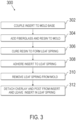
- FIG. 3 is a flowchart illustrating a process 300 for creating a leaf spring.
- an insert e.g., the insert of FIG. 2A and FIG. 2B
- the insert includes a substrate, a hole (preferably more than one hole) in the substrate, a post that extends from the substrate and covers the hole, and a thin overlay that covers the hole on an opposite end of the hole.
- the hole is encapsulated and is not open to space outside the insert.
- the posts allow the insert to be coupled to the mold.
- the insert is adhered to the leaf spring.
- the curing process may adhere the insert to the leaf spring, or a plasma treating process may be used to adhere the insert the leaf spring.
- the leaf spring is removed from the mold.
- the thin overlay and the post(s) are detached from the insert.
- the final leaf spring still includes the insert without the overlay and the post(s), and the holes are exposed to the outside.
- detaching the overlay and post(s) at 312 may be performed before or simultaneously to the leaf spring being removed from the mold at 110.
- detaching the overlay and post(s) at 312 may be performed before adhering the insert to the leaf spring at 308.
- the resulting leaf spring is similar to die leaf spring of FIG. 1 .
- the leaf spring resulting from this process includes the insert, which provides for holes to be placed in a leaf spring at areas of high stress.
- the holes may produce a weak point at areas of high stress which may cause the leaf spring to fail.
- the novel insert reduces failure in leaf springs.
- the insert there is no need to cut the fibers of the leaf spring to make a hole within the leaf spring, because cutting the fibers can weaken the leaf spring at the point where the fibers are cut/removed.
- the fibers are constant, so the properties of the leaf spring may be maintained.
- each block in the flowchart or block diagrams may represent a module, segment, or portion of code, which comprises one or more executable instructions for implementing the specified logical function(s).
- the functions noted in the block may occur out of the order noted in the figures. For example, two blocks shown in succession may, in fact, be executed substantially concurrently, or the blocks may sometimes be executed in the reverse order, depending upon the functionality involved.
- each block of the block diagrams and/or flowchart illustration, and combinations of blocks in the block diagrams and/or flowchart illustration can be implemented by special purpose hardware-based systems that perform the specified functions or acts, or combinations of special purpose hardware and computer instructions.
Landscapes
- Engineering & Computer Science (AREA)
- General Engineering & Computer Science (AREA)
- Mechanical Engineering (AREA)
- Chemical & Material Sciences (AREA)
- Composite Materials (AREA)
- Springs (AREA)
- Vehicle Body Suspensions (AREA)
Description
- This application relates to
U.S. Provisional Application No. 62/793,432, filed January 17, 2019 - Various aspects of the present invention relate generally to leaf springs and more specifically to fiberglass leaf springs used in automotive applications.
- A leaf spring is a suspension device used in heavy commercial vehicles such as vans, trucks, and rail cars. To provide suspension, the leaf spring spreads a load widely over the vehicle's frame. In contrast, a coil spring transfers the load to a single point on the frame. The leaf spring is basically a slightly arced band that bends (e.g., straightens out) to provide a cushioning effect. Known leaf springs for vehicles are described in
US2014284856A1 ,JP2002122169A GB2125514A DE10 2016 223 323 ,DE20 2016 103 285U orDE10 2016 106 381 . - According to aspects of the present disclosure, an insert to a mold for a leaf spring comprises a substrate and a hole that extends through the substrate. A post protrudes from the substrate such that the insert may be coupled to the mold. Further, the post covers the hole on a first end, so the hole is not exposed. On the other end of the hole, a thin overlay that covers the hole. Thus, during a process where resin is added to the mold, no resin enters the hole. The insert, when added to a leaf spring, offers reinforcement on areas where there is high stress. Therefore, holes may be added to a leaf spring at areas of high stress without overly weakening the leaf spring.
- According to further aspects of the present disclosure, a process for creating a leaf spring comprises coupling the insert to the mold via the posts and adding resin and fiberglass to the mold. The resin is cured, and the insert adheres to the leaf spring. The leaf spring is removed from the mold and the overlay and the post(s) are removed from the insert, which exposes the holes of the insert. Thus, the insert is integrated into the leaf spring.
-
-
FIG. 1 is a drawing of a leaf spring with an insert, according to various aspects of the present disclosure; -
FIG. 2A is a top view drawing of an insert for a leaf spring, according to various aspects of the present disclosure; -
FIG. 2B is a side view drawing of an insert for a leaf spring according to various aspects of the present disclosure; and -
FIG. 3 is a flow chart illustrating a process for creating a fiberglass leaf spring using an insert, according to various aspects of the present disclosure. - A leaf spring with an insert made from a material other than fiberglass is disclosed herein. The insert is placed in an area of high stress to allow holes to be put in the leaf spring at the area of high stress. During manufacturing of the leaf spring, the insert is coupled to a mold. After resin and fiberglass are added to the mold and cured, portions of the insert are removed, while a majority of the insert is left as part of the leaf spring. The insert includes holes sized for a coupler that allows the spring to be coupled to a suspension of a vehicle. When stresses act upon the leaf spring, the coupler through the holes wears less on the insert than the coupler would through holes directly in the fiberglass. Therefore, the insert offers reinforcement to areas of high stress in a leaf spring.
- Turning now to the figures, and in particular
FIG. 1 . aleaf spring 100 includes afirst end 102 and asecond end 104. Further, theleaf spring 100 includes aninsert 106 embedded in theleaf spring 100. As shown, the insert includes twoholes holes - As shown in
FIG. 1 , theinsert 106 includes twotapered portions point tapering insert 106 to help adhesion of theinsert 106 to the fiberglass. Further, as shown inFIG. 1 , the insert includesrounded portions insert 106 to thetapered portions - The
insert 106 can be made using additive manufacturing, where theinsert 106 is made out of a material other than fiberglass. As the vehicle travels, stress is applied to the leaf spring and possibly to the insert by the vehicle, the coupler to the vehicle, or both. Thus, the insert preferably is made from a material that will not be damaged by high stresses from vehicle usage working upon the leaf spring. - The insert offers reinforcement to areas of high stress (e.g., a point where the leaf spring flexes, a point where the leaf spring couples to the vehicle, etc.) in a leaf spring.
-
FIG. 2A and FIG. 2B illustrate respectively, a top view and a side view of theinsert 206 before theinsert 206 is coupled to a mold for creating the leaf spring (100) ofFIG. 1 . Theinsert 206 includes theholes 208. 210; thetapered portions points rounded transitions 220, 222 as described inFIG. 1 . Further, theinsert 206 includesposts holes 208, 210. Theseposts holes 208, 210 on the other side of theinsert 206. Therefore, the post covers the hole on a first end, so the hole is not exposed. - Before and while the
insert 206 is coupled to the mold, theholes 208, 210 are enclosed in plastic. Thus, when resin is added to the mold for curing, no resin will enter theholes 208, 210. When the resin has cured, thethin overlay 228 and theposts holes 208, 210. -
FIG. 3 is a flowchart illustrating aprocess 300 for creating a leaf spring. At 302, an insert (e.g., the insert ofFIG. 2A and FIG. 2B ), is coupled to a mold of a leaf spring. The insert includes a substrate, a hole (preferably more than one hole) in the substrate, a post that extends from the substrate and covers the hole, and a thin overlay that covers the hole on an opposite end of the hole. Thus, the hole is encapsulated and is not open to space outside the insert. The posts allow the insert to be coupled to the mold. - Once the insert is coupled to the mold, at 304, resin and fiberglass is added to the mold to shape a leaf spring. Because the holes are sealed off from the outside by the posts and the overlay, the resin will not enter the holes. At 306, the resin and fiberglass mixture is cured to form the leaf spring.
- At 308, the insert is adhered to the leaf spring. For example, the curing process may adhere the insert to the leaf spring, or a plasma treating process may be used to adhere the insert the leaf spring.
- At 310, the leaf spring is removed from the mold.
- At 312, the thin overlay and the post(s) are detached from the insert. This, the final leaf spring still includes the insert without the overlay and the post(s), and the holes are exposed to the outside.
- The steps of the process may be performed in any order that makes sense. For example, detaching the overlay and post(s) at 312 may be performed before or simultaneously to the leaf spring being removed from the mold at 110. As another example, detaching the overlay and post(s) at 312 may be performed before adhering the insert to the leaf spring at 308.
- The resulting leaf spring is similar to die leaf spring of
FIG. 1 . As disclosed above, the leaf spring resulting from this process includes the insert, which provides for holes to be placed in a leaf spring at areas of high stress. In leaf springs that do not include this novel insert, the holes may produce a weak point at areas of high stress which may cause the leaf spring to fail. The novel insert reduces failure in leaf springs. - Further, by using the insert, there is no need to cut the fibers of the leaf spring to make a hole within the leaf spring, because cutting the fibers can weaken the leaf spring at the point where the fibers are cut/removed. By using the insert, the fibers are constant, so the properties of the leaf spring may be maintained.
- The flowchart and block diagrams in the Figures illustrate the architecture, functionality, and operation of possible implementations of systems, methods and computer program products according to various embodiments of the present disclosure.
- In this regard, each block in the flowchart or block diagrams may represent a module, segment, or portion of code, which comprises one or more executable instructions for implementing the specified logical function(s). It should also be noted that, in some alternative implementations, the functions noted in the block may occur out of the order noted in the figures. For example, two blocks shown in succession may, in fact, be executed substantially concurrently, or the blocks may sometimes be executed in the reverse order, depending upon the functionality involved. It will also be noted that each block of the block diagrams and/or flowchart illustration, and combinations of blocks in the block diagrams and/or flowchart illustration, can be implemented by special purpose hardware-based systems that perform the specified functions or acts, or combinations of special purpose hardware and computer instructions.
Claims (12)
- A process (300) for creating a leaf spring (100), the process (300) comprising:coupling an insert (106; 206) into a mold base, wherein the insert (106; 206) comprises: a substrate;a hole (108, 110; 208, 210) within the substrate, wherein the hole (108, 110; 208, 210) extends through the substrate;a post (224, 226) that protrudes from the substrate such that the insert (106; 206) may be coupled to the mold, wherein the post (224, 226) covers the hole (108, 110; 208, 210) on a first end (102), so the hole is not exposed;a thin overlay (228) that covers the hole (108, 110; 208, 210) on a second end (104) opposite of the first end (102);adding fiberglass and resin to the mold;curing the resin to form a leaf spring (100);adhering the insert (106; 206) to the leaf spring (100);removing the leaf spring (100) from the mold; anddetaching the thin overlay (228) and the post (224, 226) from the insert (106; 206), while leaving the insert (106; 206) in the leaf spring (100).
- The process (300) of claim 1, wherein the insert (106; 206) tapers at opposite ends.
- The process (300) of claim 2, wherein the insert (106; 206) tapers to a point (116, 118) at both of the opposite ends.
- The process (300) of claim 1, wherein the insert (106; 206) includes rounded edges (120, 122); 220, 222) between opposite ends.
- The process (300) of claim 1, wherein the insert (106; 206) includes a second hole (108, 110; 208, 210) in the substrate.
- The process (300) of claim 5, wherein the insert (106; 206) includes a third hole (108, 110; 208, 210) in the substrate.
- An insert (106; 206) to a mold for a leaf spring (100), wherein the insert (106; 206) becomes part of the leaf spring (100), wherein the insert (106; 206) comprises:a substrate;a hole (108, 110; 208, 210) within the substrate, wherein the hole (108, 110; 208, 210) extends through the substrate;wherein the insert further comprises: a post (224, 226) that protrudes from the substrate such that the insert (106; 206) may be coupled to the mold, wherein the post (224, 226) covers the hole (108, 110; 208, 210) on a first end (102), so the hole is not exposed; anda thin overlay (228) that covers the hole (108, 110; 208, 210) on a second end (104) opposite of the first end (102).
- The insert (106; 206) of claim 7, wherein the insert (106; 206) tapers at opposite ends.
- The insert (106; 206) of claim 8, wherein the insert (106; 206) tapers to a point (116, 118) at both of the opposite ends.
- The insert (106; 206) of claim 7 further including rounded edges (120, 122; 220, 222) between opposite ends.
- The insert (106; 206) of claim 7 further including a second hole (108, 110; 208, 210) in the substrate.
- The insert (106; 206) of claim 11 further including a third hole (108, 110; 208, 210) in the substrate.
Applications Claiming Priority (2)
| Application Number | Priority Date | Filing Date | Title |
|---|---|---|---|
| US201962793432P | 2019-01-17 | 2019-01-17 | |
| PCT/US2020/014150 WO2020150640A1 (en) | 2019-01-17 | 2020-01-17 | Process for manufacturing a leaf spring and insert for leaf spring |
Publications (2)
| Publication Number | Publication Date |
|---|---|
| EP3911491A1 EP3911491A1 (en) | 2021-11-24 |
| EP3911491B1 true EP3911491B1 (en) | 2023-04-26 |
Family
ID=69593793
Family Applications (1)
| Application Number | Title | Priority Date | Filing Date |
|---|---|---|---|
| EP20705853.8A Active EP3911491B1 (en) | 2019-01-17 | 2020-01-17 | Process for manufacturing a leaf spring and insert for leaf spring |
Country Status (7)
| Country | Link |
|---|---|
| US (1) | US12163565B2 (en) |
| EP (1) | EP3911491B1 (en) |
| CN (1) | CN113316507B (en) |
| AU (1) | AU2020209954B2 (en) |
| CA (1) | CA3126701A1 (en) |
| MX (1) | MX2021008515A (en) |
| WO (1) | WO2020150640A1 (en) |
Family Cites Families (15)
| Publication number | Priority date | Publication date | Assignee | Title |
|---|---|---|---|---|
| US2557610A (en) * | 1947-05-24 | 1951-06-19 | Ohio Rubber Co | Resilient mounting |
| US4198037A (en) * | 1976-12-28 | 1980-04-15 | Miner Enterprises, Inc. | Method of making polyester elastomer compression spring and resulting product |
| JPS58118341A (en) * | 1981-12-28 | 1983-07-14 | Hino Motors Ltd | Leaf spring made of fiber reinforced resin |
| US4519591A (en) | 1982-08-20 | 1985-05-28 | Bush John W | Non-metallic leaf spring structure |
| JPS61119826A (en) * | 1984-11-14 | 1986-06-07 | Nhk Spring Co Ltd | Frp plate spring device |
| FR2587649B1 (en) * | 1985-09-20 | 1988-05-27 | Renault | PROCESS FOR PRODUCING ORIENTED FIBER COMPOSITE MATERIAL PRODUCTS, PARTICULARLY SPRING BLADES, PARTICULARLY FOR MOTOR VEHICLES AND PRODUCTS THEREOF |
| JPH04362330A (en) * | 1991-06-05 | 1992-12-15 | Nhk Spring Co Ltd | Frp-made plate spring |
| US6361032B1 (en) | 2000-06-30 | 2002-03-26 | Visteon Global Technologies, Inc. | Composite leaf spring with improved lateral stiffness |
| US6530587B2 (en) | 2000-06-30 | 2003-03-11 | Visteon Global Technologies, Inc. | Wheel suspension system having an integrated link, spring, and anti-roll bar |
| CN102667219A (en) * | 2009-10-26 | 2012-09-12 | 雷诺索尔公司 | Composite leaf spring |
| US20140284856A1 (en) * | 2013-03-15 | 2014-09-25 | Gordon Holdings, Inc. | Light weight composite leaf spring and method of making |
| DE102014107584A1 (en) * | 2014-05-28 | 2015-12-03 | Benteler Sgl Gmbh & Co. Kg | Apparatus and method for the production of fiber composite components and fiber composite component |
| ES2928017T3 (en) * | 2016-06-14 | 2022-11-15 | Nordex Blade Tech Centre Aps | A connection structure of a wind turbine blade and method for its manufacture |
| DE102019132875A1 (en) * | 2018-12-26 | 2020-07-02 | Hyundai Motor Company | COMPOSITE MATERIAL SOCKET |
| DE102019203761A1 (en) * | 2019-03-20 | 2020-09-24 | Ford Global Technologies, Llc | Leaf spring assembly, vehicle and method of making a leaf spring assembly |
-
2020
- 2020-01-17 AU AU2020209954A patent/AU2020209954B2/en active Active
- 2020-01-17 WO PCT/US2020/014150 patent/WO2020150640A1/en not_active Ceased
- 2020-01-17 CA CA3126701A patent/CA3126701A1/en active Pending
- 2020-01-17 US US17/424,112 patent/US12163565B2/en active Active
- 2020-01-17 CN CN202080009890.6A patent/CN113316507B/en active Active
- 2020-01-17 EP EP20705853.8A patent/EP3911491B1/en active Active
- 2020-01-17 MX MX2021008515A patent/MX2021008515A/en unknown
Also Published As
| Publication number | Publication date |
|---|---|
| US12163565B2 (en) | 2024-12-10 |
| CN113316507B (en) | 2024-05-28 |
| CN113316507A (en) | 2021-08-27 |
| AU2020209954B2 (en) | 2025-12-18 |
| WO2020150640A1 (en) | 2020-07-23 |
| AU2020209954A1 (en) | 2021-08-12 |
| US20220065319A1 (en) | 2022-03-03 |
| MX2021008515A (en) | 2021-08-19 |
| CA3126701A1 (en) | 2020-07-23 |
| EP3911491A1 (en) | 2021-11-24 |
Similar Documents
| Publication | Publication Date | Title |
|---|---|---|
| CN102753368B (en) | For the manufacture method of airtyred electronic machine | |
| US10596870B2 (en) | Vehicular arm component manufacturing method and vehicular arm component | |
| US11203236B2 (en) | Tire sensor fixed in screwing manner and tire having the same | |
| US9278578B2 (en) | Adhesive-type wheel balance weight for vehicle and manufacturing method thereof | |
| EP3911491B1 (en) | Process for manufacturing a leaf spring and insert for leaf spring | |
| US20200198448A1 (en) | Bodywork part comprising a lock loop | |
| US8992209B2 (en) | Metal mold for injection molding of framed glass and manufacturing method for framed glass | |
| CA3122901C (en) | Leaf spring, manufacturing process and mould of that leaf spring | |
| DE102015203914A1 (en) | Elastomeric article | |
| DE102015222700A1 (en) | Elastomeric bearing and process for its production | |
| WO2006131179A1 (en) | Vehicle tyre | |
| EP1431091A4 (en) | Window glass for automobile and method for production thereof | |
| DE102005027998A1 (en) | Electronic module for transmission of information about condition of tire, comprises holding device with dove-tailed joint | |
| JPH11108094A (en) | Manufacture of vibration control device | |
| CN212964467U (en) | Akron abrasion sample | |
| JPH11210818A (en) | Dynamic damper | |
| CN111372746B (en) | Fixing element for fixing two plastic parts of a motor vehicle | |
| JP2002178723A (en) | Tire and wheel assembly and its rim assembling method | |
| US20240367374A1 (en) | Hybrid manufacturing method comprising an additive manufacturing step and a product resulting from such a method | |
| KR20250074376A (en) | A pneumatic tire and manufacturing method of it | |
| JP2006032126A (en) | Grommet | |
| KR970042902A (en) | Introduced solution of vulcanization system and tire manufacturing method using the same | |
| DE102017215272A1 (en) | Wishbone of fiber-reinforced plastic for the suspension of a motor vehicle | |
| WO2003043844A3 (en) | Method for making a ready-to-bond element and mounting method | |
| WO2006005709A8 (en) | Reinforced connecting element which is disposed between a longitudinal axle arm and an anti-roll bar, and corresponding axle, vehicle and production method |
Legal Events
| Date | Code | Title | Description |
|---|---|---|---|
| STAA | Information on the status of an ep patent application or granted ep patent |
Free format text: STATUS: UNKNOWN |
|
| STAA | Information on the status of an ep patent application or granted ep patent |
Free format text: STATUS: THE INTERNATIONAL PUBLICATION HAS BEEN MADE |
|
| PUAI | Public reference made under article 153(3) epc to a published international application that has entered the european phase |
Free format text: ORIGINAL CODE: 0009012 |
|
| STAA | Information on the status of an ep patent application or granted ep patent |
Free format text: STATUS: REQUEST FOR EXAMINATION WAS MADE |
|
| 17P | Request for examination filed |
Effective date: 20210728 |
|
| AK | Designated contracting states |
Kind code of ref document: A1 Designated state(s): AL AT BE BG CH CY CZ DE DK EE ES FI FR GB GR HR HU IE IS IT LI LT LU LV MC MK MT NL NO PL PT RO RS SE SI SK SM TR |
|
| DAV | Request for validation of the european patent (deleted) | ||
| DAX | Request for extension of the european patent (deleted) | ||
| GRAP | Despatch of communication of intention to grant a patent |
Free format text: ORIGINAL CODE: EPIDOSNIGR1 |
|
| STAA | Information on the status of an ep patent application or granted ep patent |
Free format text: STATUS: GRANT OF PATENT IS INTENDED |
|
| INTG | Intention to grant announced |
Effective date: 20220603 |
|
| GRAJ | Information related to disapproval of communication of intention to grant by the applicant or resumption of examination proceedings by the epo deleted |
Free format text: ORIGINAL CODE: EPIDOSDIGR1 |
|
| STAA | Information on the status of an ep patent application or granted ep patent |
Free format text: STATUS: REQUEST FOR EXAMINATION WAS MADE |
|
| GRAP | Despatch of communication of intention to grant a patent |
Free format text: ORIGINAL CODE: EPIDOSNIGR1 |
|
| STAA | Information on the status of an ep patent application or granted ep patent |
Free format text: STATUS: GRANT OF PATENT IS INTENDED |
|
| INTC | Intention to grant announced (deleted) | ||
| INTG | Intention to grant announced |
Effective date: 20221107 |
|
| GRAS | Grant fee paid |
Free format text: ORIGINAL CODE: EPIDOSNIGR3 |
|
| GRAA | (expected) grant |
Free format text: ORIGINAL CODE: 0009210 |
|
| STAA | Information on the status of an ep patent application or granted ep patent |
Free format text: STATUS: THE PATENT HAS BEEN GRANTED |
|
| AK | Designated contracting states |
Kind code of ref document: B1 Designated state(s): AL AT BE BG CH CY CZ DE DK EE ES FI FR GB GR HR HU IE IS IT LI LT LU LV MC MK MT NL NO PL PT RO RS SE SI SK SM TR |
|
| REG | Reference to a national code |
Ref country code: GB Ref legal event code: FG4D |
|
| REG | Reference to a national code |
Ref country code: CH Ref legal event code: EP |
|
| REG | Reference to a national code |
Ref country code: DE Ref legal event code: R096 Ref document number: 602020010106 Country of ref document: DE |
|
| REG | Reference to a national code |
Ref country code: AT Ref legal event code: REF Ref document number: 1562518 Country of ref document: AT Kind code of ref document: T Effective date: 20230515 |
|
| REG | Reference to a national code |
Ref country code: IE Ref legal event code: FG4D |
|
| REG | Reference to a national code |
Ref country code: SE Ref legal event code: TRGR |
|
| REG | Reference to a national code |
Ref country code: NL Ref legal event code: FP |
|
| REG | Reference to a national code |
Ref country code: LT Ref legal event code: MG9D |
|
| REG | Reference to a national code |
Ref country code: AT Ref legal event code: MK05 Ref document number: 1562518 Country of ref document: AT Kind code of ref document: T Effective date: 20230426 |
|
| PG25 | Lapsed in a contracting state [announced via postgrant information from national office to epo] |
Ref country code: PT Free format text: LAPSE BECAUSE OF FAILURE TO SUBMIT A TRANSLATION OF THE DESCRIPTION OR TO PAY THE FEE WITHIN THE PRESCRIBED TIME-LIMIT Effective date: 20230828 Ref country code: NO Free format text: LAPSE BECAUSE OF FAILURE TO SUBMIT A TRANSLATION OF THE DESCRIPTION OR TO PAY THE FEE WITHIN THE PRESCRIBED TIME-LIMIT Effective date: 20230726 Ref country code: ES Free format text: LAPSE BECAUSE OF FAILURE TO SUBMIT A TRANSLATION OF THE DESCRIPTION OR TO PAY THE FEE WITHIN THE PRESCRIBED TIME-LIMIT Effective date: 20230426 Ref country code: AT Free format text: LAPSE BECAUSE OF FAILURE TO SUBMIT A TRANSLATION OF THE DESCRIPTION OR TO PAY THE FEE WITHIN THE PRESCRIBED TIME-LIMIT Effective date: 20230426 |
|
| PG25 | Lapsed in a contracting state [announced via postgrant information from national office to epo] |
Ref country code: RS Free format text: LAPSE BECAUSE OF FAILURE TO SUBMIT A TRANSLATION OF THE DESCRIPTION OR TO PAY THE FEE WITHIN THE PRESCRIBED TIME-LIMIT Effective date: 20230426 Ref country code: PL Free format text: LAPSE BECAUSE OF FAILURE TO SUBMIT A TRANSLATION OF THE DESCRIPTION OR TO PAY THE FEE WITHIN THE PRESCRIBED TIME-LIMIT Effective date: 20230426 Ref country code: LV Free format text: LAPSE BECAUSE OF FAILURE TO SUBMIT A TRANSLATION OF THE DESCRIPTION OR TO PAY THE FEE WITHIN THE PRESCRIBED TIME-LIMIT Effective date: 20230426 Ref country code: LT Free format text: LAPSE BECAUSE OF FAILURE TO SUBMIT A TRANSLATION OF THE DESCRIPTION OR TO PAY THE FEE WITHIN THE PRESCRIBED TIME-LIMIT Effective date: 20230426 Ref country code: IS Free format text: LAPSE BECAUSE OF FAILURE TO SUBMIT A TRANSLATION OF THE DESCRIPTION OR TO PAY THE FEE WITHIN THE PRESCRIBED TIME-LIMIT Effective date: 20230826 Ref country code: HR Free format text: LAPSE BECAUSE OF FAILURE TO SUBMIT A TRANSLATION OF THE DESCRIPTION OR TO PAY THE FEE WITHIN THE PRESCRIBED TIME-LIMIT Effective date: 20230426 Ref country code: GR Free format text: LAPSE BECAUSE OF FAILURE TO SUBMIT A TRANSLATION OF THE DESCRIPTION OR TO PAY THE FEE WITHIN THE PRESCRIBED TIME-LIMIT Effective date: 20230727 |
|
| PG25 | Lapsed in a contracting state [announced via postgrant information from national office to epo] |
Ref country code: FI Free format text: LAPSE BECAUSE OF FAILURE TO SUBMIT A TRANSLATION OF THE DESCRIPTION OR TO PAY THE FEE WITHIN THE PRESCRIBED TIME-LIMIT Effective date: 20230426 |
|
| PG25 | Lapsed in a contracting state [announced via postgrant information from national office to epo] |
Ref country code: SK Free format text: LAPSE BECAUSE OF FAILURE TO SUBMIT A TRANSLATION OF THE DESCRIPTION OR TO PAY THE FEE WITHIN THE PRESCRIBED TIME-LIMIT Effective date: 20230426 |
|
| REG | Reference to a national code |
Ref country code: DE Ref legal event code: R097 Ref document number: 602020010106 Country of ref document: DE |
|
| PG25 | Lapsed in a contracting state [announced via postgrant information from national office to epo] |
Ref country code: SM Free format text: LAPSE BECAUSE OF FAILURE TO SUBMIT A TRANSLATION OF THE DESCRIPTION OR TO PAY THE FEE WITHIN THE PRESCRIBED TIME-LIMIT Effective date: 20230426 Ref country code: SK Free format text: LAPSE BECAUSE OF FAILURE TO SUBMIT A TRANSLATION OF THE DESCRIPTION OR TO PAY THE FEE WITHIN THE PRESCRIBED TIME-LIMIT Effective date: 20230426 Ref country code: RO Free format text: LAPSE BECAUSE OF FAILURE TO SUBMIT A TRANSLATION OF THE DESCRIPTION OR TO PAY THE FEE WITHIN THE PRESCRIBED TIME-LIMIT Effective date: 20230426 Ref country code: EE Free format text: LAPSE BECAUSE OF FAILURE TO SUBMIT A TRANSLATION OF THE DESCRIPTION OR TO PAY THE FEE WITHIN THE PRESCRIBED TIME-LIMIT Effective date: 20230426 Ref country code: DK Free format text: LAPSE BECAUSE OF FAILURE TO SUBMIT A TRANSLATION OF THE DESCRIPTION OR TO PAY THE FEE WITHIN THE PRESCRIBED TIME-LIMIT Effective date: 20230426 Ref country code: CZ Free format text: LAPSE BECAUSE OF FAILURE TO SUBMIT A TRANSLATION OF THE DESCRIPTION OR TO PAY THE FEE WITHIN THE PRESCRIBED TIME-LIMIT Effective date: 20230426 |
|
| PLBE | No opposition filed within time limit |
Free format text: ORIGINAL CODE: 0009261 |
|
| STAA | Information on the status of an ep patent application or granted ep patent |
Free format text: STATUS: NO OPPOSITION FILED WITHIN TIME LIMIT |
|
| 26N | No opposition filed |
Effective date: 20240129 |
|
| PG25 | Lapsed in a contracting state [announced via postgrant information from national office to epo] |
Ref country code: SI Free format text: LAPSE BECAUSE OF FAILURE TO SUBMIT A TRANSLATION OF THE DESCRIPTION OR TO PAY THE FEE WITHIN THE PRESCRIBED TIME-LIMIT Effective date: 20230426 |
|
| PG25 | Lapsed in a contracting state [announced via postgrant information from national office to epo] |
Ref country code: SI Free format text: LAPSE BECAUSE OF FAILURE TO SUBMIT A TRANSLATION OF THE DESCRIPTION OR TO PAY THE FEE WITHIN THE PRESCRIBED TIME-LIMIT Effective date: 20230426 |
|
| PG25 | Lapsed in a contracting state [announced via postgrant information from national office to epo] |
Ref country code: MC Free format text: LAPSE BECAUSE OF FAILURE TO SUBMIT A TRANSLATION OF THE DESCRIPTION OR TO PAY THE FEE WITHIN THE PRESCRIBED TIME-LIMIT Effective date: 20230426 |
|
| PG25 | Lapsed in a contracting state [announced via postgrant information from national office to epo] |
Ref country code: MC Free format text: LAPSE BECAUSE OF FAILURE TO SUBMIT A TRANSLATION OF THE DESCRIPTION OR TO PAY THE FEE WITHIN THE PRESCRIBED TIME-LIMIT Effective date: 20230426 |
|
| REG | Reference to a national code |
Ref country code: CH Ref legal event code: PL |
|
| PG25 | Lapsed in a contracting state [announced via postgrant information from national office to epo] |
Ref country code: LU Free format text: LAPSE BECAUSE OF NON-PAYMENT OF DUE FEES Effective date: 20240117 |
|
| PG25 | Lapsed in a contracting state [announced via postgrant information from national office to epo] |
Ref country code: LU Free format text: LAPSE BECAUSE OF NON-PAYMENT OF DUE FEES Effective date: 20240117 |
|
| PG25 | Lapsed in a contracting state [announced via postgrant information from national office to epo] |
Ref country code: BE Free format text: LAPSE BECAUSE OF NON-PAYMENT OF DUE FEES Effective date: 20240131 |
|
| PG25 | Lapsed in a contracting state [announced via postgrant information from national office to epo] |
Ref country code: CH Free format text: LAPSE BECAUSE OF NON-PAYMENT OF DUE FEES Effective date: 20240131 |
|
| PG25 | Lapsed in a contracting state [announced via postgrant information from national office to epo] |
Ref country code: CH Free format text: LAPSE BECAUSE OF NON-PAYMENT OF DUE FEES Effective date: 20240131 Ref country code: BE Free format text: LAPSE BECAUSE OF NON-PAYMENT OF DUE FEES Effective date: 20240131 |
|
| REG | Reference to a national code |
Ref country code: BE Ref legal event code: MM Effective date: 20240131 |
|
| PG25 | Lapsed in a contracting state [announced via postgrant information from national office to epo] |
Ref country code: BG Free format text: LAPSE BECAUSE OF FAILURE TO SUBMIT A TRANSLATION OF THE DESCRIPTION OR TO PAY THE FEE WITHIN THE PRESCRIBED TIME-LIMIT Effective date: 20230426 |
|
| PG25 | Lapsed in a contracting state [announced via postgrant information from national office to epo] |
Ref country code: BG Free format text: LAPSE BECAUSE OF FAILURE TO SUBMIT A TRANSLATION OF THE DESCRIPTION OR TO PAY THE FEE WITHIN THE PRESCRIBED TIME-LIMIT Effective date: 20230426 |
|
| PG25 | Lapsed in a contracting state [announced via postgrant information from national office to epo] |
Ref country code: IE Free format text: LAPSE BECAUSE OF NON-PAYMENT OF DUE FEES Effective date: 20240117 |
|
| PG25 | Lapsed in a contracting state [announced via postgrant information from national office to epo] |
Ref country code: IE Free format text: LAPSE BECAUSE OF NON-PAYMENT OF DUE FEES Effective date: 20240117 |
|
| PG25 | Lapsed in a contracting state [announced via postgrant information from national office to epo] |
Ref country code: CY Free format text: LAPSE BECAUSE OF FAILURE TO SUBMIT A TRANSLATION OF THE DESCRIPTION OR TO PAY THE FEE WITHIN THE PRESCRIBED TIME-LIMIT; INVALID AB INITIO Effective date: 20200117 |
|
| PG25 | Lapsed in a contracting state [announced via postgrant information from national office to epo] |
Ref country code: HU Free format text: LAPSE BECAUSE OF FAILURE TO SUBMIT A TRANSLATION OF THE DESCRIPTION OR TO PAY THE FEE WITHIN THE PRESCRIBED TIME-LIMIT; INVALID AB INITIO Effective date: 20200117 |
|
| PG25 | Lapsed in a contracting state [announced via postgrant information from national office to epo] |
Ref country code: TR Free format text: LAPSE BECAUSE OF FAILURE TO SUBMIT A TRANSLATION OF THE DESCRIPTION OR TO PAY THE FEE WITHIN THE PRESCRIBED TIME-LIMIT Effective date: 20230426 |
|
| PGFP | Annual fee paid to national office [announced via postgrant information from national office to epo] |
Ref country code: NL Payment date: 20260126 Year of fee payment: 7 |
|
| PGFP | Annual fee paid to national office [announced via postgrant information from national office to epo] |
Ref country code: SE Payment date: 20260127 Year of fee payment: 7 |
|
| PGFP | Annual fee paid to national office [announced via postgrant information from national office to epo] |
Ref country code: GB Payment date: 20260127 Year of fee payment: 7 |
|
| PGFP | Annual fee paid to national office [announced via postgrant information from national office to epo] |
Ref country code: DE Payment date: 20260128 Year of fee payment: 7 |
|
| PGFP | Annual fee paid to national office [announced via postgrant information from national office to epo] |
Ref country code: IT Payment date: 20260121 Year of fee payment: 7 |
|
| PGFP | Annual fee paid to national office [announced via postgrant information from national office to epo] |
Ref country code: FR Payment date: 20260126 Year of fee payment: 7 |