EP3910176B1 - Adaptable flow control for engine nacelles - Google Patents
Adaptable flow control for engine nacelles Download PDFInfo
- Publication number
- EP3910176B1 EP3910176B1 EP21172981.9A EP21172981A EP3910176B1 EP 3910176 B1 EP3910176 B1 EP 3910176B1 EP 21172981 A EP21172981 A EP 21172981A EP 3910176 B1 EP3910176 B1 EP 3910176B1
- Authority
- EP
- European Patent Office
- Prior art keywords
- flow
- inlet
- flow control
- array
- control devices
- Prior art date
- Legal status (The legal status is an assumption and is not a legal conclusion. Google has not performed a legal analysis and makes no representation as to the accuracy of the status listed.)
- Active
Links
Images







Classifications
-
- F—MECHANICAL ENGINEERING; LIGHTING; HEATING; WEAPONS; BLASTING
- F02—COMBUSTION ENGINES; HOT-GAS OR COMBUSTION-PRODUCT ENGINE PLANTS
- F02C—GAS-TURBINE PLANTS; AIR INTAKES FOR JET-PROPULSION PLANTS; CONTROLLING FUEL SUPPLY IN AIR-BREATHING JET-PROPULSION PLANTS
- F02C7/00—Features, components parts, details or accessories, not provided for in, or of interest apart form groups F02C1/00 - F02C6/00; Air intakes for jet-propulsion plants
- F02C7/04—Air intakes for gas-turbine plants or jet-propulsion plants
- F02C7/057—Control or regulation
-
- B—PERFORMING OPERATIONS; TRANSPORTING
- B64—AIRCRAFT; AVIATION; COSMONAUTICS
- B64D—EQUIPMENT FOR FITTING IN OR TO AIRCRAFT; FLIGHT SUITS; PARACHUTES; ARRANGEMENT OR MOUNTING OF POWER PLANTS OR PROPULSION TRANSMISSIONS IN AIRCRAFT
- B64D31/00—Power plant control systems; Arrangement of power plant control systems in aircraft
-
- B—PERFORMING OPERATIONS; TRANSPORTING
- B64—AIRCRAFT; AVIATION; COSMONAUTICS
- B64D—EQUIPMENT FOR FITTING IN OR TO AIRCRAFT; FLIGHT SUITS; PARACHUTES; ARRANGEMENT OR MOUNTING OF POWER PLANTS OR PROPULSION TRANSMISSIONS IN AIRCRAFT
- B64D33/00—Arrangement in aircraft of power plant parts or auxiliaries not otherwise provided for
- B64D33/02—Arrangement in aircraft of power plant parts or auxiliaries not otherwise provided for of combustion air intakes
-
- F—MECHANICAL ENGINEERING; LIGHTING; HEATING; WEAPONS; BLASTING
- F01—MACHINES OR ENGINES IN GENERAL; ENGINE PLANTS IN GENERAL; STEAM ENGINES
- F01D—NON-POSITIVE DISPLACEMENT MACHINES OR ENGINES, e.g. STEAM TURBINES
- F01D17/00—Regulating or controlling by varying flow
- F01D17/10—Final actuators
- F01D17/12—Final actuators arranged in stator parts
-
- F—MECHANICAL ENGINEERING; LIGHTING; HEATING; WEAPONS; BLASTING
- F02—COMBUSTION ENGINES; HOT-GAS OR COMBUSTION-PRODUCT ENGINE PLANTS
- F02C—GAS-TURBINE PLANTS; AIR INTAKES FOR JET-PROPULSION PLANTS; CONTROLLING FUEL SUPPLY IN AIR-BREATHING JET-PROPULSION PLANTS
- F02C6/00—Plural gas-turbine plants; Combinations of gas-turbine plants with other apparatus; Adaptations of gas-turbine plants for special use
- F02C6/04—Gas-turbine plants providing heated or pressurised working fluid for other apparatus, e.g. without mechanical power output
- F02C6/06—Gas-turbine plants providing heated or pressurised working fluid for other apparatus, e.g. without mechanical power output providing compressed gas
- F02C6/08—Gas-turbine plants providing heated or pressurised working fluid for other apparatus, e.g. without mechanical power output providing compressed gas the gas being bled from the gas-turbine compressor
-
- F—MECHANICAL ENGINEERING; LIGHTING; HEATING; WEAPONS; BLASTING
- F02—COMBUSTION ENGINES; HOT-GAS OR COMBUSTION-PRODUCT ENGINE PLANTS
- F02C—GAS-TURBINE PLANTS; AIR INTAKES FOR JET-PROPULSION PLANTS; CONTROLLING FUEL SUPPLY IN AIR-BREATHING JET-PROPULSION PLANTS
- F02C7/00—Features, components parts, details or accessories, not provided for in, or of interest apart form groups F02C1/00 - F02C6/00; Air intakes for jet-propulsion plants
- F02C7/04—Air intakes for gas-turbine plants or jet-propulsion plants
- F02C7/042—Air intakes for gas-turbine plants or jet-propulsion plants having variable geometry
-
- B—PERFORMING OPERATIONS; TRANSPORTING
- B64—AIRCRAFT; AVIATION; COSMONAUTICS
- B64D—EQUIPMENT FOR FITTING IN OR TO AIRCRAFT; FLIGHT SUITS; PARACHUTES; ARRANGEMENT OR MOUNTING OF POWER PLANTS OR PROPULSION TRANSMISSIONS IN AIRCRAFT
- B64D33/00—Arrangement in aircraft of power plant parts or auxiliaries not otherwise provided for
- B64D33/02—Arrangement in aircraft of power plant parts or auxiliaries not otherwise provided for of combustion air intakes
- B64D2033/0226—Arrangement in aircraft of power plant parts or auxiliaries not otherwise provided for of combustion air intakes comprising boundary layer control means
-
- F—MECHANICAL ENGINEERING; LIGHTING; HEATING; WEAPONS; BLASTING
- F05—INDEXING SCHEMES RELATING TO ENGINES OR PUMPS IN VARIOUS SUBCLASSES OF CLASSES F01-F04
- F05D—INDEXING SCHEME FOR ASPECTS RELATING TO NON-POSITIVE-DISPLACEMENT MACHINES OR ENGINES, GAS-TURBINES OR JET-PROPULSION PLANTS
- F05D2210/00—Working fluids
- F05D2210/30—Flow characteristics
-
- F—MECHANICAL ENGINEERING; LIGHTING; HEATING; WEAPONS; BLASTING
- F05—INDEXING SCHEMES RELATING TO ENGINES OR PUMPS IN VARIOUS SUBCLASSES OF CLASSES F01-F04
- F05D—INDEXING SCHEME FOR ASPECTS RELATING TO NON-POSITIVE-DISPLACEMENT MACHINES OR ENGINES, GAS-TURBINES OR JET-PROPULSION PLANTS
- F05D2260/00—Function
- F05D2260/60—Fluid transfer
-
- F—MECHANICAL ENGINEERING; LIGHTING; HEATING; WEAPONS; BLASTING
- F05—INDEXING SCHEMES RELATING TO ENGINES OR PUMPS IN VARIOUS SUBCLASSES OF CLASSES F01-F04
- F05D—INDEXING SCHEME FOR ASPECTS RELATING TO NON-POSITIVE-DISPLACEMENT MACHINES OR ENGINES, GAS-TURBINES OR JET-PROPULSION PLANTS
- F05D2270/00—Control
- F05D2270/01—Purpose of the control system
- F05D2270/10—Purpose of the control system to cope with, or avoid, compressor flow instabilities
-
- F—MECHANICAL ENGINEERING; LIGHTING; HEATING; WEAPONS; BLASTING
- F05—INDEXING SCHEMES RELATING TO ENGINES OR PUMPS IN VARIOUS SUBCLASSES OF CLASSES F01-F04
- F05D—INDEXING SCHEME FOR ASPECTS RELATING TO NON-POSITIVE-DISPLACEMENT MACHINES OR ENGINES, GAS-TURBINES OR JET-PROPULSION PLANTS
- F05D2270/00—Control
- F05D2270/01—Purpose of the control system
- F05D2270/17—Purpose of the control system to control boundary layer
-
- Y—GENERAL TAGGING OF NEW TECHNOLOGICAL DEVELOPMENTS; GENERAL TAGGING OF CROSS-SECTIONAL TECHNOLOGIES SPANNING OVER SEVERAL SECTIONS OF THE IPC; TECHNICAL SUBJECTS COVERED BY FORMER USPC CROSS-REFERENCE ART COLLECTIONS [XRACs] AND DIGESTS
- Y02—TECHNOLOGIES OR APPLICATIONS FOR MITIGATION OR ADAPTATION AGAINST CLIMATE CHANGE
- Y02T—CLIMATE CHANGE MITIGATION TECHNOLOGIES RELATED TO TRANSPORTATION
- Y02T50/00—Aeronautics or air transport
- Y02T50/10—Drag reduction
Definitions
- This disclosure relates generally to the field of aircraft fan j et propulsion employing inlets with a low ratio of inlet length to engine fan diameter (L/D) and, more particularly, to an inlet flow control system employing arrays of flow control devices on internal surfaces of a fan inlet for mitigating flow distortion in the inlet in low speed operations due to crosswind, high angle-of-attack, and ground vortices.
- L/D inlet length to engine fan diameter
- L/D inlet length to engine fan diameter
- Greater than 0.5 LID is typical for current engines to maintain desired flow profiles at the fan face in crosswinds and other flight conditions.
- Future inlets are expected to employ an L/D lower than 0.5.
- a lower limit on L/D appears to exist with current inlet design capabilities based on inlet lengths required to mitigate flow distortion in the inlet in low-speed takeoff and landing conditions.
- an L/D smaller than the current lower limit would aerodynamically improve all other segments of the mission (97% of the mission profile for a 1 hour commercial flight profile). This aerodynamic performance improvement due to a lower L/D reduces the fuel consumption by the aircraft.
- EP2843244 describes, according to its abstract, an apparatus for suppressing shock-induced separation of high speed airflow from a relatively low-energy boundary layer.
- the apparatus may include an actuator or array of actuators configured to alternately inhale and exhale fluid and positioned to alternately inhale fluid from and exhale fluid into a boundary layer of a fluid mass flowing along the wall.
- the actuator may be positioned to inhale fluid from a boundary layer separation bubble induced by a supersonic shock wave propagated in the fluid mass.
- WO0106134 describes, according to its abstract, a system and method for actively manipulating and controlling aerodynamic or hydrodynamic fluid flow over a surface. More specifically, the present invention provides a system and method to control aerodynamic or hydrodynamic fluid flow behavior of a ducted fluid flow using very-small-scale effectors.
- the system and method for actively manipulating and controlling fluid flow over a surface includes the placement of arrays of very-small-scale effectors on ducted surfaces bounding the ducted fluid flow. These very-small-scale effectors actively manipulate the boundary layer to control the flow behavior of the ducted fluid flow and suppress or prevent flow separation within the primary fluid flow.
- the implementations described herein provide one or more azimuthal-radial arrays of flow control devices integrated into the internal surface of an inlet.
- the total azimuthal-radial coverage of the flow control array is determined based on the flow separation domain over the full flight envelope and subsets or controlled configuration of the arrays can be activated at particular realized flow states.
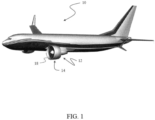
- FIG. 1 depicts a large commercial aircraft 10 employing high bypass ratio turbofan engines 12 having ultra-short nacelles 14 in which implementations as described herein are employed. While the implementations described herein relate to commercial aircraft, the disclosure is applicable to any low L/D application or other inlet having asymmetrical flow distortion-.
- a plurality of flow control devices 16 are integrated into an internal surface 18 of an inlet 20 of the ultra-short nacelle 14 forming one or more arrays (as will be described in greater detail subsequently) extending axially aft from a highlight 21 (or lip) of the inlet.
- the inlet 20 has a normal flow axis 15.
- flow control devices may comprise pneumatic jets, fluidic oscillators, steady jets, unsteady pulsing jets, non-pneumatic-based flow control systems and zero-net-mass-flux devices such as electronic synthetic jets or a combination of the identified systems.
- arrays of deployable vortex generators, or other mechanical devices may replace the orifices for fluidic jets.
- the devices can be stowed, flush with the internal surface of the inlet, and then be deployed in patterns within the array to achieve the desired flow pattern.
- Such mechanical devices can also be deployed and stowed periodically at varying frequency.
- a control system (to be described in greater detail subsequently) operably connected to the flow control devices 16 is adapted to activate or modulate the flow control devices in selected subarrays responsive to the inlet flow state indicated by a predetermined flight condition or measured flow parameters within the inlet 20.
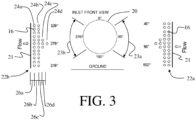
- FIG. 3 shows, in a flat layout presentation, right and left flow control device arrays 22a, 22b located on the internal surface 18 of the inlet 20.
- Right array 22a extends over an azimuthal range 23a determined based on an example flow separation domain for a right cross wind (defined herein relative to the drawings as flowing from right to left), between 40° and 150° relative to the normal flow axis 15 for the example implementation, while the left array 22b extends over a second azimuthal range 23b determined based on a flow separation domain for a left cross wind (defined herein relative to the drawings as flowing from left to right), between 320° and 210° for the example implementation.
- Each array 22a, 22b employs a plurality of circumferential rows 24a, 24b, 24c, 24d spaced at increasing first, second, third and fourth axial distances 26a, 26b, 26c, 26d from the highlight 21 of the inlet. Describing left array 22b, circumferential rows 24a and 24b have a first arrangement of flow control devices extending over the full azimuthal range of the array. Row 24c has a reduced azimuthal range centered at 270° and extending between 260° and 280°, while row 24d has a further reduced azimuthal range (a single jet at 270° in the example shown). For the example implementation, each row has a flow control device 16 at each 10° of azimuth within the range.
- the maps shows very little distortion in the flow into the inlet with 0 kt of crosswind.
- IDC inlet distortion coefficient
- FIG. 5 provides a plot of IDC max for the 0 kt condition, trace 502, and the 30 kt condition, trace 504, for a baseline condition with no activation of the flow control devices 16 in the described implementation.
- activation of flow control devices 16 in subarrays within left array 22b is accomplished to mitigate the flow distortion created by a left crosswind component as described with respect to FIG. 4 and FIG. 5 .
- activation of a first subarray 28a seen in FIG. 6A results in modification of IDC max over the entire mass flow range as shown in FIG. 7A as trace 701.
- activation of a second subarray 28b shown in FIG. 6B results in modification of IDC max as shown in FIG. 7B as trace 702
- activation of the third subarray 28c shown in FIG. 6C results in modification of IDC max as shown in FIG. 7C as trace 703.
- switching between the activated subarrays is accomplished depending on the mass flow range; the first subarray 28a is activated at mass flow rates between 0 and 0.48, the second subarray 28b is activated at mass flow rates between 0.48 and 0.82, and the third subarray 28c is activated a mass flow rates between 0.82 and 1. This results in modification of IDC max as shown in FIG.
- trace segment 801 relates to IDC max modification over the flow range of 0 to 0.48 with first subarray 28a activated
- trace segment 802 relates to IDC max modification over the flow range of 0.48 to 0.82 with second subarray 28b activated
- trace segment 803 relates to IDC max modification over the flow range of 0.82 to 1.0 with third subarray 28c activated.
- the overall reduction in IDC max over the entire flow range is optimized.
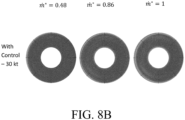
- the resulting reduction in flow distortion is show in FIG. 8B .
- various combinations of flow control devices in subarrays and individual or combined activation of subarrays may be employed for tailoring flow correction based on varying conditions of crosswind velocity and inlet mass flow rate.
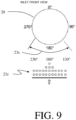
- one or more arrays 22c of flow control devices may be employed in an azimuthal range 23c over a bottom portion of the internal surface of the inlet, 130° to 230° as shown in FIG. 9 as an example, to accommodate control of flow distortion due to a high angle of attack (aircraft pitch up) scenario or a ground vortex scenario, where flow separation occurs substantially on a bottom internal surface of the inlet or on the bottom surface and one or both sides of the inlet.
- Operation of array 22c may be comparable to that disclosed for array 22b and may be combined with operation of array 22a or array 22b.
- the implementations provide the ability for flow control based on generalized flight conditions for the freestream velocity including flow speed, flow angle with respect to the engine, engine inlet mass flow rate and altitude which constitute as the instantaneous flight condition.
- a control system 1002 employs a controller 1004 receiving a condition input 1006 from one or more condition sensors 1008.
- the condition sensors 1008 may be pressure sensors or other sensing systems such as optical or ultrasonic detectors for boundary layer separation or internal turbulence in the inlet 20.
- Crosswind direction and speed may be provided by various aircraft onboard systems or external input as a status signal 1009 to be received by the controller 1004.
- One or more mass flow sensors 1010 also provides an inlet mass flow input 1012 to the controller 1004.
- the inlet mass flow input 1012 may alternatively be derived from external inputs such as thrust lever position or fan speed.
- the controller 1004 Responsive to an inlet condition determined by the status signal 1009, the condition sensors 1008 and mass flow sensors 1010, the controller 1004 provides a control signal 1013 to one or more activation devices 1014 configured to activate flow control devices 16 in the arrays, previously described, individually or in subarrays.
- the control signal may also provide or modulate a jet flow rate or vortex generator deployment frequency for the flow control devices 16, as described in greater detail subsequently.
- the controller may operate in an open loop based on the status signal 1009 and inlet mass flow input 1012 or may provide closed loop control with feedback from the condition sensors 1008 and mass flow sensors 1010.
- the controller 1004 does not react to the condition of the flowfield. Instead, it acts solely on a pre-planned schedule that targets specific actuation intensities and locations based on the flight condition that is measured at the time, such as the current engine inlet mass flow rate, the flight speed, the crosswind speed and direction and altitude.
- the controller 1004 responds to the "condition" of the flowfield in the inlet.
- the mass flow sensors 1010 and condition sensors 1008 provide continuous monitoring to the controller 1004 such that the controller is continuously providing an updated control signal 1013 to the activation devices 1014.
- the flow control system is only active if the controller 1004 has determined that flow separation has occurred (or is expected to be present based on conditions).
- the controller 1004 will actuate predetermined arrays or subarrays and at intensities for the flow control devices 16 targeting the expected region of flow separation based on the status signal 1009 and then convert to continuous monitoring of the mass flow sensors 1010 and condition sensors 1008 for a closed-loop configuration.
- the arrays or subarrays in the closed-loop configuration may be determined in real time and may include multiple or single flow control devices 16 responsive to the condition sensors 1008 in real time depending on the configuration of the activation devices as described subsequently
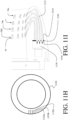
- the flow control devices 16 are control jets and the activation devices 1014 are one or more concentric cylinders 1102, or cylinder segments, spaced between the internal surface 18 of the inlet and a pressure plenum 1104 (wall thicknesses of the components are exaggerated for clarity).
- the pressure plenum 1104 is connected to a bleed air system 1105 or other pressure source.
- the concentric cylinders have aperture arrays 1106a -1106d rotatable from a "closed" position as seen in FIG.
- Activation devices 1014 are motors engaged to the concentric cylinders 1102 to rotate the cylinders from the closed to aligned positions. While shown in the FIGs.
- each concentric cylinder may be rotatable in multiple steps within the 10° separation of devices with the stepped arrays having apertures or blank closure to accommodate differing azimuthal range of the particular subsets of flow control devices in the row to obtain the subarrays 28a, 28b and 28c previously described.
- individual sliding or rotatable doors may provide closed and open conditions for the flow control devices 16.
- the flow control devices 16 are control jets and the activation devices 1014 are one or more perforated annular plates 1110, or plate segments, substantially perpendicular to the normal flow axis 15, located between the internal surface 18 and an outer surface 19 of the inlet, with conduits 1112 extending from an interface 1114 of the annular plate 1110 to the flow control devices 16 on the internal surface 18 of the inlet.
- a second interface 1116 of the plate is in communication with a pressure plenum 1118.
- the pressure plenum 1118 is connected to a bleed air system or other pressure source.
- the annular plates 1110 have aperture arrays 1120a -1120d as seen in FIG.
- Activation devices 1014 are motors engaged to the annular plates 1110 to rotate the plates about the normal flow axis 15 from the closed to a plurality of aligned positions. While shown in the FIGs.
- the annular plate 1110 may be rotatable in multiple steps within the 10° separation of devices with the stepped arrays having apertures or blank closure to accommodate differing azimuthal range of the particular subsets of flow control devices in the row to obtain various sub arrays.
- electrically or hydraulically controlled valves 1202 provide activation devices to connect corresponding ones of the flow control devices 16 to a pressure source 1203 such as a bleed air system.
- Controller 1004 activates one or more selected valves 1202 with control signal 1013 for predetermined arrays or subarrays of the flow control devices.
- manifold valves 1302 may be connected between the pressure source and one or more manifolds 1304 in fluid communication with arrays or subarrays 28a, 28b of the flow control devices 16 as shown in FIG. 13 .
- FIGs. 11A-13 may also be applied as a pneumatic-based flow control system that employs suction instead of blowing, i.e. jets, or a combination of suction and blowing.
- synthetic jets 1402 may be employed as the flow control devices at the array locations on the internal surface 18 of the inlet 20 and may be directly activated by the controller 1004 to provide flow modification in the inlet.
- Power connections 1404 and level control 1406 (such as Pulse Width Modulation (PWM) jet modulation) may be directly controlled by the controller 1004 through relays 1408 or other appropriate control elements to activate each of the synthetic jets controllable by the controller 1004 to produce the selected subarrays 28a, 28b, 28c.
- PWM Pulse Width Modulation
- FIG. 15 schematically demonstrates alternative implementations with arrays of deployable vortex generators, or other mechanical devices such as pins 1502 extended and retracted by solenoid operators 1504 or similar components acting as the activation devices responsive to the control signal 1013.
- the pins 1502 can be deployed and stowed periodically at varying frequency to obtain the desired flow modification.
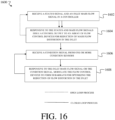
- a controller receives a status signal and an inlet mass flow signal, step 1602. Responsive to the status and inlet mass flow signals, the controller provides a control output to one or more of a plurality of flow control devices in an array on an inlet internal surface for reduction of flow distortion in the inlet, step 1604.
- the controller receives a condition signal from one or more condition sensors, step 1606. Responsive to the inlet mass flow signal or the condition signal, the controller modulates the flow control devices to form subarrays for optimizing the reduction of flow distortion in the inlet, step 1608.
- the step of modulating the flow control devices may be accomplished by selectively aligning concentric cylinders with aperture arrays to connect corresponding subarrays of the flow control devices to a pressure source, selectively opening valves between a pressure source and the one or more of the plurality flow control devices to form the subarrays, selectively opening valves between a pressure source and one or more manifolds connected to subarrays of the plurality of flow control devices, selectively activating synthetic devices to form the subarrays, or selectively deploying and stowing deployable vortex generators to form the subarrays.
Landscapes
- Engineering & Computer Science (AREA)
- Chemical & Material Sciences (AREA)
- Combustion & Propulsion (AREA)
- Mechanical Engineering (AREA)
- General Engineering & Computer Science (AREA)
- Aviation & Aerospace Engineering (AREA)
- Physics & Mathematics (AREA)
- Geometry (AREA)
- Control Of Turbines (AREA)
Description
- This disclosure relates generally to the field of aircraft fan j et propulsion employing inlets with a low ratio of inlet length to engine fan diameter (L/D) and, more particularly, to an inlet flow control system employing arrays of flow control devices on internal surfaces of a fan inlet for mitigating flow distortion in the inlet in low speed operations due to crosswind, high angle-of-attack, and ground vortices.
- Modern commercial aircraft predominantly employ fan jet engines. Current inlets are designed with high inlet length to engine fan diameter (L/D) values. Greater than 0.5 LID is typical for current engines to maintain desired flow profiles at the fan face in crosswinds and other flight conditions. Future inlets are expected to employ an L/D lower than 0.5. A lower limit on L/D appears to exist with current inlet design capabilities based on inlet lengths required to mitigate flow distortion in the inlet in low-speed takeoff and landing conditions. However, an L/D smaller than the current lower limit would aerodynamically improve all other segments of the mission (97% of the mission profile for a 1 hour commercial flight profile). This aerodynamic performance improvement due to a lower L/D reduces the fuel consumption by the aircraft. Current inlets are designed to meet the aforementioned low-speed takeoff and landing requirements (approximately two minutes of a typical commercial aircraft flight) and thus are overdesigned for the climb/cruise/descent flight phases. This 'overdesign' causes a fuel burn penalty throughout the rest of the mission due to increased drag and weight.
- Current solutions for flow control applied to aircraft inlets provide non-modular designs with fixed flow control device configurations. Any given flow control input may become much less effective (or maybe ineffective) due to the fact that the separated flow region is dynamic and may move within the inlet. Consequently, existing flow control solutions could be 'missing' the separated region. Such system configurations require that, in order to continue to successfully combat flow separation throughout different flight conditions, the flow control system output be increased and therefore the input is increased (e.g., higher input mass flow rate for a pneumatic flow control system). Consequently, such systems may affect size, weight, and power requirements.
-
EP2843244 describes, according to its abstract, an apparatus for suppressing shock-induced separation of high speed airflow from a relatively low-energy boundary layer. The apparatus may include an actuator or array of actuators configured to alternately inhale and exhale fluid and positioned to alternately inhale fluid from and exhale fluid into a boundary layer of a fluid mass flowing along the wall. The actuator may be positioned to inhale fluid from a boundary layer separation bubble induced by a supersonic shock wave propagated in the fluid mass. -
WO0106134 - According to an aspect of the invention to which this European patent relates, there is provided an inlet flow distortion control system as defined in
claim 1. According to a second aspect to which this European patent relates, there is provided a method for flow control in a jet inlet as defined inclaim 10. - The features, functions, and advantages that have been discussed can be achieved independently in various implementations or may be combined in yet other implementations further details of which can be seen with reference to the following description and drawings.
-
FIG. 1 is pictorial representation of a commercial aircraft with high bypass ratio turbofan engines in which example implementations of the adaptable flow control for engine nacelles are employed; -
FIG. 2 is a pictorial representation of the engine nacelle inlet demonstrating an array of flow control devices employed in an example implementation; -
FIG. 3 is a schematic flat representation of lateral arrays of flow control devices as implemented over angular segments of the inlet; -
FIG. 4 is a presentation of flow distortion patterns in the inlet at various mass flow rates and crosswind conditions; -
FIG. 5 is a graph of inlet distortion coefficient at conditions of not crosswind and 30 knots crosswind; -
FIGs. 6A-6C are schematic flat representations of subarrays of flow control devices for activation at differing mass flow rates for crosswind compensation; -
FIGs. 7A-7C are graphs of the maximum inlet distortion coefficient corresponding to the subarray activations inFIGs. 6A-6C ; -
FIG. 8A is a graph of maximum inlet distortion correction by activation of the different subarrays over selected mass flow rates; -
FIG. 8B is a presentation of improved flow distortion patterns in the inlet at various inlet mass flow rates with a 30 kt crosswind condition and control imposed as displayed inFIG. 8A ; -
FIG. 9 is a schematic flat representation of a bottom array of flow control devices for flow control in high angle of attack or ground vortex scenarios; -
FIG. 10 is a block diagram of an example control system; -
FIGs. 11A-11D are representations of concentric cylinders spaced between the inlet internal surface and a pressure plenum for control jet actuation for flow jets as the flow control devices; -
FIGs. 11E-11O are representations of annular perforated plates controlling flow communication through conduits between the inlet internal surface and a pressure plenum for control jet actuation for flow jets as the flow control devices; -
FIG. 12 is a representation of individua control of flow jets to form the array of the flow control devices; -
FIG. 13 is a representation of control of manifolded flow jets as the flow control devices;FIG. 14 is a representation of control of individual synthetic jets to form the array of flow control devices; -
FIG. 15 is a representation of control of individual deployable vortex generators as the array of flow control devices; and, -
FIG. 16 is a flow chart of a method for flow control in a low L/D fan jet inlet. - The implementations described herein provide one or more azimuthal-radial arrays of flow control devices integrated into the internal surface of an inlet. The total azimuthal-radial coverage of the flow control array is determined based on the flow separation domain over the full flight envelope and subsets or controlled configuration of the arrays can be activated at particular realized flow states.
- Referring to the drawings,
FIG. 1 depicts a largecommercial aircraft 10 employing high bypassratio turbofan engines 12 havingultra-short nacelles 14 in which implementations as described herein are employed. While the implementations described herein relate to commercial aircraft, the disclosure is applicable to any low L/D application or other inlet having asymmetrical flow distortion-. As seen inFIG.2 , a plurality offlow control devices 16 are integrated into aninternal surface 18 of aninlet 20 of theultra-short nacelle 14 forming one or more arrays (as will be described in greater detail subsequently) extending axially aft from a highlight 21 (or lip) of the inlet. Theinlet 20 has anormal flow axis 15. As defined herein "flow control devices" may comprise pneumatic jets, fluidic oscillators, steady jets, unsteady pulsing jets, non-pneumatic-based flow control systems and zero-net-mass-flux devices such as electronic synthetic jets or a combination of the identified systems. In alternative implementations, arrays of deployable vortex generators, or other mechanical devices (pins, etc.) may replace the orifices for fluidic jets. The devices can be stowed, flush with the internal surface of the inlet, and then be deployed in patterns within the array to achieve the desired flow pattern. Such mechanical devices can also be deployed and stowed periodically at varying frequency. A control system (to be described in greater detail subsequently) operably connected to theflow control devices 16 is adapted to activate or modulate the flow control devices in selected subarrays responsive to the inlet flow state indicated by a predetermined flight condition or measured flow parameters within theinlet 20. -
FIG. 3 shows, in a flat layout presentation, right and left flowcontrol device arrays internal surface 18 of theinlet 20.Right array 22a extends over anazimuthal range 23a determined based on an example flow separation domain for a right cross wind (defined herein relative to the drawings as flowing from right to left), between 40° and 150° relative to thenormal flow axis 15 for the example implementation, while theleft array 22b extends over a secondazimuthal range 23b determined based on a flow separation domain for a left cross wind (defined herein relative to the drawings as flowing from left to right), between 320° and 210° for the example implementation. Eacharray circumferential rows axial distances highlight 21 of the inlet. Describingleft array 22b,circumferential rows Row 24c has a reduced azimuthal range centered at 270° and extending between 260° and 280°, whilerow 24d has a further reduced azimuthal range (a single jet at 270° in the example shown). For the example implementation, each row has aflow control device 16 at each 10° of azimuth within the range. While shown in the drawings for the example implementations as circular orifices, theflow control devices 16 may have slotted apertures or alternative geometric configurations. The implementation shown inFIG. 3 provides the left and right arrays for response to vector components of left and right crosswind flow relative to thenormal flow axis 15.FIG. 4 shows visualization of flow distortion in the inlet for a left crosswind component with 0 kt of crosswind at mass flow rates (defined as ṁ*, non-dimensionalized as mass flow rate divided by the maximum mass flow rate for the inlet) of ṁ* = 0.48,map 401; ṁ*= 0.86,map 402; and ṁ*= 1,map 403. The maps shows very little distortion in the flow into the inlet with 0 kt of crosswind. However, with a 30 kt crosswind component at flow rates of ṁ* = 0.48,map 404; ṁ*= 0.86,map 405; and ṁ* = 1,map 406, significant distortion is present. - For purposes of quantitative description of the flow distortion herein, an inlet distortion coefficient, IDC, is defined as

- Where
P̅ is the average pressure and Pmin is the minimum pressure on the i-th ring (measured at constant radius circumferential rings). A maximum distortion defined as IDCmax corresponds to the maximum IDC and yields the maximum circumferential distortion that the inlet sees.FIG. 5 provides a plot of IDCmax for the 0 kt condition,trace 502, and the 30 kt condition,trace 504, for a baseline condition with no activation of theflow control devices 16 in the described implementation. - As demonstrated in
FIGs. 6A-6C , selective activation offlow control devices 16 in subarrays withinleft array 22b is accomplished to mitigate the flow distortion created by a left crosswind component as described with respect toFIG. 4 andFIG. 5 . For the example shown in the drawings, activation of afirst subarray 28a seen inFIG. 6A results in modification of IDCmax over the entire mass flow range as shown inFIG. 7A astrace 701. Similarly, activation of asecond subarray 28b shown inFIG. 6B results in modification of IDCmax as shown inFIG. 7B astrace 702 while activation of thethird subarray 28c shown inFIG. 6C results in modification of IDCmax as shown inFIG. 7C astrace 703. In one example control scenario, switching between the activated subarrays is accomplished depending on the mass flow range; thefirst subarray 28a is activated at mass flow rates between 0 and 0.48, thesecond subarray 28b is activated at mass flow rates between 0.48 and 0.82, and thethird subarray 28c is activated a mass flow rates between 0.82 and 1. This results in modification of IDCmax as shown inFIG. 8 wheretrace segment 801 relates to IDCmax modification over the flow range of 0 to 0.48 withfirst subarray 28a activated,trace segment 802 relates to IDCmax modification over the flow range of 0.48 to 0.82 withsecond subarray 28b activated andtrace segment 803 relates to IDCmax modification over the flow range of 0.82 to 1.0 withthird subarray 28c activated. The overall reduction in IDCmax over the entire flow range is optimized. The resulting reduction in flow distortion is show inFIG. 8B . In other implementations (or in alternative operation of the implementation shown), various combinations of flow control devices in subarrays and individual or combined activation of subarrays may be employed for tailoring flow correction based on varying conditions of crosswind velocity and inlet mass flow rate. - Operation of
array 22a for right crosswind components is similar to the operation ofarray 22b described for left crosswind components. - In alternative implementations, separately or in addition to the flow
control device arrays more arrays 22c of flow control devices may be employed in anazimuthal range 23c over a bottom portion of the internal surface of the inlet, 130° to 230° as shown inFIG. 9 as an example, to accommodate control of flow distortion due to a high angle of attack (aircraft pitch up) scenario or a ground vortex scenario, where flow separation occurs substantially on a bottom internal surface of the inlet or on the bottom surface and one or both sides of the inlet. Operation ofarray 22c may be comparable to that disclosed forarray 22b and may be combined with operation ofarray 22a orarray 22b. - While described herein with respect to specific flight conditions of crosswind, angle of attack and ground vortex, the implementations provide the ability for flow control based on generalized flight conditions for the freestream velocity including flow speed, flow angle with respect to the engine, engine inlet mass flow rate and altitude which constitute as the instantaneous flight condition.
- A
control system 1002, as shown inFIG. 10 , employs acontroller 1004 receiving acondition input 1006 from one ormore condition sensors 1008. Thecondition sensors 1008 may be pressure sensors or other sensing systems such as optical or ultrasonic detectors for boundary layer separation or internal turbulence in theinlet 20. Crosswind direction and speed (or angle of attack) may be provided by various aircraft onboard systems or external input as astatus signal 1009 to be received by thecontroller 1004. One or moremass flow sensors 1010 also provides an inletmass flow input 1012 to thecontroller 1004. The inletmass flow input 1012 may alternatively be derived from external inputs such as thrust lever position or fan speed. Responsive to an inlet condition determined by thestatus signal 1009, thecondition sensors 1008 andmass flow sensors 1010, thecontroller 1004 provides acontrol signal 1013 to one ormore activation devices 1014 configured to activateflow control devices 16 in the arrays, previously described, individually or in subarrays. The control signal may also provide or modulate a jet flow rate or vortex generator deployment frequency for theflow control devices 16, as described in greater detail subsequently. The controller may operate in an open loop based on thestatus signal 1009 and inletmass flow input 1012 or may provide closed loop control with feedback from thecondition sensors 1008 andmass flow sensors 1010. - In an open-loop implementation, the
controller 1004 does not react to the condition of the flowfield. Instead, it acts solely on a pre-planned schedule that targets specific actuation intensities and locations based on the flight condition that is measured at the time, such as the current engine inlet mass flow rate, the flight speed, the crosswind speed and direction and altitude. - In a closed-loop implementation, the
controller 1004 responds to the "condition" of the flowfield in the inlet. Themass flow sensors 1010 andcondition sensors 1008 provide continuous monitoring to thecontroller 1004 such that the controller is continuously providing an updatedcontrol signal 1013 to theactivation devices 1014. The flow control system is only active if thecontroller 1004 has determined that flow separation has occurred (or is expected to be present based on conditions). - For a combination of the above, in an open loop configuration, the
controller 1004 will actuate predetermined arrays or subarrays and at intensities for theflow control devices 16 targeting the expected region of flow separation based on thestatus signal 1009 and then convert to continuous monitoring of themass flow sensors 1010 andcondition sensors 1008 for a closed-loop configuration. The arrays or subarrays in the closed-loop configuration may be determined in real time and may include multiple or singleflow control devices 16 responsive to thecondition sensors 1008 in real time depending on the configuration of the activation devices as described subsequently - In an example implementation seen in
FIG. 11A and in exploded pictorial representation inFIG. 11B , theflow control devices 16 are control jets and theactivation devices 1014 are one or moreconcentric cylinders 1102, or cylinder segments, spaced between theinternal surface 18 of the inlet and a pressure plenum 1104 (wall thicknesses of the components are exaggerated for clarity). Thepressure plenum 1104 is connected to ableed air system 1105 or other pressure source. The concentric cylinders haveaperture arrays 1106a -1106d rotatable from a "closed" position as seen inFIG. 11C into alignment with the control jets incircumferential rows 24a - 24d to open thesubarrays pressure plenum 1104 for jet flow as shown inFIG. 11D .Activation devices 1014 are motors engaged to theconcentric cylinders 1102 to rotate the cylinders from the closed to aligned positions. While shown in theFIGs. 11A-11D with single apertures with one-to-one correspondence with the flow control devices in the corresponding rows, each concentric cylinder may be rotatable in multiple steps within the 10° separation of devices with the stepped arrays having apertures or blank closure to accommodate differing azimuthal range of the particular subsets of flow control devices in the row to obtain thesubarrays flow control devices 16. - In a similar example implementation seen in
FIGs. 11E-11O , theflow control devices 16 are control jets and theactivation devices 1014 are one or more perforatedannular plates 1110, or plate segments, substantially perpendicular to thenormal flow axis 15, located between theinternal surface 18 and anouter surface 19 of the inlet, withconduits 1112 extending from aninterface 1114 of theannular plate 1110 to theflow control devices 16 on theinternal surface 18 of the inlet. Asecond interface 1116 of the plate is in communication with apressure plenum 1118. As in the prior implementation, thepressure plenum 1118 is connected to a bleed air system or other pressure source. Theannular plates 1110 haveaperture arrays 1120a -1120d as seen inFIG. 11F rotatable from a "closed" position as seen inFIG. 11E andFIGs. 11N and 11O , into alignment with the control jets incircumferential rows 24a - 24d to open various subarrays to thepressure plenum 1118 for jet flow as shown inFIG. 11F and 11G with the full subarrays open to partial subarrays as shown inFIGs. 11H and 11I ,11J and 11K , and11L and 11M .Activation devices 1014 are motors engaged to theannular plates 1110 to rotate the plates about thenormal flow axis 15 from the closed to a plurality of aligned positions. While shown in theFIGs. 11A-11D with single apertures with one-to-one correspondence with the flow control devices in the corresponding rows, theannular plate 1110 may be rotatable in multiple steps within the 10° separation of devices with the stepped arrays having apertures or blank closure to accommodate differing azimuthal range of the particular subsets of flow control devices in the row to obtain various sub arrays. - In another example implementation represented schematically in
FIG. 12 , electrically or hydraulically controlledvalves 1202 provide activation devices to connect corresponding ones of theflow control devices 16 to apressure source 1203 such as a bleed air system.Controller 1004 activates one or moreselected valves 1202 withcontrol signal 1013 for predetermined arrays or subarrays of the flow control devices. As opposed to control of individual flow control devices,manifold valves 1302 may be connected between the pressure source and one ormore manifolds 1304 in fluid communication with arrays orsubarrays flow control devices 16 as shown inFIG. 13 . - The implementations as described with respect to
FIGs. 11A-13 may also be applied as a pneumatic-based flow control system that employs suction instead of blowing, i.e. jets, or a combination of suction and blowing. - As shown in
FIG. 14 ,synthetic jets 1402 may be employed as the flow control devices at the array locations on theinternal surface 18 of theinlet 20 and may be directly activated by thecontroller 1004 to provide flow modification in theinlet. Power connections 1404 and level control 1406 (such as Pulse Width Modulation (PWM) jet modulation) may be directly controlled by thecontroller 1004 throughrelays 1408 or other appropriate control elements to activate each of the synthetic jets controllable by thecontroller 1004 to produce the selectedsubarrays -
FIG. 15 schematically demonstrates alternative implementations with arrays of deployable vortex generators, or other mechanical devices such aspins 1502 extended and retracted bysolenoid operators 1504 or similar components acting as the activation devices responsive to thecontrol signal 1013. Thepins 1502 can be deployed and stowed periodically at varying frequency to obtain the desired flow modification. - The implementations disclosed provide a
method 1600 for flow control in a low L/D fanjet inlet as shown inFIG. 16 . A controller receives a status signal and an inlet mass flow signal, step 1602. Responsive to the status and inlet mass flow signals, the controller provides a control output to one or more of a plurality of flow control devices in an array on an inlet internal surface for reduction of flow distortion in the inlet, step 1604. The controller receives a condition signal from one or more condition sensors,step 1606. Responsive to the inlet mass flow signal or the condition signal, the controller modulates the flow control devices to form subarrays for optimizing the reduction of flow distortion in the inlet, step 1608. For the various disclosed implementations, the step of modulating the flow control devices may be accomplished by selectively aligning concentric cylinders with aperture arrays to connect corresponding subarrays of the flow control devices to a pressure source, selectively opening valves between a pressure source and the one or more of the plurality flow control devices to form the subarrays, selectively opening valves between a pressure source and one or more manifolds connected to subarrays of the plurality of flow control devices, selectively activating synthetic devices to form the subarrays, or selectively deploying and stowing deployable vortex generators to form the subarrays.
Claims (15)
- An inlet flow distortion control system for an aircraft fan jet, comprising:a plurality of flow control devices (16) integrated into an internal surface (18) of the inlet (20) forming at least one array (22a, 22b, 22c), said at least one array extending over an azimuthal range (23a, 23b) relative to a normal flow axis (15) of the inlet and having a plurality of circumferential rows (24a, 24b, 24c, 24d) spaced at an increasing axial distance from a highlight of the inlet; and,
a control system (1002) operably connected to the plurality of flow control devices, said control system adapted to activate flow control devices in selected subarrays (28a, 28b, 28c) of the at least one array responsive to an inlet flow state indicated by a predetermined flight condition or measured flow parameters within the inlet;
whereinthe at least one array comprises a right array (22a) having an azimuthal range determined based on a flow separation domain for a right crosswind, and a left array (22b) having an azimuthal range determined based on a flow separation domain for a left crosswind; and whereinthe left array and right array each comprise a plurality of circumferential rows (24a, 24v, 24c, 24d) spaced at increasing first, second, third and fourth axial distances (226a, 26b, 26c, 26d) from the highlight of the inlet. - The inlet flow distortion control system of claim 1 or 2, wherein the at least one array comprises an array (22c) extending over an azimuthal range (23c) on a bottom portion of the internal surface of the inlet to accommodate control of flow distortion due to high angle of attack or ground vortex.
- The inlet flow distortion control system of claim 1, wherein for each of the right array and left array, a first of the plurality of circumferential rows includes flow control devices extending over the azimuthal range of said each of the right array and left array, a second of the plurality of circumferential rows includes flow control devices extending over a reduced azimuthal range of said each of the right array and left array and a third of the plurality of circumferential rows includes flow control devices extending over a further reduced azimuthal range of said each of the right array and left array.
- The inlet flow distortion control system of claim 1, wherein the control system comprises:a controller (1004) receiving a status signal (1009) or a condition input (1006) for crosswind or angle of attack;a mass flow input (1012) to the controller; andone or more activation devices (1014) receiving an output signal (1013) from the controller responsive to the mass flow input and the status signal or the condition input, said one or more activation devices configured to activate flow control devices in one of the selected subarrays.
- The inlet flow distortion control system of claim 4, wherein the one or more activation devices comprise:one or more concentric cylinders (1102) spaced between the internal surface of the inlet and a pressure plenum (1104), the one or more concentric cylinders having aperture arrays (1106a, 1106b, 1106c, 1106d) rotatable from a closed position into alignment with one or more control jet rows (24a, 24b, 24c, 24d); and,a pressure source (1105) connected to the pressure plenum.
- The inlet flow distortion control system of claim 5, wherein the pressure source is a bleed air system.
- The inlet flow distortion control system of claim 5 or 6, wherein the one or more concentric cylinders comprise a plurality of concentric cylinders, each concentric cylinder aligned with a respective one of the one or more control jet rows to open the one of the selected subarrays to the pressure plenum.
- The inlet flow distortion control system of any of claims 4-7, wherein the one or more activation devices comprise one or more valves (1202), each valve connecting corresponding ones of the plurality of flow control devices, and
optionally, the inlet flow distortion control system further comprising at least one manifold (1304) connecting one of said one or more valves to a selected subarray (28a, 28b) of the at least one array of the plurality of flow control devices. - The inlet flow distortion control system of any of claims 4-8, wherein the plurality of flow control devices each comprise a synthetic jet (1402) and further comprising:a power connection (1404) to each synthetic jet; and,a level control (1406) connected through a relay (1408) to each synthetic jet, controllable to produce selected subarrays of the at least one array,optionally, wherein the plurality of flow control devices each comprise a deployable vortex generator (1502), and wherein the one or more activation devices each comprise solenoid operators (1504).
- A method for flow control in an aircraft fan jet inlet of the system of any of claims 1 to 9, the method comprising:receiving a status signal and a mass flow signal in a controller;providing a control output from the controller responsive to the status signal and the mass flow signal to one or more of a plurality of flow control devices in an array on an inlet internal surface; andreducing flow distortion in the inlet.
- The method of claim 10, further comprising:receiving a condition signal in the controller from one or more condition sensors; wherein the step of reducing flow distortion comprisesmodulating the plurality of flow control devices to form subarrays responsive to the mass flow signal or condition signal for optimizing reduction of flow distortion in the inlet.
- The method of claim 11, wherein the step of modulating the plurality of flow control devices comprises selectively aligning concentric cylinders with aperture arrays to connect corresponding subarrays of the plurality of flow control devices to a pressure source.
- The method of claim 11 or 12, wherein the step of modulating the plurality of flow control devices comprises:
selectively opening valves between a pressure source andone or more of the plurality of flow control devices to form the subarrays, orone or more manifolds connected to the subarrays of the plurality of flow control devices. - The method of any of claims 11-13, wherein the plurality of flow control devices comprise synthetic devices, and the step of modulating the plurality of flow control devices comprises selectively activating the synthetic devices to form the subarrays.
- The method of any of claims 11-13, wherein the plurality of flow control devices comprise deployable vortex generators, and the step of modulating the plurality of flow control devices comprises selectively deploying and stowing the deployable vortex generators to form the subarrays.
Applications Claiming Priority (1)
| Application Number | Priority Date | Filing Date | Title |
|---|---|---|---|
| US15/931,328 US11542866B2 (en) | 2020-05-13 | 2020-05-13 | Adaptable flow control for engine nacelles |
Publications (2)
| Publication Number | Publication Date |
|---|---|
| EP3910176A1 EP3910176A1 (en) | 2021-11-17 |
| EP3910176B1 true EP3910176B1 (en) | 2024-03-06 |
Family
ID=75887886
Family Applications (1)
| Application Number | Title | Priority Date | Filing Date |
|---|---|---|---|
| EP21172981.9A Active EP3910176B1 (en) | 2020-05-13 | 2021-05-10 | Adaptable flow control for engine nacelles |
Country Status (3)
| Country | Link |
|---|---|
| US (1) | US11542866B2 (en) |
| EP (1) | EP3910176B1 (en) |
| CN (1) | CN113665826A (en) |
Families Citing this family (4)
| Publication number | Priority date | Publication date | Assignee | Title |
|---|---|---|---|---|
| CN115014792B (en) * | 2022-08-08 | 2022-10-25 | 中国空气动力研究与发展中心高速空气动力研究所 | Distortion generating device with adjustable dynamic and steady-state distortion index proportion and configuration method |
| US12435666B1 (en) | 2024-10-09 | 2025-10-07 | General Electric Company | Turbine engine having a variable engine intake system |
| US12442333B1 (en) | 2024-10-09 | 2025-10-14 | General Electric Company | Turbine engine having a variable engine intake system |
| US12529335B1 (en) | 2024-10-09 | 2026-01-20 | General Electric Company | Turbine engine having a variable engine intake system |
Family Cites Families (20)
| Publication number | Priority date | Publication date | Assignee | Title |
|---|---|---|---|---|
| US4154256A (en) * | 1978-03-29 | 1979-05-15 | The United States Of America As Represented By The Administrator Of The National Aeronautics And Space Administration | Self stabilizing sonic inlet |
| US5448881A (en) * | 1993-06-09 | 1995-09-12 | United Technologies Corporation | Gas turbine engine control based on inlet pressure distortion |
| US6371414B1 (en) * | 1999-07-16 | 2002-04-16 | Lockheed Martin Corporation | System and method for manipulating and controlling fluid flow over a surface |
| US7637455B2 (en) * | 2006-04-12 | 2009-12-29 | The Boeing Company | Inlet distortion and recovery control system |
| WO2008045050A1 (en) * | 2006-10-12 | 2008-04-17 | United Technologies Corporation | Gas turbine engine with fan variable area nozzle, nacelle assembly and method of varying area of a fan nozzle |
| US7766280B2 (en) * | 2007-05-29 | 2010-08-03 | United Technologies Corporation | Integral suction device with acoustic panel |
| US9004399B2 (en) * | 2007-11-13 | 2015-04-14 | United Technologies Corporation | Nacelle flow assembly |
| US8192147B2 (en) * | 2007-12-14 | 2012-06-05 | United Technologies Corporation | Nacelle assembly having inlet bleed |
| FR2970465B1 (en) * | 2011-01-19 | 2013-10-11 | Aircelle Sa | NACELLE FOR A DOUBLE FLOW AIRCRAFT AIRCRAFT TURBOREACTOR. |
| US9932121B2 (en) * | 2012-06-22 | 2018-04-03 | United Technologies Corporation | Turbomachine flow stability enhancement device control |
| US10054048B2 (en) * | 2013-07-26 | 2018-08-21 | Lockheed Martin Corporation | Suprression of shock-induced airflow separation |
| US9334807B2 (en) * | 2014-05-13 | 2016-05-10 | The Boeing Company | Methods and apparatus to determine airflow conditions at an inlet of an engine |
| US10221764B2 (en) * | 2014-08-19 | 2019-03-05 | Pratt & Whitney Canada Corp. | Variable geometry inlet system |
| GB201511454D0 (en) * | 2015-06-30 | 2015-08-12 | Rolls Royce Plc | Aircraft engine nacelle |
| US10399687B2 (en) * | 2015-12-03 | 2019-09-03 | The Boeing Company | Methods and apparatus to vary an air intake of aircraft engines |
| US11485486B2 (en) * | 2016-05-18 | 2022-11-01 | The University Of Toledo | Active flow control for ducted fans and fan-in-wing configurations |
| DE102016112604A1 (en) | 2016-07-08 | 2018-01-11 | Rolls-Royce Deutschland Ltd & Co Kg | Engine nacelle and method for influencing flows in an engine nacelle |
| US10605113B2 (en) * | 2017-06-16 | 2020-03-31 | The Boeing Company | Methods and apparatus for reducing flow distortion at engine fans of nacelles |
| GB201716836D0 (en) * | 2017-10-13 | 2017-11-29 | Rolls Royce Plc | Gas turbine engine vortex suppressor |
| US11828237B2 (en) * | 2020-04-28 | 2023-11-28 | General Electric Company | Methods and apparatus to control air flow separation of an engine |
-
2020
- 2020-05-13 US US15/931,328 patent/US11542866B2/en active Active
-
2021
- 2021-05-07 CN CN202110497161.6A patent/CN113665826A/en active Pending
- 2021-05-10 EP EP21172981.9A patent/EP3910176B1/en active Active
Also Published As
| Publication number | Publication date |
|---|---|
| US11542866B2 (en) | 2023-01-03 |
| CN113665826A (en) | 2021-11-19 |
| US20210355874A1 (en) | 2021-11-18 |
| EP3910176A1 (en) | 2021-11-17 |
Similar Documents
| Publication | Publication Date | Title |
|---|---|---|
| EP3910176B1 (en) | Adaptable flow control for engine nacelles | |
| US11597510B2 (en) | Ducted fans having fluidic thrust vectoring | |
| US7472543B2 (en) | Jet engine noise suppressor | |
| Lin et al. | An overview of active flow control enhanced vertical tail technology development | |
| CN101200220B (en) | Systems and methods for passively directing aircraft engine nozzle flows | |
| CN113830291B (en) | Virtual variable pneumatic layout intelligent control system of aircraft | |
| US20100044504A1 (en) | Rear propulsion system with lateral air inlets for an aircraft with such system | |
| JP2008518828A (en) | High lift distributed active flow control system and method | |
| US20160280358A1 (en) | Hybrid Flow Control Method for Simple Hinged Flap High-Lift System | |
| WO2010036419A2 (en) | Vtol aerial vehicle | |
| US20200385133A1 (en) | Engine and thrust control of aircraft in no dwell zone | |
| US6837456B1 (en) | Microjet based control system | |
| Warsop et al. | NATO AVT-239 task group: innovative control effectors for manoeuvring of air vehicles-conclusions and next steps | |
| US20220411046A1 (en) | Vortex control on engine nacelle strake and other vortex generators | |
| US9102395B2 (en) | Multifunctional propulsive system for an airplane | |
| Filippone | Steep-descent maneuver of transport aircraft | |
| CN106081050A (en) | Integration High Altitude UAV is beaten in detecing of a kind of variable flying state | |
| US12331767B2 (en) | Adjustable flow control systems | |
| Farokhi | Propulsion system design with smart vortex generators | |
| US11686246B2 (en) | Propulsion system for an aircraft | |
| LINDERMAN et al. | Development of an in-flight thrust reverser for tactical/attack aircraft | |
| US20200298957A1 (en) | Vortex wake attenuation device | |
| McMichael et al. | Aerodynamic technology—the role ofaerodynamic technology in the design and developmentof modern combat aircraft | |
| Cole et al. | A Throat-Bypass Stability System Tested in a YF-12 | |
| Orme | Performance seeking control (PSC) for the F-15 highly integrated digital electronic control (HIDEC) aircraft |
Legal Events
| Date | Code | Title | Description |
|---|---|---|---|
| PUAI | Public reference made under article 153(3) epc to a published international application that has entered the european phase |
Free format text: ORIGINAL CODE: 0009012 |
|
| STAA | Information on the status of an ep patent application or granted ep patent |
Free format text: STATUS: THE APPLICATION HAS BEEN PUBLISHED |
|
| AK | Designated contracting states |
Kind code of ref document: A1 Designated state(s): AL AT BE BG CH CY CZ DE DK EE ES FI FR GB GR HR HU IE IS IT LI LT LU LV MC MK MT NL NO PL PT RO RS SE SI SK SM TR |
|
| B565 | Issuance of search results under rule 164(2) epc |
Effective date: 20211008 |
|
| STAA | Information on the status of an ep patent application or granted ep patent |
Free format text: STATUS: REQUEST FOR EXAMINATION WAS MADE |
|
| 17P | Request for examination filed |
Effective date: 20220511 |
|
| RBV | Designated contracting states (corrected) |
Designated state(s): AL AT BE BG CH CY CZ DE DK EE ES FI FR GB GR HR HU IE IS IT LI LT LU LV MC MK MT NL NO PL PT RO RS SE SI SK SM TR |
|
| RAP3 | Party data changed (applicant data changed or rights of an application transferred) |
Owner name: GEORGIA TECH RESEARCH CORPORATION Owner name: THE BOEING COMPANY |
|
| RAP3 | Party data changed (applicant data changed or rights of an application transferred) |
Owner name: GEORGIA TECH RESEARCH CORPORATION Owner name: THE BOEING COMPANY |
|
| GRAP | Despatch of communication of intention to grant a patent |
Free format text: ORIGINAL CODE: EPIDOSNIGR1 |
|
| STAA | Information on the status of an ep patent application or granted ep patent |
Free format text: STATUS: GRANT OF PATENT IS INTENDED |
|
| RIC1 | Information provided on ipc code assigned before grant |
Ipc: F02C 7/057 20060101ALI20230828BHEP Ipc: F02C 7/045 20060101AFI20230828BHEP |
|
| INTG | Intention to grant announced |
Effective date: 20230929 |
|
| GRAS | Grant fee paid |
Free format text: ORIGINAL CODE: EPIDOSNIGR3 |
|
| GRAA | (expected) grant |
Free format text: ORIGINAL CODE: 0009210 |
|
| STAA | Information on the status of an ep patent application or granted ep patent |
Free format text: STATUS: THE PATENT HAS BEEN GRANTED |
|
| REG | Reference to a national code |
Ref country code: DE Ref legal event code: R081 Ref document number: 602021009990 Country of ref document: DE Owner name: THE BOEING COMPANY, ARLINGTON, US Free format text: FORMER OWNERS: THE BOEING COMPANY, ARLINGTON, VA, US; THE GEORGIA TECH RESEARCH CORPORATION, ATLANTA, GA, US Ref country code: DE Ref legal event code: R081 Ref document number: 602021009990 Country of ref document: DE Owner name: GEORGIA TECH RESEARCH CORPORATION, ATLANTA, US Free format text: FORMER OWNERS: THE BOEING COMPANY, ARLINGTON, VA, US; THE GEORGIA TECH RESEARCH CORPORATION, ATLANTA, GA, US |
|
| AK | Designated contracting states |
Kind code of ref document: B1 Designated state(s): AL AT BE BG CH CY CZ DE DK EE ES FI FR GB GR HR HU IE IS IT LI LT LU LV MC MK MT NL NO PL PT RO RS SE SI SK SM TR |
|
| REG | Reference to a national code |
Ref country code: CH Ref legal event code: EP |
|
| REG | Reference to a national code |
Ref country code: IE Ref legal event code: FG4D |
|
| REG | Reference to a national code |
Ref country code: DE Ref legal event code: R096 Ref document number: 602021009990 Country of ref document: DE |
|
| P01 | Opt-out of the competence of the unified patent court (upc) registered |
Effective date: 20240305 |
|
| REG | Reference to a national code |
Ref country code: LT Ref legal event code: MG9D |
|
| PG25 | Lapsed in a contracting state [announced via postgrant information from national office to epo] |
Ref country code: LT Free format text: LAPSE BECAUSE OF FAILURE TO SUBMIT A TRANSLATION OF THE DESCRIPTION OR TO PAY THE FEE WITHIN THE PRESCRIBED TIME-LIMIT Effective date: 20240306 |
|
| REG | Reference to a national code |
Ref country code: NL Ref legal event code: MP Effective date: 20240306 |
|
| PG25 | Lapsed in a contracting state [announced via postgrant information from national office to epo] |
Ref country code: GR Free format text: LAPSE BECAUSE OF FAILURE TO SUBMIT A TRANSLATION OF THE DESCRIPTION OR TO PAY THE FEE WITHIN THE PRESCRIBED TIME-LIMIT Effective date: 20240607 |
|
| PG25 | Lapsed in a contracting state [announced via postgrant information from national office to epo] |
Ref country code: RS Free format text: LAPSE BECAUSE OF FAILURE TO SUBMIT A TRANSLATION OF THE DESCRIPTION OR TO PAY THE FEE WITHIN THE PRESCRIBED TIME-LIMIT Effective date: 20240606 Ref country code: HR Free format text: LAPSE BECAUSE OF FAILURE TO SUBMIT A TRANSLATION OF THE DESCRIPTION OR TO PAY THE FEE WITHIN THE PRESCRIBED TIME-LIMIT Effective date: 20240306 |
|
| PG25 | Lapsed in a contracting state [announced via postgrant information from national office to epo] |
Ref country code: ES Free format text: LAPSE BECAUSE OF FAILURE TO SUBMIT A TRANSLATION OF THE DESCRIPTION OR TO PAY THE FEE WITHIN THE PRESCRIBED TIME-LIMIT Effective date: 20240306 |
|
| PG25 | Lapsed in a contracting state [announced via postgrant information from national office to epo] |
Ref country code: RS Free format text: LAPSE BECAUSE OF FAILURE TO SUBMIT A TRANSLATION OF THE DESCRIPTION OR TO PAY THE FEE WITHIN THE PRESCRIBED TIME-LIMIT Effective date: 20240606 Ref country code: NO Free format text: LAPSE BECAUSE OF FAILURE TO SUBMIT A TRANSLATION OF THE DESCRIPTION OR TO PAY THE FEE WITHIN THE PRESCRIBED TIME-LIMIT Effective date: 20240606 Ref country code: LT Free format text: LAPSE BECAUSE OF FAILURE TO SUBMIT A TRANSLATION OF THE DESCRIPTION OR TO PAY THE FEE WITHIN THE PRESCRIBED TIME-LIMIT Effective date: 20240306 Ref country code: HR Free format text: LAPSE BECAUSE OF FAILURE TO SUBMIT A TRANSLATION OF THE DESCRIPTION OR TO PAY THE FEE WITHIN THE PRESCRIBED TIME-LIMIT Effective date: 20240306 Ref country code: GR Free format text: LAPSE BECAUSE OF FAILURE TO SUBMIT A TRANSLATION OF THE DESCRIPTION OR TO PAY THE FEE WITHIN THE PRESCRIBED TIME-LIMIT Effective date: 20240607 Ref country code: FI Free format text: LAPSE BECAUSE OF FAILURE TO SUBMIT A TRANSLATION OF THE DESCRIPTION OR TO PAY THE FEE WITHIN THE PRESCRIBED TIME-LIMIT Effective date: 20240306 Ref country code: ES Free format text: LAPSE BECAUSE OF FAILURE TO SUBMIT A TRANSLATION OF THE DESCRIPTION OR TO PAY THE FEE WITHIN THE PRESCRIBED TIME-LIMIT Effective date: 20240306 Ref country code: BG Free format text: LAPSE BECAUSE OF FAILURE TO SUBMIT A TRANSLATION OF THE DESCRIPTION OR TO PAY THE FEE WITHIN THE PRESCRIBED TIME-LIMIT Effective date: 20240306 |
|
| REG | Reference to a national code |
Ref country code: AT Ref legal event code: MK05 Ref document number: 1663728 Country of ref document: AT Kind code of ref document: T Effective date: 20240306 |
|
| PG25 | Lapsed in a contracting state [announced via postgrant information from national office to epo] |
Ref country code: SE Free format text: LAPSE BECAUSE OF FAILURE TO SUBMIT A TRANSLATION OF THE DESCRIPTION OR TO PAY THE FEE WITHIN THE PRESCRIBED TIME-LIMIT Effective date: 20240306 Ref country code: LV Free format text: LAPSE BECAUSE OF FAILURE TO SUBMIT A TRANSLATION OF THE DESCRIPTION OR TO PAY THE FEE WITHIN THE PRESCRIBED TIME-LIMIT Effective date: 20240306 |
|
| PG25 | Lapsed in a contracting state [announced via postgrant information from national office to epo] |
Ref country code: NL Free format text: LAPSE BECAUSE OF FAILURE TO SUBMIT A TRANSLATION OF THE DESCRIPTION OR TO PAY THE FEE WITHIN THE PRESCRIBED TIME-LIMIT Effective date: 20240306 |
|
| PG25 | Lapsed in a contracting state [announced via postgrant information from national office to epo] |
Ref country code: NL Free format text: LAPSE BECAUSE OF FAILURE TO SUBMIT A TRANSLATION OF THE DESCRIPTION OR TO PAY THE FEE WITHIN THE PRESCRIBED TIME-LIMIT Effective date: 20240306 |
|
| PG25 | Lapsed in a contracting state [announced via postgrant information from national office to epo] |
Ref country code: IS Free format text: LAPSE BECAUSE OF FAILURE TO SUBMIT A TRANSLATION OF THE DESCRIPTION OR TO PAY THE FEE WITHIN THE PRESCRIBED TIME-LIMIT Effective date: 20240706 |
|
| PG25 | Lapsed in a contracting state [announced via postgrant information from national office to epo] |
Ref country code: PT Free format text: LAPSE BECAUSE OF FAILURE TO SUBMIT A TRANSLATION OF THE DESCRIPTION OR TO PAY THE FEE WITHIN THE PRESCRIBED TIME-LIMIT Effective date: 20240708 Ref country code: SM Free format text: LAPSE BECAUSE OF FAILURE TO SUBMIT A TRANSLATION OF THE DESCRIPTION OR TO PAY THE FEE WITHIN THE PRESCRIBED TIME-LIMIT Effective date: 20240306 |
|
| PG25 | Lapsed in a contracting state [announced via postgrant information from national office to epo] |
Ref country code: EE Free format text: LAPSE BECAUSE OF FAILURE TO SUBMIT A TRANSLATION OF THE DESCRIPTION OR TO PAY THE FEE WITHIN THE PRESCRIBED TIME-LIMIT Effective date: 20240306 Ref country code: CZ Free format text: LAPSE BECAUSE OF FAILURE TO SUBMIT A TRANSLATION OF THE DESCRIPTION OR TO PAY THE FEE WITHIN THE PRESCRIBED TIME-LIMIT Effective date: 20240306 |
|
| PG25 | Lapsed in a contracting state [announced via postgrant information from national office to epo] |
Ref country code: AT Free format text: LAPSE BECAUSE OF FAILURE TO SUBMIT A TRANSLATION OF THE DESCRIPTION OR TO PAY THE FEE WITHIN THE PRESCRIBED TIME-LIMIT Effective date: 20240306 |
|
| PG25 | Lapsed in a contracting state [announced via postgrant information from national office to epo] |
Ref country code: PL Free format text: LAPSE BECAUSE OF FAILURE TO SUBMIT A TRANSLATION OF THE DESCRIPTION OR TO PAY THE FEE WITHIN THE PRESCRIBED TIME-LIMIT Effective date: 20240306 |
|
| PG25 | Lapsed in a contracting state [announced via postgrant information from national office to epo] |
Ref country code: SK Free format text: LAPSE BECAUSE OF FAILURE TO SUBMIT A TRANSLATION OF THE DESCRIPTION OR TO PAY THE FEE WITHIN THE PRESCRIBED TIME-LIMIT Effective date: 20240306 |
|
| PG25 | Lapsed in a contracting state [announced via postgrant information from national office to epo] |
Ref country code: SM Free format text: LAPSE BECAUSE OF FAILURE TO SUBMIT A TRANSLATION OF THE DESCRIPTION OR TO PAY THE FEE WITHIN THE PRESCRIBED TIME-LIMIT Effective date: 20240306 Ref country code: SK Free format text: LAPSE BECAUSE OF FAILURE TO SUBMIT A TRANSLATION OF THE DESCRIPTION OR TO PAY THE FEE WITHIN THE PRESCRIBED TIME-LIMIT Effective date: 20240306 Ref country code: RO Free format text: LAPSE BECAUSE OF FAILURE TO SUBMIT A TRANSLATION OF THE DESCRIPTION OR TO PAY THE FEE WITHIN THE PRESCRIBED TIME-LIMIT Effective date: 20240306 Ref country code: PT Free format text: LAPSE BECAUSE OF FAILURE TO SUBMIT A TRANSLATION OF THE DESCRIPTION OR TO PAY THE FEE WITHIN THE PRESCRIBED TIME-LIMIT Effective date: 20240708 Ref country code: PL Free format text: LAPSE BECAUSE OF FAILURE TO SUBMIT A TRANSLATION OF THE DESCRIPTION OR TO PAY THE FEE WITHIN THE PRESCRIBED TIME-LIMIT Effective date: 20240306 Ref country code: IS Free format text: LAPSE BECAUSE OF FAILURE TO SUBMIT A TRANSLATION OF THE DESCRIPTION OR TO PAY THE FEE WITHIN THE PRESCRIBED TIME-LIMIT Effective date: 20240706 Ref country code: EE Free format text: LAPSE BECAUSE OF FAILURE TO SUBMIT A TRANSLATION OF THE DESCRIPTION OR TO PAY THE FEE WITHIN THE PRESCRIBED TIME-LIMIT Effective date: 20240306 Ref country code: CZ Free format text: LAPSE BECAUSE OF FAILURE TO SUBMIT A TRANSLATION OF THE DESCRIPTION OR TO PAY THE FEE WITHIN THE PRESCRIBED TIME-LIMIT Effective date: 20240306 Ref country code: AT Free format text: LAPSE BECAUSE OF FAILURE TO SUBMIT A TRANSLATION OF THE DESCRIPTION OR TO PAY THE FEE WITHIN THE PRESCRIBED TIME-LIMIT Effective date: 20240306 |
|
| PG25 | Lapsed in a contracting state [announced via postgrant information from national office to epo] |
Ref country code: IT Free format text: LAPSE BECAUSE OF FAILURE TO SUBMIT A TRANSLATION OF THE DESCRIPTION OR TO PAY THE FEE WITHIN THE PRESCRIBED TIME-LIMIT Effective date: 20240306 |
|
| REG | Reference to a national code |
Ref country code: DE Ref legal event code: R097 Ref document number: 602021009990 Country of ref document: DE |
|
| REG | Reference to a national code |
Ref country code: CH Ref legal event code: PL |
|
| PG25 | Lapsed in a contracting state [announced via postgrant information from national office to epo] |
Ref country code: IT Free format text: LAPSE BECAUSE OF FAILURE TO SUBMIT A TRANSLATION OF THE DESCRIPTION OR TO PAY THE FEE WITHIN THE PRESCRIBED TIME-LIMIT Effective date: 20240306 |
|
| PG25 | Lapsed in a contracting state [announced via postgrant information from national office to epo] |
Ref country code: MC Free format text: LAPSE BECAUSE OF FAILURE TO SUBMIT A TRANSLATION OF THE DESCRIPTION OR TO PAY THE FEE WITHIN THE PRESCRIBED TIME-LIMIT Effective date: 20240306 |
|
| PLBE | No opposition filed within time limit |
Free format text: ORIGINAL CODE: 0009261 |
|
| STAA | Information on the status of an ep patent application or granted ep patent |
Free format text: STATUS: NO OPPOSITION FILED WITHIN TIME LIMIT |
|
| PG25 | Lapsed in a contracting state [announced via postgrant information from national office to epo] |
Ref country code: DK Free format text: LAPSE BECAUSE OF FAILURE TO SUBMIT A TRANSLATION OF THE DESCRIPTION OR TO PAY THE FEE WITHIN THE PRESCRIBED TIME-LIMIT Effective date: 20240306 |
|
| PG25 | Lapsed in a contracting state [announced via postgrant information from national office to epo] |
Ref country code: LU Free format text: LAPSE BECAUSE OF NON-PAYMENT OF DUE FEES Effective date: 20240510 |
|
| PG25 | Lapsed in a contracting state [announced via postgrant information from national office to epo] |
Ref country code: MC Free format text: LAPSE BECAUSE OF FAILURE TO SUBMIT A TRANSLATION OF THE DESCRIPTION OR TO PAY THE FEE WITHIN THE PRESCRIBED TIME-LIMIT Effective date: 20240306 Ref country code: LU Free format text: LAPSE BECAUSE OF NON-PAYMENT OF DUE FEES Effective date: 20240510 Ref country code: DK Free format text: LAPSE BECAUSE OF FAILURE TO SUBMIT A TRANSLATION OF THE DESCRIPTION OR TO PAY THE FEE WITHIN THE PRESCRIBED TIME-LIMIT Effective date: 20240306 Ref country code: CH Free format text: LAPSE BECAUSE OF NON-PAYMENT OF DUE FEES Effective date: 20240531 |
|
| 26N | No opposition filed |
Effective date: 20241209 |
|
| REG | Reference to a national code |
Ref country code: BE Ref legal event code: MM Effective date: 20240531 |
|
| PG25 | Lapsed in a contracting state [announced via postgrant information from national office to epo] |
Ref country code: IE Free format text: LAPSE BECAUSE OF NON-PAYMENT OF DUE FEES Effective date: 20240510 |
|
| PG25 | Lapsed in a contracting state [announced via postgrant information from national office to epo] |
Ref country code: SI Free format text: LAPSE BECAUSE OF FAILURE TO SUBMIT A TRANSLATION OF THE DESCRIPTION OR TO PAY THE FEE WITHIN THE PRESCRIBED TIME-LIMIT Effective date: 20240306 Ref country code: BE Free format text: LAPSE BECAUSE OF NON-PAYMENT OF DUE FEES Effective date: 20240531 |
|
| PGFP | Annual fee paid to national office [announced via postgrant information from national office to epo] |
Ref country code: DE Payment date: 20250529 Year of fee payment: 5 |
|
| PGFP | Annual fee paid to national office [announced via postgrant information from national office to epo] |
Ref country code: GB Payment date: 20250527 Year of fee payment: 5 |
|
| PGFP | Annual fee paid to national office [announced via postgrant information from national office to epo] |
Ref country code: FR Payment date: 20250526 Year of fee payment: 5 |
|
| PG25 | Lapsed in a contracting state [announced via postgrant information from national office to epo] |
Ref country code: CY Free format text: LAPSE BECAUSE OF FAILURE TO SUBMIT A TRANSLATION OF THE DESCRIPTION OR TO PAY THE FEE WITHIN THE PRESCRIBED TIME-LIMIT; INVALID AB INITIO Effective date: 20210510 |
|
| PG25 | Lapsed in a contracting state [announced via postgrant information from national office to epo] |
Ref country code: HU Free format text: LAPSE BECAUSE OF FAILURE TO SUBMIT A TRANSLATION OF THE DESCRIPTION OR TO PAY THE FEE WITHIN THE PRESCRIBED TIME-LIMIT; INVALID AB INITIO Effective date: 20210510 |