EP3907736A2 - Disaggregiertes datenspeicherungs- und abrufsystem - Google Patents
Disaggregiertes datenspeicherungs- und abrufsystem Download PDFInfo
- Publication number
- EP3907736A2 EP3907736A2 EP21182586.4A EP21182586A EP3907736A2 EP 3907736 A2 EP3907736 A2 EP 3907736A2 EP 21182586 A EP21182586 A EP 21182586A EP 3907736 A2 EP3907736 A2 EP 3907736A2
- Authority
- EP
- European Patent Office
- Prior art keywords
- data
- performance
- current
- heads
- adjust
- Prior art date
- Legal status (The legal status is an assumption and is not a legal conclusion. Google has not performed a legal analysis and makes no representation as to the accuracy of the status listed.)
- Withdrawn
Links
Images



Classifications
-
- G—PHYSICS
- G06—COMPUTING OR CALCULATING; COUNTING
- G06F—ELECTRIC DIGITAL DATA PROCESSING
- G06F3/00—Input arrangements for transferring data to be processed into a form capable of being handled by the computer; Output arrangements for transferring data from processing unit to output unit, e.g. interface arrangements
- G06F3/06—Digital input from, or digital output to, record carriers, e.g. RAID, emulated record carriers or networked record carriers
- G06F3/0601—Interfaces specially adapted for storage systems
- G06F3/0602—Interfaces specially adapted for storage systems specifically adapted to achieve a particular effect
- G06F3/061—Improving I/O performance
-
- G—PHYSICS
- G11—INFORMATION STORAGE
- G11B—INFORMATION STORAGE BASED ON RELATIVE MOVEMENT BETWEEN RECORD CARRIER AND TRANSDUCER
- G11B17/00—Guiding record carriers not specifically of filamentary or web form, or of supports therefor
- G11B17/22—Guiding record carriers not specifically of filamentary or web form, or of supports therefor from random access magazine of disc records
-
- G—PHYSICS
- G06—COMPUTING OR CALCULATING; COUNTING
- G06F—ELECTRIC DIGITAL DATA PROCESSING
- G06F3/00—Input arrangements for transferring data to be processed into a form capable of being handled by the computer; Output arrangements for transferring data from processing unit to output unit, e.g. interface arrangements
- G06F3/06—Digital input from, or digital output to, record carriers, e.g. RAID, emulated record carriers or networked record carriers
- G06F3/0601—Interfaces specially adapted for storage systems
- G06F3/0628—Interfaces specially adapted for storage systems making use of a particular technique
- G06F3/0629—Configuration or reconfiguration of storage systems
- G06F3/0634—Configuration or reconfiguration of storage systems by changing the state or mode of one or more devices
-
- G—PHYSICS
- G06—COMPUTING OR CALCULATING; COUNTING
- G06F—ELECTRIC DIGITAL DATA PROCESSING
- G06F3/00—Input arrangements for transferring data to be processed into a form capable of being handled by the computer; Output arrangements for transferring data from processing unit to output unit, e.g. interface arrangements
- G06F3/06—Digital input from, or digital output to, record carriers, e.g. RAID, emulated record carriers or networked record carriers
- G06F3/0601—Interfaces specially adapted for storage systems
- G06F3/0628—Interfaces specially adapted for storage systems making use of a particular technique
- G06F3/0653—Monitoring storage devices or systems
-
- G—PHYSICS
- G06—COMPUTING OR CALCULATING; COUNTING
- G06F—ELECTRIC DIGITAL DATA PROCESSING
- G06F3/00—Input arrangements for transferring data to be processed into a form capable of being handled by the computer; Output arrangements for transferring data from processing unit to output unit, e.g. interface arrangements
- G06F3/06—Digital input from, or digital output to, record carriers, e.g. RAID, emulated record carriers or networked record carriers
- G06F3/0601—Interfaces specially adapted for storage systems
- G06F3/0668—Interfaces specially adapted for storage systems adopting a particular infrastructure
- G06F3/0671—In-line storage system
- G06F3/0673—Single storage device
- G06F3/0674—Disk device
- G06F3/0677—Optical disk device, e.g. CD-ROM, DVD
-
- G—PHYSICS
- G06—COMPUTING OR CALCULATING; COUNTING
- G06N—COMPUTING ARRANGEMENTS BASED ON SPECIFIC COMPUTATIONAL MODELS
- G06N20/00—Machine learning
-
- G—PHYSICS
- G11—INFORMATION STORAGE
- G11B—INFORMATION STORAGE BASED ON RELATIVE MOVEMENT BETWEEN RECORD CARRIER AND TRANSDUCER
- G11B7/00—Recording or reproducing by optical means, e.g. recording using a thermal beam of optical radiation by modifying optical properties or the physical structure, reproducing using an optical beam at lower power by sensing optical properties; Record carriers therefor
- G11B7/08—Disposition or mounting of heads or light sources relatively to record carriers
- G11B7/085—Disposition or mounting of heads or light sources relatively to record carriers with provision for moving the light beam into, or out of, its operative position or across tracks, otherwise than during the transducing operation, e.g. for adjustment or preliminary positioning or track change or selection
- G11B7/0857—Arrangements for mechanically moving the whole head
-
- G—PHYSICS
- G11—INFORMATION STORAGE
- G11B—INFORMATION STORAGE BASED ON RELATIVE MOVEMENT BETWEEN RECORD CARRIER AND TRANSDUCER
- G11B7/00—Recording or reproducing by optical means, e.g. recording using a thermal beam of optical radiation by modifying optical properties or the physical structure, reproducing using an optical beam at lower power by sensing optical properties; Record carriers therefor
- G11B2007/0003—Recording, reproducing or erasing systems characterised by the structure or type of the carrier
- G11B2007/0009—Recording, reproducing or erasing systems characterised by the structure or type of the carrier for carriers having data stored in three dimensions, e.g. volume storage
- G11B2007/0013—Recording, reproducing or erasing systems characterised by the structure or type of the carrier for carriers having data stored in three dimensions, e.g. volume storage for carriers having multiple discrete layers
Definitions
- NVM non-volatile memory
- HDD hard disk drives
- magnetic tape magnetic tape
- optical discs optical discs
- flash storage offers acceptable durability, high throughput, and low latency.
- a flash-provisioned service could be used, therefore, to handle current workloads in the cloud according to a single-storage type Service Level Agreement (SLA).
- SLA Service Level Agreement
- the high cost of flash storage is prohibitive for very large volumes of data.
- this technology is used primarily to store so-called 'hot' data- i.e ., recent or transient data.
- Cloud providers handle 'cooler' data using a segregated tier system, each tier having a different SLA, with pricing and performance characteristics dictated by the associated storage technology.
- One aspect of this disclosure is directed to a data-storage system comprising a head receiver configured to variably receive up to a number M of write heads.
- the data-storage system also includes an installed number N of write heads arranged in the head receiver, a substrate receiver configured to receive one or more data-storage substrates, and a positioner machine configured to adjust a relative placement of each of the M write heads with respect to at least one of the one or more data-storage substrates.
- a data-retrieval system comprising a head receiver configured to variably receive up to a number P of read heads.
- the data-retrieval system also includes an installed number Q of read heads arranged in the head receiver, a substrate receiver configured to receive one or more data-storage substrates, and a positioner machine configured to adjust a relative placement of each of the P read heads with respect to at least one of the one or more data-storage substrates.
- Another aspect of this disclosure is directed to a method for reconfiguring a system to store and retrieve data in a data server.
- the method comprises monitoring current performance data for the system, the current performance data comprising data regarding one or more of storage performance and retrieval performance; monitoring current workload data for the system, the current workload data comprising data regarding one or more of storage demand and retrieval demand; forming a feature vector for a machine-learning model, the feature vector comprising the current performance data, the current workload data, and data related to a target performance of the system; providing the feature vector to the machine-learning model; obtaining from the machine-learning model an output of one or more actions to take to adjust a current state of the system based upon the target performance of the system; and implementing the one or more actions to adjust the current state of the system.
- This disclosure addresses the problem of large-scale data storage and retrieval on a cloud service.
- the disclosed examples disaggregate the read and write paths from the physical storage media and uses different technologies to read and write the data. In this manner, the disclosed examples enable intelligent scaling of read, write, and storage resources in response to variable and evolving demand scenarios.
- machine learning may be used to discover the optimal arrangement of hardware and software components to service an expected range of storage and retrieval demand.
- 'System adaptation' is a term used herein to refer to a change or re-configuration of the components of a data server to enable 'elasticity'- i.e ., selective deployment of those resources needed to support the demand on the data server at a given time.
- the related objective of 'right provisioning' refers to managing the cost of providing the required hardware and other componentry in order to secure the desired level of performance at the point of deployment.
- Right provisioning may also be directed to other objectives of a cloud service provider or user.
- Such objectives may include post-deployment refitting with updated hardware (e.g., improved read and write heads), and changing the configuration of hardware already deployed in response to an unexpected change in storage or retrieval demand.
- FIG. 1 shows aspects of an example data storage and retrieval (DSR) system 10 of a computer network 12.
- the computer network may be referred to as 'the cloud'; it may include a local-area network (LAN) or intranet, a wide-area network such as the Internet, or any portion or combination thereof.
- DSR system 10 includes a substrate receiver 14 configured to receive a plurality of data-storage substrates 16.
- the substrate receiver may take the form of a rack, track, robotic mechanism, and/or carousel, for example.
- Each data-storage substrate 16 may be configured for one of several different forms of optical data storage.
- each data-storage substrate is a rectangular silica-glass slab.
- the data-storage substrate may be rotatable or differently shaped-as a disc, prism, or cylinder, for instance.
- high-power, short-pulse laser irradiance is used to write and store data within a data-storage substrate. The irradiance induces a long-lived lattice perturbation at its focus, which derives from a non-linear optical process in the data-storage medium.
- the lattice perturbation has the optical properties of a nano grating embedded within the medium, at the point where the irradiance is imaged. Data written to a data-storage substrate in this manner can be read back using an optical beam to interrogate the various grating-like perturbations formed within it.
- arbitrary data i.e. data that may differ from substrate to substrate
- a data-storage substrate 16 can be written into a data-storage substrate 16 using high-power, coherent irradiance.
- the term 'voxel' is used herein to refer to any discrete locus of a data-storage substrate where an individual data value (i.e., symbol) may be stored.
- the data stored in a voxel may take various forms.
- the substrate lattice can be manipulated to affect changes in any of the coefficients of the Mueller matrix used to characterize the physical changes induced by the irradiance.
- each voxel of the data-storage substrate may be modeled as a very small waveplate of a retardance ⁇ d and slow-axis orientation ⁇ .
- These model parameters may be manipulated independently to write a desired symbol to a given voxel.
- the polarization angle of the beam determines the slow-axis orientation ⁇ , while various other factors (pulse amplitude, duration, energy, number, and/or spacing between pulses) determine the strength of the waveplate grating, and therefore the retardance ⁇ d.
- multi-bit data values may be encoded into each voxel viz., by independently coercing the birefringence of that voxel to be within one of the discrete intervals.
- each voxel may encode one of K ⁇ 1 different retardance states at each of L ⁇ 1 different polarization angles.
- many parallel layers of voxel structures may be written to the same data-storage substrate by focusing the laser irradiance to specified depths below the irradiated surface of data-storage substrate 16. This mode of data storage is referred to as '5D optical storage'.
- data-storage substrate 16 may comprise a film of silica glass (e.g., 30 to 300 microns thick), coupled to a mechanically stable supporting layer.
- a polymer data-storage substrate may be used: this type of data-storage substrate may be applied to holographic data storage, where the data is confined to a single, thin layer of the data-storage substrate.
- the data written to a data-storage substrate may be encoded not as a localized birefringence, but as another optical characteristic- e.g ., a localized scattering center formed by focused, high-power laser irradiance of the data-storage substrate.
- DSR system 10 includes a data-storage (DS) system 18.
- the DS system comprises a write buffer 20W, a plurality of optical write heads 22, a head receiver 24W, and a positioner machine 26W.
- Write buffer 20W is configured to buffer the input data stream 28W to be written to one or more of the data-storage substrates 16.
- Encoder 30 is configured to encode the data from the write buffer and to provide encoded write data to the write controller (not shown in FIG. 1 ). The write controller then provides appropriate control signals to the plurality of optical write heads 22, so that the data is written to the associated data-storage substrates 16 according to the desired encoding.
- encoder 30 is service hosted on computer network 12. In other examples, the encoder may be a component of DS system 18.
- Head receiver 24W is a mechanical structure configured to receive a maximum number M of optical write heads 22.
- the head receiver may include a plurality of sockets, slots, tracks, or fixtures configured to fittably receive M optical write heads.
- the head receiver may also include any suitable electronic and/or fiber optic coupling configured to provide power, control signal, and, in some examples, laser irradiance to each of the M optical write heads.
- an installed number N of optical write heads 22 is arranged in head receiver 24W.
- a solid rectangular box is used in FIG. 1 to denote a currently installed optical write head, whereas a dashed box is used to denote an empty socket where an optical write head may be installed.
- the installed number N of optical write heads may be smaller than the maximum number M of optical write heads. In other scenarios, the maximum number M may be installed. In either scenario, either a subset or a full set of write heads may be used for data writing, depending upon current needs.
- Positioner machine 26W is configured to adjust a relative placement of each of the M optical write heads 22 with respect to at least one of the one or more data-storage substrates 16.
- the positioner machine is configured to move the data-storage substrates into registry with the optical write heads arranged in head receiver 24W.
- the positioner machine includes a convey or mechanism (shown as filled boxes) configured to draw each of the data-storage substrates out of the substrate receiver when that substrate is required for writing.
- the illustrated positioner machine also includes a rotor (filled circle) configured to rotate the data-storage substrate in order to expose on or more tracks or sectors of the substrate to the appropriate optical write head.
- the positioner machine may include a servomechanical translational stage- e.g.
- an X, Y stage for positioning the substrate in two directions.
- the positioner machine may be configured to move the optical write heads into registry with the data-storage substrates arranged in substrate receiver 14.
- the positioner machine may be configured to move both the optical write heads and the data-storage substrates, to ensure proper registry among these components during the write process.
- FIG. 2 shows aspects of an example optical write head 22 of DS system 18.
- Each optical write head 22 includes a focusing optic 32 configured to focus laser irradiance on a data-storage substrate associated with that optical write head.
- the focusing optic may include an adjustable objective lens system configured to focus the laser irradiance to any selected depth layer of the data-storage substrate.
- DS system 18 includes at least one high-power laser 34 configured to irradiate one or more of a maximum number M of optical write heads.
- Laser 34 may be configured to emit a pulsed wavefront having uniform phase and polarization.
- the laser may be a femtosecond pulsed laser emitting in a narrow wavelength band of fixed (e.g.. plane) polarization.
- Irradiance from the laser may comprise, accordingly, a repeating pulsetrain of sub picosecond photon pulses- e.g ., tens to hundreds of femtoseconds in duration.
- laser 34 may be one or more of Q-switched and mode-locked, to provide very brief pulses of very high energy. In some cases, shorter wavelengths of a light may be formed by using optical harmonic generators utilizing non-linear processes. Other forms of laser irradiance are also envisaged. In some examples, a separate laser 34 is provided for each optical write head 22. In other examples, a smaller number of lasers (e.g., one laser) may be used; the high-power laser output from the smaller number of lasers may be demultiplexed to each of M optical write heads.
- each optical write head 22 of DS system 18 is configured to write numerous voxels in parallel. Although it is possible to write each voxel serially, the required overhead of high-speed, high-precision mechanical movement may make such an approach impractical.
- the output of high-power laser 34 may be split into a plurality of independently modulated, voxel-sized child beams, so that a corresponding plurality of voxels may be written simultaneously. Each child beam, however, must be rotated to the particular polarization state appropriate for the symbol it writes.
- optical write head 22 may include an imaging optic in the form of an electronically addressable spatial light modulator (SLM) 36 and an electronically controllable polarization modulator (PM) 38.
- SLM electronically addressable spatial light modulator
- PM electronically controllable polarization modulator
- the SLM 36 of FIG. 2 is configured as a dynamic digital hologram, or grating.
- the SLM includes an array of pixel elements that receive the wavefront from laser 34.
- the SLM may comprise a liquid-crystal SLM, in which polarizable liquid crystal (LC) within each pixel element imparts a variable phase delay to the irradiance passing through that element. Because each pixel element is independently addressable, the magnitude of the variable phase delay may be controlled down to the pixel level.
- LC polarizable liquid crystal
- the SLM may comprise a digital micromirror device (DMD), digital light processor (DLP), and/or deformable mirror.
- DMD digital micromirror device
- DLP digital light processor
- deformable mirror Irrespective of the detailed configuration, however, SLM 36 may be configured to enable spatial control of the phase and/or amplitude of the laser wavefront. Such control may be enacted in a pixel-wise or non-pixel-wise manner.
- the holographic projection from SLM 36 passes through PM 38.
- the PM is anon-imaging active optic configured to rotate, by a controllably variable angle, the polarization state of the holographic projection.
- the SLM is used to divide the laser wavefront into the required number of child beams, while PM 38 sets the rotation of the far-field polarization based on the data to be written.
- This enables an arbitrary symbol Si to be written to each voxel i of the data-storage substrate, encoded by the slow-axis angle and retardance of that voxel.
- the symbol may be expressed as a digital value or bit sequence- e.g ., 00, 01, 10, 11.
- the holographic projection 'appears' as a parallel 2D array of write beams, each having controlled polarization and intensity, and each being mapped to a corresponding voxel of data-storage substrate 16.
- the mapping of SLM pixels to write beams is not necessarily a 1:1 mapping, but may be 2:1, 4:1, or 10:1, among other suitable mappings.
- the number of write beams achievable practically is about one-fourth the number of pixels on the SLM. For example, with about 10 million SLM pixels, one-million or more child beams may be formed
- the array of write beams may be reconfigured at the full refresh rate of the SLM.
- SLM 36 and PM 38 are each coupled operatively to write controller 40.
- the write controller provides electronic signal that digitally defines the holographic projection;
- the write controller provides electronic signal that defines the variable rotation applied to the polarization state of the holographic projection.
- the array of pixel positions of SLM 36 may be grouped into a plurality of non-overlapping or marginally overlapping holographic zones, which are exposed sequentially to the wavefront of laser 34.
- Each holographic zone may be a two-dimensional area of any desired shape- e.g ., rectangular, wedge-shaped, ring-shaped, etc.
- SLM 36 of optical write head 22 may be coupled mechanically to a scanning stage 42, which is configured to change the relative positioning of the SLM versus the laser. In this manner, each of the holographic zones of the SLM may be irradiated in sequence.
- the scanning stage may be translational and/or rotational, and may be advanced a plurality of times (4, 9, 16 times, etc.) for each time that the SLM is addressed. This approach effectively multiplies the temporal bandwidth of the SLM beyond its maximum refresh rate.
- laser 34, SLM 36, and PM 38 may be fixed relative to each other.
- a suitably configured SLM 36 may be used to divide the laser irradiance into numerous voxel-sized child beams and to simultaneously control the polarization of each of the child beams, so that PM 38 may be omitted.
- the SLM may be configured to modulate the different portions of the wavefront to different near-field polarizations and to image the light to an array of data-storage substrate voxels at different far-field polarizations.
- the controller logic is configured to receive data and to control modulation of the phase and polarization such that the light diffracted from the imaging optic writes the data to data-storage substrate 16.
- data may include inequivalent first and second data values written simultaneously by the light diffracted from the imaging optic.
- the first data value may be written to a first voxel by light of a first far-field polarization while the second data value is written to a second voxel by light of a second, inequivalent far-field polarization.
- each of the installed number N of optical write heads 22 may be configured to write arbitrary digital data encoded as a localized birefringence in the associated data-storage substrate 16.
- arbitrary digital data may be encoded as a scattering center or other optical phenomenon, as noted above.
- the data-writing bandwidth of at least one of the installed optical write heads may differ from at least one other of the other optical write heads.
- the data-storage bandwidth of DS system 18 may be matched to the rate at which data is available to be ingested by the system.
- DSR system 10 also includes a data-retrieval (DR) system 44.
- the DR system comprises a plurality of optical read heads 46, a head receiver 24R configured to receive a maximum number P of optical read heads, and positioner machine 26R configured to adjust a relative placement of each of the P optical read heads with respect to at least one of the one or more data-storage substrates 16.
- DS system 18 and DR system 44 may share the same head receiver and/or positioner machine.
- each of DS system 18 and DR system 44 may include its own, independent head receiver and/or positioner machine. When included, independent head receivers 24W and 24R and/or positioner machines 26W and 26R may differ to some degree.
- positioner machine 26R of DR system 44 may be configured to move the optical read heads (up to the maximum installable number of read heads), to move the data-storage substrates, or to move both relative to one another.
- the installed number Q of optical read heads may be smaller than the maximum number P of optical read heads.
- the maximum number P may be currently installed in the system.
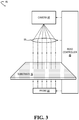
- FIG. 3 shows aspects of an example optical read head 46 of DR system 44.
- the optical read head is configured to read, according to parameters and other control signals supplied by read controller 48, the data that has been stored on an associated data-storage substrate 16.
- the data read from the data-storage substrate is then passed to decoder 50.
- the decoder is service hosted on computer network 12.
- the decoder may be a component of DS system 18.
- the decoder is configured to decode and output the data read from the one or more data-storage substrates to read buffer 20, from which an output stream 28R is made available.
- each optical read head 46 includes a polarized optical probe 54 and an analyzer camera 56 configured to image the data-storage substrate 16 associated with that optical read head.
- the polarized optical probe may include a low-power diode laser or other light source.
- Read controller 48 is coupled operatively to the polarized optical probe and configured to control the angle of the polarization plane of emission of the polarized optical probe.
- Analyzer camera 56 may include a high-resolution / high frame-rate CMOS or other suitable photodetector array.
- the analyzer camera is configured to image light from polarized optical probe 54, after such light has interacted with the voxels of data-storage substrate 16.
- FIG. 3 shows transmission of light rays through the storage medium and on to the camera, the light rays may, in alternative configurations, reach the camera by reflection from the storage medium.
- Each image frame acquired by analyzer camera 56 may include a plurality of component images captured simultaneously or in rapid succession.
- the analyzer camera may resolve, in corresponding pixel arrays of the component images, localized intensity in different polarization planes.
- the analyzer camera may include switchable or tunable polarization control in the form of a liquid-crystal retarder or Pockels cell, for example.
- four images of each target portion of data-storage substrate 16 are acquired in sequence by the analyzer camera as the polarized optical probe 54 is rotated through four different polarization angles. This process is akin to measuring basis vectors of a multi-dimensional vector, where here the 'vector' captures the birefringent properties of the voxels of the imaged target portion.
- a background image is also acquired, which captures the distribution of polarization noise in the component images.
- optical read head 46 may include an adjustable collection lens system 58.
- the adjustable collection lens system may collect light rays diffracted from a selected depth layer of the optical storage medium, and reject other light rays.
- lensless imaging based on interferometry may be employed.
- Decoder 50 of FIG. 1 is configured to receive the component images from analyzer camera 56 and to enact the image processing necessary to retrieve the data stored in data-storage substrate 16. Such data may be decoded according to a machine-learning method and/or a canonical method in which an observable physical property is connected through one or more intermediates to the data read from the data-storage substrate.
- an installed number Q of optical read heads 46 is arranged in head receiver 24R.
- a solid rectangular box is used in FIG. 1 to denote a currently installed optical read head, whereas a dashed box is used to denote an empty socket where an optical read head may be installed.
- an empty socket of a given head receiver 24R or 24W may accommodate either an optical read head or an optical write head.
- the data-reading bandwidth of at least one of the installed optical read heads may differ from at least one other of the optical read heads.
- optical read heads with different performance characteristics can be used in DR system 44 at the same time. Higher performance is achieved by imaging a larger physical area of data-storage substrate 16 when reading. This can be achieved by using optical read heads having a larger imaging sensor and optical components, or by deploying multiple optical read heads in parallel. These measures may increase cost- viz ., if more expensive optical components, or imaging sensors are used-but may be useful in situations such as disaster recovery, when significant data-reading throughput is transiently needed to retrieve much-needed backup data, or if a customer is willing to pay for higher data-reading throughput. Having a mixture of optical read heads with different performance characteristics offers flexibility when choosing how to allocate resources, and to scale system performance.
- overall read capacity in DR system 44 should support the current read demand, which will change as function of the total amount of data stored in the system, and as a function of the age of the data. Typically, the demand will decrease with increasing age. Read demand for specific data may also increase, however, as a result of a spike in the customer workload-disaster recovery being one example. Deployment of disaggregated optical write and read heads also makes it easier to maximize the value of these heads by keeping them utilized as much as possible. This feature is particularly useful for optical write heads, which may be more than an order of magnitude more expensive than the optical read heads.
- optical read head 46 may be incorporated in optical write head 22, to enable the data to be verified as it is written.
- read-after-write verification may be achieved simply by associating an optical read head to the same data-storage substrate being written to, in addition to the optical write head.
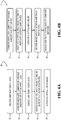
- FIG. 4A illustrates an example method 60 for dynamic reconfiguration of a DSR system, such as DSR system 10 of FIG. 1 .
- the DS system of the data server receives arbitrary digital data to be stored in the data server.
- the DS system computes one or more of the desired installed number N and desired variable write-head bandwidth based on a volume of the data to be written in the data server.
- an encoder of the DS system encodes the arbitrary digital data for optical storage via the installed number N of optical write heads.
- a positioner machine of the data server associates the N optical write heads to one or more data-storage substrates.
- the N optical write heads are activated to write the encoded data to the one or more data-storage substrates.
- activating the N optical write heads results may result in substantially permanent storage of the encoded data into the one or more data-storage substrates. Also as noted above, activating the N optical write heads may result in storage of the encoded data into an array of localized voxel positions in the one or more data-storage substrates. In implementations in which the storage is substantially permanent, each of the array of localized voxel positions of a given data-storage substrate may be written only once.
- FIG. 4B illustrates an example method 71 for dynamic reconfiguration of a DSR system, such as DSR system 10 of FIG. 1 .
- methods 60 and 71 may be enacted together; in other examples, the methods may be enacted separately.
- the DR system computes one or more of a desired installed number Q and desired variable read-head bandwidth based on a volume of the data to be read in the data server.
- a positioner machine of the data server associates the variable installed number Q of optical read heads to the one or more data-storage substrates.
- the Q optical read heads are activated to read image data from the one or more data-storage substrates.
- a decoder of the DR system decodes the image data to retrieve the arbitrary digital data that was stored on the data-storage substrates.
- the DR system releases the arbitrary digital data to a computer network.
- encoding at 66 and/or the decoding at 78 may be enacted in an elastically provisioned computer system, or virtual machine (VM), on computer network 12 of FIG. 1 .
- VM virtual machine
- the computing resource necessary to decode the images collected by the optical read head may be physically separate (i.e., disaggregated) from the hardware used to image the data-storage substrates. This is in contrast to prior storage technologies, which have a fixed amount of compute power associated with each optical read head, such compute power being usable only to decode the signal read from the data-storage medium.
- DS system 18 may be configured to stream captured data over the network to, for example, one or more VMs that may be engaged or disengaged responsive to the changing need for image-data decoding.
- disaggregating the decoding compute from the read hardware enables fine-grained scaling of the compute resources provisioned for decoding data, to match the current amount of read activity in the system.
- Disaggregation also enables batching when decoding data collected from data-storage substrates across the system, which maximizes the utilization of the compute resources provisioned for the decoding operation.
- the computing of the installed number of optical write heads N and/or the installed number of optical read heads Q may be enacted using a trained machine-learning model executing at runtime.
- Machine learning may be used both to enable and to drive system adaptation.
- various signals may be monitored, including current and historical characteristics of the workload, and current and historical DSR system configurations and resulting performance characteristics.
- Machine-learning techniques such as model-based and model-free reinforcement learning, etc., may consume these signals to learn about workload versus system behavior, as well as to derive change / re-configuration decisions and information pertaining to system adaptation. The derived changes are then implemented in the system, to effect the desired behavior.
- One particular example of system adaptation is guaranteeing that the right amount of aggregate read capacity is available to service the current workload demand in the system (i.e., the demand for a particular subset of the data stored in the system).
- Average read demand for data decreases as the total amount of data stored in the system increases, while occasional events like a client initiating disaster recovery for lost data can increase demand for the subset of the data in the system belonging to that client.
- demand dynamics can be accommodated by deploying additional optical read heads into DR system 44, and/or by changing the hardware or software configuration of the DR system (e.g., by reassigning which heads have access to which data-storage substrates.
- the policy for when this should happen may comprise hard-coded heuristics (e.g., if the total pending read requests for a rack of substrates should exceed a specified threshold), or it could be derived from a machine-learning system trained on real or simulated system configurations and performance characteristics.
- One example machine-learning policy takes the form of a neural network that receives the system and workload state observations as input, and outputs a probability distribution over possible next actions to take.
- a network may be trained by reinforcement learning, where a reward metric is used to score the actions of the network and update the weights of the network to maximize the reward.
- the reward metric may be designed to measure how well the current policy achieves right-provisioning and elasticity by avoiding redundant hardware, while meeting user demand.
- the factor that separates a better machine-learned policy from a more primitive hard-coded policy is how quickly and how well the system is able to respond to change- viz ., meeting the new read or write demand in the system, while maximizing the utilization of the deployed resources, including not keeping valuable write or optical read heads idle when there is unmet demand in the system.
- the high-level goal of system adaptation using machine learning is to drive changes in the system configuration, both in hardware and in software.
- many other aspects of the configuration may evolve under the direction of an appropriate machine-learning method (e.g., model-based reinforcement learning). Additional examples include: using higher- versus lower-bandwidth heads to service a given set of write or read requests; associating heads to substrates; reordering and/or batching certain write or read requests based on appropriate criteria; choosing between different scheduling policies; and changing the number of images (and perhaps even the polarization states) captured of the same substrate and FOV, as an input to the data decoder.
- the set of actions output by the machine-learning method may depend on the detailed way in which the world and/or problem is modeled, on tractability (given the dimensionality of the problem), and on the types of system behaviors used to drive the machine-learning model.
- FIG. 5 shows an example method 82 for reconfiguring a system to store and retrieve data in a data server using a machine-learning model.
- the method of FIG. 5 may be implemented on the example data storage and retrieval systems described above.
- Method 82 comprises, at 84, monitoring current performance data for the system, the current performance data comprising data regarding one or more of data-storage performance and data-retrieval performance. Any suitable performance data may be monitored, including hardware performance data and software performance data.
- Examples of hardware performance data may comprises a number of read heads in use, the type or types of read heads in use, e.g., with regard to bandwidth, a maximum number of read heads available for use, the type or types of the read heads available for use, a number and/or type(s) of write heads in use, and a maximum number of write heads available for use, including the type or types of the write heads with regard to bandwidth.
- Example software performance data comprises a number of encoders in use and a number of decoders in use, bandwidth information on the encoders/decoders, as well as client-facing bandwidth and latency information. Further, the current state of policies (e.g., scheduling policies) that affect system performance also may be monitored.
- Method 82 further comprises, at 86, monitoring current workload data for the system.
- the current workload data may comprise, for example, data regarding one or more of storage demand (e.g ., an amount of data to be written and/or a bandwidth demand for the data writing) and retrieval demand (e.g., an amount of data to be read and/or a bandwidth demand for data reading).
- Method 82 next comprises, at 88, forming a feature vector for input into a machine-learning model configured to reconfigure the system based upon a target performance of the system.
- the feature vector may include any suitable information, such as the current performance data, the current workload data, and data related to the target system performance (e.g., service-level agreement information for current read/write demands, and/or any other suitable target system performance data).
- any suitable machine-learning model may be used, including reinforcement learning models.
- Method 82 further comprises, at 90, providing the feature vector to the machine-learning model; at 92, obtaining from the machine-learning model an output of one or more actions to take to adjust a state of the system based upon the target performance of the system; and at 94, implementing the one or more actions to adjust the state of the system. Any suitable action may be implemented.
- Examples include, but are not limited to, adjusting a hardware configuration (e.g., adjusting the number of read heads in use, adjusting a maximum number of read heads, adjusting a number of write heads in use, and adjusting a maximum number of write heads), and/or adjusting a software configuration (e.g., adjusting a number of encoders in use, a number of decoders in use, and/or the detailed configuration thereof).
- adjusting a hardware configuration e.g., adjusting the number of read heads in use, adjusting a maximum number of read heads, adjusting a number of write heads in use, and adjusting a maximum number of write heads
- adjusting a software configuration e.g., adjusting a number of encoders in use, a number of decoders in use, and/or the detailed configuration thereof.
- encoder / decoder function may be enacted at least partially on an elastically provisioned computer system on a computer network.
- provisioning of resources may happen at different time scales, including at deployment time and later at runtime in response to historical trends, desired performance targets, and other suitable factors. Even the maximum number of heads (M for Write heads, P for Read heads) may not be fixed over time. The process of deciding if/when/how to change the amount of heads provisioned for the system may happen asynchronously (in parallel) with the standard operation of the system.
- re-configuration e.g., as illustrated in step 68 in Figure 4A
- re-configuration e.g., as illustrated in step 68 in Figure 4A
- Such reconfiguration processes may happen orthogonally and/or concomitantly with the provisioning described above.
- Both the reconfiguration and reprovisioning aspects of the disclosed examples provide for elasticity and right provisioning of a system, which help to efficiently utilize available resources.
- DSR system 10 is intended to be illustrative and non-limiting.
- FIG. 1 shows a combined DSR system with shared components, separate but cooperating data-storage and data-retrieval systems may also be used.
- Cooperating data-storage and data-retrieval systems may communicate with an external bank of data-storage substrates, for example.
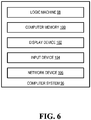
- FIG. 6 schematically shows a non-limiting embodiment of a computer system 96 that can enact one or more of the methods and processes described above.
- Computer system 96 is shown in simplified form.
- Computer system 96 may take the form of one or more server computers, network computing devices, and/or other computing devices.
- computer system 12 may be embodied as write controller 40, read controller, encoder 30, and/or decoder 50.
- Computer system 96 includes a logic machine 98 and associated computer memory 100.
- Computer system 96 may optionally include a display device 102, input device 104, network device 106, and/or other components not shown in FIG. 5 .
- Logic machine 98 includes one or more physical devices configured to execute instructions.
- the logic machine may be configured to execute instructions that are part of one or more applications, services, programs, routines, libraries, objects, components, data structures, or other logical constructs.
- Such instructions may be implemented to perform a task, implement a data type, transform the state of one or more components, achieve a technical effect, or otherwise arrive at a desired result.
- Logic machine 98 may include one or more processors configured to execute software instructions. Additionally or alternatively, the logic machine may include one or more hardware or firmware logic machines configured to execute hardware or firmware instructions. Processors of the logic machine may be single-core or multi-core, and the instructions executed thereon may be configured for sequential, parallel, and/or distributed processing. Individual components of the logic machine optionally may be distributed among two or more separate devices, which may be remotely located and/or configured for coordinated processing. Aspects of the logic machine may be virtualized and executed by remotely accessible, networked computing devices configured in a cloud-computing configuration.
- Computer memory 100 includes one or more physical devices configured to hold instructions executable by the logic machine to implement the methods and processes described herein. When such methods and processes are implemented, the state of computer memory 100 may be transformed- e.g. , to hold different data.
- Computer memory 100 may include removable and/or built-in devices.
- Computer memory 100 may include optical memory (e.g., CD, DVD, HD-DVD, Blu-Ray Disc, etc.), semiconductor memory (e.g., RAM, ROM, EPROM, EEPROM, etc.), and/or magnetic memory (e.g., hard-disk drive, tape drive, MRAM, etc.), among others.
- Computer memory 100 may include volatile, nonvolatile, dynamic, static, read/write, read-only, random-access, sequential-access, location-addressable, file-addressable, and/or content-addressable devices.
- computer memory 100 includes one or more physical devices.
- aspects of the instructions described herein alternatively may be propagated by a communication medium (e.g., an electromagnetic signal, an optical signal, etc.) that is not held by a physical device for a finite duration.
- a communication medium e.g., an electromagnetic signal, an optical signal, etc.
- Such hardware-logic components may include field-programmable gate arrays (FPGAs), program- and application-specific integrated circuits (PASIC / ASICs), program- and application-specific standard products (PSSP / ASSPs), system-on-a-chip (SOC), and complex programmable logic devices (CPLDs), for example.
- FPGAs field-programmable gate arrays
- PASIC / ASICs program- and application-specific integrated circuits
- PSSP / ASSPs program- and application-specific standard products
- SOC system-on-a-chip
- CPLDs complex programmable logic devices
- the terms 'module,' 'program,' and 'engine' may be used to describe an aspect of computer system 96 implemented to perform a particular function.
- a module, program, or engine may be instantiated via logic machine 98 executing instructions held by computer memory 100. It will be understood that different modules, programs, and/or engines may be instantiated from the same application, service, code block, object, library, routine, API. function, etc Likewise, the same module, program, and/or engine may be instantiated by different applications, services, code blocks, objects, routines, APIs, functions, etc.
- the terms 'module,' 'program,' and 'engine' may encompass individual or groups of executable files, data files, libraries, drivers, scripts, database records, etc.
- a 'service' is an application program executable across multiple user sessions.
- a service may be available to one or more system components, programs, and/or other services.
- a service may run on one or more server-computing devices.
- display device 102 may be used to present a visual representation of data held by computer memory 100.
- This visual representation may take the form of a graphical user interface (GUI).
- GUI graphical user interface
- the state of display device 130 may likewise be transformed to visually represent changes in the underlying data.
- Display device 102 may include one or more display components utilizing virtually any type of technology. Such display components may be combined with logic machine 98 and/or computer memory 100 in a shared enclosure, or such display devices may be peripheral display devices.
- input device 104 may comprise or interface with one or more user-input components such as a keyboard, mouse, or touch screen.
- the input device may comprise or interface with selected natural user input (NUI) componentry.
- NUI natural user input
- Such componentry may be integrated or peripheral, and the transduction and/or processing of input actions may be handled on- or off-board.
- NUI componentry may include a microphone for speech and/or voice recognition; an infrared, color, stereoscopic, and/or depth camera for machine vision and/or gesture recognition; a head tracker, eye tracker, accelerometer, and/or gyroscope for motion detection and/or intent recognition.
- network device 106 may be configured to communicatively couple computer system 96 with one or more other computing devices.
- Network device 106 may include wired and/or wireless communication components compatible with one or more different communication protocols.
- the network device may be configured for communication via a wireless telephone network, or a wired or wireless local- or wide-area network.
- the network device may allow computer system 96 to send and/or receive messages to and/or from other devices via a network such as the Internet.
- a data-storage system comprising a head receiver configured to variably receive up to a number M of write heads; an installed number N of write heads arranged in the head receiver; a substrate receiver configured to receive one or more data-storage substrates; and a positioner machine configured to adjust a relative placement of each of the M write heads with respect to at least one of the one or more data-storage substrates.
- the positioner machine is configured to move one or more of each of the M write heads and the at least one or more of the data-storage substrates.
- the write heads comprise optical write heads configured to direct sub-nanosecond laser irradiance on a data-storage substrate associated with the optical write head.
- the installed number N of write heads includes fewer than the number M of optical read heads.
- at least one of the installed number N of write heads has a variable data-writing bandwidth.
- the data-storage system further comprises at least one read head arranged in the head receiver, the read head including a camera configured to image a data-storage substrate associated with the optical read head.
- each of the installed number N of write heads is configured to write arbitrary digital data encoded as a localized birefringence in the associated data-storage substrate.
- the data-storage system further comprises at least one femtosecond laser configured to provide the laser irradiance to one or more of the maximum number M of write heads.
- a data-retrieval system comprising a head receiver configured to receive up to a number P of read heads; an installed number Q of read heads arranged in the head receiver; a substrate receiver configured to receive one or more data-storage substrates; and a positioner machine configured to adjust a relative placement of each of the P read heads with respect to at least one of the one or more data-storage substrates.
- the positioner machine is configured to move one or more of the read heads and the at least one of the one or more data-storage substrates.
- each of the read heads includes a camera configured to image a data-storage substrate associated with the optical read head.
- the installed number Q of optical read heads includes fewer than the number P of read heads.
- at least one of the installed number Q of optical read heads has a variable data-reading bandwidth. 0.
- the data-retrieval system further comprises at least one optical write head arranged in the head receiver, the optical write head configured to direct a sub nanosecond laser irradiance on a data-storage substrate associated with the optical write head.
- Another example provides a method for reconfiguring a system to store and retrieve data in a data server, the method comprising: monitoring current performance data for the system, the current performance data comprising data regarding one or more of storage performance and retrieval performance; monitoring current workload data for the system, the current workload data comprising data regarding one or more of storage demand and retrieval demand; forming a feature vector for a machine-learning model, the feature vector comprising the current performance data. the current workload data. and data related to a target performance of the system; providing the feature vector to the machine-learning model; obtaining from the machine-learning model an output of one or more actions to take to adjust a current state of the system based upon the target performance of the system; and implementing the one or more actions to adjust the current state of the system.
- the current performance data for the system comprises one or more of a number of read heads in use, a number of write head in use, a maximum number of read heads, a maximum number of write heads, a number of encoders in, a number of decoders in use, and a scheduling policy.
- the machine-learning model comprises a reinforcement learning model.
- implementing the one or more actions comprises one or more of adjusting a hardware configuration of the system, adjusting a software configuration of the system, and adjusting a policy of the system.
- adjusting the hardware configuration of the system comprises one or more of adjusting the number of read heads in use, adjusting a maximum number of read heads, adjusting a number of write heads in use, and adjusting a maximum number of write heads.
- implementing the one or more actions comprises adjusting one or more of an encoder configuration and a decoder configuration enacted in an elastically provisioned computer system on a computer network.
Landscapes
- Engineering & Computer Science (AREA)
- Theoretical Computer Science (AREA)
- Physics & Mathematics (AREA)
- General Physics & Mathematics (AREA)
- General Engineering & Computer Science (AREA)
- Human Computer Interaction (AREA)
- Software Systems (AREA)
- Evolutionary Computation (AREA)
- Computing Systems (AREA)
- Medical Informatics (AREA)
- Data Mining & Analysis (AREA)
- Mathematical Physics (AREA)
- Computer Vision & Pattern Recognition (AREA)
- Artificial Intelligence (AREA)
- Optical Recording Or Reproduction (AREA)
- Information Retrieval, Db Structures And Fs Structures Therefor (AREA)
- Debugging And Monitoring (AREA)
- Signal Processing For Digital Recording And Reproducing (AREA)
Applications Claiming Priority (3)
| Application Number | Priority Date | Filing Date | Title |
|---|---|---|---|
| US15/981,789 US10719239B2 (en) | 2018-05-16 | 2018-05-16 | Disaggregated data storage and retrieval system |
| EP19724980.8A EP3794433A1 (de) | 2018-05-16 | 2019-04-29 | Disaggregiertes datenspeicherungs- und abrufsystem |
| PCT/US2019/029629 WO2019221898A1 (en) | 2018-05-16 | 2019-04-29 | Disaggregated data storage and retrieval system |
Related Parent Applications (1)
| Application Number | Title | Priority Date | Filing Date |
|---|---|---|---|
| EP19724980.8A Division EP3794433A1 (de) | 2018-05-16 | 2019-04-29 | Disaggregiertes datenspeicherungs- und abrufsystem |
Publications (2)
| Publication Number | Publication Date |
|---|---|
| EP3907736A2 true EP3907736A2 (de) | 2021-11-10 |
| EP3907736A3 EP3907736A3 (de) | 2022-02-23 |
Family
ID=66589892
Family Applications (2)
| Application Number | Title | Priority Date | Filing Date |
|---|---|---|---|
| EP19724980.8A Withdrawn EP3794433A1 (de) | 2018-05-16 | 2019-04-29 | Disaggregiertes datenspeicherungs- und abrufsystem |
| EP21182586.4A Withdrawn EP3907736A3 (de) | 2018-05-16 | 2019-04-29 | Disaggregiertes datenspeicherungs- und abrufsystem |
Family Applications Before (1)
| Application Number | Title | Priority Date | Filing Date |
|---|---|---|---|
| EP19724980.8A Withdrawn EP3794433A1 (de) | 2018-05-16 | 2019-04-29 | Disaggregiertes datenspeicherungs- und abrufsystem |
Country Status (3)
| Country | Link |
|---|---|
| US (2) | US10719239B2 (de) |
| EP (2) | EP3794433A1 (de) |
| WO (1) | WO2019221898A1 (de) |
Families Citing this family (23)
| Publication number | Priority date | Publication date | Assignee | Title |
|---|---|---|---|---|
| US10970363B2 (en) * | 2017-10-17 | 2021-04-06 | Microsoft Technology Licensing, Llc | Machine-learning optimization of data reading and writing |
| KR102511881B1 (ko) | 2019-08-14 | 2023-03-20 | 세라믹 데이터 솔루션즈 게엠베하 | 정보의 장기 저장을 위한 방법 및 그를 위한 저장 매체 |
| GB201912337D0 (en) | 2019-08-28 | 2019-10-09 | Univ Southampton | Method of forming birefringent structures in an optical element |
| US11403031B2 (en) * | 2019-11-13 | 2022-08-02 | Microsoft Technology Licensing, Llc | Systems and methods for encoding and decoding data |
| US11748166B2 (en) * | 2020-06-26 | 2023-09-05 | EMC IP Holding Company LLC | Method and system for pre-allocation of computing resources prior to preparation of physical assets |
| JP2023532545A (ja) | 2020-07-03 | 2023-07-28 | セラミック・データ・ソリューションズ・ゲーエムベーハー | 多ビット符号方式により記憶密度が向上した情報の記憶方法および情報記憶媒体 |
| CN115843362B (zh) | 2020-07-03 | 2025-07-04 | 陶瓷数据解决方案有限公司 | 用于长期存储信息的方法和信息存储介质的提高存储能力 |
| EP3955248B1 (de) | 2020-08-11 | 2025-12-17 | Ceramic Data Solutions GmbH | Datenaufzeichnung auf keramischem material |
| US20220076160A1 (en) * | 2020-09-09 | 2022-03-10 | Western Digital Technologies, Inc. | Embedded Machine Learning for Storage Devices |
| US20220121985A1 (en) * | 2020-10-20 | 2022-04-21 | Western Digital Technologies, Inc. | Machine Learning Supplemented Storage Device Calibration |
| US12475365B2 (en) | 2020-10-20 | 2025-11-18 | Western Digital Technologies, Inc. | Embedded multi-attribute machine learning for storage devices |
| EP4044182B1 (de) | 2021-02-12 | 2025-12-31 | Ceramic Data Solutions GmbH | Ultradünner datenträger |
| US20240055021A1 (en) | 2021-02-12 | 2024-02-15 | Ceramic Data Solutions GmbH | Ultra-Thin Data Carrier and Method of Read-Out |
| WO2022194354A1 (en) | 2021-03-16 | 2022-09-22 | Ceramic Data Solutions GmbH | Data carrier, reading method and system utilizing super resolution techniques |
| AU2021443312B2 (en) | 2021-04-29 | 2025-06-26 | Ceramic Data Solutions GmbH | Hybrid digital and analog data storage |
| EP4092464B1 (de) | 2021-05-17 | 2025-03-26 | Ceramic Data Solutions GmbH | Hochgeschwindigkeitsauslesung durch kombination einer transmissiven weitwinkelansicht mit einer reflektiven fokussierungsansicht |
| EP4195204A1 (de) | 2021-12-09 | 2023-06-14 | Ceramic Data Solutions GmbH | Ultradünner magnetischer datenträger auf einem keramiksubstrat |
| KR20240124333A (ko) | 2021-12-14 | 2024-08-16 | 세라믹 데이터 솔루션즈 게엠베하 | 초박형 데이터 캐리어 및 판독 방법 |
| EP4198979A1 (de) | 2021-12-14 | 2023-06-21 | Ceramic Data Solutions GmbH | Ultradünner datenträger und verfahren zum auslesen |
| US12165682B2 (en) | 2023-03-31 | 2024-12-10 | Microsoft Technology Licensing, Llc | Phase-modulated optical data storage |
| US12266391B2 (en) | 2023-03-31 | 2025-04-01 | Microsoft Technology Licensing, Llc | Method and system for writing voxels to a transparent substrate |
| US12183378B2 (en) | 2023-03-31 | 2024-12-31 | Microsoft Technology Licensing, Llc | Method and system for forming birefringent voxels |
| US12524262B1 (en) * | 2025-05-05 | 2026-01-13 | SGM Infotech, LLC | Integrated AI-driven and compliance-aware multi-state encoding framework |
Family Cites Families (7)
| Publication number | Priority date | Publication date | Assignee | Title |
|---|---|---|---|---|
| JP3566458B2 (ja) | 1995-08-30 | 2004-09-15 | 株式会社東芝 | アーカイブ装置 |
| IT1312476B1 (it) | 1999-05-11 | 2002-04-17 | Bernardini Srl | Stazioni di carico e scarico per apparecchiatura di registrazione didischi ottici e simili |
| US20100067343A1 (en) | 2008-09-18 | 2010-03-18 | Kabushiki Kaisha Toshiba | Information Processing Apparatus, Health Check Method, and Storage Medium |
| US8880794B2 (en) | 2012-06-04 | 2014-11-04 | Spectra Logic Corporation | Populating a sparsely allocated memory in a storage array |
| US8929023B1 (en) * | 2014-05-13 | 2015-01-06 | International Business Machines Corporation | Inventory management for automated data storage libraries |
| US10395688B2 (en) | 2016-03-04 | 2019-08-27 | Sony Corporation Of America | Storage library system |
| US10007459B2 (en) * | 2016-10-20 | 2018-06-26 | Pure Storage, Inc. | Performance tuning in a storage system that includes one or more storage devices |
-
2018
- 2018-05-16 US US15/981,789 patent/US10719239B2/en active Active
-
2019
- 2019-04-29 EP EP19724980.8A patent/EP3794433A1/de not_active Withdrawn
- 2019-04-29 WO PCT/US2019/029629 patent/WO2019221898A1/en not_active Ceased
- 2019-04-29 EP EP21182586.4A patent/EP3907736A3/de not_active Withdrawn
- 2019-11-12 US US16/680,865 patent/US10768825B2/en active Active
Also Published As
| Publication number | Publication date |
|---|---|
| US20190354283A1 (en) | 2019-11-21 |
| US10719239B2 (en) | 2020-07-21 |
| WO2019221898A1 (en) | 2019-11-21 |
| EP3907736A3 (de) | 2022-02-23 |
| US20200081619A1 (en) | 2020-03-12 |
| US10768825B2 (en) | 2020-09-08 |
| EP3794433A1 (de) | 2021-03-24 |
Similar Documents
| Publication | Publication Date | Title |
|---|---|---|
| US10768825B2 (en) | Disaggregated data storage and retrieval system | |
| US10236027B1 (en) | Data storage using light of spatially modulated phase and polarization | |
| CN111033613B (zh) | 用于在玻璃上快速写入数据的多光束光学系统 | |
| US20210224355A1 (en) | Machine-learning optimization of data reading and writing | |
| Hu et al. | High‐throughput multichannel parallelized diffraction convolutional neural network accelerator | |
| US10620511B2 (en) | Projection device, projection system, and interface apparatus | |
| US10657420B2 (en) | Modeling post-lithography stochastic critical dimension variation with multi-task neural networks | |
| JP7522767B2 (ja) | 高密度光データ記録 | |
| CN109799666B (zh) | 一种全息投影装置及全息投影方法 | |
| US8199387B1 (en) | Phase addressed holographic associative memory | |
| US11740587B2 (en) | Method and apparatus for generating computer-generated hologram | |
| JP7276974B2 (ja) | 点群コーディングのための方法、装置およびコンピュータプログラム | |
| KR102697995B1 (ko) | 액정디스플레이 장치를 사용한 홀로그램 디스플레이 | |
| WO2014171949A1 (en) | Holographic image generation and reconstruction | |
| JP7518163B2 (ja) | ビデオコーディングのための領域適応ループフィルタ | |
| Velez-Zea et al. | Alternative constraints for improved multiplane hologram generation | |
| US11586932B2 (en) | Model training with variable batch sizing and gradient checkpoint segments | |
| US11499815B2 (en) | Visual quality assessment augmentation employing holographic interferometry | |
| WO2022010558A1 (en) | Extended maximum coding unit size | |
| RU2815327C2 (ru) | Высокоплотная оптическая запись данных | |
| US20230152971A1 (en) | Parameter redundancy reduction method | |
| JP2024171188A (ja) | 回折光学素子、撮像装置、及びプログラム | |
| US9640215B2 (en) | Holographic light-emitting module and holographic storage system using the same | |
| HK40061184B (en) | A method and system for recording data in a solid substrate | |
| Panotopoulos | Holographic information systems |
Legal Events
| Date | Code | Title | Description |
|---|---|---|---|
| PUAI | Public reference made under article 153(3) epc to a published international application that has entered the european phase |
Free format text: ORIGINAL CODE: 0009012 |
|
| STAA | Information on the status of an ep patent application or granted ep patent |
Free format text: STATUS: REQUEST FOR EXAMINATION WAS MADE |
|
| 17P | Request for examination filed |
Effective date: 20210629 |
|
| AC | Divisional application: reference to earlier application |
Ref document number: 3794433 Country of ref document: EP Kind code of ref document: P |
|
| AK | Designated contracting states |
Kind code of ref document: A2 Designated state(s): AL AT BE BG CH CY CZ DE DK EE ES FI FR GB GR HR HU IE IS IT LI LT LU LV MC MK MT NL NO PL PT RO RS SE SI SK SM TR |
|
| PUAL | Search report despatched |
Free format text: ORIGINAL CODE: 0009013 |
|
| AK | Designated contracting states |
Kind code of ref document: A3 Designated state(s): AL AT BE BG CH CY CZ DE DK EE ES FI FR GB GR HR HU IE IS IT LI LT LU LV MC MK MT NL NO PL PT RO RS SE SI SK SM TR |
|
| RIC1 | Information provided on ipc code assigned before grant |
Ipc: G11B 17/22 20060101AFI20220120BHEP |
|
| STAA | Information on the status of an ep patent application or granted ep patent |
Free format text: STATUS: THE APPLICATION HAS BEEN WITHDRAWN |
|
| 18W | Application withdrawn |
Effective date: 20220810 |