EP3907154A1 - Household tissue paper container - Google Patents
Household tissue paper container Download PDFInfo
- Publication number
- EP3907154A1 EP3907154A1 EP20763161.5A EP20763161A EP3907154A1 EP 3907154 A1 EP3907154 A1 EP 3907154A1 EP 20763161 A EP20763161 A EP 20763161A EP 3907154 A1 EP3907154 A1 EP 3907154A1
- Authority
- EP
- European Patent Office
- Prior art keywords
- tissue paper
- container body
- outlet
- household tissue
- open
- Prior art date
- Legal status (The legal status is an assumption and is not a legal conclusion. Google has not performed a legal analysis and makes no representation as to the accuracy of the status listed.)
- Granted
Links
Images




Classifications
-
- B—PERFORMING OPERATIONS; TRANSPORTING
- B65—CONVEYING; PACKING; STORING; HANDLING THIN OR FILAMENTARY MATERIAL
- B65D—CONTAINERS FOR STORAGE OR TRANSPORT OF ARTICLES OR MATERIALS, e.g. BAGS, BARRELS, BOTTLES, BOXES, CANS, CARTONS, CRATES, DRUMS, JARS, TANKS, HOPPERS, FORWARDING CONTAINERS; ACCESSORIES, CLOSURES, OR FITTINGS THEREFOR; PACKAGING ELEMENTS; PACKAGES
- B65D25/00—Details of other kinds or types of rigid or semi-rigid containers
- B65D25/34—Coverings or external coatings
-
- A—HUMAN NECESSITIES
- A47—FURNITURE; DOMESTIC ARTICLES OR APPLIANCES; COFFEE MILLS; SPICE MILLS; SUCTION CLEANERS IN GENERAL
- A47K—SANITARY EQUIPMENT; ACCESSORIES THEREFOR, e.g. TOILET ACCESSORIES
- A47K10/00—Body-drying implements; Toilet paper; Holders therefor
- A47K10/24—Towel dispensers; Toilet paper dispensers
- A47K10/32—Dispensers for paper towels or toilet paper
-
- A—HUMAN NECESSITIES
- A47—FURNITURE; DOMESTIC ARTICLES OR APPLIANCES; COFFEE MILLS; SPICE MILLS; SUCTION CLEANERS IN GENERAL
- A47K—SANITARY EQUIPMENT; ACCESSORIES THEREFOR, e.g. TOILET ACCESSORIES
- A47K10/00—Body-drying implements; Toilet paper; Holders therefor
- A47K10/24—Towel dispensers; Toilet paper dispensers
- A47K10/32—Dispensers for paper towels or toilet paper
- A47K10/42—Dispensers for paper towels or toilet paper dispensing from a store of single sheets, e.g. stacked
- A47K10/421—Dispensers for paper towels or toilet paper dispensing from a store of single sheets, e.g. stacked dispensing from the top of the dispenser
-
- B—PERFORMING OPERATIONS; TRANSPORTING
- B65—CONVEYING; PACKING; STORING; HANDLING THIN OR FILAMENTARY MATERIAL
- B65D—CONTAINERS FOR STORAGE OR TRANSPORT OF ARTICLES OR MATERIALS, e.g. BAGS, BARRELS, BOTTLES, BOXES, CANS, CARTONS, CRATES, DRUMS, JARS, TANKS, HOPPERS, FORWARDING CONTAINERS; ACCESSORIES, CLOSURES, OR FITTINGS THEREFOR; PACKAGING ELEMENTS; PACKAGES
- B65D43/00—Lids or covers for rigid or semi-rigid containers
- B65D43/14—Non-removable lids or covers
- B65D43/16—Non-removable lids or covers hinged for upward or downward movement
- B65D43/162—Non-removable lids or covers hinged for upward or downward movement the container, the lid and the hinge being made of one piece
-
- B—PERFORMING OPERATIONS; TRANSPORTING
- B65—CONVEYING; PACKING; STORING; HANDLING THIN OR FILAMENTARY MATERIAL
- B65D—CONTAINERS FOR STORAGE OR TRANSPORT OF ARTICLES OR MATERIALS, e.g. BAGS, BARRELS, BOTTLES, BOXES, CANS, CARTONS, CRATES, DRUMS, JARS, TANKS, HOPPERS, FORWARDING CONTAINERS; ACCESSORIES, CLOSURES, OR FITTINGS THEREFOR; PACKAGING ELEMENTS; PACKAGES
- B65D43/00—Lids or covers for rigid or semi-rigid containers
- B65D43/14—Non-removable lids or covers
- B65D43/16—Non-removable lids or covers hinged for upward or downward movement
- B65D43/163—Non-removable lids or covers hinged for upward or downward movement the container and the lid being made separately
-
- B—PERFORMING OPERATIONS; TRANSPORTING
- B65—CONVEYING; PACKING; STORING; HANDLING THIN OR FILAMENTARY MATERIAL
- B65D—CONTAINERS FOR STORAGE OR TRANSPORT OF ARTICLES OR MATERIALS, e.g. BAGS, BARRELS, BOTTLES, BOXES, CANS, CARTONS, CRATES, DRUMS, JARS, TANKS, HOPPERS, FORWARDING CONTAINERS; ACCESSORIES, CLOSURES, OR FITTINGS THEREFOR; PACKAGING ELEMENTS; PACKAGES
- B65D43/00—Lids or covers for rigid or semi-rigid containers
- B65D43/14—Non-removable lids or covers
- B65D43/24—Devices for retaining in open position
-
- B—PERFORMING OPERATIONS; TRANSPORTING
- B65—CONVEYING; PACKING; STORING; HANDLING THIN OR FILAMENTARY MATERIAL
- B65D—CONTAINERS FOR STORAGE OR TRANSPORT OF ARTICLES OR MATERIALS, e.g. BAGS, BARRELS, BOTTLES, BOXES, CANS, CARTONS, CRATES, DRUMS, JARS, TANKS, HOPPERS, FORWARDING CONTAINERS; ACCESSORIES, CLOSURES, OR FITTINGS THEREFOR; PACKAGING ELEMENTS; PACKAGES
- B65D83/00—Containers or packages with special means for dispensing contents
- B65D83/08—Containers or packages with special means for dispensing contents for dispensing thin flat articles in succession
- B65D83/0805—Containers or packages with special means for dispensing contents for dispensing thin flat articles in succession through an aperture in a wall
-
- A—HUMAN NECESSITIES
- A47—FURNITURE; DOMESTIC ARTICLES OR APPLIANCES; COFFEE MILLS; SPICE MILLS; SUCTION CLEANERS IN GENERAL
- A47K—SANITARY EQUIPMENT; ACCESSORIES THEREFOR, e.g. TOILET ACCESSORIES
- A47K10/00—Body-drying implements; Toilet paper; Holders therefor
- A47K10/24—Towel dispensers; Toilet paper dispensers
- A47K10/32—Dispensers for paper towels or toilet paper
- A47K2010/3233—Details of the housing, e.g. hinges, connection to the wall
-
- A—HUMAN NECESSITIES
- A47—FURNITURE; DOMESTIC ARTICLES OR APPLIANCES; COFFEE MILLS; SPICE MILLS; SUCTION CLEANERS IN GENERAL
- A47K—SANITARY EQUIPMENT; ACCESSORIES THEREFOR, e.g. TOILET ACCESSORIES
- A47K10/00—Body-drying implements; Toilet paper; Holders therefor
- A47K10/24—Towel dispensers; Toilet paper dispensers
- A47K10/32—Dispensers for paper towels or toilet paper
- A47K2010/3266—Wet wipes
-
- B—PERFORMING OPERATIONS; TRANSPORTING
- B65—CONVEYING; PACKING; STORING; HANDLING THIN OR FILAMENTARY MATERIAL
- B65D—CONTAINERS FOR STORAGE OR TRANSPORT OF ARTICLES OR MATERIALS, e.g. BAGS, BARRELS, BOTTLES, BOXES, CANS, CARTONS, CRATES, DRUMS, JARS, TANKS, HOPPERS, FORWARDING CONTAINERS; ACCESSORIES, CLOSURES, OR FITTINGS THEREFOR; PACKAGING ELEMENTS; PACKAGES
- B65D2251/00—Details relating to container closures
- B65D2251/10—Details of hinged closures
- B65D2251/1016—Means for locking the closure in closed position
- B65D2251/1058—Latching mechanisms
-
- B—PERFORMING OPERATIONS; TRANSPORTING
- B65—CONVEYING; PACKING; STORING; HANDLING THIN OR FILAMENTARY MATERIAL
- B65D—CONTAINERS FOR STORAGE OR TRANSPORT OF ARTICLES OR MATERIALS, e.g. BAGS, BARRELS, BOTTLES, BOXES, CANS, CARTONS, CRATES, DRUMS, JARS, TANKS, HOPPERS, FORWARDING CONTAINERS; ACCESSORIES, CLOSURES, OR FITTINGS THEREFOR; PACKAGING ELEMENTS; PACKAGES
- B65D2543/00—Lids or covers essentially for box-like containers
- B65D2543/00009—Details of lids or covers for rigid or semi-rigid containers
- B65D2543/00018—Overall construction of the lid
- B65D2543/00064—Shape of the outer periphery
- B65D2543/0012—Shape of the outer periphery having straight sides, e.g. with curved corners
- B65D2543/00175—Shape of the outer periphery having straight sides, e.g. with curved corners four straight sides, e.g. trapezium or diamond
- B65D2543/00194—Shape of the outer periphery having straight sides, e.g. with curved corners four straight sides, e.g. trapezium or diamond square or rectangular
-
- B—PERFORMING OPERATIONS; TRANSPORTING
- B65—CONVEYING; PACKING; STORING; HANDLING THIN OR FILAMENTARY MATERIAL
- B65D—CONTAINERS FOR STORAGE OR TRANSPORT OF ARTICLES OR MATERIALS, e.g. BAGS, BARRELS, BOTTLES, BOXES, CANS, CARTONS, CRATES, DRUMS, JARS, TANKS, HOPPERS, FORWARDING CONTAINERS; ACCESSORIES, CLOSURES, OR FITTINGS THEREFOR; PACKAGING ELEMENTS; PACKAGES
- B65D2543/00—Lids or covers essentially for box-like containers
- B65D2543/00009—Details of lids or covers for rigid or semi-rigid containers
- B65D2543/00018—Overall construction of the lid
- B65D2543/00259—Materials used
- B65D2543/00296—Plastic
-
- B—PERFORMING OPERATIONS; TRANSPORTING
- B65—CONVEYING; PACKING; STORING; HANDLING THIN OR FILAMENTARY MATERIAL
- B65D—CONTAINERS FOR STORAGE OR TRANSPORT OF ARTICLES OR MATERIALS, e.g. BAGS, BARRELS, BOTTLES, BOXES, CANS, CARTONS, CRATES, DRUMS, JARS, TANKS, HOPPERS, FORWARDING CONTAINERS; ACCESSORIES, CLOSURES, OR FITTINGS THEREFOR; PACKAGING ELEMENTS; PACKAGES
- B65D2543/00—Lids or covers essentially for box-like containers
- B65D2543/00009—Details of lids or covers for rigid or semi-rigid containers
- B65D2543/00018—Overall construction of the lid
- B65D2543/00259—Materials used
- B65D2543/00305—Other
-
- B—PERFORMING OPERATIONS; TRANSPORTING
- B65—CONVEYING; PACKING; STORING; HANDLING THIN OR FILAMENTARY MATERIAL
- B65D—CONTAINERS FOR STORAGE OR TRANSPORT OF ARTICLES OR MATERIALS, e.g. BAGS, BARRELS, BOTTLES, BOXES, CANS, CARTONS, CRATES, DRUMS, JARS, TANKS, HOPPERS, FORWARDING CONTAINERS; ACCESSORIES, CLOSURES, OR FITTINGS THEREFOR; PACKAGING ELEMENTS; PACKAGES
- B65D2543/00—Lids or covers essentially for box-like containers
- B65D2543/00009—Details of lids or covers for rigid or semi-rigid containers
- B65D2543/00018—Overall construction of the lid
- B65D2543/00259—Materials used
- B65D2543/00314—Combination, e.g. laminates, several different materials
-
- B—PERFORMING OPERATIONS; TRANSPORTING
- B65—CONVEYING; PACKING; STORING; HANDLING THIN OR FILAMENTARY MATERIAL
- B65D—CONTAINERS FOR STORAGE OR TRANSPORT OF ARTICLES OR MATERIALS, e.g. BAGS, BARRELS, BOTTLES, BOXES, CANS, CARTONS, CRATES, DRUMS, JARS, TANKS, HOPPERS, FORWARDING CONTAINERS; ACCESSORIES, CLOSURES, OR FITTINGS THEREFOR; PACKAGING ELEMENTS; PACKAGES
- B65D2543/00—Lids or covers essentially for box-like containers
- B65D2543/00009—Details of lids or covers for rigid or semi-rigid containers
- B65D2543/00342—Central part of the lid
- B65D2543/00351—Dome-like
-
- B—PERFORMING OPERATIONS; TRANSPORTING
- B65—CONVEYING; PACKING; STORING; HANDLING THIN OR FILAMENTARY MATERIAL
- B65D—CONTAINERS FOR STORAGE OR TRANSPORT OF ARTICLES OR MATERIALS, e.g. BAGS, BARRELS, BOTTLES, BOXES, CANS, CARTONS, CRATES, DRUMS, JARS, TANKS, HOPPERS, FORWARDING CONTAINERS; ACCESSORIES, CLOSURES, OR FITTINGS THEREFOR; PACKAGING ELEMENTS; PACKAGES
- B65D2543/00—Lids or covers essentially for box-like containers
- B65D2543/00009—Details of lids or covers for rigid or semi-rigid containers
- B65D2543/00444—Contact between the container and the lid
- B65D2543/00481—Contact between the container and the lid on the inside or the outside of the container
- B65D2543/0049—Contact between the container and the lid on the inside or the outside of the container on the inside, or a part turned to the inside of the mouth of the container
-
- B—PERFORMING OPERATIONS; TRANSPORTING
- B65—CONVEYING; PACKING; STORING; HANDLING THIN OR FILAMENTARY MATERIAL
- B65D—CONTAINERS FOR STORAGE OR TRANSPORT OF ARTICLES OR MATERIALS, e.g. BAGS, BARRELS, BOTTLES, BOXES, CANS, CARTONS, CRATES, DRUMS, JARS, TANKS, HOPPERS, FORWARDING CONTAINERS; ACCESSORIES, CLOSURES, OR FITTINGS THEREFOR; PACKAGING ELEMENTS; PACKAGES
- B65D2543/00—Lids or covers essentially for box-like containers
- B65D2543/00009—Details of lids or covers for rigid or semi-rigid containers
- B65D2543/00444—Contact between the container and the lid
- B65D2543/00481—Contact between the container and the lid on the inside or the outside of the container
- B65D2543/0049—Contact between the container and the lid on the inside or the outside of the container on the inside, or a part turned to the inside of the mouth of the container
- B65D2543/00527—NO contact
-
- B—PERFORMING OPERATIONS; TRANSPORTING
- B65—CONVEYING; PACKING; STORING; HANDLING THIN OR FILAMENTARY MATERIAL
- B65D—CONTAINERS FOR STORAGE OR TRANSPORT OF ARTICLES OR MATERIALS, e.g. BAGS, BARRELS, BOTTLES, BOXES, CANS, CARTONS, CRATES, DRUMS, JARS, TANKS, HOPPERS, FORWARDING CONTAINERS; ACCESSORIES, CLOSURES, OR FITTINGS THEREFOR; PACKAGING ELEMENTS; PACKAGES
- B65D2543/00—Lids or covers essentially for box-like containers
- B65D2543/00009—Details of lids or covers for rigid or semi-rigid containers
- B65D2543/00444—Contact between the container and the lid
- B65D2543/00481—Contact between the container and the lid on the inside or the outside of the container
- B65D2543/00537—Contact between the container and the lid on the inside or the outside of the container on the outside, or a part turned to the outside of the mouth of the container
-
- B—PERFORMING OPERATIONS; TRANSPORTING
- B65—CONVEYING; PACKING; STORING; HANDLING THIN OR FILAMENTARY MATERIAL
- B65D—CONTAINERS FOR STORAGE OR TRANSPORT OF ARTICLES OR MATERIALS, e.g. BAGS, BARRELS, BOTTLES, BOXES, CANS, CARTONS, CRATES, DRUMS, JARS, TANKS, HOPPERS, FORWARDING CONTAINERS; ACCESSORIES, CLOSURES, OR FITTINGS THEREFOR; PACKAGING ELEMENTS; PACKAGES
- B65D2543/00—Lids or covers essentially for box-like containers
- B65D2543/00009—Details of lids or covers for rigid or semi-rigid containers
- B65D2543/00444—Contact between the container and the lid
- B65D2543/00481—Contact between the container and the lid on the inside or the outside of the container
- B65D2543/00537—Contact between the container and the lid on the inside or the outside of the container on the outside, or a part turned to the outside of the mouth of the container
- B65D2543/00546—NO contact
-
- B—PERFORMING OPERATIONS; TRANSPORTING
- B65—CONVEYING; PACKING; STORING; HANDLING THIN OR FILAMENTARY MATERIAL
- B65D—CONTAINERS FOR STORAGE OR TRANSPORT OF ARTICLES OR MATERIALS, e.g. BAGS, BARRELS, BOTTLES, BOXES, CANS, CARTONS, CRATES, DRUMS, JARS, TANKS, HOPPERS, FORWARDING CONTAINERS; ACCESSORIES, CLOSURES, OR FITTINGS THEREFOR; PACKAGING ELEMENTS; PACKAGES
- B65D2543/00—Lids or covers essentially for box-like containers
- B65D2543/00009—Details of lids or covers for rigid or semi-rigid containers
- B65D2543/00444—Contact between the container and the lid
- B65D2543/00564—Contact between the container and the lid indirect by means of a gasket or similar intermediate ring
-
- B—PERFORMING OPERATIONS; TRANSPORTING
- B65—CONVEYING; PACKING; STORING; HANDLING THIN OR FILAMENTARY MATERIAL
- B65D—CONTAINERS FOR STORAGE OR TRANSPORT OF ARTICLES OR MATERIALS, e.g. BAGS, BARRELS, BOTTLES, BOXES, CANS, CARTONS, CRATES, DRUMS, JARS, TANKS, HOPPERS, FORWARDING CONTAINERS; ACCESSORIES, CLOSURES, OR FITTINGS THEREFOR; PACKAGING ELEMENTS; PACKAGES
- B65D2543/00—Lids or covers essentially for box-like containers
- B65D2543/00009—Details of lids or covers for rigid or semi-rigid containers
- B65D2543/00444—Contact between the container and the lid
- B65D2543/00592—Snapping means
- B65D2543/00601—Snapping means on the container
- B65D2543/00611—Profiles
- B65D2543/00648—Flange or lip
-
- B—PERFORMING OPERATIONS; TRANSPORTING
- B65—CONVEYING; PACKING; STORING; HANDLING THIN OR FILAMENTARY MATERIAL
- B65D—CONTAINERS FOR STORAGE OR TRANSPORT OF ARTICLES OR MATERIALS, e.g. BAGS, BARRELS, BOTTLES, BOXES, CANS, CARTONS, CRATES, DRUMS, JARS, TANKS, HOPPERS, FORWARDING CONTAINERS; ACCESSORIES, CLOSURES, OR FITTINGS THEREFOR; PACKAGING ELEMENTS; PACKAGES
- B65D2543/00—Lids or covers essentially for box-like containers
- B65D2543/00009—Details of lids or covers for rigid or semi-rigid containers
- B65D2543/00444—Contact between the container and the lid
- B65D2543/00592—Snapping means
- B65D2543/00601—Snapping means on the container
- B65D2543/00675—Periphery concerned
-
- B—PERFORMING OPERATIONS; TRANSPORTING
- B65—CONVEYING; PACKING; STORING; HANDLING THIN OR FILAMENTARY MATERIAL
- B65D—CONTAINERS FOR STORAGE OR TRANSPORT OF ARTICLES OR MATERIALS, e.g. BAGS, BARRELS, BOTTLES, BOXES, CANS, CARTONS, CRATES, DRUMS, JARS, TANKS, HOPPERS, FORWARDING CONTAINERS; ACCESSORIES, CLOSURES, OR FITTINGS THEREFOR; PACKAGING ELEMENTS; PACKAGES
- B65D2543/00—Lids or covers essentially for box-like containers
- B65D2543/00009—Details of lids or covers for rigid or semi-rigid containers
- B65D2543/00444—Contact between the container and the lid
- B65D2543/00592—Snapping means
- B65D2543/00712—Snapping means on the lid
- B65D2543/00722—Profiles
- B65D2543/00759—Flange or lip
-
- B—PERFORMING OPERATIONS; TRANSPORTING
- B65—CONVEYING; PACKING; STORING; HANDLING THIN OR FILAMENTARY MATERIAL
- B65D—CONTAINERS FOR STORAGE OR TRANSPORT OF ARTICLES OR MATERIALS, e.g. BAGS, BARRELS, BOTTLES, BOXES, CANS, CARTONS, CRATES, DRUMS, JARS, TANKS, HOPPERS, FORWARDING CONTAINERS; ACCESSORIES, CLOSURES, OR FITTINGS THEREFOR; PACKAGING ELEMENTS; PACKAGES
- B65D2543/00—Lids or covers essentially for box-like containers
- B65D2543/00009—Details of lids or covers for rigid or semi-rigid containers
- B65D2543/00444—Contact between the container and the lid
- B65D2543/00592—Snapping means
- B65D2543/00712—Snapping means on the lid
- B65D2543/00787—Periphery concerned
-
- B—PERFORMING OPERATIONS; TRANSPORTING
- B65—CONVEYING; PACKING; STORING; HANDLING THIN OR FILAMENTARY MATERIAL
- B65D—CONTAINERS FOR STORAGE OR TRANSPORT OF ARTICLES OR MATERIALS, e.g. BAGS, BARRELS, BOTTLES, BOXES, CANS, CARTONS, CRATES, DRUMS, JARS, TANKS, HOPPERS, FORWARDING CONTAINERS; ACCESSORIES, CLOSURES, OR FITTINGS THEREFOR; PACKAGING ELEMENTS; PACKAGES
- B65D2543/00—Lids or covers essentially for box-like containers
- B65D2543/00009—Details of lids or covers for rigid or semi-rigid containers
- B65D2543/00824—Means for facilitating removing of the closure
- B65D2543/00944—Located only on the container, e.g. recesses
-
- B—PERFORMING OPERATIONS; TRANSPORTING
- B65—CONVEYING; PACKING; STORING; HANDLING THIN OR FILAMENTARY MATERIAL
- B65D—CONTAINERS FOR STORAGE OR TRANSPORT OF ARTICLES OR MATERIALS, e.g. BAGS, BARRELS, BOTTLES, BOXES, CANS, CARTONS, CRATES, DRUMS, JARS, TANKS, HOPPERS, FORWARDING CONTAINERS; ACCESSORIES, CLOSURES, OR FITTINGS THEREFOR; PACKAGING ELEMENTS; PACKAGES
- B65D2543/00—Lids or covers essentially for box-like containers
- B65D2543/00009—Details of lids or covers for rigid or semi-rigid containers
- B65D2543/00953—Sealing means
- B65D2543/0099—Integral supplemental sealing lips
Definitions
- the present invention relates to a household tissue paper container.
- Conventionally known containers for household tissues such as wet tissues have an open/close lid that is biased in an opening direction by a biasing member such as a leaf spring and can be latched in a closed state by a predetermined latch.
- the open/close lid can be opened by a user in a single operation of a button provided on the latch (for example, see patent document 1).
- the edge of the outlet has a shape that extends on an opposite side of a hinge of the open/close lid, that is, on the front side.
- the open/close lid of the container sometimes pinches an excessively long portion of the wet tissue that is held at the outlet, and is prevented from being closed.
- An object of the present invention is to provide a household tissue paper container from which the household tissue paper can be readily pulled out.
- a household tissue paper container including:
- the outlet is formed at a substantially spherical raised swelling portion in the take-out portion, one end of the household tissue paper that is held at the outlet at a higher position than the surrounding area and can be easily picked up. Therefore, it is easy to pull out the household tissue paper by picking the one end.
- the outlet has a protruding piece that is protruding from a front edge of the outlet toward the rear, the protruding piece is in sliding contact with the household tissue paper pulled out from the outlet toward the front and applies appropriate frictional force thereto. Therefore, it is possible to prevent the next sheet of the household tissue paper, which is to be pulled out subsequent to the sheet of the household tissue paper that has been pulled out and used, from being pulled out too much from the outlet.
- the household tissue paper in the outlet does not prevent the open/close lid from being closed.
- a household tissue paper container according to claim 1 or 2, further including: a biasing member that is formed integrally with the part formed of the elastic material and biases the open/close lid in an opening direction.
- a household tissue paper container according to any one of claims 1 to 3, wherein the protruding piece has a tip at a rear position of a middle of the take-out portion, the rear position being away from the middle of the take-out portion toward a position where the open/close lid is attached to the container body.
- a household tissue paper container that enables the household tissue paper to be readily pulled out.
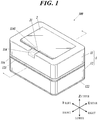
- an X-axis, Y-axis, Z-axis, front-rear direction, left-right direction, and upper-lower direction are defined as shown in FIG. 1 and FIG. 2 . That is, the side of the household tissue paper container 100 on which the open/close lid 2 is attached and the side opposite thereto are referred to as “upper” and “lower”, respectively. The side where a container body 1 and the open/close lid 2 are connected and the side opposite thereto are referred to as “rear” and "front”, respectively. The right-hand side and the left-hand side when one is looking at the front surface of the container from the front side are referred to as "right” and "left”, respectively.
- the axis along the front-rear direction is referred to as the X axis
- the axis along the left-right direction is referred to as the Y axis
- the axis along the upper-lower direction is referred to as the Z axis.
- the household tissue paper container 100 includes a container body 1 that has an outlet 112a through which the inside household tissue paper P is taken out, an open/close lid 2 that is connected to the container body 1 so as to cover the outlet 112a and is freely opened and closed, and a biasing member 3 that biases the open/close lid 2 in its opening direction.
- the container body 1 has a storage space S to store the household tissue paper inside.
- the container body 1 and the open/close lid 2 can be integrally formed by injection molding (double molding).
- the household tissue paper P is, for example, so-called pop-up type sheets in which small wet sheets, wet tissues, or the like are folded and stacked in alternating directions such that, when one of the wet sheets, wet tissues, or the like is pulled out, the next one is also pulled out.
- Another example of the household tissue paper P is a roll sheet that is a long wet sheet, wet tissue, or the like that is wound into a roll and has perforations at regular intervals in the length direction so as to be cut along the perforations and used.
- the container body 1 as a whole is formed in a substantially rectangular parallelepiped shape that is longer in the Y direction than in the X and Z directions.
- the container body 1 is divided into two parts, top and bottom, almost in the middle portion in the Z direction, one being an upper container body 11 constituting the upper side of the container body 1 and the other being a lower container body 12 constituting the lower side of the container body 1.
- the upper container body 11 and the lower container body 12 are connected to each other on the rear side of the container body 1.
- the upper container body 11 and the lower container body 12 can be integrally formed by injection molding (double molding).
- the dimensions of the container body 1 as a whole are preferably 60 mm to 150 mm, more preferably 80 mm to 100 mm in the X direction, preferably 80 mm to 200 mm, more preferably 145 mm to 165 mm in the Y direction, and preferably 30 mm to 100 mm, more preferably 50 mm to 70 mm in the Z direction.
- the thickness of each surface is preferably 0.5 mm to 3 mm, more preferably 1 mm to 2 mm.
- the inside storage space S of the container body 1 can be exposed to the outside when the upper container body 11 pivots upward around a pivot point on the rear side where the upper container body 11 and the lower container body 12 are connected to each other.
- the upper container body 11 and the lower container body 12 can be formed separately and connected pivotably using a hinge or the like.
- the container body 1 is divided into the upper container body 11 and the lower container body 12 almost in the middle portion in the Z direction in the drawings, but is more preferably divided at above the middle portion in the Z direction. This makes it easier to refill the household tissue paper P covered with a predetermined package to be stored in the container body 1 because an end seal portion of the package is less likely to be pinched accidentally when the container is closed.
- the upper container body 11 is formed in a substantially rectangular parallelepiped shape having an opening lower surface and has a recessed portion 111 having a sunken recessed shape on the upper surface of the upper container body 11.
- An outlet 112a for taking out the household tissue paper P in the storage space S is in a take-out portion 112 in the middle of the recessed portion 111.
- the outlet 112a is surrounded by a body-side sealing loop 113.
- the recessed portion 111 surrounded by the body-side sealing loop 113 is formed as the take-out portion 112, and the outlet 112a is formed in the middle portion of the take-out portion 112.
- a fixing portion 115 is provided between the body-side sealing loop 113 and the open/close lid 2, at a portion inside the recessed portion 111 but outside the body-side sealing loop 113.
- a biasing member 3 described later is arranged at the fixing portion 115. One end of the biasing member 3 is arranged so as to be embedded in the recessed portion 111.
- a latch 114 for opening and closing the open/close lid 2 is formed at the front side of the upper surface.
- an upper fitting portion 116 that fits a lower fitting portion 121 of the lower container body 12 described later.
- the outlet 112a is a hole that is formed in the middle of the upper surface of the container body and connects to the storage space S.
- FIG. 2 shows the outlet 112a in an inverted Y shape formed of three slits connecting respective vertices of a triangle and the center of gravity of the triangle.
- the periphery of the outlet 112a is formed of a material having elasticity described later so as to apply appropriate resistance to the household tissue paper P.
- the outlet 112a can cut the household tissue paper P at its perforations for cutting.
- the take-out portion 112 has a substantially spherical raised swelling portion 112b in its approximate middle, and the outlet 112a is formed at the swelling portion 112b.
- the outlet 112a formed in the take-out portion 112 is located in the swelling portion 112b having a substantially spherical raised shape.
- the protruding piece 112c which the household tissue paper P pulled out from the outlet 112a is in sliding contact with, is provided to apply appropriate resistance to the household tissue paper P pulled out from the outlet 112a.
- the user in opening the open/close lid 2 of the household tissue paper container 100 to take out the household tissue paper P, the user extends his or her hand from the front side of the container 100 to the outlet 112a and pulls out the household tissue paper P therefrom, so that the movement of taking out the household tissue paper P is not interfered with the open/close lid 2 standing on the rear of the container 100.
- the household tissue paper P pulled out from the outlet 112a comes into sliding contact with the protruding piece 112c on the front side edge.
- the protruding piece 112c protruding from the front edge toward the rear has a function of applying appropriate frictional force to the household tissue paper P pulled out from the outlet 112a toward the front, and a function of preventing the next sheet of the household tissue paper P, which is to be pulled out subsequent to the sheet of the household tissue paper P that has been pulled out and used, from being pulled out too much from the outlet 112a.
- the next sheet of the household tissue paper P which is pulled out subsequent to the sheet of the household tissue paper P to be used, is held at the outlet 112a with one end pulled out by an appropriate length (see FIG. 4 ).
- the one end of the household tissue paper P that is held at the outlet 112a in this way is supported by three protruding pieces including the protruding piece 112c on the front side.
- the tip of each of the protruding pieces (112c) is located higher than the base surface (take-out portion 112) around the swelling portion 112b.
- the body-side sealing loop 113 is a loop-shaped projection protruding in the upper direction and surrounding the outlet 112a. As shown in FIG. 3 to FIG. 5 , the outer peripheral surface of the body-side sealing loop 113 is formed so as to fit the inner peripheral surface of the open/close-lid-side sealing loop 22 that is formed on the open/close lid 2 as described later.
- the latch 114 is formed in a shape of a button and has a body-side hook 1141.
- the body-side hook 1141 engages with the open/close-lid-side hook 21 formed on the open/close lid 2 described later to latch the open/close lid 2 in a closed state.
- the body-side hook 1141 and the open/close-lid-side hook 21 are disengaged, and the open/close lid 2 is in an opened state.
- the upper fitting portion 116 is formed around the opening lower surface of the upper container body 11 except for the rear side of the opening where the upper container body 11 and the lower container body 12 are connected to each other. As shown in FIG. 3 to FIG. 5 , only the outer peripheral side of the lower edge of the upper fitting portion 116 protrudes to form an upper protrusion 1161.
- the inner peripheral surface of the upper protrusion 1161 is formed so as to fit the outer peripheral surface of the lower protrusion 1211 of the lower fitting portion 121 formed in the lower container body 12 described later.
- the upper fitting portion 116 is formed such that the upper protrusion 1161 has a dimension in the upper-lower direction of preferably 0.5 mm to 5 mm, more preferably 1 mm to 3 mm.
- the upper container body 11 has the take-out portion 112, the body-side sealing loop 113, and the biasing member 3 on the upper surface that are formed of a material having elasticity (hereinafter, referred to as an "elastic material") such as a thermoplastic elastomer of a styrenebutadiene type, polyester type, polyethylene type, or urethane type.
- an elastic material such as a thermoplastic elastomer of a styrenebutadiene type, polyester type, polyethylene type, or urethane type.
- Hardness of the elastic material is preferably 20 to 90. The hardness is measured in accordance with JIS K 6253 (type A durometer).
- the upper fitting portion 116 is also formed of a similar elastic material.
- the other portion(s) of the upper container body 11 is formed of a polyolefin resin material such as polyethylene or polypropylene.
- the hardness is less than the above range, the elastic material is too soft and difficult to be molded, which results in poor molding efficiency. Furthermore, the biasing member 3 cannot bias the open / close lid 2 sufficiently.
- the hard portion around the outlet 112a increases the resistance too much and makes it difficult to take out the sheet one by one and to put fingers inside the container for pulling out the sheet. Furthermore, the biasing member 3 biases the open / close lid 2 too much.
- the hardness of the elastic material is preferably within the above range.
- the lower container body 12 is formed in a substantially rectangular parallelepiped shape having an opening upper surface.
- a lower fitting portion 121 that fits the upper fitting portion 116 of the upper container body 11.
- a lower nonslip portion 122 is formed at the lower surface.
- the lower fitting portion 121 is formed around the upper opening of the lower container body 12 except for the rear side of the opening where the lower container body 12 and the upper container body 11 are connected to each other. As shown in FIG. 3 to FIG. 5 , only the inner peripheral side of the upper edge of the lower fitting portion 121 protrudes to form a lower protrusion 1211.
- the outer peripheral surface of the lower protrusion 1211 is formed so as to fit the inner peripheral surface of the upper protrusion 1161 of the upper fitting portion 116 formed in the upper container body 11.
- the lower fitting portion 121 is formed such that the lower protrusion 1211 has a dimension in the upper-lower direction of preferably 0.5 mm to 5 mm, more preferably 1 mm to 3 mm.
- only the inner peripheral side of the upper protrusion 1161 of the upper fitting portion 116 and only the outer peripheral side of the lower protrusion 1211 of the lower fitting portion 121 may be each formed so as to protrude, such that the outer peripheral surface of the upper protrusion 1161 fits the inner peripheral surface of the lower protrusion 1211.
- the middle portion between the inner and outer peripheral sides of the upper protrusion and both of the inner and outer peripheral sides of the lower protrusion may be each formed so as to protrude, such that the upper protrusion fits a recessed portion between the protruding sides of the lower protrusion.
- both of the inner and outer peripheral sides of the upper protrusion and the middle portion between the inner and outer peripheral sides of the lower protrusion may be each formed to protrude, such that the lower protrusion fits a recessed portion between the protruding sides of the upper protrusions.
- the placed household tissue paper container 100 is less likely to slip because of the lower nonslip portion 122 that is formed by providing a portion of an elastic material on the lower surface of the lower container body 12 integrally with other portion(s).
- the lower container body 12 has the lower fitting portion 121 and the lower nonslip portion 122 that are formed of an elastic material similar to that used in the upper container body 11.
- the other portion (s) of the lower container body 12 is formed of a polyolefin resin material such as polyethylene or polypropylene.
- the open/close lid 2 is a flat and substantially rectangular member that is pivotably connected to the rear of the recessed portion 111 of the upper container body 11, and has an open/close-lid-side hook 21 on the front side and an open/close-lid-side sealing loop 22 on the lower surface side.
- the shape of the open/close lid 2 in a plan view in the closed state is formed to be substantially the same as that of the recessed portion 111 of the upper container body 11, so that the open/close lid 2 can be fit in the recessed portion 111 when closed.
- a connecting portion between the open/close lid 2 and the upper container body 11 is formed so as to be thinner than the other portions.
- the connecting portion can be easily bent, and the open/close lid 2 easily pivots around the connecting portion as a pivot point.
- the open/close-lid-side hook 21 is a hook protruding from the open/close lid 2 toward the front.
- the open/close-lid-side hook 21 engages with the body-side hook 1141 formed on the latch 114 of the upper container body 11 and latches the open/close lid in the closed state.
- the body-side hook 1141 and the open/close-lid-side hook 21 are disengaged, and the open/close lid 2 is in an opened state because of the biasing member 3 described later.
- the open/close-lid-side sealing loop 22 is a loop-shaped projection protruding in the lower direction, and formed in the middle portion of the lower surface of the open/close lid 2 in the closed state.
- the inner peripheral surface of the open/close-lid-side sealing loop 22 is formed so as to fit the outer peripheral surface of the body-side sealing loop 113 formed on the upper container body 11.
- the open/close lid 2 is formed of a polyolefin resin material such as polyethylene or polypropylene.
- the open/close lid 2 and the container body 1 are integrally formed by injection molding (double molding).
- the biasing member 3 biases the open/close lid 2 in the opening direction and stands it up such that, when a user pushes the latch 114 and disengages the body-side hook 1141 and the open/close-lid-side hook 21, the open/close lid 2 is opened by pivoting on the rear connecting portion between the open/close lid 2 and the upper container body 11 as a pivot shaft.
- the biasing member 3 is a portion formed by an elastic material formed on the upper container body 11 so as to connect with the rear of the body-side sealing loop 113 of the upper container body 11. That is, the biasing member 3 is integrally formed with the body-side sealing loop 113 that is formed with the elastic material on the upper container body 11.
- the biasing member 3 is formed of the same elastic material as that used for the take-out portion 112 of the upper container body 11 and the body-side sealing loop 113.
- the biasing member 3 is formed so as to be in a band shape having a width of preferably 2 mm to 30 mm, more preferably 8 mm to 10 mm, and a thickness of preferably 0.5 mm to 3 mm, more preferably 1 mm to 2 mm.
- the biasing member 3 is formed so as to have such dimensions, it is possible to push up the open/close lid 2 without difficulty and to bent the biasing member 3 easily in the recessed portion 111 when the open/close lid 2 is closed.
- the biasing member 3 is bent at the base of the open/close lid 2 when the open/close lid 2 is closed.
- the latch 114 When a user pushes the latch 114 and disengages the body-side hook 1141 and the open/close-lid-side hook 21, the open/close lid 2 is opened to be in a state shown in FIG. 4 because of a repulsive force generated when the bent biasing member 3 returns to its original state.
- the open/close lid 2 jumps up automatically because of the biasing member 3. Therefore, it is easy to open the open/close lid 2 when using the household tissue paper.
- the outlet 112a that holds one end of the household tissue paper P is formed at the swelling portion 112b of the take-out portion 112, the one end of the household tissue paper P that is held at the outlet 112a at a higher position than the surrounding area and can be easily picked up. Therefore, it is easy to pull out the household tissue paper P by picking the one end.
- the take-out portion 112 having the outlet 112a is formed of the elastic material so as to apply appropriate resistance to the household tissue paper P that is pulled out from the outlet 112a.
- the take-out portion 112. when a sheet of the household tissue paper P stored in the storage space S is pulled out, the next sheet of the household tissue paper P can be suitably held by the take-out portion 112.
- the household tissue paper P when the household tissue paper P is a roll sheet, the household tissue paper P can be suitably cut at its perforations for cutting.
- the outlet 112a has the protruding piece 112c protruding from the front edge of the outlet 112a toward the rear. Because the protruding piece 112c is in sliding contact with the household tissue paper P that is pulled out from the outlet 112a toward the front and applies appropriate frictional force, it is possible to prevent the next sheet of the household tissue paper P, which is to be pulled out subsequent to the sheet of the household tissue paper P that is pulled out and used, from being pulled out too much from the outlet 112a.
- the household tissue paper P in the outlet 112a does not prevent the open/close lid 2 from being closed.
- the open/close lid 2 does not pinch the household tissue paper P held at the outlet 112a, there is no problems such as drying of the household tissue paper P (wet tissue) that is protruding outside the container and pinched by the open/close lid 2.
- the household tissue paper P can be readily pulled out, and one end of the next sheet of the household tissue paper P, which is to be pulled out subsequent to the sheet of the household tissue paper P that has been pulled out and used, can be held at the outlet 112a so as not to prevent the open/close lid 2 from being closed.
- the household tissue paper P is held at the outlet 112a with one end pulled out by an appropriate length, it is possible to appropriately repeat pulling out the household tissue paper P stored in the household tissue paper container 100 for use.
- the container body 1 is constituted by the upper container body 11 and the lower container body 12 that are connected to each other at the rear surface, accordingly, the container body 1 can be opened at its middle portion, and the household tissue paper P stored in the interior storage space S can be refilled.
- the upper container body 11 and the lower container body 12 are connected to each other at the rear surface and pivot relative to each other on the connecting portion as a pivot point. In this way, the storage space S can be opened and closed. Therefore, after refilling and the like, the upper container body 11 and the lower container body 12 can easily fit each other so that the container body is closed without aligning their positions each time. As a result, it is possible to reduce efforts at the time of refilling the inside household tissue paper P.
- the upper fitting portion 116 formed of an elastic material in the upper container body 11 and the lower fitting portion 121 formed of an elastic material in the lower container body 12 fit each other, and the airtightness of the container body 1 can be improved. This effect can be particularly enhanced when both the upper fitting portion 116 and the lower fitting portion 121 are made of an elastic material.
- the container body 1 can be placed more stably on the table or the like.
- FIG. 6A is a top view showing the outlet 112a and the protruding piece 112c of the take-out portion 112 according to the above embodiment.
- the outlet 112a in an inverted Y shape is formed of three slits connecting respective vertices of an equilateral triangle and the center of gravity of the equilateral triangle, approximately in the middle of the upper container body (approximately in the middle of the take-out portion 112).
- the outlet 112a in an inverted Y shape may be formed of three slits connecting respective vertices of an isosceles triangle and the center of gravity of the isosceles triangle, at a position at the rear of the upper surface of the container body (a position at the rear in the take-out portion 112).
- the outlet 112a is formed such that the protruding piece 112c protruding from the front edge of the outlet 112a toward the rear is larger than the other two protruding pieces, and the tip of the protruding piece 112c is located at the rear of the middle of the take-out portion 112, away from the middle of the take-out portion 112 toward where the open/close lid 2 is attached to the container body 1.
- the protruding piece 112c protruding from the front edge of the outlet 112a toward the rear is formed such that its tip is located at the rear of the middle of the take-out portion 112, away from the middle of the take-out portion 112 toward where the open/close lid 2 is attached to the container body 1.
- the protruding piece 112c and the household tissue paper P that is pulled out from the outlet 112a to the front side are in sliding contact with each other at a rear position of the upper surface of the container body (take-out portion 112) when the outlet 112a is formed at the rear of the take-out portion 112 on the upper surface of the container body and when the tip of the protruding piece 112c on the front edge of the outlet 112a is located at the rear of the middle of the take-out portion 112. Furthermore, the next sheet of the household tissue paper P, which is to be pulled out subsequent to the sheet of the household tissue paper P that has been pulled out and used, is held at the outlet 112a at the rear.
- the dimension becomes large between the hold tissue paper P held in the outlet 112a at the rear position of the take-out portion 112 and the standing piece on the front side of the body-side sealing loop 113. This makes it possible to ensure that the open/close lid 2 is not prevented from being closed, even when one end of the household tissue paper P that is pulled out from the outlet 112a toward the front and held is tilted or inclined forward.
- the shape of the outlet 112a is not limited to an inverted Y-shape.
- the outlet 112a may have an arch shape.
- the outlet 112a having such an arch shape also has a protruding piece 112c protruding from the front edge of the outlet 112a toward the rear, toward where the open/close lid 2 is attached to the container body 1.
- the protruding piece 112c is in sliding contact with the household tissue paper P pulled out from the outlet 112a to the front side, and can apply appropriate frictional force to the household tissue paper P.
- the outlet 112a may have a fan shape (fan shape with a central angle of 180° or more).
- the outlet 112a having such a fan shape also has a protruding piece 112c that is protruding from the front edge of the outlet 112a toward the rear, toward where the open/close lid 2 is attached to the container body 1.
- the protruding piece 112c is in sliding contact with the household tissue paper P pulled out from the outlet 112a to the front side, and can apply appropriate frictional force to the household tissue paper P.
- the outlet 112a may have a polygonal shape (in this case, a star shape) .
- the outlet 112a having such a polygonal shape also has a protruding piece 112c that is protruding from the front edge of the outlet 112a toward the rear, toward where the open/close lid 2 is attached to the container body 1.
- the protruding piece 112c is in sliding contact with the household tissue paper P pulled out from the outlet 112a to the front side, and can apply appropriate frictional force to the household tissue paper P.
- the outlet 112a is formed at the swelling portion 112b, which is provided approximately in the middle of the take-out portion 112.
- the swelling portion 112b may be provided at a rear position in the take-out portion 112, and the outlet 112a may be formed in the rear swelling portion 112b.
- the tip of the protruding piece 112c protruding from the front edge toward the rear can be located at the rear of the middle of the take-out portion 112, away from the middle of the take-out portion 112 toward where the open/close lid 2 is attached to the container body 1.
- the dimension also becomes large between the hold tissue paper P held in the outlet 112a at the rear position of the take-out portion 112 and the standing piece on the front side of the body-side sealing loop 113. This makes it possible to ensure that the open/close lid 2 is not prevented from being closed, even when one end of the household tissue paper P that is pulled out from the outlet 112a toward the front and held is tilted or inclined forward.
- the household tissue paper P that is held at the outlet 112a can be readily pulled out and used.
- the household tissue paper P that is held at the outlet 112a can be readily pulled out.
- the container body 1 and the open/close lid 2 are integrally formed by injection molding (two-color molding), but the present invention is not limited thereto.
- the container body 1 and the open/close lid 2 can be formed separately and then connected rotatably using a hinge or the like, though the productivity is lowered.
- the biasing member 3 is integrally formed with the container body 1 and the open/close lid 2, but the present invention is not limited thereto.
- the biasing member 3 may be formed separately from the container body 1 or the open/close lid 2 and attached to the container body 1 or the open/close lid 2.
- the present invention is configured as described above and can be used as a household tissue paper container from which the household tissue paper can be readily pulled out.
Landscapes
- Engineering & Computer Science (AREA)
- Mechanical Engineering (AREA)
- Health & Medical Sciences (AREA)
- Public Health (AREA)
- Containers And Packaging Bodies Having A Special Means To Remove Contents (AREA)
Abstract
Description
- The present invention relates to a household tissue paper container.
- Conventionally known containers for household tissues such as wet tissues have an open/close lid that is biased in an opening direction by a biasing member such as a leaf spring and can be latched in a closed state by a predetermined latch. The open/close lid can be opened by a user in a single operation of a button provided on the latch (for example, see patent document 1).
- When the open/close lid of the container is opened, an outlet formed on an upper container body is exposed, such that a wet tissue that is partially held at the outlet can be picked up and pulled out for use.
- [Patent Document 1]
JP 2017-013854 A - However, in the container of the above-mentioned
patent document 1, the edge of the outlet has a shape that extends on an opposite side of a hinge of the open/close lid, that is, on the front side. As a result, wet wipes are easily pulled out toward the front, and the next wet tissue that follows the one being pulled out and used may be pulled out too much. - When the next wet tissue is pulled out too much, the open/close lid of the container sometimes pinches an excessively long portion of the wet tissue that is held at the outlet, and is prevented from being closed.
- This cumbersomely requires to push the wet tissue that has been pulled out too much into the outlet.
- An object of the present invention is to provide a household tissue paper container from which the household tissue paper can be readily pulled out.
- In order to achieve the object, according to the invention recited in
claim 1, there is provided a household tissue paper container including: - a container body that is configured to store household tissue paper therein and has a take-out portion having an outlet through which the household tissue paper is taken out; and
- an open/close lid that is pivotably attached to the container body and closes the outlet;
- wherein the outlet is formed at a swelling portion having a substantially spherical raised shape in the take-out portion, and
- wherein the outlet has a protruding piece that is protruding from a front edge of the outlet toward a rear where the open/close lid is attached to the container body.
- According to the household tissue paper container having such a configuration, because the outlet is formed at a substantially spherical raised swelling portion in the take-out portion, one end of the household tissue paper that is held at the outlet at a higher position than the surrounding area and can be easily picked up. Therefore, it is easy to pull out the household tissue paper by picking the one end.
- In particular, because the outlet has a protruding piece that is protruding from a front edge of the outlet toward the rear, the protruding piece is in sliding contact with the household tissue paper pulled out from the outlet toward the front and applies appropriate frictional force thereto. Therefore, it is possible to prevent the next sheet of the household tissue paper, which is to be pulled out subsequent to the sheet of the household tissue paper that has been pulled out and used, from being pulled out too much from the outlet.
- Because the next sheet of the household tissue paper that is pulled out from the outlet in this way is held at the outlet with one end pulled out by an appropriate length, the household tissue paper in the outlet does not prevent the open/close lid from being closed.
- According to the invention recited in
claim 2, there is provided a household tissue paper container according toclaim 1, - wherein at least a part of the container body is formed of an elastic material, and
- wherein the take-out portion is formed integrally with the part formed of the elastic material.
- According to the invention recited in
claim 3, there is provided a household tissue paper container according toclaim
a biasing member that is formed integrally with the part formed of the elastic material and biases the open/close lid in an opening direction. - According to the invention recited in claim 4, there is provided a household tissue paper container according to any one of
claims 1 to 3,
wherein the protruding piece has a tip at a rear position of a middle of the take-out portion, the rear position being away from the middle of the take-out portion toward a position where the open/close lid is attached to the container body. - According to the present invention, there is provided a household tissue paper container that enables the household tissue paper to be readily pulled out.
-
-
FIG. 1 is a perspective view showing a household tissue paper container according to a present embodiment. -
FIG. 2 is a perspective view showing the household tissue paper container according to the present embodiment. -
FIG. 3 is a sectional view showing the household tissue paper container according to the present embodiment, which is a sectional view ofFIG. 1 cut through a middle portion in Y direction. -
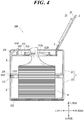
FIG. 4 is a sectional view showing the household tissue paper container according to the present embodiment, which is a sectional view ofFIG. 2 cut through a middle portion in Y direction. -
FIG. 5 is a sectional view showing the household tissue paper container in a state where an upper container body and a lower container body are not fitted. -
FIG. 6A is a top view showing a take-out portion of the household tissue paper container. -
FIG. 6B is a top view showing a modification of the take-out portion of the household tissue paper container. -
FIG. 7A is a top view showing a modification of the take-out portion (outlet). -
FIG. 7B is a top view showing a modification of the take-out portion (outlet). -
FIG. 7C is a top view showing a modification of the take-out portion (outlet). -
FIG. 8 is a perspective view showing a modification of the household tissue paper container. - Hereinafter, an embodiment of a household tissue paper container according to the present invention is described in detail with reference to the drawings. Although the embodiments described below include various technically preferable limitations for carrying out the present invention, the scope of the present invention is not limited to the following embodiments or illustrated examples.
- In the followings, an X-axis, Y-axis, Z-axis, front-rear direction, left-right direction, and upper-lower direction are defined as shown in
FIG. 1 andFIG. 2 . That is, the side of the householdtissue paper container 100 on which the open/close lid 2 is attached and the side opposite thereto are referred to as "upper" and "lower", respectively. The side where acontainer body 1 and the open/close lid 2 are connected and the side opposite thereto are referred to as "rear" and "front", respectively. The right-hand side and the left-hand side when one is looking at the front surface of the container from the front side are referred to as "right" and "left", respectively. The axis along the front-rear direction is referred to as the X axis, the axis along the left-right direction is referred to as the Y axis, and the axis along the upper-lower direction is referred to as the Z axis. - As shown in
FIG. 1 to FIG. 5 , for example, the householdtissue paper container 100 includes acontainer body 1 that has anoutlet 112a through which the inside household tissue paper P is taken out, an open/close lid 2 that is connected to thecontainer body 1 so as to cover theoutlet 112a and is freely opened and closed, and abiasing member 3 that biases the open/close lid 2 in its opening direction. Thecontainer body 1 has a storage space S to store the household tissue paper inside. - The
container body 1 and the open/close lid 2 can be integrally formed by injection molding (double molding). - The household tissue paper P is, for example, so-called pop-up type sheets in which small wet sheets, wet tissues, or the like are folded and stacked in alternating directions such that, when one of the wet sheets, wet tissues, or the like is pulled out, the next one is also pulled out. Another example of the household tissue paper P is a roll sheet that is a long wet sheet, wet tissue, or the like that is wound into a roll and has perforations at regular intervals in the length direction so as to be cut along the perforations and used.
- As shown in
FIG. 1 andFIG. 2 , thecontainer body 1 as a whole is formed in a substantially rectangular parallelepiped shape that is longer in the Y direction than in the X and Z directions. Thecontainer body 1 is divided into two parts, top and bottom, almost in the middle portion in the Z direction, one being anupper container body 11 constituting the upper side of thecontainer body 1 and the other being alower container body 12 constituting the lower side of thecontainer body 1. Theupper container body 11 and thelower container body 12 are connected to each other on the rear side of thecontainer body 1. - The
upper container body 11 and thelower container body 12 can be integrally formed by injection molding (double molding). - The dimensions of the
container body 1 as a whole are preferably 60 mm to 150 mm, more preferably 80 mm to 100 mm in the X direction, preferably 80 mm to 200 mm, more preferably 145 mm to 165 mm in the Y direction, and preferably 30 mm to 100 mm, more preferably 50 mm to 70 mm in the Z direction. The thickness of each surface is preferably 0.5 mm to 3 mm, more preferably 1 mm to 2 mm. - With such dimensions and thickness, it is possible to achieve high molding efficiency and strength that is enough to cause no problem in actual use.
- As shown in
FIG. 5 , the inside storage space S of thecontainer body 1 can be exposed to the outside when theupper container body 11 pivots upward around a pivot point on the rear side where theupper container body 11 and thelower container body 12 are connected to each other. - As shown in
FIG. 3 to FIG. 5 , when a connecting portion between theupper container body 11 and thelower container body 12 on the rear side of thecontainer body 1 is formed so as to be thinner than the other portions of thecontainer body 1, the rear surface of the container body can be easily bent at the connecting portion. Then, theupper container body 11 easily pivots with respect to thelower container body 12 around the connecting portion as the pivot point. - Alternatively, though productivity is lowered, the
upper container body 11 and thelower container body 12 can be formed separately and connected pivotably using a hinge or the like. - The
container body 1 is divided into theupper container body 11 and thelower container body 12 almost in the middle portion in the Z direction in the drawings, but is more preferably divided at above the middle portion in the Z direction. This makes it easier to refill the household tissue paper P covered with a predetermined package to be stored in thecontainer body 1 because an end seal portion of the package is less likely to be pinched accidentally when the container is closed. - As shown in
FIG. 1 to FIG. 5 , theupper container body 11 is formed in a substantially rectangular parallelepiped shape having an opening lower surface and has a recessedportion 111 having a sunken recessed shape on the upper surface of theupper container body 11. - An
outlet 112a for taking out the household tissue paper P in the storage space S is in a take-outportion 112 in the middle of the recessedportion 111. Theoutlet 112a is surrounded by a body-side sealing loop 113. In other words, the recessedportion 111 surrounded by the body-side sealing loop 113 is formed as the take-outportion 112, and theoutlet 112a is formed in the middle portion of the take-outportion 112. - Furthermore, a fixing portion 115 is provided between the body-
side sealing loop 113 and the open/close lid 2, at a portion inside the recessedportion 111 but outside the body-side sealing loop 113. A biasingmember 3 described later is arranged at the fixing portion 115. One end of the biasingmember 3 is arranged so as to be embedded in the recessedportion 111. - Furthermore, a
latch 114 for opening and closing the open/close lid 2 is formed at the front side of the upper surface. - Around the opening lower surface, there is formed an upper
fitting portion 116 that fits a lowerfitting portion 121 of thelower container body 12 described later. - The
outlet 112a is a hole that is formed in the middle of the upper surface of the container body and connects to the storage space S. -
FIG. 2 shows theoutlet 112a in an inverted Y shape formed of three slits connecting respective vertices of a triangle and the center of gravity of the triangle. - The periphery of the
outlet 112a is formed of a material having elasticity described later so as to apply appropriate resistance to the household tissue paper P. As a result, when a sheet of the household tissue paper P stored in the storage space S is pulled out, the next sheet of the household tissue paper P is held at theoutlet 112a. Furthermore, when the household tissue paper P is a roll sheet, theoutlet 112a can cut the household tissue paper P at its perforations for cutting. - In particular, the take-out
portion 112 has a substantially spherical raised swellingportion 112b in its approximate middle, and theoutlet 112a is formed at the swellingportion 112b. In other words, theoutlet 112a formed in the take-outportion 112 is located in the swellingportion 112b having a substantially spherical raised shape. - On the edge of the
outlet 112a, there is a protruding piece(s) 112c protruding from the front edge of theoutlet 112a toward the rear, toward where the open/close lid 2 is attached to thecontainer body 1. - The protruding
piece 112c, which the household tissue paper P pulled out from theoutlet 112a is in sliding contact with, is provided to apply appropriate resistance to the household tissue paper P pulled out from theoutlet 112a. - Specifically, in opening the open/
close lid 2 of the householdtissue paper container 100 to take out the household tissue paper P, the user extends his or her hand from the front side of thecontainer 100 to theoutlet 112a and pulls out the household tissue paper P therefrom, so that the movement of taking out the household tissue paper P is not interfered with the open/close lid 2 standing on the rear of thecontainer 100. As a result, the household tissue paper P pulled out from theoutlet 112a comes into sliding contact with the protrudingpiece 112c on the front side edge. - At this time, as the protruding
piece 112c protruding from the front edge of theoutlet 112a toward the rear is in sliding contact with the household tissue paper P pulled out from theoutlet 112a toward the front, it is possible to apply appropriate resistance to the household tissue paper P and to prevent the household tissue paper P from being pulled out too much. - That is, the protruding
piece 112c protruding from the front edge toward the rear has a function of applying appropriate frictional force to the household tissue paper P pulled out from theoutlet 112a toward the front, and a function of preventing the next sheet of the household tissue paper P, which is to be pulled out subsequent to the sheet of the household tissue paper P that has been pulled out and used, from being pulled out too much from theoutlet 112a. - The next sheet of the household tissue paper P, which is pulled out subsequent to the sheet of the household tissue paper P to be used, is held at the
outlet 112a with one end pulled out by an appropriate length (seeFIG. 4 ). - The one end of the household tissue paper P that is held at the
outlet 112a in this way is supported by three protruding pieces including the protrudingpiece 112c on the front side. - Because the
outlet 112a that holds the one end of the household tissue paper P is formed at the swellingportion 112b of the take-outportion 112, the tip of each of the protruding pieces (112c) is located higher than the base surface (take-out portion 112) around the swellingportion 112b. - Then, because such protruding pieces (112c) support and hold the one end of the household tissue paper P in the
outlet 112a at a higher position than the surrounding area, the household tissue paper P can be easily picked up. - As shown in
FIG. 2 , the body-side sealing loop 113 is a loop-shaped projection protruding in the upper direction and surrounding theoutlet 112a. As shown inFIG. 3 to FIG. 5 , the outer peripheral surface of the body-side sealing loop 113 is formed so as to fit the inner peripheral surface of the open/close-lid-side sealing loop 22 that is formed on the open/close lid 2 as described later. - As shown in
FIG. 1 to FIG. 5 , thelatch 114 is formed in a shape of a button and has a body-side hook 1141. The body-side hook 1141 engages with the open/close-lid-side hook 21 formed on the open/close lid 2 described later to latch the open/close lid 2 in a closed state. When a user pushes thelatch 114, the body-side hook 1141 and the open/close-lid-side hook 21 are disengaged, and the open/close lid 2 is in an opened state. - As shown in
FIG. 1 to FIG. 5 , the upperfitting portion 116 is formed around the opening lower surface of theupper container body 11 except for the rear side of the opening where theupper container body 11 and thelower container body 12 are connected to each other. As shown inFIG. 3 to FIG. 5 , only the outer peripheral side of the lower edge of the upperfitting portion 116 protrudes to form anupper protrusion 1161. The inner peripheral surface of theupper protrusion 1161 is formed so as to fit the outer peripheral surface of thelower protrusion 1211 of the lowerfitting portion 121 formed in thelower container body 12 described later. - The upper
fitting portion 116 is formed such that theupper protrusion 1161 has a dimension in the upper-lower direction of preferably 0.5 mm to 5 mm, more preferably 1 mm to 3 mm. - The
upper container body 11 has the take-outportion 112, the body-side sealing loop 113, and the biasingmember 3 on the upper surface that are formed of a material having elasticity (hereinafter, referred to as an "elastic material") such as a thermoplastic elastomer of a styrenebutadiene type, polyester type, polyethylene type, or urethane type. Hardness of the elastic material is preferably 20 to 90. The hardness is measured in accordance with JIS K 6253 (type A durometer). - In the
upper container body 11, the upperfitting portion 116 is also formed of a similar elastic material. - The other portion(s) of the
upper container body 11 is formed of a polyolefin resin material such as polyethylene or polypropylene. - They are integrally formed by injection molding (double molding).
- When the hardness is less than the above range, the elastic material is too soft and difficult to be molded, which results in poor molding efficiency. Furthermore, the biasing
member 3 cannot bias the open/close lid 2 sufficiently. - When the hardness is more than the above range, the hard portion around the
outlet 112a increases the resistance too much and makes it difficult to take out the sheet one by one and to put fingers inside the container for pulling out the sheet. Furthermore, the biasingmember 3 biases the open/close lid 2 too much. - Therefore, the hardness of the elastic material is preferably within the above range.
- As shown in
FIG. 1 to FIG. 5 , thelower container body 12 is formed in a substantially rectangular parallelepiped shape having an opening upper surface. Around the opening upper surface, there is formed a lowerfitting portion 121 that fits the upperfitting portion 116 of theupper container body 11. A lowernonslip portion 122 is formed at the lower surface. - As shown in
FIG. 1 to FIG. 5 , the lowerfitting portion 121 is formed around the upper opening of thelower container body 12 except for the rear side of the opening where thelower container body 12 and theupper container body 11 are connected to each other. As shown inFIG. 3 to FIG. 5 , only the inner peripheral side of the upper edge of the lowerfitting portion 121 protrudes to form alower protrusion 1211. The outer peripheral surface of thelower protrusion 1211 is formed so as to fit the inner peripheral surface of theupper protrusion 1161 of the upperfitting portion 116 formed in theupper container body 11. - The lower
fitting portion 121 is formed such that thelower protrusion 1211 has a dimension in the upper-lower direction of preferably 0.5 mm to 5 mm, more preferably 1 mm to 3 mm. - Alternatively, only the inner peripheral side of the
upper protrusion 1161 of the upperfitting portion 116 and only the outer peripheral side of thelower protrusion 1211 of the lowerfitting portion 121 may be each formed so as to protrude, such that the outer peripheral surface of theupper protrusion 1161 fits the inner peripheral surface of thelower protrusion 1211. - Alternatively, the middle portion between the inner and outer peripheral sides of the upper protrusion and both of the inner and outer peripheral sides of the lower protrusion may be each formed so as to protrude, such that the upper protrusion fits a recessed portion between the protruding sides of the lower protrusion. Conversely, both of the inner and outer peripheral sides of the upper protrusion and the middle portion between the inner and outer peripheral sides of the lower protrusion may be each formed to protrude, such that the lower protrusion fits a recessed portion between the protruding sides of the upper protrusions.
- The placed household
tissue paper container 100 is less likely to slip because of the lowernonslip portion 122 that is formed by providing a portion of an elastic material on the lower surface of thelower container body 12 integrally with other portion(s). - The
lower container body 12 has the lowerfitting portion 121 and the lowernonslip portion 122 that are formed of an elastic material similar to that used in theupper container body 11. The other portion (s) of thelower container body 12 is formed of a polyolefin resin material such as polyethylene or polypropylene. - They are integrally formed by injection molding (double molding).
- As shown in
FIG. 1 to FIG. 5 , the open/close lid 2 is a flat and substantially rectangular member that is pivotably connected to the rear of the recessedportion 111 of theupper container body 11, and has an open/close-lid-side hook 21 on the front side and an open/close-lid-side sealing loop 22 on the lower surface side. - As shown in
FIG. 1 to FIG. 5 , the shape of the open/close lid 2 in a plan view in the closed state is formed to be substantially the same as that of the recessedportion 111 of theupper container body 11, so that the open/close lid 2 can be fit in the recessedportion 111 when closed. - As shown in
FIG. 4 , a connecting portion between the open/close lid 2 and theupper container body 11 is formed so as to be thinner than the other portions. As a result, the connecting portion can be easily bent, and the open/close lid 2 easily pivots around the connecting portion as a pivot point. - As shown in
FIG. 1 to FIG. 5 , the open/close-lid-side hook 21 is a hook protruding from the open/close lid 2 toward the front. The open/close-lid-side hook 21 engages with the body-side hook 1141 formed on thelatch 114 of theupper container body 11 and latches the open/close lid in the closed state. When a user pushes thelatch 114, the body-side hook 1141 and the open/close-lid-side hook 21 are disengaged, and the open/close lid 2 is in an opened state because of the biasingmember 3 described later. - As shown in
FIG. 2 , the open/close-lid-side sealing loop 22 is a loop-shaped projection protruding in the lower direction, and formed in the middle portion of the lower surface of the open/close lid 2 in the closed state. As shown inFIG. 3 to FIG. 5 , the inner peripheral surface of the open/close-lid-side sealing loop 22 is formed so as to fit the outer peripheral surface of the body-side sealing loop 113 formed on theupper container body 11. - The open/
close lid 2 is formed of a polyolefin resin material such as polyethylene or polypropylene. - The open/
close lid 2 and thecontainer body 1 are integrally formed by injection molding (double molding). - The biasing
member 3 biases the open/close lid 2 in the opening direction and stands it up such that, when a user pushes thelatch 114 and disengages the body-side hook 1141 and the open/close-lid-side hook 21, the open/close lid 2 is opened by pivoting on the rear connecting portion between the open/close lid 2 and theupper container body 11 as a pivot shaft. - As shown in
FIG. 2 to FIG. 5 , the biasingmember 3 is a portion formed by an elastic material formed on theupper container body 11 so as to connect with the rear of the body-side sealing loop 113 of theupper container body 11. That is, the biasingmember 3 is integrally formed with the body-side sealing loop 113 that is formed with the elastic material on theupper container body 11. - The biasing
member 3 is formed of the same elastic material as that used for the take-outportion 112 of theupper container body 11 and the body-side sealing loop 113. - The biasing
member 3 is formed so as to be in a band shape having a width of preferably 2 mm to 30 mm, more preferably 8 mm to 10 mm, and a thickness of preferably 0.5 mm to 3 mm, more preferably 1 mm to 2 mm. - When the biasing
member 3 is formed so as to have such dimensions, it is possible to push up the open/close lid 2 without difficulty and to bent the biasingmember 3 easily in the recessedportion 111 when the open/close lid 2 is closed. - As shown in
FIG. 3 , the biasingmember 3 is bent at the base of the open/close lid 2 when the open/close lid 2 is closed. When a user pushes thelatch 114 and disengages the body-side hook 1141 and the open/close-lid-side hook 21, the open/close lid 2 is opened to be in a state shown inFIG. 4 because of a repulsive force generated when thebent biasing member 3 returns to its original state. - When a user pushes the open/
close lid 2 from the upper side, the biasingmember 3 is bent, and the open/close lid 2 is closed to be in a state shown inFIG. 3 . - According to the household
tissue paper container 100 of the present embodiment, when a user operates thelatch 114 and disengages the opening/close lid 2, the open/close lid 2 jumps up automatically because of the biasingmember 3. Therefore, it is easy to open the open/close lid 2 when using the household tissue paper. - Because the
outlet 112a that holds one end of the household tissue paper P is formed at the swellingportion 112b of the take-outportion 112, the one end of the household tissue paper P that is held at theoutlet 112a at a higher position than the surrounding area and can be easily picked up. Therefore, it is easy to pull out the household tissue paper P by picking the one end. - The take-out
portion 112 having theoutlet 112a is formed of the elastic material so as to apply appropriate resistance to the household tissue paper P that is pulled out from theoutlet 112a. As a result, when a sheet of the household tissue paper P stored in the storage space S is pulled out, the next sheet of the household tissue paper P can be suitably held by the take-outportion 112. Furthermore, when the household tissue paper P is a roll sheet, the household tissue paper P can be suitably cut at its perforations for cutting. - In particular, the
outlet 112a has the protrudingpiece 112c protruding from the front edge of theoutlet 112a toward the rear. Because the protrudingpiece 112c is in sliding contact with the household tissue paper P that is pulled out from theoutlet 112a toward the front and applies appropriate frictional force, it is possible to prevent the next sheet of the household tissue paper P, which is to be pulled out subsequent to the sheet of the household tissue paper P that is pulled out and used, from being pulled out too much from theoutlet 112a. - Because the next sheet of the household tissue paper P that is pulled out from the
outlet 112a in this way is held at theoutlet 112a with one end pulled out by an appropriate length, the household tissue paper P in theoutlet 112a does not prevent the open/close lid 2 from being closed. - Furthermore, because the open/
close lid 2 does not pinch the household tissue paper P held at theoutlet 112a, there is no problems such as drying of the household tissue paper P (wet tissue) that is protruding outside the container and pinched by the open/close lid 2. - According to the household
tissue paper container 100 having theoutlet 112a (take-out portion 112) having the above described protrudingpiece 112c, the household tissue paper P can be readily pulled out, and one end of the next sheet of the household tissue paper P, which is to be pulled out subsequent to the sheet of the household tissue paper P that has been pulled out and used, can be held at theoutlet 112a so as not to prevent the open/close lid 2 from being closed. - Furthermore, because the household tissue paper P is held at the
outlet 112a with one end pulled out by an appropriate length, it is possible to appropriately repeat pulling out the household tissue paper P stored in the householdtissue paper container 100 for use. - The
container body 1 is constituted by theupper container body 11 and thelower container body 12 that are connected to each other at the rear surface, accordingly, thecontainer body 1 can be opened at its middle portion, and the household tissue paper P stored in the interior storage space S can be refilled. - Therefore, it is possible to refill the household tissue paper P while the housing household
tissue paper container 100 is not lifted from but left on the table or the like. - The
upper container body 11 and thelower container body 12 are connected to each other at the rear surface and pivot relative to each other on the connecting portion as a pivot point. In this way, the storage space S can be opened and closed. Therefore, after refilling and the like, theupper container body 11 and thelower container body 12 can easily fit each other so that the container body is closed without aligning their positions each time. As a result, it is possible to reduce efforts at the time of refilling the inside household tissue paper P. - When the
container body 1 is closed, the upperfitting portion 116 formed of an elastic material in theupper container body 11 and the lowerfitting portion 121 formed of an elastic material in thelower container body 12 fit each other, and the airtightness of thecontainer body 1 can be improved. This effect can be particularly enhanced when both the upperfitting portion 116 and the lowerfitting portion 121 are made of an elastic material. - Furthermore, because the lower
nonslip portion 122 made of an elastic material is formed at the lower surface of thecontainer body 1, thecontainer body 1 can be placed more stably on the table or the like. - The present invention is not limited to the above-described embodiments.
-
FIG. 6A is a top view showing theoutlet 112a and the protrudingpiece 112c of the take-outportion 112 according to the above embodiment. - According to the above-described example of the above embodiment, the
outlet 112a in an inverted Y shape is formed of three slits connecting respective vertices of an equilateral triangle and the center of gravity of the equilateral triangle, approximately in the middle of the upper container body (approximately in the middle of the take-out portion 112). However, as shown inFIG. 6B , for example, theoutlet 112a in an inverted Y shape may be formed of three slits connecting respective vertices of an isosceles triangle and the center of gravity of the isosceles triangle, at a position at the rear of the upper surface of the container body (a position at the rear in the take-out portion 112). - In particular, as shown in
FIG. 6B , theoutlet 112a is formed such that the protrudingpiece 112c protruding from the front edge of theoutlet 112a toward the rear is larger than the other two protruding pieces, and the tip of the protrudingpiece 112c is located at the rear of the middle of the take-outportion 112, away from the middle of the take-outportion 112 toward where the open/close lid 2 is attached to thecontainer body 1. - In other words, the protruding
piece 112c protruding from the front edge of theoutlet 112a toward the rear is formed such that its tip is located at the rear of the middle of the take-outportion 112, away from the middle of the take-outportion 112 toward where the open/close lid 2 is attached to thecontainer body 1. - In this way, the protruding
piece 112c and the household tissue paper P that is pulled out from theoutlet 112a to the front side are in sliding contact with each other at a rear position of the upper surface of the container body (take-out portion 112) when theoutlet 112a is formed at the rear of the take-outportion 112 on the upper surface of the container body and when the tip of the protrudingpiece 112c on the front edge of theoutlet 112a is located at the rear of the middle of the take-outportion 112. Furthermore, the next sheet of the household tissue paper P, which is to be pulled out subsequent to the sheet of the household tissue paper P that has been pulled out and used, is held at theoutlet 112a at the rear. - In this way, the dimension becomes large between the hold tissue paper P held in the
outlet 112a at the rear position of the take-outportion 112 and the standing piece on the front side of the body-side sealing loop 113. This makes it possible to ensure that the open/close lid 2 is not prevented from being closed, even when one end of the household tissue paper P that is pulled out from theoutlet 112a toward the front and held is tilted or inclined forward. - The shape of the
outlet 112a is not limited to an inverted Y-shape. - For example, as shown in
FIG. 7A , theoutlet 112a may have an arch shape. - The
outlet 112a having such an arch shape also has a protrudingpiece 112c protruding from the front edge of theoutlet 112a toward the rear, toward where the open/close lid 2 is attached to thecontainer body 1. The protrudingpiece 112c is in sliding contact with the household tissue paper P pulled out from theoutlet 112a to the front side, and can apply appropriate frictional force to the household tissue paper P. - Alternatively, as shown in
FIG. 7B , theoutlet 112a may have a fan shape (fan shape with a central angle of 180° or more). - The
outlet 112a having such a fan shape also has a protrudingpiece 112c that is protruding from the front edge of theoutlet 112a toward the rear, toward where the open/close lid 2 is attached to thecontainer body 1. The protrudingpiece 112c is in sliding contact with the household tissue paper P pulled out from theoutlet 112a to the front side, and can apply appropriate frictional force to the household tissue paper P. - Alternatively, as shown in
FIG. 7C , theoutlet 112a may have a polygonal shape (in this case, a star shape) . - The
outlet 112a having such a polygonal shape also has a protrudingpiece 112c that is protruding from the front edge of theoutlet 112a toward the rear, toward where the open/close lid 2 is attached to thecontainer body 1. The protrudingpiece 112c is in sliding contact with the household tissue paper P pulled out from theoutlet 112a to the front side, and can apply appropriate frictional force to the household tissue paper P. - In the above embodiments, the
outlet 112a is formed at the swellingportion 112b, which is provided approximately in the middle of the take-outportion 112. However, as shown inFIG. 8 , for example, the swellingportion 112b may be provided at a rear position in the take-outportion 112, and theoutlet 112a may be formed in therear swelling portion 112b. - In this case, the tip of the protruding
piece 112c protruding from the front edge toward the rear can be located at the rear of the middle of the take-outportion 112, away from the middle of the take-outportion 112 toward where the open/close lid 2 is attached to thecontainer body 1. - In this way, the dimension also becomes large between the hold tissue paper P held in the
outlet 112a at the rear position of the take-outportion 112 and the standing piece on the front side of the body-side sealing loop 113. This makes it possible to ensure that the open/close lid 2 is not prevented from being closed, even when one end of the household tissue paper P that is pulled out from theoutlet 112a toward the front and held is tilted or inclined forward. - Then, the household tissue paper P that is held at the
outlet 112a can be readily pulled out and used. - As described above, according to the household
tissue paper container 100 of the present embodiment, the household tissue paper P that is held at theoutlet 112a can be readily pulled out. - Furthermore, in the above embodiments, the
container body 1 and the open/close lid 2 are integrally formed by injection molding (two-color molding), but the present invention is not limited thereto. Thecontainer body 1 and the open/close lid 2 can be formed separately and then connected rotatably using a hinge or the like, though the productivity is lowered. - Furthermore, in the above embodiments, the biasing
member 3 is integrally formed with thecontainer body 1 and the open/close lid 2, but the present invention is not limited thereto. The biasingmember 3 may be formed separately from thecontainer body 1 or the open/close lid 2 and attached to thecontainer body 1 or the open/close lid 2. - The present invention is not limited to be applied to the above-described embodiment, and can be appropriately changed as long as it does not depart from the spirit of the present invention.
- The present invention is configured as described above and can be used as a household tissue paper container from which the household tissue paper can be readily pulled out.
-
- 1
- Container Body
- 111
- Recessed Portion
- 112
- Take-Out Portion
- 112a
- Outlet
- 112b
- Swelling Portion
- 112c
- Protruding Piece
- 113
- Body-Side Sealing Loop
- 114
- Latch
- 2
- Open/Close Lid
- 3
- Biasing Member
- 100
- Household Tissue Paper Container
- P
- Household Tissue Paper
Claims (4)
- A household tissue paper container comprising:a container body that is configured to store household tissue paper therein and has a take-out portion having an outlet through which the household tissue paper is taken out; andan open/close lid that is pivotably attached to the container body and closes the outlet;wherein the outlet is formed at a swelling portion having a substantially spherical raised shape in the take-out portion, andwherein the outlet has a protruding piece that is protruding from a front edge of the outlet toward a rear where the open/close lid is attached to the container body.
- The household tissue paper container according to claim 1,wherein at least a part of the container body is formed of an elastic material, andwherein the take-out portion is formed integrally with the part formed of the elastic material.
- The household tissue paper container according to claim 1 or 2, further comprising:
a biasing member that is formed integrally with the part formed of the elastic material and biases the open/close lid in an opening direction. - The household tissue paper container according to any one of claims 1 to 3,
wherein the protruding piece has a tip at a rear position of a middle of the take-out portion, the rear position being away from the middle of the take-out portion toward a position where the open/close lid is attached to the container body.
Applications Claiming Priority (2)
| Application Number | Priority Date | Filing Date | Title |
|---|---|---|---|
| JP2019031927A JP7307554B2 (en) | 2019-02-25 | 2019-02-25 | Household tissue paper storage container |
| PCT/JP2020/002105 WO2020174942A1 (en) | 2019-02-25 | 2020-01-22 | Household tissue paper container |
Publications (3)
| Publication Number | Publication Date |
|---|---|
| EP3907154A1 true EP3907154A1 (en) | 2021-11-10 |
| EP3907154A4 EP3907154A4 (en) | 2022-03-02 |
| EP3907154B1 EP3907154B1 (en) | 2025-05-07 |
Family
ID=72238279
Family Applications (1)
| Application Number | Title | Priority Date | Filing Date |
|---|---|---|---|
| EP20763161.5A Active EP3907154B1 (en) | 2019-02-25 | 2020-01-22 | Household tissue paper container |
Country Status (6)
| Country | Link |
|---|---|
| US (1) | US20220135284A1 (en) |
| EP (1) | EP3907154B1 (en) |
| JP (1) | JP7307554B2 (en) |
| CN (1) | CN113260582B (en) |
| BR (1) | BR112021016045A2 (en) |
| WO (1) | WO2020174942A1 (en) |
Families Citing this family (4)
| Publication number | Priority date | Publication date | Assignee | Title |
|---|---|---|---|---|
| US12312130B2 (en) * | 2021-04-15 | 2025-05-27 | Professional Disposables International Inc. | Lid for container |
| JP2024011725A (en) * | 2022-07-15 | 2024-01-25 | Toppanホールディングス株式会社 | plastic container |
| US20240382049A1 (en) * | 2023-05-17 | 2024-11-21 | Amy B. O'Brien | Roll Tissue Box |
| US20240382048A1 (en) * | 2023-05-17 | 2024-11-21 | Amy B. O'Brien | Tissue Roll Holder |
Family Cites Families (14)
| Publication number | Priority date | Publication date | Assignee | Title |
|---|---|---|---|---|
| JPH08104377A (en) * | 1994-08-03 | 1996-04-23 | O K:Kk | Wet tissue supply kit |
| JPH11165776A (en) * | 1997-11-28 | 1999-06-22 | Pigeon Corp | Lid with sheet member take-out opening and container having lid with sheet member take-out opening |
| JP2000051117A (en) * | 1998-08-06 | 2000-02-22 | Kobayashi Pharmaceut Co Ltd | Wet tissue container |
| US6182858B1 (en) * | 1999-07-22 | 2001-02-06 | Lawrence Den Hartog | Wet towel dispenser |
| US6412634B1 (en) * | 2000-05-01 | 2002-07-02 | Unilever Home & Personal Care Usa, Division Of Conopco, Inc. | Refillable towelette dispensing article |
| JP4791111B2 (en) * | 2004-09-22 | 2011-10-12 | ユニ・チャーム株式会社 | Tissue feeding container |
| JP4387418B2 (en) * | 2006-09-29 | 2009-12-16 | 大王製紙株式会社 | Household thin paper storage container |
| WO2009038185A1 (en) * | 2007-09-21 | 2009-03-26 | Daio Paper Corporation | Household thin paper storing container |
| JP5280743B2 (en) * | 2008-06-19 | 2013-09-04 | 凸版印刷株式会社 | Packaging container having composite lid made of elastic material |
| US9549646B2 (en) * | 2010-12-08 | 2017-01-24 | Gojo Industries, Inc. | Wipes dispenser |
| DE102013111859B3 (en) * | 2013-10-28 | 2014-06-05 | Schülke & Mayr GmbH | Dispenser system for damp cloths impregnated with i.e. surface disinfectant in hospital, has closure and recess including flange, tab and rectilinear portions such that closure engages with recess so as to fix closure on lid |
| JP6574094B2 (en) * | 2015-03-20 | 2019-09-11 | 大王製紙株式会社 | Household thin paper storage container |
| JP6478839B2 (en) | 2015-06-30 | 2019-03-06 | ユニ・チャーム株式会社 | Structure |
| JP7060410B2 (en) * | 2018-03-05 | 2022-04-26 | 大王製紙株式会社 | Household tissue paper storage container |
-
2019
- 2019-02-25 JP JP2019031927A patent/JP7307554B2/en active Active
-
2020
- 2020-01-22 WO PCT/JP2020/002105 patent/WO2020174942A1/en not_active Ceased
- 2020-01-22 EP EP20763161.5A patent/EP3907154B1/en active Active
- 2020-01-22 CN CN202080007961.9A patent/CN113260582B/en active Active
- 2020-01-22 BR BR112021016045-0A patent/BR112021016045A2/en not_active Application Discontinuation
- 2020-01-22 US US17/428,783 patent/US20220135284A1/en not_active Abandoned
Also Published As
| Publication number | Publication date |
|---|---|
| EP3907154B1 (en) | 2025-05-07 |
| US20220135284A1 (en) | 2022-05-05 |
| EP3907154A4 (en) | 2022-03-02 |
| BR112021016045A2 (en) | 2021-10-05 |
| WO2020174942A1 (en) | 2020-09-03 |
| CN113260582B (en) | 2023-02-10 |
| JP2020132256A (en) | 2020-08-31 |
| JP7307554B2 (en) | 2023-07-12 |
| CN113260582A (en) | 2021-08-13 |
Similar Documents
| Publication | Publication Date | Title |
|---|---|---|
| EP3907154B1 (en) | Household tissue paper container | |
| EP3744659B1 (en) | Container for housing household tissue paper | |
| US11261020B2 (en) | Container for housing household tissue paper | |
| EP3831743A1 (en) | Household thin paper sheet storing container | |
| EP3747799B1 (en) | Container for housing household tissue paper | |
| JP7623465B2 (en) | Household tissue paper storage container | |
| EP3889069A1 (en) | Household thin paper storage container | |
| CN113811236A (en) | Household Tissue Paper Storage Container | |
| CN113811495A (en) | Container for containing household tissue paper | |
| CN113874298B (en) | Household tissue paper storage container | |
| EP3915896A1 (en) | Household-use tissue storage container | |
| CN113874297A (en) | Container for containing household tissue paper | |
| EP3858760A1 (en) | Home tissue paper accommodation container | |
| CN114929596B (en) | Tissue paper storage containers for home use | |
| JP7507102B2 (en) | Sanitary tissue storage container | |
| WO2026069758A1 (en) | Sanitary tissue paper storage container | |
| JP2023018288A (en) | sanitary tissue paper container |
Legal Events
| Date | Code | Title | Description |
|---|---|---|---|
| STAA | Information on the status of an ep patent application or granted ep patent |
Free format text: STATUS: THE INTERNATIONAL PUBLICATION HAS BEEN MADE |
|
| PUAI | Public reference made under article 153(3) epc to a published international application that has entered the european phase |
Free format text: ORIGINAL CODE: 0009012 |
|
| STAA | Information on the status of an ep patent application or granted ep patent |
Free format text: STATUS: REQUEST FOR EXAMINATION WAS MADE |
|
| 17P | Request for examination filed |
Effective date: 20210804 |
|
| AK | Designated contracting states |
Kind code of ref document: A1 Designated state(s): AL AT BE BG CH CY CZ DE DK EE ES FI FR GB GR HR HU IE IS IT LI LT LU LV MC MK MT NL NO PL PT RO RS SE SI SK SM TR |
|
| A4 | Supplementary search report drawn up and despatched |
Effective date: 20220128 |
|
| RIC1 | Information provided on ipc code assigned before grant |
Ipc: A47K 7/00 20060101ALI20220124BHEP Ipc: B65D 83/08 20060101AFI20220124BHEP |
|
| DAV | Request for validation of the european patent (deleted) | ||
| DAX | Request for extension of the european patent (deleted) | ||
| RAP3 | Party data changed (applicant data changed or rights of an application transferred) |
Owner name: DAIO PAPER CORPORATION |
|
| GRAP | Despatch of communication of intention to grant a patent |
Free format text: ORIGINAL CODE: EPIDOSNIGR1 |
|
| STAA | Information on the status of an ep patent application or granted ep patent |
Free format text: STATUS: GRANT OF PATENT IS INTENDED |
|
| INTG | Intention to grant announced |
Effective date: 20241129 |
|
| GRAS | Grant fee paid |
Free format text: ORIGINAL CODE: EPIDOSNIGR3 |
|
| GRAA | (expected) grant |
Free format text: ORIGINAL CODE: 0009210 |
|
| STAA | Information on the status of an ep patent application or granted ep patent |
Free format text: STATUS: THE PATENT HAS BEEN GRANTED |
|
| P01 | Opt-out of the competence of the unified patent court (upc) registered |
Free format text: CASE NUMBER: APP_13522/2025 Effective date: 20250319 |
|
| AK | Designated contracting states |
Kind code of ref document: B1 Designated state(s): AL AT BE BG CH CY CZ DE DK EE ES FI FR GB GR HR HU IE IS IT LI LT LU LV MC MK MT NL NO PL PT RO RS SE SI SK SM TR |
|
| REG | Reference to a national code |
Ref country code: GB Ref legal event code: FG4D |
|
| REG | Reference to a national code |
Ref country code: CH Ref legal event code: EP |
|
| REG | Reference to a national code |
Ref country code: DE Ref legal event code: R096 Ref document number: 602020050870 Country of ref document: DE |
|
| REG | Reference to a national code |
Ref country code: IE Ref legal event code: FG4D |
|
| REG | Reference to a national code |
Ref country code: NL Ref legal event code: MP Effective date: 20250507 |
|
| PG25 | Lapsed in a contracting state [announced via postgrant information from national office to epo] |
Ref country code: FI Free format text: LAPSE BECAUSE OF FAILURE TO SUBMIT A TRANSLATION OF THE DESCRIPTION OR TO PAY THE FEE WITHIN THE PRESCRIBED TIME-LIMIT Effective date: 20250507 Ref country code: ES Free format text: LAPSE BECAUSE OF FAILURE TO SUBMIT A TRANSLATION OF THE DESCRIPTION OR TO PAY THE FEE WITHIN THE PRESCRIBED TIME-LIMIT Effective date: 20250507 Ref country code: PT Free format text: LAPSE BECAUSE OF FAILURE TO SUBMIT A TRANSLATION OF THE DESCRIPTION OR TO PAY THE FEE WITHIN THE PRESCRIBED TIME-LIMIT Effective date: 20250908 |
|
| REG | Reference to a national code |
Ref country code: LT Ref legal event code: MG9D |
|
| PG25 | Lapsed in a contracting state [announced via postgrant information from national office to epo] |
Ref country code: NO Free format text: LAPSE BECAUSE OF FAILURE TO SUBMIT A TRANSLATION OF THE DESCRIPTION OR TO PAY THE FEE WITHIN THE PRESCRIBED TIME-LIMIT Effective date: 20250807 Ref country code: GR Free format text: LAPSE BECAUSE OF FAILURE TO SUBMIT A TRANSLATION OF THE DESCRIPTION OR TO PAY THE FEE WITHIN THE PRESCRIBED TIME-LIMIT Effective date: 20250808 |
|
| PG25 | Lapsed in a contracting state [announced via postgrant information from national office to epo] |
Ref country code: PL Free format text: LAPSE BECAUSE OF FAILURE TO SUBMIT A TRANSLATION OF THE DESCRIPTION OR TO PAY THE FEE WITHIN THE PRESCRIBED TIME-LIMIT Effective date: 20250507 Ref country code: NL Free format text: LAPSE BECAUSE OF FAILURE TO SUBMIT A TRANSLATION OF THE DESCRIPTION OR TO PAY THE FEE WITHIN THE PRESCRIBED TIME-LIMIT Effective date: 20250507 |
|
| REG | Reference to a national code |
Ref country code: AT Ref legal event code: MK05 Ref document number: 1792286 Country of ref document: AT Kind code of ref document: T Effective date: 20250507 |
|
| PG25 | Lapsed in a contracting state [announced via postgrant information from national office to epo] |
Ref country code: BG Free format text: LAPSE BECAUSE OF FAILURE TO SUBMIT A TRANSLATION OF THE DESCRIPTION OR TO PAY THE FEE WITHIN THE PRESCRIBED TIME-LIMIT Effective date: 20250507 |
|
| PG25 | Lapsed in a contracting state [announced via postgrant information from national office to epo] |
Ref country code: HR Free format text: LAPSE BECAUSE OF FAILURE TO SUBMIT A TRANSLATION OF THE DESCRIPTION OR TO PAY THE FEE WITHIN THE PRESCRIBED TIME-LIMIT Effective date: 20250507 |
|
| PG25 | Lapsed in a contracting state [announced via postgrant information from national office to epo] |
Ref country code: AT Free format text: LAPSE BECAUSE OF FAILURE TO SUBMIT A TRANSLATION OF THE DESCRIPTION OR TO PAY THE FEE WITHIN THE PRESCRIBED TIME-LIMIT Effective date: 20250507 |
|
| PG25 | Lapsed in a contracting state [announced via postgrant information from national office to epo] |
Ref country code: RS Free format text: LAPSE BECAUSE OF FAILURE TO SUBMIT A TRANSLATION OF THE DESCRIPTION OR TO PAY THE FEE WITHIN THE PRESCRIBED TIME-LIMIT Effective date: 20250807 |
|
| PG25 | Lapsed in a contracting state [announced via postgrant information from national office to epo] |
Ref country code: IS Free format text: LAPSE BECAUSE OF FAILURE TO SUBMIT A TRANSLATION OF THE DESCRIPTION OR TO PAY THE FEE WITHIN THE PRESCRIBED TIME-LIMIT Effective date: 20250907 |
|
| PG25 | Lapsed in a contracting state [announced via postgrant information from national office to epo] |
Ref country code: LV Free format text: LAPSE BECAUSE OF FAILURE TO SUBMIT A TRANSLATION OF THE DESCRIPTION OR TO PAY THE FEE WITHIN THE PRESCRIBED TIME-LIMIT Effective date: 20250507 |
|
| PG25 | Lapsed in a contracting state [announced via postgrant information from national office to epo] |
Ref country code: DK Free format text: LAPSE BECAUSE OF FAILURE TO SUBMIT A TRANSLATION OF THE DESCRIPTION OR TO PAY THE FEE WITHIN THE PRESCRIBED TIME-LIMIT Effective date: 20250507 Ref country code: SM Free format text: LAPSE BECAUSE OF FAILURE TO SUBMIT A TRANSLATION OF THE DESCRIPTION OR TO PAY THE FEE WITHIN THE PRESCRIBED TIME-LIMIT Effective date: 20250507 |
|
| PG25 | Lapsed in a contracting state [announced via postgrant information from national office to epo] |
Ref country code: CZ Free format text: LAPSE BECAUSE OF FAILURE TO SUBMIT A TRANSLATION OF THE DESCRIPTION OR TO PAY THE FEE WITHIN THE PRESCRIBED TIME-LIMIT Effective date: 20250507 |
|
| PG25 | Lapsed in a contracting state [announced via postgrant information from national office to epo] |
Ref country code: EE Free format text: LAPSE BECAUSE OF FAILURE TO SUBMIT A TRANSLATION OF THE DESCRIPTION OR TO PAY THE FEE WITHIN THE PRESCRIBED TIME-LIMIT Effective date: 20250507 |
|
| PG25 | Lapsed in a contracting state [announced via postgrant information from national office to epo] |
Ref country code: SK Free format text: LAPSE BECAUSE OF FAILURE TO SUBMIT A TRANSLATION OF THE DESCRIPTION OR TO PAY THE FEE WITHIN THE PRESCRIBED TIME-LIMIT Effective date: 20250507 Ref country code: RO Free format text: LAPSE BECAUSE OF FAILURE TO SUBMIT A TRANSLATION OF THE DESCRIPTION OR TO PAY THE FEE WITHIN THE PRESCRIBED TIME-LIMIT Effective date: 20250507 |
|
| PG25 | Lapsed in a contracting state [announced via postgrant information from national office to epo] |
Ref country code: IT Free format text: LAPSE BECAUSE OF FAILURE TO SUBMIT A TRANSLATION OF THE DESCRIPTION OR TO PAY THE FEE WITHIN THE PRESCRIBED TIME-LIMIT Effective date: 20250507 |
|
| REG | Reference to a national code |
Ref country code: DE Ref legal event code: R097 Ref document number: 602020050870 Country of ref document: DE |
|
| PLBE | No opposition filed within time limit |
Free format text: ORIGINAL CODE: 0009261 |
|
| STAA | Information on the status of an ep patent application or granted ep patent |
Free format text: STATUS: NO OPPOSITION FILED WITHIN TIME LIMIT |
|
| REG | Reference to a national code |
Ref country code: CH Ref legal event code: L10 Free format text: ST27 STATUS EVENT CODE: U-0-0-L10-L00 (AS PROVIDED BY THE NATIONAL OFFICE) Effective date: 20260318 |
|
| PGFP | Annual fee paid to national office [announced via postgrant information from national office to epo] |
Ref country code: GB Payment date: 20260126 Year of fee payment: 7 |
|
| PGFP | Annual fee paid to national office [announced via postgrant information from national office to epo] |
Ref country code: DE Payment date: 20260130 Year of fee payment: 7 |
|
| 26N | No opposition filed |
Effective date: 20260210 |
|
| PGFP | Annual fee paid to national office [announced via postgrant information from national office to epo] |
Ref country code: FR Payment date: 20260126 Year of fee payment: 7 |
|
| PGFP | Annual fee paid to national office [announced via postgrant information from national office to epo] |
Ref country code: TR Payment date: 20260106 Year of fee payment: 7 |
|
| PG25 | Lapsed in a contracting state [announced via postgrant information from national office to epo] |
Ref country code: LT Free format text: LAPSE BECAUSE OF FAILURE TO SUBMIT A TRANSLATION OF THE DESCRIPTION OR TO PAY THE FEE WITHIN THE PRESCRIBED TIME-LIMIT Effective date: 20250507 |
|
| PG25 | Lapsed in a contracting state [announced via postgrant information from national office to epo] |
Ref country code: SE Free format text: LAPSE BECAUSE OF FAILURE TO SUBMIT A TRANSLATION OF THE DESCRIPTION OR TO PAY THE FEE WITHIN THE PRESCRIBED TIME-LIMIT Effective date: 20250507 |