EP3906966A1 - Resuscitation system - Google Patents
Resuscitation system Download PDFInfo
- Publication number
- EP3906966A1 EP3906966A1 EP21165963.6A EP21165963A EP3906966A1 EP 3906966 A1 EP3906966 A1 EP 3906966A1 EP 21165963 A EP21165963 A EP 21165963A EP 3906966 A1 EP3906966 A1 EP 3906966A1
- Authority
- EP
- European Patent Office
- Prior art keywords
- subject
- resuscitation
- biodata
- strategy
- defibrillator
- Prior art date
- Legal status (The legal status is an assumption and is not a legal conclusion. Google has not performed a legal analysis and makes no representation as to the accuracy of the status listed.)
- Granted
Links
Images
Classifications
-
- A—HUMAN NECESSITIES
- A61—MEDICAL OR VETERINARY SCIENCE; HYGIENE
- A61N—ELECTROTHERAPY; MAGNETOTHERAPY; RADIATION THERAPY; ULTRASOUND THERAPY
- A61N1/00—Electrotherapy; Circuits therefor
- A61N1/18—Applying electric currents by contact electrodes
- A61N1/32—Applying electric currents by contact electrodes alternating or intermittent currents
- A61N1/38—Applying electric currents by contact electrodes alternating or intermittent currents for producing shock effects
- A61N1/39—Heart defibrillators
- A61N1/3987—Heart defibrillators characterised by the timing or triggering of the shock
-
- A—HUMAN NECESSITIES
- A61—MEDICAL OR VETERINARY SCIENCE; HYGIENE
- A61B—DIAGNOSIS; SURGERY; IDENTIFICATION
- A61B5/00—Measuring for diagnostic purposes; Identification of persons
- A61B5/24—Detecting, measuring or recording bioelectric or biomagnetic signals of the body or parts thereof
- A61B5/316—Modalities, i.e. specific diagnostic methods
- A61B5/318—Heart-related electrical modalities, e.g. electrocardiography [ECG]
-
- A—HUMAN NECESSITIES
- A61—MEDICAL OR VETERINARY SCIENCE; HYGIENE
- A61H—PHYSICAL THERAPY APPARATUS, e.g. DEVICES FOR LOCATING OR STIMULATING REFLEX POINTS IN THE BODY; ARTIFICIAL RESPIRATION; MASSAGE; BATHING DEVICES FOR SPECIAL THERAPEUTIC OR HYGIENIC PURPOSES OR SPECIFIC PARTS OF THE BODY
- A61H31/00—Artificial respiration by a force applied to the chest; Heart stimulation, e.g. heart massage
- A61H31/004—Heart stimulation
- A61H31/005—Heart stimulation with feedback for the user
-
- A—HUMAN NECESSITIES
- A61—MEDICAL OR VETERINARY SCIENCE; HYGIENE
- A61N—ELECTROTHERAPY; MAGNETOTHERAPY; RADIATION THERAPY; ULTRASOUND THERAPY
- A61N1/00—Electrotherapy; Circuits therefor
- A61N1/02—Details
- A61N1/025—Digital circuitry features of electrotherapy devices, e.g. memory, clocks, processors
-
- A—HUMAN NECESSITIES
- A61—MEDICAL OR VETERINARY SCIENCE; HYGIENE
- A61N—ELECTROTHERAPY; MAGNETOTHERAPY; RADIATION THERAPY; ULTRASOUND THERAPY
- A61N1/00—Electrotherapy; Circuits therefor
- A61N1/18—Applying electric currents by contact electrodes
- A61N1/32—Applying electric currents by contact electrodes alternating or intermittent currents
- A61N1/38—Applying electric currents by contact electrodes alternating or intermittent currents for producing shock effects
- A61N1/39—Heart defibrillators
- A61N1/3904—External heart defibrillators [EHD]
- A61N1/39044—External heart defibrillators [EHD] in combination with cardiopulmonary resuscitation [CPR] therapy
-
- A—HUMAN NECESSITIES
- A61—MEDICAL OR VETERINARY SCIENCE; HYGIENE
- A61N—ELECTROTHERAPY; MAGNETOTHERAPY; RADIATION THERAPY; ULTRASOUND THERAPY
- A61N1/00—Electrotherapy; Circuits therefor
- A61N1/18—Applying electric currents by contact electrodes
- A61N1/32—Applying electric currents by contact electrodes alternating or intermittent currents
- A61N1/38—Applying electric currents by contact electrodes alternating or intermittent currents for producing shock effects
- A61N1/39—Heart defibrillators
- A61N1/3925—Monitoring; Protecting
-
- A—HUMAN NECESSITIES
- A61—MEDICAL OR VETERINARY SCIENCE; HYGIENE
- A61N—ELECTROTHERAPY; MAGNETOTHERAPY; RADIATION THERAPY; ULTRASOUND THERAPY
- A61N1/00—Electrotherapy; Circuits therefor
- A61N1/18—Applying electric currents by contact electrodes
- A61N1/32—Applying electric currents by contact electrodes alternating or intermittent currents
- A61N1/38—Applying electric currents by contact electrodes alternating or intermittent currents for producing shock effects
- A61N1/39—Heart defibrillators
- A61N1/3993—User interfaces for automatic external defibrillators
-
- G—PHYSICS
- G16—INFORMATION AND COMMUNICATION TECHNOLOGY [ICT] SPECIALLY ADAPTED FOR SPECIFIC APPLICATION FIELDS
- G16H—HEALTHCARE INFORMATICS, i.e. INFORMATION AND COMMUNICATION TECHNOLOGY [ICT] SPECIALLY ADAPTED FOR THE HANDLING OR PROCESSING OF MEDICAL OR HEALTHCARE DATA
- G16H20/00—ICT specially adapted for therapies or health-improving plans, e.g. for handling prescriptions, for steering therapy or for monitoring patient compliance
- G16H20/30—ICT specially adapted for therapies or health-improving plans, e.g. for handling prescriptions, for steering therapy or for monitoring patient compliance relating to physical therapies or activities, e.g. physiotherapy, acupressure or exercising
-
- G—PHYSICS
- G16—INFORMATION AND COMMUNICATION TECHNOLOGY [ICT] SPECIALLY ADAPTED FOR SPECIFIC APPLICATION FIELDS
- G16H—HEALTHCARE INFORMATICS, i.e. INFORMATION AND COMMUNICATION TECHNOLOGY [ICT] SPECIALLY ADAPTED FOR THE HANDLING OR PROCESSING OF MEDICAL OR HEALTHCARE DATA
- G16H50/00—ICT specially adapted for medical diagnosis, medical simulation or medical data mining; ICT specially adapted for detecting, monitoring or modelling epidemics or pandemics
- G16H50/20—ICT specially adapted for medical diagnosis, medical simulation or medical data mining; ICT specially adapted for detecting, monitoring or modelling epidemics or pandemics for computer-aided diagnosis, e.g. based on medical expert systems
-
- A—HUMAN NECESSITIES
- A61—MEDICAL OR VETERINARY SCIENCE; HYGIENE
- A61H—PHYSICAL THERAPY APPARATUS, e.g. DEVICES FOR LOCATING OR STIMULATING REFLEX POINTS IN THE BODY; ARTIFICIAL RESPIRATION; MASSAGE; BATHING DEVICES FOR SPECIAL THERAPEUTIC OR HYGIENIC PURPOSES OR SPECIFIC PARTS OF THE BODY
- A61H2201/00—Characteristics of apparatus not provided for in the preceding codes
- A61H2201/50—Control means thereof
- A61H2201/5007—Control means thereof computer controlled
- A61H2201/501—Control means thereof computer controlled connected to external computer devices or networks
-
- A—HUMAN NECESSITIES
- A61—MEDICAL OR VETERINARY SCIENCE; HYGIENE
- A61H—PHYSICAL THERAPY APPARATUS, e.g. DEVICES FOR LOCATING OR STIMULATING REFLEX POINTS IN THE BODY; ARTIFICIAL RESPIRATION; MASSAGE; BATHING DEVICES FOR SPECIAL THERAPEUTIC OR HYGIENIC PURPOSES OR SPECIFIC PARTS OF THE BODY
- A61H2230/00—Measuring physical parameters of the user
- A61H2230/04—Heartbeat characteristics, e.g. E.G.C., blood pressure modulation
- A61H2230/06—Heartbeat rate
-
- A—HUMAN NECESSITIES
- A61—MEDICAL OR VETERINARY SCIENCE; HYGIENE
- A61H—PHYSICAL THERAPY APPARATUS, e.g. DEVICES FOR LOCATING OR STIMULATING REFLEX POINTS IN THE BODY; ARTIFICIAL RESPIRATION; MASSAGE; BATHING DEVICES FOR SPECIAL THERAPEUTIC OR HYGIENIC PURPOSES OR SPECIFIC PARTS OF THE BODY
- A61H2230/00—Measuring physical parameters of the user
- A61H2230/08—Other bio-electrical signals
- A61H2230/10—Electroencephalographic signals
-
- A—HUMAN NECESSITIES
- A61—MEDICAL OR VETERINARY SCIENCE; HYGIENE
- A61H—PHYSICAL THERAPY APPARATUS, e.g. DEVICES FOR LOCATING OR STIMULATING REFLEX POINTS IN THE BODY; ARTIFICIAL RESPIRATION; MASSAGE; BATHING DEVICES FOR SPECIAL THERAPEUTIC OR HYGIENIC PURPOSES OR SPECIFIC PARTS OF THE BODY
- A61H2230/00—Measuring physical parameters of the user
- A61H2230/20—Blood composition characteristics
-
- A—HUMAN NECESSITIES
- A61—MEDICAL OR VETERINARY SCIENCE; HYGIENE
- A61H—PHYSICAL THERAPY APPARATUS, e.g. DEVICES FOR LOCATING OR STIMULATING REFLEX POINTS IN THE BODY; ARTIFICIAL RESPIRATION; MASSAGE; BATHING DEVICES FOR SPECIAL THERAPEUTIC OR HYGIENIC PURPOSES OR SPECIFIC PARTS OF THE BODY
- A61H2230/00—Measuring physical parameters of the user
- A61H2230/20—Blood composition characteristics
- A61H2230/207—Blood composition characteristics partial O2-value
-
- A—HUMAN NECESSITIES
- A61—MEDICAL OR VETERINARY SCIENCE; HYGIENE
- A61H—PHYSICAL THERAPY APPARATUS, e.g. DEVICES FOR LOCATING OR STIMULATING REFLEX POINTS IN THE BODY; ARTIFICIAL RESPIRATION; MASSAGE; BATHING DEVICES FOR SPECIAL THERAPEUTIC OR HYGIENIC PURPOSES OR SPECIFIC PARTS OF THE BODY
- A61H2230/00—Measuring physical parameters of the user
- A61H2230/30—Blood pressure
-
- A—HUMAN NECESSITIES
- A61—MEDICAL OR VETERINARY SCIENCE; HYGIENE
- A61H—PHYSICAL THERAPY APPARATUS, e.g. DEVICES FOR LOCATING OR STIMULATING REFLEX POINTS IN THE BODY; ARTIFICIAL RESPIRATION; MASSAGE; BATHING DEVICES FOR SPECIAL THERAPEUTIC OR HYGIENIC PURPOSES OR SPECIFIC PARTS OF THE BODY
- A61H2230/00—Measuring physical parameters of the user
- A61H2230/40—Respiratory characteristics
Definitions
- the invention relates to a resuscitation system which uses information about a subject to determine a resuscitation strategy and adapt resuscitation treatment for the subject.
- a resuscitation system for use in the resuscitation of a subject, comprising:
- the resuscitation system uses knowledge of the subject to determine best resuscitation actions to provide a tailored defibrillator resuscitation treatment for the subject.
- the subject knowledge comprises subject information, e.g. health records, received by the computing device, subject biosignals measured by the sensor and subject biodata measured by the defibrillator.
- the computing device may comprise at least one processor, at least one signal transceiver, at least one storage module, at least one display module, at least one user interface.
- the computing device may comprise any of a smartphone, a tablet, a laptop.
- the computing device may comprise resuscitation strategy software.
- the resuscitation strategy software may comprise a software application.
- the resuscitation strategy software may create an account for the subject.
- the resuscitation strategy software may link the subject information to the account.
- the resuscitation strategy software may link the subject resuscitation strategy to the account.
- the resuscitation strategy software may link the sensor subject biodata to the account.
- the resuscitation strategy software may link the defibrillator subject biodata to the account.
- the resuscitation strategy software may comprise a resuscitation strategy software algorithm.
- the resuscitation strategy software algorithm may parse the subject information and use the parsed subject information to create the subject resuscitation strategy.
- the resuscitation strategy software algorithm may access a database of previously-developed resuscitation strategies categorised by subject information and select a previously-developed resuscitation strategy that best fits the parsed subject information to be the subject resuscitation strategy.
- the database of previously-developed resuscitation strategies may be stored in the computing device or in a remote location access by the computing device.
- the subject resuscitation strategy may be output to the defibrillator as a set of software instructions.
- the subject information may comprise any of subject health data, subject genetic data, subject lifestyle data, subject demographic data.
- the subject health data may comprise any of subject medical history, subject cardiac conditions, subject health status, subject illnesses, subject injuries.
- the subject genetic data may comprise any of genetic test results, genetic variations linked to cardiac conditions, genetic variations linked to musculo-skeletal conditions.
- the subject lifestyle data may comprise any of sleep data, mood data, stress level data, nutrition data, activity data.
- the subject demographic data may comprise any of height, weight, gender, ethnicity, location data.
- the computing device may input the subject information from any of the subject, a carer of the subject, medical professionals of the subject.
- the computing device may detect that the subject has been in a healthcare facility and input subject information comprising subject health data updates.
- the computing device may send a notification to the subject to determine if the subject wants to input the health data updates.
- the computing device may receive the sensor subject biosignals and issue a notification to the sensor requesting subject health status data.
- the computing device may input subject health status data comprising subject health status good data and send a signal to the sensor causing a return to monitoring for a subject cardiac arrest event.
- the computing device may treat receipt of the sensor subject biosignals as a subject cardiac arrest event alarm and send a notification to emergency services to alert them of the subject cardiac arrest event.
- the sensor may be configured to output a subject cardiac arrest event alarm and sensor subject biosignals to the computing device.
- the computing device may receive the subject cardiac arrest event alarm and send a notification to emergency services to alert them of the subject cardiac arrest event.
- the computing device may be configured to send information about the subject to any of emergency services, a medical facility.
- the information about the subject may be sent in real-time during resuscitation treatment of the subject.
- the sensor may be proximate the subject to detect the subject biosignals.
- the sensor may be a wearable sensor.
- the wearable sensor may be a wrist watch capable of detecting biosignals.
- the wearable sensor may be a chest-based device capable of detecting biosignals.
- the sensor may continuously detect subject biosignals.
- the sensor may periodically detect subject biosignals.
- the sensor may detect subject biosignals prior to a subject cardiac arrest event and output the prior subject biosignals to the computing device.
- the subject biosignals detected prior to the subject cardiac arrest event may comprise biosignals detected between the subject cardiac arrest event and any of 2 hours, 1 hour, 45 mins, 30 mins, 15 mins, 10 mins, 5 mins, 3 mins prior to the subject cardiac arrest event.
- the sensor may detect subject biosignals comprising any of subject heart rate signals, subject ECG signals, subject blood pressure signals, subject respiration rate signals, subject blood oxygen saturation signals, subject regional blood oxygen saturation signals, photoplethysmography, subject activity data signals, subject position signals, subject location signals.
- the sensor may detect cessation of subject heart rate signals and use this to determine a subject cardiac arrest event.
- the sensor may by detect an arrythmia in subject ECG signals and use this to determine a subject cardiac arrest event.
- the resuscitation strategy software algorithm of the computing device may use the sensor subject biosignals to adapt the subject resuscitation strategy.
- the resuscitation strategy software algorithm may access a database of optimal subject biosignals, determine sensor subject biosignals which are suboptimal subject biosignals, and adapt aspects of the subject resuscitation strategy corresponding to the suboptimal subject biosigna ls.
- the senor On determination of a subject cardiac arrest event, the sensor may be configured to repeatedly output sensor subject biosignals to the computing device, and the computing device may be configured to repeatedly use the sensor subject biosignals to adapt the subject resuscitation strategy and output the subject resuscitation strategy to the defibrillator.
- the computing device may be configured to repeatedly use the sensor subject biosignals and the defibrillator subject biodata to adapt the subject resuscitation strategy and output the subject resuscitation strategy to the defibrillator.
- the sensor may further measure subject information about subject lifestyle changes and output the subject information to the computing device.
- the computing device may use the subject information to adapt the subject resuscitation strategy.
- the subject lifestyle changes may comprise any of changes in exercise routine, changes in sleep habits, changes in nutritional status.
- the defibrillator may measure subject biodata comprising any of subject heart rate biodata, subject ECG biodata, subject ICG biodata, subject blood pressure biodata, subject respiration rate biodata, subject blood oxygen saturation biodata, subject cardiopulmonary resuscitation (CPR) chest compression biodata, a type of the cardiac arrest event, condition of the subject, duration of the cardiac arrest event, subject response to the resuscitation treatment, success of resuscitation treatment.
- subject biodata comprising any of subject heart rate biodata, subject ECG biodata, subject ICG biodata, subject blood pressure biodata, subject respiration rate biodata, subject blood oxygen saturation biodata, subject cardiopulmonary resuscitation (CPR) chest compression biodata, a type of the cardiac arrest event, condition of the subject, duration of the cardiac arrest event, subject response to the resuscitation treatment, success of resuscitation treatment.
- the defibrillator may comprise a resuscitation treatment algorithm which uses the subject biodata and the subject resuscitation strategy to determine and deliver the subject resuscitation treatment.
- the subject resuscitation treatment may comprise a set of software instructions which are used by the defibrillator to alter one or more defibrillation shock waveform characteristics for the subject.
- the defibrillation shock waveform characteristics may comprise any of pulse duration, energy, voltage, tilt, interphase spacing.
- the subject resuscitation treatment may comprise a set of software instructions which are used by the defibrillator to alter feedback presented to a rescuer using the defibrillator to deliver the resuscitation treatment for the subject.
- the feedback may comprise any of perform hands-only CPR, perform mouth to mouth CPR, adjust CPR chest compression duration, adjust CPR chest compression rate, adjust CPR chest compression depth, adjust CPR chest compression recoil.
- the feedback may comprise prompts to the rescuer comprising any of audio prompts, visual prompts, haptic prompts, other sensory prompts.
- the resuscitation strategy software algorithm of the computing device may use the defibrillator subject biodata to adapt the subject resuscitation strategy.
- the resuscitation strategy software algorithm may access a database of optimal subject biodata, determine defibrillator subject biodata which are suboptimal subject biodata, and adapt aspects of the subject resuscitation strategy corresponding to the suboptimal subject biodata.
- the defibrillator may comprise a receiver configured to receive subject information from the rescuer.
- the subject information from the rescuer may comprise any of subject gender, subject ethnicity, subject height, subject weight.
- the defibrillator may output the subject information to the computing device.
- the computing device may use the subject information to adapt the subject resuscitation strategy and output the subject resuscitation strategy to the defibrillator.
- the resuscitation system may be deployed in the subject's home using a home defibrillator.
- the resuscitation system may be deployed outside of the subject's home using a public defibrillator.
- the defibrillator may be an automated external defibrillator (AED).
- a resuscitation system 1 for use in the resuscitation of a subject, comprises a computing device 3, a sensor 5 and a defibrillator 7.
- the computing device 3, sensor 5 and defibrillator 7 are connected to each other, preferably wirelessly, but it will be appreciated that, in some circumstances, wired connections could be used.
- the computing device 3 comprises a smartphone.
- the smartphone comprises at least one processor, at least one signal transceiver, a resuscitation strategy software in the form of a software application, at least one storage module, at least one display module and at least one user interface.
- the resuscitation strategy software of the computing device 3 is used to create an account for the subject on the computing device 3.
- the sensor 5 and the defibrillator are linked to the subject account.
- subject information is received by the computing device 3, this is linked to the subject account.
- subject resuscitation strategy is created, this is also linked to the subject account.
- the computing device 3 inputs subject information and uses the subject information to create a subject resuscitation strategy.
- the resuscitation strategy software comprises a resuscitation strategy software algorithm which parses the subject information and uses the parsed subject information to create the subject resuscitation strategy.
- the resuscitation strategy software algorithm accesses a database of previously-developed resuscitation strategies categorised by subject information and selects a previously-developed resuscitation strategy that best fits the parsed subject information to be the subject resuscitation strategy.
- the database of previously-developed resuscitation strategies may be stored in the computing device or in a remote location access by the computing device.
- the subject resuscitation strategy is output to the defibrillator as a set of software instructions.
- the subject information input by the computing device 3 comprises any of subject health data, subject genetic data, subject lifestyle data, subject demographic data.
- the subject health data may comprise any of subject medical history, subject cardiac conditions, subject health status, subject illnesses, subject injuries.
- the subject genetic data may comprise any of genetic test results, genetic variations linked to cardiac conditions, genetic variations linked to musculo-skeletal conditions.
- the subject lifestyle data may comprise any of sleep data, mood data, stress level data, nutrition data, activity data.
- the subject demographic data may comprise any of height, weight, gender, ethnicity, location data.
- the subject information may be input by the computing device 3 from any of the subject, a carer of the subject, medical professionals of the subject.
- the computing device 3 may detect that the subject has been in a healthcare facility and input subject information comprising subject health data updates.
- the computing device 3 may send a notification to the subject to determine if the subject wants to input the health data updates.
- the sensor 5 is a wearable sensor, such as a wrist watch or a chest-based sensor.
- the sensor 5 is configured to detect subject biosignals and use the subject biosignals to monitor for a subject cardiac arrest event.
- the sensor 5 may continuously or periodically detect subject biosignals.
- the sensor 5 may detect subject biosignals prior to a subject cardiac arrest event.
- the subject biosignals detected prior to the subject cardiac arrest event may comprise biosignals detected between the subject cardiac arrest event and any of 2 hours, 1 hour, 45 mins, 30 mins, 15 mins, 10 mins, 5 mins, 3 mins prior to the subject cardiac arrest event.
- the sensor 5 detects subject biosignals comprising any of subject heart rate signals, subject ECG signals, subject blood pressure signals, subject respiration rate signals, subject blood oxygen saturation signals, subject activity data signals, subject position signals, subject location signals.
- the sensor 5 detects cessation of subject heart rate signals and uses this to determine a subject cardiac arrest event.
- the sensor 5 detects an arrythmia in subject ECG signals and uses this to determine a subject cardiac arrest event.
- the sensor 5 On determination of a subject cardiac arrest event, the sensor 5 is configured to output sensor subject biosignals to the computing device 3.
- the subject biosignals may be biosignals detected prior to a subject cardiac arrest event.
- the computing device 5 treats receipt of the sensor subject biosignals as a subject cardiac arrest event alarm and sends a notification to emergency services to alert them of the subject cardiac arrest event.
- the resuscitation strategy software of the computing device 3 links the sensor subject biodata to the subject account.
- the computing device 3 is configured to use the sensor subject biosignals to adapt the subject resuscitation strategy and output the subject resuscitation strategy to the defibrillator 7.
- the resuscitation strategy software algorithm of the computing device 3 uses the sensor subject biosignals to adapt the subject resuscitation strategy.
- the resuscitation strategy software algorithm accesses a database of optimal subject biosignals, determines sensor subject biosignals which are suboptimal subject biosignals, and adapts aspects of the subject resuscitation strategy corresponding to the suboptimal subject biosignals.
- the resuscitation strategy software algorithm may determine sensor subject biosignals relating to the subject heart rate are suboptimal and adapt an aspect of the subject resuscitation strategy relating to rate of CPR to be delivered to the subject.
- the defibrillator 7 is an AED and the resuscitation system 1 is deployed in the subject's home using a home AED.
- the defibrillator 7 is configured to measure subject biodata, use the subject biodata and the subject resuscitation strategy received from the computing device 3 to determine and deliver a subject resuscitation treatment.
- the defibrillator 7 measures subject biodata comprising any of subject heart rate biodata, subject ECG biodata, subject ICG biodata, subject blood pressure biodata, subject respiration rate biodata, subject blood oxygen saturation biodata, subject cardiopulmonary resuscitation (CPR) chest compression biodata.
- subject biodata comprising any of a type of the cardiac arrest event, condition of the subject, duration of the cardiac arrest event, subject response to the resuscitation treatment, success of resuscitation treatment.
- the defibrillator 7 comprises a resuscitation treatment algorithm which uses the subject biodata and the subject resuscitation strategy to determine and deliver the subject resuscitation treatment.
- the subject resuscitation treatment comprises a set of software instructions which are used by the defibrillator to alter one or more defibrillation shock waveform characteristics for the subject.
- the defibrillation shock waveform characteristics may comprise any of pulse duration, energy, voltage, tilt, interphase spacing.
- the subject resuscitation treatment further comprises a set of software instructions which are used by the defibrillator to alter feedback presented to a rescuer using the defibrillator to deliver the resuscitation treatment for the subject.
- the feedback may comprise any of perform hands-only CPR, perform mouth to mouth CPR, adjust CPR chest compression duration, adjust CPR chest compression rate, adjust CPR chest compression depth, adjust CPR chest compression recoil.
- the feedback may comprise prompts to the rescuer comprising any of audio prompts, visual prompts, haptic prompts, other sensory prompts.
- the defibrillator 7 is configured to repeatedly measure subject biodata and output defibrillator subject biodata to the computing device 3.
- the resuscitation strategy software of the computing device 3 links the defibrillator subject biodata to the subject account.
- the computing device 3 is configured to repeatedly use the defibrillator subject biodata to adapt the subject resuscitation strategy.
- the resuscitation strategy software algorithm of the software of the computing device 3 accesses a database of optimal subject biodata, determines defibrillator subject biodata which are suboptimal subject biodata, and adapts aspects of the subject resuscitation strategy corresponding to the suboptimal subject biodata.
- the resuscitation strategy software algorithm may determine defibrillator subject biodata relating to the subject ECG are suboptimal and adapt an aspect of the subject resuscitation strategy relating to a tilt characteristic of a defibrillation shock waveform to be delivered to the subject.
- the computing device 3 outputs the subject resuscitation strategy to the defibrillator 7, which uses the measured subject biodata and the subject resuscitation strategy to adapt the subject resuscitation treatment. This process is carried out repeatedly during subject resuscitation treatment, for example, the defibrillator may output defibrillator subject biodata to the computing device 3 every 5 seconds.
- the defibrillator 7 may comprise a receiver (not shown) configured to receive subject information from the rescuer, such as subject gender, subject ethnicity, subject height, subject weight.
- the defibrillator 7 may output the subject information to the computing device 3 and the computing device 3 may use the subject information to adapt the subject resuscitation strategy and output the subject resuscitation strategy to the defibrillator 7.
- the computing device 3 is configured to send information about the subject to any of emergency services, a medical facility, in real-time, during subject resuscitation treatment.
Landscapes
- Health & Medical Sciences (AREA)
- Cardiology (AREA)
- Public Health (AREA)
- Life Sciences & Earth Sciences (AREA)
- Engineering & Computer Science (AREA)
- General Health & Medical Sciences (AREA)
- Heart & Thoracic Surgery (AREA)
- Biomedical Technology (AREA)
- Animal Behavior & Ethology (AREA)
- Veterinary Medicine (AREA)
- Radiology & Medical Imaging (AREA)
- Nuclear Medicine, Radiotherapy & Molecular Imaging (AREA)
- Epidemiology (AREA)
- Medical Informatics (AREA)
- Emergency Medicine (AREA)
- Physical Education & Sports Medicine (AREA)
- Primary Health Care (AREA)
- Biophysics (AREA)
- Critical Care (AREA)
- Pulmonology (AREA)
- Pain & Pain Management (AREA)
- Rehabilitation Therapy (AREA)
- Pathology (AREA)
- Molecular Biology (AREA)
- Surgery (AREA)
- Physics & Mathematics (AREA)
- Human Computer Interaction (AREA)
- Data Mining & Analysis (AREA)
- Databases & Information Systems (AREA)
- Electrotherapy Devices (AREA)
- Percussion Or Vibration Massage (AREA)
Abstract
Description
- The invention relates to a resuscitation system which uses information about a subject to determine a resuscitation strategy and adapt resuscitation treatment for the subject.
- Both the European Resuscitation Council and the American Heart Association Guidelines for adult basic life support in a cardiac arrest event, suggest that a rescuer should perform the exact same actions on adult subjects, regardless of age, gender, health status, duration of cardiac arrest etc. However, it has been realised that it is possible that these characteristics and others could influence the condition of the subject and therefore the optimal actions a rescuer should take to achieve successful resuscitation and prevent loss of life.
- According to the invention there is provided a resuscitation system for use in the resuscitation of a subject, comprising:
- a computing device configured to input subject information and use the subject information to create a subject resuscitation strategy,
- a sensor configured to detect subject biosignals and use the subject biosignals to monitor for a subject cardiac arrest event, and
- a defibrillator configured to determine and deliver a subject resuscitation treatment, wherein
- on determination of a subject cardiac arrest event, the sensor is configured to output sensor subject biosignals to the computing device,
- the computing device is configured to use the sensor subject biosignals to adapt the subject resuscitation strategy and output the subject resuscitation strategy to the defibrillator,
- the defibrillator is configured to measure subject biodata, use the subject biodata and the subject resuscitation strategy to determine and deliver a subject resuscitation treatment, and
- during subject resuscitation treatment,
- the defibrillator is configured to repeatedly measure subject biodata and output defibrillator subject biodata to the computing device,
- the computing device is configured to repeatedly use the defibrillator subject biodata to adapt the subject resuscitation strategy and output the subject resuscitation strategy to the defibrillator,
- the defibrillator is configured to repeatedly use the measured subject biodata and the subject resuscitation strategy to adapt the subject resuscitation treatment.
- The resuscitation system uses knowledge of the subject to determine best resuscitation actions to provide a tailored defibrillator resuscitation treatment for the subject. The subject knowledge comprises subject information, e.g. health records, received by the computing device, subject biosignals measured by the sensor and subject biodata measured by the defibrillator.
- The computing device may comprise at least one processor, at least one signal transceiver, at least one storage module, at least one display module, at least one user interface. The computing device may comprise any of a smartphone, a tablet, a laptop. The computing device may comprise resuscitation strategy software. The resuscitation strategy software may comprise a software application.
- The resuscitation strategy software may create an account for the subject. The resuscitation strategy software may link the subject information to the account. The resuscitation strategy software may link the subject resuscitation strategy to the account. The resuscitation strategy software may link the sensor subject biodata to the account. The resuscitation strategy software may link the defibrillator subject biodata to the account.
- The resuscitation strategy software may comprise a resuscitation strategy software algorithm. The resuscitation strategy software algorithm may parse the subject information and use the parsed subject information to create the subject resuscitation strategy. The resuscitation strategy software algorithm may access a database of previously-developed resuscitation strategies categorised by subject information and select a previously-developed resuscitation strategy that best fits the parsed subject information to be the subject resuscitation strategy. The database of previously-developed resuscitation strategies may be stored in the computing device or in a remote location access by the computing device. The subject resuscitation strategy may be output to the defibrillator as a set of software instructions.
- The subject information may comprise any of subject health data, subject genetic data, subject lifestyle data, subject demographic data. The subject health data may comprise any of subject medical history, subject cardiac conditions, subject health status, subject illnesses, subject injuries. The subject genetic data may comprise any of genetic test results, genetic variations linked to cardiac conditions, genetic variations linked to musculo-skeletal conditions. The subject lifestyle data may comprise any of sleep data, mood data, stress level data, nutrition data, activity data. The subject demographic data may comprise any of height, weight, gender, ethnicity, location data.
- The computing device may input the subject information from any of the subject, a carer of the subject, medical professionals of the subject. The computing device may detect that the subject has been in a healthcare facility and input subject information comprising subject health data updates. The computing device may send a notification to the subject to determine if the subject wants to input the health data updates.
- The computing device may receive the sensor subject biosignals and issue a notification to the sensor requesting subject health status data. The computing device may input subject health status data comprising subject health status good data and send a signal to the sensor causing a return to monitoring for a subject cardiac arrest event.
- The computing device may treat receipt of the sensor subject biosignals as a subject cardiac arrest event alarm and send a notification to emergency services to alert them of the subject cardiac arrest event. Alternatively, on detection of a subject cardiac arrest event, the sensor may be configured to output a subject cardiac arrest event alarm and sensor subject biosignals to the computing device. The computing device may receive the subject cardiac arrest event alarm and send a notification to emergency services to alert them of the subject cardiac arrest event.
- The computing device may be configured to send information about the subject to any of emergency services, a medical facility. The information about the subject may be sent in real-time during resuscitation treatment of the subject.
- The sensor may be proximate the subject to detect the subject biosignals. The sensor may be a wearable sensor. The wearable sensor may be a wrist watch capable of detecting biosignals. The wearable sensor may be a chest-based device capable of detecting biosignals.
- The sensor may continuously detect subject biosignals. The sensor may periodically detect subject biosignals. The sensor may detect subject biosignals prior to a subject cardiac arrest event and output the prior subject biosignals to the computing device. The subject biosignals detected prior to the subject cardiac arrest event may comprise biosignals detected between the subject cardiac arrest event and any of 2 hours, 1 hour, 45 mins, 30 mins, 15 mins, 10 mins, 5 mins, 3 mins prior to the subject cardiac arrest event.
- The sensor may detect subject biosignals comprising any of subject heart rate signals, subject ECG signals, subject blood pressure signals, subject respiration rate signals, subject blood oxygen saturation signals, subject regional blood oxygen saturation signals, photoplethysmography, subject activity data signals, subject position signals, subject location signals. The sensor may detect cessation of subject heart rate signals and use this to determine a subject cardiac arrest event. The sensor may by detect an arrythmia in subject ECG signals and use this to determine a subject cardiac arrest event.
- The resuscitation strategy software algorithm of the computing device may use the sensor subject biosignals to adapt the subject resuscitation strategy. The resuscitation strategy software algorithm may access a database of optimal subject biosignals, determine sensor subject biosignals which are suboptimal subject biosignals, and adapt aspects of the subject resuscitation strategy corresponding to the suboptimal subject biosigna ls.
- On determination of a subject cardiac arrest event, the sensor may be configured to repeatedly output sensor subject biosignals to the computing device, and the computing device may be configured to repeatedly use the sensor subject biosignals to adapt the subject resuscitation strategy and output the subject resuscitation strategy to the defibrillator. The computing device may be configured to repeatedly use the sensor subject biosignals and the defibrillator subject biodata to adapt the subject resuscitation strategy and output the subject resuscitation strategy to the defibrillator.
- The sensor may further measure subject information about subject lifestyle changes and output the subject information to the computing device. The computing device may use the subject information to adapt the subject resuscitation strategy. The subject lifestyle changes may comprise any of changes in exercise routine, changes in sleep habits, changes in nutritional status.
- The defibrillator may measure subject biodata comprising any of subject heart rate biodata, subject ECG biodata, subject ICG biodata, subject blood pressure biodata, subject respiration rate biodata, subject blood oxygen saturation biodata, subject cardiopulmonary resuscitation (CPR) chest compression biodata, a type of the cardiac arrest event, condition of the subject, duration of the cardiac arrest event, subject response to the resuscitation treatment, success of resuscitation treatment.
- The defibrillator may comprise a resuscitation treatment algorithm which uses the subject biodata and the subject resuscitation strategy to determine and deliver the subject resuscitation treatment. The subject resuscitation treatment may comprise a set of software instructions which are used by the defibrillator to alter one or more defibrillation shock waveform characteristics for the subject. The defibrillation shock waveform characteristics may comprise any of pulse duration, energy, voltage, tilt, interphase spacing. The subject resuscitation treatment may comprise a set of software instructions which are used by the defibrillator to alter feedback presented to a rescuer using the defibrillator to deliver the resuscitation treatment for the subject. The feedback may comprise any of perform hands-only CPR, perform mouth to mouth CPR, adjust CPR chest compression duration, adjust CPR chest compression rate, adjust CPR chest compression depth, adjust CPR chest compression recoil. The feedback may comprise prompts to the rescuer comprising any of audio prompts, visual prompts, haptic prompts, other sensory prompts.
- The resuscitation strategy software algorithm of the computing device may use the defibrillator subject biodata to adapt the subject resuscitation strategy. The resuscitation strategy software algorithm may access a database of optimal subject biodata, determine defibrillator subject biodata which are suboptimal subject biodata, and adapt aspects of the subject resuscitation strategy corresponding to the suboptimal subject biodata.
- The defibrillator may comprise a receiver configured to receive subject information from the rescuer. The subject information from the rescuer may comprise any of subject gender, subject ethnicity, subject height, subject weight. The defibrillator may output the subject information to the computing device. The computing device may use the subject information to adapt the subject resuscitation strategy and output the subject resuscitation strategy to the defibrillator.
- The resuscitation system may be deployed in the subject's home using a home defibrillator. The resuscitation system may be deployed outside of the subject's home using a public defibrillator. The defibrillator may be an automated external defibrillator (AED).
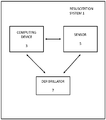
- An embodiment of the invention will now be described, by way of example only, with reference to the accompanying drawing, which is a schematic representation of a resuscitation system.
- Referring to the drawing, a resuscitation system 1 for use in the resuscitation of a subject, comprises a
computing device 3, asensor 5 and adefibrillator 7. Thecomputing device 3,sensor 5 anddefibrillator 7 are connected to each other, preferably wirelessly, but it will be appreciated that, in some circumstances, wired connections could be used. - In this embodiment, the
computing device 3 comprises a smartphone. The smartphone comprises at least one processor, at least one signal transceiver, a resuscitation strategy software in the form of a software application, at least one storage module, at least one display module and at least one user interface. - On receipt of the resuscitation system 1, the resuscitation strategy software of the
computing device 3 is used to create an account for the subject on thecomputing device 3. Thesensor 5 and the defibrillator are linked to the subject account. When subject information is received by thecomputing device 3, this is linked to the subject account. When the subject resuscitation strategy is created, this is also linked to the subject account. - The
computing device 3 inputs subject information and uses the subject information to create a subject resuscitation strategy. The resuscitation strategy software comprises a resuscitation strategy software algorithm which parses the subject information and uses the parsed subject information to create the subject resuscitation strategy. The resuscitation strategy software algorithm accesses a database of previously-developed resuscitation strategies categorised by subject information and selects a previously-developed resuscitation strategy that best fits the parsed subject information to be the subject resuscitation strategy. The database of previously-developed resuscitation strategies may be stored in the computing device or in a remote location access by the computing device. The subject resuscitation strategy is output to the defibrillator as a set of software instructions. - The subject information input by the
computing device 3 comprises any of subject health data, subject genetic data, subject lifestyle data, subject demographic data. The subject health data may comprise any of subject medical history, subject cardiac conditions, subject health status, subject illnesses, subject injuries. The subject genetic data may comprise any of genetic test results, genetic variations linked to cardiac conditions, genetic variations linked to musculo-skeletal conditions. The subject lifestyle data may comprise any of sleep data, mood data, stress level data, nutrition data, activity data. The subject demographic data may comprise any of height, weight, gender, ethnicity, location data. - The subject information may be input by the
computing device 3 from any of the subject, a carer of the subject, medical professionals of the subject. Thecomputing device 3 may detect that the subject has been in a healthcare facility and input subject information comprising subject health data updates. Thecomputing device 3 may send a notification to the subject to determine if the subject wants to input the health data updates. - In this embodiment, the
sensor 5 is a wearable sensor, such as a wrist watch or a chest-based sensor. Thesensor 5 is configured to detect subject biosignals and use the subject biosignals to monitor for a subject cardiac arrest event. Thesensor 5 may continuously or periodically detect subject biosignals. Thesensor 5 may detect subject biosignals prior to a subject cardiac arrest event. The subject biosignals detected prior to the subject cardiac arrest event may comprise biosignals detected between the subject cardiac arrest event and any of 2 hours, 1 hour, 45 mins, 30 mins, 15 mins, 10 mins, 5 mins, 3 mins prior to the subject cardiac arrest event. - The
sensor 5 detects subject biosignals comprising any of subject heart rate signals, subject ECG signals, subject blood pressure signals, subject respiration rate signals, subject blood oxygen saturation signals, subject activity data signals, subject position signals, subject location signals. Thesensor 5 detects cessation of subject heart rate signals and uses this to determine a subject cardiac arrest event. Thesensor 5 detects an arrythmia in subject ECG signals and uses this to determine a subject cardiac arrest event. - On determination of a subject cardiac arrest event, the
sensor 5 is configured to output sensor subject biosignals to thecomputing device 3. The subject biosignals may be biosignals detected prior to a subject cardiac arrest event. - The
computing device 5 treats receipt of the sensor subject biosignals as a subject cardiac arrest event alarm and sends a notification to emergency services to alert them of the subject cardiac arrest event. The resuscitation strategy software of thecomputing device 3 links the sensor subject biodata to the subject account. - The
computing device 3 is configured to use the sensor subject biosignals to adapt the subject resuscitation strategy and output the subject resuscitation strategy to thedefibrillator 7. The resuscitation strategy software algorithm of thecomputing device 3 uses the sensor subject biosignals to adapt the subject resuscitation strategy. The resuscitation strategy software algorithm accesses a database of optimal subject biosignals, determines sensor subject biosignals which are suboptimal subject biosignals, and adapts aspects of the subject resuscitation strategy corresponding to the suboptimal subject biosignals. For example, the resuscitation strategy software algorithm may determine sensor subject biosignals relating to the subject heart rate are suboptimal and adapt an aspect of the subject resuscitation strategy relating to rate of CPR to be delivered to the subject. - In this embodiment, the
defibrillator 7 is an AED and the resuscitation system 1 is deployed in the subject's home using a home AED. - The
defibrillator 7 is configured to measure subject biodata, use the subject biodata and the subject resuscitation strategy received from thecomputing device 3 to determine and deliver a subject resuscitation treatment. Thedefibrillator 7 measures subject biodata comprising any of subject heart rate biodata, subject ECG biodata, subject ICG biodata, subject blood pressure biodata, subject respiration rate biodata, subject blood oxygen saturation biodata, subject cardiopulmonary resuscitation (CPR) chest compression biodata. Thedefibrillator 7 further measures subject biodata comprising any of a type of the cardiac arrest event, condition of the subject, duration of the cardiac arrest event, subject response to the resuscitation treatment, success of resuscitation treatment. - The
defibrillator 7 comprises a resuscitation treatment algorithm which uses the subject biodata and the subject resuscitation strategy to determine and deliver the subject resuscitation treatment. The subject resuscitation treatment comprises a set of software instructions which are used by the defibrillator to alter one or more defibrillation shock waveform characteristics for the subject. The defibrillation shock waveform characteristics may comprise any of pulse duration, energy, voltage, tilt, interphase spacing. The subject resuscitation treatment further comprises a set of software instructions which are used by the defibrillator to alter feedback presented to a rescuer using the defibrillator to deliver the resuscitation treatment for the subject. The feedback may comprise any of perform hands-only CPR, perform mouth to mouth CPR, adjust CPR chest compression duration, adjust CPR chest compression rate, adjust CPR chest compression depth, adjust CPR chest compression recoil. The feedback may comprise prompts to the rescuer comprising any of audio prompts, visual prompts, haptic prompts, other sensory prompts. - During subject resuscitation treatment delivered by the
defibrillator 7, thedefibrillator 7 is configured to repeatedly measure subject biodata and output defibrillator subject biodata to thecomputing device 3. The resuscitation strategy software of thecomputing device 3 links the defibrillator subject biodata to the subject account. Thecomputing device 3 is configured to repeatedly use the defibrillator subject biodata to adapt the subject resuscitation strategy. The resuscitation strategy software algorithm of the software of thecomputing device 3 accesses a database of optimal subject biodata, determines defibrillator subject biodata which are suboptimal subject biodata, and adapts aspects of the subject resuscitation strategy corresponding to the suboptimal subject biodata. For example, the resuscitation strategy software algorithm may determine defibrillator subject biodata relating to the subject ECG are suboptimal and adapt an aspect of the subject resuscitation strategy relating to a tilt characteristic of a defibrillation shock waveform to be delivered to the subject. Thecomputing device 3 outputs the subject resuscitation strategy to thedefibrillator 7, which uses the measured subject biodata and the subject resuscitation strategy to adapt the subject resuscitation treatment. This process is carried out repeatedly during subject resuscitation treatment, for example, the defibrillator may output defibrillator subject biodata to thecomputing device 3 every 5 seconds. - The
defibrillator 7 may comprise a receiver (not shown) configured to receive subject information from the rescuer, such as subject gender, subject ethnicity, subject height, subject weight. Thedefibrillator 7 may output the subject information to thecomputing device 3 and thecomputing device 3 may use the subject information to adapt the subject resuscitation strategy and output the subject resuscitation strategy to thedefibrillator 7. - The
computing device 3 is configured to send information about the subject to any of emergency services, a medical facility, in real-time, during subject resuscitation treatment.
Claims (16)
- A resuscitation system (1) for use in the resuscitation of a subject, comprising:a computing device (3) configured to input subject information and use the subject information to create a subject resuscitation strategy,a sensor (5) configured to detect subject biosignals and use the subject biosignals to monitor for a subject cardiac arrest event, anda defibrillator (7) configured to determine and deliver a subject resuscitation treatment, whereinon determination of a subject cardiac arrest event, the sensor (5) is configured to output sensor subject biosignals to the computing device (3),the computing device (3) is configured to use the sensor subject biosignals to adapt the subject resuscitation strategy and output the subject resuscitation strategy to the defibrillator (7),the defibrillator (7) is configured to measure subject biodata, use the subject biodata and the subject resuscitation strategy to determine and deliver a subject resuscitation treatment, andduring subject resuscitation treatment,the defibrillator (7) is configured to repeatedly measure subject biodata and output defibrillator subject biodata to the computing device (3),the computing device (3) is configured to repeatedly use the defibrillator subject biodata to adapt the subject resuscitation strategy and output the subject resuscitation strategy to the defibrillator (7),the defibrillator (7) is configured to repeatedly use the measured subject biodata and the subject resuscitation strategy to adapt the subject resuscitation treatment.
- A resuscitation system (1) according to claim 1 in which the computing device (3) comprises a resuscitation strategy software algorithm which parses the subject information and uses the parsed subject information to create the subject resuscitation strategy.
- A resuscitation system (1) according to claim 2 in which the resuscitation strategy software algorithm accesses a database of previously-developed resuscitation strategies categorised by subject information and selects a previously-developed resuscitation strategy that best fits the parsed subject information to be the subject resuscitation strategy.
- A resuscitation system (1) according to any preceding claim in which the computing device (3) comprises a resuscitation strategy software algorithm which uses the sensor subject biosignals to adapt the subject resuscitation strategy.
- A resuscitation system (1) according to claim 4 in which the resuscitation strategy software algorithm accesses a database of optimal subject biosignals, determines sensor subject biosignals which are suboptimal subject biosignals, and adapts aspects of the subject resuscitation strategy corresponding to the suboptimal subject biosignals.
- A resuscitation system (1) according to any preceding claim in which the computing device (3) comprises a resuscitation strategy software algorithm which uses the defibrillator subject biodata to adapt the subject resuscitation strategy.
- A resuscitation system (1) according to claim 6 in which the resuscitation strategy software algorithm accesses a database of optimal subject biodata, determines defibrillator subject biodata which are suboptimal subject biodata, and adapts aspects of the subject resuscitation strategy corresponding to the suboptimal subject biodata.
- A resuscitation system (1) according to any preceding claim in which the subject information comprises any of subject health data, subject genetic data, subject lifestyle data, subject demographic data.
- A resuscitation system (1) according to any preceding claim in which the sensor (5) detects subject biosignals prior to a subject cardiac arrest event and outputs the prior subject biosignals to the computing device (3).
- A resuscitation system (1) according to any preceding claim in which the sensor (5) detects subject biosignals comprising any of subject heart rate signals, subject ECG signals, subject blood pressure signals, subject respiration rate signals, subject blood oxygen saturation signals, subject activity data signals, subject position signals, subject location signals.
- A resuscitation system (1) according to any preceding claim in which the sensor (5) further measures subject information about subject lifestyle changes and outputs the subject information to the computing device (3), which uses the subject information to adapt the subject resuscitation strategy.
- A resuscitation system (1) according to any preceding claim in which the defibrillator (7) measures subject biodata comprising any of subject heart rate biodata, subject ECG biodata, subject ICG biodata, subject blood pressure biodata, subject respiration rate biodata, subject blood oxygen saturation biodata, subject cardiopulmonary resuscitation (CPR) chest compression biodata, a type of the cardiac arrest event, condition of the subject, duration of the cardiac arrest event, subject response to the resuscitation treatment, success of resuscitation treatment.
- A resuscitation system (1) according to any preceding claim in which the subject resuscitation treatment comprises a set of software instructions which are used by the defibrillator (7) to alter one or more defibrillation shock waveform characteristics for the subject.
- A resuscitation system (1) according to claim 13 in which the defibrillation shock waveform characteristics comprise any of pulse duration, energy, voltage, tilt, interphase spacing.
- A resuscitation system (1) according to any preceding claim in which the subject resuscitation treatment comprises a set of software instructions which are used by the defibrillator (7) to alter feedback presented to a rescuer using the defibrillator to deliver the resuscitation treatment for the subject.
- A resuscitation system (1) according to claim 15 in which the feedback comprises any of perform hands-only CPR, perform mouth to mouth CPR, adjust CPR chest compression duration, adjust CPR chest compression rate, adjust CPR chest compression depth, adjust CPR chest compression recoil.
Applications Claiming Priority (2)
| Application Number | Priority Date | Filing Date | Title |
|---|---|---|---|
| GBGB2006613.0A GB202006613D0 (en) | 2020-05-05 | 2020-05-05 | Resuscitation system |
| GB2020616.5A GB2595018A (en) | 2020-05-05 | 2020-12-24 | Resuscitation System |
Publications (2)
| Publication Number | Publication Date |
|---|---|
| EP3906966A1 true EP3906966A1 (en) | 2021-11-10 |
| EP3906966B1 EP3906966B1 (en) | 2024-06-26 |
Family
ID=71080485
Family Applications (1)
| Application Number | Title | Priority Date | Filing Date |
|---|---|---|---|
| EP21165963.6A Active EP3906966B1 (en) | 2020-05-05 | 2021-03-30 | Resuscitation system |
Country Status (5)
| Country | Link |
|---|---|
| US (1) | US12097378B2 (en) |
| EP (1) | EP3906966B1 (en) |
| JP (1) | JP7769476B2 (en) |
| AU (1) | AU2021202084A1 (en) |
| GB (2) | GB202006613D0 (en) |
Families Citing this family (2)
| Publication number | Priority date | Publication date | Assignee | Title |
|---|---|---|---|---|
| US11173315B1 (en) * | 2020-07-24 | 2021-11-16 | Defibrio AS | Mobile defibrillator |
| CN120432195A (en) * | 2025-04-21 | 2025-08-05 | 天津大学 | A cardiopulmonary resuscitation collaborative control device based on multi-source physiological parameter detection |
Citations (5)
| Publication number | Priority date | Publication date | Assignee | Title |
|---|---|---|---|---|
| US6356785B1 (en) * | 1997-11-06 | 2002-03-12 | Cecily Anne Snyder | External defibrillator with CPR prompts and ACLS prompts and methods of use |
| WO2017055953A2 (en) * | 2015-09-28 | 2017-04-06 | Koninklijke Philips N.V. | Portable medical apparatus for individualized treatment guidance based on an online storage profile with body measurements and method |
| US20180040255A1 (en) * | 2016-08-08 | 2018-02-08 | Zoll Medical Corporation | Wrist-Worn Device for Coordinating Patient Care |
| US20190255340A1 (en) * | 2018-02-21 | 2019-08-22 | Zoll Medical Corporation | Active compression decompression resuscitation integrated treatment system |
| US20190365333A1 (en) * | 2018-05-30 | 2019-12-05 | International Business Machines Corporation | Automated smart watch assistance in the event of cardiac arrest |
Family Cites Families (8)
| Publication number | Priority date | Publication date | Assignee | Title |
|---|---|---|---|---|
| US7395216B2 (en) | 1999-06-23 | 2008-07-01 | Visicu, Inc. | Using predictive models to continuously update a treatment plan for a patient in a health care location |
| US8731658B2 (en) * | 2005-01-31 | 2014-05-20 | Physio-Control, Inc | System and method for using diagnostic pulses in connection with defibrillation therapy |
| US8078278B2 (en) | 2006-01-10 | 2011-12-13 | Remon Medical Technologies Ltd. | Body attachable unit in wireless communication with implantable devices |
| US8140154B2 (en) | 2007-06-13 | 2012-03-20 | Zoll Medical Corporation | Wearable medical treatment device |
| US20090270930A1 (en) * | 2008-04-25 | 2009-10-29 | Physio-Control, Inc. | External Defibrillator With Adaptive Protocols |
| US20160213560A1 (en) * | 2015-01-20 | 2016-07-28 | Renata Sturdivant | Automated cardiopulmonary resuscitation (cpr) device |
| US10946207B2 (en) * | 2017-05-27 | 2021-03-16 | West Affum Holdings Corp. | Defibrillation waveforms for a wearable cardiac defibrillator |
| US12390653B2 (en) | 2018-09-21 | 2025-08-19 | The Regents Of The University Of California | Spreading depolarization and repolarization as biomarkers of neurological recovery after cardiac arrest |
-
2020
- 2020-05-05 GB GBGB2006613.0A patent/GB202006613D0/en not_active Ceased
- 2020-12-24 GB GB2020616.5A patent/GB2595018A/en not_active Withdrawn
-
2021
- 2021-03-30 EP EP21165963.6A patent/EP3906966B1/en active Active
- 2021-04-02 JP JP2021063309A patent/JP7769476B2/en active Active
- 2021-04-06 AU AU2021202084A patent/AU2021202084A1/en active Pending
- 2021-05-04 US US17/307,203 patent/US12097378B2/en active Active
Patent Citations (5)
| Publication number | Priority date | Publication date | Assignee | Title |
|---|---|---|---|---|
| US6356785B1 (en) * | 1997-11-06 | 2002-03-12 | Cecily Anne Snyder | External defibrillator with CPR prompts and ACLS prompts and methods of use |
| WO2017055953A2 (en) * | 2015-09-28 | 2017-04-06 | Koninklijke Philips N.V. | Portable medical apparatus for individualized treatment guidance based on an online storage profile with body measurements and method |
| US20180040255A1 (en) * | 2016-08-08 | 2018-02-08 | Zoll Medical Corporation | Wrist-Worn Device for Coordinating Patient Care |
| US20190255340A1 (en) * | 2018-02-21 | 2019-08-22 | Zoll Medical Corporation | Active compression decompression resuscitation integrated treatment system |
| US20190365333A1 (en) * | 2018-05-30 | 2019-12-05 | International Business Machines Corporation | Automated smart watch assistance in the event of cardiac arrest |
Also Published As
| Publication number | Publication date |
|---|---|
| US20210346708A1 (en) | 2021-11-11 |
| AU2021202084A1 (en) | 2021-11-25 |
| JP2021176502A (en) | 2021-11-11 |
| US12097378B2 (en) | 2024-09-24 |
| EP3906966B1 (en) | 2024-06-26 |
| JP7769476B2 (en) | 2025-11-13 |
| GB202020616D0 (en) | 2021-02-10 |
| GB202006613D0 (en) | 2020-06-17 |
| GB2595018A (en) | 2021-11-17 |
Similar Documents
| Publication | Publication Date | Title |
|---|---|---|
| US12226645B2 (en) | Medical device operational modes | |
| US20250010087A1 (en) | Rescue Services Activation | |
| US20240374471A1 (en) | Force Sensing Implementations in Cardiopulmonary Resuscitation | |
| US9149411B2 (en) | Programmable cardiopulmonary resuscitation (CPR) detection device | |
| US10959624B2 (en) | Methods of monitoring for hemodynamically significant heart rhythm disturbances and devices for practicing same | |
| US10674911B2 (en) | Systems and methods of integrating ambulatory medical devices | |
| EP2341825A1 (en) | Personal alerting device for use with diagnostic device | |
| US12318621B2 (en) | Response mechanisms | |
| WO2019075035A1 (en) | System and method for distinguishing a cardiac event from noise in an electrocardiogram (ecg) signal | |
| EP3906966B1 (en) | Resuscitation system | |
| KR102601976B1 (en) | Appratus and method for self tilt training | |
| US20230372722A1 (en) | Managing alerts in a wcd system | |
| US12629102B2 (en) | Managing cardiac risk based on physiological markers | |
| US20260069168A1 (en) | Wearable computing device identification and use for role-based feedback |
Legal Events
| Date | Code | Title | Description |
|---|---|---|---|
| PUAI | Public reference made under article 153(3) epc to a published international application that has entered the european phase |
Free format text: ORIGINAL CODE: 0009012 |
|
| STAA | Information on the status of an ep patent application or granted ep patent |
Free format text: STATUS: THE APPLICATION HAS BEEN PUBLISHED |
|
| AK | Designated contracting states |
Kind code of ref document: A1 Designated state(s): AL AT BE BG CH CY CZ DE DK EE ES FI FR GB GR HR HU IE IS IT LI LT LU LV MC MK MT NL NO PL PT RO RS SE SI SK SM TR |
|
| B565 | Issuance of search results under rule 164(2) epc |
Effective date: 20211008 |
|
| STAA | Information on the status of an ep patent application or granted ep patent |
Free format text: STATUS: REQUEST FOR EXAMINATION WAS MADE |
|
| 17P | Request for examination filed |
Effective date: 20220504 |
|
| RBV | Designated contracting states (corrected) |
Designated state(s): AL AT BE BG CH CY CZ DE DK EE ES FI FR GB GR HR HU IE IS IT LI LT LU LV MC MK MT NL NO PL PT RO RS SE SI SK SM TR |
|
| P01 | Opt-out of the competence of the unified patent court (upc) registered |
Effective date: 20230829 |
|
| RAP1 | Party data changed (applicant data changed or rights of an application transferred) |
Owner name: STRYKER EUROPEAN OPERATIONS LIMITED |
|
| GRAP | Despatch of communication of intention to grant a patent |
Free format text: ORIGINAL CODE: EPIDOSNIGR1 |
|
| STAA | Information on the status of an ep patent application or granted ep patent |
Free format text: STATUS: GRANT OF PATENT IS INTENDED |
|
| RIC1 | Information provided on ipc code assigned before grant |
Ipc: G16H 50/20 20180101ALI20240223BHEP Ipc: G16H 20/30 20180101ALI20240223BHEP Ipc: A61B 5/318 20210101ALI20240223BHEP Ipc: G16H 40/67 20180101ALI20240223BHEP Ipc: A61H 31/00 20060101ALI20240223BHEP Ipc: A61N 1/39 20060101AFI20240223BHEP |
|
| INTG | Intention to grant announced |
Effective date: 20240312 |
|
| GRAS | Grant fee paid |
Free format text: ORIGINAL CODE: EPIDOSNIGR3 |
|
| GRAA | (expected) grant |
Free format text: ORIGINAL CODE: 0009210 |
|
| STAA | Information on the status of an ep patent application or granted ep patent |
Free format text: STATUS: THE PATENT HAS BEEN GRANTED |
|
| AK | Designated contracting states |
Kind code of ref document: B1 Designated state(s): AL AT BE BG CH CY CZ DE DK EE ES FI FR GB GR HR HU IE IS IT LI LT LU LV MC MK MT NL NO PL PT RO RS SE SI SK SM TR |
|
| REG | Reference to a national code |
Ref country code: GB Ref legal event code: FG4D |
|
| REG | Reference to a national code |
Ref country code: CH Ref legal event code: EP |
|
| REG | Reference to a national code |
Ref country code: DE Ref legal event code: R096 Ref document number: 602021014698 Country of ref document: DE |
|
| REG | Reference to a national code |
Ref country code: NL Ref legal event code: FP |
|
| PG25 | Lapsed in a contracting state [announced via postgrant information from national office to epo] |
Ref country code: BG Free format text: LAPSE BECAUSE OF FAILURE TO SUBMIT A TRANSLATION OF THE DESCRIPTION OR TO PAY THE FEE WITHIN THE PRESCRIBED TIME-LIMIT Effective date: 20240626 |
|
| PG25 | Lapsed in a contracting state [announced via postgrant information from national office to epo] |
Ref country code: FI Free format text: LAPSE BECAUSE OF FAILURE TO SUBMIT A TRANSLATION OF THE DESCRIPTION OR TO PAY THE FEE WITHIN THE PRESCRIBED TIME-LIMIT Effective date: 20240626 Ref country code: HR Free format text: LAPSE BECAUSE OF FAILURE TO SUBMIT A TRANSLATION OF THE DESCRIPTION OR TO PAY THE FEE WITHIN THE PRESCRIBED TIME-LIMIT Effective date: 20240626 |
|
| REG | Reference to a national code |
Ref country code: LT Ref legal event code: MG9D |
|
| PG25 | Lapsed in a contracting state [announced via postgrant information from national office to epo] |
Ref country code: GR Free format text: LAPSE BECAUSE OF FAILURE TO SUBMIT A TRANSLATION OF THE DESCRIPTION OR TO PAY THE FEE WITHIN THE PRESCRIBED TIME-LIMIT Effective date: 20240927 |
|
| PG25 | Lapsed in a contracting state [announced via postgrant information from national office to epo] |
Ref country code: LV Free format text: LAPSE BECAUSE OF FAILURE TO SUBMIT A TRANSLATION OF THE DESCRIPTION OR TO PAY THE FEE WITHIN THE PRESCRIBED TIME-LIMIT Effective date: 20240626 |
|
| PG25 | Lapsed in a contracting state [announced via postgrant information from national office to epo] |
Ref country code: NO Free format text: LAPSE BECAUSE OF FAILURE TO SUBMIT A TRANSLATION OF THE DESCRIPTION OR TO PAY THE FEE WITHIN THE PRESCRIBED TIME-LIMIT Effective date: 20240926 Ref country code: LV Free format text: LAPSE BECAUSE OF FAILURE TO SUBMIT A TRANSLATION OF THE DESCRIPTION OR TO PAY THE FEE WITHIN THE PRESCRIBED TIME-LIMIT Effective date: 20240626 Ref country code: HR Free format text: LAPSE BECAUSE OF FAILURE TO SUBMIT A TRANSLATION OF THE DESCRIPTION OR TO PAY THE FEE WITHIN THE PRESCRIBED TIME-LIMIT Effective date: 20240626 Ref country code: GR Free format text: LAPSE BECAUSE OF FAILURE TO SUBMIT A TRANSLATION OF THE DESCRIPTION OR TO PAY THE FEE WITHIN THE PRESCRIBED TIME-LIMIT Effective date: 20240927 Ref country code: FI Free format text: LAPSE BECAUSE OF FAILURE TO SUBMIT A TRANSLATION OF THE DESCRIPTION OR TO PAY THE FEE WITHIN THE PRESCRIBED TIME-LIMIT Effective date: 20240626 Ref country code: BG Free format text: LAPSE BECAUSE OF FAILURE TO SUBMIT A TRANSLATION OF THE DESCRIPTION OR TO PAY THE FEE WITHIN THE PRESCRIBED TIME-LIMIT Effective date: 20240626 Ref country code: RS Free format text: LAPSE BECAUSE OF FAILURE TO SUBMIT A TRANSLATION OF THE DESCRIPTION OR TO PAY THE FEE WITHIN THE PRESCRIBED TIME-LIMIT Effective date: 20240926 |
|
| REG | Reference to a national code |
Ref country code: AT Ref legal event code: MK05 Ref document number: 1697215 Country of ref document: AT Kind code of ref document: T Effective date: 20240626 |
|
| PG25 | Lapsed in a contracting state [announced via postgrant information from national office to epo] |
Ref country code: PT Free format text: LAPSE BECAUSE OF FAILURE TO SUBMIT A TRANSLATION OF THE DESCRIPTION OR TO PAY THE FEE WITHIN THE PRESCRIBED TIME-LIMIT Effective date: 20241028 |
|
| PG25 | Lapsed in a contracting state [announced via postgrant information from national office to epo] |
Ref country code: PT Free format text: LAPSE BECAUSE OF FAILURE TO SUBMIT A TRANSLATION OF THE DESCRIPTION OR TO PAY THE FEE WITHIN THE PRESCRIBED TIME-LIMIT Effective date: 20241028 |
|
| PG25 | Lapsed in a contracting state [announced via postgrant information from national office to epo] |
Ref country code: PL Free format text: LAPSE BECAUSE OF FAILURE TO SUBMIT A TRANSLATION OF THE DESCRIPTION OR TO PAY THE FEE WITHIN THE PRESCRIBED TIME-LIMIT Effective date: 20240626 |
|
| PG25 | Lapsed in a contracting state [announced via postgrant information from national office to epo] |
Ref country code: EE Free format text: LAPSE BECAUSE OF FAILURE TO SUBMIT A TRANSLATION OF THE DESCRIPTION OR TO PAY THE FEE WITHIN THE PRESCRIBED TIME-LIMIT Effective date: 20240626 |
|
| PG25 | Lapsed in a contracting state [announced via postgrant information from national office to epo] |
Ref country code: IS Free format text: LAPSE BECAUSE OF FAILURE TO SUBMIT A TRANSLATION OF THE DESCRIPTION OR TO PAY THE FEE WITHIN THE PRESCRIBED TIME-LIMIT Effective date: 20241026 Ref country code: AT Free format text: LAPSE BECAUSE OF FAILURE TO SUBMIT A TRANSLATION OF THE DESCRIPTION OR TO PAY THE FEE WITHIN THE PRESCRIBED TIME-LIMIT Effective date: 20240626 |
|
| PG25 | Lapsed in a contracting state [announced via postgrant information from national office to epo] |
Ref country code: CZ Free format text: LAPSE BECAUSE OF FAILURE TO SUBMIT A TRANSLATION OF THE DESCRIPTION OR TO PAY THE FEE WITHIN THE PRESCRIBED TIME-LIMIT Effective date: 20240626 |
|
| PG25 | Lapsed in a contracting state [announced via postgrant information from national office to epo] |
Ref country code: RO Free format text: LAPSE BECAUSE OF FAILURE TO SUBMIT A TRANSLATION OF THE DESCRIPTION OR TO PAY THE FEE WITHIN THE PRESCRIBED TIME-LIMIT Effective date: 20240626 Ref country code: SK Free format text: LAPSE BECAUSE OF FAILURE TO SUBMIT A TRANSLATION OF THE DESCRIPTION OR TO PAY THE FEE WITHIN THE PRESCRIBED TIME-LIMIT Effective date: 20240626 |
|
| PG25 | Lapsed in a contracting state [announced via postgrant information from national office to epo] |
Ref country code: ES Free format text: LAPSE BECAUSE OF FAILURE TO SUBMIT A TRANSLATION OF THE DESCRIPTION OR TO PAY THE FEE WITHIN THE PRESCRIBED TIME-LIMIT Effective date: 20240626 Ref country code: SM Free format text: LAPSE BECAUSE OF FAILURE TO SUBMIT A TRANSLATION OF THE DESCRIPTION OR TO PAY THE FEE WITHIN THE PRESCRIBED TIME-LIMIT Effective date: 20240626 |
|
| PG25 | Lapsed in a contracting state [announced via postgrant information from national office to epo] |
Ref country code: SM Free format text: LAPSE BECAUSE OF FAILURE TO SUBMIT A TRANSLATION OF THE DESCRIPTION OR TO PAY THE FEE WITHIN THE PRESCRIBED TIME-LIMIT Effective date: 20240626 Ref country code: SK Free format text: LAPSE BECAUSE OF FAILURE TO SUBMIT A TRANSLATION OF THE DESCRIPTION OR TO PAY THE FEE WITHIN THE PRESCRIBED TIME-LIMIT Effective date: 20240626 Ref country code: RO Free format text: LAPSE BECAUSE OF FAILURE TO SUBMIT A TRANSLATION OF THE DESCRIPTION OR TO PAY THE FEE WITHIN THE PRESCRIBED TIME-LIMIT Effective date: 20240626 Ref country code: PL Free format text: LAPSE BECAUSE OF FAILURE TO SUBMIT A TRANSLATION OF THE DESCRIPTION OR TO PAY THE FEE WITHIN THE PRESCRIBED TIME-LIMIT Effective date: 20240626 Ref country code: IS Free format text: LAPSE BECAUSE OF FAILURE TO SUBMIT A TRANSLATION OF THE DESCRIPTION OR TO PAY THE FEE WITHIN THE PRESCRIBED TIME-LIMIT Effective date: 20241026 Ref country code: ES Free format text: LAPSE BECAUSE OF FAILURE TO SUBMIT A TRANSLATION OF THE DESCRIPTION OR TO PAY THE FEE WITHIN THE PRESCRIBED TIME-LIMIT Effective date: 20240626 Ref country code: EE Free format text: LAPSE BECAUSE OF FAILURE TO SUBMIT A TRANSLATION OF THE DESCRIPTION OR TO PAY THE FEE WITHIN THE PRESCRIBED TIME-LIMIT Effective date: 20240626 Ref country code: CZ Free format text: LAPSE BECAUSE OF FAILURE TO SUBMIT A TRANSLATION OF THE DESCRIPTION OR TO PAY THE FEE WITHIN THE PRESCRIBED TIME-LIMIT Effective date: 20240626 Ref country code: AT Free format text: LAPSE BECAUSE OF FAILURE TO SUBMIT A TRANSLATION OF THE DESCRIPTION OR TO PAY THE FEE WITHIN THE PRESCRIBED TIME-LIMIT Effective date: 20240626 |
|
| PG25 | Lapsed in a contracting state [announced via postgrant information from national office to epo] |
Ref country code: IT Free format text: LAPSE BECAUSE OF FAILURE TO SUBMIT A TRANSLATION OF THE DESCRIPTION OR TO PAY THE FEE WITHIN THE PRESCRIBED TIME-LIMIT Effective date: 20240626 |
|
| REG | Reference to a national code |
Ref country code: DE Ref legal event code: R097 Ref document number: 602021014698 Country of ref document: DE |
|
| PG25 | Lapsed in a contracting state [announced via postgrant information from national office to epo] |
Ref country code: DK Free format text: LAPSE BECAUSE OF FAILURE TO SUBMIT A TRANSLATION OF THE DESCRIPTION OR TO PAY THE FEE WITHIN THE PRESCRIBED TIME-LIMIT Effective date: 20240626 |
|
| PLBE | No opposition filed within time limit |
Free format text: ORIGINAL CODE: 0009261 |
|
| STAA | Information on the status of an ep patent application or granted ep patent |
Free format text: STATUS: NO OPPOSITION FILED WITHIN TIME LIMIT |
|
| 26N | No opposition filed |
Effective date: 20250327 |
|
| PG25 | Lapsed in a contracting state [announced via postgrant information from national office to epo] |
Ref country code: SE Free format text: LAPSE BECAUSE OF FAILURE TO SUBMIT A TRANSLATION OF THE DESCRIPTION OR TO PAY THE FEE WITHIN THE PRESCRIBED TIME-LIMIT Effective date: 20240626 |
|
| PG25 | Lapsed in a contracting state [announced via postgrant information from national office to epo] |
Ref country code: MC Free format text: LAPSE BECAUSE OF FAILURE TO SUBMIT A TRANSLATION OF THE DESCRIPTION OR TO PAY THE FEE WITHIN THE PRESCRIBED TIME-LIMIT Effective date: 20240626 |
|
| REG | Reference to a national code |
Ref country code: CH Ref legal event code: H13 Free format text: ST27 STATUS EVENT CODE: U-0-0-H10-H13 (AS PROVIDED BY THE NATIONAL OFFICE) Effective date: 20251023 |
|
| PG25 | Lapsed in a contracting state [announced via postgrant information from national office to epo] |
Ref country code: LU Free format text: LAPSE BECAUSE OF NON-PAYMENT OF DUE FEES Effective date: 20250330 |
|
| REG | Reference to a national code |
Ref country code: BE Ref legal event code: MM Effective date: 20250331 |
|
| PGFP | Annual fee paid to national office [announced via postgrant information from national office to epo] |
Ref country code: FR Payment date: 20251231 Year of fee payment: 6 |
|
| PG25 | Lapsed in a contracting state [announced via postgrant information from national office to epo] |
Ref country code: BE Free format text: LAPSE BECAUSE OF NON-PAYMENT OF DUE FEES Effective date: 20250331 |
|
| PG25 | Lapsed in a contracting state [announced via postgrant information from national office to epo] |
Ref country code: CH Free format text: LAPSE BECAUSE OF NON-PAYMENT OF DUE FEES Effective date: 20250331 |
|
| PG25 | Lapsed in a contracting state [announced via postgrant information from national office to epo] |
Ref country code: IE Free format text: LAPSE BECAUSE OF NON-PAYMENT OF DUE FEES Effective date: 20250330 |
|
| PGFP | Annual fee paid to national office [announced via postgrant information from national office to epo] |
Ref country code: NL Payment date: 20260106 Year of fee payment: 6 |
|
| PGFP | Annual fee paid to national office [announced via postgrant information from national office to epo] |
Ref country code: GB Payment date: 20260106 Year of fee payment: 6 |
|
| PGFP | Annual fee paid to national office [announced via postgrant information from national office to epo] |
Ref country code: DE Payment date: 20260102 Year of fee payment: 6 |
|
| PG25 | Lapsed in a contracting state [announced via postgrant information from national office to epo] |
Ref country code: CY Free format text: LAPSE BECAUSE OF FAILURE TO SUBMIT A TRANSLATION OF THE DESCRIPTION OR TO PAY THE FEE WITHIN THE PRESCRIBED TIME-LIMIT Effective date: 20240626 |
|
| PG25 | Lapsed in a contracting state [announced via postgrant information from national office to epo] |
Ref country code: LT Free format text: LAPSE BECAUSE OF FAILURE TO SUBMIT A TRANSLATION OF THE DESCRIPTION OR TO PAY THE FEE WITHIN THE PRESCRIBED TIME-LIMIT Effective date: 20240626 |
|
| PG25 | Lapsed in a contracting state [announced via postgrant information from national office to epo] |
Ref country code: TR Free format text: LAPSE BECAUSE OF FAILURE TO SUBMIT A TRANSLATION OF THE DESCRIPTION OR TO PAY THE FEE WITHIN THE PRESCRIBED TIME-LIMIT Effective date: 20240626 |