EP3906754B1 - Steuerungsvorrichtung und verfahren für adaptive beleuchtungsanordnung - Google Patents
Steuerungsvorrichtung und verfahren für adaptive beleuchtungsanordnung Download PDFInfo
- Publication number
- EP3906754B1 EP3906754B1 EP20736207.0A EP20736207A EP3906754B1 EP 3906754 B1 EP3906754 B1 EP 3906754B1 EP 20736207 A EP20736207 A EP 20736207A EP 3906754 B1 EP3906754 B1 EP 3906754B1
- Authority
- EP
- European Patent Office
- Prior art keywords
- marker
- control
- controller
- lighting
- light
- Prior art date
- Legal status (The legal status is an assumption and is not a legal conclusion. Google has not performed a legal analysis and makes no representation as to the accuracy of the status listed.)
- Active
Links
Images






Classifications
-
- A—HUMAN NECESSITIES
- A61—MEDICAL OR VETERINARY SCIENCE; HYGIENE
- A61B—DIAGNOSIS; SURGERY; IDENTIFICATION
- A61B34/00—Computer-aided surgery; Manipulators or robots specially adapted for use in surgery
- A61B34/70—Manipulators specially adapted for use in surgery
- A61B34/77—Manipulators with motion or force scaling
-
- A—HUMAN NECESSITIES
- A61—MEDICAL OR VETERINARY SCIENCE; HYGIENE
- A61B—DIAGNOSIS; SURGERY; IDENTIFICATION
- A61B90/00—Instruments, implements or accessories specially adapted for surgery or diagnosis and not covered by any of the groups A61B1/00 - A61B50/00, e.g. for luxation treatment or for protecting wound edges
- A61B90/30—Devices for illuminating a surgical field, the devices having an interrelation with other surgical devices or with a surgical procedure
-
- A—HUMAN NECESSITIES
- A61—MEDICAL OR VETERINARY SCIENCE; HYGIENE
- A61B—DIAGNOSIS; SURGERY; IDENTIFICATION
- A61B90/00—Instruments, implements or accessories specially adapted for surgery or diagnosis and not covered by any of the groups A61B1/00 - A61B50/00, e.g. for luxation treatment or for protecting wound edges
- A61B90/30—Devices for illuminating a surgical field, the devices having an interrelation with other surgical devices or with a surgical procedure
- A61B90/35—Supports therefor
-
- A—HUMAN NECESSITIES
- A61—MEDICAL OR VETERINARY SCIENCE; HYGIENE
- A61B—DIAGNOSIS; SURGERY; IDENTIFICATION
- A61B90/00—Instruments, implements or accessories specially adapted for surgery or diagnosis and not covered by any of the groups A61B1/00 - A61B50/00, e.g. for luxation treatment or for protecting wound edges
- A61B90/36—Image-producing devices or illumination devices not otherwise provided for
-
- G—PHYSICS
- G06—COMPUTING OR CALCULATING; COUNTING
- G06F—ELECTRIC DIGITAL DATA PROCESSING
- G06F3/00—Input arrangements for transferring data to be processed into a form capable of being handled by the computer; Output arrangements for transferring data from processing unit to output unit, e.g. interface arrangements
- G06F3/01—Input arrangements or combined input and output arrangements for interaction between user and computer
- G06F3/017—Gesture based interaction, e.g. based on a set of recognized hand gestures
-
- H—ELECTRICITY
- H04—ELECTRIC COMMUNICATION TECHNIQUE
- H04N—PICTORIAL COMMUNICATION, e.g. TELEVISION
- H04N23/00—Cameras or camera modules comprising electronic image sensors; Control thereof
- H04N23/56—Cameras or camera modules comprising electronic image sensors; Control thereof provided with illuminating means
-
- H—ELECTRICITY
- H04—ELECTRIC COMMUNICATION TECHNIQUE
- H04N—PICTORIAL COMMUNICATION, e.g. TELEVISION
- H04N23/00—Cameras or camera modules comprising electronic image sensors; Control thereof
- H04N23/60—Control of cameras or camera modules
-
- H—ELECTRICITY
- H04—ELECTRIC COMMUNICATION TECHNIQUE
- H04N—PICTORIAL COMMUNICATION, e.g. TELEVISION
- H04N23/00—Cameras or camera modules comprising electronic image sensors; Control thereof
- H04N23/60—Control of cameras or camera modules
- H04N23/61—Control of cameras or camera modules based on recognised objects
- H04N23/611—Control of cameras or camera modules based on recognised objects where the recognised objects include parts of the human body
-
- H—ELECTRICITY
- H04—ELECTRIC COMMUNICATION TECHNIQUE
- H04N—PICTORIAL COMMUNICATION, e.g. TELEVISION
- H04N23/00—Cameras or camera modules comprising electronic image sensors; Control thereof
- H04N23/70—Circuitry for compensating brightness variation in the scene
- H04N23/74—Circuitry for compensating brightness variation in the scene by influencing the scene brightness using illuminating means
-
- H—ELECTRICITY
- H05—ELECTRIC TECHNIQUES NOT OTHERWISE PROVIDED FOR
- H05B—ELECTRIC HEATING; ELECTRIC LIGHT SOURCES NOT OTHERWISE PROVIDED FOR; CIRCUIT ARRANGEMENTS FOR ELECTRIC LIGHT SOURCES, IN GENERAL
- H05B47/00—Circuit arrangements for operating light sources in general, i.e. where the type of light source is not relevant
- H05B47/10—Controlling the light source
- H05B47/105—Controlling the light source in response to determined parameters
- H05B47/115—Controlling the light source in response to determined parameters by determining the presence or movement of objects or living beings
- H05B47/125—Controlling the light source in response to determined parameters by determining the presence or movement of objects or living beings by using cameras
-
- A—HUMAN NECESSITIES
- A61—MEDICAL OR VETERINARY SCIENCE; HYGIENE
- A61B—DIAGNOSIS; SURGERY; IDENTIFICATION
- A61B34/00—Computer-aided surgery; Manipulators or robots specially adapted for use in surgery
- A61B34/20—Surgical navigation systems; Devices for tracking or guiding surgical instruments, e.g. for frameless stereotaxis
- A61B2034/2046—Tracking techniques
- A61B2034/2055—Optical tracking systems
-
- A—HUMAN NECESSITIES
- A61—MEDICAL OR VETERINARY SCIENCE; HYGIENE
- A61B—DIAGNOSIS; SURGERY; IDENTIFICATION
- A61B90/00—Instruments, implements or accessories specially adapted for surgery or diagnosis and not covered by any of the groups A61B1/00 - A61B50/00, e.g. for luxation treatment or for protecting wound edges
- A61B90/36—Image-producing devices or illumination devices not otherwise provided for
- A61B2090/363—Use of fiducial points
-
- Y—GENERAL TAGGING OF NEW TECHNOLOGICAL DEVELOPMENTS; GENERAL TAGGING OF CROSS-SECTIONAL TECHNOLOGIES SPANNING OVER SEVERAL SECTIONS OF THE IPC; TECHNICAL SUBJECTS COVERED BY FORMER USPC CROSS-REFERENCE ART COLLECTIONS [XRACs] AND DIGESTS
- Y02—TECHNOLOGIES OR APPLICATIONS FOR MITIGATION OR ADAPTATION AGAINST CLIMATE CHANGE
- Y02B—CLIMATE CHANGE MITIGATION TECHNOLOGIES RELATED TO BUILDINGS, e.g. HOUSING, HOUSE APPLIANCES OR RELATED END-USER APPLICATIONS
- Y02B20/00—Energy efficient lighting technologies, e.g. halogen lamps or gas discharge lamps
- Y02B20/40—Control techniques providing energy savings, e.g. smart controller or presence detection
Definitions
- the present disclosure generally relates to illumination systems, and more particularly, to surgical theater and surgical suite illumination systems.
- the system of the present invention includes various subsystems, which are referred to herein as modules, that both act independently and co-dependently, as will be described in greater detail below, in conjunction with a central control computer module.
- the modules consist, in an exemplary embodiment, of the cable robot module, the central computer module, the imaging module, the illumination module, and the object manipulator module.
- a control instrument for an illumination system is defined in claim 1.
- the term "and/or,” when used in a list of two or more items, means that any one of the listed items can be employed by itself, or any combination of two or more of the listed items can be employed.
- the composition can contain A alone; B alone; C alone; A and B in combination; A and C in combination; B and C in combination; or A, B, and C in combination.
- the disclosure provides for an illumination system 10.
- the illumination system 10 may comprise a controller 12 and various accessories that may be utilized in a medical suite 14 to selectively illuminate a location or operating region 16.
- the illumination system 10 may comprise one or more light assemblies 18, which may include one or more light sources 20.
- the system 10 may comprise at least one imager 22 operable to capture image data in a field of view 24 comprising the operating region 16.
- the controller 12 of the system 10 may be configured to scan the operating region 16 to identify a location of a marker 26. Based on the location of the marker 26, the controller 12 may control a lighting emission from the one or more light sources 20 to illuminate the location corresponding to the position of the marker 26 identified in the image data. In this way, the system 10 may provide for a computer-assisted control of a direction of lighting emissions directed from the one or more light sources to conveniently illuminate various locations within the operating region 16.
- the system 10 may be configured to track the motion of the marker 26 to adjust the position of one or more target positions 30 in response to controls instructed by a user 32. Such tracking may be at least partially determined by the controller 12 of the system 10 by detecting a motion and/or rate of motion of a control instrument 34 comprising the marker 26 identified in the field of view 24.
- the marker 26 may comprise a plurality of markers, user inputs, and various features that may be configured to control the illumination system 10.
- the control instrument may comprise a handheld device that may be robust and configured to be sanitized with various surgical instruments via conventional sterilization processes (e.g. autoclave sterilization).
- the instrument 34 may be passive in operation and rely on the imager 22 of the system to identify a user input in response to identifying an interaction by the user with a user input or feature of the control instrument 34.
- imager 22 of the system may be passive in operation and rely on the imager 22 of the system to identify a user input in response to identifying an interaction by the user with a user input or feature of the control instrument 34.
- FIGS. 5-7 Various examples of such operations are discussed in reference to FIGS. 5-7 .
- reference numeral 10 generally designates an illumination system 10.
- the illumination system 10 is depicted in a medical suite 14 and includes one or more light assemblies 18.
- the light assemblies 18 may include one or more light sources 20.
- the illumination system 10 may include one or more imagers 22 depicted to aid in the use of the illumination system 10.
- the imagers 22 may be positioned within or coupled to the light assemblies 18 (e.g., in handles or bodies), a table 28, and/or around the medical suite 14.
- the imager 22 may be a charge-coupled device (CCD) imager, a complementary metal-oxide-semiconductor (CMOS) imager, other types of imagers, and/or combinations thereof.
- the imager 22 may include one or more lenses to collimate and/or focus the light reflected by the patient, the table 28, or other features of the medical suite 14.
- the table 28 may at least partially define the operating region 16.
- the operating region 16 may be an operating field which is an isolated area where surgery is performed and may include all furniture and equipment covered with sterile drapes and all personnel being properly attired.
- the illumination system 10 of the present disclosure may be utilized in a variety of environments.
- the illumination system 10 may be utilized in automobile repair areas, doctor's offices, dentistry, photography studios, manufacturing settings, as well as other areas where dynamic lighting solutions may be advantageous.
- the table 28 is configured to support a patient during a surgical procedure.
- the table 28 may have a square, rectangular and/or oval configuration.
- the table 28 may be composed of a metal (e.g., stainless steel), a polymer and/or combinations thereof.
- a sterile covering e.g., a cloth or paper
- the table 28 may be configured to tilt, rotate and/or be raised or lowered. In examples where the table 28 is configured to tilt, the table 28 may tilt an angle from about 1° to about 10° about a long or a short axis of the table 28.
- the tilting of the table 28 may be performed in conjunction with illumination provided from the illumination system 10 and/or the light assemblies 18.
- the table 28 may be configured to tilt toward and/or away from the light assemblies 18 to increase illumination, decrease illumination and/or to eliminate glare reflecting off of the patient and/or table 28. Further, tilting of the table 28 may be advantageous in allowing users (e.g., medical personnel) positioned around the table 28 to more easily access the patient and/or surgical field. In addition to tilting, it will be understood that the table 28 may be configured to raise or lower, rotate and/or slide about an X-Y plane.
- the light assemblies 18 may take a variety of configurations.
- the light assemblies may include one or more light sources 20.
- the light assemblies 18 may be modular and interconnected and supported on a track system.
- the light assemblies 18 may have a circular, oval, oblong, triangular, square, rectangular, pentagonal or higher order polygon shape. It will be understood that different light assemblies 18 may be provided in different forms and that the illumination system 10 may include a variety of light assemblies 18.
- the operating region 16 may be illuminated by a detection emission 38, shown projected in a field of view 24 of the imager 22.
- the detection emission 38 may be emitted from one or more of the light sources 20 in a substantially non-visible wavelength of light.
- the detection emission 38 may be emitted from a detection emitter 20a as infrared light (e.g., near-infrared, infrared, and/or far-infrared).
- the operating region 16 may be illuminated by the detection emission 38 illuminating various objects that enter the field of view 24 of the imager 22.
- the marker 26 may be illuminated by the detection emission 38 from the emitter 20a such that the reflected light from the detection emission 38 is captured in the image data of the imager 22.
- the marker 26 may comprise a reflective surface finish configured to reflect the detection emission 38.
- the light assemblies 18 may be positioned or suspended from one or more positioning assemblies 40, which may adjust a projection direction of the light sources 20 by controlling one or more actuators 42. Accordingly, the positioning assemblies may be configured to rotate and/or translate independently or in any combination. As shown, the system 10 may comprise a first positioning mechanism and a second positioning mechanism, which may be referred to as a first actuator 42a and a second actuator 42b. In general, the positioning assemblies 40 as discussed herein may be configured to control a direction of one or more lighting emissions 44 emitted from the one or more visible light sources 20b.
- each of the light sources 20 as well as the positioning assemblies 40 may be in communication with the controller 12, which may be configured to control a direction of the one or more lighting emissions 44 to illuminate the location of the marker 26 with visible light.
- the system 10 may be operable to control one or more of the visible light sources 20b to illuminate the marker 26 or various portions of the operating region 16.
- the one or more positioning assemblies 40 may comprise one or more gimbaled arms, which may be maneuvered or adjusted in response to a movement (e.g., rotational actuation) of one or more actuators 42a and 42b.
- the controller 12 may be configured to control each of the actuators 42a and 42b to manipulate the orientation of a lighting module 46 comprising one or more of the visible light sources 20b and/or the detection emitters 20a.
- the positioning assembly 40 may control the rotation of the lighting module 46 about a first axis 48a and a second axis 48b.
- Such manipulation of the lighting module 46 may enable the controller 12 to direct the light sources 20b to selectively illuminate the operating region 16 or various portions of the medical suite 14 in response to the detected location of the marker 26.
- the positioning assemblies 40 and actuators 42a and 42b may correspond to one or more electrical motors (e.g., servo motors, stepper motors, etc.). Accordingly, each of the positioning assemblies 40 (e.g., the actuators 42) may be configured to rotate the lighting module 360 degrees or within the boundary constraints of lighting modules 46 or other support structures that may support the lighting modules 46.
- the controller 12 may control the motors or actuators 42 of the lighting modules 46 to direct the lighting emissions 44 of the visible light sources 20b to target a desired location in the medical suite 14. In order to accurately direct the lighting module 46 to target the desired location, the controller 12 may be calibrated to control the position of the lighting module 46 to target locations in a grid or work envelope of the medical suite 14. The calibration of such a system may require maintenance in the form of calibration updates or compensation due to variations in operation of the positioning assemblies 40 and actuators 42 that may occur over time.
- the marker 26 may be illuminated by the detection emission 38 in field of view 24 such that the imager 22 may capture the reflection of the marker 26 in image data.
- the imager 22 may comprise one or more filters that may limit the transmission of wavelengths of light that are not included in the detection emission 38 such that the reflection of the detection emission 38 may be readily identifiable.
- the image data may be communicated to the controller 12 such that the location of the marker 26 may be identified in the field of view 24. Based on the location of the marker 26, the controller 12 may control a lighting emission 44 from the one or more light sources 20 to illuminate the location corresponding to the position of the marker 26.
- the light sources 20 configured to emit the lighting emission 44 may be referred to as visible light sources 20b.
- the system 10 may provide for a computer-assisted control of a direction of lighting emissions directed from the one or more light sources to conveniently illuminate various locations within the operating region 16.
- the illumination system 10 may comprise a plurality of imagers 22 which capture image data from the medical suite 14 and/or from the operating region 16.
- the imagers 22 may be configured to relay image data to the controller 12 of the illumination system 10.
- the controller 12 may include a memory and a processor.
- the memory may store computer executable commands (e.g., routines) which are controlled by the processor.
- the memory may include a light control routine and/or an image analyzing routine.
- the image analyzing routine is configured to process data from the imager 22.
- the image analyzing routine may be configured to identify shadows and luminosity of the operating region 16, the light from the guidance system, location of points of interest (e.g., users around the table 28) and/or gestures from the users.
- the image analyzing routine may also be configured to identify the location of the marker 26 in the image data.
- the marker 26 may include one or more symbols, computer readable codes and/or patterns which designate a point of interest in the image data.
- the marker 26 can be positioned around the operating region 16 such that the image analyzing routine may identify the location of the marker 26 in the operating region 16.
- the marker 26 may be disposed on one or more instruments, points of interest in the medical suite 14, and/or the patient.
- the light control routine may control how the positioning assemblies 40 are operated.
- the light control routine may be configured to move, steer, activate or otherwise influence the light assemblies 18 to emit light at the location of the marker 26.
- Such a location may correspond to an area of interest where the user is looking or working (e.g., as measured from the guidance system).
- the light control routine may steer or otherwise move the one or more visible light sources 20b to emit the lighting emission 44 to illuminate various areas where the user is looking and/or where hands and instruments may be positioned.
- the illumination system 10 and/or the disclosure provided above are configured to operate in conjunction with a number of other features present in the medical suite 14.
- the illumination system 10 may be configured to track the location and use of the marker 26, which may be coupled to one or more instruments.
- the instruments may be coded based on type (e.g., consumable tool vs. non-consumable) and/or by the operator using or placing them.
- the instruments may be tracked as they enter and exit the operating region 16 in response to a detection of the marker 26 in image data captured by the imager 22.
- one or more of the instruments may include a radio frequency identification tracking device.
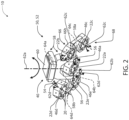
- each of the articulating head assemblies 50 or articulating assemblies 50 may comprise a lighting module array 52 of the lighting modules 46.
- Each of the articulating head assembly 50 may serve as an exemplary embodiment of the one or more positioning assemblies 40 in accordance with the disclosure.
- the articulating head assembly 50 comprises five of the lighting modules 46.
- the lighting modules 46 may be suspended from a central control arm 54 comprising a plurality of support arms 56. Extending from each of the support arms 56, a lateral support beam 58 or wing may extend laterally outward from each of the arms 56 in opposing directions. In this configuration, the lighting modules 46 are supported by the central control arm 54 in a distributed arrangement.
- the central control arm 54 may be suspended from a support housing 60 along a first axis 62a (e.g., Y-axis).
- the support housing 60 may comprise the controller 12 and a first actuator 64a configured to rotate the central control arm 54 about the first axis.
- a first lighting module 46a may be suspended along a second axis 62b (e.g., X-axis) extending between the support arms 56.
- a second actuator 64b may be in connection with the support arms 56 and the first lighting module 46a.
- the second actuator 64b may be configured to rotate the first lighting module 46a about the second axis 62b.
- the controller 12 may control the emission direction of the first lighting module 46a to rotate approximately 360 degrees about the first axis 62a and the second axis 62b.
- Each of the lateral support beams 58 may support a pair of the lighting modules 46. That is, a first support beam 58a may support a second lighting module 46b on a first side 66 and a third lighting module 46c on a second side 68. The first side 66 and the second side 68 of the first support beam 58a may extend in opposing directions from the first support beam 58a along a third axis 62c. A second support beam 58b may support a fourth lighting module 46d on the first side 66 and a fifth lighting module 46e on the second side 68. The first side 66 and the second side 68 of the second support beam 58b may extend in opposing directions from the first support beam 58a along a fourth axis 62d. The third axis 62c and the fourth axis 62d may extend perpendicular to the second axis 62b.
- Each of the first support beam 58a and the second support beam 58b may connect to each of the support arms 56 and rotate about the second axis 62b with the first lighting module 46a.
- each of the lateral support beams may comprise at least one actuator configured to rotate the lighting modules 46b, 46c, 46d, and 46e about the third axis 62c and the fourth axis 62d.
- the first support beam 58a may comprise a third actuator 64c in connection with the second lighting module 46b and the third lighting module 46c along the third axis 62c.
- the second support beam 58b may comprise a fourth actuator 64d in connection with the fourth lighting module 46d and the fifth lighting module 46e along the fourth axis 62d.
- the controller 12 may control the second actuator 64b to rotate each of the lighting modules 46b, 46c, 46d, and 46e about the second axis 62b. Additionally, the controller 12 may control the third actuator 64c to rotate the second and third lighting modules 46b and 46c about the third axis 62c. Finally, the controller 12 may control the fourth actuator 64d to rotate the fourth and fifth lighting modules 46d and 46e about the fourth axis 62d.
- each of the light modules 46 may comprise an imager 22.
- the articulating head assembly 50 may comprise a single imager 22 or an imager array.
- the imager array may be formed as follows: the first lighting module 46a may comprise a first imager 22a, the second lighting module 46b may comprise a second imager 22b, the third lighting module 46c may comprise a third imager 22c, the fourth lighting module 46d may comprise a fourth imager 22d, and/or the fifth lighting module 46e may comprise a fifth imager 22e.
- Each of the imagers 22 may be configured to capture the image data in corresponding fields of view 24a, 24b, 24c, 24d, and 24e (not shown for clarity).
- the controller 12 may process the image data from each of the imagers 22 to identify a region of interest. Accordingly, the controller 12 may scan the image data from each of the imagers 22 and adjust the orientation of each of the lighting modules 46 to dynamically control the light in the surgical suite 14.
- the system 10 may be configured to capture image data from any location in the surgical suite 14.
- a plurality of the articulating head assemblies 50 may be controlled by a central controller in communication with each of the controllers 12.
- the central controller may be configured to process the image data from the one or more imagers 22 and communicate control signals for each of the plurality of lighting modules 46 and the actuators 64 of the articulating head assemblies 50.
- the system 10 may be implemented in a variety of beneficial embodiments without departing from the spirit of the disclosure.
- FIG. 3 is a schematic view of the illumination system 10 comprising a head assembly array 70 formed of the articulating head assemblies 50.
- Each of the articulating head assemblies 50 may comprise the lighting module array 52.
- the head assembly array 70 comprises a first head assembly 50a, a second head assembly 50b, a third assembly 50c, and a fourth head assembly 50d.
- Each of the head assemblies 50 comprises a corresponding lighting module array 52.
- the first head assembly 50a comprises the first lighting module array 52a
- the second head assembly 50b comprises the second lighting module array 52b
- the third head assembly 50c comprises the third lighting module array 52c
- the fourth head assembly 50d comprises the fourth lighting module array 52d.
- Each of the head assemblies 50 of the head assembly array 70 may comprise a controller 12 (e.g., a first controller 12a, a second controller 12b, a third controller 12c, and a fourth controller 12d).
- the controllers 12 may be configured to independently control each of the actuators 64 as discussed in reference to FIG. 5 . Additionally, the controllers 12 may be in communication via a central control system or a distributed control system incorporated in each of the controllers 12. In this configuration, each of the controllers 12 may be configured to identify an orientation of the actuators 64 and the corresponding positions of the lighting modules 46. Based on this information, the system 10 may be configured to map a combined illumination pattern or illumination coverage of each of the emissions that may be emitted from the light sources 20 of the lighting modules 46.
- the map of the combined illumination or emission coverage of the combined lighting modules 46 may be programmed into the controllers 12 of the system 10 by one or more calibration methods. In this way, the system 10 may control each lighting module 46 of the head assemblies 50 in concert to provide a scalable, dynamic-lighting system operable to emit the various emissions of light as discussed herein.
- the system 10 may comprise one or more imagers 22.
- the controllers 12a, 12b, 12c, and 12d are in communication with a central controller 74.
- the central controller 74 may comprise or be in communication with one or more of the imagers 22.
- the imager 22 of the central controller 74 may be configured to identify one or more obstructions in a region of interest 72.
- the region of interest 72 may be identified by a location of the marker 26, gesture, input via a user interface, identified by a radio frequency identification tracking device, or programmed into the central controller 74 in relation to a specific procedure.
- each of the controllers 12 of the head assemblies 50 may alternatively have a single imager or multiple imagers.
- the controllers 12 of each of the head assemblies 50 may be configured to detect the obstructions and communicate among one another to identify the best response to adjust the lighting modules 46 to illuminate the region of interest 72.
- the identification of one or more obstructions 76 may be based on a detection of an object in the image data.
- the obstructions 76 may be identified in response to detecting one or more pulsed infrared emissions emitted from the lighting modules 46.
- the central controller 74 may be calibrated such that the location of each of a plurality of the detection emitters 20a is indicated in programming. Accordingly, by cycling through the detection emitters 20a of each of the lighting modules (46a, 46b, 46c... 46m), the controller may identify a location of the obstructions 76 based on a timed detection of each of the infrared emissions 77.
- the central controller 74 may detect a location of the obstructions 76 in relation to a projection trajectory of each of the detection emitters 20a to identify a clear or unobstructed trajectory 78. Once the unobstructed trajectory 78 is identified, the central controller 74 may control one or more of the light sources to illuminate the region of interest 72.
- the controllers 12 may communicate within the system 10 to identify the region of interest 72 between two or more of the imagers 22, which may be incorporated in two or more or the lighting modules 46. That is, the two or more of the lighting modules 46 from which the image data is processed to identify the region of interest 72 may be incorporated in a single head assembly 50 or captured by imagers 22 in two or more of the head assemblies 50 (e.g., 50a and 50b). In this way, the system 10 may operate as a distributed scanning and illumination system formed by the head assemblies 50 and controlled to operate as a unified system via communication among the controllers 12 and/or a central controller.
- the central controller 74 or the controllers 12 may be configured to identify one or more light sources 20 of the lighting modules 46 with a line of sight or projection trajectory 78 aligned with the region of interest 72 without interference by one or more obstructions 76. Upon identifying at least one lighting module 46 in one or more of the head assemblies 50 with the clear projection trajectory 78, the central controller 74 may respond by controlling one or more of the controllers 12 to position the at least one lighting module 46 to direct an emission to the region of interest 72. In this configuration, the head assembly array 70 may provide for effective lighting even when tasked with illuminating obstructed regions that change over time.
- the system 10 may initially illuminate the table 28 via a lighting module of the second head assembly 50b by emitting a second emission 80 of visible light.
- the imager 22 may detect the obstruction 76 in the field of view 24, which may result in one or more shadows 81 in the region of interest 72.
- the central controller 74 may control controllers 12a and 12b activating a lighting module of the first head assembly 50a that may have the clear projection trajectory 78 via activating a first emission 82 of visible light.
- the system 10 may continue to monitor the image data to verify that the first emission 82 remains unobstructed.
- the head assembly array 70 may be configured to illuminate the region of interest 72 by controlling a plurality of the head assemblies 50 in combination.
- the system 10 may utilize one or more algorithms configured to identify and project light to the region of interest 72 via a predictive or experimental algorithm. Such algorithms may apply various inference as well as trial and error to gradually move one or more of the head assemblies 50 and gradually activating the light sources 20 to illuminate the region of interest 72. In these methods as well as others discussed herein, the system may consistently monitor the region or regions of interest 72 for changes or improvements in lighting. In this way, the system 10 may be configured to continue positioning operations that improve the projected trajectory of the light as indicated by the image data from the imagers 22. Such a routine may be applied alone or in combination with the location detection based control discussed herein.
- the method 90 may begin by initializing a control routine of the illumination system 10 (92). Once initiated, the controller 12 may activate the emitter 20a to illuminate the operating region 16 in the detection emission 38 (94). In this way, the operating region 16 may be illuminated by the detection emission 38 illuminating various objects that enter the field of view 24 of the imager 22. The controller 12 may then control the imager 22 to capture image data in the field of view 24 (96). Once the image data is captured, the controller 12 may process or scan the image data for various objects including the marker 26 (98).
- step 100 the controller 12 may determine if the position of the marker 26 is identified in the image data. If the position of the marker is not identified, the method 90 may return to steps 96 and 98 to capture and scan the image data in the field of view 24. If the position of the marker 26 is identified in step 100, the controller 12 may control one or more of the positioning or head assemblies 50 to activate the lighting emission(s) 44 directed at the marker 26 (102). Once the position of the marker 26 is identified and illuminated by the lighting emission(s) 44, the controller 12 may continue to track the location of the marker 26 and reposition the head assemblies 50 to maintain a consistent illumination of the marker 26 and the corresponding location (104).
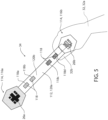
- the control instrument 34 is shown demonstrating a plurality of the markers 26.
- the control instrument 34 comprises a first marker 26a and a second marker 26b.
- the markers 26a, 26b may be disposed at opposing ends of a connecting member 112, which may correspond to a narrow, elongated bar interconnecting a plurality to end portions 114.
- the controller 12 may be configured to identify and distinguish between the first marker 26a and the second marker 26b.
- the system 10 may control one or more of the positioning assemblies 40, head assemblies 50 and corresponding lighting modules 46 to illuminate the operating region 16 in different ways.
- the control instrument 34 may be configured such that the end portions 114 correspond to a first grip 116a and a second grip 116b.
- the first grip 116a may comprise the first marker 26a
- the second grip 116b may comprise the second marker 26b.
- the control instrument 34 may be configured such that the user 32 may hold the second grip 116b to display the first marker 26a or hold the first grip 116a to display the second marker 26b.
- the second marker 26b may be substantially or completely covered/masked by the hand of the user 32.
- the instrument 34 may be configured to allow the user 32 to intuitively and selectively reveal the first marker 26a or the second marker 26b in the field of view 24 to control the system 10.
- the first marker 26a and the second marker 26b may be disposed on opposite sides (e.g. a top surface and bottom surface) of the instrument 34 such that the body of the instrument 34 conceals one of the markers 26a, 26b from the field of view.
- the operation of the illumination system may vary based on the detection of the first marker 26a or the second marker 26b.
- the system 10 in response to identifying the first marker 26a, the system 10 may be configured to load a first control configuration, which may comprise a variety of pre-configured or user-defined operation settings.
- the system 10 in response to identifying the second marker 26b, the system 10 may be configured to load a second control configuration that may comprise pre-configured or user-defined settings that differ from the first control configuration.
- Each of the control configurations may differ in a variety of ways, which may include, control sensitivity, control methods, control offsets, light intensity, light coverage or focus, light color, and a variety of configurable settings for the lighting system 10.
- the instrument 34 may comprise a plurality of inputs 118, which may correspond to virtual inputs or symbols disposed on one or more of the surfaces of the instrument 34.
- the plurality of inputs 118 may be implemented as a plurality of symbols or details formed or printed on the instrument 34.
- the inputs may comprise a first symbol 118a and a second symbol 118b positioned on a first surface 120a (e.g. top surface).
- the instrument 34 may comprise a third symbol 118c and a fourth symbol 118d, which may be disposed on a second surface 120b (e.g. a bottom surface), opposite the first surface 120a.
- the controller 12 of the system 10 may be configured to detect each of the markers 26 and the symbols to control various operations, presets, and/or configurations of the system 10.
- the user 32 may selectively conceal one or more of the symbols 118a, 118b, 118c, 118d with a hand 32a, digit 32b (finger, thumb), etc.
- the controller may be configured to change one or more settings or adjust various configurations of the system 10 as discussed here.
- the controller may adjust a variety of settings of the system 10.
- the controller 12 may be configured to adjust a variety of settings or activate various preconfigured settings of the system 10.
- settings may include but are not limited to: a control sensitivity, light intensity, light coverage or focus, light color, lighting priority, tracking function, and a variety of configurable settings for the lighting system 10.
- control instrument 34 may comprise a handheld device that may be robust and configured to be sanitized with various surgical instruments via conventional sterilization processes (e.g. autoclave sterilization).
- sterilization processes e.g. autoclave sterilization
- the exemplary instrument 34 demonstrated in FIG. 5 may be configured to communicate a variety of visual cues to the system 10 to control various settings and operations. In this way, the instrument 34 may be free of complex mechanical and/or electrical parts that may be damaged due to sterilization techniques that may be necessary to ensure sanitation for use in the surgical suite 14.
- the system 10 may be configured to control the location of the target positions 30 in the field of view 24 via an offset control method.
- the user 32 may desire to change the location of the target position 30 without reaching into a region 130 where the target position 30 is located. Avoiding reaching into such the region 130 may prevent the user 32 from interfering with a working area or blocking one or more of the visible light emissions 80 and/or 82, which may be directed at the region 130.
- the user 32 may activate the offset control method such that the location the target position 30 may be adjusted relative the location of the marker 26 in the field of view 24 over a configurable offset 132. In this way, the user may adjust the location of the target position without interfering with the region 130.
- the controller 12 may be configured to activate the offset control method in response to the user 32 revealing the first marker 26a, the second marker 26b, and/or one or more of the symbols 118a, 118b, 118c, 118d to the imager 22 in the field of view 24.
- the configurable offset 132 may comprise an X-axis offset 132a, a Y-axis offset 132b such that the relative location of the marker 26 is defined relative to the target position 30.
- the offset 132 may be set or selected by hiding and revealing the marker 26 in the field of view 24. Once revealed, the controller 12 may set the configurable offset 132 and adjust the location of the target position 30 relative to a movement of the marker 26. In this way, the system 10 may be configured to adjust the location of the target position 30 without interfering with the region 130.
- the controller 12 may be configured to detect one or more, motions, gestures, and/or visual cues identified in the image data captured in the field of view 24 to control the system.
- exemplary gestures 140 that may be identified by the controller 12 may include a rotation 140a, a lateral motion 140b, and/or an outline or character gesture 140c.
- the controller 12 may selectively control one or more settings of the illumination system 10.
- the detection of the gestures 140 may be in connection with a movement of the instrument 34, which may be detected by the controller 12 based on a position, orientation, and/or appearance or presence of the markers 26 or symbols 118a-118d identified in the image data.
- Such settings may include, but are not limited to, a control sensitivity, light intensity, light coverage or focus, light color, a lighting priority, tracking function, panning and/or control of positioning assemblies 40, and a variety of configurable settings for the lighting system 10.
- the system 10 may be configured to control a focus or intensity of one or more of the lighting emissions 80, 82 in response to a rotation gesture.
- the controller 12 may be configured to detect a rotation of the instrument in connection with the hand 32a of the user 32. In response to a detection of a clockwise rotation or counterclockwise rotation, the controller 12 may increase or decrease an intensity of one or more of the lighting emissions 80, 82.
- the controller 12 may be configured to increase a proportion or size of an illumination range or region, adjust a color or color temperature, and/or control various operational characteristics of the illumination system 10 in response to detecting each of the gestures 140.
- the controller 12 may also be configured to identify the lateral motion 140b of the marker 26 and/or the instrument 34 in connection with the hand 32a. In response to the detection, the controller 12 may be configured to control various characteristics (e.g. intensity, focus, hue, etc.). Similarly, the controller 12 may be configured to identify rapid lateral movements, which may exceed a predetermined rate of movement. For example, the controller 12 may be configured to identify a swiping gesture, and, in response, the controller 12 may selectively control various operations and/or characteristics of the system 10. In some embodiments, the controller 12 may even be configured to identify characters in the form or sign language and/or traced characters that may be demonstrated by the hand 32a in the field of view 24.
- various characteristics e.g. intensity, focus, hue, etc.
- the controller 12 may be configured to identify rapid lateral movements, which may exceed a predetermined rate of movement.
- the controller 12 may be configured to identify a swiping gesture, and, in response, the controller 12 may selectively control various operations and/or
- the controller 12 may further be configured to identify one or more gestures completed by the user 32 with a first hand 32a and a second hand. For example, the user 32 may merge a plurality of illumination regions corresponding to the first lighting emission 80 and the second lighting emission 82 in response to detecting the user 32 moving the first hand and the second hand from a separated configuration to a close proximity. Accordingly, the controller 12 may selectively control the illumination system 10 in response to a variety of gestures 140 and or movements identified in the image data in the field of view 24.
- the controller 12 may be configured to set a primary lighting region 142a and a second region 142b illuminated by the light sources 20 of the positioning assemblies 40. For example, in response to detecting one of the gestures 140 and/or one or more of the inputs 118, within a first portion 144a of the field of view 24, the controller 12 may designate the first portion 144a to be the primary lighting region 142a. Similarly, in response to detecting one of the gestures 140 and/or one or more of the inputs 118, within a second portion 144b of the field of view 24, the controller 12 may designate the second portion 144b to be the secondary lighting region 142b.
- the controller 12 may be configured to identify and/or determine that the first portion 144a and the second portion 144b are to be illuminated by the light sources 20. Additionally, the controller 12 may prioritize the lighting of each of the first portion 144a and the second portion 144b based on the indication of the primary light region 142a and the secondary lighting region 142b.
- the controller 12 may control the positioning assemblies 40 to direct the light sources 20 to prioritize the illumination of the first portion 144a in response to the designation of the primary lighting region 142a.
- the controller 12 may assign each the light sources 20 of the positioning assemblies 40 to mitigate shadowing, as previously discussed herein, in the first portion 144a.
- the controller 12 may additionally assign a greater number of the lighting modules 46 to illuminate the first portion 144a relative to the second portion 144b in response to the designation as the primary lighting region 142a.
- the primary lighting region 142a and the secondary lighting region 142b are discussed herein, the number and/or scale of the lighting regions may vary depending on the application and desired operation of the system 10. Accordingly, the disclosure may provide for a flexible solution that may provide for illumination in a variety of applications.
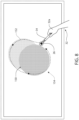
- the system 10 may be configured to identify a path 152 of at least one of the hand 32a of the user 32 and/or the instrument 34 in the field of view 24.
- the path 152 may be tracked by the controller 12 of the system to define an outline 154 of the lighting region 150 in the operating region 16.
- the controller 12 may be configured to detect the movement of the instrument 34, which may be detected by the controller 12 based on a position, orientation, and/or appearance or presence of the markers 26 or symbols 118a-118d identified in the image data.
- the controller 12 may similarly be configured to detect the path 152 in response to the lateral motion 140b of the marker 26 and/or the instrument 34 in connection with the hand 32a forming a closed path. In this way, the system 10 may identify the lighting region 150 based on the path 152.
- the controller 12 may be configured to control the positioning assemblies 40 to direct one or more of the light sources 20 to illuminate the illumination region 150.
- the illumination region may be illuminated by a plurality of the light sources 20 as represented by the plurality of illuminated regions 156 shown in FIG. 8 .
- the controller 12 may be configured to control a light intensity, light coverage or focus, emission direction, lighting priority, panning of one or more of the positioning assemblies 40, etc.
- the system 10 may be configured to selectively illuminate the illumination region 150 based on the outline 154 drawn or gestured by the user 32 within the field of view 24.
- the illumination system 10 may include one or more imagers 22 configured to capture image data from the medical suite 14 and/or from the operating region 16.
- the imagers 22 may be configured to relay visual information to the controller 12 of the illumination system 10.
- the controller 12 may include a memory 160 and a processor 162.
- the memory 160 may store computer executable commands (e.g., routines) which are controlled by the processor 162.
- the memory 160 may include a light control routine and/or an image analyzing routine.
- the memory 160 may include the lighting control method 90.
- the controller 12 may communicate one or more control instructions to a motor or actuator controller 164.
- the motor controller 164 may control the actuators 42, 64 or the positioning assemblies 40 to move, steer, or otherwise adjust an orientation of the light assemblies 18.
- the controller 12 may direct the lighting assemblies 18 to emit the lighting emission 44 and/or direct the field of view 24 to a desired location, which may correspond to the location of the marker 26.
- the system 10 may additionally comprise one or more power supplies 166.
- the power supplies 166 may provide for one or more power supplies or ballasts for various components of the lighting assembly 18 as well as the actuators 42, 64 or positioning assemblies 40.
- the system 10 may further comprise one or more communication circuits 168, which may be in communication with the processor 162.
- the communication circuit 168 may be configured to communicate data and control information to a display or user interface 170 for operating the system 10.
- the interface 170 may comprise one or more input or operational elements configured to control the system 10 and communicate data.
- the communication circuit 168 may further be in communication with additional lighting assemblies 18, which may operate in combination as an array of lighting assemblies.
- the communication circuit 168 may be configured to communicate via various communication protocols.
- communication protocols may correspond to process automation protocols, industrial system protocols, vehicle protocol buses, consumer communication protocols, etc. Additional protocols may include, MODBUS, PROFIBUS, CAN bus, DATA HIGHWAY, DeviceNet, Digital multiplexing (DMX512), or various forms of communication standards.
- circular polarization of light is a polarization state in which, at each point, the electric field of the light wave has a constant magnitude, but its direction rotates with time at a steady rate in a plane perpendicular to the direction of the wave.
- the term "coupled” in all of its forms: couple, coupling, coupled, etc. generally means the joining of two components (electrical or mechanical) directly or indirectly to one another. Such joining may be stationary in nature or movable in nature. Such joining may be achieved with the two components (electrical or mechanical) and any additional intermediate members being integrally formed as a single unitary body with one another or with the two components. Such joining may be permanent in nature or may be removable or releasable in nature unless otherwise stated.
- the term “about” means that amounts, sizes, formulations, parameters, and other quantities and characteristics are not and need not be exact, but may be approximate and/or larger or smaller, as desired, reflecting tolerances, conversion factors, rounding off, measurement error and the like, and other factors known to those of skill in the art.
- the term “about” is used in describing a value or an end-point of a range, the disclosure should be understood to include the specific value or end-point referred to.
- substantially is intended to note that a described feature is equal or approximately equal to a value or description.
- a “substantially planar” surface is intended to denote a surface that is planar or approximately planar.
- substantially is intended to denote that two values are equal or approximately equal.
- substantially may denote values within about 10% of each other, such as within about 5% of each other, or within about 2% of each other.
Landscapes
- Health & Medical Sciences (AREA)
- Engineering & Computer Science (AREA)
- Life Sciences & Earth Sciences (AREA)
- Surgery (AREA)
- General Health & Medical Sciences (AREA)
- Biomedical Technology (AREA)
- Veterinary Medicine (AREA)
- Public Health (AREA)
- Animal Behavior & Ethology (AREA)
- Nuclear Medicine, Radiotherapy & Molecular Imaging (AREA)
- Molecular Biology (AREA)
- Medical Informatics (AREA)
- Heart & Thoracic Surgery (AREA)
- Oral & Maxillofacial Surgery (AREA)
- Pathology (AREA)
- General Engineering & Computer Science (AREA)
- Theoretical Computer Science (AREA)
- Signal Processing (AREA)
- Multimedia (AREA)
- Physics & Mathematics (AREA)
- Robotics (AREA)
- Human Computer Interaction (AREA)
- General Physics & Mathematics (AREA)
- Circuit Arrangement For Electric Light Sources In General (AREA)
Claims (7)
- Ein Steuerungsinstrument (34) für ein Beleuchtungssystem (10), wobei das Beleuchtungssystem (10) konfiguriert ist, um einen Ort in einem Operationsbereich (16) selektiv zu beleuchten, wobei das Steuerungsinstrument (34) Folgendes umfasst:einen ersten Endabschnitt (114, 116a) und einen zweiten Endabschnitt (114, 116b);einen länglichen Griff (112), der den ersten Endabschnitt (114, 116a) und den zweiten Endabschnitt (114, 116b) miteinander verbindet;mindestens eine Markierung (26), die in der Nähe des ersten Endabschnitts (114, 116a) angeordnet ist, wobei die mindestens eine Markierung (26) ein erstes Symbol (118a) umfasst; unddadurch gekennzeichnet, dass es ferner Folgendes umfasst:
mindestens eine Benutzereingabe (user input), die auf dem länglichen Griff (112) zwischen dem ersten Endabschnitt (114, 116a) und dem zweiten Endabschnitt (114, 116b) angeordnet ist, wobei die mindestens eine Benutzereingabe mindestens ein Symbol (118) umfasst, das konfiguriert ist, um eine Benutzerfunktion zu definieren, die durch das Beleuchtungssystem (10) identifizierbar ist. - Das Steuerungsinstrument (34) nach Anspruch 1, wobei die mindestens eine Markierung (26) eine erste Markierung (26a) und eine zweite Markierung (26b) umfasst, wobei die erste Markierung (26a) auf dem ersten Endabschnitt (114, 116a) angeordnet ist und die zweite Markierung (26b) auf dem zweiten Endabschnitt (114, 116b) angeordnet ist.
- Das Steuerungsinstrument (34) nach irgendeinem der Ansprüche von 1 bis 2, wobei die mindestens eine Markierung (26) eine erste Markierung (26a) und eine zweite Markierung (26b) umfasst, wobei die erste Markierung (26a) auf einer ersten Seite des Steuerungsinstruments (34) angeordnet ist und die zweite Markierung (26b) auf einer zweiten Seite des Steuerungsinstruments (34) angeordnet ist.
- Das Steuerungsinstrument (34) nach Anspruch 3, wobei die zweite Seite der ersten Seite im Wesentlichen gegenüberliegt, sodass eine von der ersten Markierung (26a) und der zweiten Markierung (26b) durch einen Körper des Steuerungsinstruments (34) aus dem Sichtfeld (24) des Bildgebers (22) verborgen ist.
- Das Steuerungsinstrument (34) nach irgendeinem der Ansprüche von 1 bis 4, wobei das Beleuchtungssystem (10) mindestens einen Bildsensor umfasst, der konfiguriert ist, um eine Position der mindestens einen Markierung (26) in einem Sichtfeld (24) zu identifizieren.
- Das Steuerungsinstrument (34) nach Anspruch 5, wobei das Steuerungsinstrument (34) konfiguriert ist, um das Beleuchtungssystem (10) zu steuern durch selektives Anzeigen im Sichtfeld (24) von mindestens einem von der Markierung (26) und von dem Symbol (118).
- Das Steuerungsinstrument (34) nach irgendeinem der vorstehenden Ansprüche, wobei das Steuerungsinstrument (34) konfiguriert ist, um das Beleuchtungssystem (10) über visuelle Hinweise zu steuern.
Applications Claiming Priority (2)
| Application Number | Priority Date | Filing Date | Title |
|---|---|---|---|
| US201962788404P | 2019-01-04 | 2019-01-04 | |
| PCT/IB2020/050018 WO2020141476A1 (en) | 2019-01-04 | 2020-01-02 | Control apparatus and methods for adaptive lighting array |
Publications (3)
| Publication Number | Publication Date |
|---|---|
| EP3906754A1 EP3906754A1 (de) | 2021-11-10 |
| EP3906754A4 EP3906754A4 (de) | 2022-03-09 |
| EP3906754B1 true EP3906754B1 (de) | 2024-11-27 |
Family
ID=71404922
Family Applications (1)
| Application Number | Title | Priority Date | Filing Date |
|---|---|---|---|
| EP20736207.0A Active EP3906754B1 (de) | 2019-01-04 | 2020-01-02 | Steuerungsvorrichtung und verfahren für adaptive beleuchtungsanordnung |
Country Status (3)
| Country | Link |
|---|---|
| US (1) | US20200214788A1 (de) |
| EP (1) | EP3906754B1 (de) |
| WO (1) | WO2020141476A1 (de) |
Families Citing this family (2)
| Publication number | Priority date | Publication date | Assignee | Title |
|---|---|---|---|---|
| USD925801S1 (en) * | 2018-04-13 | 2021-07-20 | Gentex Corporation | Medical light |
| US11659642B1 (en) | 2021-12-06 | 2023-05-23 | American Sterilizer Company | Surgical lighting system co-illumination detection |
Family Cites Families (4)
| Publication number | Priority date | Publication date | Assignee | Title |
|---|---|---|---|---|
| EP0814344A3 (de) * | 1996-06-19 | 1998-12-30 | Matsushita Electric Works, Ltd. | Beleuchtungssystem mit automatischer Nachführung |
| US20020036617A1 (en) * | 1998-08-21 | 2002-03-28 | Timothy R. Pryor | Novel man machine interfaces and applications |
| DE102009037316A1 (de) * | 2009-08-14 | 2011-02-17 | Karl Storz Gmbh & Co. Kg | Steuerung und Verfahren zum Betreiben einer Operationsleuchte |
| US10099368B2 (en) * | 2016-10-25 | 2018-10-16 | Brandon DelSpina | System for controlling light and for tracking tools in a three-dimensional space |
-
2020
- 2020-01-02 EP EP20736207.0A patent/EP3906754B1/de active Active
- 2020-01-02 US US16/732,591 patent/US20200214788A1/en not_active Abandoned
- 2020-01-02 WO PCT/IB2020/050018 patent/WO2020141476A1/en not_active Ceased
Also Published As
| Publication number | Publication date |
|---|---|
| EP3906754A1 (de) | 2021-11-10 |
| EP3906754A4 (de) | 2022-03-09 |
| US20200214788A1 (en) | 2020-07-09 |
| WO2020141476A1 (en) | 2020-07-09 |
Similar Documents
| Publication | Publication Date | Title |
|---|---|---|
| EP3676533B1 (de) | Beleuchtungssysteme | |
| US11998399B2 (en) | Systems and methods for detection and illumination of regions of interest | |
| EP3750382B1 (de) | Adaptive beleuchtungsanordnung mit bildbasierter steuerung | |
| US12156312B2 (en) | Control for adaptive lighting array | |
| US11538570B2 (en) | Authentication and informational displays with adaptive lighting array | |
| EP3968888B1 (de) | Beleuchtungssysteme zur objektverfolgung | |
| EP3906754B1 (de) | Steuerungsvorrichtung und verfahren für adaptive beleuchtungsanordnung |
Legal Events
| Date | Code | Title | Description |
|---|---|---|---|
| STAA | Information on the status of an ep patent application or granted ep patent |
Free format text: STATUS: THE INTERNATIONAL PUBLICATION HAS BEEN MADE |
|
| PUAI | Public reference made under article 153(3) epc to a published international application that has entered the european phase |
Free format text: ORIGINAL CODE: 0009012 |
|
| STAA | Information on the status of an ep patent application or granted ep patent |
Free format text: STATUS: REQUEST FOR EXAMINATION WAS MADE |
|
| 17P | Request for examination filed |
Effective date: 20210804 |
|
| AK | Designated contracting states |
Kind code of ref document: A1 Designated state(s): AL AT BE BG CH CY CZ DE DK EE ES FI FR GB GR HR HU IE IS IT LI LT LU LV MC MK MT NL NO PL PT RO RS SE SI SK SM TR |
|
| REG | Reference to a national code |
Ref country code: DE Ref legal event code: R079 Free format text: PREVIOUS MAIN CLASS: H05B0047100000 Ipc: H05B0047125000 Ref country code: DE Ref legal event code: R079 Ref document number: 602020042044 Country of ref document: DE Free format text: PREVIOUS MAIN CLASS: H05B0047100000 Ipc: H05B0047125000 |
|
| A4 | Supplementary search report drawn up and despatched |
Effective date: 20220204 |
|
| RIC1 | Information provided on ipc code assigned before grant |
Ipc: H04N 5/232 20060101ALI20220131BHEP Ipc: A61B 90/35 20160101ALI20220131BHEP Ipc: A61B 90/30 20160101ALI20220131BHEP Ipc: H05B 47/125 20200101AFI20220131BHEP |
|
| DAV | Request for validation of the european patent (deleted) | ||
| DAX | Request for extension of the european patent (deleted) | ||
| P01 | Opt-out of the competence of the unified patent court (upc) registered |
Effective date: 20230503 |
|
| STAA | Information on the status of an ep patent application or granted ep patent |
Free format text: STATUS: EXAMINATION IS IN PROGRESS |
|
| 17Q | First examination report despatched |
Effective date: 20231116 |
|
| GRAP | Despatch of communication of intention to grant a patent |
Free format text: ORIGINAL CODE: EPIDOSNIGR1 |
|
| STAA | Information on the status of an ep patent application or granted ep patent |
Free format text: STATUS: GRANT OF PATENT IS INTENDED |
|
| RIC1 | Information provided on ipc code assigned before grant |
Ipc: A61B 90/35 20160101ALI20240612BHEP Ipc: A61B 90/30 20160101ALI20240612BHEP Ipc: H05B 47/125 20200101AFI20240612BHEP |
|
| INTG | Intention to grant announced |
Effective date: 20240704 |
|
| GRAS | Grant fee paid |
Free format text: ORIGINAL CODE: EPIDOSNIGR3 |
|
| GRAA | (expected) grant |
Free format text: ORIGINAL CODE: 0009210 |
|
| STAA | Information on the status of an ep patent application or granted ep patent |
Free format text: STATUS: THE PATENT HAS BEEN GRANTED |
|
| AK | Designated contracting states |
Kind code of ref document: B1 Designated state(s): AL AT BE BG CH CY CZ DE DK EE ES FI FR GB GR HR HU IE IS IT LI LT LU LV MC MK MT NL NO PL PT RO RS SE SI SK SM TR |
|
| REG | Reference to a national code |
Ref country code: GB Ref legal event code: FG4D |
|
| REG | Reference to a national code |
Ref country code: CH Ref legal event code: EP |
|
| REG | Reference to a national code |
Ref country code: DE Ref legal event code: R096 Ref document number: 602020042044 Country of ref document: DE |
|
| REG | Reference to a national code |
Ref country code: IE Ref legal event code: FG4D |
|
| REG | Reference to a national code |
Ref country code: LT Ref legal event code: MG9D |
|
| REG | Reference to a national code |
Ref country code: NL Ref legal event code: MP Effective date: 20241127 |
|
| PG25 | Lapsed in a contracting state [announced via postgrant information from national office to epo] |
Ref country code: PT Free format text: LAPSE BECAUSE OF FAILURE TO SUBMIT A TRANSLATION OF THE DESCRIPTION OR TO PAY THE FEE WITHIN THE PRESCRIBED TIME-LIMIT Effective date: 20250327 Ref country code: IS Free format text: LAPSE BECAUSE OF FAILURE TO SUBMIT A TRANSLATION OF THE DESCRIPTION OR TO PAY THE FEE WITHIN THE PRESCRIBED TIME-LIMIT Effective date: 20250327 Ref country code: HR Free format text: LAPSE BECAUSE OF FAILURE TO SUBMIT A TRANSLATION OF THE DESCRIPTION OR TO PAY THE FEE WITHIN THE PRESCRIBED TIME-LIMIT Effective date: 20241127 |
|
| PGFP | Annual fee paid to national office [announced via postgrant information from national office to epo] |
Ref country code: DE Payment date: 20241218 Year of fee payment: 6 |
|
| PG25 | Lapsed in a contracting state [announced via postgrant information from national office to epo] |
Ref country code: NL Free format text: LAPSE BECAUSE OF FAILURE TO SUBMIT A TRANSLATION OF THE DESCRIPTION OR TO PAY THE FEE WITHIN THE PRESCRIBED TIME-LIMIT Effective date: 20241127 Ref country code: FI Free format text: LAPSE BECAUSE OF FAILURE TO SUBMIT A TRANSLATION OF THE DESCRIPTION OR TO PAY THE FEE WITHIN THE PRESCRIBED TIME-LIMIT Effective date: 20241127 |
|
| REG | Reference to a national code |
Ref country code: AT Ref legal event code: MK05 Ref document number: 1747026 Country of ref document: AT Kind code of ref document: T Effective date: 20241127 |
|
| PG25 | Lapsed in a contracting state [announced via postgrant information from national office to epo] |
Ref country code: BG Free format text: LAPSE BECAUSE OF FAILURE TO SUBMIT A TRANSLATION OF THE DESCRIPTION OR TO PAY THE FEE WITHIN THE PRESCRIBED TIME-LIMIT Effective date: 20241127 |
|
| PG25 | Lapsed in a contracting state [announced via postgrant information from national office to epo] |
Ref country code: ES Free format text: LAPSE BECAUSE OF FAILURE TO SUBMIT A TRANSLATION OF THE DESCRIPTION OR TO PAY THE FEE WITHIN THE PRESCRIBED TIME-LIMIT Effective date: 20241127 |
|
| PG25 | Lapsed in a contracting state [announced via postgrant information from national office to epo] |
Ref country code: NO Free format text: LAPSE BECAUSE OF FAILURE TO SUBMIT A TRANSLATION OF THE DESCRIPTION OR TO PAY THE FEE WITHIN THE PRESCRIBED TIME-LIMIT Effective date: 20250227 |
|
| PG25 | Lapsed in a contracting state [announced via postgrant information from national office to epo] |
Ref country code: LV Free format text: LAPSE BECAUSE OF FAILURE TO SUBMIT A TRANSLATION OF THE DESCRIPTION OR TO PAY THE FEE WITHIN THE PRESCRIBED TIME-LIMIT Effective date: 20241127 Ref country code: AT Free format text: LAPSE BECAUSE OF FAILURE TO SUBMIT A TRANSLATION OF THE DESCRIPTION OR TO PAY THE FEE WITHIN THE PRESCRIBED TIME-LIMIT Effective date: 20241127 Ref country code: GR Free format text: LAPSE BECAUSE OF FAILURE TO SUBMIT A TRANSLATION OF THE DESCRIPTION OR TO PAY THE FEE WITHIN THE PRESCRIBED TIME-LIMIT Effective date: 20250228 |
|
| PG25 | Lapsed in a contracting state [announced via postgrant information from national office to epo] |
Ref country code: PL Free format text: LAPSE BECAUSE OF FAILURE TO SUBMIT A TRANSLATION OF THE DESCRIPTION OR TO PAY THE FEE WITHIN THE PRESCRIBED TIME-LIMIT Effective date: 20241127 |
|
| PG25 | Lapsed in a contracting state [announced via postgrant information from national office to epo] |
Ref country code: RS Free format text: LAPSE BECAUSE OF FAILURE TO SUBMIT A TRANSLATION OF THE DESCRIPTION OR TO PAY THE FEE WITHIN THE PRESCRIBED TIME-LIMIT Effective date: 20250227 |
|
| PG25 | Lapsed in a contracting state [announced via postgrant information from national office to epo] |
Ref country code: SM Free format text: LAPSE BECAUSE OF FAILURE TO SUBMIT A TRANSLATION OF THE DESCRIPTION OR TO PAY THE FEE WITHIN THE PRESCRIBED TIME-LIMIT Effective date: 20241127 |
|
| PG25 | Lapsed in a contracting state [announced via postgrant information from national office to epo] |
Ref country code: DK Free format text: LAPSE BECAUSE OF FAILURE TO SUBMIT A TRANSLATION OF THE DESCRIPTION OR TO PAY THE FEE WITHIN THE PRESCRIBED TIME-LIMIT Effective date: 20241127 |
|
| PG25 | Lapsed in a contracting state [announced via postgrant information from national office to epo] |
Ref country code: EE Free format text: LAPSE BECAUSE OF FAILURE TO SUBMIT A TRANSLATION OF THE DESCRIPTION OR TO PAY THE FEE WITHIN THE PRESCRIBED TIME-LIMIT Effective date: 20241127 |
|
| PG25 | Lapsed in a contracting state [announced via postgrant information from national office to epo] |
Ref country code: RO Free format text: LAPSE BECAUSE OF FAILURE TO SUBMIT A TRANSLATION OF THE DESCRIPTION OR TO PAY THE FEE WITHIN THE PRESCRIBED TIME-LIMIT Effective date: 20241127 |
|
| PG25 | Lapsed in a contracting state [announced via postgrant information from national office to epo] |
Ref country code: SK Free format text: LAPSE BECAUSE OF FAILURE TO SUBMIT A TRANSLATION OF THE DESCRIPTION OR TO PAY THE FEE WITHIN THE PRESCRIBED TIME-LIMIT Effective date: 20241127 |
|
| PG25 | Lapsed in a contracting state [announced via postgrant information from national office to epo] |
Ref country code: CZ Free format text: LAPSE BECAUSE OF FAILURE TO SUBMIT A TRANSLATION OF THE DESCRIPTION OR TO PAY THE FEE WITHIN THE PRESCRIBED TIME-LIMIT Effective date: 20241127 |
|
| PG25 | Lapsed in a contracting state [announced via postgrant information from national office to epo] |
Ref country code: IT Free format text: LAPSE BECAUSE OF FAILURE TO SUBMIT A TRANSLATION OF THE DESCRIPTION OR TO PAY THE FEE WITHIN THE PRESCRIBED TIME-LIMIT Effective date: 20241127 |
|
| REG | Reference to a national code |
Ref country code: DE Ref legal event code: R097 Ref document number: 602020042044 Country of ref document: DE |
|
| REG | Reference to a national code |
Ref country code: CH Ref legal event code: PL |
|
| PG25 | Lapsed in a contracting state [announced via postgrant information from national office to epo] |
Ref country code: SE Free format text: LAPSE BECAUSE OF FAILURE TO SUBMIT A TRANSLATION OF THE DESCRIPTION OR TO PAY THE FEE WITHIN THE PRESCRIBED TIME-LIMIT Effective date: 20241127 |
|
| PG25 | Lapsed in a contracting state [announced via postgrant information from national office to epo] |
Ref country code: LU Free format text: LAPSE BECAUSE OF NON-PAYMENT OF DUE FEES Effective date: 20250102 Ref country code: MC Free format text: LAPSE BECAUSE OF FAILURE TO SUBMIT A TRANSLATION OF THE DESCRIPTION OR TO PAY THE FEE WITHIN THE PRESCRIBED TIME-LIMIT Effective date: 20241127 |
|
| PLBE | No opposition filed within time limit |
Free format text: ORIGINAL CODE: 0009261 |
|
| STAA | Information on the status of an ep patent application or granted ep patent |
Free format text: STATUS: NO OPPOSITION FILED WITHIN TIME LIMIT |
|
| PG25 | Lapsed in a contracting state [announced via postgrant information from national office to epo] |
Ref country code: BE Free format text: LAPSE BECAUSE OF NON-PAYMENT OF DUE FEES Effective date: 20250131 |
|
| PG25 | Lapsed in a contracting state [announced via postgrant information from national office to epo] |
Ref country code: CH Free format text: LAPSE BECAUSE OF NON-PAYMENT OF DUE FEES Effective date: 20250131 |
|
| REG | Reference to a national code |
Ref country code: BE Ref legal event code: MM Effective date: 20250131 |
|
| 26N | No opposition filed |
Effective date: 20250828 |
|
| PGFP | Annual fee paid to national office [announced via postgrant information from national office to epo] |
Ref country code: GB Payment date: 20251220 Year of fee payment: 7 |
|
| PGFP | Annual fee paid to national office [announced via postgrant information from national office to epo] |
Ref country code: FR Payment date: 20251217 Year of fee payment: 7 |
|
| PG25 | Lapsed in a contracting state [announced via postgrant information from national office to epo] |
Ref country code: IE Free format text: LAPSE BECAUSE OF NON-PAYMENT OF DUE FEES Effective date: 20250102 |