EP3905832A1 - Method and apparatus for performing contention based random access in a carrier frequency - Google Patents
Method and apparatus for performing contention based random access in a carrier frequency Download PDFInfo
- Publication number
- EP3905832A1 EP3905832A1 EP21181834.9A EP21181834A EP3905832A1 EP 3905832 A1 EP3905832 A1 EP 3905832A1 EP 21181834 A EP21181834 A EP 21181834A EP 3905832 A1 EP3905832 A1 EP 3905832A1
- Authority
- EP
- European Patent Office
- Prior art keywords
- random access
- access procedure
- user equipment
- preamble
- physical
- Prior art date
- Legal status (The legal status is an assumption and is not a legal conclusion. Google has not performed a legal analysis and makes no representation as to the accuracy of the status listed.)
- Granted
Links
Images




Classifications
-
- H—ELECTRICITY
- H04—ELECTRIC COMMUNICATION TECHNIQUE
- H04W—WIRELESS COMMUNICATION NETWORKS
- H04W74/00—Wireless channel access
- H04W74/08—Non-scheduled access, e.g. ALOHA
- H04W74/0833—Random access procedures, e.g. with 4-step access
-
- H—ELECTRICITY
- H04—ELECTRIC COMMUNICATION TECHNIQUE
- H04W—WIRELESS COMMUNICATION NETWORKS
- H04W74/00—Wireless channel access
- H04W74/002—Transmission of channel access control information
-
- H—ELECTRICITY
- H04—ELECTRIC COMMUNICATION TECHNIQUE
- H04W—WIRELESS COMMUNICATION NETWORKS
- H04W74/00—Wireless channel access
- H04W74/08—Non-scheduled access, e.g. ALOHA
- H04W74/0833—Random access procedures, e.g. with 4-step access
- H04W74/0836—Random access procedures, e.g. with 4-step access with 2-step access
-
- H—ELECTRICITY
- H04—ELECTRIC COMMUNICATION TECHNIQUE
- H04W—WIRELESS COMMUNICATION NETWORKS
- H04W74/00—Wireless channel access
- H04W74/08—Non-scheduled access, e.g. ALOHA
- H04W74/0833—Random access procedures, e.g. with 4-step access
- H04W74/0838—Random access procedures, e.g. with 4-step access using contention-free random access [CFRA]
Definitions
- the present disclosure is directed to a method and apparatus for performing contention based random access in a carrier frequency of a communication network, and more particularly, to contention based random access having a reduced number of steps in support of lower latency communication.
- NR new radio access technology
- LTE Long Term Evolution
- UMTS Universal Mobile Telecommunications Service
- GSM Global System for Mobile Communication
- EDGE Enhanced Data GSM Environment
- the standard While operating within a network, the standard will define the manner in which the user equipment communicates with the network including initiating a new connection or refreshing an existing connection that has somehow become stale, such as for example where synchronization between the user equipment and the network access point has been lost.
- At least some developing and/or existing standards use a random access procedure in support of establishing a new or refreshing an already existing connection.
- a contention based random access can facilitate the possibility that multiple communication devices may be interested in attempting to access the network through the random access process at the same or similar point in time.
- the network can assign network resources to a particular user equipment in support of the uplink communication with the network.
- a random access process as a precursor to network resources being made available by the network to the user equipment represents signaling overhead in support of an uplink communication, which can also impact the latency associated with any particular communication.
- the process is supported by a four step interaction, which may better accommodate assumed worst case conditions.
- the present inventors have recognized that in some instances a two step process may be sufficient.
- the present inventors have further recognized that simultaneously supporting both a two step and a four step process may be beneficial, whereby the circumstances and conditions alternatively associated with the selective beneficial application of a two step and a four step process might be identified and correspondingly encoded as part of the process.
- Such a process can improve communication latency where possible, and also continue to provide a more robust process where helpful, depending upon the determined present circumstances associated with the particular communication being requested.
- a method in a user equipment in a carrier frequency to perform contention based random access includes receiving an indication from a network entity whether a cell in the carrier frequency supports a 2-step random access procedure.
- a random access procedure can select between the 2-step random access procedure and a 4-step random access procedure, wherein each of the 2-step random access procedure and the 4-step random access procedure can include one or more preambles, which can be configured in the cell to be associated with one of the 2-step random access procedure or the 4-step random access procedures.
- a preamble can be randomly selected and transmitted from the one or more preambles which are associated with the selected random access procedure, wherein the 2-step random access procedure includes a physical random access channel carrying preamble and a physical random access channel carrying data, and the 4-step random access procedure includes the physical random access channel carrying preamble, and wherein a time-frequency resource for the physical random access channel carrying data in the 2-step random access procedure can be determined, based on the transmitted preamble.
- the physical random access channel carrying data can be transmitted including a demodulation reference signal and one or more data symbols on the determined time-frequency resource.
- a user equipment in a communication network including a network entity for performing contention based random access in a carrier frequency
- the user equipment includes a transceiver that can send and receive signals between the user equipment and the network entity including receiving an indication from a network entity whether a cell in the carrier frequency supports a 2-step random access procedure.
- the user equipment further includes a controller that, when the 2-step random access procedure is supported in the cell, can select a random access procedure between the 2-step random access procedure and a 4-step random access procedure.
- the transceiver of the user equipment can receive a list of associated preambles for each of the 2-step random access procedure and the 4-step random access procedure, where one or more preambles are configured in the cell to be associated with one of the 2-step random access procedure or the 4-step random access procedures.
- the controller can further randomly select and transmit a preamble from the one or more preambles which are associated with the selected random access procedure, wherein the 2-step random access procedure includes a physical random access channel carrying preamble and a physical random access channel carrying data, and the 4-step random access procedure includes the physical random access channel carrying preamble, and wherein a time-frequency resource for the physical random access channel carrying data in the 2-step random access procedure can be determined, based on the transmitted preamble.
- the transceiver can further transmit the physical random access channel carrying data including a demodulation reference signal and one or more data symbols on the determined time-frequency resource.
- a method in a network entity in a carrier frequency to perform contention based random access.
- the method includes configuring one or more preambles to be associated with each supported random access procedures including a 2-step random access procedure and a 4-step random access procedure for a cell in the carrier frequency.
- An indication whether the cell in the carrier frequency supports the 2-step random access procedure in addition to the 4-step random access procedure, as well as the respective associated one or more preambles, can be provided to a user equipment.
- a selected preamble can be received from the user equipment, where the preamble was randomly selected from the one or more preambles which can be configured to be associated with a selected one of the 2-step random access procedure and the 4-step random access procedure, wherein the 2-step random access procedure can include a physical random access channel carrying preamble and a physical random access channel carrying data, and the 4-step random access procedure can include the physical random access channel carrying preamble, and wherein a time-frequency resource for the physical random access channel carrying data in the 2-step random access procedure can be determined, based on the received preamble.
- the physical random access channel carrying data including a demodulation reference signal and one or more data symbols on the determined time-frequency resource can be received from the user equipment.
- a network entity in a communication network for performing contention based random access in a carrier frequency.
- the network entity includes a controller that can configure one or more preambles to be associated with each supported random access procedures including a 2-step random access procedure and a 4-step random access procedure for a cell in the carrier frequency.
- the network entity further includes a transceiver that can provide to a user equipment an indication whether the cell in the carrier frequency supports the 2-step random access procedure in addition to the 4-step random access procedure, as well as the respective associated one or more preambles.
- the transceiver of the network entity can receive a selected preamble from the user equipment, where the preamble was randomly selected from the one or more preambles which can be configured to be associated with a selected one of the 2-step random access procedure and the 4-step random access procedure, wherein the 2-step random access procedure can include a physical random access channel carrying preamble and a physical random access channel carrying data, and the 4-step random access procedure can include the physical random access channel carrying preamble, and wherein a time-frequency resource for the physical random access channel carrying data in the 2-step random access procedure can be determined, based on the received preamble, and the transceiver of the network entity can receive the physical random access channel carrying data including a demodulation reference signal and one or more data symbols on the determined time-frequency resource from the user equipment.
- Embodiments provide a method and apparatus for performing contention based random access in a carrier frequency.
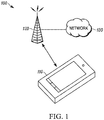
- FIG. 1 is an example block diagram of a system 100 according to a possible embodiment.
- the system 100 can include a wireless communication device 110, such as User Equipment (UE), a base station 120, such as an enhanced NodeB (eNB) or next generation NodeB (gNB), and a network 130.
- the wireless communication device 110 can be a wireless terminal, a portable wireless communication device, a smartphone, a cellular telephone, a flip phone, a personal digital assistant, a personal computer, a selective call receiver, a tablet computer, a laptop computer, or any other device that is capable of sending and receiving communication signals on a wireless network.
- the network 130 can include any type of network that is capable of sending and receiving wireless communication signals.
- the network 130 can include a wireless communication network, a cellular telephone network, a Time Division Multiple Access (TDMA)-based network, a Code Division Multiple Access (CDMA)-based network, an Orthogonal Frequency Division Multiple Access (OFDMA)-based network, a Long Term Evolution (LTE) network, a 5th generation (5G) network, a 3rd Generation Partnership Project (3GPP)-based network, a satellite communications network, a high altitude platform network, the Internet, and/or other communications networks.
- TDMA Time Division Multiple Access
- CDMA Code Division Multiple Access
- OFDMA Orthogonal Frequency Division Multiple Access
- LTE Long Term Evolution
- 5G 5th generation
- 3GPP 3rd Generation Partnership Project
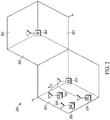
- FIG. 2 is an overview of multiple communication regions 202 in an exemplary cellular communication system 200.
- each of the multiple communication regions is often associated with a particular base station 204, which are intended to communicate with compatible user equipment 206 located within the associated communication region 202 and serve as an access point to the communication network.
- more than one base station can support a particular communication area, such as in edge areas where regions may overlap.
- a particular base station can support one or more communication regions.
- each particular base station 204 can support at least three regions 202, where the base station is positioned at a shared vertex of each of the three regions.
- the user equipment 206 will generally communicate wirelessly with the base station 204 using radio frequency signaling. Depending upon the location within the communication region 202, radio frequency signaling received between the base station 204 and the user equipment 206 will experience varying degrees of delay and attenuation, which needs to be managed as part of the user equipment's attempt to communicate with a base station 204.
- the degree of delay and attenuation will generally be dependent upon the distance between the user equipment and the base station, where closer user equipment relative to the base station will generally experience less delay and attenuation, and farther away user equipment will generally experience more. Other factors, such as the presence and the nature of any obstructions in the communication path between the user equipment and the base station can also have an effect on the degree of delay and attenuation.
- wireless signaling between user equipment 1 and the base station might have an associated first propagation delay Tpl
- user equipment 2 and the base station might have an associated second propagation delay Tp2.
- the relative propagation delay between all user equipment intending to communicate with a particular base station will have an associated delay spread, which corresponds to the difference between the various amounts of delay currently being experienced relative to the associated wireless signaling transmissions.
- a random access channel In LTE, a random access channel (RACH) is used for uplink synchronization or scheduling request.
- UE's contention-based random access procedure have previously generally consisted of four steps; a preamble transmission, reception of a random access response (RAR) message, a layer 2/3 message transmission, and reception of a contention resolution message.
- RAR random access response
- Contention-free random access procedure which is used for the cases of downlink (DL) data arrival or during handover can reduce the latency in random access, as the UE performs two steps, transmission of an assigned preamble and reception of a RAR message, instead of 4 steps.
- contention-based 2-step RACH procedure can be considered to reduce RACH related signaling overhead and latency. This can be the case for small data transmission and/or for operation in unlicensed band.
- a physical layer design to support contention-based 2-step RACH procedure is presented.
- Msgl may include at least a UE identity (ID) and some radio resource control (RRC) messages along with preamble, where a payload size may be up to, for example, 100 to 150 bits.
- RRC radio resource control
- the first approach, involving embedding the message in the RACH preamble, may not be suitable to accommodate a corresponding Msgl size in the range of 100 to 150 bits.
- MCS modulation and coding scheme
- contention-based 2-step RACH procedure may be more suitable for small cells, for example up to 2km cell radius, as a larger cell size might increase a potential timing offset at a receiver which is dependent on a propagation delay.
- FIG. 3 illustrates an example timing relationship for asynchronous multi-user uplink transmissions. More specifically, FIG. 3 shows that a UE with a larger propagation delay, for example UE1, may have a timing offset close to the data symbol duration 'Ts'.
- 'T ⁇ 1' corresponds to a propagation delay for user equipment 1, relative to a base station gNB.
- 'Tp2' corresponds to a propagation delay for user equipment 2, relative to base station gNB.
- 'To' corresponds to the base station gNB processing and switching time.
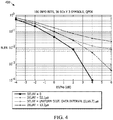
- a timing offset that is much larger than a cyclical prefix (CP) length in orthogonal frequency division multiplexing (OFDM) and/or involving discrete Fourier transform-spread-OFDM (DFT-S-OFDM) symbols may significantly degrade demodulation performance of physical random access channel carrying data (PRACH-D), as shown in FIG. 4.
- FIG. 4 physical random access channel carrying data
- a network entity may be able to determine and correspondingly indicate whether a given cell is configured to support contention-based 2-step RACH or not via system information or a dedicated higher-layer message, such as a radio resource control message.
- 2-step RACH procedure refers to contention-based 2-step RACH procedure.
- a network entity may configure common time/frequency radio resources for physical random access channel carrying preamble (PRACH-P) but mutually exclusive two subsets of preambles for 2-step RACH and 4-step RACH procedures, respectively, for a given cell.
- a user equipment may select one of the RACH procedures, such as a 2-step RACH procedure or a 4-step RACH procedure, based on path loss estimates or reference signal received power (RSRP) measurements, and may transmit a PRACH preamble randomly selected from a corresponding subset for the selected RACH procedure. For example, among 64 preambles configured for a cell, 16 preambles may be assigned for use with the 2-step RACH procedure, and 48 preambles may be assigned for use with the 4-step RACH procedure.
- the UE may select the 2-step RACH procedure, if a reference signal received power (RSRP) value is larger than a configured RSRP threshold value.
- RSRP reference signal received power
- the network entity may semi-statically change the number of preambles assigned for use with the 2-step RACH procedure and 4-step RACH procedure, based on RSRP measurement reports received from UEs in the radio resource control (RRC) connected state and/or the RRC inactive state. For example, if the NE observes an increase of RRC connected UEs which have RSRP values higher than the threshold value, it may assign a larger number of preambles for 2-step RACH procedure. Furthermore, the NE may configure UEs whose RSRP values are lower than the threshold value with scheduling request (SR) resources so that they can avoid a longer 4-step RACH procedure for SR resources and can perform low-latency uplink transmission. For UEs with higher RSRP values which can potentially perform a 2-step RACH procedure, the NE might elect not to configure dedicated SR resources to reduce the system overhead.
- RRC radio resource control
- the network entity may configure a set of time-frequency radio resources for PRACH-D in a cell, each of which is associated with a given PRACH preamble sequence. If the NE employs an advanced receiver such as parallel or successive interference cancellation, two or more PRACH preambles can be associated with one PRACH-D time-frequency radio resource.
- a user equipment (UE) performing 2-step RACH procedure transmits a PRACH preamble and PRACH-D in a resource associated with the transmitted preamble.
- the NE can perform demodulation and decoding of a corresponding PRACH-D.
- the received PRACH-D may have timing offset up to the maximum round-trip propagation delay, with respect to the reference receive timing for physical uplink shared channel (PUSCH).
- PUSCH is transmitted with a proper timing advance (TA) value and is received with timing alignment to the reference receive timing.
- TA timing advance
- the NE receiver may compensate frequency offset and apply fast Fourier transform (FFT) based on the acquired frequency and timing information.
- FFT fast Fourier transform
- the receiver may have to perform multiple FFT operations with different receive timing for multiple detected preambles, while the CP overhead does not increase. If the number of subcarrier allocated to each PRACH-D resource is small, for example 12 subcarriers, FFT complexity can be reduced, such as from FFT size of 1024 to FFT size of 16, by time-domain frequency shifts, down-sampling, and anti-aliasing filtering. Alternatively, the CP length and subcarrier spacing of PRACH-D may be the same as those for PRACH-P, potentially with much longer CP length than the CP length of PUSCH.
- PRACH-D carries demodulation reference signal (DM RS), and DM RS of PRACH-D is transmitted with a longer CP length (longer than a CP length of PRACH-D data symbols) and guard time (GT) appended to the DM RS symbol.
- the CP-length of DM RS of PRACH-D is determined based on the maximum round-trip delay and the maximum delay spread for UEs selecting 2-step RACH procedure in a cell.
- the guard time (GT) of DM RS of PRACH-D is also determined based on the maximum round-trip delay for the UEs performing 2-step RACH process in the cell.
- PRACH-D data symbols may employ the same CP length as PUSCH and not include GT.
- FIGS. 5A and 5B show exemplary physical channel structures for 2-step RACH procedure, which includes in FIG. 5A an example resource allocation of PRACH-P and PRACH-D, as well as in FIG. 5B an example symbol structure of PRACH-D.
- the example symbol structure of PRACH-D includes a demodulation reference signal (DM RS) 502 preceded by a cyclic prefix (CP) 504, and followed by multiple sets of data symbols 506, each of which are preceded by a cyclic prefix 508.
- DM RS demodulation reference signal
- CP cyclic prefix
- the cyclic prefix 508 which precedes each of the sets of data symbols 506 is shorter than the cyclic prefix 504 which precedes the demodulation reference signal 502.
- the longer CP length would help promote synchronous reception of DM RS, which leads to DM RS reception without severe inter-carrier interference caused by timing offset larger than the CP length.
- SINR signal-to-interference and noise ratio
- channel estimation performance can be important to the overall demodulation performance.
- low inter-carrier interference (ICI) or ICI-free reception of DM RS is beneficial to achieve good demodulation performance of PRACH-D.
- the longer CP of DM RS can maintain orthogonality of multiple orthogonal DM RS, such as a Zadoff-Chu (ZC) sequence and its cyclic shifts, when two or more PRACH preambles are associated with the same time-frequency resource for PRACH-D and multiple orthogonal DM RS for multiple PRACH-D are multiplexed in the same time-frequency resource.
- ZC Zadoff-Chu
- a DM RS sequence for PRACH-D is determined by a preamble index or according to the order of preamble indices for the preambles associated with the same time-frequency resource for PRACH-D.
- the user equipment can indicate a modulation order and a payload size for PRACH-D by selecting a proper DM RS sequence for PRACH-D.
- PRACH-D carries data often of limited size, such as UE ID, buffer status report (BSR), and small size user data
- modulation may be limited to one or two low order modulation schemes, such as binary phase shift keying (BPSK) or quadrature phase shift keying (QPSK), and only a few payload sizes may need to be supported.
- BPSK binary phase shift keying
- QPSK quadrature phase shift keying
- 6 selections for combination of modulation and payload sizes are supported in PRACH-D, and 6 different DM RS sequences are used to indicate a selected modulation and payload size.
- PRACH-D is allocated with 12 subcarriers per symbol
- two PRACH preambles such as preamble 1 and 2
- DM RS occupies all the subcarriers within a DM RS symbol. If 12 cyclic shifts of a root Zadoff-Chu (ZC) sequence are available for DM RS, the first 6 cyclic shifts of the root ZC sequence are used for DM RS of PRACH-D associated with preamble 1, and the second 6 cyclic shifts are used for DM RS-D associated with preamble 2.
- ZC Zadoff-Chu
- channel bits (coded and rate-matched bits) of PRACH-D are scrambled by a scrambling sequence, which can be based on cell/TRP (transmit and receive point) ID and a preamble sequence index.
- Preamble-sequence specific scrambling would be beneficial to combat co-channel interference when two or more preambles are associated with a given PRACH-D time/frequency resource.
- the UE can receive a RAR message as downlink control information (DCI) in a UE-specific search space.
- DCI downlink control information
- NE network entity
- RAR random access response
- the RAR message can be UE-specific. That is, the RAR message can be transmitted in a UE-specific channel and can be addressed by a C-RNTI (i.e.
- the RAR message carrying UL transmit timing advance (TA) information and UL scheduling grant for subsequent UL data transmission may be transmitted in UE-specific physical downlink control channel (PDCCH) according to a special UL downlink control information (DCI) format.
- the special UL DCI format includes a bit field for timing advance (TA) information in addition to typical UL scheduling grant related information.
- the NE If the NE detects a preamble but fails to decode the corresponding data successfully, the NE transmits the RAR message in common physical downlink shared channel (PDSCH), and DCI carrying scheduling information of the RAR transmission is addressed by a random access-radio network temporary identifier (RA-RNTI), for example CRC bits appended to the DCI are scrambled by the RA-RNTI.
- RA-RNTI random access-radio network temporary identifier
- the RA-RNTI may be determined by a time and frequency resource for PRACH-P.
- An RRC connected or RRC inactive UE performs blind decoding of PDCCH both in a UE-specific search space and in a common search space. During the RACH response window, the UE additionally performs blind decoding of the special UL DCI format to receive the RAR message.
- FIG. 6 illustrates an exemplary flow diagram 600 for performing in a user equipment contention based random access in a carrier frequency according to a possible embodiment.
- the flow diagram illustrates the operation of a wireless communication device, such as the user equipment 110, according to at least one possible embodiment.
- a wireless communication device such as the user equipment 110
- an indication from a network entity is received identifying whether a cell in a carrier frequency supports a 2-step random access procedure.
- the user equipment selects 606 a random access procedure between the 2-step and the 4-step random access procedures.
- Each of the 2-step random access procedure and the 4-step random access procedure includes one or more associated preambles. A preamble is then randomly selected from the one or more preambles associated with the selected random access procedure and transmitted 608.
- the 2-step random access procedure includes a physical random access channel carrying preamble and a physical random access channel carrying data.
- the 4-step random access procedure includes the physical random access channel carrying preamble.
- a time-frequency resource for the physical random access channel carrying data in the 2-step random access procedure is determined, based on the transmitted preamble.
- the physical random access channel carrying data including a demodulation reference signal and one or more data symbols is transmitted on the determined time-frequency resource 610.
- the flow diagram 600 could be extended to include a selection by the user equipment of one of the 2-step random access procedure or the 4-step random access procedure.
- the selection with be based on a path loss estimate, where the 2-step random access procedure is selected if the path loss estimate is less than a predetermined path loss estimate threshold, and the 4-step random access procedure is selected if the path loss estimate is greater than the predetermined path loss estimate threshold.
- the selection can be based upon a reference signal received power measurement, where the 2-step random access procedure is selected if the reference signal received power measurement is greater than a predetermined reference signal received power measurement threshold, and the 4-step random access procedure is selected if the reference signal received power measurement is less than the predetermined reference signal received power measurement threshold.
- the user equipment when the user equipment selects the 4-step random access procedure, the user equipment could be configured by the network entity with scheduling request resources.
- the preambles used in the cell could be configured into two mutually exclusive subsets of preambles, which are separately associated with the respective ones of the 2-step random access procedure and the 4-step random access procedure.
- the number of preambles in each of the two mutually exclusive subsets of preambles is some instances, could be semi-statically changed by the network entity, based on one or more reference signal received power measurement reports received from one or more user equipments in the cell.
- the number of preambles in each of the two mutually exclusive subsets of preambles could be based upon a ratio of a number of reference signal received power measurements included in the reference signal received power measurements reports received from the one or more user equipments in the cell, which are greater than a predetermined reference signal received power measurement threshold relative to a number of the reference signal received power measurements included in the reference signal received power measurements reports received from the one or more user equipments in the cell, which are less than the predetermined reference signal received power measurement threshold.
- the demodulation reference signal sequence can be determined based on at least one of a modulation order of the physical random access channel carrying data, a payload size of the physical random access channel carrying data, or a preamble sequence index of the transmitted preamble.
- the demodulation reference signal symbol of the physical random access channel carrying data could have a longer cyclic prefix than the one or more data symbols of the physical random access channel carrying data.
- the cyclic prefix length of the demodulation reference signal symbol of the physical random access channel carrying data could be determined based on the maximum round-trip delay for the user equipment performing the 2-step random access procedure in the cell.
- the demodulation reference signal symbol of the physical random access channel carrying data could also have a guard time that is based on the maximum round-trip delay for the user equipment performing the 2-step random access procedure in the cell.
- the cyclic prefix length of the demodulation reference signal symbol of the physical random access channel carrying data could also and/or alternatively be determined based on the maximum delay spread for all user equipment within the cell, which are selecting a 2-step random access procedure.
- channel bits of the physical random access channel carrying data could be scrambled by a scrambling sequence.
- the scrambling sequence could be based upon a network entity identity and a preamble sequence index.
- the user equipment when the user equipment has a valid user equipment identity assigned by a cell, the user equipment could includes the valid user equipment identity in the physical random access channel carrying data and could receives a random access response message as downlink control information in a user equipment specific search space.
- the valid user equipment identity could be a cell-radio network temporary identifier
- the user equipment specific search space within which the random access response message is transmitted could include user equipment specific physical downlink control channels, where appended cyclic redundancy check bits could be scrambled by the cell-radio network temporary identifier.
- downlink control information for the random access response message could contain a field for an uplink timing advance value.
- a physical downlink control channel could be monitored both for the user equipment specific search space and for a common search space for reception of the random access response message, where monitoring the physical downlink control channel could include attempting to decode the physical downlink control channel assuming a first payload size for the user equipment specific search space and assuming a second payload size for the common search space, where appended cyclic redundancy check bits in the physical downlink control channel of the common search space are scrambled by a random access-radio network temporary identifier.
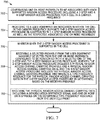
- FIG. 7 illustrates an exemplary flow diagram 700 for performing in a network entity contention based random access in a carrier frequency according to a possible embodiment.
- the flow diagram illustrates the operation in a network entity, which could include a base station 120 and/or other elements from a network 130, according to at least one possible embodiment.
- one or more preambles are configured to be associated with each supported random access procedure including a 2-step random access procedure and a 4-step random access procedure for a cell in a carrier frequency.
- An indication as to whether the cell in the carrier frequency supports the 2-step random access procedure in addition to the 4-step random access procedure, as well as the respective associated one or more preambles, is provided 704 to a user equipment.
- a selected preamble is received 708 from the user equipment, which is randomly selected from the one or more preambles that are configured to be associated with a selected one of the 2-step random access procedure and the 4-step random access procedure.
- the 2-step random access procedure includes a physical random access channel carrying preamble and a physical random access channel carrying data.
- the 4-step random access procedure includes the physical random access channel carrying preamble.
- a time-frequency resource for the physical random access channel carrying data in the 2-step random access procedure is determined, based on the received preamble.
- the physical random access channel carrying data including a demodulation reference signal and one or more data symbols is then received on the determined time-frequency resource 710.
- FIG. 8 is an example block diagram of an apparatus 800, such as the wireless communication device 110, according to a possible embodiment.
- the apparatus 800 can include a housing 810, a controller 820 within the housing 810, audio input and output circuitry 830 coupled to the controller 820, a display 840 coupled to the controller 820, a transceiver 850 coupled to the controller 820, an antenna 855 coupled to the transceiver 850, a user interface 860 coupled to the controller 820, a memory 870 coupled to the controller 820, and a network interface 880 coupled to the controller 820.
- the apparatus 800 can perform the methods described in all the embodiments.
- the display 840 can be a viewfinder, a liquid crystal display (LCD), a light emitting diode (LED) display, a plasma display, a projection display, a touch screen, or any other device that displays information.
- the transceiver 850 can include a transmitter and/or a receiver.
- the audio input and output circuitry 830 can include a microphone, a speaker, a transducer, or any other audio input and output circuitry.
- the user interface 860 can include a keypad, a keyboard, buttons, a touch pad, a joystick, a touch screen display, another additional display, or any other device useful for providing an interface between a user and an electronic device.
- the network interface 880 can be a Universal Serial Bus (USB) port, an Ethernet port, an infrared transmitter/receiver, an IEEE 1394 port, a WLAN transceiver, or any other interface that can connect an apparatus to a network, device, or computer and that can transmit and receive data communication signals.
- the memory 870 can include a random access memory, a read only memory, an optical memory, a solid state memory, a flash memory, a removable memory, a hard drive, a cache, or any other memory that can be coupled to an apparatus.
- the apparatus 800 or the controller 820 may implement any operating system, such as Microsoft Windows®, UNIX®, or LINUX®, AndroidTM, or any other operating system.
- Apparatus operation software may be written in any programming language, such as C, C++, Java or Visual Basic, for example.
- Apparatus software may also run on an application framework, such as, for example, a Java® framework, a .NET® framework, or any other application framework.
- the software and/or the operating system may be stored in the memory 870 or elsewhere on the apparatus 800.
- the apparatus 800 or the controller 820 may also use hardware to implement disclosed operations.
- the controller 820 may be any programmable processor.
- Disclosed embodiments may also be implemented on a general-purpose or a special purpose computer, a programmed microprocessor or microprocessor, peripheral integrated circuit elements, an application-specific integrated circuit or other integrated circuits, hardware/electronic logic circuits, such as a discrete element circuit, a programmable logic device, such as a programmable logic array, field programmable gate-array, or the like.
- the controller 820 may be any controller or processor device or devices capable of operating an apparatus and implementing the disclosed embodiments. Some or all of the additional elements of the apparatus 800 can also perform some or all of the operations of the disclosed embodiments.
- the method of this disclosure can be implemented on a programmed processor.
- the controllers, flowcharts, and modules may also be implemented on a general purpose or special purpose computer, a programmed microprocessor or microcontroller and peripheral integrated circuit elements, an integrated circuit, a hardware electronic or logic circuit such as a discrete element circuit, a programmable logic device, or the like.
- any device on which resides a finite state machine capable of implementing the flowcharts shown in the figures may be used to implement the processor functions of this disclosure.
Landscapes
- Engineering & Computer Science (AREA)
- Computer Networks & Wireless Communication (AREA)
- Signal Processing (AREA)
- Mobile Radio Communication Systems (AREA)
Abstract
Description
- The present disclosure is directed to a method and apparatus for performing contention based random access in a carrier frequency of a communication network, and more particularly, to contention based random access having a reduced number of steps in support of lower latency communication.
- Presently, user equipment, such as wireless communication devices, communicate with other communication devices using wireless signals, such as within a network environment that can include one or more cells within which various communication connections with the network and other devices operating within the network can be supported. Network environments often involve one or more sets of standards, which each define various aspects of any communication connection being made when using the corresponding standard within the network environment. Examples of developing and/or existing standards include new radio access technology (NR), Long Term Evolution (LTE), Universal Mobile Telecommunications Service (UMTS), Global System for Mobile Communication (GSM), and/or Enhanced Data GSM Environment (EDGE).
- While operating within a network, the standard will define the manner in which the user equipment communicates with the network including initiating a new connection or refreshing an existing connection that has somehow become stale, such as for example where synchronization between the user equipment and the network access point has been lost. At least some developing and/or existing standards use a random access procedure in support of establishing a new or refreshing an already existing connection. A contention based random access can facilitate the possibility that multiple communication devices may be interested in attempting to access the network through the random access process at the same or similar point in time. Once access has been established and/or confirmed, the network can assign network resources to a particular user equipment in support of the uplink communication with the network.
- However, a random access process, as a precursor to network resources being made available by the network to the user equipment represents signaling overhead in support of an uplink communication, which can also impact the latency associated with any particular communication. Often times, the process is supported by a four step interaction, which may better accommodate assumed worst case conditions. The present inventors have recognized that in some instances a two step process may be sufficient. As such, the present inventors have further recognized that simultaneously supporting both a two step and a four step process may be beneficial, whereby the circumstances and conditions alternatively associated with the selective beneficial application of a two step and a four step process might be identified and correspondingly encoded as part of the process. Such a process can improve communication latency where possible, and also continue to provide a more robust process where helpful, depending upon the determined present circumstances associated with the particular communication being requested.
- Presently, user equipment, such as wireless communication devices, communicate with other communication devices using wireless signals. According to a possible embodiment, a method in a user equipment in a carrier frequency to perform contention based random access is provided. The method includes receiving an indication from a network entity whether a cell in the carrier frequency supports a 2-step random access procedure. When the 2-step random access procedure is supported in the cell, a random access procedure can select between the 2-step random access procedure and a 4-step random access procedure, wherein each of the 2-step random access procedure and the 4-step random access procedure can include one or more preambles, which can be configured in the cell to be associated with one of the 2-step random access procedure or the 4-step random access procedures. A preamble can be randomly selected and transmitted from the one or more preambles which are associated with the selected random access procedure, wherein the 2-step random access procedure includes a physical random access channel carrying preamble and a physical random access channel carrying data, and the 4-step random access procedure includes the physical random access channel carrying preamble, and wherein a time-frequency resource for the physical random access channel carrying data in the 2-step random access procedure can be determined, based on the transmitted preamble. The physical random access channel carrying data can be transmitted including a demodulation reference signal and one or more data symbols on the determined time-frequency resource.
- According to another possible embodiment, a user equipment in a communication network including a network entity for performing contention based random access in a carrier frequency is provided. The user equipment includes a transceiver that can send and receive signals between the user equipment and the network entity including receiving an indication from a network entity whether a cell in the carrier frequency supports a 2-step random access procedure. The user equipment further includes a controller that, when the 2-step random access procedure is supported in the cell, can select a random access procedure between the 2-step random access procedure and a 4-step random access procedure. The transceiver of the user equipment can receive a list of associated preambles for each of the 2-step random access procedure and the 4-step random access procedure, where one or more preambles are configured in the cell to be associated with one of the 2-step random access procedure or the 4-step random access procedures. The controller can further randomly select and transmit a preamble from the one or more preambles which are associated with the selected random access procedure, wherein the 2-step random access procedure includes a physical random access channel carrying preamble and a physical random access channel carrying data, and the 4-step random access procedure includes the physical random access channel carrying preamble, and wherein a time-frequency resource for the physical random access channel carrying data in the 2-step random access procedure can be determined, based on the transmitted preamble. The transceiver can further transmit the physical random access channel carrying data including a demodulation reference signal and one or more data symbols on the determined time-frequency resource.
- According to another possible embodiment, a method in a network entity in a carrier frequency is provided to perform contention based random access. The method includes configuring one or more preambles to be associated with each supported random access procedures including a 2-step random access procedure and a 4-step random access procedure for a cell in the carrier frequency. An indication whether the cell in the carrier frequency supports the 2-step random access procedure in addition to the 4-step random access procedure, as well as the respective associated one or more preambles, can be provided to a user equipment. When the 2-step random access procedure is supported in the cell, a selected preamble can be received from the user equipment, where the preamble was randomly selected from the one or more preambles which can be configured to be associated with a selected one of the 2-step random access procedure and the 4-step random access procedure, wherein the 2-step random access procedure can include a physical random access channel carrying preamble and a physical random access channel carrying data, and the 4-step random access procedure can include the physical random access channel carrying preamble, and wherein a time-frequency resource for the physical random access channel carrying data in the 2-step random access procedure can be determined, based on the received preamble. The physical random access channel carrying data including a demodulation reference signal and one or more data symbols on the determined time-frequency resource can be received from the user equipment.
- According to another possible embodiment, a network entity in a communication network is provided for performing contention based random access in a carrier frequency. The network entity includes a controller that can configure one or more preambles to be associated with each supported random access procedures including a 2-step random access procedure and a 4-step random access procedure for a cell in the carrier frequency. The network entity further includes a transceiver that can provide to a user equipment an indication whether the cell in the carrier frequency supports the 2-step random access procedure in addition to the 4-step random access procedure, as well as the respective associated one or more preambles. When the 2-step random access procedure is supported in the cell, the transceiver of the network entity can receive a selected preamble from the user equipment, where the preamble was randomly selected from the one or more preambles which can be configured to be associated with a selected one of the 2-step random access procedure and the 4-step random access procedure, wherein the 2-step random access procedure can include a physical random access channel carrying preamble and a physical random access channel carrying data, and the 4-step random access procedure can include the physical random access channel carrying preamble, and wherein a time-frequency resource for the physical random access channel carrying data in the 2-step random access procedure can be determined, based on the received preamble, and the transceiver of the network entity can receive the physical random access channel carrying data including a demodulation reference signal and one or more data symbols on the determined time-frequency resource from the user equipment.
- These and other objects, features, and advantages of the present application are evident from the following description of one or more preferred embodiments, with reference to the accompanying drawings.
-
-
FIG. 1 is a block diagram of an exemplary network environment in which the present invention is adapted to operate; -
FIG. 2 is an overview of multiple communication regions in an exemplary cellular communication system; -
FIG. 3 is an example timing relationship for asynchronous multi-user uplink transmissions; -
FIG. 4 is a graph of block error rate performance of a physical random access channel carrying data for various receive timing offset; -
FIGS. 5A and 5B are exemplary physical channel structures for a 2-step random access channel including inFIG. 5A an example resource allocation of a physical random access channel carrying preamble and a physical random access channel carrying data; and inFIG. 5B an example symbol structure of a physical random access channel carrying data; -
FIG. 6 is a flow diagram for performing in a user equipment contention based random access in a carrier frequency according to a possible embodiment; -
FIG. 7 is a flow diagram for performing in a network entity contention based random access in a carrier frequency according to a possible embodiment; and -
FIG. 8 is an example block diagram of an apparatus according to a possible embodiment. - While the present disclosure is susceptible of embodiment in various forms, there is shown in the drawings and will hereinafter be described presently preferred embodiments with the understanding that the present disclosure is to be considered an exemplification of the invention and is not intended to limit the invention to the specific embodiments illustrated.
- Embodiments provide a method and apparatus for performing contention based random access in a carrier frequency.
-
FIG. 1 is an example block diagram of asystem 100 according to a possible embodiment. Thesystem 100 can include awireless communication device 110, such as User Equipment (UE), abase station 120, such as an enhanced NodeB (eNB) or next generation NodeB (gNB), and anetwork 130. Thewireless communication device 110 can be a wireless terminal, a portable wireless communication device, a smartphone, a cellular telephone, a flip phone, a personal digital assistant, a personal computer, a selective call receiver, a tablet computer, a laptop computer, or any other device that is capable of sending and receiving communication signals on a wireless network. - The
network 130 can include any type of network that is capable of sending and receiving wireless communication signals. For example, thenetwork 130 can include a wireless communication network, a cellular telephone network, a Time Division Multiple Access (TDMA)-based network, a Code Division Multiple Access (CDMA)-based network, an Orthogonal Frequency Division Multiple Access (OFDMA)-based network, a Long Term Evolution (LTE) network, a 5th generation (5G) network, a 3rd Generation Partnership Project (3GPP)-based network, a satellite communications network, a high altitude platform network, the Internet, and/or other communications networks. - In at least some instances, the network will provide coverage across a geographical area, where in at least some instances, the area of coverage will be divided into multiple regions, at least sometimes referred to as cells.
FIG. 2 is an overview ofmultiple communication regions 202 in an exemplarycellular communication system 200. In many cellular communication networks, each of the multiple communication regions is often associated with aparticular base station 204, which are intended to communicate withcompatible user equipment 206 located within the associatedcommunication region 202 and serve as an access point to the communication network. In some cases, more than one base station can support a particular communication area, such as in edge areas where regions may overlap. In some cases, a particular base station can support one or more communication regions. In the illustrated embodiment, eachparticular base station 204 can support at least threeregions 202, where the base station is positioned at a shared vertex of each of the three regions. - The
user equipment 206 will generally communicate wirelessly with thebase station 204 using radio frequency signaling. Depending upon the location within thecommunication region 202, radio frequency signaling received between thebase station 204 and theuser equipment 206 will experience varying degrees of delay and attenuation, which needs to be managed as part of the user equipment's attempt to communicate with abase station 204. The degree of delay and attenuation will generally be dependent upon the distance between the user equipment and the base station, where closer user equipment relative to the base station will generally experience less delay and attenuation, and farther away user equipment will generally experience more. Other factors, such as the presence and the nature of any obstructions in the communication path between the user equipment and the base station can also have an effect on the degree of delay and attenuation. For example, wireless signaling betweenuser equipment 1 and the base station might have an associated first propagation delay Tpl, anduser equipment 2 and the base station might have an associated second propagation delay Tp2. Correspondingly, the relative propagation delay between all user equipment intending to communicate with a particular base station will have an associated delay spread, which corresponds to the difference between the various amounts of delay currently being experienced relative to the associated wireless signaling transmissions. - In LTE, a random access channel (RACH) is used for uplink synchronization or scheduling request. User equipment's (UE's) contention-based random access procedure have previously generally consisted of four steps; a preamble transmission, reception of a random access response (RAR) message, a
layer 2/3 message transmission, and reception of a contention resolution message. Contention-free random access procedure which is used for the cases of downlink (DL) data arrival or during handover can reduce the latency in random access, as the UE performs two steps, transmission of an assigned preamble and reception of a RAR message, instead of 4 steps. - In the fifth generation (5G) radio access technology (RAT) or a new RAT (NR), contention-based 2-step RACH procedure can be considered to reduce RACH related signaling overhead and latency. This can be the case for small data transmission and/or for operation in unlicensed band. In the present disclosure, a physical layer design to support contention-based 2-step RACH procedure is presented.
- For contention-based 2-Step RACH procedure, two approaches have been considered:
- (1) instances where a message is embedded in a random access preamble; and
- (2) instances where a message and a preamble are separately transmitted.
- For contention-based 2-step RACH procedure, Message 1 (Msgl) may include at least a UE identity (ID) and some radio resource control (RRC) messages along with preamble, where a payload size may be up to, for example, 100 to 150 bits. However, the first approach, involving embedding the message in the RACH preamble, may not be suitable to accommodate a corresponding Msgl size in the range of 100 to 150 bits.
- In instances where a message and preamble were separately transmitted, detailed design aspects on a physical
channel carrying Msg 1, for example how to indicate modulation and coding scheme (MCS) and a channel structure, have generally not been previously disclosed. - According to a possible embodiment, contention-based 2-step RACH procedure may be more suitable for small cells, for example up to 2km cell radius, as a larger cell size might increase a potential timing offset at a receiver which is dependent on a propagation delay.
FIG. 3 illustrates an example timing relationship for asynchronous multi-user uplink transmissions. More specifically,FIG. 3 shows that a UE with a larger propagation delay, for example UE1, may have a timing offset close to the data symbol duration 'Ts'. 'Tρ1' corresponds to a propagation delay foruser equipment 1, relative to a base station gNB. 'Tp2' corresponds to a propagation delay foruser equipment 2, relative to base station gNB. 'To' corresponds to the base station gNB processing and switching time. A timing offset that is much larger than a cyclical prefix (CP) length in orthogonal frequency division multiplexing (OFDM) and/or involving discrete Fourier transform-spread-OFDM (DFT-S-OFDM) symbols may significantly degrade demodulation performance of physical random access channel carrying data (PRACH-D), as shown inFIG. 4. FIG. 4 illustrates a graph of block error ratio (BLER) performance of PRACH-D for various receive timing offsets, assuming perfect detection of preamble and timing offset, and more specifically a graph of block error ratio as a function of signal to noise ratio measured in decibels for 100 info bits included in 3 symbols across 36 subcarriers, where the info bits are encoded using quadrature phase shift keying. Thus, a network entity (NE) may be able to determine and correspondingly indicate whether a given cell is configured to support contention-based 2-step RACH or not via system information or a dedicated higher-layer message, such as a radio resource control message. Hereafter, 2-step RACH procedure refers to contention-based 2-step RACH procedure. - A network entity (NE) may configure common time/frequency radio resources for physical random access channel carrying preamble (PRACH-P) but mutually exclusive two subsets of preambles for 2-step RACH and 4-step RACH procedures, respectively, for a given cell. A user equipment (UE) may select one of the RACH procedures, such as a 2-step RACH procedure or a 4-step RACH procedure, based on path loss estimates or reference signal received power (RSRP) measurements, and may transmit a PRACH preamble randomly selected from a corresponding subset for the selected RACH procedure. For example, among 64 preambles configured for a cell, 16 preambles may be assigned for use with the 2-step RACH procedure, and 48 preambles may be assigned for use with the 4-step RACH procedure. The UE may select the 2-step RACH procedure, if a reference signal received power (RSRP) value is larger than a configured RSRP threshold value.
- Further, the network entity (NE) may semi-statically change the number of preambles assigned for use with the 2-step RACH procedure and 4-step RACH procedure, based on RSRP measurement reports received from UEs in the radio resource control (RRC) connected state and/or the RRC inactive state. For example, if the NE observes an increase of RRC connected UEs which have RSRP values higher than the threshold value, it may assign a larger number of preambles for 2-step RACH procedure. Furthermore, the NE may configure UEs whose RSRP values are lower than the threshold value with scheduling request (SR) resources so that they can avoid a longer 4-step RACH procedure for SR resources and can perform low-latency uplink transmission. For UEs with higher RSRP values which can potentially perform a 2-step RACH procedure, the NE might elect not to configure dedicated SR resources to reduce the system overhead.
- The network entity (NE) may configure a set of time-frequency radio resources for PRACH-D in a cell, each of which is associated with a given PRACH preamble sequence. If the NE employs an advanced receiver such as parallel or successive interference cancellation, two or more PRACH preambles can be associated with one PRACH-D time-frequency radio resource. A user equipment (UE) performing 2-step RACH procedure transmits a PRACH preamble and PRACH-D in a resource associated with the transmitted preamble.
- Once the NE detects a particular preamble and acquires timing and frequency information of the UE transmitting the detected preamble, it can perform demodulation and decoding of a corresponding PRACH-D. The received PRACH-D may have timing offset up to the maximum round-trip propagation delay, with respect to the reference receive timing for physical uplink shared channel (PUSCH). Note that PUSCH is transmitted with a proper timing advance (TA) value and is received with timing alignment to the reference receive timing. If a CP length of PRACH-D is set to be the same as the CP length of PUSCH for a given subcarrier spacing, the NE receiver may compensate frequency offset and apply fast Fourier transform (FFT) based on the acquired frequency and timing information. The receiver may have to perform multiple FFT operations with different receive timing for multiple detected preambles, while the CP overhead does not increase. If the number of subcarrier allocated to each PRACH-D resource is small, for example 12 subcarriers, FFT complexity can be reduced, such as from FFT size of 1024 to FFT size of 16, by time-domain frequency shifts, down-sampling, and anti-aliasing filtering. Alternatively, the CP length and subcarrier spacing of PRACH-D may be the same as those for PRACH-P, potentially with much longer CP length than the CP length of PUSCH.
- In one embodiment, PRACH-D carries demodulation reference signal (DM RS), and DM RS of PRACH-D is transmitted with a longer CP length (longer than a CP length of PRACH-D data symbols) and guard time (GT) appended to the DM RS symbol. The CP-length of DM RS of PRACH-D is determined based on the maximum round-trip delay and the maximum delay spread for UEs selecting 2-step RACH procedure in a cell. The guard time (GT) of DM RS of PRACH-D is also determined based on the maximum round-trip delay for the UEs performing 2-step RACH process in the cell. PRACH-D data symbols may employ the same CP length as PUSCH and not include GT. If the cell is large, for example 5km cell radius, and if UEs within 2km radius are expected to perform 2-step RACH procedure based on RSRP (or path loss) threshold setting, the CP-length of DM RS of PRACH-D is longer than the CP length of PRACH-D data symbols but less than the CP length of PRACH preamble. In another embodiment, DM RS of PRACH-D has a longer CP, but no GT is appended.
FIGS. 5A and 5B show exemplary physical channel structures for 2-step RACH procedure, which includes inFIG. 5A an example resource allocation of PRACH-P and PRACH-D, as well as inFIG. 5B an example symbol structure of PRACH-D. - The example symbol structure of PRACH-D includes a demodulation reference signal (DM RS) 502 preceded by a cyclic prefix (CP) 504, and followed by multiple sets of
data symbols 506, each of which are preceded by acyclic prefix 508. In the illustrated embodiment, thecyclic prefix 508 which precedes each of the sets ofdata symbols 506 is shorter than thecyclic prefix 504 which precedes thedemodulation reference signal 502. - The longer CP length would help promote synchronous reception of DM RS, which leads to DM RS reception without severe inter-carrier interference caused by timing offset larger than the CP length. When an operating signal-to-interference and noise ratio (SINR) range is low because of a small payload, channel estimation performance can be important to the overall demodulation performance. Thus, low inter-carrier interference (ICI) or ICI-free reception of DM RS is beneficial to achieve good demodulation performance of PRACH-D. Moreover, the longer CP of DM RS can maintain orthogonality of multiple orthogonal DM RS, such as a Zadoff-Chu (ZC) sequence and its cyclic shifts, when two or more PRACH preambles are associated with the same time-frequency resource for PRACH-D and multiple orthogonal DM RS for multiple PRACH-D are multiplexed in the same time-frequency resource. In one embodiment, a DM RS sequence for PRACH-D is determined by a preamble index or according to the order of preamble indices for the preambles associated with the same time-frequency resource for PRACH-D.
- In another embodiment, the user equipment (UE) can indicate a modulation order and a payload size for PRACH-D by selecting a proper DM RS sequence for PRACH-D. As PRACH-D carries data often of limited size, such as UE ID, buffer status report (BSR), and small size user data, modulation may be limited to one or two low order modulation schemes, such as binary phase shift keying (BPSK) or quadrature phase shift keying (QPSK), and only a few payload sizes may need to be supported. In one example, 6 selections for combination of modulation and payload sizes are supported in PRACH-D, and 6 different DM RS sequences are used to indicate a selected modulation and payload size. Further, PRACH-D is allocated with 12 subcarriers per symbol, two PRACH preambles, such as
preamble preamble 1, and the second 6 cyclic shifts are used for DM RS-D associated withpreamble 2. - In another embodiment, channel bits (coded and rate-matched bits) of PRACH-D are scrambled by a scrambling sequence, which can be based on cell/TRP (transmit and receive point) ID and a preamble sequence index. Preamble-sequence specific scrambling would be beneficial to combat co-channel interference when two or more preambles are associated with a given PRACH-D time/frequency resource.
- In one embodiment, if UE is in an RRC connected state or in an RRC inactive state, for example UE has a valid UE ID assigned by a cell, such as a cell-radio network temporary identifier (C-RNTI), the UE can receive a RAR message as downlink control information (DCI) in a UE-specific search space. If a network entity (NE) detects a preamble and decodes corresponding data successfully, the random access response (RAR) message can be UE-specific. That is, the RAR message can be transmitted in a UE-specific channel and can be addressed by a C-RNTI (i.e. cyclic redundancy check (CRC) bits appended are scrambled by the C-RNTI), wherein the NE can obtain the C-RNTI from decoding PRACH-D. Connected mode UEs perform a contention-based RACH procedure, when there is no SR resource configured for the UEs or uplink (UL) timing information is not up-to-date. Thus, the RAR message carrying UL transmit timing advance (TA) information and UL scheduling grant for subsequent UL data transmission may be transmitted in UE-specific physical downlink control channel (PDCCH) according to a special UL downlink control information (DCI) format. The special UL DCI format includes a bit field for timing advance (TA) information in addition to typical UL scheduling grant related information.
- If the NE detects a preamble but fails to decode the corresponding data successfully, the NE transmits the RAR message in common physical downlink shared channel (PDSCH), and DCI carrying scheduling information of the RAR transmission is addressed by a random access-radio network temporary identifier (RA-RNTI), for example CRC bits appended to the DCI are scrambled by the RA-RNTI. The RA-RNTI may be determined by a time and frequency resource for PRACH-P.
- An RRC connected or RRC inactive UE performs blind decoding of PDCCH both in a UE-specific search space and in a common search space. During the RACH response window, the UE additionally performs blind decoding of the special UL DCI format to receive the RAR message.
-
FIG. 6 illustrates an exemplary flow diagram 600 for performing in a user equipment contention based random access in a carrier frequency according to a possible embodiment. The flow diagram illustrates the operation of a wireless communication device, such as theuser equipment 110, according to at least one possible embodiment. At 602, an indication from a network entity is received identifying whether a cell in a carrier frequency supports a 2-step random access procedure. When the 2-step random access procedure is supported in thecell 604, the user equipment selects 606 a random access procedure between the 2-step and the 4-step random access procedures. Each of the 2-step random access procedure and the 4-step random access procedure includes one or more associated preambles. A preamble is then randomly selected from the one or more preambles associated with the selected random access procedure and transmitted 608. The 2-step random access procedure includes a physical random access channel carrying preamble and a physical random access channel carrying data. The 4-step random access procedure includes the physical random access channel carrying preamble. A time-frequency resource for the physical random access channel carrying data in the 2-step random access procedure is determined, based on the transmitted preamble. The physical random access channel carrying data including a demodulation reference signal and one or more data symbols is transmitted on the determined time-frequency resource 610. - In at least some embodiments, the flow diagram 600 could be extended to include a selection by the user equipment of one of the 2-step random access procedure or the 4-step random access procedure. In some instances, the selection with be based on a path loss estimate, where the 2-step random access procedure is selected if the path loss estimate is less than a predetermined path loss estimate threshold, and the 4-step random access procedure is selected if the path loss estimate is greater than the predetermined path loss estimate threshold. In other instances, the selection can be based upon a reference signal received power measurement, where the 2-step random access procedure is selected if the reference signal received power measurement is greater than a predetermined reference signal received power measurement threshold, and the 4-step random access procedure is selected if the reference signal received power measurement is less than the predetermined reference signal received power measurement threshold.
- In some instances, when the user equipment selects the 4-step random access procedure, the user equipment could be configured by the network entity with scheduling request resources.
- The same or other instances might allow where when the one or more preambles are associated with each one of the 2-step random access procedure or the 4-step random access procedures, the preambles used in the cell could be configured into two mutually exclusive subsets of preambles, which are separately associated with the respective ones of the 2-step random access procedure and the 4-step random access procedure. The number of preambles in each of the two mutually exclusive subsets of preambles, is some instances, could be semi-statically changed by the network entity, based on one or more reference signal received power measurement reports received from one or more user equipments in the cell. Still further, the number of preambles in each of the two mutually exclusive subsets of preambles could be based upon a ratio of a number of reference signal received power measurements included in the reference signal received power measurements reports received from the one or more user equipments in the cell, which are greater than a predetermined reference signal received power measurement threshold relative to a number of the reference signal received power measurements included in the reference signal received power measurements reports received from the one or more user equipments in the cell, which are less than the predetermined reference signal received power measurement threshold.
- In some instances, the demodulation reference signal sequence can be determined based on at least one of a modulation order of the physical random access channel carrying data, a payload size of the physical random access channel carrying data, or a preamble sequence index of the transmitted preamble.
- In some instances, the demodulation reference signal symbol of the physical random access channel carrying data could have a longer cyclic prefix than the one or more data symbols of the physical random access channel carrying data. In some of these instances, the cyclic prefix length of the demodulation reference signal symbol of the physical random access channel carrying data could be determined based on the maximum round-trip delay for the user equipment performing the 2-step random access procedure in the cell. The demodulation reference signal symbol of the physical random access channel carrying data could also have a guard time that is based on the maximum round-trip delay for the user equipment performing the 2-step random access procedure in the cell. The cyclic prefix length of the demodulation reference signal symbol of the physical random access channel carrying data could also and/or alternatively be determined based on the maximum delay spread for all user equipment within the cell, which are selecting a 2-step random access procedure.
- In some instances, channel bits of the physical random access channel carrying data could be scrambled by a scrambling sequence. In some of these instances, the scrambling sequence could be based upon a network entity identity and a preamble sequence index.
- In some instances, when the user equipment has a valid user equipment identity assigned by a cell, the user equipment could includes the valid user equipment identity in the physical random access channel carrying data and could receives a random access response message as downlink control information in a user equipment specific search space. In some of these instances, the valid user equipment identity could be a cell-radio network temporary identifier, and the user equipment specific search space within which the random access response message is transmitted could include user equipment specific physical downlink control channels, where appended cyclic redundancy check bits could be scrambled by the cell-radio network temporary identifier. It may also be possible, that downlink control information for the random access response message could contain a field for an uplink timing advance value. It is still further possible, that a physical downlink control channel could be monitored both for the user equipment specific search space and for a common search space for reception of the random access response message, where monitoring the physical downlink control channel could include attempting to decode the physical downlink control channel assuming a first payload size for the user equipment specific search space and assuming a second payload size for the common search space, where appended cyclic redundancy check bits in the physical downlink control channel of the common search space are scrambled by a random access-radio network temporary identifier.
-
FIG. 7 illustrates an exemplary flow diagram 700 for performing in a network entity contention based random access in a carrier frequency according to a possible embodiment. The flow diagram illustrates the operation in a network entity, which could include abase station 120 and/or other elements from anetwork 130, according to at least one possible embodiment. At 702, one or more preambles are configured to be associated with each supported random access procedure including a 2-step random access procedure and a 4-step random access procedure for a cell in a carrier frequency. An indication as to whether the cell in the carrier frequency supports the 2-step random access procedure in addition to the 4-step random access procedure, as well as the respective associated one or more preambles, is provided 704 to a user equipment. When the 2-step random access procedure is supported in the cell, a selected preamble is received 708 from the user equipment, which is randomly selected from the one or more preambles that are configured to be associated with a selected one of the 2-step random access procedure and the 4-step random access procedure. The 2-step random access procedure includes a physical random access channel carrying preamble and a physical random access channel carrying data. The 4-step random access procedure includes the physical random access channel carrying preamble. A time-frequency resource for the physical random access channel carrying data in the 2-step random access procedure is determined, based on the received preamble. The physical random access channel carrying data including a demodulation reference signal and one or more data symbols is then received on the determined time-frequency resource 710. - It should be understood that, notwithstanding the particular steps as shown in the figures, a variety of additional or different steps can be performed depending upon the embodiment, and one or more of the particular steps can be rearranged, repeated or eliminated entirely depending upon the embodiment. Also, some of the steps performed can be repeated on an ongoing or continuous basis simultaneously while other steps are performed. Furthermore, different steps can be performed by different elements or in a single element of the disclosed embodiments.
-
FIG. 8 is an example block diagram of anapparatus 800, such as thewireless communication device 110, according to a possible embodiment. Theapparatus 800 can include a housing 810, acontroller 820 within the housing 810, audio input andoutput circuitry 830 coupled to thecontroller 820, adisplay 840 coupled to thecontroller 820, atransceiver 850 coupled to thecontroller 820, anantenna 855 coupled to thetransceiver 850, auser interface 860 coupled to thecontroller 820, amemory 870 coupled to thecontroller 820, and anetwork interface 880 coupled to thecontroller 820. Theapparatus 800 can perform the methods described in all the embodiments. - The
display 840 can be a viewfinder, a liquid crystal display (LCD), a light emitting diode (LED) display, a plasma display, a projection display, a touch screen, or any other device that displays information. Thetransceiver 850 can include a transmitter and/or a receiver. The audio input andoutput circuitry 830 can include a microphone, a speaker, a transducer, or any other audio input and output circuitry. Theuser interface 860 can include a keypad, a keyboard, buttons, a touch pad, a joystick, a touch screen display, another additional display, or any other device useful for providing an interface between a user and an electronic device. Thenetwork interface 880 can be a Universal Serial Bus (USB) port, an Ethernet port, an infrared transmitter/receiver, an IEEE 1394 port, a WLAN transceiver, or any other interface that can connect an apparatus to a network, device, or computer and that can transmit and receive data communication signals. Thememory 870 can include a random access memory, a read only memory, an optical memory, a solid state memory, a flash memory, a removable memory, a hard drive, a cache, or any other memory that can be coupled to an apparatus. - The
apparatus 800 or thecontroller 820 may implement any operating system, such as Microsoft Windows®, UNIX®, or LINUX®, Android™, or any other operating system. Apparatus operation software may be written in any programming language, such as C, C++, Java or Visual Basic, for example. Apparatus software may also run on an application framework, such as, for example, a Java® framework, a .NET® framework, or any other application framework. The software and/or the operating system may be stored in thememory 870 or elsewhere on theapparatus 800. Theapparatus 800 or thecontroller 820 may also use hardware to implement disclosed operations. For example, thecontroller 820 may be any programmable processor. Disclosed embodiments may also be implemented on a general-purpose or a special purpose computer, a programmed microprocessor or microprocessor, peripheral integrated circuit elements, an application-specific integrated circuit or other integrated circuits, hardware/electronic logic circuits, such as a discrete element circuit, a programmable logic device, such as a programmable logic array, field programmable gate-array, or the like. In general, thecontroller 820 may be any controller or processor device or devices capable of operating an apparatus and implementing the disclosed embodiments. Some or all of the additional elements of theapparatus 800 can also perform some or all of the operations of the disclosed embodiments. - The method of this disclosure can be implemented on a programmed processor. However, the controllers, flowcharts, and modules may also be implemented on a general purpose or special purpose computer, a programmed microprocessor or microcontroller and peripheral integrated circuit elements, an integrated circuit, a hardware electronic or logic circuit such as a discrete element circuit, a programmable logic device, or the like. In general, any device on which resides a finite state machine capable of implementing the flowcharts shown in the figures may be used to implement the processor functions of this disclosure.
- While this disclosure has been described with specific embodiments thereof, it is evident that many alternatives, modifications, and variations will be apparent to those skilled in the art. For example, various components of the embodiments may be interchanged, added, or substituted in the other embodiments. Also, all of the elements of each figure are not necessary for operation of the disclosed embodiments. For example, one of ordinary skill in the art of the disclosed embodiments would be enabled to make and use the teachings of the disclosure by simply employing the elements of the independent claims. Accordingly, embodiments of the disclosure as set forth herein are intended to be illustrative, not limiting. Various changes may be made without departing from the spirit and scope of the disclosure.
- In this document, relational terms such as "first", "second", and the like may be used solely to distinguish one entity or action from another entity or action without necessarily requiring or implying any actual such relationship or order between such entities or actions. The phrase "at least one of, "at least one selected from the group of, or "at least one selected from" followed by a list is defined to mean one, some, or all, but not necessarily all of, the elements in the list. The terms "comprises", "comprising", "including", or any other variation thereof, are intended to cover a non-exclusive inclusion, such that a process, method, article, or apparatus that comprises a list of elements does not include only those elements but may include other elements not expressly listed or inherent to such process, method, article, or apparatus. An element proceeded by "a", "an", or the like does not, without more constraints, preclude the existence of additional identical elements in the process, method, article, or apparatus that comprises the element. Also, the term "another" is defined as at least a second or more. The terms "including", "having", and the like, as used herein, are defined as "comprising". Furthermore, the background section is written as the inventor's own understanding of the context of some embodiments at the time of filing and includes the inventor's own recognition of any problems with existing technologies and/or problems experienced in the inventor's own work.
Further aspects of the invention are provided by the subject matter of the following clauses: - 1. A method in a user equipment in a carrier frequency to perform contention based random access comprising:
- receiving an indication from a network entity whether a cell in the carrier frequency supports a 2-step random access procedure;
- wherein when the 2-step random access procedure is supported in the cell,
- selecting a random access procedure between the 2-step random access procedure and a 4-step random access procedure, wherein each of the 2-step random access procedure and the 4-step random access procedure includes one or more preambles, which are configured in the cell to be associated with one of the 2-step random access procedure or the 4-step random access procedures;
- randomly selecting and transmitting a preamble from the one or more preambles which are associated with the selected random access procedure, wherein the 2-step random access procedure includes a physical random access channel carrying preamble and a physical random access channel carrying data, and the 4-step random access procedure includes the physical random access channel carrying preamble, and wherein a time-frequency resource for the physical random access channel carrying data in the 2-step random access procedure is determined, based on the transmitted preamble; and
- transmitting the physical random access channel carrying data including a demodulation reference signal and one or more data symbols on the determined time-frequency resource.
- 2. The method of
clause 1, further comprising that the user equipment selects one of the 2-step random access procedure or the 4-step random access procedure based on a path loss estimate, wherein the 2-step random access procedure is selected if the path loss estimate is less than a predetermined path loss estimate threshold, and the 4-step random access procedure is selected if the path loss estimate is greater than the predetermined path loss estimate threshold. - 3. The method of
clause 1, further comprising that the user equipment selects one of the 2-step random access procedure or the 4-step random access procedure based on a reference signal received power measurement, wherein the 2-step random access procedure is selected if the reference signal received power measurement is greater than a predetermined reference signal received power measurement threshold, and the 4-step random access procedure is selected if the reference signal received power measurement is less than the predetermined reference signal received power measurement threshold. - 4. The method of
clause 1, wherein when the user equipment selects the 4-step random access procedure, the user equipment is configured by the network entity with scheduling request resources. - 5. The method of
clause 1, wherein when the one or more preambles are associated with each one of the 2-step random access procedure or the 4-step random access procedures, the preambles used in the cell are configured into two mutually exclusive subsets of preambles, which are separately associated with a respective one of the 2-step random access procedure and the 4-step random access procedure. - 6. The method of
clause 5, wherein the number of preambles in each of the two mutually exclusive subsets of preambles is semi-statically changed by the network entity, based on one or more reference signal received power measurement reports received from one or more user equipments in the cell. - 7. The method of
clause 6, wherein the number of preambles in each of the two mutually exclusive subsets of preambles is based upon a ratio of a number of reference signal received power measurements included in the reference signal received power measurements reports received from the one or more user equipments in the cell, which are greater than a predetermined reference signal received power measurement threshold relative to a number of the reference signal received power measurements included in the reference signal received power measurements reports received from the one or more user equipments in the cell, which are less than the predetermined reference signal received power measurement threshold. - 8. The method of
clause 1, wherein the demodulation reference signal sequence is determined based on at least one of a modulation order of the physical random access channel carrying data, a payload size of the physical random access channel carrying data, or a preamble sequence index of the transmitted preamble. - 9. The method of
clause 1, wherein the demodulation reference signal symbol of the physical random access channel carrying data has a longer cyclic prefix than the one or more data symbols of the physical random access channel carrying data. - 10. The method of clause 9, wherein the cyclic prefix length of the demodulation reference signal symbol of the physical random access channel carrying data is determined based on the maximum round-trip delay for the user equipment performing the 2-step random access procedure in the cell.
- 11. The method of clause 10 wherein the demodulation reference signal symbol of the physical random access channel carrying data has a guard time that is based on the maximum round-trip delay for the user equipment performing the 2-step random access procedure in the cell.
- 12. The method in accordance with clause 9, wherein the cyclic prefix length of the demodulation reference signal symbol of the physical random access channel carrying data is determined based on the maximum delay spread for all user equipment within the cell, which are selecting a 2-step random access procedure.
- 13. The method in accordance with
clause 1, wherein channel bits of the physical random access channel carrying data are scrambled by a scrambling sequence. - 14. The method in accordance with clause 13, wherein the scrambling sequence is based upon a network entity identity and a preamble sequence index.
- 15. The method in accordance with
clause 1, wherein when the user equipment has a valid user equipment identity assigned by a cell, the user equipment includes the valid user equipment identity in the physical random access channel carrying data and receives a random access response message as downlink control information in a user equipment specific search space. - 16. The method in accordance with clause 15, wherein the valid user equipment identity is a cell-radio network temporary identifier, and the user equipment specific search space within which the random access response message is transmitted comprises user equipment specific physical downlink control channels, where appended cyclic redundancy check bits are scrambled by the cell-radio network temporary identifier.
- 17. The method in accordance with clause 15, wherein downlink control information for the random access response message contains a field for an uplink timing advance value.
- 18. The method in accordance with clause 15, further comprising:
monitoring a physical downlink control channel both for the user equipment specific search space and for a common search space for reception of the random access response message, wherein monitoring the physical downlink control channel comprises attempting to decode the physical downlink control channel assuming a first payload size for the user equipment specific search space and assuming a second payload size for the common search space, wherein appended cyclic redundancy check bits in the physical downlink control channel of the common search space are scrambled by a random access-radio network temporary identifier. - 19. A user equipment in a communication network including a network entity for performing contention based random access in a carrier frequency, the user equipment comprising: a transceiver that sends and receives signals between the user equipment and the network entity including receiving an indication from a network entity whether a cell in the carrier frequency supports a 2-step random access procedure; a controller that, when the 2-step random access procedure is supported in the cell, selects a random access procedure between the 2-step random access procedure and a 4-step random access procedure; wherein the transceiver receives a list of associated preambles for each of the 2-step random access procedure and the 4-step random access procedure, where one or more preambles are configured in the cell to be associated with one of the 2-step random access procedure or the 4-step random access procedures; wherein the controller further randomly selects and transmits a preamble from the one or more preambles which are associated with the selected random access procedure, wherein the 2-step random access procedure includes a physical random access channel carrying preamble and a physical random access channel carrying data, and the 4-step random access procedure includes the physical random access channel carrying preamble, and wherein a time-frequency resource for the physical random access channel carrying data in the 2-step random access procedure is determined, based on the transmitted preamble; and wherein the transceiver further transmits the physical random access channel carrying data including a demodulation reference signal and one or more data symbols on the determined time-frequency resource.
- 20. A user equipment in accordance with clause 19, wherein the transceiver further receives a random access response message as downlink control information from the network entity in response to the network entity having received and decoded the physical random access channel carrying data transmitted by the user equipment.
Claims (20)
- A method in a user equipment, the method comprising:receiving an indication that a cell in a carrier frequency supports a 2-step random access procedure;transmitting a physical random access channel preamble on a first time-frequency resource;transmitting a physical uplink channel carrying data, where the physical uplink channel carrying the data is associated with the transmitted physical random access channel preamble; andreceiving, in response to the transmitted physical random access channel preamble and the transmitted physical uplink channel carrying the data, a user equipment specific channel within a random access response window; andwherein the data includes a user equipment identity.
- The method according to claim 1, wherein the user equipment specific channel is a user equipment specific physical downlink control channel, wherein the user equipment specific physical downlink control channel includes cyclic redundancy check bits scrambled by the user equipment identity.
- The method according to claim 1 or 2, wherein the user equipment identity comprises a cell-radio network temporary identifier.
- The method according to claim 1, 2 or 3, wherein the physical uplink channel carrying the data is transmitted on a second time-frequency resource, where the second time-frequency resource is determined based on the physical random access channel preamble transmitted on the first time-frequency resource.
- The method according to any preceding claim, further comprising transmitting a demodulation reference signal of the physical uplink channel carrying the data, wherein a demodulation reference signal sequence of the demodulation reference signal is determined based on the physical random access channel preamble transmitted on the first time-frequency resource.
- The method according to any preceding claim, wherein channel bits of the physical uplink channel carrying the data are scrambled by a scrambling sequence,
wherein the scrambling sequence is based upon a preamble index of the physical random access channel preamble; and
wherein the preamble index is determined based on an order of the physical random access channel preamble among a plurality of preambles associated with the first time-frequency resource. - The method according to claim 6, wherein the scrambling sequence is further based upon a cell identity and the preamble index of the physical random access channel preamble transmitted on the first time-frequency resource.
- The method according to any preceding claim, wherein a demodulation reference signal symbol of the physical uplink channel carrying the data corresponds to an earliest symbol in the first time-frequency resource, wherein the earliest symbol in the first time-frequency resource has a longer cyclic prefix than one or more data symbols of the physical uplink channel carrying the data.
- The method according to any preceding claim, further comprising:receiving an indication that the cell in the carrier frequency supports a 4-step random access procedure; andselecting between the 2-step random access procedure and the 4-step random access procedure,wherein the physical random access channel preamble is transmitted and the physical uplink channel carrying the data is transmitted, when the 2-step random access procedure is selected.
- The method according to any preceding claim, further comprising receiving information of a reference signal received power threshold value,
wherein selecting between the 2-step random access procedure and the 4-step random access procedure is based on a reference signal received power measurement, where the 2-step random access procedure is selected if the reference signal received power measurement is greater than the reference signal received power threshold value, and the 4-step random access procedure is selected if the reference signal received power measurement is equal to or less than the reference signal received power threshold value. - The method according to claim 9, wherein a plurality of preambles associated with the first time-frequency resource comprise two mutually exclusive subsets of preambles, which are separately associated with a respective one of the 2-step random access procedure and the 4-step random access procedure.
- The method according to any preceding claim, where the physical random access channel preamble is randomly selected from at least one preamble associated with the 2-step random access procedure.
- The method according to any preceding claim, wherein the user equipment specific channel includes information of an uplink timing advance value.
- The method according to any preceding claim, wherein the user equipment specific channel includes information of an uplink grant.
- A user equipment comprising:a controller; anda transceiver that receives an indication that a cell in a carrier frequency supports a 2-step random access procedure, and transmits a physical random access channel preamble on a first time-frequency resource;wherein a physical uplink channel carrying data is transmitted by the transceiver, where the physical uplink channel carrying the data is associated with the transmitted physical random access channel preamble;wherein in response to the transmitted physical random access channel preamble and the transmitted physical uplink channel carrying the data, a user equipment specific channel is received within a random access response window; andwherein the data includes a user equipment identity.
- The user equipment according to claim 15, wherein the physical uplink channel carrying the data is transmitted on a second time-frequency resource by the transceiver, where the second time-frequency resource is determined by the controller based on the physical random access channel preamble transmitted on the first time-frequency resource.
- The user equipment according to claim 15 or 16, wherein channel bits of the physical uplink channel carrying the data are scrambled by a scrambling sequence;
wherein the scrambling sequence is based upon a preamble index of the physical random access channel preamble;
wherein the preamble index is determined based on an order of the physical random access channel preamble among a plurality of preambles associated with the first time-frequency resource; and
wherein the scrambling sequence is further based upon a cell identity and the preamble index of the physical random access channel preamble transmitted on the first time-frequency resource. - The user equipment according to claim 15, 16 or 17, wherein the transceiver receives an indication that the cell in the carrier frequency supports a 4-step random access procedure;
wherein the controller selects between the 2-step random access procedure and the 4-step random access procedure; and
wherein the physical random access channel preamble is transmitted, and the physical uplink channel carrying the data is transmitted, when the 2-step random access procedure is selected. - The user equipment according to claim 18, wherein the transceiver receives information of a reference signal received power threshold value; and
wherein selecting between the 2-step random access procedure and the 4-step random access procedure by the controller is based on a reference signal received power measurement, where the 2-step random access procedure is selected if the reference signal received power measurement is greater than the reference signal received power threshold value, and the 4-step random access procedure is selected if the reference signal received power measurement is equal to or less than the reference signal received power threshold value. - The user equipment according to claim 18, wherein a plurality of preambles associated with the first time-frequency resource comprise two mutually exclusive subsets of preambles, which are separately associated with a respective one of the 2-step random access procedure and the 4-step random access procedure.
Applications Claiming Priority (3)
| Application Number | Priority Date | Filing Date | Title |
|---|---|---|---|
| US201762446355P | 2017-01-13 | 2017-01-13 | |
| PCT/US2018/013912 WO2018132843A1 (en) | 2017-01-13 | 2018-01-16 | Method and apparatus for performing contention based random access in a carrier frequency |
| EP18712724.6A EP3569029B1 (en) | 2017-01-13 | 2018-01-16 | Method and apparatus for performing contention based random access in a carrier frequency of a communication network |
Related Parent Applications (2)
| Application Number | Title | Priority Date | Filing Date |
|---|---|---|---|
| EP18712724.6A Division-Into EP3569029B1 (en) | 2017-01-13 | 2018-01-16 | Method and apparatus for performing contention based random access in a carrier frequency of a communication network |
| EP18712724.6A Division EP3569029B1 (en) | 2017-01-13 | 2018-01-16 | Method and apparatus for performing contention based random access in a carrier frequency of a communication network |
Publications (3)
| Publication Number | Publication Date |
|---|---|
| EP3905832A1 true EP3905832A1 (en) | 2021-11-03 |
| EP3905832C0 EP3905832C0 (en) | 2024-05-22 |
| EP3905832B1 EP3905832B1 (en) | 2024-05-22 |
Family
ID=67645430
Family Applications (2)
| Application Number | Title | Priority Date | Filing Date |
|---|---|---|---|
| EP21181834.9A Active EP3905832B1 (en) | 2017-01-13 | 2018-01-16 | Method and apparatus for performing contention based random access in a carrier frequency |
| EP18712724.6A Active EP3569029B1 (en) | 2017-01-13 | 2018-01-16 | Method and apparatus for performing contention based random access in a carrier frequency of a communication network |
Family Applications After (1)
| Application Number | Title | Priority Date | Filing Date |
|---|---|---|---|
| EP18712724.6A Active EP3569029B1 (en) | 2017-01-13 | 2018-01-16 | Method and apparatus for performing contention based random access in a carrier frequency of a communication network |
Country Status (3)
| Country | Link |
|---|---|
| EP (2) | EP3905832B1 (en) |
| CN (2) | CN110169189B (en) |
| ES (1) | ES2985347T3 (en) |
Families Citing this family (23)
| Publication number | Priority date | Publication date | Assignee | Title |
|---|---|---|---|---|
| CN110169189B (en) * | 2017-01-13 | 2022-08-09 | 摩托罗拉移动有限责任公司 | Method and apparatus for performing contention-based random access in carrier frequency |
| CN112969242B (en) | 2018-07-27 | 2023-03-24 | Oppo广东移动通信有限公司 | Random access method, terminal device, network device, chip and storage medium |
| WO2020089328A1 (en) * | 2018-10-30 | 2020-05-07 | Telefonaktiebolaget Lm Ericsson (Publ) | Technique for configuring a random access procedure |
| CN112449386B (en) * | 2019-09-02 | 2022-08-23 | 中国移动通信有限公司研究院 | Information record reporting method and device |
| WO2021062783A1 (en) * | 2019-09-30 | 2021-04-08 | Oppo广东移动通信有限公司 | Random access channel type selection method and device |
| EP4040883A4 (en) * | 2019-09-30 | 2022-10-05 | Fujitsu Limited | RANDOM ACCESS METHOD AND APPARATUS, AND COMMUNICATION SYSTEM |
| KR20220074867A (en) * | 2019-10-02 | 2022-06-03 | 삼성전자주식회사 | Method and apparatus for random access procedure |
| WO2021128016A1 (en) * | 2019-12-24 | 2021-07-01 | 华为技术有限公司 | Communication method, apparatus and device |
| WO2021128353A1 (en) * | 2019-12-27 | 2021-07-01 | 华为技术有限公司 | Random access method and network node |
| PL4101223T3 (en) * | 2020-02-06 | 2025-09-08 | Nokia Technologies Oy | FREE ACCESS IN THE COMMUNICATIONS SYSTEM |
| GB2592061A (en) | 2020-02-14 | 2021-08-18 | Nec Corp | Communication system |
| CN113365364A (en) * | 2020-03-06 | 2021-09-07 | 华为技术有限公司 | Communication method and device |
| WO2021184179A1 (en) * | 2020-03-17 | 2021-09-23 | Oppo广东移动通信有限公司 | Data transmission method and apparatus, and terminal device |
| CN113518468B (en) * | 2020-04-09 | 2025-03-25 | 北京三星通信技术研究有限公司 | Method and apparatus for determining a configuration |
| EP4118922B1 (en) | 2020-04-09 | 2026-03-25 | Samsung Electronics Co., Ltd. | Method and device for determining configuration |
| WO2021243620A1 (en) * | 2020-06-03 | 2021-12-09 | 北京小米移动软件有限公司 | Method and apparatus for determining random access configuration, communication device, and storage medium |
| CN113825250B (en) | 2020-06-19 | 2025-03-07 | 中国移动通信有限公司研究院 | Information sending method, receiving method and device |
| US12477389B2 (en) | 2020-07-28 | 2025-11-18 | Beijing Xiaomi Mobile Software Co., Ltd. | Uplink transmission method, communication device and storage medium |
| CN114071783A (en) * | 2020-07-30 | 2022-02-18 | 夏普株式会社 | Method performed by user equipment and user equipment |
| EP4233458A4 (en) * | 2020-10-21 | 2024-07-17 | Nokia Technologies Oy | METHODS, APPARATUS AND COMPUTER-READABLE MEDIA FOR SELECTING A DIRECT ACCESS METHOD TYPE |
| WO2022147699A1 (en) * | 2021-01-06 | 2022-07-14 | 北京小米移动软件有限公司 | Random access method and apparatus, and electronic device |
| CN119544436A (en) * | 2023-08-29 | 2025-02-28 | 华为技术有限公司 | A communication method and device |
| US12418941B1 (en) * | 2024-11-13 | 2025-09-16 | AerKodo, LLC | Performing random access procedure in a wireless communication system |
Citations (1)
| Publication number | Priority date | Publication date | Assignee | Title |
|---|---|---|---|---|
| WO2015137632A1 (en) * | 2014-03-11 | 2015-09-17 | Lg Electronics Inc. | Method for allocating temporary identifier to terminal in random access procedure in wireless communication system and apparatus tehrefor |
Family Cites Families (5)
| Publication number | Priority date | Publication date | Assignee | Title |
|---|---|---|---|---|
| EP2456109B1 (en) * | 2009-07-15 | 2018-02-21 | LG Electronics Inc. | Carrier reconfiguration in multi-carrier aggregation |
| CN104185293B (en) * | 2013-05-24 | 2017-09-15 | 普天信息技术研究院有限公司 | A kind of resource allocation methods of random access signaling flow |
| KR101849253B1 (en) * | 2014-01-28 | 2018-04-17 | 후아웨이 테크놀러지 컴퍼니 리미티드 | Information processing method, user equipment and base station |
| EP3245835B1 (en) * | 2015-01-13 | 2019-06-05 | Telefonaktiebolaget LM Ericsson (publ) | A network node, a wireless device and respective method performed thereby for use in a random access procedure therebetween in a cell of the network node |
| CN110169189B (en) * | 2017-01-13 | 2022-08-09 | 摩托罗拉移动有限责任公司 | Method and apparatus for performing contention-based random access in carrier frequency |
-
2018
- 2018-01-16 CN CN201880006410.3A patent/CN110169189B/en active Active
- 2018-01-16 EP EP21181834.9A patent/EP3905832B1/en active Active
- 2018-01-16 EP EP18712724.6A patent/EP3569029B1/en active Active
- 2018-01-16 CN CN202210872689.1A patent/CN115361745B/en active Active
- 2018-01-16 ES ES21181834T patent/ES2985347T3/en active Active
Patent Citations (1)
| Publication number | Priority date | Publication date | Assignee | Title |
|---|---|---|---|---|
| WO2015137632A1 (en) * | 2014-03-11 | 2015-09-17 | Lg Electronics Inc. | Method for allocating temporary identifier to terminal in random access procedure in wireless communication system and apparatus tehrefor |
Non-Patent Citations (4)
| Title |
|---|
| CATT: "Consideration on 2-step RA", vol. RAN WG2, no. Spokane, USA; 20170117 - 20170119, 7 January 2017 (2017-01-07), XP051203911, Retrieved from the Internet <URL:http://www.3gpp.org/ftp/tsg_ran/WG2_RL2/TSGR2_AHs/2017_01_NR/Docs/> [retrieved on 20170107] * |
| CATT: "Further considerations on a 2-step RA Procedure", vol. RAN WG1, no. Spokane, USA; 20170116 - 20170120, 10 January 2017 (2017-01-10), XP051202691, Retrieved from the Internet <URL:http://www.3gpp.org/ftp/tsg_ran/WG1_RL1/TSGR1_AH/NR_AH_1701/Docs/> [retrieved on 20170110] * |
| INTERDIGITAL COMMUNICATIONS: "2-step random access procedure", vol. RAN WG1, no. Spokane, USA; 20170116 - 20170120, 10 January 2017 (2017-01-10), XP051203022, Retrieved from the Internet <URL:http://www.3gpp.org/ftp/tsg_ran/WG1_RL1/TSGR1_AH/NR_AH_1701/Docs/> [retrieved on 20170110] * |
| ZTE ET AL: "2-step Random Access Procedure", vol. RAN WG1, no. Spokane, USA; 20170116 - 20170120, 10 January 2017 (2017-01-10), XP051202613, Retrieved from the Internet <URL:http://www.3gpp.org/ftp/tsg_ran/WG1_RL1/TSGR1_AH/NR_AH_1701/Docs/> [retrieved on 20170110] * |
Also Published As
| Publication number | Publication date |
|---|---|
| EP3569029B1 (en) | 2021-08-04 |
| EP3905832C0 (en) | 2024-05-22 |
| CN115361745A (en) | 2022-11-18 |
| CN115361745B (en) | 2025-04-04 |
| ES2985347T3 (en) | 2024-11-05 |
| EP3905832B1 (en) | 2024-05-22 |
| CN110169189B (en) | 2022-08-09 |
| EP3569029A1 (en) | 2019-11-20 |
| CN110169189A (en) | 2019-08-23 |
Similar Documents
| Publication | Publication Date | Title |
|---|---|---|
| US12489578B2 (en) | Method and apparatus for performing contention based random access in a carrier frequency | |
| EP3905832B1 (en) | Method and apparatus for performing contention based random access in a carrier frequency | |
| US11778499B2 (en) | Method and apparatus for transmitting a measurement report on a wireless network | |
| CN110463332B (en) | Method and apparatus for random access on a wireless communication network | |
| JP6829278B2 (en) | Time division duplex wireless communication system | |
| US10270565B2 (en) | Transmission of system information for low cost user equipment | |
| JP6267796B2 (en) | Uplink subframe reduction in time division duplex (TDD) systems | |
| CN114221741B (en) | System and method for coverage enhancement of broadcast channels | |
| JP7413398B2 (en) | Methods, terminal devices and base stations for random access procedures | |
| CN114585050B (en) | Method and apparatus for discovery of timing configuration of signals and channels | |
| US20090125363A1 (en) | Method, apparatus and computer program for employing a frame structure in wireless communication | |
| JP6643457B2 (en) | Physical downlink control channel transmission method and apparatus | |
| CN108207027B (en) | Random access method and equipment | |
| JP6417025B2 (en) | Uplink subframe reduction in time division duplex (TDD) systems | |
| CN111247764A (en) | Method and apparatus for configuring TDD operation of a narrowband Internet of Things communication system |
Legal Events
| Date | Code | Title | Description |
|---|---|---|---|
| PUAI | Public reference made under article 153(3) epc to a published international application that has entered the european phase |
Free format text: ORIGINAL CODE: 0009012 |
|
| STAA | Information on the status of an ep patent application or granted ep patent |
Free format text: STATUS: THE APPLICATION HAS BEEN PUBLISHED |
|
| AC | Divisional application: reference to earlier application |
Ref document number: 3569029 Country of ref document: EP Kind code of ref document: P |
|
| AK | Designated contracting states |
Kind code of ref document: A1 Designated state(s): AL AT BE BG CH CY CZ DE DK EE ES FI FR GB GR HR HU IE IS IT LI LT LU LV MC MK MT NL NO PL PT RO RS SE SI SK SM TR |
|
| B565 | Issuance of search results under rule 164(2) epc |
Effective date: 20211006 |
|
| STAA | Information on the status of an ep patent application or granted ep patent |
Free format text: STATUS: REQUEST FOR EXAMINATION WAS MADE |
|
| 17P | Request for examination filed |
Effective date: 20220503 |
|
| RBV | Designated contracting states (corrected) |
Designated state(s): AL AT BE BG CH CY CZ DE DK EE ES FI FR GB GR HR HU IE IS IT LI LT LU LV MC MK MT NL NO PL PT RO RS SE SI SK SM TR |
|
| STAA | Information on the status of an ep patent application or granted ep patent |
Free format text: STATUS: EXAMINATION IS IN PROGRESS |
|
| 17Q | First examination report despatched |
Effective date: 20230309 |
|
| GRAP | Despatch of communication of intention to grant a patent |
Free format text: ORIGINAL CODE: EPIDOSNIGR1 |
|
| STAA | Information on the status of an ep patent application or granted ep patent |
Free format text: STATUS: GRANT OF PATENT IS INTENDED |
|
| INTG | Intention to grant announced |
Effective date: 20231214 |
|
| RIN1 | Information on inventor provided before grant (corrected) |
Inventor name: LOVE, ROBERT Inventor name: KUCHIBHOTLA, RAVI Inventor name: NORY, RAVIKIRAN Inventor name: NANGIA, VIJAY Inventor name: JUNG, HYEJUNG |
|
| GRAS | Grant fee paid |
Free format text: ORIGINAL CODE: EPIDOSNIGR3 |
|
| GRAA | (expected) grant |
Free format text: ORIGINAL CODE: 0009210 |
|
| STAA | Information on the status of an ep patent application or granted ep patent |
Free format text: STATUS: THE PATENT HAS BEEN GRANTED |
|
| AC | Divisional application: reference to earlier application |
Ref document number: 3569029 Country of ref document: EP Kind code of ref document: P |
|
| AK | Designated contracting states |
Kind code of ref document: B1 Designated state(s): AL AT BE BG CH CY CZ DE DK EE ES FI FR GB GR HR HU IE IS IT LI LT LU LV MC MK MT NL NO PL PT RO RS SE SI SK SM TR |
|
| REG | Reference to a national code |
Ref country code: GB Ref legal event code: FG4D |
|
| REG | Reference to a national code |
Ref country code: CH Ref legal event code: EP |
|
| REG | Reference to a national code |
Ref country code: DE Ref legal event code: R096 Ref document number: 602018069946 Country of ref document: DE |
|
| REG | Reference to a national code |
Ref country code: IE Ref legal event code: FG4D |
|
| U01 | Request for unitary effect filed |
Effective date: 20240607 |
|
| U07 | Unitary effect registered |
Designated state(s): AT BE BG DE DK EE FI FR IT LT LU LV MT NL PT SE SI Effective date: 20240620 |
|
| PG25 | Lapsed in a contracting state [announced via postgrant information from national office to epo] |
Ref country code: IS Free format text: LAPSE BECAUSE OF FAILURE TO SUBMIT A TRANSLATION OF THE DESCRIPTION OR TO PAY THE FEE WITHIN THE PRESCRIBED TIME-LIMIT Effective date: 20240922 |
|
| PG25 | Lapsed in a contracting state [announced via postgrant information from national office to epo] |
Ref country code: HR Free format text: LAPSE BECAUSE OF FAILURE TO SUBMIT A TRANSLATION OF THE DESCRIPTION OR TO PAY THE FEE WITHIN THE PRESCRIBED TIME-LIMIT Effective date: 20240522 |
|
| PG25 | Lapsed in a contracting state [announced via postgrant information from national office to epo] |
Ref country code: GR Free format text: LAPSE BECAUSE OF FAILURE TO SUBMIT A TRANSLATION OF THE DESCRIPTION OR TO PAY THE FEE WITHIN THE PRESCRIBED TIME-LIMIT Effective date: 20240823 |
|
| PG25 | Lapsed in a contracting state [announced via postgrant information from national office to epo] |
Ref country code: PL Free format text: LAPSE BECAUSE OF FAILURE TO SUBMIT A TRANSLATION OF THE DESCRIPTION OR TO PAY THE FEE WITHIN THE PRESCRIBED TIME-LIMIT Effective date: 20240522 |
|
| PG25 | Lapsed in a contracting state [announced via postgrant information from national office to epo] |
Ref country code: PL Free format text: LAPSE BECAUSE OF FAILURE TO SUBMIT A TRANSLATION OF THE DESCRIPTION OR TO PAY THE FEE WITHIN THE PRESCRIBED TIME-LIMIT Effective date: 20240522 Ref country code: NO Free format text: LAPSE BECAUSE OF FAILURE TO SUBMIT A TRANSLATION OF THE DESCRIPTION OR TO PAY THE FEE WITHIN THE PRESCRIBED TIME-LIMIT Effective date: 20240822 Ref country code: IS Free format text: LAPSE BECAUSE OF FAILURE TO SUBMIT A TRANSLATION OF THE DESCRIPTION OR TO PAY THE FEE WITHIN THE PRESCRIBED TIME-LIMIT Effective date: 20240922 Ref country code: HR Free format text: LAPSE BECAUSE OF FAILURE TO SUBMIT A TRANSLATION OF THE DESCRIPTION OR TO PAY THE FEE WITHIN THE PRESCRIBED TIME-LIMIT Effective date: 20240522 Ref country code: GR Free format text: LAPSE BECAUSE OF FAILURE TO SUBMIT A TRANSLATION OF THE DESCRIPTION OR TO PAY THE FEE WITHIN THE PRESCRIBED TIME-LIMIT Effective date: 20240823 Ref country code: RS Free format text: LAPSE BECAUSE OF FAILURE TO SUBMIT A TRANSLATION OF THE DESCRIPTION OR TO PAY THE FEE WITHIN THE PRESCRIBED TIME-LIMIT Effective date: 20240822 |
|
| REG | Reference to a national code |
Ref country code: ES Ref legal event code: FG2A Ref document number: 2985347 Country of ref document: ES Kind code of ref document: T3 Effective date: 20241105 |
|
| PG25 | Lapsed in a contracting state [announced via postgrant information from national office to epo] |
Ref country code: CZ Free format text: LAPSE BECAUSE OF FAILURE TO SUBMIT A TRANSLATION OF THE DESCRIPTION OR TO PAY THE FEE WITHIN THE PRESCRIBED TIME-LIMIT Effective date: 20240522 |
|
| PG25 | Lapsed in a contracting state [announced via postgrant information from national office to epo] |
Ref country code: RO Free format text: LAPSE BECAUSE OF FAILURE TO SUBMIT A TRANSLATION OF THE DESCRIPTION OR TO PAY THE FEE WITHIN THE PRESCRIBED TIME-LIMIT Effective date: 20240522 Ref country code: SK Free format text: LAPSE BECAUSE OF FAILURE TO SUBMIT A TRANSLATION OF THE DESCRIPTION OR TO PAY THE FEE WITHIN THE PRESCRIBED TIME-LIMIT Effective date: 20240522 |
|
| PG25 | Lapsed in a contracting state [announced via postgrant information from national office to epo] |
Ref country code: SK Free format text: LAPSE BECAUSE OF FAILURE TO SUBMIT A TRANSLATION OF THE DESCRIPTION OR TO PAY THE FEE WITHIN THE PRESCRIBED TIME-LIMIT Effective date: 20240522 Ref country code: RO Free format text: LAPSE BECAUSE OF FAILURE TO SUBMIT A TRANSLATION OF THE DESCRIPTION OR TO PAY THE FEE WITHIN THE PRESCRIBED TIME-LIMIT Effective date: 20240522 Ref country code: CZ Free format text: LAPSE BECAUSE OF FAILURE TO SUBMIT A TRANSLATION OF THE DESCRIPTION OR TO PAY THE FEE WITHIN THE PRESCRIBED TIME-LIMIT Effective date: 20240522 |
|
| REG | Reference to a national code |
Ref country code: DE Ref legal event code: R097 Ref document number: 602018069946 Country of ref document: DE |
|
| U20 | Renewal fee for the european patent with unitary effect paid |
Year of fee payment: 8 Effective date: 20250127 |
|
| PLBE | No opposition filed within time limit |
Free format text: ORIGINAL CODE: 0009261 |
|
| STAA | Information on the status of an ep patent application or granted ep patent |
Free format text: STATUS: NO OPPOSITION FILED WITHIN TIME LIMIT |
|
| 26N | No opposition filed |
Effective date: 20250225 |
|
| REG | Reference to a national code |
Ref country code: CH Ref legal event code: PL |
|
| PG25 | Lapsed in a contracting state [announced via postgrant information from national office to epo] |
Ref country code: MC Free format text: LAPSE BECAUSE OF FAILURE TO SUBMIT A TRANSLATION OF THE DESCRIPTION OR TO PAY THE FEE WITHIN THE PRESCRIBED TIME-LIMIT Effective date: 20240522 |
|
| PG25 | Lapsed in a contracting state [announced via postgrant information from national office to epo] |
Ref country code: CH Free format text: LAPSE BECAUSE OF NON-PAYMENT OF DUE FEES Effective date: 20250131 |
|
| PG25 | Lapsed in a contracting state [announced via postgrant information from national office to epo] |
Ref country code: IE Free format text: LAPSE BECAUSE OF NON-PAYMENT OF DUE FEES Effective date: 20250116 |
|
| U20 | Renewal fee for the european patent with unitary effect paid |
Year of fee payment: 9 Effective date: 20260126 |
|
| PGFP | Annual fee paid to national office [announced via postgrant information from national office to epo] |
Ref country code: GB Payment date: 20260126 Year of fee payment: 9 |
|
| PGFP | Annual fee paid to national office [announced via postgrant information from national office to epo] |
Ref country code: ES Payment date: 20260210 Year of fee payment: 9 |