EP3905769A1 - Communication terminal device and base station device - Google Patents
Communication terminal device and base station device Download PDFInfo
- Publication number
- EP3905769A1 EP3905769A1 EP19903668.2A EP19903668A EP3905769A1 EP 3905769 A1 EP3905769 A1 EP 3905769A1 EP 19903668 A EP19903668 A EP 19903668A EP 3905769 A1 EP3905769 A1 EP 3905769A1
- Authority
- EP
- European Patent Office
- Prior art keywords
- data
- base station
- retransmission
- terminal device
- communication terminal
- Prior art date
- Legal status (The legal status is an assumption and is not a legal conclusion. Google has not performed a legal analysis and makes no representation as to the accuracy of the status listed.)
- Withdrawn
Links
- 238000004891 communication Methods 0.000 title claims abstract description 208
- 238000000034 method Methods 0.000 claims abstract description 51
- 230000004044 response Effects 0.000 claims abstract description 42
- 230000005540 biological transmission Effects 0.000 claims abstract description 34
- 238000004458 analytical method Methods 0.000 claims description 5
- 238000001514 detection method Methods 0.000 description 11
- 238000010586 diagram Methods 0.000 description 6
- 230000006870 function Effects 0.000 description 5
- 230000000694 effects Effects 0.000 description 4
- QVFWZNCVPCJQOP-UHFFFAOYSA-N chloralodol Chemical compound CC(O)(C)CC(C)OC(O)C(Cl)(Cl)Cl QVFWZNCVPCJQOP-UHFFFAOYSA-N 0.000 description 3
- 230000007423 decrease Effects 0.000 description 2
- 230000001419 dependent effect Effects 0.000 description 2
- 238000009434 installation Methods 0.000 description 2
- 230000001788 irregular Effects 0.000 description 2
- 230000000737 periodic effect Effects 0.000 description 2
- 238000004364 calculation method Methods 0.000 description 1
- 239000000969 carrier Substances 0.000 description 1
- 235000019504 cigarettes Nutrition 0.000 description 1
- 238000005516 engineering process Methods 0.000 description 1
- 230000007774 longterm Effects 0.000 description 1
- 238000010295 mobile communication Methods 0.000 description 1
- 239000000047 product Substances 0.000 description 1
- 239000004065 semiconductor Substances 0.000 description 1
- 239000011265 semifinished product Substances 0.000 description 1
- 230000004622 sleep time Effects 0.000 description 1
Images



Classifications
-
- H—ELECTRICITY
- H04—ELECTRIC COMMUNICATION TECHNIQUE
- H04W—WIRELESS COMMUNICATION NETWORKS
- H04W28/00—Network traffic management; Network resource management
- H04W28/02—Traffic management, e.g. flow control or congestion control
- H04W28/04—Error control
-
- H—ELECTRICITY
- H04—ELECTRIC COMMUNICATION TECHNIQUE
- H04L—TRANSMISSION OF DIGITAL INFORMATION, e.g. TELEGRAPHIC COMMUNICATION
- H04L1/00—Arrangements for detecting or preventing errors in the information received
- H04L1/12—Arrangements for detecting or preventing errors in the information received by using return channel
- H04L1/16—Arrangements for detecting or preventing errors in the information received by using return channel in which the return channel carries supervisory signals, e.g. repetition request signals
- H04L1/18—Automatic repetition systems, e.g. Van Duuren systems
- H04L1/1867—Arrangements specially adapted for the transmitter end
- H04L1/1887—Scheduling and prioritising arrangements
-
- H—ELECTRICITY
- H04—ELECTRIC COMMUNICATION TECHNIQUE
- H04L—TRANSMISSION OF DIGITAL INFORMATION, e.g. TELEGRAPHIC COMMUNICATION
- H04L1/00—Arrangements for detecting or preventing errors in the information received
- H04L1/12—Arrangements for detecting or preventing errors in the information received by using return channel
- H04L1/16—Arrangements for detecting or preventing errors in the information received by using return channel in which the return channel carries supervisory signals, e.g. repetition request signals
- H04L1/18—Automatic repetition systems, e.g. Van Duuren systems
- H04L1/1829—Arrangements specially adapted for the receiver end
- H04L1/1835—Buffer management
-
- H—ELECTRICITY
- H04—ELECTRIC COMMUNICATION TECHNIQUE
- H04W—WIRELESS COMMUNICATION NETWORKS
- H04W4/00—Services specially adapted for wireless communication networks; Facilities therefor
- H04W4/02—Services making use of location information
- H04W4/025—Services making use of location information using location based information parameters
- H04W4/027—Services making use of location information using location based information parameters using movement velocity, acceleration information
-
- H—ELECTRICITY
- H04—ELECTRIC COMMUNICATION TECHNIQUE
- H04W—WIRELESS COMMUNICATION NETWORKS
- H04W4/00—Services specially adapted for wireless communication networks; Facilities therefor
- H04W4/30—Services specially adapted for particular environments, situations or purposes
- H04W4/40—Services specially adapted for particular environments, situations or purposes for vehicles, e.g. vehicle-to-pedestrians [V2P]
- H04W4/44—Services specially adapted for particular environments, situations or purposes for vehicles, e.g. vehicle-to-pedestrians [V2P] for communication between vehicles and infrastructures, e.g. vehicle-to-cloud [V2C] or vehicle-to-home [V2H]
-
- H—ELECTRICITY
- H04—ELECTRIC COMMUNICATION TECHNIQUE
- H04W—WIRELESS COMMUNICATION NETWORKS
- H04W88/00—Devices specially adapted for wireless communication networks, e.g. terminals, base stations or access point devices
- H04W88/02—Terminal devices
-
- H—ELECTRICITY
- H04—ELECTRIC COMMUNICATION TECHNIQUE
- H04W—WIRELESS COMMUNICATION NETWORKS
- H04W88/00—Devices specially adapted for wireless communication networks, e.g. terminals, base stations or access point devices
- H04W88/08—Access point devices
-
- H—ELECTRICITY
- H04—ELECTRIC COMMUNICATION TECHNIQUE
- H04L—TRANSMISSION OF DIGITAL INFORMATION, e.g. TELEGRAPHIC COMMUNICATION
- H04L1/00—Arrangements for detecting or preventing errors in the information received
- H04L1/12—Arrangements for detecting or preventing errors in the information received by using return channel
- H04L1/16—Arrangements for detecting or preventing errors in the information received by using return channel in which the return channel carries supervisory signals, e.g. repetition request signals
- H04L1/1607—Details of the supervisory signal
- H04L1/1642—Formats specially adapted for sequence numbers
-
- H—ELECTRICITY
- H04—ELECTRIC COMMUNICATION TECHNIQUE
- H04M—TELEPHONIC COMMUNICATION
- H04M1/00—Substation equipment, e.g. for use by subscribers
- H04M1/60—Substation equipment, e.g. for use by subscribers including speech amplifiers
- H04M1/6033—Substation equipment, e.g. for use by subscribers including speech amplifiers for providing handsfree use or a loudspeaker mode in telephone sets
- H04M1/6041—Portable telephones adapted for handsfree use
- H04M1/6075—Portable telephones adapted for handsfree use adapted for handsfree use in a vehicle
-
- H—ELECTRICITY
- H04—ELECTRIC COMMUNICATION TECHNIQUE
- H04M—TELEPHONIC COMMUNICATION
- H04M1/00—Substation equipment, e.g. for use by subscribers
- H04M1/72—Mobile telephones; Cordless telephones, i.e. devices for establishing wireless links to base stations without route selection
- H04M1/724—User interfaces specially adapted for cordless or mobile telephones
- H04M1/72448—User interfaces specially adapted for cordless or mobile telephones with means for adapting the functionality of the device according to specific conditions
- H04M1/72454—User interfaces specially adapted for cordless or mobile telephones with means for adapting the functionality of the device according to specific conditions according to context-related or environment-related conditions
-
- H—ELECTRICITY
- H04—ELECTRIC COMMUNICATION TECHNIQUE
- H04W—WIRELESS COMMUNICATION NETWORKS
- H04W52/00—Power management, e.g. Transmission Power Control [TPC] or power classes
- H04W52/02—Power saving arrangements
- H04W52/0209—Power saving arrangements in terminal devices
- H04W52/0251—Power saving arrangements in terminal devices using monitoring of local events, e.g. events related to user activity
- H04W52/0254—Power saving arrangements in terminal devices using monitoring of local events, e.g. events related to user activity detecting a user operation or a tactile contact or a motion of the device
-
- Y—GENERAL TAGGING OF NEW TECHNOLOGICAL DEVELOPMENTS; GENERAL TAGGING OF CROSS-SECTIONAL TECHNOLOGIES SPANNING OVER SEVERAL SECTIONS OF THE IPC; TECHNICAL SUBJECTS COVERED BY FORMER USPC CROSS-REFERENCE ART COLLECTIONS [XRACs] AND DIGESTS
- Y02—TECHNOLOGIES OR APPLICATIONS FOR MITIGATION OR ADAPTATION AGAINST CLIMATE CHANGE
- Y02D—CLIMATE CHANGE MITIGATION TECHNOLOGIES IN INFORMATION AND COMMUNICATION TECHNOLOGIES [ICT], I.E. INFORMATION AND COMMUNICATION TECHNOLOGIES AIMING AT THE REDUCTION OF THEIR OWN ENERGY USE
- Y02D30/00—Reducing energy consumption in communication networks
- Y02D30/70—Reducing energy consumption in communication networks in wireless communication networks
Definitions
- the present disclosure relates to a mechanism of retransmission when, in mobile communication, particularly, LPWA (Low Power Wide Area) wireless communication between a communication terminal device and a base station device is interrupted during movement.
- LPWA Low Power Wide Area
- Patent Literature 1 a technology for switching the communication speed in accordance with the speed is proposed.
- Patent Literature 1 JP H11-98574 A
- such a communication terminal device for the loT has no mechanism for preventing communication interruption due to frequency doppler shift of carriers that occur during communication with the corresponding mobile body with LTE (Long Term Evolution), in order to provide a wide area communication and reduce an electric power consumption. Further, it was found that the communication terminal device is not always suitable for being mounted on the mobile body. The inventor of the present disclosure found that such a communication terminal device or the like can reliably perform the data communication by devising retransmission performed when the communication is interrupted.
- LTE Long Term Evolution
- LPWA low power wide area
- a communication terminal device is mounted on a mobile body and communicates with a base station device by a low power wide area (LPWA) wireless communication method.
- the communication terminal device includes: a storage portion that stores data to be transmitted; a communication portion that transmits the data to the base station device and receives a response to transmission of the data from the base station device; a speed sensor that detects a movement speed of the mobile body; and a retransmission controller that controls retransmission of the data to the base station device.
- the retransmission controller holds the retransmission of the data based on the movement speed when the communication portion does not receive the response.
- a base station device receives data from a communication terminal device that is mounted on a mobile body and communicates by a low power wide area (LPWA) wireless communication method.
- the communication terminal device includes a storage portion that stores data to be transmitted, a communication portion that transmits the data to the base station device and receives a response to transmission of the data from the base station device, a speed sensor that detects a movement speed of the mobile body, and a retransmission controller that controls retransmission of the data to the base station device and hold the retransmission of the data based on the movement speed when the communication portion does not receive the response.
- the data includes a sequence number assigned in an order of transmission from the communication portion or an order of acquisition from the communication terminal device.
- the base station device includes a communication portion that receives the data and transmits the response to reception of the data to the communication terminal device, an analysis portion that analyzes the data, and a storage portion that stores the data.
- the analysis portion leaves any one of data, discards a remaining of data, stores left data in the storage portion.
- a communication method is a communication method of a communication terminal device that is mounted on a mobile body and communicates with a base station device by a low power wide area (LPWA) wireless communication method.
- the communication method stores data to be transmitted, transmits the data to the base station device, detects a movement speed of the mobile body, and holds retransmission of the data based on the movement speed when a response to transmission of the data is not received from the base station device.
- LPWA low power wide area
- a communication control program is a communication control program executed by a communication terminal device that is mounted on a mobile body and communicates with a base station device by a low power wide area (LPWA) wireless communication method.
- the communication control program stores data to be transmitted, transmits the data to the base station device, detects a movement speed of the mobile body, and holds retransmission of the data based on the movement speed when a response to transmission of the data is not received from the base station device.
- LPWA low power wide area
- the communication terminal device, the base station device, the communication method, the communication control program does not perform the retransmission that may be wasted when the movement speed of the mobile body increases. Thereby, it may be possible to reduce the power consumption of the communication terminal device.
- Configurations and methods described in dependent claims of claims, configurations and methods of the following embodiments corresponding to the configurations and the methods described in the dependent claims, and the configurations and the methods described only in the following embodiments without descriptions in claims should be interpreted as arbitrary configurations and arbitrary methods in this disclosure.
- configurations and methods described in the following embodiments are just examples of configurations and methods of the present disclosure, which should be interpreted as arbitrary configurations and arbitrary methods in this disclosure.
- essential configurations and methods of this disclosure should be interpreted based on independent claims.
- the configuration disclosed in each embodiment is not limited to each embodiment alone, but may be combined across the embodiments.
- the configuration disclosed in one embodiment may be combined with another embodiment.
- the disclosed configurations may be collected and combined in each of the plurality of embodiments.
- a communication terminal device 100 of a first embodiment will be described with reference to FIG. 1 .
- an in-vehicle communication terminal device mainly mounted on an automobile will be described as an example.
- the present disclosure includes a communication terminal device other than the in-vehicle communication terminal device unless the claims are limited.
- the communication terminal device 100 is mounted on a "mobile body” such as an automobile, and communicates with a base station device 200 described in a second embodiment by a "low power wide area (LPWA) wireless communication method".
- the communication terminal device 100 performs communication using, for example, SIGFOX developed by the Sigfox company or LoRa developed by the Semtech company. These communication methods have a characteristic that starts communication based on an up communication from the communication terminal device to the base station device.
- the communication terminal device 100 includes a RAM 101, a communication portion 102, a speed sensor 103, a CPU 104, an external I/F 105, a power source 106, and an antenna A1.
- the "mobile body” of the present disclosure is a movable body.
- the RAM 101 (corresponding to a "storage portion") stores data via the CPU 104.
- the data is acquired from various sensors connected to the external interface (I/F) 105, and is data to be transmitted.
- the various sensors may not be connected to the external I/F 105, and may be built in the communication terminal device 100.
- Examples of various sensors may include, in addition to thermometers, hygrometers, sunshine meters, GPS, and the like, a sensor that is mounted on an automobile and is connected to a driving type electronic control unit that controls an engine, a steering wheel, a brake, or the like, a vehicle body type electronic control unit that controls a meter, a power window, or the like, and a safety control type electronic control unit that performs control for preventing collision with an obstacle or a pedestrian.
- the RAM 101 is a random access memory
- the RAM 101 may be a hard disk (HDD), a flash memory, or the like. In this case, when the power source is turned off, data is not deleted, and can be stored
- the speed sensor 103 detects a "movement speed" of the automobile mounted on the communication terminal device 100.
- the speed sensor is devices using, for example, a global positioning system (GPS) or an untethered dead reckoning (UDR). These devices do not need to be connected to the automobile, and therefore installation work by a specialized business operator is unnecessary.
- the communication terminal device 100 can be implemented as, for example, a device mounted on a dashboard.
- the speed sensor 103 may be a sensor connected to an axle of the automobile.
- an accelerometer may be used.
- the speed sensor 103 detects the movement speed periodically or based on a trigger input from the outside. In an example of the former, the speed sensor 103 detects the movement speed every 100 ms, for example.
- the trigger is a trigger when the communication portion 102 transmits the data, when the communication portion 102 determines that the retransmission of the data is performed or hold, or when it is determined that the reception portion 102 does not receive the response from the base station device 200.
- the movement speed includes not only the data indicating the speed but also data indirectly indicating a speed such as a movement distance in a certain time.
- the power source 106 supplies the power source to each portion of the communication terminal device 100.
- the power source may be, for example, directly supplied from a cigarette socket, and a primary battery or a secondary battery may be used. By using the battery, the communication terminal device 100 can be mounted on the dashboard of the automobile without a cable or the like for power source supply, and installation work becomes easy.
- the CPU 104 "holds the retransmission" of the data based on the movement speed detected by the speed sensor 103 in a case where "the communication portion 102 does not receive the response" from the base station device 200.
- the speed sensor 103 detects the movement speed "equal to or higher than a predetermined speed”
- the CPU 104 holds the retransmission of the data.
- the SIGFOX is used as the low power wide area wireless communication method and the predetermined speed is set to 40 km/h.
- the speed sensor 103 detects a speed of 60 km/h
- the communication portion 102 transmits the data.
- the response to the transmission of this data from the base station device 200 is not received within 45 seconds (that is, a sleep time of 20 seconds after the transmission and a reception waiting time of 25 seconds)
- the retransmission of the data is not performed.
- the "predetermined speed" of the present disclosure is not limited to a constant speed, may not be the constant speed, may be determined in accordance with, for example, the amount of rainfall or the like, and may be uniquely determined by calculation or the like.
- the description "equal to or higher than” of the present disclosure includes a case where the reference numerical value is included and a case where the reference numerical value is not included.
- the communication portion 102 does not receive the response in the present disclosure is a case where the response is not received within a period in which the response can be expected, and it is unnecessary immediately after the data is transmitted.
- the movement speed increases, and thereby it may be possible to estimate interruption of the up communication from the communication terminal device 100 to the base station device 200, that is, failure. Therefore, there is a high possibility that the retransmission of the data fails. Therefore, by holding the retransmission of the data in such a situation, it may be possible to reduce the power consumption.
- the CPU 104 executes the retransmission of the data when the speed sensor 103 detects the movement speed "equal to or less than" the predetermined speed.
- the predetermined speed is set to a speed of 30 km/h.
- the communication portion 102 executes the retransmission of the data while maintaining a transmission interval and cycle that are specified by SIGFOX.
- the description of "equal to or less than" of the present disclosure means not only a case where the reference numerical value is included but also a case where the reference numerical value is not included.
- the retransmission may stop after a predetermined number of retransmissions are attempted.
- the predetermined speed for example, 40 km/h
- the predetermined speed for example, 30 km/h
- the speed may be changed within a range that the predetermined speed for holding the retransmission is equal to or higher than ( ⁇ ) the predetermined speed that is the condition for executing the retransmission.
- the movement speed decreases, and thereby it may be possible to estimate that the possibility that the up communication from the communication terminal device 100 to the base station device 200 can be executed becomes high. Therefore, there is a high possibility that the retransmission of the data succeeds. Therefore, by retransmitting the data in such a case, it may be possible to reliably transmit the data to the base station device.
- the CPU 104 When the speed sensor 103 detects the movement speed equal to or higher than the predetermined speed during the execution of the retransmission of the data, the CPU 104 "stops" the retransmission of the data. For example, it is assumed that predetermined speed is set to a speed of 40 km/h. When the speed increases due to the accelerator operation during the execution of the retransmission of the data in (2) and the speed sensor 103 detects the speed exceeding 40 km/h, the CPU 104 "stops" the retransmission of the data.
- stop may include holding retransmission of the entire data, suspending of the hold of the retransmission of an unsent part of the data, and stopping (in other words, no execution of) the retransmission of the data.
- the movement speed increases during the retransmission of the data, and thereby it may be possible to estimate that the possibility that the up communication from the communication terminal device 100 to the base station device 200 is interrupted becomes high. Therefore, there is a high possibility that the retransmission of the data fails. Therefore, by stopping the retransmission of the data in such a situation, it may be possible to reduce the power consumption.
- the data retransmission is determined based on the movement speed detected when the communication portion 102 transmits the data.
- the detection time of the movement speed is not limited to the data transmission time.
- it may be a time when it is confirmed that the response is not received, or may be a time when the retransmission is executed after it is confirmed that the response is not received.
- (2) and (3) are arbitrary configurations in the present disclosure. Further, it is not necessary to execute all retransmission control of (1), (2), and (3), and control may be executed alone or in any combination.
- the retransmission may conflict with a periodic communication or an irregular communication timing for each separately defined event, the periodic communication or the irregular communication may be prioritized. After these end, the retransmission may start or restart.
- the RAM 101 stores the data to be transmitted (S10).
- the communication portion 102 transmits the data stored in the RAM 101 to the base station device 200 (S11).
- the speed sensor 103 detects the movement speed of the automobile on which the communication terminal device 100 is mounted (S12).
- the communication portion 102 determines whether to receive the response (ACK) to the transmission of the data in S11 from the base station device 200 (S13). When the response is received, the data transmission is determined to be successful, and the process ends. When the response is not received, the process shifts to S14.
- the CPU 104 determines whether the speed sensor 103 detects the movement speed equal to or higher than the predetermined speed at the time of data transmission in S11 (S14). When the movement speed equal to or higher than the predetermined speed is not detected, the CPU 104 executes the retransmission of the data (S17). When the movement speed equal to or higher than the predetermined speed is detected, the CPU 104 holds the retransmission of the data (S15).
- the CPU 104 determines whether the speed sensor 103 has detected the movement speed equal to or lower than the predetermined speed (S16). When the movement speed equal to or lower than the predetermined speed has not been detected, the CPU 104 continuously holds the retransmission (S15). When the movement speed equal to or higher than the predetermined speed has been detected, the CPU 104 executes the retransmission of the data (S17).
- the CPU 104 determines whether the speed sensor 103 has detected the movement speed equal to or higher than the predetermined speed during the retransmission of the data (S18). When the movement speed equal to higher than the predetermined speed has not been detected, the CPU 104 continues the retransmission (S19). When the speed equal to or higher than the predetermined speed has been detected, the CPU 104 stops the retransmission of the data (S20).
- the order can be changed.
- the determination in S14 is performed based on the movement speed when the data is transmitted from the communication portion 102.
- a movement speed at the time of the determination in S14 that is, the determination of whether the retransmission of the data is executed or hold may be used.
- the determination is executed based on the movement speed immediately before the retransmission is executed, and, in S20, the determination is executed immediately before the retransmission is stopped.
- it may have a certain range as long as it does not deviate from the purpose of using the movement speed also in S14.
- S12 represents execution of the detection of the movement speed itself.
- a case where the movement speed is periodically detected is also included.
- a position on the flow in consideration of the detection timing can be appropriately changed. For example, it is conceivable that the movement speed is detected at at least one of a position before S13, a position between S13 and S14, a position between S15 and S16, or a position between S17 and S18.
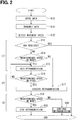
- FIG. 2 shows the communication method of the communication terminal device and a process procedure of a program executed by the communication terminal device.
- the program is implemented as software in any protocol stack of communication protocols, and not necessarily at an application level. In a case of the application level, it may be possible to cover shortcomings of an upper layer while maintaining a communication protocol of the upper layer of a communication method.
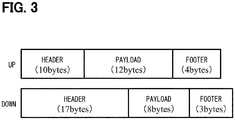
- FIG. 3 An example of a format of data transmitted from the communication terminal device 100 to the base station device 200 will be described with reference to FIG. 3 .
- This example shows a frame configuration of data for an up communication and a down communication of the SIGFOX.
- the data format (that is, up frame) transmitted from the communication portion 102 to the base station device 200 includes a header, a payload, and a footer.
- the header is formed of an area with 10 bytes, and stores data necessary for preamble or synchronization.
- the payload is formed of an area with 12 bytes, and stores data to be transmitted.
- the payload may include a data ID for identifying the data to be transmitted, and a sequence number indicating data transmission order or acquisition-detection order.
- the footer is formed of an area with 4 bytes and stores an authentication code, a checksum, and the like.
- a data format (that is, down from) transmitted from the base station device 200 to the communication portion 102 also includes a header, a payload, and a footer, similarly to the up frame.
- the sequence number is assigned based on a timing when data is first transmitted or acquired and detected.
- the sequence number assigned at the above timing is inherited and transmitted as it is.
- a constant-irregular event that occurs after the retransmission data is preferentially transmitted. Even when the event arrives at the base station device in no particular order, it may be possible to reproduce data in which the transmission order or the acquisition-detection order is reflected.
- the constant-irregular communication executed in synchronization with data detection is executed regardless of the speed at that time.
- the payload stores the sequence numbers assigned in the transmission order from the communication portion 102.
- the sequence numbers may be assigned in the detection order.
- the sequence number may not be stored in the payload, and may be stored in any part of the frame.
- the base station device 200 In the low power wide area (LPWA) wireless communication method, an allowable transmission interval is long. Therefore, when the mechanism of the retransmission of data in the first embodiment is used, there is a possibility that data is not received by the base station device 200 in the detection order of various sensors connected to the communication terminal device 100. Therefore, by assigning the sequence number to the data transmitted from the communication terminal device 100, the base station device 200 that is the transmission destination can organize the data in the detection order of various sensors connected to the communication terminal device 100 or the order of the original transmission from the communication terminal device 100.
- LPWA low power wide area
- the up communication may be determined to be failure and the retransmission may be executed when the response from the base station device 200 has not been received.
- the base station device 200 succeeds in receiving the data and transmits the response to the communication terminal device 100, the communication terminal device 100 may not be able to receive the response. In this case, the base station device 200 receives the same data twice. Therefore, by assigning the sequence number to the data transmitted from the communication terminal device 100, when the base station device 200 that is the transmission destination has received the same data from the communication terminal device 100 multiple times, one of them is not discarded and the others can be discarded.
- the base station device 200 receives data using a data format of FIG. 3 from the communication terminal device 100 described in the first embodiment.
- the payload of the data stores the sequence numbers assigned in the order of transmission form the communication portion 102 of the communication terminal device 100.
- the base station device 200 communicates with the communication terminal device 100 described in the first embodiment by the low power wide area (LPWA) wireless communication method.
- the base station device 200 communicates by using the low power wide area wireless communication system, for example, the SIGFOX developed by the Sigfox company or the LoRa developed by the Semtech company.
- the base station device 200 includes a communication portion 201, a CPU 202, a RAM 203, a gateway (G/W) 204, and an antenna A2.
- the communication portion 201 receives the data transmitted from the communication terminal device 100 via the antenna A2.
- the communication portion 201 transmits the response to the data reception to the communication terminal device 100 via the antenna A2.
- the CPU 202 (corresponding to an "analysis portion") analyzes the data received by the communication portion 201. Specifically, when there is the data having a duplicate sequence number, any one of data is left and the remaining of data is discarded, the left data is saved in the RAM 203 described later. For example, when there are three data having a sequence of 0011, any one of data is left and the remaining of data is discarded, and the left one data is saved in the RAM 203. By rearranging the received data in accordance with the sequence numbers, the data is arranged in the order of the original transmission from the communication terminal device 100, and stored in the RAM 203.
- the RAM 203 (corresponding to a "storage portion") stores the data received by the communication portion 201 via the CPU 202. Although it is assumed that the RAM 203 is a random access memory, the RAM 203 may be a hard disk (HDD), a flash memory, or the like.
- HDD hard disk
- flash memory or the like.
- the gateway (G/W) 204 is connected to a cloud device via a network, and the data stored in the RAM 203 is transferred to the cloud device.
- the base station device 200 In the low power wide area (LPWA) wireless communication method, an allowable transmission interval is long. Therefore, when the mechanism of the retransmission of data in the first embodiment is used, there is a possibility that data is not received by the base station device 200 in the detection order of various sensors connected to the communication terminal device 100. Therefore, by assigning the sequence number to the data transmitted from the communication terminal device 100, the base station device 200 that is the transmission destination can organize the data in the detection order of various sensors connected to the communication terminal device 100 or the order of the original transmission from the communication terminal device 100.
- LPWA low power wide area
- the up communication may be determined to be failure and the retransmission may be executed when the response from the base station device 200 has not been received.
- the base station device 200 succeeds in receiving the data and transmits the response to the communication terminal device 100, the communication terminal device 100 may not be able to receive the response. In this case, the base station device 200 receives the same data multiple times. Therefore, by assigning the sequence number to the data transmitted from the communication terminal device 100, when the base station device 200 that is the transmission destination has received the same data from the communication terminal device 100 multiple times, one of them is not discarded and the others can be discarded.
- the base station device 200 analyzes the received data
- the cloud device connected via the gateway (G/W) 204 may analyze the received data.
- the cloud device indirectly receives the data from the communication terminal device via the base station device 200. That is, the "base station device" of the present disclosure includes a backbone device such as the cloud device connected to the base station device, in addition to a narrowly defined base station device that directly communicates with the communication terminal device.
- the communication portion 201 receives the data transmitted from the communication terminal device 100 (S21).
- the CPU 202 determines whether there is data having the duplicate sequence number for each data received in S21 (S22). When there is no data having the duplicate sequence number, the data is stored in the RAM 203 (S24). When there is the data having the duplicate sequence number, any one of data is left and the remaining is discarded (S23), and the left data is saved in the RAM 203 (S24).
- the communication portion 201 transmits the response (ACK) to the data reception to the communication terminal device 100 (S25).
- FIG. 5 shows the communication method of the base station device and a process procedure of a program executed by the base station device.
- the program is implemented as software in any protocol stack of communication protocols, and not necessarily at an application level.
- the application level it may be possible to cover shortcomings of an upper layer while maintaining a communication protocol of the upper layer of a communication method.
- the subsequent response may not be transmitted (S25).
- the block diagram used in the description of each embodiment is a diagram in which the configurations of the communication terminal device and the base station device are classified and organized by function. These functional blocks may be provided by any combination of hardware or software. Further, since the functions are shown, the block diagram can be understood as disclosure of the method and the program that implements the method.
- Order of functional blocks that can be grasped as processing, a sequence, and a method described in relation to each embodiment may be changed unless some restriction is imposed, for example, a result from one step is utilized at another step.
- first and second used in the description of each embodiment and claims are for discriminating two or more configurations and methods of the same kind and do not limit order or superiority or inferiority.
- the communication terminal device of the present disclosure is mounted on the vehicle, that is, the in-vehicle device is described.
- the present disclosure may be applied on the premise that the terminal device of the present disclosure is possessed by the pedestrian.
- Examples of the communication terminal device include, as parts or semi-finished products, a semiconductor, an electronic circuit, a module, or an ECU (electronic control unit). Further, the examples include, as finished products, a drive recorder, a smartphone, a personal computer, a mobile phone, and a mobile information terminal.
- the present disclosure is implemented not only by dedicated hardware having a configuration and a function described in relation to each embodiment.
- the present disclosure can also be implemented as a combination of a program for implementing the present invention, recorded on such a recording medium as memory and a hard disk and general-purpose hardware including dedicated or general-purpose CPU, memory, or the like, capable of executing the program.
- a program may be stored in a non-transitory tangible storage medium including an external storage (for example, hard disk, USB memory, CD/BD), or an internal storage (for example, RAM, ROM) in a special-purpose or general-purpose hardware (for example, computer).
- Such a program may be downloaded to the storage medium in the hardware via a communication link from a server. As a result, it is possible to provide a latest function by updating the program.
- the communication terminal device and the base station device according to the present disclosure are used not only for in-vehicle use but also for the low power wide area (LPWA) wireless communication terminal device in general.
- the communication terminal device of the present disclosure is mounted on a delivered package, thereby the information indicating a delivery situation (for example, position information) of the package or an environment (for example, temperature or humidity) at the time of delivery is transmitted, and the information can be used.
- a delivery situation for example, position information
- an environment for example, temperature or humidity
Landscapes
- Engineering & Computer Science (AREA)
- Computer Networks & Wireless Communication (AREA)
- Signal Processing (AREA)
- Mobile Radio Communication Systems (AREA)
- Telephone Function (AREA)
Abstract
Description
- This application is based on
Japanese Patent Application No. 2018-241639 filed on December 25, 2018 - The present disclosure relates to a mechanism of retransmission when, in mobile communication, particularly, LPWA (Low Power Wide Area) wireless communication between a communication terminal device and a base station device is interrupted during movement.
- In recent years, utilization form borders of conventional smartphones or mobile phones are transcended, all things are connected to a network, and exchange information. As the result, loT (Internet of Things) era has arrived, and generated a new additional value. Many of these things are located out of reach, and have characteristics that needs only a small amount of data for a long period. In response to this request, specifications of eMTC (enhanced Machine Type Communication) advocated by 3GPP (Third Generation Partnership Project), NB-IoT (Narrow Band Internet of Things) optimized for a smaller amount of data communication, SIGFOX (registered trademark) developed by Sigfox company, LoRa (registered trademark) developed by Semitech company, and the like are established.
- On the other hand, in a mobile wireless communication system mounted on a moving vehicle, the communication is unstable when performing high-speed communication during high-speed movement. In consideration of this, a technology for switching the communication speed in accordance with the speed is proposed (Patent Literature 1).
- Patent Literature 1:
JP H11-98574 A - As a result of detailed studies of the inventor of the present disclosure, it was found that such a communication terminal device for the loT has no mechanism for preventing communication interruption due to frequency doppler shift of carriers that occur during communication with the corresponding mobile body with LTE (Long Term Evolution), in order to provide a wide area communication and reduce an electric power consumption. Further, it was found that the communication terminal device is not always suitable for being mounted on the mobile body. The inventor of the present disclosure found that such a communication terminal device or the like can reliably perform the data communication by devising retransmission performed when the communication is interrupted.
- It is an object of the present disclosure to appropriately perform retransmission by a communication terminal device and a base station device that are mounted on a mobile body and use a low power wide area (LPWA) wireless communication method.
- According to one aspect of the present disclosure, a communication terminal device is mounted on a mobile body and communicates with a base station device by a low power wide area (LPWA) wireless communication method. The communication terminal device includes: a storage portion that stores data to be transmitted; a communication portion that transmits the data to the base station device and receives a response to transmission of the data from the base station device; a speed sensor that detects a movement speed of the mobile body; and a retransmission controller that controls retransmission of the data to the base station device. The retransmission controller holds the retransmission of the data based on the movement speed when the communication portion does not receive the response.
- According to another aspect of the present disclosure, a base station device receives data from a communication terminal device that is mounted on a mobile body and communicates by a low power wide area (LPWA) wireless communication method. The communication terminal device includes a storage portion that stores data to be transmitted, a communication portion that transmits the data to the base station device and receives a response to transmission of the data from the base station device, a speed sensor that detects a movement speed of the mobile body, and a retransmission controller that controls retransmission of the data to the base station device and hold the retransmission of the data based on the movement speed when the communication portion does not receive the response. The data includes a sequence number assigned in an order of transmission from the communication portion or an order of acquisition from the communication terminal device. The base station device includes a communication portion that receives the data and transmits the response to reception of the data to the communication terminal device, an analysis portion that analyzes the data, and a storage portion that stores the data. When there is multiple data having a duplicate sequence number, the analysis portion leaves any one of data, discards a remaining of data, stores left data in the storage portion.
- According to another aspect of the present disclosure, a communication method is a communication method of a communication terminal device that is mounted on a mobile body and communicates with a base station device by a low power wide area (LPWA) wireless communication method. The communication method stores data to be transmitted, transmits the data to the base station device, detects a movement speed of the mobile body, and holds retransmission of the data based on the movement speed when a response to transmission of the data is not received from the base station device.
- According to another aspect of the present disclosure, a communication control program is a communication control program executed by a communication terminal device that is mounted on a mobile body and communicates with a base station device by a low power wide area (LPWA) wireless communication method. The communication control program stores data to be transmitted, transmits the data to the base station device, detects a movement speed of the mobile body, and holds retransmission of the data based on the movement speed when a response to transmission of the data is not received from the base station device.
- The communication terminal device, the base station device, the communication method, the communication control program does not perform the retransmission that may be wasted when the movement speed of the mobile body increases. Thereby, it may be possible to reduce the power consumption of the communication terminal device.
-
-
FIG. 1 is a block diagram illustrating communication of a communication terminal device according to a first embodiment; -
FIG. 2 is a flowchart illustrating a flowchart of operation of the communication terminal device according to the first embodiment; -
FIG. 3 is an explanatory diagram illustrating a format of data transmitted by the communication terminal device according to the first embodiment; -
FIG. 4 is a block diagram illustrating a configuration of a base station device according to a second embodiment; and -
FIG. 5 is a flowchart illustrating an operation of the base station device according to the second embodiment. - Hereinafter, embodiments of the present disclosure will be described with reference to the drawings.
- The present disclosure described below means the disclosure described in the claims, and is not limited to the following embodiments. Further, at least words within the double quotation mean words and phrases described in claims, and are not limited to the following embodiments.
- Configurations and methods described in dependent claims of claims, configurations and methods of the following embodiments corresponding to the configurations and the methods described in the dependent claims, and the configurations and the methods described only in the following embodiments without descriptions in claims should be interpreted as arbitrary configurations and arbitrary methods in this disclosure. In a case where the scope of claims is broader than descriptions of the embodiments, configurations and methods described in the following embodiments are just examples of configurations and methods of the present disclosure, which should be interpreted as arbitrary configurations and arbitrary methods in this disclosure. In any cases, essential configurations and methods of this disclosure should be interpreted based on independent claims.
- Any effects described in the embodiments are effects obtained by configurations of the embodiments as an example of this disclosure, and are not necessarily effects of this disclosure.
- In the present disclosure, the configuration disclosed in each embodiment is not limited to each embodiment alone, but may be combined across the embodiments. For example, the configuration disclosed in one embodiment may be combined with another embodiment. Further, the disclosed configurations may be collected and combined in each of the plurality of embodiments.
- Findings or difficulties described in this disclosure are not publicly known, but person including the inventor has independently found out, and is a fact that affirms the inventive step of the invention together with the configuration and method of the present disclosure.
- First, a
communication terminal device 100 of a first embodiment will be described with reference toFIG. 1 . In the following embodiments, an in-vehicle communication terminal device mainly mounted on an automobile will be described as an example. However, the present disclosure includes a communication terminal device other than the in-vehicle communication terminal device unless the claims are limited. - The
communication terminal device 100 is mounted on a "mobile body" such as an automobile, and communicates with abase station device 200 described in a second embodiment by a "low power wide area (LPWA) wireless communication method". For example, thecommunication terminal device 100 performs communication using, for example, SIGFOX developed by the Sigfox company or LoRa developed by the Semtech company. These communication methods have a characteristic that starts communication based on an up communication from the communication terminal device to the base station device. Thecommunication terminal device 100 includes aRAM 101, acommunication portion 102, aspeed sensor 103, aCPU 104, an external I/F 105, apower source 106, and an antenna A1. Here, the "mobile body" of the present disclosure is a movable body. and the movement speed is not limited. The mobile body may stop. For example, the mobile body includes automobiles, motorcycles, pedestrians, ships, and aircrafts, and is not limited to these. The "low power wide area (LPWA) wireless communication method" of the present disclosure is a general term for wide area wireless communication systems having low power consumption and a communication distance similar to that of a mobile phone, and the system is not limited. - The RAM 101 (corresponding to a "storage portion") stores data via the
CPU 104. The data is acquired from various sensors connected to the external interface (I/F) 105, and is data to be transmitted. The various sensors may not be connected to the external I/F 105, and may be built in thecommunication terminal device 100. Examples of various sensors may include, in addition to thermometers, hygrometers, sunshine meters, GPS, and the like, a sensor that is mounted on an automobile and is connected to a driving type electronic control unit that controls an engine, a steering wheel, a brake, or the like, a vehicle body type electronic control unit that controls a meter, a power window, or the like, and a safety control type electronic control unit that performs control for preventing collision with an obstacle or a pedestrian. Although it is assumed that theRAM 101 is a random access memory, theRAM 101 may be a hard disk (HDD), a flash memory, or the like. In this case, when the power source is turned off, data is not deleted, and can be stored. - The
communication portion 102 transmits data read via theCPU 104 from the antenna A1 to thebase station device 200 Thecommunication portion 102 receives a response, from thebase station device 200, to the transmission of the data from thecommunication terminal device 100. - The
speed sensor 103 detects a "movement speed" of the automobile mounted on thecommunication terminal device 100. The speed sensor is devices using, for example, a global positioning system (GPS) or an untethered dead reckoning (UDR). These devices do not need to be connected to the automobile, and therefore installation work by a specialized business operator is unnecessary. Thecommunication terminal device 100 can be implemented as, for example, a device mounted on a dashboard. Of course, thespeed sensor 103 may be a sensor connected to an axle of the automobile. Alternatively, an accelerometer may be used. Thespeed sensor 103 detects the movement speed periodically or based on a trigger input from the outside. In an example of the former, thespeed sensor 103 detects the movement speed every 100 ms, for example. In an example of the latter, the trigger is a trigger when thecommunication portion 102 transmits the data, when thecommunication portion 102 determines that the retransmission of the data is performed or hold, or when it is determined that thereception portion 102 does not receive the response from thebase station device 200. Here, "the movement speed" of the present disclosure includes not only the data indicating the speed but also data indirectly indicating a speed such as a movement distance in a certain time. - The
power source 106 supplies the power source to each portion of thecommunication terminal device 100. The power source may be, for example, directly supplied from a cigarette socket, and a primary battery or a secondary battery may be used. By using the battery, thecommunication terminal device 100 can be mounted on the dashboard of the automobile without a cable or the like for power source supply, and installation work becomes easy. - The CPU 104 (corresponding to a "retransmission controller") controls the external I/
F 105, theRAM 101, and thecommunication portion 102 as described above, and further controls the retransmission of data transmitted from thecommunication portion 102 to thebase station device 200. The control content is, for example, hold of the retransmission, execution of the retransmission, and stop of the retransmission. Hereinafter, the content of the retransmission control by the retransmission controller will be described in detail. - The
CPU 104 "holds the retransmission" of the data based on the movement speed detected by thespeed sensor 103 in a case where "thecommunication portion 102 does not receive the response" from thebase station device 200. In a specific example, in a case where thespeed sensor 103 detects the movement speed "equal to or higher than a predetermined speed", when thecommunication portion 102 transmits the data and does not receive the response from thebase station device 200, theCPU 104 holds the retransmission of the data. For example, it is assumed that the SIGFOX is used as the low power wide area wireless communication method and the predetermined speed is set to 40 km/h. When thespeed sensor 103 detects a speed of 60 km/h, thecommunication portion 102 transmits the data. When the response to the transmission of this data from thebase station device 200 is not received within 45 seconds (that is, a sleep time of 20 seconds after the transmission and a reception waiting time of 25 seconds), the retransmission of the data is not performed. - Here, the "predetermined speed" of the present disclosure is not limited to a constant speed, may not be the constant speed, may be determined in accordance with, for example, the amount of rainfall or the like, and may be uniquely determined by calculation or the like.
- The description "equal to or higher than" of the present disclosure includes a case where the reference numerical value is included and a case where the reference numerical value is not included.
- The case where "the
communication portion 102 does not receive the response" in the present disclosure is a case where the response is not received within a period in which the response can be expected, and it is unnecessary immediately after the data is transmitted. - The description of "holds the retransmission" of the present disclosure means that the retransmission is not performed until a present trigger occurs.
- The movement speed increases, and thereby it may be possible to estimate interruption of the up communication from the
communication terminal device 100 to thebase station device 200, that is, failure. Therefore, there is a high possibility that the retransmission of the data fails. Therefore, by holding the retransmission of the data in such a situation, it may be possible to reduce the power consumption. - After the retransmission of the data is hold in (1), the
CPU 104 executes the retransmission of the data when thespeed sensor 103 detects the movement speed "equal to or less than" the predetermined speed. For example, it is assumed that the predetermined speed is set to a speed of 30 km/h. After thespeed sensor 103 detects the speed of 60 km/h, when the speed decreases due to the brake operation and thespeed sensor 103 detects a speed of 30 km/h, thecommunication portion 102 executes the retransmission of the data while maintaining a transmission interval and cycle that are specified by SIGFOX. Here, the description of "equal to or less than" of the present disclosure means not only a case where the reference numerical value is included but also a case where the reference numerical value is not included. - When the response to the retransmission of this data is not received from the
base station device 200 within 45 seconds, further retransmission may be attempted. However, for preventing loads of a communication network from increasing, the retransmission may stop after a predetermined number of retransmissions are attempted. - In the present embodiment, an example in which the predetermined speed (for example, 40 km/h) that is a condition for holding the retransmission is different from the predetermined speed (for example, 30 km/h) that is a condition for executing the retransmission has been described. However, the speed may be changed within a range that the predetermined speed for holding the retransmission is equal to or higher than (≥) the predetermined speed that is the condition for executing the retransmission.
- The movement speed decreases, and thereby it may be possible to estimate that the possibility that the up communication from the
communication terminal device 100 to thebase station device 200 can be executed becomes high. Therefore, there is a high possibility that the retransmission of the data succeeds. Therefore, by retransmitting the data in such a case, it may be possible to reliably transmit the data to the base station device. - When the
speed sensor 103 detects the movement speed equal to or higher than the predetermined speed during the execution of the retransmission of the data, theCPU 104 "stops" the retransmission of the data. For example, it is assumed that predetermined speed is set to a speed of 40 km/h. When the speed increases due to the accelerator operation during the execution of the retransmission of the data in (2) and thespeed sensor 103 detects the speed exceeding 40 km/h, theCPU 104 "stops" the retransmission of the data. Here, the meaning of the description "stop" of the present disclosure may include holding retransmission of the entire data, suspending of the hold of the retransmission of an unsent part of the data, and stopping (in other words, no execution of) the retransmission of the data. - The movement speed increases during the retransmission of the data, and thereby it may be possible to estimate that the possibility that the up communication from the
communication terminal device 100 to thebase station device 200 is interrupted becomes high. Therefore, there is a high possibility that the retransmission of the data fails. Therefore, by stopping the retransmission of the data in such a situation, it may be possible to reduce the power consumption. - In the example of (1) described above, the data retransmission is determined based on the movement speed detected when the
communication portion 102 transmits the data. However, the detection time of the movement speed is not limited to the data transmission time. For example, it may be a time when it is confirmed that the response is not received, or may be a time when the retransmission is executed after it is confirmed that the response is not received. Note that (2) and (3) are arbitrary configurations in the present disclosure. Further, it is not necessary to execute all retransmission control of (1), (2), and (3), and control may be executed alone or in any combination. When the retransmission conflicts with a periodic communication or an irregular communication timing for each separately defined event, the periodic communication or the irregular communication may be prioritized. After these end, the retransmission may start or restart. - Next, the operation of the
communication terminal device 100 of the first embodiment will be described with reference toFIG. 2 . Here, an example of executing retransmission control of all of the (1), (2), and (3) will be described. TheRAM 101 stores the data to be transmitted (S10). Thecommunication portion 102 transmits the data stored in theRAM 101 to the base station device 200 (S11). - The
speed sensor 103 detects the movement speed of the automobile on which thecommunication terminal device 100 is mounted (S12). - The
communication portion 102 determines whether to receive the response (ACK) to the transmission of the data in S11 from the base station device 200 (S13). When the response is received, the data transmission is determined to be successful, and the process ends. When the response is not received, the process shifts to S14. TheCPU 104 determines whether thespeed sensor 103 detects the movement speed equal to or higher than the predetermined speed at the time of data transmission in S11 (S14). When the movement speed equal to or higher than the predetermined speed is not detected, theCPU 104 executes the retransmission of the data (S17). When the movement speed equal to or higher than the predetermined speed is detected, theCPU 104 holds the retransmission of the data (S15). - The
CPU 104 determines whether thespeed sensor 103 has detected the movement speed equal to or lower than the predetermined speed (S16). When the movement speed equal to or lower than the predetermined speed has not been detected, theCPU 104 continuously holds the retransmission (S15). When the movement speed equal to or higher than the predetermined speed has been detected, theCPU 104 executes the retransmission of the data (S17). - The
CPU 104 determines whether thespeed sensor 103 has detected the movement speed equal to or higher than the predetermined speed during the retransmission of the data (S18). When the movement speed equal to higher than the predetermined speed has not been detected, theCPU 104 continues the retransmission (S19). When the speed equal to or higher than the predetermined speed has been detected, theCPU 104 stops the retransmission of the data (S20). - In the flow of
FIG. 2 , when a process or determination in the latter stage does not presuppose a process or determination in the first stage, the order can be changed. In the above description of the operation, the determination in S14 is performed based on the movement speed when the data is transmitted from thecommunication portion 102. However, alternatively, a movement speed at the time of the determination in S14, that is, the determination of whether the retransmission of the data is executed or hold may be used. In S16, the determination is executed based on the movement speed immediately before the retransmission is executed, and, in S20, the determination is executed immediately before the retransmission is stopped. However, it may have a certain range as long as it does not deviate from the purpose of using the movement speed also in S14. That is, S12 represents execution of the detection of the movement speed itself. A case where the movement speed is periodically detected is also included. A position on the flow in consideration of the detection timing can be appropriately changed. For example, it is conceivable that the movement speed is detected at at least one of a position before S13, a position between S13 and S14, a position between S15 and S16, or a position between S17 and S18. -
FIG. 2 shows the communication method of the communication terminal device and a process procedure of a program executed by the communication terminal device. The program is implemented as software in any protocol stack of communication protocols, and not necessarily at an application level. In a case of the application level, it may be possible to cover shortcomings of an upper layer while maintaining a communication protocol of the upper layer of a communication method. - An example of a format of data transmitted from the
communication terminal device 100 to thebase station device 200 will be described with reference toFIG. 3 . This example shows a frame configuration of data for an up communication and a down communication of the SIGFOX. - The data format (that is, up frame) transmitted from the
communication portion 102 to thebase station device 200 includes a header, a payload, and a footer. The header is formed of an area with 10 bytes, and stores data necessary for preamble or synchronization. The payload is formed of an area with 12 bytes, and stores data to be transmitted. The payload may include a data ID for identifying the data to be transmitted, and a sequence number indicating data transmission order or acquisition-detection order. The footer is formed of an area with 4 bytes and stores an authentication code, a checksum, and the like. A data format (that is, down from) transmitted from thebase station device 200 to thecommunication portion 102 also includes a header, a payload, and a footer, similarly to the up frame. - The sequence number is assigned based on a timing when data is first transmitted or acquired and detected. In a case where the response (ACK) cannot be received and it is determined that the response is interrupted, that is, in a case of retransmission, the sequence number assigned at the above timing is inherited and transmitted as it is. Thereby, a constant-irregular event that occurs after the retransmission data is preferentially transmitted. Even when the event arrives at the base station device in no particular order, it may be possible to reproduce data in which the transmission order or the acquisition-detection order is reflected. The constant-irregular communication executed in synchronization with data detection is executed regardless of the speed at that time.
- In the present embodiment, the payload stores the sequence numbers assigned in the transmission order from the
communication portion 102. However, it is not limited to this. The sequence numbers may be assigned in the detection order. The sequence number may not be stored in the payload, and may be stored in any part of the frame. - In the low power wide area (LPWA) wireless communication method, an allowable transmission interval is long. Therefore, when the mechanism of the retransmission of data in the first embodiment is used, there is a possibility that data is not received by the
base station device 200 in the detection order of various sensors connected to thecommunication terminal device 100. Therefore, by assigning the sequence number to the data transmitted from thecommunication terminal device 100, thebase station device 200 that is the transmission destination can organize the data in the detection order of various sensors connected to thecommunication terminal device 100 or the order of the original transmission from thecommunication terminal device 100. - In the case where the mechanism of the retransmission of the data in the first embodiment is used, the up communication may be determined to be failure and the retransmission may be executed when the response from the
base station device 200 has not been received. However, even though thebase station device 200 succeeds in receiving the data and transmits the response to thecommunication terminal device 100, thecommunication terminal device 100 may not be able to receive the response. In this case, thebase station device 200 receives the same data twice. Therefore, by assigning the sequence number to the data transmitted from thecommunication terminal device 100, when thebase station device 200 that is the transmission destination has received the same data from thecommunication terminal device 100 multiple times, one of them is not discarded and the others can be discarded. - A configuration of the
base station device 200 of a second embodiment will be described with reference toFIG. 4 . Thebase station device 200 receives data using a data format ofFIG. 3 from thecommunication terminal device 100 described in the first embodiment. The payload of the data stores the sequence numbers assigned in the order of transmission form thecommunication portion 102 of thecommunication terminal device 100. - The
base station device 200 communicates with thecommunication terminal device 100 described in the first embodiment by the low power wide area (LPWA) wireless communication method. For example, thebase station device 200 communicates by using the low power wide area wireless communication system, for example, the SIGFOX developed by the Sigfox company or the LoRa developed by the Semtech company. Thebase station device 200 includes acommunication portion 201, aCPU 202, aRAM 203, a gateway (G/W) 204, and an antenna A2. - The
communication portion 201 receives the data transmitted from thecommunication terminal device 100 via the antenna A2. Thecommunication portion 201 transmits the response to the data reception to thecommunication terminal device 100 via the antenna A2. - The CPU 202 (corresponding to an "analysis portion") analyzes the data received by the
communication portion 201. Specifically, when there is the data having a duplicate sequence number, any one of data is left and the remaining of data is discarded, the left data is saved in theRAM 203 described later. For example, when there are three data having a sequence of 0011, any one of data is left and the remaining of data is discarded, and the left one data is saved in theRAM 203. By rearranging the received data in accordance with the sequence numbers, the data is arranged in the order of the original transmission from thecommunication terminal device 100, and stored in theRAM 203. - The RAM 203 (corresponding to a "storage portion") stores the data received by the
communication portion 201 via theCPU 202. Although it is assumed that theRAM 203 is a random access memory, theRAM 203 may be a hard disk (HDD), a flash memory, or the like. - The gateway (G/W) 204 is connected to a cloud device via a network, and the data stored in the
RAM 203 is transferred to the cloud device. - In the low power wide area (LPWA) wireless communication method, an allowable transmission interval is long. Therefore, when the mechanism of the retransmission of data in the first embodiment is used, there is a possibility that data is not received by the
base station device 200 in the detection order of various sensors connected to thecommunication terminal device 100. Therefore, by assigning the sequence number to the data transmitted from thecommunication terminal device 100, thebase station device 200 that is the transmission destination can organize the data in the detection order of various sensors connected to thecommunication terminal device 100 or the order of the original transmission from thecommunication terminal device 100. - In the case where the mechanism of the retransmission of the data in the first embodiment is used, the up communication may be determined to be failure and the retransmission may be executed when the response from the
base station device 200 has not been received. However, even though thebase station device 200 succeeds in receiving the data and transmits the response to thecommunication terminal device 100, thecommunication terminal device 100 may not be able to receive the response. In this case, thebase station device 200 receives the same data multiple times. Therefore, by assigning the sequence number to the data transmitted from thecommunication terminal device 100, when thebase station device 200 that is the transmission destination has received the same data from thecommunication terminal device 100 multiple times, one of them is not discarded and the others can be discarded. - In the present embodiment, although the
base station device 200 analyzes the received data, the cloud device connected via the gateway (G/W) 204 may analyze the received data. In this case, the cloud device indirectly receives the data from the communication terminal device via thebase station device 200. That is, the "base station device" of the present disclosure includes a backbone device such as the cloud device connected to the base station device, in addition to a narrowly defined base station device that directly communicates with the communication terminal device. - Next, the operation of the
base station device 200 of the second embodiment will be described with reference toFIG. 5 . Thecommunication portion 201 receives the data transmitted from the communication terminal device 100 (S21). TheCPU 202 determines whether there is data having the duplicate sequence number for each data received in S21 (S22). When there is no data having the duplicate sequence number, the data is stored in the RAM 203 (S24). When there is the data having the duplicate sequence number, any one of data is left and the remaining is discarded (S23), and the left data is saved in the RAM 203 (S24). Thecommunication portion 201 transmits the response (ACK) to the data reception to the communication terminal device 100 (S25). - In the flow of
FIG. 5 , when a process or determination in the latter stage does not presuppose a process or determination in the first stage, the order can be changed. Further, S23 and S24 are interchanged, and any one of data can be saved and the remaining of data can be discarded. -
FIG. 5 shows the communication method of the base station device and a process procedure of a program executed by the base station device. The program is implemented as software in any protocol stack of communication protocols, and not necessarily at an application level. In a case of the application level, it may be possible to cover shortcomings of an upper layer while maintaining a communication protocol of the upper layer of a communication method. In the case of a mechanism, in the first embodiment, that stops the retransmission after attempting the retransmission a predetermined number of times, the subsequent response may not be transmitted (S25). - The features of the communication terminal device and the base station device according to the embodiments of the present disclosure have been described above.
- Terms used in the description of each embodiment are examples and may be replaced with synonymous terms or terms having a synonymous function.
- The block diagram used in the description of each embodiment is a diagram in which the configurations of the communication terminal device and the base station device are classified and organized by function. These functional blocks may be provided by any combination of hardware or software. Further, since the functions are shown, the block diagram can be understood as disclosure of the method and the program that implements the method.
- Order of functional blocks that can be grasped as processing, a sequence, and a method described in relation to each embodiment may be changed unless some restriction is imposed, for example, a result from one step is utilized at another step.
- The terms of "first" and "second" used in the description of each embodiment and claims are for discriminating two or more configurations and methods of the same kind and do not limit order or superiority or inferiority.
- In the embodiments described above, it is described that the communication terminal device of the present disclosure is mounted on the vehicle, that is, the in-vehicle device is described. However, the present disclosure may be applied on the premise that the terminal device of the present disclosure is possessed by the pedestrian.
- Examples of the communication terminal device include, as parts or semi-finished products, a semiconductor, an electronic circuit, a module, or an ECU (electronic control unit). Further, the examples include, as finished products, a drive recorder, a smartphone, a personal computer, a mobile phone, and a mobile information terminal.
- The present disclosure is implemented not only by dedicated hardware having a configuration and a function described in relation to each embodiment. The present disclosure can also be implemented as a combination of a program for implementing the present invention, recorded on such a recording medium as memory and a hard disk and general-purpose hardware including dedicated or general-purpose CPU, memory, or the like, capable of executing the program.
- A program may be stored in a non-transitory tangible storage medium including an external storage (for example, hard disk, USB memory, CD/BD), or an internal storage (for example, RAM, ROM) in a special-purpose or general-purpose hardware (for example, computer). Such a program may be downloaded to the storage medium in the hardware via a communication link from a server. As a result, it is possible to provide a latest function by updating the program.
- The communication terminal device and the base station device according to the present disclosure are used not only for in-vehicle use but also for the low power wide area (LPWA) wireless communication terminal device in general. For example, the communication terminal device of the present disclosure is mounted on a delivered package, thereby the information indicating a delivery situation (for example, position information) of the package or an environment (for example, temperature or humidity) at the time of delivery is transmitted, and the information can be used.
Claims (11)
- A communication terminal device (100) that is mounted on a mobile body and communicates with a base station device by a low power wide area (LPWA) wireless communication method, the communication terminal device comprising:a storage portion (101) configured to store data to be transmitted;a communication portion (102) configured totransmit the data to the base station device andreceive a response to transmission of the data from the base station device;a speed sensor (103) configured to detect a movement speed of the mobile body; anda retransmission controller (104) configured to control retransmission of the data to the base station device,wherein:
the retransmission controller holds the retransmission of the data based on the movement speed when the communication portion does not receive the response. - The communication terminal device according to claim 1, wherein:
the speed sensor detects the movement speed when the retransmission controller determines whether to execute or hold the retransmission of the data. - The communication terminal device according to claim 1, wherein:
the speed sensor is configured to detect the movement speed when the communication portion transmits the data. - The communication terminal device according to claim 1, wherein:
the retransmission controller holds the retransmission of the data when the speed sensor detects the movement speed equal to or higher than a predetermined speed. - The communication terminal device according to claim 1, wherein:
the retransmission controller executes the retransmission of the data when the speed sensor detects the movement speed equal to or less than a predetermined speed. - The communication terminal device according to claim 5, wherein:
the retransmission controller stops the retransmission of the data when the speed sensor detects the movement speed equal to or higher than the predetermined speed during the transmission of the data. - The communication terminal device according to claim 1, wherein:
the speed sensor uses a global positioning system (GPS) or an untethered dead reckoning. - The communication terminal device according to claim 1, wherein:
the data includes a sequence number assigned in an order of transmission from the communication portion or an order of acquisition by the communication terminal device. - A base station device (200) that receives data from a communication terminal device that is mounted on a mobile body and communicates by a low power wide area wireless communication method, wherein:the communication terminal device includesa storage portion (101) configured to store data to be transmitted,a communication portion (102) configured totransmit the data to the base station device andreceive a response to transmission of the data from the base station device, a speed sensor (103) configured to detect a movement speed of the mobile body, anda retransmission controller (104) configured to control retransmission of the data to the base station device and hold the retransmission of the data based on the movement speed when the communication portion does not receive the response;the data includes a sequence number assigned in an order of transmission from the communication portion or an order of acquisition from the communication terminal device;the base station device includesa communication portion (201) configured to receive the data and transmit the response to reception of the data to the communication terminal device,an analysis portion (202) configured to analyze the data, anda storage portion (203) configured to store the data; andwhen there is a plurality of data having a duplicate sequence number, the analysis portion leaves any one of data, discards a remaining of data, stores left data in the storage portion.
- A communication method of a communication terminal device (100) that is mounted on a mobile body and communicates with a base station device by a low power wide area (LPWA) wireless communication method, the communication method comprising:storing data to be transmitted (310);transmitting the data to the base station device (311);detecting a movement speed of the mobile body (312); andholding retransmission of the data based on the movement speed when a response to transmission of the data is not received from the base station device (313, 314, 315).
- A communication control program executed by a communication terminal device (100) that is mounted on a mobile body and communicates with a base station device by a low power wide area (LPWA) wireless communication method, the communication control program configured to:store data to be transmitted (310);transmit the data to the base station device (311),detect a movement speed of the mobile body (312), andhold retransmission of the data based on the movement speed when a response to transmission of the data is not received from the base station device (313, 314, 315).
Applications Claiming Priority (2)
| Application Number | Priority Date | Filing Date | Title |
|---|---|---|---|
| JP2018241639A JP2020102826A (en) | 2018-12-25 | 2018-12-25 | Communication terminal device and base station device |
| PCT/JP2019/040610 WO2020137100A1 (en) | 2018-12-25 | 2019-10-16 | Communication terminal device and base station device |
Publications (2)
| Publication Number | Publication Date |
|---|---|
| EP3905769A1 true EP3905769A1 (en) | 2021-11-03 |
| EP3905769A4 EP3905769A4 (en) | 2022-03-02 |
Family
ID=71126401
Family Applications (1)
| Application Number | Title | Priority Date | Filing Date |
|---|---|---|---|
| EP19903668.2A Withdrawn EP3905769A4 (en) | 2018-12-25 | 2019-10-16 | Communication terminal device and base station device |
Country Status (5)
| Country | Link |
|---|---|
| EP (1) | EP3905769A4 (en) |
| JP (1) | JP2020102826A (en) |
| KR (1) | KR20210091315A (en) |
| CN (1) | CN113228733A (en) |
| WO (1) | WO2020137100A1 (en) |
Families Citing this family (1)
| Publication number | Priority date | Publication date | Assignee | Title |
|---|---|---|---|---|
| JP7657000B2 (en) | 2020-09-04 | 2025-04-04 | 株式会社 ミックウェア | REMOTE SYSTEM, COMMUNICATION TERMINAL DEVICE, RETRANSMISSION CONTROL METHOD, AND PROGRAM |
Family Cites Families (12)
| Publication number | Priority date | Publication date | Assignee | Title |
|---|---|---|---|---|
| JPH1198574A (en) | 1997-09-24 | 1999-04-09 | Toyota Motor Corp | Mobile radio communication system and radio communication mobile station used in the system |
| JP3354455B2 (en) * | 1997-09-24 | 2002-12-09 | 株式会社エヌ・ティ・ティ・ドコモ | Control method of mobile phone with moving speed detection function |
| JP2006086879A (en) * | 2004-09-16 | 2006-03-30 | Fujitsu Ten Ltd | Data communication unit |
| WO2009145315A1 (en) * | 2008-05-29 | 2009-12-03 | 京セラ株式会社 | Radio communication device and radio communication method |
| US9532294B2 (en) * | 2012-06-27 | 2016-12-27 | Kyocera Corporation | Mobile communication system, transmission-side terminal, mobile communication method and processor |
| JP6106907B2 (en) * | 2012-09-11 | 2017-04-05 | パナソニックIpマネジメント株式会社 | Wireless communication system |
| GB2507529A (en) * | 2012-11-02 | 2014-05-07 | Sony Corp | Telecommunications apparatus and methods |
| CN104828112B (en) * | 2015-04-08 | 2017-01-25 | 北京世纪东方国铁科技股份有限公司 | On-board signal relaying device for train and method |
| US10644848B2 (en) * | 2015-08-13 | 2020-05-05 | Electronics And Telecommunications Research Institute | Operation method of communication node supporting direct communication in network |
| WO2017222432A1 (en) * | 2016-06-22 | 2017-12-28 | Telefonaktiebolaget Lm Ericsson (Publ) | Methods and arrangements relating to retransmissions of data in a wireless communication network |
| JP6782148B2 (en) * | 2016-10-21 | 2020-11-11 | 株式会社日立製作所 | Communication terminal |
| CN106954276B (en) * | 2017-03-07 | 2021-07-09 | 上海华为技术有限公司 | Method, device and system for retransmission scheduling |
-
2018
- 2018-12-25 JP JP2018241639A patent/JP2020102826A/en not_active Ceased
-
2019
- 2019-10-16 EP EP19903668.2A patent/EP3905769A4/en not_active Withdrawn
- 2019-10-16 WO PCT/JP2019/040610 patent/WO2020137100A1/en not_active Ceased
- 2019-10-16 CN CN201980085758.0A patent/CN113228733A/en active Pending
- 2019-10-16 KR KR1020217019307A patent/KR20210091315A/en not_active Withdrawn
Also Published As
| Publication number | Publication date |
|---|---|
| EP3905769A4 (en) | 2022-03-02 |
| WO2020137100A1 (en) | 2020-07-02 |
| CN113228733A (en) | 2021-08-06 |
| KR20210091315A (en) | 2021-07-21 |
| JP2020102826A (en) | 2020-07-02 |
Similar Documents
| Publication | Publication Date | Title |
|---|---|---|
| CN103563407B (en) | System for providing voice communication | |
| CN110191439B (en) | Vehicle data transmission system and method | |
| US20150172956A1 (en) | Apparatus and method for avoiding message collision between v2v communication | |
| US11627612B2 (en) | Method and apparatus for efficient vehicle data reporting | |
| CA3079969A1 (en) | Network computer system to evaluate an operator of a freight vehicle | |
| EP3099043B1 (en) | Method and system for bluetooth-based transfer of contact list information | |
| WO2017140201A1 (en) | Accident processing method and corresponding device | |
| EP3905769A1 (en) | Communication terminal device and base station device | |
| US11641571B2 (en) | Communication device, communication method, non-transitory computer-readable storage medium storing communication program, and vehicle | |
| WO2022001665A1 (en) | Communication method for vehicle-mounted device, vehicle-mounted device, storage medium, and electronic apparatus | |
| JP7167726B2 (en) | Communication terminal equipment and base station equipment | |
| JP2021141507A (en) | Abnormality detection device | |
| US20220015031A1 (en) | Information collection terminal device, information collection method, and non-transitory computer-readable storage medium | |
| KR20160056122A (en) | A method for performing emergency rescue service using telematics | |
| JP2011234209A (en) | Transmission control program, and radio communication equipment | |
| CN106063301B (en) | Method and system for determining the number of vehicle-to-X messages to discard | |
| CN105472113A (en) | Driving mode starting system and method | |
| CN113596767A (en) | Method and system for reducing battery consumption of smart phone when accessing vehicle using virtual key | |
| JP2021168454A (en) | Vehicle control device, vehicle, vehicle control program, and vehicle control method | |
| JP7111077B2 (en) | Communication equipment and communication control equipment | |
| US20210286807A1 (en) | Gateway device and non-transitory computer-readable medium | |
| JP2020120259A (en) | Communication terminal device and base station device | |
| US12515598B2 (en) | Electronic control unit, electronic control system, log processing method, and non-transitory computer-readable storage medium storing log processing program | |
| JP2021163121A (en) | Data collection device | |
| JP7765872B2 (en) | Log management device and log management analysis system |
Legal Events
| Date | Code | Title | Description |
|---|---|---|---|
| STAA | Information on the status of an ep patent application or granted ep patent |
Free format text: STATUS: THE INTERNATIONAL PUBLICATION HAS BEEN MADE |
|
| PUAI | Public reference made under article 153(3) epc to a published international application that has entered the european phase |
Free format text: ORIGINAL CODE: 0009012 |
|
| STAA | Information on the status of an ep patent application or granted ep patent |
Free format text: STATUS: REQUEST FOR EXAMINATION WAS MADE |
|
| 17P | Request for examination filed |
Effective date: 20210622 |
|
| AK | Designated contracting states |
Kind code of ref document: A1 Designated state(s): AL AT BE BG CH CY CZ DE DK EE ES FI FR GB GR HR HU IE IS IT LI LT LU LV MC MK MT NL NO PL PT RO RS SE SI SK SM TR |
|
| STAA | Information on the status of an ep patent application or granted ep patent |
Free format text: STATUS: EXAMINATION IS IN PROGRESS |
|
| A4 | Supplementary search report drawn up and despatched |
Effective date: 20220131 |
|
| RIC1 | Information provided on ipc code assigned before grant |
Ipc: H04L 1/16 20060101ALI20220125BHEP Ipc: H04L 1/18 20060101ALI20220125BHEP Ipc: H04W 4/44 20180101ALI20220125BHEP Ipc: H04M 1/00 20060101ALI20220125BHEP Ipc: H04W 28/04 20090101AFI20220125BHEP |
|
| 17Q | First examination report despatched |
Effective date: 20220211 |
|
| DAV | Request for validation of the european patent (deleted) | ||
| DAX | Request for extension of the european patent (deleted) | ||
| STAA | Information on the status of an ep patent application or granted ep patent |
Free format text: STATUS: THE APPLICATION IS DEEMED TO BE WITHDRAWN |
|
| 18D | Application deemed to be withdrawn |
Effective date: 20240501 |