EP3904455A1 - Thermoplastic resin composition and molded article therefrom - Google Patents
Thermoplastic resin composition and molded article therefrom Download PDFInfo
- Publication number
- EP3904455A1 EP3904455A1 EP19901687.4A EP19901687A EP3904455A1 EP 3904455 A1 EP3904455 A1 EP 3904455A1 EP 19901687 A EP19901687 A EP 19901687A EP 3904455 A1 EP3904455 A1 EP 3904455A1
- Authority
- EP
- European Patent Office
- Prior art keywords
- thermoplastic resin
- resin composition
- weight
- composition according
- parts
- Prior art date
- Legal status (The legal status is an assumption and is not a legal conclusion. Google has not performed a legal analysis and makes no representation as to the accuracy of the status listed.)
- Withdrawn
Links
Classifications
-
- C—CHEMISTRY; METALLURGY
- C08—ORGANIC MACROMOLECULAR COMPOUNDS; THEIR PREPARATION OR CHEMICAL WORKING-UP; COMPOSITIONS BASED THEREON
- C08L—COMPOSITIONS OF MACROMOLECULAR COMPOUNDS
- C08L69/00—Compositions of polycarbonates; Compositions of derivatives of polycarbonates
-
- C—CHEMISTRY; METALLURGY
- C08—ORGANIC MACROMOLECULAR COMPOUNDS; THEIR PREPARATION OR CHEMICAL WORKING-UP; COMPOSITIONS BASED THEREON
- C08L—COMPOSITIONS OF MACROMOLECULAR COMPOUNDS
- C08L25/00—Compositions of, homopolymers or copolymers of compounds having one or more unsaturated aliphatic radicals, each having only one carbon-to-carbon double bond, and at least one being terminated by an aromatic carbocyclic ring; Compositions of derivatives of such polymers
- C08L25/02—Homopolymers or copolymers of hydrocarbons
- C08L25/04—Homopolymers or copolymers of styrene
- C08L25/08—Copolymers of styrene
- C08L25/10—Copolymers of styrene with conjugated dienes
-
- C—CHEMISTRY; METALLURGY
- C08—ORGANIC MACROMOLECULAR COMPOUNDS; THEIR PREPARATION OR CHEMICAL WORKING-UP; COMPOSITIONS BASED THEREON
- C08F—MACROMOLECULAR COMPOUNDS OBTAINED BY REACTIONS ONLY INVOLVING CARBON-TO-CARBON UNSATURATED BONDS
- C08F279/00—Macromolecular compounds obtained by polymerising monomers on to polymers of monomers having two or more carbon-to-carbon double bonds as defined in group C08F36/00
- C08F279/02—Macromolecular compounds obtained by polymerising monomers on to polymers of monomers having two or more carbon-to-carbon double bonds as defined in group C08F36/00 on to polymers of conjugated dienes
- C08F279/04—Vinyl aromatic monomers and nitriles as the only monomers
-
- C—CHEMISTRY; METALLURGY
- C08—ORGANIC MACROMOLECULAR COMPOUNDS; THEIR PREPARATION OR CHEMICAL WORKING-UP; COMPOSITIONS BASED THEREON
- C08F—MACROMOLECULAR COMPOUNDS OBTAINED BY REACTIONS ONLY INVOLVING CARBON-TO-CARBON UNSATURATED BONDS
- C08F279/00—Macromolecular compounds obtained by polymerising monomers on to polymers of monomers having two or more carbon-to-carbon double bonds as defined in group C08F36/00
- C08F279/02—Macromolecular compounds obtained by polymerising monomers on to polymers of monomers having two or more carbon-to-carbon double bonds as defined in group C08F36/00 on to polymers of conjugated dienes
-
- C—CHEMISTRY; METALLURGY
- C08—ORGANIC MACROMOLECULAR COMPOUNDS; THEIR PREPARATION OR CHEMICAL WORKING-UP; COMPOSITIONS BASED THEREON
- C08F—MACROMOLECULAR COMPOUNDS OBTAINED BY REACTIONS ONLY INVOLVING CARBON-TO-CARBON UNSATURATED BONDS
- C08F285/00—Macromolecular compounds obtained by polymerising monomers on to preformed graft polymers
-
- C—CHEMISTRY; METALLURGY
- C08—ORGANIC MACROMOLECULAR COMPOUNDS; THEIR PREPARATION OR CHEMICAL WORKING-UP; COMPOSITIONS BASED THEREON
- C08G—MACROMOLECULAR COMPOUNDS OBTAINED OTHERWISE THAN BY REACTIONS ONLY INVOLVING UNSATURATED CARBON-TO-CARBON BONDS
- C08G63/00—Macromolecular compounds obtained by reactions forming a carboxylic ester link in the main chain of the macromolecule
- C08G63/02—Polyesters derived from hydroxycarboxylic acids or from polycarboxylic acids and polyhydroxy compounds
- C08G63/12—Polyesters derived from hydroxycarboxylic acids or from polycarboxylic acids and polyhydroxy compounds derived from polycarboxylic acids and polyhydroxy compounds
- C08G63/16—Dicarboxylic acids and dihydroxy compounds
- C08G63/18—Dicarboxylic acids and dihydroxy compounds the acids or hydroxy compounds containing carbocyclic rings
- C08G63/181—Acids containing aromatic rings
- C08G63/183—Terephthalic acids
-
- C—CHEMISTRY; METALLURGY
- C08—ORGANIC MACROMOLECULAR COMPOUNDS; THEIR PREPARATION OR CHEMICAL WORKING-UP; COMPOSITIONS BASED THEREON
- C08G—MACROMOLECULAR COMPOUNDS OBTAINED OTHERWISE THAN BY REACTIONS ONLY INVOLVING UNSATURATED CARBON-TO-CARBON BONDS
- C08G64/00—Macromolecular compounds obtained by reactions forming a carbonic ester link in the main chain of the macromolecule
- C08G64/04—Aromatic polycarbonates
- C08G64/06—Aromatic polycarbonates not containing aliphatic unsaturation
-
- C—CHEMISTRY; METALLURGY
- C08—ORGANIC MACROMOLECULAR COMPOUNDS; THEIR PREPARATION OR CHEMICAL WORKING-UP; COMPOSITIONS BASED THEREON
- C08K—Use of inorganic or non-macromolecular organic substances as compounding ingredients
- C08K3/00—Use of inorganic substances as compounding ingredients
- C08K3/18—Oxygen-containing compounds, e.g. metal carbonyls
- C08K3/20—Oxides; Hydroxides
- C08K3/22—Oxides; Hydroxides of metals
-
- C—CHEMISTRY; METALLURGY
- C08—ORGANIC MACROMOLECULAR COMPOUNDS; THEIR PREPARATION OR CHEMICAL WORKING-UP; COMPOSITIONS BASED THEREON
- C08K—Use of inorganic or non-macromolecular organic substances as compounding ingredients
- C08K5/00—Use of organic ingredients
- C08K5/16—Nitrogen-containing compounds
- C08K5/34—Heterocyclic compounds having nitrogen in the ring
- C08K5/3467—Heterocyclic compounds having nitrogen in the ring having more than two nitrogen atoms in the ring
- C08K5/3477—Six-membered rings
- C08K5/3492—Triazines
-
- C—CHEMISTRY; METALLURGY
- C08—ORGANIC MACROMOLECULAR COMPOUNDS; THEIR PREPARATION OR CHEMICAL WORKING-UP; COMPOSITIONS BASED THEREON
- C08K—Use of inorganic or non-macromolecular organic substances as compounding ingredients
- C08K5/00—Use of organic ingredients
- C08K5/49—Phosphorus-containing compounds
-
- C—CHEMISTRY; METALLURGY
- C08—ORGANIC MACROMOLECULAR COMPOUNDS; THEIR PREPARATION OR CHEMICAL WORKING-UP; COMPOSITIONS BASED THEREON
- C08K—Use of inorganic or non-macromolecular organic substances as compounding ingredients
- C08K5/00—Use of organic ingredients
- C08K5/49—Phosphorus-containing compounds
- C08K5/51—Phosphorus bound to oxygen
- C08K5/52—Phosphorus bound to oxygen only
-
- C—CHEMISTRY; METALLURGY
- C08—ORGANIC MACROMOLECULAR COMPOUNDS; THEIR PREPARATION OR CHEMICAL WORKING-UP; COMPOSITIONS BASED THEREON
- C08K—Use of inorganic or non-macromolecular organic substances as compounding ingredients
- C08K5/00—Use of organic ingredients
- C08K5/49—Phosphorus-containing compounds
- C08K5/51—Phosphorus bound to oxygen
- C08K5/52—Phosphorus bound to oxygen only
- C08K5/524—Esters of phosphorous acids, e.g. of H3PO3
-
- C—CHEMISTRY; METALLURGY
- C08—ORGANIC MACROMOLECULAR COMPOUNDS; THEIR PREPARATION OR CHEMICAL WORKING-UP; COMPOSITIONS BASED THEREON
- C08K—Use of inorganic or non-macromolecular organic substances as compounding ingredients
- C08K5/00—Use of organic ingredients
- C08K5/49—Phosphorus-containing compounds
- C08K5/51—Phosphorus bound to oxygen
- C08K5/53—Phosphorus bound to oxygen bound to oxygen and to carbon only
- C08K5/5317—Phosphonic compounds, e.g. R—P(:O)(OR')2
- C08K5/5333—Esters of phosphonic acids
- C08K5/5373—Esters of phosphonic acids containing heterocyclic rings not representing cyclic esters of phosphonic acids
-
- C—CHEMISTRY; METALLURGY
- C08—ORGANIC MACROMOLECULAR COMPOUNDS; THEIR PREPARATION OR CHEMICAL WORKING-UP; COMPOSITIONS BASED THEREON
- C08L—COMPOSITIONS OF MACROMOLECULAR COMPOUNDS
- C08L25/00—Compositions of, homopolymers or copolymers of compounds having one or more unsaturated aliphatic radicals, each having only one carbon-to-carbon double bond, and at least one being terminated by an aromatic carbocyclic ring; Compositions of derivatives of such polymers
- C08L25/02—Homopolymers or copolymers of hydrocarbons
- C08L25/04—Homopolymers or copolymers of styrene
- C08L25/08—Copolymers of styrene
- C08L25/12—Copolymers of styrene with unsaturated nitriles
-
- C—CHEMISTRY; METALLURGY
- C08—ORGANIC MACROMOLECULAR COMPOUNDS; THEIR PREPARATION OR CHEMICAL WORKING-UP; COMPOSITIONS BASED THEREON
- C08L—COMPOSITIONS OF MACROMOLECULAR COMPOUNDS
- C08L55/00—Compositions of homopolymers or copolymers, obtained by polymerisation reactions only involving carbon-to-carbon unsaturated bonds, not provided for in groups C08L23/00 - C08L53/00
- C08L55/02—ABS [Acrylonitrile-Butadiene-Styrene] polymers
-
- C—CHEMISTRY; METALLURGY
- C08—ORGANIC MACROMOLECULAR COMPOUNDS; THEIR PREPARATION OR CHEMICAL WORKING-UP; COMPOSITIONS BASED THEREON
- C08L—COMPOSITIONS OF MACROMOLECULAR COMPOUNDS
- C08L67/00—Compositions of polyesters obtained by reactions forming a carboxylic ester link in the main chain; Compositions of derivatives of such polymers
- C08L67/02—Polyesters derived from dicarboxylic acids and dihydroxy compounds
-
- C—CHEMISTRY; METALLURGY
- C08—ORGANIC MACROMOLECULAR COMPOUNDS; THEIR PREPARATION OR CHEMICAL WORKING-UP; COMPOSITIONS BASED THEREON
- C08K—Use of inorganic or non-macromolecular organic substances as compounding ingredients
- C08K3/00—Use of inorganic substances as compounding ingredients
- C08K3/18—Oxygen-containing compounds, e.g. metal carbonyls
- C08K3/20—Oxides; Hydroxides
- C08K3/22—Oxides; Hydroxides of metals
- C08K2003/2217—Oxides; Hydroxides of metals of magnesium
- C08K2003/222—Magnesia, i.e. magnesium oxide
-
- C—CHEMISTRY; METALLURGY
- C08—ORGANIC MACROMOLECULAR COMPOUNDS; THEIR PREPARATION OR CHEMICAL WORKING-UP; COMPOSITIONS BASED THEREON
- C08K—Use of inorganic or non-macromolecular organic substances as compounding ingredients
- C08K3/00—Use of inorganic substances as compounding ingredients
- C08K3/18—Oxygen-containing compounds, e.g. metal carbonyls
- C08K3/20—Oxides; Hydroxides
- C08K3/22—Oxides; Hydroxides of metals
- C08K2003/2296—Oxides; Hydroxides of metals of zinc
-
- C—CHEMISTRY; METALLURGY
- C08—ORGANIC MACROMOLECULAR COMPOUNDS; THEIR PREPARATION OR CHEMICAL WORKING-UP; COMPOSITIONS BASED THEREON
- C08L—COMPOSITIONS OF MACROMOLECULAR COMPOUNDS
- C08L2201/00—Properties
- C08L2201/02—Flame or fire retardant/resistant
-
- C—CHEMISTRY; METALLURGY
- C08—ORGANIC MACROMOLECULAR COMPOUNDS; THEIR PREPARATION OR CHEMICAL WORKING-UP; COMPOSITIONS BASED THEREON
- C08L—COMPOSITIONS OF MACROMOLECULAR COMPOUNDS
- C08L2205/00—Polymer mixtures characterised by other features
- C08L2205/03—Polymer mixtures characterised by other features containing three or more polymers in a blend
-
- C—CHEMISTRY; METALLURGY
- C08—ORGANIC MACROMOLECULAR COMPOUNDS; THEIR PREPARATION OR CHEMICAL WORKING-UP; COMPOSITIONS BASED THEREON
- C08L—COMPOSITIONS OF MACROMOLECULAR COMPOUNDS
- C08L2205/00—Polymer mixtures characterised by other features
- C08L2205/03—Polymer mixtures characterised by other features containing three or more polymers in a blend
- C08L2205/035—Polymer mixtures characterised by other features containing three or more polymers in a blend containing four or more polymers in a blend
-
- C—CHEMISTRY; METALLURGY
- C08—ORGANIC MACROMOLECULAR COMPOUNDS; THEIR PREPARATION OR CHEMICAL WORKING-UP; COMPOSITIONS BASED THEREON
- C08L—COMPOSITIONS OF MACROMOLECULAR COMPOUNDS
- C08L2207/00—Properties characterising the ingredient of the composition
- C08L2207/53—Core-shell polymer
Definitions
- the present invention relates to a thermoplastic resin composition and a molded article produced therefrom. More particularly, the present invention relates to a thermoplastic resin composition that exhibits good properties in terms of hydrolysis resistance, flame retardancy, impact resistance, and property balance therebetween, and a molded article produced therefrom.
- thermoplastic resin composition including a polycarbonate resin, a rubber-modified aromatic vinyl copolymer resin and a flame retardant has good properties in terms of impact resistance, flame retardancy, processability, and the like to be advantageously applied to housings of electric/electronic products and interior and exterior materials for office automation devices, which generate a large quantity of heat.
- thermoplastic resin composition including a polycarbonate resin and a rubber-modified aromatic vinyl copolymer resin has a problem in application to products requiring 5VA flame retardancy. Accordingly, although various studies have been made to improve characteristics for 5VA flame retardancy through addition of a polyester resin, addition of the polyester resin causes a problem of deterioration in hydrolysis resistance and the like.
- thermoplastic resin composition having good properties in terms of hydrolysis resistance, flame retardancy, impact resistance, and property balance therebetween.
- thermoplastic resin composition that exhibits good properties in terms of hydrolysis resistance, flame retardancy, impact resistance, and property balance therebetween.
- the present invention provides a thermoplastic resin composition that has good properties in terms of hydrolysis resistance, flame retardancy, impact resistance and property balance therebetween, and a molded article produced therefrom.
- thermoplastic resin composition includes: (A) a rubber-modified aromatic vinyl copolymer resin; (B) a polycarbonate resin; (C) a polyester resin; (D) zinc oxide; (E) a phosphite compound; and (F) a phosphorus flame retardant.
- a rubber-modified aromatic vinyl copolymer resin according to one embodiment of the present invention may include (A1) a rubber-modified vinyl graft copolymer and (A2) an aromatic vinyl copolymer resin.
- the rubber-modified vinyl graft copolymer according to the embodiment of the present invention may be obtained through graft polymerization of a monomer mixture including an aromatic vinyl monomer and a vinyl cyanide monomer to a rubber polymer.
- the rubber-modified vinyl graft copolymer may be obtained through graft polymerization of the monomer mixture including the aromatic vinyl monomer and the vinyl cyanide monomer to the rubber polymer and, optionally, the monomer mixture may further include a monomer for imparting processability and heat resistance.
- polymerization may be performed by any suitable polymerization method known in the art, such as emulsion polymerization, suspension polymerization, and the like.
- the rubber-modified vinyl graft copolymer may have a core-shell structure in which the rubber polymer constitutes the core and a copolymer of the monomer mixture constitutes the shell, without being limited thereto.
- the rubber polymer may include diene rubbers, such as polybutadiene, poly(styrene-butadiene), and poly(acrylonitrile-butadiene), saturated rubbers obtained by adding hydrogen to the diene rubbers, isoprene rubbers, C 2 to C 10 alkyl (meth)acrylate rubbers, copolymers of C 2 to C 10 alkyl (meth)acrylate rubbers and styrene, and ethylene-propylene-diene terpolymer (EPDM), and the like. These may be used alone or as a mixture thereof.
- the rubber polymer may include diene rubbers, (meth)acrylate rubbers, specifically butadiene rubbers, butyl acrylate rubbers, and the like.
- the rubber polymer (rubber particles) may have an average (z-average) particle diameter of about 0.05 ⁇ m to about 6 ⁇ m, for example, about 0.15 ⁇ m to about 4 ⁇ m, specifically about 0.25 ⁇ m to about 3.5 ⁇ m.
- the thermoplastic resin composition can have good impact resistance and appearance characteristics.
- the average (Z-average) particle diameter of the rubber polymer (rubber particles) may be measured by a light scattering method in a latex state. Specifically, a rubber polymer latex is filtered through a mesh to remove coagulum generated during polymerization of the rubber polymer.
- a mixed solution of 0.5 g of the latex and 30 ml of distilled water is placed in a 1,000 ml flask, which in turn is filled with distilled water to prepare a specimen. Then, 10 ml of the specimen is transferred to a quartz cell, followed by measurement of the average particle diameter of the rubber polymer using a light scattering particle analyzer (Malvern Co., Ltd., Nano-zs).
- the rubber polymer may be present in an amount of about 20 wt% to about 70 wt%, for example, about 25 wt% to about 60 wt%, based on 100 wt% of the rubber-modified vinyl graft copolymer, and the monomer mixture (including the aromatic vinyl monomer and the vinyl cyanide monomer) may be present in an amount of about 30 wt% to about 80 wt%, for example, about 40 wt% to about 75 wt%, based on 100 wt% of the rubber-modified vinyl graft copolymer.
- the thermoplastic resin composition can have good properties in terms of impact resistance, appearance characteristics, and the like.
- the aromatic vinyl monomer may be graft copolymerizable with the rubber polymer and may include, for example, styrene, ⁇ -methylstyrene, ⁇ -methylstyrene, p-methylstyrene, p-t-butylstyrene, ethylstyrene, vinylxylene, monochlorostyrene, dichlorostyrene, dibromostyrene, vinyl naphthalene, and the like. These may be used alone or as a mixture thereof.
- the aromatic vinyl monomer may be present in an amount of about 10 wt% to about 90 wt%, for example, about 40 wt% to about 90 wt%, based on 100 wt% of the monomer mixture.
- the thermoplastic resin composition can have good properties in terms of processability, impact resistance, and the like.
- the vinyl cyanide monomer is a monomer copolymerizable with the aromatic vinyl monomer and may include, for example, acrylonitrile, methacrylonitrile, ethacrylonitrile, phenyl acrylonitrile, ⁇ -chloroacrylonitrile, and fumaronitrile, without being limited thereto. These may be used alone or as a mixture thereof.
- the vinyl cyanide monomer may be acrylonitrile, methacrylonitrile, and the like.
- the vinyl cyanide monomer may be present in an amount of about 10 wt% to about 90 wt%, for example, about 10 wt% to about 60 wt%, based on 100 wt% of the monomer mixture.
- the thermoplastic resin composition can have good properties in terms of chemical resistance, mechanical properties, and the like.
- the monomer for imparting processability and heat resistance may include, for example, (meth)acrylic acid, maleic anhydride, and N-substituted maleimide, without being limited thereto.
- the monomer for imparting processability and heat resistance may be present in an amount of about 15 wt% or less, for example, about 0.1 wt% to about 10 wt%, based on 100 wt% of the monomer mixture. Within this range, the monomer for imparting processability and heat resistance can impart processability and heat resistance to the thermoplastic resin composition without deterioration in other properties.
- the rubber-modified vinyl graft copolymer may include a copolymer (g-ABS) obtained by grafting a styrene monomer as the aromatic vinyl compound and an acrylonitrile monomer as the vinyl cyanide compound to a butadiene rubber polymer, a copolymer (g-MBS) obtained by grafting a styrene monomer as the aromatic vinyl compound and methyl methacrylate as the monomer copolymerizable therewith to a butadiene rubber polymer, an acrylate-styreneacrylonitrile graft copolymer (g-ASA) obtained by grafting a styrene monomer as the aromatic vinyl compound and an acrylonitrile monomer as the vinyl cyanide compound to a butyl acrylate rubber polymer, and the like.
- g-ABS copolymer obtained by grafting a styrene monomer as the aromatic vinyl compound and an acrylonitrile mono
- the rubber-modified vinyl graft copolymer may be present in an amount of about 20 wt% to about 50 wt%, for example, about 25 wt% to about 45 wt%, based on 100 wt% of the rubber-modified aromatic vinyl copolymer resin.
- the thermoplastic resin composition can exhibit good properties in terms of impact resistance, fluidity (molding processability), appearance characteristics, and property balance therebetween.
- the aromatic vinyl copolymer resin according to one embodiment of the present invention may include an aromatic vinyl copolymer resin used in typical rubber-modified aromatic vinyl copolymer resins.
- the aromatic vinyl copolymer resin may be a polymer of a monomer mixture including an aromatic vinyl monomer and a monomer copolymerizable with the aromatic vinyl monomer.
- the aromatic vinyl copolymer resin may be obtained by mixing the aromatic vinyl monomer with the monomer copolymerizable with the aromatic vinyl monomer, followed by polymerization of the mixture.
- polymerization may be performed by any suitable polymerization method known in the art, such as emulsion polymerization, suspension polymerization, bulk polymerization, and the like.
- the aromatic vinyl monomer may include styrene, ⁇ -methylstyrene, ⁇ -methylstyrene, p-methylstyrene, p-t-butylstyrene, ethylstyrene, vinylxylene, monochlorostyrene, dichlorostyrene, dibromostyrene, and vinyl naphthalene, without being limited thereto. These may be used alone or as a mixture thereof.
- the aromatic vinyl monomer may be present in an amount of about 20 wt% to about 90 wt%, for example, about 30 wt% to about 80 wt%, based on 100 wt% of the aromatic vinyl copolymer resin. Within this range, the thermoplastic resin composition can have good properties in terms of impact resistance and fluidity.
- the monomer copolymerizable with the aromatic vinyl monomer may include at least one of a vinyl cyanide monomer and an alkyl (meth)acrylic monomer.
- the monomer copolymerizable with the aromatic vinyl monomer may include a vinyl cyanide monomer or a mixture of a vinyl cyanide monomer and an alkyl (meth)acrylic monomer, specifically a mixture of a vinyl cyanide monomer and an alkyl (meth)acrylic monomer.
- the vinyl cyanide monomer may include acrylonitrile, methacrylonitrile, ethacrylonitrile, phenyl acrylonitrile, ⁇ -chloroacrylonitrile, and fumaronitrile, without being limited thereto. These may be used alone or as a mixture thereof.
- the vinyl cyanide monomer may include acrylonitrile, methacrylonitrile, and the like.
- the alkyl (meth)acrylic monomer may include (meth)acrylic acid and/or a C 1 to C 10 alkyl (meth)acrylate. These may be used alone as a mixture thereof.
- the alkyl (meth)acrylic monomer may be methyl methacrylate, methyl acrylate, and the like.
- the vinyl cyanide monomer when the monomer copolymerizable with the aromatic vinyl monomer is a mixture of a vinyl cyanide monomer and an alkyl (meth)acrylic monomer, the vinyl cyanide monomer may be present in an amount of 1 wt% to 40 wt%, for example, 2 wt% to 35 wt%, based on 100 wt% of the monomer copolymerizable with the aromatic vinyl monomer, and the alkyl (meth)acrylic monomer may be present in an amount of about 60 wt% to about 99 wt%, for example, about 65 wt% to about 98 wt%, based on 100 wt% of the monomer copolymerizable with the aromatic vinyl monomer.
- the thermoplastic resin composition can exhibit good properties in terms of transparency, heat resistance, processability, and the like.
- the monomer copolymerizable with the aromatic vinyl monomer may be present in an amount of about 10 wt% to about 80 wt%, for example, about 20 wt% to about 70 wt%, based on 100 wt% of the aromatic vinyl copolymer resin.
- the thermoplastic resin composition can have good properties in terms of impact resistance, fluidity, and the like.
- the aromatic vinyl copolymer resin may have a weight average molecular weight (Mw) of about 10,000 g/mol to about 300,000 g/mol, for example, about 15,000 g/mol to about 150,000 g/mol, as measured by gel permeation chromatography (GPC).
- Mw weight average molecular weight
- the thermoplastic resin composition can have good mechanical strength, moldability, and the like.
- the aromatic vinyl copolymer resin may be present in an amount of about 50 wt% to about 80 wt%, for example, about 55 wt% to about 75 wt%, based on 100 wt% of the rubber-modified aromatic vinyl copolymer resin.
- the thermoplastic resin composition can exhibit good properties in terms of impact resistance, fluidity (molding processability), , and the like.
- the rubber-modified aromatic vinyl copolymer resin (A) may be present in an amount of about 30 wt% to about 60 wt%, for example, about 35 wt% to about 55 wt%, specifically about 40 wt% to about 50 wt%, based on 100 wt% of the thermoplastic resin (including the rubber-modified aromatic vinyl copolymer resin (A), the polycarbonate resin (B), and the polyester resin (C)).
- the thermoplastic resin composition can suffer from deterioration in impact resistance and hydrolysis resistance, and if the content of the rubber-modified aromatic vinyl copolymer resin exceeds about 60 wt%, the thermoplastic resin composition can suffer from deterioration in flame retardancy, fluidity, and the like.
- the polycarbonate resin according to one embodiment of the present invention may include any polycarbonate resin used in typical thermoplastic resin compositions.
- the polycarbonate resin may be an aromatic polycarbonate resin prepared by reacting diphenols (aromatic diol compounds) with a precursor, such as phosgene, halogen formate, or carbonate diester.
- the diphenols may include, for example, 4,4'-biphenol, 2,2-bis(4-hydroxyphenyl)propane, 2,4-bis(4-hydroxyphenyl)-2-methylbutane, 1,1-bis(4-hydroxyphenyl)cyclohexane, 2,2-bis(3-chloro-4-hydroxyphenyl)propane, and 2,2-bis-(3,5-dichloro-4-hydroxyphenyl)propane, without being limited thereto.
- the diphenols may be 2,2-bis(4-hydroxyphenyl)propane, 2,2-bis(3,5-dichloro-4-hydroxyphenyl)propane, or 1,1-bis(4-hydroxyphenyl)cyclohexane, specifically 2,2-bis(4-hydroxyphenyl)propane, which is also referred to as bisphenol-A.
- the polycarbonate resin may be a branched polycarbonate resin.
- the polycarbonate resin may be a polycarbonate resin prepared by adding a tri- or higher polyfunctional compound, specifically, a tri- or higher valent phenol group-containing compound, in an amount of about 0.05 mol% to about 2 mol% based on the total number of moles of the diphenols used in polymerization.
- the polycarbonate resin may be a homopolycarbonate resin, a copolycarbonate resin, or a blend thereof.
- the polycarbonate resin may be partly or completely replaced by an aromatic polyester-carbonate resin obtained by polymerization in the presence of an ester precursor, for example, a bifunctional carboxylic acid.
- the polycarbonate resin may have a weight average molecular weight (Mw) of about 10,000 g/mol to about 50,000 g/mol, for example, about 15,000 g/mol to about 40,000 g/mol, as measured by gel permeation chromatography (GPC). Within this range, the thermoplastic resin composition can have good fluidity (processability).
- Mw weight average molecular weight
- the polycarbonate resin (B) may be present in an amount of about 30 wt% to about 60 wt%, for example, about 30 wt% to about 50 wt%, specifically about 35 wt% to about 45 wt%, based on 100 wt% of the thermoplastic resin (including the rubber-modified aromatic vinyl copolymer resin (A), the polycarbonate resin (B), and the polyester resin (C)). If the content of the polycarbonate resin is less than about 30 wt%, the thermoplastic resin composition can suffer from deterioration in flame retardancy and impact resistance, and if the content of the polycarbonate resin exceeds about 60 wt%, the thermoplastic resin composition can suffer from deterioration in fluidity and hydrolysis resistance.
- the polyester resin according to one embodiment of the present invention may be selected from any polyester resins used in a typical thermoplastic resin composition.
- the polyester resin may be obtained by polycondensation of a dicarboxylic acid component and a diol component, in which the dicarboxylic acid component may include: aromatic dicarboxylic acids, such as terephthalic acid (TPA), isophthalic acid (IPA), 1,2-naphthalene dicarboxylic acid, 1,4-naphthalene dicarboxylic acid, 1,5-naphthalene dicarboxylic acid, 1,6-naphthalene dicarboxylic acid, 1,7-naphthalene dicarboxylic acid, 1,8-naphthalene dicarboxylic acid, 2,3-naphthalene dicarboxylic acid, 2,6-naphthalene dicarboxylic acid, 2,7-naphthalenedicarboxylic acid, and the like; and aromatic dicarboxylates, such as dimethyl tere
- the polyester resin may include at least one of polyethylene terephthalate (PET), polybutylene terephthalate (PBT), polyethylene naphthalate (PEN), polytrimethylene terephthalate (PTT), and polycyclohexylene terephthalate (PCT).
- PET polyethylene terephthalate
- PBT polybutylene terephthalate
- PEN polyethylene naphthalate
- PTT polytrimethylene terephthalate
- PCT polycyclohexylene terephthalate
- the polyester resin may have an inherent viscosity [ ⁇ ] of about 0.5 dl/g to about 1.5 dl/g, for example, about 0.6 dl/g to about 1.3 dl/g, as measured using o-chloro phenol as a solvent at 25°C. Within this range, the thermoplastic resin composition can exhibit good flame retardancy and mechanical properties.
- the polyester resin (C) may be present in an amount of about 5 wt% to about 25 wt%, for example, about 7 wt% to about 22 wt%, specifically about 10 wt% to about 20 wt%, based on 100 wt% of the thermoplastic resin (including the rubber-modified aromatic vinyl copolymer resin (A), the polycarbonate resin (B), and the polyester resin (C)).
- the thermoplastic resin composition can suffer from deterioration in flame retardancy, fluidity (processability), and the like, and if the content of the polyester resin exceeds about 25 wt%, the thermoplastic resin composition can suffer from deterioration in impact resistance, hydrolysis resistance, and the like.
- zinc oxide may be used together with a particular phosphite compound to improve hydrolysis resistance, impact resistance, flame retardancy, and property balance of the thermoplastic resin composition, and may be selected from any zinc oxide used in a typical thermoplastic resin composition.
- the zinc oxide may have an average particle diameter (D50) of about 0.2 ⁇ m to about 3 ⁇ m, for example, about 0.5 ⁇ m to about 3 ⁇ m, as measured in a single particle state (not forming a secondary particle through agglomeration of particles) using a particle size analyzer (Laser Diffraction Particle Size Analyzer LS 13 320, Beckman Coulter Co., Ltd.).
- D50 average particle diameter of about 0.2 ⁇ m to about 3 ⁇ m, for example, about 0.5 ⁇ m to about 3 ⁇ m, as measured in a single particle state (not forming a secondary particle through agglomeration of particles) using a particle size analyzer (Laser Diffraction Particle Size Analyzer LS 13 320, Beckman Coulter Co., Ltd.).
- the zinc oxide may have a BET specific surface area of about 1 m 2 /g to about 10 m 2 /g, for example, about 1 m 2 /g to about 7 m 2 /g, as measured by a nitrogen gas adsorption method using a BET analyzer (Surface Area and Porosity Analyzer ASAP 2020, Micromeritics Co., Ltd.), and a purity of about 99% or more.
- the thermoplastic resin composition can have good discoloration resistance, bacterial resistance, and the like.
- the zinc oxide may have various shapes, for example, a spherical shape, a plate shape, a rod shape, and combinations thereof.
- the zinc oxide (D) may be present in an amount of about 0.1 to about 5 parts by weight, for example, about 0.2 to about 4 parts by weight, specifically about 0.5 to about 2 parts by weight, relative to 100 parts by weight of the thermoplastic resin (including the rubber-modified aromatic vinyl copolymer resin (A), the polycarbonate resin (B), and the polyester resin (C)).
- the thermoplastic resin composition can suffer from deterioration in hydrolysis resistance, impact resistance, and the like, and if the content of the zinc oxide exceeds about 5 parts by weight, the thermoplastic resin composition can suffer from deterioration in impact resistance, flame retardancy, hydrolysis resistance, and the like.
- the phosphite compound may be used together with zinc oxide to improve hydrolysis resistance, impact resistance, flame retardancy, and property balance of the thermoplastic resin composition, and may be a phosphite compound represented by Formula 1 and/or a phosphite compound represented by Formula 2.
- R 1 is a linear or branched C 1 to C 10 alkyl group and n is an integer of 1 to 5, for example, an integer of 2 to 4.
- at least one R 1 may be a branched alkyl group, for example, a tert-butyl group.
- R 2 is a linear or branched C 10 to C 30 alkyl group, for example, a linear C 15 to C 25 alkyl group, or a C 6 to C 30 aryl group, for example, a phenyl group substituted with a linear or branched C 1 to C 4 alkyl group.
- the phosphite compound may include at least one of a compound represented by Formula 1a, a compound represented by Formula 2a, and a compound represented by Formula 2b.
- the phosphite compound (E) may be present in an amount of about 0.1 to about 3 parts by weight, for example, about 0.1 to about 2 parts by weight, specifically about 0.2 to about 1.5 parts by weight, based on 100 parts by weight of the thermoplastic resin (including the rubber-modified aromatic vinyl copolymer resin (A), the polycarbonate resin (B), and the polyester resin (C)).
- thermoplastic resin composition can suffer from deterioration in hydrolysis resistance, impact resistance, and the like, and if the content of the phosphite compound exceeds about 3 parts by weight, the thermoplastic resin composition can suffer from deterioration in hydrolysis resistance, impact resistance, and the like
- the zinc oxide (D) and the phosphite compound (E) may be present in a weight ratio (D:E) of about 1:1 to about 10:1, for example, about 1:1 to about 4:1.
- D:E weight ratio
- the thermoplastic resin composition can exhibit better properties in terms of hydrolysis resistance, impact resistance, flame retardancy, and property balance therebetween.
- the phosphorus flame retardant according to one embodiment of the present invention may be a phosphorus flame retardant used in typical thermoplastic resin compositions.
- the phosphorus flame retardant may include a phosphate compound, a phosphonate compound, a phosphinate compound, a phosphine oxide compound, a phosphazene compound, and metal salts thereof. These compounds may be used alone or as a mixture thereof.
- the phosphorus flame retardant may include an aromatic phosphoric ester compound represented by Formula 3.
- R 1 , R 2 , R 4 , and R 5 are each independently a hydrogen atom, a C 6 to C 20 (6 to 20 carbon atoms) aryl group, or a C 1 to C 10 alkyl group-substituted C 6 to C 20 aryl group
- R 3 is a C 6 to C 20 arylene group or a C 1 to C 10 alkyl group-substituted C 6 to C 20 arylene group, for example, derivatives of a dialcohol, such as resorcinol, hydroquinone, bisphenol-A, or bisphenol-S
- n is an integer of 0 to 10, for example, 0 to 4.
- examples of the aromatic phosphoric ester compound may include diaryl phosphates such as diphenyl phosphate, triphenyl phosphate, tricresyl phosphate, trixylenyl phosphate, tri(2,6-dimethylphenyl) phosphate, tri(2,4,6-trimethylphenyl) phosphate, tri(2,4-di-tert-butylphenyl) phosphate, and tri(2,6-dimethylphenyl) phosphate; when n is 1 in Formula 1, examples of the aromatic phosphoric ester compound may include bisphenol-A bis(diphenyl phosphate), resorcinol bis(diphenyl phosphate), resorcinol bis[bis(2,6-dimethylphenyl)phosphate], resorcinol bis[bis(2,4-di-tert-butylphenyl) phosphate], hydroquinone bis[bis(2,6-dimethylphen
- the phosphorus flame retardant (F) may be present in an amount of about 5 to about 30 parts by weight, for example, about 7 to about 20 parts by weight, specifically about 9 to about 18 parts by weight, relative to 100 parts by weight of the thermoplastic resin (including the rubber-modified aromatic vinyl copolymer resin (A), the polycarbonate resin (B), and the polyester resin (C)).
- the thermoplastic resin composition can suffer from deterioration in flame retardancy, fluidity, and the like, and if the content of the phosphorus flame retardant exceeds about 30 parts by weight, the thermoplastic resin composition can suffer from deterioration in impact resistance and the like.
- thermoplastic resin composition according to one embodiment of the present invention may further include flame retardants, such as a halogen flame retardant, an antimony flame retardant, and a combination thereof, other than the phosphorus flame retardant, to achieve further improvement in flame retardancy and the like.
- flame retardants such as a halogen flame retardant, an antimony flame retardant, and a combination thereof, other than the phosphorus flame retardant, to achieve further improvement in flame retardancy and the like.
- the halogen flame retardant may include decabromodiphenyl oxide, decabromodiphenyl ethane, decabromodiphenyl ether, tetrabromobisphenol A, tetrabromobisphenol A-epoxy oligomer, brominated epoxy oligomer, octabromotrimethyl phenyldindane, ethylene bistetrabromophthal imide, 2,4,6-tris(2,4,6-tribromophenoxy)-1,3,5-triazine, and the like, and the antimony flame retardant may include antimony trioxide, antimony pentoxide, and the like. These may be used alone or as a mixture thereof.
- the flame retardant other than the phosphorus flame retardant may be present in an amount of about 5 to about 20 parts by weight, for example, about 7 to about 10 parts by weight, relative to about 100 parts by weight of the thermoplastic resin(rubber-modified aromatic vinyl copolymer resin(A), polycarbonate resin(B) and polyester resin(C)). Within this range, the thermoplastic resin composition can exhibit good flame retardancy.
- the thermoplastic resin composition according to one embodiment of the present invention may further include additives used for typical thermoplastic resin compositions.
- the additives may include anti-dripping agents, such as fluorinated olefin resins and the like, lubricants, nucleating agents, stabilizers, release agents, pigments, dyes, and mixtures thereof, without being limited thereto.
- the additives may be present in an amount of about 0.001 to about 40 parts by weight, for example, about 0.1 to about 10 parts by weight, relative to about 100 parts by weight of the thermoplastic resin.
- thermoplastic resin composition according to one embodiment of the present invention may be prepared in pellet form by mixing the aforementioned components, followed by melt extrusion at about 200°C to about 280°C, for example, about 220°C to about 250°C, using a typical twin-screw extruder.
- the thermoplastic resin composition may have a flame retardancy of 5VA, as measured on an injection-molded 2.5 mm thick specimen by a UL-94 vertical test method.
- the thermoplastic resin composition may have a flame retardancy of 5VA, as measured on an injection-molded 2.5 mm thick specimen by a UL-94 vertical test method after the specimen is exposed in a chamber under conditions of 70°C and 95% RH for 300 hours and is left for aging under conditions of room temperature and 50% RH for 24 hours.
- the thermoplastic resin composition may have a notched Izod impact strength of about 20 kgf ⁇ cm/cm to about 60 kgf ⁇ cm/cm, for example, about 30 kgf ⁇ cm/cm to about 50 kgf ⁇ cm/cm, as measured on a 1/8" thick specimen in accordance with ASTM D256.
- the thermoplastic resin composition may have an impact strength retention rate of about 85% or more, for example, about 90% to about 99%, as calculated according to Equation 1.
- Impact strength retention rate % IZ 1 / IZ 0 ⁇ 100 where IZo denotes a notched Izod impact strength, as measured on a 1/8" thick specimen in accordance with ASTM D256, and IZ 1 denotes a notched Izod impact strength, as measured on the specimen in accordance with ASTM D256 after the specimen is exposed in a chamber under conditions of 70°C and 95% RH for 300 hours and is left for aging under conditions of room temperature and 50% RH for 24 hours.
- thermoplastic resin composition set forth above.
- the thermoplastic resin composition may be prepared in pellet form.
- the prepared pellets may be produced into various molded articles (products) by various molding methods, such as injection molding, extrusion molding, vacuum molding, and casting. These molding methods are well known to those skilled in the art.
- the molded product has good properties in terms of hydrolysis resistance, flame retardancy, impact resistance, and property balance therebetween, and thus can be advantageously used for interior/exterior materials for electrical/electronic products, interior/exterior materials for vehicles, exterior materials for buildings, and the like.
- a bisphenol-A type polycarbonate resin having a weight average molecular weight (Mw) of 22,000 g/mol was used.
- PET Polyethylene terephthalate
- a primary intermediate was obtained by melting zinc solids and heating the molten zinc to 900°C to vaporize the molten zinc, followed by injecting oxygen gas and cooling the vaporized zinc to room temperature (25°C). Next, the primary intermediate was subjected to heat treatment at 700°C for 90 minutes and cooled to room temperature (25°C), thereby preparing zinc oxide.
- Oligomer type bisphenol-A diphosphate (Manufacturer: Yoke Chemical, Product Name: YOKE BDP) was used.
- Bromine-based flame retardant (2,4,6-tris(2,4,6-tribromophenoxy)-1,3,5-triazine, Manufacturer: ICL Industrial, Product Name: FR-245) was used.
- thermoplastic resin compositions according to the present invention had good properties in terms of hydrolysis resistance (flame retardancy after high temperature/high humidity treatment, impact strength retention rate), flame retardancy, impact resistance, and balance therebetween
Landscapes
- Chemical & Material Sciences (AREA)
- Health & Medical Sciences (AREA)
- Chemical Kinetics & Catalysis (AREA)
- Medicinal Chemistry (AREA)
- Polymers & Plastics (AREA)
- Organic Chemistry (AREA)
- Compositions Of Macromolecular Compounds (AREA)
Abstract
Description
- The present invention relates to a thermoplastic resin composition and a molded article produced therefrom. More particularly, the present invention relates to a thermoplastic resin composition that exhibits good properties in terms of hydrolysis resistance, flame retardancy, impact resistance, and property balance therebetween, and a molded article produced therefrom.
- A thermoplastic resin composition including a polycarbonate resin, a rubber-modified aromatic vinyl copolymer resin and a flame retardant has good properties in terms of impact resistance, flame retardancy, processability, and the like to be advantageously applied to housings of electric/electronic products and interior and exterior materials for office automation devices, which generate a large quantity of heat.
- However, a thermoplastic resin composition including a polycarbonate resin and a rubber-modified aromatic vinyl copolymer resin has a problem in application to products requiring 5VA flame retardancy. Accordingly, although various studies have been made to improve characteristics for 5VA flame retardancy through addition of a polyester resin, addition of the polyester resin causes a problem of deterioration in hydrolysis resistance and the like.
- Therefore, there is a need for development of a thermoplastic resin composition having good properties in terms of hydrolysis resistance, flame retardancy, impact resistance, and property balance therebetween.
- The background technique of the present invention is disclosed in
US Patent No. 5,061,745 and the like. - It is one object of the present invention to provide a thermoplastic resin composition that exhibits good properties in terms of hydrolysis resistance, flame retardancy, impact resistance, and property balance therebetween.
- It is another object of the present invention to provide a molded article produced from the thermoplastic resin composition.
- The above and other objects of the present invention can be achieved by the present invention described below.
-
- 1. One aspect of the present invention relates to a thermoplastic resin composition. The thermoplastic resin composition includes: about 100 parts by weight of a thermoplastic resin including about 30 wt% to about 60 wt% of a rubber-modified aromatic vinyl copolymer resin, about 30 wt% to about 60 wt% of a polycarbonate resin, and about 5 wt% to about 25 wt% of a polyester resin; about 0.1 to about 5 parts by weight of zinc oxide; about 0.1 to about 3 parts by weight of a phosphite compound including at least one of a phosphite compound represented by Formula 1 and a phosphite compound represented by Formula 2; and about 5 to about 30 parts by weight of a phosphorus flame retardant.


- 2. In Embodiment 1, the rubber-modified aromatic vinyl copolymer resin may include a rubber-modified vinyl graft copolymer and an aromatic vinyl copolymer resin.
- 3. In Embodiment 1 or 2, the rubber-modified vinyl graft copolymer may be prepared through graft polymerization of a monomer mixture including an aromatic vinyl monomer and a vinyl cyanide monomer to a rubber polymer.
- 4. In Embodiments 1 to 3, the polyester resin may include at least one of polyethylene terephthalate (PET), polybutylene terephthalate (PBT), polyethylene naphthalate (PEN), polytrimethylene terephthalate (PTT), and polycyclohexylene terephthalate (PCT).
- 5. In Embodiments 1 to 4, the phosphite compound may include at least one of a compound represented by Formula 1a, a compound represented by Formula 2a, and a compound represented by Formula 2b.


- 6. In Embodiments 1 to 5, the phosphorus flame retardant may include at least one of a phosphate compound, a phosphonate compound, a phosphinate compound, a phosphine oxide compound, and a phosphazene compound.
- 7. In Embodiments 1 to 6, the thermoplastic resin composition may include at least one of a halogen flame retardant and an antimony flame retardant.
- 8. In Embodiments 1 to 7, the zinc oxide and the phosphite compound may be present in a weight ratio of about 1:1 to about 4:1.
- 9. In Embodiments 1 to 8, the thermoplastic resin composition may have a flame retardancy of 5VA, as measured on an injection-molded 2.5 mm thick specimen by a UL-94 vertical test method.
- 10. In Embodiments 1 to 9, the thermoplastic resin composition may have a flame retardancy of 5VA, as measured on an injection-molded 2.5 mm thick specimen by a UL-94 vertical test method after the specimen is exposed in a chamber under conditions of 70°C and 95% RH (relative humidity) for 300 hours and is left for aging under conditions of room temperature and 50% RH for 24 hours.
- 11. In Embodiments 1 to 10, the thermoplastic resin composition may have a notched Izod impact strength of about 20 kgf cm/cm to about 60 kgf·cm/cm, as measured on a 1/8" thick specimen in accordance with ASTM D256.
- 12. In Embodiments 1 to 11, the thermoplastic resin composition may have an impact strength retention rate of about 85% or more, as calculated by Equation 1:

- 13. Another aspect of the present invention relates to a molded article. The molded article is produced from the thermoplastic resin composition according to any one of Embodiments 1 to 12.
- The present invention provides a thermoplastic resin composition that has good properties in terms of hydrolysis resistance, flame retardancy, impact resistance and property balance therebetween, and a molded article produced therefrom.
- Hereinafter, embodiments of the present invention will be described in detail.
- A thermoplastic resin composition according to the present invention includes:
(A) a rubber-modified aromatic vinyl copolymer resin; (B) a polycarbonate resin; (C) a polyester resin; (D) zinc oxide; (E) a phosphite compound; and (F) a phosphorus flame retardant. - As used herein to represent a specific numerical range, the expression "a to b" means "≥ a and ≤ b".
- A rubber-modified aromatic vinyl copolymer resin according to one embodiment of the present invention may include (A1) a rubber-modified vinyl graft copolymer and (A2) an aromatic vinyl copolymer resin.
- The rubber-modified vinyl graft copolymer according to the embodiment of the present invention may be obtained through graft polymerization of a monomer mixture including an aromatic vinyl monomer and a vinyl cyanide monomer to a rubber polymer. For example, the rubber-modified vinyl graft copolymer may be obtained through graft polymerization of the monomer mixture including the aromatic vinyl monomer and the vinyl cyanide monomer to the rubber polymer and, optionally, the monomer mixture may further include a monomer for imparting processability and heat resistance. Here, polymerization may be performed by any suitable polymerization method known in the art, such as emulsion polymerization, suspension polymerization, and the like. Further, the rubber-modified vinyl graft copolymer may have a core-shell structure in which the rubber polymer constitutes the core and a copolymer of the monomer mixture constitutes the shell, without being limited thereto.
- In some embodiments, the rubber polymer may include diene rubbers, such as polybutadiene, poly(styrene-butadiene), and poly(acrylonitrile-butadiene), saturated rubbers obtained by adding hydrogen to the diene rubbers, isoprene rubbers, C2 to C10 alkyl (meth)acrylate rubbers, copolymers of C2 to C10 alkyl (meth)acrylate rubbers and styrene, and ethylene-propylene-diene terpolymer (EPDM), and the like. These may be used alone or as a mixture thereof. For example, the rubber polymer may include diene rubbers, (meth)acrylate rubbers, specifically butadiene rubbers, butyl acrylate rubbers, and the like.
- In some embodiments, the rubber polymer (rubber particles) may have an average (z-average) particle diameter of about 0.05 µm to about 6 µm, for example, about 0.15 µm to about 4 µm, specifically about 0.25 µm to about 3.5 µm. Within this range, the thermoplastic resin composition can have good impact resistance and appearance characteristics. Here, the average (Z-average) particle diameter of the rubber polymer (rubber particles) may be measured by a light scattering method in a latex state. Specifically, a rubber polymer latex is filtered through a mesh to remove coagulum generated during polymerization of the rubber polymer. Then, a mixed solution of 0.5 g of the latex and 30 ml of distilled water is placed in a 1,000 ml flask, which in turn is filled with distilled water to prepare a specimen. Then, 10 ml of the specimen is transferred to a quartz cell, followed by measurement of the average particle diameter of the rubber polymer using a light scattering particle analyzer (Malvern Co., Ltd., Nano-zs).
- In some embodiments, the rubber polymer may be present in an amount of about 20 wt% to about 70 wt%, for example, about 25 wt% to about 60 wt%, based on 100 wt% of the rubber-modified vinyl graft copolymer, and the monomer mixture (including the aromatic vinyl monomer and the vinyl cyanide monomer) may be present in an amount of about 30 wt% to about 80 wt%, for example, about 40 wt% to about 75 wt%, based on 100 wt% of the rubber-modified vinyl graft copolymer. Within this range, the thermoplastic resin composition can have good properties in terms of impact resistance, appearance characteristics, and the like.
- In some embodiments, the aromatic vinyl monomer may be graft copolymerizable with the rubber polymer and may include, for example, styrene, α-methylstyrene, β-methylstyrene, p-methylstyrene, p-t-butylstyrene, ethylstyrene, vinylxylene, monochlorostyrene, dichlorostyrene, dibromostyrene, vinyl naphthalene, and the like. These may be used alone or as a mixture thereof. The aromatic vinyl monomer may be present in an amount of about 10 wt% to about 90 wt%, for example, about 40 wt% to about 90 wt%, based on 100 wt% of the monomer mixture. Within this range, the thermoplastic resin composition can have good properties in terms of processability, impact resistance, and the like.
- In some embodiments, the vinyl cyanide monomer is a monomer copolymerizable with the aromatic vinyl monomer and may include, for example, acrylonitrile, methacrylonitrile, ethacrylonitrile, phenyl acrylonitrile, α-chloroacrylonitrile, and fumaronitrile, without being limited thereto. These may be used alone or as a mixture thereof. For example, the vinyl cyanide monomer may be acrylonitrile, methacrylonitrile, and the like. The vinyl cyanide monomer may be present in an amount of about 10 wt% to about 90 wt%, for example, about 10 wt% to about 60 wt%, based on 100 wt% of the monomer mixture. Within this range, the thermoplastic resin composition can have good properties in terms of chemical resistance, mechanical properties, and the like.
- In some embodiments, the monomer for imparting processability and heat resistance may include, for example, (meth)acrylic acid, maleic anhydride, and N-substituted maleimide, without being limited thereto. The monomer for imparting processability and heat resistance may be present in an amount of about 15 wt% or less, for example, about 0.1 wt% to about 10 wt%, based on 100 wt% of the monomer mixture. Within this range, the monomer for imparting processability and heat resistance can impart processability and heat resistance to the thermoplastic resin composition without deterioration in other properties.
- In some embodiments, the rubber-modified vinyl graft copolymer may include a copolymer (g-ABS) obtained by grafting a styrene monomer as the aromatic vinyl compound and an acrylonitrile monomer as the vinyl cyanide compound to a butadiene rubber polymer, a copolymer (g-MBS) obtained by grafting a styrene monomer as the aromatic vinyl compound and methyl methacrylate as the monomer copolymerizable therewith to a butadiene rubber polymer, an acrylate-styreneacrylonitrile graft copolymer (g-ASA) obtained by grafting a styrene monomer as the aromatic vinyl compound and an acrylonitrile monomer as the vinyl cyanide compound to a butyl acrylate rubber polymer, and the like.
- In some embodiments, the rubber-modified vinyl graft copolymer may be present in an amount of about 20 wt% to about 50 wt%, for example, about 25 wt% to about 45 wt%, based on 100 wt% of the rubber-modified aromatic vinyl copolymer resin. Within this range, the thermoplastic resin composition can exhibit good properties in terms of impact resistance, fluidity (molding processability), appearance characteristics, and property balance therebetween.
- The aromatic vinyl copolymer resin according to one embodiment of the present invention may include an aromatic vinyl copolymer resin used in typical rubber-modified aromatic vinyl copolymer resins. For example, the aromatic vinyl copolymer resin may be a polymer of a monomer mixture including an aromatic vinyl monomer and a monomer copolymerizable with the aromatic vinyl monomer.
- In some embodiments, the aromatic vinyl copolymer resin may be obtained by mixing the aromatic vinyl monomer with the monomer copolymerizable with the aromatic vinyl monomer, followed by polymerization of the mixture. Here, polymerization may be performed by any suitable polymerization method known in the art, such as emulsion polymerization, suspension polymerization, bulk polymerization, and the like.
- In some embodiments, the aromatic vinyl monomer may include styrene, α-methylstyrene, β-methylstyrene, p-methylstyrene, p-t-butylstyrene, ethylstyrene, vinylxylene, monochlorostyrene, dichlorostyrene, dibromostyrene, and vinyl naphthalene, without being limited thereto. These may be used alone or as a mixture thereof. The aromatic vinyl monomer may be present in an amount of about 20 wt% to about 90 wt%, for example, about 30 wt% to about 80 wt%, based on 100 wt% of the aromatic vinyl copolymer resin. Within this range, the thermoplastic resin composition can have good properties in terms of impact resistance and fluidity.
- In some embodiments, the monomer copolymerizable with the aromatic vinyl monomer may include at least one of a vinyl cyanide monomer and an alkyl (meth)acrylic monomer. For example, the monomer copolymerizable with the aromatic vinyl monomer may include a vinyl cyanide monomer or a mixture of a vinyl cyanide monomer and an alkyl (meth)acrylic monomer, specifically a mixture of a vinyl cyanide monomer and an alkyl (meth)acrylic monomer.
- In some embodiments, the vinyl cyanide monomer may include acrylonitrile, methacrylonitrile, ethacrylonitrile, phenyl acrylonitrile, α-chloroacrylonitrile, and fumaronitrile, without being limited thereto. These may be used alone or as a mixture thereof. For example, the vinyl cyanide monomer may include acrylonitrile, methacrylonitrile, and the like.
- In some embodiments, the alkyl (meth)acrylic monomer may include (meth)acrylic acid and/or a C1 to C10 alkyl (meth)acrylate. These may be used alone as a mixture thereof. For example, the alkyl (meth)acrylic monomer may be methyl methacrylate, methyl acrylate, and the like.
- In some embodiments, when the monomer copolymerizable with the aromatic vinyl monomer is a mixture of a vinyl cyanide monomer and an alkyl (meth)acrylic monomer, the vinyl cyanide monomer may be present in an amount of 1 wt% to 40 wt%, for example, 2 wt% to 35 wt%, based on 100 wt% of the monomer copolymerizable with the aromatic vinyl monomer, and the alkyl (meth)acrylic monomer may be present in an amount of about 60 wt% to about 99 wt%, for example, about 65 wt% to about 98 wt%, based on 100 wt% of the monomer copolymerizable with the aromatic vinyl monomer. Within this range, the thermoplastic resin composition can exhibit good properties in terms of transparency, heat resistance, processability, and the like.
- In some embodiments, the monomer copolymerizable with the aromatic vinyl monomer may be present in an amount of about 10 wt% to about 80 wt%, for example, about 20 wt% to about 70 wt%, based on 100 wt% of the aromatic vinyl copolymer resin. Within this range, the thermoplastic resin composition can have good properties in terms of impact resistance, fluidity, and the like.
- In some embodiments, the aromatic vinyl copolymer resin may have a weight average molecular weight (Mw) of about 10,000 g/mol to about 300,000 g/mol, for example, about 15,000 g/mol to about 150,000 g/mol, as measured by gel permeation chromatography (GPC). Within this range, the thermoplastic resin composition can have good mechanical strength, moldability, and the like.
- In some embodiments, the aromatic vinyl copolymer resin may be present in an amount of about 50 wt% to about 80 wt%, for example, about 55 wt% to about 75 wt%, based on 100 wt% of the rubber-modified aromatic vinyl copolymer resin. Within this range, the thermoplastic resin composition can exhibit good properties in terms of impact resistance, fluidity (molding processability), , and the like.
- In some embodiments, the rubber-modified aromatic vinyl copolymer resin (A) may be present in an amount of about 30 wt% to about 60 wt%, for example, about 35 wt% to about 55 wt%, specifically about 40 wt% to about 50 wt%, based on 100 wt% of the thermoplastic resin (including the rubber-modified aromatic vinyl copolymer resin (A), the polycarbonate resin (B), and the polyester resin (C)). If the content of the rubber-modified aromatic vinyl copolymer resin is less than about 30 wt%, the thermoplastic resin composition can suffer from deterioration in impact resistance and hydrolysis resistance, and if the content of the rubber-modified aromatic vinyl copolymer resin exceeds about 60 wt%, the thermoplastic resin composition can suffer from deterioration in flame retardancy, fluidity, and the like.
- The polycarbonate resin according to one embodiment of the present invention may include any polycarbonate resin used in typical thermoplastic resin compositions. For example, the polycarbonate resin may be an aromatic polycarbonate resin prepared by reacting diphenols (aromatic diol compounds) with a precursor, such as phosgene, halogen formate, or carbonate diester.
- In some embodiments, the diphenols may include, for example, 4,4'-biphenol, 2,2-bis(4-hydroxyphenyl)propane, 2,4-bis(4-hydroxyphenyl)-2-methylbutane, 1,1-bis(4-hydroxyphenyl)cyclohexane, 2,2-bis(3-chloro-4-hydroxyphenyl)propane, and 2,2-bis-(3,5-dichloro-4-hydroxyphenyl)propane, without being limited thereto. For example, the diphenols may be 2,2-bis(4-hydroxyphenyl)propane, 2,2-bis(3,5-dichloro-4-hydroxyphenyl)propane, or 1,1-bis(4-hydroxyphenyl)cyclohexane, specifically 2,2-bis(4-hydroxyphenyl)propane, which is also referred to as bisphenol-A.
- In some embodiments, the polycarbonate resin may be a branched polycarbonate resin. For example, the polycarbonate resin may be a polycarbonate resin prepared by adding a tri- or higher polyfunctional compound, specifically, a tri- or higher valent phenol group-containing compound, in an amount of about 0.05 mol% to about 2 mol% based on the total number of moles of the diphenols used in polymerization.
- In some embodiments, the polycarbonate resin may be a homopolycarbonate resin, a copolycarbonate resin, or a blend thereof. In addition, the polycarbonate resin may be partly or completely replaced by an aromatic polyester-carbonate resin obtained by polymerization in the presence of an ester precursor, for example, a bifunctional carboxylic acid.
- In some embodiments, the polycarbonate resin may have a weight average molecular weight (Mw) of about 10,000 g/mol to about 50,000 g/mol, for example, about 15,000 g/mol to about 40,000 g/mol, as measured by gel permeation chromatography (GPC). Within this range, the thermoplastic resin composition can have good fluidity (processability).
- In some embodiments, the polycarbonate resin (B) may be present in an amount of about 30 wt% to about 60 wt%, for example, about 30 wt% to about 50 wt%, specifically about 35 wt% to about 45 wt%, based on 100 wt% of the thermoplastic resin (including the rubber-modified aromatic vinyl copolymer resin (A), the polycarbonate resin (B), and the polyester resin (C)). If the content of the polycarbonate resin is less than about 30 wt%, the thermoplastic resin composition can suffer from deterioration in flame retardancy and impact resistance, and if the content of the polycarbonate resin exceeds about 60 wt%, the thermoplastic resin composition can suffer from deterioration in fluidity and hydrolysis resistance.
- The polyester resin according to one embodiment of the present invention may be selected from any polyester resins used in a typical thermoplastic resin composition. For example, the polyester resin may be obtained by polycondensation of a dicarboxylic acid component and a diol component, in which the dicarboxylic acid component may include: aromatic dicarboxylic acids, such as terephthalic acid (TPA), isophthalic acid (IPA), 1,2-naphthalene dicarboxylic acid, 1,4-naphthalene dicarboxylic acid, 1,5-naphthalene dicarboxylic acid, 1,6-naphthalene dicarboxylic acid, 1,7-naphthalene dicarboxylic acid, 1,8-naphthalene dicarboxylic acid, 2,3-naphthalene dicarboxylic acid, 2,6-naphthalene dicarboxylic acid, 2,7-naphthalenedicarboxylic acid, and the like; and aromatic dicarboxylates, such as dimethyl terephthalate (DMT), dimethyl isophthalate, dimethyl-1,2-naphthalate, dimethyl-1,5-naphthalate, dimethyl-1,7-naphthalate, dimethyl-1,7-naphthalate, dimethyl-1,8-naphthalate, dimethyl-2,3 -naphthalate, dimethyl-2,6-naphthalate, dimethyl-2,7-naphthalate, and the like, and in which the diol component may include ethylene glycol, 1,2-propylene glycol, 1,3-propylene glycol, 2,2-dimethyl-1,3-propanediol, 1,3-butanediol, 1,4-butanediol, 1,5-pentanediol, 1,5-pentanediol, 1,6-hexanediol, and cycloalkylene diol.
- In some embodiments, the polyester resin may include at least one of polyethylene terephthalate (PET), polybutylene terephthalate (PBT), polyethylene naphthalate (PEN), polytrimethylene terephthalate (PTT), and polycyclohexylene terephthalate (PCT).
- In some embodiments, the polyester resin may have an inherent viscosity [η] of about 0.5 dl/g to about 1.5 dl/g, for example, about 0.6 dl/g to about 1.3 dl/g, as measured using o-chloro phenol as a solvent at 25°C. Within this range, the thermoplastic resin composition can exhibit good flame retardancy and mechanical properties.
- In some embodiments, the polyester resin (C) may be present in an amount of about 5 wt% to about 25 wt%, for example, about 7 wt% to about 22 wt%, specifically about 10 wt% to about 20 wt%, based on 100 wt% of the thermoplastic resin (including the rubber-modified aromatic vinyl copolymer resin (A), the polycarbonate resin (B), and the polyester resin (C)). If the content of the polyester resin is less than about 5 wt%, the thermoplastic resin composition can suffer from deterioration in flame retardancy, fluidity (processability), and the like, and if the content of the polyester resin exceeds about 25 wt%, the thermoplastic resin composition can suffer from deterioration in impact resistance, hydrolysis resistance, and the like.
- According to the present invention, zinc oxide may be used together with a particular phosphite compound to improve hydrolysis resistance, impact resistance, flame retardancy, and property balance of the thermoplastic resin composition, and may be selected from any zinc oxide used in a typical thermoplastic resin composition.
- In some embodiments, the zinc oxide may have an average particle diameter (D50) of about 0.2 µm to about 3 µm, for example, about 0.5 µm to about 3 µm, as measured in a single particle state (not forming a secondary particle through agglomeration of particles) using a particle size analyzer (Laser Diffraction Particle Size Analyzer LS 13 320, Beckman Coulter Co., Ltd.). In addition, the zinc oxide may have a BET specific surface area of about 1 m2/g to about 10 m2/g, for example, about 1 m2/g to about 7 m2/g, as measured by a nitrogen gas adsorption method using a BET analyzer (Surface Area and Porosity Analyzer ASAP 2020, Micromeritics Co., Ltd.), and a purity of about 99% or more. Within this range, the thermoplastic resin composition can have good discoloration resistance, bacterial resistance, and the like.
- In some embodiments, the zinc oxide may have various shapes, for example, a spherical shape, a plate shape, a rod shape, and combinations thereof.
- In some embodiments, the zinc oxide (D) may be present in an amount of about 0.1 to about 5 parts by weight, for example, about 0.2 to about 4 parts by weight, specifically about 0.5 to about 2 parts by weight, relative to 100 parts by weight of the thermoplastic resin (including the rubber-modified aromatic vinyl copolymer resin (A), the polycarbonate resin (B), and the polyester resin (C)). If the content of the zinc oxide is less than about 0.1 parts by weight relative to about 100 parts by weight of the thermoplastic resin, the thermoplastic resin composition can suffer from deterioration in hydrolysis resistance, impact resistance, and the like, and if the content of the zinc oxide exceeds about 5 parts by weight, the thermoplastic resin composition can suffer from deterioration in impact resistance, flame retardancy, hydrolysis resistance, and the like.
- According to the present invention, the phosphite compound may be used together with zinc oxide to improve hydrolysis resistance, impact resistance, flame retardancy, and property balance of the thermoplastic resin composition, and may be a phosphite compound represented by Formula 1 and/or a phosphite compound represented by Formula 2.


- In some embodiments, the phosphite compound may include at least one of a compound represented by Formula 1a, a compound represented by Formula 2a, and a compound represented by Formula 2b.

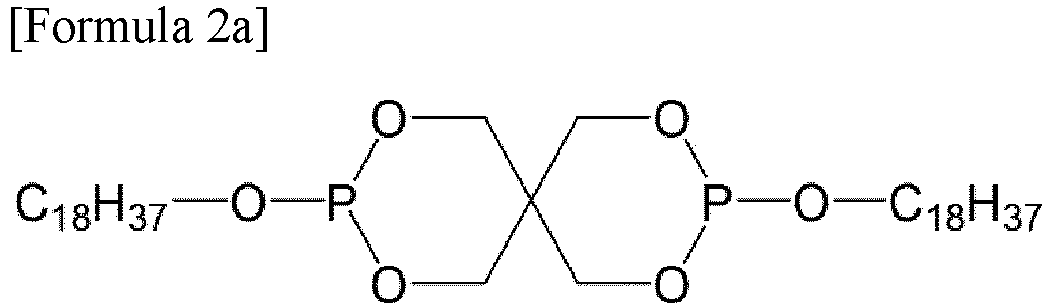

- In some embodiments, the phosphite compound (E) may be present in an amount of about 0.1 to about 3 parts by weight, for example, about 0.1 to about 2 parts by weight, specifically about 0.2 to about 1.5 parts by weight, based on 100 parts by weight of the thermoplastic resin (including the rubber-modified aromatic vinyl copolymer resin (A), the polycarbonate resin (B), and the polyester resin (C)). If the content of the phosphite compound is less than about 0.1 parts by weight relative to about 100 parts by weight of the thermoplastic resin, the thermoplastic resin composition can suffer from deterioration in hydrolysis resistance, impact resistance, and the like, and if the content of the phosphite compound exceeds about 3 parts by weight, the thermoplastic resin composition can suffer from deterioration in hydrolysis resistance, impact resistance, and the like
- In some embodiments, the zinc oxide (D) and the phosphite compound (E) may be present in a weight ratio (D:E) of about 1:1 to about 10:1, for example, about 1:1 to about 4:1. Within this range, the thermoplastic resin composition can exhibit better properties in terms of hydrolysis resistance, impact resistance, flame retardancy, and property balance therebetween.
- The phosphorus flame retardant according to one embodiment of the present invention may be a phosphorus flame retardant used in typical thermoplastic resin compositions. For example, the phosphorus flame retardant may include a phosphate compound, a phosphonate compound, a phosphinate compound, a phosphine oxide compound, a phosphazene compound, and metal salts thereof. These compounds may be used alone or as a mixture thereof.
- In some embodiments, the phosphorus flame retardant may include an aromatic phosphoric ester compound represented by Formula 3.

- When n is 0 in Formula 1, examples of the aromatic phosphoric ester compound may include diaryl phosphates such as diphenyl phosphate, triphenyl phosphate, tricresyl phosphate, trixylenyl phosphate, tri(2,6-dimethylphenyl) phosphate, tri(2,4,6-trimethylphenyl) phosphate, tri(2,4-di-tert-butylphenyl) phosphate, and tri(2,6-dimethylphenyl) phosphate; when n is 1 in Formula 1, examples of the aromatic phosphoric ester compound may include bisphenol-A bis(diphenyl phosphate), resorcinol bis(diphenyl phosphate), resorcinol bis[bis(2,6-dimethylphenyl)phosphate], resorcinol bis[bis(2,4-di-tert-butylphenyl) phosphate], hydroquinone bis[bis(2,6-dimethylphenyl)phosphate], hydroquinone bis(diphenyl phosphate), and hydroquinone bis[bis(2,4-di-tert-butylphenyl)phosphate]; and when n is 2 or more in Formula 1, the aromatic phosphoric ester compound may be an oligomer type phosphoric acid ester compound, without being limited thereto. These compounds may be used alone or as a mixture thereof.
- In some embodiments, the phosphorus flame retardant (F) may be present in an amount of about 5 to about 30 parts by weight, for example, about 7 to about 20 parts by weight, specifically about 9 to about 18 parts by weight, relative to 100 parts by weight of the thermoplastic resin (including the rubber-modified aromatic vinyl copolymer resin (A), the polycarbonate resin (B), and the polyester resin (C)). If the content of the phosphorus flame retardant is less than about 5 parts by weight relative to about 100 parts by weight of the thermoplastic resin, the thermoplastic resin composition can suffer from deterioration in flame retardancy, fluidity, and the like, and if the content of the phosphorus flame retardant exceeds about 30 parts by weight, the thermoplastic resin composition can suffer from deterioration in impact resistance and the like.
- The thermoplastic resin composition according to one embodiment of the present invention may further include flame retardants, such as a halogen flame retardant, an antimony flame retardant, and a combination thereof, other than the phosphorus flame retardant, to achieve further improvement in flame retardancy and the like.
- In some embodiments, the halogen flame retardant may include decabromodiphenyl oxide, decabromodiphenyl ethane, decabromodiphenyl ether, tetrabromobisphenol A, tetrabromobisphenol A-epoxy oligomer, brominated epoxy oligomer, octabromotrimethyl phenyldindane, ethylene bistetrabromophthal imide, 2,4,6-tris(2,4,6-tribromophenoxy)-1,3,5-triazine, and the like, and the antimony flame retardant may include antimony trioxide, antimony pentoxide, and the like. These may be used alone or as a mixture thereof.
- In some embodiments, the flame retardant other than the phosphorus flame retardant may be present in an amount of about 5 to about 20 parts by weight, for example, about 7 to about 10 parts by weight, relative to about 100 parts by weight of the thermoplastic resin(rubber-modified aromatic vinyl copolymer resin(A), polycarbonate resin(B) and polyester resin(C)). Within this range, the thermoplastic resin composition can exhibit good flame retardancy.
- The thermoplastic resin composition according to one embodiment of the present invention may further include additives used for typical thermoplastic resin compositions. Examples of the additives may include anti-dripping agents, such as fluorinated olefin resins and the like, lubricants, nucleating agents, stabilizers, release agents, pigments, dyes, and mixtures thereof, without being limited thereto. The additives may be present in an amount of about 0.001 to about 40 parts by weight, for example, about 0.1 to about 10 parts by weight, relative to about 100 parts by weight of the thermoplastic resin.
- The thermoplastic resin composition according to one embodiment of the present invention may be prepared in pellet form by mixing the aforementioned components, followed by melt extrusion at about 200°C to about 280°C, for example, about 220°C to about 250°C, using a typical twin-screw extruder.
- In some embodiments, the thermoplastic resin composition may have a flame retardancy of 5VA, as measured on an injection-molded 2.5 mm thick specimen by a UL-94 vertical test method.
- In some embodiments, the thermoplastic resin composition may have a flame retardancy of 5VA, as measured on an injection-molded 2.5 mm thick specimen by a UL-94 vertical test method after the specimen is exposed in a chamber under conditions of 70°C and 95% RH for 300 hours and is left for aging under conditions of room temperature and 50% RH for 24 hours.
- In some embodiments, the thermoplastic resin composition may have a notched Izod impact strength of about 20 kgf·cm/cm to about 60 kgf·cm/cm, for example, about 30 kgf·cm/cm to about 50 kgf·cm/cm, as measured on a 1/8" thick specimen in accordance with ASTM D256.
- In some embodiments, the thermoplastic resin composition may have an impact strength retention rate of about 85% or more, for example, about 90% to about 99%, as calculated according to Equation 1.

- A molded article according to the present invention is produced from the thermoplastic resin composition set forth above. The thermoplastic resin composition may be prepared in pellet form. The prepared pellets may be produced into various molded articles (products) by various molding methods, such as injection molding, extrusion molding, vacuum molding, and casting. These molding methods are well known to those skilled in the art. The molded product has good properties in terms of hydrolysis resistance, flame retardancy, impact resistance, and property balance therebetween, and thus can be advantageously used for interior/exterior materials for electrical/electronic products, interior/exterior materials for vehicles, exterior materials for buildings, and the like.
- Next, the present invention will be described in more detail with reference to some examples. It should be understood that these examples are provided for illustration only and are not to be construed in any way as limiting the invention.
- Details of components used in Examples and Comparative Examples are as follows.
- A mixture of 23 wt% of (A1) a rubber-modified aromatic vinyl copolymer resin and 77 wt% of (B2) an aromatic vinyl copolymer resin was used.
- A core-shell type graft copolymer (g-ABS) obtained through graft copolymerization of 42 wt% of styrene and acrylonitrile (styrene/acrylonitrile: 75 wt%/25 wt%) to 58 wt% of butadiene rubbers having an average particle diameter of 0.3 µm was used.
- A resin (weight average molecular weight: 135,000 g/mol) prepared through polymerization of 72 wt% of styrene and 28 wt% of acrylonitrile was used.
- A bisphenol-A type polycarbonate resin having a weight average molecular weight (Mw) of 22,000 g/mol was used.
- Polyethylene terephthalate (PET) having an inherent viscosity [η] of about 1.0 dl/g as measured using o-chloro phenol at 25°C was used.
- (D1) A primary intermediate was obtained by melting zinc solids and heating the molten zinc to 900°C to vaporize the molten zinc, followed by injecting oxygen gas and cooling the vaporized zinc to room temperature (25°C). Next, the primary intermediate was subjected to heat treatment at 700°C for 90 minutes and cooled to room temperature (25°C), thereby preparing zinc oxide.
- (D2) Magnesium oxide (Manufacturer: KYOWA, Product Name: KYOWAMAG 150) was used.
- (E1) A phosphite compound represented by Formula 1a was used.

- (E2) A phosphite compound represented by Formula 2a was used.

- (E3) A phosphite compound represented by Formula 2b was used.

- (E4) Diphenyl-isooctyl-phosphite (Manufacturer: Kolong Industries Co., Ltd., Product Name: KP-1406) was used.
- (F) Phosphorus flame retardant
- Oligomer type bisphenol-A diphosphate (Manufacturer: Yoke Chemical, Product Name: YOKE BDP) was used.
- (G) Halogen flame retardant
- Bromine-based flame retardant (2,4,6-tris(2,4,6-tribromophenoxy)-1,3,5-triazine, Manufacturer: ICL Industrial, Product Name: FR-245) was used.
- The above components were mixed in amounts as listed in Tables 1 and 2 and subjected to extrusion at 230°C, thereby preparing pellets. Here, extrusion was performed using a twin-screw extruder (L/D=36, Φ: 45 mm) and the prepared pellets were dried at 80°C for 2 hours or more and injection-molded in a 6 oz. injection molding machine (molding temperature: 230°C, mold temperature: 60°C), thereby preparing specimens. The specimens were evaluated as to the following properties by the following method, and results are shown in Tables 1 and 2.
-
- (1) Flame retardancy: Flame retardancy was measured on an injection-molded 1.5 mm thick specimen by a UL-94 vertical test method.
- (2) Flame retardancy after high temperature/high humidity treatment: Flame retardancy was measured on an injection-molded 2.5 mm thick specimen by a UL-94 vertical test method after the specimen was exposed in a chamber under conditions of 70°C and 95% RH for 300 hours and was left for aging under conditions of room temperature and 50% RH for 24 hours.
- (3) Notched Izod impact resistance (kgf·cm/cm): Notched Izod impact strength was measured on a 1/8" thick specimen in accordance with ASTM D256.
- (4) Impact strength retention rate (unit: %): Hydrolysis resistance was evaluated based on an impact strength retention rate of an injection molded specimen calculated according to Equation 1:

- From the result, it could be seen that the thermoplastic resin compositions according to the present invention had good properties in terms of hydrolysis resistance (flame retardancy after high temperature/high humidity treatment, impact strength retention rate), flame retardancy, impact resistance, and balance therebetween
- On the contrary, it could be seen that the resin composition of Comparative Example 1 prepared using an insufficient amount of the rubber-modified aromatic vinyl copolymer resin and an excess of the polyester resin suffered from deterioration in impact resistance, hydrolysis resistance (impact strength retention rate), and the like, and that the resin composition of Comparative Example 2 prepared using an excess of the rubber-modified aromatic vinyl copolymer resin and an insufficient amount of the polyester resin suffered from deterioration in flame retardancy, hydrolysis resistance (flame retardancy after high temperature/high humidity treatment), and the like. It could be seen that: the resin composition of Comparative Example 3 not using zinc oxide and the resin composition of Comparative Example 4 prepared using an insufficient amount of zinc oxide suffered from deterioration in impact resistance, hydrolysis resistance (flame retardancy after high temperature/high humidity treatment and impact strength retention rate), and the like; the resin composition of Comparative Example 5 prepared using an excess of zinc oxide suffered from deterioration in flame retardancy, hydrolysis resistance (flame retardancy after high temperature/high humidity treatment), and the like; the resin composition of Comparative Example 6 prepared using magnesium oxide (D2) instead of zinc oxide suffered from deterioration in impact resistance, hydrolysis resistance (flame retardancy after high temperature/high humidity treatment and impact strength retention rate), and the like; and the resin composition of Comparative Example 7 free from the phosphite compound according to the present invention and the resin composition of Comparative Example 8 containing an insufficient amount of the phosphite compound according to the present invention suffered from deterioration in hydrolysis resistance (flame retardancy after high temperature/high humidity treatment and impact strength retention rate) and the like. It could be seen that the resin composition of Comparative Example 9 containing an excess of the phosphite compound according to the present invention suffered from deterioration in hydrolysis resistance (impact strength retention rate) and the like, and the resin composition of Comparative Example 10 prepared using diphenyl-isooctyl-phosphite (E4) instead of the phosphite compound according to the present invention suffered from deterioration in hydrolysis resistance (flame retardancy after high temperature/high humidity treatment and impact strength retention rate) and the like.
- It should be understood that various modifications, changes, alterations, and equivalent embodiments can be made by those skilled in the art without departing from the spirit and scope of the present invention.
| Example | ||||||||||
| 1 | 2 | 3 | 4 | 5 | 6 | 7 | 8 | 9 | 10 | |
| (A) (wt%) | 50 | 45 | 40 | 50 | 45 | 40 | 45 | 45 | 45 | 42 |
| (B) (wt%) | 40 | 40 | 40 | 40 | 40 | 40 | 40 | 40 | 40 | 40 |
| (C) (wt%) | 10 | 15 | 20 | 10 | 15 | 20 | 15 | 15 | 15 | 18 |
| (D1) (parts by weight) | 0.5 | 0.5 | 0.5 | 2 | 2 | 2 | 1.3 | 1.3 | 1.3 | 1.3 |
| (D2) (parts by weight) | - | - | - | - | - | - | - | - | - | - |
| (E1) (parts by weight) | 0.5 | 0.5 | 0.5 | 0.5 | 0.5 | 0.5 | 0.5 | - | - | 0.5 |
| (E2) (parts by weight) | - | - | - | - | - | - | - | 0.5 | - | - |
| (E3) (parts by weight) | - | - | - | - | - | - | - | - | 0.5 | |
| (E4) (parts by weight) | - | - | - | - | - | - | - | - | - | - |
| (F) (parts by weight) | 10 | 10 | 10 | 10 | 10 | 10 | 10 | 10 | 10 | 15 |
| (G) (parts by weight) | 7 | 7 | 7 | 7 | 7 | 7 | 7 | 7 | 7 | - |
| Flame retardancy after high temperature/high humidity treatment | 5VA | 5VA | 5VA | 5VA | 5VA | 5VA | 5VA | 5VA | 5VA | 5VA |
| Flame retardancy | 5VA | 5VA | 5VA | 5VA | 5VA | 5VA | 5VA | 5VA | 5VA | 5VA |
| Notched Izod impact strength (IZ0) | 41 | 40 | 38 | 35 | 35 | 33 | 37 | 37 | 37 | 30 |
| Notched Izod impact strength (IZ1) | 37.3 | 36.4 | 34.2 | 34 | 33.2 | 35.5 | 35.2 | 36.0 | 35.8 | 27.5 |
| Impact strength retention rate (%) | 91 | 91 | 90 | 97 | 95 | 93 | 95 | 97 | 97 | 92 |
| Comparative Example | ||||||||||
| 1 | 2 | 3 | 4 | 5 | 6 | 7 | 8 | 9 | 10 | |
| (A) (wt%) | 25 | 65 | 45 | 45 | 45 | 45 | 45 | 45 | 45 | 45 |
| (B) (wt%) | 40 | 34 | 40 | 40 | 40 | 40 | 40 | 40 | 40 | 40 |
| (C) (wt%) | 35 | 1 | 15 | 15 | 15 | 15 | 15 | 15 | 15 | 15 |
| (D1) (parts by weight) | 1.3 | 1.3 | - | 0.05 | 6 | - | 1.3 | 1.3 | 1.3 | 1.3 |
| (D2) (parts by weight) | - | - | - | - | - | 1.3 | - | - | - | - |
| (E1) (parts by weight) | 0.5 | 0.5 | 0.5 | 0.5 | 0.5 | 0.5 | - | 0.05 | 4 | - |
| (E2) (parts by weight) | - | - | - | - | - | - | - | - | - | - |
| (E3) (parts by weight) | - | - | - | - | - | - | - | - | - | - |
| (E4) (parts by weight) | - | - | - | - | - | - | - | - | - | 0.5 |
| (F) (parts by weight) | 10 | 10 | 10 | 10 | 10 | 10 | 10 | 10 | 10 | 10 |
| (G) (parts by weight) | 7 | 7 | 7 | 7 | 7 | 7 | 7 | 7 | 7 | 7 |
| Flame retardancy | 5VA | Fail | 5VA | 5VA | Fail | 5VA | 5VA | 5VA | 5VA | 5VA |
| Flame retardancy after high temperature/high humidity treatment | 5VA | Fail | Fail | Fail | Fail | Fail | Fail | Fail | 5VA | Fail |
| Notched Izod impact strength (IZ0) | 7 | 45 | 12 | 17 | 22 | 13 | 32 | 31 | 25 | 29 |
| Notched Izod impact strength (IZ1) | 2 | 42 | 2.5 | 3 | 19 | 2.5 | 10 | 11 | 19 | 8 |
| Impact strength retention rate (%) | 29 | 93 | 20 | 18 | 86 | 19 | 31 | 35 | 76 | 28 |
Claims (13)
- A thermoplastic resin composition comprising:about 100 parts by weight of a thermoplastic resin comprising about 30 wt% to about 60 wt% of a rubber-modified aromatic vinyl copolymer resin, about 30 wt% to about 60 wt% of a polycarbonate resin, and about 5 wt% to about 25 wt% of a polyester resin;about 0.1 to about 5 parts by weight of zinc oxide;about 0.1 to about 3 parts by weight of a phosphite compound comprising at least one of a phosphite compound represented by Formula 1 and a phosphite compound represented by Formula 2; andabout 5 to about 30 parts by weight of a phosphorus flame retardant.
 where R1 is a linear or branched C1 to C10 alkyl group and n is an integer of 1 to 5;
 where R2 is a linear or branched C10 to C30 alkyl group or a C6 to C30 aryl group.
 - The thermoplastic resin composition according to claim 1, wherein the rubber-modified aromatic vinyl copolymer resin comprises a rubber-modified vinyl graft copolymer and an aromatic vinyl copolymer resin.
- The thermoplastic resin composition according to claim 2, wherein the rubber-modified vinyl graft copolymer is prepared through graft polymerization of a monomer mixture comprising an aromatic vinyl monomer and a vinyl cyanide monomer to a rubber polymer.
- The thermoplastic resin composition according to any one of claims 1 to 3, wherein the polyester resin comprises at least one of polyethylene terephthalate (PET), polybutylene terephthalate (PBT), polyethylene naphthalate (PEN), polytrimethylene terephthalate (PTT), and polycyclohexylene terephthalate (PCT).
- The thermoplastic resin composition according to any one of claims 1 to 4, wherein the phosphite compound comprises at least one of a compound represented by Formula 1a, a compound represented by Formula 2a, and a compound represented by Formula 2b.


- The thermoplastic resin composition according to any one of claims 1 to 5, wherein the phosphorus flame retardant comprises at least one of a phosphate compound, a phosphonate compound, a phosphinate compound, a phosphine oxide compound, and a phosphazene compound.
- The thermoplastic resin composition according to any one of claims 1 to 6, further comprising: at least one of a halogen flame retardant and an antimony flame retardant.
- The thermoplastic resin composition according to any one of claims 1 to 7, wherein the zinc oxide and the phosphite compound are present in a weight ratio of about 1:1 to about 4:1.
- The thermoplastic resin composition according to any one of claims 1 to 8, wherein the thermoplastic resin composition has a flame retardancy of 5VA, as measured on an injection-molded 2.5 mm thick specimen by a UL-94 vertical test method.
- The thermoplastic resin composition according to any one of claims 1 to 9, wherein the thermoplastic resin composition has a flame retardancy of 5VA, as measured on an injection-molded 2.5 mm thick specimen by a UL-94 vertical test method after the specimen is exposed in a chamber under conditions of 70°C and 95% RH (relative humidity) for 300 hours and is left for aging under conditions of room temperature and 50% RH for 24 hours.
- The thermoplastic resin composition according to any one of claims 1 to 10, wherein the thermoplastic resin composition has a notched Izod impact strength of about 20 kgf·cm/cm to about 60 kgf·cm/cm, as measured on a 1/8" thick specimen in accordance with ASTM D256.
- The thermoplastic resin composition according to any one of claims 1 to 11, wherein the thermoplastic resin composition has an impact strength retention rate of about 85% or more, as calculated by Equation 1:
[Equation 1]
- A molded article produced from the thermoplastic resin composition according to any one of claims 1 to 12.
Applications Claiming Priority (2)
| Application Number | Priority Date | Filing Date | Title |
|---|---|---|---|
| KR1020180172708A KR102183731B1 (en) | 2018-12-28 | 2018-12-28 | Thermoplastic resin composition and article produced therefrom |
| PCT/KR2019/017783 WO2020138802A1 (en) | 2018-12-28 | 2019-12-16 | Thermoplastic resin composition and molded article therefrom |
Publications (2)
| Publication Number | Publication Date |
|---|---|
| EP3904455A1 true EP3904455A1 (en) | 2021-11-03 |
| EP3904455A4 EP3904455A4 (en) | 2022-08-31 |
Family
ID=71126590
Family Applications (1)
| Application Number | Title | Priority Date | Filing Date |
|---|---|---|---|
| EP19901687.4A Withdrawn EP3904455A4 (en) | 2018-12-28 | 2019-12-16 | THERMOPLASTIC RESIN COMPOSITION AND MOLDED ARTICLE PRODUCED THEREOF |
Country Status (5)
| Country | Link |
|---|---|
| US (1) | US20210388140A1 (en) |
| EP (1) | EP3904455A4 (en) |
| KR (1) | KR102183731B1 (en) |
| CN (1) | CN113056521A (en) |
| WO (1) | WO2020138802A1 (en) |
Families Citing this family (2)
| Publication number | Priority date | Publication date | Assignee | Title |
|---|---|---|---|---|
| KR102559676B1 (en) * | 2020-08-31 | 2023-07-25 | 롯데케미칼 주식회사 | Thermoplastic resin composition and article produced therefrom |
| KR102639840B1 (en) * | 2021-08-30 | 2024-02-22 | 롯데케미칼 주식회사 | Thermoplastic resin composition and article produced therefrom |
Family Cites Families (14)
| Publication number | Priority date | Publication date | Assignee | Title |
|---|---|---|---|---|
| FR245E (en) | 1901-05-18 | 1902-11-24 | Dupont | Advanced bath heater system |
| DE3819081A1 (en) | 1988-06-04 | 1989-12-07 | Bayer Ag | FLAME-RESISTANT, IMPACT TOOL POLYCARBONATE MOLDS |
| US5510398A (en) * | 1994-04-07 | 1996-04-23 | General Electric Company | Highly filled extruded thermoplastic compositions having a speckled surface appearance |
| KR100379658B1 (en) * | 2000-12-27 | 2003-04-11 | 제일모직주식회사 | Thermoplastic Flameproof Resin Composition Having Excellent Light Stability |
| US7186853B2 (en) | 2003-06-05 | 2007-03-06 | Crompton Corporation | Polymer compositions containing stabilizer compounds comprising tricyclodecylmethyl groups |
| KR100782700B1 (en) * | 2005-11-01 | 2007-12-07 | 주식회사 엘지화학 | Thermoplastic resin composition with excellent thermal stability, photochromic resistance and weather resistance |
| US7553895B2 (en) * | 2006-06-29 | 2009-06-30 | Sabic Innovative Plastics Ip B.V. | Polycarbonate compositions and articles formed therefrom |
| KR100969454B1 (en) * | 2006-10-10 | 2010-07-14 | 주식회사 엘지화학 | Thermoplastic Flame Retardant Composition |
| JP2013133362A (en) * | 2011-12-26 | 2013-07-08 | Mitsubishi Engineering Plastics Corp | Aromatic polycarbonate resin composition and molded article |
| JP6313331B2 (en) | 2012-12-20 | 2018-04-18 | ポリアド サービシズ エルエルシー | Flame retardant polymer composition |
| KR101664845B1 (en) * | 2013-06-28 | 2016-10-11 | 롯데첨단소재(주) | Low shrinkage thermoplastic resin composition and article comprising the same |
| KR20160079786A (en) * | 2013-11-01 | 2016-07-06 | 사빅 글로벌 테크놀러지스 비.브이. | Reinforced flame retardant polycarbonate composition and molded article comprising same |
| CN110088200B (en) * | 2016-12-19 | 2021-07-20 | 三菱工程塑料株式会社 | Polycarbonate resin composition and molded article |
| CN107501888B (en) * | 2017-08-12 | 2020-04-10 | 宁波市镇海甬鼎紧固件制造有限公司 | High-performance PC/ABS alloy material and preparation method thereof |
-
2018
- 2018-12-28 KR KR1020180172708A patent/KR102183731B1/en active Active
-
2019
- 2019-12-16 EP EP19901687.4A patent/EP3904455A4/en not_active Withdrawn
- 2019-12-16 US US17/284,858 patent/US20210388140A1/en not_active Abandoned
- 2019-12-16 CN CN201980075671.5A patent/CN113056521A/en not_active Withdrawn
- 2019-12-16 WO PCT/KR2019/017783 patent/WO2020138802A1/en not_active Ceased
Also Published As
| Publication number | Publication date |
|---|---|
| WO2020138802A1 (en) | 2020-07-02 |
| KR20200082276A (en) | 2020-07-08 |
| CN113056521A (en) | 2021-06-29 |
| KR102183731B1 (en) | 2020-11-27 |
| US20210388140A1 (en) | 2021-12-16 |
| EP3904455A4 (en) | 2022-08-31 |
Similar Documents
| Publication | Publication Date | Title |
|---|---|---|
| TWI589687B (en) | Flame-retardant thermoplastic polyester resin composition and molded article | |
| JP6428264B2 (en) | Thermoplastic polyester resin composition and molded article | |
| WO2001029135A1 (en) | Polycarbonate resin composition | |
| JP2009013410A (en) | Flame retardant thermoplastic resin composition | |
| CN109988406B (en) | Thermoplastic resin composition and molded article produced therefrom | |
| JP2010037375A (en) | Flame-retardant thermoplastic polyester resin composition and molded article | |
| EP3733770B1 (en) | Thermoplastic resin composition and molded product formed therefrom | |
| US8901216B2 (en) | Impact-modified polyester/polycarbonate compositions with improved elongation at break | |
| KR102183731B1 (en) | Thermoplastic resin composition and article produced therefrom | |
| KR102253245B1 (en) | Thermoplastic resin composition and article produced therefrom | |
| EP1963429A1 (en) | Flameproof thermoplastic resin composition | |
| KR101632571B1 (en) | Halogen-free flame retardant polyester resin composition with good mechanical properties and molded article thereof | |
| EP3992249B1 (en) | Thermoplastic resin composition and molded article therefrom | |
| EP4206281B1 (en) | Thermoplastic resin composition and molded article formed therefrom | |
| KR101803131B1 (en) | Flame retardant thermoplastic resin composition and article comprising the same | |
| EP3572463B1 (en) | Thermoplastic resin composition and article produced therefrom | |
| KR102253835B1 (en) | Thermoplastic resin composition and article produced therefrom | |
| KR20230123135A (en) | Conductive thermoplastic composition and article produced therefrom | |
| KR20130061560A (en) | Polycarbonate resin composition |
Legal Events
| Date | Code | Title | Description |
|---|---|---|---|
| STAA | Information on the status of an ep patent application or granted ep patent |
Free format text: STATUS: THE INTERNATIONAL PUBLICATION HAS BEEN MADE |
|
| PUAI | Public reference made under article 153(3) epc to a published international application that has entered the european phase |
Free format text: ORIGINAL CODE: 0009012 |
|
| STAA | Information on the status of an ep patent application or granted ep patent |
Free format text: STATUS: REQUEST FOR EXAMINATION WAS MADE |
|
| 17P | Request for examination filed |
Effective date: 20210705 |
|
| AK | Designated contracting states |
Kind code of ref document: A1 Designated state(s): AL AT BE BG CH CY CZ DE DK EE ES FI FR GB GR HR HU IE IS IT LI LT LU LV MC MK MT NL NO PL PT RO RS SE SI SK SM TR |
|
| DAV | Request for validation of the european patent (deleted) | ||
| DAX | Request for extension of the european patent (deleted) | ||
| A4 | Supplementary search report drawn up and despatched |
Effective date: 20220728 |
|
| RIC1 | Information provided on ipc code assigned before grant |
Ipc: C08K 5/524 20060101ALI20220722BHEP Ipc: C08K 5/49 20060101ALI20220722BHEP Ipc: C08K 3/22 20060101ALI20220722BHEP Ipc: C08F 279/02 20060101ALI20220722BHEP Ipc: C08F 285/00 20060101ALI20220722BHEP Ipc: C08L 67/02 20060101ALI20220722BHEP Ipc: C08L 25/10 20060101ALI20220722BHEP Ipc: C08L 55/02 20060101ALI20220722BHEP Ipc: C08L 69/00 20060101AFI20220722BHEP |
|
| STAA | Information on the status of an ep patent application or granted ep patent |
Free format text: STATUS: THE APPLICATION HAS BEEN WITHDRAWN |
|
| 18W | Application withdrawn |
Effective date: 20221219 |