EP3904442A1 - Resin composition, molded body, optical lens, and optical lens unit - Google Patents
Resin composition, molded body, optical lens, and optical lens unit Download PDFInfo
- Publication number
- EP3904442A1 EP3904442A1 EP19906113.6A EP19906113A EP3904442A1 EP 3904442 A1 EP3904442 A1 EP 3904442A1 EP 19906113 A EP19906113 A EP 19906113A EP 3904442 A1 EP3904442 A1 EP 3904442A1
- Authority
- EP
- European Patent Office
- Prior art keywords
- group
- formula
- resin composition
- optical
- composition according
- Prior art date
- Legal status (The legal status is an assumption and is not a legal conclusion. Google has not performed a legal analysis and makes no representation as to the accuracy of the status listed.)
- Granted
Links
- 0 C*(C)*C(CC1*(C)C)C(C2C3)C1C3C(C)(*)C2(N)I Chemical compound C*(C)*C(CC1*(C)C)C(C2C3)C1C3C(C)(*)C2(N)I 0.000 description 5
- CYISMTMRBPPERU-UHFFFAOYSA-N CCC1CCC(C)CC1 Chemical compound CCC1CCC(C)CC1 CYISMTMRBPPERU-UHFFFAOYSA-N 0.000 description 1
Classifications
-
- C—CHEMISTRY; METALLURGY
- C08—ORGANIC MACROMOLECULAR COMPOUNDS; THEIR PREPARATION OR CHEMICAL WORKING-UP; COMPOSITIONS BASED THEREON
- C08G—MACROMOLECULAR COMPOUNDS OBTAINED OTHERWISE THAN BY REACTIONS ONLY INVOLVING UNSATURATED CARBON-TO-CARBON BONDS
- C08G61/00—Macromolecular compounds obtained by reactions forming a carbon-to-carbon link in the main chain of the macromolecule
- C08G61/02—Macromolecular compounds containing only carbon atoms in the main chain of the macromolecule, e.g. polyxylylenes
- C08G61/04—Macromolecular compounds containing only carbon atoms in the main chain of the macromolecule, e.g. polyxylylenes only aliphatic carbon atoms
- C08G61/06—Macromolecular compounds containing only carbon atoms in the main chain of the macromolecule, e.g. polyxylylenes only aliphatic carbon atoms prepared by ring-opening of carbocyclic compounds
- C08G61/08—Macromolecular compounds containing only carbon atoms in the main chain of the macromolecule, e.g. polyxylylenes only aliphatic carbon atoms prepared by ring-opening of carbocyclic compounds of carbocyclic compounds containing one or more carbon-to-carbon double bonds in the ring
-
- C—CHEMISTRY; METALLURGY
- C08—ORGANIC MACROMOLECULAR COMPOUNDS; THEIR PREPARATION OR CHEMICAL WORKING-UP; COMPOSITIONS BASED THEREON
- C08L—COMPOSITIONS OF MACROMOLECULAR COMPOUNDS
- C08L65/00—Compositions of macromolecular compounds obtained by reactions forming a carbon-to-carbon link in the main chain; Compositions of derivatives of such polymers
-
- C—CHEMISTRY; METALLURGY
- C08—ORGANIC MACROMOLECULAR COMPOUNDS; THEIR PREPARATION OR CHEMICAL WORKING-UP; COMPOSITIONS BASED THEREON
- C08G—MACROMOLECULAR COMPOUNDS OBTAINED OTHERWISE THAN BY REACTIONS ONLY INVOLVING UNSATURATED CARBON-TO-CARBON BONDS
- C08G61/00—Macromolecular compounds obtained by reactions forming a carbon-to-carbon link in the main chain of the macromolecule
- C08G61/02—Macromolecular compounds containing only carbon atoms in the main chain of the macromolecule, e.g. polyxylylenes
- C08G61/04—Macromolecular compounds containing only carbon atoms in the main chain of the macromolecule, e.g. polyxylylenes only aliphatic carbon atoms
-
- C—CHEMISTRY; METALLURGY
- C08—ORGANIC MACROMOLECULAR COMPOUNDS; THEIR PREPARATION OR CHEMICAL WORKING-UP; COMPOSITIONS BASED THEREON
- C08K—Use of inorganic or non-macromolecular organic substances as compounding ingredients
- C08K5/00—Use of organic ingredients
- C08K5/04—Oxygen-containing compounds
- C08K5/06—Ethers; Acetals; Ketals; Ortho-esters
-
- C—CHEMISTRY; METALLURGY
- C08—ORGANIC MACROMOLECULAR COMPOUNDS; THEIR PREPARATION OR CHEMICAL WORKING-UP; COMPOSITIONS BASED THEREON
- C08K—Use of inorganic or non-macromolecular organic substances as compounding ingredients
- C08K5/00—Use of organic ingredients
- C08K5/04—Oxygen-containing compounds
- C08K5/09—Carboxylic acids; Metal salts thereof; Anhydrides thereof
-
- C—CHEMISTRY; METALLURGY
- C08—ORGANIC MACROMOLECULAR COMPOUNDS; THEIR PREPARATION OR CHEMICAL WORKING-UP; COMPOSITIONS BASED THEREON
- C08K—Use of inorganic or non-macromolecular organic substances as compounding ingredients
- C08K5/00—Use of organic ingredients
- C08K5/04—Oxygen-containing compounds
- C08K5/10—Esters; Ether-esters
- C08K5/12—Esters; Ether-esters of cyclic polycarboxylic acids
-
- G—PHYSICS
- G02—OPTICS
- G02B—OPTICAL ELEMENTS, SYSTEMS OR APPARATUS
- G02B1/00—Optical elements characterised by the material of which they are made; Optical coatings for optical elements
- G02B1/04—Optical elements characterised by the material of which they are made; Optical coatings for optical elements made of organic materials, e.g. plastics
- G02B1/041—Lenses
-
- C—CHEMISTRY; METALLURGY
- C08—ORGANIC MACROMOLECULAR COMPOUNDS; THEIR PREPARATION OR CHEMICAL WORKING-UP; COMPOSITIONS BASED THEREON
- C08G—MACROMOLECULAR COMPOUNDS OBTAINED OTHERWISE THAN BY REACTIONS ONLY INVOLVING UNSATURATED CARBON-TO-CARBON BONDS
- C08G2261/00—Macromolecular compounds obtained by reactions forming a carbon-to-carbon link in the main chain of the macromolecule
- C08G2261/10—Definition of the polymer structure
- C08G2261/14—Side-groups
- C08G2261/141—Side-chains having aliphatic units
- C08G2261/1412—Saturated aliphatic units
-
- C—CHEMISTRY; METALLURGY
- C08—ORGANIC MACROMOLECULAR COMPOUNDS; THEIR PREPARATION OR CHEMICAL WORKING-UP; COMPOSITIONS BASED THEREON
- C08G—MACROMOLECULAR COMPOUNDS OBTAINED OTHERWISE THAN BY REACTIONS ONLY INVOLVING UNSATURATED CARBON-TO-CARBON BONDS
- C08G2261/00—Macromolecular compounds obtained by reactions forming a carbon-to-carbon link in the main chain of the macromolecule
- C08G2261/10—Definition of the polymer structure
- C08G2261/14—Side-groups
- C08G2261/142—Side-chains containing oxygen
- C08G2261/1426—Side-chains containing oxygen containing carboxy groups (COOH) and/or -C(=O)O-moieties
-
- C—CHEMISTRY; METALLURGY
- C08—ORGANIC MACROMOLECULAR COMPOUNDS; THEIR PREPARATION OR CHEMICAL WORKING-UP; COMPOSITIONS BASED THEREON
- C08G—MACROMOLECULAR COMPOUNDS OBTAINED OTHERWISE THAN BY REACTIONS ONLY INVOLVING UNSATURATED CARBON-TO-CARBON BONDS
- C08G2261/00—Macromolecular compounds obtained by reactions forming a carbon-to-carbon link in the main chain of the macromolecule
- C08G2261/30—Monomer units or repeat units incorporating structural elements in the main chain
- C08G2261/33—Monomer units or repeat units incorporating structural elements in the main chain incorporating non-aromatic structural elements in the main chain
- C08G2261/332—Monomer units or repeat units incorporating structural elements in the main chain incorporating non-aromatic structural elements in the main chain containing only carbon atoms
- C08G2261/3324—Monomer units or repeat units incorporating structural elements in the main chain incorporating non-aromatic structural elements in the main chain containing only carbon atoms derived from norbornene
-
- C—CHEMISTRY; METALLURGY
- C08—ORGANIC MACROMOLECULAR COMPOUNDS; THEIR PREPARATION OR CHEMICAL WORKING-UP; COMPOSITIONS BASED THEREON
- C08G—MACROMOLECULAR COMPOUNDS OBTAINED OTHERWISE THAN BY REACTIONS ONLY INVOLVING UNSATURATED CARBON-TO-CARBON BONDS
- C08G2261/00—Macromolecular compounds obtained by reactions forming a carbon-to-carbon link in the main chain of the macromolecule
- C08G2261/40—Polymerisation processes
- C08G2261/41—Organometallic coupling reactions
- C08G2261/418—Ring opening metathesis polymerisation [ROMP]
-
- C—CHEMISTRY; METALLURGY
- C08—ORGANIC MACROMOLECULAR COMPOUNDS; THEIR PREPARATION OR CHEMICAL WORKING-UP; COMPOSITIONS BASED THEREON
- C08G—MACROMOLECULAR COMPOUNDS OBTAINED OTHERWISE THAN BY REACTIONS ONLY INVOLVING UNSATURATED CARBON-TO-CARBON BONDS
- C08G2261/00—Macromolecular compounds obtained by reactions forming a carbon-to-carbon link in the main chain of the macromolecule
- C08G2261/50—Physical properties
- C08G2261/57—Physical properties photorefractive, e.g. change of refractive index
Definitions
- the present invention relates to a resin composition, in particular, an optical resin composition useful as optical parts such as an lens.
- the present invention relates to a molded body, an optical lens, an optical lens unit and the like using the optical resin composition.
- Optical resins are used as materials of optical parts such as optical lenses used in optical systems of various cameras such as smartphones, digital still cameras (DSC), automotive camera lenses, video cameras and the like.
- Optical resins used for such usage are required to have high refractive index, low Abbe number, excellent heat resistance, transparency and the like.
- Non-patent document 1 a predetermined cyclic olefin-based resin
- Patent document 1 an optical resin containing a fluorene compound
- Patent document 2 a polycarbonate resin and the like have been developed as such resin materials or resins for optical application
- Patent document 2 a predetermined cyclic olefin-based resin
- Patent document 1 an optical resin containing a fluorene compound
- Patent document 2 a polycarbonate resin and the like
- Non-patent document 1 JSR TECHNICAL REVIEW No. 108/2001
- optical resin is required to have excellent moldability as well as the various favorable properties mentioned in the background section.
- Conventional optical resins did not always have excellent moldability in addition to their optical characteristics.
- a novel optical resin which has excellent moldability that does not cause any molding defect while maintaining favorable optical properties such as high refractive index.
- the present invention provides the following optical resin composition and else which are useful as optical parts such as an lens.
- a resin composition for lenses according to a preferred aspect of the present invention can have, in particular, improved moldability than conventional resin compositions, while realizing excellent optical characteristics. Accordingly, the resin composition for lenses can prevent occurrence of surface defects, for example, flow marks, on a molded body such as a lens obtained by molding.
- the resin composition for lenses according to the preferred aspect of the present invention can realize superior moldability and optical characteristics with a relatively inexpensive resin material.
- a resin composition for lenses of the present invention comprises a resin containing a structural unit represented by Formula (1) above which has an alicyclic backbone, and a binaphthalene compound having a structure represented by Formula (2) above and/or an oligomer thereof.
- a resin used in the present invention has a structural unit represented by Formula (1) (hereinafter, the resin used in the present invention is also referred to as the resin of Formula (1)), and contains an alicyclic backbone as follows.
- A represents a C1-C5 alkylene group, preferably a C1-C3 alkylene group, and more preferably a C2 ethylene group;
- A is an ethylene group
- p is 1
- K 1 is a hydrogen atom or a methyl group, more preferably a methyl group
- K 2 is a hydrogen atom
- Z are each independently selected from any of the substituents of Formula (3) below.
- a preferable example of the resin of Formula (1) includes, specifically, a polymer containing a structural unit represented by Formula (1-1) below.
- the resin of Formula (1) preferably has a molecular weight (Mw) of 10,000 or more but not more than 60,000, more preferably a molecular weight (Mw) of 20,000 or more but not more than 50,000, and still more preferably a molecular weight (Mw) of 30,000 or more but not more than 50,000.
- the resin of Formula (1) preferably has a glass transition temperature (Tg) of 150°C or higher but not higher than 180°C, and more preferably a glass transition temperature (Tg) of 160°C or higher but not higher than 170°C.
- Tg glass transition temperature
- the glass transition temperature (Tg) refers to a value obtained according to JIS-K-7121.
- the MVR value of the resin of Formula (1) is preferably 5-40 (cm 3 /10 min), and more preferably 10-25 (cm 3 /10 min).
- MVR refers to a value obtained in accordance with JIS-B-7210 under the conditions of 260°C and 2.16 kg.
- the refractive index of the resin of Formula (1) is preferably 1.500-1.532 and more preferably 1.520-1.530.
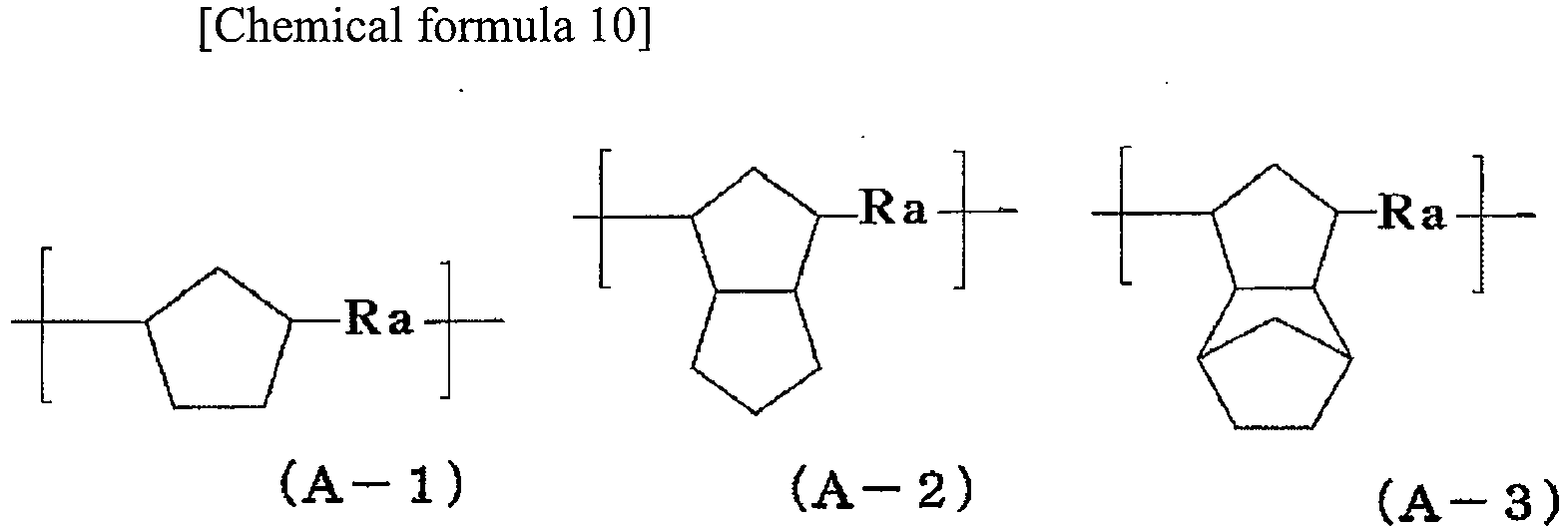
- the resin of Formula (1) may contain any of structural units represented by Formulae (A-1)-(A-3) below.
- Ra are each independently an alkylene group with a total carbon number of 1-10 which may have a substituent and a branched chain. Ra is, for example, a methylene group, an ethylene group, a propylene group or the like, preferably an ethylene group.
- the resin of Formula (1) has such a structural unit in addition to the above-described structural unit represented by Formula (1)
- the resin of Formula (1) containing these structural units is, for example, a random copolymer or a block copolymer, preferably a random copolymer.
- the resin of Formula (1) contains preferably 50 mol% or more, more preferably 70 mol% or more and particularly preferably 90 mol% or more of the structural unit represented by Formula (1).
- Binaphthalene compound or oligomer containing binaphthalene backbone (structure represented by Formula (2))
- a binaphthalene compound and/or oligomer used in the present invention has a structure represented by Formula (2) (hereinafter, the binaphthalene compound and/or the oligomer used in the present invention are also referred to as the compound of Formula (2) or the oligomer of Formula (2)), and contains a binaphthalene backbone as follows.
- R 1 -R 10 each independently represent a hydrogen atom, a fluorine atom, a chlorine atom, a bromine atom, an iodine atom, a C1-C6 alkyl group, a C6-C20 aryl group which may contain a heterocyclic atom selected from O, N and S, a C2-C10 alkenyl group, a C2-C10 alkynyl group, a C1-C6 alkoxy group or a C7-C17 aralkyl group.
- R 1 -R 10 are each independently any of a hydrogen atom, a C1-C6 alkyl group or a C6-C20 aryl group which may contain a heterocyclic atom, more preferably any of a hydrogen atom, a C1-C4 alkyl group or a C6-C12 aryl group without a heteroatom, and still more preferably any of a hydrogen atom, a C1-C3 alkyl group or a C6-C8 aryl group without a heteroatom.
- R 1 -R 10 are an alkyl group, an aryl group, an alkenyl group, an alkynyl group, an alkoxy group or an aralkyl group, each of them may have a substituent, for example, a fluorine atom, a chlorine atom, a bromine atom, an iodine atom, a cyano group or a phenyl group.
- a substituent of an alkyl group may be any of an aryl group, an alkenyl group, an alkoxy group, an aralkyl group or the like
- a substituent of an aryl group may be any of an alkyl group, an alkenyl group, an alkoxy group, an aralkyl group or the like, where the carbon number of these substituents is not included in the carbon number of the above-described alkyl group or aryl group.
- X are each independently a C1-C8 alkylene group, a C5-C12 cycloalkylene group or a C6-C20 arylene group, preferably a C1-C8 alkylene group, more preferably a C1-C4 alkylene group, and particularly preferably a C2 or C3 alkylene group.
- a and b are each independently an integer of 1-10.
- a and b are each independently preferably an integer of 1-6, more preferably an integer of 1-4 and still more preferably an integer of 1 or 2.
- the kinds of binaphthalene compounds of Formula (2) used may be the same or different. This also applies to the oligomer of the compound of Formula (2), where oligomers of any one kind of compound of Formula (2) or oligomers of multiple kinds of compounds of Formula (2) may be used. Alternatively, a mixture of one or more kinds of compounds of Formula (2) and oligomers of one or more kinds of compounds of Formula (2) may be used.
- binaphthalene compound of Formula (2) examples include binaphthalene compounds represented by Formula (4) or (5), and oligomers of binaphthalene compounds represented by Formula (4) or (5) can also be used favorably.
- R 1 -R 10 , a and b are synonymous with R 1 -R 10 , a and b in Formula (1) above.
- binaphthalene compound or oligomer of Formula (2) include, specifically, compounds or oligomers represented by Formulae (2-1)-(2-11) below. Among them, compounds or oligomers represented by Formulae (2-1)-(2-7) below are particularly preferable.
- An oligomer of the compound of Formula (2) is, for example, a mixture of a monomer to a decamer of the compound of Formula (2), preferably any of a dimer to a pentamer of the compound of Formula (2), or a mixture thereof.
- the molecular weight (weight-average molecular weight: Mw) of the oligomer of the compound of Formula (2) is preferably 5,000 or less, for example, 500-5000.
- the molecular weight (Mw) of the oligomer of the compound of Formula (2) is more preferably 600-3000, and still more preferably 800-2000.
- the oligomer of the compound of Formula (2) has a glass transition temperature (Tg) of 100°C or higher but not higher than 250°C, or a melting point of 100°C or higher but not higher than 250°C.
- Tg glass transition temperature refers to a value obtained according to JIS-K-7121.
- the compound or the oligomer of Formula (2) may contain a structure (structural unit) represented by Formula (B) below in a small amount.
- the structural unit represented by Formula (2) contains the compound or the oligomer of Formula (2) preferably at 70 mol% or more, more preferably at 80 mol% or more and particularly preferably at 90 mol% or more.
- the oligomer of the compound of Formula (2) containing these structural units is, for example, a random copolymer or a block copolymer, preferably a random copolymer.
- An optical resin composition of the present invention comprises the resin of Formula (1) and the compound or the oligomer of Formula (2).
- A/B (mass ratio) is more preferably 97/3-82/18, still more preferably 95/5-84/16, and particularly preferably 92/8-85/15.
- Mass A of the resin of Formula (1) refers to the total mass of the multiple kinds of resins of Formula (1).
- the optical resin composition may be added with additives as long as the purpose of the present invention is not impaired.
- additives such as an antioxidant, a processing stabilizer, a light stabilizer, a polymerization-metal deactivator, a flame retardant, a lubricant, an antistatic agent, a surfactant, an antibacterial agent, a mold release agent, a UV absorber, a plasticizer, a compatibilizer or the like may be mixed.
- the content of the additives is preferably 10 mass% or less, more preferably 6 mass% or less, still more preferably 6 mass% or less and particularly preferably 2 mass% or less relative to the total mass of the optical resin composition.
- fluorene compounds are compounds having a molecule structure similar to the binaphthalene compound of Formula (2)
- the optical resin composition is preferably free of a fluorene compound. As can be appreciated from the results in the following examples and comparative example, this is because an optical resin composition containing the binaphthalene compound of Formula (2) or an oligomer thereof has better moldability than an optical resin composition containing a fluorene compound.
- the refractive index of the optical resin composition is preferably within a range of 1.510-1.600 in accordance with JIS-B-7071.
- the refractive index of the optical resin composition is more preferably 1.512-1.580, still more preferably 1.515-1.560, and particularly preferably 1.520-1.540.
- the Abbe number of the optical resin composition is preferably within a range of 35-50 in accordance with JIS-B-7090.
- the Abbe number of the optical resin composition is more preferably 36-49, still more preferably 37-47, and particularly preferably 38-46.
- the MVR value of the optical resin composition in accordance with JIS-B-7210 under the conditions of 260°C and 2.16 kg is preferably within a range of 8-30 (cm 3 /10 min).
- the MVR value of the optical resin composition is more preferably 10-26 (cm 3 /10 min), still more preferably 11-25 (cm 3 /10 min), and particularly preferably 12-24 (cm 3 /10 min).
- the optical resin composition of the present invention may be contained in various kinds of molded bodies, in particular, a molded body of optical parts. Furthermore, the optical resin composition is useful as a material of a molded body of optical parts. For example, the optical resin composition of the present invention is particularly useful as a material of an optical lens, and the optical lens containing the optical resin composition of the present invention has excellent characteristics.
- the optical resin composition of the present invention can be used to produce a lens having a high to moderate refractive index and a moderate Abbe number, without causing a defect upon molding processing.
- an optical lens molded using an optical resin composition having such excellent characteristics can be used favorably in an optical lens unit.
- GPC Gel permeation chromatography
- Glass transition temperature was measured using a differential scanning calorimeter (High Sensitivity Differential Scanning Calorimeter DSC7000X). Following melting and cooling for solidification in the differential scanning calorimeter (DSC) where the rates of temperature increase and decrease were set to 10°C/min, Tg was measured during the second heating run (second run).
- DSC differential scanning calorimeter
- Melt indexer manufactured by Toyo Seiki Seisaku-sho, Ltd. was used to measure fluidity in accordance with the method of JIS-B-7210. Unless otherwise noted, MVR (cm3/10 min) was obtained under the conditions of 260°C and 2.16 kg.
- Refractive indices were measured using an Abbe refractometer by a method according to JIS-K-7142 for 0.1 mm-thick films made of the resin compositions produced in the examples described in detail below.
- Refractive indices at wavelengths of 486 nm, 589 nm and 656 nm were measured using an Abbe refractometer at 23°C for 0.1 mm-thick films made of the resin compositions produced in the examples.
- a resin having a structural unit represented by Formula (1) and a compound represented by Formula (2) As a resin having a structural unit represented by Formula (1) and a compound represented by Formula (2), 92 parts by mass of pellets of a resin represented by Formula (1-1) below (glass transition temperature (Tg): 164°C, molecular weight (Mw): 45,000) and 8 parts by weight of 2,2'-bis(2-hydroxyethoxy)-6,6'-diphenyl-1,1'-binaphthalene (DP-BHBNA) of Formula (2-1) below were used, respectively.
- Tg glass transition temperature
- Mw molecular weight
- DP-BHBNA 2,2'-bis(2-hydroxyethoxy)-6,6'-diphenyl-1,1'-binaphthalene
- Resin compositions of Examples 2-5 were obtained in the same manner as Example 1 except that a compound or an oligomer represented by Formula (2-2)-(2-4) below was used as the compound represented by Formula (2) or that the content of the compound of Formula (2-1) was changed.
- Example 4 The oligomer used in Example 4 (BNE-3PC) was synthesized as follows.
- the number of the repeating units, i.e., "3" (trimer), in Formula (2-4) was calculated by a known method from the weight-average molecular weight relative to polystyrene standards (Mw) and FD-MS.
- a resin composition was obtained in the same manner as Example 1 except that a fluorene compound represented by Formula (B) below was used instead of the compound represented by Formula (2).
- the optical resin composition according to a preferred aspect of the present invention can have, in particular, improved moldability than conventional resin compositions, while realizing excellent optical characteristics. Accordingly, the optical resin composition can produce a molded body such as a lens having satisfactory optical characteristics without causing a surface defect such as flow marks.
- Comparative example that used a fluorene compound was shown to be inferior in moldability.
- optical resin composition of the present invention can also realize the above-described superior optical characteristics and moldability in an aspect where the contents of these components are minimized, it can also reduce the cost for producing molded bodies.
- a resin composition for lenses according to a preferred aspect of the present invention can realize excellent moldability and optical characteristics by using relatively inexpensive resin materials.
Landscapes
- Chemical & Material Sciences (AREA)
- Health & Medical Sciences (AREA)
- Chemical Kinetics & Catalysis (AREA)
- Medicinal Chemistry (AREA)
- Polymers & Plastics (AREA)
- Organic Chemistry (AREA)
- Physics & Mathematics (AREA)
- General Physics & Mathematics (AREA)
- Optics & Photonics (AREA)
- Compositions Of Macromolecular Compounds (AREA)
- Polyesters Or Polycarbonates (AREA)
Abstract
Description
- The present invention relates to a resin composition, in particular, an optical resin composition useful as optical parts such as an lens. In addition, the present invention relates to a molded body, an optical lens, an optical lens unit and the like using the optical resin composition.
- Optical resins are used as materials of optical parts such as optical lenses used in optical systems of various cameras such as smartphones, digital still cameras (DSC), automotive camera lenses, video cameras and the like. Optical resins used for such usage are required to have high refractive index, low Abbe number, excellent heat resistance, transparency and the like.
- For example, a predetermined cyclic olefin-based resin (Non-patent document 1), an optical resin containing a fluorene compound (Patent document 1), a polycarbonate resin and the like have been developed as such resin materials or resins for optical application (Patent document 2).
-
- Patent document 1:
WO2016/147847 - Patent document 2:
WO2014/073496 - Non-patent document 1: JSR TECHNICAL REVIEW No. 108/2001
- Production of optical parts such as optical lenses requires a step of molding an optical resin. Therefore, the optical resin is required to have excellent moldability as well as the various favorable properties mentioned in the background section. Conventional optical resins did not always have excellent moldability in addition to their optical characteristics.
- Thus, a novel optical resin is desired which has excellent moldability that does not cause any molding defect while maintaining favorable optical properties such as high refractive index.
- The present invention provides the following optical resin composition and else which are useful as optical parts such as an lens.
- [1] An optical resin composition comprising:
- a resin having a structural unit represented by Formula (1) below; and
- a binaphthalene compound having a structure represented by Formula (2) below and/or an oligomer thereof:

- A represents a C1-C5 alkylene group,
- p represents 0 or 1,
- K1 represents a hydrogen atom or a C1-C5 alkyl group,
- K2 represents a hydrogen atom, a C1-C5 alkyl group or a C6-C20 aryl group,
- Z each independently represent a carboxyl group, an alkoxycarbonyl group, a cycloalkyloxycarbonyl group, an aryloxycarbonyl group, a hydroxyalkylcarbonyl group, a glycidyloxycarbonyl group, a cyano group or an amide group, and
- q represents 0 or 1); and

- R1-R10 each independently represent a hydrogen atom, a fluorine atom, a chlorine atom, a bromine atom, an iodine atom, a C1-C6 alkyl group, a C6-C20 aryl group which may contain a heterocyclic atom selected from O, N and S, a C2-C10 alkenyl group, a C2-C10 alkynyl group, a C1-C6 alkoxy group or a C7-C17 aralkyl group, provided that the alkyl group, the aryl group, the alkenyl group, the alkynyl group, the alkoxy group and the aralkyl group may be substituted with a cyano group, and that the alkyl group, the alkenyl group, the alkynyl group, the alkoxy group and the aralkyl group may be substituted with a phenyl group,
- X each independently represent a C1-C8 alkylene group, a C5-C12 cycloalkylene group or a C6-C20 arylene group, and
- a and b each independently represent an integer of 1-10.)
- [2] The optical resin composition according to [1] above, wherein, in Formula (1), A is an ethylene group, p is 1, K1 is a hydrogen atom or a methyl group, K2 is a hydrogen atom, and Z is selected from any substituent of Formula (3) below:

- [3] The optical resin composition according to either one of[1] and [2] above, wherein the ratio of Mass A of the resin having a structural unit represented by Formula (1) to Total mass B of the binaphthalene compound represented by Formula (2) and the oligomer thereof is A/B (mass ratio) = 99/1-80/20.
- [4] The optical resin composition according to any one of [1]-[3] above, wherein the binaphthalene compound comprises a compound represented by Formula (4) or (5) below:


- [5] The optical resin composition according to any one of [1]-[4] above, wherein the binaphthalene compound comprises at least one of the compounds represented by Formulae (2-1)-(2-5) below:

- [6] The optical resin composition according to any one of [1]-[5] above, wherein the molecular weight (Mw) of the oligomer is 5,000 or less.
- [7] The optical resin composition according to any one of [1]-[6] above, wherein the molecular weight (Mw) of the resin is 10,000 or more but not more than 60,000.
- [8] The optical resin composition according to any one of [1]-[7] above, wherein the refractive index in accordance with JIS-B-7071 is 1.510-1.600.
- [9] The optical resin composition according to any one of [1]-[8] above, wherein the Abbe number in accordance with JIS-B-7090 is 35-50.
- [10] The optical resin composition according to [1]-[9] above, wherein the MVR value in accordance with JIS-B-7210 under the conditions of 260°C and 2.16 kg is 8-30 (cm3/10 min).
- [11] The optical resin composition according to any one of [1]-[10] above, which is a resin composition for lenses.
- [12] A molded body comprising the optical resin composition according to any one of [1]-[11] above.
- [13] An optical lens comprising the optical resin composition according to any one of [1]-[12] above.
- [14] An optical lens unit comprising the optical lens according to [13] above.
- A resin composition for lenses according to a preferred aspect of the present invention can have, in particular, improved moldability than conventional resin compositions, while realizing excellent optical characteristics. Accordingly, the resin composition for lenses can prevent occurrence of surface defects, for example, flow marks, on a molded body such as a lens obtained by molding.
- Furthermore, the resin composition for lenses according to the preferred aspect of the present invention can realize superior moldability and optical characteristics with a relatively inexpensive resin material.
- A resin composition for lenses of the present invention comprises a resin containing a structural unit represented by Formula (1) above which has an alicyclic backbone, and a binaphthalene compound having a structure represented by Formula (2) above and/or an oligomer thereof.
- Hereinafter, a resin composition for lenses according to the present invention will be described in detail.
- A resin used in the present invention has a structural unit represented by Formula (1) (hereinafter, the resin used in the present invention is also referred to as the resin of Formula (1)), and contains an alicyclic backbone as follows.

- In Formula (1), A represents a C1-C5 alkylene group, preferably a C1-C3 alkylene group, and more preferably a C2 ethylene group;
- p represents 0 or 1, preferably 1;
- K1 represents a hydrogen atom or a C1-C5 alkyl group, preferably a hydrogen atom or a C1-C3 alkyl group, and more preferably a hydrogen atom or a C1 or C2 alkyl group;
- K2 represents a hydrogen atom, a C1-C5 alkyl group or a C6-C20 aryl group, preferably a hydrogen atom, a C1-C3 alkyl group or a C6-C12 aryl group, more preferably a hydrogen atom, a C1 or C2 alkyl group or a C6-C10 aryl group, and still more preferably a hydrogen atom, a methyl group or a C6-C8 aryl group;
- Z each independently represent a carboxyl group, an alkoxycarbonyl group, a cycloalkyloxycarbonyl group, an aryloxycarbonyl group, a hydroxyalkylcarbonyl group, a glycidyloxycarbonyl group, a cyano group or an amide group, preferably a C2-C8 carboxyl, alkoxycarbonyl, aryloxycarbonyl, hydroxyalkylcarbonyl or glycidyloxycarbonyl group, a C4-C10 cycloalkyloxycarbonyl group or a C1 cyano group;
- More preferably, Z represents a C2-C6 carboxyl, alkoxycarbonyl or hydroxyalkylcarbonyl group or a C6-C8 a cycloalkyloxycarbonyl group; and
- q represents 0 or 1, preferably 0.
- In Formula (1) of a preferred embodiment of the resin of Formula (1), A is an ethylene group, p is 1, K1 is a hydrogen atom or a methyl group, more preferably a methyl group, K2 is a hydrogen atom, and Z are each independently selected from any of the substituents of Formula (3) below.

- Moreover, a preferable example of the resin of Formula (1) includes, specifically, a polymer containing a structural unit represented by Formula (1-1) below.

- The resin of Formula (1) preferably has a molecular weight (Mw) of 10,000 or more but not more than 60,000, more preferably a molecular weight (Mw) of 20,000 or more but not more than 50,000, and still more preferably a molecular weight (Mw) of 30,000 or more but not more than 50,000.
- The resin of Formula (1) preferably has a glass transition temperature (Tg) of 150°C or higher but not higher than 180°C, and more preferably a glass transition temperature (Tg) of 160°C or higher but not higher than 170°C. Herein, the glass transition temperature (Tg) refers to a value obtained according to JIS-K-7121.
- The MVR value of the resin of Formula (1) is preferably 5-40 (cm3/10 min), and more preferably 10-25 (cm3/10 min). Herein, MVR refers to a value obtained in accordance with JIS-B-7210 under the conditions of 260°C and 2.16 kg.
- In addition, the refractive index of the resin of Formula (1) is preferably 1.500-1.532 and more preferably 1.520-1.530.
- In addition to the above-described structural unit represented by Formula (1), the resin of Formula (1) may contain any of structural units represented by Formulae (A-1)-(A-3) below. In Formulae (A-1)-(A-3), Ra are each independently an alkylene group with a total carbon number of 1-10 which may have a substituent and a branched chain. Ra is, for example, a methylene group, an ethylene group, a propylene group or the like, preferably an ethylene group.
- If the resin of Formula (1) has such a structural unit in addition to the above-described structural unit represented by Formula (1), the resin of Formula (1) containing these structural units is, for example, a random copolymer or a block copolymer, preferably a random copolymer. In addition, if a structural unit is contained in addition to the above-described structural unit represented by Formula (1), the resin of Formula (1) contains preferably 50 mol% or more, more preferably 70 mol% or more and particularly preferably 90 mol% or more of the structural unit represented by Formula (1).
- A binaphthalene compound and/or oligomer used in the present invention has a structure represented by Formula (2) (hereinafter, the binaphthalene compound and/or the oligomer used in the present invention are also referred to as the compound of Formula (2) or the oligomer of Formula (2)), and contains a binaphthalene backbone as follows.


- In Formula (2), R1-R10 each independently represent a hydrogen atom, a fluorine atom, a chlorine atom, a bromine atom, an iodine atom, a C1-C6 alkyl group, a C6-C20 aryl group which may contain a heterocyclic atom selected from O, N and S, a C2-C10 alkenyl group, a C2-C10 alkynyl group, a C1-C6 alkoxy group or a C7-C17 aralkyl group.
- Preferably, R1-R10 are each independently any of a hydrogen atom, a C1-C6 alkyl group or a C6-C20 aryl group which may contain a heterocyclic atom, more preferably any of a hydrogen atom, a C1-C4 alkyl group or a C6-C12 aryl group without a heteroatom, and still more preferably any of a hydrogen atom, a C1-C3 alkyl group or a C6-C8 aryl group without a heteroatom.
- Furthermore, if R1-R10 are an alkyl group, an aryl group, an alkenyl group, an alkynyl group, an alkoxy group or an aralkyl group, each of them may have a substituent, for example, a fluorine atom, a chlorine atom, a bromine atom, an iodine atom, a cyano group or a phenyl group. Moreover, a substituent of an alkyl group may be any of an aryl group, an alkenyl group, an alkoxy group, an aralkyl group or the like, and a substituent of an aryl group may be any of an alkyl group, an alkenyl group, an alkoxy group, an aralkyl group or the like, where the carbon number of these substituents is not included in the carbon number of the above-described alkyl group or aryl group.
- X are each independently a C1-C8 alkylene group, a C5-C12 cycloalkylene group or a C6-C20 arylene group, preferably a C1-C8 alkylene group, more preferably a C1-C4 alkylene group, and particularly preferably a C2 or C3 alkylene group.
a and b are each independently an integer of 1-10. a and b are each independently preferably an integer of 1-6, more preferably an integer of 1-4 and still more preferably an integer of 1 or 2.) - The kinds of binaphthalene compounds of Formula (2) used may be the same or different. This also applies to the oligomer of the compound of Formula (2), where oligomers of any one kind of compound of Formula (2) or oligomers of multiple kinds of compounds of Formula (2) may be used. Alternatively, a mixture of one or more kinds of compounds of Formula (2) and oligomers of one or more kinds of compounds of Formula (2) may be used.
- Examples of a preferred embodiment of the binaphthalene compound of Formula (2) include binaphthalene compounds represented by Formula (4) or (5), and oligomers of binaphthalene compounds represented by Formula (4) or (5) can also be used favorably.
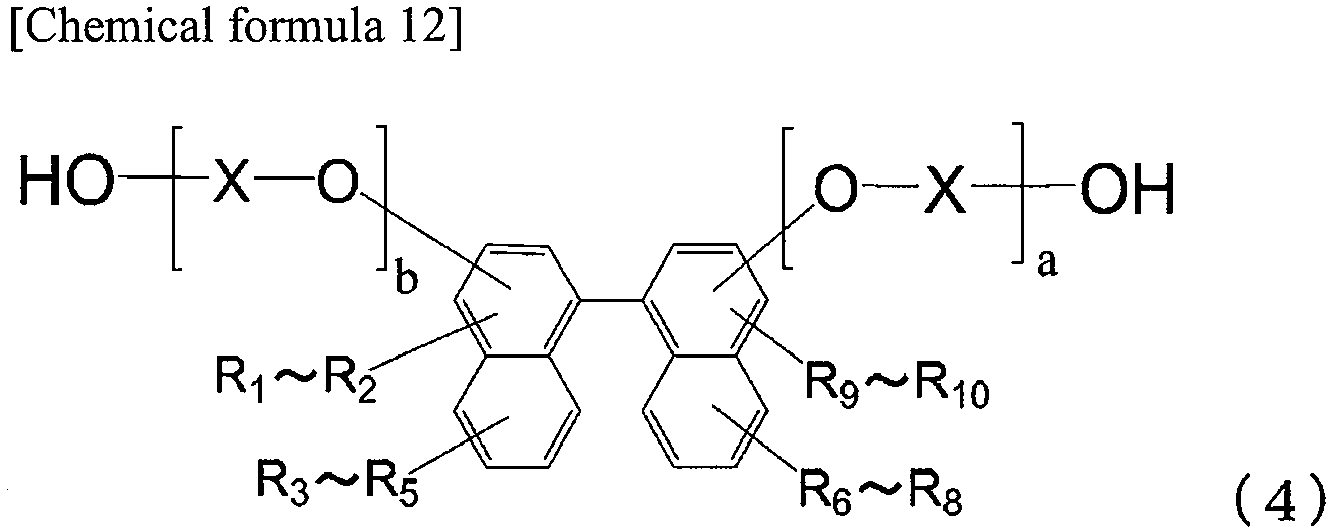

- In Formulae (4) and (5), R1-R10, a and b are synonymous with R1-R10, a and b in Formula (1) above.
- Moreover, preferable examples of the binaphthalene compound or oligomer of Formula (2) include, specifically, compounds or oligomers represented by Formulae (2-1)-(2-11) below. Among them, compounds or oligomers represented by Formulae (2-1)-(2-7) below are particularly preferable.


- An oligomer of the compound of Formula (2) is, for example, a mixture of a monomer to a decamer of the compound of Formula (2), preferably any of a dimer to a pentamer of the compound of Formula (2), or a mixture thereof.
- The molecular weight (weight-average molecular weight: Mw) of the oligomer of the compound of Formula (2) is preferably 5,000 or less, for example, 500-5000. The molecular weight (Mw) of the oligomer of the compound of Formula (2) is more preferably 600-3000, and still more preferably 800-2000.
- Preferably, the oligomer of the compound of Formula (2) has a glass transition temperature (Tg) of 100°C or higher but not higher than 250°C, or a melting point of 100°C or higher but not higher than 250°C. Herein, a glass transition temperature (Tg) refers to a value obtained according to JIS-K-7121.
- In addition to the structure represented by Formula (2) above, the compound or the oligomer of Formula (2) may contain a structure (structural unit) represented by Formula (B) below in a small amount.
- In a case where a structural unit represented by Formula (B) is contained in addition to the structural unit represented by Formula (2) above, the structural unit represented by Formula (2) contains the compound or the oligomer of Formula (2) preferably at 70 mol% or more, more preferably at 80 mol% or more and particularly preferably at 90 mol% or more.

- If the compound or the oligomer of Formula (2) has such a structural unit in addition to the above-described structural unit represented by Formula (2), the oligomer of the compound of Formula (2) containing these structural units is, for example, a random copolymer or a block copolymer, preferably a random copolymer.
- An optical resin composition of the present invention comprises the resin of Formula (1) and the compound or the oligomer of Formula (2).
- In the optical resin composition, the ratio of Mass A of the resin of Formula (1) to Total mass B of the compound or the oligomer of Formula (2) is preferably A/B (mass ratio) = 99/1-80/20 (A:B = 99:1-80:20).
- A/B (mass ratio) is more preferably 97/3-82/18, still more preferably 95/5-84/16, and particularly preferably 92/8-85/15.
- When multiple kinds of resins of Formula (1) are used in a mixture, Mass A of the resin of Formula (1) refers to the total mass of the multiple kinds of resins of Formula (1).
- The optical resin composition may be added with additives as long as the purpose of the present invention is not impaired. For example, additives such as an antioxidant, a processing stabilizer, a light stabilizer, a polymerization-metal deactivator, a flame retardant, a lubricant, an antistatic agent, a surfactant, an antibacterial agent, a mold release agent, a UV absorber, a plasticizer, a compatibilizer or the like may be mixed.
- The content of the additives is preferably 10 mass% or less, more preferably 6 mass% or less, still more preferably 6 mass% or less and particularly preferably 2 mass% or less relative to the total mass of the optical resin composition.
- Although fluorene compounds are compounds having a molecule structure similar to the binaphthalene compound of Formula (2), the optical resin composition is preferably free of a fluorene compound. As can be appreciated from the results in the following examples and comparative example, this is because an optical resin composition containing the binaphthalene compound of Formula (2) or an oligomer thereof has better moldability than an optical resin composition containing a fluorene compound.
- The refractive index of the optical resin composition is preferably within a range of 1.510-1.600 in accordance with JIS-B-7071. The refractive index of the optical resin composition is more preferably 1.512-1.580, still more preferably 1.515-1.560, and particularly preferably 1.520-1.540.
- The Abbe number of the optical resin composition is preferably within a range of 35-50 in accordance with JIS-B-7090. The Abbe number of the optical resin composition is more preferably 36-49, still more preferably 37-47, and particularly preferably 38-46.
- The MVR value of the optical resin composition in accordance with JIS-B-7210 under the conditions of 260°C and 2.16 kg is preferably within a range of 8-30 (cm3/10 min). The MVR value of the optical resin composition is more preferably 10-26 (cm3/10 min), still more preferably 11-25 (cm3/10 min), and particularly preferably 12-24 (cm3/10 min).
- The optical resin composition of the present invention may be contained in various kinds of molded bodies, in particular, a molded body of optical parts. Furthermore, the optical resin composition is useful as a material of a molded body of optical parts. For example, the optical resin composition of the present invention is particularly useful as a material of an optical lens, and the optical lens containing the optical resin composition of the present invention has excellent characteristics.
- Specifically, the optical resin composition of the present invention can be used to produce a lens having a high to moderate refractive index and a moderate Abbe number, without causing a defect upon molding processing.
- Thus, an optical lens molded using an optical resin composition having such excellent characteristics can be used favorably in an optical lens unit.
- Hereinafter, the present invention will be described specifically by way of examples, although the embodiment can be modified suitably as long as the effect of the present invention can be achieved.
- Gel permeation chromatography (GPC) was employed using tetrahydrofuran as an eluent to generate a calibration curve using polystyrene standards with known molecular weights (molecular weight distribution = 1). Based on this calibration curve, weight-average molecular weight (Mw) was calculated from the retention time in GPC.
-
- Instrument: HLC-8320 GPC manufactured by Tosoh Corporation
- Columns: guard column: TSKguardcolumn SuperMPHZ-M x 1 column analytical columns: TSKgel SuperMultiporeHZ-M x 3 columns
- Eluent: tetrahydrofuran
- Injection amount: 10 µL
- Sample concentration: 0.2 w/v% tetrahydrofuran solution
- Flow rate of eluent: 0.35 ml/min
- Measurement temperature: 40°C
- Detector: RI
- Glass transition temperature was measured using a differential scanning calorimeter (High Sensitivity Differential Scanning Calorimeter DSC7000X). Following melting and cooling for solidification in the differential scanning calorimeter (DSC) where the rates of temperature increase and decrease were set to 10°C/min, Tg was measured during the second heating run (second run).
- Melt indexer manufactured by Toyo Seiki Seisaku-sho, Ltd. was used to measure fluidity in accordance with the method of JIS-B-7210. Unless otherwise noted, MVR (cm3/10 min) was obtained under the conditions of 260°C and 2.16 kg.
- Refractive indices were measured using an Abbe refractometer by a method according to JIS-K-7142 for 0.1 mm-thick films made of the resin compositions produced in the examples described in detail below.
- Refractive indices at wavelengths of 486 nm, 589 nm and 656 nm were measured using an Abbe refractometer at 23°C for 0.1 mm-thick films made of the resin compositions produced in the examples.
- Furthermore, Abbe number v was calculated from the measured refractive indices using the following equation.

- nD: Refractive index at wavelength of 589 nm
- nC: Refractive index at wavelength of 656 nm
- nF: Refractive index at wavelength of 486 nm
- 10,000 continuous shots of molding were performed by an injection molding machine (FANUC ROBOSHOT S-2000i50B manufactured by Fanuc Corporation) using an aspheric mold at a resin temperature of 300°C and a mold temperature of [Tg - 20°C] (temperature lower than Tg of the resin by 20°C) to produce lenses. The surfaces of the resulting molded bodies, i.e., lenses, were visually inspected to confirm the presence of flow marks on the molded bodies.
- Flow marks caused upon molding (visual inspection) A: No flow mark
- Flow marks caused upon molding (visual inspection) B: Very few flow marks
- Flow marks caused upon molding (visual inspection) C: A few flow marks
- Flow marks caused upon molding (visual inspection) D: Considerable number of flow marks
- As a resin having a structural unit represented by Formula (1) and a compound represented by Formula (2), 92 parts by mass of pellets of a resin represented by Formula (1-1) below (glass transition temperature (Tg): 164°C, molecular weight (Mw): 45,000) and 8 parts by weight of 2,2'-bis(2-hydroxyethoxy)-6,6'-diphenyl-1,1'-binaphthalene (DP-BHBNA) of Formula (2-1) below were used, respectively. These resin and compound were melt kneaded in a twin-screw extruder (IPT 35 mm co-rotating twin-screw extruder, IPT-35, L/D = 38), and the resultant was extruded into a strand, which was cut with a cutter to obtain pellets of the resin composition. Appearance of the resulting resin composition was colorless and transparent.

2,2-bis(2-hydroxyethoxy)-6,6'-diphenyl-1,1'-binaphthalene - Resin compositions of Examples 2-5 were obtained in the same manner as Example 1 except that a compound or an oligomer represented by Formula (2-2)-(2-4) below was used as the compound represented by Formula (2) or that the content of the compound of Formula (2-1) was changed.

- Compound represented by Formula (2-2) (BINOLE-2EO):
2,2-bis(2-hydroxyethoxy)-1,1'-binaphthalene - Compound represented by Formula (2-3) (BINOLE-DC):
2,2-([1,1-binaphthalene]-2,2-diylbis[oxy])diacetate - Oligomer represented by Formula (2-4) (BNE-3PC):
Trimer of 2,2-bis(2-hydroxyethoxy)-1,1'-binaphthalene - The oligomer used in Example 4 (BNE-3PC) was synthesized as follows.
- 1.000 mol 2,2-bis(2-hydroxyethoxy)-1,1'-binaphthalene, 1.750 mol diphenyl carbonate and 1 × 10⁻⁶ mol sodium hydrogen carbonate were placed in a 1-liter reactor equipped with a stirrer and a distillation unit, heated to 200°C in a nitrogen atmosphere by spending 30 minutes and stirred. Subsequently, temperature and pressure of the reaction system were set to 230°C and 0.13 kPa, respectively by spending 60 minutes, and stirring was performed for 30 minutes continuously under the same conditions but while introducing nitrogen into the reactor, thereby obtaining an oligomer. Mw of the resulting oligomer (BNE-3PC) was 1,415.
- Herein, the number of the repeating units, i.e., "3" (trimer), in Formula (2-4) was calculated by a known method from the weight-average molecular weight relative to polystyrene standards (Mw) and FD-MS.
- In addition, as Comparative example, a resin composition was obtained in the same manner as Example 1 except that a fluorene compound represented by Formula (B) below was used instead of the compound represented by Formula (2).

- The physical properties of the resin compositions obtained in Examples 1-5 and Comparative example are shown in Table 1.
[Table 1] Composition Physical properties Optical properties Moldability Resin Compound or oligomer Tg MVR Refractive index Abbe number Flow marks (*) Kind Content (mass parts) Kind Content (mass parts) (°C) cm3/10 min (nd) (v) Example 1 Formula (1-1) 92 DP-BHBNA (Formula (2-1)) 8 149 13 1.526 45 A Example 2 Formula (1-1) 90 BINOLE-2EO (Formula (2-2)) 10 135 24 1.528 46 B Example 3 Formula (1-1) 90 BINOLE-DC (Formula (2-3)) 10 138 23 1.527 46 B Example 4 Formula (1-1) 90 BNE-3PC (Formula (2-4)) 10 150 14 1.53 46 A Example 5 Formula (1-1) 85 DP-BHBNA (Formula (2-1)) 15 140 18 1.539 38 C Comparative example 1 Formula (1-1) 85 BPEF (Formula (B)) 15 140 22 1.533 45 D (*) Flow marks caused upon molding (visual inspection) A: No flow mark
Flow marks caused upon molding (visual inspection) B: Very few flow marks
Flow marks caused upon molding (visual inspection) C: A few flow marks
Flow marks caused upon molding (visual inspection) D: Considerable number of flow marks - The optical resin composition according to a preferred aspect of the present invention can have, in particular, improved moldability than conventional resin compositions, while realizing excellent optical characteristics. Accordingly, the optical resin composition can produce a molded body such as a lens having satisfactory optical characteristics without causing a surface defect such as flow marks.
- On the other hand, Comparative example that used a fluorene compound was shown to be inferior in moldability.
- In addition, although compounds or oligomers used in the examples are superior in optical characteristics such as high refractive index, they are usually expensive. Since the optical resin composition of the present invention can also realize the above-described superior optical characteristics and moldability in an aspect where the contents of these components are minimized, it can also reduce the cost for producing molded bodies.
- Thus, a resin composition for lenses according to a preferred aspect of the present invention can realize excellent moldability and optical characteristics by using relatively inexpensive resin materials.
Claims (14)
- An optical resin composition comprising:a resin having a structural unit represented by Formula (1) below; anda binaphthalene compound having a structure represented by Formula (2) below and/or an oligomer thereof:
 A represents a C1-C5 alkylene group,p represents 0 or 1,K1 represents a hydrogen atom or a C1-C5 alkyl group,K2 represents a hydrogen atom, a C1-C5 alkyl group or a C6-C20 aryl group,Z each independently represent a carboxyl group, an alkoxycarbonyl group, a cycloalkyloxycarbonyl group, an aryloxycarbonyl group, a hydroxyalkylcarbonyl group, a glycidyloxycarbonyl group, a cyano group or an amide group, andq represents 0 or 1); and
 R1-R10 each independently represent a hydrogen atom, a fluorine atom, a chlorine atom, a bromine atom, an iodine atom, a C1-C6 alkyl group, a C6-C20 aryl group which may contain a heterocyclic atom selected from O, N and S, a C2-C10 alkenyl group, a C2-C10 alkynyl group, a C1-C6 alkoxy group or a C7-C17 aralkyl group, provided that the alkyl group, the aryl group, the alkenyl group, the alkynyl group, the alkoxy group and the aralkyl group may be substituted with a cyano group, and that the alkyl group, the alkenyl group, the alkynyl group, the alkoxy group and the aralkyl group may be substituted with a phenyl group,X each independently represent a C1-C8 alkylene group, a C5-C12 cycloalkylene group or a C6-C20 arylene group, anda and b each independently represent an integer of 1-10.)
 - The optical resin composition according to Claim 1, wherein, in Formula (1), A is an ethylene group, p is 1, K1 is a hydrogen atom or a methyl group, K2 is a hydrogen atom, and Z is selected from any substituent of Formula (3) below:

- The optical resin composition according to either one of Claims 1 and 2, wherein the ratio of Mass A of the resin having a structural unit represented by Formula (1) to Total mass B of the binaphthalene compound represented by Formula (2) and the oligomer thereof is A/B (mass ratio) = 99/1-80/20.
- The optical resin composition according to any one of Claims 1-3, wherein the binaphthalene compound comprises a compound represented by Formula (4) or (5) below:


- The optical resin composition according to any one of Claims 1-4, wherein the binaphthalene compound comprises at least one of the compounds represented by Formulae (2-1)-(2-5) below:

- The optical resin composition according to any one of Claims 1-5, wherein the molecular weight (Mw) of the oligomer is 5,000 or less.
- The optical resin composition according to any one of Claims 1-6, wherein the molecular weight (Mw) of the resin is 10,000 or more but not more than 60,000.
- The optical resin composition according to any one of Claims 1-7, wherein the refractive index in accordance with JIS-B-7071 is 1.510-1.600.
- The optical resin composition according to any one of Claims 1-8, wherein the Abbe number in accordance with JIS-B-7090 is 35-50.
- The optical resin composition according to any one of Claims 1-9, wherein the MVR value in accordance with JIS-B-7210 under the conditions of 260°C and 2.16 kg is 8-30 (cm3/10 min).
- The optical resin composition according to any one of Claims 1-10, which is a resin composition for lenses.
- A molded body comprising the optical resin composition according to any one of Claims 1-11.
- An optical lens comprising the optical resin composition according to any one of Claims 1-12.
- An optical lens unit comprising the optical lens according to Claim 13.
Applications Claiming Priority (2)
| Application Number | Priority Date | Filing Date | Title |
|---|---|---|---|
| JP2018245787 | 2018-12-27 | ||
| PCT/JP2019/050233 WO2020137926A1 (en) | 2018-12-27 | 2019-12-23 | Resin composition, molded body, optical lens, and optical lens unit |
Publications (3)
| Publication Number | Publication Date |
|---|---|
| EP3904442A1 true EP3904442A1 (en) | 2021-11-03 |
| EP3904442A4 EP3904442A4 (en) | 2022-02-16 |
| EP3904442B1 EP3904442B1 (en) | 2025-04-23 |
Family
ID=71127294
Family Applications (1)
| Application Number | Title | Priority Date | Filing Date |
|---|---|---|---|
| EP19906113.6A Active EP3904442B1 (en) | 2018-12-27 | 2019-12-23 | Resin composition, molded body, optical lens, and optical lens unit |
Country Status (7)
| Country | Link |
|---|---|
| US (1) | US12091498B2 (en) |
| EP (1) | EP3904442B1 (en) |
| JP (1) | JP7367704B2 (en) |
| KR (1) | KR102826035B1 (en) |
| CN (1) | CN113272376A (en) |
| TW (1) | TWI835961B (en) |
| WO (1) | WO2020137926A1 (en) |
Cited By (4)
| Publication number | Priority date | Publication date | Assignee | Title |
|---|---|---|---|---|
| EP4174126A4 (en) * | 2020-06-26 | 2023-11-15 | Mitsubishi Gas Chemical Company, Inc. | RESIN COMPOSITION |
| EP4332172A4 (en) * | 2021-04-26 | 2024-09-25 | Mitsubishi Gas Chemical Company, Inc. | THERMOPLASTIC RESIN COMPOSITION AND FORMULATION INGREDIENT TO BE ADDED TO SAID THERMOPLASTIC RESIN COMPOSITION |
| WO2025248024A1 (en) | 2024-05-29 | 2025-12-04 | Reuter Chemische Apparatebau E.K. | Binaphthyl compounds as additives in resin compositions |
| WO2025249586A1 (en) * | 2024-05-29 | 2025-12-04 | Mitsubishi Gas Chemical Company, Inc. | Binaphthyl compounds as additives in resin compositions |
Families Citing this family (1)
| Publication number | Priority date | Publication date | Assignee | Title |
|---|---|---|---|---|
| CN115836045A (en) * | 2020-07-08 | 2023-03-21 | 三菱瓦斯化学株式会社 | Composition for forming photoresist, method for forming resist pattern, and method for forming circuit pattern |
Family Cites Families (12)
| Publication number | Priority date | Publication date | Assignee | Title |
|---|---|---|---|---|
| US5516456A (en) * | 1994-02-24 | 1996-05-14 | Japan Synthetic Rubber Co., Ltd. | Liquid crystal display panel |
| JP5625281B2 (en) * | 2009-08-07 | 2014-11-19 | Dic株式会社 | Curable resin composition, cured product thereof, and plastic lens |
| CN108329464B (en) | 2012-11-07 | 2021-05-11 | 三菱瓦斯化学株式会社 | Polycarbonate resin, process for producing the same, and optical molded article |
| MY155102A (en) * | 2013-01-09 | 2015-09-07 | Daicel Corp | Curable resin composition, and cured product of same |
| JP6274639B2 (en) * | 2013-05-23 | 2018-02-07 | 日本化薬株式会社 | Energy ray curable resin composition and cured product thereof |
| EP3081596B1 (en) * | 2013-12-10 | 2018-07-25 | Sumika Polycarbonate Limited | Polycarbonate resin composition and optical molded article |
| US9982129B2 (en) * | 2014-05-02 | 2018-05-29 | Mitsubishi Gas Chemical Company, Inc. | Polycarbonate resin composition, and optical material and optical lens each manufactured using same |
| US10689486B2 (en) * | 2014-05-07 | 2020-06-23 | Mitsubishi Gas Chemical Company, Inc. | Resin produced by polycondensation, and resin composition |
| CN107429033B (en) * | 2015-03-13 | 2020-11-24 | 大阪燃气化学有限公司 | Resin composition and optical lens |
| TWI814646B (en) * | 2015-11-04 | 2023-09-01 | 日商三菱瓦斯化學股份有限公司 | The method of reducing the length of the welding line |
| JP6680650B2 (en) * | 2016-08-30 | 2020-04-15 | 帝人株式会社 | Polyester resin |
| JP6916026B2 (en) | 2017-04-06 | 2021-08-11 | 帝人株式会社 | Thermoplastic resin |
-
2019
- 2019-12-23 TW TW108147207A patent/TWI835961B/en active
- 2019-12-23 US US17/413,984 patent/US12091498B2/en active Active
- 2019-12-23 EP EP19906113.6A patent/EP3904442B1/en active Active
- 2019-12-23 WO PCT/JP2019/050233 patent/WO2020137926A1/en not_active Ceased
- 2019-12-23 CN CN201980085660.5A patent/CN113272376A/en active Pending
- 2019-12-23 KR KR1020217009969A patent/KR102826035B1/en active Active
- 2019-12-23 JP JP2020563227A patent/JP7367704B2/en active Active
Cited By (4)
| Publication number | Priority date | Publication date | Assignee | Title |
|---|---|---|---|---|
| EP4174126A4 (en) * | 2020-06-26 | 2023-11-15 | Mitsubishi Gas Chemical Company, Inc. | RESIN COMPOSITION |
| EP4332172A4 (en) * | 2021-04-26 | 2024-09-25 | Mitsubishi Gas Chemical Company, Inc. | THERMOPLASTIC RESIN COMPOSITION AND FORMULATION INGREDIENT TO BE ADDED TO SAID THERMOPLASTIC RESIN COMPOSITION |
| WO2025248024A1 (en) | 2024-05-29 | 2025-12-04 | Reuter Chemische Apparatebau E.K. | Binaphthyl compounds as additives in resin compositions |
| WO2025249586A1 (en) * | 2024-05-29 | 2025-12-04 | Mitsubishi Gas Chemical Company, Inc. | Binaphthyl compounds as additives in resin compositions |
Also Published As
| Publication number | Publication date |
|---|---|
| WO2020137926A1 (en) | 2020-07-02 |
| JPWO2020137926A1 (en) | 2021-11-18 |
| TWI835961B (en) | 2024-03-21 |
| CN113272376A (en) | 2021-08-17 |
| US12091498B2 (en) | 2024-09-17 |
| KR20210114919A (en) | 2021-09-24 |
| EP3904442A4 (en) | 2022-02-16 |
| KR102826035B1 (en) | 2025-06-26 |
| TW202035560A (en) | 2020-10-01 |
| US20220025110A1 (en) | 2022-01-27 |
| JP7367704B2 (en) | 2023-10-24 |
| EP3904442B1 (en) | 2025-04-23 |
Similar Documents
| Publication | Publication Date | Title |
|---|---|---|
| EP3904442B1 (en) | Resin composition, molded body, optical lens, and optical lens unit | |
| US10913848B2 (en) | Polycarbonate resin composition and optical lens using same | |
| TWI686445B (en) | Polycarbonate resin composition and molded optical product | |
| WO2010061927A1 (en) | Polycarbonate resin, polycarbonate resin composition, optical film, and polycarbonate resin molded article | |
| JP2009001658A (en) | Triazine resin composition and molded article comprising the same | |
| US12286532B2 (en) | Thermoplastic resin composition and optical member using same | |
| EP0837086A2 (en) | Copolycarbonate resin and resin composition comprising the same | |
| US20230192951A1 (en) | Polycarbonate resin, and optical lens and optical film using same | |
| EP3744791A1 (en) | Polycarbonate resin composition, production method therefor, and optical lens | |
| JP6553314B1 (en) | Aromatic polycarbonate resin composition and molded article for optics | |
| WO2019146693A1 (en) | Aromatic polycarbonate resin composition and optical molded article | |
| JP5905655B2 (en) | Polycarbonate resin composition | |
| EP3926000A1 (en) | Polycarbonate resin composition or copolymer, and optical film | |
| CN107429051A (en) | Polycarbonate resin composition and molded article thereof | |
| EP4198092A1 (en) | Thermoplastic resin composition for optical material, molded article, compounding agent, method for producing thermoplastic resin composition, and method for improving transmissivity | |
| JP6986986B2 (en) | Fluorine-containing cyclic olefin-based copolymers and molded products | |
| KR20260009287A (en) | Thermoplastic resin composition and optical lens comprising the same | |
| EP4361196A1 (en) | Thermoplastic resin and optical lens including same | |
| KR101452087B1 (en) | Polycarbonate resin compositions | |
| US12043684B2 (en) | Optical lens | |
| US20070088107A1 (en) | Production and use of polycarbonates with special purified, oligomeric epoxy resins | |
| EP4715011A1 (en) | Thermoplastic resin composition production method and thermoplastic resin composition | |
| KR20190064297A (en) | A gamma-resistant polycarbonate resin composition having improved color recovery performance | |
| HK1234085B (en) | Polycarbonate resin composition, and optical material and optical lens each manufactured using same |
Legal Events
| Date | Code | Title | Description |
|---|---|---|---|
| STAA | Information on the status of an ep patent application or granted ep patent |
Free format text: STATUS: THE INTERNATIONAL PUBLICATION HAS BEEN MADE |
|
| PUAI | Public reference made under article 153(3) epc to a published international application that has entered the european phase |
Free format text: ORIGINAL CODE: 0009012 |
|
| STAA | Information on the status of an ep patent application or granted ep patent |
Free format text: STATUS: REQUEST FOR EXAMINATION WAS MADE |
|
| 17P | Request for examination filed |
Effective date: 20210531 |
|
| AK | Designated contracting states |
Kind code of ref document: A1 Designated state(s): AL AT BE BG CH CY CZ DE DK EE ES FI FR GB GR HR HU IE IS IT LI LT LU LV MC MK MT NL NO PL PT RO RS SE SI SK SM TR |
|
| A4 | Supplementary search report drawn up and despatched |
Effective date: 20220119 |
|
| RIC1 | Information provided on ipc code assigned before grant |
Ipc: G02B 1/04 20060101ALI20220113BHEP Ipc: C08L 65/00 20060101ALI20220113BHEP Ipc: C08K 5/12 20060101ALI20220113BHEP Ipc: C08K 5/06 20060101AFI20220113BHEP |
|
| DAV | Request for validation of the european patent (deleted) | ||
| DAX | Request for extension of the european patent (deleted) | ||
| GRAP | Despatch of communication of intention to grant a patent |
Free format text: ORIGINAL CODE: EPIDOSNIGR1 |
|
| STAA | Information on the status of an ep patent application or granted ep patent |
Free format text: STATUS: GRANT OF PATENT IS INTENDED |
|
| INTG | Intention to grant announced |
Effective date: 20241223 |
|
| GRAS | Grant fee paid |
Free format text: ORIGINAL CODE: EPIDOSNIGR3 |
|
| GRAA | (expected) grant |
Free format text: ORIGINAL CODE: 0009210 |
|
| STAA | Information on the status of an ep patent application or granted ep patent |
Free format text: STATUS: THE PATENT HAS BEEN GRANTED |
|
| AK | Designated contracting states |
Kind code of ref document: B1 Designated state(s): AL AT BE BG CH CY CZ DE DK EE ES FI FR GB GR HR HU IE IS IT LI LT LU LV MC MK MT NL NO PL PT RO RS SE SI SK SM TR |
|
| REG | Reference to a national code |
Ref country code: GB Ref legal event code: FG4D |
|
| REG | Reference to a national code |
Ref country code: CH Ref legal event code: EP |
|
| P01 | Opt-out of the competence of the unified patent court (upc) registered |
Free format text: CASE NUMBER: APP_15502/2025 Effective date: 20250331 |
|
| REG | Reference to a national code |
Ref country code: DE Ref legal event code: R096 Ref document number: 602019069173 Country of ref document: DE |
|
| REG | Reference to a national code |
Ref country code: IE Ref legal event code: FG4D |
|
| REG | Reference to a national code |
Ref country code: NL Ref legal event code: MP Effective date: 20250423 |
|
| PG25 | Lapsed in a contracting state [announced via postgrant information from national office to epo] |
Ref country code: NL Free format text: LAPSE BECAUSE OF FAILURE TO SUBMIT A TRANSLATION OF THE DESCRIPTION OR TO PAY THE FEE WITHIN THE PRESCRIBED TIME-LIMIT Effective date: 20250423 |
|
| REG | Reference to a national code |
Ref country code: AT Ref legal event code: MK05 Ref document number: 1787745 Country of ref document: AT Kind code of ref document: T Effective date: 20250423 |
|
| PG25 | Lapsed in a contracting state [announced via postgrant information from national office to epo] |
Ref country code: PT Free format text: LAPSE BECAUSE OF FAILURE TO SUBMIT A TRANSLATION OF THE DESCRIPTION OR TO PAY THE FEE WITHIN THE PRESCRIBED TIME-LIMIT Effective date: 20250825 Ref country code: ES Free format text: LAPSE BECAUSE OF FAILURE TO SUBMIT A TRANSLATION OF THE DESCRIPTION OR TO PAY THE FEE WITHIN THE PRESCRIBED TIME-LIMIT Effective date: 20250423 Ref country code: FI Free format text: LAPSE BECAUSE OF FAILURE TO SUBMIT A TRANSLATION OF THE DESCRIPTION OR TO PAY THE FEE WITHIN THE PRESCRIBED TIME-LIMIT Effective date: 20250423 |
|
| REG | Reference to a national code |
Ref country code: LT Ref legal event code: MG9D |
|
| PG25 | Lapsed in a contracting state [announced via postgrant information from national office to epo] |
Ref country code: NO Free format text: LAPSE BECAUSE OF FAILURE TO SUBMIT A TRANSLATION OF THE DESCRIPTION OR TO PAY THE FEE WITHIN THE PRESCRIBED TIME-LIMIT Effective date: 20250723 Ref country code: GR Free format text: LAPSE BECAUSE OF FAILURE TO SUBMIT A TRANSLATION OF THE DESCRIPTION OR TO PAY THE FEE WITHIN THE PRESCRIBED TIME-LIMIT Effective date: 20250724 |
|
| PG25 | Lapsed in a contracting state [announced via postgrant information from national office to epo] |
Ref country code: PL Free format text: LAPSE BECAUSE OF FAILURE TO SUBMIT A TRANSLATION OF THE DESCRIPTION OR TO PAY THE FEE WITHIN THE PRESCRIBED TIME-LIMIT Effective date: 20250423 |
|
| PG25 | Lapsed in a contracting state [announced via postgrant information from national office to epo] |
Ref country code: BG Free format text: LAPSE BECAUSE OF FAILURE TO SUBMIT A TRANSLATION OF THE DESCRIPTION OR TO PAY THE FEE WITHIN THE PRESCRIBED TIME-LIMIT Effective date: 20250423 |
|
| PG25 | Lapsed in a contracting state [announced via postgrant information from national office to epo] |
Ref country code: HR Free format text: LAPSE BECAUSE OF FAILURE TO SUBMIT A TRANSLATION OF THE DESCRIPTION OR TO PAY THE FEE WITHIN THE PRESCRIBED TIME-LIMIT Effective date: 20250423 |
|
| PG25 | Lapsed in a contracting state [announced via postgrant information from national office to epo] |
Ref country code: AT Free format text: LAPSE BECAUSE OF FAILURE TO SUBMIT A TRANSLATION OF THE DESCRIPTION OR TO PAY THE FEE WITHIN THE PRESCRIBED TIME-LIMIT Effective date: 20250423 |
|
| PG25 | Lapsed in a contracting state [announced via postgrant information from national office to epo] |
Ref country code: RS Free format text: LAPSE BECAUSE OF FAILURE TO SUBMIT A TRANSLATION OF THE DESCRIPTION OR TO PAY THE FEE WITHIN THE PRESCRIBED TIME-LIMIT Effective date: 20250723 |
|
| PG25 | Lapsed in a contracting state [announced via postgrant information from national office to epo] |
Ref country code: IS Free format text: LAPSE BECAUSE OF FAILURE TO SUBMIT A TRANSLATION OF THE DESCRIPTION OR TO PAY THE FEE WITHIN THE PRESCRIBED TIME-LIMIT Effective date: 20250823 |
|
| PG25 | Lapsed in a contracting state [announced via postgrant information from national office to epo] |
Ref country code: LV Free format text: LAPSE BECAUSE OF FAILURE TO SUBMIT A TRANSLATION OF THE DESCRIPTION OR TO PAY THE FEE WITHIN THE PRESCRIBED TIME-LIMIT Effective date: 20250423 |
|
| PGFP | Annual fee paid to national office [announced via postgrant information from national office to epo] |
Ref country code: DE Payment date: 20251028 Year of fee payment: 7 |
|
| PGFP | Annual fee paid to national office [announced via postgrant information from national office to epo] |
Ref country code: GB Payment date: 20251030 Year of fee payment: 7 |
|
| PG25 | Lapsed in a contracting state [announced via postgrant information from national office to epo] |
Ref country code: DK Free format text: LAPSE BECAUSE OF FAILURE TO SUBMIT A TRANSLATION OF THE DESCRIPTION OR TO PAY THE FEE WITHIN THE PRESCRIBED TIME-LIMIT Effective date: 20250423 Ref country code: SM Free format text: LAPSE BECAUSE OF FAILURE TO SUBMIT A TRANSLATION OF THE DESCRIPTION OR TO PAY THE FEE WITHIN THE PRESCRIBED TIME-LIMIT Effective date: 20250423 |
|
| PGFP | Annual fee paid to national office [announced via postgrant information from national office to epo] |
Ref country code: FR Payment date: 20251110 Year of fee payment: 7 |
|
| PG25 | Lapsed in a contracting state [announced via postgrant information from national office to epo] |
Ref country code: CZ Free format text: LAPSE BECAUSE OF FAILURE TO SUBMIT A TRANSLATION OF THE DESCRIPTION OR TO PAY THE FEE WITHIN THE PRESCRIBED TIME-LIMIT Effective date: 20250423 |
|
| PG25 | Lapsed in a contracting state [announced via postgrant information from national office to epo] |
Ref country code: EE Free format text: LAPSE BECAUSE OF FAILURE TO SUBMIT A TRANSLATION OF THE DESCRIPTION OR TO PAY THE FEE WITHIN THE PRESCRIBED TIME-LIMIT Effective date: 20250423 |
|
| REG | Reference to a national code |
Ref country code: DE Ref legal event code: R097 Ref document number: 602019069173 Country of ref document: DE |
|
| PG25 | Lapsed in a contracting state [announced via postgrant information from national office to epo] |
Ref country code: SK Free format text: LAPSE BECAUSE OF FAILURE TO SUBMIT A TRANSLATION OF THE DESCRIPTION OR TO PAY THE FEE WITHIN THE PRESCRIBED TIME-LIMIT Effective date: 20250423 Ref country code: RO Free format text: LAPSE BECAUSE OF FAILURE TO SUBMIT A TRANSLATION OF THE DESCRIPTION OR TO PAY THE FEE WITHIN THE PRESCRIBED TIME-LIMIT Effective date: 20250423 |
|
| PG25 | Lapsed in a contracting state [announced via postgrant information from national office to epo] |
Ref country code: IT Free format text: LAPSE BECAUSE OF FAILURE TO SUBMIT A TRANSLATION OF THE DESCRIPTION OR TO PAY THE FEE WITHIN THE PRESCRIBED TIME-LIMIT Effective date: 20250423 |
|
| PLBE | No opposition filed within time limit |
Free format text: ORIGINAL CODE: 0009261 |
|
| STAA | Information on the status of an ep patent application or granted ep patent |
Free format text: STATUS: NO OPPOSITION FILED WITHIN TIME LIMIT |
|
| REG | Reference to a national code |
Ref country code: CH Ref legal event code: L10 Free format text: ST27 STATUS EVENT CODE: U-0-0-L10-L00 (AS PROVIDED BY THE NATIONAL OFFICE) Effective date: 20260304 |
|
| 26N | No opposition filed |
Effective date: 20260126 |