EP3904283B1 - Solid electrolyte material and battery using same - Google Patents
Solid electrolyte material and battery using same Download PDFInfo
- Publication number
- EP3904283B1 EP3904283B1 EP19904950.3A EP19904950A EP3904283B1 EP 3904283 B1 EP3904283 B1 EP 3904283B1 EP 19904950 A EP19904950 A EP 19904950A EP 3904283 B1 EP3904283 B1 EP 3904283B1
- Authority
- EP
- European Patent Office
- Prior art keywords
- solid electrolyte
- electrolyte material
- material according
- negative electrode
- positive electrode
- Prior art date
- Legal status (The legal status is an assumption and is not a legal conclusion. Google has not performed a legal analysis and makes no representation as to the accuracy of the status listed.)
- Active
Links
Images


Classifications
-
- H—ELECTRICITY
- H01—ELECTRIC ELEMENTS
- H01M—PROCESSES OR MEANS, e.g. BATTERIES, FOR THE DIRECT CONVERSION OF CHEMICAL ENERGY INTO ELECTRICAL ENERGY
- H01M10/00—Secondary cells; Manufacture thereof
- H01M10/05—Accumulators with non-aqueous electrolyte
- H01M10/052—Li-accumulators
- H01M10/0525—Rocking-chair batteries, i.e. batteries with lithium insertion or intercalation in both electrodes; Lithium-ion batteries
-
- C—CHEMISTRY; METALLURGY
- C01—INORGANIC CHEMISTRY
- C01B—NON-METALLIC ELEMENTS; COMPOUNDS THEREOF; METALLOIDS OR COMPOUNDS THEREOF NOT COVERED BY SUBCLASS C01C
- C01B25/00—Phosphorus; Compounds thereof
- C01B25/16—Oxyacids of phosphorus; Salts thereof
- C01B25/26—Phosphates
- C01B25/455—Phosphates containing halogen
-
- C—CHEMISTRY; METALLURGY
- C01—INORGANIC CHEMISTRY
- C01G—COMPOUNDS CONTAINING METALS NOT COVERED BY SUBCLASSES C01D OR C01F
- C01G33/00—Compounds of niobium
-
- C—CHEMISTRY; METALLURGY
- C01—INORGANIC CHEMISTRY
- C01G—COMPOUNDS CONTAINING METALS NOT COVERED BY SUBCLASSES C01D OR C01F
- C01G35/00—Compounds of tantalum
- C01G35/02—Halides
-
- H—ELECTRICITY
- H01—ELECTRIC ELEMENTS
- H01B—CABLES; CONDUCTORS; INSULATORS; SELECTION OF MATERIALS FOR THEIR CONDUCTIVE, INSULATING OR DIELECTRIC PROPERTIES
- H01B1/00—Conductors or conductive bodies characterised by the conductive materials; Selection of materials as conductors
- H01B1/06—Conductors or conductive bodies characterised by the conductive materials; Selection of materials as conductors mainly consisting of other non-metallic substances
-
- H—ELECTRICITY
- H01—ELECTRIC ELEMENTS
- H01B—CABLES; CONDUCTORS; INSULATORS; SELECTION OF MATERIALS FOR THEIR CONDUCTIVE, INSULATING OR DIELECTRIC PROPERTIES
- H01B1/00—Conductors or conductive bodies characterised by the conductive materials; Selection of materials as conductors
- H01B1/06—Conductors or conductive bodies characterised by the conductive materials; Selection of materials as conductors mainly consisting of other non-metallic substances
- H01B1/08—Conductors or conductive bodies characterised by the conductive materials; Selection of materials as conductors mainly consisting of other non-metallic substances oxides
-
- H—ELECTRICITY
- H01—ELECTRIC ELEMENTS
- H01B—CABLES; CONDUCTORS; INSULATORS; SELECTION OF MATERIALS FOR THEIR CONDUCTIVE, INSULATING OR DIELECTRIC PROPERTIES
- H01B1/00—Conductors or conductive bodies characterised by the conductive materials; Selection of materials as conductors
- H01B1/14—Conductive material dispersed in non-conductive inorganic material
-
- H—ELECTRICITY
- H01—ELECTRIC ELEMENTS
- H01M—PROCESSES OR MEANS, e.g. BATTERIES, FOR THE DIRECT CONVERSION OF CHEMICAL ENERGY INTO ELECTRICAL ENERGY
- H01M10/00—Secondary cells; Manufacture thereof
- H01M10/05—Accumulators with non-aqueous electrolyte
- H01M10/056—Accumulators with non-aqueous electrolyte characterised by the materials used as electrolytes, e.g. mixed inorganic/organic electrolytes
- H01M10/0561—Accumulators with non-aqueous electrolyte characterised by the materials used as electrolytes, e.g. mixed inorganic/organic electrolytes the electrolyte being constituted of inorganic materials only
- H01M10/0562—Solid materials
-
- H—ELECTRICITY
- H01—ELECTRIC ELEMENTS
- H01M—PROCESSES OR MEANS, e.g. BATTERIES, FOR THE DIRECT CONVERSION OF CHEMICAL ENERGY INTO ELECTRICAL ENERGY
- H01M4/00—Electrodes
- H01M4/02—Electrodes composed of, or comprising, active material
- H01M4/04—Processes of manufacture in general
- H01M4/0402—Methods of deposition of the material
- H01M4/0407—Methods of deposition of the material by coating on an electrolyte layer
-
- H—ELECTRICITY
- H01—ELECTRIC ELEMENTS
- H01M—PROCESSES OR MEANS, e.g. BATTERIES, FOR THE DIRECT CONVERSION OF CHEMICAL ENERGY INTO ELECTRICAL ENERGY
- H01M4/00—Electrodes
- H01M4/02—Electrodes composed of, or comprising, active material
- H01M4/62—Selection of inactive substances as ingredients for active masses, e.g. binders, fillers
-
- H—ELECTRICITY
- H01—ELECTRIC ELEMENTS
- H01M—PROCESSES OR MEANS, e.g. BATTERIES, FOR THE DIRECT CONVERSION OF CHEMICAL ENERGY INTO ELECTRICAL ENERGY
- H01M4/00—Electrodes
- H01M4/02—Electrodes composed of, or comprising, active material
- H01M2004/026—Electrodes composed of, or comprising, active material characterised by the polarity
- H01M2004/027—Negative electrodes
-
- H—ELECTRICITY
- H01—ELECTRIC ELEMENTS
- H01M—PROCESSES OR MEANS, e.g. BATTERIES, FOR THE DIRECT CONVERSION OF CHEMICAL ENERGY INTO ELECTRICAL ENERGY
- H01M4/00—Electrodes
- H01M4/02—Electrodes composed of, or comprising, active material
- H01M2004/026—Electrodes composed of, or comprising, active material characterised by the polarity
- H01M2004/028—Positive electrodes
-
- H—ELECTRICITY
- H01—ELECTRIC ELEMENTS
- H01M—PROCESSES OR MEANS, e.g. BATTERIES, FOR THE DIRECT CONVERSION OF CHEMICAL ENERGY INTO ELECTRICAL ENERGY
- H01M2300/00—Electrolytes
- H01M2300/0017—Non-aqueous electrolytes
- H01M2300/0065—Solid electrolytes
- H01M2300/0068—Solid electrolytes inorganic
-
- H—ELECTRICITY
- H01—ELECTRIC ELEMENTS
- H01M—PROCESSES OR MEANS, e.g. BATTERIES, FOR THE DIRECT CONVERSION OF CHEMICAL ENERGY INTO ELECTRICAL ENERGY
- H01M2300/00—Electrolytes
- H01M2300/0017—Non-aqueous electrolytes
- H01M2300/0065—Solid electrolytes
- H01M2300/0068—Solid electrolytes inorganic
- H01M2300/008—Halides
-
- Y—GENERAL TAGGING OF NEW TECHNOLOGICAL DEVELOPMENTS; GENERAL TAGGING OF CROSS-SECTIONAL TECHNOLOGIES SPANNING OVER SEVERAL SECTIONS OF THE IPC; TECHNICAL SUBJECTS COVERED BY FORMER USPC CROSS-REFERENCE ART COLLECTIONS [XRACs] AND DIGESTS
- Y02—TECHNOLOGIES OR APPLICATIONS FOR MITIGATION OR ADAPTATION AGAINST CLIMATE CHANGE
- Y02E—REDUCTION OF GREENHOUSE GAS [GHG] EMISSIONS, RELATED TO ENERGY GENERATION, TRANSMISSION OR DISTRIBUTION
- Y02E60/00—Enabling technologies; Technologies with a potential or indirect contribution to GHG emissions mitigation
- Y02E60/10—Energy storage using batteries
Definitions
- the present disclosure relates to a solid electrolyte material and a battery using the same.
- PTL 1 discloses an all-solid battery in which a sulfide solid electrolyte is used.
- PTL 2 discloses an all-solid battery in which a halide solid electrolyte containing indium is used.
- PTL 3 discloses the solid electrolyte material Li 3 Ta 0.1 PO 3.9 F 0.7 obtained by highfrequency sputtering using a mixture of Li 3 PO 4 , LiF and tantalum oxide.
- NPL 3 discloses LiSr(Nb,Ta) 2 O 6 F having a pyrochlore structure as solid electrolyte material.
- PTL 4 discloses Li 5 La 3 Nb 2 O 12 as solid electrolyte.
- PTL 5 discloses a garnet-type Li 5 La 3 Nb 2 O 12 co-doped with Mg, Al, Zr and F ions and batteries comprising the same. Magnetic properties of lithium niobium halogenides are disclosed in NPL 4.
- a solid electrolyte material according to the present disclosure has a crystal structure including a structure framework and an ion-conductive species, wherein the structure framework has a one-dimensional chain in which a plurality of polyhedrons are linearly connected to each other while sharing a corner, and each of the plurality of polyhedrons contains at least one type of cation and at least one type of anion, the polyhedron being composed of at least one cation selected from the group consisting of Nb, Ta, and P and at least one anion selected from the group consisting of O, F, Cl, Br, and I.
- the present disclosure provides a solid electrolyte material having high ionic conductivity.
- the solid electrolyte material according to the first embodiment has a crystal structure including a structure framework and an ion-conductive species.
- the structure framework has a one-dimensional chain in which a plurality of polyhedrons are linearly connected to each other while sharing a corner.
- Each of the plurality of polyhedrons contains at least one type of cation and at least one type of anion, the polyhedron being composed of at least one cation selected from the group consisting of Nb, Ta, and P and at least one anion selected from the group consisting of O, F, CI, Br, and I.
- the solid electrolyte material according to the first embodiment has high ionic conductivity. Consequently, the solid electrolyte material according to the first embodiment can be used for obtaining a battery having excellent charge-discharge characteristics.
- An example of the battery is an all-solid secondary battery.
- a polyhedron is formed from a cation and all anions bonded to the cation.
- the cation is arranged inside the polyhedron, and the anions are arranged at the corners of the polyhedron.
- the distance between an anion and the cation is less than 1.2 times the sum of the atomic radius of the cation and the atomic radius of the anion, the cation is assumed to be bonded to the anion.
- the one-dimensional chain in the present disclosure is a structure in which a plurality of polyhedrons are linearly connected to each other while sharing a corner.
- an anion arranged at the corner is also referred to as a shared anion.
- the structure framework of the solid electrolyte material consisting of the one-dimensional chain decreases the filling ratio of the crystal structure (that is, the volume ratio of the constituent elements to the entire crystal structure). This is because, in the structure framework consisting of the one-dimensional chain, the distance between an atom constituting one polyhedron and an atom constituting another polyhedron increases compared with a structure framework composed of a two-dimensional chain or a three-dimensional chain. In the crystal structure having a low filling ratio, the number of atoms that hinder ionic conduction of the ion-conductive species is small. That is, the ionic conduction path of the ion-conductive species is wide.
- the distance between the ion-conductive species and the anion constituting the structure framework is large, electrostatic interaction between the ion-conductive species and the anion is small. As a result of these, the ionic conductivity of the solid electrolyte material increases.
- the shared anions may be one type or two or more types.
- the bonding distances between the cation and the respective shared anions are substantially equal to each other.
- distortion of the polyhedron decreases, and the polyhedron has a shape close to a regular polyhedron. Consequently, the polyhedron can more stably exist.
- a solid electrolyte material not containing sulfur has excellent safety since hydrogen sulfide is not generated even in the case of exposure to air. It should be noted that hydrogen sulfide may be generated when the sulfide solid electrolyte material disclosed in PTL 1 is exposed to air.
- the polyhedron may be a tetrahedron or an octahedron. Such a polyhedron tends to form a one-dimensional chain.
- the polyhedron may be an octahedron.
- the anions constituting the polyhedron may be one type or two or more types.
- the polyhedron contains two or more types of anions
- the polyhedron can realize various shapes.
- the stability and the ionic conductivity of the solid electrolyte material can be improved.
- the shared anions are one type and in which anions other than the shared anions are anions different from the shared anions
- the polyhedron has a shape close to a regular polyhedron and the stability of the solid electrolyte material is improved.
- the shared anions are two or more types
- the polyhedron has a shape like a distorted regular polyhedron.
- the stability of the solid electrolyte material may be deteriorated, but the filling ratio of the crystal structure may be decreased due to the above-described distortion. Accordingly, the solid electrolyte material has high ionic conductivity.
- the polyhedron is composed of at least one cation selected from the group consisting of Nb, Ta, and P and at least one anion selected from the group consisting of O, F, Cl, Br, and I.
- the solid electrolyte material composed of such a polyhedron has high ionic conductivity.
- the ion-conductive species may be a lithium ion.
- a lithium ion has a small ionic radius and, therefore, readily passes through a crystal.
- the solid electrolyte material according to the first embodiment may be particles.
- the solid electrolyte material according to the first embodiment may be formed so as to have the shape of pellets or plates.
- the solid electrolyte material may have a median diameter greater than or equal to 0.1 ⁇ m and less than or equal to 100 ⁇ m. Desirably, the median diameter may be greater than or equal to 0.5 ⁇ m and less than or equal to 10 ⁇ m. Consequently, the solid electrolyte material according to the first embodiment has higher ionic conductivity. Further, the solid electrolyte material according to the first embodiment and other materials may be favorably dispersed.
- the solid electrolyte material according to the first embodiment may have a smaller median diameter than the active material.
- the solid electrolyte material according to the first embodiment may further have a different crystal phase.
- the crystal structure of the solid electrolyte material is evaluated by Rietveld analysis.
- Rietveld analysis is a method for determining the crystal structure of a target sample mainly on the basis of the diffraction peak angle and the intensity of a diffraction pattern obtained by using an X-ray diffraction method.
- the method described in, for example, Chapter 7, Chapter 8, and Chapter 9 of "Funmatsu Xsen Kaiseki no Jissai ( Practice of Powder X-ray Analysis), second edition, (Asakura Publishing Co., Ltd., edited by NAKAI Izumi and IZUMI Fujio ) is used.
- the X-ray diffraction pattern of the solid electrolyte material of the analysis target is measured by using a ⁇ -2 ⁇ method in the range in which the diffraction angle 2 ⁇ is greater than or equal to 10° and less than or equal to 80°.
- the resulting X-ray diffraction pattern is subjected to Rietveld analysis by using the RIETAN-2000 program.
- the reliability of the analysis result is evaluated on the basis of, for example, an R wp value.
- the solid electrolyte material according to the first embodiment is produced by using, for example, the following method.
- Raw material powders are mixed so as to have a predetermined composition.
- the raw material powder include halides, oxides, hydroxides, and acid halides.
- the raw material powders may be mixed at a molar ratio adjusted in advance so as to negate a composition change that may occur during the synthesis process.
- the raw material powders are made to mechanochemically react with each other in a mixer such as a planetary ball mill (that is, through a mechanochemical milling method) so as to produce a product.
- a mixer such as a planetary ball mill (that is, through a mechanochemical milling method) so as to produce a product.
- a battery according to the second embodiment includes a positive electrode, an electrolyte layer, and a negative electrode.
- the electrolyte layer is arranged between the positive electrode and the negative electrode.
- At least one selected from the group consisting of the positive electrode, the electrolyte layer, and the negative electrode contains the solid electrolyte material according to the first embodiment.
- the battery according to the second embodiment contains the solid electrolyte material according to the first embodiment and, therefore, has high charge-discharge characteristics.
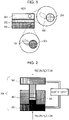
- Fig. 1 is a sectional view of a battery 1000 according to the second embodiment.
- the battery 1000 includes a positive electrode 201, an electrolyte layer 202, and a negative electrode 203.
- the electrolyte layer 202 is arranged between the positive electrode 201 and the negative electrode 203.
- the positive electrode 201 includes positive electrode active material particles 204 and solid electrolyte particles 100.
- the electrolyte layer 202 contains an electrolyte material (for example, a solid electrolyte material).
- the negative electrode 203 contains negative electrode active material particles 205 and solid electrolyte particles 100.
- the solid electrolyte particle 100 is a particle composed of the solid electrolyte material according to the first embodiment or a particle containing the solid electrolyte material according to the first embodiment as a primary component.
- the particle containing the solid electrolyte material according to the first embodiment as a primary component is a particle in which a component contained in the largest amount is the solid electrolyte material according to the first embodiment.
- the positive electrode 201 contains a material capable of occluding and releasing metal ions (for example, lithium ions).
- the material is, for example, a positive electrode active material (for example, the positive electrode active material particles 204).
- Examples of the positive electrode active material include lithium-containing transition metal oxides, transition metal fluorides, polyanions, fluorized polyanionic materials, transition metal sulfides, transition metal oxyfluorides, transition metal oxysulfides, and transition metal oxynitrides.
- An example of the lithium-containing transition metal oxide is Li(NiCoAl)O 2 , LiCoO 2 , or Li(NiCoMn)O 2 .
- the positive electrode active material particles 204 may have a median diameter greater than or equal to 0.1 ⁇ m and less than or equal to 100 ⁇ m. In the case in which the positive electrode active material particles 204 have a median diameter greater than or equal to 0.1 ⁇ m, in the positive electrode, the positive electrode active material particles 204 and the solid electrolyte particles 100 can be favorably dispersed. Consequently, the charge-discharge characteristics of the battery are improved. In the case in which the positive electrode active material particles 204 have a median diameter less than or equal to 100 ⁇ m, the lithium diffusion rate in the positive electrode active material particles 204 is increased. Consequently, the battery can function with a high output.
- the positive electrode active material particles 204 may have a greater median diameter than the solid electrolyte particles 100. Consequently, the positive electrode active material particles 204 and the solid electrolyte particles 100 can be favorably dispersed.
- the ratio of the volume of the positive electrode active material particles 204 to the total of the volume of the positive electrode active material particles 204 and the volume of the solid electrolyte particles 100 may be greater than or equal to 0.30 and less than or equal to 0.95.
- the thickness of the positive electrode 201 may be greater than or equal to 10 ⁇ m and less than or equal to 500 ⁇ m.
- the electrolyte layer 202 contains an electrolyte material.
- the electrolyte material is, for example, a solid electrolyte material.
- the electrolyte layer 202 may be a solid electrolyte layer.
- the electrolyte layer 202 may be composed of just the solid electrolyte material according to the first embodiment.
- the electrolyte layer 202 may be composed of just a solid electrolyte material different from the solid electrolyte material according to the first embodiment.
- the solid electrolyte material different from the solid electrolyte material according to the first embodiment include Li 2 MgX' 4 , Li 2 FeX' 4 , Li(Al,Ga,In)X' 4 , Li 3 (Al,Ga,In)X' 6 , and LiI.
- X' is at least one element selected from the group consisting of F, Cl, Br, and I.
- the solid electrolyte material according to the first embodiment is referred to as a first solid electrolyte material.
- the solid electrolyte material different from the solid electrolyte material according to the first embodiment is referred to as a second solid electrolyte material.
- the electrolyte layer 202 may contain not only the first solid electrolyte material but also the second solid electrolyte material. In the electrolyte layer 202, the first solid electrolyte material and the second solid electrolyte material may be uniformly dispersed.
- a layer composed of the first solid electrolyte material and a layer composed of the second solid electrolyte material may be stacked in the stacking direction of the battery 1000.
- the electrolyte layer 202 may have a thickness greater than or equal to 1 ⁇ m and less than or equal to 1,000 ⁇ m. In the case in which the electrolyte layer 202 has a thickness greater than or equal to 1 ⁇ m, a short circuit between the positive electrode 201 and the negative electrode 203 does not readily occur. In the case in which the electrolyte layer 202 has a thickness less than or equal to 1,000 ⁇ m, the battery can function with a high output.
- the negative electrode 203 contains a material capable of occluding and releasing metal ions (for example, lithium ions).
- the material is, for example, a negative electrode active material (for example, the negative electrode active material particles 205).
- Examples of the negative electrode active material include metal materials, carbon materials, oxides, nitrides, tin compounds, and silicon compounds.
- the metal material may be a simple metal or an alloy.
- Examples of the metal material include lithium metal and lithium alloys.
- Examples of the carbon material include natural graphite, coke, graphitizing carbon, carbon fiber, spherical carbon, artificial carbon, and amorphous carbon. From the viewpoint of the capacity density, favorable examples of the negative electrode active material include silicon (that is, Si), tin (that is, Sn), silicon compounds, and tin compounds.
- the negative electrode active material particles 205 may have a median diameter greater than or equal to 0.1 ⁇ m and less than or equal to 100 ⁇ m. In the case in which the negative electrode active material particles 205 have a median diameter greater than or equal to 0.1 ⁇ m, in the negative electrode 203, the negative electrode active material particles 205 and the solid electrolyte particles 100 can be favorably dispersed. Consequently, the charge-discharge characteristics of the battery are improved. In the case in which the negative electrode active material particles 205 have a median diameter less than or equal to 100 ⁇ m, the lithium diffusion rate in the negative electrode active material particles 205 is improved. Consequently, the battery can function with a high output.
- the negative electrode active material particles 205 may have a greater median diameter than the solid electrolyte particles 100. Consequently, the negative electrode active material particles 205 and the solid electrolyte particles 100 can be favorably dispersed.
- the ratio of the volume of the negative electrode active material particles 205 to the total of the volume of the negative electrode active material particles 205 and the volume of the solid electrolyte particles 100 may be greater than or equal to 0.30 and less than or equal to 0.95.
- the negative electrode 203 may have a thickness greater than or equal to 10 ⁇ m and less than or equal to 500 ⁇ m.
- At least one selected from the group consisting of the positive electrode 201, the electrolyte layer 202, and the negative electrode 203 may contain the second solid electrolyte material.
- the second solid electrolyte material may be a sulfide solid electrolyte.
- Examples of the sulfide solid electrolyte include Li 2 S-P 2 S 5 , Li 2 S-SiS 2 , Li 2 S-B 2 S 3 , Li 2 S-GeS 2 , Li 3.25 Ge 0.25 P 0.75 S 4 , and Li 10 GeP 2 S 12 .
- the second solid electrolyte material may be an oxide solid electrolyte.
- oxide solid electrolyte examples include
- the second solid electrolyte material may be an organic polymer solid electrolyte.
- Examples of the organic polymer solid electrolyte include compounds of a polymer compound and a lithium salt.
- the polymer compound may have an ethylene oxide structure. Since the polymer compound having an ethylene oxide structure can contain a large amount of lithium salt, the ionic conductivity can be further enhanced.
- lithium salt examples include LiPF 6 , LiBF 4 , LiSbF 6 , LiAsF 6 , LiSO 3 CF 3 , LiN(SO 2 CF 3 ) 2 , LiN(SO 2 C 2 F 5 ) 2 , LiN(SO 2 CF 3 )(SO 2 C 4 F 9 ), and LiC(SO 2 CF 3 ) 3 .
- a lithium salt selected from these may be used alone. Alternatively, a mixture of at least two lithium salts selected from these may be used.
- At least one selected from the group consisting of the positive electrode 201, the electrolyte layer 202, and the negative electrode 203 may contain a nonaqueous electrolytic solution, a gel electrolyte, or an ionic liquid.
- the nonaqueous electrolytic solution contains a nonaqueous solvent and a lithium salt dissolved in the nonaqueous solvent.
- the nonaqueous solvent include cyclic carbonic acid ester solvents, chain carbonic acid ester solvents, cyclic ether solvents, chain ether solvents, cyclic ester solvents, chain ester solvents, and fluorine solvents.
- the cyclic carbonic acid ester solvent include ethylene carbonate, propylene carbonate, and butylene carbonate.
- Examples of the chain carbonic acid ester solvent include dimethyl carbonate, ethyl methyl carbonate, and diethyl carbonate.
- Examples of the cyclic ether solvent include tetrahydrofuran, 1,4-dioxane, and 1,3-dioxolane.
- Examples of the chain ether solvent include 1,2-dimethoxyethane and 1,2-diethoxyethane.
- Examples of the cyclic ester solvent include ⁇ -butyrolactone.
- Examples of the chain ester solvent include methyl acetate.
- Examples of the fluorine solvent include fluoroethylene carbonate, methyl fluoropropionate, fluorobenzene, fluoroethyl methyl carbonate, and fluorodimethylene carbonate.
- a nonaqueous solvent selected from these may be used alone. Alternatively, a mixture of at least two nonaqueous solvents selected from these may be used.
- lithium salt examples include LiPF 6 , LiBF 4 , LiSbF 6 , LiAsF 6 , LiSO 3 CF 3 , LiN(SO 2 CF 3 ) 2 , LiN(SO 2 C 2 F 5 ) 2 , LiN(SO 2 CF 3 )(SO 2 C 4 F 9 ), and LiC(SO 2 CF 3 ) 3 .
- a lithium salt selected from these may be used alone. Alternatively, a mixture of at least two lithium salts selected from these may be used.
- the concentration of the lithium salt may be, for example, greater than or equal to 0.5 mol/liter and less than or equal to 2 mol/liter.
- a polymer material impregnated with a nonaqueous electrolytic solution may be used.
- the polymer material include polyethylene oxides, polyacrylonitriles, polyvinylidene fluorides, polymethyl methacrylates, and polymers having an ethylene oxide bond.
- Examples of the cation contained in the ionic liquid include
- Examples of the anion contained in the ionic liquid include PF 6 - , BF 4 - , SbF 6 - , AsF 6 - , SO 3 CF 3 - , N(SO 2 CF 3 ) 2 - , N(SO 2 C 2 F 5 ) 2 - , N(SO 2 CF 3 )(SO 2 C 4 F 9 ) - , and C(SO 2 CF 3 ) 3 - .
- the ionic liquid may contain a lithium salt.
- At least one selected from the group consisting of the positive electrode 201, the electrolyte layer 202, and the negative electrode 203 may contain a binder.
- binder examples include polyvinylidene fluorides, polytetrafluoroethylenes, polyethylenes, polypropylenes, aramid resins, polyamides, polyimides, polyamide-imides, polyacrylonitriles, polyacrylic acids, polyacrylic acid methyl esters, polyacrylic acid ethyl esters, polyacrylic acid hexyl esters, polymethacrylic acids, polymethacrylic acid methyl esters, polymethacrylic acid ethyl esters, polymethacrylic acid hexyl esters, polyvinyl acetates, polyvinylpyrrolidones, polyethers, polyether sulfones, hexafluoropolypropylenes, styrene-butadiene rubber, and carboxymethyl cellulose.
- Copolymers may also be used as binders.
- a binder include copolymers of at least two materials selected from the group consisting of tetrafluoroethylene, hexafluoroethylene, hexafluoropropylene, perfluoroalkyl vinyl ether, vinylidene fluoride, chlorotrifluoroethylene, ethylene, propylene, pentafluoropropylene, fluoromethyl vinyl ether, acrylic acid, and hexadiene.
- a mixture of at least two selected from the above-described materials may be used as the binder.
- At least one selected from the positive electrode 201 or the negative electrode 203 may contain a conductive auxiliary.
- Examples of the conductive auxiliary include
- examples of the shape of the battery according to the second embodiment include a coin type, a cylindrical type, a square type, a sheet type, a button type, a flat type, and a stacked type.
- LiCl and NbOCl 3 at a LiCl:NbOCl 3 molar ratio of 1:1 were prepared in a dry atmosphere having a dew point lower than or equal to -30°C. These materials were pulverized and mixed in a mortar so as to obtain a powder mixture. The resulting mixture was subjected to milling treatment for 24 hours at 600 rpm by using a planetary ball mill. In this manner, a powder of the solid electrolyte material according to Example 1 was obtained.
- the solid electrolyte material according to Example 1 had a composition denoted by LiNbOCl 4 .
- Fig. 2 is a schematic diagram of a pressure forming die 300 used for evaluating the ionic conductivity of the solid electrolyte material.
- the pressure forming die 300 included a punch upper portion 301, a die 302, and a punch lower portion 303.
- the die 302 was formed of an insulating polycarbonate.
- Each of the punch upper portion 301 and the punch lower portion 303 was formed of stainless steel having electron conductivity.
- the pressure forming die 300 illustrated in Fig. 2 was used, and the ionic conductivity of the solid electrolyte material was measured by using the method described below.
- the solid electrolyte material powder according to Example 1 (that is, the solid electrolyte material powder 101 in Fig. 2 ) was placed into the pressure forming die 300 in a dry atmosphere having a dew point lower than or equal to - 30°C. A pressure of 400 MPa was applied to the solid electrolyte material according to Example 1 by using the punch upper portion 301 and the punch lower portion 303.
- the punch upper portion 301 and the punch lower portion 303 were connected to a potentiostat (VersaSTAT4 produced by Princeton Applied Research) incorporated with a frequency-response analyzer while the pressure was applied.
- the punch upper portion 301 was connected to a working electrode and a potential-measurement terminal.
- the punch lower portion 303 was connected to a counter electrode and a reference electrode.
- the ionic conductivity of the solid electrolyte material according to Example 1 was measured by using an electrochemical impedance measuring method.
- the ionic conductivity measured at 25°C was 5.7 mS/cm.
- the solid electrolyte material according to Example 1 was subjected to X-ray diffraction measurement.
- An X-ray diffraction apparatus (MiniFlex 600, RIGAKU Corporation) was used for the measurement.
- the X-ray diffraction pattern of the solid electrolyte material according to Example 1 was measured in a dry atmosphere having a dew point lower than or equal to -45°C.
- Cu-K ⁇ rays were used as the X-ray source. That is, the X-ray diffraction pattern was measured by using a ⁇ -2 ⁇ method where Cu-K ⁇ rays (wavelengths of 1.5405 ⁇ and 1.5444 ⁇ ) were used as the X-rays.
- Fig. 5 illustrates the measurement result as "ACTUAL MEASUREMENT PATTERN".
- the solid electrolyte material according to Example 1 was subjected to Rietveld analysis by using the crystal structure illustrated in Fig. 3 and Fig. 4 .
- the solid line in Fig. 5 illustrates the analysis result as "SIMULATED PATTERN".
- the positions of the peaks calculated on the basis of the crystal structure illustrated in Fig. 3 were substantially in accord with those in the X-ray diffraction pattern of the solid electrolyte material according to Example 1.
- the R wp value was 4.76. Referring to, for example, NPL 1, it can be said that the value is sufficiently low. Therefore, the solid electrolyte material according to Example 1 had the crystal structure illustrated in Fig. 3 and Fig. 4 .
- the solid electrolyte material according to Example 1 included a structure framework and an ion-conductive species, and the structure framework was composed of a one-dimensional chain in which a plurality of polyhedrons were linearly connected to each other while sharing a corner.
- the lowest line in Fig. 5 represents the difference in diffraction intensity between the actually measured value and the calculated value. The difference in diffraction intensity being small supports high reliability of the analysis result.
- the solid electrolyte material according to Example 1 was heat-treated at 300°C for 3 hours in an argon atmosphere having a dew point lower than or equal to -60°C. In this manner, a solid electrolyte material powder according to Comparative example 1 was obtained.
- the ionic conductivity of the solid electrolyte material according to Comparative example 1 was measured in the same manner as in Example 1. As a result, the ionic conductivity was 1.6 ⁇ 10 -4 mS/cm.
- the solid electrolyte material according to Comparative example 1 was subjected to the Rietveld analysis by using the crystal structure of the solid electrolyte material according to Example 1. As a result, the R wp value was 28.4. Since the R wp value was large, the crystal structures were not assumed to be similar. That is, it is conjectured that the solid electrolyte material according to Comparative example 1 does not have the one-dimensional structure as illustrated in Fig. 3 and Fig. 4 .
- the activation energy of the solid electrolyte material according to Example 1 was calculated by using a technique described in NPL 2. Table 1 describes the calculated value.
- the crystal structure of the solid electrolyte material according to Example 1 was substituted with F. Subsequently, the crystal structure was optimized by using a first-principle calculation.
- the first-principle calculation was performed by using a PAW (Projector Augmented Wave) method based on the density functional theory.
- GGA-PBE was used for describing the electron density that expresses exchange-correlation term related to the interaction between electrons. GGA represents generalized gradient approximation.
- PBE represents Perdew-Burke-Ernzerhof.
- Example 2 In the crystal structure of the solid electrolyte material according to Example 1, CI was substituted with Br. Subsequently, the crystal structure was optimized by using the first-principle calculation. The first-principle calculation was performed under the same condition as in Example 2.
- Example 2 In the crystal structure of the solid electrolyte material according to Example 1, CI was substituted with I. Subsequently, the crystal structure was optimized by using the first-principle calculation. The first-principle calculation was performed under the same condition as in Example 2.
- Nb was substituted with Ta. Subsequently, the crystal structure was optimized by using the first-principle calculation. The first-principle calculation was performed under the same condition as in Example 2.
- the activation energy of the solid electrolyte material according to each of Example 2 to Example 6 was calculated in the same manner as in Example 1. Table 1 describes the calculated value.
- the crystal structure of Li 2 NbOF 5 (mp-755505) was obtained from the first-principle calculation data base Materials Project. In the resulting crystal structure, F was substituted with CI. Subsequently, the crystal structure was optimized by using the first-principle calculation. The first-principle calculation was performed under the same condition as in Example 2. Regarding the optimized crystal structure, the activation energy was calculated in the same manner as in Example 1. The optimized crystal structure is illustrated in Fig. 6 . As is clear from Fig. 6 , polyhedrons did not share a corner. Further, a plurality of polyhedrons did not form a one-dimensional chain. Table 1 describes the values of the activation energy of the solid electrolyte material according to Comparative example 2.
- Example 1 As is clear from comparisons between Example 1 and Comparative example 2, even when the same constituent elements are included, the activation energy increases unless the one-dimensional chain is included.
- the two-dimensional activation energy and the three-dimensional activation energy are higher than the one-dimensional activation energy.
- the solid electrolyte materials according to Examples 1 to 6 have lower two-dimensional activation energy and three-dimensional activation energy than the solid electrolyte material according to Comparative example 2 not including the one-dimensional chain. The reason for this is conjectured that, in the solid electrolyte materials according to Examples 1 to 6, since polyhedrons are linearly connected to each other while sharing a corner, the filling ratio of the crystal structure is low and the ionic conduction path is wide.
- the solid electrolyte material according to the present disclosure is used for, for example, all-solid lithium ion secondary batteries.
Landscapes
- Chemical & Material Sciences (AREA)
- Engineering & Computer Science (AREA)
- Electrochemistry (AREA)
- Chemical Kinetics & Catalysis (AREA)
- General Chemical & Material Sciences (AREA)
- Inorganic Chemistry (AREA)
- Organic Chemistry (AREA)
- Manufacturing & Machinery (AREA)
- Materials Engineering (AREA)
- Physics & Mathematics (AREA)
- Condensed Matter Physics & Semiconductors (AREA)
- General Physics & Mathematics (AREA)
- Dispersion Chemistry (AREA)
- Secondary Cells (AREA)
- Conductive Materials (AREA)
- Inorganic Compounds Of Heavy Metals (AREA)
- Primary Cells (AREA)
- Battery Electrode And Active Subsutance (AREA)
Description
- The present disclosure relates to a solid electrolyte material and a battery using the same.
- PTL 1 discloses an all-solid battery in which a sulfide solid electrolyte is used. PTL 2 discloses an all-solid battery in which a halide solid electrolyte containing indium is used. PTL 3 discloses the solid electrolyte material Li3Ta0.1PO3.9F0.7 obtained by highfrequency sputtering using a mixture of Li3PO4, LiF and tantalum oxide. NPL 3 discloses LiSr(Nb,Ta)2O6F having a pyrochlore structure as solid electrolyte material. PTL 4 discloses Li5La3Nb2O12 as solid electrolyte. PTL 5 discloses a garnet-type Li5La3Nb2O12 co-doped with Mg, Al, Zr and F ions and batteries comprising the same. Magnetic properties of lithium niobium halogenides are disclosed in NPL 4.
-
- PTL 1:
JP 2011-129312 A - PTL 2:
JP 2006-244734 A - PTL 3:
JP 2006-156284 A - PTL 4:
US 2017/162902 A1 - PTL 5:
CN 102 780 031 B - NPL 1: Y. Li, C. Wang, H. Xie, J. Cheng and J. B. Goodenough, Electrochem. Commun., 2011, 13, 1289-1292
- NPL 2: H. Chen, L. L. Wong and S. Adams, Acta Crystallogr., Sect. B: Struct. Sci., Cryst. Eng. Mater., 2019, 75, 18-33
- NPL 3: T. Phraewphiphat et al., J. Jpn. Soc. Powder Powder Metallurgy 2018, 65(1), 26-33.
- NPL 4: Z. Yongjia et al., IEEE Transactions on Magnetics, 2011, 47(19), 2916-2919.
- It is an object of the present disclosure to provide a solid electrolyte material having high lithium ion conductivity.
- A solid electrolyte material according to the present disclosure has a crystal structure including a structure framework and an ion-conductive species, wherein the structure framework has a one-dimensional chain in which a plurality of polyhedrons are linearly connected to each other while sharing a corner, and each of the plurality of polyhedrons contains at least one type of cation and at least one type of anion, the polyhedron being composed of at least one cation selected from the group consisting of Nb, Ta, and P and at least one anion selected from the group consisting of O, F, Cl, Br, and I.
- The present disclosure provides a solid electrolyte material having high ionic conductivity.
-
- [
Fig. 1] Fig. 1 is a sectional view of abattery 1000 according to a second embodiment. - [
Fig. 2] Fig. 2 is a schematic diagram of a pressure forming die 300 used for evaluating the ionic conductivity of a solid electrolyte material. - [
Fig. 3] Fig. 3 illustrates a crystal structure of a solid electrolyte material having a composition denoted by LiNbOCl4. - [
Fig. 4] Fig. 4 illustrates the structure when the crystal structure inFig. 3 is viewed in an a-axis direction. - [
Fig. 5] Fig. 5 illustrates the result of Rietveld analysis of a solid electrolyte material according to Example 1 when using the crystal structure illustrated inFig. 3 . - [
Fig. 6] Fig. 6 illustrates the crystal structure of a solid electrolyte material according to Comparative example 2. - The embodiments according to the present disclosure will be described below with reference to the drawings.
- The solid electrolyte material according to the first embodiment has a crystal structure including a structure framework and an ion-conductive species. The structure framework has a one-dimensional chain in which a plurality of polyhedrons are linearly connected to each other while sharing a corner. Each of the plurality of polyhedrons contains at least one type of cation and at least one type of anion, the polyhedron being composed of at least one cation selected from the group consisting of Nb, Ta, and P and at least one anion selected from the group consisting of O, F, CI, Br, and I.
- The solid electrolyte material according to the first embodiment has high ionic conductivity. Consequently, the solid electrolyte material according to the first embodiment can be used for obtaining a battery having excellent charge-discharge characteristics. An example of the battery is an all-solid secondary battery.
- A polyhedron is formed from a cation and all anions bonded to the cation. The cation is arranged inside the polyhedron, and the anions are arranged at the corners of the polyhedron. When the distance between an anion and the cation is less than 1.2 times the sum of the atomic radius of the cation and the atomic radius of the anion, the cation is assumed to be bonded to the anion.
- The one-dimensional chain in the present disclosure is a structure in which a plurality of polyhedrons are linearly connected to each other while sharing a corner. Hereafter, an anion arranged at the corner is also referred to as a shared anion.
- The structure framework of the solid electrolyte material consisting of the one-dimensional chain decreases the filling ratio of the crystal structure (that is, the volume ratio of the constituent elements to the entire crystal structure). This is because, in the structure framework consisting of the one-dimensional chain, the distance between an atom constituting one polyhedron and an atom constituting another polyhedron increases compared with a structure framework composed of a two-dimensional chain or a three-dimensional chain. In the crystal structure having a low filling ratio, the number of atoms that hinder ionic conduction of the ion-conductive species is small. That is, the ionic conduction path of the ion-conductive species is wide. Further, since the distance between the ion-conductive species and the anion constituting the structure framework is large, electrostatic interaction between the ion-conductive species and the anion is small. As a result of these, the ionic conductivity of the solid electrolyte material increases.
- In the case in which a plurality of polyhedrons share a corner with each other, a space between the polyhedrons is large compared with the case in which a face or an edge is shared. That is, the filling ratio of the crystal structure decreases. Consequently, the conduction path of the ion-conductive species is widened, and the ionic conductivity of the solid electrolyte material is further enhanced.
- The shared anions may be one type or two or more types. In the case in which the shared anions are one type, the bonding distances between the cation and the respective shared anions are substantially equal to each other. As a result, distortion of the polyhedron decreases, and the polyhedron has a shape close to a regular polyhedron. Consequently, the polyhedron can more stably exist.
- It is desirable that sulfur not be contained in the solid electrolyte material according to the first embodiment. A solid electrolyte material not containing sulfur has excellent safety since hydrogen sulfide is not generated even in the case of exposure to air. It should be noted that hydrogen sulfide may be generated when the sulfide solid electrolyte material disclosed in PTL 1 is exposed to air.
- The polyhedron may be a tetrahedron or an octahedron. Such a polyhedron tends to form a one-dimensional chain.
- To form a one-dimensional chain having reduced distortion, the polyhedron may be an octahedron.
- The anions constituting the polyhedron may be one type or two or more types. In the case in which the polyhedron contains two or more types of anions, the polyhedron can realize various shapes. As a result, the stability and the ionic conductivity of the solid electrolyte material can be improved. In the case in which the shared anions are one type and in which anions other than the shared anions are anions different from the shared anions, the polyhedron has a shape close to a regular polyhedron and the stability of the solid electrolyte material is improved. In the case in which the shared anions are two or more types, the polyhedron has a shape like a distorted regular polyhedron. As a result, the stability of the solid electrolyte material may be deteriorated, but the filling ratio of the crystal structure may be decreased due to the above-described distortion. Accordingly, the solid electrolyte material has high ionic conductivity.
- The polyhedron is composed of at least one cation selected from the group consisting of Nb, Ta, and P and at least one anion selected from the group consisting of O, F, Cl, Br, and I. The solid electrolyte material composed of such a polyhedron has high ionic conductivity.
- The ion-conductive species may be a lithium ion. A lithium ion has a small ionic radius and, therefore, readily passes through a crystal.
- There is no particular limitation regarding the shape of the solid electrolyte material according to the first embodiment. Examples of the shape include needle-like shapes, spherical shapes, and ellipsoidal shapes. The solid electrolyte material according to the first embodiment may be particles. The solid electrolyte material according to the first embodiment may be formed so as to have the shape of pellets or plates.
- For example, in the case in which the shape of the solid electrolyte material according to the first embodiment is granular (for example, spherical), the solid electrolyte material may have a median diameter greater than or equal to 0.1 µm and less than or equal to 100 µm. Desirably, the median diameter may be greater than or equal to 0.5 µm and less than or equal to 10 µm. Consequently, the solid electrolyte material according to the first embodiment has higher ionic conductivity. Further, the solid electrolyte material according to the first embodiment and other materials may be favorably dispersed.
- To favorably disperse the solid electrolyte material according to the first embodiment and an active material, the solid electrolyte material according to the first embodiment may have a smaller median diameter than the active material.
- The solid electrolyte material according to the first embodiment may further have a different crystal phase.
- The crystal structure of the solid electrolyte material is evaluated by Rietveld analysis. Rietveld analysis is a method for determining the crystal structure of a target sample mainly on the basis of the diffraction peak angle and the intensity of a diffraction pattern obtained by using an X-ray diffraction method. Regarding the Rietveld method, the method described in, for example, Chapter 7, Chapter 8, and Chapter 9 of "Funmatsu Xsen Kaiseki no Jissai (Practice of Powder X-ray Analysis), second edition, (Asakura Publishing Co., Ltd., edited by NAKAI Izumi and IZUMI Fujio) is used. Specifically, the X-ray diffraction pattern of the solid electrolyte material of the analysis target is measured by using a θ-2θ method in the range in which the diffraction angle 2θ is greater than or equal to 10° and less than or equal to 80°. The resulting X-ray diffraction pattern is subjected to Rietveld analysis by using the RIETAN-2000 program. The reliability of the analysis result is evaluated on the basis of, for example, an Rwp value.
- The solid electrolyte material according to the first embodiment is produced by using, for example, the following method.
- Raw material powders are mixed so as to have a predetermined composition. Examples of the raw material powder include halides, oxides, hydroxides, and acid halides. The raw material powders may be mixed at a molar ratio adjusted in advance so as to negate a composition change that may occur during the synthesis process.
- The raw material powders are made to mechanochemically react with each other in a mixer such as a planetary ball mill (that is, through a mechanochemical milling method) so as to produce a product.
- In this manner, the solid electrolyte material according to the first embodiment is obtained.
- A second embodiment will be described below. Matters described in the first embodiment may be appropriately omitted.
- A battery according to the second embodiment includes a positive electrode, an electrolyte layer, and a negative electrode. The electrolyte layer is arranged between the positive electrode and the negative electrode.
- At least one selected from the group consisting of the positive electrode, the electrolyte layer, and the negative electrode contains the solid electrolyte material according to the first embodiment. The battery according to the second embodiment contains the solid electrolyte material according to the first embodiment and, therefore, has high charge-discharge characteristics.
- A specific example of the battery according to the second embodiment will be described below.
-
Fig. 1 is a sectional view of abattery 1000 according to the second embodiment. - The
battery 1000 includes apositive electrode 201, anelectrolyte layer 202, and anegative electrode 203. Theelectrolyte layer 202 is arranged between thepositive electrode 201 and thenegative electrode 203. - The
positive electrode 201 includes positive electrodeactive material particles 204 andsolid electrolyte particles 100. - The
electrolyte layer 202 contains an electrolyte material (for example, a solid electrolyte material). - The
negative electrode 203 contains negative electrodeactive material particles 205 andsolid electrolyte particles 100. - The
solid electrolyte particle 100 is a particle composed of the solid electrolyte material according to the first embodiment or a particle containing the solid electrolyte material according to the first embodiment as a primary component. The particle containing the solid electrolyte material according to the first embodiment as a primary component is a particle in which a component contained in the largest amount is the solid electrolyte material according to the first embodiment. - The
positive electrode 201 contains a material capable of occluding and releasing metal ions (for example, lithium ions). The material is, for example, a positive electrode active material (for example, the positive electrode active material particles 204). - Examples of the positive electrode active material include lithium-containing transition metal oxides, transition metal fluorides, polyanions, fluorized polyanionic materials, transition metal sulfides, transition metal oxyfluorides, transition metal oxysulfides, and transition metal oxynitrides. An example of the lithium-containing transition metal oxide is Li(NiCoAl)O2, LiCoO2, or Li(NiCoMn)O2.
- The positive electrode
active material particles 204 may have a median diameter greater than or equal to 0.1 µm and less than or equal to 100 µm. In the case in which the positive electrodeactive material particles 204 have a median diameter greater than or equal to 0.1 µm, in the positive electrode, the positive electrodeactive material particles 204 and thesolid electrolyte particles 100 can be favorably dispersed. Consequently, the charge-discharge characteristics of the battery are improved. In the case in which the positive electrodeactive material particles 204 have a median diameter less than or equal to 100 µm, the lithium diffusion rate in the positive electrodeactive material particles 204 is increased. Consequently, the battery can function with a high output. - The positive electrode
active material particles 204 may have a greater median diameter than thesolid electrolyte particles 100. Consequently, the positive electrodeactive material particles 204 and thesolid electrolyte particles 100 can be favorably dispersed. - From the viewpoint of the energy density and the output of the battery, in the
positive electrode 201, the ratio of the volume of the positive electrodeactive material particles 204 to the total of the volume of the positive electrodeactive material particles 204 and the volume of thesolid electrolyte particles 100 may be greater than or equal to 0.30 and less than or equal to 0.95. - From the viewpoint of the energy density and the output of the battery, the thickness of the
positive electrode 201 may be greater than or equal to 10 µm and less than or equal to 500 µm. - The
electrolyte layer 202 contains an electrolyte material. The electrolyte material is, for example, a solid electrolyte material. Theelectrolyte layer 202 may be a solid electrolyte layer. - The
electrolyte layer 202 may be composed of just the solid electrolyte material according to the first embodiment. - The
electrolyte layer 202 may be composed of just a solid electrolyte material different from the solid electrolyte material according to the first embodiment. Examples of the solid electrolyte material different from the solid electrolyte material according to the first embodiment include Li2MgX'4, Li2FeX'4, Li(Al,Ga,In)X'4, Li3(Al,Ga,In)X'6, and LiI. Here, X' is at least one element selected from the group consisting of F, Cl, Br, and I. - Hereafter, the solid electrolyte material according to the first embodiment is referred to as a first solid electrolyte material. The solid electrolyte material different from the solid electrolyte material according to the first embodiment is referred to as a second solid electrolyte material.
- The
electrolyte layer 202 may contain not only the first solid electrolyte material but also the second solid electrolyte material. In theelectrolyte layer 202, the first solid electrolyte material and the second solid electrolyte material may be uniformly dispersed. - A layer composed of the first solid electrolyte material and a layer composed of the second solid electrolyte material may be stacked in the stacking direction of the
battery 1000. - The
electrolyte layer 202 may have a thickness greater than or equal to 1 µm and less than or equal to 1,000 µm. In the case in which theelectrolyte layer 202 has a thickness greater than or equal to 1 µm, a short circuit between thepositive electrode 201 and thenegative electrode 203 does not readily occur. In the case in which theelectrolyte layer 202 has a thickness less than or equal to 1,000 µm, the battery can function with a high output. - The
negative electrode 203 contains a material capable of occluding and releasing metal ions (for example, lithium ions). The material is, for example, a negative electrode active material (for example, the negative electrode active material particles 205). - Examples of the negative electrode active material include metal materials, carbon materials, oxides, nitrides, tin compounds, and silicon compounds. The metal material may be a simple metal or an alloy. Examples of the metal material include lithium metal and lithium alloys. Examples of the carbon material include natural graphite, coke, graphitizing carbon, carbon fiber, spherical carbon, artificial carbon, and amorphous carbon. From the viewpoint of the capacity density, favorable examples of the negative electrode active material include silicon (that is, Si), tin (that is, Sn), silicon compounds, and tin compounds.
- The negative electrode
active material particles 205 may have a median diameter greater than or equal to 0.1 µm and less than or equal to 100 µm. In the case in which the negative electrodeactive material particles 205 have a median diameter greater than or equal to 0.1 µm, in thenegative electrode 203, the negative electrodeactive material particles 205 and thesolid electrolyte particles 100 can be favorably dispersed. Consequently, the charge-discharge characteristics of the battery are improved. In the case in which the negative electrodeactive material particles 205 have a median diameter less than or equal to 100 µm, the lithium diffusion rate in the negative electrodeactive material particles 205 is improved. Consequently, the battery can function with a high output. - The negative electrode
active material particles 205 may have a greater median diameter than thesolid electrolyte particles 100. Consequently, the negative electrodeactive material particles 205 and thesolid electrolyte particles 100 can be favorably dispersed. - From the viewpoint of the energy density and the output of the battery, in the
negative electrode 203, the ratio of the volume of the negative electrodeactive material particles 205 to the total of the volume of the negative electrodeactive material particles 205 and the volume of thesolid electrolyte particles 100 may be greater than or equal to 0.30 and less than or equal to 0.95. - From the viewpoint of the energy density and the output of the battery, the
negative electrode 203 may have a thickness greater than or equal to 10 µm and less than or equal to 500 µm. - For the purpose of enhancing the ionic conductivity, chemical stability, and electrochemical stability, at least one selected from the group consisting of the
positive electrode 201, theelectrolyte layer 202, and thenegative electrode 203 may contain the second solid electrolyte material. - The second solid electrolyte material may be a sulfide solid electrolyte.
- Examples of the sulfide solid electrolyte include Li2S-P2S5, Li2S-SiS2, Li2S-B2S3, Li2S-GeS2, Li3.25Ge0.25P0.75S4, and Li10GeP2S12.
- The second solid electrolyte material may be an oxide solid electrolyte.
- Examples of the oxide solid electrolyte include
- (i) NASICON-type solid electrolytes such as LiTi2(PO4)3 or element substitution products thereof,
- (ii) Perovskite-type solid electrolytes such as (LaLi)TiO3,
- (iii) LISICON-type solid electrolytes such as Li14ZnGe4O16, Li4SiO4, or LiGeO4 or element substitution products thereof,
- (iv) Garnet-type solid electrolytes such as Li7La3Zr2O12 or element substitution products thereof, and
- (v) Li3PO4 or N-substitution products thereof.
- The second solid electrolyte material may be an organic polymer solid electrolyte.
- Examples of the organic polymer solid electrolyte include compounds of a polymer compound and a lithium salt. The polymer compound may have an ethylene oxide structure. Since the polymer compound having an ethylene oxide structure can contain a large amount of lithium salt, the ionic conductivity can be further enhanced.
- Examples of the lithium salt include LiPF6, LiBF4, LiSbF6, LiAsF6, LiSO3CF3, LiN(SO2CF3)2, LiN(SO2C2F5)2, LiN(SO2CF3)(SO2C4F9), and LiC(SO2CF3)3. A lithium salt selected from these may be used alone. Alternatively, a mixture of at least two lithium salts selected from these may be used.
- For the purpose of facilitating transfer of lithium ions and improving the output characteristics of the battery, at least one selected from the group consisting of the
positive electrode 201, theelectrolyte layer 202, and thenegative electrode 203 may contain a nonaqueous electrolytic solution, a gel electrolyte, or an ionic liquid. - The nonaqueous electrolytic solution contains a nonaqueous solvent and a lithium salt dissolved in the nonaqueous solvent. Examples of the nonaqueous solvent include cyclic carbonic acid ester solvents, chain carbonic acid ester solvents, cyclic ether solvents, chain ether solvents, cyclic ester solvents, chain ester solvents, and fluorine solvents. Examples of the cyclic carbonic acid ester solvent include ethylene carbonate, propylene carbonate, and butylene carbonate. Examples of the chain carbonic acid ester solvent include dimethyl carbonate, ethyl methyl carbonate, and diethyl carbonate. Examples of the cyclic ether solvent include tetrahydrofuran, 1,4-dioxane, and 1,3-dioxolane. Examples of the chain ether solvent include 1,2-dimethoxyethane and 1,2-diethoxyethane. Examples of the cyclic ester solvent include γ-butyrolactone. Examples of the chain ester solvent include methyl acetate. Examples of the fluorine solvent include fluoroethylene carbonate, methyl fluoropropionate, fluorobenzene, fluoroethyl methyl carbonate, and fluorodimethylene carbonate. A nonaqueous solvent selected from these may be used alone. Alternatively, a mixture of at least two nonaqueous solvents selected from these may be used.
- Examples of the lithium salt include LiPF6, LiBF4, LiSbF6, LiAsF6, LiSO3CF3, LiN(SO2CF3)2, LiN(SO2C2F5)2, LiN(SO2CF3)(SO2C4F9), and LiC(SO2CF3)3. A lithium salt selected from these may be used alone. Alternatively, a mixture of at least two lithium salts selected from these may be used. The concentration of the lithium salt may be, for example, greater than or equal to 0.5 mol/liter and less than or equal to 2 mol/liter.
- Regarding the gel electrolyte, a polymer material impregnated with a nonaqueous electrolytic solution may be used. Examples of the polymer material include polyethylene oxides, polyacrylonitriles, polyvinylidene fluorides, polymethyl methacrylates, and polymers having an ethylene oxide bond.
- Examples of the cation contained in the ionic liquid include
- (i) aliphatic chain quaternary salts such as tetraalkylammonium or tetraalkylphosphonium,
- (ii) aliphatic cyclic ammoniums such as pyrrolidinium, morpholinium, imidazolinium, tetrahydropyrimidinium, piperazinium, or piperidinium, and
- (iii) nitrogen-containing-heterocyclic aromatic cations such as pyridinium or imidazolium.
- Examples of the anion contained in the ionic liquid include PF6 -, BF4 -, SbF6 -, AsF6 -, SO3CF3 -, N(SO2CF3)2 -, N(SO2C2F5)2 -, N(SO2CF3)(SO2C4F9)-, and C(SO2CF3)3 -.
- The ionic liquid may contain a lithium salt.
- For the purpose of improving the adhesiveness between particles, at least one selected from the group consisting of the
positive electrode 201, theelectrolyte layer 202, and thenegative electrode 203 may contain a binder. - Examples of the binder include polyvinylidene fluorides, polytetrafluoroethylenes, polyethylenes, polypropylenes, aramid resins, polyamides, polyimides, polyamide-imides, polyacrylonitriles, polyacrylic acids, polyacrylic acid methyl esters, polyacrylic acid ethyl esters, polyacrylic acid hexyl esters, polymethacrylic acids, polymethacrylic acid methyl esters, polymethacrylic acid ethyl esters, polymethacrylic acid hexyl esters, polyvinyl acetates, polyvinylpyrrolidones, polyethers, polyether sulfones, hexafluoropolypropylenes, styrene-butadiene rubber, and carboxymethyl cellulose. Copolymers may also be used as binders. Examples of such a binder include copolymers of at least two materials selected from the group consisting of tetrafluoroethylene, hexafluoroethylene, hexafluoropropylene, perfluoroalkyl vinyl ether, vinylidene fluoride, chlorotrifluoroethylene, ethylene, propylene, pentafluoropropylene, fluoromethyl vinyl ether, acrylic acid, and hexadiene. A mixture of at least two selected from the above-described materials may be used as the binder.
- For the purpose of enhancing the electron conductivity, at least one selected from the
positive electrode 201 or thenegative electrode 203 may contain a conductive auxiliary. - Examples of the conductive auxiliary include
- (i) graphite such as natural graphite or artificial graphite,
- (ii) carbon black such as acetylene black or Ketjenblack,
- (iii) conductive fibers such as carbon fiber or metal fiber,
- (iv) carbon fluoride,
- (v) metal powders such as aluminum,
- (vi) conductive whiskers such as zinc oxide or potassium titanate,
- (vii) conductive metal oxides such as titanium oxide, and
- (viii) conductive polymer compounds such as polyanilines, polypyrroles, or polythiophenes. To reduce cost, the conductive auxiliary of (i) or (ii) above may be used.
- In this regard, examples of the shape of the battery according to the second embodiment include a coin type, a cylindrical type, a square type, a sheet type, a button type, a flat type, and a stacked type.
- The present disclosure will be described below in more detail with reference to the examples.
- Regarding raw material powders, LiCl and NbOCl3 at a LiCl:NbOCl3 molar ratio of 1:1 were prepared in a dry atmosphere having a dew point lower than or equal to -30°C. These materials were pulverized and mixed in a mortar so as to obtain a powder mixture. The resulting mixture was subjected to milling treatment for 24 hours at 600 rpm by using a planetary ball mill. In this manner, a powder of the solid electrolyte material according to Example 1 was obtained. The solid electrolyte material according to Example 1 had a composition denoted by LiNbOCl4.
-
Fig. 2 is a schematic diagram of a pressure forming die 300 used for evaluating the ionic conductivity of the solid electrolyte material. - The pressure forming die 300 included a punch
upper portion 301, adie 302, and a punchlower portion 303. Thedie 302 was formed of an insulating polycarbonate. Each of the punchupper portion 301 and the punchlower portion 303 was formed of stainless steel having electron conductivity. - The pressure forming die 300 illustrated in
Fig. 2 was used, and the ionic conductivity of the solid electrolyte material was measured by using the method described below. - The solid electrolyte material powder according to Example 1 (that is, the solid
electrolyte material powder 101 inFig. 2 ) was placed into thepressure forming die 300 in a dry atmosphere having a dew point lower than or equal to - 30°C. A pressure of 400 MPa was applied to the solid electrolyte material according to Example 1 by using the punchupper portion 301 and the punchlower portion 303. - The punch
upper portion 301 and the punchlower portion 303 were connected to a potentiostat (VersaSTAT4 produced by Princeton Applied Research) incorporated with a frequency-response analyzer while the pressure was applied. The punchupper portion 301 was connected to a working electrode and a potential-measurement terminal. The punchlower portion 303 was connected to a counter electrode and a reference electrode. The ionic conductivity of the solid electrolyte material according to Example 1 was measured by using an electrochemical impedance measuring method. - As a result, the ionic conductivity measured at 25°C was 5.7 mS/cm.
- The solid electrolyte material according to Example 1 was subjected to X-ray diffraction measurement. An X-ray diffraction apparatus (MiniFlex 600, RIGAKU Corporation) was used for the measurement. The X-ray diffraction pattern of the solid electrolyte material according to Example 1 was measured in a dry atmosphere having a dew point lower than or equal to -45°C. Cu-Kα rays were used as the X-ray source. That is, the X-ray diffraction pattern was measured by using a θ-2θ method where Cu-Kα rays (wavelengths of 1.5405 Å and 1.5444 Å) were used as the X-rays.
Fig. 5 illustrates the measurement result as "ACTUAL MEASUREMENT PATTERN". - The solid electrolyte material according to Example 1 was subjected to Rietveld analysis by using the crystal structure illustrated in
Fig. 3 and Fig. 4 . The solid line inFig. 5 illustrates the analysis result as "SIMULATED PATTERN". The positions of the peaks calculated on the basis of the crystal structure illustrated inFig. 3 were substantially in accord with those in the X-ray diffraction pattern of the solid electrolyte material according to Example 1. The Rwp value was 4.76. Referring to, for example, NPL 1, it can be said that the value is sufficiently low. Therefore, the solid electrolyte material according to Example 1 had the crystal structure illustrated inFig. 3 and Fig. 4 . That is, the solid electrolyte material according to Example 1 included a structure framework and an ion-conductive species, and the structure framework was composed of a one-dimensional chain in which a plurality of polyhedrons were linearly connected to each other while sharing a corner. The lowest line inFig. 5 represents the difference in diffraction intensity between the actually measured value and the calculated value. The difference in diffraction intensity being small supports high reliability of the analysis result. - The solid electrolyte material according to Example 1 was heat-treated at 300°C for 3 hours in an argon atmosphere having a dew point lower than or equal to -60°C. In this manner, a solid electrolyte material powder according to Comparative example 1 was obtained.
- The ionic conductivity of the solid electrolyte material according to Comparative example 1 was measured in the same manner as in Example 1. As a result, the ionic conductivity was 1.6 × 10⁻⁴ mS/cm.
- The solid electrolyte material according to Comparative example 1 was subjected to the Rietveld analysis by using the crystal structure of the solid electrolyte material according to Example 1. As a result, the Rwp value was 28.4. Since the Rwp value was large, the crystal structures were not assumed to be similar. That is, it is conjectured that the solid electrolyte material according to Comparative example 1 does not have the one-dimensional structure as illustrated in
Fig. 3 and Fig. 4 . - The activation energy of the solid electrolyte material according to Example 1 was calculated by using a technique described in NPL 2. Table 1 describes the calculated value.
- The crystal structures of the solid electrolyte materials according to Examples 2 to 6 were derived in the manner described below.
- In the crystal structure of the solid electrolyte material according to Example 1, CI was substituted with F. Subsequently, the crystal structure was optimized by using a first-principle calculation. The first-principle calculation was performed by using a PAW (Projector Augmented Wave) method based on the density functional theory. Regarding the optimization of the crystal structure, GGA-PBE was used for describing the electron density that expresses exchange-correlation term related to the interaction between electrons. GGA represents generalized gradient approximation. PBE represents Perdew-Burke-Ernzerhof.
- In the crystal structure of the solid electrolyte material according to Example 1, CI was substituted with Br. Subsequently, the crystal structure was optimized by using the first-principle calculation. The first-principle calculation was performed under the same condition as in Example 2.
- In the crystal structure of the solid electrolyte material according to Example 1, CI was substituted with I. Subsequently, the crystal structure was optimized by using the first-principle calculation. The first-principle calculation was performed under the same condition as in Example 2.
- In the crystal structure of the solid electrolyte material according to Example 1, Nb was substituted with Ta. Subsequently, the crystal structure was optimized by using the first-principle calculation. The first-principle calculation was performed under the same condition as in Example 2.
- In the crystal structure of the solid electrolyte material according to Example 1, Nb was substituted with P. Subsequently, the crystal structure was optimized by using the first-principle calculation. The first-principle calculation was performed under the same condition as in Example 2.
- The activation energy of the solid electrolyte material according to each of Example 2 to Example 6 was calculated in the same manner as in Example 1. Table 1 describes the calculated value.
- The crystal structure of Li2NbOF5 (mp-755505) was obtained from the first-principle calculation data base Materials Project. In the resulting crystal structure, F was substituted with CI. Subsequently, the crystal structure was optimized by using the first-principle calculation. The first-principle calculation was performed under the same condition as in Example 2. Regarding the optimized crystal structure, the activation energy was calculated in the same manner as in Example 1. The optimized crystal structure is illustrated in
Fig. 6 . As is clear fromFig. 6 , polyhedrons did not share a corner. Further, a plurality of polyhedrons did not form a one-dimensional chain. Table 1 describes the values of the activation energy of the solid electrolyte material according to Comparative example 2. - In Table 1, "One-dimensional activation energy" denotes "activation energy with respect to a one-dimensional conduction path". The same applies to "two-dimensional" or "three-dimensional".
[Table 1] Composition One-dimensional activation energy (eV) Two-dimensional activation energy (eV) Three-dimensional activation energy (eV) Example 1 LiNbOCl4 0.08 0.21 0.21 Example 2 LiNbOF4 0.20 0.34 0.34 Example 3 LiNbOBr4 0.06 0.24 0.24 Example 4 LiNbOI4 0.48 0.56 0.56 Example 5 LiTaOCl4 0.05 0.24 0.27 Example 6 LiPOCl4 0.16 0.33 0.33 Comparative example 2 Li2NbOCl5 0.75 0.75 0.83 - As is clear from Table 1, regarding the solid electrolyte material according to each of Examples 1 to 6 having a structure framework consisting of a one-dimensional chain, in particular, the one-dimensional activation energy is low. Consequently, the solid electrolyte materials according to Examples 1 to 6 have high ionic conductivity.
- As is clear from comparisons between Example 1 and Comparative example 2, even when the same constituent elements are included, the activation energy increases unless the one-dimensional chain is included.
- Regarding the two-dimensional conduction path and the three-dimensional conduction path in the solid electrolyte material according to each of Examples 1 to 6, since the ion-conductive species has to pass between one-dimensional chains, the two-dimensional activation energy and the three-dimensional activation energy are higher than the one-dimensional activation energy. However, the solid electrolyte materials according to Examples 1 to 6 have lower two-dimensional activation energy and three-dimensional activation energy than the solid electrolyte material according to Comparative example 2 not including the one-dimensional chain. The reason for this is conjectured that, in the solid electrolyte materials according to Examples 1 to 6, since polyhedrons are linearly connected to each other while sharing a corner, the filling ratio of the crystal structure is low and the ionic conduction path is wide.
- The solid electrolyte material according to the present disclosure is used for, for example, all-solid lithium ion secondary batteries.
-
- 100
- solid electrolyte particle
- 101
- solid electrolyte material powder
- 201
- positive electrode
- 202
- electrolyte layer
- 203
- negative electrode
- 204
- positive electrode active material particle
- 205
- negative electrode active material particle
- 300
- pressure forming die
- 301
- punch upper portion
- 302
- die
- 303
- punch lower portion
- 1000
- battery
Claims (8)
- A solid electrolyte material comprising a crystal structure including a structure framework and an ion-conductive species,wherein the structure framework has a one-dimensional chain in which a plurality of polyhedrons are linearly connected to each other while sharing a corner,each of the plurality of polyhedrons contains at least one type of cation and at least one type of anion, andwherein the polyhedron is composed of at least one cation selected from the group consisting of Nb, Ta, and P and at least one anion selected from the group consisting of O, F, CI, Br, and I.
- The solid electrolyte material according to Claim 1,
wherein the polyhedron is an octahedron. - The solid electrolyte material according to Claim 1 or Claim 2,
wherein an element arranged at the corner is one type of anion. - The solid electrolyte material according to any one of Claims 1 to 3,
wherein the polyhedron contains greater than or equal to two types of anions. - The solid electrolyte material according to any one of Claims 1 to 4,
wherein the ion-conductive species is a lithium ion. - The solid electrolyte material according to Claim 1,
wherein the structure framework has a one-dimensional chain in which the plurality of polyhedrons are linearly connected to each other while sharing only a corner. - The solid electrolyte material according to Claim 1,
wherein the structure framework consists of a one-dimensional chain in which the plurality of polyhedrons are linearly connected to each other while sharing a corner. - A battery comprising:a positive electrode;a negative electrode; andan electrolyte layer arranged between the positive electrode and the negative electrode,wherein at least one selected from the group consisting of positive electrode, the negative electrode, and the electrolyte layer contains the solid electrolyte material according to any one of Claims 1 to 7.
Applications Claiming Priority (6)
| Application Number | Priority Date | Filing Date | Title |
|---|---|---|---|
| JP2018248585 | 2018-12-28 | ||
| JP2018248586 | 2018-12-28 | ||
| JP2019125548 | 2019-07-04 | ||
| JP2019159080 | 2019-08-30 | ||
| JP2019190374 | 2019-10-17 | ||
| PCT/JP2019/046737 WO2020137355A1 (en) | 2018-12-28 | 2019-11-29 | Solid electrolyte material and battery using same |
Publications (3)
| Publication Number | Publication Date |
|---|---|
| EP3904283A1 EP3904283A1 (en) | 2021-11-03 |
| EP3904283A4 EP3904283A4 (en) | 2022-03-09 |
| EP3904283B1 true EP3904283B1 (en) | 2022-12-28 |
Family
ID=71127978
Family Applications (1)
| Application Number | Title | Priority Date | Filing Date |
|---|---|---|---|
| EP19904950.3A Active EP3904283B1 (en) | 2018-12-28 | 2019-11-29 | Solid electrolyte material and battery using same |
Country Status (5)
| Country | Link |
|---|---|
| US (1) | US12057549B2 (en) |
| EP (1) | EP3904283B1 (en) |
| JP (1) | JP7515114B2 (en) |
| CN (1) | CN113015694B (en) |
| WO (1) | WO2020137355A1 (en) |
Families Citing this family (6)
| Publication number | Priority date | Publication date | Assignee | Title |
|---|---|---|---|---|
| JP7724434B2 (en) * | 2019-12-12 | 2025-08-18 | パナソニックIpマネジメント株式会社 | Solid electrolyte composition and method for producing solid electrolyte member |
| JP7769981B2 (en) * | 2020-10-30 | 2025-11-14 | パナソニックIpマネジメント株式会社 | Solid electrolyte material and battery using the same |
| JP7742584B2 (en) * | 2021-04-19 | 2025-09-22 | パナソニックIpマネジメント株式会社 | Solid electrolyte composition, solid electrolyte material, and method for producing solid electrolyte composition |
| CN117616600A (en) * | 2021-07-16 | 2024-02-27 | 松下知识产权经营株式会社 | Cathode materials and batteries |
| CN115832249B (en) * | 2022-11-30 | 2025-06-13 | 格林美(无锡)能源材料有限公司 | A high-nickel ternary positive electrode material with a lithium fast ion conductor as a coating layer, and its preparation method and application |
| CN119480948A (en) * | 2024-10-11 | 2025-02-18 | 深圳大学 | Solid electrolytes, composite cathode materials and lithium-rich manganese-based solid-state batteries |
Family Cites Families (18)
| Publication number | Priority date | Publication date | Assignee | Title |
|---|---|---|---|---|
| JPH10316424A (en) | 1997-05-12 | 1998-12-02 | Tokuyama Corp | Method for producing composite tin oxide powder and negative electrode active material for non-aqueous electrolyte secondary battery |
| KR100513726B1 (en) | 2003-01-30 | 2005-09-08 | 삼성전자주식회사 | Solid electrolytes, batteries employing the same and method for preparing the same |
| JP2006156284A (en) * | 2004-12-01 | 2006-06-15 | Matsushita Electric Ind Co Ltd | Lithium ion conductor and secondary battery using the same |
| JP5108205B2 (en) | 2005-02-28 | 2012-12-26 | 国立大学法人静岡大学 | All solid-state lithium secondary battery |
| JP5352358B2 (en) * | 2009-07-03 | 2013-11-27 | シャープ株式会社 | Positive electrode active material for non-aqueous electrolyte secondary battery and non-aqueous electrolyte secondary battery |
| JP5141675B2 (en) | 2009-12-16 | 2013-02-13 | トヨタ自動車株式会社 | Method for producing sulfide solid electrolyte material, sulfide solid electrolyte material, and lithium battery |
| JP5462747B2 (en) * | 2010-08-31 | 2014-04-02 | 積水化学工業株式会社 | Lithium ion conductive material, lithium ion conductive electrolyte membrane, lithium ion conductive electrolyte membrane-electrode assembly, and lithium ion polymer battery |
| JP5772961B2 (en) * | 2011-08-17 | 2015-09-02 | 富士通株式会社 | Lithium ion conductor and method for producing the same, all-solid lithium secondary battery |
| KR102086665B1 (en) * | 2012-07-06 | 2020-03-09 | 삼성전자주식회사 | Solid ion conductor, solid electrolyte comprising the conductor, lithium battery comprising the electrolyte, and preparation method thereof |
| CN102780031B (en) * | 2012-07-18 | 2016-03-30 | 宁波大学 | A kind of Mg 2+, Al 3+, Zr 4+, F -ion co-doped garnet-type solid electrolyte |
| JP2016219130A (en) * | 2015-05-15 | 2016-12-22 | セイコーエプソン株式会社 | Solid electrolyte battery, electrode assembly, composite solid electrolyte, and method for producing solid electrolyte battery |
| CN107431242B (en) | 2015-09-16 | 2021-03-23 | 松下知识产权经营株式会社 | Battery |
| JP6418145B2 (en) * | 2015-12-07 | 2018-11-07 | トヨタ自動車株式会社 | Composite solid electrolyte |
| US10396395B2 (en) * | 2017-03-31 | 2019-08-27 | Tokyo Institute Of Technology | Solid electrolyte material and method for producing the same |
| CN112805793B (en) | 2018-12-28 | 2024-05-24 | 松下知识产权经营株式会社 | Solid electrolyte material and battery using the same |
| CN112753079B (en) | 2018-12-28 | 2024-03-08 | 松下知识产权经营株式会社 | Solid electrolyte materials and batteries using them |
| JP6733922B1 (en) | 2019-02-13 | 2020-08-05 | Necプラットフォームズ株式会社 | Voltage conversion circuit, control method and program |
| JP7081523B2 (en) | 2019-02-13 | 2022-06-07 | 株式会社デンソー | Power converter |
-
2019
- 2019-11-29 JP JP2020562975A patent/JP7515114B2/en active Active
- 2019-11-29 WO PCT/JP2019/046737 patent/WO2020137355A1/en not_active Ceased
- 2019-11-29 EP EP19904950.3A patent/EP3904283B1/en active Active
- 2019-11-29 CN CN201980074838.6A patent/CN113015694B/en active Active
-
2021
- 2021-06-04 US US17/338,670 patent/US12057549B2/en active Active
Also Published As
| Publication number | Publication date |
|---|---|
| CN113015694A (en) | 2021-06-22 |
| CN113015694B (en) | 2024-03-08 |
| JP7515114B2 (en) | 2024-07-12 |
| US12057549B2 (en) | 2024-08-06 |
| EP3904283A1 (en) | 2021-11-03 |
| EP3904283A4 (en) | 2022-03-09 |
| US20210296692A1 (en) | 2021-09-23 |
| WO2020137355A1 (en) | 2020-07-02 |
| JPWO2020137355A1 (en) | 2021-11-18 |
Similar Documents
| Publication | Publication Date | Title |
|---|---|---|
| US11760649B2 (en) | Solid electrolyte material and battery | |
| US11427477B2 (en) | Solid electrolyte material and battery | |
| EP3904283B1 (en) | Solid electrolyte material and battery using same | |
| CN111566757B (en) | Solid Electrolyte Materials and Batteries | |
| US12095030B2 (en) | Solid-electrolyte material and battery including the same | |
| CN111295720B (en) | Solid Electrolyte Materials and Batteries | |
| CN111279432A (en) | Solid Electrolyte Materials and Batteries | |
| US11485646B2 (en) | Solid electrolyte material and battery | |
| US12125972B2 (en) | Solid electrolyte material and battery using same | |
| CN111295721B (en) | Solid electrolyte material and battery | |
| US12148878B2 (en) | Lithium ion conductive solid electrolyte material, and battery using same | |
| WO2020194897A1 (en) | Solid electrolyte material and battery using same | |
| CN116529205A (en) | Solid electrolyte material and battery using the same | |
| US12308383B2 (en) | Solid electrolyte material and battery using same | |
| US12125970B2 (en) | Solid electrolyte material and battery using same | |
| US20240170718A1 (en) | Solid electrolyte material and battery including the same | |
| CN115298753A (en) | Solid electrolyte material and battery using the same | |
| US11984554B2 (en) | Solid electrolyte material and battery including the same | |
| EP3905274B1 (en) | Solid electrolyte material and battery using same | |
| US12074279B2 (en) | Solid electrolyte material and battery using same | |
| WO2022249759A1 (en) | Solid electrolyte material and battery using same |
Legal Events
| Date | Code | Title | Description |
|---|---|---|---|
| STAA | Information on the status of an ep patent application or granted ep patent |
Free format text: STATUS: THE INTERNATIONAL PUBLICATION HAS BEEN MADE |
|
| PUAI | Public reference made under article 153(3) epc to a published international application that has entered the european phase |
Free format text: ORIGINAL CODE: 0009012 |
|
| STAA | Information on the status of an ep patent application or granted ep patent |
Free format text: STATUS: REQUEST FOR EXAMINATION WAS MADE |
|
| 17P | Request for examination filed |
Effective date: 20210607 |
|
| AK | Designated contracting states |
Kind code of ref document: A1 Designated state(s): AL AT BE BG CH CY CZ DE DK EE ES FI FR GB GR HR HU IE IS IT LI LT LU LV MC MK MT NL NO PL PT RO RS SE SI SK SM TR |
|
| A4 | Supplementary search report drawn up and despatched |
Effective date: 20220204 |
|
| RIC1 | Information provided on ipc code assigned before grant |
Ipc: H01M 10/0525 20100101ALI20220131BHEP Ipc: C01G 35/02 20060101ALI20220131BHEP Ipc: C01B 25/455 20060101ALI20220131BHEP Ipc: H01M 4/62 20060101ALI20220131BHEP Ipc: H01M 10/0562 20100101ALI20220131BHEP Ipc: H01M 10/052 20100101ALI20220131BHEP Ipc: C01G 35/00 20060101ALI20220131BHEP Ipc: C01G 33/00 20060101ALI20220131BHEP Ipc: H01B 1/06 20060101ALI20220131BHEP Ipc: H01B 1/14 20060101ALI20220131BHEP Ipc: H01B 1/08 20060101AFI20220131BHEP |
|
| DAV | Request for validation of the european patent (deleted) | ||
| DAX | Request for extension of the european patent (deleted) | ||
| REG | Reference to a national code |
Ref country code: DE Ref legal event code: R079 Ref document number: 602019023827 Country of ref document: DE Free format text: PREVIOUS MAIN CLASS: C01B0025455000 Ipc: H01B0001080000 |
|
| GRAP | Despatch of communication of intention to grant a patent |
Free format text: ORIGINAL CODE: EPIDOSNIGR1 |
|
| STAA | Information on the status of an ep patent application or granted ep patent |
Free format text: STATUS: GRANT OF PATENT IS INTENDED |
|
| RIC1 | Information provided on ipc code assigned before grant |
Ipc: H01M 10/0525 20100101ALI20220613BHEP Ipc: C01G 35/02 20060101ALI20220613BHEP Ipc: C01B 25/455 20060101ALI20220613BHEP Ipc: H01M 4/62 20060101ALI20220613BHEP Ipc: H01M 10/0562 20100101ALI20220613BHEP Ipc: H01M 10/052 20100101ALI20220613BHEP Ipc: C01G 35/00 20060101ALI20220613BHEP Ipc: C01G 33/00 20060101ALI20220613BHEP Ipc: H01B 1/06 20060101ALI20220613BHEP Ipc: H01B 1/14 20060101ALI20220613BHEP Ipc: H01B 1/08 20060101AFI20220613BHEP |
|
| INTG | Intention to grant announced |
Effective date: 20220718 |
|
| GRAS | Grant fee paid |
Free format text: ORIGINAL CODE: EPIDOSNIGR3 |
|
| GRAA | (expected) grant |
Free format text: ORIGINAL CODE: 0009210 |
|
| STAA | Information on the status of an ep patent application or granted ep patent |
Free format text: STATUS: THE PATENT HAS BEEN GRANTED |
|
| AK | Designated contracting states |
Kind code of ref document: B1 Designated state(s): AL AT BE BG CH CY CZ DE DK EE ES FI FR GB GR HR HU IE IS IT LI LT LU LV MC MK MT NL NO PL PT RO RS SE SI SK SM TR |
|
| REG | Reference to a national code |
Ref country code: GB Ref legal event code: FG4D |
|
| REG | Reference to a national code |
Ref country code: CH Ref legal event code: EP |
|
| REG | Reference to a national code |
Ref country code: DE Ref legal event code: R096 Ref document number: 602019023827 Country of ref document: DE |
|
| REG | Reference to a national code |
Ref country code: AT Ref legal event code: REF Ref document number: 1540991 Country of ref document: AT Kind code of ref document: T Effective date: 20230115 |
|
| REG | Reference to a national code |
Ref country code: IE Ref legal event code: FG4D |
|
| REG | Reference to a national code |
Ref country code: LT Ref legal event code: MG9D |
|
| PG25 | Lapsed in a contracting state [announced via postgrant information from national office to epo] |
Ref country code: SE Free format text: LAPSE BECAUSE OF FAILURE TO SUBMIT A TRANSLATION OF THE DESCRIPTION OR TO PAY THE FEE WITHIN THE PRESCRIBED TIME-LIMIT Effective date: 20221228 Ref country code: NO Free format text: LAPSE BECAUSE OF FAILURE TO SUBMIT A TRANSLATION OF THE DESCRIPTION OR TO PAY THE FEE WITHIN THE PRESCRIBED TIME-LIMIT Effective date: 20230328 Ref country code: LT Free format text: LAPSE BECAUSE OF FAILURE TO SUBMIT A TRANSLATION OF THE DESCRIPTION OR TO PAY THE FEE WITHIN THE PRESCRIBED TIME-LIMIT Effective date: 20221228 Ref country code: FI Free format text: LAPSE BECAUSE OF FAILURE TO SUBMIT A TRANSLATION OF THE DESCRIPTION OR TO PAY THE FEE WITHIN THE PRESCRIBED TIME-LIMIT Effective date: 20221228 |
|
| REG | Reference to a national code |
Ref country code: NL Ref legal event code: MP Effective date: 20221228 |
|
| REG | Reference to a national code |
Ref country code: AT Ref legal event code: MK05 Ref document number: 1540991 Country of ref document: AT Kind code of ref document: T Effective date: 20221228 |
|
| PG25 | Lapsed in a contracting state [announced via postgrant information from national office to epo] |
Ref country code: RS Free format text: LAPSE BECAUSE OF FAILURE TO SUBMIT A TRANSLATION OF THE DESCRIPTION OR TO PAY THE FEE WITHIN THE PRESCRIBED TIME-LIMIT Effective date: 20221228 Ref country code: LV Free format text: LAPSE BECAUSE OF FAILURE TO SUBMIT A TRANSLATION OF THE DESCRIPTION OR TO PAY THE FEE WITHIN THE PRESCRIBED TIME-LIMIT Effective date: 20221228 Ref country code: HR Free format text: LAPSE BECAUSE OF FAILURE TO SUBMIT A TRANSLATION OF THE DESCRIPTION OR TO PAY THE FEE WITHIN THE PRESCRIBED TIME-LIMIT Effective date: 20221228 Ref country code: GR Free format text: LAPSE BECAUSE OF FAILURE TO SUBMIT A TRANSLATION OF THE DESCRIPTION OR TO PAY THE FEE WITHIN THE PRESCRIBED TIME-LIMIT Effective date: 20230329 |
|
| PG25 | Lapsed in a contracting state [announced via postgrant information from national office to epo] |
Ref country code: NL Free format text: LAPSE BECAUSE OF FAILURE TO SUBMIT A TRANSLATION OF THE DESCRIPTION OR TO PAY THE FEE WITHIN THE PRESCRIBED TIME-LIMIT Effective date: 20221228 |
|
| PG25 | Lapsed in a contracting state [announced via postgrant information from national office to epo] |
Ref country code: SM Free format text: LAPSE BECAUSE OF FAILURE TO SUBMIT A TRANSLATION OF THE DESCRIPTION OR TO PAY THE FEE WITHIN THE PRESCRIBED TIME-LIMIT Effective date: 20221228 Ref country code: RO Free format text: LAPSE BECAUSE OF FAILURE TO SUBMIT A TRANSLATION OF THE DESCRIPTION OR TO PAY THE FEE WITHIN THE PRESCRIBED TIME-LIMIT Effective date: 20221228 Ref country code: PT Free format text: LAPSE BECAUSE OF FAILURE TO SUBMIT A TRANSLATION OF THE DESCRIPTION OR TO PAY THE FEE WITHIN THE PRESCRIBED TIME-LIMIT Effective date: 20230428 Ref country code: ES Free format text: LAPSE BECAUSE OF FAILURE TO SUBMIT A TRANSLATION OF THE DESCRIPTION OR TO PAY THE FEE WITHIN THE PRESCRIBED TIME-LIMIT Effective date: 20221228 Ref country code: EE Free format text: LAPSE BECAUSE OF FAILURE TO SUBMIT A TRANSLATION OF THE DESCRIPTION OR TO PAY THE FEE WITHIN THE PRESCRIBED TIME-LIMIT Effective date: 20221228 Ref country code: CZ Free format text: LAPSE BECAUSE OF FAILURE TO SUBMIT A TRANSLATION OF THE DESCRIPTION OR TO PAY THE FEE WITHIN THE PRESCRIBED TIME-LIMIT Effective date: 20221228 Ref country code: AT Free format text: LAPSE BECAUSE OF FAILURE TO SUBMIT A TRANSLATION OF THE DESCRIPTION OR TO PAY THE FEE WITHIN THE PRESCRIBED TIME-LIMIT Effective date: 20221228 |
|
| PG25 | Lapsed in a contracting state [announced via postgrant information from national office to epo] |
Ref country code: SK Free format text: LAPSE BECAUSE OF FAILURE TO SUBMIT A TRANSLATION OF THE DESCRIPTION OR TO PAY THE FEE WITHIN THE PRESCRIBED TIME-LIMIT Effective date: 20221228 Ref country code: PL Free format text: LAPSE BECAUSE OF FAILURE TO SUBMIT A TRANSLATION OF THE DESCRIPTION OR TO PAY THE FEE WITHIN THE PRESCRIBED TIME-LIMIT Effective date: 20221228 Ref country code: IS Free format text: LAPSE BECAUSE OF FAILURE TO SUBMIT A TRANSLATION OF THE DESCRIPTION OR TO PAY THE FEE WITHIN THE PRESCRIBED TIME-LIMIT Effective date: 20230428 Ref country code: AL Free format text: LAPSE BECAUSE OF FAILURE TO SUBMIT A TRANSLATION OF THE DESCRIPTION OR TO PAY THE FEE WITHIN THE PRESCRIBED TIME-LIMIT Effective date: 20221228 |
|
| REG | Reference to a national code |
Ref country code: DE Ref legal event code: R097 Ref document number: 602019023827 Country of ref document: DE |
|
| PG25 | Lapsed in a contracting state [announced via postgrant information from national office to epo] |
Ref country code: DK Free format text: LAPSE BECAUSE OF FAILURE TO SUBMIT A TRANSLATION OF THE DESCRIPTION OR TO PAY THE FEE WITHIN THE PRESCRIBED TIME-LIMIT Effective date: 20221228 |
|
| PLBE | No opposition filed within time limit |
Free format text: ORIGINAL CODE: 0009261 |
|
| STAA | Information on the status of an ep patent application or granted ep patent |
Free format text: STATUS: NO OPPOSITION FILED WITHIN TIME LIMIT |
|
| 26N | No opposition filed |
Effective date: 20230929 |
|
| PG25 | Lapsed in a contracting state [announced via postgrant information from national office to epo] |
Ref country code: SI Free format text: LAPSE BECAUSE OF FAILURE TO SUBMIT A TRANSLATION OF THE DESCRIPTION OR TO PAY THE FEE WITHIN THE PRESCRIBED TIME-LIMIT Effective date: 20221228 |
|
| PG25 | Lapsed in a contracting state [announced via postgrant information from national office to epo] |
Ref country code: IT Free format text: LAPSE BECAUSE OF FAILURE TO SUBMIT A TRANSLATION OF THE DESCRIPTION OR TO PAY THE FEE WITHIN THE PRESCRIBED TIME-LIMIT Effective date: 20221228 |
|
| REG | Reference to a national code |
Ref country code: CH Ref legal event code: PL |
|
| PG25 | Lapsed in a contracting state [announced via postgrant information from national office to epo] |
Ref country code: MC Free format text: LAPSE BECAUSE OF FAILURE TO SUBMIT A TRANSLATION OF THE DESCRIPTION OR TO PAY THE FEE WITHIN THE PRESCRIBED TIME-LIMIT Effective date: 20221228 |
|
| PG25 | Lapsed in a contracting state [announced via postgrant information from national office to epo] |
Ref country code: LU Free format text: LAPSE BECAUSE OF NON-PAYMENT OF DUE FEES Effective date: 20231129 |
|
| PG25 | Lapsed in a contracting state [announced via postgrant information from national office to epo] |
Ref country code: CH Free format text: LAPSE BECAUSE OF NON-PAYMENT OF DUE FEES Effective date: 20231130 |
|
| GBPC | Gb: european patent ceased through non-payment of renewal fee |
Effective date: 20231129 |
|
| PG25 | Lapsed in a contracting state [announced via postgrant information from national office to epo] |
Ref country code: MC Free format text: LAPSE BECAUSE OF FAILURE TO SUBMIT A TRANSLATION OF THE DESCRIPTION OR TO PAY THE FEE WITHIN THE PRESCRIBED TIME-LIMIT Effective date: 20221228 Ref country code: LU Free format text: LAPSE BECAUSE OF NON-PAYMENT OF DUE FEES Effective date: 20231129 Ref country code: CH Free format text: LAPSE BECAUSE OF NON-PAYMENT OF DUE FEES Effective date: 20231130 |
|
| REG | Reference to a national code |
Ref country code: BE Ref legal event code: MM Effective date: 20231130 |
|
| REG | Reference to a national code |
Ref country code: IE Ref legal event code: MM4A |
|
| PG25 | Lapsed in a contracting state [announced via postgrant information from national office to epo] |
Ref country code: IE Free format text: LAPSE BECAUSE OF NON-PAYMENT OF DUE FEES Effective date: 20231129 |
|
| PG25 | Lapsed in a contracting state [announced via postgrant information from national office to epo] |
Ref country code: GB Free format text: LAPSE BECAUSE OF NON-PAYMENT OF DUE FEES Effective date: 20231129 |
|
| PG25 | Lapsed in a contracting state [announced via postgrant information from national office to epo] |
Ref country code: BE Free format text: LAPSE BECAUSE OF NON-PAYMENT OF DUE FEES Effective date: 20231130 |
|
| PG25 | Lapsed in a contracting state [announced via postgrant information from national office to epo] |
Ref country code: FR Free format text: LAPSE BECAUSE OF NON-PAYMENT OF DUE FEES Effective date: 20231130 |
|
| PG25 | Lapsed in a contracting state [announced via postgrant information from national office to epo] |
Ref country code: IE Free format text: LAPSE BECAUSE OF NON-PAYMENT OF DUE FEES Effective date: 20231129 Ref country code: GB Free format text: LAPSE BECAUSE OF NON-PAYMENT OF DUE FEES Effective date: 20231129 Ref country code: FR Free format text: LAPSE BECAUSE OF NON-PAYMENT OF DUE FEES Effective date: 20231130 Ref country code: BE Free format text: LAPSE BECAUSE OF NON-PAYMENT OF DUE FEES Effective date: 20231130 |
|
| PG25 | Lapsed in a contracting state [announced via postgrant information from national office to epo] |
Ref country code: BG Free format text: LAPSE BECAUSE OF FAILURE TO SUBMIT A TRANSLATION OF THE DESCRIPTION OR TO PAY THE FEE WITHIN THE PRESCRIBED TIME-LIMIT Effective date: 20221228 |
|
| PG25 | Lapsed in a contracting state [announced via postgrant information from national office to epo] |
Ref country code: BG Free format text: LAPSE BECAUSE OF FAILURE TO SUBMIT A TRANSLATION OF THE DESCRIPTION OR TO PAY THE FEE WITHIN THE PRESCRIBED TIME-LIMIT Effective date: 20221228 |
|
| PG25 | Lapsed in a contracting state [announced via postgrant information from national office to epo] |
Ref country code: CY Free format text: LAPSE BECAUSE OF FAILURE TO SUBMIT A TRANSLATION OF THE DESCRIPTION OR TO PAY THE FEE WITHIN THE PRESCRIBED TIME-LIMIT; INVALID AB INITIO Effective date: 20191129 |
|
| PG25 | Lapsed in a contracting state [announced via postgrant information from national office to epo] |
Ref country code: HU Free format text: LAPSE BECAUSE OF FAILURE TO SUBMIT A TRANSLATION OF THE DESCRIPTION OR TO PAY THE FEE WITHIN THE PRESCRIBED TIME-LIMIT; INVALID AB INITIO Effective date: 20191129 |
|
| PG25 | Lapsed in a contracting state [announced via postgrant information from national office to epo] |
Ref country code: TR Free format text: LAPSE BECAUSE OF FAILURE TO SUBMIT A TRANSLATION OF THE DESCRIPTION OR TO PAY THE FEE WITHIN THE PRESCRIBED TIME-LIMIT Effective date: 20221228 |
|
| PGFP | Annual fee paid to national office [announced via postgrant information from national office to epo] |
Ref country code: DE Payment date: 20251119 Year of fee payment: 7 |