EP3903971A1 - Auto-tempering steels for additive manufacturing - Google Patents
Auto-tempering steels for additive manufacturing Download PDFInfo
- Publication number
- EP3903971A1 EP3903971A1 EP21159760.4A EP21159760A EP3903971A1 EP 3903971 A1 EP3903971 A1 EP 3903971A1 EP 21159760 A EP21159760 A EP 21159760A EP 3903971 A1 EP3903971 A1 EP 3903971A1
- Authority
- EP
- European Patent Office
- Prior art keywords
- less
- alloy
- weight
- additive manufacturing
- steel alloys
- Prior art date
- Legal status (The legal status is an assumption and is not a legal conclusion. Google has not performed a legal analysis and makes no representation as to the accuracy of the status listed.)
- Pending
Links
Images







Classifications
-
- B—PERFORMING OPERATIONS; TRANSPORTING
- B22—CASTING; POWDER METALLURGY
- B22F—WORKING METALLIC POWDER; MANUFACTURE OF ARTICLES FROM METALLIC POWDER; MAKING METALLIC POWDER; APPARATUS OR DEVICES SPECIALLY ADAPTED FOR METALLIC POWDER
- B22F10/00—Additive manufacturing of workpieces or articles from metallic powder
- B22F10/20—Direct sintering or melting
-
- B—PERFORMING OPERATIONS; TRANSPORTING
- B22—CASTING; POWDER METALLURGY
- B22F—WORKING METALLIC POWDER; MANUFACTURE OF ARTICLES FROM METALLIC POWDER; MAKING METALLIC POWDER; APPARATUS OR DEVICES SPECIALLY ADAPTED FOR METALLIC POWDER
- B22F1/00—Metallic powder; Treatment of metallic powder, e.g. to facilitate working or to improve properties
-
- B—PERFORMING OPERATIONS; TRANSPORTING
- B22—CASTING; POWDER METALLURGY
- B22F—WORKING METALLIC POWDER; MANUFACTURE OF ARTICLES FROM METALLIC POWDER; MAKING METALLIC POWDER; APPARATUS OR DEVICES SPECIALLY ADAPTED FOR METALLIC POWDER
- B22F10/00—Additive manufacturing of workpieces or articles from metallic powder
- B22F10/20—Direct sintering or melting
- B22F10/28—Powder bed fusion, e.g. selective laser melting [SLM] or electron beam melting [EBM]
-
- B—PERFORMING OPERATIONS; TRANSPORTING
- B22—CASTING; POWDER METALLURGY
- B22F—WORKING METALLIC POWDER; MANUFACTURE OF ARTICLES FROM METALLIC POWDER; MAKING METALLIC POWDER; APPARATUS OR DEVICES SPECIALLY ADAPTED FOR METALLIC POWDER
- B22F10/00—Additive manufacturing of workpieces or articles from metallic powder
- B22F10/60—Treatment of workpieces or articles after build-up
- B22F10/64—Treatment of workpieces or articles after build-up by thermal means
-
- B—PERFORMING OPERATIONS; TRANSPORTING
- B22—CASTING; POWDER METALLURGY
- B22F—WORKING METALLIC POWDER; MANUFACTURE OF ARTICLES FROM METALLIC POWDER; MAKING METALLIC POWDER; APPARATUS OR DEVICES SPECIALLY ADAPTED FOR METALLIC POWDER
- B22F9/00—Making metallic powder or suspensions thereof
- B22F9/02—Making metallic powder or suspensions thereof using physical processes
- B22F9/06—Making metallic powder or suspensions thereof using physical processes starting from liquid material
- B22F9/08—Making metallic powder or suspensions thereof using physical processes starting from liquid material by casting, e.g. through sieves or in water, by atomising or spraying
-
- B—PERFORMING OPERATIONS; TRANSPORTING
- B22—CASTING; POWDER METALLURGY
- B22F—WORKING METALLIC POWDER; MANUFACTURE OF ARTICLES FROM METALLIC POWDER; MAKING METALLIC POWDER; APPARATUS OR DEVICES SPECIALLY ADAPTED FOR METALLIC POWDER
- B22F9/00—Making metallic powder or suspensions thereof
- B22F9/02—Making metallic powder or suspensions thereof using physical processes
- B22F9/06—Making metallic powder or suspensions thereof using physical processes starting from liquid material
- B22F9/08—Making metallic powder or suspensions thereof using physical processes starting from liquid material by casting, e.g. through sieves or in water, by atomising or spraying
- B22F9/082—Making metallic powder or suspensions thereof using physical processes starting from liquid material by casting, e.g. through sieves or in water, by atomising or spraying atomising using a fluid
-
- B—PERFORMING OPERATIONS; TRANSPORTING
- B33—ADDITIVE MANUFACTURING TECHNOLOGY
- B33Y—ADDITIVE MANUFACTURING, i.e. MANUFACTURING OF THREE-DIMENSIONAL [3D] OBJECTS BY ADDITIVE DEPOSITION, ADDITIVE AGGLOMERATION OR ADDITIVE LAYERING, e.g. BY 3D PRINTING, STEREOLITHOGRAPHY OR SELECTIVE LASER SINTERING
- B33Y70/00—Materials specially adapted for additive manufacturing
-
- C—CHEMISTRY; METALLURGY
- C21—METALLURGY OF IRON
- C21D—MODIFYING THE PHYSICAL STRUCTURE OF FERROUS METALS; GENERAL DEVICES FOR HEAT TREATMENT OF FERROUS OR NON-FERROUS METALS OR ALLOYS; MAKING METAL MALLEABLE, e.g. BY DECARBURISATION OR TEMPERING
- C21D6/00—Heat treatment of ferrous alloys
- C21D6/001—Heat treatment of ferrous alloys containing Ni
-
- C—CHEMISTRY; METALLURGY
- C21—METALLURGY OF IRON
- C21D—MODIFYING THE PHYSICAL STRUCTURE OF FERROUS METALS; GENERAL DEVICES FOR HEAT TREATMENT OF FERROUS OR NON-FERROUS METALS OR ALLOYS; MAKING METAL MALLEABLE, e.g. BY DECARBURISATION OR TEMPERING
- C21D6/00—Heat treatment of ferrous alloys
- C21D6/004—Heat treatment of ferrous alloys containing Cr and Ni
-
- C—CHEMISTRY; METALLURGY
- C22—METALLURGY; FERROUS OR NON-FERROUS ALLOYS; TREATMENT OF ALLOYS OR NON-FERROUS METALS
- C22C—ALLOYS
- C22C38/00—Ferrous alloys, e.g. steel alloys
- C22C38/005—Ferrous alloys, e.g. steel alloys containing rare earths, i.e. Sc, Y, Lanthanides
-
- C—CHEMISTRY; METALLURGY
- C22—METALLURGY; FERROUS OR NON-FERROUS ALLOYS; TREATMENT OF ALLOYS OR NON-FERROUS METALS
- C22C—ALLOYS
- C22C38/00—Ferrous alloys, e.g. steel alloys
- C22C38/04—Ferrous alloys, e.g. steel alloys containing manganese
-
- C—CHEMISTRY; METALLURGY
- C22—METALLURGY; FERROUS OR NON-FERROUS ALLOYS; TREATMENT OF ALLOYS OR NON-FERROUS METALS
- C22C—ALLOYS
- C22C38/00—Ferrous alloys, e.g. steel alloys
- C22C38/18—Ferrous alloys, e.g. steel alloys containing chromium
- C22C38/40—Ferrous alloys, e.g. steel alloys containing chromium with nickel
-
- C—CHEMISTRY; METALLURGY
- C22—METALLURGY; FERROUS OR NON-FERROUS ALLOYS; TREATMENT OF ALLOYS OR NON-FERROUS METALS
- C22C—ALLOYS
- C22C38/00—Ferrous alloys, e.g. steel alloys
- C22C38/18—Ferrous alloys, e.g. steel alloys containing chromium
- C22C38/40—Ferrous alloys, e.g. steel alloys containing chromium with nickel
- C22C38/50—Ferrous alloys, e.g. steel alloys containing chromium with nickel with titanium or zirconium
-
- C—CHEMISTRY; METALLURGY
- C22—METALLURGY; FERROUS OR NON-FERROUS ALLOYS; TREATMENT OF ALLOYS OR NON-FERROUS METALS
- C22C—ALLOYS
- C22C38/00—Ferrous alloys, e.g. steel alloys
- C22C38/18—Ferrous alloys, e.g. steel alloys containing chromium
- C22C38/40—Ferrous alloys, e.g. steel alloys containing chromium with nickel
- C22C38/54—Ferrous alloys, e.g. steel alloys containing chromium with nickel with boron
-
- B—PERFORMING OPERATIONS; TRANSPORTING
- B22—CASTING; POWDER METALLURGY
- B22F—WORKING METALLIC POWDER; MANUFACTURE OF ARTICLES FROM METALLIC POWDER; MAKING METALLIC POWDER; APPARATUS OR DEVICES SPECIALLY ADAPTED FOR METALLIC POWDER
- B22F3/00—Manufacture of workpieces or articles from metallic powder characterised by the manner of compacting or sintering; Apparatus specially adapted therefor ; Presses and furnaces
- B22F3/24—After-treatment of workpieces or articles
- B22F2003/248—Thermal after-treatment
-
- B—PERFORMING OPERATIONS; TRANSPORTING
- B22—CASTING; POWDER METALLURGY
- B22F—WORKING METALLIC POWDER; MANUFACTURE OF ARTICLES FROM METALLIC POWDER; MAKING METALLIC POWDER; APPARATUS OR DEVICES SPECIALLY ADAPTED FOR METALLIC POWDER
- B22F2301/00—Metallic composition of the powder or its coating
- B22F2301/35—Iron
-
- B—PERFORMING OPERATIONS; TRANSPORTING
- B22—CASTING; POWDER METALLURGY
- B22F—WORKING METALLIC POWDER; MANUFACTURE OF ARTICLES FROM METALLIC POWDER; MAKING METALLIC POWDER; APPARATUS OR DEVICES SPECIALLY ADAPTED FOR METALLIC POWDER
- B22F2303/00—Functional details of metal or compound in the powder or product
- B22F2303/01—Main component
-
- B—PERFORMING OPERATIONS; TRANSPORTING
- B22—CASTING; POWDER METALLURGY
- B22F—WORKING METALLIC POWDER; MANUFACTURE OF ARTICLES FROM METALLIC POWDER; MAKING METALLIC POWDER; APPARATUS OR DEVICES SPECIALLY ADAPTED FOR METALLIC POWDER
- B22F2999/00—Aspects linked to processes or compositions used in powder metallurgy
-
- B—PERFORMING OPERATIONS; TRANSPORTING
- B33—ADDITIVE MANUFACTURING TECHNOLOGY
- B33Y—ADDITIVE MANUFACTURING, i.e. MANUFACTURING OF THREE-DIMENSIONAL [3D] OBJECTS BY ADDITIVE DEPOSITION, ADDITIVE AGGLOMERATION OR ADDITIVE LAYERING, e.g. BY 3D PRINTING, STEREOLITHOGRAPHY OR SELECTIVE LASER SINTERING
- B33Y70/00—Materials specially adapted for additive manufacturing
- B33Y70/10—Composites of different types of material, e.g. mixtures of ceramics and polymers or mixtures of metals and biomaterials
-
- C—CHEMISTRY; METALLURGY
- C22—METALLURGY; FERROUS OR NON-FERROUS ALLOYS; TREATMENT OF ALLOYS OR NON-FERROUS METALS
- C22C—ALLOYS
- C22C33/00—Making ferrous alloys
- C22C33/02—Making ferrous alloys by powder metallurgy
- C22C33/0257—Making ferrous alloys by powder metallurgy characterised by the range of the alloying elements
- C22C33/0278—Making ferrous alloys by powder metallurgy characterised by the range of the alloying elements with at least one alloying element having a minimum content above 5%
- C22C33/0285—Making ferrous alloys by powder metallurgy characterised by the range of the alloying elements with at least one alloying element having a minimum content above 5% with Cr, Co, or Ni having a minimum content higher than 5%
-
- Y—GENERAL TAGGING OF NEW TECHNOLOGICAL DEVELOPMENTS; GENERAL TAGGING OF CROSS-SECTIONAL TECHNOLOGIES SPANNING OVER SEVERAL SECTIONS OF THE IPC; TECHNICAL SUBJECTS COVERED BY FORMER USPC CROSS-REFERENCE ART COLLECTIONS [XRACs] AND DIGESTS
- Y02—TECHNOLOGIES OR APPLICATIONS FOR MITIGATION OR ADAPTATION AGAINST CLIMATE CHANGE
- Y02P—CLIMATE CHANGE MITIGATION TECHNOLOGIES IN THE PRODUCTION OR PROCESSING OF GOODS
- Y02P10/00—Technologies related to metal processing
- Y02P10/25—Process efficiency
Definitions
- Exemplary low carbon steel alloys comprising nickel (Ni) may be suited for direct-printed additive manufacturing implementations and may be high strength and high toughness.
- Additive manufacturing is a process of fabricating components in a layer-by-layer method under the control of computer-aided design (CAD) information, rather than by the traditional use of casting molds and forming dies.
- Metal additive manufacturing technologies such as Selective Laser Melting (SLM), also known as Laser Powder Bed Fusion (LPBF), have matured significantly in recent years.
- additive manufacturing offers the potential to reduce material usage, energy consumption, component cost, and fabrication time.
- Additive manufacturing allows for rapid component production, one-off production of difficult-to-source parts, and production of parts difficult to produce by conventional means (such as complex geometries that cannot be machined or cast).
- additive manufacturing can provide flexibility in part manufacturing to original equipment manufacturers as well as end users acquiring custom or replacement parts.
- steel alloys can be molybdenum free and can include carbon, nickel, manganese, chromium, and the balance iron and incidental elements and impurities.
- an alloy in one aspect, can include, by weight, 0.05% to 0.15% carbon, 5.0% to 10.0% nickel, 0.2% to 1.0% manganese, 0.5% to 1.5% chromium, less than 0.001% molybdenum, and the balance iron and incidental impurities.
- an atomized alloy powder usable in additive manufacturing can include alloy particles that include, by weight, 0.05% to 0.15% carbon, 5.0% to 10.0% nickel, 0.2% to 1.0% manganese, 0.5% to 1.5% chromium, less than 0.001% molybdenum, and the balance iron and incidental impurities.
- a method of performing additive manufacturing can include conducting additive manufacturing with an atomized alloy powder to generate a manufactured article.
- the atomized alloy powder can include alloyed particles comprising, by weight percentage, 0.05% to 0.15% carbon, 5.0% to 10.0% nickel, 0.2% to 1.0% manganese, 0.5% to 1.5% chromium, less than 0.001% molybdenum, and the balance iron and incidental impurities.
- the method can also include removing a completed manufactured article.
- Materials, methods and techniques disclosed and contemplated herein relate to martensitic steel alloys. Alloys disclosed and contemplated herein are particularly suited for additive manufacturing applications. For instance, an atomized alloy powder usable in additive manufacturing can include alloy particles comprising various alloys disclosed and contemplated herein.
- High-strength and high-toughness LPBF steels have been identified as promising candidates for temporary replacements for difficult to acquire components in various naval applications.
- Navy 10Ni steel is a regarded as a promising candidate, however Navy 10Ni is an alloy designed for wrought applications and requires secondary heat treatment to reach its optimal performance.
- the secondary heat treatment can promote precipitation of stable (Mo,V) 2 C carbides that may provide improved mechanical properties.
- Exemplary alloys can be high-strength, high toughness steels in as-printed additively manufactured condition without the need of any secondary heat treatment.
- Exemplary alloy microstructure can be primarily martensitic with precipitation of nanoscale carbides, which may improve strength and toughness. These nanoscale carbides are likely to be different than the M 2 C (where M can be Cr, Mo or V) which require secondary heat treatment to precipitate.
- the phenomenon called 'auto-tempering' causes the tempering of martensite during the cooling cycle without the need of any secondary heat treatment.
- the auto-tempering effect phenomenon may take place during the inherent cooling cycle of the build samples to room temperature after solidification of laser melted powders.
- the auto-tempering effect is closely dependent on the onset temperature for martensite transformation in the alloy. Higher Ms temperature results in the freshly transformed martensite spending longer time at higher aging temperatures during the cooling cycle and thus resulting in increased auto-tempering effects.
- Auto-tempering of martensite can result in nanoscale carbide precipitation and recovery of quenched stress that can provide toughness improvement.
- exemplary alloys can have lower raw material costs in terms of alloying elements as compared to Navy 10Ni and/or BlastAlloy 160 alloys.
- Example steel alloys are described below regarding example components and amounts, phase and nanostructure characteristics, and physical properties.
- Exemplary steel alloys may be nano-carbide strengthened steel that show a combination of high strength and high toughness in an as-printed additively manufactured condition.
- the alloy microstructure can be primarily martensitic with precipitation of nanoscale carbides, which can lead to improvement in strength and toughness.
- exemplary alloys can have better strength and toughness properties in direct printed condition which are better than those obtained in promising naval steels (Navy 10Ni steel and BlastAlloy 160 (BA160)) in wrought condition with application of secondary heat treatment.
- exemplary alloys use nickel (Ni) for lowering the ductile to brittle transition temperature thereby improving resistance to cleavage fracture.
- the carbon (C) content of exemplary alloys can help provide additional strengthening attributable to nanoscale carbide precipitation while limiting the carbon (C) content to obtain a sufficiently low Carbon Equivalent (CE) necessary for maintaining weldability.
- Chromium (Cr) and manganese (Mn) content of exemplary alloys can help maintain sufficient hardenability and high enough martensite start temperature to ensure auto-tempering effects in martensite.
- Some embodiments may include one or more of lanthanum (La), boron (B) and titanium (Ti), which, when included in exemplary alloys, can capture harmful impurities such as sulfur (S) and phosphorus (P) and can also provide grain pinning particle dispersions.
- Lanthanum may be added to capture harmful sulfur, oxygen and phosphorus content in the steel in form of the stable phosphate (LaPO 4 ) and oxysulphide (La 2 O 2 S) compounds that would help in pinning grain boundaries for grain size refinement.
- Boron may be added to further improve the hardenability of the steel to ensure martensite formation at end of L-PBF deposition.
- Titanium may be added to help capture the dissolved nitrogen in the alloy in form of fine titanium nitride precipitates.
- Exemplary steel alloys disclosed and contemplated herein may include various components at various amounts.
- example steel alloys can include iron and one or more of: carbon (C), nickel (Ni), manganese (Mn), and chromium (Cr).
- example steel alloys can additionally include one or more of: lanthanum (La), boron (B) and titanium (Ti).
- Example steel alloys are usually molybdenum-free.
- Example steel alloys can include carbon.
- exemplary steel alloys can include, by weight, 0.05% to 0.15% carbon (C).
- exemplary steel alloys can include, by weight, 0.05% to 0.13% C; 0.07% to 0.15% C; 0.05% to 0.11% C; 0.07% to 0.13% C; 0.09% to 0.15% C; 0.05% to 0.09% C; 0.06% to 0.10% C; 0.07% to 0.11% C; 0.11% to 0.15% C; 0.05% to 0.07% C; 0.07% to 0.09% C; 0.09% to 0.11% C; 0.11% to 0.13% C; 0.13% to 0.15% C.
- Example steel alloys can include nickel.
- exemplary steel alloys can include, by weight, 5.0% to 10.0% nickel (Ni).
- exemplary steel alloys can include, by weight, 5.0% to 9.0% Ni; 6.0% to 10.0% Ni; 5.0% to 8.0% Ni; 6.0% to 9.0% Ni; 7.0% to 10.0% Ni; 6.5% to 9.0% Ni; 7.0% to 9.5% Ni; 5.0% to 7.0% Ni; 7.0% to 9.0% Ni; 8.0% to 10.0% Ni; 8.0% to 9.0% Ni; 8.5% to 9.5% Ni; or 8.75% to 9.25% Ni.
- Example steel alloys can include manganese.
- example steel alloys can include, by weight, 0.2% to 1.0% manganese (Mn).
- Mn manganese
- example steel alloys can include 0.2% to 0.9% Mn; 0.3% to 1.0% Mn; 0.2% to 0.8% Mn; 0.3% to 0.9% Mn; 0.4% to 1.0% Mn; 0.2% to 0.7% Mn; 0.3% to 0.8% Mn; 0.4% to 0.9% Mn; 0.5% to 1.0% Mn; 0.2% to 0.5% Mn; 0.3% to 0.5% Mn; 0.4% to 0.7% Mn; 0.6% to 0.9% Mn; 0.2% to 0.4% Mn; 0.4% to 0.6% Mn; 0.6% to 0.8% Mn; or 0.8% to 1.0% Mn.
- Example steel alloys can include chromium.
- example steel alloys can include, by weight, 0.5% to 1.5% chromium (Cr).
- example steel alloys can include, by weight, 0.5% to 1.3% Cr; 0.6% to 1.4% Cr; 0.7% to 1.5% Cr; 0.5% to 1.1% Cr; 0.7% to 1.3% Cr; 0.9% to 1.5% Cr; 0.5% to 0.9% Cr; 0.7% to 1.1% Cr; 0.8% to 1.2% Cr; 1.1% to 1.5% Cr; 0.5% to 0.7% Cr; 0.7% to 0.9% Cr; 0.9% to 1.1% Cr; 1.1% to 1.3% Cr; 1.3% to 1.5% Cr; or 0.8% to 0.9% Cr.
- example steel alloys may include lanthanum.
- example steel alloys may include, by weight, up to 0.1% lanthanum (La); up to 0.075% La; up to 0.05% La; up to 0.025% La; or up to 0.01% La.
- example steel alloys may include, by weight, 0.01% to 0.1% La; 0.01% to 0.05% La; 0.05% to 0.1% La; 0.03% to 0.06% La; or 0.025% to 0.075% La.
- example steel alloys may include, by weight, no more than 0.05% La; no more than 0.01% La; or no more than 0.001% La.
- example steel alloys may include boron.
- example steel alloys may include, by weight, up to 0.004% boron (B); up to 0.003% B; up to 0.002% B; or up to 0.001% B.
- example steel alloys may include 0.001% to 0.004% B; 0.001% to 0.003% B; or 0.002% to 0.004% B.
- example steel alloys may include, by weight, no more than 0.001% B; no more than 0.002% B; or no more than 0.003% B.
- example steel alloys may include titanium.
- example steel alloys may include, by weight, up to 0.03% titanium (Ti); up to 0.02% Ti; up to 0.01% Ti; or up to 0.001% Ti.
- example steel alloys may include 0.005% to 0.03% Ti; 0.001% to 0.02% Ti; or 0.01% to 0.03% Ti.
- example steel alloys may include no more than 0.02% Ti; no more than 0.01% Ti; or no more than 0.001% Ti.
- example steel alloys are molybdenum-free.
- example steel alloys can include, by weight, less than 0.01% molybdenum (Mo); less than 0.001% Mo; and less than 0.0001% Mo.
- example steel alloys are vanadium-free.
- example steel alloys can include, by weight, less than 0.01% vanadium (V); less than 0.001% V; and less than 0.0001% V.
- example steel alloys are silicon-free.
- example steel alloys can include, by weight, less than 0.01% silicon (Si); less than 0.001% Si; and less than 0.0001% Si.
- example steel alloys may include one or more incidental elements and impurities.
- incidental elements and impurities in the disclosed steel alloys may include, but are not limited to, silicon, vanadium, niobium, aluminum, copper elements adhering to raw material stock, or mixtures thereof.
- Incidental elements and impurities may be present in the alloys disclosed herein in amounts totaling no more than 0.1 wt %, no more than 0.05 wt %, no more than 0.01 wt %, or no more than 0.001 wt %.
- alloys described herein may consist only of the above-mentioned constituents, may consist essentially of such constituents, or, in other embodiments, may include additional constituents.
- Example steel alloys can include components discussed above in various combinations of amounts.
- example steel alloys can include, by weight, 0.05% to 0.15% carbon, 5.0% to 10.0% nickel, 0.2% to 1.0% manganese, 0.5% to 1.5% chromium, less than 0.001 % molybdenum, and the balance of weight percent comprising iron and incidental impurities.
- example steel alloys can include, by weight, 0.07% to 0.09% carbon, 8.0% to 10.0% nickel, 0.4% to 0.6% manganese, 0.8% to 1.2% chromium, less than 0.001% lanthanum, less than 0.001% boron, less than 0.001% titanium, less than 0.0001% molybdenum, less than 0.001% silicon, and less than 0.001% vanadium. Other amounts are contemplated.
- Exemplary alloys can have various phase and nanostructure characteristics in powder form and after being subjected to an additive manufacturing process (also referred to as "as-built").
- exemplary steel alloys can have, relative to a 10-Ni alloy, increased martensite start temperature (M s ).
- M s martensite start temperature
- certain exemplary steel alloys can have Ms values greater than 400°C compared to reported Ms temperature of ⁇ 330°C for 10-Ni alloy.
- the higher martensite start temperature can increase the auto-tempering effect during the cooling cycle of additive manufacturing process resulting in enhanced mechanical properties such as toughness.
- the higher Ms temperature also reduces the final retained austenite content in the alloy, thus eliminating the need of any cryogenic treatment to obtain higher yield strength values.
- exemplary alloys can have a retained austenite content of less than 5% by volume, as determined by ASTM E975-13.
- exemplary alloys after being subjected to an additive manufacturing process, can have a majority martensitic structure.
- the martensitic structure can include fine distribution of epsilon ( ⁇ ) carbides or other precursor carbides.
- the exemplary alloys can have a very refined grain size due to the additive manufacturing process resulting in very fine martensitic lath size.
- the alloy under as-built condition can have a homogenous compositional distribution with no significant segregation of any alloying addition.
- Exemplary alloys can have various mechanical properties in powder form and after being subjected to an additive manufacturing process (also referred to as "as-built” or “as-printed” condition).
- Mechanical properties discussed below can vary depending upon specifics of the additive manufacturing process, such as power, scan rate, scan spacing, build height, build thickness, etc. The following mechanical properties may be obtained after additive manufacturing under a laser power of 200 W, scan speed 600 mm/s, and scan spacing of 0.1 mm.
- Example steel alloys after being subjected to an additive manufacturing process, can have a density higher than 99.95% i.e. porosity less than 0.05%.
- Example steel alloys after being subjected to an additive manufacturing process, can result in builds with no observable hot cracking.
- Example steel alloys after being subjected to an additive manufacturing process, can have a yield strength of 1000 MPa to 1055 MPa.
- example steel alloys in as-built condition can have a yield strength of at least 1000 MPa; at least 1010 MPa; at least 1020 MPa; at least 1030 MPa; at least 1040 MPa; or at least 1050 MPa.
- example steel alloys in as-built condition can have a yield strength of 1000 MPa to 1055 MPa; 1010 MPa to 1050 MPa; 1010 MPa to 1055 MPa; or 1030 MPa to 1055 MPa.
- Example steel alloys, after being subjected to an additive manufacturing process, can have an elongation of up to 19%. In various implementations, example steel alloys, after being subjected to an additive manufacturing process, can have an elongation of at least 15%; at least 17%; or at least 19%. In various implementations, example steel alloys, after being subjected to an additive manufacturing process, can have an elongation of 15% to 19%; 17% to 19%; or 18% to 19%.
- Example steel alloys after being subjected to an additive manufacturing process, can have a fracture toughness of up to 217 Joules at -17.8°C.
- example steel alloys, after being subjected to an additive manufacturing process can have a fracture toughness of at least 190 Joules at -17.8°C; at least 197 Joules at -17.8°C; at least 203 Joules at - 17.8°C; at least 210 Joules at -17.8°C; or at least 217 Joules at -17.8°C.
- example steel alloys after being subjected to an additive manufacturing process, can have a fracture toughness of 190 to 217 Joules at -17.8°C; 197 to 217 Joules at - 17.8°C; 203 to 217 Joules at -17.8°C; or 210 to 217 Joules at -17.8°C.
- Example steel alloys after being subjected to an additive manufacturing process, can have a fracture toughness of up to 217 Joules at -45.6°C.
- example steel alloys, after being subjected to an additive manufacturing process can have a fracture toughness of at least 190 Joules at -45.6°C; at least 197 Joules at -45.6°C; at least 203 Joules at - 45.6°C; at least 210 Joules at -45.6°C; or at least 217 Joules at -45.6°C.
- example steel alloys after being subjected to an additive manufacturing process, can have a fracture toughness of 190 to 217 Joules at -45.6°C; 197 to 217 Joules at - 45.6°C; 203 to 217 Joules at -45.6°C; or 210 to 217 Joules at -45.6°C.
- Example steel alloys after being subjected to an additive manufacturing process, can have a fracture toughness of up to 190 Joules at -84.4°C.
- example steel alloys, after being subjected to an additive manufacturing process can have a fracture toughness of at least 125 Joules at -84.4°C; of at least 176 Joules at -84.4°C; of at least 133 Joules at -84.4°C; of at least 183 Joules at -84.4°C; or at least 139 Joules at -84.4°C.
- example steel alloys after being subjected to an additive manufacturing process, can have a fracture toughness of 125 to 190 Joules at -84.4°C; 176 to 190 Joules at - 84.4°C; 125 to 183 Joules at -84.4°C; or 183 to 190 Joules at -84.4°C.
- Example steel alloys disclosed and contemplated herein can be fabricated into various input stock forms relevant to the additive manufacturing system of interest.
- example steel alloys disclosed and contemplated herein can be manufactured into atomized alloy powder using available atomization techniques such as inert gas atomization. Resulting atomized alloy powders can be used in powder-bed fusion and directed energy deposition systems.
- An example method of manufacturing an atomized alloy powder includes melting elemental metal feedstock or pre-alloyed feedstock such that a desired chemistry is produced.
- a desired chemistry reaches temperatures at or above temperatures where there is no solid material fraction in the melt, atomization processes should take place.
- Example atomized alloy powders can have particles sized for a particular use and/or fabrication system.
- example atomized alloy powders include particles having diameters of from 20 ⁇ m to 63 ⁇ m.
- Example steel alloys disclosed and contemplated herein can be used in additive manufacturing systems.
- Additive manufacturing is a process by which products are built in a layered fashion by selectively fusing metal using a computer-controlled energy source (e.g., laser, electron beam, weld torch, or the like).
- a computer-controlled energy source e.g., laser, electron beam, weld torch, or the like.
- Additive manufacturing is also defined in ASTM F2792-12a entitled "Standard Terminology for Additively Manufacturing Technologies.”
- Example additive layer manufacturing processes include: selective laser sintering (also referred to as laser powder bed fusion) in which a laser is used to sinter a powder media in precisely controlled locations; laser wire deposition in which a wire feedstock is melted by a laser and then deposited and solidified in precise locations to build the product; electron beam melting; laser engineered net shaping; and direct metal deposition.
- additive manufacturing techniques provide flexibility in free- form fabrication without geometric constraints, fast material processing time, and innovative joining techniques.
- Suitable additive manufacturing systems include the EOSINT M 280 Direct Metal Laser Sintering (DMLS) additive manufacturing system, available from EOS GmbH (Robert-Stirling-Ring 1, 82152 Krailling/Munich, Germany).
- DMLS Direct Metal Laser Sintering
- An exemplary method may include conducting additive manufacturing with an atomized alloy powder as described herein.
- the alloyed particles can include, by weight percentage, 0.05% to 0.15% carbon, 5.0% to 10.0% nickel, 0.2% to 1.0% manganese, 0.5% to 1.5% chromium, less than 0.001% molybdenum, and the balance iron and incidental impurities.
- a completed manufactured article may be removed.
- direct metal laser sintering is used to produce articles comprising the disclosed and contemplated example steel alloys.
- an atomized alloy powder may be spread in a bed and a laser is used to selectively melt and fuse regions of the bed.
- Articles of manufacture can be built in a layer-by-layer fashion by continually spreading and fusing layers of powder.
- an exemplary method may include foregoing aging the manufactured article in a heated enclosure or container such as a furnace.
- one or more post-processing operations can be performed after the additive manufacturing build process.
- an as-built article of manufacture may be subjected to basic heat treatment for stress relief.
- an as-built article of manufacture may be subjected to Stage I tempering, which can include the article being in a 200°C environment for up to 1 hour followed by air cooling.
- Example experimental alloys were fabricated and the results are discussed below. In some instances, exemplary experimental alloys were evaluated in comparison to well-studied alloys.
- An example experimental alloy composition as shown in Table 1 below was provided to an additive manufacturing powder manufacturer.
- the AM powder manufacturer supplied 75 kg of argon gas-atomized powder suitable for additive manufacturing by selective laser melting. Chemical analysis of the supplied powder is shown in Table 1 below. Table 1.
- FIG. 1 shows schematic depictions of an "xy" build, a "z” build, and a "45°” build for experimental samples. Exemplary "z build” alloys tested were oriented perpendicular to the build plate and 45° angle builds were oriented at a 45° angle to the build plate.
- FIG. 2 A photograph of the actual built specimens is shown in FIG. 2 .
- the as-built material chemistry was evaluated using ICP/IGA analysis and is listed in Table 1, above.
- the chemical composition appears to be reasonably close to the designed composition.
- the nitrogen and oxygen content in the samples are also close to expected amounts.
- FIG. 3 and FIG. 4 are light optical microscopy (LOM) images on the 5% nital etched cross section of the xy build deposited samples, where the build direction was up.
- FIG. 3 and FIG. 4 appear to reveal a layered microstructure in the as-deposited condition.
- the average melt pool depth is seen to be slightly larger than the layer thickness of 40 microns used for making the samples.
- the etched microstructure in the LOM shows different colorations at the melt pool boundaries compared to the interior. This could be attributed to different size scale of microstructural features (ex. martensite lath size) or attributed to different amount of tempering/carbide precipitation.
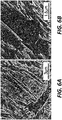
- the lath martensite microstructure has a small fraction of retained austenite close to the lath boundaries along with fine carbides inside the laths.
- the size scale of the carbides is approximately ⁇ 50nm and validates the designed nanocarbide strengthened steel microstructure.
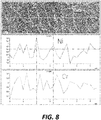
- EDS line scans in SEM were carried out to investigate microsegregation that may be attributable to rapid solidification in the AM process.
- Long range scans ( ⁇ 50-micron length, FIG. 7A and FIG. 7B ) showed no significant segregation of the alloying elements nickel, chromium, or manganese.
- 3-Dimensional Atom Probe tomography (3D-APT) experiments were performed to identify precipitation of finer carbides/precipitates inside the martensite matrix.
- the ion map reconstructions in FIG. 9 show the carbon atoms in black and, in the Top view, the iron atoms are shown in light gray. Segregation of carbon atoms to possibly lath boundaries or dislocations is observed. Finer scale nanocarbides resembling early stages of epsilon carbide precipitation are observed under these conditions.
- a proximity histogram showing averaged composition variation across the nanoscale carbide is shown in FIG. 10 , where the averaged composition variation is perpendicular to the 3.5 wt% isoconcentration surface shown in the inset.
- the inset in FIG. 10 shows the finer nanoscale carbide to be about ⁇ 10nm in size.
- the carbon content inside the carbide is measured to be about -12 at.%.
- the nanocarbides are also found to be slightly depleted in Ni and enriched in Cr and Mn. Similar carbon content in APT analysis have been reported for low temperature aged Fe-Ni-C and 4340 steel.
- the finer scale precipitation was suggested to be a precursor to epsilon carbide precipitation in the reported steels.
- FIG. 11A and FIG. 11B are representative light optical microscope (LOM) images sections of a z-build sample's T1 and B2 sections, respectively. Low porosity was observed throughout the z-direction coupon.
- LOM light optical microscope
- FIG. 12A, FIG. 12B, and FIG. 12C are scanning electron microscopy (SEM) images captured after etching the top, middle, and bottom sections, respectively. It may be observed that a finer microstructure exists towards the bottom of the coupon.
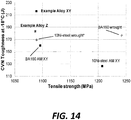
- Charpy v-notch impact testing was performed in accordance with ASTM E23 (2016) for experimental samples of BA-160 (xy-build), 10Ni-steel (xy-build), and the alloy shown in Table 1 (both xy-build and z-build). Each experimental sample was tested in as-built condition and the results are shown in FIG. 13 . Charpy tests at three different test temperatures were performed to measure the toughness and its variation with test temperature.
- Wrought samples were also prepared using BA160 steel and 10-Ni steel. Strength and toughness values were experimentally obtained for both samples and results are shown in FIG. 13 , which also includes strength and toughness values for the example experimental alloy.
- the variation of Charpy energy as a function of test temperature for the example experimental alloy is plotted in FIG. 14 along with measured values for 10-Ni steel and BA-160 steel.
- the data point for 10Ni-steel wrought is estimated based on data at -84°C.
- the measured strength of the example experimental alloy can be seen to be comparable to 10-Ni steel and BA160 alloys but with higher ductility.
- the Charpy impact energy values for the example experimental alloy is found to be much higher than 10-Ni steel or BA160 alloy which is quite promising.
- DBTT ductile to brittle transition temperature
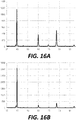
- X-ray diffraction was performed on a 1 inch (2.54 cm) cube coupon in as-built condition and following ASTM E975-13.
- the analysis included an xy sample (the plane perpendicular to the build direction) and a z sample (the plane parallel to the build direction). Measurements were obtained using a Scintag XDS 2000 diffractometer equipped with a 40kV/20mA Cu-K- ⁇ source.
- FIG. 16A shows the XRD pattern for the xy-build sample and
- FIG. 16B shows the XRD pattern for the z-build.
- the percentage of retained austenite measured on the XY and XZ plane of the Round 1 build cubes was determined to be 3.77% by volume and 4.08% by volume, respectively.
- the martensite start (M s ) temperature was calculated as the average of the three measurements and results are shown in Table 4, below. Table 4. Martensite start (M s ) temperature determined for experimental samples of BA-160, 10Ni-steel, and the alloy of Table 1.
- XY-build samples of the alloy shown in Table 1 were heat treated at 200°C (Stage I temper) for 1 hour, 4 hours, and 16 hours. Hardness measurements were taken (Rockwell C, average of 5 datapoints) for the as-built sample and after 1 hour, 4 hours, and 16 hours of the heat treatment. Results of the hardness tests are shown in FIG. 17 . It is observed that the hardness appears to be maintained over time.
- each intervening number there between with the same degree of precision is contemplated.
- the numbers 7 and 8 are contemplated in addition to 6 and 9, and for the range 6.0-7.0, the numbers 6.0, 6.1, 6.2, 6.3, 6.4, 6.5, 6.6, 6.7, 6.8, 6.9, and 7.0 are contemplated.
- a pressure range is described as being between ambient pressure and another pressure, a pressure that is ambient pressure is expressly contemplated.
Landscapes
- Chemical & Material Sciences (AREA)
- Engineering & Computer Science (AREA)
- Materials Engineering (AREA)
- Organic Chemistry (AREA)
- Mechanical Engineering (AREA)
- Metallurgy (AREA)
- Manufacturing & Machinery (AREA)
- Physics & Mathematics (AREA)
- Thermal Sciences (AREA)
- Crystallography & Structural Chemistry (AREA)
- Plasma & Fusion (AREA)
- Powder Metallurgy (AREA)
- Manufacture Of Metal Powder And Suspensions Thereof (AREA)
Applications Claiming Priority (1)
| Application Number | Priority Date | Filing Date | Title |
|---|---|---|---|
| US202063015802P | 2020-04-27 | 2020-04-27 |
Publications (1)
| Publication Number | Publication Date |
|---|---|
| EP3903971A1 true EP3903971A1 (en) | 2021-11-03 |
Family
ID=74844719
Family Applications (1)
| Application Number | Title | Priority Date | Filing Date |
|---|---|---|---|
| EP21159760.4A Pending EP3903971A1 (en) | 2020-04-27 | 2021-02-26 | Auto-tempering steels for additive manufacturing |
Country Status (3)
| Country | Link |
|---|---|
| US (1) | US11780014B2 (https=) |
| EP (1) | EP3903971A1 (https=) |
| JP (1) | JP7585089B2 (https=) |
Families Citing this family (10)
| Publication number | Priority date | Publication date | Assignee | Title |
|---|---|---|---|---|
| US20210164081A1 (en) | 2018-03-29 | 2021-06-03 | Oerlikon Metco (Us) Inc. | Reduced carbides ferrous alloys |
| WO2020086971A1 (en) | 2018-10-26 | 2020-04-30 | Oerlikon Metco (Us) Inc. | Corrosion and wear resistant nickel based alloys |
| US12227853B2 (en) | 2019-03-28 | 2025-02-18 | Oerlikon Metco (Us) Inc. | Thermal spray iron-based alloys for coating engine cylinder bores |
| EP3962693A1 (en) | 2019-05-03 | 2022-03-09 | Oerlikon Metco (US) Inc. | Powder feedstock for wear resistant bulk welding configured to optimize manufacturability |
| CN114341385A (zh) | 2019-07-09 | 2022-04-12 | 欧瑞康美科(美国)公司 | 针对耐磨性和耐腐蚀性设计的铁基合金 |
| US12226823B2 (en) * | 2020-12-22 | 2025-02-18 | Wisconsin Alumni Research Foundation | Alloy composition, method and apparatus therefor |
| WO2022270956A1 (ko) * | 2021-06-23 | 2022-12-29 | 주식회사 펩트론 | 세마글루타이드 또는 이의 약학적으로 허용가능한 염을 포함하는 서방형 제제 조성물 |
| CN115491473B (zh) * | 2022-08-18 | 2025-01-10 | 禾锐材料科技(浙江)有限公司 | 一种提高大规格dc53冷作模具钢性能的处理方法 |
| JP7664317B2 (ja) * | 2023-06-13 | 2025-04-17 | 株式会社ソディック | 積層造形物の製造方法 |
| WO2026068981A1 (en) * | 2024-09-24 | 2026-04-02 | Arcelormittal | High nickel powder for additive manufacturing, printed part and method of manufacturing the same |
Citations (7)
| Publication number | Priority date | Publication date | Assignee | Title |
|---|---|---|---|---|
| GB963220A (en) * | 1961-03-15 | 1964-07-08 | Donald Hardwick | Improvements in or relating to alloy steels |
| US3496034A (en) * | 1966-02-21 | 1970-02-17 | United States Steel Corp | Steel resistant to embrittlement by neutron radiation |
| DE3541620A1 (de) * | 1984-11-26 | 1986-06-26 | Nippon Steel Corp., Tokio/Tokyo | Verfahren zur herstellung von ni-stahl mit hohem rissauffangvermoegen |
| US4826543A (en) * | 1986-11-14 | 1989-05-02 | Nippon Steel Corporation | Process for producing high toughness, high strength steel having excellent resistance to stress corrosion cracking |
| US20150147222A1 (en) * | 2012-07-23 | 2015-05-28 | Jfe Steel Corporation | Ni-containing steel plate |
| US20160251736A1 (en) * | 2015-02-27 | 2016-09-01 | Japan Silicolloy Industry Co., Ltd. | Selective laser sintering method, heat treatment method, metal powder, and shaped product |
| RU2703008C1 (ru) * | 2019-06-26 | 2019-10-15 | Публичное акционерное общество "Магнитогорский металлургический комбинат" | Способ производства листов из криогенной конструкционной стали |
Family Cites Families (5)
| Publication number | Priority date | Publication date | Assignee | Title |
|---|---|---|---|---|
| US5629091A (en) * | 1994-12-09 | 1997-05-13 | Ford Motor Company | Agglomerated anti-friction granules for plasma deposition |
| EP1689902A4 (en) | 2003-11-12 | 2007-08-22 | Questek Innovations Llc | ULTRA-TOOL HIGH-WELD WELDABLE PLATE STEEL |
| JP5741260B2 (ja) | 2011-07-06 | 2015-07-01 | 新日鐵住金株式会社 | 歪付与後のctod特性に優れた極低温用鋼材およびその製造方法 |
| US9499890B1 (en) | 2012-04-10 | 2016-11-22 | The United States Of America As Represented By The Secretary Of The Navy | High-strength, high-toughness steel articles for ballistic and cryogenic applications, and method of making thereof |
| JP7469597B2 (ja) | 2020-01-10 | 2024-04-17 | 日本製鉄株式会社 | フラックス入りワイヤ及び溶接継手の製造方法 |
-
2021
- 2021-02-26 JP JP2021030507A patent/JP7585089B2/ja active Active
- 2021-02-26 US US17/186,556 patent/US11780014B2/en active Active
- 2021-02-26 EP EP21159760.4A patent/EP3903971A1/en active Pending
Patent Citations (7)
| Publication number | Priority date | Publication date | Assignee | Title |
|---|---|---|---|---|
| GB963220A (en) * | 1961-03-15 | 1964-07-08 | Donald Hardwick | Improvements in or relating to alloy steels |
| US3496034A (en) * | 1966-02-21 | 1970-02-17 | United States Steel Corp | Steel resistant to embrittlement by neutron radiation |
| DE3541620A1 (de) * | 1984-11-26 | 1986-06-26 | Nippon Steel Corp., Tokio/Tokyo | Verfahren zur herstellung von ni-stahl mit hohem rissauffangvermoegen |
| US4826543A (en) * | 1986-11-14 | 1989-05-02 | Nippon Steel Corporation | Process for producing high toughness, high strength steel having excellent resistance to stress corrosion cracking |
| US20150147222A1 (en) * | 2012-07-23 | 2015-05-28 | Jfe Steel Corporation | Ni-containing steel plate |
| US20160251736A1 (en) * | 2015-02-27 | 2016-09-01 | Japan Silicolloy Industry Co., Ltd. | Selective laser sintering method, heat treatment method, metal powder, and shaped product |
| RU2703008C1 (ru) * | 2019-06-26 | 2019-10-15 | Публичное акционерное общество "Магнитогорский металлургический комбинат" | Способ производства листов из криогенной конструкционной стали |
Also Published As
| Publication number | Publication date |
|---|---|
| US20210332465A1 (en) | 2021-10-28 |
| JP2021183718A (ja) | 2021-12-02 |
| US11780014B2 (en) | 2023-10-10 |
| JP7585089B2 (ja) | 2024-11-18 |
Similar Documents
| Publication | Publication Date | Title |
|---|---|---|
| US11780014B2 (en) | Auto-tempering steels for additive manufacturing | |
| EP3717150B1 (en) | Multicomponent aluminum alloys for applications such as additive manufacturing | |
| US12000022B2 (en) | High entropy alloy article, product formed of said high entropy alloy article, and fluid machine having said product | |
| US12227825B2 (en) | Stainless steel powders for additive manufacturing | |
| Turk et al. | Advances in maraging steels for additive manufacturing | |
| JP7160689B2 (ja) | プラスチック成形用金型に適した鋼材 | |
| US11359638B2 (en) | Alloy article, method for manufacturing said alloy article, product formed of said alloy article, and fluid machine having said product | |
| Lass et al. | Additively manufactured nitrogen-atomized 17-4 PH stainless steel with mechanical properties comparable to wrought | |
| Jamshidinia et al. | Additive manufacturing of steel alloys using laser powder-bed fusion | |
| Liu et al. | A preliminary investigation on selective laser melting of M2 high speed steel | |
| US20210222275A1 (en) | Bulk metallic glass-based alloys for additive manufacturing | |
| Patil et al. | Spark plasma sintering of 13Ni-400 maraging steel: Enhancement of mechanical properties through surface modification | |
| Güney et al. | Effect of heat treatments on microstructural and tribological properties of 3D printed 18Ni-300 maraging tool steel made by selective laser sintering process | |
| Aydogan et al. | Effects of heat treatment on direct laser fabricated stainless steel 420-Inconel 718 alloy multi-material structures | |
| EP4174206A1 (en) | Stainless steel powders for additive manufacturing | |
| Sioui-Latulippe et al. | A NOVEL, LOW-COST, HIGHLY ALLOYED CAST IRON POWDER FOR HIGH PERFORMANCE BINDER-JET PROCESSED COMPONENTS. | |
| EP4567144A1 (en) | Fe-cr-al-based alloy powder for additive manufacturing, fe-cr-al-based alloy member, and method for producing fe-cr-al-based alloy member | |
| Yingying et al. | Microstructure and mechanical performance of laser additive manufacturing Ni50Ti40Cu10 and Ni45Ti40Cu15 alloy | |
| Amini et al. | Materials Chemistry and Mechani cs | |
| KR20250136865A (ko) | 적층 가공용 중망간 분말, 인쇄된 부품 및 그 제조 방법 | |
| WO2024217920A1 (en) | Maraging steel powder free from co, ti, and al | |
| KR20260043096A (ko) | Ni기 합금제의 조형물 | |
| WO2025068681A1 (en) | Alloy | |
| Averyanova et al. | Rapid Protyping: Influence of Metallurgical Aspects of Martensitic Stainless Steel Powder on Final Parts Properties Manufactured by Selective Laser Melting Technology |
Legal Events
| Date | Code | Title | Description |
|---|---|---|---|
| PUAI | Public reference made under article 153(3) epc to a published international application that has entered the european phase |
Free format text: ORIGINAL CODE: 0009012 |
|
| STAA | Information on the status of an ep patent application or granted ep patent |
Free format text: STATUS: THE APPLICATION HAS BEEN PUBLISHED |
|
| AK | Designated contracting states |
Kind code of ref document: A1 Designated state(s): AL AT BE BG CH CY CZ DE DK EE ES FI FR GB GR HR HU IE IS IT LI LT LU LV MC MK MT NL NO PL PT RO RS SE SI SK SM TR |
|
| B565 | Issuance of search results under rule 164(2) epc |
Effective date: 20210728 |
|
| STAA | Information on the status of an ep patent application or granted ep patent |
Free format text: STATUS: REQUEST FOR EXAMINATION WAS MADE |
|
| 17P | Request for examination filed |
Effective date: 20220503 |
|
| RBV | Designated contracting states (corrected) |
Designated state(s): AL AT BE BG CH CY CZ DE DK EE ES FI FR GB GR HR HU IE IS IT LI LT LU LV MC MK MT NL NO PL PT RO RS SE SI SK SM TR |
|
| P01 | Opt-out of the competence of the unified patent court (upc) registered |
Effective date: 20230707 |