EP3903784A1 - Cyclic amine derivative as advillin function promoter and novel cyclic amine derivative and pharmaceutical use thereof - Google Patents
Cyclic amine derivative as advillin function promoter and novel cyclic amine derivative and pharmaceutical use thereof Download PDFInfo
- Publication number
- EP3903784A1 EP3903784A1 EP19902158.5A EP19902158A EP3903784A1 EP 3903784 A1 EP3903784 A1 EP 3903784A1 EP 19902158 A EP19902158 A EP 19902158A EP 3903784 A1 EP3903784 A1 EP 3903784A1
- Authority
- EP
- European Patent Office
- Prior art keywords
- advillin
- group
- promoting
- amine derivative
- cyclic amine
- Prior art date
- Legal status (The legal status is an assumption and is not a legal conclusion. Google has not performed a legal analysis and makes no representation as to the accuracy of the status listed.)
- Pending
Links
- -1 Cyclic amine Chemical class 0.000 title claims abstract description 153
- 102100031460 Advillin Human genes 0.000 title claims abstract description 87
- 101710166120 Advillin Proteins 0.000 title claims abstract description 87
- 150000003839 salts Chemical class 0.000 claims abstract description 66
- 230000001737 promoting effect Effects 0.000 claims abstract description 55
- 208000027418 Wounds and injury Diseases 0.000 claims abstract description 46
- 230000003376 axonal effect Effects 0.000 claims abstract description 45
- 230000006378 damage Effects 0.000 claims abstract description 43
- 208000014674 injury Diseases 0.000 claims abstract description 43
- 239000004480 active ingredient Substances 0.000 claims abstract description 16
- 150000001875 compounds Chemical class 0.000 claims description 101
- 210000003632 microfilament Anatomy 0.000 claims description 78
- 210000003050 axon Anatomy 0.000 claims description 43
- 230000007306 turnover Effects 0.000 claims description 30
- 239000003795 chemical substances by application Substances 0.000 claims description 28
- 230000005856 abnormality Effects 0.000 claims description 25
- 230000033228 biological regulation Effects 0.000 claims description 23
- 239000003814 drug Substances 0.000 claims description 22
- 230000027455 binding Effects 0.000 claims description 19
- 238000009739 binding Methods 0.000 claims description 19
- 125000002496 methyl group Chemical group [H]C([H])([H])* 0.000 claims description 17
- OKTJSMMVPCPJKN-UHFFFAOYSA-N Carbon Chemical compound [C] OKTJSMMVPCPJKN-UHFFFAOYSA-N 0.000 claims description 12
- 229910052799 carbon Inorganic materials 0.000 claims description 12
- 125000004200 2-methoxyethyl group Chemical group [H]C([H])([H])OC([H])([H])C([H])([H])* 0.000 claims description 11
- 125000001449 isopropyl group Chemical group [H]C([H])([H])C([H])(*)C([H])([H])[H] 0.000 claims description 11
- 125000004123 n-propyl group Chemical group [H]C([H])([H])C([H])([H])C([H])([H])* 0.000 claims description 11
- 229910052801 chlorine Inorganic materials 0.000 claims description 9
- 125000001309 chloro group Chemical group Cl* 0.000 claims description 9
- 125000004435 hydrogen atom Chemical group [H]* 0.000 claims description 9
- IZJPDZWZNCAQHQ-UHFFFAOYSA-N 1-[4-(dimethylamino)piperidin-1-yl]-3-hydroxy-3-(1-propylimidazol-2-yl)propan-1-one Chemical compound CCCn1ccnc1C(O)CC(=O)N1CCC(CC1)N(C)C IZJPDZWZNCAQHQ-UHFFFAOYSA-N 0.000 claims description 7
- DMAYUFAGLKYYPJ-UHFFFAOYSA-N 1-[4-(dimethylamino)piperidin-1-yl]-3-hydroxy-3-(1-propan-2-ylimidazol-2-yl)propan-1-one Chemical compound CC(C)n1ccnc1C(O)CC(=O)N1CCC(CC1)N(C)C DMAYUFAGLKYYPJ-UHFFFAOYSA-N 0.000 claims description 6
- RWGYURDFAPPUAG-UHFFFAOYSA-N 1-[4-(dimethylamino)piperidin-1-yl]-3-hydroxy-3-[1-(2-methoxyethyl)imidazol-2-yl]propan-1-one Chemical compound COCCn1ccnc1C(O)CC(=O)N1CCC(CC1)N(C)C RWGYURDFAPPUAG-UHFFFAOYSA-N 0.000 claims description 6
- QTHWGHYTGVRCIC-UHFFFAOYSA-N 1-[4-(dimethylamino)piperidin-1-yl]-3-hydroxy-3-[1-(3,3,3-trifluoropropyl)imidazol-2-yl]propan-1-one Chemical compound CN(C)C1CCN(CC1)C(=O)CC(O)c1nccn1CCC(F)(F)F QTHWGHYTGVRCIC-UHFFFAOYSA-N 0.000 claims description 6
- CZYZYBZOKPRURT-UHFFFAOYSA-N 3-(5-chloro-1-methylimidazol-2-yl)-1-[4-(dimethylamino)piperidin-1-yl]-3-hydroxypropan-1-one Chemical compound CN(C)C1CCN(CC1)C(=O)CC(O)c1ncc(Cl)n1C CZYZYBZOKPRURT-UHFFFAOYSA-N 0.000 claims description 6
- IABRBXZAQNQJOF-UHFFFAOYSA-N 3-hydroxy-3-(1-methylimidazol-2-yl)-1-(4-morpholin-4-ylpiperidin-1-yl)propan-1-one Chemical compound CN1C=CN=C1C(CC(=O)N2CCC(CC2)N3CCOCC3)O IABRBXZAQNQJOF-UHFFFAOYSA-N 0.000 claims description 6
- 125000001495 ethyl group Chemical group [H]C([H])([H])C([H])([H])* 0.000 claims description 6
- 229940124597 therapeutic agent Drugs 0.000 claims description 5
- 125000001028 difluoromethyl group Chemical group [H]C(F)(F)* 0.000 claims description 3
- 229910052731 fluorine Inorganic materials 0.000 claims description 3
- 125000001153 fluoro group Chemical group F* 0.000 claims description 3
- 238000011282 treatment Methods 0.000 abstract description 21
- 239000000126 substance Substances 0.000 abstract description 6
- 150000003384 small molecules Chemical class 0.000 abstract description 2
- OKKJLVBELUTLKV-UHFFFAOYSA-N Methanol Chemical compound OC OKKJLVBELUTLKV-UHFFFAOYSA-N 0.000 description 78
- 239000012295 chemical reaction liquid Substances 0.000 description 63
- HEDRZPFGACZZDS-UHFFFAOYSA-N Chloroform Chemical compound ClC(Cl)Cl HEDRZPFGACZZDS-UHFFFAOYSA-N 0.000 description 60
- 239000000243 solution Substances 0.000 description 57
- 239000007864 aqueous solution Substances 0.000 description 47
- 241000700159 Rattus Species 0.000 description 46
- XEKOWRVHYACXOJ-UHFFFAOYSA-N Ethyl acetate Chemical compound CCOC(C)=O XEKOWRVHYACXOJ-UHFFFAOYSA-N 0.000 description 45
- WYURNTSHIVDZCO-UHFFFAOYSA-N Tetrahydrofuran Chemical compound C1CCOC1 WYURNTSHIVDZCO-UHFFFAOYSA-N 0.000 description 44
- FAPWRFPIFSIZLT-UHFFFAOYSA-M Sodium chloride Chemical compound [Na+].[Cl-] FAPWRFPIFSIZLT-UHFFFAOYSA-M 0.000 description 38
- 230000006870 function Effects 0.000 description 37
- HEDRZPFGACZZDS-MICDWDOJSA-N Trichloro(2H)methane Chemical compound [2H]C(Cl)(Cl)Cl HEDRZPFGACZZDS-MICDWDOJSA-N 0.000 description 36
- 210000003594 spinal ganglia Anatomy 0.000 description 36
- YMWUJEATGCHHMB-UHFFFAOYSA-N Dichloromethane Chemical compound ClCCl YMWUJEATGCHHMB-UHFFFAOYSA-N 0.000 description 33
- 210000004027 cell Anatomy 0.000 description 33
- 230000000694 effects Effects 0.000 description 32
- 210000001519 tissue Anatomy 0.000 description 31
- 108010085238 Actins Proteins 0.000 description 29
- 102000007469 Actins Human genes 0.000 description 29
- 239000000706 filtrate Substances 0.000 description 29
- VYPSYNLAJGMNEJ-UHFFFAOYSA-N Silicium dioxide Chemical compound O=[Si]=O VYPSYNLAJGMNEJ-UHFFFAOYSA-N 0.000 description 28
- 230000015572 biosynthetic process Effects 0.000 description 28
- 238000003786 synthesis reaction Methods 0.000 description 28
- 238000005160 1H NMR spectroscopy Methods 0.000 description 26
- DWAFYCQODLXJNR-BNTLRKBRSA-L oxaliplatin Chemical compound O1C(=O)C(=O)O[Pt]11N[C@@H]2CCCC[C@H]2N1 DWAFYCQODLXJNR-BNTLRKBRSA-L 0.000 description 26
- 229960001756 oxaliplatin Drugs 0.000 description 26
- PMZURENOXWZQFD-UHFFFAOYSA-L Sodium Sulfate Chemical compound [Na+].[Na+].[O-]S([O-])(=O)=O PMZURENOXWZQFD-UHFFFAOYSA-L 0.000 description 25
- 238000003818 flash chromatography Methods 0.000 description 25
- 210000004379 membrane Anatomy 0.000 description 25
- 239000012528 membrane Substances 0.000 description 25
- 239000012044 organic layer Substances 0.000 description 25
- XLYOFNOQVPJJNP-UHFFFAOYSA-N water Chemical compound O XLYOFNOQVPJJNP-UHFFFAOYSA-N 0.000 description 25
- VLKZOEOYAKHREP-UHFFFAOYSA-N n-Hexane Chemical compound CCCCCC VLKZOEOYAKHREP-UHFFFAOYSA-N 0.000 description 24
- 239000000741 silica gel Substances 0.000 description 24
- 229910002027 silica gel Inorganic materials 0.000 description 24
- BWHMMNNQKKPAPP-UHFFFAOYSA-L potassium carbonate Chemical compound [K+].[K+].[O-]C([O-])=O BWHMMNNQKKPAPP-UHFFFAOYSA-L 0.000 description 22
- YLQBMQCUIZJEEH-UHFFFAOYSA-N tetrahydrofuran Natural products C=1C=COC=1 YLQBMQCUIZJEEH-UHFFFAOYSA-N 0.000 description 22
- ZMXDDKWLCZADIW-UHFFFAOYSA-N N,N-Dimethylformamide Chemical compound CN(C)C=O ZMXDDKWLCZADIW-UHFFFAOYSA-N 0.000 description 21
- 238000002330 electrospray ionisation mass spectrometry Methods 0.000 description 21
- 238000000034 method Methods 0.000 description 20
- 239000000178 monomer Substances 0.000 description 19
- 239000000523 sample Substances 0.000 description 19
- 239000011780 sodium chloride Substances 0.000 description 19
- UIIMBOGNXHQVGW-UHFFFAOYSA-M Sodium bicarbonate Chemical compound [Na+].OC([O-])=O UIIMBOGNXHQVGW-UHFFFAOYSA-M 0.000 description 18
- 239000011324 bead Substances 0.000 description 18
- 230000003834 intracellular effect Effects 0.000 description 18
- 210000005036 nerve Anatomy 0.000 description 18
- 238000003756 stirring Methods 0.000 description 18
- 239000012230 colorless oil Substances 0.000 description 17
- 230000000052 comparative effect Effects 0.000 description 17
- 239000012153 distilled water Substances 0.000 description 17
- 210000001032 spinal nerve Anatomy 0.000 description 17
- NLXLAEXVIDQMFP-UHFFFAOYSA-N Ammonia chloride Chemical compound [NH4+].[Cl-] NLXLAEXVIDQMFP-UHFFFAOYSA-N 0.000 description 16
- IAZDPXIOMUYVGZ-WFGJKAKNSA-N Dimethyl sulfoxide Chemical compound [2H]C([2H])([2H])S(=O)C([2H])([2H])[2H] IAZDPXIOMUYVGZ-WFGJKAKNSA-N 0.000 description 16
- HEMHJVSKTPXQMS-UHFFFAOYSA-M Sodium hydroxide Chemical compound [OH-].[Na+] HEMHJVSKTPXQMS-UHFFFAOYSA-M 0.000 description 15
- 208000037265 diseases, disorders, signs and symptoms Diseases 0.000 description 15
- 210000002569 neuron Anatomy 0.000 description 15
- 235000018102 proteins Nutrition 0.000 description 15
- 108090000623 proteins and genes Proteins 0.000 description 15
- 102000004169 proteins and genes Human genes 0.000 description 15
- 229920006395 saturated elastomer Polymers 0.000 description 15
- ZCSHNCUQKCANBX-UHFFFAOYSA-N lithium diisopropylamide Chemical compound [Li+].CC(C)[N-]C(C)C ZCSHNCUQKCANBX-UHFFFAOYSA-N 0.000 description 14
- 210000003497 sciatic nerve Anatomy 0.000 description 14
- VEXZGXHMUGYJMC-UHFFFAOYSA-N Hydrochloric acid Chemical compound Cl VEXZGXHMUGYJMC-UHFFFAOYSA-N 0.000 description 13
- 210000002241 neurite Anatomy 0.000 description 13
- YXFVVABEGXRONW-UHFFFAOYSA-N Toluene Chemical compound CC1=CC=CC=C1 YXFVVABEGXRONW-UHFFFAOYSA-N 0.000 description 12
- 230000003247 decreasing effect Effects 0.000 description 12
- 201000010099 disease Diseases 0.000 description 12
- 230000009870 specific binding Effects 0.000 description 12
- 229910000027 potassium carbonate Inorganic materials 0.000 description 11
- 210000000578 peripheral nerve Anatomy 0.000 description 10
- 210000000278 spinal cord Anatomy 0.000 description 10
- 239000006228 supernatant Substances 0.000 description 10
- QTBSBXVTEAMEQO-UHFFFAOYSA-N Acetic acid Chemical compound CC(O)=O QTBSBXVTEAMEQO-UHFFFAOYSA-N 0.000 description 9
- WEVYAHXRMPXWCK-UHFFFAOYSA-N Acetonitrile Chemical compound CC#N WEVYAHXRMPXWCK-UHFFFAOYSA-N 0.000 description 9
- LFQSCWFLJHTTHZ-UHFFFAOYSA-N Ethanol Chemical compound CCO LFQSCWFLJHTTHZ-UHFFFAOYSA-N 0.000 description 9
- 230000001965 increasing effect Effects 0.000 description 9
- 239000002609 medium Substances 0.000 description 9
- 239000000203 mixture Substances 0.000 description 9
- 235000017557 sodium bicarbonate Nutrition 0.000 description 9
- 229910000030 sodium bicarbonate Inorganic materials 0.000 description 9
- 239000003440 toxic substance Substances 0.000 description 9
- MOPYFVNSJJDURW-UHFFFAOYSA-N 1-[4-(dimethylamino)piperidin-1-yl]ethanone Chemical compound CN(C)C1CCN(C(C)=O)CC1 MOPYFVNSJJDURW-UHFFFAOYSA-N 0.000 description 8
- 235000019270 ammonium chloride Nutrition 0.000 description 8
- 239000000546 pharmaceutical excipient Substances 0.000 description 8
- 238000011534 incubation Methods 0.000 description 7
- 239000007787 solid Substances 0.000 description 7
- WFDIJRYMOXRFFG-UHFFFAOYSA-N Acetic anhydride Chemical compound CC(=O)OC(C)=O WFDIJRYMOXRFFG-UHFFFAOYSA-N 0.000 description 6
- 241000282414 Homo sapiens Species 0.000 description 6
- 206010033799 Paralysis Diseases 0.000 description 6
- KPKZJLCSROULON-QKGLWVMZSA-N Phalloidin Chemical compound N1C(=O)[C@@H]([C@@H](O)C)NC(=O)[C@H](C)NC(=O)[C@H](C[C@@](C)(O)CO)NC(=O)[C@H](C2)NC(=O)[C@H](C)NC(=O)[C@@H]3C[C@H](O)CN3C(=O)[C@@H]1CSC1=C2C2=CC=CC=C2N1 KPKZJLCSROULON-QKGLWVMZSA-N 0.000 description 6
- ZMANZCXQSJIPKH-UHFFFAOYSA-N Triethylamine Chemical compound CCN(CC)CC ZMANZCXQSJIPKH-UHFFFAOYSA-N 0.000 description 6
- 210000004720 cerebrum Anatomy 0.000 description 6
- 230000003100 immobilizing effect Effects 0.000 description 6
- 208000021090 palsy Diseases 0.000 description 6
- 239000000651 prodrug Substances 0.000 description 6
- 229940002612 prodrug Drugs 0.000 description 6
- 239000002904 solvent Substances 0.000 description 6
- CURLTUGMZLYLDI-UHFFFAOYSA-N Carbon dioxide Chemical compound O=C=O CURLTUGMZLYLDI-UHFFFAOYSA-N 0.000 description 5
- 241000699666 Mus <mouse, genus> Species 0.000 description 5
- 210000000133 brain stem Anatomy 0.000 description 5
- 210000004748 cultured cell Anatomy 0.000 description 5
- ZMMLBTOFERWSQO-UHFFFAOYSA-N ethyl 3-(1-methylimidazol-2-yl)-3-oxopropanoate Chemical compound CCOC(=O)CC(=O)C1=NC=CN1C ZMMLBTOFERWSQO-UHFFFAOYSA-N 0.000 description 5
- 239000001963 growth medium Substances 0.000 description 5
- 238000004519 manufacturing process Methods 0.000 description 5
- 210000003205 muscle Anatomy 0.000 description 5
- 210000004126 nerve fiber Anatomy 0.000 description 5
- 231100000614 poison Toxicity 0.000 description 5
- 239000002244 precipitate Substances 0.000 description 5
- 231100000167 toxic agent Toxicity 0.000 description 5
- QUTKDCYSTKFFEU-LBPRGKRZSA-N (3S)-1-[4-(dimethylamino)piperidin-1-yl]-3-hydroxy-3-(1-methylimidazol-2-yl)propan-1-one Chemical compound CN(C1CCN(CC1)C(C[C@@H](C=1N(C=CN=1)C)O)=O)C QUTKDCYSTKFFEU-LBPRGKRZSA-N 0.000 description 4
- XYHKNCXZYYTLRG-UHFFFAOYSA-N 1h-imidazole-2-carbaldehyde Chemical compound O=CC1=NC=CN1 XYHKNCXZYYTLRG-UHFFFAOYSA-N 0.000 description 4
- QTBSBXVTEAMEQO-UHFFFAOYSA-M Acetate Chemical compound CC([O-])=O QTBSBXVTEAMEQO-UHFFFAOYSA-M 0.000 description 4
- 108091003079 Bovine Serum Albumin Proteins 0.000 description 4
- FERIUCNNQQJTOY-UHFFFAOYSA-N Butyric acid Chemical compound CCCC(O)=O FERIUCNNQQJTOY-UHFFFAOYSA-N 0.000 description 4
- 239000006144 Dulbecco’s modified Eagle's medium Substances 0.000 description 4
- 206010015719 Exsanguination Diseases 0.000 description 4
- PEDCQBHIVMGVHV-UHFFFAOYSA-N Glycerine Chemical compound OCC(O)CO PEDCQBHIVMGVHV-UHFFFAOYSA-N 0.000 description 4
- AEMRFAOFKBGASW-UHFFFAOYSA-N Glycolic acid Chemical compound OCC(O)=O AEMRFAOFKBGASW-UHFFFAOYSA-N 0.000 description 4
- TWRXJAOTZQYOKJ-UHFFFAOYSA-L Magnesium chloride Chemical compound [Mg+2].[Cl-].[Cl-] TWRXJAOTZQYOKJ-UHFFFAOYSA-L 0.000 description 4
- OUXRMEUJNPVXMM-UHFFFAOYSA-N N,n-diethyl-4-piperidinamine Chemical compound CCN(CC)C1CCNCC1 OUXRMEUJNPVXMM-UHFFFAOYSA-N 0.000 description 4
- 239000011230 binding agent Substances 0.000 description 4
- 239000007853 buffer solution Substances 0.000 description 4
- 210000001638 cerebellum Anatomy 0.000 description 4
- 238000010586 diagram Methods 0.000 description 4
- 239000002552 dosage form Substances 0.000 description 4
- 229940079593 drug Drugs 0.000 description 4
- NOTZYDYZBOBDFE-UHFFFAOYSA-N ethyl 1-methylimidazole-2-carboxylate Chemical compound CCOC(=O)C1=NC=CN1C NOTZYDYZBOBDFE-UHFFFAOYSA-N 0.000 description 4
- 238000011156 evaluation Methods 0.000 description 4
- 239000012091 fetal bovine serum Substances 0.000 description 4
- 210000003734 kidney Anatomy 0.000 description 4
- 239000010410 layer Substances 0.000 description 4
- 229920000642 polymer Polymers 0.000 description 4
- 230000008929 regeneration Effects 0.000 description 4
- 238000011069 regeneration method Methods 0.000 description 4
- 239000004094 surface-active agent Substances 0.000 description 4
- PUUWFDOMQTZEIF-UHFFFAOYSA-N 1-(1-methylimidazol-2-yl)-3-(4-morpholin-4-ylpiperidin-1-yl)propane-1,3-dione Chemical compound CN1C=CN=C1C(=O)CC(=O)N2CCC(CC2)N3CCOCC3 PUUWFDOMQTZEIF-UHFFFAOYSA-N 0.000 description 3
- FGTGROGYCVYCPH-UHFFFAOYSA-N 1-(1-methylimidazol-2-yl)-3-[4-(4-methylpiperazin-1-yl)piperidin-1-yl]propane-1,3-dione Chemical compound CN1C(=NC=C1)C(CC(=O)N1CCC(CC1)N1CCN(CC1)C)=O FGTGROGYCVYCPH-UHFFFAOYSA-N 0.000 description 3
- JHQSYDUBFCLNNC-UHFFFAOYSA-N 1-(2-methoxyethyl)imidazole-2-carbaldehyde Chemical compound COCCN1C=CN=C1C=O JHQSYDUBFCLNNC-UHFFFAOYSA-N 0.000 description 3
- BGQFVKKJFARMAU-UHFFFAOYSA-N 1-(3,3,3-trifluoropropyl)imidazole-2-carbaldehyde Chemical compound FC(F)(F)CCN1C=CN=C1C=O BGQFVKKJFARMAU-UHFFFAOYSA-N 0.000 description 3
- QUTKDCYSTKFFEU-UHFFFAOYSA-N 1-[4-(dimethylamino)piperidin-1-yl]-3-hydroxy-3-(1-methylimidazol-2-yl)propan-1-one Chemical compound CN(C1CCN(CC1)C(CC(C=1N(C=CN=1)C)O)=O)C QUTKDCYSTKFFEU-UHFFFAOYSA-N 0.000 description 3
- MRYYJGQKVGZGSB-UHFFFAOYSA-N 1-methyl-4-piperidin-4-ylpiperazine Chemical compound C1CN(C)CCN1C1CCNCC1 MRYYJGQKVGZGSB-UHFFFAOYSA-N 0.000 description 3
- WAEJIEIBRIUGNH-UHFFFAOYSA-N 1-propan-2-ylimidazole-2-carbaldehyde Chemical compound CC(C)N1C=CN=C1C=O WAEJIEIBRIUGNH-UHFFFAOYSA-N 0.000 description 3
- COIFMOLQDBIKOF-UHFFFAOYSA-N 1-propylimidazole-2-carbaldehyde Chemical compound CCCN1C=CN=C1C=O COIFMOLQDBIKOF-UHFFFAOYSA-N 0.000 description 3
- YYBXNWIRMJXEQJ-UHFFFAOYSA-N 4-piperidin-4-ylmorpholine Chemical compound C1CNCCC1N1CCOCC1 YYBXNWIRMJXEQJ-UHFFFAOYSA-N 0.000 description 3
- OKOJCRYVLBYFQN-UHFFFAOYSA-N 5-chloro-1-methylimidazole-2-carbaldehyde Chemical compound CN1C(Cl)=CN=C1C=O OKOJCRYVLBYFQN-UHFFFAOYSA-N 0.000 description 3
- 206010002091 Anaesthesia Diseases 0.000 description 3
- 102100036597 Basement membrane-specific heparan sulfate proteoglycan core protein Human genes 0.000 description 3
- 101710151712 Basement membrane-specific heparan sulfate proteoglycan core protein Proteins 0.000 description 3
- 208000018428 Eosinophilic granulomatosis with polyangiitis Diseases 0.000 description 3
- 229920000084 Gum arabic Polymers 0.000 description 3
- PIWKPBJCKXDKJR-UHFFFAOYSA-N Isoflurane Chemical compound FC(F)OC(Cl)C(F)(F)F PIWKPBJCKXDKJR-UHFFFAOYSA-N 0.000 description 3
- 108010009711 Phalloidine Proteins 0.000 description 3
- 229940124158 Protease/peptidase inhibitor Drugs 0.000 description 3
- 206010039203 Road traffic accident Diseases 0.000 description 3
- 229920002472 Starch Polymers 0.000 description 3
- 238000000692 Student's t-test Methods 0.000 description 3
- 239000013504 Triton X-100 Substances 0.000 description 3
- 229920004890 Triton X-100 Polymers 0.000 description 3
- 235000010489 acacia gum Nutrition 0.000 description 3
- 239000000205 acacia gum Substances 0.000 description 3
- 238000001261 affinity purification Methods 0.000 description 3
- 230000037005 anaesthesia Effects 0.000 description 3
- 238000010171 animal model Methods 0.000 description 3
- 210000000702 aorta abdominal Anatomy 0.000 description 3
- 125000001797 benzyl group Chemical group [H]C1=C([H])C([H])=C(C([H])=C1[H])C([H])([H])* 0.000 description 3
- 230000000903 blocking effect Effects 0.000 description 3
- 230000017531 blood circulation Effects 0.000 description 3
- 210000004556 brain Anatomy 0.000 description 3
- 238000006243 chemical reaction Methods 0.000 description 3
- 210000004292 cytoskeleton Anatomy 0.000 description 3
- 208000035475 disorder Diseases 0.000 description 3
- 239000013583 drug formulation Substances 0.000 description 3
- 239000003995 emulsifying agent Substances 0.000 description 3
- 235000003599 food sweetener Nutrition 0.000 description 3
- 239000011521 glass Substances 0.000 description 3
- 238000002347 injection Methods 0.000 description 3
- 239000007924 injection Substances 0.000 description 3
- 229960002725 isoflurane Drugs 0.000 description 3
- 210000004185 liver Anatomy 0.000 description 3
- 239000000314 lubricant Substances 0.000 description 3
- SYSQUGFVNFXIIT-UHFFFAOYSA-N n-[4-(1,3-benzoxazol-2-yl)phenyl]-4-nitrobenzenesulfonamide Chemical class C1=CC([N+](=O)[O-])=CC=C1S(=O)(=O)NC1=CC=C(C=2OC3=CC=CC=C3N=2)C=C1 SYSQUGFVNFXIIT-UHFFFAOYSA-N 0.000 description 3
- 230000001537 neural effect Effects 0.000 description 3
- 239000002581 neurotoxin Substances 0.000 description 3
- 231100000618 neurotoxin Toxicity 0.000 description 3
- 239000000137 peptide hydrolase inhibitor Substances 0.000 description 3
- 239000008194 pharmaceutical composition Substances 0.000 description 3
- 238000006116 polymerization reaction Methods 0.000 description 3
- 239000000047 product Substances 0.000 description 3
- 239000012460 protein solution Substances 0.000 description 3
- 238000001959 radiotherapy Methods 0.000 description 3
- 210000000813 small intestine Anatomy 0.000 description 3
- 239000012279 sodium borohydride Substances 0.000 description 3
- 229910000033 sodium borohydride Inorganic materials 0.000 description 3
- FVAUCKIRQBBSSJ-UHFFFAOYSA-M sodium iodide Chemical compound [Na+].[I-] FVAUCKIRQBBSSJ-UHFFFAOYSA-M 0.000 description 3
- 239000012321 sodium triacetoxyborohydride Substances 0.000 description 3
- 239000008107 starch Substances 0.000 description 3
- 235000019698 starch Nutrition 0.000 description 3
- 239000000375 suspending agent Substances 0.000 description 3
- 239000000725 suspension Substances 0.000 description 3
- 239000003765 sweetening agent Substances 0.000 description 3
- 208000011580 syndromic disease Diseases 0.000 description 3
- 238000012360 testing method Methods 0.000 description 3
- 238000005406 washing Methods 0.000 description 3
- 238000001262 western blot Methods 0.000 description 3
- FYYWYIJPQQZHHG-UHFFFAOYSA-N 1-[4-(diethylamino)piperidin-1-yl]-3-(1-methylimidazol-2-yl)propane-1,3-dione Chemical compound C(C)N(C1CCN(CC1)C(CC(=O)C=1N(C=CN=1)C)=O)CC FYYWYIJPQQZHHG-UHFFFAOYSA-N 0.000 description 2
- SJYCEZUVQHFJIC-UHFFFAOYSA-N 1-[4-(diethylamino)piperidin-1-yl]-3-hydroxy-3-(1-methylimidazol-2-yl)propan-1-one Chemical compound C(C)N(C1CCN(CC1)C(CC(C=1N(C=CN=1)C)O)=O)CC SJYCEZUVQHFJIC-UHFFFAOYSA-N 0.000 description 2
- QIRAITNGJZWEAU-UHFFFAOYSA-N 1-[4-(dimethylamino)piperidin-1-yl]-3-hydroxy-3-[1-(2,2,2-trifluoroethyl)imidazol-2-yl]propan-1-one Chemical compound CN(C1CCN(CC1)C(CC(C=1N(C=CN=1)CC(F)(F)F)O)=O)C QIRAITNGJZWEAU-UHFFFAOYSA-N 0.000 description 2
- LMDZBCPBFSXMTL-UHFFFAOYSA-N 1-ethyl-3-(3-dimethylaminopropyl)carbodiimide Chemical compound CCN=C=NCCCN(C)C LMDZBCPBFSXMTL-UHFFFAOYSA-N 0.000 description 2
- IXPNQXFRVYWDDI-UHFFFAOYSA-N 1-methyl-2,4-dioxo-1,3-diazinane-5-carboximidamide Chemical compound CN1CC(C(N)=N)C(=O)NC1=O IXPNQXFRVYWDDI-UHFFFAOYSA-N 0.000 description 2
- XMHYPIGPVTXBEK-ZDUSSCGKSA-N 2-[(1S)-3-[4-(dimethylamino)piperidin-1-yl]-1-(1-methylimidazol-2-yl)-3-oxopropoxy]acetic acid Chemical compound CN1C=CN=C1[C@H](CC(=O)N2CCC(CC2)N(C)C)OCC(=O)O XMHYPIGPVTXBEK-ZDUSSCGKSA-N 0.000 description 2
- SCTPBUMHPWONKH-UHFFFAOYSA-N 3-hydroxy-3-(1-methylimidazol-2-yl)-1-[4-(4-methylpiperazin-1-yl)piperidin-1-yl]propan-1-one Chemical compound OC(CC(=O)N1CCC(CC1)N1CCN(CC1)C)C=1N(C=CN=1)C SCTPBUMHPWONKH-UHFFFAOYSA-N 0.000 description 2
- HBAQYPYDRFILMT-UHFFFAOYSA-N 8-[3-(1-cyclopropylpyrazol-4-yl)-1H-pyrazolo[4,3-d]pyrimidin-5-yl]-3-methyl-3,8-diazabicyclo[3.2.1]octan-2-one Chemical class C1(CC1)N1N=CC(=C1)C1=NNC2=C1N=C(N=C2)N1C2C(N(CC1CC2)C)=O HBAQYPYDRFILMT-UHFFFAOYSA-N 0.000 description 2
- 244000171897 Acacia nilotica subsp nilotica Species 0.000 description 2
- 208000032671 Allergic granulomatous angiitis Diseases 0.000 description 2
- CIWBSHSKHKDKBQ-JLAZNSOCSA-N Ascorbic acid Chemical compound OC[C@H](O)[C@H]1OC(=O)C(O)=C1O CIWBSHSKHKDKBQ-JLAZNSOCSA-N 0.000 description 2
- 241000416162 Astragalus gummifer Species 0.000 description 2
- IJGRMHOSHXDMSA-UHFFFAOYSA-N Atomic nitrogen Chemical compound N#N IJGRMHOSHXDMSA-UHFFFAOYSA-N 0.000 description 2
- 0 CCC[n]1c(C(CC(N(CC2)CCC2N(C)*)=O)O)ncc1 Chemical compound CCC[n]1c(C(CC(N(CC2)CCC2N(C)*)=O)O)ncc1 0.000 description 2
- VTYYLEPIZMXCLO-UHFFFAOYSA-L Calcium carbonate Chemical compound [Ca+2].[O-]C([O-])=O VTYYLEPIZMXCLO-UHFFFAOYSA-L 0.000 description 2
- 208000006344 Churg-Strauss Syndrome Diseases 0.000 description 2
- 102000029816 Collagenase Human genes 0.000 description 2
- 108060005980 Collagenase Proteins 0.000 description 2
- KDXKERNSBIXSRK-RXMQYKEDSA-N D-lysine Chemical compound NCCCC[C@@H](N)C(O)=O KDXKERNSBIXSRK-RXMQYKEDSA-N 0.000 description 2
- JOYRKODLDBILNP-UHFFFAOYSA-N Ethyl urethane Chemical compound CCOC(N)=O JOYRKODLDBILNP-UHFFFAOYSA-N 0.000 description 2
- 108010010803 Gelatin Proteins 0.000 description 2
- WQZGKKKJIJFFOK-GASJEMHNSA-N Glucose Natural products OC[C@H]1OC(O)[C@H](O)[C@@H](O)[C@@H]1O WQZGKKKJIJFFOK-GASJEMHNSA-N 0.000 description 2
- 206010072579 Granulomatosis with polyangiitis Diseases 0.000 description 2
- UFHFLCQGNIYNRP-UHFFFAOYSA-N Hydrogen Chemical compound [H][H] UFHFLCQGNIYNRP-UHFFFAOYSA-N 0.000 description 2
- 208000031814 IgA Vasculitis Diseases 0.000 description 2
- 241000124008 Mammalia Species 0.000 description 2
- YNAVUWVOSKDBBP-UHFFFAOYSA-N Morpholine Chemical compound C1COCCN1 YNAVUWVOSKDBBP-UHFFFAOYSA-N 0.000 description 2
- 238000005481 NMR spectroscopy Methods 0.000 description 2
- 101710138657 Neurotoxin Proteins 0.000 description 2
- 241000283973 Oryctolagus cuniculus Species 0.000 description 2
- 229910019142 PO4 Inorganic materials 0.000 description 2
- 208000031481 Pathologic Constriction Diseases 0.000 description 2
- 206010034701 Peroneal nerve palsy Diseases 0.000 description 2
- 102000001708 Protein Isoforms Human genes 0.000 description 2
- 108010029485 Protein Isoforms Proteins 0.000 description 2
- JUJWROOIHBZHMG-UHFFFAOYSA-N Pyridine Chemical compound C1=CC=NC=C1 JUJWROOIHBZHMG-UHFFFAOYSA-N 0.000 description 2
- 235000021355 Stearic acid Nutrition 0.000 description 2
- 229930006000 Sucrose Natural products 0.000 description 2
- CZMRCDWAGMRECN-UGDNZRGBSA-N Sucrose Chemical compound O[C@H]1[C@H](O)[C@@H](CO)O[C@@]1(CO)O[C@@H]1[C@H](O)[C@@H](O)[C@H](O)[C@@H](CO)O1 CZMRCDWAGMRECN-UGDNZRGBSA-N 0.000 description 2
- 206010043121 Tarsal tunnel syndrome Diseases 0.000 description 2
- 229920001615 Tragacanth Polymers 0.000 description 2
- 102000004142 Trypsin Human genes 0.000 description 2
- 108090000631 Trypsin Proteins 0.000 description 2
- 208000036826 VIIth nerve paralysis Diseases 0.000 description 2
- 235000001014 amino acid Nutrition 0.000 description 2
- 150000001413 amino acids Chemical class 0.000 description 2
- 238000004458 analytical method Methods 0.000 description 2
- 239000012131 assay buffer Substances 0.000 description 2
- 239000012298 atmosphere Substances 0.000 description 2
- WQZGKKKJIJFFOK-VFUOTHLCSA-N beta-D-glucose Chemical compound OC[C@H]1O[C@@H](O)[C@H](O)[C@@H](O)[C@@H]1O WQZGKKKJIJFFOK-VFUOTHLCSA-N 0.000 description 2
- 230000008827 biological function Effects 0.000 description 2
- 230000037396 body weight Effects 0.000 description 2
- 239000000872 buffer Substances 0.000 description 2
- OSGAYBCDTDRGGQ-UHFFFAOYSA-L calcium sulfate Chemical compound [Ca+2].[O-]S([O-])(=O)=O OSGAYBCDTDRGGQ-UHFFFAOYSA-L 0.000 description 2
- 239000002775 capsule Substances 0.000 description 2
- 125000003178 carboxy group Chemical group [H]OC(*)=O 0.000 description 2
- 239000001768 carboxy methyl cellulose Substances 0.000 description 2
- 229960002424 collagenase Drugs 0.000 description 2
- 239000012043 crude product Substances 0.000 description 2
- 230000007423 decrease Effects 0.000 description 2
- 230000002950 deficient Effects 0.000 description 2
- 230000002939 deleterious effect Effects 0.000 description 2
- 238000001514 detection method Methods 0.000 description 2
- 239000000839 emulsion Substances 0.000 description 2
- 238000005516 engineering process Methods 0.000 description 2
- 238000009472 formulation Methods 0.000 description 2
- 239000000499 gel Substances 0.000 description 2
- 239000008273 gelatin Substances 0.000 description 2
- 229920000159 gelatin Polymers 0.000 description 2
- 229940014259 gelatin Drugs 0.000 description 2
- 235000019322 gelatine Nutrition 0.000 description 2
- 235000011852 gelatine desserts Nutrition 0.000 description 2
- 239000008103 glucose Substances 0.000 description 2
- 229960001031 glucose Drugs 0.000 description 2
- 235000011187 glycerol Nutrition 0.000 description 2
- 239000008187 granular material Substances 0.000 description 2
- 210000000020 growth cone Anatomy 0.000 description 2
- 238000004128 high performance liquid chromatography Methods 0.000 description 2
- 239000001257 hydrogen Substances 0.000 description 2
- 229910052739 hydrogen Inorganic materials 0.000 description 2
- 208000015446 immunoglobulin a vasculitis Diseases 0.000 description 2
- 239000000543 intermediate Substances 0.000 description 2
- 239000007788 liquid Substances 0.000 description 2
- 238000004020 luminiscence type Methods 0.000 description 2
- 229910001629 magnesium chloride Inorganic materials 0.000 description 2
- HQKMJHAJHXVSDF-UHFFFAOYSA-L magnesium stearate Chemical compound [Mg+2].CCCCCCCCCCCCCCCCCC([O-])=O.CCCCCCCCCCCCCCCCCC([O-])=O HQKMJHAJHXVSDF-UHFFFAOYSA-L 0.000 description 2
- 238000005259 measurement Methods 0.000 description 2
- 230000003387 muscular Effects 0.000 description 2
- QIQXTHQIDYTFRH-UHFFFAOYSA-N octadecanoic acid Chemical compound CCCCCCCCCCCCCCCCCC(O)=O QIQXTHQIDYTFRH-UHFFFAOYSA-N 0.000 description 2
- OQCDKBAXFALNLD-UHFFFAOYSA-N octadecanoic acid Natural products CCCCCCCC(C)CCCCCCCCC(O)=O OQCDKBAXFALNLD-UHFFFAOYSA-N 0.000 description 2
- 239000003921 oil Substances 0.000 description 2
- 201000011197 peroneal nerve paralysis Diseases 0.000 description 2
- 239000010452 phosphate Substances 0.000 description 2
- 239000008363 phosphate buffer Substances 0.000 description 2
- 239000006187 pill Substances 0.000 description 2
- 235000010482 polyoxyethylene sorbitan monooleate Nutrition 0.000 description 2
- 239000000244 polyoxyethylene sorbitan monooleate Substances 0.000 description 2
- 229940068968 polysorbate 80 Drugs 0.000 description 2
- 229920000053 polysorbate 80 Polymers 0.000 description 2
- 239000000843 powder Substances 0.000 description 2
- 230000008569 process Effects 0.000 description 2
- 238000011084 recovery Methods 0.000 description 2
- 230000001105 regulatory effect Effects 0.000 description 2
- 230000001953 sensory effect Effects 0.000 description 2
- 235000010413 sodium alginate Nutrition 0.000 description 2
- 239000000661 sodium alginate Substances 0.000 description 2
- 229940005550 sodium alginate Drugs 0.000 description 2
- 239000008117 stearic acid Substances 0.000 description 2
- 230000036262 stenosis Effects 0.000 description 2
- 208000037804 stenosis Diseases 0.000 description 2
- KZNICNPSHKQLFF-UHFFFAOYSA-N succinimide Chemical compound O=C1CCC(=O)N1 KZNICNPSHKQLFF-UHFFFAOYSA-N 0.000 description 2
- 239000005720 sucrose Substances 0.000 description 2
- 238000002198 surface plasmon resonance spectroscopy Methods 0.000 description 2
- 235000020357 syrup Nutrition 0.000 description 2
- 239000006188 syrup Substances 0.000 description 2
- 239000003826 tablet Substances 0.000 description 2
- ROUYFJUVMYHXFJ-UHFFFAOYSA-N tert-butyl 4-oxopiperidine-1-carboxylate Chemical compound CC(C)(C)OC(=O)N1CCC(=O)CC1 ROUYFJUVMYHXFJ-UHFFFAOYSA-N 0.000 description 2
- 235000010487 tragacanth Nutrition 0.000 description 2
- 239000000196 tragacanth Substances 0.000 description 2
- 229940116362 tragacanth Drugs 0.000 description 2
- VZCYOOQTPOCHFL-UHFFFAOYSA-N trans-butenedioic acid Natural products OC(=O)C=CC(O)=O VZCYOOQTPOCHFL-UHFFFAOYSA-N 0.000 description 2
- 239000012588 trypsin Substances 0.000 description 2
- CXAQNNLFDCKAPG-SCFUHWHPSA-N (2R,3R,4S,5R)-2-[6-(dibutylamino)purin-9-yl]-5-(hydroxymethyl)oxolane-3,4-diol Chemical compound C1=NC=2C(N(CCCC)CCCC)=NC=NC=2N1[C@@H]1O[C@H](CO)[C@@H](O)[C@H]1O CXAQNNLFDCKAPG-SCFUHWHPSA-N 0.000 description 1
- OVJBOPBBHWOWJI-FYNXUGHNSA-N (2S)-2-[[(2S)-1-[(2S)-2-[[(aS,1R,3aS,4S,10S,16S,19R,22S,25S,28S,34S,37S,40R,45R,48S,51S,57S,60S,63S,69S,72S,75S,78S,85R,88S,91R,94S)-40-[[(2S)-6-amino-2-[[(2S)-2-[[(2S)-4-amino-2-[[(2S,3S)-2-[[(2S,3S)-2-[[(2S,3R)-2-amino-3-hydroxybutanoyl]amino]-3-methylpentanoyl]amino]-3-methylpentanoyl]amino]-4-oxobutanoyl]amino]-3-methylbutanoyl]amino]hexanoyl]amino]-25,48,78,88,94-pentakis(4-aminobutyl)-a-(2-amino-2-oxoethyl)-22,63,72-tris(3-amino-3-oxopropyl)-69-benzyl-37-[(1R)-1-hydroxyethyl]-34,60-bis(hydroxymethyl)-51,57,75-trimethyl-16-(2-methylpropyl)-3a-(2-methylsulfanylethyl)-2a,3,5a,9,15,18,21,24,27,33,36,39,47,50,53,56,59,62,65,68,71,74,77,80,87,90,93,96,99-nonacosaoxo-7a,8a,42,43,82,83-hexathia-1a,2,4a,8,14,17,20,23,26,32,35,38,46,49,52,55,58,61,64,67,70,73,76,79,86,89,92,95,98-nonacosazahexacyclo[43.35.25.419,91.04,8.010,14.028,32]nonahectane-85-carbonyl]amino]-3-(4-hydroxyphenyl)propanoyl]pyrrolidine-2-carbonyl]amino]-3-(1H-imidazol-5-yl)propanoic acid Chemical compound CC[C@H](C)[C@H](NC(=O)[C@@H](N)[C@@H](C)O)C(=O)N[C@@H]([C@@H](C)CC)C(=O)N[C@@H](CC(N)=O)C(=O)N[C@@H](C(C)C)C(=O)N[C@@H](CCCCN)C(=O)N[C@H]1CSSC[C@@H]2NC(=O)[C@H](CCCCN)NC(=O)[C@H](C)NC(=O)CNC(=O)[C@H](C)NC(=O)[C@H](CO)NC(=O)[C@H](CCC(N)=O)NC(=O)CNC(=O)[C@H](Cc3ccccc3)NC(=O)[C@H](CCC(N)=O)NC(=O)[C@H](C)NC(=O)[C@H](CCCCN)NC(=O)[C@@H]3CSSC[C@H](NC(=O)[C@H](CCCCN)NC(=O)[C@H](CSSC[C@H](NC(=O)[C@H](CCC(N)=O)NC(=O)[C@H](CCCCN)NC(=O)[C@@H]4CCCN4C(=O)[C@H](CO)NC(=O)[C@@H](NC1=O)[C@@H](C)O)C(=O)N[C@@H](CC(C)C)C(=O)N1CCC[C@H]1C(=O)N1CCC[C@H]1C(=O)N3)NC(=O)[C@H](CCCCN)NC(=O)CNC(=O)[C@H](CC(N)=O)NC(=O)[C@H](CCSC)NC2=O)C(=O)N[C@@H](Cc1ccc(O)cc1)C(=O)N1CCC[C@H]1C(=O)N[C@@H](Cc1cnc[nH]1)C(O)=O OVJBOPBBHWOWJI-FYNXUGHNSA-N 0.000 description 1
- GTSCNQPMGNAJSH-YHFCJVPQSA-N (2S)-2-[[(2S)-2-[[(4R,7S,10S,16S,19R)-19-[[(3S,6S,9S,12S,15S,21R,26R,29S,32S,35S,38S,41S)-21-[[2-[[(1R,2aR,4S,7S,9aS,10S,12aS,13S,15aS,16S,18aS,19S,22S,25S,28S,31S,34S,37S,40S,43S,46S,52R,57R,60S,63S,66S,69S,72S,75S,81S,84S,87S,90S,93S,96S,99S)-7,63,90-tris(4-aminobutyl)-2a-[[(2S,3S)-2-[[(2S)-2-amino-5-carbamimidamidopentanoyl]amino]-3-methylpentanoyl]amino]-12a-(2-amino-2-oxoethyl)-25-(3-amino-3-oxopropyl)-13-benzyl-16,37,96-tris[(2S)-butan-2-yl]-19,28,46,72-tetrakis(3-carbamimidamidopropyl)-15a,31,43-tris(2-carboxyethyl)-9a,22,60,66-tetrakis[(1R)-1-hydroxyethyl]-40,84-bis(hydroxymethyl)-4,34,99-tris[(4-hydroxyphenyl)methyl]-93-(1H-imidazol-5-ylmethyl)-69,87-dimethyl-81-(2-methylpropyl)-10-(2-methylsulfanylethyl)-1a,2,5,8,8a,11,11a,14,14a,17,17a,20,20a,23,26,29,32,35,38,41,44,47,50,59,62,65,68,71,74,80,83,86,89,92,95,98-hexatriacontaoxo-18a-propan-2-yl-4a,5a,54,55-tetrathia-a,3,6,7a,9,10a,12,13a,15,16a,18,19a,21,24,27,30,33,36,39,42,45,48,51,58,61,64,67,70,73,79,82,85,88,91,94,97-hexatriacontazatricyclo[55.49.14.075,79]icosahectane-52-carbonyl]amino]acetyl]amino]-35-(3-amino-3-oxopropyl)-29-(2-carboxyethyl)-12,32-bis[(1R)-1-hydroxyethyl]-38-[(4-hydroxyphenyl)methyl]-3-(1H-indol-3-ylmethyl)-9-methyl-6-(2-methylsulfanylethyl)-2,5,8,11,14,20,28,31,34,37,40-undecaoxo-23,24-dithia-1,4,7,10,13,19,27,30,33,36,39-undecazatricyclo[39.3.0.015,19]tetratetracontane-26-carbonyl]amino]-16-(4-aminobutyl)-7-(3-carbamimidamidopropyl)-10-(carboxymethyl)-6,9,12,15,18-pentaoxo-1,2-dithia-5,8,11,14,17-pentazacycloicosane-4-carbonyl]amino]-4-amino-4-oxobutanoyl]amino]-6-aminohexanoic acid Chemical compound CC[C@H](C)[C@H](NC(=O)[C@@H](N)CCCNC(N)=N)C(=O)N[C@H]1CSSC[C@@H]2NC(=O)[C@@H](NC(=O)[C@H](CC(N)=O)NC(=O)[C@H](CCC(O)=O)NC(=O)[C@@H](NC(=O)[C@H](CSSC[C@H](NC(=O)CNC(=O)[C@H](CCCNC(N)=N)NC(=O)[C@H](CCC(O)=O)NC(=O)[C@H](CO)NC(=O)[C@@H](NC(=O)[C@H](Cc3ccc(O)cc3)NC(=O)[C@H](CCC(O)=O)NC(=O)[C@H](CCCNC(N)=N)NC(=O)[C@H](CCC(N)=O)NC(=O)[C@@H](NC(=O)[C@H](CCCNC(N)=N)NC(=O)[C@@H](NC(=O)[C@H](Cc3ccccc3)NC(=O)[C@H](CCSC)NC(=O)[C@H](CCCCN)NC(=O)[C@H](Cc3ccc(O)cc3)NC2=O)[C@@H](C)CC)[C@@H](C)O)[C@@H](C)CC)C(=O)NCC(=O)N[C@H]2CSSC[C@H](NC(=O)[C@H](CCC(O)=O)NC(=O)[C@@H](NC(=O)[C@H](CCC(N)=O)NC(=O)[C@H](Cc3ccc(O)cc3)NC(=O)[C@@H]3CCCN3C(=O)[C@H](Cc3c[nH]c4ccccc34)NC(=O)[C@H](CCSC)NC(=O)[C@H](C)NC(=O)[C@@H](NC(=O)[C@@H]3CCCN3C2=O)[C@@H](C)O)[C@@H](C)O)C(=O)N[C@H]2CSSC[C@H](NC(=O)[C@H](CCCNC(N)=N)NC(=O)[C@H](CC(O)=O)NC(=O)CNC(=O)[C@H](CCCCN)NC2=O)C(=O)N[C@@H](CC(N)=O)C(=O)N[C@@H](CCCCN)C(O)=O)NC(=O)[C@@H](NC(=O)[C@H](CCCCN)NC(=O)[C@@H](NC(=O)[C@H](C)NC(=O)[C@H](CCCNC(N)=N)NC(=O)[C@@H]2CCCN2C(=O)[C@H](CC(C)C)NC(=O)[C@H](CO)NC(=O)[C@H](C)NC(=O)[C@H](CCCCN)NC(=O)[C@H](Cc2cnc[nH]2)NC(=O)[C@@H](NC(=O)[C@H](Cc2ccc(O)cc2)NC1=O)[C@@H](C)CC)[C@@H](C)O)[C@@H](C)O)C(C)C)[C@@H](C)O GTSCNQPMGNAJSH-YHFCJVPQSA-N 0.000 description 1
- JNYAEWCLZODPBN-JGWLITMVSA-N (2r,3r,4s)-2-[(1r)-1,2-dihydroxyethyl]oxolane-3,4-diol Chemical compound OC[C@@H](O)[C@H]1OC[C@H](O)[C@H]1O JNYAEWCLZODPBN-JGWLITMVSA-N 0.000 description 1
- LNAZSHAWQACDHT-XIYTZBAFSA-N (2r,3r,4s,5r,6s)-4,5-dimethoxy-2-(methoxymethyl)-3-[(2s,3r,4s,5r,6r)-3,4,5-trimethoxy-6-(methoxymethyl)oxan-2-yl]oxy-6-[(2r,3r,4s,5r,6r)-4,5,6-trimethoxy-2-(methoxymethyl)oxan-3-yl]oxyoxane Chemical compound CO[C@@H]1[C@@H](OC)[C@H](OC)[C@@H](COC)O[C@H]1O[C@H]1[C@H](OC)[C@@H](OC)[C@H](O[C@H]2[C@@H]([C@@H](OC)[C@H](OC)O[C@@H]2COC)OC)O[C@@H]1COC LNAZSHAWQACDHT-XIYTZBAFSA-N 0.000 description 1
- WVYWXQMEOXPVNO-UHFFFAOYSA-N (5-chloro-1-methylimidazol-2-yl)methanol Chemical compound CN1C(Cl)=CN=C1CO WVYWXQMEOXPVNO-UHFFFAOYSA-N 0.000 description 1
- ULIYQAUQKZDZOX-UHFFFAOYSA-N 1,1,1-trifluoro-3-iodopropane Chemical compound FC(F)(F)CCI ULIYQAUQKZDZOX-UHFFFAOYSA-N 0.000 description 1
- PVOAHINGSUIXLS-UHFFFAOYSA-N 1-Methylpiperazine Chemical compound CN1CCNCC1 PVOAHINGSUIXLS-UHFFFAOYSA-N 0.000 description 1
- BUJMESPNSPNVLQ-NFJWQWPMSA-N 1-[(3R)-3-(dimethylamino)pyrrolidin-1-yl]-3-hydroxy-3-(1-methylimidazol-2-yl)propan-1-one Chemical compound CN([C@H]1CN(CC1)C(CC(C=1N(C=CN=1)C)O)=O)C BUJMESPNSPNVLQ-NFJWQWPMSA-N 0.000 description 1
- PTUWVWBYWUNQHK-UHFFFAOYSA-N 1-[4-(dimethylamino)piperidin-1-yl]-3-(1-ethylimidazol-2-yl)-3-hydroxypropan-1-one Chemical compound CN(C1CCN(CC1)C(CC(O)C=1N(C=CN=1)CC)=O)C PTUWVWBYWUNQHK-UHFFFAOYSA-N 0.000 description 1
- ZQLVFWWGBSOLIZ-UHFFFAOYSA-N 1-[4-(dimethylamino)piperidin-1-yl]-3-(1-methylimidazol-2-yl)propane-1,3-dione Chemical compound CN(C1CCN(CC1)C(CC(=O)C=1N(C=CN=1)C)=O)C ZQLVFWWGBSOLIZ-UHFFFAOYSA-N 0.000 description 1
- YZUPZGFPHUVJKC-UHFFFAOYSA-N 1-bromo-2-methoxyethane Chemical compound COCCBr YZUPZGFPHUVJKC-UHFFFAOYSA-N 0.000 description 1
- MCTWTZJPVLRJOU-UHFFFAOYSA-N 1-methyl-1H-imidazole Chemical compound CN1C=CN=C1 MCTWTZJPVLRJOU-UHFFFAOYSA-N 0.000 description 1
- UEBFLTZXUXZPJO-UHFFFAOYSA-N 1-methylimidazole-2-carbaldehyde Chemical compound CN1C=CN=C1C=O UEBFLTZXUXZPJO-UHFFFAOYSA-N 0.000 description 1
- JKMHFZQWWAIEOD-UHFFFAOYSA-N 2-[4-(2-hydroxyethyl)piperazin-1-yl]ethanesulfonic acid Chemical compound OCC[NH+]1CCN(CCS([O-])(=O)=O)CC1 JKMHFZQWWAIEOD-UHFFFAOYSA-N 0.000 description 1
- QKNYBSVHEMOAJP-UHFFFAOYSA-N 2-amino-2-(hydroxymethyl)propane-1,3-diol;hydron;chloride Chemical compound Cl.OCC(N)(CO)CO QKNYBSVHEMOAJP-UHFFFAOYSA-N 0.000 description 1
- FWBHETKCLVMNFS-UHFFFAOYSA-N 4',6-Diamino-2-phenylindol Chemical compound C1=CC(C(=N)N)=CC=C1C1=CC2=CC=C(C(N)=N)C=C2N1 FWBHETKCLVMNFS-UHFFFAOYSA-N 0.000 description 1
- 208000019198 Abducens Nerve disease Diseases 0.000 description 1
- IKHGUXGNUITLKF-UHFFFAOYSA-N Acetaldehyde Chemical compound CC=O IKHGUXGNUITLKF-UHFFFAOYSA-N 0.000 description 1
- GUBGYTABKSRVRQ-XLOQQCSPSA-N Alpha-Lactose Chemical compound O[C@@H]1[C@@H](O)[C@@H](O)[C@@H](CO)O[C@H]1O[C@@H]1[C@@H](CO)O[C@H](O)[C@H](O)[C@H]1O GUBGYTABKSRVRQ-XLOQQCSPSA-N 0.000 description 1
- 239000012583 B-27 Supplement Substances 0.000 description 1
- 238000009020 BCA Protein Assay Kit Methods 0.000 description 1
- ISNYUQWBWALXEY-UHFFFAOYSA-N Batrachotoxin Natural products C=1CC2(C3=CCC4C5(C)CCC(C4)(O)OC53C(O)C3)OCCN(C)CC32C=1C(C)OC(=O)C=1C(C)=CNC=1C ISNYUQWBWALXEY-UHFFFAOYSA-N 0.000 description 1
- 208000009137 Behcet syndrome Diseases 0.000 description 1
- 208000006373 Bell palsy Diseases 0.000 description 1
- 102000004954 Biglycan Human genes 0.000 description 1
- 108090001138 Biglycan Proteins 0.000 description 1
- 241000283690 Bos taurus Species 0.000 description 1
- JWFJNBIFLLSFJL-UHFFFAOYSA-N CCN(CC)C(CC1)CCN1C(CC(c1ncc[n]1C(C)C)O)=O Chemical compound CCN(CC)C(CC1)CCN1C(CC(c1ncc[n]1C(C)C)O)=O JWFJNBIFLLSFJL-UHFFFAOYSA-N 0.000 description 1
- ZYPPVBARDAMFEB-LBPRGKRZSA-N CCN(CC)C(CC1)CCN1C(C[C@@H](c([nH]1)ncc1Cl)O)=O Chemical compound CCN(CC)C(CC1)CCN1C(C[C@@H](c([nH]1)ncc1Cl)O)=O ZYPPVBARDAMFEB-LBPRGKRZSA-N 0.000 description 1
- DFVYOEWFOJYXQS-UHFFFAOYSA-N CC[K].OC(=O)CC(O)=O Chemical compound CC[K].OC(=O)CC(O)=O DFVYOEWFOJYXQS-UHFFFAOYSA-N 0.000 description 1
- UXVMQQNJUSDDNG-UHFFFAOYSA-L Calcium chloride Chemical compound [Cl-].[Cl-].[Ca+2] UXVMQQNJUSDDNG-UHFFFAOYSA-L 0.000 description 1
- UGFAIRIUMAVXCW-UHFFFAOYSA-N Carbon monoxide Chemical compound [O+]#[C-] UGFAIRIUMAVXCW-UHFFFAOYSA-N 0.000 description 1
- 229920002134 Carboxymethyl cellulose Polymers 0.000 description 1
- 102100040751 Casein kinase II subunit alpha Human genes 0.000 description 1
- 101710099573 Casein kinase II subunit alpha Proteins 0.000 description 1
- 101000997261 Centruroides margaritatus Potassium channel toxin alpha-KTx 2.2 Proteins 0.000 description 1
- 101000997271 Centruroides noxius Potassium channel toxin alpha-KTx 1.11 Proteins 0.000 description 1
- 241000282693 Cercopithecidae Species 0.000 description 1
- 108010023798 Charybdotoxin Proteins 0.000 description 1
- KRKNYBCHXYNGOX-UHFFFAOYSA-K Citrate Chemical compound [O-]C(=O)CC(O)(CC([O-])=O)C([O-])=O KRKNYBCHXYNGOX-UHFFFAOYSA-K 0.000 description 1
- 208000035473 Communicable disease Diseases 0.000 description 1
- 241000699800 Cricetinae Species 0.000 description 1
- 208000009347 Cubital Tunnel Syndrome Diseases 0.000 description 1
- FBPFZTCFMRRESA-FSIIMWSLSA-N D-Glucitol Natural products OC[C@H](O)[C@H](O)[C@@H](O)[C@H](O)CO FBPFZTCFMRRESA-FSIIMWSLSA-N 0.000 description 1
- FBPFZTCFMRRESA-KVTDHHQDSA-N D-Mannitol Chemical compound OC[C@@H](O)[C@@H](O)[C@H](O)[C@H](O)CO FBPFZTCFMRRESA-KVTDHHQDSA-N 0.000 description 1
- FBPFZTCFMRRESA-JGWLITMVSA-N D-glucitol Chemical compound OC[C@H](O)[C@@H](O)[C@H](O)[C@H](O)CO FBPFZTCFMRRESA-JGWLITMVSA-N 0.000 description 1
- RGHNJXZEOKUKBD-SQOUGZDYSA-M D-gluconate Chemical compound OC[C@@H](O)[C@@H](O)[C@H](O)[C@@H](O)C([O-])=O RGHNJXZEOKUKBD-SQOUGZDYSA-M 0.000 description 1
- 101000723297 Dendroaspis polylepis polylepis Calciseptin Proteins 0.000 description 1
- FEWJPZIEWOKRBE-JCYAYHJZSA-N Dextrotartaric acid Chemical compound OC(=O)[C@H](O)[C@@H](O)C(O)=O FEWJPZIEWOKRBE-JCYAYHJZSA-N 0.000 description 1
- 102100034109 DnaJ homolog subfamily C member 13 Human genes 0.000 description 1
- 208000012661 Dyskinesia Diseases 0.000 description 1
- KCXVZYZYPLLWCC-UHFFFAOYSA-N EDTA Chemical compound OC(=O)CN(CC(O)=O)CCN(CC(O)=O)CC(O)=O KCXVZYZYPLLWCC-UHFFFAOYSA-N 0.000 description 1
- 241000283074 Equus asinus Species 0.000 description 1
- PIICEJLVQHRZGT-UHFFFAOYSA-N Ethylenediamine Chemical compound NCCN PIICEJLVQHRZGT-UHFFFAOYSA-N 0.000 description 1
- 206010015548 Euthanasia Diseases 0.000 description 1
- 208000004929 Facial Paralysis Diseases 0.000 description 1
- 241000282326 Felis catus Species 0.000 description 1
- 206010049789 Femoral nerve palsy Diseases 0.000 description 1
- 229930091371 Fructose Natural products 0.000 description 1
- 239000005715 Fructose Substances 0.000 description 1
- RFSUNEUAIZKAJO-ARQDHWQXSA-N Fructose Chemical compound OC[C@H]1O[C@](O)(CO)[C@@H](O)[C@@H]1O RFSUNEUAIZKAJO-ARQDHWQXSA-N 0.000 description 1
- VZCYOOQTPOCHFL-OWOJBTEDSA-N Fumaric acid Chemical compound OC(=O)\C=C\C(O)=O VZCYOOQTPOCHFL-OWOJBTEDSA-N 0.000 description 1
- 102000004878 Gelsolin Human genes 0.000 description 1
- 108090001064 Gelsolin Proteins 0.000 description 1
- 208000007465 Giant cell arteritis Diseases 0.000 description 1
- WHUUTDBJXJRKMK-UHFFFAOYSA-N Glutamic acid Natural products OC(=O)C(N)CCC(O)=O WHUUTDBJXJRKMK-UHFFFAOYSA-N 0.000 description 1
- 241000202807 Glycyrrhiza Species 0.000 description 1
- 208000037357 HIV infectious disease Diseases 0.000 description 1
- 201000004331 Henoch-Schoenlein purpura Diseases 0.000 description 1
- 206010019617 Henoch-Schonlein purpura Diseases 0.000 description 1
- 102100031001 Hepatoma-derived growth factor-related protein 2 Human genes 0.000 description 1
- 206010063491 Herpes zoster oticus Diseases 0.000 description 1
- 101000729999 Homo sapiens Advillin Proteins 0.000 description 1
- 101000899935 Homo sapiens Collagen alpha-1(XV) chain Proteins 0.000 description 1
- 101000870239 Homo sapiens DnaJ homolog subfamily C member 13 Proteins 0.000 description 1
- CPELXLSAUQHCOX-UHFFFAOYSA-N Hydrogen bromide Chemical compound Br CPELXLSAUQHCOX-UHFFFAOYSA-N 0.000 description 1
- 206010021283 IIIrd nerve paralysis Diseases 0.000 description 1
- 208000011200 Kawasaki disease Diseases 0.000 description 1
- WHUUTDBJXJRKMK-VKHMYHEASA-N L-glutamic acid Chemical compound OC(=O)[C@@H](N)CCC(O)=O WHUUTDBJXJRKMK-VKHMYHEASA-N 0.000 description 1
- JVTAAEKCZFNVCJ-UHFFFAOYSA-M Lactate Chemical compound CC(O)C([O-])=O JVTAAEKCZFNVCJ-UHFFFAOYSA-M 0.000 description 1
- GUBGYTABKSRVRQ-QKKXKWKRSA-N Lactose Natural products OC[C@H]1O[C@@H](O[C@H]2[C@H](O)[C@@H](O)C(O)O[C@@H]2CO)[C@H](O)[C@@H](O)[C@H]1O GUBGYTABKSRVRQ-QKKXKWKRSA-N 0.000 description 1
- 101001049894 Leiurus hebraeus Potassium channel toxin alpha-KTx 5.1 Proteins 0.000 description 1
- 206010024229 Leprosy Diseases 0.000 description 1
- 208000034624 Leukocytoclastic Cutaneous Vasculitis Diseases 0.000 description 1
- 208000016604 Lyme disease Diseases 0.000 description 1
- OFOBLEOULBTSOW-UHFFFAOYSA-L Malonate Chemical compound [O-]C(=O)CC([O-])=O OFOBLEOULBTSOW-UHFFFAOYSA-L 0.000 description 1
- 229930195725 Mannitol Natural products 0.000 description 1
- AFVFQIVMOAPDHO-UHFFFAOYSA-N Methanesulfonic acid Chemical compound CS(O)(=O)=O AFVFQIVMOAPDHO-UHFFFAOYSA-N 0.000 description 1
- 229920000168 Microcrystalline cellulose Polymers 0.000 description 1
- 102000002151 Microfilament Proteins Human genes 0.000 description 1
- 108010040897 Microfilament Proteins Proteins 0.000 description 1
- 208000003250 Mixed connective tissue disease Diseases 0.000 description 1
- 108060008487 Myosin Proteins 0.000 description 1
- 102000003505 Myosin Human genes 0.000 description 1
- HOKKHZGPKSLGJE-GSVOUGTGSA-N N-Methyl-D-aspartic acid Chemical compound CN[C@@H](C(O)=O)CC(O)=O HOKKHZGPKSLGJE-GSVOUGTGSA-N 0.000 description 1
- 208000028389 Nerve injury Diseases 0.000 description 1
- 208000001738 Nervous System Trauma Diseases 0.000 description 1
- MUBZPKHOEPUJKR-UHFFFAOYSA-N Oxalic acid Chemical compound OC(=O)C(O)=O MUBZPKHOEPUJKR-UHFFFAOYSA-N 0.000 description 1
- 239000002033 PVDF binder Substances 0.000 description 1
- 208000002193 Pain Diseases 0.000 description 1
- KDLHZDBZIXYQEI-UHFFFAOYSA-N Palladium Chemical compound [Pd] KDLHZDBZIXYQEI-UHFFFAOYSA-N 0.000 description 1
- 241001494479 Pecora Species 0.000 description 1
- 208000010886 Peripheral nerve injury Diseases 0.000 description 1
- 241000009328 Perro Species 0.000 description 1
- 208000008713 Piriformis Muscle Syndrome Diseases 0.000 description 1
- 229920002873 Polyethylenimine Polymers 0.000 description 1
- 229920002675 Polyoxyl Polymers 0.000 description 1
- 206010037751 Radial nerve palsy Diseases 0.000 description 1
- 208000032831 Ramsay Hunt syndrome Diseases 0.000 description 1
- 101100068253 Rattus norvegicus Gdnf gene Proteins 0.000 description 1
- 239000012722 SDS sample buffer Substances 0.000 description 1
- 206010039672 Sciatic nerve palsy Diseases 0.000 description 1
- 206010039710 Scleroderma Diseases 0.000 description 1
- 101001049892 Scorpio palmatus Potassium channel toxin alpha-KTx 6.2 Proteins 0.000 description 1
- 241000978776 Senegalia senegal Species 0.000 description 1
- 208000021386 Sjogren Syndrome Diseases 0.000 description 1
- KEAYESYHFKHZAL-UHFFFAOYSA-N Sodium Chemical compound [Na] KEAYESYHFKHZAL-UHFFFAOYSA-N 0.000 description 1
- DBMJMQXJHONAFJ-UHFFFAOYSA-M Sodium laurylsulphate Chemical compound [Na+].CCCCCCCCCCCCOS([O-])(=O)=O DBMJMQXJHONAFJ-UHFFFAOYSA-M 0.000 description 1
- QAOWNCQODCNURD-UHFFFAOYSA-L Sulfate Chemical compound [O-]S([O-])(=O)=O QAOWNCQODCNURD-UHFFFAOYSA-L 0.000 description 1
- 208000001106 Takayasu Arteritis Diseases 0.000 description 1
- DTQVDTLACAAQTR-UHFFFAOYSA-M Trifluoroacetate Chemical compound [O-]C(=O)C(F)(F)F DTQVDTLACAAQTR-UHFFFAOYSA-M 0.000 description 1
- 102000004243 Tubulin Human genes 0.000 description 1
- 108090000704 Tubulin Proteins 0.000 description 1
- 206010058942 Ulnar tunnel syndrome Diseases 0.000 description 1
- 101710159648 Uncharacterized protein Proteins 0.000 description 1
- 102100030409 Unconventional myosin-Va Human genes 0.000 description 1
- 101710135147 Unconventional myosin-Va Proteins 0.000 description 1
- TVXBFESIOXBWNM-UHFFFAOYSA-N Xylitol Natural products OCCC(O)C(O)C(O)CCO TVXBFESIOXBWNM-UHFFFAOYSA-N 0.000 description 1
- 208000022021 abducens nerve palsy Diseases 0.000 description 1
- 230000002159 abnormal effect Effects 0.000 description 1
- DPXJVFZANSGRMM-UHFFFAOYSA-N acetic acid;2,3,4,5,6-pentahydroxyhexanal;sodium Chemical compound [Na].CC(O)=O.OCC(O)C(O)C(O)C(O)C=O DPXJVFZANSGRMM-UHFFFAOYSA-N 0.000 description 1
- 239000002253 acid Substances 0.000 description 1
- 239000000853 adhesive Substances 0.000 description 1
- 230000001070 adhesive effect Effects 0.000 description 1
- WNLRTRBMVRJNCN-UHFFFAOYSA-L adipate(2-) Chemical compound [O-]C(=O)CCCCC([O-])=O WNLRTRBMVRJNCN-UHFFFAOYSA-L 0.000 description 1
- 201000003352 adrenal gland pheochromocytoma Diseases 0.000 description 1
- 230000002776 aggregation Effects 0.000 description 1
- 238000004220 aggregation Methods 0.000 description 1
- 239000003905 agrochemical Substances 0.000 description 1
- GZCGUPFRVQAUEE-SLPGGIOYSA-N aldehydo-D-glucose Chemical compound OC[C@@H](O)[C@@H](O)[C@H](O)[C@@H](O)C=O GZCGUPFRVQAUEE-SLPGGIOYSA-N 0.000 description 1
- 230000029936 alkylation Effects 0.000 description 1
- 238000005804 alkylation reaction Methods 0.000 description 1
- VLSMHEGGTFMBBZ-UHFFFAOYSA-N alpha-Kainic acid Natural products CC(=C)C1CNC(C(O)=O)C1CC(O)=O VLSMHEGGTFMBBZ-UHFFFAOYSA-N 0.000 description 1
- 230000000202 analgesic effect Effects 0.000 description 1
- 238000011394 anticancer treatment Methods 0.000 description 1
- 229940072107 ascorbate Drugs 0.000 description 1
- 235000010323 ascorbic acid Nutrition 0.000 description 1
- 239000011668 ascorbic acid Substances 0.000 description 1
- 210000000467 autonomic pathway Anatomy 0.000 description 1
- 230000001580 bacterial effect Effects 0.000 description 1
- 239000000440 bentonite Substances 0.000 description 1
- 229910000278 bentonite Inorganic materials 0.000 description 1
- 235000012216 bentonite Nutrition 0.000 description 1
- SVPXDRXYRYOSEX-UHFFFAOYSA-N bentoquatam Chemical compound O.O=[Si]=O.O=[Al]O[Al]=O SVPXDRXYRYOSEX-UHFFFAOYSA-N 0.000 description 1
- WPYMKLBDIGXBTP-UHFFFAOYSA-N benzoic acid Chemical compound OC(=O)C1=CC=CC=C1 WPYMKLBDIGXBTP-UHFFFAOYSA-N 0.000 description 1
- JHVLLYQQQYIWKX-UHFFFAOYSA-N benzyl 2-bromoacetate Chemical compound BrCC(=O)OCC1=CC=CC=C1 JHVLLYQQQYIWKX-UHFFFAOYSA-N 0.000 description 1
- VZOVOHRDLOYBJX-UHFFFAOYSA-N benzyl 4-oxopiperidine-1-carboxylate Chemical compound C1CC(=O)CCN1C(=O)OCC1=CC=CC=C1 VZOVOHRDLOYBJX-UHFFFAOYSA-N 0.000 description 1
- 230000002457 bidirectional effect Effects 0.000 description 1
- 238000005885 boration reaction Methods 0.000 description 1
- 229910000019 calcium carbonate Inorganic materials 0.000 description 1
- 239000001110 calcium chloride Substances 0.000 description 1
- 229910001628 calcium chloride Inorganic materials 0.000 description 1
- 239000001506 calcium phosphate Substances 0.000 description 1
- 235000011010 calcium phosphates Nutrition 0.000 description 1
- CJZGTCYPCWQAJB-UHFFFAOYSA-L calcium stearate Chemical compound [Ca+2].CCCCCCCCCCCCCCCCCC([O-])=O.CCCCCCCCCCCCCCCCCC([O-])=O CJZGTCYPCWQAJB-UHFFFAOYSA-L 0.000 description 1
- 239000008116 calcium stearate Substances 0.000 description 1
- 235000013539 calcium stearate Nutrition 0.000 description 1
- 235000011132 calcium sulphate Nutrition 0.000 description 1
- 201000011510 cancer Diseases 0.000 description 1
- 235000011089 carbon dioxide Nutrition 0.000 description 1
- 229910002091 carbon monoxide Inorganic materials 0.000 description 1
- PFKFTWBEEFSNDU-UHFFFAOYSA-N carbonyldiimidazole Chemical compound C1=CN=CN1C(=O)N1C=CN=C1 PFKFTWBEEFSNDU-UHFFFAOYSA-N 0.000 description 1
- 235000010948 carboxy methyl cellulose Nutrition 0.000 description 1
- 239000008112 carboxymethyl-cellulose Substances 0.000 description 1
- 208000003295 carpal tunnel syndrome Diseases 0.000 description 1
- 210000005056 cell body Anatomy 0.000 description 1
- 239000006285 cell suspension Substances 0.000 description 1
- 238000005119 centrifugation Methods 0.000 description 1
- 210000003710 cerebral cortex Anatomy 0.000 description 1
- 230000008859 change Effects 0.000 description 1
- 239000003153 chemical reaction reagent Substances 0.000 description 1
- 229940114081 cinnamate Drugs 0.000 description 1
- 239000003086 colorant Substances 0.000 description 1
- 238000004891 communication Methods 0.000 description 1
- 229920001577 copolymer Polymers 0.000 description 1
- 201000003278 cryoglobulinemia Diseases 0.000 description 1
- CNVQLPPZGABUCM-LIGYZCPXSA-N ctx toxin Chemical compound C([C@@H](C(=O)N[C@H](C(=O)N[C@@H](CC(N)=O)C(=O)N[C@H](C(=O)N[C@@H](CO)C(=O)N[C@H]1CSSC[C@H]2C(=O)N[C@H](C(N[C@@H](CC(N)=O)C(=O)N[C@@H](CCCCN)C(=O)N[C@@H](CCCCN)C(=O)N[C@H]3CSSC[C@@H](C(N[C@@H](CC=4C5=CC=CC=C5NC=4)C(=O)N[C@@H](CO)C(=O)N[C@H](C(=O)N[C@@H](CSSC[C@H](NC(=O)[C@H](CCCNC(N)=N)NC3=O)C(=O)N[C@@H](CC=3C=CC(O)=CC=3)C(=O)N[C@@H](CO)C(O)=O)C(=O)N[C@@H](CCC(N)=O)C(=O)N[C@@H](CCCNC(N)=N)C(=O)N[C@@H](CC(C)C)C(=O)N[C@@H](CC=3NC=NC=3)C(=O)N[C@@H](CC(N)=O)C(=O)N[C@@H]([C@@H](C)O)C(=O)N[C@@H](CO)C(=O)N[C@@H](CCCNC(N)=N)C(=O)NCC(=O)N[C@@H](CCCCN)C(=O)N2)C(C)C)=O)NC(=O)[C@H](CCC(O)=O)NC(=O)[C@H](CCCCN)NC(=O)[C@H](CO)NC(=O)[C@H]([C@@H](C)O)NC(=O)[C@H]([C@@H](C)O)NC1=O)=O)CCSC)C(C)C)[C@@H](C)O)NC(=O)[C@H]1NC(=O)CC1)C1=CC=CC=C1 CNVQLPPZGABUCM-LIGYZCPXSA-N 0.000 description 1
- 208000018261 cutaneous leukocytoclastic angiitis Diseases 0.000 description 1
- 238000005520 cutting process Methods 0.000 description 1
- 230000009089 cytolysis Effects 0.000 description 1
- 201000001981 dermatomyositis Diseases 0.000 description 1
- NKLCNNUWBJBICK-UHFFFAOYSA-N dess–martin periodinane Chemical compound C1=CC=C2I(OC(=O)C)(OC(C)=O)(OC(C)=O)OC(=O)C2=C1 NKLCNNUWBJBICK-UHFFFAOYSA-N 0.000 description 1
- 238000011161 development Methods 0.000 description 1
- 230000018109 developmental process Effects 0.000 description 1
- 235000014113 dietary fatty acids Nutrition 0.000 description 1
- HPNMFZURTQLUMO-UHFFFAOYSA-N diethylamine Chemical compound CCNCC HPNMFZURTQLUMO-UHFFFAOYSA-N 0.000 description 1
- 230000004069 differentiation Effects 0.000 description 1
- FPAFDBFIGPHWGO-UHFFFAOYSA-N dioxosilane;oxomagnesium;hydrate Chemical compound O.[Mg]=O.[Mg]=O.[Mg]=O.O=[Si]=O.O=[Si]=O.O=[Si]=O.O=[Si]=O FPAFDBFIGPHWGO-UHFFFAOYSA-N 0.000 description 1
- 239000008298 dragée Substances 0.000 description 1
- 239000003937 drug carrier Substances 0.000 description 1
- 210000001198 duodenum Anatomy 0.000 description 1
- 210000001951 dura mater Anatomy 0.000 description 1
- 230000004064 dysfunction Effects 0.000 description 1
- 238000001962 electrophoresis Methods 0.000 description 1
- 238000000119 electrospray ionisation mass spectrum Methods 0.000 description 1
- 230000002708 enhancing effect Effects 0.000 description 1
- 150000002148 esters Chemical class 0.000 description 1
- RIFGWPKJUGCATF-UHFFFAOYSA-N ethyl chloroformate Chemical compound CCOC(Cl)=O RIFGWPKJUGCATF-UHFFFAOYSA-N 0.000 description 1
- 230000005284 excitation Effects 0.000 description 1
- 238000002474 experimental method Methods 0.000 description 1
- 239000000194 fatty acid Substances 0.000 description 1
- 229930195729 fatty acid Natural products 0.000 description 1
- RWTNPBWLLIMQHL-UHFFFAOYSA-N fexofenadine Chemical group C1=CC(C(C)(C(O)=O)C)=CC=C1C(O)CCCN1CCC(C(O)(C=2C=CC=CC=2)C=2C=CC=CC=2)CC1 RWTNPBWLLIMQHL-UHFFFAOYSA-N 0.000 description 1
- 239000000835 fiber Substances 0.000 description 1
- 239000007941 film coated tablet Substances 0.000 description 1
- 239000012467 final product Substances 0.000 description 1
- 239000010419 fine particle Substances 0.000 description 1
- 239000000796 flavoring agent Substances 0.000 description 1
- 239000007850 fluorescent dye Substances 0.000 description 1
- 235000013355 food flavoring agent Nutrition 0.000 description 1
- 239000012634 fragment Substances 0.000 description 1
- 239000003205 fragrance Substances 0.000 description 1
- 229960002737 fructose Drugs 0.000 description 1
- 210000000609 ganglia Anatomy 0.000 description 1
- 239000007789 gas Substances 0.000 description 1
- 201000011349 geniculate herpes zoster Diseases 0.000 description 1
- 229940050410 gluconate Drugs 0.000 description 1
- 235000013922 glutamic acid Nutrition 0.000 description 1
- 239000004220 glutamic acid Substances 0.000 description 1
- 229960005150 glycerol Drugs 0.000 description 1
- 238000003505 heat denaturation Methods 0.000 description 1
- XLYOFNOQVPJJNP-ZSJDYOACSA-N heavy water Substances [2H]O[2H] XLYOFNOQVPJJNP-ZSJDYOACSA-N 0.000 description 1
- 229920000669 heparin Polymers 0.000 description 1
- ZFGMDIBRIDKWMY-PASTXAENSA-N heparin Chemical compound CC(O)=N[C@@H]1[C@@H](O)[C@H](O)[C@@H](COS(O)(=O)=O)O[C@@H]1O[C@@H]1[C@@H](C(O)=O)O[C@@H](O[C@H]2[C@@H]([C@@H](OS(O)(=O)=O)[C@@H](O[C@@H]3[C@@H](OC(O)[C@H](OS(O)(=O)=O)[C@H]3O)C(O)=O)O[C@@H]2O)CS(O)(=O)=O)[C@H](O)[C@H]1O ZFGMDIBRIDKWMY-PASTXAENSA-N 0.000 description 1
- 229960001008 heparin sodium Drugs 0.000 description 1
- 108010052188 hepatoma-derived growth factor Proteins 0.000 description 1
- 239000004009 herbicide Substances 0.000 description 1
- 102000057622 human COL15A1 Human genes 0.000 description 1
- 125000002887 hydroxy group Chemical group [H]O* 0.000 description 1
- 238000001114 immunoprecipitation Methods 0.000 description 1
- 230000006872 improvement Effects 0.000 description 1
- 238000001727 in vivo Methods 0.000 description 1
- 238000005462 in vivo assay Methods 0.000 description 1
- 238000001802 infusion Methods 0.000 description 1
- 229910017053 inorganic salt Inorganic materials 0.000 description 1
- 239000002917 insecticide Substances 0.000 description 1
- 230000003993 interaction Effects 0.000 description 1
- 238000010253 intravenous injection Methods 0.000 description 1
- 229960004903 invert sugar Drugs 0.000 description 1
- 238000011835 investigation Methods 0.000 description 1
- LTINPJMVDKPJJI-UHFFFAOYSA-N iodinated glycerol Chemical compound CC(I)C1OCC(CO)O1 LTINPJMVDKPJJI-UHFFFAOYSA-N 0.000 description 1
- FMKOJHQHASLBPH-UHFFFAOYSA-N isopropyl iodide Chemical compound CC(C)I FMKOJHQHASLBPH-UHFFFAOYSA-N 0.000 description 1
- 210000001630 jejunum Anatomy 0.000 description 1
- VLSMHEGGTFMBBZ-OOZYFLPDSA-N kainic acid Chemical compound CC(=C)[C@H]1CN[C@H](C(O)=O)[C@H]1CC(O)=O VLSMHEGGTFMBBZ-OOZYFLPDSA-N 0.000 description 1
- 229950006874 kainic acid Drugs 0.000 description 1
- 238000002372 labelling Methods 0.000 description 1
- 239000008101 lactose Substances 0.000 description 1
- 229960001375 lactose Drugs 0.000 description 1
- 239000000865 liniment Substances 0.000 description 1
- 238000001294 liquid chromatography-tandem mass spectrometry Methods 0.000 description 1
- 210000003141 lower extremity Anatomy 0.000 description 1
- 210000005230 lumbar spinal cord Anatomy 0.000 description 1
- 210000002988 lumbosacral plexus Anatomy 0.000 description 1
- 235000019359 magnesium stearate Nutrition 0.000 description 1
- 230000014759 maintenance of location Effects 0.000 description 1
- 229940049920 malate Drugs 0.000 description 1
- VZCYOOQTPOCHFL-UPHRSURJSA-N maleic acid Chemical compound OC(=O)\C=C/C(O)=O VZCYOOQTPOCHFL-UPHRSURJSA-N 0.000 description 1
- BJEPYKJPYRNKOW-UHFFFAOYSA-N malic acid Chemical compound OC(=O)C(O)CC(O)=O BJEPYKJPYRNKOW-UHFFFAOYSA-N 0.000 description 1
- 239000000594 mannitol Substances 0.000 description 1
- 235000010355 mannitol Nutrition 0.000 description 1
- QSHDDOUJBYECFT-UHFFFAOYSA-N mercury Chemical compound [Hg] QSHDDOUJBYECFT-UHFFFAOYSA-N 0.000 description 1
- 229910052753 mercury Inorganic materials 0.000 description 1
- HEBKCHPVOIAQTA-UHFFFAOYSA-N meso ribitol Natural products OCC(O)C(O)C(O)CO HEBKCHPVOIAQTA-UHFFFAOYSA-N 0.000 description 1
- 229910052751 metal Inorganic materials 0.000 description 1
- 239000002184 metal Substances 0.000 description 1
- UKVIEHSSVKSQBA-UHFFFAOYSA-N methane;palladium Chemical compound C.[Pd] UKVIEHSSVKSQBA-UHFFFAOYSA-N 0.000 description 1
- 229920000609 methyl cellulose Polymers 0.000 description 1
- 235000010981 methylcellulose Nutrition 0.000 description 1
- 239000001923 methylcellulose Substances 0.000 description 1
- 239000003094 microcapsule Substances 0.000 description 1
- 229940016286 microcrystalline cellulose Drugs 0.000 description 1
- 235000019813 microcrystalline cellulose Nutrition 0.000 description 1
- 239000008108 microcrystalline cellulose Substances 0.000 description 1
- 206010063344 microscopic polyangiitis Diseases 0.000 description 1
- 208000022084 motor paralysis Diseases 0.000 description 1
- 229940126619 mouse monoclonal antibody Drugs 0.000 description 1
- 208000001725 mucocutaneous lymph node syndrome Diseases 0.000 description 1
- YFJAIURZMRJPDB-UHFFFAOYSA-N n,n-dimethylpiperidin-4-amine Chemical compound CN(C)C1CCNCC1 YFJAIURZMRJPDB-UHFFFAOYSA-N 0.000 description 1
- CGVLVOOFCGWBCS-RGDJUOJXSA-N n-octyl β-d-thioglucopyranoside Chemical compound CCCCCCCCS[C@@H]1O[C@H](CO)[C@@H](O)[C@H](O)[C@H]1O CGVLVOOFCGWBCS-RGDJUOJXSA-N 0.000 description 1
- PVWOIHVRPOBWPI-UHFFFAOYSA-N n-propyl iodide Chemical compound CCCI PVWOIHVRPOBWPI-UHFFFAOYSA-N 0.000 description 1
- 239000013642 negative control Substances 0.000 description 1
- 238000006386 neutralization reaction Methods 0.000 description 1
- 229910052757 nitrogen Inorganic materials 0.000 description 1
- 238000010606 normalization Methods 0.000 description 1
- 238000000655 nuclear magnetic resonance spectrum Methods 0.000 description 1
- 238000010899 nucleation Methods 0.000 description 1
- 230000003287 optical effect Effects 0.000 description 1
- 230000036407 pain Effects 0.000 description 1
- FIKAKWIAUPDISJ-UHFFFAOYSA-L paraquat dichloride Chemical compound [Cl-].[Cl-].C1=C[N+](C)=CC=C1C1=CC=[N+](C)C=C1 FIKAKWIAUPDISJ-UHFFFAOYSA-L 0.000 description 1
- 238000007911 parenteral administration Methods 0.000 description 1
- 239000008188 pellet Substances 0.000 description 1
- 230000008447 perception Effects 0.000 description 1
- 208000027232 peripheral nervous system disease Diseases 0.000 description 1
- 208000033808 peripheral neuropathy Diseases 0.000 description 1
- 239000000825 pharmaceutical preparation Substances 0.000 description 1
- 229940127557 pharmaceutical product Drugs 0.000 description 1
- NBIIXXVUZAFLBC-UHFFFAOYSA-K phosphate Chemical compound [O-]P([O-])([O-])=O NBIIXXVUZAFLBC-UHFFFAOYSA-K 0.000 description 1
- 230000026731 phosphorylation Effects 0.000 description 1
- 238000006366 phosphorylation reaction Methods 0.000 description 1
- 230000004962 physiological condition Effects 0.000 description 1
- 230000035479 physiological effects, processes and functions Effects 0.000 description 1
- 206010049433 piriformis syndrome Diseases 0.000 description 1
- 230000007096 poisonous effect Effects 0.000 description 1
- 201000006292 polyarteritis nodosa Diseases 0.000 description 1
- 229920000223 polyglycerol Polymers 0.000 description 1
- 208000005987 polymyositis Diseases 0.000 description 1
- 229920002981 polyvinylidene fluoride Polymers 0.000 description 1
- 239000003755 preservative agent Substances 0.000 description 1
- 230000000069 prophylactic effect Effects 0.000 description 1
- 238000000746 purification Methods 0.000 description 1
- 239000012264 purified product Substances 0.000 description 1
- UMJSCPRVCHMLSP-UHFFFAOYSA-N pyridine Natural products COC1=CC=CN=C1 UMJSCPRVCHMLSP-UHFFFAOYSA-N 0.000 description 1
- 208000009873 radial neuropathy Diseases 0.000 description 1
- 150000003254 radicals Chemical class 0.000 description 1
- 239000002994 raw material Substances 0.000 description 1
- 238000002278 reconstructive surgery Methods 0.000 description 1
- 230000007832 reinnervation Effects 0.000 description 1
- 230000008439 repair process Effects 0.000 description 1
- 238000011160 research Methods 0.000 description 1
- 239000011369 resultant mixture Substances 0.000 description 1
- 206010039073 rheumatoid arthritis Diseases 0.000 description 1
- 229940080817 rotenone Drugs 0.000 description 1
- JUVIOZPCNVVQFO-UHFFFAOYSA-N rotenone Natural products O1C2=C3CC(C(C)=C)OC3=CC=C2C(=O)C2C1COC1=C2C=C(OC)C(OC)=C1 JUVIOZPCNVVQFO-UHFFFAOYSA-N 0.000 description 1
- YGSDEFSMJLZEOE-UHFFFAOYSA-M salicylate Chemical compound OC1=CC=CC=C1C([O-])=O YGSDEFSMJLZEOE-UHFFFAOYSA-M 0.000 description 1
- 229960001860 salicylate Drugs 0.000 description 1
- 201000000306 sarcoidosis Diseases 0.000 description 1
- 208000007771 sciatic neuropathy Diseases 0.000 description 1
- MXWDLLUGULWYIQ-BFRWRHKQSA-N scyllatoxin Chemical compound C([C@@H](C(=O)N[C@@H](CS)C(=O)N[C@@H](CC(N)=O)C(=O)N[C@@H](CC(C)C)C(=O)N[C@@H](CCCNC(N)=N)C(=O)N[C@@H](CCSC)C(=O)N[C@@H](CS)C(=O)N[C@@H](CCC(N)=O)C(=O)N[C@@H](CC(C)C)C(=O)N[C@@H](CO)C(=O)N[C@@H](CS)C(=O)N[C@@H](CCCNC(N)=N)C(=O)N[C@@H](CO)C(=O)N[C@@H](CC(C)C)C(=O)NCC(=O)N[C@@H](CC(C)C)C(=O)N[C@@H](CC(C)C)C(=O)NCC(=O)N[C@@H](CCCCN)C(=O)N[C@@H](CS)C(=O)N[C@@H]([C@@H](C)CC)C(=O)NCC(=O)N[C@@H](CC(O)=O)C(=O)N[C@@H](CCCCN)C(=O)N[C@@H](CS)C(=O)N[C@@H](CCC(O)=O)C(=O)N[C@@H](CS)C(=O)N[C@@H](C(C)C)C(=O)N[C@@H](CCCCN)C(=O)N[C@@H](CC=1N=CNC=1)C(N)=O)NC(=O)[C@H](C)N)C1=CC=CC=C1 MXWDLLUGULWYIQ-BFRWRHKQSA-N 0.000 description 1
- 235000020374 simple syrup Nutrition 0.000 description 1
- IYKSHBADGOZWIF-UTPLJIOFSA-N slotoxin Chemical compound C([C@@H](C(=O)N[C@@H]([C@@H](C)CC)C(=O)N[C@@H](CC(O)=O)C(=O)N[C@@H](C(C)C)C(=O)N[C@@H](CC(O)=O)C(=O)N[C@@H](CS)C(=O)N[C@@H]([C@@H](C)O)C(=O)N[C@@H](C(C)C)C(=O)N[C@@H](CO)C(=O)N[C@@H](CCCCN)C(=O)N[C@@H](CCC(O)=O)C(=O)N[C@@H](CS)C(=O)N[C@@H](CC=1C2=CC=CC=C2NC=1)C(=O)N[C@@H](C)C(=O)N1[C@@H](CCC1)C(=O)N[C@@H](CS)C(=O)N[C@@H](CCCCN)C(=O)N[C@@H](C)C(=O)N[C@@H](C)C(=O)N[C@@H](CC=1C=CC=CC=1)C(=O)NCC(=O)N[C@@H](C(C)C)C(=O)N[C@@H](CC(O)=O)C(=O)N[C@@H](CCCNC(N)=N)C(=O)NCC(=O)N[C@@H](CCCCN)C(=O)N[C@@H](CS)C(=O)N[C@@H](CCSC)C(=O)NCC(=O)N[C@@H](CCCCN)C(=O)N[C@@H](CCCCN)C(=O)N[C@@H](CS)C(=O)N[C@@H](CCCCN)C(=O)N[C@@H](CS)C(=O)N[C@@H](CC=1C=CC(O)=CC=1)C(=O)N[C@@H](C(C)C)C(O)=O)NC(=O)[C@@H](N)[C@@H](C)O)C1=CC=CC=C1 IYKSHBADGOZWIF-UTPLJIOFSA-N 0.000 description 1
- 229910001467 sodium calcium phosphate Inorganic materials 0.000 description 1
- 235000019812 sodium carboxymethyl cellulose Nutrition 0.000 description 1
- 229920001027 sodium carboxymethylcellulose Polymers 0.000 description 1
- 238000002415 sodium dodecyl sulfate polyacrylamide gel electrophoresis Methods 0.000 description 1
- 239000012312 sodium hydride Substances 0.000 description 1
- 229910000104 sodium hydride Inorganic materials 0.000 description 1
- 235000009518 sodium iodide Nutrition 0.000 description 1
- 235000019333 sodium laurylsulphate Nutrition 0.000 description 1
- AKHNMLFCWUSKQB-UHFFFAOYSA-L sodium thiosulfate Chemical compound [Na+].[Na+].[O-]S([O-])(=O)=S AKHNMLFCWUSKQB-UHFFFAOYSA-L 0.000 description 1
- 235000019345 sodium thiosulphate Nutrition 0.000 description 1
- 239000007901 soft capsule Substances 0.000 description 1
- 239000012453 solvate Substances 0.000 description 1
- 229940100515 sorbitan Drugs 0.000 description 1
- 235000010356 sorbitol Nutrition 0.000 description 1
- 239000000600 sorbitol Substances 0.000 description 1
- 229960002920 sorbitol Drugs 0.000 description 1
- 230000006641 stabilisation Effects 0.000 description 1
- 238000011105 stabilization Methods 0.000 description 1
- 239000003381 stabilizer Substances 0.000 description 1
- 229940032147 starch Drugs 0.000 description 1
- KDYFGRWQOYBRFD-UHFFFAOYSA-L succinate(2-) Chemical compound [O-]C(=O)CCC([O-])=O KDYFGRWQOYBRFD-UHFFFAOYSA-L 0.000 description 1
- 229960002317 succinimide Drugs 0.000 description 1
- 229960004793 sucrose Drugs 0.000 description 1
- 238000000967 suction filtration Methods 0.000 description 1
- 239000007940 sugar coated tablet Substances 0.000 description 1
- 239000013589 supplement Substances 0.000 description 1
- 239000000829 suppository Substances 0.000 description 1
- 238000001356 surgical procedure Methods 0.000 description 1
- 238000013268 sustained release Methods 0.000 description 1
- 239000012730 sustained-release form Substances 0.000 description 1
- 208000024891 symptom Diseases 0.000 description 1
- 238000001308 synthesis method Methods 0.000 description 1
- 230000002194 synthesizing effect Effects 0.000 description 1
- 201000000596 systemic lupus erythematosus Diseases 0.000 description 1
- 229940095064 tartrate Drugs 0.000 description 1
- 206010043207 temporal arteritis Diseases 0.000 description 1
- CZDYPVPMEAXLPK-UHFFFAOYSA-N tetramethylsilane Chemical compound C[Si](C)(C)C CZDYPVPMEAXLPK-UHFFFAOYSA-N 0.000 description 1
- CFMYXEVWODSLAX-QOZOJKKESA-N tetrodotoxin Chemical compound O([C@@]([C@H]1O)(O)O[C@H]2[C@@]3(O)CO)[C@H]3[C@@H](O)[C@]11[C@H]2[C@@H](O)N=C(N)N1 CFMYXEVWODSLAX-QOZOJKKESA-N 0.000 description 1
- 229950010357 tetrodotoxin Drugs 0.000 description 1
- CFMYXEVWODSLAX-UHFFFAOYSA-N tetrodotoxin Natural products C12C(O)NC(=N)NC2(C2O)C(O)C3C(CO)(O)C1OC2(O)O3 CFMYXEVWODSLAX-UHFFFAOYSA-N 0.000 description 1
- 230000001225 therapeutic effect Effects 0.000 description 1
- 239000002562 thickening agent Substances 0.000 description 1
- 210000000115 thoracic cavity Anatomy 0.000 description 1
- 206010048627 thoracic outlet syndrome Diseases 0.000 description 1
- 201000001314 tibial nerve palsy Diseases 0.000 description 1
- JOXIMZWYDAKGHI-UHFFFAOYSA-N toluene-4-sulfonic acid Chemical compound CC1=CC=C(S(O)(=O)=O)C=C1 JOXIMZWYDAKGHI-UHFFFAOYSA-N 0.000 description 1
- 231100000027 toxicology Toxicity 0.000 description 1
- WBYWAXJHAXSJNI-VOTSOKGWSA-M trans-cinnamate Chemical compound [O-]C(=O)\C=C\C1=CC=CC=C1 WBYWAXJHAXSJNI-VOTSOKGWSA-M 0.000 description 1
- 230000002103 transcriptional effect Effects 0.000 description 1
- QORWJWZARLRLPR-UHFFFAOYSA-H tricalcium bis(phosphate) Chemical compound [Ca+2].[Ca+2].[Ca+2].[O-]P([O-])([O-])=O.[O-]P([O-])([O-])=O QORWJWZARLRLPR-UHFFFAOYSA-H 0.000 description 1
- 208000015861 trochlear nerve disease Diseases 0.000 description 1
- ISNYUQWBWALXEY-OMIQOYQYSA-N tsg6xhx09r Chemical compound O([C@@H](C)C=1[C@@]23CN(C)CCO[C@]3(C3=CC[C@H]4[C@]5(C)CC[C@@](C4)(O)O[C@@]53[C@H](O)C2)CC=1)C(=O)C=1C(C)=CNC=1C ISNYUQWBWALXEY-OMIQOYQYSA-N 0.000 description 1
- 210000005115 ulnar canal Anatomy 0.000 description 1
- 238000005199 ultracentrifugation Methods 0.000 description 1
- 230000003612 virological effect Effects 0.000 description 1
- 229950000339 xinafoate Drugs 0.000 description 1
- 239000000811 xylitol Substances 0.000 description 1
- 235000010447 xylitol Nutrition 0.000 description 1
- HEBKCHPVOIAQTA-SCDXWVJYSA-N xylitol Chemical compound OC[C@H](O)[C@@H](O)[C@H](O)CO HEBKCHPVOIAQTA-SCDXWVJYSA-N 0.000 description 1
- 229960002675 xylitol Drugs 0.000 description 1
Images


Classifications
-
- C—CHEMISTRY; METALLURGY
- C07—ORGANIC CHEMISTRY
- C07D—HETEROCYCLIC COMPOUNDS
- C07D413/00—Heterocyclic compounds containing two or more hetero rings, at least one ring having nitrogen and oxygen atoms as the only ring hetero atoms
- C07D413/14—Heterocyclic compounds containing two or more hetero rings, at least one ring having nitrogen and oxygen atoms as the only ring hetero atoms containing three or more hetero rings
-
- A—HUMAN NECESSITIES
- A61—MEDICAL OR VETERINARY SCIENCE; HYGIENE
- A61K—PREPARATIONS FOR MEDICAL, DENTAL OR TOILETRY PURPOSES
- A61K31/00—Medicinal preparations containing organic active ingredients
- A61K31/33—Heterocyclic compounds
- A61K31/395—Heterocyclic compounds having nitrogen as a ring hetero atom, e.g. guanethidine or rifamycins
- A61K31/435—Heterocyclic compounds having nitrogen as a ring hetero atom, e.g. guanethidine or rifamycins having six-membered rings with one nitrogen as the only ring hetero atom
- A61K31/44—Non condensed pyridines; Hydrogenated derivatives thereof
- A61K31/445—Non condensed piperidines, e.g. piperocaine
- A61K31/4523—Non condensed piperidines, e.g. piperocaine containing further heterocyclic ring systems
- A61K31/454—Non condensed piperidines, e.g. piperocaine containing further heterocyclic ring systems containing a five-membered ring with nitrogen as a ring hetero atom, e.g. pimozide, domperidone
-
- A—HUMAN NECESSITIES
- A61—MEDICAL OR VETERINARY SCIENCE; HYGIENE
- A61K—PREPARATIONS FOR MEDICAL, DENTAL OR TOILETRY PURPOSES
- A61K31/00—Medicinal preparations containing organic active ingredients
- A61K31/33—Heterocyclic compounds
- A61K31/395—Heterocyclic compounds having nitrogen as a ring hetero atom, e.g. guanethidine or rifamycins
- A61K31/495—Heterocyclic compounds having nitrogen as a ring hetero atom, e.g. guanethidine or rifamycins having six-membered rings with two or more nitrogen atoms as the only ring heteroatoms, e.g. piperazine or tetrazines
- A61K31/496—Non-condensed piperazines containing further heterocyclic rings, e.g. rifampin, thiothixene or sparfloxacin
-
- A—HUMAN NECESSITIES
- A61—MEDICAL OR VETERINARY SCIENCE; HYGIENE
- A61K—PREPARATIONS FOR MEDICAL, DENTAL OR TOILETRY PURPOSES
- A61K31/00—Medicinal preparations containing organic active ingredients
- A61K31/33—Heterocyclic compounds
- A61K31/395—Heterocyclic compounds having nitrogen as a ring hetero atom, e.g. guanethidine or rifamycins
- A61K31/535—Heterocyclic compounds having nitrogen as a ring hetero atom, e.g. guanethidine or rifamycins having six-membered rings with at least one nitrogen and one oxygen as the ring hetero atoms, e.g. 1,2-oxazines
- A61K31/5375—1,4-Oxazines, e.g. morpholine
- A61K31/5377—1,4-Oxazines, e.g. morpholine not condensed and containing further heterocyclic rings, e.g. timolol
-
- A—HUMAN NECESSITIES
- A61—MEDICAL OR VETERINARY SCIENCE; HYGIENE
- A61P—SPECIFIC THERAPEUTIC ACTIVITY OF CHEMICAL COMPOUNDS OR MEDICINAL PREPARATIONS
- A61P25/00—Drugs for disorders of the nervous system
-
- A—HUMAN NECESSITIES
- A61—MEDICAL OR VETERINARY SCIENCE; HYGIENE
- A61P—SPECIFIC THERAPEUTIC ACTIVITY OF CHEMICAL COMPOUNDS OR MEDICINAL PREPARATIONS
- A61P25/00—Drugs for disorders of the nervous system
- A61P25/02—Drugs for disorders of the nervous system for peripheral neuropathies
-
- A—HUMAN NECESSITIES
- A61—MEDICAL OR VETERINARY SCIENCE; HYGIENE
- A61P—SPECIFIC THERAPEUTIC ACTIVITY OF CHEMICAL COMPOUNDS OR MEDICINAL PREPARATIONS
- A61P3/00—Drugs for disorders of the metabolism
-
- A—HUMAN NECESSITIES
- A61—MEDICAL OR VETERINARY SCIENCE; HYGIENE
- A61P—SPECIFIC THERAPEUTIC ACTIVITY OF CHEMICAL COMPOUNDS OR MEDICINAL PREPARATIONS
- A61P43/00—Drugs for specific purposes, not provided for in groups A61P1/00-A61P41/00
-
- C—CHEMISTRY; METALLURGY
- C07—ORGANIC CHEMISTRY
- C07D—HETEROCYCLIC COMPOUNDS
- C07D401/00—Heterocyclic compounds containing two or more hetero rings, having nitrogen atoms as the only ring hetero atoms, at least one ring being a six-membered ring with only one nitrogen atom
- C07D401/02—Heterocyclic compounds containing two or more hetero rings, having nitrogen atoms as the only ring hetero atoms, at least one ring being a six-membered ring with only one nitrogen atom containing two hetero rings
- C07D401/06—Heterocyclic compounds containing two or more hetero rings, having nitrogen atoms as the only ring hetero atoms, at least one ring being a six-membered ring with only one nitrogen atom containing two hetero rings linked by a carbon chain containing only aliphatic carbon atoms
-
- Y—GENERAL TAGGING OF NEW TECHNOLOGICAL DEVELOPMENTS; GENERAL TAGGING OF CROSS-SECTIONAL TECHNOLOGIES SPANNING OVER SEVERAL SECTIONS OF THE IPC; TECHNICAL SUBJECTS COVERED BY FORMER USPC CROSS-REFERENCE ART COLLECTIONS [XRACs] AND DIGESTS
- Y02—TECHNOLOGIES OR APPLICATIONS FOR MITIGATION OR ADAPTATION AGAINST CLIMATE CHANGE
- Y02A—TECHNOLOGIES FOR ADAPTATION TO CLIMATE CHANGE
- Y02A50/00—TECHNOLOGIES FOR ADAPTATION TO CLIMATE CHANGE in human health protection, e.g. against extreme weather
- Y02A50/30—Against vector-borne diseases, e.g. mosquito-borne, fly-borne, tick-borne or waterborne diseases whose impact is exacerbated by climate change
Definitions
- the present invention relates to a cyclic amine derivative as an agent for promoting advillin function, and a novel cyclic amine derivative and a pharmaceutical use thereof.
- Non Patent Literatures 1 and 2 Advillin mainly expresses in peripheral nerves, and plays a significant role in axon extension.
- An advillin-deficient mouse is found to have dysfunction of axon extension in regeneration of neural circuit, and have shorter axon (Non Patent Literature 2).
- axonal injury is induced in an advillin-deficient mouse by nerve ligation, an anti-cancer treatment, or the like, symptoms related to the axonal injury are aggravated as compared with a normal mouse (Non Patent Literatures 2 and 3).
- Non Patent Literature 3 it is known that advillin has an effect of promoting axon extension in nerve regeneration.
- Non Patent Literature 4 For extending an axon, it is necessary to normally regulate actin monomer polymerization and actin filament depolymerization (hereinafter referred to as the actin filament turnover) in the growth cone at the tip of the axon (Non Patent Literature 4). It is known that advillin is present in the growth cone at the tip of an axon (Non Patent Literature 3). It is also known that advillin has a function, as an actin-binding protein, to regulate actin filament turnover (Non Patent Literature 5).
- Axonal injury of a peripheral nerve is also designated as a peripheral nerve injury, is caused by a surgical operation, a toxic substance, blood circulation disorder, an external wound caused by traffic accident or the like, radiation therapy, or the like, and causes motor paralysis, anesthesia, or failure of autonomic nerves or the like.
- Axonal regeneration is known to occur after axonal injury of a peripheral nerve, but incomplete functional recovery including abnormality occurs in many cases.
- One of causes is said to be as follows: Actual axonal regeneration takes time, during which tissues around the axon and a target tissue to be joined to an end of the axon are degenerated.
- Non Patent Literature 7 there is a desire for an effective therapeutic agent for promoting axon extension to be used for treating and preventing incomplete functional recovery including abnormality after axonal injury of a peripheral nerve.
- Patent Literatures 1 and 2 disclose that cyclic amine derivatives have analgesic action, and can treat or prevent peripheral neuropathies, but do not disclose an effect of promoting advillin function and an effect of treating axonal injury. Besides, there are no known compounds that promote the advillin function.
- an object of the present invention is to provide an agent for promoting advillin function that comprises a low molecular weight compound, and is useful for treatment of axonal injury.
- a cyclic amine derivative or a pharmacologically acceptable salt thereof has an effect of promoting advillin function.
- the present invention provides an agent for promoting advillin function, comprising a cyclic amine derivative represented by the following general formula (I) or a pharmacologically acceptable salt thereof as an active ingredient.
- carbon marked with ⁇ represents asymmetric carbon
- A represents a group represented by the following general formula (IIa) or (IIb): wherein R 1 represents a methyl group, a n-propyl group, an isopropyl group, a 2-methoxyethyl group, a 2-ethoxyethyl group, a difluoromethyl group, or a 3,3,3-trifluoropropyl group, R 2 represents a hydrogen atom, a fluorine atom, or a chlorine atom, each R 3 independently represents a methyl group or an ethyl group, and X represents -O- or -N(R 3 )-.
- A is the group represented by the general formula (IIa), in which R 1 is more preferably a methyl group, a n-propyl group, an isopropyl group, a 2-methoxyethyl group, or a 3,3,3-trifluoropropyl group.
- A is the group represented by the general formula (IIb), in which X is more preferably -N(R 3 ), and R 1 is further preferably a methyl group, a n-propyl group, an isopropyl group, a 2-methoxyethyl group, or a 3,3,3-trifluoropropyl group.
- R 2 is more preferably a hydrogen atom or a chlorine atom.
- the stereochemical configuration of the asymmetric carbon marked with ⁇ is more preferably S.
- the effect of promoting advillin function can be further enhanced by defining as mentioned above.
- the present invention provides an agent for promoting advillin function, for promoting advillin function by binding to advillin and/or an advillin complex, comprising a cyclic amine derivative represented by the above general formula (I) or a pharmacologically acceptable salt thereof as an active ingredient.
- the present invention also provides an agent for promoting advillin function, for improving abnormality in regulation of actin filament turnover, comprising a cyclic amine derivative represented by the above general formula (I) or a pharmacologically acceptable salt thereof as an active ingredient.
- the present invention also provides an agent for promoting advillin function, for promoting axon extension, comprising a cyclic amine derivative represented by the above general formula (I) or a pharmacologically acceptable salt thereof as an active ingredient.
- the present invention further provides an agent for promoting advillin function, for improving abnormality in regulation of actin filament turnover and promoting axon extension by binding to advillin and/or an advillin complex, comprising a cyclic amine derivative represented by the above general formula (I) or a pharmacologically acceptable salt thereof as an active ingredient.
- the present invention also provides an agent for promoting advillin function, which is a therapeutic agent for axonal injury, comprising a cyclic amine derivative represented by the above general formula (I) or a pharmacologically acceptable salt thereof as an active ingredient.
- the present invention also provides a cyclic amine derivative that is one compound selected from the group consisting of 3-hydroxy-3-(1-methyl-1H-imidazol-2-yl)-1-(4-morpholinopiperidin-1-yl)propan-1-one, 1-(4-(dimethylamino)piperidin-1-yl)-3-(1-propyl-1H-imidazol-2-yl)-3 -hydroxypropan-1-one, 1-(4-(dimethylamino)piperidin-1-yl)-3-(1-isopropyl-1H-imidazol-2-yl)-3 -hydroxypropan-1 -one, 3 -(5 -chloro-1 -methyl-1H-imidazol-2-yl)-1-(4-(dimethylamino)piperidin-1-yl)-3-hydroxypropan-1-one, 1-(4-(dimethylamino)piperidin-1-yl)-3 -(1 -(2-me
- the present invention also provides a medicine comprising, as an active ingredient, a cyclic amine derivative that is one compound selected from the group consisting of 3-hydroxy-3-(1-methyl-1H-imidazol-2-yl)-1-(4-morpholinopiperidin-1-yl)propan-1-one, 1-(4-(dimethylamino)piperidin-1-yl)-3 -(1-propyl-1H-imidazol-2-yl)-3-hydroxypropan-1-one, 1-(4-(dimethylamino)piperidin-1-yl)-3 -(1-isopropyl-1H-imidazol-2-yl)-3 -hydroxypropan-1-one, 3-(5-chloro-1-methyl-1H-imidazol-2-yl)-1-(4-(dimethylamino)piperidin-1-yl)-3-hydroxypropan-1-one, 1-(4-(dimethylamino)piperidin-1-yl)-3-(
- the present invention also provides a pharmaceutical composition for treating axonal injury, comprising a cyclic amine derivative represented by the above general formula (I) or a pharmacologically acceptable salt thereof, and a pharmacologically acceptable excipient or the like.
- the present invention also provides a cyclic amine derivative represented by the above general formula (I) or a pharmacologically acceptable salt thereof for use in treatment of axonal injury.
- the present invention also provides use of a cyclic amine derivative represented by the above general formula (I) or a pharmacologically acceptable salt thereof for treating axonal injury.
- the present invention also provides use of a cyclic amine derivative represented by the above general formula (I) or a pharmacologically acceptable salt thereof in production of a medicine for treating axonal injury.
- the present invention also provides a method for treating axonal injury, comprising administering a therapeutically effective amount of a cyclic amine derivative represented by the above general formula (I) or a pharmacologically acceptable salt thereof to a patient in need of treatment.
- the present invention also provides a method for treating axonal injury, comprising contacting an effective amount of a cyclic amine derivative represented by the above general formula (I) or a pharmacologically acceptable salt thereof with neurons.
- the present invention also provides a method for treating axonal injury, comprising administering an effective amount of a cyclic amine derivative represented by the above general formula (I) or a pharmacologically acceptable salt thereof to a subject in need thereof.
- Examples of a cause of axonal injury include, but are not limited to: surgical operation, a toxic substance, blood circulation disorder, an external wound caused by traffic accident or the like, and radiation therapy.
- the present invention also provides a pharmaceutical composition for treating a disease related to axonal injury, comprising a cyclic amine derivative represented by the above general formula (I) or a pharmacologically acceptable salt thereof, and a pharmacologically acceptable excipient or the like.
- the present invention also provides a cyclic amine derivative represented by the above general formula (I) or a pharmacologically acceptable salt thereof for use in treatment of a disease related to axonal injury.
- the present invention also provides use of a cyclic amine derivative represented by the above general formula (I) or a pharmacologically acceptable salt thereof for treating a disease related to axonal injury.
- the present invention also provides use of a cyclic amine derivative represented by the above general formula (I) or a pharmacologically acceptable salt thereof in production of a medicine for treating a disease related to axonal injury.
- the present invention also provides a method for treating a disease related to axonal injury, comprising administering a therapeutically effective amount of a cyclic amine derivative represented by the above general formula (I) or a pharmacologically acceptable salt thereof to a patient in need of treatment.
- the present invention also provides a method for treating a disease related to axonal injury, comprising contacting an effective amount of a cyclic amine derivative represented by the above general formula (I) or a pharmacologically acceptable salt thereof with neurons.
- the present invention also provides a method for treating a disease related to axonal injury, comprising administering an effective amount of a cyclic amine derivative represented by the above general formula (I) or a pharmacologically acceptable salt thereof to a subject in need thereof.
- the present invention also provides a pharmaceutical composition for promoting advillin function, improving abnormality in regulation of actin filament turnover, or promoting axon extension, comprising a cyclic amine derivative represented by the above general formula (I) or a pharmacologically acceptable salt thereof, and a pharmacologically acceptable excipient or the like.
- the present invention also provides a cyclic amine derivative represented by the above general formula (I) or a pharmacologically acceptable salt thereof, for use in promoting advillin function, improving abnormality in regulation of actin filament turnover, or promoting axon extension.
- the present invention also provides use of a cyclic amine derivative represented by the above general formula (I) or a pharmacologically acceptable salt thereof, for promoting advillin function, improving abnormality in regulation of actin filament turnover, or promoting axon extension.
- the present invention also provides use of a cyclic amine derivative represented by the above general formula (I) or a pharmacologically acceptable salt thereof in production of a medicine for promoting advillin function, improving abnormality in regulation of actin filament turnover, or promoting axon extension.
- the present invention also provides a method for promoting advillin function, improving abnormality in regulation of actin filament turnover, or promoting axon extension, comprising administering a therapeutically effective amount of a cyclic amine derivative represented by the above general formula (I) or a pharmacologically acceptable salt thereof to a patient in need thereof.
- the present invention also provides a method for promoting advillin function, improving abnormality in regulation of actin filament turnover, or promoting axon extension, comprising contacting an effective amount of a cyclic amine derivative represented by the above general formula (I) or a pharmacologically acceptable salt thereof with neurons.
- the present invention also provides a method for promoting advillin function, improving abnormality in regulation of actin filament turnover, or promoting axon extension, comprising administering an effective amount of a cyclic amine derivative represented by the above general formula (I) or a pharmacologically acceptable salt thereof to a subject in need thereof.
- the cyclic amine derivative of the present invention or a pharmacologically acceptable salt thereof can promote the function of advillin that is one of regulatory molecules for actin filament turnover, and can be used as a medicine for a disease related to axonal injury.
- the cyclic amine derivative according to one embodiment of the present invention is represented by the following general formula (I): wherein carbon marked with ⁇ represents asymmetric carbon, and A represents a group represented by the following general formula (IIa) or (IIb): wherein R 1 represents a methyl group, a n-propyl group, an isopropyl group, a 2-methoxyethyl group, a 2-ethoxyethyl group, a difluoromethyl group, or a 3,3,3-trifluoropropyl group, R 2 represents a hydrogen atom, a fluorine atom, or a chlorine atom, each R 3 independently represents a methyl group or an ethyl group, and X represents -O- or -N(R 3 )-.
- R 1 represents a methyl group, a n-propyl group, an isopropyl group, a 2-methoxyethyl group, a 2-ethoxyethyl
- A is the group represented by the general formula (IIa), in which R 1 is preferably a methyl group, a n-propyl group, an isopropyl group, a 2-methoxyethyl group, or a 3,3,3-trifluoropropyl group.
- A is the group represented by the general formula (IIb), in which X is preferably -N(R 3 ), and R 1 is preferably a methyl group, a n-propyl group, an isopropyl group, a 2-methoxyethyl group, or a 3,3,3-trifluoropropyl group.
- R 2 is preferably a hydrogen atom or a chlorine atom.
- the stereochemical configuration of the asymmetric carbon marked with ⁇ is preferably S.
- A is a group represented by the general formula (IIa), R 1 is a methyl group, a n-propyl group, an isopropyl group, a 2-methoxyethyl group, or a 3,3,3-trifluoropropyl group, R 2 is a hydrogen atom or a chlorine atom, and R 3 is a methyl group or an ethyl group.
- the stereochemical configuration of the asymmetric carbon marked with ⁇ is preferably S.
- A is a group represented by the general formula (IIb), X is -N(R 3 )-, R 1 is a methyl group, a n-propyl group, an isopropyl group, a 2-methoxyethyl group, or a 3,3,3-trifluoropropyl group, R 2 is a hydrogen atom or a chlorine atom, and R 3 is a methyl group or an ethyl group.
- the stereochemical configuration of the asymmetric carbon marked with ⁇ is preferably S.
- A is a group represented by the general formula (IIb), X is -O-, R 1 is a methyl group, a n-propyl group, an isopropyl group, a 2-methoxyethyl group, or a 3,3,3-trifluoropropyl group, R 2 is a hydrogen atom or a chlorine atom, and R 3 is a methyl group or an ethyl group.
- the stereochemical configuration of the asymmetric carbon marked with ⁇ is preferably S.
- the cyclic amine derivative according to one embodiment of the present invention is one compound selected from the group consisting of 3-hydroxy-3-(1-methyl-1H-imidazol-2-yl)-1-(4-morpholinopiperidin-1-yl)propan-1-one, 1-(4-(dimethylamino)piperidin-1-yl)-3-(1-propyl-1H-imidazol-2-yl)-3-hydroxypropan-1-one, 1-(4-(dimethylamino)piperidin-1-yl)-3-(1-isopropyl-1H-imidazol-2-yl)-3 -hydroxypropan-1-one, 3-(5 -chloro-1-methyl-1H-imidazol-2-yl)-1-(4-(dimethylamino)piperidin-1-yl)-3 -hydroxypropan-1-one, 1-(4-(dimethylamino)piperidin-1-yl)-3-(1-(2-methoxyethy
- the cyclic amine derivative (I) has isomers such as enantiomers and stereoisomers, any one of isomers and mixtures of them are included in the cyclic amine derivative (I).
- the cyclic amine derivative (I) may be a mixture comprising any one of isomers or mixtures of them.
- the cyclic amine derivative (I) has conformational isomers, the cyclic amine derivative (I) includes any one of isomers and mixtures of them.
- a desired isomer can be obtained by a known method or a similar method thereto. For example, when an enantiomer of the cyclic amine derivative (I) is present, the enantiomer separated from the cyclic amine derivative (I) is also included in the cyclic amine derivative (I).
- a desired enantiomer can be obtained by a known means (for example, an optically active synthetic intermediate is used or final-product racemic mixture is subjected to a known method or a similar method thereto (for example, optical resolution)).
- a known means for example, an optically active synthetic intermediate is used or final-product racemic mixture is subjected to a known method or a similar method thereto (for example, optical resolution)).
- a prodrug of a cyclic amine derivative (I) or a pharmacologically acceptable salt thereof is also included.
- the prodrug of the cyclic amine derivative (I) refers to a compound, which is enzymatically or chemically converted to the cyclic amine derivative (I) in vivo.
- the active form of a prodrug of the cyclic amine derivative (I) is the cyclic amine derivative (I); however a prodrug of the cyclic amine derivative (I) itself may have activity.
- the prodrug of the cyclic amine derivative (I) for example, a compound obtained by alkylation, phosphorylation or boration of a hydroxyl group of the cyclic amine derivative (I) can be mentioned. These compounds can be each synthesized from the cyclic amine derivative (I) in accordance with a known method.
- a prodrug of the cyclic amine derivative (I) may be converted into the cyclic amine derivative (I) in physiological conditions described in known literatures (" Development of pharmaceutical products", Hirokawa-Shoten Ltd., vol. 7, p. 163 to 198, 1990 , and Progress in Medicine, vol. 5, p. 2157 to 2161, 1985 ).
- the cyclic amine derivative (I) may be labeled with an isotope.
- isotopes for use in labeling include 2 H, 3 H, 13 C, 14 C, 15 N, 15 O and/or 18 O.
- an inorganic salt such as a hydrochloride, a sulfate, a phosphate and a hydrobromide
- organic salt such as an oxalate, a malonate, a citrate, a fumarate, a lactate, a malate, a succinate, a tartrate, an acetate, a trifluoroacetate, a maleate, a gluconate, a benzoate, a salicylate, a xinafoate, a pamoate, an ascorbate, an adipate, a methanesulfonate, a p-toluenesulfonate and a cinnamate
- an inorganic salt such as a hydrochloride, a sulfate, a phosphate and a hydrobromide
- organic salt such as an oxalate, a malonate, a citrate, a fumarate, a lac
- the cyclic amine derivative (I) or a pharmacologically acceptable salt thereof includes a hydrate and a solvate thereof.
- the cyclic amine derivative (I) or a pharmacologically acceptable salt thereof has crystalline polymorphs
- the cyclic amine derivative (I) or the pharmacologically acceptable salt thereof includes all crystalline polymorphs and mixtures of them.
- the cyclic amine derivative (I) or a pharmacologically acceptable salt thereof can be synthesized in accordance with a method described in a known literature (International Publication No. WO2016/136944 ), for example.
- advillin encompasses an isoform, an analog, a variant, a fragment and a functional derivative.
- Advillin is a transcriptional product of advillin gene, is also designated as p92 or AVIL, and is one member of the gelsolin family.
- advillin is a protein having two isoforms, and consisting of 819 amino acids or 821 amino acids.
- Advanced is a molecule that acts on an actin filament, and has a function of cutting the actin filament having a double helix structure.
- to promote advillin function refers to retaining, sustaining, or enhancing the biological function of advillin, and/or normalizing the biological function deteriorated.
- the promotion of advillin function can be improvement and/or normalization of abnormality in regulation of actin filament turnover. Accordingly, if actin filaments have increased due to axonal injury of peripheral nerve, the promotion of advillin function decreases the actin filaments and increases a relative amount of actin monomers.
- the promotion of advillin function also includes promotion of axon extension.
- advillin complex refers to an aggregation formed by advillin and a molecule of a protein or the like which interacts with and/or binding to advillin.
- actin filament turnover refers to bidirectional turnover proceeding through actin monomer polymerization and actin filament depolymerization.
- abnormality in regulation of actin filament turnover refers to that balance between actin polymerization and actin filament depolymerization in the "actin filament turnover" is lost to make unidirectional process dominant.
- to improve abnormality in regulation of actin filament turnover means that the state where the monodirectional process is dominant in the "abnormality in regulation of actin filament turnover" is normalized or made closer to a normal state. Specifically, it means that the amount of actin filaments, and a ratio between the amount of actin filaments and the amount of actin monomers are normalized or made closer to normal.
- cells such as primary cultured human dorsal root ganglion neurons, primary cultured neurons of dorsal root ganglion derived from a mammal such as a rat or a mouse, PC12 cells derived from rat adrenal pheochromocytoma, or F11 cells derived from rat dorsal root ganglion
- the cyclic amine derivative (I) or a pharmacologically acceptable salt thereof has an effect of improving abnormality in regulation of actin filament turnover.
- the measurement can be performed by, for example, fluorescent staining using fluorescent-labeled phalloidin binding to actin filaments ( Carlson et al., Neuro Toxicology, 2001, vol. 22, pp. 819-827 ).
- effect of decreasing intracellular actin filaments means an effect of decreasing the amount of intracellular actin filaments as compared with a case where a treatment for decreasing the amount of intracellular actin filaments is not performed, and in this effect, the amount of intracellular actin filaments decreases preferably by 5% or more, 10% or more, 20% or more, 30% or more, 40% or more, 50% or more, 60% or more, 70% or more, 80% or more, 90% or more, or 100% as compared with the case where the treatment for decreasing the amount of intracellular actin filaments is not performed.
- a sample of a disease related to the abnormality in regulation of actin filament turnover such as a tissue of a patient suffering from axonal injury or axonal injury animal model, to measure a ratio between the amount of actin filaments and the amount of actin monomers, that the cyclic amine derivative (I) or a pharmacologically acceptable salt thereof has the effect of improving abnormality in regulation of actin filament turnover.
- axonal injury animal model for example, a rat spinal nerve ligation model ( Kim et al., Pain, 1992, vol. 50, pp. 355-363 ) can be mentioned.
- the ratio between the amount of actin filaments and the amount of actin monomers can be calculated by separating actin filaments and actin monomers by ultracentrifugation of a tissue or a cell homogenate, and quantitatively determining the amounts of these by Western blotting ( Kim et al., The journal of Physiology, 2015, vol. 593, pp. 1873-1886 ).
- Axon refers to a long projection extending from neuron cell body, and is also designated as neurite. Axon forms nerve fiber. An end of an axon is branched to be joined to a next neuron or target tissue for transmitting neuronal excitation.
- axonal injury refers to a state in which an axon is partly or completely destroyed or cut, and a portion of the axon on the side of the tissue from the damaged site is degenerated or lost.
- axon extension refers to extension of an axon of a neuron. The promotion of axon extension is expected to rejoin a target tissue to the axon and/or to reconstruct neural circuit after axonal injury.
- Examples of a cause of axonal injury include, but are not limited to: surgical operation, a toxic substance, blood circulation disorder, an external wound caused by traffic accident or the like, or radiation therapy.
- exogenous and endogenous neurotoxins can be mentioned.
- exogenous neurotoxin for example, tetrodotoxin, batrachotoxin, maurotoxin, agitoxin, charybdotoxin, margatoxin, slotoxin, scyllatoxin, hefutoxin, calciseptine, taicatoxin, or calcicludine can be mentioned.
- endogenous neurotoxin for example, glutamic acid, N-methyl-D-aspartic acid (NMDA), or kainic acid can be mentioned.
- NMDA N-methyl-D-aspartic acid
- a gas such as carbon monoxide
- a metal such as mercury
- methanol such as ethanol
- ethanol a gas
- other toxic substances for example, agricultural chemicals of herbicides and insecticides (such as rotenone and paraquat) can be mentioned.
- a list of toxic substances and deleterious substances is published as toxic substances harmful to the human body by Poisonous and Deleterious Substances Control Law in Japan, and toxic substances listed therein can be mentioned as the toxic substance.
- Examples of the disease related to axonal injury include, but are not limited to, carpal tunnel syndrome, pronator syndrome, anterior interosseous nerve palsy, ulnar tunnel syndrome (Guyon's tunnel syndrome), cubital tunnel syndrome, posterior interosseous nerve palsy, radial nerve palsy, thoracic outlet syndrome, axillary nerve palsy, suprascapular nerve palsy, piriformis muscle syndrome, lumbar plexus palsy, tarsal tunnel syndrome, femoral nerve palsy, sciatic nerve palsy, tibial nerve palsy, common peroneal nerve palsy, deep peroneal nerve palsy (anterior tarsal tunnel syndrome), saphenous nerve palsy (Hunter tunnel syndrome), cervical spinal canal stenosis, lumbar spinal canal stenosis, facial palsy, oculomotor paralysis, trochlear nerve palsy, abducens nerve palsy, giant cell
- a tissue in which an axon of a human neuron has been injured axonal injury animal model, or a neuron (such as a neuron derived from the cerebral cortex, or a cell derived from dorsal root ganglion) to measure the length, density or the like of neurites having been extended, that the cyclic amine derivative (I) or a pharmacologically acceptable salt thereof has the effect of promoting axon extension ( Yang et al., Free Radical Biology and Medicine, 2018, vol. 120, pp. 13-24 ).
- the cyclic amine derivative (I) or a pharmacologically acceptable salt thereof can be used as a medicine for treating or preventing axonal injury in a mammal (for example, mouse, rat, hamster, rabbit, cat, dog, cow, sheep, monkey or human), and especially to a human.
- a mammal for example, mouse, rat, hamster, rabbit, cat, dog, cow, sheep, monkey or human
- the cyclic amine derivative (I) or a pharmacologically acceptable salt thereof When used as a medicine, the cyclic amine derivative (I) or a pharmacologically acceptable salt thereof directly or in combination with a pharmaceutically acceptable carrier can be orally or parenterally administered.
- a medicine comprising the cyclic amine derivative (I) or a pharmacologically acceptable salt thereof as an active ingredient is orally administered, for example, tablets (including sugar-coated and film-coated tablets), pills, granules, powders, capsules (including soft capsules and micro capsules), syrups, emulsions and suspensions can be mentioned.
- a medicine comprising the cyclic amine derivative (I) or a pharmacologically acceptable salt thereof as an active ingredient is parenterally administered, for example, injections, infusions, drops, suppositories, endermic liniments and adhesive patches can be mentioned.
- a sustained-release formulation by using the cyclic amine derivative (I) or a pharmacologically acceptable salt thereof in combination with an appropriate base (for example, a butyric acid polymer, a glycolic acid polymer, a butyric acid-glycolic acid copolymer, mixtures of a butyric acid polymer and a glycolic acid polymer, or a polyglycerol fatty acid ester).
- an appropriate base for example, a butyric acid polymer, a glycolic acid polymer, a butyric acid-glycolic acid copolymer, mixtures of a butyric acid polymer and a glycolic acid polymer, or a polyglycerol fatty acid ester.
- Formulations having the aforementioned dosage forms can be prepared in accordance with production methods known in the field of drug formulation. In this case, if necessary, production can be made by adding an excipient, a binder, a lubricant, a disintegrating agent, a sweetening agent, a surfactant, a suspending agent or an emulsifying agent, which is generally used in the field of drug formulation.
- Tablets can be prepared, for example, by adding an excipient, a binder, a disintegrating agent or a lubricant. Pills and granules can be prepared by adding, for example, an excipient, a binder or a disintegrating agent. Powders and capsules can be prepared by adding, for example, an excipient. Syrups can be prepared by adding, for example, a sweetening agent. Emulsions or suspensions can be prepared by adding, for example, a surfactant, a suspending agent or an emulsifier.
- excipient for example, lactose, glucose, starch, sucrose, microcrystalline cellulose, powdered glycyrrhiza, mannitol, sodium hydrogen carbonate, calcium phosphate and calcium sulfate can be mentioned.
- binder for example, a starch paste solution, a gum arabic solution, a gelatin solution, a tragacanth solution, a carboxymethylcellulose solution, a sodium alginate solution and glycerin can be mentioned.
- disintegrating agent for example, starch and calcium carbonate can be mentioned.
- lubricant for example, magnesium stearate, stearic acid, calcium stearate and purified talc can be mentioned.
- sweetening agent for example, glucose, fructose, invert sugar, sorbitol, xylitol, glycerin and simple syrup can be mentioned.
- surfactant for example, sodium lauryl sulfate, polysorbate 80, sorbitan monofatty acid ester and stearic acid polyoxyl 40 can be mentioned.
- suspending agent for example, Gum arabic, sodium alginate, sodium carboxymethylcellulose, methyl cellulose and bentonite can be mentioned.
- emulsifier for example, Gum arabic, tragacanth, gelatin and polysorbate 80 can be mentioned.
- a medicine comprising the cyclic amine derivative (I) or a pharmacologically acceptable salt thereof as an active ingredient is prepared in the aforementioned dosage forms
- a coloring agent, a preserving agent, a fragrance, a flavoring agent, a stabilizer or a thickener generally used in the field of drug formulation can be added.
- the dose per day of a medicine comprising the cyclic amine derivative (I) or a pharmacologically acceptable salt thereof as an active ingredient varies depending upon e.g., the state or body weight of the patient or the type or administration route of a compound, but for example, in oral administration to an adult (weight: about 60 kg), it is preferable that the amount of the cyclic amine derivative (I) or a pharmacologically acceptable salt thereof serving as an active ingredient falling within the range of 1 to 1000 mg is administered in 1 to 3 divided doses, and in parenteral administration to an adult (weight: about 60 kg) as injections, it is preferable that the amount of the cyclic amine derivative (I) or a pharmacologically acceptable salt thereof serving as an active ingredient falling within the range of 0.01 to 100 mg per body weight (1 kg) is administered by intravenous injection.
- the cyclic amine derivative (I) or a pharmacologically acceptable salt thereof may be blended with other medicinal agents in an appropriate ratio or used in combination with other medicinal agents to supplement or enhance a therapeutic or prophylactic effect or reduce the dose.
- the cyclic amine derivative (I) or a pharmacologically acceptable salt thereof may be administered concurrently with other medicinal agents or may be administered continuously therewith in an arbitrary order.
- the other medicinal agents for example, but are not limited to, therapeutic agents for treating axonal injury can be mentioned.
- the names of the solvents shown in NMR data represent the solvents used in the measurement.
- the 400 MHz NMR spectra were measured by using JNM-AL 400 series Nuclear Magnetic Resonance spectrometer (manufactured by JEOL, Ltd.).
- Chemical shifts are expressed by ⁇ (unit: ppm) using tetramethylsilane as the reference, and the respective signals respectively have the following meanings: s (singlet), d (doublet), t (triplet), q (quartet), quint (quintet), sept (septet), m (multiplet), br (broad), dd (double doublet), dt (double triplet), ddd (double double doublet), dq (double quartet), td (triple doublet), and tt (triple triplet).
- the ESI-MS spectra were measured by using Agilent Technologies 1200 Series, G6130A (manufactured by Agilent Technology). Commercially available products were used for all the solvents. For flash column chromatography, YFLC W-prep2XY (manufactured by YAMAZEN Corporation) was used.
- Triethylamine (3.40 mL, 24.4 mmol) and ethyl chloroformate (2.34 mL, 24.4 mmol) were added to a solution of 1-methyl-1H-imidazole (1.00 g, 12.2 mmol) in acetonitrile (4.0 mL) at 0°C, and the resultant reaction liquid was stirred at room temperature for 16 hours. The reaction liquid was filtered through celite, and the filtrate was concentrated under reduced pressure.
- reaction liquid A was added to the reaction liquid B at room temperature, and the resultant reaction liquid was stirred at 80°C for 2 hours.
- the reaction liquid was cooled to room temperature.
- Hydrochloric acid (1.0 N) was added to the reaction liquid, and the resultant was extracted with ethyl acetate.
- the organic layer was washed with a 10% aqueous solution of sodium chloride, and then dried over anhydrous sodium sulfate and filtered. The filtrate was concentrated under reduced pressure.
- Morpholine (0.792 g, 9.09 mmol), sodium triacetoxyborohydride (1.93 g, 9.09 mmol) and acetic acid (0.0460 g, 0.758 mmol) were added to a solution of 1-tert-butoxycarbonyl-4-piperidinone (1.51 g, 7.58 mmol) in dichloromethane (25.0 mL) at 0°C, followed by stirring at room temperature for 16 hours. The resultant reaction liquid was cooled to 0°C. A saturated aqueous solution of sodium bicarbonate was added to the reaction liquid, and the resultant was extracted with dichloromethane. The organic layer was dried over anhydrous sodium sulfate and filtered. The filtrate was concentrated under reduced pressure.
- the residue was dissolved in hydrochloric acid (1.0 N), and the resultant was extracted with ethyl acetate.
- the aqueous layer was made basic by adding a 48% aqueous solution of sodium hydroxide thereto, and the resultant was extracted with dichloromethane.
- the organic layer was dried over anhydrous sodium sulfate and filtered.
- the filtrate was concentrated under reduced pressure.
- the residue was dissolved in methanol (25.0 mL), and concentrated hydrochloric acid (5.0 mL) was added thereto, followed by stirring at 40°C for 12 hours.
- the resultant reaction liquid was concentrated to dryness, and the resultant was dissolved in distilled water.
- Dess-Martin reagent (1.04 g, 2.46 mmol) was added to a solution of (5-chloro-1-methyl-1H-imidazol-2-yl)methanol (0.300 g, 2.05 mmol) in dichloromethane (20.0 mL) at 0°C, followed by stirring at the same temperature for 3 hours.
- a 10% aqueous solution of sodium thiosulfate and a saturated aqueous solution of sodium bicarbonate were added to the resultant reaction liquid, and the resultant was extracted with chloroform.
- the organic layer was washed with a 10% aqueous solution of sodium chloride, and then dried over anhydrous sodium sulfate and filtered. The filtrate was concentrated under reduced pressure.
- 1,1,1-Trifluoro-3-iodopropane (0.710 mL, 6.24 mmol) and potassium carbonate (1.08 g, 7.81 mmol) were added to a solution of 1H-imidazole-2-carbaldehyde (0.500 g, 5.20 mmol) in N,N-dimethylformamide (5.20 mL), followed by stirring at 60°C for 5 hours. Water was added to the resultant reaction liquid, and the resultant was extracted with ethyl acetate. The organic layer was washed with a 10% aqueous solution of sodium chloride, and then dried over anhydrous sodium sulfate and filtered. The filtrate was concentrated under reduced pressure.
- the filtrate was concentrated under reduced pressure.
- the residue was dissolved in hydrochloric acid (1.0 N), and the resultant was extracted with ethyl acetate.
- the aqueous layer was made basic by adding a 48% aqueous solution of sodium hydroxide thereto, and the resultant was extracted with dichloromethane.
- the organic layer was dried over anhydrous sodium sulfate and filtered.
- the filtrate was concentrated under reduced pressure.
- the residue was dissolved in methanol (25.0 mL), and concentrated hydrochloric acid (5.0 mL) was added thereto, followed by stirring at 40°C for 12 hours.
- the resultant reaction liquid was concentrated under reduced pressure, and the resultant was dissolved in distilled water.
- the resultant was made basic by adding a 48% aqueous solution of sodium hydroxide thereto, and the resultant was extracted with dichloromethane. The organic layer was dried over anhydrous sodium sulfate and filtered. The filtrate was concentrated under reduced pressure to obtain 4-(1-methylpiperazin-4-yl)piperidine (0.826 g, 4.51 mmol, 60%) as a white solid.
- the filtrate was concentrated under reduced pressure.
- the residue was purified by flash column chromatography (NH silica gel, chloroform/methanol).
- the thus obtained crudely purified product was dissolved in methanol (8.0 mL), and palladium/carbon (10% wet, 0.180 g, 0.169 mmol) was added thereto at room temperature, followed by stirring under a hydrogen atmosphere for 16 hours.
- the resultant reaction liquid was filtered through celite, and the filtrate was concentrated under reduced pressure to obtain a crude product of 4-diethylaminopiperidine.
- a binding property of a 3 H-labeled cyclic amine derivative (I) to each of membrane fractions prepared from various tissues of a rat was evaluated, and thus, a tissue containing a molecular target of the cyclic amine derivative (I) was clarified.
- Rats Male SD rats (manufactured by Charles River Laboratories Japan, Inc.) of 7 weeks old were used. Rats were anesthetized with isoflurane, and euthanized by exsanguination from the abdominal aorta using a syringe having an inner wall treated with a heparin sodium injection (manufactured by AY Pharmaceuticals Co., Ltd.). Within 60 minutes after the euthanasia by exsanguination, the cerebrum, the cerebellum, the brainstem, the brainstem, the spinal cord, the dorsal root ganglion, the sciatic nerve, the skin, the heart, the muscle, the liver, the kidney, and the small intestine were excised.
- the cerebellum was collected from the whole brain.
- the brainstem was collected after removing the cerebrum and the cerebellum from the whole brain.
- the spinal cord was collected by excising a part of the thoracic spinal cord and the lumbar spinal cord, peeling off the dura mater, and removing remaining nerve roots.
- As the dorsal root ganglion right and left lumbar ganglia (L3 to L6) were collected.
- the sciatic nerve was collected by excising right and left sciatic nerves, and removing adhering tissues such as fat.
- As the skin a part of the skin of a footpad portion of a front or hind limb was collected.
- the whole excised heart was collected.
- the muscle a part of the quadriceps was collected.
- the liver the left lateral lobe was collected.
- the kidney the whole excised kidney was collected.
- the small intestine the content was washed out, and a portion having a length of about 5 cm was collected from around the duodenum and the jejunum.
- the tissues thus collected were immediately frozen on dry ice, and stored at -80°C.
- the sciatic nerve, the muscle and the skin tissues collected from ten individuals were mixed to be dealt with as one sample.
- tissues collected from three rats were mixed to be dealt with as one sample.
- a homogenate sample of each tissue thus collected was prepared, using a homogenizer, by adding a homogenize buffer (sucrose (1 M), Tris-HCl (0.5 M), and 1 x protease inhibitor cocktail (manufactured by Sigma Aldrich), pH 7.6) to the collected tissue.
- a homogenize buffer sucrose (1 M
- Tris-HCl 0.5 M
- 1 x protease inhibitor cocktail manufactured by Sigma Aldrich
- the resultant supernatant was ultracentrifuged at 100,000 x g at 4°C for 60 minutes, and the thus obtained precipitate was suspended in Krebs-Ringer bicarbonate buffer (manufactured by Sigma Aldrich) to quantitatively determine the amount of protein using a BCA protein assay kit (manufactured by Thermo Fisher Scientific K.K.).
- a reaction between a membrane fraction and the 3 H-labeled compound of Example 7 was carried out in a microtube all using Krebs-Ringer bicarbonate buffer.
- Samples each obtained by adding a solution of the compound of Example 7 (unlabeled, 400 ⁇ M, 100 ⁇ L) to a protein solution of a membrane fraction of each tissue (0.2 mg/mL, 200 ⁇ L) were designated as a sample group A, and samples each obtained by adding Krebs-Ringer bicarbonate buffer (100 ⁇ L) were designated as a sample group B.
- the 3 H-labeled compound of Example 7 containing octyl- ⁇ -D-thioglucopyranoside (0.4% (w/v)) (80 nM, 100 ⁇ L) was added to each of the samples of the sample groups A and B, and the resultant was rapidly transferred to an incubator at 37°C to start the reaction. After incubation for 1 hour, the resultant was cooled on ice for 5 minutes or more to stop the reaction. Each of the resultant reaction liquids was added to a glass filter (manufactured by Perkin Elmer Co., Ltd.) immersed in a 0.05% polyethyleneimine solution in advance, and the pressure was rapidly reduced for suction filtration to cause the membrane fraction to be adsorbed on the glass filter.
- a glass filter manufactured by Perkin Elmer Co., Ltd.
- the glass filter was washed with Krebs-Ringer bicarbonate buffer six times, 10 mL of Hionic-Fluor (manufactured by Perkin Elmer Co., Ltd.) was added to the resultant, and radioactivity of the thus bound 3 H-labeled compound of Example 7 was measured as a disintegration rate (hereinafter, referred to as the dpm) by liquid scintillation.
- dpm/ ⁇ g a specific binding (dpm/ ⁇ g) was calculated as a value (dpm/ ⁇ g) obtained by dividing, by the amount of protein, a difference between an average of measured values of the dpm of the sample group B and an average of measured values of the dpm of the sample group A.
- the membrane fractions prepared from the respective tissues of the rats and evaluation results of the binding property of the 3 H-labeled compound of Example 7 are illustrated in Figure 2 .
- the vertical axis of Figure 2 indicates the specific binding (dpm/ ⁇ g) (average, two samples of each group).
- the horizontal axis indicates the membrane fractions prepared from the tissues of the cerebrum, the cerebellum, the brainstem, the spinal cord, the dorsal root ganglion, the sciatic nerve, the heart, the liver, the kidney, the small intestine, the muscle, and the skin from the left.
- the specific binding of the compound of Example 7 to each membrane fraction prepared from the respective tissues was significant in the membrane fraction prepared from the dorsal root ganglion.
- the specific binding to the membrane fraction prepared from the sciatic nerve was 42% of the specific binding to the membrane fraction prepared from the dorsal root ganglion.
- the specific binding to the membrane fraction prepared from the spinal cord was 23% of the specific binding to the membrane fraction prepared from the dorsal root ganglion.
- the specific binding to the membrane fraction prepared from the brainstem was 4.2% of the specific binding to the membrane fraction prepared from the dorsal root ganglion, and the specific bindings to the membrane fractions prepared from the other tissues including the brain were less than 1% of the specific binding to the membrane fraction prepared from the dorsal root ganglion.
- the compound of Example 7 was thus specifically bound to the membrane fractions prepared from the peripheral nerves, such as the dorsal root ganglion and the sciatic nerve, or the spinal cord, and thus, it was found that the molecular target of the compound of Example 7 is present in the peripheral nerves or the spinal cord, and that the cyclic amine derivative (I) acts through binding to a membrane present in the peripheral nerves or the spinal cord.
- (S)-2-(3-(4-(dimethylamino)piperidin-1-yl)-1-(1-methyl-1H-imidazol-2-yl)-3-oxopropoxy) acetic acid (hereinafter, referred to as a compound for immobilizing beads) represented by the following chemical formula was used to perform the synthesis as follows:
- the compound for immobilizing beads was fixed on NH 2 beads (5 mg, manufactured by Tamagawa Seiki Co., Ltd.). First, a solution of the compound for immobilizing beads (20 mM, 200 ⁇ L), a solution of succinimide (200 mM, 20 ⁇ L), and a solution of 1-ethyl-3-(3-dimethylaminopropyl)carbodiimide (200 mM, 20 ⁇ L) were added to N,N-dimethylformamide (160 ⁇ L), and the resultant mixture was reacted using a microtube mixer at room temperature for 2 hours to prepare an activated solution of the compound for immobilizing beads.
- N,N-dimethylformamide (900 ⁇ L) and the activated solution of the compound for immobilizing beads (100 ⁇ L) were added to NH 2 beads, and the resultant was reacted using a microtube mixer at room temperature overnight.
- the resultant was washed with N,N-dimethylformamide (500 ⁇ L) three times, acetic anhydride was added thereto to obtain a concentration of 20%, and the resultant was reacted using a microtube mixer at room temperature for 2 hours.
- the resultant was washed with 50% methanol (500 ⁇ L) three times to obtain beads immobilized with the cyclic amine derivative.
- a protein solution to be reacted with the beads immobilized with the cyclic amine derivative was prepared from rat dorsal root ganglia.
- Dorsal root ganglia were separated from male SD rats of 6 weeks old (manufactured by Charles River Laboratories Japan, Inc.). Rats were anesthetized with urethane, and euthanized by exsanguination from abdominal aorta. After incision of the dorsal part, the spinal column was excised and cooled on ice. The dorsal side of the spinal column was cut off, and the spinal cord was removed from the ventral side of the spinal column.
- the dorsal root ganglia (T11 to T13 and L3 to 6, left and right) with bundles of nerve fibers were excised with precision tweezers.
- the excised dorsal root ganglia were dipped in ice-cold Leibovitz's L-15 medium (manufactured by Thermo Fisher Scientific), and the bundles of nerve fibers were removed under a stereoscopic microscope to separate dorsal root ganglia.
- the separated dorsal root ganglia were frozen with liquid nitrogen to be stored at -80°C.
- tissues collected from 21 individuals were mixed to be dealt with as one sample.
- the dorsal root ganglia were homogenized in an assay buffer (NaCl (140 mM), KCl (5 mM), CaCl 2 ⁇ 2H 2 O (1.2 mM), MgCl 2 ⁇ 6H 2 O (2 mM), D(+)-glucose (14 mM), Hepes (10 mM), and protease inhibitor cocktail (manufactured by Sigma Aldrich), pH 7.4) using a Dounce homogenizer to prepare a dorsal root ganglion homogenate.
- an assay buffer NaCl (140 mM), KCl (5 mM), CaCl 2 ⁇ 2H 2 O (1.2 mM), MgCl 2 ⁇ 6H 2 O (2 mM), D(+)-glucose (14 mM), Hepes (10 mM), and protease inhibitor cocktail (manufactured by Sigma Aldrich), pH 7.4
- a surfactant n-Dodecyl- ⁇ -D-Maltopyranoside (manufactured by Sigma Aldrich) was added to the dorsal root ganglion homogenate to obtain a concentration of 1%, and the resultant was incubated at 4°C for 1 hour. The resultant was centrifuged at 20,400 x g for 30 minutes, and the resultant supernatant was diluted 40 times, and the resultant was concentrated with Amicon Ultra 3kDa (manufactured by Merck Millipore Ltd.).
- the beads immobilized with the cyclic amine derivative and the protein solution were mixed to be reacted at 4°C overnight.
- the resultant beads were washed with the assay buffer three times, then washed with PBS(-) once, and were suspended in PBS(-). Proteins binding to the beads were comprehensively identified by shotgun proteomics (LC-MS/MS).
- Proteins not binding to beads not immobilized with compound but binding to the beads immobilized with the cyclic amine derivative are shown in Table 3. Entry IDs (rats) and names of the proteins are cited from protein database Uniprot (http://www.uniprot.org/). A protein having an entry ID F1LTJ5 is, however, listed as Uncharacterized Protein in the Uniprot database, but is shown as an ortholog of basement membrane-specific heparan sulfate proteoglycan core protein in PANTHER Classification System, and hence the name of this protein is shown in Table 3 as basement membrane-specific heparan sulfate proteoglycan core protein.
- advillin is reported to highly express in a peripheral nerve tissue as compared with that in other tissues ( Ravenall et al., European Journal of Neuroscience, 2002, vol. 27, pp. 14404-14414 ). Since it is revealed, in Example 10, that the molecular target of the compound of Example 7 is a molecule present in a large amount in a peripheral nerve, it is suggested that the molecular target of the cyclic amine derivative (I) may be possibly advillin.
- advillin forms a complex with myosin identified in this example ( Chuang et al., Proceedings of the National Academy of Sciences of the United States of America, 2018, vol. 115, pp. E8557-E8566 ). Accordingly, it is suggested that the cyclic amine derivative (I) or a pharmacologically acceptable salt thereof may bind to advillin and/or an advillin complex containing a protein identified in this example or the like, and regulate advillin function.
- Example 12 Effect of decreasing intracellular actin filaments in rat dorsal root ganglion neuron cell line: The effect of the cyclic amine derivative (I) or a pharmacologically acceptable salt thereof on the amount of intracellular actin filaments in F11 cells (rat dorsal root ganglion neuron cell line) was examined.
- test compounds the compounds of Examples 1, 2, 3, 4, 5, 6, 7, 8, and 9 were used.
- Trypsin/EDTA manufactured by Thermo Fisher Scientific K.K.
- 10% fetal bovine serum-containing DMEM medium manufactured by Thermo Fisher Scientific K.K.
- fetal bovine serum-containing DMEM medium 0.5% fetal bovine serum-containing DMEM medium was added thereto for suspending cells therein, and the resultant was seeded in a poly-D-lysine-coated 96 well plate (manufactured by BD Biosciences) coated with laminin (2 ⁇ g/cm 2 , manufactured by Sigma Aldrich) to be cultured at 37°C under an environment of 5% CO 2 .
- N,N-dibutyladenosine 3',5'-phosphate final concentration ImM, manufactured by Sigma Aldrich
- recombinant rat GDNF final concentration 50 ng/mL, manufactured by PeproTech
- the medium was exchanged with 0.5% fetal bovine serum-containing DMEM medium containing oxaliplatin (final concentration 15 ⁇ M), and the resultant was cultured for 5 days to induce axonal injury.
- fetal bovine serum-containing DMEM medium containing oxaliplatin final concentration 15 ⁇ M
- Each of the compounds of Examples and Comparative Examples was caused to be contained in the medium (final concentration 10 ⁇ M) for treatment in the same manner as oxaliplatin.
- the amount of intracellular actin filaments increased by 5% as compared with that in a group not treated with oxaliplatin. Since the amount thus statistically significantly increased, it was confirmed that abnormality in regulation of actin filament turnover had been induced (p ⁇ 0.05, Student's t-test). A decreasing rate of intracellular actin filaments, caused by each compound, as compared with the amount of intracellular actin filaments of the oxaliplatin alone treated group was calculated.
- the amount of intracellular actin filaments decreased by 5% or more by the compounds of Examples 1, 2, 3, 4, 5, 6, 7, 8, and 9.
- the decreasing rates of intracellular actin filaments of the compounds of Comparative Examples 1, 2, 3, and 4 were 5% or less.
- Example 13 Effect of improving abnormality in regulation of actin filament turnover in rat spinal nerve ligation model: The effect of the cyclic amine derivative (I) or a pharmacologically acceptable salt thereof on a ratio between the amount of actin filaments and the amount of actin monomers in the sciatic nerve of a rat spinal nerve ligation model was examined.
- Each rat spinal nerve ligation model was produced by resecting the spine vertebral arch by incision of the right lower back under isoflurane inhalation anesthesia, completely ligating L5 and L6 nerve roots of the spinal nerve, and then suturing the muscular layer and the skin.
- As a negative control sham-operation group
- the right L5 and L6 nerves were exposed, and then the muscular layer and the skin were sutured similarly without ligation.
- the rats were used for performing the following experiment.
- the compound of Example 7 was orally administered to each rat spinal nerve ligation model at any of three doses of 6, 20 and 60 mg/kg once a day for 2 days. Three hours after the last administration, the sciatic nerve was collected under anesthesia with isoflurane, and the rat was euthanized. The collected sciatic nerve was frozen and stored at -80°C. As controls, a sham-operation group of rats administered with a solvent of distilled water, and a group of spinal nerve ligation model rats administered with distilled water (distilled water administration group) were provided, and the rats of both the groups were subjected to the same treatment for collecting the sciatic nerves and then euthanized.
- G-actin/F-actin in vivo assay kit (manufactured by Cytoskeleton Inc.) was used.
- the frozen tissues were homogenized with a protease inhibitor and ATP (1 mM)-containing lysis and F-actin stabilization buffer (manufactured by Cytoskeleton Inc.) added thereto.
- the thus obtained homogenate was incubated at 37°C for 10 minutes, and the resultant was centrifuged at 350 x g for 5 minutes.
- the resultant supernatant was centrifuged at 100,000 x g at 37°C for 1 hour.
- a supernatant obtained after the centrifugation was used as an actin monomer sample, and a precipitate was used as an actin filament sample.
- the actin filament sample was incubated on ice for 1 hour, and pipetted once every 15 minutes.
- the amount of actin in each of the actin monomer sample and the actin filament sample was measured by Western blotting.
- Each of the actin monomer sample and the actin filament sample was subjected to heat denaturation treatment with SDS sample buffer added thereto, and the resultant was applied on SDS-PAGE precast gel (manufactured by Bio-Rad) for electrophoresis to separate protein.
- the protein contained in the gel was electrically moved to/fixed in a PVDF membrane to prepare a blot (blotting membrane) (Trans-blot Turbo Blotting System, manufactured by Bio-Rad). After the blotting membrane was blocked (Block One, manufactured by Nacalai Tesque, Inc.), an antibody against actin (anti-actin rabbit polyclonal antibody) was added thereto, followed by incubation at room temperature for 1 hour. After washing the resultant blotting membrane, an anti-rabbit HRP-labeled secondary antibody (manufactured by GE Healthcare) was added thereto, followed by incubation at room temperature for 30 minutes.
- blotting membrane Trans-blot Turbo Blotting System, manufactured by Bio-Rad
- an antibody against actin anti-actin rabbit polyclonal antibody
- an anti-rabbit HRP-labeled secondary antibody manufactured by GE Healthcare
- a detection reagent ECL Prime, manufactured by GE Healthcare
- CCD Imager manufactured by Bio-Rad
- Luminescence intensity of a band corresponding to actin was quantitatively determined using Image Lab software (manufactured by Bio-Rad).
- Figure 3a illustrates images, detected by Western blotting, of actin protein present in actin filament samples (upper images) and actin monomer samples (lower images) isolated from the sciatic nerve.
- the luminescence intensity of each band of the actin protein was quantitatively determined, and a ratio of the actin filaments to the actin monomers (hereinafter, referred to as the actin filament/actin monomer ratio) was calculated to be illustrated in Figure 3b .
- the vertical axis of Figure 3b indicates the actin filament/actin monomer ratio (average ⁇ standard deviation).
- “Distilled Water-Sham Operation” on the horizontal axis indicates the sham-operation group (6 samples)
- “Distilled Water” indicates the distilled water administration group of the spinal nerve ligation model rats (7 samples)
- “Compound of Example 7” indicates the group of the spinal nerve ligation model rats administered with the compound of Example 7
- “6” indicates the group of the spinal nerve ligation model rats administered with the compound of Example 7 at 6 mg/kg (6 samples”
- “20” indicates the group of the spinal nerve ligation model rats administered with the compound of Example 7 at 20 mg/kg (6 samples)
- “60” indicates the group of the spinal nerve ligation model rats administered with the compound of Example 7 at 60 mg/kg (7 samples).
- the actin filament/actin monomer ratio significantly increased as compared with that in the sham-operation group.
- the actin filament/actin monomer ratio was reduced as the dose of the compound of Example 7 was increased, and was significantly reduced in the group administered at 60 mg/kg as compared with that in the distilled water administration group.
- the compound of Example 7 has the effect of improving abnormality in regulation of actin filament turnover of the sciatic nerve caused by spinal nerve ligation.
- advillin that is, one of molecular targets of the cyclic amine derivative (I) or a pharmacologically acceptable salt thereof described in Example 11, a function of regulating actin filament turnover via binding to actin has been reported ( Hasegawa et al, The Journal of Neuroscience, 2007, vol. 27, pp. 14404-14414 ).
- the cyclic amine derivative (I) or a pharmacologically acceptable salt thereof has, in addition to an effect of binding to advillin and/or an advillin complex, an effect of promoting the function of advillin and/or an advillin complex to improve abnormality in regulation of actin filament turnover.
- the dorsal root ganglia (L3 to 6, right and left) were excised with tweezers, and dipped in ice-cold Leibovitz's L-15 medium (manufactured by Thermo Fisher Scientific), and the bundles of nerve fibers were removed under a stereoscopic microscope.
- the dorsal root ganglia from which the bundles of nerve fibers had been removed were made fine slits with ophthalmic scissors to be used as dorsal root ganglion pieces.
- the dorsal root ganglion pieces were dipped in about 3 mL of a solution of collagenase A (manufactured by Roche Molecular Systems, Inc.), followed by incubation at 37°C for 20 minutes. After the incubation, the resultant was centrifuged at 200 x g at 25°C for 5 minutes to remove a collagenase A solution corresponding to the supernatant. About 1 mL of a solution of trypsin was added thereto, followed by incubation at 37°C for 5 minutes.
- collagenase A manufactured by Roche Molecular Systems, Inc.
- DMEM manufactured by Thermo Fisher Scientific K.K.
- 10% fetal bovine serum was added to the resultant, the resultant was centrifuged at 200 x g at room temperature for 5 minutes, and then the supernatant was removed.
- the culture medium manufactured by Thermo Fisher Scientific K.K.
- B27 supplement was added to the precipitate, and the precipitate was dispersed with a micropipette.
- a 70 ⁇ m cell strainer (manufactured by BD Falcon) was used to collect cells with debris removed, and the debris remaining on the cell strainer were washed with 5 mL of the culture medium to collect cells. The thus collected cells were centrifuged at 200 x g at room temperature for 5 minutes to remove the supernatant.
- Example 7 Two hours after starting the culture, the medium was exchanged with a culture medium containing oxaliplatin (final concentration 3 ⁇ M), and the resultant was cultured for 7 days to induce axonal injury.
- the compound of Example 7 was caused to be contained in the culture medium (final concentration 10, 30 or 100 ⁇ M) for treatment at the same time as oxaliplatin.
- the resultant cells were washed with PBS(-) three times, and treated with a 4% paraformaldehyde-phosphate buffer for 10 minutes.
- the resultant was washed with PBS(-) three times, and treated with 20% Blocking One (manufactured by Nacalai Tesque, Inc.) and 0.1% Triton X-100/PBS(-) for 1 hour.
- Blocking One manufactured by Nacalai Tesque, Inc.
- Triton X-100/PBS(-) for 1 hour.
- the resultant was treated at 4°C overnight with an anti- ⁇ III tubulin mouse monoclonal antibody (manufactured by Promega Corporation) diluted 500 times with 0.1% Triton X-100/PBS(-) containing 5% Blocking One.
- the resultant was washed with PBS(-) three times, and was treated at room temperature for 1 hour with a secondary antibody (CF488A anti-mouse IgG donkey antibody, manufactured by Biotium) diluted with 0.1% Triton X-100/PBS(-) containing 5% Blocking One. Subsequently, the resultant was washed with PBS(-) three times, treated for 5 minutes with DAPI (manufactured by Dojindo Laboratories) diluted 1000 times with PBS(-), and washed with PBS(-) three times.
- DAPI manufactured by Dojindo Laboratories
- An image of the resultant cells was acquired using IN Cell Analyzer 2200 (manufactured by GE Healthcare), and the image was analyzed using IN Cell Investigator Developer Toolbox. As the result of the analysis, a value obtained by dividing the length of a region identified as a neurite (Fiber length) by the number of neurons was shown as the length of a neurite per cell, and an effect of increasing the length of a neurite was evaluated as axon extension effect.
- Figure 4 illustrates images of examples of average cells, obtained under respective conditions, of a non-treatment group (treated with distilled water), an oxaliplatin alone treated group, and a group treated with oxaliplatin and 100 ⁇ M of the compound of Example 7.
- a non-treatment group treated with distilled water
- an oxaliplatin alone treated group treated with distilled water
- an image in which the length of a neurite was reduced by the treatment with oxaliplatin alone was observed, and it was found that the length of a neurite was increased by the treatment with the compound of Example 7 (100 ⁇ M) as compared with that in the oxaliplatin alone treated group.
- Figure 5 Analysis results of the length of neurites in the respective images are illustrated in Figure 5 .
- the vertical axis of Figure 5 indicates the length of a neurite ( ⁇ m/neuron) (average ⁇ standard deviation, each group consisting of 5 samples).
- "Distilled Water” shown on the horizontal axis indicates the non-treated group
- "Oxaliplatin + Distilled Water” indicates the oxaliplatin alone treated group
- "Oxaliplatin + Compound of Example 7” indicates the group administered with oxaliplatin and the compound of Example 7
- “10” indicates the group treated with oxaliplatin and 10 ⁇ M of the compound of Example 7
- “30” indicates the group treated with oxaliplatin and 30 ⁇ M of the compound of Example 7
- "100” indicates the group treated with oxaliplatin and 100 ⁇ M of the compound of Example 7.
- the length of a neurite was significantly reduced by the treatment with oxaliplatin alone, the length of a neurite was found to increase by the treatment with the compound (10, 30 or 100 ⁇ M) of Example 7 as the dose of the compound of Example 7 was increased as compared with that in the oxaliplatin alone treated group.
- the length was found to significantly increase as compared with that in the oxaliplatin alone treated group.
- the compound of Example 7 has an effect of promoting axon extension in primary cultured cells of rat dorsal root ganglion having axonal injury induced with oxaliplatin.
- advillin that is, one of molecular targets of the cyclic amine derivative (I) described in Example 11, a function of extending an axon has been reported ( Hasegawa et al, The Journal of Neuroscience, 2007, vol. 27, pp. 14404-14414 ). Accordingly, it was revealed, based on Examples 11 and 14, that the cyclic amine derivative (I) or a pharmacologically acceptable salt thereof has, in addition to the effect of binding to advillin and/or an advillin complex, an effect of promoting axon extension.
- the cyclic amine derivative or a pharmacologically acceptable salt thereof according to the present invention has the effect of promoting advillin function, and hence can be used as a medicine against a disease related to axonal injury.
Landscapes
- Health & Medical Sciences (AREA)
- Chemical & Material Sciences (AREA)
- Organic Chemistry (AREA)
- Medicinal Chemistry (AREA)
- General Health & Medical Sciences (AREA)
- Animal Behavior & Ethology (AREA)
- Veterinary Medicine (AREA)
- Public Health (AREA)
- Life Sciences & Earth Sciences (AREA)
- Pharmacology & Pharmacy (AREA)
- Engineering & Computer Science (AREA)
- Nuclear Medicine, Radiotherapy & Molecular Imaging (AREA)
- General Chemical & Material Sciences (AREA)
- Chemical Kinetics & Catalysis (AREA)
- Bioinformatics & Cheminformatics (AREA)
- Epidemiology (AREA)
- Neurosurgery (AREA)
- Neurology (AREA)
- Biomedical Technology (AREA)
- Diabetes (AREA)
- Hematology (AREA)
- Obesity (AREA)
- Pharmaceuticals Containing Other Organic And Inorganic Compounds (AREA)
- Plural Heterocyclic Compounds (AREA)
Abstract
Description
- The present invention relates to a cyclic amine derivative as an agent for promoting advillin function, and a novel cyclic amine derivative and a pharmaceutical use thereof.
- Advillin mainly expresses in peripheral nerves, and plays a significant role in axon extension (Non Patent Literatures 1 and 2). An advillin-deficient mouse is found to have dysfunction of axon extension in regeneration of neural circuit, and have shorter axon (Non Patent Literature 2). Besides, if axonal injury is induced in an advillin-deficient mouse by nerve ligation, an anti-cancer treatment, or the like, symptoms related to the axonal injury are aggravated as compared with a normal mouse (
Non Patent Literatures 2 and 3). On the other hand, in neurons in which advillin is overexpressed, the number and the length of neurites including axons are increased (Non Patent Literature 3). In other words, it is known that advillin has an effect of promoting axon extension in nerve regeneration. - For extending an axon, it is necessary to normally regulate actin monomer polymerization and actin filament depolymerization (hereinafter referred to as the actin filament turnover) in the growth cone at the tip of the axon (Non Patent Literature 4). It is known that advillin is present in the growth cone at the tip of an axon (Non Patent Literature 3). It is also known that advillin has a function, as an actin-binding protein, to regulate actin filament turnover (Non Patent Literature 5).
- Axonal injury of a peripheral nerve is also designated as a peripheral nerve injury, is caused by a surgical operation, a toxic substance, blood circulation disorder, an external wound caused by traffic accident or the like, radiation therapy, or the like, and causes motor paralysis, anesthesia, or failure of autonomic nerves or the like. Axonal regeneration is known to occur after axonal injury of a peripheral nerve, but incomplete functional recovery including abnormality occurs in many cases. One of causes is said to be as follows: Actual axonal regeneration takes time, during which tissues around the axon and a target tissue to be joined to an end of the axon are degenerated. Therefore, the end of the axon cannot be accurately re-joined to the target tissue or target cell, and hence effective and normal reinnervation cannot be performed. Inaccurate rejoining occurs not only between a nerve and a target tissue such as a muscle tissue but also between sensory nerves and between motor nerves, and results in abnormal perception when occurring between sensory nerves, and involuntary abnormal movement when occurring between motor nerves (Non Patent Literature 6). In particular, neurotmesis in which an axon and a nerve sheath are ruptured cannot be expected to be spontaneously recovered, and there is no effective therapeutic agent. Therefore, a surgical treatment such as nerve repair or function reconstructive surgery is employed, but such a treatment is disadvantageous due to a large burden of a patient (Non Patent Literature 7). Accordingly, there is a desire for an effective therapeutic agent for promoting axon extension to be used for treating and preventing incomplete functional recovery including abnormality after axonal injury of a peripheral nerve.
-
Patent Literatures 1 and 2 disclose that cyclic amine derivatives have analgesic action, and can treat or prevent peripheral neuropathies, but do not disclose an effect of promoting advillin function and an effect of treating axonal injury. Besides, there are no known compounds that promote the advillin function. -
- Patent Literature 1: International Publication No.
WO2016/136944 - Patent Literature 2: International Publication No.
WO2018/181860 -
- Non Patent Literature 1: Ravenall et al., European Journal of Neuroscience, 2002, vol. 15, pp. 281-290
- Non Patent Literature 2: Hasegawa et al., The Journal of Neuroscience, 2007, vol. 27, pp. 14404-14414
- Non Patent Literature 3: Chuang et al., Proceedings of the National Academy of Sciences of the United States of America, 2018, vol. 115, pp. E8557-E8566
- Non Patent Literature 4: Blanquie et al., Current Opinion in Neurobiology, 2018, vol. 51, pp. 60-69
- Non Patent Literature 5: Rao et al., The Journal of Clinical Investigation, 2017, vol. 127, pp. 4257-4269
- Non Patent Literature 6: Nishiwaki et al., The Japanese Journal of Rehabilitation Medicine, 2002, vol. 39, pp. 257-266
- Non Patent Literature 7: Kanaya, The Japanese Journal of Rehabilitation Medicine, 2014, vol. 51, pp. 52-60
- Accordingly, an object of the present invention is to provide an agent for promoting advillin function that comprises a low molecular weight compound, and is useful for treatment of axonal injury.
- As a result of intensive studies to achieve the above-described object, the present inventors found that a cyclic amine derivative or a pharmacologically acceptable salt thereof has an effect of promoting advillin function.
- Specifically, the present invention provides an agent for promoting advillin function, comprising a cyclic amine derivative represented by the following general formula (I) or a pharmacologically acceptable salt thereof as an active ingredient.
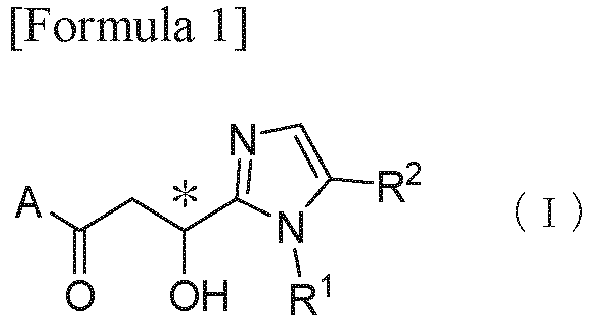

- In the above-described cyclic amine derivative, it is preferable that A is the group represented by the general formula (IIa), in which R1 is more preferably a methyl group, a n-propyl group, an isopropyl group, a 2-methoxyethyl group, or a 3,3,3-trifluoropropyl group.
- In the above-described cyclic amine derivative, it is preferable that A is the group represented by the general formula (IIb), in which X is more preferably -N(R3), and R1 is further preferably a methyl group, a n-propyl group, an isopropyl group, a 2-methoxyethyl group, or a 3,3,3-trifluoropropyl group.
- In the above-described cyclic amine derivative, R2 is more preferably a hydrogen atom or a chlorine atom.
- In the above-described cyclic amine derivative, the stereochemical configuration of the asymmetric carbon marked with ∗ is more preferably S.
- The effect of promoting advillin function can be further enhanced by defining as mentioned above.
- The present invention provides an agent for promoting advillin function, for promoting advillin function by binding to advillin and/or an advillin complex, comprising a cyclic amine derivative represented by the above general formula (I) or a pharmacologically acceptable salt thereof as an active ingredient.
- The present invention also provides an agent for promoting advillin function, for improving abnormality in regulation of actin filament turnover, comprising a cyclic amine derivative represented by the above general formula (I) or a pharmacologically acceptable salt thereof as an active ingredient.
- The present invention also provides an agent for promoting advillin function, for promoting axon extension, comprising a cyclic amine derivative represented by the above general formula (I) or a pharmacologically acceptable salt thereof as an active ingredient.
- The present invention further provides an agent for promoting advillin function, for improving abnormality in regulation of actin filament turnover and promoting axon extension by binding to advillin and/or an advillin complex, comprising a cyclic amine derivative represented by the above general formula (I) or a pharmacologically acceptable salt thereof as an active ingredient.
- The present invention also provides an agent for promoting advillin function, which is a therapeutic agent for axonal injury, comprising a cyclic amine derivative represented by the above general formula (I) or a pharmacologically acceptable salt thereof as an active ingredient.
- The present invention also provides a cyclic amine derivative that is one compound selected from the group consisting of 3-hydroxy-3-(1-methyl-1H-imidazol-2-yl)-1-(4-morpholinopiperidin-1-yl)propan-1-one, 1-(4-(dimethylamino)piperidin-1-yl)-3-(1-propyl-1H-imidazol-2-yl)-3 -hydroxypropan-1-one, 1-(4-(dimethylamino)piperidin-1-yl)-3-(1-isopropyl-1H-imidazol-2-yl)-3 -hydroxypropan-1 -one, 3 -(5 -chloro-1 -methyl-1H-imidazol-2-yl)-1-(4-(dimethylamino)piperidin-1-yl)-3-hydroxypropan-1-one, 1-(4-(dimethylamino)piperidin-1-yl)-3 -(1 -(2-methoxyethyl)-1H-imidazol-2-yl)-3 -hydroxypropan-1-one and 1-(4-(dimethylamino)piperidin-1-yl)-3-(1-(3,3,3-trifluoropropyl)-1H-imidazol-2-yl)-3- hydroxypropan-1-one, or a pharmacologically acceptable salt thereof.
- The present invention also provides a medicine comprising, as an active ingredient, a cyclic amine derivative that is one compound selected from the group consisting of 3-hydroxy-3-(1-methyl-1H-imidazol-2-yl)-1-(4-morpholinopiperidin-1-yl)propan-1-one, 1-(4-(dimethylamino)piperidin-1-yl)-3 -(1-propyl-1H-imidazol-2-yl)-3-hydroxypropan-1-one, 1-(4-(dimethylamino)piperidin-1-yl)-3 -(1-isopropyl-1H-imidazol-2-yl)-3 -hydroxypropan-1-one, 3-(5-chloro-1-methyl-1H-imidazol-2-yl)-1-(4-(dimethylamino)piperidin-1-yl)-3-hydroxypropan-1-one, 1-(4-(dimethylamino)piperidin-1-yl)-3-(1-(2-methoxyethyl)-1H-imidazol-2-yl)-3 - hydroxypropan-1-one and 1-(4-(dimethylamino)piperidin-1-yl)-3-(1-(3,3,3-trifluoropropyl)-1H-imidazol-2-yl)-3-hydroxypropan-1-one, or a pharmacologically acceptable salt thereof.
- The present invention also provides a pharmaceutical composition for treating axonal injury, comprising a cyclic amine derivative represented by the above general formula (I) or a pharmacologically acceptable salt thereof, and a pharmacologically acceptable excipient or the like.
- The present invention also provides a cyclic amine derivative represented by the above general formula (I) or a pharmacologically acceptable salt thereof for use in treatment of axonal injury.
- The present invention also provides use of a cyclic amine derivative represented by the above general formula (I) or a pharmacologically acceptable salt thereof for treating axonal injury.
- The present invention also provides use of a cyclic amine derivative represented by the above general formula (I) or a pharmacologically acceptable salt thereof in production of a medicine for treating axonal injury.
- The present invention also provides a method for treating axonal injury, comprising administering a therapeutically effective amount of a cyclic amine derivative represented by the above general formula (I) or a pharmacologically acceptable salt thereof to a patient in need of treatment.
- The present invention also provides a method for treating axonal injury, comprising contacting an effective amount of a cyclic amine derivative represented by the above general formula (I) or a pharmacologically acceptable salt thereof with neurons.
- The present invention also provides a method for treating axonal injury, comprising administering an effective amount of a cyclic amine derivative represented by the above general formula (I) or a pharmacologically acceptable salt thereof to a subject in need thereof.
- Examples of a cause of axonal injury include, but are not limited to: surgical operation, a toxic substance, blood circulation disorder, an external wound caused by traffic accident or the like, and radiation therapy.
- The present invention also provides a pharmaceutical composition for treating a disease related to axonal injury, comprising a cyclic amine derivative represented by the above general formula (I) or a pharmacologically acceptable salt thereof, and a pharmacologically acceptable excipient or the like.
- The present invention also provides a cyclic amine derivative represented by the above general formula (I) or a pharmacologically acceptable salt thereof for use in treatment of a disease related to axonal injury.
- The present invention also provides use of a cyclic amine derivative represented by the above general formula (I) or a pharmacologically acceptable salt thereof for treating a disease related to axonal injury.
- The present invention also provides use of a cyclic amine derivative represented by the above general formula (I) or a pharmacologically acceptable salt thereof in production of a medicine for treating a disease related to axonal injury.
- The present invention also provides a method for treating a disease related to axonal injury, comprising administering a therapeutically effective amount of a cyclic amine derivative represented by the above general formula (I) or a pharmacologically acceptable salt thereof to a patient in need of treatment.
- The present invention also provides a method for treating a disease related to axonal injury, comprising contacting an effective amount of a cyclic amine derivative represented by the above general formula (I) or a pharmacologically acceptable salt thereof with neurons.
- The present invention also provides a method for treating a disease related to axonal injury, comprising administering an effective amount of a cyclic amine derivative represented by the above general formula (I) or a pharmacologically acceptable salt thereof to a subject in need thereof.
- The present invention also provides a pharmaceutical composition for promoting advillin function, improving abnormality in regulation of actin filament turnover, or promoting axon extension, comprising a cyclic amine derivative represented by the above general formula (I) or a pharmacologically acceptable salt thereof, and a pharmacologically acceptable excipient or the like.
- The present invention also provides a cyclic amine derivative represented by the above general formula (I) or a pharmacologically acceptable salt thereof, for use in promoting advillin function, improving abnormality in regulation of actin filament turnover, or promoting axon extension.
- The present invention also provides use of a cyclic amine derivative represented by the above general formula (I) or a pharmacologically acceptable salt thereof, for promoting advillin function, improving abnormality in regulation of actin filament turnover, or promoting axon extension.
- The present invention also provides use of a cyclic amine derivative represented by the above general formula (I) or a pharmacologically acceptable salt thereof in production of a medicine for promoting advillin function, improving abnormality in regulation of actin filament turnover, or promoting axon extension.
- The present invention also provides a method for promoting advillin function, improving abnormality in regulation of actin filament turnover, or promoting axon extension, comprising administering a therapeutically effective amount of a cyclic amine derivative represented by the above general formula (I) or a pharmacologically acceptable salt thereof to a patient in need thereof.
- The present invention also provides a method for promoting advillin function, improving abnormality in regulation of actin filament turnover, or promoting axon extension, comprising contacting an effective amount of a cyclic amine derivative represented by the above general formula (I) or a pharmacologically acceptable salt thereof with neurons.
- The present invention also provides a method for promoting advillin function, improving abnormality in regulation of actin filament turnover, or promoting axon extension, comprising administering an effective amount of a cyclic amine derivative represented by the above general formula (I) or a pharmacologically acceptable salt thereof to a subject in need thereof.
- The cyclic amine derivative of the present invention or a pharmacologically acceptable salt thereof can promote the function of advillin that is one of regulatory molecules for actin filament turnover, and can be used as a medicine for a disease related to axonal injury.
- This description includes the description and/or drawings described in
Japanese Patent Application No. 2018-243042 -
- [
Figure 1] Figure 1 is a diagram illustrating advillin function against an actin filament. - [
Figure 2] Figure 2 is a diagram illustrating specific bindings of a compound of Example 7 to membrane fractions prepared from various tissues of a rat. - [
Figure 3] Figure 3 is a diagram illustrating an effect of the compound of Example 7 of improving abnormality in regulation of actin filament turnover in a rat spinal nerve ligation model. - [
Figure 4] Figure 4 is images illustrating an axon extension effect of the compound of Example 7 in primary cultured cells of rat dorsal root ganglion having axonal injury induced, as a change of a cell form. - [
Figure 5] Figure 5 is a diagram illustrating the axon extension promoting effect of the compound of Example 7 in primary cultured cells of rat dorsal root ganglion having axonal injury induced. - The following terms used in the specification are, unless otherwise specified, defined as follows.
- It is characterized in that the cyclic amine derivative according to one embodiment of the present invention is represented by the following general formula (I):


- In the above-described cyclic amine derivative, it is preferable that A is the group represented by the general formula (IIa), in which R1 is preferably a methyl group, a n-propyl group, an isopropyl group, a 2-methoxyethyl group, or a 3,3,3-trifluoropropyl group.
- In the above-described cyclic amine derivative, it is preferable that A is the group represented by the general formula (IIb), in which X is preferably -N(R3), and R1 is preferably a methyl group, a n-propyl group, an isopropyl group, a 2-methoxyethyl group, or a 3,3,3-trifluoropropyl group.
- In the above-described cyclic amine derivative, R2 is preferably a hydrogen atom or a chlorine atom.
- In the above-described cyclic amine derivative, the stereochemical configuration of the asymmetric carbon marked with ∗ is preferably S.
- In one embodiment of the cyclic amine derivative of the present invention, A is a group represented by the general formula (IIa), R1 is a methyl group, a n-propyl group, an isopropyl group, a 2-methoxyethyl group, or a 3,3,3-trifluoropropyl group, R2 is a hydrogen atom or a chlorine atom, and R3 is a methyl group or an ethyl group. In the present embodiment, the stereochemical configuration of the asymmetric carbon marked with ∗ is preferably S.
- In one embodiment of the cyclic amine derivative of the present invention, A is a group represented by the general formula (IIb), X is -N(R3)-, R1 is a methyl group, a n-propyl group, an isopropyl group, a 2-methoxyethyl group, or a 3,3,3-trifluoropropyl group, R2 is a hydrogen atom or a chlorine atom, and R3 is a methyl group or an ethyl group. In the present embodiment, the stereochemical configuration of the asymmetric carbon marked with ∗ is preferably S.
- In one embodiment of the cyclic amine derivative of the present invention, A is a group represented by the general formula (IIb), X is -O-, R1 is a methyl group, a n-propyl group, an isopropyl group, a 2-methoxyethyl group, or a 3,3,3-trifluoropropyl group, R2 is a hydrogen atom or a chlorine atom, and R3 is a methyl group or an ethyl group. In the present embodiment, the stereochemical configuration of the asymmetric carbon marked with ∗ is preferably S.
- The cyclic amine derivative according to one embodiment of the present invention is one compound selected from the group consisting of 3-hydroxy-3-(1-methyl-1H-imidazol-2-yl)-1-(4-morpholinopiperidin-1-yl)propan-1-one, 1-(4-(dimethylamino)piperidin-1-yl)-3-(1-propyl-1H-imidazol-2-yl)-3-hydroxypropan-1-one, 1-(4-(dimethylamino)piperidin-1-yl)-3-(1-isopropyl-1H-imidazol-2-yl)-3 -hydroxypropan-1-one, 3-(5 -chloro-1-methyl-1H-imidazol-2-yl)-1-(4-(dimethylamino)piperidin-1-yl)-3 -hydroxypropan-1-one, 1-(4-(dimethylamino)piperidin-1-yl)-3-(1-(2-methoxyethyl)-1H-imidazol-2-yl)-3 -hydroxypropan-1-one and 1-(4-(dimethylamino)piperidin-1 -yl)-3 -(1-(3,3,3 -trifluoropropyl)- 1H-imidazol-2-yl)-3-hydroxypropan-1-one.
- Specific examples of a compound preferable as a cyclic amine derivative represented by the above general formula (I) (hereinafter, referred to as a cyclic amine derivative (I)) will be shown in Tables 1 and 2, but the present invention is not limited to these.
[Table 1] Structural Formula Structural Formula Structural Formula 


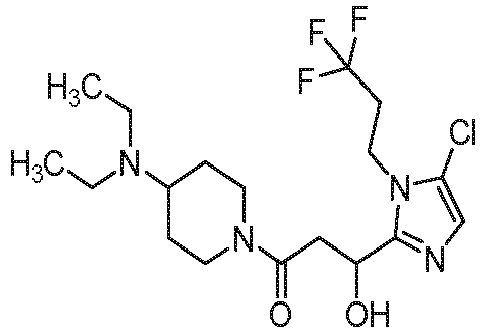

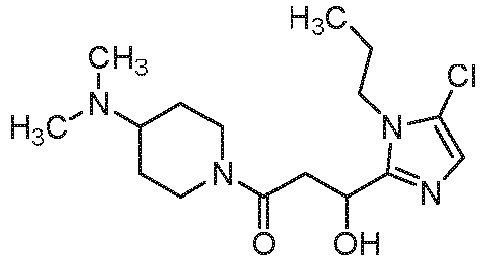


[Table 2] Structural Formula Structural Formula Structural Formula 


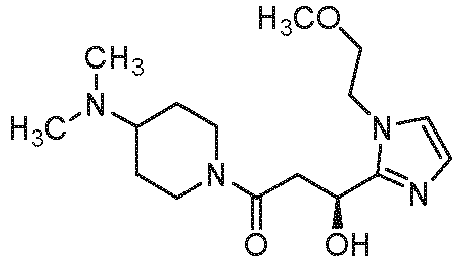
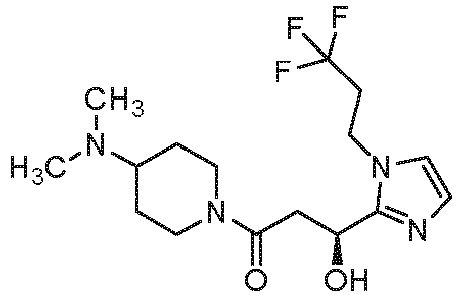


- When the cyclic amine derivative (I) has isomers such as enantiomers and stereoisomers, any one of isomers and mixtures of them are included in the cyclic amine derivative (I). In addition, when the cyclic amine derivative (I) has isomers such as enantiomers and stereoisomers, the cyclic amine derivative (I) may be a mixture comprising any one of isomers or mixtures of them. In addition, when the cyclic amine derivative (I) has conformational isomers, the cyclic amine derivative (I) includes any one of isomers and mixtures of them. A desired isomer can be obtained by a known method or a similar method thereto. For example, when an enantiomer of the cyclic amine derivative (I) is present, the enantiomer separated from the cyclic amine derivative (I) is also included in the cyclic amine derivative (I).
- A desired enantiomer can be obtained by a known means (for example, an optically active synthetic intermediate is used or final-product racemic mixture is subjected to a known method or a similar method thereto (for example, optical resolution)).
- A prodrug of a cyclic amine derivative (I) or a pharmacologically acceptable salt thereof is also included. The prodrug of the cyclic amine derivative (I) refers to a compound, which is enzymatically or chemically converted to the cyclic amine derivative (I) in vivo. The active form of a prodrug of the cyclic amine derivative (I) is the cyclic amine derivative (I); however a prodrug of the cyclic amine derivative (I) itself may have activity.
- As the prodrug of the cyclic amine derivative (I), for example, a compound obtained by alkylation, phosphorylation or boration of a hydroxyl group of the cyclic amine derivative (I) can be mentioned. These compounds can be each synthesized from the cyclic amine derivative (I) in accordance with a known method.
- A prodrug of the cyclic amine derivative (I) may be converted into the cyclic amine derivative (I) in physiological conditions described in known literatures ("Development of pharmaceutical products", Hirokawa-Shoten Ltd., vol. 7, p. 163 to 198, 1990, and Progress in Medicine, vol. 5, p. 2157 to 2161, 1985).
- The cyclic amine derivative (I) may be labeled with an isotope. Examples of isotopes for use in labeling include 2H, 3H, 13C, 14C, 15N, 15O and/or 18O.
- As the pharmacologically acceptable salt of the cyclic amine derivative (I), for example, an inorganic salt such as a hydrochloride, a sulfate, a phosphate and a hydrobromide; or organic salt such as an oxalate, a malonate, a citrate, a fumarate, a lactate, a malate, a succinate, a tartrate, an acetate, a trifluoroacetate, a maleate, a gluconate, a benzoate, a salicylate, a xinafoate, a pamoate, an ascorbate, an adipate, a methanesulfonate, a p-toluenesulfonate and a cinnamate can be mentioned.
- The cyclic amine derivative (I) or a pharmacologically acceptable salt thereof includes a hydrate and a solvate thereof.
- When the cyclic amine derivative (I) or a pharmacologically acceptable salt thereof has crystalline polymorphs, the cyclic amine derivative (I) or the pharmacologically acceptable salt thereof includes all crystalline polymorphs and mixtures of them.
- The cyclic amine derivative (I) or a pharmacologically acceptable salt thereof can be synthesized in accordance with a method described in a known literature (International Publication No.
WO2016/136944 ), for example. - The term "advillin" encompasses an isoform, an analog, a variant, a fragment and a functional derivative. Advillin is a transcriptional product of advillin gene, is also designated as p92 or AVIL, and is one member of the gelsolin family. In a human, advillin is a protein having two isoforms, and consisting of 819 amino acids or 821 amino acids.
- "Advillin" is a molecule that acts on an actin filament, and has a function of cutting the actin filament having a double helix structure.
- The term "to promote advillin function" refers to retaining, sustaining, or enhancing the biological function of advillin, and/or normalizing the biological function deteriorated. The promotion of advillin function can be improvement and/or normalization of abnormality in regulation of actin filament turnover. Accordingly, if actin filaments have increased due to axonal injury of peripheral nerve, the promotion of advillin function decreases the actin filaments and increases a relative amount of actin monomers. The promotion of advillin function also includes promotion of axon extension.
- The term "advillin complex" refers to an aggregation formed by advillin and a molecule of a protein or the like which interacts with and/or binding to advillin.
- It can be evaluated, for example, by affinity purification using FG Beads (registered trademark) that are magnetic fine particles described in a known literature (Aono et al., 2018, Biochemical and Biophysical Research Communications, vol. 505, pp. 1203-1210), that the cyclic amine derivative (I) binds to advillin and/or an advillin complex. Alternatively, it can be evaluated by analyzing interaction between molecules by employing not only immunoprecipitation or affinity purification using an antibody recognizing advillin and/or the advillin complex but also surface plasmon resonance (SPR).
- The term "actin filament turnover" refers to bidirectional turnover proceeding through actin monomer polymerization and actin filament depolymerization.
- The term "abnormality in regulation of actin filament turnover" refers to that balance between actin polymerization and actin filament depolymerization in the "actin filament turnover" is lost to make unidirectional process dominant.
- The term "to improve abnormality in regulation of actin filament turnover" means that the state where the monodirectional process is dominant in the "abnormality in regulation of actin filament turnover" is normalized or made closer to a normal state. Specifically, it means that the amount of actin filaments, and a ratio between the amount of actin filaments and the amount of actin monomers are normalized or made closer to normal.
- It can be evaluated, by using cells (such as primary cultured human dorsal root ganglion neurons, primary cultured neurons of dorsal root ganglion derived from a mammal such as a rat or a mouse, PC12 cells derived from rat adrenal pheochromocytoma, or F11 cells derived from rat dorsal root ganglion) to measure the amount of actin filaments in the cells, that the cyclic amine derivative (I) or a pharmacologically acceptable salt thereof has an effect of improving abnormality in regulation of actin filament turnover. As a method for measuring the amount of actin filaments in cells, the measurement can be performed by, for example, fluorescent staining using fluorescent-labeled phalloidin binding to actin filaments (Carlson et al., Neuro Toxicology, 2001, vol. 22, pp. 819-827).
- The term "effect of decreasing intracellular actin filaments" means an effect of decreasing the amount of intracellular actin filaments as compared with a case where a treatment for decreasing the amount of intracellular actin filaments is not performed, and in this effect, the amount of intracellular actin filaments decreases preferably by 5% or more, 10% or more, 20% or more, 30% or more, 40% or more, 50% or more, 60% or more, 70% or more, 80% or more, 90% or more, or 100% as compared with the case where the treatment for decreasing the amount of intracellular actin filaments is not performed.
- Besides, it can be evaluated, by using a sample of a disease related to the abnormality in regulation of actin filament turnover, such as a tissue of a patient suffering from axonal injury or axonal injury animal model, to measure a ratio between the amount of actin filaments and the amount of actin monomers, that the cyclic amine derivative (I) or a pharmacologically acceptable salt thereof has the effect of improving abnormality in regulation of actin filament turnover. As the axonal injury animal model, for example, a rat spinal nerve ligation model (Kim et al., Pain, 1992, vol. 50, pp. 355-363) can be mentioned. The ratio between the amount of actin filaments and the amount of actin monomers can be calculated by separating actin filaments and actin monomers by ultracentrifugation of a tissue or a cell homogenate, and quantitatively determining the amounts of these by Western blotting (Kim et al., The journal of Physiology, 2015, vol. 593, pp. 1873-1886).
- The term "axon" refers to a long projection extending from neuron cell body, and is also designated as neurite. Axon forms nerve fiber. An end of an axon is branched to be joined to a next neuron or target tissue for transmitting neuronal excitation.
- The term "axonal injury" refers to a state in which an axon is partly or completely destroyed or cut, and a portion of the axon on the side of the tissue from the damaged site is degenerated or lost.
- The term "axon extension" refers to extension of an axon of a neuron. The promotion of axon extension is expected to rejoin a target tissue to the axon and/or to reconstruct neural circuit after axonal injury.
- Examples of a cause of axonal injury include, but are not limited to: surgical operation, a toxic substance, blood circulation disorder, an external wound caused by traffic accident or the like, or radiation therapy.
- As the toxic substance, for example, exogenous and endogenous neurotoxins can be mentioned. As the exogenous neurotoxin, for example, tetrodotoxin, batrachotoxin, maurotoxin, agitoxin, charybdotoxin, margatoxin, slotoxin, scyllatoxin, hefutoxin, calciseptine, taicatoxin, or calcicludine can be mentioned. As the endogenous neurotoxin, for example, glutamic acid, N-methyl-D-aspartic acid (NMDA), or kainic acid can be mentioned. In addition, a gas (such as carbon monoxide), a metal (such as mercury), methanol, or ethanol can be mentioned. As other toxic substances, for example, agricultural chemicals of herbicides and insecticides (such as rotenone and paraquat) can be mentioned. Besides, a list of toxic substances and deleterious substances is published as toxic substances harmful to the human body by Poisonous and Deleterious Substances Control Law in Japan, and toxic substances listed therein can be mentioned as the toxic substance.
- Examples of the disease related to axonal injury (including a disease caused by it) include, but are not limited to, carpal tunnel syndrome, pronator syndrome, anterior interosseous nerve palsy, ulnar tunnel syndrome (Guyon's tunnel syndrome), cubital tunnel syndrome, posterior interosseous nerve palsy, radial nerve palsy, thoracic outlet syndrome, axillary nerve palsy, suprascapular nerve palsy, piriformis muscle syndrome, lumbar plexus palsy, tarsal tunnel syndrome, femoral nerve palsy, sciatic nerve palsy, tibial nerve palsy, common peroneal nerve palsy, deep peroneal nerve palsy (anterior tarsal tunnel syndrome), saphenous nerve palsy (Hunter tunnel syndrome), cervical spinal canal stenosis, lumbar spinal canal stenosis, facial palsy, oculomotor paralysis, trochlear nerve palsy, abducens nerve palsy, giant cell arteritis, Takayasu arteritis, polyarteritis nodosa, Kawasaki disease, granulomatosis with polyangiitis (Wegener's granulomatosis), microscopic polyangiitis, eosinophilic granulomatosis with polyangiitis (allergic granulomatous angiitis, Churg-Strauss syndrome), cryoglobulinemia, IgA vasculitis (Henoch-Schonlein purpura), cutaneous leukocytoclastic vasculitis, systemic lupus erythematosus, Sjogren's syndrome, rheumatoid arthritis, mixed connective tissue disease, polymyositis, dermatomyositis, scleroderma, Behcet's disease, Bell's palsy, Ramsay Hunt syndrome, bacterial/viral infectious diseases (such as Lyme disease, HIV infectious disease, and leprosy), sarcoidosis, and malignant tumors.
- It can be evaluated, by using a tissue in which an axon of a human neuron has been injured, axonal injury animal model, or a neuron (such as a neuron derived from the cerebral cortex, or a cell derived from dorsal root ganglion) to measure the length, density or the like of neurites having been extended, that the cyclic amine derivative (I) or a pharmacologically acceptable salt thereof has the effect of promoting axon extension (Yang et al., Free Radical Biology and Medicine, 2018, vol. 120, pp. 13-24).
- The cyclic amine derivative (I) or a pharmacologically acceptable salt thereof can be used as a medicine for treating or preventing axonal injury in a mammal (for example, mouse, rat, hamster, rabbit, cat, dog, cow, sheep, monkey or human), and especially to a human.
- When the cyclic amine derivative (I) or a pharmacologically acceptable salt thereof is used as a medicine, the cyclic amine derivative (I) or a pharmacologically acceptable salt thereof directly or in combination with a pharmaceutically acceptable carrier can be orally or parenterally administered.
- As the dosage form when a medicine comprising the cyclic amine derivative (I) or a pharmacologically acceptable salt thereof as an active ingredient is orally administered, for example, tablets (including sugar-coated and film-coated tablets), pills, granules, powders, capsules (including soft capsules and micro capsules), syrups, emulsions and suspensions can be mentioned. As the dosage form when a medicine comprising the cyclic amine derivative (I) or a pharmacologically acceptable salt thereof as an active ingredient is parenterally administered, for example, injections, infusions, drops, suppositories, endermic liniments and adhesive patches can be mentioned. It is further effective to prepare a sustained-release formulation by using the cyclic amine derivative (I) or a pharmacologically acceptable salt thereof in combination with an appropriate base (for example, a butyric acid polymer, a glycolic acid polymer, a butyric acid-glycolic acid copolymer, mixtures of a butyric acid polymer and a glycolic acid polymer, or a polyglycerol fatty acid ester).
- Formulations having the aforementioned dosage forms can be prepared in accordance with production methods known in the field of drug formulation. In this case, if necessary, production can be made by adding an excipient, a binder, a lubricant, a disintegrating agent, a sweetening agent, a surfactant, a suspending agent or an emulsifying agent, which is generally used in the field of drug formulation.
- Tablets can be prepared, for example, by adding an excipient, a binder, a disintegrating agent or a lubricant. Pills and granules can be prepared by adding, for example, an excipient, a binder or a disintegrating agent. Powders and capsules can be prepared by adding, for example, an excipient. Syrups can be prepared by adding, for example, a sweetening agent. Emulsions or suspensions can be prepared by adding, for example, a surfactant, a suspending agent or an emulsifier.
- As the excipient, for example, lactose, glucose, starch, sucrose, microcrystalline cellulose, powdered glycyrrhiza, mannitol, sodium hydrogen carbonate, calcium phosphate and calcium sulfate can be mentioned.
- As the binder, for example, a starch paste solution, a gum arabic solution, a gelatin solution, a tragacanth solution, a carboxymethylcellulose solution, a sodium alginate solution and glycerin can be mentioned.
- As the disintegrating agent, for example, starch and calcium carbonate can be mentioned.
- As the lubricant, for example, magnesium stearate, stearic acid, calcium stearate and purified talc can be mentioned.
- As the sweetening agent, for example, glucose, fructose, invert sugar, sorbitol, xylitol, glycerin and simple syrup can be mentioned.
- As the surfactant, for example, sodium lauryl sulfate, polysorbate 80, sorbitan monofatty acid ester and stearic acid polyoxyl 40 can be mentioned.
- As the suspending agent, for example, Gum arabic, sodium alginate, sodium carboxymethylcellulose, methyl cellulose and bentonite can be mentioned.
- As the emulsifier, for example, Gum arabic, tragacanth, gelatin and polysorbate 80 can be mentioned.
- When a medicine comprising the cyclic amine derivative (I) or a pharmacologically acceptable salt thereof as an active ingredient is prepared in the aforementioned dosage forms, a coloring agent, a preserving agent, a fragrance, a flavoring agent, a stabilizer or a thickener generally used in the field of drug formulation can be added.
- The dose per day of a medicine comprising the cyclic amine derivative (I) or a pharmacologically acceptable salt thereof as an active ingredient varies depending upon e.g., the state or body weight of the patient or the type or administration route of a compound, but for example, in oral administration to an adult (weight: about 60 kg), it is preferable that the amount of the cyclic amine derivative (I) or a pharmacologically acceptable salt thereof serving as an active ingredient falling within the range of 1 to 1000 mg is administered in 1 to 3 divided doses, and in parenteral administration to an adult (weight: about 60 kg) as injections, it is preferable that the amount of the cyclic amine derivative (I) or a pharmacologically acceptable salt thereof serving as an active ingredient falling within the range of 0.01 to 100 mg per body weight (1 kg) is administered by intravenous injection.
- The cyclic amine derivative (I) or a pharmacologically acceptable salt thereof may be blended with other medicinal agents in an appropriate ratio or used in combination with other medicinal agents to supplement or enhance a therapeutic or prophylactic effect or reduce the dose. The cyclic amine derivative (I) or a pharmacologically acceptable salt thereof may be administered concurrently with other medicinal agents or may be administered continuously therewith in an arbitrary order. As the other medicinal agents, for example, but are not limited to, therapeutic agents for treating axonal injury can be mentioned.
- Hereinafter, the present invention will be specifically described in detail below with reference to Examples, Comparative Examples and Reference Example, but the present invention is not limited to them.
- In the following description, the names of the solvents shown in NMR data represent the solvents used in the measurement. The 400 MHz NMR spectra were measured by using JNM-
AL 400 series Nuclear Magnetic Resonance spectrometer (manufactured by JEOL, Ltd.). Chemical shifts are expressed by δ (unit: ppm) using tetramethylsilane as the reference, and the respective signals respectively have the following meanings: s (singlet), d (doublet), t (triplet), q (quartet), quint (quintet), sept (septet), m (multiplet), br (broad), dd (double doublet), dt (double triplet), ddd (double double doublet), dq (double quartet), td (triple doublet), and tt (triple triplet). The ESI-MS spectra were measured by using Agilent Technologies 1200 Series, G6130A (manufactured by Agilent Technology). Commercially available products were used for all the solvents. For flash column chromatography, YFLC W-prep2XY (manufactured by YAMAZEN Corporation) was used. - Raw materials and intermediates of the cyclic amine derivative (I) were synthesized by the methods described in Reference Examples given below. Note that commercially available products were used for the compounds which were used in synthesizing the compounds of Reference Examples and whose synthesis methods are not described below.
- (Reference Example 1) Synthesis of benzyl (S)-2-(3-(4-dimethylamino)piperidin-1-yl)-1-(1-methyl-1H-imidazol-2-yl)-3-oxopropoxy)acetate:


- Sodium hydride (55%, 0.0202 mg, 0.464 mmol) was added to a solution of (S)-1-(4-(dimethylamino)piperidin-1-yl)-3 -hydroxy-3 -(1-methyl-1H-imidazol-2-yl)propan-1-one (0.100 g, 0.357 mmol) in tetrahydrofuran (0.800 mL) at 0°C. The resultant was stirred at the same temperature for 10 minutes, and benzyl bromoacetate (0.0620 mL, 0.390 mmol) was added to the resultant reaction liquid, followed by stirring for further 15 hours at room temperature. An aqueous solution of ammonium chloride was added to the reaction liquid, and the resultant was extracted with chloroform. The organic layer was washed with a 10% aqueous solution of sodium chloride, and then dried over anhydrous sodium sulfate and filtered. The filtrate was concentrated under reduced pressure. The residue was purified by flash column chromatography (NH silica gel, chloroform/methanol) to obtain benzyl (S)-2-(3-(4-dimethylamino)piperidin-1-yl)-1-(1-methyl- 1H-imidazol-2-yl)-3-oxopropoxy)acetate (0.568 g, 0.133 mmol, 37%) as a colorless oil.
- 1H-NMR (400 MHz, CDCl3) δ: 1.30-1.57 (2H, m), 1.73-1.90 (2H, m), 2.24-2.37 (7H, m), 2.48-2.58 (1H, m), 2.95-3.13 (2H, m), 3.28-3.36 (1H, m), 3.70 (3H, d, J=1.6 Hz), 3.93-4.17 (3H, m),4.48-4.54 (1H, m), 5.12-5.14 (2H, m), 5.30-5.36 (1H, m), 6.80 (1H, s), 6.96 (1H, s), 7.31-7.39 (5H, m). ESI-MS: m/z= 429 (M+H)+.
- (Reference Example 2) Synthesis of ethyl 1-methyl-1H-imidazole-2-carboxylate:

- Triethylamine (3.40 mL, 24.4 mmol) and ethyl chloroformate (2.34 mL, 24.4 mmol) were added to a solution of 1-methyl-1H-imidazole (1.00 g, 12.2 mmol) in acetonitrile (4.0 mL) at 0°C, and the resultant reaction liquid was stirred at room temperature for 16 hours. The reaction liquid was filtered through celite, and the filtrate was concentrated under reduced pressure. The residue was purified by flash chromatography (silica gel, hexane/ethyl acetate) to obtain ethyl 1-methyl-1H-imidazole-2-carboxylate (1.50 g, 9.73 mmol, 80%) as a white solid.
- 1H-NMR (400 MHz, CDCl3) δ: 1.42 (3H, t, J=7.2 Hz), 4.01 (3H, s), 4.40 (2H, q, J=7.2 Hz), 7.01-7.03 (1H, m), 7.13-7.15 (1H, m).
- ESI-MS: m/z= 155 (M+H)+.
- (Reference Example 3) Synthesis of ethyl 3-(1-methyl-1H-imidazol-2-yl)-3-oxopropanoate:

- An aqueous solution of sodium hydroxide (1.0 N, 14.6 mL, 14.6 mmol) was added to a solution of ethyl 1-methyl-1H-imidazole-2-carboxylate (1.50 g, 9.73 mmol) in methanol (15.0 mL) at room temperature, and the resultant reaction liquid was stirred at the same temperature for 3 hours. The reaction liquid was cooled to 0°C. Hydrochloric acid (1.0 N) was added to the reaction liquid for neutralization, and the resultant reaction liquid was concentrated under reduced pressure. An azeotrope was formed with toluene, and ethanol was added thereto. The thus obtained precipitate was filtered through celite, and the filtrate was concentrated under reduced pressure. Acetonitrile (7.0 mL) and carbonyl diimidazole (1.54 g, 9.52 mmol) were added to the thus obtained crude product at room temperature, and the resultant reaction liquid was stirred at the same temperature for 2.5 hours (reaction liquid A). Separately, magnesium chloride (0.997 g, 10.5 mmol) was dissolved in acetonitrile (7.0 mL), and ethyl potassium malonate (1.70 g, 9.99 mmol) and triethylamine (2.98 mL, 21.4 mmol) were added thereto at room temperature, and the resultant reaction liquid was stirred at the same temperature for 2.5 hours (reaction liquid B). The reaction liquid A was added to the reaction liquid B at room temperature, and the resultant reaction liquid was stirred at 80°C for 2 hours. The reaction liquid was cooled to room temperature. Hydrochloric acid (1.0 N) was added to the reaction liquid, and the resultant was extracted with ethyl acetate. The organic layer was washed with a 10% aqueous solution of sodium chloride, and then dried over anhydrous sodium sulfate and filtered. The filtrate was concentrated under reduced pressure. The residue was purified by flash chromatography (silica gel, hexane/ethyl acetate) to obtain ethyl 3-(1-methyl-1H-imidazol-2-yl)-3-oxopropanoate (0.721 g, 3.67 mmol, 38%) as a white solid.
- 1H-NMR (400 MHz, CDCl3) δ: 1.27 (3H, t, J=7.2 Hz), 4.01 (3H, s), 4.13 (2H, s), 4.21 (2H, q,J=7.2 Hz), 7.05-7.07 (1H, m), 7.15-7.17 (1H, m).
- ESI-MS: m/z= 197 (M+H)+.
- (Reference Example 4) Synthesis of 4-(morpholin-4-yl)piperidine:

- Morpholine (0.792 g, 9.09 mmol), sodium triacetoxyborohydride (1.93 g, 9.09 mmol) and acetic acid (0.0460 g, 0.758 mmol) were added to a solution of 1-tert-butoxycarbonyl-4-piperidinone (1.51 g, 7.58 mmol) in dichloromethane (25.0 mL) at 0°C, followed by stirring at room temperature for 16 hours. The resultant reaction liquid was cooled to 0°C. A saturated aqueous solution of sodium bicarbonate was added to the reaction liquid, and the resultant was extracted with dichloromethane. The organic layer was dried over anhydrous sodium sulfate and filtered. The filtrate was concentrated under reduced pressure. The residue was dissolved in hydrochloric acid (1.0 N), and the resultant was extracted with ethyl acetate. The aqueous layer was made basic by adding a 48% aqueous solution of sodium hydroxide thereto, and the resultant was extracted with dichloromethane. The organic layer was dried over anhydrous sodium sulfate and filtered. The filtrate was concentrated under reduced pressure. The residue was dissolved in methanol (25.0 mL), and concentrated hydrochloric acid (5.0 mL) was added thereto, followed by stirring at 40°C for 12 hours. The resultant reaction liquid was concentrated to dryness, and the resultant was dissolved in distilled water. The resultant was made basic by adding a 48% aqueous solution of sodium hydroxide thereto, and the resultant was extracted with dichloromethane. The organic layer was dried over anhydrous sodium sulfate and filtered. The filtrate was concentrated under reduced pressure. Thus, 4-(morpholin-4-yl)piperidine (1.52 g, 5.63 mmol, 74%) was obtained as a yellow solid.
- 1H-NMR (400 MHz, CDCl3) δ: 1.34 (2H, dd, J=12.0, 4.0 Hz), 1.40 (2H, dd, J=12.0, 4.0 Hz), 1.85 (2H, d, J=12.4 Hz), 2.28 (1H, tt, J=11.2, 4.0 Hz), 3.53-3.63 (6H, m), 3.15 (2H, d, J=12.4Hz), 3.73 (4H, t, J=4.4 Hz).
- ESI-MS: m/z= 171 (M+H)+
- (Reference Example 5) Synthesis of 1-(1-methyl-1H-imidazol-2-yl)-3-(4-morpholinopiperidin-1-yl)propan-1,3-dione:

- 4-(Morpholin-4-yl)piperidine (0.158 g, 0. 928 mmol) was added to a solution of ethyl 3-(1-methyl-1H-imidazol-2-yl)-3-oxopropanoate (0.200 g, 1.02 mmol) in toluene (0.460 mL) at room temperature, and the resultant reaction liquid was stirred at 110°C for 16 hours. The reaction liquid was concentrated under reduced pressure. The residue was purified by flash chromatography (silica gel, chloroform/methanol) to obtain 1-(1-methyl-1H-imidazol-2-yl)-3-(4-morpholinopiperidin-1-yl)propan-1,3-dione (0.285 g, 0.890 mmol, 96%) as a colorless oil.
- 1H-NMR (400 MHz, CDCl3) δ: 1.40-1.64 (2H, m), 1.82-1.92 (2H, m), 2.37-2.47 (1H, m), 2.52-2.58 (4H, m), 3.05-3.15 (1H, m), 3.69-3.76 (5H, m), 3.82-3.90 (1H, m), 4.01 (3H, s), 4.16-4.31(2H, m), 4.58-4.65 (1H, m), 7.04-7.06 (1H, m), 7.13-7.15 (1H, m).
- ESI-MS: m/z= 321 (M+H)+.
- (Reference Example 6) Synthesis of 1-propyl-1H-imidazole-2-carbaldehyde:

- 1-Iodopropane (1.22 mL, 12.5 mmol) and potassium carbonate (2.16 g, 15.6 mmol) were added to a solution of 1H-imidazole-2-carbaldehyde (1.00 g, 10.4 mmol) in N,N-dimethylformamide (10.0 mL), followed by stirring at 60°C for 3 hours. Water was added to the resultant reaction liquid, and the resultant was extracted with ethyl acetate. The organic layer was washed with a 10% aqueous solution of sodium chloride, and then dried over anhydrous sodium sulfate and filtered. The filtrate was concentrated under reduced pressure. The residue was purified by flash column chromatography (silica gel, hexane/ethyl acetate) to obtain 1-propyl-1H-imidazole-2-carbaldehyde (0.786 g, 5.69 mmol, 55%) as a yellow oil.
- 1H-NMR (400 MHz, CDCl3) δ: 0.93 (3H, t, J=7.4 Hz), 1.77-1.85 (2H, m), 4.37 (2H, t, J=7.2 Hz), 7.16 (1H, s), 7.28 (1H, s), 9.82 (1H, s).
- (Reference Example 7) Synthesis of 1-isopropyl-1H-imidazole-2-carbaldehyde:

- 2-Iodopropane (1.26 mL, 12.5 mmol) and potassium carbonate (2.16 g, 15.6 mmol) were added to a solution of 1H-imidazole-2-carbaldehyde (1.00 g, 10.4 mmol) in N,N-dimethylformamide (10 mL), followed by stirring at 60°C for 3 hours. Water was added to the resultant reaction liquid, and the resultant was extracted with ethyl acetate. The organic layer was washed with a 10% aqueous solution of sodium chloride, and then dried over anhydrous sodium sulfate and filtered. The filtrate was concentrated under reduced pressure. The residue was purified by flash column chromatography (silica gel, hexane/ethyl acetate) to obtain 1-isopropyl-1H-imidazole-2-carbaldehyde (0.703 g, 5.09 mmol, 49%) as a yellow oil. 1H-NMR (400 MHz, CDCl3) δ: 1.47 (6H, t, J=6.6 Hz), 5.48 (1H, q, J=6.6 Hz), 7.30 (1H, s), 7.33 (1H, s), 9.83 (1H, s).
- (Reference Example 8) Synthesis of 5-chloro-1-methyl-1H-imidazole-2-carbaldehyde:

- Dess-Martin reagent (1.04 g, 2.46 mmol) was added to a solution of (5-chloro-1-methyl-1H-imidazol-2-yl)methanol (0.300 g, 2.05 mmol) in dichloromethane (20.0 mL) at 0°C, followed by stirring at the same temperature for 3 hours. A 10% aqueous solution of sodium thiosulfate and a saturated aqueous solution of sodium bicarbonate were added to the resultant reaction liquid, and the resultant was extracted with chloroform. The organic layer was washed with a 10% aqueous solution of sodium chloride, and then dried over anhydrous sodium sulfate and filtered. The filtrate was concentrated under reduced pressure. The residue was purified by flash column chromatography (silica gel, hexane/ethyl acetate) to obtain 5-chloro-1-methyl-1H-imidazole-2-carbaldehyde (0.235 g, 1.62 mmol, 79%) as a white solid.
- 1H-NMR (400 MHz, CDCl3) δ: 3.98 (3H, s), 7.24 (1H, s), 9.70 (1H, s).
- (Reference Example 9) Synthesis of 1-(2-methoxyethyl)-1H-imidazole-2-carbaldehyde:


- 2-Bromoethylmethylether (1.20 mL, 12.5 mmol), potassium carbonate (2.16 g, 15.6 mmol), and sodium iodide (0.468 g, 3.12 mmol) were added to a solution of 1H-imidazole-2-carbaldehyde (1.00 g, 10.4 mmol) in N,N-dimethylformamide (10.0 mL), followed by stirring at 60°C for 3 hours. Water was added to the resultant reaction liquid, and the resultant was extracted with ethyl acetate. The organic layer was washed with a 10% aqueous solution of sodium chloride, and then dried over anhydrous sodium sulfate and filtered. The filtrate was concentrated under reduced pressure. The residue was purified by flash column chromatography (silica gel, hexane/ethyl acetate) to obtain 1-(2-methoxyethyl)-1H-imidazole-2-carbaldehyde (0.535 g, 3.47 mmol, 33%) as a white solid.
- 1H-NMR (400 MHz, CDCl3) δ: 3.32 (3H, s), 3.67 (2H, t, J=5.0 Hz), 4.59 (2H, t, J=5.0 Hz), 7.23-7.30 (2H, m), 9.81 (1H, s).
- (Reference Example 10) Synthesis of 1-(3,3,3-trifluoropropyl)-1H-imidazole-2-carbaldehyde:

- 1,1,1-Trifluoro-3-iodopropane (0.710 mL, 6.24 mmol) and potassium carbonate (1.08 g, 7.81 mmol) were added to a solution of 1H-imidazole-2-carbaldehyde (0.500 g, 5.20 mmol) in N,N-dimethylformamide (5.20 mL), followed by stirring at 60°C for 5 hours. Water was added to the resultant reaction liquid, and the resultant was extracted with ethyl acetate. The organic layer was washed with a 10% aqueous solution of sodium chloride, and then dried over anhydrous sodium sulfate and filtered. The filtrate was concentrated under reduced pressure. The residue was purified by flash column chromatography (silica gel, hexane/ethyl acetate) to obtain 1-(3,3,3-trifluoropropyl)-1H-imidazole-2-carbaldehyde (0.0863 g, 0.449 mmol, 8.6%) as a colorless oil.
- 1H-NMR (400 MHz, CDCl3) δ: 2.60-2.72 (2H, m), 4.61 (2H, t, J=6.8 Hz), 7.18 (1H, s), 7.32 (1H, s), 9.83 (1H, s).
- (Reference Example 11) Synthesis of 1-(4-dimethylamino)piperidin-1-yl)ethanone:

- Pyridine (0.922 mL, 9.75 mmol) and acetic anhydride (0.946 mL, 11.7 mmol) were added to a solution of 4-dimethylaminopiperidine (1.00 g, 7.79 mmol) in dichloromethane (7.8 mL) at 0°C, and the resultant reaction liquid was stirred at room temperature for 16 hours. A saturated aqueous solution of sodium bicarbonate was added to the resultant reaction liquid, and the resultant was extracted with chloroform. The organic layer was washed with a 10% aqueous solution of sodium chloride, and then dried over anhydrous sodium sulfate and filtered. The filtrate was concentrated under reduced pressure. The residue was purified by flash column chromatography (NH silica gel, chloroform/methanol) to obtain 1-(4-(dimethylamino)piperidin-1-yl)ethanone (0.869 g, 6.78 mmol, 87%) as a colorless oil.
- 1H-NMR (400 MHz, CDCl3) δ: 1.30-1.47 (2H, m), 1.79-1.92 (2H, m), 2.10 (3H, s), 2.25-2.40 (7H, m), 2.53-2.63 (1H, m), 3.01-3.11 (1H, m), 3.81-3.90 (1H, m), 4.58-4.66 (1H, m). ESI-MS: m/z= 171 (M+H)+.
- (Reference Example 12) Synthesis of 4-(1-methylpiperazin-4-yl)piperidine:


- 1-Methylpiperazine (0.905 g, 9.03 mmol), acetic acid (0.497 g, 8.28 mmol), and sodium triacetoxyborohydride (1.92 g, 9.03 mmol) were added to a solution of 1-tert-butoxycarbonyl-4-piperidinone (1.50 g, 7.53 mmol) in dichloromethane (25.0 mL) at 0°C, and the resultant reaction liquid was stirred at room temperature for 16 hours. The reaction liquid was cooled to 0°C. A saturated aqueous solution of sodium bicarbonate was added to the reaction liquid, and the resultant was extracted with dichloromethane. The organic layer was dried over anhydrous sodium sulfate and filtered. The filtrate was concentrated under reduced pressure. The residue was dissolved in hydrochloric acid (1.0 N), and the resultant was extracted with ethyl acetate. The aqueous layer was made basic by adding a 48% aqueous solution of sodium hydroxide thereto, and the resultant was extracted with dichloromethane. The organic layer was dried over anhydrous sodium sulfate and filtered. The filtrate was concentrated under reduced pressure. The residue was dissolved in methanol (25.0 mL), and concentrated hydrochloric acid (5.0 mL) was added thereto, followed by stirring at 40°C for 12 hours. The resultant reaction liquid was concentrated under reduced pressure, and the resultant was dissolved in distilled water. The resultant was made basic by adding a 48% aqueous solution of sodium hydroxide thereto, and the resultant was extracted with dichloromethane. The organic layer was dried over anhydrous sodium sulfate and filtered. The filtrate was concentrated under reduced pressure to obtain 4-(1-methylpiperazin-4-yl)piperidine (0.826 g, 4.51 mmol, 60%) as a white solid.
- 1H-NMR (400 MHz, CDCl3) δ: 1.35 (2H, dd, J=12.0, 3.6 Hz), 1.41 (2H, dd, J=12.0, 3.6 Hz), 1.85 (2H, d, J=12.8 Hz), 1.96-2.06 (2H, br), 2.28 (3H, s), 2.32 (1H, tt, J=11.6, 3.6 Hz), 3.37-3.70 (8H, m), 3.14 (2H, d, J=12.8 Hz).
- ESI-MS: m/z= 169 (M+H)+.
- (Reference Example 13) Synthesis of crude 4-diethylaminopiperidine:


- Diethylamine (0.276 mL, 2.68 mmol), acetic acid (0.0120 mL, 0.214 mmol), and sodium triacetoxyborohydride (0.681 g, 3.22 mmol) were added to a solution of benzyl 4-oxopiperidine-1-carboxylate (0.500 g, 2.14 mmol) in dichloromethane (12.0 mL) at 0°C, and the resultant reaction liquid was stirred at room temperature for 16 hours. The reaction liquid was cooled to 0°C. A saturated aqueous solution of sodium bicarbonate was added to the reaction liquid, and the resultant was extracted with chloroform. The organic layer was dried over anhydrous sodium sulfate and filtered. The filtrate was concentrated under reduced pressure. The residue was purified by flash column chromatography (NH silica gel, chloroform/methanol). The thus obtained crudely purified product was dissolved in methanol (8.0 mL), and palladium/carbon (10% wet, 0.180 g, 0.169 mmol) was added thereto at room temperature, followed by stirring under a hydrogen atmosphere for 16 hours. The resultant reaction liquid was filtered through celite, and the filtrate was concentrated under reduced pressure to obtain a crude product of 4-diethylaminopiperidine.
- (Reference Example 14) Synthesis of 1-(4-(dimethylamino)piperidin-1-yl)-3-(1-methyl-1H-imidazol-2-yl)propan-1,3-dione:

- A solution of lithium diisopropylamide in tetrahydrofuran (2.0 M, 7.05 mL, 14.1 mmol) was added dropwise to a solution of 1-(4-(dimethylamino)piperidin-1-yl)ethanone (1.00 g, 5.87 mmol) in tetrahydrofuran (20 mL) at -78°C, followed by stirring at the same temperature for 1 hour. A solution of ethyl 1-methyl-1H-imidazole-2-carboxylate (1.09 g, 7.05 mmol) in tetrahydrofuran (9.0 mL) was added to the resultant reaction liquid at the same temperature, and the resultant was stirred for 1 hour, and then at 0°C for further 1 hour. A saturated aqueous solution of ammonium chloride and an aqueous solution of potassium carbonate were successively added to the resultant reaction liquid, and the resultant was extracted with chloroform. The organic layer was washed with a 10% aqueous solution of sodium chloride, and then dried over anhydrous sodium sulfate and filtered. The filtrate was concentrated under reduced pressure. The residue was purified by flash column chromatography (NH silica gel, hexane/ethyl acetate) to obtain 1-(4-(dimethylamino)piperidin-1-yl)-3-1H-imidazol-2-yl)propan-1,3-dione (0.990 g, 3.56 mmol, 61%) as a colorless oil.
- 1H-NMR (400 MHz, CDCl3) δ: 1.32-1.5 (2H, m), 1.80-1.94 (2H, m), 2.22-41 (7H, m), 2.60-2.70 (1H, m), 3.03-3.13 (1H, m), 3.80-3.89 (1H, m), 4.01 (3H, s), 4.23 (2H, dd, J=15.6, 36.8 Hz),4.55-4.67 (1H, m), 7.05 (1H, s), 7.14 (1H, s).
- ESI-MS: m/z= 279 (M+H)+.
- (Reference Example 15) Synthesis of 1-(1-methyl-1H-imidazol-2-yl)-3-(4-(4-methylpiperazin-1-yl)piperidin-1-yl)propan-1,3-dione:
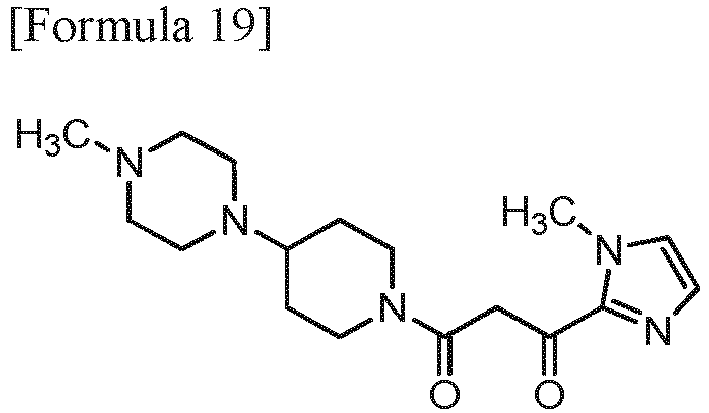
- 4-(1-Methylpiperazin-4-yl)piperidine (0.170 g, 0.927 mmol) was added to a solution of ethyl 3-(1-methyl-1H-imidazol-2-yl)-3-oxopropanoate (0.200 g, 1.02 mmol) in toluene (0.46 mL) at room temperature, and the resultant reaction liquid was stirred at 110°C for 16 hours. The reaction liquid was concentrated under reduced pressure. The residue was purified by flash column chromatography (NH silica gel, chloroform/methanol) to obtain 1-(1-methyl-1H-imidazol-2-yl)-3-(4-(4-methylpiperazin-1-yl)piperidin-1-yl)propan-1,3-dione (0.290 g, 0.870 mmol, 94%) as a colorless oil.
- 1H-NMR (400 MHz, CDCl3) δ: 1.38-1.60 (2H, m), 1.82-1.90 (2H, m), 1.95-2.10 (1H, m), 2.27 (3H, s), 2.36-2.68 (9H, m), 3.02-3.12 (1H, m), 3.79-3.88 (1H, m), 3.98 (3H, s), 4.13-4.28 (2H,m), 4.57-4.90 (1H, m), 7.02-7.04 (1H, m), 7.11-7.13 (1H, m).
- ESI-MS: m/z= 334 (M+H)+.
- (Reference Example 16) Synthesis of 1-(4-(diethylamino)piperidin-1-yl)-3-(1-methyl-1H-imidazol-2-yl)propan-1,3-dione:

- Crude 4-diethylaminopiperidine (0.143 g, 0.917 mmol) was added to a solution of ethyl 3-(1-methyl-1H-imidazol-2-yl)-3-oxopropanoate (0.150 g, 0.765 mmol) in toluene (0.38 mL) at room temperature, and the resultant reaction liquid was stirred at 110°C for 10 hours. The reaction liquid was concentrated under reduced pressure. The residue was purified by flash column chromatography (NH silica gel, chloroform/methanol) to obtain 1-(4-(diethylamino)piperidin-1-yl)-3-(1-methyl-1H-imidazol-2-yl)propan-1,3-dione (0.0750 g, 0.245 mmol, 32%) as a colorless oil.
- 1H-NMR (400 MHz, CDCl3) δ: 1.02 (6H, t, J=6.8 Hz), 1.37-1.58 (2H, m), 1.73-1.98 (2H, m), 2.48-2.78 (6H, m), 3.01-3.11 (1H, m), 3.80-3.88 (1H, m), 4.00 (3H, s), 4.14-4.28 (2H, m), 4.60-4.70 (1H, m), 7.03-7.05 (1H, m), 7.12-7.14 (1H, m).
- ESI-MS: m/z= 307 (M+H)+.
- (Reference Example 17) Synthesis of 1-(4-(dimethylamino)piperidin-1-yl)-3-hydroxy-3-(1-methyl-1H-imidazol-2-yl)propan-1-one:


- A solution of lithium diisopropylamide in tetrahydrofuran (2.0 M, 0.162 mL, 0.323 mmol) was added dropwise to a solution of 1-(4-(dimethylamino)piperidin-1-yl)ethanone (0.0500 g, 0.294 mmol) in tetrahydrofuran (0.8 mL) at -78°C, followed by stirring at the same temperature for 1 hour. A solution of 1-methyl-1H-imidazole-2-carbaldehyde (0.0390 g, 0.352 mmol) in tetrahydrofuran (0.4 mL) was added to the resultant reaction liquid at the same temperature, and the resultant was stirred for 1 hour, and then at 0°C for further 1 hour. A saturated aqueous solution of ammonium chloride and an aqueous solution of potassium carbonate were successively added to the resultant reaction liquid, and the resultant was extracted with chloroform. The organic layer was washed with a 10% aqueous solution of sodium chloride, and then dried over anhydrous sodium sulfate and filtered. The filtrate was concentrated under reduced pressure. The residue was purified by flash column chromatography (silica gel, chloroform/methanol) to obtain 1-(4-(dimethylamino)piperidin-1-yl)-3-hydroxy-3-(1-methyl-1H-imidazol-2-yl)propan-1-one (0.0220 g, 0.0785 mmol, 27%) as a colorless oil.
- 1H-NMR (400 MHz, CDCl3) δ: 1.32-1.53 (2H, m), 1.82-1.92 (2H, m), 2.27-2.41 (7H, m), 2.60-2.72 (1H, m), 2.98-3.23 (3H, m), 3.77 (3H, s), 3.99-4.08 (1H, m), 4.58-4.82 (2H, m), 5.18-5.26(1H, m), 6.86 (1H, s), 6.93 (1H, s).
- ESI-MS: m/z= 281 (M+H)+.
- (Example 1) Synthesis of 3-hydroxy-3-(1-methyl-1H-imidazol-2-yl)-1-(4-morpholinopiperidin-1-yl)propan-1-one:


- Sodium borohydride (0.0370 g, 0.979 mmol) was added to a solution of 1-(1-methyl-1H-imidazol-2-yl)-3-(4-morpholinopiperidin-1-yl)propan-1,3-dione (0.285 g, 0.890 mmol) in methanol (4.50 mL) at room temperature, and the resultant reaction liquid was stirred at the same temperature for 3 hours. A saturated aqueous solution of sodium bicarbonate was added to the reaction liquid, and the resultant was concentrated under reduced pressure. Distilled water was added to the residue, and the resultant was extracted with chloroform. The organic layer was washed with a 10% aqueous solution of sodium chloride, and then dried over anhydrous sodium sulfate and filtered. The filtrate was concentrated under reduced pressure. The residue was purified by flash chromatography (silica gel, chloroform/methanol) to obtain 3-hydroxy-3-(1-methyl-1H-imidazol-2-yl)-1-(4-morpholinopiperidin-1-yl)propan-1-one (0.0711 g, 0.221 mmol, 25%) (hereinafter, referred to as the compound of Example 1) as a colorless oil.
- 1H-NMR (400 MHz, DMSO-d6) δ: 1.08-1.50 (7H, m), 1.60-1.76 (2H, m), 2.36-2.46 (5H, m), 2.75-3.05 (3H, m), 3.64 (3H, s), 3.92-4.02 (1H, m), 4.32-4.42 (1H, m), 4.99-5.08 (1H, m), 5.34-5.49 (1H, m), 6.70-6.72 (1H, m), 7.01-7.03 (1H, m).
- ESI-MS: m/z= 323 (M+H)+.
- (Example 2) Synthesis of 1-(4-(dimethylamino)piperidin-1-yl)-3-(1-propyl-1H-imidazol-2-yl)-3-hydroxypropan-1-one:

- A solution of lithium diisopropylamide in tetrahydrofuran (2.0 M, 0.969 mL, 1.94 mmol) was added dropwise to a solution of 1-(4-dimethylaminopiperidin-1-yl)ethanone (0.300 g, 1.76 mmol) in tetrahydrofuran (6.00 mL) at -78°C, followed by stirring at the same temperature for 1 hour. A solution of 1-propyl-1H-imidazole-2-carbaldehyde (0.292 g, 2.12 mmol) in tetrahydrofuran (2.8 mL) was added to the resultant reaction liquid at the same temperature, and the resultant was stirred for 1 hour, and then at 0°C for further 1 hour. A saturated aqueous solution of ammonium chloride and an aqueous solution of potassium carbonate were successively added to the resultant reaction liquid, and the resultant was extracted with chloroform. The organic layer was washed with a 10% aqueous solution of sodium chloride, and then dried over anhydrous sodium sulfate and filtered. The filtrate was concentrated under reduced pressure. The residue was purified by flash column chromatography (NH silica gel, chloroform/methanol) to obtain 1-(4-(dimethylamino)piperidin-1-yl)-3 -(1-propyl-1H-imidazol-2-yl)-3 -hydroxypropan-1-one (0.296 g, 0.960 mmol, 55%) (hereinafter, referred to as the compound of Example 2) as a colorless oil. 1H-NMR (400 MHz, DMSO-d6) δ: 0.85 (3H, t, J=7.4 Hz), 1.00-1.40 (2H, m), 1.61-1.80 (4H, m), 2.10-2.33 (7H, m), 2.45-2.59 (1H, m), 2.73-2.88 (1H, m), 2.93-3.13 (2H, m), 3.86-4.00 (3H, m), 4.25-4.35 (1H, m),4.98-5.05 (1H, m), 5.34-5.40 (1H, m), 6.72 (1H, s), 7.07 (1H, s).
- ESI-MS: m/z= 309 (M+H)+.
- (Example 3) Synthesis of 1-(4-(dimethylamino)piperidin-1-yl)-3-(1-isopropyl-1H-imidazol-2-yl)-3-hydroxypropan-1-one:
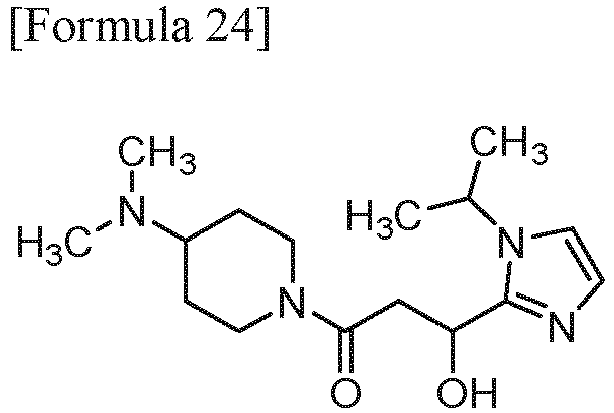
- A solution of lithium diisopropylamide in tetrahydrofuran (2.0 M, 0.969 mL, 1.94 mmol) was added dropwise to a solution of 1-(4-dimethylaminopiperidin-1-yl)ethanone (0.300 g, 1.76 mmol) in tetrahydrofuran (6.00 mL) at -78°C, followed by stirring at the same temperature for 1 hour. A solution of 1-isopropyl-1H-imidazol-2-carbaldehyde (0.292 g, 2.12 mmol) in tetrahydrofuran (2.8 mL) was added to the resultant reaction liquid at the same temperature, and the resultant was stirred for 1 hour, and then at 0°C for further 1 hour. A saturated aqueous solution of ammonium chloride and an aqueous solution of potassium carbonate were successively added to the resultant reaction liquid, and the resultant was extracted with chloroform. The organic layer was washed with a 10% aqueous solution of sodium chloride, and then dried over anhydrous sodium sulfate and filtered. The filtrate was concentrated under reduced pressure. The residue was purified by flash column chromatography (NH silica gel, chloroform/methanol) to obtain 1-(4-(dimethylamino)piperidin-1-yl)-3 -(1-isopropyl-1H-imidazol-2-yl)-3 -hydroxypropan-1-one (0.302 g, 0.979 mmol, 56%) (hereinafter, referred to as the compound of Example 3) as a colorless oil.
- 1H-NMR (400 MHz, DMSO-d6) δ: 1.04-1.41 (8H, m), 1.62-1.80 (2H, m), 2.16 (6H, s), 2.25-2.34 (1H, m), 2.48-2.59 (2H, m), 2.76-2.88 (1H, m), 2.95-3.16 (2H, m), 3.90-4.00 (1H, m), 4.27-4.38 (1H, m), 5.05-5.12 (1H, m), 5.36-5.42 (1H, m), 6.77 (1H, s), 7.20 (1H, s).
- ESI-MS: m/z= 309 (M+H)+.
- (Example 4) Synthesis of 3-(5-chloro-1-methyl-1H-imidazol-2-yl)-1-(4-(dimethyl amino)piperidin-1-yl)-3-hydroxypropan-1-one:

- A solution of lithium diisopropylamide in tetrahydrofuran (2.0 M, 0.745 mL, 1.49 mmol) was added dropwise to a solution of 1-(4-dimethylaminopiperidin-1-yl)ethanone (0.231 g, 1.36 mmol) in tetrahydrofuran (5.10 mL) at -78°C, followed by stirring at the same temperature for 1 hour. A solution of 5-chloro-1-methyl-1H-imidazole-2-carbaldehyde (0.235 g, 1.63 mmol) in tetrahydrofuran (1.70 mL) was added to the resultant reaction liquid at the same temperature, and the resultant was stirred for 1 hour, and then at 0°C for further 1 hour. A saturated aqueous solution of ammonium chloride and an aqueous solution of potassium carbonate were successively added to the resultant reaction liquid, and the resultant was extracted with chloroform. The organic layer was washed with a 10% aqueous solution of sodium chloride, and then dried over anhydrous sodium sulfate and filtered. The filtrate was concentrated under reduced pressure. The residue was purified by flash column chromatography (NH silica gel, chloroform/methanol) to obtain 3-(5-chloro-1-methyl-1H-imidazol-2-yl)-1-(4-(dimethylamino)piperidin-1-yl)-3-hydroxypropan-1-one (0.159 g, 0.505 mmol, 37%) (hereinafter, referred to as the compound of Example 4) as a colorless oil.
- 1H-NMR (400 MHz, DMSO-d6) δ: 1.04-1.21 (1H, m), 1.28-1.40 (1H, m), 1.64-1.80 (2H, m), 2.15 (6H, s), 2.24-2.35 (1H, m), 2.44-2.60 (1H, m), 2.78-2.88 (1H, m), 2.95-3.11 (2H, m), 3.59 (3H, s), 3.90-3.98 (1H, m), 4.27-4.35 (1H, m), 5.00-5.10 (1H, m), 5.50-5.58 (1H, m), 6.85 (1H,s).
- ESI-MS: m/z= 315 (M+H)+.
- (Example 5) Synthesis of 1-(4-(dimethylamino)piperidin-1-yl)-3-(1-(2-methoxyethyl)-1H-imidazol-2-yl)-3-hydroxypropan-1-one:

- A solution of lithium diisopropylamide in tetrahydrofuran (2.0 M, 0.969 mL, 1.94 mmol) was added dropwise to a solution of 1-(4-dimethylaminopiperidin-1-yl)ethanone (0.300 g, 1.76 mmol) in tetrahydrofuran (6.00 mL) at -78°C, followed by stirring at the same temperature for 1 hour. A solution of 1-(2-methoxyethyl)-1H-imidazole-2-carbaldehyde (0.292 g, 2.12 mmol) in tetrahydrofuran (2.80 mL) was added to the resultant reaction liquid at the same temperature, and the resultant was stirred for 1 hour, and then at 0°C for further 1 hour. A saturated aqueous solution of ammonium chloride and an aqueous solution of potassium carbonate were successively added to the resultant reaction liquid, and the resultant was extracted with chloroform. The organic layer was washed with a 10% aqueous solution of sodium chloride, and then dried over anhydrous sodium sulfate and filtered. The filtrate was concentrated under reduced pressure. The residue was purified by flash column chromatography (NH silica gel, chloroform/methanol) to obtain 1-(4-(dimethylamino)piperidin-1-yl)-3-(1-(2-methoxyethyl)-1H-imidazol-2-yl)-3-hydroxypropan-1-one (0.193 g, 0.594 mmol, 34%) (hereinafter, referred to as the compound of Example 5) as a colorless oil.
- 1H-NMR (400 MHz, DMSO-d6) δ: 1.04-1.40 (2H, m), 1.62-1.80 (2H, m), 2.10-2.35 (7H, m), 2.46-2.59 (1H, m), 2.80-2.90 (1H, m), 2.95-3.10 (2H, m), 3.24 (3H, s), 3.61 (2H, t, J=5.5 Hz), 3.90-4.00 (1H, m), 4.10-4.38 (3H, m), 5.05-5.11 (1H, m), 5.38-5.42 (1H, m), 6.73 (1H, s), 7.07(1H, s).
- ESI-MS: m/z= 325 (M+H)+.
- (Example 6) Synthesis of 1-(4-(dimethylamino)piperidin-1-yl)-3-(1-(3,3,3-trifluoropropyl)- 1H-imidazol-2-yl)-3-hydroxypropan-1-one:
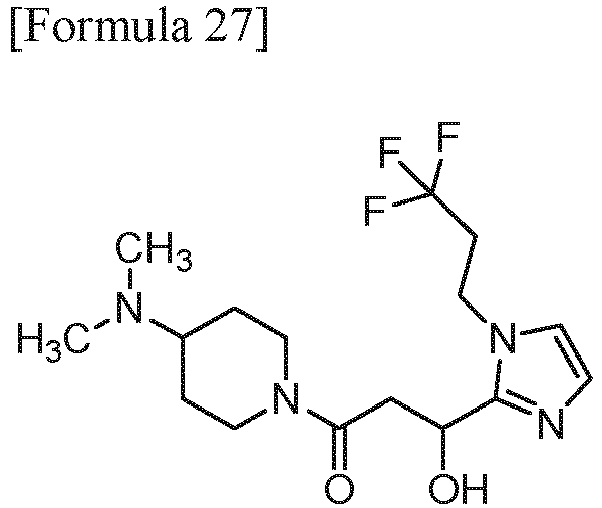
- A solution of lithium diisopropylamide in tetrahydrofuran (2.0 M, 0.246 mL, 0.492 mmol) was added dropwise to a solution of 1-(4-dimethylaminopiperidin-1-yl)ethanone (0.0760 g, 0.448 mmol) in tetrahydrofuran (1.80 mL) at -78°C, followed by stirring at the same temperature for 1 hour. A solution of 1-(3,3,3-trifluoropropyl)-1H-imidazole-2-carbaldehyde (0.0860 g, 0.448 mmol) in tetrahydrofuran (0.70 mL) was added to the resultant reaction liquid at the same temperature, and the resultant was stirred for 1 hour, and then at 0°C for further 1 hour. A saturated aqueous solution of ammonium chloride and an aqueous solution of potassium carbonate were successively added to the resultant reaction liquid, and the resultant was extracted with chloroform. The organic layer was washed with a 10% aqueous solution of sodium chloride, and then dried over anhydrous sodium sulfate and filtered. The filtrate was concentrated under reduced pressure. The residue was purified by flash column chromatography (NH silica gel, chloroform/methanol) to obtain 1-(4-(dimethylamino)piperidin-1-yl)-3-(1-(3,3,3-trifluoropropyl)-1H-imidazol-2-yl)-3-hydroxypropan-1-one (0.0845 g, 0.233 mmol, 52%) (hereinafter, referred to as the compound of Example 6) as a colorless oil.
- 1H-NMR (400 MHz, DMSO-d6) δ: 1.03-1.40 (2H, m), 1.63-1.79 (2H, m), 2.10-2.33 (7H, m), 2.47-2.59 (1H, m), 2.78-2.90 (3H, m), 2.95-3.13 (2H, m), 3.90-3.98 (1H, m), 4.21-4.36 (3H, m), 5.03-5.10 (1H, m), 5.49-5.54 (1H, m), 6.77 (1H, s), 7.17 (1H, s).
- ESI-MS: m/z= 363 (M+H)+.
- (Example 7) Synthesis of (S)-1-(4-(dimethylamino)piperidin-1-yl)-3-hydroxy-3-(1-methyl-1H-imidazol-2-yl)propan-1-one:

- 1-(4-(Dimethylamino)piperidin-1 -yl)-3 -hydroxy-3 -(1 -methyl-1H-imidazol-2-yl)propan-1-one (3.32 g) was optically resolved by HPLC purification, and the eluate was concentrated under reduced pressure. The residue was purified by flash column chromatography (NH silica gel, chloroform/methanol) to obtain (S)-1-(4-(dimethylamino)piperidin-1-yl)-3 -hydroxy-3 -(1-methyl-1H-imidazol-2-yl)propan-1 -one (0.467 g, >99% ee) (hereinafter, referred to as the compound of Example 7) as a white solid.
- HPLC retention time: 8.4 min, apparatus: LC-10ADvp system, manufactured by Shimadzu Corporation, column: CHIRALCEL OZ-H, 4.6 x 250 mm (manufactured by Daicel Corporation), solvent: 0.01% ethylenediamine-containing methanol (v/v), flow rate: 0.5 mL/min, detection method: UV 220 nm, column temperature: 40°C
- 1H-NMR (400 MHz, CDCl3) δ: 1.32-1.53 (2H, m), 1.82-1.92 (2H, m), 2.27-2.41 (7H, m), 2.60-2.72 (1H, m), 2.98-3.23 (3H, m), 3.77 (3H, s), 3.99-4.08 (1H, m), 4.58-4.82 (2H, m), 5.18-5.26(1H, m), 6.86 (1H, s), 6.93 (1H, s).
- ESI-MS: m/z= 281 (M+H)+.
- (Example 8) Synthesis of 3-hydroxy-3-(1-methyl-1H-imidazol-2-yl)-1-(4-(4-methylpiperazin-1-yl)piperidin-1-yl)propan-1-one:

- Sodium borohydride (0.0360 g, 0.957 mmol) was added to a solution of 1-(1-methyl-1H-imidazol-2-yl)-3-(4-(4-methylpiperazin-1-yl)piperidin-1-yl)propan-1,3-dione (0.290 g, 0.870 mmol) in methanol (4.4 mL) at room temperature, and the resultant reaction liquid was stirred at the same temperature for 3 hours. A saturated aqueous solution of sodium bicarbonate was added to the resultant reaction liquid, and the resultant was concentrated under reduced pressure. Distilled water was added to the residue, and the resultant was extracted with chloroform. The organic layer was washed with a 10% aqueous solution of sodium chloride, and then dried over anhydrous sodium sulfate and filtered. The filtrate was concentrated under reduced pressure. The residue was purified by flash column chromatography (NH silica gel, chloroform/methanol) to obtain 3-hydroxy-3-(1-methyl-1H-imidazol-2-yl)-1-(4-(4-methylpiperazin-1-yl)piperidin-1-yl)propan-1-one (0.140 g, 0.417 mmol, 48%) (hereinafter, referred to as the compound of Example 8) as a colorless oil.
- 1H-NMR (400 MHz, DMSO-d6) δ: 1.45-1.66 (4H, m), 1.87-1.95 (2H, m), 2.26-2.30(3H, s), 2.38-2.70 (8H, m), 2.98-3.23 (3H, m), 3.77 (3H, s), 4.00-4.10 (1H, m), 4.60-4.70 (2H, m), 5.17-5.25 (1H, m), 6.85-6.88 (1H, m), 6.92-6.95 (1H, m).
- ESI-MS: m/z= 336 (M+H)+.
- (Example 9) Synthesis of 1-(4-(diethylamino)piperidin-1-yl)-3-hydroxy-3-(1-methyl-1H-imidazol-2-yl)propan-1-one:

- Sodium borohydride (0.0109 g, 0.287 mmol) was added to a solution of 1-(4-diethylamino)piperidin-1-yl)-3-(1-methyl-1H-imidazol-2-yl)propan-1,3-dione (0.0800 g, 0.261 mmol) in methanol (1.3 mL) at room temperature, and the resultant reaction liquid was stirred at the same temperature for 3 hours. A saturated aqueous solution of sodium bicarbonate was added to the resultant reaction liquid, and the resultant was concentrated under reduced pressure. Distilled water was added to the residue, and the resultant was extracted with chloroform. The organic layer was washed with a 10% aqueous solution of sodium chloride, and then dried over anhydrous sodium sulfate and filtered. The filtrate was concentrated under reduced pressure. The residue was purified by flash column chromatography (NH silica gel, chloroform/methanol) to obtain 1-(4-(diethylamino)piperidin-1-yl)-3-hydroxy-3-(1-methyl-1H-imidazol-2-yl)propan-1-one (0.0561 g, 0.182 mmol, 70%) (hereinafter, referred to as the compound of Example 9) as a colorless oil.
- 1H-NMR (400 MHz, DMSO-d6) δ: 0.94 (6H, t, J=6.8 Hz), 1.05-1.75 (5H, m), 2.42-3.10 (8H, m), 3.64 (3H, s), 3.93-4.02 (1H, m), 4.32-4.43 (1H, m), 5.00-5.08 (1H, m), 5.34-5.42 (1H, m), 6.69-6.71 (1H, m), 7.01-7.03 (1H, m).
- ESI-MS: m/z= 309 (M+H)+.
- (Example 10) Evaluation of binding of cyclic amine derivative (I) to membrane fractions prepared from various tissues of rat:
- A binding property of a 3H-labeled cyclic amine derivative (I) to each of membrane fractions prepared from various tissues of a rat was evaluated, and thus, a tissue containing a molecular target of the cyclic amine derivative (I) was clarified.
- As the cyclic amine derivative (I), the compound of Example 7 was used.
- Male SD rats (manufactured by Charles River Laboratories Japan, Inc.) of 7 weeks old were used. Rats were anesthetized with isoflurane, and euthanized by exsanguination from the abdominal aorta using a syringe having an inner wall treated with a heparin sodium injection (manufactured by AY Pharmaceuticals Co., Ltd.). Within 60 minutes after the euthanasia by exsanguination, the cerebrum, the cerebellum, the brainstem, the brainstem, the spinal cord, the dorsal root ganglion, the sciatic nerve, the skin, the heart, the muscle, the liver, the kidney, and the small intestine were excised. As the cerebrum, the right and left cerebral hemispheres were collected. The cerebellum was collected from the whole brain. The brainstem was collected after removing the cerebrum and the cerebellum from the whole brain. The spinal cord was collected by excising a part of the thoracic spinal cord and the lumbar spinal cord, peeling off the dura mater, and removing remaining nerve roots. As the dorsal root ganglion, right and left lumbar ganglia (L3 to L6) were collected. The sciatic nerve was collected by excising right and left sciatic nerves, and removing adhering tissues such as fat. As the skin, a part of the skin of a footpad portion of a front or hind limb was collected. As the heart, the whole excised heart was collected. As the muscle, a part of the quadriceps was collected. As the liver, the left lateral lobe was collected. As the kidney, the whole excised kidney was collected. As the small intestine, the content was washed out, and a portion having a length of about 5 cm was collected from around the duodenum and the jejunum. The tissues thus collected were immediately frozen on dry ice, and stored at -80°C. As for each of the dorsal root ganglion, the sciatic nerve, the muscle and the skin, tissues collected from ten individuals were mixed to be dealt with as one sample. As for each of the other tissues, tissues collected from three rats were mixed to be dealt with as one sample.
- A homogenate sample of each tissue thus collected was prepared, using a homogenizer, by adding a homogenize buffer (sucrose (1 M), Tris-HCl (0.5 M), and 1 x protease inhibitor cocktail (manufactured by Sigma Aldrich), pH 7.6) to the collected tissue. Each homogenate sample was centrifuged at 1,000 x g at 4°C for 10 minutes to remove a non-disrupted portion of the tissue. The resultant supernatant was ultracentrifuged at 100,000 x g at 4°C for 60 minutes, and the thus obtained precipitate was suspended in Krebs-Ringer bicarbonate buffer (manufactured by Sigma Aldrich) to quantitatively determine the amount of protein using a BCA protein assay kit (manufactured by Thermo Fisher Scientific K.K.).
- A reaction between a membrane fraction and the 3H-labeled compound of Example 7 was carried out in a microtube all using Krebs-Ringer bicarbonate buffer. Samples each obtained by adding a solution of the compound of Example 7 (unlabeled, 400 µM, 100 µL) to a protein solution of a membrane fraction of each tissue (0.2 mg/mL, 200 µL) were designated as a sample group A, and samples each obtained by adding Krebs-Ringer bicarbonate buffer (100 µL) were designated as a sample group B.
- The 3H-labeled compound of Example 7 containing octyl-β-D-thioglucopyranoside (0.4% (w/v)) (80 nM, 100 µL) was added to each of the samples of the sample groups A and B, and the resultant was rapidly transferred to an incubator at 37°C to start the reaction. After incubation for 1 hour, the resultant was cooled on ice for 5 minutes or more to stop the reaction. Each of the resultant reaction liquids was added to a glass filter (manufactured by Perkin Elmer Co., Ltd.) immersed in a 0.05% polyethyleneimine solution in advance, and the pressure was rapidly reduced for suction filtration to cause the membrane fraction to be adsorbed on the glass filter. The glass filter was washed with Krebs-Ringer bicarbonate buffer six times, 10 mL of Hionic-Fluor (manufactured by Perkin Elmer Co., Ltd.) was added to the resultant, and radioactivity of the thus bound 3H-labeled compound of Example 7 was measured as a disintegration rate (hereinafter, referred to as the dpm) by liquid scintillation. A specific binding (dpm/µg) was calculated as a value (dpm/µg) obtained by dividing, by the amount of protein, a difference between an average of measured values of the dpm of the sample group B and an average of measured values of the dpm of the sample group A.
- The membrane fractions prepared from the respective tissues of the rats and evaluation results of the binding property of the 3H-labeled compound of Example 7 are illustrated in
Figure 2 . The vertical axis ofFigure 2 indicates the specific binding (dpm/µg) (average, two samples of each group). The horizontal axis indicates the membrane fractions prepared from the tissues of the cerebrum, the cerebellum, the brainstem, the spinal cord, the dorsal root ganglion, the sciatic nerve, the heart, the liver, the kidney, the small intestine, the muscle, and the skin from the left. - As a result, the specific binding of the compound of Example 7 to each membrane fraction prepared from the respective tissues was significant in the membrane fraction prepared from the dorsal root ganglion. Secondly, the specific binding to the membrane fraction prepared from the sciatic nerve was 42% of the specific binding to the membrane fraction prepared from the dorsal root ganglion. The specific binding to the membrane fraction prepared from the spinal cord was 23% of the specific binding to the membrane fraction prepared from the dorsal root ganglion. The specific binding to the membrane fraction prepared from the brainstem was 4.2% of the specific binding to the membrane fraction prepared from the dorsal root ganglion, and the specific bindings to the membrane fractions prepared from the other tissues including the brain were less than 1% of the specific binding to the membrane fraction prepared from the dorsal root ganglion. The compound of Example 7 was thus specifically bound to the membrane fractions prepared from the peripheral nerves, such as the dorsal root ganglion and the sciatic nerve, or the spinal cord, and thus, it was found that the molecular target of the compound of Example 7 is present in the peripheral nerves or the spinal cord, and that the cyclic amine derivative (I) acts through binding to a membrane present in the peripheral nerves or the spinal cord.
- (Example 11) Identification of binding molecule of cyclic amine derivative (I) or pharmacologically acceptable salt thereof:
In order to identify a binding molecule of the cyclic amine derivative (I) or a pharmacologically acceptable salt thereof, affinity purification using FG beads immobilized with the cyclic amine derivative (I), and comprehensive identification were carried out. - In order to immobilize, through an amide bond, the cyclic amine derivative (I) with FG beads having an amino group linker, a cyclic amine derivative having a carboxyl group was synthesized.
- As the cyclic amine derivative having a carboxyl group, (S)-2-(3-(4-(dimethylamino)piperidin-1-yl)-1-(1-methyl-1H-imidazol-2-yl)-3-oxopropoxy) acetic acid (hereinafter, referred to as a compound for immobilizing beads) represented by the following chemical formula was used to perform the synthesis as follows:
- Synthesis of compound for immobilizing beads:

- Palladium-carbon (10% wet, 14.0 mg) was added to a solution of benzyl (S)-2-(3-(4-(dimethyl amino)piperidin-1-yl)-1-(1-methyl-1H-imidazol-2-yl)-3 -oxopropoxy) acetate (0.0550 g, 0.128 mmol) in ethanol (2.50 mL) at room temperature, followed by stirring for 6 hours under a hydrogen atmosphere. The resultant reaction liquid was filtered through celite, and the filtrate was concentrated under reduced pressure to obtain (S)-2-(3-(4-(dimethylamino)piperidin-1-yl)-1-(1-methyl-1H-imidazol-2-yl)-3-oxopropoxy) acetic acid (0.0404 g, 0.119 mmol, 93%) as a colorless oil.
- 1H-NMR (400 MHz, CDCl3) δ: 1.30-1.69 (2H, m), 1.88-2.10 (2H, m), 2.40-2.63 (7H, m), 2.88-3.20 (3H, m), 3.21-3.41 (1H, m), 3.74-3.98 (5H, m), 4.09-4.27 (1H, m), 4.63-4.78 (1H, m), 5.20-5.26 (1H, m), 6.84 (1H, s), 6.95 (1H, s).
- ESI-MS: m/z= 339 (M+H)+.
- The compound for immobilizing beads was fixed on NH2 beads (5 mg, manufactured by Tamagawa Seiki Co., Ltd.). First, a solution of the compound for immobilizing beads (20 mM, 200 µL), a solution of succinimide (200 mM, 20 µL), and a solution of 1-ethyl-3-(3-dimethylaminopropyl)carbodiimide (200 mM, 20 µL) were added to N,N-dimethylformamide (160 µL), and the resultant mixture was reacted using a microtube mixer at room temperature for 2 hours to prepare an activated solution of the compound for immobilizing beads. Subsequently, N,N-dimethylformamide (900 µL) and the activated solution of the compound for immobilizing beads (100 µL) were added to NH2 beads, and the resultant was reacted using a microtube mixer at room temperature overnight. The resultant was washed with N,N-dimethylformamide (500 µL) three times, acetic anhydride was added thereto to obtain a concentration of 20%, and the resultant was reacted using a microtube mixer at room temperature for 2 hours. Ultimately, the resultant was washed with 50% methanol (500 µL) three times to obtain beads immobilized with the cyclic amine derivative.
- A protein solution to be reacted with the beads immobilized with the cyclic amine derivative was prepared from rat dorsal root ganglia. Dorsal root ganglia were separated from male SD rats of 6 weeks old (manufactured by Charles River Laboratories Japan, Inc.). Rats were anesthetized with urethane, and euthanized by exsanguination from abdominal aorta. After incision of the dorsal part, the spinal column was excised and cooled on ice. The dorsal side of the spinal column was cut off, and the spinal cord was removed from the ventral side of the spinal column. Then, the dorsal root ganglia (T11 to T13 and L3 to 6, left and right) with bundles of nerve fibers were excised with precision tweezers. The excised dorsal root ganglia were dipped in ice-cold Leibovitz's L-15 medium (manufactured by Thermo Fisher Scientific), and the bundles of nerve fibers were removed under a stereoscopic microscope to separate dorsal root ganglia. The separated dorsal root ganglia were frozen with liquid nitrogen to be stored at -80°C. As the dorsal root ganglia, tissues collected from 21 individuals were mixed to be dealt with as one sample.
- The dorsal root ganglia were homogenized in an assay buffer (NaCl (140 mM), KCl (5 mM), CaCl2·2H2O (1.2 mM), MgCl2·6H2O (2 mM), D(+)-glucose (14 mM), Hepes (10 mM), and protease inhibitor cocktail (manufactured by Sigma Aldrich), pH 7.4) using a Dounce homogenizer to prepare a dorsal root ganglion homogenate. A surfactant n-Dodecyl-β-D-Maltopyranoside (manufactured by Sigma Aldrich) was added to the dorsal root ganglion homogenate to obtain a concentration of 1%, and the resultant was incubated at 4°C for 1 hour. The resultant was centrifuged at 20,400 x g for 30 minutes, and the resultant supernatant was diluted 40 times, and the resultant was concentrated with Amicon Ultra 3kDa (manufactured by Merck Millipore Ltd.).
- The beads immobilized with the cyclic amine derivative and the protein solution were mixed to be reacted at 4°C overnight. The resultant beads were washed with the assay buffer three times, then washed with PBS(-) once, and were suspended in PBS(-). Proteins binding to the beads were comprehensively identified by shotgun proteomics (LC-MS/MS).
- Proteins not binding to beads not immobilized with compound but binding to the beads immobilized with the cyclic amine derivative are shown in Table 3. Entry IDs (rats) and names of the proteins are cited from protein database Uniprot (http://www.uniprot.org/). A protein having an entry ID F1LTJ5 is, however, listed as Uncharacterized Protein in the Uniprot database, but is shown as an ortholog of basement membrane-specific heparan sulfate proteoglycan core protein in PANTHER Classification System, and hence the name of this protein is shown in Table 3 as basement membrane-specific heparan sulfate proteoglycan core protein.
[Table 3] Entry ID (uniprot) Name of Protein F1LTJ5 Basement membrane-specific heparan sulfate proteoglycan core protein MORCA6 Advillin Q9QYF3 Unconventional myosin-Va P19139 Casein kinase II subunit α D3ZN27 DnaJ heat shock protein family (Hsp40) member C13 Q925G1 Hepatoma-derived growth factor-related protein2 F1LPD0 Collagen alpha-1(XV) chain-like protein P47853 Biglycan - Among the eight molecules thus identified, advillin is reported to highly express in a peripheral nerve tissue as compared with that in other tissues (Ravenall et al., European Journal of Neuroscience, 2002, vol. 27, pp. 14404-14414). Since it is revealed, in Example 10, that the molecular target of the compound of Example 7 is a molecule present in a large amount in a peripheral nerve, it is suggested that the molecular target of the cyclic amine derivative (I) may be possibly advillin.
- It is also reported that advillin forms a complex with myosin identified in this example (Chuang et al., Proceedings of the National Academy of Sciences of the United States of America, 2018, vol. 115, pp. E8557-E8566). Accordingly, it is suggested that the cyclic amine derivative (I) or a pharmacologically acceptable salt thereof may bind to advillin and/or an advillin complex containing a protein identified in this example or the like, and regulate advillin function.
- (Example 12) Effect of decreasing intracellular actin filaments in rat dorsal root ganglion neuron cell line:
The effect of the cyclic amine derivative (I) or a pharmacologically acceptable salt thereof on the amount of intracellular actin filaments in F11 cells (rat dorsal root ganglion neuron cell line) was examined. - As test compounds, the compounds of Examples 1, 2, 3, 4, 5, 6, 7, 8, and 9 were used.
- As compounds of comparative examples, 1-(4-(dimethylamino)piperidin-1-yl)-3-(1-ethyl-1H-imidazol-2-yl)-3-hydroxypropan-1-one (hereinafter, referred to as the compound of Comparative Example 1), 1-(4-(dimethylamino)piperidin-1-yl)-3-hydroxy-3-(1-(2,2,2-trifluoroethyl)-1H-imidazol-2-yl)propan-1-one (hereinafter, referred to as the compound of Comparative Example 2), 1-((R)-3-(dimethylamino)pyrrolidin-1-yl)-3-hydroxy-3-(1-methyl-1H-imidazol-2-yl)propan-1-one (hereinafter, referred to as the compound of Comparative Example 3), and 1-((R)-3-(3-(dimethylamino)piperidin-1-yl)-3-hydroxy-3-(1-methyl-1H-imidazol-2-yl)propan-1-one (hereinafter, referred to as the compound of Comparative Example 4) shown in Table 4 were used. The compounds of Comparative Examples 1, 2, 3, and 4 were synthesized in accordance with methods described in the known literature (International Publication No.
WO2016/136944 ).[Table 4] Compound Structural Formula Compound of Comparative Example 1 
Compound of Comparative Example 2 
Compound of Comparative Example 3 
Compound of Comparative Example 4 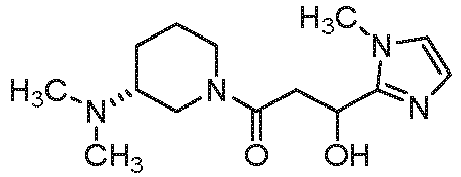
- For peeling the F11 cells off from a culture flask, 0.25% Trypsin/EDTA (manufactured by Thermo Fisher Scientific K.K.) was added to the cells, followed by incubation at room temperature for several minutes. Thereafter, 10% fetal bovine serum-containing DMEM medium (manufactured by Thermo Fisher Scientific K.K.) was added thereto for suspension, and the resultant was centrifuged at 1,500 rpm for 1 minute. After removing the resultant centrifugal supernatant, 0.5% fetal bovine serum-containing DMEM medium was added thereto for suspending cells therein, and the resultant was seeded in a poly-D-lysine-coated 96 well plate (manufactured by BD Biosciences) coated with laminin (2 µg/cm2, manufactured by Sigma Aldrich) to be cultured at 37°C under an environment of 5% CO2. Two hours after seeding the cells, N,N-dibutyladenosine 3',5'-phosphate (final concentration ImM, manufactured by Sigma Aldrich) and recombinant rat GDNF (final concentration 50 ng/mL, manufactured by PeproTech) were added thereto to culture the cells at 37°C under an environment of 5% CO2 for 7 days for differentiation.
- Seven days after starting the culture, the medium was exchanged with 0.5% fetal bovine serum-containing DMEM medium containing oxaliplatin (final concentration 15 µM), and the resultant was cultured for 5 days to induce axonal injury. Each of the compounds of Examples and Comparative Examples was caused to be contained in the medium (
final concentration 10 µM) for treatment in the same manner as oxaliplatin. - Five days after the treatment with oxaliplatin and each of the compounds, the resultant cells were washed with PBS(-) three times, a 4% paraformaldehyde-phosphate buffer (manufactured by Wako Pure Chemical Industries Ltd.) was added thereto, and the resultant was allowed to stand still at room temperature for 10 minutes to fix the cells. Acti-stain 670 phalloidin (manufactured by Cytoskeleton Inc.) was added thereto, and the resultant was incubated at room temperature for 30 minutes to stain actin filaments. An image of the cells was acquired using IN Cell Analyzer 2200 (manufactured by GE Healthcare), and the image was analyzed using IN Cell Investigator Developer Toolbox. The amount of intracellular actin filaments was indicated by the amount of fluorescence (density) of fluorescent-labeled phalloidin binding to the actin filaments.
- In a group treated with oxaliplatin alone (hereinafter, referred to as the oxaliplatin alone treated group), the amount of intracellular actin filaments increased by 5% as compared with that in a group not treated with oxaliplatin. Since the amount thus statistically significantly increased, it was confirmed that abnormality in regulation of actin filament turnover had been induced (p < 0.05, Student's t-test). A decreasing rate of intracellular actin filaments, caused by each compound, as compared with the amount of intracellular actin filaments of the oxaliplatin alone treated group was calculated.
- Effects of decreasing intracellular actin filaments of the respective compounds in the F11 cells are shown in Table 5. In "Decreasing Rate of Intracellular Actin Filaments" of the table, a ratio (%) of the amount of intracellular actin filaments decreased by the treatment with each compound, as compared with the amount of intracellular actin filaments of the oxaliplatin alone treated group is shown (average value, each group including five samples assuming that one sample corresponds to one well). In "Test Compound" of the table, a compound treated group treated with a corresponding one of the compounds is shown.
[Table 5] Test Compound Decreasing Rate of Intracellular Actin Filament (%) Compound of Example 1 5.2 Compound of Example 2 11.8 Compound of Example 3 9.9 Compound of Example 4 8.5 Compound of Example 5 9.6 Compound of Example 6 6.7 Compound of Example 7 9.6 Compound of Example 8 6.4 Compound of Example 9 17.5 Compound of Comparative Example 1 2.1 Compound of Comparative Example 2 4.5 Compound of Comparative Example 3 2.4 Compound of Comparative Example 4 3.8 - As compared with the solvent treated group, the amount of intracellular actin filaments decreased by 5% or more by the compounds of Examples 1, 2, 3, 4, 5, 6, 7, 8, and 9. On the other hand, the decreasing rates of intracellular actin filaments of the compounds of Comparative Examples 1, 2, 3, and 4 were 5% or less.
- (Example 13) Effect of improving abnormality in regulation of actin filament turnover in rat spinal nerve ligation model:
The effect of the cyclic amine derivative (I) or a pharmacologically acceptable salt thereof on a ratio between the amount of actin filaments and the amount of actin monomers in the sciatic nerve of a rat spinal nerve ligation model was examined. - Male SD rats (manufactured by Charles River Laboratories Japan, Inc.) of 6 weeks old were used. Each rat spinal nerve ligation model was produced by resecting the spine vertebral arch by incision of the right lower back under isoflurane inhalation anesthesia, completely ligating L5 and L6 nerve roots of the spinal nerve, and then suturing the muscular layer and the skin. As a negative control (sham-operation group), the right L5 and L6 nerves were exposed, and then the muscular layer and the skin were sutured similarly without ligation. One week after the nerve ligation, the rats were used for performing the following experiment.
- The compound of Example 7 was orally administered to each rat spinal nerve ligation model at any of three doses of 6, 20 and 60 mg/kg once a day for 2 days. Three hours after the last administration, the sciatic nerve was collected under anesthesia with isoflurane, and the rat was euthanized. The collected sciatic nerve was frozen and stored at -80°C. As controls, a sham-operation group of rats administered with a solvent of distilled water, and a group of spinal nerve ligation model rats administered with distilled water (distilled water administration group) were provided, and the rats of both the groups were subjected to the same treatment for collecting the sciatic nerves and then euthanized.
- For quantitative determination of actin filaments and actin monomers, G-actin/F-actin in vivo assay kit (manufactured by Cytoskeleton Inc.) was used. The frozen tissues were homogenized with a protease inhibitor and ATP (1 mM)-containing lysis and F-actin stabilization buffer (manufactured by Cytoskeleton Inc.) added thereto. The thus obtained homogenate was incubated at 37°C for 10 minutes, and the resultant was centrifuged at 350 x g for 5 minutes. The resultant supernatant was centrifuged at 100,000 x g at 37°C for 1 hour. A supernatant obtained after the centrifugation was used as an actin monomer sample, and a precipitate was used as an actin filament sample. The actin filament sample was incubated on ice for 1 hour, and pipetted once every 15 minutes. The amount of actin in each of the actin monomer sample and the actin filament sample was measured by Western blotting. Each of the actin monomer sample and the actin filament sample was subjected to heat denaturation treatment with SDS sample buffer added thereto, and the resultant was applied on SDS-PAGE precast gel (manufactured by Bio-Rad) for electrophoresis to separate protein. The protein contained in the gel was electrically moved to/fixed in a PVDF membrane to prepare a blot (blotting membrane) (Trans-blot Turbo Blotting System, manufactured by Bio-Rad). After the blotting membrane was blocked (Block One, manufactured by Nacalai Tesque, Inc.), an antibody against actin (anti-actin rabbit polyclonal antibody) was added thereto, followed by incubation at room temperature for 1 hour. After washing the resultant blotting membrane, an anti-rabbit HRP-labeled secondary antibody (manufactured by GE Healthcare) was added thereto, followed by incubation at room temperature for 30 minutes. After washing the resultant blotting membrane, a detection reagent (ECL Prime, manufactured by GE Healthcare) was added thereto to detect chemiluminescence using a CCD Imager (manufactured by Bio-Rad). Luminescence intensity of a band corresponding to actin was quantitatively determined using Image Lab software (manufactured by Bio-Rad).
- Evaluation results of the compound of Example 7 on an actin filament/actin monomer ratio in the sciatic nerve of the rat spinal nerve ligation model are illustrated in
Figure 3. Figure 3a illustrates images, detected by Western blotting, of actin protein present in actin filament samples (upper images) and actin monomer samples (lower images) isolated from the sciatic nerve. The luminescence intensity of each band of the actin protein was quantitatively determined, and a ratio of the actin filaments to the actin monomers (hereinafter, referred to as the actin filament/actin monomer ratio) was calculated to be illustrated inFigure 3b . The vertical axis ofFigure 3b indicates the actin filament/actin monomer ratio (average ± standard deviation). "Distilled Water-Sham Operation" on the horizontal axis indicates the sham-operation group (6 samples), "Distilled Water" indicates the distilled water administration group of the spinal nerve ligation model rats (7 samples), "Compound of Example 7" indicates the group of the spinal nerve ligation model rats administered with the compound of Example 7, "6" indicates the group of the spinal nerve ligation model rats administered with the compound of Example 7 at 6 mg/kg (6 samples), "20" indicates the group of the spinal nerve ligation model rats administered with the compound of Example 7 at 20 mg/kg (6 samples), and "60" indicates the group of the spinal nerve ligation model rats administered with the compound of Example 7 at 60 mg/kg (7 samples). In this drawing, "#" indicates that there is a statistically significant difference (#: p <0.05, Student's t-test) as compared with the sham-operation group, and "∗" indicates that there is a statistically significant difference (∗: p <0.025, Williams' multiple comparison, one-sided) as compared with the distilled water administration group of the spinal nerve ligation model rats. - In the rat spinal nerve ligation model group administered with distilled water (distilled water administration group), the actin filament/actin monomer ratio significantly increased as compared with that in the sham-operation group. In the groups administered with the compound of Example 7, the actin filament/actin monomer ratio was reduced as the dose of the compound of Example 7 was increased, and was significantly reduced in the group administered at 60 mg/kg as compared with that in the distilled water administration group. Specifically, it was revealed that the compound of Example 7 has the effect of improving abnormality in regulation of actin filament turnover of the sciatic nerve caused by spinal nerve ligation.
- As the function of advillin, that is, one of molecular targets of the cyclic amine derivative (I) or a pharmacologically acceptable salt thereof described in Example 11, a function of regulating actin filament turnover via binding to actin has been reported (Hasegawa et al, The Journal of Neuroscience, 2007, vol. 27, pp. 14404-14414). Accordingly, it was revealed, based on Examples 11, 12 and 13, that the cyclic amine derivative (I) or a pharmacologically acceptable salt thereof has, in addition to an effect of binding to advillin and/or an advillin complex, an effect of promoting the function of advillin and/or an advillin complex to improve abnormality in regulation of actin filament turnover.
- (Example 14) Evaluation of effect of promoting axon extension in primary cultured cells of rat dorsal root ganglion:
The effect of the cyclic amine derivative (I) or a pharmacologically acceptable salt thereof on neurite extension in primary cultured cells of rat dorsal root ganglion was examined. - Male SD rats (manufactured by Charles River Laboratories Japan, Inc.) of 4 to 7 weeks old were used. Each rat was anesthetized by intraperitoneally administering urethane. After confirming that the rat was anesthetized, the rat was rapidly euthanized by exsanguination from the abdominal aorta. After incision of the dorsal part, the spinal column was excised and cooled on ice. The dorsal side of the spinal column was cut off, and the spinal cord was removed from the ventral side of the spinal column to expose the dorsal root ganglia on the ventral side of the spinal column. The dorsal root ganglia (L3 to 6, right and left) were excised with tweezers, and dipped in ice-cold Leibovitz's L-15 medium (manufactured by Thermo Fisher Scientific), and the bundles of nerve fibers were removed under a stereoscopic microscope. The dorsal root ganglia from which the bundles of nerve fibers had been removed were made fine slits with ophthalmic scissors to be used as dorsal root ganglion pieces.
- The dorsal root ganglion pieces were dipped in about 3 mL of a solution of collagenase A (manufactured by Roche Molecular Systems, Inc.), followed by incubation at 37°C for 20 minutes. After the incubation, the resultant was centrifuged at 200 x g at 25°C for 5 minutes to remove a collagenase A solution corresponding to the supernatant. About 1 mL of a solution of trypsin was added thereto, followed by incubation at 37°C for 5 minutes. Subsequently, about 3 mL of DMEM (manufactured by Thermo Fisher Scientific K.K.) containing 10% fetal bovine serum was added to the resultant, the resultant was centrifuged at 200 x g at room temperature for 5 minutes, and then the supernatant was removed. After removing the supernatant, about 5 mL of Neurobasal-A Medium (hereinafter, referred to as the culture medium, manufactured by Thermo Fisher Scientific K.K.) containing 2% B27 supplement was added to the precipitate, and the precipitate was dispersed with a micropipette. A 70 µm cell strainer (manufactured by BD Falcon) was used to collect cells with debris removed, and the debris remaining on the cell strainer were washed with 5 mL of the culture medium to collect cells. The thus collected cells were centrifuged at 200 x g at room temperature for 5 minutes to remove the supernatant.
- After removing the supernatant, 5 mL of the culture medium was added to suspend cell pellets. The thus obtained cell suspension was seeded in a poly-D-lysine-coated 96 well plate (manufactured by BD Biosciences) coated with laminin (6 µg/cm2, manufactured by Sigma Aldrich) by 100 µL to be cultured in a CO2 incubator at 37°C and 5% CO2
- Two hours after starting the culture, the medium was exchanged with a culture medium containing oxaliplatin (
final concentration 3 µM), and the resultant was cultured for 7 days to induce axonal injury. The compound of Example 7 was caused to be contained in the culture medium (final concentration - One week after starting the culture, the resultant cells were washed with PBS(-) three times, and treated with a 4% paraformaldehyde-phosphate buffer for 10 minutes. The resultant was washed with PBS(-) three times, and treated with 20% Blocking One (manufactured by Nacalai Tesque, Inc.) and 0.1% Triton X-100/PBS(-) for 1 hour. After washing with PBS(-) once, the resultant was treated at 4°C overnight with an anti-βIII tubulin mouse monoclonal antibody (manufactured by Promega Corporation) diluted 500 times with 0.1% Triton X-100/PBS(-) containing 5% Blocking One. After the treatment overnight, the resultant was washed with PBS(-) three times, and was treated at room temperature for 1 hour with a secondary antibody (CF488A anti-mouse IgG donkey antibody, manufactured by Biotium) diluted with 0.1% Triton X-100/PBS(-) containing 5% Blocking One. Subsequently, the resultant was washed with PBS(-) three times, treated for 5 minutes with DAPI (manufactured by Dojindo Laboratories) diluted 1000 times with PBS(-), and washed with PBS(-) three times.
- An image of the resultant cells was acquired using IN Cell Analyzer 2200 (manufactured by GE Healthcare), and the image was analyzed using IN Cell Investigator Developer Toolbox. As the result of the analysis, a value obtained by dividing the length of a region identified as a neurite (Fiber length) by the number of neurons was shown as the length of a neurite per cell, and an effect of increasing the length of a neurite was evaluated as axon extension effect.
-
Figure 4 illustrates images of examples of average cells, obtained under respective conditions, of a non-treatment group (treated with distilled water), an oxaliplatin alone treated group, and a group treated with oxaliplatin and 100 µM of the compound of Example 7. As illustrated inFigure 4 , an image in which the length of a neurite was reduced by the treatment with oxaliplatin alone was observed, and it was found that the length of a neurite was increased by the treatment with the compound of Example 7 (100 µM) as compared with that in the oxaliplatin alone treated group. - Analysis results of the length of neurites in the respective images are illustrated in
Figure 5 . The vertical axis ofFigure 5 indicates the length of a neurite (µm/neuron) (average ± standard deviation, each group consisting of 5 samples). "Distilled Water" shown on the horizontal axis indicates the non-treated group, "Oxaliplatin + Distilled Water" indicates the oxaliplatin alone treated group, "Oxaliplatin + Compound of Example 7" indicates the group administered with oxaliplatin and the compound of Example 7, "10" indicates the group treated with oxaliplatin and 10 µM of the compound of Example 7, "30" indicates the group treated with oxaliplatin and 30 µM of the compound of Example 7, and "100" indicates the group treated with oxaliplatin and 100 µM of the compound of Example 7. In this drawing, "#" indicates that there is a statistically significant difference as compared with the non-treated group (#: p < 0.05, Student's t-test), and "∗" indicates that there is a statistically significant difference as compared with the oxaliplatin alone treated group (∗: p < 0.025, Williams' multiple comparison, one-sided). - As illustrated in
Figure 5 , while the length of a neurite was significantly reduced by the treatment with oxaliplatin alone, the length of a neurite was found to increase by the treatment with the compound (10, 30 or 100 µM) of Example 7 as the dose of the compound of Example 7 was increased as compared with that in the oxaliplatin alone treated group. In the group treated with 100 µM of the compound of Example 7, the length was found to significantly increase as compared with that in the oxaliplatin alone treated group. In other words, it was revealed that the compound of Example 7 has an effect of promoting axon extension in primary cultured cells of rat dorsal root ganglion having axonal injury induced with oxaliplatin. - As the function of advillin, that is, one of molecular targets of the cyclic amine derivative (I) described in Example 11, a function of extending an axon has been reported (Hasegawa et al, The Journal of Neuroscience, 2007, vol. 27, pp. 14404-14414). Accordingly, it was revealed, based on Examples 11 and 14, that the cyclic amine derivative (I) or a pharmacologically acceptable salt thereof has, in addition to the effect of binding to advillin and/or an advillin complex, an effect of promoting axon extension.
- Based on these results, it was revealed that the cyclic amine derivative (I) falling in the scope of the present invention has the effect of promoting advillin function.
- The cyclic amine derivative or a pharmacologically acceptable salt thereof according to the present invention has the effect of promoting advillin function, and hence can be used as a medicine against a disease related to axonal injury.
- All publications, patents and patent applications cited herein are incorporated herein by reference in their entirety.
Claims (14)
- An agent for promoting advillin function, comprising a cyclic amine derivative represented by a following general formula (I) or a pharmacologically acceptable salt thereof as an active ingredient:


- The agent for promoting advillin function according to claim 1, wherein A is the group represented by the general formula (IIa).
- The agent for promoting advillin function according to claim 1, wherein A is the group represented by the general formula (IIb).
- The agent for promoting advillin function according to claim 3, wherein X is -N(R3)-.
- The agent for promoting advillin function according to any one of claims 1 to 4, wherein R1 is a methyl group, a n-propyl group, an isopropyl group, a 2-methoxyethyl group, or a 3,3,3-trifluoropropyl group.
- The agent for promoting advillin function according to any one of claims 1 to 4, wherein R2 is a hydrogen atom or a chlorine atom.
- The agent for promoting advillin function according to any one of claims 1 to 4, wherein a stereochemical configuration of the asymmetric carbon marked with ∗ is S.
- The agent for promoting advillin function according to any one of claims 1 to 7, for promoting advillin function by binding to advillin and/or an advillin complex.
- The agent for promoting advillin function according to any one of claims 1 to 8, for improving abnormality in regulation of actin filament turnover.
- The agent for promoting advillin function according to any one of claims 1 to 8, for promoting axon extension.
- The agent for promoting advillin function according to any one of claims 1 to 7, for improving abnormality in regulation of actin filament turnover and promoting axon extension by binding to advillin and/or an advillin complex.
- The agent for promoting advillin function according to any one of claims 1 to 11, which is a therapeutic agent for axonal injury.
- A cyclic amine derivative that is one compound selected from the group consisting of 3 -hydroxy-3 -(1-methyl-1H-imidazol-2-yl)-1-(4-morpholinopiperidin-1-yl)propan-1-one, 1-(4-(dimethyl amino)piperidin-1-yl)-3-(1-propyl-1H-imidazol-2-yl)-3-hydroxypropan-1-one, 1-(4-(dimethylamino)piperidin-1-yl)-3-(1-isopropyl-1H-imidazol-2-yl)-3-hydroxypropan-1-one, 3-(5-chloro-1-methyl-1H-imidazol-2-yl)-1-(4-(dimethylamino)piperidin-1-yl)-3-hydroxypropan-1-one, 1-(4-(dimethylamino)piperidin-1-yl)-3-(1-(2-methoxyethyl)-1H-imidazol-2-yl)-3-hydroxypropan-1-one and 1-(4-(dimethylamino)piperidin-1-yl)-3-(1-(3,3,3-trifluoropropyl)-1H-imidazol-2-yl)-3-hydroxypropan-1-one, or a pharmacologically acceptable salt thereof.
- A medicine comprising the cyclic amine derivative or the pharmacologically acceptable sale thereof according to claim 13 as an active ingredient.
Applications Claiming Priority (2)
| Application Number | Priority Date | Filing Date | Title |
|---|---|---|---|
| JP2018243042 | 2018-12-26 | ||
| PCT/JP2019/051104 WO2020138281A1 (en) | 2018-12-26 | 2019-12-26 | Cyclic amine derivative as advillin function promoter and novel cyclic amine derivative and pharmaceutical use thereof |
Publications (2)
| Publication Number | Publication Date |
|---|---|
| EP3903784A1 true EP3903784A1 (en) | 2021-11-03 |
| EP3903784A4 EP3903784A4 (en) | 2022-09-07 |
Family
ID=71128677
Family Applications (1)
| Application Number | Title | Priority Date | Filing Date |
|---|---|---|---|
| EP19902158.5A Pending EP3903784A4 (en) | 2018-12-26 | 2019-12-26 | Cyclic amine derivative as advillin function promoter and novel cyclic amine derivative and pharmaceutical use thereof |
Country Status (10)
| Country | Link |
|---|---|
| US (1) | US12545668B2 (en) |
| EP (1) | EP3903784A4 (en) |
| JP (1) | JP7447803B2 (en) |
| KR (1) | KR20210107713A (en) |
| CN (1) | CN113194947A (en) |
| AU (1) | AU2019414251B2 (en) |
| BR (1) | BR112021012449A2 (en) |
| CA (1) | CA3123833A1 (en) |
| TW (1) | TWI884935B (en) |
| WO (1) | WO2020138281A1 (en) |
Family Cites Families (7)
| Publication number | Priority date | Publication date | Assignee | Title |
|---|---|---|---|---|
| BRPI0516115A (en) | 2004-10-14 | 2008-08-26 | Abbott Gmbh & Co Kg | substituted aromatic arylsulfonylmethyl or arylsulfonamide compounds suitable for treating disorders responsive to dopamine d3 receptor modulation |
| TWI435874B (en) | 2008-10-31 | 2014-05-01 | Toray Industries | A cyclohexane derivative and the medical and pharmaceutical use |
| WO2013147160A1 (en) * | 2012-03-29 | 2013-10-03 | 東レ株式会社 | Cyclic amine derivative and use thereof for medical purposes |
| CN107250128B (en) * | 2015-02-27 | 2019-07-26 | 东丽株式会社 | Cyclic amine derivatives and its medical usage |
| HUE057370T2 (en) * | 2016-08-26 | 2022-05-28 | Toray Industries | Crystals of cyclic amine derivative and pharmaceutical use thereof |
| RU2770307C2 (en) | 2017-03-31 | 2022-04-15 | Торэй Индастриз, Инк. | Therapeutic or preventive medicine against peripheral neuropathies |
| ES3023985T3 (en) * | 2018-03-30 | 2025-06-03 | Toray Industries | Agent for inhibiting rise in intraneuronal calcium concentration |
-
2019
- 2019-12-26 TW TW108147878A patent/TWI884935B/en active
- 2019-12-26 WO PCT/JP2019/051104 patent/WO2020138281A1/en not_active Ceased
- 2019-12-26 BR BR112021012449-7A patent/BR112021012449A2/en unknown
- 2019-12-26 JP JP2020562403A patent/JP7447803B2/en active Active
- 2019-12-26 EP EP19902158.5A patent/EP3903784A4/en active Pending
- 2019-12-26 US US17/417,827 patent/US12545668B2/en active Active
- 2019-12-26 AU AU2019414251A patent/AU2019414251B2/en active Active
- 2019-12-26 CN CN201980086201.9A patent/CN113194947A/en active Pending
- 2019-12-26 CA CA3123833A patent/CA3123833A1/en active Pending
- 2019-12-26 KR KR1020217021381A patent/KR20210107713A/en not_active Ceased
Also Published As
| Publication number | Publication date |
|---|---|
| TW202037372A (en) | 2020-10-16 |
| JP7447803B2 (en) | 2024-03-12 |
| JPWO2020138281A1 (en) | 2021-11-04 |
| BR112021012449A2 (en) | 2021-09-08 |
| CN113194947A (en) | 2021-07-30 |
| KR20210107713A (en) | 2021-09-01 |
| WO2020138281A1 (en) | 2020-07-02 |
| EP3903784A4 (en) | 2022-09-07 |
| AU2019414251A1 (en) | 2021-06-24 |
| US12545668B2 (en) | 2026-02-10 |
| CA3123833A1 (en) | 2020-07-02 |
| AU2019414251B2 (en) | 2025-02-27 |
| US20220081431A1 (en) | 2022-03-17 |
| TWI884935B (en) | 2025-06-01 |
Similar Documents
| Publication | Publication Date | Title |
|---|---|---|
| CA2977614C (en) | Cyclic amine derivative and pharmaceutical use thereof | |
| EP2879673B1 (en) | 1,5,6-substituted naphthalene derivatives as sphingosine 1 phosphate (S1P) receptor and/or autotaxin (ATX) modulators for treating inflammatory and autoimmune disorders | |
| US10273234B2 (en) | Compounds that are S1P modulating agents and/or ATX modulating agents | |
| EP4079748A1 (en) | Modulators of sortilin activity | |
| CN107406434A (en) | As 5 HT4The amide compound of receptor stimulating agent | |
| US12545668B2 (en) | Cyclic amine derivative as agent for promoting advillin function, and novel cyclic amine derivative and pharmaceutical use thereof | |
| RU2792056C2 (en) | Cyclicamine derivative as a means of stimulation of the action of advillin and a new cyclicamine derivative and its application in pharmaceuticals | |
| KR20190034609A (en) | Crystals of cyclic amine derivatives and uses thereof | |
| US20250000838A1 (en) | Uses of Inhibitors of YTH Domain Family Proteins in the Management of Cognitive or Developmental Disorders | |
| JP6791977B2 (en) | Frostan-3ol derivative as a skeletal muscle hypertrophy agent | |
| US6486202B1 (en) | Inhibitors of isoprenyl transferase | |
| WO2026015438A1 (en) | Mdm2 targeting protacs | |
| HUE034661T2 (en) | A therapeutic agent for diseases based on the inhibitory effect of macrophage migration inhibition factor | |
| Jha et al. | HEAT SHOCK PROTEIN (HSP) A BEACON OF LIGHT IN THE FIELD OF THERAPY | |
| BR112017017859B1 (en) | CYCLIC AMINE DERIVATIVE OR A PHARMACOLOGICALLY ACCEPTABLE SALT MEDICINE, ANALGESIC AGENT, AND ITS USE | |
| HK40006594B (en) | Crystals of cyclic amine derivative and pharmaceutical use thereof | |
| HK1211236B (en) | 1,5,6-substituted naphthalene derivatives as sphingosine 1 phosphate (s1p) receptor and/or autotaxin (atx) modulators for treating inflammatory and autoimmune disorders | |
| WO2014127112A1 (en) | Memory enhancer and actin dynamics |
Legal Events
| Date | Code | Title | Description |
|---|---|---|---|
| STAA | Information on the status of an ep patent application or granted ep patent |
Free format text: STATUS: THE INTERNATIONAL PUBLICATION HAS BEEN MADE |
|
| PUAI | Public reference made under article 153(3) epc to a published international application that has entered the european phase |
Free format text: ORIGINAL CODE: 0009012 |
|
| STAA | Information on the status of an ep patent application or granted ep patent |
Free format text: STATUS: REQUEST FOR EXAMINATION WAS MADE |
|
| 17P | Request for examination filed |
Effective date: 20210722 |
|
| AK | Designated contracting states |
Kind code of ref document: A1 Designated state(s): AL AT BE BG CH CY CZ DE DK EE ES FI FR GB GR HR HU IE IS IT LI LT LU LV MC MK MT NL NO PL PT RO RS SE SI SK SM TR |
|
| DAV | Request for validation of the european patent (deleted) | ||
| DAX | Request for extension of the european patent (deleted) | ||
| A4 | Supplementary search report drawn up and despatched |
Effective date: 20220809 |
|
| RIC1 | Information provided on ipc code assigned before grant |
Ipc: A61P 43/00 20060101ALI20220803BHEP Ipc: A61P 25/02 20060101ALI20220803BHEP Ipc: A61P 3/00 20060101ALI20220803BHEP Ipc: A61K 31/5377 20060101ALI20220803BHEP Ipc: A61K 31/496 20060101ALI20220803BHEP Ipc: A61K 31/454 20060101AFI20220803BHEP |
|
| STAA | Information on the status of an ep patent application or granted ep patent |
Free format text: STATUS: EXAMINATION IS IN PROGRESS |
|
| 17Q | First examination report despatched |
Effective date: 20250225 |