EP3903147B1 - Mehransichtsanzeige, system und verfahren mit dynamischer farbsubpixelneuabbildung - Google Patents
Mehransichtsanzeige, system und verfahren mit dynamischer farbsubpixelneuabbildung Download PDFInfo
- Publication number
- EP3903147B1 EP3903147B1 EP18945141.2A EP18945141A EP3903147B1 EP 3903147 B1 EP3903147 B1 EP 3903147B1 EP 18945141 A EP18945141 A EP 18945141A EP 3903147 B1 EP3903147 B1 EP 3903147B1
- Authority
- EP
- European Patent Office
- Prior art keywords
- multiview
- light
- pixels
- color sub
- multiview display
- Prior art date
- Legal status (The legal status is an assumption and is not a legal conclusion. Google has not performed a legal analysis and makes no representation as to the accuracy of the status listed.)
- Active
Links
Images


Classifications
-
- G—PHYSICS
- G02—OPTICS
- G02B—OPTICAL ELEMENTS, SYSTEMS OR APPARATUS
- G02B30/00—Optical systems or apparatus for producing three-dimensional [3D] effects, e.g. stereoscopic images
- G02B30/20—Optical systems or apparatus for producing three-dimensional [3D] effects, e.g. stereoscopic images by providing first and second parallax images to an observer's left and right eyes
- G02B30/26—Optical systems or apparatus for producing three-dimensional [3D] effects, e.g. stereoscopic images by providing first and second parallax images to an observer's left and right eyes of the autostereoscopic type
- G02B30/30—Optical systems or apparatus for producing three-dimensional [3D] effects, e.g. stereoscopic images by providing first and second parallax images to an observer's left and right eyes of the autostereoscopic type involving parallax barriers
- G02B30/31—Optical systems or apparatus for producing three-dimensional [3D] effects, e.g. stereoscopic images by providing first and second parallax images to an observer's left and right eyes of the autostereoscopic type involving parallax barriers involving active parallax barriers
-
- G—PHYSICS
- G02—OPTICS
- G02F—OPTICAL DEVICES OR ARRANGEMENTS FOR THE CONTROL OF LIGHT BY MODIFICATION OF THE OPTICAL PROPERTIES OF THE MEDIA OF THE ELEMENTS INVOLVED THEREIN; NON-LINEAR OPTICS; FREQUENCY-CHANGING OF LIGHT; OPTICAL LOGIC ELEMENTS; OPTICAL ANALOGUE/DIGITAL CONVERTERS
- G02F1/00—Devices or arrangements for the control of the intensity, colour, phase, polarisation or direction of light arriving from an independent light source, e.g. switching, gating or modulating; Non-linear optics
- G02F1/01—Devices or arrangements for the control of the intensity, colour, phase, polarisation or direction of light arriving from an independent light source, e.g. switching, gating or modulating; Non-linear optics for the control of the intensity, phase, polarisation or colour
- G02F1/13—Devices or arrangements for the control of the intensity, colour, phase, polarisation or direction of light arriving from an independent light source, e.g. switching, gating or modulating; Non-linear optics for the control of the intensity, phase, polarisation or colour based on liquid crystals, e.g. single liquid crystal display cells
- G02F1/1323—Arrangements for providing a switchable viewing angle
-
- G—PHYSICS
- G02—OPTICS
- G02B—OPTICAL ELEMENTS, SYSTEMS OR APPARATUS
- G02B6/00—Light guides; Structural details of arrangements comprising light guides and other optical elements, e.g. couplings
- G02B6/0001—Light guides; Structural details of arrangements comprising light guides and other optical elements, e.g. couplings specially adapted for lighting devices or systems
- G02B6/0011—Light guides; Structural details of arrangements comprising light guides and other optical elements, e.g. couplings specially adapted for lighting devices or systems the light guides being planar or of plate-like form
- G02B6/0033—Means for improving the coupling-out of light from the light guide
- G02B6/005—Means for improving the coupling-out of light from the light guide provided by one optical element, or plurality thereof, placed on the light output side of the light guide
-
- G—PHYSICS
- G09—EDUCATION; CRYPTOGRAPHY; DISPLAY; ADVERTISING; SEALS
- G09G—ARRANGEMENTS OR CIRCUITS FOR CONTROL OF INDICATING DEVICES USING STATIC MEANS TO PRESENT VARIABLE INFORMATION
- G09G3/00—Control arrangements or circuits, of interest only in connection with visual indicators other than cathode-ray tubes
- G09G3/001—Control arrangements or circuits, of interest only in connection with visual indicators other than cathode-ray tubes using specific devices not provided for in groups G09G3/02 - G09G3/36, e.g. using an intermediate record carrier such as a film slide; Projection systems; Display of non-alphanumerical information, solely or in combination with alphanumerical information, e.g. digital display on projected diapositive as background
- G09G3/003—Control arrangements or circuits, of interest only in connection with visual indicators other than cathode-ray tubes using specific devices not provided for in groups G09G3/02 - G09G3/36, e.g. using an intermediate record carrier such as a film slide; Projection systems; Display of non-alphanumerical information, solely or in combination with alphanumerical information, e.g. digital display on projected diapositive as background to produce spatial visual effects
-
- G—PHYSICS
- G09—EDUCATION; CRYPTOGRAPHY; DISPLAY; ADVERTISING; SEALS
- G09G—ARRANGEMENTS OR CIRCUITS FOR CONTROL OF INDICATING DEVICES USING STATIC MEANS TO PRESENT VARIABLE INFORMATION
- G09G3/00—Control arrangements or circuits, of interest only in connection with visual indicators other than cathode-ray tubes
- G09G3/20—Control arrangements or circuits, of interest only in connection with visual indicators other than cathode-ray tubes for presentation of an assembly of a number of characters, e.g. a page, by composing the assembly by combination of individual elements arranged in a matrix no fixed position being assigned to or needed to be assigned to the individual characters or partial characters
- G09G3/34—Control arrangements or circuits, of interest only in connection with visual indicators other than cathode-ray tubes for presentation of an assembly of a number of characters, e.g. a page, by composing the assembly by combination of individual elements arranged in a matrix no fixed position being assigned to or needed to be assigned to the individual characters or partial characters by control of light from an independent source
- G09G3/3406—Control of illumination source
-
- G—PHYSICS
- G09—EDUCATION; CRYPTOGRAPHY; DISPLAY; ADVERTISING; SEALS
- G09G—ARRANGEMENTS OR CIRCUITS FOR CONTROL OF INDICATING DEVICES USING STATIC MEANS TO PRESENT VARIABLE INFORMATION
- G09G3/00—Control arrangements or circuits, of interest only in connection with visual indicators other than cathode-ray tubes
- G09G3/20—Control arrangements or circuits, of interest only in connection with visual indicators other than cathode-ray tubes for presentation of an assembly of a number of characters, e.g. a page, by composing the assembly by combination of individual elements arranged in a matrix no fixed position being assigned to or needed to be assigned to the individual characters or partial characters
- G09G3/34—Control arrangements or circuits, of interest only in connection with visual indicators other than cathode-ray tubes for presentation of an assembly of a number of characters, e.g. a page, by composing the assembly by combination of individual elements arranged in a matrix no fixed position being assigned to or needed to be assigned to the individual characters or partial characters by control of light from an independent source
- G09G3/3433—Control arrangements or circuits, of interest only in connection with visual indicators other than cathode-ray tubes for presentation of an assembly of a number of characters, e.g. a page, by composing the assembly by combination of individual elements arranged in a matrix no fixed position being assigned to or needed to be assigned to the individual characters or partial characters by control of light from an independent source using light modulating elements actuated by an electric field and being other than liquid crystal devices and electrochromic devices
- G09G3/3473—Control arrangements or circuits, of interest only in connection with visual indicators other than cathode-ray tubes for presentation of an assembly of a number of characters, e.g. a page, by composing the assembly by combination of individual elements arranged in a matrix no fixed position being assigned to or needed to be assigned to the individual characters or partial characters by control of light from an independent source using light modulating elements actuated by an electric field and being other than liquid crystal devices and electrochromic devices based on light coupled out of a light guide, e.g. due to scattering, by contracting the light guide with external means
-
- G—PHYSICS
- G09—EDUCATION; CRYPTOGRAPHY; DISPLAY; ADVERTISING; SEALS
- G09G—ARRANGEMENTS OR CIRCUITS FOR CONTROL OF INDICATING DEVICES USING STATIC MEANS TO PRESENT VARIABLE INFORMATION
- G09G2354/00—Aspects of interface with display user
Definitions
- Electronic displays are a nearly ubiquitous medium for communicating information to users of a wide variety of devices and products.
- Most commonly employed electronic displays include the cathode ray tube (CRT), plasma display panels (PDP), liquid crystal displays (LCD), electroluminescent displays (EL), organic light emitting diode (OLED) and active matrix OLEDs (AMOLED) displays, electrophoretic displays (EP) and various displays that employ electromechanical or electrofluidic light modulation (e.g., digital micromirror devices, electrowetting displays, etc.).
- CTR cathode ray tube
- PDP plasma display panels
- LCD liquid crystal displays
- EL electroluminescent displays
- OLED organic light emitting diode
- AMOLED active matrix OLEDs
- electrophoretic displays EP
- electrophoretic displays e.g., digital micromirror devices, electrowetting displays, etc.
- electronic displays may be categorized as either active displays (i.e., displays that emit light) or passive displays (i.e., displays that modul
- Displays that are typically classified as passive when considering emitted light are LCDs and EP displays.
- Passive displays while often exhibiting attractive performance characteristics including, but not limited to, inherently low power consumption, may find somewhat limited use in many practical applications given the lack of an ability to emit light.
- US2018278923A1 describes a head-tracking multiview display and a head-tracking multiview display system selectively provide a primary set of views and a secondary view representing a perspective view of a scene that is angularly adjacent to the primary view set.
- US2017208319A1 describes a autostereoscopic three-dimensional image display apparatus having a modified sub-pixel structure.
- US2015029317A1 describes a device for displaying a multi-view 3D image by using viewing zone expansion that is applicable to multiple observers.
- US2007018585A1 describes a multi view display which is arranged to provide large viewing zones and includes a barrier comprising a plurality of color portions that co-operate with color filters in a display panel to selectively direct light to the viewing zones.
- Examples and embodiments in accordance with the principles described herein provide a multiview display employing dynamic color sub-pixel remapping.
- a multiview display is provided.
- the multiview display is configured to shift a location of a multiview pixel relative to a location of color sub-pixels as a function of a position of a user of the multiview display.
- the shift provides dynamic color sub-pixel shifting or remapping that may mitigate color fringing on the multiview display, according to some embodiments.
- a ⁇ two-dimensional display' or ⁇ 2D display' is defined as a display configured to provide a view of an image that is substantially the same regardless of a direction from which the image is viewed (i.e., within a predefined viewing angle or viewing range of the 2D display).
- a liquid crystal display (LCD) found in may smart phones and computer monitors are examples of 2D displays.
- a ⁇ multiview display' is defined as an electronic display or display system configured to provide different views of a multiview image in or from different view directions. In particular, the different views may represent different perspective views of a scene or object of the multiview image.
- a multiview display may also be referred to as a three-dimensional (3D) display, e.g., when simultaneously viewing two different views of the multiview image provides a perception of viewing a three-dimensional image (3D image).
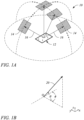
- FIG 1A illustrates a perspective view of a multiview display 10 in an example, according to an embodiment consistent with the principles described herein.
- the multiview display 10 comprises a screen 12 to display a multiview image to be viewed.
- the multiview display 10 provides different views 14 of the multiview image in different view directions 16 relative to the screen 12.
- the view directions 16 are illustrated as arrows extending from the screen 12 in various different principal angular directions; the different views 14 are illustrated as shaded polygonal boxes at the termination of the arrows (i.e., depicting the view directions 16); and only four views 14 and four view directions 16 are illustrated, all by way of example and not limitation.
- a view direction or equivalently a light beam having a direction corresponding to a view direction of a multiview display generally has a principal angular direction given by angular components ⁇ , ⁇ , by definition herein.
- the angular component ⁇ is referred to herein as the ⁇ elevation component' or ⁇ elevation angle' of the light beam.
- the angular component ⁇ is referred to as the ⁇ azimuth component' or ⁇ azimuth angle' of the light beam.
- the elevation angle ⁇ is an angle in a vertical plane (e.g., perpendicular to a plane of the multiview display screen) while the azimuth angle ⁇ is an angle in a horizontal plane (e.g., parallel to the multiview display screen plane).
- Figure 1B illustrates a graphical representation of the angular components ⁇ , ⁇ of a light beam 20 having a particular principal angular direction corresponding to a view direction (e.g., view direction 16 in Figure 1A ) of a multiview display in an example, according to an embodiment consistent with the principles described herein.
- the light beam 20 is emitted or emanates from a particular point, by definition herein. That is, by definition, the light beam 20 has a central ray associated with a particular point of origin within the multiview display.
- Figure 1B also illustrates the light beam (or view direction) point of origin O.
- the term 'multiview' as used in the terms ⁇ multiview image' and ⁇ multiview display' is defined as a plurality of views representing different perspectives or including angular disparity between views of the view plurality.
- the term 'multiview' explicitly includes more than two different views (i.e., a minimum of three views and generally more than three views), by definition herein.
- ⁇ multiview display' as employed herein is explicitly distinguished from a stereoscopic display that includes only two different views to represent a scene or an image.
- multiview images and multiview displays include more than two views
- multiview images may be viewed (e.g., on a multiview display) as a stereoscopic pair of images by selecting only two of the multiview views to view at a time (e.g., one view per eye).
- a ⁇ multiview pixel' is defined herein as a set of pixels representing 'view' pixels in each of a similar plurality of different views of a multiview display.
- a multiview pixel may have an individual pixel or set of pixels corresponding to or representing a view pixel in each of the different views of the multiview image.
- a ⁇ view pixel' is a pixel or set of pixels corresponding to a view in a multiview pixel of a multiview display.
- a view pixel may include one or more color sub-pixels.
- the view pixels of the multiview pixel are so-called ⁇ directional pixels' in that each of the view pixels is associated with a predetermined view direction of a corresponding one of the different views, by definition herein.
- the different view pixels of a multiview pixel may have equivalent or at least substantially similar locations or coordinates in each of the different views.
- a first multiview pixel may have individual view pixels located at ⁇ x1, y1 ⁇ in each of the different views of a multiview image
- a second multiview pixel may have individual view pixels located at ⁇ x2, y2 ⁇ in each of the different views, and so on.
- a number of view pixels in a multiview pixel may be equal to a number of views of the multiview display.
- the multiview pixel may provide sixty-four (64) view pixels associated with a multiview display having 64 different views.
- the multiview display may provide an eight by four array of views (i.e., 32 views) and the multiview pixel may include thirty-two (32) view pixels (i.e., one for each view).
- each different view pixel may have an associated direction (e.g., light beam principal angular direction) that corresponds to a different one of the view directions corresponding to the 64 different views, for example.
- a ⁇ multibeam emitter' is a structure or element of a backlight or a display that produces light that includes a plurality of light beams.
- the multibeam emitter may be optically coupled to a light guide of a backlight to provide the light beams by coupling out a portion of light guided in the light guide.
- a multibeam emitter may comprise a ⁇ multibeam element.
- the multibeam emitter may generate light emitted as the light beams (i.e., may comprise a light source). Further, the light beams of the plurality of light beams produced by a multibeam emitter have different principal angular directions from one another, by definition herein.
- a light beam of the plurality has a predetermined principal angular direction that is different from another light beam of the light beam plurality.
- the light beam plurality may represent a light field.
- the light beam plurality may be confined to a substantially conical region of space or have a predetermined angular spread that includes the different principal angular directions of the light beams in the light beam plurality.
- the predetermined angular spread of the light beams in combination i.e., the light beam plurality
- the predetermined angular spread of the light beams in combination may represent the light field.
- the different principal angular directions of the various light beams are determined by a characteristic including, but not limited to, a size (e.g., length, width, area, etc.) of the multibeam emitter.
- the multibeam emitter may be considered an ⁇ extended point light source', i.e., a plurality of point light sources distributed across an extent of the multibeam emitter, by definition herein.
- a light beam produced by the multibeam emitter has a principal angular direction given by angular components ⁇ , ⁇ ⁇ , by definition herein, and as described above with respect to Figure 1B .
- a ⁇ light guide' is defined as a structure that guides light within the structure using total internal reflection.
- the light guide may include a core that is substantially transparent at an operational wavelength of the light guide.
- the term ⁇ light guide' generally refers to a dielectric optical waveguide that employs total internal reflection to guide light at an interface between a dielectric material of the light guide and a material or medium that surrounds that light guide.
- a condition for total internal reflection is that a refractive index of the light guide is greater than a refractive index of a surrounding medium adjacent to a surface of the light guide material.
- the light guide may include a coating in addition to or instead of the aforementioned refractive index difference to further facilitate the total internal reflection.
- the coating may be a reflective coating, for example.
- the light guide may be any of several light guides including, but not limited to, one or both of a plate or slab guide and a strip guide.
- 'broad-angle' emitted light is defined as light having a cone angle that is greater than a cone angle of the view of a multiview image or multiview display.
- the broad-angle emitted light may have a cone angle that is greater than about twenty degrees (e.g., > ⁇ 20°).
- the broad-angle emitted light cone angle may be greater than about thirty degrees (e.g., > ⁇ 30°), or greater than about forty degrees (e.g., > ⁇ 40°), or greater than fifty degrees (e.g., > ⁇ 50°).
- the cone angle of the broad-angle emitted light may be about sixty degrees (e.g., > ⁇ 60°).
- the broad-angle emitted light cone angle may be defined to be about the same as a viewing angle of an LCD computer monitor, an LCD tablet, an LCD television, or a similar digital display device meant for broad-angle viewing (e.g., about ⁇ 40-65°).
- broad-angle emitted light may also be characterized or described as diffuse light, substantially diffuse light, non-directional light (i.e., lacking any specific or defined directionality), or as light having a single or substantially uniform direction.
- the article 'a' is intended to have its ordinary meaning in the patent arts, namely 'one or more'.
- ⁇ a color sub-pixel' means one or more color sub-pixels and as such, 'the color sub-pixel' means ⁇ color sub-pixel(s)' herein.
- any reference herein to 'top', 'bottom', 'upper', 'lower', 'up', 'down', 'front', back', 'first', 'second', 'left' or 'right' is not intended to be a limitation herein.
- the term 'about' when applied to a value generally means within the tolerance range of the equipment used to produce the value, or may mean plus or minus 10%, or plus or minus 5%, or plus or minus 1%, unless otherwise expressly specified.
- the term 'substantially' as used herein means a majority, or almost all, or all, or an amount within a range of about 51% to about 100%.
- examples herein are intended to be illustrative only and are presented for discussion purposes and not by way of limitation.
- a multiview display that provides dynamic color sub-pixel remapping.
- Figure 2A illustrates a cross-sectional view of a multiview display 100 in an example, according to an embodiment consistent with the principles described herein.
- Figure 2B illustrates a plan view of the multiview display 100 in an example, according to an embodiment consistent with the principles described herein.
- Figure 2C illustrates a plan view of a portion of the multiview display 100 of Figure 2B in an example, according to an embodiment consistent with the principles described herein.
- the multiview display 100 illustrated in Figures 2A-2C may employ dynamic color sub-pixel remapping to mitigate color fringing in or associated with a multiview image displayed by or on the multiview display 100.
- the multiview display 100 comprises an array of light valves 110.
- Figures 2A and 2B also illustrate light valves 110 of the light valve array arranged as a plurality of multiview pixels 120, outlined by dashed lines in Figure 2B .
- the light valve array may comprise any of a variety of different types of light valves including, but not limited to, a liquid crystal light valve, an electrophoretic light valve, and a light valve based on electrowetting.
- the array of light valves 110 comprises a repeating plurality of color sub-pixels 112 configured to modulate directional light beams as color pixels of different views of a multiview image displayed on or by the multiview display 100.
- each light valve 110 of the light valve array includes the plurality of color sub-pixels 112. As such, across the light valve array the plurality of color sub-pixels 112 repeats from one light valve 110 to an adjacent light valve 110 as the repeating color sub-pixel plurality.
- a light valve 110 of the array of light valves 110 may comprise the plurality of color sub-pixels 112 having a first color sub-pixel 112-1, a second color sub-pixel 112-2, and a third color sub-pixel 112-3. Further, as illustrated in Figure 2C , the plurality of color sub-pixels 112 may be the same in each light valve 110 of the light valve array. As a result, the color sub-pixel plurality having the first, second, and third color sub-pixels 112-1, 112-2, 112-3 may repeat across the light valve array (e.g., in a row direction), according to various embodiments.
- a color sub-pixel 112 of the repeating color sub-pixel plurality may have or represent a different color from another color sub-pixel of the repeating color sub-pixel plurality (e.g., each color sub-pixel 112 may include a different color filter representing a different color).
- the first color sub-pixel 112-1 may be a red color sub-pixel ( R )
- the second color sub-pixel 112-2 may be a green color sub-pixel ( G )
- the third color sub-pixel 112-3 may be a blue color sub-pixel ( B ), e.g., as illustrated in Figure 2C .
- the repeating color sub-pixel plurality comprises a repeating set of red ( R ), green ( G ), and blue ( B ) color sub-pixels 112, as illustrated in Figure 2C by way of example and not limitation.
- the repeating set of red ( R ), green ( G ), and blue ( B ) color sub-pixels 112 may be consistent with a red-green-blue (RGB) color model used to display color multiview images with the multiview display 100, according to some embodiments.
- RGB red-green-blue
- the repeating plurality of color sub-pixels 112 may include, but is not limited to, a repeating set that includes red ( R ), green ( G ), and blue ( B ), and yellow ( Y ) color sub-pixels 112 (RGBY) and a repeating set that includes red ( R ), green ( G ), and blue ( B ), and white ( W ) color sub-pixels 112 (RGBW).
- light valve array with the repeating plurality of color sub-pixels 112 is arranged as a plurality of multiview pixels 120 of the multiview display 100.
- Each multiview pixel of the plurality of multiview pixels 120 comprises a different subset of the repeating plurality of color sub-pixels 112.
- Each multiview pixel 120 is configured to modulate directional light beams as color pixels of different views of the multiview display 100.
- the modulated light beams represent the respective different colors of the color sub-pixels 112 of the color sub-pixel plurality within the color pixels of the multiview display 100.
- individual light valves 110 within each multiview pixel 120 of the multiview pixel plurality represent different ones of the different views of the multiview image or equivalently of the multiview display 100, according to various embodiments.
- the multiview display 100 illustrated in Figures 2B-2C includes multiview pixels 120 representing a four-by-four (4 x 4) arrangement of different views. That is, the illustrated multiview display 100 has multiview pixels 120 configured to provide sixteen (16) different views in a full parallax mode. Accordingly, each multiview pixel 120 of the plurality includes sixteen (16) light valves 110, each light valve comprising three (3) color sub-pixels 112, as illustrated. In particular, as illustrated each light valves 110 comprises a set of three consecutive color sub-pixels 112 including a red ( R ) color sub-pixel 112, a green ( G ) color sub-pixel 112, and a blue ( B ) color sub-pixel 112.
- the plurality of multiview pixels 120 may be arranged in rows and columns of multiview pixels 120 (e.g., as illustrated), according to some embodiments.
- a location of a multiview pixel 120 of the multiview pixel plurality relative to a location of color sub-pixels 112 of the light valve array is configured to be shifted as a function of a position of a user 101 of the multiview display 100.
- the shift may provide dynamic color sub-pixel remapping of or with respect to multiview pixels 120 of the multiview display 100.
- the dynamic color sub-pixel remapping may mitigate color fringing within a multiview image displayed on the multiview display 100 when the user 101 views the multiview image from the position used to determine the shift.
- Figure 3A illustrates a plan view of a portion of a multiview display 100 in an example, according to an embodiment consistent with the principles described herein.
- a multiview pixel 120 spans from a red ( R ) color sub-pixel 112 at an upper left corner to a blue ( B ) color sub-pixel 112 at a lower right corner of the multiview pixel 120.
- a first view V1 may correspond to a first set of three color sub-pixels 112 ( R , G , B ) at the upper left corner
- a second view V2 may correspond to a second set of three color sub-pixels 112 ( R , G , B ) adjacent and to the right of the first set
- a third view V3 may correspond to a third set of three color sub-pixels 112 ( R , G , B ) adjacent and to the right of the second set, as illustrated.
- the user 101 When the user 101 views the multiview display 100 from a location centered on view V2 , the user 101 will experience a multiview image that is free of color fringing. That is, the views V1 , V2 , V3 will be color balanced when the location of the user 101 is centered on view V2 along the repeating plurality of color sub-pixels 112, i.e., along a row.
- an arrow indicates a line of sight of the user 101 viewing the multiview display 100. Accordingly, the line of sight of the user 101 is aligned with the center of view V2 (or the second set of color sub-pixels 112) of the multiview pixel 120.
- view V2 may include a bluish artifact
- view V3 may include a red ghost or artifact when viewed by the user 101.
- Figure 3B illustrates plan view of a portion of the multiview display 100 of Figure 3A in another example, according to an embodiment consistent with the principles described herein.
- the multiview display 100 is the same multiview display 100 illustrated in Figure 3A .
- Figure 3B illustrates the user 101 at a new location that is to the right such that, while the user 101 may continue to observe the view V2, the line of sight of the user has moved with the user to be aligned with a color sub-pixel 112 that is off center of view V2 or the multiview pixel 120, as originally illustrated in Figure 3A . Since the line of sight of the user 101 is off center, the multiview image may lack color balance if the original multiview pixel 120 of Figure 3A were to be used.
- Figure 3B illustrates a multiview pixel 120' having a location that is shifted relative to the color sub-pixels 112 as a function of the new user location. Accordingly, the multiview pixel 120' is shifted to a new location such that the multiview pixel 120' spans from a green ( G ) color sub-pixel 112 (of view V1 ) at an upper left corner to a red ( R ) color sub-pixel 112 (of view '9') at a lower right corner of the multiview pixel 120'.
- G green
- R red
- the first view V1 corresponds to a first set of three color sub-pixels 112 ( G , B , R ) at the upper left corner
- a second view V2 corresponds to a second set of three color sub-pixels 112 ( G , B , R ) adjacent and to the right of the first set
- the third view V3 corresponds to a third set of three color sub-pixels 112 ( G , B , R ) adjacent and to the right of the second set, as illustrated in Figure 3B .
- Each of the three views V1 , V2 , V3 still have a full complement of color sub-pixels 112, but the color balance is restored by the shift of the multiview pixel 120 relative to the color sub-pixels 112 of the light valve array.
- an arrow indicates a line of sight of the user 101 viewing the multiview display 100 in Figure 3B .
- a shift distance of the multiview pixel location may be an integer multiple of a size of a color sub-pixel 112 of the repeating color sub-pixel plurality.
- the multiview pixel 120' is shifted by a width of one (1) color sub-pixel 112 in a row direction of the repeating plurality of color sub-pixels 112 in response to the movement in location of the user 101, compared to the position of the multiview pixel 120 in Figure 3A prior to the movement.
- the shift distance may amount to two widths, three widths, and so on, of a color sub-pixel 112, for example.
- the multiview pixel 120 is remapped to a different set of color sub-pixels 112 of the repeating plurality of color sub-pixels 112 to reposition the line of sight of the user 101 on the center of multiview pixel 120 or more specifically to a center of the second set of color sub-pixels 112 corresponding to view V2 .
- a different set of color sub-pixels 112 form the multiview pixel 120' in Figure 3B as compared to the multiview pixel 120 of Figure 3A .
- the multiview pixel 120 of Figure 3A spanned from the red ( R ) color sub-pixel 112 to a blue ( B ) color sub-pixel 112 along a first row of the repeating plurality of color sub-pixels 112
- the multiview pixel 120' illustrated in Figure 3B spans from the green ( G ) color sub-pixel 112 to a red ( R ) color sub-pixel 112 along the same repeating plurality of color sub-pixels 112.
- view V2 of the multiview pixel 120 is shifted from the set of color sub-pixels 112 ( R , G , B ) in Figure 3A to the different set of color sub-pixels 112 ( G B , R ) in Figure 3A , which re-centers view V2 on the line of sight of the user 101.
- All other views in the multiview pixel 120' are similarly shifted in the same direction along the repeating plurality of color sub-pixels 112, by the shift. Further, the shift is a row direction of the light valve array, as illustrated in Figures 3A-3B .
- the shift of the multiview pixel 120, 120' in response to change in a location by the user 101 may be performed while the multiview display 100 is active and displaying the multiview image. Accordingly, remapping of the color sub-pixels 112 performed with the shift of the multiview pixel location may be accomplished dynamically.
- dynamic sub-pixel remapping is defined as the reassignment of at least one color sub-pixel 112 to a different multiview pixel 120 while the multiview display 100 is active.
- the dynamic color sub-pixel remapping of the multiview display 100 is configured to mitigate color fringing associated with the color pixels of the multiview image.
- the shift of the multiview pixels 120 help minimize uneven overlap between directional light beams 102 of different colors that can emphasize certain colors in a pixel over other colors, depending on the position and view point of the user 101.
- the illustrated multiview display 100 further comprises an array of multibeam emitters 130.
- the multibeam emitters 130 are configured to provide the directional light beams 102 modulated by the plurality of color sub-pixels 112 of the light valve array.
- the directional light beams 102 may have principal angular directions corresponding to respective different view directions of the multiview display 100 or equivalently of different views of the multiview image displayed on or by the multiview display 100.
- Figure 2A illustrates the directional light beams 102 as a plurality of diverging arrows depicted as being directed way from the multibeam emitters 130 in a direction toward the light valve array.
- a size of the multibeam emitter 130 is comparable to a size of a light valve 110 of the multiview display 100.
- the 'size' may be defined in any of a variety of manners to include, but not be limited to, a length, a width or an area.
- the size of a light valve 110 may be a length thereof and the comparable size of the multibeam emitter 130 may also be a length of the multibeam emitter 130.
- size may refer to an area such that an area of the multibeam emitter 130 may be comparable to an area of the light valve 110.
- the size of the multibeam emitter 130 is comparable to the light valve size such that the multibeam emitter size is between about fifty percent (50%) and about two hundred percent (200%) of the light valve size.
- the multiview display 100 may comprise a light guide 140, e.g., as illustrated.
- the light guide 140 is configured to guide light along a length of the light guide as guided light 104 (i.e., a guided light beam 104).
- the light guide 140 may include a dielectric material configured as an optical waveguide.
- the dielectric material may have a first refractive index that is greater than a second refractive index of a medium surrounding the dielectric optical waveguide.
- the difference in refractive indices is configured to facilitate total internal reflection of the guided light 104 according to one or more guided modes of the light guide 140, for example.
- the light guide 140 and the array of multibeam elements 130' may be configured to be optically transparent to the broad-angle light 162 emitted from the adjacent broad-angle backlight 160.
- broad-angle light 162 may be emitted from the broad-angle backlight 160 and through a thickness of light guide 140.
- the broad-angle light 162 from the broad-angle backlight 160 is therefore received through the bottom surface 140" of the light guide 140, transmitted through a thickness of the light guide 140, and emitted from the array of light valves 110. Because the light guide 140 is optically transparent to the broad-angle light 162, the broad-angle light 162 is not substantially affected by the light guide 140.
- a user tracker may be employed with the multiview display 100 as part of a multiview display system.
- the user tracker is configured to track a location or a position of the user 101 relative to the multiview display 100 to provide the user position.
- the user tracker may be configured to track a position of the user 101 (e.g., of a head of the user) in a region in front of the multiview display 100, that is, a region adjacent to a light emitting surface or an image view screen of the multiview display 100.
- the hardware-based and software-based motion sensors are configured to track a relative motion of the multiview display 100.
- the motion of the user relative to the multiview display 100 may be used to infer a position of the user with respect to the multiview display 100.
- the user tracker may comprise both position sensor and a motion sensor.
- the multiview display system 200 further comprises an array of light valves 220 having a repeating plurality of color sub-pixels.
- the light valves of the array are substantially similar to the light valves 110 of the multiview display 100, previously described.
- different types of light valves may be employed as the light valves 220 of the light valve array including, but not limited to, one or more of liquid crystal light valves, electrophoretic light valves, and light valves based on electrowetting.
- each color sub-pixel of the repeating plurality of color sub-pixels has a different color.
- the multiview display system 200 further comprises a user tracker 230 configured to track a position of a user relative to the multiview display.
- the user tracker 230 may comprise a position sensor.
- the user tracker comprising a motion sensor may comprise a camera to capture an image of the user relative to the screen of the multiview display system 200.
- the user tracker 230 comprising a motion sensor may further comprise a processor configured to determine a position of the user within the captured image relative to the screen of the multiview display system 200. The position of the user relative to the screen of the multiview display system 200 may thus be determined from the captured image.
- the user tracker 230 may comprise a motion sensor configured to track a relative motion of the multiview display system 200.
- the motion of the user relative to the multiview display system 200 may be used to infer a position of the user with respect to the multiview display system 200.
- the user tracker 230 may comprise both a position sensor and a motion sensor.
- the user tracker 230 may be substantially similar to the user tracker described above with respect to multiview display 100.
- locations of the multiview pixels 222 relative to locations of color sub-pixels of the light valve array are configured to be shifted as a function of the tracked user position to provide dynamic color sub-pixel remapping.
- the dynamic color sub-pixel remapping may be substantially similar to the dynamic color sub-pixel remapping of the above-described multiview display 100, e.g., as illustrated in and described with respect to Figures 3A and 3B .
- one or more multiview pixels 222 may be remapped to a different set of color sub-pixels of the repeating plurality of color sub-pixels of the array of light valves 220.
- the shift may be replicated for all multiview pixels 222 of the multiview display system 200, and a different set of color sub-pixels forms each multiview pixel 222, e.g., as in Figures 3A-3B .
- the multiview pixels 222 are shifted in the direction of the plurality of color sub-pixels to follow the tracked position of the user in order to maintain the color balance in the view aligned with the user position.
- the shift distance of the multiview pixel location is an integer multiple of a size of a color sub-pixel of the color sub-pixel plurality.
- the multiview pixels 222 may be shifted by a distance about equal to a width of one of the color sub-pixels of the light valve array, e.g., as illustrated in Figures 3A and 3B .
- the shift distance may be about equal to two times a color sub-pixel width, three times a color sub-pixel width, and so on, for example.
- the multibeam backlight 210 comprises a plurality of multibeam emitters 212 distributed across the multibeam backlight.
- Multibeam emitters 212 of the plurality may be substantially similar to the multibeam emitters 130 described above with respect to the multiview display 100.
- multibeam emitters 212 of the multibeam emitter plurality are configured to provide directional light beams 202 of the directional light beam plurality of the light emitted by the multiview display system 200.
- the multibeam emitters 212 of the plurality may be located on a surface of or within the multibeam backlight 210, according to various embodiments.
- the multibeam backlight 210 further comprises a light guide.
- the light guide is configured to guide light in a propagation direction along a length of the light guide as guided light.
- the light guide may be substantially similar to the light guide 140 of the above-described multiview display 100, in some embodiments.
- the light guide may be configured to guide the guided light using total internal reflection.
- the guided light may be guided at a non-zero propagation angle by or within the light guide.
- the guided light may be collimated or may be a collimated light beam.
- the guided light may be collimated according to or having a collimation factor ⁇ , in various embodiments.
- a multibeam emitter of the plurality of multibeam emitters 212 comprises a multibeam element.
- the multibeam element may be substantially similar to the multibeam element 130' described above.
- the multibeam element is configured to scatter out a portion of the guided light as the directional light beams 202 of the multiview display system 200.
- the multibeam element may be located on a surface of or within the light guide.
- a size of the multibeam emitter 212 or the element is comparable to a size of a light valve 220 of the light valve array. In some embodiments, the size of the multibeam emitter or element is comparable to the light valve size such that the multibeam element size is between about fifty percent (50%) and about two hundred percent (200%) of the light valve size.
- the multibeam element may comprise any of a number of different structures configured to scatter out a portion of the guided light.
- the different structures may include, but are not limited to, diffraction gratings, micro-reflective elements, micro-refractive elements, or various combinations thereof.
- the multibeam element comprising a diffraction grating is configured to diffractively scatter out the guided light portion as the plurality of directional light beams having the different principal angular directions.
- the multibeam element comprising a micro-reflective element is configured to reflectively scatter out the guided light portion as the plurality of directional light beams, or the multibeam element comprising a micro-refractive element is configured to scatter out the guided light portion as the plurality of directional light beams by or using refraction (i.e., refractively scatter out the guided light portion).
- a method 300 of multiview display system operation comprises modulating 310 directional light beams using an array of light valves having a repeating plurality of color sub-pixels.
- the array of light valves may be substantially similar to the array of light valves 110 described above with respect to the multiview display 100.
- different types of light valves may be employed as the light valves of the light valve array including, but not limited to, one or more of liquid crystal light valves, electrophoretic light valves, and light valves based on electrowetting.
- each color sub-pixel of the repeating plurality of color sub-pixels has a different color.
- the repeating plurality of color sub-pixels may consist of a repeating set of red ( R ), green ( G ), and blue ( B ) color sub-pixels (RGB) in this order along a row of the array of light valves.
- the repeating plurality of color sub-pixels is arranged as a plurality of multiview pixels to provide color pixels of views of a multiview image, according to various embodiments.
- the method 300 further comprises tracking 320 a position of a user relative to the multiview display system with a user-tracking module to provide a tracked position of the user.
- the user-tracking module may be substantially similar to the user tracker 230 of the multiview display system 200, described above.
- the user-tracking module may comprise a position sensor configured to provide a position of the user relative to the multiview display system.
- the user-tracking module may comprise a motion sensor configured to track a relative motion of the multiview display. The motion the user relative to the multiview display system may be used to infer a position of the user with respect to the multiview display system, for example.
- the user-tracking module may comprise both a position sensor and a motion sensor.
- the method 300 further comprises shifting 330 a location of a multiview pixel of the multiview pixel plurality relative to a location of color sub-pixels of the light valve array as a function of the tracked user position to provide dynamic color sub-pixel remapping and mitigate color fringing perceived by the user when viewing the multiview display.
- shifting 330 may be substantially similar to the shift as previously described with respect to either the multiview display 100 or multiview display system 200.
- the shifting 330 changes the location of the multiview pixel by an integer multiple of a size of a color sub-pixel in a row direction of the color sub-pixels.
- the method 300 further comprises emitting the directional light beams using an array of multibeam emitters.
- the multibeam emitters of the array may be substantially similar to the multibeam emitters 130 of the multiview display 100, as described above.
- emitting the directional light beams comprises guiding light in a light guide as guided light.
- the light guide may be substantially similar to the light guide 140 of the multiview display 100, and light may be guided at a non-zero propagation angle between opposite internal surfaces of the light guide.
- the multibeam emitters of the multibeam emitter array may be multibeam elements of a multibeam element array, each multibeam element corresponding to a different multibeam emitter of the multibeam emitter array.
- emitting the directional light beams using the array of multibeam emitters may further comprise scattering out a portion of the guided light from the light guide using a multibeam element of the multibeam element array to provide the directional light beams.
- the multibeam element may be substantially similar to the multibeam element 140' of the multiview display 100.
- the multibeam emitter or the multibeam element may have a size comparable to a size of a light valve of the light valve array.
- the size of the multibeam emitter or multibeam element may be comparable to the light valve size such that the multibeam element size is between about fifty percent (50%) and about two hundred percent (200%) of the light valve size.
- tracking a position of a user relative to the multiview display system comprises monitoring a relative motion of the multiview display system using a motion sensor to infer the user position from the relative motion. In some embodiments, wherein tracking a position of a user relative to the multiview display system comprises tracking the user position with a position sensor. In some embodiments, tracking a user position comprises both monitoring the relative motion using a motion sensor and tracking the user position with a position sensor.
- the motion sensor may comprise, but is not limited to, one or both of a gyroscope and an accelerometer.
- the position sensor may comprise, but is not limited to, one or more of a capacitive sensor, a camera, and a time-of-flight sensor.
Landscapes
- Physics & Mathematics (AREA)
- Engineering & Computer Science (AREA)
- General Physics & Mathematics (AREA)
- Computer Hardware Design (AREA)
- Theoretical Computer Science (AREA)
- Optics & Photonics (AREA)
- Nonlinear Science (AREA)
- Crystallography & Structural Chemistry (AREA)
- Chemical & Material Sciences (AREA)
- Control Of Indicators Other Than Cathode Ray Tubes (AREA)
- Liquid Crystal Display Device Control (AREA)
- Testing, Inspecting, Measuring Of Stereoscopic Televisions And Televisions (AREA)
- Liquid Crystal (AREA)
- Devices For Indicating Variable Information By Combining Individual Elements (AREA)
- Planar Illumination Modules (AREA)
- Optical Elements Other Than Lenses (AREA)
- Electrochromic Elements, Electrophoresis, Or Variable Reflection Or Absorption Elements (AREA)
Claims (14)
- Mehrfachansichtsanzeigesystem (100, 200), umfassend:eine Mehrstrahl-Hintergrundbeleuchtung (210), die dazu konfiguriert ist, emittiertes Licht als eine Mehrzahl gerichteter Lichtstrahlen (102) mit unterschiedlichen Hauptwinkelrichtungen bereitzustellen, die jeweiligen unterschiedlichen Ansichtsrichtungen der Mehrfachansichtsanzeige entsprechen, wobei die Mehrfachansichtsanzeige dazu konfiguriert ist, unterschiedliche Ansichten eines Mehrfachansichtsbildes für die unterschiedlichen Ansichtsrichtungen bereitzustellen,eine Anordnung von Lichtventilen (220, 110), die eine sich wiederholende Mehrzahl von Farbsubpixeln (112) aufweist und als Mehrfachansichtspixel (120) angeordnet und dazu konfiguriert ist, die gerichteten Lichtstrahlen als Farbpixel der Ansichten des Mehrfachansichtsbildes zu modulieren; undeinen Benutzer-Tracker (230), der dazu konfiguriert ist, eine Position eines Benutzers relativ zur Mehrfachansichtsanzeige zu verfolgen,wobei Stellen der Mehrfachansichtspixel relativ zu Stellen von Farbsubpixeln der Lichtventilanordnung dazu konfiguriert sind, in Abhängigkeit von der verfolgten Benutzerposition verschoben zu werden, um dynamische Farbsubpixelneuabbildung zu ermöglichen.
- Mehrfachansichtsanzeigesystem nach Anspruch 1, wobei ein Verschiebungsabstand der Mehrfachansichtspixelstelle ein ganzzahliges Vielfaches einer Größe eines Farbsubpixels der sich wiederholenden Farbsubpixelmehrzahl ist.
- Mehrfachansichtsanzeigesystem nach Anspruch 1, wobei jedes Farbsubpixel der sich wiederholenden Mehrzahl von Farbsubpixeln eine unterschiedliche Farbe aufweist, wobei die modulierten Lichtstrahlen die jeweiligen unterschiedlichen Farben innerhalb der Farbpixel des Mehrfachansichtsbildes darstellen.
- Mehrfachansichtsanzeigesystem nach Anspruch 3, wobei die sich wiederholende Mehrzahl von Farbsubpixeln ein rotes Farbsubpixel, ein grünes Farbsubpixel und ein blaues Farbsubpixel umfasst.
- Mehrfachansichtsanzeigesystem nach Anspruch 1, wobei eine Verschiebung der Stelle der Mehrfachansichtspixel in einer Richtung erfolgt, die einer Zeilenrichtung der Lichtventilanordnung entspricht.
- Mehrfachansichtsanzeigesystem nach Anspruch 1, wobei die Mehrstrahl-Hintergrundbeleuchtung eine Mehrzahl von Mehrstrahl-Emittern umfasst, die räumlich über die Mehrstrahl-Hintergrundbeleuchtung verteilt ist, wobei jeder Mehrstrahl-Emitter der Mehrstrahl-Emitter-Mehrzahl dazu konfiguriert ist, gerichtete Lichtstrahlen der Mehrzahl gerichteter Lichtstrahlen bereitzustellen.
- Mehrfachansichtsanzeigesystem nach Anspruch 6, wobei die Mehrstrahl-Hintergrundbeleuchtung ferner Folgendes umfasst:
einen Lichtleiter, der dazu konfiguriert ist, Licht als geleitetes Licht entlang einer Länge des Lichtleiters zu leiten, wobei der Mehrstrahl-Emitter ein Mehrstrahlelement umfasst, das eine Größe aufweist, die mit einer Größe eines Lichtventils der Lichtventilanordnung vergleichbar ist, und dazu konfiguriert ist, einen Teil des geleiteten Lichts als die Mehrzahl gerichteter Lichtstrahlen zu streuen. - Mehrfachansichtsanzeigesystem nach Anspruch 7, wobei das Mehrstrahlelement eines oder mehrere von einem Beugungsgitter, das dazu konfiguriert ist, den Teil des geleiteten Lichts als die gerichteten Lichtstrahlen beugend zu streuen, einer mikroreflektierenden Struktur, die dazu konfiguriert ist, den Teil des geleiteten Lichts als die gerichteten Lichtstrahlen reflektierend zu streuen, und einer mikrobrechenden Struktur umfasst, die dazu konfiguriert ist, den Teil des geleiteten Lichts als die gerichteten Lichtstrahlen brechend zu streuen.
- Mehrfachansichtsanzeigesystem nach Anspruch 7, ferner umfassend eine Weitwinkel-Hintergrundbeleuchtung (160) benachbart zu einer Seite des Lichtleiters gegenüber einer Seite benachbart zur Lichtventilanordnung, wobei die Weitwinkel-Hintergrundbeleuchtung dazu konfiguriert ist, mit weitem Winkel emittiertes Licht während eines zweidimensionalen Modus, 2D-Modus, der Mehrfachansichtsanzeige bereitzustellen, wobei die Lichtventilanordnung dazu konfiguriert ist, das mit weitem Winkel emittierte Licht als ein 2D-Bild zu modulieren,
wobei der Lichtleiter und die Mehrstrahlelementanordnung dazu konfiguriert sind, für das mit weitem Winkel emittierte Licht transparent zu sein, wobei die Mehrfachansichtsanzeige dazu konfiguriert ist, das Mehrfachansichtsbild während eines Mehrfachansichtsmodus und das 2D-Bild während des 2D-Modus anzuzeigen. - Mehrfachansichtsanzeigesystem nach Anspruch 1, wobei der Benutzer-Tracker einen oder beide von einem Positionssensor, der zum Verfolgen der Benutzerposition konfiguriert ist, und einem Bewegungssensor umfasst, der zum Überwachen einer relativen Bewegung der Mehrfachansichtsanzeige konfiguriert ist, wobei die relative Bewegung zum Ableiten der Benutzerposition verwendet wird.
- Verfahren (300) zum Betrieb eines Mehrfachansichtsanzeigesystems, wobei das Mehrfachansichtsanzeigesystem dazu konfiguriert ist, unterschiedliche Ansichten eines Mehrfachansichtsbildes in unterschiedlichen Ansichtsrichtungen bereitzustellen, wobei das Verfahren Folgendes umfasst:Modulieren gerichteter Lichtstrahlen unter Verwendung einer Anordnung von Lichtventilen, die eine sich wiederholende Mehrzahl von Farbsubpixeln aufweist und als eine Mehrzahl von Mehrfachansichtspixeln angeordnet ist, um Farbpixel von Ansichten des Mehrfachansichtsbildes bereitzustellen (310), wobei die gerichteten Lichtstrahlen Hauptwinkelrichtungen aufweisen, die jeweiligen unterschiedlichen Ansichtsrichtungen der Mehrfachansichtsanzeige entsprechen; undVerfolgen einer Position eines Benutzers relativ zum Mehrfachansichtsanzeigesystem unter Verwendung eines Benutzerverfolgungsmoduls, um eine verfolgte Position des Benutzers bereitzustellen (320); undVerschieben einer Stelle eines Mehrfachansichtspixels der Mehrfachansichtspixelmehrzahl relativ zu einer Stelle von Farbsubpixeln der Lichtventilanordnung in Abhängigkeit von der verfolgten Benutzerposition, um dynamische Farbsubpixelneuabbildung bereitzustellen und Farbsaumbildung zu verringern, die vom Benutzer beim Betrachten des Mehrfachansichtsanzeigesystems wahrgenommen wird (330).
- Verfahren zum Betrieb eines Mehrfachansichtsanzeigesystems nach Anspruch 11, wobei das Verschieben die Stelle des Mehrfachansichtspixels um ein ganzzahliges Vielfaches einer Größe eines Farbsubpixels in einer Zeilenrichtung der Farbsubpixel ändert.
- Verfahren zum Betrieb eines Mehrfachansichtsanzeigesystems nach Anspruch 11, ferner umfassend ein Emittieren der gerichteten Lichtstrahlen unter Verwendung einer Anordnung von Mehrstrahl-Emittern, wobei das Emittieren der gerichteten Lichtstrahlen Folgendes umfasst:Leiten von Licht in einem Lichtleiter als geleitetes Licht; undStreuen eines Teils des geleiteten Lichts unter Verwendung eines Mehrstrahlelements einer Anordnung von Mehrstrahlelementen, um die gerichteten Lichtstrahlen bereitzustellen, wobei eine Größe des Mehrstrahlelements mit einer Größe eines Lichtventils der Lichtventilanordnung vergleichbar ist,wobei die Mehrstrahlelementanordnung die Mehrstrahl-Emitter-Anordnung ist, wobei jedes Mehrstrahlelement der Mehrstrahlelementanordnung einem unterschiedlichen Mehrstrahl-Emitter der Mehrstrahl-Emitter-Anordnung entspricht.
- Verfahren zum Betrieb eines Mehrfachansichtsanzeigesystems nach Anspruch 11, wobei das Verfolgen einer Position eines Benutzers relativ zum Mehrfachansichtsanzeigesystem unter Verwendung eines Benutzerverfolgungsmoduls eines oder beides von Folgendem umfasst:Überwachen einer relativen Bewegung des Mehrfachansichtsanzeigesystems unter Verwendung eines Bewegungssensors, um die Benutzerposition von der relativen Bewegung abzuleiten; undVerfolgen der Benutzerposition mit einem Positionssensor,wobei der Bewegungssensor eines oder beides von einem Gyroskop und einem Beschleunigungsmesser umfasst und wobei der Positionssensor eines oder mehrere von einem kapazitiven Sensor, einer Kamera und einem Flugzeitsensor umfasst.
Applications Claiming Priority (1)
| Application Number | Priority Date | Filing Date | Title |
|---|---|---|---|
| PCT/US2018/067644 WO2020139338A1 (en) | 2018-12-27 | 2018-12-27 | Multiview display, system, and method having dynamic color sub-pixels remapping |
Publications (4)
| Publication Number | Publication Date |
|---|---|
| EP3903147A1 EP3903147A1 (de) | 2021-11-03 |
| EP3903147A4 EP3903147A4 (de) | 2022-08-24 |
| EP3903147C0 EP3903147C0 (de) | 2024-12-11 |
| EP3903147B1 true EP3903147B1 (de) | 2024-12-11 |
Family
ID=71128366
Family Applications (1)
| Application Number | Title | Priority Date | Filing Date |
|---|---|---|---|
| EP18945141.2A Active EP3903147B1 (de) | 2018-12-27 | 2018-12-27 | Mehransichtsanzeige, system und verfahren mit dynamischer farbsubpixelneuabbildung |
Country Status (8)
| Country | Link |
|---|---|
| US (1) | US11320578B2 (de) |
| EP (1) | EP3903147B1 (de) |
| JP (1) | JP7439097B2 (de) |
| KR (1) | KR102706282B1 (de) |
| CN (1) | CN113260903B (de) |
| CA (1) | CA3120350A1 (de) |
| TW (1) | TWI789565B (de) |
| WO (1) | WO2020139338A1 (de) |
Families Citing this family (10)
| Publication number | Priority date | Publication date | Assignee | Title |
|---|---|---|---|---|
| JP2021536588A (ja) | 2018-08-26 | 2021-12-27 | レイア、インコーポレイテッドLeia Inc. | ユーザ追跡を使用したマルチビューディスプレイ、システム、および方法 |
| EP3959469A4 (de) | 2019-04-22 | 2022-12-28 | LEIA Inc. | Zeitmultiplexierte hintergrundbeleuchtung, mehrsichtanzeige und verfahren |
| WO2020219399A1 (en) | 2019-04-22 | 2020-10-29 | Leia Inc. | Multi-zone backlight, multiview display, and method |
| CA3136919C (en) | 2019-04-29 | 2024-01-23 | Leia Inc. | Multiview display and method having shifted color sub-pixels |
| CN114341550A (zh) | 2019-08-27 | 2022-04-12 | 镭亚股份有限公司 | 采用光学扩散器的多视图背光体,显示器和方法 |
| KR102762847B1 (ko) * | 2020-11-09 | 2025-02-05 | 레이아 인코포레이티드 | 확산체를 채용하는 능동 방출기 멀티뷰 백라이트, 디스플레이 및 방법 |
| CN116601943A (zh) | 2020-12-07 | 2023-08-15 | 镭亚股份有限公司 | 实时多视图视频转换方法及系统 |
| WO2023107103A1 (en) | 2021-12-07 | 2023-06-15 | Leia Inc. | Time-multiplexed multiview backlight, multiview display and method |
| TWI783875B (zh) * | 2022-02-18 | 2022-11-11 | 友達光電股份有限公司 | 顯示面板 |
| WO2023219638A1 (en) * | 2022-05-10 | 2023-11-16 | Leia Inc. | Head-tracking multiview display and method |
Family Cites Families (48)
| Publication number | Priority date | Publication date | Assignee | Title |
|---|---|---|---|---|
| JP3547015B2 (ja) * | 1993-01-07 | 2004-07-28 | ソニー株式会社 | 画像表示装置および画像表示装置の解像度改善方法 |
| US5521724A (en) * | 1993-11-15 | 1996-05-28 | Shires; Mark R. | Real-time automultiscopic 3D video display using holographic optical elements (HOEs) |
| KR100389249B1 (ko) * | 2000-04-29 | 2003-06-25 | 한국과학기술연구원 | 다시점 영상 표시 시스템 |
| GB2405545A (en) * | 2003-08-30 | 2005-03-02 | Sharp Kk | Multiple view directional display with parallax optic having colour filters. |
| GB0322681D0 (en) | 2003-09-27 | 2003-10-29 | Koninkl Philips Electronics Nv | Multi-view display |
| JP2008170841A (ja) * | 2007-01-15 | 2008-07-24 | Epson Imaging Devices Corp | 電気光学装置及び電子機器 |
| TWI428645B (zh) | 2008-06-30 | 2014-03-01 | Cpt Technology Group Co Ltd | 彩色導光板以及液晶顯示裝置 |
| KR101615111B1 (ko) * | 2009-06-16 | 2016-04-25 | 삼성전자주식회사 | 다시점 영상 표시 장치 및 방법 |
| US9448459B2 (en) * | 2009-10-30 | 2016-09-20 | Koninklijke Philips N.V. | Multiview display device |
| KR101629479B1 (ko) * | 2009-11-04 | 2016-06-10 | 삼성전자주식회사 | 능동 부화소 렌더링 방식 고밀도 다시점 영상 표시 시스템 및 방법 |
| US8587498B2 (en) * | 2010-03-01 | 2013-11-19 | Holovisions LLC | 3D image display with binocular disparity and motion parallax |
| US9225975B2 (en) * | 2010-06-21 | 2015-12-29 | Microsoft Technology Licensing, Llc | Optimization of a multi-view display |
| WO2012038856A1 (en) | 2010-09-21 | 2012-03-29 | Koninklijke Philips Electronics N.V. | Multi-view display device |
| JP5715539B2 (ja) * | 2011-10-06 | 2015-05-07 | 株式会社ジャパンディスプレイ | 表示装置および電子機器 |
| KR101322910B1 (ko) * | 2011-12-23 | 2013-10-29 | 한국과학기술연구원 | 다수의 관찰자에 적용가능한 동적 시역 확장을 이용한 다시점 3차원 영상표시장치 및 그 방법 |
| TW201326972A (zh) | 2011-12-30 | 2013-07-01 | Ind Tech Res Inst | 顯示裝置 |
| US9389415B2 (en) | 2012-04-27 | 2016-07-12 | Leia Inc. | Directional pixel for use in a display screen |
| US9459461B2 (en) | 2012-05-31 | 2016-10-04 | Leia Inc. | Directional backlight |
| US9201270B2 (en) * | 2012-06-01 | 2015-12-01 | Leia Inc. | Directional backlight with a modulation layer |
| KR20130137927A (ko) * | 2012-06-08 | 2013-12-18 | 엘지전자 주식회사 | 영상표시장치 및 그 동작방법 |
| JP2014045466A (ja) * | 2012-08-29 | 2014-03-13 | Lenovo Singapore Pte Ltd | 立体映像表示システム、立体映像データの設定方法および観察位置の変更方法 |
| US9298168B2 (en) | 2013-01-31 | 2016-03-29 | Leia Inc. | Multiview 3D wrist watch |
| JP6140838B2 (ja) | 2013-07-30 | 2017-05-31 | レイア、インコーポレイテッドLeia Inc. | マルチビーム回折格子ベースの背面照明 |
| JP6443654B2 (ja) * | 2013-09-26 | 2018-12-26 | Tianma Japan株式会社 | 立体画像表示装置、端末装置、立体画像表示方法、及びそのプログラム |
| US9557466B2 (en) | 2014-07-30 | 2017-01-31 | Leia, Inc | Multibeam diffraction grating-based color backlighting |
| JP6397698B2 (ja) * | 2014-08-28 | 2018-09-26 | 任天堂株式会社 | 情報処理端末、情報処理プログラム、情報処理端末システム、および情報処理方法 |
| CN104460115B (zh) | 2014-12-31 | 2017-09-01 | 苏州大学 | 一种多视角像素指向型背光模组及裸眼3d显示装置 |
| CA2990591C (en) | 2015-03-30 | 2021-12-21 | Leia Inc. | 2d/3d mode-switchable electronic display with dual layer backlight |
| US10802212B2 (en) | 2015-09-05 | 2020-10-13 | Leia Inc. | Angular subpixel rendering multiview display using shifted multibeam elements |
| CA2992307C (en) * | 2015-09-05 | 2021-12-28 | Leia Inc. | Multiview display with head tracking |
| WO2017204840A1 (en) * | 2016-05-23 | 2017-11-30 | Leia Inc. | Diffractive multibeam element-based backlighting |
| WO2017041079A1 (en) | 2015-09-05 | 2017-03-09 | Leia Inc. | Angular subpixel rendering multiview display using shifted multibeam diffraction gratings |
| US10798371B2 (en) | 2015-09-05 | 2020-10-06 | Leia Inc. | Multiview display with head tracking |
| KR101760453B1 (ko) | 2016-01-18 | 2017-07-24 | 한국과학기술연구원 | 변형 서브화소 구조를 갖는 무안경식 3차원 영상표시장치 |
| WO2017132579A1 (en) | 2016-01-30 | 2017-08-03 | Leia Inc. | Multibeam element-based backlighting having converging views |
| US10649128B2 (en) | 2016-01-30 | 2020-05-12 | Leia Inc. | Multibeam element-based backlight and display using same |
| PT3469409T (pt) * | 2016-06-08 | 2022-03-07 | Leia Inc | Ecrã multiview de transmissão de subpixel angular usando elementos de feixes múltiplos escalonados |
| TWI614534B (zh) | 2016-09-30 | 2018-02-11 | 台達電子工業股份有限公司 | 多視域顯示器 |
| CN110168280A (zh) | 2016-12-28 | 2019-08-23 | 镭亚股份有限公司 | 具有反射支撑结构的多视图显示器 |
| EP3563082B1 (de) * | 2016-12-28 | 2021-05-05 | LEIA Inc. | Mehrfachansichtsrückbeleuchtung mit anwendung fluoreszenter mehrstrahlelemente |
| CN110192132B (zh) | 2017-01-30 | 2021-09-10 | 镭亚股份有限公司 | 采用等离子体多束元件的多视图背光照明 |
| WO2018160173A1 (en) | 2017-02-28 | 2018-09-07 | Leia Inc. | Multiview backlighting having a color-tailored emission pattern |
| EP3601881A4 (de) | 2017-03-25 | 2021-01-13 | LEIA Inc. | Gerichtete hintergrundbeleuchtung, hintergrundbeleuchtete anzeige und verfahren |
| JP6899447B2 (ja) * | 2017-04-02 | 2021-07-07 | レイア、インコーポレイテッドLeia Inc. | デュアルビューゾーンのバックライト、デュアルモードのディスプレイ、および方法 |
| JP7089583B2 (ja) * | 2017-05-14 | 2022-06-22 | レイア、インコーポレイテッド | アクティブエミッタを使用したマルチビューバックライト、ディスプレイ、および方法 |
| JP7023381B2 (ja) | 2017-12-18 | 2022-02-21 | レイア、インコーポレイテッド | モード切り替え可能なバックライト、ディスプレイ、および方法 |
| WO2019125394A1 (en) | 2017-12-18 | 2019-06-27 | Leia Inc. | Multibeam element-based near-eye display, system, and method |
| WO2020131087A1 (en) | 2018-12-20 | 2020-06-25 | Leia Inc. | Multiview display, system, and method having shiftable convergence plane |
-
2018
- 2018-12-27 EP EP18945141.2A patent/EP3903147B1/de active Active
- 2018-12-27 KR KR1020217023653A patent/KR102706282B1/ko active Active
- 2018-12-27 WO PCT/US2018/067644 patent/WO2020139338A1/en not_active Ceased
- 2018-12-27 CN CN201880100476.9A patent/CN113260903B/zh active Active
- 2018-12-27 JP JP2021537094A patent/JP7439097B2/ja active Active
- 2018-12-27 CA CA3120350A patent/CA3120350A1/en active Pending
-
2019
- 2019-12-13 TW TW108145656A patent/TWI789565B/zh active
-
2021
- 2021-06-20 US US17/352,331 patent/US11320578B2/en active Active
Also Published As
| Publication number | Publication date |
|---|---|
| US11320578B2 (en) | 2022-05-03 |
| KR20210097815A (ko) | 2021-08-09 |
| KR102706282B1 (ko) | 2024-09-13 |
| CN113260903B (zh) | 2024-04-19 |
| EP3903147A4 (de) | 2022-08-24 |
| US20210311244A1 (en) | 2021-10-07 |
| CA3120350A1 (en) | 2020-07-02 |
| EP3903147A1 (de) | 2021-11-03 |
| CN113260903A (zh) | 2021-08-13 |
| JP2022516456A (ja) | 2022-02-28 |
| EP3903147C0 (de) | 2024-12-11 |
| JP7439097B2 (ja) | 2024-02-27 |
| WO2020139338A1 (en) | 2020-07-02 |
| TWI789565B (zh) | 2023-01-11 |
| TW202032207A (zh) | 2020-09-01 |
Similar Documents
| Publication | Publication Date | Title |
|---|---|---|
| US11320578B2 (en) | Multiview display, system, and method having dynamic color sub-pixels remapping | |
| US12196983B2 (en) | Multiview display and method having light control film | |
| US20250044608A1 (en) | Multiview display and method | |
| EP3924772B1 (de) | Mehrfachansichtsanzeige und verfahren mit lichtsteuerungsfolie | |
| US11846800B2 (en) | Multiview display and method having shifted color sub-pixels | |
| US20210209980A1 (en) | Multiview display and method with offset rows of multibeam emitters and multiview pixels | |
| EP3735610B1 (de) | Horizontale parallax-mehrsichtanzeige und verfahren mit geneigten mehrstrahlspalten | |
| HK40059563A (en) | Multiview display, system, and method having dynamic color sub-pixels remapping | |
| KR102899030B1 (ko) | 시프트된 컬러 서브 픽셀들을 갖는 멀티뷰 디스플레이 및 방법 | |
| HK40062241B (zh) | 具有光控膜的多视图显示器和方法 | |
| HK40037549A (en) | Horizontal parallax multiview display and method having slanted multibeam columns |
Legal Events
| Date | Code | Title | Description |
|---|---|---|---|
| STAA | Information on the status of an ep patent application or granted ep patent |
Free format text: STATUS: THE INTERNATIONAL PUBLICATION HAS BEEN MADE |
|
| PUAI | Public reference made under article 153(3) epc to a published international application that has entered the european phase |
Free format text: ORIGINAL CODE: 0009012 |
|
| STAA | Information on the status of an ep patent application or granted ep patent |
Free format text: STATUS: REQUEST FOR EXAMINATION WAS MADE |
|
| 17P | Request for examination filed |
Effective date: 20210611 |
|
| AK | Designated contracting states |
Kind code of ref document: A1 Designated state(s): AL AT BE BG CH CY CZ DE DK EE ES FI FR GB GR HR HU IE IS IT LI LT LU LV MC MK MT NL NO PL PT RO RS SE SI SK SM TR |
|
| DAV | Request for validation of the european patent (deleted) | ||
| DAX | Request for extension of the european patent (deleted) | ||
| REG | Reference to a national code |
Ref country code: DE Ref legal event code: R079 Free format text: PREVIOUS MAIN CLASS: G02F0001130000 Ipc: G02B0030310000 Ref country code: DE Ref legal event code: R079 Ref document number: 602018077625 Country of ref document: DE Free format text: PREVIOUS MAIN CLASS: G02F0001130000 Ipc: G02B0030310000 |
|
| A4 | Supplementary search report drawn up and despatched |
Effective date: 20220722 |
|
| RIC1 | Information provided on ipc code assigned before grant |
Ipc: G02F 1/13 20060101ALI20220718BHEP Ipc: G02B 30/31 20200101AFI20220718BHEP |
|
| GRAP | Despatch of communication of intention to grant a patent |
Free format text: ORIGINAL CODE: EPIDOSNIGR1 |
|
| STAA | Information on the status of an ep patent application or granted ep patent |
Free format text: STATUS: GRANT OF PATENT IS INTENDED |
|
| INTG | Intention to grant announced |
Effective date: 20240513 |
|
| GRAJ | Information related to disapproval of communication of intention to grant by the applicant or resumption of examination proceedings by the epo deleted |
Free format text: ORIGINAL CODE: EPIDOSDIGR1 |
|
| STAA | Information on the status of an ep patent application or granted ep patent |
Free format text: STATUS: REQUEST FOR EXAMINATION WAS MADE |
|
| INTC | Intention to grant announced (deleted) | ||
| GRAP | Despatch of communication of intention to grant a patent |
Free format text: ORIGINAL CODE: EPIDOSNIGR1 |
|
| STAA | Information on the status of an ep patent application or granted ep patent |
Free format text: STATUS: GRANT OF PATENT IS INTENDED |
|
| INTG | Intention to grant announced |
Effective date: 20240930 |
|
| GRAS | Grant fee paid |
Free format text: ORIGINAL CODE: EPIDOSNIGR3 |
|
| GRAA | (expected) grant |
Free format text: ORIGINAL CODE: 0009210 |
|
| STAA | Information on the status of an ep patent application or granted ep patent |
Free format text: STATUS: THE PATENT HAS BEEN GRANTED |
|
| AK | Designated contracting states |
Kind code of ref document: B1 Designated state(s): AL AT BE BG CH CY CZ DE DK EE ES FI FR GB GR HR HU IE IS IT LI LT LU LV MC MK MT NL NO PL PT RO RS SE SI SK SM TR |
|
| REG | Reference to a national code |
Ref country code: GB Ref legal event code: FG4D |
|
| REG | Reference to a national code |
Ref country code: CH Ref legal event code: EP |
|
| REG | Reference to a national code |
Ref country code: DE Ref legal event code: R096 Ref document number: 602018077625 Country of ref document: DE |
|
| REG | Reference to a national code |
Ref country code: IE Ref legal event code: FG4D |
|
| RAP4 | Party data changed (patent owner data changed or rights of a patent transferred) |
Owner name: LEIA INC. |
|
| U01 | Request for unitary effect filed |
Effective date: 20250107 |
|
| U07 | Unitary effect registered |
Designated state(s): AT BE BG DE DK EE FI FR IT LT LU LV MT NL PT RO SE SI Effective date: 20250114 |
|
| U20 | Renewal fee for the european patent with unitary effect paid |
Year of fee payment: 7 Effective date: 20250122 |
|
| PG25 | Lapsed in a contracting state [announced via postgrant information from national office to epo] |
Ref country code: HR Free format text: LAPSE BECAUSE OF FAILURE TO SUBMIT A TRANSLATION OF THE DESCRIPTION OR TO PAY THE FEE WITHIN THE PRESCRIBED TIME-LIMIT Effective date: 20241211 |
|
| PG25 | Lapsed in a contracting state [announced via postgrant information from national office to epo] |
Ref country code: ES Free format text: LAPSE BECAUSE OF FAILURE TO SUBMIT A TRANSLATION OF THE DESCRIPTION OR TO PAY THE FEE WITHIN THE PRESCRIBED TIME-LIMIT Effective date: 20241211 |
|
| PG25 | Lapsed in a contracting state [announced via postgrant information from national office to epo] |
Ref country code: NO Free format text: LAPSE BECAUSE OF FAILURE TO SUBMIT A TRANSLATION OF THE DESCRIPTION OR TO PAY THE FEE WITHIN THE PRESCRIBED TIME-LIMIT Effective date: 20250311 |
|
| PG25 | Lapsed in a contracting state [announced via postgrant information from national office to epo] |
Ref country code: GR Free format text: LAPSE BECAUSE OF FAILURE TO SUBMIT A TRANSLATION OF THE DESCRIPTION OR TO PAY THE FEE WITHIN THE PRESCRIBED TIME-LIMIT Effective date: 20250312 |
|
| PGFP | Annual fee paid to national office [announced via postgrant information from national office to epo] |
Ref country code: GB Payment date: 20250109 Year of fee payment: 7 |
|
| PG25 | Lapsed in a contracting state [announced via postgrant information from national office to epo] |
Ref country code: RS Free format text: LAPSE BECAUSE OF FAILURE TO SUBMIT A TRANSLATION OF THE DESCRIPTION OR TO PAY THE FEE WITHIN THE PRESCRIBED TIME-LIMIT Effective date: 20250311 |
|
| PG25 | Lapsed in a contracting state [announced via postgrant information from national office to epo] |
Ref country code: SM Free format text: LAPSE BECAUSE OF FAILURE TO SUBMIT A TRANSLATION OF THE DESCRIPTION OR TO PAY THE FEE WITHIN THE PRESCRIBED TIME-LIMIT Effective date: 20241211 |
|
| PG25 | Lapsed in a contracting state [announced via postgrant information from national office to epo] |
Ref country code: PL Free format text: LAPSE BECAUSE OF FAILURE TO SUBMIT A TRANSLATION OF THE DESCRIPTION OR TO PAY THE FEE WITHIN THE PRESCRIBED TIME-LIMIT Effective date: 20241211 |
|
| PG25 | Lapsed in a contracting state [announced via postgrant information from national office to epo] |
Ref country code: IS Free format text: LAPSE BECAUSE OF FAILURE TO SUBMIT A TRANSLATION OF THE DESCRIPTION OR TO PAY THE FEE WITHIN THE PRESCRIBED TIME-LIMIT Effective date: 20250411 |
|
| PG25 | Lapsed in a contracting state [announced via postgrant information from national office to epo] |
Ref country code: SK Free format text: LAPSE BECAUSE OF FAILURE TO SUBMIT A TRANSLATION OF THE DESCRIPTION OR TO PAY THE FEE WITHIN THE PRESCRIBED TIME-LIMIT Effective date: 20241211 |
|
| PG25 | Lapsed in a contracting state [announced via postgrant information from national office to epo] |
Ref country code: CZ Free format text: LAPSE BECAUSE OF FAILURE TO SUBMIT A TRANSLATION OF THE DESCRIPTION OR TO PAY THE FEE WITHIN THE PRESCRIBED TIME-LIMIT Effective date: 20241211 |
|
| REG | Reference to a national code |
Ref country code: CH Ref legal event code: PL |
|
| PG25 | Lapsed in a contracting state [announced via postgrant information from national office to epo] |
Ref country code: MC Free format text: LAPSE BECAUSE OF FAILURE TO SUBMIT A TRANSLATION OF THE DESCRIPTION OR TO PAY THE FEE WITHIN THE PRESCRIBED TIME-LIMIT Effective date: 20241211 |
|
| PLBE | No opposition filed within time limit |
Free format text: ORIGINAL CODE: 0009261 |
|
| STAA | Information on the status of an ep patent application or granted ep patent |
Free format text: STATUS: NO OPPOSITION FILED WITHIN TIME LIMIT |
|
| PG25 | Lapsed in a contracting state [announced via postgrant information from national office to epo] |
Ref country code: CH Free format text: LAPSE BECAUSE OF NON-PAYMENT OF DUE FEES Effective date: 20241231 |
|
| PG25 | Lapsed in a contracting state [announced via postgrant information from national office to epo] |
Ref country code: IE Free format text: LAPSE BECAUSE OF NON-PAYMENT OF DUE FEES Effective date: 20241227 |
|
| 26N | No opposition filed |
Effective date: 20250912 |