EP3902091A1 - System and method for controlling a high-voltage battery system - Google Patents
System and method for controlling a high-voltage battery system Download PDFInfo
- Publication number
- EP3902091A1 EP3902091A1 EP21153551.3A EP21153551A EP3902091A1 EP 3902091 A1 EP3902091 A1 EP 3902091A1 EP 21153551 A EP21153551 A EP 21153551A EP 3902091 A1 EP3902091 A1 EP 3902091A1
- Authority
- EP
- European Patent Office
- Prior art keywords
- circuit
- diode
- battery
- switch
- anode
- Prior art date
- Legal status (The legal status is an assumption and is not a legal conclusion. Google has not performed a legal analysis and makes no representation as to the accuracy of the status listed.)
- Pending
Links
Images

Classifications
-
- H—ELECTRICITY
- H02—GENERATION; CONVERSION OR DISTRIBUTION OF ELECTRIC POWER
- H02J—ELECTRIC POWER NETWORKS; CIRCUIT ARRANGEMENTS OR SYSTEMS FOR SUPPLYING OR DISTRIBUTING ELECTRIC POWER; SYSTEMS FOR STORING ELECTRIC ENERGY
- H02J7/00—Circuit arrangements for charging or discharging batteries or for supplying loads from batteries
- H02J7/50—Circuit arrangements for charging or discharging batteries or for supplying loads from batteries acting upon multiple batteries simultaneously or sequentially
- H02J7/575—Parallel/serial switching of connection of batteries to charge or load circuit
-
- H—ELECTRICITY
- H02—GENERATION; CONVERSION OR DISTRIBUTION OF ELECTRIC POWER
- H02J—ELECTRIC POWER NETWORKS; CIRCUIT ARRANGEMENTS OR SYSTEMS FOR SUPPLYING OR DISTRIBUTING ELECTRIC POWER; SYSTEMS FOR STORING ELECTRIC ENERGY
- H02J7/00—Circuit arrangements for charging or discharging batteries or for supplying loads from batteries
- H02J7/60—Circuit arrangements for charging or discharging batteries or for supplying loads from batteries including safety or protection arrangements
- H02J7/663—Circuit arrangements for charging or discharging batteries or for supplying loads from batteries including safety or protection arrangements using battery or load disconnect circuits
-
- H—ELECTRICITY
- H02—GENERATION; CONVERSION OR DISTRIBUTION OF ELECTRIC POWER
- H02J—ELECTRIC POWER NETWORKS; CIRCUIT ARRANGEMENTS OR SYSTEMS FOR SUPPLYING OR DISTRIBUTING ELECTRIC POWER; SYSTEMS FOR STORING ELECTRIC ENERGY
- H02J7/00—Circuit arrangements for charging or discharging batteries or for supplying loads from batteries
- H02J7/50—Circuit arrangements for charging or discharging batteries or for supplying loads from batteries acting upon multiple batteries simultaneously or sequentially
-
- H—ELECTRICITY
- H01—ELECTRIC ELEMENTS
- H01M—PROCESSES OR MEANS, e.g. BATTERIES, FOR THE DIRECT CONVERSION OF CHEMICAL ENERGY INTO ELECTRICAL ENERGY
- H01M10/00—Secondary cells; Manufacture thereof
- H01M10/42—Methods or arrangements for servicing or maintenance of secondary cells or secondary half-cells
- H01M10/4207—Methods or arrangements for servicing or maintenance of secondary cells or secondary half-cells for several batteries or cells simultaneously or sequentially
-
- H—ELECTRICITY
- H01—ELECTRIC ELEMENTS
- H01M—PROCESSES OR MEANS, e.g. BATTERIES, FOR THE DIRECT CONVERSION OF CHEMICAL ENERGY INTO ELECTRICAL ENERGY
- H01M10/00—Secondary cells; Manufacture thereof
- H01M10/42—Methods or arrangements for servicing or maintenance of secondary cells or secondary half-cells
- H01M10/425—Structural combination with electronic components, e.g. electronic circuits integrated to the outside of the casing
-
- H—ELECTRICITY
- H02—GENERATION; CONVERSION OR DISTRIBUTION OF ELECTRIC POWER
- H02J—ELECTRIC POWER NETWORKS; CIRCUIT ARRANGEMENTS OR SYSTEMS FOR SUPPLYING OR DISTRIBUTING ELECTRIC POWER; SYSTEMS FOR STORING ELECTRIC ENERGY
- H02J7/00—Circuit arrangements for charging or discharging batteries or for supplying loads from batteries
- H02J7/34—Parallel operation in networks using both storage and other DC sources, e.g. providing buffering
-
- H—ELECTRICITY
- H02—GENERATION; CONVERSION OR DISTRIBUTION OF ELECTRIC POWER
- H02J—ELECTRIC POWER NETWORKS; CIRCUIT ARRANGEMENTS OR SYSTEMS FOR SUPPLYING OR DISTRIBUTING ELECTRIC POWER; SYSTEMS FOR STORING ELECTRIC ENERGY
- H02J7/00—Circuit arrangements for charging or discharging batteries or for supplying loads from batteries
- H02J7/60—Circuit arrangements for charging or discharging batteries or for supplying loads from batteries including safety or protection arrangements
- H02J7/62—Circuit arrangements for charging or discharging batteries or for supplying loads from batteries including safety or protection arrangements against overcurrent
-
- H—ELECTRICITY
- H01—ELECTRIC ELEMENTS
- H01M—PROCESSES OR MEANS, e.g. BATTERIES, FOR THE DIRECT CONVERSION OF CHEMICAL ENERGY INTO ELECTRICAL ENERGY
- H01M10/00—Secondary cells; Manufacture thereof
- H01M10/42—Methods or arrangements for servicing or maintenance of secondary cells or secondary half-cells
- H01M10/425—Structural combination with electronic components, e.g. electronic circuits integrated to the outside of the casing
- H01M2010/4271—Battery management systems including electronic circuits, e.g. control of current or voltage to keep battery in healthy state, cell balancing
Definitions
- the present disclosure is directed to systems and methods for controlling a high-voltage battery system. More particularly, the present disclosure is directed to systems and methods for safely turning a high-voltage battery system on and off.
- high-voltage battery systems are built around a single high-voltage core with solid state or mechanical disconnects built to withstand the high voltages and high currents. Due to the high voltage of the core, manufacturing conventional battery systems requires a unique system to assembly the core, handle the core safely, install the core into the battery, and connect to and monitor the individual cells for a balanced operation.
- a circuit for controlling a battery includes a switch.
- the switch includes a source, a gate, and a drain.
- the drain of the switch is configured to be connected to a positive terminal of the battery.
- the circuit also includes a first diode.
- the first diode includes an anode and a cathode.
- the anode of the first diode is connected to the source of the switch.
- the cathode of the first diode is connected to the drain of the switch and is configured to be connected to the positive terminal of the battery.
- the circuit also includes a second diode.
- the second diode includes an anode and a cathode.
- the anode of the second diode is configured to be connected to a negative terminal of the battery.
- the cathode of the second diode is connected to the source of the switch and to the anode of the first diode.
- the circuit is configured to switch the battery on and off.
- a battery system is also disclosed.
- the battery system includes a first circuit.
- the first circuit includes a first switch having a source, a gate, and a drain.
- the first circuit also includes a second switch having a source, a gate, and a drain.
- the first circuit also includes a third switch having a source, a gate, and a drain.
- the sources of the first, second, and third switches are connected to one another, and the drains of the first, second, and third switches are connected to one another, such that the first, second, and third switches are in parallel with one another.
- the first circuit also includes a first diode having an anode and a cathode.
- the anode of the first diode is connected to the source of the first switch, and the cathode of the first diode is connected to the drain of the first switch.
- the first circuit also includes a second diode having an anode and a cathode. The anode of the second diode is connected to the source of the second switch, and the cathode of the second diode is connected to the drain of the second switch.
- the first circuit also includes a third diode having an anode and a cathode. The anode of the third diode is connected to the source of the third switch, and the cathode of the third diode is connected to the drain of the third switch.
- the first circuit also includes a fourth diode having an anode and a cathode.
- the cathode of the fourth diode is connected to the sources of the first, second, and third switches and to the anodes of the first, second, and third diodes.
- the battery system also includes a first battery having a positive terminal and a negative terminal.
- the positive terminal is configured to be connected to the drains of the first, second, and third switches, the cathodes of the first, second, and third diodes, or a combination thereof.
- the negative terminal is configured to be connected to the anode of the fourth diode.
- the first circuit is configured to turn the first battery on and off.
- a method includes connecting a first circuit to a first battery to produce a first battery assembly.
- the first circuit includes a switch having a source, a gate, and a drain. Connecting the first circuit to the first battery includes connecting the drain of the switch of the first circuit to a positive terminal of the first battery.
- the first circuit also includes a first diode having an anode and a cathode. The anode of the first diode of the first circuit is connected to the source of the switch of the first circuit. The cathode of the first diode of the first circuit is connected to the drain of the switch of the first circuit. Connecting the first circuit to the first battery includes connecting the cathode of the first diode of the first circuit to the positive terminal of the first battery.
- the first circuit also includes a second diode having an anode and a cathode. Connecting the first circuit to the first battery includes connecting the anode of the second diode of the first circuit to a negative terminal of the first battery. The cathode of the second diode of the first circuit is connected to the source of the switch of the first circuit and to the anode of the first diode of the first circuit.
- the method also includes connecting a second circuit to a second battery to produce a second battery assembly.
- the second circuit includes a switch having a source, a gate, and a drain. Connecting the second circuit to the second battery includes connecting the drain of the switch of the second circuit to a positive terminal of the second battery.
- the second circuit also includes a first diode having an anode and a cathode.
- the anode of the first diode of the second circuit is connected to the source of the switch of the second circuit.
- the cathode of the first diode of the second circuit is connected to the drain of the switch of the second circuit.
- Connecting the second circuit to the second battery includes connecting the cathode of the first diode of the second circuit to the positive terminal of the second battery.
- the second circuit also includes a second diode having an anode and a cathode. Connecting the second circuit to the second battery includes connecting the anode of the second diode of the second circuit to a negative terminal of the second battery.
- the cathode of the second diode of the second circuit is connected to the source of the switch of the second circuit and to the anode of the first diode of the second circuit.
- the method also includes connecting the first battery assembly to the second battery assembly in series.
- the method also includes connecting the first battery assembly to a load and to a capacitor. The load and the capacitor are connected in parallel.
- the method also includes connecting the second battery assembly to the load and to the capacitor.
- the method also includes switching the first battery assembly on.
- the method also includes switching the second battery assembly on before or after the first battery assembly is switched on.
- the present disclosure is directed to a system and method for controlling a high-voltage battery system.
- the system and method include a plurality of batteries that are turned on in sequence, which causes the power supplied to a load to gradually increase, allowing a conventional pre-charging circuit to be omitted.
- a diode may be connected in parallel with each battery, which facilitates turning the batteries on one at a time. This system and method represents a reduction in energy during the electrical current inrush as the batteries are turned on.
- the high-voltage battery system is turned off, the electrical current may stop flowing through the batteries and shunt to the diodes. As the inductive current is supported by the diode, the batteries can safely be turned off.
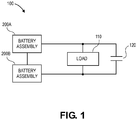
- FIG. 1 illustrates a schematic view of a battery system 100, according to an implementation.
- the battery system 100 may include one or more battery assemblies (two are shown: 200A, 200B) that are configured to be connected to, and to provide electrical power to, a load 110.
- the load 110 may be or include a constant-power load, a resistive load, a reactive load, or a combination thereof.
- the load 110 may be or include a resistive heater, an inductive heater, a motor controller, switch mode power supplies, a larger capacitor bank used as voltage bus support, or the like.
- the battery assemblies 200A, 200B may also be connected to a capacitor (e.g., bus capacitance) 120.
- the capacitor 120 may be connected in parallel with the load 110.
- the capacitor 120 may be or include a primary bus support capacitance sized to manage a bus voltage ripple produced by large transient loads (e.g., the load 110 and/or the capacitor 120).
- a bus voltage ripple may be produced by a large transient load when providing high bandwidth (e.g., >4Hz) motor speed control with high load inertia acceleration and de-acceleration present large current transients to the primary voltage bus. Without significant bulk capacitance, the bus voltage ripple will become unacceptable.
- the capacitor 120 may have a capacitance value from about 1000 ⁇ F to about 5000 ⁇ F or preferably about 2000 ⁇ F to about 4000 ⁇ F, which may reduce the bus voltage ripple.
- the capacitance value may be selected to be proportional to the voltage minimum and the maximum transient limit.
- the DC bus has a physical extent, and that forces inductance into the circuit between the DC voltage source and the various loads. When the loads rapidly change their current demand from the bus, without capacitance, the bus voltage may rise or fall uncontrollably, potentially resulting in overvoltage or under voltage condition that would be detrimental to the load electronics.
- the magnitude of the support capacitance limits the rise and fall of the bus voltage to a value within the operating range of the load electronics. The value is proportional to the inductance between the source and load and the maximum current change.
- the number of battery assemblies may vary depending upon the properties of the load 110 and the properties of the capacitor 120. As shown, the battery assemblies 200A, 200B are connected in series. In another implementation, the battery assemblies 200A, 200B may be connected in parallel, or a combination of series and parallel, depending upon the properties of the load 110, the properties of the capacitor 120, the number and properties of the battery assemblies 200A, 200B, or a combination thereof.
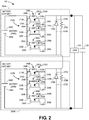
- the first battery assembly 200A may include a first circuit 202A and a first battery 204A.
- the first circuit 202A is configured to connect to the first battery 204A. As described in greater detail below, the first circuit 202A may be used to turn the first battery 204A on and off in a controlled manner.
- the first circuit 202A is configured to operate between about 28 V and about 64 V and between about 100 A and about 200 A.
- the first circuit 202A may include one or more switches (three are shown: 210A, 220A, 230A).
- the switches 210A, 220A, 230A may be or include field-effect transistors (FETs) such as MOSFETs. More particularly, the first switch 210A may include a source 212A, a gate 214A, and a drain 216A, the second switch 220A may include a source 222A, a gate 224A, and a drain 226A, and the third switch 230A may include a source 232A, a gate 234A, and a drain 236A.
- the switches 210A, 220A, 230A may be connected in parallel with one another.
- the sources 212A, 222A, 232A may be connected together, and the drains 216A, 226A, 236A may be connected together.
- the switches 210A, 220A, 230A may have an isolation voltage from about 2000 volts to about 2500 volts.
- Each switch 210A, 220A, 230A may have a diode 240A, 250A, 260A connected thereto.
- the first diode 240A may have an anode 242A and a cathode 244A
- the second diode 250A may have an anode 252A and a cathode 254A
- the third diode 260A may have an anode 262A and a cathode 264A.
- the diodes 240A, 250A, 260A may be connected in parallel with one another.
- the anodes 242A, 252A, 262A may be connected together
- the cathodes 244A, 254A, 264A may be connected together.
- the switches 210A, 220A, 230A may be connected in parallel with the diodes 240A, 250A, 260A.
- the source 212A of the first switch 210A may be connected to the anode 242A of the first diode 240A
- the source 222A of the second switch 220A may be connected to the anode 252A of the second diode 250A
- the source 232A of the third switch 230A may be connected to the anode 262A of the third diode 260A.
- the sources 212A, 222A, 232A and the anodes 242A, 252A, 262A may be connected together, and the drains 216A, 226A, 236A and the cathodes 244A, 254A, 264A may be connected together.
- Each switch 210A, 220A, 230A may have one or more resistors connected thereto. More particularly, the gate 214A of the first switch 210A may have a first resistor 218A connected thereto, the gate 224A of the second switch 220A may have a second resistor 228A connected thereto, and the gate 234A of the third switch 230A may have a third resistor 238A connected thereto.
- the resistors 218A, 228A, 238A may be connected in parallel with one another. For example, the resistors 218A, 228A, 238A may be connected to one another, to the sources 212A, 222A, 232A, and/or to the anodes 242A, 252A, 262A.
- the resistors 218A, 228A, 238A may have resistance values from about 10 k ⁇ to about 100 k ⁇ .
- the first circuit 202A may also include a fourth diode 270A that is connected to the switches 210A, 220A, 230A and/or to the diodes 240A, 250A, 260A. More particularly, a cathode 274A of the fourth diode 270A may be connected to the sources 212A, 222A, 232A and to the anodes 242A, 252A, 262A.
- the first circuit 202A may also include a fourth resistor 278A that is connected in parallel with the fourth diode 270A. More particularly, a first side of the fourth resistor 278A may be connected to the sources 212A, 222A, 232A, to the anodes 242A, 252A, 262A, and to the cathode 274A.
- the fourth resistor 278A may have a resistance value from about 10 k ⁇ to about 100 k ⁇ .
- the first circuit 202A may be connected to the first battery 204A. More particularly, the drains 216A, 226A, 236A and/or the cathodes 244A, 254A, 264A may be connected to a positive terminal 206A of the first battery 204A.
- the anode 272A of the fourth diode 270A and/or a second side of the fourth resistor 278A may be connected to a negative terminal 208A of the first battery 204A.
- the first circuit 202A may be configured to connect to the load 110 and/or the capacitor 120. More particularly, the sources 212A, 222A, 232A, the anodes 242A, 252A, 262A, the cathode 274A, the resistors 218A, 228A, 238A, 278A, or a combination thereof may be connected to a first side of the load 110 and/or a first side of the capacitor 120.
- the second battery assembly 200B may be similar to the first battery assembly 200A; however, in other implementations, it may be different.
- the second battery assembly 200B may include a second circuit 202B and a second battery 204B.
- the second circuit 202B is configured to connect to the second battery 204B.
- the second circuit 202B may be similar to the first circuit 202A; however, in other implementations, it may be different.
- the second circuit 202B is configured to operate between about 28 V and about 64 V and between about 100 A and about 200 A.
- the second circuit 202B may include a first switch 210B, a second switch 220B, and a third switch 230B.
- the first switch 210B may include a source 212B, a gate 214B, and a drain 216B.
- the second switch 220B may include a source 222B, a gate 224B, and a drain 226B.
- the third switch 230B may include a source 232B, a gate 234B, and a drain 236B.
- the second circuit 202B may also include a first diode 240B, a second diode 250B, a third diode 260B, and a fourth diode 270B.
- the first diode 240B may include an anode 242B and a cathode 244B.
- the second diode 250B may include an anode 252B and a cathode 254B.
- the third diode 260B may include an anode 262B and a cathode 264B.
- the fourth diode 270B may include an anode 272B and a cathode 274B.
- the second circuit 202B may also include resistors 218B, 228B, 238B, 278B.
- the second circuit 202B may be configured to connect to the load 110 and/or the capacitor 120. More particularly, the anode 272B of the fourth diode 270B and/or second side the resistor 278B may be connected to a second side of the load 110 and/or a second side of the capacitor 120.
- the first battery assembly 200A may be connected to the second battery assembly 200B.
- the anode 272A, the fourth resistor 278A, and/or the negative terminal 208A of the first battery 204A may be connected to the sources 212B, 222B, 232B, the anodes 242B, 252B, 262B, the resistors 218B, 228B, 238B, 278A, the cathode 274B, or a combination thereof.
- two battery assemblies 200A, 200B are shown in Figures 1 and 2 for simplicity; however, one or more additional battery assemblies may be added to the system 100 (e.g., in series) depending at least partially upon the size and/or properties of the load 110, the size and/or properties of the capacitor 120, the size, number, and properties of the battery assemblies 200A, 200B, or a combination thereof.
- Figure 3 illustrates a flowchart of a method 300 for controlling the battery system 100, according to an implementation. More particularly, the method 300 may be used to control the first circuit 202A in the first battery assembly 200A, the second circuit 202B in the second battery assembly 200B, or a combination thereof. An illustrative order of the method 300 is provided below; however, one or more steps of the method 300 may be performed in a different order, repeated, or omitted altogether.
- the method 300 may include connecting the first circuit 202A to the first battery 204A to produce the first battery assembly 200A, as at step 302.
- connecting the first circuit 202A to the first battery 204A may include connecting the drains 216A, 226A, 236A, the cathodes 244A, 254A, 264A, or a combination thereof to the positive terminal 206A of the first battery 204A.
- Connecting the first circuit 202A to the first battery 204A may also include connecting the anode 272A and/or the resistor 278A to the negative terminal 208A of the first battery 204A.
- the method 300 may also include connecting the second circuit 202B to the second battery 204B to produce the second battery assembly 200B, as at step 304.
- connecting the second circuit 202B to the second battery 204B may include connecting the drains 216B, 226B, 236B, the cathodes 244B, 254B, 264B, or a combination thereof to the positive terminal 206B of the second battery 204B.
- Connecting the second circuit 202B to the second battery 204B may also include connecting the anode 272B and/or the resistor 278B to the negative terminal 208B of the second battery 204B.
- the method 300 may also include connecting the first battery assembly 200A to the second battery assembly 200B, as at step 306. This may include connecting the negative terminal 208A, the anode 272A, the resistor 278A, or a combination thereof of the first battery assembly 200A to the sources 212B, 222B, 232B, the anodes 242B, 252B, 262B, the cathode 274B, the resistors 218A, 228A, 238A, 278A, or a combination thereof of the second battery assembly 200B.
- the method 300 may also include connecting the first battery assembly 200A to the load 110, the capacitor 120, or both, as at step 308. This may include connecting the sources 212A, 222A, 232A, the anodes 242A, 252A, 262A, the cathode 274A, the resistors 218A, 228A, 238A, 278A, or a combination thereof of the first battery assembly 200A to a first side of the load 110, a first side of the capacitor 120, or both.
- the method 300 may also include connecting the second battery assembly 200B to the load 110, the capacitor 120, or both, as at step 310. This may include connecting the anode 272B, the resistor 278B, the negative terminal 208B of the second battery 204B or a combination thereof of the second battery assembly 200B to a second side of the load 110, a second side of the capacitor 120, or both.
- the method 300 may also include switching the first battery assembly 200A on, as at step 312. This may include switching the first battery 204A on using the first circuit 202A. For example, this may include switching the switches 210A, 220A, 230A into a first (e.g., on) state. This may generate a voltage across the load 110 and/or the capacitor 120 that causes an electrical current to flow into, through, and/or across the load 110 and/or the capacitor 120. In an example, the first battery 204A may generate about 45.1 V and about 300A.
- the method 300 may also include switching the second battery assembly 200B on, as at step 314.
- the second battery assembly 200B may be switched on after the first battery assembly 200A is switched on.
- the order may be reversed, and the second battery assembly 200B may be switched on prior to the first battery assembly 200A being switched on.
- Switching the second battery assembly 200B on may include switching the second battery 204B on using the second circuit 202B.
- this may include switching the switches 210B, 220B, 230B into the first (e.g., on) state. This may generate a voltage across the load 110 and/or the capacitor 120 that causes an electrical current to flow into, through, and/or across the load 110 and/or the capacitor 120.
- the second battery 204B may also generate about 45.1 V and about 300A.
- One or more additional battery assemblies may also be switched on sequentially.
- ten battery assemblies e.g., 200A, 200B, etc.
- ten battery assemblies may be connected in series and turned on sequentially to generate a voltage of about 450 V.
- standard charging systems may be used, no unsafe voltage is present, and an isolation fault presents only low voltage.
- a conventional battery system may include ten battery assemblies that may be connected in parallel and turned on simultaneously. Each of the battery assemblies in the conventional battery system may generate about 426 V and about 30 A. Thus, the conventional battery system may generate about the same voltage and current; however, application-specific charging systems may be used, special safety and handling procedures should be used due to the higher voltages and currents, and an isolation fault presents high (e.g., unsafe) voltage.
- low voltage and/or safe voltage refers to less than or equal to about 50 V
- high-voltage and/or unsafe voltage refers to greater than or equal to about 100 V.
- the battery system 100 may operate without a pre-charging circuit because the electrical power gradually builds due to the sequential switching of the battery assemblies 200A, 200B.
- the total energy required to charge the bus capacitance e.g., capacitor 120
- Pre-charge circuits extend the time that energy is allowed to build-up, reducing the load on the switching elements (e.g., switches 210A, 220A, 230A).
- Sequencing the batteries 204A, 204B on one after another performs the same function as a pre-charge circuit without the addition of a pre-charge circuit, dissipative elements, and control functions. If a pre-charge circuit fails, this may cascade failures to the primary battery disconnections, resulting in a high-voltage failure in the battery system 100.
- Using only a small fraction of the total voltage in each step e.g., when turning on each battery 204A, 204B) reduces the total energy of the charge step to -1%, allowing the pre-charging circuits to be omitted. This low energy is well within the safe operating area of the solid state switches (e.g., switches 210A, 220A, 230A) in this battery system 100.
- the method 300 may also include switching the first battery assembly 200A off, as at step 316. This may include switching the first battery 204A off using the first circuit 202A. For example, this may include switching the switches 210A, 220A, 230A into a second (e.g., off) state.
- This may include switching the switches 210A, 220A, 230A into a second (e.g., off) state.
- the method 300 may also include switching the second battery assembly 200B off, as at step 318. This may include switching the second battery 204B off using the second circuit 202B.
- the second circuit 202B may switch the second battery 204B off by switching the switches 210B, 220B, 230B into the second (e.g., off) state.
- the second battery assembly 200B may be switched off after the first battery assembly 200A is switched off.
- the order may be reversed, and the second battery assembly 200B may be switched off prior to the first battery assembly 200A being switched off.
- the electrical current may be diverted through the diode(s) 270A, 270B. This may have the benefit of eliminating inductive kick back voltage. This voltage occurs when the rate of change of the electrical current is high (e.g., greater than about 50 A, greater than about 100 A, greater than about 200 A, etc.), by allowing the current to flow through the diode the rate of change reduces slowly because it is not blocked as in typical applications.
- the terms “inner” and “outer”; “up” and “down”; “upper” and “lower”; “upward” and “downward”; “upstream” and “downstream”; “above” and “below”; “inward” and “outward”; and other like terms as used herein refer to relative positions to one another and are not intended to denote a particular direction or spatial orientation.
- the terms “couple,” “coupled,” “connect,” “connection,” “connected,” “in connection with,” and “connecting” refer to “in direct connection with” or “in connection with via one or more intermediate elements or members.”
- the term "at least one of A and B" with respect to a listing of items such as, for example, A and B, means A alone, B alone, or A and B.
- Those skilled in the art will recognize that these and other variations are possible.
- the terms “including,” “includes,” “having,” “has,” “with,” or variants thereof are used in either the detailed description and the claims, such terms are intended to be inclusive in a manner similar to the term “comprising.”
- the term “about” indicates that the value listed may be somewhat altered, as long as the alteration does not result in nonconformance of the process or structure to the intended purpose described herein.
- “exemplary” indicates the description is used as an example, rather than implying that it is an ideal.
Landscapes
- Engineering & Computer Science (AREA)
- Power Engineering (AREA)
- Manufacturing & Machinery (AREA)
- Chemical & Material Sciences (AREA)
- Chemical Kinetics & Catalysis (AREA)
- Electrochemistry (AREA)
- General Chemical & Material Sciences (AREA)
- Microelectronics & Electronic Packaging (AREA)
- Charge And Discharge Circuits For Batteries Or The Like (AREA)
Abstract
Description
- The present disclosure is directed to systems and methods for controlling a high-voltage battery system. More particularly, the present disclosure is directed to systems and methods for safely turning a high-voltage battery system on and off. Currently, high-voltage battery systems are built around a single high-voltage core with solid state or mechanical disconnects built to withstand the high voltages and high currents. Due to the high voltage of the core, manufacturing conventional battery systems requires a unique system to assembly the core, handle the core safely, install the core into the battery, and connect to and monitor the individual cells for a balanced operation.
- A circuit for controlling a battery is disclosed. The circuit includes a switch. The switch includes a source, a gate, and a drain. The drain of the switch is configured to be connected to a positive terminal of the battery. The circuit also includes a first diode. The first diode includes an anode and a cathode. The anode of the first diode is connected to the source of the switch. The cathode of the first diode is connected to the drain of the switch and is configured to be connected to the positive terminal of the battery. The circuit also includes a second diode. The second diode includes an anode and a cathode. The anode of the second diode is configured to be connected to a negative terminal of the battery. The cathode of the second diode is connected to the source of the switch and to the anode of the first diode. The circuit is configured to switch the battery on and off.
- A battery system is also disclosed. The battery system includes a first circuit. The first circuit includes a first switch having a source, a gate, and a drain. The first circuit also includes a second switch having a source, a gate, and a drain. The first circuit also includes a third switch having a source, a gate, and a drain. The sources of the first, second, and third switches are connected to one another, and the drains of the first, second, and third switches are connected to one another, such that the first, second, and third switches are in parallel with one another. The first circuit also includes a first diode having an anode and a cathode. The anode of the first diode is connected to the source of the first switch, and the cathode of the first diode is connected to the drain of the first switch. The first circuit also includes a second diode having an anode and a cathode. The anode of the second diode is connected to the source of the second switch, and the cathode of the second diode is connected to the drain of the second switch. The first circuit also includes a third diode having an anode and a cathode. The anode of the third diode is connected to the source of the third switch, and the cathode of the third diode is connected to the drain of the third switch. The first circuit also includes a fourth diode having an anode and a cathode. The cathode of the fourth diode is connected to the sources of the first, second, and third switches and to the anodes of the first, second, and third diodes. The battery system also includes a first battery having a positive terminal and a negative terminal. The positive terminal is configured to be connected to the drains of the first, second, and third switches, the cathodes of the first, second, and third diodes, or a combination thereof. The negative terminal is configured to be connected to the anode of the fourth diode. The first circuit is configured to turn the first battery on and off.
- A method is also disclosed. The method includes connecting a first circuit to a first battery to produce a first battery assembly. The first circuit includes a switch having a source, a gate, and a drain. Connecting the first circuit to the first battery includes connecting the drain of the switch of the first circuit to a positive terminal of the first battery. The first circuit also includes a first diode having an anode and a cathode. The anode of the first diode of the first circuit is connected to the source of the switch of the first circuit. The cathode of the first diode of the first circuit is connected to the drain of the switch of the first circuit. Connecting the first circuit to the first battery includes connecting the cathode of the first diode of the first circuit to the positive terminal of the first battery. The first circuit also includes a second diode having an anode and a cathode. Connecting the first circuit to the first battery includes connecting the anode of the second diode of the first circuit to a negative terminal of the first battery. The cathode of the second diode of the first circuit is connected to the source of the switch of the first circuit and to the anode of the first diode of the first circuit. The method also includes connecting a second circuit to a second battery to produce a second battery assembly. The second circuit includes a switch having a source, a gate, and a drain. Connecting the second circuit to the second battery includes connecting the drain of the switch of the second circuit to a positive terminal of the second battery. The second circuit also includes a first diode having an anode and a cathode. The anode of the first diode of the second circuit is connected to the source of the switch of the second circuit. The cathode of the first diode of the second circuit is connected to the drain of the switch of the second circuit. Connecting the second circuit to the second battery includes connecting the cathode of the first diode of the second circuit to the positive terminal of the second battery. The second circuit also includes a second diode having an anode and a cathode. Connecting the second circuit to the second battery includes connecting the anode of the second diode of the second circuit to a negative terminal of the second battery. The cathode of the second diode of the second circuit is connected to the source of the switch of the second circuit and to the anode of the first diode of the second circuit. The method also includes connecting the first battery assembly to the second battery assembly in series. The method also includes connecting the first battery assembly to a load and to a capacitor. The load and the capacitor are connected in parallel. The method also includes connecting the second battery assembly to the load and to the capacitor. The method also includes switching the first battery assembly on. The method also includes switching the second battery assembly on before or after the first battery assembly is switched on.
- The accompanying drawings, which are incorporated in and constitute a part of this specification, illustrate aspects of the present teachings and together with the description, serve to explain the principles of the present teachings.
-
Figure 1 illustrates a schematic view of a battery system, according to an implementation. -
Figure 2 illustrates a more detailed schematic view of the battery system, according to an implementation. -
Figure 3 illustrates a flowchart of a method for controlling the battery system, according to an implementation. - It should be noted that some details of the figures have been simplified and are drawn to facilitate understanding rather than to maintain strict structural accuracy, detail, and scale.
- Reference will now be made in detail to the present teachings, examples of which are illustrated in the accompanying drawings. In the drawings, like reference numerals have been used throughout to designate identical elements. In the following description, reference is made to the accompanying drawings that form a part thereof, and in which is shown by way of illustration specific examples of practicing the present teachings. The following description is, therefore, merely exemplary.
- The present disclosure is directed to a system and method for controlling a high-voltage battery system. The system and method include a plurality of batteries that are turned on in sequence, which causes the power supplied to a load to gradually increase, allowing a conventional pre-charging circuit to be omitted. In addition, a diode may be connected in parallel with each battery, which facilitates turning the batteries on one at a time. This system and method represents a reduction in energy during the electrical current inrush as the batteries are turned on. When the high-voltage battery system is turned off, the electrical current may stop flowing through the batteries and shunt to the diodes. As the inductive current is supported by the diode, the batteries can safely be turned off.
-
Figure 1 illustrates a schematic view of abattery system 100, according to an implementation. Thebattery system 100 may include one or more battery assemblies (two are shown: 200A, 200B) that are configured to be connected to, and to provide electrical power to, aload 110. Theload 110 may be or include a constant-power load, a resistive load, a reactive load, or a combination thereof. For example, theload 110 may be or include a resistive heater, an inductive heater, a motor controller, switch mode power supplies, a larger capacitor bank used as voltage bus support, or the like. - In at least one implementation, the
battery assemblies capacitor 120 may be connected in parallel with theload 110. Thecapacitor 120 may be or include a primary bus support capacitance sized to manage a bus voltage ripple produced by large transient loads (e.g., theload 110 and/or the capacitor 120). For example, a bus voltage ripple may be produced by a large transient load when providing high bandwidth (e.g., >4Hz) motor speed control with high load inertia acceleration and de-acceleration present large current transients to the primary voltage bus. Without significant bulk capacitance, the bus voltage ripple will become unacceptable. Thecapacitor 120 may have a capacitance value from about 1000 µF to about 5000 µF or preferably about 2000 µF to about 4000 µF, which may reduce the bus voltage ripple. The capacitance value may be selected to be proportional to the voltage minimum and the maximum transient limit. The DC bus has a physical extent, and that forces inductance into the circuit between the DC voltage source and the various loads. When the loads rapidly change their current demand from the bus, without capacitance, the bus voltage may rise or fall uncontrollably, potentially resulting in overvoltage or under voltage condition that would be detrimental to the load electronics. The magnitude of the support capacitance limits the rise and fall of the bus voltage to a value within the operating range of the load electronics. The value is proportional to the inductance between the source and load and the maximum current change. - Although two
battery assemblies load 110 and the properties of thecapacitor 120. As shown, thebattery assemblies battery assemblies load 110, the properties of thecapacitor 120, the number and properties of thebattery assemblies -
Figure 2 illustrates a more detailed schematic view of thebattery system 100, according to an implementation. Thefirst battery assembly 200A may include afirst circuit 202A and afirst battery 204A. Thefirst circuit 202A is configured to connect to thefirst battery 204A. As described in greater detail below, thefirst circuit 202A may be used to turn thefirst battery 204A on and off in a controlled manner. Thefirst circuit 202A is configured to operate between about 28 V and about 64 V and between about 100 A and about 200 A. - The
first circuit 202A may include one or more switches (three are shown: 210A, 220A, 230A). Theswitches first switch 210A may include asource 212A, agate 214A, and adrain 216A, thesecond switch 220A may include asource 222A, agate 224A, and adrain 226A, and thethird switch 230A may include asource 232A, agate 234A, and adrain 236A. Theswitches sources drains switches - Each
switch diode first diode 240A may have ananode 242A and acathode 244A, thesecond diode 250A may have ananode 252A and acathode 254A, and thethird diode 260A may have ananode 262A and acathode 264A. Thediodes anodes cathodes - In the implementation shown, the
switches diodes source 212A of thefirst switch 210A may be connected to theanode 242A of thefirst diode 240A, thesource 222A of thesecond switch 220A may be connected to theanode 252A of thesecond diode 250A, and thesource 232A of thethird switch 230A may be connected to theanode 262A of thethird diode 260A. As shown, thesources anodes drains cathodes - Each
switch gate 214A of thefirst switch 210A may have afirst resistor 218A connected thereto, thegate 224A of thesecond switch 220A may have asecond resistor 228A connected thereto, and thegate 234A of thethird switch 230A may have athird resistor 238A connected thereto. Theresistors resistors sources anodes resistors - The
first circuit 202A may also include afourth diode 270A that is connected to theswitches diodes cathode 274A of thefourth diode 270A may be connected to thesources anodes - The
first circuit 202A may also include afourth resistor 278A that is connected in parallel with thefourth diode 270A. More particularly, a first side of thefourth resistor 278A may be connected to thesources anodes cathode 274A. Thefourth resistor 278A may have a resistance value from about 10 kΩ to about 100 kΩ. - As mentioned above, the
first circuit 202A may be connected to thefirst battery 204A. More particularly, thedrains cathodes positive terminal 206A of thefirst battery 204A. Theanode 272A of thefourth diode 270A and/or a second side of thefourth resistor 278A may be connected to anegative terminal 208A of thefirst battery 204A. - The
first circuit 202A may be configured to connect to theload 110 and/or thecapacitor 120. More particularly, thesources anodes cathode 274A, theresistors load 110 and/or a first side of thecapacitor 120. - As shown, the
second battery assembly 200B may be similar to thefirst battery assembly 200A; however, in other implementations, it may be different. Thesecond battery assembly 200B may include asecond circuit 202B and asecond battery 204B. Thesecond circuit 202B is configured to connect to thesecond battery 204B. Thesecond circuit 202B may be similar to thefirst circuit 202A; however, in other implementations, it may be different. Thesecond circuit 202B is configured to operate between about 28 V and about 64 V and between about 100 A and about 200 A. - As shown, the
second circuit 202B may include a first switch 210B, asecond switch 220B, and athird switch 230B. The first switch 210B may include asource 212B, agate 214B, and adrain 216B. Thesecond switch 220B may include asource 222B, agate 224B, and adrain 226B. Thethird switch 230B may include asource 232B, agate 234B, and adrain 236B. - The
second circuit 202B may also include afirst diode 240B, asecond diode 250B, athird diode 260B, and afourth diode 270B. Thefirst diode 240B may include an anode 242B and acathode 244B. Thesecond diode 250B may include ananode 252B and acathode 254B. Thethird diode 260B may include ananode 262B and acathode 264B. Thefourth diode 270B may include ananode 272B and acathode 274B. Thesecond circuit 202B may also includeresistors - The
second circuit 202B may be configured to connect to theload 110 and/or thecapacitor 120. More particularly, theanode 272B of thefourth diode 270B and/or second side theresistor 278B may be connected to a second side of theload 110 and/or a second side of thecapacitor 120. - As mentioned above, the
first battery assembly 200A may be connected to thesecond battery assembly 200B. For example, theanode 272A, thefourth resistor 278A, and/or thenegative terminal 208A of thefirst battery 204A may be connected to thesources anodes resistors cathode 274B, or a combination thereof. As mentioned above, twobattery assemblies Figures 1 and2 for simplicity; however, one or more additional battery assemblies may be added to the system 100 (e.g., in series) depending at least partially upon the size and/or properties of theload 110, the size and/or properties of thecapacitor 120, the size, number, and properties of thebattery assemblies -
Figure 3 illustrates a flowchart of amethod 300 for controlling thebattery system 100, according to an implementation. More particularly, themethod 300 may be used to control thefirst circuit 202A in thefirst battery assembly 200A, thesecond circuit 202B in thesecond battery assembly 200B, or a combination thereof. An illustrative order of themethod 300 is provided below; however, one or more steps of themethod 300 may be performed in a different order, repeated, or omitted altogether. - The
method 300 may include connecting thefirst circuit 202A to thefirst battery 204A to produce thefirst battery assembly 200A, as atstep 302. As mentioned above, connecting thefirst circuit 202A to thefirst battery 204A may include connecting thedrains cathodes positive terminal 206A of thefirst battery 204A. Connecting thefirst circuit 202A to thefirst battery 204A may also include connecting theanode 272A and/or theresistor 278A to thenegative terminal 208A of thefirst battery 204A. - The
method 300 may also include connecting thesecond circuit 202B to thesecond battery 204B to produce thesecond battery assembly 200B, as atstep 304. As mentioned above, connecting thesecond circuit 202B to thesecond battery 204B may include connecting thedrains cathodes second battery 204B. Connecting thesecond circuit 202B to thesecond battery 204B may also include connecting theanode 272B and/or theresistor 278B to thenegative terminal 208B of thesecond battery 204B. - The
method 300 may also include connecting thefirst battery assembly 200A to thesecond battery assembly 200B, as atstep 306. This may include connecting thenegative terminal 208A, theanode 272A, theresistor 278A, or a combination thereof of thefirst battery assembly 200A to thesources anodes cathode 274B, theresistors second battery assembly 200B. - The
method 300 may also include connecting thefirst battery assembly 200A to theload 110, thecapacitor 120, or both, as atstep 308. This may include connecting thesources anodes cathode 274A, theresistors first battery assembly 200A to a first side of theload 110, a first side of thecapacitor 120, or both. - The
method 300 may also include connecting thesecond battery assembly 200B to theload 110, thecapacitor 120, or both, as atstep 310. This may include connecting theanode 272B, theresistor 278B, thenegative terminal 208B of thesecond battery 204B or a combination thereof of thesecond battery assembly 200B to a second side of theload 110, a second side of thecapacitor 120, or both. - The
method 300 may also include switching thefirst battery assembly 200A on, as atstep 312. This may include switching thefirst battery 204A on using thefirst circuit 202A. For example, this may include switching theswitches load 110 and/or thecapacitor 120 that causes an electrical current to flow into, through, and/or across theload 110 and/or thecapacitor 120. In an example, thefirst battery 204A may generate about 45.1 V and about 300A. - The
method 300 may also include switching thesecond battery assembly 200B on, as atstep 314. Thesecond battery assembly 200B may be switched on after thefirst battery assembly 200A is switched on. However, in another implementation, the order may be reversed, and thesecond battery assembly 200B may be switched on prior to thefirst battery assembly 200A being switched on. Switching thesecond battery assembly 200B on may include switching thesecond battery 204B on using thesecond circuit 202B. For example, this may include switching theswitches load 110 and/or thecapacitor 120 that causes an electrical current to flow into, through, and/or across theload 110 and/or thecapacitor 120. In an example, thesecond battery 204B may also generate about 45.1 V and about 300A. - One or more additional battery assemblies may also be switched on sequentially. Continuing with the example above, ten battery assemblies (e.g., 200A, 200B, etc.) may be connected in series and turned on sequentially to generate a voltage of about 450 V. Thus, standard charging systems may be used, no unsafe voltage is present, and an isolation fault presents only low voltage.
- In contrast, a conventional battery system may include ten battery assemblies that may be connected in parallel and turned on simultaneously. Each of the battery assemblies in the conventional battery system may generate about 426 V and about 30 A. Thus, the conventional battery system may generate about the same voltage and current; however, application-specific charging systems may be used, special safety and handling procedures should be used due to the higher voltages and currents, and an isolation fault presents high (e.g., unsafe) voltage. As used herein, low voltage and/or safe voltage refers to less than or equal to about 50 V, and high-voltage and/or unsafe voltage refers to greater than or equal to about 100 V.
- In addition, while the conventional battery system may require a pre-charging circuit to limit the rate at which the electrical current is introduced to the switch(es), the
battery system 100 may operate without a pre-charging circuit because the electrical power gradually builds due to the sequential switching of thebattery assemblies capacitor 120. Pre-charge circuits extend the time that energy is allowed to build-up, reducing the load on the switching elements (e.g., switches 210A, 220A, 230A). Sequencing thebatteries battery system 100. Using only a small fraction of the total voltage in each step (e.g., when turning on eachbattery battery system 100. - The
method 300 may also include switching thefirst battery assembly 200A off, as atstep 316. This may include switching thefirst battery 204A off using thefirst circuit 202A. For example, this may include switching theswitches - The
method 300 may also include switching thesecond battery assembly 200B off, as atstep 318. This may include switching thesecond battery 204B off using thesecond circuit 202B. For example, thesecond circuit 202B may switch thesecond battery 204B off by switching theswitches second battery assembly 200B may be switched off after thefirst battery assembly 200A is switched off. However, in another implementation, the order may be reversed, and thesecond battery assembly 200B may be switched off prior to thefirst battery assembly 200A being switched off. - When the
first battery assembly 200A and/or thesecond battery assembly 200B is/are switched off, at least a portion of the electrical current may be diverted through the diode(s) 270A, 270B. This may have the benefit of eliminating inductive kick back voltage. This voltage occurs when the rate of change of the electrical current is high (e.g., greater than about 50 A, greater than about 100 A, greater than about 200 A, etc.), by allowing the current to flow through the diode the rate of change reduces slowly because it is not blocked as in typical applications. - Further, the disclosure comprises the following examples, whereby the scope of protection is provided by the claims.
- Example 1. A circuit for controlling a battery, the circuit comprising: a switch comprising a source, a gate, and a drain, wherein the drain of the switch is configured to be connected to a positive terminal of the battery; a first diode comprising an anode and a cathode, wherein the anode of the first diode is connected to the source of the switch, and wherein the cathode of the first diode is connected to the drain of the switch and is configured to be connected to the positive terminal of the battery; and a second diode comprising an anode and a cathode, wherein the anode of the second diode is configured to be connected to a negative terminal of the battery, wherein the cathode of the second diode is connected to the source of the switch and to the anode of the first diode, and wherein the circuit is configured to switch the battery on and off.
- Example 2. The circuit of example 1, further comprising a first resistor comprising a first end connected to the gate of the switch, and a second end connected to the source of the switch, the anode of the first diode, and the cathode of the second diode, wherein the first resistor has a resistance from about 10 kΩ to about 100 kΩ.
- Example 3. The circuit of example 2, further comprising a second resistor in parallel with the second diode, wherein the second resistor has a resistance from about 10 kΩ to about 100 kΩ.
- Example 4. The circuit of example 3, wherein the circuit is configured to operate between about 28 volts and about 64 volts and between about 100 amps and about 200 amps.
- Example 5. The circuit of any of examples 1-4, wherein the circuit is configured to switch the battery on without using a pre-charging circuit.
- Example 6. A battery system, comprising: a first circuit comprising: a first switch comprising a source, a gate, and a drain; a second switch comprising a source, a gate, and a drain; a third switch comprising a source, a gate, and a drain, wherein the sources of the first, second, and third switches are connected to one another, and the drains of the first, second, and third switches are connected to one another, such that the first, second, and third switches are in parallel with one another; a first diode comprising an anode and a cathode, wherein the anode of the first diode is connected to the source of the first switch, and wherein the cathode of the first diode is connected to the drain of the first switch; a second diode comprising an anode and a cathode, wherein the anode of the second diode is connected to the source of the second switch, and wherein the cathode of the second diode is connected to the drain of the second switch; a third diode comprising an anode and a cathode, wherein the anode of the third diode is connected to the source of the third switch, and wherein the cathode of the third diode is connected to the drain of the third switch; and a fourth diode comprising an anode and a cathode, wherein the cathode of the fourth diode is connected to the sources of the first, second, and third switches and to the anodes of the first, second, and third diodes; and a first battery comprising a positive terminal and a negative terminal, wherein the positive terminal is configured to be connected to the drains of the first, second, and third switches, the cathodes of the first, second, and third diodes, or a combination thereof, wherein the negative terminal is configured to be connected to the anode of the fourth diode, and wherein the first circuit is configured to turn the first battery on and off.
- Example 7. The battery system of example 6, further comprising a first resistor comprising a first end connected to the gate of the first switch, and a second end connected to the source of the first switch, the anode of the first diode, and the cathode of the fourth diode, wherein the first resistor has a resistance from about 10 kΩ to about 100 kΩ.
- Example 8. The battery system of example 7, further comprising: a second resistor comprising a first end connected to the gate of the second switch, and a second end connected to the source of the second switch, the anode of the second diode, and the cathode of the fourth diode, wherein the second resistor has a resistance from about 10 kΩ to about 100 kΩ; and a third resistor comprising a first end connected to the gate of the third switch, and a second end connected to the source of the third switch, the anode of the third diode, and the cathode of the fourth diode, wherein the third resistor has a resistance from about 10 kΩ to about 100 kΩ.
- Example 9. The battery system of example 8, further comprising a fourth resistor comprising a first end and a second end, wherein the first end of the fourth resistor is connected to the sources of the first, second, and third switches, to the anodes of the first, second, and third diodes, and to the cathode of the fourth diode, wherein the second end of the fourth resistor is connected to the anode of the fourth diode and is configured to be connected to the negative terminal of the battery, and wherein the fourth resistor has a resistance from about 10 kΩ to about 100 kΩ.
- Example 10. The battery system of example 9, wherein the first circuit is configured to operate between about 28 volts and about 64 volts and between about 300 amps and about 600 amps.
- Example 11. The battery system of example 9, wherein each of the first, second, and third switches comprises an isolation voltage from about 2000 volts to about 2500 volts.
- Example 12. The battery system of any of examples 6-11, further comprising: a second circuit connected to the first circuit, the second circuit comprising: a first switch comprising a source, a gate, and a drain; a second switch comprising a source, a gate, and a drain; a third switch comprising a source, a gate, and a drain, wherein the sources of the first, second, and third switches of the second circuit are connected to one another, and the drains of the first, second, and third switches of the second circuit are connected to one another, such that the first, second, and third switches of the second circuit are in parallel with one another; a first diode comprising an anode and a cathode, wherein the anode of the first diode of the second circuit is connected to the source of the first switch of the second circuit, and wherein the cathode of the first diode of the second circuit is connected to the drain of the first switch of the second circuit; a second diode comprising an anode and a cathode, wherein the anode of the second diode of the second circuit is connected to the source of the second switch of the second circuit, and wherein the cathode of the second diode of the second circuit is connected to the drain of the second switch of the second circuit; a third diode comprising an anode and a cathode, wherein the anode of the third diode of the second circuit is connected to the source of the third switch of the second circuit, and wherein the cathode of the third diode of the second circuit is connected to the drain of the third switch of the second circuit; and a fourth diode comprising an anode and a cathode, wherein the cathode of the fourth diode of the second circuit is connected to the sources of the first, second, and third switches of the second circuit and to the anodes of the first, second, and third diodes of the second circuit; and a second battery comprising a positive terminal and a negative terminal, wherein the positive terminal of the second battery is configured to be connected to the drains of the first, second, and third switches of the second circuit, the cathodes of the first, second, and third diodes of the second circuit, or a combination thereof, wherein the negative terminal of the second battery is configured to be connected to the anode of the fourth diode of the second circuit, and wherein the second circuit is configured to turn the second battery on and off.
- Example 13. The battery system of example 12, wherein the anode of the fourth diode of the first circuit and the negative terminal of the first battery are connected to the cathode of the fourth diode of the second circuit, the sources of the first, second, and third switches of the second circuit, and the anodes of the first, second, and third diodes of the second circuit.
- Example 14. The battery system of example 13, wherein the first circuit and the second circuit are configured to connect to a load and to a capacitor.
- Example 15. The battery system of example 14, wherein the first, second, and third switches of the first circuit and the cathode of the fourth diode of the first circuit are configured to connect to a first side of the load and a first side of the capacitor, and wherein the anode of the fourth diode of the second circuit and the negative terminal of the second battery are configured to connect to a second side of the load and a second side of the capacitor.
- Example 16. A method, comprising: connecting a first circuit to a first battery to produce a first battery assembly, wherein the first circuit comprises: a switch comprising a source, a gate, and a drain, wherein connecting the first circuit to the first battery comprises connecting the drain of the switch of the first circuit to a positive terminal of the first battery; a first diode comprising an anode and a cathode, wherein the anode of the first diode of the first circuit is connected to the source of the switch of the first circuit, wherein the cathode of the first diode of the first circuit is connected to the drain of the switch of the first circuit, and wherein connecting the first circuit to the first battery comprises connecting the cathode of the first diode of the first circuit to the positive terminal of the first battery; and a second diode comprising an anode and a cathode, wherein connecting the first circuit to the first battery comprises connecting the anode of the second diode of the first circuit to a negative terminal of the first battery, wherein the cathode of the second diode of the first circuit is connected to the source of the switch of the first circuit and to the anode of the first diode of the first circuit; connecting a second circuit to a second battery to produce a second battery assembly, wherein the second circuit comprises: a switch comprising a source, a gate, and a drain, wherein connecting the second circuit to the second battery comprises connecting the drain of the switch of the second circuit to a positive terminal of the second battery; a first diode comprising an anode and a cathode, wherein the anode of the first diode of the second circuit is connected to the source of the switch of the second circuit, wherein the cathode of the first diode of the second circuit is connected to the drain of the switch of the second circuit, and wherein connecting the second circuit to the second battery comprises connecting the cathode of the first diode of the second circuit to the positive terminal of the second battery; and a second diode comprising an anode and a cathode, wherein connecting the second circuit to the second battery comprises connecting the anode of the second diode of the second circuit to a negative terminal of the second battery, and wherein the cathode of the second diode of the second circuit is connected to the source of the switch of the second circuit and to the anode of the first diode of the second circuit; connecting the first battery assembly to the second battery assembly in series; connecting the first battery assembly to a load and to a capacitor, wherein the load and the capacitor are connected in parallel; connecting the second battery assembly to the load and to the capacitor; switching the first battery assembly on; and switching the second battery assembly on before or after the first battery assembly is switched on.
- Example 17. The method of example 16, wherein connecting the first battery assembly to the second battery assembly comprises connecting the negative terminal of the first battery and the anode of the second diode of the first circuit to the source of the switch of the second circuit, the anode of the first diode of the second circuit, and the cathode of the second diode of the second circuit.
- Example 18. The method of example 17, wherein connecting the first battery assembly to the load and to the capacitor comprises connecting the source of the switch of the first circuit, the anode of the first diode of the first circuit, and the cathode of the second diode of the first circuit to a first side of the load and to a first side of the capacitor, and wherein connecting the second battery assembly to the load and to the capacitor comprises connecting the negative terminal of the second battery and the anode of the second diode of the second circuit to a second side of the load and to a second side of the capacitor.
- Example 19. The method of example 18, wherein switching the first battery assembly on comprises switching the switch of the first circuit into an on state to cause the first battery to supply power to the load without using a pre-charge circuit.
- Example 20. The method of example 19, further comprising: switching the first battery assembly off; and switching the second battery assembly off before or after switching the first battery assembly off, thereby causing at least a portion of an electrical current flowing through the first and second batteries to be diverted and flow through the second diode of the first circuit and the second diode of the second circuit.
- As used herein, the terms "inner" and "outer"; "up" and "down"; "upper" and "lower"; "upward" and "downward"; "upstream" and "downstream"; "above" and "below"; "inward" and "outward"; and other like terms as used herein refer to relative positions to one another and are not intended to denote a particular direction or spatial orientation. The terms "couple," "coupled," "connect," "connection," "connected," "in connection with," and "connecting" refer to "in direct connection with" or "in connection with via one or more intermediate elements or members."
- Notwithstanding that the numerical ranges and parameters setting forth the broad scope of the disclosure are approximations, the numerical values set forth in the specific examples are reported as precisely as possible. Any numerical value, however, inherently contains certain errors necessarily resulting from the standard deviation found in their respective testing measurements. Moreover, all ranges disclosed herein are to be understood to encompass any and all sub-ranges subsumed therein.
- While the present teachings have been illustrated with respect to one or more implementations, alterations and/or modifications can be made to the illustrated examples without departing from the spirit and scope of the appended claims. In addition, while a particular feature of the present teachings may have been disclosed with respect to only one of several implementations, such feature may be combined with one or more other features of the other implementations as may be desired and advantageous for any given or particular function. As used herein, the terms "a", "an", and "the" may refer to one or more elements or parts of elements. As used herein, the terms "first" and "second" may refer to two different elements or parts of elements. As used herein, the term "at least one of A and B" with respect to a listing of items such as, for example, A and B, means A alone, B alone, or A and B. Those skilled in the art will recognize that these and other variations are possible. Furthermore, to the extent that the terms "including," "includes," "having," "has," "with," or variants thereof are used in either the detailed description and the claims, such terms are intended to be inclusive in a manner similar to the term "comprising." Further, in the discussion and claims herein, the term "about" indicates that the value listed may be somewhat altered, as long as the alteration does not result in nonconformance of the process or structure to the intended purpose described herein. Finally, "exemplary" indicates the description is used as an example, rather than implying that it is an ideal.
- It will be appreciated that variants of the above-disclosed and other features and functions, or alternatives thereof, may be combined into many other different systems or applications. Various presently unforeseen or unanticipated alternatives, modifications, variations, or improvements therein may be subsequently made by those skilled in the art which are also intended to be encompasses by the following claims.
Claims (15)
- A battery system (100), comprising:a first circuit (202A) comprising:a first switch (210A) comprising a source (212A), a gate (214A), and a drain (216A);a second switch (220A) comprising a source (222A), a gate (224A), and a drain (226A);a third switch (230A) comprising a source (232A), a gate (234A), and a drain (236A), wherein the sources of the first, second, and third switches are connected to one another, and the drains of the first, second, and third switches are connected to one another, such that the first, second, and third switches are in parallel with one another;a first diode (240A) comprising an anode (242A) and a cathode (244A), wherein the anode of the first diode is connected to the source of the first switch, and wherein the cathode of the first diode is connected to the drain of the first switch;a second diode (250A) comprising an anode (252A) and a cathode (254A), wherein the anode of the second diode is connected to the source of the second switch, and wherein the cathode of the second diode is connected to the drain of the second switch;a third diode (260A) comprising an anode (262A) and a cathode (264A), wherein the anode of the third diode is connected to the source of the third switch, and wherein the cathode of the third diode is connected to the drain of the third switch; anda fourth diode (270A) comprising an anode (272A) and a cathode (274A), wherein the cathode of the fourth diode is connected to the sources of the first, second, and third switches and to the anodes of the first, second, and third diodes; anda first battery (204A) comprising a positive terminal (206A) and a negative terminal (208A), wherein the positive terminal is configured to be connected to the drains of the first, second, and third switches, the cathodes of the first, second, and third diodes, or a combination thereof, wherein the negative terminal is configured to be connected to the anode of the fourth diode, and wherein the first circuit is configured to turn the first battery on and off.
- The battery system of claim 1, further comprising a first resistor (218A) comprising a first end connected to the gate of the first switch, and a second end connected to the source of the first switch, the anode of the first diode, and the cathode of the fourth diode, wherein the first resistor has a resistance from about 10 kΩ to about 100 kΩ.
- The battery system of claim 2, further comprising:a second resistor (228A) comprising a first end connected to the gate of the second switch, and a second end connected to the source of the second switch, the anode of the second diode, and the cathode of the fourth diode, wherein the second resistor has a resistance from about 10 kΩ to about 100 kΩ; anda third resistor (238A) comprising a first end connected to the gate of the third switch, and a second end connected to the source of the third switch, the anode of the third diode, and the cathode of the fourth diode, wherein the third resistor has a resistance from about 10 kΩ to about 100 kΩ.
- The battery system of claim 3, further comprising a fourth resistor (278A) comprising a first end and a second end, wherein the first end of the fourth resistor is connected to the sources of the first, second, and third switches, to the anodes of the first, second, and third diodes, and to the cathode of the fourth diode, wherein the second end of the fourth resistor is connected to the anode of the fourth diode and is configured to be connected to the negative terminal of the battery, and wherein the fourth resistor has a resistance from about 10 kΩ to about 100 kΩ.
- The battery system of claim 4, wherein the first circuit is configured to operate between about 28 volts and about 64 volts and between about 300 amps and about 600 amps.
- The battery system of claim 4, wherein each of the first, second, and third switches comprises an isolation voltage from about 2000 volts to about 2500 volts.
- The battery system of any of claims 1-6, further comprising:a second circuit (202B) connected to the first circuit, the second circuit comprising:a first switch (210B) comprising a source (212B), a gate (214B), and a drain (216B);a second switch (220B) comprising a source (222B), a gate (224B), and a drain (226B);a third switch (230B) comprising a source (232B), a gate (234B), and a drain (236B), wherein the sources of the first, second, and third switches of the second circuit are connected to one another, and the drains of the first, second, and third switches of the second circuit are connected to one another, such that the first, second, and third switches of the second circuit are in parallel with one another;a first diode (240B) comprising an anode (242B) and a cathode (244B), wherein the anode of the first diode of the second circuit is connected to the source of the first switch of the second circuit, and wherein the cathode of the first diode of the second circuit is connected to the drain of the first switch of the second circuit;a second diode (250B) comprising an anode (252B) and a cathode (254B), wherein the anode of the second diode of the second circuit is connected to the source of the second switch of the second circuit, and wherein the cathode of the second diode of the second circuit is connected to the drain of the second switch of the second circuit;a third diode (260B) comprising an anode (262B) and a cathode (264B), wherein the anode of the third diode of the second circuit is connected to the source of the third switch of the second circuit, and wherein the cathode of the third diode of the second circuit is connected to the drain of the third switch of the second circuit; anda fourth diode (270B) comprising an anode (272B) and a cathode (274B), wherein the cathode of the fourth diode of the second circuit is connected to the sources of the first, second, and third switches of the second circuit and to the anodes of the first, second, and third diodes of the second circuit; anda second battery (204B) comprising a positive terminal (206B) and a negative terminal (208B), wherein the positive terminal of the second battery is configured to be connected to the drains of the first, second, and third switches of the second circuit, the cathodes of the first, second, and third diodes of the second circuit, or a combination thereof, wherein the negative terminal of the second battery is configured to be connected to the anode of the fourth diode of the second circuit, and wherein the second circuit is configured to turn the second battery on and off.
- The battery system of claim 7, wherein the anode of the fourth diode of the first circuit and the negative terminal of the first battery are connected to the cathode of the fourth diode of the second circuit, the sources of the first, second, and third switches of the second circuit, and the anodes of the first, second, and third diodes of the second circuit.
- The battery system of claim 8, wherein the first circuit and the second circuit are configured to connect to a load (110) and to a capacitor (120).
- The battery system of claim 9, wherein the first, second, and third switches of the first circuit and the cathode of the fourth diode of the first circuit are configured to connect to a first side of the load and a first side of the capacitor, and wherein the anode of the fourth diode of the second circuit and the negative terminal of the second battery are configured to connect to a second side of the load and a second side of the capacitor.
- A method (300), comprising:connecting (302) a first circuit (202A) to a first battery (204A) to produce a first battery assembly (200A), wherein the first circuit comprises:a switch (210A) comprising a source (212A), a gate (214A), and a drain (216A), wherein connecting the first circuit to the first battery comprises connecting the drain of the switch of the first circuit to a positive terminal (206A) of the first battery;a first diode (240A) comprising an anode (242A) and a cathode (244A), wherein the anode of the first diode of the first circuit is connected to the source of the switch of the first circuit, wherein the cathode of the first diode of the first circuit is connected to the drain of the switch of the first circuit, and wherein connecting the first circuit to the first battery comprises connecting the cathode of the first diode of the first circuit to the positive terminal of the first battery; anda second diode (270A) comprising an anode (272A) and a cathode (274A), wherein connecting the first circuit to the first battery comprises connecting the anode of the second diode of the first circuit to a negative terminal (208A) of the first battery, wherein the cathode of the second diode of the first circuit is connected to the source of the switch of the first circuit and to the anode of the first diode of the first circuit;connecting (304) a second circuit (202B) to a second battery (204B) to produce a second battery assembly (200B), wherein the second circuit comprises:a switch (210B) comprising a source (212B), a gate (214B), and a drain (216B), wherein connecting the second circuit to the second battery comprises connecting the drain of the switch of the second circuit to a positive terminal (206B) of the second battery;a first diode (240B) comprising an anode (242B) and a cathode (244B), wherein the anode of the first diode of the second circuit is connected to the source of the switch of the second circuit, wherein the cathode of the first diode of the second circuit is connected to the drain of the switch of the second circuit, and wherein connecting the second circuit to the second battery comprises connecting the cathode of the first diode of the second circuit to the positive terminal of the second battery; anda second diode (270A) comprising an anode (272A) and a cathode (274A), wherein connecting the second circuit to the second battery comprises connecting the anode of the second diode of the second circuit to a negative terminal (208A) of the second battery, and wherein the cathode of the second diode of the second circuit is connected to the source of the switch of the second circuit and to the anode of the first diode of the second circuit;connecting (306) the first battery assembly to the second battery assembly in series;connecting (308) the first battery assembly to a load (110) and to a capacitor (120), wherein the load and the capacitor are connected in parallel;connecting (310) the second battery assembly to the load and to the capacitor;switching (312) the first battery assembly on; andswitching (314) the second battery assembly on before or after the first battery assembly is switched on.
- The method of claim 11, wherein connecting the first battery assembly to the second battery assembly comprises connecting the negative terminal of the first battery and the anode of the second diode of the first circuit to the source of the switch of the second circuit, the anode of the first diode of the second circuit, and the cathode of the second diode of the second circuit.
- The method of claim 12, wherein connecting the first battery assembly to the load and to the capacitor comprises connecting the source of the switch of the first circuit, the anode of the first diode of the first circuit, and the cathode of the second diode of the first circuit to a first side of the load and to a first side of the capacitor, and wherein connecting the second battery assembly to the load and to the capacitor comprises connecting the negative terminal of the second battery and the anode of the second diode of the second circuit to a second side of the load and to a second side of the capacitor.
- The method of claim 13, wherein switching the first battery assembly on comprises switching the switch of the first circuit into an on state to cause the first battery to supply power to the load without using a pre-charge circuit.
- The method of claim 14, further comprising:switching (316) the first battery assembly off; andswitching (318) the second battery assembly off before or after switching the first battery assembly off, thereby causing at least a portion of an electrical current flowing through the first and second batteries to be diverted and flow through the second diode of the first circuit and the second diode of the second circuit.
Applications Claiming Priority (1)
| Application Number | Priority Date | Filing Date | Title |
|---|---|---|---|
| US16/852,879 US11349316B2 (en) | 2020-04-20 | 2020-04-20 | System and method for controlling a high-voltage battery system |
Publications (1)
| Publication Number | Publication Date |
|---|---|
| EP3902091A1 true EP3902091A1 (en) | 2021-10-27 |
Family
ID=74285295
Family Applications (1)
| Application Number | Title | Priority Date | Filing Date |
|---|---|---|---|
| EP21153551.3A Pending EP3902091A1 (en) | 2020-04-20 | 2021-01-26 | System and method for controlling a high-voltage battery system |
Country Status (5)
| Country | Link |
|---|---|
| US (2) | US11349316B2 (en) |
| EP (1) | EP3902091A1 (en) |
| JP (1) | JP2021175366A (en) |
| CN (1) | CN113541226A (en) |
| TW (1) | TWI895335B (en) |
Families Citing this family (2)
| Publication number | Priority date | Publication date | Assignee | Title |
|---|---|---|---|---|
| US11349316B2 (en) * | 2020-04-20 | 2022-05-31 | The Boeing Company | System and method for controlling a high-voltage battery system |
| JP7579170B2 (en) * | 2021-02-16 | 2024-11-07 | 本田技研工業株式会社 | Power Supply Circuit |
Citations (3)
| Publication number | Priority date | Publication date | Assignee | Title |
|---|---|---|---|---|
| FR2959631A1 (en) * | 2010-04-29 | 2011-11-04 | Saft Groupe Sa | Aircraft rechargeable lithium ion battery disconnecting system, has parallel branches, where each branch includes silicon switches that are mounted on metal isolated substrate card, where free wheel diode is equipped in system |
| US20190027952A1 (en) * | 2016-04-08 | 2019-01-24 | Murata Manufacturing Co., Ltd. | Battery module and battery device |
| EP3588733A1 (en) * | 2017-03-31 | 2020-01-01 | Kabushiki Kaisha Toyota Chuo Kenkyusho | Power supply device |
Family Cites Families (12)
| Publication number | Priority date | Publication date | Assignee | Title |
|---|---|---|---|---|
| US7038426B2 (en) | 2003-12-16 | 2006-05-02 | The Boeing Company | Method for prolonging the life of lithium ion batteries |
| JP4982274B2 (en) * | 2007-07-06 | 2012-07-25 | セイコーインスツル株式会社 | Battery state monitoring circuit and battery device |
| JP5200986B2 (en) * | 2009-02-17 | 2013-06-05 | 新神戸電機株式会社 | Power supply |
| US8575891B2 (en) * | 2010-08-23 | 2013-11-05 | The Boeing Company | Battery housing system and method |
| JP2012060762A (en) * | 2010-09-08 | 2012-03-22 | Seiko Instruments Inc | Charge and discharge control circuit, and battery device |
| US9157827B1 (en) | 2013-08-08 | 2015-10-13 | The Boeing Company | Tilt electrolyte sensing for battery health management |
| TWI488405B (en) * | 2014-01-03 | 2015-06-11 | Hycon Technology Corp | Control method for achieving power transfer between stacked rechargeable battery cells and power transfer circuit thereof |
| US10826136B2 (en) * | 2014-07-24 | 2020-11-03 | The Boeing Company | Battery pack including stacked battery-board assemblies |
| US10414358B2 (en) | 2016-02-03 | 2019-09-17 | The Boeing Company | Composite panel power system |
| US10445449B2 (en) | 2016-11-14 | 2019-10-15 | The Boeing Company | Systems and methods for optimizing battery designs |
| TWI667862B (en) * | 2017-12-26 | 2019-08-01 | 國家中山科學研究院 | High voltage battery management and balancing circuit architecture |
| US11349316B2 (en) * | 2020-04-20 | 2022-05-31 | The Boeing Company | System and method for controlling a high-voltage battery system |
-
2020
- 2020-04-20 US US16/852,879 patent/US11349316B2/en active Active
-
2021
- 2021-01-26 EP EP21153551.3A patent/EP3902091A1/en active Pending
- 2021-01-27 TW TW110103082A patent/TWI895335B/en active
- 2021-01-29 JP JP2021013066A patent/JP2021175366A/en active Pending
- 2021-03-10 CN CN202110259077.0A patent/CN113541226A/en active Pending
-
2022
- 2022-05-04 US US17/736,313 patent/US11764589B2/en active Active
Patent Citations (3)
| Publication number | Priority date | Publication date | Assignee | Title |
|---|---|---|---|---|
| FR2959631A1 (en) * | 2010-04-29 | 2011-11-04 | Saft Groupe Sa | Aircraft rechargeable lithium ion battery disconnecting system, has parallel branches, where each branch includes silicon switches that are mounted on metal isolated substrate card, where free wheel diode is equipped in system |
| US20190027952A1 (en) * | 2016-04-08 | 2019-01-24 | Murata Manufacturing Co., Ltd. | Battery module and battery device |
| EP3588733A1 (en) * | 2017-03-31 | 2020-01-01 | Kabushiki Kaisha Toyota Chuo Kenkyusho | Power supply device |
Also Published As
| Publication number | Publication date |
|---|---|
| JP2021175366A (en) | 2021-11-01 |
| US20210328439A1 (en) | 2021-10-21 |
| US11764589B2 (en) | 2023-09-19 |
| TWI895335B (en) | 2025-09-01 |
| US11349316B2 (en) | 2022-05-31 |
| US20220263322A1 (en) | 2022-08-18 |
| CN113541226A (en) | 2021-10-22 |
| TW202211582A (en) | 2022-03-16 |
Similar Documents
| Publication | Publication Date | Title |
|---|---|---|
| US8008923B2 (en) | Method for bypassing a power cell of a power supply | |
| US7800254B2 (en) | System for bypassing a power cell of a power supply | |
| EP3784516B1 (en) | Battery charging and discharging of multiple packs at different states of charge | |
| EP2043219B1 (en) | Electricity storage device | |
| US10734916B2 (en) | Power conversion device | |
| KR101837205B1 (en) | System for storing energy and method for controlling the same | |
| US10741885B2 (en) | Autonomous interconnection of a drive battery | |
| US10110035B2 (en) | Electric energy storage device and method for increasing the voltage at the storage device terminals | |
| EP3902091A1 (en) | System and method for controlling a high-voltage battery system | |
| CN104170236B (en) | Converter unit and associated converter arm and method | |
| CN107017673A (en) | Voltage disrupted configuration | |
| US20210359588A1 (en) | Power conversion device | |
| US20230396077A1 (en) | System and method for controlling a high-voltage battery system | |
| DK180966B1 (en) | Multiple output energy storage | |
| KR20240071269A (en) | A method for determining and controlling medium voltage DC systems | |
| KR20210108148A (en) | Battery system | |
| KR20160106597A (en) | Electrochemical composite storage system | |
| CN110901396A (en) | Anti-mutual charging circuit and method for power supply of multiple battery packs of quadrotor aircraft | |
| JP2024143902A (en) | Power supply system, mobile body having power supply system, and control method for power supply system | |
| JP2024143917A (en) | Power supply system, mobile body equipped with power supply system, and method for controlling power supply system | |
| US11716008B2 (en) | Power conversion device | |
| EP4583342A1 (en) | Electrical power system | |
| KR101401210B1 (en) | Controlling system for multi level inverter and controlling method for the same | |
| EP4498551A1 (en) | Multilane power distribution system | |
| KR102475412B1 (en) | Power supply system of eletric vhiecle with fail safe function and fail safe method thereof |
Legal Events
| Date | Code | Title | Description |
|---|---|---|---|
| PUAI | Public reference made under article 153(3) epc to a published international application that has entered the european phase |
Free format text: ORIGINAL CODE: 0009012 |
|
| STAA | Information on the status of an ep patent application or granted ep patent |
Free format text: STATUS: THE APPLICATION HAS BEEN PUBLISHED |
|
| AK | Designated contracting states |
Kind code of ref document: A1 Designated state(s): AL AT BE BG CH CY CZ DE DK EE ES FI FR GB GR HR HU IE IS IT LI LT LU LV MC MK MT NL NO PL PT RO RS SE SI SK SM TR |
|
| B565 | Issuance of search results under rule 164(2) epc |
Effective date: 20210608 |
|
| STAA | Information on the status of an ep patent application or granted ep patent |
Free format text: STATUS: REQUEST FOR EXAMINATION WAS MADE |
|
| 17P | Request for examination filed |
Effective date: 20220328 |
|
| RBV | Designated contracting states (corrected) |
Designated state(s): AL AT BE BG CH CY CZ DE DK EE ES FI FR GB GR HR HU IE IS IT LI LT LU LV MC MK MT NL NO PL PT RO RS SE SI SK SM TR |
|
| RAP3 | Party data changed (applicant data changed or rights of an application transferred) |
Owner name: THE BOEING COMPANY |
|
| STAA | Information on the status of an ep patent application or granted ep patent |
Free format text: STATUS: EXAMINATION IS IN PROGRESS |
|
| 17Q | First examination report despatched |
Effective date: 20241120 |