EP3900396B1 - Analoges audio-patchbay unter digitaler steuerung - Google Patents
Analoges audio-patchbay unter digitaler steuerung Download PDFInfo
- Publication number
- EP3900396B1 EP3900396B1 EP19901327.7A EP19901327A EP3900396B1 EP 3900396 B1 EP3900396 B1 EP 3900396B1 EP 19901327 A EP19901327 A EP 19901327A EP 3900396 B1 EP3900396 B1 EP 3900396B1
- Authority
- EP
- European Patent Office
- Prior art keywords
- audio
- module
- connectors
- input
- multiplicity
- Prior art date
- Legal status (The legal status is an assumption and is not a legal conclusion. Google has not performed a legal analysis and makes no representation as to the accuracy of the status listed.)
- Active
Links
Images
Classifications
-
- H—ELECTRICITY
- H04—ELECTRIC COMMUNICATION TECHNIQUE
- H04S—STEREOPHONIC SYSTEMS
- H04S7/00—Indicating arrangements; Control arrangements, e.g. balance control
- H04S7/30—Control circuits for electronic adaptation of the sound field
-
- H—ELECTRICITY
- H04—ELECTRIC COMMUNICATION TECHNIQUE
- H04Q—SELECTING
- H04Q1/00—Details of selecting apparatus or arrangements
- H04Q1/02—Constructional details
- H04Q1/13—Patch panels for monitoring, interconnecting or testing circuits, e.g. patch bay, patch field or jack field; Patching modules
-
- H—ELECTRICITY
- H01—ELECTRIC ELEMENTS
- H01R—ELECTRICALLY-CONDUCTIVE CONNECTIONS; STRUCTURAL ASSOCIATIONS OF A PLURALITY OF MUTUALLY-INSULATED ELECTRICAL CONNECTING ELEMENTS; COUPLING DEVICES; CURRENT COLLECTORS
- H01R9/00—Structural associations of a plurality of mutually-insulated electrical connecting elements, e.g. terminal strips or terminal blocks; Terminals or binding posts mounted upon a base or in a case; Bases therefor
- H01R9/22—Bases, e.g. strip, block, panel
- H01R9/24—Terminal blocks
- H01R9/2408—Modular blocks
-
- H—ELECTRICITY
- H04—ELECTRIC COMMUNICATION TECHNIQUE
- H04H—BROADCAST COMMUNICATION
- H04H60/00—Arrangements for broadcast applications with a direct linking to broadcast information or broadcast space-time; Broadcast-related systems
- H04H60/02—Arrangements for generating broadcast information; Arrangements for generating broadcast-related information with a direct linking to broadcast information or to broadcast space-time; Arrangements for simultaneous generation of broadcast information and broadcast-related information
- H04H60/04—Studio equipment; Interconnection of studios
-
- H—ELECTRICITY
- H04—ELECTRIC COMMUNICATION TECHNIQUE
- H04S—STEREOPHONIC SYSTEMS
- H04S3/00—Systems employing more than two channels, e.g. quadraphonic
- H04S3/002—Non-adaptive circuits, e.g. manually adjustable or static, for enhancing the sound image or the spatial distribution
-
- H—ELECTRICITY
- H01—ELECTRIC ELEMENTS
- H01R—ELECTRICALLY-CONDUCTIVE CONNECTIONS; STRUCTURAL ASSOCIATIONS OF A PLURALITY OF MUTUALLY-INSULATED ELECTRICAL CONNECTING ELEMENTS; COUPLING DEVICES; CURRENT COLLECTORS
- H01R24/00—Two-part coupling devices, or either of their cooperating parts, characterised by their overall structure
-
- H—ELECTRICITY
- H04—ELECTRIC COMMUNICATION TECHNIQUE
- H04R—LOUDSPEAKERS, MICROPHONES, GRAMOPHONE PICK-UPS OR LIKE ACOUSTIC ELECTROMECHANICAL TRANSDUCERS; ELECTRIC HEARING AIDS; PUBLIC ADDRESS SYSTEMS
- H04R2420/00—Details of connection covered by H04R, not provided for in its groups
- H04R2420/03—Connection circuits to selectively connect loudspeakers or headphones to amplifiers
Definitions
- the present invention relates to devices and assemblies for audio patch panel systems. More particularly the present invention relates to an audio patch panel capable of providing analog signal control by digital means without the need for analog to digital signal conversion.
- Patch panels are generally used to provide connectivity, and interconnectivity, between elements in electronic communication with each other; and more particularly audio patch panels are used to provide interconnectivity between systems capable of producing, modifying or recording electronic signals generally convertible to and from audible information (audio signals).
- Conventional interconnectivity on a patch panel is provided through interconnecting circuitry that includes jacks for receiving cables, which are then directed to other components either directly from the patch panel or indirectly through the re-entry of the signal into the patch panel before direction to a distant device.
- an audio studio commonly includes a multiplicity of recording devices, audio signal generators or audio processors from which an audio engineer selects connections, and settings within the device, in order to achieve a desired result.
- Many audio devices provide electronic means to store and duplicate settings within the device; yet the implementation of such components in the chain of audio signals itself can affect the audio signal provided from, or through, the conventional patch panel. Further the exact settings of each device may affect the signal itself; and the order of their incorporation into a chain of audio processing signals, communicating through conventional patch panels, can be impact the resulting audio signal. Therefore, the order or interconnectivity through conventional patch panels can be critical to maintaining, or recreating, a desired audio result by an audio engineer.
- the prior art has described digital control of analog signals, for example United States Patent No. 9,998,244 by Gebauer et al. , through utilization of a multiplicity of switches controlling entry of an audio analog electrical signal into a variable amplifier; wherein the variable amplifier is under digital control by way of a microcontroller or computer. Though enabling digital control of an analog signal; the prior art has suffered from the disadvantage of limited or complete inability to duplicate input audio signals through multiple output channels; as well as direct connectivity between input and output channels, which can result in signal attenuation through application of loads, for example by use of further audio processing devices, following the output connections.
- US5444676A proposes an audio processing system for use in the mix down and mastering phases of professional audio recording.
- a computer means any device with suitable processing, communication and input/output capability to provide instructions to a microcontroller module through digital communication means.
- a computer generally comprises a general purpose hardware processor and/or special purpose hardware processor, a memory such as a random access memory or hard drive, and a means to communicate externally to itself either in the form of at least one input connection to receive instructions (via a second memory or a keyboard, for example), and at least one output (such as a serial or parallel communications port and/or a display monitor, for example).
- analog signal means the continuous modulation of an electronic value, typically a voltage.
- An analog audio signal means an analog signal being used to communicate audio information, such as music or speech, preferably sounds within the range of human hearing of 20 Hz to 20kHz.
- the term “receiver” means hardware configured for receiving an analog signal with a differential amplifier operating on a unity, above unity, or below unity amplification.
- driver means hardware for transmitting an analog signal with or without a differential amplifier operating on a unity, above unity, or below unity amplification.
- microcontroller refers to a single integrated circuit containing a processor core, memory, and programmable input/output peripherals.
- module refers broadly to locally executed software, hardware, or firmware components (or any combination thereof). Modules are typically functional components that can generate useful data or electronic signals using specified input(s) and in the context of the present invention is used to refer to a collection of electronic components which are assembled into a functional unit.
- hot means the in-phase wire carrying an electronic signal by way of a variation in electrical value (such as voltage over time); while “cold” refers to the corresponding phase-inverted electronic signal.
- the present invention provides for an analog audio patchbay capable of accepting a plurality of audio channels as an input and then providing those audio channels through to a plurality of outputs, all at the election or instruction of a user; under digital control via a microcontroller, directly, or computer, indirectly, and all while maintaining their analog nature.
- This provides for a novel device for use in, by way of non-limiting examples, audio studios, audio production facilities, live music venues, or any place where receipt and redirection of multiple analog audio channels is desirable.
- the present invention contemplates any multiplicity of inputs and outputs. It is well known in the art how to implement multiple crosspoint chips, as described herein, to achieve a desired number of inputs and outputs; and implementation of the novel combination of receiver and driver modules, in advance of and following crosspoint chip inputs and outputs respectively, as disclosed herein, will allow implementation of devices of the present invention with input and output channels of the desired combination.
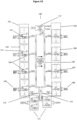
- FIG. 1 shows an analog audio patchbay of the present invention is constructed around a 32 input 101, 32 output 103, non-blocking analogue crosspoint switching assembly; the assembly comprising four 16x16 analog crosspoint switches (not shown, represented by module 105, Model AD-8113, Analog Devices, Massachusetts USA).
- each crosspoint switch input channel is fed by an output from balanced receiver module 102 containing a fixed balanced to unbalanced receiver 106 (often referred to as a differential amplifier in the art, operating at an amplification of less than unity) configured to accept as input conventional balanced signals through wired connections from external audio equipment 109.
- each output channel from the crosspoint switch is connected to fixed balanced driver module 104 containing an unbalanced to balanced driver (often referred to as a differential amplifier in the art, operating at an amplification of greater than unity) 107 which can drive audio signals to distant inputs on external audio equipment through balanced outputs 108.
- Connections to the external equipment may be provided on any facing surface of the patchbay unit, but in a preferred embodiment the inputs and outputs are provided on the rear of the patchbay to simplify cable management issues in rack mounting situations.
- each of the 4 blocks 102 within 32 input module 101 in the examples of Figure 1 contains 8 circuit arrangements comprising optional phantom power module 111, balanced to unbalanced receiver module 106, and Electrostatic Discharge (ESD) protection module 114.
- ESD Electrostatic Discharge
- the crosspoint switch 105 is under the control of microcontroller module 115, which may be further under the control of, and in digital communication with, a computer (not shown). This allows the computer in digital communication with the microcontroller to provide pre-set settings and commands so as to allow the microcontroller to duplicate pre-established control settings.
- the fixed balanced input drivers accept balanced audio signals, they may also accept unbalanced signals with little loss in audio performance with the exception of the corresponding reduction in headroom that the unbalanced signal implies.
- the fixed balanced output drivers may be connected to unbalanced loads with little loss in audio performance, beyond a reduction in peak-to-peak signal headroom.
- Phantom power is provided through phantom power module 111 for each of 8 inputs as part of receiver modules 102. This feature is useful to energize external amplified microphones and other phantom powered equipment found in audio recording applications. As each input is treated the same, there are no special limitations on which channels can be used for these purposes as long as the net current maximum draw rating is observed. This phantom power can be individually enabled or disabled on each input 111. Phantom power is nominally 48VDC (unloaded) and is separately impedance limited by roughly 7 kOhm on each channel so that overloading or shorting one channel does not unduly affect other phantom power channels.
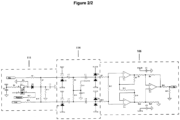
- FIG. 2 shows one typical channel of balanced (differential) audio input signal to unbalanced (single ended) signal conversion that includes the ability to optionally supply phantom power to the upstream signal generating or processing equipment, commonly but not exclusively preamps or microphones.
- Indicated supply voltages are for illustration only: alternate values may be used in other embodiments without affecting the intent of this design.
- Ground or common signal levels are at the same potential as the downstream crosspoint circuitry.
- Phantom power module 111 via integrated circuit U2, provides a switching mechanism to connect or disconnect the main 48 volt phantom power source from this channel.
- This is shown as an optically coupled bipolar junction transistor, but could also be a MOSFET enabled solid state relays such as a photoMOS relay, a mechanical relay or another controlled switch known to the art.
- Resistor R9 in combination with resistors R7 and R1 on the "hot” side, and resistors R19 and R20 on the "cold" side of an incoming balanced signal; provide an impedance limited DC bias power path out to both the hot and cold input signal lines. Impedance limiting is used as a safety feature to limit the available current in the event of a wiring misconnection or equipment fault in the upstream electronic equipment.
- Resistors R6 and R7 are provided as bleeders on the output side of integrated circuit U2 and the common mode of the hot and cold signal lines, and further diode D3 is provided to protect integrated circuit U2 from damage if the external inputs attempt to apply their own bias voltages into the inputs.
- Capacitors C4 and C5 act in filter roles for the phantom power.
- FIG 2 shows module 114 for providing electronic protection to the modules, crosspoint chips and circuits provided for in the present invention.
- Diodes D2 and D5 in conjunction with resistors R1 and R20 respectively, act as input voltage clamps for electrostatic discharge and excessive signal levels at the hot and cold inputs.
- Diodes D2 and D5 can be constructed as series connected diode pairs, with the appropriate terminals biased to high and low clamping voltages (as indicated by the power supply connections and the dotted outline for the topmost diode in the figure), or as transient voltage suppressing devices, or as biased zener diodes as shown in the figure, or through other means known to the art.
- the topology used should have very high impedance at normal signal levels and low impedance at excess voltages, to effect the protection function in fault cases without unduly loading the input signal lines under normal conditions.
- Back to back capacitor pairs C2-C3 and C7-C8 are used to effect a non-polar capacitor, with electrolytic type capacitors preferred due to their superior audio characteristics such as near zero capacitance voltage coefficients.
- the bipolar arrangement is used to allow AC coupling of larger signal levels.
- the common connection of resistors R8 and R16 is biased to the system negative power rail voltage via resistor R10, filtered by capacitor C6.
- the negative bias conveyed through resistors R8 and R16 to the respective common connections between capacitors C2-C3 and C7-C8 ensures that each of those capacitors is never reverse biased for an extended duration in normal use.
- a receiver module 102 comprises balanced receiver circuitry 106 (containing, at a minimum differential amplifier) for optionally providing phantom power for audio components providing the input analog audio signal, and an electronic means for reducing the voltage of the received analog signal (pad, 110 ) to the appropriate input voltage for the downstream crosspoint chip.
- the voltage required will vary depending on the crosspoint chip utilized, in the case of the Model AD-8113 crosspoint chip used as an example in the present disclosure, the voltage is reduced to +/- 12V.
- the balanced outputs from the balanced driver module are monitored for the presence of common mode voltages during operation. If high common mode voltages are detected, a warning may be sent to the operator indicating such as this may cause signal distortion and introduce noise in the output. Absent this warning, the operator may not recognize that cabling problems, ground loops, or back-powering issues exist.
- FIG 2 shows an exemplary circuit diagram of balanced receiver circuitry 106, with resistors R2, R12 and R21 provided to attenuate (often referred to as a "pad") the signal inputs to a range acceptable for the differential input amplifier notionally represented by integrated circuit amplifiers U1, U3 and U4 and resistors R5, R13, R18, R3, R22, R4 and R23.
- This type of instrumentation amplifier topology is shown for illustration only, other balanced (differential) to unbalanced (single ended) conversion configurations are known to the art and may be used to effect similar overall circuit behaviour.
- Resistors R11 and R15 form a single ended attenuator to allow another opportunity to adjust the signal amplitude to downstream circuits.
- Noise and noise propagation through this circuit topology is a concern in general, and is dealt with by arranging the various gains, attenuations, and system voltages in manners known to the art. These are managed in the design of the circuit by physical placement of the circuit elements, so as to allow the desired input signal range (headroom) specification to coexist with the acceptable noise floor to provide an overall dynamic range that is useful in this type of equipment.
- two channels, 112 are specially configured to alternatively, and under the control of switching equipment 113, accept inputs or provide outputs, such channels located on either the front or rear of the patchbay unit.
- two of the crosspoint switch channels are provided with an input source selector and an output load selector that can be independently set to use the front inputs, the front outputs, or the front inputs and outputs. The selection is done at the unbalanced crosspoint switch channel inputs and outputs 113, so the respective channels each have their corresponding balanced conversion stages.
- the present invention provides the benefit that any combination of outputs can access an analog audio channel input simultaneously, all under digital control via the microcontroller 115, directly, or computer in digital communication with the microcontroller, indirectly.
- the channels under the control of the crosspoint chip it is electronically possible to have multiple input channels directed to a single output channel, though in a preferred embodiment this is prevented through internal control mechanisms, either digitally controlled through the microcontroller module, the software control via the computer in digital communication with the microcontroller, or through circuit elements incorporated into the patchbay unit. This is implemented so as to prevent the unintentional blending of multiple input channels through a single output channel.
- the configuration of routing of outputs to select inputs may be set, saved, edited, cleared or restored in quick fashion without physically modifying the any external cabling. This provides the operator with the ability to quickly compare alternate configurations, to restore previous setups and to save custom setups for particular use cases. In a studio recording, or audio production, setting this speeds work flow and makes for faster resets and turn arounds of the facilities.
- the audio signals routed through the patchbay of the present invention are conveyed entirely on high linearity, low distortion analogue signal channels to provide as great a transparency of the signal as possible. Routing path selection is carried by digital means using a local microcontroller and firmware directed by an application running on a remote computer, however there are no analogue-to-digital or digital-to-analogue conversions carried out on the audio signals traversing through the crosspoint chip pathways.
- the frequency response of the audio signal path is arranged to be quite wide compared to the nominal range of human hearing, along with it being flat to prevent increasing the power spectrum of noise, referred to as "colouring", of the audio signals of interest. Response into the subsonic and ultrasound regions helps preserve pristine signals for processing in external equipment.
- the implementation of the differential amplifiers as part of the balanced receiver module 101 and balanced driver modules 103 provides unity gain buffering between the input analog signals and corresponding output analog signal.
- High impedance differential balanced inputs and low impedance differential balanced outputs are interconnected in the patchbay of the present invention with an overall pass through unity gain, when using conventional types of audio sources and loads.
- internal buffering ensures that the magnitude of the load on one output does not affect the signal amplitude on another output routed from the same input. This also mitigates back-feeding of noise or load induced distortion on a particular output from polluting sister outputs. This provides a distinct advantage over conventional hard contact types of connections provided by mechanical switches and relays or plug-in patch cable routers.
- the patchbay of the present invention advantageously provides, through the novel selection and arrangement of the components as described herein, input common mode suppression and tolerates output common mode injection.
- the balanced inputs provide a significant level of common mode suppression for balanced input signals that might be floating on top of undesired DC bias or that contain line frequency hum and other undesirable common mode effects.
- the output drivers can operate into loads that may be trying to back-feed these types of signal contaminates.
- the patchbay of the present invention assists in the isolation and reduction of these problems.
- the patchbay of the present invention can be used to break up and isolate ground loops in complex cabling and equipment installations, unlike common hard contact patch panels that can often create ground loops.
- Ground loop isolation can be accomplished in conjunction with hard contact type patch panels by either raising the voltage of the signal ground reference connections, or by introducing isolation transformers.
- these floating ground or transformer techniques can create or enhance other noise mechanisms, and in the case of transformers in particular, introduce frequency response issues that colour the desired audio signals.
- the patchbay of the present invention through implementation of the exemplary crosspoint switch arrangement provided herein; enables the selection of any one input to be provided for on any one output; thereby allowing duplications of an analogue input, balanced or unbalanced, to a multiplicity of outputs. Given the use of a greater than unity amplifier prior to the output; the duplication of an input is without significant decrease of signal strength or quality by way of the duplication.
- the present invention contemplates any number of input channels, with increasing number of input channels requiring additional crosspoint switch modules; with the exemplary Model AD-8113 crosspoint chip providing 16 input and 16 outputs.
- the present invention provides for higher number of inputs and outputs, with a corresponding increase in the number of crosspoint switch elements, contained within a crosspoint chip; closely approximating NxM crosspoint switch elements, where N is equal to the number of inputs, M is equal to the number of outputs, and where N is greater to or equal to M. While particular embodiments of the present invention have been described in the foregoing, it is to be understood that other embodiments are possible within the scope of the invention and are intended to be included herein. The invention is therefore to be considered limited solely by the scope of the appended claims.
Landscapes
- Engineering & Computer Science (AREA)
- Signal Processing (AREA)
- Physics & Mathematics (AREA)
- Acoustics & Sound (AREA)
- Computer Networks & Wireless Communication (AREA)
- Amplifiers (AREA)
- Electronic Switches (AREA)
Claims (5)
- Analoges Audio-Patchbay (100), das Folgendes umfasst:i. mehrere Eingangsverbinder, die mehrere analoge elektronische Signale empfangen können,ii. mehrere Ausgangsverbinder, die mehrere analoge elektronische Signale übertragen können,iii. eine Audiosteuerschaltung, die sich von den mehreren Eingangsverbindungen zu den mehreren Ausgangsverbindern erstreckt,wobeii. die Audiosteuerschaltung eine Vielzahl (101) von festen ausgeglichenen Empfängermodulen (102); mindestens ein Kreuzpunktmodul (105), mindestens ein Mikrocontrollermodul (115) und eine Vielzahl (103) von festen ausgeglichenen Treibermodulen (104) umfasst,ii. jeder der Verbinder, die die mehreren Eingangsverbinder umfassen, in direkter elektronischer Kommunikation mit einem festen ausgeglichenen Empfängermodul (102) steht, sodass eine Eins-zu-Eins-Korrelation der mehreren Eingangsverbinder mit einem festen ausgeglichenen Empfängermodul (102) besteht;iii. das Kreuzpunktmodul (105) eine Vielzahl von Eingängen, eine Vielzahl von Ausgängen und die Fähigkeit eines beliebigen der Vielzahl von Kreuzpunktausgängen, ein analoges Signal von einem beliebigen der Vielzahl von Kreuzpunkteingängen zu empfangen, alles unter der Steuerung eines digitalen Mikrocontrollers (115), umfasst;iv. jedes der festen ausgeglichenen Empfänger (102) in direkter elektronischer Kommunikation mit einem Eingang an dem Kreuzpunktmodul (105) steht;v. jeder der Ausgänge des Kreuzpunktmoduls (105) in direkter elektronischer Kommunikation mit einem festen ausgeglichenen Treibermodul (104) steht;vi. jedes der festen ausgeglichenen Treibermodule (104) in direkter elektronischer Kommunikation mit einem Ausgangsverbinder steht, sodass eine Eins-zu-Eins-Korrelation der mehreren Ausgangsverbinder mit einem festen ausgeglichenen Treibermodul (104) besteht; undvii. das Kreuzpunktmodul (105) unter der digitalen Steuerung des Mikrocontrollermoduls (115) steht;viii. jedes der Vielzahl (101) von festen ausgeglichenen Empfängermodulen (102) mindestens einen differenziellen Empfänger (106), einen Schutz (114) gegen elektrostatische Entladung und eine Schaltungsanordnung (111) zum optionalen Bereitstellen von bis zu 48 V Phantomleistung für Audiovorrichtungen, die mit mindestens einem der mehreren Eingangsverbindern verbunden werden, umfasst.
- Analoges Audio-Patchbay (100) nach Anspruch 1, wobei die mehreren Eingangsverbinder vier DB25-Verbinder umfassen, wobei jeder DB25-Verbinder zur Verbindung mit acht Audiokanälen ausgelegt ist.
- Analoges Audio-Patchbay (100) nach Anspruch 1, wobei die zweiten mehreren Verbinder vier DB25-Verbinder umfassen, wobei jeder DB25-Verbinder zur Verbindung mit acht Audiokanälen ausgelegt ist.
- Analoges Audio-Patchbay (100) nach Anspruch 1, wobei das Mikrocontrollermodul in digitaler Kommunikation mit einem Computer steht.
- Analoges Audio-Patchbay (100) nach Anspruch 1, wobei jedes der Vielzahl (103) von festen ausgeglichenen Treibermodulen (104) mindestens einen differenziellen Treiber, einen Schutz gegen elektrostatische Entladung und eine Schaltungsanordnung zum optionalen Bereitstellen von bis zu 48 V Phantomleistung für Audiovorrichtungen, die mit mindestens einem der mehreren Ausgangsverbindern verbunden werden, umfasst.
Applications Claiming Priority (2)
| Application Number | Priority Date | Filing Date | Title |
|---|---|---|---|
| US201862781392P | 2018-12-18 | 2018-12-18 | |
| PCT/CA2019/000172 WO2020124197A1 (en) | 2018-12-18 | 2019-12-18 | Analog audio patchbay under digital control |
Publications (4)
| Publication Number | Publication Date |
|---|---|
| EP3900396A1 EP3900396A1 (de) | 2021-10-27 |
| EP3900396A4 EP3900396A4 (de) | 2022-10-05 |
| EP3900396C0 EP3900396C0 (de) | 2024-01-24 |
| EP3900396B1 true EP3900396B1 (de) | 2024-01-24 |
Family
ID=71102368
Family Applications (1)
| Application Number | Title | Priority Date | Filing Date |
|---|---|---|---|
| EP19901327.7A Active EP3900396B1 (de) | 2018-12-18 | 2019-12-18 | Analoges audio-patchbay unter digitaler steuerung |
Country Status (4)
| Country | Link |
|---|---|
| US (2) | US11438719B2 (de) |
| EP (1) | EP3900396B1 (de) |
| CA (1) | CA3065487A1 (de) |
| WO (1) | WO2020124197A1 (de) |
Family Cites Families (12)
| Publication number | Priority date | Publication date | Assignee | Title |
|---|---|---|---|---|
| WO1993003549A1 (en) * | 1991-07-31 | 1993-02-18 | Euphonix, Inc. | Automated audio mixer |
| US5444676A (en) * | 1994-09-28 | 1995-08-22 | Balsamo; Nicholas | Audio mixer system |
| US5757941A (en) * | 1996-08-23 | 1998-05-26 | Gibson Guitar Corp. | Audio signal patching mixer and method |
| US7742609B2 (en) * | 2002-04-08 | 2010-06-22 | Gibson Guitar Corp. | Live performance audio mixing system with simplified user interface |
| TWI371925B (en) | 2006-09-08 | 2012-09-01 | Via Tech Inc | Apparatus for processing multiple signals with a single analog-to-digital converter and method thereof |
| US8221159B2 (en) * | 2009-09-25 | 2012-07-17 | Thomas William Knepp | Audio patchbay/breakout panel |
| WO2011095841A2 (en) * | 2010-02-02 | 2011-08-11 | Nokia Corporation | An apparatus |
| US20120300960A1 (en) | 2011-05-27 | 2012-11-29 | Graeme Gordon Mackay | Digital signal routing circuit |
| US9094742B2 (en) | 2012-07-24 | 2015-07-28 | Fox Filmed Entertainment | Event drivable N X M programmably interconnecting sound mixing device and method for use thereof |
| CN104618666B (zh) | 2013-11-05 | 2018-04-10 | 南宁富桂精密工业有限公司 | 音频信号控制电路 |
| US9111047B1 (en) | 2014-03-24 | 2015-08-18 | Cadence Design Systems, Inc. | Method, system, and computer program product for implementing firmware-driven, dynamically configurable pulse-density modulation audio intellectual property |
| US10241745B1 (en) | 2016-01-15 | 2019-03-26 | McDowell Signal Processing, LLC. | Apparatus, a system and a method of creating modifiable analog processing |
-
2019
- 2019-12-18 CA CA3065487A patent/CA3065487A1/en active Pending
- 2019-12-18 US US16/718,434 patent/US11438719B2/en active Active
- 2019-12-18 WO PCT/CA2019/000172 patent/WO2020124197A1/en not_active Ceased
- 2019-12-18 EP EP19901327.7A patent/EP3900396B1/de active Active
-
2022
- 2022-07-06 US US17/858,725 patent/US11700498B2/en active Active
Also Published As
| Publication number | Publication date |
|---|---|
| US11438719B2 (en) | 2022-09-06 |
| EP3900396A4 (de) | 2022-10-05 |
| US20220345840A1 (en) | 2022-10-27 |
| EP3900396C0 (de) | 2024-01-24 |
| US11700498B2 (en) | 2023-07-11 |
| US20200329328A1 (en) | 2020-10-15 |
| CA3065487A1 (en) | 2020-06-18 |
| EP3900396A1 (de) | 2021-10-27 |
| WO2020124197A1 (en) | 2020-06-25 |
Similar Documents
| Publication | Publication Date | Title |
|---|---|---|
| US5444417A (en) | Self-configurable, dual bridge, power amplifier | |
| US7912431B2 (en) | Signal amplifiers having non-interruptible communication paths | |
| JPH0454006A (ja) | 増幅装置 | |
| US10074353B2 (en) | Self-powered loudspeaker for sound masking | |
| SE531023C2 (sv) | Ljudåtergivningssystem | |
| CN101803185B (zh) | 音频功率放大器 | |
| EP3900396B1 (de) | Analoges audio-patchbay unter digitaler steuerung | |
| US20020059008A1 (en) | Audio system for minimizing the chance that high power audio signals may be directed to a headphone jack | |
| US10777336B1 (en) | Branching unit for power distribution | |
| KR101248181B1 (ko) | 전관방송 시스템용 출력 트랜스 내장형 d클래스 파워앰프 | |
| US6339356B1 (en) | Variable attenuator | |
| US9510116B2 (en) | High definition distributed sound system | |
| KR101471484B1 (ko) | 사운드 네트워크 전송 시스템을 적용한 디지털 아날로그 파워 앰프 및 그 운용방법 | |
| CN207399517U (zh) | 通道可扩展的数字音频处理设备及音频通道扩展系统 | |
| US20100117728A1 (en) | Signal Amplifiers Having Communications Paths that Automatically Terminate to a Matched Termination in Response to a Power Interruption and Related Methods | |
| EP1614216B1 (de) | Verstärkereinrichtung und distribuiertes audiosystem | |
| EP0449104B1 (de) | Verstärker mit maximal addierter Ausgangsleistung einer Mehrzahl von Einrichtungen mit begrenzter Stromsenkefähigkeit | |
| KR20240154292A (ko) | 스피커라인의 부하용량변경시 자동 부하조절 파워앰프 | |
| US20130202296A1 (en) | Optical node configuration apparatus | |
| US20010022002A1 (en) | CATV trunk amplifier, upward signal amplifier, and bi-directional CATV system | |
| KR102076282B1 (ko) | 사운드 네트워크 전송 시스템 및 방법 | |
| EP0777403B1 (de) | Ton-Diffusionssystem, insbesondere für grosse Räume | |
| US5586194A (en) | Augmentation amplifier | |
| US11996813B2 (en) | Electronic circuit for amplifiers and sound devices for the transfer of electric power between channels | |
| CN211018837U (zh) | 用于广播系统的控制装置 |
Legal Events
| Date | Code | Title | Description |
|---|---|---|---|
| STAA | Information on the status of an ep patent application or granted ep patent |
Free format text: STATUS: THE INTERNATIONAL PUBLICATION HAS BEEN MADE |
|
| PUAI | Public reference made under article 153(3) epc to a published international application that has entered the european phase |
Free format text: ORIGINAL CODE: 0009012 |
|
| STAA | Information on the status of an ep patent application or granted ep patent |
Free format text: STATUS: REQUEST FOR EXAMINATION WAS MADE |
|
| 17P | Request for examination filed |
Effective date: 20210611 |
|
| AK | Designated contracting states |
Kind code of ref document: A1 Designated state(s): AL AT BE BG CH CY CZ DE DK EE ES FI FR GB GR HR HU IE IS IT LI LT LU LV MC MK MT NL NO PL PT RO RS SE SI SK SM TR |
|
| DAV | Request for validation of the european patent (deleted) | ||
| DAX | Request for extension of the european patent (deleted) | ||
| A4 | Supplementary search report drawn up and despatched |
Effective date: 20220905 |
|
| RIC1 | Information provided on ipc code assigned before grant |
Ipc: H04R 3/00 20060101AFI20220830BHEP |
|
| GRAP | Despatch of communication of intention to grant a patent |
Free format text: ORIGINAL CODE: EPIDOSNIGR1 |
|
| STAA | Information on the status of an ep patent application or granted ep patent |
Free format text: STATUS: GRANT OF PATENT IS INTENDED |
|
| INTG | Intention to grant announced |
Effective date: 20230803 |
|
| GRAS | Grant fee paid |
Free format text: ORIGINAL CODE: EPIDOSNIGR3 |
|
| GRAA | (expected) grant |
Free format text: ORIGINAL CODE: 0009210 |
|
| STAA | Information on the status of an ep patent application or granted ep patent |
Free format text: STATUS: THE PATENT HAS BEEN GRANTED |
|
| AK | Designated contracting states |
Kind code of ref document: B1 Designated state(s): AL AT BE BG CH CY CZ DE DK EE ES FI FR GB GR HR HU IE IS IT LI LT LU LV MC MK MT NL NO PL PT RO RS SE SI SK SM TR |
|
| REG | Reference to a national code |
Ref country code: GB Ref legal event code: FG4D |
|
| REG | Reference to a national code |
Ref country code: CH Ref legal event code: EP |
|
| REG | Reference to a national code |
Ref country code: IE Ref legal event code: FG4D |
|
| REG | Reference to a national code |
Ref country code: DE Ref legal event code: R096 Ref document number: 602019045831 Country of ref document: DE |
|
| U01 | Request for unitary effect filed |
Effective date: 20240221 |
|
| U07 | Unitary effect registered |
Designated state(s): AT BE BG DE DK EE FI FR IT LT LU LV MT NL PT SE SI Effective date: 20240229 |
|
| REG | Reference to a national code |
Ref country code: LT Ref legal event code: MG9D |
|
| PG25 | Lapsed in a contracting state [announced via postgrant information from national office to epo] |
Ref country code: IS Free format text: LAPSE BECAUSE OF FAILURE TO SUBMIT A TRANSLATION OF THE DESCRIPTION OR TO PAY THE FEE WITHIN THE PRESCRIBED TIME-LIMIT Effective date: 20240524 |
|
| PG25 | Lapsed in a contracting state [announced via postgrant information from national office to epo] |
Ref country code: GR Free format text: LAPSE BECAUSE OF FAILURE TO SUBMIT A TRANSLATION OF THE DESCRIPTION OR TO PAY THE FEE WITHIN THE PRESCRIBED TIME-LIMIT Effective date: 20240425 |
|
| PG25 | Lapsed in a contracting state [announced via postgrant information from national office to epo] |
Ref country code: HR Free format text: LAPSE BECAUSE OF FAILURE TO SUBMIT A TRANSLATION OF THE DESCRIPTION OR TO PAY THE FEE WITHIN THE PRESCRIBED TIME-LIMIT Effective date: 20240124 Ref country code: RS Free format text: LAPSE BECAUSE OF FAILURE TO SUBMIT A TRANSLATION OF THE DESCRIPTION OR TO PAY THE FEE WITHIN THE PRESCRIBED TIME-LIMIT Effective date: 20240424 |
|
| PG25 | Lapsed in a contracting state [announced via postgrant information from national office to epo] |
Ref country code: ES Free format text: LAPSE BECAUSE OF FAILURE TO SUBMIT A TRANSLATION OF THE DESCRIPTION OR TO PAY THE FEE WITHIN THE PRESCRIBED TIME-LIMIT Effective date: 20240124 |
|
| PG25 | Lapsed in a contracting state [announced via postgrant information from national office to epo] |
Ref country code: RS Free format text: LAPSE BECAUSE OF FAILURE TO SUBMIT A TRANSLATION OF THE DESCRIPTION OR TO PAY THE FEE WITHIN THE PRESCRIBED TIME-LIMIT Effective date: 20240424 Ref country code: NO Free format text: LAPSE BECAUSE OF FAILURE TO SUBMIT A TRANSLATION OF THE DESCRIPTION OR TO PAY THE FEE WITHIN THE PRESCRIBED TIME-LIMIT Effective date: 20240424 Ref country code: IS Free format text: LAPSE BECAUSE OF FAILURE TO SUBMIT A TRANSLATION OF THE DESCRIPTION OR TO PAY THE FEE WITHIN THE PRESCRIBED TIME-LIMIT Effective date: 20240524 Ref country code: HR Free format text: LAPSE BECAUSE OF FAILURE TO SUBMIT A TRANSLATION OF THE DESCRIPTION OR TO PAY THE FEE WITHIN THE PRESCRIBED TIME-LIMIT Effective date: 20240124 Ref country code: GR Free format text: LAPSE BECAUSE OF FAILURE TO SUBMIT A TRANSLATION OF THE DESCRIPTION OR TO PAY THE FEE WITHIN THE PRESCRIBED TIME-LIMIT Effective date: 20240425 Ref country code: ES Free format text: LAPSE BECAUSE OF FAILURE TO SUBMIT A TRANSLATION OF THE DESCRIPTION OR TO PAY THE FEE WITHIN THE PRESCRIBED TIME-LIMIT Effective date: 20240124 |
|
| PG25 | Lapsed in a contracting state [announced via postgrant information from national office to epo] |
Ref country code: PL Free format text: LAPSE BECAUSE OF FAILURE TO SUBMIT A TRANSLATION OF THE DESCRIPTION OR TO PAY THE FEE WITHIN THE PRESCRIBED TIME-LIMIT Effective date: 20240124 |
|
| PG25 | Lapsed in a contracting state [announced via postgrant information from national office to epo] |
Ref country code: PL Free format text: LAPSE BECAUSE OF FAILURE TO SUBMIT A TRANSLATION OF THE DESCRIPTION OR TO PAY THE FEE WITHIN THE PRESCRIBED TIME-LIMIT Effective date: 20240124 |
|
| PG25 | Lapsed in a contracting state [announced via postgrant information from national office to epo] |
Ref country code: SM Free format text: LAPSE BECAUSE OF FAILURE TO SUBMIT A TRANSLATION OF THE DESCRIPTION OR TO PAY THE FEE WITHIN THE PRESCRIBED TIME-LIMIT Effective date: 20240124 |
|
| PG25 | Lapsed in a contracting state [announced via postgrant information from national office to epo] |
Ref country code: CZ Free format text: LAPSE BECAUSE OF FAILURE TO SUBMIT A TRANSLATION OF THE DESCRIPTION OR TO PAY THE FEE WITHIN THE PRESCRIBED TIME-LIMIT Effective date: 20240124 |
|
| REG | Reference to a national code |
Ref country code: DE Ref legal event code: R097 Ref document number: 602019045831 Country of ref document: DE |
|
| PG25 | Lapsed in a contracting state [announced via postgrant information from national office to epo] |
Ref country code: SK Free format text: LAPSE BECAUSE OF FAILURE TO SUBMIT A TRANSLATION OF THE DESCRIPTION OR TO PAY THE FEE WITHIN THE PRESCRIBED TIME-LIMIT Effective date: 20240124 |
|
| PG25 | Lapsed in a contracting state [announced via postgrant information from national office to epo] |
Ref country code: SM Free format text: LAPSE BECAUSE OF FAILURE TO SUBMIT A TRANSLATION OF THE DESCRIPTION OR TO PAY THE FEE WITHIN THE PRESCRIBED TIME-LIMIT Effective date: 20240124 Ref country code: SK Free format text: LAPSE BECAUSE OF FAILURE TO SUBMIT A TRANSLATION OF THE DESCRIPTION OR TO PAY THE FEE WITHIN THE PRESCRIBED TIME-LIMIT Effective date: 20240124 Ref country code: CZ Free format text: LAPSE BECAUSE OF FAILURE TO SUBMIT A TRANSLATION OF THE DESCRIPTION OR TO PAY THE FEE WITHIN THE PRESCRIBED TIME-LIMIT Effective date: 20240124 |
|
| PLBE | No opposition filed within time limit |
Free format text: ORIGINAL CODE: 0009261 |
|
| STAA | Information on the status of an ep patent application or granted ep patent |
Free format text: STATUS: NO OPPOSITION FILED WITHIN TIME LIMIT |
|
| 26N | No opposition filed |
Effective date: 20241025 |
|
| PG25 | Lapsed in a contracting state [announced via postgrant information from national office to epo] |
Ref country code: MC Free format text: LAPSE BECAUSE OF FAILURE TO SUBMIT A TRANSLATION OF THE DESCRIPTION OR TO PAY THE FEE WITHIN THE PRESCRIBED TIME-LIMIT Effective date: 20240124 |
|
| REG | Reference to a national code |
Ref country code: CH Ref legal event code: PL |
|
| U90 | Renewal fees not paid: noting of loss of rights |
Free format text: RENEWAL FEE NOT PAID FOR YEAR 06 Effective date: 20250716 |
|
| GBPC | Gb: european patent ceased through non-payment of renewal fee |
Effective date: 20241218 |
|
| PG25 | Lapsed in a contracting state [announced via postgrant information from national office to epo] |
Ref country code: GB Free format text: LAPSE BECAUSE OF NON-PAYMENT OF DUE FEES Effective date: 20241218 |
|
| PG25 | Lapsed in a contracting state [announced via postgrant information from national office to epo] |
Ref country code: CH Free format text: LAPSE BECAUSE OF NON-PAYMENT OF DUE FEES Effective date: 20241231 |
|
| PG25 | Lapsed in a contracting state [announced via postgrant information from national office to epo] |
Ref country code: IE Free format text: LAPSE BECAUSE OF NON-PAYMENT OF DUE FEES Effective date: 20241218 |
|
| U93 | Unitary patent lapsed |
Free format text: RENEWAL FEE NOT PAID Effective date: 20241231 |
|
| PG25 | Lapsed in a contracting state [announced via postgrant information from national office to epo] |
Ref country code: RO Free format text: LAPSE BECAUSE OF FAILURE TO SUBMIT A TRANSLATION OF THE DESCRIPTION OR TO PAY THE FEE WITHIN THE PRESCRIBED TIME-LIMIT Effective date: 20240124 |