EP3900129B1 - System and method for spark plug identification and engine monitoring - Google Patents
System and method for spark plug identification and engine monitoring Download PDFInfo
- Publication number
- EP3900129B1 EP3900129B1 EP18837031.6A EP18837031A EP3900129B1 EP 3900129 B1 EP3900129 B1 EP 3900129B1 EP 18837031 A EP18837031 A EP 18837031A EP 3900129 B1 EP3900129 B1 EP 3900129B1
- Authority
- EP
- European Patent Office
- Prior art keywords
- spark plug
- engine
- optical signal
- transmitter device
- coupled
- Prior art date
- Legal status (The legal status is an assumption and is not a legal conclusion. Google has not performed a legal analysis and makes no representation as to the accuracy of the status listed.)
- Active
Links
Images



Classifications
-
- H—ELECTRICITY
- H01—ELECTRIC ELEMENTS
- H01T—SPARK GAPS; OVERVOLTAGE ARRESTERS USING SPARK GAPS; SPARKING PLUGS; CORONA DEVICES; GENERATING IONS TO BE INTRODUCED INTO NON-ENCLOSED GASES
- H01T13/00—Sparking plugs
- H01T13/02—Details
- H01T13/04—Means providing electrical connection to sparking plugs
-
- F—MECHANICAL ENGINEERING; LIGHTING; HEATING; WEAPONS; BLASTING
- F02—COMBUSTION ENGINES; HOT-GAS OR COMBUSTION-PRODUCT ENGINE PLANTS
- F02P—IGNITION, OTHER THAN COMPRESSION IGNITION, FOR INTERNAL-COMBUSTION ENGINES; TESTING OF IGNITION TIMING IN COMPRESSION-IGNITION ENGINES
- F02P13/00—Sparking plugs structurally combined with other parts of internal-combustion engines
-
- F—MECHANICAL ENGINEERING; LIGHTING; HEATING; WEAPONS; BLASTING
- F02—COMBUSTION ENGINES; HOT-GAS OR COMBUSTION-PRODUCT ENGINE PLANTS
- F02P—IGNITION, OTHER THAN COMPRESSION IGNITION, FOR INTERNAL-COMBUSTION ENGINES; TESTING OF IGNITION TIMING IN COMPRESSION-IGNITION ENGINES
- F02P17/00—Testing of ignition installations, e.g. in combination with adjusting; Testing of ignition timing in compression-ignition engines
- F02P17/12—Testing characteristics of the spark, ignition voltage or current
-
- H—ELECTRICITY
- H01—ELECTRIC ELEMENTS
- H01T—SPARK GAPS; OVERVOLTAGE ARRESTERS USING SPARK GAPS; SPARKING PLUGS; CORONA DEVICES; GENERATING IONS TO BE INTRODUCED INTO NON-ENCLOSED GASES
- H01T13/00—Sparking plugs
- H01T13/20—Sparking plugs characterised by features of the electrodes or insulation
-
- H—ELECTRICITY
- H01—ELECTRIC ELEMENTS
- H01T—SPARK GAPS; OVERVOLTAGE ARRESTERS USING SPARK GAPS; SPARKING PLUGS; CORONA DEVICES; GENERATING IONS TO BE INTRODUCED INTO NON-ENCLOSED GASES
- H01T13/00—Sparking plugs
- H01T13/40—Sparking plugs structurally combined with other devices
- H01T13/44—Sparking plugs structurally combined with other devices with transformers, e.g. for high-frequency ignition
-
- H—ELECTRICITY
- H01—ELECTRIC ELEMENTS
- H01T—SPARK GAPS; OVERVOLTAGE ARRESTERS USING SPARK GAPS; SPARKING PLUGS; CORONA DEVICES; GENERATING IONS TO BE INTRODUCED INTO NON-ENCLOSED GASES
- H01T13/00—Sparking plugs
- H01T13/58—Testing
Definitions
- Embodiments of the present specification relate to a system and method for spark plug identification and engine monitoring, and more particularly, embodiments of the present specification relate to a spark plug assembly having a detection unit.
- IC engines are used in applications such as transportation, electricity generation, and the like. Unexpected breakdown of such engines hinders normal operations and adversely effects productivity.
- the IC engines are typically ignited using a spark produced by a spark plug. Spark plugs are vital for engine performance as the spark plugs provide sparks to ignite and burn the air-fuel mixture compressed in a cylinder of an IC engine.
- the spark plugs are parts that are subject to wear and tear and need to be serviced and replaced frequently.
- an existing authentic spark plug needs to be replaced by another authentic spark plug. Replacing an authentic spark plug with a counterfeit spark plug adversely effects engine performance and may even cause irreversible damage to the engine.
- installing a counterfeit spark plug may result in decreased efficiency, increased emissions from the engine, and the like.
- a spark plug assembly includes a spark plug, where the spark plug includes a high voltage connector disposed at one end of the spark plug and an insulator body having a first side and a second side. The insulator body is coupled to the high voltage connector at the first side. Further, the spark plug includes a metallic shell having a first side and a second side, where the first side of the metallic shell is coupled to the second side of the insulator body. The spark plug also includes an electrical conductor at least partly disposed in the insulator body and the metallic shell.
- the spark plug assembly includes a detection unit having a transmitter device and a receiver device. The transmitter device is coupled to the spark plug and is electrically disposed between the high voltage connector and the electrical conductor.
- the transmitter device is configured to draw an excitation current from the electrical conductor.
- the transmitter device includes an optical signal generator, where the optical signal generator is configured to generate an optical signal in response to the drawn excitation current.
- the receiver device is disposed in optical communication with the transmitter device and configured to receive the optical signal from the transmitter device.
- an engine in another embodiment, according to claim 5, includes one or more ignition modules, where each ignition module includes one or more ignition coils and one or more spark plug assemblies.
- the spark plug assemblies are coupled to respective ignition coils, where at least one of the one or more spark plug assemblies is according to claim 1.
- a method includes powering a transmitter device disposed in a spark plug using harvested energy from an electrical conductor of a spark plug. The method further includes transmitting an optical signal using the transmitter device, and receiving the optical signal using a receiver device, where the optical signal is representative of an identification parameter of the spark plug, or a diagnostic parameter of an engine, or both. The method also includes determining a control action based on the optical signal and initiating the control action for the engine.
- a kit in another embodiment according to claim 17, includes a detection unit, where the detection unit comprises a transmitter device and a receiver device.
- the transmitter device is configured to be coupled to a spark plug, where the transmitter device is configured to be electrically disposed between a high voltage connector and an electrical conductor.
- the transmitter device includes an optical signal generator, where the optical signal generator is configured to generate an optical signal in response to the drawn excitation current.
- the receiver device is configured to be disposed in optical communication with the transmitter device. Further, the receiver device is configured to receive the optical signal from the transmitter device.
- Embodiments of the present specification are directed to spark plug assemblies having a spark plug and a detection unit.
- the spark plug assemblies are configured to be used in engines.
- the spark plug assemblies may be used in an internal combustion engine, a gas engine, or a gas turbine.
- the detection unit in conjunction with the spark plug is configured to facilitate spark plug identification and/or engine monitoring.
- the detection unit is configured to determine an identification parameter for the spark plug, a diagnostic parameter for an engine, or both.
- the identification parameter may correspond to a spark plug identification (ID), and the diagnostic parameter may correspond to diagnostic parameters of the engine.
- ID spark plug identification
- systems and methods of the spark plug assemblies may be used to determine spark plug specifics, such as, but not limited to, spark plug type, manufacturing date, manufacturer's name, and the like.
- the systems and methods of the spark plug assemblies may be used to determine the identification parameter to recognize and report use of a counterfeit spark plug in a spark plug assembly, or to determine use of an authentic spark plug in the spark plug assembly.
- the spark plug assembly may facilitate prognosis, diagnosis, or both of an engine in which it is employed.
- one or more diagnostic parameters of the engine may be determined using the spark plug assembly. These diagnostic parameters may be used to prognose and/or diagnose the engine to schedule maintenance, determine leftover run time, determine replacement of certain parts of the engine, and the like.
- FIG. 1 illustrates a portion of a spark plug assembly 100 of the present specification.
- the spark plug assembly 100 includes a spark plug 102 and a detection unit 104.
- the spark plug 102 may be any spark plug that is suitable for use in a given engine.
- the spark plug 102 includes an insulator body 106 having a first side 108 and a second side 110.
- the insulator body 106 is coupled to a high voltage connector 112 at the first side 108 of the insulator body 106.
- the high voltage connector 112 is coupled to an ignition coil (not shown in FIG. 1 ) of the engine, such as an internal combustion engine, a gas engine, or a gas turbine.
- the high voltage connector 112 is configured to connect to a high voltage source of the order of few KVs.
- the spark plug 102 also includes a metallic shell 114 having a first side 116 and a second side 118, where the first side 116 of the metallic shell 114 is coupled to the second side 110 of the insulator body 106. Further, the spark plug 102 includes an electrical conductor 120 at least partly disposed in the insulator body 106 and the metallic shell 114. The electrical conductor 120 is disposed in a core of the spark plug 102 and extends along a longitudinal axis 122 of the spark plug 102. The electrical conductor 120 is disposed between the high voltage connector 112 and a central electrode 124 of the spark plug 102. Particularly, the electrical conductor 120 is housed in the insulator body 106 and the metallic shell 114 and is connected to the high voltage connector 112 at one end and the central electrode 124 at the other end.
- the central electrode 124 includes an electrode tip 126.
- the spark plug 102 includes a ground electrode 128 having a ground electrode pad 130.
- the ground electrode 128 is mounted on the metallic shell 114 using any suitable technique, such as welding.
- the ground electrode pad 130 of the ground electrode 128 is disposed opposite to the electrode tip 126.
- a gap, generally represented by reference numeral 132, between the electrode tip 126 and the ground electrode pad 130 defines a spark gap.
- the spark gap 132 is the spacing between the electrode tip 126 of the central electrode 124 and the ground electrode pad 130 of the ground electrode 128.
- the spark gap 132 may be measured and adjusted as required to facilitate generation of sparks to fire one or more cylinders in an engine.
- the detection unit 104 is used for spark plug identification and/or engine monitoring.
- the detection unit 104 may perform prognostics and/or diagnostics of an engine in which it is employed.
- the detection unit 104 includes a transmitter device 134 and a receiver device (not shown in FIG. 1 ).
- the transmitter device 134 is coupled to the spark plug 102.
- the receiver device is operatively coupled to the transmitter device 134 and disposed within or outside the engine. In embodiments where the receiver device is disposed within the engine, the receiver device may be disposed in a spark plug connector (as shown in FIG. 2 ) or the receiver device may be disposed in an ignition coil of the engine (as shown in FIG. 4 ). In other embodiments, the receiver device may be disposed in any other location in the engine where the receiver device may communicate with the transmitter device 134.
- the transmitter device 134 is electrically disposed between the high voltage connector 112 and the electrical conductor 120 of the spark plug 102 via internal electrical circuitry (not shown in FIG. 1 ) of the spark plug 102.
- the transmitter device 134 is configured to draw an excitation current from the electrical conductor 120.
- the excitation current is used to ignite a spark in the spark plug 102.
- the transmitter device 134 includes an optical signal generator (not shown in FIG. 1 ) configured to generate an optical signal in response to the drawn excitation current.
- the transmitter device 134 also includes a coder (not shown in FIG. 1 ), such as a microcontroller, a field programmable gate array (FPGA), and the like.
- the optical signal generator is configured to sustain high temperatures with minimal decrease in optical intensity at high temperatures.
- the optical signal generator may include one or more light emitting diodes (LEDs).
- the light emitting diode (LED) may be a narrow view angle LED.
- the LED may be an ultra-bright LED.
- the LED may be a red LED, an orange LED, an ultra-bright red LED, an ultra-bright orange LED, or combinations thereof.
- the coder may have a relatively smaller footprint, which is suitable for employing the coder in the transmitter device 134. Moreover, the coder may also have a suitable memory capacity appropriate for high temperature applications having a maximum temperature of 300°C.
- a non-limiting example of the coder may include a peripheral interface controller (PIC).
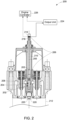
- FIG. 2 is a cross-sectional view of a portion of an engine 200 employing a spark plug assembly 202, where the spark plug assembly 202 includes a spark plug 204 and a detection unit 206.
- the detection unit 206 includes a transmitter device 208 and a receiver device 214.
- the spark plug 204 is coupled to one end 203 of a spark plug connector 205.
- the transmitter device 208 is disposed in the body of the spark plug 204, while the receiver device 214 is disposed at another end 216 of the spark plug connector 205.
- the spark plug connector 205 is an electrically insulated channel which is partly disposed in a spark plug sleeve 210, which is a metallic sleeve.
- spark plug sleeve 210 is electrically coupled to an ignition module (not shown in FIG. 2 ).
- An ignition coil (not shown in FIG. 2 ) is disposed between the ignition module and the high voltage connector (not shown in FIG. 2 ) to connect the spark plug 204 to the ignition module.
- An electrical cable is disposed in the spark plug connector 205. The ignition coil may be disposed in the spark plug connector 205.
- the spark plug connector 205 which is an electrically insulated channel, may also be configured to act as an insulated optical conduit to communicate optical signals from the transmitter device 208 to the receiver device 214.
- the insulated optical conduit may be a separate element from the spark plug connector 205.
- the insulated optical conduit may be disposed inside the spark plug connector 205.
- an optical cable may be disposed in the spark plug connector 205 to provide optical communication between the transmitter device 208 and the receiver device 214.
- the engine 200 may further include one or more diagnostic sensors, such as sensors 220.
- the diagnostic sensors 220 may be disposed in the ignition chamber 212 of the engine 200.
- the diagnostic sensors 220 may be any suitable sensors that are able to withstand harsh engine environments.
- the diagnostic sensors 220 may be operatively and/or physically coupled to the transmitter device 208 of the detection unit 206. In one example, the diagnostic sensors 220 may be physically wired to the transmitter device 208 using electrical cables.
- the diagnostic sensors 220 may include one or more of a temperature sensor, a pressure sensor, or a soot sensor.
- the diagnostic sensors 220 may include a negative temperature coefficient (NTC) sensor or a positive temperature coefficient (PTC) sensor.
- the diagnostic sensors 220 may be a NTC or PTC thermistor.
- the diagnostic sensors 220 may be coupled to the coder and configured to transmit an optical signal using the optical signal generator of the transmitter device 208.
- the engine 200 may include an output unit 224 coupled to the spark plug assembly 202.
- the output unit 224 is configured to receive an output signal from the receiver device 214.
- the output unit 224 may include a display unit, a graphical user interface (GUI), or the like.
- GUI graphical user interface
- the output signal from the receiver device 214 and/or the output unit 224 may be communicated to an engine controller 226.
- the output unit 224 may be part of the engine controller 226. Based on the output signal received from the receiver device 214, the engine controller 226 may accordingly determine a control action, such as to generate an alarm, continue the operation as is, stall the operation, and the like.
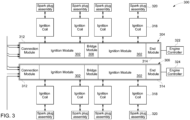
- FIG. 3 illustrates an engine 300 employing ignition modules 302.
- the ignition modules 302 may be operatively coupled to form one or more banks.
- the ignition modules 302 are shown to form two banks, referred generally to as a first bank 304 and a second bank 306.
- the ignition modules 302 of individual banks 304 and 306 are coupled using bridge modules 308.
- the bridge module 308 bridges power and signal lines and provides a safety signal loop between the various ignition modules 302 of the engine 300.
- the power lines may be configured to carry 24 V, and in same or different examples, the signal line may be a controller area network (CAN) bus.
- the banks 304 and 306 may have connection modules 312 and end modules 314.
- the connection modules 312 are configured to receive the power and signal lines for connecting to the ignition modules 302, and the end modules are used to close the safety signal loop.
- Each ignition module 302 includes one or more ignition coils 318.
- One or more ignition coils 318 in turn are coupled to respective spark plug assemblies 320.
- the spark plug assemblies 320 include a spark plug (not shown in FIG. 3 ) and a detection unit (not shown in FIG. 3 ).
- a high voltage output of the ignition coil 318 is connected to the spark plug 320 using a high voltage connector (not shown in FIG. 3 ) of the spark plug 320.
- each ignition module 302 may include semiconductor bridges and at least one controller, where the controller may be configured to use a feedback mechanism to control a voltage applied to a corresponding ignition coil 318 to control the excitation current of an associated spark plug.
- the ignition module 302 may also house one or more relays or breakers to break a safety signal loop thereby powering down multiple ignition coils 318 to stop the ignition of the engine 300.
- the engine 300 includes an internal combustion engine, a gas engine, or a gas turbine.
- the internal combustion engine may be a vehicle engine.
- vehicles may include a passenger vehicle, mass transit vehicle, military vehicle, construction vehicle, aircraft, watercraft, and the like.
- the engine 300 further includes one or more engine controllers.
- each individual bank 304 and 306 includes respective engine controllers 322 and 324, respectively.
- the engine controllers 322 and 324 are configured to receive output signals from individual spark plug assemblies 320 and initiate a control action based on the received output signals.
- the engine 300 may include a single engine controller for the banks 304 and 306.
- a spark plug assembly 400 of FIG. 4 employs an insulated optical conduit for operatively coupling the transmitter and receiver devices
- a spark plug assembly 500 of FIG. 5 employs an optical cable for operatively coupling the transmitter and receiver devices.
- FIG. 4 illustrates the spark plug assembly 400 having a spark plug 402 and a detection unit 404.
- the detection unit 404 includes a transmitter device 406 and a receiver device 408.
- the transmitter device 406 of the detection unit 404 is coupled to the spark plug 402, and the receiver device 408 of the detection unit 404 is coupled to an ignition coil 410 and an ignition module 411 of an engine (not shown in FIG. 4 ).
- the ignition coil 410 is coupled to the spark plug 402 via an electrical conductor 412.
- the transmitter device 406 is coupled to the spark plug 402 such that the transmitter device 406 is electrically disposed between a high voltage connector (not shown in FIG. 4 ) and the electrical conductor 412 of the spark plug 402.
- Disposing the transmitter device 406 between the high voltage connector and the electrical conductor 412 enables the transmitter device 406 to draw an excitation current from the electrical conductor 412.
- the transmitter device 406 is also configured to generate optical signals in response to the drawn excitation current.
- the optical signals are generally represented by reference numeral 414.
- the transmitter device 406 includes an optical signal generator, a coder, and an energy storage device. Further, in certain embodiments, the transmitter device 406 includes a high temperature circuit board. In one example, the transmitter device 406 includes a high temperature printed circuit board (PCB). In a non-limiting example, the transmitter device 406 may include two or more optical signal generators or two or more energy storage devices. In a non-limiting example, the transmitter device 406 may employ two LEDs of different wavelengths as the optical signal generator.
- PCB printed circuit board
- the transmitter device 406 and the receiver device 408 are held in operative and communicative association via an insulated optical conduit 416.
- the insulated optical conduit 416 may also house the electrical conductor 412.
- the insulated optical conduit 416 has a first end 418 and a second end 420.
- the receiver device 408 may be disposed closer to the first end 418 of the insulated optical conduit 416.
- the receiver device 408 may be at least partly disposed at the first end 418 of the insulated optical conduit 416.
- the insulated optical conduit 416 may be coupled to the transmitter device 406. At least a portion of an internal surface 422 of the insulated optical conduit 416 is optically reflective.
- the insulated optical conduit 416 enables the optical signals 414 to traverse from the transmitter device 406 to the receiver device 408. Specifically, the optically reflective internal surface 422 of the insulated optical conduit 416 facilitates traversal of the optical signals 414 from the transmitter device 406 toward the receiver device 408.
- the receiver device 408 includes an optical sensor 424.
- the optical sensor 424 is coupled to a controller, generally represented by reference numeral 426.
- the controller 426 may or may not be a part of the receiver device 408.
- the optical sensor 424 is disposed in the ignition coil 410.
- the optical sensor 424 of the receiver device 408 may be coupled to the transmitter device, such as the transmitter device 406, using an optical cable (not shown in FIG. 4 ).
- the controller 426 may be a decoder, a microcontroller, an engine controller, or combinations thereof. In embodiments where the controller 426 is a microcontroller or a decoder, the controller 426 may be part of the receiver device 408 or the engine controller.
- the decoder or the microcontroller may be coupled to and in communication with the engine controller of the engine.
- a spark plug assembly 500 includes a spark plug 502 and a detection unit 504.
- the detection unit 504 includes a transmitter device 510 and a receiver device 512.
- An ignition coil 506 of an engine is coupled to the spark plug 502 using an electrical conductor 508.
- the electrical conductor 508 is also coupled to the transmitter device 510.
- the transmitter device 504 is coupled to the receiver device 512 using an optical cable 514.
- the transmitter device 510 includes an optical signal generator 516, a coder 518, and an energy storage device 520. According to the invention, the energy storage device 520 is coupled to the coder 518, and the coder 518 in turn is coupled to the optical signal generator 516.
- the voltage limiting device such as a Zener diode 521, is used to limit the voltage across the energy storage device 520 and bypass the excitation current when a determined voltage limit is achieved across the energy storage device 520.
- the transmitter device 510 is configured to draw the excitation current from the electrical conductor 508.
- the excitation current may be drawn by the transmitter device 510 from the electrical conductor 508 at regular intervals or irregular intervals.
- the step of drawing the excitation current may be synchronized with spark events of the engine. In some other embodiments, the step of drawing the current may not be dependent on the spark events.
- the energy storage device 520 stores energy obtained from the drawn excitation current.
- the coder 518 is configured to excite the optical signal generator 516 using the energy stored in the energy storage device 520.
- the optical signal generator 516 Upon excitation, the optical signal generator 516 generates optical signals 522 representative of the identification parameter and/or diagnostic parameters. Diagnostic sensors from the engine (not shown in FIG. 5 ) may be coupled to the coder 518 for optically transmitting the diagnostic parameters.
- the optical signals 522 are communicated from the transmitter device 510 to an optical sensor 524 of the receiver device 512 using the optical cable 514.
- the optical signals 522 may be transmitted at pre-defined, frequent, regular, or irregular intervals.
- the optical cable 514 is selected based on for example, a wavelength of the optical signals 522.
- the controller represented by reference numeral 526 may be a part of the receiver device 512.
- the controller 526 may be a decoder that together with the optical sensor 524 may form the receiver device 512.
- the controller 526 may be an engine controller.
- the detection unit such as the detection unit 104 of FIG. 1 , detection unit 206 of FIG. 2 , detection unit 404 of FIG. 4 , detection unit 504 of FIG. 5 may form a kit.
- the kit may be retrofitted in existing engines or may be installed in newly manufactured engines or spark plugs.
- the kit may be installed in an engine by a service provider when the engine is brought in for servicing.
- the detection unit may be factory fitted in an engine during or after manufacturing and/or assembling of the engine.
- the kit having the detection unit includes a transmitter device configured to be coupled to a spark plug, where the transmitter device is configured to be electrically disposed between an electrical conductor and a high voltage connector. Further, the transmitter device is configured to generate an optical signal in response to the drawn excitation current.
- FIG. 6 is a flow chart 600 for a method for identification of a spark plug and/or for monitoring operation of an engine.
- the method of the flow chart 600 may be used for generating a control action based on an identification parameter of the spark plug, or a diagnostic parameter of an engine, or both.
- the identification and/or diagnostic parameters are determined based on an optical signal received from a spark plug assembly.
- a transmitter device disposed in the spark plug of the spark plug assembly is powered using a portion of an excitation current.
- the excitation current is the electrical current that is used to ignite a spark in the spark plug.
- a portion of the excitation current being carried by an electrical conductor of the spark plug is drawn or harvested by the transmitter device.
- the harvested electrical energy is used to power the transmitter device.
- the drawn excitation current is used to charge an energy storage device of the transmitter device.
- the energy stored in the energy storage device is used by a coder of the transmitter device to excite an optical signal generator of the transmitter device to generate optical signals representative of identification and/or diagnostic parameters.
- a determined amount of current is drawn from the energy storage device by the coder to excite the optical signal generator to generate an optical signal representative of the identification and/or diagnostic parameters.
- the step of drawing the portion of the excitation current is synchronized with the spark events of an engine.
- the identification parameter, diagnostic parameter, or both may be monitored during the spark events.
- the step of drawing the portion of the excitation current is performed independent of the spark events of the engine.
- the diagnostic parameters of the engine may be determined using one or more electrical parameters.
- a voltage may be sensed across a diagnostic sensor, such as, but not limited to, a NTC or PTC sensor, an analog or digitized value, of the voltage may be communicated to the receiver device via the transmitter device. Digitization of the analog value may be performed by a coder.
- a table such as a look-up table, may be used to determine a relation between the sensed voltage and one or more diagnostic parameters, such as a voltage, temperature, and the like.
- an optical signal is generated using the coder and the optical signal generator of the transmitter device. Further, the optical signal is transmitted using the transmitter device and one or both of an insulated optical conduit or an optical cable.
- the optical signal is received using a receiver device, where the optical signal is representative of an identification parameter of the spark plug, or a diagnostic parameter of an engine, or both.
- the identification parameter of the spark plug is generally representative of the identification number of the spark plug.
- the diagnostic parameter of the engine is representative of one or more of a temperature, pressure, or soot composition.
- a control action is determined based on the optical signal and the control action is initiated for the engine based on the identification parameter, diagnostic parameter, or both.
- the diagnostic parameters may be provided as an input to the engine controller and based on the diagnostic parameters the engine controller may determine the control action.
- Non-limiting examples of the control action may include generating an alarm signal, shutting down the engine, maintaining status quo, such as for example, continuing to power the engine or run the engine, predicting health of the engine, scheduling maintenance of the engine, or combinations thereof.
- an alarm may be generated based on the identification parameter, diagnostic parameter, or both.
- initiating the control action may include logging in the identification parameter of the spark plug in an engine data log registry, and continuing or discontinuing engine operations accordingly.
- initiating the control action may include logging in the identification parameter of the spark plug in an engine data log registry.
- the log entry may be a blank registry. An entry may be made in the engine log registry for every instance when the engine is started.
- initiating the control action may include displaying or communicating the identification parameter, diagnostic parameters, or both to an output device and/or the engine controller.
- identification of the authentic spark plug identification allows optimization of the engine performance, while minimizing risk of damage to the engine that may be otherwise caused due to, for example, use of counterfeit spark plugs in an engine.
- the systems and methods may also be used to monitor the engine performance during operation using the diagnostic parameters in a periodic or intermittent fashion. In addition to providing a control action, monitoring the engine performance may also result in timely prognosis and/or diagnosis, thereby providing an opportunity to timely schedule a maintenance event, prepare a predictive maintenance chart, provide recommendation for part replacement, provide recommendation for part service, and the like.
Landscapes
- Engineering & Computer Science (AREA)
- Chemical & Material Sciences (AREA)
- Combustion & Propulsion (AREA)
- Mechanical Engineering (AREA)
- General Engineering & Computer Science (AREA)
- Power Engineering (AREA)
- Spark Plugs (AREA)
- Combined Controls Of Internal Combustion Engines (AREA)
Description
- Embodiments of the present specification relate to a system and method for spark plug identification and engine monitoring, and more particularly, embodiments of the present specification relate to a spark plug assembly having a detection unit.
- Generally, internal combustion (IC) engines are used in applications such as transportation, electricity generation, and the like. Unexpected breakdown of such engines hinders normal operations and adversely effects productivity. The IC engines are typically ignited using a spark produced by a spark plug. Spark plugs are vital for engine performance as the spark plugs provide sparks to ignite and burn the air-fuel mixture compressed in a cylinder of an IC engine. As will be appreciated, the spark plugs are parts that are subject to wear and tear and need to be serviced and replaced frequently. During replacement of a spark plug, an existing authentic spark plug needs to be replaced by another authentic spark plug. Replacing an authentic spark plug with a counterfeit spark plug adversely effects engine performance and may even cause irreversible damage to the engine. By way of example, installing a counterfeit spark plug may result in decreased efficiency, increased emissions from the engine, and the like.
- Further, it is desirable to at least intermittently assess health of engines, to assist in diagnostics and/or prognostics of engine failures, and monitoring operations of the engines.
- Known diagnostic methods for spark plugs are for example shown by
US 2001/056323 A1 ,US 4 224 570 A orUS 5 208 541 A . - In one embodiment, a spark plug assembly according to claim 1 includes a spark plug, where the spark plug includes a high voltage connector disposed at one end of the spark plug and an insulator body having a first side and a second side. The insulator body is coupled to the high voltage connector at the first side. Further, the spark plug includes a metallic shell having a first side and a second side, where the first side of the metallic shell is coupled to the second side of the insulator body. The spark plug also includes an electrical conductor at least partly disposed in the insulator body and the metallic shell. The spark plug assembly includes a detection unit having a transmitter device and a receiver device. The transmitter device is coupled to the spark plug and is electrically disposed between the high voltage connector and the electrical conductor. The transmitter device is configured to draw an excitation current from the electrical conductor. The transmitter device includes an optical signal generator, where the optical signal generator is configured to generate an optical signal in response to the drawn excitation current. The receiver device is disposed in optical communication with the transmitter device and configured to receive the optical signal from the transmitter device.
- In another embodiment, according to claim 5, an engine includes one or more ignition modules, where each ignition module includes one or more ignition coils and one or more spark plug assemblies. The spark plug assemblies are coupled to respective ignition coils, where at least one of the one or more spark plug assemblies is according to claim 1.
- In yet another embodiment, a method according to claim 13 includes powering a transmitter device disposed in a spark plug using harvested energy from an electrical conductor of a spark plug. The method further includes transmitting an optical signal using the transmitter device, and receiving the optical signal using a receiver device, where the optical signal is representative of an identification parameter of the spark plug, or a diagnostic parameter of an engine, or both. The method also includes determining a control action based on the optical signal and initiating the control action for the engine.
- In another embodiment according to claim 17, a kit includes a detection unit, where the detection unit comprises a transmitter device and a receiver device. The transmitter device is configured to be coupled to a spark plug, where the transmitter device is configured to be electrically disposed between a high voltage connector and an electrical conductor. Further, the transmitter device includes an optical signal generator, where the optical signal generator is configured to generate an optical signal in response to the drawn excitation current. The receiver device is configured to be disposed in optical communication with the transmitter device. Further, the receiver device is configured to receive the optical signal from the transmitter device.
- These and other features and aspects of embodiments of the invention will become better understood when the following detailed description is read with reference to the accompanying drawings in which like characters represent like parts throughout the drawings, wherein:
-
FIG. 1 is a cross-sectional view of a spark plug having a transmitter device, in accordance with aspects of the present specification; -
FIG. 2 is a schematic representation of a portion of an engine employing a spark plug assembly, where the spark plug assembly includes a spark plug and a detection unit, in accordance with aspects of the present specification; -
FIG. 3 is a schematic representation of an engine employing one or more ignition modules having one or more ignition coils, and one or more spark plug assemblies coupled to respective ignition coils, where at least one spark plug assembly includes a spark plug and a detection unit, in accordance with aspects of the present specification; -
FIG. 4 is a diagrammatical representation of a spark plug assembly having a transmitter device of a detection unit coupled to a spark plug, and a receiver device of the detection unit coupled to an ignition coil, in accordance with aspects of the present specification; -
FIG. 5 is a detailed view illustrating electrical circuitry of the spark plug assembly ofFIG. 4 , in accordance with aspects of the present specification; and -
FIG. 6 is a flow chart of a method for determining an identification parameter of the spark plug, or a diagnostic parameter of an engine, or both based on an optical signal received from a spark plug assembly, in accordance with aspects of the present specification. - Embodiments of the present specification are directed to spark plug assemblies having a spark plug and a detection unit. The spark plug assemblies are configured to be used in engines. By way of example, the spark plug assemblies may be used in an internal combustion engine, a gas engine, or a gas turbine. In a spark plug assembly of the present specification, the detection unit in conjunction with the spark plug is configured to facilitate spark plug identification and/or engine monitoring. By way of example, the detection unit is configured to determine an identification parameter for the spark plug, a diagnostic parameter for an engine, or both. The identification parameter may correspond to a spark plug identification (ID), and the diagnostic parameter may correspond to diagnostic parameters of the engine. In certain embodiments, systems and methods of the spark plug assemblies may be used to determine spark plug specifics, such as, but not limited to, spark plug type, manufacturing date, manufacturer's name, and the like. In one example, the systems and methods of the spark plug assemblies may be used to determine the identification parameter to recognize and report use of a counterfeit spark plug in a spark plug assembly, or to determine use of an authentic spark plug in the spark plug assembly. Further, in some embodiments, the spark plug assembly may facilitate prognosis, diagnosis, or both of an engine in which it is employed. By way of example, one or more diagnostic parameters of the engine may be determined using the spark plug assembly. These diagnostic parameters may be used to prognose and/or diagnose the engine to schedule maintenance, determine leftover run time, determine replacement of certain parts of the engine, and the like.
-
FIG. 1 illustrates a portion of aspark plug assembly 100 of the present specification. Thespark plug assembly 100 includes aspark plug 102 and adetection unit 104. Thespark plug 102 may be any spark plug that is suitable for use in a given engine. Thespark plug 102 includes aninsulator body 106 having afirst side 108 and asecond side 110. Theinsulator body 106 is coupled to ahigh voltage connector 112 at thefirst side 108 of theinsulator body 106. Thehigh voltage connector 112 is coupled to an ignition coil (not shown inFIG. 1 ) of the engine, such as an internal combustion engine, a gas engine, or a gas turbine. Thehigh voltage connector 112 is configured to connect to a high voltage source of the order of few KVs. Thespark plug 102 also includes ametallic shell 114 having afirst side 116 and asecond side 118, where thefirst side 116 of themetallic shell 114 is coupled to thesecond side 110 of theinsulator body 106. Further, thespark plug 102 includes anelectrical conductor 120 at least partly disposed in theinsulator body 106 and themetallic shell 114. Theelectrical conductor 120 is disposed in a core of thespark plug 102 and extends along alongitudinal axis 122 of thespark plug 102. Theelectrical conductor 120 is disposed between thehigh voltage connector 112 and acentral electrode 124 of thespark plug 102. Particularly, theelectrical conductor 120 is housed in theinsulator body 106 and themetallic shell 114 and is connected to thehigh voltage connector 112 at one end and thecentral electrode 124 at the other end. - The
central electrode 124 includes anelectrode tip 126. Further, thespark plug 102 includes aground electrode 128 having a ground electrode pad 130. Theground electrode 128 is mounted on themetallic shell 114 using any suitable technique, such as welding. Moreover, the ground electrode pad 130 of theground electrode 128 is disposed opposite to theelectrode tip 126. A gap, generally represented by reference numeral 132, between theelectrode tip 126 and the ground electrode pad 130 defines a spark gap. The spark gap 132 is the spacing between theelectrode tip 126 of thecentral electrode 124 and the ground electrode pad 130 of theground electrode 128. The spark gap 132 may be measured and adjusted as required to facilitate generation of sparks to fire one or more cylinders in an engine. - The
detection unit 104 is used for spark plug identification and/or engine monitoring. By way of example, thedetection unit 104 may perform prognostics and/or diagnostics of an engine in which it is employed. Thedetection unit 104 includes atransmitter device 134 and a receiver device (not shown inFIG. 1 ). Thetransmitter device 134 is coupled to thespark plug 102. The receiver device is operatively coupled to thetransmitter device 134 and disposed within or outside the engine. In embodiments where the receiver device is disposed within the engine, the receiver device may be disposed in a spark plug connector (as shown inFIG. 2 ) or the receiver device may be disposed in an ignition coil of the engine (as shown inFIG. 4 ). In other embodiments, the receiver device may be disposed in any other location in the engine where the receiver device may communicate with thetransmitter device 134. - The
transmitter device 134 is electrically disposed between thehigh voltage connector 112 and theelectrical conductor 120 of thespark plug 102 via internal electrical circuitry (not shown inFIG. 1 ) of thespark plug 102. Thetransmitter device 134 is configured to draw an excitation current from theelectrical conductor 120. The excitation current is used to ignite a spark in thespark plug 102. Further, thetransmitter device 134 includes an optical signal generator (not shown inFIG. 1 ) configured to generate an optical signal in response to the drawn excitation current. Thetransmitter device 134 also includes a coder (not shown inFIG. 1 ), such as a microcontroller, a field programmable gate array (FPGA), and the like. Further, the optical signal generator is configured to sustain high temperatures with minimal decrease in optical intensity at high temperatures. In some embodiments, the optical signal generator may include one or more light emitting diodes (LEDs). In certain embodiments, the light emitting diode (LED) may be a narrow view angle LED. In one embodiment, the LED may be an ultra-bright LED. In a non-limiting example, the LED may be a red LED, an orange LED, an ultra-bright red LED, an ultra-bright orange LED, or combinations thereof. - In some embodiments, the coder may have a relatively smaller footprint, which is suitable for employing the coder in the
transmitter device 134. Moreover, the coder may also have a suitable memory capacity appropriate for high temperature applications having a maximum temperature of 300°C. A non-limiting example of the coder may include a peripheral interface controller (PIC). -
FIG. 2 is a cross-sectional view of a portion of anengine 200 employing aspark plug assembly 202, where thespark plug assembly 202 includes aspark plug 204 and adetection unit 206. Thedetection unit 206 includes atransmitter device 208 and areceiver device 214. Thespark plug 204 is coupled to oneend 203 of aspark plug connector 205. Thetransmitter device 208 is disposed in the body of thespark plug 204, while thereceiver device 214 is disposed at anotherend 216 of thespark plug connector 205. Thespark plug connector 205 is an electrically insulated channel which is partly disposed in aspark plug sleeve 210, which is a metallic sleeve. - While a side of the
spark plug 204 having a high voltage connector (not shown inFIG. 2 ) is disposed in aspark plug sleeve 210, the other side of thespark plug 204 having the center and ground electrodes (not shown inFIG. 2 ) is disposed in acombustion chamber 212 of theengine 200. Thespark plug sleeve 210 is electrically coupled to an ignition module (not shown inFIG. 2 ). An ignition coil (not shown inFIG. 2 ) is disposed between the ignition module and the high voltage connector (not shown inFIG. 2 ) to connect thespark plug 204 to the ignition module. An electrical cable is disposed in thespark plug connector 205. The ignition coil may be disposed in thespark plug connector 205. In some embodiments, thespark plug connector 205, which is an electrically insulated channel, may also be configured to act as an insulated optical conduit to communicate optical signals from thetransmitter device 208 to thereceiver device 214. In other embodiments, the insulated optical conduit may be a separate element from thespark plug connector 205. In some of these embodiments, the insulated optical conduit may be disposed inside thespark plug connector 205. Additionally, although not illustrated, in some embodiments, an optical cable may be disposed in thespark plug connector 205 to provide optical communication between thetransmitter device 208 and thereceiver device 214. - The
engine 200 may further include one or more diagnostic sensors, such assensors 220. Thediagnostic sensors 220 may be disposed in theignition chamber 212 of theengine 200. Thediagnostic sensors 220 may be any suitable sensors that are able to withstand harsh engine environments. Thediagnostic sensors 220 may be operatively and/or physically coupled to thetransmitter device 208 of thedetection unit 206. In one example, thediagnostic sensors 220 may be physically wired to thetransmitter device 208 using electrical cables. Thediagnostic sensors 220 may include one or more of a temperature sensor, a pressure sensor, or a soot sensor. In certain embodiments, thediagnostic sensors 220 may include a negative temperature coefficient (NTC) sensor or a positive temperature coefficient (PTC) sensor. In some examples, thediagnostic sensors 220 may be a NTC or PTC thermistor. Further, thediagnostic sensors 220 may be coupled to the coder and configured to transmit an optical signal using the optical signal generator of thetransmitter device 208. - Additionally, the
engine 200 may include anoutput unit 224 coupled to thespark plug assembly 202. Theoutput unit 224 is configured to receive an output signal from thereceiver device 214. Theoutput unit 224 may include a display unit, a graphical user interface (GUI), or the like. In some embodiments, the output signal from thereceiver device 214 and/or theoutput unit 224 may be communicated to anengine controller 226. In some of these embodiments, theoutput unit 224 may be part of theengine controller 226. Based on the output signal received from thereceiver device 214, theengine controller 226 may accordingly determine a control action, such as to generate an alarm, continue the operation as is, stall the operation, and the like. -
FIG. 3 illustrates anengine 300 employingignition modules 302. Theignition modules 302 may be operatively coupled to form one or more banks. In the illustrated embodiment, theignition modules 302 are shown to form two banks, referred generally to as afirst bank 304 and asecond bank 306. - The
ignition modules 302 ofindividual banks bridge modules 308. Thebridge module 308, as the name suggests, bridges power and signal lines and provides a safety signal loop between thevarious ignition modules 302 of theengine 300. In one example, the power lines may be configured to carry 24 V, and in same or different examples, the signal line may be a controller area network (CAN) bus. Further, thebanks connection modules 312 and endmodules 314. Theconnection modules 312 are configured to receive the power and signal lines for connecting to theignition modules 302, and the end modules are used to close the safety signal loop. Eachignition module 302 includes one or more ignition coils 318. One ormore ignition coils 318 in turn are coupled to respectivespark plug assemblies 320. Thespark plug assemblies 320 include a spark plug (not shown inFIG. 3 ) and a detection unit (not shown inFIG. 3 ). A high voltage output of theignition coil 318 is connected to thespark plug 320 using a high voltage connector (not shown inFIG. 3 ) of thespark plug 320. Although not illustrated, eachignition module 302 may include semiconductor bridges and at least one controller, where the controller may be configured to use a feedback mechanism to control a voltage applied to acorresponding ignition coil 318 to control the excitation current of an associated spark plug. Theignition module 302 may also house one or more relays or breakers to break a safety signal loop thereby powering downmultiple ignition coils 318 to stop the ignition of theengine 300. - The
engine 300 includes an internal combustion engine, a gas engine, or a gas turbine. The internal combustion engine may be a vehicle engine. Non-limiting examples of vehicles may include a passenger vehicle, mass transit vehicle, military vehicle, construction vehicle, aircraft, watercraft, and the like. - The
engine 300 further includes one or more engine controllers. In the illustrated embodiment, eachindividual bank respective engine controllers engine controllers spark plug assemblies 320 and initiate a control action based on the received output signals. In some embodiments, theengine 300 may include a single engine controller for thebanks - Referring now to
FIGS. 4 and5 , alternative embodiments of spark plug assemblies are illustrated. Aspark plug assembly 400 ofFIG. 4 employs an insulated optical conduit for operatively coupling the transmitter and receiver devices, while aspark plug assembly 500 ofFIG. 5 employs an optical cable for operatively coupling the transmitter and receiver devices. -
FIG. 4 illustrates thespark plug assembly 400 having aspark plug 402 and adetection unit 404. Thedetection unit 404 includes atransmitter device 406 and areceiver device 408. Thetransmitter device 406 of thedetection unit 404 is coupled to thespark plug 402, and thereceiver device 408 of thedetection unit 404 is coupled to anignition coil 410 and anignition module 411 of an engine (not shown inFIG. 4 ). Theignition coil 410 is coupled to thespark plug 402 via anelectrical conductor 412. Thetransmitter device 406 is coupled to thespark plug 402 such that thetransmitter device 406 is electrically disposed between a high voltage connector (not shown inFIG. 4 ) and theelectrical conductor 412 of thespark plug 402. Disposing thetransmitter device 406 between the high voltage connector and theelectrical conductor 412 enables thetransmitter device 406 to draw an excitation current from theelectrical conductor 412. In addition to being configured to draw the excitation current from theelectrical conductor 412, thetransmitter device 406 is also configured to generate optical signals in response to the drawn excitation current. The optical signals are generally represented byreference numeral 414. - Although not illustrated in
FIG. 4 , according to the invention, thetransmitter device 406 includes an optical signal generator, a coder, and an energy storage device. Further, in certain embodiments, thetransmitter device 406 includes a high temperature circuit board. In one example, thetransmitter device 406 includes a high temperature printed circuit board (PCB). In a non-limiting example, thetransmitter device 406 may include two or more optical signal generators or two or more energy storage devices. In a non-limiting example, thetransmitter device 406 may employ two LEDs of different wavelengths as the optical signal generator. - In the illustrated embodiment of
FIG. 4 , thetransmitter device 406 and thereceiver device 408 are held in operative and communicative association via an insulatedoptical conduit 416. The insulatedoptical conduit 416 may also house theelectrical conductor 412. The insulatedoptical conduit 416 has afirst end 418 and asecond end 420. Thereceiver device 408 may be disposed closer to thefirst end 418 of the insulatedoptical conduit 416. In one example, thereceiver device 408 may be at least partly disposed at thefirst end 418 of the insulatedoptical conduit 416. Further, at thesecond end 420, the insulatedoptical conduit 416 may be coupled to thetransmitter device 406. At least a portion of aninternal surface 422 of the insulatedoptical conduit 416 is optically reflective. The insulatedoptical conduit 416 enables theoptical signals 414 to traverse from thetransmitter device 406 to thereceiver device 408. Specifically, the optically reflectiveinternal surface 422 of the insulatedoptical conduit 416 facilitates traversal of theoptical signals 414 from thetransmitter device 406 toward thereceiver device 408. - The
receiver device 408 includes anoptical sensor 424. Theoptical sensor 424 is coupled to a controller, generally represented byreference numeral 426. Thecontroller 426 may or may not be a part of thereceiver device 408. As illustrated inFIG. 4 , in some embodiments, theoptical sensor 424 is disposed in theignition coil 410. In some of these embodiments, theoptical sensor 424 of thereceiver device 408 may be coupled to the transmitter device, such as thetransmitter device 406, using an optical cable (not shown inFIG. 4 ). Further, thecontroller 426 may be a decoder, a microcontroller, an engine controller, or combinations thereof. In embodiments where thecontroller 426 is a microcontroller or a decoder, thecontroller 426 may be part of thereceiver device 408 or the engine controller. Moreover, when deployed, the decoder or the microcontroller may be coupled to and in communication with the engine controller of the engine. - Turning now to
FIG. 5 , aspark plug assembly 500 includes aspark plug 502 and adetection unit 504. Thedetection unit 504 includes atransmitter device 510 and areceiver device 512. Anignition coil 506 of an engine is coupled to thespark plug 502 using anelectrical conductor 508. Theelectrical conductor 508 is also coupled to thetransmitter device 510. Further, in the illustrated embodiment, thetransmitter device 504 is coupled to thereceiver device 512 using anoptical cable 514. Thetransmitter device 510 includes anoptical signal generator 516, acoder 518, and anenergy storage device 520. According to the invention, theenergy storage device 520 is coupled to thecoder 518, and thecoder 518 in turn is coupled to theoptical signal generator 516. The voltage limiting device, such as aZener diode 521, is used to limit the voltage across theenergy storage device 520 and bypass the excitation current when a determined voltage limit is achieved across theenergy storage device 520. Thetransmitter device 510 is configured to draw the excitation current from theelectrical conductor 508. The excitation current may be drawn by thetransmitter device 510 from theelectrical conductor 508 at regular intervals or irregular intervals. In some embodiments, the step of drawing the excitation current may be synchronized with spark events of the engine. In some other embodiments, the step of drawing the current may not be dependent on the spark events. Theenergy storage device 520 stores energy obtained from the drawn excitation current. Based on an identification parameter and/or diagnostic parameters, thecoder 518 is configured to excite theoptical signal generator 516 using the energy stored in theenergy storage device 520. Upon excitation, theoptical signal generator 516 generatesoptical signals 522 representative of the identification parameter and/or diagnostic parameters. Diagnostic sensors from the engine (not shown inFIG. 5 ) may be coupled to thecoder 518 for optically transmitting the diagnostic parameters. Theoptical signals 522 are communicated from thetransmitter device 510 to anoptical sensor 524 of thereceiver device 512 using theoptical cable 514. Theoptical signals 522 may be transmitted at pre-defined, frequent, regular, or irregular intervals. Theoptical cable 514 is selected based on for example, a wavelength of the optical signals 522. In one embodiment, the controller represented byreference numeral 526 may be a part of thereceiver device 512. By way of example, thecontroller 526 may be a decoder that together with theoptical sensor 524 may form thereceiver device 512. In another embodiment, thecontroller 526 may be an engine controller. - In certain embodiments, the detection unit, such as the
detection unit 104 ofFIG. 1 ,detection unit 206 ofFIG. 2 ,detection unit 404 ofFIG. 4 ,detection unit 504 ofFIG. 5 may form a kit. The kit may be retrofitted in existing engines or may be installed in newly manufactured engines or spark plugs. By way of example, the kit may be installed in an engine by a service provider when the engine is brought in for servicing. In another example, the detection unit may be factory fitted in an engine during or after manufacturing and/or assembling of the engine. The kit having the detection unit includes a transmitter device configured to be coupled to a spark plug, where the transmitter device is configured to be electrically disposed between an electrical conductor and a high voltage connector. Further, the transmitter device is configured to generate an optical signal in response to the drawn excitation current. -
FIG. 6 is aflow chart 600 for a method for identification of a spark plug and/or for monitoring operation of an engine. The method of theflow chart 600 may be used for generating a control action based on an identification parameter of the spark plug, or a diagnostic parameter of an engine, or both. The identification and/or diagnostic parameters are determined based on an optical signal received from a spark plug assembly. - At
step 602, a transmitter device disposed in the spark plug of the spark plug assembly is powered using a portion of an excitation current. The excitation current is the electrical current that is used to ignite a spark in the spark plug. In some embodiments, a portion of the excitation current being carried by an electrical conductor of the spark plug is drawn or harvested by the transmitter device. The harvested electrical energy is used to power the transmitter device. Specifically, the drawn excitation current is used to charge an energy storage device of the transmitter device. Subsequently, the energy stored in the energy storage device is used by a coder of the transmitter device to excite an optical signal generator of the transmitter device to generate optical signals representative of identification and/or diagnostic parameters. Particularly, a determined amount of current is drawn from the energy storage device by the coder to excite the optical signal generator to generate an optical signal representative of the identification and/or diagnostic parameters. - In certain embodiments, the step of drawing the portion of the excitation current is synchronized with the spark events of an engine. In these embodiments, the identification parameter, diagnostic parameter, or both may be monitored during the spark events. In certain other embodiments, the step of drawing the portion of the excitation current is performed independent of the spark events of the engine. In some of these embodiments, the diagnostic parameters of the engine may be determined using one or more electrical parameters. In one example, a voltage may be sensed across a diagnostic sensor, such as, but not limited to, a NTC or PTC sensor, an analog or digitized value, of the voltage may be communicated to the receiver device via the transmitter device. Digitization of the analog value may be performed by a coder. Further, a table, such as a look-up table, may be used to determine a relation between the sensed voltage and one or more diagnostic parameters, such as a voltage, temperature, and the like.
- At step 604, an optical signal is generated using the coder and the optical signal generator of the transmitter device. Further, the optical signal is transmitted using the transmitter device and one or both of an insulated optical conduit or an optical cable.
- Further, at
step 606, the optical signal is received using a receiver device, where the optical signal is representative of an identification parameter of the spark plug, or a diagnostic parameter of an engine, or both. The identification parameter of the spark plug is generally representative of the identification number of the spark plug. The diagnostic parameter of the engine is representative of one or more of a temperature, pressure, or soot composition. - At
step 608, a control action is determined based on the optical signal and the control action is initiated for the engine based on the identification parameter, diagnostic parameter, or both. In some embodiments, the diagnostic parameters may be provided as an input to the engine controller and based on the diagnostic parameters the engine controller may determine the control action. Non-limiting examples of the control action may include generating an alarm signal, shutting down the engine, maintaining status quo, such as for example, continuing to power the engine or run the engine, predicting health of the engine, scheduling maintenance of the engine, or combinations thereof. By way of example, an alarm may be generated based on the identification parameter, diagnostic parameter, or both. - In some embodiments, initiating the control action may include logging in the identification parameter of the spark plug in an engine data log registry, and continuing or discontinuing engine operations accordingly. In same or different embodiments, initiating the control action may include logging in the identification parameter of the spark plug in an engine data log registry. In instances where the spark plug is not a valid spark plug, the log entry may be a blank registry. An entry may be made in the engine log registry for every instance when the engine is started. In certain embodiments, initiating the control action may include displaying or communicating the identification parameter, diagnostic parameters, or both to an output device and/or the engine controller.
- Advantageously, identification of the authentic spark plug identification allows optimization of the engine performance, while minimizing risk of damage to the engine that may be otherwise caused due to, for example, use of counterfeit spark plugs in an engine. The systems and methods may also be used to monitor the engine performance during operation using the diagnostic parameters in a periodic or intermittent fashion. In addition to providing a control action, monitoring the engine performance may also result in timely prognosis and/or diagnosis, thereby providing an opportunity to timely schedule a maintenance event, prepare a predictive maintenance chart, provide recommendation for part replacement, provide recommendation for part service, and the like.
Claims (17)
- A spark plug assembly, comprising:a spark plug (102, 402, 502), wherein the spark plug (102, 402, 502) comprises:a high voltage connector (112) disposed at one end of the spark plug (102, 402, 502);an insulator body (106) having a first side (108) and a second side (110), wherein the insulator body (106) is coupled to the high voltage connector (112) at the first side (108);a metallic shell (114) having a first side (116) and a second side (118), wherein the first side (116) of the metallic shell (114) is coupled to the second side (110) of the insulator body (106);an electrical conductor (120, 412, 508) at least partly disposed in the insulator body (106) and the metallic shell (114);a detection unit (104, 206, 404, 504), comprising:a transmitter device (134, 208, 406, 510) coupled to the spark plug (102, 402, 502) and electrically disposed between the high voltage connector (112) and the electrical conductor (120, 412, 508), wherein the transmitter device (134, 208, 406, 510) is configured to draw an excitation current from the electrical conductor (120, 412, 508), and wherein the transmitter device (134, 208, 406, 510) comprises an optical signal generator (516), wherein the optical signal generator (516) is configured to generate an optical signal being representative of an identification parameter of the spark plug (102, 402, 502) and/or a diagnostic parameter of an engine (200, 300) in response to the drawn excitation current, wherein the transmitter device (134, 208, 406, 510) further comprises a coder (518) and an energy storage device (520) and wherein the energy storage device (520) is coupled to the coder (518) and the coder (518) is coupled to the optical signal generator (516); anda receiver device (214, 408, 512) disposed in optical communication with the transmitter device (134, 208, 406, 510) and configured to receive the optical signal from the transmitter device (134, 208, 406, 510).
- The spark plug assembly of claim 1, wherein the optical signal generator (516) is a light emitting diode (LED).
- The spark plug assembly of claim 1, further comprising an optical cable (514) coupled to the transmitter (134, 208, 406, 510) and receiver devices (214, 408, 512), wherein the optical cable (514) is configured to transmit the optical signal from the transmitter device (134, 208, 406, 510) to the receiver device (214, 408, 512).
- The spark plug assembly of claim 1, wherein the receiver device (214, 408, 512) comprises an optical sensor (424, 524) coupled to a controller (226, 322, 324, 426, 526).
- An engine, wherein the engine (200, 300) comprises an internal combustion engine, a gas engine, or a gas turbine,
comprising:
one or more ignition modules (302) comprising one or more ignition coils (318, 410, 506);
one or more spark plug assemblies (100, 202, 320, 400, 500), wherein the one or more spark plug (102, 402, 502) assemblies are coupled to respective ignition coils (318, 410, 506), and wherein at least one of the one or more spark plug assemblies (100, 202, 320, 400, 500) comprises a spark plug assembly (100, 202, 320, 400, 500) as set forth in at least one of the claims 1 to 4. - The engine of claim 5, further comprising an engine controller (226, 322, 324), wherein the engine controller (226, 322, 324) is configured to control operation of the engine (200, 300), the one or more ignition modules (302, 411), the one or more spark plug assemblies (100, 202, 320, 400, 500), or combinations thereof.
- The engine of claim 5, further comprising one or more diagnostic sensors (220), wherein the diagnostic sensors (220) are coupled to the transmitter device (134, 208, 406, 510).
- The engine of claim 5, wherein the receiver device (214, 408, 512) is disposed in an ignition coil (318, 410, 506) of the at least one of the one or more ignition modules (302, 411).
- The engine of claim 5, wherein a receiver device (214, 408, 512) of a spark plug assembly (100, 202, 320, 400, 500) of the one or more spark plug assemblies (100, 202, 320, 400, 500) is configured to receive optical signals from transmitter devices (134, 208, 406, 510) of at least one other spark plug assembly (100, 202, 320, 400, 500) of the one or more spark plug assemblies (100, 202, 320, 400, 500).
- The engine of claim 5, further comprising a spark plug connector (205) comprising an insulated optical conduit (416) having a first end (418) and a second end (420), wherein the receiver device (214, 408, 512) is disposed at the first end (418) of the insulated optical conduit (416).
- The engine of claim 10, wherein at least a portion of an internal surface of the insulated optical conduit (416) is optically reflective.
- The engine of claim 5, wherein the receiver device (214, 408, 512) is disposed outside the engine (200, 300).
- A method for operating a spark plug assembly according to at least one of the claims 1 to 4, comprising:powering a transmitter device (134, 208, 406, 510) disposed in a spark plug (102, 402, 502) using harvested energy from an electrical conductor (120, 412, 508) of the spark plug (102, 402, 502);transmitting an optical signal using the transmitter device (134, 208, 406, 510);receiving the optical signal using a receiver device (214, 408, 512), wherein the optical signal is representative of an identification parameter of the spark plug (102, 402, 502), or a diagnostic parameter of an engine (200, 300), or both;determining a control action based on the optical signal; andinitiating the control action for the engine (200, 300).
- The method of claim 13, wherein the step of initiating the control action comprises logging in the identification parameter of the spark plug (102, 402, 502) in an engine data log registry.
- The method of claim 13, wherein powering the transmitter device (134, 208, 406, 510) comprises:drawing a portion of the excitation current from an electrical conductor (120, 412, 508) of the spark plug (102, 402, 502); andexciting an optical signal generator to generate the optical signal.
- The method of claim 13, wherein the step of drawing the portion of the excitation current is performed independent of spark events or synchronized with the spark events.
- A kit comprising a detection unit, wherein the detection unit comprises:a transmitter device (134, 208, 406, 510) configured to be coupled to a spark plug (102, 402, 502), wherein the transmitter device (134, 208, 406, 510) is configured to be electrically disposed between a high voltage connector (112) and an electrical conductor (120, 412, 508), wherein the transmitter device (134, 208, 406, 510) comprises an optical signal generator (516), and wherein the optical signal generator (518) is configured to generate an optical signal being representative of an identification parameter of the spark plug (102, 402, 502) and/or a diagnostic parameter of an engine (200, 300) in response to an excitation current, wherein the transmitter device (134, 208, 406, 510) further comprises a coder (518) and an energy storage device (520) and wherein the energy storage device (520) is coupled to the coder (518) and the coder (518) is coupled to the optical signal generator (516); anda receiver device (214, 408, 512) configured to be disposed in optical communication with the transmitter device (134, 208, 406, 510), wherein the receiver device (214, 408, 512) is configured to receive the optical signal from the transmitter device (134, 208, 406, 510).
Applications Claiming Priority (1)
| Application Number | Priority Date | Filing Date | Title |
|---|---|---|---|
| PCT/US2018/066623 WO2020131055A1 (en) | 2018-12-20 | 2018-12-20 | System and method for spark plug identification and engine monitoring |
Publications (3)
| Publication Number | Publication Date |
|---|---|
| EP3900129A1 EP3900129A1 (en) | 2021-10-27 |
| EP3900129C0 EP3900129C0 (en) | 2025-04-30 |
| EP3900129B1 true EP3900129B1 (en) | 2025-04-30 |
Family
ID=65139174
Family Applications (1)
| Application Number | Title | Priority Date | Filing Date |
|---|---|---|---|
| EP18837031.6A Active EP3900129B1 (en) | 2018-12-20 | 2018-12-20 | System and method for spark plug identification and engine monitoring |
Country Status (3)
| Country | Link |
|---|---|
| US (1) | US11984705B2 (en) |
| EP (1) | EP3900129B1 (en) |
| WO (1) | WO2020131055A1 (en) |
Families Citing this family (1)
| Publication number | Priority date | Publication date | Assignee | Title |
|---|---|---|---|---|
| DE102019134343B4 (en) | 2019-12-13 | 2025-06-12 | Ams OSRAM Automotive Lighting Systems GmbH | Arrangement for a vehicle, lamp, vehicle and vehicle with an arrangement |
Family Cites Families (24)
| Publication number | Priority date | Publication date | Assignee | Title |
|---|---|---|---|---|
| US4224570A (en) * | 1978-12-11 | 1980-09-23 | Simpson Electric Company, A Division Of American Gage & Machine Company | Engine speed indicator |
| US4412151A (en) * | 1980-09-02 | 1983-10-25 | Charles W. Taggart | Piezoelectric crystal spark plug |
| US4557229A (en) * | 1982-06-07 | 1985-12-10 | Nippondenso Co., Ltd. | Ignition apparatus for internal combustion engines |
| US5371436A (en) * | 1989-09-28 | 1994-12-06 | Hensley Plasma Plug Partnership | Combustion ignitor |
| EP0508804B1 (en) * | 1991-04-12 | 1997-12-29 | Ngk Spark Plug Co., Ltd | A secondary voltage waveform detecting device for internal combustion engine |
| US5208541A (en) * | 1991-06-19 | 1993-05-04 | Daniel Yerkovich | Spark plug firing sensor with capacitive coupling and optical pickup |
| US6741925B2 (en) * | 1999-11-02 | 2004-05-25 | Autotronic Controls Corporation | User interface for electronic controller and timing sensor |
| US6721648B2 (en) * | 1999-11-02 | 2004-04-13 | Autotronic Controls Corporation | Method and apparatus for controlling a motorcycle engine |
| US7022968B1 (en) | 2003-10-21 | 2006-04-04 | National Semiconductor Corporation | Optical sensor that measures the light output by the combustion chamber of an internal combustion engine |
| US6948372B2 (en) * | 2004-01-08 | 2005-09-27 | Delphi Technologies, Inc. | Method of connection to a spark plug pressure sensor |
| US7412129B2 (en) | 2004-08-04 | 2008-08-12 | Colorado State University Research Foundation | Fiber coupled optical spark delivery system |
| DE102004042101B4 (en) | 2004-08-30 | 2008-04-10 | Deutsche Bahn Ag | Energy supply and signal transmission for measuring technology at high voltage potential |
| DE102006029989A1 (en) * | 2006-06-29 | 2008-01-03 | Robert Bosch Gmbh | Spark plug for an internal combustion engine and operating method therefor |
| JP5185990B2 (en) | 2009-12-21 | 2013-04-17 | 日本特殊陶業株式会社 | Spark plug and manufacturing method thereof |
| JP5792435B2 (en) | 2010-05-18 | 2015-10-14 | トヨタ自動車株式会社 | In-cylinder state monitoring device and control device for spark ignition internal combustion engine |
| DE102010043893A1 (en) | 2010-11-15 | 2012-05-16 | Robert Bosch Gmbh | Ignition system and operating method for this |
| DE102010043894A1 (en) | 2010-11-15 | 2012-05-16 | Robert Bosch Gmbh | Covering device for a spark plug well, control device for a spark plug and method for operating a spark plug |
| AT513537B1 (en) | 2012-10-19 | 2014-08-15 | Ge Jenbacher Gmbh & Co Og | laser spark plug |
| US9255565B2 (en) | 2014-01-10 | 2016-02-09 | Ford Global Technologies, Llc | Laser ignition system based diagnostics |
| DE102014219722A1 (en) * | 2014-09-29 | 2016-03-31 | Robert Bosch Gmbh | Ignition system and method for checking electrodes of a spark gap |
| US9702333B1 (en) * | 2016-03-29 | 2017-07-11 | Eco-S Spark Plug Corporation | Thermally controlled ignition device |
| WO2018098278A1 (en) * | 2016-11-22 | 2018-05-31 | Ic Llc | Spark plug combustion ionization sensor |
| US10995726B2 (en) * | 2018-03-29 | 2021-05-04 | Woodward, Inc. | Current profile optimization |
| DE102018217335A1 (en) * | 2018-10-10 | 2020-04-16 | Robert Bosch Gmbh | Method for operating an internal combustion engine, control unit for performing the method |
-
2018
- 2018-12-20 WO PCT/US2018/066623 patent/WO2020131055A1/en not_active Ceased
- 2018-12-20 EP EP18837031.6A patent/EP3900129B1/en active Active
- 2018-12-20 US US17/415,668 patent/US11984705B2/en active Active
Also Published As
| Publication number | Publication date |
|---|---|
| EP3900129C0 (en) | 2025-04-30 |
| US20220077660A1 (en) | 2022-03-10 |
| US11984705B2 (en) | 2024-05-14 |
| WO2020131055A1 (en) | 2020-06-25 |
| EP3900129A1 (en) | 2021-10-27 |
Similar Documents
| Publication | Publication Date | Title |
|---|---|---|
| US9494125B2 (en) | System and method of ignition coil testing | |
| US7635826B2 (en) | Glow plug having built-in sensor | |
| US9562510B2 (en) | Spark plug for a gas-powered internal combustion engine | |
| EP3140533B1 (en) | Localized ignition diagnostics | |
| US4090125A (en) | Ignition indicator for internal combustion engines | |
| KR102027743B1 (en) | Integrated monitoring system for voltage and temperature of power cable joint point | |
| KR101189355B1 (en) | Fault diagnosis logic of fuel filter heater for diesel engine and fault diagnosis method therefor | |
| US20170284358A1 (en) | Ignition system and method for checking electrodes of a spark plug of an internal combustion engine | |
| US11984705B2 (en) | System and method for spark plug identification and engine monitoring | |
| EP2455661A2 (en) | Combustion dynamics monitoring ignition system for a gas turbine | |
| US20190376486A1 (en) | Spark plug electrode wear rate determination for a spark-ignited engine | |
| US20150100183A1 (en) | Aircraft instrument and backup power therefor provided by magneto p-lead | |
| US8438906B2 (en) | Apparatus and method for the detection of knocking combustion | |
| US20130298863A1 (en) | Ignition system and operating method for same | |
| CN112840110B (en) | Method for operating an internal combustion engine, controller for performing said method | |
| JP2011074825A (en) | Remote monitor device for voltage required for ignition plug of spark ignition engine | |
| KR100738193B1 (en) | How to diagnose ignition coil failure of a car | |
| US20090160450A1 (en) | Method and device for providing diagnostics for an internal combustion engine ignition coil | |
| CN120231677A (en) | Ignition system for vehicle and vehicle | |
| CN206038847U (en) | Engine ignition device primary circuit fault detection device | |
| CN110094264A (en) | A kind of engine behavior monitoring system | |
| CN202007735U (en) | Self-diagnosis device used on igniter | |
| RU2655681C1 (en) | Method of the ignition system components diagnostics by the spark discharges continuous sequence | |
| KR101720222B1 (en) | Glow plug | |
| SU1126709A1 (en) | Device for checking operation of ignition spark plug |
Legal Events
| Date | Code | Title | Description |
|---|---|---|---|
| STAA | Information on the status of an ep patent application or granted ep patent |
Free format text: STATUS: UNKNOWN |
|
| STAA | Information on the status of an ep patent application or granted ep patent |
Free format text: STATUS: THE INTERNATIONAL PUBLICATION HAS BEEN MADE |
|
| PUAI | Public reference made under article 153(3) epc to a published international application that has entered the european phase |
Free format text: ORIGINAL CODE: 0009012 |
|
| STAA | Information on the status of an ep patent application or granted ep patent |
Free format text: STATUS: REQUEST FOR EXAMINATION WAS MADE |
|
| 17P | Request for examination filed |
Effective date: 20210714 |
|
| AK | Designated contracting states |
Kind code of ref document: A1 Designated state(s): AL AT BE BG CH CY CZ DE DK EE ES FI FR GB GR HR HU IE IS IT LI LT LU LV MC MK MT NL NO PL PT RO RS SE SI SK SM TR |
|
| DAV | Request for validation of the european patent (deleted) | ||
| DAX | Request for extension of the european patent (deleted) | ||
| STAA | Information on the status of an ep patent application or granted ep patent |
Free format text: STATUS: EXAMINATION IS IN PROGRESS |
|
| 17Q | First examination report despatched |
Effective date: 20230227 |
|
| P01 | Opt-out of the competence of the unified patent court (upc) registered |
Effective date: 20230602 |
|
| GRAP | Despatch of communication of intention to grant a patent |
Free format text: ORIGINAL CODE: EPIDOSNIGR1 |
|
| STAA | Information on the status of an ep patent application or granted ep patent |
Free format text: STATUS: GRANT OF PATENT IS INTENDED |
|
| GRAS | Grant fee paid |
Free format text: ORIGINAL CODE: EPIDOSNIGR3 |
|
| GRAA | (expected) grant |
Free format text: ORIGINAL CODE: 0009210 |
|
| STAA | Information on the status of an ep patent application or granted ep patent |
Free format text: STATUS: THE PATENT HAS BEEN GRANTED |
|
| INTG | Intention to grant announced |
Effective date: 20250226 |
|
| AK | Designated contracting states |
Kind code of ref document: B1 Designated state(s): AL AT BE BG CH CY CZ DE DK EE ES FI FR GB GR HR HU IE IS IT LI LT LU LV MC MK MT NL NO PL PT RO RS SE SI SK SM TR |
|
| REG | Reference to a national code |
Ref country code: CH Ref legal event code: EP Ref country code: GB Ref legal event code: FG4D |
|
| REG | Reference to a national code |
Ref country code: IE Ref legal event code: FG4D |
|
| REG | Reference to a national code |
Ref country code: DE Ref legal event code: R096 Ref document number: 602018081582 Country of ref document: DE |
|
| P04 | Withdrawal of opt-out of the competence of the unified patent court (upc) registered |
Free format text: CASE NUMBER: APP_22720/2025 Effective date: 20250514 |
|
| U01 | Request for unitary effect filed |
Effective date: 20250508 |
|
| U07 | Unitary effect registered |
Designated state(s): AT BE BG DE DK EE FI FR IT LT LU LV MT NL PT RO SE SI Effective date: 20250516 |
|
| PG25 | Lapsed in a contracting state [announced via postgrant information from national office to epo] |
Ref country code: ES Free format text: LAPSE BECAUSE OF FAILURE TO SUBMIT A TRANSLATION OF THE DESCRIPTION OR TO PAY THE FEE WITHIN THE PRESCRIBED TIME-LIMIT Effective date: 20250430 |
|
| PG25 | Lapsed in a contracting state [announced via postgrant information from national office to epo] |
Ref country code: NO Free format text: LAPSE BECAUSE OF FAILURE TO SUBMIT A TRANSLATION OF THE DESCRIPTION OR TO PAY THE FEE WITHIN THE PRESCRIBED TIME-LIMIT Effective date: 20250730 Ref country code: GR Free format text: LAPSE BECAUSE OF FAILURE TO SUBMIT A TRANSLATION OF THE DESCRIPTION OR TO PAY THE FEE WITHIN THE PRESCRIBED TIME-LIMIT Effective date: 20250731 |
|
| PG25 | Lapsed in a contracting state [announced via postgrant information from national office to epo] |
Ref country code: PL Free format text: LAPSE BECAUSE OF FAILURE TO SUBMIT A TRANSLATION OF THE DESCRIPTION OR TO PAY THE FEE WITHIN THE PRESCRIBED TIME-LIMIT Effective date: 20250430 |
|
| PG25 | Lapsed in a contracting state [announced via postgrant information from national office to epo] |
Ref country code: HR Free format text: LAPSE BECAUSE OF FAILURE TO SUBMIT A TRANSLATION OF THE DESCRIPTION OR TO PAY THE FEE WITHIN THE PRESCRIBED TIME-LIMIT Effective date: 20250430 |
|
| PG25 | Lapsed in a contracting state [announced via postgrant information from national office to epo] |
Ref country code: RS Free format text: LAPSE BECAUSE OF FAILURE TO SUBMIT A TRANSLATION OF THE DESCRIPTION OR TO PAY THE FEE WITHIN THE PRESCRIBED TIME-LIMIT Effective date: 20250731 |
|
| PG25 | Lapsed in a contracting state [announced via postgrant information from national office to epo] |
Ref country code: IS Free format text: LAPSE BECAUSE OF FAILURE TO SUBMIT A TRANSLATION OF THE DESCRIPTION OR TO PAY THE FEE WITHIN THE PRESCRIBED TIME-LIMIT Effective date: 20250830 |
|
| U20 | Renewal fee for the european patent with unitary effect paid |
Year of fee payment: 8 Effective date: 20251119 |
|
| PGFP | Annual fee paid to national office [announced via postgrant information from national office to epo] |
Ref country code: GB Payment date: 20251119 Year of fee payment: 8 |
|
| PG25 | Lapsed in a contracting state [announced via postgrant information from national office to epo] |
Ref country code: SM Free format text: LAPSE BECAUSE OF FAILURE TO SUBMIT A TRANSLATION OF THE DESCRIPTION OR TO PAY THE FEE WITHIN THE PRESCRIBED TIME-LIMIT Effective date: 20250430 |
|
| PG25 | Lapsed in a contracting state [announced via postgrant information from national office to epo] |
Ref country code: CZ Free format text: LAPSE BECAUSE OF FAILURE TO SUBMIT A TRANSLATION OF THE DESCRIPTION OR TO PAY THE FEE WITHIN THE PRESCRIBED TIME-LIMIT Effective date: 20250430 |
|
| PG25 | Lapsed in a contracting state [announced via postgrant information from national office to epo] |
Ref country code: SK Free format text: LAPSE BECAUSE OF FAILURE TO SUBMIT A TRANSLATION OF THE DESCRIPTION OR TO PAY THE FEE WITHIN THE PRESCRIBED TIME-LIMIT Effective date: 20250430 |
|
| PLBE | No opposition filed within time limit |
Free format text: ORIGINAL CODE: 0009261 |
|
| STAA | Information on the status of an ep patent application or granted ep patent |
Free format text: STATUS: NO OPPOSITION FILED WITHIN TIME LIMIT |
|
| REG | Reference to a national code |
Ref country code: CH Ref legal event code: L10 Free format text: ST27 STATUS EVENT CODE: U-0-0-L10-L00 (AS PROVIDED BY THE NATIONAL OFFICE) Effective date: 20260311 |
|
| 26N | No opposition filed |
Effective date: 20260202 |