EP3899990B1 - Atominterferometer - Google Patents
Atominterferometer Download PDFInfo
- Publication number
- EP3899990B1 EP3899990B1 EP19900933.3A EP19900933A EP3899990B1 EP 3899990 B1 EP3899990 B1 EP 3899990B1 EP 19900933 A EP19900933 A EP 19900933A EP 3899990 B1 EP3899990 B1 EP 3899990B1
- Authority
- EP
- European Patent Office
- Prior art keywords
- atom
- interferometer
- atoms
- quantum states
- fringe pattern
- Prior art date
- Legal status (The legal status is an assumption and is not a legal conclusion. Google has not performed a legal analysis and makes no representation as to the accuracy of the status listed.)
- Active
Links
Images



Classifications
-
- G—PHYSICS
- G01—MEASURING; TESTING
- G01V—GEOPHYSICS; GRAVITATIONAL MEASUREMENTS; DETECTING MASSES OR OBJECTS; TAGS
- G01V7/00—Measuring gravitational fields or waves; Gravimetric prospecting or detecting
-
- G—PHYSICS
- G01—MEASURING; TESTING
- G01B—MEASURING LENGTH, THICKNESS OR SIMILAR LINEAR DIMENSIONS; MEASURING ANGLES; MEASURING AREAS; MEASURING IRREGULARITIES OF SURFACES OR CONTOURS
- G01B9/00—Measuring instruments characterised by the use of optical techniques
- G01B9/02—Interferometers
- G01B9/02001—Interferometers characterised by controlling or generating intrinsic radiation properties
-
- G—PHYSICS
- G01—MEASURING; TESTING
- G01B—MEASURING LENGTH, THICKNESS OR SIMILAR LINEAR DIMENSIONS; MEASURING ANGLES; MEASURING AREAS; MEASURING IRREGULARITIES OF SURFACES OR CONTOURS
- G01B9/00—Measuring instruments characterised by the use of optical techniques
- G01B9/02—Interferometers
- G01B9/02041—Interferometers characterised by particular imaging or detection techniques
-
- G—PHYSICS
- G01—MEASURING; TESTING
- G01P—MEASURING LINEAR OR ANGULAR SPEED, ACCELERATION, DECELERATION, OR SHOCK; INDICATING PRESENCE, ABSENCE, OR DIRECTION, OF MOVEMENT
- G01P15/00—Measuring acceleration; Measuring deceleration; Measuring shock, i.e. sudden change of acceleration
- G01P15/02—Measuring acceleration; Measuring deceleration; Measuring shock, i.e. sudden change of acceleration by making use of inertia forces using solid seismic masses
- G01P15/08—Measuring acceleration; Measuring deceleration; Measuring shock, i.e. sudden change of acceleration by making use of inertia forces using solid seismic masses with conversion into electric or magnetic values
- G01P15/093—Measuring acceleration; Measuring deceleration; Measuring shock, i.e. sudden change of acceleration by making use of inertia forces using solid seismic masses with conversion into electric or magnetic values by photoelectric pick-up
-
- G—PHYSICS
- G01—MEASURING; TESTING
- G01B—MEASURING LENGTH, THICKNESS OR SIMILAR LINEAR DIMENSIONS; MEASURING ANGLES; MEASURING AREAS; MEASURING IRREGULARITIES OF SURFACES OR CONTOURS
- G01B2290/00—Aspects of interferometers not specifically covered by any group under G01B9/02
- G01B2290/55—Quantum effects
-
- G—PHYSICS
- G01—MEASURING; TESTING
- G01C—MEASURING DISTANCES, LEVELS OR BEARINGS; SURVEYING; NAVIGATION; GYROSCOPIC INSTRUMENTS; PHOTOGRAMMETRY OR VIDEOGRAMMETRY
- G01C19/00—Gyroscopes; Turn-sensitive devices using vibrating masses; Turn-sensitive devices without moving masses; Measuring angular rate using gyroscopic effects
- G01C19/58—Turn-sensitive devices without moving masses
-
- G—PHYSICS
- G01—MEASURING; TESTING
- G01P—MEASURING LINEAR OR ANGULAR SPEED, ACCELERATION, DECELERATION, OR SHOCK; INDICATING PRESENCE, ABSENCE, OR DIRECTION, OF MOVEMENT
- G01P15/00—Measuring acceleration; Measuring deceleration; Measuring shock, i.e. sudden change of acceleration
- G01P15/02—Measuring acceleration; Measuring deceleration; Measuring shock, i.e. sudden change of acceleration by making use of inertia forces using solid seismic masses
- G01P15/04—Measuring acceleration; Measuring deceleration; Measuring shock, i.e. sudden change of acceleration by making use of inertia forces using solid seismic masses for indicating maximum value
- G01P15/06—Measuring acceleration; Measuring deceleration; Measuring shock, i.e. sudden change of acceleration by making use of inertia forces using solid seismic masses for indicating maximum value using members subjected to a permanent deformation
-
- G—PHYSICS
- G21—NUCLEAR PHYSICS; NUCLEAR ENGINEERING
- G21K—HANDLING OF PARTICLES OR IONISING RADIATION NOT OTHERWISE PROVIDED FOR; IRRADIATION DEVICES; GAMMA RAY OR X-RAY MICROSCOPES
- G21K1/00—Arrangements for handling particles or ionising radiation, e.g. focusing or moderating
- G21K1/30—Arrangements for handling particles or ionising radiation, e.g. focusing or moderating for confining neutral particles or handling confined neutral particles, e.g. atom traps
Definitions
- the present invention relates generally to an atom interferometer.
- the present invention also relates to a method for operating the atom interferometer, and to a computer program product including a computer readable medium having recorded thereon a computer program for operating the atom interferometer.
- An atom interferometer is a tool for accurately measuring physical quantities such as local gravity, the gravitational constant, the fine structure constant, the ratio of Planck's constant to the atomic mass, rotation of the atom interferometer, acceleration of the atom interferometer, and the like.
- Atom interferometers can employ Raman transitions to generate the mirror and beamsplitters light pulses required for the interferometry sequence. This two-photon process couples atoms in different internal quantum states in addition to providing a momentum kick. Whilst different internal quantum states allow the interferometer outputs to be measured independently without requiring quantum state separation, such an atom interferometer is susceptible to systematic shifts from electromagnetic gradients and require careful shielding from external fields.
- Atom interferometers can also use Bragg transitions, which couple only between external quantum states (e.g., momentum states).
- external quantum states e.g., momentum states
- atom interferometers using Bragg transitions require separation of the external quantum states at the output before measurement can be taken. The required separation delays the detection of the external quantum states (e.g., momentum states) and limits the possible sensitivity for a given free-fall distance or apparatus size.
- Large momentum transfer (LMT) interferometry mitigates this effect, but increases the laser phase noise.
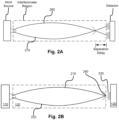
- Fig. 2A shows an example of the travel paths of different quantum states of atoms in a conventional Bragg-transition atom interferometer with spatial fringes.
- the atoms When atoms are released from the atom source, the atoms are placed into different quantum states, which travel at different paths 270, 280 in the interferometer region.
- the quantum states of the atoms then overlap and separate completely before being measured by the detector.
- there is a separation delay which is the time taken when the quantum states overlap and when the quantum states completely separate.
- the separation delay hold-ups the measurement of the quantum states and limits the possible sensitivity for a given free-fall distance or apparatus size. Muntinga H.
- the present disclosure relates to an atom interferometer that does not require the quantum states of atoms to separate in space before detection.
- An aspect of the disclosed atom interferometer provides an additional benefit of single shot phase readout.
- the atom interferometer uses an asymmetric Mach-Zehnder method for creating a spatial fringe pattern at the output.
- the spatial fringe pattern is detected when the quantum states of the atoms overlap spatially and the spatial fringe patterns of both output ports are in phase. Therefore, the atom interferometer of the present disclosure does not require the quantum states to separate in space before being detected, thereby reducing detection delay.
- the Bragg-transition atom interferometer uses laser rotation to create the spatial fringe pattern when the quantum states of the atoms overlap spatially.
- the spatial fringe pattern enables the quantum states of the atoms to be detected.
- an atom interferometry acceleration measurement method according to claim 1.
- an atom interferometer according to claim 6.
- a computer program product including a computer readable medium having recorded thereon a computer program for implementing any one of the methods described above.
- Fig. 1 shows a schematic block diagram of an atom interferometer 100 according to the present disclosure.
- the atom interferometer 100 includes an atom source 110, an interferometer region 120, a detector 130, a laser system 140, and a computer system 1300.
- the atom source 110 is configured to provide atoms to be released into the interferometer region 120.
- the laser system 140 provides laser light to the atom source 110 for the operation of a magneto optical trap (MOT).
- the computer system 1300 controls the atom source 110 for releasing the atoms.
- the computer system 1300 also controls the laser system 140 for providing the laser to operate as the optical trap.
- the atom source 110 is an ultra-high vacuum system with a background pressure of less than 10 -9 torr.
- the atom source 110 confines a thermal sample of 87 Rb atoms.
- the thermal sample is then cooled using a two-dimensional MOT before being transferred through a high impedance line to an ultrahigh vacuum 3D MOT where further cooling is achieved.
- a sample of 5 x 10 9 atoms is acquired before undergoing a compression and polarization gradient cooling stage, lowering the temperature to about 20 ⁇ K.
- the atoms are then loaded into a hybrid magnetic quadrupole and crossed optical dipole trap, where an initial stage of evaporation is completed using a microwave knife over 4.5 seconds leaving 4 x 10 7 atoms at 4 ⁇ K.
- the magnetic field gradient is subsequently decreased from 150G/cm to 25G/cm over 200 ms until the atoms are no longer supported against gravity, allowing efficient loading into the crossed optical dipole trap with the magnetic field subsequently extinguished.
- the use of this hybrid trap facilitates spatial mode matching from the MOT stage to the dipole trap stage, enabling a higher final atom number to be achieved.
- the dipole trap is performed using the laser system 140.
- the laser system 140 generates a pair of 1064nm broad linewidth laser beams intersecting at 22.5° each with waists of 300 ⁇ m. By reducing the intensity of both beams over 2 seconds, forced evaporation results in a pure
- BEC Bose Einstein condensate
- the dipole trap is then removed (i.e., the laser system 140 stops providing laser beams to the atom source 110) and the condensed atoms fall under gravity.
- non-condensed atoms are used for the atom source 110 where the atoms are not condensed at the time of release.
- the beams are provided by the laser system 140.
- the atoms then enter the interferometer region 120.
- the atoms entering the interferometer region 120 may be placed in other quantum states such as hyper-fine states, angular momentum states, and linear momentum states.
- the atoms may be placed in any quantum states, but for simplicity sake the discussions will refer to a particular quantum state.
- the timing of the steps performed by the atom source 110 is controlled by the computer system 1300.
- the interferometer region 120 is a region through which the released atoms travel.
- the laser system 140 provides pulses of light directed at the travelling atoms so that the travelling atoms are placed in different quantum states.
- a spatial fringe pattern is created when the quantum states overlapped spatially.
- the computer system 1300 controls the laser system 140 for providing the light pulses.
- the laser system 140 provides the light pulses such that the time period between the pulses are asymmetric to create the spatial fringe pattern. In other words, there is temporal asymmetry when directing the light pulses at the atoms travelling through the interferometer region 120.
- one or more of the light pulses provided by the laser system 140 are rotated relative to each other to create the spatial fringe pattern.
- the interferometer region 120 is an ultra-high vacuum system with a background pressure of less than 10 -9 torr.
- the detector 130 The detector 130
- the detector 130 is positioned at the end of the interferometer region to detect the spatial fringe pattern when the quantum states of the atoms overlapped spatially.
- the computer system 1300 controls the laser system 140 for providing light to the detector 130 to capture the spatial fringe pattern.
- the detector 130 may be charged-coupled device (CCD) cameras, complementary metal-oxide-semiconductor (CMOS) cameras, a photo-diode, or a photo multiplier tube (PMT).
- CCD charged-coupled device
- CMOS complementary metal-oxide-semiconductor
- PMT photo multiplier tube
- the laser system 140 includes different types of laser.
- One type of lasers in the laser system 140 is used to operate as MOT for the atom source 110.
- Another type of lasers is used to provide light pulses at the atoms travelling through the interferometer region 120 to create the spatial fringe pattern.
- Another type of lasers is used to provide light to the detector 130 for detecting the spatial fringe pattern.
- the computer system 1300 controls the operation of the atom source 110, the laser system 140, and the detector 130.
- the computer system 1300 performs such controls by sending control signals to the respective devices 110, 130, 140 to perform certain functions (e.g., releasing of atoms, providing the light pulses, etc.).
- the computer system 1300 may be replaced with analog hardware.
- an oscillator may be used to trigger the light pulses generated by the laser system 140 to control the atom source 110, to direct light pulses when the atoms are in the interferometer region 120, and to control the detector 130.
- a controller configured to control the atom source 110, the laser system 140, and the detector 130 can be the computer system 1300 or analog hardware.
- Fig. 8 shows a flow chart of a method 800 of operating the atom interferometer 100.
- Method 800 can be implemented as one or more software application programs 1333 (see Fig. 9A and discussed below) that are executable by a processor 1305 (see Fig. 9A and discussed below).
- Method 800 commences at step 810 by releasing atoms from the atom source 110. The atoms released by the atom source 110 then proceed into the interferometer region 120. Method 800 then proceeds from step 810 to step 820.
- the laser system 140 directs pulses of light at the atoms travelling through the interferometer region 120.
- the atoms are placed into different quantum states.
- the light pulses then recombine the quantum states such that the recombined quantum states interfere with each other when the quantum states are overlapped spatially.
- the recombined quantum states create a spatial fringe pattern having a phase if an asymmetry in the interferometer sequence is applied (as described below in paragraphs [0051], [0056], and [0062]).
- the recombination of the quantum states occurs at the end of the interferometer region 120, where, given this asymmetry, a spatial fringe pattern is created when the quantum states are recombined when the quantum states overlap spatially and interfere with each other.
- the spatial fringe pattern is created when the time period between the light pulses directed at the atoms in the interferometer region 120 are asymmetric.
- Fig. 2B shows an illustration of different quantum states travelling through paths 210 and 220 in the interferometer region 120.
- the quantum states overlapped spatially at the end 240 of the interferometer region 120, a spatial fringe pattern 230 is created.
- the atom interferometer 100 does not require the quantum states of the atoms to separate before detection. Therefore, the atom interferometer 100 does not have the separation delay of a conventional Bragg-transition atom interferometer.
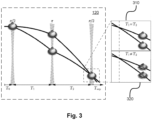
- Fig. 3 shows an illustration of Fig. 2B with the pulses of light being directed at the atoms.
- a Mach-Zehnder atom-interferometer sequence is used for directing the pulses of light.
- a Bose-Einstein condensate of atoms is released into the interferometer region 120.
- a vertically oriented Bragg lattice is generated with two frequency shifted counter propagating beams of same polarization.
- a light pulse is applied to swap the quantum states.
- the light pulse applied at time T1 is known as the mirror light pulse.
- a light pulse is applied to recombine and interfere the quantum states of the atoms.
- the light pulse applied at time T2 is known as the beamsplitter light pulse.
- the light pulses in Fig. 3 are detuned Bragg pulses, with one beam frequency chirped to account for an increasing Doppler shift resulting from the accelerating atoms.
- the laser system 140 generates the light through a frequency doubled 1560nm fiber amplifier system using a seed with a narrow 10 Hz linewidth. Bragg pulses with 50 ⁇ s full width half maximum are used to couple the atoms to the 2 ⁇ k momentum state.
- the inertial reference is provided by a custom retro-reflector passively isolated from ground vibrations through the low frequency mechanical oscillator of a geometric anti-spring system.
- the Stern-Gerlach pulse (not shown in Fig. 3 ) is used to separate the different magnetic substates at the culmination of the interferometer sequence.
- the Stern-Gerlach pulse is a magnetic gradient that is generated by switching a magnetic field for a short period of time (e.g., about 5ms.
- the Stern-Gerlach pulse is applied before the end of the interferometer region 120, as the noise analysis is only concerned with the magnetically insensitive states. In this case, the other two magnetic substates do not participate in simultaneous interferometers. In another arrangement, it is possible to apply the Stern-Gerlach pulse before the first of the light pulses from the laser system 140 is directed at the atoms.
- the Stern-Gerlach pulse is not applied.
- the light pulses are rotated relative to each other to create the spatial fringe pattern.
- the light pulse is rotated by tipping or tilting the reference mirror or the Bragg light outcouple, or any combination of these, during the interferometer sequence (i.e., when atoms are travelling through the interferometer region 120).
- Method 800 proceeds from step 820 to step 830.
- the detector 130 (which is placed at the end of the interferometer region 120) detects the spatial fringe pattern created during the overlap of the quantum states of the atoms.
- the laser system 140 provides resonant light to the detector to detect the overlap atoms (discussed below).
- the interferometer region 120 allows the atoms to travel through the region 120 for a time period known as time-of-flight ( T TOF ).
- T TOF time-of-flight
- a number of imaging techniques is available for different T TOF .
- frequency modulation imaging (FMI) on a photo diode allows for 1D density signals for all other possible interferometer times.
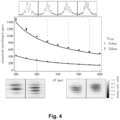
- Fig. 4 shows a comparison of the different spatial fringe patterns captured by the detector 130 at different T TOF and different temporal asymmetry of the pulses.
- Fig. 4 shows two T TOF of 218ms and 722ms, where the x-axis shows the different temporal asymmetry ⁇ T and the y-axis shows the measures wavelength of the spatial fringe patterns.
- the different spatial fringe patterns detected at T TOF of 218ms at different temporal asymmetry ⁇ T is shown at the bottom of Fig. 4 .
- the different spatial fringe patterns detected at T TOF of 722ms at different temporal asymmetry ⁇ T is shown at the top of Fig. 4 .
- the spatial fringe patterns when the T TOF is 218ms were obtained using absorption imaging with raw single run images.
- the spatial fringe patterns when the T TOF is 722ms were obtained using FMI with single run images and a Savitzky-Golay filter.
- the data shown in Fig. 4 is the mean measured wavelengths of the spatial fringe patterns for 100 runs, with the error bars indicating one standard deviation from the mean.
- the measured and calculated wavelengths of the spatial fringe patterns are in agreement.
- Method 800 concludes at the conclusion of step 830.
- Physical quantities such as local gravity, the gravitational constant, the fine structure constant, the ratio of Planck's constant to the atomic mass, rotation of the atom interferometer, acceleration of the atom interferometer, and the like can then be measured.
- the physical quantities are determined from the measured phase of the spatial fringe pattern using equation 3 below.
- the atom source 110 releases cold or ultracold atoms from a trapping potential. The released atoms then freely fall under gravity in the interferometer region 120.
- the laser system 140 then directs light pulses separated by T1 and T2 to couple vertical momentum states of the atoms as shown in Fig. 3 .
- ⁇ total ⁇ propagation + ⁇ laser + ⁇ separation
- ⁇ propagation corresponds to the phase shift as the atoms travel through the interferometer region 120
- ⁇ laser corresponds to the phase shift that occurs due to the light pulses from the laser system 140
- ⁇ separation corresponds to the phase shift due to finite separation of the quantum states of the atoms at the final light pulse.
- T the time between the interferometer pulses (as illustrated in Fig. 3 )
- k eff 4 ⁇ / ⁇ is the effective wavevector of the pulses of light of wavelength ⁇
- ⁇ L is the phase of the light pulses relative to the inertial reference
- g is an acceleration variable.
- the acceleration variable is used to determine the physical quantities such as local gravity, the gravitational constant, acceleration or rotation of the atom interferometer, and the like.
- the relative population in each of the two quantum states at the output can be monitored and the phase extracted and related to an inertial acceleration. As described above with reference to Fig. 2A , such measurement requires waiting for a separation delay to allow the quantum states to separate.
- the first term ⁇ x ⁇ ⁇ p ⁇ of Eq. 4 results from a slight spatial mismatch ( ⁇ x ) at the final light pulse (i.e., the light pulse after T2).
- ⁇ r is the recoil velocity.
- the second term ⁇ p ⁇ ⁇ x of Eq. 4 results from a spread of momentum across the atoms that, along with the temporal asymmetry ⁇ T , results in a spatially dependent phase at the final light pulse.
- the quantum states at the output display a sinusoidal modulation on top of the density envelope with a phase that is linked to the inertial acceleration.
- the wavenumber of the spatial fringe pattern k fringe is given by ⁇ p / ⁇ .
- the wavelength of the spatial fringe pattern calculated using Eq. 7 is compared to the measured wavelength of the spatial fringe pattern and are shown to be in good agreement.
- imaging by the detector 130 is performed almost immediately after the final light pulse with the temporal asymmetry ⁇ T.
- the time between the final light pulse and detection is sufficient for the sinusoidal modulation on each cloud of atoms to overlap constructively. That is, the atoms are allowed to move a quarter of a wavelength apart to optimize the overlap of the quantum states of the atoms.
- T TOF 218 ms
- the optimal separation time is ⁇ 6 ms.
- the phase can therefore be extracted with an increased signal-to-noise and without requiring full separation of the clouds of atoms.
- phase noise of the asymmetric atom interferometer 100 will now be discussed.
- the phase noise of the atom interferometer 100 should not be substantially higher than conventional atom interferometers.
- the phase noises for both conventional atom interferometers with temporal symmetric of the light pulses and the atom interferometer 100 with temporal asymmetric are calculated using an Allan deviation.
- the data points y i correspond to the measured phase and the averaging time is given in units of runs, which correspond to the 11.4 seconds duty cycle of the experiment.
- the resulting phase signal can then be determined and the phase stability calculated.
- a conventional interferometer of this type is run mid-fringe, with a new fringe scanned whenever necessary. In this case 20 runs were required to extract a phase, limiting the minimum sampling rate shown in the Allan deviation of Fig. 6 .
- y ⁇ A , x 0 , ⁇ x , B , k , ⁇ , C ⁇ are free parameters.
- Fig. 5 shows a comparison of the phase noise for varying spatial frequencies, obtained by changing the value of the temporal asymmetry ⁇ T.
- the phase noise tends to increase with increasing temporal asymmetry ⁇ T indicating lower temporal asymmetry ⁇ T provides a more optimal operation of the interferometer 100.
- the spatial frequency increases with increasing temporal asymmetry ⁇ T.
- the fringe contrast indicated by the darker points, is also seen to decrease as the temporal asymmetry ⁇ T increases, limiting the extent to which the temporal asymmetry ⁇ T can be increased.
- Fig. 6 shows a comparison of the phase noise of the conventional temporal symmetric atom interferometer and the temporal asymmetric atom interferometer 100 as calculated through the Allan deviation.
- the phase for the temporal symmetric atom interferometer is obtained by scanning the phase of the laser then fitting a sinusoid to 20 points.
- the phase for the temporal asymmetric atom interferometer 100 is obtained each run by fitting the sinusoidal modulation.
- the asymmetric interferometer 100 and the symmetric interferometer follow the same trend.
- the symmetric interferometer requires multiple runs to generate a fringe for phase estimation.
- the asymmetric interferometer 100 requires a single shot to estimate phase and requires significantly lower sampling rates without compromising phase noise.
- the phase noise of the temporal asymmetric interferometer 100 should be competitive with the conventional temporal asymmetric interferometer. In order to test this, 1000 measurements of phase were taken using the temporal asymmetric interferometer 100 and temporal symmetric interferometer.
- the spatial fringe pattern was measured 19 ms after the final light pulse, whereby the two quantum states are added constructively.
- the time required for measuring the spatial fringe pattern may be calculated given the expected fringe spacing and the momentum difference of the two quantum states as given by Eq. 8. In practice, this is empirically optimized by monitoring the contrast in the resultant spatial fringe pattern.
- Part c) shows the output after the two quantum states have separated fully as is the case in the solid lines of a).
- Figs. 9A and 9B depict a general-purpose computer system 1300, upon which the various arrangements described can be practiced.
- the computer system 1300 includes: a computer module 1301; input devices such as a keyboard 1302, a mouse pointer device 1303, a scanner 1326, a camera 1327, and a microphone 1380; and output devices including a printer 1315, a display device 1314 and loudspeakers 1317.
- An external Modulator-Demodulator (Modem) transceiver device 1316 may be used by the computer module 1301 for communicating to and from a communications network 1320 via a connection 1321.
- the communications network 1320 may be a wide-area network (WAN), such as the Internet, a cellular telecommunications network, or a private WAN.
- WAN wide-area network
- the modem 1316 may be a traditional "dial-up" modem.
- the modem 1316 may be a broadband modem.
- a wireless modem may also be used for wireless connection to the communications network 1320.
- the computer module 1301 typically includes at least one processor unit 1305, and a memory unit 1306.
- the memory unit 1306 may have semiconductor random access memory (RAM) and semiconductor read only memory (ROM).
- the computer module 1301 also includes an number of input/output (I/O) interfaces including: an audio-video interface 1307 that couples to the video display 1314, loudspeakers 1317 and microphone 1380; an I/O interface 1313 that couples to the keyboard 1302, mouse 1303, scanner 1326, camera 1327 and optionally a joystick or other human interface device (not illustrated); and an interface 1308 for the external modem 1316 and printer 1315.
- the modem 1316 may be incorporated within the computer module 1301, for example within the interface 1308.
- the computer module 1301 also has a local network interface 1311, which permits coupling of the computer system 1300 via a connection 1323 to a local-area communications network 1322, known as a Local Area Network (LAN). As illustrated in Fig. 9A , the local communications network 1322 may also couple to the wide network 1320 via a connection 1324, which would typically include a so-called "firewall" device or device of similar functionality.
- the local network interface 1311 may comprise an Ethernet circuit card, a Bluetooth ® wireless arrangement or an IEEE 802.11 wireless arrangement; however, numerous other types of interfaces may be practiced for the interface 1311.
- the atom source 110, the detector 130, and the laser system 140 may connect to the computer module 1301 via the networks 1320 or 1322, or the I/O interfaces 1308 or 1313.
- the I/O interfaces 1308 and 1313 may afford either or both of serial and parallel connectivity, the former typically being implemented according to the Universal Serial Bus (USB) standards and having corresponding USB connectors (not illustrated).
- Storage devices 1309 are provided and typically include a hard disk drive (HDD) 1310. Other storage devices such as a floppy disk drive and a magnetic tape drive (not illustrated) may also be used.
- An optical disk drive 1312 is typically provided to act as a non-volatile source of data.
- Portable memory devices such optical disks (e.g., CD-ROM, DVD, Blu-ray Disc TM ), USB-RAM, portable, external hard drives, and floppy disks, for example, may be used as appropriate sources of data to the system 1300.
- the components 1305 to 1313 of the computer module 1301 typically communicate via an interconnected bus 1304 and in a manner that results in a conventional mode of operation of the computer system 1300 known to those in the relevant art.
- the processor 1305 is coupled to the system bus 1304 using a connection 1318.
- the memory 1306 and optical disk drive 1312 are coupled to the system bus 1304 by connections 1319. Examples of computers on which the described arrangements can be practised include IBM-PC's and compatibles, Sun Sparcstations, Apple Mac TM or like computer systems.
- the method of Fig. 8 may be implemented using the computer system 1300 wherein the processes may be controlled by one or more software application programs 1333 executable within the computer system 1300.
- the steps of the method of Fig. 8 are effected by instructions 1331 (see Fig. 9B ) in the software 1333 that are carried out within the computer system 1300.
- the software instructions 1331 may be formed as one or more code modules, each for performing one or more particular tasks.
- the software may also be divided into two separate parts, in which a first part and the corresponding code modules performs the method for controlling the atom source 110, the detector 130, and the laser system 140 and a second part and the corresponding code modules manage a user interface between the first part and the user.
- the software may be stored in a computer readable medium, including the storage devices described below, for example.
- the software is loaded into the computer system 1300 from the computer readable medium, and then executed by the computer system 1300.
- a computer readable medium having such software or computer program recorded on the computer readable medium is a computer program product.
- the use of the computer program product in the computer system 1300 preferably effects an advantageous apparatus for atom interferometry.
- the software 1333 is typically stored in the HDD 1310 or the memory 1306.
- the software is loaded into the computer system 1300 from a computer readable medium, and executed by the computer system 1300.
- the software 1333 may be stored on an optically readable disk storage medium (e.g., CD-ROM) 1325 that is read by the optical disk drive 1312.
- a computer readable medium having such software or computer program recorded on it is a computer program product.
- the use of the computer program product in the computer system 1300 preferably effects an apparatus for atom interferometry.
- the application programs 1333 may be supplied to the user encoded on one or more CD-ROMs 1325 and read via the corresponding drive 1312, or alternatively may be read by the user from the networks 1320 or 1322. Still further, the software can also be loaded into the computer system 1300 from other computer readable media.
- Computer readable storage media refers to any non-transitory tangible storage medium that provides recorded instructions and/or data to the computer system 1300 for execution and/or processing.
- Examples of such storage media include floppy disks, magnetic tape, CD-ROM, DVD, Blu-ray TM Disc, a hard disk drive, a ROM or integrated circuit, USB memory, a magnetooptical disk, or a computer readable card such as a PCMCIA card and the like, whether or not such devices are internal or external of the computer module 1301.
- Examples of transitory or non-tangible computer readable transmission media that may also participate in the provision of software, application programs, instructions and/or data to the computer module 1301 include radio or infra-red transmission channels as well as a network connection to another computer or networked device, and the Internet or Intranets including e-mail transmissions and information recorded on Websites and the like.
- the second part of the application programs 1333 and the corresponding code modules mentioned above may be executed to implement one or more graphical user interfaces (GUIs) to be rendered or otherwise represented upon the display 1314.
- GUIs graphical user interfaces
- a user of the computer system 1300 and the application may manipulate the interface in a functionally adaptable manner to provide controlling commands and/or input to the applications associated with the GUI(s).
- Other forms of functionally adaptable user interfaces may also be implemented, such as an audio interface utilizing speech prompts output via the loudspeakers 1317 and user voice commands input via the microphone 1380.
- Fig. 9B is a detailed schematic block diagram of the processor 1305 and a "memory" 1334.
- the memory 1334 represents a logical aggregation of all the memory modules (including the HDD 1309 and semiconductor memory 1306) that can be accessed by the computer module 1301 in Fig. 9A .
- a power-on self-test (POST) program 1350 executes.
- the POST program 1350 is typically stored in a ROM 1349 of the semiconductor memory 1306 of Fig. 9A .
- a hardware device such as the ROM 1349 storing software is sometimes referred to as firmware.
- the POST program 1350 examines hardware within the computer module 1301 to ensure proper functioning and typically checks the processor 1305, the memory 1334 (1309, 1306), and a basic input-output systems software (BIOS) module 1351, also typically stored in the ROM 1349, for correct operation. Once the POST program 1350 has run successfully, the BIOS 1351 activates the hard disk drive 1310 of Fig. 9A .
- BIOS basic input-output systems software
- Activation of the hard disk drive 1310 causes a bootstrap loader program 1352 that is resident on the hard disk drive 1310 to execute via the processor 1305.
- the operating system 1353 is a system level application, executable by the processor 1305, to fulfil various high level functions, including processor management, memory management, device management, storage management, software application interface, and generic user interface.
- the operating system 1353 manages the memory 1334 (1309, 1306) to ensure that each process or application running on the computer module 1301 has sufficient memory in which to execute without colliding with memory allocated to another process. Furthermore, the different types of memory available in the system 1300 of Fig. 9A must be used properly so that each process can run effectively. Accordingly, the aggregated memory 1334 is not intended to illustrate how particular segments of memory are allocated (unless otherwise stated), but rather to provide a general view of the memory accessible by the computer system 1300 and how such is used.
- the processor 1305 includes a number of functional modules including a control unit 1339, an arithmetic logic unit (ALU) 1340, and a local or internal memory 1348, sometimes called a cache memory.
- the cache memory 1348 typically includes a number of storage registers 1344 - 1346 in a register section.
- One or more internal busses 1341 functionally interconnect these functional modules.
- the processor 1305 typically also has one or more interfaces 1342 for communicating with external devices via the system bus 1304, using a connection 1318.
- the memory 1334 is coupled to the bus 1304 using a connection 1319.
- the application program 1333 includes a sequence of instructions 1331 that may include conditional branch and loop instructions.
- the program 1333 may also include data 1332 which is used in execution of the program 1333.
- the instructions 1331 and the data 1332 are stored in memory locations 1328, 1329, 1330 and 1335, 1336, 1337, respectively.
- a particular instruction may be stored in a single memory location as depicted by the instruction shown in the memory location 1330.
- an instruction may be segmented into a number of parts each of which is stored in a separate memory location, as depicted by the instruction segments shown in the memory locations 1328 and 1329.
- the processor 1305 is given a set of instructions which are executed therein.
- the processor 1305 waits for a subsequent input, to which the processor 1305 reacts to by executing another set of instructions.
- Each input may be provided from one or more of a number of sources, including data generated by one or more of the input devices 1302, 1303, data received from an external source across one of the networks 1320, 1302, data retrieved from one of the storage devices 1306, 1309 or data retrieved from a storage medium 1325 inserted into the corresponding reader 1312, all depicted in Fig. 9A .
- the execution of a set of the instructions may in some cases result in output of data. Execution may also involve storing data or variables to the memory 1334.
- the disclosed atom interferometer arrangements use input variables 1354, which are stored in the memory 1334 in corresponding memory locations 1355, 1356, 1357.
- the input variables may be the temporal asymmetry ⁇ T.
- the atom interferometer arrangements produce output variables 1361, which are stored in the memory 1334 in corresponding memory locations 1362, 1363, 1364.
- the output may be control signals to control the atom source 110, the detector 130, and the laser system 140.
- Intermediate variables 1358 may be stored in memory locations 1359, 1360, 1366 and 1367.
- each fetch, decode, and execute cycle comprises:
- a further fetch, decode, and execute cycle for the next instruction may be executed.
- a store cycle may be performed by which the control unit 1339 stores or writes a value to a memory location 1332.
- Each step or sub-process in the processes of Figs. 8 is associated with one or more segments of the program 1333 and is performed by the register section 1344, 1345, 1347, the ALU 1340, and the control unit 1339 in the processor 1305 working together to perform the fetch, decode, and execute cycles for every instruction in the instruction set for the noted segments of the program 1333.
- the method of controlling the atom interferometer 100 may alternatively be implemented in dedicated hardware such as one or more integrated circuits.
- dedicated hardware may include graphic processors, digital signal processors, a field-programmable gate array (FPGA), or one or more microprocessors and associated memories.
- the arrangements described are applicable to operating an atom interferometer for measuring physical quantities such as local gravity, the gravitational constant, the fine structure constant, the ratio of Planck's constant to the atomic mass, rotation of the atom interferometer, acceleration of the atom interferometer, and the like using the overlapped spatial fringes.
Landscapes
- Physics & Mathematics (AREA)
- General Physics & Mathematics (AREA)
- Life Sciences & Earth Sciences (AREA)
- General Life Sciences & Earth Sciences (AREA)
- Geophysics (AREA)
- Engineering & Computer Science (AREA)
- Radar, Positioning & Navigation (AREA)
- Remote Sensing (AREA)
- Length Measuring Devices By Optical Means (AREA)
- Instruments For Measurement Of Length By Optical Means (AREA)
Claims (16)
- Atominterferometrie-Beschleunigungsmessverfahren, umfassend:Freisetzen von Atomen von einer Atomquelle (110) in einen Interferometerbereich (120) eines Bragg-Übergangs-Atominterferometers (100);Richten von Lichtimpulsen auf die Atome, um die Atome in verschiedene Quantenzustände zu setzen und die Quantenzustände so zu rekombinieren, dass die rekombinierten Quantenzustände miteinander interferieren, wenn die Quantenzustände räumlich überlappt sind, wobei die rekombinierten Quantenzustände ein räumliches Streifenmuster mit einer Phase erzeugen;Detektieren des räumlichen Streifenmusters und der Phase des räumlichen Streifenmusters, wenn die Quantenzustände der Atome räumlich überlappt sind;und Messen, basierend auf dem detektierten räumlichen Streifenmuster, der Beschleunigung des Bragg-Übergangs-Atominterferometers (100).
- Atominterferometrie-Beschleunigungsmessverfahren nach Anspruch 1, wobei die Zeitspannen zwischen den Impulsen asymmetrisch sind, um das räumliche Streifenmuster zu erzeugen.
- Atominterferometrie-Beschleunigungsmessverfahren nach Anspruch 1, wobei ein oder mehrere der Lichtimpulse relativ zueinander rotiert werden, um das räumliche Streifenmuster zu erzeugen.
- Atominterferometrie-Beschleunigungsmessverfahren nach Anspruch 1, wobei die freigesetzten Atome von einem Atomensemble eines thermischen oder Bose-Einstein-Kondensats stammen.
- Atominterferometrie-Beschleunigungsmessverfahren nach Anspruch 1, wobei die Quantenzustände einen magnetischen Subzustand, einen hyperfeinen Zustand, einen winkeligen Momentzustand oder einen geradlinigen Momentzustand umfassen.
- Bragg-Übergangs-Atominterferometer (100), umfassend:eine Atomquelle (110), die zum Freisetzen von Atomen von einer Atomquelle (110) in einen Interferometerbereich (120) ausgelegt ist;ein Lasersystem (140), das zum Richten von Lichtimpulsen auf die Atome ausgelegt ist, um die Atome in verschiedene Quantenzustände zu setzen und die Quantenzustände so zu rekombinieren, dass die rekombinierten Quantenzustände miteinander interferieren, wenn die Quantenzustände räumlich überlappt sind, wobei die rekombinierten Quantenzustände ein räumliches Streifenmuster mit einer Phase erzeugen;einen Detektor (130), der zum Detektieren des räumlichen Streifenmusters und der Phase des räumlichen Streifenmusters ausgelegt ist, wenn die Quantenzustände der Atome räumlich überlappt sind; undeinen Prozessor, der dazu ausgelegt ist, die Beschleunigung des Bragg-Übergangs-Atominterferometers (100) basierend auf dem detektierten räumlichen Streifenmuster zu messen.
- Atominterferometer nach Anspruch 6, wobei das Lasersystem so ausgelegt ist, dass die Zeitabstände zwischen den Impulsen asymmetrisch sind, um das räumliche Streifenmuster zu erzeugen.
- Atominterferometer nach Anspruch 6, wobei das Lasersystem so ausgelegt ist, dass ein oder mehrere der Lichtimpulse relativ zueinander rotiert werden, um das räumliche Streifenmuster zu erzeugen.
- Atominterferometer nach Anspruch 6, wobei die freigesetzten Atome von einem Atomensemble eines thermischen oder Bose-Einstein-Kondensats stammen.
- Atominterferometer nach Anspruch 6, wobei die Quantenzustände einen magnetischen Subzustand, einen hyperfeinen Zustand, einen winkeligen Momentzustand oder einen geradlinigen Momentzustand umfassen.
- Atominterferometer nach Anspruch 6, ferner umfassend:
eine Steuerung, die zum Steuern der Atomquelle, des Lasersystems und des Detektors ausgelegt ist. - Nichtflüchtiges, compuerlesbares Medium, umfassend ein Computeranwendungsprogramm, das durch einen Prozessor eines Bragg-Übergangs-Atominterferometer nach Anspruch 6 ausführbar ist, so dass die Ausführung des Computeranwendungsprogramms durch den Prozessor das Bragg-Übergang-Atominterferometer veranlasst, ein Atominterferometrie-Beschleunigungsmessverfahren durchzuführen, umfassend:Freisetzen von Atomen von einer Atomquelle (110) in einen Interferometerbereich (120) eines Bragg-Übergangs-Atominterferometers (100);Richten von Lichtimpulsen auf die Atome, um die Atome in verschiedene Quantenzustände zu setzen und die Quantenzustände so zu rekombinieren, dass die rekombinierten Quantenzustände miteinander interferieren, wenn die Quantenzustände räumlich überlappt sind, wobei die rekombinierten Quantenzustände ein räumliches Streifenmuster mit einer Phase erzeugen;Detektieren des räumlichen Streifenmusters und der Phase des räumlichen Streifenmusters, wenn die Quantenzustände der Atome räumlich überlappt sind;und Messen, basierend auf dem detektierten räumlichen Streifenmuster, der Beschleunigung des Bragg-Übergangs-Atominterferometers (100).
- Computerlesbares Medium nach Anspruch 12, wobei Zeitspannen zwischen den Impulsen asymmetrisch sind, um das räumliche Streifenmuster zu erzeugen.
- Computerlesbares Medium nach Anspruch 12, wobei ein oder mehrere der Lichtimpulse relativ zueinander rotiert werden, um das räumliche Streifenmuster zu erzeugen.
- Computerlesbares Medium nach Anspruch 12, wobei die freigesetzten Atome von einem Atomensemble eines thermischen oder Bose-Einstein-Kondensats stammen.
- Computerlesbares Medium nach Anspruch 12, wobei die Quantenzustände einen magnetischen Subzustand, einen hyperfeinen Zustand, einen winkeligen Momentzustand oder einen geradlinigen Momentzustand umfassen.
Applications Claiming Priority (2)
| Application Number | Priority Date | Filing Date | Title |
|---|---|---|---|
| AU2018904789A AU2018904789A0 (en) | 2018-12-17 | Atom interferometer | |
| PCT/AU2019/051384 WO2020124134A1 (en) | 2018-12-17 | 2019-12-16 | Atom interferometer |
Publications (4)
| Publication Number | Publication Date |
|---|---|
| EP3899990A1 EP3899990A1 (de) | 2021-10-27 |
| EP3899990A4 EP3899990A4 (de) | 2022-09-21 |
| EP3899990C0 EP3899990C0 (de) | 2024-04-10 |
| EP3899990B1 true EP3899990B1 (de) | 2024-04-10 |
Family
ID=71099951
Family Applications (1)
| Application Number | Title | Priority Date | Filing Date |
|---|---|---|---|
| EP19900933.3A Active EP3899990B1 (de) | 2018-12-17 | 2019-12-16 | Atominterferometer |
Country Status (4)
| Country | Link |
|---|---|
| US (1) | US11725926B2 (de) |
| EP (1) | EP3899990B1 (de) |
| AU (1) | AU2019404609B2 (de) |
| WO (1) | WO2020124134A1 (de) |
Families Citing this family (5)
| Publication number | Priority date | Publication date | Assignee | Title |
|---|---|---|---|---|
| EP3983829B1 (de) * | 2019-06-13 | 2024-12-18 | University of Southampton | Quantengravimeter und gradiometer |
| JP7419949B2 (ja) * | 2020-04-16 | 2024-01-23 | 富士通オプティカルコンポーネンツ株式会社 | 光伝送装置、光合波器及び光伝送方法 |
| GB2606148B (en) * | 2021-04-26 | 2024-08-28 | Univ Birmingham | High fidelity robust atom optics |
| CN115826072B (zh) * | 2022-12-23 | 2025-08-01 | 中科酷原科技(武汉)有限公司 | 绝对重力值的测量方法、电子设备 |
| DE102023118819B3 (de) | 2023-07-17 | 2024-11-28 | Deutsches Zentrum für Luft- und Raumfahrt e.V. | Quantensensor und Verfahren zu dessen Herstellung |
Family Cites Families (4)
| Publication number | Priority date | Publication date | Assignee | Title |
|---|---|---|---|---|
| US4874942A (en) * | 1987-10-26 | 1989-10-17 | Clauser John F | Rotation, acceleration, and gravity sensors using quantum-mechanical matter-wave interferometry with neutral atoms and molecules |
| US8289018B2 (en) * | 2009-10-29 | 2012-10-16 | The United States Of America, As Represented By The Secretary Of The Navy | Gradient magnetometer atom interferometer |
| US9018579B2 (en) * | 2013-05-07 | 2015-04-28 | The Board Of Trustees Of The Leland Stanford Junior University | Atom interferometry having spatially resolved phase |
| FR3109221B1 (fr) * | 2020-04-10 | 2022-07-15 | Ixblue | Interféromètre atomique à réseau de diffraction bidimensionnel et procédé d’interférométrie atomique |
-
2019
- 2019-12-16 US US17/413,822 patent/US11725926B2/en active Active
- 2019-12-16 AU AU2019404609A patent/AU2019404609B2/en active Active
- 2019-12-16 EP EP19900933.3A patent/EP3899990B1/de active Active
- 2019-12-16 WO PCT/AU2019/051384 patent/WO2020124134A1/en not_active Ceased
Also Published As
| Publication number | Publication date |
|---|---|
| EP3899990C0 (de) | 2024-04-10 |
| EP3899990A1 (de) | 2021-10-27 |
| US11725926B2 (en) | 2023-08-15 |
| US20220018650A1 (en) | 2022-01-20 |
| WO2020124134A1 (en) | 2020-06-25 |
| AU2019404609A1 (en) | 2021-07-08 |
| EP3899990A4 (de) | 2022-09-21 |
| AU2019404609B2 (en) | 2025-10-30 |
Similar Documents
| Publication | Publication Date | Title |
|---|---|---|
| EP3899990B1 (de) | Atominterferometer | |
| Hu et al. | Sr atom interferometry with the optical clock transition as a gravimeter and a gravity gradiometer | |
| US11519989B2 (en) | High-resolution magnetic field fingerprinting of integrated circuit activity with a quantum diamond microscope | |
| Chen et al. | Cavity-aided nondemolition measurements for atom counting and spin squeezing | |
| Anderson et al. | Spatially inhomogeneous phase evolution of a two-component Bose-Einstein condensate | |
| Endres et al. | Single-site-and single-atom-resolved measurement of correlation functions | |
| EP3752792A1 (de) | Geschwindigkeitsselektiver thermischer atomstrahl-trägheitssensor | |
| Kristensen et al. | Sub-atom shot noise Faraday imaging of ultracold atom clouds | |
| US9829379B2 (en) | Two-dimensional spectroscopy system and two-dimensional spectroscopic analysis method | |
| CA3204993A1 (en) | Ultrafast detector of rydberg atoms | |
| CN113692593B (zh) | 执行量子傅里叶-克拉夫丘克变换(qkt)的方法及实施该方法的设备 | |
| Wigley et al. | Readout-delay-free Bragg atom interferometry using overlapped spatial fringes | |
| KR20230063646A (ko) | 원자 매질에서 생성된 안정적인 편광 얽힘 양자 광원 및 구현 방법 | |
| JP5036005B2 (ja) | 微小変位計測方法及び装置 | |
| Altuntaş et al. | Weak-measurement-induced heating in Bose-Einstein condensates | |
| Mokhun et al. | Energy flows in polychromatic fields | |
| EP4330735B1 (de) | Robuste atomoptik mit hoher wiedergabetreue | |
| Kochetkov et al. | Complex interferometry of magnetized plasma: Accuracy and limitations | |
| Kroeze | Many-body spin physics with quantum gases in a confocal cavity | |
| Malia | Integration of spin squeezed states into free space atomic sensors | |
| WO2021172290A1 (ja) | 分析方法、発光分析装置、拡散光トモグラフィー装置、撮像装置、反射率測定装置、分析装置、及びプログラム | |
| Glicenstein et al. | Probing subradiant dynamics in cold atomic ensembles via population and emitted light measurements | |
| Metzner | The Sound of Ions: Using Trapped Atomic Ion Motion for Quantum Computation and Sensing | |
| CN121071274A (zh) | 光镊中原子轴向波函数的重构方法、控制器和重构系统 | |
| Fekete et al. | Absorption imaging of quantum gases near surfaces using incoherent light |
Legal Events
| Date | Code | Title | Description |
|---|---|---|---|
| STAA | Information on the status of an ep patent application or granted ep patent |
Free format text: STATUS: THE INTERNATIONAL PUBLICATION HAS BEEN MADE |
|
| PUAI | Public reference made under article 153(3) epc to a published international application that has entered the european phase |
Free format text: ORIGINAL CODE: 0009012 |
|
| STAA | Information on the status of an ep patent application or granted ep patent |
Free format text: STATUS: REQUEST FOR EXAMINATION WAS MADE |
|
| 17P | Request for examination filed |
Effective date: 20210714 |
|
| AK | Designated contracting states |
Kind code of ref document: A1 Designated state(s): AL AT BE BG CH CY CZ DE DK EE ES FI FR GB GR HR HU IE IS IT LI LT LU LV MC MK MT NL NO PL PT RO RS SE SI SK SM TR |
|
| DAV | Request for validation of the european patent (deleted) | ||
| DAX | Request for extension of the european patent (deleted) | ||
| A4 | Supplementary search report drawn up and despatched |
Effective date: 20220823 |
|
| RIC1 | Information provided on ipc code assigned before grant |
Ipc: G01P 15/093 20060101ALI20220817BHEP Ipc: G21K 1/00 20060101ALI20220817BHEP Ipc: G01V 7/00 20060101ALI20220817BHEP Ipc: G01C 19/58 20060101ALI20220817BHEP Ipc: G01B 9/02 20060101ALI20220817BHEP Ipc: G21K 5/04 20060101AFI20220817BHEP |
|
| GRAP | Despatch of communication of intention to grant a patent |
Free format text: ORIGINAL CODE: EPIDOSNIGR1 |
|
| STAA | Information on the status of an ep patent application or granted ep patent |
Free format text: STATUS: GRANT OF PATENT IS INTENDED |
|
| INTG | Intention to grant announced |
Effective date: 20231107 |
|
| GRAS | Grant fee paid |
Free format text: ORIGINAL CODE: EPIDOSNIGR3 |
|
| GRAA | (expected) grant |
Free format text: ORIGINAL CODE: 0009210 |
|
| STAA | Information on the status of an ep patent application or granted ep patent |
Free format text: STATUS: THE PATENT HAS BEEN GRANTED |
|
| AK | Designated contracting states |
Kind code of ref document: B1 Designated state(s): AL AT BE BG CH CY CZ DE DK EE ES FI FR GB GR HR HU IE IS IT LI LT LU LV MC MK MT NL NO PL PT RO RS SE SI SK SM TR |
|
| REG | Reference to a national code |
Ref country code: GB Ref legal event code: FG4D |
|
| REG | Reference to a national code |
Ref country code: CH Ref legal event code: EP |
|
| REG | Reference to a national code |
Ref country code: DE Ref legal event code: R096 Ref document number: 602019050257 Country of ref document: DE |
|
| REG | Reference to a national code |
Ref country code: IE Ref legal event code: FG4D |
|
| U01 | Request for unitary effect filed |
Effective date: 20240509 |
|
| U07 | Unitary effect registered |
Designated state(s): AT BE BG DE DK EE FI FR IT LT LU LV MT NL PT SE SI Effective date: 20240517 |
|
| PG25 | Lapsed in a contracting state [announced via postgrant information from national office to epo] |
Ref country code: IS Free format text: LAPSE BECAUSE OF FAILURE TO SUBMIT A TRANSLATION OF THE DESCRIPTION OR TO PAY THE FEE WITHIN THE PRESCRIBED TIME-LIMIT Effective date: 20240810 |
|
| PG25 | Lapsed in a contracting state [announced via postgrant information from national office to epo] |
Ref country code: HR Free format text: LAPSE BECAUSE OF FAILURE TO SUBMIT A TRANSLATION OF THE DESCRIPTION OR TO PAY THE FEE WITHIN THE PRESCRIBED TIME-LIMIT Effective date: 20240410 |
|
| PG25 | Lapsed in a contracting state [announced via postgrant information from national office to epo] |
Ref country code: GR Free format text: LAPSE BECAUSE OF FAILURE TO SUBMIT A TRANSLATION OF THE DESCRIPTION OR TO PAY THE FEE WITHIN THE PRESCRIBED TIME-LIMIT Effective date: 20240711 |
|
| PG25 | Lapsed in a contracting state [announced via postgrant information from national office to epo] |
Ref country code: ES Free format text: LAPSE BECAUSE OF FAILURE TO SUBMIT A TRANSLATION OF THE DESCRIPTION OR TO PAY THE FEE WITHIN THE PRESCRIBED TIME-LIMIT Effective date: 20240410 |
|
| PG25 | Lapsed in a contracting state [announced via postgrant information from national office to epo] |
Ref country code: PL Free format text: LAPSE BECAUSE OF FAILURE TO SUBMIT A TRANSLATION OF THE DESCRIPTION OR TO PAY THE FEE WITHIN THE PRESCRIBED TIME-LIMIT Effective date: 20240410 |
|
| PG25 | Lapsed in a contracting state [announced via postgrant information from national office to epo] |
Ref country code: PL Free format text: LAPSE BECAUSE OF FAILURE TO SUBMIT A TRANSLATION OF THE DESCRIPTION OR TO PAY THE FEE WITHIN THE PRESCRIBED TIME-LIMIT Effective date: 20240410 Ref country code: NO Free format text: LAPSE BECAUSE OF FAILURE TO SUBMIT A TRANSLATION OF THE DESCRIPTION OR TO PAY THE FEE WITHIN THE PRESCRIBED TIME-LIMIT Effective date: 20240710 Ref country code: IS Free format text: LAPSE BECAUSE OF FAILURE TO SUBMIT A TRANSLATION OF THE DESCRIPTION OR TO PAY THE FEE WITHIN THE PRESCRIBED TIME-LIMIT Effective date: 20240810 Ref country code: HR Free format text: LAPSE BECAUSE OF FAILURE TO SUBMIT A TRANSLATION OF THE DESCRIPTION OR TO PAY THE FEE WITHIN THE PRESCRIBED TIME-LIMIT Effective date: 20240410 Ref country code: GR Free format text: LAPSE BECAUSE OF FAILURE TO SUBMIT A TRANSLATION OF THE DESCRIPTION OR TO PAY THE FEE WITHIN THE PRESCRIBED TIME-LIMIT Effective date: 20240711 Ref country code: ES Free format text: LAPSE BECAUSE OF FAILURE TO SUBMIT A TRANSLATION OF THE DESCRIPTION OR TO PAY THE FEE WITHIN THE PRESCRIBED TIME-LIMIT Effective date: 20240410 Ref country code: RS Free format text: LAPSE BECAUSE OF FAILURE TO SUBMIT A TRANSLATION OF THE DESCRIPTION OR TO PAY THE FEE WITHIN THE PRESCRIBED TIME-LIMIT Effective date: 20240710 |
|
| REG | Reference to a national code |
Ref country code: DE Ref legal event code: R097 Ref document number: 602019050257 Country of ref document: DE |
|
| PG25 | Lapsed in a contracting state [announced via postgrant information from national office to epo] |
Ref country code: CZ Free format text: LAPSE BECAUSE OF FAILURE TO SUBMIT A TRANSLATION OF THE DESCRIPTION OR TO PAY THE FEE WITHIN THE PRESCRIBED TIME-LIMIT Effective date: 20240410 |
|
| PG25 | Lapsed in a contracting state [announced via postgrant information from national office to epo] |
Ref country code: RO Free format text: LAPSE BECAUSE OF FAILURE TO SUBMIT A TRANSLATION OF THE DESCRIPTION OR TO PAY THE FEE WITHIN THE PRESCRIBED TIME-LIMIT Effective date: 20240410 Ref country code: SK Free format text: LAPSE BECAUSE OF FAILURE TO SUBMIT A TRANSLATION OF THE DESCRIPTION OR TO PAY THE FEE WITHIN THE PRESCRIBED TIME-LIMIT Effective date: 20240410 |
|
| PG25 | Lapsed in a contracting state [announced via postgrant information from national office to epo] |
Ref country code: SM Free format text: LAPSE BECAUSE OF FAILURE TO SUBMIT A TRANSLATION OF THE DESCRIPTION OR TO PAY THE FEE WITHIN THE PRESCRIBED TIME-LIMIT Effective date: 20240410 |
|
| PG25 | Lapsed in a contracting state [announced via postgrant information from national office to epo] |
Ref country code: SM Free format text: LAPSE BECAUSE OF FAILURE TO SUBMIT A TRANSLATION OF THE DESCRIPTION OR TO PAY THE FEE WITHIN THE PRESCRIBED TIME-LIMIT Effective date: 20240410 Ref country code: SK Free format text: LAPSE BECAUSE OF FAILURE TO SUBMIT A TRANSLATION OF THE DESCRIPTION OR TO PAY THE FEE WITHIN THE PRESCRIBED TIME-LIMIT Effective date: 20240410 Ref country code: RO Free format text: LAPSE BECAUSE OF FAILURE TO SUBMIT A TRANSLATION OF THE DESCRIPTION OR TO PAY THE FEE WITHIN THE PRESCRIBED TIME-LIMIT Effective date: 20240410 Ref country code: CZ Free format text: LAPSE BECAUSE OF FAILURE TO SUBMIT A TRANSLATION OF THE DESCRIPTION OR TO PAY THE FEE WITHIN THE PRESCRIBED TIME-LIMIT Effective date: 20240410 |
|
| U20 | Renewal fee for the european patent with unitary effect paid |
Year of fee payment: 6 Effective date: 20241227 |
|
| PLBE | No opposition filed within time limit |
Free format text: ORIGINAL CODE: 0009261 |
|
| STAA | Information on the status of an ep patent application or granted ep patent |
Free format text: STATUS: NO OPPOSITION FILED WITHIN TIME LIMIT |
|
| 26N | No opposition filed |
Effective date: 20250113 |
|
| PG25 | Lapsed in a contracting state [announced via postgrant information from national office to epo] |
Ref country code: MC Free format text: LAPSE BECAUSE OF FAILURE TO SUBMIT A TRANSLATION OF THE DESCRIPTION OR TO PAY THE FEE WITHIN THE PRESCRIBED TIME-LIMIT Effective date: 20240410 |
|
| REG | Reference to a national code |
Ref country code: CH Ref legal event code: PL |
|
| PG25 | Lapsed in a contracting state [announced via postgrant information from national office to epo] |
Ref country code: CH Free format text: LAPSE BECAUSE OF NON-PAYMENT OF DUE FEES Effective date: 20241231 |
|
| PG25 | Lapsed in a contracting state [announced via postgrant information from national office to epo] |
Ref country code: IE Free format text: LAPSE BECAUSE OF NON-PAYMENT OF DUE FEES Effective date: 20241216 |
|
| PGFP | Annual fee paid to national office [announced via postgrant information from national office to epo] |
Ref country code: GB Payment date: 20251219 Year of fee payment: 7 |
|
| U20 | Renewal fee for the european patent with unitary effect paid |
Year of fee payment: 7 Effective date: 20251230 |