EP3899599B1 - System und verfahren zur bewertung der umgebungsbedingung eines schiffs - Google Patents
System und verfahren zur bewertung der umgebungsbedingung eines schiffs Download PDFInfo
- Publication number
- EP3899599B1 EP3899599B1 EP19901127.1A EP19901127A EP3899599B1 EP 3899599 B1 EP3899599 B1 EP 3899599B1 EP 19901127 A EP19901127 A EP 19901127A EP 3899599 B1 EP3899599 B1 EP 3899599B1
- Authority
- EP
- European Patent Office
- Prior art keywords
- signal
- energy
- energy signal
- vessel
- motion
- Prior art date
- Legal status (The legal status is an assumption and is not a legal conclusion. Google has not performed a legal analysis and makes no representation as to the accuracy of the status listed.)
- Active
Links
Images


Classifications
-
- B—PERFORMING OPERATIONS; TRANSPORTING
- B63—SHIPS OR OTHER WATERBORNE VESSELS; RELATED EQUIPMENT
- B63B—SHIPS OR OTHER WATERBORNE VESSELS; EQUIPMENT FOR SHIPPING
- B63B39/00—Equipment to decrease pitch, roll, or like unwanted vessel movements; Apparatus for indicating vessel attitude
-
- B—PERFORMING OPERATIONS; TRANSPORTING
- B63—SHIPS OR OTHER WATERBORNE VESSELS; RELATED EQUIPMENT
- B63B—SHIPS OR OTHER WATERBORNE VESSELS; EQUIPMENT FOR SHIPPING
- B63B79/00—Monitoring properties or operating parameters of vessels in operation
- B63B79/10—Monitoring properties or operating parameters of vessels in operation using sensors, e.g. pressure sensors, strain gauges or accelerometers
- B63B79/15—Monitoring properties or operating parameters of vessels in operation using sensors, e.g. pressure sensors, strain gauges or accelerometers for monitoring environmental variables, e.g. wave height or weather data
-
- B—PERFORMING OPERATIONS; TRANSPORTING
- B63—SHIPS OR OTHER WATERBORNE VESSELS; RELATED EQUIPMENT
- B63B—SHIPS OR OTHER WATERBORNE VESSELS; EQUIPMENT FOR SHIPPING
- B63B79/00—Monitoring properties or operating parameters of vessels in operation
- B63B79/20—Monitoring properties or operating parameters of vessels in operation using models or simulation, e.g. statistical models or stochastic models
-
- B—PERFORMING OPERATIONS; TRANSPORTING
- B63—SHIPS OR OTHER WATERBORNE VESSELS; RELATED EQUIPMENT
- B63B—SHIPS OR OTHER WATERBORNE VESSELS; EQUIPMENT FOR SHIPPING
- B63B79/00—Monitoring properties or operating parameters of vessels in operation
- B63B79/40—Monitoring properties or operating parameters of vessels in operation for controlling the operation of vessels, e.g. monitoring their speed, routing or maintenance schedules
-
- B—PERFORMING OPERATIONS; TRANSPORTING
- B63—SHIPS OR OTHER WATERBORNE VESSELS; RELATED EQUIPMENT
- B63H—MARINE PROPULSION OR STEERING
- B63H25/00—Steering; Slowing-down otherwise than by use of propulsive elements; Dynamic anchoring, i.e. positioning vessels by means of main or auxiliary propulsive elements
- B63H25/42—Steering or dynamic anchoring by propulsive elements; Steering or dynamic anchoring by propellers used therefor only; Steering or dynamic anchoring by rudders carrying propellers
-
- G—PHYSICS
- G01—MEASURING; TESTING
- G01C—MEASURING DISTANCES, LEVELS OR BEARINGS; SURVEYING; NAVIGATION; GYROSCOPIC INSTRUMENTS; PHOTOGRAMMETRY OR VIDEOGRAMMETRY
- G01C19/00—Gyroscopes; Turn-sensitive devices using vibrating masses; Turn-sensitive devices without moving masses; Measuring angular rate using gyroscopic effects
-
- G—PHYSICS
- G01—MEASURING; TESTING
- G01C—MEASURING DISTANCES, LEVELS OR BEARINGS; SURVEYING; NAVIGATION; GYROSCOPIC INSTRUMENTS; PHOTOGRAMMETRY OR VIDEOGRAMMETRY
- G01C9/00—Measuring inclination, e.g. by clinometers, by levels
- G01C9/02—Details
-
- G—PHYSICS
- G01—MEASURING; TESTING
- G01P—MEASURING LINEAR OR ANGULAR SPEED, ACCELERATION, DECELERATION, OR SHOCK; INDICATING PRESENCE, ABSENCE, OR DIRECTION, OF MOVEMENT
- G01P13/00—Indicating or recording presence, absence, or direction, of movement
-
- G—PHYSICS
- G01—MEASURING; TESTING
- G01W—METEOROLOGY
- G01W1/00—Meteorology
-
- G—PHYSICS
- G01—MEASURING; TESTING
- G01W—METEOROLOGY
- G01W1/00—Meteorology
- G01W1/02—Instruments for indicating weather conditions by measuring two or more variables, e.g. humidity, pressure, temperature, cloud cover or wind speed
-
- G—PHYSICS
- G05—CONTROLLING; REGULATING
- G05D—SYSTEMS FOR CONTROLLING OR REGULATING NON-ELECTRIC VARIABLES
- G05D1/00—Control of position, course, altitude or attitude of land, water, air or space vehicles, e.g. using automatic pilots
- G05D1/02—Control of position or course in two dimensions
- G05D1/0206—Control of position or course in two dimensions specially adapted to water vehicles
-
- G—PHYSICS
- G05—CONTROLLING; REGULATING
- G05D—SYSTEMS FOR CONTROLLING OR REGULATING NON-ELECTRIC VARIABLES
- G05D1/00—Control of position, course, altitude or attitude of land, water, air or space vehicles, e.g. using automatic pilots
- G05D1/40—Control within particular dimensions
- G05D1/43—Control of position or course in two dimensions
-
- G—PHYSICS
- G05—CONTROLLING; REGULATING
- G05D—SYSTEMS FOR CONTROLLING OR REGULATING NON-ELECTRIC VARIABLES
- G05D1/00—Control of position, course, altitude or attitude of land, water, air or space vehicles, e.g. using automatic pilots
- G05D1/40—Control within particular dimensions
- G05D1/49—Control of attitude, i.e. control of roll, pitch or yaw
-
- G—PHYSICS
- G05—CONTROLLING; REGULATING
- G05D—SYSTEMS FOR CONTROLLING OR REGULATING NON-ELECTRIC VARIABLES
- G05D1/00—Control of position, course, altitude or attitude of land, water, air or space vehicles, e.g. using automatic pilots
- G05D1/60—Intended control result
- G05D1/69—Coordinated control of the position or course of two or more vehicles
-
- G—PHYSICS
- G01—MEASURING; TESTING
- G01C—MEASURING DISTANCES, LEVELS OR BEARINGS; SURVEYING; NAVIGATION; GYROSCOPIC INSTRUMENTS; PHOTOGRAMMETRY OR VIDEOGRAMMETRY
- G01C21/00—Navigation; Navigational instruments not provided for in groups G01C1/00 - G01C19/00
- G01C21/20—Instruments for performing navigational calculations
- G01C21/203—Instruments for performing navigational calculations specially adapted for water-borne vessels
-
- G—PHYSICS
- G05—CONTROLLING; REGULATING
- G05D—SYSTEMS FOR CONTROLLING OR REGULATING NON-ELECTRIC VARIABLES
- G05D1/00—Control of position, course, altitude or attitude of land, water, air or space vehicles, e.g. using automatic pilots
- G05D1/08—Control of attitude, i.e. control of roll, pitch, or yaw
- G05D1/0875—Control of attitude, i.e. control of roll, pitch, or yaw specially adapted to water vehicles
Definitions
- the present invention relates to assessment of vessel response to environmental condition.
- an energy operator to a motion signal to determine an energy signal representative of the environmental condition for the vessel
- an example of known method can be seen in DE 10 2010 015359 A1 .
- the sea state the general condition of the surface of the open sea, varies over time, and there exist various ways of characterizing sea state by statistics, including various properties of the waves, such as wave height, period, and power spectrum.
- Sea state is typically assessed by buoys, wave radars or satellites. Different hydro-mechanical approaches are used, including statistics for characterization of wave height, direction, period, energy spectra etc. Due to the complexity, existing wave measuring sensor systems tend to be costly. The sensor systems may typically make use of different types of gyro sensors, accelerometers etc.
- a goal with the present invention is to overcome the problems of prior art, and to disclose a system and a method.
- the invention solving the above mentioned problems is a vessel environmental condition assessment method and a vessel environmental condition assessment system according to the independent claims.
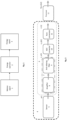
- the invention is in a first embodiment a vessel environmental condition sensing method comprising receiving a motion signal 1 from a motion measurement unit on board a vessel.
- An energy operator 2 is applied to the motion signal 1 to determine an energy signal 3 representative of the environmental condition for the vessel.
- the energy signal describes the dynamics of the motions of a vessel on the sea.
- the value of the energy signal reflect the vessel's response to the environmental conditions, such as weather and/or wave conditions.
- the energy operator 2 is the Teager Kaiser (TK) instantaneous energy operator.
- the implementation of the instantaneous energy operator for the discrete signal is simple, numerically cheap and only introduces 1 Sa (sample delay), thus is considered a delay-less solution.
- the method further comprises classifying the energy signal into a plurality of environmental condition classes for the vessel, each environmental condition class being defined by an energy signal threshold value.
- each environmental condition class being defined by an energy signal threshold value.
- any number of classes may be used.
- Exemplary methods of building a classifier based on the energy signals are perceptron or k-means clustering. Any other clustering method applicable may be used.
- the motion measurement unit senses the movements of a vessel on which the motion measurement unit is positioned, and translates those movements into an electrical signal.
- a vessel on sea have six degrees of freedom or motions; three rotational motions, pitch, roll and yaw; and three translational motions, heave, sway and surge.
- a motion measurement unit comprises one or more movement sensors that measures movement in one or more of those six degrees of freedom.
- the motion measurement unit comprises at least one of an inertial measurement unit, an inclinometer or an angular rate sensor.
- a motion measurement unit 4 comprises a movement sensor 5.
- the movement sensor 5 outputs an analog electrical signal, x(t).
- the analog electrical signal, x(t) then undergoes digital signaling processing (DSP) 6 into a discrete time signal by well-known technologies.
- the first step is signal conditioning 7, typically using an amplifier 8 and an anti-aliasing filter 9.
- the conditioned analog signal x_a(t) is transformed into a digital sequence by an analog-to-digital converter (ADC) 10.
- ADC analog-to-digital converter
- the input to the ADC, x_a(t) is a real-valued function of a continuous variable, t. For each value of t, the function x_a(t) may be any real number.
- the output of the ADC 10 is a bit stream that corresponds to the discrete-time sequence, x_a[n], with an amplitude that is quantized, for each value of n, to one of a finite number of possible values.
- the digital signal x[n] may be converted from one sampling rate to another sampling rate by a sample rate conversion process 11, e.g. change from a 10Hz signal to a 1Hz signal.
- the sample rate conversion may be performed in the DSP 6 unit and/or in a data logger external to the DSP unit.
- the energy operator is applied to the discrete motion signal x[n] in a processor 12 to determine an energy signal ⁇ d x n .
- the motion signal comprises at least one of a pitch, roll, heave, yaw, surge or sway signal
- the energy signal representative of the environmental condition is a pitch energy signal, a roll energy signal, heave energy signal, yaw energy signal, surge energy signal or sway energy signal, respectively.
- the environmental condition may be classified based on one of pitch energy signal, the roll energy signal, the heave energy signal, the yaw energy signal, the surge energy signal, the sway energy signal, or any combination of them.
- the pitch energy signal, the roll energy signal, and the heave energy signal are more preferred for determining vessel response on the environmental conditions, and particularly efficient is the pitch energy signal.
- Fig. 3 is an exemplary plot of determined pitch energy and roll energy for a vessel. As shown in Fig. 3 determining signal energy is particularly efficient to provide a clear separation of the information included in vessel motion measurement, which provides for classification of the vessel response on the environmental conditions.
- the environmental condition is a weather condition.
- Fig. 4 illustrates schematically a motion measurement unit 4 positioned on board a vessel 17,
- the motion measurement unit 4 outputs discrete motion signals x[n].
- the discrete motion signals x[n] may be input to a data logger 13 for storage and/or sample rate conversion.
- the discrete motion signal x[n] is output from the data logger 13 to a computer 12 to apply energy operator to the discrete motion signal x[n] and determine an energy signal ⁇ d x n as described above.
- the computer 12 may also receive the discrete motion signal x[n] directly from motion measurement unit 4.
- the energy signal may be determined on board the vessel and used for on-board advisory systems 14, such as Energy Management where the pitch energy signal may be a Wave Indication input.
- the data logger 13 may also be configured to transfer the discrete motion signal x[n] from the vessel 17 to shore 18. The transfer may be performed using any suitable wireless communication, wired connection or physical connection to the data logger 13.
- a computer 15 apply the energy operator to the discrete motion signal x[n] and determines an energy signal ⁇ d x n as described above.
- the energy signal may also be determined from archived data. Then then energy signal may be used in ship Design & Systems 16 to:
- FIG. 1 Another embodiment of the invention is a vessel environment condition assessment system comprising a motion measurement unit 4 on board a vessel 17 configured to sense the vessels motion.
- the motion measurement unit 4 is configured to output a motion signal 1 of the vessel 17 to a processor 12, 15 adapted to receive the motion signal of the vessel.
- the processor 12, 15 applies an energy operator 2 to the motion signal 1 to determine an energy signal 3 representative of the environmental condition.
- the motion measurement unit 4 of the environment condition assessment system comprises at least one of an inertial measurement unit, an inclinometer or an angular rate sensor.
- the processor 12, 15 applies a Teager Kaiser energy operator.
- the processor 12, 15 is further adapted to classifying the energy signal 3 into a plurality of environmental condition classes for the vessel, each environmental condition class defined by an energy signal threshold value.
- the motion signal 1 of the vessel 17 input to the processor 12, 15 comprises one or more of a pitch signal, roll signal, heave signals, yaw signal, surge signal or sway signal, and the energy signal 3 representative of the environmental condition is a one or more of a pitch energy signal, a roll energy signal, a heave energy signal, a yaw energy signal, a surge energy signal or a sway energy signal.
- the processor 12, 15 may classify the environmental condition based on one of the pitch energy signal, the roll energy signal, the heave energy signal, the yaw energy signal, the surge energy signal, the sway energy signal, or any combination thereof.
- energy signal 3 may be input to an on-board advisory systems 14 on board the vessel 17.
- the energy signal 3 may be input to a ship design and system 16 on-shore 18.
Landscapes
- Engineering & Computer Science (AREA)
- Radar, Positioning & Navigation (AREA)
- Remote Sensing (AREA)
- Physics & Mathematics (AREA)
- General Physics & Mathematics (AREA)
- Ocean & Marine Engineering (AREA)
- Chemical & Material Sciences (AREA)
- Combustion & Propulsion (AREA)
- Mechanical Engineering (AREA)
- Environmental & Geological Engineering (AREA)
- Automation & Control Theory (AREA)
- Life Sciences & Earth Sciences (AREA)
- Atmospheric Sciences (AREA)
- Aviation & Aerospace Engineering (AREA)
- Biodiversity & Conservation Biology (AREA)
- Ecology (AREA)
- Environmental Sciences (AREA)
- Probability & Statistics with Applications (AREA)
- Testing Or Calibration Of Command Recording Devices (AREA)
- Management, Administration, Business Operations System, And Electronic Commerce (AREA)
Claims (11)
- Verfahren zur Bewertung der Umgebungsbedingung eines Schiffs, umfassend:Empfangen eines Bewegungssignals (1) von einer Bewegungsmesseinheit (4) an Bord eines Schiffs (17);Anwenden eines Energieoperators (2) auf das Bewegungssignal, um ein Energiesignal (3) zu bestimmen,wobei der Energieoperator (2) ein augenblicklicher Teager-Kaiser-Energieoperator, TK-Energieoperator, ist, wobei der TK-Operator folgendermaßen ausgedrückt wird:
 wobei Ψ d (x[n]) der TK-Operator von Signal x[n] ist und x[n] ein diskretes Bewegungssignal ist,wobei das Energiesignal (3) in eine oder mehrere Umgebungsbedingungsklassen für das Schiff eingeordnet wird, wobei jede Umgebungsbedingungsklasse durch einen Schwellenwert für Energiesignale (3) definiert wird und wobei das Energiesignal (3) die Umgebungsbedingung für das Schiff darstellt.
 - Verfahren nach Anspruch 1, wobei das Bewegungssignal des Schiffs eines oder mehrere eines Nick-, Roll-, Stampf-, Gier-, Woge- oder Schwoisignals umfasst und das Energiesignal, das die Umgebungsbedingung darstellt, ein Nickenergiesignal, ein Rollenergiesignal, ein Stampfenergiesignal, ein Gierenergiesignal, ein Wogeenergiesignal oder ein Schwoienergiesignal ist.
- Verfahren nach Anspruch 2, wobei die Umgebungsbedingung basierend auf einem des Nickenergiesignals, des Rollenergiesignals, des Stampfenergiesignals, des Gierenergiesignals, des Wogeenergiesignals, des Schwoienergiesignals oder einer beliebigen Kombination davon eingeordnet wird.
- Verfahren nach einem der vorhergehenden Ansprüche, wobei die Umgebungsbedingung eine Witterungsbedingung ist.
- System zur Bewertung der Umgebungsbedingung eines Schiffs, umfassend:- eine Bewegungsmesseinheit (4) an Bord eines Schiffs (17), die dazu konfiguriert ist, die Schiffsbewegung zu erfassen, wobei die Bewegungsmesseinheit dazu konfiguriert ist, ein Bewegungssignal (1) des Schiffs auszugeben;- einen Prozessor (12, 15), der zu Folgendem ausgelegt ist:Empfangen des Bewegungssignals des Schiffs;Anwenden eines Energieoperators (2) auf das Bewegungssignal, um ein Energiesignal (3) zu berechnen,wobei der Energieoperator (2) ein augenblicklicher Teager-Kaiser-Energieoperator, TK-Energieoperator, ist, wobei der TK-Operator folgendermaßen ausgedrückt wird:
 wobei Ψ d (x[n]) der TK-Operator von Signal x[n] ist und x[n] ein diskretes Bewegungssignal ist,wobei das Energiesignal (3) in eine Vielzahl von Umgebungsbedingungsklassen für das Schiff eingeordnet wird, wobei jede Umgebungsbedingungsklasse durch einen Schwellenwert für Energiesignale (3) definiert wird und wobei das Energiesignal (3) die Umgebungsbedingung für das Schiff darstellt.
 - System nach Anspruch 5, wobei das Bewegungssignal des Schiffs eines oder mehrere eines Nicksignals, eines Rollsignals, eines Stampfsignals, eines Giersignals, eines Wogesignals oder eines Schwoisignals umfasst und das Energiesignal, das die Umgebungsbedingung darstellt, eines oder mehrere eines Nickenergiesignals, eines Rollenergiesignals, eines Stampfenergiesignals, eines Gierenergiesignals, eines Wogeenergiesignals oder eines Schwoienergiesignals ist.
- System nach Anspruch 6, wobei die Umgebungsbedingung basierend auf einem des Nickenergiesignals, des Rollenergiesignals, des Stampfenergiesignals, des Gierenergiesignals, des Wogeenergiesignals, des Schwoienergiesignals oder einer beliebigen Kombination davon eingeordnet wird.
- System nach einem der Ansprüche 5-7, wobei die Bewegungsmesseinheit mindestens eines einer Trägheitsmesseinheit, eines Neigungsmessers oder eines Winkelgeschwindigkeitssensors umfasst.
- System nach einem der Ansprüche 5-8, wobei die Umgebungsbedingung eine Witterungsbedingung ist.
- System nach einem der Ansprüche 5-9, wobei das Energiesignal in ein Bord-Beratungssystem (14) an Bord des Schiffs eingegeben wird.
- System nach einem der Ansprüche 5-9, wobei das Energiesignal in einen Schiffsentwurf und ein System (16) an Land (18) eingegeben wird.
Applications Claiming Priority (2)
| Application Number | Priority Date | Filing Date | Title |
|---|---|---|---|
| NO20181654A NO345528B1 (en) | 2018-12-20 | 2018-12-20 | Vessel environment condition assessment system and method |
| PCT/NO2019/050283 WO2020130847A1 (en) | 2018-12-20 | 2019-12-19 | Vessel environment condition assessment system and method |
Publications (4)
| Publication Number | Publication Date |
|---|---|
| EP3899599A1 EP3899599A1 (de) | 2021-10-27 |
| EP3899599A4 EP3899599A4 (de) | 2022-10-05 |
| EP3899599C0 EP3899599C0 (de) | 2025-02-26 |
| EP3899599B1 true EP3899599B1 (de) | 2025-02-26 |
Family
ID=71102668
Family Applications (1)
| Application Number | Title | Priority Date | Filing Date |
|---|---|---|---|
| EP19901127.1A Active EP3899599B1 (de) | 2018-12-20 | 2019-12-19 | System und verfahren zur bewertung der umgebungsbedingung eines schiffs |
Country Status (7)
| Country | Link |
|---|---|
| US (1) | US11919612B2 (de) |
| EP (1) | EP3899599B1 (de) |
| KR (1) | KR102876655B1 (de) |
| CN (1) | CN113227720B (de) |
| NO (1) | NO345528B1 (de) |
| PL (1) | PL3899599T3 (de) |
| WO (1) | WO2020130847A1 (de) |
Families Citing this family (1)
| Publication number | Priority date | Publication date | Assignee | Title |
|---|---|---|---|---|
| CN115218949A (zh) * | 2022-05-31 | 2022-10-21 | 中国电子产品可靠性与环境试验研究所((工业和信息化部电子第五研究所)(中国赛宝实验室)) | 环境数据测试方法、测试装置及存储介质 |
Family Cites Families (24)
| Publication number | Priority date | Publication date | Assignee | Title |
|---|---|---|---|---|
| NO144253C (no) * | 1975-02-28 | 1981-07-22 | Mobil Oil Corp | Fremgangsmaate og system for seismiske undersoekelser |
| US5572765A (en) * | 1996-02-02 | 1996-11-12 | Guell; Ronald R. | Heated wiper blade and blade carrier employing single heating element |
| NO315724B1 (no) * | 2001-12-20 | 2003-10-13 | Sten Hellvik | Datainnsamlingssystem for et fartöy |
| NO320465B1 (no) * | 2004-02-16 | 2005-12-12 | Egeland Olav | Fremgangsmate og system for testing av et reguleringssystem tilhorende et marint fartoy |
| JP2007047036A (ja) * | 2005-08-10 | 2007-02-22 | Universal Shipbuilding Corp | 荒天避航支援システム |
| GB0703128D0 (en) * | 2007-02-16 | 2007-03-28 | Rolls Royce Plc | Stall detection |
| DE602008006727D1 (de) * | 2007-06-14 | 2011-06-16 | Fincantieri Cantieri Navali It | Vorrichtung und verfahren zur bedieneranweisung bei einem schiff |
| RU69267U1 (ru) * | 2007-07-24 | 2007-12-10 | Институт оптики атмосферы Сибирское Отделение Российской Академии Наук | Мобильная станция для экологического контроля окружающей среды |
| DK2419804T3 (en) | 2009-04-14 | 2014-02-24 | Univ Danmarks Tekniske | Prediction of resonant swing |
| CN101793521B (zh) * | 2010-01-06 | 2012-10-31 | 哈尔滨工程大学 | 基于光纤陀螺惯性测量系统的舰船横纵荡信息测量方法 |
| DE102010015359A1 (de) * | 2010-04-19 | 2011-10-20 | Howaldtswerke-Deutsche Werft Gmbh | Beurteilung der Schiffsdynamik |
| KR20120061104A (ko) * | 2010-10-22 | 2012-06-13 | (주)대우건설 | 해상구조물의 외해 시공을 위한 파랑 관측 시스템 및 파랑 관측 방법 |
| SE1130084A1 (sv) * | 2011-09-16 | 2013-03-12 | Tagg R & D Ab Q | Metod och anordning för undvikande och dämpning av ett fartygs rullning |
| EP2587321A1 (de) * | 2011-10-25 | 2013-05-01 | Siemens Aktiengesellschaft | Wellenfilterung mit Differentialentwicklung für dynamische Positioniersysteme |
| NO333881B1 (no) * | 2012-03-26 | 2013-10-07 | Rolls Royce Marine As | Rotor omfattende segmentert åk |
| EP2669172A1 (de) * | 2012-06-01 | 2013-12-04 | ABB Technology AG | Verfahren und System zur Vorhersage der Leistung eines Schiffs |
| EP3095017A4 (de) * | 2014-01-14 | 2017-02-01 | Conoco Phillips Company | Gefässpositionierungssystem zur aufrechterhaltung der relativen position zwischen zwei betrieblich gekoppelten gefässen und verfahren |
| RU2582500C2 (ru) * | 2014-05-14 | 2016-04-27 | Нокиа Текнолоджиз Ой | Информация о погодных условиях на основе магнитометров |
| US11529084B2 (en) * | 2015-09-08 | 2022-12-20 | Dan Qun Fang | Cardiovascular detection system and method |
| KR101823030B1 (ko) * | 2016-01-28 | 2018-01-31 | 대우조선해양 주식회사 | 선박의 위험환경 회피 시스템 및 이를 이용한 회피 방법 |
| US9593522B1 (en) * | 2016-02-17 | 2017-03-14 | Jvis-Usa, Llc | System including a hand-held communication device having a motion sensor for remotely controlling the position of a door of a land vehicle and key fob for use in the system |
| KR101915051B1 (ko) * | 2017-03-16 | 2018-12-28 | 한국해양대학교 산학협력단 | 선내 모니터링 시스템을 이용한 내항성 지수 산정 방법 및 내항성 지수 산정 시스템 |
| CN107504998A (zh) * | 2017-08-04 | 2017-12-22 | 宁波巨神制泵实业有限公司 | 一种泵站故障检测装置 |
| KR101867296B1 (ko) * | 2017-12-07 | 2018-06-15 | 한국해양과학기술원 | 파도를 이용한 수중 승강식 프로파일러 장치 |
-
2018
- 2018-12-20 NO NO20181654A patent/NO345528B1/en unknown
-
2019
- 2019-12-19 US US17/416,107 patent/US11919612B2/en active Active
- 2019-12-19 EP EP19901127.1A patent/EP3899599B1/de active Active
- 2019-12-19 PL PL19901127.1T patent/PL3899599T3/pl unknown
- 2019-12-19 CN CN201980084654.8A patent/CN113227720B/zh active Active
- 2019-12-19 KR KR1020217021978A patent/KR102876655B1/ko active Active
- 2019-12-19 WO PCT/NO2019/050283 patent/WO2020130847A1/en not_active Ceased
Also Published As
| Publication number | Publication date |
|---|---|
| WO2020130847A1 (en) | 2020-06-25 |
| EP3899599C0 (de) | 2025-02-26 |
| KR102876655B1 (ko) | 2025-10-24 |
| CN113227720B (zh) | 2024-08-27 |
| EP3899599A1 (de) | 2021-10-27 |
| PL3899599T3 (pl) | 2025-04-28 |
| US11919612B2 (en) | 2024-03-05 |
| NO20181654A1 (en) | 2020-06-22 |
| KR20210104099A (ko) | 2021-08-24 |
| US20220073172A1 (en) | 2022-03-10 |
| NO345528B1 (en) | 2021-03-29 |
| EP3899599A4 (de) | 2022-10-05 |
| CN113227720A (zh) | 2021-08-06 |
Similar Documents
| Publication | Publication Date | Title |
|---|---|---|
| Yin et al. | On-line prediction of ship roll motion during maneuvering using sequential learning RBF neuralnetworks | |
| CN108846207B (zh) | 一种基于非线性模型辨识的船舶运动预报装置及其预报方法 | |
| Han et al. | An uncertainty-aware hybrid approach for sea state estimation using ship motion responses | |
| US12054225B2 (en) | Method and controller unit for controlling motion of a hydrofoil watercraft | |
| Perera et al. | Development of an onboard decision support system for ship navigation under rough weather conditions | |
| CN120057221B (zh) | 一种应用于两栖船舶的无线监控报警系统及方法 | |
| EP3899599B1 (de) | System und verfahren zur bewertung der umgebungsbedingung eines schiffs | |
| KR102786166B1 (ko) | 파랑 스펙트럼 실시간 추정 및 운항지침제공 알고리즘을 구현한 시스템 및 동 시스템을 구비한 선박 또는 해양구조물 | |
| Njaka et al. | CFD investigation of hull-rudder interaction for improved maneuvering models | |
| CN119398246A (zh) | 一种基于多源异构数据融合的船员工作负荷自适应预测方法 | |
| Nielsen et al. | A novel approach for navigational guidance of ships using onboard monitoring systems | |
| US20240149993A1 (en) | Integrated condition monitoring system and method for ice-going vessels | |
| CN112800075A (zh) | 一种基于实船六自由度姿态数据的船舶操纵预报数据库更新方法 | |
| CN105180944A (zh) | 一种船体侧滑速度误差判定补偿方法 | |
| Zhao et al. | Sea ice type and thickness identification based on vibration sensor networks and machine learning | |
| CN118585781B (zh) | 一种主动自扶正无人船倾覆快速判别方法 | |
| Montazeri | Estimation of waves and ship responses using onboard measurements | |
| KR102838787B1 (ko) | 파랑 스펙트럼 실시간 추정 시스템 및 동 시스템을 포함하는 선박 또는 해양구조물 | |
| KR102786135B1 (ko) | 파랑 스펙트럼을 실시간 추정하는 시스템 및 동 시스템을 구비한 선박 또는 해양구조물 | |
| Heyn et al. | Distributed motion sensing on ships | |
| Lou et al. | Influence of sample intervals in real-sea trails on the nonparametric model of 3-DoF ship motion predictions | |
| Lin et al. | Multi-parameter stochastic inversion for first and second moment mass properties of a model-scale ship with topside ice accumulation | |
| CN111275084A (zh) | 基于k近邻算法的会遇船舶碰撞危险类别确定方法和装置 | |
| KR20160085056A (ko) | 선체 기준 해상상태 계측시스템 및 그 방법 | |
| KR100516851B1 (ko) | 선박의 종합 내항성능 평가 시스템 및 방법 |
Legal Events
| Date | Code | Title | Description |
|---|---|---|---|
| STAA | Information on the status of an ep patent application or granted ep patent |
Free format text: STATUS: THE INTERNATIONAL PUBLICATION HAS BEEN MADE |
|
| PUAI | Public reference made under article 153(3) epc to a published international application that has entered the european phase |
Free format text: ORIGINAL CODE: 0009012 |
|
| STAA | Information on the status of an ep patent application or granted ep patent |
Free format text: STATUS: REQUEST FOR EXAMINATION WAS MADE |
|
| 17P | Request for examination filed |
Effective date: 20210623 |
|
| AK | Designated contracting states |
Kind code of ref document: A1 Designated state(s): AL AT BE BG CH CY CZ DE DK EE ES FI FR GB GR HR HU IE IS IT LI LT LU LV MC MK MT NL NO PL PT RO RS SE SI SK SM TR |
|
| DAV | Request for validation of the european patent (deleted) | ||
| DAX | Request for extension of the european patent (deleted) | ||
| RIN1 | Information on inventor provided before grant (corrected) |
Inventor name: FOLKESTAD, ARE Inventor name: SWIDER, ANNA |
|
| A4 | Supplementary search report drawn up and despatched |
Effective date: 20220831 |
|
| RIC1 | Information provided on ipc code assigned before grant |
Ipc: B63B 79/40 20200101ALI20220826BHEP Ipc: G01C 19/00 20130101ALI20220826BHEP Ipc: G01C 9/00 20060101ALI20220826BHEP Ipc: G01W 1/02 20060101AFI20220826BHEP |
|
| GRAP | Despatch of communication of intention to grant a patent |
Free format text: ORIGINAL CODE: EPIDOSNIGR1 |
|
| STAA | Information on the status of an ep patent application or granted ep patent |
Free format text: STATUS: GRANT OF PATENT IS INTENDED |
|
| INTG | Intention to grant announced |
Effective date: 20240412 |
|
| GRAJ | Information related to disapproval of communication of intention to grant by the applicant or resumption of examination proceedings by the epo deleted |
Free format text: ORIGINAL CODE: EPIDOSDIGR1 |
|
| STAA | Information on the status of an ep patent application or granted ep patent |
Free format text: STATUS: REQUEST FOR EXAMINATION WAS MADE |
|
| INTC | Intention to grant announced (deleted) | ||
| RIN1 | Information on inventor provided before grant (corrected) |
Inventor name: FOLKESTAD, ARE Inventor name: SWIDER, ANNA |
|
| GRAP | Despatch of communication of intention to grant a patent |
Free format text: ORIGINAL CODE: EPIDOSNIGR1 |
|
| STAA | Information on the status of an ep patent application or granted ep patent |
Free format text: STATUS: GRANT OF PATENT IS INTENDED |
|
| INTG | Intention to grant announced |
Effective date: 20241001 |
|
| GRAS | Grant fee paid |
Free format text: ORIGINAL CODE: EPIDOSNIGR3 |
|
| GRAA | (expected) grant |
Free format text: ORIGINAL CODE: 0009210 |
|
| STAA | Information on the status of an ep patent application or granted ep patent |
Free format text: STATUS: THE PATENT HAS BEEN GRANTED |
|
| AK | Designated contracting states |
Kind code of ref document: B1 Designated state(s): AL AT BE BG CH CY CZ DE DK EE ES FI FR GB GR HR HU IE IS IT LI LT LU LV MC MK MT NL NO PL PT RO RS SE SI SK SM TR |
|
| REG | Reference to a national code |
Ref country code: GB Ref legal event code: FG4D |
|
| REG | Reference to a national code |
Ref country code: CH Ref legal event code: EP |
|
| REG | Reference to a national code |
Ref country code: DE Ref legal event code: R096 Ref document number: 602019066666 Country of ref document: DE |
|
| REG | Reference to a national code |
Ref country code: IE Ref legal event code: FG4D |
|
| U01 | Request for unitary effect filed |
Effective date: 20250319 |
|
| U07 | Unitary effect registered |
Designated state(s): AT BE BG DE DK EE FI FR IT LT LU LV MT NL PT RO SE SI Effective date: 20250326 |
|
| PG25 | Lapsed in a contracting state [announced via postgrant information from national office to epo] |
Ref country code: RS Free format text: LAPSE BECAUSE OF FAILURE TO SUBMIT A TRANSLATION OF THE DESCRIPTION OR TO PAY THE FEE WITHIN THE PRESCRIBED TIME-LIMIT Effective date: 20250526 |
|
| PG25 | Lapsed in a contracting state [announced via postgrant information from national office to epo] |
Ref country code: ES Free format text: LAPSE BECAUSE OF FAILURE TO SUBMIT A TRANSLATION OF THE DESCRIPTION OR TO PAY THE FEE WITHIN THE PRESCRIBED TIME-LIMIT Effective date: 20250226 |
|
| PG25 | Lapsed in a contracting state [announced via postgrant information from national office to epo] |
Ref country code: IS Free format text: LAPSE BECAUSE OF FAILURE TO SUBMIT A TRANSLATION OF THE DESCRIPTION OR TO PAY THE FEE WITHIN THE PRESCRIBED TIME-LIMIT Effective date: 20250626 |
|
| PG25 | Lapsed in a contracting state [announced via postgrant information from national office to epo] |
Ref country code: HR Free format text: LAPSE BECAUSE OF FAILURE TO SUBMIT A TRANSLATION OF THE DESCRIPTION OR TO PAY THE FEE WITHIN THE PRESCRIBED TIME-LIMIT Effective date: 20250226 |
|
| PG25 | Lapsed in a contracting state [announced via postgrant information from national office to epo] |
Ref country code: GR Free format text: LAPSE BECAUSE OF FAILURE TO SUBMIT A TRANSLATION OF THE DESCRIPTION OR TO PAY THE FEE WITHIN THE PRESCRIBED TIME-LIMIT Effective date: 20250527 |
|
| PG25 | Lapsed in a contracting state [announced via postgrant information from national office to epo] |
Ref country code: SM Free format text: LAPSE BECAUSE OF FAILURE TO SUBMIT A TRANSLATION OF THE DESCRIPTION OR TO PAY THE FEE WITHIN THE PRESCRIBED TIME-LIMIT Effective date: 20250226 |
|
| PG25 | Lapsed in a contracting state [announced via postgrant information from national office to epo] |
Ref country code: CZ Free format text: LAPSE BECAUSE OF FAILURE TO SUBMIT A TRANSLATION OF THE DESCRIPTION OR TO PAY THE FEE WITHIN THE PRESCRIBED TIME-LIMIT Effective date: 20250226 |
|
| PG25 | Lapsed in a contracting state [announced via postgrant information from national office to epo] |
Ref country code: SK Free format text: LAPSE BECAUSE OF FAILURE TO SUBMIT A TRANSLATION OF THE DESCRIPTION OR TO PAY THE FEE WITHIN THE PRESCRIBED TIME-LIMIT Effective date: 20250226 |
|
| PLBE | No opposition filed within time limit |
Free format text: ORIGINAL CODE: 0009261 |
|
| REG | Reference to a national code |
Ref country code: CH Ref legal event code: U11 Free format text: ST27 STATUS EVENT CODE: U-0-0-U10-U11 (AS PROVIDED BY THE NATIONAL OFFICE) Effective date: 20260101 |
|
| STAA | Information on the status of an ep patent application or granted ep patent |
Free format text: STATUS: NO OPPOSITION FILED WITHIN TIME LIMIT |
|
| PGFP | Annual fee paid to national office [announced via postgrant information from national office to epo] |
Ref country code: GB Payment date: 20251229 Year of fee payment: 7 |
|
| PGFP | Annual fee paid to national office [announced via postgrant information from national office to epo] |
Ref country code: NO Payment date: 20251231 Year of fee payment: 7 |
|
| PGFP | Annual fee paid to national office [announced via postgrant information from national office to epo] |
Ref country code: TR Payment date: 20251216 Year of fee payment: 7 |
|
| PGFP | Annual fee paid to national office [announced via postgrant information from national office to epo] |
Ref country code: PL Payment date: 20251208 Year of fee payment: 7 |
|
| 26N | No opposition filed |
Effective date: 20251127 |
|
| U20 | Renewal fee for the european patent with unitary effect paid |
Year of fee payment: 7 Effective date: 20251229 |