EP3898323B1 - Auxetische verstelleinrichtung - Google Patents
Auxetische verstelleinrichtung Download PDFInfo
- Publication number
- EP3898323B1 EP3898323B1 EP19835390.6A EP19835390A EP3898323B1 EP 3898323 B1 EP3898323 B1 EP 3898323B1 EP 19835390 A EP19835390 A EP 19835390A EP 3898323 B1 EP3898323 B1 EP 3898323B1
- Authority
- EP
- European Patent Office
- Prior art keywords
- auxetic
- adjustment device
- cell structure
- cell
- plane
- Prior art date
- Legal status (The legal status is an assumption and is not a legal conclusion. Google has not performed a legal analysis and makes no representation as to the accuracy of the status listed.)
- Active
Links
Images


Classifications
-
- B—PERFORMING OPERATIONS; TRANSPORTING
- B60—VEHICLES IN GENERAL
- B60N—SEATS SPECIALLY ADAPTED FOR VEHICLES; VEHICLE PASSENGER ACCOMMODATION NOT OTHERWISE PROVIDED FOR
- B60N2/00—Seats specially adapted for vehicles; Arrangement or mounting of seats in vehicles
- B60N2/90—Details or parts not otherwise provided for
- B60N2/919—Positioning and locking mechanisms
-
- B—PERFORMING OPERATIONS; TRANSPORTING
- B60—VEHICLES IN GENERAL
- B60N—SEATS SPECIALLY ADAPTED FOR VEHICLES; VEHICLE PASSENGER ACCOMMODATION NOT OTHERWISE PROVIDED FOR
- B60N2/00—Seats specially adapted for vehicles; Arrangement or mounting of seats in vehicles
- B60N2/24—Seats specially adapted for vehicles; Arrangement or mounting of seats in vehicles for particular purposes or particular vehicles
- B60N2/26—Seats specially adapted for vehicles; Arrangement or mounting of seats in vehicles for particular purposes or particular vehicles for children
- B60N2/28—Seats readily mountable on, and dismountable from, existing seats or other parts of the vehicle
-
- B—PERFORMING OPERATIONS; TRANSPORTING
- B60—VEHICLES IN GENERAL
- B60N—SEATS SPECIALLY ADAPTED FOR VEHICLES; VEHICLE PASSENGER ACCOMMODATION NOT OTHERWISE PROVIDED FOR
- B60N2/00—Seats specially adapted for vehicles; Arrangement or mounting of seats in vehicles
- B60N2/02—Seats specially adapted for vehicles; Arrangement or mounting of seats in vehicles the seat or part thereof being movable, e.g. adjustable
- B60N2/0284—Adjustable seat-cushion length
Definitions
- the invention relates to the use of an auxetic structure.
- Three-dimensional auxetic materials thus stretch in all directions transverse to the direction of pull. These are structures that give the material the auxetic properties, not the material used for them. There are materials that naturally have such structures, and materials that are artificially brought into an auxetic structure, such as the well-known diamond-fold structure, one of the first artificially produced auxetic structures, which is produced from a surface independently of the material.
- the diamond-fold structure is based on a lever mechanism with a non-linear mechanical response.
- the pamphlet DE 11 2006 000 538 T5 describes an energy absorbing assembly comprising a rigid support structure having an inlet port, a flexible cover that engages the rigid support structure to define an expandable interior region, a fluid source in fluid communication with the inlet port, and a cellular lattice contained in the expandable interior Area is arranged, wherein the cell lattice comprises a shape memory material that is adapted to expand in response to fluid communication with the fluid source from a first configuration to an expanded configuration.
- a cell unit of the cell lattice has an auxetic geometry. It is also disclosed that a cell unit of the cell lattice is preferably hexagons or rhombuses.
- the pamphlet DE 10 2016 013 923 A1 discloses a vehicle seat with an occupant protection device for reducing a risk of slipping under a lap belt section of a fastened seat belt in the event of a vehicle collision.
- foam with variable firmness and/or shape which is directly operatively connected to a conditioning device in the form of a gas supply, with the foam forming a seat ramp by activating the conditioning device.
- the foam comprises a viscoelastic and/or auxetic material.
- the pamphlet DE 10 2016 010 929 A1 explains a vehicle seat with a seat back and a seat cushion forming a seat surface, in which a seat wedge forming a seat ramp is arranged, wherein the seat wedge is made of an auxetic material, in particular the seat wedge is made of an auxetic foam, it is provided that a height of the Seat wedge reduced in the direction of the seat back.
- the auxetic structures are used for energy absorption. In other words, the auxetic structures act in or against the direction of loading.
- the object of the invention is now to use an auxetic structure in a non-conventional way.
- auxetic structure is used as an adjustment device.
- an auxetic adjustment device is to be designed according to the subject matter of claim 1, which at least partially comprises an auxetic cell structure which has a plurality of cell units having a predeterminable geometry, with the auxetic cell structure being assigned an action direction in a starting position of the adjustment device, with an actuator to adjust the auxetic cell structure in the direction of action exerts an action force on the auxetic cell structure, which causes an auxetic reaction of the auxetic cell structure transversely to the action force into an adjustment position on a reaction axis in the reaction direction, which is provided as an adjustment axis in an adjustment direction of the adjustment device, the cell units of Cell structure are connected to one another via at least one joint, wherein according to the invention the cell units of the cell structure are connected to one another via at least one joint with at least one support element arranged at the edge of the cell structure.
- the core idea of the invention is the use of the auxetic adjusting device according to claims 8 and 9.
- the cell units of the cell structure via the at least one joint at least one support plate arranged at the edge of the cell structure are connected to one another as a support element.
- At least the auxetic cell structure and/or by the cell units themselves or by the cell units themselves and the at least one joint forms a support structure which forms a supporting force substantially orthogonal as a normal vector to the surface plane of the auxetic cell structure, which is substantially orthogonal to the plane which is formed by the surface plane of the auxetic cell structure defined in the direction of action and direction of reaction.
- the at least partially auxetic adjusting device is further distinguished by the fact that all of the above-mentioned embodiments can be designed in such a way that the cell units of the cell structure are designed as surface elements at least in one plane.
- the adjoining component is another structural part of a vehicle seat/child seat or, for example, a foam as a cushion for the respective component, with the adjustment and support device being arranged under the foam of the adjustment and support device or in the foam as the adjustment and support device.
- the at least one level of the cell units of the auxetic cell structure designed as surface elements forms a support level, whereby the adjustment device can be used as an adjustment and support device for an adjacent component, in particular the upholstery foam.
- the auxetic cell structure and the at least one support plate and the at least one joint is/are formed from a one-piece or multi-piece injection molded part, as a result of which inexpensive series production is possible.
- Adjusting devices are thus advantageously created which can only be formed in a conventional manner with the aid of a plurality of components and additional guides.
- components and guides are saved in an advantageous manner, so that there is a reduction in weight, in particular also because a plastic is used in the injection molding production process.
- a horizontal direction of a cell structure ZS shall be denoted by "x”.
- y denotes the horizontal direction orthogonal to the x-direction (x and y thus form a horizontal x/y plane), and
- z denotes the vertical direction of the cell structure ZS orthogonal to the x-direction or y-direction.
- FIGS 1A to 1E show schematic representations of various layers of auxetic cell structures ZS1 to ZS5, which in principle can be used either individually or in combination according to the auxetic adjustment structure 10 according to the invention explained below.
- the invention is based on a layered auxetic adjustment structure 10 which has only one layer.
- the layer of the auxetic adjustment structure 10 extends in two dimensions in an imaginary plane (x/y plane), for example in the x-direction and y-direction, with the layer height, which corresponds to the height of a cell unit, in z-direction extends.
- the cell units E of the auxetic cell structures ZS1 to ZS5 are in the layer according to FIG Figures 1A to 1E thus arranged as the smallest unit of the cell structures ZS1 to ZS5.
- the layer of the auxetic cell structure ZS1 is made up of rectangles and cylinders as cell units E.
- the layer of the auxetic cell structure ZS2 is made up of triangles as cell units E.
- the layer of the auxetic cell structure ZS3 is made up of crosses as cell units E.
- the layer of the auxetic cell structure ZS4 is made up of double cones as cell units E.
- the layer of the auxetic cell structure ZS5 is made up of stars as cell units E.
- the layers of the auxetic cell structures ZS1 to ZS5 become wider in the x-direction as a result of the application of a tensile force in the direction of the tensile force axis Y transverse to the tensile force axis Y, as is symbolized by the X-axes X.
- the Y-axis thus represents the axis of action of the active action force and the X-axes represent the reaction axes of the auxetic cell structures ZS1 to ZS5.
- a compressive force is exerted as an action force Fz in the direction of the Y axis on the respective cell structure ZS1 to ZS5, with the auxetic cell structures ZS1 to ZS5 becoming narrower transversely to the Y axis in the x direction, i.e. the X-axis also represents the reaction axis of the respective auxetic cell structures ZS1 to ZS5.
- an adjustment device 10 is proposed according to the invention, which is arranged as an adjustment device in at least one component of a vehicle seat, not shown in detail.
- the features described for the vehicle seat can be transferred analogously to a child seat.
- the adjustment device carries another component, in particular a foam, or is connected to a mechanism which transmits the adjustment movement.
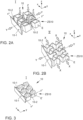
- the Figure 2A shows in a perspective view in an exemplary manner of the Figures 1A and 1C starting from an auxetic cell structure ZS10 in an unadjusted initial position I as adjustment structure 10, which is made up of rectangles.
- At least one support element in particular in the form of a support plate 10-1, is arranged on the rectangles transversely to the tensile force axis Y, only one of several support plates 10-1 that can be arranged at the edge being shown.
- a tensile force as an action force Fz in the direction of action in the direction of the axis of tension Y is transmitted via the support plates 10-1 to the auxetic cell structure ZS10 at least on one side, preferably on both sides.
- a compressive force can be transmitted to the auxetic cell structure ZS10 as an action force Fz in the action direction on one side, preferably on both sides, which acts analogously in the direction of the tensile force axis Y and triggers the effects described above in the direction of the reaction axes.
- the Figure 1C shows a crossing point KP of four cell units E, which are arranged in the auxetic cell structure ZS10 according to the invention at four adjacent corner points of the rectangles that form the smallest cell units E.
- the adjusting device 10 according to the invention can be constructed in such a way that the crossing point KP is analogous to that Figure 1C is formed with the support plate(s) 10-1 abutting the rectangular cell units E directly.
- the direct crossing point KP is dissolved, so to speak, since at least one joint, in particular a hinge 10-2 in the form of film hinges, is formed between the rectangular cell units E and between the rectangular cell units E and the support plate(s) 10-1, with only two of the hinges 10-2 are provided with reference numerals.
- the crossing point KP lies in the space between the four vertices of the rectangular cell units E.
- the arrangement of hinges 10-2 between the rectangular cell units E increases the elasticity of the auxetic cell structure ZS10, i.e. the adjustability (of the Starting position I in the adjustment position II) and the geometric adaptability of the auxetic cell structure ZS10 to other bodies is improved.
- the arrangement of the hinges 10-2 in the manner of film hinges also stabilizes the adjusting device 10 transversely to the layer lying in the x/y plane.
- the auxetic adjustment device 10 can better absorb forces that act on it from the Z direction, as is illustrated by the force arrows of the supporting force in the force direction along the Z axis.
- the auxetic cell structure ZS10 advantageously forms a support structure through the cell units themselves or through the cell units and the joints, and thus the hinges 10-2.
- the support structure has the advantage that when a force acts on the auxetic cell structure ZS10, there is an opposing supporting force of the support structure.
- the supporting force in the z-direction acts essentially normal as a normal vector to the surface plane (x/y plane) or layer plane of the auxetic cell structure ZS10, i.e. essentially orthogonal to the layer lying in the x/y plane, which is formed by the axis of action of the acting action force Fz explained below and the X-axes are defined as reaction axes of the auxetic cell structure ZS10.
- the Figure 2B shows in a perspective view in an exemplary manner of the Figures 1A and 1C starting from the auxetic cell structure ZS10 as adjustment device 10 in adjustment position II.
- the Y axis thus represents the axis of action of the acting action force F Z and the X axes represent the reaction axes of the auxetic cell structures ZS1 to ZS5.
- the tensile force Fz is transmitted uniformly to the auxetic cell structure ZS10 via the at least one support plate/s 10-1, in that the hinges 10-2 mechanically transmit the force to the rectangular cell units E in the manner of film hinges, with the transmission from cell unit to cell unit also takes place via the hinges 10-2 in the manner of film hinges.
- the hinges 10-2 achieve the effect described.
- figure 3 shows that the auxetic cell structure ZS10 in the starting position I according to Figure 2A is formed from cell units E, which lie in at least one support or support plane, in particular the x/y plane shown, as surface elements E', so that a foam and/or a cover is better placed on the adjustment device 10 of an upholstery part arranged on or on the adjustment device 10 of the vehicle seat can be attached or placed.
- cell units E which lie in at least one support or support plane, in particular the x/y plane shown, as surface elements E', so that a foam and/or a cover is better placed on the adjustment device 10 of an upholstery part arranged on or on the adjustment device 10 of the vehicle seat can be attached or placed.
- the adjusting device 10 comprises, for example, an auxetic cell structure ZS10 on one side of a boundary line G or a boundary area GB and a non-auxetic cell structure on the other side of the boundary line G or a boundary area GB, which is denoted by the reference symbol ZS10(-). becomes.
- figure 5 shows how in the Figures 2A and 2B already shown that the cell units E of the auxetic cell structure ZS10 can have different (layer) heights Z1, Z, Z3.
- an x*/y* support level (compare also Figure 2A, Figure 3 ) of the auxetic cell structures ZS10 geometrically adapted adjusting device 10 can be formed.
- the support plate 10-1 and the adjoining cell units E have the height Z1, while other cell units E can have other heights Z2, Z3, depending on the application.
- the wall thicknesses of the cell units E can vary (not shown) in such a way that greater or greater wall thicknesses are formed in areas of higher loads, i.e. in areas in which higher forces occur, and smaller or smaller wall thicknesses are formed in areas in which lower forces occur are.
- the height and wall thickness are selected in combination depending on the magnitude of the forces acting on the auxetic cell structure ZS10.
- the choice of height and wall thickness as a function of the forces that occur also applies to a non-auxetic cell structure ZS10(-), which is used in combination with the auxetic cell structure ZS10.
- the auxetic cell structure ZS10 described or a combination of the described auxetic cell structure ZS10 with a non-auxetic cell structure ZS10(-) can be found in a vehicle seat or, analogously, in a child's seat can be used in a variety of ways as an adjusting device 10, as will be explained in more detail below.
- the adjustment structure 10 can be used over the entire surface as a support structure for a seat part and/or a backrest part and/or a headrest and/or a side bolster or in other words in every component of the vehicle seat or child seat as an adjustment device 10 .
- the adjusting device 10 can be arranged below a foam or in the foam of the respective component.
- the x*/y* support level explained advantageously a bearing surface that can be varied as explained.
- a seat width or a seat height or a seat depth of a seat part or a backrest width or a backrest height or a backrest depth of a backrest part or a headrest width or a headrest height or a headrest depth of a headrest or a side bolster width or a side bolster height or a side bolster depth a side wall can be adjusted.
- FIG 6 shows an example of the use of an adjustment device 10 as a seat depth adjustment device 10 ⁇ .
- the seat depth adjustment device 10 ⁇ is a module which is arranged in the front area of a seat part 12.
- figure 6 shows a section through a seat part 12 in a horizontal x/y plane, which runs through an auxetic cell structure ZS10, the supporting plates 10-1, which can be moved laterally in the direction of the tensile force axis Y, for example analogously to FIGS Figures 2A, 2B, 3 , 5 assigned.
- the auxetic cell structure ZS10 lies between the support plates 10-1 near a front face of the seat part 12, which may be upholstered.
- the module 10' has no support plate 10-1 on the front face of the seat part 12.
- the x*/y* support plane of the auxetic cell structure ZS10 lies above the plane of the page, so that the lower legs U of a sitting person are shown as a section in the plane of the page.
- the seat depth adjustment device module 10' In the normal arrangement of a vehicle seat in a vehicle, the lower legs U of the person sitting on it rest on the front side of the seat part 12 lying in the direction of travel ⁇ x. On the opposite side +x opposite to the direction of travel, the seat depth adjustment device module 10' has a further support plate 10-1, which is therefore non-adjustably arranged in a stationary manner.
- the seat depth adjustment device module 10 ⁇ is arranged in the foam of the seat part 12.
- the auxetic cell structure ZS10 will accommodate the underside of the thighs of the person sitting on it, as explained above, the auxetic cell structure ZS10 per se remaining stable and thus advantageously serving as a supporting structure at the same time.
- the auxetic cell structure ZS10 advantageously adapts to the geometry of the underside of the person's thighs depending on the body weight and specific structure of the auxetic cell structure ZS10, but without an auxetic adjustment in one of the directions of the horizontal x/y plane.
- a rear side of the illustrated lower legs can come into contact with the front end face of the seat part 12 and press the foam of the seat part 12 backwards in the +x direction, so that the auxetic cell structure ZS10 at the end face in the +x direction opposite to the direction of travel - x comes under pressure, causing the ZS10 auxetic cell structure to conform to the back of the depicted lower legs.
- the person sitting on the seat can now adjust the seat depth individually by moving at least one lateral support plate 10-1, preferably both lateral support plates 10-1, in the direction of action in the direction of the tensile force axis(s) Y, and thus pulling.
- the auxetic cell structure ZS10 becomes wider transversely to the tensile force axis Y (in the -x direction) in the reaction direction -x according to the adjustment axis X, i.e. the seat depth is adjusted, as shown in figure 6 illustrated multiple X-axes X is symbolized in the reaction direction / direction of adjustment.
- the seat depth adjustment device module 10 ⁇ is fully or partially prestressed and is surrounded by a pneumatic bladder, so that a reduction in the volume of the bladder by releasing air requires an adjustment path of the at least one lateral Support plate 10-1 and thus causes a reversible adjustment of the auxetic cell structure ZS10 of the cell units E in -x direction in the adjustment position II.
- the auxetic cell structure ZS10 is brought back into its starting position I and the end face of the seat depth adjustment device module 10' is pushed back into the starting position I in the +x direction.
Landscapes
- Engineering & Computer Science (AREA)
- Aviation & Aerospace Engineering (AREA)
- Transportation (AREA)
- Mechanical Engineering (AREA)
- Health & Medical Sciences (AREA)
- Child & Adolescent Psychology (AREA)
- General Health & Medical Sciences (AREA)
- Seats For Vehicles (AREA)
Description
- Die Erfindung betrifft die Verwendung einer auxetischen Struktur.
- Allgemein bekannt ist es, dass Materialien, wenn sie auseinandergezogen werden, in der Mitte dünner werden, da sie sich mit der Ziehrichtung weiten. Auxetische Materialien [vergleiche https://de.wikipedia.org/wiki/Auxetisches_Material#cite_note-3dagegen] werden in der Mitte dicker, wenn an ihnen gezogen wird; sie weiten sich quer zur Zugrichtung. Eine beispielsweise wabenartige Struktur mit vielen Zwischenräumen wird so angeordnet, dass bei einer mechanischen Reaktion das Material in die Breite statt in die Länge verändert wird.
- Dreidimensionale auxetische Materialien weiten sich somit in alle Richtungen quer zur Zugrichtung. Dabei handelt es sich um Strukturen, die dem Material die auxetischen Eigenschaften verleihen, nicht um den dafür verwendeten Werkstoff. Es gibt Materialien, die von Natur aus solche Strukturen aufweisen, und Materialien, die künstlich in eine auxetische Struktur gebracht werden, wie die bekannte Rauten-Falt-Struktur eines der ersten künstlich hergestellten auxetischen Strukturen, die unabhängig vom Material aus einer Fläche erzeugt wird. Der Rauten-Falt-Struktur (RFS) liegt gemäß der oben genannten Quelle eine Hebelmechanik mit einer nicht linearen mechanischen Reaktion zugrunde.
- Die Druckschrift
DE 11 2006 000 538 T5 beschreibt eine Energieabsorptionsanordnung, aufweisend eine starre Stützstruktur mit einer Einlassöffnung, eine flexible Abdeckung, die mit der starren Stützstruktur in Eingriff steht, um einen expandierbaren inneren Bereich zu definieren, eine Fluidquelle in Fluidverbindung mit der Einlassöffnung, und ein Zellengitter, das in dem expandierbaren inneren Bereich angeordnet ist, wobei das Zellengitter ein Formgedächtnismaterial umfasst, das geeignet ist, um in Ansprechen auf die Fluidverbindung mit der Fluidquelle von einer ersten Konfiguration in eine expandierte Konfiguration zu expandieren. In einer Ausgestaltung ist vorgesehen, dass eine Zelleinheit des Zellengitters eine auxetische Geometrie umfasst. Es wird zudem offenbart, dass eine Zelleinheit des Zellengitters bevorzugt Sechsecke oder Rauten sind. - Die Druckschrift
DE 10 2016 013 923 A1 offenbart einen Fahrzeugsitz mit einer Insassenschutzvorrichtung zur Verringerung eines Risikos eines Unterdurchrutschens unter einem Beckengurtabschnitt eines angelegten Sicherheitsgurtes im Kollisionsfall eines Fahrzeuges. In einem Bereich eines eine Sitzfläche bildenden Sitzpolsters ist ein in seiner Festigkeit und/oder seiner Form veränderbarer Schaum angeordnet, welcher mit einer Konditionierungsvorrichtung in Form einer Gaszuführung in unmittelbarer Wirkverbindung steht, wobei der Schaum durch Aktivierung der Konditionierungsvorrichtung eine Sitzrampe bildet. Vorgesehen ist, dass der Schaum ein viskoelastisches und/oder auxetisches Material umfasst. Die DruckschriftDE 10 2016 010 929 A1 erläutert einen Fahrzeugsitz mit einer Sitzlehne und einem eine Sitzfläche bildenden Sitzpolster, in welchem ein eine Sitzrampe bildender Sitzkeil angeordnet ist, wobei der Sitzkeil aus einem auxetischen Material gebildet ist, insbesondere ist der Sitzkeil aus einem auxetischen Schaum ausgebildet vorgesehen ist, dass sich eine Höhe des Sitzkeiles in Richtung der Sitzlehne verringert. In der Druckschrift werden die auxetischen Strukturen zur Energieaufnahme verwendet. Mit anderen Worten, die auxetischen Strukturen wirken in oder entgegen der Belastungsrichtung. - Als weiteren Stand der Technik werden die Druckschriften
US 2011/059291A1 und die DruckschriftUS 2018/311 833 A1 genannt. - Der Erfindung liegt nun die Aufgabe zugrunde, eine auxetische Struktur auf eine nicht herkömmliche Art und Weise zu nutzen.
- Im Unterschied zu der bisherigen Verwendung einer auxetischen Struktur als Energieabsorptionselement ist erfindungsgemäß vorgesehen, dass die auxetische Struktur als Verstelleinrichtung verwendet wird.
- 2. Dazu ist vorgesehen eine auxetische Verstelleinrichtung nach dem Gegenstand des Anspruchs 1 auszubilden, die zumindest teilweise eine auxetische Zellenstruktur umfasst, die mehrere eine vorgebbare Geometrie aufweisende Zelleneinheiten aufweist, wobei der auxetischen Zellenstruktur in einer Ausgangsposition der Verstelleinrichtung eine Aktionsrichtung zugeordnet ist, wobei ein Aktor zur Verstellung der auxetischen Zellenstruktur in Aktionsrichtung eine Aktionskraft auf die auxetische Zellenstruktur ausübt, die quer zur Aktionskraft eine auxetische Reaktion der auxetischen Zellenstruktur in eine Verstellposition auf einer Reaktionsachse in Reaktionsrichtung bewirkt, die als Verstellachse in einer Verstellrichtung der Verstelleinrichtung vorgesehen ist, wobei die Zelleneinheiten der Zellenstruktur über mindestens ein Gelenk miteinander verbunden sind, wobei erfindungsgemäß die Zelleneinheiten der Zellenstruktur über mindestens ein Gelenk mit mindestens einem randseitig der Zellenstruktur angeordneten Stützelement miteinander verbunden sind. Kerngedanke der Erfindung ist die Verwendung der auxetischen Verstelleinrichtung nach den Ansprüchen 8 und 9.
- Vorzugsweise ist vorgesehen, dass die Zelleneinheiten der Zellenstruktur über das mindestens eine Gelenk mit mindestens einer randseitig der Zellenstruktur angeordneten Stützplatte als Stützelement miteinander verbunden sind.
- Vorzugsweise bildet zumindest die auxetische Zellenstruktur und/oder die durch die Zelleneinheiten selbst oder durch die Zelleneinheiten selbst und das mindestens eine Gelenk eine Stützstruktur, die im Wesentlichen orthogonal als Normalvektor zu der Flächenebene der auxetischen Zellenstruktur eine Abstützkraft bildet, der im Wesentlichen orthogonal zu der Ebene liegt, welche durch die in Aktionsrichtung und Reaktionsrichtung definierte Flächenebene der auxetischen Zellenstruktur gebildet wird.
- Die zumindest teilweise auxetische Verstelleinrichtung zeichnet sich ferner dadurch aus, dass alle zuvor genannten Ausführungsformen derart ausgestaltet werden können, dass die Zelleneinheiten der Zellenstruktur mindestens in einer Ebene als Flächenelemente ausgebildet sind.
- Vorgesehen ist ferner bevorzugt, dass die mindestens eine Ebene der als Flächenelemente ausgebildeten Zelleneinheiten der Zellenstruktur eine Auflageebene bildet, wodurch die Verstelleinrichtung in vorteilhafter Weise als Verstell- und Trageinrichtung für ein angrenzendes Bauteil einsetzbar ist.
- Das angrenzende Bauteil ist ein weiteres Strukturteil eines Fahrzeugsitzes/Kindersitzes oder beispielsweise ein Schaum als Polster der jeweiligen Komponente, wobei die Verstell- und Trageinrichtung unter dem Schaum der Verstell- und Trageinrichtung der in dem Schaum als Verstell- und Trageinrichtung angeordnet ist.
- Vorgesehen ist zudem bevorzugt, dass die mindestens eine Ebene der als Flächenelemente ausgebildeten Zelleneinheiten der auxetischen Zellenstruktur eine Auflageebene bildet, wodurch die Verstelleinrichtung als Verstell- und Trageinrichtung für ein angrenzendes Bauteil, insbesondere den Polster-Schaum einsetzbar ist.
- Fertigungstechnisch wird vorgeschlagen, dass die auxetische Zellenstruktur und die mindestens eine Stützplatte und das mindestens eine Gelenk aus einem einteiligen oder mehrteiligen Spritzgussteil ausgebildet ist/sind, wodurch eine preiswerte Serienfertigung möglich ist.
- In vorteilhafter Weise werden somit Verstelleinrichtungen geschaffen, die auf herkömmliche Weise nur mithilfe von mehreren Bauteilen und zusätzlichen Führungen ausbildbar sind. Dadurch werden in vorteilhafter Weise Bauteile und Führungen eingespart, sodass es zu einer Gewichtreduzierung kommt, insbesondere auch dadurch, dass ein Kunststoff im Spritzguss-Fertigungsverfahren verwendet wird.
- Die Erfindung wird anhand der zugehörigen Zeichnungen erläutert. Es zeigen:
- Figur 1A
- eine schematisch dargestellte Schicht einer auxetischen Zellenstruktur, deren Zelleneinheiten aus Rechtecken und Zylindern ausgebildet sind;
- Figur 1B
- eine schematisch dargestellte Schicht einer auxetischen Zellenstruktur, deren Zelleneinheiten aus Dreiecken ausgebildet sind;
- Figur 1C
- eine schematisch dargestellte Schicht einer auxetischen Zellenstruktur, deren Zelleneinheiten aus Kreuzen ausgebildet sind;
- Figur 1D
- eine schematisch dargestellte Schicht einer auxetischen Zellenstruktur, deren Zelleneinheiten aus Doppelkegeln ausgebildet sind;
- Figur 1E
- eine schematisch dargestellte Schicht einer auxetischen Zellenstruktur, deren Zelleneinheiten aus Sternen ausgebildet sind;
- Figur 2A
- eine modellhaft dargestellte perspektivische Ansicht einer erfindungsgemäßen auxetischen Zellenstruktur in einer Ausgangsposition;
- Figur 2B
- die erfindungsgemäße auxetische Zellenstruktur in einer modellhaft dargestellten perspektivischen Ansicht in ihrer Verstellposition;
- Figur 3
- die erfindungsgemäße auxetische Zellenstruktur in der Ausgangsposition gemäß
Figur 2A mit Zelleneinheiten, die als Flächenelemente ausgebildet sind; - Figur 4
- eine schematisch dargestellte Schicht einer erfindungsgemäßen auxetischen/ nicht-auxetischen Zellenstruktur in einer Kombination von auxetischen und nichtauxetischen Zelleneinheiten;
- Figur 5
- eine modellhaft dargestellte perspektivische Ansicht der erfindungsgemäßen auxetischen Zellenstruktur gemäß
Figur 2A in ihrer Ausgangsposition mit Darstellung der Zelleneinheiten, die hinsichtlich ihrer (Schicht-)Höhe variieren; und - Figur 6
- eine schematische Darstellung eines Anwendungsbeispiel in dem eine auxetische Zellenstruktur als Sitztiefen-Verstelleinrichtungs-Modul verwendet wird.
- Für die Zwecke der Beschreibung soll eine horizontale Richtung einer Zellenstruktur ZS mit "x" bezeichnet werden. Mit "y" wird die Richtung in der Horizontalen orthogonal zur x-Richtung bezeichnet (x und y bilden somit ein horizontale x/y-Ebene), und mit "z" wird die Richtung in der Vertikalen der Zellenstruktur ZS orthogonal zur x-Richtung beziehungsweise y-Richtung bezeichnet.
- Die
Figuren 1A bis 1E zeigen in schematischen Darstellungen verschiedene Schichten von auxetischen Zellenstrukturen ZS1 bis ZS5, die prinzipiell gemäß der nachfolgend erläuterten erfindungsgemäßen auxetischen Verstellstruktur 10 wahlweise einzeln oder in Kombination einsetzbar sind. - In den
Figuren 1A bis 1E ist jeweils eine Strich-Punkt-Linie dargestellt, die zur Erläuterung der Wirkungsweise der auxetischen Verstelleinrichtung 10 einer Zugkraftrichtung Y entspricht. - Bei der Erfindung wird von einer schichtartigen auxetischen Verstellstruktur 10 ausgegangen, die nur eine Schicht aufweist. Mit anderen Worten, die Schicht der auxetischen Verstellstruktur 10 erstreckt sich in zwei Dimensionen in einer gedachten Ebene (x/y-Ebene), beispielsweise in x-Richtung und y-Richtung, wobei sich die Schichthöhe, die der Höhe einer Zelleneinheit entspricht, in z-Richtung erstreckt.
- In der Schicht sind die Zelleneinheiten E der auxetischen Zellenstrukturen ZS1 bis ZS5 gemäß der
Figuren 1A bis 1E somit als kleinste Einheit der Zellenstrukturen ZS1 bis ZS5 angeordnet. - Mehrere miteinander verbundene Schichten ergeben eine dreidimensionale auxetische Zellenstruktur.
- In der schematischen Darstellung der
Figur 1A ist die Schicht der auxetischen Zellenstruktur ZS1 aus Rechtecken und Zylindern als Zelleneinheiten E aufgebaut. - In der schematischen Darstellung der
Figur 1B ist die Schicht der auxetischen Zellenstruktur ZS2 aus Dreiecken als Zelleneinheiten E aufgebaut. - In der schematischen Darstellung der
Figur 1C ist die Schicht der auxetischen Zellenstruktur ZS3 aus Kreuzen als Zelleneinheiten E aufgebaut. - In der schematischen Darstellung der
Figur 1D ist die Schicht der auxetischen Zellenstruktur ZS4 aus Doppelkegeln als Zelleneinheiten E aufgebaut. - In der schematischen Darstellung
Figur 1E ist die Schicht der auxetischen Zellenstruktur ZS5 aus Sternen als Zelleneinheiten E aufgebaut. - Die Schichten der auxetischen Zellenstrukturen ZS1 bis ZS5 werden durch Aufbringung einer Zugkraft in Richtung der Zugkraftachse Y quer zur Zugkraftachse Y in x-Richtung breiter, wie durch die X-Achsen X symbolisiert ist.
- Die Y-Achse stellt somit die Aktionsachse der wirkenden Aktionskraft und die X-Achsen stellen die Reaktionsachsen der auxetischen Zellenstrukturen ZS1 bis ZS5 dar.
- Anders als dargestellt ist es möglich, dass eine Druckkraft als Aktionskraft Fz in Richtung der Achse Y auf die jeweilige Zellenstruktur ZS1 bis ZS5 ausgeübt wird, wobei die auxetischen Zellenstrukturen ZS1 bis ZS5 quer zu der Achse Y in x-Richtung schmaler werden, das heißt, die X-Achse stellt ebenfalls die Reaktionsachse der jeweiligen auxetischen Zellenstrukturen ZS1 bis ZS5 dar.
- Ausgehend von diesen einleitenden Erläuterungen wird erfindungsgemäß eine Verstelleinrichtung 10 vorgeschlagen, die als Verstelleinrichtung in mindestens einer Komponente eines nicht näher dargestellten Fahrzeugsitzes angeordnet ist. Die zu dem Fahrzeugsitz beschriebenen Merkmale sind erfindungsgemäß analog auf einen Kindersitz übertragbar. Die Verstelleinrichtung trägt im Anwendungsfall ein anderes Bauteil, insbesondere einen Schaum oder ist mit einer Mechanik verbunden, welche die Verstellbewegung überträgt.
- Die
Figur 2A zeigt in einer perspektivischen Darstellung in beispielhafter Weise von denFiguren 1A und 1C ausgehend eine auxetischen Zellenstruktur ZS10 in einer unverstellten Ausgangsposition I als Verstellstruktur 10, die aus Rechtecken aufgebaut ist. - An den Rechtecken ist quer zu der Zugkraftachse Y mindestens ein Stützelement, insbesondere in der Art einer Stützplatte 10-1 angeordnet, wobei nur eine von mehreren randseitig anordbaren Stützplatten 10-1 gezeigt ist.
- Über die Stützplatten 10-1 wird gemäß dem gewählten Ausführungsbeispiel eine Zugkraft als Aktionskraft Fz in Aktionsrichtung in Richtung Zugkraftachse Y zumindest einseitig bevorzugt zweiseitig auf die auxetische Zellenstruktur ZS10 übertragen.
- Es versteht sich, dass analog dazu eine Druckkraft als Aktionskraft Fz in Aktionsrichtung einseitig bevorzugt zweiseitig auf die auxetische Zellenstruktur ZS10 übertragen werden kann, die analog dazu in Richtung der Zugkraftachse Y wirkt und die zuvor beschriebenen Effekte in Richtung der Reaktionsachsen auslöst.
- Die
Figur 1C zeigt einen Kreuzungspunkt KP von vier Zelleneinheiten E, der in der erfindungsgemäßen auxetischen Zellenstruktur ZS10 an vier aneinander liegenden Eckpunkten der Rechtecke, welche die kleinsten Zelleneinheiten E bilden, angeordnet sind. - Die erfindungsgemäße Verstelleinrichtung 10 kann derart aufgebaut sein, dass der Kreuzungspunkt KP analog zu der
Figur 1C gebildet ist, wobei die Stützplatte/n 10-1 direkt an den rechteckigen Zelleneinheiten E anliegt. - In der bevorzugten Ausgestaltung gemäß der
Figur 2A wird der direkte Kreuzungspunkt KP sozusagen aufgelöst, da zwischen den rechteckigen Zelleneinheiten E und zwischen den rechteckigen Zelleneinheiten E und der/den Stützplatte/n 10-1 mindestens ein Gelenk, insbesondere ein Scharnier 10-2 in der Art von Filmscharnieren ausgebildet ist, wobei nur zwei der Scharniere 10-2 mit Bezugszeichen versehen sind. Mit anderen Worten, der Kreuzungspunkt KP liegt im Raum zwischen den vier Eckpunkten der rechteckigen Zelleneinheiten E. - Durch die Anordnung von Scharnieren 10-2 zwischen den rechteckigen Zelleneinheiten E wird die Elastizität der auxetischen Zellenstruktur ZS10 erhöht, das heißt, die Verstellbarkeit (von der Ausgangsposition I in die Verstellposition II) und die geometrische Anpassungsfähigkeit der auxetischen Zellenstruktur ZS10 an andere Körper wird verbessert.
- Durch die Anordnung der Scharniere 10-2 in der Art von Filmscharnieren wird zudem die Verstelleinrichtung 10 quer zu der in der x/y-Ebene liegenden Schicht stabilisiert. Mit anderen Worten, die auxetische Verstelleinrichtung 10 kann Kräfte, die aus Z-Richtung auf sie einwirken, besser aufnehmen, wie anhand der Kraftpfeile der Abstützkraft in Kraftrichtung entlang der Z-Achse verdeutlicht wird. In vorteilhafter Weise bildet die auxetische Zellenstruktur ZS10 durch die Zelleneinheiten selbst oder durch die Zelleneinheiten und die Gelenke, mithin die Scharniere 10-2 eine Stützstruktur. Die Stützstruktur hat den Vorteil, dass bei Einwirken einer Kraft auf die auxetische Zellenstruktur ZS10 eine entgegenwirkende Abstützkraft der Stützstruktur vorliegt.
- Dabei wirkt die Abstützkraft in z-Richtung im Wesentlichen normal als Normalvektor zu der Flächenebene (x/y-Ebene) beziehungsweise Schichtebene der auxetischen Zellenstruktur ZS10, das heißt im Wesentlichen orthogonal zu der in der x/y-Ebene liegenden Schicht, die durch die nachfolgend erläuterte Aktionsachse der wirkenden Aktionskraft Fz und die X-Achsen als Reaktionsachsen der auxetischen Zellenstruktur ZS10 definiert ist.
- Die
Figur 2B zeigt in einer perspektivischen Darstellung in beispielhafter Weise von denFiguren 1A und 1C ausgehend die auxetische Zellenstruktur ZS10 als Verstelleinrichtung 10 in der Verstellposition II. - In
Figur 2B wird verdeutlicht, dass die auxetische Zellenstruktur ZS10 durch Aufbringung einer Zugkraft in Richtung der Zugkraftachse Y quer zur Zugkraftachse Y in x-Richtung breiter wird, wie durch die X-Achsen X symbolisiert ist. - Die Y-Achse stellt somit die Aktionsachse der wirkenden Aktionskraft FZ und die X-Achsen stellen die Reaktionsachsen der auxetischen Zellenstrukturen ZS1 bis ZS5 dar.
- Im gewählten erfindungsgemäßen Ausführungsbeispiel wird die Zugkraft Fz über die mindestens eine Stützplatte/n 10-1 gleichmäßig auf die auxetische Zellenstruktur ZS10 übertragen, indem die Scharniere 10-2 in der Art von Filmscharnieren die Kraftwirkung auf die rechteckigen Zelleneinheiten E mechanisch übertragen, wobei die Übertragung von Zelleneinheit zu Zelleneinheit ebenfalls über die Scharniere 10-2 in der Art von Filmscharnieren erfolgt. Die Scharniere 10-2 erzielen dabei die beschriebene Wirkung.
-
Figur 3 zeigt, dass die auxetische Zellenstruktur ZS10 in der Ausgangsposition I gemäßFigur 2A aus Zelleneinheiten E ausgebildet ist, die in mindestens einer Auflage oder Stützebene, insbesondere der gezeigten x/y-Ebene als Flächenelemente E' liegen, sodass ein Schaum und/oder ein Bezug besser auf der Verstelleinrichtung 10 eines auf oder an der Verstelleinrichtung 10 angeordneten Polsterteils des Fahrzeugsitzes befestigt beziehungsweise aufgelegt werden kann. -
Figur 4 verdeutlicht, dass die auxetische Zellenstruktur ZS10 mit nicht-auxetischen Zellenstrukturen ZS10(-) kombinierbar ist. Mit anderen Worten, die Verstelleinrichtung 10 umfasst beispielsweise auf einer Seite einer Grenzlinie G oder eines Grenzbereiches GB eine auxetische Zellenstruktur ZS10 und auf der anderen Seite der Grenzlinie G oder eines Grenzbereiches GB eine nicht-auxetische Zellenstruktur, die mit dem Bezugszeichen ZS10(-) bezeichnet wird. -
Figur 5 zeigt, wie in denFiguren 2A und 2B bereits gezeigt, dass die Zelleneinheiten E der auxetischen Zellenstruktur ZS10 unterschiedliche (Schicht-)Höhen Z1, Z, Z3 aufweisen kann. Dadurch sind einer x*/y*-Auflageebene (vergleiche auchFigur 2A, Figur 3 ) der auxetischen Zellenstrukturen ZS10 geometrisch angepasste Verstelleinrichtung 10 ausbildbar. Im Ausführungsbeispiel weisen die Stützplatte 10-1 und die angrenzenden Zelleneinheiten E die Höhe Z1 auf, während weitere Zelleneinheiten E je nach Anwendungsfall andere Höhen Z2, Z3 aufweisen können. - Zudem können die Wandstärken der Zelleneinheiten E derart variieren (nicht dargestellt), dass in Bereichen höherer Belastungen, also in Bereichen, in denen höhere Kräfte auftreten, große oder größere Wandstärken, und in Bereichen, in denen geringere Kräfte auftreten, kleine beziehungsweise kleinere Wandstärken ausgebildet sind.
- Die Höhenauswahl und Wandstärkenauswahl erfolgt in bevorzugter Ausgestaltung der Erfindung in Kombination in Abhängigkeit der Höhe der auf die auxetischen Zellenstruktur ZS10 auftretenden Kräfte. Die Höhenauswahl und Wandstärkenauswahl in Abhängigkeit der auftretenden Kräfte trifft im Übrigen auch auf eine nicht-auxetische Zellenstruktur ZS10(-) zu, die in Kombination mit der auxetischen Zellenstruktur ZS10 eingesetzt wird.
- Die beschriebene auxetische Zellenstruktur ZS10 oder eine Kombination der beschriebenen auxetischen Zellenstruktur ZS10 mit einer nicht-auxetischen Zellenstruktur ZS10(-) kann in einem Fahrzeugsitz oder analog in einem Kindersitz in vielfältiger Weise als Verstelleinrichtung 10 verwendet werden, wie nachfolgend noch weiter erläutert wird.
- Die Verstellstruktur 10 kann vollflächig als Tragstruktur eines Sitzteils und/oder eines Rückenlehnenteils und/oder eines Kopfstütze und/oder einer Seitenwange oder mit anderen Worten in jeder Komponente des Fahrzeugsitzes oder Kindersitzes als Verstelleinrichtung 10 eingesetzt werden.
- Die Verstelleinrichtung 10 kann dabei unterhalb eines Schaumes oder in dem Schaum der jeweiligen Komponente angeordnet sein.
- Ist die Verstelleinrichtung 10 unterhalb eines Schaumes angeordnet, bietet die erläuterte x*/y*-Auflageebene (vergleiche
Figuren 2A und 3 ) in vorteilhafter Weise eine Auflagefläche, die wie erläutert variiert werden kann. - Je nach Ausrichtung der Aktionsachse und der Reaktionsachse kann eine Sitzbreite oder eine Sitzhöhe oder eine Sitztiefe eines Sitzteils oder eine Rückenlehnenbreite oder eine Rückenlehnenhöhe oder eine Rückenlehnentiefe eines Rückenlehnenteils oder eine Kopfstützenbreite oder eine Kopfstützenhöhe oder eine Kopfstützentiefe einer Kopfstütze oder eine Seitenwangenbreite oder eine Seitenwangenhöhe oder eine Seitenwangentiefe einer Seitenwange eingestellt werden.
-
Figur 6 zeigt beispielhaft die Verwendung einer Verstelleinrichtung 10 als Sitztiefen-Verstelleinrichtung 10`. Die Sitztiefen-Verstelleinrichtung 10` ist im Ausführungsbeispiel ein Modul, welches im vorderen Bereich eines Sitzteils 12 angeordnet ist. -
Figur 6 zeigt einen Schnitt durch ein Sitzteil 12 in einer horizontalen x/y-Ebene, der durch eine auxetische Zellenstruktur ZS10 verläuft, der jeweils seitlich in Richtung der Zugkraftachse Y bewegliche Stützplatten 10-1 beispielsweise analog zu denFiguren 2A, 2B, 3 ,5 zugeordnet sind. Zwischen den Stützplatten 10-1 liegt die auxetische Zellenstruktur ZS10 nahe einer vorderen Stirnseite des gegebenenfalls gepolsterten Sitzteils 12. Das Modul 10` weist an der vorderen Stirnseite des Sitzteils 12 keine Stützplatte 10-1 auf. - Die x*/y*-Auflageebene der auxetischen Zellenstruktur ZS10 liegt oberhalb der Blattebene, sodass in der Blattebene die Unterschenkel U einer aufsitzenden Person als Schnitt dargestellt sind.
- Die Unterschenkel U der aufsitzenden Person liegen in der normalen Anordnung eines Fahrzeugsitzes in einem Fahrzeug auf der in Fahrtrichtung -x liegenden Frontseite des Sitzteils 12 an. Auf der gegenüberliegenden Seite +x entgegen der Fahrtrichtung weist das Sitztiefen-Verstelleinrichtungs-Modul 10' eine weitere Stützplatte 10-1 auf, die nicht verstellbar mithin ortsfest angeordnet ist.
- Bei diesem Ausführungsbeispiel ist das Sitztiefen-Verstelleinrichtungs-Modul 10` in dem Schaum des Sitzteils 12 angeordnet.
- Setzt sich jetzt eine Person gemäß der Blickrichtung des die
Figur 6 ansehenden Betrachters auf das Sitzteil 12, so wird die auxetische Zellenstruktur ZS10 die Unterseite der Oberschenkel der aufsitzenden Person, wie oben erläutert, aufnehmen, wobei die auxetische Zellenstruktur ZS10 an sich stabil bleibt und somit in vorteilhafter Weise gleichzeitig als Tragstruktur dient. Dabei passt sich die auxetische Zellenstruktur ZS10 in vorteilhafter Weise je nach Körpergewicht und spezifischen Aufbau der auxetischen Zellenstruktur ZS10 an die Geometrie der Unterseite der Oberschenkel der Person an, jedoch ohne dass eine auxetische Verstellung in eine der Richtungen der horizontalen x/y-Ebene erfolgt. - Gleichzeitig oder unabhängig davon kann eine Rückseite der dargestellten Unterschenkel mit der vorderen Stirnseite des Sitzteils 12 in Kontakt kommen und den Schaum des Sitzteils 12 nach hinten in +x-Richtung eindrücken, sodass die auxetische Zellenstruktur ZS10 stirnseitig in +x-Richtung entgegen der Fahrtrichtung -x unter Druck gerät, wodurch sich die auxetische Zellenstruktur ZS10 an die Rückseite der dargestellten Unterschenkel anpasst.
- Erfindungsgemäß kann die aufsitzende Person jetzt eine individuelle Sitztiefenverstellung vornehmen, indem mindestens eine seitliche Stützplatte 10-1 vorzugsweise beide seitlichen Stützplatten 10-1 in Aktionsrichtung in Richtung der Zugkraftachse/n Y bewegt wird/werden, mithin gezogen wird. Mittels dem Sitztiefen-Verstelleinrichtungs-Modul 10` wird die auxetische Zellenstruktur ZS10 quer zu der Zugkraftachse Y (in -x-Richtung) in Reaktionsrichtung -x gemäß der Verstellachse X breiter, das heißt die Sitztiefe wird verstellt, wie durch die in
Figur 6 dargestellten mehreren X-Achsen X in die Reaktionsrichtung/Verstellrichtung symbolisiert wird. - Es wird vorgeschlagen, die Kraft in Aktionsrichtung durch eine manuelle Mechanik auszuführen, die der Aufsitzende bei Bedarf betätigt. Zudem wird vorgeschlagen, die Kraft in Aktionsrichtung durch eine Aktorik auszuführen, die der Fachmann aus einer Vielzahl der möglichen aktorischen Lösungen auswählt. Es besteht in einer Ausführungsvariante die Möglichkeit, dass das Sitztiefen-Verstelleinrichtungs-Modul 10` ganz oder teilweise unter Vorspannung stehend ausgebildet wird und von einer pneumatischen Blase umgeben ist, sodass eine Verringerung des Volumens der Blase durch Ablassen von Luft einen Verstellweg der mindestens einen seitlichen Stützplatte 10-1 und somit eine reversible Verstellung der auxetische Zellenstruktur ZS10 der Zelleneinheiten E in -x-Richtung in die Verstellposition II bewirkt. Durch Auffüllen der Luft wird die auxetische Zellenstruktur ZS10 wieder in ihre Ausgangsposition I zurückgebracht und die Stirnseite des Sitztiefen-Verstelleinrichtungs-Moduls 10' wird in +x-Richtung in die Ausgangsposition I zurückgedrückt.
-
- 10
- Verstelleinrichtung
- 10`
- Sitztiefen-Verstelleinrichtung
- 10-1
- Stützelement, Stützplatte
- 10-2
- Gelenk, Scharnier
- 12
- Sitzteil
- E
- Zelleneinheit
- E'
- Zelleneinheit als Flächenelement
- G
- Grenzlinie
- GB
- Grenzbereich
- U
- Unterschenkel
- x*/y*
- Auflageebene
- Y
- Zugkraftachse, Aktionsachse, Y-Achse
- X
- Reaktionsachse, X-Achse
- Z
- Kraftrichtung, Z-Achse
- ZS
- Zellenstruktur
- ZS(-)
- nicht-auxetische Zellenstruktur
- ZS10
- auxetische Zellenstruktur in einer Ausführungsform
- ZS10(-)
- nicht-auxetische Zellenstruktur
- ZS1
- auxetische Zellenstruktur
- ZS2
- auxetische Zellenstruktur
- ZS3
- auxetische Zellenstruktur
- ZS4
- auxetische Zellenstruktur
- ZS5
- auxetische Zellenstruktur
- Z1
- Höhe
- Z2
- Höhe
- Z3
- Höhe
- I
- Ausgangsposition
- II
- Verstellposition
- FZ
- Aktionskraft
Claims (9)
- Auxetische Verstelleinrichtung (10, 10'), die zumindest teilweise eine auxetische Zellenstruktur (ZS) umfasst, die mehrere eine vorgebbare Geometrie aufweisende Zelleneinheiten (E) aufweist, wobei der auxetischen Zellenstruktur (ZS) in einer Ausgangsposition (I) der Verstelleinrichtung (10, 10') eine Aktionsrichtung (Y) zugeordnet ist, wobei ein Aktor zur Verstellung der auxetischen Zellenstruktur (ZS) in Aktionsrichtung (Y) eine Aktionskraft (Fz) auf die auxetische Zellenstruktur (ZS) ausübt, die quer zur Aktionskraft (Fz) eine auxetische Reaktion der auxetischen Zellenstruktur (ZS) in eine Verstellposition (II) auf einer Reaktionsachse (X) in Reaktionsrichtung bewirkt, die als Verstellachse in einer Verstellrichtung der Verstelleinrichtung (10, 10') vorgesehen ist, wobei die Zelleneinheiten (E) der Zellenstruktur (ZS) über mindestens ein Gelenk (10-2) miteinander verbunden sind, dadurch gekennzeichnet, dass die Zelleneinheiten (E) der Zellenstruktur (ZS) über mindestens ein Gelenk (10-2) mit mindestens einem randseitig der Zellenstruktur (ZS) angeordneten Stützelement miteinander verbunden sind.
- Auxetische Verstelleinrichtung (10, 10') nach Anspruch 1, dadurch gekennzeichnet, dass das mindestens eine Stützelement eine Stützplatte (10-1) ist.
- Auxetische Verstelleinrichtung (10, 10') nach Anspruch 1, dadurch gekennzeichnet, dass zumindest die auxetische Zellenstruktur (ZS) und/oder die durch die Zelleneinheiten (E) selbst oder durch die Zelleneinheiten (E) selbst und das mindestens eine Gelenk (10-2) eine Stützstruktur bildet, die im Wesentlichen orthogonal als Normalvektor (Z) zu der Flächenebene (x/y-Ebene) der auxetischen Zellenstruktur (ZS10) eine Abstützkraft bildet, der im Wesentlichen orthogonal zu der Ebene (x/y-Ebene) liegt, welche durch die in Aktionsrichtung (Y) und Reaktionsrichtung (X) definierte Flächenebene (x/y-Ebene) der auxetischen Zellenstruktur (ZS10) gebildet wird.
- Auxetische Verstelleinrichtung (10, 10') nach Anspruch 1, dadurch gekennzeichnet, dass die Zelleneinheiten (E) der Zellenstruktur (ZS) mindestens in einer Ebene (x/y) als Flächenelemente (E`) ausgebildet sind.
- Auxetische Verstelleinrichtung (10, 10') nach Anspruch 4, dadurch gekennzeichnet, dass die mindestens eine Ebene (x/y) der als Flächenelemente (E`) ausgebildeten Zelleneinheiten (E) der Zellenstruktur (ZS) eine Auflageebene (x*/y*) bildet, wodurch die Verstelleinrichtung (10, 10') als Verstell- und Trageinrichtung (10, 10') für ein angrenzendes Bauteil, insbesondere einen Schaum einsetzbar ist.
- Auxetische Verstelleinrichtung (10, 10') nach Anspruch 5, dadurch gekennzeichnet, dass die Zelleneinheiten (E) der Zellenstruktur (ZS) oder die als Flächenelemente (E`) ausgebildeten Zelleneinheiten (E) der Zellenstruktur (ZS) unterschiedliche Höhen (Z1, Z2, Z3) aufweisen, sodass eine höhenvariable von der Auflageebene (x*/y*) abweichende Auflagefläche der Verstelleinrichtung (10, 10') ausbildbar ist.
- Auxetische Verstelleinrichtung (10, 10') nach Anspruch 2, dadurch gekennzeichnet, dass die auxetische Zellenstruktur (ZS) und die mindestens eine Stützplatte (10-1) und das mindestens eine Gelenk (10-2) aus einem einteiligen oder mehrteiligen Spritzgussteil ausgebildet ist/sind.
- Verwendung einer auxetischen Verstelleinrichtung (10, 10') nach mindestens einem der Ansprüche 1 - 7, dadurch gekennzeichnet, dass die auxetische Verstelleinrichtung (10, 10') oder eine Kombination aus der auxetischen Verstelleinrichtung (10, 10') und einer nicht-auxetischen Struktur (ZS10(-)) als Verstelleinrichtung mindestens einer Komponente (12) eines Fahrzeugsitzes oder eines Kindersitzes zugeordnet ist.
- Verwendung der auxetischen Verstelleinrichtung (10, 10') nach Anspruch 8, dadurch gekennzeichnet, dass die mindestens eine Komponente ein Sitzteil (12) oder eine Rückenlehne, oder eine Kopfstütze oder eine Seitenwange mindestens einer der zuvor genannten Komponenten ist, sodass die zumindest teilweise auxetische Verstelleinrichtung (10) eine Sitzbreiten-Verstelleinrichtung oder eine Sitzhöhen-Verstelleinrichtung oder eine Sitztiefen-Verstelleinrichtung (10') des Sitzteils (12) oder eine Rückenlehnenbreiten-Verstelleinrichtung oder eine Rückenlehnenhöhen-Verstelleinrichtung oder eine Rückenlehnentiefen-Verstelleinrichtung der Rückenlehne oder eine Kopfstützenbreiten-Verstelleinrichtung oder eine Kopfstützenhöhen-Verstelleinrichtung oder eine Kopfstützentiefen-Verstelleinrichtung oder eine Seitenwangenbreiten-Verstelleinrichtung oder eine Seitenwangenhöhen-Verstelleinrichtung oder eine Seitenwangentiefen-Verstelleinrichtung ist.
Applications Claiming Priority (2)
| Application Number | Priority Date | Filing Date | Title |
|---|---|---|---|
| DE102018133405.2A DE102018133405A1 (de) | 2018-12-21 | 2018-12-21 | Auxetische Verstelleinrichtung |
| PCT/EP2019/086427 WO2020127810A1 (de) | 2018-12-21 | 2019-12-19 | Auxetische verstelleinrichtung |
Publications (2)
| Publication Number | Publication Date |
|---|---|
| EP3898323A1 EP3898323A1 (de) | 2021-10-27 |
| EP3898323B1 true EP3898323B1 (de) | 2023-08-09 |
Family
ID=69157794
Family Applications (1)
| Application Number | Title | Priority Date | Filing Date |
|---|---|---|---|
| EP19835390.6A Active EP3898323B1 (de) | 2018-12-21 | 2019-12-19 | Auxetische verstelleinrichtung |
Country Status (3)
| Country | Link |
|---|---|
| EP (1) | EP3898323B1 (de) |
| DE (1) | DE102018133405A1 (de) |
| WO (1) | WO2020127810A1 (de) |
Families Citing this family (4)
| Publication number | Priority date | Publication date | Assignee | Title |
|---|---|---|---|---|
| NZ743673A (en) * | 2016-02-05 | 2022-05-27 | Formway Furniture Ltd | A chair and components |
| EP4021805B1 (de) * | 2019-08-29 | 2025-12-17 | Safran Seats USA LLC | Auxetisch energie-absorbierende passagiersicherheitsanordnungen |
| DE102021126424A1 (de) | 2021-10-12 | 2023-04-13 | Universität der Bundeswehr München, Körperschaft des öffentlichen Rechts | Element und Verfahren zum Ausgleichen von Toleranzen und/oder Spaltweiten einer Vorrichtung und Triebwerk, Montageverfahren für eine Welle-Nabe-Verbindung |
| CN116791761A (zh) * | 2023-04-26 | 2023-09-22 | 西南石油大学 | 基于榫卯连接的模块化装配式拉胀超结构 |
Family Cites Families (7)
| Publication number | Priority date | Publication date | Assignee | Title |
|---|---|---|---|---|
| US7350851B2 (en) | 2005-03-08 | 2008-04-01 | Gm Global Technology Operations, Inc. | Reversibly expandable energy absorbing assembly and methods for operating the same |
| US20110059291A1 (en) * | 2009-09-07 | 2011-03-10 | Boyce Christopher M | Structured materials with tailored isotropic and anisotropic poisson's ratios including negative and zero poisson's ratios |
| US20150320220A1 (en) * | 2014-05-06 | 2015-11-12 | Steelcase Inc. | Seating unit with auxetic user support |
| DE102016010929A1 (de) | 2016-09-09 | 2017-04-13 | Daimler Ag | Fahrzeugsitz |
| DE102016013923A1 (de) | 2016-11-22 | 2017-05-24 | Daimler Ag | Fahrzeugsitz |
| US10850406B2 (en) * | 2017-04-27 | 2020-12-01 | Massachusetts Institute Of Technology | Non-planar shearing auxetic structures, devices, and methods |
| DE102017122183B4 (de) * | 2017-09-25 | 2025-04-30 | Brose Fahrzeugteile SE & Co. Kommanditgesellschaft, Coburg | Vorrichtung zur Verstellung der Härte und/oder Geometrie von Sitzelementen eines Fahrzeugsitzes, Gestell für einen Fahrzeugsitz sowie Fahrzeugsitz mit einer solchen Vorrichtung |
-
2018
- 2018-12-21 DE DE102018133405.2A patent/DE102018133405A1/de not_active Withdrawn
-
2019
- 2019-12-19 WO PCT/EP2019/086427 patent/WO2020127810A1/de not_active Ceased
- 2019-12-19 EP EP19835390.6A patent/EP3898323B1/de active Active
Also Published As
| Publication number | Publication date |
|---|---|
| EP3898323A1 (de) | 2021-10-27 |
| DE102018133405A1 (de) | 2020-06-25 |
| WO2020127810A1 (de) | 2020-06-25 |
Similar Documents
| Publication | Publication Date | Title |
|---|---|---|
| DE102013202688B4 (de) | Sitzkissen für einen Fahrzeugsitz | |
| EP2697096B1 (de) | Kopfstütze mit einer autoreaktiven gerüststruktur | |
| DE102007031898B4 (de) | Fahrzeugsitzanordnung mit einem Härtegradienten, der durch Vertiefungen und Vorsprünge in der "A"-Fläche und "B"-Fläche vorgesehen wird | |
| EP2941366B1 (de) | Schaumteil, insbesondere für einen fahrzeugsitz, sowie verfahren und werkzeug zur herstellung eines schaumteils | |
| DE69507411T2 (de) | Kinderwagen und Verfahren zum Herstellen der Unterstützungsplatte des Sitzes | |
| WO2020127810A1 (de) | Auxetische verstelleinrichtung | |
| EP2406102B1 (de) | Fahrzeugsitzpolster | |
| WO2015091355A1 (de) | Schaumteil für einen fahrzeugsitz und fahrzeugsitz | |
| DE102012208725A1 (de) | Rückenlehne für einen Fahrzeugsitz | |
| DE102016102512A1 (de) | Rückenlehne mit zusammenschiebbarer interner Stützeinheit | |
| DE102015121089A1 (de) | Energieabsorbierende zusammenklappbare Armlehne mit einstellbarem Versteifungsmerkmal | |
| DE112019000955B4 (de) | Sitzanordnung mit einer druckbegrenzungsvorrichtung mit einem wellenabschnitt | |
| DE102016222465A1 (de) | Kreuzbein-Luftaufblasbehälteranordnung | |
| EP3515757A1 (de) | Lastpfadoptimierte hybrid-tragstruktur | |
| DE102016116933B4 (de) | Fahrzeugsitzanordnung und Sitzlehnenpolsteranordnung mit einem Luftblasenrücklehnsystem für eine Fahrzeugsitzlehne | |
| EP3947034B1 (de) | Strukturbauteil, sitzkomponente und fahrzeugsitz | |
| EP2760701B1 (de) | Fahrzeugsitz mit aus autoreaktiven gerüststrukturen ausgebildeten seitenwangen | |
| DE102015207292A1 (de) | Vollständig zusammenklappender armlehneneinsatz mit einstellbaren spannelementen | |
| DE69301206T2 (de) | Kissen für einen Sitz mit verstellbarer Sitzfläche und Anwendung bei einem Fahrzeugsitz | |
| DE202024100025U1 (de) | Aufpralldämpfungs- und Winkeleinstellungsmechanismus sowie Dämpfungsscheibe | |
| WO2013096985A2 (de) | Stützbaugruppe für einen fahrgastsitz sowie damit ausgerüsteter fahrgastsitz | |
| DE102020103649B4 (de) | Anti-submarining-sitz für ein fahrzeug | |
| EP3844024B1 (de) | Verstellelement für einen fahrzeugsitz | |
| DE102012020049B4 (de) | Kindersitz nach Finray-Prinzip | |
| DE102009021654A1 (de) | Fahrzeugsitz |
Legal Events
| Date | Code | Title | Description |
|---|---|---|---|
| STAA | Information on the status of an ep patent application or granted ep patent |
Free format text: STATUS: UNKNOWN |
|
| STAA | Information on the status of an ep patent application or granted ep patent |
Free format text: STATUS: THE INTERNATIONAL PUBLICATION HAS BEEN MADE |
|
| PUAI | Public reference made under article 153(3) epc to a published international application that has entered the european phase |
Free format text: ORIGINAL CODE: 0009012 |
|
| STAA | Information on the status of an ep patent application or granted ep patent |
Free format text: STATUS: REQUEST FOR EXAMINATION WAS MADE |
|
| 17P | Request for examination filed |
Effective date: 20210721 |
|
| AK | Designated contracting states |
Kind code of ref document: A1 Designated state(s): AL AT BE BG CH CY CZ DE DK EE ES FI FR GB GR HR HU IE IS IT LI LT LU LV MC MK MT NL NO PL PT RO RS SE SI SK SM TR |
|
| DAV | Request for validation of the european patent (deleted) | ||
| DAX | Request for extension of the european patent (deleted) | ||
| GRAP | Despatch of communication of intention to grant a patent |
Free format text: ORIGINAL CODE: EPIDOSNIGR1 |
|
| STAA | Information on the status of an ep patent application or granted ep patent |
Free format text: STATUS: GRANT OF PATENT IS INTENDED |
|
| INTG | Intention to grant announced |
Effective date: 20230227 |
|
| GRAS | Grant fee paid |
Free format text: ORIGINAL CODE: EPIDOSNIGR3 |
|
| GRAA | (expected) grant |
Free format text: ORIGINAL CODE: 0009210 |
|
| STAA | Information on the status of an ep patent application or granted ep patent |
Free format text: STATUS: THE PATENT HAS BEEN GRANTED |
|
| RAP3 | Party data changed (applicant data changed or rights of an application transferred) |
Owner name: BROSE SITECH GMBH Owner name: VOLKSWAGEN AG |
|
| AK | Designated contracting states |
Kind code of ref document: B1 Designated state(s): AL AT BE BG CH CY CZ DE DK EE ES FI FR GB GR HR HU IE IS IT LI LT LU LV MC MK MT NL NO PL PT RO RS SE SI SK SM TR |
|
| REG | Reference to a national code |
Ref country code: GB Ref legal event code: FG4D Free format text: NOT ENGLISH |
|
| REG | Reference to a national code |
Ref country code: CH Ref legal event code: EP |
|
| REG | Reference to a national code |
Ref country code: IE Ref legal event code: FG4D Free format text: LANGUAGE OF EP DOCUMENT: GERMAN |
|
| REG | Reference to a national code |
Ref country code: DE Ref legal event code: R096 Ref document number: 502019008916 Country of ref document: DE |
|
| P01 | Opt-out of the competence of the unified patent court (upc) registered |
Effective date: 20230825 |
|
| REG | Reference to a national code |
Ref country code: LT Ref legal event code: MG9D |
|
| REG | Reference to a national code |
Ref country code: NL Ref legal event code: MP Effective date: 20230809 |
|
| PG25 | Lapsed in a contracting state [announced via postgrant information from national office to epo] |
Ref country code: GR Free format text: LAPSE BECAUSE OF FAILURE TO SUBMIT A TRANSLATION OF THE DESCRIPTION OR TO PAY THE FEE WITHIN THE PRESCRIBED TIME-LIMIT Effective date: 20231110 |
|
| PG25 | Lapsed in a contracting state [announced via postgrant information from national office to epo] |
Ref country code: IS Free format text: LAPSE BECAUSE OF FAILURE TO SUBMIT A TRANSLATION OF THE DESCRIPTION OR TO PAY THE FEE WITHIN THE PRESCRIBED TIME-LIMIT Effective date: 20231209 |
|
| PG25 | Lapsed in a contracting state [announced via postgrant information from national office to epo] |
Ref country code: SE Free format text: LAPSE BECAUSE OF FAILURE TO SUBMIT A TRANSLATION OF THE DESCRIPTION OR TO PAY THE FEE WITHIN THE PRESCRIBED TIME-LIMIT Effective date: 20230809 Ref country code: RS Free format text: LAPSE BECAUSE OF FAILURE TO SUBMIT A TRANSLATION OF THE DESCRIPTION OR TO PAY THE FEE WITHIN THE PRESCRIBED TIME-LIMIT Effective date: 20230809 Ref country code: PT Free format text: LAPSE BECAUSE OF FAILURE TO SUBMIT A TRANSLATION OF THE DESCRIPTION OR TO PAY THE FEE WITHIN THE PRESCRIBED TIME-LIMIT Effective date: 20231211 Ref country code: NO Free format text: LAPSE BECAUSE OF FAILURE TO SUBMIT A TRANSLATION OF THE DESCRIPTION OR TO PAY THE FEE WITHIN THE PRESCRIBED TIME-LIMIT Effective date: 20231109 Ref country code: NL Free format text: LAPSE BECAUSE OF FAILURE TO SUBMIT A TRANSLATION OF THE DESCRIPTION OR TO PAY THE FEE WITHIN THE PRESCRIBED TIME-LIMIT Effective date: 20230809 Ref country code: LV Free format text: LAPSE BECAUSE OF FAILURE TO SUBMIT A TRANSLATION OF THE DESCRIPTION OR TO PAY THE FEE WITHIN THE PRESCRIBED TIME-LIMIT Effective date: 20230809 Ref country code: LT Free format text: LAPSE BECAUSE OF FAILURE TO SUBMIT A TRANSLATION OF THE DESCRIPTION OR TO PAY THE FEE WITHIN THE PRESCRIBED TIME-LIMIT Effective date: 20230809 Ref country code: IS Free format text: LAPSE BECAUSE OF FAILURE TO SUBMIT A TRANSLATION OF THE DESCRIPTION OR TO PAY THE FEE WITHIN THE PRESCRIBED TIME-LIMIT Effective date: 20231209 Ref country code: HR Free format text: LAPSE BECAUSE OF FAILURE TO SUBMIT A TRANSLATION OF THE DESCRIPTION OR TO PAY THE FEE WITHIN THE PRESCRIBED TIME-LIMIT Effective date: 20230809 Ref country code: GR Free format text: LAPSE BECAUSE OF FAILURE TO SUBMIT A TRANSLATION OF THE DESCRIPTION OR TO PAY THE FEE WITHIN THE PRESCRIBED TIME-LIMIT Effective date: 20231110 Ref country code: FI Free format text: LAPSE BECAUSE OF FAILURE TO SUBMIT A TRANSLATION OF THE DESCRIPTION OR TO PAY THE FEE WITHIN THE PRESCRIBED TIME-LIMIT Effective date: 20230809 |
|
| PG25 | Lapsed in a contracting state [announced via postgrant information from national office to epo] |
Ref country code: PL Free format text: LAPSE BECAUSE OF FAILURE TO SUBMIT A TRANSLATION OF THE DESCRIPTION OR TO PAY THE FEE WITHIN THE PRESCRIBED TIME-LIMIT Effective date: 20230809 |
|
| PG25 | Lapsed in a contracting state [announced via postgrant information from national office to epo] |
Ref country code: ES Free format text: LAPSE BECAUSE OF FAILURE TO SUBMIT A TRANSLATION OF THE DESCRIPTION OR TO PAY THE FEE WITHIN THE PRESCRIBED TIME-LIMIT Effective date: 20230809 |
|
| PG25 | Lapsed in a contracting state [announced via postgrant information from national office to epo] |
Ref country code: SM Free format text: LAPSE BECAUSE OF FAILURE TO SUBMIT A TRANSLATION OF THE DESCRIPTION OR TO PAY THE FEE WITHIN THE PRESCRIBED TIME-LIMIT Effective date: 20230809 Ref country code: RO Free format text: LAPSE BECAUSE OF FAILURE TO SUBMIT A TRANSLATION OF THE DESCRIPTION OR TO PAY THE FEE WITHIN THE PRESCRIBED TIME-LIMIT Effective date: 20230809 Ref country code: ES Free format text: LAPSE BECAUSE OF FAILURE TO SUBMIT A TRANSLATION OF THE DESCRIPTION OR TO PAY THE FEE WITHIN THE PRESCRIBED TIME-LIMIT Effective date: 20230809 Ref country code: EE Free format text: LAPSE BECAUSE OF FAILURE TO SUBMIT A TRANSLATION OF THE DESCRIPTION OR TO PAY THE FEE WITHIN THE PRESCRIBED TIME-LIMIT Effective date: 20230809 Ref country code: DK Free format text: LAPSE BECAUSE OF FAILURE TO SUBMIT A TRANSLATION OF THE DESCRIPTION OR TO PAY THE FEE WITHIN THE PRESCRIBED TIME-LIMIT Effective date: 20230809 Ref country code: CZ Free format text: LAPSE BECAUSE OF FAILURE TO SUBMIT A TRANSLATION OF THE DESCRIPTION OR TO PAY THE FEE WITHIN THE PRESCRIBED TIME-LIMIT Effective date: 20230809 Ref country code: SK Free format text: LAPSE BECAUSE OF FAILURE TO SUBMIT A TRANSLATION OF THE DESCRIPTION OR TO PAY THE FEE WITHIN THE PRESCRIBED TIME-LIMIT Effective date: 20230809 |
|
| REG | Reference to a national code |
Ref country code: DE Ref legal event code: R097 Ref document number: 502019008916 Country of ref document: DE |
|
| PG25 | Lapsed in a contracting state [announced via postgrant information from national office to epo] |
Ref country code: IT Free format text: LAPSE BECAUSE OF FAILURE TO SUBMIT A TRANSLATION OF THE DESCRIPTION OR TO PAY THE FEE WITHIN THE PRESCRIBED TIME-LIMIT Effective date: 20230809 |
|
| PLBE | No opposition filed within time limit |
Free format text: ORIGINAL CODE: 0009261 |
|
| STAA | Information on the status of an ep patent application or granted ep patent |
Free format text: STATUS: NO OPPOSITION FILED WITHIN TIME LIMIT |
|
| 26N | No opposition filed |
Effective date: 20240513 |
|
| PG25 | Lapsed in a contracting state [announced via postgrant information from national office to epo] |
Ref country code: SI Free format text: LAPSE BECAUSE OF FAILURE TO SUBMIT A TRANSLATION OF THE DESCRIPTION OR TO PAY THE FEE WITHIN THE PRESCRIBED TIME-LIMIT Effective date: 20230809 |
|
| REG | Reference to a national code |
Ref country code: CH Ref legal event code: PL |
|
| PG25 | Lapsed in a contracting state [announced via postgrant information from national office to epo] |
Ref country code: LU Free format text: LAPSE BECAUSE OF NON-PAYMENT OF DUE FEES Effective date: 20231219 |
|
| PG25 | Lapsed in a contracting state [announced via postgrant information from national office to epo] |
Ref country code: MC Free format text: LAPSE BECAUSE OF FAILURE TO SUBMIT A TRANSLATION OF THE DESCRIPTION OR TO PAY THE FEE WITHIN THE PRESCRIBED TIME-LIMIT Effective date: 20230809 |
|
| REG | Reference to a national code |
Ref country code: BE Ref legal event code: MM Effective date: 20231231 |
|
| PG25 | Lapsed in a contracting state [announced via postgrant information from national office to epo] |
Ref country code: MC Free format text: LAPSE BECAUSE OF FAILURE TO SUBMIT A TRANSLATION OF THE DESCRIPTION OR TO PAY THE FEE WITHIN THE PRESCRIBED TIME-LIMIT Effective date: 20230809 Ref country code: LU Free format text: LAPSE BECAUSE OF NON-PAYMENT OF DUE FEES Effective date: 20231219 |
|
| REG | Reference to a national code |
Ref country code: IE Ref legal event code: MM4A |
|
| PG25 | Lapsed in a contracting state [announced via postgrant information from national office to epo] |
Ref country code: IE Free format text: LAPSE BECAUSE OF NON-PAYMENT OF DUE FEES Effective date: 20231219 |
|
| PG25 | Lapsed in a contracting state [announced via postgrant information from national office to epo] |
Ref country code: BE Free format text: LAPSE BECAUSE OF NON-PAYMENT OF DUE FEES Effective date: 20231231 |
|
| PG25 | Lapsed in a contracting state [announced via postgrant information from national office to epo] |
Ref country code: CH Free format text: LAPSE BECAUSE OF NON-PAYMENT OF DUE FEES Effective date: 20231231 |
|
| PG25 | Lapsed in a contracting state [announced via postgrant information from national office to epo] |
Ref country code: IE Free format text: LAPSE BECAUSE OF NON-PAYMENT OF DUE FEES Effective date: 20231219 Ref country code: CH Free format text: LAPSE BECAUSE OF NON-PAYMENT OF DUE FEES Effective date: 20231231 Ref country code: BE Free format text: LAPSE BECAUSE OF NON-PAYMENT OF DUE FEES Effective date: 20231231 |
|
| PG25 | Lapsed in a contracting state [announced via postgrant information from national office to epo] |
Ref country code: BG Free format text: LAPSE BECAUSE OF FAILURE TO SUBMIT A TRANSLATION OF THE DESCRIPTION OR TO PAY THE FEE WITHIN THE PRESCRIBED TIME-LIMIT Effective date: 20230809 |
|
| PG25 | Lapsed in a contracting state [announced via postgrant information from national office to epo] |
Ref country code: BG Free format text: LAPSE BECAUSE OF FAILURE TO SUBMIT A TRANSLATION OF THE DESCRIPTION OR TO PAY THE FEE WITHIN THE PRESCRIBED TIME-LIMIT Effective date: 20230809 |
|
| PGFP | Annual fee paid to national office [announced via postgrant information from national office to epo] |
Ref country code: GB Payment date: 20241217 Year of fee payment: 6 |
|
| PGFP | Annual fee paid to national office [announced via postgrant information from national office to epo] |
Ref country code: FR Payment date: 20241219 Year of fee payment: 6 |
|
| PG25 | Lapsed in a contracting state [announced via postgrant information from national office to epo] |
Ref country code: CY Free format text: LAPSE BECAUSE OF FAILURE TO SUBMIT A TRANSLATION OF THE DESCRIPTION OR TO PAY THE FEE WITHIN THE PRESCRIBED TIME-LIMIT; INVALID AB INITIO Effective date: 20191219 |
|
| PG25 | Lapsed in a contracting state [announced via postgrant information from national office to epo] |
Ref country code: HU Free format text: LAPSE BECAUSE OF FAILURE TO SUBMIT A TRANSLATION OF THE DESCRIPTION OR TO PAY THE FEE WITHIN THE PRESCRIBED TIME-LIMIT; INVALID AB INITIO Effective date: 20191219 |
|
| PG25 | Lapsed in a contracting state [announced via postgrant information from national office to epo] |
Ref country code: TR Free format text: LAPSE BECAUSE OF FAILURE TO SUBMIT A TRANSLATION OF THE DESCRIPTION OR TO PAY THE FEE WITHIN THE PRESCRIBED TIME-LIMIT Effective date: 20230809 |
|
| REG | Reference to a national code |
Ref country code: AT Ref legal event code: MM01 Ref document number: 1597149 Country of ref document: AT Kind code of ref document: T Effective date: 20241219 |
|
| PGFP | Annual fee paid to national office [announced via postgrant information from national office to epo] |
Ref country code: DE Payment date: 20251230 Year of fee payment: 7 |
|
| PG25 | Lapsed in a contracting state [announced via postgrant information from national office to epo] |
Ref country code: AT Free format text: LAPSE BECAUSE OF NON-PAYMENT OF DUE FEES Effective date: 20241219 |
|
| PGFP | Annual fee paid to national office [announced via postgrant information from national office to epo] |
Ref country code: AT Payment date: 20260410 Year of fee payment: 5 |