EP3897500B1 - Manual wheel chair propulsion system - Google Patents
Manual wheel chair propulsion system Download PDFInfo
- Publication number
- EP3897500B1 EP3897500B1 EP19899962.5A EP19899962A EP3897500B1 EP 3897500 B1 EP3897500 B1 EP 3897500B1 EP 19899962 A EP19899962 A EP 19899962A EP 3897500 B1 EP3897500 B1 EP 3897500B1
- Authority
- EP
- European Patent Office
- Prior art keywords
- drive wheel
- mounting
- suspension
- wheelchair
- carriage
- Prior art date
- Legal status (The legal status is an assumption and is not a legal conclusion. Google has not performed a legal analysis and makes no representation as to the accuracy of the status listed.)
- Active
Links
Images




Classifications
-
- A—HUMAN NECESSITIES
- A61—MEDICAL OR VETERINARY SCIENCE; HYGIENE
- A61G—TRANSPORT, PERSONAL CONVEYANCES, OR ACCOMMODATION SPECIALLY ADAPTED FOR PATIENTS OR DISABLED PERSONS; OPERATING TABLES OR CHAIRS; CHAIRS FOR DENTISTRY; FUNERAL DEVICES
- A61G5/00—Chairs or personal conveyances specially adapted for patients or disabled persons, e.g. wheelchairs
- A61G5/04—Chairs or personal conveyances specially adapted for patients or disabled persons, e.g. wheelchairs motor-driven
- A61G5/047—Chairs or personal conveyances specially adapted for patients or disabled persons, e.g. wheelchairs motor-driven by a modular detachable drive system
-
- A—HUMAN NECESSITIES
- A61—MEDICAL OR VETERINARY SCIENCE; HYGIENE
- A61G—TRANSPORT, PERSONAL CONVEYANCES, OR ACCOMMODATION SPECIALLY ADAPTED FOR PATIENTS OR DISABLED PERSONS; OPERATING TABLES OR CHAIRS; CHAIRS FOR DENTISTRY; FUNERAL DEVICES
- A61G5/00—Chairs or personal conveyances specially adapted for patients or disabled persons, e.g. wheelchairs
- A61G5/02—Chairs or personal conveyances specially adapted for patients or disabled persons, e.g. wheelchairs propelled by the patient or disabled person
- A61G5/027—Chairs or personal conveyances specially adapted for patients or disabled persons, e.g. wheelchairs propelled by the patient or disabled person by using auxiliary detachable mechanisms
-
- B—PERFORMING OPERATIONS; TRANSPORTING
- B60—VEHICLES IN GENERAL
- B60G—VEHICLE SUSPENSION ARRANGEMENTS
- B60G2300/00—Indexing codes relating to the type of vehicle
- B60G2300/24—Wheelchairs
Definitions
- DE 199 35 506 A1 teaches a pulling device, in particular for pulling wheelchairs, wherein a box-shaped crossbeam accommodating the drive batteries firmly connects two longitudinal bars to one another and forms a torsionally rigid frame which is open on one side and is preferably approximately horizontal and on which the drive wheels are arranged to the right and left of the longitudinal axis and limit the width of the towing device.
- US 2015/001833 A1 teaches an adapter for a wheelchair, the adapter comprising an adapting member, the adapter further comprising an attachment member configured for attachment of the adapting member to a first side of the wheelchair independently of an opposing, second side of the wheelchair, the adapter further comprising a transition means for alternating an adaptive implement between an operative state and an inoperative state, wherein, while the adaptive implement is in the operative state, the adaptive implement is maintained in the operative state during travel of the wheelchair in all directions, and wherein, while the adaptive implement is in the operative state, the adaptive implement moves in concert with movements of the wheelchair.
- the latching mechanism 46 is supported by the handle 42 and the mounting block 20.
- the latching mechanism 46 includes an actuation lever 48 that is pivotally supported by a pin 48a on the handle lower body 42b and resiliently held in a ready position enabling release of the propulsion unit 10a portion of the propulsion system 10 from the clamp 14.
- the actuation lever 48 has an actuation cam face 48b that contacts a latch cam face 50a of a latch hook 50.
- the latch hook 50 as illustrated, is pivotally supported on the mounting block 20 by a pin 50b and resiliently held in an engaged position where a hook end 50c is positioned to hold the propulsion unit 10a fixed to the clamp 14.
- the propulsion unit 10a may be free-standing with the aid of the kickstand 32 such that the locating tab 20c is aimed toward the clamp 14 mounted on the axle or camber tube 16 of the manual wheelchair 12.
- the actuator 26 When the actuator 26 is contracted, the mounting block 20 is raised relative to the carriage 30 by extension of the suspension spring 40 toward its free state length.
- the locating tab 20c may be sufficiently elevated to enter the mounting cavity 14b as the propulsion unit 10a rests on the kickstand 32.
- the unit 10a When the unit 10a is aligned relative to the clamp 14, the wheelchair may be rolled backwards until the locating tab 20c enters the mounting cavity 14b. In other configurations, the unit may need to be elevated by the user through the handle 42.
- the clamping axis A is coincident with the axle tube axis C. Because the drive wheel axis B extends toward the clamping axis A, the drive wheel tire contact patch is moved close to or coincident with the tire patch of the wheelchair drive wheel 12a. This results in the system 10 being contained within an envelope defined by the wheelchair 12, including the drive wheels 12a.
- the envelope can be defined by a line generally tangent to an outer diameter of the wheelchair drive wheel and may represent a wall or other external structure abutting the wheelchair drive wheel.
- the propulsion system 10 includes a controller 100 containing electronics necessary to operate the propulsion unit for drive control, suspension control, and/or latch control.
- the controller 100 and other components of the propulsion system may be enclosed in a housing 10b, though such is not required.
- the propulsion unit 10 also includes an energy source, illustrated as a battery pack 110 and a battery housing 112.
- the controller 100 may include all of the necessary sensors within the controller or may receive signals from remote sensors for processing.
- the actuator 26 may be configured as an electrically driven actuator and rely on a current measurement to detect end of travel positioning. Such a sensor and its associated measurement may be provided on the controller 100. Alternatively, the actuator 26 may rely on a proximity switch or load cell to detect the end of travel position which may be remote mounted from the controller 100 and attached to the actuator or a supporting structure.
Landscapes
- Health & Medical Sciences (AREA)
- Life Sciences & Earth Sciences (AREA)
- Animal Behavior & Ethology (AREA)
- General Health & Medical Sciences (AREA)
- Public Health (AREA)
- Veterinary Medicine (AREA)
- Handcart (AREA)
- Motorcycle And Bicycle Frame (AREA)
Description
- This invention relates in general to manual wheelchairs. In particular, this invention relates to auxiliary propulsion devices for manual wheelchairs. In detail, the invention refers to a propulsion system for a manual wheelchair according to the preamble of claim 1.
- Manual wheelchairs are cost effective mobility aids, many of which are foldable for easy transport. Manual wheelchairs generally rely either on an attendant or the user for propulsion power. Users with sufficient upper body strength can propel a manual wheelchair for some distance but fatigue is an inevitable outcome if the travel distance is long. Devices designed to provide auxiliary motive power to a manual wheelchair are known. These devices are either incorporated into the large, hand-rim, drive wheels or provided as add-on units typically attached to structural elements of the manual wheelchair, such as frames or rear axle tubes or mounts.
- These add-on auxiliary power drives have challenges related to ease of attachment and detachment to the manual wheelchair structure and transfer of propulsion forces between the wheelchair and the particular travel surface. It would be advantageous to provide an improved add-on propulsion unit for manual wheelchairs that overcomes these shortcomings of prior systems.
-
US 5,651,422 A describes a power drive/steer assist attachment for a wheelchair, comprising: a frame connectable to said wheelchair including spaced apart first and second horizontal members; means for securing said first and second horizontal members of said frame to said wheelchair with said first, horizontal member positioned above said second horizontal member; a steering column connected to said frame; a drive wheel connected to said steering column; and means for rotating said steering column about a horizontal axis using said second horizontal member of said frame as a center of rotation to alternatively position and hold in place said drive wheel connected, to said steering column in a ground engaging position where said drive wheel engages the ground and in at least one non-ground engaging position where said drive wheel does not engage the ground. -
DE 199 35 506 A1 teaches a pulling device, in particular for pulling wheelchairs, wherein a box-shaped crossbeam accommodating the drive batteries firmly connects two longitudinal bars to one another and forms a torsionally rigid frame which is open on one side and is preferably approximately horizontal and on which the drive wheels are arranged to the right and left of the longitudinal axis and limit the width of the towing device. -
US 2012/279789 A1 refers to a detachable power drive unit which fits underneath or immediately behind a manual wheelchair, comprising: a frame; two independently controlled drive wheels attached to said frame; a hitching unit for coupling the frame to a manual wheelchair; a user interface consisting of an input device such as a joystick; and a controller which receives the inputs from the operator through the joystick and controls the rotation of said drive wheels based on said inputs, wherein said hitching unit can be adjusted such that ground contacts of drive wheels and wheelchair wheels form a straight line, said drive wheels, having ground contacts in line with wheelchair wheels, can drive wheelchair in any direction, fore-aft, side-to-side and rotation-in-place without excessive tire scrubbing. said controller translates joystick inputs into wheelchair heading and speed and powers drive wheels independently to achieve said heading and speed. -
US 3,387,681 A describes a power operated wheel chair comprising in combination frame means including a structure having a back rest portion and a supporting seat portion, a pair of wheels rotatably mounted along a line extending horizontally across the back side of said structure, and a substantially smaller wheel relative to each wheel of said pair, said smaller wheel being rotatably mounted to said structure at a front corner portion thereof in caster-like arrangement; means mechanically coupled to said structure at the other front corner portion thereof and including a motor drive and control assembly, said motor drive including a housing having a cylindrical member disposed therein, a motor means disposed in said cylindrical member, a traction wheel surrounding said motor means in rotatable disposition on said cylindrical member and in contact relationship with the surface in contact with said pair of wheels and said smaller wheel, and means for coupling said motor means to said traction wheel in predetermined geared relationship therewith; source means including a storage battery for supplying electrical energy to said motor means, said motor drive and control assembly including variable resistance means serially coupled between said battery and said motor means and responsive to manual operation to control the speed and torque output of said motor means; and support means for said source means and including a battery support device disposed on said frame means between each of said pair of wheels, said support device including conductive means for electromagnetically coupling said battery in series circuit relationship with said motor drive and control assembly. -
US 2015/001833 A1 teaches an adapter for a wheelchair, the adapter comprising an adapting member, the adapter further comprising an attachment member configured for attachment of the adapting member to a first side of the wheelchair independently of an opposing, second side of the wheelchair, the adapter further comprising a transition means for alternating an adaptive implement between an operative state and an inoperative state, wherein, while the adaptive implement is in the operative state, the adaptive implement is maintained in the operative state during travel of the wheelchair in all directions, and wherein, while the adaptive implement is in the operative state, the adaptive implement moves in concert with movements of the wheelchair. -
EP 1 927 331 A1 refers to an auxiliary power device for a wheelchair, the wheelchair including a chair frame, and two spaced-apart front wheels disposed pivotally on a bottom portion of a front end of the chair frame, wherein a coupling assembly including a coupling seat unit adapted to be disposed on the chair frame; an adjustable unit including a steering operation rod unit disposed rotatably on the coupling seat unit of the coupling assembly, an electrical wheel unit disposed on a bottom end of the operation rod unit, and a linkage interconnecting the electrical wheel unit and the coupling seat unit such that the electrical wheel unit is movable relative to the operation rod unit between a used position whereat a lower end of the electrical wheel unit is below that of the front wheels, and an unused position whereat the lower end of the electrical wheel unit is above that of the front wheels; and a power supply unit including a battery for providing electricity to the electrical wheel unit, and a controller for controlling the rotational direction of the electrical wheel unit. - It is the object of the present invention to further develop the known propulsion system for a manual wheelchair to overcome the drawbacks of the prior art.
- This object is achieved by the features of the characterizing portion of claim 1. Preferred embodiments are described in sub-claims 2 to 5.
- Further, a manual wheelchair with an propulsion system in line with claims 6 and 7 are described.
- Thus, this invention relates to auxiliary propulsion devices for manual wheelchairs. The auxiliary propulsion device is a propulsion system for a manual wheelchair where the system includes a mounting clamp and a propulsion drive unit. The propulsion drive unit includes a drive wheel assembly and a support suspension. The support suspension is configured to provide linear movement of the drive wheel and drive hub assembly relative to the manual wheelchair.
- The support suspension of the propulsion system includes a linear bearing and slide member assembly having at least one linear bearing and a slide member for accommodating the linear movement of the drive wheel assembly. The support suspension also includes a resilient suspension member that provides a tractive effort force to the drive wheel. The drive wheel assembly is supported on a carriage that is attached to one of the at least one linear bearing or the slide member and having a suspension mount in contact with the resilient suspension member. The mounting clamp is connected to the other of the linear bearing or the slide member. Further, an actuator provides selective linear movement of the carriage between a drive position where the drive wheel contacts the ground and a stowed position where the drive wheel is out of contact with the ground.
- The mounting clamp is selectively engaged to a mounting block that is attached to the other of the at least one linear bearing or slide member. The mounting block has a clamp interface that engages the mounting clamp. The mounting clamp includes a mounting cavity having a lead-in wall and a mounting slot. The lead-in wall is shaped to guide a portion of the clamp interface into the mounting slot. In one configuration of the propulsion system, the clamp interface includes a locating tab that is configured to seat into the mounting slot.
- Various aspects of this invention will become apparent to those skilled in the art from the following detailed description of the preferred embodiment, when read in light of the accompanying drawings.
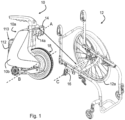
- Fig. 1
- is a perspective view of a manual wheelchair and a detachable propulsion system according to the invention.
- Fig. 2
- is a perspective view of the detachable propulsion system of
Fig. 1 . - Fig. 3
- is a cross sectional, side elevational view of the detachable propulsion system of
Fig. 2 . - Fig. 4
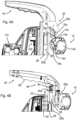
- A is an enlarged view of an attachment portion of the detachable propulsion system of
Fig. 2 . - Fig. 4B
- is a cross sectional view of the attachment portion of the detachable propulsion system of
Fig. 4A . - Fig. 5A
- is a side perspective view, in cross section, of an actuation and suspension portion of the detachable propulsion system of
Fig. 1 . - Fig. 5B
- is a front perspective view, in cross section, of the actuation and suspension portion of the detachable propulsion system of
Fig. 5A . - Fig. 6A
- is a side elevational view of the detachable propulsion system of
Fig. 1 mounted to an axle tube component of the wheelchair. - Fig. 6B
- is a partially exploded view of a suspension slide assembly of the detachable propulsion system.
- Fig. 7
- A is a side view of the detachable propulsion system in an operating position.
- Fig. 7B
- is a side view of the detachable propulsion system in a detached position.
- Fig. 8
- is an exploded view of the detachable propulsion system.
- Referring now to the drawings, there is illustrated in
Fig. 1 a detachable propulsion system, shown generally at 10, configured to be mounted to amanual wheelchair 12. In the illustrated embodiment, thepropulsion system 10 includes apropulsion unit 10a and aclamp 14 that is configured to attach to a structural member of thewheelchair 12, such as a cross-member, a camber tube, oraxle tube 16. Theclamp 14 has at least oneaperture 14a that defines a mounting axis A. Thepropulsion system 10 further includes adrive wheel assembly 18, illustrated as a tire or rather drivewheel 18a andhub motor assembly 18b, though other drive systems such as a motorized pinch-roller or friction drive, belt or chain drive, shaft drive, and the like may be used. Thedrive wheel assembly 18 defines a wheel rotational axis B through the hub rotational centerline and an associated tire contact patch, i.e., the area of the tire in contact with a support surface such as the ground. Thewheelchair 12 includesdrive wheels 12a, though only one wheel is illustrated two spaced-apart drive wheels are known, that define a rotational axis C and an associated tire contact patch. - Referring to
Figs. 2-4B , thepropulsion system 10 includes a mountingblock 20 having aslide mounting body 20a and aclamp interface 20b. Theslide mounting body 20a is configured to attach to one of at least oneslide bearing 22 or amating slide 24, configured as a slide bar, track or other suitable linear motion structure. Though identified as "slide" bearings, thesebearings 22 may be any suitable rolling or sliding element including bearings, bushings, or other elements conducive to supporting linear motion. In the illustrated embodiment, theslide bar 24 includes asuspension reaction mount 24a. The mountingblock 20 is connected to anactuator 26, illustrated within acavity 28 of theslide mounting body 20a, at a first orlower end 26a of theactuator 26. Theactuator 26 selectively engages acarriage 30 at a second orupper end 26b of theactuator 26. Thecarriage 30 has a mountingplate 30a that is proximate to and configured to attach to the other of the at least oneslide bearing 22 or themating slide 24 such that thecarriage 30 is linearly moveable relative to the mountingblock 20. Thecarriage 30 has a drive wheel fork 30b at a distal end that supports thedrive wheel assembly 18 for rotation. Thecarriage 30 further includes aslide mount 30c that supports one of theslide bar 24 or the at least oneslide bearing 22. In the illustrated embodiment, thesuspension reaction mount 24a is attached to theslide bar 24 and extends into theactuator cavity 28 and is configured to be contacted by the actuatorsecond end 26b when theactuator 26 is extended. Alternatively, thesuspension reaction mount 24a may be formed integrally with theslide bar 24 or thecarriage 30 if desired. Theactuator 26 selectively moves thecarriage 30 and thedrive wheel 18 relative to the mountingblock 20 between a use position, where the drive wheel is in contact with the ground, and a stowed position, where the drive wheel is moved out of contact with the ground.Fig. 3 illustrates theactuator 26 in the use position where thesecond end 26b is retracted away from thesuspension reaction mount 24a. Thecarriage 30 is shown in an articulated position where thesuspension reaction mount 24a has compressed a resilient suspension member such as during an obstacle traversal maneuver by thepropulsion system 10. - The
carriage 30 includes at least onekickstand mount 30d, illustrated as extending from the drive wheel fork 30b, for supporting akickstand 32. Thekickstand 32 supports thesystem 10 in a free-standing configuration, as shown inFig. 7B , when detached from thewheelchair 12 or theclamp 14. The illustratedkickstand 32 includes akickstand fork 34 pivotally mounted to thekickstand mount 30d at a first end and supporting at least onewheel 36 at a second end. Twowheels 36, illustrated as Omni style or Mecanum-style wheels having lateral roller elements, are shown mounted on opposing arms of thekickstand fork 34. The Omni-style wheels accommodate lateral movement of thepropulsion system 10, making attachment or detachment of the unit easier by a user from a seated position. It should be understood that any wheel or sliding contact member may be used if so desired. Thefork 34 is held out of contact with the ground or support surface, as shown inFig. 7A , by aspring 38. Thekickstand 32 is configured to clear or pivot away from irregularities encountered during travel in order to prevent force transfers to thewheelchair 12 that can cause unintended deviations in the desired travel direction. - Referring to
Figs. 3 ,5A and 5B , theslide mounting body 20a supports a resilient suspension member in the form of asuspension spring 40, shown as a coil compression spring though other resilient elements may be used. Thesuspension spring 40 applies a force to thecarriage 30 and drivewheel assembly 18, through thesuspension reaction mount 24a, that is sufficient to provide traction to propel thewheelchair 12. Thesuspension spring 40, in contact with thesuspension reaction mount 24a, compresses and extends as thedrive wheel system 18 moves over irregular surfaces to maintain ground contact. In the illustrated embodiment, ahandle 42 is secured to theslide mounting body 20a. Thehandle 42 is shown having anupper body 42a and alower body 42b. Thelower body 42b includes a spring seat 44 that contacts thesuspension spring 40. The spring seat 44 may alternatively be part of the mountingbody 20a. Theupper body 42a supports and/or houses at least a portion of a latching mechanism, shown generally at 46 ofFig. 4B , which will be explained in detail below. During movement of thedrive wheel system 18, theslide 24 shown mounted to thecarriage 30 is supported by and moves linearly against theslide bearings 22. Theslide 24 andslide bearings 22 transfer the tractive force of the drive wheel to theclamp 14 and wheelchair axle orcross member 16 thus moving thewheelchair 12 forward. The linear motion of theslide members drive wheel 18a to articulate relative to terrain irregularities and permits theactuator 26 to move thedrive wheel 18a out of contact with the ground if only manual propulsion is desired. This permits a user to easily reduce drag from thepropulsion unit 10a in manual mode operation without removing the unit. - The
latching mechanism 46, as illustrated, is supported by thehandle 42 and the mountingblock 20. Thelatching mechanism 46 includes anactuation lever 48 that is pivotally supported by apin 48a on the handlelower body 42b and resiliently held in a ready position enabling release of thepropulsion unit 10a portion of thepropulsion system 10 from theclamp 14. Theactuation lever 48 has anactuation cam face 48b that contacts alatch cam face 50a of alatch hook 50. Thelatch hook 50, as illustrated, is pivotally supported on the mountingblock 20 by apin 50b and resiliently held in an engaged position where ahook end 50c is positioned to hold thepropulsion unit 10a fixed to theclamp 14. Because thelatch cam face 50a is movable relative to theactuation cam face 48b, thehook end 50c is movable relative to the mounting block to permit securement of thepropulsion unit 10a to theclamp 14 without operating theactuation lever 48. This permits easier attachment of theunit 10a by a seated user. - The
clamp 14, as shown inFigs. 4A and 4B , includes a mounting cavity 14b having a lead-inwall 14c terminating in a mountingslot 14d. Themating clamp interface 20b of the mountingblock 20 includes a locating tab ortongue 20c that is configured to locate and seat within the mountingslot 14d. In the illustrated embodiment, the mounting cavity 14b can function as a funnel or chute to guide thelocating tab 20c into engagement with the mountingslot 14d. In connecting thepropulsion unit 10a to theclamp 14, the following sequence of actions or steps illustrate the functions and interactions of the mounting elements of thepropulsion system 10. Initially, thepropulsion unit 10a may be free-standing with the aid of thekickstand 32 such that the locatingtab 20c is aimed toward theclamp 14 mounted on the axle orcamber tube 16 of themanual wheelchair 12. When theactuator 26 is contracted, the mountingblock 20 is raised relative to thecarriage 30 by extension of thesuspension spring 40 toward its free state length. In certain wheelchair configurations, the locatingtab 20c may be sufficiently elevated to enter the mounting cavity 14b as thepropulsion unit 10a rests on thekickstand 32. When theunit 10a is aligned relative to theclamp 14, the wheelchair may be rolled backwards until the locatingtab 20c enters the mounting cavity 14b. In other configurations, the unit may need to be elevated by the user through thehandle 42. After thetab 20c enters the cavity 14b, theactuator 26 may be extended to draw the locatingtab 20c into the mountingslot 14d. When thetab 20c completely enters theslot 14d, thehook end 50c of thelatch hook 50 engages a latchingboss 14e of theclamp 14 to secure thepropulsion unit 10a to theclamp 14 and thewheelchair 12. - In order to remove or disconnect the
unit 10a from theclamp 14, thelatching mechanism 46 may be activated by moving theactuation lever 48 into thehandle 42. This causes thelever 48 to pivot aboutpin 48a causing theactuation cam face 48b to move thelatch cam face 50a toward theclamp 14. Thelatch hook 50 pivots about thelatch pivot pin 50b causing thehook end 50c to disengage from the latchingboss 14e. If theunit 10a is loaded against the ground with thesuspension spring 40 compressed, the force exerted by the spring may assist in extracting theclamp interface 20b from the mounting cavity 14b as the mountingblock 20 is moved by the spring force. If theactuator 26 is extended to compress thesuspension spring 40 and raise thedrive wheel 18a from contact with the ground, thelatch hook 50 may be more easily pivoted and theunit 10a can be lifted from the mounting cavity 14b Alternatively, theactuator 26 may include a linkage (not shown) that releases thelatch hook 50 when theactuator 26 is extended beyond the length necessary to lift the wheel off of the ground. Theactuator 26 may be directly or indirectly connected to thelatch hook 50 or may actuate thelever 48 in order to provide remote or automated actuation. - Referring to
Figs. 3 and6A , when thepropulsion system 10 is mounted to thewheelchair 12 the clamping axis A is coincident with the axle tube axis C. Because the drive wheel axis B extends toward the clamping axis A, the drive wheel tire contact patch is moved close to or coincident with the tire patch of thewheelchair drive wheel 12a. This results in thesystem 10 being contained within an envelope defined by thewheelchair 12, including thedrive wheels 12a. In one aspect, the envelope can be defined by a line generally tangent to an outer diameter of the wheelchair drive wheel and may represent a wall or other external structure abutting the wheelchair drive wheel. This packaging permits a seated user to operate themanual wheelchair 12 in the usual manner, including being able to manually back the wheelchair against a wall, curb, or other structure and also lean the wheelchair against a wall, which is a common resting position providing the weight distribution benefits of a reclined, seated position to reduce prolonged seated skin conditions. The close proximity of the drive wheel contact patches is primarily enabled by the use of sliding suspension members instead of pivoting suspension members. This provides the ability to package the moving components in a compact envelope. In one embodiment, this permits the unit to be mounted in a rearward position that is more easily accessible by the seated user for attaching and disconnecting the unit fostering a greater sense of independence. Alternatively, thepropulsion system 10 may be mounted from the front side of the wheelchair and extend toward the rear. - During operation, when the propulsion unit drive wheel tire patch is close to or in line with the wheelchair drive wheel tire patch, the moment created by the offset is minimized. This reduces the cause of tire scrubbing and permits easier turning and maneuvering of the wheelchair. Since the operating basis of the wheelchair is manual in nature, maneuvering is based on relative speed or rotation of one
drive wheel 12a relative to the other spaced- apartdrive wheel 12a. Through the use of a linear motion suspension system and the rearward mounting configuration of thepropulsion system 10, particularly mounting the system to the wheelchair drive wheel axle or camber tube member, the weight of the unit is brought closer to the center of gravity of the wheelchair and seated user which reduces tipping or instability sensations. This location also can take advantage of the weight over the wheelchair drive wheels to improve tractive effort of thepropulsion drive wheel 18a. - As shown in the drawings, the
propulsion system 10 includes acontroller 100 containing electronics necessary to operate the propulsion unit for drive control, suspension control, and/or latch control. Thecontroller 100 and other components of the propulsion system may be enclosed in ahousing 10b, though such is not required. Thepropulsion unit 10 also includes an energy source, illustrated as abattery pack 110 and abattery housing 112. Thecontroller 100 may include all of the necessary sensors within the controller or may receive signals from remote sensors for processing. Theactuator 26 may be configured as an electrically driven actuator and rely on a current measurement to detect end of travel positioning. Such a sensor and its associated measurement may be provided on thecontroller 100. Alternatively, theactuator 26 may rely on a proximity switch or load cell to detect the end of travel position which may be remote mounted from thecontroller 100 and attached to the actuator or a supporting structure. - In two of the preferred embodiments shown herein, as illustrated in Figs. 8A- 12, a first version is shown in Figs. 8A-8C and 11. This version, identified as Embodiment 2, includes a power drive wheel with hub motor and a linearly movable support housing with carriage rollers. The carriage rollers are supported and guided by slots formed in the housing. A mounting bolt extends through the slot to slidably secure the carriage roller blocks to the housing. In the illustrated embodiment, the slots are formed in generally parallel raised portions that engage corresponding recesses formed in the carriage roller blocks.
- In the version identified as Embodiment 3, the power drive wheel with hub motor is mounted in a linearly movable support housing using linear bearings. The linear bearings engage a slide track having parallel grooves that support and guide the linear bearings.
-
- 10
- propulsion system
- 10a
- propulsion unit
- 10b
- housing
- 12
- wheelchair
- 12a
- drive wheel
- 14
- mounting clamp
- 14a
- clamp aperture
- 14b
- mounting cavity
- 14c
- lead-in wall
- 14d
- mounting slot
- 14e
- latching boss
- 16
- axle tube
- 18
- drive wheel assembly
- 18a
- drive wheel
- 18b
- hub motor assembly
- 20
- mounting bock
- 20a
- slide mounting body
- 20b
- clamp interface
- 20c
- locating tab or tongue
- 22
- slide bearing
- 24
- mating slide
- 24a
- suspension reaction mount
- 26
- actuator
- 26a
- first or lower end of the actuator
- 26b
- second or upper end of the actuator
- 28
- actuator cavity
- 30
- carriage
- 30a
- mounting plate
- 30b
- drive wheel fork
- 30c
- slide mount
- 30d
- kickstand mount
- 32
- kickstand
- 34
- kickstand fork
- 36
- wheel
- 38
- spring
- 40
- suspension spring
- 42
- handle
- 42a
- handle upper body
- 42b
- handle lower body
- 44
- spring seat
- 46
- latching mechanism
- 48
- actuation lever
- 48a
- pin
- 48b
- actuation cam face
- 50
- latch hook
- 50a
- latch cam face
- 50b
- latch pivot pin
- 50c
- hook end
- 100
- controller
- 110
- battery pack
- 112
- battery housing
Claims (7)
- A propulsion system (10) for a manual wheelchair (12), the system (10) comprising:• a mounting clamp (14) configured to attach to the manual wheelchair (12);• a propulsion unit (10a) selectively attachable to the mounting clamp (14), the propulsion unit (10a) comprising:• a drive wheel assembly (18), wherein the drive wheel assembly (18) is supported on a carriage (30); and• a support suspension, wherein the support suspension is configured to provide linear movement of a drive wheel (18a) of the drive wheel assembly (18) relative to the manual wheelchair (12),
characterized by• an actuator (26), which provides selective linear movement of the carriage (30) between a drive position where the drive wheel (18a) contacts a support surface and a stowed position where the drive wheel (18a) is out of contact with the support surface, whereino the support suspension comprises rolling and/or sliding means conducive to supporting linear motion, with the support suspension comprising a linear bearing and slide member assembly having at least one linear bearing and a slide member (22, 24) for accommodating the linear movement of the drive wheel assembly (18),o the support suspension comprises a resilient suspension member providing a tractive effort force to the drive wheel (18a),o the carriage (30) is attached to one of the at least one linear bearing (22) or the slide member (24) and has a suspension reaction mount (24a) in contact with the resilient suspension member, and the mounting clamp (14) is connected to the other of the linear bearing or the slide member (22, 24),o the actuator (26) is an electrically driven actuator attached at a first end (26a) to a mounting block (20), with the mounting block (20) being attached to the at least one linear bearing (22) and the carriage (30) is attached to the slide member (24), the mounting block (20) being selectively attachable to the mounting clamp (14) and has a spring seat (44), and the resilient suspension member being positioned between the spring seat (44) and the suspension reaction mount (24a), ando the actuator (26) has a second end (26b) that selectively engages the suspension reaction mount (24a) to move the drive wheel (18a) out of contact with the support surface. - The propulsion system (10) of claim 1, wherein
the resilient suspension member is a suspension spring (40). - The propulsion system (10) of claim 1 or 2, wherein
the mounting block (20) supports a latching mechanism (46) having a latch hook (50) that is resiliently held in an engaged position such that the latch hook (50) is movable relative to the mounting block (20) to permit securement without an additional manipulation of the latch hook (50). - The propulsion system (10) of claim 3, whereinthe mounting block (20) supports a handle (42), andthe handle (42) includes an actuation lever (48) that moves the latch hook (50) between an engaged position where the propulsion unit (10a) is fixed to the mounting clamp (14) and a disengaged position where the propulsion unit (10a) is removable from the mounting clamp (14).
- The propulsion system (10) of claim 4, wherein
the actuation lever (48) is pivotally supported on the handle (42) and has an actuation cam face (48b) configured to contact a latch cam face (50a) of the latch hook (50) such that movement of the actuation lever (48) moves the latch hook (50) into the disengaged position. - A manual wheelchair (12) with a propulsion system (10) of one of the preceding claims, a drive wheel (12a) and one of a cross-member (16), an axle tube (16) or a camber tube (16) defining a wheelchair mounting axis C, withthe manual wheelchair drive wheel (12a) defining an envelope tangent to an outer diameter of the manual wheelchair drive wheel (12a),the mounting clamp (14) defining a propulsion unit mounting axis A which are aligned when the mounting clamp (14) is attached to the manual wheelchair (12), andthe propulsion unit drive wheel (18a) defining a drive wheel axis B that is positioned within the envelope when the mounting clamp (14) is attached to the manual wheelchair (12).
- The manual wheelchair (12) of claim 6, whereinthe propulsion unit drive wheel (18a) is supported on a carriage (30), andthe carriage (30) is connected to an actuator (26) that provides selective linear movement of the carriage (30) between a drive position where the drive wheel (18a) contacts the support surface and a stowed position where the drive wheel (18a) is out of contact with the support surface, withthe drive wheel axis B being positioned within the envelope in at least the stowed position.
Priority Applications (1)
| Application Number | Priority Date | Filing Date | Title |
|---|---|---|---|
| EP25164197.3A EP4545319B1 (en) | 2018-12-21 | 2019-12-23 | Manual wheel chair propulsion system |
Applications Claiming Priority (2)
| Application Number | Priority Date | Filing Date | Title |
|---|---|---|---|
| US201862784015P | 2018-12-21 | 2018-12-21 | |
| PCT/US2019/068377 WO2020132685A1 (en) | 2018-12-21 | 2019-12-23 | Manual wheel chair propulsion system |
Related Child Applications (1)
| Application Number | Title | Priority Date | Filing Date |
|---|---|---|---|
| EP25164197.3A Division EP4545319B1 (en) | 2018-12-21 | 2019-12-23 | Manual wheel chair propulsion system |
Publications (3)
| Publication Number | Publication Date |
|---|---|
| EP3897500A1 EP3897500A1 (en) | 2021-10-27 |
| EP3897500A4 EP3897500A4 (en) | 2022-09-07 |
| EP3897500B1 true EP3897500B1 (en) | 2025-04-16 |
Family
ID=71100955
Family Applications (2)
| Application Number | Title | Priority Date | Filing Date |
|---|---|---|---|
| EP19899962.5A Active EP3897500B1 (en) | 2018-12-21 | 2019-12-23 | Manual wheel chair propulsion system |
| EP25164197.3A Active EP4545319B1 (en) | 2018-12-21 | 2019-12-23 | Manual wheel chair propulsion system |
Family Applications After (1)
| Application Number | Title | Priority Date | Filing Date |
|---|---|---|---|
| EP25164197.3A Active EP4545319B1 (en) | 2018-12-21 | 2019-12-23 | Manual wheel chair propulsion system |
Country Status (6)
| Country | Link |
|---|---|
| US (2) | US12115110B2 (en) |
| EP (2) | EP3897500B1 (en) |
| JP (1) | JP2022516037A (en) |
| AU (1) | AU2019404594B2 (en) |
| ES (1) | ES3035133T3 (en) |
| WO (1) | WO2020132685A1 (en) |
Families Citing this family (6)
| Publication number | Priority date | Publication date | Assignee | Title |
|---|---|---|---|---|
| US11529274B2 (en) * | 2018-04-27 | 2022-12-20 | Roda Futura, Llc | Removable power assist for manual wheelchair |
| US20230072204A1 (en) * | 2021-09-09 | 2023-03-09 | Juliana T. Iacono | Motorized wheel system |
| US20230190546A1 (en) * | 2021-12-20 | 2023-06-22 | Permobil, Inc. | Front add-on for a wheelchair |
| DE202022100039U1 (en) | 2022-01-03 | 2022-01-11 | Aat Alber Antriebstechnik Gmbh | Drive device for a wheelchair |
| DE102022100043A1 (en) | 2022-01-03 | 2023-07-06 | Aat Alber Antriebstechnik Gmbh | Drive device for a wheelchair |
| EP4302741B1 (en) | 2022-07-07 | 2025-01-29 | Permobil AB | Powered midwheel drive wheelchair with standing capability |
Family Cites Families (15)
| Publication number | Priority date | Publication date | Assignee | Title |
|---|---|---|---|---|
| US3387681A (en) | 1966-02-14 | 1968-06-11 | Rodney R. Rabjohn | Power operated wheel chair |
| FR2675688A1 (en) * | 1991-04-26 | 1992-10-30 | Poirier Ets | INDIVIDUAL VEHICLE FOR USE IN MANUAL OR MOTORIZED VERSION, IN PARTICULAR WHEELCHAIR OR TRICYCLE. |
| US5222567A (en) | 1991-04-26 | 1993-06-29 | Genus Inc. | Power assist device for a wheelchair |
| US5351774A (en) | 1992-06-02 | 1994-10-04 | Quickie Designs Inc. | Powered wheelchair with a detachable power drive assembly |
| US5651422A (en) | 1994-04-22 | 1997-07-29 | The Center For Innovative Technology | Universal-fit, quick-connect power drive/steer attachment for wheelchair |
| DE19539487A1 (en) * | 1995-10-24 | 1997-04-30 | Alber Ulrich Gmbh | Drive and brake assist device for wheelchairs |
| DE19935506B4 (en) | 1999-07-28 | 2009-07-09 | Georg Binnen | Electric motor driven traction device for wheelchairs |
| EP1927331A1 (en) | 2006-11-29 | 2008-06-04 | ZMI Electronics Ltd. | Auxiliary power device for a wheelchair |
| US8430189B2 (en) * | 2009-05-27 | 2013-04-30 | Patrick Tallino | Power add-on device for manual wheelchair |
| US8960340B2 (en) * | 2009-05-27 | 2015-02-24 | Patrick Tallino | Power add-on device for manual wheelchair |
| GB2481404A (en) * | 2010-06-22 | 2011-12-28 | Wus Tech Co Ltd | Wheelchair with detachable drive means and frame |
| US20120279789A1 (en) | 2011-05-02 | 2012-11-08 | Bradley Brill | Detachable power drive unit for propelling and steering manual wheelchairs |
| KR101454716B1 (en) | 2013-02-13 | 2014-10-27 | 계명대학교 산학협력단 | mountable power train system and wheelchair with it |
| US9144525B2 (en) | 2013-03-14 | 2015-09-29 | Max Mobility, Llc. | Motion assistance system for wheelchairs |
| US9808384B2 (en) * | 2013-06-27 | 2017-11-07 | Stephen C. Golden, JR. | Unilateral transition means for adapting a wheelchair |
-
2019
- 2019-12-23 US US17/416,801 patent/US12115110B2/en active Active
- 2019-12-23 WO PCT/US2019/068377 patent/WO2020132685A1/en not_active Ceased
- 2019-12-23 JP JP2021536394A patent/JP2022516037A/en active Pending
- 2019-12-23 EP EP19899962.5A patent/EP3897500B1/en active Active
- 2019-12-23 AU AU2019404594A patent/AU2019404594B2/en active Active
- 2019-12-23 ES ES19899962T patent/ES3035133T3/en active Active
- 2019-12-23 EP EP25164197.3A patent/EP4545319B1/en active Active
-
2024
- 2024-10-10 US US18/911,362 patent/US20250032331A1/en active Pending
Also Published As
| Publication number | Publication date |
|---|---|
| AU2019404594B2 (en) | 2025-03-20 |
| EP3897500A1 (en) | 2021-10-27 |
| WO2020132685A1 (en) | 2020-06-25 |
| EP3897500A4 (en) | 2022-09-07 |
| US20220062076A1 (en) | 2022-03-03 |
| US12115110B2 (en) | 2024-10-15 |
| ES3035133T3 (en) | 2025-08-29 |
| EP4545319B1 (en) | 2026-04-01 |
| JP2022516037A (en) | 2022-02-24 |
| EP4545319A3 (en) | 2025-07-09 |
| EP4545319A2 (en) | 2025-04-30 |
| AU2019404594A1 (en) | 2021-07-22 |
| US20250032331A1 (en) | 2025-01-30 |
Similar Documents
| Publication | Publication Date | Title |
|---|---|---|
| EP3897500B1 (en) | Manual wheel chair propulsion system | |
| US5291959A (en) | Individual vehicle usable in a manual or a motorized version, in particular a wheelchair or a tricycle | |
| US12594201B2 (en) | Auxiliary drive device for a wheelchair | |
| US6766871B2 (en) | Attachment means for attaching a wheelchair to a motorized apparatus | |
| US10675206B2 (en) | Electrically driven wheeled walker | |
| US4771840A (en) | Articulated power-driven shopping cart | |
| US4811966A (en) | Kerb climbing device | |
| US20040134692A1 (en) | Freestanding self-propelled device for moving objects | |
| EP3878712B1 (en) | Motorized wheelbarrow | |
| US10736799B1 (en) | Power assist apparatus for hand-propelled wheelchairs | |
| US8096745B2 (en) | Paper roll transport cart | |
| US11103394B1 (en) | Power assist apparatus for hand-propelled wheelchairs | |
| EP0592427B1 (en) | A wheel chair with a driving unit, and a driving unit for wheel chairs | |
| US11311435B2 (en) | Frame for utilization with components of wheelchair | |
| WO2004021954A1 (en) | Transport device, especially for the physically disabled and/or the ill | |
| CN119929026A (en) | Power Tools | |
| JP2025173147A (en) | Transport vehicle | |
| JP2603035B2 (en) | Bag transport device | |
| WO1992004200A1 (en) | Foldable wheelchair with optional power or manual drive | |
| CA2326289A1 (en) | Apparatus for roughening concrete slat surfaces |
Legal Events
| Date | Code | Title | Description |
|---|---|---|---|
| STAA | Information on the status of an ep patent application or granted ep patent |
Free format text: STATUS: THE INTERNATIONAL PUBLICATION HAS BEEN MADE |
|
| PUAI | Public reference made under article 153(3) epc to a published international application that has entered the european phase |
Free format text: ORIGINAL CODE: 0009012 |
|
| STAA | Information on the status of an ep patent application or granted ep patent |
Free format text: STATUS: REQUEST FOR EXAMINATION WAS MADE |
|
| 17P | Request for examination filed |
Effective date: 20210720 |
|
| AK | Designated contracting states |
Kind code of ref document: A1 Designated state(s): AL AT BE BG CH CY CZ DE DK EE ES FI FR GB GR HR HU IE IS IT LI LT LU LV MC MK MT NL NO PL PT RO RS SE SI SK SM TR |
|
| DAV | Request for validation of the european patent (deleted) | ||
| DAX | Request for extension of the european patent (deleted) | ||
| A4 | Supplementary search report drawn up and despatched |
Effective date: 20220810 |
|
| RIC1 | Information provided on ipc code assigned before grant |
Ipc: B60G 11/107 20060101ALI20220804BHEP Ipc: A61G 5/10 20060101ALI20220804BHEP Ipc: A61G 5/04 20130101AFI20220804BHEP |
|
| P01 | Opt-out of the competence of the unified patent court (upc) registered |
Effective date: 20230619 |
|
| GRAP | Despatch of communication of intention to grant a patent |
Free format text: ORIGINAL CODE: EPIDOSNIGR1 |
|
| STAA | Information on the status of an ep patent application or granted ep patent |
Free format text: STATUS: GRANT OF PATENT IS INTENDED |
|
| INTG | Intention to grant announced |
Effective date: 20241108 |
|
| GRAS | Grant fee paid |
Free format text: ORIGINAL CODE: EPIDOSNIGR3 |
|
| GRAA | (expected) grant |
Free format text: ORIGINAL CODE: 0009210 |
|
| STAA | Information on the status of an ep patent application or granted ep patent |
Free format text: STATUS: THE PATENT HAS BEEN GRANTED |
|
| AK | Designated contracting states |
Kind code of ref document: B1 Designated state(s): AL AT BE BG CH CY CZ DE DK EE ES FI FR GB GR HR HU IE IS IT LI LT LU LV MC MK MT NL NO PL PT RO RS SE SI SK SM TR |
|
| REG | Reference to a national code |
Ref country code: GB Ref legal event code: FG4D |
|
| REG | Reference to a national code |
Ref country code: CH Ref legal event code: EP Ref country code: DE Ref legal event code: R096 Ref document number: 602019068863 Country of ref document: DE |
|
| REG | Reference to a national code |
Ref country code: IE Ref legal event code: FG4D |
|
| REG | Reference to a national code |
Ref country code: NL Ref legal event code: FP |
|
| REG | Reference to a national code |
Ref country code: ES Ref legal event code: FG2A Ref document number: 3035133 Country of ref document: ES Kind code of ref document: T3 Effective date: 20250829 |
|
| REG | Reference to a national code |
Ref country code: AT Ref legal event code: MK05 Ref document number: 1785055 Country of ref document: AT Kind code of ref document: T Effective date: 20250416 |
|
| PG25 | Lapsed in a contracting state [announced via postgrant information from national office to epo] |
Ref country code: PT Free format text: LAPSE BECAUSE OF FAILURE TO SUBMIT A TRANSLATION OF THE DESCRIPTION OR TO PAY THE FEE WITHIN THE PRESCRIBED TIME-LIMIT Effective date: 20250818 Ref country code: FI Free format text: LAPSE BECAUSE OF FAILURE TO SUBMIT A TRANSLATION OF THE DESCRIPTION OR TO PAY THE FEE WITHIN THE PRESCRIBED TIME-LIMIT Effective date: 20250416 |
|
| REG | Reference to a national code |
Ref country code: LT Ref legal event code: MG9D |
|
| PG25 | Lapsed in a contracting state [announced via postgrant information from national office to epo] |
Ref country code: NO Free format text: LAPSE BECAUSE OF FAILURE TO SUBMIT A TRANSLATION OF THE DESCRIPTION OR TO PAY THE FEE WITHIN THE PRESCRIBED TIME-LIMIT Effective date: 20250716 Ref country code: GR Free format text: LAPSE BECAUSE OF FAILURE TO SUBMIT A TRANSLATION OF THE DESCRIPTION OR TO PAY THE FEE WITHIN THE PRESCRIBED TIME-LIMIT Effective date: 20250717 |
|
| PG25 | Lapsed in a contracting state [announced via postgrant information from national office to epo] |
Ref country code: PL Free format text: LAPSE BECAUSE OF FAILURE TO SUBMIT A TRANSLATION OF THE DESCRIPTION OR TO PAY THE FEE WITHIN THE PRESCRIBED TIME-LIMIT Effective date: 20250416 |
|
| PG25 | Lapsed in a contracting state [announced via postgrant information from national office to epo] |
Ref country code: BG Free format text: LAPSE BECAUSE OF FAILURE TO SUBMIT A TRANSLATION OF THE DESCRIPTION OR TO PAY THE FEE WITHIN THE PRESCRIBED TIME-LIMIT Effective date: 20250416 |
|
| PG25 | Lapsed in a contracting state [announced via postgrant information from national office to epo] |
Ref country code: HR Free format text: LAPSE BECAUSE OF FAILURE TO SUBMIT A TRANSLATION OF THE DESCRIPTION OR TO PAY THE FEE WITHIN THE PRESCRIBED TIME-LIMIT Effective date: 20250416 |
|
| PG25 | Lapsed in a contracting state [announced via postgrant information from national office to epo] |
Ref country code: AT Free format text: LAPSE BECAUSE OF FAILURE TO SUBMIT A TRANSLATION OF THE DESCRIPTION OR TO PAY THE FEE WITHIN THE PRESCRIBED TIME-LIMIT Effective date: 20250416 |
|
| PG25 | Lapsed in a contracting state [announced via postgrant information from national office to epo] |
Ref country code: RS Free format text: LAPSE BECAUSE OF FAILURE TO SUBMIT A TRANSLATION OF THE DESCRIPTION OR TO PAY THE FEE WITHIN THE PRESCRIBED TIME-LIMIT Effective date: 20250716 |
|
| PG25 | Lapsed in a contracting state [announced via postgrant information from national office to epo] |
Ref country code: IS Free format text: LAPSE BECAUSE OF FAILURE TO SUBMIT A TRANSLATION OF THE DESCRIPTION OR TO PAY THE FEE WITHIN THE PRESCRIBED TIME-LIMIT Effective date: 20250816 |
|
| PG25 | Lapsed in a contracting state [announced via postgrant information from national office to epo] |
Ref country code: LV Free format text: LAPSE BECAUSE OF FAILURE TO SUBMIT A TRANSLATION OF THE DESCRIPTION OR TO PAY THE FEE WITHIN THE PRESCRIBED TIME-LIMIT Effective date: 20250416 |
|
| PGFP | Annual fee paid to national office [announced via postgrant information from national office to epo] |
Ref country code: GB Payment date: 20251218 Year of fee payment: 7 |
|
| PG25 | Lapsed in a contracting state [announced via postgrant information from national office to epo] |
Ref country code: DK Free format text: LAPSE BECAUSE OF FAILURE TO SUBMIT A TRANSLATION OF THE DESCRIPTION OR TO PAY THE FEE WITHIN THE PRESCRIBED TIME-LIMIT Effective date: 20250416 Ref country code: SM Free format text: LAPSE BECAUSE OF FAILURE TO SUBMIT A TRANSLATION OF THE DESCRIPTION OR TO PAY THE FEE WITHIN THE PRESCRIBED TIME-LIMIT Effective date: 20250416 |
|
| PGFP | Annual fee paid to national office [announced via postgrant information from national office to epo] |
Ref country code: NL Payment date: 20251217 Year of fee payment: 7 Ref country code: FR Payment date: 20251218 Year of fee payment: 7 |
|
| REG | Reference to a national code |
Ref country code: DE Ref legal event code: R097 Ref document number: 602019068863 Country of ref document: DE |
|
| PG25 | Lapsed in a contracting state [announced via postgrant information from national office to epo] |
Ref country code: CZ Free format text: LAPSE BECAUSE OF FAILURE TO SUBMIT A TRANSLATION OF THE DESCRIPTION OR TO PAY THE FEE WITHIN THE PRESCRIBED TIME-LIMIT Effective date: 20250416 |
|
| PG25 | Lapsed in a contracting state [announced via postgrant information from national office to epo] |
Ref country code: EE Free format text: LAPSE BECAUSE OF FAILURE TO SUBMIT A TRANSLATION OF THE DESCRIPTION OR TO PAY THE FEE WITHIN THE PRESCRIBED TIME-LIMIT Effective date: 20250416 |
|
| PG25 | Lapsed in a contracting state [announced via postgrant information from national office to epo] |
Ref country code: SK Free format text: LAPSE BECAUSE OF FAILURE TO SUBMIT A TRANSLATION OF THE DESCRIPTION OR TO PAY THE FEE WITHIN THE PRESCRIBED TIME-LIMIT Effective date: 20250416 Ref country code: RO Free format text: LAPSE BECAUSE OF FAILURE TO SUBMIT A TRANSLATION OF THE DESCRIPTION OR TO PAY THE FEE WITHIN THE PRESCRIBED TIME-LIMIT Effective date: 20250416 |
|
| PLBE | No opposition filed within time limit |
Free format text: ORIGINAL CODE: 0009261 |
|
| STAA | Information on the status of an ep patent application or granted ep patent |
Free format text: STATUS: NO OPPOSITION FILED WITHIN TIME LIMIT |
|
| REG | Reference to a national code |
Ref country code: CH Ref legal event code: L10 Free format text: ST27 STATUS EVENT CODE: U-0-0-L10-L00 (AS PROVIDED BY THE NATIONAL OFFICE) Effective date: 20260225 |
|
| 26N | No opposition filed |
Effective date: 20260119 |
|
| PGFP | Annual fee paid to national office [announced via postgrant information from national office to epo] |
Ref country code: ES Payment date: 20260119 Year of fee payment: 7 |
|
| PGFP | Annual fee paid to national office [announced via postgrant information from national office to epo] |
Ref country code: DE Payment date: 20251222 Year of fee payment: 7 |
|
| PGFP | Annual fee paid to national office [announced via postgrant information from national office to epo] |
Ref country code: IT Payment date: 20251231 Year of fee payment: 7 |