EP3897388B1 - System und verfahren zum lesen und analysieren von verhaltensweisen, einschliesslich des verbalen ausdrucks, der körpersprache und von gesichtsausdrücken, zur bestimmung der kongruenz einer person - Google Patents
System und verfahren zum lesen und analysieren von verhaltensweisen, einschliesslich des verbalen ausdrucks, der körpersprache und von gesichtsausdrücken, zur bestimmung der kongruenz einer person Download PDFInfo
- Publication number
- EP3897388B1 EP3897388B1 EP19839416.5A EP19839416A EP3897388B1 EP 3897388 B1 EP3897388 B1 EP 3897388B1 EP 19839416 A EP19839416 A EP 19839416A EP 3897388 B1 EP3897388 B1 EP 3897388B1
- Authority
- EP
- European Patent Office
- Prior art keywords
- audio
- cue
- video
- sequences
- person
- Prior art date
- Legal status (The legal status is an assumption and is not a legal conclusion. Google has not performed a legal analysis and makes no representation as to the accuracy of the status listed.)
- Active
Links
Images

Classifications
-
- G—PHYSICS
- G06—COMPUTING OR CALCULATING; COUNTING
- G06V—IMAGE OR VIDEO RECOGNITION OR UNDERSTANDING
- G06V40/00—Recognition of biometric, human-related or animal-related patterns in image or video data
- G06V40/20—Movements or behaviour, e.g. gesture recognition
-
- A—HUMAN NECESSITIES
- A61—MEDICAL OR VETERINARY SCIENCE; HYGIENE
- A61B—DIAGNOSIS; SURGERY; IDENTIFICATION
- A61B5/00—Measuring for diagnostic purposes; Identification of persons
- A61B5/16—Devices for psychotechnics; Testing reaction times ; Devices for evaluating the psychological state
- A61B5/164—Lie detection
-
- A—HUMAN NECESSITIES
- A61—MEDICAL OR VETERINARY SCIENCE; HYGIENE
- A61B—DIAGNOSIS; SURGERY; IDENTIFICATION
- A61B5/00—Measuring for diagnostic purposes; Identification of persons
- A61B5/16—Devices for psychotechnics; Testing reaction times ; Devices for evaluating the psychological state
-
- A—HUMAN NECESSITIES
- A61—MEDICAL OR VETERINARY SCIENCE; HYGIENE
- A61B—DIAGNOSIS; SURGERY; IDENTIFICATION
- A61B5/00—Measuring for diagnostic purposes; Identification of persons
- A61B5/72—Signal processing specially adapted for physiological signals or for diagnostic purposes
- A61B5/7235—Details of waveform analysis
- A61B5/7264—Classification of physiological signals or data, e.g. using neural networks, statistical classifiers, expert systems or fuzzy systems
- A61B5/7267—Classification of physiological signals or data, e.g. using neural networks, statistical classifiers, expert systems or fuzzy systems involving training the classification device
-
- G—PHYSICS
- G06—COMPUTING OR CALCULATING; COUNTING
- G06F—ELECTRIC DIGITAL DATA PROCESSING
- G06F18/00—Pattern recognition
- G06F18/20—Analysing
- G06F18/21—Design or setup of recognition systems or techniques; Extraction of features in feature space; Blind source separation
- G06F18/214—Generating training patterns; Bootstrap methods, e.g. bagging or boosting
-
- G—PHYSICS
- G06—COMPUTING OR CALCULATING; COUNTING
- G06N—COMPUTING ARRANGEMENTS BASED ON SPECIFIC COMPUTATIONAL MODELS
- G06N20/00—Machine learning
-
- G—PHYSICS
- G06—COMPUTING OR CALCULATING; COUNTING
- G06N—COMPUTING ARRANGEMENTS BASED ON SPECIFIC COMPUTATIONAL MODELS
- G06N3/00—Computing arrangements based on biological models
- G06N3/02—Neural networks
- G06N3/08—Learning methods
-
- G—PHYSICS
- G06—COMPUTING OR CALCULATING; COUNTING
- G06V—IMAGE OR VIDEO RECOGNITION OR UNDERSTANDING
- G06V20/00—Scenes; Scene-specific elements
- G06V20/40—Scenes; Scene-specific elements in video content
- G06V20/46—Extracting features or characteristics from the video content, e.g. video fingerprints, representative shots or key frames
-
- G—PHYSICS
- G06—COMPUTING OR CALCULATING; COUNTING
- G06V—IMAGE OR VIDEO RECOGNITION OR UNDERSTANDING
- G06V20/00—Scenes; Scene-specific elements
- G06V20/40—Scenes; Scene-specific elements in video content
- G06V20/49—Segmenting video sequences, i.e. computational techniques such as parsing or cutting the sequence, low-level clustering or determining units such as shots or scenes
-
- G—PHYSICS
- G06—COMPUTING OR CALCULATING; COUNTING
- G06V—IMAGE OR VIDEO RECOGNITION OR UNDERSTANDING
- G06V40/00—Recognition of biometric, human-related or animal-related patterns in image or video data
- G06V40/10—Human or animal bodies, e.g. vehicle occupants or pedestrians; Body parts, e.g. hands
- G06V40/16—Human faces, e.g. facial parts, sketches or expressions
- G06V40/174—Facial expression recognition
-
- G—PHYSICS
- G06—COMPUTING OR CALCULATING; COUNTING
- G06V—IMAGE OR VIDEO RECOGNITION OR UNDERSTANDING
- G06V40/00—Recognition of biometric, human-related or animal-related patterns in image or video data
- G06V40/10—Human or animal bodies, e.g. vehicle occupants or pedestrians; Body parts, e.g. hands
- G06V40/16—Human faces, e.g. facial parts, sketches or expressions
- G06V40/174—Facial expression recognition
- G06V40/176—Dynamic expression
-
- G—PHYSICS
- G10—MUSICAL INSTRUMENTS; ACOUSTICS
- G10L—SPEECH ANALYSIS TECHNIQUES OR SPEECH SYNTHESIS; SPEECH RECOGNITION; SPEECH OR VOICE PROCESSING TECHNIQUES; SPEECH OR AUDIO CODING OR DECODING
- G10L25/00—Speech or voice analysis techniques not restricted to a single one of groups G10L15/00 - G10L21/00
- G10L25/48—Speech or voice analysis techniques not restricted to a single one of groups G10L15/00 - G10L21/00 specially adapted for particular use
- G10L25/51—Speech or voice analysis techniques not restricted to a single one of groups G10L15/00 - G10L21/00 specially adapted for particular use for comparison or discrimination
- G10L25/63—Speech or voice analysis techniques not restricted to a single one of groups G10L15/00 - G10L21/00 specially adapted for particular use for comparison or discrimination for estimating an emotional state
-
- H—ELECTRICITY
- H04—ELECTRIC COMMUNICATION TECHNIQUE
- H04N—PICTORIAL COMMUNICATION, e.g. TELEVISION
- H04N5/00—Details of television systems
- H04N5/76—Television signal recording
-
- A—HUMAN NECESSITIES
- A61—MEDICAL OR VETERINARY SCIENCE; HYGIENE
- A61B—DIAGNOSIS; SURGERY; IDENTIFICATION
- A61B5/00—Measuring for diagnostic purposes; Identification of persons
- A61B5/16—Devices for psychotechnics; Testing reaction times ; Devices for evaluating the psychological state
- A61B5/167—Personality evaluation
Definitions
- the present invention concerns a method and a system for providing indicators of congruence or incongruence between the body language (including all facial expressions) and the Speech of a person.
- This method and system are useful to provide, by reading and analysing the body language (including all facial expressions) and the features of the Speech, which could be done totally or partially automatically, the congruence of a person's behaviour or Speech in relation to the situation (comfort, part of the 6C of the congruence method: calibration, comfort, context, change, combination, consciousness).
- CN104537361 relates to a lie-detection method based on a video.
- This lie detection method includes the steps of detecting visual behaviour characteristics of a detected object according to video images, detecting physiological parameter characteristics of the detected object according to the video images, and obtaining lying probability data by combining the visual behaviour characteristics with the physiological parameter characteristics.
- WO2008063527 relates to procedures to allow an indication of truth or lie to be deduced, notably (a) monitoring the activation of a plurality of regions of a subject's brain while the subject answers questions and (b) measuring one or more physiological parameters while the subject answers questions, and combining the results of (a) and (b) to form a composite evaluation indicative of the truth or lie in the subject's response.
- US2016354024 concerns detection of deception and prediction interviewer accuracy.
- Physiological information of the interviewer during the interview is recorded by at least a first sensor, including a time series of physiological data.
- the interview assessment calculated by a computer indicates at least one of whether a statement made by the interviewee is likely to be deceitful and whether the interviewer is likely to be accurate in estimating truthfulness of the interviewee.
- WO2008063155 relates to deception detection via functional near-infrared spectroscopy. More precisely, Functional near-infrared (fNIR) neuroimaging is used to detect deception. Oxygenation levels of portions of the brain of a subject are imaged via fNIR spectroscopy and the measured oxygenation levels are utilised to determine if the subject is telling a lie or a truth.
- fNIR functional near-infrared
- US2013139259A1 , US2013139257A1 and US2013139255A1 present systems and methods for detecting masking of deceptive indicia in communications content.
- the following steps are implemented: receiving one or more signals associated with communications content provided by a first participant in a communications interaction; and detecting at least one indicia of a modification of the communications content associated with at least one indicia of deception by the first participant.
- a collecting module is used for collecting video samples, screening out target images from the video samples for data cleaning, marking the data-cleaned target images and computing a first impression numerical value according to marking results
- a modelling module is used for detecting facial actions, hand actions and body actions in the video samples and establishing an image characteristic learning model and an integrated learning model according to detecting results.
- a detecting module is used for identifying a video to be detected through the image characteristic learning model and the integrated learning model;
- a feedback module is used for analysing results identified by the detecting module according to the first impression numerical value and a present specific task and outputting feedback information for determining the first impression left by a newly met person.
- US20080260212 relates to a method for detecting truth or deceit comprising providing a video camera adapted to record images of a subject's face, recording images of the subject's face, providing a mathematical model of a face defined by a set of facial feature locations and textures, providing a mathematical model of facial behaviors that correlate to truth or deceit, comparing the facial feature locations to the image to provide a set of matched facial feature locations, comparing the mathematical model of facial behaviors to the matched facial feature locations, and providing a deceit indication as a function of the comparison.
- None of these technologies allow the detection of congruence or non-congruence in a Speech of a person or giving some indicators of congruence or incongruence between the body language and the Speech of a person. Such indicators of congruence or incongruence would be very useful in a lot of situations for confirming or disconfirming the intuition of the interviewer (or more generally the person who see and listen to the Speech, that can be contained in a video). Moreover, in case of live interviews, such indicators would be a strong help to the interviewer and in charge of the dialogue to decide and apply the appropriate communication strategy in the continuing discussion.
- each Visual cue Vc can be attributed one, or two ratings among positive rating, neutral rating or negative rating, in accordance with the table, as defined below.
- Such a Visual cue Vc also can have a neutral rating Vc0.
- these aims are also achieved by means of a system for providing indicators of congruence or incongruence between the body language and the Speech of a person, according to claim 10.
- a micro expression is an involuntary, transient facial expression of an intense, concealed, emotion that appears on a person's face according to the emotions being experienced. Furthermore a micro expression is the result of the conflict between an innate, involuntary emotional response and the voluntary one. This occurs when the amygdala (the emotion centre of the brain) responds appropriately to the stimuli that the individual experiences but the individual wishes to conceal this specific emotion. This results in the individual very briefly displaying their true emotions followed by a altered emotional display (that can differ from the prior experienced emotion). Human facial expressions of emotions are an unconscious bio-psycho-social reaction that derives from the amygdala and they typically last 0.5-4.0 seconds. A micro expression will typically last a few tenths of a second.
- micro expressions are very difficult to conceal or control. Micro expressions happen in a fraction of a second (about 1/25 second), but it is possible to capture someone's expressions with a high-speed camera to replay them at much slower speed.
- micro expressions that are universal, derived from the five basic emotions (anger, fear, disgust, enjoyment, sadness), those seven are : disgust, anger, fear, sadness, happiness, contempt, and surprise.
- the face can express a macro expression showing discomfort, such as lip corners that are completely pulled down and lips tightened and that lasts for more than 1/15 of a second.
- the face which is called the canvas of emotions, shows the emotions felt by the person. This can be, as said, macro-expressions, micro-expressions, stress, comfort, discomfort etc.
- Body language is a type of nonverbal communication in which physical behaviour, as opposed to words, is used to express or convey information. Such behaviour includes emotions that we identify through facial expressions (macro and micro expressions), body posture, gestures or motions, that can reflect comfort, discomfort and pacifying gestures, eye movement (pupils, blinking eyelids, jerking, etc.), touch and the use of space (proxemics).
- Body language exists in both animals and humans, but this document focuses on human body language. It is also known as kinesics.
- the self-learning machine is trained with video sequences resulting from video sequences recording the Speeches and body language (including all facial expressions) of different persons, so that the self-learning machine is to get used to a very large panel of Speech and body language parameters (including Visual cues Vc, and Audio cues Ac).
- the self-learning machine is also trained through video sequences where participants watched an "emotionally strong” film in order to produce easily emotions on them, with both macro expressions and micro expressions.
- congruence refers to the extent to which a person's body language cues correspond to each other in their meaning.
- our brain synchronises facial expressions, posture, movement and tone of voice. If they remain synchronised with each other, the intended message is transmitted more precisely, efficiently and correctly. If the opposite occurs, it reduces the impact and demonstrates incongruence (incongruency or inconsistency).
- congruence congruency or coherence
- incongruence incongruence refers to the relationship between the verbal and non-verbal components as well as a verbal or emblematic lapsus could express a incongruence in itself, of a message.
- any single or both audio signal(s) and visual signal(s) of comfort and/or discomfort is important for establishing congruency or incongruency.
- a facial expression of happiness (Vc+) is detected as a non-verbal cue (Visual cue) while a verbal cue (Audio cue) states a sentiment of sadness (Ac-).
- a facial expression of sadness (Vc-) is detected as a non-verbal cue (Visual cue) while a verbal cue (Audio cue) states a sentiment of happiness (Ac+), for instance when the audio sequence is "I am happy to see you" (positive Audio Cue Ac+) and when in the corresponding Visual sequence are detected dilated nostrils (negative Visual Cue Vc-).
- Vc- moving back gesture
- Audio cue Ac+ positive emotional vocal cue
- the term “Speech” means an oral and physical piece of expression / communication of a person and covers all such as discourse or discussion taking place from one person or between two or more persons (including an interview between said person or subject and an interviewer) or during an address or a conference, and any other orally expressed communication.
- the term “Speech” includes therefore the audio or oral part of that piece of communication.
- the term “Speech” includes also the body language and facial expression of the person in that moment.
- Visual and Audio cues are separated in two categories, the first category being the baseline (annotated and starting with a B in the table below), namely established as remarkable Visual cues and Audio cues for the person as a neutral state of a person or idiosyncrasy in the specific recorded situation, that includes the calibration of the Visual cues (Vc) and Audio cues (Ac), as well as possible tics, also recognised as a possible medical condition.
- the second category being said cues (respectively Visual cues Vc and Audio cues Ac), enabling the analysis and establishment of a change in behaviour.
- Said Baseline is set first, for example by a visualisation of a reference film by the person/subject.
- the method comprises, before step b), a preliminary step b0) for the baseline establishment during the following, sub-steps are implemented:
- Such a reference film is used so that the system according to the invention, via the self-learning machine, learns how to define a Baseline.
- said Visual cue Vc is one of the following : a micro expression VcMe or a body language behaviour (like VcDp; dilateld pupils)).
- said micro expression VcMe is one of the following : happiness VcMeH, anger VcMeA, sadness VcMeSa, disgust VcMeD, contempt VcMeC, surprise VcMeS, and fear VcMeF.
- said body language behaviour is one of the following : a facial expression of the eyes, of the lips, of the nose, motion of the hands or of the fingers on the body with possibly. a position of contact, change of orientation of the body and motion of the feet, of the legs or of the whole body.
- Facial expressions include any movement of the facial muscles of more than 1/15 of a second (macro expressions).
- Body Language any movement or posture of the body being either the arms, head, legs, torso, feet, hands between them or resting on top of each other, etc. , and any illustrators and emblems. Any change in direction that expresses one of the reactions of our survival instincts system identifiable among others, through the 3 F's (freeze, flee, fight). All comfort gestures, pacifying gesture or discomfort gestures caused by the limbic system and the ANS (autonomic nervous system. Indeed, limbic reactions are instantaneous, experienced, honest, reliable and apply to all of us. These are innate reactions.)
- the visual cues deriving from the body language of the person can be used alone or in combination to the audio cues for establishing the rating of this Audio cue Ac (body impact). For instance, some movements of the body, such as the gestures of the arms accompanying a speech (illustrators) increase the person's impact. We are talking about emphasis or isopraxia. In the same way, using the same words as the other person during a discussion increases the impact. This is called mirroring.
- said Audio cue Ac is one of the following : for the voice : Rhythm (pause), Speed (change of speed), Volume (high or low), Pitch, Ton (low or high) and also the emotional voice (negative, positive); Verbal style : Linguistics, Inquiry, Word, Count, for example change of verbal style.
- a reference table is provided with the rating correspondence(s) of the Visual cue Vc and of the Audio cue Ac, used for rating the identified (detected) Audio cue Ac (or Audio cues) of the audio sequence(s), and for rating the identified (detected) Video cue Vc (or Video cues) of the video sequence(s).
- said self-learning machine further receives as input a reference table with the rating correspondence of each of the Visual cues Vc and of each of the Audio cues Ac, and wherein based on said identified Visual cue Vc and on said identified Audio cue Ac of the analysed video sequence and based on said reference table, said system is further able to deliver as output both at least one Visual cue Vc rating and at least one Audio cue Ac rating, which forms a pair or a group of cue ratings. Such a pair or group of cue ratings allows pointing to congruence or to incongruence.
- this indication of congruence or of incongruence can be considered as an information about the credibility rate of the person whose speech has been analysed according to the invention.
- the table reference is a follows.
- Table 1 Table of reference : Corresponding ratings for Visual cues Vc and Audio cues Ac Category Designation of the cue Abbreviation Rating of the cue positive (+) or negative (-) Visual Cue (Vc, non-verbal) Baseline (BVc) Illustrators (I) BVcl Tics (T) BVcT Motoric disability or medical condition (M) BVcM Changes Micro expression (Me) Happiness (H) VcMeH Vc+ Anger (A) VcMeA Vc- Sadness (Sa) VcMeSa Vc- Disgust (D) VcMeD Vc- Contempt (C) VcMeC Vc- &/or Vc+ Surprise (S) VcMeS Vc- &/or Vc+ Fear (F) VcMeF Vc- GESTURE Eyes Dilated pupils (Dp) VcDp Vc+ Contracted pupils (Cp) VcC
- This table is non exhaustive and is an exemplary table of the cues which are currently possibly used, but the self-learning machine is able to highlight and detect others visual and/or audio cues.
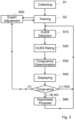
- Step S1 is collected an approved dataset of a collection of analysed Speeches of persons, which is provided in step S2 to the self-learning machine 120 for training this self-learning machine.
- the collection of this approved dataset during step S1 results from:
- step S2 in addition to the training of the self-learning machine 120 with the input data set which is completed and renewed regularly, there could be in some cases further interaction with an expert 134 or specialist in profiling, wherein via step S50 there is an expert adjustment of the training of the self-learning machine 120, which correspond to the verification and possible correction by this expert 134 of the quotation of any of the video sequence or any of the audio sequence respectively by at least one corrected Audio Cue Ac or at least one Video Cue Vc.
- the "person” means any person independently of the situation and scenario of the Speech, namely any speaker, including but not limited to a lonely speaker, an interviewee or an interviewer (case of a Speech between two or more than two persons with the interviewer being the leading speaker), a speaker during a staff meeting, a speaker during a negotiation meeting, a speaker during a coaching session, an online learning session........independently of the number of participants and of the number of speakers present during the Speech.
- the system and the methods presented in the present text can be used mutatis mutandis for one person/speaker only or for two persons/speakers or for more than two persons/speakers, including for all the /speakers participating to the Speech.
- the term "person” can be used for designing any speaker of the Speech including for instance, but not limited to, a lonely speaker, an interviewee or an interviewer, a speaker during a staff meeting, a speaker during a negotiation meeting, a speaker during a coaching session, an online learning session .
- the method and the system applied for a Speech between an interviewee and an interviewer the same explanations applied in any other case of discussion between two persons or between more than two persons, which means that in the present text "interviewee " can be replaced by "person” and "interviewer” can be replaced by "another person”.
- steps S10 to S30 or steps S10 to S40, or steps S10 to S50, or steps S10 to S60, of methods for providing indicators of congruence or incongruence between the body language and the Speech of a person which can be implemented in an embodiment of the system according to the present invention.
- the initial steps for training the self-learning machine have already been described, namely the collecting step S1 and the training step S2.
- step S10 a video of a Speech of the person (for instance the interviewee 130) is captured, and said video is divided into n video sequences comprising n sequences of images (or n visual sequences) and n corresponding audio sequences.
- step S10 the system performs cues detection, namely for each sequence of images, at least one Visual cue Vc is detected and for each audio sequence, at least one Audio cue Ac is detected.
- step S20 the system performs cues rating, i.e. the system attributes at least one rating among positive Ac+, neutral Ac0 or negative Ac- for each Audio cue Ac and the system attributes at least one rating among positive Vc+, neutral Vc0 or negative Vc- for each visual cue Vc.
- step S30 the system performs congruency determination, which means comparing the rating of said Audio cue Ac with the rating of said Visual cue Vc, and giving a congruence indicator which is a positive congruence indicator if both ratings are either positive (Vc+ and Ac+) or negative (Vc+ and Ac+), a negative congruence indicator if one of the ratings is positive and the other one is negative (Vc+ and Ac-, or Vc- and Ac+), and a neutral congruence indicator if one of the ratings is neutral (Vc0 or Ac0).
- steps S10 to S30 are the minimum steps of the method according to the invention for determining congruence in the speech of a person, in the form of a congruence indicator.
- step S40 the system displays a sign representative of the congruence indicator previously established (for instance a displayed sign on display 124 such as "+", "-” or "0" and/or the displaying of an icon and/or the displaying of a colour on a screen (for instance red for a negative congruence indicator, orange for a neutral congruence indicator, green for a positive congruence indicator) and/or the display of a sound in an earpiece of the interviewer 132.
- a sign representative of the congruence indicator previously established for instance a displayed sign on display 124 such as "+", "-” or "0” and/or the displaying of an icon and/or the displaying of a colour on a screen (for instance red for a negative congruence indicator, orange for a neutral congruence indicator, green for a positive congruence indicator) and/or the display of a sound in an earpiece of the interviewer 132.
- each route being independent of the other routes, namely can intervene alone or in combination with one or two of the other routes:
- the directing of the method through Route 1 (congruence indicator is positive (+), the reply to the congruency recognition is "YES” ), Route 2 (congruence indicator is negative (-) or neutral (0), the reply to the congruency recognition is "NO”) or through Route 3 (congruence indicator "(?)" not clearly established) intervenes after the step S30 (where the congruency indicator is determined).
- the step S40 of displaying a sign representative of the congruence indicator, at least for the positive congruency indicator (+), and if allowed by the system also for the negative congruency indicator (-) and the neutral congruency indicator (0), is implemented after the directing towards Route 1 or Route 2 or Route 3.
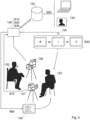
- the person or subject 130 whose Speech will be analysed is placed facing the video recording device 126.
- a video recording device 126 can be for instance a video camera.
- This video recording device 126 allows to capture video sequences comprising both audio sequences (audio signal captured by a microphone or equivalent) and visual sequences (series of images captured by image capturing device).
- uch a video recording device 126 can be a hand-held device, or can be integrated into another system such as glasses, contact lens or other types of devices.
- This video recording device 126 is placed such that the face and the body of the subject 130 can be both video recorded.
- the interviewer 132 is preferably placed facing the subject 130 for a better discussion comfort as shown in Figure 4 , but it is not necessary.
- the interviewer 132 and the interviewee 130 are communicating live with each other via telecommunication devices equipped with screen, camera and microphone, such as a computer facing the interviewee 130 and another computer facing the interviewer 132: in that situation, the interviewee 130 and the interviewer 132 can have the exchanges described in the present text through Internet using an application such as but not limited to Whatsapp, Skype, Zoom...
- the interviewer 132 has access to a display 124 for receiving information from the system 100 (step 40), among which a congruence indicator (+ for positive, - for negative or 0 for neutral on Fig.4 ).
- the interviewer 132 has also access to another display 124' (see Figure 4 ) which provides a series of formulations of hypotheses (notably affirmations or questions) provided by the system 100, and notably based on said indicator of congruence or of incongruence of the previously analysed video sequence.
- This series of formulations of hypotheses can alternatively be shown on the same display 124 as the congruency indicator, or through any other device, notably any other display device, including but not limited to glasses.
- This step corresponds to S60 in Figure 3 .
- This series of hypotheses are helpful especially when the congruence indicator is negative, in order to check (confirm or infirm) the incongruence of the reply of the interviewee 130 regarding the item (information, theme, topic) of the previously analysed video sequence.
- one of the hypotheses is chosen by the interviewer 132 and is used and voiced in presence of the subject 130, and the subject response is being simultaneously recorded and creating another video sequence of the subject, for a further analyse.
- this list is proposed by an avatar speaking to the interviewer 132. This could be implemented alternatively through an audio signal transmitted to the interviewer 132 by an earpiece, glasses or any other audio device.
- the system further comprise a second video recording device 127 as shown on Figure 4 .
- This second video recording device 127 is for example a second camera and is used to capture another video of the interviewer 132.
- This second video recording device 127 capture video sequences comprising both audio sequences (audio signal captured by a microphone or equivalent) and visual sequences (series of images captured by image capturing device).
- this second video recording device 127 has no microphone (or such a microphone or equivalent is shut off) and only capture visual sequences : in this case, the system can use the audio sequence of the first video recording device 126 to separate the voice/speech of the interviewer 132 from the speech/voice of the interviewee 130 (which is called diarization).
- first video recording device 126 when using at the same time a first video recording device 126 and a second video recording device 127, preferably the first video recording device 126 is facing the interviewee 130 and the second video recording device 127 is facing the interviewer 132 as shown in Figure 4 .
- the two persons (such as the interviewee 130 and the interviewer 132, but any other possible situation of Speech with at least two persons/speakers) are not located in the same room and are each facing a video recording device included in a computer or any other telecommunication devices equipped with screen, camera and microphone and allowing the two (or more than two) persons to communicate live with each other.
- the system can also perform recognition of what is called “perception management”, namely in the present case the influence of the behaviour and Speech/questions of the interviewer 132 on the Speech of the interviewee.
- perception management namely in the present case the influence of the behaviour and Speech/questions of the interviewer 132 on the Speech of the interviewee.
- the system can be used to detect evidence of this scientific theory known as "perception management” stipulating that the attitude, behaviour, thoughts of one person towards the other, influences the behaviour of the other person and vice versa.
- the interviewee 130 can use perception management to influence the interviewer 132.
- Perception management is both verbal and non-verbal. Actually, our role, our ornaments, our attitude (intentional or unconscious) affects others. The objective is to influence the observation of the other person in an exchange between two persons. For example, you may yawn excessively as if you were bored or squatting on a couch, stretch your arms, take up space, etc. Audio signals can be used through standard sentences: "I could never hurt anyone," "You don't think that about me, do you?", and/or in the case of the raising of the voice. All these signals, verbal signals and non-verbal signals, should alert the interviewer 132 and give him also Visual cues or Audio cues.
- Verbal signals (Audio cues) and non-verbal signals (Visual cues) will also be analyzed by the system, in the course of the method, in order to establish perception management through indicator of perception management represented by a visual sign (such as the displaying of an icon and/or the displaying of a colour on a screen) or by an audio signal (that can be displayed in an earpiece or through another audio equipment).
- indicator of perception management represented by a visual sign (such as the displaying of an icon and/or the displaying of a colour on a screen) or by an audio signal (that can be displayed in an earpiece or through another audio equipment).
- neutral indicator of perception management or neutral influence indicator
- those signals will be signaled (both to the interviewer and to the interviewee or only to one person, according to each one's needs) for instance by an orange colour (or by an neutral audio signal); if those signals are intrusive (detection of an influence of the Speech of one of the two persons on the Speech of the other of the two persons, and/or inversely) then an indicator of intrusive perception management (or negative influence indicator) be signaled for instance by a red colour (or by an intrusive audio signal), and if those signals are detected as non-intrusive (detection of no influence of the Speech of one of the two persons on the Speech of the other of the two persons, and/or inversely), then an indicator of non-intrusive perception management (or positive influence indicator) is signaled for instance in green (or by an non-intrusive audio signal).
- the system and the method can also bring some valuable inputs to complete and refine this theory of perception management, either for determining the influence of the first person on the (other) second person, or for determining the influence of the (other) second person on the first person or for determining both the influence of the first person on the (other) second person and the influence of the first person on the (other) second person.
- This analysis of the influence of the behaviour and Speech of the Interviewer 132 on the interviewee 130 can also be used the system 100 to provide the series of formulations of hypotheses (notably affirmations or questions) to the display 124' (or 124), in order to confirm or infirm whether the congruence or absence of congruency detected is maintained when changing the behaviour and/or the Speech of the interviewer 132 (interviewee 130).
- the system 100 proposes some lists of hypotheses to the user (Interviewer 132) so that he/she can confirm or infirm the previously perceived clues (detected Visual cues or Audio cues).
- the validation of the incongruency also known as TH (Test of Hypothesis, which formulates hypotheses to recreate the emotional state and the experienced feeling) following a behavioural interview, makes it possible to recreate the internal state experienced by the person at the time of the incongruence and confirm or not this incongruence, by confirming or infirming the preceding detected clues (Visual cues and/or Audio cues).
- the system according to the invention can therefore relates the visual cues to the audio cues according to their rating. If an incongruence is reported, the Interviewer 132 will be offered hypotheses to apply the TH method. This step corresponds to S60 in Figure 3 .
- the paleo limbal pole of the brain is the honest part. This means that the body reacts according to its animal part and thus delivers so-called sincere visual signals. Indeed, these are very fast reactions and do not pass through the neolimbic cortex pole which can "think" and thus want to condition his speech.
- the premise of the TH method is that when a person listens to a hypothesis / story He/she does not speak, but his/her body gives us signals. Indeed, without passing through the neo-limbal cortex pole, the signal given will arrive from the paleo limbal pole and will thus be honest. Thus, when a hypothesis is stated, the observed signal will confirm or not the detected incongruence.
- the TH method was implemented following the understanding of the different poles of the brain. Indeed, depending on which one is most active, the type of cues will not be the same.
- Reptilian / paleolimbic brains are considered in congruence as being "honest”. It includes, among other things, clues/cues related to feeled emotions and to survival strategies (3F).
- the neolimbic cortex brain concerns words.
- the neolimbic cortex brain is considered to be the "lying" brain in the field of profiling.
- the prefrontal cortex is adaptive, therefore the one where our full potential and cues such as comfort and isopraxia are located.
- the Speech of the person 130 takes place in front of another person considered as an interviewer 132, so that the Speech forms an interview between said person or interviewee 130 and an interviewer 132.
- the method further comprises the following steps:
- the method further comprises the following steps:
- the system is also able to give feedback to the interviewer 132 about the body language of the interviewee 130.
- said detected influence indicator is used to provide to the interviewer 132 a series of formulations of hypotheses in the form of affirmations and/or questions.
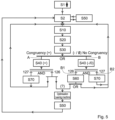
- Figure 5 shows another method according to the invention for providing indicators of congruence or incongruence between the body language and the Speech of a person, which uses the perception management in a step S70 considering the video sequences of the interviewer 132 captured by the second video recording device 127.
- Steps S1, S2, S10, S20, S30 and S40 are the same as those previously described in relation with figure 3 .
- two routes A and B are possible at the moment of the displaying step S40 or after the displaying step S40 depending of the congruence indicator:
- step S50 there is an expert adjustment, which correspond to the human verification and possible correction by an expert 134 of the congruence indicator, which further step of congruence indicator also possibly serves to train further the self-learning machine 120. Then, the method follows previously described steps starting from step S10.
- the systems and methods according to the invention take into account all the component of the human behaviour, namely from micro-expression to pacification gestures.
- the data processing system 100 of Fig. 1 may be located and/or otherwise operate at any node of a computer network, that may exemplarily comprise clients, servers, etc., and it is not illustrated in the figure.
- the system 100 includes communication network 102, which provides communications between processor unit 104, memory 106, visual cues detector 108, communications unit 110, input/output (I/O) unit 112, and audio cues detector 114.
- Processor unit 104 serves to execute instructions for software that may be loaded into memory 106.
- Processor unit 104 may be a set of one or more processors or may be a multi-processor core, depending on the particular implementation. Further, processor unit 104 may be implemented using one or more heterogeneous processor systems in which a main processor is present with secondary processors on a single chip. As another illustrative example, the processor unit 104 may be a symmetric multiprocessor system containing multiple processors of the same type.
- the memory 106 shown in Fig. 1 may be a random access memory or any other suitable volatile or non-volatile storage device.
- the database 122 connected to the communication unit 110 can be a persistent storage that may take various forms depending on the particular implementation.
- a persistent storage may contain one or more components or devices.
- Such a persistent storage may be a hard drive, a flash memory, a rewritable optical disc, a rewritable magnetic tape, or some combination of the above.
- the media used by such a persistent storage may also be removable such as, but not limited to, a removable hard drive.
- the communications unit 110 shown in Fig. 1 provides for communications with other data processing systems or devices.
- communications unit 110 is a network interface card.
- Modems, cable modem and Ethernet cards are just a few of the currently available types of network interface adapters.
- Communications unit 110 may provide communications using either or both physical and wireless communications links.
- the input/output unit 112 shown in Fig. 1 enables input and output of data with other devices that may be connected to the data processing system 100.
- input/output unit 112 may provide a connection for user input through a keyboard and mouse. Further, input/output unit 112 may send output to a printer.
- Display 124 (and display 124') provide(s) a mechanism to display information to a user, for instance a tablet computer or a smartphone.
- Instructions for the operating system and applications or programs can be located on the persistent storage. These instructions may be loaded into the memory 106 for execution by processor unit 104.
- the processes of the different embodiments may be performed by processor unit 104 using computer implemented instructions, which may be located in a memory, such as memory 106.
- These instructions are referred to as program code, computer usable program code, or computer-readable program code that may be read and executed by a processor in processor unit 104.
- the program code in the different embodiments may be embodied on different physical or tangible computer readable media, such as memory 106 or persistent storage.
- Program code 116 can be located in a functional form on the computer-readable media 118 that is selectively removable and may be loaded onto or transferred to the system 100 for execution by processor unit 104.
- Program code 116 and computer-readable media 118 form a computer program product in these examples.
- the computer-readable media 118 may be in a tangible form, such as, for example, an optical or magnetic disc that is inserted or placed into a drive or other device that is part of persistent storage (database 122) for transfer onto a storage device, such as a hard drive that is part of persistent storage 108.
- the computer-readable media 118 also may take the form of a persistent storage, such as a hard drive, a thumb drive, or a flash memory that is connected to the system 100.
- the tangible form of computer-readable media 118 is also referred to as computer recordable storage media. In some instances, computer-readable media 118 may not be removable.
- the program code 116 may be transferred to the system 100 from computer-readable media 118 through a communication link to communications unit 110 and/or through a connection to input/output unit 112.
- the communications link and/or the connection may be physical or wireless in the illustrative examples.
- the computer-readable media may also take the form of non-tangible media, such as communications links or wireless transmissions containing the program code.
- a storage device in the system 100 (and/or in the self-learning machine 120) is any hardware apparatus that may store data.
- Memory 106, persistent storage, and computer-readable media 118 are examples of storage devices in a tangible form.
- This communication system 102 can be totally or partially wireless, or totally or partially wired.
- a wireless communication network or part of the communication network can be for instance based on Wi-fi technology.
- a wired communication network or part of the communication network can be for instance formed by a data bus system or any other fixed communication network.
- the communication between the data processing system 100 and any of or several of the database 122, self-learning machine 120, display 124, display 124', computer reading media 118, and the video recording device can be implemented using only a wireless communication network (such as Wi-fi ) or using only a wired communication network (such as data bus system), or using partially a wireless communication network (such as Wi-fi ) and partially a wired communication network (such as data bus system).
- a wireless communication network such as Wi-fi
- a wired communication network such as data bus system
- partially a wireless communication network such as Wi-fi
- a wired communication network such as data bus system
- the self-learning machine 120 comprises a neural network, for instance a convolution neural network, and/or a deep learning neural network.
- said self-learning machine is a deep learning machine.
- the display 124 for receiving information from the system 100 and the other display 124' which provides a series of formulations of hypotheses provided by the system 100 are shown in Figure 4 as screens of a tablet computer, but they can be replaced by other displays such as screen of a tablet or screens of another device, such as a hand-held device, or these displays can be integrated into another system such as glasses, contact lens or another type of device.
- These displays 124 and 124' give a visual feedback (visual signal) to the interviewer 132 (user of the system 100) but this visual signal can also be replaced by or cumulated with (an)other type(s) of signal(s), such as an audio signal, and/or a vibrating signal, including via an earphone or an device worn on the body (for instance a watch or a bracelet or an earring or a pendant.).
- a training method proposed for training a self-learning machine 120 such as a neuronal network, in order to determine indicators of congruence or incongruence between the body language and the Speech of a person or between the cues themselves, comprising:
- this congruence indicator or approved congruence indicator can be a positive congruence, a negative congruence indicator, or a neutral congruence indicator.
- this congruence indicator or approved congruence indicator results from a video of a Speech of that person, wherein said video is divided into n video sequences comprising n sequences of images (or n visual sequences) and n corresponding audio sequences, wherein for each sequence of images, at least one Visual cue Vc is detected and attributed at least one rating among positive Vc+, neutral Vc0 or negative Vc, wherein for each audio sequence, at least one Audio cue Ac is detected and attributed at least one rating among positive Ac+, neutral Ac0 or negative Ac, and wherein for each video sequence, the rating of said Audio cue Ac is compared with the rating of said Visual cue Vc, thereby giving a congruence indicator which is a positive congruence indicator if both ratings are either positive (Vc+ and Ac+) or negative (Vc+ and Ac+),
- a sign of discomfort for determining an approved congruence indicator, a sign of discomfort, a sign of comfort and/or a pacificator sign is (are) also determined and used.
- an Audio cue or an Visual cue among possible cues are possibly included a sign of discomfort, a sign of comfort or a pacificator sign, those signs being possibly a visual sign or an audio sign.
- a method for training a self-learning machine such as a neural network, in order to determine congruence or incongruence between the body language and the oral part of the Speech of a person comprising the following steps:
- a data processing system for determining congruence or incongruence (establish a congruence rate) between the body language and the Speech of a person comprising a self-learning machine, such as a neural network, arranged for receiving as input a dataset including:
- said data set further includes for each sequence, a pair or a group of identified cues including at least one Audio cue Ac identified from the audio sequence of said sequence, and at least one Visual cue Vc identified from the corresponding visual sequence of said video sequence, said identified Audio cue Ac and said identified Visual cue Vc forming a pair of identified cues, and for each pair or group of identified cues, said data set further includes said approved congruence indicator, the latter be possibly a congruence indicator approved by an expert 134.
Landscapes
- Engineering & Computer Science (AREA)
- Health & Medical Sciences (AREA)
- Life Sciences & Earth Sciences (AREA)
- Physics & Mathematics (AREA)
- Theoretical Computer Science (AREA)
- Artificial Intelligence (AREA)
- General Health & Medical Sciences (AREA)
- General Physics & Mathematics (AREA)
- Psychiatry (AREA)
- Multimedia (AREA)
- Medical Informatics (AREA)
- Biophysics (AREA)
- Biomedical Technology (AREA)
- Molecular Biology (AREA)
- Evolutionary Computation (AREA)
- Computer Vision & Pattern Recognition (AREA)
- Heart & Thoracic Surgery (AREA)
- Veterinary Medicine (AREA)
- Pathology (AREA)
- Public Health (AREA)
- Animal Behavior & Ethology (AREA)
- Surgery (AREA)
- Signal Processing (AREA)
- Mathematical Physics (AREA)
- Child & Adolescent Psychology (AREA)
- Human Computer Interaction (AREA)
- Hospice & Palliative Care (AREA)
- Data Mining & Analysis (AREA)
- Social Psychology (AREA)
- Software Systems (AREA)
- General Engineering & Computer Science (AREA)
- Computing Systems (AREA)
- Educational Technology (AREA)
- Psychology (AREA)
- Physiology (AREA)
- Fuzzy Systems (AREA)
- Developmental Disabilities (AREA)
- Computational Linguistics (AREA)
- Oral & Maxillofacial Surgery (AREA)
- Audiology, Speech & Language Pathology (AREA)
Claims (10)
- Verfahren zum Bereitstellen von Indikatoren für Kongruenz oder Inkongruenz zwischen der Körpersprache und der Sprache eines Subjekts, durchgeführt von einem Datenverarbeitungssystem zum Bestimmen von Kongruenz oder Inkongruenz zwischen der Körpersprache und der Sprache der Person, das Verfahren umfassend die folgenden Schritte:a/ Bereitstellen einer Videoaufnahmevorrichtung, die angepasst ist, um Bilder eines Subjekts einschließlich Gesicht und mindestens einiger Körperteile aufzunehmen,b/ Aufnehmen eines Videos einer Sprache dieser Person (130) mit der Videoaufnahmevorrichtung (126), wobei das Video in n Videosequenzen unterteilt ist, umfassend n Bildsequenzen (oder n visuelle Sequenzen) und n entsprechende Audiosequenzen,c/ für jede Bildsequenz, Erkennen mindestens eines visuellen Auslösereizes Vc und Zuweisen mindestens einer Bewertung unter positiv Vc+, neutral Vc0 und negativ Vc- für jeden visuellen Auslösereiz Vc,d/ für jede Audiosequenz, Erkennen mindestens eines Audio-Auslösereizes Ac und Zuweisen mindestens einer Bewertung unter positiv Ac+, neutral Ac0 und negativ Ac- für jeden Audio-Auslösereiz Ac,e/ für jede Videosequenz, Vergleichen der Bewertung des Audio-Auslösereizes Ac mit der Bewertung des visuellen Auslösereizes Vc und Angeben eines Kongruenzindikators, der wie folgt istein positiver Kongruenzindikator, wenn beide Bewertungen entweder positiv (Vc+ und Ac+) oder negativ (Vc- und Ac-) sind,ein negativer Kongruenzindikator, wenn eine der Bewertungen positiv und die andere negativ ist (Vc+ und Ac- oder Vc- und Ac+), undein neutraler Kongruenzindikator, wenn eine der Bewertungen neutral ist (Vc0 oder Ac0),wobei das Verfahren dadurch gekennzeichnet ist, dass es ferner vor Schritt b) einen vorbereitenden Schritt b0) zur Festlegung einer Basislinie umfasst, bei dem die folgenden Teilschritte implementiert werden:i) der Person (130) wird ein Referenzfilm gezeigt, der Referenzfilm umfassend m Referenzfilmsequenzen, wobei zumindest einige der Referenzfilmsequenzen emotional geladen sind;ii) während der Film gezeigt wird, erfolgt eine Aufnahme eines Referenzvideos der Person (130);iii) Unterteilen des Referenzvideos in m Referenzvideosequenzen, wobei jede Referenzvideosequenz einer Referenzfilmsequenz des Films entspricht;iv) für jede Referenzvideosequenz, Erkennen mindestens eines visuellen Auslösereizes Vc eines Mikroausdrucks, der in einer Basislinientabelle der Person (130) gespeichert ist.
- Verfahren nach Anspruch 1, wobei der visuelle Auslösereiz Vc einer der folgenden ist: alle Gesichtsausdrücke oder körpersprachlichen Auslösereize, einschließlich eines visuellen Zeichens für Unbehagen, eines visuellen Zeichens für Wohlbehagen oder eines visuellen Beschwichtigungszeichens.
- Verfahren nach einem der Ansprüche 1 bis 2, wobei der Audio-Auslösereiz Ac einer von Folgenden ist: für die Stimme: Rhythmus (Pause), Geschwindigkeit (Tempowechsel), Lautstärke (hoch oder niedrig), Tonhöhe, Ton (hoch oder niedrig); für die emotionale Stimme (negativ oder positiv); Verbalstil: Linguistik, Untersuchung, Wort, Zählung, Änderung des Sprachstils und eine positive oder negative Stimmung, die in der Audiosequenz ausgedrückt wird, ein Audiozeichen für Unbehagen, ein Audiozeichen für Trost und ein Audiozeichen für Beschwichtigung.
- Verfahren nach einem der Ansprüche 1 bis 3, wobei ferner eine Referenztabelle mit der/den Bewertungsentsprechung(en) des visuellen Auslösereizes Vc und des akustischen Auslösereizes Ac bereitgestellt ist.
- Verfahren nach einem der Ansprüche 1 bis 4, wobei die Sprache der Person (130) vor einer anderen Person stattfindet, die als Interviewer (132) betrachtet wird, sodass die Sprache ein Interview zwischen der Person oder dem Interviewten (130) und einem Interviewer (132) bildet, wobei das Verfahren ferner die folgenden Schritte umfasst:f/ Bereitstellen einer zweiten Videoaufnahmevorrichtung (127), die angepasst ist, um Bilder des Interviewers (132) einschließlich Gesicht und mindestens einiger Körperteile aufzunehmen,g/ Aufnehmen auch eines Videos der Sprache dieses Interviewers (132) mit der zweiten Videoaufnahmevorrichtung (127), wobei das Video in n Videosequenzen unterteilt ist, umfassend n Bildsequenzen (oder n visuelle Sequenzen) und n entsprechende Audiosequenzen,h/ Erkennen mindestens eines visuellen Auslösereizes Vc des Interviewers (132) für jede Bildsequenz und Erkennen mindestens eines akustischen Auslösereizes Ac des Interviewers (132) für jede Audiosequenz,i/ für jede Videosequenz, Analysieren der Bewertung des Audio-Auslösereizes Ac und des visuellen Auslösereizes Vc der Person, die den Interviewten (130) bildet, in Bezug auf den visuellen Auslösereiz Vc und den Audio-Auslösereiz Ac des Interviewers (132), wodurch ein positiver oder negativer Einflussindikator erstellt wird,wobei der Einflussindikator positiv ist, wenn es einen erkannten Einfluss des visuellen Auslösereizes Vc und des akustischen Auslösereizes Ac des Interviewers (132) auf die Bewertung des akustischen Auslösereizes Ac und des visuellen Auslösereizes Vc der Person, die den Interviewten (130) bildet, gibt, undwobei der Einflussindikator positiv ist, wenn es keinen erkannten Einfluss des visuellen Auslösereizes Vc und des akustischen Auslösereizes Ac des Interviewers (132) auf die Bewertung des akustischen Auslösereizes Ac und des visuellen Auslösereizes Vc der Person, die den Interviewten (130) bildet, gibt.
- Verfahren nach Anspruch 5, wobei der erkannte Einflussindikator verwendet wird, um dem Interviewer eine Reihe von Hypothesenformulierungen in Form von Behauptungen bereitzustellen.
- Verfahren nach einem der Ansprüche 1 bis 4, wobei die Sprache der Person (130) vor einer anderen Person, die als Interviewer (132) betrachtet wird, erfolgt, sodass die Sprache ein Interview zwischen der Person oder dem Interviewten (130) und einem Interviewer (132) bildet, wobei das Verfahren ferner die folgenden Schritte umfasst:f/ Bereitstellen einer zweiten Videoaufnahmevorrichtung (127), die angepasst ist, um Bilder des Interviewers (132) einschließlich Gesicht und mindestens einiger Körperteile aufzunehmen,g/ Aufnehmen auch eines Videos der Sprache dieses Interviewers (132) mit der zweiten Videoaufnahmevorrichtung (127), wobei das Video in n Videosequenzen unterteilt ist, umfassend n Bildsequenzen (oder n visuelle Sequenzen) und n entsprechende Audiosequenzen,h/ Erkennen mindestens eines visuellen Auslösereizes Vc des Interviewers (132) für jede Bildsequenz und Erkennen mindestens eines akustischen Auslösereizes Ac des Interviewers (132) für jede Audiosequenz,i/ für jede Videosequenz, Analysieren der Bewertung des Audio-Auslösereizes Ac und des visuellen Auslösereizes Vc der Person, die den Interviewer (132) bildet, in Bezug auf den visuellen Auslösereiz Vc und den Audio-Auslösereiz Ac des Interviewten (130), wodurch ein positiver oder negativer Einflussindikator erstellt wird,wobei der Einflussindikator positiv ist, wenn es einen erkannten Einfluss des visuellen Auslösereizes Vc und des akustischen Auslösereizes Ac des Interviewten (130) auf die Bewertung des akustischen Auslösereizes Ac und des visuellen Auslösereizes Vc der Person, die den Interviewer (132) bildet, gibt, undwobei der Einflussindikator positiv ist, wenn es keinen erkannten Einfluss des visuellen Auslösereizes Vc und des akustischen Auslösereizes Ac des Interviewten (130) auf die Bewertung des akustischen Auslösereizes Ac und des visuellen Auslösereizes Vc der Person, die den Interviewer (132) bildet, gibt.
- Verfahren zum Trainieren einer selbstlernenden Maschine, wie beispielsweise eines neuronalen Netzes, um Kongruenz oder Inkongruenz zwischen der Körpersprache und der Sprache einer Person (130) zu bestimmen, umfassend die folgenden Schritte:a) Bereitstellen einer selbstlernenden Maschine, wie beispielsweise eines neuronalen Netzes, die angeordnet ist, um als Eingang einen Eingangsdatensatz zu empfangen, der Folgendes beinhaltet:
genehmigte Daten einer Sammlung von analysierten Sprachen von Personen, wobei die genehmigten Daten für jede analysierte Sprache Folgendes umfassen:* einen Satz von Videosequenzen, umfassend Audiosequenzen und visuelle Sequenzen, wobei jede Audiosequenz einer visuellen Sequenz entspricht, und* für jede Videosequenz, einen genehmigten Kongruenzindikator für die Videosequenz, wobei der genehmigte Kongruenzindikator durch die Implementierung des Verfahrens zum Bereitstellen von Indikatoren für Kongruenz oder Inkongruenz nach einem der Ansprüche 1 bis 7 erlangt wird,b) Trainieren der selbstlernenden Maschine mit dem Eingangsdatensatz. - Verfahren nach Anspruch 8, wobei der genehmigte Datensatz aus Folgendem resultiert:- Videoaufnahmen einer großen Anzahl von Sprachen verschiedener Personen,- Unterteilen jeder Sprache in n Videosequenzen, umfassend n Bildsequenzen oder n visuelle Sequenzen und n entsprechende Audiosequenzen, und- Kommentieren jeder Videosequenz durch Profiling-Spezialisten, d. h. Profiler, die die Videosequenzen manuell mit mindestens einem Audio-Auslösereiz Ac und mindestens einem Video-Auslösereiz Vc versehen, wobei jedem Auslösereiz von dem Spezialisten mindestens eine Bewertung von positiv (+), neutral (0) oder negativ (-) zugewiesen wird.
- System zum Bereitstellen von Indikatoren für Kongruenz oder Inkongruenz zwischen der Körpersprache und der Sprache eines Subjekts, das System Folgendes umfassend:eine selbstlernende Maschine, die konfiguriert ist, um einen Eingang zu erhalten, umfassend Sätze von Audiosequenzen der Sprache einer Person und Sequenzen von Bildern der Person während der Sprache,eine Videoaufnahmevorrichtung, die konfiguriert ist, um Bilder eines Subjekts einschließlich Gesicht und mindestens einiger Körperteile aufzunehmen,wobei die Videoaufnahmevorrichtung konfiguriert ist, um ein Video einer Sprache dieser Person (130) aufzunehmen, wobei das Video in n Videosequenzen unterteilt ist, umfassend n Bildsequenzen (oder n visuelle Sequenzen) und n entsprechende Audiosequenzen;einen visuellen Auslösereiz-Detektor (108), der konfiguriert ist, um für jede Bildsequenz die Videosequenz zu analysieren und mindestens einen visuellen Auslösereiz Vc zu erkennen, wobei jedem visuellen Auslösereiz Vc mindestens eine Bewertung unter positiv Vc+, neutral Vc0 und negativ Vc- zugewiesen wird,einen Audio-Auslösereiz-Detektor (114), der konfiguriert ist, um für jede Audiosequenz die Audiosequenz zu analysieren und mindestens einen Audio-Auslösereiz Ac zu erkennen, wobei jedem Audio-Auslösereiz Ac mindestens eine Bewertung unter positiv Ac+, neutral Ac0 und negativ Ac- zugewiesen wird,wobei das System konfiguriert ist, um für jede Videosequenz die Bewertung des Audio-Auslösereizes Ac mit der Bewertung des visuellen Auslösereizes Vc zu vergleichen und einen Kongruenzindikator auszugeben, der wie folgt istein positiver Kongruenzindikator, wenn beide Bewertungen entweder positiv (Vc+ und Ac+) oder negativ (Vc- und Ac-) sind,ein negativer Kongruenzindikator, wenn eine der Bewertungen positiv und die andere negativ ist (Vc+ und Ac- oder Vc- und Ac+), undein neutraler Kongruenzindikator, wenn eine der Bewertungen neutral ist (Vc0 oder AcO);dadurch gekennzeichnet, dass das System konfiguriert ist, um eine Basislinie zu erstellen, umfassend:i) Zeigen eines Referenzfilms der Person (130), der Referenzfilm umfassend m Referenzfilmsequenzen, wobei zumindest einige der Referenzfilmsequenzen emotional geladen sind;ii) während der Film gezeigt wird, Aufnehmen eines Referenzvideo der Person (130);iii) Unterteilen des Referenzvideos in m Referenzvideosequenzen, wobei jede Referenzvideosequenz einer Referenzfilmsequenz des Films entspricht;iv) für jede Referenzvideosequenz, Erkennen mindestens eines visuellen Auslösereizes Vc eines Mikroausdrucks, der in einer Basislinientabelle der Person (130) gespeichert ist.
Priority Applications (1)
| Application Number | Priority Date | Filing Date | Title |
|---|---|---|---|
| MA54537A MA54537B1 (fr) | 2018-12-20 | 2019-12-20 | Système et procédé de lecture et d'analyse du comportement comprenant les expressions verbales, corporelles et faciales afin de déterminer la congruence d'une personne |
Applications Claiming Priority (2)
| Application Number | Priority Date | Filing Date | Title |
|---|---|---|---|
| CH001571/2018A CH715893A9 (fr) | 2018-12-20 | 2018-12-20 | Système et procédé destinés à lire et analyser le comportement, y compris le langage verbal, le langage corporel et les expressions faciales, afin de déterminer la congruence d'une personne. |
| PCT/IB2019/061184 WO2020128999A1 (en) | 2018-12-20 | 2019-12-20 | System and method for reading and analysing behaviour including verbal, body language and facial expressions in order to determine a person's congruence |
Publications (3)
| Publication Number | Publication Date |
|---|---|
| EP3897388A1 EP3897388A1 (de) | 2021-10-27 |
| EP3897388C0 EP3897388C0 (de) | 2024-05-01 |
| EP3897388B1 true EP3897388B1 (de) | 2024-05-01 |
Family
ID=64959049
Family Applications (1)
| Application Number | Title | Priority Date | Filing Date |
|---|---|---|---|
| EP19839416.5A Active EP3897388B1 (de) | 2018-12-20 | 2019-12-20 | System und verfahren zum lesen und analysieren von verhaltensweisen, einschliesslich des verbalen ausdrucks, der körpersprache und von gesichtsausdrücken, zur bestimmung der kongruenz einer person |
Country Status (7)
| Country | Link |
|---|---|
| US (1) | US20220067353A1 (de) |
| EP (1) | EP3897388B1 (de) |
| CA (1) | CA3122729A1 (de) |
| CH (1) | CH715893A9 (de) |
| IL (1) | IL283516A (de) |
| MA (1) | MA54537B1 (de) |
| WO (1) | WO2020128999A1 (de) |
Families Citing this family (9)
| Publication number | Priority date | Publication date | Assignee | Title |
|---|---|---|---|---|
| CN111657971A (zh) * | 2020-07-07 | 2020-09-15 | 电子科技大学 | 基于微多普勒和视觉感知融合的非接触测谎系统及方法 |
| US20220101873A1 (en) * | 2020-09-30 | 2022-03-31 | Harman International Industries, Incorporated | Techniques for providing feedback on the veracity of spoken statements |
| CN112991076A (zh) * | 2021-02-08 | 2021-06-18 | 支付宝(杭州)信息技术有限公司 | 信息处理方法及装置 |
| US12062367B1 (en) * | 2021-06-28 | 2024-08-13 | Amazon Technologies, Inc. | Machine learning techniques for processing video streams using metadata graph traversal |
| US11900327B2 (en) * | 2021-06-30 | 2024-02-13 | Capital One Services, Llc | Evaluation adjustment factoring for bias |
| EP4252643A1 (de) * | 2022-03-29 | 2023-10-04 | Emotion Comparator Systems Sweden AB | System und verfahren zur interpretation menschlicher interpersoneller interaktion |
| EP4325517B1 (de) * | 2022-08-18 | 2024-11-20 | Carl Zeiss Vision International GmbH | Verfahren und vorrichtungen zur durchführung eines sehtestverfahrens an einer person |
| US12293010B1 (en) * | 2024-07-08 | 2025-05-06 | AYL Tech, Inc. | Context-sensitive portable messaging based on artificial intelligence |
| CN119993474B (zh) * | 2024-12-13 | 2026-01-06 | 华东师范大学 | 基于面部表情的人工智能自动识别系统 |
Family Cites Families (15)
| Publication number | Priority date | Publication date | Assignee | Title |
|---|---|---|---|---|
| US7046300B2 (en) * | 2002-11-29 | 2006-05-16 | International Business Machines Corporation | Assessing consistency between facial motion and speech signals in video |
| WO2008063155A2 (en) | 2005-10-18 | 2008-05-29 | Drexel University | Deception detection via functional near-infrared spectroscopy |
| WO2008063527A2 (en) | 2006-11-13 | 2008-05-29 | Faro Scott H | Detection of deception and truth-telling using fmri of the brain |
| US20080260212A1 (en) | 2007-01-12 | 2008-10-23 | Moskal Michael D | System for indicating deceit and verity |
| US8903176B2 (en) * | 2011-11-14 | 2014-12-02 | Sensory Logic, Inc. | Systems and methods using observed emotional data |
| US20130139259A1 (en) | 2011-11-30 | 2013-05-30 | Elwha Llc | Deceptive indicia profile generation from communications interactions |
| US9832510B2 (en) | 2011-11-30 | 2017-11-28 | Elwha, Llc | Deceptive indicia profile generation from communications interactions |
| US9026678B2 (en) | 2011-11-30 | 2015-05-05 | Elwha Llc | Detection of deceptive indicia masking in a communications interaction |
| US8848068B2 (en) | 2012-05-08 | 2014-09-30 | Oulun Yliopisto | Automated recognition algorithm for detecting facial expressions |
| CN104537361A (zh) | 2015-01-15 | 2015-04-22 | 上海博康智能信息技术有限公司 | 基于视频的测谎方法及其测谎系统 |
| US10368792B2 (en) | 2015-06-02 | 2019-08-06 | The Charles Stark Draper Laboratory Inc. | Method for detecting deception and predicting interviewer accuracy in investigative interviewing using interviewer, interviewee and dyadic physiological and behavioral measurements |
| US9697833B2 (en) * | 2015-08-25 | 2017-07-04 | Nuance Communications, Inc. | Audio-visual speech recognition with scattering operators |
| US10049263B2 (en) | 2016-06-15 | 2018-08-14 | Stephan Hau | Computer-based micro-expression analysis |
| US20180160959A1 (en) * | 2016-12-12 | 2018-06-14 | Timothy James Wilde | Modular electronic lie and emotion detection systems, methods, and devices |
| CN107578015B (zh) | 2017-09-06 | 2020-06-30 | 竹间智能科技(上海)有限公司 | 一种基于深度学习的第一印象识别与回馈系统及方法 |
-
2018
- 2018-12-20 CH CH001571/2018A patent/CH715893A9/fr not_active Application Discontinuation
-
2019
- 2019-12-20 EP EP19839416.5A patent/EP3897388B1/de active Active
- 2019-12-20 US US17/416,344 patent/US20220067353A1/en active Pending
- 2019-12-20 WO PCT/IB2019/061184 patent/WO2020128999A1/en not_active Ceased
- 2019-12-20 CA CA3122729A patent/CA3122729A1/en active Pending
- 2019-12-20 MA MA54537A patent/MA54537B1/fr unknown
-
2021
- 2021-05-27 IL IL283516A patent/IL283516A/en unknown
Also Published As
| Publication number | Publication date |
|---|---|
| IL283516A (en) | 2021-07-29 |
| MA54537A (fr) | 2022-03-30 |
| EP3897388C0 (de) | 2024-05-01 |
| MA54537B1 (fr) | 2024-08-30 |
| CH715893A9 (fr) | 2023-06-30 |
| US20220067353A1 (en) | 2022-03-03 |
| EP3897388A1 (de) | 2021-10-27 |
| WO2020128999A1 (en) | 2020-06-25 |
| CH715893A2 (fr) | 2020-08-31 |
| CA3122729A1 (en) | 2020-06-25 |
Similar Documents
| Publication | Publication Date | Title |
|---|---|---|
| EP3897388B1 (de) | System und verfahren zum lesen und analysieren von verhaltensweisen, einschliesslich des verbalen ausdrucks, der körpersprache und von gesichtsausdrücken, zur bestimmung der kongruenz einer person | |
| Bhatt et al. | Machine learning for cognitive behavioral analysis: datasets, methods, paradigms, and research directions | |
| KR102277820B1 (ko) | 반응정보 및 감정정보를 이용한 심리 상담 시스템 및 그 방법 | |
| Bekele et al. | Multimodal adaptive social interaction in virtual environment (MASI-VR) for children with Autism spectrum disorders (ASD) | |
| Conture et al. | Young stutterers’ nonspeech behaviors during stuttering | |
| JP7036046B2 (ja) | 情報処理装置、情報処理方法、及び情報処理プログラム | |
| CN111326253A (zh) | 自闭症谱系障碍患者的多模态情感认知能力的评估方法 | |
| Chaby et al. | Exploring multimodal social-emotional behaviors in autism spectrum disorders: an interface between social signal processing and psychopathology | |
| US20040210159A1 (en) | Determining a psychological state of a subject | |
| US20150305662A1 (en) | Remote assessment of emotional status | |
| RU2708807C2 (ru) | Алгоритм комплексного дистанционного бесконтактного мультиканального анализа психоэмоционального и физиологического состояния объекта по аудио- и видеоконтенту | |
| US20170344713A1 (en) | Device, system and method for assessing information needs of a person | |
| CN116322496A (zh) | 感情判定装置、感情判定方法以及感情判定程序 | |
| Lucas et al. | Towards an affective interface for assessment of psychological distress | |
| Terven et al. | Head-gestures mirroring detection in dyadic social interactions with computer vision-based wearable devices | |
| Steinert et al. | Towards engagement recognition of people with dementia in care settings | |
| Steinert et al. | Audio-Visual Recognition of Emotional Engagement of People with Dementia. | |
| Virvou et al. | Emotion recognition: empirical studies towards the combination of audio-lingual and visual-facial modalities through multi-attribute decision making | |
| Heimerl et al. | The ForDigitStress dataset: A multi-modal dataset for automatic stress recognition | |
| Hyekang Joo et al. | Multimodal Behavioral Characterization of Dyadic Alliance in Support Groups | |
| Buck et al. | Measuring the dynamic stream of display: Spontaneous and intentional facial expression and communication. | |
| Dawood et al. | Natural-spontaneous affective-cognitive dataset for adult students with and without asperger syndrome | |
| Pohjola et al. | Reducing strain and increasing gain of remote work group meetings with physiological indicators: Final Report of the PhinGAIN project | |
| Belmonte et al. | BAREM: A multimodal dataset of individuals interacting with an e-service platform | |
| RU2506048C1 (ru) | Способ определения ложности передаваемой информации по динамике параметров невербального поведения человека |
Legal Events
| Date | Code | Title | Description |
|---|---|---|---|
| STAA | Information on the status of an ep patent application or granted ep patent |
Free format text: STATUS: UNKNOWN |
|
| STAA | Information on the status of an ep patent application or granted ep patent |
Free format text: STATUS: THE INTERNATIONAL PUBLICATION HAS BEEN MADE |
|
| PUAI | Public reference made under article 153(3) epc to a published international application that has entered the european phase |
Free format text: ORIGINAL CODE: 0009012 |
|
| STAA | Information on the status of an ep patent application or granted ep patent |
Free format text: STATUS: REQUEST FOR EXAMINATION WAS MADE |
|
| 17P | Request for examination filed |
Effective date: 20210713 |
|
| AK | Designated contracting states |
Kind code of ref document: A1 Designated state(s): AL AT BE BG CH CY CZ DE DK EE ES FI FR GB GR HR HU IE IS IT LI LT LU LV MC MK MT NL NO PL PT RO RS SE SI SK SM TR |
|
| DAX | Request for extension of the european patent (deleted) | ||
| RAV | Requested validation state of the european patent: fee paid |
Extension state: MA Effective date: 20210713 |
|
| STAA | Information on the status of an ep patent application or granted ep patent |
Free format text: STATUS: EXAMINATION IS IN PROGRESS |
|
| 17Q | First examination report despatched |
Effective date: 20220513 |
|
| GRAP | Despatch of communication of intention to grant a patent |
Free format text: ORIGINAL CODE: EPIDOSNIGR1 |
|
| STAA | Information on the status of an ep patent application or granted ep patent |
Free format text: STATUS: GRANT OF PATENT IS INTENDED |
|
| INTG | Intention to grant announced |
Effective date: 20231208 |
|
| GRAS | Grant fee paid |
Free format text: ORIGINAL CODE: EPIDOSNIGR3 |
|
| GRAJ | Information related to disapproval of communication of intention to grant by the applicant or resumption of examination proceedings by the epo deleted |
Free format text: ORIGINAL CODE: EPIDOSDIGR1 |
|
| GRAL | Information related to payment of fee for publishing/printing deleted |
Free format text: ORIGINAL CODE: EPIDOSDIGR3 |
|
| STAA | Information on the status of an ep patent application or granted ep patent |
Free format text: STATUS: EXAMINATION IS IN PROGRESS |
|
| GRAP | Despatch of communication of intention to grant a patent |
Free format text: ORIGINAL CODE: EPIDOSNIGR1 |
|
| STAA | Information on the status of an ep patent application or granted ep patent |
Free format text: STATUS: GRANT OF PATENT IS INTENDED |
|
| INTC | Intention to grant announced (deleted) | ||
| GRAA | (expected) grant |
Free format text: ORIGINAL CODE: 0009210 |
|
| STAA | Information on the status of an ep patent application or granted ep patent |
Free format text: STATUS: THE PATENT HAS BEEN GRANTED |
|
| INTG | Intention to grant announced |
Effective date: 20240313 |
|
| AK | Designated contracting states |
Kind code of ref document: B1 Designated state(s): AL AT BE BG CH CY CZ DE DK EE ES FI FR GB GR HR HU IE IS IT LI LT LU LV MC MK MT NL NO PL PT RO RS SE SI SK SM TR |
|
| REG | Reference to a national code |
Ref country code: GB Ref legal event code: FG4D |
|
| REG | Reference to a national code |
Ref country code: CH Ref legal event code: EP |
|
| REG | Reference to a national code |
Ref country code: IE Ref legal event code: FG4D |
|
| REG | Reference to a national code |
Ref country code: DE Ref legal event code: R096 Ref document number: 602019051600 Country of ref document: DE |
|
| U01 | Request for unitary effect filed |
Effective date: 20240503 |
|
| U07 | Unitary effect registered |
Designated state(s): AT BE BG DE DK EE FI FR IT LT LU LV MT NL PT SE SI Effective date: 20240516 |
|
| REG | Reference to a national code |
Ref country code: MA Ref legal event code: VAGR Ref document number: 54537 Country of ref document: MA Kind code of ref document: B1 |
|
| PG25 | Lapsed in a contracting state [announced via postgrant information from national office to epo] |
Ref country code: IS Free format text: LAPSE BECAUSE OF FAILURE TO SUBMIT A TRANSLATION OF THE DESCRIPTION OR TO PAY THE FEE WITHIN THE PRESCRIBED TIME-LIMIT Effective date: 20240901 |
|
| PG25 | Lapsed in a contracting state [announced via postgrant information from national office to epo] |
Ref country code: HR Free format text: LAPSE BECAUSE OF FAILURE TO SUBMIT A TRANSLATION OF THE DESCRIPTION OR TO PAY THE FEE WITHIN THE PRESCRIBED TIME-LIMIT Effective date: 20240501 |
|
| PG25 | Lapsed in a contracting state [announced via postgrant information from national office to epo] |
Ref country code: GR Free format text: LAPSE BECAUSE OF FAILURE TO SUBMIT A TRANSLATION OF THE DESCRIPTION OR TO PAY THE FEE WITHIN THE PRESCRIBED TIME-LIMIT Effective date: 20240802 |
|
| PG25 | Lapsed in a contracting state [announced via postgrant information from national office to epo] |
Ref country code: ES Free format text: LAPSE BECAUSE OF FAILURE TO SUBMIT A TRANSLATION OF THE DESCRIPTION OR TO PAY THE FEE WITHIN THE PRESCRIBED TIME-LIMIT Effective date: 20240501 |
|
| PG25 | Lapsed in a contracting state [announced via postgrant information from national office to epo] |
Ref country code: PL Free format text: LAPSE BECAUSE OF FAILURE TO SUBMIT A TRANSLATION OF THE DESCRIPTION OR TO PAY THE FEE WITHIN THE PRESCRIBED TIME-LIMIT Effective date: 20240501 |
|
| PG25 | Lapsed in a contracting state [announced via postgrant information from national office to epo] |
Ref country code: PL Free format text: LAPSE BECAUSE OF FAILURE TO SUBMIT A TRANSLATION OF THE DESCRIPTION OR TO PAY THE FEE WITHIN THE PRESCRIBED TIME-LIMIT Effective date: 20240501 Ref country code: NO Free format text: LAPSE BECAUSE OF FAILURE TO SUBMIT A TRANSLATION OF THE DESCRIPTION OR TO PAY THE FEE WITHIN THE PRESCRIBED TIME-LIMIT Effective date: 20240801 Ref country code: IS Free format text: LAPSE BECAUSE OF FAILURE TO SUBMIT A TRANSLATION OF THE DESCRIPTION OR TO PAY THE FEE WITHIN THE PRESCRIBED TIME-LIMIT Effective date: 20240901 Ref country code: HR Free format text: LAPSE BECAUSE OF FAILURE TO SUBMIT A TRANSLATION OF THE DESCRIPTION OR TO PAY THE FEE WITHIN THE PRESCRIBED TIME-LIMIT Effective date: 20240501 Ref country code: GR Free format text: LAPSE BECAUSE OF FAILURE TO SUBMIT A TRANSLATION OF THE DESCRIPTION OR TO PAY THE FEE WITHIN THE PRESCRIBED TIME-LIMIT Effective date: 20240802 Ref country code: ES Free format text: LAPSE BECAUSE OF FAILURE TO SUBMIT A TRANSLATION OF THE DESCRIPTION OR TO PAY THE FEE WITHIN THE PRESCRIBED TIME-LIMIT Effective date: 20240501 Ref country code: RS Free format text: LAPSE BECAUSE OF FAILURE TO SUBMIT A TRANSLATION OF THE DESCRIPTION OR TO PAY THE FEE WITHIN THE PRESCRIBED TIME-LIMIT Effective date: 20240801 |
|
| U20 | Renewal fee for the european patent with unitary effect paid |
Year of fee payment: 6 Effective date: 20241121 |
|
| PG25 | Lapsed in a contracting state [announced via postgrant information from national office to epo] |
Ref country code: CZ Free format text: LAPSE BECAUSE OF FAILURE TO SUBMIT A TRANSLATION OF THE DESCRIPTION OR TO PAY THE FEE WITHIN THE PRESCRIBED TIME-LIMIT Effective date: 20240501 |
|
| PG25 | Lapsed in a contracting state [announced via postgrant information from national office to epo] |
Ref country code: SK Free format text: LAPSE BECAUSE OF FAILURE TO SUBMIT A TRANSLATION OF THE DESCRIPTION OR TO PAY THE FEE WITHIN THE PRESCRIBED TIME-LIMIT Effective date: 20240501 Ref country code: RO Free format text: LAPSE BECAUSE OF FAILURE TO SUBMIT A TRANSLATION OF THE DESCRIPTION OR TO PAY THE FEE WITHIN THE PRESCRIBED TIME-LIMIT Effective date: 20240501 |
|
| PG25 | Lapsed in a contracting state [announced via postgrant information from national office to epo] |
Ref country code: SM Free format text: LAPSE BECAUSE OF FAILURE TO SUBMIT A TRANSLATION OF THE DESCRIPTION OR TO PAY THE FEE WITHIN THE PRESCRIBED TIME-LIMIT Effective date: 20240501 |
|
| PG25 | Lapsed in a contracting state [announced via postgrant information from national office to epo] |
Ref country code: SM Free format text: LAPSE BECAUSE OF FAILURE TO SUBMIT A TRANSLATION OF THE DESCRIPTION OR TO PAY THE FEE WITHIN THE PRESCRIBED TIME-LIMIT Effective date: 20240501 Ref country code: SK Free format text: LAPSE BECAUSE OF FAILURE TO SUBMIT A TRANSLATION OF THE DESCRIPTION OR TO PAY THE FEE WITHIN THE PRESCRIBED TIME-LIMIT Effective date: 20240501 Ref country code: RO Free format text: LAPSE BECAUSE OF FAILURE TO SUBMIT A TRANSLATION OF THE DESCRIPTION OR TO PAY THE FEE WITHIN THE PRESCRIBED TIME-LIMIT Effective date: 20240501 Ref country code: CZ Free format text: LAPSE BECAUSE OF FAILURE TO SUBMIT A TRANSLATION OF THE DESCRIPTION OR TO PAY THE FEE WITHIN THE PRESCRIBED TIME-LIMIT Effective date: 20240501 |
|
| REG | Reference to a national code |
Ref country code: DE Ref legal event code: R097 Ref document number: 602019051600 Country of ref document: DE |
|
| PLBE | No opposition filed within time limit |
Free format text: ORIGINAL CODE: 0009261 |
|
| STAA | Information on the status of an ep patent application or granted ep patent |
Free format text: STATUS: NO OPPOSITION FILED WITHIN TIME LIMIT |
|
| 26N | No opposition filed |
Effective date: 20250204 |
|
| PGFP | Annual fee paid to national office [announced via postgrant information from national office to epo] |
Ref country code: CH Payment date: 20250101 Year of fee payment: 6 |
|
| PG25 | Lapsed in a contracting state [announced via postgrant information from national office to epo] |
Ref country code: MC Free format text: LAPSE BECAUSE OF FAILURE TO SUBMIT A TRANSLATION OF THE DESCRIPTION OR TO PAY THE FEE WITHIN THE PRESCRIBED TIME-LIMIT Effective date: 20240501 |
|
| PG25 | Lapsed in a contracting state [announced via postgrant information from national office to epo] |
Ref country code: IE Free format text: LAPSE BECAUSE OF NON-PAYMENT OF DUE FEES Effective date: 20241220 |
|
| VSFP | Annual fee paid to validation state [announced via postgrant information from national office to epo] |
Ref country code: MA Payment date: 20241218 Year of fee payment: 6 |
|
| REG | Reference to a national code |
Ref country code: CH Ref legal event code: U11 Free format text: ST27 STATUS EVENT CODE: U-0-0-U10-U11 (AS PROVIDED BY THE NATIONAL OFFICE) Effective date: 20260101 |
|
| PGFP | Annual fee paid to national office [announced via postgrant information from national office to epo] |
Ref country code: GB Payment date: 20251222 Year of fee payment: 7 |
|
| U20 | Renewal fee for the european patent with unitary effect paid |
Year of fee payment: 7 Effective date: 20251230 |