EP3896901B1 - Verteiltes computersystem und verfahren zum betrieb davon - Google Patents
Verteiltes computersystem und verfahren zum betrieb davon Download PDFInfo
- Publication number
- EP3896901B1 EP3896901B1 EP20020399.0A EP20020399A EP3896901B1 EP 3896901 B1 EP3896901 B1 EP 3896901B1 EP 20020399 A EP20020399 A EP 20020399A EP 3896901 B1 EP3896901 B1 EP 3896901B1
- Authority
- EP
- European Patent Office
- Prior art keywords
- shard
- shards
- computer system
- transactions
- transaction
- Prior art date
- Legal status (The legal status is an assumption and is not a legal conclusion. Google has not performed a legal analysis and makes no representation as to the accuracy of the status listed.)
- Active
Links
Images

Classifications
-
- H—ELECTRICITY
- H04—ELECTRIC COMMUNICATION TECHNIQUE
- H04L—TRANSMISSION OF DIGITAL INFORMATION, e.g. TELEGRAPHIC COMMUNICATION
- H04L9/00—Cryptographic mechanisms or cryptographic arrangements for secret or secure communications; Network security protocols
- H04L9/32—Cryptographic mechanisms or cryptographic arrangements for secret or secure communications; Network security protocols including means for verifying the identity or authority of a user of the system or for message authentication, e.g. authorization, entity authentication, data integrity or data verification, non-repudiation, key authentication or verification of credentials
- H04L9/3236—Cryptographic mechanisms or cryptographic arrangements for secret or secure communications; Network security protocols including means for verifying the identity or authority of a user of the system or for message authentication, e.g. authorization, entity authentication, data integrity or data verification, non-repudiation, key authentication or verification of credentials using cryptographic hash functions
-
- H—ELECTRICITY
- H04—ELECTRIC COMMUNICATION TECHNIQUE
- H04L—TRANSMISSION OF DIGITAL INFORMATION, e.g. TELEGRAPHIC COMMUNICATION
- H04L67/00—Network arrangements or protocols for supporting network services or applications
- H04L67/01—Protocols
- H04L67/10—Protocols in which an application is distributed across nodes in the network
- H04L67/1097—Protocols in which an application is distributed across nodes in the network for distributed storage of data in networks, e.g. transport arrangements for network file system [NFS], storage area networks [SAN] or network attached storage [NAS]
-
- H—ELECTRICITY
- H04—ELECTRIC COMMUNICATION TECHNIQUE
- H04L—TRANSMISSION OF DIGITAL INFORMATION, e.g. TELEGRAPHIC COMMUNICATION
- H04L9/00—Cryptographic mechanisms or cryptographic arrangements for secret or secure communications; Network security protocols
- H04L9/30—Public key, i.e. encryption algorithm being computationally infeasible to invert or user's encryption keys not requiring secrecy
-
- H—ELECTRICITY
- H04—ELECTRIC COMMUNICATION TECHNIQUE
- H04L—TRANSMISSION OF DIGITAL INFORMATION, e.g. TELEGRAPHIC COMMUNICATION
- H04L9/00—Cryptographic mechanisms or cryptographic arrangements for secret or secure communications; Network security protocols
- H04L9/50—Cryptographic mechanisms or cryptographic arrangements for secret or secure communications; Network security protocols using hash chains, e.g. blockchains or hash trees
-
- G—PHYSICS
- G06—COMPUTING OR CALCULATING; COUNTING
- G06F—ELECTRIC DIGITAL DATA PROCESSING
- G06F9/00—Arrangements for program control, e.g. control units
- G06F9/06—Arrangements for program control, e.g. control units using stored programs, i.e. using an internal store of processing equipment to receive or retain programs
- G06F9/46—Multiprogramming arrangements
- G06F9/48—Program initiating; Program switching, e.g. by interrupt
- G06F9/4806—Task transfer initiation or dispatching
- G06F9/4843—Task transfer initiation or dispatching by program, e.g. task dispatcher, supervisor, operating system
- G06F9/4881—Scheduling strategies for dispatcher, e.g. round robin, multi-level priority queues
-
- G—PHYSICS
- G06—COMPUTING OR CALCULATING; COUNTING
- G06F—ELECTRIC DIGITAL DATA PROCESSING
- G06F9/00—Arrangements for program control, e.g. control units
- G06F9/06—Arrangements for program control, e.g. control units using stored programs, i.e. using an internal store of processing equipment to receive or retain programs
- G06F9/46—Multiprogramming arrangements
- G06F9/50—Allocation of resources, e.g. of the central processing unit [CPU]
- G06F9/5061—Partitioning or combining of resources
- G06F9/5072—Grid computing
-
- H—ELECTRICITY
- H04—ELECTRIC COMMUNICATION TECHNIQUE
- H04L—TRANSMISSION OF DIGITAL INFORMATION, e.g. TELEGRAPHIC COMMUNICATION
- H04L2209/00—Additional information or applications relating to cryptographic mechanisms or cryptographic arrangements for secret or secure communication H04L9/00
- H04L2209/56—Financial cryptography, e.g. electronic payment or e-cash
Definitions
- the present disclosure relates generally to systems for managing information related to recordal of entries in a distributed ledger; and more specifically, to methods and systems for distributed computer systems that enable parallel recordal of entries in a distributed ledger thereby maximizing throughput thereof.
- Decentralized ledgers make it possible for large numbers of individual entities that are unknown to each other to transact quickly, securely, and reliably.
- Transactions generally include any digitally encoded information of value and can be as simple as a one-way transfer or arbitrarily complex.
- the key enabling technology is blockchain consensus, which relies on carefully designed data structures and algorithms along with cryptography to achieve provable guarantees of performance and security.
- a critical problem with most existing block chain ledgers is that they are severely limited in the number of transactions they can process in a given amount of time.
- One particularly promising solution to this problem is parallelization or sharding (i.e. a partition of data).
- DLTs Decentralized Ledger Technologies
- blockchains A major issue facing many existing Decentralized Ledger Technologies (DLTs), more popularly known as blockchains, is their limited throughput. This arises because of their serial architecture, which causes bottlenecks in the rate at which transactions can be communicated, executed and accessed from local databases.
- sharding in decentralized ledgers involves decomposing the ledger into smaller groups, known as shards, and processing transactions on different shards in parallel.
- factors inherent to blockchains present some additional challenges to sharding implementation.
- the various stakeholders may have different and even competing objectives that impact the performance of the sharded ledger. For example, it is in the interest of agents transacting on the ledger that transactions are fast and cheap, which will occur when congestion is low, but miners and validators benefit when transactions are expensive, which may be the case when congestion is high.
- the sharding of databases has a long history and has been developed in many different directions.
- the most important distinction between blockchains and conventional databases is that the blockchain and its users involve many different stakeholders, who have varying and sometimes competing objectives on the blockchain.
- the agents/wallets are interested in exchanging resources securely, quickly, , but miners/validators would prefer to validate fewer transactions which could be at higher cost.
- These incentives must be considered in the design of an effective sharding implementation for blockchain ledgers.
- sharding protocols have the following issues: due to the load imbalance, the hardware specs required for the validator will be higher than when the load is balanced. This prevents new validators from entering.
- the present disclosure seeks to provide a distributed computer system that includes a plurality of worker nodes that are coupled together via a data communication network to exchange data therebetween, wherein computation by the worker nodes is managed within the distributed computer system.
- the present disclosure seeks to provide, in the aforementioned distributed computer system and enables parallel execution of transactions in a distributed ledger arrangement, maximising throughput thereof.
- the distributed computer system and the method provided in the present disclosure ensures increased transaction throughput in decentralized ledgers. Notably, implementation of the system described herein requires only a few simple and fast computations based on readily available transaction history. Furthermore, the distributed computer system enables fully decentralized optimization of transaction execution.
- a distributed computer system that includes a plurality of worker nodes that are coupled together via a data communication network to exchange data therebetween, wherein the worker nodes are configured to process data therein, wherein operation of the distributed computer system is coordinated by employing a distributed ledger arrangement, wherein the distributed computer system is configured to execute at least one smart contract via use of the distributed ledger arrangement, wherein the distributed computer system further comprises a scheme for mapping cryptographic keys to a specific shard in the distributed ledger arrangement such that the scheme can be modified by a user worker node and/or an operator worker node of the distributed ledger arrangement; a pricing mechanism, for specifying a transaction cost, such that it maximises system throughput by incentivising user worker nodes to submit transactions that are restricted to a single shard, algorithms for specifying internal logic for wallet software that accesses shards such that the transaction cost is minimised; and wherein the distributed computer system is configured to execute procedures for reorganizing state databases when shards are duplicated or merged,
- the scheme for mapping cryptographic keys is configured to employ an index that maps a public key to a specific shard and to employ an account index that allows a single public key to map to different addresses within a same shard.
- the system may further comprise a wallet software configured to track changes within a block when a transaction is submitted, wherein each of the shards keeps a record of the merging and splitting operations that have been applied to it.
- the wallet software is configured to compute probabilities of transactions being assigned to particular shards during splitting operations to decrease the average number of queries that are required.
- the distributed computer system is configured to provide a permission to validators of the distributed ledger arrangement to modify account indices.
- the distributed computer system is configured to arrange for optimal distribution of transactions between shards such that cross-shard transaction is disincentivised.
- the system is configured to split a given shard into two new shards when the given shard reaches the predefined congestion threshold.
- a method for operating a distributed computer system that includes a plurality of worker nodes that are coupled together via a data communication network to exchange data therebetween, wherein the worker nodes are configured to process data therein, wherein operation of the distributed computer system is coordinated by employing a distributed ledger arrangement, wherein the distributed computer system is arranged to execute at least one smart contract via use of the distributed ledger arrangement, characterized in that the method includes
- method further comprises employing an index that maps a public key to a specific shard and employing an account index that allows a single public key to map to different addresses within a same shard.
- the method may further comprise employing a wallet software configured to keep track of a block when the latest transaction was submitted, wherein each of the shards keeps a record of the merging and splitting operations that have been applied to it.
- the method further comprises computing probabilities (namely arranging for the wallet software to compute probabilities) of transactions being assigned to particular shards during splitting operations to decrease the average number of queries that are required.
- the method comprises providing a permission to modify account indices to validators of the distributed ledger arrangement.
- the method further comprises disincentivising cross-shard transaction and arranging for optimal distribution of transactions between shards.
- a given shard splits into two new shards when the given shard reaches the predefined congestion threshold.
- the present disclosure also seeks to provide a software product recorded on non-transient machine-readable data storage media, wherein the software product is executable upon computing hardware for implementing a method, including all essential and optional features.
- the present disclosure thus addresses the aforementioned problems by providing: (i) a scheme for mapping cryptographic keys to a specific shard in the blockchain that can be modified by both the user and the operators of a blockchain (known as validators or miners depending on the type of consensus that is employed) (ii) a pricing mechanism for specifying transaction costs that incentivizes users to submit transactions that are restricted to a single shard, thereby maximising system throughput, (iii) algorithms specifying internal logic for wallet software that access shards so as to minimise their transaction costs (iv) procedures for reorganizing state databases when shards are duplicated or merged so that subsequent transactions can be maximally executed in parallel.
- the combination of the pricing scheme, best-responding agent strategy and shard merging, and division algorithms enable the blockchain to act as
- an underlined number is employed to represent an item over which the underlined number is positioned or an item to which the underlined number is adjacent.
- a non-underlined number relates to an item identified by a line linking the non-underlined number to the item. When a number is non-underlined and accompanied by an associated arrow, the non-underlined number is used to identify a general item at which the arrow is pointing.
- the distributed computer system and the method provided in the present disclosure ensures increased transaction throughput in decentralized ledgers.
- implementation of the system described herein requires only a few simple and fast computations based on readily available transaction history.
- the distributed computer system enables fully decentralized optimization of transaction execution. Consequently, the increased efficiency and throughput of the system decreases cost of operation of the distributed ledgers and increases validator efficiency.
- transaction finality times, network traffic and the potential for DDoS attacks is significantly reduces.
- the word 'cost' refers to ⁇ computing cost', which in turn is defined in respect of physical (measurable) quantities such as the amount of computing power used, speed of processing of computing tasks in a distributed system, use of computing memory, where a more economic use of power and memory for achieving an equivalent result (namely, perform an equivalent computing task) is considered an efficiency improvement.
- the minimisation of computing cost typically also translate into minimization of energy or time required, or even minimisation of resources (such as water) for cooling the heat produced by processing devices (namely the worker nodes participating in the system).
- minimisation of computing cost typically also translate into minimization of energy or time required, or even minimisation of resources (such as water) for cooling the heat produced by processing devices (namely the worker nodes participating in the system).
- efficiency improvements or savings should also result in saving of monetary costs.
- the worker nodes that are configured to (namely operable to) respond to, and processes instructions and data therein.
- the worked nodes may comprise a microprocessor, a microcontroller, a complex instruction set computing (CISC) microprocessor, a reduced instruction set (RISC) microprocessor, a very long instruction word (VLIW) microprocessor, an artificial intelligence (Al) computing engine based on hierarchical networks of variable-state machines, or any other type of processing circuit.
- the worker nodes can be one or more individual processors, processing devices and various elements associated with a processing device that may be shared by other processing devices. Additionally, the worker nodes may be arranged in various architectures for responding to and processing the instructions that drive the system.
- the worker nodes are processing devices that operate automatically or autonomously, the letter being the case in which one or more worker nodes possesses artificial intelligence capabilities.
- the worker nodes may be equipped with artificial intelligence algorithms that responds to and performs the instructions that drive the system based on data learning techniques.
- the worker nodes may also be processing devices that respond to one or more instructions or performs such instructions based on an input provided from a user (namely, a worker node participating in the system).
- computation by the worker nodes may be managed within the distributed computer system, for example with respect to the amount of computational power used or available for use.
- the computing model is trained between the plurality of worker nodes in a manner that the intermediary computing models that have been partially trained are shared between the worker nodes and resources of worker nodes are utilized productively.
- the plurality of worker nodes are communicably coupled to each other via the data communication network.
- the data communication network allows for communication among the plurality of worker nodes.
- each of the plurality of worker nodes is capable of communicating with other worker nodes via the data communication network in order to facilitate training of the computing model.
- the data communication network refers to an arrangement of interconnected, programmable and/or non-programmable components that, when in operation, facilitate data communication between one or more electronic devices and/or databases.
- the data communication network may include, but is not limited to, a peer-to-peer (P2P) network, a hybrid peer-to-peer network, local area networks (LANs), radio access networks (RANs), metropolitan area networks (MANs), wide area networks (WANs), all of or a portion of a public network such as global computer network known as the Internet ® , a private network, a cellular network and any other communication system.
- P2P peer-to-peer
- LANs local area networks
- RANs radio access networks
- MANs metropolitan area networks
- WANs wide area networks
- the data communication network employs wired or wireless communication that can be carried out via one or more known protocols.
- distributed ledger arrangement refers to a ledger (such as a database) comprising entries recording operations and/or contracts, with a timestamp.
- the distributed ledger arrangement refers to a database of the entries or blocks.
- the distributed ledger arrangement is consensually shared and synchronised in a decentralised form across the plurality of worker nodes.
- the ledger is consensually shared and synchronised across multiple sites, institutions or geographies.
- worker nodes are established across different locations and operated by different users.
- the distributed ledger arrangement eliminates the need of a central authority to maintain the distributed ledger arrangement and protect it against manipulation.
- the entries or blocks in the distributed ledger arrangement are monitored publicly, thereby making the distributed ledger arrangement robust against attacks.
- the worker nodes may be independent entities that may become a part of the distributed computer system and provide resources thereof in exchange for a reward provided as a compensation for the resources used thereof for training the computing model.
- the plurality of worker nodes may access each of the entries in the distributed ledger arrangement and may own an identical copy of each of the entries. It will be appreciated that in the present invention accessing of each of the entries and ownership of, or even access to an identical copy of each of the entries is an option comprised on the present system. Notably, an alteration made to the distributed ledger arrangement is reflected almost instantly to each of the plurality of worker nodes. Subsequently, an addition of an entry is completed when all or some of the plurality of worker nodes perform a validation with respect to the addition.
- the entry is recorded (namely, added) in the distributed ledger arrangement in an immutable form when at least a threshold number of worker nodes from the plurality of worker nodes reach a consensus that the entry is valid.
- recording of the entry or the block is denied when the threshold number of worker nodes reach a consensus that the entry is invalid.
- the threshold number of worker nodes to reach a consensus may be more than fifty percent of the plurality of worker nodes.
- information in the distributed ledger arrangement is stored securely using cryptography techniques.
- the distributed ledger arrangement is arranged to execute at least one smart contract via use of the distributed ledger arrangement.
- smart contract refers to a computer protocol implemented using the distributed ledger arrangement comprising information required to coordinate the computation by the worker nodes by the distributed computer system.
- the smart contract permits trusted execution thereof without involving a central authority, legal system, or externally enforced mechanisms.
- the smart contract is employed to coordinate learning between the worker nodes and to ensure that the learning parameters relating to training of the computing model are provided to the plurality of worker nodes.
- the distributed computer system comprises data processing capabilities, which refers to data processing by at least one the nodes participating in the distributed computer system.
- the data processing capabilities is an arrangement of the system in which each participating node is communicably coupled to the plurality of worker nodes in the distributed computer system and thus enables tracking the operation of each of the worker nodes by any participating nodes.
- nodes participating in the system may include, but is not limited to, a microprocessor, a microcontroller, a complex instruction set computing (CISC) microprocessor, a reduced instruction set (RISC) microprocessor, a very long instruction word (VLIW) microprocessor, an artificial intelligence (Al) computing engine based on hierarchical networks of variable-state machines, or any other type of processing circuit.
- the nodes may also include one or more individual processors, processing devices and various elements associated with a processing device that may be shared by other processing devices.
- the system described herein is configured to implement a scheme for mapping cryptographic keys to a specific shard in the distributed ledger arrangement that can be modified by a user worker node and an operator worker node of the distributed ledger arrangement.
- an important component of the system is the procedure that is used to map public keys to (i) a specific shard in the blockchain and (ii) an address within the shard, wherein, by consequence each shard may be a logically and potentially physically separated database.
- the present disclosure uses the standard constructions where users (node has authority to transact or create entry) possess a secret key that allows them to sign transactions and there is a matching public key that is stored on-chain and allows the operators of the network to verify signatures. It is also standard practice for accounts to have a shorter variable known as an address, which is used to reference, for example, the account balance in the blockchain's state database. The address is typically generated by hashing the public key, and in many cases ignoring some of the digits within the hash.
- each shard incorporates a database
- the division of shards might also be necessary to decrease the size of these databases so that they fit easily on a single storage partition or have acceptable read/write times.
- the two indices are designed to facilitate the movement of addresses between different shards to maximize the parallelism and therefore throughput of a sharded blockchain. This movement would occur under two circumstances; the division of a shard into two sub-shards or the merge of a pair of shards into a single shard. Both cases involve the movement of addresses to a different shard configuration as shown in Figures 1 and 2 .
- This procedure ensures that all of the state is preserved during both divide and merge operations. This would be appropriate, for example, for preserving variables representing state in smart contracts but other rules could be applied in different circumstances. These typically apply to merge operations as described herein below.
- summation could be applied so that a single, merged state variable represents the sum of the two variables that were present on the parent chains. This is particularly appropriate for variables representing fungible tokenized assets.
- Other simple arithmetic operations such as subtraction and multiplication could be applied to numerical data.
- Logical operations such as AND, NOT, OR and more complex logic arising from combination of these operators could be applied.
- Aggregation or set-intersection could be applied to composite data structures that are referenced in the two parent shards.
- restriction is imposed on the protocol so that account indices can only be modified by validators.
- State rent is integrated so that account holdings are decreased over time to cover the cost of maintaining the state on all replicas of the shard. It is also straightforward for an agent to send funds from one shard to another using a cross-shard transaction. This allows the agent to move currency to a shard of their choice that may or may not reference the same public key.
- This address management scheme also allows the validators, using rules defined in the protocol, to perform merging and division of shards.
- a final component that is required is for users to be able to keep track of their addresses over multiple merge and join operations, since unlike conventional blockchains, these can change over time.
- This can be achieved by the wallet software keeping track of the block when the latest transaction was submitted.
- Each shard then keeps a record of the merging and splitting operations that have been applied to it over its lifetime. This enables the wallet software to query the original shards where addresses are located to find the location of the address following the first shard splitting or merging event that occurred after the user's last transaction. This can be repeated until the address is matched to its current destination.
- the wallet software may compute the probabilities of being assigned to particular shards during splitting operations to decrease the average number of queries that are needed.
- off-chain solutions could be used to provide address mapping services.
- brute force querying of all shards could be used if this is more efficient or if the affected shard has been removed during a merge.
- the present disclosure proposes a transaction pricing mechanism for optimizing transaction throughput in sharded blockchains, herein below. This assumes that agents can choose to transact using funds from any shard that contains an address that they control.
- the above indexing scheme provides a time and space-efficient mechanism to fulfil this function.
- the system is configured to employ a pricing mechanism for specifying transaction costs that incentivizes user worker nodes to submit transactions that are restricted to a single shard, thereby maximising system throughput.
- a pricing mechanism for specifying transaction costs that incentivizes user worker nodes to submit transactions that are restricted to a single shard, thereby maximising system throughput.
- This present disclosure uses the data structures and cryptographic primitives described herein previously to ensure that addresses are organized for maximal throughput.
- transaction throughput refers to the number of transactions that can be processed by the ledger in a given amount of time.
- the transaction throughput is determined by the rate at which miners or validators can produce blocks and the number of transactions that each block can contain.
- Sharding has the potential to further multiply this number by the number of shards in each block.
- it is slightly more complicated than this due to two main factors: (i) cross-shard transactions effectively block another transaction from using one of the shards and (ii) maximal throughput depends on the transactions being equally distributed among the shards. Proposed is a shard efficiency measure to capture both of these effects as explained in Figure 4 as well.
- u s ( P )of a given shard is defined as number of transactions in the pool that use that shard
- divided by the sum of the cardinality (number of shards in a transaction s T ) over all transactions in the pool: u s P : P s ⁇ T ⁇ P s T
- the congestion c s ( P ) of a given shard is defined as the maximum of zero and u s ( P ) - 1/ m .
- Total congestion C ( P ) is then the sum of all the shard congestion values.
- high cardinality and congestion cause the shard efficiency in the left and middle blocks to be 1 ⁇ 2, whereas the ideal case in the right block has a shard efficiency of 1.
- the pricing mechanism proposed herein maximizes transaction throughput by incentivizing agents to maximize the shard efficiency of each transaction.
- the actual throughput of a decentralized ledger is complex to model in practice because it depends on various quantities including individual preferences and decisions by diverse users.
- transaction rates are uniform across the network and that expected cardinality relates directly to the probability that agents request transactions from each other in the same shard, then the strong result that the pricing function (1) induces a potential game for the agents interacting on the ledger is obtained, where the potential function is the total shard efficiency.
- the agent incentives are fully aligned with the goal of maximizing shard efficiency, and thus throughput, in the ledger.
- the congestion is described in terms of a discrete number of "execution slots" within a block but this could also be modified to account for the variable time the execution of a transaction takes to complete, which arises in blockchains with complex state modification rules such as Turing-complete smart contract languages.
- the present disclosure describes a strategy that constitutes a best response for agents under the pricing scheme described previously.
- the system is configured to adopt algorithms specifying internal logic for wallet software that access shards so as to minimise their transaction costs.
- the problem remains how agents should act in order to minimize the price of their current and future transactions.
- the relevant choices by the agents are in which shards to request and send transactions. This motivates some analysis in order to pose the problem in mathematical terms.
- ⁇ is tuned to account for discrepancies between estimated and actual transaction cardinality.
- agent i can approximate this with an empirical distribution based on the histogram of shards in which transactions have been requested by agent j in the past. This is known as fictitious play in game theory and is known to converge to a Nash equilibrium in potential games.
- the present disclosure provides a set of algorithms that validators can use to perform the shard division operation. These algorithms use address malleability in order to maximize parallelism and thereby throughput.
- the combination of the pricing scheme, best-responding agent strategy and shard division enable the blockchain to act as a decentralized system that self-organizes to optimize throughput.
- the system is configured to execute procedures for reorganizing state databases when shards are duplicated or merged so that subsequent transactions can be maximally executed in parallel.
- the present disclosure has provided a framework by which a sharded blockchain ledger can maximize transaction throughput via self-organization among the agents. Under ideal conditions, the system will converge to a state in which each transaction occurs on a single shard and the transactions are evenly distributed among the shards. However, it is always possible that extreme conditions can attract activity on a particular contract, for example, and result in high congestion on one or a small number of shards.
- a complementary mechanism for maximizing efficiency which can be used to mitigate performance degradation under such conditions, or simply to boost performance under normal conditions.
- any shard when any shard reaches a pre-defined congestion threshold, it splits into two new shards, and the ledger reassigns public keys to agents in order to minimize cross-shard transactions while producing shards of roughly the same size.
- This task is well-suited to the concept of balanced graph-partitioning, which involves cutting a graph into pieces of almost the same size while optimizing a cost function on the resulting partition. Since shard efficiency captures exactly the relevant criterion for optimization, it is chosen as the cost function for the partitioning algorithm, computed from the estimated transaction weights w ijs based on recent transaction history on the shard to be split. Let Sdenote the set of addresses contained in the shard.
- partitioning algorithm described above could also be augmented to include other properties that increase the utility of derived chains including size of state database, number of elements in state database, some "social" property of the network such as votes for a particular policy, membership of a particular organization or to enable hard-forking of the protocol.
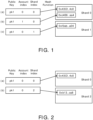
- FIG. 1 there is shown a block diagram illustrating a shard indexing scheme, wherein mapping of a single public key to different addresses on the same shard and/or a different shard is executed.
- the shard index is identical for all elements that are stored in the shard and does not need to be stored explicitly for each element.
- the account index generally zero for most addresses in the shard can be omitted to reduce storage requirements.
- FIG. 2 there is shown a block diagram illustrating a shard division scheme, wherein division of a shard 0 comprising addresses (a) and (b), wherein addresses (a) and (b) can be moved to different shards.
- previously stored addresses (a) and (b) of shard 0 as depicted in FIG. 1 are stored in two different shards, namely shard 0 and shard 2.
- the change of shard index results in a change in the hash/address of account (b).
- entire state (of said address) is preserved. It is possible that neither address would be moved following shard duplication in which case neither of the addresses would be altered.
- Shard 1 and all addresses associated with it are unchanged by the split of shard 0.
- FIG. 3 there is shown a block diagram illustrating a shard merging scheme, wherein the merging of shards 0 and 1 takes place.
- addresses (a) and (b) remain unchanged.
- address (c) is modified to prevent conflict with address (b). Said modification is achieved by incrementing its account index variable.
- said procedure ensures that entire state is preserved during both divide and merge operations.
- FIG. 4 there is a block diagram illustrating pricing mechanism for maximizing throughput, wherein cardinality and congestion affect transaction throughput in a distributed ledger arrangement/blockchain ledger.
- rows represent shards and columns or slices in the block, comprising at most one transaction per shard.
- transactions are shown as tiles occupying one or more shards in the block.
- the number of transactions is maximized when both cardinality and congestion are minimized. In other words, allowing the maximum number of transactions to be processed.
Landscapes
- Engineering & Computer Science (AREA)
- Computer Networks & Wireless Communication (AREA)
- Signal Processing (AREA)
- Computer Security & Cryptography (AREA)
- Computing Systems (AREA)
- Theoretical Computer Science (AREA)
- Information Retrieval, Db Structures And Fs Structures Therefor (AREA)
Claims (13)
- Verteiltes Computersystem, das eine Vielzahl von Arbeitsknoten einschließt, die über ein Datenkommunikationsnetzwerk miteinander gekoppelt sind, um Daten dazwischen auszutauschen, wobei die Arbeitsknoten konfiguriert sind, um Daten darin zu verarbeiten, wobei ein Betrieb des verteilten Computersystems durch Einsetzen einer Distributed-Ledger-Anordnung koordiniert wird, wobei das verteilte Computersystem konfiguriert ist, um mindestens einen Smart Contract über eine Verwendung der Distributed-Ledger-Anordnung auszuführen, wobei das verteilte Computersystem ferner umfasstein Schema zum Zuordnen kryptografischer Schlüssel zu einem bestimmten Shard in der Distributed-Ledger-Anordnung, sodass das Schema durch einen Benutzerarbeitsknoten und/oder einen Betreiberarbeitsknoten der Distributed-Ledger-Anordnung geändert werden kann; einen Preismechanismus, zum Spezifizieren von Transaktionskosten, sodass er einen Systemdurchsatz dadurch maximiert, dass er Benutzerarbeitsknoten einen Anreiz bietet, Transaktionen zu senden, die auf einen einzigen Shard beschränkt sind; Algorithmen zum Spezifizieren einer internen Logik für Wallet-Software, die auf Shards zugreift, sodass die Transaktionskosten minimiert werden; undwobei das verteilte Computersystem konfiguriert ist, um Prozeduren zum Reorganisieren von Zustandsdatenbanken auszuführen, wenn Shards dupliziert oder zusammengeführt werden, sodass nachfolgende Transaktionen maximal parallel ausgeführt werden,dadurch gekennzeichnet, dass, für jeden Shard, das Schema zum Zuordnen kryptografischer Schlüssel konfiguriert ist, um einen Index einzusetzen, der einen öffentlichen Schlüssel zu einem spezifischen Shard zuordnet, und um einen Kontoindex einzusetzen, der es erlaubt, einen einzelnen öffentlichen Schlüssel zu verschiedenen Adressen innerhalb eines gleichen Shards zuzuordnen.
- Verteiltes Computersystem nach Anspruch 1, wobei das System ferner eine Wallet-Software umfasst, die konfiguriert ist, um Änderungen innerhalb eines Blocks zu verfolgen, wenn eine Transaktion gesendet wird, wobei jeder der Shards eine Aufzeichnung der Zusammenführungs- und Aufteilungsvorgänge führt, die auf ihn angewendet wurden.
- Verteiltes Computersystem nach einem der Ansprüche 1 oder 2, wobei das System konfiguriert ist, um eine Berechtigung an Prüfer der Distributed-Ledger-Anordnung bereitzustellen, um Kontoindizes zu ändern.
- Verteiltes Computersystem nach Anspruch 2, wobei die Wallet-Software konfiguriert ist, um Wahrscheinlichkeiten zu berechnen, dass Transaktionen bei Aufteilungsvorgängen bestimmten Shards zugewiesen werden, um die durchschnittliche Anzahl von Abfragen, die erforderlich sind, zu verringern.
- Verteiltes Computersystem nach einem der vorstehenden Ansprüche, wobei das System konfiguriert ist, um für eine optimale Verteilung von Transaktionen zwischen den Shards zu sorgen, sodass der Anreiz für eine shardübergreifende Transaktion entzogen wird.
- Verteiltes Computersystem nach einem der vorstehenden Ansprüche, wobei jeder der Shards einen vordefinierten Überlastungsschwellenwert aufweist, wobei das System konfiguriert ist, um einen gegebenen Shard in zwei neue Shards aufzuteilen, wenn der gegebene Shard den vordefinierten Überlastungsschwellenwert erreicht.
- Verfahren zum Betreiben eines verteilten Computersystems, das eine Vielzahl von Arbeitsknoten einschließt, die über ein Datenkommunikationsnetzwerk miteinander gekoppelt sind, um Daten dazwischen auszutauschen, wobei die Arbeitsknoten konfiguriert sind, um Daten darin zu verarbeiten, wobei der Betrieb des verteilten Computersystems durch Einsetzen einer Distributed-Ledger-Anordnung koordiniert wird, wobei das verteilte Computersystem angeordnet ist, um mindestens einen Smart Contract über die Verwendung der Distributed-Ledger-Anordnung auszuführen,
das Verfahren umfassend:(a) Implementieren eines Schemas zum Zuordnen kryptografischer Schlüssel zu einem spezifischen Shard in der Distributed-Ledger-Anordnung, der durch einen Benutzerarbeitsknoten und/oder einen Betreiberarbeitsknoten der Distributed-Ledger-Anordnung geändert werden kann;(b) Einsetzen eines Indexes, der einen öffentlichen Schlüssel zu einem spezifischen Shard zuordnet, und Einsetzen eines Kontoindexes, der es erlaubt, einen einzelnen öffentlichen Schlüssel zu verschiedenen Adressen innerhalb eines gleichen Shards zuzuordnen;(c) Einsetzen eines Preismechanismus zum Spezifizieren von Transaktionsberechnungskosten, der Benutzerarbeitsknoten den Anreiz bietet, Transaktionen zu senden, die auf einen einzigen Shard beschränkt sind, wobei dadurch der Systemdurchsatz maximiert wird;(d) Einführen von Algorithmen, die die interne Logik für Wallet-Software spezifizieren, die auf Shards zugreift, sodass ihre Transaktionsberechnungskosten minimiert werden; und(e) Ausführen von Prozeduren zum Reorganisieren von Zustandsdatenbanken, wenn Shards dupliziert oder zusammengeführt werden, sodass nachfolgende Transaktionen maximal parallel ausgeführt werden können. - Verfahren nach Anspruch 7, wobei das Verfahren das Einsetzen einer Wallet-Software umfasst, die konfiguriert ist, um einen Block nachzuverfolgen, wenn die letzte Transaktion gesendet wurde, wobei jeder der Shards eine Aufzeichnung der Zusammenführungs- und Aufteilungsvorgänge führt, die auf ihn angewendet wurden.
- Verfahren nach einem der Ansprüche 7 oder 8, wobei das Verfahren ein Bereitstellen einer Berechtigung, um Kontoindizes zu ändern, an Prüfer der Distributed-Ledger-Anordnung umfasst.
- Verfahren nach Anspruch 8, wobei das Verfahren ein Sorgen dafür umfasst, dass die Wallet-Software die Wahrscheinlichkeiten berechnet, dass Transaktionen bei Aufteilungsvorgängen bestimmten Shards zugewiesen werden, um die durchschnittliche Anzahl von Abfragen, die erforderlich sind, zu verringern.
- Verfahren nach einem der Ansprüche 7 bis 10, wobei das Verfahren ein Entziehen des Anreizes für die shardübergreifende Transaktion und das Sorgen für die optimale Verteilung von Transaktionen zwischen Shards umfasst.
- Verfahren nach einem der Ansprüche 7 bis 11, wobei jeder der Shards einen vordefinierten Überlastungsschwellenwert aufweist, wobei ein gegebener Shard in zwei neue Shards aufgeteilt wird, wenn der gegebene Shard den vordefinierten Überlastungsschwellenwert erreicht.
- Softwareprodukt, das auf einem nichtflüchtigen maschinenlesbaren Datenspeichermedium aufgezeichnet ist, umfassend Anweisungen, die, wenn das Softwareprodukt auf einer Computerhardware ausgeführt wird, die Computerhardware veranlassen, ein Verfahren nach einem der Ansprüche 7 bis 12 zu implementieren.
Priority Applications (2)
| Application Number | Priority Date | Filing Date | Title |
|---|---|---|---|
| US17/996,163 US12483621B2 (en) | 2020-04-17 | 2021-04-16 | Mapping cryptographic keys to distributed ledger shards |
| PCT/IB2021/053155 WO2021209966A1 (en) | 2020-04-17 | 2021-04-16 | Distributed computer system and method of operation thereof |
Applications Claiming Priority (1)
| Application Number | Priority Date | Filing Date | Title |
|---|---|---|---|
| EP20020184 | 2020-04-17 |
Publications (3)
| Publication Number | Publication Date |
|---|---|
| EP3896901A1 EP3896901A1 (de) | 2021-10-20 |
| EP3896901C0 EP3896901C0 (de) | 2024-08-14 |
| EP3896901B1 true EP3896901B1 (de) | 2024-08-14 |
Family
ID=70390722
Family Applications (1)
| Application Number | Title | Priority Date | Filing Date |
|---|---|---|---|
| EP20020399.0A Active EP3896901B1 (de) | 2020-04-17 | 2020-09-07 | Verteiltes computersystem und verfahren zum betrieb davon |
Country Status (3)
| Country | Link |
|---|---|
| US (1) | US12483621B2 (de) |
| EP (1) | EP3896901B1 (de) |
| WO (1) | WO2021209966A1 (de) |
Cited By (1)
| Publication number | Priority date | Publication date | Assignee | Title |
|---|---|---|---|---|
| EP3920464A4 (de) * | 2019-02-03 | 2022-10-26 | bitFlyer Blockchain, Inc. | Verfahren zum speichern einer transaktion, die einen verbindungsaufbau zu einem verteilten netzwerk repräsentiert, und programm dafür |
Families Citing this family (6)
| Publication number | Priority date | Publication date | Assignee | Title |
|---|---|---|---|---|
| US12298919B2 (en) * | 2022-04-19 | 2025-05-13 | Dell Products L.P. | Bit level sharding of sensitive data for increased security |
| KR102843451B1 (ko) * | 2022-08-17 | 2025-08-07 | 주식회사 블룸테크놀로지 | 블록체인 네트워크에서 다이나믹 샤딩 시스템 및 방법 |
| KR102774697B1 (ko) * | 2022-09-22 | 2025-03-04 | 주식회사 블룸테크놀로지 | 블록체인 네트워크에서 어카운트 디렉토리 변경 시스템 및 방법 |
| WO2024148464A1 (zh) * | 2023-01-09 | 2024-07-18 | 华为技术有限公司 | 数据存储方法及相关设备 |
| CN118042001B (zh) * | 2024-04-12 | 2024-06-14 | 南京邮电大学 | 一种面向点对点能源交易的区块链自适应分片方法 |
| CN119884252B (zh) * | 2025-03-17 | 2025-09-05 | 恒辉信达技术有限公司 | 基于密钥管理系统的加密数据库高效数据治理方法 |
Family Cites Families (9)
| Publication number | Priority date | Publication date | Assignee | Title |
|---|---|---|---|---|
| US10396997B2 (en) * | 2016-12-14 | 2019-08-27 | International Business Machines Corporation | Container-based operating system and method |
| US10552556B2 (en) * | 2017-08-03 | 2020-02-04 | Liquineq AG | System and method for performance testing of scalable distributed network transactional databases |
| WO2020018898A1 (en) * | 2018-07-20 | 2020-01-23 | Ezblock Ltd. | Blockchain sharding with parallel threads |
| US11228452B2 (en) * | 2019-09-16 | 2022-01-18 | Cisco Technology, Inc. | Distributed certificate authority |
| US11943350B2 (en) * | 2019-10-16 | 2024-03-26 | Coinbase, Inc. | Systems and methods for re-using cold storage keys |
| US12481703B2 (en) * | 2020-03-30 | 2025-11-25 | International Business Machines Corporation | Shard hashing for database objects within a distributed database |
| KR20220014095A (ko) * | 2020-07-28 | 2022-02-04 | 삼성에스디에스 주식회사 | 블록체인 기반의 데이터 분산 관리 방법 및 이를 위한 장치 |
| US12021978B2 (en) * | 2021-07-22 | 2024-06-25 | Oracle International Corporation | Blockchain record of user biometrics for access control |
| US11803844B2 (en) * | 2021-12-06 | 2023-10-31 | Paypal, Inc. | Multi-party computation in a computer sharding environment |
-
2020
- 2020-09-07 EP EP20020399.0A patent/EP3896901B1/de active Active
-
2021
- 2021-04-16 US US17/996,163 patent/US12483621B2/en active Active
- 2021-04-16 WO PCT/IB2021/053155 patent/WO2021209966A1/en not_active Ceased
Cited By (1)
| Publication number | Priority date | Publication date | Assignee | Title |
|---|---|---|---|---|
| EP3920464A4 (de) * | 2019-02-03 | 2022-10-26 | bitFlyer Blockchain, Inc. | Verfahren zum speichern einer transaktion, die einen verbindungsaufbau zu einem verteilten netzwerk repräsentiert, und programm dafür |
Also Published As
| Publication number | Publication date |
|---|---|
| EP3896901C0 (de) | 2024-08-14 |
| WO2021209966A1 (en) | 2021-10-21 |
| EP3896901A1 (de) | 2021-10-20 |
| US20230254370A1 (en) | 2023-08-10 |
| US12483621B2 (en) | 2025-11-25 |
Similar Documents
| Publication | Publication Date | Title |
|---|---|---|
| EP3896901B1 (de) | Verteiltes computersystem und verfahren zum betrieb davon | |
| Kaur et al. | Blockchain: A path to the future | |
| Buldas et al. | An ultra-scalable blockchain platform for universal asset tokenization: Design and implementation | |
| US12002045B2 (en) | Resource management system and method of operation thereof | |
| Sarode et al. | Blockchain for committing peer-to-peer transactions using distributed ledger technologies | |
| Chen et al. | Bitcoin theft detection based on supervised machine learning algorithms | |
| Hannan et al. | Analysis of blockchain technology based on digital management systems and data mining technology | |
| Drąsutis | Iota smart contracts | |
| US20210089356A1 (en) | Data Processing System using Directed Acyclic Graph and Method of use thereof | |
| Deval et al. | Mobile smart contracts: exploring scalability challenges and consensus mechanisms | |
| Feng et al. | PoTN: a novel blockchain consensus protocol with proof-of-trust negotiation in distributed IoT networks | |
| Qiu et al. | [Retracted] Blockchain and K‐Means Algorithm for Edge AI Computing | |
| Gol et al. | Blockchain: A comparative analysis of hybrid consensus algorithm and performance evaluation | |
| Wang et al. | LRBFT: Improvement of practical Byzantine fault tolerance consensus protocol for blockchains based on Lagrange interpolation | |
| Alkhodair et al. | Consensus algorithms of distributed ledger technology--a comprehensive analysis | |
| Al-Mutar et al. | Scalability of blockchain: Review of cross-sharding with high communication overhead | |
| Yangang et al. | Research on the application of smart rural governance platform based on blockchain technology in rural sustainable development | |
| Lefkir et al. | Hiding sensitive frequent itemsets by item removal via two-level multi-objective optimization | |
| Anupama et al. | Survey on Blockchain Scalability Addressing Techniques | |
| Zhang | The Future of Mobile Edge Computing | |
| Joshi et al. | Rise of blockchain based digital twin: A transformative tool for new research trends | |
| Hussain et al. | Performance Optimized Leader Selection Consensus Algorithm for Consortium Blockchain Using Trust Values of Nodes | |
| Luqman et al. | Internet of Things Security: A Blockchain Perspective | |
| Chaudhury et al. | Smart Contracts on Algorand | |
| Bhardwaj et al. | A federated incremental blockchain framework with privacy preserving XAI optimization for securing healthcare data |
Legal Events
| Date | Code | Title | Description |
|---|---|---|---|
| PUAI | Public reference made under article 153(3) epc to a published international application that has entered the european phase |
Free format text: ORIGINAL CODE: 0009012 |
|
| STAA | Information on the status of an ep patent application or granted ep patent |
Free format text: STATUS: THE APPLICATION HAS BEEN PUBLISHED |
|
| AK | Designated contracting states |
Kind code of ref document: A1 Designated state(s): AL AT BE BG CH CY CZ DE DK EE ES FI FR GB GR HR HU IE IS IT LI LT LU LV MC MK MT NL NO PL PT RO RS SE SI SK SM TR |
|
| B565 | Issuance of search results under rule 164(2) epc |
Effective date: 20210210 |
|
| STAA | Information on the status of an ep patent application or granted ep patent |
Free format text: STATUS: REQUEST FOR EXAMINATION WAS MADE |
|
| 17P | Request for examination filed |
Effective date: 20220413 |
|
| RBV | Designated contracting states (corrected) |
Designated state(s): AL AT BE BG CH CY CZ DE DK EE ES FI FR GB GR HR HU IE IS IT LI LT LU LV MC MK MT NL NO PL PT RO RS SE SI SK SM TR |
|
| RAP3 | Party data changed (applicant data changed or rights of an application transferred) |
Owner name: UVUE LIMITED |
|
| 111Z | Information provided on other rights and legal means of execution |
Free format text: AL AT BE BG CH CY CZ DE DK EE ES FI FR GB GR HR HU IE IS IT LT LU LV MC MK MT NL NO PL PT RO RS SE SI SK SM TR Effective date: 20231018 |
|
| GRAP | Despatch of communication of intention to grant a patent |
Free format text: ORIGINAL CODE: EPIDOSNIGR1 |
|
| STAA | Information on the status of an ep patent application or granted ep patent |
Free format text: STATUS: GRANT OF PATENT IS INTENDED |
|
| INTG | Intention to grant announced |
Effective date: 20240527 |
|
| GRAS | Grant fee paid |
Free format text: ORIGINAL CODE: EPIDOSNIGR3 |
|
| GRAA | (expected) grant |
Free format text: ORIGINAL CODE: 0009210 |
|
| STAA | Information on the status of an ep patent application or granted ep patent |
Free format text: STATUS: THE PATENT HAS BEEN GRANTED |
|
| AK | Designated contracting states |
Kind code of ref document: B1 Designated state(s): AL AT BE BG CH CY CZ DE DK EE ES FI FR GB GR HR HU IE IS IT LI LT LU LV MC MK MT NL NO PL PT RO RS SE SI SK SM TR |
|
| REG | Reference to a national code |
Ref country code: GB Ref legal event code: FG4D |
|
| REG | Reference to a national code |
Ref country code: CH Ref legal event code: EP |
|
| REG | Reference to a national code |
Ref country code: DE Ref legal event code: R096 Ref document number: 602020035590 Country of ref document: DE |
|
| REG | Reference to a national code |
Ref country code: IE Ref legal event code: FG4D |
|
| U01 | Request for unitary effect filed |
Effective date: 20240913 |
|
| U07 | Unitary effect registered |
Designated state(s): AT BE BG DE DK EE FI FR IT LT LU LV MT NL PT RO SE SI Effective date: 20241002 |
|
| U20 | Renewal fee for the european patent with unitary effect paid |
Year of fee payment: 5 Effective date: 20241002 |
|
| PG25 | Lapsed in a contracting state [announced via postgrant information from national office to epo] |
Ref country code: NO Free format text: LAPSE BECAUSE OF FAILURE TO SUBMIT A TRANSLATION OF THE DESCRIPTION OR TO PAY THE FEE WITHIN THE PRESCRIBED TIME-LIMIT Effective date: 20241114 |
|
| PG25 | Lapsed in a contracting state [announced via postgrant information from national office to epo] |
Ref country code: GR Free format text: LAPSE BECAUSE OF FAILURE TO SUBMIT A TRANSLATION OF THE DESCRIPTION OR TO PAY THE FEE WITHIN THE PRESCRIBED TIME-LIMIT Effective date: 20241115 Ref country code: PL Free format text: LAPSE BECAUSE OF FAILURE TO SUBMIT A TRANSLATION OF THE DESCRIPTION OR TO PAY THE FEE WITHIN THE PRESCRIBED TIME-LIMIT Effective date: 20240814 |
|
| PG25 | Lapsed in a contracting state [announced via postgrant information from national office to epo] |
Ref country code: IS Free format text: LAPSE BECAUSE OF FAILURE TO SUBMIT A TRANSLATION OF THE DESCRIPTION OR TO PAY THE FEE WITHIN THE PRESCRIBED TIME-LIMIT Effective date: 20241214 |
|
| PG25 | Lapsed in a contracting state [announced via postgrant information from national office to epo] |
Ref country code: HR Free format text: LAPSE BECAUSE OF FAILURE TO SUBMIT A TRANSLATION OF THE DESCRIPTION OR TO PAY THE FEE WITHIN THE PRESCRIBED TIME-LIMIT Effective date: 20240814 |
|
| PG25 | Lapsed in a contracting state [announced via postgrant information from national office to epo] |
Ref country code: ES Free format text: LAPSE BECAUSE OF FAILURE TO SUBMIT A TRANSLATION OF THE DESCRIPTION OR TO PAY THE FEE WITHIN THE PRESCRIBED TIME-LIMIT Effective date: 20240814 Ref country code: RS Free format text: LAPSE BECAUSE OF FAILURE TO SUBMIT A TRANSLATION OF THE DESCRIPTION OR TO PAY THE FEE WITHIN THE PRESCRIBED TIME-LIMIT Effective date: 20241114 |
|
| PG25 | Lapsed in a contracting state [announced via postgrant information from national office to epo] |
Ref country code: RS Free format text: LAPSE BECAUSE OF FAILURE TO SUBMIT A TRANSLATION OF THE DESCRIPTION OR TO PAY THE FEE WITHIN THE PRESCRIBED TIME-LIMIT Effective date: 20241114 Ref country code: PL Free format text: LAPSE BECAUSE OF FAILURE TO SUBMIT A TRANSLATION OF THE DESCRIPTION OR TO PAY THE FEE WITHIN THE PRESCRIBED TIME-LIMIT Effective date: 20240814 Ref country code: NO Free format text: LAPSE BECAUSE OF FAILURE TO SUBMIT A TRANSLATION OF THE DESCRIPTION OR TO PAY THE FEE WITHIN THE PRESCRIBED TIME-LIMIT Effective date: 20241114 Ref country code: IS Free format text: LAPSE BECAUSE OF FAILURE TO SUBMIT A TRANSLATION OF THE DESCRIPTION OR TO PAY THE FEE WITHIN THE PRESCRIBED TIME-LIMIT Effective date: 20241214 Ref country code: HR Free format text: LAPSE BECAUSE OF FAILURE TO SUBMIT A TRANSLATION OF THE DESCRIPTION OR TO PAY THE FEE WITHIN THE PRESCRIBED TIME-LIMIT Effective date: 20240814 Ref country code: GR Free format text: LAPSE BECAUSE OF FAILURE TO SUBMIT A TRANSLATION OF THE DESCRIPTION OR TO PAY THE FEE WITHIN THE PRESCRIBED TIME-LIMIT Effective date: 20241115 Ref country code: ES Free format text: LAPSE BECAUSE OF FAILURE TO SUBMIT A TRANSLATION OF THE DESCRIPTION OR TO PAY THE FEE WITHIN THE PRESCRIBED TIME-LIMIT Effective date: 20240814 |
|
| PG25 | Lapsed in a contracting state [announced via postgrant information from national office to epo] |
Ref country code: SM Free format text: LAPSE BECAUSE OF FAILURE TO SUBMIT A TRANSLATION OF THE DESCRIPTION OR TO PAY THE FEE WITHIN THE PRESCRIBED TIME-LIMIT Effective date: 20240814 |
|
| PG25 | Lapsed in a contracting state [announced via postgrant information from national office to epo] |
Ref country code: CZ Free format text: LAPSE BECAUSE OF FAILURE TO SUBMIT A TRANSLATION OF THE DESCRIPTION OR TO PAY THE FEE WITHIN THE PRESCRIBED TIME-LIMIT Effective date: 20240814 |
|
| PG25 | Lapsed in a contracting state [announced via postgrant information from national office to epo] |
Ref country code: SK Free format text: LAPSE BECAUSE OF FAILURE TO SUBMIT A TRANSLATION OF THE DESCRIPTION OR TO PAY THE FEE WITHIN THE PRESCRIBED TIME-LIMIT Effective date: 20240814 |
|
| REG | Reference to a national code |
Ref country code: CH Ref legal event code: PL |
|
| PLBE | No opposition filed within time limit |
Free format text: ORIGINAL CODE: 0009261 |
|
| STAA | Information on the status of an ep patent application or granted ep patent |
Free format text: STATUS: NO OPPOSITION FILED WITHIN TIME LIMIT |
|
| PG25 | Lapsed in a contracting state [announced via postgrant information from national office to epo] |
Ref country code: MC Free format text: LAPSE BECAUSE OF FAILURE TO SUBMIT A TRANSLATION OF THE DESCRIPTION OR TO PAY THE FEE WITHIN THE PRESCRIBED TIME-LIMIT Effective date: 20240814 |
|
| 26N | No opposition filed |
Effective date: 20250515 |
|
| PG25 | Lapsed in a contracting state [announced via postgrant information from national office to epo] |
Ref country code: CH Free format text: LAPSE BECAUSE OF NON-PAYMENT OF DUE FEES Effective date: 20240930 |
|
| PG25 | Lapsed in a contracting state [announced via postgrant information from national office to epo] |
Ref country code: IE Free format text: LAPSE BECAUSE OF NON-PAYMENT OF DUE FEES Effective date: 20240907 |
|
| U20 | Renewal fee for the european patent with unitary effect paid |
Year of fee payment: 6 Effective date: 20250822 |
|
| PGFP | Annual fee paid to national office [announced via postgrant information from national office to epo] |
Ref country code: GB Payment date: 20250820 Year of fee payment: 6 |