EP3896479A1 - Localization systems and methods - Google Patents
Localization systems and methods Download PDFInfo
- Publication number
- EP3896479A1 EP3896479A1 EP21176497.2A EP21176497A EP3896479A1 EP 3896479 A1 EP3896479 A1 EP 3896479A1 EP 21176497 A EP21176497 A EP 21176497A EP 3896479 A1 EP3896479 A1 EP 3896479A1
- Authority
- EP
- European Patent Office
- Prior art keywords
- electronic device
- mobile electronic
- localization
- environment
- server
- Prior art date
- Legal status (The legal status is an assumption and is not a legal conclusion. Google has not performed a legal analysis and makes no representation as to the accuracy of the status listed.)
- Pending
Links
Images


Classifications
-
- G—PHYSICS
- G01—MEASURING; TESTING
- G01C—MEASURING DISTANCES, LEVELS OR BEARINGS; SURVEYING; NAVIGATION; GYROSCOPIC INSTRUMENTS; PHOTOGRAMMETRY OR VIDEOGRAMMETRY
- G01C21/00—Navigation; Navigational instruments not provided for in groups G01C1/00 - G01C19/00
- G01C21/10—Navigation; Navigational instruments not provided for in groups G01C1/00 - G01C19/00 by using measurements of speed or acceleration
- G01C21/12—Navigation; Navigational instruments not provided for in groups G01C1/00 - G01C19/00 by using measurements of speed or acceleration executed aboard the object being navigated; Dead reckoning
- G01C21/16—Navigation; Navigational instruments not provided for in groups G01C1/00 - G01C19/00 by using measurements of speed or acceleration executed aboard the object being navigated; Dead reckoning by integrating acceleration or speed, i.e. inertial navigation
- G01C21/165—Navigation; Navigational instruments not provided for in groups G01C1/00 - G01C19/00 by using measurements of speed or acceleration executed aboard the object being navigated; Dead reckoning by integrating acceleration or speed, i.e. inertial navigation combined with non-inertial navigation instruments
- G01C21/1656—Navigation; Navigational instruments not provided for in groups G01C1/00 - G01C19/00 by using measurements of speed or acceleration executed aboard the object being navigated; Dead reckoning by integrating acceleration or speed, i.e. inertial navigation combined with non-inertial navigation instruments with passive imaging devices, e.g. cameras
-
- G—PHYSICS
- G01—MEASURING; TESTING
- G01C—MEASURING DISTANCES, LEVELS OR BEARINGS; SURVEYING; NAVIGATION; GYROSCOPIC INSTRUMENTS; PHOTOGRAMMETRY OR VIDEOGRAMMETRY
- G01C21/00—Navigation; Navigational instruments not provided for in groups G01C1/00 - G01C19/00
- G01C21/20—Instruments for performing navigational calculations
-
- G—PHYSICS
- G01—MEASURING; TESTING
- G01S—RADIO DIRECTION-FINDING; RADIO NAVIGATION; DETERMINING DISTANCE OR VELOCITY BY USE OF RADIO WAVES; LOCATING OR PRESENCE-DETECTING BY USE OF THE REFLECTION OR RERADIATION OF RADIO WAVES; ANALOGOUS ARRANGEMENTS USING OTHER WAVES
- G01S5/00—Position-fixing by co-ordinating two or more direction or position line determinations; Position-fixing by co-ordinating two or more distance determinations
- G01S5/02—Position-fixing by co-ordinating two or more direction or position line determinations; Position-fixing by co-ordinating two or more distance determinations using radio waves
- G01S5/0257—Hybrid positioning
- G01S5/0263—Hybrid positioning by combining or switching between positions derived from two or more separate positioning systems
- G01S5/0264—Hybrid positioning by combining or switching between positions derived from two or more separate positioning systems at least one of the systems being a non-radio wave positioning system
-
- H—ELECTRICITY
- H04—ELECTRIC COMMUNICATION TECHNIQUE
- H04W—WIRELESS COMMUNICATION NETWORKS
- H04W64/00—Locating users or terminals or network equipment for network management purposes, e.g. mobility management
-
- H—ELECTRICITY
- H04—ELECTRIC COMMUNICATION TECHNIQUE
- H04W—WIRELESS COMMUNICATION NETWORKS
- H04W64/00—Locating users or terminals or network equipment for network management purposes, e.g. mobility management
- H04W64/003—Locating users or terminals or network equipment for network management purposes, e.g. mobility management locating network equipment
Definitions
- the present invention relates to localization.
- a system for providing localization of a mobile electronic device within an environment includes at least one server in communication with the mobile electronic device.
- the at least one server is adapted to receive input data from the mobile electronic device, the input data at least including one or more 2-dimensional feature points extracted from at least one picture representing at least a portion of the environment.
- the at least one server includes a localization module that provides localization to the mobile electronic device based on the input data and on at least one 3-dimensional map of the environment.
- the input data received at the server further includes at least one accelerometer measurement and at least one 3-dimensional map of the environment.
- the 3-dimensional map includes a database of 3-dimensional feature points.
- the localization module provides localization by matching 2-dimensional feature points with the 3-dimensional feature points.
- the server is configured to invoke a cloud computing service for executing the localization module.
- the at least one accelerometer measurement includes a 3-axis acceleration measurement from a 3-axis accelerometer.
- the mobile electronic device is a wearable smart gadget.
- the localization module is adapted toconstrain a search space of the 3-dimensional map to a subset for comparing the at least one picture and at least one accelerometer measurement to the 3-dimensional map.
- the localization module constrains the search space of the 3-dimensional map by calculating a pitch and roll of the mobile electronic device from the accelerometer measurement.
- the localization module constrains the search space of the 3-dimensional map by approximating a position of the mobile electronic device within the environment using at least one of WiFi geolocation, a two-dimensional barcode or location information input in the mobile electronic device.
- the environment is an indoor environment.
- the mobile device is configured to:
- the mobile device is further configured to: include the at least one 3-dimensional map of the environment the at least one accelerometer measurement as part of the input data that is transmitted from the mobile device to the server.
- the system 10 includes a mobile electronic device 12 adapted to be operated by a user 14 within an indoor environment 16, a localization module 18 and a pre-built indoor 3-dimensional (3D) map 20 of the indoor environment 16.
- the mobile electronic device 12 may be any typical mobile device that includes a color camera, a 3-axis accelerometer, and at least one communication network connection (e.g. a connection to a mobile data network, a WiFi wireless computer network, or the like).
- the mobile electronic device 12 may be a cellular telephone, smart phone, a tablet, GOOGLE GLASS, or any similar portable device that may be worn and/or carried and operated by the user 14 inside the indoor environment 16.
- the pre-built 3D indoor map 20 of the indoor environment 16 is built offline, before the system 10 can perform indoor localization, to capture geometry of the indoor environment 16 of interest.
- the pre-built 3D indoor map 20 is stored in a location that is accessible to the localization module 18 as will be discussed in greater detail below.
- the 3D indoor map 20 may be a collection or database of 3D feature points 21 sampled in the indoor environment 16.
- the pre-built 3D indoor map 20 may be built, for example, using a color and depth (RGB-D) camera, such as the KINECT motion sensing input device developed by MICROSOFT, to map the indoor environment 16 of a particular building of interest.
- the KINECT motion sensing input device has an Infra-Red (IR) pattern source and an IR camera.
- the IR camera detects IR patterns projected by the IR pattern source and reflected on objects, which allows an on-board chip to estimate a depth map of the object using stereoscopy.
- This depth map and the corresponding RGB image provided by the RGB camera may be used to define 3D feature points 21 in an indoor map coordinate system (x, y, z), shown in FIG. 2 .
- Each 3D feature point 21 may include, for example, 3D coordinates in the 3D indoor map 20 and a Scale Invariant Feature Transform (SIFT) descriptor (e.g. a 128-dimensional vector) that characterizes an appearance of a small area around the 3D feature point 21 to allow for feature point matching.
- SIFT Scale Invariant Feature Transform
- the 3D indoor map 20 may be built by iteratively associating 3D feature points 21 from consecutive RGB-D images as the RGB-D camera is moved around the indoor environment 16 to define the pre-built 3D indoor map 20 of the indoor environment 16 as the collection or database of these 3D feature points 21.
- the localization module 18 may be located on a server 22 and is adapted to communicate with the mobile electronic device 12 to receive input therefrom and to provide localization to the electronic device 12 in response to the input.
- the server 22 may be a standalone server unit or may be a cloud computing service 24, as shown in FIG. 3 , as should be understood by those skilled in the art.
- the server 22 includes the necessary electronics, software, memory, storage, databases, firmware, logic/state machines, microprocessors, communication links, and any other input/output interfaces to perform the functions described herein and/or to achieve the results described herein.
- the server 22 may include processor 26 and memory 28, which may include system memory, including random access memory (RAM) and read-only memory (ROM).
- the server 22 may be in communication with the mobile electronic device 12 and/or to one or more other mobile devices through a communication interface unit 30, as should be understood by those skilled in the art, to facilitate the operation of the system 10 for indoor localization as discussed below.
- Suitable computer program code may be provided to the server 22 for executing numerous functions, including those discussed below in connection with the localization module 18.
- the processor 26 may include one or more conventional microprocessors and one or more supplementary co-processors such as math co-processors or the like.
- the processor 26 may be in communication with the communication interface unit 30, through which the processor 26 may communicate with other networks and/or devices such as other servers, other processors, computers, cellular telephones, tablets and the like.
- the communication interface unit 30 may include multiple communication channels for simultaneous communication with, for example, other mobile electronic devices 12, processors, servers, computers, cellular telephones, tablets, or the like. Devices in communication with each other need not be continually transmitting to each other. Devices in communication with each other may require several steps to be performed to establish a communication link between the devices.
- the processor 26 is in communication with the memory 28, which may comprise an appropriate combination of magnetic, optical and/or semiconductor memory, and may include, for example, RAM, ROM, flash drive, an optical disc such as a compact disc and/or a hard disk or drive.
- the processor 26 and the memory 28 each may be, for example, located entirely within a single computer or other device; or connected to each other by a communication medium, such as a USB port, serial port cable, a coaxial cable, an Ethernet type cable, a telephone line, a radio frequency transceiver or other similar wireless or wired medium or combination of the foregoing.
- the processor 26 may be connected to memory 28 via the communication interface unit 30.
- the memory 28 stores the pre-built 3D indoor map 20 and may also store, for example, one or more databases and/or other information required by the localization module 18, an operating system for the server 22, and/or one or more other programs (e.g., computer program code and/or a computer program product) adapted to direct the localization module 18 to provide localization to the mobile electronic device 12 according to the various embodiments discussed herein.
- the memory 28 may also store a WiFi fingerprint map (not shown) of the indoor environment 16 as will be discussed in greater detail below.
- the pre-built 3D indoor map 20, operating system, localization module 18 and/or other programs may be stored, for example, in a compressed, an uncompiled and/or an encrypted format, and may include computer program code executable by the processor 26.
- the instructions of the computer program code may be read into a main memory of the processor 26 from the memory 28 or a computer-readable medium other than the memory 28. While execution of sequences of instructions in the program causes the processor 26 to perform the process steps described herein, hard-wired circuitry may be used in place of, or in combination with, software instructions for implementation of the processes of the present invention. Thus, embodiments of the present invention are not limited to any specific combination of hardware and software.
- the programs discussed herein may also be implemented in programmable hardware devices such as field programmable gate arrays, programmable array logic, programmable logic devices or the like. Programs may also be implemented in software for execution by various types of computer processors.
- a program of executable code may, for instance, comprise one or more physical or logical blocks of computer instructions, which may, for instance, be organized as an object, procedure, process or function. Nevertheless, the executables of an identified program need not be physically located together, but may comprise separate instructions stored in different locations which, when joined logically together, comprise the program and achieve the stated purpose for the programs such providing indoor localization of the mobile electronic device 12.
- an application of executable code may be a compilation of many instructions, and may even be distributed over several different code partitions or segments, among different programs, and across several devices.
- Non-volatile media include, for example, optical, magnetic, or opto-magnetic disks, such as memory.
- Volatile media include dynamic random access memory (DRAM), which typically constitutes the main memory.
- Computer-readable media include, for example, a floppy disk, a flexible disk, hard disk, magnetic tape, any other magnetic medium, a CD-ROM, DVD, any other optical medium, punch cards, paper tape, any other physical medium with patterns of holes, a RAM, a PROM, an EPROM or EEPROM (electronically erasable programmable read-only memory), a FLASH-EEPROM, any other memory chip or cartridge, or any other medium from which a computer can read.
- a floppy disk a flexible disk, hard disk, magnetic tape, any other magnetic medium, a CD-ROM, DVD, any other optical medium, punch cards, paper tape, any other physical medium with patterns of holes, a RAM, a PROM, an EPROM or EEPROM (electronically erasable programmable read-only memory), a FLASH-EEPROM, any other memory chip or cartridge, or any other medium from which a computer can read.
- Various forms of computer readable media may be involved in carrying one or more sequences of one or more instructions to the processor 26 (or any other processor of a device described herein) for execution.
- the instructions may initially be stored on a magnetic disk of a remote computer (not shown).
- the remote computer can load the instructions into its dynamic memory and send the instructions over an Ethernet connection, cable line, telephone line using a modem, wirelessly or over another suitable connection.
- a communications device local to a computing device e.g., server 22
- the system bus carries the data to the main memory, from which the processor 26 retrieves and executes the instructions.
- the instructions received by main memory may optionally be stored in memory 28 either before or after execution by the processor 26.
- instructions may be received via a communication port as electrical, electromagnetic or optical signals, which are exemplary forms of wireless communications or data streams that carry various types of information.
- the system 10 for indoor localization allows the localization module 18, executing on the server 22, to calculate the 3D position and orientation of the mobile electronic device 12 using only a 2-dimensional (2D) picture captured by the camera of the mobile electronic device 12 and an acceleration measurement taken by the 3-axis accelerometer of the mobile electronic device 12.
- 2D picture captured by the camera and the acceleration measurement from the mobile electronic device 12 are in a device coordinate system (u, v, s).
- the localization module matches 2D feature points 21 in the 2D picture with the 3D feature points 21 in the 3D indoor map 20, shown in FIG.
- the server 22 first receives input data from the 2D picture and acceleration measurement, captured substantially simultaneously, from the mobile electronic device 12 at 32.
- input data may be the 2D photograph and acceleration measurements captured by the mobile electronic device 12.
- the mobile electronic device 12 may extract information from the 2D photograph and/or acceleration measurements and may send the extract information instead of, or in addition to, the 2D photograph and/or acceleration measurements.
- the mobile electronic device 12 may calculate pitch ⁇ and roll ⁇ angles from the accelerometer measurement and may send the calculated angles to the localization system 18 along with the 2D picture as the input data.
- the mobile electronic device 12 may perform the angle calculation discussed below as should be understood by those skilled in the art.
- the mobile electronic device 12 may also extract feature points 21 from the 2D picture and may send the feature points 21 to the localization system 18, instead of sending the 2D picture itself. Extracting the feature points 21 locally at the mobile electronic device 12 may be more power and/or bandwidth-efficient and may conserve computing resources at the localization module 18 and server 22, depending upon an efficiency of the feature point 21 extraction, a quality of the network condition between the mobile electronic device 12 and the server 22 and the like.
- the server 22 restrains a search space of the 3D indoor map 20 from the entire map to a subset of the 3D indoor map 20 based on the acceleration measurement received from the mobile electronic device 12.
- the localization module 18 may restrain the search space using the pitch ⁇ and roll ⁇ angles received from the mobile electronic device 12, if the angles are received as part of the input data, or by first calculating the pitch angle ⁇ and roll angle ⁇ of the mobile electronic device 12 based on the 3-axis accelerometer measurements.
- the localization module 18 (or the mobile electronic device 12) calculates the pitch ⁇ and roll ⁇ angles by assuming that the acceleration on the mobile electronic device 12 when the measurement was taken is acceleration due to gravity (i.e. noise and/or misalignment biases are ignored).
- G u , G v and G s are the components of gravity detected by the 3-axis accelerometer in the device coordinate system (u, v, s), shown in FIG. 2 .
- the localization module 18 may then constrain the search space of the 3D indoor map 20 using the calculated pitch ⁇ and roll ⁇ angles. For example, the localization module 18 may constrain the search space to include only orientations within thirty (30) degrees of the horizontal if the acceleration measurement indicates that the mobile electronic device 12 is tilted upright.
- the localization module 18 may use the calculated pitch ⁇ and roll ⁇ angles to match feature points from the 2D picture provided by the mobile electronic device 12 with feature points from the 3D indoor map 20 stored in memory 28 to obtain a rough estimation of the 3D position, as expressed by the translation vector (T x , T y , T z ), and yaw angle ⁇ of the mobile electronic device 12 within the subset of the 3D indoor map 20.
- the localization module 18 may obtain the rough estimation of the 3D position, as expressed by the translation vector (T x , T y , T z ), and yaw angle ⁇ of the mobile electronic device 12 using a quadratic constraint least-square estimation or similar calculation.
- the localization module 18 may also apply the Random Sample Consensus (RANSAC) algorithm or the like to remove outliers due to mismatched feature point pairs.
- RANSAC Random Sample Consensus
- J( ⁇ ) may be calculated by the location module 18 at every 10° degrees of ⁇ between 0° and 360° (i.e. the calculation may be repeated 36 times).
- the location module 18 selects the ⁇ that provides the smallest value for J( ⁇ ) as the rough estimate of the yaw angle ⁇ , which provides a corresponding rough estimate of the 3D position, as expressed by the translation vector (T x , T y , T z ).
- the localization module 18 on the server 22 uses the rough estimation of the 3D position and yaw angle ⁇ to determine the 3D position and orientation of the mobile electronic device 12 with sub-meter accuracy (i.e. the position and orientation of the mobile electronic device 12 within a meter of the actual position of the device).
- This full optimization reduces any errors caused by accelerometer measurement errors, for example, due to measurement noise, bias from small accelerations, mechanical misalignments of the camera or accelerometer or the like.
- the localization module 18 uses matched feature point pairs between the 3D indoor map 20 stored in memory 28 and the 2D picture using the rough estimation of the 3D position and yaw angle ⁇ and the calculated pitch ⁇ and roll y angles as a starting point.
- the localization module 18 conducts a six-parameter optimization (i.e. the 3D position parameters and the three orientation parameters) to calculate the 3D position and attitude angles of the mobile electronic device 12 by determining the translation vector (T x , T y , T z ) and rotation matrix (Rx(y), Ry( ⁇ ), Rz( ⁇ )) between the matched feature point pairs assuming rigid-body motion.
- the full optimization may be executed using known numerical optimization tools such as MATLAB, GNU OCTAVE or the like. The full optimization allows the localization module 18 to determine the 3D position and orientation of the mobile electronic device 12 with sub-meter accuracy.
- the localization module 18 may perform an iteration of the Newton-Raphson method to determine the yaw angle ⁇ with sub-meter accuracy.
- the server 22 then transmits the calculated 3D position and orientation determination back to the mobile electronic device 12 to provide indoor localization to the mobile electronic device 12 with sub-meter accuracy.
- the mobile electronic device 12 may use the indoor localization provided by the localization module 18 for a variety of applications.
- the indoor localization may be used for augmented reality applications, to enhance interactive indoor tours, for destination guidance within indoor environments (e.g. at malls, airports or the like), for mobility aid for blind people, for wireless emergency responses, or for other similar applications.
- the system 10, shown in FIG. 1 may also use additional input from the mobile electronic device 12 for approximating the rough estimate of the localization of the mobile electronic device 12.
- the server 22 may approximate the position of the mobile electronic device 12 within the indoor structure 16, shown in FIG. 1 , using WiFi geolocation, an explicit input from the mobile electronic device 12 (e.g. the reading of two-dimensional barcode such as a QUICK RESPONSE (QR) code, the input of a room number or other similar location information) or the like.
- the server 22 may compare a WiFi signal received on the mobile electronic device 12 to a WiFi fingerprint map of the indoor structure 16, shown in FIG.
- the WiFi geolocation provides for an approximate position of the mobile electronic device 12 in the indoor structure 16, shown in FIG. 1 , within a radius on the magnitude of tens of meters.
- Various techniques for performing WiFi geolocation should be readily understood by those skilled in the art.
- the WiFi fingerprint map of the indoor structure 16, shown in FIG. 1 may be, for example, a pre-existing map of the indoor structure 16, shown in FIG. 1 , if one is available.
- the WiFi fingerprint map may be pre-built in an offline phase (e.g. at the same time that the 3D indoor map 20 is built) according to known techniques for WiFi fingerprint mapping.
- the approximate position detected through WiFi geolocation is used by the localization module 18 to additionally constrain the search space of the 3D indoor map 20, as will be discussed below.
- the server 22 may also use an explicit input from the mobile electronic device 12 to approximate localization of the mobile electronic device 12 at 140.
- the user 14, shown in FIG. 1 may read a two-dimensional barcode, such as a QR code, with the mobile electronic device 12 or may input other localization information directly into the mobile electronic device 12 such as a room number, floor number or the like.
- the server 22 receives input data from the 2D picture and acceleration measurement, which may be captured substantially simultaneously, from the mobile electronic device 12 in substantially the same manner discussed in connection with FIG. 4 .
- a user may take the 2D photo and the acceleration measurements using a cellular telephone, smart phone, tablet, GOOGLE GLASS, or any similar mobile electronic device 12.
- the acceleration measurements may be, for example, 3-axis acceleration measurements from a 3-axis accelerometer.
- the mobile electronic device 12 then sends the 2D photograph and acceleration measurements to the localization module 18 on the server 22.
- the input data may be the 2D photograph and acceleration measurements captured by the mobile electronic device 12.
- the mobile electronic device 12 may extract information from the 2D photograph and/or acceleration measurements and may send the extract information instead of, or in addition to, the 2D photograph and/or acceleration measurements.
- the mobile electronic device 12 may calculate pitch ⁇ and roll ⁇ angles from the accelerometer measurement and may send the calculated angles to the localization system 18 along with the 2D picture as the input data.
- the mobile electronic device 12 may perform the angle calculation discussed below as should be understood by those skilled in the art.
- the mobile electronic device 12 may also extract feature points 21 from the 2D picture and may send the feature points 21 to the localization system 18, instead of sending the 2D picture itself. Extracting the feature points 21 locally at the mobile electronic device 12 may be more power and/or bandwidth-efficient and may conserve computing resources at the localization module 18 and server 22, depending upon an efficiency of the feature point 21 extraction, a quality of the network condition between the mobile electronic device 12 and the server 22 and the like.
- the server 22 restrains a search space of the 3D indoor map 20 from the entire map to a subset of the 3D indoor map 20 based on the approximate position detected at 140 (e.g. through WiFi geolocation) and on the acceleration measurements received from the mobile electronic device 12.
- the localization module 18 uses the approximate position detected at 140 (e.g. through WiFi geolocation) to restrain the search space from the entire 3D indoor map 20 of the indoor space to the smaller subset (e.g. in a radius of twenty (20) meters around the approximate position detected through WiFi geolocation).
- the localization module 18 may use the pitch ⁇ and roll ⁇ angles received from the mobile electronic device 12, if the angles are received as part of the input data, or may calculate the pitch and roll angles of the mobile electronic device 12 from the 3-axis accelerometer measurements, in substantially the same manner discussed in connection with FIG. 4 , by assuming that the only acceleration on the mobile electronic device 12 when the measurement was taken is acceleration due to gravity (i.e. noise and/or misalignment biases are ignored). The localization module 18 may then constrain the search space of the 3D indoor map 20 using the calculated pitch and roll angles.
- the localization module 18 may constrain the search space to include only orientations within thirty (30) degrees of the horizontal if the acceleration measurement indicates that the mobile electronic device 12 is tilted upright.
- the localization module 18 uses the calculated pitch and roll angles to match feature points from the 2D picture provided by the mobile electronic device 12 with feature points from the constrained subset of the 3D indoor map 20 stored in memory 28 to obtain a rough estimation of the 3D position and yaw angle of the mobile electronic device 12 within the subset of the 3D indoor map 20.
- the localization module 18 may obtain the rough estimation of the 3D position and yaw angle of the mobile electronic device 12 using a quadratic constraint least-square estimation or similar calculation.
- the localization module 18 may also apply the Random Sample Consensus (RANSAC) algorithm or the like to remove outliers due to mismatched feature point pairs.
- RANSAC Random Sample Consensus
- the localization module 18 on the server 22 uses the rough estimation of the 3D position and yaw angle to determine the 3D position and orientation of the mobile electronic device 12 with sub-meter accuracy (i.e. the position and orientation of the mobile electronic device 12 within a meter of the actual position of the device) in substantially the same manner discussed in connection with FIG. 4 .
- This full optimization reduces any errors caused by accelerometer measurement errors, for example, due to measurement noise, bias from small accelerations, mechanical misalignments of the camera or accelerometer or the like.
- the localization module 18 uses matched feature point pairs between the 3D indoor map 20 stored in memory 28 and the 2D picture using the rough estimation of the 3D position and yaw angle and the calculated pitch and roll angles as a starting point.
- the localization module 18 conducts a six-parameter optimization (i.e. the 3D position parameters and the three orientation parameters) to calculate the 3D position and attitude angles of the mobile electronic device 12 by determining a translation vector and rotation matrix between the matched feature point pairs assuming rigid-body motion.
- the full optimization may be executed using known numerical optimization tools such as MATLAB, GNU OCTAVE or the like. The full optimization allows the localization module 18 to determine the 3D position and orientation of the mobile electronic device 12 with sub-meter accuracy.
- the server 22 then transmits the calculated 3D position and orientation determination back to the mobile electronic device 12 to provide indoor localization to the mobile electronic device 12 with sub-meter accuracy (i.e. centimeter-level 3D localization).
- the mobile electronic device 12 may use the indoor localization provided by the localization module 18 for a variety of applications.
- the indoor localization may be used for augmented reality applications, to enhance interactive indoor tours, for destination guidance within indoor environments (e.g. at malls, airports or the like), for mobility aid for blind people, for wireless emergency responses, or for other similar applications.
- the system 10 shown in FIG. 1 advantageously allows calculation of the 3D position and orientation of the mobile electronic device 12 using input data from a 2D photograph and accelerometer measurements captured from the electronic device 12 with an existing 3D indoor map 20 of the indoor structure 16, shown in FIG. 1 .
- WiFi measurements or location information from the mobile electronic device 12 and, in an embodiment, an existing WiFi fingerprint map stored on one or several remote servers 22 are also used in addition to the 2D photograph and the accelerometer measurements to determine the location of the mobile electronic device 12.
- the 3D indoor map 20 (and, in an embodiment, the WiFi fingerprint map) of the indoor environment 16, shown in FIG. 1 there is no need for special hardware, such as depth cameras, on mobile devices, or for installations of dedicated equipments such as radio frequency beacons.
- the system 10, shown in FIG. 1 advantageously provides for accurate indoor localization (i.e. position and attitude angles) of mobile electronic devices 12 within sub-meter (e.g. centimeter-level) accuracy.
- the system 10 shown in FIG. 1 may be implemented for both commercial and non-commercial Location-Based Services (LBS), including network optimization, precise indoor navigation, augmented reality uses such as advertising (user engagement) or leisure applications (e.g. gaming or museum visits) or any similar application for improving the user's experience within the indoor environment 16, shown in FIG. 1 .
- LBS Location-Based Services
- the system 10 provides high-fidelity 3D localization (rather than simple 2D navigation), which may be advantageous for augmented reality based applications using wearable smart gadgets such as GOOGLE GLASS or the like.
- the computational overhead for feature point matching may become high in a real-world indoor environment depending upon the size of the indoor environment (e.g. since the computational overhead for indoor environment 16 shown in FIG. 1 may have a linear relationship with the size of the 3D indoor map 20).
- the cloud computing service 24, as shown in FIG. 3 ma advantageously address this issue by offloading computation in a scale-out fashion to a plurality of servers 22 in the cloud to allow the cloud computing service 24, shown in FIG. 3 , to compute the 3D position and orientation angles of the mobile electronic device 12.
- the cloud computing service 24, shown in FIG. 3 may advantageously allow the system 10, shown in FIG. 1 , to produce localization results with ten (10) centimeter accuracy in a matter of seconds.
Landscapes
- Engineering & Computer Science (AREA)
- Radar, Positioning & Navigation (AREA)
- Remote Sensing (AREA)
- Physics & Mathematics (AREA)
- General Physics & Mathematics (AREA)
- Automation & Control Theory (AREA)
- Computer Networks & Wireless Communication (AREA)
- Signal Processing (AREA)
- Navigation (AREA)
- Telephone Function (AREA)
- Telephonic Communication Services (AREA)
Abstract
Description
- The present invention relates to localization.
- There is an increasing need to provide indoor localization that replicates the outdoor localization provided by vehicle navigation systems, such as global positioning systems (GPS), in indoor environments where GPS signals are not typically able to register. Approaches for providing indoor localization include Radio Frequency (RF) fingerprinting, where WiFi or cellular signal measurements are matched against RF maps of a site of interest to infer a user's current location at the site, and vision-based Simultaneous Localization and Mapping (SLAM), where a map of an unknown environment is incrementally built by projected images and the viewer's current location and trajectory are deduced along the process. However, these indoor localization systems typically lack accuracy in localization in 3D space or require too resource-intensive computations and/or specialized hardware.
Examples of prior art approaches compriseWO2012/106075 ,WO2011/144968 orWO2011/144967 . However the localization system of these approaches are based on bar-code recognition, which is an important limitation. - According to an embodiment, a system for providing localization of a mobile electronic device within an environment includes at least one server in communication with the mobile electronic device. The at least one server is adapted to receive input data from the mobile electronic device, the input data at least including one or more 2-dimensional feature points extracted from at least one picture representing at least a portion of the environment. The at least one server includes a localization module that provides localization to the mobile electronic device based on the input data and on at least one 3-dimensional map of the environment.
- According to an embodiment, the input data received at the server further includes at least one accelerometer measurement and at least one 3-dimensional map of the environment.
- According to an embodiment, the 3-dimensional map includes a database of 3-dimensional feature points.
- According to an embodiment, the localization module provides localization by matching 2-dimensional feature points with the 3-dimensional feature points.
- According to an embodiment, the server is configured to invoke a cloud computing service for executing the localization module.
- According to an embodiment, the at least one accelerometer measurement includes a 3-axis acceleration measurement from a 3-axis accelerometer.
- According to an embodiment, the mobile electronic device is a wearable smart gadget.
- According to an embodiment, the localization module is adapted toconstrain a search space of the 3-dimensional map to a subset for comparing the at least one picture and at least one accelerometer measurement to the 3-dimensional map.
- According to an embodiment, the localization module constrains the search space of the 3-dimensional map by calculating a pitch and roll of the mobile electronic device from the accelerometer measurement.
- According to an embodiment, the localization module constrains the search space of the 3-dimensional map by approximating a position of the mobile electronic device within the environment using at least one of WiFi geolocation, a two-dimensional barcode or location information input in the mobile electronic device.
- According to an embodiment, the environment is an indoor environment.
- According to an embodiment, the mobile device is configured to:
- generate the input data at least including the one or more 2-dimensional feature points extracted from the at least one picture representing at least the portion of the environment;
- transmit the input data to the server; and,
- receive the localization of the mobile electronic device based on the input data and the at least one 3-dimensional map of the environment.
- According to an embodiment, the mobile device is further configured to:
include the at least one 3-dimensional map of the environment the at least one accelerometer measurement as part of the input data that is transmitted from the mobile device to the server. - These and other embodiments will become apparent in light of the following detailed description herein, with reference to the accompanying drawings.
-
-
FIG. 1 is a schematic diagram of a system according to an embodiment; -
FIG. 2 is schematic diagram of the coordinate systems of the system ofFIG. 1 ; -
FIG. 3 is a schematic diagram of the system ofFIG. 1 implementing a cloud computing service; -
FIG. 4 is a flow diagram of an embodiment for providing indoor localization with the system ofFIG. 1 ; and -
FIG. 5 is a flow diagram of an embodiment for providing indoor localization with the system ofFIG. 1 . - Before the various embodiments are described in further detail, it is to be understood that the invention is not limited to the particular embodiments described. It will be understood by one of ordinary skill in the art that the systems and methods described herein may be adapted and modified as is appropriate for the application being addressed and that the systems and methods described herein may be employed in other suitable applications, and that such other additions and modifications will not depart from the scope thereof.
- In the drawings, like reference numerals refer to like features of the systems and methods of the present application. Accordingly, although certain descriptions may refer only to certain Figures and reference numerals, it should be understood that such descriptions might be equally applicable to like reference numerals in other Figures.
- Referring to
FIG. 1 , asystem 10 for indoor localization is shown. Thesystem 10 includes a mobileelectronic device 12 adapted to be operated by auser 14 within anindoor environment 16, alocalization module 18 and a pre-built indoor 3-dimensional (3D)map 20 of theindoor environment 16. - The mobile
electronic device 12 may be any typical mobile device that includes a color camera, a 3-axis accelerometer, and at least one communication network connection (e.g. a connection to a mobile data network, a WiFi wireless computer network, or the like). For example, the mobileelectronic device 12 may be a cellular telephone, smart phone, a tablet, GOOGLE GLASS, or any similar portable device that may be worn and/or carried and operated by theuser 14 inside theindoor environment 16. - The pre-built 3D
indoor map 20 of theindoor environment 16 is built offline, before thesystem 10 can perform indoor localization, to capture geometry of theindoor environment 16 of interest. The pre-built 3Dindoor map 20 is stored in a location that is accessible to thelocalization module 18 as will be discussed in greater detail below. The 3Dindoor map 20 may be a collection or database of3D feature points 21 sampled in theindoor environment 16. The pre-built 3Dindoor map 20 may be built, for example, using a color and depth (RGB-D) camera, such as the KINECT motion sensing input device developed by MICROSOFT, to map theindoor environment 16 of a particular building of interest. The KINECT motion sensing input device has an Infra-Red (IR) pattern source and an IR camera. The IR camera detects IR patterns projected by the IR pattern source and reflected on objects, which allows an on-board chip to estimate a depth map of the object using stereoscopy. This depth map and the corresponding RGB image provided by the RGB camera may be used to define3D feature points 21 in an indoor map coordinate system (x, y, z), shown inFIG. 2 . Each3D feature point 21 may include, for example, 3D coordinates in the 3Dindoor map 20 and a Scale Invariant Feature Transform (SIFT) descriptor (e.g. a 128-dimensional vector) that characterizes an appearance of a small area around the3D feature point 21 to allow for feature point matching. The 3Dindoor map 20 may be built by iteratively associating3D feature points 21 from consecutive RGB-D images as the RGB-D camera is moved around theindoor environment 16 to define the pre-built 3Dindoor map 20 of theindoor environment 16 as the collection or database of these3D feature points 21. - The
localization module 18 may be located on aserver 22 and is adapted to communicate with the mobileelectronic device 12 to receive input therefrom and to provide localization to theelectronic device 12 in response to the input. Theserver 22 may be a standalone server unit or may be acloud computing service 24, as shown inFIG. 3 , as should be understood by those skilled in the art. Theserver 22 includes the necessary electronics, software, memory, storage, databases, firmware, logic/state machines, microprocessors, communication links, and any other input/output interfaces to perform the functions described herein and/or to achieve the results described herein. For example, theserver 22 may includeprocessor 26 andmemory 28, which may include system memory, including random access memory (RAM) and read-only memory (ROM). Theserver 22 may be in communication with the mobileelectronic device 12 and/or to one or more other mobile devices through acommunication interface unit 30, as should be understood by those skilled in the art, to facilitate the operation of thesystem 10 for indoor localization as discussed below. Suitable computer program code may be provided to theserver 22 for executing numerous functions, including those discussed below in connection with thelocalization module 18. - The
processor 26 may include one or more conventional microprocessors and one or more supplementary co-processors such as math co-processors or the like. Theprocessor 26 may be in communication with thecommunication interface unit 30, through which theprocessor 26 may communicate with other networks and/or devices such as other servers, other processors, computers, cellular telephones, tablets and the like. Thecommunication interface unit 30 may include multiple communication channels for simultaneous communication with, for example, other mobileelectronic devices 12, processors, servers, computers, cellular telephones, tablets, or the like. Devices in communication with each other need not be continually transmitting to each other. Devices in communication with each other may require several steps to be performed to establish a communication link between the devices. - The
processor 26 is in communication with thememory 28, which may comprise an appropriate combination of magnetic, optical and/or semiconductor memory, and may include, for example, RAM, ROM, flash drive, an optical disc such as a compact disc and/or a hard disk or drive. Theprocessor 26 and thememory 28 each may be, for example, located entirely within a single computer or other device; or connected to each other by a communication medium, such as a USB port, serial port cable, a coaxial cable, an Ethernet type cable, a telephone line, a radio frequency transceiver or other similar wireless or wired medium or combination of the foregoing. For example, theprocessor 26 may be connected tomemory 28 via thecommunication interface unit 30. - The
memory 28 stores the pre-built 3Dindoor map 20 and may also store, for example, one or more databases and/or other information required by thelocalization module 18, an operating system for theserver 22, and/or one or more other programs (e.g., computer program code and/or a computer program product) adapted to direct thelocalization module 18 to provide localization to the mobileelectronic device 12 according to the various embodiments discussed herein. For example, thememory 28 may also store a WiFi fingerprint map (not shown) of theindoor environment 16 as will be discussed in greater detail below. The pre-built 3Dindoor map 20, operating system,localization module 18 and/or other programs may be stored, for example, in a compressed, an uncompiled and/or an encrypted format, and may include computer program code executable by theprocessor 26. The instructions of the computer program code may be read into a main memory of theprocessor 26 from thememory 28 or a computer-readable medium other than thememory 28. While execution of sequences of instructions in the program causes theprocessor 26 to perform the process steps described herein, hard-wired circuitry may be used in place of, or in combination with, software instructions for implementation of the processes of the present invention. Thus, embodiments of the present invention are not limited to any specific combination of hardware and software. - The programs discussed herein may also be implemented in programmable hardware devices such as field programmable gate arrays, programmable array logic, programmable logic devices or the like. Programs may also be implemented in software for execution by various types of computer processors. A program of executable code may, for instance, comprise one or more physical or logical blocks of computer instructions, which may, for instance, be organized as an object, procedure, process or function. Nevertheless, the executables of an identified program need not be physically located together, but may comprise separate instructions stored in different locations which, when joined logically together, comprise the program and achieve the stated purpose for the programs such providing indoor localization of the mobile
electronic device 12. In an embodiment, an application of executable code may be a compilation of many instructions, and may even be distributed over several different code partitions or segments, among different programs, and across several devices. - The term "computer-readable medium" as used herein refers to any medium that provides or participates in providing instructions and/or data to the
processor 26 of the server 22 (or any other processor of a device described herein) for execution. Such a medium may take many forms, including but not limited to, non-volatile media and volatile media. Non-volatile media include, for example, optical, magnetic, or opto-magnetic disks, such as memory. Volatile media include dynamic random access memory (DRAM), which typically constitutes the main memory. Common forms of computer-readable media include, for example, a floppy disk, a flexible disk, hard disk, magnetic tape, any other magnetic medium, a CD-ROM, DVD, any other optical medium, punch cards, paper tape, any other physical medium with patterns of holes, a RAM, a PROM, an EPROM or EEPROM (electronically erasable programmable read-only memory), a FLASH-EEPROM, any other memory chip or cartridge, or any other medium from which a computer can read. - Various forms of computer readable media may be involved in carrying one or more sequences of one or more instructions to the processor 26 (or any other processor of a device described herein) for execution. For example, the instructions may initially be stored on a magnetic disk of a remote computer (not shown). The remote computer can load the instructions into its dynamic memory and send the instructions over an Ethernet connection, cable line, telephone line using a modem, wirelessly or over another suitable connection. A communications device local to a computing device (e.g., server 22) can receive the data on the respective communications line and place the data on a system bus for the
processor 26. The system bus carries the data to the main memory, from which theprocessor 26 retrieves and executes the instructions. The instructions received by main memory may optionally be stored inmemory 28 either before or after execution by theprocessor 26. In addition, instructions may be received via a communication port as electrical, electromagnetic or optical signals, which are exemplary forms of wireless communications or data streams that carry various types of information. - In operation, the
system 10 for indoor localization allows thelocalization module 18, executing on theserver 22, to calculate the 3D position and orientation of the mobileelectronic device 12 using only a 2-dimensional (2D) picture captured by the camera of the mobileelectronic device 12 and an acceleration measurement taken by the 3-axis accelerometer of the mobileelectronic device 12. Referring back toFIG. 2 , the 2D picture captured by the camera and the acceleration measurement from the mobileelectronic device 12 are in a device coordinate system (u, v, s). To determine localization for themobile device 12, the localization module matches 2D feature points 21 in the 2D picture with the 3D feature points 21 in the 3Dindoor map 20, shown inFIG. 1 , by determining a translation vector (Tx, Ty, Tz) and rotation matrix (Rx(y), Ry(β), Rz(α)) between matched feature points 21 assuming rigid-body rotation, where β, γ, and α are the pitch, roll and yaw of the mobileelectronic device 12, respectively. - Referring to
FIG. 4 , to determine indoor localization of the mobileelectronic device 12, theserver 22 first receives input data from the 2D picture and acceleration measurement, captured substantially simultaneously, from the mobileelectronic device 12 at 32. For example, in an embodiment, a user may take the 2D photo and the acceleration measurements using a cellular telephone, smart phone, tablet, GOOGLE GLASS, or any similar mobileelectronic device 12. The acceleration measurements may be, for example, 3-axis acceleration measurements from a 3-axis accelerometer. The user then sends the 2D photograph and acceleration measurements to thelocalization module 18 on theserver 22. Thus, in an embodiment, the input data may be the 2D photograph and acceleration measurements captured by the mobileelectronic device 12. - In other embodiments, the mobile
electronic device 12 may extract information from the 2D photograph and/or acceleration measurements and may send the extract information instead of, or in addition to, the 2D photograph and/or acceleration measurements. For example, the mobileelectronic device 12 may calculate pitch β and roll γ angles from the accelerometer measurement and may send the calculated angles to thelocalization system 18 along with the 2D picture as the input data. The mobileelectronic device 12 may perform the angle calculation discussed below as should be understood by those skilled in the art. - The mobile
electronic device 12 may also extract feature points 21 from the 2D picture and may send the feature points 21 to thelocalization system 18, instead of sending the 2D picture itself. Extracting the feature points 21 locally at the mobileelectronic device 12 may be more power and/or bandwidth-efficient and may conserve computing resources at thelocalization module 18 andserver 22, depending upon an efficiency of thefeature point 21 extraction, a quality of the network condition between the mobileelectronic device 12 and theserver 22 and the like. - At 34, the
server 22 restrains a search space of the 3Dindoor map 20 from the entire map to a subset of the 3Dindoor map 20 based on the acceleration measurement received from the mobileelectronic device 12. Thelocalization module 18 may restrain the search space using the pitch β and roll γ angles received from the mobileelectronic device 12, if the angles are received as part of the input data, or by first calculating the pitch angle β and roll angle γ of the mobileelectronic device 12 based on the 3-axis accelerometer measurements. The localization module 18 (or the mobile electronic device 12) calculates the pitch β and roll γ angles by assuming that the acceleration on the mobileelectronic device 12 when the measurement was taken is acceleration due to gravity (i.e. noise and/or misalignment biases are ignored). For example, the pitch angle (β) and roll angle (γ) may be calculated from the 3-axis accelerometer measurement of the mobileelectronic device 12 according to the equations:

FIG. 2 . - The
localization module 18 may then constrain the search space of the 3Dindoor map 20 using the calculated pitch β and roll γ angles. For example, thelocalization module 18 may constrain the search space to include only orientations within thirty (30) degrees of the horizontal if the acceleration measurement indicates that the mobileelectronic device 12 is tilted upright. Thelocalization module 18 may use the calculated pitch β and roll γ angles to match feature points from the 2D picture provided by the mobileelectronic device 12 with feature points from the 3Dindoor map 20 stored inmemory 28 to obtain a rough estimation of the 3D position, as expressed by the translation vector (Tx, Ty, Tz), and yaw angle α of the mobileelectronic device 12 within the subset of the 3Dindoor map 20. For example, thelocalization module 18 may obtain the rough estimation of the 3D position, as expressed by the translation vector (Tx, Ty, Tz), and yaw angle α of the mobileelectronic device 12 using a quadratic constraint least-square estimation or similar calculation. Thelocalization module 18 may also apply the Random Sample Consensus (RANSAC) algorithm or the like to remove outliers due to mismatched feature point pairs. For example, in an embodiment, thelocalization module 18 may compute the translation vector (Tx, Ty, Tz), and yaw angle α by minimizing J, which is the sum of squared transform errors, according to the equation:
- O is a number of matched feature pairs 21;
- R = Rx (γ)·Ry (β)·Rz (α);
- ul, vl are the 2D coordinates of an I-
th feature point 21 in the device coordinate system (u, v, s), shown inFIG. 2 ; - xl ,yl ,zl are the 3D coordinates of the I-
th feature point 21 in the map coordinate system (x, y, z), shown inFIG. 2 ; - A is a 3x3 camera intrinsic matrix;


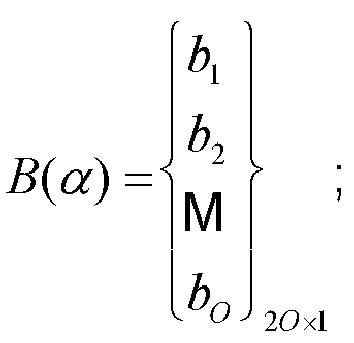
- For a given yaw angle α, minimizing J may be a least-squares estimation problem with J being a scalar function of the yaw angle α. To ensure the calculated J as a function of α (i.e. J(α)) is a global minimum, J(α) may be calculated by the
location module 18 at every 10° degrees of α between 0° and 360° (i.e. the calculation may be repeated 36 times). Thelocation module 18 then selects the α that provides the smallest value for J(α) as the rough estimate of the yaw angle α, which provides a corresponding rough estimate of the 3D position, as expressed by the translation vector (Tx, Ty, Tz). - At 36, the
localization module 18 on theserver 22 uses the rough estimation of the 3D position and yaw angle α to determine the 3D position and orientation of the mobileelectronic device 12 with sub-meter accuracy (i.e. the position and orientation of the mobileelectronic device 12 within a meter of the actual position of the device). This full optimization reduces any errors caused by accelerometer measurement errors, for example, due to measurement noise, bias from small accelerations, mechanical misalignments of the camera or accelerometer or the like. To determine the 3D position and orientation of the mobileelectronic device 12, thelocalization module 18 uses matched feature point pairs between the 3Dindoor map 20 stored inmemory 28 and the 2D picture using the rough estimation of the 3D position and yaw angle α and the calculated pitch β and roll y angles as a starting point. Thelocalization module 18 conducts a six-parameter optimization (i.e. the 3D position parameters and the three orientation parameters) to calculate the 3D position and attitude angles of the mobileelectronic device 12 by determining the translation vector (Tx, Ty, Tz) and rotation matrix (Rx(y), Ry(β), Rz(α)) between the matched feature point pairs assuming rigid-body motion. The full optimization may be executed using known numerical optimization tools such as MATLAB, GNU OCTAVE or the like. The full optimization allows thelocalization module 18 to determine the 3D position and orientation of the mobileelectronic device 12 with sub-meter accuracy. - In an embodiment, using the rough estimate of the yaw angle α, the
localization module 18 may perform an iteration of the Newton-Raphson method to determine the yaw angle α with sub-meter accuracy. In the iteration, the yaw angle α may be updated according the equation:



- Once the yaw angle α is determined, the translation vector (Tx, Ty, Tz), shown in
FIG. 2 , may be calculated by thelocation module 18 according to the equation:
- At 38, the
server 22 then transmits the calculated 3D position and orientation determination back to the mobileelectronic device 12 to provide indoor localization to the mobileelectronic device 12 with sub-meter accuracy. The mobileelectronic device 12 may use the indoor localization provided by thelocalization module 18 for a variety of applications. For example, the indoor localization may be used for augmented reality applications, to enhance interactive indoor tours, for destination guidance within indoor environments (e.g. at malls, airports or the like), for mobility aid for blind people, for wireless emergency responses, or for other similar applications. - Referring to
FIG. 5 , in an embodiment, thesystem 10, shown inFIG. 1 , may also use additional input from the mobileelectronic device 12 for approximating the rough estimate of the localization of the mobileelectronic device 12. For example, at 140, theserver 22 may approximate the position of the mobileelectronic device 12 within theindoor structure 16, shown inFIG. 1 , using WiFi geolocation, an explicit input from the mobile electronic device 12 (e.g. the reading of two-dimensional barcode such as a QUICK RESPONSE (QR) code, the input of a room number or other similar location information) or the like. To perform WiFi geolocation at 140, theserver 22 may compare a WiFi signal received on the mobileelectronic device 12 to a WiFi fingerprint map of theindoor structure 16, shown inFIG. 1 , which may be stored on theserver 22. The WiFi geolocation provides for an approximate position of the mobileelectronic device 12 in theindoor structure 16, shown inFIG. 1 , within a radius on the magnitude of tens of meters. Various techniques for performing WiFi geolocation should be readily understood by those skilled in the art. Additionally, it should be understood by those skilled in the art that the WiFi fingerprint map of theindoor structure 16, shown inFIG. 1 , may be, for example, a pre-existing map of theindoor structure 16, shown inFIG. 1 , if one is available. Alternatively, the WiFi fingerprint map may be pre-built in an offline phase (e.g. at the same time that the 3Dindoor map 20 is built) according to known techniques for WiFi fingerprint mapping. The approximate position detected through WiFi geolocation is used by thelocalization module 18 to additionally constrain the search space of the 3Dindoor map 20, as will be discussed below. As discussed above, theserver 22 may also use an explicit input from the mobileelectronic device 12 to approximate localization of the mobileelectronic device 12 at 140. For example, theuser 14, shown inFIG. 1 , may read a two-dimensional barcode, such as a QR code, with the mobileelectronic device 12 or may input other localization information directly into the mobileelectronic device 12 such as a room number, floor number or the like. - At 132, the
server 22 receives input data from the 2D picture and acceleration measurement, which may be captured substantially simultaneously, from the mobileelectronic device 12 in substantially the same manner discussed in connection withFIG. 4 . For example, in an embodiment, a user may take the 2D photo and the acceleration measurements using a cellular telephone, smart phone, tablet, GOOGLE GLASS, or any similar mobileelectronic device 12. The acceleration measurements may be, for example, 3-axis acceleration measurements from a 3-axis accelerometer. The mobileelectronic device 12 then sends the 2D photograph and acceleration measurements to thelocalization module 18 on theserver 22. Thus, in an embodiment, the input data may be the 2D photograph and acceleration measurements captured by the mobileelectronic device 12. - As discussed above, in other embodiments, the mobile
electronic device 12 may extract information from the 2D photograph and/or acceleration measurements and may send the extract information instead of, or in addition to, the 2D photograph and/or acceleration measurements. For example, the mobileelectronic device 12 may calculate pitch β and roll γ angles from the accelerometer measurement and may send the calculated angles to thelocalization system 18 along with the 2D picture as the input data. The mobileelectronic device 12 may perform the angle calculation discussed below as should be understood by those skilled in the art. - The mobile
electronic device 12 may also extract feature points 21 from the 2D picture and may send the feature points 21 to thelocalization system 18, instead of sending the 2D picture itself. Extracting the feature points 21 locally at the mobileelectronic device 12 may be more power and/or bandwidth-efficient and may conserve computing resources at thelocalization module 18 andserver 22, depending upon an efficiency of thefeature point 21 extraction, a quality of the network condition between the mobileelectronic device 12 and theserver 22 and the like. - At 134, the
server 22 restrains a search space of the 3Dindoor map 20 from the entire map to a subset of the 3Dindoor map 20 based on the approximate position detected at 140 (e.g. through WiFi geolocation) and on the acceleration measurements received from the mobileelectronic device 12. Thelocalization module 18 uses the approximate position detected at 140 (e.g. through WiFi geolocation) to restrain the search space from the entire 3Dindoor map 20 of the indoor space to the smaller subset (e.g. in a radius of twenty (20) meters around the approximate position detected through WiFi geolocation). To further restrain the search space, thelocalization module 18 may use the pitch β and roll γ angles received from the mobileelectronic device 12, if the angles are received as part of the input data, or may calculate the pitch and roll angles of the mobileelectronic device 12 from the 3-axis accelerometer measurements, in substantially the same manner discussed in connection withFIG. 4 , by assuming that the only acceleration on the mobileelectronic device 12 when the measurement was taken is acceleration due to gravity (i.e. noise and/or misalignment biases are ignored). Thelocalization module 18 may then constrain the search space of the 3Dindoor map 20 using the calculated pitch and roll angles. For example, thelocalization module 18 may constrain the search space to include only orientations within thirty (30) degrees of the horizontal if the acceleration measurement indicates that the mobileelectronic device 12 is tilted upright. Thelocalization module 18 then uses the calculated pitch and roll angles to match feature points from the 2D picture provided by the mobileelectronic device 12 with feature points from the constrained subset of the 3Dindoor map 20 stored inmemory 28 to obtain a rough estimation of the 3D position and yaw angle of the mobileelectronic device 12 within the subset of the 3Dindoor map 20. For example, thelocalization module 18 may obtain the rough estimation of the 3D position and yaw angle of the mobileelectronic device 12 using a quadratic constraint least-square estimation or similar calculation. Thelocalization module 18 may also apply the Random Sample Consensus (RANSAC) algorithm or the like to remove outliers due to mismatched feature point pairs. - At 136, the
localization module 18 on theserver 22 uses the rough estimation of the 3D position and yaw angle to determine the 3D position and orientation of the mobileelectronic device 12 with sub-meter accuracy (i.e. the position and orientation of the mobileelectronic device 12 within a meter of the actual position of the device) in substantially the same manner discussed in connection withFIG. 4 . This full optimization reduces any errors caused by accelerometer measurement errors, for example, due to measurement noise, bias from small accelerations, mechanical misalignments of the camera or accelerometer or the like. To determine the 3D position and orientation of the mobileelectronic device 12, thelocalization module 18 uses matched feature point pairs between the 3Dindoor map 20 stored inmemory 28 and the 2D picture using the rough estimation of the 3D position and yaw angle and the calculated pitch and roll angles as a starting point. Thelocalization module 18 conducts a six-parameter optimization (i.e. the 3D position parameters and the three orientation parameters) to calculate the 3D position and attitude angles of the mobileelectronic device 12 by determining a translation vector and rotation matrix between the matched feature point pairs assuming rigid-body motion. The full optimization may be executed using known numerical optimization tools such as MATLAB, GNU OCTAVE or the like. The full optimization allows thelocalization module 18 to determine the 3D position and orientation of the mobileelectronic device 12 with sub-meter accuracy. - At 138, the
server 22 then transmits the calculated 3D position and orientation determination back to the mobileelectronic device 12 to provide indoor localization to the mobileelectronic device 12 with sub-meter accuracy (i.e. centimeter-level 3D localization). The mobileelectronic device 12 may use the indoor localization provided by thelocalization module 18 for a variety of applications. For example, the indoor localization may be used for augmented reality applications, to enhance interactive indoor tours, for destination guidance within indoor environments (e.g. at malls, airports or the like), for mobility aid for blind people, for wireless emergency responses, or for other similar applications. - The
system 10 shown inFIG. 1 advantageously allows calculation of the 3D position and orientation of the mobileelectronic device 12 using input data from a 2D photograph and accelerometer measurements captured from theelectronic device 12 with an existing 3Dindoor map 20 of theindoor structure 16, shown inFIG. 1 . In another embodiment, WiFi measurements or location information from the mobileelectronic device 12 and, in an embodiment, an existing WiFi fingerprint map stored on one or severalremote servers 22 are also used in addition to the 2D photograph and the accelerometer measurements to determine the location of the mobileelectronic device 12. Advantageously, aside from the 3D indoor map 20 (and, in an embodiment, the WiFi fingerprint map) of theindoor environment 16, shown inFIG. 1 , there is no need for special hardware, such as depth cameras, on mobile devices, or for installations of dedicated equipments such as radio frequency beacons. - The
system 10, shown inFIG. 1 , advantageously provides for accurate indoor localization (i.e. position and attitude angles) of mobileelectronic devices 12 within sub-meter (e.g. centimeter-level) accuracy. - The
system 10 shown inFIG. 1 may be implemented for both commercial and non-commercial Location-Based Services (LBS), including network optimization, precise indoor navigation, augmented reality uses such as advertising (user engagement) or leisure applications (e.g. gaming or museum visits) or any similar application for improving the user's experience within theindoor environment 16, shown inFIG. 1 . Additionally, thesystem 10 provides high-fidelity 3D localization (rather than simple 2D navigation), which may be advantageous for augmented reality based applications using wearable smart gadgets such as GOOGLE GLASS or the like. - The computational overhead for feature point matching may become high in a real-world indoor environment depending upon the size of the indoor environment (e.g. since the computational overhead for
indoor environment 16 shown inFIG. 1 may have a linear relationship with the size of the 3D indoor map 20). Thecloud computing service 24, as shown inFIG. 3 , ma advantageously address this issue by offloading computation in a scale-out fashion to a plurality ofservers 22 in the cloud to allow thecloud computing service 24, shown inFIG. 3 , to compute the 3D position and orientation angles of the mobileelectronic device 12. Thecloud computing service 24, shown inFIG. 3 , may advantageously allow thesystem 10, shown inFIG. 1 , to produce localization results with ten (10) centimeter accuracy in a matter of seconds. - Although this invention has been shown and described with respect to the detailed embodiments thereof, it will be understood by those skilled in the art that various changes in form and detail thereof may be made without departing from the spirit and the scope of the invention. For example, although the
system 10, shown inFIG. 1 , is described in connection with providing localization in indoor environments, thesystem 10 may provide localization in a variety of environments, including outdoor environments.
Claims (14)
- A system for providing localization of a mobile electronic device within an environment, the system comprising:at least one server in communication with the mobile electronic device, the at least one server adapted to receive input data from the mobile electronic device, the input data at least including one or more 2-dimensional feature points extracted from at least one picture representing at least a portion of the environment;;a memory database in communication with at least one server, the memory database storing at least one 3-dimensional map of the environment; anda localization module adapted to be executed by the at least one server, the localization module providing localization to the mobile electronic device based on the input data t and the at least one 3-dimensional map of the environment.
- The system according to claim 1, where the input data received at the server further includes at least one accelerometer measurement and at least one 3-dimensional map of the environment.
- The system according to claim 2, wherein the 3-dimensional map includes a database of 3-dimensional feature points.
- The system according to claim 3, wherein the localization module provides localization by matching 2-dimensional feature points with the 3-dimensional feature points.
- The system according to claim 4, wherein the localization module is adapted to determine a translation vector and a rotation matrix between matched feature point pairs assuming rigid-body motion.
- The system according to claim 1, wherein the server is configured to invoke a cloud computing service for executing the localization module.
- The system according to claim 2, wherein the at least one accelerometer measurement includes a 3-axis acceleration measurement from a 3-axis accelerometer.
- The system according to claim 1, wherein the mobile electronic device is a wearable smart gadget.
- The system according to claim 2, wherein the localization module is adapted to constrain a search space of the 3-dimensional map to a subset for comparing the at least one picture and at least one accelerometer measurement to the 3-dimensional map.
- The system according to claim 9, wherein the localization module constrains the search space of the 3-dimensional map by calculating a pitch and roll of the mobile electronic device from the accelerometer measurement.
- The system according to claim 9, wherein the localization module additionally constrains the search space of the 3-dimensional map by approximating a position of the mobile electronic device within the environment using at least one of WiFi geolocation, a two-dimensional barcode or location information input in the mobile electronic device.
- The system according to claim 1, wherein the environment is an indoor environment.
- The system according to claim 1, wherein the mobile device is configured to:generate the input data at least including the one or more 2-dimensional feature points extracted from the at least one picture representing at least the portion of the environment;transmit the input data to the server; and,receive the localization of the mobile electronic device based on the input data and the at least one 3-dimensional map of the environment.
- The system according to claim 13, wherein the mobile device is further configured to:
include the at least one 3-dimensional map of the environment the at least one accelerometer measurement as part of the input data that is transmitted from the mobile device to the server.
Applications Claiming Priority (3)
| Application Number | Priority Date | Filing Date | Title |
|---|---|---|---|
| US13/867,420 US9154919B2 (en) | 2013-04-22 | 2013-04-22 | Localization systems and methods |
| PCT/US2014/033951 WO2014176054A1 (en) | 2013-04-22 | 2014-04-14 | Localization systems and methods |
| EP14724938.7A EP2989481B1 (en) | 2013-04-22 | 2014-04-14 | Localization systems and methods |
Related Parent Applications (1)
| Application Number | Title | Priority Date | Filing Date |
|---|---|---|---|
| EP14724938.7A Division EP2989481B1 (en) | 2013-04-22 | 2014-04-14 | Localization systems and methods |
Publications (1)
| Publication Number | Publication Date |
|---|---|
| EP3896479A1 true EP3896479A1 (en) | 2021-10-20 |
Family
ID=50733408
Family Applications (2)
| Application Number | Title | Priority Date | Filing Date |
|---|---|---|---|
| EP21176497.2A Pending EP3896479A1 (en) | 2013-04-22 | 2014-04-14 | Localization systems and methods |
| EP14724938.7A Active EP2989481B1 (en) | 2013-04-22 | 2014-04-14 | Localization systems and methods |
Family Applications After (1)
| Application Number | Title | Priority Date | Filing Date |
|---|---|---|---|
| EP14724938.7A Active EP2989481B1 (en) | 2013-04-22 | 2014-04-14 | Localization systems and methods |
Country Status (5)
| Country | Link |
|---|---|
| US (1) | US9154919B2 (en) |
| EP (2) | EP3896479A1 (en) |
| JP (1) | JP6255085B2 (en) |
| CN (1) | CN105143907B (en) |
| WO (1) | WO2014176054A1 (en) |
Families Citing this family (61)
| Publication number | Priority date | Publication date | Assignee | Title |
|---|---|---|---|---|
| US20140323148A1 (en) * | 2013-04-30 | 2014-10-30 | Qualcomm Incorporated | Wide area localization from slam maps |
| US9492343B1 (en) * | 2013-05-07 | 2016-11-15 | Christ G. Ellis | Guided movement |
| US9770382B1 (en) * | 2013-05-07 | 2017-09-26 | Christ G. Ellis | Guided movement |
| US9940897B2 (en) * | 2013-05-24 | 2018-04-10 | Awe Company Limited | Systems and methods for a shared mixed reality experience |
| US9478029B2 (en) * | 2014-10-23 | 2016-10-25 | Qualcomm Incorporated | Selection strategy for exchanging map information in collaborative multi-user SLAM systems |
| CN104378735B (en) * | 2014-11-13 | 2018-11-13 | 无锡儒安科技有限公司 | Indoor orientation method, client and server |
| WO2016089357A1 (en) * | 2014-12-01 | 2016-06-09 | Draeger Medical Systems, Inc. | Asset tracking |
| US10582105B2 (en) | 2014-12-30 | 2020-03-03 | Qualcomm Incorporated | Changing camera parameters based on wireless signal information |
| US20160188540A1 (en) * | 2014-12-30 | 2016-06-30 | Qualcomm Incorporated | Tagging visual data with wireless signal information |
| US9824481B2 (en) | 2014-12-30 | 2017-11-21 | Qualcomm Incorporated | Maintaining heatmaps using tagged visual data |
| GB2535723A (en) * | 2015-02-25 | 2016-08-31 | Bae Systems Plc | Emergency guidance system and method |
| JP6440539B2 (en) * | 2015-03-13 | 2018-12-19 | 三菱電機株式会社 | Equipment information display system, mobile terminal, server, and equipment information display method |
| US9841205B2 (en) * | 2015-05-20 | 2017-12-12 | Google Llc | Systems and methods of detection with active infrared sensors |
| US10395116B2 (en) * | 2015-10-29 | 2019-08-27 | Hand Held Products, Inc. | Dynamically created and updated indoor positioning map |
| US10257498B2 (en) * | 2015-12-04 | 2019-04-09 | Empire Technology Development Llc | Coordination of multiple structured light-based 3D image detectors |
| CN105578414A (en) * | 2016-01-08 | 2016-05-11 | 南京网河智能科技有限公司 | Terminal and positioning method and apparatus for same |
| US10505756B2 (en) * | 2017-02-10 | 2019-12-10 | Johnson Controls Technology Company | Building management system with space graphs |
| US10127434B2 (en) | 2016-07-15 | 2018-11-13 | Tyco Fire & Security Gmbh | Techniques for built environment representations |
| US10379514B2 (en) * | 2016-07-27 | 2019-08-13 | Ademco Inc. | Systems and methods for controlling a home automation system based on identifying a user location via a wi-fi fingerprint |
| US10169914B2 (en) * | 2016-08-26 | 2019-01-01 | Osense Technology Co., Ltd. | Method and system for indoor positioning and device for creating indoor maps thereof |
| CN106408601B (en) * | 2016-09-26 | 2018-12-14 | 成都通甲优博科技有限责任公司 | A kind of binocular fusion localization method and device based on GPS |
| CN107024980A (en) * | 2016-10-26 | 2017-08-08 | 阿里巴巴集团控股有限公司 | Customer location localization method and device based on augmented reality |
| CN106779541A (en) * | 2016-11-30 | 2017-05-31 | 长威信息科技发展股份有限公司 | A kind of warehouse management method and system based on AR technologies |
| CN106840149A (en) * | 2017-01-22 | 2017-06-13 | 北京铅笔视界科技有限公司 | A kind of three dimensions tracing-positioning system and method |
| JP6272572B1 (en) * | 2017-02-03 | 2018-01-31 | 三菱電機株式会社 | Display control apparatus and display control method |
| US20180356233A1 (en) * | 2017-06-13 | 2018-12-13 | Boutros Baqain | Intelligent navigation assistance device |
| CN107295480A (en) * | 2017-07-13 | 2017-10-24 | 湖南汇博电子科技股份有限公司 | Indoor orientation method and device, computer equipment and storage medium |
| CN107506040A (en) * | 2017-08-29 | 2017-12-22 | 上海爱优威软件开发有限公司 | A kind of space path method and system for planning |
| CN107807346A (en) * | 2017-10-26 | 2018-03-16 | 南京华苏科技有限公司 | Adaptive WKNN outdoor positionings method based on OTT Yu MR data |
| DE102017126861A1 (en) * | 2017-11-15 | 2019-05-16 | Innogy Innovation Gmbh | Method and device for position determination |
| CN108174390B (en) * | 2017-12-15 | 2021-08-31 | 深圳无线电检测技术研究院 | Method and device for judging qualified LTE-V2X field performance test scenarios |
| US10565464B2 (en) * | 2017-12-21 | 2020-02-18 | At&T Intellectual Property I, L.P. | Adaptive cloud offloading of mobile augmented reality |
| CN111788606B (en) * | 2018-03-01 | 2024-12-03 | 索尼互动娱乐股份有限公司 | Position estimation device, position estimation method, and computer-readable storage medium |
| WO2019168886A1 (en) * | 2018-03-02 | 2019-09-06 | Purdue Research Foundation | System and method for spatially mapping smart objects within augmented reality scenes |
| CN109029450B (en) * | 2018-06-26 | 2021-05-14 | 重庆市勘测院 | Indoor positioning method |
| US10957112B2 (en) | 2018-08-13 | 2021-03-23 | Magic Leap, Inc. | Cross reality system |
| US11227435B2 (en) | 2018-08-13 | 2022-01-18 | Magic Leap, Inc. | Cross reality system |
| EP3861387B1 (en) | 2018-10-05 | 2025-05-21 | Magic Leap, Inc. | Rendering location specific virtual content in any location |
| CN109612455A (en) * | 2018-12-04 | 2019-04-12 | 天津职业技术师范大学 | An indoor positioning method and system |
| US10539644B1 (en) * | 2019-02-27 | 2020-01-21 | Northern Digital Inc. | Tracking an object in an electromagnetic field |
| CN112629532B (en) * | 2019-10-08 | 2023-10-20 | 宏碁股份有限公司 | Indoor positioning methods to improve accuracy and mobile devices using them |
| CN114600064B (en) | 2019-10-15 | 2026-04-24 | 奇跃公司 | Cross-reality system with location services |
| EP4046070A4 (en) | 2019-10-15 | 2023-10-18 | Magic Leap, Inc. | EXTENDED REALITY SYSTEM SUPPORTING MULTIPLE DEVICE TYPES |
| US11632679B2 (en) | 2019-10-15 | 2023-04-18 | Magic Leap, Inc. | Cross reality system with wireless fingerprints |
| JP7604478B2 (en) | 2019-10-31 | 2024-12-23 | マジック リープ, インコーポレイテッド | Cross reality systems with quality information about persistent coordinate frames. |
| WO2021096931A1 (en) | 2019-11-12 | 2021-05-20 | Magic Leap, Inc. | Cross reality system with localization service and shared location-based content |
| CN114762008A (en) | 2019-12-09 | 2022-07-15 | 奇跃公司 | Simplified virtual content programmed cross reality system |
| KR20210081576A (en) * | 2019-12-24 | 2021-07-02 | 삼성전자주식회사 | Method for indoor positioning and the electronic device |
| JP7684321B2 (en) | 2020-02-13 | 2025-05-27 | マジック リープ, インコーポレイテッド | Cross reality system with prioritization of geolocation information for position determination |
| CN119984235A (en) | 2020-02-13 | 2025-05-13 | 奇跃公司 | Cross-reality system with accurate shared maps |
| JP7768888B2 (en) | 2020-02-13 | 2025-11-12 | マジック リープ, インコーポレイテッド | Cross-reality system with map processing using multi-resolution frame descriptors |
| JP7671769B2 (en) | 2020-02-26 | 2025-05-02 | マジック リープ, インコーポレイテッド | Cross reality system with fast localization |
| KR20210121910A (en) | 2020-03-31 | 2021-10-08 | 삼성전자주식회사 | Electronic apparatus and control method thereof |
| WO2021216345A1 (en) * | 2020-04-23 | 2021-10-28 | Commscope Technologies Llc | Indoor location system for emergency responders and/or contact tracking and tracing |
| JP2023524446A (en) | 2020-04-29 | 2023-06-12 | マジック リープ, インコーポレイテッド | Cross-reality system for large-scale environments |
| EP4036524B1 (en) * | 2021-01-29 | 2026-04-22 | SC Dotlumen SRL | A computer-implemented method, wearable device, computer program and computer readable medium for assisting the movement of a visually impaired user |
| JP7704404B2 (en) * | 2021-07-12 | 2025-07-08 | Necソリューションイノベータ株式会社 | Map information generating device, location identifying device, map information generating method, location identifying method, program, and recording medium |
| US12289653B2 (en) | 2021-11-18 | 2025-04-29 | International Business Machines Corporation | Augmented device retrieval assistance |
| US20250071727A1 (en) * | 2023-08-25 | 2025-02-27 | Qualcomm Incorporated | Radio frequency map aggregation |
| CN117934598B (en) * | 2024-03-21 | 2024-06-11 | 浙江大学 | A desktop-level rigid body positioning device and method based on optical positioning technology |
| CN118397582A (en) * | 2024-04-19 | 2024-07-26 | 北京地平线信息技术有限公司 | Redundancy perception method, redundancy perception device, electronic equipment and storage medium |
Citations (3)
| Publication number | Priority date | Publication date | Assignee | Title |
|---|---|---|---|---|
| WO2011144968A1 (en) | 2010-05-19 | 2011-11-24 | Nokia Corporation | Physically-constrained radiomaps |
| WO2011144967A1 (en) | 2010-05-19 | 2011-11-24 | Nokia Corporation | Extended fingerprint generation |
| WO2012106075A1 (en) | 2011-02-05 | 2012-08-09 | Wifislam, Inc. | Method and apparatus for mobile location determination |
Family Cites Families (10)
| Publication number | Priority date | Publication date | Assignee | Title |
|---|---|---|---|---|
| JP4206036B2 (en) * | 2003-12-09 | 2009-01-07 | 株式会社ゼンリン | Identification of landscape image capturing position using electronic map data |
| JP4148276B2 (en) * | 2006-05-09 | 2008-09-10 | ソニー株式会社 | POSITION ESTIMATION DEVICE, POSITION ESTIMATION METHOD, AND PROGRAM RECORDING MEDIUM |
| US8098894B2 (en) * | 2008-06-20 | 2012-01-17 | Yahoo! Inc. | Mobile imaging device as navigator |
| JP5274192B2 (en) * | 2008-10-07 | 2013-08-28 | Kddi株式会社 | Position estimation system, position estimation server, and position estimation method |
| US20110209201A1 (en) * | 2010-02-19 | 2011-08-25 | Nokia Corporation | Method and apparatus for accessing media content based on location |
| US8693689B2 (en) * | 2010-11-01 | 2014-04-08 | Microsoft Corporation | Location brokering for providing security, privacy and services |
| US20120135746A1 (en) * | 2010-11-30 | 2012-05-31 | Nokia Corporation | Method and apparatus for determining and providing location-based resource availability information based on mobile device data |
| JP2012127896A (en) * | 2010-12-17 | 2012-07-05 | Kumamoto Univ | Mobile object position measurement device |
| US8938257B2 (en) * | 2011-08-19 | 2015-01-20 | Qualcomm, Incorporated | Logo detection for indoor positioning |
| US9301097B2 (en) * | 2011-10-27 | 2016-03-29 | Point Inside, Inc. | Correlating wireless signals to a location on an image using mobile sensor technologies |
-
2013
- 2013-04-22 US US13/867,420 patent/US9154919B2/en active Active
-
2014
- 2014-04-14 EP EP21176497.2A patent/EP3896479A1/en active Pending
- 2014-04-14 CN CN201480022720.6A patent/CN105143907B/en active Active
- 2014-04-14 EP EP14724938.7A patent/EP2989481B1/en active Active
- 2014-04-14 JP JP2016510695A patent/JP6255085B2/en active Active
- 2014-04-14 WO PCT/US2014/033951 patent/WO2014176054A1/en not_active Ceased
Patent Citations (3)
| Publication number | Priority date | Publication date | Assignee | Title |
|---|---|---|---|---|
| WO2011144968A1 (en) | 2010-05-19 | 2011-11-24 | Nokia Corporation | Physically-constrained radiomaps |
| WO2011144967A1 (en) | 2010-05-19 | 2011-11-24 | Nokia Corporation | Extended fingerprint generation |
| WO2012106075A1 (en) | 2011-02-05 | 2012-08-09 | Wifislam, Inc. | Method and apparatus for mobile location determination |
Also Published As
| Publication number | Publication date |
|---|---|
| JP6255085B2 (en) | 2017-12-27 |
| EP2989481B1 (en) | 2021-06-02 |
| US20140315570A1 (en) | 2014-10-23 |
| WO2014176054A1 (en) | 2014-10-30 |
| CN105143907A (en) | 2015-12-09 |
| CN105143907B (en) | 2017-03-15 |
| EP2989481A1 (en) | 2016-03-02 |
| US9154919B2 (en) | 2015-10-06 |
| JP2016524128A (en) | 2016-08-12 |
Similar Documents
| Publication | Publication Date | Title |
|---|---|---|
| EP2989481B1 (en) | Localization systems and methods | |
| US11127203B2 (en) | Leveraging crowdsourced data for localization and mapping within an environment | |
| CN106471548B (en) | Method and apparatus for accelerating template matching using peripheral information | |
| CN104350524B (en) | Pose estimation based on peripheral information | |
| CN103827634B (en) | Logo detection for indoor positioning | |
| Niu et al. | Resource-efficient and automated image-based indoor localization | |
| US20150119086A1 (en) | Simultaneous localization and mapping systems and methods | |
| US20160258761A1 (en) | Vlc-based vector field fingerprint mapping | |
| Liu et al. | Enabling context-aware indoor augmented reality via smartphone sensing and vision tracking | |
| Caldini et al. | Smartphone-based obstacle detection for the visually impaired | |
| Zhang et al. | Seeing Eye Phone: a smart phone-based indoor localization and guidance system for the visually impaired | |
| Ruiz-Ruiz et al. | A multisensor LBS using SIFT-based 3D models | |
| Cheng et al. | Positioning and navigation of mobile robot with asynchronous fusion of binocular vision system and inertial navigation system | |
| KR102825288B1 (en) | An electronic device detecting a location and a method thereof | |
| US11688094B1 (en) | Method and system for map target tracking | |
| US20230186508A1 (en) | Modeling planar surfaces using direct plane fitting | |
| Calloway et al. | Three tiered visual-inertial tracking and mapping for augmented reality in urban settings | |
| CN107683496A (en) | The mapping of hypothesis line and checking for 3D maps | |
| KR20210020331A (en) | Apparatus and method for estimating indoor position using multiple plane detection | |
| US20260111028A1 (en) | Global localization apparatus and method thereof | |
| KR102212268B1 (en) | Localization system and means of transportation with the same and computing device for executing the same | |
| Yun et al. | Sub-meter accuracy 3D indoor positioning algorithm by matching feature points of 2D smartphone photo | |
| Salhi et al. | Multimodal Localization for Embedded | |
| CN119579848A (en) | Unified visual positioning architecture | |
| Reinhardt et al. | DETERMINATION OF DEVICE POSE USING TEXT MATCHING FROM CAPTURED IMAGES |
Legal Events
| Date | Code | Title | Description |
|---|---|---|---|
| PUAI | Public reference made under article 153(3) epc to a published international application that has entered the european phase |
Free format text: ORIGINAL CODE: 0009012 |
|
| STAA | Information on the status of an ep patent application or granted ep patent |
Free format text: STATUS: THE APPLICATION HAS BEEN PUBLISHED |
|
| AC | Divisional application: reference to earlier application |
Ref document number: 2989481 Country of ref document: EP Kind code of ref document: P |
|
| AK | Designated contracting states |
Kind code of ref document: A1 Designated state(s): AL AT BE BG CH CY CZ DE DK EE ES FI FR GB GR HR HU IE IS IT LI LT LU LV MC MK MT NL NO PL PT RO RS SE SI SK SM TR |
|
| B565 | Issuance of search results under rule 164(2) epc |
Effective date: 20210910 |
|
| STAA | Information on the status of an ep patent application or granted ep patent |
Free format text: STATUS: REQUEST FOR EXAMINATION WAS MADE |
|
| 17P | Request for examination filed |
Effective date: 20220406 |
|
| RBV | Designated contracting states (corrected) |
Designated state(s): AL AT BE BG CH CY CZ DE DK EE ES FI FR GB GR HR HU IE IS IT LI LT LU LV MC MK MT NL NO PL PT RO RS SE SI SK SM TR |
|
| STAA | Information on the status of an ep patent application or granted ep patent |
Free format text: STATUS: EXAMINATION IS IN PROGRESS |
|
| 17Q | First examination report despatched |
Effective date: 20230403 |