EP3896389B1 - Stereo camera device - Google Patents
Stereo camera device Download PDFInfo
- Publication number
- EP3896389B1 EP3896389B1 EP19897395.0A EP19897395A EP3896389B1 EP 3896389 B1 EP3896389 B1 EP 3896389B1 EP 19897395 A EP19897395 A EP 19897395A EP 3896389 B1 EP3896389 B1 EP 3896389B1
- Authority
- EP
- European Patent Office
- Prior art keywords
- imaging element
- circuit element
- stereo camera
- center
- distance
- Prior art date
- Legal status (The legal status is an assumption and is not a legal conclusion. Google has not performed a legal analysis and makes no representation as to the accuracy of the status listed.)
- Active
Links
Images



Classifications
-
- G—PHYSICS
- G01—MEASURING; TESTING
- G01C—MEASURING DISTANCES, LEVELS OR BEARINGS; SURVEYING; NAVIGATION; GYROSCOPIC INSTRUMENTS; PHOTOGRAMMETRY OR VIDEOGRAMMETRY
- G01C3/00—Measuring distances in line of sight; Optical rangefinders
- G01C3/02—Details
-
- B—PERFORMING OPERATIONS; TRANSPORTING
- B60—VEHICLES IN GENERAL
- B60R—VEHICLES, VEHICLE FITTINGS, OR VEHICLE PARTS, NOT OTHERWISE PROVIDED FOR
- B60R11/00—Arrangements for holding or mounting articles, not otherwise provided for
- B60R11/04—Mounting of cameras operative during drive; Arrangement of controls thereof relative to the vehicle
-
- B—PERFORMING OPERATIONS; TRANSPORTING
- B60—VEHICLES IN GENERAL
- B60R—VEHICLES, VEHICLE FITTINGS, OR VEHICLE PARTS, NOT OTHERWISE PROVIDED FOR
- B60R11/00—Arrangements for holding or mounting articles, not otherwise provided for
- B60R2011/0001—Arrangements for holding or mounting articles, not otherwise provided for characterised by position
- B60R2011/0003—Arrangements for holding or mounting articles, not otherwise provided for characterised by position inside the vehicle
- B60R2011/0026—Windows, e.g. windscreen
Definitions
- the present invention relates to a stereo camera device.
- a stereo camera which is one of the external environment recognition systems, extracts a feature point common to images from a pair of pieces of image information, and an integrated circuit performs a process of obtaining the number of pixels in which a position of the feature point is shifted between the pair of images to calculate the distance. Therefore, if there is a shift other than the original parallax between the pair of images, an error occurs in a distance measurement result.
- One of causes of the shift is a temperature increase due to sunlight, heat generation inside a device, or the like. If a temperature of an internal component exceeds an upper limit temperature, there is a concern that malfunction may occur and the life of the component may be shortened. Further, when a temperature difference occurs between a pair of left and right imaging elements, there is a concern that the measurement accuracy may deteriorate.
- a temperature of a vehicle body side such as a windshield on which the stereo camera is installed increases due to sunlight or the like so that a temperature difference between the car body side and the stereo camera is insufficient or the temperature of the vehicle body side is higher than that of the stereo camera
- an imaging element such as a CMOS, which is important for the stereo camera, often has a relatively lower upper limit temperature for guaranteeing an operation than other components, and it is conceivable that it is difficult to suppress a temperature increase in the imaging element.
- the stereo camera device capable of reducing the temperature difference between the pair of left and right imaging elements and reducing the temperature increase in the imaging elements.
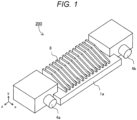
- FIG. 1 is a perspective view illustrating an appearance of the stereo camera 200 according to a first embodiment of the present invention.
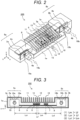
- FIG. 2 is a perspective view illustrating an internal configuration of the stereo camera 200 of FIG. 1 .
- FIG. 3 is a perspective view illustrating a yz plane of the stereo camera 200 of FIG. 2 .
- FIG. 4 is a graph illustrating a temperature increase of a first imaging element 2a and a temperature increase of a second imaging element 2b depending on a length of a first distance (Lf) in the stereo camera 200 of FIG. 1 . Note that a description will be given in FIGS.
- Cartesian coordinate system including the x axis in which the front direction is positive in the front-back direction (optical-axis direction of a camera module) of the stereo camera 200, the y axis in which the upward direction is positive in the up-down direction (height direction), and the z axis in which the right direction (right direction when facing the front direction) is positive in the left-right direction.
- the horizontal axis represents the first distance
- the vertical axis represents the temperature increase of the first imaging element 2a and the temperature increase of the second imaging element 2b.
- the first distance (Lf) is a distance from a first circuit element center 14 to a device center 12 (the stereo camera device center).
- the device center 12 in a direction between camera modules 5a and 5b refers to an xy plane that has a line passing through a midpoint 13, which divides a portion between the two imaging elements 2a and 2b mounted on the pair of left and right camera modules 5a and 5b into two portions, and connecting the imaging elements 2a and 2b as a normal line.
- the first circuit element center 14 refers to a plane that is parallel to the xy plane and passes through a centroid 15 of the first circuit element 6, and a second circuit element center 16 refers to a plane that is parallel to the xy plane and passes through a centroid 17 of the second circuit element 7 including an element groups of second circuit elements 7a, 7b, and 7c. Note that the centroid is used here for the sake of simplicity when obtaining the center, but the center of gravity or the heat generation center may be used instead.
- a first imaging element center 18a refers to a plane parallel to the xy plane that passes through a first imaging element center 19a (a center of the optical first imaging element 2a including a lens and the like).
- a second imaging element center 18b refers to a plane that is parallel to the xy plane and passes through a second imaging element center 19b (a center of the optical second imaging element 2b including a lens and the like).
- the stereo camera 200 includes the first imaging element 2a and the second imaging element 2b, a first circuit element 6 and a second circuit element 7 disposed between the first imaging element 2a and the second imaging element 2b, and a casing 1a for retaining the first imaging element 2a, the first circuit element 6, the second circuit element 7, and the second imaging element 2b along the z axis in this order.
- the first imaging element 2a is attached to the casing 1a as a set of the first camera module 5a including a first imaging element substrate 3a and a first lens 4a.
- the second imaging element 2b is attached to the casing 1a as a set of the second camera module 5b including a second imaging element substrate 3b and a second lens 4b.
- the first circuit element 6 and the second circuit element 7 that process signals from the camera modules 5a and 5b are mounted on a circuit board 8, and the first circuit element 6 and the second circuit element 7 are attached by being thermally connected to the casing 1a via a thermally conductive member 9.
- FIG. 2 illustrates a case where three second circuit elements 7a to 7c are mounted.
- a cover 10 that covers a lower surface of the casing 1a has a structure that is attached to the casing 1a using a screw or the like.
- An electrical connection to the stereo camera 200 is made by connecting a wiring to an internal electrical connector through an opening (not illustrated) on a rear surface of the casing 1a.
- the stereo camera 200 can image a front side of the stereo camera 200 using the pair of left and right camera modules 5a and 5b to image the front side of the stereo camera 200 and obtain parallax of an object from a pair of left and right captured images to obtain the distance to the object. Therefore, if there is a difference between the temperature of the first imaging element 2a and the temperature of the second imaging element 2b due to an increase in heat generation amount (power consumption) caused by high performance of the stereo camera 200 and a decrease in surface area due to miniaturization, there occurs a difference in external recognition between a signal of the first imaging element 2a and a signal of the second imaging element 2b, which causes a decrease in accuracy of the measurement distance or the like.
- the first circuit element 6 is, for example, a microcomputer, a signal processing element, a field programmable gate array (FPGA), or the like that processes an image signal, and refers to a circuit element that generates a large amount of heat and requires heat conduction to the casing 1a or the cover 10.
- the second circuit elements 7a to 7c are, for example, double data rate (DDR) memories or the like, and are circuit elements used in the first circuit element 6.
- the second circuit elements 7a to 7c may be circuit elements that are not used in the first circuit element 6.
- the second circuit elements 7a to 7c refer to, for example, memories used for temporary storage of data, and the first circuit element 6 has a larger heat generation amount (power consumption) than the second circuit element 7.
- a plurality of fins 11 for heat radiation are disposed in the upper part of the casing 1a at least between the first imaging element 2a and the second imaging element 2b.
- the present embodiment relates to an arrangement of circuit elements, and a second distance (Lm) from the device center 12 to the second circuit element center 16 is longer than the first distance (Lf) from the device center 12 to the first circuit element center 14 in the direction between the camera modules 5a and 5b (z-axis direction). Further, a third distance (Lcr) from the first circuit element center 14 to the first imaging element center 18a is longer than the first distance (Lf) from the device center 12 to the first circuit element center 14 in the direction between the camera modules 5a and 5b (z-axis direction).
- a fourth distance (Lcl) from the second circuit element center 16 to the second imaging element center 18b is longer than the second distance (Lm) from the device center 12 to the second circuit element center 16 in the direction between the camera modules 5a and 5b (z-axis direction).
- heat generation centers of the first circuit element 6 and the second circuit element 7 can be disposed at the device center 12, and the temperature of the first imaging element 2a and the temperature of the second imaging element 2b can be made equal.
- the temperature increase of the first imaging element 2a and the temperature increase of the second imaging element 2b depending on the length of the first distance (Lf) illustrated in FIG.
- the temperature of the first imaging element 2a can be reduced in a case where the first circuit element 6 is closer to the first imaging element 2a as compared to a case where the first circuit element 6 is located at a position closer to the device center 12, and the temperature of the first imaging element 2a and the temperature of the second imaging element 2b can be made equal. Further, when the temperature of the first imaging element 2a and the temperature of the second imaging element 2b at left and right sides are equal, a temperature distribution in the entire casing 1a is not biased. and the heat radiation performance of the stereo camera 200 is improved, so that the temperature of the first circuit element 6 and the temperature of the second circuit element 7 can also be reduced.
- the third distance (Lcr) is longer than the first distance (Lf), in other words, the third distance (Lcr), which is the distance between the first circuit element 6 and the first imaging element 2a, is made longer, the heat radiation from the fins 11 and the like between the first circuit element 6 and the first imaging element 2a progresses, and the amount of heat transferred from the first circuit element 6 to the first imaging element 2a decreases, so that the temperature of the first imaging element 2a can be reduced.
- the efficient heat radiation is possible by providing the fins 11 between the first circuit element 6 and the first imaging element 2a, and the temperature of the first imaging element 2a can be reduced.
- the fourth distance (Lcl) is longer than the second distance (Lm), in other words, the fourth distance (Lcl), which is the distance between the second circuit element 7 and the second imaging element 2b, is made longer, the heat radiation from the fins 11 and the like between the second circuit element 7 and the second imaging element 2b progresses, and the amount of heat transferred from the second circuit element 7 to the second imaging element 2b decreases, so that the temperature of the second imaging element 2b can be reduced.
- the efficient heat radiation is possible by providing the fins 11 between the second circuit element 7 and the second imaging element 2b, and the temperature of the second imaging element 2b can be reduced.
- the temperature of the first imaging element 2a and the temperature of the second imaging element 2b can be made equal, and the stereo camera 200 with high measurement accuracy can be realized. Further, the temperature of the first imaging element 2a and the temperature of the second imaging element 2b can be reduced, and the stereo camera 200 with high reliability can be realized. Further, the temperature of the first circuit element 6 and the temperature of the second circuit element 7 can be reduced, and the stereo camera 200 with high reliability can be realized.
- circuit elements may be retained to be left-right reversed such that the first imaging element 2a, the second circuit element 7, the first circuit element 6, and the second imaging element 2b are retained in this order along the z axis, and the arrangement may be plane-symmetrical in the xy plane with respect to the arrangement of the first embodiment.
- the distance from the device center 12 to the center of the second circuit element 7 may be longer than the distance from the device center 12 to the center of the first circuit element 6 in the direction between the camera modules 5a and 5b
- the distance from the center of the first circuit element 6 to the center of the second imaging element 2b may be longer than the distance from the device center 12 to the center of the first circuit element 6 in the direction between the camera modules 5a and 5b
- the distance from the center of the second circuit element 7 to the center of the first imaging element 2a may be longer than the distance from the device center 12 to the center of the second circuit element 7 in the direction between the camera modules 5a and 5b.
- FIG. 5 is a perspective view illustrating a yz plane of a stereo camera 201 according to a second embodiment of the present invention.
- the stereo camera 201 has a casing 1b instead of the casing 1a of the stereo camera 200.
- the same configurations as those in the first embodiment will be denoted by the same reference signs, and detailed descriptions thereof will be omitted.
- first extension portion 22 in which a first connection portion 21 connecting the first circuit element 6 and the casing 1b extends toward the second circuit element 7.
- second extension portion 24 in which a second connection portion 23 connecting the second circuit element 7 and the casing 1b extends toward the first circuit element 6.
- first extension portion 22 and the second extension portion 24 there are both the first extension portion 22 and the second extension portion 24.
- a heat generation center 25 on the casing 1b of the first circuit element 6 becomes closer to the second circuit element 7
- a distance Lcr2 from the first imaging element 2a to the heat generation center 25 of the first circuit element 6 in the direction between the camera modules 5a and 5b becomes longer, the heat radiation from fins 11 and the like between the first circuit element 6 and the first imaging element 2a progresses, and the amount of heat transferred from the first circuit element 6 to the first imaging element 2a decreases, so that a temperature of the first imaging element 2a can be reduced.
- a heat generation center 26 on the casing 1b of the second circuit element 7 becomes closer to the first circuit element 6, a distance Lcl2 from the second imaging element 2b to the heat generation center 26 of the second circuit element 7 in the direction between the camera modules 5a and 5b becomes longer, the heat radiation from the fins 11 and the like between the second circuit element 7 and the second imaging element 2b progresses, and the amount of heat transferred from the second circuit element 7 to the second imaging element 2b decreases, so that a temperature of the second imaging element 2b can be reduced.
- the heat generation center 25 on the casing 1c of the first circuit element 6 is closer to the second circuit element 7, and the heat generation center 26 on the casing 1c of the second circuit element 7 is similarly closer to the first circuit element 6, which is similar to the second embodiment. Therefore, the distance Lcr2 from the first imaging element 2a to the heat generation center 25 of the first circuit element 6 in the direction between the camera modules 5a and 5b becomes longer, the heat radiation from the fins 11 and the like between the first circuit element 6 and the first imaging element 2a progresses, and the amount of heat transferred from the first circuit element 6 to the first imaging element 2a decreases, so that a temperature of the first imaging element 2a can be reduced.
- FIG. 7 is a perspective view illustrating a yz plane of a stereo camera 203 according to a fourth embodiment of the present invention.
- the stereo camera 203 has a casing 1d instead of the casing 1a of the stereo camera 200.
- the same configurations as those in the first to third embodiments will be denoted by the same reference signs, and detailed descriptions thereof will be omitted.
- the first connection portion 21 (second embodiment) connecting the first circuit element 6 and the casing 1d and the second connection portion 23 (second embodiment) connecting the second circuit element 7 and the casing 1d are integrated to form a fourth connection portion 28. Then, a position 29 of the casing 1d in the height direction (y direction) is lowered within a range of the fourth connection portion 28 to make a plate thickness 30 of the casing 1d between the first circuit element 6 and the second circuit element 7 equal to that of the other places, and a fin height (fin length) 33 of fins 31 in the above range is made higher than a fin height (fin length) 32 of the other fins 11.
- an end portion of the second circuit element 7 on the second imaging element 2b side is located within a width of a fin, it is possible to efficiently radiate heat from the second circuit element 7 toward the second imaging element 2b and to reduce a temperature of the second imaging element 2b.
- the temperature of the first imaging element 2a and the temperature of the second imaging element 2b can be made equal, the temperature of the first imaging element 2a and the temperature of the second imaging element 2b can be reduced, and the stereo camera 204 with high measurement accuracy and high reliability can be realized.
- the first circuit element 6 has a larger heat generation amount (power consumption) than the second circuit element 7, and a difference in the heat generation amount is three to five times. Therefore, it is preferable that the second distance (Lm) from the device center 12 to the second circuit element center 16 be longer than the first distance (Lf) from the device center 12 to the first circuit element center 14 in the direction between the camera modules 5a and 5b, and that the second distance (Lm) be three to five times the first distance (Lf).
- the present invention is not limited to the above-described embodiments, but includes various modifications.
- the above-described embodiments have been described in detail in order to describe the present invention in an easily understandable manner, and are not necessarily limited to one including the entire configuration that has been described above.
- some configurations of a certain embodiment can be substituted by configurations of another embodiment, and further, a configuration of another embodiment can be added to a configuration of a certain embodiment.
- addition, deletion or substitution of other configurations can be made with respect to some configurations of each embodiment.
Landscapes
- Engineering & Computer Science (AREA)
- Physics & Mathematics (AREA)
- Mechanical Engineering (AREA)
- Electromagnetism (AREA)
- General Physics & Mathematics (AREA)
- Radar, Positioning & Navigation (AREA)
- Remote Sensing (AREA)
- Measurement Of Optical Distance (AREA)
- Studio Devices (AREA)
- Testing, Inspecting, Measuring Of Stereoscopic Televisions And Televisions (AREA)
- Stereoscopic And Panoramic Photography (AREA)
Description
- The present invention relates to a stereo camera device.
- In recent years, the installation of driver assistance systems in actual vehicles has progressed with the aim of realizing a safe and comfortable car society. Among them, systems that pursue the safety, convenience, and comfort of drivers and passengers have been developed such as a collision damage reduction braking control device that automatically performs a stop operation before a collision, an inter-vehicle distance control device that automatically tracks a preceding vehicle, and a lane departure prevention device, and sign recognition. Among such systems, importance of external environment recognition systems that recognize vehicles, pedestrians, and the like and measure the distance of an object have increased.
- A stereo camera, which is one of the external environment recognition systems, extracts a feature point common to images from a pair of pieces of image information, and an integrated circuit performs a process of obtaining the number of pixels in which a position of the feature point is shifted between the pair of images to calculate the distance. Therefore, if there is a shift other than the original parallax between the pair of images, an error occurs in a distance measurement result. One of causes of the shift is a temperature increase due to sunlight, heat generation inside a device, or the like. If a temperature of an internal component exceeds an upper limit temperature, there is a concern that malfunction may occur and the life of the component may be shortened. Further, when a temperature difference occurs between a pair of left and right imaging elements, there is a concern that the measurement accuracy may deteriorate.
- As the stereo camera, there is disclosed a heat radiation structure in which one end of a heat transfer portion that transfers heat from a part to a substrate holding portion is in contact with a heat generating part, and the other end of the heat transfer portion is in contact with the substrate holding portion on a line equidistant from imaging elements of two imaging devices, for example, as disclosed in
PTL 1.PTL 2 relates to a symmetrically provided vehicle-mounted image processing device.PTL 3 relates to a stereo camera device in which plural image pickup devices are mounted. -
- PTL 1:
JP 2016-177257 A - PTL 2:
WO 2017/ 163 584 A1 - PTL 3:
US 2015/ 215 606 A1 - In the related art as described in
PTL 1, an operation failure is suppressed by suppressing a bias of a temperature distribution in an imaging unit. However, the length of the heat transfer portion, which is a heat transfer path, becomes long in the configuration using the heat transfer portion that transfers heat from a circuit element to the substrate holding portion, so that the thermal resistance increases. - Therefore, for example, when a temperature of a vehicle body side such as a windshield on which the stereo camera is installed increases due to sunlight or the like so that a temperature difference between the car body side and the stereo camera is insufficient or the temperature of the vehicle body side is higher than that of the stereo camera, it is conceivable that it is difficult to suppress a temperature increase in the stereo camera without sufficiently obtaining the heat radiation effect. In particular, an imaging element such as a CMOS, which is important for the stereo camera, often has a relatively lower upper limit temperature for guaranteeing an operation than other components, and it is conceivable that it is difficult to suppress a temperature increase in the imaging element.
- The present invention has been made to solve such a problem, and a main object of the present invention is to provide a stereo camera device capable of reducing a temperature difference between a pair of left and right imaging elements and reducing a temperature increase in the imaging elements.
- In order to solve the above-described problems, the present invention provides a stereo camera device having the features defined in
claim 1. Further preferred embodiments are defined in the dependent claims. - According to the present invention, it is possible to provide the stereo camera device capable of reducing the temperature difference between the pair of left and right imaging elements and reducing the temperature increase in the imaging elements.
- Other objects, configurations, operations, and effects of the present invention which have not been described above become apparent from embodiments to be described hereinafter.
-
- [
FIG. 1] FIG. 1 is an external view of a stereo camera according to a first embodiment of the present invention. - [
FIG. 2] FIG. 2 is a perspective view of the stereo camera according to the first embodiment of the present invention. - [
FIG. 3] FIG. 3 is a perspective view illustrating a yz plane of the stereo camera according to the first embodiment of the present invention. - [
FIG. 4] FIG. 4 is a graph illustrating a temperature increase of a first imaging element and a temperature increase of a second imaging element depending on a first distance to a first circuit element center of the present invention. - [
FIG. 5] FIG. 5 is a perspective view of a stereo camera according to a second embodiment of the present invention. - [
FIG. 6] FIG. 6 is a perspective view of a stereo camera according to a third embodiment of the present invention. - [
FIG. 7] FIG. 7 is a perspective view of a stereo camera according to a fourth embodiment of the present invention. - [
FIG. 8] FIG. 8 is a perspective view of a stereo camera according to a fifth embodiment of the present invention. - [
FIG. 9] FIG. 9 is a perspective view of a stereo camera according to a sixth embodiment of the present invention. - [
FIG. 10] FIG. 10 is a cross-sectional view of the stereo camera according to the sixth embodiment of the present invention. - [
FIG. 11] FIG. 11 is a cross-sectional view of a stereo camera according to a seventh embodiment of the present invention. - [
FIG. 12] FIG. 12 is a view of an allowable range of a temperature increase of a first imaging element and a temperature increase of a second imaging element depending on a first distance from a device center to a first circuit element center according to an eighth embodiment of the present invention. - Hereinafter, embodiments of the present invention will be described in detail with reference to the accompanying drawings, but the present invention is not limited to the following embodiments, and various modifications and applications that fall within the technological concept of the present invention will be also included in the scope of the present invention.
- Note that configurations denoted by the same reference signs have the same functions, and thus, descriptions of those that have already been described will be omitted unless otherwise specified. Further, orthogonal coordinate axes including an x axis, a y axis and a z axis will be described in the necessary drawings in order to clarify the description of positions of the respective parts.
- An example of a stereo camera 200 (stereo camera device) of the present embodiment will be described.
FIG. 1 is a perspective view illustrating an appearance of thestereo camera 200 according to a first embodiment of the present invention.FIG. 2 is a perspective view illustrating an internal configuration of thestereo camera 200 ofFIG. 1 .FIG. 3 is a perspective view illustrating a yz plane of thestereo camera 200 ofFIG. 2 . Further,FIG. 4 is a graph illustrating a temperature increase of afirst imaging element 2a and a temperature increase of asecond imaging element 2b depending on a length of a first distance (Lf) in thestereo camera 200 ofFIG. 1 . Note that a description will be given inFIGS. 1 to 4 by setting a Cartesian coordinate system including the x axis in which the front direction is positive in the front-back direction (optical-axis direction of a camera module) of thestereo camera 200, the y axis in which the upward direction is positive in the up-down direction (height direction), and the z axis in which the right direction (right direction when facing the front direction) is positive in the left-right direction. In the graph ofFIG. 4 , the horizontal axis represents the first distance, and the vertical axis represents the temperature increase of thefirst imaging element 2a and the temperature increase of thesecond imaging element 2b. Further, in the graph ofFIG. 4 , the temperature increase of thefirst imaging element 2a is indicated by a broken line, and the temperature increase of thesecond imaging element 2b is indicated by a solid line. The first distance (Lf) is a distance from a firstcircuit element center 14 to a device center 12 (the stereo camera device center). - The
device center 12 in a direction betweencamera modules camera module 5a and thecamera module 5b, that is, the z-axis direction) refers to an xy plane that has a line passing through amidpoint 13, which divides a portion between the twoimaging elements right camera modules imaging elements - The first
circuit element center 14 refers to a plane that is parallel to the xy plane and passes through acentroid 15 of thefirst circuit element 6, and a secondcircuit element center 16 refers to a plane that is parallel to the xy plane and passes through acentroid 17 of thesecond circuit element 7 including an element groups ofsecond circuit elements - A first
imaging element center 18a refers to a plane parallel to the xy plane that passes through a firstimaging element center 19a (a center of the opticalfirst imaging element 2a including a lens and the like). Similarly, a secondimaging element center 18b refers to a plane that is parallel to the xy plane and passes through a secondimaging element center 19b (a center of the opticalsecond imaging element 2b including a lens and the like). - As illustrated in
FIGS. 1 and2 , thestereo camera 200 includes thefirst imaging element 2a and thesecond imaging element 2b, afirst circuit element 6 and asecond circuit element 7 disposed between thefirst imaging element 2a and thesecond imaging element 2b, and acasing 1a for retaining thefirst imaging element 2a, thefirst circuit element 6, thesecond circuit element 7, and thesecond imaging element 2b along the z axis in this order. - The
first imaging element 2a is attached to thecasing 1a as a set of thefirst camera module 5a including a firstimaging element substrate 3a and afirst lens 4a. Similarly, thesecond imaging element 2b is attached to thecasing 1a as a set of thesecond camera module 5b including a secondimaging element substrate 3b and asecond lens 4b. Thefirst circuit element 6 and thesecond circuit element 7 that process signals from thecamera modules circuit board 8, and thefirst circuit element 6 and thesecond circuit element 7 are attached by being thermally connected to thecasing 1a via a thermallyconductive member 9. At that time, there may be a plurality of thesecond circuit elements 7, andFIG. 2 illustrates a case where threesecond circuit elements 7a to 7c are mounted. - Further, a
cover 10 that covers a lower surface of thecasing 1a has a structure that is attached to thecasing 1a using a screw or the like. An electrical connection to thestereo camera 200 is made by connecting a wiring to an internal electrical connector through an opening (not illustrated) on a rear surface of thecasing 1a. - The
stereo camera 200 can image a front side of thestereo camera 200 using the pair of left andright camera modules stereo camera 200 and obtain parallax of an object from a pair of left and right captured images to obtain the distance to the object. Therefore, if there is a difference between the temperature of thefirst imaging element 2a and the temperature of thesecond imaging element 2b due to an increase in heat generation amount (power consumption) caused by high performance of thestereo camera 200 and a decrease in surface area due to miniaturization, there occurs a difference in external recognition between a signal of thefirst imaging element 2a and a signal of thesecond imaging element 2b, which causes a decrease in accuracy of the measurement distance or the like. Further, when the temperature of thefirst imaging element 2a or the temperature of thesecond imaging element 2b becomes high, a noise component of the signal increases and the measurement accuracy deteriorates. Similarly, malfunction or the like is caused if the temperature of thefirst imaging element 2a or the temperature of thesecond imaging element 2b becomes high. - The
first circuit element 6 is, for example, a microcomputer, a signal processing element, a field programmable gate array (FPGA), or the like that processes an image signal, and refers to a circuit element that generates a large amount of heat and requires heat conduction to thecasing 1a or thecover 10. Thesecond circuit elements 7a to 7c are, for example, double data rate (DDR) memories or the like, and are circuit elements used in thefirst circuit element 6. Thesecond circuit elements 7a to 7c may be circuit elements that are not used in thefirst circuit element 6. Thesecond circuit elements 7a to 7c refer to, for example, memories used for temporary storage of data, and thefirst circuit element 6 has a larger heat generation amount (power consumption) than thesecond circuit element 7. A plurality offins 11 for heat radiation are disposed in the upper part of thecasing 1a at least between thefirst imaging element 2a and thesecond imaging element 2b. - The present embodiment relates to an arrangement of circuit elements, and a second distance (Lm) from the
device center 12 to the secondcircuit element center 16 is longer than the first distance (Lf) from thedevice center 12 to the firstcircuit element center 14 in the direction between thecamera modules circuit element center 14 to the firstimaging element center 18a is longer than the first distance (Lf) from thedevice center 12 to the firstcircuit element center 14 in the direction between thecamera modules circuit element center 16 to the secondimaging element center 18b is longer than the second distance (Lm) from thedevice center 12 to the secondcircuit element center 16 in the direction between thecamera modules - Since the second distance (Lm) is longer than the first distance (Lf), heat generation centers of the
first circuit element 6 and thesecond circuit element 7 can be disposed at thedevice center 12, and the temperature of thefirst imaging element 2a and the temperature of thesecond imaging element 2b can be made equal. As can be understood by referring to the temperature increase of thefirst imaging element 2a and the temperature increase of thesecond imaging element 2b depending on the length of the first distance (Lf) illustrated inFIG. 4 , the temperature of thefirst imaging element 2a can be reduced in a case where thefirst circuit element 6 is closer to thefirst imaging element 2a as compared to a case where thefirst circuit element 6 is located at a position closer to thedevice center 12, and the temperature of thefirst imaging element 2a and the temperature of thesecond imaging element 2b can be made equal. Further, when the temperature of thefirst imaging element 2a and the temperature of thesecond imaging element 2b at left and right sides are equal, a temperature distribution in theentire casing 1a is not biased. and the heat radiation performance of thestereo camera 200 is improved, so that the temperature of thefirst circuit element 6 and the temperature of thesecond circuit element 7 can also be reduced. - Further, when the third distance (Lcr) is longer than the first distance (Lf), in other words, the third distance (Lcr), which is the distance between the
first circuit element 6 and thefirst imaging element 2a, is made longer, the heat radiation from thefins 11 and the like between thefirst circuit element 6 and thefirst imaging element 2a progresses, and the amount of heat transferred from thefirst circuit element 6 to thefirst imaging element 2a decreases, so that the temperature of thefirst imaging element 2a can be reduced. At that time, the efficient heat radiation is possible by providing thefins 11 between thefirst circuit element 6 and thefirst imaging element 2a, and the temperature of thefirst imaging element 2a can be reduced. - Similarly, when the fourth distance (Lcl) is longer than the second distance (Lm), in other words, the fourth distance (Lcl), which is the distance between the
second circuit element 7 and thesecond imaging element 2b, is made longer, the heat radiation from thefins 11 and the like between thesecond circuit element 7 and thesecond imaging element 2b progresses, and the amount of heat transferred from thesecond circuit element 7 to thesecond imaging element 2b decreases, so that the temperature of thesecond imaging element 2b can be reduced. At that time, the efficient heat radiation is possible by providing thefins 11 between thesecond circuit element 7 and thesecond imaging element 2b, and the temperature of thesecond imaging element 2b can be reduced. - According to the present embodiment, the temperature of the
first imaging element 2a and the temperature of thesecond imaging element 2b can be made equal, and thestereo camera 200 with high measurement accuracy can be realized. Further, the temperature of thefirst imaging element 2a and the temperature of thesecond imaging element 2b can be reduced, and thestereo camera 200 with high reliability can be realized. Further, the temperature of thefirst circuit element 6 and the temperature of thesecond circuit element 7 can be reduced, and thestereo camera 200 with high reliability can be realized. - Although the
first imaging element 2a, thefirst circuit element 6, thesecond circuit element 7, and thesecond imaging element 2b are retained in this order along the z axis in thestereo camera 200 of the present embodiment, circuit elements may be retained to be left-right reversed such that thefirst imaging element 2a, thesecond circuit element 7, thefirst circuit element 6, and thesecond imaging element 2b are retained in this order along the z axis, and the arrangement may be plane-symmetrical in the xy plane with respect to the arrangement of the first embodiment. In the case of such an arrangement, in other words, the distance from thedevice center 12 to the center of thesecond circuit element 7 may be longer than the distance from thedevice center 12 to the center of thefirst circuit element 6 in the direction between thecamera modules first circuit element 6 to the center of thesecond imaging element 2b may be longer than the distance from thedevice center 12 to the center of thefirst circuit element 6 in the direction between thecamera modules second circuit element 7 to the center of thefirst imaging element 2a may be longer than the distance from thedevice center 12 to the center of thesecond circuit element 7 in the direction between thecamera modules -
FIG. 5 is a perspective view illustrating a yz plane of astereo camera 201 according to a second embodiment of the present invention. Thestereo camera 201 has acasing 1b instead of thecasing 1a of thestereo camera 200. InFIG. 5 , the same configurations as those in the first embodiment will be denoted by the same reference signs, and detailed descriptions thereof will be omitted. - In the present embodiment, in a state where the second distance (Lm) is longer than the first distance (Lf), the third distance (Lcr) is longer than the first distance (Lf), and the fourth distance (Lcl) is longer than the second distance (Lm), there is a first extension portion 22 in which a
first connection portion 21 connecting thefirst circuit element 6 and thecasing 1b extends toward thesecond circuit element 7. Alternatively, there is asecond extension portion 24 in which asecond connection portion 23 connecting thesecond circuit element 7 and thecasing 1b extends toward thefirst circuit element 6. Alternatively, there are both the first extension portion 22 and thesecond extension portion 24. - Due to the first extension portion 22, a
heat generation center 25 on thecasing 1b of thefirst circuit element 6 becomes closer to thesecond circuit element 7, a distance Lcr2 from thefirst imaging element 2a to theheat generation center 25 of thefirst circuit element 6 in the direction between thecamera modules fins 11 and the like between thefirst circuit element 6 and thefirst imaging element 2a progresses, and the amount of heat transferred from thefirst circuit element 6 to thefirst imaging element 2a decreases, so that a temperature of thefirst imaging element 2a can be reduced. - Similarly, due to the
second extension portion 24, aheat generation center 26 on thecasing 1b of thesecond circuit element 7 becomes closer to thefirst circuit element 6, a distance Lcl2 from thesecond imaging element 2b to theheat generation center 26 of thesecond circuit element 7 in the direction between thecamera modules fins 11 and the like between thesecond circuit element 7 and thesecond imaging element 2b progresses, and the amount of heat transferred from thesecond circuit element 7 to thesecond imaging element 2b decreases, so that a temperature of thesecond imaging element 2b can be reduced. - According to the second embodiment of the present invention, the temperature of the
first imaging element 2a and the temperature of thesecond imaging element 2b can be made equal, the temperature of thefirst imaging element 2a and the temperature of thesecond imaging element 2b can be reduced, and thestereo camera 201 with high measurement accuracy and high reliability can be realized. -
FIG. 6 is a perspective view illustrating a yz plane of astereo camera 202 according to a third embodiment of the present invention. Thestereo camera 202 has a casing 1c instead of thecasing 1a of thestereo camera 200. InFIG. 6 , the same configurations as those in the first and second embodiments will be denoted by the same reference signs, and detailed descriptions thereof will be omitted. - In the present embodiment, the first connection portion 21 (second embodiment) connecting the
first circuit element 6 and the casing 1c and the second connection portion 23 (second embodiment) connecting thesecond circuit element 7 and the casing 1c are integrated to form athird connection portion 27. An end surface of thethird connection portion 27 in the -y-axis direction is flush at a position of thefirst circuit element 6, a position between thefirst circuit element 6 and thesecond circuit element 7, and a position of thesecond circuit element 7 in the z-axis direction. - In the present embodiment, due to the
third connection portion 27, theheat generation center 25 on the casing 1c of thefirst circuit element 6 is closer to thesecond circuit element 7, and theheat generation center 26 on the casing 1c of thesecond circuit element 7 is similarly closer to thefirst circuit element 6, which is similar to the second embodiment. Therefore, the distance Lcr2 from thefirst imaging element 2a to theheat generation center 25 of thefirst circuit element 6 in the direction between thecamera modules fins 11 and the like between thefirst circuit element 6 and thefirst imaging element 2a progresses, and the amount of heat transferred from thefirst circuit element 6 to thefirst imaging element 2a decreases, so that a temperature of thefirst imaging element 2a can be reduced. Further, the distance Lcl2 from thesecond imaging element 2b to theheat generation center 26 of thesecond circuit element 7 becomes longer, the heat radiation from thefins 11 and the like between thesecond circuit element 7 and thesecond imaging element 2b progresses, and the amount of heat transferred from thesecond circuit element 7 to thesecond imaging element 2b decreases, so that a temperature of thesecond imaging element 2b can be reduced. - According to the third embodiment of the present invention, the temperature of the
first imaging element 2a and the temperature of thesecond imaging element 2b can be made equal, the temperature of thefirst imaging element 2a and the temperature of thesecond imaging element 2b can be reduced, and thestereo camera 202 with high measurement accuracy and high reliability can be realized. -
FIG. 7 is a perspective view illustrating a yz plane of astereo camera 203 according to a fourth embodiment of the present invention. Thestereo camera 203 has acasing 1d instead of thecasing 1a of thestereo camera 200. InFIG. 7 , the same configurations as those in the first to third embodiments will be denoted by the same reference signs, and detailed descriptions thereof will be omitted. - In the present embodiment, the first connection portion 21 (second embodiment) connecting the
first circuit element 6 and thecasing 1d and the second connection portion 23 (second embodiment) connecting thesecond circuit element 7 and thecasing 1d are integrated to form a fourth connection portion 28. Then, aposition 29 of thecasing 1d in the height direction (y direction) is lowered within a range of the fourth connection portion 28 to make aplate thickness 30 of thecasing 1d between thefirst circuit element 6 and thesecond circuit element 7 equal to that of the other places, and a fin height (fin length) 33 offins 31 in the above range is made higher than a fin height (fin length) 32 of theother fins 11. - In the present embodiment, due to the fourth connection portion 28, the
heat generation center 25 on thecasing 1d of thefirst circuit element 6 is closer to thesecond circuit element 7, and theheat generation center 26 on thecasing 1d of thesecond circuit element 7 is similarly closer to thefirst circuit element 6, which is similar to the second embodiment. Therefore, the distance Lcr2 from thefirst imaging element 2a to theheat generation center 25 of thefirst circuit element 6 in the direction between thecamera modules fins 11 and the like between thefirst circuit element 6 and thefirst imaging element 2a progresses, and the amount of heat transferred from thefirst circuit element 6 to thefirst imaging element 2a decreases, so that a temperature of thefirst imaging element 2a can be reduced. Further, the distance Lcl2 from thesecond imaging element 2b to theheat generation center 26 of thesecond circuit element 7 becomes longer, the heat radiation from thefins 11 and the like between thesecond circuit element 7 and thesecond imaging element 2b progresses, and the amount of heat transferred from thesecond circuit element 7 to thesecond imaging element 2b decreases, so that a temperature of thesecond imaging element 2b can be reduced. Further, since thefin height 33 between thefirst circuit element 6 and thesecond circuit element 7 is increased, the heat radiation performance can be improved, and the temperature of thefirst circuit element 6 and the temperature of thesecond circuit element 7 can be reduced. Further, since theplate thickness 30 of thecasing 1d between thefirst circuit element 6 and thesecond circuit element 7 can be made equal to that of other places, the moldability of thecasing 1d is improved, the dimensional accuracy is improved, and the reliability of thestereo camera 203 is also improved. - According to the fourth embodiment of the present invention, the temperature of the
first imaging element 2a and the temperature of thesecond imaging element 2b can be made equal, the temperature of thefirst imaging element 2a and the temperature of thesecond imaging element 2b can be reduced, and thestereo camera 203 with high measurement accuracy and high reliability can be realized. -
FIG. 8 is a perspective view illustrating a yz plane of astereo camera 204 according to a fifth embodiment of the present invention. Thestereo camera 204 has acasing 1e instead of thecasing 1a of thestereo camera 200. InFIG. 8 , the same configurations as those in the first and fourth embodiments will be denoted by the same reference signs, and detailed descriptions thereof will be omitted. - In the present embodiment, an
end portion 34 of thefirst circuit element 6 on thefirst imaging element 2a side is disposed so as to be located within awidth 36 of afin 35 as illustrated in the enlarged view ofFIG. 9 in the first embodiment in which the second distance (Lm) is longer than the first distance (Lf), the third distance (Lcr) is longer than the first distance (Lf), and the fourth distance (Lcl) is longer than the second distance (Lm). Since theend portion 34 of thefirst circuit element 6 on thefirst imaging element 2a side is located within thewidth 36 of thefin 35, it is possible to efficiently radiate heat from thefirst circuit element 6 toward thefirst imaging element 2a and to reduce a temperature of thefirst imaging element 2a. - Similarly, if an end portion of the
second circuit element 7 on thesecond imaging element 2b side is located within a width of a fin, it is possible to efficiently radiate heat from thesecond circuit element 7 toward thesecond imaging element 2b and to reduce a temperature of thesecond imaging element 2b. - According to the fifth embodiment of the present invention, the temperature of the
first imaging element 2a and the temperature of thesecond imaging element 2b can be made equal, the temperature of thefirst imaging element 2a and the temperature of thesecond imaging element 2b can be reduced, and thestereo camera 204 with high measurement accuracy and high reliability can be realized. -
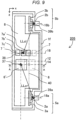
FIG. 9 is a perspective view illustrating a zx plane (viewed from above) of astereo camera 205 according to a sixth embodiment of the present invention. Thestereo camera 205 has acasing 1f instead of thecasing 1a of thestereo camera 200.FIG. 10 is an A-A cross-sectional view ofFIG. 9 . InFIGS. 9 and10 , the same configurations as those in the first and fifth embodiments will be denoted by the same reference signs, and detailed descriptions thereof will be omitted. - The first to sixth embodiments describe the distance between the
camera modules - Here, a connection center 37 of the
first circuit element 6 to thecasing 1f on the horizontal plane (zx plane) is a point obtained by projecting a centroid of thefirst circuit element 6 onto the horizontal plane, and aconnection center 38 of thesecond circuit element 7 is a point obtained by projecting a centroid of the plurality ofsecond circuit elements 7 onto the horizontal plane. Further, connection centers 39a and 39b of thefirst imaging element 2a and thesecond imaging element 2b are points obtained by projecting centers of surfaces attached to thecasing 1f as thecamera modules - Considering distances in a direction between the
camera modules first imaging element 2a and thesecond imaging element 2b, and thefirst circuit element 6 and thesecond circuit element 7 on the horizontal plane (zx plane) are disposed in thecasings 1a to 1e substantially in a straight line as indicated by abroken line 40 inFIG. 9 , in the above-described respective embodiments. - In the present embodiment, for example, a distance (LLcr) between the
connection center 39a of thefirst imaging element 2a and the connection center 37 of a first circuit element 6' is increased to further reduce the influence of a temperature increase of the first circuit element 6' on thefirst imaging element 2a. In the present embodiment, the first circuit element 6' is disposed on the rear side of the optical axis (negative direction of the x axis) as indicated by a solid line inFIG. 9 . Similarly, the second circuit element 7' may be disposed on the rear side of the optical axis (negative direction of the x axis) to increase a distance (LLcl) between theconnection center 39b of thesecond imaging element 2b and theconnection center 38 of the second circuit element 7' in order to further reduce the influence of a temperature increase of the second circuit element 7' includingsecond circuit elements 7a', 7b'and 7c' on thesecond imaging element 2b. That is, when thefirst imaging element 2a and thesecond imaging element 2b are disposed on the front side of thestereo camera 205, the first circuit element 6' and the second circuit element 7' may be disposed on the rear side of thestereo camera 205. - The cross-sectional view of
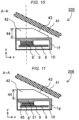
FIG. 10 is a view cut at a position of the first circuit element 6' of thestereo camera 205 ofFIG. 9 . As illustrated inFIG. 10 , thestereo camera 205 is located near awindshield 41, and thus, theentire stereo camera 205 adopts a shape along thewindshield 41, that is, a shape in which aslope 43 is provided on a front side of a shape of afin 42 in many cases. Therefore, when the first circuit element 6' and the second circuit element 7' are disposed on the rear side of the optical axis, a portion where afin height 44 is high can be effectively used to improve the heat radiation performance, and it is possible to reduce a temperature of thefirst imaging element 2a, a temperature of thesecond imaging element 2b, a temperature of the first circuit element 6' and a temperature of the second circuit element 7', and to realize thestereo camera 205 with high reliability. -
FIG. 11 is a cross-sectional view of astereo camera 206 according to a seventh embodiment of the present invention cut at the same position as that inFIG. 10 . Thestereo camera 206 has a casing 1g instead of thecasing 1a of thestereo camera 200. InFIG. 11 , the same configurations as those in the first and sixth embodiments will be denoted by the same reference signs, and detailed descriptions thereof will be omitted. - In the present embodiment, there is a
third extension portion 45 in which thefirst connection portion 21 connecting the first circuit element 6' and the casing 1g extends to the rear side of the optical axis (negative direction of the x axis), which is similar to the sixth embodiment. Due to thethird extension portion 45, a heat generation center on the casing 1g of the first circuit element 6' becomes closer to the rear side of the optical axis, a distance from thefirst imaging element 2a to the heat generation center of the first circuit element 6' becomes longer, the heat radiation from thefins 42 and the like between the first circuit element 6' and thefirst imaging element 2a progresses, and the amount of heat transferred from the first circuit element 6' to thefirst imaging element 2a decreases, so that a temperature of thefirst imaging element 2a can be reduced. - Similarly, if there is a fourth extension portion (not illustrated) in which the
second connection portion 23 connecting the second circuit element 7' and thecasing 1f extends to the rear side of the optical axis (negative direction of the x axis), a heat generation center on thecasing 1f of the second circuit element 7' becomes closer to the rear side of the optical axis, a distance from thesecond imaging element 2b to the heat generation center of the second circuit element 7' becomes longer, the heat radiation from thefins 42 and the like between the second circuit element 7' and thesecond imaging element 2b progresses, and the amount of heat transferred to thesecond imaging element 2b decreases, so that a temperature of thesecond imaging element 2b can be reduced. - According to the seventh embodiment of the present invention, the temperature of the
first imaging element 2a and the temperature of thesecond imaging element 2b can be reduced, and thestereo camera 206 with high reliability can be realized. -
FIG. 12 is a view illustrating a temperature increase of thefirst imaging element 2a and a temperature increase of thesecond imaging element 2b depending on a length of the first distance (Lf) in a stereo camera according to an eighth embodiment of the present invention. In the present embodiment, a structure of the stereo camera may be any of the first to seventh embodiments. Thus, a description will be given here with reference to the structure of thestereo camera 200 of the first embodiment. In the present embodiment, the first distance (Lf) is set based on an allowable range of a temperature difference between a temperature of thefirst imaging element 2a and a temperature of thesecond imaging element 2b. - Conditions that the second distance (Lm) is longer than the first distance (Lf), the third distance (Lcr) is longer than the first distance (Lf), and the fourth distance (Lcl) is longer than the second distance (Lm) can make the temperature of the
first imaging element 2a and the temperature of thesecond imaging element 2b equal. At that time, a range of the length of the first distance (Lf), which is included in the allowable range of the temperature difference between the temperature of thefirst imaging element 2a and the temperature of thesecond imaging element 2b, which is allowable for the operation of thestereo camera 200, is obtained byFIG. 12 as the range of 0 to 20 mm. That is, if the length of the first distance (Lf) is in the range of 0 to 20 mm, the temperature difference between the temperature of thefirst imaging element 2a and the temperature of thesecond imaging element 2b can be set within the range that is allowable for the operation of thestereo camera 200. Therefore, the temperature of thefirst imaging element 2a and the temperature of thesecond imaging element 2b can be made equal by setting the first distance (Lf) within the range of 0 to 20 mm, and thestereo camera 200 with high measurement accuracy can be realized. At that time, thestereo camera 200 with high reliability can be realized even if a disturbance such as an assembly variation occurs. - Further, the
first circuit element 6 has a larger heat generation amount (power consumption) than thesecond circuit element 7, and a difference in the heat generation amount is three to five times. Therefore, it is preferable that the second distance (Lm) from thedevice center 12 to the secondcircuit element center 16 be longer than the first distance (Lf) from thedevice center 12 to the firstcircuit element center 14 in the direction between thecamera modules - According to the present embodiment, the temperature of the
first imaging element 2a and the temperature of thesecond imaging element 2b can be made equal, and thestereo camera 200 with high measurement accuracy can be realized. - Note that the present invention is not limited to the above-described embodiments, but includes various modifications. For example, the above-described embodiments have been described in detail in order to describe the present invention in an easily understandable manner, and are not necessarily limited to one including the entire configuration that has been described above. Further, some configurations of a certain embodiment can be substituted by configurations of another embodiment, and further, a configuration of another embodiment can be added to a configuration of a certain embodiment. Further, addition, deletion or substitution of other configurations can be made with respect to some configurations of each embodiment.
-
- 1a to 1g
- casing
- 2a
- first imaging element
- 2b
- second imaging element
- 3a
- first imaging element substrate
- 3b
- second imaging element substrate
- 4a
- first lens
- 4b
- second lens
- 5a
- first camera module
- 5b
- second camera module
- 6
- first circuit element
- 7
- second circuit element
- 8
- circuit board
- 9
- thermally conductive member
- 10
- cover
- 11
- fin
- 12
- device center (center of stereo camera device)
- 13
- midpoint
- 14
- first circuit element center
- 15
- centroid
- 16
- second circuit element center
- 17
- centroid
- 18a
- first imaging element center
- 18b
- second imaging element center
- 19a
- first imaging element center
- 19b
- second imaging element center
- 21
- first connection portion
- 22
- first extension portion
- 23
- second connection portion
- 24
- second extension portion
- 25
- heat generation center
- 26
- heat generation center
- 27
- third connection portion
- 28
- fourth connection portion
- 29
- position
- 30
- plate thickness
- 31
- fin
- 32
- fin height
- 33
- fin height
- 34
- end portion
- 35
- fin
- 36
- width
- 37
- connection center
- 38
- connection center
- 39a
- connection center
- 39b
- connection center
- 40
- broken line
- 41
- windshield
- 42
- fin
- 43
- slope
- 44
- fin height
- 45
- third extension portion
- 200
- stereo camera
- 201
- stereo camera
- 202
- stereo camera
- 203
- stereo camera
- 204
- stereo camera
- 205
- stereo camera
- 206
- stereo camera
Claims (9)
- A stereo camera device comprising:a first imaging element (2a) and a second imaging element (2b) ;a first circuit element (6) and a second circuit element (7) disposed between the first imaging element (2a) and the second imaging element (2b), whereinthe first circuit element (6) has a larger heat generation amount than the second circuit element (7); anda casing (1a; 1b; 1c; 1d; 1e; 1f; 1g) for retaining the first imaging element (2a), the first circuit element (6), the second circuit element (7), and the second imaging element (2b) in order,wherein a plane, which is passing through a midpoint (13) between the first imaging element (2a) and the second imaging element (2b) and which has a normal line connecting the first imaging element (2a) and the second imaging element (2b), is defined as a stereo camera device center (12),a plane, which is passing through a centroid of the first imaging element (2a) and which has a normal line connecting the first imaging element (2a) and the second imaging element (2b), is defined as a first imaging element center (18a),a plane, which is passing through a centroid of the second imaging element (2b) and which has a normal line connecting the first imaging element (2a) and the second imaging element (2b), is defined as a second imaging element center (18b),a plane, which is passing through a centroid (15) of the first circuit element (6) and which has a normal line connecting the first imaging element (2a) and the second imaging element (2b), is defined as a first circuit element center (14),a plane, which is passing through a centroid (17) of the second circuit element (7) and which has a normal line connecting the first imaging element (2a) and the second imaging element (2b), is defined as a second circuit element center (16),a second distance (Lm) from the second circuit element center (16) to the stereo camera device center (12) is longer than a first distance (Lf) from the first circuit element center (14) to the stereo camera device center (12) in a direction connecting the first imaging element (2a) and the second imaging element (2b),a third distance (Lcr) from the first circuit element center (14) to the first imaging element center (18a) is longer than the first distance (Lf), anda fourth distance (Lcl) from the second circuit element center (16) to the second imaging element center (18b) is longer than the second distance (Lm).
- The stereo camera device according to claim 1, wherein
a first connection portion (21) of the first circuit element (6) to the casing (1a; 1b; 1c; 1d; 1e; 1f; 1g) extends to a side of the second circuit element (7) from an outer form of the first circuit element (6), or a second connection portion (23) of the second circuit element (7) to the casing (1a; 1b; 1c; 1d; 1e; 1f; 1g) extends to a side of the first circuit element (6) from an outer form of the second circuit element (7). - The stereo camera device according to claim 1, wherein
a third connection portion (27), obtained by integrating a first connection portion (21) of the first circuit element (6) to the casing (1a; 1b; 1c; 1d; 1e; 1f; 1g) and a second connection portion (23) of the second circuit element (7) to the casing (1a; 1b; 1c; 1d; 1e; 1f; 1g), is provided, and an end surface of the third connection portion (27) in a -y-axis direction is flush at a position of the first circuit element (6), a position between the first circuit element (6) and the second circuit element (7), and a position of the second circuit element (7) in a z-axis direction. - The stereo camera device according to claim 2 or 3, wherein
the casing (1a; 1b; 1c; 1d; 1e; 1f; 1g) has a plurality of fins (11; 31) extending in a y-axis direction at a predetermined interval in the z-axis direction at least between a position of the first connection portion (21) and a position of the second connection portion (23) in the z-axis direction. - The stereo camera device according to claim 4, whereinthe plurality of fins (11; 31) are also disposed in places other than a place between the position of the first connection portion (21) and the position of the second connection portion (23) in the z-axis direction, andamong the plurality of fins (11; 31), fins (31) between the position of the first connection portion (21) and the position of the second connection portion (23) in the z-axis direction have a longer length (33) in the y-axis direction than fins (11) disposed in places other than the place between the position of the first connection portion (21) and the position of the second connection portion (23) in the z-axis direction.
- The stereo camera device according to claim 4 or 5, wherein
an end portion (34) of the first circuit element (6) on a side of the first imaging element (2a) is located within a width (36) of one of the plurality of fins (35) in the z-axis direction. - The stereo camera device according to any one of claims 1 to 6, whereinthe second circuit element (7) is an element group formed of a plurality of elements, andthe second circuit element center (16) is a plane which is passing through a centroid (17) of the element group and which has a normal line connecting the first imaging element (2a) and the second imaging element (2b).
- The stereo camera device according to any one of claims 1 to 7, wherein
the first distance (Lf) is 0 mm to 20 mm. - The stereo camera device according to any one of claims 1 to 8, wherein
the second distance (Lm) is three to five times the first distance (Lf).
Applications Claiming Priority (2)
| Application Number | Priority Date | Filing Date | Title |
|---|---|---|---|
| JP2018231605A JP7154120B2 (en) | 2018-12-11 | 2018-12-11 | stereo camera device |
| PCT/JP2019/045180 WO2020121746A1 (en) | 2018-12-11 | 2019-11-19 | Stereo camera device |
Publications (3)
| Publication Number | Publication Date |
|---|---|
| EP3896389A1 EP3896389A1 (en) | 2021-10-20 |
| EP3896389A4 EP3896389A4 (en) | 2022-11-23 |
| EP3896389B1 true EP3896389B1 (en) | 2025-06-25 |
Family
ID=71076960
Family Applications (1)
| Application Number | Title | Priority Date | Filing Date |
|---|---|---|---|
| EP19897395.0A Active EP3896389B1 (en) | 2018-12-11 | 2019-11-19 | Stereo camera device |
Country Status (3)
| Country | Link |
|---|---|
| EP (1) | EP3896389B1 (en) |
| JP (1) | JP7154120B2 (en) |
| WO (1) | WO2020121746A1 (en) |
Family Cites Families (6)
| Publication number | Priority date | Publication date | Assignee | Title |
|---|---|---|---|---|
| EP2357527B1 (en) * | 2004-11-15 | 2012-10-17 | Hitachi Ltd. | Stereo camera having two imaging elements mounted on a common stay |
| JP5961506B2 (en) * | 2012-09-27 | 2016-08-02 | 日立オートモティブシステムズ株式会社 | Stereo camera device |
| EP2972478B1 (en) * | 2013-03-15 | 2020-12-16 | Uatc, Llc | Methods, systems, and apparatus for multi-sensory stereo vision for robotics |
| JP6627471B2 (en) | 2015-03-18 | 2020-01-08 | 株式会社リコー | Imaging unit, vehicle control unit, and heat transfer method of imaging unit |
| JP6573713B2 (en) * | 2016-03-23 | 2019-09-11 | 日立オートモティブシステムズ株式会社 | In-vehicle image processing device |
| JP6838262B2 (en) * | 2017-01-06 | 2021-03-03 | 日立Astemo株式会社 | Stereo camera |
-
2018
- 2018-12-11 JP JP2018231605A patent/JP7154120B2/en active Active
-
2019
- 2019-11-19 EP EP19897395.0A patent/EP3896389B1/en active Active
- 2019-11-19 WO PCT/JP2019/045180 patent/WO2020121746A1/en not_active Ceased
Also Published As
| Publication number | Publication date |
|---|---|
| JP2020094858A (en) | 2020-06-18 |
| WO2020121746A1 (en) | 2020-06-18 |
| JP7154120B2 (en) | 2022-10-17 |
| EP3896389A4 (en) | 2022-11-23 |
| EP3896389A1 (en) | 2021-10-20 |
Similar Documents
| Publication | Publication Date | Title |
|---|---|---|
| US9961242B2 (en) | Stereo camera | |
| JP7691859B2 (en) | Image capture device and method for assembling image capture device | |
| EP3985431A1 (en) | Stereo camera | |
| CN101326424B (en) | Stereo camera | |
| US12545193B2 (en) | Vehicle-mounted camera | |
| CN108780267A (en) | Vehicle image processing device | |
| US12069226B2 (en) | Imaging device | |
| JP2016177257A (en) | Imaging unit, vehicle control unit, and heat transfer method of imaging unit | |
| WO2014050282A1 (en) | Stereo camera device | |
| JP6415649B1 (en) | Car camera | |
| CN111989909B (en) | Camera device | |
| EP3796085B1 (en) | Camera device | |
| EP3896389B1 (en) | Stereo camera device | |
| WO2021010173A1 (en) | Wiring module and imaging device | |
| CN105467391B (en) | radar device | |
| JP2018013623A (en) | On-vehicle imaging device | |
| JP7548786B2 (en) | Camera equipment | |
| JP7532926B2 (en) | Imaging unit and vehicle control unit | |
| JP2025109630A (en) | Imaging device | |
| WO2024201732A1 (en) | Imaging device | |
| WO2025120811A1 (en) | Imaging device |
Legal Events
| Date | Code | Title | Description |
|---|---|---|---|
| STAA | Information on the status of an ep patent application or granted ep patent |
Free format text: STATUS: THE INTERNATIONAL PUBLICATION HAS BEEN MADE |
|
| PUAI | Public reference made under article 153(3) epc to a published international application that has entered the european phase |
Free format text: ORIGINAL CODE: 0009012 |
|
| STAA | Information on the status of an ep patent application or granted ep patent |
Free format text: STATUS: REQUEST FOR EXAMINATION WAS MADE |
|
| 17P | Request for examination filed |
Effective date: 20210712 |
|
| AK | Designated contracting states |
Kind code of ref document: A1 Designated state(s): AL AT BE BG CH CY CZ DE DK EE ES FI FR GB GR HR HU IE IS IT LI LT LU LV MC MK MT NL NO PL PT RO RS SE SI SK SM TR |
|
| DAV | Request for validation of the european patent (deleted) | ||
| DAX | Request for extension of the european patent (deleted) | ||
| A4 | Supplementary search report drawn up and despatched |
Effective date: 20221020 |
|
| RIC1 | Information provided on ipc code assigned before grant |
Ipc: B60R 11/00 20060101ALI20221014BHEP Ipc: B60R 11/04 20060101ALI20221014BHEP Ipc: G01C 3/02 20060101ALI20221014BHEP Ipc: G01C 3/06 20060101AFI20221014BHEP |
|
| GRAP | Despatch of communication of intention to grant a patent |
Free format text: ORIGINAL CODE: EPIDOSNIGR1 |
|
| STAA | Information on the status of an ep patent application or granted ep patent |
Free format text: STATUS: GRANT OF PATENT IS INTENDED |
|
| INTG | Intention to grant announced |
Effective date: 20250129 |
|
| GRAS | Grant fee paid |
Free format text: ORIGINAL CODE: EPIDOSNIGR3 |
|
| GRAA | (expected) grant |
Free format text: ORIGINAL CODE: 0009210 |
|
| STAA | Information on the status of an ep patent application or granted ep patent |
Free format text: STATUS: THE PATENT HAS BEEN GRANTED |
|
| AK | Designated contracting states |
Kind code of ref document: B1 Designated state(s): AL AT BE BG CH CY CZ DE DK EE ES FI FR GB GR HR HU IE IS IT LI LT LU LV MC MK MT NL NO PL PT RO RS SE SI SK SM TR |
|
| REG | Reference to a national code |
Ref country code: GB Ref legal event code: FG4D |
|
| REG | Reference to a national code |
Ref country code: CH Ref legal event code: EP |
|
| REG | Reference to a national code |
Ref country code: CH Ref legal event code: EP |
|
| REG | Reference to a national code |
Ref country code: IE Ref legal event code: FG4D |
|
| REG | Reference to a national code |
Ref country code: DE Ref legal event code: R096 Ref document number: 602019071751 Country of ref document: DE |
|
| PG25 | Lapsed in a contracting state [announced via postgrant information from national office to epo] |
Ref country code: FI Free format text: LAPSE BECAUSE OF FAILURE TO SUBMIT A TRANSLATION OF THE DESCRIPTION OR TO PAY THE FEE WITHIN THE PRESCRIBED TIME-LIMIT Effective date: 20250625 |
|
| REG | Reference to a national code |
Ref country code: LT Ref legal event code: MG9D |
|
| PG25 | Lapsed in a contracting state [announced via postgrant information from national office to epo] |
Ref country code: NO Free format text: LAPSE BECAUSE OF FAILURE TO SUBMIT A TRANSLATION OF THE DESCRIPTION OR TO PAY THE FEE WITHIN THE PRESCRIBED TIME-LIMIT Effective date: 20250925 Ref country code: GR Free format text: LAPSE BECAUSE OF FAILURE TO SUBMIT A TRANSLATION OF THE DESCRIPTION OR TO PAY THE FEE WITHIN THE PRESCRIBED TIME-LIMIT Effective date: 20250926 |
|
| PG25 | Lapsed in a contracting state [announced via postgrant information from national office to epo] |
Ref country code: BG Free format text: LAPSE BECAUSE OF FAILURE TO SUBMIT A TRANSLATION OF THE DESCRIPTION OR TO PAY THE FEE WITHIN THE PRESCRIBED TIME-LIMIT Effective date: 20250625 |
|
| PG25 | Lapsed in a contracting state [announced via postgrant information from national office to epo] |
Ref country code: HR Free format text: LAPSE BECAUSE OF FAILURE TO SUBMIT A TRANSLATION OF THE DESCRIPTION OR TO PAY THE FEE WITHIN THE PRESCRIBED TIME-LIMIT Effective date: 20250625 |
|
| PG25 | Lapsed in a contracting state [announced via postgrant information from national office to epo] |
Ref country code: RS Free format text: LAPSE BECAUSE OF FAILURE TO SUBMIT A TRANSLATION OF THE DESCRIPTION OR TO PAY THE FEE WITHIN THE PRESCRIBED TIME-LIMIT Effective date: 20250925 |
|
| PG25 | Lapsed in a contracting state [announced via postgrant information from national office to epo] |
Ref country code: LV Free format text: LAPSE BECAUSE OF FAILURE TO SUBMIT A TRANSLATION OF THE DESCRIPTION OR TO PAY THE FEE WITHIN THE PRESCRIBED TIME-LIMIT Effective date: 20250625 |
|
| REG | Reference to a national code |
Ref country code: NL Ref legal event code: MP Effective date: 20250625 |
|
| PG25 | Lapsed in a contracting state [announced via postgrant information from national office to epo] |
Ref country code: NL Free format text: LAPSE BECAUSE OF FAILURE TO SUBMIT A TRANSLATION OF THE DESCRIPTION OR TO PAY THE FEE WITHIN THE PRESCRIBED TIME-LIMIT Effective date: 20250625 |
|
| PG25 | Lapsed in a contracting state [announced via postgrant information from national office to epo] |
Ref country code: PT Free format text: LAPSE BECAUSE OF FAILURE TO SUBMIT A TRANSLATION OF THE DESCRIPTION OR TO PAY THE FEE WITHIN THE PRESCRIBED TIME-LIMIT Effective date: 20251027 |
|
| REG | Reference to a national code |
Ref country code: AT Ref legal event code: MK05 Ref document number: 1806829 Country of ref document: AT Kind code of ref document: T Effective date: 20250625 |
|
| PG25 | Lapsed in a contracting state [announced via postgrant information from national office to epo] |
Ref country code: IS Free format text: LAPSE BECAUSE OF FAILURE TO SUBMIT A TRANSLATION OF THE DESCRIPTION OR TO PAY THE FEE WITHIN THE PRESCRIBED TIME-LIMIT Effective date: 20251025 |
|
| PGFP | Annual fee paid to national office [announced via postgrant information from national office to epo] |
Ref country code: DE Payment date: 20251130 Year of fee payment: 7 |
|
| PG25 | Lapsed in a contracting state [announced via postgrant information from national office to epo] |
Ref country code: AT Free format text: LAPSE BECAUSE OF FAILURE TO SUBMIT A TRANSLATION OF THE DESCRIPTION OR TO PAY THE FEE WITHIN THE PRESCRIBED TIME-LIMIT Effective date: 20250625 Ref country code: SM Free format text: LAPSE BECAUSE OF FAILURE TO SUBMIT A TRANSLATION OF THE DESCRIPTION OR TO PAY THE FEE WITHIN THE PRESCRIBED TIME-LIMIT Effective date: 20250625 |
|
| PG25 | Lapsed in a contracting state [announced via postgrant information from national office to epo] |
Ref country code: CZ Free format text: LAPSE BECAUSE OF FAILURE TO SUBMIT A TRANSLATION OF THE DESCRIPTION OR TO PAY THE FEE WITHIN THE PRESCRIBED TIME-LIMIT Effective date: 20250625 |
|
| PG25 | Lapsed in a contracting state [announced via postgrant information from national office to epo] |
Ref country code: PL Free format text: LAPSE BECAUSE OF FAILURE TO SUBMIT A TRANSLATION OF THE DESCRIPTION OR TO PAY THE FEE WITHIN THE PRESCRIBED TIME-LIMIT Effective date: 20250625 |
|
| PG25 | Lapsed in a contracting state [announced via postgrant information from national office to epo] |
Ref country code: EE Free format text: LAPSE BECAUSE OF FAILURE TO SUBMIT A TRANSLATION OF THE DESCRIPTION OR TO PAY THE FEE WITHIN THE PRESCRIBED TIME-LIMIT Effective date: 20250625 |
|
| PG25 | Lapsed in a contracting state [announced via postgrant information from national office to epo] |
Ref country code: SK Free format text: LAPSE BECAUSE OF FAILURE TO SUBMIT A TRANSLATION OF THE DESCRIPTION OR TO PAY THE FEE WITHIN THE PRESCRIBED TIME-LIMIT Effective date: 20250625 |
|
| PG25 | Lapsed in a contracting state [announced via postgrant information from national office to epo] |
Ref country code: ES Free format text: LAPSE BECAUSE OF FAILURE TO SUBMIT A TRANSLATION OF THE DESCRIPTION OR TO PAY THE FEE WITHIN THE PRESCRIBED TIME-LIMIT Effective date: 20250625 |
|
| PG25 | Lapsed in a contracting state [announced via postgrant information from national office to epo] |
Ref country code: RO Free format text: LAPSE BECAUSE OF FAILURE TO SUBMIT A TRANSLATION OF THE DESCRIPTION OR TO PAY THE FEE WITHIN THE PRESCRIBED TIME-LIMIT Effective date: 20250625 |
|
| PG25 | Lapsed in a contracting state [announced via postgrant information from national office to epo] |
Ref country code: DK Free format text: LAPSE BECAUSE OF FAILURE TO SUBMIT A TRANSLATION OF THE DESCRIPTION OR TO PAY THE FEE WITHIN THE PRESCRIBED TIME-LIMIT Effective date: 20250625 |
|
| PG25 | Lapsed in a contracting state [announced via postgrant information from national office to epo] |
Ref country code: IT Free format text: LAPSE BECAUSE OF FAILURE TO SUBMIT A TRANSLATION OF THE DESCRIPTION OR TO PAY THE FEE WITHIN THE PRESCRIBED TIME-LIMIT Effective date: 20250625 |
|
| PLBE | No opposition filed within time limit |
Free format text: ORIGINAL CODE: 0009261 |
|
| STAA | Information on the status of an ep patent application or granted ep patent |
Free format text: STATUS: NO OPPOSITION FILED WITHIN TIME LIMIT |