EP3896376B1 - Flexible air supply damper system - Google Patents
Flexible air supply damper system Download PDFInfo
- Publication number
- EP3896376B1 EP3896376B1 EP21168461.8A EP21168461A EP3896376B1 EP 3896376 B1 EP3896376 B1 EP 3896376B1 EP 21168461 A EP21168461 A EP 21168461A EP 3896376 B1 EP3896376 B1 EP 3896376B1
- Authority
- EP
- European Patent Office
- Prior art keywords
- fluid
- unit
- drying
- flow rate
- discharge
- Prior art date
- Legal status (The legal status is an assumption and is not a legal conclusion. Google has not performed a legal analysis and makes no representation as to the accuracy of the status listed.)
- Active
Links
Images



Classifications
-
- H—ELECTRICITY
- H01—ELECTRIC ELEMENTS
- H01M—PROCESSES OR MEANS, e.g. BATTERIES, FOR THE DIRECT CONVERSION OF CHEMICAL ENERGY INTO ELECTRICAL ENERGY
- H01M4/00—Electrodes
- H01M4/02—Electrodes composed of, or comprising, active material
- H01M4/04—Processes of manufacture in general
- H01M4/0471—Processes of manufacture in general involving thermal treatment, e.g. firing, sintering, backing particulate active material, thermal decomposition, pyrolysis
-
- F—MECHANICAL ENGINEERING; LIGHTING; HEATING; WEAPONS; BLASTING
- F26—DRYING
- F26B—DRYING SOLID MATERIALS OR OBJECTS BY REMOVING LIQUID THEREFROM
- F26B21/00—Arrangements for supplying or controlling air or other gases for drying solid materials or objects
- F26B21/001—Air generating units, e.g. movable or independent of drying enclosure
-
- F—MECHANICAL ENGINEERING; LIGHTING; HEATING; WEAPONS; BLASTING
- F26—DRYING
- F26B—DRYING SOLID MATERIALS OR OBJECTS BY REMOVING LIQUID THEREFROM
- F26B21/00—Arrangements for supplying or controlling air or other gases for drying solid materials or objects
- F26B21/20—Circulating air or gases in closed cycles, e.g. wholly within the drying enclosure
- F26B21/202—Circulating air or gases in closed cycles, e.g. wholly within the drying enclosure with means for changing the flow pattern, e.g. by reversing gas flow or by moving the materials or objects through subsequent compartments, at least two of which have a different flow direction
- F26B21/208—Circulating air or gases in closed cycles, e.g. wholly within the drying enclosure with means for changing the flow pattern, e.g. by reversing gas flow or by moving the materials or objects through subsequent compartments, at least two of which have a different flow direction by air valves, movable baffles or nozzle arrangements
-
- F—MECHANICAL ENGINEERING; LIGHTING; HEATING; WEAPONS; BLASTING
- F26—DRYING
- F26B—DRYING SOLID MATERIALS OR OBJECTS BY REMOVING LIQUID THEREFROM
- F26B21/00—Arrangements for supplying or controlling air or other gases for drying solid materials or objects
- F26B21/20—Circulating air or gases in closed cycles, e.g. wholly within the drying enclosure
- F26B21/25—Circulating air or gases in closed cycles, e.g. wholly within the drying enclosure partly outside the drying enclosure
-
- F—MECHANICAL ENGINEERING; LIGHTING; HEATING; WEAPONS; BLASTING
- F26—DRYING
- F26B—DRYING SOLID MATERIALS OR OBJECTS BY REMOVING LIQUID THEREFROM
- F26B21/00—Arrangements for supplying or controlling air or other gases for drying solid materials or objects
- F26B21/30—Controlling, e.g. regulating, parameters of gas supply
- F26B21/35—Temperature; Pressure
-
- F—MECHANICAL ENGINEERING; LIGHTING; HEATING; WEAPONS; BLASTING
- F26—DRYING
- F26B—DRYING SOLID MATERIALS OR OBJECTS BY REMOVING LIQUID THEREFROM
- F26B21/00—Arrangements for supplying or controlling air or other gases for drying solid materials or objects
- F26B21/30—Controlling, e.g. regulating, parameters of gas supply
- F26B21/37—Velocity of flow; Quantity of flow
-
- F—MECHANICAL ENGINEERING; LIGHTING; HEATING; WEAPONS; BLASTING
- F26—DRYING
- F26B—DRYING SOLID MATERIALS OR OBJECTS BY REMOVING LIQUID THEREFROM
- F26B21/00—Arrangements for supplying or controlling air or other gases for drying solid materials or objects
- F26B21/50—Ducting arrangements from the source of air or other gases to the materials or objects being dried
-
- F—MECHANICAL ENGINEERING; LIGHTING; HEATING; WEAPONS; BLASTING
- F26—DRYING
- F26B—DRYING SOLID MATERIALS OR OBJECTS BY REMOVING LIQUID THEREFROM
- F26B3/00—Drying solid materials or objects by processes involving the application of heat
- F26B3/02—Drying solid materials or objects by processes involving the application of heat by convection, i.e. heat being conveyed from a heat source to the materials or objects to be dried by a gas or vapour, e.g. air
- F26B3/04—Drying solid materials or objects by processes involving the application of heat by convection, i.e. heat being conveyed from a heat source to the materials or objects to be dried by a gas or vapour, e.g. air the gas or vapour circulating over or surrounding the materials or objects to be dried
-
- F—MECHANICAL ENGINEERING; LIGHTING; HEATING; WEAPONS; BLASTING
- F26—DRYING
- F26B—DRYING SOLID MATERIALS OR OBJECTS BY REMOVING LIQUID THEREFROM
- F26B9/00—Machines or apparatus for drying solid materials or objects at rest or with only local agitation; Domestic airing cupboards
- F26B9/06—Machines or apparatus for drying solid materials or objects at rest or with only local agitation; Domestic airing cupboards in stationary drums or chambers
-
- Y—GENERAL TAGGING OF NEW TECHNOLOGICAL DEVELOPMENTS; GENERAL TAGGING OF CROSS-SECTIONAL TECHNOLOGIES SPANNING OVER SEVERAL SECTIONS OF THE IPC; TECHNICAL SUBJECTS COVERED BY FORMER USPC CROSS-REFERENCE ART COLLECTIONS [XRACs] AND DIGESTS
- Y02—TECHNOLOGIES OR APPLICATIONS FOR MITIGATION OR ADAPTATION AGAINST CLIMATE CHANGE
- Y02E—REDUCTION OF GREENHOUSE GAS [GHG] EMISSIONS, RELATED TO ENERGY GENERATION, TRANSMISSION OR DISTRIBUTION
- Y02E60/00—Enabling technologies; Technologies with a potential or indirect contribution to GHG emissions mitigation
- Y02E60/10—Energy storage using batteries
Definitions
- the following disclosure relates to a flexible air supply damper system for preventing an overdrying-caused defect of a secondary battery electrode plate capable of controlling a flow rate of air to be supplied to a drying unit to prevent damage to the electrode plate caused when the electrode plate is overdried at the beginning of the drying process.
- a device for drying a secondary battery electrode plate has a predetermined drying temperature and air volume for each section of a drying furnace. Since the electrode plate is dried in a state where the temperature and the air volume are kept constant, the electrode plate is overdried due to concentration-based drying at the beginning of the drying process, resulting in a crack in the electrode plate, a break in the electrode plate, and an increase in electrode resistance due to binder migration. This has caused a problem that the quality of the dried electrode plate deteriorates.
- the introduction of the external fluid for resolving overheating may cause a safety accident because flammable/toxic gas (NMP) generated during drying a positive electrode plate is released to the outside
- NMP flammable/toxic gas
- the spraying of the water for forcibly increasing the solvent saturation amount in the drying furnace may cause a problem that the positive electrode plate generating NMP during the drying process may have a rapidly increasing NMP gas concentration
- the lowering of the initial temperature and the adjusting of the temperature to the target drying temperature simultaneously with the production may cause a problem that a time required for stabilizing the temperature from the low temperature to the target temperature is not constant, and thus, the electrode plate is not partially dried in the temperature stabilizing process, resulting in a deterioration in production quality.
- Patent Document 1 Korean Patent Laid-Open Publication No. 10-2018-0069388 (entitled “ELECTRODE DRYING DEVICE” and published on June 25, 2018 ) discloses a drying apparatus with a hot air generating means, a hot air driving unit, and a manifold splitting the hot air flow in three partial flows being directed through three drying chambers.
- Patent Document 2 Korean Patent Laid-Open Publication No. 10-2015-0131563 (entitled “APPARATUS FOR DRYING THE ELECTRODE PLATE AND METHOD FOR DRYING THE SAME" and published on November 25, 2015 ) discloses an air supply system comprising: a fluid supply unit; a heating unit; a drying unit drying an electrode plate and a discharge unit.
- An embodiment of the present invention is directed to providing a flexible air supply damper system for preventing an overdrying-caused defect of a secondary battery electrode plate capable of controlling an amount of hot air supplied to a drying furnace, when the system is restarted after being stopped, to solve a problem of overheating of the electrode plate at the beginning of the drying process.
- Another embodiment of the present invention is directed to providing a method for preventing overdrying using the flexible air supply damper system for preventing an overdrying-caused defect of a secondary battery electrode plate.
- a flexible air supply damper system for preventing an overdrying-caused defect of a secondary battery electrode plate includes: a fluid supply unit 100 supplying a fluid; a heating unit 200 heating the fluid supplied through the fluid supply unit 100; a drying unit 300 drying an electrode plate while receiving the fluid heated through the heating unit 200; a damper unit 400 splitting the fluid passing through the heating unit 200 to control an amount of the fluid to be introduced into the drying unit 300; and a discharge unit 500 through which the fluid used in the drying unit 300 and the fluid split out of the damper unit 400 are discharged.
- the discharge unit 500 further includes a discharge means 510 discharging the fluid, a first discharge passage 520 allowing the damper unit 400 and the discharge means 510 to communicate with each other, and a second discharge passage 530 allowing the drying unit 300 and the discharge means 510 to communicate with each other.
- the flexible air supply damper system may further include a circulation unit 600 reintroducing the fluid from the drying unit 300 via the heating unit 200.
- the fluid supply unit 100 may include an introduction means 110 introducing the fluid, and an introduction passage 120 guiding the fluid introduced by the introduction means 110 to the heating unit 200.
- the circulation unit 600 may include a circulation-supply means 610 positioned between the introduction means 110 and the heating unit 200 and supplying, to the heating unit 200, at least one of the fluid introduced through the introduction means 110 and the fluid introduced through the drying unit 300, and a circulation passage 620 allowing the drying unit 300 and the introduction passage 120 positioned between the introduction means 110 and the circulation-supply means 610 to communicate with each other.
- the flexible air supply damper system may further include a flow rate measurement unit 700 positioned on the circulation passage 620 to measure a flow rate of the fluid introduced into the introduction passage 120 through the circulation passage 620 and provide information on the measured flow rate to the discharge means 510.
- a flow rate measurement unit 700 positioned on the circulation passage 620 to measure a flow rate of the fluid introduced into the introduction passage 120 through the circulation passage 620 and provide information on the measured flow rate to the discharge means 510.
- the discharge means 510 may control an amount of the fluid to be discharged based on the information on the flow rate received from the flow rate measurement unit 700 to keep an amount of the fluid circulating through the circulation passage 620 constant.
- a drying method using the flexible air supply damper system for preventing an overdrying-caused defect of a secondary battery electrode plate includes: an introduction fluid flow rate determination step S100 of determining a flow rate of fluid to be introduced through the fluid supply unit 100; a drying fluid temperature determination step S200 of setting a temperature of the fluid to be introduced into the drying unit 300; a drying fluid flow rate determination step S300 of controlling a flow rate of the fluid to be introduced into the drying unit 300 from the damper unit 400; and a discharge fluid flow rate determination step S400 of determining a flow rate of the fluid to be discharged through the discharge unit 500, wherein in the drying fluid flow rate determination step S300, the flow rate of the drying fluid is determined as increasing in a stepwise manner for a predetermined period of time.
- FIG. 1 is a conceptual diagram illustrating a flexible air supply damper system 1000 for preventing an overdrying-caused defect of a secondary battery electrode plate according to a first exemplary embodiment of the present invention.
- the flexible air supply damper system 1000 for preventing an overdrying-caused defect of a secondary battery electrode plate includes: a fluid supply unit 100 supplying a fluid; a heating unit 200 heating the fluid supplied through the fluid supply unit 100; a drying unit 300 drying the electrode plate while receiving the fluid heated through the heating unit 200; a damper unit 400 splitting the fluid passing through the heating unit 200 to control an amount of the fluid to be introduced into the drying unit 300; and a discharge unit 500 through which the fluid used in the drying unit 300 and the fluid split out of the damper unit 400 are discharged.
- a heat-based drying scheme using a temperature and an air volume and a concentration-based drying scheme using a solvent saturation amount are used together.
- the present invention is provided to control an amount of the fluid to be introduced into the drying unit 300 using the damper unit 400, thereby preventing the electrode plate from being overdried when the same amount of fluid is introduced into the drying unit in a state where the solvent saturation amount in the drying unit is low.
- a degree to which the electrode plate is dried is controlled based on the temperature and the amount of the fluid introduced into the drying unit, in which the electrode plate is dried, and the solvent saturation amount in the drying unit.
- the solvent saturation amount in the drying unit 300 is low, if the fluid is introduced into the drying unit 300 in an amount that is suitable when the solvent saturation amount is a predetermined value or higher, a concentration-based drying rate may increase and the electrode plate may be overdried.
- the amount of the fluid to be introduced into the drying unit 300 is controlled using the damper unit 400.
- the discharge unit 500 includes a discharge means 510 discharging the fluid, a first discharge passage 520 allowing the damper unit 400 and the discharge means 510 to communicate with each other, and a second discharge passage 530 allowing the drying unit 300 and the discharge means 510 to communicate with each other.
- the fluid split out of the damper unit 400 and the fluid discharged after being used in the drying unit 300 are discharged by the discharge means 510 after moving through the first discharge passage 520 and the second discharge passage 530, respectively.
- FIG. 2 is a flowchart illustrating a drying method using the flexible air supply damper system 1000 for preventing an overdrying-caused defect of a secondary battery electrode plate according to the first exemplary embodiment
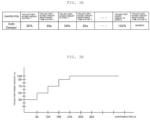
- FIG. 3 illustrates a table and a graph for explaining the electrode plate drying method of FIG. 2 .
- the drying method using the flexible air supply damper system 1000 for preventing an overdrying-caused defect of a secondary battery electrode plate may include: an introduction fluid flow rate determination step S100 of determining a flow rate of the fluid to be introduced through the fluid supply unit 100; a drying fluid temperature determination step S200 of setting a temperature of the fluid to be introduced into the drying unit 300; a drying fluid flow rate determination step S300 of controlling a flow rate of the fluid to be introduced into the drying unit 300 from the damper unit 400; and a discharge fluid flow rate determination step S400 of determining a flow rate of the fluid to be discharged through the discharge unit 500.
- the flow rate of the drying fluid which is determined in the drying fluid flow rate determination step S300, may be determined as increasing in a stepwise manner for a predetermined period of time.
- the flow rate of the fluid supplied to the drying unit 300 increases in the stepwise manner at the time intervals, it is possible to solve the overdrying problem that occurs when a large amount of drying fluid is supplied to the drying unit 300 at the beginning of operating the system. Also, since the amount of the fluid supplied to the heating unit 200 is constant at all times, it is possible to minimize a range of fluctuation in temperature of the fluid supplied to the drying unit 300.
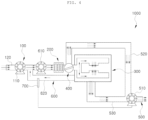
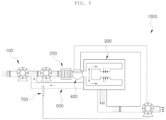
- FIGS. 4 and 5 are conceptual diagrams illustrating a flexible air supply damper system 1000 for preventing an overdrying-caused defect of a secondary battery electrode plate according to a second exemplary embodiment of the present invention.
- the flexible air supply damper system 1000 for preventing an overdrying-caused defect of a secondary battery electrode plate further includes a circulation unit 600 reintroducing the fluid from the drying unit 300 via the heating unit 200.
- the electrode plate positioned in the drying unit 300 is dried by the fluid heated in the heating unit 200.
- the circulation unit 600 is used to mix the air from the drying unit 300 with the air newly introduced through the fluid supply unit 100.
- the fluid supply unit 100 includes an introduction means 110 introducing the fluid, and an introduction passage 120 guiding the fluid introduced by the introduction means 110 to the heating unit 200
- the circulation unit 600 includes a circulation-supply means 610 positioned between the introduction means 110 and the heating unit 200 and supplying, to the heating unit 200, at least one of the fluid introduced through the introduction means 110 and the fluid introduced through the drying unit 300, and a circulation passage 620 allowing the drying unit 300 and the introduction passage 120 positioned between the introduction means 110 and the circulation-supply means 610 to communicate with each other.
- the circulation unit 600 forms a path through which the fluid from the drying unit 300 may circulate, and supplies, to the drying unit 300, the fluid in which the fluid from the drying unit sucked by the circulation-supply means 610 is mixed with the fluid introduced through the introduction means 110.
- the flexible air supply damper system for preventing an overdrying-caused defect of a secondary battery electrode plate further includes a flow rate measurement unit 700 positioned on the circulation passage 620 to measure a flow rate of the fluid introduced into the introduction passage 120 through the circulation passage 620 and provide information on the measured flow rate to the discharge means 510.
- the discharge means 510 may control an amount of fluid to be discharged based on the information on the flow rate received from the flow rate measurement unit 700 to keep an amount of fluid circulating through the circulation passage 620 constant.
- the flow rate measurement unit 700 is positioned to detect an amount of the circulating fluid on the circulation passage 620, and information on the flow rate measured by the flow rate measurement unit 700 is provided to the discharge means 510 capable of controlling an amount of the circulating fluid, such that the discharge means 510 may control an amount of fluid to be discharged based on the received information to control an amount of fluid to be supplied to the circulation-supply means 610 through the circulation passage 620.
- the circulation-supply means 610 may be any type of device capable of controlling an amount of fluid to be discharged, and may be a fan whose blades rotate to move the fluid as an example.
- the introduction means 110 and the discharge means 510 may be the same device.
- the fluid refers to any type of fluid that can be used for drying, and may be air as an example.
- FIG. 6 is a table and a graph for explaining the electrode plate drying method of the flexible air supply damper system 1000 for preventing an overdrying-caused defect of a secondary battery electrode plate according to the second exemplary embodiment of the present invention.
- the present invention is capable of solving the electrode plate overdrying problem at the beginning of the drying process by increasing a degree to which the damper unit 400 is opened in a stepwise manner, as illustrated in FIGS. 6A and 6B , in a state where the amount of the circulating fluid is kept constant.
- a trajectory-based amount maintaining time is set to 60 seconds, but this is an example.
- the solvent saturation amount in the drying unit 300 is stabilized faster, and the temperature of the fluid can be more stably controlled resulting from a reduced difference between a temperature of the fluid before being heated and a target temperature which the fluid needs to reach after passing through the heating unit 200.
- This also makes it possible to reduce the trajectory-based amount maintaining time as compared with that when the circulation unit 600 is not provided.
- the flexible air supply damper system for preventing an overdrying-caused defect of a secondary battery electrode plate according to the present invention is advantageous in that an amount of hot air introduced into the drying unit can be controlled using the damper unit, thereby solving the overdrying problem that occurs when the drying device is restarted after being stopped.
- the flexible air supply damper system for preventing an overdrying-caused defect of a secondary battery electrode plate is also advantageous in that the damper unit controlling an amount of fluid to be introduced into the drying unit is positioned between the heating unit adjusting a temperature of the fluid and the drying unit drying the electrode plate using the heated fluid, thereby keeping the amount of fluid to be supplied to the heating unit constant.
- the damper unit controlling a flow rate of the fluid is positioned at a rear end of the heating unit to keep the temperature of the fluid to be introduced into the drying unit constant at all times.
- the flexible air supply damper system for preventing an overdrying-caused defect of a secondary battery electrode plate according to the present invention is also advantageous in that the fluid used for drying can be circulated for reuse, thereby quickly increasing an initial solvent saturation amount in the drying unit to a predetermined value and minimizing energy consumption in heating the fluid.
- the flexible air supply damper system for preventing an overdrying-caused defect of a secondary battery electrode plate according to the present invention is also advantageous in that the discharge means and the flow rate measurement unit communicate with each other to control an amount of circulating fluid to be constant, thereby keeping a flow rate of fluid to be introduced into the drying unit constant.
Landscapes
- Engineering & Computer Science (AREA)
- Mechanical Engineering (AREA)
- General Engineering & Computer Science (AREA)
- Manufacturing & Machinery (AREA)
- Chemical & Material Sciences (AREA)
- Chemical Kinetics & Catalysis (AREA)
- Electrochemistry (AREA)
- General Chemical & Material Sciences (AREA)
- Life Sciences & Earth Sciences (AREA)
- Microbiology (AREA)
- Battery Electrode And Active Subsutance (AREA)
Description
- The following disclosure relates to a flexible air supply damper system for preventing an overdrying-caused defect of a secondary battery electrode plate capable of controlling a flow rate of air to be supplied to a drying unit to prevent damage to the electrode plate caused when the electrode plate is overdried at the beginning of the drying process.
- A device for drying a secondary battery electrode plate has a predetermined drying temperature and air volume for each section of a drying furnace. Since the electrode plate is dried in a state where the temperature and the air volume are kept constant, the electrode plate is overdried due to concentration-based drying at the beginning of the drying process, resulting in a crack in the electrode plate, a break in the electrode plate, and an increase in electrode resistance due to binder migration. This has caused a problem that the quality of the dried electrode plate deteriorates.
- Conventionally, in order to prevent such a problem, the following methods have been proposed: when the drying furnace is in operation, a door of the drying furnace is opened to forcibly introduce external fluid into the drying furnace, thereby resolving overheating; production is performed after water is sprayed onto a substrate with a sprayer at the beginning of operating the drying furnace to forcibly increase a solvent saturation amount in the drying furnace; and a temperature in the drying furnace is lowered at the beginning of operating the drying furnace and adjusted to a target drying temperature simultaneously with production. However, the introduction of the external fluid for resolving overheating may cause a safety accident because flammable/toxic gas (NMP) generated during drying a positive electrode plate is released to the outside, the spraying of the water for forcibly increasing the solvent saturation amount in the drying furnace may cause a problem that the positive electrode plate generating NMP during the drying process may have a rapidly increasing NMP gas concentration, and the lowering of the initial temperature and the adjusting of the temperature to the target drying temperature simultaneously with the production may cause a problem that a time required for stabilizing the temperature from the low temperature to the target temperature is not constant, and thus, the electrode plate is not partially dried in the temperature stabilizing process, resulting in a deterioration in production quality.
- Therefore, there is a need for a new electrode plate drying system capable of solving such problems.
- Patent Document 1)
Korean Patent Laid-Open Publication No. 10-2018-0069388 (entitled "ELECTRODE DRYING DEVICE" and published on June 25, 2018 - Patent Document 2)
Korean Patent Laid-Open Publication No. 10-2015-0131563 (entitled "APPARATUS FOR DRYING THE ELECTRODE PLATE AND METHOD FOR DRYING THE SAME" and published on November 25, 2015 - An embodiment of the present invention is directed to providing a flexible air supply damper system for preventing an overdrying-caused defect of a secondary battery electrode plate capable of controlling an amount of hot air supplied to a drying furnace, when the system is restarted after being stopped, to solve a problem of overheating of the electrode plate at the beginning of the drying process.
- Also, a specific aspect of such a system is proposed to maintain the system in a more efficient way.
- Another embodiment of the present invention is directed to providing a method for preventing overdrying using the flexible air supply damper system for preventing an overdrying-caused defect of a secondary battery electrode plate.
- The invention is defined by the appending claims. In one general aspect, a flexible air supply damper system for preventing an overdrying-caused defect of a secondary battery electrode plate includes: a
fluid supply unit 100 supplying a fluid; aheating unit 200 heating the fluid supplied through thefluid supply unit 100; adrying unit 300 drying an electrode plate while receiving the fluid heated through theheating unit 200; adamper unit 400 splitting the fluid passing through theheating unit 200 to control an amount of the fluid to be introduced into thedrying unit 300; and adischarge unit 500 through which the fluid used in thedrying unit 300 and the fluid split out of thedamper unit 400 are discharged. - The
discharge unit 500 further includes a discharge means 510 discharging the fluid, afirst discharge passage 520 allowing thedamper unit 400 and the discharge means 510 to communicate with each other, and asecond discharge passage 530 allowing thedrying unit 300 and the discharge means 510 to communicate with each other. - The flexible air supply damper system may further include a
circulation unit 600 reintroducing the fluid from thedrying unit 300 via theheating unit 200. - The
fluid supply unit 100 may include an introduction means 110 introducing the fluid, and anintroduction passage 120 guiding the fluid introduced by the introduction means 110 to theheating unit 200. - The
circulation unit 600 may include a circulation-supply means 610 positioned between the introduction means 110 and theheating unit 200 and supplying, to theheating unit 200, at least one of the fluid introduced through the introduction means 110 and the fluid introduced through thedrying unit 300, and acirculation passage 620 allowing thedrying unit 300 and theintroduction passage 120 positioned between the introduction means 110 and the circulation-supply means 610 to communicate with each other. - The flexible air supply damper system may further include a flow
rate measurement unit 700 positioned on thecirculation passage 620 to measure a flow rate of the fluid introduced into theintroduction passage 120 through thecirculation passage 620 and provide information on the measured flow rate to the discharge means 510. - The discharge means 510 may control an amount of the fluid to be discharged based on the information on the flow rate received from the flow
rate measurement unit 700 to keep an amount of the fluid circulating through thecirculation passage 620 constant. - In another general aspect, a drying method using the flexible air supply damper system for preventing an overdrying-caused defect of a secondary battery electrode plate includes: an introduction fluid flow rate determination step S100 of determining a flow rate of fluid to be introduced through the
fluid supply unit 100; a drying fluid temperature determination step S200 of setting a temperature of the fluid to be introduced into thedrying unit 300; a drying fluid flow rate determination step S300 of controlling a flow rate of the fluid to be introduced into thedrying unit 300 from thedamper unit 400; and a discharge fluid flow rate determination step S400 of determining a flow rate of the fluid to be discharged through thedischarge unit 500, wherein in the drying fluid flow rate determination step S300, the flow rate of the drying fluid is determined as increasing in a stepwise manner for a predetermined period of time. -
-
FIG. 1 is a conceptual diagram illustrating a flexible air supply damper system for preventing an overdrying-caused defect of a secondary battery electrode plate according to a first exemplary embodiment of the present invention. -
FIG. 2 is a flowchart illustrating a drying method using the flexible air supply damper system for preventing an overdrying-caused defect of a secondary battery electrode plate according to the first exemplary embodiment. -
FIG. 3A and 3B is each a table and a graph for explaining the electrode plate drying method of the flexible air supply damper system for preventing an overdrying-caused defect of a secondary battery electrode plate according to the first exemplary embodiment. -
FIGS. 4 and5 are conceptual diagrams illustrating a flexible air supply damper system for preventing an overdrying-caused defect of a secondary battery electrode plate according to a second exemplary embodiment of the present invention. -
FIG. 6A and 6B is each a table and a graph for explaining the electrode plate drying method of the flexible air supply damper system for preventing an overdrying-caused defect of a secondary battery electrode plate according to the second exemplary embodiment of the present invention. -
- 100:
- Fluid supply unit
- 110:
- Introduction means
- 120:
- Introduction passage
- 200:
- Heating unit
- 300:
- Drying unit
- 400:
- Damper unit
- 500:
- Discharge unit
- 510:
- Discharge means
- 520:
- First discharge passage
- 530:
- Second discharge passage
- 600:
- Circulation unit
- 610:
- Circulation-supply means
- 620:
- Circulation passage
- 700:
- Flow rate measurement unit
- S100:
- Introduction fluid flow rate determination step
- S200:
- Drying fluid temperature determination step
- S300:
- Drying fluid flow rate determination step
- S400:
- Discharge fluid flow rate determination step
- The advantages and features of the present invention and methods for accomplishment thereof will be clear from the exemplary embodiments that will be described in detail below with reference to the accompanying drawings. However, the present invention is not limited to the exemplary embodiments to be described below and may be implemented in variously different forms. The exemplary embodiments are provided to complete the disclosure of the present invention and for those skilled in the art to completely understand the scope of the present invention. The present invention is defined only by the claims. Like reference numerals denote like components throughout the specification.
- In describing the exemplary embodiments of the present invention, if it is determined that a detailed description of a known function or configuration may unnecessarily obscure the gist of the present invention, the detailed description thereof will be omitted. Further, the following terminologies are defined in consideration of the functions in the exemplary embodiments of the present invention and may be construed in different ways by the intention or practice of users and operators. Accordingly, they should be defined based on the contents throughout the specification.
- Hereinafter, a flexible air
supply damper system 1000 for preventing an overdrying-caused defect of a secondary battery electrode plate according to the present invention will be described with reference to the accompanying drawings. -
FIG. 1 is a conceptual diagram illustrating a flexible airsupply damper system 1000 for preventing an overdrying-caused defect of a secondary battery electrode plate according to a first exemplary embodiment of the present invention. - Referring to
FIG. 1 , the flexible airsupply damper system 1000 for preventing an overdrying-caused defect of a secondary battery electrode plate according to the first exemplary embodiment of the present invention includes: afluid supply unit 100 supplying a fluid; aheating unit 200 heating the fluid supplied through thefluid supply unit 100; adrying unit 300 drying the electrode plate while receiving the fluid heated through theheating unit 200; adamper unit 400 splitting the fluid passing through theheating unit 200 to control an amount of the fluid to be introduced into thedrying unit 300; and adischarge unit 500 through which the fluid used in thedrying unit 300 and the fluid split out of thedamper unit 400 are discharged. - Specifically, when drying the secondary battery electrode plate, a heat-based drying scheme using a temperature and an air volume and a concentration-based drying scheme using a solvent saturation amount are used together. However, there has been a problem that, when the system is restarted after being shut down, since the solvent saturation amount in the drying unit does not reach a predetermined value, the electrode plate is over-dried, resulting in a defect. The present invention is provided to control an amount of the fluid to be introduced into the
drying unit 300 using thedamper unit 400, thereby preventing the electrode plate from being overdried when the same amount of fluid is introduced into the drying unit in a state where the solvent saturation amount in the drying unit is low. - More specifically, a degree to which the electrode plate is dried is controlled based on the temperature and the amount of the fluid introduced into the drying unit, in which the electrode plate is dried, and the solvent saturation amount in the drying unit. In this case, when the system is restarted, since the solvent saturation amount in the
drying unit 300 is low, if the fluid is introduced into thedrying unit 300 in an amount that is suitable when the solvent saturation amount is a predetermined value or higher, a concentration-based drying rate may increase and the electrode plate may be overdried. Thus, the amount of the fluid to be introduced into thedrying unit 300 is controlled using thedamper unit 400. - In addition, the
discharge unit 500 includes a discharge means 510 discharging the fluid, afirst discharge passage 520 allowing thedamper unit 400 and the discharge means 510 to communicate with each other, and asecond discharge passage 530 allowing thedrying unit 300 and the discharge means 510 to communicate with each other. Specifically, the fluid split out of thedamper unit 400 and the fluid discharged after being used in thedrying unit 300 are discharged by the discharge means 510 after moving through thefirst discharge passage 520 and thesecond discharge passage 530, respectively. -
FIG. 2 is a flowchart illustrating a drying method using the flexible airsupply damper system 1000 for preventing an overdrying-caused defect of a secondary battery electrode plate according to the first exemplary embodiment, andFIG. 3 illustrates a table and a graph for explaining the electrode plate drying method ofFIG. 2 . - Referring to
FIG. 2 , the drying method using the flexible airsupply damper system 1000 for preventing an overdrying-caused defect of a secondary battery electrode plate may include: an introduction fluid flow rate determination step S100 of determining a flow rate of the fluid to be introduced through thefluid supply unit 100; a drying fluid temperature determination step S200 of setting a temperature of the fluid to be introduced into thedrying unit 300; a drying fluid flow rate determination step S300 of controlling a flow rate of the fluid to be introduced into thedrying unit 300 from thedamper unit 400; and a discharge fluid flow rate determination step S400 of determining a flow rate of the fluid to be discharged through thedischarge unit 500. The flow rate of the drying fluid, which is determined in the drying fluid flow rate determination step S300, may be determined as increasing in a stepwise manner for a predetermined period of time. - Specifically, as described above, when a large amount of drying fluid is introduced into the
drying unit 300 in a state where the solvent saturation amount in thedrying unit 300 is low, overdrying may occur. According to the present invention, as illustrated inFIGS. 3A and 3B , when the total amount of the fluid supplied to theheating unit 200 is defined as 1000 based on a trajectory-based amount using thedamper unit drying unit 300 for about 60 seconds instep 1, 50% of the total amount of the fluid is supplied to thedrying unit 300 for about 60 seconds instep 2, and the amount of the fluid supplied to thedrying unit 300 sequentially increases in a stepwise manner in the next steps at time intervals until the final step N in which the solvent saturation amount in thedrying unit 300 increases to the predetermined value and all of the fluid heated while passing through theheating unit 200 is supplied to thedrying unit 300. - Therefore, since the flow rate of the fluid supplied to the
drying unit 300 increases in the stepwise manner at the time intervals, it is possible to solve the overdrying problem that occurs when a large amount of drying fluid is supplied to thedrying unit 300 at the beginning of operating the system. Also, since the amount of the fluid supplied to theheating unit 200 is constant at all times, it is possible to minimize a range of fluctuation in temperature of the fluid supplied to thedrying unit 300. -
FIGS. 4 and5 are conceptual diagrams illustrating a flexible airsupply damper system 1000 for preventing an overdrying-caused defect of a secondary battery electrode plate according to a second exemplary embodiment of the present invention. - Referring to
FIG. 4 , the flexible airsupply damper system 1000 for preventing an overdrying-caused defect of a secondary battery electrode plate according to the second exemplary embodiment of the present invention further includes acirculation unit 600 reintroducing the fluid from the dryingunit 300 via theheating unit 200. Specifically, the electrode plate positioned in thedrying unit 300 is dried by the fluid heated in theheating unit 200. In this regard, there has been a problem in that, in order to keep the flow rate and temperature of the fluid introduced into thedrying unit 300 constant, a lot of energy is consumed because fresh air introduced through thefluid supply unit 100 needs to be heated all over again. In addition, there has been another problem in that, when new air is supplied to theheating unit 200 through thefluid supply unit 100, a range of fluctuation in solvent saturation amount in theheating unit 200 increases. According to the present invention, thecirculation unit 600 is used to mix the air from the dryingunit 300 with the air newly introduced through thefluid supply unit 100. - When the air from the drying
unit 300 is mixed in thefluid supply unit 100, a flow rate of the circulating fluid is added to that of the fluid introduced through thefluid supply unit 100, thereby reducing energy consumption in the fluid supplying process. - Further, referring to
FIG. 4 , thefluid supply unit 100 includes an introduction means 110 introducing the fluid, and anintroduction passage 120 guiding the fluid introduced by the introduction means 110 to theheating unit 200, and thecirculation unit 600 includes a circulation-supply means 610 positioned between the introduction means 110 and theheating unit 200 and supplying, to theheating unit 200, at least one of the fluid introduced through the introduction means 110 and the fluid introduced through the dryingunit 300, and acirculation passage 620 allowing thedrying unit 300 and theintroduction passage 120 positioned between the introduction means 110 and the circulation-supply means 610 to communicate with each other. - Specifically, allowing the
drying unit 300 and theintroduction passage 120 to communicate with each other through thecirculation passage 620, thecirculation unit 600 forms a path through which the fluid from the dryingunit 300 may circulate, and supplies, to thedrying unit 300, the fluid in which the fluid from the drying unit sucked by the circulation-supply means 610 is mixed with the fluid introduced through the introduction means 110. - In addition, referring to
FIG. 4 , the flexible air supply damper system for preventing an overdrying-caused defect of a secondary battery electrode plate according to the present invention further includes a flowrate measurement unit 700 positioned on thecirculation passage 620 to measure a flow rate of the fluid introduced into theintroduction passage 120 through thecirculation passage 620 and provide information on the measured flow rate to the discharge means 510. The discharge means 510 may control an amount of fluid to be discharged based on the information on the flow rate received from the flowrate measurement unit 700 to keep an amount of fluid circulating through thecirculation passage 620 constant. - Specifically, in order to stably dry the electrode plate, it is important to control a flow rate of fluid to be supplied to be kept constant. Thus, according to the present invention, the flow
rate measurement unit 700 is positioned to detect an amount of the circulating fluid on thecirculation passage 620, and information on the flow rate measured by the flowrate measurement unit 700 is provided to the discharge means 510 capable of controlling an amount of the circulating fluid, such that the discharge means 510 may control an amount of fluid to be discharged based on the received information to control an amount of fluid to be supplied to the circulation-supply means 610 through thecirculation passage 620. - In this case, the circulation-supply means 610 may be any type of device capable of controlling an amount of fluid to be discharged, and may be a fan whose blades rotate to move the fluid as an example. In addition, the introduction means 110 and the discharge means 510 may be the same device. In the present invention, the fluid refers to any type of fluid that can be used for drying, and may be air as an example.
-
FIG. 6 is a table and a graph for explaining the electrode plate drying method of the flexible airsupply damper system 1000 for preventing an overdrying-caused defect of a secondary battery electrode plate according to the second exemplary embodiment of the present invention. - Referring to
FIGS. 4 and5 , when thedamper unit 400 splits the introduced fluid to control a flow rate of the fluid to be introduced into thedrying unit 300, only some of the fluid introduced into theheating unit 200 is introduced into thedrying unit 300 if thedamper unit 400 is partially opened as illustrated inFIG. 4 , or all of the fluid introduced into theheating unit 200 is introduced into thedrying unit 300 if thedamper unit 400 is fully opened as illustrated inFIG. 5 . Accordingly, the present invention is capable of solving the electrode plate overdrying problem at the beginning of the drying process by increasing a degree to which thedamper unit 400 is opened in a stepwise manner, as illustrated inFIGS. 6A and 6B , in a state where the amount of the circulating fluid is kept constant. - In the drawings, it is illustrated that a trajectory-based amount maintaining time is set to 60 seconds, but this is an example. When the fluid from the drying
unit 300 circulates through thecirculation unit 600, the solvent saturation amount in thedrying unit 300 is stabilized faster, and the temperature of the fluid can be more stably controlled resulting from a reduced difference between a temperature of the fluid before being heated and a target temperature which the fluid needs to reach after passing through theheating unit 200. This also makes it possible to reduce the trajectory-based amount maintaining time as compared with that when thecirculation unit 600 is not provided. - The flexible air supply damper system for preventing an overdrying-caused defect of a secondary battery electrode plate according to the present invention is advantageous in that an amount of hot air introduced into the drying unit can be controlled using the damper unit, thereby solving the overdrying problem that occurs when the drying device is restarted after being stopped.
- Further, the flexible air supply damper system for preventing an overdrying-caused defect of a secondary battery electrode plate according to the present invention is also advantageous in that the damper unit controlling an amount of fluid to be introduced into the drying unit is positioned between the heating unit adjusting a temperature of the fluid and the drying unit drying the electrode plate using the heated fluid, thereby keeping the amount of fluid to be supplied to the heating unit constant.
- Specifically, if the amount of the fluid introduced into the heating unit fluctuates, the temperature of the fluid having passed through the heating unit cannot be kept constant. Thus, the damper unit controlling a flow rate of the fluid is positioned at a rear end of the heating unit to keep the temperature of the fluid to be introduced into the drying unit constant at all times.
- Further, the flexible air supply damper system for preventing an overdrying-caused defect of a secondary battery electrode plate according to the present invention is also advantageous in that the fluid used for drying can be circulated for reuse, thereby quickly increasing an initial solvent saturation amount in the drying unit to a predetermined value and minimizing energy consumption in heating the fluid.
- In addition, the flexible air supply damper system for preventing an overdrying-caused defect of a secondary battery electrode plate according to the present invention is also advantageous in that the discharge means and the flow rate measurement unit communicate with each other to control an amount of circulating fluid to be constant, thereby keeping a flow rate of fluid to be introduced into the drying unit constant.
- The present invention is not limited to the above-described exemplary embodiments, and may be applied in various ways. Various modifications can be made by any person having ordinary knowledge in the field to which the present invention pertains without departing from the gist of the present invention claimed in the appended claims.
Claims (7)
- A flexible air supply damper system comprising:a fluid supply unit (100) supplying a fluid;a heating unit (200) heating the fluid supplied through the fluid supply unit (100);a drying unit (300) configured for drying an electrode plate while receiving the fluid heated through the heating unit (200);a damper unit (400) splitting the fluid passing through the heating unit (200) to control an amount of the fluid to be introduced into the drying unit (300); anda discharge unit (500) through which the fluid used in the drying unit (300) and the fluid split out of the damper unit (400) are discharged,wherein the damper unit (400) is positioned between the heating unit (200) and the drying unit (300), thereby keeping an amount of the fluid to be supplied to the heating unit (200) constant, andwherein the discharge unit (500) includes a discharge means (510) discharging the fluid, a first discharge passage (520) allowing the damper unit (400) and the discharge means (510) to communicate with each other by bypassing the drying unit (300), and a second discharge passage (530) allowing the drying unit (300) and the discharge means (510) to communicate with each other,the fluid used in the drying unit (300) is discharged through the second discharge passage (530) and the fluid split from the damper unit (400) is discharged through the first discharge passage (520).
- The flexible air supply damper system of claim 1, further comprising a circulation unit (600) reintroducing the fluid from the drying unit (300) via the heating unit (200).
- The flexible air supply damper system of claim 2, wherein the fluid supply unit (100) includes an introduction means (110) introducing the fluid, and an introduction passage (120) guiding the fluid introduced by the introduction means (110) to the heating unit (200).
- The flexible air supply damper system of claim 3, wherein the circulation unit (600) includes a circulation-supply means (610) positioned between the introduction means (110) and the heating unit (200) and supplying, to the heating unit (200), at least one of the fluid introduced through the introduction means (110) and the fluid introduced through the drying unit (300), and a circulation passage (620) allowing the drying unit (300) and the introduction passage (120) positioned between the introduction means (110) and the circulation-supply means (610) to communicate with each other.
- The flexible air supply damper system of claim 4, further comprising a flow rate measurement unit (700) positioned on the circulation passage (620) to measure a flow rate of the fluid introduced into the introduction passage (110) through the circulation passage (620) and provide information on the measured flow rate to the discharge means (510) .
- The flexible air supply damper system of claim 5, wherein the discharge means (510) controls an amount of the fluid to be discharged based on the information on the flow rate received from the flow rate measurement unit (700) to keep an amount of the fluid circulating through the circulation passage (620) constant.
- A drying method using the flexible air supply damper system of claim 1, the drying method comprising:an introduction fluid flow rate determination step of determining a flow rate of fluid to be introduced through the fluid supply unit (100);a drying fluid temperature determination step of setting a temperature of the fluid to be introduced into the drying unit (300);a drying fluid flow rate determination step of controlling a flow rate of the fluid to be introduced into the drying unit (300) from the damper unit, thereby keeping an amount of fluid to be supplied to the heating unit (200) constant, anda discharge fluid flow rate determination step of determining a flow rate of the fluid to be discharged through the discharge unit (500),wherein in the drying fluid flow rate determination step, the flow rate of the drying fluid is determined as increasing in a stepwise manner for a predetermined period of time.
Applications Claiming Priority (1)
| Application Number | Priority Date | Filing Date | Title |
|---|---|---|---|
| KR1020200046734A KR102732713B1 (en) | 2020-04-17 | 2020-04-17 | Flexible air supply damper system to improve secondary battery electrode plate over-rolling failure |
Publications (2)
| Publication Number | Publication Date |
|---|---|
| EP3896376A1 EP3896376A1 (en) | 2021-10-20 |
| EP3896376B1 true EP3896376B1 (en) | 2024-03-06 |
Family
ID=75539095
Family Applications (1)
| Application Number | Title | Priority Date | Filing Date |
|---|---|---|---|
| EP21168461.8A Active EP3896376B1 (en) | 2020-04-17 | 2021-04-14 | Flexible air supply damper system |
Country Status (5)
| Country | Link |
|---|---|
| US (3) | US11670751B2 (en) |
| EP (1) | EP3896376B1 (en) |
| KR (1) | KR102732713B1 (en) |
| CN (1) | CN113532091B (en) |
| DE (1) | DE202021004427U1 (en) |
Families Citing this family (8)
| Publication number | Priority date | Publication date | Assignee | Title |
|---|---|---|---|---|
| US12205689B2 (en) * | 2020-01-13 | 2025-01-21 | The Catholic University Of Korea Industry—Academic Cooperation Foundation | Dental medical record device and dental medical record method thereof |
| KR102732713B1 (en) * | 2020-04-17 | 2024-11-21 | 에스케이온 주식회사 | Flexible air supply damper system to improve secondary battery electrode plate over-rolling failure |
| KR102732718B1 (en) * | 2020-07-06 | 2024-11-21 | 에스케이온 주식회사 | Drying Method for Electrode Plate of Secondary Battery and Drying System Thereof |
| EP4280294A1 (en) * | 2022-05-19 | 2023-11-22 | LG Energy Solution, Ltd. | Method and system for drying a battery part |
| ES3059759T3 (en) * | 2022-06-24 | 2026-03-23 | Contemporary Amperex Technology Hong Kong Ltd | Electrode sheet oven drying apparatus, battery production device, and electrode sheet oven drying method |
| SE546294C2 (en) * | 2022-07-06 | 2024-09-24 | Northvolt Ab | A drying chamber assembly for drying battery electrodes |
| CN118463519A (en) * | 2024-06-13 | 2024-08-09 | 深圳市正和惠通自动化有限公司 | Automatic discernment material and intelligent self-cleaning's intelligent oven of vertical type |
| KR20250179891A (en) | 2024-06-24 | 2025-12-31 | 에스케이온 주식회사 | Electrode drying apparatus and electrode drying method |
Family Cites Families (20)
| Publication number | Priority date | Publication date | Assignee | Title |
|---|---|---|---|---|
| US2097233A (en) * | 1934-03-31 | 1937-10-26 | Research Corp | Electrical deposition in pattern form |
| US2231457A (en) * | 1936-08-03 | 1941-02-11 | John L Stephen | Electrical apparatus |
| CA1190362A (en) * | 1982-01-18 | 1985-07-16 | Reiji Ishikawa | Method of making a rotary ball display device |
| JP2000114479A (en) * | 1998-10-01 | 2000-04-21 | Toshiba Corp | Method of forming conductive film and method of forming capacitor using the same |
| SE524779C2 (en) * | 2002-12-20 | 2004-10-05 | Andritz Fiber Drying Ab | Device for drying or heat treatment of a web-shaped material |
| US7228645B2 (en) * | 2005-01-11 | 2007-06-12 | Xuyen Ngoc Pham | Multi-zone shower head for drying single semiconductor substrate |
| CA2594220C (en) * | 2007-06-15 | 2008-11-18 | Joao Pascoa Fernandes | Moisture removal system |
| JP4994211B2 (en) * | 2007-12-20 | 2012-08-08 | 大日本スクリーン製造株式会社 | Substrate processing equipment |
| FR2963616B1 (en) * | 2010-08-06 | 2012-09-21 | Commissariat Energie Atomique | METHOD AND INSTALLATION FOR DRYING SLUDGE |
| KR101264522B1 (en) * | 2011-02-21 | 2013-05-14 | 삼성에스디아이 주식회사 | Drying System |
| KR101475429B1 (en) * | 2012-05-15 | 2014-12-23 | 주식회사 엘지화학 | Flow Controller of Drying Oven with Automatic Air Charge for Manufacturing Secondary Battery |
| US9587880B2 (en) * | 2012-05-31 | 2017-03-07 | Semes Co., Ltd. | Apparatus and method for drying substrate |
| US10276857B2 (en) | 2012-09-25 | 2019-04-30 | Toyota Jidosha Kabushiki Kaisha | Method of manufacturing electrode for secondary battery and hot-gas drying furnace |
| KR102257673B1 (en) * | 2014-05-15 | 2021-05-28 | 삼성에스디아이 주식회사 | Apparatus for drying electrode plate and method for drying the same |
| KR102257677B1 (en) * | 2014-05-15 | 2021-05-28 | 삼성에스디아이 주식회사 | Apparatus for drying the electrode plate and method for drying the same |
| KR20170109912A (en) * | 2016-03-22 | 2017-10-10 | 삼성에스디아이 주식회사 | Apparatus for drying electrode plate |
| KR102208454B1 (en) | 2016-12-15 | 2021-01-27 | 주식회사 엘지화학 | Drying apparatus for electrode |
| KR102732713B1 (en) * | 2020-04-17 | 2024-11-21 | 에스케이온 주식회사 | Flexible air supply damper system to improve secondary battery electrode plate over-rolling failure |
| KR102452262B1 (en) * | 2021-02-25 | 2022-10-07 | 이우성 | Dependent Poisoning System for Earthquake Tsunami Prevention |
| JP7453178B2 (en) * | 2021-04-05 | 2024-03-19 | 日本碍子株式会社 | Method for measuring wind direction and speed in continuous electromagnetic wave dryer and method for controlling wind direction and speed |
-
2020
- 2020-04-17 KR KR1020200046734A patent/KR102732713B1/en active Active
-
2021
- 2021-04-12 CN CN202110398758.5A patent/CN113532091B/en active Active
- 2021-04-14 DE DE202021004427.2U patent/DE202021004427U1/en active Active
- 2021-04-14 EP EP21168461.8A patent/EP3896376B1/en active Active
- 2021-04-19 US US17/234,198 patent/US11670751B2/en active Active
-
2023
- 2023-04-25 US US18/306,761 patent/US11916219B2/en active Active
- 2023-04-25 US US18/306,778 patent/US12021218B2/en active Active
Also Published As
| Publication number | Publication date |
|---|---|
| CN113532091A (en) | 2021-10-22 |
| US11916219B2 (en) | 2024-02-27 |
| US11670751B2 (en) | 2023-06-06 |
| EP3896376A1 (en) | 2021-10-20 |
| US12021218B2 (en) | 2024-06-25 |
| US20230268482A1 (en) | 2023-08-24 |
| CN113532091B (en) | 2023-08-25 |
| US20210328208A1 (en) | 2021-10-21 |
| KR20210128721A (en) | 2021-10-27 |
| KR102732713B1 (en) | 2024-11-21 |
| US20240079550A1 (en) | 2024-03-07 |
| DE202021004427U1 (en) | 2024-06-20 |
Similar Documents
| Publication | Publication Date | Title |
|---|---|---|
| EP3896376B1 (en) | Flexible air supply damper system | |
| US10602764B2 (en) | Roasting system with clean emissions and high thermal efficiency | |
| US11029089B2 (en) | Apparatus for the temperature control of objects, in particular for drying coated vehicle bodies | |
| US12018889B2 (en) | Method and system for drying electrode plate of secondary battery | |
| JP5266544B2 (en) | Drying equipment | |
| US10525739B2 (en) | Controlling the distribution of pre-heated air in a printing device | |
| KR20240018459A (en) | Drying apparatus, control apparatus and method for drying vessels containing cleaning liquid | |
| US5174044A (en) | Control of the concentration of solvents in a dryer | |
| RU2117228C1 (en) | Method of automatic control of drying process | |
| JP4521257B2 (en) | Heat treatment method and heat treatment apparatus | |
| JPS58187779A (en) | Circulation type cereal drier | |
| JP5825488B2 (en) | Operation method of heat storage type gas processing apparatus and heat storage type gas processing apparatus | |
| JP3545515B2 (en) | Special malt production method and special malt production equipment | |
| US20180320969A1 (en) | Device for controlling the temperature of objects and method for controlling a device for controlling the temperature of objects | |
| JP3545516B2 (en) | Apparatus and method for producing special malt | |
| JPS5950916B2 (en) | Hot air circulation continuous dryer | |
| JPH01200185A (en) | Drying control device for circulating grain dryer | |
| KR100574831B1 (en) | Temperature control method for semiconductor equipment by PID controller and apparatus using same | |
| JPH02233987A (en) | Controller of grain dryer | |
| JPS63190677A (en) | Apparatus for drying object being coated | |
| JP2005257564A (en) | Burn-in system | |
| JP3332528B2 (en) | Direct heating type drying oven | |
| JPH037882A (en) | Method of air supply and discharge for painted surface baking furnace | |
| JPH07180964A (en) | Method for operating indirect heating type coating and drying furnace | |
| JP2000337772A (en) | Controller for circulating type grain dryer |
Legal Events
| Date | Code | Title | Description |
|---|---|---|---|
| REG | Reference to a national code |
Ref country code: DE Ref legal event code: R138 Ref document number: 202021004427 Country of ref document: DE Free format text: GERMAN DOCUMENT NUMBER IS 602021009983 |
|
| PUAI | Public reference made under article 153(3) epc to a published international application that has entered the european phase |
Free format text: ORIGINAL CODE: 0009012 |
|
| STAA | Information on the status of an ep patent application or granted ep patent |
Free format text: STATUS: REQUEST FOR EXAMINATION WAS MADE |
|
| 17P | Request for examination filed |
Effective date: 20210414 |
|
| AK | Designated contracting states |
Kind code of ref document: A1 Designated state(s): AL AT BE BG CH CY CZ DE DK EE ES FI FR GB GR HR HU IE IS IT LI LT LU LV MC MK MT NL NO PL PT RO RS SE SI SK SM TR |
|
| B565 | Issuance of search results under rule 164(2) epc |
Effective date: 20210913 |
|
| STAA | Information on the status of an ep patent application or granted ep patent |
Free format text: STATUS: EXAMINATION IS IN PROGRESS |
|
| RAP1 | Party data changed (applicant data changed or rights of an application transferred) |
Owner name: SK ON CO., LTD. |
|
| 17Q | First examination report despatched |
Effective date: 20230130 |
|
| P01 | Opt-out of the competence of the unified patent court (upc) registered |
Effective date: 20230602 |
|
| GRAP | Despatch of communication of intention to grant a patent |
Free format text: ORIGINAL CODE: EPIDOSNIGR1 |
|
| STAA | Information on the status of an ep patent application or granted ep patent |
Free format text: STATUS: GRANT OF PATENT IS INTENDED |
|
| INTG | Intention to grant announced |
Effective date: 20230926 |
|
| GRAS | Grant fee paid |
Free format text: ORIGINAL CODE: EPIDOSNIGR3 |
|
| GRAA | (expected) grant |
Free format text: ORIGINAL CODE: 0009210 |
|
| STAA | Information on the status of an ep patent application or granted ep patent |
Free format text: STATUS: THE PATENT HAS BEEN GRANTED |
|
| AK | Designated contracting states |
Kind code of ref document: B1 Designated state(s): AL AT BE BG CH CY CZ DE DK EE ES FI FR GB GR HR HU IE IS IT LI LT LU LV MC MK MT NL NO PL PT RO RS SE SI SK SM TR |
|
| REG | Reference to a national code |
Ref country code: CH Ref legal event code: EP |
|
| REG | Reference to a national code |
Ref country code: DE Ref legal event code: R096 Ref document number: 602021009983 Country of ref document: DE |
|
| REG | Reference to a national code |
Ref country code: IE Ref legal event code: FG4D |
|
| REG | Reference to a national code |
Ref country code: LT Ref legal event code: MG9D |
|
| PG25 | Lapsed in a contracting state [announced via postgrant information from national office to epo] |
Ref country code: LT Free format text: LAPSE BECAUSE OF FAILURE TO SUBMIT A TRANSLATION OF THE DESCRIPTION OR TO PAY THE FEE WITHIN THE PRESCRIBED TIME-LIMIT Effective date: 20240306 |
|
| REG | Reference to a national code |
Ref country code: NL Ref legal event code: MP Effective date: 20240306 |
|
| PG25 | Lapsed in a contracting state [announced via postgrant information from national office to epo] |
Ref country code: GR Free format text: LAPSE BECAUSE OF FAILURE TO SUBMIT A TRANSLATION OF THE DESCRIPTION OR TO PAY THE FEE WITHIN THE PRESCRIBED TIME-LIMIT Effective date: 20240607 |
|
| PG25 | Lapsed in a contracting state [announced via postgrant information from national office to epo] |
Ref country code: RS Free format text: LAPSE BECAUSE OF FAILURE TO SUBMIT A TRANSLATION OF THE DESCRIPTION OR TO PAY THE FEE WITHIN THE PRESCRIBED TIME-LIMIT Effective date: 20240606 Ref country code: HR Free format text: LAPSE BECAUSE OF FAILURE TO SUBMIT A TRANSLATION OF THE DESCRIPTION OR TO PAY THE FEE WITHIN THE PRESCRIBED TIME-LIMIT Effective date: 20240306 |
|
| PG25 | Lapsed in a contracting state [announced via postgrant information from national office to epo] |
Ref country code: ES Free format text: LAPSE BECAUSE OF FAILURE TO SUBMIT A TRANSLATION OF THE DESCRIPTION OR TO PAY THE FEE WITHIN THE PRESCRIBED TIME-LIMIT Effective date: 20240306 |
|
| PG25 | Lapsed in a contracting state [announced via postgrant information from national office to epo] |
Ref country code: RS Free format text: LAPSE BECAUSE OF FAILURE TO SUBMIT A TRANSLATION OF THE DESCRIPTION OR TO PAY THE FEE WITHIN THE PRESCRIBED TIME-LIMIT Effective date: 20240606 Ref country code: NO Free format text: LAPSE BECAUSE OF FAILURE TO SUBMIT A TRANSLATION OF THE DESCRIPTION OR TO PAY THE FEE WITHIN THE PRESCRIBED TIME-LIMIT Effective date: 20240606 Ref country code: LT Free format text: LAPSE BECAUSE OF FAILURE TO SUBMIT A TRANSLATION OF THE DESCRIPTION OR TO PAY THE FEE WITHIN THE PRESCRIBED TIME-LIMIT Effective date: 20240306 Ref country code: HR Free format text: LAPSE BECAUSE OF FAILURE TO SUBMIT A TRANSLATION OF THE DESCRIPTION OR TO PAY THE FEE WITHIN THE PRESCRIBED TIME-LIMIT Effective date: 20240306 Ref country code: GR Free format text: LAPSE BECAUSE OF FAILURE TO SUBMIT A TRANSLATION OF THE DESCRIPTION OR TO PAY THE FEE WITHIN THE PRESCRIBED TIME-LIMIT Effective date: 20240607 Ref country code: FI Free format text: LAPSE BECAUSE OF FAILURE TO SUBMIT A TRANSLATION OF THE DESCRIPTION OR TO PAY THE FEE WITHIN THE PRESCRIBED TIME-LIMIT Effective date: 20240306 Ref country code: ES Free format text: LAPSE BECAUSE OF FAILURE TO SUBMIT A TRANSLATION OF THE DESCRIPTION OR TO PAY THE FEE WITHIN THE PRESCRIBED TIME-LIMIT Effective date: 20240306 Ref country code: BG Free format text: LAPSE BECAUSE OF FAILURE TO SUBMIT A TRANSLATION OF THE DESCRIPTION OR TO PAY THE FEE WITHIN THE PRESCRIBED TIME-LIMIT Effective date: 20240306 |
|
| REG | Reference to a national code |
Ref country code: AT Ref legal event code: MK05 Ref document number: 1663906 Country of ref document: AT Kind code of ref document: T Effective date: 20240306 |
|
| PG25 | Lapsed in a contracting state [announced via postgrant information from national office to epo] |
Ref country code: SE Free format text: LAPSE BECAUSE OF FAILURE TO SUBMIT A TRANSLATION OF THE DESCRIPTION OR TO PAY THE FEE WITHIN THE PRESCRIBED TIME-LIMIT Effective date: 20240306 Ref country code: LV Free format text: LAPSE BECAUSE OF FAILURE TO SUBMIT A TRANSLATION OF THE DESCRIPTION OR TO PAY THE FEE WITHIN THE PRESCRIBED TIME-LIMIT Effective date: 20240306 |
|
| PG25 | Lapsed in a contracting state [announced via postgrant information from national office to epo] |
Ref country code: NL Free format text: LAPSE BECAUSE OF FAILURE TO SUBMIT A TRANSLATION OF THE DESCRIPTION OR TO PAY THE FEE WITHIN THE PRESCRIBED TIME-LIMIT Effective date: 20240306 |
|
| PG25 | Lapsed in a contracting state [announced via postgrant information from national office to epo] |
Ref country code: NL Free format text: LAPSE BECAUSE OF FAILURE TO SUBMIT A TRANSLATION OF THE DESCRIPTION OR TO PAY THE FEE WITHIN THE PRESCRIBED TIME-LIMIT Effective date: 20240306 |
|
| PG25 | Lapsed in a contracting state [announced via postgrant information from national office to epo] |
Ref country code: IS Free format text: LAPSE BECAUSE OF FAILURE TO SUBMIT A TRANSLATION OF THE DESCRIPTION OR TO PAY THE FEE WITHIN THE PRESCRIBED TIME-LIMIT Effective date: 20240706 |
|
| PG25 | Lapsed in a contracting state [announced via postgrant information from national office to epo] |
Ref country code: PT Free format text: LAPSE BECAUSE OF FAILURE TO SUBMIT A TRANSLATION OF THE DESCRIPTION OR TO PAY THE FEE WITHIN THE PRESCRIBED TIME-LIMIT Effective date: 20240708 Ref country code: SM Free format text: LAPSE BECAUSE OF FAILURE TO SUBMIT A TRANSLATION OF THE DESCRIPTION OR TO PAY THE FEE WITHIN THE PRESCRIBED TIME-LIMIT Effective date: 20240306 |
|
| PG25 | Lapsed in a contracting state [announced via postgrant information from national office to epo] |
Ref country code: EE Free format text: LAPSE BECAUSE OF FAILURE TO SUBMIT A TRANSLATION OF THE DESCRIPTION OR TO PAY THE FEE WITHIN THE PRESCRIBED TIME-LIMIT Effective date: 20240306 Ref country code: CZ Free format text: LAPSE BECAUSE OF FAILURE TO SUBMIT A TRANSLATION OF THE DESCRIPTION OR TO PAY THE FEE WITHIN THE PRESCRIBED TIME-LIMIT Effective date: 20240306 |
|
| PG25 | Lapsed in a contracting state [announced via postgrant information from national office to epo] |
Ref country code: AT Free format text: LAPSE BECAUSE OF FAILURE TO SUBMIT A TRANSLATION OF THE DESCRIPTION OR TO PAY THE FEE WITHIN THE PRESCRIBED TIME-LIMIT Effective date: 20240306 |
|
| PG25 | Lapsed in a contracting state [announced via postgrant information from national office to epo] |
Ref country code: PL Free format text: LAPSE BECAUSE OF FAILURE TO SUBMIT A TRANSLATION OF THE DESCRIPTION OR TO PAY THE FEE WITHIN THE PRESCRIBED TIME-LIMIT Effective date: 20240306 |
|
| PG25 | Lapsed in a contracting state [announced via postgrant information from national office to epo] |
Ref country code: SK Free format text: LAPSE BECAUSE OF FAILURE TO SUBMIT A TRANSLATION OF THE DESCRIPTION OR TO PAY THE FEE WITHIN THE PRESCRIBED TIME-LIMIT Effective date: 20240306 |
|
| PG25 | Lapsed in a contracting state [announced via postgrant information from national office to epo] |
Ref country code: SM Free format text: LAPSE BECAUSE OF FAILURE TO SUBMIT A TRANSLATION OF THE DESCRIPTION OR TO PAY THE FEE WITHIN THE PRESCRIBED TIME-LIMIT Effective date: 20240306 Ref country code: SK Free format text: LAPSE BECAUSE OF FAILURE TO SUBMIT A TRANSLATION OF THE DESCRIPTION OR TO PAY THE FEE WITHIN THE PRESCRIBED TIME-LIMIT Effective date: 20240306 Ref country code: RO Free format text: LAPSE BECAUSE OF FAILURE TO SUBMIT A TRANSLATION OF THE DESCRIPTION OR TO PAY THE FEE WITHIN THE PRESCRIBED TIME-LIMIT Effective date: 20240306 Ref country code: PT Free format text: LAPSE BECAUSE OF FAILURE TO SUBMIT A TRANSLATION OF THE DESCRIPTION OR TO PAY THE FEE WITHIN THE PRESCRIBED TIME-LIMIT Effective date: 20240708 Ref country code: PL Free format text: LAPSE BECAUSE OF FAILURE TO SUBMIT A TRANSLATION OF THE DESCRIPTION OR TO PAY THE FEE WITHIN THE PRESCRIBED TIME-LIMIT Effective date: 20240306 Ref country code: IS Free format text: LAPSE BECAUSE OF FAILURE TO SUBMIT A TRANSLATION OF THE DESCRIPTION OR TO PAY THE FEE WITHIN THE PRESCRIBED TIME-LIMIT Effective date: 20240706 Ref country code: EE Free format text: LAPSE BECAUSE OF FAILURE TO SUBMIT A TRANSLATION OF THE DESCRIPTION OR TO PAY THE FEE WITHIN THE PRESCRIBED TIME-LIMIT Effective date: 20240306 Ref country code: CZ Free format text: LAPSE BECAUSE OF FAILURE TO SUBMIT A TRANSLATION OF THE DESCRIPTION OR TO PAY THE FEE WITHIN THE PRESCRIBED TIME-LIMIT Effective date: 20240306 Ref country code: AT Free format text: LAPSE BECAUSE OF FAILURE TO SUBMIT A TRANSLATION OF THE DESCRIPTION OR TO PAY THE FEE WITHIN THE PRESCRIBED TIME-LIMIT Effective date: 20240306 |
|
| REG | Reference to a national code |
Ref country code: CH Ref legal event code: PL |
|
| PG25 | Lapsed in a contracting state [announced via postgrant information from national office to epo] |
Ref country code: IT Free format text: LAPSE BECAUSE OF FAILURE TO SUBMIT A TRANSLATION OF THE DESCRIPTION OR TO PAY THE FEE WITHIN THE PRESCRIBED TIME-LIMIT Effective date: 20240306 |
|
| REG | Reference to a national code |
Ref country code: DE Ref legal event code: R097 Ref document number: 602021009983 Country of ref document: DE |
|
| PG25 | Lapsed in a contracting state [announced via postgrant information from national office to epo] |
Ref country code: LU Free format text: LAPSE BECAUSE OF NON-PAYMENT OF DUE FEES Effective date: 20240414 |
|
| REG | Reference to a national code |
Ref country code: BE Ref legal event code: MM Effective date: 20240430 |
|
| PG25 | Lapsed in a contracting state [announced via postgrant information from national office to epo] |
Ref country code: LU Free format text: LAPSE BECAUSE OF NON-PAYMENT OF DUE FEES Effective date: 20240414 Ref country code: IT Free format text: LAPSE BECAUSE OF FAILURE TO SUBMIT A TRANSLATION OF THE DESCRIPTION OR TO PAY THE FEE WITHIN THE PRESCRIBED TIME-LIMIT Effective date: 20240306 |
|
| PG25 | Lapsed in a contracting state [announced via postgrant information from national office to epo] |
Ref country code: MC Free format text: LAPSE BECAUSE OF FAILURE TO SUBMIT A TRANSLATION OF THE DESCRIPTION OR TO PAY THE FEE WITHIN THE PRESCRIBED TIME-LIMIT Effective date: 20240306 |
|
| PLBE | No opposition filed within time limit |
Free format text: ORIGINAL CODE: 0009261 |
|
| STAA | Information on the status of an ep patent application or granted ep patent |
Free format text: STATUS: NO OPPOSITION FILED WITHIN TIME LIMIT |
|
| PG25 | Lapsed in a contracting state [announced via postgrant information from national office to epo] |
Ref country code: DK Free format text: LAPSE BECAUSE OF FAILURE TO SUBMIT A TRANSLATION OF THE DESCRIPTION OR TO PAY THE FEE WITHIN THE PRESCRIBED TIME-LIMIT Effective date: 20240306 |
|
| PG25 | Lapsed in a contracting state [announced via postgrant information from national office to epo] |
Ref country code: BE Free format text: LAPSE BECAUSE OF NON-PAYMENT OF DUE FEES Effective date: 20240430 |
|
| PG25 | Lapsed in a contracting state [announced via postgrant information from national office to epo] |
Ref country code: MC Free format text: LAPSE BECAUSE OF FAILURE TO SUBMIT A TRANSLATION OF THE DESCRIPTION OR TO PAY THE FEE WITHIN THE PRESCRIBED TIME-LIMIT Effective date: 20240306 Ref country code: DK Free format text: LAPSE BECAUSE OF FAILURE TO SUBMIT A TRANSLATION OF THE DESCRIPTION OR TO PAY THE FEE WITHIN THE PRESCRIBED TIME-LIMIT Effective date: 20240306 Ref country code: BE Free format text: LAPSE BECAUSE OF NON-PAYMENT OF DUE FEES Effective date: 20240430 Ref country code: CH Free format text: LAPSE BECAUSE OF NON-PAYMENT OF DUE FEES Effective date: 20240430 |
|
| 26N | No opposition filed |
Effective date: 20241209 |
|
| PG25 | Lapsed in a contracting state [announced via postgrant information from national office to epo] |
Ref country code: IE Free format text: LAPSE BECAUSE OF NON-PAYMENT OF DUE FEES Effective date: 20240414 |
|
| PG25 | Lapsed in a contracting state [announced via postgrant information from national office to epo] |
Ref country code: SI Free format text: LAPSE BECAUSE OF FAILURE TO SUBMIT A TRANSLATION OF THE DESCRIPTION OR TO PAY THE FEE WITHIN THE PRESCRIBED TIME-LIMIT Effective date: 20240306 |
|
| PGFP | Annual fee paid to national office [announced via postgrant information from national office to epo] |
Ref country code: DE Payment date: 20250320 Year of fee payment: 5 |
|
| PG25 | Lapsed in a contracting state [announced via postgrant information from national office to epo] |
Ref country code: CY Free format text: LAPSE BECAUSE OF FAILURE TO SUBMIT A TRANSLATION OF THE DESCRIPTION OR TO PAY THE FEE WITHIN THE PRESCRIBED TIME-LIMIT; INVALID AB INITIO Effective date: 20210414 |
|
| PG25 | Lapsed in a contracting state [announced via postgrant information from national office to epo] |
Ref country code: HU Free format text: LAPSE BECAUSE OF FAILURE TO SUBMIT A TRANSLATION OF THE DESCRIPTION OR TO PAY THE FEE WITHIN THE PRESCRIBED TIME-LIMIT; INVALID AB INITIO Effective date: 20210414 |
|
| PGFP | Annual fee paid to national office [announced via postgrant information from national office to epo] |
Ref country code: GB Payment date: 20260324 Year of fee payment: 6 |
|
| PGFP | Annual fee paid to national office [announced via postgrant information from national office to epo] |
Ref country code: FR Payment date: 20260323 Year of fee payment: 6 |