EP3896271B1 - Liner coolant flow pilot feature - Google Patents
Liner coolant flow pilot feature Download PDFInfo
- Publication number
- EP3896271B1 EP3896271B1 EP21161301.3A EP21161301A EP3896271B1 EP 3896271 B1 EP3896271 B1 EP 3896271B1 EP 21161301 A EP21161301 A EP 21161301A EP 3896271 B1 EP3896271 B1 EP 3896271B1
- Authority
- EP
- European Patent Office
- Prior art keywords
- flow surface
- coolant
- angle
- tangent line
- curvature
- Prior art date
- Legal status (The legal status is an assumption and is not a legal conclusion. Google has not performed a legal analysis and makes no representation as to the accuracy of the status listed.)
- Active
Links
Images

Classifications
-
- F—MECHANICAL ENGINEERING; LIGHTING; HEATING; WEAPONS; BLASTING
- F02—COMBUSTION ENGINES; HOT-GAS OR COMBUSTION-PRODUCT ENGINE PLANTS
- F02F—CYLINDERS, PISTONS OR CASINGS, FOR COMBUSTION ENGINES; ARRANGEMENTS OF SEALINGS IN COMBUSTION ENGINES
- F02F1/00—Cylinders; Cylinder heads
- F02F1/02—Cylinders; Cylinder heads having cooling means
- F02F1/10—Cylinders; Cylinder heads having cooling means for liquid cooling
- F02F1/16—Cylinder liners of wet type
-
- F—MECHANICAL ENGINEERING; LIGHTING; HEATING; WEAPONS; BLASTING
- F02—COMBUSTION ENGINES; HOT-GAS OR COMBUSTION-PRODUCT ENGINE PLANTS
- F02F—CYLINDERS, PISTONS OR CASINGS, FOR COMBUSTION ENGINES; ARRANGEMENTS OF SEALINGS IN COMBUSTION ENGINES
- F02F1/00—Cylinders; Cylinder heads
- F02F1/02—Cylinders; Cylinder heads having cooling means
- F02F1/10—Cylinders; Cylinder heads having cooling means for liquid cooling
Definitions
- the present invention relates generally to systems for cooling an engine system.
- a cooling system circulates a coolant fluid around the various cylinders in a liner (for example, a coolant fluid jacket, a water jacket, etc.).
- a liner may surround the various cylinders, allowing coolant fluid to flow around the cylinders from a coolant fluid source (for example, a radiator).
- a coolant fluid source for example, a radiator
- the shape of the liner can affect the efficiency of the coolant fluid and the flow characteristics of the coolant fluid.
- CN104895693 discloses a coolant liner with a transition region between the coolant inlet and the coolant jacket.
- a coolant liner comprises a first flow surface to direct coolant fluid toward a cylinder of an engine and a transition region coupled to the first flow surface.
- the transition region includes a convex portion having a first radius of curvature and a concave portion having a second radius of curvature.
- the concave portion is coupled to the convex portion at an inflection point.
- a second flow surface is coupled to the transition region to direct coolant fluid around the cylinder.
- the first radius of curvature is greater than the second radius of curvature.
- the second radius of curvature is greater than the first radius of curvature.
- the first radius of curvature is substantially equal to the second radius of curvature.
- a ratio of the first radius of curvature to the second radius of curvature is between approximately 1.3 and approximately 2.5.
- the coolant liner further comprises: a curved portion coupled to the second flow surface; and a base portion coupled to the curved portion.
- a height of the second flow surface extending between the base portion and the concave portion is between approximately 8 mm and approximately 10 mm.
- a distance between the first flow surface and the base portion is between approximately 12 mm and approximately 13 mm.
- a coolant liner comprises a first flow surface to direct coolant fluid toward the cylinder.
- the first flow surface defines a first tangent line tangent to the first flow surface.
- a transition region is coupled to the first flow surface.
- the transition region includes a convex portion having a first vertex defining a second tangent line tangent to the convex portion at the first vertex.
- a concave portion is coupled to the convex portion at an inflection point.
- the concave portion has a second vertex defining a third tangent line tangent to the concave portion at the second vertex.
- a second flow surface is coupled to the transition region to direct coolant fluid around the cylinder.
- a coolant liner comprising:
- the first angle is greater than the second angle.
- the second angle is greater than the first angle.
- the first angle is substantially equal to the second angle.
- a ratio of the first angle to the second angle is between approximately 1.075 and approximately 2.0.
- a system comprises an engine with at least one engine cylinder and a liner positioned around the at least one engine cylinder.
- the liner includes a first flow surface to direct coolant fluid toward the at least one engine cylinder.
- the first flow surface defines a first tangent line tangent to the first flow surface.
- a transition region is coupled to the first flow surface.
- the transition region includes a convex portion having a first radius of curvature and a first vertex.
- the first vertex defines a second tangent line tangent to the convex portion at the first vertex.
- a concave portion is coupled to the convex portion at an inflection point and includes a second radius of curvature and a second vertex.
- the second vertex defines a third tangent line tangent to the concave portion at the second vertex.
- a first angle is defined by the first tangent line and the second tangent line, and a second angle is defined by the second tangent line and the third tangent line.
- a second flow surface is coupled to the transition region to direct coolant fluid around the at least one engine cylinder.
- the convex portion extends from the first flow surface and curves downward relative to the first flow surface.
- the concave portion curves upward relative to the first flow surface and is coupled to the second flow surface.
- the first flow surface is substantially horizontal.
- the second flow surface is substantially vertical.
- the second flow surface is coupled to a curved portion and the curved portion is coupled to a base portion, the curved portion configured to direct the coolant fluid from the second flow surface to the base portion.
- the base portion is coupled to a bottom portion, the base portion configured to direct the coolant fluid to the bottom portion.
- a liner may surround the various cylinders, allowing coolant fluid to flow around the cylinders from a cooling fluid source (for example, a radiator). As the coolant fluid flows around the cylinders, heat from each cylinder is transferred to the coolant fluid, which flows back to the cooling fluid source to dissipate the heat and complete a coolant fluid circuit.
- the shape of the liner can affect the efficiency of the coolant fluid and the flow characteristics of the coolant fluid. In some instances, the flow characteristics of the coolant fluid can change the shape of the liner via erosion.
- Implementations herein relate to a cooling system to direct coolant fluid efficiently in a coolant liner and reduce or eliminate instances where the coolant fluid erodes the liner.
- Embodiments of the cooling system described herein include a transition region with a concave portion, a convex portion, and an inflection point between the concave portion and convex portion. Coolant fluid flows along a first flow surface that is substantially horizontal relative to a top portion of the coolant liner before reaching the convex portion. The coolant fluid then flows along the convex portion and then the concave portion before reaching a second flow surface that is substantially vertical relative to the top portion of the coolant liner.
- the various embodiments of the system described herein provide benefits that can be applied to engine cooling systems.
- the transition region provides for coolant flow that can cool a cylinder block more efficiently than an engine cooling system without such a transition region. Additionally, the transition region can prevent erosion of the liner, thereby increasing a useful life of the liner.
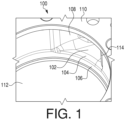
- FIG. 1 is an illustration of a portion of a coolant liner 100, according to a particular embodiment.
- the coolant liner 100 is configured to direct a coolant fluid (e.g., refrigerant, water, etc.) around one or more cylinders in an engine system to cool the one or more cylinders.
- the coolant fluid flows within the coolant liner 100 and does not directly contact the one or more cylinders.
- the coolant liner 100 is constructed from a material that can transfer heat from the one or more cylinders to the coolant fluid flowing through the coolant liner. Examples of materials from which the coolant liner 100 can be constructed include, but are not limited to, aluminum, cast iron, or other materials with suitable heat transfer properties.
- the coolant liner 100 includes a top portion 110, a first wall portion 108 extending from the top portion 110 and a second wall portion 114 extending from the top portion 110.
- a first flow surface 102 is positioned opposite the top portion 110 and is substantially horizontal (e.g., within fifteen degrees of perfectly horizontal relative to the top portion 110).
- the top portion 110, the first wall portion 108, the second wall portion 114, and the first flow surface 102 define a coolant fluid flow path through which the coolant fluid flows in the coolant liner 100.
- a transition region 104 is coupled to the first flow surface 102 and a second flow surface 106 and is configured to direct the coolant fluid from the first flow surface 102 to the second flow surface 106.
- the second flow surface 106 is substantially vertical (e.g., within fifteen degrees of perfectly vertical relative to the top portion 110) and directs the coolant fluid around the coolant liner 100 and to a bottom portion 112.
- the bottom portion 112 is configured to direct the coolant fluid around a cylinder of an engine.
- the transition region 104 is further described with respect to FIGS. 2A-2B .
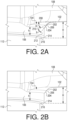
- FIGS. 2A-B illustrate a side view of a cross-section of the transition region 104 of the coolant liner 100 of FIG. 1 , according to a particular embodiment (with angular representations shown in FIG. 2A but not FIG. 2B ).
- the transition region 104 includes a convex portion 202 coupled to, and extending from, the first flow surface 102.
- the convex portion 202 extends from the first flow surface 102 in substantially the same direction as the first flow surface 102 before curving downward relative to the first flow surface 102. In other words, the convex portion curves away from the first flow surface 102.
- a concave portion 204 is coupled to the convex portion 202 at an inflection point 206.
- the concave portion 204 curves upward relative to the first flow surface 102. In other words, the concave portion 204 curves toward the first flow surface 102. When viewed in cross-section as shown, the transition region 104 resembles an "S" shape.
- the concave portion 204 and convex portion 202 are configured to efficiently direct the coolant fluid from the first flow surface 102 to the second flow surface 106 and prevent the coolant fluid from damaging the second flow surface 106 via erosion.
- the shape of the transition region 104 prevents turbulent flow of the coolant fluid (which can lead to erosion) at the second flow surface 106 by gradually changing the direction of the flow of the coolant fluid from substantially horizontal (e.g., along the first flow surface 102) to substantially vertical (e.g., along the second flow surface 106).
- the convex portion 202 is defined by a first radius of curvature
- the concave portion 204 is defined by a second radius of curvature.
- the first radius of curvature is larger than the second radius of curvature.
- the second radius of curvature may also be larger than the first radius of curvature.
- the first radius of curvature is approximately equal to the second radius of curvature.
- the first radius of curvature is approximately (e.g., within plus or minus one millimeter) nine millimeters (mm) and the second radius of curvature is approximately five mm.
- the transition region 104 can also be defined by various angles related to tangent lines associated with the transition region 104.
- the transition region 104 also includes a first tangent line 208 that is tangent to the first flow surface 102 at the intersection between the first flow surface 102 and the convex portion 202.
- a second tangent line 210 is tangent to the convex portion 202 at a vertex of the convex portion 202 (e.g., the point at which the convex portion 202 transitions from a positive slope to a negative slope), and a third tangent line 212 that is tangent to the concave portion 204 at a vertex of the concave portion 204 (e.g., the point at which the concave portion 204 transitions from a positive slope to a negative slope).
- An angle a is defined as the angle between the first tangent line 208 and the second tangent line 210.
- An angle b is defined as the angle between the second tangent line 210 and the third tangent line 212.
- the value of the angle a decreases as the vertex of the convex portion 202 moves toward the first tangent line 208, and the value of the angle a increases as the vertex of the convex portion 202 moves away from the first tangent line 208.
- the value of the angle b increases as the vertex of the concave portion 204 moves away from the first tangent line 208, and the value of the angle b decreases as the vertex of the concave portion 204 moves toward the first tangent line 208.
- the angle a is larger than the angle b.
- the angle a can also be approximately equal to (e.g., within plus or minus five degrees) angle b.
- the angle a is smaller than the angle b.
- the angle a is approximately fifty-three degrees and the angle b is approximately thirty-five degrees.
- the concave portion 204 is coupled to the second flow surface 106 to direct the coolant fluid toward the bottom portion 112.
- the second flow surface 106 is coupled to a curved portion 214 positioned opposite the concave portion 204.
- the curved portion 214 is configured to direct the coolant fluid that flows down the second flow surface 106 along a base portion 216 and toward the bottom portion 112.
- the first flow surface 102 is positioned at a height H above the base portion 216.
- the transition region 104 reduces the height H to a smaller height h above the base portion 216 at the intersection between the concave portion 204 and the second flow surface 106.
- the height H is typically between twelve and thirteen mm and the height h is between nine and ten mm. The reduction in height from H to h by the transition region 104 provides for efficient flow of the coolant fluid.
- the efficient flow is accomplished by reducing the turbulence of the coolant fluid flow as compared to a coolant liner that does not include the transition region 104 (e.g., coolant fluid flowing in a liner without the transition region 104 would encounter a second flow surface directly coupled to a first flow surface).
- the reduction in turbulence prevents the coolant fluid from damaging the second flow surface 106 as the coolant fluid flows around the transition between the concave portion 204 and the second flow surface 106.
- Reducing turbulence of the flow of the coolant fluid also provides for more uniform distribution of the coolant fluid around the coolant liner than a coolant fluid that has a more turbulent flow (e.g., a coolant fluid that flows through a coolant liner that does not include the transition region 104).
- FIG. 3 is an illustration of a velocity profile 300 of coolant fluid flowing through the coolant liner 100 of FIG. 1 , according to a particular embodiment.
- the velocity profile 300 indicates the velocity of the coolant fluid as the coolant fluid flows around a first cylinder and a second cylinder in the coolant liner 100 (e.g., the lines around the elements in FIG. 3 indicate flow, and the shading of the lines indicate velocity, with darker lines generally indicating a lower velocity).
- the velocity profile 300 includes a first cylinder profile 302, a second cylinder profile 312, and a coolant inlet profile 322.
- the first cylinder profile includes a first coolant outlet profile 304, a second coolant outlet profile 306, a first upper portion 308, and a first lower portion 310.
- the second cylinder profile includes a third coolant outlet profile 314, a fourth coolant outlet profile 316, a second upper portion 318, and a second lower portion 320.
- the coolant fluid flows through a coolant inlet and enters the coolant liner 100.
- the coolant fluid flows around the coolant liner 100 to cool a cylinder and out one of the outlets associated with the cylinder.
- the coolant fluid does not flow entirely around the lower portions of the cylinders, leaving a "dead zone" where the cylinder may not be effectively cooled by the coolant fluid.
- Such "dead zones" are typically found in locations corresponding to the first lower portion 310 and the second lower portion 320.
- the first lower portion 310 and the second lower portion 320 show the coolant fluid flowing around the first lower portion 310 and the second lower portion 320.
- the transition region 104 promotes circulation of the coolant fluid around the entire coolant liner 100 to eliminate "dead zones.”
- Coupled means the joining of two components directly or indirectly to one another. Such joining may be stationary (e.g., permanent) or moveable (e.g., removable or releasable). Such joining may be achieved with the two components or the two components and any additional intermediate components being integrally formed as a single unitary body with one another, with the two components, or with the two components and any additional intermediate components being attached to one another.
- the term "or” is used in its inclusive sense (and not in its exclusive sense) so that when used, for example, to connect a list of elements, the term “or” means one, some, or all of the elements in the list.
- Conjunctive language such as the phrase "at least one of X, Y, and Z," unless specifically stated otherwise, is otherwise understood with the context as used in general to convey that an item, term, etc. may be either X, Y, Z, X and Y, X and Z, Y and Z, or X, Y, and Z (i.e., any combination of X, Y, and Z).
- Conjunctive language is not generally intended to imply that certain embodiments require at least one of X, at least one of Y, and at least one of Z to each be present, unless otherwise indicated.
Landscapes
- Engineering & Computer Science (AREA)
- Chemical & Material Sciences (AREA)
- Combustion & Propulsion (AREA)
- Mechanical Engineering (AREA)
- General Engineering & Computer Science (AREA)
- Cylinder Crankcases Of Internal Combustion Engines (AREA)
Description
- The present invention relates generally to systems for cooling an engine system.
- In an engine system, one or more cylinders of a cylinder block of the engine generate heat as combustion occurs. To avoid overheating, a cooling system circulates a coolant fluid around the various cylinders in a liner (for example, a coolant fluid jacket, a water jacket, etc.). In one of various arrangements of liners, a liner may surround the various cylinders, allowing coolant fluid to flow around the cylinders from a coolant fluid source (for example, a radiator). As the coolant fluid flows around the cylinders, heat from each cylinder is transferred to the coolant fluid, which flows back to the coolant fluid source to dissipate the heat and complete a coolant fluid circuit. The shape of the liner can affect the efficiency of the coolant fluid and the flow characteristics of the coolant fluid.
CN104895693 discloses a coolant liner with a transition region between the coolant inlet and the coolant jacket. - In one set of embodiments, a coolant liner comprises a first flow surface to direct coolant fluid toward a cylinder of an engine and a transition region coupled to the first flow surface. The transition region includes a convex portion having a first radius of curvature and a concave portion having a second radius of curvature. The concave portion is coupled to the convex portion at an inflection point. A second flow surface is coupled to the transition region to direct coolant fluid around the cylinder.
- In some embodiments, the first radius of curvature is greater than the second radius of curvature.
- In some embodiments, the second radius of curvature is greater than the first radius of curvature.
- In some embodiments, the first radius of curvature is substantially equal to the second radius of curvature.
- In some embodiments, a ratio of the first radius of curvature to the second radius of curvature is between approximately 1.3 and approximately 2.5.
- In some embodiments, the coolant liner further comprises: a curved portion coupled to the second flow surface; and a base portion coupled to the curved portion.
- In some embodiments, a height of the second flow surface extending between the base portion and the concave portion is between approximately 8 mm and approximately 10 mm.
- In some embodiments, a distance between the first flow surface and the base portion is between approximately 12 mm and approximately 13 mm.In another set of embodiments, a coolant liner comprises a first flow surface to direct coolant fluid toward the cylinder. The first flow surface defines a first tangent line tangent to the first flow surface. A transition region is coupled to the first flow surface. The transition region includes a convex portion having a first vertex defining a second tangent line tangent to the convex portion at the first vertex. A concave portion is coupled to the convex portion at an inflection point. The concave portion has a second vertex defining a third tangent line tangent to the concave portion at the second vertex. A second flow surface is coupled to the transition region to direct coolant fluid around the cylinder.
- In another set of embodiments, A coolant liner, comprising:
- a first flow surface to direct a coolant fluid toward a cylinder of an engine, the first flow surface defining a first tangent line tangent to the first flow surface;
- a transition region coupled to the first flow surface, the transition region comprising:
- a convex portion having a first vertex, the first vertex defining a second tangent line tangent to the convex portion at the first vertex;
- a concave portion coupled to the convex portion at an inflection point, the concave portion having a second vertex, the second vertex defining a third tangent line tangent to the concave portion at the second vertex;
- a first angle defined by the first tangent line and the second tangent line; and
- a second angle defined by the second tangent line and the third tangent line; and
- a second flow surface coupled to the transition region to direct the coolant fluid around the cylinder.
- In some embodiments, the first angle is greater than the second angle.
- In some embodiments, the second angle is greater than the first angle.
- In some embodiments, the first angle is substantially equal to the second angle.
- In some embodiments, a ratio of the first angle to the second angle is between approximately 1.075 and approximately 2.0.In yet another set of embodiments, a system comprises an engine with at least one engine cylinder and a liner positioned around the at least one engine cylinder. The liner includes a first flow surface to direct coolant fluid toward the at least one engine cylinder. The first flow surface defines a first tangent line tangent to the first flow surface. A transition region is coupled to the first flow surface. The transition region includes a convex portion having a first radius of curvature and a first vertex. The first vertex defines a second tangent line tangent to the convex portion at the first vertex. A concave portion is coupled to the convex portion at an inflection point and includes a second radius of curvature and a second vertex. The second vertex defines a third tangent line tangent to the concave portion at the second vertex. A first angle is defined by the first tangent line and the second tangent line, and a second angle is defined by the second tangent line and the third tangent line. A second flow surface is coupled to the transition region to direct coolant fluid around the at least one engine cylinder.
- According to the claimed invention, the convex portion extends from the first flow surface and curves downward relative to the first flow surface.
- According to the claimed invention the concave portion curves upward relative to the first flow surface and is coupled to the second flow surface.
- In some embodiments, the first flow surface is substantially horizontal.
- In some embodiments, the second flow surface is substantially vertical.
- In some embodiments, the second flow surface is coupled to a curved portion and the curved portion is coupled to a base portion, the curved portion configured to direct the coolant fluid from the second flow surface to the base portion.
- In some embodiments, the base portion is coupled to a bottom portion, the base portion configured to direct the coolant fluid to the bottom portion.
- The details of one or more implementations are set forth in the accompanying drawings and the description below. Other features, aspects, and advantages of the disclosure will become apparent from the description, the drawings, and the claims, in which:
-
FIG. 1 is an illustration of a portion of a coolant liner, according to a particular embodiment. -
FIGS. 2A-B illustrate a side view of a cross-section of a transition region of the coolant liner ofFIG. 1 , according to a particular embodiment. -
FIG. 3 is an illustration of a velocity profile of coolant fluid flowing through the coolant liner ofFIG. 1 , according to a particular embodiment. - Following below are more detailed descriptions of various concepts related to, and implementations of, methods, apparatuses, and systems for directing coolant fluid through a coolant fluid liner of an engine system. The various concepts introduced above and discussed in greater detail below may be implemented in any of numerous ways, as the described concepts are not limited to any particular manner of implementation. Examples of specific implementations and applications are provided primarily for illustrative purposes.
- In an engine cooling system, a liner may surround the various cylinders, allowing coolant fluid to flow around the cylinders from a cooling fluid source (for example, a radiator). As the coolant fluid flows around the cylinders, heat from each cylinder is transferred to the coolant fluid, which flows back to the cooling fluid source to dissipate the heat and complete a coolant fluid circuit. The shape of the liner can affect the efficiency of the coolant fluid and the flow characteristics of the coolant fluid. In some instances, the flow characteristics of the coolant fluid can change the shape of the liner via erosion.
- Implementations herein relate to a cooling system to direct coolant fluid efficiently in a coolant liner and reduce or eliminate instances where the coolant fluid erodes the liner. Embodiments of the cooling system described herein include a transition region with a concave portion, a convex portion, and an inflection point between the concave portion and convex portion. Coolant fluid flows along a first flow surface that is substantially horizontal relative to a top portion of the coolant liner before reaching the convex portion. The coolant fluid then flows along the convex portion and then the concave portion before reaching a second flow surface that is substantially vertical relative to the top portion of the coolant liner.
- The various embodiments of the system described herein provide benefits that can be applied to engine cooling systems. The transition region provides for coolant flow that can cool a cylinder block more efficiently than an engine cooling system without such a transition region. Additionally, the transition region can prevent erosion of the liner, thereby increasing a useful life of the liner.
-
FIG. 1 is an illustration of a portion of acoolant liner 100, according to a particular embodiment. Thecoolant liner 100 is configured to direct a coolant fluid (e.g., refrigerant, water, etc.) around one or more cylinders in an engine system to cool the one or more cylinders. The coolant fluid flows within thecoolant liner 100 and does not directly contact the one or more cylinders. Accordingly, thecoolant liner 100 is constructed from a material that can transfer heat from the one or more cylinders to the coolant fluid flowing through the coolant liner. Examples of materials from which thecoolant liner 100 can be constructed include, but are not limited to, aluminum, cast iron, or other materials with suitable heat transfer properties. - The
coolant liner 100 includes atop portion 110, afirst wall portion 108 extending from thetop portion 110 and asecond wall portion 114 extending from thetop portion 110. Afirst flow surface 102 is positioned opposite thetop portion 110 and is substantially horizontal (e.g., within fifteen degrees of perfectly horizontal relative to the top portion 110). Thetop portion 110, thefirst wall portion 108, thesecond wall portion 114, and thefirst flow surface 102 define a coolant fluid flow path through which the coolant fluid flows in thecoolant liner 100. Atransition region 104 is coupled to thefirst flow surface 102 and asecond flow surface 106 and is configured to direct the coolant fluid from thefirst flow surface 102 to thesecond flow surface 106. Thesecond flow surface 106 is substantially vertical (e.g., within fifteen degrees of perfectly vertical relative to the top portion 110) and directs the coolant fluid around thecoolant liner 100 and to abottom portion 112. Thebottom portion 112 is configured to direct the coolant fluid around a cylinder of an engine. Thetransition region 104 is further described with respect toFIGS. 2A-2B . -
FIGS. 2A-B illustrate a side view of a cross-section of thetransition region 104 of thecoolant liner 100 ofFIG. 1 , according to a particular embodiment (with angular representations shown inFIG. 2A but notFIG. 2B ). Thetransition region 104 includes aconvex portion 202 coupled to, and extending from, thefirst flow surface 102. Theconvex portion 202 extends from thefirst flow surface 102 in substantially the same direction as thefirst flow surface 102 before curving downward relative to thefirst flow surface 102. In other words, the convex portion curves away from thefirst flow surface 102. Aconcave portion 204 is coupled to theconvex portion 202 at aninflection point 206. Theconcave portion 204 curves upward relative to thefirst flow surface 102. In other words, theconcave portion 204 curves toward thefirst flow surface 102. When viewed in cross-section as shown, thetransition region 104 resembles an "S" shape. Theconcave portion 204 andconvex portion 202 are configured to efficiently direct the coolant fluid from thefirst flow surface 102 to thesecond flow surface 106 and prevent the coolant fluid from damaging thesecond flow surface 106 via erosion. The shape of thetransition region 104 prevents turbulent flow of the coolant fluid (which can lead to erosion) at thesecond flow surface 106 by gradually changing the direction of the flow of the coolant fluid from substantially horizontal (e.g., along the first flow surface 102) to substantially vertical (e.g., along the second flow surface 106). - The
convex portion 202 is defined by a first radius of curvature, and theconcave portion 204 is defined by a second radius of curvature. In some embodiments, the first radius of curvature is larger than the second radius of curvature. The second radius of curvature may also be larger than the first radius of curvature. In some implementations, the first radius of curvature is approximately equal to the second radius of curvature. In an example embodiment, the first radius of curvature is approximately (e.g., within plus or minus one millimeter) nine millimeters (mm) and the second radius of curvature is approximately five mm. - The
transition region 104 can also be defined by various angles related to tangent lines associated with thetransition region 104. For example, thetransition region 104 also includes a firsttangent line 208 that is tangent to thefirst flow surface 102 at the intersection between thefirst flow surface 102 and theconvex portion 202. A second tangent line 210 is tangent to theconvex portion 202 at a vertex of the convex portion 202 (e.g., the point at which theconvex portion 202 transitions from a positive slope to a negative slope), and a thirdtangent line 212 that is tangent to theconcave portion 204 at a vertex of the concave portion 204 (e.g., the point at which theconcave portion 204 transitions from a positive slope to a negative slope). An angle a is defined as the angle between the firsttangent line 208 and the second tangent line 210. An angle b is defined as the angle between the second tangent line 210 and the thirdtangent line 212. The value of the angle a decreases as the vertex of theconvex portion 202 moves toward the firsttangent line 208, and the value of the angle a increases as the vertex of theconvex portion 202 moves away from the firsttangent line 208. The value of the angle b increases as the vertex of theconcave portion 204 moves away from the firsttangent line 208, and the value of the angle b decreases as the vertex of theconcave portion 204 moves toward the firsttangent line 208. In some embodiments, the angle a is larger than the angle b. The angle a can also be approximately equal to (e.g., within plus or minus five degrees) angle b. In some implementations, the angle a is smaller than the angle b. In an example embodiment, the angle a is approximately fifty-three degrees and the angle b is approximately thirty-five degrees. - The
concave portion 204 is coupled to thesecond flow surface 106 to direct the coolant fluid toward thebottom portion 112. Thesecond flow surface 106 is coupled to acurved portion 214 positioned opposite theconcave portion 204. Thecurved portion 214 is configured to direct the coolant fluid that flows down thesecond flow surface 106 along abase portion 216 and toward thebottom portion 112. - The
first flow surface 102 is positioned at a height H above thebase portion 216. Thetransition region 104 reduces the height H to a smaller height h above thebase portion 216 at the intersection between theconcave portion 204 and thesecond flow surface 106. In some embodiments, the height H is typically between twelve and thirteen mm and the height h is between nine and ten mm. The reduction in height from H to h by thetransition region 104 provides for efficient flow of the coolant fluid. The efficient flow is accomplished by reducing the turbulence of the coolant fluid flow as compared to a coolant liner that does not include the transition region 104 (e.g., coolant fluid flowing in a liner without thetransition region 104 would encounter a second flow surface directly coupled to a first flow surface). The reduction in turbulence prevents the coolant fluid from damaging thesecond flow surface 106 as the coolant fluid flows around the transition between theconcave portion 204 and thesecond flow surface 106. Reducing turbulence of the flow of the coolant fluid also provides for more uniform distribution of the coolant fluid around the coolant liner than a coolant fluid that has a more turbulent flow (e.g., a coolant fluid that flows through a coolant liner that does not include the transition region 104). -
FIG. 3 is an illustration of avelocity profile 300 of coolant fluid flowing through thecoolant liner 100 ofFIG. 1 , according to a particular embodiment. Thevelocity profile 300 indicates the velocity of the coolant fluid as the coolant fluid flows around a first cylinder and a second cylinder in the coolant liner 100 (e.g., the lines around the elements inFIG. 3 indicate flow, and the shading of the lines indicate velocity, with darker lines generally indicating a lower velocity). Thevelocity profile 300 includes afirst cylinder profile 302, asecond cylinder profile 312, and acoolant inlet profile 322. The first cylinder profile includes a firstcoolant outlet profile 304, a secondcoolant outlet profile 306, a firstupper portion 308, and a firstlower portion 310. The second cylinder profile includes a thirdcoolant outlet profile 314, a fourthcoolant outlet profile 316, a secondupper portion 318, and a secondlower portion 320. - Generally, the coolant fluid flows through a coolant inlet and enters the
coolant liner 100. The coolant fluid flows around thecoolant liner 100 to cool a cylinder and out one of the outlets associated with the cylinder. In coolant liners that do not include thetransition region 104 as described, the coolant fluid does not flow entirely around the lower portions of the cylinders, leaving a "dead zone" where the cylinder may not be effectively cooled by the coolant fluid. Such "dead zones" are typically found in locations corresponding to the firstlower portion 310 and the secondlower portion 320. In contrast, and as shown inFIG. 3 , the firstlower portion 310 and the secondlower portion 320 show the coolant fluid flowing around the firstlower portion 310 and the secondlower portion 320. Accordingly, thetransition region 104 promotes circulation of the coolant fluid around theentire coolant liner 100 to eliminate "dead zones." - While this specification contains many specific implementation details, these should not be construed as limitations on the scope of what may be claimed but rather as descriptions of features specific to particular implementations. Certain features described in this specification in the context of separate implementations can also be implemented in combination in a single implementation. Conversely, various features described in the context of a single implementation can also be implemented in multiple implementations separately or in any suitable subcombination. Moreover, although features may be described as acting in certain combinations and even initially claimed as such, one or more features from a claimed combination can, in some cases, be excised from the combination, and the claimed combination may be directed to a subcombination or variation of a subcombination.
- As utilized herein, the term "substantially," "approximately," and similar terms are intended to have a broad meaning in harmony with the common and accepted usage by those of ordinary skill in the art to which the subject matter of this disclosure pertains. It should be understood by those of skill in the art who review this disclosure that these terms are intended to allow a description of certain features described and claimed without restricting the scope of these features to the precise numerical ranges provided. Accordingly, these terms should be interpreted as indicating that insubstantial or inconsequential modifications or alterations of the subject matter described and claimed are considered to be within the scope of the invention as recited in the appended claims.
- The terms "coupled," "attached," and the like, as used herein, mean the joining of two components directly or indirectly to one another. Such joining may be stationary (e.g., permanent) or moveable (e.g., removable or releasable). Such joining may be achieved with the two components or the two components and any additional intermediate components being integrally formed as a single unitary body with one another, with the two components, or with the two components and any additional intermediate components being attached to one another.
- Also, the term "or" is used in its inclusive sense (and not in its exclusive sense) so that when used, for example, to connect a list of elements, the term "or" means one, some, or all of the elements in the list. Conjunctive language such as the phrase "at least one of X, Y, and Z," unless specifically stated otherwise, is otherwise understood with the context as used in general to convey that an item, term, etc. may be either X, Y, Z, X and Y, X and Z, Y and Z, or X, Y, and Z (i.e., any combination of X, Y, and Z). Thus, such conjunctive language is not generally intended to imply that certain embodiments require at least one of X, at least one of Y, and at least one of Z to each be present, unless otherwise indicated.
- Although only a few embodiments have been described in detail in this disclosure, those skilled in the art who review this disclosure will readily appreciate that many modifications are possible (e.g., variations in sizes, dimensions, structures, shapes, and proportions of the various elements, values of parameters, mounting arrangements, use of materials, colors, orientations, etc.) without materially departing from the novel teachings and advantages of the subject matter described herein. For example, elements shown as integrally formed may be constructed of multiple components or elements, the position of elements may be reversed or otherwise varied, and the nature or number of discrete elements or positions may be altered or varied.
Claims (13)
- A coolant liner, comprising:a first flow surface (102) to direct a coolant fluid toward a cylinder of an engine;a transition region (104) coupled to the first flow surface, the transition region comprising:a convex portion (202) extending from the first flow surface and curving downward relative to the first flow surface, the convex portion having a first radius of curvature; anda concave portion (204) coupled to the convex portion at an inflection point, the concave portion having a second radius of curvature and curving upward relative to the first flow surface; anda second flow surface (106) coupled to the concave portion of the transition region to direct the coolant fluid around the cylinder.
- The coolant liner of claim 1, wherein the first radius of curvature is greater than the second radius of curvature, or wherein the second radius of curvature is greater than the first radius of curvature, or wherein the first radius of curvature is substantially equal to the second radius of curvature, or wherein when the first radius of curvature is greater than the second radius of curvature, a ratio of the first radius of curvature to the second radius of curvature is between approximately 1.3 and approximately 2.5.
- The coolant liner of claim2, further comprising:a curved portion coupled to the second flow surface; anda base portion coupled to the curved portion.
- The coolant liner of claim 3, wherein a height of the second flow surface extending between the base portion and the concave portion is between approximately 8 mm and approximately 10 mm.
- The coolant liner of claim 4, wherein a distance between the first flow surface and the base portion is between approximately 12 mm and approximately 13 mm.
- The coolant liner of claim 1, wherein the first flow surface defines a first tangent line tangent to the first flow surface;wherein the convex portion has a first vertex, the first vertex defining a second tangent line tangent to the convex portion at the first vertex;wherein the concave portion has a second vertex, the second vertex defining a third tangent line tangent to the concave portion at the second vertex;the coolant liner further comprising:a first angle defined by the first tangent line and the second tangent line; anda second angle defined by the second tangent line and the third tangent line.
- The coolant liner of claim 6, wherein the first angle is greater than the second angle, or wherein the second angle is greater than the first angle, or wherein the first angle is substantially equal to the second angle, or wherein when the first angle is greater than the second angle, a ratio of the first angle to the second angle is between approximately 1.075 and approximately 2.0.
- A system comprising:an engine including at least one engine cylinder; andthe coolant liner of claim 1, wherein the coolant liner is positioned around the at least one engine cylinder.
- The system of claim 8, wherein the first flow surface is substantially horizontal.
- The system of claim 9, wherein the second flow surface is substantially vertical.
- The system of any one of claims 9 or 10, wherein the second flow surface is coupled to a curved portion and the curved portion is coupled to a base portion, the curved portion configured to direct the coolant fluid from the second flow surface to the base portion.
- The system of claim 11, wherein the base portion is coupled to a bottom portion, the base portion configured to direct the coolant fluid to the bottom portion.
- The system of claim 8, wherein the coolant liner further comprises:a first tangent line defined by the first flow surface, the first tangent line tangent to the first flow surface;a first vertex defined by the convex portion, the first vertex defining a second tangent line tangent to the convex portion at the first vertex;a second vertex defined by the concave portion, the second vertex defining a third tangent line tangent to the concave portion at the second vertex;a first angle defined by the first tangent line and the second tangent line; anda second angle defined by the second tangent line and the third tangent line.
Priority Applications (1)
| Application Number | Priority Date | Filing Date | Title |
|---|---|---|---|
| EP24175211.2A EP4390105A3 (en) | 2020-04-13 | 2021-03-08 | Liner coolant flow pilot feature |
Applications Claiming Priority (1)
| Application Number | Priority Date | Filing Date | Title |
|---|---|---|---|
| CN202010285138.6A CN113530700B (en) | 2020-04-13 | 2020-04-13 | Coolant liner and engine cooling system |
Related Child Applications (2)
| Application Number | Title | Priority Date | Filing Date |
|---|---|---|---|
| EP24175211.2A Division EP4390105A3 (en) | 2020-04-13 | 2021-03-08 | Liner coolant flow pilot feature |
| EP24175211.2A Division-Into EP4390105A3 (en) | 2020-04-13 | 2021-03-08 | Liner coolant flow pilot feature |
Publications (2)
| Publication Number | Publication Date |
|---|---|
| EP3896271A1 EP3896271A1 (en) | 2021-10-20 |
| EP3896271B1 true EP3896271B1 (en) | 2024-07-24 |
Family
ID=74871157
Family Applications (2)
| Application Number | Title | Priority Date | Filing Date |
|---|---|---|---|
| EP21161301.3A Active EP3896271B1 (en) | 2020-04-13 | 2021-03-08 | Liner coolant flow pilot feature |
| EP24175211.2A Pending EP4390105A3 (en) | 2020-04-13 | 2021-03-08 | Liner coolant flow pilot feature |
Family Applications After (1)
| Application Number | Title | Priority Date | Filing Date |
|---|---|---|---|
| EP24175211.2A Pending EP4390105A3 (en) | 2020-04-13 | 2021-03-08 | Liner coolant flow pilot feature |
Country Status (2)
| Country | Link |
|---|---|
| EP (2) | EP3896271B1 (en) |
| CN (1) | CN113530700B (en) |
Family Cites Families (7)
| Publication number | Priority date | Publication date | Assignee | Title |
|---|---|---|---|---|
| US20060086327A1 (en) * | 2004-10-25 | 2006-04-27 | General Electric Company | Engine power assembly |
| WO2009000799A2 (en) * | 2007-06-28 | 2008-12-31 | Avl List Gmbh | Method for machining a cylinder head comprising a cooling jacket |
| CN104895693A (en) * | 2015-06-19 | 2015-09-09 | 安徽江淮汽车股份有限公司 | Engine and power device |
| JP6624102B2 (en) * | 2017-02-06 | 2019-12-25 | トヨタ自動車株式会社 | Engine cylinder head |
| JP2018184939A (en) * | 2017-04-27 | 2018-11-22 | トヨタ自動車株式会社 | Cooling structure of internal combustion engine |
| CN207437209U (en) * | 2017-11-10 | 2018-06-01 | 重庆凯特动力科技有限公司 | A kind of cylinder body air inlet side leads to outlet hole structure between the notch-cut type cylinder of head exhaust side |
| CN213331295U (en) * | 2020-08-14 | 2021-06-01 | 哈尔滨东安汽车动力股份有限公司 | Solve cylinder body water jacket water inlet structure of engine cooling performance |
-
2020
- 2020-04-13 CN CN202010285138.6A patent/CN113530700B/en active Active
-
2021
- 2021-03-08 EP EP21161301.3A patent/EP3896271B1/en active Active
- 2021-03-08 EP EP24175211.2A patent/EP4390105A3/en active Pending
Also Published As
| Publication number | Publication date |
|---|---|
| EP3896271A1 (en) | 2021-10-20 |
| CN113530700A (en) | 2021-10-22 |
| EP4390105A2 (en) | 2024-06-26 |
| CN113530700B (en) | 2023-11-07 |
| EP4390105A3 (en) | 2024-09-25 |
Similar Documents
| Publication | Publication Date | Title |
|---|---|---|
| EP1662129B1 (en) | Cooling structure of cylinder block | |
| JP4567206B2 (en) | Cast gas turbine blades through which coolant flows | |
| US20110180025A1 (en) | Piston for an internal combustion engine | |
| EP3896271B1 (en) | Liner coolant flow pilot feature | |
| KR101846630B1 (en) | Block insert and cylinder structure of vehicle engine including the same | |
| EP0816687A2 (en) | Transverse fan, fan impeller forming mold, and manufacturing method of fan impeller forming mold | |
| CN108167085A (en) | Cylinder head | |
| US11713729B2 (en) | Piston for splitting internal cooling runner | |
| CN219012806U (en) | Piston and compressor with same | |
| CN217183058U (en) | Oil cooling structure and three-in-one electric drive system | |
| KR101501444B1 (en) | Gas Turbine Blade Having an Internal Cooling Passage Structure for Improving Cooling Performance | |
| JP4722821B2 (en) | mold | |
| CN106979329A (en) | A kind of all-steel piston | |
| CN208712817U (en) | A kind of die casting injection punch head structure | |
| CN224161877U (en) | A novel microchannel structure for cooling water pumps | |
| CN106524805A (en) | Conformal vertical heat transfer surface heat pipe radiator | |
| CN215882481U (en) | Cooling water path and injection mold | |
| CN208950662U (en) | Water oil cooler and water oil cooled system system | |
| JP2005273469A (en) | Cylinder block cooling structure | |
| CN119789377B (en) | An inverter heat dissipation structure and its design method | |
| CN220985435U (en) | Motor shell, motor and vehicle | |
| CN113441771B (en) | Cutting inserts and cutting tools | |
| CN215500288U (en) | Controller of vehicle and vehicle | |
| WO2022021484A1 (en) | Transmission housing | |
| CN223406009U (en) | Spindle motor cooling structure and CNC machine tool |
Legal Events
| Date | Code | Title | Description |
|---|---|---|---|
| PUAI | Public reference made under article 153(3) epc to a published international application that has entered the european phase |
Free format text: ORIGINAL CODE: 0009012 |
|
| STAA | Information on the status of an ep patent application or granted ep patent |
Free format text: STATUS: THE APPLICATION HAS BEEN PUBLISHED |
|
| AK | Designated contracting states |
Kind code of ref document: A1 Designated state(s): AL AT BE BG CH CY CZ DE DK EE ES FI FR GB GR HR HU IE IS IT LI LT LU LV MC MK MT NL NO PL PT RO RS SE SI SK SM TR |
|
| B565 | Issuance of search results under rule 164(2) epc |
Effective date: 20210820 |
|
| STAA | Information on the status of an ep patent application or granted ep patent |
Free format text: STATUS: REQUEST FOR EXAMINATION WAS MADE |
|
| 17P | Request for examination filed |
Effective date: 20220225 |
|
| RBV | Designated contracting states (corrected) |
Designated state(s): AL AT BE BG CH CY CZ DE DK EE ES FI FR GB GR HR HU IE IS IT LI LT LU LV MC MK MT NL NO PL PT RO RS SE SI SK SM TR |
|
| P01 | Opt-out of the competence of the unified patent court (upc) registered |
Effective date: 20230510 |
|
| GRAP | Despatch of communication of intention to grant a patent |
Free format text: ORIGINAL CODE: EPIDOSNIGR1 |
|
| STAA | Information on the status of an ep patent application or granted ep patent |
Free format text: STATUS: GRANT OF PATENT IS INTENDED |
|
| INTG | Intention to grant announced |
Effective date: 20240202 |
|
| GRAJ | Information related to disapproval of communication of intention to grant by the applicant or resumption of examination proceedings by the epo deleted |
Free format text: ORIGINAL CODE: EPIDOSDIGR1 |
|
| STAA | Information on the status of an ep patent application or granted ep patent |
Free format text: STATUS: REQUEST FOR EXAMINATION WAS MADE |
|
| GRAP | Despatch of communication of intention to grant a patent |
Free format text: ORIGINAL CODE: EPIDOSNIGR1 |
|
| STAA | Information on the status of an ep patent application or granted ep patent |
Free format text: STATUS: GRANT OF PATENT IS INTENDED |
|
| INTC | Intention to grant announced (deleted) | ||
| INTG | Intention to grant announced |
Effective date: 20240405 |
|
| GRAS | Grant fee paid |
Free format text: ORIGINAL CODE: EPIDOSNIGR3 |
|
| GRAA | (expected) grant |
Free format text: ORIGINAL CODE: 0009210 |
|
| STAA | Information on the status of an ep patent application or granted ep patent |
Free format text: STATUS: THE PATENT HAS BEEN GRANTED |
|
| AK | Designated contracting states |
Kind code of ref document: B1 Designated state(s): AL AT BE BG CH CY CZ DE DK EE ES FI FR GB GR HR HU IE IS IT LI LT LU LV MC MK MT NL NO PL PT RO RS SE SI SK SM TR |
|
| REG | Reference to a national code |
Ref country code: GB Ref legal event code: FG4D |
|
| REG | Reference to a national code |
Ref country code: CH Ref legal event code: EP |
|
| REG | Reference to a national code |
Ref country code: IE Ref legal event code: FG4D Ref country code: DE Ref legal event code: R096 Ref document number: 602021015997 Country of ref document: DE |
|
| REG | Reference to a national code |
Ref country code: LT Ref legal event code: MG9D |
|
| REG | Reference to a national code |
Ref country code: NL Ref legal event code: MP Effective date: 20240724 |
|
| PG25 | Lapsed in a contracting state [announced via postgrant information from national office to epo] |
Ref country code: PT Free format text: LAPSE BECAUSE OF FAILURE TO SUBMIT A TRANSLATION OF THE DESCRIPTION OR TO PAY THE FEE WITHIN THE PRESCRIBED TIME-LIMIT Effective date: 20241125 |
|
| REG | Reference to a national code |
Ref country code: AT Ref legal event code: MK05 Ref document number: 1706496 Country of ref document: AT Kind code of ref document: T Effective date: 20240724 |
|
| PG25 | Lapsed in a contracting state [announced via postgrant information from national office to epo] |
Ref country code: NL Free format text: LAPSE BECAUSE OF FAILURE TO SUBMIT A TRANSLATION OF THE DESCRIPTION OR TO PAY THE FEE WITHIN THE PRESCRIBED TIME-LIMIT Effective date: 20240724 |
|
| PG25 | Lapsed in a contracting state [announced via postgrant information from national office to epo] |
Ref country code: PT Free format text: LAPSE BECAUSE OF FAILURE TO SUBMIT A TRANSLATION OF THE DESCRIPTION OR TO PAY THE FEE WITHIN THE PRESCRIBED TIME-LIMIT Effective date: 20241125 Ref country code: NL Free format text: LAPSE BECAUSE OF FAILURE TO SUBMIT A TRANSLATION OF THE DESCRIPTION OR TO PAY THE FEE WITHIN THE PRESCRIBED TIME-LIMIT Effective date: 20240724 |
|
| PG25 | Lapsed in a contracting state [announced via postgrant information from national office to epo] |
Ref country code: NO Free format text: LAPSE BECAUSE OF FAILURE TO SUBMIT A TRANSLATION OF THE DESCRIPTION OR TO PAY THE FEE WITHIN THE PRESCRIBED TIME-LIMIT Effective date: 20241024 |
|
| PG25 | Lapsed in a contracting state [announced via postgrant information from national office to epo] |
Ref country code: FI Free format text: LAPSE BECAUSE OF FAILURE TO SUBMIT A TRANSLATION OF THE DESCRIPTION OR TO PAY THE FEE WITHIN THE PRESCRIBED TIME-LIMIT Effective date: 20240724 Ref country code: PL Free format text: LAPSE BECAUSE OF FAILURE TO SUBMIT A TRANSLATION OF THE DESCRIPTION OR TO PAY THE FEE WITHIN THE PRESCRIBED TIME-LIMIT Effective date: 20240724 Ref country code: GR Free format text: LAPSE BECAUSE OF FAILURE TO SUBMIT A TRANSLATION OF THE DESCRIPTION OR TO PAY THE FEE WITHIN THE PRESCRIBED TIME-LIMIT Effective date: 20241025 |
|
| PG25 | Lapsed in a contracting state [announced via postgrant information from national office to epo] |
Ref country code: BG Free format text: LAPSE BECAUSE OF FAILURE TO SUBMIT A TRANSLATION OF THE DESCRIPTION OR TO PAY THE FEE WITHIN THE PRESCRIBED TIME-LIMIT Effective date: 20240724 |
|
| PG25 | Lapsed in a contracting state [announced via postgrant information from national office to epo] |
Ref country code: LV Free format text: LAPSE BECAUSE OF FAILURE TO SUBMIT A TRANSLATION OF THE DESCRIPTION OR TO PAY THE FEE WITHIN THE PRESCRIBED TIME-LIMIT Effective date: 20240724 |
|
| PG25 | Lapsed in a contracting state [announced via postgrant information from national office to epo] |
Ref country code: AT Free format text: LAPSE BECAUSE OF FAILURE TO SUBMIT A TRANSLATION OF THE DESCRIPTION OR TO PAY THE FEE WITHIN THE PRESCRIBED TIME-LIMIT Effective date: 20240724 Ref country code: IS Free format text: LAPSE BECAUSE OF FAILURE TO SUBMIT A TRANSLATION OF THE DESCRIPTION OR TO PAY THE FEE WITHIN THE PRESCRIBED TIME-LIMIT Effective date: 20241124 |
|
| PG25 | Lapsed in a contracting state [announced via postgrant information from national office to epo] |
Ref country code: HR Free format text: LAPSE BECAUSE OF FAILURE TO SUBMIT A TRANSLATION OF THE DESCRIPTION OR TO PAY THE FEE WITHIN THE PRESCRIBED TIME-LIMIT Effective date: 20240724 |
|
| PG25 | Lapsed in a contracting state [announced via postgrant information from national office to epo] |
Ref country code: RS Free format text: LAPSE BECAUSE OF FAILURE TO SUBMIT A TRANSLATION OF THE DESCRIPTION OR TO PAY THE FEE WITHIN THE PRESCRIBED TIME-LIMIT Effective date: 20241024 Ref country code: ES Free format text: LAPSE BECAUSE OF FAILURE TO SUBMIT A TRANSLATION OF THE DESCRIPTION OR TO PAY THE FEE WITHIN THE PRESCRIBED TIME-LIMIT Effective date: 20240724 |
|
| PG25 | Lapsed in a contracting state [announced via postgrant information from national office to epo] |
Ref country code: RS Free format text: LAPSE BECAUSE OF FAILURE TO SUBMIT A TRANSLATION OF THE DESCRIPTION OR TO PAY THE FEE WITHIN THE PRESCRIBED TIME-LIMIT Effective date: 20241024 Ref country code: PL Free format text: LAPSE BECAUSE OF FAILURE TO SUBMIT A TRANSLATION OF THE DESCRIPTION OR TO PAY THE FEE WITHIN THE PRESCRIBED TIME-LIMIT Effective date: 20240724 Ref country code: NO Free format text: LAPSE BECAUSE OF FAILURE TO SUBMIT A TRANSLATION OF THE DESCRIPTION OR TO PAY THE FEE WITHIN THE PRESCRIBED TIME-LIMIT Effective date: 20241024 Ref country code: LV Free format text: LAPSE BECAUSE OF FAILURE TO SUBMIT A TRANSLATION OF THE DESCRIPTION OR TO PAY THE FEE WITHIN THE PRESCRIBED TIME-LIMIT Effective date: 20240724 Ref country code: IS Free format text: LAPSE BECAUSE OF FAILURE TO SUBMIT A TRANSLATION OF THE DESCRIPTION OR TO PAY THE FEE WITHIN THE PRESCRIBED TIME-LIMIT Effective date: 20241124 Ref country code: HR Free format text: LAPSE BECAUSE OF FAILURE TO SUBMIT A TRANSLATION OF THE DESCRIPTION OR TO PAY THE FEE WITHIN THE PRESCRIBED TIME-LIMIT Effective date: 20240724 Ref country code: GR Free format text: LAPSE BECAUSE OF FAILURE TO SUBMIT A TRANSLATION OF THE DESCRIPTION OR TO PAY THE FEE WITHIN THE PRESCRIBED TIME-LIMIT Effective date: 20241025 Ref country code: FI Free format text: LAPSE BECAUSE OF FAILURE TO SUBMIT A TRANSLATION OF THE DESCRIPTION OR TO PAY THE FEE WITHIN THE PRESCRIBED TIME-LIMIT Effective date: 20240724 Ref country code: ES Free format text: LAPSE BECAUSE OF FAILURE TO SUBMIT A TRANSLATION OF THE DESCRIPTION OR TO PAY THE FEE WITHIN THE PRESCRIBED TIME-LIMIT Effective date: 20240724 Ref country code: BG Free format text: LAPSE BECAUSE OF FAILURE TO SUBMIT A TRANSLATION OF THE DESCRIPTION OR TO PAY THE FEE WITHIN THE PRESCRIBED TIME-LIMIT Effective date: 20240724 Ref country code: AT Free format text: LAPSE BECAUSE OF FAILURE TO SUBMIT A TRANSLATION OF THE DESCRIPTION OR TO PAY THE FEE WITHIN THE PRESCRIBED TIME-LIMIT Effective date: 20240724 |
|
| PG25 | Lapsed in a contracting state [announced via postgrant information from national office to epo] |
Ref country code: RO Free format text: LAPSE BECAUSE OF FAILURE TO SUBMIT A TRANSLATION OF THE DESCRIPTION OR TO PAY THE FEE WITHIN THE PRESCRIBED TIME-LIMIT Effective date: 20240724 Ref country code: DK Free format text: LAPSE BECAUSE OF FAILURE TO SUBMIT A TRANSLATION OF THE DESCRIPTION OR TO PAY THE FEE WITHIN THE PRESCRIBED TIME-LIMIT Effective date: 20240724 Ref country code: SM Free format text: LAPSE BECAUSE OF FAILURE TO SUBMIT A TRANSLATION OF THE DESCRIPTION OR TO PAY THE FEE WITHIN THE PRESCRIBED TIME-LIMIT Effective date: 20240724 |
|
| PG25 | Lapsed in a contracting state [announced via postgrant information from national office to epo] |
Ref country code: EE Free format text: LAPSE BECAUSE OF FAILURE TO SUBMIT A TRANSLATION OF THE DESCRIPTION OR TO PAY THE FEE WITHIN THE PRESCRIBED TIME-LIMIT Effective date: 20240724 |
|
| PG25 | Lapsed in a contracting state [announced via postgrant information from national office to epo] |
Ref country code: CZ Free format text: LAPSE BECAUSE OF FAILURE TO SUBMIT A TRANSLATION OF THE DESCRIPTION OR TO PAY THE FEE WITHIN THE PRESCRIBED TIME-LIMIT Effective date: 20240724 |
|
| REG | Reference to a national code |
Ref country code: DE Ref legal event code: R097 Ref document number: 602021015997 Country of ref document: DE |
|
| PG25 | Lapsed in a contracting state [announced via postgrant information from national office to epo] |
Ref country code: IT Free format text: LAPSE BECAUSE OF FAILURE TO SUBMIT A TRANSLATION OF THE DESCRIPTION OR TO PAY THE FEE WITHIN THE PRESCRIBED TIME-LIMIT Effective date: 20240724 Ref country code: SK Free format text: LAPSE BECAUSE OF FAILURE TO SUBMIT A TRANSLATION OF THE DESCRIPTION OR TO PAY THE FEE WITHIN THE PRESCRIBED TIME-LIMIT Effective date: 20240724 |
|
| PLBE | No opposition filed within time limit |
Free format text: ORIGINAL CODE: 0009261 |
|
| STAA | Information on the status of an ep patent application or granted ep patent |
Free format text: STATUS: NO OPPOSITION FILED WITHIN TIME LIMIT |
|
| 26N | No opposition filed |
Effective date: 20250425 |
|
| PG25 | Lapsed in a contracting state [announced via postgrant information from national office to epo] |
Ref country code: SE Free format text: LAPSE BECAUSE OF FAILURE TO SUBMIT A TRANSLATION OF THE DESCRIPTION OR TO PAY THE FEE WITHIN THE PRESCRIBED TIME-LIMIT Effective date: 20240724 |
|
| PG25 | Lapsed in a contracting state [announced via postgrant information from national office to epo] |
Ref country code: MC Free format text: LAPSE BECAUSE OF FAILURE TO SUBMIT A TRANSLATION OF THE DESCRIPTION OR TO PAY THE FEE WITHIN THE PRESCRIBED TIME-LIMIT Effective date: 20240724 |
|
| REG | Reference to a national code |
Ref country code: CH Ref legal event code: H13 Free format text: ST27 STATUS EVENT CODE: U-0-0-H10-H13 (AS PROVIDED BY THE NATIONAL OFFICE) Effective date: 20251023 |
|
| PG25 | Lapsed in a contracting state [announced via postgrant information from national office to epo] |
Ref country code: LU Free format text: LAPSE BECAUSE OF NON-PAYMENT OF DUE FEES Effective date: 20250308 |
|
| REG | Reference to a national code |
Ref country code: BE Ref legal event code: MM Effective date: 20250331 |
|
| PG25 | Lapsed in a contracting state [announced via postgrant information from national office to epo] |
Ref country code: FR Free format text: LAPSE BECAUSE OF NON-PAYMENT OF DUE FEES Effective date: 20250331 |
|
| PG25 | Lapsed in a contracting state [announced via postgrant information from national office to epo] |
Ref country code: BE Free format text: LAPSE BECAUSE OF NON-PAYMENT OF DUE FEES Effective date: 20250331 |
|
| PG25 | Lapsed in a contracting state [announced via postgrant information from national office to epo] |
Ref country code: CH Free format text: LAPSE BECAUSE OF NON-PAYMENT OF DUE FEES Effective date: 20250331 |
|
| PG25 | Lapsed in a contracting state [announced via postgrant information from national office to epo] |
Ref country code: IE Free format text: LAPSE BECAUSE OF NON-PAYMENT OF DUE FEES Effective date: 20250308 |
|
| PGFP | Annual fee paid to national office [announced via postgrant information from national office to epo] |
Ref country code: GB Payment date: 20260327 Year of fee payment: 6 |
|
| PGFP | Annual fee paid to national office [announced via postgrant information from national office to epo] |
Ref country code: DE Payment date: 20260327 Year of fee payment: 6 |