EP3896133A1 - Pressure-sensitive adhesive composition and pressure-sensitive adhesive sheet - Google Patents
Pressure-sensitive adhesive composition and pressure-sensitive adhesive sheet Download PDFInfo
- Publication number
- EP3896133A1 EP3896133A1 EP19895149.3A EP19895149A EP3896133A1 EP 3896133 A1 EP3896133 A1 EP 3896133A1 EP 19895149 A EP19895149 A EP 19895149A EP 3896133 A1 EP3896133 A1 EP 3896133A1
- Authority
- EP
- European Patent Office
- Prior art keywords
- pressure
- sensitive adhesive
- adhesive layer
- gas generating
- adhesive composition
- Prior art date
- Legal status (The legal status is an assumption and is not a legal conclusion. Google has not performed a legal analysis and makes no representation as to the accuracy of the status listed.)
- Withdrawn
Links
- 239000004820 Pressure-sensitive adhesive Substances 0.000 title claims abstract description 354
- 239000000203 mixture Substances 0.000 title claims abstract description 84
- 239000002245 particle Substances 0.000 claims abstract description 119
- DIOQZVSQGTUSAI-UHFFFAOYSA-N decane Chemical compound CCCCCCCCCC DIOQZVSQGTUSAI-UHFFFAOYSA-N 0.000 claims abstract description 16
- 239000007787 solid Substances 0.000 claims abstract description 12
- 239000010410 layer Substances 0.000 claims description 147
- XOZUGNYVDXMRKW-AATRIKPKSA-N azodicarbonamide Chemical compound NC(=O)\N=N\C(N)=O XOZUGNYVDXMRKW-AATRIKPKSA-N 0.000 claims description 30
- 239000004156 Azodicarbonamide Substances 0.000 claims description 23
- 235000019399 azodicarbonamide Nutrition 0.000 claims description 23
- 239000003795 chemical substances by application Substances 0.000 claims description 19
- 239000007789 gas Substances 0.000 description 159
- 239000000758 substrate Substances 0.000 description 73
- NIXOWILDQLNWCW-UHFFFAOYSA-M Acrylate Chemical compound [O-]C(=O)C=C NIXOWILDQLNWCW-UHFFFAOYSA-M 0.000 description 40
- 230000001070 adhesive effect Effects 0.000 description 29
- 239000004088 foaming agent Substances 0.000 description 26
- 239000000178 monomer Substances 0.000 description 25
- 238000010438 heat treatment Methods 0.000 description 24
- 238000002156 mixing Methods 0.000 description 23
- 229920000642 polymer Polymers 0.000 description 22
- -1 alkyl methacrylate Chemical compound 0.000 description 16
- 239000000853 adhesive Substances 0.000 description 14
- 239000007788 liquid Substances 0.000 description 14
- XEKOWRVHYACXOJ-UHFFFAOYSA-N Ethyl acetate Chemical compound CCOC(C)=O XEKOWRVHYACXOJ-UHFFFAOYSA-N 0.000 description 12
- 125000000217 alkyl group Chemical group 0.000 description 12
- 239000002270 dispersing agent Substances 0.000 description 12
- 125000000391 vinyl group Chemical group [H]C([*])=C([H])[H] 0.000 description 12
- 229920002554 vinyl polymer Polymers 0.000 description 12
- JSOGDEOQBIUNTR-UHFFFAOYSA-N 2-(azidomethyl)oxirane Chemical compound [N-]=[N+]=NCC1CO1 JSOGDEOQBIUNTR-UHFFFAOYSA-N 0.000 description 11
- 230000000052 comparative effect Effects 0.000 description 11
- 239000003960 organic solvent Substances 0.000 description 11
- 239000000463 material Substances 0.000 description 10
- NBOCQTNZUPTTEI-UHFFFAOYSA-N 4-[4-(hydrazinesulfonyl)phenoxy]benzenesulfonohydrazide Chemical compound C1=CC(S(=O)(=O)NN)=CC=C1OC1=CC=C(S(=O)(=O)NN)C=C1 NBOCQTNZUPTTEI-UHFFFAOYSA-N 0.000 description 9
- 239000003431 cross linking reagent Substances 0.000 description 9
- 229920005601 base polymer Polymers 0.000 description 8
- 239000006185 dispersion Substances 0.000 description 8
- 238000000034 method Methods 0.000 description 8
- 238000002360 preparation method Methods 0.000 description 8
- 229920005989 resin Polymers 0.000 description 8
- 239000011347 resin Substances 0.000 description 8
- 229920006243 acrylic copolymer Polymers 0.000 description 7
- 230000007423 decrease Effects 0.000 description 7
- 239000000126 substance Substances 0.000 description 7
- 238000011109 contamination Methods 0.000 description 6
- 229920000139 polyethylene terephthalate Polymers 0.000 description 6
- 239000005020 polyethylene terephthalate Substances 0.000 description 6
- RSWGJHLUYNHPMX-UHFFFAOYSA-N Abietic-Saeure Natural products C12CCC(C(C)C)=CC2=CCC2C1(C)CCCC2(C)C(O)=O RSWGJHLUYNHPMX-UHFFFAOYSA-N 0.000 description 5
- KHPCPRHQVVSZAH-HUOMCSJISA-N Rosin Natural products O(C/C=C/c1ccccc1)[C@H]1[C@H](O)[C@@H](O)[C@@H](O)[C@@H](CO)O1 KHPCPRHQVVSZAH-HUOMCSJISA-N 0.000 description 5
- 229920000058 polyacrylate Polymers 0.000 description 5
- 230000000717 retained effect Effects 0.000 description 5
- KHPCPRHQVVSZAH-UHFFFAOYSA-N trans-cinnamyl beta-D-glucopyranoside Natural products OC1C(O)C(O)C(CO)OC1OCC=CC1=CC=CC=C1 KHPCPRHQVVSZAH-UHFFFAOYSA-N 0.000 description 5
- 239000002966 varnish Substances 0.000 description 5
- OZAIFHULBGXAKX-UHFFFAOYSA-N 2-(2-cyanopropan-2-yldiazenyl)-2-methylpropanenitrile Chemical compound N#CC(C)(C)N=NC(C)(C)C#N OZAIFHULBGXAKX-UHFFFAOYSA-N 0.000 description 4
- 229910052799 carbon Inorganic materials 0.000 description 4
- 150000001721 carbon Chemical group 0.000 description 4
- ZWEHNKRNPOVVGH-UHFFFAOYSA-N 2-Butanone Chemical compound CCC(C)=O ZWEHNKRNPOVVGH-UHFFFAOYSA-N 0.000 description 3
- CSCPPACGZOOCGX-UHFFFAOYSA-N Acetone Chemical compound CC(C)=O CSCPPACGZOOCGX-UHFFFAOYSA-N 0.000 description 3
- UHOVQNZJYSORNB-UHFFFAOYSA-N Benzene Chemical compound C1=CC=CC=C1 UHOVQNZJYSORNB-UHFFFAOYSA-N 0.000 description 3
- YMWUJEATGCHHMB-UHFFFAOYSA-N Dichloromethane Chemical compound ClCCl YMWUJEATGCHHMB-UHFFFAOYSA-N 0.000 description 3
- LFQSCWFLJHTTHZ-UHFFFAOYSA-N Ethanol Chemical compound CCO LFQSCWFLJHTTHZ-UHFFFAOYSA-N 0.000 description 3
- OKKJLVBELUTLKV-UHFFFAOYSA-N Methanol Chemical compound OC OKKJLVBELUTLKV-UHFFFAOYSA-N 0.000 description 3
- ISWSIDIOOBJBQZ-UHFFFAOYSA-N Phenol Chemical compound OC1=CC=CC=C1 ISWSIDIOOBJBQZ-UHFFFAOYSA-N 0.000 description 3
- YXFVVABEGXRONW-UHFFFAOYSA-N Toluene Chemical compound CC1=CC=CC=C1 YXFVVABEGXRONW-UHFFFAOYSA-N 0.000 description 3
- 239000004840 adhesive resin Substances 0.000 description 3
- 229920006223 adhesive resin Polymers 0.000 description 3
- IVRMZWNICZWHMI-UHFFFAOYSA-N azide group Chemical group [N-]=[N+]=[N-] IVRMZWNICZWHMI-UHFFFAOYSA-N 0.000 description 3
- 239000011248 coating agent Substances 0.000 description 3
- 238000000576 coating method Methods 0.000 description 3
- 239000002612 dispersion medium Substances 0.000 description 3
- 239000003759 ester based solvent Substances 0.000 description 3
- 238000011156 evaluation Methods 0.000 description 3
- 239000012948 isocyanate Substances 0.000 description 3
- 150000002513 isocyanates Chemical class 0.000 description 3
- 239000000047 product Substances 0.000 description 3
- 239000002904 solvent Substances 0.000 description 3
- IJGRMHOSHXDMSA-UHFFFAOYSA-N Atomic nitrogen Chemical compound N#N IJGRMHOSHXDMSA-UHFFFAOYSA-N 0.000 description 2
- 239000004215 Carbon black (E152) Substances 0.000 description 2
- HEDRZPFGACZZDS-UHFFFAOYSA-N Chloroform Chemical compound ClC(Cl)Cl HEDRZPFGACZZDS-UHFFFAOYSA-N 0.000 description 2
- RTZKZFJDLAIYFH-UHFFFAOYSA-N Diethyl ether Chemical compound CCOCC RTZKZFJDLAIYFH-UHFFFAOYSA-N 0.000 description 2
- KFZMGEQAYNKOFK-UHFFFAOYSA-N Isopropanol Chemical compound CC(C)O KFZMGEQAYNKOFK-UHFFFAOYSA-N 0.000 description 2
- OFBQJSOFQDEBGM-UHFFFAOYSA-N Pentane Chemical compound CCCCC OFBQJSOFQDEBGM-UHFFFAOYSA-N 0.000 description 2
- UIIMBOGNXHQVGW-UHFFFAOYSA-M Sodium bicarbonate Chemical compound [Na+].OC([O-])=O UIIMBOGNXHQVGW-UHFFFAOYSA-M 0.000 description 2
- 239000000654 additive Substances 0.000 description 2
- 230000000996 additive effect Effects 0.000 description 2
- 239000001099 ammonium carbonate Substances 0.000 description 2
- 239000012298 atmosphere Substances 0.000 description 2
- 239000011324 bead Substances 0.000 description 2
- 238000009835 boiling Methods 0.000 description 2
- 238000011088 calibration curve Methods 0.000 description 2
- 239000007810 chemical reaction solvent Substances 0.000 description 2
- 229910001873 dinitrogen Inorganic materials 0.000 description 2
- 230000000694 effects Effects 0.000 description 2
- XLLIQLLCWZCATF-UHFFFAOYSA-N ethylene glycol monomethyl ether acetate Natural products COCCOC(C)=O XLLIQLLCWZCATF-UHFFFAOYSA-N 0.000 description 2
- 238000009472 formulation Methods 0.000 description 2
- 239000003292 glue Substances 0.000 description 2
- 125000003055 glycidyl group Chemical group C(C1CO1)* 0.000 description 2
- 229930195733 hydrocarbon Natural products 0.000 description 2
- 150000002430 hydrocarbons Chemical class 0.000 description 2
- 125000002887 hydroxy group Chemical group [H]O* 0.000 description 2
- 239000004005 microsphere Substances 0.000 description 2
- 230000003287 optical effect Effects 0.000 description 2
- 239000003208 petroleum Substances 0.000 description 2
- 229920003023 plastic Polymers 0.000 description 2
- 239000004033 plastic Substances 0.000 description 2
- 229920002647 polyamide Polymers 0.000 description 2
- 229920000728 polyester Polymers 0.000 description 2
- DUIOPKIIICUYRZ-UHFFFAOYSA-N semicarbazide Chemical compound NNC(N)=O DUIOPKIIICUYRZ-UHFFFAOYSA-N 0.000 description 2
- LPXPTNMVRIOKMN-UHFFFAOYSA-M sodium nitrite Chemical compound [Na+].[O-]N=O LPXPTNMVRIOKMN-UHFFFAOYSA-M 0.000 description 2
- XXANGWUMCMNLJD-UHFFFAOYSA-N 1-(benzenesulfonamido)-3-(benzenesulfonamidocarbamoylamino)oxyurea Chemical compound C=1C=CC=CC=1S(=O)(=O)NNC(=O)NONC(=O)NNS(=O)(=O)C1=CC=CC=C1 XXANGWUMCMNLJD-UHFFFAOYSA-N 0.000 description 1
- CQSQUYVFNGIECQ-UHFFFAOYSA-N 1-n,4-n-dimethyl-1-n,4-n-dinitrosobenzene-1,4-dicarboxamide Chemical compound O=NN(C)C(=O)C1=CC=C(C(=O)N(C)N=O)C=C1 CQSQUYVFNGIECQ-UHFFFAOYSA-N 0.000 description 1
- GOXQRTZXKQZDDN-UHFFFAOYSA-N 2-Ethylhexyl acrylate Chemical compound CCCCC(CC)COC(=O)C=C GOXQRTZXKQZDDN-UHFFFAOYSA-N 0.000 description 1
- 125000000022 2-aminoethyl group Chemical group [H]C([*])([H])C([H])([H])N([H])[H] 0.000 description 1
- OMIGHNLMNHATMP-UHFFFAOYSA-N 2-hydroxyethyl prop-2-enoate Chemical compound OCCOC(=O)C=C OMIGHNLMNHATMP-UHFFFAOYSA-N 0.000 description 1
- BLJHFERYMGMXSC-UHFFFAOYSA-N 3-[3-(hydrazinesulfonyl)phenyl]sulfonylbenzenesulfonohydrazide Chemical compound NNS(=O)(=O)C1=CC=CC(S(=O)(=O)C=2C=C(C=CC=2)S(=O)(=O)NN)=C1 BLJHFERYMGMXSC-UHFFFAOYSA-N 0.000 description 1
- GRRGMQBIAJCOBQ-UHFFFAOYSA-N 4-(thiatriazol-5-yl)morpholine Chemical compound C1COCCN1C1=NN=NS1 GRRGMQBIAJCOBQ-UHFFFAOYSA-N 0.000 description 1
- NLHHRLWOUZZQLW-UHFFFAOYSA-N Acrylonitrile Chemical compound C=CC#N NLHHRLWOUZZQLW-UHFFFAOYSA-N 0.000 description 1
- ATRRKUHOCOJYRX-UHFFFAOYSA-N Ammonium bicarbonate Chemical compound [NH4+].OC([O-])=O ATRRKUHOCOJYRX-UHFFFAOYSA-N 0.000 description 1
- 229910000013 Ammonium bicarbonate Inorganic materials 0.000 description 1
- 229920001342 Bakelite® Polymers 0.000 description 1
- DKPFZGUDAPQIHT-UHFFFAOYSA-N Butyl acetate Natural products CCCCOC(C)=O DKPFZGUDAPQIHT-UHFFFAOYSA-N 0.000 description 1
- GAWIXWVDTYZWAW-UHFFFAOYSA-N C[CH]O Chemical group C[CH]O GAWIXWVDTYZWAW-UHFFFAOYSA-N 0.000 description 1
- MWRWFPQBGSZWNV-UHFFFAOYSA-N Dinitrosopentamethylenetetramine Chemical compound C1N2CN(N=O)CN1CN(N=O)C2 MWRWFPQBGSZWNV-UHFFFAOYSA-N 0.000 description 1
- SNRUBQQJIBEYMU-UHFFFAOYSA-N Dodecane Natural products CCCCCCCCCCCC SNRUBQQJIBEYMU-UHFFFAOYSA-N 0.000 description 1
- 239000004593 Epoxy Substances 0.000 description 1
- JIGUQPWFLRLWPJ-UHFFFAOYSA-N Ethyl acrylate Chemical compound CCOC(=O)C=C JIGUQPWFLRLWPJ-UHFFFAOYSA-N 0.000 description 1
- JOYRKODLDBILNP-UHFFFAOYSA-N Ethyl urethane Chemical compound CCOC(N)=O JOYRKODLDBILNP-UHFFFAOYSA-N 0.000 description 1
- NTIZESTWPVYFNL-UHFFFAOYSA-N Methyl isobutyl ketone Chemical compound CC(C)CC(C)=O NTIZESTWPVYFNL-UHFFFAOYSA-N 0.000 description 1
- UIHCLUNTQKBZGK-UHFFFAOYSA-N Methyl isobutyl ketone Natural products CCC(C)C(C)=O UIHCLUNTQKBZGK-UHFFFAOYSA-N 0.000 description 1
- VVQNEPGJFQJSBK-UHFFFAOYSA-N Methyl methacrylate Chemical compound COC(=O)C(C)=C VVQNEPGJFQJSBK-UHFFFAOYSA-N 0.000 description 1
- WHNWPMSKXPGLAX-UHFFFAOYSA-N N-Vinyl-2-pyrrolidone Chemical compound C=CN1CCCC1=O WHNWPMSKXPGLAX-UHFFFAOYSA-N 0.000 description 1
- 239000004677 Nylon Substances 0.000 description 1
- CTQNGGLPUBDAKN-UHFFFAOYSA-N O-Xylene Chemical compound CC1=CC=CC=C1C CTQNGGLPUBDAKN-UHFFFAOYSA-N 0.000 description 1
- 239000004952 Polyamide Substances 0.000 description 1
- 239000004698 Polyethylene Substances 0.000 description 1
- 239000004642 Polyimide Substances 0.000 description 1
- 239000004743 Polypropylene Substances 0.000 description 1
- GOOHAUXETOMSMM-UHFFFAOYSA-N Propylene oxide Chemical group CC1CO1 GOOHAUXETOMSMM-UHFFFAOYSA-N 0.000 description 1
- 229920000297 Rayon Polymers 0.000 description 1
- 150000001252 acrylic acid derivatives Chemical class 0.000 description 1
- 239000005456 alcohol based solvent Substances 0.000 description 1
- 125000005250 alkyl acrylate group Chemical group 0.000 description 1
- 125000003368 amide group Chemical group 0.000 description 1
- 125000003277 amino group Chemical group 0.000 description 1
- 235000012538 ammonium bicarbonate Nutrition 0.000 description 1
- 235000012501 ammonium carbonate Nutrition 0.000 description 1
- CAMXVZOXBADHNJ-UHFFFAOYSA-N ammonium nitrite Chemical compound [NH4+].[O-]N=O CAMXVZOXBADHNJ-UHFFFAOYSA-N 0.000 description 1
- 150000004945 aromatic hydrocarbons Chemical class 0.000 description 1
- 229910052788 barium Inorganic materials 0.000 description 1
- LDVAXRWOGUHMKM-UHFFFAOYSA-N benzene-1,3-disulfonohydrazide Chemical compound NNS(=O)(=O)C1=CC=CC(S(=O)(=O)NN)=C1 LDVAXRWOGUHMKM-UHFFFAOYSA-N 0.000 description 1
- VJRITMATACIYAF-UHFFFAOYSA-N benzenesulfonohydrazide Chemical compound NNS(=O)(=O)C1=CC=CC=C1 VJRITMATACIYAF-UHFFFAOYSA-N 0.000 description 1
- UORVGPXVDQYIDP-UHFFFAOYSA-N borane Chemical class B UORVGPXVDQYIDP-UHFFFAOYSA-N 0.000 description 1
- 125000000484 butyl group Chemical group [H]C([*])([H])C([H])([H])C([H])([H])C([H])([H])[H] 0.000 description 1
- 239000006227 byproduct Substances 0.000 description 1
- BVKZGUZCCUSVTD-UHFFFAOYSA-N carbonic acid Chemical class OC(O)=O BVKZGUZCCUSVTD-UHFFFAOYSA-N 0.000 description 1
- 150000004649 carbonic acid derivatives Chemical class 0.000 description 1
- 125000003178 carboxy group Chemical group [H]OC(*)=O 0.000 description 1
- 229920001577 copolymer Polymers 0.000 description 1
- 125000004093 cyano group Chemical group *C#N 0.000 description 1
- 125000002704 decyl group Chemical group [H]C([H])([H])C([H])([H])C([H])([H])C([H])([H])C([H])([H])C([H])([H])C([H])([H])C([H])([H])C([H])([H])C([H])([H])* 0.000 description 1
- UMNKXPULIDJLSU-UHFFFAOYSA-N dichlorofluoromethane Chemical compound FC(Cl)Cl UMNKXPULIDJLSU-UHFFFAOYSA-N 0.000 description 1
- 229940099364 dichlorofluoromethane Drugs 0.000 description 1
- MHUWZNTUIIFHAS-CLFAGFIQSA-N dioleoyl phosphatidic acid Chemical class CCCCCCCC\C=C/CCCCCCCC(=O)OCC(COP(O)(O)=O)OC(=O)CCCCCCC\C=C/CCCCCCCC MHUWZNTUIIFHAS-CLFAGFIQSA-N 0.000 description 1
- 125000003438 dodecyl group Chemical group [H]C([H])([H])C([H])([H])C([H])([H])C([H])([H])C([H])([H])C([H])([H])C([H])([H])C([H])([H])C([H])([H])C([H])([H])C([H])([H])C([H])([H])* 0.000 description 1
- 238000001035 drying Methods 0.000 description 1
- 229920001971 elastomer Polymers 0.000 description 1
- 125000001495 ethyl group Chemical group [H]C([H])([H])C([H])([H])* 0.000 description 1
- LYCAIKOWRPUZTN-UHFFFAOYSA-N ethylene glycol Natural products OCCO LYCAIKOWRPUZTN-UHFFFAOYSA-N 0.000 description 1
- 238000010528 free radical solution polymerization reaction Methods 0.000 description 1
- 239000011521 glass Substances 0.000 description 1
- 229910052736 halogen Inorganic materials 0.000 description 1
- 150000002367 halogens Chemical class 0.000 description 1
- 125000003187 heptyl group Chemical group [H]C([*])([H])C([H])([H])C([H])([H])C([H])([H])C([H])([H])C([H])([H])C([H])([H])[H] 0.000 description 1
- 125000000623 heterocyclic group Chemical group 0.000 description 1
- FUZZWVXGSFPDMH-UHFFFAOYSA-N hexanoic acid Chemical compound CCCCCC(O)=O FUZZWVXGSFPDMH-UHFFFAOYSA-N 0.000 description 1
- 125000004051 hexyl group Chemical group [H]C([H])([H])C([H])([H])C([H])([H])C([H])([H])C([H])([H])C([H])([H])* 0.000 description 1
- WGCNASOHLSPBMP-UHFFFAOYSA-N hydroxyacetaldehyde Natural products OCC=O WGCNASOHLSPBMP-UHFFFAOYSA-N 0.000 description 1
- 125000004029 hydroxymethyl group Chemical group [H]OC([H])([H])* 0.000 description 1
- 229910052500 inorganic mineral Inorganic materials 0.000 description 1
- 238000007689 inspection Methods 0.000 description 1
- 230000001678 irradiating effect Effects 0.000 description 1
- 125000000959 isobutyl group Chemical group [H]C([H])([H])C([H])(C([H])([H])[H])C([H])([H])* 0.000 description 1
- 125000001972 isopentyl group Chemical group [H]C([H])([H])C([H])(C([H])([H])[H])C([H])([H])C([H])([H])* 0.000 description 1
- 125000001449 isopropyl group Chemical group [H]C([H])([H])C([H])(*)C([H])([H])[H] 0.000 description 1
- 239000005453 ketone based solvent Substances 0.000 description 1
- 238000004519 manufacturing process Methods 0.000 description 1
- 125000002960 margaryl group Chemical group [H]C([*])([H])C([H])([H])C([H])([H])C([H])([H])C([H])([H])C([H])([H])C([H])([H])C([H])([H])C([H])([H])C([H])([H])C([H])([H])C([H])([H])C([H])([H])C([H])([H])C([H])([H])C([H])([H])C([H])([H])[H] 0.000 description 1
- 239000011159 matrix material Substances 0.000 description 1
- 238000005259 measurement Methods 0.000 description 1
- 229910021645 metal ion Inorganic materials 0.000 description 1
- 125000002496 methyl group Chemical group [H]C([H])([H])* 0.000 description 1
- 125000000325 methylidene group Chemical group [H]C([H])=* 0.000 description 1
- 239000011707 mineral Substances 0.000 description 1
- 235000010755 mineral Nutrition 0.000 description 1
- 238000012986 modification Methods 0.000 description 1
- 230000004048 modification Effects 0.000 description 1
- 125000001421 myristyl group Chemical group [H]C([*])([H])C([H])([H])C([H])([H])C([H])([H])C([H])([H])C([H])([H])C([H])([H])C([H])([H])C([H])([H])C([H])([H])C([H])([H])C([H])([H])C([H])([H])C([H])([H])[H] 0.000 description 1
- 125000001971 neopentyl group Chemical group [H]C([*])([H])C(C([H])([H])[H])(C([H])([H])[H])C([H])([H])[H] 0.000 description 1
- 150000002826 nitrites Chemical class 0.000 description 1
- 125000001400 nonyl group Chemical group [H]C([*])([H])C([H])([H])C([H])([H])C([H])([H])C([H])([H])C([H])([H])C([H])([H])C([H])([H])C([H])([H])[H] 0.000 description 1
- 229920001778 nylon Polymers 0.000 description 1
- 125000002347 octyl group Chemical group [H]C([*])([H])C([H])([H])C([H])([H])C([H])([H])C([H])([H])C([H])([H])C([H])([H])C([H])([H])[H] 0.000 description 1
- 125000000913 palmityl group Chemical group [H]C([*])([H])C([H])([H])C([H])([H])C([H])([H])C([H])([H])C([H])([H])C([H])([H])C([H])([H])C([H])([H])C([H])([H])C([H])([H])C([H])([H])C([H])([H])C([H])([H])C([H])([H])C([H])([H])[H] 0.000 description 1
- 125000002958 pentadecyl group Chemical group [H]C([*])([H])C([H])([H])C([H])([H])C([H])([H])C([H])([H])C([H])([H])C([H])([H])C([H])([H])C([H])([H])C([H])([H])C([H])([H])C([H])([H])C([H])([H])C([H])([H])C([H])([H])[H] 0.000 description 1
- 125000001147 pentyl group Chemical group C(CCCC)* 0.000 description 1
- PNJWIWWMYCMZRO-UHFFFAOYSA-N pent‐4‐en‐2‐one Natural products CC(=O)CC=C PNJWIWWMYCMZRO-UHFFFAOYSA-N 0.000 description 1
- 239000012466 permeate Substances 0.000 description 1
- 229920002239 polyacrylonitrile Polymers 0.000 description 1
- 229920000573 polyethylene Polymers 0.000 description 1
- 229920001721 polyimide Polymers 0.000 description 1
- 229920000098 polyolefin Polymers 0.000 description 1
- 229920001155 polypropylene Polymers 0.000 description 1
- 229920001296 polysiloxane Polymers 0.000 description 1
- 229920002635 polyurethane Polymers 0.000 description 1
- 239000004814 polyurethane Substances 0.000 description 1
- 239000004800 polyvinyl chloride Substances 0.000 description 1
- 229920000915 polyvinyl chloride Polymers 0.000 description 1
- 125000001436 propyl group Chemical group [H]C([*])([H])C([H])([H])C([H])([H])[H] 0.000 description 1
- LLHKCFNBLRBOGN-UHFFFAOYSA-N propylene glycol methyl ether acetate Chemical compound COCC(C)OC(C)=O LLHKCFNBLRBOGN-UHFFFAOYSA-N 0.000 description 1
- 239000002964 rayon Substances 0.000 description 1
- 230000000630 rising effect Effects 0.000 description 1
- 125000002914 sec-butyl group Chemical group [H]C([H])([H])C([H])([H])C([H])(*)C([H])([H])[H] 0.000 description 1
- 239000004065 semiconductor Substances 0.000 description 1
- 229910000030 sodium bicarbonate Inorganic materials 0.000 description 1
- 235000017557 sodium bicarbonate Nutrition 0.000 description 1
- 229910000033 sodium borohydride Inorganic materials 0.000 description 1
- 239000012279 sodium borohydride Substances 0.000 description 1
- 235000010288 sodium nitrite Nutrition 0.000 description 1
- VQBIMXHWYSRDLF-UHFFFAOYSA-M sodium;azane;hydrogen carbonate Chemical compound [NH4+].[Na+].[O-]C([O-])=O VQBIMXHWYSRDLF-UHFFFAOYSA-M 0.000 description 1
- 239000011343 solid material Substances 0.000 description 1
- 125000004079 stearyl group Chemical group [H]C([*])([H])C([H])([H])C([H])([H])C([H])([H])C([H])([H])C([H])([H])C([H])([H])C([H])([H])C([H])([H])C([H])([H])C([H])([H])C([H])([H])C([H])([H])C([H])([H])C([H])([H])C([H])([H])C([H])([H])C([H])([H])[H] 0.000 description 1
- 125000000472 sulfonyl group Chemical group *S(*)(=O)=O 0.000 description 1
- 229920003002 synthetic resin Polymers 0.000 description 1
- 239000000057 synthetic resin Substances 0.000 description 1
- 150000003505 terpenes Chemical class 0.000 description 1
- 235000007586 terpenes Nutrition 0.000 description 1
- 125000000999 tert-butyl group Chemical group [H]C([H])([H])C(*)(C([H])([H])[H])C([H])([H])[H] 0.000 description 1
- 150000003852 triazoles Chemical class 0.000 description 1
- CYRMSUTZVYGINF-UHFFFAOYSA-N trichlorofluoromethane Chemical compound FC(Cl)(Cl)Cl CYRMSUTZVYGINF-UHFFFAOYSA-N 0.000 description 1
- 229940029284 trichlorofluoromethane Drugs 0.000 description 1
- 125000002889 tridecyl group Chemical group [H]C([*])([H])C([H])([H])C([H])([H])C([H])([H])C([H])([H])C([H])([H])C([H])([H])C([H])([H])C([H])([H])C([H])([H])C([H])([H])C([H])([H])C([H])([H])[H] 0.000 description 1
- 125000002948 undecyl group Chemical group [H]C([*])([H])C([H])([H])C([H])([H])C([H])([H])C([H])([H])C([H])([H])C([H])([H])C([H])([H])C([H])([H])C([H])([H])C([H])([H])[H] 0.000 description 1
- 239000008096 xylene Substances 0.000 description 1
Images

Classifications
-
- C—CHEMISTRY; METALLURGY
- C09—DYES; PAINTS; POLISHES; NATURAL RESINS; ADHESIVES; COMPOSITIONS NOT OTHERWISE PROVIDED FOR; APPLICATIONS OF MATERIALS NOT OTHERWISE PROVIDED FOR
- C09J—ADHESIVES; NON-MECHANICAL ASPECTS OF ADHESIVE PROCESSES IN GENERAL; ADHESIVE PROCESSES NOT PROVIDED FOR ELSEWHERE; USE OF MATERIALS AS ADHESIVES
- C09J7/00—Adhesives in the form of films or foils
- C09J7/10—Adhesives in the form of films or foils without carriers
-
- C—CHEMISTRY; METALLURGY
- C09—DYES; PAINTS; POLISHES; NATURAL RESINS; ADHESIVES; COMPOSITIONS NOT OTHERWISE PROVIDED FOR; APPLICATIONS OF MATERIALS NOT OTHERWISE PROVIDED FOR
- C09J—ADHESIVES; NON-MECHANICAL ASPECTS OF ADHESIVE PROCESSES IN GENERAL; ADHESIVE PROCESSES NOT PROVIDED FOR ELSEWHERE; USE OF MATERIALS AS ADHESIVES
- C09J7/00—Adhesives in the form of films or foils
- C09J7/30—Adhesives in the form of films or foils characterised by the adhesive composition
- C09J7/38—Pressure-sensitive adhesives [PSA]
-
- C—CHEMISTRY; METALLURGY
- C08—ORGANIC MACROMOLECULAR COMPOUNDS; THEIR PREPARATION OR CHEMICAL WORKING-UP; COMPOSITIONS BASED THEREON
- C08J—WORKING-UP; GENERAL PROCESSES OF COMPOUNDING; AFTER-TREATMENT NOT COVERED BY SUBCLASSES C08B, C08C, C08F, C08G or C08H
- C08J9/00—Working-up of macromolecular substances to porous or cellular articles or materials; After-treatment thereof
- C08J9/04—Working-up of macromolecular substances to porous or cellular articles or materials; After-treatment thereof using blowing gases generated by a previously added blowing agent
- C08J9/06—Working-up of macromolecular substances to porous or cellular articles or materials; After-treatment thereof using blowing gases generated by a previously added blowing agent by a chemical blowing agent
- C08J9/10—Working-up of macromolecular substances to porous or cellular articles or materials; After-treatment thereof using blowing gases generated by a previously added blowing agent by a chemical blowing agent developing nitrogen, the blowing agent being a compound containing a nitrogen-to-nitrogen bond
- C08J9/102—Azo-compounds
- C08J9/103—Azodicarbonamide
-
- C—CHEMISTRY; METALLURGY
- C09—DYES; PAINTS; POLISHES; NATURAL RESINS; ADHESIVES; COMPOSITIONS NOT OTHERWISE PROVIDED FOR; APPLICATIONS OF MATERIALS NOT OTHERWISE PROVIDED FOR
- C09J—ADHESIVES; NON-MECHANICAL ASPECTS OF ADHESIVE PROCESSES IN GENERAL; ADHESIVE PROCESSES NOT PROVIDED FOR ELSEWHERE; USE OF MATERIALS AS ADHESIVES
- C09J11/00—Features of adhesives not provided for in group C09J9/00, e.g. additives
- C09J11/02—Non-macromolecular additives
- C09J11/06—Non-macromolecular additives organic
-
- C—CHEMISTRY; METALLURGY
- C09—DYES; PAINTS; POLISHES; NATURAL RESINS; ADHESIVES; COMPOSITIONS NOT OTHERWISE PROVIDED FOR; APPLICATIONS OF MATERIALS NOT OTHERWISE PROVIDED FOR
- C09J—ADHESIVES; NON-MECHANICAL ASPECTS OF ADHESIVE PROCESSES IN GENERAL; ADHESIVE PROCESSES NOT PROVIDED FOR ELSEWHERE; USE OF MATERIALS AS ADHESIVES
- C09J201/00—Adhesives based on unspecified macromolecular compounds
-
- C—CHEMISTRY; METALLURGY
- C09—DYES; PAINTS; POLISHES; NATURAL RESINS; ADHESIVES; COMPOSITIONS NOT OTHERWISE PROVIDED FOR; APPLICATIONS OF MATERIALS NOT OTHERWISE PROVIDED FOR
- C09J—ADHESIVES; NON-MECHANICAL ASPECTS OF ADHESIVE PROCESSES IN GENERAL; ADHESIVE PROCESSES NOT PROVIDED FOR ELSEWHERE; USE OF MATERIALS AS ADHESIVES
- C09J5/00—Adhesive processes in general; Adhesive processes not provided for elsewhere, e.g. relating to primers
-
- C—CHEMISTRY; METALLURGY
- C09—DYES; PAINTS; POLISHES; NATURAL RESINS; ADHESIVES; COMPOSITIONS NOT OTHERWISE PROVIDED FOR; APPLICATIONS OF MATERIALS NOT OTHERWISE PROVIDED FOR
- C09J—ADHESIVES; NON-MECHANICAL ASPECTS OF ADHESIVE PROCESSES IN GENERAL; ADHESIVE PROCESSES NOT PROVIDED FOR ELSEWHERE; USE OF MATERIALS AS ADHESIVES
- C09J7/00—Adhesives in the form of films or foils
- C09J7/40—Adhesives in the form of films or foils characterised by release liners
-
- C—CHEMISTRY; METALLURGY
- C08—ORGANIC MACROMOLECULAR COMPOUNDS; THEIR PREPARATION OR CHEMICAL WORKING-UP; COMPOSITIONS BASED THEREON
- C08K—Use of inorganic or non-macromolecular organic substances as compounding ingredients
- C08K5/00—Use of organic ingredients
- C08K5/16—Nitrogen-containing compounds
- C08K5/22—Compounds containing nitrogen bound to another nitrogen atom
- C08K5/23—Azo-compounds
-
- C—CHEMISTRY; METALLURGY
- C08—ORGANIC MACROMOLECULAR COMPOUNDS; THEIR PREPARATION OR CHEMICAL WORKING-UP; COMPOSITIONS BASED THEREON
- C08K—Use of inorganic or non-macromolecular organic substances as compounding ingredients
- C08K5/00—Use of organic ingredients
- C08K5/16—Nitrogen-containing compounds
- C08K5/22—Compounds containing nitrogen bound to another nitrogen atom
- C08K5/27—Compounds containing a nitrogen atom bound to two other nitrogen atoms, e.g. diazoamino-compounds
- C08K5/28—Azides
-
- C—CHEMISTRY; METALLURGY
- C09—DYES; PAINTS; POLISHES; NATURAL RESINS; ADHESIVES; COMPOSITIONS NOT OTHERWISE PROVIDED FOR; APPLICATIONS OF MATERIALS NOT OTHERWISE PROVIDED FOR
- C09J—ADHESIVES; NON-MECHANICAL ASPECTS OF ADHESIVE PROCESSES IN GENERAL; ADHESIVE PROCESSES NOT PROVIDED FOR ELSEWHERE; USE OF MATERIALS AS ADHESIVES
- C09J2301/00—Additional features of adhesives in the form of films or foils
- C09J2301/30—Additional features of adhesives in the form of films or foils characterized by the chemical, physicochemical or physical properties of the adhesive or the carrier
- C09J2301/302—Additional features of adhesives in the form of films or foils characterized by the chemical, physicochemical or physical properties of the adhesive or the carrier the adhesive being pressure-sensitive, i.e. tacky at temperatures inferior to 30°C
-
- C—CHEMISTRY; METALLURGY
- C09—DYES; PAINTS; POLISHES; NATURAL RESINS; ADHESIVES; COMPOSITIONS NOT OTHERWISE PROVIDED FOR; APPLICATIONS OF MATERIALS NOT OTHERWISE PROVIDED FOR
- C09J—ADHESIVES; NON-MECHANICAL ASPECTS OF ADHESIVE PROCESSES IN GENERAL; ADHESIVE PROCESSES NOT PROVIDED FOR ELSEWHERE; USE OF MATERIALS AS ADHESIVES
- C09J2301/00—Additional features of adhesives in the form of films or foils
- C09J2301/30—Additional features of adhesives in the form of films or foils characterized by the chemical, physicochemical or physical properties of the adhesive or the carrier
- C09J2301/312—Additional features of adhesives in the form of films or foils characterized by the chemical, physicochemical or physical properties of the adhesive or the carrier parameters being the characterizing feature
Definitions
- the present invention relates to a pressure-sensitive adhesive composition and a pressure-sensitive adhesive sheet.
- a pressure-sensitive adhesive sheet which exhibits pressure-sensitive adhesive properties (pressure-sensitively adhesive properties) for a necessary period of time with respect to an adherend, but afterwards, can easily peel the adherend has been known.
- Patent Document 1 an adhesive material (pressure-sensitive adhesive material or pressure-sensitively adhesive material) containing a gas generating agent that generates a gas and a curable adhesive resin has been proposed (ref: for example, Patent Document 1 below).
- Patent Document 1 discloses an adhesive material in which a glycidyl azide polymer (gas generating agent) including a main chain made of a straight-chain oxypropylene and a side chain into which an azide group is introduced is dissolved in a curable adhesive resin.
- the glycidyl azide polymer thermally decomposes the azide group (-N 3 ) in the side chain by heating the adhesive material, thereby generating a nitrogen gas. Therefore, releasability (properties of easily peeling the adherend) of the adhesive material is developed.
- Patent Document 1 Japanese Patent No. 4238037
- the glycidyl azide polymer (gas generating agent) of Patent Document 1 includes a group which does not contribute to gas generation in a molecule at a large proportion. Then, a nitrogen gas generation amount per unit mass in the gas generating agent is low. Therefore, it is necessary to increase a mixing ratio of the gas generating agent in the adhesive material and ensure a constant ratio of the gas generation amount in the adhesive material. However, when the ratio of the gas generation amount is increased, the mixing ratio of the curable adhesive resin is relatively lowered. Therefore, there is a problem that an initial pressure-sensitive adhesive force of the adhesive material decreases.
- the present invention provides a pressure-sensitive adhesive composition and a pressure-sensitive adhesive sheet having both excellent releasability and excellent initial pressure-sensitive adhesive properties.
- the present invention (1) includes a pressure-sensitive adhesive composition including a pressure-sensitive adhesive component and a gas generating particle dispersed in the pressure-sensitive adhesive component, wherein a tensile elastic modulus at 25°C of the pressure-sensitive adhesive composition is 5 MPa or less, and a gas generation amount at which the gas generating particle is generated in the pressure-sensitive adhesive composition is 5 mL/g or more in terms of decane at 0°C and 1013 hPa in a solid content of the pressure-sensitive adhesive composition.
- the present invention (2) includes the pressure-sensitive adhesive composition described in (1), wherein the gas generating particle has an average particle size of 10 ⁇ m or less.
- the present invention (3) includes the pressure-sensitive adhesive composition described in (1) or (2), wherein the gas generating particle is an azodicarbonamide.
- the present invention (4) includes a pressure-sensitive adhesive sheet including a pressure-sensitive adhesive layer made of the pressure-sensitive adhesive composition described in any one of (1) to (3).
- the present invention (5) includes the pressure-sensitive adhesive sheet described in (4) further including a second pressure-sensitive adhesive layer made of a second pressure-sensitive adhesive composition containing no gas generating agent, wherein the pressure-sensitive adhesive layer and the second pressure-sensitive adhesive layer are disposed in order in a thickness direction.
- the gas generation amount at which the gas generating particles are generated in the pressure-sensitive adhesive composition is as high as 5 mL/g or more with respect to the solid content of the pressure-sensitive adhesive composition, it has excellent releasability.
- the pressure-sensitive adhesive composition of the present invention it is only necessary that the gas generating particles are simply dispersed in the pressure-sensitive adhesive component, that is, as in Patent Document 1, it is not necessary to include a large number of groups that do not contribute to generation of a gas for being dissolved in the pressure-sensitive adhesive component. Therefore, it is possible to suppress a decrease in the gas generation amount, while a mixing ratio of the gas generating particles is retained low to some extent, and accordingly, it is possible to increase a mixing ratio of the pressure-sensitive adhesive component. Therefore, the pressure-sensitive adhesive composition has excellent initial pressure-sensitive adhesive properties.
- the pressure-sensitive adhesive composition of the present invention has both excellent releasability and excellent initial pressure-sensitive adhesive properties.
- the pressure-sensitive adhesive sheet of the present invention includes the pressure-sensitive adhesive layer made of the pressure-sensitive adhesive composition described above, it has both excellent releasability and excellent initial pressure-sensitive adhesive properties.
- the pressure-sensitive adhesive composition contains a pressure-sensitive adhesive component and gas generating particles.
- the pressure-sensitive adhesive component imparts pressure-sensitive adhesive properties (also referred to as initial pressure-sensitive adhesive properties or pressure-sensitively adhesive properties) to the pressure-sensitive adhesive composition to develop a pressure-sensitive adhesive force (also referred to as an initial pressure-sensitive adhesive force or a pressure-sensitively adhesive force) with respect to an adherend 9 (described later, FIG. 1B ).
- the pressure-sensitive adhesive component is a matrix which disperses the gas generating particles in the pressure-sensitive adhesive composition.
- the pressure-sensitive adhesive component is not particularly limited as long as it can exhibit the above-described function (action).
- Examples of the pressure-sensitive adhesive component include pressure-sensitive adhesive polymers (base polymers) such as rubber-based polymers, acrylic polymers, silicone-based polymers, polyester-based polymers, polyamide-based polymers, urethane-based polymers, and styrene-diene block-based polymers.
- the pressure-sensitive adhesive polymer is described in detail as a pressure-sensitive adhesive base polymer in Japanese Unexamined Patent Publication No. 2008-266455 and the like, and can be appropriately selected from these.
- an acrylic polymer is used.
- An example of the acrylic polymer includes a copolymer of a monomer component containing an alkyl (meth)acrylate having an alkyl portion having a carbon atom of 1 or more and 18 or less as a main monomer and containing a polar group-containing vinyl monomer as a secondary monomer.
- the alkyl (meth)acrylate is an alkyl methacrylate and/or an alkyl acrylate.
- alkyl (meth)acrylate include alkyl (meth)acrylates having an alkyl portion which is a straight-chain or branched alkyl having a carbon atom of 1 or more and 18 or less such as methyl (meth)acrylate, ethyl (meth)acrylate, propyl (meth)acrylate, isopropyl (meth)acrylate, butyl (meth)acrylate, isobutyl (meth)acrylate, sec-butyl (meth)acrylate, tert-butyl (meth)acrylate, pentyl (meth)acrylate, neopentyl (meth)acrylate, isopentyl (meth)acrylate, hexyl (meth)acrylate, heptyl (meth)acrylate, octyl (meth)acrylate, 2-e
- a combination of a higher alkyl (meth)acrylate having a higher alkyl portion having a carbon atom of 6 or more and 18 or less and a lower alkyl (meth)acrylate having a lower alkyl portion having a carbon atom of 1 or more and 4 or less is used.
- a polar group-containing vinyl monomer which is a secondary monomer is a copolymerizable monomer which can be copolymerized with a main monomer.
- the polar group-containing vinyl monomer include hydroxyl group-containing vinyl monomers such as hydroxymethyl (meth)acrylate, hydroxyethyl (meth)acrylate, hydroxypropyl (meth)acrylate, and hydroxybutyl (meth)acrylate.
- examples of the polar group-containing vinyl monomer include carboxyl group-containing vinyl monomers such as (meth)acrylate, amide group-containing vinyl monomers such as (meth)acrylamido, amino group-containing vinyl monomers such as aminoethyl (meth)acrylate, glycidyl group-containing vinyl monomers such as glycidyl (meth)acrylate, cyano group-containing vinyl monomers such as (meth)acrylonitrile, and heterocyclic ring-containing vinyl monomers such as N-vinyl-2-pyrrolidone.
- a hydroxyl group-containing vinyl monomer is used.
- a mixing ratio of the main monomer and the secondary monomer in the monomer component is appropriately selected so as to exhibit the above-described function (action).
- a ratio of the main monomer in the monomer component is 80% by mass or more and 99% by mass or less, and a ratio of the secondary monomer is the above-described remaining portion.
- a known additive such as a cross-linking agent and a tackifier may be added to the pressure-sensitive adhesive component.
- cross-linking agent examples include an isocyanate-based cross-linking agent, an epoxy-based cross-linking agent, and a metal ion-based cross-linking agent, and preferably, an isocyanate-based cross-linking agent is used.
- a mixing ratio of the cross-linking agent is, for example, 0.001 parts by mass or more and 10 parts by mass or less with respect to 100 parts by mass of the base polymer of the pressure-sensitive adhesive component.
- the tackifier examples include a rosin-based resin, a rosin phenol-based resin, a terpene-based resin, and a petroleum-based resin, and preferably, a rosin phenol-based resin is used.
- a mixing ratio of the tackifier is, for example, 1 part by mass or more and 15 parts by mass or less with respect to 100 parts by mass of the base polymer of the pressure-sensitive adhesive component.
- a mixing ratio of the pressure-sensitive adhesive component is, for example, 10% by mass or more, preferably 20% by mass or more, and for example, 99% by mass or less, preferably 90% by mass or less with respect to the pressure-sensitive adhesive composition.
- the mixing ratio of the pressure-sensitive adhesive component is the above-described lower limit or more, it is possible to improve initial pressure-sensitive adhesive properties of the pressure-sensitive adhesive composition.
- the gas generating particles are particles configured to generate a gas by a stimulus such as heating, contact, and the like (preferably, heating), which is imparted to the pressure-sensitive adhesive composition.
- the gas generating particles are latent gas generating particles configured so as not to generate a gas before the above-described stimulus is imparted to the pressure-sensitive adhesive composition.
- the gas generating particles are dispersed with respect to the pressure-sensitive adhesive component in the pressure-sensitive adhesive composition. Specifically, the gas generating particles are not dissolved in the pressure-sensitive adhesive component in the pressure-sensitive adhesive composition and are dispersed in a particle form.
- the shape of the gas generating particles is not particularly limited, and examples thereof include a generally spherical shape, a generally plate (flat) shape, a generally needle shape, and an amorphous shape.
- An average value of the maximum length (average particle size in the case of a generally spherical shape) as a dimension of the gas generating particles is, for example, 1000 ⁇ m or less, preferably, 100 ⁇ m or less, more preferably 10 ⁇ m or less, particularly preferably 7.5 ⁇ m or less, most preferably 5 ⁇ m or less, and for example, 0.1 ⁇ m or more.
- the dimension of the gas generating particles is the above-described upper limit or less (preferably, 10 ⁇ m or less), it is possible to suppress contamination of the adherend 9 (described later, FIG. 1B ) by a gas locally generated due to the excessive amount of the gas generating particles when a stimulus is imparted to the pressure-sensitive adhesive composition.
- the dimension of the gas generating particles is the above-described lower limit or more, it is possible to decrease a mixing ratio of a dispersant (described later) for fine dispersing the gas generating particles.
- a method for measuring the dimension of the gas generating particles is described in detail in Examples to be described later.
- gas generating particles are, for example, insoluble with respect to the pressure-sensitive adhesive component in the pressure-sensitive adhesive composition before imparting a stimulus (heating and the like).
- Examples of the gas generating particles include particles made of only a gas generating component (first embodiment), and particles including a core made of a gas generating component and a shell covering the core (second embodiment).
- gas generating component constituting the particles of the first embodiment includes a heating-type foaming agent (thermally decomposed-type foaming agent) which generates a gas by heating.
- heating-type foaming agent examples include an organic foaming agent and an inorganic foaming agent.
- the organic foaming agent is other than a polymer-type foaming agent such as a glycidyl azide polymer, and examples thereof include azo-based foaming agents such as azodicarbonamide (ADCA), barium azodicarboxylate, azobisisobutyronitrile (AIBN), azocyclohexylnitrile, and azodiaminobenzene; N-nitroso-based foaming agents such as N,N'-dinitrosopentamethylenetetramine (DTP), N,N'-dimethyl-N,N'-dinitrosoterephthalamide, and trinitrosotrimethyltriamine; hydrazide-based foaming agents such as 4,4'-oxybis(benzenesulfonyl hydrazide) (OBSH), para-toluenesulfonyl hydrazide, diphenylsulfone-3,3'-disulfonyl hydrazide, 2,4-to
- Examples of the inorganic foaming agent include hydrogen carbonates such as sodium hydrogen carbonate and ammonium hydrogen carbonate; carbonates such as sodium carbonate and ammonium carbonate; nitrites such as sodium nitrite and ammonium nitrite; and boronhydride salts such as sodium borohydride.
- heating-type foaming agents may be used alone or in combination of two or more.
- an organic foaming agent is used, more preferably, an azo-based foaming agent is used, further more preferably, ADCA is used.
- the azo-based foaming agent preferably, ADCA
- ADCA can suppress generation of a residue containing an oligomer, and therefore, it is possible to suppress the contamination of the adherend 9 by the residue.
- ADCA includes a commercially available product, and specifically, examples thereof include the Vinyfor series and the FE series (hereinabove, manufactured by EIWA CHEMICAL IND. CO., LTD.).
- the particles of the second embodiment include, for example, a shell made of a polymer such as a polyacrylonitrile-based and a core encapsulated (enclosed) in the shell and made of a low boiling point hydrocarbon (gas generating component) such as pentane.
- the low boiling point hydrocarbon of the core thermally expands by heating, and a portion thereof permeates through the shell as a gas to be released to the outside.
- An example of the particles of the second embodiment includes a commercially available product, and specifically, examples thereof include the Matsumoto Microsphere F series and the Matsumoto Microsphere FE series (hereinabove, manufactured by Matsumoto Yushi-Seiyaku Co., Ltd.).
- the gas generating particles preferably, particles of the first embodiment are used because a content ratio of the gas generating component is high.
- the gas generating component constituting the gas generating particles in the present embodiment contains many structures which contribute to the generation of a gas at the time of heating in a molecule. Therefore, the gas generation amount of the gas generating particles is larger than that of the glycidyl azide polymer described in Patent Document 1, and specifically, is, for example, 50 mL/g or more, preferably 100 mL/g or more, more preferably 125 mL/g or more, and for example, 1000 mL/g or less at 0°C and 1013 hPa (standard state).
- a mixing ratio of the gas generating particles is adjusted so that a mixing ratio of the gas generating component is, for example, 1 part by mass or more, preferably 10 parts by mass or more, and for example, 100 parts by mass or less, preferably 80 parts by mass or less with respect to 100 parts by mass of the base polymer of the pressure-sensitive adhesive component.
- the mixing ratio of the gas generating component is the above-described upper limit or less
- the mixing ratio of the pressure-sensitive adhesive component can be set to be the above-described lower limit or more (high range), and therefore, it is possible to improve the initial pressure-sensitive adhesive properties of the pressure-sensitive adhesive composition.
- the pressure-sensitive adhesive composition can ensure a desired gas generation amount (described later).
- the mixing ratio is the above-described upper limit or less, it is possible to suppress disintegration (that the shape of the pressure-sensitive adhesive layer cannot be retained) of the pressure-sensitive adhesive composition caused by a gas excessively generated.
- the pressure-sensitive adhesive composition may further contain a dispersant.
- the dispersant is blended so as to improve dispersibility of the gas generating particles (dispersibility in a gas generating particle dispersion liquid of the gas generating particles described in the next producing method, and furthermore, dispersibility in the pressure-sensitive adhesive composition) and further to bring the gas generating particles into a desired dimension.
- the kind of the dispersant is not particularly limited, and an example thereof includes a polymer-type dispersant.
- a commercially available product can be used as the dispersant, and specifically, examples thereof include the FLOWLEN DOPA Series (manufactured by KYOEISHA CHEMICAL CO., LTD.), the Solsperse series (manufactured by The Lubrizol Corporation), the EFKA Series (manufactured by BASF SE), the Disper BYK series (manufactured by BYK Japan KK), and the DISPARLON series (manufactured by Kusumoto Chemicals, Ltd.).
- FLOWLEN DOPA Series manufactured by KYOEISHA CHEMICAL CO., LTD.
- the Solsperse series manufactured by The Lubrizol Corporation
- the EFKA Series manufactured by BASF SE
- the Disper BYK series manufactured by BYK Japan KK
- DISPARLON series manufactured by Kusumoto Chemicals, Ltd.
- a mixing ratio of the dispersant is, for example, 10 parts by mass or more, preferably 30 parts by mass or more, and for example, 100 parts by mass or less, preferably 70 parts by mass or less with respect to 100 parts by mass of the gas generating particles.
- the above-described pressure-sensitive adhesive component and the gas generating particles are blended.
- the pressure-sensitive adhesive component is prepared.
- the gas generating particles are prepared.
- the gas generating particles are dispersed in an organic solvent (dispersion medium) to prepare a gas generating particle liquid containing the gas generating particles and an organic solvent (specifically, the gas generating particle dispersion liquid).
- the organic solvent is not particularly limited as long as it is the dispersion medium capable of dispersing the gas generating particles in a particle form, and examples thereof include ester-based solvents such as ethyl acetate and butyl acetate, ketone-based solvents such as acetone, methyl ethyl ketone, and methyl isobutyl ketone, aromatic hydrocarbon-based solvents such as benzene, toluene, and xylene, alcohol-based solvents such as methanol, ethanol, and isopropanol, alkylene glycol ester-based solvents such as ethylene glycol monomethyl ether acetate and propylene glycol monomethyl ether acetate, halogen-based solvents such as dichloromethane and chloroform, and petroleum-based solvents such as mineral spirit.
- an ester-based solvent is used.
- a mixing ratio of the organic solvent is adjusted so that a content ratio of the gas generating particles in the gas generating particle liquid is, for example, 1% by mass or more, preferably 5% by mass or more, and for example, 50% by mass or less, preferably 30% by mass or less.
- the gas generating particles can be dispersed in an organic solvent (dispersion medium) in the presence of the above-described dispersant. Specifically, the gas generating particles, the dispersant, and the organic solvent are blended to mix them.
- gas generating particles are, for example, dispersed in the organic solvent (preferably, together with the dispersant) using a dispersing machine such as a mill including a bead mill.
- the pressure-sensitive adhesive component and the gas generating particle liquid are blended to mix them. Also, in this mixture, the gas generating particles are dispersed in a particle form with respect to the pressure-sensitive adhesive component and the organic solvent.
- the pressure-sensitive adhesive composition is prepared as a varnish containing the organic solvent (for example, a coating liquid).
- the pressure-sensitive adhesive composition (preferably, a varnish) is applied to a substrate sheet and the like, and then, dried to remove the organic solvent, thereby forming a pressure-sensitive adhesive layer made of a solid content of the pressure-sensitive adhesive composition.
- the gas generating particles are dispersed in a particle form with respect to the pressure-sensitive adhesive component.
- a tensile elastic modulus at 25°C of the pressure-sensitive adhesive layer (solid content of the pressure-sensitive adhesive composition) is 5 MPa or less, preferably 1 MPa or less, more preferably 500 kPa or less, and for example, 0.1 kPa or more.
- the tensile elastic modulus of the pressure-sensitive adhesive layer (solid content of the pressure-sensitive adhesive composition) is the above-described lower limit or more, shape retaining properties are excellent.
- the tensile elastic modulus of the pressure-sensitive adhesive layer is measured in conformity with JIS K6922-2 (2016).
- an initial pressure-sensitive adhesive force of the pressure-sensitive adhesive layer is, for example, 0.5 N/20mm or more, preferably 1 N/20mm or more, more preferably 3 N/20mm or more.
- the initial pressure-sensitive adhesive force of the pressure-sensitive adhesive layer is the above-described lower limit or more, it is possible to obtain an excellent initial pressure-sensitive adhesive force.
- the initial pressure-sensitive adhesive force of the pressure-sensitive adhesive layer is the above-described upper limit or less, it is possible to suppress the releasability after imparting a stimulus due to the excessive initial pressure-sensitive adhesive force.
- a method for measuring the pressure-sensitive adhesive force of the pressure-sensitive adhesive layer is described in detail in Examples to be described later.
- the pressure-sensitive adhesive force of the pressure-sensitive adhesive layer is a pressure-sensitive adhesive force possessed by the pressure-sensitive adhesive layer before heating.
- a gas generation amount at which the gas generating particles are generated in the pressure-sensitive adhesive layer is 5 mL/g or more, preferably 10 mL/g or more, more preferably 15 mL/g or more, further more preferably 20 mL/g or more, and for example, 100 mL/g or less in terms of decane at 0°C and 1013 hPa.
- the gas generation amount When the gas generation amount is below the above-described lower limit, the gas generation amount becomes excessively small at the time of imparting a stimulus to the pressure-sensitive adhesive layer (pressure-sensitive adhesive composition), and the releasability of the pressure-sensitive adhesive layer decreases.
- the gas generation amount is the above-described upper limit or less, it is possible to suppress the vigorous generation of a gas from the pressure-sensitive adhesive composition to contaminate the adherend 9 at the time of imparting a stimulus to the pressure-sensitive adhesive composition.
- a method for determining a gas generation amount at which the gas generating particles are generated in the pressure-sensitive adhesive layer is, for example, obtained as a volume in terms of decane at 0°C and 1013 hPa (1 atmosphere) of a gas generated on heating at 250°C with a mass spectrometer.
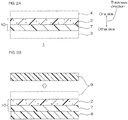
- a pressure-sensitive adhesive sheet 1 has one surface and the other surface facing each other in a thickness direction, and has a generally sheet (plate) shape extending in a plane direction (direction perpendicular to the thickness direction).
- the pressure-sensitive adhesive sheet 1 includes a pressure-sensitive adhesive layer 2 made of the above-described pressure-sensitive adhesive composition (solid content of the pressure-sensitive adhesive composition).
- the pressure-sensitive adhesive layer 2 has one surface and the other surface facing each other in the thickness direction, and has a generally sheet (plate) shape extending in the plane direction.
- a thickness of the pressure-sensitive adhesive layer 2 is not particularly limited, and is, for example, 0.1 ⁇ m or more, preferably 1 ⁇ m or more, more preferably 5 ⁇ m or more, and for example, 1000 ⁇ m or less, preferably 100 ⁇ m or less.
- the thickness of the pressure-sensitive adhesive layer 2 is a distance between one surface and the other surface in the thickness direction of the pressure-sensitive adhesive layer 2.
- the pressure-sensitive adhesive sheet 1 may further include a substrate sheet 3 shown by a phantom line and a second substrate sheet 4 shown by the phantom line.
- the substrate sheet 3 In the pressure-sensitive adhesive sheet 1, the substrate sheet 3, the pressure-sensitive adhesive layer 2, and the second substrate sheet 4 are disposed in order toward one side in the thickness direction.
- the substrate sheet 3 is a release sheet (separator) which protects the other surface of the pressure-sensitive adhesive layer 2 until the pressure-sensitive adhesive layer 2 pressure-sensitively adheres to a substrate 8 ( FIG. 1B ) to be described later, and is peeled from the other surface of the pressure-sensitive adhesive layer 2 when the pressure-sensitive adhesive layer 2 pressure-sensitively adheres to the substrate 8.
- the substrate sheet 3 is in contact with the entire other surface of the pressure-sensitive adhesive layer 2.
- the substrate sheet 3 examples include plastic-based substrate sheets (synthetic resin sheets) such as a polyester sheet (polyethylene terephthalate (PET) sheet and the like), a polyolefin sheet (polyethylene sheet, polypropylene sheet, and the like), a polyvinyl chloride sheet, a polyimide sheet, a polyamide sheet (nylon sheet), and a rayon sheet and papers.
- plastic-based substrate sheet is used.
- a thickness of the substrate sheet 3 is, for example, 1 ⁇ m or more and 1000 ⁇ m or less.
- the second substrate sheet 4 is a release sheet (separator) which protects one surface of the pressure-sensitive adhesive layer 2 until the pressure-sensitive adhesive layer 2 pressure-sensitively adheres to the adherend 9 and is peeled from one surface of the pressure-sensitive adhesive layer 2 when the pressure-sensitive adhesive layer 2 pressure-sensitively adheres to the adherend 9.
- the second substrate sheet 4 is in contact with the entire one surface of the pressure-sensitive adhesive layer 2.
- the second substrate sheet 4 has the same configuration as the substrate sheet 3.
- a pressure-sensitive adhesive composition (or a varnish) is applied to one surface of the substrate sheet 3, and then, when the pressure-sensitive adhesive composition is a varnish, it is dried to remove an organic solvent to form the pressure-sensitive adhesive layer 2 on one surface of the substrate sheet 3. Thereafter, the second substrate sheet 4 is brought into contact with (attached to) one surface of the pressure-sensitive adhesive layer 2.
- the pressure-sensitive adhesive sheet 1 including the substrate sheet 3, the pressure-sensitive adhesive layer 2, and the second substrate sheet 4 in order at one side in the thickness direction is fabricated (produced).
- the substrate sheet 3 is removed from the pressure-sensitive adhesive sheet 1. Specifically, the substrate sheet 3 is peeled from the other surface of the pressure-sensitive adhesive layer 2.
- the other surface of the pressure-sensitive adhesive layer 2 is attached to the substrate 8. Specifically, the other surface of the pressure-sensitive adhesive layer 2 is subjected to pressure-sensitively adhesion (initial pressure-sensitive adhesion) (temporary fixing) with respect to the surface of the substrate 8.
- the substrate 8 is a member having a surface which is a placement surface on which the pressure-sensitive adhesive layer 2 is placed, and is not particularly limited.
- An example thereof includes a carrier sheet.
- the second substrate sheet 4 is removed from the pressure-sensitive adhesive sheet 1. Specifically, the second substrate sheet 4 is peeled from one surface of the pressure-sensitive adhesive layer 2. Thereafter, the adherend 9 is attahced to one surface of the pressure-sensitive adhesive layer 2. Specifically, the surface of the adherend 9 is subjected to pressure-sensitively adhesion (initial pressure-sensitive adhesion) with respect to one surface of the pressure-sensitive adhesive layer 2.
- An example of the adherend 9 includes a member which is subjected to initial pressure-sensitive adhesion (pressure-sensitively adhesion) for a period of time necessary for the substrate 8 (for example, a period of an inspection process and the like), and after the lapse of the period, is peeled from the substrate 8 by imparting a predetermined stimulus to the pressure-sensitive adhesive layer 2.
- the adherend 9 is not particularly limited, and examples thereof include electronic components such as a semiconductor component.
- the adherend 9 is subjected to initial pressure-sensitive adhesion (pressure-sensitively adhesion) with respect to the substrate 8 via the pressure-sensitive adhesive layer 2.
- Examples of the stimulus imparted to the pressure-sensitive adhesive layer 2 include heating, energy rays (ultraviolet rays and the like), vibration, and pressure. Preferably, heating and energy rays are used, more preferably, heating is used.
- the pressure-sensitive adhesive layer 2 is heated via the substrate 8 by heating the substrate 8. Further, for example, a pressure-sensitive adhesive structure 20 including the substrate 8, the pressure-sensitive adhesive layer 2, and the adherend 9 can be put into a heating furnace to heat the pressure-sensitive adhesive layer 2.
- a heating temperature is not particularly limited.
- heating is carried out at a temperature at which the gas generating particles are thermally decomposed or more.
- heating is carried out at a temperature at which the core is thermally expanded or more.
- an energy ray such as an ultraviolet ray is irradiated onto the pressure-sensitive adhesive layer 2.
- the pressure-sensitive adhesive layer 2 (further, gas generating particles) may be heated.
- the gas generating particles contained in the pressure-sensitive adhesive layer 2 generate a gas.
- the pressure-sensitive adhesive force of the pressure-sensitive adhesive layer 2 decreases. Therefore, the releasability (easy releasability) is developed.
- the adherend 9 is easily peeled from one surface of the pressure-sensitive adhesive layer 2.
- the peeling occurs at the interface between the adherend 9 and the pressure-sensitive adhesive layer 2.
- the substrate 8 is not peeled from the other surface of the pressure-sensitive adhesive layer 2 and retains a state of tight contact therewith. In other words, a tight contact state is retained at the interface between the substrate 8 and the pressure-sensitive adhesive layer 2.
- the gas generation amount at which the gas generating particles are generated in the pressure-sensitive adhesive composition is as high as 5 mL/g or more with respect to the solid content of the pressure-sensitive adhesive composition, it has excellent releasability.
- the pressure-sensitive adhesive composition it is only necessary that the gas generating particles are simply dispersed in the pressure-sensitive adhesive component, that is, as in Patent Document 1, it is not necessary to include a large number of groups that do not contribute to the generation of a gas for being dissolved in the pressure-sensitive adhesive component. Therefore, it is possible to suppress a decrease in the gas generation amount, while a mixing ratio of the gas generating particles is retained low to some extent, and accordingly, it is possible to increase a mixing ratio of the pressure-sensitive adhesive component. Therefore, the pressure-sensitive adhesive composition has excellent initial pressure-sensitive adhesive properties.
- the pressure-sensitive adhesive composition of the present invention has both excellent releasability and excellent initial pressure-sensitive adhesive properties.
- the pressure-sensitive adhesive sheet 1 includes the pressure-sensitive adhesive layer 2 made of the pressure-sensitive adhesive composition described above, it has both excellent releasability and excellent initial pressure-sensitive adhesive properties.
- each of the modified examples the same reference numerals are provided for members and steps corresponding to each of those in the above-described one embodiment, and their detailed description is omitted. Further, each of the modified examples can achieve the same function and effect as that of one embodiment unless otherwise specified. Furthermore, one embodiment and the modified examples thereof can be appropriately used in combination.
- each of the substrate 8 and the adherend 9 is disposed on each of one surface and the other surface in the thickness direction of the pressure-sensitive adhesive layer 2 to peel the adherend 9 from one surface of the pressure-sensitive adhesive layer 2.
- each of the adherend 9 and the substrate 8 may be also disposed on each of one surface and the other surface in the thickness direction of the pressure-sensitive adhesive layer 2 to peel the adherend 9 from the other surface of the pressure-sensitive adhesive layer 2.
- the pressure-sensitive adhesive layer 2 is formed on one surface of the substrate sheet 3 and then, disposed on (transferred onto) the substrate 8.
- a pressure-sensitive adhesive composition may be directly disposed (applied) on one surface of the substrate 8.
- the pressure-sensitive adhesive sheet 1 may further include a second pressure-sensitive adhesive layer 7 made of a second pressure-sensitive adhesive composition that does not contain a gas generating agent.
- the second pressure-sensitive adhesive layer 7 is disposed on the other surface in the thickness direction of the pressure-sensitive adhesive layer 2. Specifically, the second pressure-sensitive adhesive layer 7 is in contact with the entire other surface in the thickness direction of the pressure-sensitive adhesive layer 2. In other words, in the pressure-sensitive adhesive sheet 1, the second pressure-sensitive adhesive layer 7 and the pressure-sensitive adhesive layer 2 are disposed in order toward one side in the thickness direction. The shape and the thickness of the second pressure-sensitive adhesive layer 7 are the same as those of the pressure-sensitive adhesive layer 2.
- the second pressure-sensitive adhesive layer 7 and the pressure-sensitive adhesive layer 2 configure a pressure-sensitive adhesive laminate 10.
- the second pressure-sensitive adhesive layer 7 is interposed between the substrate sheet 3 and the pressure-sensitive adhesive layer 2.
- the pressure-sensitive adhesive sheet 1 includes the substrate sheet 3 and the second substrate sheet 4, the substrate sheet 3, the second pressure-sensitive adhesive layer 7, the pressure-sensitive adhesive layer 2, and the second substrate sheet 4 are disposed in order toward one side in the thickness direction.
- the second pressure-sensitive adhesive composition is a material for the second pressure-sensitive adhesive layer 7, and does not contain a gas generating agent configured to generate a gas by a stimulus.
- the gas generating agent is a concept including, as described above, the gas generating particles dispersed in the pressure-sensitive adhesive component and a dissolved-type gas generating agent (for example, an azide compound such as glycidyl azide polymer and/or a terminal modified-type azo compound having a molecular terminal modified with an alkyl group) dissolved in the pressure-sensitive adhesive component.
- the second pressure-sensitive adhesive composition contains the above-described pressure-sensitive adhesive polymer and the above-described additive at an appropriate ratio.
- the second pressure-sensitive adhesive composition has the same configuration as the first pressure-sensitive adhesive composition, except that it does not contain a gas generating agent.
- a tensile elastic modulus and an initial pressure-sensitive adhesive force at 25°C of the second pressure-sensitive adhesive layer 7 are, for example, the same as those in the pressure-sensitive adhesive layer 2.
- a gas generation amount of the second pressure-sensitive adhesive layer 7 is substantially 0 mL/g in terms of decane at 0°C and 1013 hPa.
- the gas generating particles exist in the pressure-sensitive adhesive layer 2, while there is no gas generating agent in the second pressure-sensitive adhesive layer 7, the gas generating particles are unevenly distributed at one side in the thickness direction in the pressure-sensitive adhesive laminate 10.
- the pressure-sensitive adhesive layer 2 and the second pressure-sensitive adhesive layer 7 are attached to each other.
- the pressure-sensitive adhesive layer 2 is formed on the other surface of the second substrate sheet 4, and separately, the second pressure-sensitive adhesive layer 7 is formed on one surface of the substrate sheet 3. Thereafter, the other surface of the pressure-sensitive adhesive layer 2 and one surface of the second pressure-sensitive adhesive layer 7 are brought into contact with each other.
- the other surface of the second pressure-sensitive adhesive layer 7 in the pressure-sensitive adhesive sheet 1 is attached to the substrate 8, and one surface of the pressure-sensitive adhesive layer 2 is attached to the adherend 9.
- an adhesive force of the pressure-sensitive adhesive layer 2 with respect to the adherend 9 decreases based on the generation of a gas of the gas generating particles in the pressure-sensitive adhesive layer 2.
- the adhesive force of the second pressure-sensitive adhesive layer 7 with respect to the substrate 8 is not lowered and retained because there is no generation of a gas described above. In other words, the adhesive force of the adherend 9 with respect to the pressure-sensitive adhesive layer 2 is lower than the adhesive force of the second pressure-sensitive adhesive layer 7 with respect to the substrate 8.
- one surface and the other surface in the thickness direction of the pressure-sensitive adhesive laminate 10 can be selectively set such that one surface of the pressure-sensitive adhesive laminate 10 formed by the pressure-sensitive adhesive layer 2 is a peeling surface, and the other surface of the pressure-sensitive adhesive laminate 10 formed by the second pressure-sensitive adhesive layer 7 is an adhesive surface.
- a monomer component containing 70 parts by mass of ethyl acrylate, 30 parts by mass of 2-ethylhexyl acrylate, 4 parts by mass of hydroxyethyl acrylate, and 5 parts by mass of methyl methacrylate was copolymerized by a solution polymerization method to prepare an acrylic copolymer.
- the acrylic copolymer was dispersed in ethyl acetate which was a reaction solvent.
- Gas generating particles manufactured by EIWA CHEMICAL IND. CO., LTD., FE-788, ADCA particles, gas generation amount of 135 mL/g (20 g), 10 g of a dispersant (manufactured by KYOEISHA CHEMICAL CO., LTD., FLOWLEN DOPA-100), and 170 g of ethyl acetate were blended to be stirred for 1 hour with a bead mill, thereby preparing a gas generating particle dispersion liquid.
- a dispersant manufactured by KYOEISHA CHEMICAL CO., LTD., FLOWLEN DOPA-100
- the acrylic copolymer of Preparation Example 1 (100 parts by mass), 1.4 parts by mass of an isocyanate-based cross-linking agent (manufactured by Nippon Polyurethane Industry Co., Ltd., Coronate L), 200 parts by mass of a gas generating particle dispersion liquid (containing 20 parts by mass of gas generating particles), 10 parts by mass of a rosin phenol-based resin (manufactured by Sumitomo Bakelite Co., Ltd., SUMILITE RESIN PR-12603, tackifier), and an ethyl acetate (containing a reaction solvent of an acrylic copolymer) were uniformly mixed to prepare a coating liquid (varnish).
- an isocyanate-based cross-linking agent manufactured by Nippon Polyurethane Industry Co., Ltd., Coronate L
- a gas generating particle dispersion liquid containing 20 parts by mass of gas generating particles
- 10 parts by mass of a rosin phenol-based resin
- the coating liquid was applied and dried on one surface in the thickness direction of the substrate sheet (separator made of PET, thickness of 38 ⁇ m) 3 so that the thickness thereof after drying was 20 ⁇ m to prepare the pressure-sensitive adhesive layer 2.
- the second substrate sheet (separator made of PET, 38 ⁇ m) 4 was attached to one surface in the thickness direction of the pressure-sensitive adhesive layer 2.
- a pressure-sensitive adhesive sheet including the substrate sheet 3, the pressure-sensitive adhesive layer 2, and the second substate sheet 4 in order toward one side in the thickness direction was fabricated.
- a pressure-sensitive adhesive sheet was fabricated in the same manner as in Example 1, except that the formulation of the base polymer or the gas generating particle dispersion liquid was changed in accordance with Table 1.
- the pressure-sensitive adhesive layer 2 having a thickness of 1 ⁇ m was formed on the other surface of the second substrate sheet 4 in the same manner as in Example 1.
- the second pressure-sensitive adhesive layer 7 having a thickness of 5 ⁇ m was formed on one surface of the substrate sheet 3 from the second pressure-sensitive adhesive composition containing no gas generating particles in the same manner as in Example 1, except that the gas generating particle dispersion liquid was not blended.
- the pressure-sensitive adhesive layer 2 and the second pressure-sensitive adhesive layer 7 were attached to each other.
- the pressure-sensitive adhesive sheet 1 including the pressure-sensitive adhesive laminate 10 consisting of the pressure-sensitive adhesive layer 2 and the second pressure-sensitive adhesive layer 7 was fabricated.
- the pressure-sensitive adhesive sheet 1 was cut into a 5-cm square, and the pressure-sensitive adhesive layer 2 thereof was observed with an optical microscope of 500 magnifications. Then, the size of 20 randomly selected particles was measured, and an average value of the size was obtained as an average particle size.
- a tensile elastic modulus at 25°C of the pressure-sensitive adhesive layer (solid material of the pressure-sensitive adhesive composition) 2 before heating was measured in accordance with JIS K 6922-2.
- the substrate sheet 3 was peeled from the other surface of the pressure-sensitive adhesive layer 2, then, the substrate 8 made of a PET sheet having a thickness of 25 ⁇ m was attached to the other surface of the pressure-sensitive adhesive layer 2, and thereafter, the obtained sheet was cut into a size of a width of 20 mm and a length of 100 mm to fabricate a sample.
- the second substrate sheet 4 was peeled from the sample, and one surface of the pressure-sensitive adhesive layer 2 was compressively bonded to the surface of the adherend 9 made of SUS304 by one reciprocation of a 2-Kg roller under an atmosphere of 23°C to be cured at room temperature for 30 minutes. Thereafter, by using a peeling tester, a pressure-sensitive adhesive force (pressure-sensitive adhesive strength) at the time of peeling the sample at 23°C with a peeling angle of 180° at a peeling rate of 300 mm/min was measured.
- pressure-sensitive adhesive force pressure-sensitive adhesive strength
- the substrate sheet 3 and the second substrate sheet 4 were peeled from the pressure-sensitive adhesive layer 2, and the pressure-sensitive adhesive layer 2 was placed in a sample cup to be then heated with a heating furnace-type pyrolyzer (DSP). As the heating conditions, the temperature rising rate was 2°C/min, and the final temperature was 250°C.
- DSP heating furnace-type pyrolyzer
- the gas generated with the DSP was introduced into a mass spectrometer, and a gas generation amount was measured with the mass spectrometer. Separately, a calibration curve was fabricated with decane of known volume at 0°C and 1013 hPa. This calibration curve was fitted with the above-described measurement results to obtain the volume of the gas generated with the DSP in terms of decane at 0°C and 1013 hPa.
- the substrate sheet 3 was peeled from the other surface of the pressure-sensitive adhesive layer 2, and the adherend 9 made of a PET sheet having a thickness of 100 ⁇ m was attached thereto, and then, the obtained sheet was cut into a 50-mm square to fabricate a sample for evaluation of reworkability.
- the second substate sheet 4 was peeled from the sample, and one surface of the pressure-sensitive adhesive layer 2 was compressively bonded to the surface of the substrate 8 made of a glass plate of 8 cm ⁇ 10 cm by one reciprocation of a 2-Kg roller to be cured at room temperature for 30 minutes. Thereafter, the adherend 9 was placed so as to be brought into contact with the surface of a hot plate which was previously heated at 200°C, thereby heating the adherend 9. The appearance at the time was observed from the side of the substrate 8 (one side in the thickness direction), and the releasability was evaluated by the following criteria.
- the adherend 9 was observed with an optical microscope, and the contamination was evaluated by the following criteria.
- the pressure-sensitive adhesive composition is used for a pressure-sensitive adhesive sheet.
Landscapes
- Chemical & Material Sciences (AREA)
- Organic Chemistry (AREA)
- General Chemical & Material Sciences (AREA)
- Engineering & Computer Science (AREA)
- Materials Engineering (AREA)
- Health & Medical Sciences (AREA)
- Chemical Kinetics & Catalysis (AREA)
- Medicinal Chemistry (AREA)
- Polymers & Plastics (AREA)
- Adhesives Or Adhesive Processes (AREA)
- Adhesive Tapes (AREA)
- Laminated Bodies (AREA)
Abstract
Description
- The present invention relates to a pressure-sensitive adhesive composition and a pressure-sensitive adhesive sheet.
- A pressure-sensitive adhesive sheet which exhibits pressure-sensitive adhesive properties (pressure-sensitively adhesive properties) for a necessary period of time with respect to an adherend, but afterwards, can easily peel the adherend has been known.
- For example, an adhesive material (pressure-sensitive adhesive material or pressure-sensitively adhesive material) containing a gas generating agent that generates a gas and a curable adhesive resin has been proposed (ref: for example,
Patent Document 1 below). -
Patent Document 1 discloses an adhesive material in which a glycidyl azide polymer (gas generating agent) including a main chain made of a straight-chain oxypropylene and a side chain into which an azide group is introduced is dissolved in a curable adhesive resin. The glycidyl azide polymer thermally decomposes the azide group (-N3) in the side chain by heating the adhesive material, thereby generating a nitrogen gas. Therefore, releasability (properties of easily peeling the adherend) of the adhesive material is developed. - Patent Document 1:
Japanese Patent No. 4238037 - However, in the glycidyl azide polymer (gas generating agent) of
Patent Document 1, a methylene in the side chain and the main chain are not thermally decomposed, while the azide group in the side chain is thermally decomposed, and a by-product remains as a residue. Therefore, the glycidyl azide polymer (gas generating agent) ofPatent Document 1 includes a group which does not contribute to gas generation in a molecule at a large proportion. Then, a nitrogen gas generation amount per unit mass in the gas generating agent is low. Therefore, it is necessary to increase a mixing ratio of the gas generating agent in the adhesive material and ensure a constant ratio of the gas generation amount in the adhesive material. However, when the ratio of the gas generation amount is increased, the mixing ratio of the curable adhesive resin is relatively lowered. Therefore, there is a problem that an initial pressure-sensitive adhesive force of the adhesive material decreases. - The present invention provides a pressure-sensitive adhesive composition and a pressure-sensitive adhesive sheet having both excellent releasability and excellent initial pressure-sensitive adhesive properties.
- The present invention (1) includes a pressure-sensitive adhesive composition including a pressure-sensitive adhesive component and a gas generating particle dispersed in the pressure-sensitive adhesive component, wherein a tensile elastic modulus at 25°C of the pressure-sensitive adhesive composition is 5 MPa or less, and a gas generation amount at which the gas generating particle is generated in the pressure-sensitive adhesive composition is 5 mL/g or more in terms of decane at 0°C and 1013 hPa in a solid content of the pressure-sensitive adhesive composition.
- The present invention (2) includes the pressure-sensitive adhesive composition described in (1), wherein the gas generating particle has an average particle size of 10 µm or less.
- The present invention (3) includes the pressure-sensitive adhesive composition described in (1) or (2), wherein the gas generating particle is an azodicarbonamide.
- The present invention (4) includes a pressure-sensitive adhesive sheet including a pressure-sensitive adhesive layer made of the pressure-sensitive adhesive composition described in any one of (1) to (3).
- The present invention (5) includes the pressure-sensitive adhesive sheet described in (4) further including a second pressure-sensitive adhesive layer made of a second pressure-sensitive adhesive composition containing no gas generating agent, wherein the pressure-sensitive adhesive layer and the second pressure-sensitive adhesive layer are disposed in order in a thickness direction.
- In the pressure-sensitive adhesive composition of the present invention, since the gas generation amount at which the gas generating particles are generated in the pressure-sensitive adhesive composition is as high as 5 mL/g or more with respect to the solid content of the pressure-sensitive adhesive composition, it has excellent releasability.
- In addition, in the pressure-sensitive adhesive composition of the present invention, it is only necessary that the gas generating particles are simply dispersed in the pressure-sensitive adhesive component, that is, as in
Patent Document 1, it is not necessary to include a large number of groups that do not contribute to generation of a gas for being dissolved in the pressure-sensitive adhesive component. Therefore, it is possible to suppress a decrease in the gas generation amount, while a mixing ratio of the gas generating particles is retained low to some extent, and accordingly, it is possible to increase a mixing ratio of the pressure-sensitive adhesive component. Therefore, the pressure-sensitive adhesive composition has excellent initial pressure-sensitive adhesive properties. - As a result, the pressure-sensitive adhesive composition of the present invention has both excellent releasability and excellent initial pressure-sensitive adhesive properties.
- Further, since the pressure-sensitive adhesive sheet of the present invention includes the pressure-sensitive adhesive layer made of the pressure-sensitive adhesive composition described above, it has both excellent releasability and excellent initial pressure-sensitive adhesive properties.
-
-
FIGS. 1A to IB show cross-sectional views for illustrating one embodiment of a pressure-sensitive adhesive sheet of the present invention: -
FIG. 1A illustrating a pressure-sensitive adhesive sheet including a pressure-sensitive adhesive layer sandwiched between a substrate sheet and a second substrate sheet and - FIG. IB illustrating an embodiment in which a gas is generated from gas generating particles and an adherend is peeled from the pressure-sensitive adhesive layer.
-
FIGS. 2A to 2B show cross-sectional views for illustrating a modified example of a pressure-sensitive adhesive sheet of the present invention: -
FIG. 2A illustrating a pressure-sensitive adhesive sheet including a pressure-sensitive adhesive layer and a second pressure-sensitive adhesive layer and -
FIG. 2B illustrating an embodiment in which a gas is generated from gas generating particles and an adherend is peeled from the pressure-sensitive adhesive layer. - First, one embodiment of a pressure-sensitive adhesive composition of the present invention is described.
- The pressure-sensitive adhesive composition contains a pressure-sensitive adhesive component and gas generating particles.
- The pressure-sensitive adhesive component imparts pressure-sensitive adhesive properties (also referred to as initial pressure-sensitive adhesive properties or pressure-sensitively adhesive properties) to the pressure-sensitive adhesive composition to develop a pressure-sensitive adhesive force (also referred to as an initial pressure-sensitive adhesive force or a pressure-sensitively adhesive force) with respect to an adherend 9 (described later,
FIG. 1B ). The pressure-sensitive adhesive component is a matrix which disperses the gas generating particles in the pressure-sensitive adhesive composition. - The pressure-sensitive adhesive component is not particularly limited as long as it can exhibit the above-described function (action). Examples of the pressure-sensitive adhesive component include pressure-sensitive adhesive polymers (base polymers) such as rubber-based polymers, acrylic polymers, silicone-based polymers, polyester-based polymers, polyamide-based polymers, urethane-based polymers, and styrene-diene block-based polymers.
- The pressure-sensitive adhesive polymer is described in detail as a pressure-sensitive adhesive base polymer in
Japanese Unexamined Patent Publication No. 2008-266455 - An example of the acrylic polymer includes a copolymer of a monomer component containing an alkyl (meth)acrylate having an alkyl portion having a carbon atom of 1 or more and 18 or less as a main monomer and containing a polar group-containing vinyl monomer as a secondary monomer.
- The alkyl (meth)acrylate is an alkyl methacrylate and/or an alkyl acrylate. Examples of the alkyl (meth)acrylate include alkyl (meth)acrylates having an alkyl portion which is a straight-chain or branched alkyl having a carbon atom of 1 or more and 18 or less such as methyl (meth)acrylate, ethyl (meth)acrylate, propyl (meth)acrylate, isopropyl (meth)acrylate, butyl (meth)acrylate, isobutyl (meth)acrylate, sec-butyl (meth)acrylate, tert-butyl (meth)acrylate, pentyl (meth)acrylate, neopentyl (meth)acrylate, isopentyl (meth)acrylate, hexyl (meth)acrylate, heptyl (meth)acrylate, octyl (meth)acrylate, 2-ethylhexyl (meth)acrylate, isooctyl (meth)acrylate, nonyl (meth)acrylate, isononyl (meth)acrylate, decyl (meth)acrylate, isodecyl (meth)acrylate, undecyl (meth)acrylate, dodecyl (meth)acrylate, tridecyl (meth)acrylate, tetradecyl (meth)acrylate, pentadecyl (meth)acrylate, hexadecyl (meth)acrylate, heptadecyl (meth)acrylate, and octadecyl (meth)acrylate. These may be used alone or in combination of two or more.
- Preferably, a combination of a higher alkyl (meth)acrylate having a higher alkyl portion having a carbon atom of 6 or more and 18 or less and a lower alkyl (meth)acrylate having a lower alkyl portion having a carbon atom of 1 or more and 4 or less is used.
- A polar group-containing vinyl monomer which is a secondary monomer is a copolymerizable monomer which can be copolymerized with a main monomer. Examples of the polar group-containing vinyl monomer include hydroxyl group-containing vinyl monomers such as hydroxymethyl (meth)acrylate, hydroxyethyl (meth)acrylate, hydroxypropyl (meth)acrylate, and hydroxybutyl (meth)acrylate. In addition, examples of the polar group-containing vinyl monomer include carboxyl group-containing vinyl monomers such as (meth)acrylate, amide group-containing vinyl monomers such as (meth)acrylamido, amino group-containing vinyl monomers such as aminoethyl (meth)acrylate, glycidyl group-containing vinyl monomers such as glycidyl (meth)acrylate, cyano group-containing vinyl monomers such as (meth)acrylonitrile, and heterocyclic ring-containing vinyl monomers such as N-vinyl-2-pyrrolidone. Preferably, a hydroxyl group-containing vinyl monomer is used.
- A mixing ratio of the main monomer and the secondary monomer in the monomer component is appropriately selected so as to exhibit the above-described function (action). A ratio of the main monomer in the monomer component is 80% by mass or more and 99% by mass or less, and a ratio of the secondary monomer is the above-described remaining portion.
- For example, a known additive such as a cross-linking agent and a tackifier may be added to the pressure-sensitive adhesive component.
- Examples of the cross-linking agent include an isocyanate-based cross-linking agent, an epoxy-based cross-linking agent, and a metal ion-based cross-linking agent, and preferably, an isocyanate-based cross-linking agent is used. A mixing ratio of the cross-linking agent is, for example, 0.001 parts by mass or more and 10 parts by mass or less with respect to 100 parts by mass of the base polymer of the pressure-sensitive adhesive component.
- Examples of the tackifier include a rosin-based resin, a rosin phenol-based resin, a terpene-based resin, and a petroleum-based resin, and preferably, a rosin phenol-based resin is used. A mixing ratio of the tackifier is, for example, 1 part by mass or more and 15 parts by mass or less with respect to 100 parts by mass of the base polymer of the pressure-sensitive adhesive component.
- A mixing ratio of the pressure-sensitive adhesive component is, for example, 10% by mass or more, preferably 20% by mass or more, and for example, 99% by mass or less, preferably 90% by mass or less with respect to the pressure-sensitive adhesive composition.
- When the mixing ratio of the pressure-sensitive adhesive component is the above-described lower limit or more, it is possible to improve initial pressure-sensitive adhesive properties of the pressure-sensitive adhesive composition.
- The gas generating particles are particles configured to generate a gas by a stimulus such as heating, contact, and the like (preferably, heating), which is imparted to the pressure-sensitive adhesive composition. In other words, the gas generating particles are latent gas generating particles configured so as not to generate a gas before the above-described stimulus is imparted to the pressure-sensitive adhesive composition.
- Further, the gas generating particles are dispersed with respect to the pressure-sensitive adhesive component in the pressure-sensitive adhesive composition. Specifically, the gas generating particles are not dissolved in the pressure-sensitive adhesive component in the pressure-sensitive adhesive composition and are dispersed in a particle form.
- The shape of the gas generating particles is not particularly limited, and examples thereof include a generally spherical shape, a generally plate (flat) shape, a generally needle shape, and an amorphous shape.
- An average value of the maximum length (average particle size in the case of a generally spherical shape) as a dimension of the gas generating particles is, for example, 1000 µm or less, preferably, 100 µm or less, more preferably 10 µm or less, particularly preferably 7.5 µm or less, most preferably 5 µm or less, and for example, 0.1 µm or more.
- When the dimension of the gas generating particles is the above-described upper limit or less (preferably, 10 µm or less), it is possible to suppress contamination of the adherend 9 (described later,
FIG. 1B ) by a gas locally generated due to the excessive amount of the gas generating particles when a stimulus is imparted to the pressure-sensitive adhesive composition. - On the other hand, when the dimension of the gas generating particles is the above-described lower limit or more, it is possible to decrease a mixing ratio of a dispersant (described later) for fine dispersing the gas generating particles.
- A method for measuring the dimension of the gas generating particles is described in detail in Examples to be described later.
- In addition, the gas generating particles are, for example, insoluble with respect to the pressure-sensitive adhesive component in the pressure-sensitive adhesive composition before imparting a stimulus (heating and the like).
- Examples of the gas generating particles include particles made of only a gas generating component (first embodiment), and particles including a core made of a gas generating component and a shell covering the core (second embodiment).
- An example of the gas generating component (gas generating agent) constituting the particles of the first embodiment includes a heating-type foaming agent (thermally decomposed-type foaming agent) which generates a gas by heating.
- Examples of the heating-type foaming agent include an organic foaming agent and an inorganic foaming agent.
- The organic foaming agent is other than a polymer-type foaming agent such as a glycidyl azide polymer, and examples thereof include azo-based foaming agents such as azodicarbonamide (ADCA), barium azodicarboxylate, azobisisobutyronitrile (AIBN), azocyclohexylnitrile, and azodiaminobenzene; N-nitroso-based foaming agents such as N,N'-dinitrosopentamethylenetetramine (DTP), N,N'-dimethyl-N,N'-dinitrosoterephthalamide, and trinitrosotrimethyltriamine; hydrazide-based foaming agents such as 4,4'-oxybis(benzenesulfonyl hydrazide) (OBSH), para-toluenesulfonyl hydrazide, diphenylsulfone-3,3'-disulfonyl hydrazide, 2,4-toluenedisulfonyl hydrazide, p,p-bis(benzenesulfonyl hydrazide) ether, benzene-1,3-disulfonyl hydrazide, and allylbis(sulfonyl hydrazide); semicarbazide-based foaming agents such as p-toluilenesulfonyl semicarbazide and 4,4'-oxybis(benzenesulfonyl semicarbazide); alkane fluoride-based foaming agents such as trichloromonofluoromethane and dichloromonofluoromethane; and triazole-based foaming agents such as 5-morpholyl-1,2,3,4-thiatriazole.
- Examples of the inorganic foaming agent include hydrogen carbonates such as sodium hydrogen carbonate and ammonium hydrogen carbonate; carbonates such as sodium carbonate and ammonium carbonate; nitrites such as sodium nitrite and ammonium nitrite; and boronhydride salts such as sodium borohydride.
- These heating-type foaming agents may be used alone or in combination of two or more.
- As the heating-type foaming agent, preferably, an organic foaming agent is used, more preferably, an azo-based foaming agent is used, further more preferably, ADCA is used.
- Unlike the hydrazide-based foaming agent such as OBSH, the azo-based foaming agent (preferably, ADCA) can suppress generation of a residue containing an oligomer, and therefore, it is possible to suppress the contamination of the adherend 9 by the residue.
- An example of the ADCA includes a commercially available product, and specifically, examples thereof include the Vinyfor series and the FE series (hereinabove, manufactured by EIWA CHEMICAL IND. CO., LTD.).
- The particles of the second embodiment include, for example, a shell made of a polymer such as a polyacrylonitrile-based and a core encapsulated (enclosed) in the shell and made of a low boiling point hydrocarbon (gas generating component) such as pentane. In the particles of the second embodiment, the low boiling point hydrocarbon of the core thermally expands by heating, and a portion thereof permeates through the shell as a gas to be released to the outside. An example of the particles of the second embodiment includes a commercially available product, and specifically, examples thereof include the Matsumoto Microsphere F series and the Matsumoto Microsphere FE series (hereinabove, manufactured by Matsumoto Yushi-Seiyaku Co., Ltd.).
- As the gas generating particles, preferably, particles of the first embodiment are used because a content ratio of the gas generating component is high.
- The gas generating component constituting the gas generating particles in the present embodiment contains many structures which contribute to the generation of a gas at the time of heating in a molecule. Therefore, the gas generation amount of the gas generating particles is larger than that of the glycidyl azide polymer described in
Patent Document 1, and specifically, is, for example, 50 mL/g or more, preferably 100 mL/g or more, more preferably 125 mL/g or more, and for example, 1000 mL/g or less at 0°C and 1013 hPa (standard state). - A mixing ratio of the gas generating particles is adjusted so that a mixing ratio of the gas generating component is, for example, 1 part by mass or more, preferably 10 parts by mass or more, and for example, 100 parts by mass or less, preferably 80 parts by mass or less with respect to 100 parts by mass of the base polymer of the pressure-sensitive adhesive component. When the mixing ratio of the gas generating component is the above-described upper limit or less, the mixing ratio of the pressure-sensitive adhesive component can be set to be the above-described lower limit or more (high range), and therefore, it is possible to improve the initial pressure-sensitive adhesive properties of the pressure-sensitive adhesive composition.
- When the mixing ratio is the above-described lower limit or more, the pressure-sensitive adhesive composition can ensure a desired gas generation amount (described later). When the mixing ratio is the above-described upper limit or less, it is possible to suppress disintegration (that the shape of the pressure-sensitive adhesive layer cannot be retained) of the pressure-sensitive adhesive composition caused by a gas excessively generated.
- In addition, the pressure-sensitive adhesive composition may further contain a dispersant.
- The dispersant is blended so as to improve dispersibility of the gas generating particles (dispersibility in a gas generating particle dispersion liquid of the gas generating particles described in the next producing method, and furthermore, dispersibility in the pressure-sensitive adhesive composition) and further to bring the gas generating particles into a desired dimension. The kind of the dispersant is not particularly limited, and an example thereof includes a polymer-type dispersant. A commercially available product can be used as the dispersant, and specifically, examples thereof include the FLOWLEN DOPA Series (manufactured by KYOEISHA CHEMICAL CO., LTD.), the Solsperse series (manufactured by The Lubrizol Corporation), the EFKA Series (manufactured by BASF SE), the Disper BYK series (manufactured by BYK Japan KK), and the DISPARLON series (manufactured by Kusumoto Chemicals, Ltd.).
- A mixing ratio of the dispersant is, for example, 10 parts by mass or more, preferably 30 parts by mass or more, and for example, 100 parts by mass or less, preferably 70 parts by mass or less with respect to 100 parts by mass of the gas generating particles.
- In order to prepare (produce) the pressure-sensitive adhesive composition, the above-described pressure-sensitive adhesive component and the gas generating particles are blended.
- Specifically, the pressure-sensitive adhesive component is prepared. Separately, the gas generating particles are prepared.
- In order to prepare the gas generating particles, for example, the gas generating particles are dispersed in an organic solvent (dispersion medium) to prepare a gas generating particle liquid containing the gas generating particles and an organic solvent (specifically, the gas generating particle dispersion liquid).
- The organic solvent is not particularly limited as long as it is the dispersion medium capable of dispersing the gas generating particles in a particle form, and examples thereof include ester-based solvents such as ethyl acetate and butyl acetate, ketone-based solvents such as acetone, methyl ethyl ketone, and methyl isobutyl ketone, aromatic hydrocarbon-based solvents such as benzene, toluene, and xylene, alcohol-based solvents such as methanol, ethanol, and isopropanol, alkylene glycol ester-based solvents such as ethylene glycol monomethyl ether acetate and propylene glycol monomethyl ether acetate, halogen-based solvents such as dichloromethane and chloroform, and petroleum-based solvents such as mineral spirit. Preferably, an ester-based solvent is used.
- A mixing ratio of the organic solvent is adjusted so that a content ratio of the gas generating particles in the gas generating particle liquid is, for example, 1% by mass or more, preferably 5% by mass or more, and for example, 50% by mass or less, preferably 30% by mass or less.
- Further, the gas generating particles can be dispersed in an organic solvent (dispersion medium) in the presence of the above-described dispersant. Specifically, the gas generating particles, the dispersant, and the organic solvent are blended to mix them.
- Further, the gas generating particles are, for example, dispersed in the organic solvent (preferably, together with the dispersant) using a dispersing machine such as a mill including a bead mill.
- Next, the pressure-sensitive adhesive component and the gas generating particles are blended.
- Specifically, the pressure-sensitive adhesive component and the gas generating particle liquid are blended to mix them. Also, in this mixture, the gas generating particles are dispersed in a particle form with respect to the pressure-sensitive adhesive component and the organic solvent. Thus, the pressure-sensitive adhesive composition is prepared as a varnish containing the organic solvent (for example, a coating liquid).
- Thereafter, the pressure-sensitive adhesive composition (preferably, a varnish) is applied to a substrate sheet and the like, and then, dried to remove the organic solvent, thereby forming a pressure-sensitive adhesive layer made of a solid content of the pressure-sensitive adhesive composition.
- Also, in the pressure-sensitive adhesive layer, the gas generating particles are dispersed in a particle form with respect to the pressure-sensitive adhesive component.
- A tensile elastic modulus at 25°C of the pressure-sensitive adhesive layer (solid content of the pressure-sensitive adhesive composition) is 5 MPa or less, preferably 1 MPa or less, more preferably 500 kPa or less, and for example, 0.1 kPa or more.
- When the tensile elastic modulus of the pressure-sensitive adhesive layer (solid content of the pressure-sensitive adhesive composition) is above the above-described upper limit, the pressure-sensitive adhesive layer (solid content of the pressure-sensitive adhesive composition) becomes excessively hard, and the initial pressure-sensitive adhesive properties cannot be developed.
- When the tensile elastic modulus of the pressure-sensitive adhesive layer (solid content of the pressure-sensitive adhesive composition) is the above-described lower limit or more, shape retaining properties are excellent.
- The tensile elastic modulus of the pressure-sensitive adhesive layer (pressure-sensitive adhesive composition) is measured in conformity with JIS K6922-2 (2018).
- Further, an initial pressure-sensitive adhesive force of the pressure-sensitive adhesive layer is, for example, 0.5 N/20mm or more, preferably 1 N/20mm or more, more preferably 3 N/20mm or more.
- When the initial pressure-sensitive adhesive force of the pressure-sensitive adhesive layer is the above-described lower limit or more, it is possible to obtain an excellent initial pressure-sensitive adhesive force.
- When the initial pressure-sensitive adhesive force of the pressure-sensitive adhesive layer is the above-described upper limit or less, it is possible to suppress the releasability after imparting a stimulus due to the excessive initial pressure-sensitive adhesive force.
- A method for measuring the pressure-sensitive adhesive force of the pressure-sensitive adhesive layer is described in detail in Examples to be described later.
- The pressure-sensitive adhesive force of the pressure-sensitive adhesive layer is a pressure-sensitive adhesive force possessed by the pressure-sensitive adhesive layer before heating.
- A gas generation amount at which the gas generating particles are generated in the pressure-sensitive adhesive layer (solid content of the pressure-sensitive adhesive composition) is 5 mL/g or more, preferably 10 mL/g or more, more preferably 15 mL/g or more, further more preferably 20 mL/g or more, and for example, 100 mL/g or less in terms of decane at 0°C and 1013 hPa.
- When the gas generation amount is below the above-described lower limit, the gas generation amount becomes excessively small at the time of imparting a stimulus to the pressure-sensitive adhesive layer (pressure-sensitive adhesive composition), and the releasability of the pressure-sensitive adhesive layer decreases.
- When the gas generation amount is the above-described upper limit or less, it is possible to suppress the vigorous generation of a gas from the pressure-sensitive adhesive composition to contaminate the adherend 9 at the time of imparting a stimulus to the pressure-sensitive adhesive composition.
- As the details are described in Examples later, a method for determining a gas generation amount at which the gas generating particles are generated in the pressure-sensitive adhesive layer (pressure-sensitive adhesive composition) is, for example, obtained as a volume in terms of decane at 0°C and 1013 hPa (1 atmosphere) of a gas generated on heating at 250°C with a mass spectrometer.
- Next, one embodiment of the pressure-sensitive adhesive sheet of the present invention including the above-described pressure-sensitive adhesive layer is described with reference to
FIG. 1A . - As shown in
FIG. 1A , a pressure-sensitive adhesive sheet 1 has one surface and the other surface facing each other in a thickness direction, and has a generally sheet (plate) shape extending in a plane direction (direction perpendicular to the thickness direction). - The pressure-
sensitive adhesive sheet 1 includes a pressure-sensitive adhesive layer 2 made of the above-described pressure-sensitive adhesive composition (solid content of the pressure-sensitive adhesive composition). - The pressure-
sensitive adhesive layer 2 has one surface and the other surface facing each other in the thickness direction, and has a generally sheet (plate) shape extending in the plane direction. - A thickness of the pressure-
sensitive adhesive layer 2 is not particularly limited, and is, for example, 0.1 µm or more, preferably 1 µm or more, more preferably 5 µm or more, and for example, 1000 µm or less, preferably 100 µm or less. The thickness of the pressure-sensitive adhesive layer 2 is a distance between one surface and the other surface in the thickness direction of the pressure-sensitive adhesive layer 2. - Further, the pressure-
sensitive adhesive sheet 1 may further include asubstrate sheet 3 shown by a phantom line and asecond substrate sheet 4 shown by the phantom line. - In the pressure-
sensitive adhesive sheet 1, thesubstrate sheet 3, the pressure-sensitive adhesive layer 2, and thesecond substrate sheet 4 are disposed in order toward one side in the thickness direction. - The
substrate sheet 3 is a release sheet (separator) which protects the other surface of the pressure-sensitive adhesive layer 2 until the pressure-sensitive adhesive layer 2 pressure-sensitively adheres to a substrate 8 (FIG. 1B ) to be described later, and is peeled from the other surface of the pressure-sensitive adhesive layer 2 when the pressure-sensitive adhesive layer 2 pressure-sensitively adheres to thesubstrate 8. Thesubstrate sheet 3 is in contact with the entire other surface of the pressure-sensitive adhesive layer 2. Examples of thesubstrate sheet 3 include plastic-based substrate sheets (synthetic resin sheets) such as a polyester sheet (polyethylene terephthalate (PET) sheet and the like), a polyolefin sheet (polyethylene sheet, polypropylene sheet, and the like), a polyvinyl chloride sheet, a polyimide sheet, a polyamide sheet (nylon sheet), and a rayon sheet and papers. Preferably, a plastic-based substrate sheet is used. A thickness of thesubstrate sheet 3 is, for example, 1 µm or more and 1000 µm or less. - The
second substrate sheet 4 is a release sheet (separator) which protects one surface of the pressure-sensitive adhesive layer 2 until the pressure-sensitive adhesive layer 2 pressure-sensitively adheres to the adherend 9 and is peeled from one surface of the pressure-sensitive adhesive layer 2 when the pressure-sensitive adhesive layer 2 pressure-sensitively adheres to the adherend 9. Thesecond substrate sheet 4 is in contact with the entire one surface of the pressure-sensitive adhesive layer 2. Thesecond substrate sheet 4 has the same configuration as thesubstrate sheet 3. - In order to fabricate (produce) the pressure-
sensitive adhesive sheet 1, for example, a pressure-sensitive adhesive composition (or a varnish) is applied to one surface of thesubstrate sheet 3, and then, when the pressure-sensitive adhesive composition is a varnish, it is dried to remove an organic solvent to form the pressure-sensitive adhesive layer 2 on one surface of thesubstrate sheet 3. Thereafter, thesecond substrate sheet 4 is brought into contact with (attached to) one surface of the pressure-sensitive adhesive layer 2. - Thus, the pressure-
sensitive adhesive sheet 1 including thesubstrate sheet 3, the pressure-sensitive adhesive layer 2, and thesecond substrate sheet 4 in order at one side in the thickness direction is fabricated (produced). - Next, a method in which the adherend 9 is subjected to initial pressure-sensitive adhesion to the
substrate 8 using the pressure-sensitive adhesive sheet 1, and then, the adherend 9 is peeled with respect to thesubstrate 8 is described with reference to FIG. IB. - First, in this method, when the pressure-
sensitive adhesive sheet 1 includes the substrate sheet 3 (ref:FIG. 1A ), thesubstrate sheet 3 is removed from the pressure-sensitive adhesive sheet 1. Specifically, thesubstrate sheet 3 is peeled from the other surface of the pressure-sensitive adhesive layer 2. - Subsequently, as shown in
FIG. 1B , the other surface of the pressure-sensitive adhesive layer 2 is attached to thesubstrate 8. Specifically, the other surface of the pressure-sensitive adhesive layer 2 is subjected to pressure-sensitively adhesion (initial pressure-sensitive adhesion) (temporary fixing) with respect to the surface of thesubstrate 8. - The
substrate 8 is a member having a surface which is a placement surface on which the pressure-sensitive adhesive layer 2 is placed, and is not particularly limited. An example thereof includes a carrier sheet. - Subsequently, when the pressure-
sensitive adhesive sheet 1 includes the second substrate sheet 4 (ref:FIG. 1A ), thesecond substrate sheet 4 is removed from the pressure-sensitive adhesive sheet 1. Specifically, thesecond substrate sheet 4 is peeled from one surface of the pressure-sensitive adhesive layer 2. Thereafter, the adherend 9 is attahced to one surface of the pressure-sensitive adhesive layer 2. Specifically, the surface of the adherend 9 is subjected to pressure-sensitively adhesion (initial pressure-sensitive adhesion) with respect to one surface of the pressure-sensitive adhesive layer 2. - An example of the adherend 9 includes a member which is subjected to initial pressure-sensitive adhesion (pressure-sensitively adhesion) for a period of time necessary for the substrate 8 (for example, a period of an inspection process and the like), and after the lapse of the period, is peeled from the
substrate 8 by imparting a predetermined stimulus to the pressure-sensitive adhesive layer 2. The adherend 9 is not particularly limited, and examples thereof include electronic components such as a semiconductor component. - Thus, the adherend 9 is subjected to initial pressure-sensitive adhesion (pressure-sensitively adhesion) with respect to the
substrate 8 via the pressure-sensitive adhesive layer 2. - Thereafter, a stimulus is imparted to the pressure-
sensitive adhesive layer 2. - Examples of the stimulus imparted to the pressure-
sensitive adhesive layer 2 include heating, energy rays (ultraviolet rays and the like), vibration, and pressure. Preferably, heating and energy rays are used, more preferably, heating is used. - In order to heat the pressure-
sensitive adhesive layer 2, the pressure-sensitive adhesive layer 2 is heated via thesubstrate 8 by heating thesubstrate 8. Further, for example, a pressure-sensitive adhesive structure 20 including thesubstrate 8, the pressure-sensitive adhesive layer 2, and the adherend 9 can be put into a heating furnace to heat the pressure-sensitive adhesive layer 2. - A heating temperature is not particularly limited. For example, when the gas generating particles are the particles of the first embodiment (gas generating component), heating is carried out at a temperature at which the gas generating particles are thermally decomposed or more. For example, when the gas generating particles are the particles of the second embodiment, heating is carried out at a temperature at which the core is thermally expanded or more.
- Or, an energy ray such as an ultraviolet ray is irradiated onto the pressure-
sensitive adhesive layer 2. By irradiating the energy ray to the pressure-sensitive adhesive layer 2, the pressure-sensitive adhesive layer 2 (further, gas generating particles) may be heated. - By imparting a stimulus to the pressure-
sensitive adhesive layer 2, the gas generating particles contained in the pressure-sensitive adhesive layer 2 generate a gas. Thus, the pressure-sensitive adhesive force of the pressure-sensitive adhesive layer 2 decreases. Therefore, the releasability (easy releasability) is developed. - Thus, as shown by an arrow of
FIG. 1B , the adherend 9 is easily peeled from one surface of the pressure-sensitive adhesive layer 2. In other words, the peeling occurs at the interface between the adherend 9 and the pressure-sensitive adhesive layer 2. - The
substrate 8 is not peeled from the other surface of the pressure-sensitive adhesive layer 2 and retains a state of tight contact therewith. In other words, a tight contact state is retained at the interface between thesubstrate 8 and the pressure-sensitive adhesive layer 2. - Then, in the pressure-sensitive adhesive composition described above, since the gas generation amount at which the gas generating particles are generated in the pressure-sensitive adhesive composition is as high as 5 mL/g or more with respect to the solid content of the pressure-sensitive adhesive composition, it has excellent releasability.
- In addition, in the pressure-sensitive adhesive composition, it is only necessary that the gas generating particles are simply dispersed in the pressure-sensitive adhesive component, that is, as in
Patent Document 1, it is not necessary to include a large number of groups that do not contribute to the generation of a gas for being dissolved in the pressure-sensitive adhesive component. Therefore, it is possible to suppress a decrease in the gas generation amount, while a mixing ratio of the gas generating particles is retained low to some extent, and accordingly, it is possible to increase a mixing ratio of the pressure-sensitive adhesive component. Therefore, the pressure-sensitive adhesive composition has excellent initial pressure-sensitive adhesive properties. - As a result, the pressure-sensitive adhesive composition of the present invention has both excellent releasability and excellent initial pressure-sensitive adhesive properties.
- Further, since the pressure-
sensitive adhesive sheet 1 includes the pressure-sensitive adhesive layer 2 made of the pressure-sensitive adhesive composition described above, it has both excellent releasability and excellent initial pressure-sensitive adhesive properties. - In the following each of the modified examples, the same reference numerals are provided for members and steps corresponding to each of those in the above-described one embodiment, and their detailed description is omitted. Further, each of the modified examples can achieve the same function and effect as that of one embodiment unless otherwise specified. Furthermore, one embodiment and the modified examples thereof can be appropriately used in combination.
- In one embodiment, as shown in
FIG. 1B , each of thesubstrate 8 and the adherend 9 is disposed on each of one surface and the other surface in the thickness direction of the pressure-sensitive adhesive layer 2 to peel the adherend 9 from one surface of the pressure-sensitive adhesive layer 2. However, for example, though not shown, each of the adherend 9 and thesubstrate 8 may be also disposed on each of one surface and the other surface in the thickness direction of the pressure-sensitive adhesive layer 2 to peel the adherend 9 from the other surface of the pressure-sensitive adhesive layer 2. - Further, the pressure-
sensitive adhesive layer 2 is formed on one surface of thesubstrate sheet 3 and then, disposed on (transferred onto) thesubstrate 8. Alternatively, for example, though not shown, a pressure-sensitive adhesive composition may be directly disposed (applied) on one surface of thesubstrate 8. - As shown in
FIG. 2A , the pressure-sensitive adhesive sheet 1 may further include a second pressure-sensitive adhesive layer 7 made of a second pressure-sensitive adhesive composition that does not contain a gas generating agent. - The second pressure-
sensitive adhesive layer 7 is disposed on the other surface in the thickness direction of the pressure-sensitive adhesive layer 2. Specifically, the second pressure-sensitive adhesive layer 7 is in contact with the entire other surface in the thickness direction of the pressure-sensitive adhesive layer 2. In other words, in the pressure-sensitive adhesive sheet 1, the second pressure-sensitive adhesive layer 7 and the pressure-sensitive adhesive layer 2 are disposed in order toward one side in the thickness direction. The shape and the thickness of the second pressure-sensitive adhesive layer 7 are the same as those of the pressure-sensitive adhesive layer 2. - The second pressure-
sensitive adhesive layer 7 and the pressure-sensitive adhesive layer 2 configure a pressure-sensitiveadhesive laminate 10. - In addition, when the pressure-
sensitive adhesive sheet 1 includes thesubstrate sheet 3, the second pressure-sensitive adhesive layer 7 is interposed between thesubstrate sheet 3 and the pressure-sensitive adhesive layer 2. - Further, when the pressure-
sensitive adhesive sheet 1 includes thesubstrate sheet 3 and thesecond substrate sheet 4, thesubstrate sheet 3, the second pressure-sensitive adhesive layer 7, the pressure-sensitive adhesive layer 2, and thesecond substrate sheet 4 are disposed in order toward one side in the thickness direction. - The second pressure-sensitive adhesive composition is a material for the second pressure-
sensitive adhesive layer 7, and does not contain a gas generating agent configured to generate a gas by a stimulus. The gas generating agent is a concept including, as described above, the gas generating particles dispersed in the pressure-sensitive adhesive component and a dissolved-type gas generating agent (for example, an azide compound such as glycidyl azide polymer and/or a terminal modified-type azo compound having a molecular terminal modified with an alkyl group) dissolved in the pressure-sensitive adhesive component. - On the other hand, the second pressure-sensitive adhesive composition contains the above-described pressure-sensitive adhesive polymer and the above-described additive at an appropriate ratio. In other words, the second pressure-sensitive adhesive composition has the same configuration as the first pressure-sensitive adhesive composition, except that it does not contain a gas generating agent.
- A tensile elastic modulus and an initial pressure-sensitive adhesive force at 25°C of the second pressure-
sensitive adhesive layer 7 are, for example, the same as those in the pressure-sensitive adhesive layer 2. On the other hand, a gas generation amount of the second pressure-sensitive adhesive layer 7 is substantially 0 mL/g in terms of decane at 0°C and 1013 hPa. - Since the gas generating particles exist in the pressure-
sensitive adhesive layer 2, while there is no gas generating agent in the second pressure-sensitive adhesive layer 7, the gas generating particles are unevenly distributed at one side in the thickness direction in the pressure-sensitiveadhesive laminate 10. - In order to fabricate (produce) the pressure-
sensitive adhesive sheet 1 described inFIG. 2A , for example, the pressure-sensitive adhesive layer 2 and the second pressure-sensitive adhesive layer 7 are attached to each other. For example, the pressure-sensitive adhesive layer 2 is formed on the other surface of thesecond substrate sheet 4, and separately, the second pressure-sensitive adhesive layer 7 is formed on one surface of thesubstrate sheet 3. Thereafter, the other surface of the pressure-sensitive adhesive layer 2 and one surface of the second pressure-sensitive adhesive layer 7 are brought into contact with each other. - The other surface of the second pressure-
sensitive adhesive layer 7 in the pressure-sensitive adhesive sheet 1 is attached to thesubstrate 8, and one surface of the pressure-sensitive adhesive layer 2 is attached to the adherend 9. - Thereafter, a stimulus is imparted to the pressure-sensitive
adhesive laminate 10. Then, an adhesive force of the pressure-sensitive adhesive layer 2 with respect to the adherend 9 decreases based on the generation of a gas of the gas generating particles in the pressure-sensitive adhesive layer 2. On the other hand, the adhesive force of the second pressure-sensitive adhesive layer 7 with respect to thesubstrate 8 is not lowered and retained because there is no generation of a gas described above. In other words, the adhesive force of the adherend 9 with respect to the pressure-sensitive adhesive layer 2 is lower than the adhesive force of the second pressure-sensitive adhesive layer 7 with respect to thesubstrate 8. - Therefore, in a state where the pressure-sensitive
adhesive laminate 10 pressure-sensitively adheres to thesubstrate 8, the adherend 9 is easily and reliably peeled from the pressure-sensitiveadhesive laminate 10. In other words, one surface and the other surface in the thickness direction of the pressure-sensitiveadhesive laminate 10 can be selectively set such that one surface of the pressure-sensitiveadhesive laminate 10 formed by the pressure-sensitive adhesive layer 2 is a peeling surface, and the other surface of the pressure-sensitiveadhesive laminate 10 formed by the second pressure-sensitive adhesive layer 7 is an adhesive surface. - Next, the present invention is further described based on Examples and Comparative Examples shown below. The present invention is however not limited by Examples and Comparative Examples. The specific numerical values in mixing ratio (content ratio), property value, and parameter used in the following description can be replaced with upper limit values (numerical values defined as "or less" or "below") or lower limit values (numerical values defined as "or more" or "above") of corresponding numerical values in mixing ratio (content ratio), property value, and parameter described in the above-described "DESCRIPTION OF EMBODIMENTS".
- A monomer component containing 70 parts by mass of ethyl acrylate, 30 parts by mass of 2-ethylhexyl acrylate, 4 parts by mass of hydroxyethyl acrylate, and 5 parts by mass of methyl methacrylate was copolymerized by a solution polymerization method to prepare an acrylic copolymer. The acrylic copolymer was dispersed in ethyl acetate which was a reaction solvent.
- As an acrylic polymer, SK1811L manufactured by Soken Chemical & Engineering Co., Ltd. was prepared.
- Gas generating particles (manufactured by EIWA CHEMICAL IND. CO., LTD., FE-788, ADCA particles, gas generation amount of 135 mL/g) (20 g), 10 g of a dispersant (manufactured by KYOEISHA CHEMICAL CO., LTD., FLOWLEN DOPA-100), and 170 g of ethyl acetate were blended to be stirred for 1 hour with a bead mill, thereby preparing a gas generating particle dispersion liquid.
- The acrylic copolymer of Preparation Example 1 (100 parts by mass), 1.4 parts by mass of an isocyanate-based cross-linking agent (manufactured by Nippon Polyurethane Industry Co., Ltd., Coronate L), 200 parts by mass of a gas generating particle dispersion liquid (containing 20 parts by mass of gas generating particles), 10 parts by mass of a rosin phenol-based resin (manufactured by Sumitomo Bakelite Co., Ltd., SUMILITE RESIN PR-12603, tackifier), and an ethyl acetate (containing a reaction solvent of an acrylic copolymer) were uniformly mixed to prepare a coating liquid (varnish). Then, the coating liquid was applied and dried on one surface in the thickness direction of the substrate sheet (separator made of PET, thickness of 38 µm) 3 so that the thickness thereof after drying was 20 µm to prepare the pressure-
sensitive adhesive layer 2. Thereafter, the second substrate sheet (separator made of PET, 38 µm) 4 was attached to one surface in the thickness direction of the pressure-sensitive adhesive layer 2. Thus, as shown inFIG. 1A , a pressure-sensitive adhesive sheet including thesubstrate sheet 3, the pressure-sensitive adhesive layer 2, and thesecond substate sheet 4 in order toward one side in the thickness direction was fabricated. - A pressure-sensitive adhesive sheet was fabricated in the same manner as in Example 1, except that the formulation of the base polymer or the gas generating particle dispersion liquid was changed in accordance with Table 1.
- The pressure-
sensitive adhesive layer 2 having a thickness of 1 µm was formed on the other surface of thesecond substrate sheet 4 in the same manner as in Example 1. - Separately, the second pressure-
sensitive adhesive layer 7 having a thickness of 5 µm was formed on one surface of thesubstrate sheet 3 from the second pressure-sensitive adhesive composition containing no gas generating particles in the same manner as in Example 1, except that the gas generating particle dispersion liquid was not blended. - Thereafter, the pressure-
sensitive adhesive layer 2 and the second pressure-sensitive adhesive layer 7 were attached to each other. Thus, as shown inFIG. 2A , the pressure-sensitive adhesive sheet 1 including the pressure-sensitiveadhesive laminate 10 consisting of the pressure-sensitive adhesive layer 2 and the second pressure-sensitive adhesive layer 7 was fabricated. - The details of each of the gas generating particles, the gas generating agent, and the like in Examples and Comparative Examples are shown below.
- FE-788: gas generating particles, ADCA particles, gas generation amount of 135 mL/g (0°C, 1013 hPa), manufactured by EIWA CHEMICAL IND. CO., LTD.
- Vinyfor AC#3C-K2: gas generating particles, ADCA particles, gas generation amount of 210 mL/g (0°C, 1013 hPa), manufactured by EIWA CHEMICAL IND. CO., LTD.
- Neocellborn N#1000M: gas generating particles, OBSH particles, gas generation amount of 125 mL/g (0°C, 1013 hPa), manufactured by EIWA CHEMICAL IND. CO., LTD.
- Glycidyl azide polymer: dissolved-type gas generating agent represented by the following formula (1), abbreviated as "GAP", weight average molecular weight of about 2000, gas generation amount of 20 mL/g (0°C, 1013 hPa), wherein "x" and "n" represent the number of repetitions.
- The following items were evaluated for each of the pressure-sensitive adhesive sheets (each of the pressure-sensitive adhesive layers and each of the second pressure-sensitive adhesive layers) of Examples and Comparative Examples. The results are described in Tables 1 to 3.
- The pressure-
sensitive adhesive sheet 1 was cut into a 5-cm square, and the pressure-sensitive adhesive layer 2 thereof was observed with an optical microscope of 500 magnifications. Then, the size of 20 randomly selected particles was measured, and an average value of the size was obtained as an average particle size. - A tensile elastic modulus at 25°C of the pressure-sensitive adhesive layer (solid material of the pressure-sensitive adhesive composition) 2 before heating was measured in accordance with JIS K 6922-2.
- The
substrate sheet 3 was peeled from the other surface of the pressure-sensitive adhesive layer 2, then, thesubstrate 8 made of a PET sheet having a thickness of 25 µm was attached to the other surface of the pressure-sensitive adhesive layer 2, and thereafter, the obtained sheet was cut into a size of a width of 20 mm and a length of 100 mm to fabricate a sample. - Thereafter, the
second substrate sheet 4 was peeled from the sample, and one surface of the pressure-sensitive adhesive layer 2 was compressively bonded to the surface of the adherend 9 made of SUS304 by one reciprocation of a 2-Kg roller under an atmosphere of 23°C to be cured at room temperature for 30 minutes. Thereafter, by using a peeling tester, a pressure-sensitive adhesive force (pressure-sensitive adhesive strength) at the time of peeling the sample at 23°C with a peeling angle of 180° at a peeling rate of 300 mm/min was measured. - The
substrate sheet 3 and thesecond substrate sheet 4 were peeled from the pressure-sensitive adhesive layer 2, and the pressure-sensitive adhesive layer 2 was placed in a sample cup to be then heated with a heating furnace-type pyrolyzer (DSP). As the heating conditions, the temperature rising rate was 2°C/min, and the final temperature was 250°C. - The gas generated with the DSP was introduced into a mass spectrometer, and a gas generation amount was measured with the mass spectrometer. Separately, a calibration curve was fabricated with decane of known volume at 0°C and 1013 hPa. This calibration curve was fitted with the above-described measurement results to obtain the volume of the gas generated with the DSP in terms of decane at 0°C and 1013 hPa.
- The
substrate sheet 3 was peeled from the other surface of the pressure-sensitive adhesive layer 2, and the adherend 9 made of a PET sheet having a thickness of 100 µm was attached thereto, and then, the obtained sheet was cut into a 50-mm square to fabricate a sample for evaluation of reworkability. - Thereafter, the
second substate sheet 4 was peeled from the sample, and one surface of the pressure-sensitive adhesive layer 2 was compressively bonded to the surface of thesubstrate 8 made of a glass plate of 8 cm× 10 cm by one reciprocation of a 2-Kg roller to be cured at room temperature for 30 minutes. Thereafter, the adherend 9 was placed so as to be brought into contact with the surface of a hot plate which was previously heated at 200°C, thereby heating the adherend 9. The appearance at the time was observed from the side of the substrate 8 (one side in the thickness direction), and the releasability was evaluated by the following criteria. - Good: the pressure-
sensitive adhesive layer 2 was peeled from the entire surface of the adherend 9. - Bad: the pressure-
sensitive adhesive layer 2 was not peeled from the entire surface of the adherend 9, and floating was observed in a portion of the surface of the adherend 9. - After the evaluation of the releasability described above, the adherend 9 was observed with an optical microscope, and the contamination was evaluated by the following criteria.
- Good: It was not observed that a pressure-sensitive adhesive component remained as deposits (glue remains) on the surface of the adherend 9.
- Bad: It was observed that a pressure-sensitive adhesive component remained as deposits (glue remains) on the surface of the adherend 9.
-
Table 1 Formulation [parts by mass] Pressure-Sensitive Adhesive Component Foaming Agent Dispersion Liquid Acrylic Copolymer (Pressure-Sensitive Adhesive Polymer) Isocyanate-Based Cross-Linking Agent Rosin Phenol-Based Resin (Tackifier) Foaming Agent Dispersant (FLOWLEN DOPA-100) Preparation Ex. 1 Preparation Ex. 2 FE-788*1 (ADCA) Vinyfor AC #3C-K2*2 (ADCA) Neocellborn N #1000M (OBSH) Glycidyl Azide Polymer Ex. 1 100 - 1.4 10 20 - - - 10 Ex. 2 100 - 1.4 10 20 - - - - Ex. 3 100 - 1.4 10 5 - - - 10 Ex. 4 100 - 1.4 10 - 20 - - 2.5 Ex. 5 100 - 1.4 10 - - 20 - 2.5 Ex. 6 - 100 5 20 20 - - - 10 Comparative Ex. 1 100 - 1.4 10 - - - 100 - Comparative Ex. 2 100 - 1.4 10 - - - 20 - Comparative Ex. 3 100 - 1.4 10 - 1 - - 0.5 *1: FE-788 (ADCA): median size of 6 µm
*2: Vinyfor AC#3C-K2 (ADCA): median size of 5 µm -
Table 2 Foaming Agent At Time of Compressive Bonding at 25°C After (at) Heating Kind State Particle Size of Gas Generating Particle [µm] Mixing Ratio (vs 100 parts by mass of Acrylic Copolymer) Tensile Elastic Modulus (25°C) [MPa] Pressure-Sensitive Adhesive Force [N/20 mm] Gas Generation Amount [mL/g] Reworkability (Releasability) Contamination Ex. 1 FE-788(ADCA)*1 Dispersed as Gas Generating Particles 5 20 0.3 5.9 19 Good Good Ex. 2 FE-788(ADCA)*1 Dispersed as Gas Generating Particles 50 20 0.3 4.2 21 Good Bad Ex. 3 FE-788(ADCA)*1 Dispersed as Gas Generating Particles 5 5 0.3 6.2 6 Good Good Ex. 4 Vinyfor AC#3C-K2*2 (ADCA) Dispersed as Gas Generating Particles 5 20 0.3 5.8 30 Good Good Ex. 5 Neocellborn N#1000M (OBSH) Dispersed as Gas Generating Particles 5 20 0.3 5.8 19 Good Bad Ex. 6 FE-788(ADCA)*1 Dispersed as Gas Generating Particles 5 20 2 2.4 17 Good Good Comparative Ex. 1 Glycidyl Azide Polymer Gas Generating Agent is Dissolved - 100 0.3 0.1 9 Good Bad Comparative Ex. 2 Glycidyl Azide Polymer Gas Generating Agent is Dissolved - 20 0.3 1 3 Bad Bad Comparative Ex. 3 Vinyfor AC#3C-K2*2 (ADCA) Dispersed as Gas Generating Particles 5 1 0.3 6 2 Bad Good *1: FE-788 (ADCA): median size of 6 µm
*2: Vinyfor AC#3C-K2 (ADCA): median size of 5 µm -
[Table 3] Pressure-Sensitive Adhesive Layer Second Pressure-Sensitive Adhesive Layer Before Heating After (at) Heating Thickness [µm] Kind of Foaming Agent Particle Size of Gas Generating Particle [µm] Content of Foaming Agent [wt%] Thickness [µm] Foaming Agent Tensile Elastic Modulus of Pressure-Sensitive Adhesive Layer (25°C) [MPa] Gas Generation Amount at which Gas Generating Particles are Generated in Pressure-Sensitive Adhesive Layer [mL/g] Reworkability (Releasability ) Contamination Ex. 7 1 FE-788 (ADCA) 5 20 5 - 0.3 18 Good Good - While the illustrative embodiments of the present invention are provided in the above description, such is for illustrative purpose only and it is not to be construed as limiting the scope of the present invention. Modification and variation of the present invention that will be obvious to those skilled in the art is to be covered by the following claims.
- The pressure-sensitive adhesive composition is used for a pressure-sensitive adhesive sheet.
-
- 1
- Pressure-sensitive adhesive sheet
- 2
- Pressure-sensitive adhesive layer
- 7
- Second pressure-sensitive adhesive layer

Claims (5)
- A pressure-sensitive adhesive composition comprising:a pressure-sensitive adhesive component anda gas generating particle dispersed in the pressure-sensitive adhesive component, whereina tensile elastic modulus at 25°C of the pressure-sensitive adhesive composition is 5 MPa or less, anda gas generation amount at which the gas generating particle is generated in the pressure-sensitive adhesive composition is 5 mL/g or more in terms of decane at 0°C and 1013 hPa in a solid content of the pressure-sensitive adhesive composition.
- The pressure-sensitive adhesive composition according to claim 1, wherein
the gas generating particle has an average particle size of 10 µm or less. - The pressure-sensitive adhesive composition according to claim 1, wherein
the gas generating particle is an azodicarbonamide. - A pressure-sensitive adhesive sheet comprising:
a pressure-sensitive adhesive layer made of the pressure-sensitive adhesive composition according to claim 1. - The pressure-sensitive adhesive sheet according to claim 4 further comprising:a second pressure-sensitive adhesive layer made of a second pressure-sensitive adhesive composition containing no gas generating agent, whereinthe pressure-sensitive adhesive layer and the second pressure-sensitive adhesive layer are disposed in order in a thickness direction.
Applications Claiming Priority (3)
| Application Number | Priority Date | Filing Date | Title |
|---|---|---|---|
| JP2018233316 | 2018-12-13 | ||
| JP2019149838A JP2020097718A (en) | 2018-12-13 | 2019-08-19 | Adhesive composition and adhesive sheet |
| PCT/JP2019/044346 WO2020121715A1 (en) | 2018-12-13 | 2019-11-12 | Pressure-sensitive adhesive composition and pressure-sensitive adhesive sheet |
Publications (1)
| Publication Number | Publication Date |
|---|---|
| EP3896133A1 true EP3896133A1 (en) | 2021-10-20 |
Family
ID=71105747
Family Applications (1)
| Application Number | Title | Priority Date | Filing Date |
|---|---|---|---|
| EP19895149.3A Withdrawn EP3896133A1 (en) | 2018-12-13 | 2019-11-12 | Pressure-sensitive adhesive composition and pressure-sensitive adhesive sheet |
Country Status (5)
| Country | Link |
|---|---|
| EP (1) | EP3896133A1 (en) |
| JP (1) | JP2020097718A (en) |
| KR (1) | KR20210101217A (en) |
| CN (1) | CN113166591A (en) |
| TW (1) | TW202022076A (en) |
Cited By (1)
| Publication number | Priority date | Publication date | Assignee | Title |
|---|---|---|---|---|
| EP3896134A4 (en) * | 2018-12-13 | 2022-08-24 | Nitto Denko Corporation | Adhesive composition and adhesive sheet |
Family Cites Families (9)
| Publication number | Priority date | Publication date | Assignee | Title |
|---|---|---|---|---|
| JPH07145357A (en) * | 1993-11-24 | 1995-06-06 | Nitto Denko Corp | Heat release sheet and release method |
| JP4238037B2 (en) | 2001-11-15 | 2009-03-11 | 積水化学工業株式会社 | Adhesive substance, adhesive substance peeling method and adhesive tape |
| JP4404526B2 (en) * | 2002-07-11 | 2010-01-27 | 積水化学工業株式会社 | Adhesive material, single-sided adhesive tape and double-sided adhesive tape |
| JP2004175960A (en) * | 2002-11-28 | 2004-06-24 | Nitto Denko Corp | Heat-peelable pressure-sensitive adhesive sheet and electronic components |
| WO2007132694A1 (en) * | 2006-05-12 | 2007-11-22 | Seiko Epson Corporation | Pressure sensitive adhesive sheet and method of edging operation |
| JP2012151459A (en) * | 2010-12-28 | 2012-08-09 | Sekisui Chem Co Ltd | Dicing tape and method of manufacturing semiconductor chip |
| JP2015097195A (en) * | 2013-10-09 | 2015-05-21 | 日東電工株式会社 | Manufacturing method of membrane / electrode composite for fuel cell |
| JP6358798B2 (en) * | 2013-12-26 | 2018-07-18 | 積水化学工業株式会社 | Adhesive tape |
| CN104388006A (en) * | 2014-12-11 | 2015-03-04 | 安徽明讯新材料科技股份有限公司 | Ultra-small stripping force anti-sticking film and preparation method thereof |
-
2019
- 2019-08-19 JP JP2019149838A patent/JP2020097718A/en active Pending
- 2019-11-12 KR KR1020217016975A patent/KR20210101217A/en not_active Withdrawn
- 2019-11-12 CN CN201980082270.2A patent/CN113166591A/en active Pending
- 2019-11-12 EP EP19895149.3A patent/EP3896133A1/en not_active Withdrawn
- 2019-12-11 TW TW108145290A patent/TW202022076A/en unknown
Cited By (1)
| Publication number | Priority date | Publication date | Assignee | Title |
|---|---|---|---|---|
| EP3896134A4 (en) * | 2018-12-13 | 2022-08-24 | Nitto Denko Corporation | Adhesive composition and adhesive sheet |
Also Published As
| Publication number | Publication date |
|---|---|
| KR20210101217A (en) | 2021-08-18 |
| JP2020097718A (en) | 2020-06-25 |
| TW202022076A (en) | 2020-06-16 |
| CN113166591A (en) | 2021-07-23 |
Similar Documents
| Publication | Publication Date | Title |
|---|---|---|
| EP2423285A1 (en) | Heat-expansive and repeelable acrylic pressure-sensitive adhesive tape or sheet | |
| EP2080793B1 (en) | Thermally foamable repeelable acrylic pressure-sensitive adhesive tape or sheet | |
| EP2204425B1 (en) | Thermal expansion type removable acrylic pressure-sensitive adhesive tape or sheet and method of removal | |
| EP2204426B1 (en) | Thermal expansion type removable acrylic pressure-sensitive adhesive tape or sheet | |
| JP4588022B2 (en) | Heat-peelable pressure-sensitive adhesive sheet and method for processing an adherend using the heat-peelable pressure-sensitive adhesive sheet | |
| EP3040389B1 (en) | Sheet for processing semiconductor | |
| EP0527505A2 (en) | Strippable pressure-sensitive adhesive and adhesive material using the same | |
| EP4011995A1 (en) | Method for peeling adherend, and adhesive composition | |
| CN116368199A (en) | adhesive sheet | |
| EP3896133A1 (en) | Pressure-sensitive adhesive composition and pressure-sensitive adhesive sheet | |
| KR101937650B1 (en) | An electromagnetic wave shielding sheet comprising a heat peelable adhesive layer | |
| US20220017789A1 (en) | Pressure-sensitive adhesive composition and pressure-sensitive adhesive sheet | |
| EP3896134A1 (en) | Adhesive composition and adhesive sheet | |
| EP4011994A1 (en) | Method for removing adherend and adhesive composition | |
| KR20240134135A (en) | Resin composition | |
| US20220025223A1 (en) | Pressure-sensitive adhesive composition and pressure-sensitive adhesive sheet | |
| KR102607273B1 (en) | Pressure-sensitive adhesive sheet | |
| JP2021088677A (en) | Adhesive composition and adhesive sheet | |
| KR100893477B1 (en) | Peelable pressure-sensitive adhesive containing a thermal foaming agent | |
| CN116323850A (en) | adhesive sheet |
Legal Events
| Date | Code | Title | Description |
|---|---|---|---|
| STAA | Information on the status of an ep patent application or granted ep patent |
Free format text: STATUS: THE INTERNATIONAL PUBLICATION HAS BEEN MADE |
|
| PUAI | Public reference made under article 153(3) epc to a published international application that has entered the european phase |
Free format text: ORIGINAL CODE: 0009012 |
|
| STAA | Information on the status of an ep patent application or granted ep patent |
Free format text: STATUS: REQUEST FOR EXAMINATION WAS MADE |
|
| 17P | Request for examination filed |
Effective date: 20210608 |
|
| AK | Designated contracting states |
Kind code of ref document: A1 Designated state(s): AL AT BE BG CH CY CZ DE DK EE ES FI FR GB GR HR HU IE IS IT LI LT LU LV MC MK MT NL NO PL PT RO RS SE SI SK SM TR |
|
| DAV | Request for validation of the european patent (deleted) | ||
| DAX | Request for extension of the european patent (deleted) | ||
| STAA | Information on the status of an ep patent application or granted ep patent |
Free format text: STATUS: THE APPLICATION HAS BEEN WITHDRAWN |
|
| 18W | Application withdrawn |
Effective date: 20220822 |