EP3895413B1 - Common cover lens for camera and illuminators - Google Patents
Common cover lens for camera and illuminators Download PDFInfo
- Publication number
- EP3895413B1 EP3895413B1 EP19836346.7A EP19836346A EP3895413B1 EP 3895413 B1 EP3895413 B1 EP 3895413B1 EP 19836346 A EP19836346 A EP 19836346A EP 3895413 B1 EP3895413 B1 EP 3895413B1
- Authority
- EP
- European Patent Office
- Prior art keywords
- camera
- lens
- illuminator
- region
- cover lens
- Prior art date
- Legal status (The legal status is an assumption and is not a legal conclusion. Google has not performed a legal analysis and makes no representation as to the accuracy of the status listed.)
- Active
Links
Images



Classifications
-
- B—PERFORMING OPERATIONS; TRANSPORTING
- B60—VEHICLES IN GENERAL
- B60R—VEHICLES, VEHICLE FITTINGS, OR VEHICLE PARTS, NOT OTHERWISE PROVIDED FOR
- B60R1/00—Optical viewing arrangements; Real-time viewing arrangements for drivers or passengers using optical image capturing systems, e.g. cameras or video systems specially adapted for use in or on vehicles
- B60R1/002—Optical viewing arrangements; Real-time viewing arrangements for drivers or passengers using optical image capturing systems, e.g. cameras or video systems specially adapted for use in or on vehicles specially adapted for covering the peripheral part of the vehicle, e.g. for viewing tyres, bumpers or the like
-
- G—PHYSICS
- G02—OPTICS
- G02B—OPTICAL ELEMENTS, SYSTEMS OR APPARATUS
- G02B3/00—Simple or compound lenses
- G02B3/0006—Arrays
- G02B3/0037—Arrays characterized by the distribution or form of lenses
-
- H—ELECTRICITY
- H04—ELECTRIC COMMUNICATION TECHNIQUE
- H04N—PICTORIAL COMMUNICATION, e.g. TELEVISION
- H04N23/00—Cameras or camera modules comprising electronic image sensors; Control thereof
- H04N23/20—Cameras or camera modules comprising electronic image sensors; Control thereof for generating image signals from infrared radiation only
-
- H—ELECTRICITY
- H04—ELECTRIC COMMUNICATION TECHNIQUE
- H04N—PICTORIAL COMMUNICATION, e.g. TELEVISION
- H04N23/00—Cameras or camera modules comprising electronic image sensors; Control thereof
- H04N23/50—Constructional details
- H04N23/51—Housings
-
- H—ELECTRICITY
- H04—ELECTRIC COMMUNICATION TECHNIQUE
- H04N—PICTORIAL COMMUNICATION, e.g. TELEVISION
- H04N23/00—Cameras or camera modules comprising electronic image sensors; Control thereof
- H04N23/50—Constructional details
- H04N23/55—Optical parts specially adapted for electronic image sensors; Mounting thereof
-
- H—ELECTRICITY
- H04—ELECTRIC COMMUNICATION TECHNIQUE
- H04N—PICTORIAL COMMUNICATION, e.g. TELEVISION
- H04N23/00—Cameras or camera modules comprising electronic image sensors; Control thereof
- H04N23/56—Cameras or camera modules comprising electronic image sensors; Control thereof provided with illuminating means
-
- B—PERFORMING OPERATIONS; TRANSPORTING
- B60—VEHICLES IN GENERAL
- B60R—VEHICLES, VEHICLE FITTINGS, OR VEHICLE PARTS, NOT OTHERWISE PROVIDED FOR
- B60R2300/00—Details of viewing arrangements using cameras and displays, specially adapted for use in a vehicle
- B60R2300/10—Details of viewing arrangements using cameras and displays, specially adapted for use in a vehicle characterised by the type of camera system used
- B60R2300/105—Details of viewing arrangements using cameras and displays, specially adapted for use in a vehicle characterised by the type of camera system used using multiple cameras
-
- B—PERFORMING OPERATIONS; TRANSPORTING
- B60—VEHICLES IN GENERAL
- B60R—VEHICLES, VEHICLE FITTINGS, OR VEHICLE PARTS, NOT OTHERWISE PROVIDED FOR
- B60R2300/00—Details of viewing arrangements using cameras and displays, specially adapted for use in a vehicle
- B60R2300/10—Details of viewing arrangements using cameras and displays, specially adapted for use in a vehicle characterised by the type of camera system used
- B60R2300/106—Details of viewing arrangements using cameras and displays, specially adapted for use in a vehicle characterised by the type of camera system used using night vision cameras
-
- B—PERFORMING OPERATIONS; TRANSPORTING
- B60—VEHICLES IN GENERAL
- B60R—VEHICLES, VEHICLE FITTINGS, OR VEHICLE PARTS, NOT OTHERWISE PROVIDED FOR
- B60R2300/00—Details of viewing arrangements using cameras and displays, specially adapted for use in a vehicle
- B60R2300/80—Details of viewing arrangements using cameras and displays, specially adapted for use in a vehicle characterised by the intended use of the viewing arrangement
- B60R2300/802—Details of viewing arrangements using cameras and displays, specially adapted for use in a vehicle characterised by the intended use of the viewing arrangement for monitoring and displaying vehicle exterior blind spot views
-
- B—PERFORMING OPERATIONS; TRANSPORTING
- B60—VEHICLES IN GENERAL
- B60R—VEHICLES, VEHICLE FITTINGS, OR VEHICLE PARTS, NOT OTHERWISE PROVIDED FOR
- B60R2300/00—Details of viewing arrangements using cameras and displays, specially adapted for use in a vehicle
- B60R2300/80—Details of viewing arrangements using cameras and displays, specially adapted for use in a vehicle characterised by the intended use of the viewing arrangement
- B60R2300/8093—Details of viewing arrangements using cameras and displays, specially adapted for use in a vehicle characterised by the intended use of the viewing arrangement for obstacle warning
Definitions
- the present disclosure relates generally to a cover lens for a vehicle camera and illuminators, and in particular, two-shot or three-shot lens for a camera and adjacent illuminators.
- Camera systems play an important role in autonomous vehicles and in various driver assist applications to aid vehicle drivers.
- cameras are the main sensor technology that can capture color and contrast information at a level of detail that enables object classification.
- Vision cameras enable driver assist system applications such as adaptive cruise control, automatic emergency braking, forward collision warning, automatic high beam control, traffic sign recognition, lane keep systems, parking assist, cross-traffic alert, and rear-view mirror.
- Vision cameras may also be included inside the vehicle cabin for such features as gaze tracking, presence detection and gesture recognition.
- cameras may be mounted on a vehicle roof, they are increasingly being arranged at other sections of a vehicle such as along the side or even front of a vehicle.
- Vision cameras arranged in low areas of a vehicle including the side or front sections are especially susceptible to weather conditions and variations in lighting.
- a camera assembly comprising an image sensor, infrared illuminators, a single-piece cover element positioned in front of the image sensor and the infrared illuminators.
- the cover element includes a first portion corresponding to the image sensor and a second portion corresponding to the infrared illuminators.
- a vision system of a vehicle that comprises a camera and an illumination source with a wavelength of between about 820 nm and about 880 nm that is activated during nighttime lighting conditions and the camera captures images of the area illuminated by the illumination source.
- JP 2005 041240 to use a camera integrated in the exterior mirror with infrared ray illumination.
- FIG. 1 For purposes of general illustration, a typical sensor arrangement for an autonomous vehicle is shown in FIG. 1 .
- the arrangement of FIG. 1 may include several vision cameras, such as forward stereo cameras, surround cameras, rear and side cameras. Vision cameras 105, 107, 109 may facilitate features including traffic sign recognition, lane departure warning, digital side mirror, park assist, and rear view. Vision cameras may be mounted at various positions of a vehicle. It is desirable to mount some vision cameras in lower sections of a vehicle, which may include locations near a vehicle wheel well. However, cameras located in these low positions are vulnerable to road debris and other objects that may come in contact with a camera and possibly cause damage to a camera lens.
- a compact digital vehicle camera and IR illuminator apparatus according to the invention is defined in claim 1.
- Preferred embodiments of the invention are set-out in the dependent claims.
- any reference to “one embodiment” or “some embodiments” or “an embodiment” means that a particular element, feature, structure, or characteristic described in connection with the embodiment is included in at least one embodiment.
- the appearances of the phrase “in one embodiment” in various places in the specification are not necessarily all referring to the same embodiment.
- Conditional language used herein, such as, among others, “can,” “could,” “might,” “may,” “e.g.,” and the like, unless specifically stated otherwise, or otherwise understood within the context as used, is generally intended to convey that certain embodiments include, while other embodiments do not include, certain features, elements and/or steps.
- the articles “a” and “an” as used in this application and the appended claims are to be construed to mean “one or more” or “at least one” unless specified otherwise.
- proximate proximate
- minor similar terms generally refer to ranges that include the identified value within a margin of 20%, 10% or preferably 5% in certain embodiments, and any values therebetween.
- the vision camera In order to obtain video information for detecting objects in the field of view of the vision camera for a vehicle, the vision camera needs to capture video information under all types of lighting conditions. Vision cameras are able to operate at normal lighting conditions where there is sufficient daylight. However, vehicles must also operate in conditions where lighting is low, due to shading, and of course during early morning or early evening hours. Vehicles must operate during nighttime. During nighttime hours, lighting may be provided by street lights or other sources including the vehicle's own headlights and backup lights, but those sources may not sufficiently provide lighting for specific objects that the camera may be focused on. There is a need to provide light that covers the field of view of the vision camera under all lighting conditions, especially during conditions of low light and darkness.
- conditions of low light and darkness relate to conditions where visible light is low to non-existent, other wavelengths of electromagnetic radiation may be used. Lighting conditions may be enhanced using a source of visible light, such as a camera flash or other camera lighting source.
- a source of visible light such as a camera flash or other camera lighting source.
- camera flash or other camera lighting needs to be bright and is not practical for use on vehicles, as vehicles generally have specific lighting constraints, for purposes of safety and other reasons.
- vehicles are generally equipped with headlights, high beam lights, fog lights, and backup lights, which may obscure a camera light. In terms of safety, camera flash and camera lighting will blind pedestrians and other drivers.
- Infrared radiation generally is a range of the electromagnetic spectrum that is not visible to humans but is in a range than can be captured by cameras.
- Infrared radiation used as a source of camera lighting includes wavelengths that are near the visible range, referred to as near-infrared.
- Near-infrared is defined as electromagnetic radiation over the range of 0.75 to 1.4 micro meters.
- Infrared radiation similar to visible light, may be reflected off of objects, even including some black objects. Vision cameras may be provided with infrared radiation in order to enhance image capture during low light and nighttime conditions. Subsequently, infrared radiation may be used to augment the available ambient light.
- LEDs Light emitting diodes
- IR LEDs When infrared (IR) LEDs are used for transmitting infrared (IR) radiation, they are typically enclosed by a cover that protects the LED from the environment and from being damaged.
- the IR LED, cover and associated mounting structure are referred to herein as an IR illuminator.
- the cover for the IR LED may be made IR Black using black pigments that have low infrared reflectivity.
- the dark lens allows IR radiation to pass, and is commonly referred to as transparent black.
- the transparent black cover prevents transmission of visible light.
- a cover for an IR illuminator may be provided without a secondary optic, such as a neutral cover.
- a neutral cover is a cover that allows visible light and infrared radiation to pass without applying optics.
- the cover for an IR illuminator may be clear, or may include black pigments to make a transparent black lens.
- Vehicle mounted vision cameras and IR illuminators are preferably provided as an assembly, or at least the IR illuminators associated with a vision camera are positioned in close proximity to the camera in order to provide IR radiation that is within the field of view of the camera.
- Vehicle mounted vision cameras are becoming smaller in size, but are generally incorporated with a wide-angle lens and are limited by focal length.
- Locating a camera in a low section of a vehicle can expose a camera to debris or objects that can potentially damage the camera lens or even the camera circuit itself.
- An IR illuminator for providing infrared light for a camera is provided with an outer cover lens mounted over the LED light source for protection as well as to filter out visible light.
- Some embodiments may be a compact camera assembly that has IR illuminators attached adjacent to opposing sides of a vision camera.
- a compact vision camera and IR illuminator assembly may have a width that is 25 mm or smaller. Adding a cover over the camera in such a compact assembly has been found to be difficult.
- the cover for the camera in a compact assembly that includes IR illuminators, may be integrated with the cover lens of the IR illuminators as a single outer cover.
- a cover for the vision camera may have different optical properties than the cover lens for the IR illuminators.
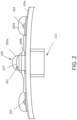
- FIG. 2 illustrates a cross-section of a compact vision camera and illuminator assembly in accordance with an exemplary aspect of the disclosure. Specific wiring and electrical contacts are omitted in order to reduce complexity.
- a compact camera and illuminator assembly may include a single common mounting structure 211. In some embodiments, the compact vision camera and illuminator assembly may be integrated by way of a bracket.
- the mounting structure 211 or bracket preferably is of a material having some flexibility, in order to avoid breakage or cracking during installation.
- a single outer lens 205 is used for both the vision camera 201 and IR illuminators with IR LEDs 203.
- the vision camera 201 includes a camera lens 207.
- the single outer lens 205 may incorporate cover bezel portions 209a, 209b for securing the outer lens 205 and sealing the camera with the mounting structure 211.
- the IR illuminators may each include an array of two or more IR LEDs.
- the mounting structure 211 or bracket may position the IR illuminators at an angle directed away from the focus axis of the vision camera 201.
- the single outer lens includes a neutral portion 205a that covers the vision camera 201 and a transparent black portion 205b that covers the IR LEDs 203 of the illuminators.
- the transparent black portion passes IR radiation and provides other optical properties such as diffraction that increases or decreases the field of view of the IR radiation.
- the neutral portion 205a that covers the vision camera 201 may not provide optical properties, but primarily will provide protection for the camera lens. It is preferred that the neutral portion 205a be of a material that allows the image to be un-obstructively viewed by the vision camera.
- Both the neutral portion and the transparent black portion may be made of polycarbonate (PC) or polymethyl methacrylate (PMMA). PC may be used to protect against environmental conditions.
- the single outer lens may be made of a glass laminant.
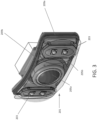
- FIG. 3 illustrates a perspective view of a compact camera and illuminator structure having an outer lens.
- the compact vision camera and IR illuminator assembly includes a single outer lens 205a, 205b for both the camera 201 and IR illuminators.
- the compact vision camera and IR illuminators may be mounted on a mounting structure 211.
- the single outer lens 205a, 205b may include a bezel for securing the outer lens 205a, 205b and camera lens 207.
- the bezel may include a portion 209a that provides a liquid seal for the single outer lens 205a, 205b and a portion 209b that provides an internal seal for the camera 201.
- the bezel portions 209a, 209b may be made of a plastic material that has low enough stiffness to conform to the mating surfaces and sufficient creep resistance to maintain tight seals.
- An example material is nylon, silicone plastic, and other rubbery materials.
- the IR illuminators include an IR LED.
- the IR illuminators may each include an array of two or more IR LEDs.
- FIG. 3 illustrates a pair of IR LEDs on opposite sides of the camera 201, other arrangements are possible.
- the IR illuminator may be arranged on a ring that encircles the camera.
- the ring arrangement may have IR LED's spaced equidistant around the camera.
- the ring arrangement may be a balanced arrangement where an equal number of IR LEDs are arranged on one side of the camera as a semicircular and the same on the other side of the camera.
- FIG. 4 illustrates a perspective view of a compact camera and IR illuminator structure with two-shot molded outer lens.
- a multi-shot mold may be used.
- multi-shot molding techniques available, such as over-molds, core-back, and multi-station molds.
- the mold type generally depends on part geometry, volume, quality, and molder capacity/capability.
- Two-shot molding may be performed using two independent injection units that inject two resin materials into a single, multi-chambered mold.
- the outer lens is molded as a transparent black cover 205b bonded to a neutral cover 205a for the camera lens.
- the transparent black cover 205b is an elliptical shape having an oval peripheral, and an inner surface that is of a different shape than the external surface such that the thickness of the elliptical cover lens varies. The variation in thickness of the cover lens provides IR light distribution that is wider than the distribution pattern of the IR LED.
- the neutral cover lens 205a for the camera lens may have a circular peripheral and dome shape.
- the material of the transparent black cover 205b and neutral cover 205a may be the same, except that black pigments may be added to the transparent black cover 205b. In some embodiments, the material of the transparent black cover 205b and neutral cover 205a may be different, but compatible resins.
- the compact camera and IR illuminator structure may include a three-shot molded outer lens.
- a third molded section may be included as a shielded region having light absorption properties.
- the single outer lens having a third molded section may be produced using a three (3)-shot molding process. Three-shot molding may be performed using three independent injection units that inject three resin materials into a single, multi-chambered mold.
- the shielded region may be sections of the single cover lens that are between the camera lens portion 205a and each of the transparent black regions 205b.
- the shielded region may be of a material that absorbs light and does not provide other optical properties such as light diffraction.
- the shielded region may function to prevent visible light from entering into the IR LEDs or indirectly entering the camera lens.
- the shielded region may be of a material that prevents transmission of both IR radiation and visible light to prevent IR light from entering the camera lens.
- the cover lens portion 205a may include optical properties that supplement the properties of the camera lens 207.
- the cover lens 205a may filter light so that only light within a specific wavelength range is allowed to enter into the camera sensor.
- the camera may be made to only capture images based on IR radiation in order to alleviate affects that may occur due to variations in lighting conditions due to sunlight as well as artificial light.
- the cover lens 205a may skew the image so that the image that enters the camera sensor is less curved that an image that is obtained by a wide-angle lens.
- the cover lens 205a may improve the camera view, such as by reducing glare from exceptionally bright conditions, and repelling water.
- FIG. 5 illustrates a perspective view of a mount for an outer lens of the compact camera and illuminator structure.
- the outer lens may be attached to the camera and illuminator structure by an adhesive.
- an adhesive may not be reliable, as it may degrade over time. Also, some gaps in the adhesive may result. In each case, leakage may occur that allows moisture to enter the space under the outer lens.
- an attachment mechanism may be used to secure the single outer lens 205 to the mount structure on which the camera and IR illuminator are mounted.
- the single outer lens 205 may be attached by a flexible snap latch 501 that tightly fits over a protrusion 503 on the mount structure.
- two flexible snap latches 501 may be provided on opposite sides of the single cover lens 205. In some embodiments, more than two flexible snap latches 501 may be provided on opposing sides of the single cover lens. For example, a pair of flexible snap latches 501 may be provided on two opposing sides of the single cover lens 205, and another pair of flexible snap latches 501 may be provided on the other set of opposing sides.
- the snap latch 501 may be an integral part of the cover lens that is formed during double-shot molding.
- the snap latch may be a separate component that is secured over a protrusion extending from the cover lens.
- the separate snap latch may be made of metal or plastic, or even include an elastic material.
- the protrusion may be in the form of a hook to prevent the snap latch from coming loose and slipping off of the protrusion.
Landscapes
- Engineering & Computer Science (AREA)
- Multimedia (AREA)
- Signal Processing (AREA)
- Physics & Mathematics (AREA)
- General Physics & Mathematics (AREA)
- Optics & Photonics (AREA)
- Mechanical Engineering (AREA)
- Studio Devices (AREA)
Description
- The present disclosure relates generally to a cover lens for a vehicle camera and illuminators, and in particular, two-shot or three-shot lens for a camera and adjacent illuminators.
- Camera systems play an important role in autonomous vehicles and in various driver assist applications to aid vehicle drivers. Among various sensors used in autonomous vehicles, cameras are the main sensor technology that can capture color and contrast information at a level of detail that enables object classification. Vision cameras enable driver assist system applications such as adaptive cruise control, automatic emergency braking, forward collision warning, automatic high beam control, traffic sign recognition, lane keep systems, parking assist, cross-traffic alert, and rear-view mirror. Vision cameras may also be included inside the vehicle cabin for such features as gaze tracking, presence detection and gesture recognition. Although cameras may be mounted on a vehicle roof, they are increasingly being arranged at other sections of a vehicle such as along the side or even front of a vehicle. Vision cameras arranged in low areas of a vehicle including the side or front sections are especially susceptible to weather conditions and variations in lighting. It is known from
EP 3407591 to use a camera assembly comprising an image sensor, infrared illuminators, a single-piece cover element positioned in front of the image sensor and the infrared illuminators. The cover element includes a first portion corresponding to the image sensor and a second portion corresponding to the infrared illuminators. It is known fromUS 2016 /0119527 to use a vision system of a vehicle that comprises a camera and an illumination source with a wavelength of between about 820 nm and about 880 nm that is activated during nighttime lighting conditions and the camera captures images of the area illuminated by the illumination source. It is known fromJP 2005 041240 - For purposes of general illustration, a typical sensor arrangement for an autonomous vehicle is shown in
FIG. 1 . The arrangement ofFIG. 1 may include several vision cameras, such as forward stereo cameras, surround cameras, rear and side cameras.Vision cameras - A compact digital vehicle camera and IR illuminator apparatus according to the invention is defined in claim 1. Preferred embodiments of the invention are set-out in the dependent claims.
- A more complete appreciation of the invention and many of the attendant advantages thereof will be readily obtained as the same becomes better understood by reference to the following detailed description when considered in connection with the accompanying drawings, wherein:
-
FIG. 1 illustrates a typical sensor arrangement for an autonomous vehicle; -
FIG. 2 illustrates a cross-section of a compact camera and illuminator structure in accordance with an exemplary aspect of the disclosure; -
FIG. 3 illustrates a perspective view of a compact camera and illuminator structure having an outer lens; -
FIG. 4 illustrates a perspective view of a compact camera and illuminator structure with two-shot molded outer lens; and -
FIG. 5 illustrates a perspective view of a mount for an outer lens of the compact camera and illuminator structure. - As used herein any reference to "one embodiment" or "some embodiments" or "an embodiment" means that a particular element, feature, structure, or characteristic described in connection with the embodiment is included in at least one embodiment. The appearances of the phrase "in one embodiment" in various places in the specification are not necessarily all referring to the same embodiment. Conditional language used herein, such as, among others, "can," "could," "might," "may," "e.g.," and the like, unless specifically stated otherwise, or otherwise understood within the context as used, is generally intended to convey that certain embodiments include, while other embodiments do not include, certain features, elements and/or steps. In addition, the articles "a" and "an" as used in this application and the appended claims are to be construed to mean "one or more" or "at least one" unless specified otherwise.
- Furthermore, the terms "approximately," "proximate," "minor," and similar terms generally refer to ranges that include the identified value within a margin of 20%, 10% or preferably 5% in certain embodiments, and any values therebetween.
- Referring now to the drawings, wherein like reference numerals designate identical or corresponding parts throughout the several views.
- In order to obtain video information for detecting objects in the field of view of the vision camera for a vehicle, the vision camera needs to capture video information under all types of lighting conditions. Vision cameras are able to operate at normal lighting conditions where there is sufficient daylight. However, vehicles must also operate in conditions where lighting is low, due to shading, and of course during early morning or early evening hours. Vehicles must operate during nighttime. During nighttime hours, lighting may be provided by street lights or other sources including the vehicle's own headlights and backup lights, but those sources may not sufficiently provide lighting for specific objects that the camera may be focused on. There is a need to provide light that covers the field of view of the vision camera under all lighting conditions, especially during conditions of low light and darkness. Although conditions of low light and darkness relate to conditions where visible light is low to non-existent, other wavelengths of electromagnetic radiation may be used. Lighting conditions may be enhanced using a source of visible light, such as a camera flash or other camera lighting source. However, camera flash or other camera lighting needs to be bright and is not practical for use on vehicles, as vehicles generally have specific lighting constraints, for purposes of safety and other reasons. Also vehicles are generally equipped with headlights, high beam lights, fog lights, and backup lights, which may obscure a camera light. In terms of safety, camera flash and camera lighting will blind pedestrians and other drivers.
- One approach to providing lighting for low light and dark conditions has been to use infrared radiation. Infrared radiation generally is a range of the electromagnetic spectrum that is not visible to humans but is in a range than can be captured by cameras. Infrared radiation used as a source of camera lighting includes wavelengths that are near the visible range, referred to as near-infrared. Near-infrared is defined as electromagnetic radiation over the range of 0.75 to 1.4 micro meters.
- Infrared radiation, similar to visible light, may be reflected off of objects, even including some black objects. Vision cameras may be provided with infrared radiation in order to enhance image capture during low light and nighttime conditions. Subsequently, infrared radiation may be used to augment the available ambient light.
- There are various devices that may be used as a source for infrared radiation. Light emitting diodes (LEDs) are increasingly being used to transmit infrared radiation as they are energy efficient and can be implemented in a small space. When infrared (IR) LEDs are used for transmitting infrared (IR) radiation, they are typically enclosed by a cover that protects the LED from the environment and from being damaged. The IR LED, cover and associated mounting structure are referred to herein as an IR illuminator. The cover for the IR LED may be made IR Black using black pigments that have low infrared reflectivity. The dark lens allows IR radiation to pass, and is commonly referred to as transparent black. The transparent black cover prevents transmission of visible light.
- In order to provide unobstructed radiation toward an object, a cover for an IR illuminator may be provided without a secondary optic, such as a neutral cover. In this disclosure, a neutral cover is a cover that allows visible light and infrared radiation to pass without applying optics. The cover for an IR illuminator may be clear, or may include black pigments to make a transparent black lens.
- Vehicle mounted vision cameras and IR illuminators are preferably provided as an assembly, or at least the IR illuminators associated with a vision camera are positioned in close proximity to the camera in order to provide IR radiation that is within the field of view of the camera. Vehicle mounted vision cameras are becoming smaller in size, but are generally incorporated with a wide-angle lens and are limited by focal length.
- Locating a camera in a low section of a vehicle, such as near the ground or near a vehicle's wheel well, can expose a camera to debris or objects that can potentially damage the camera lens or even the camera circuit itself. An IR illuminator for providing infrared light for a camera is provided with an outer cover lens mounted over the LED light source for protection as well as to filter out visible light. Some embodiments may be a compact camera assembly that has IR illuminators attached adjacent to opposing sides of a vision camera. In one embodiment, a compact vision camera and IR illuminator assembly may have a width that is 25 mm or smaller. Adding a cover over the camera in such a compact assembly has been found to be difficult. The inventors have determined that in order to accommodate a cover for the camera, in a compact assembly that includes IR illuminators, the cover for the camera may be integrated with the cover lens of the IR illuminators as a single outer cover. However, a cover for the vision camera may have different optical properties than the cover lens for the IR illuminators.
-
FIG. 2 illustrates a cross-section of a compact vision camera and illuminator assembly in accordance with an exemplary aspect of the disclosure. Specific wiring and electrical contacts are omitted in order to reduce complexity. A compact camera and illuminator assembly may include a singlecommon mounting structure 211. In some embodiments, the compact vision camera and illuminator assembly may be integrated by way of a bracket. The mountingstructure 211 or bracket preferably is of a material having some flexibility, in order to avoid breakage or cracking during installation. A singleouter lens 205 is used for both thevision camera 201 and IR illuminators withIR LEDs 203. Thevision camera 201 includes acamera lens 207. In some embodiments, the singleouter lens 205 may incorporatecover bezel portions outer lens 205 and sealing the camera with the mountingstructure 211. In some embodiments, the IR illuminators may each include an array of two or more IR LEDs. - In some embodiments, the mounting
structure 211 or bracket may position the IR illuminators at an angle directed away from the focus axis of thevision camera 201. The single outer lens includes aneutral portion 205a that covers thevision camera 201 and a transparentblack portion 205b that covers theIR LEDs 203 of the illuminators. The transparent black portion passes IR radiation and provides other optical properties such as diffraction that increases or decreases the field of view of the IR radiation. Theneutral portion 205a that covers thevision camera 201 may not provide optical properties, but primarily will provide protection for the camera lens. It is preferred that theneutral portion 205a be of a material that allows the image to be un-obstructively viewed by the vision camera. Both the neutral portion and the transparent black portion may be made of polycarbonate (PC) or polymethyl methacrylate (PMMA). PC may be used to protect against environmental conditions. In some embodiments, the single outer lens may be made of a glass laminant. -
FIG. 3 illustrates a perspective view of a compact camera and illuminator structure having an outer lens. The compact vision camera and IR illuminator assembly includes a singleouter lens camera 201 and IR illuminators. The compact vision camera and IR illuminators may be mounted on a mountingstructure 211. The singleouter lens outer lens camera lens 207. The bezel may include aportion 209a that provides a liquid seal for the singleouter lens portion 209b that provides an internal seal for thecamera 201. Thebezel portions - The IR illuminators include an IR LED. In some embodiments, the IR illuminators may each include an array of two or more IR LEDs. Further, although
FIG. 3 illustrates a pair of IR LEDs on opposite sides of thecamera 201, other arrangements are possible. For example, the IR illuminator may be arranged on a ring that encircles the camera. The ring arrangement may have IR LED's spaced equidistant around the camera. Alternatively, the ring arrangement may be a balanced arrangement where an equal number of IR LEDs are arranged on one side of the camera as a semicircular and the same on the other side of the camera. -
FIG. 4 illustrates a perspective view of a compact camera and IR illuminator structure with two-shot molded outer lens. For Two Shot Molding, a multi-shot mold may be used. There are several types of multi-shot molding techniques available, such as over-molds, core-back, and multi-station molds. The mold type generally depends on part geometry, volume, quality, and molder capacity/capability. Two-shot molding may be performed using two independent injection units that inject two resin materials into a single, multi-chambered mold. - The outer lens is molded as a transparent
black cover 205b bonded to aneutral cover 205a for the camera lens. The transparentblack cover 205b is an elliptical shape having an oval peripheral, and an inner surface that is of a different shape than the external surface such that the thickness of the elliptical cover lens varies. The variation in thickness of the cover lens provides IR light distribution that is wider than the distribution pattern of the IR LED. Theneutral cover lens 205a for the camera lens may have a circular peripheral and dome shape. The material of the transparentblack cover 205b andneutral cover 205a may be the same, except that black pigments may be added to the transparentblack cover 205b. In some embodiments, the material of the transparentblack cover 205b andneutral cover 205a may be different, but compatible resins. - In some embodiments, the compact camera and IR illuminator structure may include a three-shot molded outer lens. In addition to one region for the
neutral cover lens 205a and anotherregion 205b for the transparent black cover, a third molded section may be included as a shielded region having light absorption properties. The single outer lens having a third molded section may be produced using a three (3)-shot molding process. Three-shot molding may be performed using three independent injection units that inject three resin materials into a single, multi-chambered mold. The shielded region may be sections of the single cover lens that are between thecamera lens portion 205a and each of the transparentblack regions 205b. The shielded region may be of a material that absorbs light and does not provide other optical properties such as light diffraction. The shielded region may function to prevent visible light from entering into the IR LEDs or indirectly entering the camera lens. In some embodiments, the shielded region may be of a material that prevents transmission of both IR radiation and visible light to prevent IR light from entering the camera lens. - In some embodiments, the
cover lens portion 205a may include optical properties that supplement the properties of thecamera lens 207. Thecover lens 205a may filter light so that only light within a specific wavelength range is allowed to enter into the camera sensor. For example, the camera may be made to only capture images based on IR radiation in order to alleviate affects that may occur due to variations in lighting conditions due to sunlight as well as artificial light. Thecover lens 205a may skew the image so that the image that enters the camera sensor is less curved that an image that is obtained by a wide-angle lens. Thecover lens 205a may improve the camera view, such as by reducing glare from exceptionally bright conditions, and repelling water. -
FIG. 5 illustrates a perspective view of a mount for an outer lens of the compact camera and illuminator structure. The outer lens may be attached to the camera and illuminator structure by an adhesive. However, an adhesive may not be reliable, as it may degrade over time. Also, some gaps in the adhesive may result. In each case, leakage may occur that allows moisture to enter the space under the outer lens. In some embodiments, an attachment mechanism may be used to secure the singleouter lens 205 to the mount structure on which the camera and IR illuminator are mounted. In one embodiment, as shown inFIG. 5 , the singleouter lens 205 may be attached by aflexible snap latch 501 that tightly fits over aprotrusion 503 on the mount structure. In the embodiment, two flexible snap latches 501 may be provided on opposite sides of thesingle cover lens 205. In some embodiments, more than two flexible snap latches 501 may be provided on opposing sides of the single cover lens. For example, a pair of flexible snap latches 501 may be provided on two opposing sides of thesingle cover lens 205, and another pair of flexible snap latches 501 may be provided on the other set of opposing sides. - The
snap latch 501 may be an integral part of the cover lens that is formed during double-shot molding. Alternatively, the snap latch may be a separate component that is secured over a protrusion extending from the cover lens. In the latter case, the separate snap latch may be made of metal or plastic, or even include an elastic material. The protrusion may be in the form of a hook to prevent the snap latch from coming loose and slipping off of the protrusion. - Numerous modifications and variations of the present invention are possible in light of the above teachings. It is therefore to be understood that within the scope of the appended claims, the invention may be practiced otherwise than as specifically described herein.
Claims (17)
- A compact digital vehicle camera (201) and infrared (IR) illuminator (203) apparatus, comprising:a plurality of IR illuminators (203) arranged adjacent to the digitalcamera (201), the digital camera (201) having a camera lens (207),each IR illuminator (203) including at least one IR light emitting diode (LED); anda single cover lens (205) positioned to cover the IR LEDs and the camera lens (207), wherein a region of the single cover lens (205) that covers the IR LEDs comprises a transparent black cover (205b) and blocks visible light and a region of the single cover lens (205) that covers the camera lens (207) comprises a neutral cover (205a) and is a neutral lens that transmits visible light;characterized in that the single cover lens (205) is molded as the transparentblack cover (205b) bonded to the neutral cover (205a) for the camera lens (207) and in that the transparent black cover (205b) has an elliptical shape having an oval peripheral and an inner surface that is of a different shape than the external surfacesuch that the thickness of the elliptical cover lens varies such that the variation in thickness of the cover lens provides IR light distribution that is wider than the distribution pattern of the IR LEDs.
- The compact digital vehicle camera (201) and IR illuminator (203) apparatus of claim 1, wherein the single cover lens (205) is a two-shot molded lens.
- The compact digital vehicle camera (201) and IR illuminator (203) apparatus of claim 2, wherein the material of the region of the single cover lens (205) that covers the IR LEDs and the material of the region of the single cover lens (205) that covers the camera lens (207) are the same.
- The compact digital vehicle camera (201) and IR illuminator (203) apparatus of claim 2, wherein the region of the single cover lens (205) that covers the IR LEDs and the region of the single cover lens (205) that covers the camera lens (207) are of different materials.
- The compact digital vehicle camera (201) and IR illuminator (203) apparatus of claim 4, wherein the material of the region of the single cover lens (205) that covers the IR LEDs and the material of the region of the single cover lens (205) that covers the camera lens (207) are compatible resins.
- The compact digital vehicle camera (201) and IR illuminator (203) apparatus of claim 1, wherein the single cover lens (205) is a three-shot molded lens.
- The compact digital vehicle camera (201) and IR illuminator (203) apparatus of claim 6, wherein the three-shot molded lens includes a light shielding region that is between the region that covers the IR LEDs and the region that covers the camera lens (207), wherein the shielding region has light absorption properties.
- The compact digital vehicle camera (201) and IR illuminator (203) apparatus of claim 7, wherein the shielding region prevents transmission of both IR radiation and visible light.
- The compact digital vehicle camera (201) and IR illuminator (203) apparatus of claim 1, wherein the region of the single cover lens (205) that covers the camera lens (207) filters radiation in predetermined wavelengths.
- The compact digital vehicle camera (201) and IR illuminator (203) apparatus of claim 1, wherein the single cover lens (205) includes a bezel for securing the camera lens (207).
- The compact digital vehicle camera (201) and IR illuminator (203) apparatus of claim 1, wherein the single cover lens (205) includes a bezel having a portion (209a) that provides a liquid seal for the single cover lens (205) and a portion (209b) that provides an internal seal for the camera (201).
- The compact digital vehicle camera (201) and IR illuminator (203) apparatus of claim 1, wherein the digital camera (201) has an optic axis in a direction of focus,
wherein a center axis of IR illuminator (203) is tilted by an angle greater than or equal to five degrees. - The compact digital vehicle camera (201) and IR illuminator (203) apparatus of claim 1, wherein the top surface of the region of the single cover lens (205) that covers the IR LEDs is positioned below the field of view of the camera (201).
- The compact digital vehicle camera (201) and IR illuminator (203) apparatus of claim 12, wherein the field of view of the emission pattern of IR radiation is substantially plus or minus 80 degrees or greater from the optic axis.
- The compact digital vehicle camera (201) and IR illuminator (203) apparatus of claim 1, further including a mounting structure (211),wherein a pair of mounting substrates are arranged adjacent to the digital camera (201) and the IR LEDs is mounted to each of the mounting substrates,wherein each of the pair of mounting substrates and IR LED mounted thereon are identical.
- The compact digital vehicle camera (201) and IR illuminator (203) apparatus of claim 1, further including a single mounting structure (211) that supports the plurality of IR illuminators (203) and camera (201).
- The compact digital vehicle camera (201) and IR illuminator (203) apparatus of claim 16, wherein the single cover lens (205) is attached to the mounting structure (211) by a snap latch (501), one end of which is an integral part of the single cover lens (205).
Applications Claiming Priority (2)
| Application Number | Priority Date | Filing Date | Title |
|---|---|---|---|
| US16/217,145 US10674052B1 (en) | 2018-12-12 | 2018-12-12 | Common cover lens for camera and illuminators |
| PCT/US2019/065998 WO2020123819A1 (en) | 2018-12-12 | 2019-12-12 | Common cover lens for camera and illuminators |
Publications (2)
| Publication Number | Publication Date |
|---|---|
| EP3895413A1 EP3895413A1 (en) | 2021-10-20 |
| EP3895413B1 true EP3895413B1 (en) | 2025-04-23 |
Family
ID=69160366
Family Applications (1)
| Application Number | Title | Priority Date | Filing Date |
|---|---|---|---|
| EP19836346.7A Active EP3895413B1 (en) | 2018-12-12 | 2019-12-12 | Common cover lens for camera and illuminators |
Country Status (4)
| Country | Link |
|---|---|
| US (1) | US10674052B1 (en) |
| EP (1) | EP3895413B1 (en) |
| CN (1) | CN113170034A (en) |
| WO (1) | WO2020123819A1 (en) |
Families Citing this family (24)
| Publication number | Priority date | Publication date | Assignee | Title |
|---|---|---|---|---|
| CN111448758B (en) * | 2017-12-06 | 2023-09-08 | 株式会社村田制作所 | Multiplexer, high-frequency front-end circuit and communication device |
| WO2020157726A1 (en) * | 2019-02-01 | 2020-08-06 | Gentex Corporation | Active infrared illumination for enhancing rear vision from a vehicle |
| US11153950B2 (en) | 2019-02-14 | 2021-10-19 | Orlaco Products B.V. | Replacement mirror system with IR LED overheating management |
| USD915913S1 (en) | 2019-05-01 | 2021-04-13 | Waymo Llc | Roof pod housing |
| USD950404S1 (en) | 2019-05-01 | 2022-05-03 | Waymo Llc | Roof pod housing |
| USD957968S1 (en) | 2019-02-20 | 2022-07-19 | Waymo Llc | Sensor housing |
| USD902756S1 (en) | 2019-02-20 | 2020-11-24 | Waymo Llc | Sensor assembly |
| USD964908S1 (en) | 2019-04-25 | 2022-09-27 | Waymo Llc | Perimeter sensor housing |
| USD954571S1 (en) | 2019-04-25 | 2022-06-14 | Waymo Llc | Front sensor housing |
| USD964249S1 (en) | 2019-04-25 | 2022-09-20 | Waymo Llc | Perimeter sensor housing |
| USD964909S1 (en) | 2019-04-25 | 2022-09-27 | Waymo Llc | Perimeter sensor housing |
| USD956585S1 (en) | 2019-04-25 | 2022-07-05 | Waymo Llc | Rear sensor housing |
| USD927998S1 (en) | 2019-04-25 | 2021-08-17 | Waymo Llc | Front sensor housing |
| USD928639S1 (en) | 2019-04-25 | 2021-08-24 | Waymo Llc | Rear sensor housing |
| USD965498S1 (en) | 2019-04-25 | 2022-10-04 | Waymo Llc | Perimeter sensor housing |
| CN112925351B (en) * | 2019-12-06 | 2022-08-02 | 杭州萤石软件有限公司 | Method and device for controlling light source of vision machine |
| KR20210080032A (en) * | 2019-12-20 | 2021-06-30 | 주식회사 만도 | Driver assistance apparatus and method of thereof |
| US11557127B2 (en) | 2019-12-30 | 2023-01-17 | Waymo Llc | Close-in sensing camera system |
| US11493922B1 (en) | 2019-12-30 | 2022-11-08 | Waymo Llc | Perimeter sensor housings |
| US11262562B2 (en) * | 2020-03-18 | 2022-03-01 | Waymo Llc | Infrared camera module cover |
| DE102021102309B3 (en) | 2021-02-02 | 2022-02-17 | Ford Global Technologies Llc | Monitoring unit for a vehicle interior |
| FR3127037B1 (en) * | 2021-09-14 | 2023-08-25 | Valeo Vision | Optical module comprising a camera and an optical deflection element |
| DE102022100331B4 (en) * | 2022-01-10 | 2025-12-31 | Bayerische Motoren Werke Aktiengesellschaft | Means of transport and arrangement for taking an infrared image |
| EP4456525A1 (en) * | 2023-04-27 | 2024-10-30 | Valeo Comfort and Driving Assistance | Image capture device |
Family Cites Families (15)
| Publication number | Priority date | Publication date | Assignee | Title |
|---|---|---|---|---|
| US5001558A (en) | 1985-06-11 | 1991-03-19 | General Motors Corporation | Night vision system with color video camera |
| JP3810976B2 (en) | 2000-02-15 | 2006-08-16 | 株式会社小糸製作所 | Infrared irradiation lamp for automobiles |
| AU2003290791A1 (en) * | 2002-11-14 | 2004-06-15 | Donnelly Corporation | Imaging system for vehicle |
| JP4285092B2 (en) | 2003-05-23 | 2009-06-24 | 市光工業株式会社 | Outer mirror with camera unit |
| US7217020B2 (en) | 2004-11-24 | 2007-05-15 | General Motors Corporation | Headlamp assembly with integrated infrared illuminator |
| US7372055B2 (en) | 2005-06-30 | 2008-05-13 | Delphi Technologies, Inc. | Night vision infrared illuminator |
| JP2011109634A (en) * | 2009-06-17 | 2011-06-02 | Rohm Co Ltd | Vehicle-mounted camera |
| US9645008B2 (en) * | 2014-08-25 | 2017-05-09 | Apple Inc. | Light sensor windows for electronic devices |
| US20160119527A1 (en) | 2014-10-22 | 2016-04-28 | Magna Electronics Inc. | Vehicle vision system camera with dual filter |
| US10132971B2 (en) | 2016-03-04 | 2018-11-20 | Magna Electronics Inc. | Vehicle camera with multiple spectral filters |
| TWI598614B (en) * | 2016-12-14 | 2017-09-11 | 大立光電股份有限公司 | Optical lens assembly with dual molded lens element and electronic device including same assembly |
| US10708472B2 (en) * | 2017-01-04 | 2020-07-07 | Google Llc | Doorbell camera |
| US10819921B2 (en) | 2017-05-25 | 2020-10-27 | Google Llc | Camera assembly having a single-piece cover element |
| US20190068857A1 (en) * | 2017-08-29 | 2019-02-28 | Qualcomm Incorporated | Extended field-of-view illumination system |
| CN108081538A (en) * | 2018-02-09 | 2018-05-29 | 天津德迈特汽车零部件有限公司 | Lens of car light and penetrate horizontal turntable injection machine for producing the three of lens of car light |
-
2018
- 2018-12-12 US US16/217,145 patent/US10674052B1/en active Active
-
2019
- 2019-12-12 CN CN201980082134.3A patent/CN113170034A/en active Pending
- 2019-12-12 WO PCT/US2019/065998 patent/WO2020123819A1/en not_active Ceased
- 2019-12-12 EP EP19836346.7A patent/EP3895413B1/en active Active
Also Published As
| Publication number | Publication date |
|---|---|
| US10674052B1 (en) | 2020-06-02 |
| EP3895413A1 (en) | 2021-10-20 |
| US20200195816A1 (en) | 2020-06-18 |
| CN113170034A (en) | 2021-07-23 |
| WO2020123819A1 (en) | 2020-06-18 |
Similar Documents
| Publication | Publication Date | Title |
|---|---|---|
| EP3895413B1 (en) | Common cover lens for camera and illuminators | |
| JP7740450B2 (en) | Camera module | |
| US11601578B2 (en) | IR illuminator to avoid camera field-of-view | |
| US11378248B2 (en) | IR illuminator with secondary function | |
| US6757109B2 (en) | Plastic lens system for vehicle imaging system | |
| US20150277000A1 (en) | Domed surveillance camera including means for blocking scattered reflection and stray light | |
| CN111108409A (en) | Vehicle exterior panel with sensor | |
| CN108204568B (en) | Vehicle lamp | |
| KR20140041617A (en) | Camera system for a vehicle | |
| CN112911096A (en) | Image shooting device, light supplementing module and equipment | |
| EP3700778B1 (en) | Headlamp assembly with autodimming functionality | |
| US20180128943A1 (en) | Imaging device provided with lens having moth-eye structure | |
| CN105452954B (en) | imaging device | |
| KR20140048530A (en) | Image recognition apparatus having the blind | |
| US12181114B2 (en) | IR illuminator with asymetric radiation pattern | |
| KR20180032958A (en) | Apparatus for watching vehicle with heating wire | |
| US11843845B2 (en) | Protective lens cover for a camera | |
| KR102840717B1 (en) | Camera Device for Monitoring Driver | |
| US11838609B2 (en) | Image pickup apparatus | |
| EP4190637A1 (en) | Vehicle tracking for a camera wing system | |
| JP2004343379A (en) | Imaging device, method of manufacturing imaging device, and peripheral imaging device for vehicle |
Legal Events
| Date | Code | Title | Description |
|---|---|---|---|
| STAA | Information on the status of an ep patent application or granted ep patent |
Free format text: STATUS: UNKNOWN |
|
| STAA | Information on the status of an ep patent application or granted ep patent |
Free format text: STATUS: THE INTERNATIONAL PUBLICATION HAS BEEN MADE |
|
| PUAI | Public reference made under article 153(3) epc to a published international application that has entered the european phase |
Free format text: ORIGINAL CODE: 0009012 |
|
| STAA | Information on the status of an ep patent application or granted ep patent |
Free format text: STATUS: REQUEST FOR EXAMINATION WAS MADE |
|
| 17P | Request for examination filed |
Effective date: 20210712 |
|
| AK | Designated contracting states |
Kind code of ref document: A1 Designated state(s): AL AT BE BG CH CY CZ DE DK EE ES FI FR GB GR HR HU IE IS IT LI LT LU LV MC MK MT NL NO PL PT RO RS SE SI SK SM TR |
|
| DAV | Request for validation of the european patent (deleted) | ||
| DAX | Request for extension of the european patent (deleted) | ||
| P01 | Opt-out of the competence of the unified patent court (upc) registered |
Effective date: 20230528 |
|
| STAA | Information on the status of an ep patent application or granted ep patent |
Free format text: STATUS: EXAMINATION IS IN PROGRESS |
|
| 17Q | First examination report despatched |
Effective date: 20230802 |
|
| REG | Reference to a national code |
Ref legal event code: R079 Ipc: H04N0023550000 Ref country code: DE Ref legal event code: R079 Ref document number: 602019069094 Country of ref document: DE Free format text: PREVIOUS MAIN CLASS: H04N0005225000 Ipc: H04N0023550000 |
|
| GRAP | Despatch of communication of intention to grant a patent |
Free format text: ORIGINAL CODE: EPIDOSNIGR1 |
|
| STAA | Information on the status of an ep patent application or granted ep patent |
Free format text: STATUS: GRANT OF PATENT IS INTENDED |
|
| RIC1 | Information provided on ipc code assigned before grant |
Ipc: H04N 23/56 20230101ALI20241120BHEP Ipc: H04N 23/55 20230101AFI20241120BHEP |
|
| INTG | Intention to grant announced |
Effective date: 20241202 |
|
| GRAS | Grant fee paid |
Free format text: ORIGINAL CODE: EPIDOSNIGR3 |
|
| GRAA | (expected) grant |
Free format text: ORIGINAL CODE: 0009210 |
|
| STAA | Information on the status of an ep patent application or granted ep patent |
Free format text: STATUS: THE PATENT HAS BEEN GRANTED |
|
| AK | Designated contracting states |
Kind code of ref document: B1 Designated state(s): AL AT BE BG CH CY CZ DE DK EE ES FI FR GB GR HR HU IE IS IT LI LT LU LV MC MK MT NL NO PL PT RO RS SE SI SK SM TR |
|
| REG | Reference to a national code |
Ref country code: GB Ref legal event code: FG4D |
|
| REG | Reference to a national code |
Ref country code: CH Ref legal event code: EP |
|
| REG | Reference to a national code |
Ref country code: DE Ref legal event code: R096 Ref document number: 602019069094 Country of ref document: DE |
|
| REG | Reference to a national code |
Ref country code: IE Ref legal event code: FG4D |
|
| REG | Reference to a national code |
Ref country code: NL Ref legal event code: MP Effective date: 20250423 |
|
| PG25 | Lapsed in a contracting state [announced via postgrant information from national office to epo] |
Ref country code: NL Free format text: LAPSE BECAUSE OF FAILURE TO SUBMIT A TRANSLATION OF THE DESCRIPTION OR TO PAY THE FEE WITHIN THE PRESCRIBED TIME-LIMIT Effective date: 20250423 |
|
| REG | Reference to a national code |
Ref country code: AT Ref legal event code: MK05 Ref document number: 1788974 Country of ref document: AT Kind code of ref document: T Effective date: 20250423 |
|
| PG25 | Lapsed in a contracting state [announced via postgrant information from national office to epo] |
Ref country code: ES Free format text: LAPSE BECAUSE OF FAILURE TO SUBMIT A TRANSLATION OF THE DESCRIPTION OR TO PAY THE FEE WITHIN THE PRESCRIBED TIME-LIMIT Effective date: 20250423 Ref country code: PT Free format text: LAPSE BECAUSE OF FAILURE TO SUBMIT A TRANSLATION OF THE DESCRIPTION OR TO PAY THE FEE WITHIN THE PRESCRIBED TIME-LIMIT Effective date: 20250825 Ref country code: FI Free format text: LAPSE BECAUSE OF FAILURE TO SUBMIT A TRANSLATION OF THE DESCRIPTION OR TO PAY THE FEE WITHIN THE PRESCRIBED TIME-LIMIT Effective date: 20250423 |
|
| REG | Reference to a national code |
Ref country code: LT Ref legal event code: MG9D |
|
| PG25 | Lapsed in a contracting state [announced via postgrant information from national office to epo] |
Ref country code: NO Free format text: LAPSE BECAUSE OF FAILURE TO SUBMIT A TRANSLATION OF THE DESCRIPTION OR TO PAY THE FEE WITHIN THE PRESCRIBED TIME-LIMIT Effective date: 20250723 Ref country code: GR Free format text: LAPSE BECAUSE OF FAILURE TO SUBMIT A TRANSLATION OF THE DESCRIPTION OR TO PAY THE FEE WITHIN THE PRESCRIBED TIME-LIMIT Effective date: 20250724 |
|
| PG25 | Lapsed in a contracting state [announced via postgrant information from national office to epo] |
Ref country code: PL Free format text: LAPSE BECAUSE OF FAILURE TO SUBMIT A TRANSLATION OF THE DESCRIPTION OR TO PAY THE FEE WITHIN THE PRESCRIBED TIME-LIMIT Effective date: 20250423 |
|
| PG25 | Lapsed in a contracting state [announced via postgrant information from national office to epo] |
Ref country code: BG Free format text: LAPSE BECAUSE OF FAILURE TO SUBMIT A TRANSLATION OF THE DESCRIPTION OR TO PAY THE FEE WITHIN THE PRESCRIBED TIME-LIMIT Effective date: 20250423 |
|
| PG25 | Lapsed in a contracting state [announced via postgrant information from national office to epo] |
Ref country code: HR Free format text: LAPSE BECAUSE OF FAILURE TO SUBMIT A TRANSLATION OF THE DESCRIPTION OR TO PAY THE FEE WITHIN THE PRESCRIBED TIME-LIMIT Effective date: 20250423 |
|
| PG25 | Lapsed in a contracting state [announced via postgrant information from national office to epo] |
Ref country code: AT Free format text: LAPSE BECAUSE OF FAILURE TO SUBMIT A TRANSLATION OF THE DESCRIPTION OR TO PAY THE FEE WITHIN THE PRESCRIBED TIME-LIMIT Effective date: 20250423 |
|
| PG25 | Lapsed in a contracting state [announced via postgrant information from national office to epo] |
Ref country code: RS Free format text: LAPSE BECAUSE OF FAILURE TO SUBMIT A TRANSLATION OF THE DESCRIPTION OR TO PAY THE FEE WITHIN THE PRESCRIBED TIME-LIMIT Effective date: 20250723 |
|
| PG25 | Lapsed in a contracting state [announced via postgrant information from national office to epo] |
Ref country code: IS Free format text: LAPSE BECAUSE OF FAILURE TO SUBMIT A TRANSLATION OF THE DESCRIPTION OR TO PAY THE FEE WITHIN THE PRESCRIBED TIME-LIMIT Effective date: 20250823 |
|
| PG25 | Lapsed in a contracting state [announced via postgrant information from national office to epo] |
Ref country code: LV Free format text: LAPSE BECAUSE OF FAILURE TO SUBMIT A TRANSLATION OF THE DESCRIPTION OR TO PAY THE FEE WITHIN THE PRESCRIBED TIME-LIMIT Effective date: 20250423 |
|
| PG25 | Lapsed in a contracting state [announced via postgrant information from national office to epo] |
Ref country code: SM Free format text: LAPSE BECAUSE OF FAILURE TO SUBMIT A TRANSLATION OF THE DESCRIPTION OR TO PAY THE FEE WITHIN THE PRESCRIBED TIME-LIMIT Effective date: 20250423 Ref country code: DK Free format text: LAPSE BECAUSE OF FAILURE TO SUBMIT A TRANSLATION OF THE DESCRIPTION OR TO PAY THE FEE WITHIN THE PRESCRIBED TIME-LIMIT Effective date: 20250423 |
|
| PGFP | Annual fee paid to national office [announced via postgrant information from national office to epo] |
Ref country code: FR Payment date: 20251230 Year of fee payment: 7 |
|
| PG25 | Lapsed in a contracting state [announced via postgrant information from national office to epo] |
Ref country code: CZ Free format text: LAPSE BECAUSE OF FAILURE TO SUBMIT A TRANSLATION OF THE DESCRIPTION OR TO PAY THE FEE WITHIN THE PRESCRIBED TIME-LIMIT Effective date: 20250423 |
|
| PG25 | Lapsed in a contracting state [announced via postgrant information from national office to epo] |
Ref country code: EE Free format text: LAPSE BECAUSE OF FAILURE TO SUBMIT A TRANSLATION OF THE DESCRIPTION OR TO PAY THE FEE WITHIN THE PRESCRIBED TIME-LIMIT Effective date: 20250423 |
|
| REG | Reference to a national code |
Ref country code: DE Ref legal event code: R097 Ref document number: 602019069094 Country of ref document: DE |
|
| PG25 | Lapsed in a contracting state [announced via postgrant information from national office to epo] |
Ref country code: RO Free format text: LAPSE BECAUSE OF FAILURE TO SUBMIT A TRANSLATION OF THE DESCRIPTION OR TO PAY THE FEE WITHIN THE PRESCRIBED TIME-LIMIT Effective date: 20250423 Ref country code: SK Free format text: LAPSE BECAUSE OF FAILURE TO SUBMIT A TRANSLATION OF THE DESCRIPTION OR TO PAY THE FEE WITHIN THE PRESCRIBED TIME-LIMIT Effective date: 20250423 |
|
| PG25 | Lapsed in a contracting state [announced via postgrant information from national office to epo] |
Ref country code: IT Free format text: LAPSE BECAUSE OF FAILURE TO SUBMIT A TRANSLATION OF THE DESCRIPTION OR TO PAY THE FEE WITHIN THE PRESCRIBED TIME-LIMIT Effective date: 20250423 |
|
| PLBE | No opposition filed within time limit |
Free format text: ORIGINAL CODE: 0009261 |
|
| STAA | Information on the status of an ep patent application or granted ep patent |
Free format text: STATUS: NO OPPOSITION FILED WITHIN TIME LIMIT |
|
| REG | Reference to a national code |
Ref country code: CH Ref legal event code: L10 Free format text: ST27 STATUS EVENT CODE: U-0-0-L10-L00 (AS PROVIDED BY THE NATIONAL OFFICE) Effective date: 20260304 |
|
| 26N | No opposition filed |
Effective date: 20260126 |
|
| PGFP | Annual fee paid to national office [announced via postgrant information from national office to epo] |
Ref country code: DE Payment date: 20251231 Year of fee payment: 7 |