EP3894529B1 - Fabric conditioner compositions - Google Patents
Fabric conditioner compositions Download PDFInfo
- Publication number
- EP3894529B1 EP3894529B1 EP19812818.3A EP19812818A EP3894529B1 EP 3894529 B1 EP3894529 B1 EP 3894529B1 EP 19812818 A EP19812818 A EP 19812818A EP 3894529 B1 EP3894529 B1 EP 3894529B1
- Authority
- EP
- European Patent Office
- Prior art keywords
- triglyceride
- fabric
- fabric conditioner
- perfume
- chains
- Prior art date
- Legal status (The legal status is an assumption and is not a legal conclusion. Google has not performed a legal analysis and makes no representation as to the accuracy of the status listed.)
- Active
Links
Classifications
-
- C—CHEMISTRY; METALLURGY
- C11—ANIMAL OR VEGETABLE OILS, FATS, FATTY SUBSTANCES OR WAXES; FATTY ACIDS THEREFROM; DETERGENTS; CANDLES
- C11D—DETERGENT COMPOSITIONS; USE OF SINGLE SUBSTANCES AS DETERGENTS; SOAP OR SOAP-MAKING; RESIN SOAPS; RECOVERY OF GLYCEROL
- C11D1/00—Detergent compositions based essentially on surface-active compounds; Use of these compounds as a detergent
- C11D1/38—Cationic compounds
- C11D1/62—Quaternary ammonium compounds
-
- C—CHEMISTRY; METALLURGY
- C11—ANIMAL OR VEGETABLE OILS, FATS, FATTY SUBSTANCES OR WAXES; FATTY ACIDS THEREFROM; DETERGENTS; CANDLES
- C11D—DETERGENT COMPOSITIONS; USE OF SINGLE SUBSTANCES AS DETERGENTS; SOAP OR SOAP-MAKING; RESIN SOAPS; RECOVERY OF GLYCEROL
- C11D3/00—Other compounding ingredients of detergent compositions covered in group C11D1/00
- C11D3/0005—Other compounding ingredients characterised by their effect
- C11D3/001—Softening compositions
- C11D3/0015—Softening compositions liquid
-
- C—CHEMISTRY; METALLURGY
- C11—ANIMAL OR VEGETABLE OILS, FATS, FATTY SUBSTANCES OR WAXES; FATTY ACIDS THEREFROM; DETERGENTS; CANDLES
- C11D—DETERGENT COMPOSITIONS; USE OF SINGLE SUBSTANCES AS DETERGENTS; SOAP OR SOAP-MAKING; RESIN SOAPS; RECOVERY OF GLYCEROL
- C11D3/00—Other compounding ingredients of detergent compositions covered in group C11D1/00
- C11D3/16—Organic compounds
- C11D3/20—Organic compounds containing oxygen
- C11D3/2075—Carboxylic acids-salts thereof
- C11D3/2089—Ether acids-salts thereof
-
- C—CHEMISTRY; METALLURGY
- C11—ANIMAL OR VEGETABLE OILS, FATS, FATTY SUBSTANCES OR WAXES; FATTY ACIDS THEREFROM; DETERGENTS; CANDLES
- C11D—DETERGENT COMPOSITIONS; USE OF SINGLE SUBSTANCES AS DETERGENTS; SOAP OR SOAP-MAKING; RESIN SOAPS; RECOVERY OF GLYCEROL
- C11D3/00—Other compounding ingredients of detergent compositions covered in group C11D1/00
- C11D3/16—Organic compounds
- C11D3/20—Organic compounds containing oxygen
- C11D3/2093—Esters; Carbonates
-
- C—CHEMISTRY; METALLURGY
- C11—ANIMAL OR VEGETABLE OILS, FATS, FATTY SUBSTANCES OR WAXES; FATTY ACIDS THEREFROM; DETERGENTS; CANDLES
- C11D—DETERGENT COMPOSITIONS; USE OF SINGLE SUBSTANCES AS DETERGENTS; SOAP OR SOAP-MAKING; RESIN SOAPS; RECOVERY OF GLYCEROL
- C11D3/00—Other compounding ingredients of detergent compositions covered in group C11D1/00
- C11D3/16—Organic compounds
- C11D3/26—Organic compounds containing nitrogen
- C11D3/30—Amines; Substituted amines ; Quaternized amines
-
- C—CHEMISTRY; METALLURGY
- C11—ANIMAL OR VEGETABLE OILS, FATS, FATTY SUBSTANCES OR WAXES; FATTY ACIDS THEREFROM; DETERGENTS; CANDLES
- C11D—DETERGENT COMPOSITIONS; USE OF SINGLE SUBSTANCES AS DETERGENTS; SOAP OR SOAP-MAKING; RESIN SOAPS; RECOVERY OF GLYCEROL
- C11D3/00—Other compounding ingredients of detergent compositions covered in group C11D1/00
- C11D3/16—Organic compounds
- C11D3/34—Organic compounds containing sulfur
- C11D3/349—Organic compounds containing sulfur additionally containing nitrogen atoms, e.g. nitro, nitroso, amino, imino, nitrilo, nitrile groups containing compounds or their derivatives or thio urea
-
- C—CHEMISTRY; METALLURGY
- C11—ANIMAL OR VEGETABLE OILS, FATS, FATTY SUBSTANCES OR WAXES; FATTY ACIDS THEREFROM; DETERGENTS; CANDLES
- C11D—DETERGENT COMPOSITIONS; USE OF SINGLE SUBSTANCES AS DETERGENTS; SOAP OR SOAP-MAKING; RESIN SOAPS; RECOVERY OF GLYCEROL
- C11D3/00—Other compounding ingredients of detergent compositions covered in group C11D1/00
- C11D3/50—Perfumes
-
- C—CHEMISTRY; METALLURGY
- C11—ANIMAL OR VEGETABLE OILS, FATS, FATTY SUBSTANCES OR WAXES; FATTY ACIDS THEREFROM; DETERGENTS; CANDLES
- C11D—DETERGENT COMPOSITIONS; USE OF SINGLE SUBSTANCES AS DETERGENTS; SOAP OR SOAP-MAKING; RESIN SOAPS; RECOVERY OF GLYCEROL
- C11D7/00—Compositions of detergents based essentially on non-surface-active compounds
- C11D7/22—Organic compounds
- C11D7/26—Organic compounds containing oxygen
- C11D7/266—Esters or carbonates
-
- C—CHEMISTRY; METALLURGY
- C11—ANIMAL OR VEGETABLE OILS, FATS, FATTY SUBSTANCES OR WAXES; FATTY ACIDS THEREFROM; DETERGENTS; CANDLES
- C11D—DETERGENT COMPOSITIONS; USE OF SINGLE SUBSTANCES AS DETERGENTS; SOAP OR SOAP-MAKING; RESIN SOAPS; RECOVERY OF GLYCEROL
- C11D7/00—Compositions of detergents based essentially on non-surface-active compounds
- C11D7/22—Organic compounds
- C11D7/32—Organic compounds containing nitrogen
- C11D7/3209—Amines or imines with one to four nitrogen atoms; Quaternized amines
-
- C—CHEMISTRY; METALLURGY
- C11—ANIMAL OR VEGETABLE OILS, FATS, FATTY SUBSTANCES OR WAXES; FATTY ACIDS THEREFROM; DETERGENTS; CANDLES
- C11D—DETERGENT COMPOSITIONS; USE OF SINGLE SUBSTANCES AS DETERGENTS; SOAP OR SOAP-MAKING; RESIN SOAPS; RECOVERY OF GLYCEROL
- C11D2111/00—Cleaning compositions characterised by the objects to be cleaned; Cleaning compositions characterised by non-standard cleaning or washing processes
- C11D2111/10—Objects to be cleaned
- C11D2111/12—Soft surfaces, e.g. textile
Definitions
- the present invention is in the field of stable fabric conditioner formulations.
- Fabric conditioners require a long shelf life, i.e. they must remain stable for a long period of time after manufacture.
- the product life cycle of a fabric conditioner includes manufacture, shipping, storage, display in a shop and storage in the consumers home, all before the product is used by the consumer. Each stage may represent a significant period of time, which when combined, results in a challenge for formulators to produce a product with a suitably long shelf life.
- EP 2 553 069 discloses a fabric softener product having a composition comprising from 1 percent to 49 percent a fabric softener composition.
- EP 1 639 067 discloses a fabric softener composition in which a blend of MDEA having a high monoester content and TEA ester quats is employed.
- a first aspect of the present invention is a fabric conditioner composition
- a fabric conditioner composition comprising:
- a second aspect of the present invention is a method of making a fabric conditioner as described herein, wherein the triglyceride is added with or after the fabric softening active.
- a third aspect of the present invention is a use of a triglyceride comprising at least 60 % C18 chains to improve the shelf life of a fabric conditioner composition as described herein.
- composition of the present invention is a fabric conditioner or fabric softener.
- Fabric conditioners comprise active materials which soften or condition fabric. These are fabric softening compounds.
- Fabric conditioning compositions for use in accordance with the invention may be dilute or concentrated.
- Dilute products typically contain up to about 6 %, generally about 1 to 5 % by weight of softening compounds, whereas concentrated products may contain up to about 50 wt %, preferably from about 5 to about 50 %, more preferably from 6 to 25 % by weight active.
- the products of the invention may contain from 1 to 50 wt %, preferably from 2 to 25 wt % of softening compounds, more preferably 2 to 20 wt % of softening compounds.
- the softening compounds for use in fabric conditioner compositions of the invention are quaternary ammonium compounds (QAC).
- the QAC comprises at least one chain derived from fatty acids, more preferably at least two chains derived from fatty acids.
- fatty acids are defined as aliphatic monocarboxylic acids having a chain of 4 to 28 carbons.
- the fatty acid chains are palm or tallow fatty acids.
- the fatty acid chains of the QAC comprise from 10 to 50 wt % of saturated C18 chains and from 5 to 40 wt % of monounsaturated C18 chains by weight of total fatty acid chains.
- the fatty acid chains of the QAC comprise from 20 to 40 wt %, preferably from 25 to 35 wt % of saturated C18 chains and from 10 to 35 wt %, preferably from 15 to 30 wt % of monounsaturated C18 chains, by weight of total fatty acid chains.
- the quaternary ammonium fabric softening compounds for use in compositions of the present invention are so called "ester quats".
- Particularly preferred materials are the ester-linked triethanolamine (TEA) quaternary ammonium compounds comprising a mixture of mono-, di- and tri-ester linked components.
- TAA ester-linked triethanolamine
- TEA-based fabric softening compounds comprise a mixture of mono, di- and tri ester forms of the compound where the di-ester linked component comprises no more than 70 wt% of the fabric softening compound, preferably no more than 60 wt% e.g. no more than 55%, or even no more that 45% of the fabric softening compound and at least 10 wt% of the monoester linked component.
- a first group of quaternary ammonium compounds (QACs) suitable for use in the present invention is represented by formula (I): wherein each R is independently selected from a C5 to C35 alkyl or alkenyl group; R1 represents a C1 to C4 alkyl, C2 to C4 alkenyl or a C1 to C4 hydroxyalkyl group; T may be either O-CO. (i.e. an ester group bound to R via its carbon atom), or may alternatively be CO-O (i.e.
- Suitable actives include soft quaternary ammonium actives such as Stepantex VT90, Rewoquat WE18 (ex-Evonik) and Tetranyl L1/90N, Tetranyl L190 SP and Tetranyl L190 S (all ex-Kao).
- TEA ester quats actives rich in the di-esters of triethanolammonium methylsulfate, otherwise referred to as "TEA ester quats".
- Preapagen TM TQL Ex-Clariant
- Tetranyl TM AHT-1 Ex-Kao
- AT-1 di-[hardened tallow ester] of triethanolammonium methylsulfate
- L5/90 di-[palm ester] of triethanolammonium methylsulfate
- Rewoquat TM WE15 a di-ester of triethanolammonium methylsulfate having fatty acyl residues deriving from C10-C20 and C16-C18 unsaturated fatty acids
- a second group of QACs suitable for use in the invention is represented by formula (II): wherein each R1 group is independently selected from C1 to C4 alkyl, hydroxyalkyl or C2 to C4 alkenyl groups; and wherein each R2 group is independently selected from C8 to C28 alkyl or alkenyl groups; and wherein n, T, and X- are as defined above.
- Preferred materials of this second group include 1,2 bis[tallowoyloxy]-3- trimethylammonium propane chloride, 1,2 bis[hardened tallowoyloxy]-3- trimethylammonium propane chloride, 1,2-bis[oleoyloxy]-3-trimethylammonium propane chloride, and 1,2 bis[stearoyloxy]-3-trimethylammonium propane chloride.
- Such materials are described in US 4, 137,180 (Lever Brothers).
- these materials also comprise an amount of the corresponding mono-ester.
- a third group of QACs suitable for use in the invention is represented by formula (III): (R 1 ) 2 -N + -[(CH 2 ) n -T-R 2 ] 2 X - (III) wherein each R1 group is independently selected from C1 to C4 alkyl, or C2 to C4 alkenyl groups; and wherein each R2 group is independently selected from C8 to C28 alkyl or alkenyl groups; and n, T, and X- are as defined above.
- Preferred materials of this third group include bis(2-tallowoyloxyethyl)dimethyl ammonium chloride, partially hardened and hardened versions thereof.
- R1 and R2 are independently selected from C10 to C22 alkyl or alkenyl groups, preferably C14 to C20 alkyl or alkenyl groups.
- X- is as defined above.
- the iodine value of the quaternary ammonium fabric conditioning material is preferably from 0 to 80, more preferably from 0 to 60, and most preferably from 0 to 45.
- the iodine value may be chosen as appropriate.
- Essentially saturated material having an iodine value of from 0 to 5, preferably from 0 to 1 may be used in the compositions of the invention. Such materials are known as "hardened" quaternary ammonium compounds.
- a further preferred range of iodine values is from 20 to 60, preferably 25 to 50, more preferably from 30 to 45.
- a material of this type is a "soft" triethanolamine quaternary ammonium compound, preferably triethanolamine di-alkylester methylsulfate. Such ester-linked triethanolamine quaternary ammonium compounds comprise unsaturated fatty chains.
- the iodine value represents the mean iodine value of the parent fatty acyl compounds or fatty acids of all of the quarternary ammonium materials present.
- the iodine value represents the mean iodine value of the parent acyl compounds of fatty acids of all of the quaternary ammonium materials present.
- Iodine value refers to, the fatty acid used to produce the QAC, the measurement of the degree of unsaturation present in a material by a method of nmr spectroscopy as described in Anal. Chem., 34, 1136 (1962) Johnson and Shoolery .
- the present invention comprises triglycerides.
- a triglyceride is an ester derived from glycerol and three fatty acids. Accordingly, a triglyceride comprises three fatty chains which have the same structure as the fatty acids from which they are formed. For example, a triglyceride formed from three C18 saturated fatty acids, will comprise three C18 saturated fatty chains. Triglycerides may be naturally occurring or synthetic.
- Triglycerides according to the present invention may contain a mixture of fatty chains.
- castor oil comprises a mixture of palmitic, palmitoleic, steric, oleic, ricinoleic and linoleic fatty acid chains. ⁇ 87.5 % of the chains in castor oil (calculated based on number of carbon chains) are C18 chains (steric, oleic, ricinoleic and linoleic acid).
- the fatty chain distribution of various natural oils is provided herein in the Examples section.
- At least 60 % of the fatty chains of the triglyceride are C18 chains.
- at least 60 % is meant 60 to 100 % of the fatty chains are C18.
- at least 70% of the fatty chains are C18 (i.e. 70% to 100%), more preferably at least 80% of the fatty chains are C18 (i.e. 80% to 100%), most preferably 85 % of the fatty chains are C18 (i.e. 85% to 100%).
- Triglycerides having this structure improve shelf life stability of fabric conditioners.
- the fabric conditioner compositions of the present invention comprise at least 50 % unsaturated carbon chains (i.e. 50% to 100%). More preferably, at least 80% of the fatty chains are unsaturated carbon chains (i.e. 80% to 100%). Most preferably, at least 86% of the fatty chains are unsaturated carbon chains (i.e. 86% to 100%).
- the fabric conditioner compositions of the present invention comprise at least 50 % C18 unsaturated carbon chains (i.e. 50% to 100%). More preferably, at least 70% of the fatty chains are C18 unsaturated carbon chains (i.e. 70% to 100%). Most preferably, at least 86% of the fatty chains are C18 unsaturated carbon chains (i.e. 86% to 100%).
- the triglyceride originates from a plant / vegetable source, i.e. plant derived. Plant sources tend to have lower polyunsaturated carbon chains compared to animal sources.
- Particularly preferred triglycerides can be selected from: Olive oil, Cottonseed oil, Linseed oil, Castor oil, Safflower oil, Rapeseed oil and combinations thereof. Most preferably the triglyceride is castor oil.
- compositions of the present invention comprise more than 0.125 w.t. % triglyceride, more preferably, 0.25 w.t.% and most preferably 1 w.t.%.
- the compositions of the present invention comprise less than 3 w.t. % triglyceride, preferably less than 2.5 w.t.% triglyceride and most preferably less than 2 % triglyceride.
- the compositions comprise 0.125 to 3 w.t. % triglyceride, preferably 0.251o 2.5 w.t.% triglyceride and most preferably 0.5 to 2 w.t. % triglyceride.
- the fabric conditioners of the present invention preferable comprise perfume.
- the compositions comprises 0.1 to 30 w.t. % perfume materials, i.e. free perfume and/or perfume microcapsules.
- free perfumes and perfume microcapsules provide the consumer with perfume hits at different points during the wash cycle.
- the fabric conditioner of the present invention comprise a combination of both free perfume and perfume microcapsules.
- the fabric conditioners of the present invention comprises 0.5 to 20 w.t.% perfume materials, more preferably 1 to 15 w.t.% perfume materials, most preferably 2 to 10 w.t. % perfume materials.
- Useful perfume components may include materials of both natural and synthetic origin. They include single compounds and mixtures. Specific examples of such components may be found in the current literature, e.g., in Fenaroli's Handbook of Flavor Ingredients, 1975, CRC Press ; Synthetic Food Adjuncts, 1947 by M. B. Jacobs, edited by Van Nostr and; or Perfume and Flavor Chemicals by S. Arctander 1969, Montclair, N.J. (USA ). These substances are well known to the person skilled in the art of perfuming, flavouring, and/or aromatizing consumer products.
- the fabric conditioners of the present invention preferably comprises 0.1 to 15 w.t.% free perfume, more preferably 0.5 to 8 w.t. % free perfume.
- Particularly preferred perfume components are blooming perfume components and substantive perfume components.
- Blooming perfume components are defined by a boiling point less than 250°C and a LogP or greater than 2.5.
- Substantive perfume components are defined by a boiling point greater than 250°C and a LogP greater than 2.5. Boiling point is measured at standard pressure (760 mm Hg).
- a perfume composition will comprise a mixture of blooming and substantive perfume components.
- the perfume composition may comprise other perfume components.
- perfume components it is commonplace for a plurality of perfume components to be present in a free oil perfume composition.
- compositions for use in the present invention it is envisaged that there will be three or more, preferably four or more, more preferably five or more, most preferably six or more different perfume components.
- An upper limit of 300 perfume components may be applied.
- the fabric conditioners of the present invention preferably comprises 0.1 to 15 w.t.% perfume microcapsules, more preferably 0.5 to 8 w.t. % perfume microcapsules.
- the weight of microcapsules is of the material as supplied.
- suitable encapsulating materials may comprise, but are not limited to; aminoplasts, proteins, polyurethanes, polyacrylates, polymethacrylates, polysaccharides, polyamides, polyolefins, gums, silicones, lipids, modified cellulose, polyphosphate, polystyrene, polyesters or combinations thereof.
- Particularly preferred materials are aminoplast microcapsules, such as melamine formaldehyde or urea formaldehyde microcapsules.
- Perfume microcapsules of the present invention can be friable microcapsules and/or moisture activated microcapsules.
- friable it is meant that the perfume microcapsule will rupture when a force is exerted.
- moisture activated it is meant that the perfume is released in the presence of water.
- the fabric conditioners of the present invention preferably comprises friable microcapsules. Moisture activated microcapsules may additionally be present. Examples of a microcapsules which can be friable include aminoplast microcapsules.
- Perfume components contained in a microcapsule may comprise odiferous materials and/or pro-fragrance materials.
- Particularly preferred perfume components contained in a microcapsule are blooming perfume components and substantive perfume components.
- Blooming perfume components are defined by a boiling point less than 250°C and a LogP greater than 2.5.
- Substantive perfume components are defined by a boiling point greater than 250°C and a LogP greater than 2.5. Boiling point is measured at standard pressure (760 mm Hg).
- a perfume composition will comprise a mixture of blooming and substantive perfume components.
- the perfume composition may comprise other perfume components.
- perfume components it is commonplace for a plurality of perfume components to be present in a microcapsule.
- compositions for use in the present invention it is envisaged that there will be three or more, preferably four or more, more preferably five or more, most preferably six or more different perfume components in a microcapsule.
- An upper limit of 300 perfume components may be applied.
- the microcapsules may comprise perfume components and a carrier for the perfume ingredients, such as zeolites or cyclodextrins.
- compositions may further comprise a nonionic surfactant.
- a nonionic surfactant typically these can be included for the purpose of stabilising the compositions.
- Suitable nonionic surfactants include addition products of ethylene oxide and/or propylene oxide with fatty alcohols, fatty acids and fatty amines. Any of the alkoxylated materials of the particular type described hereinafter can be used as the nonionic surfactant.
- Suitable surfactants are substantially water soluble surfactants of the general formula (VII): R-Y-(C2H4O)z-CH2-CH2-OH (VII) where R is selected from the group consisting of primary, secondary and branched chain alkyl and/or acyl hydrocarbyl groups; primary, secondary and branched chain alkenyl hydrocarbyl groups; and primary, secondary and branched chain alkenyl-substituted phenolic hydrocarbyl groups; the hydrocarbyl groups having a chain length of from 8 to about 25, preferably 10 to 20, e.g. 14 to 18 carbon atoms.
- Y is typically: -O-, -C(O)O-, -C(O)N(R)- or -C(O)N(R)R- in which R has the meaning given above for formula (VII), or can be hydrogen; and Z is at least about 8, preferably at least about 10 or 11.
- the nonionic surfactant has an HLB of from about 7 to about 20, more preferably from 10 to 18, e.g. 12 to 16.
- Genapol TM C200 (Clariant) based on coco chain and 20 EO groups is an example of a suitable nonionic surfactant.
- the nonionic surfactant is present in an amount from 0.01 to 10%, more preferably 0.1 to 5 by weight, based on the total weight of the composition.
- a class of preferred non-ionic surfactants include addition products of ethylene oxide and/or propylene oxide with fatty alcohols, fatty acids and fatty amines. These are preferably selected from addition products of (a) an alkoxide selected from ethylene oxide, propylene oxide and mixtures thereof with (b) a fatty material selected from fatty alcohols, fatty acids and fatty amines.
- Y is typically: -O-, -C(O)O-, -C(O)N(R)- or -C(O)N(R)R- in which R has the meaning given above for formula (VIII), or can be hydrogen; and Z is at least about 6, preferably at least about 10 or 11.
- Lutensol TM AT25 (BASF) based on C16:18 chain and 25 EO groups is an example of a suitable non-ionic surfactant.
- suitable surfactants include Renex 36 (Trideceth-6), ex Croda; Tergitol 15-S3, ex Dow Chemical Co.; Dihydrol LT7, ex Thai Ethoxylate Itd; Cremophor CO40, ex BASF and Neodol 91-8, ex Shell.
- Co-softeners may be used. When employed, they are typically present at from 0.1 to 20% and particularly at from 0.5 to 10%, based on the total weight of the composition.
- Preferred co-softeners include fatty esters, and fatty N-oxides.
- Fatty esters that may be employed include fatty monoesters, such as glycerol monostearate, fatty sugar esters, such as those disclosed WO 01/46361 (Unilever ).
- compositions of the present invention may comprise a fatty complexing agent.
- Suitable fatty complexing agents include fatty alcohols and fatty acids. Of these, fatty alcohols are most preferred.
- the fatty complexing material improves the viscosity profile of the composition by complexing with mono-ester component of the fabric conditioner material thereby providing a composition which has relatively higher levels of di-ester and tri-ester linked components.
- the di-ester and tri-ester linked components are more stable and do not affect initial viscosity as detrimentally as the mono-ester component.
- compositions comprising quaternary ammonium materials based on TEA may destabilise the composition through depletion flocculation.
- depletion flocculation is significantly reduced.
- the fatty complexing agent at the increased levels as required by the present invention, "neutralises” the mono-ester linked component of the quaternary ammonium material. This in situ di-ester generation from mono-ester and fatty alcohol also improves the softening of the composition.
- Preferred fatty acids include tallow fatty acid or vegetable fatty acids, particularly preferred are hardened tallow fatty acid or hardened vegetable fatty acid (available under the trade name Pristerene TM , ex Croda).
- Preferred fatty alcohols include tallow alcohol or vegetable alcohol, particularly preferred are hardened tallow alcohol or hardened vegetable alcohol (available under the trade names Stenol TM and Hydrenol TM , ex BASF and Laurex TM CS, ex Huntsman).
- the fatty complexing agent is preferably present in an amount greater than 0.3 to 5% by weight based on the total weight of the composition. More preferably, the fatty component is present in an amount of from 0.4 to 4%.
- the weight ratio of the mono-ester component of the quaternary ammonium fabric softening material to the fatty complexing agent is preferably from 5:1 to 1:5, more preferably 4:1 to 1:4, most preferably 3:1 to 1:3, e.g. 2:1 to 1:2.
- compositions may comprise other ingredients of fabric conditioner liquids as will be known to the person skilled in the art.
- antifoams e.g. bactericides
- pH buffering agents perfume carriers, hydrotropes, anti-redeposition agents, soil-release agents, polyelectrolytes, anti-shrinking agents, anti-wrinkle agents, anti-oxidants, dyes, colorants, sunscreens, anti-corrosion agents, drape imparting agents, anti-static agents, sequestrants and ironing aids.
- the products of the invention may contain pearlisers and/or opacifiers.
- a preferred sequestrant is HEDP, an abbreviation for Etidronic acid or 1-hydroxyethane 1,1-diphosphonic acid.
- the fabric conditioner composition is preferably in an aqueous form.
- the compositions preferably comprise at least 75 w.t.% water.
- the fabric conditioner formulations of the present invention may be made by any method known in the art.
- the triglyceride is added with or after the fabric softening active, more preferably with the fabric softening active, i.e. at the same time as the fabric softening active.
- the fabric softening active and triglyceride are combined or pre-mixed in a separate pre-melt prior to addition to the main fabric conditioner mix.
- the triglyceride is added to the fabric conditioner mix before or with any perfume components, preferably before any perfume materials.
- a triglyceride comprising at least 60 w.t. % C18 chains is used to improve the shelf life of a fabric conditioner as described herein.
- the triglyceride is used to improve the shelf life of a fabric conditioner composition as described herein, at temperatures over 37°C.
- the triglycerides as described herein may be used to maintain the viscosity of a fabric conditioner (as described herein), stored at 50°C, bellow 250 mPas at 106 s-1, for more than 50 days.
- Viscosity was measured using an Anton Paar ASC instrument using cup and bob. Viscosity was measured at an equilibrated temperature of 25°C at a shear rate of 106s-1 reciprocal seconds. Data was collected for 60 seconds at a rate of 1 measurement per second and the average over the 60 seconds recorded as the viscosity.
- clothes are treated with a fabric conditioner composition.
- the treatment is preferably during the washing process. This may be hand washing or machine washing.
- the fabric conditioner is used in the rinse stage of the washing process.
- the clothes are treated with a 10 to 100 ml dose of fabric conditioner for a 4 to 7 kg load of clothes. More preferably, 10 to 80 ml for a a 4 to 7 kg load of clothes.
- Fabric conditioner formulations according to the invention were prepared (Examples 1-6) along with a Control formulation and Comparative formulations (A and B).
- Table 2 Test fabric conditioner formulations Ingredient Active w.t. % in Composition Quaternary ammonium (Di-[partially hardened tallow ester] of triethanolammonium methylsulphate) 12 Oil (when present) 1 Free perfume 2.1 Encapsulated 0.3 Cationic polymer* 0.12 Water and Minors To 100 * Flosoft 270LS ex SNF
- test formulation was prepared as above and a sample of each formulation was stored at 50°C, 40°C, 37°C and 28°C. The samples where regularly monitored and the number of days to 'fail' was recorded. 'Fail' is defined as thicken to over 250 mPas at 106 s-1.
- Viscosity was measured using an Anton Paar ASC instrument using cup and bob. Viscosity was measured at an equilibrated temperature of 25°C at a shear rate of 106s-1 reciprocal seconds. Data was collected for 60 seconds at a rate of 1 measurement per second and the average over the 60 seconds recorded as the viscosity.
- Example formulations demonstrated a longer shelf life than the Control and Comparative formulations.
Landscapes
- Chemical & Material Sciences (AREA)
- Life Sciences & Earth Sciences (AREA)
- Engineering & Computer Science (AREA)
- Chemical Kinetics & Catalysis (AREA)
- Oil, Petroleum & Natural Gas (AREA)
- Wood Science & Technology (AREA)
- Organic Chemistry (AREA)
- Health & Medical Sciences (AREA)
- Emergency Medicine (AREA)
- Treatments For Attaching Organic Compounds To Fibrous Goods (AREA)
Description
- The present invention is in the field of stable fabric conditioner formulations.
- Fabric conditioners require a long shelf life, i.e. they must remain stable for a long period of time after manufacture. The product life cycle of a fabric conditioner includes manufacture, shipping, storage, display in a shop and storage in the consumers home, all before the product is used by the consumer. Each stage may represent a significant period of time, which when combined, results in a challenge for formulators to produce a product with a suitably long shelf life.
- The requirement for a long shelf life is compounded by high temperatures. Products may experience temperatures in excess of 40°C in some countries. High temperatures are known to reduce the shelf life of products. Therefore, in some countries enhanced storage stability is required.
-
EP 2 553 069 discloses a fabric softener product having a composition comprising from 1 percent to 49 percent a fabric softener composition. -
EP 1 639 067 discloses a fabric softener composition in which a blend of MDEA having a high monoester content and TEA ester quats is employed. - There is a need for fabric conditioners with enhanced shelf life, particularly at high temperatures.
- A first aspect of the present invention is a fabric conditioner composition comprising:
- a. 1 to 50 w.t. % fabric softening active;
- b. 0.125 to 3 w.t. % triglyceride; and
- c. Water;
- A second aspect of the present invention is a method of making a fabric conditioner as described herein, wherein the triglyceride is added with or after the fabric softening active.
- A third aspect of the present invention is a use of a triglyceride comprising at least 60 % C18 chains to improve the shelf life of a fabric conditioner composition as described herein.
- These and other aspects, features and advantages will become apparent to those of ordinary skill in the art from a reading of the following detailed description and the appended claims. For the avoidance of doubt, any feature of one aspect of the present invention may be utilised in any other aspect of the invention. The word "comprising" is intended to mean "including" but not necessarily "consisting of' or "composed of." In other words, the listed steps or options need not be exhaustive. It is noted that the examples given in the description below are intended to clarify the invention and are not intended to limit the invention to those examples per se. Similarly, all percentages are weight/weight percentages unless otherwise indicated. Except in the operating and comparative examples, or where otherwise explicitly indicated, all numbers in this description indicating amounts of material or conditions of reaction, physical properties of materials and/or use are to be understood as modified by the word "about". Numerical ranges expressed in the format "from x to y" are understood to include x and y. When for a specific feature multiple preferred ranges are described in the format "from x to y", it is understood that all ranges combining the different endpoints are also contemplated.
- The composition of the present invention is a fabric conditioner or fabric softener. Fabric conditioners comprise active materials which soften or condition fabric. These are fabric softening compounds.
- Fabric conditioning compositions for use in accordance with the invention may be dilute or concentrated. Dilute products typically contain up to about 6 %, generally about 1 to 5 % by weight of softening compounds, whereas concentrated products may contain up to about 50 wt %, preferably from about 5 to about 50 %, more preferably from 6 to 25 % by weight active. Overall, the products of the invention may contain from 1 to 50 wt %, preferably from 2 to 25 wt % of softening compounds, more preferably 2 to 20 wt % of softening compounds.
- The softening compounds for use in fabric conditioner compositions of the invention are quaternary ammonium compounds (QAC).
- The QAC comprises at least one chain derived from fatty acids, more preferably at least two chains derived from fatty acids. Generally fatty acids are defined as aliphatic monocarboxylic acids having a chain of 4 to 28 carbons. Preferably the fatty acid chains are palm or tallow fatty acids. Preferably the fatty acid chains of the QAC comprise from 10 to 50 wt % of saturated C18 chains and from 5 to 40 wt % of monounsaturated C18 chains by weight of total fatty acid chains. In a further preferred embodiment, the fatty acid chains of the QAC comprise from 20 to 40 wt %, preferably from 25 to 35 wt % of saturated C18 chains and from 10 to 35 wt %, preferably from 15 to 30 wt % of monounsaturated C18 chains, by weight of total fatty acid chains.
- The quaternary ammonium fabric softening compounds for use in compositions of the present invention are so called "ester quats". Particularly preferred materials are the ester-linked triethanolamine (TEA) quaternary ammonium compounds comprising a mixture of mono-, di- and tri-ester linked components.
- Typically, TEA-based fabric softening compounds comprise a mixture of mono, di- and tri ester forms of the compound where the di-ester linked component comprises no more than 70 wt% of the fabric softening compound, preferably no more than 60 wt% e.g. no more than 55%, or even no more that 45% of the fabric softening compound and at least 10 wt% of the monoester linked component.
- A first group of quaternary ammonium compounds (QACs) suitable for use in the present invention is represented by formula (I):

- Suitable actives include soft quaternary ammonium actives such as Stepantex VT90, Rewoquat WE18 (ex-Evonik) and Tetranyl L1/90N, Tetranyl L190 SP and Tetranyl L190 S (all ex-Kao).
- Also suitable are actives rich in the di-esters of triethanolammonium methylsulfate, otherwise referred to as "TEA ester quats".
- Commercial examples include Preapagen™ TQL (ex-Clariant), and Tetranyl™ AHT-1 (ex-Kao), (both di-[hardened tallow ester] of triethanolammonium methylsulfate), AT-1 (di-[tallow ester] of triethanolammonium methylsulfate), and L5/90 (di-[palm ester] of triethanolammonium methylsulfate), (both ex-Kao), and Rewoquat™ WE15 (a di-ester of triethanolammonium methylsulfate having fatty acyl residues deriving from C10-C20 and C16-C18 unsaturated fatty acids) (ex-Evonik).
- A second group of QACs suitable for use in the invention is represented by formula (II):

- Preferred materials of this second group include 1,2 bis[tallowoyloxy]-3- trimethylammonium propane chloride, 1,2 bis[hardened tallowoyloxy]-3- trimethylammonium propane chloride, 1,2-bis[oleoyloxy]-3-trimethylammonium propane chloride, and 1,2 bis[stearoyloxy]-3-trimethylammonium propane chloride. Such materials are described in
US 4, 137,180 (Lever Brothers). Preferably, these materials also comprise an amount of the corresponding mono-ester. - A third group of QACs suitable for use in the invention is represented by formula (III):
(R1)2-N+-[(CH2)n-T-R2]2 X- (III)
wherein each R1 group is independently selected from C1 to C4 alkyl, or C2 to C4 alkenyl groups; and wherein each R2 group is independently selected from C8 to C28 alkyl or alkenyl groups; and n, T, and X- are as defined above. Preferred materials of this third group include bis(2-tallowoyloxyethyl)dimethyl ammonium chloride, partially hardened and hardened versions thereof. - A particular example of the fourth group of QACs is represented the by the formula:

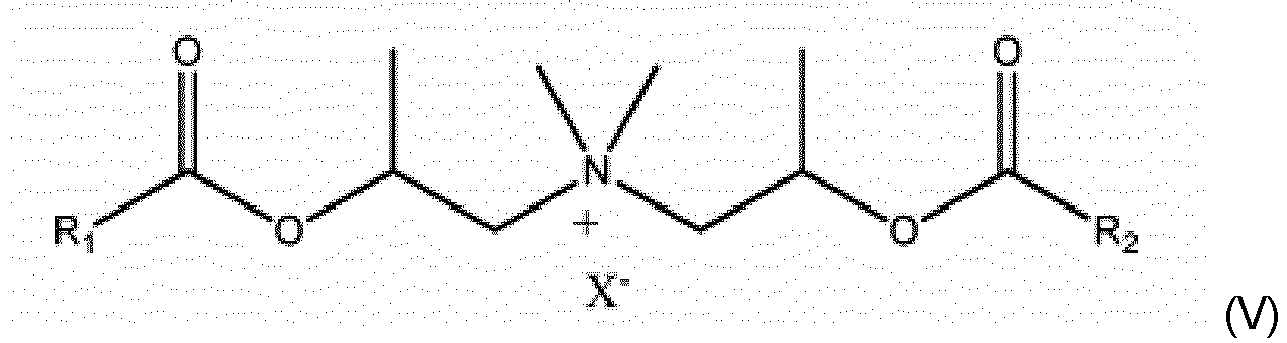
- A forth group of QACs suitable for use in the invention are represented by formula (V)
- The iodine value of the quaternary ammonium fabric conditioning material is preferably from 0 to 80, more preferably from 0 to 60, and most preferably from 0 to 45. The iodine value may be chosen as appropriate. Essentially saturated material having an iodine value of from 0 to 5, preferably from 0 to 1 may be used in the compositions of the invention. Such materials are known as "hardened" quaternary ammonium compounds.
- A further preferred range of iodine values is from 20 to 60, preferably 25 to 50, more preferably from 30 to 45. A material of this type is a "soft" triethanolamine quaternary ammonium compound, preferably triethanolamine di-alkylester methylsulfate. Such ester-linked triethanolamine quaternary ammonium compounds comprise unsaturated fatty chains.
- If there is a mixture of quarternary ammonium materials present in the composition, the iodine value, referred to above, represents the mean iodine value of the parent fatty acyl compounds or fatty acids of all of the quarternary ammonium materials present. Likewise, if there is any saturated quaternary ammonium materials present in the composition, the iodine value represents the mean iodine value of the parent acyl compounds of fatty acids of all of the quaternary ammonium materials present.
- Iodine value as used in the context of the present invention refers to, the fatty acid used to produce the QAC, the measurement of the degree of unsaturation present in a material by a method of nmr spectroscopy as described in Anal. Chem., 34, 1136 (1962) Johnson and Shoolery.
- The present invention comprises triglycerides. A triglyceride is an ester derived from glycerol and three fatty acids. Accordingly, a triglyceride comprises three fatty chains which have the same structure as the fatty acids from which they are formed. For example, a triglyceride formed from three C18 saturated fatty acids, will comprise three C18 saturated fatty chains. Triglycerides may be naturally occurring or synthetic.
- Triglycerides according to the present invention may contain a mixture of fatty chains. For example, castor oil comprises a mixture of palmitic, palmitoleic, steric, oleic, ricinoleic and linoleic fatty acid chains. ~87.5 % of the chains in castor oil (calculated based on number of carbon chains) are C18 chains (steric, oleic, ricinoleic and linoleic acid). The fatty chain distribution of various natural oils is provided herein in the Examples section.
- In the present invention, at least 60 % of the fatty chains of the triglyceride are C18 chains. By at least 60 % is meant 60 to 100 % of the fatty chains are C18. Preferably, at least 70% of the fatty chains are C18 (i.e. 70% to 100%), more preferably at least 80% of the fatty chains are C18 (i.e. 80% to 100%), most preferably 85 % of the fatty chains are C18 (i.e. 85% to 100%). Triglycerides having this structure improve shelf life stability of fabric conditioners.
- Preferably the fabric conditioner compositions of the present invention comprise at least 50 % unsaturated carbon chains (i.e. 50% to 100%). More preferably, at least 80% of the fatty chains are unsaturated carbon chains (i.e. 80% to 100%). Most preferably, at least 86% of the fatty chains are unsaturated carbon chains (i.e. 86% to 100%).
- Preferably the fabric conditioner compositions of the present invention comprise at least 50 % C18 unsaturated carbon chains (i.e. 50% to 100%). More preferably, at least 70% of the fatty chains are C18 unsaturated carbon chains (i.e. 70% to 100%). Most preferably, at least 86% of the fatty chains are C18 unsaturated carbon chains (i.e. 86% to 100%).
- Preferably the triglyceride originates from a plant / vegetable source, i.e. plant derived. Plant sources tend to have lower polyunsaturated carbon chains compared to animal sources.
- Particularly preferred triglycerides can be selected from: Olive oil, Cottonseed oil, Linseed oil, Castor oil, Safflower oil, Rapeseed oil and combinations thereof. Most preferably the triglyceride is castor oil.
- The compositions of the present invention comprise more than 0.125 w.t. % triglyceride, more preferably, 0.25 w.t.% and most preferably 1 w.t.%. The compositions of the present invention comprise less than 3 w.t. % triglyceride, preferably less than 2.5 w.t.% triglyceride and most preferably less than 2 % triglyceride. For example, the compositions comprise 0.125 to 3 w.t. % triglyceride, preferably 0.251o 2.5 w.t.% triglyceride and most preferably 0.5 to 2 w.t. % triglyceride.
- The fabric conditioners of the present invention preferable comprise perfume. Preferably the compositions comprises 0.1 to 30 w.t. % perfume materials, i.e. free perfume and/or perfume microcapsules. As is known in the art, free perfumes and perfume microcapsules provide the consumer with perfume hits at different points during the wash cycle. It is particularly preferred that the fabric conditioner of the present invention comprise a combination of both free perfume and perfume microcapsules.
- Preferably the fabric conditioners of the present invention comprises 0.5 to 20 w.t.% perfume materials, more preferably 1 to 15 w.t.% perfume materials, most preferably 2 to 10 w.t. % perfume materials.
- Useful perfume components may include materials of both natural and synthetic origin. They include single compounds and mixtures. Specific examples of such components may be found in the current literature, e.g., in Fenaroli's Handbook of Flavor Ingredients, 1975, CRC Press; Synthetic Food Adjuncts, 1947 by M. B. Jacobs, edited by Van Nostrand; or Perfume and Flavor Chemicals by S. Arctander 1969, Montclair, N.J. (USA). These substances are well known to the person skilled in the art of perfuming, flavouring, and/or aromatizing consumer products.
- The fabric conditioners of the present invention preferably comprises 0.1 to 15 w.t.% free perfume, more preferably 0.5 to 8 w.t. % free perfume.
- Particularly preferred perfume components are blooming perfume components and substantive perfume components. Blooming perfume components are defined by a boiling point less than 250°C and a LogP or greater than 2.5. Substantive perfume components are defined by a boiling point greater than 250°C and a LogP greater than 2.5. Boiling point is measured at standard pressure (760 mm Hg). Preferably a perfume composition will comprise a mixture of blooming and substantive perfume components. The perfume composition may comprise other perfume components.
- It is commonplace for a plurality of perfume components to be present in a free oil perfume composition. In the compositions for use in the present invention it is envisaged that there will be three or more, preferably four or more, more preferably five or more, most preferably six or more different perfume components. An upper limit of 300 perfume components may be applied.
- The fabric conditioners of the present invention preferably comprises 0.1 to 15 w.t.% perfume microcapsules, more preferably 0.5 to 8 w.t. % perfume microcapsules. The weight of microcapsules is of the material as supplied.
- When perfume components are encapsulated, suitable encapsulating materials, may comprise, but are not limited to; aminoplasts, proteins, polyurethanes, polyacrylates, polymethacrylates, polysaccharides, polyamides, polyolefins, gums, silicones, lipids, modified cellulose, polyphosphate, polystyrene, polyesters or combinations thereof. Particularly preferred materials are aminoplast microcapsules, such as melamine formaldehyde or urea formaldehyde microcapsules.
- Perfume microcapsules of the present invention can be friable microcapsules and/or moisture activated microcapsules. By friable, it is meant that the perfume microcapsule will rupture when a force is exerted. By moisture activated, it is meant that the perfume is released in the presence of water. The fabric conditioners of the present invention preferably comprises friable microcapsules. Moisture activated microcapsules may additionally be present. Examples of a microcapsules which can be friable include aminoplast microcapsules.
- Perfume components contained in a microcapsule may comprise odiferous materials and/or pro-fragrance materials.
- Particularly preferred perfume components contained in a microcapsule are blooming perfume components and substantive perfume components. Blooming perfume components are defined by a boiling point less than 250°C and a LogP greater than 2.5. Substantive perfume components are defined by a boiling point greater than 250°C and a LogP greater than 2.5. Boiling point is measured at standard pressure (760 mm Hg). Preferably a perfume composition will comprise a mixture of blooming and substantive perfume components. The perfume composition may comprise other perfume components.
- It is commonplace for a plurality of perfume components to be present in a microcapsule. In the compositions for use in the present invention it is envisaged that there will be three or more, preferably four or more, more preferably five or more, most preferably six or more different perfume components in a microcapsule. An upper limit of 300 perfume components may be applied.
- The microcapsules may comprise perfume components and a carrier for the perfume ingredients, such as zeolites or cyclodextrins.
- The compositions may further comprise a nonionic surfactant. Typically these can be included for the purpose of stabilising the compositions. Suitable nonionic surfactants include addition products of ethylene oxide and/or propylene oxide with fatty alcohols, fatty acids and fatty amines. Any of the alkoxylated materials of the particular type described hereinafter can be used as the nonionic surfactant.
- Suitable surfactants are substantially water soluble surfactants of the general formula (VII):
R-Y-(C2H4O)z-CH2-CH2-OH (VII)
where R is selected from the group consisting of primary, secondary and branched chain alkyl and/or acyl hydrocarbyl groups; primary, secondary and branched chain alkenyl hydrocarbyl groups; and primary, secondary and branched chain alkenyl-substituted phenolic hydrocarbyl groups; the hydrocarbyl groups having a chain length of from 8 to about 25, preferably 10 to 20, e.g. 14 to 18 carbon atoms. - In the general formula for the ethoxylated nonionic surfactant, Y is typically:
-O-, -C(O)O-, -C(O)N(R)-
or
-C(O)N(R)R-
in which R has the meaning given above for formula (VII), or can be hydrogen; and Z is at least about 8, preferably at least about 10 or 11. - Preferably the nonionic surfactant has an HLB of from about 7 to about 20, more preferably from 10 to 18, e.g. 12 to 16. Genapol™ C200 (Clariant) based on coco chain and 20 EO groups is an example of a suitable nonionic surfactant.
- If present, the nonionic surfactant is present in an amount from 0.01 to 10%, more preferably 0.1 to 5 by weight, based on the total weight of the composition.
- A class of preferred non-ionic surfactants include addition products of ethylene oxide and/or propylene oxide with fatty alcohols, fatty acids and fatty amines. These are preferably selected from addition products of (a) an alkoxide selected from ethylene oxide, propylene oxide and mixtures thereof with (b) a fatty material selected from fatty alcohols, fatty acids and fatty amines.
- Suitable surfactants are substantially water-soluble surfactants of the general formula (VIII):
R-Y-(C2H4O)z-CH2-CH2-OH (VIII)
where R is selected from the group consisting of primary, secondary and branched chain alkyl and/or acyl hydrocarbyl groups (when Y = -C(O)O, R ≠ an acyl hydrocarbyl group); primary, secondary and branched chain alkenyl hydrocarbyl groups; and primary, secondary and branched chain alkenyl-substituted phenolic hydrocarbyl groups; the hydrocarbyl groups having a chain length of from 10 to 60, preferably 10 to 25, e.g. 14 to 20 carbon atoms. - In the general formula for the ethoxylated nonionic surfactant, Y is typically:
-O-, -C(O)O-, -C(O)N(R)-
or
-C(O)N(R)R-
in which R has the meaning given above for formula (VIII), or can be hydrogen; and Z is at least about 6, preferably at least about 10 or 11. - Lutensol™ AT25 (BASF) based on C16:18 chain and 25 EO groups is an example of a suitable non-ionic surfactant. Other suitable surfactants include Renex 36 (Trideceth-6), ex Croda; Tergitol 15-S3, ex Dow Chemical Co.; Dihydrol LT7, ex Thai Ethoxylate Itd; Cremophor CO40, ex BASF and Neodol 91-8, ex Shell.
- Co-softeners may be used. When employed, they are typically present at from 0.1 to 20% and particularly at from 0.5 to 10%, based on the total weight of the composition. Preferred co-softeners include fatty esters, and fatty N-oxides. Fatty esters that may be employed include fatty monoesters, such as glycerol monostearate, fatty sugar esters, such as those disclosed
WO 01/46361 (Unilever - The compositions of the present invention may comprise a fatty complexing agent.
- Especially suitable fatty complexing agents include fatty alcohols and fatty acids. Of these, fatty alcohols are most preferred.
- Without being bound by theory it is believed that the fatty complexing material improves the viscosity profile of the composition by complexing with mono-ester component of the fabric conditioner material thereby providing a composition which has relatively higher levels of di-ester and tri-ester linked components. The di-ester and tri-ester linked components are more stable and do not affect initial viscosity as detrimentally as the mono-ester component.
- It is also believed that the higher levels of mono-ester linked component present in compositions comprising quaternary ammonium materials based on TEA may destabilise the composition through depletion flocculation. By using the fatty complexing material to complex with the monoester linked component, depletion flocculation is significantly reduced.
- In other words, the fatty complexing agent at the increased levels, as required by the present invention, "neutralises" the mono-ester linked component of the quaternary ammonium material. This in situ di-ester generation from mono-ester and fatty alcohol also improves the softening of the composition.
- Preferred fatty acids include tallow fatty acid or vegetable fatty acids, particularly preferred are hardened tallow fatty acid or hardened vegetable fatty acid (available under the trade name Pristerene™, ex Croda). Preferred fatty alcohols include tallow alcohol or vegetable alcohol, particularly preferred are hardened tallow alcohol or hardened vegetable alcohol (available under the trade names Stenol™ and Hydrenol™, ex BASF and Laurex™ CS, ex Huntsman).
- The fatty complexing agent is preferably present in an amount greater than 0.3 to 5% by weight based on the total weight of the composition. More preferably, the fatty component is present in an amount of from 0.4 to 4%. The weight ratio of the mono-ester component of the quaternary ammonium fabric softening material to the fatty complexing agent is preferably from 5:1 to 1:5, more preferably 4:1 to 1:4, most preferably 3:1 to 1:3, e.g. 2:1 to 1:2.
- The compositions may comprise other ingredients of fabric conditioner liquids as will be known to the person skilled in the art. Among such materials there may be mentioned: antifoams, insect repellents, shading or hueing dyes, preservatives (e.g. bactericides), pH buffering agents, perfume carriers, hydrotropes, anti-redeposition agents, soil-release agents, polyelectrolytes, anti-shrinking agents, anti-wrinkle agents, anti-oxidants, dyes, colorants, sunscreens, anti-corrosion agents, drape imparting agents, anti-static agents, sequestrants and ironing aids. The products of the invention may contain pearlisers and/or opacifiers. A preferred sequestrant is HEDP, an abbreviation for Etidronic acid or 1-hydroxyethane 1,1-diphosphonic acid.
- The fabric conditioner composition is preferably in an aqueous form. The compositions preferably comprise at least 75 w.t.% water.
- The fabric conditioner formulations of the present invention may be made by any method known in the art.
- Preferably the triglyceride is added with or after the fabric softening active, more preferably with the fabric softening active, i.e. at the same time as the fabric softening active. In a most preferred aspect of the present invention, the fabric softening active and triglyceride are combined or pre-mixed in a separate pre-melt prior to addition to the main fabric conditioner mix.
- Preferably the triglyceride is added to the fabric conditioner mix before or with any perfume components, preferably before any perfume materials.
- In one aspect of the present invention a triglyceride comprising at least 60 w.t. % C18 chains is used to improve the shelf life of a fabric conditioner as described herein.
- Preferably the triglyceride is used to improve the shelf life of a fabric conditioner composition as described herein, at temperatures over 37°C.
- For example, the triglycerides as described herein may be used to maintain the viscosity of a fabric conditioner (as described herein), stored at 50°C, bellow 250 mPas at 106 s-1, for more than 50 days.
- Viscosity was measured using an Anton Paar ASC instrument using cup and bob. Viscosity was measured at an equilibrated temperature of 25°C at a shear rate of 106s-1 reciprocal seconds. Data was collected for 60 seconds at a rate of 1 measurement per second and the average over the 60 seconds recorded as the viscosity.
- In one aspect of the present invention, clothes are treated with a fabric conditioner composition. The treatment is preferably during the washing process. This may be hand washing or machine washing. Preferable the fabric conditioner is used in the rinse stage of the washing process.
- Preferably the clothes are treated with a 10 to 100 ml dose of fabric conditioner for a 4 to 7 kg load of clothes. More preferably, 10 to 80 ml for a a 4 to 7 kg load of clothes.
- The effect of various triglycerides (oils) on shelf life was tested.
Table 1: Carbon Chain distributions of oils used in the present examples Carbon Chain Distributions (%): Palm oil Cotton - seed oil Olive oil Rapeseed Low Erucic Safflower oil Linse ed oil Castor oil Fish oil Myristic C14 1.25 1.25 0.5 0.01 7 Myristoleic C14:1 Palmitic C16 45.5 21.5 11.5 4.5 7 5.5 1.5 12.5 Palmitoleic C16:1 1.25 1 Stearic C18 5 2 2 2 3.5 3.5 1.5 2 Oleic C18:1 37.5 29 75 57.5 16.5 20 4.5 12 Ricinoleic C18:1.OH 87.5 Linoleic C18:2 9.5 48 9.5 23 72.5 15 4.5 7 Linolenic C18:3 11 1.75 52.5 2 Arachidic C20 0.5 Gadoleic C20:1 3 17 Mixed unsat C20 average C20:3 20 Behenic C22 0.01 Erucic C22:1 2.5 Mixed unsat C22 average C22:3 17.5 Lignoceric C24 0.01 Totals: % C18 chains 52 79 86.5 93.5 94.25 91 98 23 % unsaturated chains 48.25 78 84.5 97 90.75 87.5 96.5 75.5 % C18 unsaturated chains 47 77 84.5 91.5 90.75 87.5 96.5 21 - Fabric conditioner formulations according to the invention were prepared (Examples 1-6) along with a Control formulation and Comparative formulations (A and B).
Table 2: Test fabric conditioner formulations Ingredient Active w.t. % in Composition Quaternary ammonium (Di-[partially hardened tallow ester] of triethanolammonium methylsulphate) 12 Oil (when present) 1 Free perfume 2.1 Encapsulated 0.3 Cationic polymer* 0.12 Water and Minors To 100 * Flosoft 270LS ex SNF - Control: No oil
- Comparative A: Palm oil
- Comparative B: Fish Oil
- Example 1: Cottonseed oil
- Example 2: Olive oil
- Example 3: Rapeseed Low Erucic
- Example 4: Safflower oil
- Example 5: Linseed oil
- Example 6: Castor oil
- Water was heated in a vessel to ~50°C, the cationic polymer was added with stirring, followed by the mirrors. A premix of quaternary ammonium and oil (when present) was prepared at ~65°C and added to the main mix vessel with stirring. The mix was then cooled to ~35°C and the perfume ingredients added.
- Each test formulation was prepared as above and a sample of each formulation was stored at 50°C, 40°C, 37°C and 28°C. The samples where regularly monitored and the number of days to 'fail' was recorded. 'Fail' is defined as thicken to over 250 mPas at 106 s-1.
- Viscosity was measured using an Anton Paar ASC instrument using cup and bob. Viscosity was measured at an equilibrated temperature of 25°C at a shear rate of 106s-1 reciprocal seconds. Data was collected for 60 seconds at a rate of 1 measurement per second and the average over the 60 seconds recorded as the viscosity.
Table 3: Results Formulation: Initial viscosity (106s-1) Days to Fail: 50°C 40°C 37°C 28°C Control A* 60 48 102 133 477 Comparative A: Palm oil 80 43 103 Not measured Not measured Comparative B: Fish Oil 73 44 111 Not measured Not measured Example 1: Cottonseed oil 71 53 118 175 >528 Example 2: Olive oil 69 55 123 178 >528 Example 3: Rapeseed Low Erucic 70 57 126 181 >528 Example 4: Safflower oil 75 57 123 180 >528 Example 5: Linseed oil 67 61 129 182 >528 Example 6: Castor oil 84 65 126 184 >528 * The control results are an average of a number of samples. - The Example formulations demonstrated a longer shelf life than the Control and Comparative formulations.
Claims (10)
- A fabric conditioner composition comprising:a. 1 to 50 wt. % quaternary ammonium compound, the quaternary ammonium compound comprising at least one chain derived from fatty acids;b. 0.125 to 3 wt. % triglyceride; andc. Water;wherein the triglyceride comprises at least 60 % C18 chains and wherein the triglyceride comprises at least 50 wt. % unsaturated carbon chains; andwherein the quaternary ammonium compound is an ester quat.
- A fabric conditioner according to Claim 1, wherein the triglyceride comprises at least 50 wt. % unsaturated C18 carbon chains.
- A fabric conditioner composition according to any preceding claim, wherein the triglyceride originates from a vegetable source.
- A fabric conditioner composition according to any preceding claim, wherein the triglyceride is selected from: Olive oil, Cottonseed oil, Linseed oil, Castor oil, Safflower oil, Rapeseed oil and combinations thereof.
- A fabric conditioner composition according to any preceding claim, wherein the fabric conditioning composition further comprises a perfume composition.
- Method of making a fabric conditioner composition according to any preceding claim, wherein the triglyceride is added with or after the fabric softening active.
- Method of making a fabric conditioner according to Claim 6, wherein the fabric softening active and triglyceride are premixed prior to addition to the main mix.
- Method of making a fabric conditioner composition according to Claim 6, wherein the triglyceride is added before or with perfume.
- Use of a triglyceride comprising at least 60 wt. % C18 chains to improve the shelf life of a fabric conditioner composition according to any preceding claim.
- Use of a triglyceride according to claim 9, wherein the triglyceride is used to improve the shelf life of a fabric conditioner composition according to any preceding claim, at temperatures over 37°C.
Applications Claiming Priority (2)
| Application Number | Priority Date | Filing Date | Title |
|---|---|---|---|
| EP18211728 | 2018-12-11 | ||
| PCT/EP2019/083753 WO2020120268A1 (en) | 2018-12-11 | 2019-12-04 | Fabric conditioner compositions |
Publications (2)
| Publication Number | Publication Date |
|---|---|
| EP3894529A1 EP3894529A1 (en) | 2021-10-20 |
| EP3894529B1 true EP3894529B1 (en) | 2023-02-08 |
Family
ID=64664918
Family Applications (1)
| Application Number | Title | Priority Date | Filing Date |
|---|---|---|---|
| EP19812818.3A Active EP3894529B1 (en) | 2018-12-11 | 2019-12-04 | Fabric conditioner compositions |
Country Status (5)
| Country | Link |
|---|---|
| US (1) | US12398344B2 (en) |
| EP (1) | EP3894529B1 (en) |
| CN (1) | CN113227338A (en) |
| PL (1) | PL3894529T3 (en) |
| WO (1) | WO2020120268A1 (en) |
Families Citing this family (9)
| Publication number | Priority date | Publication date | Assignee | Title |
|---|---|---|---|---|
| US12398344B2 (en) * | 2018-12-11 | 2025-08-26 | Conopco, Inc. | Fabric conditioner compositions |
| MX2023005559A (en) | 2020-11-16 | 2023-05-29 | Procter & Gamble | LIQUID CONDITIONING COMPOSITIONS COMPRISING A QUATERNARY ESTER DERIVED IN PART FROM TRANS FATTY ACIDS. |
| EP4026887A1 (en) * | 2021-01-11 | 2022-07-13 | Unilever IP Holdings B.V. | Fabric conditioner composition |
| EP4274880A1 (en) * | 2021-01-11 | 2023-11-15 | Unilever IP Holdings B.V. | Fabric conditioner composition |
| EP4053256A1 (en) * | 2021-03-01 | 2022-09-07 | Novozymes A/S | Use of enzymes for improving fragrance deposition |
| CN118451169A (en) * | 2021-12-02 | 2024-08-06 | 联合利华知识产权控股有限公司 | Fabric conditioner |
| WO2023099595A1 (en) * | 2021-12-02 | 2023-06-08 | Unilever Ip Holdings B.V. | Fabric softening composition |
| WO2023099593A1 (en) * | 2021-12-02 | 2023-06-08 | Unilever Ip Holdings B.V. | Fabric conditioner |
| WO2026017399A1 (en) * | 2024-07-16 | 2026-01-22 | Unilever Ip Holdings B.V. | Fabric conditioner composition |
Citations (2)
| Publication number | Priority date | Publication date | Assignee | Title |
|---|---|---|---|---|
| WO1999045089A1 (en) | 1998-03-02 | 1999-09-10 | The Procter & Gamble Company | Concentrated, stable, translucent or clear, fabric softening compositions |
| WO2006005480A1 (en) | 2004-07-15 | 2006-01-19 | Unilever Plc | Fabric softening composition |
Family Cites Families (26)
| Publication number | Priority date | Publication date | Assignee | Title |
|---|---|---|---|---|
| US4127694A (en) * | 1974-02-08 | 1978-11-28 | The Procter & Gamble Company | Fabric treatment compositions |
| US4209549A (en) * | 1974-02-08 | 1980-06-24 | The Procter & Gamble Company | Process for treating fabrics with fabric treatment compositions |
| GB1567947A (en) | 1976-07-02 | 1980-05-21 | Unilever Ltd | Esters of quaternised amino-alcohols for treating fabrics |
| DE3734931A1 (en) * | 1987-10-15 | 1989-05-03 | Henkel Kgaa | AGENT FOR SMOOTHING TEXTILE FIBER MATERIALS |
| GB9930435D0 (en) | 1999-12-22 | 2000-02-16 | Unilever Plc | Fabric softening compositions |
| US6737392B1 (en) * | 2003-06-11 | 2004-05-18 | Goldschmidt Chemical Corporation | MDEA ester quats with high content of monoester in blends with tea ester quats |
| CN102272282B (en) * | 2009-01-06 | 2014-03-05 | 荷兰联合利华有限公司 | Improvements relating to fabric conditioners |
| CN102834498B (en) | 2010-04-01 | 2014-04-30 | 宝洁公司 | Fabric softener |
| MA34103B1 (en) | 2010-04-01 | 2013-03-05 | Evonik Degussa Gmbh | An effective formula for the fabric binder |
| US20110239377A1 (en) * | 2010-04-01 | 2011-10-06 | Renae Dianna Fossum | Heat Stable Fabric Softener |
| KR101050726B1 (en) * | 2011-03-22 | 2011-07-20 | 주식회사 선진화학 | Fabric softener and preparation method thereof |
| US20140106002A1 (en) * | 2011-05-23 | 2014-04-17 | Ned L. Jensen | Homeopathic composition and method for the treatment of skin irritations and other skin diseases |
| US10287615B2 (en) * | 2011-06-06 | 2019-05-14 | Ecover Co-Ordination Center N.V. | Sophorolactone production |
| PH12014500305A1 (en) * | 2011-08-24 | 2014-03-31 | Unilever Nv | Benefit agent delivery particles comprising non-ionic polysaccharides |
| MX2014002079A (en) * | 2011-08-24 | 2014-05-30 | Unilever Nv | Benefit agent delivery particles comprising dextran. |
| CN104540494B (en) * | 2012-05-30 | 2017-10-24 | 科莱恩金融(Bvi)有限公司 | N methyl Ns acyl glucamides as solubilizer purposes |
| HUE043059T2 (en) * | 2013-02-27 | 2019-07-29 | Mochida Pharm Co Ltd | Novel pyrazole derivative |
| WO2015067557A1 (en) * | 2013-11-11 | 2015-05-14 | Unilever Plc | Fabric conditioners comprising encapsulated active material |
| US9937109B2 (en) * | 2013-11-28 | 2018-04-10 | Conopco, Inc. | Encapsulated benefit agents |
| MX394441B (en) * | 2014-01-29 | 2025-03-24 | Vyome Therapeutics Ltd | A BESIFLOXACIN-BASED FORMULATION FOR USE IN THE TREATMENT OF DRUG-RESISTANT ACNE |
| TR201815223T4 (en) * | 2014-12-15 | 2018-11-21 | Unilever Nv | Castable liquid fabric softening compositions. |
| EP3101106B1 (en) * | 2015-06-05 | 2019-04-24 | The Procter and Gamble Company | Compacted liquid laundry detergent composition |
| US9796948B2 (en) * | 2016-01-13 | 2017-10-24 | The Procter & Gamble Company | Laundry detergent compositions comprising renewable components |
| WO2019072645A1 (en) * | 2017-10-13 | 2019-04-18 | Unilever Plc | Aqueous spray composition |
| CN112752832A (en) * | 2018-07-12 | 2021-05-04 | 斯蒂潘公司 | Ester quaternary ammonium salt composition |
| US12398344B2 (en) * | 2018-12-11 | 2025-08-26 | Conopco, Inc. | Fabric conditioner compositions |
-
2019
- 2019-12-04 US US17/311,383 patent/US12398344B2/en active Active
- 2019-12-04 CN CN201980082115.0A patent/CN113227338A/en active Pending
- 2019-12-04 PL PL19812818.3T patent/PL3894529T3/en unknown
- 2019-12-04 WO PCT/EP2019/083753 patent/WO2020120268A1/en not_active Ceased
- 2019-12-04 EP EP19812818.3A patent/EP3894529B1/en active Active
Patent Citations (2)
| Publication number | Priority date | Publication date | Assignee | Title |
|---|---|---|---|---|
| WO1999045089A1 (en) | 1998-03-02 | 1999-09-10 | The Procter & Gamble Company | Concentrated, stable, translucent or clear, fabric softening compositions |
| WO2006005480A1 (en) | 2004-07-15 | 2006-01-19 | Unilever Plc | Fabric softening composition |
Non-Patent Citations (3)
| Title |
|---|
| ANNEKEN DAVID J, ET AL: "Ulmann’s Encyclopedia of Industrial Chemistry. Fatty Acids. Excerpt", WILEY-VCH VERLAG GMBH & CO, vol. 14, 1 January 2012 (2012-01-01), pages 72, 83, XP093104389 |
| FRANK D. GUNSTONE , JOHN L HARWOOD , ALBERT J. DIJKSTRA: " The Lipid Handbook with CD-ROM Third Edition", 1 January 2007, CRC PRESS , ISBN: 978-0-8493-9688-5, article ANONYMOUS: "Occurrence and Characterisation of Oils and Fats", pages: 41 - 43, XP093244583 |
| FRANK D. GUNSTONE , JOHN L HARWOOD , ALBERT J. DIJKSTRA: " The Lipid Handbook with CD-ROM Third Edition", 1 January 2007, CRC PRESS, ISBN: 978-0-8493-9688-5, article ANONYMOUS: "Occurrence and Characterisation of Oils and Fats", pages: 62 - 63, XP093244590 |
Also Published As
| Publication number | Publication date |
|---|---|
| CN113227338A (en) | 2021-08-06 |
| US12398344B2 (en) | 2025-08-26 |
| WO2020120268A1 (en) | 2020-06-18 |
| EP3894529A1 (en) | 2021-10-20 |
| PL3894529T3 (en) | 2023-05-29 |
| US20220025298A1 (en) | 2022-01-27 |
| BR112021011219A2 (en) | 2021-08-24 |
Similar Documents
| Publication | Publication Date | Title |
|---|---|---|
| US12398344B2 (en) | Fabric conditioner compositions | |
| EP2294168B1 (en) | Improvements relating to fabric conditioners | |
| EP2561057B1 (en) | Improvements relating to fabric conditioners | |
| EP1765966B1 (en) | Fabric softening composition | |
| EP4247925B1 (en) | Fabric conditioner | |
| EP4150038B1 (en) | Laundry composition | |
| CA2492320C (en) | Fabric conditioning compositions | |
| HUP0402091A2 (en) | Textile conditioning preparations, procedure for their application | |
| EP4526415B1 (en) | Concentrated fabric conditioner | |
| CZ299080B6 (en) | Fabric conditioning composition | |
| US20250027010A1 (en) | Fabric conditioning method | |
| EP4490257B1 (en) | Concentrated fabric conditioner | |
| BR112021011219B1 (en) | FABRIC CONDITIONING COMPOSITION, METHOD FOR PREPARING A FABRIC CONDITIONING COMPOSITION AND USE OF A TRIGLYCERIDE | |
| CN116348582B (en) | Concentrated non-aqueous fabric conditioner | |
| EP4279569A1 (en) | Concentrated non-aqueous fabric conditioners | |
| WO2024153564A1 (en) | Laundry composition | |
| CN119173618A (en) | Concentrated fabric conditioner | |
| CN117716010A (en) | Method for preparing fabric conditioner |
Legal Events
| Date | Code | Title | Description |
|---|---|---|---|
| STAA | Information on the status of an ep patent application or granted ep patent |
Free format text: STATUS: UNKNOWN |
|
| STAA | Information on the status of an ep patent application or granted ep patent |
Free format text: STATUS: THE INTERNATIONAL PUBLICATION HAS BEEN MADE |
|
| PUAI | Public reference made under article 153(3) epc to a published international application that has entered the european phase |
Free format text: ORIGINAL CODE: 0009012 |
|
| STAA | Information on the status of an ep patent application or granted ep patent |
Free format text: STATUS: REQUEST FOR EXAMINATION WAS MADE |
|
| 17P | Request for examination filed |
Effective date: 20210510 |
|
| AK | Designated contracting states |
Kind code of ref document: A1 Designated state(s): AL AT BE BG CH CY CZ DE DK EE ES FI FR GB GR HR HU IE IS IT LI LT LU LV MC MK MT NL NO PL PT RO RS SE SI SK SM TR |
|
| DAV | Request for validation of the european patent (deleted) | ||
| DAX | Request for extension of the european patent (deleted) | ||
| GRAP | Despatch of communication of intention to grant a patent |
Free format text: ORIGINAL CODE: EPIDOSNIGR1 |
|
| STAA | Information on the status of an ep patent application or granted ep patent |
Free format text: STATUS: GRANT OF PATENT IS INTENDED |
|
| INTG | Intention to grant announced |
Effective date: 20220422 |
|
| GRAJ | Information related to disapproval of communication of intention to grant by the applicant or resumption of examination proceedings by the epo deleted |
Free format text: ORIGINAL CODE: EPIDOSDIGR1 |
|
| STAA | Information on the status of an ep patent application or granted ep patent |
Free format text: STATUS: REQUEST FOR EXAMINATION WAS MADE |
|
| INTC | Intention to grant announced (deleted) | ||
| GRAP | Despatch of communication of intention to grant a patent |
Free format text: ORIGINAL CODE: EPIDOSNIGR1 |
|
| STAA | Information on the status of an ep patent application or granted ep patent |
Free format text: STATUS: GRANT OF PATENT IS INTENDED |
|
| INTG | Intention to grant announced |
Effective date: 20220810 |
|
| GRAS | Grant fee paid |
Free format text: ORIGINAL CODE: EPIDOSNIGR3 |
|
| GRAA | (expected) grant |
Free format text: ORIGINAL CODE: 0009210 |
|
| STAA | Information on the status of an ep patent application or granted ep patent |
Free format text: STATUS: THE PATENT HAS BEEN GRANTED |
|
| AK | Designated contracting states |
Kind code of ref document: B1 Designated state(s): AL AT BE BG CH CY CZ DE DK EE ES FI FR GB GR HR HU IE IS IT LI LT LU LV MC MK MT NL NO PL PT RO RS SE SI SK SM TR |
|
| REG | Reference to a national code |
Ref country code: GB Ref legal event code: FG4D |
|
| REG | Reference to a national code |
Ref country code: CH Ref legal event code: EP Ref country code: AT Ref legal event code: REF Ref document number: 1547487 Country of ref document: AT Kind code of ref document: T Effective date: 20230215 |
|
| REG | Reference to a national code |
Ref country code: DE Ref legal event code: R096 Ref document number: 602019025128 Country of ref document: DE |
|
| REG | Reference to a national code |
Ref country code: IE Ref legal event code: FG4D |
|
| REG | Reference to a national code |
Ref country code: LT Ref legal event code: MG9D |
|
| P01 | Opt-out of the competence of the unified patent court (upc) registered |
Effective date: 20230428 |
|
| REG | Reference to a national code |
Ref country code: NL Ref legal event code: MP Effective date: 20230208 |
|
| REG | Reference to a national code |
Ref country code: AT Ref legal event code: MK05 Ref document number: 1547487 Country of ref document: AT Kind code of ref document: T Effective date: 20230208 |
|
| PG25 | Lapsed in a contracting state [announced via postgrant information from national office to epo] |
Ref country code: RS Free format text: LAPSE BECAUSE OF FAILURE TO SUBMIT A TRANSLATION OF THE DESCRIPTION OR TO PAY THE FEE WITHIN THE PRESCRIBED TIME-LIMIT Effective date: 20230208 Ref country code: PT Free format text: LAPSE BECAUSE OF FAILURE TO SUBMIT A TRANSLATION OF THE DESCRIPTION OR TO PAY THE FEE WITHIN THE PRESCRIBED TIME-LIMIT Effective date: 20230609 Ref country code: NO Free format text: LAPSE BECAUSE OF FAILURE TO SUBMIT A TRANSLATION OF THE DESCRIPTION OR TO PAY THE FEE WITHIN THE PRESCRIBED TIME-LIMIT Effective date: 20230508 Ref country code: NL Free format text: LAPSE BECAUSE OF FAILURE TO SUBMIT A TRANSLATION OF THE DESCRIPTION OR TO PAY THE FEE WITHIN THE PRESCRIBED TIME-LIMIT Effective date: 20230208 Ref country code: LV Free format text: LAPSE BECAUSE OF FAILURE TO SUBMIT A TRANSLATION OF THE DESCRIPTION OR TO PAY THE FEE WITHIN THE PRESCRIBED TIME-LIMIT Effective date: 20230208 Ref country code: LT Free format text: LAPSE BECAUSE OF FAILURE TO SUBMIT A TRANSLATION OF THE DESCRIPTION OR TO PAY THE FEE WITHIN THE PRESCRIBED TIME-LIMIT Effective date: 20230208 Ref country code: HR Free format text: LAPSE BECAUSE OF FAILURE TO SUBMIT A TRANSLATION OF THE DESCRIPTION OR TO PAY THE FEE WITHIN THE PRESCRIBED TIME-LIMIT Effective date: 20230208 Ref country code: ES Free format text: LAPSE BECAUSE OF FAILURE TO SUBMIT A TRANSLATION OF THE DESCRIPTION OR TO PAY THE FEE WITHIN THE PRESCRIBED TIME-LIMIT Effective date: 20230208 Ref country code: AT Free format text: LAPSE BECAUSE OF FAILURE TO SUBMIT A TRANSLATION OF THE DESCRIPTION OR TO PAY THE FEE WITHIN THE PRESCRIBED TIME-LIMIT Effective date: 20230208 |
|
| PG25 | Lapsed in a contracting state [announced via postgrant information from national office to epo] |
Ref country code: SE Free format text: LAPSE BECAUSE OF FAILURE TO SUBMIT A TRANSLATION OF THE DESCRIPTION OR TO PAY THE FEE WITHIN THE PRESCRIBED TIME-LIMIT Effective date: 20230208 Ref country code: IS Free format text: LAPSE BECAUSE OF FAILURE TO SUBMIT A TRANSLATION OF THE DESCRIPTION OR TO PAY THE FEE WITHIN THE PRESCRIBED TIME-LIMIT Effective date: 20230608 Ref country code: GR Free format text: LAPSE BECAUSE OF FAILURE TO SUBMIT A TRANSLATION OF THE DESCRIPTION OR TO PAY THE FEE WITHIN THE PRESCRIBED TIME-LIMIT Effective date: 20230509 Ref country code: FI Free format text: LAPSE BECAUSE OF FAILURE TO SUBMIT A TRANSLATION OF THE DESCRIPTION OR TO PAY THE FEE WITHIN THE PRESCRIBED TIME-LIMIT Effective date: 20230208 |
|
| PG25 | Lapsed in a contracting state [announced via postgrant information from national office to epo] |
Ref country code: SM Free format text: LAPSE BECAUSE OF FAILURE TO SUBMIT A TRANSLATION OF THE DESCRIPTION OR TO PAY THE FEE WITHIN THE PRESCRIBED TIME-LIMIT Effective date: 20230208 Ref country code: RO Free format text: LAPSE BECAUSE OF FAILURE TO SUBMIT A TRANSLATION OF THE DESCRIPTION OR TO PAY THE FEE WITHIN THE PRESCRIBED TIME-LIMIT Effective date: 20230208 Ref country code: EE Free format text: LAPSE BECAUSE OF FAILURE TO SUBMIT A TRANSLATION OF THE DESCRIPTION OR TO PAY THE FEE WITHIN THE PRESCRIBED TIME-LIMIT Effective date: 20230208 Ref country code: DK Free format text: LAPSE BECAUSE OF FAILURE TO SUBMIT A TRANSLATION OF THE DESCRIPTION OR TO PAY THE FEE WITHIN THE PRESCRIBED TIME-LIMIT Effective date: 20230208 Ref country code: CZ Free format text: LAPSE BECAUSE OF FAILURE TO SUBMIT A TRANSLATION OF THE DESCRIPTION OR TO PAY THE FEE WITHIN THE PRESCRIBED TIME-LIMIT Effective date: 20230208 |
|
| REG | Reference to a national code |
Ref country code: DE Ref legal event code: R026 Ref document number: 602019025128 Country of ref document: DE |
|
| PLBI | Opposition filed |
Free format text: ORIGINAL CODE: 0009260 |
|
| PLAX | Notice of opposition and request to file observation + time limit sent |
Free format text: ORIGINAL CODE: EPIDOSNOBS2 |
|
| PG25 | Lapsed in a contracting state [announced via postgrant information from national office to epo] |
Ref country code: SK Free format text: LAPSE BECAUSE OF FAILURE TO SUBMIT A TRANSLATION OF THE DESCRIPTION OR TO PAY THE FEE WITHIN THE PRESCRIBED TIME-LIMIT Effective date: 20230208 |
|
| 26 | Opposition filed |
Opponent name: THE PROCTER & GAMBLE COMPANY Effective date: 20231108 |
|
| PG25 | Lapsed in a contracting state [announced via postgrant information from national office to epo] |
Ref country code: SI Free format text: LAPSE BECAUSE OF FAILURE TO SUBMIT A TRANSLATION OF THE DESCRIPTION OR TO PAY THE FEE WITHIN THE PRESCRIBED TIME-LIMIT Effective date: 20230208 |
|
| PLBB | Reply of patent proprietor to notice(s) of opposition received |
Free format text: ORIGINAL CODE: EPIDOSNOBS3 |
|
| REG | Reference to a national code |
Ref country code: CH Ref legal event code: PL |
|
| PG25 | Lapsed in a contracting state [announced via postgrant information from national office to epo] |
Ref country code: LU Free format text: LAPSE BECAUSE OF NON-PAYMENT OF DUE FEES Effective date: 20231204 |
|
| PG25 | Lapsed in a contracting state [announced via postgrant information from national office to epo] |
Ref country code: MC Free format text: LAPSE BECAUSE OF FAILURE TO SUBMIT A TRANSLATION OF THE DESCRIPTION OR TO PAY THE FEE WITHIN THE PRESCRIBED TIME-LIMIT Effective date: 20230208 |
|
| REG | Reference to a national code |
Ref country code: BE Ref legal event code: MM Effective date: 20231231 |
|
| PG25 | Lapsed in a contracting state [announced via postgrant information from national office to epo] |
Ref country code: MC Free format text: LAPSE BECAUSE OF FAILURE TO SUBMIT A TRANSLATION OF THE DESCRIPTION OR TO PAY THE FEE WITHIN THE PRESCRIBED TIME-LIMIT Effective date: 20230208 Ref country code: LU Free format text: LAPSE BECAUSE OF NON-PAYMENT OF DUE FEES Effective date: 20231204 |
|
| REG | Reference to a national code |
Ref country code: IE Ref legal event code: MM4A |
|
| PG25 | Lapsed in a contracting state [announced via postgrant information from national office to epo] |
Ref country code: IE Free format text: LAPSE BECAUSE OF NON-PAYMENT OF DUE FEES Effective date: 20231204 |
|
| PG25 | Lapsed in a contracting state [announced via postgrant information from national office to epo] |
Ref country code: BE Free format text: LAPSE BECAUSE OF NON-PAYMENT OF DUE FEES Effective date: 20231231 |
|
| PG25 | Lapsed in a contracting state [announced via postgrant information from national office to epo] |
Ref country code: CH Free format text: LAPSE BECAUSE OF NON-PAYMENT OF DUE FEES Effective date: 20231231 |
|
| PG25 | Lapsed in a contracting state [announced via postgrant information from national office to epo] |
Ref country code: IE Free format text: LAPSE BECAUSE OF NON-PAYMENT OF DUE FEES Effective date: 20231204 Ref country code: CH Free format text: LAPSE BECAUSE OF NON-PAYMENT OF DUE FEES Effective date: 20231231 Ref country code: BE Free format text: LAPSE BECAUSE OF NON-PAYMENT OF DUE FEES Effective date: 20231231 |
|
| PG25 | Lapsed in a contracting state [announced via postgrant information from national office to epo] |
Ref country code: BG Free format text: LAPSE BECAUSE OF FAILURE TO SUBMIT A TRANSLATION OF THE DESCRIPTION OR TO PAY THE FEE WITHIN THE PRESCRIBED TIME-LIMIT Effective date: 20230208 |
|
| PG25 | Lapsed in a contracting state [announced via postgrant information from national office to epo] |
Ref country code: BG Free format text: LAPSE BECAUSE OF FAILURE TO SUBMIT A TRANSLATION OF THE DESCRIPTION OR TO PAY THE FEE WITHIN THE PRESCRIBED TIME-LIMIT Effective date: 20230208 |
|
| PG25 | Lapsed in a contracting state [announced via postgrant information from national office to epo] |
Ref country code: CY Free format text: LAPSE BECAUSE OF FAILURE TO SUBMIT A TRANSLATION OF THE DESCRIPTION OR TO PAY THE FEE WITHIN THE PRESCRIBED TIME-LIMIT; INVALID AB INITIO Effective date: 20191204 |
|
| PG25 | Lapsed in a contracting state [announced via postgrant information from national office to epo] |
Ref country code: HU Free format text: LAPSE BECAUSE OF FAILURE TO SUBMIT A TRANSLATION OF THE DESCRIPTION OR TO PAY THE FEE WITHIN THE PRESCRIBED TIME-LIMIT; INVALID AB INITIO Effective date: 20191204 |
|
| RAP4 | Party data changed (patent owner data changed or rights of a patent transferred) |
Owner name: UNILEVER GLOBAL IP LIMITED Owner name: UNILEVER IP HOLDINGS B.V. |
|
| PGFP | Annual fee paid to national office [announced via postgrant information from national office to epo] |
Ref country code: DE Payment date: 20251211 Year of fee payment: 7 |
|
| PGFP | Annual fee paid to national office [announced via postgrant information from national office to epo] |
Ref country code: GB Payment date: 20251219 Year of fee payment: 7 |
|
| PGFP | Annual fee paid to national office [announced via postgrant information from national office to epo] |
Ref country code: IT Payment date: 20251222 Year of fee payment: 7 |
|
| PGFP | Annual fee paid to national office [announced via postgrant information from national office to epo] |
Ref country code: FR Payment date: 20251229 Year of fee payment: 7 |
|
| PGFP | Annual fee paid to national office [announced via postgrant information from national office to epo] |
Ref country code: TR Payment date: 20251206 Year of fee payment: 7 |
|
| PGFP | Annual fee paid to national office [announced via postgrant information from national office to epo] |
Ref country code: PL Payment date: 20251121 Year of fee payment: 7 |