EP3893545A1 - Tci-erfassungsmechanismus für aktivierung einer unbekannten sekündärzelle die an einem fr2-band arbeit - Google Patents
Tci-erfassungsmechanismus für aktivierung einer unbekannten sekündärzelle die an einem fr2-band arbeit Download PDFInfo
- Publication number
- EP3893545A1 EP3893545A1 EP21164716.9A EP21164716A EP3893545A1 EP 3893545 A1 EP3893545 A1 EP 3893545A1 EP 21164716 A EP21164716 A EP 21164716A EP 3893545 A1 EP3893545 A1 EP 3893545A1
- Authority
- EP
- European Patent Office
- Prior art keywords
- scell
- information
- rsrp
- activation
- rsrp measurement
- Prior art date
- Legal status (The legal status is an assumption and is not a legal conclusion. Google has not performed a legal analysis and makes no representation as to the accuracy of the status listed.)
- Granted
Links
Images




Classifications
-
- H—ELECTRICITY
- H04—ELECTRIC COMMUNICATION TECHNIQUE
- H04W—WIRELESS COMMUNICATION NETWORKS
- H04W24/00—Supervisory, monitoring or testing arrangements
- H04W24/10—Scheduling measurement reports ; Arrangements for measurement reports
-
- H—ELECTRICITY
- H04—ELECTRIC COMMUNICATION TECHNIQUE
- H04W—WIRELESS COMMUNICATION NETWORKS
- H04W72/00—Local resource management
- H04W72/50—Allocation or scheduling criteria for wireless resources
- H04W72/53—Allocation or scheduling criteria for wireless resources based on regulatory allocation policies
-
- H—ELECTRICITY
- H04—ELECTRIC COMMUNICATION TECHNIQUE
- H04B—TRANSMISSION
- H04B17/00—Monitoring; Testing
- H04B17/30—Monitoring; Testing of propagation channels
- H04B17/309—Measuring or estimating channel quality parameters
- H04B17/318—Received signal strength
- H04B17/327—Received signal code power [RSCP]
-
- H—ELECTRICITY
- H04—ELECTRIC COMMUNICATION TECHNIQUE
- H04B—TRANSMISSION
- H04B17/00—Monitoring; Testing
- H04B17/30—Monitoring; Testing of propagation channels
- H04B17/309—Measuring or estimating channel quality parameters
- H04B17/318—Received signal strength
- H04B17/328—Reference signal received power [RSRP]; Reference signal received quality [RSRQ]
-
- H—ELECTRICITY
- H04—ELECTRIC COMMUNICATION TECHNIQUE
- H04B—TRANSMISSION
- H04B17/00—Monitoring; Testing
- H04B17/30—Monitoring; Testing of propagation channels
- H04B17/382—Monitoring; Testing of propagation channels for resource allocation, admission control or handover
-
- H—ELECTRICITY
- H04—ELECTRIC COMMUNICATION TECHNIQUE
- H04L—TRANSMISSION OF DIGITAL INFORMATION, e.g. TELEGRAPHIC COMMUNICATION
- H04L5/00—Arrangements affording multiple use of the transmission path
- H04L5/003—Arrangements for allocating sub-channels of the transmission path
- H04L5/0048—Allocation of pilot signals, i.e. of signals known to the receiver
-
- H—ELECTRICITY
- H04—ELECTRIC COMMUNICATION TECHNIQUE
- H04W—WIRELESS COMMUNICATION NETWORKS
- H04W56/00—Synchronisation arrangements
- H04W56/001—Synchronization between nodes
-
- H—ELECTRICITY
- H04—ELECTRIC COMMUNICATION TECHNIQUE
- H04W—WIRELESS COMMUNICATION NETWORKS
- H04W72/00—Local resource management
- H04W72/04—Wireless resource allocation
- H04W72/044—Wireless resource allocation based on the type of the allocated resource
- H04W72/046—Wireless resource allocation based on the type of the allocated resource the resource being in the space domain, e.g. beams
-
- H—ELECTRICITY
- H04—ELECTRIC COMMUNICATION TECHNIQUE
- H04W—WIRELESS COMMUNICATION NETWORKS
- H04W72/00—Local resource management
- H04W72/50—Allocation or scheduling criteria for wireless resources
- H04W72/54—Allocation or scheduling criteria for wireless resources based on quality criteria
- H04W72/542—Allocation or scheduling criteria for wireless resources based on quality criteria using measured or perceived quality
-
- H—ELECTRICITY
- H04—ELECTRIC COMMUNICATION TECHNIQUE
- H04B—TRANSMISSION
- H04B7/00—Radio transmission systems, i.e. using radiation field
- H04B7/02—Diversity systems; Multi-antenna system, i.e. transmission or reception using multiple antennas
- H04B7/022—Site diversity; Macro-diversity
- H04B7/024—Co-operative use of antennas of several sites, e.g. in co-ordinated multipoint or co-operative multiple-input multiple-output [MIMO] systems
-
- H—ELECTRICITY
- H04—ELECTRIC COMMUNICATION TECHNIQUE
- H04L—TRANSMISSION OF DIGITAL INFORMATION, e.g. TELEGRAPHIC COMMUNICATION
- H04L5/00—Arrangements affording multiple use of the transmission path
- H04L5/0001—Arrangements for dividing the transmission path
- H04L5/0003—Two-dimensional division
- H04L5/0005—Time-frequency
- H04L5/0007—Time-frequency the frequencies being orthogonal, e.g. OFDM(A) or DMT
- H04L5/001—Time-frequency the frequencies being orthogonal, e.g. OFDM(A) or DMT the frequencies being arranged in component carriers
Definitions
- Embodiments relates generally to wireless technology and more particularly to the transmission configuration indicator (TCI) information for secondary cell (SCell) activation in a wireless communication system.
- TCI transmission configuration indicator
- Wireless communication systems provide various telecommunication services and typically employ multiple-access technologies capable of supporting communication with multiple users by sharing available system resources.
- Multiple-access technologies include, for example, code division multiple access (CDMA) systems, time division multiple access (TDMA) systems, frequency division multiple access (FDMA) systems, orthogonal frequency division multiple access (OFDMA) systems, single-carrier frequency division multiple access (SC-FDMA) systems, and time division synchronous code division multiple access (TD-SCDMA) systems.
- CDMA code division multiple access
- TDMA time division multiple access
- FDMA frequency division multiple access
- OFDMA orthogonal frequency division multiple access
- SC-FDMA single-carrier frequency division multiple access
- TD-SCDMA time division synchronous code division multiple access
- One such aspect involves the activation delay related to a secondary cell (SCell) in cases where a SCell being activated belongs to Frequency Range 2 (FR2) and if there is no active serving cell on that FR2 band provided that a primary cell (PCell) or primary secondary cell (PSCell) is Frequency Range 1 (FR1).
- beam information e.g., the transmission configuration indicator (TCI) information
- TCI transmission configuration indicator
- L1-RSRP Layer 1
- RSRP Layer 1
- RSRP Layer 1-Reference Signal Received Power
- the network may not configure any TCI information for L1-RSRP RS before beginning the process of activating the SCell or may configure TCI information for L1-RSRP RS beginning the process of activating the SCell, but that TCI related information was made a long time ago and is now out of date. Without precise TCI information, the UE cannot perform a reliable L1 -RSRP, thereby making the L1 -RSRP report unreliable. If the L1 - RSRP is unreliable, the process of SCell activation for an FR2 unknown cell is delayed.
- Coupled is used to indicate that two or more elements, which may or may not be in direct physical or electrical contact with each other, co-operate or interact with each other.
- Connected is used to indicate the establishment of communication between two or more elements that are coupled with each other.
- processing logic that comprises hardware (e.g., circuitry, dedicated logic, etc.), software (such as is run on a general-purpose computer system or a dedicated machine), or a combination of both.
- processing logic comprises hardware (e.g., circuitry, dedicated logic, etc.), software (such as is run on a general-purpose computer system or a dedicated machine), or a combination of both.
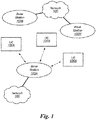
- the communication area (or coverage area) of the base station may be referred to as a "cell.”
- the base station 102A and the UEs 106 may be configured to communicate over the transmission medium using any of various radio access technologies (RATs), also referred to as wireless communication technologies, or telecommunication standards, such as GSM, UMTS
- RATs radio access technologies
- GSM Global System for Mobile communications
- UMTS Universal Mobile Subscriber Identity
- the base station 102A may also be equipped to communicate with a network 100 (e.g., a core network of a cellular service provider, a telecommunication network such as a public switched telephone network (PSTN), and/or the Internet, among various possibilities).
- a network 100 e.g., a core network of a cellular service provider, a telecommunication network such as a public switched telephone network (PSTN), and/or the Internet, among various possibilities.
- PSTN public switched telephone network
- the base station 102A may facilitate communication between the user devices and/or between the user devices and the network 100.
- the cellular base station 102A may provide UEs 106 with various telecommunication capabilities, such as voice, SMS and/or data services.
- each UE 106 may also be capable of receiving signals from (and possibly within communication range of) one or more other cells (which might be provided by base stations 102B-N and/or any other base stations), which may be referred to as "neighboring cells". Such cells may also be capable of facilitating communication between user devices and/or between user devices and the network 100. Such cells may include "macro" cells, “micro” cells, “pico” cells, and/or cells which provide any of various other granularities of service area size.
- base stations 102A-B illustrated in FIG. 1 might be macro cells, while base station 102N might be a micro cell. Other configurations are also possible.
- base station 102A may be a next generation base station, e.g., a 5G New Radio (5G NR) base station, or "gNB".
- a gNB may be connected to a legacy evolved packet core (EPC) network and/or to a NR core (NRC) network.
- EPC legacy evolved packet core
- NRC NR core
- a gNB cell may include one or more transition and reception points (TRPs).
- TRPs transition and reception points
- a UE capable of operating according to 5G NR may be connected to one or more TRPs within one or more gNBs.
- a UE 106 may be capable of communicating using multiple wireless communication standards.
- the UE 106 may be configured to communicate using a wireless networking (e.g., Wi-Fi) and/or peer-to-peer wireless communication protocol (e.g., Bluetooth, Wi-Fi peer-to-peer, etc.) in addition to at least one cellular communication protocol (e.g., GSM, UMTS (associated with, for example, WCDMA or TD-SCDMA air interfaces), LTE, LTE-A, 5G NR, HSPA, 3GPP2 CDMA2000 (e.g., 1xRTT, 1xEV-DO, HRPD, eHRPD), etc.).
- GSM Global System for Mobile communications
- UMTS associated with, for example, WCDMA or TD-SCDMA air interfaces
- LTE Long Term Evolution
- LTE-A Long Term Evolution
- 5G NR Fifth Generation
- HSPA High Speed Packet Access
- 3GPP2 CDMA2000 e.g.
- the UE 106 may also or alternatively be configured to communicate using one or more global navigational satellite systems (GNSS, e.g., GPS or GLONASS), one or more mobile television broadcasting standards (e.g., ATSC-M/H or DVB-H), and/or any other wireless communication protocol, if desired.
- GNSS global navigational satellite systems
- mobile television broadcasting standards e.g., ATSC-M/H or DVB-H
- any other wireless communication protocol if desired.
- Other combinations of wireless communication standards including more than two wireless communication standards are also possible.
- the UE 106 may include one or more antennas for communicating using one or more wireless communication protocols or technologies.
- the UE 106 may be configured to communicate using, for example, CDMA2000 (1xRTT/1xEV-DO/HRPD/eHRPD) or LTE using a single shared radio and/or GSM or LTE using the single shared radio.
- the shared radio may couple to a single antenna, or may couple to multiple antennas (e.g., for MIMO) for performing wireless communications.
- a radio may include any combination of a baseband processor, analog RF signal processing circuitry (e.g., including filters, mixers, oscillators, amplifiers, etc.), or digital processing circuitry (e.g., for digital modulation as well as other digital processing).
- the radio may implement one or more receive and transmit chains using the aforementioned hardware.
- the UE 106 may share one or more parts of a receive and/or transmit chain between multiple wireless communication technologies, such as those discussed above.
- the UE 106 may include separate transmit and/or receive chains (e.g., including separate antennas and other radio components) for each wireless communication protocol with which it is configured to communicate.
- the UE 106 may include one or more radios which are shared between multiple wireless communication protocols, and one or more radios which are used exclusively by a single wireless communication protocol.
- the UE 106 might include a shared radio for communicating using either of LTE or 5G NR (or LTE or 1xRTTor LTE or GSM), and separate radios for communicating using each of Wi-Fi and Bluetooth. Other configurations are also possible.
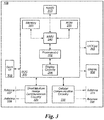
- FIG. 3 illustrates an example simplified block diagram of a communication device 106, according to some embodiments. It is noted that the block diagram of the communication device of FIG. 3 is only one example of a possible communication device.
- communication device 106 may be a user equipment (UE) device, a mobile device or mobile station, a wireless device or wireless station, a desktop computer or computing device, a mobile computing device (e.g., a laptop, notebook, or portable computing device), a tablet and/or a combination of devices, among other devices.
- the communication device 106 may include a set of components 300 configured to perform core functions.
- this set of components may be implemented as a system on chip (SOC), which may include portions for various purposes.
- SOC system on chip
- this set of components 300 may be implemented as separate components or groups of components for the various purposes.
- the set of components 300 may be coupled (e.g., communicatively; directly or indirectly) to various other circuits of the communication device 106.
- the cellular communication circuitry 330 may couple (e.g., communicatively; directly or indirectly) to one or more antennas, such as antennas 335 and 336 as shown.
- the short to medium range wireless communication circuitry 329 may also couple (e.g., communicatively; directly or indirectly) to one or more antennas, such as antennas 337 and 338 as shown.
- the short to medium range wireless communication circuitry 329 may couple (e.g., communicatively; directly or indirectly) to the antennas 335 and 336 in addition to, or instead of, coupling (e.g., communicatively; directly or indirectly) to the antennas 337 and 338.
- the short to medium range wireless communication circuitry 329 and/or cellular communication circuitry 330 may include multiple receive chains and/or multiple transmit chains for receiving and/or transmitting multiple spatial streams, such as in a multiple-input multiple output (MIMO) configuration.
- MIMO multiple-input multiple output
- cellular communication circuitry 330 may include dedicated receive chains (including and/or coupled to, e.g., communicatively; directly or indirectly. dedicated processors and/or radios) for multiple radio access technologies (RATs) (e.g., a first receive chain for LTE and a second receive chain for 5G NR).
- RATs radio access technologies
- cellular communication circuitry 330 may include a single transmit chain that may be switched between radios dedicated to specific RATs.
- a first radio may be dedicated to a first RAT, e.g., LTE, and may be in communication with a dedicated receive chain and a transmit chain shared with an additional radio, e.g., a second radio that may be dedicated to a second RAT, e.g., 5G NR, and may be in communication with a dedicated receive chain and the shared transmit chain.
- a first RAT e.g., LTE
- a second radio may be dedicated to a second RAT, e.g., 5G NR, and may be in communication with a dedicated receive chain and the shared transmit chain.
- the SOC 300 may include processor(s) 302, which may execute program instructions for the communication device 106 and display circuitry 304, which may perform graphics processing and provide display signals to the display 360.
- the processor(s) 302 may also be coupled to memory management unit (MMU) 340, which may be configured to receive addresses from the processor(s) 302 and translate those addresses to locations in memory (e.g., memory 306, read only memory (ROM) 350, NAND flash memory 310) and/or to other circuits or devices, such as the display circuitry 304, short range wireless communication circuitry 229, cellular communication circuitry 330, connector I/F 320, and/or display 360.
- the MMU 340 may be configured to perform memory protection and page table translation or set up. In some embodiments, the MMU 340 may be included as a portion of the processor(s) 302.
- the communication device 106 may be configured to communicate using wireless and/or wired communication circuitry.
- the communication device 106 may include hardware and software components for implementing the above features for enabling UE to perform L1-RSRP measurements for beam reporting during SCell activation when the UE does not have precise (and reliable) TCI information available and provides that alternative information as part of the L1-RSRP reporting during SCell activation, as well as the various other techniques described herein.
- the processor 302 of the communication device 106 may be configured to implement part or all of the features described herein, e.g., by executing program instructions stored on a memory medium (e.g., a non-transitory computer-readable memory medium).
- processor 302 may be configured as a programmable hardware element, such as an FPGA (Field Programmable Gate Array), or as an ASIC (Application Specific Integrated Circuit).
- processor 302 of the communication device 106 in conjunction with one or more of the other components 300, 304, 306, 310, 320, 329, 330, 340, 345, 350, 360 may be configured to implement part or all of the features described herein.
- processor 302 may include one or more processing elements.
- processor 302 may include one or more integrated circuits (ICs) that are configured to perform the functions of processor 302.
- each integrated circuit may include circuitry (e.g., first circuitry, second circuitry, etc.) configured to perform the functions of processor(s) 302.
- cellular communication circuitry 330 and short-range wireless communication circuitry 329 may each include one or more processing elements.
- one or more processing elements may be included in cellular communication circuitry 330 and, similarly, one or more processing elements may be included in short range wireless communication circuitry 329.
- cellular communication circuitry 330 may include one or more integrated circuits (ICs) that are configured to perform the functions of cellular communication circuitry 330.
- each integrated circuit may include circuitry (e.g., first circuitry, second circuitry, etc.) configured to perform the functions of cellular communication circuitry 230.
- the short-range wireless communication circuitry 329 may include one or more ICs that are configured to perform the functions of short-range wireless communication circuitry 32.
- each integrated circuit may include circuitry (e.g., first circuitry, second circuitry, etc.) configured to perform the functions of short-range wireless communication circuitry 329.
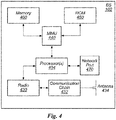
- the base station 102 may include at least one network port 470.
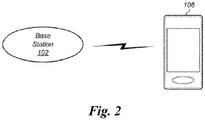
- the network port 470 may be configured to couple to a telephone network and provide a plurality of devices, such as UE devices 106, access to the telephone network as described above in FIGS. 1 and 2 .
- the network port 470 may also or alternatively be configured to couple to a cellular network, e.g., a core network of a cellular service provider.
- the core network may provide mobility related services and/or other services to a plurality of devices, such as UE devices 106.
- the network port 470 may couple to a telephone network via the core network, and/or the core network may provide a telephone network (e.g., among other UE devices serviced by the cellular service provider).
- base station 102 may be a next generation base station, e.g., a 5G New Radio (5G NR) base station, or "gNB".
- base station 102 may be connected to a legacy evolved packet core (EPC) network and/or to a NR core (NRC) network.
- EPC legacy evolved packet core
- NRC NR core
- base station 102 may be considered a 5G NR cell and may include one or more transition and reception points (TRPs).
- TRPs transition and reception points
- a UE capable of operating according to 5G NR may be connected to one or more TRPs within one or more gNBs.
- the base station 102 may include at least one antenna 434, and possibly multiple antennas.
- the at least one antenna 434 may be configured to operate as a wireless transceiver and may be further configured to communicate with UE devices 106 via radio 430.
- the antenna 434 communicates with the radio 430 via communication chain 432.
- Communication chain 432 may be a receive chain, a transmit chain or both.
- the radio 430 may be configured to communicate via various wireless communication standards, including, but not limited to, 5G NR, LTE, LTE-A, GSM, UMTS, CDMA2000, Wi-Fi, etc.
- the base station 102 may be configured to communicate wirelessly using multiple wireless communication standards.
- the base station 102 may include multiple radios, which may enable the base station 102 to communicate according to multiple wireless communication technologies.
- the base station 102 may include an LTE radio for performing communication according to LTE as well as a 5G NR radio for performing communication according to 5G NR.
- the base station 102 may be capable of operating as both an LTE base station and a 5G NR base station.
- the base station 102 may include a multi-mode radio which is capable of performing communications according to any of multiple wireless communication technologies (e.g., 5G NR and Wi-Fi, LTE and Wi-Fi, LTE and UMTS, LTE and CDMA2000, UMTS and GSM, etc.).
- multiple wireless communication technologies e.g., 5G NR and Wi-Fi, LTE and Wi-Fi, LTE and UMTS, LTE and CDMA2000, UMTS and GSM, etc.
- processor(s) 404 may be comprised of one or more processing elements. In other words, one or more processing elements may be included in processor(s) 404. Thus, processor(s) 404 may include one or more integrated circuits (ICs) that are configured to perform the functions of processor(s) 404. In addition, each integrated circuit may include circuitry (e.g., first circuitry, second circuitry, etc.) configured to perform the functions of processor(s) 404.
- circuitry e.g., first circuitry, second circuitry, etc.
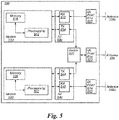
- FIG. 5 Block Diagram of Cellular Communication Circuitry
- Modem 510 may be configured for communications according to a first RAT, e.g., such as LTE or LTE-A, and modem 520 may be configured for communications according to a second RAT, e.g., such as 5G NR.
- a first RAT e.g., such as LTE or LTE-A
- modem 520 may be configured for communications according to a second RAT, e.g., such as 5G NR.
- modem 510 may include one or more processors 512 and a memory 516 in communication with processors 512. Modem 510 may be in communication with a radio frequency (RF) front end 530.
- RF front end 530 may include circuitry for transmitting and receiving radio signals.
- RF front end 530 may include receive circuitry (RX) 532 and transmit circuitry (TX) 534.
- receive circuitry 532 may be in communication with downlink (DL) front end 550, which may include circuitry for receiving radio signals via antenna 335a.
- DL downlink
- modem 520 may include one or more processors 522 and a memory 526 in communication with processors 522. Modem 520 may be in communication with an RF front end 540.
- RF front end 540 may include circuitry for transmitting and receiving radio signals.
- RF front end 540 may include receive circuitry 542 and transmit circuitry 544.
- receive circuitry 542 may be in communication with DL front end 560, which may include circuitry for receiving radio signals via antenna 335b.
- switch 570 may be switched to a second state that allows modem 520 to transmit signals according to the second RAT (e.g., via a transmit chain that includes transmit circuitry 544 and UL front end 572).
- the modem 510 may include hardware and software components for implementing the above features or for enabling UE to perform L1 -RSRP measurements for beam reporting during SCell activation when the UE does not have precise (and reliable) TCI information available and provides that alternative information as part of the L1-RSRP reporting during SCell activation, as well as the various other techniques described herein.
- the processors 512 may be configured to implement part or all of the features described herein, e.g., by executing program instructions stored on a memory medium (e.g., a non-transitory computer-readable memory medium).
- processors 522 may include one or more processing elements.
- processors 522 may include one or more integrated circuits (ICs) that are configured to perform the functions of processors 522.
- each integrated circuit may include circuitry (e.g., first circuitry, second circuitry, etc.) configured to perform the functions of processors 522.
- SCell activation and deactivation are used to activate or deactivate, respectively, data transmission between a UE and a SCell. In some embodiments, this occurs while the SCell is in carrier aggregation. Note that this occurs in one or more wireless standards including, for example, 5G NR.
- the carrier aggregation is set up by a Radio Resource Control (RRC) process, and after the RRC process has finished, the data transmission is switched on/off by the UE to facilitate activation/deactivation of the SCell.
- RRC Radio Resource Control
- the time to complete the SCell activation is based on a number of different factors and the SCell activation may be delayed for one or more reasons.
- T activation_ time may be represented as: 8 ms + 24 * T rs + T uncertainty_MAC + T L 1 ⁇ RSRP , measure + T L 1 ⁇ RSRP , report + T HARQ + T FineTiming and if the target SCell is unknown to UE and periodic CSI-RS is used for CSI reporting, provided that the side condition ⁇ s/Iot ⁇ [-2]dB is fulfilled, then T activation_time is: 3 ms + 24 * T rs + T L 1 ⁇ RSRP , mreasure + T L 1 ⁇ RSRP , report + max T HARQ + T uncertainty_MAC + 5 ms + T FineTiming T uncertainty_RRC + T RRC_delay , where
- the TCI information for L1-RSRP RS may be unknown to the UE. If that occurs, the network may not configure any TCI information for L1-RSRP RS before the SCell activation begins or the network may configure TCI information for L1-RSRP RS before the SCell activation begins, but that TCI-related measurement was long time ago and now is out of date. In these cases, the UE needs to obtain the TCI for L1-RSRP after cell synchronization. This problem may be better understood by explaining a SCell activation process.
- FIG. 6 is a data flow diagram of a SCell activation process according to some embodiments.
- the activation process occurs after the SCell has been added to the UE.
- the SCell activation process begins by the UE receiving a MAC control element (CE) command in a message from the network to activate an SCell (processing block 601) and decodes the message to determine that a targeted SCell is to be activated (processing block 602).
- CE MAC control element
- the UE After decoding the message, the UE begins the process of activating the SCell by tuning (or retuning) its RF to the new SCell (processing block 603).
- the tuning operation ensures that the UE's RF filter covers the new SCell.
- the UE performs SCell synchronization.
- SCell synchronization the UE synchronizes with the target SCell to obtain timing information needed for communication (processing block 604). In some embodiments, this timing information comprises frame boundary and symbol boundary information.
- the UE After synching to the SCell, the UE performs L1-RSRP measurements that can be used by the network to identify the best beam pair to use to enable to support channel state information (CSI) reporting for the UE (processing block 605).
- CSI channel state information
- this process assumes that the UE has been configured with the TCI information that provides beam information that the UE uses for the measurements. Without precise TCI information, the UE cannot perform reliable L1-RSRP measurements and thus makes any reporting of such measurements unreliable.
- the UE does not have reliable TCI information if the SCell being activated, referred to herein as the target SCell, belongs to FR2 and if there is not active serving cell on that FR2 band provided that PCell or PSCell is FR1.
- the UE also does not have reliable TCI information if the target SCell is unknown to the UE and either semi-persistent CSI-RS or periodic CSI-RS is used for CSI reporting.
- the UE After the UE has completed the measurements, the UE sends a L1-RSRP measurement report to the network (processing block 606).
- this report includes the measurements of all SSBs for which the UE made measurements.
- the network knows the reference signal that is best to use as it indicates the SS block with the highest response for the UE.
- the report specifies information (e.g., an index) identifying the best SS block based on the measured RSRP for the particular SS block. Using this information, the network can determine the transmit (Tx) beam that the network should use to transmit the CSI, as well as the SS block, to the UE.
- Tx transmit
- the L1-RSRP measurement report allows the UE and the network to know the best receive and transmit pair to use for the link between the UE and the SCell.
- the UE After decoding and beginning the execution of the commands for activating the channel TCI and the CSI-RS, the UE performs fine time tracking (processing block 610). In some embodiments, the fine time tracking performs time frequency checking to obtain a timing frequency offset of the target reference signal.
- the UE because the UE does not have precise TCI information, the UE cannot perform a reliable L1 -RSRP measurements for beam reporting, thereby making the L1 -RSRP report from the UE unreliable.
- the UE uses alternative information as a replacement to L1-RSRP measurements when precise (and reliable) TCI information is not available and provides that alternative information as part of the L1-RSRP reporting during SCell activation.
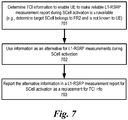
- FIG. 7 is a flow diagram of a process for using alternative information in the L1-RSRP reporting during SCell activation.
- the process includes determining, during secondary cell (SCell) activation, that beam information to enable a user equipment (UE) to make a reliable L1 -RSRP measurement is unavailable (processing block 701).
- the beam information that is not available is reliable TCI information (e.g., TCI information of a certain quality level to make a reliable L1-RSRP measurement report).
- alternative information in used by the UE for the L1-RSRP measurements during SCell activation (processing block 702). In some embodiments, this information is obtained after SCell synchronization.
- the UE reports the alternative information in a L1 -RSRP measurement report for the SCell activation as a replacement when the beam information to enable the UE to make a reliable L1-RSRP measurement is unavailable (processing block 703).
- the beam information to enable the UE to make the reliable L1-RSRP measurement report is unavailable when the SCell being activated belongs to Frequency Range 2 (FR2) and that the SCell is unknown to the UE, and in that case the alternative information is provided in the L1-RSRP measurement report as the replacement.
- FR2 Frequency Range 2
- the replacement information comprises information of one or more Synchronization Signal Blocks (SSBs), and the reporting of the alternative information comprises reporting the information of the one or more SSBs as the replacement.
- the alternative information comprise L1-RSRP measurements based on L3 SSB measurement information, and the reporting of the alternative information comprises reporting L1 -RSRP measurements based on L3 SSB measurement information as the replacement.
- the alternative information is related to preconfigured TCI information for L1-RSRP that is preconfigured by a network as part of the SCell activation process, and the preconfigured TCI information is used for L1-RSRP measurements.
- the UE uses only SSBs to perform the L1 -RSRP measurement during the current SCell activation.
- these SSBs are the ones used for SCell synchronization in the current SCell activation.
- FIG. 8 is a data flow diagram of some embodiments of a SCell activation process that uses detectable SSBs detected for the L1-RSRP measurement report when reliable beam information (e.g., TCI information) is not available for L1-RSRP measurements.
- reliable beam information e.g., TCI information
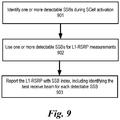
- the UE identifies detectable SSBs (processing block 801).
- the UE uses the SSBs that are detected for the L1-RSRPmeasurement for beam pair refinement. Thereafter, the UE reports the L1-RSRP measurements for the SSBs (processing block 801). In some embodiments, one or more SSBs that were not detected will still have a measurement reported. In some embodiments, the measurement is reported as zero or some other information is provided to indicate that the beams associated with the SSB should not be used for communication between the UE and the target SCell. In some embodiments, the L1-RSRP report identifies the best receive beam for each detectable SSB reception.
- FIG. 9 is a flow diagram of the process of using detectable SSBs that are detected for the L1-RSRP measurement in the SCell activation process when reliable beam information (e.g., TCI information) is not available for L1-RSRP measurements during SCell activation.
- reliable beam information e.g., TCI information
- the UE uses L1-RSRP RS TCI that is based on the layer three (L3) SSB measurements.
- FIG. 10 is a data flow diagram of some embodiments of a SCell activation process that uses L3 SSB measurements made during SCell activation to create TCI that is used for L1 -RSRP when reliable beam information (e.g., TCI information) is not available for L1-RSRP measurements during SCell activation.
- the process of FIG. 10 is the same as that of FIG. 6 except where as shown and discussed herein.
- the SCell activation process includes additional operations to provide SSB measurement results to the network that are used by the network to determine the proper TCI for the L1 -RSRP RS measurements. More specifically, after SCell synchronization, the UE performs a process to perform L3 SSB measurements and reports the results to the network (processing block 1001). As part of the L3 SSB measurement, the UE measures the detected SSBs in the SCell synchronization step and reports the measurement results with an SSB index to the network. In some embodiments, this measurement is requested by network.
- the UE waits for the network to configure or otherwise activate the TCI that enables the UE to perform L1-RSRP measurements and L1 - RSRP measurement reporting to the network.
- the network configures or activates proper TCI for L1 -RSRP RS based on the SSB measurement (processing block 1002).
- the L1-RSRP RS is a QCL type D with certain SSBs.
- FIG. 11 is a flow diagram of the process of using L3 SSB measurement and reporting for configuring the UE with TCI during SCell activation to enable the UE to perform L1-RSRP measurement and reporting during the SCell activation process when reliable beam information (e.g., TCI information) is not available for L1-RSRP measurements during SCell activation.
- reliable beam information e.g., TCI information
- the network preconfigures TCIs for each L1-RSRP RS (processing block 1201). In some embodiments, the network preconfigures TCIs for each L1-RSRP RS where the number of L1-RSRP RS is not less than the number of SSBs transmitted in that SCell. Thus, if there is a predetermined number of SSBs (e.g., greater than zero) transmitted in that SCell, then the network configure at least that same number of L1-RSRP RSs. In some embodiments, each of those L1-RSRP RS is a QCL type D with one SSB.
- FIG. 13 is a flow diagram of the process of pre-configuring a UE with beam information (e.g., TCI information) during SCell activation for the UE to perform L1-RSRP measurement and reporting during the SCell activation process when reliable beam information (e.g., TCI information) is not available for L1-RSRP measurements during SCell activation.
- beam information e.g., TCI information
- Portions of what was described above may be implemented with logic circuitry such as a dedicated logic circuit or with a microcontroller or other form of processing core that executes program code instructions.
- logic circuitry such as a dedicated logic circuit or with a microcontroller or other form of processing core that executes program code instructions.
- program code such as machine-executable instructions that cause a machine that executes these instructions to perform certain functions.
- the present invention also relates to an apparatus for performing the operations described herein.
- This apparatus may be specially constructed for the required purpose, or it may comprise a general-purpose computer selectively activated or reconfigured by a computer program stored in the computer.
- a computer program may be stored in a computer readable storage medium, such as, but is not limited to, any type of disk including floppy disks, optical disks, CD-ROMs, and magnetic-optical disks, read-only memories (ROMs), RAMs, EPROMs, EEPROMs, magnetic or optical cards, or any type of media suitable for storing electronic instructions, and each coupled to a computer system bus.
- a machine-readable medium includes any mechanism for storing or transmitting information in a form readable by a machine (e.g., a computer).
- a machine-readable medium includes read only memory ("ROM'); random access memory (“RAM”); magnetic disk storage media; optical storage media; flash memory devices; etc.
- An article of manufacture may be used to store program code.
- An article of manufacture that stores program code may be embodied as, but is not limited to, one or more memories (e.g., one or more flash memories, random access memories (static, dynamic or other)), optical disks, CD-ROMs, DVD ROMs, EPROMs, EEPROMs, magnetic or optical cards or other type of machine-readable media suitable for storing electronic instructions.
- Program code may also be downloaded from a remote computer (e.g., a server) to a requesting computer (e.g., a client) by way of data signals embodied in a propagation medium (e.g., via a communication link (e.g., a network connection)).
- personally identifiable information should follow privacy policies and practices that are generally recognized as meeting or exceeding industry or governmental requirements for maintaining the privacy of users.
- personally identifiable information data should be managed and handled so as to minimize risks of unintentional or unauthorized access or use, and the nature of authorized use should be clearly indicated to users.
Landscapes
- Engineering & Computer Science (AREA)
- Signal Processing (AREA)
- Computer Networks & Wireless Communication (AREA)
- Quality & Reliability (AREA)
- Physics & Mathematics (AREA)
- Electromagnetism (AREA)
- Mobile Radio Communication Systems (AREA)
Priority Applications (1)
| Application Number | Priority Date | Filing Date | Title |
|---|---|---|---|
| EP23194730.0A EP4258589A3 (de) | 2020-04-08 | 2021-03-24 | Erfassungsmechanismus für übertragungskonfigurationsindikator (tci) zur sekundärzellenaktivierung eines frequenzbereichs 2 |
Applications Claiming Priority (2)
| Application Number | Priority Date | Filing Date | Title |
|---|---|---|---|
| US202063007234P | 2020-04-08 | 2020-04-08 | |
| US17/184,043 US11671992B2 (en) | 2020-04-08 | 2021-02-24 | Transmission configuration indicator (TCI) acquisition mechanism for secondary cell activation of a frequency range 2 (FR2) unknown cell |
Related Child Applications (2)
| Application Number | Title | Priority Date | Filing Date |
|---|---|---|---|
| EP23194730.0A Division EP4258589A3 (de) | 2020-04-08 | 2021-03-24 | Erfassungsmechanismus für übertragungskonfigurationsindikator (tci) zur sekundärzellenaktivierung eines frequenzbereichs 2 |
| EP23194730.0A Division-Into EP4258589A3 (de) | 2020-04-08 | 2021-03-24 | Erfassungsmechanismus für übertragungskonfigurationsindikator (tci) zur sekundärzellenaktivierung eines frequenzbereichs 2 |
Publications (2)
| Publication Number | Publication Date |
|---|---|
| EP3893545A1 true EP3893545A1 (de) | 2021-10-13 |
| EP3893545B1 EP3893545B1 (de) | 2025-09-03 |
Family
ID=75223078
Family Applications (2)
| Application Number | Title | Priority Date | Filing Date |
|---|---|---|---|
| EP21164716.9A Active EP3893545B1 (de) | 2020-04-08 | 2021-03-24 | Tci-erfassungsmechanismus für aktivierung einer unbekannten sekündärzelle die an einem fr2-band arbeit |
| EP23194730.0A Pending EP4258589A3 (de) | 2020-04-08 | 2021-03-24 | Erfassungsmechanismus für übertragungskonfigurationsindikator (tci) zur sekundärzellenaktivierung eines frequenzbereichs 2 |
Family Applications After (1)
| Application Number | Title | Priority Date | Filing Date |
|---|---|---|---|
| EP23194730.0A Pending EP4258589A3 (de) | 2020-04-08 | 2021-03-24 | Erfassungsmechanismus für übertragungskonfigurationsindikator (tci) zur sekundärzellenaktivierung eines frequenzbereichs 2 |
Country Status (3)
| Country | Link |
|---|---|
| US (3) | US11671992B2 (de) |
| EP (2) | EP3893545B1 (de) |
| CN (2) | CN113498105B (de) |
Cited By (3)
| Publication number | Priority date | Publication date | Assignee | Title |
|---|---|---|---|---|
| WO2024031451A1 (en) * | 2022-08-10 | 2024-02-15 | Nokia Shanghai Bell Co., Ltd. | Reducing cell activation delay |
| WO2024186541A1 (en) * | 2023-03-03 | 2024-09-12 | Apple Inc. | Measurement reporting for secondary cell activation |
| WO2025065393A1 (en) * | 2023-09-27 | 2025-04-03 | Nokia Shanghai Bell Co., Ltd. | Reporting delay for cell activation |
Families Citing this family (10)
| Publication number | Priority date | Publication date | Assignee | Title |
|---|---|---|---|---|
| CN109391986B (zh) * | 2017-08-11 | 2021-10-01 | 华为技术有限公司 | 一种辅小区激活方法、接入网设备、通信装置以及系统 |
| US11653413B2 (en) | 2020-02-12 | 2023-05-16 | Mediatek Singapore Pte. Ltd. | Secondary cell activation in new radio system |
| US11671992B2 (en) * | 2020-04-08 | 2023-06-06 | Apple, Inc | Transmission configuration indicator (TCI) acquisition mechanism for secondary cell activation of a frequency range 2 (FR2) unknown cell |
| US20230043826A1 (en) * | 2021-08-04 | 2023-02-09 | Qualcomm Incorporated | Periodic reference signal (rs) and rs availability indication signaling for fast activation of secondary cells |
| EP4213406B1 (de) | 2022-01-18 | 2025-10-22 | Nokia Technologies Oy | Verbesserte aktivierung von primärsekundärzellen-gruppenzellen (pscell) |
| EP4544815A4 (de) * | 2022-08-04 | 2025-07-09 | Apple Inc | Entwurf eines handshake-mechanismus bei der aktivierung von fr2-s-zellen |
| US20260089489A1 (en) * | 2022-09-14 | 2026-03-26 | Beijing Xiaomi Mobile Software Co., Ltd. | Method and apparatus for transmitting configuration information, and readable storage medium |
| KR20250081902A (ko) * | 2022-09-30 | 2025-06-05 | 노키아 테크놀로지스 오와이 | 비주기적 참조 신호 기반 보조 셀 활성화 |
| CN120937416A (zh) * | 2023-04-06 | 2025-11-11 | 苹果公司 | 有条件层1(l1)测量 |
| WO2025073111A1 (en) * | 2023-10-07 | 2025-04-10 | Nokia Shanghai Bell Co., Ltd. | Cell activation |
Citations (1)
| Publication number | Priority date | Publication date | Assignee | Title |
|---|---|---|---|---|
| US20200107337A1 (en) * | 2018-09-28 | 2020-04-02 | Mediatek Inc. | Measurement for Layer-1 Reference Signal Received Power (L1-RSRP) |
Family Cites Families (28)
| Publication number | Priority date | Publication date | Assignee | Title |
|---|---|---|---|---|
| US11224024B2 (en) * | 2017-02-13 | 2022-01-11 | Telefonaktiebolaget Lm Ericsson (Publ) | Methods for controlling UE synchronization and cell identification in NR |
| US11121754B2 (en) * | 2017-05-14 | 2021-09-14 | Lg Electronics Inc. | Method for measuring and reporting channel state information in wireless communication system and device for same |
| CN110392991B (zh) * | 2017-06-16 | 2021-10-26 | Lg电子株式会社 | 测量同步信号块的方法及其装置 |
| JP7146915B2 (ja) * | 2017-11-14 | 2022-10-04 | 鴻穎創新有限公司 | 複数のコンポーネントキャリアを用いたネットワークアシスト伝送のための方法、デバイスおよびシステム |
| MY194360A (en) * | 2017-11-24 | 2022-11-29 | Lg Electronics Inc | Method for reporting channel state information in wireless communication system and apparatus for the same |
| US10772151B2 (en) * | 2018-01-05 | 2020-09-08 | Ofinno, Llc | Beam management in discontinuous reception |
| US10567145B2 (en) * | 2018-01-05 | 2020-02-18 | Ofinno, Llc | Beam reports with multiple cells |
| EP3586469B1 (de) * | 2018-01-09 | 2020-12-02 | Ofinno, LLC | Physical- und mac-schicht-verfahren in einer drahtlosen vorrichtung |
| US11533767B2 (en) * | 2018-02-19 | 2022-12-20 | Telefonaktiebolaget Lm Ericsson (Publ) | Activation of secondary cells for carrier aggregation and dual connectivity |
| US11038643B2 (en) * | 2018-02-27 | 2021-06-15 | Qualcomm Incorporated | Beam reporting for active beams |
| CN110300433B (zh) | 2018-03-22 | 2022-03-01 | 华硕电脑股份有限公司 | 无线通信中的物理下行链路控制信道监测的方法和设备 |
| EP3557778B1 (de) * | 2018-04-02 | 2022-11-16 | Comcast Cable Communications LLC | Strahlausfallwiederherstellung |
| US11569889B2 (en) * | 2018-04-05 | 2023-01-31 | Nokia Technologies Oy | User equipment receiver spatial filter configuration during secondary cell beam failure recovery |
| KR102501029B1 (ko) * | 2018-05-10 | 2023-02-16 | 노키아 테크놀로지스 오와이 | 2 차 셀 빔 복구 |
| US10986622B2 (en) * | 2018-05-10 | 2021-04-20 | Apple Inc. | User equipment (UE) downlink transmission configuration indication (TCI)-state selection |
| US10925116B2 (en) * | 2018-06-26 | 2021-02-16 | Apple Inc. | Beam indication for semi-persistent and grant-free transmissions |
| CN114760021B (zh) * | 2018-09-27 | 2024-11-05 | 北京小米移动软件有限公司 | 测量配置方法、装置、设备、系统及存储介质 |
| CN112740578B (zh) * | 2018-09-28 | 2023-02-28 | 苹果公司 | 基于l1-rsrp的波束报告的测量周期和精度的系统和方法 |
| JP7238107B2 (ja) * | 2019-05-02 | 2023-03-13 | 株式会社Nttドコモ | 端末、無線通信方法及びシステム |
| US11337226B2 (en) * | 2019-08-28 | 2022-05-17 | Samsung Electronics Co., Ltd. | Method and apparatus of receive beam management at terminal |
| JP7369859B2 (ja) * | 2019-10-04 | 2023-10-26 | テレフオンアクチーボラゲット エルエム エリクソン(パブル) | ニューラジオ無線周波数範囲におけるセカンダリセルのアクティベーション |
| CN112788754B (zh) * | 2019-11-07 | 2022-08-02 | 维沃移动通信有限公司 | 信息传输方法及设备 |
| CN113141659B (zh) * | 2020-01-20 | 2023-01-13 | 中国移动通信有限公司研究院 | 波束管理的方法及设备 |
| US11653413B2 (en) * | 2020-02-12 | 2023-05-16 | Mediatek Singapore Pte. Ltd. | Secondary cell activation in new radio system |
| CN115191094B (zh) * | 2020-03-17 | 2025-04-04 | 华为技术有限公司 | 通信方法、装置及设备 |
| US11671992B2 (en) * | 2020-04-08 | 2023-06-06 | Apple, Inc | Transmission configuration indicator (TCI) acquisition mechanism for secondary cell activation of a frequency range 2 (FR2) unknown cell |
| US20240171997A1 (en) * | 2021-04-26 | 2024-05-23 | Nokia Technologies Oy | Mechanism for delivering beam information |
| CN115606228B (zh) * | 2021-05-11 | 2026-03-17 | 苹果公司 | 针对pucch辅小区激活的波束信息报告 |
-
2021
- 2021-02-24 US US17/184,043 patent/US11671992B2/en active Active
- 2021-03-24 EP EP21164716.9A patent/EP3893545B1/de active Active
- 2021-03-24 EP EP23194730.0A patent/EP4258589A3/de active Pending
- 2021-04-01 CN CN202110356661.8A patent/CN113498105B/zh active Active
- 2021-04-01 CN CN202311128142.1A patent/CN117042033A/zh active Pending
-
2023
- 2023-05-03 US US18/142,914 patent/US12150153B2/en active Active
-
2024
- 2024-11-18 US US18/951,362 patent/US20250227743A1/en active Pending
Patent Citations (1)
| Publication number | Priority date | Publication date | Assignee | Title |
|---|---|---|---|---|
| US20200107337A1 (en) * | 2018-09-28 | 2020-04-02 | Mediatek Inc. | Measurement for Layer-1 Reference Signal Received Power (L1-RSRP) |
Non-Patent Citations (4)
| Title |
|---|
| ERICSSON: "On L1-RSRP reporting and TCI state activation at SCell activation", vol. RAN WG4, no. Reno, Nevada, US; 20190513 - 20190517, 13 May 2019 (2019-05-13), XP051733748, Retrieved from the Internet <URL:http://www.3gpp.org/ftp/Meetings%5F3GPP%5FSYNC/RAN4/Docs/R4%2D1906888%2Ezip> [retrieved on 20190513] * |
| INTEL CORPORATION: "Discussion on SCell activation delay in FR2", vol. RAN WG4, no. Reno, US; 20190513 - 20190517, 3 May 2019 (2019-05-03), XP051715831, Retrieved from the Internet <URL:http://www.3gpp.org/ftp/tsg%5Fran/WG4%5FRadio/TSGR4%5F91/Docs/R4%2D1905761%2Ezip> [retrieved on 20190503] * |
| NEC: "SCell activation delay in FR2 band", vol. RAN WG4, no. Xi'an, China; 20190408 - 20190412, 1 April 2019 (2019-04-01), XP051714028, Retrieved from the Internet <URL:http://www.3gpp.org/ftp/tsg%5Fran/WG4%5FRadio/TSGR4%5F90Bis/Docs/R4%2D1903622%2Ezip> [retrieved on 20190401] * |
| QUALCOMM INCORPORATED: "Discussion on SCell Activation Timeline in FR2", vol. RAN WG4, no. Reno, USA; 20190513 - 20190517, 13 May 2019 (2019-05-13), XP051733829, Retrieved from the Internet <URL:http://www.3gpp.org/ftp/Meetings%5F3GPP%5FSYNC/RAN4/Docs/R4%2D1906985%2Ezip> [retrieved on 20190513] * |
Cited By (6)
| Publication number | Priority date | Publication date | Assignee | Title |
|---|---|---|---|---|
| WO2024031451A1 (en) * | 2022-08-10 | 2024-02-15 | Nokia Shanghai Bell Co., Ltd. | Reducing cell activation delay |
| AU2022473674B2 (en) * | 2022-08-10 | 2026-01-15 | Nokia Technologies Oy | Reducing cell activation delay |
| EP4569756A4 (de) * | 2022-08-10 | 2026-04-22 | Nokia Shanghai Bell Co Ltd | Verringerung der zellenaktivierungsverzögerung |
| WO2024186541A1 (en) * | 2023-03-03 | 2024-09-12 | Apple Inc. | Measurement reporting for secondary cell activation |
| WO2025065393A1 (en) * | 2023-09-27 | 2025-04-03 | Nokia Shanghai Bell Co., Ltd. | Reporting delay for cell activation |
| US12538160B2 (en) | 2023-09-27 | 2026-01-27 | Nokia Technologies Oy | Reporting delay for cell activation |
Also Published As
| Publication number | Publication date |
|---|---|
| US20210321405A1 (en) | 2021-10-14 |
| US20230269763A1 (en) | 2023-08-24 |
| EP4258589A3 (de) | 2024-01-17 |
| US20250227743A1 (en) | 2025-07-10 |
| US12150153B2 (en) | 2024-11-19 |
| CN117042033A (zh) | 2023-11-10 |
| CN113498105B (zh) | 2024-06-14 |
| EP4258589A2 (de) | 2023-10-11 |
| EP3893545B1 (de) | 2025-09-03 |
| CN113498105A (zh) | 2021-10-12 |
| US11671992B2 (en) | 2023-06-06 |
Similar Documents
| Publication | Publication Date | Title |
|---|---|---|
| EP3893545B1 (de) | Tci-erfassungsmechanismus für aktivierung einer unbekannten sekündärzelle die an einem fr2-band arbeit | |
| US12506582B2 (en) | Default beams for PDSCH, CSI-RS, PUCCH and SRS | |
| US11843559B2 (en) | Beam failure recovery for user equipment communicating with multiple transmission and reception points | |
| CN116114330B (zh) | 应用非地面网络的时间间隙偏移 | |
| US20240107388A1 (en) | Timing advance in layer 1/layer 2 intercell mobility | |
| US12113737B2 (en) | Technologies for NR coverage enhancement | |
| US12120564B2 (en) | RACH configuration in L1/L2 mobility | |
| CN116158132B (zh) | 扩展非地面网络的时间间隙范围 | |
| WO2022151309A1 (en) | Counting active resources for ue processing complexity related capability | |
| US20230344607A1 (en) | Qcl configuration and dci indication for unified framework | |
| WO2023010406A1 (en) | Method for processing delay for pdcch repetitions | |
| WO2022151235A1 (en) | Methods for pathloss reference signal activation | |
| WO2022205036A1 (en) | Resource counting for reference signals | |
| WO2022027254A1 (en) | Cross-cell beam failure recovery | |
| CN115380589B (zh) | 用于基于无线电资源控制的部分带宽切换的方法和装置 | |
| WO2024229810A1 (en) | Method and apparatus to account for collision between uplink sub-band and synchronization signal block symbols | |
| WO2023130366A1 (en) | User equipment timing advance validation window design for frequency range 2 (fr2) small data transfer (sdt) | |
| WO2023115453A1 (en) | Nr ssb measurements with cca for 60ghz range | |
| WO2024097508A1 (en) | Enhanced uav measurement reports | |
| EP4569755A1 (de) | Verbesserungen von direktzugriffskanalberichten |
Legal Events
| Date | Code | Title | Description |
|---|---|---|---|
| PUAI | Public reference made under article 153(3) epc to a published international application that has entered the european phase |
Free format text: ORIGINAL CODE: 0009012 |
|
| STAA | Information on the status of an ep patent application or granted ep patent |
Free format text: STATUS: REQUEST FOR EXAMINATION WAS MADE |
|
| 17P | Request for examination filed |
Effective date: 20210324 |
|
| AK | Designated contracting states |
Kind code of ref document: A1 Designated state(s): AL AT BE BG CH CY CZ DE DK EE ES FI FR GB GR HR HU IE IS IT LI LT LU LV MC MK MT NL NO PL PT RO RS SE SI SK SM TR |
|
| STAA | Information on the status of an ep patent application or granted ep patent |
Free format text: STATUS: EXAMINATION IS IN PROGRESS |
|
| 17Q | First examination report despatched |
Effective date: 20230503 |
|
| GRAP | Despatch of communication of intention to grant a patent |
Free format text: ORIGINAL CODE: EPIDOSNIGR1 |
|
| STAA | Information on the status of an ep patent application or granted ep patent |
Free format text: STATUS: GRANT OF PATENT IS INTENDED |
|
| RIC1 | Information provided on ipc code assigned before grant |
Ipc: H04L 5/00 20060101ALN20250313BHEP Ipc: H04W 24/10 20090101AFI20250313BHEP |
|
| INTG | Intention to grant announced |
Effective date: 20250331 |
|
| RIC1 | Information provided on ipc code assigned before grant |
Ipc: H04L 5/00 20060101ALN20250324BHEP Ipc: H04W 24/10 20090101AFI20250324BHEP |
|
| GRAS | Grant fee paid |
Free format text: ORIGINAL CODE: EPIDOSNIGR3 |
|
| GRAA | (expected) grant |
Free format text: ORIGINAL CODE: 0009210 |
|
| STAA | Information on the status of an ep patent application or granted ep patent |
Free format text: STATUS: THE PATENT HAS BEEN GRANTED |
|
| AK | Designated contracting states |
Kind code of ref document: B1 Designated state(s): AL AT BE BG CH CY CZ DE DK EE ES FI FR GB GR HR HU IE IS IT LI LT LU LV MC MK MT NL NO PL PT RO RS SE SI SK SM TR |
|
| REG | Reference to a national code |
Ref country code: CH Ref legal event code: EP |
|
| REG | Reference to a national code |
Ref country code: DE Ref legal event code: R096 Ref document number: 602021037539 Country of ref document: DE |
|
| REG | Reference to a national code |
Ref country code: IE Ref legal event code: FG4D |
|
| REG | Reference to a national code |
Ref country code: NL Ref legal event code: MP Effective date: 20250903 |
|
| PG25 | Lapsed in a contracting state [announced via postgrant information from national office to epo] |
Ref country code: NO Free format text: LAPSE BECAUSE OF FAILURE TO SUBMIT A TRANSLATION OF THE DESCRIPTION OR TO PAY THE FEE WITHIN THE PRESCRIBED TIME-LIMIT Effective date: 20251203 |
|
| REG | Reference to a national code |
Ref country code: LT Ref legal event code: MG9D |
|
| PG25 | Lapsed in a contracting state [announced via postgrant information from national office to epo] |
Ref country code: FI Free format text: LAPSE BECAUSE OF FAILURE TO SUBMIT A TRANSLATION OF THE DESCRIPTION OR TO PAY THE FEE WITHIN THE PRESCRIBED TIME-LIMIT Effective date: 20250903 |
|
| PG25 | Lapsed in a contracting state [announced via postgrant information from national office to epo] |
Ref country code: HR Free format text: LAPSE BECAUSE OF FAILURE TO SUBMIT A TRANSLATION OF THE DESCRIPTION OR TO PAY THE FEE WITHIN THE PRESCRIBED TIME-LIMIT Effective date: 20250903 |
|
| PG25 | Lapsed in a contracting state [announced via postgrant information from national office to epo] |
Ref country code: GR Free format text: LAPSE BECAUSE OF FAILURE TO SUBMIT A TRANSLATION OF THE DESCRIPTION OR TO PAY THE FEE WITHIN THE PRESCRIBED TIME-LIMIT Effective date: 20251204 |
|
| PG25 | Lapsed in a contracting state [announced via postgrant information from national office to epo] |
Ref country code: SE Free format text: LAPSE BECAUSE OF FAILURE TO SUBMIT A TRANSLATION OF THE DESCRIPTION OR TO PAY THE FEE WITHIN THE PRESCRIBED TIME-LIMIT Effective date: 20250903 |
|
| PG25 | Lapsed in a contracting state [announced via postgrant information from national office to epo] |
Ref country code: LV Free format text: LAPSE BECAUSE OF FAILURE TO SUBMIT A TRANSLATION OF THE DESCRIPTION OR TO PAY THE FEE WITHIN THE PRESCRIBED TIME-LIMIT Effective date: 20250903 |
|
| PG25 | Lapsed in a contracting state [announced via postgrant information from national office to epo] |
Ref country code: BG Free format text: LAPSE BECAUSE OF FAILURE TO SUBMIT A TRANSLATION OF THE DESCRIPTION OR TO PAY THE FEE WITHIN THE PRESCRIBED TIME-LIMIT Effective date: 20250903 Ref country code: PL Free format text: LAPSE BECAUSE OF FAILURE TO SUBMIT A TRANSLATION OF THE DESCRIPTION OR TO PAY THE FEE WITHIN THE PRESCRIBED TIME-LIMIT Effective date: 20250903 |
|
| PG25 | Lapsed in a contracting state [announced via postgrant information from national office to epo] |
Ref country code: RS Free format text: LAPSE BECAUSE OF FAILURE TO SUBMIT A TRANSLATION OF THE DESCRIPTION OR TO PAY THE FEE WITHIN THE PRESCRIBED TIME-LIMIT Effective date: 20251203 |
|
| PG25 | Lapsed in a contracting state [announced via postgrant information from national office to epo] |
Ref country code: ES Free format text: LAPSE BECAUSE OF FAILURE TO SUBMIT A TRANSLATION OF THE DESCRIPTION OR TO PAY THE FEE WITHIN THE PRESCRIBED TIME-LIMIT Effective date: 20250903 |
|
| REG | Reference to a national code |
Ref country code: AT Ref legal event code: MK05 Ref document number: 1834692 Country of ref document: AT Kind code of ref document: T Effective date: 20250903 |
|
| PG25 | Lapsed in a contracting state [announced via postgrant information from national office to epo] |
Ref country code: NL Free format text: LAPSE BECAUSE OF FAILURE TO SUBMIT A TRANSLATION OF THE DESCRIPTION OR TO PAY THE FEE WITHIN THE PRESCRIBED TIME-LIMIT Effective date: 20250903 |
|
| PG25 | Lapsed in a contracting state [announced via postgrant information from national office to epo] |
Ref country code: SM Free format text: LAPSE BECAUSE OF FAILURE TO SUBMIT A TRANSLATION OF THE DESCRIPTION OR TO PAY THE FEE WITHIN THE PRESCRIBED TIME-LIMIT Effective date: 20250903 |
|
| PGFP | Annual fee paid to national office [announced via postgrant information from national office to epo] |
Ref country code: GB Payment date: 20260316 Year of fee payment: 6 |
|
| PGFP | Annual fee paid to national office [announced via postgrant information from national office to epo] |
Ref country code: DE Payment date: 20260319 Year of fee payment: 6 |
|
| PG25 | Lapsed in a contracting state [announced via postgrant information from national office to epo] |
Ref country code: AT Free format text: LAPSE BECAUSE OF FAILURE TO SUBMIT A TRANSLATION OF THE DESCRIPTION OR TO PAY THE FEE WITHIN THE PRESCRIBED TIME-LIMIT Effective date: 20250903 |
|
| PG25 | Lapsed in a contracting state [announced via postgrant information from national office to epo] |
Ref country code: IT Free format text: LAPSE BECAUSE OF FAILURE TO SUBMIT A TRANSLATION OF THE DESCRIPTION OR TO PAY THE FEE WITHIN THE PRESCRIBED TIME-LIMIT Effective date: 20250903 |
|
| PG25 | Lapsed in a contracting state [announced via postgrant information from national office to epo] |
Ref country code: IS Free format text: LAPSE BECAUSE OF FAILURE TO SUBMIT A TRANSLATION OF THE DESCRIPTION OR TO PAY THE FEE WITHIN THE PRESCRIBED TIME-LIMIT Effective date: 20260103 |
|
| PGFP | Annual fee paid to national office [announced via postgrant information from national office to epo] |
Ref country code: FR Payment date: 20260323 Year of fee payment: 6 |