EP3892602A1 - Method for the preparation of deuterated or tritiated compounds - Google Patents
Method for the preparation of deuterated or tritiated compounds Download PDFInfo
- Publication number
- EP3892602A1 EP3892602A1 EP20168757.1A EP20168757A EP3892602A1 EP 3892602 A1 EP3892602 A1 EP 3892602A1 EP 20168757 A EP20168757 A EP 20168757A EP 3892602 A1 EP3892602 A1 EP 3892602A1
- Authority
- EP
- European Patent Office
- Prior art keywords
- deuterated
- tritiated
- aromatic ring
- aromatic
- solvent
- Prior art date
- Legal status (The legal status is an assumption and is not a legal conclusion. Google has not performed a legal analysis and makes no representation as to the accuracy of the status listed.)
- Pending
Links
- 238000000034 method Methods 0.000 title claims abstract description 127
- 238000002360 preparation method Methods 0.000 title claims abstract description 7
- 150000001875 compounds Chemical class 0.000 title claims description 65
- 125000003118 aryl group Chemical group 0.000 claims abstract description 290
- 239000002904 solvent Substances 0.000 claims abstract description 160
- 229910052805 deuterium Inorganic materials 0.000 claims abstract description 143
- YZCKVEUIGOORGS-OUBTZVSYSA-N Deuterium Chemical compound [2H] YZCKVEUIGOORGS-OUBTZVSYSA-N 0.000 claims abstract description 136
- 239000007858 starting material Substances 0.000 claims abstract description 114
- YZCKVEUIGOORGS-NJFSPNSNSA-N Tritium Chemical compound [3H] YZCKVEUIGOORGS-NJFSPNSNSA-N 0.000 claims abstract description 78
- 125000004435 hydrogen atom Chemical group [H]* 0.000 claims abstract description 64
- 229910052722 tritium Inorganic materials 0.000 claims abstract description 58
- 239000002253 acid Substances 0.000 claims abstract description 49
- 239000000203 mixture Substances 0.000 claims abstract description 40
- OKTJSMMVPCPJKN-UHFFFAOYSA-N Carbon Chemical group [C] OKTJSMMVPCPJKN-UHFFFAOYSA-N 0.000 claims abstract description 34
- 239000007788 liquid Substances 0.000 claims abstract description 31
- XLYOFNOQVPJJNP-UHFFFAOYSA-N water Substances O XLYOFNOQVPJJNP-UHFFFAOYSA-N 0.000 claims abstract description 26
- 125000002837 carbocyclic group Chemical group 0.000 claims abstract description 25
- 150000001491 aromatic compounds Chemical class 0.000 claims abstract description 17
- 238000005533 tritiation Methods 0.000 claims abstract description 11
- 238000012546 transfer Methods 0.000 claims abstract description 7
- -1 heterocycloalkoxy Chemical group 0.000 claims description 416
- 125000001424 substituent group Chemical group 0.000 claims description 117
- 125000000217 alkyl group Chemical group 0.000 claims description 100
- 125000003545 alkoxy group Chemical group 0.000 claims description 86
- 125000001188 haloalkyl group Chemical group 0.000 claims description 81
- 125000004438 haloalkoxy group Chemical group 0.000 claims description 73
- 229910052736 halogen Inorganic materials 0.000 claims description 70
- 150000002367 halogens Chemical class 0.000 claims description 70
- 125000000753 cycloalkyl group Chemical group 0.000 claims description 55
- 125000002887 hydroxy group Chemical group [H]O* 0.000 claims description 43
- 238000006243 chemical reaction Methods 0.000 claims description 40
- 125000001072 heteroaryl group Chemical group 0.000 claims description 39
- 125000002915 carbonyl group Chemical group [*:2]C([*:1])=O 0.000 claims description 23
- 125000003710 aryl alkyl group Chemical group 0.000 claims description 22
- 125000004446 heteroarylalkyl group Chemical group 0.000 claims description 22
- 125000006615 aromatic heterocyclic group Chemical group 0.000 claims description 21
- 125000005842 heteroatom Chemical group 0.000 claims description 21
- LFQSCWFLJHTTHZ-UHFFFAOYSA-N Ethanol Chemical compound CCO LFQSCWFLJHTTHZ-UHFFFAOYSA-N 0.000 claims description 19
- 229910052799 carbon Inorganic materials 0.000 claims description 19
- 150000001721 carbon Chemical group 0.000 claims description 18
- 125000003302 alkenyloxy group Chemical group 0.000 claims description 15
- 125000000000 cycloalkoxy group Chemical group 0.000 claims description 15
- VLTRZXGMWDSKGL-UHFFFAOYSA-N perchloric acid Chemical compound OCl(=O)(=O)=O VLTRZXGMWDSKGL-UHFFFAOYSA-N 0.000 claims description 13
- OKKJLVBELUTLKV-UHFFFAOYSA-N Methanol Chemical compound OC OKKJLVBELUTLKV-UHFFFAOYSA-N 0.000 claims description 12
- 230000001476 alcoholic effect Effects 0.000 claims description 12
- YLQBMQCUIZJEEH-UHFFFAOYSA-N Furan Chemical compound C=1C=COC=1 YLQBMQCUIZJEEH-UHFFFAOYSA-N 0.000 claims description 11
- 125000000592 heterocycloalkyl group Chemical group 0.000 claims description 11
- 125000000449 nitro group Chemical group [O-][N+](*)=O 0.000 claims description 11
- SIKJAQJRHWYJAI-UHFFFAOYSA-N Indole Chemical compound C1=CC=C2NC=CC2=C1 SIKJAQJRHWYJAI-UHFFFAOYSA-N 0.000 claims description 10
- KAESVJOAVNADME-UHFFFAOYSA-N Pyrrole Chemical compound C=1C=CNC=1 KAESVJOAVNADME-UHFFFAOYSA-N 0.000 claims description 10
- 125000002102 aryl alkyloxo group Chemical group 0.000 claims description 9
- 125000004104 aryloxy group Chemical group 0.000 claims description 9
- 125000005553 heteroaryloxy group Chemical group 0.000 claims description 9
- 150000001408 amides Chemical class 0.000 claims description 8
- VEXZGXHMUGYJMC-UHFFFAOYSA-N Hydrochloric acid Chemical compound Cl VEXZGXHMUGYJMC-UHFFFAOYSA-N 0.000 claims description 7
- QAOWNCQODCNURD-UHFFFAOYSA-N Sulfuric acid Chemical compound OS(O)(=O)=O QAOWNCQODCNURD-UHFFFAOYSA-N 0.000 claims description 7
- YTPLMLYBLZKORZ-UHFFFAOYSA-N Thiophene Chemical compound C=1C=CSC=1 YTPLMLYBLZKORZ-UHFFFAOYSA-N 0.000 claims description 6
- 150000001735 carboxylic acids Chemical class 0.000 claims description 6
- DNIAPMSPPWPWGF-GSVOUGTGSA-N (R)-(-)-Propylene glycol Chemical compound C[C@@H](O)CO DNIAPMSPPWPWGF-GSVOUGTGSA-N 0.000 claims description 5
- PZOUSPYUWWUPPK-UHFFFAOYSA-N indole Natural products CC1=CC=CC2=C1C=CN2 PZOUSPYUWWUPPK-UHFFFAOYSA-N 0.000 claims description 5
- RKJUIXBNRJVNHR-UHFFFAOYSA-N indolenine Natural products C1=CC=C2CC=NC2=C1 RKJUIXBNRJVNHR-UHFFFAOYSA-N 0.000 claims description 5
- AFVFQIVMOAPDHO-UHFFFAOYSA-N Methanesulfonic acid Chemical compound CS(O)(=O)=O AFVFQIVMOAPDHO-UHFFFAOYSA-N 0.000 claims description 4
- ZCQWOFVYLHDMMC-UHFFFAOYSA-N Oxazole Chemical compound C1=COC=N1 ZCQWOFVYLHDMMC-UHFFFAOYSA-N 0.000 claims description 4
- FZWLAAWBMGSTSO-UHFFFAOYSA-N Thiazole Chemical compound C1=CSC=N1 FZWLAAWBMGSTSO-UHFFFAOYSA-N 0.000 claims description 4
- 125000004971 nitroalkyl group Chemical group 0.000 claims description 4
- ITMCEJHCFYSIIV-UHFFFAOYSA-N triflic acid Chemical compound OS(=O)(=O)C(F)(F)F ITMCEJHCFYSIIV-UHFFFAOYSA-N 0.000 claims description 4
- BMYNFMYTOJXKLE-UHFFFAOYSA-N 3-azaniumyl-2-hydroxypropanoate Chemical compound NCC(O)C(O)=O BMYNFMYTOJXKLE-UHFFFAOYSA-N 0.000 claims description 3
- 125000001041 indolyl group Chemical group 0.000 claims description 3
- 150000002923 oximes Chemical class 0.000 claims description 3
- 150000002978 peroxides Chemical class 0.000 claims description 3
- 150000003233 pyrroles Chemical group 0.000 claims description 3
- JOXIMZWYDAKGHI-UHFFFAOYSA-N toluene-4-sulfonic acid Chemical compound CC1=CC=C(S(O)(=O)=O)C=C1 JOXIMZWYDAKGHI-UHFFFAOYSA-N 0.000 claims description 3
- 230000035484 reaction time Effects 0.000 claims description 2
- 238000010348 incorporation Methods 0.000 description 62
- OKKJLVBELUTLKV-VMNATFBRSA-N methanol-d1 Chemical compound [2H]OC OKKJLVBELUTLKV-VMNATFBRSA-N 0.000 description 58
- 238000005160 1H NMR spectroscopy Methods 0.000 description 56
- 125000004432 carbon atom Chemical group C* 0.000 description 33
- HEDRZPFGACZZDS-MICDWDOJSA-N Trichloro(2H)methane Chemical compound [2H]C(Cl)(Cl)Cl HEDRZPFGACZZDS-MICDWDOJSA-N 0.000 description 30
- 229910052717 sulfur Inorganic materials 0.000 description 18
- 239000006184 cosolvent Substances 0.000 description 15
- 125000006413 ring segment Chemical group 0.000 description 15
- RAHZWNYVWXNFOC-UHFFFAOYSA-N Sulphur dioxide Chemical compound O=S=O RAHZWNYVWXNFOC-UHFFFAOYSA-N 0.000 description 14
- 229910052757 nitrogen Inorganic materials 0.000 description 14
- 229910052760 oxygen Inorganic materials 0.000 description 14
- 125000004429 atom Chemical group 0.000 description 13
- 239000000126 substance Substances 0.000 description 13
- UHOVQNZJYSORNB-UHFFFAOYSA-N Benzene Chemical compound C1=CC=CC=C1 UHOVQNZJYSORNB-UHFFFAOYSA-N 0.000 description 12
- 125000004093 cyano group Chemical group *C#N 0.000 description 12
- 125000004431 deuterium atom Chemical group 0.000 description 12
- XEKOWRVHYACXOJ-UHFFFAOYSA-N Ethyl acetate Chemical compound CCOC(C)=O XEKOWRVHYACXOJ-UHFFFAOYSA-N 0.000 description 10
- UIIMBOGNXHQVGW-UHFFFAOYSA-M Sodium bicarbonate Chemical compound [Na+].OC([O-])=O UIIMBOGNXHQVGW-UHFFFAOYSA-M 0.000 description 10
- 239000011903 deuterated solvents Substances 0.000 description 10
- YMWUJEATGCHHMB-UHFFFAOYSA-N Dichloromethane Chemical compound ClCCl YMWUJEATGCHHMB-UHFFFAOYSA-N 0.000 description 9
- 125000004453 alkoxycarbonyl group Chemical group 0.000 description 9
- 125000004430 oxygen atom Chemical group O* 0.000 description 9
- 150000003254 radicals Chemical class 0.000 description 9
- LKUDPHPHKOZXCD-UHFFFAOYSA-N 1,3,5-trimethoxybenzene Chemical compound COC1=CC(OC)=CC(OC)=C1 LKUDPHPHKOZXCD-UHFFFAOYSA-N 0.000 description 8
- WEVYAHXRMPXWCK-UHFFFAOYSA-N Acetonitrile Chemical compound CC#N WEVYAHXRMPXWCK-UHFFFAOYSA-N 0.000 description 8
- IJGRMHOSHXDMSA-UHFFFAOYSA-N Atomic nitrogen Chemical compound N#N IJGRMHOSHXDMSA-UHFFFAOYSA-N 0.000 description 8
- 0 COc(c(C(*)=O)c(c(O)c1OC)OC)c1O Chemical compound COc(c(C(*)=O)c(c(O)c1OC)OC)c1O 0.000 description 8
- HEDRZPFGACZZDS-UHFFFAOYSA-N Chloroform Chemical compound ClC(Cl)Cl HEDRZPFGACZZDS-UHFFFAOYSA-N 0.000 description 8
- RTZKZFJDLAIYFH-UHFFFAOYSA-N Diethyl ether Chemical compound CCOCC RTZKZFJDLAIYFH-UHFFFAOYSA-N 0.000 description 8
- 125000005160 aryl oxy alkyl group Chemical group 0.000 description 8
- 125000005326 heteroaryloxy alkyl group Chemical group 0.000 description 8
- 229910052739 hydrogen Inorganic materials 0.000 description 8
- 239000001257 hydrogen Substances 0.000 description 8
- 125000003342 alkenyl group Chemical group 0.000 description 7
- 125000005090 alkenylcarbonyl group Chemical group 0.000 description 7
- 125000005092 alkenyloxycarbonyl group Chemical group 0.000 description 7
- 125000004183 alkoxy alkyl group Chemical group 0.000 description 7
- 125000004448 alkyl carbonyl group Chemical group 0.000 description 7
- 125000005277 alkyl imino group Chemical group 0.000 description 7
- 125000000304 alkynyl group Chemical group 0.000 description 7
- 125000004103 aminoalkyl group Chemical group 0.000 description 7
- 125000005098 aryl alkoxy carbonyl group Chemical group 0.000 description 7
- 125000005099 aryl alkyl carbonyl group Chemical group 0.000 description 7
- 125000005129 aryl carbonyl group Chemical group 0.000 description 7
- 125000005161 aryl oxy carbonyl group Chemical group 0.000 description 7
- 125000006254 cycloalkyl carbonyl group Chemical group 0.000 description 7
- 125000004993 haloalkoxycarbonyl group Chemical group 0.000 description 7
- 125000004692 haloalkylcarbonyl group Chemical group 0.000 description 7
- 125000005223 heteroarylcarbonyl group Chemical group 0.000 description 7
- 125000005226 heteroaryloxycarbonyl group Chemical group 0.000 description 7
- 125000002768 hydroxyalkyl group Chemical group 0.000 description 7
- BDAGIHXWWSANSR-UHFFFAOYSA-N methanoic acid Natural products OC=O BDAGIHXWWSANSR-UHFFFAOYSA-N 0.000 description 7
- 125000000472 sulfonyl group Chemical group *S(*)(=O)=O 0.000 description 7
- 125000004434 sulfur atom Chemical group 0.000 description 7
- QTBSBXVTEAMEQO-UHFFFAOYSA-N Acetic acid Chemical compound CC(O)=O QTBSBXVTEAMEQO-UHFFFAOYSA-N 0.000 description 6
- CSCPPACGZOOCGX-UHFFFAOYSA-N Acetone Chemical compound CC(C)=O CSCPPACGZOOCGX-UHFFFAOYSA-N 0.000 description 6
- XKRFYHLGVUSROY-UHFFFAOYSA-N Argon Chemical compound [Ar] XKRFYHLGVUSROY-UHFFFAOYSA-N 0.000 description 6
- LYCAIKOWRPUZTN-UHFFFAOYSA-N Ethylene glycol Chemical compound OCCO LYCAIKOWRPUZTN-UHFFFAOYSA-N 0.000 description 6
- ZMXDDKWLCZADIW-UHFFFAOYSA-N N,N-Dimethylformamide Chemical compound CN(C)C=O ZMXDDKWLCZADIW-UHFFFAOYSA-N 0.000 description 6
- YXFVVABEGXRONW-UHFFFAOYSA-N Toluene Chemical compound CC1=CC=CC=C1 YXFVVABEGXRONW-UHFFFAOYSA-N 0.000 description 6
- 125000005196 alkyl carbonyloxy group Chemical group 0.000 description 6
- 125000004390 alkyl sulfonyl group Chemical group 0.000 description 6
- 125000004414 alkyl thio group Chemical group 0.000 description 6
- 125000005140 aralkylsulfonyl group Chemical group 0.000 description 6
- 125000004659 aryl alkyl thio group Chemical group 0.000 description 6
- 150000005840 aryl radicals Chemical group 0.000 description 6
- 125000004391 aryl sulfonyl group Chemical group 0.000 description 6
- 125000005110 aryl thio group Chemical group 0.000 description 6
- 125000005201 cycloalkylcarbonyloxy group Chemical group 0.000 description 6
- 125000005144 cycloalkylsulfonyl group Chemical group 0.000 description 6
- 125000005366 cycloalkylthio group Chemical group 0.000 description 6
- 125000001495 ethyl group Chemical group [H]C([H])([H])C([H])([H])* 0.000 description 6
- 125000005203 haloalkylcarbonyloxy group Chemical group 0.000 description 6
- 125000004441 haloalkylsulfonyl group Chemical group 0.000 description 6
- 125000004995 haloalkylthio group Chemical group 0.000 description 6
- 125000005204 heteroarylcarbonyloxy group Chemical group 0.000 description 6
- 125000005143 heteroarylsulfonyl group Chemical group 0.000 description 6
- 125000005368 heteroarylthio group Chemical group 0.000 description 6
- 125000000623 heterocyclic group Chemical group 0.000 description 6
- 125000002924 primary amino group Chemical group [H]N([H])* 0.000 description 6
- 238000001644 13C nuclear magnetic resonance spectroscopy Methods 0.000 description 5
- 229910006074 SO2NH2 Inorganic materials 0.000 description 5
- VYPSYNLAJGMNEJ-UHFFFAOYSA-N Silicium dioxide Chemical compound O=[Si]=O VYPSYNLAJGMNEJ-UHFFFAOYSA-N 0.000 description 5
- 150000007513 acids Chemical class 0.000 description 5
- 125000005199 aryl carbonyloxy group Chemical group 0.000 description 5
- 125000005708 carbonyloxy group Chemical group [*:2]OC([*:1])=O 0.000 description 5
- 125000003178 carboxy group Chemical group [H]OC(*)=O 0.000 description 5
- 150000001975 deuterium Chemical group 0.000 description 5
- 238000004128 high performance liquid chromatography Methods 0.000 description 5
- 125000002496 methyl group Chemical group [H]C([H])([H])* 0.000 description 5
- 125000000325 methylidene group Chemical group [H]C([H])=* 0.000 description 5
- 239000011541 reaction mixture Substances 0.000 description 5
- 229910000030 sodium bicarbonate Inorganic materials 0.000 description 5
- OKKJLVBELUTLKV-MZCSYVLQSA-N Deuterated methanol Chemical compound [2H]OC([2H])([2H])[2H] OKKJLVBELUTLKV-MZCSYVLQSA-N 0.000 description 4
- IAZDPXIOMUYVGZ-WFGJKAKNSA-N Dimethyl sulfoxide Chemical compound [2H]C([2H])([2H])S(=O)C([2H])([2H])[2H] IAZDPXIOMUYVGZ-WFGJKAKNSA-N 0.000 description 4
- 238000005481 NMR spectroscopy Methods 0.000 description 4
- WYURNTSHIVDZCO-UHFFFAOYSA-N Tetrahydrofuran Chemical compound C1CCOC1 WYURNTSHIVDZCO-UHFFFAOYSA-N 0.000 description 4
- WPYMKLBDIGXBTP-UHFFFAOYSA-N benzoic acid Chemical compound OC(=O)C1=CC=CC=C1 WPYMKLBDIGXBTP-UHFFFAOYSA-N 0.000 description 4
- 125000004122 cyclic group Chemical group 0.000 description 4
- 150000002148 esters Chemical class 0.000 description 4
- 235000019439 ethyl acetate Nutrition 0.000 description 4
- 238000002474 experimental method Methods 0.000 description 4
- 239000000879 neohesperidine DC Substances 0.000 description 4
- 125000001997 phenyl group Chemical group [H]C1=C([H])C([H])=C(*)C([H])=C1[H] 0.000 description 4
- 239000000843 powder Substances 0.000 description 4
- 230000009257 reactivity Effects 0.000 description 4
- 229940016667 resveratrol Drugs 0.000 description 4
- 150000005846 sugar alcohols Polymers 0.000 description 4
- 229910052723 transition metal Inorganic materials 0.000 description 4
- 150000003624 transition metals Chemical class 0.000 description 4
- MBIZFBDREVRUHY-UHFFFAOYSA-N 2,6-Dimethoxybenzoic acid Chemical compound COC1=CC=CC(OC)=C1C(O)=O MBIZFBDREVRUHY-UHFFFAOYSA-N 0.000 description 3
- IKHGUXGNUITLKF-UHFFFAOYSA-N Acetaldehyde Chemical compound CC=O IKHGUXGNUITLKF-UHFFFAOYSA-N 0.000 description 3
- ZAMOUSCENKQFHK-UHFFFAOYSA-N Chlorine atom Chemical compound [Cl] ZAMOUSCENKQFHK-UHFFFAOYSA-N 0.000 description 3
- KMTRUDSVKNLOMY-UHFFFAOYSA-N Ethylene carbonate Chemical compound O=C1OCCO1 KMTRUDSVKNLOMY-UHFFFAOYSA-N 0.000 description 3
- PXGOKWXKJXAPGV-UHFFFAOYSA-N Fluorine Chemical compound FF PXGOKWXKJXAPGV-UHFFFAOYSA-N 0.000 description 3
- PEDCQBHIVMGVHV-UHFFFAOYSA-N Glycerine Chemical compound OCC(O)CO PEDCQBHIVMGVHV-UHFFFAOYSA-N 0.000 description 3
- DTQVDTLACAAQTR-UHFFFAOYSA-N Trifluoroacetic acid Chemical compound OC(=O)C(F)(F)F DTQVDTLACAAQTR-UHFFFAOYSA-N 0.000 description 3
- 150000001298 alcohols Chemical class 0.000 description 3
- 125000002947 alkylene group Chemical group 0.000 description 3
- 238000004458 analytical method Methods 0.000 description 3
- 229910052786 argon Inorganic materials 0.000 description 3
- 239000000460 chlorine Substances 0.000 description 3
- 229910052801 chlorine Inorganic materials 0.000 description 3
- 239000006185 dispersion Substances 0.000 description 3
- 239000003814 drug Substances 0.000 description 3
- 239000003480 eluent Substances 0.000 description 3
- 150000002170 ethers Chemical class 0.000 description 3
- 125000000219 ethylidene group Chemical group [H]C(=[*])C([H])([H])[H] 0.000 description 3
- 229910052731 fluorine Inorganic materials 0.000 description 3
- 239000011737 fluorine Substances 0.000 description 3
- 239000007789 gas Substances 0.000 description 3
- 150000002576 ketones Chemical class 0.000 description 3
- 229930014626 natural product Natural products 0.000 description 3
- 239000003960 organic solvent Substances 0.000 description 3
- 239000000376 reactant Substances 0.000 description 3
- 239000007787 solid Substances 0.000 description 3
- 239000003643 water by type Substances 0.000 description 3
- 238000010626 work up procedure Methods 0.000 description 3
- HSTZMXCBWJGKHG-UHFFFAOYSA-N (E)-piceid Natural products OC1C(O)C(O)C(CO)OC1OC1=CC(O)=CC(C=CC=2C=CC(O)=CC=2)=C1 HSTZMXCBWJGKHG-UHFFFAOYSA-N 0.000 description 2
- KFZMGEQAYNKOFK-PIODKIDGSA-N 1,1,1,2,3,3,3-heptadeuterio-2-deuteriooxypropane Chemical compound [2H]OC([2H])(C([2H])([2H])[2H])C([2H])([2H])[2H] KFZMGEQAYNKOFK-PIODKIDGSA-N 0.000 description 2
- ILFIRBGRMCGNOO-UHFFFAOYSA-N 1,1-bis($l^{1}-oxidanyl)ethene Chemical group [O]C([O])=C ILFIRBGRMCGNOO-UHFFFAOYSA-N 0.000 description 2
- PEDCQBHIVMGVHV-WVALGTIDSA-N 1,2,3-trideuteriooxypropane Chemical compound [2H]OCC(O[2H])CO[2H] PEDCQBHIVMGVHV-WVALGTIDSA-N 0.000 description 2
- CRUILBNAQILVHZ-UHFFFAOYSA-N 1,2,3-trimethoxybenzene Chemical compound COC1=CC=CC(OC)=C1OC CRUILBNAQILVHZ-UHFFFAOYSA-N 0.000 description 2
- AGIQIOSHSMJYJP-UHFFFAOYSA-N 1,2,4-Trimethoxybenzene Chemical compound COC1=CC=C(OC)C(OC)=C1 AGIQIOSHSMJYJP-UHFFFAOYSA-N 0.000 description 2
- DPZNOMCNRMUKPS-UHFFFAOYSA-N 1,3-Dimethoxybenzene Chemical compound COC1=CC=CC(OC)=C1 DPZNOMCNRMUKPS-UHFFFAOYSA-N 0.000 description 2
- FNEQHKCQXDKYEO-UHFFFAOYSA-N 1-benzylpyrrole Chemical compound C1=CC=CN1CC1=CC=CC=C1 FNEQHKCQXDKYEO-UHFFFAOYSA-N 0.000 description 2
- CRBZVDLXAIFERF-UHFFFAOYSA-N 2,4,6-trimethoxybenzaldehyde Chemical compound COC1=CC(OC)=C(C=O)C(OC)=C1 CRBZVDLXAIFERF-UHFFFAOYSA-N 0.000 description 2
- KLIDCXVFHGNTTM-UHFFFAOYSA-N 2,6-dimethoxyphenol Chemical compound COC1=CC=CC(OC)=C1O KLIDCXVFHGNTTM-UHFFFAOYSA-N 0.000 description 2
- PETRWTHZSKVLRE-UHFFFAOYSA-N 2-Methoxy-4-methylphenol Chemical compound COC1=CC(C)=CC=C1O PETRWTHZSKVLRE-UHFFFAOYSA-N 0.000 description 2
- 125000004777 2-fluoroethyl group Chemical group [H]C([H])(F)C([H])([H])* 0.000 description 2
- YCOXTKKNXUZSKD-UHFFFAOYSA-N 3,4-xylenol Chemical compound CC1=CC=C(O)C=C1C YCOXTKKNXUZSKD-UHFFFAOYSA-N 0.000 description 2
- XQDNFAMOIPNVES-UHFFFAOYSA-N 3,5-Dimethoxyphenol Chemical compound COC1=CC(O)=CC(OC)=C1 XQDNFAMOIPNVES-UHFFFAOYSA-N 0.000 description 2
- TUAMRELNJMMDMT-UHFFFAOYSA-N 3,5-xylenol Chemical compound CC1=CC(C)=CC(O)=C1 TUAMRELNJMMDMT-UHFFFAOYSA-N 0.000 description 2
- 229940018563 3-aminophenol Drugs 0.000 description 2
- ASHGTJPOSUFTGB-UHFFFAOYSA-N 3-methoxyphenol Chemical compound COC1=CC=CC(O)=C1 ASHGTJPOSUFTGB-UHFFFAOYSA-N 0.000 description 2
- OSWFIVFLDKOXQC-UHFFFAOYSA-N 4-(3-methoxyphenyl)aniline Chemical compound COC1=CC=CC(C=2C=CC(N)=CC=2)=C1 OSWFIVFLDKOXQC-UHFFFAOYSA-N 0.000 description 2
- YEJRWHAVMIAJKC-UHFFFAOYSA-N 4-Butyrolactone Chemical compound O=C1CCCO1 YEJRWHAVMIAJKC-UHFFFAOYSA-N 0.000 description 2
- KWOLFJPFCHCOCG-UHFFFAOYSA-N Acetophenone Chemical compound CC(=O)C1=CC=CC=C1 KWOLFJPFCHCOCG-UHFFFAOYSA-N 0.000 description 2
- 239000005711 Benzoic acid Substances 0.000 description 2
- WKBOTKDWSSQWDR-UHFFFAOYSA-N Bromine atom Chemical compound [Br] WKBOTKDWSSQWDR-UHFFFAOYSA-N 0.000 description 2
- IAZDPXIOMUYVGZ-UHFFFAOYSA-N Dimethylsulphoxide Chemical compound CS(C)=O IAZDPXIOMUYVGZ-UHFFFAOYSA-N 0.000 description 2
- KRHYYFGTRYWZRS-UHFFFAOYSA-N Fluorane Chemical compound F KRHYYFGTRYWZRS-UHFFFAOYSA-N 0.000 description 2
- ZHNUHDYFZUAESO-UHFFFAOYSA-N Formamide Chemical compound NC=O ZHNUHDYFZUAESO-UHFFFAOYSA-N 0.000 description 2
- UFHFLCQGNIYNRP-UHFFFAOYSA-N Hydrogen Chemical compound [H][H] UFHFLCQGNIYNRP-UHFFFAOYSA-N 0.000 description 2
- KFZMGEQAYNKOFK-UHFFFAOYSA-N Isopropanol Chemical compound CC(C)O KFZMGEQAYNKOFK-UHFFFAOYSA-N 0.000 description 2
- BZLVMXJERCGZMT-UHFFFAOYSA-N Methyl tert-butyl ether Chemical compound COC(C)(C)C BZLVMXJERCGZMT-UHFFFAOYSA-N 0.000 description 2
- UFWIBTONFRDIAS-UHFFFAOYSA-N Naphthalene Chemical compound C1=CC=CC2=CC=CC=C21 UFWIBTONFRDIAS-UHFFFAOYSA-N 0.000 description 2
- GRYLNZFGIOXLOG-UHFFFAOYSA-N Nitric acid Chemical compound O[N+]([O-])=O GRYLNZFGIOXLOG-UHFFFAOYSA-N 0.000 description 2
- ISWSIDIOOBJBQZ-UHFFFAOYSA-N Phenol Chemical compound OC1=CC=CC=C1 ISWSIDIOOBJBQZ-UHFFFAOYSA-N 0.000 description 2
- HSTZMXCBWJGKHG-CENDIDJXSA-N Piceid Natural products OC[C@@H]1O[C@@H](Oc2cc(O)cc(C=Cc3ccc(O)cc3)c2)[C@H](O)[C@H](O)[C@H]1O HSTZMXCBWJGKHG-CENDIDJXSA-N 0.000 description 2
- QNVSXXGDAPORNA-UHFFFAOYSA-N Resveratrol Natural products OC1=CC=CC(C=CC=2C=C(O)C(O)=CC=2)=C1 QNVSXXGDAPORNA-UHFFFAOYSA-N 0.000 description 2
- LUKBXSAWLPMMSZ-OWOJBTEDSA-N Trans-resveratrol Chemical compound C1=CC(O)=CC=C1\C=C\C1=CC(O)=CC(O)=C1 LUKBXSAWLPMMSZ-OWOJBTEDSA-N 0.000 description 2
- XSQUKJJJFZCRTK-UHFFFAOYSA-N Urea Chemical compound NC(N)=O XSQUKJJJFZCRTK-UHFFFAOYSA-N 0.000 description 2
- DGYIJVNZSDYBOE-UHFFFAOYSA-N [CH2]C1=CC=NC=C1 Chemical group [CH2]C1=CC=NC=C1 DGYIJVNZSDYBOE-UHFFFAOYSA-N 0.000 description 2
- 235000011054 acetic acid Nutrition 0.000 description 2
- QTBSBXVTEAMEQO-GUEYOVJQSA-N acetic acid-d4 Chemical compound [2H]OC(=O)C([2H])([2H])[2H] QTBSBXVTEAMEQO-GUEYOVJQSA-N 0.000 description 2
- CSCPPACGZOOCGX-WFGJKAKNSA-N acetone d6 Chemical compound [2H]C([2H])([2H])C(=O)C([2H])([2H])[2H] CSCPPACGZOOCGX-WFGJKAKNSA-N 0.000 description 2
- 150000001299 aldehydes Chemical class 0.000 description 2
- 125000005233 alkylalcohol group Chemical group 0.000 description 2
- 125000001118 alkylidene group Chemical group 0.000 description 2
- MWPLVEDNUUSJAV-UHFFFAOYSA-N anthracene Chemical compound C1=CC=CC2=CC3=CC=CC=C3C=C21 MWPLVEDNUUSJAV-UHFFFAOYSA-N 0.000 description 2
- 239000012300 argon atmosphere Substances 0.000 description 2
- 239000012298 atmosphere Substances 0.000 description 2
- RFRXIWQYSOIBDI-UHFFFAOYSA-N benzarone Chemical compound CCC=1OC2=CC=CC=C2C=1C(=O)C1=CC=C(O)C=C1 RFRXIWQYSOIBDI-UHFFFAOYSA-N 0.000 description 2
- 235000010233 benzoic acid Nutrition 0.000 description 2
- 125000003236 benzoyl group Chemical group [H]C1=C([H])C([H])=C(C([H])=C1[H])C(*)=O 0.000 description 2
- 125000001797 benzyl group Chemical group [H]C1=C([H])C([H])=C(C([H])=C1[H])C([H])([H])* 0.000 description 2
- 125000000649 benzylidene group Chemical group [H]C(=[*])C1=C([H])C([H])=C([H])C([H])=C1[H] 0.000 description 2
- 125000001584 benzyloxycarbonyl group Chemical group C(=O)(OCC1=CC=CC=C1)* 0.000 description 2
- GDTBXPJZTBHREO-UHFFFAOYSA-N bromine Substances BrBr GDTBXPJZTBHREO-UHFFFAOYSA-N 0.000 description 2
- 229910052794 bromium Inorganic materials 0.000 description 2
- KDKYADYSIPSCCQ-UHFFFAOYSA-N but-1-yne Chemical compound CCC#C KDKYADYSIPSCCQ-UHFFFAOYSA-N 0.000 description 2
- 235000013877 carbamide Nutrition 0.000 description 2
- 150000001732 carboxylic acid derivatives Chemical class 0.000 description 2
- 239000003054 catalyst Substances 0.000 description 2
- YCIMNLLNPGFGHC-UHFFFAOYSA-N catechol Chemical compound OC1=CC=CC=C1O YCIMNLLNPGFGHC-UHFFFAOYSA-N 0.000 description 2
- WDECIBYCCFPHNR-UHFFFAOYSA-N chrysene Chemical compound C1=CC=CC2=CC=C3C4=CC=CC=C4C=CC3=C21 WDECIBYCCFPHNR-UHFFFAOYSA-N 0.000 description 2
- RTIXKCRFFJGDFG-UHFFFAOYSA-N chrysin Chemical compound C=1C(O)=CC(O)=C(C(C=2)=O)C=1OC=2C1=CC=CC=C1 RTIXKCRFFJGDFG-UHFFFAOYSA-N 0.000 description 2
- 229940043370 chrysin Drugs 0.000 description 2
- 125000001995 cyclobutyl group Chemical group [H]C1([H])C([H])([H])C([H])(*)C1([H])[H] 0.000 description 2
- 125000006639 cyclohexyl carbonyl group Chemical group 0.000 description 2
- 125000000113 cyclohexyl group Chemical group [H]C1([H])C([H])([H])C([H])([H])C([H])(*)C([H])([H])C1([H])[H] 0.000 description 2
- 125000006638 cyclopentyl carbonyl group Chemical group 0.000 description 2
- 125000001511 cyclopentyl group Chemical group [H]C1([H])C([H])([H])C([H])([H])C([H])(*)C1([H])[H] 0.000 description 2
- 125000006255 cyclopropyl carbonyl group Chemical group [H]C1([H])C([H])([H])C1([H])C(*)=O 0.000 description 2
- 125000001559 cyclopropyl group Chemical group [H]C1([H])C([H])([H])C1([H])* 0.000 description 2
- QTBSBXVTEAMEQO-DYCDLGHISA-N deuterio acetate Chemical compound [2H]OC(C)=O QTBSBXVTEAMEQO-DYCDLGHISA-N 0.000 description 2
- OFOBLEOULBTSOW-BGOGGDMHSA-N dideuterio 2,2-dideuteriopropanedioate Chemical compound [2H]OC(=O)C([2H])([2H])C(=O)O[2H] OFOBLEOULBTSOW-BGOGGDMHSA-N 0.000 description 2
- 235000014113 dietary fatty acids Nutrition 0.000 description 2
- 238000004821 distillation Methods 0.000 description 2
- 229960005309 estradiol Drugs 0.000 description 2
- 125000003754 ethoxycarbonyl group Chemical group C(=O)(OCC)* 0.000 description 2
- 125000005448 ethoxyethyl group Chemical group [H]C([H])([H])C([H])([H])OC([H])([H])C([H])([H])* 0.000 description 2
- 125000005745 ethoxymethyl group Chemical group [H]C([H])([H])C([H])([H])OC([H])([H])* 0.000 description 2
- 125000004672 ethylcarbonyl group Chemical group [H]C([H])([H])C([H])([H])C(*)=O 0.000 description 2
- 125000006125 ethylsulfonyl group Chemical group 0.000 description 2
- 238000000605 extraction Methods 0.000 description 2
- 229930195729 fatty acid Natural products 0.000 description 2
- 239000000194 fatty acid Substances 0.000 description 2
- 150000004665 fatty acids Chemical class 0.000 description 2
- 238000001914 filtration Methods 0.000 description 2
- 125000004216 fluoromethyl group Chemical group [H]C([H])(F)* 0.000 description 2
- UQSQSQZYBQSBJZ-UHFFFAOYSA-N fluorosulfonic acid Chemical compound OS(F)(=O)=O UQSQSQZYBQSBJZ-UHFFFAOYSA-N 0.000 description 2
- 235000019253 formic acid Nutrition 0.000 description 2
- BDAGIHXWWSANSR-PFUFQJKNSA-N formic acid-d2 Chemical compound [2H]OC([2H])=O BDAGIHXWWSANSR-PFUFQJKNSA-N 0.000 description 2
- LHGVFZTZFXWLCP-UHFFFAOYSA-N guaiacol Chemical compound COC1=CC=CC=C1O LHGVFZTZFXWLCP-UHFFFAOYSA-N 0.000 description 2
- 229960001867 guaiacol Drugs 0.000 description 2
- 125000005843 halogen group Chemical group 0.000 description 2
- 238000010438 heat treatment Methods 0.000 description 2
- 150000002390 heteroarenes Chemical class 0.000 description 2
- 229930195733 hydrocarbon Natural products 0.000 description 2
- WGCNASOHLSPBMP-UHFFFAOYSA-N hydroxyacetaldehyde Natural products OCC=O WGCNASOHLSPBMP-UHFFFAOYSA-N 0.000 description 2
- JBJYTZXCZDNOJW-JLHYYAGUSA-N ic261 Chemical compound COC1=CC(OC)=CC(OC)=C1\C=C\1C2=CC=CC=C2NC/1=O JBJYTZXCZDNOJW-JLHYYAGUSA-N 0.000 description 2
- 239000011261 inert gas Substances 0.000 description 2
- 150000002500 ions Chemical class 0.000 description 2
- 125000000959 isobutyl group Chemical group [H]C([H])([H])C([H])(C([H])([H])[H])C([H])([H])* 0.000 description 2
- 125000006229 isopropoxyethyl group Chemical group [H]C([H])([H])C([H])(OC([H])([H])C([H])([H])*)C([H])([H])[H] 0.000 description 2
- 125000000654 isopropylidene group Chemical group C(C)(C)=* 0.000 description 2
- 125000005928 isopropyloxycarbonyl group Chemical group [H]C([H])([H])C([H])(OC(*)=O)C([H])([H])[H] 0.000 description 2
- 238000002372 labelling Methods 0.000 description 2
- 238000004895 liquid chromatography mass spectrometry Methods 0.000 description 2
- RLSSMJSEOOYNOY-UHFFFAOYSA-N m-cresol Chemical compound CC1=CC=CC(O)=C1 RLSSMJSEOOYNOY-UHFFFAOYSA-N 0.000 description 2
- 229960003987 melatonin Drugs 0.000 description 2
- HRDXJKGNWSUIBT-UHFFFAOYSA-N methoxybenzene Chemical group [CH2]OC1=CC=CC=C1 HRDXJKGNWSUIBT-UHFFFAOYSA-N 0.000 description 2
- 125000001160 methoxycarbonyl group Chemical group [H]C([H])([H])OC(*)=O 0.000 description 2
- 125000004184 methoxymethyl group Chemical group [H]C([H])([H])OC([H])([H])* 0.000 description 2
- 125000004674 methylcarbonyl group Chemical group CC(=O)* 0.000 description 2
- 125000004170 methylsulfonyl group Chemical group [H]C([H])([H])S(*)(=O)=O 0.000 description 2
- 238000002156 mixing Methods 0.000 description 2
- 125000001624 naphthyl group Chemical group 0.000 description 2
- ITVGXXMINPYUHD-CUVHLRMHSA-N neohesperidin dihydrochalcone Chemical compound C1=C(O)C(OC)=CC=C1CCC(=O)C(C(=C1)O)=C(O)C=C1O[C@H]1[C@H](O[C@H]2[C@@H]([C@H](O)[C@@H](O)[C@H](C)O2)O)[C@@H](O)[C@H](O)[C@@H](CO)O1 ITVGXXMINPYUHD-CUVHLRMHSA-N 0.000 description 2
- 229910017604 nitric acid Inorganic materials 0.000 description 2
- LYGJENNIWJXYER-UHFFFAOYSA-N nitromethane Chemical compound C[N+]([O-])=O LYGJENNIWJXYER-UHFFFAOYSA-N 0.000 description 2
- LYGJENNIWJXYER-FIBGUPNXSA-N nitromethane-d3 Chemical compound [2H]C([2H])([2H])[N+]([O-])=O LYGJENNIWJXYER-FIBGUPNXSA-N 0.000 description 2
- 125000006574 non-aromatic ring group Chemical group 0.000 description 2
- QWVGKYWNOKOFNN-UHFFFAOYSA-N o-cresol Chemical compound CC1=CC=CC=C1O QWVGKYWNOKOFNN-UHFFFAOYSA-N 0.000 description 2
- 239000012074 organic phase Substances 0.000 description 2
- NWVVVBRKAWDGAB-UHFFFAOYSA-N p-methoxyphenol Chemical compound COC1=CC=C(O)C=C1 NWVVVBRKAWDGAB-UHFFFAOYSA-N 0.000 description 2
- 125000000951 phenoxy group Chemical group [H]C1=C([H])C([H])=C(O*)C([H])=C1[H] 0.000 description 2
- 125000006678 phenoxycarbonyl group Chemical group 0.000 description 2
- UYWQUFXKFGHYNT-UHFFFAOYSA-N phenylmethyl ester of formic acid Natural products O=COCC1=CC=CC=C1 UYWQUFXKFGHYNT-UHFFFAOYSA-N 0.000 description 2
- 125000003170 phenylsulfonyl group Chemical group C1(=CC=CC=C1)S(=O)(=O)* 0.000 description 2
- HSTZMXCBWJGKHG-OUUBHVDSSA-N piceide Natural products O[C@@H]1[C@@H](O)[C@H](O)[C@@H](CO)O[C@H]1OC1=CC(O)=CC(C=CC=2C=CC(O)=CC=2)=C1 HSTZMXCBWJGKHG-OUUBHVDSSA-N 0.000 description 2
- BDERNNFJNOPAEC-UHFFFAOYSA-N propan-1-ol Chemical compound CCCO BDERNNFJNOPAEC-UHFFFAOYSA-N 0.000 description 2
- 125000006225 propoxyethyl group Chemical group [H]C([H])([H])C([H])([H])C([H])([H])OC([H])([H])C([H])([H])* 0.000 description 2
- 125000001436 propyl group Chemical group [H]C([*])([H])C([H])([H])C([H])([H])[H] 0.000 description 2
- 125000004742 propyloxycarbonyl group Chemical group 0.000 description 2
- 238000000425 proton nuclear magnetic resonance spectrum Methods 0.000 description 2
- BBEAQIROQSPTKN-UHFFFAOYSA-N pyrene Chemical compound C1=CC=C2C=CC3=CC=CC4=CC=C1C2=C43 BBEAQIROQSPTKN-UHFFFAOYSA-N 0.000 description 2
- 230000009467 reduction Effects 0.000 description 2
- 235000021283 resveratrol Nutrition 0.000 description 2
- 150000003839 salts Chemical class 0.000 description 2
- 239000013535 sea water Substances 0.000 description 2
- 238000007086 side reaction Methods 0.000 description 2
- 239000000741 silica gel Substances 0.000 description 2
- 229910002027 silica gel Inorganic materials 0.000 description 2
- 150000003431 steroids Chemical class 0.000 description 2
- 239000000758 substrate Substances 0.000 description 2
- 125000000999 tert-butyl group Chemical group [H]C([H])([H])C(*)(C([H])([H])[H])C([H])([H])[H] 0.000 description 2
- ZMZDMBWJUHKJPS-UHFFFAOYSA-N thiocyanic acid Chemical compound SC#N ZMZDMBWJUHKJPS-UHFFFAOYSA-N 0.000 description 2
- HSTZMXCBWJGKHG-CUYWLFDKSA-N trans-piceid Chemical compound O[C@@H]1[C@@H](O)[C@H](O)[C@@H](CO)O[C@H]1OC1=CC(O)=CC(\C=C\C=2C=CC(O)=CC=2)=C1 HSTZMXCBWJGKHG-CUYWLFDKSA-N 0.000 description 2
- DTQVDTLACAAQTR-DYCDLGHISA-N trifluoroacetic acid-d1 Chemical compound [2H]OC(=O)C(F)(F)F DTQVDTLACAAQTR-DYCDLGHISA-N 0.000 description 2
- 125000002023 trifluoromethyl group Chemical group FC(F)(F)* 0.000 description 2
- 125000001889 triflyl group Chemical group FC(F)(F)S(*)(=O)=O 0.000 description 2
- 229960004490 trimethoprim hydrochloride Drugs 0.000 description 2
- GZIFEOYASATJEH-VHFRWLAGSA-N δ-tocopherol Chemical compound OC1=CC(C)=C2O[C@@](CCC[C@H](C)CCC[C@H](C)CCCC(C)C)(C)CCC2=C1 GZIFEOYASATJEH-VHFRWLAGSA-N 0.000 description 2
- 239000002446 δ-tocopherol Substances 0.000 description 2
- DNXHEGUUPJUMQT-UHFFFAOYSA-N (+)-estrone Natural products OC1=CC=C2C3CCC(C)(C(CC4)=O)C4C3CCC2=C1 DNXHEGUUPJUMQT-UHFFFAOYSA-N 0.000 description 1
- BENRTSRTJRMLCV-UHFFFAOYSA-N (3,5-dimethoxyphenoxy)-tri(propan-2-yl)silane Chemical compound COC1=CC(OC)=CC(O[Si](C(C)C)(C(C)C)C(C)C)=C1 BENRTSRTJRMLCV-UHFFFAOYSA-N 0.000 description 1
- CRPTXKKKIGGDBX-UHFFFAOYSA-N (z)-but-2-ene Chemical group [CH2]C=CC CRPTXKKKIGGDBX-UHFFFAOYSA-N 0.000 description 1
- LRHPLDYGYMQRHN-NWURLDAXSA-N 1,1,1,2,2,3,3,4,4-nonadeuterio-4-deuteriooxybutane Chemical compound [2H]OC([2H])([2H])C([2H])([2H])C([2H])([2H])C([2H])([2H])[2H] LRHPLDYGYMQRHN-NWURLDAXSA-N 0.000 description 1
- FKTXDTWDCPTPHK-UHFFFAOYSA-N 1,1,1,2,3,3,3-heptafluoropropane Chemical group FC(F)(F)[C](F)C(F)(F)F FKTXDTWDCPTPHK-UHFFFAOYSA-N 0.000 description 1
- DKGAVHZHDRPRBM-SGLLWXCUSA-N 1,1,1,3,3,3-hexadeuterio-2-deuteriooxy-2-(trideuteriomethyl)propane Chemical compound [2H]OC(C([2H])([2H])[2H])(C([2H])([2H])[2H])C([2H])([2H])[2H] DKGAVHZHDRPRBM-SGLLWXCUSA-N 0.000 description 1
- NTIZESTWPVYFNL-IKISXXDZSA-N 1,1,1,3,3-pentadeuterio-4-methylpentan-2-one Chemical compound [2H]C([2H])([2H])C(=O)C([2H])([2H])C(C)C NTIZESTWPVYFNL-IKISXXDZSA-N 0.000 description 1
- ZWEHNKRNPOVVGH-PDWRLMEDSA-N 1,1,1,3,3-pentadeuteriobutan-2-one Chemical compound [2H]C([2H])([2H])C(=O)C([2H])([2H])C ZWEHNKRNPOVVGH-PDWRLMEDSA-N 0.000 description 1
- XEKOWRVHYACXOJ-AUOAYUKBSA-N 1,1,2,2,2-pentadeuterioethyl 2,2,2-trideuterioacetate Chemical compound [2H]C([2H])([2H])C(=O)OC([2H])([2H])C([2H])([2H])[2H] XEKOWRVHYACXOJ-AUOAYUKBSA-N 0.000 description 1
- LYCAIKOWRPUZTN-UFSLNRCZSA-N 1,1,2,2-tetradeuterio-1,2-dideuteriooxyethane Chemical compound [2H]OC([2H])([2H])C([2H])([2H])O[2H] LYCAIKOWRPUZTN-UFSLNRCZSA-N 0.000 description 1
- IKHGUXGNUITLKF-MZCSYVLQSA-N 1,2,2,2-tetradeuterioethanone Chemical compound [2H]C(=O)C([2H])([2H])[2H] IKHGUXGNUITLKF-MZCSYVLQSA-N 0.000 description 1
- LYCAIKOWRPUZTN-NMQOAUCRSA-N 1,2-dideuteriooxyethane Chemical compound [2H]OCCO[2H] LYCAIKOWRPUZTN-NMQOAUCRSA-N 0.000 description 1
- DNIAPMSPPWPWGF-KFRNQKGQSA-N 1,2-dideuteriooxypropane Chemical compound [2H]OCC(C)O[2H] DNIAPMSPPWPWGF-KFRNQKGQSA-N 0.000 description 1
- GFLFIGORDZCEQV-UHFFFAOYSA-N 1,3-dimethoxy-5-(4-nitrophenoxy)benzene Chemical compound COC1=CC(OC)=CC(OC=2C=CC(=CC=2)[N+]([O-])=O)=C1 GFLFIGORDZCEQV-UHFFFAOYSA-N 0.000 description 1
- SHSFKRRHWKFWEG-UHFFFAOYSA-N 1,3-dimethoxy-5-phenylmethoxybenzene Chemical compound COC1=CC(OC)=CC(OCC=2C=CC=CC=2)=C1 SHSFKRRHWKFWEG-UHFFFAOYSA-N 0.000 description 1
- SWSDGWKXIOVJKJ-UHFFFAOYSA-N 1,3-dimethoxy-5-prop-2-enoxybenzene Chemical compound COC1=CC(OC)=CC(OCC=C)=C1 SWSDGWKXIOVJKJ-UHFFFAOYSA-N 0.000 description 1
- RYHBNJHYFVUHQT-UHFFFAOYSA-N 1,4-Dioxane Chemical compound C1COCCO1 RYHBNJHYFVUHQT-UHFFFAOYSA-N 0.000 description 1
- OXHNLMTVIGZXSG-UHFFFAOYSA-N 1-Methylpyrrole Chemical compound CN1C=CC=C1 OXHNLMTVIGZXSG-UHFFFAOYSA-N 0.000 description 1
- KRWRFIMBWRVMKE-UHFFFAOYSA-N 1-bromo-3,5-dimethoxybenzene Chemical compound COC1=CC(Br)=CC(OC)=C1 KRWRFIMBWRVMKE-UHFFFAOYSA-N 0.000 description 1
- 125000004973 1-butenyl group Chemical group C(=CCC)* 0.000 description 1
- 125000004972 1-butynyl group Chemical group [H]C([H])([H])C([H])([H])C#C* 0.000 description 1
- FPBWSPZHCJXUBL-UHFFFAOYSA-N 1-chloro-1-fluoroethene Chemical group FC(Cl)=C FPBWSPZHCJXUBL-UHFFFAOYSA-N 0.000 description 1
- 125000001478 1-chloroethyl group Chemical group [H]C([H])([H])C([H])(Cl)* 0.000 description 1
- MTHSVFCYNBDYFN-KCZCTXNHSA-N 1-deuteriooxy-2-(2-deuteriooxyethoxy)ethane Chemical compound [2H]OCCOCCO[2H] MTHSVFCYNBDYFN-KCZCTXNHSA-N 0.000 description 1
- 125000004776 1-fluoroethyl group Chemical group [H]C([H])([H])C([H])(F)* 0.000 description 1
- KJCVRFUGPWSIIH-UHFFFAOYSA-N 1-naphthol Chemical compound C1=CC=C2C(O)=CC=CC2=C1 KJCVRFUGPWSIIH-UHFFFAOYSA-N 0.000 description 1
- GEZGAZKEOUKLBR-UHFFFAOYSA-N 1-phenylpyrrole Chemical compound C1=CC=CN1C1=CC=CC=C1 GEZGAZKEOUKLBR-UHFFFAOYSA-N 0.000 description 1
- VOXZDWNPVJITMN-ZBRFXRBCSA-N 17β-estradiol Chemical compound OC1=CC=C2[C@H]3CC[C@](C)([C@H](CC4)O)[C@@H]4[C@@H]3CCC2=C1 VOXZDWNPVJITMN-ZBRFXRBCSA-N 0.000 description 1
- ZPOROQKDAPEMOL-UHFFFAOYSA-N 1h-pyrrol-3-ol Chemical compound OC=1C=CNC=1 ZPOROQKDAPEMOL-UHFFFAOYSA-N 0.000 description 1
- 125000000453 2,2,2-trichloroethyl group Chemical group [H]C([H])(*)C(Cl)(Cl)Cl 0.000 description 1
- KWOLFJPFCHCOCG-FIBGUPNXSA-N 2,2,2-trideuterio-1-phenylethanone Chemical compound [2H]C([2H])([2H])C(=O)C1=CC=CC=C1 KWOLFJPFCHCOCG-FIBGUPNXSA-N 0.000 description 1
- 125000004206 2,2,2-trifluoroethyl group Chemical group [H]C([H])(*)C(F)(F)F 0.000 description 1
- JHIVVAPYMSGYDF-YXALHFAPSA-N 2,2,3,3,4,4,5,5,6,6-decadeuteriocyclohexan-1-one Chemical compound [2H]C1([2H])C(=O)C([2H])([2H])C([2H])([2H])C([2H])([2H])C1([2H])[2H] JHIVVAPYMSGYDF-YXALHFAPSA-N 0.000 description 1
- BGTOWKSIORTVQH-KHORGVISSA-N 2,2,5,5-tetradeuteriocyclopentan-1-one Chemical compound [2H]C1([2H])CCC([2H])([2H])C1=O BGTOWKSIORTVQH-KHORGVISSA-N 0.000 description 1
- JHIVVAPYMSGYDF-CQOLUAMGSA-N 2,2,6,6-tetradeuteriocyclohexan-1-one Chemical compound [2H]C1([2H])CCCC([2H])([2H])C1=O JHIVVAPYMSGYDF-CQOLUAMGSA-N 0.000 description 1
- 125000004781 2,2-dichloro-2-fluoroethyl group Chemical group [H]C([H])(*)C(F)(Cl)Cl 0.000 description 1
- 125000004778 2,2-difluoroethyl group Chemical group [H]C([H])(*)C([H])(F)F 0.000 description 1
- NAZDVUBIEPVUKE-UHFFFAOYSA-N 2,5-dimethoxyaniline Chemical compound COC1=CC=C(OC)C(N)=C1 NAZDVUBIEPVUKE-UHFFFAOYSA-N 0.000 description 1
- MQWADEPXECFOLW-UHFFFAOYSA-N 2-(3,5-dimethoxyphenoxy)-1-phenylethanone Chemical compound COC1=CC(OC)=CC(OCC(=O)C=2C=CC=CC=2)=C1 MQWADEPXECFOLW-UHFFFAOYSA-N 0.000 description 1
- GVNVAWHJIKLAGL-UHFFFAOYSA-N 2-(cyclohexen-1-yl)cyclohexan-1-one Chemical compound O=C1CCCCC1C1=CCCCC1 GVNVAWHJIKLAGL-UHFFFAOYSA-N 0.000 description 1
- 125000000022 2-aminoethyl group Chemical group [H]C([*])([H])C([H])([H])N([H])[H] 0.000 description 1
- BPWYNWSOQOXOPI-UHFFFAOYSA-N 2-bromo-1,3,5-trimethoxybenzene Chemical compound COC1=CC(OC)=C(Br)C(OC)=C1 BPWYNWSOQOXOPI-UHFFFAOYSA-N 0.000 description 1
- 125000004974 2-butenyl group Chemical group C(C=CC)* 0.000 description 1
- 125000000069 2-butynyl group Chemical group [H]C([H])([H])C#CC([H])([H])* 0.000 description 1
- 125000004780 2-chloro-2,2-difluoroethyl group Chemical group [H]C([H])(*)C(F)(F)Cl 0.000 description 1
- 125000004779 2-chloro-2-fluoroethyl group Chemical group [H]C([H])(*)C([H])(F)Cl 0.000 description 1
- FGLBSLMDCBOPQK-UHFFFAOYSA-N 2-nitropropane Chemical compound CC(C)[N+]([O-])=O FGLBSLMDCBOPQK-UHFFFAOYSA-N 0.000 description 1
- 125000000094 2-phenylethyl group Chemical group [H]C1=C([H])C([H])=C(C([H])=C1[H])C([H])([H])C([H])([H])* 0.000 description 1
- 125000003903 2-propenyl group Chemical group [H]C([*])([H])C([H])=C([H])[H] 0.000 description 1
- RINCXYDBBGOEEQ-LNLMKGTHSA-N 3,3,4,4-tetradeuteriooxolane-2,5-dione Chemical compound [2H]C1([2H])C(=O)OC(=O)C1([2H])[2H] RINCXYDBBGOEEQ-LNLMKGTHSA-N 0.000 description 1
- WNRGWPVJGDABME-UHFFFAOYSA-N 3,5-Dimethoxyaniline Chemical compound COC1=CC(N)=CC(OC)=C1 WNRGWPVJGDABME-UHFFFAOYSA-N 0.000 description 1
- MESJRHHDBDCQTH-UHFFFAOYSA-N 3-(dimethylamino)phenol Chemical compound CN(C)C1=CC=CC(O)=C1 MESJRHHDBDCQTH-UHFFFAOYSA-N 0.000 description 1
- CWLKGDAVCFYWJK-UHFFFAOYSA-N 3-aminophenol Chemical compound NC1=CC=CC(O)=C1 CWLKGDAVCFYWJK-UHFFFAOYSA-N 0.000 description 1
- SJTBRFHBXDZMPS-UHFFFAOYSA-N 3-fluorophenol Chemical compound OC1=CC=CC(F)=C1 SJTBRFHBXDZMPS-UHFFFAOYSA-N 0.000 description 1
- 125000004217 4-methoxybenzyl group Chemical group [H]C1=C([H])C(=C([H])C([H])=C1OC([H])([H])[H])C([H])([H])* 0.000 description 1
- 125000004172 4-methoxyphenyl group Chemical group [H]C1=C([H])C(OC([H])([H])[H])=C([H])C([H])=C1* 0.000 description 1
- QHPQWRBYOIRBIT-UHFFFAOYSA-N 4-tert-butylphenol Chemical compound CC(C)(C)C1=CC=C(O)C=C1 QHPQWRBYOIRBIT-UHFFFAOYSA-N 0.000 description 1
- NYCXYKOXLNBYID-UHFFFAOYSA-N 5,7-Dihydroxychromone Natural products O1C=CC(=O)C=2C1=CC(O)=CC=2O NYCXYKOXLNBYID-UHFFFAOYSA-N 0.000 description 1
- YLCCEQZHUHUYPA-UHFFFAOYSA-N 5-[(3,4,5-trimethoxyphenyl)methyl]pyrimidine-2,4-diamine;hydrochloride Chemical compound Cl.COC1=C(OC)C(OC)=CC(CC=2C(=NC(N)=NC=2)N)=C1 YLCCEQZHUHUYPA-UHFFFAOYSA-N 0.000 description 1
- XAOOZMATJDXDQJ-UHFFFAOYSA-N 5-bromo-1,2,3-trimethoxybenzene Chemical compound COC1=CC(Br)=CC(OC)=C1OC XAOOZMATJDXDQJ-UHFFFAOYSA-N 0.000 description 1
- 229910021630 Antimony pentafluoride Inorganic materials 0.000 description 1
- 241001120493 Arene Species 0.000 description 1
- DJHGAFSJWGLOIV-UHFFFAOYSA-N Arsenic acid Chemical compound O[As](O)(O)=O DJHGAFSJWGLOIV-UHFFFAOYSA-N 0.000 description 1
- WVDDGKGOMKODPV-UHFFFAOYSA-N Benzyl alcohol Chemical compound OCC1=CC=CC=C1 WVDDGKGOMKODPV-UHFFFAOYSA-N 0.000 description 1
- 101100242814 Caenorhabditis elegans parg-1 gene Proteins 0.000 description 1
- VYZAMTAEIAYCRO-UHFFFAOYSA-N Chromium Chemical compound [Cr] VYZAMTAEIAYCRO-UHFFFAOYSA-N 0.000 description 1
- 101150065749 Churc1 gene Proteins 0.000 description 1
- XDTMQSROBMDMFD-UHFFFAOYSA-N Cyclohexane Chemical compound C1CCCCC1 XDTMQSROBMDMFD-UHFFFAOYSA-N 0.000 description 1
- GZIFEOYASATJEH-UHFFFAOYSA-N D-delta tocopherol Natural products OC1=CC(C)=C2OC(CCCC(C)CCCC(C)CCCC(C)C)(C)CCC2=C1 GZIFEOYASATJEH-UHFFFAOYSA-N 0.000 description 1
- DNXHEGUUPJUMQT-CBZIJGRNSA-N Estrone Chemical compound OC1=CC=C2[C@H]3CC[C@](C)(C(CC4)=O)[C@@H]4[C@@H]3CCC2=C1 DNXHEGUUPJUMQT-CBZIJGRNSA-N 0.000 description 1
- DKPJBSHGFSWHRQ-QDNHWIQGSA-N FOC(C([2H])(F)F)(C(F)(F)F)[2H] Chemical compound FOC(C([2H])(F)F)(C(F)(F)F)[2H] DKPJBSHGFSWHRQ-QDNHWIQGSA-N 0.000 description 1
- 229910005185 FSO3H Inorganic materials 0.000 description 1
- PTHLEKANMPKYDB-UHFFFAOYSA-N Flopropione Chemical compound CCC(=O)C1=C(O)C=C(O)C=C1O PTHLEKANMPKYDB-UHFFFAOYSA-N 0.000 description 1
- WQZGKKKJIJFFOK-GASJEMHNSA-N Glucose Natural products OC[C@H]1OC(O)[C@H](O)[C@@H](O)[C@@H]1O WQZGKKKJIJFFOK-GASJEMHNSA-N 0.000 description 1
- QUQPHWDTPGMPEX-UHFFFAOYSA-N Hesperidine Natural products C1=C(O)C(OC)=CC=C1C1OC2=CC(OC3C(C(O)C(O)C(COC4C(C(O)C(O)C(C)O4)O)O3)O)=CC(O)=C2C(=O)C1 QUQPHWDTPGMPEX-UHFFFAOYSA-N 0.000 description 1
- ISWSIDIOOBJBQZ-QNKSCLMFSA-N Hexadeuterophenol Chemical compound [2H]OC1=C([2H])C([2H])=C([2H])C([2H])=C1[2H] ISWSIDIOOBJBQZ-QNKSCLMFSA-N 0.000 description 1
- CPELXLSAUQHCOX-UHFFFAOYSA-N Hydrogen bromide Chemical compound Br CPELXLSAUQHCOX-UHFFFAOYSA-N 0.000 description 1
- YJPIGAIKUZMOQA-UHFFFAOYSA-N Melatonin Natural products COC1=CC=C2N(C(C)=O)C=C(CCN)C2=C1 YJPIGAIKUZMOQA-UHFFFAOYSA-N 0.000 description 1
- 239000007832 Na2SO4 Substances 0.000 description 1
- CTQNGGLPUBDAKN-UHFFFAOYSA-N O-Xylene Chemical compound CC1=CC=CC=C1C CTQNGGLPUBDAKN-UHFFFAOYSA-N 0.000 description 1
- 102100038239 Protein Churchill Human genes 0.000 description 1
- MDIGAZPGKJFIAH-UHFFFAOYSA-N Serotonin hydrochloride Chemical compound Cl.C1=C(O)C=C2C(CCN)=CNC2=C1 MDIGAZPGKJFIAH-UHFFFAOYSA-N 0.000 description 1
- PMZURENOXWZQFD-UHFFFAOYSA-L Sodium Sulfate Chemical compound [Na+].[Na+].[O-]S([O-])(=O)=O PMZURENOXWZQFD-UHFFFAOYSA-L 0.000 description 1
- LSNNMFCWUKXFEE-UHFFFAOYSA-N Sulfurous acid Chemical compound OS(O)=O LSNNMFCWUKXFEE-UHFFFAOYSA-N 0.000 description 1
- SLGBZMMZGDRARJ-UHFFFAOYSA-N Triphenylene Natural products C1=CC=C2C3=CC=CC=C3C3=CC=CC=C3C2=C1 SLGBZMMZGDRARJ-UHFFFAOYSA-N 0.000 description 1
- CDYUXJBPCIBFNK-UHFFFAOYSA-N [O]C(=O)CC(F)(F)F Chemical group [O]C(=O)CC(F)(F)F CDYUXJBPCIBFNK-UHFFFAOYSA-N 0.000 description 1
- 125000002777 acetyl group Chemical group [H]C([H])([H])C(*)=O 0.000 description 1
- 125000003668 acetyloxy group Chemical group [H]C([H])([H])C(=O)O[*] 0.000 description 1
- 230000002411 adverse Effects 0.000 description 1
- 239000003905 agrochemical Substances 0.000 description 1
- 150000001335 aliphatic alkanes Chemical class 0.000 description 1
- 125000000278 alkyl amino alkyl group Chemical group 0.000 description 1
- 150000001350 alkyl halides Chemical class 0.000 description 1
- 125000004202 aminomethyl group Chemical group [H]N([H])C([H])([H])* 0.000 description 1
- 125000002178 anthracenyl group Chemical group C1(=CC=CC2=CC3=CC=CC=C3C=C12)* 0.000 description 1
- VBVBHWZYQGJZLR-UHFFFAOYSA-I antimony pentafluoride Chemical compound F[Sb](F)(F)(F)F VBVBHWZYQGJZLR-UHFFFAOYSA-I 0.000 description 1
- 150000004945 aromatic hydrocarbons Chemical class 0.000 description 1
- 229940000488 arsenic acid Drugs 0.000 description 1
- QVGXLLKOCUKJST-UHFFFAOYSA-N atomic oxygen Chemical compound [O] QVGXLLKOCUKJST-UHFFFAOYSA-N 0.000 description 1
- 125000003828 azulenyl group Chemical group 0.000 description 1
- 125000000051 benzyloxy group Chemical group [H]C1=C([H])C([H])=C(C([H])=C1[H])C([H])([H])O* 0.000 description 1
- WQZGKKKJIJFFOK-VFUOTHLCSA-N beta-D-glucose Chemical compound OC[C@H]1O[C@@H](O)[C@H](O)[C@@H](O)[C@@H]1O WQZGKKKJIJFFOK-VFUOTHLCSA-N 0.000 description 1
- WXNRYSGJLQFHBR-UHFFFAOYSA-N bis(2,4-dihydroxyphenyl)methanone Chemical compound OC1=CC(O)=CC=C1C(=O)C1=CC=C(O)C=C1O WXNRYSGJLQFHBR-UHFFFAOYSA-N 0.000 description 1
- SXDBWCPKPHAZSM-UHFFFAOYSA-N bromic acid Chemical compound OBr(=O)=O SXDBWCPKPHAZSM-UHFFFAOYSA-N 0.000 description 1
- 125000005997 bromomethyl group Chemical group 0.000 description 1
- 125000005510 but-1-en-2-yl group Chemical group 0.000 description 1
- 125000005514 but-1-yn-3-yl group Chemical group 0.000 description 1
- 125000000484 butyl group Chemical group [H]C([*])([H])C([H])([H])C([H])([H])C([H])([H])[H] 0.000 description 1
- 239000004202 carbamide Substances 0.000 description 1
- QGJOPFRUJISHPQ-NJFSPNSNSA-N carbon disulfide-14c Chemical compound S=[14C]=S QGJOPFRUJISHPQ-NJFSPNSNSA-N 0.000 description 1
- 239000011203 carbon fibre reinforced carbon Substances 0.000 description 1
- 238000001460 carbon-13 nuclear magnetic resonance spectrum Methods 0.000 description 1
- 125000002843 carboxylic acid group Chemical group 0.000 description 1
- 238000006555 catalytic reaction Methods 0.000 description 1
- 150000001768 cations Chemical class 0.000 description 1
- 229920002301 cellulose acetate Polymers 0.000 description 1
- 239000003153 chemical reaction reagent Substances 0.000 description 1
- XTEGARKTQYYJKE-UHFFFAOYSA-N chloric acid Chemical compound OCl(=O)=O XTEGARKTQYYJKE-UHFFFAOYSA-N 0.000 description 1
- 229940005991 chloric acid Drugs 0.000 description 1
- 125000004775 chlorodifluoromethyl group Chemical group FC(F)(Cl)* 0.000 description 1
- 125000004773 chlorofluoromethyl group Chemical group [H]C(F)(Cl)* 0.000 description 1
- 125000004218 chloromethyl group Chemical group [H]C([H])(Cl)* 0.000 description 1
- QBWCMBCROVPCKQ-UHFFFAOYSA-N chlorous acid Chemical compound OCl=O QBWCMBCROVPCKQ-UHFFFAOYSA-N 0.000 description 1
- 229940077239 chlorous acid Drugs 0.000 description 1
- 238000004587 chromatography analysis Methods 0.000 description 1
- 235000015838 chrysin Nutrition 0.000 description 1
- 230000008878 coupling Effects 0.000 description 1
- 238000010168 coupling process Methods 0.000 description 1
- 238000005859 coupling reaction Methods 0.000 description 1
- 238000002425 crystallisation Methods 0.000 description 1
- 230000008025 crystallization Effects 0.000 description 1
- 150000001924 cycloalkanes Chemical class 0.000 description 1
- 125000002993 cycloalkylene group Chemical group 0.000 description 1
- 125000006637 cyclobutyl carbonyl group Chemical group 0.000 description 1
- 125000000582 cycloheptyl group Chemical group [H]C1([H])C([H])([H])C([H])([H])C([H])([H])C([H])(*)C([H])([H])C1([H])[H] 0.000 description 1
- 125000002933 cyclohexyloxy group Chemical group C1(CCCCC1)O* 0.000 description 1
- 125000006547 cyclononyl group Chemical group [H]C1([H])C([H])([H])C([H])([H])C([H])([H])C([H])([H])C([H])(*)C([H])([H])C([H])([H])C1([H])[H] 0.000 description 1
- 125000000640 cyclooctyl group Chemical group [H]C1([H])C([H])([H])C([H])([H])C([H])([H])C([H])(*)C([H])([H])C([H])([H])C1([H])[H] 0.000 description 1
- 125000002704 decyl group Chemical group [H]C([H])([H])C([H])([H])C([H])([H])C([H])([H])C([H])([H])C([H])([H])C([H])([H])C([H])([H])C([H])([H])C([H])([H])* 0.000 description 1
- 235000010389 delta-tocopherol Nutrition 0.000 description 1
- XBDQKXXYIPTUBI-WYMDYBCKSA-N deuterio 2,2,3,3,3-pentadeuteriopropanoate Chemical compound [2H]OC(=O)C([2H])([2H])C([2H])([2H])[2H] XBDQKXXYIPTUBI-WYMDYBCKSA-N 0.000 description 1
- FERIUCNNQQJTOY-FNQDQTMCSA-N deuterio 2,2,3,3,4,4,4-heptadeuteriobutanoate Chemical compound [2H]OC(=O)C([2H])([2H])C([2H])([2H])C([2H])([2H])[2H] FERIUCNNQQJTOY-FNQDQTMCSA-N 0.000 description 1
- XBDQKXXYIPTUBI-VLZJNYFYSA-N deuterio 2,2-dideuteriopropanoate Chemical compound [2H]OC(=O)C([2H])([2H])C XBDQKXXYIPTUBI-VLZJNYFYSA-N 0.000 description 1
- WPYMKLBDIGXBTP-DYCDLGHISA-N deuterio benzoate Chemical compound [2H]OC(=O)C1=CC=CC=C1 WPYMKLBDIGXBTP-DYCDLGHISA-N 0.000 description 1
- 125000004774 dichlorofluoromethyl group Chemical group FC(Cl)(Cl)* 0.000 description 1
- 125000004772 dichloromethyl group Chemical group [H]C(Cl)(Cl)* 0.000 description 1
- KDYFGRWQOYBRFD-DTDGFSOZSA-N dideuterio 2,2,3,3-tetradeuteriobutanedioate Chemical compound [2H]OC(=O)C([2H])([2H])C([2H])([2H])C(=O)O[2H] KDYFGRWQOYBRFD-DTDGFSOZSA-N 0.000 description 1
- 125000004786 difluoromethoxy group Chemical group [H]C(F)(F)O* 0.000 description 1
- 125000001028 difluoromethyl group Chemical group [H]C(F)(F)* 0.000 description 1
- MUXOBHXGJLMRAB-KHORGVISSA-N dimethyl 2,2,3,3-tetradeuteriobutanedioate Chemical compound COC(=O)C([2H])([2H])C([2H])([2H])C(=O)OC MUXOBHXGJLMRAB-KHORGVISSA-N 0.000 description 1
- 238000001035 drying Methods 0.000 description 1
- 230000000694 effects Effects 0.000 description 1
- 238000005265 energy consumption Methods 0.000 description 1
- 238000005886 esterification reaction Methods 0.000 description 1
- 229930182833 estradiol Natural products 0.000 description 1
- 239000000262 estrogen Substances 0.000 description 1
- 229940011871 estrogen Drugs 0.000 description 1
- 229960003399 estrone Drugs 0.000 description 1
- LFQSCWFLJHTTHZ-LIDOUZCJSA-N ethanol-d6 Chemical compound [2H]OC([2H])([2H])C([2H])([2H])[2H] LFQSCWFLJHTTHZ-LIDOUZCJSA-N 0.000 description 1
- 238000003818 flash chromatography Methods 0.000 description 1
- 229930003935 flavonoid Natural products 0.000 description 1
- 150000002215 flavonoids Chemical class 0.000 description 1
- 235000017173 flavonoids Nutrition 0.000 description 1
- GVEPBJHOBDJJJI-UHFFFAOYSA-N fluoranthrene Natural products C1=CC(C2=CC=CC=C22)=C3C2=CC=CC3=C1 GVEPBJHOBDJJJI-UHFFFAOYSA-N 0.000 description 1
- RMBPEFMHABBEKP-UHFFFAOYSA-N fluorene Chemical compound C1=CC=C2C3=C[CH]C=CC3=CC2=C1 RMBPEFMHABBEKP-UHFFFAOYSA-N 0.000 description 1
- 125000003983 fluorenyl group Chemical group C1(=CC=CC=2C3=CC=CC=C3CC12)* 0.000 description 1
- 125000004785 fluoromethoxy group Chemical group [H]C([H])(F)O* 0.000 description 1
- 238000005194 fractionation Methods 0.000 description 1
- 125000000524 functional group Chemical group 0.000 description 1
- 125000002541 furyl group Chemical group 0.000 description 1
- 239000008103 glucose Substances 0.000 description 1
- 150000002334 glycols Chemical class 0.000 description 1
- QFWPJPIVLCBXFJ-UHFFFAOYSA-N glymidine Chemical compound N1=CC(OCCOC)=CN=C1NS(=O)(=O)C1=CC=CC=C1 QFWPJPIVLCBXFJ-UHFFFAOYSA-N 0.000 description 1
- 150000008282 halocarbons Chemical class 0.000 description 1
- 239000001307 helium Substances 0.000 description 1
- 229910052734 helium Inorganic materials 0.000 description 1
- SWQJXJOGLNCZEY-UHFFFAOYSA-N helium atom Chemical compound [He] SWQJXJOGLNCZEY-UHFFFAOYSA-N 0.000 description 1
- 125000003187 heptyl group Chemical group [H]C([*])([H])C([H])([H])C([H])([H])C([H])([H])C([H])([H])C([H])([H])C([H])([H])[H] 0.000 description 1
- QUQPHWDTPGMPEX-QJBIFVCTSA-N hesperidin Chemical compound C1=C(O)C(OC)=CC=C1[C@H]1OC2=CC(O[C@H]3[C@@H]([C@@H](O)[C@H](O)[C@@H](CO[C@H]4[C@@H]([C@H](O)[C@@H](O)[C@H](C)O4)O)O3)O)=CC(O)=C2C(=O)C1 QUQPHWDTPGMPEX-QJBIFVCTSA-N 0.000 description 1
- 125000004051 hexyl group Chemical group [H]C([H])([H])C([H])([H])C([H])([H])C([H])([H])C([H])([H])C([H])([H])* 0.000 description 1
- 150000002430 hydrocarbons Chemical class 0.000 description 1
- XMBWDFGMSWQBCA-UHFFFAOYSA-N hydrogen iodide Chemical compound I XMBWDFGMSWQBCA-UHFFFAOYSA-N 0.000 description 1
- QAOWNCQODCNURD-UHFFFAOYSA-M hydrogensulfate Chemical compound OS([O-])(=O)=O QAOWNCQODCNURD-UHFFFAOYSA-M 0.000 description 1
- 229940071870 hydroiodic acid Drugs 0.000 description 1
- QWPPOHNGKGFGJK-UHFFFAOYSA-N hypochlorous acid Chemical compound ClO QWPPOHNGKGFGJK-UHFFFAOYSA-N 0.000 description 1
- 125000002883 imidazolyl group Chemical group 0.000 description 1
- 150000002475 indoles Chemical class 0.000 description 1
- PNDPGZBMCMUPRI-UHFFFAOYSA-N iodine Chemical compound II PNDPGZBMCMUPRI-UHFFFAOYSA-N 0.000 description 1
- 239000002608 ionic liquid Substances 0.000 description 1
- 125000006328 iso-butylcarbonyl group Chemical group [H]C([H])([H])C([H])(C(*)=O)C([H])([H])[H] 0.000 description 1
- 125000005929 isobutyloxycarbonyl group Chemical group [H]C([H])([H])C([H])(C([H])([H])[H])C([H])([H])OC(*)=O 0.000 description 1
- 229930013032 isoflavonoid Natural products 0.000 description 1
- 150000003817 isoflavonoid derivatives Chemical class 0.000 description 1
- 235000012891 isoflavonoids Nutrition 0.000 description 1
- 238000002955 isolation Methods 0.000 description 1
- 125000003253 isopropoxy group Chemical group [H]C([H])([H])C([H])(O*)C([H])([H])[H] 0.000 description 1
- 125000001449 isopropyl group Chemical group [H]C([H])([H])C([H])(*)C([H])([H])[H] 0.000 description 1
- 125000001786 isothiazolyl group Chemical group 0.000 description 1
- 125000000842 isoxazolyl group Chemical group 0.000 description 1
- 125000005647 linker group Chemical group 0.000 description 1
- QNDPUZFBWUBSNH-UHFFFAOYSA-I magic acid Chemical compound OS(F)(=O)=O.F[Sb](F)(F)(F)F QNDPUZFBWUBSNH-UHFFFAOYSA-I 0.000 description 1
- 238000004949 mass spectrometry Methods 0.000 description 1
- 238000001819 mass spectrum Methods 0.000 description 1
- 239000000463 material Substances 0.000 description 1
- 239000008204 material by function Substances 0.000 description 1
- 238000005259 measurement Methods 0.000 description 1
- DRLFMBDRBRZALE-UHFFFAOYSA-N melatonin Chemical compound COC1=CC=C2NC=C(CCNC(C)=O)C2=C1 DRLFMBDRBRZALE-UHFFFAOYSA-N 0.000 description 1
- AUHZEENZYGFFBQ-UHFFFAOYSA-N mesitylene Substances CC1=CC(C)=CC(C)=C1 AUHZEENZYGFFBQ-UHFFFAOYSA-N 0.000 description 1
- 125000001827 mesitylenyl group Chemical group [H]C1=C(C(*)=C(C([H])=C1C([H])([H])[H])C([H])([H])[H])C([H])([H])[H] 0.000 description 1
- 230000002503 metabolic effect Effects 0.000 description 1
- 230000037353 metabolic pathway Effects 0.000 description 1
- 239000002207 metabolite Substances 0.000 description 1
- XNEFVTBPCXGIRX-UHFFFAOYSA-N methanesulfinic acid Chemical compound CS(O)=O XNEFVTBPCXGIRX-UHFFFAOYSA-N 0.000 description 1
- 125000006533 methyl amino methyl group Chemical group [H]N(C([H])([H])[H])C([H])([H])* 0.000 description 1
- 150000007522 mineralic acids Chemical class 0.000 description 1
- 125000006126 n-butyl sulfonyl group Chemical group 0.000 description 1
- 125000004706 n-propylthio group Chemical group C(CC)S* 0.000 description 1
- 125000005185 naphthylcarbonyl group Chemical group C1(=CC=CC2=CC=CC=C12)C(=O)* 0.000 description 1
- 125000005186 naphthyloxy group Chemical group C1(=CC=CC2=CC=CC=C12)O* 0.000 description 1
- 125000005146 naphthylsulfonyl group Chemical group C1(=CC=CC2=CC=CC=C12)S(=O)(=O)* 0.000 description 1
- 150000002825 nitriles Chemical class 0.000 description 1
- 150000002828 nitro derivatives Chemical class 0.000 description 1
- 239000012299 nitrogen atmosphere Substances 0.000 description 1
- 125000004433 nitrogen atom Chemical group N* 0.000 description 1
- 229910017464 nitrogen compound Inorganic materials 0.000 description 1
- 150000002830 nitrogen compounds Chemical class 0.000 description 1
- 125000001400 nonyl group Chemical group [H]C([*])([H])C([H])([H])C([H])([H])C([H])([H])C([H])([H])C([H])([H])C([H])([H])C([H])([H])C([H])([H])[H] 0.000 description 1
- NIHNNTQXNPWCJQ-UHFFFAOYSA-N o-biphenylenemethane Natural products C1=CC=C2CC3=CC=CC=C3C2=C1 NIHNNTQXNPWCJQ-UHFFFAOYSA-N 0.000 description 1
- 125000002347 octyl group Chemical group [H]C([*])([H])C([H])([H])C([H])([H])C([H])([H])C([H])([H])C([H])([H])C([H])([H])C([H])([H])[H] 0.000 description 1
- 150000007524 organic acids Chemical class 0.000 description 1
- 235000005985 organic acids Nutrition 0.000 description 1
- 150000002894 organic compounds Chemical class 0.000 description 1
- 150000002902 organometallic compounds Chemical class 0.000 description 1
- 125000002971 oxazolyl group Chemical group 0.000 description 1
- 239000001301 oxygen Substances 0.000 description 1
- 125000003854 p-chlorophenyl group Chemical group [H]C1=C([H])C(*)=C([H])C([H])=C1Cl 0.000 description 1
- SLIUAWYAILUBJU-UHFFFAOYSA-N pentacene Chemical compound C1=CC=CC2=CC3=CC4=CC5=CC=CC=C5C=C4C=C3C=C21 SLIUAWYAILUBJU-UHFFFAOYSA-N 0.000 description 1
- 125000006340 pentafluoro ethyl group Chemical group FC(F)(F)C(F)(F)* 0.000 description 1
- 125000001147 pentyl group Chemical group C(CCCC)* 0.000 description 1
- KHIWWQKSHDUIBK-UHFFFAOYSA-N periodic acid Chemical compound OI(=O)(=O)=O KHIWWQKSHDUIBK-UHFFFAOYSA-N 0.000 description 1
- 239000003208 petroleum Substances 0.000 description 1
- NQFOGDIWKQWFMN-UHFFFAOYSA-N phenalene Chemical compound C1=CC([CH]C=C2)=C3C2=CC=CC3=C1 NQFOGDIWKQWFMN-UHFFFAOYSA-N 0.000 description 1
- 125000001792 phenanthrenyl group Chemical group C1(=CC=CC=2C3=CC=CC=C3C=CC12)* 0.000 description 1
- 150000002989 phenols Chemical class 0.000 description 1
- 125000003356 phenylsulfanyl group Chemical group [*]SC1=C([H])C([H])=C([H])C([H])=C1[H] 0.000 description 1
- 125000004437 phosphorous atom Chemical group 0.000 description 1
- 229910052698 phosphorus Inorganic materials 0.000 description 1
- 239000003075 phytoestrogen Substances 0.000 description 1
- OXNIZHLAWKMVMX-UHFFFAOYSA-N picric acid Chemical compound OC1=C([N+]([O-])=O)C=C([N+]([O-])=O)C=C1[N+]([O-])=O OXNIZHLAWKMVMX-UHFFFAOYSA-N 0.000 description 1
- 229920000642 polymer Polymers 0.000 description 1
- 150000008442 polyphenolic compounds Chemical class 0.000 description 1
- 235000013824 polyphenols Nutrition 0.000 description 1
- 238000002953 preparative HPLC Methods 0.000 description 1
- 238000012545 processing Methods 0.000 description 1
- 125000004368 propenyl group Chemical group C(=CC)* 0.000 description 1
- 125000004673 propylcarbonyl group Chemical group 0.000 description 1
- 238000000746 purification Methods 0.000 description 1
- 125000003373 pyrazinyl group Chemical group 0.000 description 1
- 125000003226 pyrazolyl group Chemical group 0.000 description 1
- 125000002098 pyridazinyl group Chemical group 0.000 description 1
- 125000004076 pyridyl group Chemical group 0.000 description 1
- 125000005554 pyridyloxy group Chemical group 0.000 description 1
- 125000000714 pyrimidinyl group Chemical group 0.000 description 1
- 125000000168 pyrrolyl group Chemical group 0.000 description 1
- 238000011002 quantification Methods 0.000 description 1
- 239000002994 raw material Substances 0.000 description 1
- 238000004064 recycling Methods 0.000 description 1
- 229910052707 ruthenium Inorganic materials 0.000 description 1
- 239000004576 sand Substances 0.000 description 1
- 125000005930 sec-butyloxycarbonyl group Chemical group [H]C([H])([H])C([H])([H])C([H])(OC(*)=O)C([H])([H])[H] 0.000 description 1
- 229940026197 serotonin hydrochloride Drugs 0.000 description 1
- WBHQBSYUUJJSRZ-UHFFFAOYSA-M sodium bisulfate Chemical compound [Na+].OS([O-])(=O)=O WBHQBSYUUJJSRZ-UHFFFAOYSA-M 0.000 description 1
- 229910000342 sodium bisulfate Inorganic materials 0.000 description 1
- 229910052938 sodium sulfate Inorganic materials 0.000 description 1
- 238000001228 spectrum Methods 0.000 description 1
- 239000007921 spray Substances 0.000 description 1
- 238000003756 stirring Methods 0.000 description 1
- 150000003455 sulfinic acids Chemical class 0.000 description 1
- HXJUTPCZVOIRIF-UHFFFAOYSA-N sulfolane Chemical compound O=S1(=O)CCCC1 HXJUTPCZVOIRIF-UHFFFAOYSA-N 0.000 description 1
- 150000003460 sulfonic acids Chemical class 0.000 description 1
- 150000003462 sulfoxides Chemical class 0.000 description 1
- 150000003464 sulfur compounds Chemical class 0.000 description 1
- 239000003930 superacid Substances 0.000 description 1
- 239000004094 surface-active agent Substances 0.000 description 1
- KCDXJAYRVLXPFO-UHFFFAOYSA-N syringaldehyde Chemical compound COC1=CC(C=O)=CC(OC)=C1O KCDXJAYRVLXPFO-UHFFFAOYSA-N 0.000 description 1
- COBXDAOIDYGHGK-UHFFFAOYSA-N syringaldehyde Natural products COC1=CC=C(C=O)C(OC)=C1O COBXDAOIDYGHGK-UHFFFAOYSA-N 0.000 description 1
- 125000006253 t-butylcarbonyl group Chemical group [H]C([H])([H])C(C(*)=O)(C([H])([H])[H])C([H])([H])[H] 0.000 description 1
- OAOSLENTGBMCNC-UHFFFAOYSA-N teflic acid Chemical compound O[Te](F)(F)(F)(F)F OAOSLENTGBMCNC-UHFFFAOYSA-N 0.000 description 1
- LSZJZDBPJNYEIE-UHFFFAOYSA-N tert-butyl 3-(2-methylpropyl)piperazine-1-carboxylate Chemical compound CC(C)CC1CN(C(=O)OC(C)(C)C)CCN1 LSZJZDBPJNYEIE-UHFFFAOYSA-N 0.000 description 1
- XEGDNXAFJOJXKT-UHFFFAOYSA-N tert-butyl-(3,5-dimethoxyphenoxy)-diphenylsilane Chemical compound COC1=CC(OC)=CC(O[Si](C=2C=CC=CC=2)(C=2C=CC=CC=2)C(C)(C)C)=C1 XEGDNXAFJOJXKT-UHFFFAOYSA-N 0.000 description 1
- 125000005931 tert-butyloxycarbonyl group Chemical group [H]C([H])([H])C(OC(*)=O)(C([H])([H])[H])C([H])([H])[H] 0.000 description 1
- 125000003831 tetrazolyl group Chemical group 0.000 description 1
- 125000000335 thiazolyl group Chemical group 0.000 description 1
- 125000001544 thienyl group Chemical group 0.000 description 1
- 231100000331 toxic Toxicity 0.000 description 1
- 230000002588 toxic effect Effects 0.000 description 1
- 150000003623 transition metal compounds Chemical class 0.000 description 1
- ZGYICYBLPGRURT-UHFFFAOYSA-N tri(propan-2-yl)silicon Chemical compound CC(C)[Si](C(C)C)C(C)C ZGYICYBLPGRURT-UHFFFAOYSA-N 0.000 description 1
- 125000004306 triazinyl group Chemical group 0.000 description 1
- 125000001425 triazolyl group Chemical group 0.000 description 1
- YNJBWRMUSHSURL-UHFFFAOYSA-N trichloroacetic acid Chemical compound OC(=O)C(Cl)(Cl)Cl YNJBWRMUSHSURL-UHFFFAOYSA-N 0.000 description 1
- 125000003866 trichloromethyl group Chemical group ClC(Cl)(Cl)* 0.000 description 1
- 125000005034 trifluormethylthio group Chemical group FC(S*)(F)F 0.000 description 1
- 125000004205 trifluoroethyl group Chemical group [H]C([H])(*)C(F)(F)F 0.000 description 1
- 125000000876 trifluoromethoxy group Chemical group FC(F)(F)O* 0.000 description 1
- YWWDBCBWQNCYNR-UHFFFAOYSA-N trimethylphosphine Chemical compound CP(C)C YWWDBCBWQNCYNR-UHFFFAOYSA-N 0.000 description 1
- 125000005580 triphenylene group Chemical group 0.000 description 1
- 238000001665 trituration Methods 0.000 description 1
- 150000003672 ureas Chemical class 0.000 description 1
- 239000008096 xylene Substances 0.000 description 1
Classifications
-
- C—CHEMISTRY; METALLURGY
- C07—ORGANIC CHEMISTRY
- C07B—GENERAL METHODS OF ORGANIC CHEMISTRY; APPARATUS THEREFOR
- C07B59/00—Introduction of isotopes of elements into organic compounds ; Labelled organic compounds per se
Definitions
- This disclosure relates to methods for preparing deuterated or tritiated aromatic or heteroaromatic compounds.
- deuterated compounds are widely used in several applications such as raw materials for pharmaceuticals, functional materials, analytic tracers and agricultural chemicals.
- Deuterated aromatic compounds are well known and utilized for the study of chemical reactions and metabolic pathways.
- deuterated derivatives of said natural products are used as an internal standard for mass spectrometry, which allows quantification in a complex biological setting without prior extraction.
- certain deuterated pharmaceuticals are known to have improved properties such as enhanced metabolic stability, pharmacokinetic features and improved activity.
- a method for the preparation of a deuterated or tritiated aromatic compound via deuteration or tritiation of an aromatic starting compound which comprises an aromatic ring or a fused aromatic ring system which may be carbocyclic or hetercyclic and which carries at least one hydrogen atom directly bonded to a carbon ring atom of an aromatic ring, said method comprising:
- this method allows a deuterated or tritiated aromatic compound to be efficiently obtained without the need for harsh reaction conditions or for the presence of a transition metal catalyst to assist in the replacement of hydrogen by deuterium or tritium.
- condition A or B refers herein to an inclusive or and not to an exclusive or.
- condition A or B is satisfied by any one of the following: Condition A is true (or present) and condition B is false (or not present), condition A is false (or not present) and condition B is true (or present), and both condition A and condition B are true (or present).
- the method of the present invention provides a deuterated or tritiated compound, preferably a deuterated compound, which comprises an aromatic ring or a fused aromatic ring system which may be carbocyclic or hetercyclic and which carries at least one deuterium or tritium atom directly bonded to a carbon ring atom of an aromatic ring.
- a deuterated or tritiated compound which comprises an aromatic ring or a fused aromatic ring system which may be carbocyclic or hetercyclic and which carries at least one deuterium or tritium atom directly bonded to a carbon ring atom of an aromatic ring.
- the aromatic ring which carries at least one deuterium atom or tritium atom directly bonded to a carbon ring atom is also referred to as deuterated or tritiated aromatic ring or ring system herein.
- deuterated refers to a compound or group in which deuterium (“D") is present in at least one position at an abundance level which is higher than the natural abundance level of deuterium, typically at least 100 times higher than the natural abundance level.
- D deuterium
- deuterium is typically attached in at least one position to the aromatic ring at a ratio of the number of deuterium atoms to the sum of the number of deuterium atoms plus hydrogen atoms, indicated a percentage, of 1.5 %.
- the deuterated compound provided by the method in accordance with the invention is a compound in which deuterium is present in at least one position at a ratio of deuterium atoms to the sum of deuterium and hydrogen atoms of 50 % or more, more preferably of 80 % or more, and most preferably of 90 % or more.
- deuteration as it refers to a method, is meant a replacement of one or more hydrogen atoms in a compound or group with a corresponding number of deuterium atoms.
- a degree of deuteration of a deuterated compound e.g. "X% deuterated” or '''X% deuteration" likewise refers to the ratio of deuterium atoms to the sum of hydrogen atoms plus deuterium atoms at a specified position in a given amount of the concerned compound, expressed as a percentage X.
- tritiated refers to a compound or group in which tritium (“T”) is present in at least one position at a significant abundance level, e.g. at least 1.5 %.
- tritium is typically attached in at least one position to the aromatic ring at a ratio of the number of tritium atoms to the sum of the number of tritium atoms plus hydrogen atoms, indicated a percentage, of 1.5 %. This ratio can be measured, by determining the number of tritium atoms at a defined position in a sample of the compound, and dividing it by the determined number of tritium and hydrogen atom at the same position in the total number of molecules of the compound, e.g.
- the tritiated compound provided by the method in accordance with the invention is a compound in which tritium is present in at least one position at a ratio of tritium atoms to the sum of tritium and hydrogen atoms of 50 % or more, more preferably of 80 % or more, and most preferably of 90 % or more.
- tritiation as it refers to a method, is meant a replacement of one or more hydrogen atoms in a compound or group with a corresponding number of tritium atoms.
- a degree of tritiation of a tritiated compound e.g.
- X% tritiated or "'X% tritiation”, likewise refers to the ratio of tritium atoms to the sum of hydrogen atoms plus tritium atoms at a specified position in a given amount of the concerned compound, expressed as a percentage X.
- the method is typically used to provide either a deuterated or a tritiated aromatic compound, preferably a deuterated aromatic compound.
- the aromatic starting compound used in the method of the present invention and the deuterated or tritiated aromatic compound prepared in the context of the method of the present invention each comprises an aromatic ring or a fused aromatic ring system.
- the aromatic ring or fused aromatic ring system may both be carbocylic or heterocyclic. Unless indicated otherwise, reference to an aromatic ring or aromatic ring system herein thus encompasses both carbocylic rings or ring systems and heterocyclic rings or ring systems.
- the aromatic ring is an unsaturated ring with 4n+2 pi-electrons delocalized across its ring atoms, with n being a non-negative integer, such as 0, 1 or 2, preferably 1 or 2.
- n is a six-membered carbocyclic aromatic ring or a five-membered heterocyclic aromatic ring which carries at least one hydrogen atom directly bonded to a carbon ring atom of the aromatic ring.
- 4n+2 pi-electrons are delocalized across the ring atoms of the system with n being a non-negative integer, such as 2 or 3, preferably 2.
- the fused aromatic ring system comprises a six-membered carbocyclic aromatic ring or a five-membered heterocyclic aromatic ring which carries at least one hydrogen atom directly bonded to a carbon ring atom of the aromatic ring.
- ring atoms are those atoms which are bonded to each other as ring members of the aromatic ring or the fused aromatic ring system.
- An aromatic carbon atom or a carbon atom of an aromatic ring as referred to herein represents a carbon atom which is a ring member of an aromatic ring or of a fused aromatic ring system.
- any aromatic heteroatom or any heteroatom of an aromatic ring as referred to herein represents a heteroatom which is a ring member of an aromatic ring or of a system of fused aromatic rings (which are in this case heteroaromatic).
- fused aromatic ring system two or more, e.g. one, two or three, aromatic rings are annulated with each other.
- fused aromatic ring system only carbocyclic aromatic rings, only heterocyclic aromatic rings, or combinations of one or more carbocyclic and one or more heterocyclic rings may be contained.
- a carbocyclic ring is formed of carbon atoms as ring atoms.
- a heterocyclic ring is formed of carbon atoms and one or more, such as one, two or three, heteroatoms as ring atoms.
- a compound containing a heterocyclic aromatic ring may also be referred to herein as a heteroaromatic compound.
- heteroatoms i.e. non-carbon atoms, which may be contained as ring atoms in heterocyclic rings, are N, O, P and S atoms. If two or more heteroatoms are contained in the heterocyclic ring, they may be identical or different.
- the aromatic starting compound comprises at least one hydrogen atom directly bonded to a carbon atom of an aromatic ring
- the prepared deuterated or tritiated compound comprises at least one deuterium atom or tritium atom directly bonded to a carbon atom of an aromatic ring.
- an aromatic ring or a fused aromatic ring system contained in the aromatic starting compound may carry a deuterium atom D or a tritium atom T directly bonded to a carbon atom of an aromatic ring in addition to the at least one hydrogen atom directly bonded to a carbon atom of an aromatic ring, e.g. in cases where the method of the invention is used to increase the content of deuterium in a deuterated aromatic starting compound.
- the aromatic starting compound is free of deuterium or tritium, i.e. D and T are absent from the compound or present at a level which is not higher than the natural abundance level of these isotopes.
- the aromatic starting compound comprises an aromatic ring which carries at least one hydrogen atom directly bonded to a carbon ring atom thereof, or a fused aromatic ring system which carries at least one hydrogen atom directly bonded to a carbon ring atom of an aromatic ring which forms part of the fused ring aromatic ring system.
- the aromatic ring or fused aromatic ring system may carry one or more, such as one, two or three, substituents bonded to one or more of its ring atoms. This includes the possibility that two suitable substituents, e.g. substituents bonded to adjacent rings atoms of an aromatic ring, form a further ring, e.g.
- the deuterated or tritiated compound provided by the method in accordance with the present invention comprises an aromatic ring which carries at least one deuterium or tritium atom directly bonded to a carbon ring atom thereof, or a fused aromatic ring system which carries at least one deuterium or tritium atom directly bonded to a carbon ring atom of an aromatic ring which forms part of the fused aromatic ring system.
- the aromatic ring or fused aromatic ring system may carry one or more, such as one, two or three, substituents bonded to one or more of its ring atoms, and this includes the possibility that two suitable substituents, e.g. substituents bonded to adjacent rings atoms of an aromatic ring, form a further ring, e.g. a non-aromatic ring together with the ring atoms to which they are bonded.
- the aromatic starting compound may thus comprise multiple carbocyclic or heterocyclic aromatic groups, such as two or three, provided that at least one aromatic group is present which provides the required aromatic ring or fused aromatic ring system which may be carbocyclic or hetercyclic and which carries at least one hydrogen atom directly bonded to a carbon ring atom of an aromatic ring.
- the deuterated or tritiated compound prepared by the method of the present invention may thus comprise multiple carbocyclic or heterocyclic aromatic groups, such as two or three, provided that at least one aromatic group is present which provides the required aromatic ring or fused aromatic ring system which may be carbocyclic or hetercyclic and which carries at least one deuterium or tritium atom directly bonded to a carbon ring atom of an aromatic ring. If multiple aromatic groups are present, they may be directly bonded to each other via (a) covalent bond(s) or indirectly via a linking group.
- optional substituents which may be bonded to the aromatic ring or the fused aromatic ring system of the aromatic starting compound and the prepared deuterated or tritiated compound can be selected from halogen, alkyl, alkenyl, alkynyl, cycloalkyl, heterocycloalkyl, arylalkyl, heteroarylalkyl, haloalkyl, hydroxy, alkoxy, haloalkoxy, cycloalkoxy, alkenyloxy, heterocycloalkoxy, arylalkyloxy, aryloxy, heteroaryloxy, -OCOR 2 , alkylcarbonyloxy, haloalkylcarbonyloxy, cycloalkylcarbonyloxy, arylalkylcarbonyloxy, arylcarbonyloxy, heteroarylcarbonyloxy, hydroxyalkyl, alkoxyalkyl, aryloxyalkyl, heteroaryloxyalkyl, aminoalkyl, -(CH 2
- aromatic starting compounds comprise, as an aromatic ring or a fused aromatic ring system which may be carbocyclic or hetercyclic and which carries at least one hydrogen atom directly bonded to a carbon ring atom of an aromatic ring:
- the aromatic starting compound comprises an aromatic ring or ring system selected from benzene, pyrrole and indole, all of which are optionally substituted.
- the deuterated or tritiated compound prepared from any of the starting compounds having such a particularly preferred strcuture would also comprise the aromatic ring or a fused aromatic ring system comprised by the starting compound, but would carry at least one deuterium or tritium atom directly bonded to a carbon ring atom of an aromatic ring.
- the covalent bond structure of the aromatic starting compound and of the deuterated or tritiated compound prepared by the the method in accordance with the invention i.e. the arrangement of the atoms bonded to each other by covalent bonds, is preferably identical, except for the fact that at least one hydrogen atom directly bonded to an aromatic ring of the aromatic starting compound is replaced by a deuterium or tritium atom.
- Excepetions may arise e.g. in a case where a substituent attached to the aromatic ring undergoes a reaction with the solvent, such as an esterification reaction of a carboxylic acid group with an alcohol used as a solvent.
- the aromatic starting compound which comprises an aromatic ring or a fused aromatic ring system which may be carbocyclic or hetercyclic carries more than one hydrogen atom directly bonded to a carbon ring atom of an aromatic ring
- at least one of these hydrogen atoms will be replaced by a deuterium or tritium atom in the deuterated or tritiated aromatic compound obtained by the method of the invention, i.e. one hydrogen atom, more than one hydrogen atom, or all hydrogen atoms directly bonded to a carbon ring atom of an aromatic ring in the starting compound may be replaced.
- the number of hydrogen atoms that is replaced may depend on the time of the treatment, or on the temperature at which the treatment is carried out.
- the aromatic starting compound is characterized in line with the embodiments defined in i) and ii) below.
- the one or more optional substituents may be selected from halogen, alkyl, alkenyl, alkynyl, cycloalkyl, heterocycloalkyl, arylalkyl, heteroarylalkyl, haloalkyl, hydroxy, alkoxy, haloalkoxy, cycloalkoxy, heterocycloalkoxy, alkenyloxy, arylalkyloxy, aryloxy, heteroaryloxy, -OCOR 2 , alkylcarbonyloxy, haloalkylcarbonyloxy, cycloalkylcarbonyloxy, arylalkylcarbonyloxy, arylcarbonyloxy, heteroarylcarbonyloxy, hydroxyalkyl, alkoxyalkyl, aryloxyalkyl, heteroaryloxyalkyl, aminoalkyl, -(CH 2 ) p -NR 2 R 3 , -COOH, -CHO, -CN, -COR 2
- the five-membered heterocyclic aromatic ring or a fused aromatic ring system comprising a five-membered heterocyclic aromatic ring of option ii) carries at least one substituent selected from hydroxy, alkoxy, haloalkoxy, cycloalkoxy, and alkenyloxy, more preferably from hydroxy and alkoxy.
- a preferred deuterated or tritiated compound provided by the method of the present invention has a structure as defined for the aromatic starting compound in i) or ii) above, except for the fact that at least one hydrogen atom directly bonded to a carbon atom of the aromatic ring has been exchanged to a deuterium atom or tritium atom.
- an exemplary aromatic starting compound may be illustrated by the following formula (1a), and preferably by the following formula (1b): In formula (1a),
- the deuterated or tritiated compound prepared by the method in accordance with the invention using a compound of formula (1a) or (1b) as an aromatic starting compound would be a deuterated or tritiated compound of formula (2a) or (2b), respectively:
- the compound of formula (2a) represents a deuterated or tritiated version of the starting compound of formula (1a), such that A is either deuterium or tritium, preferably deuterium, a1 is 1, 2, 3, 4 or 5; a2 is 0, 1, 2, 3 or 4, and a1 + a2 corresponds to a in the selected starting compound of formula (1a); and the optional substituent(s) R 1 , their number m and their position on the aromatic ring are determined by the substituent(s) R 1 , their number m and their position on the aromatic ring in the starting compound of formula (1a).
- the compound of formula (2b) represents a deuterated or tritiated version of the starting compound of formula (1b), such that A is either deuterium or tritium, preferably deuterium, b1 is 1, 2, 3, or 4; b2 is 0, 1, 2, or 3, and b1+b2 corresponds to b in the selected starting compound of formula (1b); the optional substituent(s) R 1 , their number n and their position on the aromatic ring are determined by the optional substituent(s) R 1 , their number n and their position on the aromatic ring in the starting compound of formula (1b); and the substituents R 1A and R 1B and their position on the aromatic ring are determined by the substituents R 1A and R 1B and their position on the aromatic ring in the starting compound of formula (1b).
- Examples of an aromatic starting compound with a heteroaromatic group have a structure of formula (1c), (1d) or (1e): wherein
- the compound of formula (1c), (1d) and (1e) carries at least one substituent R 1 which is selected from hydroxy, alkoxy, haloalkoxy, cycloalkoxy, and alkenyloxy, more preferably from hydroxy and alkoxy.
- the deuterated or tritiated compound prepared by the method in accordance with the invention using a compound of formula (1c), (1d) or (1e) as an aromatic starting compound would be a deuterated or tritiated compound of formula (2c), (2d) or (2e), respectively:
- the compound of formula (2c) represents a deuterated or tritiated version of the starting compound of formula (1c), such that:
- the compound of formula (2d) represents a deuterated or tritiated version of the starting compound of formula (1d), such that:
- the compound of formula (2e) represents a deuterated or tritiated version of the starting compound of formula (1e), such that:
- At least one H atom in formula (1d) and (1e) is bonded to a carbon ring atom of the aromatic ring containing X 2 or X 3 , respectively.
- at least one deuterium or tritium atom A atom in formula (2d) and (2e) is bonded to a carbon ring atom of the aromatic ring containing X 2 or X 3 , respectively.
- halogen denotes in each case fluorine, bromine, chlorine or iodine, especially fluorine, chlorine or bromine, more preferably fluorine or chlorine.
- alkyl denotes a linear or branched saturated alkyl radical, such as methyl, ethyl, propyl, 1-methylethyl (isoproyl), butyl, 1-methylpropyl (sec-butyl), 2-methylpropyl (isobutyl), 1, 1-dimethylethyl (tert-butyl), pentyl, hexyl, heptyl, octyl, 2-ethylhexyl, nonyl, decyl or 2-propylheptyl and positional isomers thereof, preferably methyl, ethyl or propyl.
- the alkyl moiety comprises 1-20 carbon atoms.
- haloalkyl as used herein and in the haloalkyl moieties of haloalkoxy describes straight-chain or branched saturated alkyl groups, the hydrogen atoms of these groups being partially or completely replaced by halogen atoms.
- the alkyl radical is unsubstituted.
- cycloalkylidene or "cycloalkylene” denotes cycloalkyl radicals bonded via a double bond, the cycloalkyl radical optionally carrying 1, 2 or 3 substituents which are selected from halogen, alkyl, haloalkyl, cycloalkyl, alkoxy, haloalkoxy. Examples are cyclopentylidene, cyclohexylidene or cycloheptylidene. Preferably, the cycloalkyl radical is unsubstituted.
- alkenyl denotes a unsaturated linear or branched aliphatic radical having 3 to 30 carbon atoms containing one or more C-C double bonds.
- examples of these are propene-1-yl, propen-2-yl (allyl), but-1-en-1-yl, but-1-en-2-yl, but-1-en-3-yl, butyne 1-en-4-yl, but-2-en-1-yl, but-2-en-2-yl, but-2-en-4-yl, 2-methylprop-1-ene-1-yl, 2-methylprop-2-en-1-yl and the like, preferably propenyl or but-1-ene-4-yl.
- cycloalkyl denotes a saturated alicyclic radical of 3 to 15 carbon atoms as ring members. Examples are cyclopropyl, cyclobutyl, cyclopentyl, cyclohexyl, cycloheptyl, cyclooctyl, cyclononyl and cyclodecyl.
- the cycloalkyl radicals may carry 1, 2 or 3 substituents which are selected from alkyl, hydroxy, alkoxy or halogen, preferably cyclopropyl, cyclobutyl, cyclopentyl or cyclohexyl.
- the cycloalkyl radical is unsubstituted.
- heterocycloalkyl denotes a saturated alicyclic radical of 3 to 15 atoms as ring members, of which a maximum of three are heteroatoms independently selected from N, O and S, the remainder being carbon atoms.
- the heterocycloalkyl radicals may carry 1, 2 or 3 substituents which are selected from alkyl, hydroxy, alkoxy or halogen.
- the cycloalkyl radical is unsubstituted.
- alkoxy denotes straight-chain or branched saturated alkyl groups which are bonded via an oxygen atom, the alkyl radical optionally carrying 1, 2 or 3 substituents which are selected from halogen, alkyl, haloalkyl, cycloalkyl, alkoxy, haloalkoxy.
- alkoxy examples are methoxy, ethoxy, n-propoxy, 1-methylethoxy (isopropoxy), n-butoxy, 1-methylpropoxy (sec-butoxy), 2-methylpropoxy (isobutoxy) and 1, 1-dimethylethoxy (tert-butoxy), preferably methoxy, ethoxy, n-propoxy, or -OCH 2 -cyclohexyl / -cyclopentyl.
- the alkyl radical is unsubstituted.
- the alkoxy moiety comprises of 1 to 20 carbon atoms.
- haloalkoxy describes straight-chain or branched saturated haloalkyl groups which are bonded via an oxygen atom. Examples of these are chloromethoxy, bromomethoxy, dichloromethoxy, trichloromethoxy, fluoromethoxy, difluoromethoxy, trifluoromethoxy, chlorofluoromethoxy, dichlorofluoromethoxy, chlorodifluoromethoxy, 1-chloroethoxy, 1-bromethoxy, 1-fluoroethoxy, 2-fluoroethoxy, 2,2-difluoroethoxy, 2,2,2-trifluoroethoxy, 2-chloro-2-fluoroethoxy, 2-chloro-2,2-difluoroethoxy, 2,2-dichloro-2-fluoroethoxy, 2,2,2-trichloroethoxy, 1,1,2,2-tetrafluoroethoxy, 1-chloro-1, 2,2-trifluoroethoxy, pentafluoroe
- cycloalkoxy refers to a cycloalkyl radical of 3 to 10 carbon atoms as ring members bonded through an oxygen atom. Examples are cyclopropyloxy, cyclobutyloxy, cyclopentyloxy, cyclohexyloxy, cycloheptyloxy, cyclooctyloxy, cyclononyloxy and cyclodecyloxy.
- the cycloalkyl radicals can carry 1, 2 or 3 substituents, which are selected from alkyl and halogen.
- Preferred cycloalkoxy radicals are cyclopropyloxy, cyclobutyloxy, cyclopentyloxy or cyclohexyloxy.
- the cycloalkyl radical is unsubstituted.
- heterocycloalkoxy denotes a heterocycloalkyl radical as denoted above, bonded through an oxygen atom.
- alkenyloxy refers to an alkenyl radical, preferably having 2 to 10 carbon atoms, bonded through an oxygen atom.
- alkylcarbonyl denotes alkyl radicals having 1 to 10 carbon atoms which are bonded via a carbonyl group, the alkyl radical optionally carrying 1, 2 or 3 substituents which are selected from halogen, alkyl, haloalkyl, cycloalkyl, alkoxy, haloalkoxy. Examples thereof are methylcarbonyl (acetyl), ethylcarbonyl, propylcarbonyl, isopropylcarbonyl, n-butylcarbonyl, sec-butylcarbonyl, isobutylcarbonyl and tert-butylcarbonyl, preferably methylcarbonyl or ethylcarbonyl.
- the alkyl radical is unsubstituted.
- haloalkylcarbonyl denotes haloalkyl radicals having 1 to 10 carbon atoms attached via a carbonyl group. Examples of these are fluoromethylcarbonyl, difluoromethylcarbonyl, trifluoromethylcarbonyl, 1-fluoroethylcarbonyl, 2-fluoroethylcarbonyl, 1,1-difluoroethylcarbonyl, 2,2-difluoroethylcarbonyl, 2,2,2-trifluoroethylcarbonyl, pentafluoroethylcarbonyl and the like.
- alkylcarbonyloxy denotes alkyl radicals having from 1 to 15 carbon atoms which are bonded via a carbonyloxy group, where the alkyl radical optionally bears 1, 2 or 3 substituents which are selected from halogen, alkyl, haloalkyl, cycloalkyl, alkoxy, haloalkoxy Examples of these are methylcarbonyloxy (Acetoxy), ethylcarbonyloxy, propylcarbonyloxy and isopropylcarbonyloxy, preferably methylcarbonyloxy or ethylcarbonyloxy, preferably the alkyl radical is unsubstituted.
- haloalkylcarbonyloxy denotes haloalkyl radicals having 1 to 15 carbon atoms attached via a carbonyloxy group. Examples of these are fluoromethylcarbonyloxy, difluoromethylcarbonyloxy, trifluoromethylcarbonyloxy, 1-fluoroethylcarbonyloxy, 2-fluoroethylcarbonyloxy, 1,1-difluoroethylcarbonyloxy, 2,2-Difluoroethylcarbonyloxy, 2,2,2-trifluoroethylcarbonyloxy, pentafluoroethylcarbonyloxy and the like, preferred are fluoromethylcarbonyloxy, difluoromethylcarbonyloxy or trifluoromethylcarbonyloxy.
- alkenylcarbonyl denotes alkenyl radicals having 3 to 6 carbon atoms which are bonded via a carbonyl group, the alkenyl radical optionally carrying 1, 2 or 3 substituents which are selected from halogen, alkyl, haloalkyl, cycloalkyl, alkoxy, haloalkoxy.
- propene-1-ylcarbonyl propen-2-ylcarbonyl (allylcarbonyl), but-1-ene-1-ylcarbonyl, but-1-yn-2-ylcarbonyl, but-1-yn-3-ylcarbonyl, butyric 1-en-4-ylcarbonyl, but-2-en-1-ylcarbonyl, but-2-en-2-ylcarbonyl, but-2-en-4-ylcarbonyl, 2-methylprop-1-ene-1-ylcarbonyl, 2-methylprop-2-en-1-ylcarbonyl and the like, preferred are propene-1-ylcarbonyl, propen-2-ylcarbonyl or but-1-ene-4-ylcarbonyl.
- the alkyl radical is unsubstituted.
- alkoxycarbonyl denotes alkoxy radicals having 1 to 15 carbon atoms bonded via a carbonyl group, the alkyl radical optionally carrying 1, 2 or 3 substituents selected from halogen, alkyl, haloalkyl, cycloalkyl, alkoxy, haloalkoxy. Examples of these are methoxycarbonyl, ethoxycarbonyl, propoxycarbonyl, isopropoxycarbonyl, n-butoxycarbonyl, sec-butoxycarbonyl, isobutoxycarbonyl and tert-butoxycarbonyl; preference is given to methoxycarbonyl, ethoxycarbonyl, propoxycarbonyl or isopropoxycarbonyl.
- the alkyl radical is unsubstituted.
- haloalkoxycarbonyl denotes haloalkoxy radicals having 1 to 15 carbon atoms attached via a carbonyl group. Examples of these are fluoromethoxycarbonyl, difluoromethoxycarbonyl, trifluoromethoxycarbonyl, 1-fluoroethoxycarbonyl, 2-fluoroethoxycarbonyl, 1, 1-difluoroethoxycarbonyl, 2,2-Difluoroethoxycarbonyl, 2,2,2-trifluoroethoxycarbonyl, pentafluoroethoxycarbonyl and the like, preferred are fluoromethoxycarbonyl, difluoromethoxycarbonyl or trifluoromethoxycarbonyl.
- alkenyloxycarbonyl denotes alkenyloxy radicals having 3 to 8 carbon atoms which are bonded via a carbonyl group, where the alkenyl radical optionally bears 1, 2 or 3 substituents which are selected from halogen, alkyl, haloalkyl, cycloalkyl, alkoxy, haloalkoxy. Examples of these are allyloxycarbonyl and methallyloxycarbonyl, preferably allyloxycarbonyl. Preferably, the alkenyl radical is unsubstituted.
- alkylsulfonyl denotes alkyl radicals having from 1 to 15 carbon atoms bonded via a sulfonyl group (SO 2 ), the alkyl radical optionally carrying 1, 2 or 3 substituents selected from halogen, alkyl, haloalkyl, cycloalkyl, alkoxy, haloalkoxy.
- Examples thereof are methylsulfonyl, ethylsulfonyl, propylsulfonyl, isopropylsulfonyl, n-butylsulfonyl, sec-butylsulfonyl, isobutylsulfonyl and tert-butylsulfonyl.
- Butylsulfonyl preferably methylsulfonyl, ethylsulfonyl, propylsulfonyl or isopropylsulfonyl.
- the alkyl radical is unsubstituted.
- haloalkylsulfonyl refers to haloalkyl radicals having from 1 to 15 carbon atoms which are bonded via a sulfonyl group (SO 2 ). Examples thereof are fluoromethylsulfonyl, difluoromethylsulfonyl, trifluoromethylsulfonyl, 1-fluoroethylsulfonyl, 2-fluoroethylsulfonyl, 1,1-difluoroethylsulfonyl, 2,2-difluoroethylsulfonyl, 2,2,2-trifluoroethylsulfonyl, pentafluoroethylsulfonyl and the like, preferably fluoromethylsulfonyl, difluoromethylsulfonyl or the like trifluoromethylsulfonyl.
- aryl refers to carbocyclic aromatic radicals having from 6 to 14 carbon atoms wherein the aryl group optionally carries 1, 2, 3, 4 or 5 substituents selected from halogen, cyano , nitro, alkyl, haloalkyl, alkoxy, alkoxycarbonyl or haloalkoxy. Examples thereof include phenyl, 4-chlorophenyl, 4-methoxyphenyl, naphthyl, fluorenyl, azulenyl, anthracenyl and phenanthrenyl.
- Aryl is preferably phenyl or naphthyl and preferably phenyl.
- heteroaryl as used herein and for example in the heteroarylalkyl moieties of heteroarylalkyl denotes aromatic radicals having 1 to 4 heteroatoms as ring members which are selected from O, N, S and SO 2 , where the heteroaryl group carries optionally 1, 2, 3 or 4 substituents which are selected from halogen, nitro, cyano, alkyl, haloalkyl, alkoxy, alkoxycarbonyl or haloalkoxy.
- Examples of these are 5-and 6-membered heteroaryl radicals having 1, 2, 3 or 4 heteroatoms selected from O, N, S and SO 2 , such as pyrrolyl, 5-methyl-2-pyrrolyl, furanyl, 3-methyl-2-furanyl, thienyl, pyrazolyl, imidazolyl, oxazolyl, isoxazolyl, thiazolyl, isothiazolyl, triazolyl, tetrazolyl, pyridyl, pyrazinyl, pyridazinyl, pyrimidyl or triazinyl.
- arylcarbonyl denotes aryl radicals which are bonded via a carbonyl group, where the aryl group optionally carries 1, 2, 3, 4 or 5 substituents which are selected from halogen, alkyl, haloalkyl, alkoxy or haloalkoxy. Examples of these are phenylcarbonyl, 4-nitrophenylcarbonyl, 2-methoxyphenylcarbonyl, 4-chlorophenylcarbonyl, 2,4-dichlorophenylcarbonyl, 4-nitrophenylcarbonyl or naphthylcarbonyl, preferably phenylcarbonyl.
- arylalkyl denotes aryl radicals which are bonded via an alkyl group, where the alkyl radical optionally bears 1, 2 or 3 substituents which are selected from halogen, alkyl, haloalkyl, cycloalkyl, alkoxy, haloalkoxy and where the aryl group is optionally 1, 2, 3, 4 or 5 substituents which are selected from halogen, alkyl, haloalkyl, alkoxy or haloalkoxy. Examples of these are 4-methoxybenzyl, benzyl, 2-phenylethyl (phenethyl) and the like, preferably benzyl and phenethyl.
- the alkyl radical is unsubstituted.
- the alkylene radical of "alkylimino” optionally bears 1, 2 or 3 substituents selected from halogen, alkyl, haloalkyl, cycloalkyl, alkoxy, haloalkoxy.
- the alkylene radical is unsubstituted.
- R arylalkylene
- the aryl group in “arylalkylimino” may optionally bear 1, 2, 3, 4 or 5 substituents selected from halogen, alkyl, haloalkyl, alkoxy or haloalkoxy.
- hydroxyalkyl denotes a hydroxy group bonded via an alkyl group, the alkyl group optionally carrying 1, 2 or 3 substituents selected from halogen, alkyl, haloalkyl, cycloalkyl, alkoxy, haloalkoxy. Examples are -CH 2 OH, -(CH 2 ) 2 OH or -(CH 2 ) 3 OH. Preferably, the alkyl radical is unsubstituted.
- alkynyl refers to an unsaturated, linear or branched aliphatic radical of 3 to 15 carbon atoms containing at least one carbon-carbon triple bond. Examples of these are propin-3-yl, but-1-yn-1-yl, but-1-yn-3-yl, but-1-yn-4-yl, but-2-yn-1-yl, but 2-yn-4-yl and the like, preferably propyn-3-yl or but-1-yn-4-yl.
- heteroarylalkyl denotes heteroaryl radicals which are bonded via an alkyl group, the alkyl radical optionally carrying 1, 2 or 3 substituents which are selected from halogen, alkyl, haloalkyl, cycloalkyl, alkoxy, haloalkoxy, and where the heteroaryl group carries optionally 1, 2, 3 or 4 substituents which are selected from halogen, alkyl, haloalkyl, alkoxy or haloalkoxy.
- Examples of these are 4-pyridylmethyl, 1-(4-pyridyl) ethyl, 2-(4-pyridyl) ethyl, 2-furanylmethyl, 1-(2-furanyl) ethyl, 2-(2-furanyl) ethyl and the like, preferably 4-pyridylmethyl.
- the alkyl radical is unsubstituted.
- alkoxyalkyl denotes alkoxy radicals having 1 to 10 carbon atoms bonded via an alkyl group, the alkyl radicals optionally carrying 1, 2 or 3 substituents which are selected from halogen, alkyl, haloalkyl, cycloalkyl, alkoxy, haloalkoxy.
- the alkyl radical is unsubstituted.
- aryloxyalkyl denotes aryloxy radicals having 6 to 14 carbon atoms which are bonded via an alkyl group, the alkyl radical optionally carrying 1, 2 or 3 substituents which are selected from halogen, alkyl, haloalkyl, cycloalkyl, alkoxy, haloalkoxy.
- the aryl group in “aryloxyalkyl” optionally carries 1, 2, 3, 4 or 5 substituents which are selected from halogen, alkyl, haloalkyl, alkoxy or haloalkoxy.
- phenoxymethyl examples of these are phenoxymethyl, phenoxyethyl, phenoxypropyl, phenoxybutyl, 1-naphthyloxymethyl, 1-(1-naphthyloxy) ethyl, 2-(1-naphthyloxy) ethyl, 1-(1-naphthyloxy) propyl, 2-(1-naphthyloxy) propyl, 3-(1-naphthyloxy) propyl and the like are preferred, phenoxymethyl and phenoxyethyl.
- the alkyl radical is unsubstituted.
- heteroaryloxyalkyl denotes heteroaryloxy radicals having from 1 to 4 heteroatoms bonded via an alkyl group as ring members selected from O, N, S and SO 2 , the alkyl radical optionally carrying 1, 2 or 3 substituents selected from halogen , Alkyl, haloalkyl, cycloalkyl, alkoxy, haloalkoxy.
- the heteroaryl group in “heteroaryloxyalkyl” optionally carries 1, 2, 3 or 4 substituents which are selected from halogen, alkyl, haloalkyl, alkoxy or haloalkoxy.
- 4-pyridyloxymethyl 1-(4-pyridyloxy) ethyl, 2-(4-pyridyloxy) ethyl, 1-(4-pyridyloxy) propyl, 2-(4-pyridyloxy) propyl, 3-(4-pyridyloxy) propyl, 2-furanyloxymethyl, 1-(2-furanyloxy) ethyl, 2-(2-furanyloxy) ethyl, 1-(2-furanyloxy) propyl, 2-(2-furanyloxy) propyl, 3-(2-furanyloxy) propyl and the like, preferred are 4-pyridyloxymethyl or 1-(4-pyridyloxy) ethyl.
- the alkyl radical is unsubstituted.
- aminoalkyl denotes an NH 2 radical bonded via an alkyl group, the alkyl group optionally carrying 1, 2 or 3 substituents which are selected from halogen, alkyl, haloalkyl, cycloalkyl, alkoxy, haloalkoxy Examples of these are aminomethyl [-CH 2 NH 2 ], aminoethyl [-(CH 2 ) 2 NH 2 ] and the like, preferred are-CH 2 NH 2 ,-(CH 2 ) 2 NH 2 or-(CH 2 ) 3 NH 2 Preferably, the alkyl radical is unsubstituted.
- alkylaminoalkyl denotes an - NHR 2 or -NR 2 R 3 radical attached via an alkyl group, wherein R 2 and R 3 are as defined above.
- Examples are methylaminomethyl [-CH 2 -NH-CH 3 ], N,N-dimethylaminomethyl [-CH 2 -N(CH 3 ) 2 ], N,N-dimethylaminoethyl [-(CH 3 ) 2 ], alkyl, haloalkyl, cycloalkyl, alkoxy and the like, preferably -CH 2 -N(CH 3 ) 2 or -(CH 2 ) 2 -N(CH 3 ) 2 .
- the alkyl group is unsubstituted.
- cycloalkylcarbonyl denotes cycloalkyl radicals having 3 to 15 carbon atoms bonded via a carbonyl group as ring members, the cycloalkyl radical optionally carrying 1, 2 or 3 substituents selected from halogen, alkyl, haloalkyl, cycloalkyl, alkoxy, haloalkoxy. Examples thereof are cyclopropylcarbonyl, cyclobutylcarbonyl, cyclopentylcarbonyl, cyclohexylcarbonyl and the like, preferably cyclopropylcarbonyl, cyclopentylcarbonyl or cyclohexylcarbonyl.
- the cycloalkyl radical is unsubstituted.
- arylalkylcarbonyl denotes an alkyl radicals attached via a carbonyl group, the alkyl radical optionally carrying 1, 2 or 3 substituents which are selected from halogen, alkyl, haloalkyl, cycloalkyl, alkoxy, haloalkoxy and where the aryl group is optionally 1, 2 , 3, 4 or 5 substituents selected from halogen, alkyl, haloalkyl, alkoxy or haloalkoxy. Examples of these are benzylcarbonyl, 2-phenylethylcarbonyl and the like, preferably benzylcarbonyl or 2-phenylethylcarbonyl.
- the alkyl radical is unsubstituted.
- heteroarylalkylcarbonyl denotes heteroarylalkyl radicals having 1 to 4 heteroatoms bonded via a carbonyl group and being ring members selected from O, N, S and SO 2 , the alkyl radical optionally bearing 1, 2 or 3 substituents selected from halogen, alkyl, haloalkyl, cycloalkyl, alkoxy, haloalkoxy, and wherein the heteroaryl group optionally carries 1, 2, 3 or 4 substituents selected from halogen, alkyl, haloalkyl, alkoxy or haloalkoxy.
- Examples of these are 4-pyridylmethylcarbonyl, 1-(4-pyridyl) ethylcarbonyl, 2-furanylmethylcarbonyl, 1-(2-furanyl) ethylcarbonyl and the like, preferably 4-pyridylmethylcarbonyl.
- the alkyl radical is unsubstituted.
- cycloalkoxycarbonyl denotes cycloalkoxy radicals having 3 to 15 carbon atoms attached via a carbonyl group as ring members, the cycloalkyl radical optionally bearing 1, 2 or 3 substituents selected from halogen, alkyl, haloalkyl, cycloalkyl, alkoxy, haloalkoxy.
- cyclopropyloxycarbonyl examples include cyclopropyloxycarbonyl, cyclobutyloxycarbonyl, cyclopentyloxycarbonyl, cyclohexyloxycarbonyl, cycloheptyloxycarbonyl, cyclooctyloxycarbonyl, cyclononyloxycarbonyl and the like, preferred are cyclopropyloxycarbonyl, cyclopentyloxycarbonyl or cyclohexyloxycarbonyl.
- the cycloalkyl radical is unsubstituted.
- arylalkoxycarbonyl denotes alkyl groups having 6 to 14 carbon atoms bonded via a carbonyl group, the alkoxy radical optionally carrying 1, 2 or 3 substituents selected from halogen, alkyl, haloalkyl, cycloalkyl, alkoxy, haloalkoxy and the aryl optionally carries 1, 2, 3 or 4 substituents selected from halogen, alkyl, haloalkyl, alkoxy or haloalkoxy. Examples of these are benzyloxycarbonyl, 2-phenylethyloxycarbonyl and the like, preferred is benzyloxycarbonyl.
- the alkoxyl radical is unsubstituted.
- aryloxy denotes an aryl radical which is bonded via an oxygen atom, where the aryl group optionally carries 1, 2, 3, 4 or 5 substituents which are selected from halogen, alkyl, haloalkyl, alkoxy or haloalkoxy. Examples of these are phenyloxy (phenoxy), naphthyloxy, fluorenyloxy and the like, phenoxy is preferred.
- aryloxycarbonyl denotes aryloxy radicals having 6 to 14 carbon atoms bonded via a carbonyl group, the aryl group optionally carrying 1, 2, 3 or 4 substituents selected from halogen, alkyl, haloalkyl, alkoxy or haloalkoxy. Examples of these are phenyloxycarbonyl (phenoxycarbonyl), naphthyloxycarbonyl, fluorenyloxycarbonyl and the like, phenoxycarbonyl being preferred.
- heteroaryloxy denotes heteroaryl radicals bonded via an oxygen atom and having 1 to 4 heteroatoms as ring members which are selected from O, N, S and SO 2 , where the heteroaryl group optionally carries 1, 2, 3 or 4 substituents which are selected under halogen, alkyl, haloalkyl, alkoxy or haloalkoxy.
- Examples of these are pyrrolyloxy, furanyloxy, thienyloxy, pyrazolyloxy, imidazolyloxy, oxazolyloxy, thiazolyloxy, pyridyloxy, pyrazinyloxy, pyridazinyloxy, pyrimidyloxy and the like, preferably pyrazolyloxy or pyridyloxy.
- heteroaryloxycarbonyl denotes heteroaryloxy radicals bonded via a carbonyl group and having 1 to 4 heteroatoms as ring members which are selected from O, N, S and SO 2 , where the heteroaryl group optionally bears 1, 2, 3 or 4 substituents which are selected under halogen, alkyl, haloalkyl, alkoxy or haloalkoxy.
- Examples of these are pyrrolyloxycarbonyl, furanyloxycarbonyl, thienyloxycarbonyl, pyrazolyloxycarbonyl, imidazolyloxycarbonyl, oxazolyloxycarbonyl, thiazolyloxycarbonyl, pyridyloxycarbonyl, pyrazinyloxycarbonyl, pyridazinyl oxycarbonyl, pyrimidyloxycarbonyl and the like, preferably imidazolyloxycarbonyl or oxazolyloxycarbonyl.
- arylalkyloxy denotes arylalkyl radicals bonded via an oxygen atom, where the alkyl radical optionally bears 1, 2 or 3 substituents which are selected from halogen, alkyl, haloalkyl, cycloalkyl, alkoxy, haloalkoxy and where the aryl group is optionally 1 , 2, 3 or 4 substituents selected from halogen, alkyl, haloalkyl, alkoxy or haloalkoxy. Examples of these are benzyloxy, 2-phenylethyloxy(phenethyloxy) and the like, preferred is benzyloxy.
- the alkyl radical is unsubstituted.
- R are cyclopentylidene, cyclohexylidene, cycloheptylidene and the like.
- the cycloalkylidene radical is unsubstituted.
- R examples of R are chloromethylene, bromomethylene, dichloromethylene, fluoromethylene, difluoromethylene, chlorofluoromethylene, 1-chloroethylene, 1-bromoethylene, 1-fluoroethylene, 2-fluoroethylene, 2,2-difluoroethylene, 2,2,2-trifluoroethylene, 2-chloro-2-fluoroethylene, 2-chloro-2,2-difluoroethylene, 2,2-dichloro-2-fluoroethylene, 2,2,2-trichlorethylene and the like.
- cycloalkylcarbonyloxy denotes cycloalkyl radicals having 3 to 10 carbon atoms bonded via a carbonyloxy group and being ring members, the cycloalkyl radical optionally carrying 1, 2 or 3 substituents which are selected from halogen, alkyl, haloalkyl, cycloalkyl, alkoxy, haloalkoxy.
- cyclophenylcarbonyloxy examples include cyclophenylcarbonyloxy, cyclobutylcarbonyloxy, cyclopentylcarbonyloxy, cyclohexylcarbonyloxy, cycloheptylcarbonyloxy, cyclooctylcarbonyloxy, cyclononylcarbonyloxy and the like, preferably cyclopentylcarbonyloxy or cyclohexylcarbonyloxy.
- the cycloalkyl radical is unsubstituted.
- arylalkylcarbonyloxy denotes arylalkyl radicals bonded via a carbonyloxy group, the alkyl radical optionally carrying 1, 2 or 3 substituents selected from halogen, alkyl, haloalkyl, cycloalkyl, alkoxy, haloalkoxy, and wherein the aryl group is optionally 1, 2, 3 or 4 substituents which are selected from halogen, alkyl, haloalkyl, alkoxy or haloalkoxy examples of which are benzylcarbonyloxy, 2-phenylethylcarbonyloxy (phenethylcarbonyloxy) and the like, preferably benzylcarbonyloxy, preferably the alkyl radical is unsubstituted a carbonyl-bonded aryl groups, wherein the aryl group optionally carries 1, 2, 3 or 4 substituents selected from halogen, alkyl, haloalkyl, alkoxy or haloalkoxy
- heteroarylcarbonyloxy denotes via a carbonyloxy group bonded heteroaryl radicals having 1 to 4 heteroatoms as ring members, which are selected from O, N, S and SO 2 , wherein the heteroaryl group optionally carries 1, 2, 3 or 4 substituents selected from halogen Examples include 2-pyrrolylcarbonyloxy, 2-furanylcarbonyloxy, 2-thienylcarbonyloxy, 3-pyrazolylcarbonyloxy, 2-imidazolylcarbonyloxy, 2-oxazolylcarbonyloxy, 2-thiazolylcarbonyloxy, 4-triazolylcarbonyloxy, 4-pyridylcarbonyloxy, and the like.
- heteroarylcarbonyl denotes heteroaryl radicals having 1 to 4 heteroatoms bonded via a carbonyl group and ring members selected from O, N, S and SO 2 , the heteroaryl group optionally carrying 1, 2, 3 or 4 substituents selected from halogen, Alkyl, haloalkyl, alkoxy or haloalkoxy. Examples of these are 2-pyrrolylcarbonyl, 2-furanylcarbonyl, 2-thienylcarbonyl, 3-pyrazolylcarbonyl, 2-imidazolylcarbonyl, 2-oxazolylcarbonyl, 2-thiazolylcarbonyl, 4-triazolylcarbonyl, 4-pyridylcarbonyl and the like.
- alkylthio denotes alkyl radicals which are bonded via a sulfur atom, where the alkyl radical optionally bears 1, 2 or 3 substituents which have been are selected from halogen, alkyl, haloalkyl, cycloalkyl, alkoxy, haloalkoxy.
- the alkyl radical is unsubstituted.
- haloalkylthio describes haloalkyl groups which are bonded via a sulfur atom. Examples thereof are chloromethylthio, bromomethylthio, dichloromethylthio, trichloromethylthio, fluoromethylthio, difluoromethylthio, trifluoromethylthio, chlorofluoromethylthio, dichlorofluoromethylthio, chlorodifluoromethylthio, 1-chloroethylthio, 1-bromoethylthio, 1-fluoroethylthio, 2-fluoroethylthio, 2,2-difluoroethylthio, 2,2,2-trifluoroethylthio, 2-chloro-2-fluoroethylthio, 2-chloro-2,2-difluoroethylthio, 2,2-dichloro-2-fluoroethylthio, 2,2,2-trichloroethylthio, 1,
- cycloalkylthio denotes cycloalkyl radicals which are bonded via a sulfur atom. Examples are cyclopropylthio, cyclobutylthio, cyclopentylthio, cyclohexylthio, cycloheptylthio, cyclooctylthio, cyclononylthio and cyclodecylthio.
- the cycloalkyl radicals can carry 1, 2 or 3 substituents which are selected from alkyl and halogen.
- Preferred cycloalkylthio radicals are cyclopentylthio or cyclohexylthio.
- the cycloalkyl radical is unsubstituted.
- arylthio denotes aryl radicals which are bonded via a sulfur atom, where the aryl group optionally carries 1, 2, 3 or 4 substituents which are selected from halogen, alkyl, haloalkyl, alkoxy or haloalkoxy. Examples of these are phenylthio, naphthylthio, fluorenylthio and the like, preferably phenylthio.
- heteroarylthio denotes heteroaryl radicals bonded via a sulfur atom having 1 to 4 heteroatoms as ring members which are selected from O, N, S and SO 2 , where the heteroaryl group optionally carries 1, 2, 3 or 4 substituents which are selected under halogen, alkyl, haloalkyl, alkoxy or haloalkoxy. Examples of these are 2-pyrrolylthio, 3-furanylthio, 3-thienylthio, 2-pyridylthio and the like, preferably 2-pyridylthio or 4-pyridylthio.
- arylalkylthio denotes arylalkyl radicals bonded via a sulfur atom, the alkyl radical optionally carrying 1, 2 or 3 substituents which are selected from halogen, alkyl, haloalkyl, cycloalkyl, alkoxy, haloalkoxy and where the aryl group is optionally 1, 2 , 3 or 4 substituents selected from halogen, alkyl, haloalkyl, alkoxy or haloalkoxy. Examples of these are benzylthio, 2-phenylethylthio and the like, preferably benzylthio.
- the alkyl radical is unsubstituted.
- cycloalkylsulfonyl denotes via a sulfonyl group (SO 2 ) bonded cycloalkyl radicals having 3 to 10 carbon atoms as ring members, where the cycloalkyl radical optionally bears 1, 2 or 3 substituents which are selected from halogen, alkyl, haloalkyl, cycloalkyl, alkoxy, haloalkoxy.
- cyclopropylsulfonyl examples include cyclopropylsulfonyl, cyclobutylsulfonyl, cyclopentylsulfonyl, cyclohexylsulfonyl and the like, preferably cyclopropylsulfonyl, cyclopentylsulfonyl or cyclohexylsulfonyl.
- the cycloalkyl radical is unsubstituted.
- arylsulfonyl denotes aryl radicals bonded via a sulfonyl group (SO 2 ), where the aryl group optionally carries 1, 2, 3 or 4 substituents which are selected from halogen, alkyl, haloalkyl, alkoxy or haloalkoxy. Examples of these are phenylsulfonyl, naphthylsulfonyl, fluorenylsulfonyl and the like, preferably phenylsulfonyl.
- heteroarylsulfonyl denotes heteroaryl radicals having from 1 to 4 heteroatoms bonded via a sulfonyl group (SO 2) as ring members selected from among O, N, S and SO 2 , the heteroaryl group optionally carrying 1, 2, 3 or 4 substituents selected are halogen, alkyl, haloalkyl, alkoxy or haloalkoxy.
- Examples of these are 2-pyrrolylsulfonyl, 2-furanylsulfonyl, 2-thienylsulfonyl, 3-pyrazolylsulfonyl, 2-imidazolylsulfonyl, 2-oxazolylsulfonyl, 4-pyridylsulfonyl and the like, 2-pyrrolylsulfonyl, 2-furanylsulfonyl or 4-pyridylsulfonyl.
- arylalkylsulfonyl denotes arylalkyl radicals bonded via a sulfonyl group (SO 2 ), the alkyl radical optionally carrying 1, 2 or 3 substituents which are selected from halogen, alkyl, haloalkyl, cycloalkyl, alkoxy, haloalkoxy and where the aryl group is optionally 1, 2, 3 or 4 substituents which are selected from halogen, alkyl, haloalkyl, alkoxy or haloalkoxy. Examples of these are benzylsulfonyl, 2-phenylethylsulfonyl and the like, preferably benzylsulfonyl.
- the alkyl radical is unsubstituted.
- a liquid composition wherein the aromatic starting compound is dissolved or dispersed in a deuterated or tritiated solvent which is not water, or in a solvent system comprising at least one deuterated or tritiated solvent which is not water.
- a deuterated solvent will be used to provide a deuterated compound group carrying at least one deuterium atom directly bonded to a carbon ring atom of an aromatic ring
- at least one tritiated solvent will be used to provide a tritiated compound group carrying at least one tritium atom directly bonded to a carbon ring atom of an aromatic ring.
- Combinations of deuterated or tritiated solvents can be used, but typically either at least one deuterated solvent is used, or at least one tritiated compound is used, and not a combination of both.
- solvent refers in the broadest sense to substances which can wholly or partially dissolve other substances by physical means, in the narrower sense inorganic or organic liquids which are able to dissolve other gaseous, liquid or solid substances.
- solvent system refers to a mixture of at least two, such as two or three, solvents.
- protic aprotic, amphiprotic, protogenic, or protophilic solvents are known.
- Exemplary solvents include alcohols (e.g. methanol, ethanol, etc.), glycols (e.g. ethylene glycol), ethers, and glycol ethers (e.g. diethyl ether, dioxane, tetrahydrofuran), ketones (e.g. acetone), amides, nitriles and other nitrogen compounds (e.g. dimethylformamide, acetonitrile), sulfur compounds (e.g. carbon disulfide, sulfolane), nitro compounds (e.g. nitromethane), halogenated hydrocarbons (e.g. dichloromethane, chloroform), and hydrocarbons (e.g. gasolines, petroleum ether, cyclohexane).
- alcohols e.g. methanol, ethanol, etc.
- glycols e.g. ethylene glycol
- ethers e.g. diethyl ether, dioxane, tetrahydro
- Solvents or solvent systems suitable for use in the method of the present invention are preferably selected with a view to the particular reaction conditions for the conversion of the aromatic starting compound. However, it is generally advantageous to use as solvent or solvent system for the method in which the aromatic starting compound has a good solubility. Good solubility is understood to mean that the aromatic starting compound is ideally completely dissolved in a suitable amount of solvent. Preferably, a solvent or solvent system is used wherein the aromatic starting compound has a solubility of at least 1 mg/mL under the reaction conditions applied in the method.
- the solvent(s) are commercially available and directly used.
- the solvent(s) may also be modified before use by e.g. drying, distillation. Other methods known to the person skilled in the art may also be applied.
- the liquid composition provided in the context of the method in accordance with the present invention comprises at least one deuterated or tritiated solvent other than water as a single solvent or as a component of a solvent system.
- a deuterated solvent is a solvent in which deuterium (“D") is present in at least one position at an abundance level which is higher than the natural abundance level of deuterium, typically at least 100 times higher than the natural abundance level.
- D deuterium
- deuterium is typically present in at least one position at a ratio of the number of deuterium atoms to the sum of the number of deuterium atoms plus hydrogen atoms, indicated a percentage, of 1.5 %.
- This ratio can be measured by determining the the number of deuterium atoms in a sample of the solvent at a defined position, and divding it by the determined number of deuterium and hydrogen atoms at the same position in the total number of molecules of the solvent, e.g. via NMR spectroscopy.
- the deuterium incorporation in the deuterated solvent is above 90 % in at least one position. Most preferably the deuterium incorporation is above 99 % in at least one position.
- a tritiated solvent is a solvent in which tritium ("T") is present in at least one position at a significant abundance level, e.g. at least 1.5 %.
- tritium is typically present in at least one position at a ratio of the number of tritium atoms to the sum of the number of tritium atoms plus hydrogen atoms, indicated a percentage, of 1.5 %. This ratio can be measured by determining the number of tritium atoms at a defined position in a sample of the solvent, and dividing it by the determined number of tritium and hydrogen atom at the same position in the total number of molecules of the solvent, e.g. via NMR spectroscopy.
- the tritium incorporation in the tritiated solvent is above 90 mol% in at least one position. Most preferably the tritium incorporation is above 99 mol% in at least one position.
- the solvent is the deuterated or tritiated solvent.
- a solvent system for example a deuterated or tritiated solvent may be used in admixture with at least one further deuterated or tritiated solvent, a deuterated or tritiated solvent may be used in admixture with at least one solvent which is neither deuterated nor tritiated, or two or more deuterated or tritiated solvents may be used in admixture together with one or more solvents which are neither deuterated nor tritiated.
- a solvent system may be used wherein a deuterated or tritiated solvent is used in admixture with a non-deuterated/non-tritiated version thereof, such as H 3 COD and H 3 COH.
- a second solvent may be present to improve the solubility or dispersibility of the aromatic starting compound (also referred to as a co-solvent), as long as the solvent does not adversely affect the deuteration or tritiation of the aromatic starting compound.
- co-solvent refers to an additional solvent, where solvent is defined as above.
- a co-solvent may be useful to enhance the solubility of the aromatic compound.
- the co-solvent may be a deuterated or tritiated solvent, or a non-deuterated and non-tritiated solvent.
- the volume fraction of the deuterated or tritiated solvent or solvents other than water in the liquid composition wherein the starting compound is dissolved or dispersed may be between 0.1% and 100% vol/vol, based on the total volume of solvents (and typically indicated for a temperature of 25°C) in the liquid composition. Preferably it is above 25% vol/vol.
- the molar amount of deuterated or tritiated solvent contained in the liquid composition is typically such that the molar amount of deuterium or tritium atoms provided by the deuterated or tritiated solvent for the transfer to the aromatic starting compound is at least equivalent to the molar amount of hydrogen atoms to be replaced in the starting compound.
- the molar amount of hydrogen atoms to be replaced can be conveniently determined from the molar amount of the starting compound and the number of positions where the deuterium or tritum atom should be introduced into the starting compound.
- an excess of deuterated solvent is used, such that the molar amount of deuterium or tritium atoms provided by the deuterated or tritiated solvent for the transfer to the aromatic starting compound is higher than the molar amount of hydrogen atoms to be replaced in the starting compound, e.g. with a ratio of at least 10:1 of the molar amounts, more preferably of at least 20:1 and still more preferably of at least 50:1.
- Water may be contained in the liquid composition in addition to a deuterated or tritiated solvent which is not water, but the water is preferably absent or contained only in small amounts, e.g. not more than 10 % vol/vol, preferably not more than 5 % vol/vol, and still more preferably not more than 1 % vol/vol based on the total volume of solvents (and typically indicated for a temperature of 25°C) in the liquid composition.
- the concentration of the aromatic starting compound in the composition wherein the aromatic starting compound is dissolved or dispersed in a deuterated or tritiated solvent or in a solvent system comprising at least one deuterated or tritiated solvent is generally between 0.0001 M and 5 M in terms of the molar concentration of the aromatic starting compound, indicated as the number of moles of the starting compound per volume of the solvent or the solvent system (typically indicated for a temperature of 25 °C). Preferably, it is between 0.0005 M and 1 M. Most preferably, it is between 0.001 M and 0.11 M.
- a preferred deuterated or tritiated solvent that can be used as a single solvent or as a component of the solvent system comprising at least one deuterated or tritiated solvent to provide the liquid composition wherein the aromatic starting compound is dissolved or dispersed, is a deuterated or tritiated organic solvent selected from the following classes of solvents:
- the aliphatic alcohol s1) comprising a deuterated or tritiated alcoholic hydroxyl group may be a monohydric or a polyhydric alcohol.
- a polyhydric alcohol one or more deuterated or tritiated alcoholic hydroxyl group(s) may be present.
- the deuterated aliphatic alcohol may carry additional deuterium atoms or tritium atoms in other positions than in the alcohol hydroxyl group(s). Examples are alkyl alcohols, such as methanol, ethanol, isopropanol and n-propanol, glycol, glycerol, glucose and substituted versions of these.
- the aromatic or heteroaromatic alcohol s2) comprising a deuterated or tritiated alcoholic hydroxyl group may be a monohydric or a polyhydric alcohol.
- a polyhydric alcohol one or more deuterated or tritiated alcoholic hydroxyl group(s) may be present.
- the aromatic alcohol may carry additional deuterium or tritium atoms in other positions than in the alcohol hydroxyl group(s). Examples are phenol, naphthol, 3-hydroxypyrrole and substituted versions thereof.
- the compound s3) comprising a carbonyl group and a deuterium or tritium atom bonded to a carbon atom or a heteroatom in alpha-position to the carbonyl group may comprise one or more deuterium or tritium atoms bonded to a carbon atom or a heteroatom in alpha-position to the carbonyl group. Furthermore, it may carry additional deuterium or tritium atoms in other positions. Examples are ketones (e.g. acetone, acetophenone), aldehydes (e.g. acetaldehyde), esters (e.g. ethyl acetate, gamma-butyrolactone), amides (e.g. formamide), ureas (e.g. urea), and carboxylic acids (e.g. acetic acid, formic acid, benzoic acid, or fatty acids).
- ketones e.g. acetone, acetophenone
- aldehydes e.
- the nitroalkane s4) comprising a deuterium or tritium atom bonded to a carbon atom in alpha position to the nitro group may carry additional deuterium or tritium atoms in other positions.
- Preferred as a nitroalkane is deuterated or tritiated nitromethane, which may comprise one, two or three tritium or deuterium atoms.
- suitable carboxylic acids are acetic acid, formic acid, benzoic acid, or fatty acids).
- the deuterated or tritiated solvent can be used as a single solvent, or as a component of a solvent system comprising at least one deuterated or tritiated solvent which is not water.
- a solvent system may combine two or more of the preferred deuterated or trititated solvents selected from s1) to s8), or it may combine one of the preferred deuterated or tritiated solvents selected from s1) to s8) with one or more other deuterated or tritiated solvent(s), and/or with one or more non-deuterated and non-tritiated solvent(s).
- the molar amount of hydrogen atoms to be replaced can be conveniently determined from the molar amount of the starting compound and the number of positions where the deuterium or tritum atom should be introduced into the starting compound.
- an excess of deuterated solvent is used, such that the molar amount of the deuterium or tritium atoms as referred to above is higher than the molar amount of hydrogen atoms to be replaced in the starting compound, e.g. with a ratio of at least 10:1 of the molar amounts, more preferably of at least 20:1, and still more preferably of at least 50:1.
- the alcohols s1) and s2) and the carboxylic acids s5) are more preferred, and the aliphatic alcohols s1) are still more preferred.
- Examples of preferred deuterated or tritiated solvents for use as a solvent or in a solvent system are n-butanol-d 10 , t-butanol-d 10 , cylohexanol-d12, ethyl alcohol-d6, ethyl alcohol-OD, ethylene glycol-d6, ethylene glycol-(OD)2, 1,2-propane(diol-d2), di(ethylene glycol-d2), 2-(2-ethoxyethoxy)ethanol-OD, glycer(ol-d3), hexafluoroisopropanol-d2, isopropanol-d8, methyl alcohol-d4, methyl alcohol-OD, trifluoroethyl alcohol-d2, OH, trifluororethyl alcohol-d3, pentafluorophenol-OD, phenol-d6, acetone-d 6 , 2-butanone-1,1,1,3,3-d5, 4-methyl-2-pentanone-1
- More preferred examples are ethyl alcohol-OD, glycer(ol-d3), isopropanol-d8, methyl alcohol-d4, methyl alcohol-OD, acetone-d 6 , nitromethane-d3, acetic acid-d 4 , acetic acid-d, trifluoroacetic acid-d, and malonic acid-d4.
- Most preferred in terms of efficiency and costs are ethyl alcohol-OD and methyl alcohol-OD.
- the other deuterated or tritiated solvent(s), and the non-deuterated and non-tritiated solvent(s) which may be used in combination with (a) solvent(s) selected from s1) to s8) in a preferred solvent system are ethers, alkanes, cycloalkanes, amides, sulfoxides, haloalkanes or esters, such as THF, N,N-dimethyl formamide, benzene, toluene, xylene, mesitylene, dimethylsulfoxide, dichloromethane, chloroform, and any deuterated or tritited version of those (the esters or amides being differnt from the deuterated or tritiated esters encompassed by s3) or the deuterated or tritiated amides encompassed by s6) above).
- At least one hydrogen atom directly bonded to a carbon ring atom of an aromatic ring comprised by the aromatic starting compound with a deuterium or tritium atom is replaced via the transfer of at least one deuterium of tritium atom from the deuterated or tritiated solvent to the aromatic starting compound dissolved or dispersed in the liquid composition in the presence of an acid.
- This part of the method in accordance with the invention may also be referred to herein as the replacement reaction.
- the term "acid”, as used herein, refers in the broadest sense to a proton donating substance that, when dissolved or dispersed in water, gives a solution with a pH of less than 7.0.
- the term “acid” encompasses both inorganic and organic acids.
- the acid can be a liquid, a gas or a solid, and is dissolved or dispersed in the solvent or solvent system to treat the liquid composition with the acid. If the acid is in liquid form under the conditions used for the replacement reaction of hydrogen with deuterium or tritium, it may form a component of the solvent system. It can also be a solid-supported acid on a polymer, on silica particles or other types of solid-support.
- Suitable acids include, but are not limited to, perchloric acid, chloric acid, chlorous acid, hypochlorous acid, hydrochloric acid, bromic acid, hydrobromic acid, periodic acid, iodic acid, hydroiodic acid, hydrofluoric acid, sulfuric acid, various sulfonic acids (e.g. triflic acid, tosylic acid, mesylic acid), sulfinic acids (e.g. methanesulfinic acid), bisulfate, sulfurous acid, nitric acid, trifluoroacetic acid, trichloroacetic acid, "super acids" (e.g.
- fluoroantimonic acid magic acid (FSO 3 H*SbF 5 ), carborane acids, fluorosulfonic acid, oleum, teflic acid), picric acid, thiocyanic acid, anilinium ions, arsenic acid, sulfonium ions and protonated ethers/ketones/aldehydes/carboxylic acids.
- at least one acid with a pKa value in water lower than 3 is used (unless indicated otherwise, the pKa is determined at 20 °C). For acids with multiple ionizable protons, this refers to the lowest pKa value. More preferably, at least one acid with a pKa value in water lower than 1 is used.
- At least one acid with a pKa value in water lower than -1 is used. Still more preferably, one or more of hydrobromic acid, hydrochloric acid, sulfuric acid, triflic acid, mesylic acid, tosylic acid and perchloric acid are used. Most preferably, perchloric acid is used.
- deuterated derivatives of the above mentioned acids may be used, but preferably the acid is not deuterated. If a deuterated acid is used, it is typically different from the deuterated solvent which is not water as discussed above.
- the acid is generally used at a concentration with regard to the aromatic starting compound of 0.001 mol% to 500 mol% (based on the amount of the aromatic starting compound as 100 mol%).
- the acid is used at a concentration of 0.01 mol% to 500 mol%. More preferably, the acid is used at a concentration of 0.1 mol% to 100 mol%. Still more preferably, the acid is used at a concentration of 1 mol% to 50 mol%. If more than one acid is used, the concentration is the total concentration of the acids.
- the replacement reaction in the presence of an acid can be carried out in a reaction vessel customary for such a procedure, such as a round-bottom flask, a pressure tube, a microwave vial, or a headspace vials. It is possible for the replacement reaction to be carried out continuously, semi-continuously or discontinuously. Other vessels known to the person skilled in the art may also be used.
- the solution or dispersion comprising the aromatic starting compound may be manipulated by stirring, shaking or other methods of mixing.
- the replacement reaction may be performed under microwave irradiation or supersonic irradiation, if desired.
- the solution or dispersion is stirred, more preferably the solution or dispersion is stirred by a magnetic stirrer. Other methods known to the person skilled in the art may also be applied.
- the replacement reaction in the presence of acid is carried out under atmospheric pressure.
- the reaction may also be carried out under reduced (e.g., 1 to less than 100 kPa) or elevated pressure (e.g., more than 100 kPa to 10 MPa).
- the reaction is carried out between 50 kPa and 1 MPa, more preferably between 80 kPa and 200 kPa.
- the optimum reaction temperature during the replacement reaction is determined by several factors, such as the reactivity and solubility of the reactants used and the stability of the aromatic starting compound towards side reactions, and can be determined by a person skilled in the individual case, for example by simple preliminary experiments.
- the replacement reaction in the presence of an acid is carried out at a temperature in the range of preferably -78 °C to 200 °C, more preferably -20 °C to 100 °C and most preferably from 0 °C to 80 °C.
- the deuterated or tritiated solvent which is not water or the solvent system comprising at least one deuterated or tritiated solvent which is not water are in a liquid state at the temperature at which the replacement reaction is carried out.
- the solvent(s) (including possible co-solvent(s)) and acid(s) used may be partially present in the gaseous state.
- the optimum reaction time for the reaction in the presence of the acid is determined by several factors, such as the reactivity of the reactants and the stability of the aromatic starting compound towards side reactions, and can be determined by a person skilled in the individual case, for example by simple preliminary experiments.
- the reaction of the aromatic starting compound in the presence of an acid is carried out at a time range of preferably 1 min to 8 weeks, preferably 5 min to 4 weeks, particularly preferably 10 min to 2 weeks and still more preferably 20 min to 5 days.
- heating of the composition wherein the aromatic starting compound is dissolved or dispersed may be achieved through several methods, such as heating with an oil bath, sand bath, air bath, microwave irradiation or light irradiation. Other methods known to the person skilled in the art may also be applied.
- the reaction in the presence of an acid may be performed under air or inert gas atmosphere such as N 2 , helium or argon atmosphere.
- air or inert gas atmosphere such as N 2 , helium or argon atmosphere.
- the treatment is performed under inert gas atmosphere. More preferably, the treatment is accomplished under N 2 or argon atmosphere.
- Mixtures of the abovementioned gases among each other and with air are also suitable. For particular aromatic starting compounds, oxygen and mixtures thereof can also be used.
- the gas(es) may be employed in dried or non-dried state.
- the reaction mixture may also be irradiated with visible light, ultraviolet light or infrared light or the reaction may be performed in the absence of light.
- the treatment with the acid is performed under daylight.
- the aromatic starting compound is preferably used in an amount of 0.00001 to 5.0 mol, particularly preferably 0.0001 to 1.0 mol and preferably from 0.001 to 0.3 mol.
- the reaction mixture in which the replacement reaction in the presence of an acid is accomplished can be provided by mixing the aromatic starting compound, the solvent(s) (including any co-solvents that may be used), the acid(s) and any further optional component under given conditions.
- the order of addition may be suitably chosen with consideration given to the practicability of the method. Generally, the order of addition is not relevant.
- reaction mixture As examples of further optional components of the reaction mixture, reference can be made to solubilizers or salts.
- solubilizer refers to (surfactant) substances which, by their presence, render another compound which is substantially insoluble in a solvent or solvent system soluble or emulsifiable in this solvent or solvent system.
- solubilizers which form a molecular compound with the sparingly soluble substance. It can also be said that solubilizers impart solubility to a so-called latent solvent, for example, ethanol (as a latent solvent) dissolves cellulose acetate poorly, but after the addition of 2-nitropropane (as a solubilizer) dissolves much better.
- salts refers to substances which, by their presence, influence the solubility or reactivity of other compounds in the reaction mixture.
- the replacement reaction can be conveniently accomplished in the absence of any of a transition metal, a transition metal compound and a transition metal complex.
- the obtained deuterated or tritiated compound may be isolated.
- the workup of the mixture resulting from the replacement reaction to isolate the obtained deuterated or tritiated compound can be carried out in a conventional manner, for example by an extractive workup, by removing the solvent e.g. under reduced pressure, or by a combination of these measures. Further purification of the obtained deuterated or tritiated compound can be accomplished, if desired, for example by crystallization, distillation or by chromatography. Other methods known to the person skilled in the art may also be applied.
- the mixture resulting from the replacement reaction in the presence of an acid is diluted with water for workup and extracted several times with a suitable organic solvent and the combined organic phases are concentrated.
- a suitable organic solvent e.g., acetyl acetate, dichloromethane, chloroform, diethyl ether, methyl tert-butylether, benzene or toluene.
- suitable organic solvents are listed above. Examples are ethyl acetate, dichloromethane, chloroform, diethyl ether, methyl tert-butylether, benzene or toluene.
- the product isolated in this way can then be kept ready for use or used directly, for example in a further reaction step, or be further purified beforehand.
- the method of the present invention can also be applied to aromatic starting compounds carrying at least one deuterium or tritium atom bonded to an aromatic ring and carrying at least one hydrogen atom directly bonded to an aromatic ring, such that (a) further hydrogen atom(s) directly bound to an aromatic ring are replaced by deuterium or tritium.
- the method in accordance with the invention can comprise one or more (e.g. one or two) repetitions of steps a) and b) above, wherein, after step b), the deuterated or tritiated compound obtained in step b) is recycled as an an aromatic starting compound to a further step a), generally after its isolation from the mixture resulting from step b). In this manner, the grade of deuteration or tritiation of the concerned compound may be increased.
- the present invention also encompasses a method for the preparation of a deuterated or tritiated compound via deuteration or tritiation of an aromatic starting compound which comprises an aromatic ring or a fused aromatic ring system which may be carbocyclic or hetercyclic and which carries at least one hydrogen atom directly bonded to a carbon ring atom of an aromatic ring, said method comprising:
- any of the above embodiments of the new method can be combined with one or more of the other embodiments, as long as they are not mutually exclusive.
- the embodiment in which the reaction is conducted under argon can be combined with the embodiment in which the temperature is between 70° C. and 80° C.
- the temperature is between 70° C. and 80° C.
- the skilled person would understand which embodiments were mutually exclusive and would thus readily be able to determine the combinations of embodiments that are contemplated by the present application.
- Solvents and reagents are obtained from commercial sources and used as received.
- 1 H-NMR and 13 C-NMR spectra are recorded on Bruker Avance 600 ( 1 H: 600 MHz; 13 C: 151 MHz) and Bruker Avance 400( 1 H: 400 MHz; 13 C: 101 MHz) spectrometers.
- CDCl 3 is used as solvent referenced to TMS (0 ppm): CHCl 3 (7.26 ppm), (CD 3 ) 2 SO (2.50 ppm), CD 3 OD (3.31 ppm). Chemical shifts are reported in parts per million (ppm). Coupling constants are in Hertz (Hz).
- Analytical TLC is carried out on Merck silica gel plates using short wave (254 nm) UV light to visualize components.
- Silica gel (Kieselgel 60, 40-63mm, Merck) is used for flash column chromatography. The purity of the substances was determined using an analytical HPLC: System A: Waters XBridge C18 analytical column, 2.3 mm x 50 mm, 3.5 ⁇ m, flow rate: 0.50 mL/min, Eluent: CH 3 CN in H 2 O + 0.1% HCO 2 H (0-15 min 10%-90%, 15-18 min 90%).
- System B Waters XBridge C18 analytical column, 2.1 mm x 50 mm, 3.5 ⁇ m, flow rate: 0.75 mL/min, Eluent: CH 3 CN in H 2 O + 0.1% HCO 2 H (0-15 min 0%-90%, 15-18 min 90%).
- System B Waters XBridge C18 analytical column, 2.1 mm x 50 mm, 3.5 ⁇ m, flow rate: 0.50 mL/min, Eluent: CH 3 CN in H 2 O + 0.1% HCO 2 H (0-15 min 0%-90%, 15-18 min 90%).
- 2,4,6-[D 3 ]-1,3,5-Trimethoxybenzene was prepared from 1,3,5-trimethoxybenzene (0.1 mmol, 16.8 mg) according to the General Procedure A for 4 h at rt (100 ⁇ mol, 100% yield, 97% deuterium incorporation).
- 1 H NMR (400 MHz, MeOD) ⁇ 6.1 (s, 0H), 3.8 (s, 9H).
- 2,4,6-[D 3 ]-3-Methoxyphenol was prepared from 3-methoxyphenol (0.1 mmol, 12.4 mg) according to the General Procedure A for 15 h at 75 °C (95 ⁇ mol, 95% yield, 97% deuterium incorporation).
- the deuterium incorporation and yield was determined by 1 H NMR analysis of the mixture in presence of ethylene carbonate as an internal standard (1 M in d 4 -MeOD, 25 ⁇ L, 25 ⁇ mol).
- 1 H NMR (400 MHz, MeOD) ⁇ 7.1 (s, 1H), 6.4 - 6.3 (m, 0H), 3.7 (s, 3H).
- 3,5-[D 2 ]-2,4,6-Trimethoxybenzaldehyde was prepared from 2,4,6-trimethoxybenzaldehyde (0.1 mmol, 19.6 mg) according to the General Procedure A for 9 d at rt (32 ⁇ mol, 32% yield, 75% deuterium incorporation).
- 1 H NMR 400 MHz, MeOD
- 3,5-[D 2 ]-1,2,4-Trimethoxybenzene was prepared from 1,2,4-trimethoxybenzene (0.1 mmol, 16.8 mg) according to the General Procedure A for 15 h at 75 °C (100 ⁇ mol, 100% yield, 97% deuterium incorporation).
- 1 H NMR 400 MHz, MeOD
- 7.0 7.0 (s, 1H), 6.7 (s, 0H), 6.7 (s, 0H), 3.8 (s, 6H), 3.8 (s, 3H).
- 2,4,6-[D 3 ]-3,5-Dimethoxyaniline was prepared from 3,5-dimethoxyaniline (0.1 mmol, 15.3 mg) according to the General Procedure A for 15 h at 75 °C (84 ⁇ mol, 84% yield, 97% deuterium incorporation).
- 1 H NMR 400 MHz, MeOD
- 6.0 s, 0H
- 6.0 s, 0H
- 3.7 s, 6H.
- 5,7-[D 2 ]- ⁇ -Tocopherol was prepared from ⁇ -tocopherol (0.1 mmol, 40.2 mg) according to the General Procedure A for 15 h at 75 °C (100 ⁇ mol, 100% yield, 96% deuterium incorporation). CDCl 3 (0.5 mL) was used as a co-solvent.
- 2,6-[D 2 ]-4-Methoxyphenol was prepared from 4-methoxyphenol (0.1 mmol, 12.4 mg) according to the General Procedure A for 3 d at 75 °C (100 ⁇ mol, 100% yield, 97% deuterium incorporation).
- 2,4,6-[D 3 ]-1,3-Dimethoxybenzene was prepared from 1,3-dimethoxybenzene (0.1 mmol, 13.8 mg) according to the General Procedure A for 3 d at 75 °C (100 ⁇ mol, 100% yield, 97% deuterium incorporation).
- 1 H NMR (400 MHz, MeOD) ⁇ 7.2 (d, J 1.3 Hz, 1H), 6.6 - 6.4 (m, 0H), 3.8 (s, 6H).
- 4,6-[D 2 ]-1,2,3-Trimethoxybenzene was prepared from 1,2,3-trimethoxybenzene (0.1 mmol, 16.7 mg) according to the General Procedure A for 2 d at 75 °C (100 ⁇ mol, 100% yield, 97% deuterium incorporation).
- 1 H NMR 400 MHz, MeOD
- 7.0 7.0 (s, 1H), 6.7 (s, 0H), 6.7 (s, 0H), 3.8 (s, 6H), 3.8 (s, 3H).
- 2,6-[D 2 ]-4-Hydroxy-3,5-dimethoxybenzaldehyde (25) was prepared from 4-hydroxy-3,5-dimethoxybenzaldehyde (0.1 mmol, 18.2 mg) according to the General Procedure A for 2 d at 75 °C (23 ⁇ mol, 23% yield, 97% deuterium incorporation).
- 1 H NMR (400 MHz, MeOD) ⁇ 9.8 (s, 1H), 7.3 (d, J 31.5 Hz, 0H), 3.9 (s, 6H).
- 2,4,6-[D 3 ]-3-Aminophenol was prepared from 3-aminophenol (0.1 mmol, 11.0 mg) according to the General Procedure A for 2 d at 75 °C (92 ⁇ mol, 92% yield, 97% deuterium incorporation).
- 1 H NMR 400 MHz, MeOD
- 6.3 (d, J 7.9 Hz, 0H)
- 6.2 (d, J 8.1 Hz, 0H).
- 4,6-[D 2 ]-Trimethoprim hydrochloride was prepared from trimethoprim hydrochloride (0.2 mmol, 67.3 mg) according to the General Procedure A for 3 d at 75 °C (168 ⁇ mol, 84% yield, 83% deuterium incorporation).
- 1 H NMR 400 MHz, MeOD
- 2,4,6-[D 3 ]-Serotonin hydrochloride was prepared from serotonin-HCl (0.086 mmol, 18.2 mg) according to the General Procedure A for 1 d at 75 °C (81 ⁇ mol, 95% yield, 95% (4-d, 6-d) / 90% (2-d) deuterium incorporation).
- the deuterium incorporation and yield was determined by 1 H NMR analysis of the mixture in presence of ethylene carbonate as an internal standard (1 M in d 4 -MeOD, 21.4 ⁇ L, 21.4 ⁇ mol).
- 6,8-[D 2 ]-Chrysin was prepared from chrysin (0.1 mmol, 25.4 mg) according to the General Procedure A for 3 d at 75 °C (100 ⁇ mol, 100% yield, 97% deuterium incorporation).
- d 6 -DMSO (1 mL) and CDCl 3 (1 mL) were used as co-solvents.
- 1 H NMR (400 MHz, MeOD) ⁇ 8.0 - 8.0 (m, 2H), 7.6 - 7.5 (m, 3H), 6.8 (s, 1H), 6.5 (s, 0H), 6.3 (s, 0H).
- 2,4-[D 2 ]-Estradiol was prepared from estradiol (0.1 mmol, 27.2 mg) according to the General Procedure A for 6 d at 75 °C (100 ⁇ mol, 100% yield, 71% (4-d) / 55% (2-d) deuterium incorporation). CDCl 3 (1 mL) was used as a co-solvent.
- 2,6-[D 2 ]-3,4-Dimethylphenol was prepared from 3,4-dimethylphenol (0.1 mmol, 12.2 mg) according to the General Procedure A for 6 d at 75 °C (100 ⁇ mol, 100% yield, 95% deuterium incorporation).
- 1 H NMR 400 MHz, MeOD
- 2,4,6-[D 3 ]-3,5-Dimethylphenol-d 3 was prepared from 3,5-dimethylphenol (0.1 mmol, 12.2 mg) according to the General Procedure A for 6 d at 75 °C (100 ⁇ mol, 100% yield, 97% deuterium incorporation).
- 6,8-[D 2 ]-Neohesperidine dihydrochalcone was prepared from neohesperidine dihydrochalcone (0.1 mmol, 61.2 mg) according to the General Procedure A for 3 d at rt (90 ⁇ mol, 90% yield, 93% deuterium incorporation).
- d 6 -DMSO (1 mL) was used as a co-solvent.
- 2,4,6-[D 3 ]-Piceid was prepared from piceid (0.1 mmol, 39.0 mg) according to the General Procedure A for 1 d at 40 °C (97 ⁇ mol, 97% yield, 97% deuterium incorporation).
- 2,4,6-[D 3 ]-(3,5-Dimethoxyphenoxy)triisopropylsilane was prepared from (3,5-Dimethoxyphenoxy)triisopropylsilane (0.1 mmol, 31.1 mg) according to the General Procedure A for 5 h at rt (98 ⁇ mol, 98% yield, 97% deuterium incorporation).
- 1 H NMR 400 MHz, MeOD
- 2,4,6-[D 3 ]-Resveratrol was prepared from resveratrol (1.0 mmol, 288 mg) according to the General Procedure B for 4 h at rt. The solvent was partly removed in vacuo, then, EtOAc and sat. NaHCO 3 (aq.) was added and the reaction mixture extracted with EtOAc (3x). The organic phases were combined, dried over Na 2 SO 4 and the solvent was removed in vacuo to obtain the clean product as a yellowish solid (0.99 mmol, 231 mg, 100% yield, 97% deuterium incorporation).
- 6,8-[D 2 ]-Neohesperidine dihydrochalcone was prepared from neohesperidine dihydrochalcone (1 mmol, 612 mg) according to the General Procedure B for 3 d at rt. d 6 -DMSO (1 mL) was used as a co-solvent. After 3 d, the reaction was stopped by addition of one drop of sat. NaHCO 3 (aq.). After subsequent syringe filtration and reduction of the solvent in vacuo, the clean product was obtained as a white powder (0.97 mmol, 598 mg, 97% yield, 94% deuterium incorporation).
- 2,4,6-[D 3] -Piceid was prepared from piceid (1 mmol, 390 mg) according to the General Procedure B for 1 d at 40 °C.
- the solvent was removed in vacuo and residue was purified by trituration with CH 3 CN to obtain the product as a white powder (0.84 mmol, 347 mg, 84 % yield, 95% purity, 97% deuterium incorporation).
- the product can additionally be purified via preparative HPLC (CH 3 CN:H 2 O - 5:95 ⁇ 85:15 over 15 min) to obtain the clean product as a white powder (>>95% purity, 97% deuterium incorporation).
Landscapes
- Chemical & Material Sciences (AREA)
- Organic Chemistry (AREA)
- Organic Low-Molecular-Weight Compounds And Preparation Thereof (AREA)
Abstract
Description
- This disclosure relates to methods for preparing deuterated or tritiated aromatic or heteroaromatic compounds.
- The natural abundance of deuterium is around 0.015%. Deuterated compounds are widely used in several applications such as raw materials for pharmaceuticals, functional materials, analytic tracers and agricultural chemicals. Deuterated aromatic compounds are well known and utilized for the study of chemical reactions and metabolic pathways. Especially in the analytical chemistry of natural products, deuterated derivatives of said natural products are used as an internal standard for mass spectrometry, which allows quantification in a complex biological setting without prior extraction. Furthermore, certain deuterated pharmaceuticals are known to have improved properties such as enhanced metabolic stability, pharmacokinetic features and improved activity.
- Current methods for the deuteration of aromatic compounds usually require costly and toxic transition metal catalysis or drastic reaction conditions such as high acid concentration, high temperature and/or high pressure. Those features do not only lead to increased costs due to low atom efficiency and high energy consumptions. Such harsh conditions also make them inapplicable for the deuteration of sophisticated and complex molecules, such as most pharmaceuticals and natural products. A particular problem that cannot be sufficiently addressed by established methods is the deuteration of aromatic compounds bearing labile functional groups. Reference can be made to Liu, K.; Williams, J.; Lee, H.; Fitzgerald, M. M.; Jensen, G. M.; Goodin, D. B.; McDermott, A. E. Solid-State Deuterium NMR of Imidazole Ligands in Cytochrome c Peroxidase. JACS 1998, 120, 10199-10202; Wähälä, K.; Rasku, S.; Parikka, K. Deuterated phytoestrogen flavonoids and isoflavonoids for quantitation. J. Chrom. B 2002, 777, 111-122; Hakala, U.; Wähälä, K. Expedient Deuterolabeling of Polyphenols in Ionic Liquids - DCl/D2O under Microwave Irradiation. J. Org. Chem. 2007, 72, 5817-5819; Golden, J. T.; Andersen, R. A.; Bergman, R. G. Exceptionally Low-Temperature Carbon-Hydrogen/Carbon-Deuterium Exchange Reactions of Organic and Organometallic Compounds Catalyzed by the Cp*(PMe3)IrH(ClCH2Cl)+ Cation. JACS 2001, 123, 5837-5838; Prechtl, M. H. G.; Hölscher, M.; Ben-David, Y.; Theyssen, N.; Loschen, R.; Milstein, D.; Leitner, W. H/D Exchange at Aromatic and Heteroaromatic Hydrocarbons Using D2O as the Deuterium Source and Ruthenium Dihydrogen Complexes as the Catalyst. Angew. Chem. Int. Ed. 2007, 46, 2269-2272; Ma, S.; Villa, G.; Thuy-Boun, P. S.; Homs, A.; Yu, J.-Q. Palladium-Catalyzed ortho-Selective C-H Deuteration of Arenes: Evidence for Superior Reactivity of Weakly Coordinated Palladacycles. Angew. Chem. Int. Ed. 2014, 53, 734-737; Vining, R. F.; Smythe, G. A.; Long, M. A. Deuterium exchange labelling of biologically important phenols, indoles and steroids. J. Label. Compd. Rad. 1981, 18, 1683-1692; Stack, D. E.; Ritonya, J.; Jakopovic, S.; Maloley-Lewis, B. Regioselective deuterium labeling of estrone and catechol estrogen metabolites. Steroids 2014, 92, 32-38.
- Against this background, there is a need to develop particularly mild deuteration methods, which enable the conversion of structurally complex molecules bearing labile functionalities. In addition, such improved method should be broadly applicable with regard to solubility of the aromatic substrates. Herein, we present a new method for aromatic deuteration (and tritiation) that meets the above mentioned requirements, and which is thus a valuable tool now allowing the preparation of so far inaccessible deuterium-labeled compounds.
- There is provided a method for the preparation of a deuterated or tritiated aromatic compound via deuteration or tritiation of an aromatic starting compound which comprises an aromatic ring or a fused aromatic ring system which may be carbocyclic or hetercyclic and which carries at least one hydrogen atom directly bonded to a carbon ring atom of an aromatic ring, said method comprising:
- a) providing a liquid composition wherein the aromatic starting compound is dissolved or dispersed in a deuterated or tritiated solvent which is not water, or in a solvent system comprising at least one deuterated or tritiated solvent which is not water; and
- b) replacing at least one hydrogen atom directly bonded to a carbon ring atom of an aromatic ring comprised by the aromatic starting compound with a deuterium or tritium atom via the transfer of at least one deuterium of tritium atom from the deuterated or tritiated solvent to the aromatic starting compound dissolved or dispersed in the liquid composition in the presence of an acid,
- Surprisingly, this method allows a deuterated or tritiated aromatic compound to be efficiently obtained without the need for harsh reaction conditions or for the presence of a transition metal catalyst to assist in the replacement of hydrogen by deuterium or tritium.
- Unless otherwise defined, all technical and scientific terms used herein have the same meaning as commonly understood by a person skilled in the art to which this invention belongs. All publications, patent applications, patents, and other references mentioned herein are incorporated by reference in their entirety, unless a particular passage is cited. In case of conflict, the present specification, including definitions, will control.
- To the extent not described herein, many details regarding specific materials and processing teps are conventional and form part of the skilled person's common general knowledge. They may be found e.g. in textbooks and other sources such as publications, patents and online sources.
- Further, unless expressly stated to the contrary, "or" refers herein to an inclusive or and not to an exclusive or. For example, a condition A or B is satisfied by any one of the following: Condition A is true (or present) and condition B is false (or not present), condition A is false (or not present) and condition B is true (or present), and both condition A and condition B are true (or present).
- On this basis, the method of the invention and its preferred embodiments shall be described in further detail in the following. The information provided below on preferred embodiments of the method according to the invention, preferably on preferred embodiments for the characteristics of the aromatic starting compound, the reactants and the conditions of the method according to the invention, apply both alone and in any conceivable combination with one another.
- As noted above, the method of the present invention provides a deuterated or tritiated compound, preferably a deuterated compound, which comprises an aromatic ring or a fused aromatic ring system which may be carbocyclic or hetercyclic and which carries at least one deuterium or tritium atom directly bonded to a carbon ring atom of an aromatic ring. The aromatic ring which carries at least one deuterium atom or tritium atom directly bonded to a carbon ring atom is also referred to as deuterated or tritiated aromatic ring or ring system herein.
- The term "deuterated" refers to a compound or group in which deuterium ("D") is present in at least one position at an abundance level which is higher than the natural abundance level of deuterium, typically at least 100 times higher than the natural abundance level. In this context, reliance is put herein on the natural abundance level of 0.015 %, reflecting the approximate abundance of deuterium in seawater, as a reference value. Thus, in a compound comprising a deuterated aromatic ring, deuterium is typically attached in at least one position to the aromatic ring at a ratio of the number of deuterium atoms to the sum of the number of deuterium atoms plus hydrogen atoms, indicated a percentage, of 1.5 %. This ratio can be measured by determining the number of deuterium atoms in a sample of the compound at a defined position, and dividing it by the determined number of deuterium and hydrogen atoms at the same position in the total number of molecules of the compound, e.g. via NMR spectroscopy. Preferably, the deuterated compound provided by the method in accordance with the invention is a compound in which deuterium is present in at least one position at a ratio of deuterium atoms to the sum of deuterium and hydrogen atoms of 50 % or more, more preferably of 80 % or more, and most preferably of 90 % or more. By "deuteration" as it refers to a method, is meant a replacement of one or more hydrogen atoms in a compound or group with a corresponding number of deuterium atoms. A degree of deuteration of a deuterated compound, e.g. "X% deuterated" or '''X% deuteration", likewise refers to the ratio of deuterium atoms to the sum of hydrogen atoms plus deuterium atoms at a specified position in a given amount of the concerned compound, expressed as a percentage X.
- The term "tritiated" refers to a compound or group in which tritium ("T") is present in at least one position at a significant abundance level, e.g. at least 1.5 %. Thus, in a compound comprising a tritiated aromatic ring, tritium is typically attached in at least one position to the aromatic ring at a ratio of the number of tritium atoms to the sum of the number of tritium atoms plus hydrogen atoms, indicated a percentage, of 1.5 %. This ratio can be measured, by determining the number of tritium atoms at a defined position in a sample of the compound, and dividing it by the determined number of tritium and hydrogen atom at the same position in the total number of molecules of the compound, e.g. via NMR spectroscopy. Preferably, the tritiated compound provided by the method in accordance with the invention is a compound in which tritium is present in at least one position at a ratio of tritium atoms to the sum of tritium and hydrogen atoms of 50 % or more, more preferably of 80 % or more, and most preferably of 90 % or more. By "tritiation" as it refers to a method, is meant a replacement of one or more hydrogen atoms in a compound or group with a corresponding number of tritium atoms. A degree of tritiation of a tritiated compound, e.g. "X% tritiated" or "'X% tritiation", likewise refers to the ratio of tritium atoms to the sum of hydrogen atoms plus tritium atoms at a specified position in a given amount of the concerned compound, expressed as a percentage X.
- While it would be possible to carry out a deuteration and a tritiation simulateously with the method of the present invention, the method is typically used to provide either a deuterated or a tritiated aromatic compound, preferably a deuterated aromatic compound.
- The aromatic starting compound used in the method of the present invention and the deuterated or tritiated aromatic compound prepared in the context of the method of the present invention each comprises an aromatic ring or a fused aromatic ring system. The aromatic ring or fused aromatic ring system may both be carbocylic or heterocyclic. Unless indicated otherwise, reference to an aromatic ring or aromatic ring system herein thus encompasses both carbocylic rings or ring systems and heterocyclic rings or ring systems.
- The aromatic ring is an unsaturated ring with 4n+2 pi-electrons delocalized across its ring atoms, with n being a non-negative integer, such as 0, 1 or 2, preferably 1 or 2. Preferably, it is a six-membered carbocyclic aromatic ring or a five-membered heterocyclic aromatic ring which carries at least one hydrogen atom directly bonded to a carbon ring atom of the aromatic ring. Likewise, in a fused aromatic ring system, 4n+2 pi-electrons are delocalized across the ring atoms of the system with n being a non-negative integer, such as 2 or 3, preferably 2. Preferably, the fused aromatic ring system comprises a six-membered carbocyclic aromatic ring or a five-membered heterocyclic aromatic ring which carries at least one hydrogen atom directly bonded to a carbon ring atom of the aromatic ring. As will be appreciated, ring atoms are those atoms which are bonded to each other as ring members of the aromatic ring or the fused aromatic ring system. An aromatic carbon atom or a carbon atom of an aromatic ring as referred to herein represents a carbon atom which is a ring member of an aromatic ring or of a fused aromatic ring system. Likewise, any aromatic heteroatom or any heteroatom of an aromatic ring as referred to herein represents a heteroatom which is a ring member of an aromatic ring or of a system of fused aromatic rings (which are in this case heteroaromatic).
- In the fused aromatic ring system, two or more, e.g. one, two or three, aromatic rings are annulated with each other. In such a fused aromatic ring system, only carbocyclic aromatic rings, only heterocyclic aromatic rings, or combinations of one or more carbocyclic and one or more heterocyclic rings may be contained.
- In line with the skilled person's understanding, a carbocyclic ring is formed of carbon atoms as ring atoms. A heterocyclic ring is formed of carbon atoms and one or more, such as one, two or three, heteroatoms as ring atoms. In line with common practice, a compound containing a heterocyclic aromatic ring may also be referred to herein as a heteroaromatic compound. Examples of heteroatoms, i.e. non-carbon atoms, which may be contained as ring atoms in heterocyclic rings, are N, O, P and S atoms. If two or more heteroatoms are contained in the heterocyclic ring, they may be identical or different.
- The aromatic starting compound comprises at least one hydrogen atom directly bonded to a carbon atom of an aromatic ring, and the prepared deuterated or tritiated compound comprises at least one deuterium atom or tritium atom directly bonded to a carbon atom of an aromatic ring. In line with the skilled person's understanding, this means that the hydrogen atom, or the deuterium or tritium atom, respectively, forms a covalent bond with one of the carbon ring atoms of the concerned aromatic ring.
- Moreover, an aromatic ring or a fused aromatic ring system contained in the aromatic starting compound may carry a deuterium atom D or a tritium atom T directly bonded to a carbon atom of an aromatic ring in addition to the at least one hydrogen atom directly bonded to a carbon atom of an aromatic ring, e.g. in cases where the method of the invention is used to increase the content of deuterium in a deuterated aromatic starting compound. However, typically the aromatic starting compound is free of deuterium or tritium, i.e. D and T are absent from the compound or present at a level which is not higher than the natural abundance level of these isotopes.
- The aromatic starting compound comprises an aromatic ring which carries at least one hydrogen atom directly bonded to a carbon ring atom thereof, or a fused aromatic ring system which carries at least one hydrogen atom directly bonded to a carbon ring atom of an aromatic ring which forms part of the fused ring aromatic ring system. In addition, the aromatic ring or fused aromatic ring system may carry one or more, such as one, two or three, substituents bonded to one or more of its ring atoms. This includes the possibility that two suitable substituents, e.g. substituents bonded to adjacent rings atoms of an aromatic ring, form a further ring, e.g. a non-aromatic ring, together with the ring atoms to which they are bonded. The deuterated or tritiated compound provided by the method in accordance with the present invention comprises an aromatic ring which carries at least one deuterium or tritium atom directly bonded to a carbon ring atom thereof, or a fused aromatic ring system which carries at least one deuterium or tritium atom directly bonded to a carbon ring atom of an aromatic ring which forms part of the fused aromatic ring system. As in the aromatic starting compound, the aromatic ring or fused aromatic ring system may carry one or more, such as one, two or three, substituents bonded to one or more of its ring atoms, and this includes the possibility that two suitable substituents, e.g. substituents bonded to adjacent rings atoms of an aromatic ring, form a further ring, e.g. a non-aromatic ring together with the ring atoms to which they are bonded.
- The aromatic starting compound may thus comprise multiple carbocyclic or heterocyclic aromatic groups, such as two or three, provided that at least one aromatic group is present which provides the required aromatic ring or fused aromatic ring system which may be carbocyclic or hetercyclic and which carries at least one hydrogen atom directly bonded to a carbon ring atom of an aromatic ring. Likewise, the deuterated or tritiated compound prepared by the method of the present invention may thus comprise multiple carbocyclic or heterocyclic aromatic groups, such as two or three, provided that at least one aromatic group is present which provides the required aromatic ring or fused aromatic ring system which may be carbocyclic or hetercyclic and which carries at least one deuterium or tritium atom directly bonded to a carbon ring atom of an aromatic ring. If multiple aromatic groups are present, they may be directly bonded to each other via (a) covalent bond(s) or indirectly via a linking group.
- For example, optional substituents which may be bonded to the aromatic ring or the fused aromatic ring system of the aromatic starting compound and the prepared deuterated or tritiated compound can be selected from halogen, alkyl, alkenyl, alkynyl, cycloalkyl, heterocycloalkyl, arylalkyl, heteroarylalkyl, haloalkyl, hydroxy, alkoxy, haloalkoxy, cycloalkoxy, alkenyloxy, heterocycloalkoxy, arylalkyloxy, aryloxy, heteroaryloxy, -OCOR2, alkylcarbonyloxy, haloalkylcarbonyloxy, cycloalkylcarbonyloxy, arylalkylcarbonyloxy, arylcarbonyloxy, heteroarylcarbonyloxy, hydroxyalkyl, alkoxyalkyl, aryloxyalkyl, heteroaryloxyalkyl, aminoalkyl, -(CH2)p-NR2R3, -COOH, -CHO, -CN, -COR2, alkylcarbonyl, haloalkylcarbonyl, cycloalkylcarbonyl, arylalkylcarbonyl, alkenylcarbonyl, arylcarbonyl, heteroarylcarbonyl, -COOR2, alkoxycarbonyl, haloalkoxycarbonyl, cycloalkoxycarbonyl, arylalkoxycarbonyl, alkenyloxycarbonyl, aryloxycarbonyl, heteroaryloxycarbonyl, -CONHR2, -CONR2R3, amino, nitro, -NHR2, -NR2R3, 1-pyrrolidino, 1-piperidino, 1-morpholino, alkylimino, cycloalkylimino, haloalkylimino, arylalkylimino, -NR2COR3, NR2COOR3 , -NR2SO2R3, -OCONR2R3, -O-(CH2)p-OR2 , -O-(CH2)p-NR2R3, -O-(CH2)p-NR2COR3 , -O-(CH2)p-NR2COOR3, -O-(CH2)p-COOR2, -O-(CH2)p-CONHR2 , -O-(CH2)p-CONR2R3, -O-(CH2)p-SO3R2, -O-(CH2)p-SO2R2, -O-(CH2)p-CN, -SH, alkylthio, haloalkylthio, cycloalkylthio, arylalkylthio, arylthio, heteroarylthio, alkylsulfonyl, haloalkylsulfonyl, cycloalkylsulfonyl, arylalkylsulfonyl, arylsulfonyl, heteroarylsulfonyl, -SO2NH2, -SO2NHR2, -SO2NR2R3, -SO3R2, aryl and heteroaryl;
- wherein p is, independently for more than one substituent, 1, 2, 3, 4, 5, 6, 7, 8, 9 or 10;
- R2 is, independently for more than one substituent, hydrogen, alkyl, cycloalkyl, haloalkyl, arylalkyl, heteroarylalkyl, aryl or heteroaryl; and
- R3 is, independently for more than one substituent, alkyl, cycloalkyl, haloalkyl, arylalkyl, heteroarylalkyl, aryl or heteroaryl;
- and wherein one or more pairs of suitable substituents may combine to form a ring structure together with the ring atoms to which they are bonded.
- In terms of their chemical structure, particularly preferred aromatic starting compounds comprise, as an aromatic ring or a fused aromatic ring system which may be carbocyclic or hetercyclic and which carries at least one hydrogen atom directly bonded to a carbon ring atom of an aromatic ring:
- a carbocylic aromatic ring or fused carbocyclic aromatic ring system selected from benzene, naphthalene, fluorene, phenalene, phenantrene, pyrene, chrysene, triphenylene, naphtacene, pentacene and anthracene, all of which are optionally substituted; or
- a heterocyclic aromatic ring or fused heterocyclic aromatic ring system selected from furan, pyrrole, thiophen, indole, oxazole, thiazole, and benzofuran, all of which are optionally substituted.
- Still more preferably, the aromatic starting compound comprises an aromatic ring or ring system selected from benzene, pyrrole and indole, all of which are optionally substituted.
- The deuterated or tritiated compound prepared from any of the starting compounds having such a particularly preferred strcuture would also comprise the aromatic ring or a fused aromatic ring system comprised by the starting compound, but would carry at least one deuterium or tritium atom directly bonded to a carbon ring atom of an aromatic ring.
- As will be understood by the skilled reader, the covalent bond structure of the aromatic starting compound and of the deuterated or tritiated compound prepared by the the method in accordance with the invention, i.e. the arrangement of the atoms bonded to each other by covalent bonds, is preferably identical, except for the fact that at least one hydrogen atom directly bonded to an aromatic ring of the aromatic starting compound is replaced by a deuterium or tritium atom. Excepetions may arise e.g. in a case where a substituent attached to the aromatic ring undergoes a reaction with the solvent, such as an esterification reaction of a carboxylic acid group with an alcohol used as a solvent.
- If the aromatic starting compound which comprises an aromatic ring or a fused aromatic ring system which may be carbocyclic or hetercyclic carries more than one hydrogen atom directly bonded to a carbon ring atom of an aromatic ring, at least one of these hydrogen atoms will be replaced by a deuterium or tritium atom in the deuterated or tritiated aromatic compound obtained by the method of the invention, i.e. one hydrogen atom, more than one hydrogen atom, or all hydrogen atoms directly bonded to a carbon ring atom of an aromatic ring in the starting compound may be replaced. As will be understood by the skilled reader, the number of hydrogen atoms that is replaced may depend on the time of the treatment, or on the temperature at which the treatment is carried out.
- Preferably, the aromatic starting compound is characterized in line with the embodiments defined in i) and ii) below.
- i) A preferred aromatic starting compound comprises a six-membered carbocyclic aromatic ring or a fused aromatic ring system comprising a six-membered carbocyclic aromatic ring, and the six-membered aromatic ring carries at least one hydrogen atom directly bonded to a carbon ring atom and further carries at least a first substituent and a second substituent. More preferably, the aromatic starting compound comprises a benzene ring. The first substituent is selected from hydroxy, alkoxy, haloalkoxy, cycloalkoxy, and alkenyloxy, preferably from hydroxy and alkoxy. The second substituent is selected from hydroxy, alkoxy, haloalkoxy, cycloalkoxy, heterocycloalkoxy, alkenyloxy, arylalkyloxy, aryloxy, heteroaryloxy, halogen, alkyl, cycloalkyl, heterocycloalkyl, aryl which is substituted with at least one substiutent selected from hydroxy and alkoxy, heteroaryl which is selected from furan, pyrrole, thiophen, indole, oxazole, thiazole, and benzofuran, amino, -NHR4, and -NR4R5, wherein R4 and R5 are independently selected from alkyl, cycloalkyl, haloalkyl, arylalkyl, heteroarylalkyl, aryl and heteroaryl. If the second substituent is a cycloalkyl group or a heterocycloalkyl group, the group may be fused with the six-membered aromatic ring. Preferably, the second substituent is selected from hydroxy and alkoxy. Moreover, it is preferred that the first and the second substituent are in meta-position to each other.
The aromatic ring or fused aromatic ring system comprise one or more optional further substituents in addition to the first and the second substituent, and to the at least one hydrogen atom to be replaced by deuterium or tritium. For example, the optional further substituent(s) may be selected from halogen, alkyl, alkenyl, alkynyl, cycloalkyl, heterocycloalkyl, arylalkyl, heteroarylalkyl, haloalkyl, hydroxy, alkoxy, haloalkoxy, cycloalkoxy, heterocycloalkoxy, alkenyloxy, arylalkyloxy, aryloxy, heteroaryloxy, -OCOR2, alkylcarbonyloxy, haloalkylcarbonyloxy, cycloalkylcarbonyloxy, arylalkylcarbonyloxy, arylcarbonyloxy, heteroarylcarbonyloxy, hydroxyalkyl, alkoxyalkyl, aryloxyalkyl, heteroaryloxyalkyl, aminoalkyl, -(CH2)p-NR2R3, -COOH, -CHO, -CN, -COR2, alkylcarbonyl, haloalkylcarbonyl, cycloalkylcarbonyl, arylalkylcarbonyl, alkenylcarbonyl, arylcarbonyl, heteroarylcarbonyl, -COOR2, alkoxycarbonyl, haloalkoxycarbonyl, cycloalkoxycarbonyl, arylalkoxycarbonyl, alkenyloxycarbonyl, aryloxycarbonyl, heteroaryloxycarbonyl, -CONHR2, -CONR2R3, amino, nitro, -NHR2, -NR2R3, 1-pyrrolidino, 1-piperidino, 1-morpholino, alkylimino, cycloalkylimino, haloalkylimino, arylalkylimino, -NR2COR3, NR2COOR3 , -NR2SO2R3, -OCONR2R3, -O-(CH2)p-OR2 , -O-(CH2)p-NR2R3, -O-(CH2)p-NR2COR3, -O-(CH2)p-NR2COOR3, -O-(CH2)p-COOR2, -O-(CH2)p-CONHR2 , -O-(CH2)p-CONR2R3, -O-(CH2)p-SO3R2, -O-(CH2)p-SO2R2, -O-(CH2)p-CN, -SH, alkylthio, haloalkylthio, cycloalkylthio, arylalkylthio, arylthio, heteroarylthio, alkylsulfonyl, haloalkylsulfonyl, cycloalkylsulfonyl, arylalkylsulfonyl, arylsulfonyl, heteroarylsulfonyl, -SO2NH2, -SO2NHR2, -SO2NR2R3, -SO3R2, aryl and heteroaryl; wherein p is, independently for more than one substituent, 1, 2, 3, 4, 5, 6, 7, 8, 9 or 10; R2 is, independently for more than one substituent, hydrogen, alkyl, cycloalkyl, haloalkyl, arylalkyl, heteroarylalkyl, aryl or heteroaryl; and R3 is, independently for more than one substituent, alkyl, cycloalkyl, haloalkyl, arylalkyl, heteroarylalkyl, aryl or heteroaryl; and wherein one or more pairs of suitable substituents may combine to form a ring structure together with the ring atoms of the carbocyclic aromatic group to which they are bonded. - ii) Another preferred aromatic starting compound comprises a five-membered heterocyclic aromatic ring or a fused aromatic ring system comprising a five-membered heterocyclic aromatic ring, and the five-membered aromatic ring carries at least one hydrogen atom directly bonded to a carbon atom of the aromatic ring, and may carry one or more substituents. More preferably, the five-membered heterocyclic aromatic ring or a fused aromatic ring system comprising a five-membered heterocyclic aromatic ring is selected from an optionally substituted pyrrole group, an optionally substituted thiophene group, an optionally substituted furan group and an optionally substituted indole group, still more preferably from an optionally substituted pyrrole group and an optionally substituted indole group.
- For example, the one or more optional substituents may be selected from halogen, alkyl, alkenyl, alkynyl, cycloalkyl, heterocycloalkyl, arylalkyl, heteroarylalkyl, haloalkyl, hydroxy, alkoxy, haloalkoxy, cycloalkoxy, heterocycloalkoxy, alkenyloxy, arylalkyloxy, aryloxy, heteroaryloxy, -OCOR2, alkylcarbonyloxy, haloalkylcarbonyloxy, cycloalkylcarbonyloxy, arylalkylcarbonyloxy, arylcarbonyloxy, heteroarylcarbonyloxy, hydroxyalkyl, alkoxyalkyl, aryloxyalkyl, heteroaryloxyalkyl, aminoalkyl, -(CH2)p-NR2R3, -COOH, -CHO, -CN, -COR2, alkylcarbonyl, haloalkylcarbonyl, cycloalkylcarbonyl, arylalkylcarbonyl, alkenylcarbonyl, arylcarbonyl, heteroarylcarbonyl, -COOR2, alkoxycarbonyl, haloalkoxycarbonyl, cycloalkoxycarbonyl, arylalkoxycarbonyl, alkenyloxycarbonyl, aryloxycarbonyl, heteroaryloxycarbonyl, -CONHR2, -CONR2R3, amino, nitro, -NHR2, -NR2R3, 1-pyrrolidino, 1-piperidino, 1-morpholino, alkylimino, cycloalkylimino, haloalkylimino, arylalkylimino, -NR2COR3, NR2COOR3, -NR2SO2R3, -OCONR2R3 , -O-(CH2)p-OR2, -O-(CH2)p-NR2R3, -O-(CH2)p-NR2COR3 , -O-(CH2)p-NR2COOR3, -O-(CH2)p-COOR2 , -O-(CH2)p-CONHR2, -O-(CH2)p-CONR2R3, -O-(CH2)p-SO3R2, -O-(CH2)p-SO2R2, -O-(CH2)p-CN, -SH, alkylthio, haloalkylthio, cycloalkylthio, arylalkylthio, arylthio, heteroarylthio, alkylsulfonyl, haloalkylsulfonyl, cycloalkylsulfonyl, arylalkylsulfonyl, arylsulfonyl, heteroarylsulfonyl, -SO2NH2, -SO2NHR2 , -SO2NR2R3 , -SO3R2, aryl and heteroaryl; wherein p is, independently for more than one substituent, 1, 2, 3, 4, 5, 6, 7, 8, 9 or 10; R2 is, independently for more than one substituent, hydrogen, alkyl, cycloalkyl, haloalkyl, arylalkyl, heteroarylalkyl, aryl or heteroaryl; and R3 is, independently for more than one substituent, alkyl, cycloalkyl, haloalkyl, arylalkyl, heteroarylalkyl, aryl or heteroaryl; and wherein one or more pairs of suitable substituents may combine to form a ring structure together with the ring atoms of the heterocyclic aromatic group to which they are bonded.
- Preferably the five-membered heterocyclic aromatic ring or a fused aromatic ring system comprising a five-membered heterocyclic aromatic ring of option ii) carries at least one substituent selected from hydroxy, alkoxy, haloalkoxy, cycloalkoxy, and alkenyloxy, more preferably from hydroxy and alkoxy.
- As will be understood by the skilled reader, a preferred deuterated or tritiated compound provided by the method of the present invention has a structure as defined for the aromatic starting compound in i) or ii) above, except for the fact that at least one hydrogen atom directly bonded to a carbon atom of the aromatic ring has been exchanged to a deuterium atom or tritium atom.
- In line with the above, an exemplary aromatic starting compound may be illustrated by the following formula (1a), and preferably by the following formula (1b):

- a is 1, 2, 3, 4, or 5,
- m is 1, 2, 3, 4 or 5,
- and a + m is 6;
- R1 is selected, independently for each occurrence within the same compound, from halogen, alkyl, alkenyl, alkynyl, cycloalkyl, heterocycloalkyl, arylalkyl, heteroarylalkyl, haloalkyl, hydroxy, alkoxy, haloalkoxy, cycloalkoxy, heterocycloalkoxy, alkenyloxy, arylalkyloxy, aryloxy, heteroaryloxy, -OCOR2 , alkylcarbonyloxy, haloalkylcarbonyloxy, cycloalkylcarbonyloxy, arylalkylcarbonyloxy, arylcarbonyloxy, heteroarylcarbonyloxy, hydroxyalkyl, alkoxyalkyl, aryloxyalkyl, heteroaryloxyalkyl, aminoalkyl, (CH2)p-NR2R3, -COOH, -CHO, -CN, -COR2, alkylcarbonyl, haloalkylcarbonyl, cycloalkylcarbonyl, arylalkylcarbonyl, alkenylcarbonyl, arylcarbonyl, heteroarylcarbonyl, -COOR2, alkoxycarbonyl, haloalkoxycarbonyl, cycloalkoxycarbonyl, arylalkoxycarbonyl, alkenyloxycarbonyl, aryloxycarbonyl, heteroaryloxycarbonyl, -CONHR2, -CONR2R3 , amino, nitro, -NHR2, -NR2R3, 1-pyrrolidino, 1-piperidino, 1-morpholino, alkylimino, cycloalkylimino, haloalkylimino, arylalkylimino, -NR2COR3, NR2COOR3, -NR2SO2R3, -OCONR2R3, -O-(CH2)p-OR2 , -O-(CH2)p-NR2R3, -O-(CH2)p-NR2COR3, -O-(CH2)p-NR2COOR3, -O-(CH2)p-COOR2 , -O-(CH2)p-CONHR2 , -O-(CH2)p-CONR2R3, -O-(CH2)p-SO3R2, -O-(CH2)p-SO2R2, -O-(CH2)p-CN, -SH, alkylthio, haloalkylthio, cycloalkylthio, arylalkylthio, arylthio, heteroarylthio, alkylsulfonyl, haloalkylsulfonyl, cycloalkylsulfonyl, arylalkylsulfonyl, arylsulfonyl, heteroarylsulfonyl, -SO2NH2, -SO2NHR2 , -SO2NR2R3 , -SO3R2, aryl and heteroaryl;
wherein p is 1, 2, 3, 4, 5, 6, 7, 8, 9 or 10;
R2 is hydrogen, alkyl, cycloalkyl, haloalkyl, arylalkyl, heteroarylalkyl, aryl or heteroaryl; and
R3 is alkyl, cycloalkyl, haloalkyl, arylalkyl, heteroarylalkyl, aryl or heteroaryl;
and wherein one or more pairs of suitable substituents R1 may combine to form a ring structure together with the atoms of the ring to which they are bonded. - In the preferred formula (1b)
- b
- is 1, 2, 3 or 4,
- n
- is 0, 1, 2 or 3 and
- b + n
- is 4, and
- R1A
- is selected from hydroxy, alkoxy, haloalkoxy, cycloalkoxy, and alkenyloxy, preferably from hydroxy and alkoxy;
- R1B
- is selected from hydroxy, alkoxy, haloalkoxy, cycloalkoxy, heterocycloalkoxy, alkenyloxy, arylalkyloxy, aryloxy, heteroaryloxy, halogen, alkyl, cycloalkyl, heterocycloalkyl, aryl which is substituted with at least one substiutent selected from hydroxy and alkoxy, heteroaryl which is selected from furan, pyrrole, thiophen, indole, oxazole, thiazole, and benzofuran,amino, -NHR4, and -NR4R5, wherein R4 and R5 are independently selected from alkyl, cycloalkyl, haloalkyl, arylalkyl, heteroarylalkyl, aryl and heteroaryl; preferably R1B is selected from hydroxy and alkoxy; and
- R1
- is defined as in formula (1a).
- In formula (1b), it also is preferred that the substituents R1A and R1B are in meta-position to each other.
- In line with established practice, the chemical bonds illustrated by the straight lines crossing a bond of the aromatic ring indicate that the concerned atom(s) or group(s) may be bonded to any one of the ring atoms of the aromatic ring.
- As will be appreciated by the skilled reader, the deuterated or tritiated compound prepared by the method in accordance with the invention using a compound of formula (1a) or (1b) as an aromatic starting compound would be a deuterated or tritiated compound of formula (2a) or (2b), respectively:

- The compound of formula (2a) represents a deuterated or tritiated version of the starting compound of formula (1a), such that
A is either deuterium or tritium, preferably deuterium,
a1 is 1, 2, 3, 4 or 5; a2 is 0, 1, 2, 3 or 4, and a1 + a2 corresponds to a in the selected starting compound of formula (1a); and
the optional substituent(s) R1, their number m and their position on the aromatic ring are determined by the substituent(s) R1, their number m and their position on the aromatic ring in the starting compound of formula (1a). - The compound of formula (2b) represents a deuterated or tritiated version of the starting compound of formula (1b), such that
A is either deuterium or tritium, preferably deuterium,
b1 is 1, 2, 3, or 4; b2 is 0, 1, 2, or 3, and b1+b2 corresponds to b in the selected starting compound of formula (1b);
the optional substituent(s) R1, their number n and their position on the aromatic ring are determined by the optional substituent(s) R1, their number n and their position on the aromatic ring in the starting compound of formula (1b); and
the substituents R1A and R1B and their position on the aromatic ring are determined by the substituents R1A and R1B and their position on the aromatic ring in the starting compound of formula (1b). - Examples of an aromatic starting compound with a heteroaromatic group have a structure of formula (1c), (1d) or (1e):


- X1, X2 and X3 are independently selected from O, S, NH, or NR5, and preferably from NH or NR5,
- c is an integer of 1 to 4, q is an integer of 0 to 3, and c + q is 4;
- d is an integer of 1 to 6, r is an integer of 0 to 5, and d + r is 6;
- e is an integer of 1 to 6, s is an integer of 0 to 5, and e + s is 6;
- R1 is selected, independently for each occurrence within the same compound, from halogen, alkyl, alkenyl, alkynyl, cycloalkyl, heterocycloalkyl, arylalkyl, heteroarylalkyl, haloalkyl, hydroxy, alkoxy, haloalkoxy, cycloalkoxy, heterocycloalkoxy, alkenyloxy, arylalkyloxy, aryloxy, heteroaryloxy, -OCOR2 , alkylcarbonyloxy, haloalkylcarbonyloxy, cycloalkylcarbonyloxy, arylalkylcarbonyloxy, arylcarbonyloxy, heteroarylcarbonyloxy, hydroxyalkyl, alkoxyalkyl, aryloxyalkyl, heteroaryloxyalkyl, aminoalkyl, (CH2)p-NR2R3, -COOH, -CHO, -CN, -COR2, alkylcarbonyl, haloalkylcarbonyl, cycloalkylcarbonyl, arylalkylcarbonyl, alkenylcarbonyl, arylcarbonyl, heteroarylcarbonyl, -COOR2, alkoxycarbonyl, haloalkoxycarbonyl, cycloalkoxycarbonyl, arylalkoxycarbonyl, alkenyloxycarbonyl, aryloxycarbonyl, heteroaryloxycarbonyl, -CONHR2, -CONR2R3, amino, nitro, -NHR2, -NR2R3, 1-pyrrolidino, 1-piperidino, 1-morpholino, alkylimino, cycloalkylimino, haloalkylimino, arylalkylimino, -NR2COR3, NR2COOR3, -NR2SO2R3, -OCONR2R3, -O-(CH2)p-OR2, -O-(CH2)p-NR2R3, -O-(CH2)p-NR2COR3, -O-(CH2)p-NR2COOR3, -O-(CH2)p-COOR2, -O-(CH2)p-CONHR2 , -O-(CH2)p-CONR2R3, -O-(CH2)p-SO3R2, -O-(CH2)p-SO2R2, -O-(CH2)p-CN, -SH, alkylthio, haloalkylthio, cycloalkylthio, arylalkylthio, arylthio, heteroarylthio, alkylsulfonyl, haloalkylsulfonyl, cycloalkylsulfonyl, arylalkylsulfonyl, arylsulfonyl, heteroarylsulfonyl, -SO2NH2, -SO2NHR2, -SO2NR2R3 , -SO3R2, aryl and heteroaryl;
wherein p is 1, 2, 3, 4, 5, 6, 7, 8, 9 or 10;
R2 is hydrogen, alkyl, cycloalkyl, haloalkyl, arylalkyl, heteroarylalkyl, aryl or heteroaryl; and
R3 is alkyl, cycloalkyl, haloalkyl, arylalkyl, heteroarylalkyl, aryl or heteroaryl;
and wherein one or more pairs of suitable substituents R1 may combine to form a ring structure together with the atoms of the ring to which they are bonded; and - R5 is selected from alkyl, alkenyl, alkynyl, cycloalkyl, arylalkyl, heteroarylalkyl, haloalkyl, hydroxyalkyl, alkoxyalkyl, aryloxyalkyl, heteroaryloxyalkyl, aminoalkyl, -(CH2)p-NR2R3, alkylcarbonyl, haloalkylcarbonyl, cycloalkylcarbonyl, arylalkylcarbonyl, alkenylcarbonyl, arylcarbonyl, heteroarylcarbonyl, alkoxycarbonyl, haloalkoxycarbonyl, cycloalkoxycarbonyl, arylalkoxycarbonyl, alkenyloxycarbonyl, aryloxycarbonyl, heteroaryloxycarbonyl, aryl and heteroaryl.
- Preferably, the compound of formula (1c), (1d) and (1e) carries at least one substituent R1 which is selected from hydroxy, alkoxy, haloalkoxy, cycloalkoxy, and alkenyloxy, more preferably from hydroxy and alkoxy.
- As will be appreciated by the skilled reader, the deuterated or tritiated compound prepared by the method in accordance with the invention using a compound of formula (1c), (1d) or (1e) as an aromatic starting compound would be a deuterated or tritiated compound of formula (2c), (2d) or (2e), respectively:


- The compound of formula (2c) represents a deuterated or tritiated version of the starting compound of formula (1c), such that:
- A is either deuterium or tritium, preferably deuterium;
- c1 is an integer of 1 to 4, c2 is an integer of 0 to 3, and c1 + c2 corresponds to c in the selected starting compound of formula (1c);
- X1 is determined by X1 in the selected starting compound of formula (1c); and
- the optional substituent(s) R1, their number q and their position on the aromatic ring are determined by the substituent(s) R1, their number q and their position on the aromatic ring in the starting compound of formula (1c).
- The compound of formula (2d) represents a deuterated or tritiated version of the starting compound of formula (1d), such that:
- A is either deuterium or tritium, preferably deuterium;
- d1 is an integer of 1 to 6, d2 is an integer of 0 to 5, and d1 + d2 corresponds to d in the selected starting compound of formula (1d);
- X2 is determined by X2 in the selected starting compound of formula (1d); and
- the optional substituent(s) R1, their number r and their position on the aromatic ring are determined by the substituent(s) R1, their number r and their position on the aromatic ring in the starting compound of formula (1d).
- The compound of formula (2e) represents a deuterated or tritiated version of the starting compound of formula (1e), such that:
- A is either deuterium or tritium, preferably deuterium;
- e1 is an integer of 1 to 6, e2 is an integer of 0 to 5, and e1 + e2 corresponds to e in the selected starting compound of formula (1e);
- X3 is determined by X3 in the selected starting compound of formula (1e); and
- the optional substituent(s) R1, their number r and their position on the aromatic ring are determined by the substituent(s) R1, their number s and their position on the aromatic ring in the starting compound of formula (1e).
- Also in formulae (1c) to (1e) and (2c) to (2e), the chemical bonds illustrated by the straight lines crossing a bond of the aromatic ring indicate that the concerned atom(s) or group(s) may be bonded to any one of the ring atoms of the aromatic ring or the aromatic ring system, respectively.
- Preferably, at least one H atom in formula (1d) and (1e) is bonded to a carbon ring atom of the aromatic ring containing X2 or X3, respectively. Likewise, it is preferred that at least one deuterium or tritium atom A atom in formula (2d) and (2e) is bonded to a carbon ring atom of the aromatic ring containing X2 or X3, respectively.
- In the context of the present invention, the terms used generically have the following meanings: the prefix Cx-Cy denotes the number of possible carbon atoms in each case.
- The term "halogen" denotes in each case fluorine, bromine, chlorine or iodine, especially fluorine, chlorine or bromine, more preferably fluorine or chlorine.
- The term "alkyl" denotes a linear or branched saturated alkyl radical, such as methyl, ethyl, propyl, 1-methylethyl (isoproyl), butyl, 1-methylpropyl (sec-butyl), 2-methylpropyl (isobutyl), 1, 1-dimethylethyl (tert-butyl), pentyl, hexyl, heptyl, octyl, 2-ethylhexyl, nonyl, decyl or 2-propylheptyl and positional isomers thereof, preferably methyl, ethyl or propyl. Preferably, the alkyl moiety comprises 1-20 carbon atoms.
- The term "haloalkyl" as used herein and in the haloalkyl moieties of haloalkoxy describes straight-chain or branched saturated alkyl groups, the hydrogen atoms of these groups being partially or completely replaced by halogen atoms. Examples of these are chloromethyl, bromomethyl, dichloromethyl, trichloromethyl, fluoromethyl, difluoromethyl, trifluoromethyl, chlorofluoromethyl, dichlorofluoromethyl, chlorodifluoromethyl, 1-chloroethyl, 1-bromethyl, 1-fluoroethyl, 2-fluoroethyl, 2,2-difluoroethyl, 2,2,2-trifluoroethyl, 2-chloro-2-fluoroethyl, 2-chloro-2,2-difluoroethyl, 2,2-dichloro-2-fluoroethyl, 2 , 2,2-trichloroethyl, pentafluoroethyl, 3,3,3-trifluoroprop-1-yl, 1,1,1-trifluoroprop-2-yl, 3,3,3-trichloroprop-1-yl, heptafluoroisopropyl, 1-chlorobutyl, 2-chlorobutyl, 3-chlorobutyl, 4-chlorobutyl, 1-fluorobutyl, 2-fluorobutyl, 3-fluorobutyl, 4-fluorobutyl and the like, preferably fluoromethyl, 2-fluoroethyl or trifluoromethyl. Preferably, the haloalkyl moiety comprises 1-10 carbon atoms.
- The term "alkylidene" or "alkylene" refers to alkyl radicals attached via a double bond, where the alkyl radical optionally carries 1, 2 or 3 substituents which are selected from halogen, alkyl, haloalkyl, cycloalkyl, alkoxy, haloalkoxy. Examples are methylidene (=CH2), ethylidene (=CHCH3), 1-propylidene (=CHCH2 CH3) or 2-propylidene (=C(CH3)2. Preferably, the alkyl radical is unsubstituted.
- The term "cycloalkylidene" or "cycloalkylene" denotes cycloalkyl radicals bonded via a double bond, the cycloalkyl radical optionally carrying 1, 2 or 3 substituents which are selected from halogen, alkyl, haloalkyl, cycloalkyl, alkoxy, haloalkoxy. Examples are cyclopentylidene, cyclohexylidene or cycloheptylidene. Preferably, the cycloalkyl radical is unsubstituted.
- The term "haloalkylidene" or "haloalkylene" refers to haloalkyl radicals attached via a double bond. Examples are fluoromethylene (=CHF), 2-chloroethylidene (=CH-CH2 CI), 3-bromo-1-propylidene (=CH2-CH2-CH2 Br).
- The term "arylalkylidene" or "arylalkylene" denotes aryl radicals bonded via an alkylidene unit, where the aryl group optionally carries 1, 2, 3, 4 or 5 substituents which are selected from halogen, alkyl, haloalkyl, alkoxy or haloalkoxy. Examples are benzylidene (=CH-phenyl), 1-naphthylidene (=CH-naphthyl) or =CH-CH2-phenyl.
- The term "alkenyl" denotes a unsaturated linear or branched aliphatic radical having 3 to 30 carbon atoms containing one or more C-C double bonds. Examples of these are propene-1-yl, propen-2-yl (allyl), but-1-en-1-yl, but-1-en-2-yl, but-1-en-3-yl, butyne 1-en-4-yl, but-2-en-1-yl, but-2-en-2-yl, but-2-en-4-yl, 2-methylprop-1-ene-1-yl, 2-methylprop-2-en-1-yl and the like, preferably propenyl or but-1-ene-4-yl.
- The term "cycloalkyl" denotes a saturated alicyclic radical of 3 to 15 carbon atoms as ring members. Examples are cyclopropyl, cyclobutyl, cyclopentyl, cyclohexyl, cycloheptyl, cyclooctyl, cyclononyl and cyclodecyl. The cycloalkyl radicals may carry 1, 2 or 3 substituents which are selected from alkyl, hydroxy, alkoxy or halogen, preferably cyclopropyl, cyclobutyl, cyclopentyl or cyclohexyl. Preferably, the cycloalkyl radical is unsubstituted.
- The term "heterocycloalkyl" denotes a saturated alicyclic radical of 3 to 15 atoms as ring members, of which a maximum of three are heteroatoms independently selected from N, O and S, the remainder being carbon atoms. The heterocycloalkyl radicals may carry 1, 2 or 3 substituents which are selected from alkyl, hydroxy, alkoxy or halogen. Preferably, the cycloalkyl radical is unsubstituted.
- The term "alkoxy" denotes straight-chain or branched saturated alkyl groups which are bonded via an oxygen atom, the alkyl radical optionally carrying 1, 2 or 3 substituents which are selected from halogen, alkyl, haloalkyl, cycloalkyl, alkoxy, haloalkoxy. Examples of alkoxy are methoxy, ethoxy, n-propoxy, 1-methylethoxy (isopropoxy), n-butoxy, 1-methylpropoxy (sec-butoxy), 2-methylpropoxy (isobutoxy) and 1, 1-dimethylethoxy (tert-butoxy), preferably methoxy, ethoxy, n-propoxy, or -OCH2-cyclohexyl / -cyclopentyl. Preferably, the alkyl radical is unsubstituted. Preferably, the alkoxy moiety comprises of 1 to 20 carbon atoms.
- The term "haloalkoxy" describes straight-chain or branched saturated haloalkyl groups which are bonded via an oxygen atom. Examples of these are chloromethoxy, bromomethoxy, dichloromethoxy, trichloromethoxy, fluoromethoxy, difluoromethoxy, trifluoromethoxy, chlorofluoromethoxy, dichlorofluoromethoxy, chlorodifluoromethoxy, 1-chloroethoxy, 1-bromethoxy, 1-fluoroethoxy, 2-fluoroethoxy, 2,2-difluoroethoxy, 2,2,2-trifluoroethoxy, 2-chloro-2-fluoroethoxy, 2-chloro-2,2-difluoroethoxy, 2,2-dichloro-2-fluoroethoxy, 2,2,2-trichloroethoxy, 1,1,2,2-tetrafluoroethoxy, 1-chloro-1, 2,2-trifluoroethoxy, pentafluoroethoxy, 3,3,3-trifluoroprop-1-oxy, 1, 1, 1-trifluoroprop-2-oxy, 3,3,3-trichloroprop-1-oxy, 1-chlorobutoxy, 2-chlorobutoxy, 3-chlorobutoxy, 4-chlorobutoxy, 1-fluorobutoxy, 2-fluorobutoxy, 3-fluorobutoxy, 4-fluorobutoxy and the like, preferred are fluoromethoxy, difluoromethoxy or trifluoromethoxy. Preferably, the haloalkoxy moiety comprises of 1 to 20 carbon atoms.
- The term "cycloalkoxy" refers to a cycloalkyl radical of 3 to 10 carbon atoms as ring members bonded through an oxygen atom. Examples are cyclopropyloxy, cyclobutyloxy, cyclopentyloxy, cyclohexyloxy, cycloheptyloxy, cyclooctyloxy, cyclononyloxy and cyclodecyloxy. The cycloalkyl radicals can carry 1, 2 or 3 substituents, which are selected from alkyl and halogen. Preferred cycloalkoxy radicals are cyclopropyloxy, cyclobutyloxy, cyclopentyloxy or cyclohexyloxy. Preferably, the cycloalkyl radical is unsubstituted.
- The term "heterocycloalkoxy" denotes a heterocycloalkyl radical as denoted above, bonded through an oxygen atom.
- The term "alkenyloxy" refers to an alkenyl radical, preferably having 2 to 10 carbon atoms, bonded through an oxygen atom.
- The term "alkylcarbonyl" denotes alkyl radicals having 1 to 10 carbon atoms which are bonded via a carbonyl group, the alkyl radical optionally carrying 1, 2 or 3 substituents which are selected from halogen, alkyl, haloalkyl, cycloalkyl, alkoxy, haloalkoxy. Examples thereof are methylcarbonyl (acetyl), ethylcarbonyl, propylcarbonyl, isopropylcarbonyl, n-butylcarbonyl, sec-butylcarbonyl, isobutylcarbonyl and tert-butylcarbonyl, preferably methylcarbonyl or ethylcarbonyl. Preferably, the alkyl radical is unsubstituted.
- The term "haloalkylcarbonyl" denotes haloalkyl radicals having 1 to 10 carbon atoms attached via a carbonyl group. Examples of these are fluoromethylcarbonyl, difluoromethylcarbonyl, trifluoromethylcarbonyl, 1-fluoroethylcarbonyl, 2-fluoroethylcarbonyl, 1,1-difluoroethylcarbonyl, 2,2-difluoroethylcarbonyl, 2,2,2-trifluoroethylcarbonyl, pentafluoroethylcarbonyl and the like.
- The term "alkylcarbonyloxy" denotes alkyl radicals having from 1 to 15 carbon atoms which are bonded via a carbonyloxy group, where the alkyl radical optionally bears 1, 2 or 3 substituents which are selected from halogen, alkyl, haloalkyl, cycloalkyl, alkoxy, haloalkoxy Examples of these are methylcarbonyloxy (Acetoxy), ethylcarbonyloxy, propylcarbonyloxy and isopropylcarbonyloxy, preferably methylcarbonyloxy or ethylcarbonyloxy, preferably the alkyl radical is unsubstituted.
- The term "haloalkylcarbonyloxy" denotes haloalkyl radicals having 1 to 15 carbon atoms attached via a carbonyloxy group. Examples of these are fluoromethylcarbonyloxy, difluoromethylcarbonyloxy, trifluoromethylcarbonyloxy, 1-fluoroethylcarbonyloxy, 2-fluoroethylcarbonyloxy, 1,1-difluoroethylcarbonyloxy, 2,2-Difluoroethylcarbonyloxy, 2,2,2-trifluoroethylcarbonyloxy, pentafluoroethylcarbonyloxy and the like, preferred are fluoromethylcarbonyloxy, difluoromethylcarbonyloxy or trifluoromethylcarbonyloxy.
- The term "alkenylcarbonyl" denotes alkenyl radicals having 3 to 6 carbon atoms which are bonded via a carbonyl group, the alkenyl radical optionally carrying 1, 2 or 3 substituents which are selected from halogen, alkyl, haloalkyl, cycloalkyl, alkoxy, haloalkoxy. Examples of these are propene-1-ylcarbonyl, propen-2-ylcarbonyl (allylcarbonyl), but-1-ene-1-ylcarbonyl, but-1-yn-2-ylcarbonyl, but-1-yn-3-ylcarbonyl, butyric 1-en-4-ylcarbonyl, but-2-en-1-ylcarbonyl, but-2-en-2-ylcarbonyl, but-2-en-4-ylcarbonyl, 2-methylprop-1-ene-1-ylcarbonyl, 2-methylprop-2-en-1-ylcarbonyl and the like, preferred are propene-1-ylcarbonyl, propen-2-ylcarbonyl or but-1-ene-4-ylcarbonyl. Preferably, the alkyl radical is unsubstituted.
- The term "alkoxycarbonyl" denotes alkoxy radicals having 1 to 15 carbon atoms bonded via a carbonyl group, the alkyl radical optionally carrying 1, 2 or 3 substituents selected from halogen, alkyl, haloalkyl, cycloalkyl, alkoxy, haloalkoxy. Examples of these are methoxycarbonyl, ethoxycarbonyl, propoxycarbonyl, isopropoxycarbonyl, n-butoxycarbonyl, sec-butoxycarbonyl, isobutoxycarbonyl and tert-butoxycarbonyl; preference is given to methoxycarbonyl, ethoxycarbonyl, propoxycarbonyl or isopropoxycarbonyl. Preferably, the alkyl radical is unsubstituted.
- The term "haloalkoxycarbonyl" denotes haloalkoxy radicals having 1 to 15 carbon atoms attached via a carbonyl group. Examples of these are fluoromethoxycarbonyl, difluoromethoxycarbonyl, trifluoromethoxycarbonyl, 1-fluoroethoxycarbonyl, 2-fluoroethoxycarbonyl, 1, 1-difluoroethoxycarbonyl, 2,2-Difluoroethoxycarbonyl, 2,2,2-trifluoroethoxycarbonyl, pentafluoroethoxycarbonyl and the like, preferred are fluoromethoxycarbonyl, difluoromethoxycarbonyl or trifluoromethoxycarbonyl.
- The term "alkenyloxycarbonyl" denotes alkenyloxy radicals having 3 to 8 carbon atoms which are bonded via a carbonyl group, where the alkenyl radical optionally bears 1, 2 or 3 substituents which are selected from halogen, alkyl, haloalkyl, cycloalkyl, alkoxy, haloalkoxy. Examples of these are allyloxycarbonyl and methallyloxycarbonyl, preferably allyloxycarbonyl. Preferably, the alkenyl radical is unsubstituted.
- The term "alkylsulfonyl" denotes alkyl radicals having from 1 to 15 carbon atoms bonded via a sulfonyl group (SO2), the alkyl radical optionally carrying 1, 2 or 3 substituents selected from halogen, alkyl, haloalkyl, cycloalkyl, alkoxy, haloalkoxy. Examples thereof are methylsulfonyl, ethylsulfonyl, propylsulfonyl, isopropylsulfonyl, n-butylsulfonyl, sec-butylsulfonyl, isobutylsulfonyl and tert-butylsulfonyl. Butylsulfonyl, preferably methylsulfonyl, ethylsulfonyl, propylsulfonyl or isopropylsulfonyl. Preferably, the alkyl radical is unsubstituted.
- The term "haloalkylsulfonyl" refers to haloalkyl radicals having from 1 to 15 carbon atoms which are bonded via a sulfonyl group (SO2). Examples thereof are fluoromethylsulfonyl, difluoromethylsulfonyl, trifluoromethylsulfonyl, 1-fluoroethylsulfonyl, 2-fluoroethylsulfonyl, 1,1-difluoroethylsulfonyl, 2,2-difluoroethylsulfonyl, 2,2,2-trifluoroethylsulfonyl, pentafluoroethylsulfonyl and the like, preferably fluoromethylsulfonyl, difluoromethylsulfonyl or the like trifluoromethylsulfonyl.
- The term "aryl" as used herein and for example in the arylalkyl moieties of arylalkyl refers to carbocyclic aromatic radicals having from 6 to 14 carbon atoms wherein the aryl group optionally carries 1, 2, 3, 4 or 5 substituents selected from halogen, cyano , nitro, alkyl, haloalkyl, alkoxy, alkoxycarbonyl or haloalkoxy. Examples thereof include phenyl, 4-chlorophenyl, 4-methoxyphenyl, naphthyl, fluorenyl, azulenyl, anthracenyl and phenanthrenyl. Aryl is preferably phenyl or naphthyl and preferably phenyl.
- The term "heteroaryl" as used herein and for example in the heteroarylalkyl moieties of heteroarylalkyl denotes aromatic radicals having 1 to 4 heteroatoms as ring members which are selected from O, N, S and SO2, where the heteroaryl group carries optionally 1, 2, 3 or 4 substituents which are selected from halogen, nitro, cyano, alkyl, haloalkyl, alkoxy, alkoxycarbonyl or haloalkoxy. Examples of these are 5-and 6-membered heteroaryl radicals having 1, 2, 3 or 4 heteroatoms selected from O, N, S and SO2, such as pyrrolyl, 5-methyl-2-pyrrolyl, furanyl, 3-methyl-2-furanyl, thienyl, pyrazolyl, imidazolyl, oxazolyl, isoxazolyl, thiazolyl, isothiazolyl, triazolyl, tetrazolyl, pyridyl, pyrazinyl, pyridazinyl, pyrimidyl or triazinyl.
- The term "arylcarbonyl" denotes aryl radicals which are bonded via a carbonyl group, where the aryl group optionally carries 1, 2, 3, 4 or 5 substituents which are selected from halogen, alkyl, haloalkyl, alkoxy or haloalkoxy. Examples of these are phenylcarbonyl, 4-nitrophenylcarbonyl, 2-methoxyphenylcarbonyl, 4-chlorophenylcarbonyl, 2,4-dichlorophenylcarbonyl, 4-nitrophenylcarbonyl or naphthylcarbonyl, preferably phenylcarbonyl.
- The term "arylalkyl" denotes aryl radicals which are bonded via an alkyl group, where the alkyl radical optionally bears 1, 2 or 3 substituents which are selected from halogen, alkyl, haloalkyl, cycloalkyl, alkoxy, haloalkoxy and where the aryl group is optionally 1, 2, 3, 4 or 5 substituents which are selected from halogen, alkyl, haloalkyl, alkoxy or haloalkoxy. Examples of these are 4-methoxybenzyl, benzyl, 2-phenylethyl (phenethyl) and the like, preferably benzyl and phenethyl. Preferably, the alkyl radical is unsubstituted.
- The term "alkylimino" refers to a radical of the formula-N = R which is bonded via the nitrogen, wherein R is alkylene, such as =CH2, =CHCH3, =CHCH2 CH3, =C(CH3)2, =CHCH2CH2CH3, =C(CH3) CH2CH3 or =CHCH(CH3)2. The alkylene radical of "alkylimino" optionally bears 1, 2 or 3 substituents selected from halogen, alkyl, haloalkyl, cycloalkyl, alkoxy, haloalkoxy. Preferably, the alkylene radical is unsubstituted.
- The term "arylalkylimino" refers to a radical of the formula-N = R which is bonded via the nitrogen, where R is arylalkylene, such as benzylidene (R = CH-phenyl). The aryl group in "arylalkylimino" may optionally bear 1, 2, 3, 4 or 5 substituents selected from halogen, alkyl, haloalkyl, alkoxy or haloalkoxy.
- The term "hydroxyalkyl" denotes a hydroxy group bonded via an alkyl group, the alkyl group optionally carrying 1, 2 or 3 substituents selected from halogen, alkyl, haloalkyl, cycloalkyl, alkoxy, haloalkoxy. Examples are -CH2OH, -(CH2)2OH or -(CH2)3OH. Preferably, the alkyl radical is unsubstituted.
- The term "alkynyl" refers to an unsaturated, linear or branched aliphatic radical of 3 to 15 carbon atoms containing at least one carbon-carbon triple bond. Examples of these are propin-3-yl, but-1-yn-1-yl, but-1-yn-3-yl, but-1-yn-4-yl, but-2-yn-1-yl, but 2-yn-4-yl and the like, preferably propyn-3-yl or but-1-yn-4-yl.
- The term "heteroarylalkyl" denotes heteroaryl radicals which are bonded via an alkyl group, the alkyl radical optionally carrying 1, 2 or 3 substituents which are selected from halogen, alkyl, haloalkyl, cycloalkyl, alkoxy, haloalkoxy, and where the heteroaryl group carries optionally 1, 2, 3 or 4 substituents which are selected from halogen, alkyl, haloalkyl, alkoxy or haloalkoxy. Examples of these are 4-pyridylmethyl, 1-(4-pyridyl) ethyl, 2-(4-pyridyl) ethyl, 2-furanylmethyl, 1-(2-furanyl) ethyl, 2-(2-furanyl) ethyl and the like, preferably 4-pyridylmethyl. Preferably, the alkyl radical is unsubstituted.
- The term "alkoxyalkyl" denotes alkoxy radicals having 1 to 10 carbon atoms bonded via an alkyl group, the alkyl radicals optionally carrying 1, 2 or 3 substituents which are selected from halogen, alkyl, haloalkyl, cycloalkyl, alkoxy, haloalkoxy. Examples of these are methoxymethyl, ethoxymethyl, n-propoxymethyl, isopropoxymethyl, n-butoxymethyl, sec-butoxymethyl, isobutoxymethyl, tert-butoxymethyl, methoxyethyl, ethoxyethyl, propoxyethyl, isopropoxyethyl, n-butoxyethyl, sec-butoxyethyl, isobutoxyethyl, tert-butoxyethyl and the like preferred are methoxymethyl, ethoxymethyl, n-propoxymethyl, isopropoxymethyl, methoxyethyl, ethoxyethyl, propoxyethyl or isopropoxyethyl. Preferably, the alkyl radical is unsubstituted.
- The term "aryloxyalkyl" denotes aryloxy radicals having 6 to 14 carbon atoms which are bonded via an alkyl group, the alkyl radical optionally carrying 1, 2 or 3 substituents which are selected from halogen, alkyl, haloalkyl, cycloalkyl, alkoxy, haloalkoxy. The aryl group in "aryloxyalkyl" optionally carries 1, 2, 3, 4 or 5 substituents which are selected from halogen, alkyl, haloalkyl, alkoxy or haloalkoxy. Examples of these are phenoxymethyl, phenoxyethyl, phenoxypropyl, phenoxybutyl, 1-naphthyloxymethyl, 1-(1-naphthyloxy) ethyl, 2-(1-naphthyloxy) ethyl, 1-(1-naphthyloxy) propyl, 2-(1-naphthyloxy) propyl, 3-(1-naphthyloxy) propyl and the like are preferred, phenoxymethyl and phenoxyethyl. Preferably, the alkyl radical is unsubstituted.
- The term "heteroaryloxyalkyl" denotes heteroaryloxy radicals having from 1 to 4 heteroatoms bonded via an alkyl group as ring members selected from O, N, S and SO2, the alkyl radical optionally carrying 1, 2 or 3 substituents selected from halogen , Alkyl, haloalkyl, cycloalkyl, alkoxy, haloalkoxy. The heteroaryl group in "heteroaryloxyalkyl" optionally carries 1, 2, 3 or 4 substituents which are selected from halogen, alkyl, haloalkyl, alkoxy or haloalkoxy. Examples of these are 4-pyridyloxymethyl, 1-(4-pyridyloxy) ethyl, 2-(4-pyridyloxy) ethyl, 1-(4-pyridyloxy) propyl, 2-(4-pyridyloxy) propyl, 3-(4-pyridyloxy) propyl, 2-furanyloxymethyl, 1-(2-furanyloxy) ethyl, 2-(2-furanyloxy) ethyl, 1-(2-furanyloxy) propyl, 2-(2-furanyloxy) propyl, 3-(2-furanyloxy) propyl and the like, preferred are 4-pyridyloxymethyl or 1-(4-pyridyloxy) ethyl. Preferably, the alkyl radical is unsubstituted.
- The term "aminoalkyl" denotes an NH2 radical bonded via an alkyl group, the alkyl group optionally carrying 1, 2 or 3 substituents which are selected from halogen, alkyl, haloalkyl, cycloalkyl, alkoxy, haloalkoxy Examples of these are aminomethyl [-CH2NH2], aminoethyl [-(CH2)2NH2] and the like, preferred are-CH2NH2 ,-(CH2)2NH2 or-(CH2)3NH2 Preferably, the alkyl radical is unsubstituted.
- The term "alkylaminoalkyl" denotes an - NHR2 or -NR2R3 radical attached via an alkyl group, wherein R2 and R3 are as defined above. Examples are methylaminomethyl [-CH2-NH-CH3], N,N-dimethylaminomethyl [-CH2-N(CH3)2], N,N-dimethylaminoethyl [-(CH3)2], alkyl, haloalkyl, cycloalkyl, alkoxy and the like, preferably -CH2-N(CH3)2 or -(CH2)2-N(CH3)2. Preferably, the alkyl group is unsubstituted.
- The term "cycloalkylcarbonyl" denotes cycloalkyl radicals having 3 to 15 carbon atoms bonded via a carbonyl group as ring members, the cycloalkyl radical optionally carrying 1, 2 or 3 substituents selected from halogen, alkyl, haloalkyl, cycloalkyl, alkoxy, haloalkoxy. Examples thereof are cyclopropylcarbonyl, cyclobutylcarbonyl, cyclopentylcarbonyl, cyclohexylcarbonyl and the like, preferably cyclopropylcarbonyl, cyclopentylcarbonyl or cyclohexylcarbonyl. Preferably, the cycloalkyl radical is unsubstituted.
- The term "arylalkylcarbonyl" denotes an alkyl radicals attached via a carbonyl group, the alkyl radical optionally carrying 1, 2 or 3 substituents which are selected from halogen, alkyl, haloalkyl, cycloalkyl, alkoxy, haloalkoxy and where the aryl group is optionally 1, 2 , 3, 4 or 5 substituents selected from halogen, alkyl, haloalkyl, alkoxy or haloalkoxy. Examples of these are benzylcarbonyl, 2-phenylethylcarbonyl and the like, preferably benzylcarbonyl or 2-phenylethylcarbonyl. Preferably, the alkyl radical is unsubstituted.
- The term "heteroarylalkylcarbonyl" denotes heteroarylalkyl radicals having 1 to 4 heteroatoms bonded via a carbonyl group and being ring members selected from O, N, S and SO2 , the alkyl radical optionally bearing 1, 2 or 3 substituents selected from halogen, alkyl, haloalkyl, cycloalkyl, alkoxy, haloalkoxy, and wherein the heteroaryl group optionally carries 1, 2, 3 or 4 substituents selected from halogen, alkyl, haloalkyl, alkoxy or haloalkoxy. Examples of these are 4-pyridylmethylcarbonyl, 1-(4-pyridyl) ethylcarbonyl, 2-furanylmethylcarbonyl, 1-(2-furanyl) ethylcarbonyl and the like, preferably 4-pyridylmethylcarbonyl. Preferably, the alkyl radical is unsubstituted.
- The term "cycloalkoxycarbonyl" denotes cycloalkoxy radicals having 3 to 15 carbon atoms attached via a carbonyl group as ring members, the cycloalkyl radical optionally bearing 1, 2 or 3 substituents selected from halogen, alkyl, haloalkyl, cycloalkyl, alkoxy, haloalkoxy. Examples of these are cyclopropyloxycarbonyl, cyclobutyloxycarbonyl, cyclopentyloxycarbonyl, cyclohexyloxycarbonyl, cycloheptyloxycarbonyl, cyclooctyloxycarbonyl, cyclononyloxycarbonyl and the like, preferred are cyclopropyloxycarbonyl, cyclopentyloxycarbonyl or cyclohexyloxycarbonyl. Preferably, the cycloalkyl radical is unsubstituted.
- The term "arylalkoxycarbonyl" denotes alkyl groups having 6 to 14 carbon atoms bonded via a carbonyl group, the alkoxy radical optionally carrying 1, 2 or 3 substituents selected from halogen, alkyl, haloalkyl, cycloalkyl, alkoxy, haloalkoxy and the aryl optionally carries 1, 2, 3 or 4 substituents selected from halogen, alkyl, haloalkyl, alkoxy or haloalkoxy. Examples of these are benzyloxycarbonyl, 2-phenylethyloxycarbonyl and the like, preferred is benzyloxycarbonyl. Preferably, the alkoxyl radical is unsubstituted.
- The term "aryloxy" denotes an aryl radical which is bonded via an oxygen atom, where the aryl group optionally carries 1, 2, 3, 4 or 5 substituents which are selected from halogen, alkyl, haloalkyl, alkoxy or haloalkoxy. Examples of these are phenyloxy (phenoxy), naphthyloxy, fluorenyloxy and the like, phenoxy is preferred.
- The term "aryloxycarbonyl" denotes aryloxy radicals having 6 to 14 carbon atoms bonded via a carbonyl group, the aryl group optionally carrying 1, 2, 3 or 4 substituents selected from halogen, alkyl, haloalkyl, alkoxy or haloalkoxy. Examples of these are phenyloxycarbonyl (phenoxycarbonyl), naphthyloxycarbonyl, fluorenyloxycarbonyl and the like, phenoxycarbonyl being preferred.
- The term "heteroaryloxy" denotes heteroaryl radicals bonded via an oxygen atom and having 1 to 4 heteroatoms as ring members which are selected from O, N, S and SO2, where the heteroaryl group optionally carries 1, 2, 3 or 4 substituents which are selected under halogen, alkyl, haloalkyl, alkoxy or haloalkoxy. Examples of these are pyrrolyloxy, furanyloxy, thienyloxy, pyrazolyloxy, imidazolyloxy, oxazolyloxy, thiazolyloxy, pyridyloxy, pyrazinyloxy, pyridazinyloxy, pyrimidyloxy and the like, preferably pyrazolyloxy or pyridyloxy.
- The term "heteroaryloxycarbonyl" denotes heteroaryloxy radicals bonded via a carbonyl group and having 1 to 4 heteroatoms as ring members which are selected from O, N, S and SO2, where the heteroaryl group optionally bears 1, 2, 3 or 4 substituents which are selected under halogen, alkyl, haloalkyl, alkoxy or haloalkoxy. Examples of these are pyrrolyloxycarbonyl, furanyloxycarbonyl, thienyloxycarbonyl, pyrazolyloxycarbonyl, imidazolyloxycarbonyl, oxazolyloxycarbonyl, thiazolyloxycarbonyl, pyridyloxycarbonyl, pyrazinyloxycarbonyl, pyridazinyl oxycarbonyl, pyrimidyloxycarbonyl and the like, preferably imidazolyloxycarbonyl or oxazolyloxycarbonyl.
- The term "arylalkyloxy" denotes arylalkyl radicals bonded via an oxygen atom, where the alkyl radical optionally bears 1, 2 or 3 substituents which are selected from halogen, alkyl, haloalkyl, cycloalkyl, alkoxy, haloalkoxy and where the aryl group is optionally 1 , 2, 3 or 4 substituents selected from halogen, alkyl, haloalkyl, alkoxy or haloalkoxy. Examples of these are benzyloxy, 2-phenylethyloxy(phenethyloxy) and the like, preferred is benzyloxy. Preferably, the alkyl radical is unsubstituted.
- The term "cycloalkylimino" denotes a radical of the formula -N=R which is bonded via the nitrogen, in which R represents cycloalkylidene radicals which optionally carry 1, 2 or 3 substituents which are selected from halogen, alkyl, haloalkyl, cycloalkylidene radicals loalkyl, alkoxy, haloalkoxy. Examples of R are cyclopentylidene, cyclohexylidene, cycloheptylidene and the like. Preferably, the cycloalkylidene radical is unsubstituted.
- The term "haloalkylimino" denotes a radical of the formula -N=R which is bonded via the nitrogen, where R represents haloalkylidene radicals, the hydrogen atoms of these straight-chain or branched alkylene groups being partly or completely replaced by halogen atoms. Examples of R are chloromethylene, bromomethylene, dichloromethylene, fluoromethylene, difluoromethylene, chlorofluoromethylene, 1-chloroethylene, 1-bromoethylene, 1-fluoroethylene, 2-fluoroethylene, 2,2-difluoroethylene, 2,2,2-trifluoroethylene, 2-chloro-2-fluoroethylene, 2-chloro-2,2-difluoroethylene, 2,2-dichloro-2-fluoroethylene, 2,2,2-trichlorethylene and the like.
- The term "cycloalkylcarbonyloxy" denotes cycloalkyl radicals having 3 to 10 carbon atoms bonded via a carbonyloxy group and being ring members, the cycloalkyl radical optionally carrying 1, 2 or 3 substituents which are selected from halogen, alkyl, haloalkyl, cycloalkyl, alkoxy, haloalkoxy. Examples of these are cyclophenylcarbonyloxy, cyclobutylcarbonyloxy, cyclopentylcarbonyloxy, cyclohexylcarbonyloxy, cycloheptylcarbonyloxy, cyclooctylcarbonyloxy, cyclononylcarbonyloxy and the like, preferably cyclopentylcarbonyloxy or cyclohexylcarbonyloxy. Preferably, the cycloalkyl radical is unsubstituted.
- The term "arylalkylcarbonyloxy" denotes arylalkyl radicals bonded via a carbonyloxy group, the alkyl radical optionally carrying 1, 2 or 3 substituents selected from halogen, alkyl, haloalkyl, cycloalkyl, alkoxy, haloalkoxy, and wherein the aryl group is optionally 1, 2, 3 or 4 substituents which are selected from halogen, alkyl, haloalkyl, alkoxy or haloalkoxy examples of which are benzylcarbonyloxy, 2-phenylethylcarbonyloxy (phenethylcarbonyloxy) and the like, preferably benzylcarbonyloxy, preferably the alkyl radical is unsubstituted a carbonyl-bonded aryl groups, wherein the aryl group optionally carries 1, 2, 3 or 4 substituents selected from halogen, alkyl, haloalkyl, alkoxy or haloalkoxy. Examples of these are phenylcarbonyloxy, naphthylcarbonyloxy, fluorenylcarbonyloxy, anthracenylcarbonyloxy and the like, preferably phenylcarbonyloxy.
- The term "heteroarylcarbonyloxy" denotes via a carbonyloxy group bonded heteroaryl radicals having 1 to 4 heteroatoms as ring members, which are selected from O, N, S and SO2, wherein the heteroaryl group optionally carries 1, 2, 3 or 4 substituents selected from halogen Examples include 2-pyrrolylcarbonyloxy, 2-furanylcarbonyloxy, 2-thienylcarbonyloxy, 3-pyrazolylcarbonyloxy, 2-imidazolylcarbonyloxy, 2-oxazolylcarbonyloxy, 2-thiazolylcarbonyloxy, 4-triazolylcarbonyloxy, 4-pyridylcarbonyloxy, and the like. The term "heteroarylcarbonyl" denotes heteroaryl radicals having 1 to 4 heteroatoms bonded via a carbonyl group and ring members selected from O, N, S and SO2, the heteroaryl group optionally carrying 1, 2, 3 or 4 substituents selected from halogen, Alkyl, haloalkyl, alkoxy or haloalkoxy. Examples of these are 2-pyrrolylcarbonyl, 2-furanylcarbonyl, 2-thienylcarbonyl, 3-pyrazolylcarbonyl, 2-imidazolylcarbonyl, 2-oxazolylcarbonyl, 2-thiazolylcarbonyl, 4-triazolylcarbonyl, 4-pyridylcarbonyl and the like.
- The term "alkylthio" denotes alkyl radicals which are bonded via a sulfur atom, where the alkyl radical optionally bears 1, 2 or 3 substituents which have been are selected from halogen, alkyl, haloalkyl, cycloalkyl, alkoxy, haloalkoxy. Examples of these are methylthio, ethylthio, n-propylthio, 1-methylethylthio (isopropylthio), n-butylthio, 1-methylpropylthio (sec-butylthio), 2-methylpropylthio (isobutylthio) and 1,1-dimethylethylthio (tert-butylthio) and the same, preferably methylthio, ethylthio or n-propylthio. Preferably, the alkyl radical is unsubstituted.
- The term "haloalkylthio" describes haloalkyl groups which are bonded via a sulfur atom. Examples thereof are chloromethylthio, bromomethylthio, dichloromethylthio, trichloromethylthio, fluoromethylthio, difluoromethylthio, trifluoromethylthio, chlorofluoromethylthio, dichlorofluoromethylthio, chlorodifluoromethylthio, 1-chloroethylthio, 1-bromoethylthio, 1-fluoroethylthio, 2-fluoroethylthio, 2,2-difluoroethylthio, 2,2,2-trifluoroethylthio, 2-chloro-2-fluoroethylthio, 2-chloro-2,2-difluoroethylthio, 2,2-dichloro-2-fluoroethylthio, 2,2,2-trichloroethylthio, 1,1,2,2-tetrafluoroethylthio, 1-chloro-1, 2,2-trifluoroethylthio, pentafluoroethylthio, 3,3,3-trifluoroprop-1-ylthio, 1,1,1-trifluoroprop-2-ylthio, 3,3,3-trichloroprop-1-ylthio, 1-chlorobutylthio, 2-chlorobutylthio, 3-chlorobutylthio, 4-chlorobutylthio, 1-fluorobutylthio, 2-fluorobutylthio, 3-fluorobutylthio, 4-fluorobutylthio and the like, preferred are fluoromethylthio, 2-fluoroethylthio or trifluoromethylthio.
- The term "cycloalkylthio" denotes cycloalkyl radicals which are bonded via a sulfur atom. Examples are cyclopropylthio, cyclobutylthio, cyclopentylthio, cyclohexylthio, cycloheptylthio, cyclooctylthio, cyclononylthio and cyclodecylthio. The cycloalkyl radicals can carry 1, 2 or 3 substituents which are selected from alkyl and halogen. Preferred cycloalkylthio radicals are cyclopentylthio or cyclohexylthio. Preferably, the cycloalkyl radical is unsubstituted.
- The term "arylthio" denotes aryl radicals which are bonded via a sulfur atom, where the aryl group optionally carries 1, 2, 3 or 4 substituents which are selected from halogen, alkyl, haloalkyl, alkoxy or haloalkoxy. Examples of these are phenylthio, naphthylthio, fluorenylthio and the like, preferably phenylthio.
- The term "heteroarylthio" denotes heteroaryl radicals bonded via a sulfur atom having 1 to 4 heteroatoms as ring members which are selected from O, N, S and SO2, where the heteroaryl group optionally carries 1, 2, 3 or 4 substituents which are selected under halogen, alkyl, haloalkyl, alkoxy or haloalkoxy. Examples of these are 2-pyrrolylthio, 3-furanylthio, 3-thienylthio, 2-pyridylthio and the like, preferably 2-pyridylthio or 4-pyridylthio.
- The term "arylalkylthio" denotes arylalkyl radicals bonded via a sulfur atom, the alkyl radical optionally carrying 1, 2 or 3 substituents which are selected from halogen, alkyl, haloalkyl, cycloalkyl, alkoxy, haloalkoxy and where the aryl group is optionally 1, 2 , 3 or 4 substituents selected from halogen, alkyl, haloalkyl, alkoxy or haloalkoxy. Examples of these are benzylthio, 2-phenylethylthio and the like, preferably benzylthio. Preferably, the alkyl radical is unsubstituted.
- The term "cycloalkylsulfonyl" denotes via a sulfonyl group (SO2) bonded cycloalkyl radicals having 3 to 10 carbon atoms as ring members, where the cycloalkyl radical optionally bears 1, 2 or 3 substituents which are selected from halogen, alkyl, haloalkyl, cycloalkyl, alkoxy, haloalkoxy. Examples of these are cyclopropylsulfonyl, cyclobutylsulfonyl, cyclopentylsulfonyl, cyclohexylsulfonyl and the like, preferably cyclopropylsulfonyl, cyclopentylsulfonyl or cyclohexylsulfonyl. Preferably, the cycloalkyl radical is unsubstituted.
- The term "arylsulfonyl" denotes aryl radicals bonded via a sulfonyl group (SO2), where the aryl group optionally carries 1, 2, 3 or 4 substituents which are selected from halogen, alkyl, haloalkyl, alkoxy or haloalkoxy. Examples of these are phenylsulfonyl, naphthylsulfonyl, fluorenylsulfonyl and the like, preferably phenylsulfonyl.
- The term "heteroarylsulfonyl" denotes heteroaryl radicals having from 1 to 4 heteroatoms bonded via a sulfonyl group (SO 2) as ring members selected from among O, N, S and SO2, the heteroaryl group optionally carrying 1, 2, 3 or 4 substituents selected are halogen, alkyl, haloalkyl, alkoxy or haloalkoxy. Examples of these are 2-pyrrolylsulfonyl, 2-furanylsulfonyl, 2-thienylsulfonyl, 3-pyrazolylsulfonyl, 2-imidazolylsulfonyl, 2-oxazolylsulfonyl, 4-pyridylsulfonyl and the like, 2-pyrrolylsulfonyl, 2-furanylsulfonyl or 4-pyridylsulfonyl.
- The term "arylalkylsulfonyl" denotes arylalkyl radicals bonded via a sulfonyl group (SO2), the alkyl radical optionally carrying 1, 2 or 3 substituents which are selected from halogen, alkyl, haloalkyl, cycloalkyl, alkoxy, haloalkoxy and where the aryl group is optionally 1, 2, 3 or 4 substituents which are selected from halogen, alkyl, haloalkyl, alkoxy or haloalkoxy. Examples of these are benzylsulfonyl, 2-phenylethylsulfonyl and the like, preferably benzylsulfonyl. Preferably, the alkyl radical is unsubstituted.
- In the context of the method of the present invention, a liquid composition is provided wherein the aromatic starting compound is dissolved or dispersed in a deuterated or tritiated solvent which is not water, or in a solvent system comprising at least one deuterated or tritiated solvent which is not water. As will be appreciated, at least one deuterated solvent will be used to provide a deuterated compound group carrying at least one deuterium atom directly bonded to a carbon ring atom of an aromatic ring, or at least one tritiated solvent will be used to provide a tritiated compound group carrying at least one tritium atom directly bonded to a carbon ring atom of an aromatic ring. Combinations of deuterated or tritiated solvents can be used, but typically either at least one deuterated solvent is used, or at least one tritiated compound is used, and not a combination of both.
- The term "solvent" refers in the broadest sense to substances which can wholly or partially dissolve other substances by physical means, in the narrower sense inorganic or organic liquids which are able to dissolve other gaseous, liquid or solid substances.
- The term "solvent system" refers to a mixture of at least two, such as two or three, solvents.
- For example, protic aprotic, amphiprotic, protogenic, or protophilic solvents are known.
- Exemplary solvents include alcohols (e.g. methanol, ethanol, etc.), glycols (e.g. ethylene glycol), ethers, and glycol ethers (e.g. diethyl ether, dioxane, tetrahydrofuran), ketones (e.g. acetone), amides, nitriles and other nitrogen compounds (e.g. dimethylformamide, acetonitrile), sulfur compounds (e.g. carbon disulfide, sulfolane), nitro compounds (e.g. nitromethane), halogenated hydrocarbons (e.g. dichloromethane, chloroform), and hydrocarbons (e.g. gasolines, petroleum ether, cyclohexane).
- Solvents or solvent systems suitable for use in the method of the present invention are preferably selected with a view to the particular reaction conditions for the conversion of the aromatic starting compound. However, it is generally advantageous to use as solvent or solvent system for the method in which the aromatic starting compound has a good solubility. Good solubility is understood to mean that the aromatic starting compound is ideally completely dissolved in a suitable amount of solvent. Preferably, a solvent or solvent system is used wherein the aromatic starting compound has a solubility of at least 1 mg/mL under the reaction conditions applied in the method.
- In the method of the present invention it is not necessary that the aromatic starting compound is completely soluble in the chosen solvent or solvent system. However, it has proven to be advantageous if both the aromatic starting compound and the prepared deuterated or tritiated compound and the used acid(s) are completely soluble in the chosen solvent or solvent system.
- Preferably, the solvent(s) are commercially available and directly used. The solvent(s) may also be modified before use by e.g. drying, distillation. Other methods known to the person skilled in the art may also be applied.
- The liquid composition provided in the context of the method in accordance with the present invention comprises at least one deuterated or tritiated solvent other than water as a single solvent or as a component of a solvent system.
- In line with the above definiton, a deuterated solvent is a solvent in which deuterium ("D") is present in at least one position at an abundance level which is higher than the natural abundance level of deuterium, typically at least 100 times higher than the natural abundance level. In this context, reliance is put herein on the natural abundance level of 0.015 mol%, reflecting the approximate abundance of deuterium in seawater, as a reference value. Thus, in a deuterated solvent, deuterium is typically present in at least one position at a ratio of the number of deuterium atoms to the sum of the number of deuterium atoms plus hydrogen atoms, indicated a percentage, of 1.5 %. This ratio can be measured by determining the the number of deuterium atoms in a sample of the solvent at a defined position, and divding it by the determined number of deuterium and hydrogen atoms at the same position in the total number of molecules of the solvent, e.g. via NMR spectroscopy. Preferably, the deuterium incorporation in the deuterated solvent is above 90 % in at least one position. Most preferably the deuterium incorporation is above 99 % in at least one position.
- Similarly, a tritiated solvent is a solvent in which tritium ("T") is present in at least one position at a significant abundance level, e.g. at least 1.5 %. Thus, in a tritiated solvent, tritium is typically present in at least one position at a ratio of the number of tritium atoms to the sum of the number of tritium atoms plus hydrogen atoms, indicated a percentage, of 1.5 %. This ratio can be measured by determining the number of tritium atoms at a defined position in a sample of the solvent, and dividing it by the determined number of tritium and hydrogen atom at the same position in the total number of molecules of the solvent, e.g. via NMR spectroscopy. Preferably, the tritium incorporation in the tritiated solvent is above 90 mol% in at least one position. Most preferably the tritium incorporation is above 99 mol% in at least one position.
- If a single solvent is used to provide the liquid composition comprising the dissolved or dispersed aromatic starting compound, the solvent is the deuterated or tritiated solvent. If a solvent system is used, for example a deuterated or tritiated solvent may be used in admixture with at least one further deuterated or tritiated solvent, a deuterated or tritiated solvent may be used in admixture with at least one solvent which is neither deuterated nor tritiated, or two or more deuterated or tritiated solvents may be used in admixture together with one or more solvents which are neither deuterated nor tritiated. Also, a solvent system may be used wherein a deuterated or tritiated solvent is used in admixture with a non-deuterated/non-tritiated version thereof, such as H3COD and H3COH.
- For example, in a solvent system, a second solvent may be present to improve the solubility or dispersibility of the aromatic starting compound (also referred to as a co-solvent), as long as the solvent does not adversely affect the deuteration or tritiation of the aromatic starting compound.
- The term "co-solvent" refers to an additional solvent, where solvent is defined as above. A co-solvent may be useful to enhance the solubility of the aromatic compound. The co-solvent may be a deuterated or tritiated solvent, or a non-deuterated and non-tritiated solvent.
- The volume fraction of the deuterated or tritiated solvent or solvents other than water in the liquid composition wherein the starting compound is dissolved or dispersed may be between 0.1% and 100% vol/vol, based on the total volume of solvents (and typically indicated for a temperature of 25°C) in the liquid composition. Preferably it is above 25% vol/vol.
- In order to allow the deuteration to proceed efficiently, and without the need for repetitions, the molar amount of deuterated or tritiated solvent contained in the liquid composition is typically such that the molar amount of deuterium or tritium atoms provided by the deuterated or tritiated solvent for the transfer to the aromatic starting compound is at least equivalent to the molar amount of hydrogen atoms to be replaced in the starting compound. As will be understood by the skilled person, the molar amount of hydrogen atoms to be replaced can be conveniently determined from the molar amount of the starting compound and the number of positions where the deuterium or tritum atom should be introduced into the starting compound. Preferably, an excess of deuterated solvent is used, such that the molar amount of deuterium or tritium atoms provided by the deuterated or tritiated solvent for the transfer to the aromatic starting compound is higher than the molar amount of hydrogen atoms to be replaced in the starting compound, e.g. with a ratio of at least 10:1 of the molar amounts, more preferably of at least 20:1 and still more preferably of at least 50:1.
- Water may be contained in the liquid composition in addition to a deuterated or tritiated solvent which is not water, but the water is preferably absent or contained only in small amounts, e.g. not more than 10 % vol/vol, preferably not more than 5 % vol/vol, and still more preferably not more than 1 % vol/vol based on the total volume of solvents (and typically indicated for a temperature of 25°C) in the liquid composition.
- The concentration of the aromatic starting compound in the composition wherein the aromatic starting compound is dissolved or dispersed in a deuterated or tritiated solvent or in a solvent system comprising at least one deuterated or tritiated solvent is generally between 0.0001 M and 5 M in terms of the molar concentration of the aromatic starting compound, indicated as the number of moles of the starting compound per volume of the solvent or the solvent system (typically indicated for a temperature of 25 °C). Preferably, it is between 0.0005 M and 1 M. Most preferably, it is between 0.001 M and 0.11 M.
- In the method of the present invention, a preferred deuterated or tritiated solvent that can be used as a single solvent or as a component of the solvent system comprising at least one deuterated or tritiated solvent to provide the liquid composition wherein the aromatic starting compound is dissolved or dispersed, is a deuterated or tritiated organic solvent selected from the following classes of solvents:
- s1) an aliphatic alcohol comprising a deuterated or tritiated alcoholic hydroxyl group;
- s2) an aromatic or heteroaromatic alcohol comprising a deuterated or tritiated alcoholic hydroxyl group;
- s3) a compound comprising a carbonyl group and a deuterium or tritium atom bonded to a carbon atom or a heteroatom in alpha-position to the carbonyl group;
- s4) a nitroalkane comprising a deuterium or tritium atom bonded to a carbon atom in alpha position to the nitro group;
- s5) a carboxylic acid which comprises a deuterated or tritiated -C(O)OH group;
- s6) an amide which comprises a deuterated or tritiated -C(O)NH- group;
- s7) an oxime or a hydroximic acid which comprises a deuterated or tritiated =N-OH group;
- s8) a peroxide which comprises a deuterated or tritiated -OOH group.
- The aliphatic alcohol s1) comprising a deuterated or tritiated alcoholic hydroxyl group may be a monohydric or a polyhydric alcohol. In a polyhydric alcohol, one or more deuterated or tritiated alcoholic hydroxyl group(s) may be present. Furthermore, the deuterated aliphatic alcohol may carry additional deuterium atoms or tritium atoms in other positions than in the alcohol hydroxyl group(s). Examples are alkyl alcohols, such as methanol, ethanol, isopropanol and n-propanol, glycol, glycerol, glucose and substituted versions of these.
- The aromatic or heteroaromatic alcohol s2) comprising a deuterated or tritiated alcoholic hydroxyl group may be a monohydric or a polyhydric alcohol. In a polyhydric alcohol, one or more deuterated or tritiated alcoholic hydroxyl group(s) may be present. Furthermore, the aromatic alcohol may carry additional deuterium or tritium atoms in other positions than in the alcohol hydroxyl group(s). Examples are phenol, naphthol, 3-hydroxypyrrole and substituted versions thereof.
- The compound s3) comprising a carbonyl group and a deuterium or tritium atom bonded to a carbon atom or a heteroatom in alpha-position to the carbonyl group may comprise one or more deuterium or tritium atoms bonded to a carbon atom or a heteroatom in alpha-position to the carbonyl group. Furthermore, it may carry additional deuterium or tritium atoms in other positions. Examples are ketones (e.g. acetone, acetophenone), aldehydes (e.g. acetaldehyde), esters (e.g. ethyl acetate, gamma-butyrolactone), amides (e.g. formamide), ureas (e.g. urea), and carboxylic acids (e.g. acetic acid, formic acid, benzoic acid, or fatty acids).
- The nitroalkane s4) comprising a deuterium or tritium atom bonded to a carbon atom in alpha position to the nitro group may carry additional deuterium or tritium atoms in other positions. Preferred as a nitroalkane is deuterated or tritiated nitromethane, which may comprise one, two or three tritium or deuterium atoms.
- Likewise, the carboxylic acid s5) which comprises a deuterated or tritiated -C(O)OH group, the amide s6) which comprises a deuterated or tritiated -C(O)NH- group, the oxime or hydroximic acid s7) which comprise a deuterated or tritiated =N-OH group and the peroxide s8) which comprises a deuterated or tritiated -OOH group may carry additional deuterium or tritium atoms in other positions. In line with the above, examples of suitable carboxylic acids are acetic acid, formic acid, benzoic acid, or fatty acids).
- In a preferred liquid composition comprising a preferred deuterated or tritiated solvent selected from s1) to s8), the deuterated or tritiated solvent can be used as a single solvent, or as a component of a solvent system comprising at least one deuterated or tritiated solvent which is not water. Such a solvent system may combine two or more of the preferred deuterated or trititated solvents selected from s1) to s8), or it may combine one of the preferred deuterated or tritiated solvents selected from s1) to s8) with one or more other deuterated or tritiated solvent(s), and/or with one or more non-deuterated and non-tritiated solvent(s).
- In the preferred liquid composition, the amount of the deuterated or tritiated solvent is typically such that the molar amount of deuterium or tritium atoms provided by one or more of a deuterated or tritiated alcoholic hydroxyl group of the solvent s1), a deuterated or tritiated alcoholic hydroxyl group of the solvent s2), a deuterium or tritium atom bonded to a carbon atom or a heteroatom in alpha-position to the carbonyl group of the solvent s3), a deuterium or tritium atom bonded to a carbon atom in alpha position to the nitro group of the solvent s4), a deuterated or tritiated -C(O)OH group of the solvent s5), a deuterated or tritiated -C(O)NH- group of the solvent s6), a deuterated or tritiated =N-OH group of the solvent s7), and a deuterated or tritiated -OOH group of the solvent s8),
is at least equivalent to the molar amount of hydrogen atoms to be replaced in the aromatic starting compound. As noted above, the molar amount of hydrogen atoms to be replaced can be conveniently determined from the molar amount of the starting compound and the number of positions where the deuterium or tritum atom should be introduced into the starting compound. Preferably, an excess of deuterated solvent is used, such that the molar amount of the deuterium or tritium atoms as referred to above is higher than the molar amount of hydrogen atoms to be replaced in the starting compound, e.g. with a ratio of at least 10:1 of the molar amounts, more preferably of at least 20:1, and still more preferably of at least 50:1. - Among the preferred deuterated or tritiated solvents selected from s1) to s8), the alcohols s1) and s2) and the carboxylic acids s5) are more preferred, and the aliphatic alcohols s1) are still more preferred. Particular preference is given to among the alcohols s1) to deuterated or trititated monohydric alkyl alkohols, e.g. C1 to C4 alkyl alcohols, such as methanol comprising a deuterated or tritiated hydroxy group, or ethanol comprising a deuterated or tritiated hydroxy group.
- Examples of preferred deuterated or tritiated solvents for use as a solvent or in a solvent system are n-butanol-d10, t-butanol-d10, cylohexanol-d12, ethyl alcohol-d6, ethyl alcohol-OD, ethylene glycol-d6, ethylene glycol-(OD)2, 1,2-propane(diol-d2), di(ethylene glycol-d2), 2-(2-ethoxyethoxy)ethanol-OD, glycer(ol-d3), hexafluoroisopropanol-d2, isopropanol-d8, methyl alcohol-d4, methyl alcohol-OD, trifluoroethyl alcohol-d2, OH, trifluororethyl alcohol-d3, pentafluorophenol-OD, phenol-d6, acetone-d6, 2-butanone-1,1,1,3,3-d5, 4-methyl-2-pentanone-1,1,1,3,3-d5, cyclohexanone-d10, cyclohexanone-2,2,6,6-d4, cyclopentanone-2,2,5,5-d4, acetophenone-β,β,β-d3, acetaldehyde-d4, ethyl acetate-d8, nitromethane-d3, succinic anhydride-2,2,3,3-d4, dimethyl succinate-2,2,3,3-d4, diethyl malonate-d2, acetic acid-d4, acetic acid-d, formic acid-d2, propanoic acid-d6, propionic-2,2-d2 acid-d, butyric acid-d8, trifluoroacetic acid-d, benzoic acid-d, succinic acid-d6, and malonic acid-d4.
- More preferred examples are ethyl alcohol-OD, glycer(ol-d3), isopropanol-d8, methyl alcohol-d4, methyl alcohol-OD, acetone-d6, nitromethane-d3, acetic acid-d4, acetic acid-d, trifluoroacetic acid-d, and malonic acid-d4. Most preferred in terms of efficiency and costs are ethyl alcohol-OD and methyl alcohol-OD.
- As examples of the other deuterated or tritiated solvent(s), and the non-deuterated and non-tritiated solvent(s) which may be used in combination with (a) solvent(s) selected from s1) to s8) in a preferred solvent system are ethers, alkanes, cycloalkanes, amides, sulfoxides, haloalkanes or esters, such as THF, N,N-dimethyl formamide, benzene, toluene, xylene, mesitylene, dimethylsulfoxide, dichloromethane, chloroform, and any deuterated or tritited version of those (the esters or amides being differnt from the deuterated or tritiated esters encompassed by s3) or the deuterated or tritiated amides encompassed by s6) above).
- Further in the method in accordance with the present invention, at least one hydrogen atom directly bonded to a carbon ring atom of an aromatic ring comprised by the aromatic starting compound with a deuterium or tritium atom is replaced via the transfer of at least one deuterium of tritium atom from the deuterated or tritiated solvent to the aromatic starting compound dissolved or dispersed in the liquid composition in the presence of an acid. This part of the method in accordance with the invention may also be referred to herein as the replacement reaction.
- The term "acid", as used herein, refers in the broadest sense to a proton donating substance that, when dissolved or dispersed in water, gives a solution with a pH of less than 7.0. The term "acid" encompasses both inorganic and organic acids. The acid can be a liquid, a gas or a solid, and is dissolved or dispersed in the solvent or solvent system to treat the liquid composition with the acid. If the acid is in liquid form under the conditions used for the replacement reaction of hydrogen with deuterium or tritium, it may form a component of the solvent system. It can also be a solid-supported acid on a polymer, on silica particles or other types of solid-support. Suitable acids include, but are not limited to, perchloric acid, chloric acid, chlorous acid, hypochlorous acid, hydrochloric acid, bromic acid, hydrobromic acid, periodic acid, iodic acid, hydroiodic acid, hydrofluoric acid, sulfuric acid, various sulfonic acids (e.g. triflic acid, tosylic acid, mesylic acid), sulfinic acids (e.g. methanesulfinic acid), bisulfate, sulfurous acid, nitric acid, trifluoroacetic acid, trichloroacetic acid, "super acids" (e.g. fluoroantimonic acid, magic acid (FSO3H*SbF5), carborane acids, fluorosulfonic acid, oleum, teflic acid), picric acid, thiocyanic acid, anilinium ions, arsenic acid, sulfonium ions and protonated ethers/ketones/aldehydes/carboxylic acids. Preferably, at least one acid with a pKa value in water lower than 3 is used (unless indicated otherwise, the pKa is determined at 20 °C). For acids with multiple ionizable protons, this refers to the lowest pKa value. More preferably, at least one acid with a pKa value in water lower than 1 is used. Even more preferably, at least one acid with a pKa value in water lower than -1 is used. Still more preferably, one or more of hydrobromic acid, hydrochloric acid, sulfuric acid, triflic acid, mesylic acid, tosylic acid and perchloric acid are used. Most preferably, perchloric acid is used.
- Alternatively, deuterated derivatives of the above mentioned acids may be used, but preferably the acid is not deuterated. If a deuterated acid is used, it is typically different from the deuterated solvent which is not water as discussed above.
- In this method of the present invention, the acid is generally used at a concentration with regard to the aromatic starting compound of 0.001 mol% to 500 mol% (based on the amount of the aromatic starting compound as 100 mol%). Preferably, the acid is used at a concentration of 0.01 mol% to 500 mol%. More preferably, the acid is used at a concentration of 0.1 mol% to 100 mol%. Still more preferably, the acid is used at a concentration of 1 mol% to 50 mol%. If more than one acid is used, the concentration is the total concentration of the acids.
- The replacement reaction in the presence of an acid can be carried out in a reaction vessel customary for such a procedure, such as a round-bottom flask, a pressure tube, a microwave vial, or a headspace vials. It is possible for the replacement reaction to be carried out continuously, semi-continuously or discontinuously. Other vessels known to the person skilled in the art may also be used.
- The solution or dispersion comprising the aromatic starting compound may be manipulated by stirring, shaking or other methods of mixing. The replacement reaction may be performed under microwave irradiation or supersonic irradiation, if desired. Preferably, the solution or dispersion is stirred, more preferably the solution or dispersion is stirred by a magnetic stirrer. Other methods known to the person skilled in the art may also be applied.
- As a rule, the replacement reaction in the presence of acid is carried out under atmospheric pressure. However, the reaction may also be carried out under reduced (e.g., 1 to less than 100 kPa) or elevated pressure (e.g., more than 100 kPa to 10 MPa). Preferably, the reaction is carried out between 50 kPa and 1 MPa, more preferably between 80 kPa and 200 kPa.
- The optimum reaction temperature during the replacement reaction is determined by several factors, such as the reactivity and solubility of the reactants used and the stability of the aromatic starting compound towards side reactions, and can be determined by a person skilled in the individual case, for example by simple preliminary experiments. In general, the replacement reaction in the presence of an acid is carried out at a temperature in the range of preferably -78 °C to 200 °C, more preferably -20 °C to 100 °C and most preferably from 0 °C to 80 °C.
- As indicated above, the deuterated or tritiated solvent which is not water or the solvent system comprising at least one deuterated or tritiated solvent which is not water are in a liquid state at the temperature at which the replacement reaction is carried out. However, at elevated temperatures, the solvent(s) (including possible co-solvent(s)) and acid(s) used may be partially present in the gaseous state.
- The optimum reaction time for the reaction in the presence of the acid is determined by several factors, such as the reactivity of the reactants and the stability of the aromatic starting compound towards side reactions, and can be determined by a person skilled in the individual case, for example by simple preliminary experiments. In general, the reaction of the aromatic starting compound in the presence of an acid is carried out at a time range of preferably 1 min to 8 weeks, preferably 5 min to 4 weeks, particularly preferably 10 min to 2 weeks and still more preferably 20 min to 5 days.
- If desired, heating of the composition wherein the aromatic starting compound is dissolved or dispersed may be achieved through several methods, such as heating with an oil bath, sand bath, air bath, microwave irradiation or light irradiation. Other methods known to the person skilled in the art may also be applied.
- The reaction in the presence of an acid may be performed under air or inert gas atmosphere such as N2, helium or argon atmosphere. Preferably the treatment is performed under inert gas atmosphere. More preferably, the treatment is accomplished under N2 or argon atmosphere. Mixtures of the abovementioned gases among each other and with air are also suitable. For particular aromatic starting compounds, oxygen and mixtures thereof can also be used.
- The gas(es) may be employed in dried or non-dried state.
- The reaction mixture may also be irradiated with visible light, ultraviolet light or infrared light or the reaction may be performed in the absence of light. Preferably, the treatment with the acid is performed under daylight.
- In the method according to the invention for the preparation of a deuterated or tritiated compound, the aromatic starting compound is preferably used in an amount of 0.00001 to 5.0 mol, particularly preferably 0.0001 to 1.0 mol and preferably from 0.001 to 0.3 mol.
- The reaction mixture in which the replacement reaction in the presence of an acid is accomplished can be provided by mixing the aromatic starting compound, the solvent(s) (including any co-solvents that may be used), the acid(s) and any further optional component under given conditions. The order of addition may be suitably chosen with consideration given to the practicability of the method. Generally, the order of addition is not relevant.
- As examples of further optional components of the reaction mixture, reference can be made to solubilizers or salts.
- The term "solubilizer" refers to (surfactant) substances which, by their presence, render another compound which is substantially insoluble in a solvent or solvent system soluble or emulsifiable in this solvent or solvent system. There are solubilizers which form a molecular compound with the sparingly soluble substance. It can also be said that solubilizers impart solubility to a so-called latent solvent, for example, ethanol (as a latent solvent) dissolves cellulose acetate poorly, but after the addition of 2-nitropropane (as a solubilizer) dissolves much better.
- The term "salts" refers to substances which, by their presence, influence the solubility or reactivity of other compounds in the reaction mixture.
- As noted above, the replacement reaction can be conveniently accomplished in the absence of any of a transition metal, a transition metal compound and a transition metal complex.
- After the replacement reaction, the obtained deuterated or tritiated compound may be isolated.
- The workup of the mixture resulting from the replacement reaction to isolate the obtained deuterated or tritiated compound can be carried out in a conventional manner, for example by an extractive workup, by removing the solvent e.g. under reduced pressure, or by a combination of these measures. Further purification of the obtained deuterated or tritiated compound can be accomplished, if desired, for example by crystallization, distillation or by chromatography. Other methods known to the person skilled in the art may also be applied.
- According to a preferred embodiment of the invention, the mixture resulting from the replacement reaction in the presence of an acid is diluted with water for workup and extracted several times with a suitable organic solvent and the combined organic phases are concentrated. Depending on the acid-base properties, if necessary, the pH of the mixture is suitably adjusted before extraction by the addition of an acid or base. Examples of suitable organic solvents are listed above. Examples are ethyl acetate, dichloromethane, chloroform, diethyl ether, methyl tert-butylether, benzene or toluene. The product isolated in this way can then be kept ready for use or used directly, for example in a further reaction step, or be further purified beforehand.
- The method of the present invention can also be applied to aromatic starting compounds carrying at least one deuterium or tritium atom bonded to an aromatic ring and carrying at least one hydrogen atom directly bonded to an aromatic ring, such that (a) further hydrogen atom(s) directly bound to an aromatic ring are replaced by deuterium or tritium. For example, the method in accordance with the invention can comprise one or more (e.g. one or two) repetitions of steps a) and b) above, wherein, after step b), the deuterated or tritiated compound obtained in step b) is recycled as an an aromatic starting compound to a further step a), generally after its isolation from the mixture resulting from step b). In this manner, the grade of deuteration or tritiation of the concerned compound may be increased.
- Thus, the present invention also encompasses a method for the preparation of a deuterated or tritiated compound via deuteration or tritiation of an aromatic starting compound which comprises an aromatic ring or a fused aromatic ring system which may be carbocyclic or hetercyclic and which carries at least one hydrogen atom directly bonded to a carbon ring atom of an aromatic ring, said method comprising:
- a) providing a liquid composition wherein the aromatic starting compound is dissolved or dispersed in a deuterated or tritiated solvent which is not water, or in a solvent system comprising at least one deuterated or tritiated solvent which is not water; and
- b) replacing at least one hydrogen atom directly bonded to a carbon ring atom of an aromatic ring comprised by the aromatic starting compound with a deuterium or tritium atom via the transfer of at least one deuterium of tritium atom from the deuterated or tritiated solvent to the aromatic starting compound dissolved or dispersed in the liquid composition in the presence of an acid,
to convert the aromatic starting compound to a deuterated or tritiated aromatic compound which comprises an aromatic ring or a fused aromatic ring system which may be carbocyclic or hetercyclic and which carries at least one deuterium or tritium atom directly bonded to a carbon ring atom of an aromatic ring, - c) isolating the deuterated or tritiated compound obtained by the replacement in step b);
- d) recycling the deuterated or tritiated compound isolated in step c) as an aromatic starting compound to a further step a) and a further step b); and
- e) optionally repeating steps c) and d) one or more times.
- As will be understood by the skilled reader, any of the above embodiments of the new method can be combined with one or more of the other embodiments, as long as they are not mutually exclusive. For example, the embodiment in which the reaction is conducted under argon can be combined with the embodiment in which the temperature is between 70° C. and 80° C. The same is true for the other non-mutually-exclusive embodiments discussed above. The skilled person would understand which embodiments were mutually exclusive and would thus readily be able to determine the combinations of embodiments that are contemplated by the present application.
- Solvents and reagents are obtained from commercial sources and used as received. 1H-NMR and 13C-NMR spectra are recorded on Bruker Avance 600 (1H: 600 MHz; 13C: 151 MHz) and Bruker Avance 400(1H: 400 MHz; 13C: 101 MHz) spectrometers. For 1H-NMR spectra CDCl3 is used as solvent referenced to TMS (0 ppm): CHCl3 (7.26 ppm), (CD3)2SO (2.50 ppm), CD3OD (3.31 ppm). Chemical shifts are reported in parts per million (ppm). Coupling constants are in Hertz (Hz). The following abbreviations are used for the description of signals: s (singlet), d (doublet), t (triplet), q (quartet), m (multiplet), bs (broad singlet). 13C-NMR (DEPTQ) spectra are recorded in CDCl3 using CDCl3 (77.16 ppm) and in (CD3)2SO using (CD3)2SO (39.52 ppm) as standard, respectively. Chemical shifts are given in parts per million (ppm). Mass spectra are recorded using electron spray ionization (ESI) and Atomospheric Pressure Photoionization (APPI) and a sector field mass analyzer for HRMS measurements. Analytical TLC is carried out on Merck silica gel plates using short wave (254 nm) UV light to visualize components. Silica gel (Kieselgel 60, 40-63mm, Merck) is used for flash column chromatography. The purity of the substances was determined using an analytical HPLC: System A: Waters XBridge C18 analytical column, 2.3 mm x 50 mm, 3.5 µm, flow rate: 0.50 mL/min, Eluent: CH3CN in H2O + 0.1% HCO2H (0-15 min 10%-90%, 15-18 min 90%). System B: Waters XBridge C18 analytical column, 2.1 mm x 50 mm, 3.5 µm, flow rate: 0.75 mL/min, Eluent: CH3CN in H2O + 0.1% HCO2H (0-15 min 0%-90%, 15-18 min 90%). System B Waters XBridge C18 analytical column, 2.1 mm x 50 mm, 3.5 µm, flow rate: 0.50 mL/min, Eluent: CH3CN in H2O + 0.1% HCO2H (0-15 min 0%-90%, 15-18 min 90%).
- General Procedure A: The aromatic starting compound (0.1 mmol) was dissolved in MeOD-d4 (1 mL). If needed, d6-DMSO or CDCl3 was added as a co-solvent. A 70% solution of HClO4 (0.005 mmol, 5 mol%, 0.42 µL) was added and the mixture was kept at the according temperature under argon. The deuterium incorporation and yield was determined by 1H NMR analysis of the mixture in presence of ethylene carbonate as an internal standard (1 M in d4-MeOD, 50 µL, 50 µmol).

- 2,4,6-[D3]-1,3,5-Trimethoxybenzene was prepared from 1,3,5-trimethoxybenzene (0.1 mmol, 16.8 mg) according to the General Procedure A for 4 h at rt (100 µmol, 100% yield, 97% deuterium incorporation). 1H NMR (400 MHz, MeOD) δ 6.1 (s, 0H), 3.8 (s, 9H).
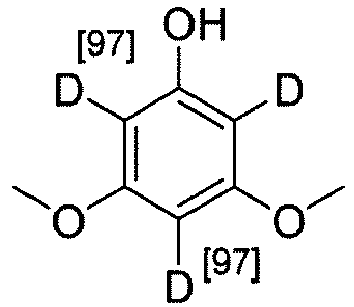
- 2,4,6-[D3]-3,5-Dimethoxyphenol was prepared from 3,5-dimethoxyphenol (0.1 mmol, 15.4 mg) according to the General Procedure A for 4 h at rt (92 µmol, 92% yield, 97% deuterium incorporation). 1H NMR (400 MHz, MeOD) δ 6.0 (d, J = 5.0 Hz, 0H), 3.7 (s, 6H).

- 3,5-[D2]-1-(2,4,6-Trihydroxyphenyl)propan-1-one was prepared from 1-(2,4,6-trihydroxyphenyl)propan-1-one (0.1 mmol, 18.2 mg) according to the General Procedure A for 15 h at rt (87 µmol, 87% yield, 97% deuterium incorporation). 1H NMR (400 MHz, MeOD) δ 5.8 (s, 0H), 3.1 (q, J = 7.3 Hz, 2H), 1.1 (t, J = 7.3 Hz, 3H).
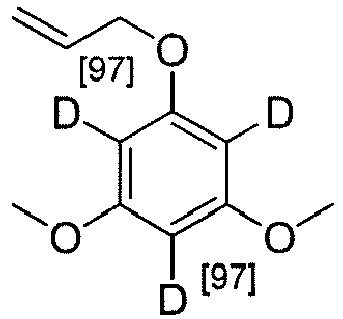
- 2,4,6-[D3]-1-(Allyloxy)-3,5-dimethoxybenzene was prepared from 1-(allyloxy)-3,5-dimethoxybenzene (0.1 mmol, 19.4 mg) according to the General Procedure A for 15 h at rt (90 µmol, 90% yield, 97% deuterium incorporation). 1H NMR (400 MHz, MeOD) δ 6.1 - 6.0 (m, 1H), 5.4 (dq, J = 1.7, 17.3 Hz, 1H), 5.3 (dq, J = 1.5, 10.6 Hz, 1H), 4.5 (dt, J = 1.6, 5.2 Hz, 2H), 3.7 (s, 6H).

- 2,4,6-[D3]-1-(Benzyloxy)-3,5-dimethoxybenzene was prepared from 1-(benzyloxy)-3,5-dimethoxybenzene (0.1 mmol, 24.4 mg) according to the General Procedure A for 15 h at rt (100 µmol, 100% yield, 97% deuterium incorporation). 1H NMR (400 MHz, MeOD) δ 7.5 - 7.2 (m, 3H), 6.2 (s, 0H), 6.1 (s, 0H), 5.0 (s, 1H), 3.7 (s, 3H).

- 2,4,6-[D3]-2-(3,5-Dimethoxyphenoxy)-1-pheny)ethan-1-one (was prepared from 2-(3,5-dimethoxyphenoxy)-1-phenylethan-1-one (0.1 mmol, 27.2 mg) according to the General Procedure A for 15 h at rt (82 µmol, 82% yield, 97% deuterium incorporation). CDCl3 (1 mL) was used as a co-solvent. 1H NMR (400 MHz, MeOD) δ 8.0 - 8.0 (m, 2H), 7.6 (ddt, J = 1.3, 6.9, 8.0 Hz, 1H), 7.6 - 7.5 (m, 2H), 6.1 (s, 0H), 6.1 (s, 0H), 5.3 (s, 2H), 3.7 (s, 6H).

- 2,4,6-[D3]-Resveratrol was prepared from resveratrol (0.1 mmol, 28.8 mg) according to the General Procedure A for 4 h at rt (100 µmol, 100% yield, 97% deuterium incorporation). 1H NMR (400 MHz, MeOD) δ 7.4 - 7.3 (m, 2H), 7.0 (d, J = 16.3 Hz, 1H), 6.9 - 6.8 (m, 3H), 6.5 (s, 0H), 6.2 (s, 0H).

- 2,4,6-[D3]-3-Methoxyphenol was prepared from 3-methoxyphenol (0.1 mmol, 12.4 mg) according to the General Procedure A for 15 h at 75 °C (95 µmol, 95% yield, 97% deuterium incorporation). The deuterium incorporation and yield was determined by 1H NMR analysis of the mixture in presence of ethylene carbonate as an internal standard (1 M in d4-MeOD, 25 µL, 25 µmol). 1H NMR (400 MHz, MeOD) δ 7.1 (s, 1H), 6.4 - 6.3 (m, 0H), 3.7 (s, 3H).

- 3,5-[D2]-2,4,6-Trimethoxybenzaldehyde was prepared from 2,4,6-trimethoxybenzaldehyde (0.1 mmol, 19.6 mg) according to the General Procedure A for 9 d at rt (32 µmol, 32% yield, 75% deuterium incorporation). 1H NMR (400 MHz, MeOD) δ 10.3 (s, 1H), 6.3 (s, 0H), 4.0 (s, 3H), 4.0 (s, 6H).

- 3,5-[D2]-1,2,4-Trimethoxybenzene was prepared from 1,2,4-trimethoxybenzene (0.1 mmol, 16.8 mg) according to the General Procedure A for 15 h at 75 °C (100 µmol, 100% yield, 97% deuterium incorporation). 1H NMR (400 MHz, MeOD) δ 7.0 (s, 1H), 6.7 (s, 0H), 6.7 (s, 0H), 3.8 (s, 6H), 3.8 (s, 3H).

- 4,6-[D2]-2-Bromo-1,3,5-trimethoxybenzene was prepared from 2-bromo-1,3,5-trimethoxybenzene (0.1 mmol, 24.7 mg) according to the General Procedure A for 4 d at rt (100 µmol, 100% yield, 97% deuterium incorporation). CDCl3 (1 mL) was used as a co-solvent. 1H NMR (400 MHz, MeOD) δ 6.2 (s, 0H), 3.9 (s, 6H), 3.8 (s, 3H).

- 2,4,6-[D3]-3,5-Dimethoxyaniline was prepared from 3,5-dimethoxyaniline (0.1 mmol, 15.3 mg) according to the General Procedure A for 15 h at 75 °C (84 µmol, 84% yield, 97% deuterium incorporation). 1H NMR (400 MHz, MeOD) δ 6.0 (s, 0H), 6.0 (s, 0H), 3.7 (s, 6H).

- 2,4,6-[D3]-1,3-Dimethoxy-5-(4-nitrophenoxy)benzene was prepared from 1,3-dimethoxy-5-(4-nitrophenoxy)benzene (0.1 mmol, 27.5 mg) according to the General Procedure A for 4 d at rt (100 µmol, 100% yield, 99% deuterium incorporation). CDCl3 (1 mL) was used as a co-solvent. 1H NMR (400 MHz, MeOD) δ 8.2 - 8.2 (m, 2H), 7.1 - 7.0 (m, 2H), 6.4 (s, 0H), 6.2 (s, 0H), 3.8 (s, 6H).

- 2,3,4,5-[D4]-N-Methyl-pyrrole was prepared from N-methyl-pyrrole (0.1 mmol, 8.1 mg) according to the General Procedure A for 15 h at 75 °C (84 µmol, 84% yield, 97% deuterium incorporation). 1H NMR (400 MHz, MeOD) δ 6.6 (s, 0H), 6.0 (s, 0H), 3.7 (s, 3H).

- 2,3,4,5-[D4]-N-Benzyl-pyrrole was prepared from N-benzyl-pyrrole (0.1 mmol, 15.7 mg) according to the General Procedure A for 15 h at 75 °C (96 µmol, 96% yield, 96% deuterium incorporation). 1H NMR (400 MHz, MeOD) δ 7.4 - 7.2 (m, 3H), 7.2 - 7.1 (m, 2H), 6.7 (s, 0H), 6.1 (s, 0H), 5.1 (d, J = 0.9 Hz, 2H).

- 5,7-[D2]-δ-Tocopherol was prepared from δ-tocopherol (0.1 mmol, 40.2 mg) according to the General Procedure A for 15 h at 75 °C (100 µmol, 100% yield, 96% deuterium incorporation). CDCl3 (0.5 mL) was used as a co-solvent. 1H NMR (400 MHz, MeOD) δ 6.4 (d, J = 0.9 Hz, 0H), 6.4 - 6.3 (m, 0H), 2.7 (td, J = 1.3, 6.8 Hz, 2H), 2.1 (s, 3H), 1.8 (ddq, J = 6.8, 13.5, 20.2 Hz, 2H), 1.7 - 1.0 (m, 18H), 0.9 - 0.8 (m, 13H).

- 3,4,5-[D3]-2,6-Dimethoxyphenol was prepared from 2,6-dimethoxyphenol (0.1 mmol, 15.5 mg) according to the General Procedure A for 3 d at 75 °C (100 µmol, 100% yield, 93% (3,5-d2) / 82% (4-d) deuterium incorporation). 1H NMR (400 MHz, MeOD) δ 6.8 (s, 0H), 6.6 - 6.6 (m, 0H), 3.8 (s, 6H).

- 4,6-[D2]-2-Methoxyphenol was prepared from 2-methoxyphenol (0.1 mmol, 12.4 mg) according to the General Procedure A for 3 d at 75 °C (100 µmol, 100% yield, 93% (3,5-d2) / 82% (4-d) deuterium incorporation). 1H NMR (400 MHz, MeOD) δ 6.9 (s, 1H), 6.9 - 6.8 (m, 1H), 3.9 (s, 3H).

- 2,6-[D2]-4-Methoxyphenol was prepared from 4-methoxyphenol (0.1 mmol, 12.4 mg) according to the General Procedure A for 3 d at 75 °C (100 µmol, 100% yield, 97% deuterium incorporation). 1H NMR (400 MHz, MeOD) δ 6.8 - 6.7 (m, 2H), 3.7 (s, 3H).

- 2,4,6-[D3]-1,3-Dimethoxybenzene was prepared from 1,3-dimethoxybenzene (0.1 mmol, 13.8 mg) according to the General Procedure A for 3 d at 75 °C (100 µmol, 100% yield, 97% deuterium incorporation). 1H NMR (400 MHz, MeOD) δ 7.2 (d, J = 1.3 Hz, 1H), 6.6 - 6.4 (m, 0H), 3.8 (s, 6H).

- 4,6-[D2]-1,2,3-Trimethoxybenzene was prepared from 1,2,3-trimethoxybenzene (0.1 mmol, 16.7 mg) according to the General Procedure A for 2 d at 75 °C (100 µmol, 100% yield, 97% deuterium incorporation). 1H NMR (400 MHz, MeOD) δ 7.0 (s, 1H), 6.7 (s, 0H), 6.7 (s, 0H), 3.8 (s, 6H), 3.8 (s, 3H).

- 2,4,6-[D3]-1-Bromo-3,5-dimethoxybenzene was prepared from 1-bromo-3,5-dimethoxybenzene (0.1 mmol, 21.7 mg) according to the General Procedure A for 3 d at 75 °C (94 µmol, 94% yield, 97% deuterium incorporation). 1H NMR (400 MHz, MeOD) δ 6.7 (s, 0H), 6.5 (s, 0H), 3.8 (s, 6H).

- 3,5-[D2]-Methyl-d3 2,6-dimethoxybenzoate was prepared from 2,6-dimethoxybenzoic acid (0.1 mmol, 18.2 mg) according to the General Procedure A for 3 d at 75 °C (91 µmol, 91% yield, 97% deuterium incorporation). 1H NMR (400 MHz, MeOD) δ 7.4 (s, 1H), 6.7 (d, J = 8.4 Hz, 0H), 3.8 (s, 6H).

- 4,6-[D2]-5-Bromo-1,2,3-trimethoxybenzene was prepared from 5-bromo-1,2,3-trimethoxybenzene (0.1 mmol, 24.6 mg) according to the General Procedure A for 4 d at 75 °C (96 µmol, 96% yield, 85% deuterium incorporation). 1H NMR (400 MHz, MeOD) δ 6.8 (d, J = 0.6 Hz, 0H), 3.8 (s, 6H), 3.8 (s, 3H).

- 2,6-[D2]-4-Hydroxy-3,5-dimethoxybenzaldehyde (25) was prepared from 4-hydroxy-3,5-dimethoxybenzaldehyde (0.1 mmol, 18.2 mg) according to the General Procedure A for 2 d at 75 °C (23 µmol, 23% yield, 97% deuterium incorporation). 1H NMR (400 MHz, MeOD) δ 9.8 (s, 1H), 7.3 (d, J = 31.5 Hz, 0H), 3.9 (s, 6H).
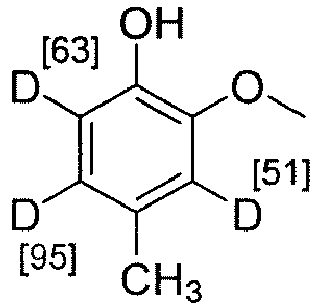
- 3,5,6-[D3]-2-Methoxy-4-methylphenol was prepared from 2-methoxy-4-methylphenol (0.1 mmol, 13.8 mg) according to the General Procedure A for 4 d at 75 °C (100 µmol, 100% yield, 95% (5-d) / 63% (6-d) / 51% (3-d) deuterium incorporation). 1H NMR (400 MHz, MeOD) δ 6.7 (s, 0H), 6.7 (s, 0H), 6.6 - 6.6 (m, 0H), 3.8 (s, 3H), 2.3 (s, 3H).

- 2,4,6-[D3]-3-Aminophenol was prepared from 3-aminophenol (0.1 mmol, 11.0 mg) according to the General Procedure A for 2 d at 75 °C (92 µmol, 92% yield, 97% deuterium incorporation). 1H NMR (400 MHz, MeOD) δ 6.9 (s, 1H), 6.3 (d, J = 7.9 Hz, 0H), 6.3 (s, 0H), 6.2 (d, J = 8.1 Hz, 0H).

- 2,4,6-[D3]-3-(Dimethylamino)phenol was prepared from 3-(dimethylamino)phenol (0.1 mmol, 13.7 mg) according to the General Procedure A for 2 d at 75 °C (71 µmol, 71% yield, 97% deuterium incorporation). 1H NMR (400 MHz, MeOD) δ 7.0 (s, 1H), 6.4 - 6.2 (m, 0H), 2.9 (s, 6H).

- 4,6-[D2]-2,5-Dimethoxybenzenamine was prepared from 2,5-dimethoxybenzenamine (0.1 mmol, 15.3 mg) according to the General Procedure A for 3 d at 75 °C (95 µmol, 95% yield, 97% deuterium incorporation). 1H NMR (400 MHz, MeOD) δ 6.8 (s, 1H), 6.5 (s, 0H), 6.3 (d, J = 8.7 Hz, 0H), 3.9 (s, 3H), 3.8 (s, 3H).
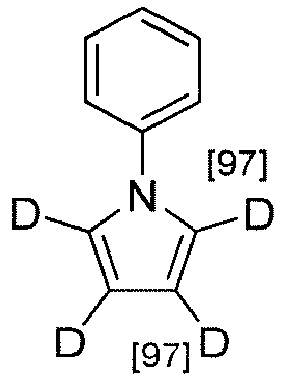
- 2,3,4,5-[D4]-N-Phenyl-pyrrole was prepared from N-phenyl-pyrrole (0.1 mmol, 14.3 mg) according to the General Procedure A for 2 d at 75 °C (90 µmol, 90% yield, 97% deuterium incorporation). 1H NMR (400 MHz, MeOD) δ 7.5 - 7.4 (m, 4H), 7.2 (ddt, J = 1.7, 6.4, 7.1 Hz, 1H), 7.2 (s, 0H), 6.3 (s, 0H).

- 3,3',5,5'-[D4]-Bis(2,4-dihydroxyphenyl)methanone was prepared from bis(2,4-dihydroxyphenyl)methanone (0.1 mmol, 24.6 mg) according to the General Procedure A for 3 d at 75 °C (85 µmol, 85% yield, 97% deuterium incorporation). 1H NMR (400 MHz, MeOD) δ 7.4 (s, 2H), 6.4 - 6.4 (m, 0H).

- 3,5-[D2]-3-(2,4,6-Trimethoxybenzylidene)indolin-2-one (IC261-d2) was prepared from 3-(2,4,6-trimethoxybenzylidene)indolin-2-one (IC261) (0.1 mmol, 31.1 mg, E/Z : 10:1) according to the General Procedure A for 1 d at 75 °C (100 µmol, 100% yield, 97% deuterium incorporation, E/Z : 10:1). CDCl3 (1 mL) was used as a co-solvent. 1H NMR (400 MHz, CDCl3) δ 7.8 (s, 1H), 7.2 (td, J = 1.3, 7.6 Hz, 1H), 7.0 - 7.0 (m, 1H), 6.9 (ddd, J = 1.2, 6.6, 7.7 Hz, 2H), 6.2 (s, 0H), 3.9 (s, 3H), 3.8 (s, 6H).

- 4,6-[D2]-Trimethoprim hydrochloride was prepared from trimethoprim hydrochloride (0.2 mmol, 67.3 mg) according to the General Procedure A for 3 d at 75 °C (168 µmol, 84% yield, 83% deuterium incorporation). 1H NMR (400 MHz, MeOD) δ 7.2 (s, 1H), 6.5 (s, 0H), 3.8 (s, 6H), 3.7 (s, 3H), 3.6 (s, 2H).

- 4,6-[D2]-Melatonin was prepared from melatonin (0.1 mmol, 23.2 mg) according to the General Procedure A for 1 d at 75 °C (100 µmol, 100% yield, 97% deuterium incorporation). 1H NMR (400 MHz, MeOD) δ 7.2 (s, 1H), 7.1 - 7.0 (m, 0H), 6.8 (d, J = 8.8 Hz, 0H), 3.8 (s, 3H), 3.5 (t, J = 7.3 Hz, 2H), 3.0 - 2.8 (m, 2H), 1.9 (s, 3H).

- 2,4,6-[D3]-Serotonin hydrochloride was prepared from serotonin-HCl (0.086 mmol, 18.2 mg) according to the General Procedure A for 1 d at 75 °C (81 µmol, 95% yield, 95% (4-d, 6-d) / 90% (2-d) deuterium incorporation). The deuterium incorporation and yield was determined by 1H NMR analysis of the mixture in presence of ethylene carbonate as an internal standard (1 M in d4-MeOD, 21.4 µL, 21.4 µmol). 1H NMR (400 MHz, MeOD) δ 7.2 (s, 1H), 7.1 (d, J = 0.8 Hz, 0H), 7.0 (d, J = 0.6 Hz, 0H), 6.7 (d, J = 8.7 Hz, 0H), 3.2 (t, J = 7.3 Hz, 2H), 3.1 (ddd, J = 0.9, 7.1, 7.9 Hz, 2H).

- 6,8-[D2]-Chrysin was prepared from chrysin (0.1 mmol, 25.4 mg) according to the General Procedure A for 3 d at 75 °C (100 µmol, 100% yield, 97% deuterium incorporation). d6-DMSO (1 mL) and CDCl3 (1 mL) were used as co-solvents. 1H NMR (400 MHz, MeOD) δ 8.0 - 8.0 (m, 2H), 7.6 - 7.5 (m, 3H), 6.8 (s, 1H), 6.5 (s, 0H), 6.3 (s, 0H).

- 2,4,6-[D3]-3-Fluorophenol was prepared from 3-fluorophenol (0.1 mmol, 11.2 mg) according to the General Procedure A for 9 d at 75 °C (99 µmol, 99% yield, 91% (4,6-d2) / 37% (2-d) deuterium incorporation). 1H NMR (400 MHz, MeOD) δ 7.0 (s, 1H), 6.4 - 6.2 (m, 0H), 2.9 (s, 6H).

- 2,4-[D2]-Estradiol was prepared from estradiol (0.1 mmol, 27.2 mg) according to the General Procedure A for 6 d at 75 °C (100 µmol, 100% yield, 71% (4-d) / 55% (2-d) deuterium incorporation). CDCl3 (1 mL) was used as a co-solvent. 1H NMR (400 MHz, MeOD) δ 7.1 - 7.1 (m, 1H), 6.6 (d, J = 8.5 Hz, 0H), 6.5 (t, J = 1.2 Hz, 0H), 3.7 (t, J = 8.6 Hz, 1H), 3.0 - 2.7 (m, 2H), 2.3 (dtd, J = 2.6, 4.2, 13.3 Hz, 1H), 2.1 (td, J = 4.3, 11.1 Hz, 1H), 2.0 (dtd, J = 5.7, 9.3, 13.2 Hz, 1H), 2.0 - 1.9 (m, 1H), 1.9 - 1.8 (m, 1H), 1.8 - 1.6 (m, 1H), 1.6 - 1.3 (m, 3H), 1.2 - 1.1 (m, 3H), 0.8 (d, J = 0.6 Hz, 3H).

- 2,4,6-[D3]-m-Cresol was prepared from m-cresol (0.1 mmol, 10.8 mg) according to the General Procedure A for 6 d at 75 °C (100 µmol, 100% yield, 96% (4-d) / 87% (2-d) / 72% (6-d) deuterium incorporation). 1H NMR (400 MHz, MeOD) δ 7.0 (s, 1H), 6.6 (dt, J = 0.7, 7.6 Hz, 0H), 6.6 - 6.6 (m, 0H), 6.6 (dq, J = 0.6, 8.1 Hz, 0H), 2.3 (s, 3H).

- 4,6-[D2]-o-Cresol was prepared from o-cresol (0.1 mmol, 10.8 mg) according to the General Procedure A for 6 d at 75 °C (100 µmol, 100% yield, 64% (4-d) / 38% (2-d) deuterium incorporation). 1H NMR (400 MHz, MeOD) δ 7.0 (tdt, J = 0.8, 1.5, 3.3 Hz, 1H), 7.0 - 6.9 (m, 1H), 6.7 (d, J = 8.0 Hz, 1H), 6.8 - 6.7 (m, 0H), 2.2 (d, J = 0.7 Hz, 3H).

- 2,6-[D2]-4-(tert-Butyl)phenol was prepared from 4-(tert-butyl)phenol (0.1 mmol, 15.0 mg) according to the General Procedure A for 6 d at 75 °C (100 µmol, 100% yield, 23% deuterium incorporation). 1H NMR (400 MHz, MeOD) δ 7.2 - 7.2 (m, 2H), 6.8 - 6.7 (m, 2H), 1.3 (s, 12H).

- 2,6-[D2]-3,4-Dimethylphenol was prepared from 3,4-dimethylphenol (0.1 mmol, 12.2 mg) according to the General Procedure A for 6 d at 75 °C (100 µmol, 100% yield, 95% deuterium incorporation). 1H NMR (400 MHz, MeOD) δ 6.5 (p, J = 0.7 Hz, 0H), 6.4 (p, J = 0.7 Hz, 0H), 2.2 (s, 3H).

- 2,4,6-[D3]-3,5-Dimethylphenol-d3 was prepared from 3,5-dimethylphenol (0.1 mmol, 12.2 mg) according to the General Procedure A for 6 d at 75 °C (100 µmol, 100% yield, 97% deuterium incorporation). 1H NMR (400 MHz, MeOD) δ 6.9 (s, 1H), 6.6 (s, 0H), 6.5 (d, J = 8.1 Hz, 0H), 2.2 (t, J = 0.4 Hz, 3H), 2.2 (d, J = 0.6 Hz, 3H).

- 6,8-[D2]-Neohesperidine dihydrochalcone was prepared from neohesperidine dihydrochalcone (0.1 mmol, 61.2 mg) according to the General Procedure A for 3 d at rt (90 µmol, 90% yield, 93% deuterium incorporation). d6-DMSO (1 mL) was used as a co-solvent. 1H NMR (400 MHz, MeOD) δ 6.8 (d, J = 8.2 Hz, 1H), 6.7 (d, J = 2.1 Hz, 1H), 6.7 (dd, J = 2.1, 8.2 Hz, 1H), 6.1 (s, 0H), 5.3 (d, J = 1.7 Hz, 1H), 5.0 (d, J = 7.4 Hz, 1H), 4.0 - 3.9 (m, 3H), 3.8 (s, 3H), 3.8 - 3.6 (m, 4H), 3.5 - 3.4 (m, 3H), 3.3 - 3.3 (m, 2H), 2.8 (dd, J = 6.9, 8.7 Hz, 2H), 1.3 (d, J = 6.2 Hz, 3H).

- 2,4,6-[D3]-Piceid was prepared from piceid (0.1 mmol, 39.0 mg) according to the General Procedure A for 1 d at 40 °C (97 µmol, 97% yield, 97% deuterium incorporation). 1H NMR (400 MHz, MeOD) δ 7.5 - 7.3 (m, 2H), 7.0 (d, J = 16.3 Hz, 1H), 6.9 (d, J = 16.3 Hz, 1H), 6.8 - 6.7 (m, 2H), 6.7 - 6.6 (m, 0H), 6.5 (s, 0H), 4.0 (dd, J = 2.2, 12.1 Hz, 1H), 3.7 (dd, J = 5.8, 12.1 Hz, 1H), 3.6 - 3.4 (m, 4H).
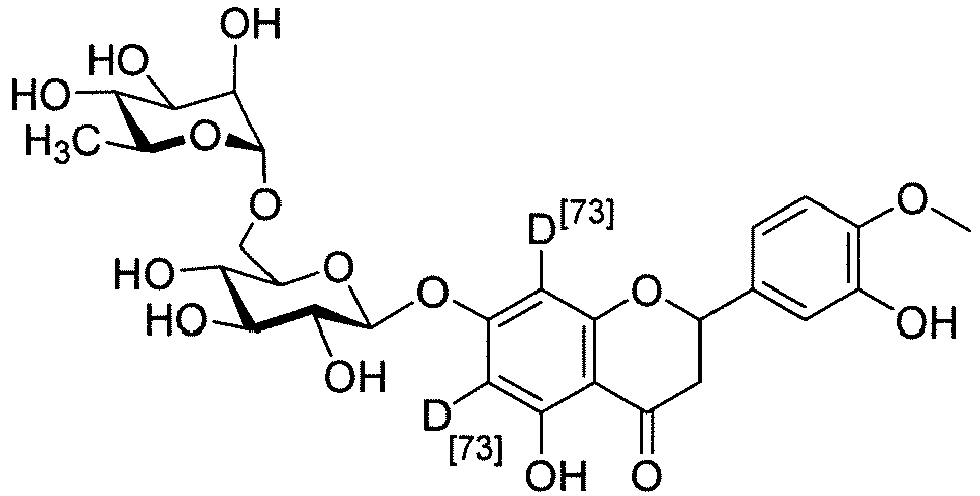
- 6,8-[D2]-Hesperidine was prepared from hesperidine (0.1 mmol, 61.0 mg) according to the General Procedure A for 4 weeks at 40 °C (75 µmol, 75% yield, 73% deuterium incorporation). 1H NMR (400 MHz, MeOD) δ 7.0 - 6.8 (m, 3H), 6.1 (dd, J = 1.2, 5.4 Hz, 0.5H), 5.4 (td, J = 4.2, 7.3 Hz, 1H), 4.9 (dd, J = 4.0, 7.5 Hz, 1H), 4.5 (d, J = 1.7 Hz, 1H), 3.8 - 3.8 (m, 1H), 3.8 (s, 3H), 3.7 (ddd, J = 1.7, 3.5, 9.3 Hz, 1H), 3.6 - 3.4 (m, 4H), 3.3 - 3.1 (m, 5H), 1.1 (dd, J = 3.0, 6.2 Hz, 3H).

- 2,4,6-[D3]-tert-Butyl(3,5-dimethoxyphenoxy)dimethylsilane was prepared from 1,3,5-trimethoxybenzene (0.1 mmol, 26.8 mg) according to the General Procedure A for 5 h at rt (83 µmol, 83% yield, 97% deuterium incorporation). 1H NMR (400 MHz, MeOD) δ 0.1 (s, 1H), 0.2 (s, 6H), 0.9 (s, 2H), 1.0 (s, 8H), 3.7 (s, 1H), 3.7 (s, 6H), 6.0 (s, 0H).

- 2,4,6-[D3]-(3,5-Dimethoxyphenoxy)triisopropylsilane was prepared from (3,5-Dimethoxyphenoxy)triisopropylsilane (0.1 mmol, 31.1 mg) according to the General Procedure A for 5 h at rt (98 µmol, 98% yield, 97% deuterium incorporation). 1H NMR (400 MHz, MeOD) δ 1.1 - 1.1 (m, 1H), 1.1 (s, 2H), 1.2 - 1.3 (m, 0H), 3.7 (s, 0H), 3.7 (s, 1H), 6.0 (s, 0H).

- 2,4,6-[D3]-tert-Butyl(3,5-dimethoxyphenoxy)diphenylsilane was prepared from tert-butyl(3,5-dimethoxyphenoxy)diphenylsilane (0.1 mmol, 39.3 mg) according to the General Procedure A for 5 h at rt (100 µmol, 100% yield, 97% deuterium incorporation). 1H NMR (400 MHz, MeOD) δ 1.0 (s, 0H), 1.1 (s, 9H), 3.5 (s, 6H), 3.7 (s, 0H), 5.9 (s, 0H), 6.0 (s, 0H), 7.3 - 7.5 (m, 6H), 7.7 - 7.7 (m, 4H).
- General Procedure B: Substrate (1 mmol) was dissolved in MeOD-d1 (10 mL). A 70% solution of HClO4 (0.05 mmol, 5 mol%, 4.2 µL) was added and the mixture was stirred at the according temperature under argon.
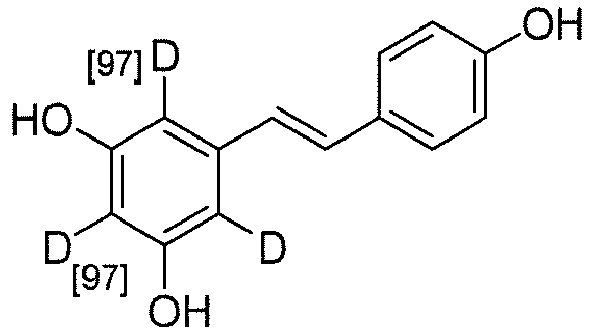
- 2,4,6-[D3]-Resveratrol was prepared from resveratrol (1.0 mmol, 288 mg) according to the General Procedure B for 4 h at rt. The solvent was partly removed in vacuo, then, EtOAc and sat. NaHCO3 (aq.) was added and the reaction mixture extracted with EtOAc (3x). The organic phases were combined, dried over Na2SO4 and the solvent was removed in vacuo to obtain the clean product as a yellowish solid (0.99 mmol, 231 mg, 100% yield, 97% deuterium incorporation). 1H NMR (400 MHz, MeOD) δ 7.4 - 7.3 (m, 2H), 7.0 (d, J = 16.3 Hz, 1H), 6.9 - 6.8 (m, 3H), 6.5 (s, 0H), 6.2 (s, 0H). 13C NMR (101 MHz, MeOD) δ 115.1, 125.5, 127.4, 128.0, 139.7, 157.0, 158.1. HPLC (254 nm, system A): t R= 6.5 min, purity: >95%. HRMS (EI) calcd. for C14H8D3O3 [M-H+]: 230.0892, found: 230.0902.

- 6,8-[D2]-Neohesperidine dihydrochalcone was prepared from neohesperidine dihydrochalcone (1 mmol, 612 mg) according to the General Procedure B for 3 d at rt. d6-DMSO (1 mL) was used as a co-solvent. After 3 d, the reaction was stopped by addition of one drop of sat. NaHCO3 (aq.). After subsequent syringe filtration and reduction of the solvent in vacuo, the clean product was obtained as a white powder (0.97 mmol, 598 mg, 97% yield, 94% deuterium incorporation). 1H NMR (400 MHz, MeOD) δ 6.8 (d, J = 8.2 Hz, 1H), 6.7 (d, J = 2.1 Hz, 1H), 6.7 (dd, J = 2.1, 8.2 Hz, 1H), 6.1 (s, 0H), 5.3 (d, J = 1.7 Hz, 1H), 5.0 (d, J = 7.4 Hz, 1H), 4.0 - 3.9 (m, 3H), 3.8 (s, 3H), 3.8 - 3.6 (m, 4H), 3.5 - 3.4 (m, 3H), 3.3 - 3.3 (m, 2H), 2.8 (dd, J = 6.9, 8.7 Hz, 2H), 1.3 (d, J = 6.2 Hz, 3H). 13C NMR (101 MHz, MeOD) δ 16.8, 30.0, 45.9, 55.1, 60.9, 68.5, 69.8, 70.7, 70.8, 72.5, 76.7, 77.4, 77.7, 94.8, 97.9, 101.0, 105.4, 111.4, 115.1, 119.1, 134.6, 145.9, 146.0, 163.2, 163.9, 205.5. HPLC (254 nm, system A): t R= 4.9 min, purity: >95%. HRMS (EI) molecular weight could not be calculated due to fractionation. m/z (%) 615.2253 (100%), 616.2287 (35%), 617.2311 (5%).

- 2,4,6-[D3]-Piceid was prepared from piceid (1 mmol, 390 mg) according to the General Procedure B for 1 d at 40 °C. The solvent was removed in vacuo and residue was purified by trituration with CH3CN to obtain the product as a white powder (0.84 mmol, 347 mg, 84 % yield, 95% purity, 97% deuterium incorporation). The product can additionally be purified via preparative HPLC (CH3CN:H2O - 5:95→85:15 over 15 min) to obtain the clean product as a white powder (>>95% purity, 97% deuterium incorporation). 1H NMR (400 MHz, MeOD) δ 7.5 - 7.3 (m, 2H), 7.0 (d, J = 16.3 Hz, 1H), 6.9 (d, J = 16.3 Hz, 1H), 6.8 - 6.7 (m, 2H), 6.7 - 6.6 (m, 0H), 6.5 (s, 0H), 4.0 (dd, J = 2.2, 12.1 Hz, 1H), 3.7 (dd, J = 5.8, 12.1 Hz, 1H), 3.6 - 3.4 (m, 4H). 13C NMR (101 MHz, MeOD) δ 26.3, 61.2, 70.0, 73.5, 76.8, 101.0, 115.0, 125.1, 127.5, 128.5, 128.9, 139.8, 157.1, 158.1, 159.0. HPLC (254 nm, system B): t R= 6.7 min, purity: >95%. HRMS (EI) calcd. for C20H19D3O3 [M-H+]: 394.1576, found 394.1585.

- 3,5-[D2]-3-(2,4,6-Trimethoxybenzylidene)indolin-2-one (IC261-d2) was prepared from 3-(2,4,6-trimethoxybenzylidene)indolin-2-one (IC261) (1 mmol, 311 mg, E/Z : 10:1) according to the General Procedure B for 1 d at 75 °C (100 µmol, 100% yield, 97% deuterium incorporation). CDCl3 (1 mL) was used as a co-solvent. After 1 d, the reaction was stopped by addition of one drop of sat. NaHCO3 (aq.). After subsequent syringe filtration and reduction of the solvent in vacuo, the clean product was obtained as a yellow powder (0.91 mmol, 285 mg, 91% yield, 96% deuterium incorporation, E/Z : 10:1). 1H NMR (400 MHz, CDCl3) δ 7.8 (s, 1H), 7.2 (td, J = 1.3, 7.6 Hz, 1H), 7.0 - 7.0 (m, 1H), 6.9 (ddd, J = 1.2, 6.6, 7.7 Hz, 2H), 6.2 (s, 0H), 3.9 (s, 3H), 3.8 (s, 6H). 13C NMR (101 MHz, CDCl3) δ 55.5, 90.3, 109.3, 121.4, 124.4, 128.4, 129.0. HPLC (254 nm, system A): t R= 7.4 min (E) and 7.8 min (Z), purity: >95%. HRMS (EI) calcd. for C18H16D2NO4 [M+H+]) calcd. for C14H8D3O3 [M-H+]: 314.1356, found: 314.1351.
- Experimental procedure: 1,3,5-trimethoxybenzene (1, 0.1 mmol, 16.8 mg) was dissolved in the appropriate deuterated solvent (1 mL). If not stated differently, HClO4 was added (0.005 mmol, 5 mol%, 0.42 µL). The reaction was kept at rt under air. After 30 min, the reaction was quenched by the addition of sat. NaHCO3 (aq.) and the isotope ratios were measured via LC/MS (Single ion recording for the according masses).
[M+3+H+]+ (d3) [M+2+H+]+ (d2) [M+1+H+]+ (d1) [M+H+]+(d0) MeOD-d4 81% 17% 2% 0% MeOD-d1 81% 17% 2% 0% AcOD 80% 17% 2% 1% DCOOD 73% 24% 3% 0% D3PO4 68% 23% 7% 2% - Experimental procedure: 1,3,5-trimethoxybenzene (1, 0.1 mmol, 16.8 mg) was dissolved in H3COD (1 mL). The appropriate acid was added (0.005 mmol, 5 mol%). The reaction was kept at rt under air. After 30 min, 1 h, 6 h, and 30 h, the reaction was quenched by the addition of sat. NaHCO3 (aq.) and the isotope ratios were measured via LC/MS (Single ion recording for the according masses).
-
30 min 1 h 6h 30 h HClO4 73% 90% 90% 90% H2SO4 73% 91% 92% 91% HBr 71% 88% 90% 91% MsOH 70% 90% 92% 91% TfOH 70% 89% 91% 91% HCl 28% 61% 91% 91% HNO3 3% 9% 81% 91% NaHSO4 1% 7% 72% 92% TFA 0% 1% 13% 78%
Claims (15)
- A method for the preparation of a deuterated or tritiated aromatic compound via deuteration or tritiation of an aromatic starting compound which comprises an aromatic ring or a fused aromatic ring system which may be carbocyclic or hetercyclic and which carries at least one hydrogen atom directly bonded to a carbon ring atom of an aromatic ring, said method comprising:a) providing a liquid composition wherein the aromatic starting compound is dissolved or dispersed in a deuterated or tritiated solvent which is not water, or in a solvent system comprising at least one deuterated or tritiated solvent which is not water; andb) replacing at least one hydrogen atom directly bonded to a carbon ring atom of an aromatic ring comprised by the aromatic starting compound with deuterium or tritium via the transfer of at least one deuterium of tritium atom from the deuterated or tritiated solvent to the aromatic starting compound dissolved or dispersed in the liquid composition in the presence of an acid,to convert the aromatic starting compound to a deuterated or tritiated aromatic compound which comprises an aromatic ring or a fused aromatic ring system which may be carbocyclic or hetercyclic and which carries at least one deuterium or tritium atom directly bonded to a carbon ring atom of an aromatic ring.
- The method in accordance with claim 1, wherein the aromatic starting compound is selected from
an aromatic starting compound i) comprising a six-membered carbocyclic aromatic ring or a fused aromatic ring system comprising a six-membered carbocyclic aromatic ring, wherein the six-membered aromatic ring carries at least one hydrogen atom directly bonded to a carbon ring atom and at least a first substituent and a second substituent, the first substituent being selected from hydroxy, alkoxy, haloalkoxy, cycloalkoxy, and alkenyloxy, and the second substituent being selected from hydroxy, alkoxy, haloalkoxy, cycloalkoxy, heterocycloalkoxy, alkenyloxy, arylalkyloxy, aryloxy, heteroaryloxy, halogen, alkyl, cycloalkyl, heterocycloalkyl, aryl which is substituted with at least one substiutent selected from hydroxy and alkoxy, heteroaryl which is selected from furan, pyrrole, thiophen, indole, oxazole, thiazole, and benzofuran, amino, -NHR4, and -NR4R5, wherein R4 and R5 are independently selected from alkyl, cycloalkyl, haloalkyl, arylalkyl, heteroarylalkyl, aryl and heteroaryl, and wherein, if the second substituent is a cycloalkyl group or a heterocycloalkyl group, the group may be fused with the six-membered aromatic ring; and
an aromatic starting compound ii) comprising a five-membered heterocyclic aromatic ring or a fused aromatic ring system comprising a five-membered heterocyclic aromatic ring, wherein the five-membered aromatic ring carries at least one hydrogen atom directly bonded to a carbon atom of the aromatic ring. - The method in accordance with claim 2, wherein the first and the second substituent of the six-membered aromatic ring are selected from hydroxy and alkoxy.
- The method in accordance with any of claims 1 to 3, wherein the five-membered heterocyclic aromatic ring or fused aromatic ring system comprising a five-membered heterocyclic aromatic ring of the aromatic starting compound ii) is selected from an optionally substituted pyrrole group, an optionally substituted thiophene group, an optionally substituted furan group and an optionally substituted indole group.
- The method in accordance with any of claims 1 to 4, wherein the five-membered heterocyclic aromatic ring or fused aromatic ring system comprising a five-membered heterocyclic aromatic ring of the aromatic starting compound ii) carries at least one substituent selected from hydroxy, alkoxy, haloalkoxy, cycloalkoxy, and alkenyloxy.
- The method in accordance with any of claims 1 to 5, wherein the liquid composition comprises a deuterated or tritiated solvent selected from:s1) an aliphatic alcohol comprising a deuterated or tritiated alcoholic hydroxyl group;s2) an aromatic or heteroaromatic alcohol comprising a deuterated or tritiated alcoholic hydroxyl group;s3) a compound comprising a carbonyl group and a deuterium or tritium atom bonded to a carbon atom or a heteroatom in alpha-position to the carbonyl group;s4) a nitroalkane comprising a deuterium or tritium atom bonded to a carbon atom in alpha position to the nitro group;s5) a carboxylic acid which comprises a deuterated or tritiated -C(O)OH group;s6) an amide which comprises a deuterated or tritiated -C(O)NH- group;s7) an oxime or a hydroximic acid which comprises a deuterated or tritiated =N-OH group; ands8) a peroxide which comprises a deuterated or tritiated -OOH group.
- The method in accordance with claim 6, wherein the liquid composition comprises the deuterated or tritiated solvent selected from s1) to s8) as a single solvent, or as a component of a solvent system comprising at least one deuterated or tritiated solvent which is not water, and wherein the solvent system combines two or more of the deuterated or trititated solvents selected from s1) to s8), or it combines one of the deuterated or tritiated solvents selected from s1) to s8) with one or more other deuterated or tritiated solvent(s), and/or with one or more non-deuterated and non-tritiated solvent(s).
- The method in accordance with claim 6 or 7, wherein the liquid composition comprises a deuterated or tritiated solvent selected from an aliphatic alcohol s1) comprising a deuterated or tritiated alcoholic hydroxyl group, an aromatic or heteroaromatic alcohol s2) comprising a deuterated or tritiated alcoholic hydroxyl group, and a carboxylic acid s5) which comprises a deuterated or tritiated -C(O)OH group.
- The method in accordance with any of claims 6 to 8, wherein the liquid composition comprises at least one of methanol comprising a deuterated or tritiated hydroxy group and ethanol comprising a deuterated or tritiated hydroxy group.
- The method in accordance with any of claims 1 to 9, wherein the liquid composition comprised a deuterated or tritiated solvent at a volume fraction of above 25 % vol/vol, based on the total volume of solvent(s).
- The method in accordance with any of claims 1 to 10, wherein the replacement of the at least one hydrogen atom is accomplished in the presence of an acid having a pKa value in water which is lower than 3.
- The method in accordance with any of claims 1 to 11, wherein the acid is selected from hydrobromic acid, hydrochloric acid, sulfuric acid, triflic acid, mesylic acid, tosylic acid, perchloric acid and combinations thereof.
- The method in accordance with any of claims 1 to 6, wherein the acid is present at a concentration of 1 mol% to 50 mol %, based on the amount of the aromatic starting compound as 100 mol%.
- The method in accordance with any of claims 1 to 13, wherein the replacement of the at least one hydrogen atom is accomplished at a reaction temperature in the range of 0 °C to 80 °C.
- The method in accordance with any of claims 1 to 14, wherein the replacement of the at least one hydrogen atom is accomplished over a reaction time of 20 min to 5 days.
Priority Applications (1)
| Application Number | Priority Date | Filing Date | Title |
|---|---|---|---|
| EP20168757.1A EP3892602A1 (en) | 2020-04-08 | 2020-04-08 | Method for the preparation of deuterated or tritiated compounds |
Applications Claiming Priority (1)
| Application Number | Priority Date | Filing Date | Title |
|---|---|---|---|
| EP20168757.1A EP3892602A1 (en) | 2020-04-08 | 2020-04-08 | Method for the preparation of deuterated or tritiated compounds |
Publications (1)
| Publication Number | Publication Date |
|---|---|
| EP3892602A1 true EP3892602A1 (en) | 2021-10-13 |
Family
ID=70277212
Family Applications (1)
| Application Number | Title | Priority Date | Filing Date |
|---|---|---|---|
| EP20168757.1A Pending EP3892602A1 (en) | 2020-04-08 | 2020-04-08 | Method for the preparation of deuterated or tritiated compounds |
Country Status (1)
| Country | Link |
|---|---|
| EP (1) | EP3892602A1 (en) |
Cited By (1)
| Publication number | Priority date | Publication date | Assignee | Title |
|---|---|---|---|---|
| CN114933516A (en) * | 2022-06-17 | 2022-08-23 | 句容宁武新材料股份有限公司 | Method for synthesizing deuterated compound in ionic liquid medium |
-
2020
- 2020-04-08 EP EP20168757.1A patent/EP3892602A1/en active Pending
Non-Patent Citations (10)
| Title |
|---|
| FOTI MARIO C ET AL: "Solvent-dependent release of bromine from bromoquercetins", TETRAHEDRON LETTERS, vol. 55, no. 31, 6 June 2014 (2014-06-06), pages 4359 - 4365, XP028876439, ISSN: 0040-4039, DOI: 10.1016/J.TETLET.2014.05.110 * |
| GOLDEN, J. T.ANDERSEN, R. A.BERGMAN, R. G.: "Exceptionally Low-Temperature Carbon-Hydrogen/Carbon-Deuterium Exchange Reactions of Organic and Organometallic Compounds Catalyzed by the Cp*(PMe )lrH(CICH CI)+ Cation", JACS, vol. 123, 2001, pages 5837 - 5838 |
| HAKALA, U.WAHALA, K.: "Expedient Deuterolabeling of Polyphenols in Ionic Liquids - DCI/D 0 under Microwave Irradiation", J. ORG. CHEM., vol. 72, 2007, pages 5817 - 5819 |
| LIU, K.WILLIAMS, J.LEE, H.FITZGERALD, M. M.JENSEN, G. M.GOODIN, D. B.MCDERMOTT, A. E.: "Solid-State Deuterium NMR of Imidazole Ligands in Cytochrome c Peroxidase", JACS, vol. 120, 1998, pages 10199 - 10202 |
| MIKHAIL KONDRASHOV ET AL: "Regioselectivity in C-H activation: reagent control in cyclometallation of 2-(1-naphthyl)-pyridine", DALTON TRANSACTIONS, vol. 45, no. 2, 1 January 2016 (2016-01-01), pages 525 - 531, XP055714452, ISSN: 1477-9226, DOI: 10.1039/C5DT04068J * |
| PRECHTL, M. H. G.HOLSCHER, M.BEN-DAVID, Y.THEYSSEN, N.LOSCHEN, R.MILSTEIN, D.LEITNER, W.: "Angew. Chem. Int. Ed.", vol. 53, 2014, article "H/D Exchange at Aromatic and Heteroaromatic Hydrocarbons Using D 0 as the Deuterium Source and Ruthenium Dihydrogen Complexes as the Catalyst", pages: 2269 - 2272 |
| STACK, D. E.RITONYA, J.JAKOPOVIC, S.MALOLEY-LEWIS, B.: "Regioselective deuterium labeling of estrone and catechol estrogen metabolites", STEROIDS, vol. 92, 2014, pages 32 - 38, XP029098092, DOI: 10.1016/j.steroids.2014.08.018 |
| VINING, R. F.SMYTHE, G. A.: "Long, M. A. Deuterium exchange labelling of biologically important phenols, indoles and steroids", J. LABEL. COMPD. RAD., vol. 18, 1981, pages 1683 - 1692, XP002443266, DOI: 10.1002/jlcr.2580181114 |
| WAHALA, K.RASKU, S.PARIKKA, K.: "Deuterated phytoestrogen flavonoids and isoflavonoids for quantitation", J. CHROM. B, vol. 777, 2002, pages 111 - 122, XP004381644, DOI: 10.1016/S1570-0232(02)00096-X |
| ZHI ZHOU ET AL: "Rhodium(III)-Catalyzed Redox-Neutral C?H Annulation of Arylnitrones and Alkynes for the Synthesis of Indole Derivatives", ADVANCED SYNTHESIS & CATALYSIS, vol. 357, no. 13, 11 September 2015 (2015-09-11), DE, pages 2944 - 2950, XP055714445, ISSN: 1615-4150, DOI: 10.1002/adsc.201500580 * |
Cited By (2)
| Publication number | Priority date | Publication date | Assignee | Title |
|---|---|---|---|---|
| CN114933516A (en) * | 2022-06-17 | 2022-08-23 | 句容宁武新材料股份有限公司 | Method for synthesizing deuterated compound in ionic liquid medium |
| CN114933516B (en) * | 2022-06-17 | 2024-01-30 | 句容宁武新材料股份有限公司 | A method for synthesizing deuterated compounds in ionic liquid medium |
Similar Documents
| Publication | Publication Date | Title |
|---|---|---|
| US8853455B2 (en) | Process for preparing substituted 2-nitrobiphenyls | |
| CA2753449C (en) | Agomelatine hydrohalide complex and preparation method thereof | |
| CN102850272A (en) | Azido-containing naphthalimide compound and applications thereof in detecting hydrogen sulfide | |
| US8481763B2 (en) | Preparation process of dronedarone and its salts | |
| CN102143935B (en) | Process for producing aminobiphenyls | |
| BR112014022053B1 (en) | process for preparing a compound | |
| Pandith et al. | A new fluorogenic sensing platform for salicylic acid derivatives based on π-π and NH-π interactions between electron-deficient and electron-rich aromatics | |
| US20130338369A1 (en) | Process for the Synthesis of Aminobiphenylene | |
| CN109053460A (en) | A method for catalyzing the amination of benzyl alcohol compounds | |
| Hirose et al. | Preparation of phenolic chiral crown ethers and podands and their enantiomer recognition ability toward secondary amines | |
| CN113999218A (en) | Flavonol compound, preparation method and application thereof in detection of biological thiol | |
| CN103896795A (en) | Methanamide compound, preparation method of intermediate of methanamide compound, and applications of the intermediate | |
| Nayal et al. | Bile acid-based triazole and triazolium receptors for colorimetric sensing of anions | |
| Gust et al. | Synthesis, Structural Evaluation, and Estrogen Receptor Interaction of 4, 5‐Bis (4‐hydroxyphenyl) imidazoles | |
| Sarrafi et al. | Microwave-assisted chemoselective copper-catalyzed amination of o-chloro and o-bromobenzoic acids using aromatic amines under solvent free conditions | |
| EP3771711A1 (en) | Pyrazole derivatives for controlling arthropods | |
| EP2546229A1 (en) | Method for synthesising aminobiphenyls | |
| CN104177265A (en) | 4,6-diamino-resorcinol hydrochloride synthesis method | |
| Gonçalves et al. | Synthesis of potentially bioactive PABA-related N-(aminoalkyl) lactamic amino acids and esters via selective SNAr reactions | |
| CN110759890A (en) | Nopinanyl indazole silver ion fluorescent probe and preparation method thereof | |
| CN102675288B (en) | 2-((2-(bis(2-pyridylmethyl)amino)ethyl)amino)-4-(3,6,6-trimethyl-4-oxo-4,5,6,7-tetrahydro Indazolyl)benzamide and its preparation and application | |
| CN120230131A (en) | Preparation method of 4-[(1,3-dihydro-1-hydroxy-2,1-benzoxaborol-5-yl)oxy]benzonitrile | |
| DE102008049675A1 (en) | Process for the preparation of 3-aminobiphenyls | |
| EP2348021B1 (en) | Rotaxane compound and antitumor agent | |
| CN103553940A (en) | Preparation method of new crystal form tapentadol hydrochloride |
Legal Events
| Date | Code | Title | Description |
|---|---|---|---|
| PUAI | Public reference made under article 153(3) epc to a published international application that has entered the european phase |
Free format text: ORIGINAL CODE: 0009012 |
|
| STAA | Information on the status of an ep patent application or granted ep patent |
Free format text: STATUS: THE APPLICATION HAS BEEN PUBLISHED |
|
| AK | Designated contracting states |
Kind code of ref document: A1 Designated state(s): AL AT BE BG CH CY CZ DE DK EE ES FI FR GB GR HR HU IE IS IT LI LT LU LV MC MK MT NL NO PL PT RO RS SE SI SK SM TR |
|
| STAA | Information on the status of an ep patent application or granted ep patent |
Free format text: STATUS: REQUEST FOR EXAMINATION WAS MADE |
|
| 17P | Request for examination filed |
Effective date: 20220412 |
|
| RBV | Designated contracting states (corrected) |
Designated state(s): AL AT BE BG CH CY CZ DE DK EE ES FI FR GB GR HR HU IE IS IT LI LT LU LV MC MK MT NL NO PL PT RO RS SE SI SK SM TR |