EP3892588A1 - Production method for lithium-containing solution - Google Patents
Production method for lithium-containing solution Download PDFInfo
- Publication number
- EP3892588A1 EP3892588A1 EP19893315.2A EP19893315A EP3892588A1 EP 3892588 A1 EP3892588 A1 EP 3892588A1 EP 19893315 A EP19893315 A EP 19893315A EP 3892588 A1 EP3892588 A1 EP 3892588A1
- Authority
- EP
- European Patent Office
- Prior art keywords
- lithium
- manganese
- manganese oxide
- adsorption
- containing solution
- Prior art date
- Legal status (The legal status is an assumption and is not a legal conclusion. Google has not performed a legal analysis and makes no representation as to the accuracy of the status listed.)
- Pending
Links
Images

Classifications
-
- C—CHEMISTRY; METALLURGY
- C01—INORGANIC CHEMISTRY
- C01D—COMPOUNDS OF ALKALI METALS, i.e. LITHIUM, SODIUM, POTASSIUM, RUBIDIUM, CAESIUM, OR FRANCIUM
- C01D15/00—Lithium compounds
- C01D15/04—Halides
-
- B—PERFORMING OPERATIONS; TRANSPORTING
- B01—PHYSICAL OR CHEMICAL PROCESSES OR APPARATUS IN GENERAL
- B01D—SEPARATION
- B01D15/00—Separating processes involving the treatment of liquids with solid sorbents; Apparatus therefor
- B01D15/08—Selective adsorption, e.g. chromatography
- B01D15/10—Selective adsorption, e.g. chromatography characterised by constructional or operational features
- B01D15/16—Selective adsorption, e.g. chromatography characterised by constructional or operational features relating to the conditioning of the fluid carrier
- B01D15/161—Temperature conditioning
-
- B—PERFORMING OPERATIONS; TRANSPORTING
- B01—PHYSICAL OR CHEMICAL PROCESSES OR APPARATUS IN GENERAL
- B01D—SEPARATION
- B01D15/00—Separating processes involving the treatment of liquids with solid sorbents; Apparatus therefor
- B01D15/08—Selective adsorption, e.g. chromatography
- B01D15/10—Selective adsorption, e.g. chromatography characterised by constructional or operational features
- B01D15/24—Selective adsorption, e.g. chromatography characterised by constructional or operational features relating to the treatment of the fractions to be distributed
-
- B—PERFORMING OPERATIONS; TRANSPORTING
- B01—PHYSICAL OR CHEMICAL PROCESSES OR APPARATUS IN GENERAL
- B01D—SEPARATION
- B01D15/00—Separating processes involving the treatment of liquids with solid sorbents; Apparatus therefor
- B01D15/08—Selective adsorption, e.g. chromatography
- B01D15/26—Selective adsorption, e.g. chromatography characterised by the separation mechanism
- B01D15/36—Selective adsorption, e.g. chromatography characterised by the separation mechanism involving ionic interaction, e.g. ion-exchange, ion-pair, ion-suppression or ion-exclusion
- B01D15/361—Ion-exchange
- B01D15/362—Cation-exchange
-
- B—PERFORMING OPERATIONS; TRANSPORTING
- B01—PHYSICAL OR CHEMICAL PROCESSES OR APPARATUS IN GENERAL
- B01D—SEPARATION
- B01D15/00—Separating processes involving the treatment of liquids with solid sorbents; Apparatus therefor
- B01D15/08—Selective adsorption, e.g. chromatography
- B01D15/42—Selective adsorption, e.g. chromatography characterised by the development mode, e.g. by displacement or by elution
- B01D15/424—Elution mode
-
- B—PERFORMING OPERATIONS; TRANSPORTING
- B01—PHYSICAL OR CHEMICAL PROCESSES OR APPARATUS IN GENERAL
- B01J—CHEMICAL OR PHYSICAL PROCESSES, e.g. CATALYSIS OR COLLOID CHEMISTRY; THEIR RELEVANT APPARATUS
- B01J20/00—Solid sorbent compositions or filter aid compositions; Sorbents for chromatography; Processes for preparing, regenerating or reactivating thereof
- B01J20/02—Solid sorbent compositions or filter aid compositions; Sorbents for chromatography; Processes for preparing, regenerating or reactivating thereof comprising inorganic material
- B01J20/06—Solid sorbent compositions or filter aid compositions; Sorbents for chromatography; Processes for preparing, regenerating or reactivating thereof comprising inorganic material comprising oxides or hydroxides of metals not provided for in group B01J20/04
-
- B—PERFORMING OPERATIONS; TRANSPORTING
- B01—PHYSICAL OR CHEMICAL PROCESSES OR APPARATUS IN GENERAL
- B01J—CHEMICAL OR PHYSICAL PROCESSES, e.g. CATALYSIS OR COLLOID CHEMISTRY; THEIR RELEVANT APPARATUS
- B01J20/00—Solid sorbent compositions or filter aid compositions; Sorbents for chromatography; Processes for preparing, regenerating or reactivating thereof
- B01J20/30—Processes for preparing, regenerating, or reactivating
- B01J20/34—Regenerating or reactivating
- B01J20/3433—Regenerating or reactivating of sorbents or filter aids other than those covered by B01J20/3408 - B01J20/3425
-
- B—PERFORMING OPERATIONS; TRANSPORTING
- B01—PHYSICAL OR CHEMICAL PROCESSES OR APPARATUS IN GENERAL
- B01J—CHEMICAL OR PHYSICAL PROCESSES, e.g. CATALYSIS OR COLLOID CHEMISTRY; THEIR RELEVANT APPARATUS
- B01J20/00—Solid sorbent compositions or filter aid compositions; Sorbents for chromatography; Processes for preparing, regenerating or reactivating thereof
- B01J20/30—Processes for preparing, regenerating, or reactivating
- B01J20/34—Regenerating or reactivating
- B01J20/345—Regenerating or reactivating using a particular desorbing compound or mixture
- B01J20/3475—Regenerating or reactivating using a particular desorbing compound or mixture in the liquid phase
-
- B—PERFORMING OPERATIONS; TRANSPORTING
- B01—PHYSICAL OR CHEMICAL PROCESSES OR APPARATUS IN GENERAL
- B01J—CHEMICAL OR PHYSICAL PROCESSES, e.g. CATALYSIS OR COLLOID CHEMISTRY; THEIR RELEVANT APPARATUS
- B01J39/00—Cation exchange; Use of material as cation exchangers; Treatment of material for improving the cation exchange properties
- B01J39/08—Use of material as cation exchangers; Treatment of material for improving the cation exchange properties
- B01J39/10—Oxides or hydroxides
-
- B—PERFORMING OPERATIONS; TRANSPORTING
- B01—PHYSICAL OR CHEMICAL PROCESSES OR APPARATUS IN GENERAL
- B01J—CHEMICAL OR PHYSICAL PROCESSES, e.g. CATALYSIS OR COLLOID CHEMISTRY; THEIR RELEVANT APPARATUS
- B01J49/00—Regeneration or reactivation of ion-exchangers; Apparatus therefor
- B01J49/05—Regeneration or reactivation of ion-exchangers; Apparatus therefor of fixed beds
- B01J49/06—Regeneration or reactivation of ion-exchangers; Apparatus therefor of fixed beds containing cationic exchangers
-
- B—PERFORMING OPERATIONS; TRANSPORTING
- B01—PHYSICAL OR CHEMICAL PROCESSES OR APPARATUS IN GENERAL
- B01J—CHEMICAL OR PHYSICAL PROCESSES, e.g. CATALYSIS OR COLLOID CHEMISTRY; THEIR RELEVANT APPARATUS
- B01J49/00—Regeneration or reactivation of ion-exchangers; Apparatus therefor
- B01J49/50—Regeneration or reactivation of ion-exchangers; Apparatus therefor characterised by the regeneration reagents
- B01J49/53—Regeneration or reactivation of ion-exchangers; Apparatus therefor characterised by the regeneration reagents for cationic exchangers
-
- C—CHEMISTRY; METALLURGY
- C01—INORGANIC CHEMISTRY
- C01G—COMPOUNDS CONTAINING METALS NOT COVERED BY SUBCLASSES C01D OR C01F
- C01G45/00—Compounds of manganese
- C01G45/01—Preparation or separation involving a liquid-liquid extraction, an adsorption or an ion-exchange
-
- C—CHEMISTRY; METALLURGY
- C01—INORGANIC CHEMISTRY
- C01G—COMPOUNDS CONTAINING METALS NOT COVERED BY SUBCLASSES C01D OR C01F
- C01G45/00—Compounds of manganese
- C01G45/12—Complex oxides containing manganese and at least one other metal element
- C01G45/1207—Permanganates ([MnO4)-] or manganates ([MnO4)2-]
-
- C—CHEMISTRY; METALLURGY
- C22—METALLURGY; FERROUS OR NON-FERROUS ALLOYS; TREATMENT OF ALLOYS OR NON-FERROUS METALS
- C22B—PRODUCTION AND REFINING OF METALS; PRETREATMENT OF RAW MATERIALS
- C22B26/00—Obtaining alkali, alkaline earth metals or magnesium
- C22B26/10—Obtaining alkali metals
- C22B26/12—Obtaining lithium
-
- C—CHEMISTRY; METALLURGY
- C22—METALLURGY; FERROUS OR NON-FERROUS ALLOYS; TREATMENT OF ALLOYS OR NON-FERROUS METALS
- C22B—PRODUCTION AND REFINING OF METALS; PRETREATMENT OF RAW MATERIALS
- C22B3/00—Extraction of metal compounds from ores or concentrates by wet processes
- C22B3/20—Treatment or purification of solutions, e.g. obtained by leaching
- C22B3/22—Treatment or purification of solutions, e.g. obtained by leaching by physical processes, e.g. by filtration, by magnetic means, or by thermal decomposition
- C22B3/24—Treatment or purification of solutions, e.g. obtained by leaching by physical processes, e.g. by filtration, by magnetic means, or by thermal decomposition by adsorption on solid substances, e.g. by extraction with solid resins
-
- C—CHEMISTRY; METALLURGY
- C22—METALLURGY; FERROUS OR NON-FERROUS ALLOYS; TREATMENT OF ALLOYS OR NON-FERROUS METALS
- C22B—PRODUCTION AND REFINING OF METALS; PRETREATMENT OF RAW MATERIALS
- C22B3/00—Extraction of metal compounds from ores or concentrates by wet processes
- C22B3/20—Treatment or purification of solutions, e.g. obtained by leaching
- C22B3/44—Treatment or purification of solutions, e.g. obtained by leaching by chemical processes
Definitions
- the present invention relates to a method for producing a lithium-containing solution. Further specifically, the present invention relates to a method for producing a lithium-containing solution, by which a lithium-containing solution is produced from lithium manganese oxide.
- Lithium is broadly used in industry as, such as addition agents for ceramic or glass, glass flux for steel continuous casting, grease, pharmaceutical products and batteries.
- lithium ion batteries in which such lithium is used are known as secondary batteries having high energy density and high voltage, and thus the applications thereof as batteries for electronic equipment such as notebook personal computers or on-vehicle batteries for electric vehicles and hybrid vehicles are currently expanding and causing a sudden surge in demand therefor. This causes a sudden increase in demand for lithium as a raw material.
- Lithium has been produced in the form of lithium hydroxide or lithium carbonate by purifying salt lake brine or lithium-containing ores, such as spodumene (Li 2 O ⁇ Al 2 O 3 ⁇ 2SiO 4 ) as raw materials.
- salt lake brine or lithium-containing ores such as spodumene (Li 2 O ⁇ Al 2 O 3 ⁇ 2SiO 4 ) as raw materials.
- spodumene Li 2 O ⁇ Al 2 O 3 ⁇ 2SiO 4
- a known process for selectively collecting lithium alone is a method in which lithium manganese oxide that is an inorganic adsorbent is used.
- Lithium manganese oxide having a spinel structure has good capacity of selectively adsorbing lithium as a result of pre-treatment; that is, lithium-hydrogen exchange via contacting with acid, and thus can be repeatedly used through adsorption and elution in a manner similar to ion-exchange resins.
- lithium manganese oxide serves as a precursor of a lithium adsorbent.
- a method for producing the lithium manganese oxide include dry methods for producing the lithium manganese oxide by firing alone and wet methods for producing the same in aqueous solutions. Unlike the dry methods, the wet methods are capable of stably producing the lithium manganese oxide in large quantities.
- Patent Literature 1 discloses a method for producing lithium manganese oxide by a wet method.
- the wet method involves heat treatment for accelerating crystallization reaction after preparation of lithium manganese oxide by reaction in an aqueous solution.
- the wet method specifically involves mixing ⁇ -manganese oxyhydroxide with lithium hydroxide for hydrothermal reaction at 100°C to 140°C under pressure, so as to obtain lithium manganese oxide (LiMn 2 O 4 ), and then performing heat treatment at temperatures ranging from 400°C to 700°C, so as to oxidize trivalent manganese to tetravalent manganese, whereby lithium manganese oxide (Li 2 Mn 2 O 5 ) can be stably obtained without causing any structural change.
- the lithium manganese oxide obtained by the above method or the like is used as disclosed in Non-patent literature 1, for example.
- predetermined acid is added to obtain H 1.6 Mn 1.6 O 4 and to obtain a lithium-containing solution in which Li ions are dissolved (desorption step, or may also be referred to as "elution step" in the Description). Impurities are removed from the lithium-containing solution and the lithium-containing solution is concentrated by heating, thereby obtaining lithium carbonate and the like.
- Patent Literature 1 Japanese Patent No.3388406
- Non-patent Literature 1 Tang Weiping "Lithium Recovery System from brine”, [online], June 11, 2010, Kagawa Industry Support Foundation, [November 22,2018], Internet (www.kagawa-isf.jp/rist/seika-happyou/21tang.pdf )
- an obj ect of the present invention is to provide a method for producing a lithium-containing solution, which is capable of preventing the dissolution of the whole lithium manganese oxide while maintaining the efficiency of the elution step.
- the method for producing a lithium-containing solution of a 1 st invention comprises performing an adsorption step of contacting a lithium adsorbent obtained from lithium manganese oxide with a low lithium-containing liquid for adsorption to give post-adsorption lithium manganese oxide, an elution step of contacting the post-adsorption lithium manganese oxide with an acid solution to give a lithium-containing solution with residual manganese, and a manganese oxidation step of oxidating manganese by adding an oxidant and a pH adjuster to the lithium-containing solution with residual manganese to give a lithium-containing solution with a suppressed manganese concentration, performed in this order, wherein the acid solution is a 0.5 mol/L or more and 4.0 mol/L or less hydrochloric acid solution.
- the method for producing a lithium-containing solution of a 2 nd invention comprises the elution step in the 1st invention performed at 0°C or higher and 70°C or lower.
- the acid solution as a 0.5 mol/L or more and 4.0 mol/L or less hydrochloric acid solution can suppress the dissolution of the whole lithium manganese oxide while maintaining the efficiency of exchange reaction between cations including Li + and H + in the elution step.
- the repeated use of a lithium adsorbent becomes possible.
- the manganese oxidation step allows obtaining a lithium-containing solution with a suppressed manganese concentration.
- the elution step at 0°C or higher and 70°C or lower suppresses the dissolution of the whole lithium manganese oxide and allows reliably maintaining the efficiency of exchange reaction between cations.
- the method for producing a lithium-containing solution comprises an adsorption step of contacting a lithium adsorbent obtained from lithium manganese oxide with a low lithium-containing liquid for adsorption to give post-adsorption lithium manganese oxide, an elution step of contacting the post-adsorption lithium manganese oxide with an acid solution to give a lithium-containing solution with residual manganese, and a manganese oxidation step of oxidating manganese by adding an oxidant and a pH adjuster to this lithium-containing solution with residual manganese to give a lithium-containing solution with a suppressed manganese concentration, performed in this order, wherein the acid solution is a 0.5 mol/L or more and 4.0 mol/L or less hydrochloric acid solution.
- the acid solution as a 0.5 mol/L or more and 4.0 mol/L or less hydrochloric acid solution can suppress the dissolution of the whole lithium manganese oxide while maintaining the efficiency of exchange reaction between cations including Li + and H + in the elution step.
- the repeated use of a lithium adsorbent becomes possible.
- the manganese oxidation step allows obtaining a lithium-containing solution with a suppressed manganese concentration.
- the method for producing a lithium-containing solution according to the present invention comprises the elution step which is performed at 0°C or higher and 70°C or lower.
- the elution step is performed at 0°C or higher and 70°C or lower, so that the dissolution of the whole lithium manganese oxide can be suppressed as well as the efficiency of exchange reaction between cations can be reliably maintained.
- the adsorption step involves contacting a lithium adsorbent with a low lithium-containing liquid, obtaining post-adsorption lithium manganese oxide.
- a method for obtaining a lithium adsorbent to be used in the adsorption step is described as follows. Note that Fig. 1 depicts a flow chart of the method for producing a lithium-containing solution according to an embodiment of the present invention, and the "preceding stage of the adsorption step" is the stage where the H 1.6 Mn 1.6 O 4 in the uppermost stage in Fig. 1 is obtained.
- Lithium manganese oxide is subjected to acid treatment to give a lithium adsorbent as depicted in Formula 1.
- lithium manganese oxide is represented by Li 1.6 Mn 1.6 O 4 , but lithium manganese oxide is not limited thereto.
- Li 1.33 Mn 1.67 O 4 can also be used.
- the resulting lithium adsorbent is H 1.6 Mn 1.6 O 4 .
- lithium manganese oxide (lithium manganese tetroxide) is Li 1.33 Mn 1.67 O 4
- the resulting lithium adsorbent is H 1.33 Mn 1.67 O 4 .
- acid to be used for the acid treatment is specified as HCl, but the example of the acid is not limited thereto.
- sulfuric acid, nitric acid, and the like can also be used herein.
- lithium manganese oxide is determined in view of lithium adsorption in the adsorption step.
- lithium manganese oxide can be in various forms such as a powdery form, a granular form resulting from granulation of the powder, and a columnar form resulting from spraying to column fibers.
- Acid treatment is performed to give H 1.6 Mn 1.6 O 4 as a lithium adsorbent, for example.
- the form of the lithium adsorbent is the same as that of the lithium manganese oxide before the acid treatment.
- Fig. 1 depicts a flow chart of the method for producing a lithium-containing solution according to an embodiment of the present invention.
- the adsorption step involves contacting a lithium adsorbent with a low lithium-containing liquid for ion exchange reaction between H and Li depicted in Formula 2, thereby obtaining post-adsorption lithium manganese oxide.
- the lithium manganese oxide obtained by the adsorption step may be referred to as post-adsorption lithium manganese oxide.
- the low lithium-containing liquid corresponds to seawater or salt lake brine, for example.
- seawater contains an average of0.17 ppm lithium.
- elements such as sodium, magnesium, and calcium are dissolved.
- the method for producing a lithium-containing solution of the present invention lithium can be selectively collected from a low lithium-containing liquid in which these elements are dissolved.
- the low lithium-containing liquid means that the lithium content per unit volume thereof is lower than that of a Li-containing solution described later.
- a method for contacting a low lithium-containing liquid with an adsorbent differs depending on the form of the adsorbent. For example, when the adsorbent is powdery, a predetermined amount of the adsorbent is introduced into a low lithium-containing liquid followed by stirring of the mixture for a predetermined time period, for the low lithium-containing liquid to contact with the adsorbent, so that lithium is adsorbed to the adsorbent.
- the granular adsorbent When the adsorbent is granular, the granular adsorbent is sealed in a container for liquid passage, a low lithium-containing liquid is passed through the container for the low lithium-containing liquid to contact with the adsorbent, so that lithium is adsorbed to the adsorbent.
- the passage of the low lithium-containing solution through the column causes the low lithium-containing liquid to contact with the adsorbent, so that lithium is adsorbed to the adsorbent. Note that when the low lithium-containing liquid is passed through the column, the liquid should be repeatedly passed through the column so as to ensure the required number of contact with the adsorbent.
- the adsorbent will be post-adsorption lithium manganese oxide. Further the low lithium-containing liquid will be a post-adsorption liquid after lithium adsorption to the adsorbent.
- the post-adsorption liquid is discharged into sea or lake from which the low lithium-containing liquid has been collected. At this time, the post-adsorption liquid is discharged after treated by neutralization or the like so that it is suitable for discharge.
- the post-adsorption lithium manganese oxide brought in contact with an acid solution for reaction depicted in Formula 3 obtains a lithium-containing solution with residual manganese.
- the post-adsorption lithium manganese oxide is regenerated as a lithium adsorbent through exchange reaction between cations including Li + and H + , and then the lithium adsorbent is used again in the adsorption step.
- the acid solution to be contacted with the post-adsorption lithium manganese oxide in the elution step of the embodiment is a 0.5 mol/L or more and 4.0 mol/L or less hydrochloric acid solution, and is preferably a 0.5 mol/L or more and 2.0 mol/L or less hydrochloric acid solution.
- the acid solution is a 0.5 mol/L or more and 4.0 mol/L or less hydrochloric acid solution, so that in the elution step, the dissolution of the whole lithium manganese oxide can be suppressed while maintaining the efficiency of exchange reaction between cations including Li + and H + , Specifically, the repeated use of the lithium adsorbent becomes possible.
- the concentration of the acid solution is lower than 0.5 mol/L, exchange reaction between cations cannot be sufficiently performed, lowering the efficiency of the exchange reaction. Further, when the concentration of the acid solution is higher than 4.0 mol/L, the whole lithium manganese oxide is dissolved in the acid solution, so that the post-adsorption lithium manganese oxide cannot be used again as a lithium adsorbent.
- the acid of the acid solution is not limited to hydrochloric acid. For example, sulfuric acid, acetic acid or the like may also be used herein.
- the elution step is preferably performed at 0°C or higher and 70°C or lower.
- the elution step is performed at 0°C or higher and 70°C or lower, so that the dissolution of the whole lithium manganese oxide can be suppressed, as well as the efficiency of exchange reaction between cations can be reliably maintained.
- the acid solution may be frozen, and thus no exchange reaction between cations may be performed. Further, if the elution step is performed at a temperature higher than 70°C, the whole lithium manganese oxide may be dissolved.
- the way of contacting the post-adsorption lithium manganese oxide with an acid solution in the elution step differs depending on the form of lithium manganese oxide.
- lithium manganese oxide when lithium manganese oxide is in a powdery form, post-adsorption lithium manganese oxide powder is introduced into an acid solution and then the mixture is stirred, thereby contacting the post-adsorption lithium manganese oxide with the acid solution.
- an acid solution is passed through the container for liquid passage while lithium manganese oxide granules and the column are being housed within the container for liquid passage, thereby contacting the post-adsorption lithium manganese oxide with the acid solution.
- an oxidant and a pH adjuster are added to the lithium-containing solution with residual manganese obtained in the elution step for oxidizing divalent manganese to tetravalent manganese, thereby obtaining a lithium-containing solution with a suppressed manganese concentration. Since tetravalent manganese has low solubility, it precipitates in the solution. This can suppress the concentration of manganese contained in the lithium-containing solution with residual manganese. Further, the precipitated manganese can be used again as a raw material of the lithium adsorbent.
- an oxidant and a pH adjuster are added to the lithium-containing solution with residual manganese.
- a pH is adjusted to be in a range of3 or more and 7 or less and a redox potential vs the silver-silver chloride electrodes is adjusted to be 600 mV or more and 1100 mV or less.
- the pH and the redox potential are measured simultaneously, while the oxidant and the pH adjuster are added simultaneously or altematingly so as to make it within the range described above.
- an oxidant for example, sodium hypochlorite, sodium chlorite, ozone, permanganate or the like can be used, but are not limited thereto; using any materials whose redox potential is adjustable will present no problems.
- a pH adjuster for example, antalkalis such as sodium hydroxide and calcium hydrate can be used, but are not limited thereto; using any materials whose pH is adjustable will present no problems.
- lithium is present in the form of lithium chloride (LiCl) in this embodiment.
- alkali is added to the solution or the solution is concentrated by heating, thus obtaining lithium in the form of lithium carbonate, for example.
- the post-adsorption lithium manganese oxide is treated with an acid solution to give a lithium adsorbent, and thus the lithium adsorbent is used again in the adsorption step.
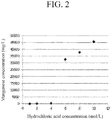
- the above post-adsorption lithium manganese oxide powder Li 1.6 Mn 1.6 O 4 (3 g) and 42 mL of a 1 mol/L aqueous hydrochloric acid solution as an acid solution were mixed by stirring for 30 minutes within a 100 mL PYLEX (registered trademark) beaker. At this time, the aqueous hydrochloric acid solution was kept at a temperature of 25°C. After mixing by stirring, the resultant was left to stand for 12 hours, the solution (lithium-containing solution with residual manganese) was subjected to solid-liquid separation, and then the manganese concentration in the solution was measured by ICP-AES. The results are depicted in Table 1 and Fig. 2 .
- Lithium-containing solutions are generally obtained from lithium-containing solution with residual manganese through the manganese oxidation step.
- High manganese concentration in the solution indicates that the whole lithium manganese oxide was dissolved in the acid solution. If the manganese concentration was not higher than 500 mg/L, it was determined that the amount of the whole lithium manganese oxide dissolved was suppressed and the post-adsorption lithium manganese oxide can be used again as a lithium adsorbent. In Example 1, the manganese concentration was 6.1 mg/L, suggesting the suppressed dissolution of the whole lithium manganese oxide. Note that, in Example 1, by adding chlorine gas as an oxidant and calcium hydrate as a pH adjuster to the lithium-containing solution with residual manganese after the elution step, the manganese oxidation step was performed, thereby obtaining the lithium-containing solution. When the manganese concentration in the lithium-containing solution was measured by ICP-AES, the manganese concentration was less than 1 mg/L, which was less than the lower limit of detection of the measurement instrument.
- Example 2 was performed under the same conditions as in Example 1 except for the use of a 2 mol/L aqueous hydrochloric acid solution as an acid solution in the elution step. The results are depicted in Table 1 and Fig. 2 .
- Example 2 the manganese concentration was 35 mg/L, suggesting the suppressed dissolution of the whole lithium manganese oxide. In addition, after performing the manganese oxidation step, the manganese concentration was less than 1 mg/L, which was less than the lower limit of detection of the measurement instrument.
- Example 3 was performed under the same conditions as in Example 1 except for the use of a 4 mol/L aqueous hydrochloric acid solution as an acid solution in the elution step. The results are depicted in Table 1 and Fig. 2 .
- Example 3 the manganese concentration was 289 mg/L, suggesting the suppressed dissolution of the whole lithium manganese oxide. In addition, after performing the manganese oxidation step, the manganese concentration was less than 1 mg/L, which was less than the lower limit of detection of the measurement instrument.
- Comparative example 1 was performed under the same conditions as in Example 1 except for the use of a 6 mol/L aqueous hydrochloric acid solution as an acid solution in the elution step. The results are depicted in Table 1 and Fig. 2 .
- Comparative example 2 was performed under the same conditions as in Example 1 except for the use of an 8 mol/L aqueous hydrochloric acid solution as an acid solution in the elution step. The results are depicted in Table 1 and Fig. 2 .
- Comparative example 3 was performed under the same conditions as in Example 1 except for the use of a 10 mol/L aqueous hydrochloric acid solution as an acid solution in the elution step. The results are depicted in Table 1 and Fig. 2 .
Landscapes
- Chemical & Material Sciences (AREA)
- Organic Chemistry (AREA)
- Engineering & Computer Science (AREA)
- Chemical Kinetics & Catalysis (AREA)
- Materials Engineering (AREA)
- Analytical Chemistry (AREA)
- Inorganic Chemistry (AREA)
- Geology (AREA)
- Metallurgy (AREA)
- Environmental & Geological Engineering (AREA)
- Life Sciences & Earth Sciences (AREA)
- Manufacturing & Machinery (AREA)
- General Life Sciences & Earth Sciences (AREA)
- Mechanical Engineering (AREA)
- Geochemistry & Mineralogy (AREA)
- General Chemical & Material Sciences (AREA)
- Solid-Sorbent Or Filter-Aiding Compositions (AREA)
- Inorganic Compounds Of Heavy Metals (AREA)
- Manufacture And Refinement Of Metals (AREA)
- Battery Electrode And Active Subsutance (AREA)
- Pharmaceuticals Containing Other Organic And Inorganic Compounds (AREA)
Abstract
Description
- The present invention relates to a method for producing a lithium-containing solution. Further specifically, the present invention relates to a method for producing a lithium-containing solution, by which a lithium-containing solution is produced from lithium manganese oxide.
- Lithium is broadly used in industry as, such as addition agents for ceramic or glass, glass flux for steel continuous casting, grease, pharmaceutical products and batteries. In particular, lithium ion batteries in which such lithium is used are known as secondary batteries having high energy density and high voltage, and thus the applications thereof as batteries for electronic equipment such as notebook personal computers or on-vehicle batteries for electric vehicles and hybrid vehicles are currently expanding and causing a sudden surge in demand therefor. This causes a sudden increase in demand for lithium as a raw material.
- Lithium has been produced in the form of lithium hydroxide or lithium carbonate by purifying salt lake brine or lithium-containing ores, such as spodumene (Li2O·Al2O3·2SiO4) as raw materials. However, in view of production cost, not a process of removing impurities other than lithium to cause lithium to remain in an aqueous solution, but a process of selectively collecting lithium from an aqueous solution in which impurities coexist with lithium is desired.
- A known process for selectively collecting lithium alone is a method in which lithium manganese oxide that is an inorganic adsorbent is used. Lithium manganese oxide having a spinel structure has good capacity of selectively adsorbing lithium as a result of pre-treatment; that is, lithium-hydrogen exchange via contacting with acid, and thus can be repeatedly used through adsorption and elution in a manner similar to ion-exchange resins.
- Specifically, in a process for selectively collecting lithium, lithium manganese oxide serves as a precursor of a lithium adsorbent. Examples of a method for producing the lithium manganese oxide include dry methods for producing the lithium manganese oxide by firing alone and wet methods for producing the same in aqueous solutions. Unlike the dry methods, the wet methods are capable of stably producing the lithium manganese oxide in large quantities.
- Specifically, Patent Literature 1 discloses a method for producing lithium manganese oxide by a wet method. The wet method involves heat treatment for accelerating crystallization reaction after preparation of lithium manganese oxide by reaction in an aqueous solution. The wet method specifically involves mixing γ-manganese oxyhydroxide with lithium hydroxide for hydrothermal reaction at 100°C to 140°C under pressure, so as to obtain lithium manganese oxide (LiMn2O4), and then performing heat treatment at temperatures ranging from 400°C to 700°C, so as to oxidize trivalent manganese to tetravalent manganese, whereby lithium manganese oxide (Li2Mn2O5) can be stably obtained without causing any structural change.
- The lithium manganese oxide obtained by the above method or the like is used as disclosed in Non-patent literature 1, for example. First, with the use of H1.6Mn1.6O4 obtained from Li1.6Mn1.6O4 by acid treatment, exchange reaction between cations is performed to adsorb lithium in brine, thereby obtaining Li1.6Mn1.6O4 again (adsorption step). Next, predetermined acid is added to obtain H1.6Mn1.6O4 and to obtain a lithium-containing solution in which Li ions are dissolved (desorption step, or may also be referred to as "elution step" in the Description). Impurities are removed from the lithium-containing solution and the lithium-containing solution is concentrated by heating, thereby obtaining lithium carbonate and the like.
- [Patent Literature 1]
Japanese Patent No.3388406 - [Non-patent Literature 1] Tang Weiping "Lithium Recovery System from brine", [online], June 11, 2010, Kagawa Industry Support Foundation, [November 22,2018], Internet (www.kagawa-isf.jp/rist/seika-happyou/21tang.pdf)
- However, increasing the amount of acid to be used in the above elution step in order to increase the efficiency of lithium elution is problematic in that this does not lead to exchange reaction between cations, but may result in dissolution of the whole lithium manganese oxide.
- In view of the above circumstances, an obj ect of the present invention is to provide a method for producing a lithium-containing solution, which is capable of preventing the dissolution of the whole lithium manganese oxide while maintaining the efficiency of the elution step.
- The method for producing a lithium-containing solution of a 1st invention comprises performing an adsorption step of contacting a lithium adsorbent obtained from lithium manganese oxide with a low lithium-containing liquid for adsorption to give post-adsorption lithium manganese oxide, an elution step of contacting the post-adsorption lithium manganese oxide with an acid solution to give a lithium-containing solution with residual manganese, and a manganese oxidation step of oxidating manganese by adding an oxidant and a pH adjuster to the lithium-containing solution with residual manganese to give a lithium-containing solution with a suppressed manganese concentration, performed in this order, wherein the acid solution is a 0.5 mol/L or more and 4.0 mol/L or less hydrochloric acid solution.
- The method for producing a lithium-containing solution of a 2nd invention comprises the elution step in the 1st invention performed at 0°C or higher and 70°C or lower.
- According to the 1st invention, in the elution step, the acid solution as a 0.5 mol/L or more and 4.0 mol/L or less hydrochloric acid solution can suppress the dissolution of the whole lithium manganese oxide while maintaining the efficiency of exchange reaction between cations including Li+ and H+ in the elution step. In other words, the repeated use of a lithium adsorbent becomes possible. Moreover, the manganese oxidation step allows obtaining a lithium-containing solution with a suppressed manganese concentration.
- According to the 2nd invention, the elution step at 0°C or higher and 70°C or lower suppresses the dissolution of the whole lithium manganese oxide and allows reliably maintaining the efficiency of exchange reaction between cations.
-
-
Fig. 1 is a flow chart of the method for producing a lithium-containing solution according to an embodiment of the present invention. -
Fig. 2 is a graph depicting the concentration of manganese in a Li-containing solution with respect to the concentration of hydrochloric acid. - Next, the embodiments of the present invention are as described below on the basis of the drawings. However, the following embodiments illustrate the method for producing a lithium-containing solution for realization of the technical idea of the present invention, and thus the present invention does not intend to limit the method for producing a lithium-containing solution to the following method.
- The method for producing a lithium-containing solution according to the present invention comprises an adsorption step of contacting a lithium adsorbent obtained from lithium manganese oxide with a low lithium-containing liquid for adsorption to give post-adsorption lithium manganese oxide, an elution step of contacting the post-adsorption lithium manganese oxide with an acid solution to give a lithium-containing solution with residual manganese, and a manganese oxidation step of oxidating manganese by adding an oxidant and a pH adjuster to this lithium-containing solution with residual manganese to give a lithium-containing solution with a suppressed manganese concentration, performed in this order, wherein the acid solution is a 0.5 mol/L or more and 4.0 mol/L or less hydrochloric acid solution.
- In the elution step of the method for producing a lithium-containing solution, the acid solution as a 0.5 mol/L or more and 4.0 mol/L or less hydrochloric acid solution can suppress the dissolution of the whole lithium manganese oxide while maintaining the efficiency of exchange reaction between cations including Li+ and H+ in the elution step. In other words, the repeated use of a lithium adsorbent becomes possible. Moreover, the manganese oxidation step allows obtaining a lithium-containing solution with a suppressed manganese concentration.
- Further, the method for producing a lithium-containing solution according to the present invention comprises the elution step which is performed at 0°C or higher and 70°C or lower.
- The elution step is performed at 0°C or higher and 70°C or lower, so that the dissolution of the whole lithium manganese oxide can be suppressed as well as the efficiency of exchange reaction between cations can be reliably maintained.
- The adsorption step involves contacting a lithium adsorbent with a low lithium-containing liquid, obtaining post-adsorption lithium manganese oxide. A method for obtaining a lithium adsorbent to be used in the adsorption step is described as follows. Note that
Fig. 1 depicts a flow chart of the method for producing a lithium-containing solution according to an embodiment of the present invention, and the "preceding stage of the adsorption step" is the stage where the H1.6Mn1.6O4 in the uppermost stage inFig. 1 is obtained. - Lithium manganese oxide is subjected to acid treatment to give a lithium adsorbent as depicted in Formula 1. Note that in Formula 1, lithium manganese oxide is represented by Li1.6Mn1.6O4, but lithium manganese oxide is not limited thereto. For example, Li1.33Mn1.67O4 can also be used. Specifically, when lithium manganese oxide is Li1.6Mn1.6O4, the resulting lithium adsorbent is H1.6Mn1.6O4. However, when lithium manganese oxide (lithium manganese tetroxide) is Li1.33Mn1.67O4, for example, the resulting lithium adsorbent is H1.33Mn1.67O4. Moreover, acid to be used for the acid treatment is specified as HCl, but the example of the acid is not limited thereto. For example, sulfuric acid, nitric acid, and the like can also be used herein.
- The shape of lithium manganese oxide is determined in view of lithium adsorption in the adsorption step. For example, lithium manganese oxide can be in various forms such as a powdery form, a granular form resulting from granulation of the powder, and a columnar form resulting from spraying to column fibers. Acid treatment is performed to give H1.6Mn1.6O4 as a lithium adsorbent, for example. The form of the lithium adsorbent is the same as that of the lithium manganese oxide before the acid treatment.
[Formula 1] Li1.6Mn1.6O4+1.6HCl→H1.6Mn1.6O4+1.6LiCl
-
Fig. 1 depicts a flow chart of the method for producing a lithium-containing solution according to an embodiment of the present invention. The adsorption step involves contacting a lithium adsorbent with a low lithium-containing liquid for ion exchange reaction between H and Li depicted inFormula 2, thereby obtaining post-adsorption lithium manganese oxide. In the Description, the lithium manganese oxide obtained by the adsorption step may be referred to as post-adsorption lithium manganese oxide.
[Formula 2] H1.6Mn1.6O4+1.6LiCl→Li1.6Mn1.6O4+1.6HCl
- The low lithium-containing liquid corresponds to seawater or salt lake brine, for example. For example, seawater contains an average of0.17 ppm lithium. However, in these low lithium-containing liquids, in addition to lithium, elements such as sodium, magnesium, and calcium are dissolved. According to the method for producing a lithium-containing solution of the present invention, lithium can be selectively collected from a low lithium-containing liquid in which these elements are dissolved. In addition, the low lithium-containing liquid means that the lithium content per unit volume thereof is lower than that of a Li-containing solution described later.
- In the adsorption step, a method for contacting a low lithium-containing liquid with an adsorbent differs depending on the form of the adsorbent. For example, when the adsorbent is powdery, a predetermined amount of the adsorbent is introduced into a low lithium-containing liquid followed by stirring of the mixture for a predetermined time period, for the low lithium-containing liquid to contact with the adsorbent, so that lithium is adsorbed to the adsorbent. When the adsorbent is granular, the granular adsorbent is sealed in a container for liquid passage, a low lithium-containing liquid is passed through the container for the low lithium-containing liquid to contact with the adsorbent, so that lithium is adsorbed to the adsorbent. When the adsorbent is sprayed over the column fibers, the passage of the low lithium-containing solution through the column causes the low lithium-containing liquid to contact with the adsorbent, so that lithium is adsorbed to the adsorbent. Note that when the low lithium-containing liquid is passed through the column, the liquid should be repeatedly passed through the column so as to ensure the required number of contact with the adsorbent.
- Through the adsorption step, the adsorbent will be post-adsorption lithium manganese oxide. Further the low lithium-containing liquid will be a post-adsorption liquid after lithium adsorption to the adsorbent. The post-adsorption liquid is discharged into sea or lake from which the low lithium-containing liquid has been collected. At this time, the post-adsorption liquid is discharged after treated by neutralization or the like so that it is suitable for discharge.
- In the elution step, the post-adsorption lithium manganese oxide brought in contact with an acid solution for reaction depicted in Formula 3 obtains a lithium-containing solution with residual manganese. At this time, the post-adsorption lithium manganese oxide is regenerated as a lithium adsorbent through exchange reaction between cations including Li+ and H+, and then the lithium adsorbent is used again in the adsorption step.
[Formula 3] Li1.6Mn1.6O4+1.6HCl→H1.6Mn1.6O4+1.6LiCl
- The acid solution to be contacted with the post-adsorption lithium manganese oxide in the elution step of the embodiment is a 0.5 mol/L or more and 4.0 mol/L or less hydrochloric acid solution, and is preferably a 0.5 mol/L or more and 2.0 mol/L or less hydrochloric acid solution.
- In the elution step, the acid solution is a 0.5 mol/L or more and 4.0 mol/L or less hydrochloric acid solution, so that in the elution step, the dissolution of the whole lithium manganese oxide can be suppressed while maintaining the efficiency of exchange reaction between cations including Li+ and H+, Specifically, the repeated use of the lithium adsorbent becomes possible.
- When the concentration of the acid solution is lower than 0.5 mol/L, exchange reaction between cations cannot be sufficiently performed, lowering the efficiency of the exchange reaction. Further, when the concentration of the acid solution is higher than 4.0 mol/L, the whole lithium manganese oxide is dissolved in the acid solution, so that the post-adsorption lithium manganese oxide cannot be used again as a lithium adsorbent. Note that the acid of the acid solution is not limited to hydrochloric acid. For example, sulfuric acid, acetic acid or the like may also be used herein.
- In the embodiment, the elution step is preferably performed at 0°C or higher and 70°C or lower. The elution step is performed at 0°C or higher and 70°C or lower, so that the dissolution of the whole lithium manganese oxide can be suppressed, as well as the efficiency of exchange reaction between cations can be reliably maintained.
- If the elution step is performed at a temperature lower than 0°C, the acid solution may be frozen, and thus no exchange reaction between cations may be performed. Further, if the elution step is performed at a temperature higher than 70°C, the whole lithium manganese oxide may be dissolved.
- The way of contacting the post-adsorption lithium manganese oxide with an acid solution in the elution step differs depending on the form of lithium manganese oxide. For example, when lithium manganese oxide is in a powdery form, post-adsorption lithium manganese oxide powder is introduced into an acid solution and then the mixture is stirred, thereby contacting the post-adsorption lithium manganese oxide with the acid solution. When lithium manganese oxide is in a granular form or in a form sprayed over column fibers, an acid solution is passed through the container for liquid passage while lithium manganese oxide granules and the column are being housed within the container for liquid passage, thereby contacting the post-adsorption lithium manganese oxide with the acid solution.
- In the manganese oxidation step, an oxidant and a pH adjuster are added to the lithium-containing solution with residual manganese obtained in the elution step for oxidizing divalent manganese to tetravalent manganese, thereby obtaining a lithium-containing solution with a suppressed manganese concentration. Since tetravalent manganese has low solubility, it precipitates in the solution. This can suppress the concentration of manganese contained in the lithium-containing solution with residual manganese. Further, the precipitated manganese can be used again as a raw material of the lithium adsorbent.
- To oxidize divalent manganese to tetravalent manganese, an oxidant and a pH adjuster are added to the lithium-containing solution with residual manganese. When the oxidant and the pH adjuster are added, it is preferred that a pH is adjusted to be in a range of3 or more and 7 or less and a redox potential vs the silver-silver chloride electrodes is adjusted to be 600 mV or more and 1100 mV or less. In other words, the pH and the redox potential are measured simultaneously, while the oxidant and the pH adjuster are added simultaneously or altematingly so as to make it within the range described above. As an oxidant, for example, sodium hypochlorite, sodium chlorite, ozone, permanganate or the like can be used, but are not limited thereto; using any materials whose redox potential is adjustable will present no problems. As a pH adjuster, for example, antalkalis such as sodium hydroxide and calcium hydrate can be used, but are not limited thereto; using any materials whose pH is adjustable will present no problems.
- In the lithium-containing solution obtained in the manganese oxidation step, lithium is present in the form of lithium chloride (LiCl) in this embodiment. Hence, alkali is added to the solution or the solution is concentrated by heating, thus obtaining lithium in the form of lithium carbonate, for example.
- Further, the post-adsorption lithium manganese oxide is treated with an acid solution to give a lithium adsorbent, and thus the lithium adsorbent is used again in the adsorption step.
- Hereinafter, specific examples of the method for producing a lithium-containing solution of the present invention will be further described in detail, but the present invention is not limited by these examples.
- To a solution prepared by dissolving lithium in simulation of salt lake brine; that is a low lithium-containing liquid, 5 g of a lithium adsorbent, H1.6Mn1.6O4, was added, thereby obtaining 5.3 g of post-adsorption lithium manganese oxide, Li1.6Mn1.6O4. The post-adsorption lithium manganese oxide was subjected to solid-liquid separation, and then dried to give lithium manganese oxide powder.
- The above post-adsorption lithium manganese oxide powder Li1.6Mn1.6O4 (3 g) and 42 mL of a 1 mol/L aqueous hydrochloric acid solution as an acid solution were mixed by stirring for 30 minutes within a 100 mL PYLEX (registered trademark) beaker. At this time, the aqueous hydrochloric acid solution was kept at a temperature of 25°C. After mixing by stirring, the resultant was left to stand for 12 hours, the solution (lithium-containing solution with residual manganese) was subjected to solid-liquid separation, and then the manganese concentration in the solution was measured by ICP-AES. The results are depicted in Table 1 and
Fig. 2 . Note that the results indicated in the examples and the like are for the lithium-containing solution with residual manganese in the prior stage of the manganese oxidation step to find the amount of manganese dissolution. Lithium-containing solutions are generally obtained from lithium-containing solution with residual manganese through the manganese oxidation step. - High manganese concentration in the solution indicates that the whole lithium manganese oxide was dissolved in the acid solution. If the manganese concentration was not higher than 500 mg/L, it was determined that the amount of the whole lithium manganese oxide dissolved was suppressed and the post-adsorption lithium manganese oxide can be used again as a lithium adsorbent. In Example 1, the manganese concentration was 6.1 mg/L, suggesting the suppressed dissolution of the whole lithium manganese oxide. Note that, in Example 1, by adding chlorine gas as an oxidant and calcium hydrate as a pH adjuster to the lithium-containing solution with residual manganese after the elution step, the manganese oxidation step was performed, thereby obtaining the lithium-containing solution. When the manganese concentration in the lithium-containing solution was measured by ICP-AES, the manganese concentration was less than 1 mg/L, which was less than the lower limit of detection of the measurement instrument.
- Example 2 was performed under the same conditions as in Example 1 except for the use of a 2 mol/L aqueous hydrochloric acid solution as an acid solution in the elution step. The results are depicted in Table 1 and
Fig. 2 . - In Example 2, the manganese concentration was 35 mg/L, suggesting the suppressed dissolution of the whole lithium manganese oxide. In addition, after performing the manganese oxidation step, the manganese concentration was less than 1 mg/L, which was less than the lower limit of detection of the measurement instrument.
- Example 3 was performed under the same conditions as in Example 1 except for the use of a 4 mol/L aqueous hydrochloric acid solution as an acid solution in the elution step. The results are depicted in Table 1 and
Fig. 2 . - In Example 3, the manganese concentration was 289 mg/L, suggesting the suppressed dissolution of the whole lithium manganese oxide. In addition, after performing the manganese oxidation step, the manganese concentration was less than 1 mg/L, which was less than the lower limit of detection of the measurement instrument.
- Comparative example 1 was performed under the same conditions as in Example 1 except for the use of a 6 mol/L aqueous hydrochloric acid solution as an acid solution in the elution step. The results are depicted in Table 1 and
Fig. 2 . - In Comparative example 1, the manganese concentration was 32500 mg/L, revealing that the dissolution of the whole lithium manganese oxide was not suppressed.
- Comparative example 2 was performed under the same conditions as in Example 1 except for the use of an 8 mol/L aqueous hydrochloric acid solution as an acid solution in the elution step. The results are depicted in Table 1 and
Fig. 2 . - In Comparative example 2, the manganese concentration was 37800 mg/L, revealing that the dissolution of the whole lithium manganese oxide was not suppressed.
- Comparative example 3 was performed under the same conditions as in Example 1 except for the use of a 10 mol/L aqueous hydrochloric acid solution as an acid solution in the elution step. The results are depicted in Table 1 and
Fig. 2 . - In Comparative example 3, the manganese concentration was 45500 mg/L, revealing that the dissolution of the whole lithium manganese oxide was not suppressed.
[Table 1] Hydrochloric acid concentration mol/L Manganese concentration mg/L Example 1 1 6.1 Example 2 2 35 Example 3 4 289 Comparative example 1 6 32500 Comparative example 2 8 37800 Comparative example 3 10 45500
Claims (2)
- A method for producing a lithium-containing solution, comprising:an adsorption step of contacting a lithium adsorbent obtained from lithium manganese oxide with a low lithium-containing liquid for adsorption to give post-adsorption lithium manganese oxide;an elution step of contacting the post-adsorption lithium manganese oxide with an acid solution to give a lithium-containing solution with residual manganese; anda manganese oxidation step of oxidating manganese by adding an oxidant and a pH adjuster to the lithium-containing solution with residual manganese to give a lithium-containing solution with a suppressed manganese concentration, performed in this order, wherein
the acid solution is a 0.5 mol/L or more and 4.0 mol/L or less hydrochloric acid solution. - The method for producing a lithium-containing solution according to claim 1, wherein the elution step is performed at 0°C or higher and 70°C or lower.
Applications Claiming Priority (2)
| Application Number | Priority Date | Filing Date | Title |
|---|---|---|---|
| JP2018229507 | 2018-12-07 | ||
| PCT/JP2019/047811 WO2020116607A1 (en) | 2018-12-07 | 2019-12-06 | Production method for lithium-containing solution |
Publications (2)
| Publication Number | Publication Date |
|---|---|
| EP3892588A1 true EP3892588A1 (en) | 2021-10-13 |
| EP3892588A4 EP3892588A4 (en) | 2022-08-31 |
Family
ID=70973585
Family Applications (1)
| Application Number | Title | Priority Date | Filing Date |
|---|---|---|---|
| EP19893315.2A Pending EP3892588A4 (en) | 2018-12-07 | 2019-12-06 | PROCESS FOR PRODUCTION OF SOLUTION CONTAINING LITHIUM |
Country Status (8)
| Country | Link |
|---|---|
| US (1) | US20220024776A1 (en) |
| EP (1) | EP3892588A4 (en) |
| JP (1) | JP7415948B2 (en) |
| CN (1) | CN113195411A (en) |
| AR (1) | AR117244A1 (en) |
| AU (1) | AU2019395190C1 (en) |
| CL (1) | CL2021001426A1 (en) |
| WO (2) | WO2020115948A1 (en) |
Cited By (1)
| Publication number | Priority date | Publication date | Assignee | Title |
|---|---|---|---|---|
| DE102021108442A1 (en) | 2021-04-01 | 2022-10-06 | EnBW Energie Baden-Württemberg AG | Process for preparing a lithium adsorbent |
Families Citing this family (11)
| Publication number | Priority date | Publication date | Assignee | Title |
|---|---|---|---|---|
| JP7156322B2 (en) * | 2020-02-17 | 2022-10-19 | 住友金属鉱山株式会社 | Method for producing lithium hydroxide |
| CN112791691B (en) | 2020-12-23 | 2023-07-25 | 礼思(上海)材料科技有限公司 | A kind of coated lithium ion sieve and preparation method thereof |
| DE102021105808A1 (en) | 2021-03-10 | 2022-09-15 | EnBW Energie Baden-Württemberg AG | Process for extracting lithium from brine or seawater |
| JP7124917B1 (en) * | 2021-03-31 | 2022-08-24 | 住友金属鉱山株式会社 | Method for producing lithium-containing solution |
| AR126130A1 (en) * | 2021-06-11 | 2023-09-13 | Geo40 Ltd | PROCESS AND SYSTEM |
| CN113368537B (en) * | 2021-06-28 | 2022-05-24 | 青海盐湖工业股份有限公司 | Method and device for preparing high-lithium mother liquor by using old brine through adsorption method |
| JP7877643B2 (en) | 2021-06-30 | 2026-06-23 | 住友金属鉱山株式会社 | Method for manufacturing lithium adsorbent granules |
| CN116351384A (en) * | 2021-12-28 | 2023-06-30 | 比亚迪股份有限公司 | Lithium adsorbent and salt lake lithium extraction method |
| JP7513138B1 (en) * | 2023-02-28 | 2024-07-09 | 住友金属鉱山株式会社 | Method for producing lithium-containing solution |
| CN117920169A (en) * | 2024-01-29 | 2024-04-26 | 南京工业大学 | Low-dissolution-loss lithium manganese oxide eluent and method for preparing manganese series lithium ion sieve |
| WO2025253801A1 (en) * | 2024-06-06 | 2025-12-11 | 住友化学株式会社 | Method for producing lithium salt and system for producing lithium salt |
Family Cites Families (12)
| Publication number | Priority date | Publication date | Assignee | Title |
|---|---|---|---|---|
| JPS61171535A (en) * | 1985-01-24 | 1986-08-02 | Agency Of Ind Science & Technol | Lithium adsorbent, its preparation and recovery of lithium using said adsorbent |
| JP3388406B2 (en) | 1999-09-22 | 2003-03-24 | 独立行政法人産業技術総合研究所 | Method for producing lithium adsorbent |
| US7465334B2 (en) * | 2001-09-13 | 2008-12-16 | Intec Ltd. | Zinc recovery process |
| JP4210475B2 (en) * | 2002-06-05 | 2009-01-21 | 日鉱金属株式会社 | Method for recovering cobalt from scrap |
| CN101597689B (en) * | 2009-07-08 | 2010-12-01 | 中南大学 | Efficient purification process of acidic leaching solution of active substances in waste lithium batteries |
| JP5700338B2 (en) * | 2009-11-10 | 2015-04-15 | 公益財団法人北九州産業学術推進機構 | Lithium adsorbent production method, lithium concentration method, and lithium concentration apparatus |
| US20110219607A1 (en) * | 2010-03-12 | 2011-09-15 | Nanjundaswamy Kirakodu S | Cathode active materials and method of making thereof |
| US8663361B1 (en) * | 2010-05-06 | 2014-03-04 | Sandia Corporation | Methods of recovering alkali metals |
| JP2015020090A (en) * | 2013-07-16 | 2015-02-02 | 独立行政法人産業技術総合研究所 | Manufacturing method of lithium-adsorbing material, and lithium-adsorbing material |
| JP6137035B2 (en) * | 2014-04-24 | 2017-05-31 | 住友金属鉱山株式会社 | Purification method of nickel chloride solution |
| JP6735192B2 (en) * | 2016-09-07 | 2020-08-05 | Jx金属株式会社 | Lithium-ion battery scrap processing method |
| CN106629789B (en) * | 2016-09-12 | 2018-02-27 | 中国科学院青海盐湖研究所 | It is a kind of that the method that lithium prepares battery-level lithium carbonate in bittern is extracted using ion-exchange |
-
2019
- 2019-08-07 WO PCT/JP2019/031180 patent/WO2020115948A1/en not_active Ceased
- 2019-12-04 AR ARP190103541A patent/AR117244A1/en unknown
- 2019-12-06 EP EP19893315.2A patent/EP3892588A4/en active Pending
- 2019-12-06 US US17/297,227 patent/US20220024776A1/en not_active Abandoned
- 2019-12-06 WO PCT/JP2019/047811 patent/WO2020116607A1/en not_active Ceased
- 2019-12-06 AU AU2019395190A patent/AU2019395190C1/en active Active
- 2019-12-06 JP JP2020560044A patent/JP7415948B2/en active Active
- 2019-12-06 CN CN201980079488.2A patent/CN113195411A/en active Pending
-
2021
- 2021-05-31 CL CL2021001426A patent/CL2021001426A1/en unknown
Cited By (2)
| Publication number | Priority date | Publication date | Assignee | Title |
|---|---|---|---|---|
| DE102021108442A1 (en) | 2021-04-01 | 2022-10-06 | EnBW Energie Baden-Württemberg AG | Process for preparing a lithium adsorbent |
| DE102021108442B4 (en) | 2021-04-01 | 2023-01-26 | EnBW Energie Baden-Württemberg AG | Process for preparing a lithium adsorbent |
Also Published As
| Publication number | Publication date |
|---|---|
| CL2021001426A1 (en) | 2021-11-26 |
| AU2019395190A1 (en) | 2021-06-24 |
| EP3892588A4 (en) | 2022-08-31 |
| AU2019395190C1 (en) | 2023-03-16 |
| JP7415948B2 (en) | 2024-01-17 |
| US20220024776A1 (en) | 2022-01-27 |
| CN113195411A (en) | 2021-07-30 |
| WO2020115948A1 (en) | 2020-06-11 |
| AR117244A1 (en) | 2021-07-21 |
| WO2020116607A1 (en) | 2020-06-11 |
| JPWO2020116607A1 (en) | 2020-06-11 |
| AU2019395190B2 (en) | 2022-10-13 |
Similar Documents
| Publication | Publication Date | Title |
|---|---|---|
| US20220024776A1 (en) | Method for producing lithium-containing solution | |
| TWI805730B (en) | Process for the recovery of lithium and transition metal using heat | |
| Grágeda et al. | Purification of brines by chemical precipitation and ion‐exchange processes for obtaining battery‐grade lithium compounds | |
| CA3175416A1 (en) | Lithium extraction process | |
| AU2022250148B2 (en) | Lithium-containing solution production method | |
| JP2019099901A (en) | Method for recovering lithium from lithium-containing solution | |
| TW202134182A (en) | Process for the purification of lithium salts | |
| JP2015534610A (en) | Method for recovering lithium by lithium metallurgical process from lithium manganese oxide-containing part of used galvanic cell | |
| EP3705181B1 (en) | Method for producing lithium adsorbent precursor | |
| JP2008254944A (en) | Porous iron oxide, method for producing the same, and method for treating water to be treated | |
| CN117732420A (en) | Flaky porous defluorination adsorbent, and preparation method and application thereof | |
| JPH0218906B2 (en) | ||
| CA3087389C (en) | Method for producing precursor of lithium adsorbent | |
| CN110498431A (en) | A kind of preparation method of high-purity spherical shape potassium chloride | |
| TW202547782A (en) | Method for lithium battery recycling | |
| KR20250091898A (en) | Adsorbent for removing potassium ion and method of removing potassium ion | |
| WO2025257073A1 (en) | Use of sodium sulfate from battery recycling | |
| AU2024228971A1 (en) | Method for producing lithium-containing solution | |
| JP2683312B2 (en) | Potassium selective adsorbent and method for producing the same | |
| CN119895061A (en) | Method for producing lithium-containing solution | |
| CN121159381A (en) | A method for recovering phosphorus iron slag from refining | |
| CN121513978A (en) | A UV-excited manganese-based lithium ion sieve eluent and its application | |
| CN102139897A (en) | Method for removing bromine impurities from alkali metal or alkali earth metal chloride |
Legal Events
| Date | Code | Title | Description |
|---|---|---|---|
| STAA | Information on the status of an ep patent application or granted ep patent |
Free format text: STATUS: THE INTERNATIONAL PUBLICATION HAS BEEN MADE |
|
| PUAI | Public reference made under article 153(3) epc to a published international application that has entered the european phase |
Free format text: ORIGINAL CODE: 0009012 |
|
| STAA | Information on the status of an ep patent application or granted ep patent |
Free format text: STATUS: REQUEST FOR EXAMINATION WAS MADE |
|
| 17P | Request for examination filed |
Effective date: 20210527 |
|
| AK | Designated contracting states |
Kind code of ref document: A1 Designated state(s): AL AT BE BG CH CY CZ DE DK EE ES FI FR GB GR HR HU IE IS IT LI LT LU LV MC MK MT NL NO PL PT RO RS SE SI SK SM TR |
|
| DAV | Request for validation of the european patent (deleted) | ||
| DAX | Request for extension of the european patent (deleted) | ||
| A4 | Supplementary search report drawn up and despatched |
Effective date: 20220801 |
|
| RIC1 | Information provided on ipc code assigned before grant |
Ipc: C01G 45/00 20060101ALI20220726BHEP Ipc: C02F 1/42 20060101ALI20220726BHEP Ipc: C01D 15/08 20060101ALI20220726BHEP Ipc: B01J 20/06 20060101ALI20220726BHEP Ipc: B01D 15/36 20060101ALI20220726BHEP Ipc: C01G 45/12 20060101AFI20220726BHEP |
|
| STAA | Information on the status of an ep patent application or granted ep patent |
Free format text: STATUS: EXAMINATION IS IN PROGRESS |
|
| 17Q | First examination report despatched |
Effective date: 20250109 |