EP3891836B1 - Battery combinations for optimised space utilization - Google Patents
Battery combinations for optimised space utilization Download PDFInfo
- Publication number
- EP3891836B1 EP3891836B1 EP19735002.8A EP19735002A EP3891836B1 EP 3891836 B1 EP3891836 B1 EP 3891836B1 EP 19735002 A EP19735002 A EP 19735002A EP 3891836 B1 EP3891836 B1 EP 3891836B1
- Authority
- EP
- European Patent Office
- Prior art keywords
- battery
- auxiliary battery
- auxiliary
- mobile device
- interconnect
- Prior art date
- Legal status (The legal status is an assumption and is not a legal conclusion. Google has not performed a legal analysis and makes no representation as to the accuracy of the status listed.)
- Active
Links
Images




Classifications
-
- H—ELECTRICITY
- H01—ELECTRIC ELEMENTS
- H01M—PROCESSES OR MEANS, e.g. BATTERIES, FOR THE DIRECT CONVERSION OF CHEMICAL ENERGY INTO ELECTRICAL ENERGY
- H01M10/00—Secondary cells; Manufacture thereof
- H01M10/04—Construction or manufacture in general
- H01M10/0431—Cells with wound or folded electrodes
-
- G—PHYSICS
- G06—COMPUTING OR CALCULATING; COUNTING
- G06F—ELECTRIC DIGITAL DATA PROCESSING
- G06F1/00—Details not covered by groups G06F3/00 - G06F13/00 and G06F21/00
- G06F1/26—Power supply means, e.g. regulation thereof
- G06F1/263—Arrangements for using multiple switchable power supplies, e.g. battery and AC
-
- H—ELECTRICITY
- H01—ELECTRIC ELEMENTS
- H01M—PROCESSES OR MEANS, e.g. BATTERIES, FOR THE DIRECT CONVERSION OF CHEMICAL ENERGY INTO ELECTRICAL ENERGY
- H01M10/00—Secondary cells; Manufacture thereof
- H01M10/04—Construction or manufacture in general
- H01M10/0436—Small-sized flat cells or batteries for portable equipment
-
- H—ELECTRICITY
- H01—ELECTRIC ELEMENTS
- H01M—PROCESSES OR MEANS, e.g. BATTERIES, FOR THE DIRECT CONVERSION OF CHEMICAL ENERGY INTO ELECTRICAL ENERGY
- H01M50/00—Constructional details or processes of manufacture of the non-active parts of electrochemical cells other than fuel cells, e.g. hybrid cells
- H01M50/10—Primary casings; Jackets or wrappings
- H01M50/102—Primary casings; Jackets or wrappings characterised by their shape or physical structure
- H01M50/105—Pouches or flexible bags
-
- H—ELECTRICITY
- H01—ELECTRIC ELEMENTS
- H01M—PROCESSES OR MEANS, e.g. BATTERIES, FOR THE DIRECT CONVERSION OF CHEMICAL ENERGY INTO ELECTRICAL ENERGY
- H01M50/00—Constructional details or processes of manufacture of the non-active parts of electrochemical cells other than fuel cells, e.g. hybrid cells
- H01M50/20—Mountings; Secondary casings or frames; Racks, modules or packs; Suspension devices; Shock absorbers; Transport or carrying devices; Holders
- H01M50/204—Racks, modules or packs for multiple batteries or multiple cells
- H01M50/207—Racks, modules or packs for multiple batteries or multiple cells characterised by their shape
- H01M50/211—Racks, modules or packs for multiple batteries or multiple cells characterised by their shape adapted for pouch cells
-
- H—ELECTRICITY
- H01—ELECTRIC ELEMENTS
- H01M—PROCESSES OR MEANS, e.g. BATTERIES, FOR THE DIRECT CONVERSION OF CHEMICAL ENERGY INTO ELECTRICAL ENERGY
- H01M50/00—Constructional details or processes of manufacture of the non-active parts of electrochemical cells other than fuel cells, e.g. hybrid cells
- H01M50/20—Mountings; Secondary casings or frames; Racks, modules or packs; Suspension devices; Shock absorbers; Transport or carrying devices; Holders
- H01M50/247—Mountings; Secondary casings or frames; Racks, modules or packs; Suspension devices; Shock absorbers; Transport or carrying devices; Holders specially adapted for portable devices, e.g. mobile phones, computers, hand tools or pacemakers
-
- H—ELECTRICITY
- H01—ELECTRIC ELEMENTS
- H01M—PROCESSES OR MEANS, e.g. BATTERIES, FOR THE DIRECT CONVERSION OF CHEMICAL ENERGY INTO ELECTRICAL ENERGY
- H01M50/00—Constructional details or processes of manufacture of the non-active parts of electrochemical cells other than fuel cells, e.g. hybrid cells
- H01M50/50—Current conducting connections for cells or batteries
- H01M50/502—Interconnectors for connecting terminals of adjacent batteries; Interconnectors for connecting cells outside a battery casing
- H01M50/509—Interconnectors for connecting terminals of adjacent batteries; Interconnectors for connecting cells outside a battery casing characterised by the type of connection, e.g. mixed connections
- H01M50/512—Connection only in parallel
-
- H—ELECTRICITY
- H01—ELECTRIC ELEMENTS
- H01M—PROCESSES OR MEANS, e.g. BATTERIES, FOR THE DIRECT CONVERSION OF CHEMICAL ENERGY INTO ELECTRICAL ENERGY
- H01M6/00—Primary cells; Manufacture thereof
- H01M6/02—Details
-
- H—ELECTRICITY
- H04—ELECTRIC COMMUNICATION TECHNIQUE
- H04M—TELEPHONIC COMMUNICATION
- H04M1/00—Substation equipment, e.g. for use by subscribers
- H04M1/02—Constructional features of telephone sets
- H04M1/0202—Portable telephone sets, e.g. cordless phones, mobile phones or bar type handsets
- H04M1/026—Details of the structure or mounting of specific components
- H04M1/0262—Details of the structure or mounting of specific components for a battery compartment
-
- H—ELECTRICITY
- H01—ELECTRIC ELEMENTS
- H01M—PROCESSES OR MEANS, e.g. BATTERIES, FOR THE DIRECT CONVERSION OF CHEMICAL ENERGY INTO ELECTRICAL ENERGY
- H01M10/00—Secondary cells; Manufacture thereof
- H01M10/04—Construction or manufacture in general
- H01M10/0445—Multimode batteries, e.g. containing auxiliary cells or electrodes switchable in parallel or series connections
-
- H—ELECTRICITY
- H01—ELECTRIC ELEMENTS
- H01M—PROCESSES OR MEANS, e.g. BATTERIES, FOR THE DIRECT CONVERSION OF CHEMICAL ENERGY INTO ELECTRICAL ENERGY
- H01M2220/00—Batteries for particular applications
- H01M2220/30—Batteries in portable systems, e.g. mobile phone, laptop
-
- H—ELECTRICITY
- H01—ELECTRIC ELEMENTS
- H01M—PROCESSES OR MEANS, e.g. BATTERIES, FOR THE DIRECT CONVERSION OF CHEMICAL ENERGY INTO ELECTRICAL ENERGY
- H01M6/00—Primary cells; Manufacture thereof
- H01M6/40—Printed batteries, e.g. thin film batteries
-
- Y—GENERAL TAGGING OF NEW TECHNOLOGICAL DEVELOPMENTS; GENERAL TAGGING OF CROSS-SECTIONAL TECHNOLOGIES SPANNING OVER SEVERAL SECTIONS OF THE IPC; TECHNICAL SUBJECTS COVERED BY FORMER USPC CROSS-REFERENCE ART COLLECTIONS [XRACs] AND DIGESTS
- Y02—TECHNOLOGIES OR APPLICATIONS FOR MITIGATION OR ADAPTATION AGAINST CLIMATE CHANGE
- Y02E—REDUCTION OF GREENHOUSE GAS [GHG] EMISSIONS, RELATED TO ENERGY GENERATION, TRANSMISSION OR DISTRIBUTION
- Y02E60/00—Enabling technologies; Technologies with a potential or indirect contribution to GHG emissions mitigation
- Y02E60/10—Energy storage using batteries
-
- Y—GENERAL TAGGING OF NEW TECHNOLOGICAL DEVELOPMENTS; GENERAL TAGGING OF CROSS-SECTIONAL TECHNOLOGIES SPANNING OVER SEVERAL SECTIONS OF THE IPC; TECHNICAL SUBJECTS COVERED BY FORMER USPC CROSS-REFERENCE ART COLLECTIONS [XRACs] AND DIGESTS
- Y02—TECHNOLOGIES OR APPLICATIONS FOR MITIGATION OR ADAPTATION AGAINST CLIMATE CHANGE
- Y02P—CLIMATE CHANGE MITIGATION TECHNOLOGIES IN THE PRODUCTION OR PROCESSING OF GOODS
- Y02P70/00—Climate change mitigation technologies in the production process for final industrial or consumer products
- Y02P70/50—Manufacturing or production processes characterised by the final manufactured product
Definitions
- Batteries can be used to temporarily provide electrical power to various devices when those devices are not connected to an external power source, for example. For a variety of reasons, batteries (and specifically rechargeable batteries) have become increasingly prevalent in many technology areas.
- the lithium-ion battery is an example of a rechargeable battery.
- batteries can be used to provide electrical power to devices, such batteries may be integrated into such devices.
- a rechargeable battery may be integrated into a consumer-electronic device such as a mobile phone, a tablet, or a laptop computer in order to provide power to such a device.
- the battery's designed shape and size may be at least partially determined based on the available space within the device. Hence, the capacity of the battery may be adversely affected by the dimensions of the device.
- US2014/361747A1 describes a method for managing the lifetime of a battery.
- An ambient temperature is measured near a battery.
- a discharge of the battery is triggered when the ambient temperature exceeds a first temperature threshold.
- the battery can then be charged when the ambient temperature decreases below a second temperature threshold.
- US2010/216023A1 describes an energy storage device structure comprising a first electrode layer, an electrolyte layer and a second electrode layer. At least one of the electrode layers comprise a metallic foil base layer and a layer of carbon nanotubes grown on the base layer, the carbon nanotube layer being arranged to face the electrolyte layer.
- the structure may be made in such a way that its width and length are much larger than its thickness, so that it can rolled up or folded and then hermetically sealed to form an energy storage unit.
- the layer of carbon nanotubes is grown on the metallic foil base layer by a chemical vapor deposition process at a temperature no higher than 550° C.
- the carbon nanotubes in the carbon nanotube layer are at least partially aligned in a direction that is perpendicular to the surface of the metallic base layer.
- a device according to claim 1 is disclosed.
- Example methods and systems are described herein. Any example embodiment or feature described herein is not necessarily to be construed as preferred or advantageous over other embodiments or features.
- the example embodiments described herein are not meant to be limiting. It will be readily understood that certain aspects of the disclosed systems and methods can be arranged and combined in a wide variety of different configurations, all of which are contemplated herein.
- Example embodiments relate to multiple battery configurations for space utilization.
- example embodiments disclosed herein include a battery (e.g., a planar or "jellyroll" lithium-ion battery) used in conjunction with a thin-film auxiliary battery to efficiently fill space within a consumer-electronic device housing.
- a battery e.g., a planar or "jellyroll" lithium-ion battery
- Such a multiple battery configuration may also accommodate the presence of interconnects (e.g., electronic cables) or other components (e.g., computing components, cooling devices, communication components, etc.).
- the battery might have the approximate shape of a rectangular prism with a thickness that is the same across the entire battery (e.g., similar to a conventional battery).
- the thin-film auxiliary battery can be placed along a top surface of the battery, thereby taking advantage of unused space to provide additional energy storage (e.g., unused space underneath a display of the consumer-electronic device).
- the thin-film auxiliary battery may have a length and/or a width that does not span the entire top face of the battery, thereby providing a void for placement of an interconnect (e.g., a wire or cable) or another component between the case and the battery and/or the thin-film auxiliary battery.
- the thin-film auxiliary battery may be a flexible battery, which can accommodate any swelling that occurs in the battery during charging / discharging.
- portions of the thin-film auxiliary battery or the battery may be excised to accommodate device components.
- the thin-film auxiliary battery might be placed between the battery and the case of the consumer-electronic device or between the battery and a touchscreen of the consumer-electronic device to take advantage of space that would otherwise be left empty due to design constraints of a conventional battery (e.g., a fabrication tolerance between the desired thickness and the actual thickness of a conventional battery).
- the thin-film auxiliary battery can be used to provide electrical power to the consumer-electronic device when the battery is sufficiently depleted.
- the thin-film auxiliary battery could be connected in parallel with the battery to provide an additional electrical power source during operation of the consumer-electronic device.
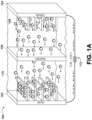
- FIG 1A is an illustration of a battery 100 (e.g., a single-celled battery).
- the battery 100 may be a rechargeable lithium-ion battery, for example.
- the battery 100 may include an anode 102, a cathode 104, a separator 106, and free lithium ions 108 within an electrolyte 110.
- the elements of the battery 100 are not necessarily illustrated to scale (e.g., the free lithium ions 108 may be significantly smaller than illustrated in the figure).
- the battery 100 may be chargeable by an electrical power source 112 (e.g., a rectified alternating current (AC) signal, a separate charged battery, or a charged capacitor).
- an electrical power source 112 e.g., a rectified alternating current (AC) signal, a separate charged battery, or a charged capacitor.
- multiple cells of cathode, anode, separator, and electrolyte may be electrically arranged in series and/or parallel to form a composite battery. Such cell
- Charging may include electrons flowing from the cathode 104 to the anode 102 through circuitry external to the battery 100.
- charging may include free lithium ions 108, within the electrolyte 110 solution, flowing from the cathode 104 to the anode 102 through the separator 106.
- charging may include the free lithium ions 108 being intercalated into the anode 102.
- the charging may represent a first formation charging process, in some embodiments.
- the first formation charging process may last between 10 hours and 20 hours, in some embodiments.
- the battery 100 may be configured to undergo repeated charge / discharge cycles during a lifetime of the battery 100.
- the battery 100 may be a rechargeable battery configured to be charged by an external voltage between 4.20 volts and 4.50 volts or between 4.40 volts and 4.60 volts.
- various charging / recharging schemes may be used.
- a constant voltage (CV) scheme may be used, where a constant voltage is applied across the terminals of the battery, resulting in a decreasing current as the battery charges, until the current reaches 0.0 Amps (or within a threshold current of 0.0 Amps), at which point the voltage source charging the battery is removed.
- a constant current (CC) scheme may be used, where the voltage applied across the terminals of the battery by a charging device is varied such that the current is maintained at a constant rate. Once the battery voltage reaches a threshold value to maintain the continuous current, the battery may be determined to be charged, and the voltage source charging the battery may be removed.
- a hybrid constant current / constant voltage (CC/CV) charging mode may be used to charge the battery.
- the CC/CV charging mode may have two stages. In a first stage (a CC stage), the voltage may be increased continuously to maintain a constant current charging the battery. Then, once the voltage reaches a certain maximum charging voltage threshold, the second stage of the CC/CV charging mode may begin. In the second stage (a CV stage), the voltage may be maintained at the maximum charging voltage threshold, and the charging current may be allowed to decrease. Once the charging current reaches a threshold level, indicating the battery is charged, the CC/CV charging mode may cease.
- the anode 102 may be the negative terminal (electrode) of the battery 100.
- the anode 102 may include one or more external electrical contacts on the side of the anode 102 facing away from the separator 106.
- the external electrical contact(s) may allow an electrical connection between the anode 102 and the power source 112 or a load to be made.
- the anode 102 may include graphite, Li, Li 4 Ti 5 O 12 , a lithium-metal composite, and/or Si, in various embodiments.
- the cathode 104 may be the positive terminal (electrode) of the battery 100.
- the cathode 104 may include one or more external electrical contacts on the side of the cathode 104 facing away from the separator 106.
- the external electrical contact(s) may allow an electrical connection between the cathode 104 and the power source 112 or a load to be made.
- the cathode 104 may include LiCoO 2 , LiMn 2 O 4 , a vanadium oxide, LiNiMnCoO 2 , LiNiCoAlO 2 , and/or an olivine (e.g., LiFePO 4 ), in some embodiments.
- Other lithium-containing cathode materials are possible and contemplated herein.
- the separator 106 may prevent a short circuit of the cathode 104 to the anode 102 within the battery 100.
- the separator 106 may include a semi-permeable membrane (e.g., permeable to the free lithium ions 108).
- the separator 106 may include micropores that are sized to selectively allow the passage of the free lithium ions 108 during charging or discharging processes.
- the semi-permeable membrane of the separator 106 may also have an amorphous or a semi-crystalline structure.
- the semi-permeable membrane of the separator 106 may be polymeric (e.g., fabricated from cellulose acetate, nitrocellulose, cellulose esters, polysulfone, polyether sulfone, polyacrilonitrile, polyamide, polyimide, polyethylene, polypropylene, polytetrafluoroethylene, polyvinylidene fluoride, polyvinylchloride, and/or aramid).
- the separator 106 may be chemically and electrochemically stable for use within the battery 100 during charging and discharging processes.
- the separator 106 may include a multi-layered structure.
- the separator 106 may be a non-standard separator having an increased mechanical stability, which can prevent dendrites from piercing the separator 106. Further, the separator 106 may also include compounds that are chemically and/or electrochemically stable for use within the battery 100 during charging or discharging processes. Such compounds may enhance the lifetime of the battery 100, for example.
- the battery 100 may be a thin-film battery.
- the battery 100 may not include a separator 106.
- the electrolyte 110 may be solid (e.g., rather than liquid), thereby satisfying purposes of both the electrolyte 110 and the separator 106 (e.g., transporting ions and preventing a short circuit of the cathode 104 to the anode 102).
- a discrete separator may not be needed.
- the free lithium ions 108 may transfer between the anode 102 and the cathode 104 during charging / discharging processes of the battery 100.
- the free lithium ions 108 may originate from the cathode 104.
- the cathode 104 may include LiCoO 2 , which may be a source of free lithium during the chemical reactions occurring during the charging process (e.g., during the first formation charging process). Other sources of free lithium ions are also possible.
- the anode 102 may provide free lithium ions and/or lithium salts (e.g., LiPF 6 , LiBF 4 , LiBC 4 O 8 , Li[PF 3 (C 2 F 5 ) 3 ], or LiClO 4 ) dissolved within the electrolyte 110 may provide free lithium ions.
- lithium salts e.g., LiPF 6 , LiBF 4 , LiBC 4 O 8 , Li[PF 3 (C 2 F 5 ) 3 ], or LiClO 4
- the electrolyte 110 may be a medium through which the free lithium ions 108 travel during charging and discharging processes of the battery 100.
- the electrolyte 110 may be a gel or a liquid, in various embodiments and/or at various temperatures.
- the electrolyte 110 may be an organic solvent (e.g., ethylene carbonate, dimethyl carbonate, or diethyl carbonate).
- Additives may be included within the electrolyte 110 to enhance the effectiveness of the electrolyte 110.
- ionic liquids may be included within the electrolyte to reduce volatility of the electrolyte solution.
- the electrolyte 110 may be a solid (e.g., rather than a liquid or gel).
- the electrolyte 110 may include one or more amorphous glassy layers deposited on the cathode 104 (e.g., deposited using sputtering or vapor deposition).
- amorphous glassy material that may be used is lithium phosphorous oxynitride (LiPON).
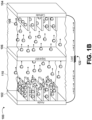
- FIG 1B is another illustration of the battery 100.
- the battery 100 illustrated in Figure 1B may be discharging across a load 122.
- Discharging the battery 100 may include electrons flowing from the anode 102 to the cathode 104, across the load 122, through circuitry external to the battery 100.
- Discharging the battery 100 may also include the free lithium ions 108 within the electrolyte 110 flowing from the anode 102 to the cathode 104 through the separator 106 (in embodiments having a discrete separator).
- discharging the battery 100 may include the free lithium ions 108 being intercalated into the cathode 104.
- Such a scenario is illustrated in Figure 1B by the lithium ions that are sitting on "shelves" of the cathode 104.
- the load 122 may be a device powered by the battery 100, such as an electric vehicle, a hybrid electric vehicle, a mobile device, a tablet computing device, a laptop computing device, a light source, television remote, headphones, etc.
- the load 122 may be powered by the flow of electrons through the circuitry external to the battery 100 during the discharging process, for example.
- Figure 2A is a front-view (e.g., view from a plane perpendicular to the x-axis, as illustrated) illustration of a mobile device 200 (e.g., a smartphone), according to example unclaimed embodiments.
- the mobile device 200 may include a case 212, a display 214, peripherals 216, and an input device 218.
- the mobile device 200 shown and described herein is an example consumer-electronic device.
- the mobile device 200 is referenced herein, although the mobile device 200 is depicted and described as a mobile phone or smartphone, other consumer-electronic devices that incorporate batteries (e.g., activity trackers, calculators, camcorders, digital cameras, e-readers, electronic cigarettes, flashlights, game controllers, global positioning system (GPS) devices, headphones, hotspots, keyboards, laptop computing devices, mice, microphones, musical instruments, portable gaming systems, portable grooming devices, portable media players, power tools, radios, remote-control vehicles, remotes, robotic vacuum cleaners, smartwatches, smart home devices, smart speakers, smoke detectors, speakers, tablet computing devices, thermometers, toothbrushes, watches, wearables, etc.) could equally be used and could equally benefit from the embodiments disclosed herein (with appropriate modifications made).
- batteries e.g., activity trackers, calculators, camcorders, digital cameras, e-readers, electronic cigarettes, flashlights, game controllers, global positioning system (GPS) devices, headphones, hotspots,
- the case 212 may be a plastic and/or metallic enclosure that encapsulates the interior of the mobile device 200.
- the case 212 may have an ergonomic shape.
- the case 212 may have beveled corners.
- the shape and/or size of the case 212 may be designed to house the interior electronic components of the mobile device 200 (e.g., a processor, a non-volatile memory, a volatile memory, one or more interconnects, a motherboard, an antenna, etc.) and one or more power-supplying devices (e.g., batteries).
- the case 212 may have one or more portions excised so as to accommodate exterior components of the mobile device 200 (e.g., an opening in which to mount the display 214 or an opening through which sound can pass to and/or from a speaker or a microphone may be created by excising a portion of the case 212).
- exterior components of the mobile device 200 e.g., an opening in which to mount the display 214 or an opening through which sound can pass to and/or from a speaker or a microphone may be created by excising a portion of the case 212).
- the display 214 may provide information to a user of the mobile device 200.
- the display 214 may display text, images, and/or video content to a user to facilitate interaction between the user and the mobile device 200.
- the display 214 may include a light-emitting diode (LED) display, a liquid-crystal display (LCD), a cathode ray tube (CRT), a projection device, an electronic ink (e-ink) display, a light bulb, etc.
- the display 214 may receive electrical power from one or more batteries of the mobile device 200.
- the peripherals 216 may be additional components of the mobile device 200 that enhance the functionality of the mobile device 200.
- the peripherals may include speakers, microphones, cameras, headphones, wearable sensors, mice, keyboards, scanners, laser pointers, game controllers, external storage devices (e.g., external hard drives or flash drives), printers, etc.
- the peripherals 216 may receive electrical power from one or more batteries of the mobile device 200.
- the input device 218 may receive input from a user of the mobile device 200.
- the input device 218 may include a button.
- the input device 218 may include other devices for receiving input.
- the display 214 may include a touchscreen (e.g., a capacitive touchscreen, a resistive touchscreen, or a surface acoustic wave touchscreen). In such embodiments, the display 214 may receive input from a user in addition to providing output to a user.
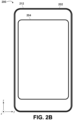
- Figure 2B is a cut-away illustration (e.g., as viewed from a plane perpendicular to the x-axis, as illustrated) of the mobile device 200, according to example embodiments.
- Figure 2B may depict the mobile device 200 when viewed from an x-location (as indicated by the axes in Figure 2B ) that is behind both the display 214 and a front face of the case 212.
- the mobile device 200 may include a battery 202 and an auxiliary battery 204.
- the battery 202 and the auxiliary battery 204 may be contained by the case 212, as illustrated.
- the battery 202 may supply electrical power to components of the mobile device 200.
- the battery 202 may include a rechargeable battery (e.g., a lithium-ion battery similar to the battery 100 illustrated in Figures 1A and 1B ) having terminals that are connected to circuitry within the mobile device 200 (e.g., electrically coupled to a motherboard within the mobile device 200 and/or to the display 214).
- the battery 202 may be connectable to an external power source (e.g., a wall socket) in order to recharge the battery 202.
- an external power source e.g., a wall socket
- a charging port defined within the case 212 of the mobile device 200 may permit a charging cable to be connected to the mobile device 200 in order to charge the battery 202.
- the battery 202 could be charged via wireless charging (e.g., using inductive coupling with an external power source).
- the battery 202 may have a capacity between 2,500 mAh and 3,500 mAh.
- the battery 202 may have various shapes or conformations.
- the battery 202 may be arranged in a jellyroll conformation (e.g., a flattened jellyroll conformation to occupy reduced space).
- the battery 202 may be fabricated by positioning one or more anodes adjacent to one or more cathodes with a separator in between, filling one or more defined interstices between the cathode(s), anode(s), and separator with an electrolyte, and then rolling the arrangement to form a jellyroll.
- such a jellyroll conformation may be encapsulated in a metallic or plastic cylindrical casing (e.g., to prevent leakage of electrolyte solution and/or to enhance safety in the case of battery failure).
- the battery 202 may be arranged in a pouch conformation.
- the pouch conformation may increase the gravimetric energy density of the battery 202 compared to the jellyroll conformation because no cylindrical casing is used.
- the auxiliary battery 204 may supply supplementary electrical power to components of the mobile device 200.
- the capacity of the auxiliary battery 204 may be less than the capacity of the battery 202.
- the auxiliary battery 204 may have a capacity between 50 mAh and 200 mAh.
- the auxiliary battery 204 may have a different battery chemistry than the battery 202 and/or have a different shape or conformation than the auxiliary battery 204.
- the auxiliary battery 204 may be a thin-film battery (e.g., a thin-film lithium-ion battery). As such, the auxiliary battery 204 may not be susceptible to swelling during charge / discharge cycles (e.g., unlike conventional lithium-ion batteries).
- the auxiliary battery 204 may be flexible. As such, the auxiliary battery 204 can be installed in the mobile device 200 to fill space that would otherwise be unoccupied within the mobile device 200 due to: (i) fabrication tolerances for the case 212, the display 214, the battery 202, or other components of the mobile device 200; (ii) accommodation of potential swelling of the battery 202 during charging and/or discharging of the battery 202; and/or (iii) challenges in performing fabrication techniques for the battery 202 that would allow the battery 202 to have a non-uniform height (e.g., such that the battery 202 could fill a non-uniform cavity within the case 212 of the mobile device 200, as may be present in a mobile device with an exotic geometry).
- a non-uniform height e.g., such that the battery 202 could fill a non-uniform cavity within the case 212 of the mobile device 200, as may be present in a mobile device with an exotic geometry.
- a first surface of the auxiliary battery 204 may be positioned along a first surface of the battery 202 (e.g., a front surface of the battery 202 parallel to the y - z plane, as illustrated). As such, the first surface of the auxiliary battery 204 may be parallel to the first surface of the battery 202. In some embodiments, the first surface of the auxiliary battery 204 may be adhered to the first surface of the battery 202.
- the first surface of the auxiliary battery 204 may be aligned to one or more locations on the first surface of the battery 202 prior to the case 212 of the mobile device 200 encapsulating the battery 202 and the auxiliary battery 204. Further, as illustrated in Figure 2B , the first surface of the auxiliary battery 204 has a smaller area than the first surface of the battery 202.
- the auxiliary battery 204 may be rechargeable using the same charging mechanism as the battery 202.
- a single charging port defined within the case 212 may be used to connect the battery 202 and the auxiliary battery 204 to an external power source (e.g., to a wall socket using a charging cable or to a computing device using a universal serial bus (USB) cable) to simultaneously or sequentially charge both the battery 202 and the auxiliary battery 204.
- an external power source e.g., to a wall socket using a charging cable or to a computing device using a universal serial bus (USB) cable
- USB universal serial bus
- a separate charging mechanism could be used to charge the auxiliary battery 204.
- the auxiliary battery 204 could be charged via wireless charging (e.g., using inductive coupling with an external power source) or using a secondary, dedicated charging port defined within the case 212 that is used to connect an external power source only to the auxiliary battery 204 (and not to the battery 202), thereby charging only the auxiliary battery 204.
- wireless charging e.g., using inductive coupling with an external power source
- secondary, dedicated charging port defined within the case 212 that is used to connect an external power source only to the auxiliary battery 204 (and not to the battery 202), thereby charging only the auxiliary battery 204.
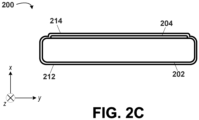
- Figure 2C is a bottom-view (e.g., view from a plane perpendicular to the z-axis, as illustrated) illustration of the mobile device 200, according to example unclaimed embodiments.
- the shape and size of the battery 202 and the auxiliary battery 204 may be selected so as to conform to one or more available volumes within the mobile device 200 and/or so as to conform with one or more contours of the case 212.
- one or more edges of the battery 202 and/or of the auxiliary battery 204 may be contoured so as to conform to one or more contoured edges or other features of the case 212.
- the first surface of the auxiliary battery 204 may be positioned along the first surface of the battery 202 (e.g., a front surface of the battery 202 parallel to the y - z plane, as illustrated).
- the auxiliary battery 204 may be a thin-film battery.
- a thickness of the auxiliary battery 204 i.e., the shortest length dimension of the auxiliary battery 204, measured along the x-axis illustrated in Figure 2C
- a thickness of the battery 202 i.e., the length dimension of the battery 202, measured along the x-axis illustrated in Figure 2C
- the thickness of the auxiliary battery 204 may be between 0.25 mm and 0.50 mm, for example.
- the thickness of the battery 202 may be between 3.0 mm and 6.0 mm.
- the auxiliary battery 204 may be positioned along additional surfaces of the battery 202, in addition to the first surface of the battery 202.
- the auxiliary battery 204 may be wrapped around two, three, four, five, or six sides of the battery 202.
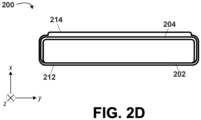
- An example embodiment where the auxiliary battery 204 is wrapped around three sides of the battery 202 is shown in bottom-view in Figure 2D . Wrapping the auxiliary battery 204 around multiple sides of the battery 202 may further enhance the space in the case 212 that is occupied by a battery that can provide electrical power to components of the mobile device 200.
- the battery 202 and the auxiliary battery 204 may supply electrical power to components of the mobile device 200 simultaneously.
- Figure 2E is a circuit diagram illustrating an arrangement of batteries, according to example embodiments.
- the arrangement of batteries may include the battery 202 and the auxiliary battery 204 of the mobile device 200 illustrated in Figures 2A-2C electrically connected in parallel.
- charge from the battery 202 and the auxiliary battery 204 may simultaneously power components of the mobile device 200 (e.g., the display 214 of the mobile device 200, as illustrated, or any other component of the mobile device 200).
- the aggregate battery life of the mobile device 200 can be extended by including the auxiliary battery 204 in the mobile device 200 in addition to the battery 202.
- the battery 202 and the auxiliary battery 204 may supply electrical power to components of the mobile device 200 sequentially.
- the battery 202 may initially solely provide electrical power to components of the mobile device 200 and, upon threshold discharge of the battery 202, the battery 202 may cease providing electrical power to components of the mobile device 200 and the auxiliary battery 204 may begin providing electrical power to components of the mobile device 200.
- the shift from the battery 202 providing electrical power to the auxiliary battery 204 providing electrical power may occur by engaging one or more switches within the mobile device 200.
- FIG. 2F is a circuit diagram illustrating an arrangement of batteries, according to example unclaimed embodiments.
- the arrangement of batteries may include the battery 202 and the auxiliary battery 204 of the mobile device 200 illustrated in Figures 2A-2C .
- a controller 222 and a switch 224 are also illustrated in Figure 2F.
- the controller 222 may include a voltmeter or a digital multimeter used to monitor the voltage between the terminals of the battery 202.
- the voltage between the terminals of the battery 202 may decrease according to a predetermined discharge curve (e.g., as determined empirically for the battery 202 during a calibration or fabrication process).
- a predetermined discharge curve e.g., as determined empirically for the battery 202 during a calibration or fabrication process.
- the voltage between the terminals of the battery 202 can be used to estimate the state of charge of the battery 202.
- Figure 2G is a plot of battery voltage within a mobile device (e.g., a mobile device including the battery arrangement of Figure 2F ) as the mobile device discharges, according to example embodiments.
- a mobile device e.g., a mobile device including the battery arrangement of Figure 2F
- the predetermined discharge curve 272 for the battery 202 is illustrated (the dashed portion indicating how the battery 202 would continue to discharge if the switch in Figure 2F were never engaged such that the battery 202 ceased providing electrical power).
- the measured voltage between the terminals of the battery 202 may be transmitted to a processor within the controller 222.
- the processor may be executing instructions stored on a non-transitory, computer-readable medium (e.g., in a non-volatile memory, such as a hard drive).
- These instructions may include a threshold value 286 (e.g., a threshold voltage) below which, the battery 202 is too discharged to provide significant electrical power to the mobile device 200.
- a threshold value 286 e.g., a threshold voltage
- the controller 222 may cause the switch 224 to flip (i.e., engage).
- the threshold value 286 may be a threshold voltage. In alternate embodiments, the threshold value 286 may be a different quantity (e.g., a threshold current, a threshold state of charge, or a threshold amount of time discharging). For example, in other embodiments, rather than measuring the voltage between the terminals of the battery 202 (e.g., as illustrated in Figure 2F ), an ammeter may be used to measure the current being provided by the battery 202 in order to estimate the state of charge of the battery 202. Similar to the voltage between the terminals of the battery 202, the current being provided by the battery 202 may also follow a predetermined curve that can be used to determine the present state of charge of the battery.
- a threshold current e.g., a threshold state of charge, or a threshold amount of time discharging.
- an ammeter may be used to measure the current being provided by the battery 202 in order to estimate the state of charge of the battery 202. Similar to the voltage between the terminals of the battery 202, the current being provided by the battery
- the current being provided could be transmitted to a processor within the controller 222 and, once the current reaches a threshold value, the controller 222 could cause the switch 224 to flip. Additionally or alternatively, the amount of time that the battery 202 has spent discharging and those applications / devices within the mobile device 200 that are consuming electrical power during that time could be monitored by the controller 222 to approximate the state of charge of the battery 202 (e.g., and the controller 222 may similarly cause the switch 224 to flip once a threshold time-power combination has been reached).
- the switch 224 may be in the position of the dashed line. Further, once the switch 224 flips, the auxiliary battery 204 may begin providing components of the mobile device 200 (e.g., the display 214) with electrical power. The act of flipping the switch 288 is reflected in Figure 2G Once the auxiliary battery 204 begins to discharge, it too follows a predetermined discharge curve 274 (e.g., as determined empirically for the auxiliary battery 204 during a calibration or fabrication process).
- a predetermined discharge curve 274 e.g., as determined empirically for the auxiliary battery 204 during a calibration or fabrication process.
- the controller 222 may cause the switch 224 to flip for other purposes as well (e.g., to select one of the batteries 202/204 to be charged by a charging circuit when an external power source is provided, such as to select the auxiliary battery 204 to be charged when the battery 202 has been charged sufficiently such that the voltage between the terminals of the battery 202 exceed the threshold value 286). Also illustrated in Figure 2G are the battery's portion 282 and the auxiliary battery's portion 284 of the aggregate state of charge of the battery combination illustrated in Figure 2F .
- the battery's portion 282 is significantly larger (e.g., about 90%) than the auxiliary battery's portion 284 (e.g., about 10%), meaning that the battery 202 supplies significantly more electrical power to the components of the mobile device 200 than the auxiliary battery 204 during a complete charge / discharge cycle of the battery combination illustrated in Figure 2F .
- Figure 2G is provided by way of example, and it is understood that other percentages than those illustrated in Figure 2G are equally possible.
- the battery 202 and the auxiliary battery 204 may instead be used in totally separate circuits within the mobile device 200.
- the battery 202 may be used to power one subset of components of the mobile device 200 (e.g., a processor and the display 214) while the auxiliary battery 204 may be used to power a different subset of components of the mobile device 200 (e.g., components that generally consume less electrical power than the components configured to receive electrical power from the battery 202, such as one or more status LEDs).
- the battery 202 and the auxiliary battery 204 may be positioned within the mobile device 200 such that a distance between the battery 202 and one or more components configured to receive electrical power from the battery 202 is less than a distance between the auxiliary battery 204 and one or more components configured to receive electrical power from the battery 202.
- the battery 202 and the auxiliary battery 204 may be positioned within the mobile device 200 such that a distance between the auxiliary battery 204 and one or more components configured to receive electrical power from the auxiliary battery 204 is less than a distance between the battery 202 and one or more components configured to receive electrical power from the auxiliary battery 204.
- Figure 3A is a cut-away illustration (e.g., as viewed from a plane perpendicular to the x-axis, as illustrated) of a mobile device 300, according to example embodiments.
- the mobile device 300 may include a battery 202, an auxiliary battery 204, a case 212, and a display 214.
- the mobile device 300 includes an interconnect 312 between a first component 314 and a second component 316.
- the interconnect 312 may permit electrical power transfer between the first component 314 and the second component 316 and/or communication between the first component 314 and the second component 316 (e.g., using a communication signal).
- the interconnect 312 may include one or more wires and/or traces on a circuit board that electrically connect the first component 314 to the second component 316.
- the interconnect 312 is routed around a periphery of the auxiliary battery 204.
- the interconnect 312 may include a wire that is positioned along the first surface of the battery 202 such that the wire follows the edge of the auxiliary battery 204.
- the auxiliary battery 204 is designed (e.g., a size and/or shape of the auxiliary battery 204 may be chosen) and/or positioned along the first surface of the battery 202 such that the interconnect 312 can be accommodated along the first surface of the battery 202.
- the auxiliary battery 204 may be shaped so as to accommodate one or more other components of the mobile device 200 positioned adjacent to the auxiliary battery 204 along the first surface of the battery 202.
- Figure 3B is a bottom-view (e.g., view from a plane perpendicular to the z-axis, as illustrated) illustration of the mobile device 300, according to example embodiments.
- the thickness of the auxiliary battery 204 i.e., the shortest length dimension of the auxiliary battery 204, measured along the x-axis illustrated in Figure 3B
- the thickness of the auxiliary battery 204 may also be the same as the thickness of the second component 316.
- the auxiliary battery 204 may have a different thickness than the interconnect 312, the first component 314, and/or the second component 316.
- Figure 4A is a cut-away illustration (e.g., as viewed from a plane perpendicular to the x-axis, as illustrated) of a mobile device 400, according to example embodiments. Similar to the mobile device 200 illustrated in Figures 2A-2C , the mobile device 400 may include a battery 202, an auxiliary battery 402, a case 212, and a display 214. In addition, the mobile device 400 may include an additional auxiliary battery 404 and an interconnect 412 between a first component 414 and a second component 416. Unlike the embodiments described above, the embodiment of Figure 4A includes two auxiliary batteries 402/404.
- both of the auxiliary batteries 402/404 may be configured to supply auxiliary electrical power to one or more components of the mobile device 400. Further, the auxiliary batteries 402/404 may supply electrical power to components of the mobile device 400: (i) simultaneously with the battery 202 or sequentially with the battery 202; and (ii) simultaneously with one another or sequentially with one another.
- a first surface of the auxiliary battery 402 and a first surface of the additional auxiliary battery 404 may each be positioned along the first surface of the battery 202.
- Figure 4B is a bottom-view (e.g., view from a plane perpendicular to the z- axis, as illustrated) illustration of the mobile device 400, according to example embodiments.
- the auxiliary battery 402 and the additional auxiliary battery 404 may be substantially parallel to one another (e.g., within 5° of parallel with one another).
- a first surface of the auxiliary battery 402 positioned along the first surface of the battery 202 and a first surface of the additional auxiliary battery 404 positioned along the first surface of the battery 202 may be coplanar with one another.
- the interconnect 412 may also be positioned along the first surface of the battery 202. In some embodiments, the interconnect 412, the first component 414, and/or the second component 416 may be adjacent to the auxiliary battery 402 and/or the additional auxiliary battery 404. Further, the interconnect 412 is routed along a periphery of the auxiliary battery 402 and/or along a periphery of the additional auxiliary battery 404.
- auxiliary batteries 402/404 are positioned along the first surface of the battery 202, and the interconnect 412 may be positioned along a periphery of one or both of the auxiliary batteries 402/404, in some embodiments, one or both of the auxiliary batteries 402/404 may be smaller than the auxiliary battery 204 illustrated in Figures 2A-2C .
- the additional auxiliary battery 404 may have a different shape, capacity, and/or battery chemistry than the auxiliary battery 402. For example, based on the location of the interconnect 412 and the components 414/416 of the mobile device 400, the amount of space available for the additional auxiliary battery 404 may be less than the amount of space available for the auxiliary battery 402 (e.g., as illustrated in Figure 4A ). In such embodiments, the additional auxiliary battery 404 may be smaller in size and capacity than the auxiliary battery 402. Figure 4A is provided by way of example, and it is understood that other sizes or shapes of the auxiliary batteries 402/404, the interconnect 412, and the components 414/416 are possible and contemplated herein.
- the thickness of the auxiliary battery 402 (i.e., the shortest length dimension of the auxiliary battery 402, measured along the x-axis illustrated in Figure 4B ) may be the same as a thickness of the interconnect 412 and/or the thickness of the first component 414.
- the thickness of the additional auxiliary battery 404 (i.e., the shortest length dimension of the additional auxiliary battery 404, measured along the x-axis illustrated in Figure 4B ) may be the same as a thickness of the interconnect 412 and/or the thickness of the first component 414.
- the thicknesses of one or both of the auxiliary batteries 402/404 may be the same as the thickness of the second component 416.
- the thickness of the auxiliary battery 402 may be the same as the thickness of the additional auxiliary battery 404.
- the thickness of the additional auxiliary battery 404 may be different from the thickness of the auxiliary battery 402 (e.g., to efficiently fill a non-uniform cavity within the case 212 of the mobile device 400).
- one or both of the auxiliary batteries 402/404 may have different thicknesses than the interconnect 412, the first component 414, and/or the second component 416.
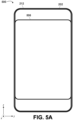
- Figure 5A is a cut-away illustration (e.g., as viewed from a plane perpendicular to the x-axis, as illustrated) of a mobile device 500, according to example embodiments.
- the mobile device 500 may include a case 212, a display 214, a battery 202, a first auxiliary battery 502, a second auxiliary battery 504, a third auxiliary battery 506, and an interconnect 512.
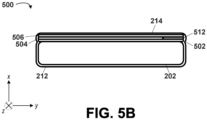
- Figure 5B is a bottom-view (e.g., view from a plane perpendicular to the z-axis, as illustrated) illustration of the mobile device 500, according to example embodiments.
- the mobile device 500 includes multiple auxiliary batteries.
- the auxiliary batteries 502/504/506 are not coplanar with one another.
- the auxiliary batteries 502/504/506 may be stacked on top of one another (e.g., along the x-axis).
- a first surface (e.g., a bottom surface) of the first auxiliary battery 502 may be positioned along a first surface (e.g., a top surface) of the battery 202
- a first surface (e.g., a bottom surface) of the second auxiliary battery 504 may be positioned along a second surface (e.g., a top surface) of the first auxiliary battery 502
- a first surface (e.g., a bottom surface) of the third auxiliary battery 506 may be positioned along a second surface (e.g., a top surface) of the second auxiliary battery 504.
- the auxiliary batteries 502/504/506 may each have the same thickness (e.g., dimensionality in the x-direction) as one another.
- the auxiliary batteries may have different thicknesses (e.g., an auxiliary battery that is in a layer of the auxiliary battery stack where an interconnect is routed may be thicker or thinner than the other auxiliary batteries in the stack).
- auxiliary batteries 502/504/506 may be shaped or sized so as to accommodate one or more interconnects within the mobile device 500.
- the second auxiliary battery 504 e.g., the middle auxiliary battery in the stack of auxiliary batteries
- the first auxiliary battery 502 and the third auxiliary battery 506 so as to provide space along the second surface of the first auxiliary battery 502 for the interconnect 512 to run.
- the interconnect 512 in the mobile device 500 of Figure 5B may be routed around a periphery of one or more of the auxiliary batteries 502/504/506 (e.g., along the periphery of the second auxiliary battery 504).
- one or more interconnects may include segments that have vertical dimensionality (e.g., run along the x-axis illustrated in Figure 5B ).
- multiple auxiliary batteries within an auxiliary battery stack may be shaped and/or sized along multiple dimensions to accommodate the one or more interconnects.
- Figures 5A and 5B are provided for illustrative purposes only. While the mobile device 500 includes three auxiliary batteries 502/504/506, other embodiments may include a mobile device that includes any number of auxiliary batteries (e.g., one, two, four, five, six, seven, eight, nine, ten, etc.) arranged in any number of possible arrangements relative to one another and the battery within the mobile device. In still other embodiments, some mobile devices may include more than one battery.
- auxiliary batteries e.g., one, two, four, five, six, seven, eight, nine, ten, etc.
- Figure 6 is a flow chart illustrating a method 600.
- the method 600 may be performed by the mobile device 200 illustrated in Figures 2A-2C , for example.
- the method 600 may be performed to supply electrical power to one or more components of the mobile device 200 using the battery 202 until the battery 202 is sufficiently discharged and then proceed to supply electrical power to one or more components of the mobile device 200 using the auxiliary battery 204.
- the method 600 may include providing electrical power to a consumer-electronic device by discharging a battery of the consumer-electronic device.
- the method 600 may include providing, upon the battery being discharged to a threshold value, electrical power to the consumer-electronic device by discharging an auxiliary battery of the consumer-electronic device.
- a first surface of the auxiliary battery is positioned along a first surface of the battery.
- the auxiliary battery is a thin-film battery. The auxiliary battery only occupies a portion of the first surface of the battery.
Landscapes
- Chemical & Material Sciences (AREA)
- Chemical Kinetics & Catalysis (AREA)
- Electrochemistry (AREA)
- General Chemical & Material Sciences (AREA)
- Engineering & Computer Science (AREA)
- Manufacturing & Machinery (AREA)
- Theoretical Computer Science (AREA)
- Computer Hardware Design (AREA)
- Biophysics (AREA)
- Life Sciences & Earth Sciences (AREA)
- Power Engineering (AREA)
- Physics & Mathematics (AREA)
- General Engineering & Computer Science (AREA)
- General Physics & Mathematics (AREA)
- Signal Processing (AREA)
- Charge And Discharge Circuits For Batteries Or The Like (AREA)
- Battery Mounting, Suspending (AREA)
Description
- Batteries can be used to temporarily provide electrical power to various devices when those devices are not connected to an external power source, for example. For a variety of reasons, batteries (and specifically rechargeable batteries) have become increasingly prevalent in many technology areas. The lithium-ion battery is an example of a rechargeable battery.
- Because batteries can be used to provide electrical power to devices, such batteries may be integrated into such devices. For example, a rechargeable battery may be integrated into a consumer-electronic device such as a mobile phone, a tablet, or a laptop computer in order to provide power to such a device. When integrating a rechargeable battery into the consumer-electronic device, the battery's designed shape and size may be at least partially determined based on the available space within the device. Hence, the capacity of the battery may be adversely affected by the dimensions of the device.
-
US2014/361747A1 describes a method for managing the lifetime of a battery. An ambient temperature is measured near a battery. A discharge of the battery is triggered when the ambient temperature exceeds a first temperature threshold. The battery can then be charged when the ambient temperature decreases below a second temperature threshold.US2010/216023A1 describes an energy storage device structure comprising a first electrode layer, an electrolyte layer and a second electrode layer. At least one of the electrode layers comprise a metallic foil base layer and a layer of carbon nanotubes grown on the base layer, the carbon nanotube layer being arranged to face the electrolyte layer. The structure may be made in such a way that its width and length are much larger than its thickness, so that it can rolled up or folded and then hermetically sealed to form an energy storage unit. The layer of carbon nanotubes is grown on the metallic foil base layer by a chemical vapor deposition process at a temperature no higher than 550° C. The carbon nanotubes in the carbon nanotube layer are at least partially aligned in a direction that is perpendicular to the surface of the metallic base layer. - The specification and drawings disclose embodiments that relate to multiple battery configurations for space utilization.
- In an aspect, a device according to claim 1 is disclosed.
- In another aspect, a method according to claim 15 is disclosed.
- The foregoing summary is illustrative only and is not intended to be in any way limiting. In addition to the illustrative aspects, embodiments, and features described above, further aspects, embodiments, and features will become apparent by reference to the figures and the following detailed description.
-
-
Figure 1A is an illustration of a battery, according to example embodiments. -
Figure 1B is an illustration of a battery, according to example embodiments. -
Figure 2A is a front-view illustration of a mobile device, according to example embodiments. -
Figure 2B is a cut-away illustration of a mobile device, according to example embodiments. -
Figure 2C is a bottom-view illustration of a mobile device, according to example embodiments. -
Figure 2D is a bottom-view illustration of a mobile device, according to example embodiments. -
Figure 2E is a circuit diagram illustrating an arrangement of batteries, according to example embodiments. -
Figure 2F is a circuit diagram illustrating an arrangement of batteries, according to example embodiments. -
Figure 2G is a plot of battery voltage within a mobile device as it discharges, according to example embodiments. -
Figure 3A is a cut-away illustration of a mobile device, according to example embodiments. -
Figure 3B is a bottom-view illustration of a mobile device, according to example embodiments. -
Figure 4A is a cut-away illustration of a mobile device, according to example embodiments. -
Figure 4B is a bottom-view illustration of a mobile device, according to example embodiments. -
Figure 5A is a cut-away illustration of a mobile device, according to example embodiments. -
Figure 5B is a bottom-view illustration of a mobile device, according to example embodiments. -
Figure 6 is a flow cart illustrating a method, according to example embodiments. - Example methods and systems are described herein. Any example embodiment or feature described herein is not necessarily to be construed as preferred or advantageous over other embodiments or features. The example embodiments described herein are not meant to be limiting. It will be readily understood that certain aspects of the disclosed systems and methods can be arranged and combined in a wide variety of different configurations, all of which are contemplated herein.
- Furthermore, the particular arrangements shown in the figures should not be viewed as limiting. It should be understood that other embodiments might include more or less of each element shown in a given figure. In addition, some of the illustrated elements may be combined or omitted. Similarly, an example embodiment may include elements that are not illustrated in the figures.
- Example embodiments relate to multiple battery configurations for space utilization.
- Consumers continue to demand smaller and/or thinner form factors in electronic devices (e.g., mobile computing devices, tablet computing devices, and laptop computing devices). However, consumers also desire longer battery lifetime between charges. Shrinking the housing size of consumer-electronic devices inherently reduces the interior volume to accommodate batteries and other device components. This makes it advantageous to arrange the components of the device in a manner that makes efficient use of the space available within the case. In some instances, it can be useful for a device's battery to have an irregular shape (e.g., a curved or "step" shape) that helps the battery fill a corner or end space of the device that might otherwise be left empty. Using conventional techniques, it can be expensive and/or difficult to produce batteries having such shapes.
- To at least partially ameliorate this problem, example embodiments disclosed herein include a battery (e.g., a planar or "jellyroll" lithium-ion battery) used in conjunction with a thin-film auxiliary battery to efficiently fill space within a consumer-electronic device housing. Such a multiple battery configuration may also accommodate the presence of interconnects (e.g., electronic cables) or other components (e.g., computing components, cooling devices, communication components, etc.). For example, the battery might have the approximate shape of a rectangular prism with a thickness that is the same across the entire battery (e.g., similar to a conventional battery). In addition, the thin-film auxiliary battery can be placed along a top surface of the battery, thereby taking advantage of unused space to provide additional energy storage (e.g., unused space underneath a display of the consumer-electronic device). The thin-film auxiliary battery may have a length and/or a width that does not span the entire top face of the battery, thereby providing a void for placement of an interconnect (e.g., a wire or cable) or another component between the case and the battery and/or the thin-film auxiliary battery. Further, the thin-film auxiliary battery may be a flexible battery, which can accommodate any swelling that occurs in the battery during charging / discharging. Additionally or alternatively, portions of the thin-film auxiliary battery or the battery may be excised to accommodate device components. In some examples, the thin-film auxiliary battery might be placed between the battery and the case of the consumer-electronic device or between the battery and a touchscreen of the consumer-electronic device to take advantage of space that would otherwise be left empty due to design constraints of a conventional battery (e.g., a fabrication tolerance between the desired thickness and the actual thickness of a conventional battery).
- The thin-film auxiliary battery can be used to provide electrical power to the consumer-electronic device when the battery is sufficiently depleted. In another example, the thin-film auxiliary battery could be connected in parallel with the battery to provide an additional electrical power source during operation of the consumer-electronic device.
-
Figure 1A is an illustration of a battery 100 (e.g., a single-celled battery). Thebattery 100 may be a rechargeable lithium-ion battery, for example. Thebattery 100 may include ananode 102, acathode 104, aseparator 106, andfree lithium ions 108 within anelectrolyte 110. The elements of thebattery 100 are not necessarily illustrated to scale (e.g., thefree lithium ions 108 may be significantly smaller than illustrated in the figure). Further, as illustrated inFigure 1A , thebattery 100 may be chargeable by an electrical power source 112 (e.g., a rectified alternating current (AC) signal, a separate charged battery, or a charged capacitor). In some embodiments, multiple cells of cathode, anode, separator, and electrolyte may be electrically arranged in series and/or parallel to form a composite battery. Such cell arrangements may enhance the capacity and/or voltage of the composite battery. - Charging may include electrons flowing from the
cathode 104 to theanode 102 through circuitry external to thebattery 100. In addition, charging may includefree lithium ions 108, within theelectrolyte 110 solution, flowing from thecathode 104 to theanode 102 through theseparator 106. Further, charging may include thefree lithium ions 108 being intercalated into theanode 102. Such a process is illustrated inFigure 1A by the lithium ions that are sitting on "shelves" of theanode 102. The charging may represent a first formation charging process, in some embodiments. The first formation charging process may last between 10 hours and 20 hours, in some embodiments. Additionally, thebattery 100 may be configured to undergo repeated charge / discharge cycles during a lifetime of thebattery 100. For example, thebattery 100 may be a rechargeable battery configured to be charged by an external voltage between 4.20 volts and 4.50 volts or between 4.40 volts and 4.60 volts. - In various embodiments, various charging / recharging schemes may be used. For example, a constant voltage (CV) scheme may be used, where a constant voltage is applied across the terminals of the battery, resulting in a decreasing current as the battery charges, until the current reaches 0.0 Amps (or within a threshold current of 0.0 Amps), at which point the voltage source charging the battery is removed. In other embodiments, a constant current (CC) scheme may be used, where the voltage applied across the terminals of the battery by a charging device is varied such that the current is maintained at a constant rate. Once the battery voltage reaches a threshold value to maintain the continuous current, the battery may be determined to be charged, and the voltage source charging the battery may be removed.
- Alternatively, in some embodiments, a hybrid constant current / constant voltage (CC/CV) charging mode may be used to charge the battery. The CC/CV charging mode may have two stages. In a first stage (a CC stage), the voltage may be increased continuously to maintain a constant current charging the battery. Then, once the voltage reaches a certain maximum charging voltage threshold, the second stage of the CC/CV charging mode may begin. In the second stage (a CV stage), the voltage may be maintained at the maximum charging voltage threshold, and the charging current may be allowed to decrease. Once the charging current reaches a threshold level, indicating the battery is charged, the CC/CV charging mode may cease.
- The
anode 102 may be the negative terminal (electrode) of thebattery 100. For example, theanode 102 may include one or more external electrical contacts on the side of theanode 102 facing away from theseparator 106. The external electrical contact(s) may allow an electrical connection between theanode 102 and thepower source 112 or a load to be made. Theanode 102 may include graphite, Li, Li4Ti5O12, a lithium-metal composite, and/or Si, in various embodiments. - The
cathode 104 may be the positive terminal (electrode) of thebattery 100. For example, thecathode 104 may include one or more external electrical contacts on the side of thecathode 104 facing away from theseparator 106. The external electrical contact(s) may allow an electrical connection between thecathode 104 and thepower source 112 or a load to be made. Thecathode 104 may include LiCoO2, LiMn2O4, a vanadium oxide, LiNiMnCoO2, LiNiCoAlO2, and/or an olivine (e.g., LiFePO4), in some embodiments. Other lithium-containing cathode materials are possible and contemplated herein. - The
separator 106 may prevent a short circuit of thecathode 104 to theanode 102 within thebattery 100. For example, theseparator 106 may include a semi-permeable membrane (e.g., permeable to the free lithium ions 108). To achieve such semi-permeability, theseparator 106 may include micropores that are sized to selectively allow the passage of thefree lithium ions 108 during charging or discharging processes. The semi-permeable membrane of theseparator 106 may also have an amorphous or a semi-crystalline structure. Further, the semi-permeable membrane of theseparator 106 may be polymeric (e.g., fabricated from cellulose acetate, nitrocellulose, cellulose esters, polysulfone, polyether sulfone, polyacrilonitrile, polyamide, polyimide, polyethylene, polypropylene, polytetrafluoroethylene, polyvinylidene fluoride, polyvinylchloride, and/or aramid). In addition, theseparator 106 may be chemically and electrochemically stable for use within thebattery 100 during charging and discharging processes. In some embodiments, theseparator 106 may include a multi-layered structure. - In some embodiments, the
separator 106 may be a non-standard separator having an increased mechanical stability, which can prevent dendrites from piercing theseparator 106. Further, theseparator 106 may also include compounds that are chemically and/or electrochemically stable for use within thebattery 100 during charging or discharging processes. Such compounds may enhance the lifetime of thebattery 100, for example. - In some embodiments, the
battery 100 may be a thin-film battery. In such embodiments, thebattery 100 may not include aseparator 106. Further, in such embodiments, theelectrolyte 110 may be solid (e.g., rather than liquid), thereby satisfying purposes of both theelectrolyte 110 and the separator 106 (e.g., transporting ions and preventing a short circuit of thecathode 104 to the anode 102). In such embodiments, a discrete separator may not be needed. - The
free lithium ions 108 may transfer between theanode 102 and thecathode 104 during charging / discharging processes of thebattery 100. In some embodiments, thefree lithium ions 108 may originate from thecathode 104. For example, thecathode 104 may include LiCoO2, which may be a source of free lithium during the chemical reactions occurring during the charging process (e.g., during the first formation charging process). Other sources of free lithium ions are also possible. For example, theanode 102 may provide free lithium ions and/or lithium salts (e.g., LiPF6, LiBF4, LiBC4O8, Li[PF3(C2F5)3], or LiClO4) dissolved within theelectrolyte 110 may provide free lithium ions. - The
electrolyte 110 may be a medium through which thefree lithium ions 108 travel during charging and discharging processes of thebattery 100. Theelectrolyte 110 may be a gel or a liquid, in various embodiments and/or at various temperatures. For example, theelectrolyte 110 may be an organic solvent (e.g., ethylene carbonate, dimethyl carbonate, or diethyl carbonate). Additives may be included within theelectrolyte 110 to enhance the effectiveness of theelectrolyte 110. In some embodiments, for instance, ionic liquids may be included within the electrolyte to reduce volatility of the electrolyte solution. - As described above, in some embodiments (e.g., embodiments where the
battery 100 is a thin-film battery), theelectrolyte 110 may be a solid (e.g., rather than a liquid or gel). For example, in some embodiments, theelectrolyte 110 may include one or more amorphous glassy layers deposited on the cathode 104 (e.g., deposited using sputtering or vapor deposition). One type of amorphous glassy material that may be used is lithium phosphorous oxynitride (LiPON). -
Figure 1B is another illustration of thebattery 100. Thebattery 100 illustrated inFigure 1B may be discharging across aload 122. Discharging thebattery 100 may include electrons flowing from theanode 102 to thecathode 104, across theload 122, through circuitry external to thebattery 100. Discharging thebattery 100 may also include thefree lithium ions 108 within theelectrolyte 110 flowing from theanode 102 to thecathode 104 through the separator 106 (in embodiments having a discrete separator). Further, discharging thebattery 100 may include thefree lithium ions 108 being intercalated into thecathode 104. Such a scenario is illustrated inFigure 1B by the lithium ions that are sitting on "shelves" of thecathode 104. - The
load 122 may be a device powered by thebattery 100, such as an electric vehicle, a hybrid electric vehicle, a mobile device, a tablet computing device, a laptop computing device, a light source, television remote, headphones, etc. Theload 122 may be powered by the flow of electrons through the circuitry external to thebattery 100 during the discharging process, for example. -
Figure 2A is a front-view (e.g., view from a plane perpendicular to the x-axis, as illustrated) illustration of a mobile device 200 (e.g., a smartphone), according to example unclaimed embodiments. Themobile device 200 may include acase 212, adisplay 214,peripherals 216, and aninput device 218. Themobile device 200 shown and described herein is an example consumer-electronic device. It is understood that where themobile device 200 is referenced herein, although themobile device 200 is depicted and described as a mobile phone or smartphone, other consumer-electronic devices that incorporate batteries (e.g., activity trackers, calculators, camcorders, digital cameras, e-readers, electronic cigarettes, flashlights, game controllers, global positioning system (GPS) devices, headphones, hotspots, keyboards, laptop computing devices, mice, microphones, musical instruments, portable gaming systems, portable grooming devices, portable media players, power tools, radios, remote-control vehicles, remotes, robotic vacuum cleaners, smartwatches, smart home devices, smart speakers, smoke detectors, speakers, tablet computing devices, thermometers, toothbrushes, watches, wearables, etc.) could equally be used and could equally benefit from the embodiments disclosed herein (with appropriate modifications made). - The
case 212 may be a plastic and/or metallic enclosure that encapsulates the interior of themobile device 200. In some embodiments, thecase 212 may have an ergonomic shape. For example, as illustrated inFigure 2A , thecase 212 may have beveled corners. The shape and/or size of thecase 212 may be designed to house the interior electronic components of the mobile device 200 (e.g., a processor, a non-volatile memory, a volatile memory, one or more interconnects, a motherboard, an antenna, etc.) and one or more power-supplying devices (e.g., batteries). Further, thecase 212 may have one or more portions excised so as to accommodate exterior components of the mobile device 200 (e.g., an opening in which to mount thedisplay 214 or an opening through which sound can pass to and/or from a speaker or a microphone may be created by excising a portion of the case 212). - The
display 214 may provide information to a user of themobile device 200. For example, thedisplay 214 may display text, images, and/or video content to a user to facilitate interaction between the user and themobile device 200. In various embodiments, thedisplay 214 may include a light-emitting diode (LED) display, a liquid-crystal display (LCD), a cathode ray tube (CRT), a projection device, an electronic ink (e-ink) display, a light bulb, etc. In some embodiments, thedisplay 214 may receive electrical power from one or more batteries of themobile device 200. - The
peripherals 216 may be additional components of themobile device 200 that enhance the functionality of themobile device 200. For example, the peripherals may include speakers, microphones, cameras, headphones, wearable sensors, mice, keyboards, scanners, laser pointers, game controllers, external storage devices (e.g., external hard drives or flash drives), printers, etc. Similar to thedisplay 214, in some embodiments, theperipherals 216 may receive electrical power from one or more batteries of themobile device 200. - The
input device 218 may receive input from a user of themobile device 200. For example, as illustrated inFigure 2A , theinput device 218 may include a button. Additionally or alternatively, theinput device 218 may include other devices for receiving input. For example, in some embodiments, thedisplay 214 may include a touchscreen (e.g., a capacitive touchscreen, a resistive touchscreen, or a surface acoustic wave touchscreen). In such embodiments, thedisplay 214 may receive input from a user in addition to providing output to a user. -
Figure 2B is a cut-away illustration (e.g., as viewed from a plane perpendicular to the x-axis, as illustrated) of themobile device 200, according to example embodiments. For example,Figure 2B may depict themobile device 200 when viewed from an x-location (as indicated by the axes inFigure 2B ) that is behind both thedisplay 214 and a front face of thecase 212. As illustrated, themobile device 200 may include abattery 202 and anauxiliary battery 204. Thebattery 202 and theauxiliary battery 204 may be contained by thecase 212, as illustrated. - The
battery 202 may supply electrical power to components of themobile device 200. For example, thebattery 202 may include a rechargeable battery (e.g., a lithium-ion battery similar to thebattery 100 illustrated inFigures 1A and1B ) having terminals that are connected to circuitry within the mobile device 200 (e.g., electrically coupled to a motherboard within themobile device 200 and/or to the display 214). Further, thebattery 202 may be connectable to an external power source (e.g., a wall socket) in order to recharge thebattery 202. For example, a charging port defined within thecase 212 of themobile device 200 may permit a charging cable to be connected to themobile device 200 in order to charge thebattery 202. Alternatively, thebattery 202 could be charged via wireless charging (e.g., using inductive coupling with an external power source). In some embodiments, thebattery 202 may have a capacity between 2,500 mAh and 3,500 mAh. - Depending on the manner in which the
battery 202 is fabricated (which may depend on constraints such as a size and/or shape of thecase 212 and/or sizes and/or shapes of other components within the mobile device 200), thebattery 202 may have various shapes or conformations. In some embodiments, for example, thebattery 202 may be arranged in a jellyroll conformation (e.g., a flattened jellyroll conformation to occupy reduced space). In such embodiments, thebattery 202 may be fabricated by positioning one or more anodes adjacent to one or more cathodes with a separator in between, filling one or more defined interstices between the cathode(s), anode(s), and separator with an electrolyte, and then rolling the arrangement to form a jellyroll. Further, such a jellyroll conformation may be encapsulated in a metallic or plastic cylindrical casing (e.g., to prevent leakage of electrolyte solution and/or to enhance safety in the case of battery failure). In alternate embodiments, thebattery 202 may be arranged in a pouch conformation. In some embodiments, the pouch conformation may increase the gravimetric energy density of thebattery 202 compared to the jellyroll conformation because no cylindrical casing is used. - The
auxiliary battery 204 may supply supplementary electrical power to components of themobile device 200. In some embodiments, the capacity of theauxiliary battery 204 may be less than the capacity of thebattery 202. For example, theauxiliary battery 204 may have a capacity between 50 mAh and 200 mAh. In some embodiments, theauxiliary battery 204 may have a different battery chemistry than thebattery 202 and/or have a different shape or conformation than theauxiliary battery 204. For example, theauxiliary battery 204 may be a thin-film battery (e.g., a thin-film lithium-ion battery). As such, theauxiliary battery 204 may not be susceptible to swelling during charge / discharge cycles (e.g., unlike conventional lithium-ion batteries). Additionally or alternatively, theauxiliary battery 204 may be flexible. As such, theauxiliary battery 204 can be installed in themobile device 200 to fill space that would otherwise be unoccupied within themobile device 200 due to: (i) fabrication tolerances for thecase 212, thedisplay 214, thebattery 202, or other components of themobile device 200; (ii) accommodation of potential swelling of thebattery 202 during charging and/or discharging of thebattery 202; and/or (iii) challenges in performing fabrication techniques for thebattery 202 that would allow thebattery 202 to have a non-uniform height (e.g., such that thebattery 202 could fill a non-uniform cavity within thecase 212 of themobile device 200, as may be present in a mobile device with an exotic geometry). - As illustrated in
Figure 2B , a first surface of the auxiliary battery 204 (e.g., a back surface of theauxiliary battery 204 parallel to the y-z plane, as illustrated) may be positioned along a first surface of the battery 202 (e.g., a front surface of thebattery 202 parallel to the y-z plane, as illustrated). As such, the first surface of theauxiliary battery 204 may be parallel to the first surface of thebattery 202. In some embodiments, the first surface of theauxiliary battery 204 may be adhered to the first surface of thebattery 202. Additionally or alternatively, the first surface of theauxiliary battery 204 may be aligned to one or more locations on the first surface of thebattery 202 prior to thecase 212 of themobile device 200 encapsulating thebattery 202 and theauxiliary battery 204. Further, as illustrated inFigure 2B , the first surface of theauxiliary battery 204 has a smaller area than the first surface of thebattery 202. - In some embodiments, the
auxiliary battery 204 may be rechargeable using the same charging mechanism as thebattery 202. For example, a single charging port defined within thecase 212 may be used to connect thebattery 202 and theauxiliary battery 204 to an external power source (e.g., to a wall socket using a charging cable or to a computing device using a universal serial bus (USB) cable) to simultaneously or sequentially charge both thebattery 202 and theauxiliary battery 204. In alternate embodiments, a separate charging mechanism could be used to charge theauxiliary battery 204. For example, theauxiliary battery 204 could be charged via wireless charging (e.g., using inductive coupling with an external power source) or using a secondary, dedicated charging port defined within thecase 212 that is used to connect an external power source only to the auxiliary battery 204 (and not to the battery 202), thereby charging only theauxiliary battery 204. -
Figure 2C is a bottom-view (e.g., view from a plane perpendicular to the z-axis, as illustrated) illustration of themobile device 200, according to example unclaimed embodiments. As illustrated inFigure 2C , the shape and size of thebattery 202 and theauxiliary battery 204 may be selected so as to conform to one or more available volumes within themobile device 200 and/or so as to conform with one or more contours of thecase 212. For example, one or more edges of thebattery 202 and/or of theauxiliary battery 204 may be contoured so as to conform to one or more contoured edges or other features of thecase 212. As described with reference toFigure 2B , the first surface of the auxiliary battery 204 (e.g., a back surface of theauxiliary battery 204 parallel to the y-z plane, as illustrated) may be positioned along the first surface of the battery 202 (e.g., a front surface of thebattery 202 parallel to the y-z plane, as illustrated). - As described above, the
auxiliary battery 204 may be a thin-film battery. As such, a thickness of the auxiliary battery 204 (i.e., the shortest length dimension of theauxiliary battery 204, measured along the x-axis illustrated inFigure 2C ) may be less than a thickness of the battery 202 (i.e., the length dimension of thebattery 202, measured along the x-axis illustrated inFigure 2C ). In some embodiments, the thickness of theauxiliary battery 204 may be between 0.25 mm and 0.50 mm, for example. The thickness of thebattery 202, however, may be between 3.0 mm and 6.0 mm. - In some embodiments, the
auxiliary battery 204 may be positioned along additional surfaces of thebattery 202, in addition to the first surface of thebattery 202. For example, theauxiliary battery 204 may be wrapped around two, three, four, five, or six sides of thebattery 202. An example embodiment where theauxiliary battery 204 is wrapped around three sides of thebattery 202 is shown in bottom-view inFigure 2D . Wrapping theauxiliary battery 204 around multiple sides of thebattery 202 may further enhance the space in thecase 212 that is occupied by a battery that can provide electrical power to components of themobile device 200. - In some embodiments, the
battery 202 and theauxiliary battery 204 may supply electrical power to components of themobile device 200 simultaneously. For example,Figure 2E is a circuit diagram illustrating an arrangement of batteries, according to example embodiments. The arrangement of batteries may include thebattery 202 and theauxiliary battery 204 of themobile device 200 illustrated inFigures 2A-2C electrically connected in parallel. In such an embodiment, charge from thebattery 202 and theauxiliary battery 204 may simultaneously power components of the mobile device 200 (e.g., thedisplay 214 of themobile device 200, as illustrated, or any other component of the mobile device 200). Further, because some of the electrical power to themobile device 200 is being provided by theauxiliary battery 204, the aggregate battery life of themobile device 200 can be extended by including theauxiliary battery 204 in themobile device 200 in addition to thebattery 202. - In other embodiments, the
battery 202 and theauxiliary battery 204 may supply electrical power to components of themobile device 200 sequentially. For example, thebattery 202 may initially solely provide electrical power to components of themobile device 200 and, upon threshold discharge of thebattery 202, thebattery 202 may cease providing electrical power to components of themobile device 200 and theauxiliary battery 204 may begin providing electrical power to components of themobile device 200. The shift from thebattery 202 providing electrical power to theauxiliary battery 204 providing electrical power may occur by engaging one or more switches within themobile device 200. -
Figure 2F is a circuit diagram illustrating an arrangement of batteries, according to example unclaimed embodiments. The arrangement of batteries may include thebattery 202 and theauxiliary battery 204 of themobile device 200 illustrated inFigures 2A-2C . Also illustrated inFigure 2F is acontroller 222 and aswitch 224. Thecontroller 222 may include a voltmeter or a digital multimeter used to monitor the voltage between the terminals of thebattery 202. As thebattery 202 is discharged (e.g., when providing electrical power to components of the mobile device 200), the voltage between the terminals of thebattery 202 may decrease according to a predetermined discharge curve (e.g., as determined empirically for thebattery 202 during a calibration or fabrication process). Hence, the voltage between the terminals of thebattery 202 can be used to estimate the state of charge of thebattery 202. -
Figure 2G is a plot of battery voltage within a mobile device (e.g., a mobile device including the battery arrangement ofFigure 2F ) as the mobile device discharges, according to example embodiments. InFigure 2G , thepredetermined discharge curve 272 for thebattery 202 is illustrated (the dashed portion indicating how thebattery 202 would continue to discharge if the switch inFigure 2F were never engaged such that thebattery 202 ceased providing electrical power). The measured voltage between the terminals of thebattery 202 may be transmitted to a processor within thecontroller 222. The processor may be executing instructions stored on a non-transitory, computer-readable medium (e.g., in a non-volatile memory, such as a hard drive). These instructions may include a threshold value 286 (e.g., a threshold voltage) below which, thebattery 202 is too discharged to provide significant electrical power to themobile device 200. Hence, once it is determined by thecontroller 222 that the voltage between the terminals of thebattery 202 has fallen below thethreshold value 286, thecontroller 222 may cause theswitch 224 to flip (i.e., engage). - As illustrated in
Figure 2G , thethreshold value 286 may be a threshold voltage. In alternate embodiments, thethreshold value 286 may be a different quantity (e.g., a threshold current, a threshold state of charge, or a threshold amount of time discharging). For example, in other embodiments, rather than measuring the voltage between the terminals of the battery 202 (e.g., as illustrated inFigure 2F ), an ammeter may be used to measure the current being provided by thebattery 202 in order to estimate the state of charge of thebattery 202. Similar to the voltage between the terminals of thebattery 202, the current being provided by thebattery 202 may also follow a predetermined curve that can be used to determine the present state of charge of the battery. Also similar to the voltage between the terminals, the current being provided could be transmitted to a processor within thecontroller 222 and, once the current reaches a threshold value, thecontroller 222 could cause theswitch 224 to flip. Additionally or alternatively, the amount of time that thebattery 202 has spent discharging and those applications / devices within themobile device 200 that are consuming electrical power during that time could be monitored by thecontroller 222 to approximate the state of charge of the battery 202 (e.g., and thecontroller 222 may similarly cause theswitch 224 to flip once a threshold time-power combination has been reached). - As illustrated in
Figure 2F , once theswitch 224 flips, theswitch 224 may be in the position of the dashed line. Further, once theswitch 224 flips, theauxiliary battery 204 may begin providing components of the mobile device 200 (e.g., the display 214) with electrical power. The act of flipping theswitch 288 is reflected inFigure 2G Once theauxiliary battery 204 begins to discharge, it too follows a predetermined discharge curve 274 (e.g., as determined empirically for theauxiliary battery 204 during a calibration or fabrication process). Thecontroller 222 may cause theswitch 224 to flip for other purposes as well (e.g., to select one of thebatteries 202/204 to be charged by a charging circuit when an external power source is provided, such as to select theauxiliary battery 204 to be charged when thebattery 202 has been charged sufficiently such that the voltage between the terminals of thebattery 202 exceed the threshold value 286). Also illustrated inFigure 2G are the battery'sportion 282 and the auxiliary battery'sportion 284 of the aggregate state of charge of the battery combination illustrated inFigure 2F . As illustrated inFigure 2G , the battery'sportion 282 is significantly larger (e.g., about 90%) than the auxiliary battery's portion 284 (e.g., about 10%), meaning that thebattery 202 supplies significantly more electrical power to the components of themobile device 200 than theauxiliary battery 204 during a complete charge / discharge cycle of the battery combination illustrated inFigure 2F .Figure 2G is provided by way of example, and it is understood that other percentages than those illustrated inFigure 2G are equally possible. - In alternate embodiments, rather than the
battery 202 and theauxiliary battery 204 being electrically connected in parallel (e.g., as schematically illustrated inFigure 2E ) or being engaged / disengaged in a switching arrangement (e.g., as schematically illustrated inFigure 2F ), thebattery 202 and theauxiliary battery 204 may instead be used in totally separate circuits within themobile device 200. For example, thebattery 202 may be used to power one subset of components of the mobile device 200 (e.g., a processor and the display 214) while theauxiliary battery 204 may be used to power a different subset of components of the mobile device 200 (e.g., components that generally consume less electrical power than the components configured to receive electrical power from thebattery 202, such as one or more status LEDs). In some embodiments, thebattery 202 and theauxiliary battery 204 may be positioned within themobile device 200 such that a distance between thebattery 202 and one or more components configured to receive electrical power from thebattery 202 is less than a distance between theauxiliary battery 204 and one or more components configured to receive electrical power from thebattery 202. Similarly, thebattery 202 and theauxiliary battery 204 may be positioned within themobile device 200 such that a distance between theauxiliary battery 204 and one or more components configured to receive electrical power from theauxiliary battery 204 is less than a distance between thebattery 202 and one or more components configured to receive electrical power from theauxiliary battery 204. -
Figure 3A is a cut-away illustration (e.g., as viewed from a plane perpendicular to the x-axis, as illustrated) of amobile device 300, according to example embodiments. Similar to themobile device 200 illustrated inFigures 2A-2C , themobile device 300 may include abattery 202, anauxiliary battery 204, acase 212, and adisplay 214. In addition, themobile device 300 includes aninterconnect 312 between afirst component 314 and asecond component 316. Theinterconnect 312 may permit electrical power transfer between thefirst component 314 and thesecond component 316 and/or communication between thefirst component 314 and the second component 316 (e.g., using a communication signal). In some embodiments, theinterconnect 312 may include one or more wires and/or traces on a circuit board that electrically connect thefirst component 314 to thesecond component 316. - As illustrated in
Figure 3A , theinterconnect 312 is routed around a periphery of theauxiliary battery 204. For example, theinterconnect 312 may include a wire that is positioned along the first surface of thebattery 202 such that the wire follows the edge of theauxiliary battery 204. Theauxiliary battery 204 is designed (e.g., a size and/or shape of theauxiliary battery 204 may be chosen) and/or positioned along the first surface of thebattery 202 such that theinterconnect 312 can be accommodated along the first surface of thebattery 202. Additionally or alternatively, theauxiliary battery 204 may be shaped so as to accommodate one or more other components of themobile device 200 positioned adjacent to theauxiliary battery 204 along the first surface of thebattery 202. -
Figure 3B is a bottom-view (e.g., view from a plane perpendicular to the z-axis, as illustrated) illustration of themobile device 300, according to example embodiments. As illustrated, in some embodiments, the thickness of the auxiliary battery 204 (i.e., the shortest length dimension of theauxiliary battery 204, measured along the x-axis illustrated inFigure 3B ) may be the same as a thickness of theinterconnect 312 and/or the thickness of thefirst component 314. Further, in some embodiments, the thickness of theauxiliary battery 204 may also be the same as the thickness of thesecond component 316. In alternate embodiments, theauxiliary battery 204 may have a different thickness than theinterconnect 312, thefirst component 314, and/or thesecond component 316. -
Figure 4A is a cut-away illustration (e.g., as viewed from a plane perpendicular to the x-axis, as illustrated) of amobile device 400, according to example embodiments. Similar to themobile device 200 illustrated inFigures 2A-2C , themobile device 400 may include abattery 202, anauxiliary battery 402, acase 212, and adisplay 214. In addition, themobile device 400 may include an additionalauxiliary battery 404 and aninterconnect 412 between afirst component 414 and asecond component 416. Unlike the embodiments described above, the embodiment ofFigure 4A includes twoauxiliary batteries 402/404. Like theauxiliary battery 204 described above, both of theauxiliary batteries 402/404 may be configured to supply auxiliary electrical power to one or more components of themobile device 400. Further, theauxiliary batteries 402/404 may supply electrical power to components of the mobile device 400: (i) simultaneously with thebattery 202 or sequentially with thebattery 202; and (ii) simultaneously with one another or sequentially with one another. - In some embodiments, a first surface of the
auxiliary battery 402 and a first surface of the additionalauxiliary battery 404 may each be positioned along the first surface of thebattery 202.Figure 4B is a bottom-view (e.g., view from a plane perpendicular to the z-axis, as illustrated) illustration of themobile device 400, according to example embodiments. As illustrated inFigure 4B , theauxiliary battery 402 and the additionalauxiliary battery 404 may be substantially parallel to one another (e.g., within 5° of parallel with one another). For example, a first surface of theauxiliary battery 402 positioned along the first surface of thebattery 202 and a first surface of the additionalauxiliary battery 404 positioned along the first surface of thebattery 202 may be coplanar with one another. - The
interconnect 412 may also be positioned along the first surface of thebattery 202. In some embodiments, theinterconnect 412, thefirst component 414, and/or thesecond component 416 may be adjacent to theauxiliary battery 402 and/or the additionalauxiliary battery 404. Further, theinterconnect 412 is routed along a periphery of theauxiliary battery 402 and/or along a periphery of the additionalauxiliary battery 404. Because multipleauxiliary batteries 402/404 are positioned along the first surface of thebattery 202, and theinterconnect 412 may be positioned along a periphery of one or both of theauxiliary batteries 402/404, in some embodiments, one or both of theauxiliary batteries 402/404 may be smaller than theauxiliary battery 204 illustrated inFigures 2A-2C . - In some embodiments, the additional
auxiliary battery 404 may have a different shape, capacity, and/or battery chemistry than theauxiliary battery 402. For example, based on the location of theinterconnect 412 and thecomponents 414/416 of themobile device 400, the amount of space available for the additionalauxiliary battery 404 may be less than the amount of space available for the auxiliary battery 402 (e.g., as illustrated inFigure 4A ). In such embodiments, the additionalauxiliary battery 404 may be smaller in size and capacity than theauxiliary battery 402.Figure 4A is provided by way of example, and it is understood that other sizes or shapes of theauxiliary batteries 402/404, theinterconnect 412, and thecomponents 414/416 are possible and contemplated herein. - As illustrated in
Figure 4B , in some embodiments, the thickness of the auxiliary battery 402 (i.e., the shortest length dimension of theauxiliary battery 402, measured along the x-axis illustrated inFigure 4B ) may be the same as a thickness of theinterconnect 412 and/or the thickness of thefirst component 414. Similarly, the thickness of the additional auxiliary battery 404 (i.e., the shortest length dimension of the additionalauxiliary battery 404, measured along the x-axis illustrated inFigure 4B ) may be the same as a thickness of theinterconnect 412 and/or the thickness of thefirst component 414. Further, in some embodiments, the thicknesses of one or both of theauxiliary batteries 402/404 may be the same as the thickness of thesecond component 416. Still further, the thickness of theauxiliary battery 402 may be the same as the thickness of the additionalauxiliary battery 404. In alternate embodiments, the thickness of the additionalauxiliary battery 404 may be different from the thickness of the auxiliary battery 402 (e.g., to efficiently fill a non-uniform cavity within thecase 212 of the mobile device 400). Additionally or alternatively, one or both of theauxiliary batteries 402/404 may have different thicknesses than theinterconnect 412, thefirst component 414, and/or thesecond component 416. -
Figure 5A is a cut-away illustration (e.g., as viewed from a plane perpendicular to the x-axis, as illustrated) of amobile device 500, according to example embodiments. Themobile device 500 may include acase 212, adisplay 214, abattery 202, a firstauxiliary battery 502, a secondauxiliary battery 504, a thirdauxiliary battery 506, and aninterconnect 512.Figure 5B is a bottom-view (e.g., view from a plane perpendicular to the z-axis, as illustrated) illustration of themobile device 500, according to example embodiments. - Like the
mobile device 400 illustrated inFigures 4A and4B , themobile device 500 includes multiple auxiliary batteries. However, unlike themobile device 400 ofFigures 4A and4B , theauxiliary batteries 502/504/506 are not coplanar with one another. As illustrated inFigure 5B , theauxiliary batteries 502/504/506 may be stacked on top of one another (e.g., along the x-axis). For example, a first surface (e.g., a bottom surface) of the firstauxiliary battery 502 may be positioned along a first surface (e.g., a top surface) of thebattery 202, a first surface (e.g., a bottom surface) of the secondauxiliary battery 504 may be positioned along a second surface (e.g., a top surface) of the firstauxiliary battery 502, and a first surface (e.g., a bottom surface) of the thirdauxiliary battery 506 may be positioned along a second surface (e.g., a top surface) of the secondauxiliary battery 504. As illustrated inFigure 5B , theauxiliary batteries 502/504/506 may each have the same thickness (e.g., dimensionality in the x-direction) as one another. However, in alternate embodiments, the auxiliary batteries may have different thicknesses (e.g., an auxiliary battery that is in a layer of the auxiliary battery stack where an interconnect is routed may be thicker or thinner than the other auxiliary batteries in the stack). - Further, one or more of the
auxiliary batteries 502/504/506 may be shaped or sized so as to accommodate one or more interconnects within themobile device 500. For example, as illustrated inFigure 5B , the second auxiliary battery 504 (e.g., the middle auxiliary battery in the stack of auxiliary batteries) may be smaller in width (e.g., along the y-direction, as illustrated) than the firstauxiliary battery 502 and the thirdauxiliary battery 506 so as to provide space along the second surface of the firstauxiliary battery 502 for theinterconnect 512 to run. As with the interconnects described above, theinterconnect 512 in themobile device 500 ofFigure 5B may be routed around a periphery of one or more of theauxiliary batteries 502/504/506 (e.g., along the periphery of the second auxiliary battery 504). In some embodiments, one or more interconnects may include segments that have vertical dimensionality (e.g., run along the x-axis illustrated inFigure 5B ). As such, in some embodiments, multiple auxiliary batteries within an auxiliary battery stack may be shaped and/or sized along multiple dimensions to accommodate the one or more interconnects. - It is understood that
Figures 5A and5B are provided for illustrative purposes only. While themobile device 500 includes threeauxiliary batteries 502/504/506, other embodiments may include a mobile device that includes any number of auxiliary batteries (e.g., one, two, four, five, six, seven, eight, nine, ten, etc.) arranged in any number of possible arrangements relative to one another and the battery within the mobile device. In still other embodiments, some mobile devices may include more than one battery. -
Figure 6 is a flow chart illustrating amethod 600. Themethod 600 may be performed by themobile device 200 illustrated inFigures 2A-2C , for example. Themethod 600 may be performed to supply electrical power to one or more components of themobile device 200 using thebattery 202 until thebattery 202 is sufficiently discharged and then proceed to supply electrical power to one or more components of themobile device 200 using theauxiliary battery 204. - At
block 602, themethod 600 may include providing electrical power to a consumer-electronic device by discharging a battery of the consumer-electronic device. - At
block 604, themethod 600 may include providing, upon the battery being discharged to a threshold value, electrical power to the consumer-electronic device by discharging an auxiliary battery of the consumer-electronic device. A first surface of the auxiliary battery is positioned along a first surface of the battery. The auxiliary battery is a thin-film battery. The auxiliary battery only occupies a portion of the first surface of the battery.
Claims (15)
- A device comprising:a battery (202);an auxiliary battery (204, 402) configured to supply auxiliary electrical power,wherein a first surface of the auxiliary battery (204, 402) is positioned along a first surface of the battery (202), andwherein the auxiliary battery (204, 402) is a thin-film battery; andan interconnect (312, 412, 512) adapted to connect two or more components of the device, wherein the interconnect (312, 412, 512) is positioned along the first surface of the battery (202) adjacent to the auxiliary battery (204, 402),wherein the interconnect (312, 412, 512) is routed around a periphery of the auxiliary battery (204, 402), andwherein the first surface of the auxiliary battery (204, 402) has a smaller area than the first surface of the battery (202).
- The device of claim 1, wherein the auxiliary battery (204, 402) is shaped so as to accommodate the interconnect (312, 412, 512) or one or more other components positioned adjacent to the auxiliary battery (204, 402) along the first surface of the battery (202).
- The device of claim 1, wherein the auxiliary battery (204, 402) is shaped so as to conform with a shape of a case (212) of the device.
- The device of claim 1, wherein the auxiliary battery (204, 402) has a different shape than the battery (202).
- The device of claim 1, wherein the battery (202) and the auxiliary battery (204, 402) are electrically connected in parallel with one another.
- The device of claim 1, further comprising a controller (222) and a switch (224), wherein the controller (222) is configured to engage a switch (224) that alternates from the battery (202) to the auxiliary battery once the battery (202) is discharged to a threshold value.
- The device of claim 1, wherein the battery (202) has a capacity between 2,500 mAh and 3,500 mAh, or wherein the auxiliary battery (204, 402) has a capacity between 50 mAh and 200 mAh.
- The device of claim 1, wherein a thickness of the auxiliary battery (204, 402) is between 0.25 mm and 0.50 mm.
- The device of claim 1, wherein the auxiliary battery (204, 402) is flexible.
- The device of claim 1, wherein the battery (202) is arranged in a flattened jellyroll conformation, or wherein the battery (202) is arranged in a pouch conformation.
- The device of claim 1, further comprising an additional auxiliary battery (404) configured to supply additional auxiliary electrical power.
- The device of claim 12, wherein a first surface of the additional auxiliary battery (404) is positioned along a second surface of the auxiliary battery (402, or:wherein a first surface of the additional auxiliary battery (404) is positioned along the first surface of the battery (202), andwherein the first surface of the additional auxiliary battery (404) is coplanar with the first surface of the auxiliary battery (402).
- The device of claim 12, wherein the additional auxiliary battery (404) has a different shape or capacity than the auxiliary battery (402), or wherein the additional auxiliary battery (404) has a different thickness than the auxiliary battery (402).
- The device of any preceding claim, wherein a capacity of the auxiliary battery is less than a capacity of the battery.
- A method (600) comprising:providing (602) electrical power to a consumer-electronic device by discharging a battery (202) of the consumer-electronic device; andproviding (604), upon the battery (202) being discharged to a threshold value, electrical power to the consumer-electronic device by discharging an auxiliary battery (204, 402) of the consumer-electronic device, an interconnect (312, 412, 512) adapted to connect two or more components (314, 316, 414, 416) of the device, wherein the interconnect (312, 412, 512) is positioned along the first surface of the battery (202) adjacent to the auxiliary battery (204, 402),wherein a first surface of the auxiliary battery (204, 402) is positioned along a first surface of the battery (202),wherein the auxiliary battery (204, 402) is a thin-film battery,wherein the interconnect (312, 412, 512) is routed around a periphery of the auxiliary battery (204, 402), andwherein the first surface of the auxiliary battery (204, 402) has a smaller area than the first surface of the battery (202).
Applications Claiming Priority (1)
| Application Number | Priority Date | Filing Date | Title |
|---|---|---|---|
| PCT/US2019/036816 WO2020251572A1 (en) | 2019-06-12 | 2019-06-12 | Battery combinations for optimised space utilization |
Publications (2)
| Publication Number | Publication Date |
|---|---|
| EP3891836A1 EP3891836A1 (en) | 2021-10-13 |
| EP3891836B1 true EP3891836B1 (en) | 2025-04-09 |
Family
ID=67138069
Family Applications (1)
| Application Number | Title | Priority Date | Filing Date |
|---|---|---|---|
| EP19735002.8A Active EP3891836B1 (en) | 2019-06-12 | 2019-06-12 | Battery combinations for optimised space utilization |
Country Status (4)
| Country | Link |
|---|---|
| US (2) | US11876167B2 (en) |
| EP (1) | EP3891836B1 (en) |
| CN (1) | CN113228402B (en) |
| WO (1) | WO2020251572A1 (en) |
Citations (1)
| Publication number | Priority date | Publication date | Assignee | Title |
|---|---|---|---|---|
| US20100216023A1 (en) * | 2009-01-13 | 2010-08-26 | Di Wei | Process for producing carbon nanostructure on a flexible substrate, and energy storage devices comprising flexible carbon nanostructure electrodes |
Family Cites Families (10)
| Publication number | Priority date | Publication date | Assignee | Title |
|---|---|---|---|---|
| US5783327A (en) * | 1996-11-26 | 1998-07-21 | Ericsson Inc. | Modular stackable batteries for cellular phones |
| JP2005302382A (en) * | 2004-04-07 | 2005-10-27 | Toshiba Corp | Non-aqueous electrolyte secondary battery pack |
| US20090136839A1 (en) * | 2007-11-28 | 2009-05-28 | Front Edge Technology, Inc. | Thin film battery comprising stacked battery cells and method |
| CN101504977B (en) * | 2009-03-19 | 2012-05-16 | 东莞新能源科技有限公司 | Multi-cell power supply system |
| JP2012005008A (en) * | 2010-06-21 | 2012-01-05 | Hosiden Corp | Slide mechanism of slide type portable terminal |
| KR101383804B1 (en) * | 2012-06-08 | 2014-04-09 | 지에스에너지 주식회사 | Multilayer thin film battery |
| US9159964B2 (en) | 2012-09-25 | 2015-10-13 | Front Edge Technology, Inc. | Solid state battery having mismatched battery cells |
| FR3006812A1 (en) | 2013-06-06 | 2014-12-12 | St Microelectronics Tours Sas | MANAGING THE LIFETIME OF A BATTERY |
| KR20160030278A (en) * | 2013-08-09 | 2016-03-16 | 애플 인크. | Battery with a battery management system, multiple cell subsets and an hermetic casing |
| KR101616426B1 (en) * | 2014-11-04 | 2016-04-28 | 주식회사 루트제이드 | Secondary battery having stepped cell structure |
-
2019
- 2019-06-12 EP EP19735002.8A patent/EP3891836B1/en active Active
- 2019-06-12 WO PCT/US2019/036816 patent/WO2020251572A1/en not_active Ceased
- 2019-06-12 US US17/295,628 patent/US11876167B2/en active Active
- 2019-06-12 CN CN201980085435.1A patent/CN113228402B/en active Active
-
2023
- 2023-12-05 US US18/529,430 patent/US20240105981A1/en active Pending
Patent Citations (1)
| Publication number | Priority date | Publication date | Assignee | Title |
|---|---|---|---|---|
| US20100216023A1 (en) * | 2009-01-13 | 2010-08-26 | Di Wei | Process for producing carbon nanostructure on a flexible substrate, and energy storage devices comprising flexible carbon nanostructure electrodes |
Also Published As
| Publication number | Publication date |
|---|---|
| WO2020251572A1 (en) | 2020-12-17 |
| US11876167B2 (en) | 2024-01-16 |
| CN113228402B (en) | 2024-02-06 |
| EP3891836A1 (en) | 2021-10-13 |
| US20240105981A1 (en) | 2024-03-28 |
| CN113228402A (en) | 2021-08-06 |
| US20220102748A1 (en) | 2022-03-31 |
Similar Documents
| Publication | Publication Date | Title |
|---|---|---|
| JP6021087B2 (en) | System for secondary battery including mixed positive electrode material, management apparatus and method for secondary battery including mixed positive electrode material | |
| CN103151553B (en) | Square lithium secondary battery | |
| US20120176093A1 (en) | Method for controlling the charging or discharging process of a secondary battery with auxiliary electrode | |
| US9935342B2 (en) | Li/metal battery with shape change control | |
| EP2980894A1 (en) | Nonaqueous electrolyte battery and battery pack | |
| KR20140086863A (en) | Power storage device control system, power storage system, and electrical appliance | |
| US20220407190A1 (en) | Battery, device, and method and apparatus for manufacturing battery | |
| CN116780009B (en) | Batteries and electrical devices | |
| US12567609B2 (en) | Battery pack, electronic device and vehicle | |
| JP6786545B2 (en) | Charging device and charging method | |
| US20250300247A1 (en) | Battery cell, battery, and power consuming device | |
| EP3671942B1 (en) | Terminal case having the improved function of estimating state of secondary battery | |
| JP7306576B2 (en) | secondary battery | |
| US20240105981A1 (en) | Multiple Battery Configurations for Space Utilization | |
| JP2009060718A (en) | Auxiliary power supply | |
| WO2025152434A1 (en) | Battery cover plate, battery cell, battery, and electric device | |
| US20220231286A1 (en) | Composite Lithium-metal Anodes for Enhanced Energy Density and Reduced Charging Times | |
| EP4730522A1 (en) | Energy storage apparatus | |
| US12597644B2 (en) | Battery | |
| CN116368393A (en) | Battery, electrical device and method of making battery | |
| US20240372193A1 (en) | Battery with rechargeable electrochemical energy storage elements | |
| CN219086863U (en) | Battery, power supply system and electric equipment | |
| US12407052B2 (en) | Electrochemical cell | |
| EP4700962A1 (en) | Battery cell, battery and electric device | |
| WO2023243554A1 (en) | Secondary battery electrode and secondary battery |
Legal Events
| Date | Code | Title | Description |
|---|---|---|---|
| STAA | Information on the status of an ep patent application or granted ep patent |
Free format text: STATUS: UNKNOWN |
|
| STAA | Information on the status of an ep patent application or granted ep patent |
Free format text: STATUS: THE INTERNATIONAL PUBLICATION HAS BEEN MADE |
|
| PUAI | Public reference made under article 153(3) epc to a published international application that has entered the european phase |
Free format text: ORIGINAL CODE: 0009012 |
|
| STAA | Information on the status of an ep patent application or granted ep patent |
Free format text: STATUS: REQUEST FOR EXAMINATION WAS MADE |
|
| 17P | Request for examination filed |
Effective date: 20210705 |
|
| AK | Designated contracting states |
Kind code of ref document: A1 Designated state(s): AL AT BE BG CH CY CZ DE DK EE ES FI FR GB GR HR HU IE IS IT LI LT LU LV MC MK MT NL NO PL PT RO RS SE SI SK SM TR |
|
| DAV | Request for validation of the european patent (deleted) | ||
| DAX | Request for extension of the european patent (deleted) | ||
| STAA | Information on the status of an ep patent application or granted ep patent |
Free format text: STATUS: EXAMINATION IS IN PROGRESS |
|
| 17Q | First examination report despatched |
Effective date: 20231002 |
|
| REG | Reference to a national code |
Ref country code: DE Ref legal event code: R079 Free format text: PREVIOUS MAIN CLASS: H01M0010040000 Ipc: H01M0050247000 Ref country code: DE Ref legal event code: R079 Ref document number: 602019068397 Country of ref document: DE Free format text: PREVIOUS MAIN CLASS: H01M0010040000 Ipc: H01M0050247000 |
|
| GRAP | Despatch of communication of intention to grant a patent |
Free format text: ORIGINAL CODE: EPIDOSNIGR1 |
|
| STAA | Information on the status of an ep patent application or granted ep patent |
Free format text: STATUS: GRANT OF PATENT IS INTENDED |
|
| RIC1 | Information provided on ipc code assigned before grant |
Ipc: G06F 1/26 20060101ALI20241210BHEP Ipc: H01M 50/211 20210101ALI20241210BHEP Ipc: H01M 6/40 20060101ALI20241210BHEP Ipc: H04M 1/02 20060101ALI20241210BHEP Ipc: H01M 10/04 20060101ALI20241210BHEP Ipc: H01M 50/512 20210101ALI20241210BHEP Ipc: H01M 50/247 20210101AFI20241210BHEP |
|
| INTG | Intention to grant announced |
Effective date: 20241223 |
|
| GRAS | Grant fee paid |
Free format text: ORIGINAL CODE: EPIDOSNIGR3 |
|
| GRAA | (expected) grant |
Free format text: ORIGINAL CODE: 0009210 |
|
| STAA | Information on the status of an ep patent application or granted ep patent |
Free format text: STATUS: THE PATENT HAS BEEN GRANTED |
|
| P01 | Opt-out of the competence of the unified patent court (upc) registered |
Free format text: CASE NUMBER: APP_7589/2025 Effective date: 20250213 |
|
| AK | Designated contracting states |
Kind code of ref document: B1 Designated state(s): AL AT BE BG CH CY CZ DE DK EE ES FI FR GB GR HR HU IE IS IT LI LT LU LV MC MK MT NL NO PL PT RO RS SE SI SK SM TR |
|
| REG | Reference to a national code |
Ref country code: GB Ref legal event code: FG4D |
|
| REG | Reference to a national code |
Ref country code: CH Ref legal event code: EP |
|
| REG | Reference to a national code |
Ref country code: DE Ref legal event code: R096 Ref document number: 602019068397 Country of ref document: DE |
|
| REG | Reference to a national code |
Ref country code: IE Ref legal event code: FG4D |
|
| REG | Reference to a national code |
Ref country code: NL Ref legal event code: FP |
|
| PGFP | Annual fee paid to national office [announced via postgrant information from national office to epo] |
Ref country code: DE Payment date: 20250627 Year of fee payment: 7 |
|
| PGFP | Annual fee paid to national office [announced via postgrant information from national office to epo] |
Ref country code: GB Payment date: 20250627 Year of fee payment: 7 |
|
| PGFP | Annual fee paid to national office [announced via postgrant information from national office to epo] |
Ref country code: NL Payment date: 20250626 Year of fee payment: 7 |
|
| REG | Reference to a national code |
Ref country code: AT Ref legal event code: MK05 Ref document number: 1784416 Country of ref document: AT Kind code of ref document: T Effective date: 20250409 |
|
| PG25 | Lapsed in a contracting state [announced via postgrant information from national office to epo] |
Ref country code: PT Free format text: LAPSE BECAUSE OF FAILURE TO SUBMIT A TRANSLATION OF THE DESCRIPTION OR TO PAY THE FEE WITHIN THE PRESCRIBED TIME-LIMIT Effective date: 20250811 Ref country code: ES Free format text: LAPSE BECAUSE OF FAILURE TO SUBMIT A TRANSLATION OF THE DESCRIPTION OR TO PAY THE FEE WITHIN THE PRESCRIBED TIME-LIMIT Effective date: 20250409 Ref country code: FI Free format text: LAPSE BECAUSE OF FAILURE TO SUBMIT A TRANSLATION OF THE DESCRIPTION OR TO PAY THE FEE WITHIN THE PRESCRIBED TIME-LIMIT Effective date: 20250409 |
|
| REG | Reference to a national code |
Ref country code: LT Ref legal event code: MG9D |
|
| PG25 | Lapsed in a contracting state [announced via postgrant information from national office to epo] |
Ref country code: GR Free format text: LAPSE BECAUSE OF FAILURE TO SUBMIT A TRANSLATION OF THE DESCRIPTION OR TO PAY THE FEE WITHIN THE PRESCRIBED TIME-LIMIT Effective date: 20250710 Ref country code: NO Free format text: LAPSE BECAUSE OF FAILURE TO SUBMIT A TRANSLATION OF THE DESCRIPTION OR TO PAY THE FEE WITHIN THE PRESCRIBED TIME-LIMIT Effective date: 20250709 |
|
| PG25 | Lapsed in a contracting state [announced via postgrant information from national office to epo] |
Ref country code: PL Free format text: LAPSE BECAUSE OF FAILURE TO SUBMIT A TRANSLATION OF THE DESCRIPTION OR TO PAY THE FEE WITHIN THE PRESCRIBED TIME-LIMIT Effective date: 20250409 |
|
| PG25 | Lapsed in a contracting state [announced via postgrant information from national office to epo] |
Ref country code: BG Free format text: LAPSE BECAUSE OF FAILURE TO SUBMIT A TRANSLATION OF THE DESCRIPTION OR TO PAY THE FEE WITHIN THE PRESCRIBED TIME-LIMIT Effective date: 20250409 |
|
| PG25 | Lapsed in a contracting state [announced via postgrant information from national office to epo] |
Ref country code: HR Free format text: LAPSE BECAUSE OF FAILURE TO SUBMIT A TRANSLATION OF THE DESCRIPTION OR TO PAY THE FEE WITHIN THE PRESCRIBED TIME-LIMIT Effective date: 20250409 |
|
| PG25 | Lapsed in a contracting state [announced via postgrant information from national office to epo] |
Ref country code: AT Free format text: LAPSE BECAUSE OF FAILURE TO SUBMIT A TRANSLATION OF THE DESCRIPTION OR TO PAY THE FEE WITHIN THE PRESCRIBED TIME-LIMIT Effective date: 20250409 |
|
| PG25 | Lapsed in a contracting state [announced via postgrant information from national office to epo] |
Ref country code: RS Free format text: LAPSE BECAUSE OF FAILURE TO SUBMIT A TRANSLATION OF THE DESCRIPTION OR TO PAY THE FEE WITHIN THE PRESCRIBED TIME-LIMIT Effective date: 20250709 |
|
| PG25 | Lapsed in a contracting state [announced via postgrant information from national office to epo] |
Ref country code: IS Free format text: LAPSE BECAUSE OF FAILURE TO SUBMIT A TRANSLATION OF THE DESCRIPTION OR TO PAY THE FEE WITHIN THE PRESCRIBED TIME-LIMIT Effective date: 20250809 |
|
| PG25 | Lapsed in a contracting state [announced via postgrant information from national office to epo] |
Ref country code: LV Free format text: LAPSE BECAUSE OF FAILURE TO SUBMIT A TRANSLATION OF THE DESCRIPTION OR TO PAY THE FEE WITHIN THE PRESCRIBED TIME-LIMIT Effective date: 20250409 |
|
| REG | Reference to a national code |
Ref country code: DE Ref legal event code: R097 Ref document number: 602019068397 Country of ref document: DE |
|
| PG25 | Lapsed in a contracting state [announced via postgrant information from national office to epo] |
Ref country code: DK Free format text: LAPSE BECAUSE OF FAILURE TO SUBMIT A TRANSLATION OF THE DESCRIPTION OR TO PAY THE FEE WITHIN THE PRESCRIBED TIME-LIMIT Effective date: 20250409 Ref country code: SM Free format text: LAPSE BECAUSE OF FAILURE TO SUBMIT A TRANSLATION OF THE DESCRIPTION OR TO PAY THE FEE WITHIN THE PRESCRIBED TIME-LIMIT Effective date: 20250409 |
|
| PG25 | Lapsed in a contracting state [announced via postgrant information from national office to epo] |
Ref country code: CZ Free format text: LAPSE BECAUSE OF FAILURE TO SUBMIT A TRANSLATION OF THE DESCRIPTION OR TO PAY THE FEE WITHIN THE PRESCRIBED TIME-LIMIT Effective date: 20250409 |
|
| PG25 | Lapsed in a contracting state [announced via postgrant information from national office to epo] |
Ref country code: EE Free format text: LAPSE BECAUSE OF FAILURE TO SUBMIT A TRANSLATION OF THE DESCRIPTION OR TO PAY THE FEE WITHIN THE PRESCRIBED TIME-LIMIT Effective date: 20250409 |
|
| PG25 | Lapsed in a contracting state [announced via postgrant information from national office to epo] |
Ref country code: SK Free format text: LAPSE BECAUSE OF FAILURE TO SUBMIT A TRANSLATION OF THE DESCRIPTION OR TO PAY THE FEE WITHIN THE PRESCRIBED TIME-LIMIT Effective date: 20250409 Ref country code: RO Free format text: LAPSE BECAUSE OF FAILURE TO SUBMIT A TRANSLATION OF THE DESCRIPTION OR TO PAY THE FEE WITHIN THE PRESCRIBED TIME-LIMIT Effective date: 20250409 |
|
| REG | Reference to a national code |
Ref country code: CH Ref legal event code: H13 Free format text: ST27 STATUS EVENT CODE: U-0-0-H10-H13 (AS PROVIDED BY THE NATIONAL OFFICE) Effective date: 20260127 |
|
| PG25 | Lapsed in a contracting state [announced via postgrant information from national office to epo] |
Ref country code: IT Free format text: LAPSE BECAUSE OF FAILURE TO SUBMIT A TRANSLATION OF THE DESCRIPTION OR TO PAY THE FEE WITHIN THE PRESCRIBED TIME-LIMIT Effective date: 20250409 |
|
| PG25 | Lapsed in a contracting state [announced via postgrant information from national office to epo] |
Ref country code: MC Free format text: LAPSE BECAUSE OF FAILURE TO SUBMIT A TRANSLATION OF THE DESCRIPTION OR TO PAY THE FEE WITHIN THE PRESCRIBED TIME-LIMIT Effective date: 20250409 |
|
| PLBE | No opposition filed within time limit |
Free format text: ORIGINAL CODE: 0009261 |
|
| STAA | Information on the status of an ep patent application or granted ep patent |
Free format text: STATUS: NO OPPOSITION FILED WITHIN TIME LIMIT |
|
| PG25 | Lapsed in a contracting state [announced via postgrant information from national office to epo] |
Ref country code: LU Free format text: LAPSE BECAUSE OF NON-PAYMENT OF DUE FEES Effective date: 20250612 |
|
| REG | Reference to a national code |
Ref country code: CH Ref legal event code: L10 Free format text: ST27 STATUS EVENT CODE: U-0-0-L10-L00 (AS PROVIDED BY THE NATIONAL OFFICE) Effective date: 20260218 |
|
| REG | Reference to a national code |
Ref country code: BE Ref legal event code: MM Effective date: 20250630 |
|
| 26N | No opposition filed |
Effective date: 20260112 |
|
| PG25 | Lapsed in a contracting state [announced via postgrant information from national office to epo] |
Ref country code: IE Free format text: LAPSE BECAUSE OF NON-PAYMENT OF DUE FEES Effective date: 20250612 |
|
| PG25 | Lapsed in a contracting state [announced via postgrant information from national office to epo] |
Ref country code: BE Free format text: LAPSE BECAUSE OF NON-PAYMENT OF DUE FEES Effective date: 20250630 |
|
| PG25 | Lapsed in a contracting state [announced via postgrant information from national office to epo] |
Ref country code: FR Free format text: LAPSE BECAUSE OF NON-PAYMENT OF DUE FEES Effective date: 20250630 |
|
| PG25 | Lapsed in a contracting state [announced via postgrant information from national office to epo] |
Ref country code: CH Free format text: LAPSE BECAUSE OF NON-PAYMENT OF DUE FEES Effective date: 20250630 |