EP3891820B1 - Akkupackvorrichtung - Google Patents
Akkupackvorrichtung Download PDFInfo
- Publication number
- EP3891820B1 EP3891820B1 EP19806241.6A EP19806241A EP3891820B1 EP 3891820 B1 EP3891820 B1 EP 3891820B1 EP 19806241 A EP19806241 A EP 19806241A EP 3891820 B1 EP3891820 B1 EP 3891820B1
- Authority
- EP
- European Patent Office
- Prior art keywords
- battery pack
- sensor
- rechargeable battery
- designed
- pouch
- Prior art date
- Legal status (The legal status is an assumption and is not a legal conclusion. Google has not performed a legal analysis and makes no representation as to the accuracy of the status listed.)
- Active
Links
Images

Classifications
-
- H—ELECTRICITY
- H01—ELECTRIC ELEMENTS
- H01M—PROCESSES OR MEANS, e.g. BATTERIES, FOR THE DIRECT CONVERSION OF CHEMICAL ENERGY INTO ELECTRICAL ENERGY
- H01M10/00—Secondary cells; Manufacture thereof
- H01M10/04—Construction or manufacture in general
- H01M10/0481—Compression means other than compression means for stacks of electrodes and separators
-
- H—ELECTRICITY
- H01—ELECTRIC ELEMENTS
- H01M—PROCESSES OR MEANS, e.g. BATTERIES, FOR THE DIRECT CONVERSION OF CHEMICAL ENERGY INTO ELECTRICAL ENERGY
- H01M10/00—Secondary cells; Manufacture thereof
- H01M10/42—Methods or arrangements for servicing or maintenance of secondary cells or secondary half-cells
- H01M10/48—Accumulators combined with arrangements for measuring, testing or indicating the condition of cells, e.g. the level or density of the electrolyte
-
- H—ELECTRICITY
- H01—ELECTRIC ELEMENTS
- H01M—PROCESSES OR MEANS, e.g. BATTERIES, FOR THE DIRECT CONVERSION OF CHEMICAL ENERGY INTO ELECTRICAL ENERGY
- H01M10/00—Secondary cells; Manufacture thereof
- H01M10/42—Methods or arrangements for servicing or maintenance of secondary cells or secondary half-cells
- H01M10/48—Accumulators combined with arrangements for measuring, testing or indicating the condition of cells, e.g. the level or density of the electrolyte
- H01M10/482—Accumulators combined with arrangements for measuring, testing or indicating the condition of cells, e.g. the level or density of the electrolyte for several batteries or cells simultaneously or sequentially
-
- H—ELECTRICITY
- H01—ELECTRIC ELEMENTS
- H01M—PROCESSES OR MEANS, e.g. BATTERIES, FOR THE DIRECT CONVERSION OF CHEMICAL ENERGY INTO ELECTRICAL ENERGY
- H01M10/00—Secondary cells; Manufacture thereof
- H01M10/60—Heating or cooling; Temperature control
- H01M10/64—Heating or cooling; Temperature control characterised by the shape of the cells
- H01M10/647—Prismatic or flat cells, e.g. pouch cells
-
- H—ELECTRICITY
- H01—ELECTRIC ELEMENTS
- H01M—PROCESSES OR MEANS, e.g. BATTERIES, FOR THE DIRECT CONVERSION OF CHEMICAL ENERGY INTO ELECTRICAL ENERGY
- H01M50/00—Constructional details or processes of manufacture of the non-active parts of electrochemical cells other than fuel cells, e.g. hybrid cells
- H01M50/20—Mountings; Secondary casings or frames; Racks, modules or packs; Suspension devices; Shock absorbers; Transport or carrying devices; Holders
- H01M50/204—Racks, modules or packs for multiple batteries or multiple cells
- H01M50/207—Racks, modules or packs for multiple batteries or multiple cells characterised by their shape
- H01M50/211—Racks, modules or packs for multiple batteries or multiple cells characterised by their shape adapted for pouch cells
-
- H—ELECTRICITY
- H01—ELECTRIC ELEMENTS
- H01M—PROCESSES OR MEANS, e.g. BATTERIES, FOR THE DIRECT CONVERSION OF CHEMICAL ENERGY INTO ELECTRICAL ENERGY
- H01M50/00—Constructional details or processes of manufacture of the non-active parts of electrochemical cells other than fuel cells, e.g. hybrid cells
- H01M50/20—Mountings; Secondary casings or frames; Racks, modules or packs; Suspension devices; Shock absorbers; Transport or carrying devices; Holders
- H01M50/247—Mountings; Secondary casings or frames; Racks, modules or packs; Suspension devices; Shock absorbers; Transport or carrying devices; Holders specially adapted for portable devices, e.g. mobile phones, computers, hand tools or pacemakers
-
- H—ELECTRICITY
- H01—ELECTRIC ELEMENTS
- H01M—PROCESSES OR MEANS, e.g. BATTERIES, FOR THE DIRECT CONVERSION OF CHEMICAL ENERGY INTO ELECTRICAL ENERGY
- H01M50/00—Constructional details or processes of manufacture of the non-active parts of electrochemical cells other than fuel cells, e.g. hybrid cells
- H01M50/50—Current conducting connections for cells or batteries
- H01M50/572—Means for preventing undesired use or discharge
- H01M50/574—Devices or arrangements for the interruption of current
- H01M50/578—Devices or arrangements for the interruption of current in response to pressure
-
- H—ELECTRICITY
- H01—ELECTRIC ELEMENTS
- H01M—PROCESSES OR MEANS, e.g. BATTERIES, FOR THE DIRECT CONVERSION OF CHEMICAL ENERGY INTO ELECTRICAL ENERGY
- H01M2200/00—Safety devices for primary or secondary batteries
- H01M2200/10—Temperature sensitive devices
- H01M2200/103—Fuse
-
- H—ELECTRICITY
- H01—ELECTRIC ELEMENTS
- H01M—PROCESSES OR MEANS, e.g. BATTERIES, FOR THE DIRECT CONVERSION OF CHEMICAL ENERGY INTO ELECTRICAL ENERGY
- H01M2200/00—Safety devices for primary or secondary batteries
- H01M2200/20—Pressure-sensitive devices
-
- Y—GENERAL TAGGING OF NEW TECHNOLOGICAL DEVELOPMENTS; GENERAL TAGGING OF CROSS-SECTIONAL TECHNOLOGIES SPANNING OVER SEVERAL SECTIONS OF THE IPC; TECHNICAL SUBJECTS COVERED BY FORMER USPC CROSS-REFERENCE ART COLLECTIONS [XRACs] AND DIGESTS
- Y02—TECHNOLOGIES OR APPLICATIONS FOR MITIGATION OR ADAPTATION AGAINST CLIMATE CHANGE
- Y02E—REDUCTION OF GREENHOUSE GAS [GHG] EMISSIONS, RELATED TO ENERGY GENERATION, TRANSMISSION OR DISTRIBUTION
- Y02E60/00—Enabling technologies; Technologies with a potential or indirect contribution to GHG emissions mitigation
- Y02E60/10—Energy storage using batteries
-
- Y—GENERAL TAGGING OF NEW TECHNOLOGICAL DEVELOPMENTS; GENERAL TAGGING OF CROSS-SECTIONAL TECHNOLOGIES SPANNING OVER SEVERAL SECTIONS OF THE IPC; TECHNICAL SUBJECTS COVERED BY FORMER USPC CROSS-REFERENCE ART COLLECTIONS [XRACs] AND DIGESTS
- Y02—TECHNOLOGIES OR APPLICATIONS FOR MITIGATION OR ADAPTATION AGAINST CLIMATE CHANGE
- Y02P—CLIMATE CHANGE MITIGATION TECHNOLOGIES IN THE PRODUCTION OR PROCESSING OF GOODS
- Y02P70/00—Climate change mitigation technologies in the production process for final industrial or consumer products
- Y02P70/50—Manufacturing or production processes characterised by the final manufactured product
Definitions
- the present invention relates to a battery pack device with a housing device and a battery pack having at least one pouch cell according to the preamble of patent claim 1.
- Battery packs that are designed with one or more pouch cells are generally known from the prior art, see e.g US2015207131 A1 .
- gas formation can occur, for example as part of the aging process of pouch cells. These gases can occur, for example, in the event of electrolyte decomposition or due to stress on the pouch cells, for example in the event of overcharging or overheating. These gases cause pressure to build up within an outer shell of the pouch cells and the volume of the pouch cell increases. If the pressure reaches or exceeds a critical pressure level, the outer shell of the pouch cell can be damaged and burst. This also greatly increases the risk of a fire occurring.
- a battery pack device with a housing device and a battery pack having at least one pouch cell, in that a detection device with a detection element coupled to the battery pack or at least one pouch cell and a sensor arranged fixed to the housing are provided, the sensor being used to detect the detection element is carried out when the distance falls below a defined distance between the detection element and the sensor.
- a battery pack device designed according to the invention can be operated safely, since an enlargement of at least one pouch cell of the battery pack greater than a defined circumference can be detected by means of the detection device and thereon
- An increase in internal pressure within an outer shell of a pouch cell leads to the pouch cell inflating.
- This inflation causes the pouch cell to enlarge in a main direction, which is in particular arranged essentially transversely to a main extension direction of the pouch cell.
- This process known as swelling, can result in damage or an uncontrolled rupture of the outer shell of the pouch cell.
- This creates an increased safety risk for the user as electrolyte can escape from the outer shell of the pouch cell and ignite through contact with an ignition source, for example a cell connector that has a high temperature.
- an ignition source for example a cell connector that has a high temperature.
- by damaging the outer shell of the pouch cell areas of the pouch cell that are under tension can be made freely accessible. After rupture, the pouch cell continues to function, which is why thermal runaway can occur.
- the detection element is in particular coupled to the battery pack or a pouch cell of the battery pack in such a way that the detection element is displaced in the main direction in the direction of the sensor when the at least one pouch cell is enlarged, thereby reducing a distance between the detection element and the sensor, so that such an enlargement of one and/or several pouch cells of the battery pack can be detected by the sensor.
- the detection element can be a separate component which is directly or indirectly connected to the battery pack or a pouch cell of the battery pack, or can be formed, for example, directly by a pouch cell of the battery pack or the battery pack.
- a battery pack designed in particular with lithium-ion pouch cells has high performance and is lightweight and compact. Due to their internal design, pouch cells offer significantly lower internal resistance than conventional cylindrical battery cells, which means that higher discharge currents can be achieved without overheating the battery pack. At the same time, lithium-ion pouch cells can be manufactured in flexible geometries, which means the battery pack can be designed to be light and compact.
- the detection device is arranged on a plate-shaped element which rests on the battery pack and is displaceable relative to the housing device and with a wall of the housing device a space containing at least one pouch cell.
- the plate-shaped element rests in particular in the main direction on the at least one pouch cell, so that when the at least one pouch cell is enlarged in the main direction, the plate-shaped element is displaced in the main direction relative to the wall of the housing device and onto the one arranged on another wall of the housing device Sensor is moved.
- the detection element can also be connected directly to the battery pack, for example to a pouch cell of the battery pack. Even in such an embodiment, an increase in the size of the at least one pouch cell in the main direction leads to a displacement of the detection element in the direction of the sensor, so that a distance between the detection element and the sensor is reduced.
- the senor can be designed for contact-based detection of the detection element.
- the sensor detects the detection element when it comes into contact with the sensor and a distance between the detection element and the sensor is zero.
- the sensor is designed for contactless detection of the detection element and detects the detection element when the distance between the detection element and the sensor is smaller than a predetermined threshold value.
- the sensor is designed in particular for immediate and/or reversible detection of the detection element.
- the senor can be designed with a material that changes resistance when contacted by the detection element. It can be provided that a change in resistance is determined directly or via a voltage divider.
- the senor is arranged on a further wall of the housing device and in particular at least partially in a recess in the further wall of the housing device.
- Spring device may be provided, which applies a force to the detection element directly or indirectly, which presses the detection element in a direction facing away from the sensor.
- the at least one spring device is arranged in particular between the plate-shaped element and the further wall of the housing device.
- One spring strength The at least one spring device is selected such that the detection element is displaced to the desired extent in the direction of the sensor when the at least one pouch cell is enlarged in the main direction.
- Providing the at least one spring device also has the advantage that the performance of the at least one pouch cell is improved by applying pressure to the pouch cells.
- spring devices are provided, which are arranged in particular in such a way that the introduction of force is as uniform as possible.
- four spring devices are provided, of which one spring device is assigned to a corner region of a substantially rectangular plate-shaped element.
- At least one spring device can be designed as a spiral spring or as a disc spring, with a space-saving arrangement being made possible in particular by means of at least one disc spring.
- the at least one pouch cell is preferably arranged at least partially within a space delimited by the housing device.
- the housing device can be designed very flexibly and can, for example, delimit a space containing the battery pack on at least three sides.
- the housing device can be designed to be open in at least one direction, preferably deviating from the main direction, so that, for example, an arrangement of the battery pack in the housing device is simplified.
- a control device can be provided, by means of which the battery pack can be controlled, the detection device being operatively connected to the control device. It can be easily ensured that if the detection element is detected by the sensor, the control device prevents further operation of the battery pack.
- a switch-off device can be provided, which is part of a circuit that controls the battery pack, the switch-off device being used to mechanically interrupt the circuit when the detection element is detected the sensor is executed.
- a particularly passively acting shutdown device can, for example, have a protective element in the form of a fuse or a fuse, which disconnects the circuit in which the battery pack is integrated when the defined enlargement of the at least one pouch cell is detected and reliably prevents further operation of the battery pack.
- the sensor can be connected, for example, to a so-called FET or MOSFET, which upon detection of the detection element, a heating element of the fuse is actuated so that the fuse trips.
- a method for operating such a battery pack device is also proposed, wherein a housing device and a battery pack having at least one pouch cell are provided, wherein a detection device with a detection element coupled to the battery pack and a sensor arranged fixed to the housing are provided, and wherein the sensor is used to detect the Detection element is carried out when the distance falls below a defined distance between the detection element and the sensor. It is proposed that operation of the battery pack is prevented if a distance between the detection element and the sensor is smaller than the defined distance over a defined period of time.
- a battery pack device 1 for an electric hand-held power tool, which has a housing device 10 and a battery pack 20.
- the battery pack 20 has four identically designed pouch cells 21, 22, 23, 24, although in alternative embodiments fewer, for example two or three or more than four, can be provided.
- the pouch cells 21, 22, 23, 24 are at least partially, in the present case almost completely, arranged stacked in an interior 11 formed by the housing device 10.
- Fig. 1 the pouch cells 21, 22, 23, 24 are shown in a new, i.e. not expanded, state.
- Fig. 2 again shows the battery pack 20 with aged, inflated cells 21', 22', 23', 24'.
- a stack height a in the new battery pack 20 is lower than a stack height b of the aged battery pack 20 'in Fig. 2 .
- the pouch cells 21 to 24 are designed in particular as lithium polymer cells and are electrically contacted with one another via contact tabs 26, 27, 28, 29.
- gas formation within the pouch cells 21, 22, 23,24 can occur as part of an aging process. These gases can occur, for example, in the event of electrolyte decomposition or due to a load on the pouch cells 21, 22, 23, 24, in particular in the event of overcharging, a short circuit or overheating. These gases cause pressure to build up within an outer shell of the pouch cells 21, 22, 23, 24, so that a volume within the outer shell of the pouch cells 21, 22, 23, 24 increases. This is also known as swelling.
- the pouch cells 21, 22, 23, 24 thereby enlarge in particular in a main direction HR.
- the pressure within the outer shell of the respective pouch cell 21', 22', 23', 24' can reach or exceed a critical pressure level, so that the outer shell of the pouch cell 21', 22', 23', 24' is thereby damaged and/or can burst open in an uncontrolled manner.
- electrolyte escaping from the outer shell can come into contact with an ignition source, for example a hot cell connector, and thereby ignite.
- pouch cells 21, 22, 23, 24 continue to function, which is why thermal runaway can occur. With the solution described, it can be reliably prevented that the pouch cells 21, 22, 23, 24 are damaged during operation and that the above-mentioned disadvantages occur.
- the housing device 10 has at least one wall 12 and a further wall 13 opposite the wall 12 and in particular arranged essentially parallel to the wall 12, which is formed by a substantially perpendicular to the walls 12, 13 arranged additional wall 14 are firmly connected to one another.
- the battery pack 20 and in this case the pouch cell 21 rest directly and in particular flatly on the wall 12.
- the interior 11 can be delimited by further walls, in particular arranged perpendicular to all walls 12, 13, 14.
- the individual walls 12, 13, 14 have one or more recesses.
- a plate-shaped element 15 is also provided, which is arranged essentially parallel to the walls 12 and 13.
- the plate-shaped element 15 also rests on the battery pack 20, here in particular flatly against the pouch cell 24, so that the battery pack 20 is surrounded in the main direction HR by the wall 12 and the plate-shaped element 15 and thereby a stack height a or b of the battery pack 20 or 20 'is defined.
- the plate-shaped element 15 is displaceable relative to the walls 12 and 13 of the housing device 10. It can be provided here that the plate-shaped element 15 is freely movable towards the walls 12, 13 or that a guide device is provided for the targeted displacement of the plate-shaped element 15.
- inflated state of the pouch cells 21', 22', 23' and 24' Fig. 2 is arranged in the main direction HR between the plate-shaped element 15 and the wall 12, in the present case four spring devices 40, 41, 42, 43 designed as spiral springs are provided, which are arranged in the main direction HR between the further wall 13 and the plate-shaped element 15 and the plate-shaped element 15 is subjected to a force pressing the plate-shaped element 15 in the direction of the wall 12.
- a spring device 40, 41, 42, 43 is arranged in a corner region of the plate-shaped element 15, which is essentially rectangular here.
- a number and arrangement of the spring devices can basically be varied as desired and is in particular selected in such a way that the pressurization of the plate-shaped element 15 is as uniform as possible for the respective application.
- other types of springs for example at least one disc spring, can also be provided in alternative designs.
- the plate-shaped element is designed in several parts with several small elements, each of which serves in particular as a support point for a spring device 40, 41, 42, 43 and can each be displaced relative to the housing device 10 are.
- the elements of the plate-shaped element are arranged in such a way and interact with spring devices in such a way that a pressure acting on the pouch cells 21, 22, 23, 24 by the spring devices is essentially uniformly distributed.
- a detection device 50 In order to be able to reliably recognize when the battery pack 20 has reached a critical stack height b, i.e. that is, if the pouch cells 21, 22, 23, 24 together have a size change in the main direction HR greater than a defined threshold value, a detection device 50 is provided.
- the detection device 50 has a sensor 51 arranged on the further wall 13, here in a recess 16 of the further wall 13, and a detection element 52 arranged on the plate-shaped element 15.
- the sensor 51 is arranged in a central region of the further wall 13 and the detection element 52 in a central region of the plate-shaped element 15.
- the sensor 51 and the detection element 52 are arranged relative to one another in such a way that when the plate-shaped element 15 is displaced in the main direction HR, the detection element 52 is greater than a defined value due to a corresponding increase in the size of the battery pack 20 and the individual pouch cells 21, 22, 23, 24 in Main direction HR comes into contact with the sensor 51 and a distance between the detection element 52 and the sensor 51, to which the sensor 51 detects the detection element 52, is in the present case equal to zero.
- a displacement of the plate-shaped element 15 in the direction of the further wall 13 occurs when an internal pressure present in the pouch cells 21, 22, 23, 24 is greater than that of the spring devices 40, 41, 42, 43 on the plate-shaped element 15 acting force is.
- the senor 51 is designed as a contact sensor, so that contact of the detection element 52, which here protrudes from the plate-shaped element 15 in the direction of the further wall 13 and is designed as a detection tip, with the sensor 51 can be detected by means of the sensor 51.
- the sensor 51 can, for example, be designed with a material that changes resistance upon contact or upon pressurization by the detection element 52. Such a change in resistance can be detected, for example, directly or by means of a voltage divider circuit and contact between the detection element 52 and the sensor 51 can be determined.
- the sensor 51 can be designed with a film that has such a material.
- a contact of the detection element 52 with the sensor 51 can be detected immediately and reversibly, with a control device, for example, only preventing further operation of the battery pack 20 if there is contact between the detection element 52 and the sensor 51 for longer than a predetermined, defined period of time.
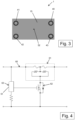
- Fig. 4 shows schematically a section of a circuit 60 into which the battery pack 20 is integrated.
- the circuit 60 is equipped with a shutdown device 61, designed as a FET Switch device 62 and a sensor device 63 having the sensor 51 are formed.
Landscapes
- Chemical & Material Sciences (AREA)
- Chemical Kinetics & Catalysis (AREA)
- Electrochemistry (AREA)
- General Chemical & Material Sciences (AREA)
- Engineering & Computer Science (AREA)
- Manufacturing & Machinery (AREA)
- Life Sciences & Earth Sciences (AREA)
- Biophysics (AREA)
- Computer Hardware Design (AREA)
- Battery Mounting, Suspending (AREA)
Description
- Die vorliegende Erfindung betrifft eine Akkupackvorrichtung mit einer Gehäuseeinrichtung und einem wenigstens eine Pouchzelle aufweisenden Akkupack gemäß dem Oberbegriff des Patentanspruches 1.
- Akkupacks, die mit einer oder mehreren Pouchzellen ausgeführt sind, sind grundsätzlich aus dem Stand der Technik bekannt, siehe z.B.
US2015207131 A1 . Während eines Betriebs von Pouchzellen auf Lithiumionenbasis bzw. des Akkupacks kann es beispielsweise im Rahmen eines Alterungsprozesses von Pouchzellen zur Gasbildung kommen. Diese Gase können beispielsweise bei einer Elektrolyt-Zersetzung oder aufgrund einer Belastung der Pouchzellen beispielsweise bei einer Überladung oder einer Überhitzung auftreten. Durch diese Gase baut sich innerhalb einer äußeren Hülle der Pouchzellen ein Druck auf und ein Volumen der Pouchzelle vergrößert sich. Erreicht oder übersteigt der Druck ein kritisches Drucklevel, kann hierdurch die äußere Hülle der Pouchzelle beschädigt werden und aufplatzen. Hierdurch wird auch die Gefahr des Auftretens eines Feuers stark erhöht. - Im Unterschied zu klassischen zylindrischen Zellen, die mit einer Stromunterbrechungseinrichtung ausgeführt sind, die Elektroden der Zelle bei Übersteigen eines definierten Innendrucks in der Zelle trennen, weisen bekannte Pouchzellen keine derartige Stromunterbrechungseinrichtung auf. Da eine äußere Hülle der Pouchzelle als Folie ausgeführt ist und daher keine große Robustheit aufweist, kann ein durch ein sogenanntes Swelling erhöhter Innendruck in der Pouchzelle zu einem Platzen der äußeren Hülle mit einem Gasaustritt führen.
- Es ist Aufgabe der vorliegenden Erfindung eine Akkupackvorrichtung und ein Verfahren zum Betreiben einer Akkupackvorrichtung zur Verfügung zu stellen, wobei die Akkupackvorrichtung sicher betreibbar ist.
- Diese Aufgabe wird mit einer Akkupackvorrichtung mit einer Gehäuseeinrichtung und einem wenigstens eine Pouchzelle aufweisenden Akkupack, dadurch gelöst, dass eine Detektiereinrichtung mit einem an das Akkupack bzw. wenigstens eine Pouchzelle gekoppelten Detektierelement und einem gehäusefest angeordneten Sensor vorgesehen sind, wobei der Sensor zur Detektion des Detektierelements bei Unterschreiten eines definierten Abstands zwischen dem Detektierelement und dem Sensor ausgeführt ist.
- Eine erfindungsgemäß ausgeführte Akkupackvorrichtung ist sicher betreibbar, da mittels der Detektiereinrichtung eine Vergrößerung wenigstens einer Pouchzelle des Akkupacks größer als ein definierter Umfang detektierbar ist und darauf
- Ein Ansteigen eines Innendrucks innerhalb einer äußeren Hülle einer Pouchzelle, beispielsweise durch eine Überladung, einen Kurzschluss oder infolge von Alterung, führt zu einem Aufblähen der Pouchzelle. Durch dieses Aufblähen vergrößert sich die Pouchzelle in einer Hauptrichtung, die insbesondere im Wesentlichen quer zu einer Haupterstreckungsrichtung der Pouchzelle angeordnet ist. Durch diesen als Swelling bezeichneten Vorgang kann es zu einer Beschädigung oder zu einem unkontrollierten Aufplatzen einer äußeren Hülle der Pouchzelle kommen. Dadurch entsteht ein erhöhtes Sicherheitsrisiko für den Anwender, da hierdurch Elektrolyt aus der äußeren Hülle der Pouchzelle austreten kann und durch einen Kontakt mit einer Zündquelle, beispielsweise einem eine hohe Temperatur aufweisenden Zellverbinder, entflammen kann. Zudem können durch die Beschädigung der äußeren Hülle der Pouchzelle unter Spannung stehende Bereiche der Pouchzelle frei zugänglich gemacht werden. Nach dem Aufplatzen funktioniert die Pouchzelle weiterhin, weshalb ein thermisches Durchgehen entstehen kann. Diese Nachteile sind auch einfache Weise mit einer erfindungsgemäß ausgeführten Akkupackvorrichtung verhindert werden.
- Das Detektierelement ist insbesondere derart mit dem Akkupack bzw. einer Pouchzelle des Akkupacks gekoppelt, dass das Detektierelement bei einer Vergrößerung der wenigstens einen Pouchzelle in der Hauptrichtung in Richtung des Sensors verlagert wird und hierdurch ein Abstand zwischen dem Detektierelement und dem Sensor reduziert wird, so dass eine derartige Vergrößerung einer und/oder mehrere Pouchzellen des Akkupacks von dem Sensor detektierbar ist.
- Das Detektierelement kann dabei ein separates Bauteil, welches direkt oder indirekt mit dem Akkupack oder einer Pouchzelle des Akkupack verbunden ist, oder beispielsweise direkt durch eine Pouchzelle des Akkupacks oder das Akkupack gebildet sein.
- Ein insbesondere mit Lithium-Ionen Pouchzellen ausgeführter Akkupack weist eine hohe Leistungsfähigkeit auf und ist dabei leicht und kompakt zu gestalten. Pouchzellen bieten aufgrund ihres inneren Designs einen deutlich geringeren internen Widerstand als herkömmliche zylindrische Batteriezellen auf, wodurch höhere Entladeströme realisiert werden können, ohne den Akkupack zu überhitzen. Zugleich können Lithium-Ionen Pouchzellen in flexiblen Geometrien hergestellt werden, wodurch der Akkupack leicht und kompakt konstruiert werden kann.
- Bei einer bevorzugten Ausführungsform der Akkupackvorrichtung ist die Detektiereinrichtung an einem plattenförmigen, an dem Akkupack anliegenden Element angeordnet, das gegenüber der Gehäuseeinrichtung verlagerbar ist und mit einer Wand der Gehäuseeinrichtung einen die wenigstens eine Pouchzelle aufweisenden Raum begrenzt. Das plattenförmige Element liegt insbesondere in der Hauptrichtung an der wenigstens einen Pouchzelle an, so dass bei einer Vergrößerung der wenigstens einen Pouchzelle in der Hauptrichtung das plattenförmige Element in der Hauptrichtung gegenüber der Wand der Gehäuseeinrichtung verlagert wird und auf den an einer anderen Wand der Gehäuseeinrichtung angeordneten Sensor zubewegt wird.
- Bei einer alternativen Ausführung kann das Detektierelement auch direkt an dem Akkupack, beispielsweise an einer Pouchzelle des Akkupacks, angebunden sein. Auch bei einer derartigen Ausführung führt eine Vergrößerung der wenigstens einen Pouchzelle in der Hauptrichtung zu einer Verlagerung des Detektierelements in Richtung des Sensors, so dass ein Abstand zwischen dem Detektierelement und dem Sensor reduziert wird.
- Um eine sichere Detektion einer kritischen Vergrößerung der wenigstens einen Pouchzelle zu erzielen, kann der Sensor zur kontaktgebundenen Detektion des Detektierelements ausgeführt sein. Der Sensor detektiert in diesem Fall das Detektierelement, wenn es mit dem Sensor in Kontakt kommt und ein Abstand zwischen dem Detektierelement und dem Sensor gleich Null ist. Alternativ hierzu kann es auch vorgesehen sein, dass der Sensor zur kontaktlosen Detektion des Detektierelements ausgeführt ist und das Detektierelement detektiert, wenn der Abstand zwischen dem Detektierelement und dem Sensor kleiner als ein vorgegebener Schwellwert ist. Der Sensor ist insbesondere zur sofortigen und/oder reversiblen Detektion des Detektierelements ausgeführt.
- Zur einfachen und sicheren Detektion des Detektierelements kann der Sensor mit einem Material ausgeführt sein, das bei einer Kontaktierung durch das Detektierelement einen Widerstand verändert. Hierbei kann es vorgesehen sein, dass eine Änderung des Widerstands direkt oder über einen Spannungsteiler ermittelt wird.
- Bei einer konstruktiv einfachen Ausführung ist der Sensor an einer weiteren Wand der Gehäuseeinrichtung und insbesondere zumindest bereichsweise in einer Ausnehmung der weiteren Wand der Gehäuseeinrichtung angeordnet. Durch die Anordnung des Sensors in der Ausnehmung ist die Wahrscheinlichkeit des Auftretens einer unbeabsichtigten Detektion oder eines unbeabsichtigten Kontakts reduziert.
- Um auf konstruktiv einfache Weise eine unerwünschte Detektion des Detektierelements durch den Sensor sicher zu verhindern, die aufgrund von äußeren Krafteinwirkungen und nicht auf einer Vergrößerung der wenigstens einen Pouchzelle beruht, ist erfindungsgemäß wenigstens eine
- Federeinrichtung vorgesehen sein, die das Detektierelement direkt oder indirekt mit einer Kraft beaufschlagt, die das Detektierelement in eine dem Sensor abgewandte Richtung drückt. Die wenigstens eine Federeinrichtung ist dabei insbesondere zwischen dem plattenförmigen Element und der weiteren Wand der Gehäuseeinrichtung angeordnet. Eine Federstärke der wenigstens einen Federeinrichtung ist dabei derart gewählt, dass das Detektierelement in gewünschtem Umfang bei einer Vergrößerung der wenigstens einen Pouchzelle in der Hauptrichtung in Richtung des Sensors verlagert wird. Das Vorsehen der wenigstens einen Federeinrichtung hat weiterhin den Vorteil, dass eine Performance der wenigstens einen Pouchzelle durch die Beaufschlagung der Pouchzellen mit Druck verbessert ist.
- Bei einer bevorzugten Ausführung sind mehrere Federeinrichtungen vorgesehen, die insbesondere derart angeordnet sind, dass eine möglichst gleichmäßige Krafteinleitung erzielt ist. Beispielsweise sind vier Federeinrichtungen vorgesehen, von denen jeweils eine Federeinrichtung einem Eckbereich eines im Wesentlichen rechteckig ausgeführten plattenförmigen Elements zugeordnet ist.
- Wenigstens eine Federeinrichtung kann dabei als Spiralfeder oder als Tellerfeder ausgeführt sein, wobei insbesondere mittels wenigstens einer Tellerfeder eine bauraumgünstige Anordnung ermöglicht ist.
- Bei einer bevorzugten Ausführung ist die wenigstens eine Pouchzelle vorzugsweise zumindest bereichsweise innerhalb eines von der Gehäuseeinrichtung begrenzten Raumes angeordnet. Die Gehäuseeinrichtung ist dabei sehr flexibel ausführbar und kann beispielsweise einen das Akkupack aufweisenden Raum von wenigstens drei Seiten begrenzen. Die Gehäuseeinrichtung kann dabei in wenigstens eine, vorzugsweise von der Hauptrichtung abweichende Richtung offen ausgeführt sein, so dass beispielsweise eine Anordnung des Ackupacks in der Gehäuseeinrichtung vereinfacht ist.
- Zur insbesondere aktiven Deaktivierung der Akkupackvorrichtung bei einer Detektion des Detektierelements durch den Sensor kann eine Steuereinrichtung vorgesehen sein, mittels welcher der Akkupack ansteuerbar ist, wobei die Detektiereinrichtung mit der Steuereinrichtung wirkverbunden ist. Hierbei kann auf einfache Weise sichergestellt werden, dass im Falle der Detektion des Detektierelements durch den Sensor von der Steuereinrichtung ein weiterer Betrieb des Akkupacks unterbunden wird.
- Um einen weiteren Betrieb des Akkupacks sicher zu verhindern, wenn der Sensor das Detektierelement detektiert, kann bei einer bevorzugten Ausführung eine Abschalteinrichtung vorgesehen sein, die Teil eines den Akkupack ansteuernden Stromkreises ist, wobei die Abschalteinrichtung zur mechanischen Unterbrechung des Stromkreises bei einer Detektion des Detektierelements durch den Sensor ausgeführt ist. Eine insbesondere passiv wirkende Abschalteinrichtung kann beispielsweise ein Schutzelement in Form einer Sicherung oder einer Schmelzsicherung aufweisen, die den Stromkreis, in den der Akkupack eingebunden ist, bei einer Detektion der definierten Vergrößerung der wenigstens einen Pouchzelle trennt und ein weiteres Betreiben des Akkupacks sicher verhindert. Hierzu kann der Sensor beispielsweise mit einem sogenannten FET bzw. MOSFET verbunden sein, der bei Detektion des Detektierelements ein Heizelement der Schmelzsicherung betätigt, so dass die Sicherung auslöst.
- Es wird weiterhin ein Verfahren zum Betreiben einer derartigen Akkupackvorrichtung vorgeschlagen, wobei eine Gehäuseeinrichtung und ein wenigstens eine Pouchzelle aufweisender Akkupack vorgesehen ist, wobei eine Detektiereinrichtung mit einem an das Akkupack gekoppelten Detektierelement und einem gehäusefest angeordneten Sensor vorgesehen sind, und wobei der Sensor zur Detektion des Detektierelements bei Unterschreiten eines definierten Abstands zwischen dem Detektierelement und dem Sensor ausgeführt ist. Dabei wird vorgeschlagen, dass ein Betrieb des Akkupack verhindert wird, wenn ein Abstand zwischen dem Detektierelement und dem Sensor über einen definierten Zeitraum kleiner als der definierte Abstand ist.
- Hierdurch ist ein sicherer Betrieb einer Akkupackvorrichtung erzielt, da mittels der Detektiereinrichtung eine durch eine Vergrößerung wenigstens einer Pouchzelle verursachte Detektion des Detektierelements von dem Sensor sicher ermittelt wird und ein weiterer Betrieb des Akkupacks bei einer Vergrößerung wenigstens einer Pouchzelle mit der Gefahr der Beschädigung des Akkupacks und dem Auftreten eines Feuers verhindert ist. Eine beispielsweise auf eine äußere Krafteinwirkung zurückgehende Detektion des Detektierelements durch den Sensor ist sicher verhindert, da eine derartige Detektion meist nur kurzfristig vorliegt und durch eine entsprechende Wahl des Zeitraums nicht zu einer Deaktivierung des Akkupacks führt.
- Weitere Vorteile ergeben sich aus der folgenden Figurenbeschreibung. In den Figuren ist ein Ausführungsbeispiel der vorliegenden Erfindung dargestellt. Die Figuren, die Beschreibung und die Ansprüche enthalten zahlreiche Merkmale in Kombination. Der Fachmann wird die Merkmale zweckmäßigerweise auch einzeln betrachten und zu sinnvollen weiteren Kombinationen zusammenfassen.
- In den Figuren sind gleiche und gleichartige Komponenten mit gleichen Bezugszeichen beziffert. Es zeigen:
- Fig. 1
- ein vereinfacht gezeigtes Ausführungsbeispiel einer Akkupackvorrichtung mit einem mehrere Pouchzellen aufweisenden Akkupack, der in einer Gehäuseeinrichtung angeordnet ist;
- Fig. 2
- eine vereinfachte Darstellung der Akkupackvorrichtung gemäß
Fig. 1 , wobei die Pouchzellen in einer Hauptrichtung vergrößert sind; - Fig. 3
- eine vereinfacht gezeigte Schnittdarstellung durch die Akkupackvorrichtung gemäß
Fig. 1 entlang der Linie III-III; und - Fig. 4
- ein vereinfachtes Schaubild eines Stromkreises, in den eine Detektiereinrichtung der Akkupackvorrichtung eingebunden ist.
- In den
Figuren 1 bis 3 ist eine Akkupackvorrichtung 1 für eine elektrische Handwerkzeugmaschine gezeigt, die eine Gehäuseeinrichtung 10 und einen Akkupack 20 aufweist. Der Akkupack 20 weist im vorliegend dargestellten Ausführungsbeispiel vier identisch ausgeführte Pouchzellen 21, 22, 23, 24 auf, wobei bei alternativen Ausführungen auch weniger, beispielsweise zwei oder drei oder mehr als vier vorgesehen sein können. Die Pouchzellen 21, 22, 23, 24 sind zumindest teilweise, vorliegend annähernd vollständig in einem von der Gehäuseeinrichtung 10 gebildeten Innenraum 11 gestapelt angeordnet. - In
Fig. 1 sind die Pouchzellen 21, 22, 23, 24 in neuem, das heißt nicht ausgedehntem Zustand, dargestellt.Fig. 2 zeigt wiederum den Akkupack 20 mit gealterten, aufgeblähten Zellen 21', 22', 23', 24`. Wie der Zusammenschau derFig. 1 und Fig. 2 zu entnehmen ist, ist eine Stapelhöhe a beim neuwertigen Akkupack 20 geringer als eine Stapelhöhe b des gealterten Akkupacks 20' inFig. 2 . Die Pouchzellen 21 bis 24 sind insbesondere als Lithium-Polymerzellen ausgeführt und über Kontaktfahnen 26, 27, 28, 29 miteinander elektrisch kontaktiert. - Während eines Betriebs der Pouchzellen 21, 22, 23,24 kann es im Rahmen eines Alterungsprozesses zu einer Gasbildung innerhalb der Pouchzellen 21, 22, 23,24 kommen. Diese Gase können beispielsweise bei einer Elektrolyt-Zersetzung oder aufgrund einer Belastung der Pouchzellen 21, 22, 23, 24 insbesondere bei einer Überladung, einem Kurzschluss oder einer Überhitzung auftreten. Durch diese Gase baut sich innerhalb einer äußeren Hülle der Pouchzellen 21, 22, 23, 24 ein Druck auf, so dass sich ein Volumen innerhalb der äußeren Hülle der Pouchzellen 21, 22, 23, 24 vergrößert. Dies wird auch als Swelling bezeichnet. Die Pouchzellen 21, 22, 23, 24 vergrößern sich hierdurch insbesondere in einer Hauptrichtung HR. Werden die vergrößerten Pouchzellen 21', 22', 23', 24' weiter betrieben, kann der Druck innerhalb der äußeren Hülle der jeweiligen Pouchzelle 21', 22', 23', 24' ein kritisches Drucklevel erreichen bzw. übersteigen, so dass die äußere Hülle der Pouchzelle 21', 22', 23', 24' hierdurch beschädigt wird und/oder unkontrolliert aufplatzen kann. In diesem Fall kann aus der äußeren Hülle austretendes Elektrolyt in Kontakt mit einer Zündquelle, beispielsweise einem heißen Zellverbinder, kommen und hierdurch entflammen. Nach dem Aufplatzen funktionieren Pouchzellen 21, 22, 23, 24 weiterhin, weshalb ein thermisches Durchgehen entstehen kann. Mit der beschriebenen Lösung kann sicher verhindert werden, dass die Pouchzellen 21, 22, 23, 24 während eines Betriebs beschädigt werden und die oben genannten Nachteile auftreten.
- Die Gehäuseeinrichtung 10 weist vorliegend wenigstens eine Wand 12 und eine der Wand 12 gegenüberliegende und insbesondere im Wesentlichen parallel zu der Wand 12 angeordnete weitere Wand 13 auf, die durch eine im Wesentlichen senkrecht zu den Wänden 12, 13 angeordnete zusätzlich Wand 14 fest miteinander verbunden sind. Der Akkupack 20 und vorliegend die Pouchzelle 21 liegen hier direkt und insbesondere flächig an der Wand 12 an. Bei alternativen Ausführungen der Erfindung kann der Innenraum 11 durch weitere, insbesondere senkrecht zu allen Wänden 12, 13, 14 angeordnete Wände begrenzt sein. Zudem kann es auch vorgesehen sein, dass die einzelnen Wände 12, 13, 14 eine oder mehrere Ausnehmungen aufweisen.
- Es ist weiterhin ein plattenförmiges Element 15 vorgesehen, welches im Wesentlichen parallel zu den Wänden 12 und 13 angeordnet ist. Das plattenförmige Element 15 liegt vorliegend ebenfalls an dem Akkupack 20, hier insbesondere flächig an der Pouchzelle 24 an, so dass der Akkupack 20 in Hauptrichtung HR von der Wand 12 und dem plattenförmigen Element 15 eingefasst ist und hierdurch eine Stapelhöhe a bzw. b des Akkupack 20 bzw. 20' definiert ist.
- Das plattenförmige Element 15 ist relativ zu den Wänden 12 und 13 der Gehäuseeinrichtung 10 verlagerbar. Hierbei kann es vorgesehen sein, dass das plattenförmige Element 15 frei zu den Wänden 12, 13 bewegbar ist oder eine Führungseinrichtung zur gezielten Verlagerung des plattenförmigen Elements 15 vorgesehen ist.
- Um sicherzustellen, dass der Akkupack 20 sowohl im Grundzustand bzw. neuem Zustand der Pouchzellen 21, 22, 23, 24 gemäß
Fig. 1 als auch im gealterten, aufgeblähten Zustand der Pouchzellen 21', 22', 23' 24' gemäßFig. 2 jeweils in Hauptrichtung HR anliegend zwischen dem plattenförmigen Element 15 und der Wand 12 angeordnet ist, sind vorliegend vier als Spiralfedern ausgeführte Federeinrichtungen 40, 41, 42, 43 vorgesehen, welche in Hauptrichtung HR zwischen der weiteren Wand 13 und dem plattenförmigen Element 15 angeordnet sind und das plattenförmige Element 15 mit einer das plattenförmige Element 15 in Richtung der Wand 12 drückenden Kraft beaufschlagen. Um eine gleichmäßige Beaufschlagung des plattenförmigen Elements 15 durch die Federeinrichtungen 40, 41, 42, 43 zu erzielen, ist vorliegend, wie inFig. 3 näher ersichtlich ist, jeweils eine Federeinrichtung 40, 41, 42, 43 in einem Eckbereich des hier im Wesentlichen rechteckig ausgeführten plattenförmigen Elements 15 angeordnet. - Eine Anzahl und Anordnung der Federeinrichtungen ist grundsätzlich beliebig variierbar und wird insbesondere derart gewählt, dass eine für den jeweiligen Anwendungsfall möglichst gleichmäßige Druckbeaufschlagung des plattenförmigen Elements 15 erzielt wird. Alternativ zum Vorsehen von Spiralfedern können bei alternativen Ausführungen auch andere Bauarten von Federn, beispielsweise wenigstens eine Tellerfeder, vorgesehen sein. Weiterhin kann es vorgesehen sein, dass das plattenförmige Element mehrteilig mit mehreren kleinen Elementen ausgeführt ist, die insbesondere jeweils als Auflagepunkt für eine Federeinrichtung 40, 41, 42, 43 dienen und jeweils gegenüber der Gehäuseeinrichtung 10 verlagerbar sind. Insbesondere sind die Elemente des plattenförmigen Elements dabei derart angeordnet und wirken derart mit Federeinrichtungen zusammen, dass ein von den Federeinrichtungen auf die Pouchzellen 21, 22, 23, 24 wirkender Druck im Wesentlichen gleichverteilt ist.
- Um sicher erkennen zu können, wenn der Akkupack 20 eine kritische Stapelhöhe b erreicht hat, d. h., wenn die Pouchzellen 21, 22, 23, 24 gemeinsam eine Größenänderung in Hauptrichtung HR größer als ein definierter Schwellwert aufweisen, ist eine Detektiereinrichtung 50 vorgesehen. Die Detektiereinrichtung 50 weist einen an der weiteren Wand 13, hier in einer Ausnehmung 16 der weiteren Wand 13 angeordneten Sensor 51 und ein an dem plattenförmigen Element 15 angeordnetes Detektierelement 52 auf. Der Sensor 51 ist in einem mittigen Bereich der weiteren Wand 13 und das Detektierelement 52 in einem mittigen Bereich des plattenförmigen Elements 15 angeordnet. Der Sensor 51 und das Detektierelement 52 sind derart zueinander angeordnet, dass das Detektierelement 52 bei einer Verlagerung des plattenförmigen Elements 15 in Hauptrichtung HR größer als ein definierter Wert durch eine entsprechende Vergrößerung des Akkupacks 20 und der einzelnen Pouchzellen 21, 22, 23, 24 in Hauptrichtung HR in Kontakt mit dem Sensor 51 kommt und ein Abstand zwischen dem Detektierelement 52 und dem Sensor 51, zu dem der Sensor 51 das Detektierelement 52 detektiert, vorliegend gleich Null ist. Eine Verlagerung des plattenförmigen Elements 15 in Richtung der weiteren Wand 13 kommt dabei zustande, wenn ein in den Pouchzellen 21, 22, 23, 24 vorliegender Innendruck in Summe größer als die von den Federeinrichtungen 40, 41, 42, 43 auf das plattenförmige Element 15 wirkende Kraft ist.
- Der Sensor 51 ist vorliegend als Kontaktsensor ausgeführt, so dass mittels des Sensors 51 ein Kontakt des hier als von dem plattenförmigen Element 15 in Richtung der weiteren Wand 13 hervorstehenden und als Detektierspitze ausgeführten Detektierelements 52 mit dem Sensor 51 detektierbar ist. Der Sensor 51 kann dabei beispielsweise mit einem Material ausgeführt sein, das bei einem Kontakt bzw. bei einer Druckbeaufschlagung durch das Detektierelement 52 einen Widerstand ändert. Eine derartige Widerstandsänderung kann beispielsweise direkt oder mittels eines Spannungsteilerkreislaufes erkannt und ein Kontakt des Detektierelements 52 mit dem Sensor 51 ermittelt werden. Der Sensor 51 kann hierzu mit einer Folie ausgeführt sein, die ein derartiges Material aufweist.
- Ein Kontakt des Detektierelements 52 mit dem Sensor 51 ist hierbei unverzüglich und reversibel detektierbar, wobei beispielsweise eine Steuereinrichtung einen weiteren Betrieb des Akkupacks 20 erst verhindert, wenn ein Kontakt des Detektierelements 52 mit dem Sensor 51 länger als ein vorgegebener definierter Zeitraum vorliegt.
-
Fig. 4 zeigt schematisch einen Ausschnitt eines Stromkreises 60, in den der Akkupack 20 eingebunden ist. Der Stromkreis 60 ist mit einer Abschalteinrichtung 61, einer als FET ausgeführten Schaltereinrichtung 62 und einer den Sensor 51 aufweisenden Sensoreinrichtung 63 ausgebildet. Wenn das Detektierelement 51 von dem Sensor 51 detektiert wird, steigt eine Spannung an einem Ausgang der Sensoreinrichtung 63, durch die die Schaltereinrichtung 62 aktiviert wird und ein Strom in Richtung der Abschalteinrichtung 61 fließt. Der Strom fließt durch ein Heizelement der Abschalteinrichtung 61 und eine Schmelzsicherung der Abschalteinrichtung 61 schmilzt, so dass ein weiterer Betrieb des Akkupacks 20 durch eine mechanische Trennung des Stromkreises 60 sicher unterbunden ist. -
- 1
- Akkupackvorrichtung
- 10
- Gehäuseeinrichtung
- 11
- Innenraum
- 12
- Wand
- 13
- weitere Wand
- 14
- zusätzliche Wand
- 15
- plattenförmiges Element
- 16
- Ausnehmung der weiteren Wand
- 20
- Akkupack(neu)
- 20'
- Akkupack (aufgebläht)
- 21, 22, 23, 24
- Pouchzelle (neu)
- 21', 22', 23`, 24`
- Pouchzelle (aufgebläht)
- 26, 27, 28, 29
- Kontaktfahne
- 40, 41, 42, 43
- Federeinrichtung; Spiralfeder
- 50
- Detektiereinrichtung
- 51
- Sensor
- 52
- Detektierelement
- 60
- Stromkreis
- 61
- Abschalteinrichtung
- 62
- Schaltereinrichtung
- 63
- Sensoreinrichtung
- a, b
- Stapelhöhe
- HR
- Hauptrichtung
Claims (9)
- Akkupackvorrichtung (1) für eine elektrische Handwerkzeugmaschine mit einer Gehäuseeinrichtung (10) und einem wenigstens eine Pouchzelle (21, 22, 23, 24) aufweisenden Akkupack (20),wobei eine Detektiereinrichtung (50) mit einem an das Akkupack (20) gekoppelten Detektierelement (52) und einem gehäusefest angeordneten Sensor (51) vorgesehen sind, wobei der Sensor (51) zur Detektion des Detektierelements (52) bei Unterschreiten eines definierten Abstands zwischen dem Detektierelement (52) und dem Sensor (51) ausgeführt ist,dadurch gekennzeichnet, dass wenigstens eine Federeinrichtung (40, 41, 42, 43) vorgesehen ist, die das Detektierelement (52) mit einer Kraft beaufschlagt, die das Detektierelement (52) in eine dem Sensor (51) abgewandte Richtung drückt.
- Akkupackvorrichtung nach Anspruch 1,
dadurch gekennzeichnet, dass die Detektiereinrichtung (50) an einem plattenförmigen, an dem Akkupack (20) anliegenden Element (15) angeordnet ist, das gegenüber der Gehäuseeinrichtung (10) verlagerbar ist und mit einer Wand (12) der Gehäuseeinrichtung (10) einen die wenigstens eine Pouchzelle (21, 22, 23, 24) aufweisenden Raum (11) begrenzt. - Akkupackvorrichtung nach einem der Ansprüche 1 oder 2,
dadurch gekennzeichnet, dass der Sensor (51) zur kontaktgebundenen Detektion des Detektierelements (52) ausgeführt ist. - Akkupackvorrichtung nach Anspruch 3,
dadurch gekennzeichnet, dass der Sensor (51) mit einem Material ausgeführt ist, das bei einer Kontaktierung einen Widerstand verändert. - Akkupackvorrichtung nach einem der Ansprüche 1 bis 4,
dadurch gekennzeichnet, dass der Sensor (51) an einer weiteren Wand (13) der Gehäuseeinrichtung (10) und insbesondere zumindest bereichsweise in einer Ausnehmung (16) der weiteren Wand (13) der Gehäuseeinrichtung (10) angeordnet ist. - Akkupackvorrichtung nach Anspruch 1,
dadurch gekennzeichnet, dass die wenigstens eine Federeinrichtung (40, 41, 42, 43) als Spiralfeder oder als Tellerfeder ausgeführt ist. - Akkupackvorrichtung nach einem der Ansprüche 1 bis 6,
dadurch gekennzeichnet, dass die wenigstens eine Pouchzelle (21, 22, 23,24) zumindest bereichsweise innerhalb eines von der Gehäuseeinrichtung (10) begrenzten Raumes (11) angeordnet ist. - Akkupackvorrichtung nach einem der Ansprüche 1 bis 7,
dadurch gekennzeichnet, dass eine Steuereinrichtung vorgesehen ist, mittels welcher der Akkupack (20) ansteuerbar ist, wobei die Detektiereinrichtung (50) mit der Steuereinrichtung wirkverbunden ist. - Akkupackvorrichtung nach einem der Ansprüche 1 bis 8,
dadurch gekennzeichnet, dass eine Abschalteinrichtung (61) vorgesehen ist, die Teil eines den Akkupack (20) ansteuernden Stromkreises (60) ist, wobei die Abschalteinrichtung (61) zur mechanischen Unterbrechung des Stromkreises (60) bei einer Detektion des Detektierelements (52) durch den Sensor (51) ausgeführt ist.
Applications Claiming Priority (2)
| Application Number | Priority Date | Filing Date | Title |
|---|---|---|---|
| EP18210391.1A EP3664179A1 (de) | 2018-12-05 | 2018-12-05 | Akkupackvorrichtung und verfahren zum betreiben der akkupackvorrichtung |
| PCT/EP2019/082200 WO2020114800A1 (de) | 2018-12-05 | 2019-11-22 | Akkupackvorrichtung und verfahren zum betreiben der akkupackvorrichtung |
Publications (2)
| Publication Number | Publication Date |
|---|---|
| EP3891820A1 EP3891820A1 (de) | 2021-10-13 |
| EP3891820B1 true EP3891820B1 (de) | 2024-03-27 |
Family
ID=64606837
Family Applications (2)
| Application Number | Title | Priority Date | Filing Date |
|---|---|---|---|
| EP18210391.1A Withdrawn EP3664179A1 (de) | 2018-12-05 | 2018-12-05 | Akkupackvorrichtung und verfahren zum betreiben der akkupackvorrichtung |
| EP19806241.6A Active EP3891820B1 (de) | 2018-12-05 | 2019-11-22 | Akkupackvorrichtung |
Family Applications Before (1)
| Application Number | Title | Priority Date | Filing Date |
|---|---|---|---|
| EP18210391.1A Withdrawn EP3664179A1 (de) | 2018-12-05 | 2018-12-05 | Akkupackvorrichtung und verfahren zum betreiben der akkupackvorrichtung |
Country Status (4)
| Country | Link |
|---|---|
| US (1) | US11799123B2 (de) |
| EP (2) | EP3664179A1 (de) |
| CN (1) | CN112840499B (de) |
| WO (1) | WO2020114800A1 (de) |
Families Citing this family (9)
| Publication number | Priority date | Publication date | Assignee | Title |
|---|---|---|---|---|
| EP3161899A4 (de) | 2014-06-30 | 2017-12-27 | Black & Decker Inc. | Batteriepack für schnurlose elektrowerkzeuge |
| WO2021184044A1 (en) | 2020-03-10 | 2021-09-16 | Black & Decker Inc. | Cordless power tool system compatible with multiple battery packs |
| EP3945616A1 (de) * | 2020-07-27 | 2022-02-02 | Hilti Aktiengesellschaft | Akkupack |
| DE202020104503U1 (de) * | 2020-08-04 | 2021-09-07 | Webasto SE | Gehäuse für ein Batteriemodul zur Aufnahme von Batteriezellen |
| US20230124344A1 (en) * | 2021-10-19 | 2023-04-20 | Enevate Corporation | Clamping device and interface for an electrochemical cell stack |
| US20230147262A1 (en) * | 2021-11-09 | 2023-05-11 | Hand Held Products, Inc. | Battery fault detection assemblies |
| DE102022208233A1 (de) | 2022-08-08 | 2024-02-08 | Volkswagen Aktiengesellschaft | Zellverband für ein Batteriesystem |
| EP4525200A1 (de) * | 2023-09-18 | 2025-03-19 | Einhell Germany AG | Batteriepack mit beutelakkumulatorzellen |
| DE102024002250A1 (de) | 2024-07-10 | 2026-01-15 | Mercedes-Benz Group AG | Batterie und Fahrzeug |
Citations (1)
| Publication number | Priority date | Publication date | Assignee | Title |
|---|---|---|---|---|
| EP2284929B1 (de) * | 2009-08-14 | 2011-09-21 | SB LiMotive Co., Ltd. | Batteriemodul |
Family Cites Families (17)
| Publication number | Priority date | Publication date | Assignee | Title |
|---|---|---|---|---|
| JPS569972A (en) * | 1979-07-05 | 1981-01-31 | Japan Storage Battery Co Ltd | Laminated battery of flat-type nickel cadmium battery and its charge control mechanism |
| US7826189B1 (en) * | 2008-03-06 | 2010-11-02 | Sprint Communications Company L.P. | Battery swell triggered override system |
| US8395519B2 (en) | 2010-11-19 | 2013-03-12 | General Electric Company | Device and method of determining safety in a battery pack |
| US20120208054A1 (en) | 2011-02-16 | 2012-08-16 | Toyota Jidosha Kabushiki Kaisha | Battery system and battery structure |
| JP5804540B2 (ja) * | 2011-05-17 | 2015-11-04 | エルジー ケム. エルティーディ. | 安全性の向上した電池パック |
| WO2013167189A1 (en) | 2012-05-10 | 2013-11-14 | Abb Research Ltd | Battery energy storage and power system |
| DE102012208509A1 (de) * | 2012-05-22 | 2013-11-28 | Robert Bosch Gmbh | Vorrichtung zum Ermitteln einer Zustandsgröße einer Zelle zur Umwandlung von chemischer Energie in elektrische Energie, Zelle, Zellenmodul und Verfahren zum Ermitteln einer Zustandsgröße einer Zelle |
| CN202585672U (zh) * | 2012-06-07 | 2012-12-05 | 深圳市海盈科技有限公司 | 锂离子电池组 |
| KR101690295B1 (ko) * | 2013-05-15 | 2017-01-09 | 주식회사 엘지화학 | 과전류 차단 장치 및 이를 포함하는 이차전지 시스템 |
| KR101775545B1 (ko) * | 2013-10-08 | 2017-09-06 | 삼성에스디아이 주식회사 | 단락 돌기를 갖는 이차 전지 |
| KR101558685B1 (ko) * | 2013-12-09 | 2015-10-07 | 현대자동차주식회사 | 차량 기반 통신 서비스 지원 방법 및 시스템과 이를 지원하는 차량 |
| KR101650991B1 (ko) * | 2013-12-23 | 2016-08-24 | 주식회사 엘지화학 | 배터리 스웰링 감지 시스템 및 방법 |
| KR102272264B1 (ko) * | 2014-01-20 | 2021-07-02 | 삼성에스디아이 주식회사 | 단락 연결부를 갖는 전지 모듈 |
| US9509020B1 (en) * | 2014-03-27 | 2016-11-29 | Amazon Technologies, Inc. | Volumetric battery health sensor |
| US10158149B2 (en) * | 2014-11-20 | 2018-12-18 | Motorola Solutions, Inc. | Method and apparatus to detect and manage battery pack cell swell |
| KR102540916B1 (ko) * | 2016-12-05 | 2023-06-07 | 현대자동차주식회사 | 과충전 안전장치 |
| CN206789648U (zh) * | 2017-03-31 | 2017-12-22 | 上海思致汽车工程技术有限公司 | 一种动力电池组的安全结构 |
-
2018
- 2018-12-05 EP EP18210391.1A patent/EP3664179A1/de not_active Withdrawn
-
2019
- 2019-11-22 CN CN201980068295.7A patent/CN112840499B/zh active Active
- 2019-11-22 WO PCT/EP2019/082200 patent/WO2020114800A1/de not_active Ceased
- 2019-11-22 US US17/297,621 patent/US11799123B2/en active Active
- 2019-11-22 EP EP19806241.6A patent/EP3891820B1/de active Active
Patent Citations (1)
| Publication number | Priority date | Publication date | Assignee | Title |
|---|---|---|---|---|
| EP2284929B1 (de) * | 2009-08-14 | 2011-09-21 | SB LiMotive Co., Ltd. | Batteriemodul |
Also Published As
| Publication number | Publication date |
|---|---|
| US11799123B2 (en) | 2023-10-24 |
| CN112840499A (zh) | 2021-05-25 |
| US20220029190A1 (en) | 2022-01-27 |
| EP3891820A1 (de) | 2021-10-13 |
| EP3664179A1 (de) | 2020-06-10 |
| WO2020114800A1 (de) | 2020-06-11 |
| CN112840499B (zh) | 2023-01-10 |
Similar Documents
| Publication | Publication Date | Title |
|---|---|---|
| EP3891820B1 (de) | Akkupackvorrichtung | |
| EP3259792B1 (de) | Batteriezelle für eine batterie eines kraftfahrzeugs, batterie und kraftfahrzeug | |
| EP3166172B1 (de) | Batteriezelle mit einer schnellentladeeinheit und schnellentladeverfahren für eine solche batteriezelle | |
| WO2016131797A1 (de) | Batteriezelle für eine batterie eines kraftfahrzeugs, batterie und kraftfahrzeug | |
| EP3389115A1 (de) | Modular aufgebaute batterie mit verbesserten sicherheitseigenschaften | |
| WO2011116803A2 (de) | Zellverbund mit einer vorgebbaren anzahl von parallel und/oder seriell miteinander elektrisch verschalteten einzelzellen | |
| WO2020193375A1 (de) | Elektrische sicherung, verfahren zum betreiben einer elektrischen sicherung und elektrisches traktionsnetz | |
| DE102020202857A1 (de) | Vorrichtung sowie Verfahren zur thermischen Überwachung einer Batterie | |
| WO2013174590A1 (de) | Vorrichtung und verfahren zum abkoppeln und/oder überbrücken von anschlüssen für eine batteriezelle | |
| WO2014180665A1 (de) | Batterie mit rückstellbarer sicherheitseinrichtung sowie dafür geeigneter polbolzen | |
| DE102013204073B4 (de) | Batterie mit thermischem Auslöseelement | |
| EP3259787B1 (de) | Verfahren zum fertigen einer batterie | |
| DE102011015829A1 (de) | Elektrochemische Energiespeicherzelle mit Stromunterbrechungseinrichtung | |
| WO2016071100A1 (de) | Batterie mit verbesserter sicherheit | |
| WO2014195048A1 (de) | Sicherheitsventil zum schutz einer galvanischen zelle vor schädigendem überdruck sowie zellgehäusedeckel und galvanische zelle mit sicherheitsventil | |
| EP2606522A1 (de) | Elektrochemische zelle mit wenigstens einer druckentlastungsvorrichtung | |
| DE102008006026A1 (de) | Sicherheitseinrichtung für nach galvanischen Prinzipien arbeitenden elektrischen Einrichtungen | |
| DE102008059958A1 (de) | Batterie, insbesondere Fahrzeugbatterie | |
| EP3433892B1 (de) | Zelle für einen elektrischen energiespeicher | |
| EP3166173B1 (de) | Batteriesystem für ein fahrzeug | |
| EP4327397B1 (de) | Batteriemodul mit mehreren batterieeinzelzellen | |
| EP3867960B1 (de) | Pouchzelle | |
| DE102012222242B4 (de) | Elektrisches Energiespeichersystem mit einer Trägerstruktur | |
| DE102008028609A1 (de) | Elektrische Akkumulatorenzelle | |
| EP2888782B1 (de) | Batteriezelle, batterie, verfahren zur entladung einer batteriezelle und kraftfahrzeug |
Legal Events
| Date | Code | Title | Description |
|---|---|---|---|
| STAA | Information on the status of an ep patent application or granted ep patent |
Free format text: STATUS: UNKNOWN |
|
| STAA | Information on the status of an ep patent application or granted ep patent |
Free format text: STATUS: THE INTERNATIONAL PUBLICATION HAS BEEN MADE |
|
| PUAI | Public reference made under article 153(3) epc to a published international application that has entered the european phase |
Free format text: ORIGINAL CODE: 0009012 |
|
| STAA | Information on the status of an ep patent application or granted ep patent |
Free format text: STATUS: REQUEST FOR EXAMINATION WAS MADE |
|
| 17P | Request for examination filed |
Effective date: 20210705 |
|
| AK | Designated contracting states |
Kind code of ref document: A1 Designated state(s): AL AT BE BG CH CY CZ DE DK EE ES FI FR GB GR HR HU IE IS IT LI LT LU LV MC MK MT NL NO PL PT RO RS SE SI SK SM TR |
|
| DAV | Request for validation of the european patent (deleted) | ||
| DAX | Request for extension of the european patent (deleted) | ||
| REG | Reference to a national code |
Ref country code: DE Ref legal event code: R079 Free format text: PREVIOUS MAIN CLASS: H01M0002020000 Ipc: H01M0050211000 Ref document number: 502019010926 Country of ref document: DE |
|
| GRAP | Despatch of communication of intention to grant a patent |
Free format text: ORIGINAL CODE: EPIDOSNIGR1 |
|
| STAA | Information on the status of an ep patent application or granted ep patent |
Free format text: STATUS: GRANT OF PATENT IS INTENDED |
|
| RIC1 | Information provided on ipc code assigned before grant |
Ipc: H01M 10/04 20060101ALI20231211BHEP Ipc: H01M 10/48 20060101ALI20231211BHEP Ipc: H01M 10/647 20140101ALI20231211BHEP Ipc: H01M 50/578 20210101ALI20231211BHEP Ipc: H01M 50/211 20210101AFI20231211BHEP |
|
| INTG | Intention to grant announced |
Effective date: 20240111 |
|
| GRAS | Grant fee paid |
Free format text: ORIGINAL CODE: EPIDOSNIGR3 |
|
| GRAA | (expected) grant |
Free format text: ORIGINAL CODE: 0009210 |
|
| STAA | Information on the status of an ep patent application or granted ep patent |
Free format text: STATUS: THE PATENT HAS BEEN GRANTED |
|
| AK | Designated contracting states |
Kind code of ref document: B1 Designated state(s): AL AT BE BG CH CY CZ DE DK EE ES FI FR GB GR HR HU IE IS IT LI LT LU LV MC MK MT NL NO PL PT RO RS SE SI SK SM TR |
|
| REG | Reference to a national code |
Ref country code: GB Ref legal event code: FG4D Free format text: NOT ENGLISH |
|
| REG | Reference to a national code |
Ref country code: CH Ref legal event code: EP |
|
| REG | Reference to a national code |
Ref country code: DE Ref legal event code: R096 Ref document number: 502019010926 Country of ref document: DE |
|
| REG | Reference to a national code |
Ref country code: IE Ref legal event code: FG4D Free format text: LANGUAGE OF EP DOCUMENT: GERMAN |
|
| PG25 | Lapsed in a contracting state [announced via postgrant information from national office to epo] |
Ref country code: LT Free format text: LAPSE BECAUSE OF FAILURE TO SUBMIT A TRANSLATION OF THE DESCRIPTION OR TO PAY THE FEE WITHIN THE PRESCRIBED TIME-LIMIT Effective date: 20240327 |
|
| REG | Reference to a national code |
Ref country code: LT Ref legal event code: MG9D |
|
| PG25 | Lapsed in a contracting state [announced via postgrant information from national office to epo] |
Ref country code: GR Free format text: LAPSE BECAUSE OF FAILURE TO SUBMIT A TRANSLATION OF THE DESCRIPTION OR TO PAY THE FEE WITHIN THE PRESCRIBED TIME-LIMIT Effective date: 20240628 |
|
| PG25 | Lapsed in a contracting state [announced via postgrant information from national office to epo] |
Ref country code: HR Free format text: LAPSE BECAUSE OF FAILURE TO SUBMIT A TRANSLATION OF THE DESCRIPTION OR TO PAY THE FEE WITHIN THE PRESCRIBED TIME-LIMIT Effective date: 20240327 Ref country code: RS Free format text: LAPSE BECAUSE OF FAILURE TO SUBMIT A TRANSLATION OF THE DESCRIPTION OR TO PAY THE FEE WITHIN THE PRESCRIBED TIME-LIMIT Effective date: 20240627 |
|
| PG25 | Lapsed in a contracting state [announced via postgrant information from national office to epo] |
Ref country code: RS Free format text: LAPSE BECAUSE OF FAILURE TO SUBMIT A TRANSLATION OF THE DESCRIPTION OR TO PAY THE FEE WITHIN THE PRESCRIBED TIME-LIMIT Effective date: 20240627 Ref country code: NO Free format text: LAPSE BECAUSE OF FAILURE TO SUBMIT A TRANSLATION OF THE DESCRIPTION OR TO PAY THE FEE WITHIN THE PRESCRIBED TIME-LIMIT Effective date: 20240627 Ref country code: LT Free format text: LAPSE BECAUSE OF FAILURE TO SUBMIT A TRANSLATION OF THE DESCRIPTION OR TO PAY THE FEE WITHIN THE PRESCRIBED TIME-LIMIT Effective date: 20240327 Ref country code: HR Free format text: LAPSE BECAUSE OF FAILURE TO SUBMIT A TRANSLATION OF THE DESCRIPTION OR TO PAY THE FEE WITHIN THE PRESCRIBED TIME-LIMIT Effective date: 20240327 Ref country code: GR Free format text: LAPSE BECAUSE OF FAILURE TO SUBMIT A TRANSLATION OF THE DESCRIPTION OR TO PAY THE FEE WITHIN THE PRESCRIBED TIME-LIMIT Effective date: 20240628 Ref country code: FI Free format text: LAPSE BECAUSE OF FAILURE TO SUBMIT A TRANSLATION OF THE DESCRIPTION OR TO PAY THE FEE WITHIN THE PRESCRIBED TIME-LIMIT Effective date: 20240327 Ref country code: BG Free format text: LAPSE BECAUSE OF FAILURE TO SUBMIT A TRANSLATION OF THE DESCRIPTION OR TO PAY THE FEE WITHIN THE PRESCRIBED TIME-LIMIT Effective date: 20240327 |
|
| REG | Reference to a national code |
Ref country code: NL Ref legal event code: MP Effective date: 20240327 |
|
| P01 | Opt-out of the competence of the unified patent court (upc) registered |
Free format text: CASE NUMBER: APP_41789/2024 Effective date: 20240716 |
|
| PG25 | Lapsed in a contracting state [announced via postgrant information from national office to epo] |
Ref country code: SE Free format text: LAPSE BECAUSE OF FAILURE TO SUBMIT A TRANSLATION OF THE DESCRIPTION OR TO PAY THE FEE WITHIN THE PRESCRIBED TIME-LIMIT Effective date: 20240327 Ref country code: LV Free format text: LAPSE BECAUSE OF FAILURE TO SUBMIT A TRANSLATION OF THE DESCRIPTION OR TO PAY THE FEE WITHIN THE PRESCRIBED TIME-LIMIT Effective date: 20240327 |
|
| PG25 | Lapsed in a contracting state [announced via postgrant information from national office to epo] |
Ref country code: NL Free format text: LAPSE BECAUSE OF FAILURE TO SUBMIT A TRANSLATION OF THE DESCRIPTION OR TO PAY THE FEE WITHIN THE PRESCRIBED TIME-LIMIT Effective date: 20240327 |
|
| PG25 | Lapsed in a contracting state [announced via postgrant information from national office to epo] |
Ref country code: NL Free format text: LAPSE BECAUSE OF FAILURE TO SUBMIT A TRANSLATION OF THE DESCRIPTION OR TO PAY THE FEE WITHIN THE PRESCRIBED TIME-LIMIT Effective date: 20240327 |
|
| PG25 | Lapsed in a contracting state [announced via postgrant information from national office to epo] |
Ref country code: IS Free format text: LAPSE BECAUSE OF FAILURE TO SUBMIT A TRANSLATION OF THE DESCRIPTION OR TO PAY THE FEE WITHIN THE PRESCRIBED TIME-LIMIT Effective date: 20240727 |
|
| PG25 | Lapsed in a contracting state [announced via postgrant information from national office to epo] |
Ref country code: SM Free format text: LAPSE BECAUSE OF FAILURE TO SUBMIT A TRANSLATION OF THE DESCRIPTION OR TO PAY THE FEE WITHIN THE PRESCRIBED TIME-LIMIT Effective date: 20240327 Ref country code: PT Free format text: LAPSE BECAUSE OF FAILURE TO SUBMIT A TRANSLATION OF THE DESCRIPTION OR TO PAY THE FEE WITHIN THE PRESCRIBED TIME-LIMIT Effective date: 20240729 |
|
| PG25 | Lapsed in a contracting state [announced via postgrant information from national office to epo] |
Ref country code: ES Free format text: LAPSE BECAUSE OF FAILURE TO SUBMIT A TRANSLATION OF THE DESCRIPTION OR TO PAY THE FEE WITHIN THE PRESCRIBED TIME-LIMIT Effective date: 20240327 |
|
| PG25 | Lapsed in a contracting state [announced via postgrant information from national office to epo] |
Ref country code: EE Free format text: LAPSE BECAUSE OF FAILURE TO SUBMIT A TRANSLATION OF THE DESCRIPTION OR TO PAY THE FEE WITHIN THE PRESCRIBED TIME-LIMIT Effective date: 20240327 Ref country code: CZ Free format text: LAPSE BECAUSE OF FAILURE TO SUBMIT A TRANSLATION OF THE DESCRIPTION OR TO PAY THE FEE WITHIN THE PRESCRIBED TIME-LIMIT Effective date: 20240327 |
|
| PG25 | Lapsed in a contracting state [announced via postgrant information from national office to epo] |
Ref country code: PL Free format text: LAPSE BECAUSE OF FAILURE TO SUBMIT A TRANSLATION OF THE DESCRIPTION OR TO PAY THE FEE WITHIN THE PRESCRIBED TIME-LIMIT Effective date: 20240327 |
|
| PG25 | Lapsed in a contracting state [announced via postgrant information from national office to epo] |
Ref country code: SK Free format text: LAPSE BECAUSE OF FAILURE TO SUBMIT A TRANSLATION OF THE DESCRIPTION OR TO PAY THE FEE WITHIN THE PRESCRIBED TIME-LIMIT Effective date: 20240327 |
|
| PG25 | Lapsed in a contracting state [announced via postgrant information from national office to epo] |
Ref country code: SM Free format text: LAPSE BECAUSE OF FAILURE TO SUBMIT A TRANSLATION OF THE DESCRIPTION OR TO PAY THE FEE WITHIN THE PRESCRIBED TIME-LIMIT Effective date: 20240327 Ref country code: SK Free format text: LAPSE BECAUSE OF FAILURE TO SUBMIT A TRANSLATION OF THE DESCRIPTION OR TO PAY THE FEE WITHIN THE PRESCRIBED TIME-LIMIT Effective date: 20240327 Ref country code: RO Free format text: LAPSE BECAUSE OF FAILURE TO SUBMIT A TRANSLATION OF THE DESCRIPTION OR TO PAY THE FEE WITHIN THE PRESCRIBED TIME-LIMIT Effective date: 20240327 Ref country code: PT Free format text: LAPSE BECAUSE OF FAILURE TO SUBMIT A TRANSLATION OF THE DESCRIPTION OR TO PAY THE FEE WITHIN THE PRESCRIBED TIME-LIMIT Effective date: 20240729 Ref country code: PL Free format text: LAPSE BECAUSE OF FAILURE TO SUBMIT A TRANSLATION OF THE DESCRIPTION OR TO PAY THE FEE WITHIN THE PRESCRIBED TIME-LIMIT Effective date: 20240327 Ref country code: IS Free format text: LAPSE BECAUSE OF FAILURE TO SUBMIT A TRANSLATION OF THE DESCRIPTION OR TO PAY THE FEE WITHIN THE PRESCRIBED TIME-LIMIT Effective date: 20240727 Ref country code: ES Free format text: LAPSE BECAUSE OF FAILURE TO SUBMIT A TRANSLATION OF THE DESCRIPTION OR TO PAY THE FEE WITHIN THE PRESCRIBED TIME-LIMIT Effective date: 20240327 Ref country code: EE Free format text: LAPSE BECAUSE OF FAILURE TO SUBMIT A TRANSLATION OF THE DESCRIPTION OR TO PAY THE FEE WITHIN THE PRESCRIBED TIME-LIMIT Effective date: 20240327 Ref country code: CZ Free format text: LAPSE BECAUSE OF FAILURE TO SUBMIT A TRANSLATION OF THE DESCRIPTION OR TO PAY THE FEE WITHIN THE PRESCRIBED TIME-LIMIT Effective date: 20240327 |
|
| PG25 | Lapsed in a contracting state [announced via postgrant information from national office to epo] |
Ref country code: IT Free format text: LAPSE BECAUSE OF FAILURE TO SUBMIT A TRANSLATION OF THE DESCRIPTION OR TO PAY THE FEE WITHIN THE PRESCRIBED TIME-LIMIT Effective date: 20240327 |
|
| PG25 | Lapsed in a contracting state [announced via postgrant information from national office to epo] |
Ref country code: IT Free format text: LAPSE BECAUSE OF FAILURE TO SUBMIT A TRANSLATION OF THE DESCRIPTION OR TO PAY THE FEE WITHIN THE PRESCRIBED TIME-LIMIT Effective date: 20240327 |
|
| REG | Reference to a national code |
Ref country code: DE Ref legal event code: R097 Ref document number: 502019010926 Country of ref document: DE |
|
| PG25 | Lapsed in a contracting state [announced via postgrant information from national office to epo] |
Ref country code: DK Free format text: LAPSE BECAUSE OF FAILURE TO SUBMIT A TRANSLATION OF THE DESCRIPTION OR TO PAY THE FEE WITHIN THE PRESCRIBED TIME-LIMIT Effective date: 20240327 |
|
| PG25 | Lapsed in a contracting state [announced via postgrant information from national office to epo] |
Ref country code: DK Free format text: LAPSE BECAUSE OF FAILURE TO SUBMIT A TRANSLATION OF THE DESCRIPTION OR TO PAY THE FEE WITHIN THE PRESCRIBED TIME-LIMIT Effective date: 20240327 |
|
| PLBE | No opposition filed within time limit |
Free format text: ORIGINAL CODE: 0009261 |
|
| STAA | Information on the status of an ep patent application or granted ep patent |
Free format text: STATUS: NO OPPOSITION FILED WITHIN TIME LIMIT |
|
| 26N | No opposition filed |
Effective date: 20250103 |
|
| PG25 | Lapsed in a contracting state [announced via postgrant information from national office to epo] |
Ref country code: SI Free format text: LAPSE BECAUSE OF FAILURE TO SUBMIT A TRANSLATION OF THE DESCRIPTION OR TO PAY THE FEE WITHIN THE PRESCRIBED TIME-LIMIT Effective date: 20240327 |
|
| REG | Reference to a national code |
Ref country code: CH Ref legal event code: PL |
|
| PG25 | Lapsed in a contracting state [announced via postgrant information from national office to epo] |
Ref country code: MC Free format text: LAPSE BECAUSE OF FAILURE TO SUBMIT A TRANSLATION OF THE DESCRIPTION OR TO PAY THE FEE WITHIN THE PRESCRIBED TIME-LIMIT Effective date: 20240327 |
|
| PG25 | Lapsed in a contracting state [announced via postgrant information from national office to epo] |
Ref country code: LU Free format text: LAPSE BECAUSE OF NON-PAYMENT OF DUE FEES Effective date: 20241122 |
|
| REG | Reference to a national code |
Ref country code: CH Ref legal event code: PL |
|
| PG25 | Lapsed in a contracting state [announced via postgrant information from national office to epo] |
Ref country code: CH Free format text: LAPSE BECAUSE OF NON-PAYMENT OF DUE FEES Effective date: 20241130 |
|
| REG | Reference to a national code |
Ref country code: BE Ref legal event code: MM Effective date: 20241130 |
|
| PG25 | Lapsed in a contracting state [announced via postgrant information from national office to epo] |
Ref country code: BE Free format text: LAPSE BECAUSE OF NON-PAYMENT OF DUE FEES Effective date: 20241130 |
|
| PG25 | Lapsed in a contracting state [announced via postgrant information from national office to epo] |
Ref country code: IE Free format text: LAPSE BECAUSE OF NON-PAYMENT OF DUE FEES Effective date: 20241122 |
|
| PGFP | Annual fee paid to national office [announced via postgrant information from national office to epo] |
Ref country code: DE Payment date: 20251119 Year of fee payment: 7 |
|
| PGFP | Annual fee paid to national office [announced via postgrant information from national office to epo] |
Ref country code: GB Payment date: 20251121 Year of fee payment: 7 |
|
| PG25 | Lapsed in a contracting state [announced via postgrant information from national office to epo] |
Ref country code: AT Free format text: LAPSE BECAUSE OF NON-PAYMENT OF DUE FEES Effective date: 20241122 |
|
| PGFP | Annual fee paid to national office [announced via postgrant information from national office to epo] |
Ref country code: FR Payment date: 20251126 Year of fee payment: 7 |
|
| REG | Reference to a national code |
Ref country code: AT Ref legal event code: MM01 Ref document number: 1670810 Country of ref document: AT Kind code of ref document: T Effective date: 20241122 |
|
| PG25 | Lapsed in a contracting state [announced via postgrant information from national office to epo] |
Ref country code: HU Free format text: LAPSE BECAUSE OF FAILURE TO SUBMIT A TRANSLATION OF THE DESCRIPTION OR TO PAY THE FEE WITHIN THE PRESCRIBED TIME-LIMIT; INVALID AB INITIO Effective date: 20191122 |
|
| PG25 | Lapsed in a contracting state [announced via postgrant information from national office to epo] |
Ref country code: CY Free format text: LAPSE BECAUSE OF FAILURE TO SUBMIT A TRANSLATION OF THE DESCRIPTION OR TO PAY THE FEE WITHIN THE PRESCRIBED TIME-LIMIT; INVALID AB INITIO Effective date: 20191122 |