EP3890043A1 - Compound having azabenzoxazole ring structure and organic electroluminescent element - Google Patents
Compound having azabenzoxazole ring structure and organic electroluminescent element Download PDFInfo
- Publication number
- EP3890043A1 EP3890043A1 EP19890353.6A EP19890353A EP3890043A1 EP 3890043 A1 EP3890043 A1 EP 3890043A1 EP 19890353 A EP19890353 A EP 19890353A EP 3890043 A1 EP3890043 A1 EP 3890043A1
- Authority
- EP
- European Patent Office
- Prior art keywords
- group
- compound
- substituted
- unsubstituted
- azabenzoxazole
- Prior art date
- Legal status (The legal status is an assumption and is not a legal conclusion. Google has not performed a legal analysis and makes no representation as to the accuracy of the status listed.)
- Withdrawn
Links
Images


Classifications
-
- C—CHEMISTRY; METALLURGY
- C07—ORGANIC CHEMISTRY
- C07D—HETEROCYCLIC COMPOUNDS
- C07D498/00—Heterocyclic compounds containing in the condensed system at least one hetero ring having nitrogen and oxygen atoms as the only ring hetero atoms
- C07D498/02—Heterocyclic compounds containing in the condensed system at least one hetero ring having nitrogen and oxygen atoms as the only ring hetero atoms in which the condensed system contains two hetero rings
- C07D498/04—Ortho-condensed systems
-
- H—ELECTRICITY
- H10—SEMICONDUCTOR DEVICES; ELECTRIC SOLID-STATE DEVICES NOT OTHERWISE PROVIDED FOR
- H10K—ORGANIC ELECTRIC SOLID-STATE DEVICES
- H10K30/00—Organic devices sensitive to infrared radiation, light, electromagnetic radiation of shorter wavelength or corpuscular radiation
- H10K30/30—Organic devices sensitive to infrared radiation, light, electromagnetic radiation of shorter wavelength or corpuscular radiation comprising bulk heterojunctions, e.g. interpenetrating networks of donor and acceptor material domains
- H10K30/353—Organic devices sensitive to infrared radiation, light, electromagnetic radiation of shorter wavelength or corpuscular radiation comprising bulk heterojunctions, e.g. interpenetrating networks of donor and acceptor material domains comprising blocking layers, e.g. exciton blocking layers
-
- H—ELECTRICITY
- H10—SEMICONDUCTOR DEVICES; ELECTRIC SOLID-STATE DEVICES NOT OTHERWISE PROVIDED FOR
- H10K—ORGANIC ELECTRIC SOLID-STATE DEVICES
- H10K50/00—Organic light-emitting devices
- H10K50/10—OLEDs or polymer light-emitting diodes [PLED]
- H10K50/14—Carrier transporting layers
- H10K50/16—Electron transporting layers
-
- H—ELECTRICITY
- H10—SEMICONDUCTOR DEVICES; ELECTRIC SOLID-STATE DEVICES NOT OTHERWISE PROVIDED FOR
- H10K—ORGANIC ELECTRIC SOLID-STATE DEVICES
- H10K50/00—Organic light-emitting devices
- H10K50/10—OLEDs or polymer light-emitting diodes [PLED]
- H10K50/17—Carrier injection layers
- H10K50/171—Electron injection layers
-
- H—ELECTRICITY
- H10—SEMICONDUCTOR DEVICES; ELECTRIC SOLID-STATE DEVICES NOT OTHERWISE PROVIDED FOR
- H10K—ORGANIC ELECTRIC SOLID-STATE DEVICES
- H10K50/00—Organic light-emitting devices
- H10K50/10—OLEDs or polymer light-emitting diodes [PLED]
- H10K50/18—Carrier blocking layers
-
- H—ELECTRICITY
- H10—SEMICONDUCTOR DEVICES; ELECTRIC SOLID-STATE DEVICES NOT OTHERWISE PROVIDED FOR
- H10K—ORGANIC ELECTRIC SOLID-STATE DEVICES
- H10K85/00—Organic materials used in the body or electrodes of devices covered by this subclass
- H10K85/60—Organic compounds having low molecular weight
- H10K85/615—Polycyclic condensed aromatic hydrocarbons, e.g. anthracene
-
- H—ELECTRICITY
- H10—SEMICONDUCTOR DEVICES; ELECTRIC SOLID-STATE DEVICES NOT OTHERWISE PROVIDED FOR
- H10K—ORGANIC ELECTRIC SOLID-STATE DEVICES
- H10K85/00—Organic materials used in the body or electrodes of devices covered by this subclass
- H10K85/60—Organic compounds having low molecular weight
- H10K85/615—Polycyclic condensed aromatic hydrocarbons, e.g. anthracene
- H10K85/624—Polycyclic condensed aromatic hydrocarbons, e.g. anthracene containing six or more rings
-
- H—ELECTRICITY
- H10—SEMICONDUCTOR DEVICES; ELECTRIC SOLID-STATE DEVICES NOT OTHERWISE PROVIDED FOR
- H10K—ORGANIC ELECTRIC SOLID-STATE DEVICES
- H10K85/00—Organic materials used in the body or electrodes of devices covered by this subclass
- H10K85/60—Organic compounds having low molecular weight
- H10K85/615—Polycyclic condensed aromatic hydrocarbons, e.g. anthracene
- H10K85/626—Polycyclic condensed aromatic hydrocarbons, e.g. anthracene containing more than one polycyclic condensed aromatic rings, e.g. bis-anthracene
-
- H—ELECTRICITY
- H10—SEMICONDUCTOR DEVICES; ELECTRIC SOLID-STATE DEVICES NOT OTHERWISE PROVIDED FOR
- H10K—ORGANIC ELECTRIC SOLID-STATE DEVICES
- H10K85/00—Organic materials used in the body or electrodes of devices covered by this subclass
- H10K85/60—Organic compounds having low molecular weight
- H10K85/649—Aromatic compounds comprising a hetero atom
- H10K85/654—Aromatic compounds comprising a hetero atom comprising only nitrogen as heteroatom
-
- H—ELECTRICITY
- H10—SEMICONDUCTOR DEVICES; ELECTRIC SOLID-STATE DEVICES NOT OTHERWISE PROVIDED FOR
- H10K—ORGANIC ELECTRIC SOLID-STATE DEVICES
- H10K85/00—Organic materials used in the body or electrodes of devices covered by this subclass
- H10K85/60—Organic compounds having low molecular weight
- H10K85/649—Aromatic compounds comprising a hetero atom
- H10K85/656—Aromatic compounds comprising a hetero atom comprising two or more different heteroatoms per ring
-
- H—ELECTRICITY
- H10—SEMICONDUCTOR DEVICES; ELECTRIC SOLID-STATE DEVICES NOT OTHERWISE PROVIDED FOR
- H10K—ORGANIC ELECTRIC SOLID-STATE DEVICES
- H10K85/00—Organic materials used in the body or electrodes of devices covered by this subclass
- H10K85/60—Organic compounds having low molecular weight
- H10K85/649—Aromatic compounds comprising a hetero atom
- H10K85/657—Polycyclic condensed heteroaromatic hydrocarbons
-
- H—ELECTRICITY
- H10—SEMICONDUCTOR DEVICES; ELECTRIC SOLID-STATE DEVICES NOT OTHERWISE PROVIDED FOR
- H10K—ORGANIC ELECTRIC SOLID-STATE DEVICES
- H10K85/00—Organic materials used in the body or electrodes of devices covered by this subclass
- H10K85/60—Organic compounds having low molecular weight
- H10K85/649—Aromatic compounds comprising a hetero atom
- H10K85/657—Polycyclic condensed heteroaromatic hydrocarbons
- H10K85/6572—Polycyclic condensed heteroaromatic hydrocarbons comprising only nitrogen in the heteroaromatic polycondensed ring system, e.g. phenanthroline or carbazole
-
- H—ELECTRICITY
- H10—SEMICONDUCTOR DEVICES; ELECTRIC SOLID-STATE DEVICES NOT OTHERWISE PROVIDED FOR
- H10K—ORGANIC ELECTRIC SOLID-STATE DEVICES
- H10K85/00—Organic materials used in the body or electrodes of devices covered by this subclass
- H10K85/60—Organic compounds having low molecular weight
- H10K85/649—Aromatic compounds comprising a hetero atom
- H10K85/657—Polycyclic condensed heteroaromatic hydrocarbons
- H10K85/6574—Polycyclic condensed heteroaromatic hydrocarbons comprising only oxygen in the heteroaromatic polycondensed ring system, e.g. cumarine dyes
-
- H—ELECTRICITY
- H10—SEMICONDUCTOR DEVICES; ELECTRIC SOLID-STATE DEVICES NOT OTHERWISE PROVIDED FOR
- H10K—ORGANIC ELECTRIC SOLID-STATE DEVICES
- H10K85/00—Organic materials used in the body or electrodes of devices covered by this subclass
- H10K85/60—Organic compounds having low molecular weight
- H10K85/649—Aromatic compounds comprising a hetero atom
- H10K85/657—Polycyclic condensed heteroaromatic hydrocarbons
- H10K85/6576—Polycyclic condensed heteroaromatic hydrocarbons comprising only sulfur in the heteroaromatic polycondensed ring system, e.g. benzothiophene
-
- Y—GENERAL TAGGING OF NEW TECHNOLOGICAL DEVELOPMENTS; GENERAL TAGGING OF CROSS-SECTIONAL TECHNOLOGIES SPANNING OVER SEVERAL SECTIONS OF THE IPC; TECHNICAL SUBJECTS COVERED BY FORMER USPC CROSS-REFERENCE ART COLLECTIONS [XRACs] AND DIGESTS
- Y02—TECHNOLOGIES OR APPLICATIONS FOR MITIGATION OR ADAPTATION AGAINST CLIMATE CHANGE
- Y02E—REDUCTION OF GREENHOUSE GAS [GHG] EMISSIONS, RELATED TO ENERGY GENERATION, TRANSMISSION OR DISTRIBUTION
- Y02E10/00—Energy generation through renewable energy sources
- Y02E10/50—Photovoltaic [PV] energy
- Y02E10/549—Organic PV cells
Definitions
- the present invention relates to a compound suitable for organic electroluminescent elements (hereinafter referred to simply as organic EL elements), which are self-emissive elements favorably used in various display devices, and also to an element. More particularly, the present invention relates to a compound having an azabenzoxazole ring structure and an organic EL element including the compound.
- organic EL elements are self-emissive elements, they have larger brightness and better viewability than elements including liquid crystals, and can thus provide a clearer display. For these reasons, active studies have been carried out on organic EL elements.
- Electroluminescent elements have been suggested in which an anode, a hole-injecting layer, a hole-transporting layer, a light-emitting layer, an electron-transporting layer, an electron-injecting layer, and a cathode are sequentially provided on a substrate to subdivide various functions in the multi-layered structure even further, and such electroluminescent elements successfully have high efficiency and durability (see Non-Patent Literature 1, for example).
- Non-Patent Literature 2 For example.
- thermoly activated delayed fluorescence TADF
- Adachi et al. from Kyushu University achieved a result of an external quantum efficiency of 5.3% by an element including a thermally activated delayed fluorescence material (see Non-Patent Literature 3, for example).
- An light-emitting layer can also be prepared by doping a charge-transporting compound, generally called a host material, with a fluorescent compound, a phosphorescent compound, or a material that radiates delayed fluorescence.
- a charge-transporting compound generally called a host material
- a fluorescent compound generally called a fluorescent compound
- a phosphorescent compound or a material that radiates delayed fluorescence.
- the charges injected from both electrodes recombine in the light-emitting layer, thereby producing light emission, and how efficiently the both charges, i.e., the holes and the electrons, are passed to the light-emitting layer is of importance.
- heat resistance and amorphousness of the materials are also important.
- a material with low heat resistance thermally decomposes, due to heat generated during driving the element, even at a low temperature, and thus the material deteriorates.
- a film made of a material with low amorphousness causes crystallization thereof even in a short period of time to result in deterioration of the element.
- the materials to be used are required to have high heat resistance and good amorphousness.
- Alq3 Tris(8-hydroxyquinoline)aluminum
- Alq3 Tris(8-hydroxyquinoline)aluminum
- TAZ 3-(4-biphenylyl)-4-phenyl-5-(4-t-butylphenyl)-1,2,4-triazole
- TAZ has a work function as high as 6.6 eV and has high hole-blocking capability. Therefore, TAZ is used for an electron transportable, hole-blocking layer stacked on the cathode side of a fluorescent or phosphorescent light-emitting layer produced by vacuum deposition or coating, and TAZ thus contributes to an increase in the efficiency of an organic EL element (see Non-Patent Literature 4, for example).
- BCP 2,9-dimethyl-4,7-diphenyl-1,10-phenanthroline
- BCP also has a work function as high as 6.7 eV and has high hole-blocking capability.
- BCP has a glass transition point (Tg) as low as 83°C, which results in poor stability of a thin film made of it, and therefore cannot be said to be capable of sufficiently functioning as a hole-blocking layer.
- An object of the present invention is to provide, as a material for a highly efficient and highly durable organic EL element, an organic compound having excellent properties, including excellent electron-injecting/transporting capability, hole-blocking capability, and high stability in the form of a thin film. Furthermore, another object of the present invention is to provide a highly efficient and highly durable organic EL element by using this compound.
- An organic compound to be provided by the present invention should have the following physical properties: (1) good electron-injecting properties, (2) high electron mobility, (3) excellent hole-blocking capability, (4) stability in the form of a thin film, and (5) excellent heat resistance.
- an organic EL element to be provided by the present invention should have the following physical characteristics: (1) high luminous efficacy and high power efficiency, (2) a low voltage for the start of light emission, (3) a low driving voltage in actual use, and (4) a long lifespan.
- the inventors of the present invention have focused on the properties of the azabenzoxazole ring, which has affinity for electrons, and specifically focused on the capability of its nitrogen atoms to coordinate a metal and also on excellent heat resistance.
- the inventors have thus designed and chemically synthesized compounds having an azabenzoxazole ring structure, and then experimentally produced various organic EL elements including the compounds, followed by thoroughly evaluating the characteristics thereof, and thus, the present invention has been accomplished.
- aromatic hydrocarbon group the "aromatic heterocyclic group”, or the "fused polycyclic aromatic group” of the "substituted or unsubstituted aromatic hydrocarbon group", the "substituted or unsubstituted aromatic heterocyclic group”, or the "substituted or unsubstituted fused polycyclic aromatic group” represented by R in the general formula (a-1)
- R in the general formula (a-1) include a phenyl group, a biphenylyl group, a terphenylyl group, a naphthyl group, an anthracenyl group, a phenanthrenyl group, a fluorenyl group, a spirobifluorenyl group, an indenyl group, a pyrenyl group, a perylenyl group, a fluoranthenyl group, a triphenylenyl group, a pyridyl group, a pyrimidinyl group,
- substituted aromatic hydrocarbon group examples include a deuterium atom, a cyano group, and a nitro group; halogen atoms such as a fluorine atom, a chlorine atom, a bromine atom, and an iodine atom; silyl groups such as a trimethylsilyl group and a triphenylsilyl group; linear or branched alkyl groups having 1 to 6 carbon atoms such as a methyl group, an ethyl group, and a propyl group; linear or branched alkyloxy groups having 1 to 6 carbon atoms such as a methyloxy group, an ethyloxy group, and a propyloxy group; alkenyl groups such as a vinyl group and an allyl group
- substituents may further be substituted by any of the substituents listed above as examples. Moreover, such a substituent and the benzene ring substituted therewith, or a plurality of substituents that substitute the same benzene ring may be bonded to each other to form a ring via a single bond, a substituted or unsubstituted methylene group, an oxygen atom, or a sulfur atom.
- Such a substituent and the benzene ring substituted therewith, or a plurality of the substituents that substitute the same benzene ring may be bonded to each other to form a ring via a single bond, a substituted or unsubstituted methylene group, a substituted or unsubstituted amino group, an oxygen atom, or a sulfur atom.
- Examples of the "substituent" of the "linear or branched alkyl group having 1 to 6 carbon atoms and optionally having a substituent”, the "cycloalkyl group having 5 to 10 carbon atoms and optionally having a substituent", or the “linear or branched alkenyl group having 2 to 6 carbon atoms and optionally having a substituent” represented by R in the general formula (a-1) are the same as those listed above as examples of the "substituent" of the "substituted aromatic hydrocarbon group", the "substituted aromatic heterocyclic group", or the "substituted fused polycyclic aromatic group” represented by R in the general formula (a-1). The same holds true for the form that the substituent may be in.
- Such a substituent and the benzene ring substituted therewith, or a plurality of the substituents that substitute the same benzene ring may be bonded to each other to form a ring via a single bond, a substituted or unsubstituted methylene group, a substituted or unsubstituted amino group, an oxygen atom, or a sulfur atom.
- Examples of the "substituent" of the "linear or branched alkyloxy group having 1 to 6 carbon atoms and optionally having a substituent” or the “cycloalkyloxy group having 5 to 10 carbon atoms and optionally having a substituent” represented by R in the general formula (a-1) are the same as those listed above as examples of the "substituent" of the "substituted aromatic hydrocarbon group", the "substituted aromatic heterocyclic group”, or the "substituted fused polycyclic aromatic group” represented by R in the general formula (a-1). The same holds true for the form that the substituent may be in.
- R in the case where it is a group other than the group represented by structural formula (b-1) is preferably a hydrogen atom, or the "substituted or unsubstituted fused polycyclic aromatic group".
- the "substituted or unsubstituted fused polycyclic aromatic group” is preferably a substituted or unsubstituted naphthyl group, anthracenyl group, phenanthrenyl group, fluorenyl group, or spirobifluorenyl group, and more preferably a substituted or unsubstituted anthracenyl group or spirobifluorenyl group.
- the substituent is preferably a phenyl group, a biphenylyl group, a terphenylyl group, a naphthyl group, a phenanthrenyl group, or an anthracenyl group, and more preferably a phenyl group or a naphthyl group.
- R in the general formula (a-1) include the groups represented by the following structure: where the dashed line represents a binding site.
- L in the structural formula (b-1) is preferably a substituted or unsubstituted phenyl group, biphenylyl group, terphenylyl group, naphthyl group, anthracenyl group, or phenanthrenyl group, and more preferably a substituted or unsubstituted phenyl group, biphenylyl group, or naphthyl group.
- Het in the structural formula (b-1) is preferably a substituted or unsubstituted pyridyl group, pyrimidyl group, quinolyl group, isoquinolyl group, or phenanthrolinyl group, and more preferably a substituted or unsubstituted pyridyl group or pyrimidyl group.
- the compound having an azabenzoxazole ring structure and represented by the general formula (a-1) are suitable for use in the organic EL element of the present invention, and can be used as a constituent material of an electron-injecting layer, an electron-transporting layer, or a hole-blocking layer of the organic EL element.
- the compound having an azabenzoxazole ring structure and represented by the general formula (a-1) is particularly preferable as a material of the electron-injecting layer or the electron-transporting layer due to its high electron mobility.
- the organic EL element of the present invention includes the compound having an azabenzoxazole ring structure and represented by the general formula (a-1), which has excellent electron-injecting/transporting capability, excellent stability in the form of a thin film, and excellent durability. Therefore, compared with a conventional organic EL element, the organic EL element of the present invention has improved efficiency in terms of transporting electrons from the electron-transporting layer to the light-emitting layer and hence improved luminous efficacy, as well as a reduced driving voltage and hence improved durability of the organic EL element, and thus the organic EL element of the present invention can achieve high efficiency, a low driving voltage, and a long lifespan.
- the compound having an azabenzoxazole ring structure of the present invention has the properties including: (1) good electron-injecting properties, (2) high electron mobility, (3) excellent hole-blocking capability, (4) stability in the form of a thin film, and (5) excellent heat resistance.
- the organic EL element of the present invention has the characteristics including: (6) high luminous efficacy, (7) a low voltage for the start of light emission, (8) a low driving voltage in actual use, and (9) a long lifespan.
- the compound having an azabenzoxazole ring structure of the present invention has good electron-injecting properties and high electron mobility. Therefore, an organic EL element having an electron-injecting layer and/or an electron-transporting layer including the compound as an electron-injecting material and/or an electron-transporting material has improved efficiency in terms of transporting electrons to the light-emitting layer and hence improved luminous efficacy, and also has a lower driving voltage and hence improved durability.
- the compound having an azabenzoxazole ring structure of the present invention is characterized by excellent hole-blocking capability and electron-transporting capability, stability in the form of a thin film, and capability to confine excitons generated in a light-emitting layer. Therefore, an organic EL element including a hole-blocking layer produced by using the compound as a hole-blocking material has high luminous efficacy because the probability of recombination of holes and electrons is increased to thereby suppress the heat inactivation, and also has an increased maximum luminance because the driving voltage is reduced to thereby improve the current resistance.
- the compound having an azabenzoxazole ring structure of the present invention has excellent electron-transporting capability and has a wide band gap. Therefore, an organic EL element including a light-emitting layer prepared by using the compound as a host material has a reduced driving voltage and hence improved luminous efficacy when the light-emitting layer contains a fluorescent emitter, a phosphorescent emitter, or a delayed fluorescent emitter, which are called dopants.
- the compound having an azabenzoxazole ring structure of the present invention is useful as the material of an electron-injecting layer, an electron-transporting layer, a hole-blocking layer, or a light-emitting layer of an organic EL element, and can improve the luminous efficacy, the driving voltage, and the durability of a conventional organic EL element.
- the compound having an azabenzoxazole ring structure of the present invention is a novel compound
- the compound itself can be synthesized according to a known method (see Non-Patent Literature 6, for example).
- the compounds having an azabenzoxazole ring structure and represented by the general formulas (a-1) to (a-7) can be purified using a known purification method such as column chromatography, adsorption with silica gel, activated carbon, activated clay, or others, recrystallization or crystallization from a solvent, or sublimation.
- the compounds can be identified by NMR analysis.
- the physical properties can be measured in terms of a melting point, a glass transition point (Tg), a work function, and others.
- the melting point is a measure of vapor deposition properties
- the glass transition point (Tg) is a measure of stability in the form of a thin film
- the work function is a measure of hole-transporting capability and hole-blocking cability.
- the melting point and the glass transition point (Tg) can be measured on the compound in the form of a powder using a high-sensitivity differential scanning calorimeter (DSC3100SA manufactured by Bruker AXS K.K.), for example.
- DSC3100SA high-sensitivity differential scanning calorimeter manufactured by Bruker AXS K.K.
- the work function can be measured on the compound in the form of a thin film with a thickness of 100 nm formed on an ITO substrate using an ionization potential measuring device (PYS-202 manufactured by Sumitomo Heavy Industries, Ltd.), for example.
- PYS-202 manufactured by Sumitomo Heavy Industries, Ltd.
- the organic EL element of the present invention may have a structure in which an anode, a hole-injecting layer, a hole-transporting layer, a light-emitting layer, an electron-transporting layer, an electron-injecting layer, and a cathode are sequentially provided on a substrate; and the structure may further include an electron-blocking layer between the hole-transporting layer and the light-emitting layer and also may further include a hole-blocking layer between the light-emitting layer and the electron-transporting layer.
- a single organic layer may perform functions of some layers.
- a single organic layer may serve as both the hole-injecting layer and the hole-transporting layer, and a single organic layer may serve as both the electron-injecting layer and the electron-transporting layer.
- An electrode material having a high work function such as ITO or gold, is used for the anode of the organic EL element of the present invention.
- a material used for the hole-injecting layer of the organic EL element of the present invention include porphyrin compounds typified by copper phthalocyanine; starburst triphenylamine derivatives; arylamine compounds having a structure containing two or more triphenylamine structures or carbazolyl structures in the molecule, the triphenylamine or the carbazolyl structures being linked via a single bond or a divalent group having no heteroatom; heterocyclic compounds of acceptor type, such as hexacyanoazatriphenylene; polymer materials of coating type. These materials can be formed into a thin film using a known method such as vapor deposition, spin coating, or inkjet printing.
- Examples of a material used for the hole-transporting layer of the organic EL element of the present invention include benzidine derivatives, such as N,N'-diphenyl-N,N'-di(m-tolyl)-benzidine (hereinafter abbreviated as TPD), N,N'-diphenyl-N,N'-di( ⁇ -naphthyl)benzidine (hereinafter abbreviated as NPD), and N,N,N',N'-tetrabiphenylyl benzidine; 1,1-bis[(di-4-tolylamino)phenyl]cyclohexane (hereinafter abbreviated as TAPC); and arylamine compounds having a structure containing two or more triphenylamine structures or carbazolyl structures in the molecule, the triphenylamine or the carbazolyl structures being linked via a single bond or a divalent group having no heteroatom.
- TPD N,N'-diphenyl-N
- the hole-transporting layer may have a layered structure composed of different layers each formed of a single kind of the materials described above, a layered structure composed of different layers each formed of a mixture of the materials described above, or a layered structure composed of a layer formed of a single kind of the materials described above and a layer formed of a mixture of two or more of the materials described above.
- PEDOT poly(3,4-ethylenedioxythiophene)
- PSS poly(styrenesulfonate)
- These materials can be formed into a thin film using a known method such as vapor deposition, spin coating, or inkjet printing.
- the material used for the hole-injecting layer or the hole-transporting layer include a material obtained by p-doping a material normally used for these layers with trisbromophenylamine hexachloroantimony or a radialene derivative (see Patent Literature 6, for example); and a polymer compound having the structure of a benzidine derivative, such as TPD, as a partial structure thereof.
- Examples of a material used for the electron-blocking layer of the organic EL element of the present invention include compounds having an electron-blocking effect, such as carbazole derivatives such as 4,4',4"-tri(N-carbazolyl)triphenylamine (hereinafter abbreviated as TCTA), 9,9-bis[4-(carbazole-9-yl)phenyl]fluorene, 1,3-bis(carbazole-9-yl)benzene (hereinafter abbreviated as mCP), and 2,2-bis(4-carbazole-9-ylphenyl)adamantane (hereinafter abbreviated as Ad-Cz); and compounds having a triphenylsilyl group and a triarylamine structure and typified by 9-[4-(carbazole-9-yl)phenyl]-9-[4-(triphenylsilyl)phenyl]-9H-fluorene . These materials may be used singly for film formation, or
- the electron-blockting layer may have a layered structure composed of different layers each formed of a single kind of the materials described above, a layered structure composed of different layers each formed of a mixture of the materials described above, or a layered structure composed of a layer formed of a single kind of the materials described above and a layer formed of a mixture of two or more of the materials described above.
- These materials can be formed into a thin film using a known method such as vapor deposition, spin coating, or inkjet printing.
- Examples of a material used for the light-emitting layer of the organic EL element of the present invention include the compound having an azabenzoxazole ring structure of the present invention, and also metal complexes of quinolinol derivatives such as Alq 3 , various types of metal complexes, an anthracene derivative, a bisstyrylbenzene derivative, a pyrene derivative, an oxazole derivative, and a polyphenylene vinylene derivative.
- the light-emitting layer may include a host material and a dopant material. As the host material, an anthracene derivative is preferably used.
- the host material include the above-listed light-emitting materials including the compound having an azabenzoxazole ring structure of the present invention, and also a heterocyclic compound having an indole ring as a partial structure of a fused ring, a heterocyclic compound having a carbazole ring as a partial structure of a fused ring, a carbazole derivative, a thiazole derivative, a benzimidazole derivative, and a polydialkylfluorene derivative.
- the dopant material include quinacridone, coumalin, rubrene, perylene, and derivatives thereof; a benzopyran derivative; a rhodamine derivative; and an aminostyryl derivative.
- the light-emitting layer may have a layered structure composed of different layers each formed of a single kind of the materials described above, a layered structure composed of different layers each formed of a mixture of the materials described above, or a layered structure composed of a layer formed of a single kind of the materials described above and a layer formed of a mixture of two or more of the materials described above.
- These materials can be formed into a thin film using a known method such as vapor deposition, spin coating, or inkjet printing.
- a phosphorescent emitter can also be used as a light-emitting material.
- the phosphorescent emitter may be a metal complex of iridium, platinum, or the like, and examples thereof include a green phosphorescent emitter such as Ir(ppy) 3 , a blue phosphorescent emitter such as FIrpic or FIr6, and a red phosphorescent emitter such as Btp 2 Ir (acac).
- a host material having hole injecting/transporting capability including carbazole derivatives such as 4,4'-di(N-carbazolyl)biphenyl (hereinafter abbreviated as CBP), TCTA, and mCP, and also the compound having an azabenzoxazole ring structure of the present invention.
- CBP 4,4'-di(N-carbazolyl)biphenyl
- TCTA 4,4'-di(N-carbazolyl)biphenyl
- mCP mCP
- host materials having electron-transporting capability may be used, including p-bis(triphenylsilyl)benzene (hereinafter abbreviated as UGH2) and 2,2',2"-(1,3,5-phenylene)-tris(1-phenyl-1H-benzimidazole) (hereinafter abbreviated as TPBI).
- UGH2 p-bis(triphenylsilyl)benzene
- doping of the host material with a phosphorescent material is preferably performed by co-deposition in an amount within a range of 1 to 30 wt% based on the entire light-emitting layer.
- a material that emits delayed fluorescence can also be used, including a CDCB derivative, such as PIC-TRZ, CC2TA, PXZ-TRZ, or 4CzIPN (see Non-Patent Literature 3, for example). These materials can be formed into a thin film using a known method such as vapor deposition, spin coating, or inkjet printing.
- Examples of a material used for the hole-blocking layer of the organic EL element of the present invention include the compound having an azabenzoxazole ring structure of the present invention, and also compounds exhibiting a hole-blocking effect including a phenanthroline derivative, such as bathocuproine (hereinafter abbreviated as BCP); a metal complex of a quinolinol derivative, such as BAlq; various types of rare-earth complexes; an oxazole derivative; a triazole derivative; and a triazine derivative. These materials may also serve as the material of the electron-transporting layer.
- BCP bathocuproine
- the hole-bloking layer may have a layered structure composed of different layers each formed of a single kind of the materials described above, a layered structure composed of different layers each formed of a mixture of the materials described above, or a layered structure composed of a layer formed of a single kind of the materials described above and a layer formed of a mixture of two or more of the materials described above.
- These materials can be formed into a thin film using a known method such as vapor deposition, spin coating, or inkjet printing.
- Examples of a material used for the electron-transporting layer of the organic EL element of the present invention include the compound having an azabenzoxazole ring structure of the present invention, and also metal complexes of quinolinol derivatives, such as Alq 3 and BAlq; various types of metal complexes; a triazole derivative; a triazine derivative; an oxadiazole derivative; a pyridine derivative; a benzimidazole derivative; a thiadiazole derivative; an anthracene derivative; a carbodiimide derivative; a quinoxaline derivative; a pyridoindole derivative; a phenanthroline derivative; and a silole derivative.
- the electron-transporting layer may have a layered structure composed of different layers each formed of a single kind of the materials described above, a layered structure composed of different layers each formed of a mixture of the materials described above, or a layered structure composed of a layer formed of a single kind of the materials described above and a layer formed of a mixture of two or more of the materials described above.
- These materials can be formed into a thin film using a known method such as vapor deposition, spin coating, or inkjet printing.
- Examples of a material used for the electron-injecting layer of the organic EL element of the present invention include the compound having an azabenzoxazole ring structure of the present invention, and also an alkali metal salt such as lithium fluoride or cesium fluoride; an alkaline earth metal salt such as magnesium fluoride; a metal complex of a quinolinol derivative such as lithium quinolinol; a metal oxide such as aluminum oxide; and a metal such as ytterbium (Yb), samarium (Sm), calcium (Ca), strontium (Sr), and cesium (Cs).
- the electron-injecting layer can however be omitted when an electron-transporting layer and a cathode are suitably selected.
- a material obtained by n-doping a material normally used for an electron-injecting layer or an electron-transporting layer with a metal such as cesium can be used for the electron-injecting layer or the electron-transporting layer.
- Examples of an electrode material used for the cathode of the organic EL element of the present invention include a metal having a low work function, such as aluminum; and an alloy having an even lower work function, such as a magnesium-silver alloy, a magnesium-indium alloy, and an aluminum-magnesium alloy.
- the structure of the obtained pale yellow powder was identified using NMR.
- the structure of the obtained pale yellow powder was identified using NMR.
- the structure of the obtained pale yellow powder was identified using NMR.
- the structure of the obtained yellow powder was identified using NMR.
- the structure of the obtained white powder was identified using NMR.
- the structure of the obtained white powder was identified using NMR.
- the compounds having an azabenzoxazole ring structure and represented by the general formulas (a-1) to (a-7) had a glass transition point of at least 130°C, which means that these compounds are stable in the form of a thin film.
- a vapor-deposited film (thickness: 100 nm) of the compound having an azabenzoxazole ring structure and represented by the general formula (a-1) to (a-7) was formed on an ITO substrate, and the work function was measured using an ionization potential measuring device (PYS-202 manufactured by Sumitomo Heavy Industries, Ltd.). Table 2 shows the results. Table 2 Work function Compound of Ex. 1 6.07 eV Compound of Ex. 2 6.37 eV Compound of Ex. 3 6.35 eV Compound of Ex. 4 5.91 eV Compound of Ex. 5 6.58 eV Compound of Ex. 6 6.64 eV
- the compounds having an azabenzoxazole ring structure and represented by the general formulas (a-1) to (a-7) had a work function value greater than 5.5 eV, which is the work function of common hole-transporting materials such as NPD and TPD. This means that these compounds have good hole-blocking capability.
- an organic EL element was prepared by vapor-depositing, on an ITO electrode that was formed as a transparent anode 2 on a glass substrate 1, a hole-injecting layer 3, a hole-transporting layer 4, a light-emitting layer 5, a hole-blocking layer 6, an electron-transporting layer 7, an electron-injecting layer 8, and a cathode (aluminum electrode) 9 in this order.
- a glass substrate 1 having an ITO film with a thickness of 50 nm as a transparent anode 2 was ultrasonically cleaned in isopropyl alcohol for 20 minutes, and then dried for 10 minutes on a hot plate heated at 200°C. After that, UV/ozone treatment was performed for 15 minutes. Then, the glass substrate with ITO was set inside a vacuum vapor deposition machine, and the pressure was reduced to 0.001 Pa or less.
- an electron acceptor (Acceptor-1) having the structural formula below and a compound (HTM-1) having the structural formula below were vapor-deposited so as to coat the transparent anode 2 through binary vapor deposition at vapor deposition rates such that the ratio of the vapor deposition rate of Acceptor-1 to that of HTM-1 was 3:97, to thereby form a hole-injecting layer 3 with a thickness of 10 nm.
- a hole-transporting layer 4 (thickness: 60 nm) made of the compound (HTM-1) having the structural formula below was formed.
- a compound (EMD-1) having the structural formula below and a compound (EMH-1) having the structural formula below were vapor-deposited on this hole-transporting layer 4 through binary vapor deposition at vapor deposition rates such that the ratio of the vapor deposition rate of EMD-1 to that of EMH-1 was 5:95, to thereby form a light-emitting layer 5 with a thickness of 20 nm.
- Inventive Compound (5) of Example 1 and a compound (ETM-1) having the structural formula below were vapor-deposited on this light-emitting layer 5 through binary vapor deposition at vapor deposition rates such that the ratio of the vapor deposition rate of Compound (5) to that of ETM-1 was 50:50, to thereby form a layer (thickness 30 nm) serving as both a hole-blocking layer 6 and an electron-transporting layer 7.
- an electron-injecting layer 8 (thickness 1 nm) made of lithium fluoride was formed.
- the prepared organic EL element was characterized in the atmosphere at normal temperature.
- Table 1 collectively shows the measurement results of light emission characteristics when a DC voltage was applied to the prepared organic EL element.
- An organic EL element was prepared under the same conditions as in Example 9, except that, instead of Compound (5) of Example 1, Compound (15) of Example 2 was used as the material of the layer serving as both the hole-blocking layer 6 and the electron-transporting layer 7, and that the binary vapor deposition was performed at vapor deposition rates such that the ratio of the vapor deposition rate of Compound (15) to that of ETM-1 was 50:50.
- the prepared organic EL element was characterized in the atmosphere at normal temperature. Table 3 collectively shows the measurement results of light emission characteristics when a DC voltage was applied to the prepared organic EL element.
- An organic EL element was prepared under the same conditions as in Example 9, except that, instead of Compound (5) of Example 1, Compound (17) of Example 3 was used as the material of the layer serving as both the hole-blocking layer 6 and the electron-transporting layer 7, and that the binary vapor deposition was performed at vapor deposition rates such that the ratio of the vapor deposition rate of Compound (17) to that of ETM-1 was 50:50.
- the prepared organic EL element was characterized in the atmosphere at normal temperature. Table 3 collectively shows the measurement results of light emission characteristics when a DC voltage was applied to the prepared organic EL element.
- An organic EL element was prepared under the same conditions as in Example 9, except that, instead of Compound (22) of Example 1, Compound (22) of Example 4 was used as the material of the layer serving as both the hole-blocking layer 6 and the electron-transporting layer 7, and that the binary vapor deposition was performed at vapor deposition rates such that the ratio of the vapor deposition rate of Compound (22) to that of ETM-1 was 50:50.
- the prepared organic EL element was characterized in the atmosphere at normal temperature. Table 3 collectively shows the measurement results of light emission characteristics when a DC voltage was applied to the prepared organic EL element.
- An organic EL element was prepared under the same conditions as in Example 9, except that, instead of Compound (5) of Example 1, Compound (26) of Example 5 was used as the material of the layer serving as both the hole-blocking layer 6 and the electron-transporting layer 7, and that the binary vapor deposition was performed at vapor deposition rates such that the ratio of the vapor deposition rate of Compound (26) to that of ETM-1 was 50:50.
- the prepared organic EL element was characterized in the atmosphere at normal temperature. Table 3 collectively shows the measurement results of light emission characteristics when a DC voltage was applied to the prepared organic EL element.
- An organic EL element was prepared under the same conditions as in Example 9, except that, instead of Compound (5) of Example 1, Compound (30) of Example 6 was used as the material of the layer serving as both the hole-blocking layer 6 and the electron-transporting layer 7, and that the binary vapor deposition was performed at vapor deposition rates such that the ratio of the vapor deposition rate of Compound (30) to that of ETM-1 was 50:50.
- the prepared organic EL element was characterized in the atmosphere at normal temperature. Table 3 collectively shows the measurement results of light emission characteristics when a DC voltage was applied to the prepared organic EL element.
- an organic EL element was prepared under the same conditions as in Example 9, except that, instead of Compound (5) of Example 1, a compound (ETM-2) having the structural formula below (see Patent Literature 5, for example) was used as the material of the layer serving as both the hole-blocking layer 6 and the electron-transporting layer 7, and that the binary vapor deposition was performed at vapor deposition rates such that the ratio of the vapor deposition rate of ETM-2 to that of ETM-1 was 50:50.
- the prepared organic EL element was characterized in the atmosphere at normal temperature. Table 3 collectively shows the measurement results of light emission characteristics when a DC voltage was applied to the prepared organic EL element.
- an organic EL element was prepared under the same conditions as in Example 9, except, instead of Compound (5) of Example 1, a compound (ETM-3) having the structural formula below (see Patent Literature 7, for example) was used as the material of the layer serving as both the hole-blocking layer 6 and the electron-transporting layer 7, and that the binary vapor deposition was performed at vapor deposition rates such that the ratio of the vapor deposition rate of ETM-3 to that of ETM-1 was 50:50.
- the prepared organic EL element was characterized in the atmosphere at normal temperature. Table 3 collectively shows the measurement results of light emission characteristics when a DC voltage was applied to the prepared organic EL element.
- the element lifespan of each of the organic EL elements prepared in Examples 9 to 14 and Comparative Examples 1 and 2 was measured. Table 3 collectively shows the results.
- the element lifespan was determined as follows: the organic EL element was driven by constant current to emit light at an initial luminance (luminance when light emission started) of 2,000 cd/m 2 , and the time taken for the luminance to decay to 1,900 cd/m 2 (corresponding to 95% based on the initial luminance (100%): 95% decay) was determined and defined as the element lifespan.
- the organic EL elements of the present invention had excellent luminous efficacy and power efficiency as well as a long lifespan, compared with the elements including the compounds ETM-2 or 3 of the structural formula shown above.
- the compound having a specific azabenzoxazole ring structure of the present invention has good electron-injecting properties and excellent hole-blocking capability and is stable in the form of a thin film, and the compound of the present invention is therefore an excellent compound for an organic EL element.
- An organic EL element prepared by using this compound can achieve high efficiency and also achieve a reduced driving voltage and hence improved durability.
- the organic EL element can be applied to uses such as home electric appliances and lighting equipment.
Landscapes
- Chemical & Material Sciences (AREA)
- Physics & Mathematics (AREA)
- Spectroscopy & Molecular Physics (AREA)
- Engineering & Computer Science (AREA)
- Materials Engineering (AREA)
- Organic Chemistry (AREA)
- Optics & Photonics (AREA)
- Electromagnetism (AREA)
- Electroluminescent Light Sources (AREA)
- Nitrogen And Oxygen Or Sulfur-Condensed Heterocyclic Ring Systems (AREA)
- Luminescent Compositions (AREA)
Abstract
Description
- The present invention relates to a compound suitable for organic electroluminescent elements (hereinafter referred to simply as organic EL elements), which are self-emissive elements favorably used in various display devices, and also to an element. More particularly, the present invention relates to a compound having an azabenzoxazole ring structure and an organic EL element including the compound.
- Since organic EL elements are self-emissive elements, they have larger brightness and better viewability than elements including liquid crystals, and can thus provide a clearer display. For these reasons, active studies have been carried out on organic EL elements.
- In 1987, C. W. Tang et al. of Eastman Kodak Company developed an element having a layered structure in which various functions were assigned to different materials, and thus made a practical organic EL element including organic materials. They made an organic EL element having a layered structure including a layer of a fluorescent substance capable of transporting electrons and a layer of an organic substance capable of transporting holes, and injected both charges into the layer of the fluorescent substance to thereby cause the layer to emit light, and as a result, the organic EL element achieved a luminance as high as 1,000 cd/m2 or more at a voltage of 10 V or less (see
Patent Literatures - Organic EL elements have been heretofore much improved to put them to practical use. Electroluminescent elements have been suggested in which an anode, a hole-injecting layer, a hole-transporting layer, a light-emitting layer, an electron-transporting layer, an electron-injecting layer, and a cathode are sequentially provided on a substrate to subdivide various functions in the multi-layered structure even further, and such electroluminescent elements successfully have high efficiency and durability (see Non-Patent
Literature 1, for example). - To further increase luminous efficacy, attempts have been made to utilize triplet excitons, and the utilization of phosphorescent compounds has been investigated (see Non-Patent
Literature 2, for example). - Moreover, elements that utilize light emission by thermally activated delayed fluorescence (TADF) have also been developed. In 2011, Adachi et al. from Kyushu University achieved a result of an external quantum efficiency of 5.3% by an element including a thermally activated delayed fluorescence material (see Non-Patent
Literature 3, for example). - An light-emitting layer can also be prepared by doping a charge-transporting compound, generally called a host material, with a fluorescent compound, a phosphorescent compound, or a material that radiates delayed fluorescence. As stated in the non-patent literature above, the selection of the organic materials in an organic EL element greatly affects the characteristics of that element, such as efficiency and durability (see Non-Patent
Literature 2, for example). - In an organic EL element, the charges injected from both electrodes recombine in the light-emitting layer, thereby producing light emission, and how efficiently the both charges, i.e., the holes and the electrons, are passed to the light-emitting layer is of importance. For this purpose, it is necessary to enhance the electron-injecting capability and increase the electron mobility to increase the probability that holes and electrons recombine in the light-emitting layer. In other words, highly efficient light emission can be achieved, if an environment that increases the probability of the recombination even more can be created by confining holes transported from the anode side in the light-emitting layer, preventing deterioration of the electron-transporting layer, and confining excitons generated in the light-emitting layer. Therefore, the functions of the electron-transporting material are important, and there is a need for an electron-transporting material that has great electron-injecting capability, high electron mobility, high hole-blocking capability, and high durability against holes.
- Moreover, with regard to element lifespan, heat resistance and amorphousness of the materials are also important. A material with low heat resistance thermally decomposes, due to heat generated during driving the element, even at a low temperature, and thus the material deteriorates. A film made of a material with low amorphousness causes crystallization thereof even in a short period of time to result in deterioration of the element. Thus, the materials to be used are required to have high heat resistance and good amorphousness.
- Tris(8-hydroxyquinoline)aluminum (hereinafter abbreviated as Alq3), which is a typical light emitting material, is also commonly used as an electron-transporting material; however, it provides low electron mobility and has a work function of 5.6 eV, and therefore it cannot be said that Alq3 has sufficient hole-blocking capability.
- Compounds having a benzotriazole structure have been suggested as compounds improved in the properties including the electron-injecting capability and the electron mobility (see
Patent Literature 3, for example). Elements having an electron-transporting layer including such a compound have the improved properties including luminous efficacy; however, these properties are still insufficient. Therefore, there is a demand for a further decrease in driving voltage and a further increase in luminous efficacy. - Also, 3-(4-biphenylyl)-4-phenyl-5-(4-t-butylphenyl)-1,2,4-triazole (hereinafter abbreviated as TAZ) has been suggested as an electron-transporting material with excellent hole-blocking capability (see
Patent Literature 4, for example). - TAZ has a work function as high as 6.6 eV and has high hole-blocking capability. Therefore, TAZ is used for an electron transportable, hole-blocking layer stacked on the cathode side of a fluorescent or phosphorescent light-emitting layer produced by vacuum deposition or coating, and TAZ thus contributes to an increase in the efficiency of an organic EL element (see Non-Patent
Literature 4, for example). - However, low electron-transporting capability is a critical problem with TAZ, and it is necessary to combine TAZ with an electron-transporting material having higher electron-transporting capability when producing an organic EL element (see Non-Patent
Literature 5, for example). - 2,9-dimethyl-4,7-diphenyl-1,10-phenanthroline (BCP), which is known as an electron-transporting material, also has a work function as high as 6.7 eV and has high hole-blocking capability. However, BCP has a glass transition point (Tg) as low as 83°C, which results in poor stability of a thin film made of it, and therefore cannot be said to be capable of sufficiently functioning as a hole-blocking layer.
- All of these materials have insufficient stability in the form of a film or have insufficient hole-blocking capability. In order to improve characteristics of an organic EL element, there is a demand for an organic compound that has excellent electron-injecting/transporting capability and hole-blocking capability and also has high stability in the form of a thin film.
-
- Patent Literature 1:
US 5792557 - Patent Literature 2:
US 5639914 - Patent Literature 3:
US 9123897 - Patent Literature 4:
US 5869199 - Patent Literature 5:
US9199966 - Patent Literature 6:
EP2684932 - Patent Literature 7:
US6878469 -
- Non-Patent Literature 1: Proceedings of the 9th Meeting of the Japan Society of Applied Physics, pp. 55-61 (2001)
- Non-Patent Literature 2: Proceedings of the 9th Meeting of the Japan Society of Applied Physics, pp. 23-31 (2001)
- Non-Patent Literature 3: Appl. Phys. Lett., 98, 083302 (2011)
- Non-Patent Literature 4: Extended Abstracts of the 50th Meeting, the Japan Society of Applied Physics and Related Societies, 28p-A-6, p. 1413 (2003)
- Non-Patent Literature 5: The Journal of Molecular Electronics and Bioelectronics, the Japan Society of Applied Physics, Vol. 11, No. 1, pp. 13-19 (2000)
- Non-Patent Literature 6: Synlett. 2009 (7), 1172-1174.
- An object of the present invention is to provide, as a material for a highly efficient and highly durable organic EL element, an organic compound having excellent properties, including excellent electron-injecting/transporting capability, hole-blocking capability, and high stability in the form of a thin film. Furthermore, another object of the present invention is to provide a highly efficient and highly durable organic EL element by using this compound.
- An organic compound to be provided by the present invention should have the following physical properties: (1) good electron-injecting properties, (2) high electron mobility, (3) excellent hole-blocking capability, (4) stability in the form of a thin film, and (5) excellent heat resistance. Moreover, an organic EL element to be provided by the present invention should have the following physical characteristics: (1) high luminous efficacy and high power efficiency, (2) a low voltage for the start of light emission, (3) a low driving voltage in actual use, and (4) a long lifespan.
- To achieve the above-described objects, the inventors of the present invention have focused on the properties of the azabenzoxazole ring, which has affinity for electrons, and specifically focused on the capability of its nitrogen atoms to coordinate a metal and also on excellent heat resistance. The inventors have thus designed and chemically synthesized compounds having an azabenzoxazole ring structure, and then experimentally produced various organic EL elements including the compounds, followed by thoroughly evaluating the characteristics thereof, and thus, the present invention has been accomplished.
- 1) Specifically, the present invention provides a compound having an azabenzoxazole ring structure and being represented by the general formula (a-1):

- where R is the same or different, and each represents a group represented by the structural formula (b-1), a hydrogen atom, a deuterium atom, a fluorine atom, a chlorine atom, a cyano group, a nitro group, a trimethylsilyl group, a triphenylsilyl group, a substituted or unsubstituted aromatic hydrocarbon group, a substituted or unsubstituted aromatic heterocyclic group, a substituted or unsubstituted fused polycyclic aromatic group, a linear or branched alkyl group having 1 to 6 carbon atoms and optionally having a substituent, a cycloalkyl group having 5 to 10 carbon atoms and optionally having a substituent, a linear or branched alkenyl group having 2 to 6 carbon atoms and optionally having a substituent, a linear or branched alkyloxy group having 1 to 6 carbon atoms and optionally having a substituent, or a cycloalkyloxy group having 5 to 10 carbon atoms and optionally having a substituent; and
- Y is the same or different, and each represents a carbon atom having R or a nitrogen atom;
- provided that at least one R is a group represented by the structural formula (b-1), and that at least one Y is a nitrogen atom,
[Chem.2]
- - - -L-Het (b-1)
- where L represents a single bond, or a divalent group of a substituted or unsubstituted aromatic hydrocarbon group, a substituted or unsubstituted aromatic heterocyclic group, or a substituted or unsubstituted fused polycyclic aromatic group;
- Het represents a substituted or unsubstituted pyridyl group, a substituted or unsubstituted pyrimidyl group, a substituted or unsubstituted triazyl group, a substituted or unsubstituted quinolyl group, a substituted or unsubstituted isoquinolyl group, a substituted or unsubstituted phenanthrolinyl group, a substituted or unsubstituted indolyl group, a substituted or unsubstituted azafluorenyl group, a substituted or unsubstituted diazafluorenyl group, a substituted or unsubstituted azaspirobifluorenyl group, or a substituted or unsubstituted diazaspirobifluorenyl group; and
- the dashed line represents a binding site.
- 2) The present invention also provides the compound having an azabenzoxazole ring structure as set forth in clause 1), wherein the compound is represented by the general formula (a-2):


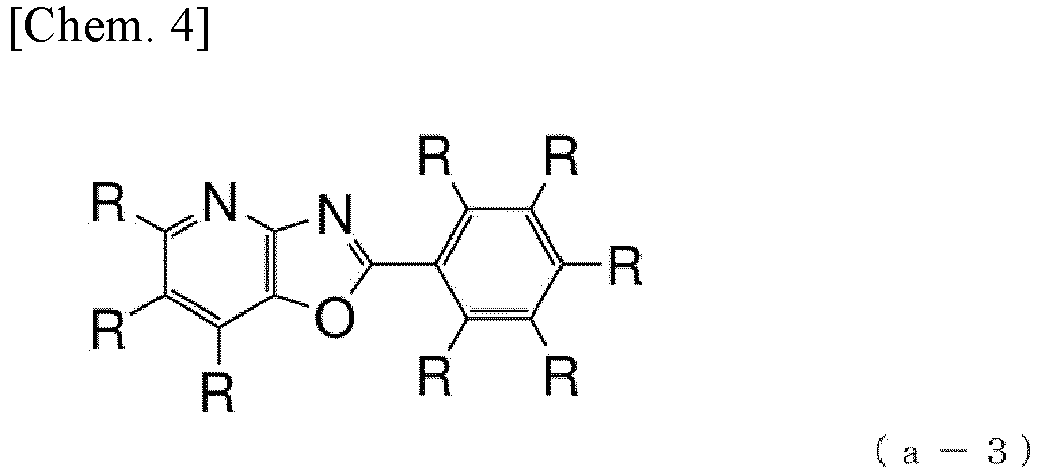
- 3) The present invention also provides the compound having an azabenzoxazole ring structure as set forth in clause 1), wherein the compound is represented by the general formula (a-3):
- 4) The present invention also provides the compound having an azabenzoxazole ring structure as set forth in clause 1), wherein the compound is represented by the general formula (a-4):


- 5) The present invention also provides the compound having an azabenzoxazole ring structure as set forth in clause 1), wherein the compound is represented by the general formula (a-5):

- 6) The present invention also provides the compound having an azabenzoxazole ring structure as set forth in clause 1), wherein the compound is represented by the general formula (a-6) or (a-7):


- 7) The present invention also provides the compound having an azabenzoxazole ring structure as set forth in any one of clauses 2) to 6),
wherein L in the structural formula (b-1) represents a single bond, a substituted or unsubstituted phenyl group, a substituted or unsubstituted biphenylyl group, or a substituted or unsubstituted naphthyl group. - 8) The compound having an azabenzoxazole ring structure as set forth in clause 7),
wherein Het in the structural formula (b-1) represents a substituted or unsubstituted pyridyl group, a substituted or unsubstituted pyrimidyl group, a substituted or unsubstituted quinolyl group, a substituted or unsubstituted isoquinolyl group, or a substituted or unsubstituted phenanthrolinyl group. - 9) An organic EL element comprising a pair of electrodes and one or more organic layers sandwiched therebetween,
wherein the compound having an azabenzoxazole ring structure as set forth in any one of clauses 1) to 8) is included in at least one of the organic layers as a constituent material thereof. - 10) The organic EL element as set forth in clause 9),
wherein the organic layer including the compound having an azabenzoxazole ring structure is an electron-transporting layer. - 11) The organic EL element as set forth in clause 9),
wherein the organic layer including the compound having an azabenzoxazole ring structure is a hole-blocking layer. - 12) The organic EL element as set forth in clause 9) above,
wherein the organic layer including the compound having an azabenzoxazole ring structure is a light-emitting layer. - 13) The organic EL element as set forth in clause 9) above,
wherein the organic layer including the compound having an azabenzoxazole ring structure is an electron-injecting layer. - Specific examples of the "aromatic hydrocarbon group", the "aromatic heterocyclic group", or the "fused polycyclic aromatic group" of the "substituted or unsubstituted aromatic hydrocarbon group", the "substituted or unsubstituted aromatic heterocyclic group", or the "substituted or unsubstituted fused polycyclic aromatic group" represented by R in the general formula (a-1) include a phenyl group, a biphenylyl group, a terphenylyl group, a naphthyl group, an anthracenyl group, a phenanthrenyl group, a fluorenyl group, a spirobifluorenyl group, an indenyl group, a pyrenyl group, a perylenyl group, a fluoranthenyl group, a triphenylenyl group, a pyridyl group, a pyrimidinyl group, a triazinyl group, a furyl group, a pyrrolyl group, a thienyl group, a quinolyl group, an isoquinolyl group, a benzofuranyl group, a benzothienyl group, an indolyl group, a carbazolyl group, a benzooxazolyl group, a benzothiazolyl group, an azafluorenyl group, a diazafluorenyl group, an azaspirobifluorenyl group, a diazaspirobifluorenyl group, a quinoxalinyl group, a benzimidazolyl group, a pyrazolyl group, a dibenzofuranyl group, a dibenzothienyl group, a naphthyridinyl group, a phenanthrolinyl group, an acridinyl group, and a carbolinyl group; and also an aryl group having 6 to 30 carbon atoms, and a heteroaryl group having 2 to 20 carbon atoms.
- Specific examples of the "substituent" of the "substituted aromatic hydrocarbon group", the "substituted aromatic heterocyclic group", or the "substituted fused polycyclic aromatic group" represented by R in the general formula (a-1) include a deuterium atom, a cyano group, and a nitro group; halogen atoms such as a fluorine atom, a chlorine atom, a bromine atom, and an iodine atom; silyl groups such as a trimethylsilyl group and a triphenylsilyl group; linear or branched alkyl groups having 1 to 6 carbon atoms such as a methyl group, an ethyl group, and a propyl group; linear or branched alkyloxy groups having 1 to 6 carbon atoms such as a methyloxy group, an ethyloxy group, and a propyloxy group; alkenyl groups such as a vinyl group and an allyl group; aryloxy groups such as a phenyloxy group and a tolyloxy group; arylalkyloxy groups such as a benzyloxy group and a phenethyloxy group; aromatic hydrocarbon groups or fused polycyclic aromatic groups such as a phenyl group, a biphenylyl group, a terphenylyl group, a naphthyl group, an anthracenyl group, a phenanthrenyl group, a fluorenyl group, a spirobifluorenyl group, an indenyl group, a pyrenyl group, a perylenyl group, a fluoranthenyl group, and a triphenylenyl group; and aromatic heterocyclic groups such as a pyridyl group, a thienyl group, a furyl group, a pyrrolyl group, a quinolyl group, an isoquinolyl group, a benzofuranyl group, a benzothienyl group, an indolyl group, a carbazolyl group, a benzooxazolyl group, a benzothiazolyl group, a quinoxalinyl group, a benzimidazolyl group, a pyrazolyl group, a dibenzofuranyl group, a dibenzothienyl group, and a carbolinyl group. These substituents may further be substituted by any of the substituents listed above as examples. Moreover, such a substituent and the benzene ring substituted therewith, or a plurality of substituents that substitute the same benzene ring may be bonded to each other to form a ring via a single bond, a substituted or unsubstituted methylene group, an oxygen atom, or a sulfur atom.
- Specific examples of the "carbon atom having a linear or branched alkyl group having 1 to 6 carbon atoms", the "carbon atom having a cycloalkyl group having 5 to 10 carbon atoms", or the "carbon atom having a linear or branched alkenyl group having 2 to 6 carbon atoms" of the "carbon atom having a linear or branched alkyl group having 1 to 6 carbon atoms and optionally having a substituent", the "carbon atom having a cycloalkyl group having 5 to 10 carbon atoms and optionally having a substituent", or the "carbon atom having a linear or branched alkenyl group having 2 to 6 carbon atoms and optionally having a substituent" represented by R in the general formula (a-1) include a methyl group, an ethyl group, an n-propyl group, an isopropyl group, an n-butyl group, an isobutyl group, a tert-butyl group, an n-pentyl group, an isopentyl group, a neopentyl group, an n-hexyl group, a cyclopentyl group, a cyclohexyl group, a 1-adamantyl group, a 2-adamantyl group, a vinyl group, an allyl group, an isopropenyl group, and a 2-butenyl group. Such a substituent and the benzene ring substituted therewith, or a plurality of the substituents that substitute the same benzene ring may be bonded to each other to form a ring via a single bond, a substituted or unsubstituted methylene group, a substituted or unsubstituted amino group, an oxygen atom, or a sulfur atom.
- Examples of the "substituent" of the "linear or branched alkyl group having 1 to 6 carbon atoms and optionally having a substituent", the "cycloalkyl group having 5 to 10 carbon atoms and optionally having a substituent", or the "linear or branched alkenyl group having 2 to 6 carbon atoms and optionally having a substituent" represented by R in the general formula (a-1) are the same as those listed above as examples of the "substituent" of the "substituted aromatic hydrocarbon group", the "substituted aromatic heterocyclic group", or the "substituted fused polycyclic aromatic group" represented by R in the general formula (a-1). The same holds true for the form that the substituent may be in.
- Specific examples of the "carbon atom having a linear or branched alkyloxy group having 1 to 6 carbon atoms" or the "carbon atom having a cycloalkyloxy group having 5 to 10 carbon atoms" of the "carbon atom having a linear or branched alkyloxy group having 1 to 6 carbon atoms and optionally having a substituent" or the "carbon atom having a cycloalkyloxy group having 5 to 10 carbon atoms and optionally having a substituent" represented by R in the general formula (a-1) include a methyloxy group, an ethyloxy group, an n-propyloxy group, an isopropyloxy group, an n-butyloxy group, a tert-butyloxy group, an n-pentyloxy group, an n-hexyloxy group, a cyclopentyloxy group, a cyclohexyloxy group, a cycloheptyloxy group, a cyclooctyloxy group, a 1-adamantyloxy group, and a 2-adamantyloxy group. Such a substituent and the benzene ring substituted therewith, or a plurality of the substituents that substitute the same benzene ring may be bonded to each other to form a ring via a single bond, a substituted or unsubstituted methylene group, a substituted or unsubstituted amino group, an oxygen atom, or a sulfur atom.
- Examples of the "substituent" of the "linear or branched alkyloxy group having 1 to 6 carbon atoms and optionally having a substituent" or the "cycloalkyloxy group having 5 to 10 carbon atoms and optionally having a substituent" represented by R in the general formula (a-1) are the same as those listed above as examples of the "substituent" of the "substituted aromatic hydrocarbon group", the "substituted aromatic heterocyclic group", or the "substituted fused polycyclic aromatic group" represented by R in the general formula (a-1). The same holds true for the form that the substituent may be in.
- Examples of the "aromatic hydrocarbon group", the "aromatic heterocyclic group", or the "fused polycyclic aromatic group" of the "substituted or unsubstituted aromatic hydrocarbon group", the "substituted or unsubstituted aromatic heterocyclic group", or the "substituted or unsubstituted fused polycyclic aromatic group" represented by L in the structural formula (b-1) are similar to those listed above as examples of the "aromatic hydrocarbon group", the "aromatic heterocyclic group", or the "fused polycyclic aromatic group" of the "substituted or unsubstituted aromatic hydrocarbon group", the "substituted or unsubstituted aromatic heterocyclic group", or the "substituted or unsubstituted fused polycyclic aromatic group" represented by R in the general formula (a-1). The same holds true for the form that the substituent may be in.
- Examples of the "substituent" of the "substituted aromatic hydrocarbon group", the "substituted aromatic heterocyclic group", or the "substituted fused polycyclic aromatic group" represented by L in the structural formula (b-1) are the same as those listed above as examples of the "substituent" of the "substituted aromatic hydrocarbon group", the "substituted aromatic heterocyclic group", or the "substituted fused polycyclic aromatic group" represented by R in the general formula (a-1). The same holds true for the form that the substituent may be in.
- Examples of the "substituent" of the "substituted pyridyl group", the "substituted pyrimidyl group", the "substituted triazyl group", the "substituted quinolyl group", the "substituted isoquinolyl group", the "substituted phenanthrolinyl group", the "substituted indolyl group", the "substituted azafluorenyl group", the "substituted diazafluorenyl group", the "substituted azaspirobifluorenyl group", or the "substituted diazaspirobifluorenyl group" represented by Het in the structural formula (b-1) are the same as those listed above as examples of the "substituent" of the "substituted aromatic hydrocarbon group", the "substituted aromatic heterocyclic group", or the "substituted fused polycyclic aromatic group" represented by R in the general formula (a-1). The same holds true for the form that the substituent may be in.
- In the general formula (a-1), R in the case where it is a group other than the group represented by structural formula (b-1) is preferably a hydrogen atom, or the "substituted or unsubstituted fused polycyclic aromatic group".
- The "substituted or unsubstituted fused polycyclic aromatic group" is preferably a substituted or unsubstituted naphthyl group, anthracenyl group, phenanthrenyl group, fluorenyl group, or spirobifluorenyl group, and more preferably a substituted or unsubstituted anthracenyl group or spirobifluorenyl group. If these groups have a substituent, the substituent is preferably a phenyl group, a biphenylyl group, a terphenylyl group, a naphthyl group, a phenanthrenyl group, or an anthracenyl group, and more preferably a phenyl group or a naphthyl group.
- Preferable specific examples of R in the general formula (a-1) include the groups represented by the following structure:

- L in the structural formula (b-1) is preferably a substituted or unsubstituted phenyl group, biphenylyl group, terphenylyl group, naphthyl group, anthracenyl group, or phenanthrenyl group, and more preferably a substituted or unsubstituted phenyl group, biphenylyl group, or naphthyl group.
- Het in the structural formula (b-1) is preferably a substituted or unsubstituted pyridyl group, pyrimidyl group, quinolyl group, isoquinolyl group, or phenanthrolinyl group, and more preferably a substituted or unsubstituted pyridyl group or pyrimidyl group.
- Preferable specific examples of the structural formula (b-1) include the groups represented by the following structure:

- The compound having an azabenzoxazole ring structure and represented by the general formula (a-1) are suitable for use in the organic EL element of the present invention, and can be used as a constituent material of an electron-injecting layer, an electron-transporting layer, or a hole-blocking layer of the organic EL element. The compound having an azabenzoxazole ring structure and represented by the general formula (a-1) is particularly preferable as a material of the electron-injecting layer or the electron-transporting layer due to its high electron mobility.
- The organic EL element of the present invention includes the compound having an azabenzoxazole ring structure and represented by the general formula (a-1), which has excellent electron-injecting/transporting capability, excellent stability in the form of a thin film, and excellent durability. Therefore, compared with a conventional organic EL element, the organic EL element of the present invention has improved efficiency in terms of transporting electrons from the electron-transporting layer to the light-emitting layer and hence improved luminous efficacy, as well as a reduced driving voltage and hence improved durability of the organic EL element, and thus the organic EL element of the present invention can achieve high efficiency, a low driving voltage, and a long lifespan.
- The compound having an azabenzoxazole ring structure of the present invention has the properties including: (1) good electron-injecting properties, (2) high electron mobility, (3) excellent hole-blocking capability, (4) stability in the form of a thin film, and (5) excellent heat resistance. The organic EL element of the present invention has the characteristics including: (6) high luminous efficacy, (7) a low voltage for the start of light emission, (8) a low driving voltage in actual use, and (9) a long lifespan.
- The compound having an azabenzoxazole ring structure of the present invention has good electron-injecting properties and high electron mobility. Therefore, an organic EL element having an electron-injecting layer and/or an electron-transporting layer including the compound as an electron-injecting material and/or an electron-transporting material has improved efficiency in terms of transporting electrons to the light-emitting layer and hence improved luminous efficacy, and also has a lower driving voltage and hence improved durability.
- The compound having an azabenzoxazole ring structure of the present invention is characterized by excellent hole-blocking capability and electron-transporting capability, stability in the form of a thin film, and capability to confine excitons generated in a light-emitting layer. Therefore, an organic EL element including a hole-blocking layer produced by using the compound as a hole-blocking material has high luminous efficacy because the probability of recombination of holes and electrons is increased to thereby suppress the heat inactivation, and also has an increased maximum luminance because the driving voltage is reduced to thereby improve the current resistance.
- The compound having an azabenzoxazole ring structure of the present invention has excellent electron-transporting capability and has a wide band gap. Therefore, an organic EL element including a light-emitting layer prepared by using the compound as a host material has a reduced driving voltage and hence improved luminous efficacy when the light-emitting layer contains a fluorescent emitter, a phosphorescent emitter, or a delayed fluorescent emitter, which are called dopants.
- Accordingly, the compound having an azabenzoxazole ring structure of the present invention is useful as the material of an electron-injecting layer, an electron-transporting layer, a hole-blocking layer, or a light-emitting layer of an organic EL element, and can improve the luminous efficacy, the driving voltage, and the durability of a conventional organic EL element.
-
- [
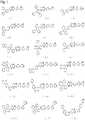
Fig. 1] Fig. 1 shows Compounds (1) to (18) as preferable specific examples of the compound having an azabenzoxazole ring structure and represented by the general formula (a-1) - [
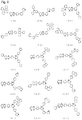
Fig. 2] Fig. 2 shows Compounds (19) to (33) as preferable specific examples of the compound having an azabenzoxazole ring structure and represented by the general formula (a-1). - [
Fig. 3] Fig. 3 shows Compounds (34) to (47) as preferable specific examples of the compound having an azabenzoxazole ring structure and represented by the general formula (a-1). - [
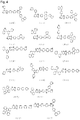
Fig. 4] Fig. 4 shows Compounds (48) to (63) as preferable specific examples of the compound having an azabenzoxazole ring structure and represented by the general formula (a-1). - [
Fig. 5] Fig. 5 shows Compounds (64) to (72) as preferable specific examples of the compound having an azabenzoxazole ring structure and represented by the general formula (a-1). - [
Fig. 6] Fig. 6 is a diagram showing the configuration of organic EL elements of Examples 9 to 14 and Comparative Examples 1 and 2. - Although the compound having an azabenzoxazole ring structure of the present invention is a novel compound, the compound itself can be synthesized according to a known method (see
Non-Patent Literature 6, for example). - Specific preferable examples of the compound having an azabenzoxazole ring structure and represented by the general formula (a-1), which is suitable for use in the organic EL element of the present invention, will be shown in
Figs. 1 to 5 . However, the present invention is not limited to these compounds. - The compounds having an azabenzoxazole ring structure and represented by the general formulas (a-1) to (a-7) can be purified using a known purification method such as column chromatography, adsorption with silica gel, activated carbon, activated clay, or others, recrystallization or crystallization from a solvent, or sublimation. The compounds can be identified by NMR analysis. The physical properties can be measured in terms of a melting point, a glass transition point (Tg), a work function, and others. The melting point is a measure of vapor deposition properties, the glass transition point (Tg) is a measure of stability in the form of a thin film, and the work function is a measure of hole-transporting capability and hole-blocking cability.
- The melting point and the glass transition point (Tg) can be measured on the compound in the form of a powder using a high-sensitivity differential scanning calorimeter (DSC3100SA manufactured by Bruker AXS K.K.), for example.
- The work function can be measured on the compound in the form of a thin film with a thickness of 100 nm formed on an ITO substrate using an ionization potential measuring device (PYS-202 manufactured by Sumitomo Heavy Industries, Ltd.), for example.
- The organic EL element of the present invention may have a structure in which an anode, a hole-injecting layer, a hole-transporting layer, a light-emitting layer, an electron-transporting layer, an electron-injecting layer, and a cathode are sequentially provided on a substrate; and the structure may further include an electron-blocking layer between the hole-transporting layer and the light-emitting layer and also may further include a hole-blocking layer between the light-emitting layer and the electron-transporting layer. In these multilayer structures, a single organic layer may perform functions of some layers. For example, a single organic layer may serve as both the hole-injecting layer and the hole-transporting layer, and a single organic layer may serve as both the electron-injecting layer and the electron-transporting layer. Moreover, it is possible to stack two or more organic layers having the same function. Specifically, two hole-transporting layers may be stacked; two light-emitting layers may be stacked; and two electron-transporting layers may be stacked.
- An electrode material having a high work function, such as ITO or gold, is used for the anode of the organic EL element of the present invention. Examples of a material used for the hole-injecting layer of the organic EL element of the present invention include porphyrin compounds typified by copper phthalocyanine; starburst triphenylamine derivatives; arylamine compounds having a structure containing two or more triphenylamine structures or carbazolyl structures in the molecule, the triphenylamine or the carbazolyl structures being linked via a single bond or a divalent group having no heteroatom; heterocyclic compounds of acceptor type, such as hexacyanoazatriphenylene; polymer materials of coating type. These materials can be formed into a thin film using a known method such as vapor deposition, spin coating, or inkjet printing.
- Examples of a material used for the hole-transporting layer of the organic EL element of the present invention include benzidine derivatives, such as N,N'-diphenyl-N,N'-di(m-tolyl)-benzidine (hereinafter abbreviated as TPD), N,N'-diphenyl-N,N'-di(α-naphthyl)benzidine (hereinafter abbreviated as NPD), and N,N,N',N'-tetrabiphenylyl benzidine; 1,1-bis[(di-4-tolylamino)phenyl]cyclohexane (hereinafter abbreviated as TAPC); and arylamine compounds having a structure containing two or more triphenylamine structures or carbazolyl structures in the molecule, the triphenylamine or the carbazolyl structures being linked via a single bond or a divalent group having no heteroatom.
- These materials may be used singly for film formation, or two or more of these material may be mixed and used for film formation. In each case, a single layer may be formed. The hole-transporting layer may have a layered structure composed of different layers each formed of a single kind of the materials described above, a layered structure composed of different layers each formed of a mixture of the materials described above, or a layered structure composed of a layer formed of a single kind of the materials described above and a layer formed of a mixture of two or more of the materials described above.
- It is also possible to use, as a material for a hole-injecting/transporting layer, polymer materials of coating type, such as poly(3,4-ethylenedioxythiophene) (hereinafter abbreviated as PEDOT)/poly(styrenesulfonate) (hereinafter abbreviated as PSS)
- These materials can be formed into a thin film using a known method such as vapor deposition, spin coating, or inkjet printing.
- Other examples of the material used for the hole-injecting layer or the hole-transporting layer include a material obtained by p-doping a material normally used for these layers with trisbromophenylamine hexachloroantimony or a radialene derivative (see
Patent Literature 6, for example); and a polymer compound having the structure of a benzidine derivative, such as TPD, as a partial structure thereof. - Examples of a material used for the electron-blocking layer of the organic EL element of the present invention include compounds having an electron-blocking effect, such as carbazole derivatives such as 4,4',4"-tri(N-carbazolyl)triphenylamine (hereinafter abbreviated as TCTA), 9,9-bis[4-(carbazole-9-yl)phenyl]fluorene, 1,3-bis(carbazole-9-yl)benzene (hereinafter abbreviated as mCP), and 2,2-bis(4-carbazole-9-ylphenyl)adamantane (hereinafter abbreviated as Ad-Cz); and compounds having a triphenylsilyl group and a triarylamine structure and typified by 9-[4-(carbazole-9-yl)phenyl]-9-[4-(triphenylsilyl)phenyl]-9H-fluorene . These materials may be used singly for film formation, or a mixture of any of these material and another material may be used to form a single layer.
- These materials may be used singly for film formation, or two or more of these material may be mixed and used for film formation. In each case, a single layer may be formed. The electron-blockting layer may have a layered structure composed of different layers each formed of a single kind of the materials described above, a layered structure composed of different layers each formed of a mixture of the materials described above, or a layered structure composed of a layer formed of a single kind of the materials described above and a layer formed of a mixture of two or more of the materials described above. These materials can be formed into a thin film using a known method such as vapor deposition, spin coating, or inkjet printing.
- Examples of a material used for the light-emitting layer of the organic EL element of the present invention include the compound having an azabenzoxazole ring structure of the present invention, and also metal complexes of quinolinol derivatives such as Alq3, various types of metal complexes, an anthracene derivative, a bisstyrylbenzene derivative, a pyrene derivative, an oxazole derivative, and a polyphenylene vinylene derivative. The light-emitting layer may include a host material and a dopant material. As the host material, an anthracene derivative is preferably used. Other examples of the host material include the above-listed light-emitting materials including the compound having an azabenzoxazole ring structure of the present invention, and also a heterocyclic compound having an indole ring as a partial structure of a fused ring, a heterocyclic compound having a carbazole ring as a partial structure of a fused ring, a carbazole derivative, a thiazole derivative, a benzimidazole derivative, and a polydialkylfluorene derivative. Examples of the dopant material include quinacridone, coumalin, rubrene, perylene, and derivatives thereof; a benzopyran derivative; a rhodamine derivative; and an aminostyryl derivative.
- These materials may be used singly for film formation, or two or more of these material may be mixed and used for film formation. In each case, a single layer may be formed. The light-emitting layer may have a layered structure composed of different layers each formed of a single kind of the materials described above, a layered structure composed of different layers each formed of a mixture of the materials described above, or a layered structure composed of a layer formed of a single kind of the materials described above and a layer formed of a mixture of two or more of the materials described above. These materials can be formed into a thin film using a known method such as vapor deposition, spin coating, or inkjet printing.
- A phosphorescent emitter can also be used as a light-emitting material. The phosphorescent emitter may be a metal complex of iridium, platinum, or the like, and examples thereof include a green phosphorescent emitter such as Ir(ppy)3, a blue phosphorescent emitter such as FIrpic or FIr6, and a red phosphorescent emitter such as Btp2Ir (acac). As a host material in this case, a host material having hole injecting/transporting capability may be used, including carbazole derivatives such as 4,4'-di(N-carbazolyl)biphenyl (hereinafter abbreviated as CBP), TCTA, and mCP, and also the compound having an azabenzoxazole ring structure of the present invention. Also, host materials having electron-transporting capability may be used, including p-bis(triphenylsilyl)benzene (hereinafter abbreviated as UGH2) and 2,2',2"-(1,3,5-phenylene)-tris(1-phenyl-1H-benzimidazole) (hereinafter abbreviated as TPBI). Use of these materials enables production of a high-performance organic EL element.
- In order to avoid concentration quenching, doping of the host material with a phosphorescent material is preferably performed by co-deposition in an amount within a range of 1 to 30 wt% based on the entire light-emitting layer.
- As the light-emitting material, a material that emits delayed fluorescence can also be used, including a CDCB derivative, such as PIC-TRZ, CC2TA, PXZ-TRZ, or 4CzIPN (see
Non-Patent Literature 3, for example). These materials can be formed into a thin film using a known method such as vapor deposition, spin coating, or inkjet printing. - Examples of a material used for the hole-blocking layer of the organic EL element of the present invention include the compound having an azabenzoxazole ring structure of the present invention, and also compounds exhibiting a hole-blocking effect including a phenanthroline derivative, such as bathocuproine (hereinafter abbreviated as BCP); a metal complex of a quinolinol derivative, such as BAlq; various types of rare-earth complexes; an oxazole derivative; a triazole derivative; and a triazine derivative. These materials may also serve as the material of the electron-transporting layer.
- These materials may be used singly for film formation, or two or more of these material may be mixed and used for film formation. In each case, a single layer may be formed. The hole-bloking layer may have a layered structure composed of different layers each formed of a single kind of the materials described above, a layered structure composed of different layers each formed of a mixture of the materials described above, or a layered structure composed of a layer formed of a single kind of the materials described above and a layer formed of a mixture of two or more of the materials described above. These materials can be formed into a thin film using a known method such as vapor deposition, spin coating, or inkjet printing.
- Examples of a material used for the electron-transporting layer of the organic EL element of the present invention include the compound having an azabenzoxazole ring structure of the present invention, and also metal complexes of quinolinol derivatives, such as Alq3 and BAlq; various types of metal complexes; a triazole derivative; a triazine derivative; an oxadiazole derivative; a pyridine derivative; a benzimidazole derivative; a thiadiazole derivative; an anthracene derivative; a carbodiimide derivative; a quinoxaline derivative; a pyridoindole derivative; a phenanthroline derivative; and a silole derivative.
- These materials may be used singly for film formation, or two or more of these material may be mixed and used for film formation. In each case, a single layer may be formed. The electron-transporting layer may have a layered structure composed of different layers each formed of a single kind of the materials described above, a layered structure composed of different layers each formed of a mixture of the materials described above, or a layered structure composed of a layer formed of a single kind of the materials described above and a layer formed of a mixture of two or more of the materials described above. These materials can be formed into a thin film using a known method such as vapor deposition, spin coating, or inkjet printing.
- Examples of a material used for the electron-injecting layer of the organic EL element of the present invention include the compound having an azabenzoxazole ring structure of the present invention, and also an alkali metal salt such as lithium fluoride or cesium fluoride; an alkaline earth metal salt such as magnesium fluoride; a metal complex of a quinolinol derivative such as lithium quinolinol; a metal oxide such as aluminum oxide; and a metal such as ytterbium (Yb), samarium (Sm), calcium (Ca), strontium (Sr), and cesium (Cs). The electron-injecting layer can however be omitted when an electron-transporting layer and a cathode are suitably selected.
- Furthermore, a material obtained by n-doping a material normally used for an electron-injecting layer or an electron-transporting layer with a metal such as cesium can be used for the electron-injecting layer or the electron-transporting layer.
- Examples of an electrode material used for the cathode of the organic EL element of the present invention include a metal having a low work function, such as aluminum; and an alloy having an even lower work function, such as a magnesium-silver alloy, a magnesium-indium alloy, and an aluminum-magnesium alloy.
- Hereinafter, embodiments of the present invention will be described in greater detail by way of Examples. However, the present invention is not limited to Examples below as long as it does not depart from the gist thereof.
- First, 4.1 g of 2-(4-chlorophenyl)-6-(10-phenyl-anthracene-9-yl)-7-azabenzoxazole, 1.1 g of 3-pyridylboronic acid, 0.6 g of tris(dibenzylideneacetone)dipalladium(0), 1.0 ml of 50% (w/v) tri-(t-butyl)phosphine solution in toluene, and 5.2 g of cesium carbonate were placed in a reaction vessel, and stirred under reflux overnight in a 1,4-dioxane/H2O mixed solvent. The reaction system was allowed to cool. Then, ethyl acetate/H2O was added thereto, and an organic layer was obtained through extraction and separation, and concentrated to obtain a crude product. The thus obtained crude product was purified by column chromatography (carrier: silica gel, eluent: dichloromethane/ethyl acetate) to thereby obtain 3.2 g (yield: 71%) of a pale yellow powder of 6-(10-phenyl-anthracene-9-yl)-2-(4-pyridine-3-yl-phenyl)-7-azabenzoxazole (Compound (5)).

- The structure of the obtained pale yellow powder was identified using NMR.
- In 1H-NMR (CDCl3), the following signals of 23 hydrogens were detected. δ (ppm) = 8.99 (1H), 8.70 (1H), 8.50 (2H), 8.36 (1H), 8.01 (1H), 7.85 (2H), 7.79-7.57 (8H), 7.56-7.33 (7H).
- First, 10.0 g of 2-(4-chlorophenyl)-6-(9,9'-spirobi[9H]fluorene-2-yl)-7-azabenzoxazole, 4.4 g of 4-(pyridine-3-yl)-phenylboronic acid, 0.5 g of tris(dibenzylideneacetone)dipalladium(0), 0.3 g of tricyclohexylphosphine, and 11.7 g of tripotassium phosphate were placed in a reaction vessel, and stirred under reflux overnight in a 1,4-dioxane/H2O mixed solvent. The reaction system was allowed to cool. Then, ethyl acetate/H2O was added thereto, and an organic layer was obtained through extraction and separation, and concentrated to obtain a crude product. The thus obtained crude product was purified by column chromatography (carrier: silica gel, eluent: dichloromethane/ethyl acetate) to thereby obtain 8.7 g (yield: 71%) of a pale yellow powder of 2-{4'-(pyridine-3-yl)-biphenyl-4-yl}-6-(9,9'-spirobi[9H]fluorene-2-yl)-7-azabenzoxazole (Compound (15)).

- The structure of the obtained pale yellow powder was identified using NMR.
- In 1H-NMR (CDCl3), the following signals of 29 hydrogens were detected. δ (ppm) = 8.94 (1H), 8.65 (1H), 8.37 (2H), 8.21 (1H), 8.01 (2H), 7.96 (1H), 7.92 (3H), 7.83 (2H), 7.81 (2H), 7.73 (2H), 7.69 (1H), 7.50 (1H), 7.42 (4H), 7.16 (2H), 7.14 (1H), 6.82 (2H), 6.76 (1H).
- First, 10.0 g of 2-(4-chlorophenyl)-6-(9,9'-spirobi[9H]fluorene-2-yl)-7-azabenzoxazole, 4.4 g of 3-(pyridine-3-yl)-phenylboronic acid, 0.5 g of tris(dibenzylideneacetone)dipalladium(0), 0.3 g of tricyclohexylphosphine, 11.7 g of tripotassium phosphate were placed in a reaction vessel, and stirred under reflux overnight in a 1,4-dioxane/H2O mixed solvent. The reaction system was allowed to cool. Then, ethyl acetate/H2O was added thereto, and an organic layer was obtained through extraction and separation, and concentrated to obtain a crude product. The thus obtained crude product was purified by column chromatography (carrier: silica gel, eluent: dichloromethane/ethyl acetate) to thereby obtain 8.3 g (yield: 68%) of a pale yellow powder of 2-{3'-(pyridine-3-yl)-biphenyl-4-yl}-6-(9,9'-spirobi[9H]fluorene-2-yl)-7-azabenzoxazole (Compound (17)).

- The structure of the obtained pale yellow powder was identified using NMR.
- In 1H-NMR (CDCl3), the following signals of 29 hydrogens were detected. δ (ppm) = 8.94 (1H), 8.66 (1H), 8.38 (2H), 8.21 (1H), 8.01 (2H), 7.97 (1H), 7.91 (3H), 7.87 (1H), 7.84 (2H), 7.72 (1H), 7.70 (1H), 7.63 (2H), 7.50 (1H), 7.41 (4H), 7.16 (2H), 7.13 (1H), 6.82 (2H), 6.76 (1H).
- First, 8.1 g of 2-(4-chlorophenyl)-6-(4-pyridine-3-yl-phenyl)-7-azabenzoxazole, 6.9 g of 10-phenyl-9-anthraceneboronic acid, 0.6 g of tris(dibenzylideneacetone)dipalladium(0), 4.0 ml of 50% (w/v) tri-(t-butyl)-phosphine solution in toluene, and 13.7 g of cesium carbonate were placed in a reaction vessel, and stirred under reflux overnight in a 1,4-dioxane/H2O mixed solvent. The reaction system was allowed to cool. Then, methanol was added thereto, and the deposited solid was collected by filtering to thereby obtain a crude product. The thus obtained crude product was purified by column chromatography (carrier: silica gel, eluent: dichloromethane/ethyl acetate) to thereby obtain 4.2 g (yield: 33%) of a yellow powder of 2-{4-(10-phenyl-anthracene-9-yl)-phenyl}-6-(4-pyridine-3-yl-phenyl)-7-azabenzoxazole (Compound (22)).

- The structure of the obtained yellow powder was identified using NMR.
- In 1H-NMR (CDCl3), the following signals of 27 hydrogens were detected. δ (ppm) = 8.98 (1H), 8.66 (1H), 8.60 (2H), 8.29 (2H), 8.24 (1H), 8.02 (1H), 7.97 (1H), 7.84-7.70 (8H), 7.64 (3H), 7.52 (2H), 7.47-7.36 (5H).
- First, 4.6 g of 2-{4-(2,6-dichloropyrimidine-4-yl)-phenyl}-7-azabenzoxazole, 7.3 g of 4-(naphthalene-1-yl)-phenylboronic acid, and 0.6 g of tetrakis(triphenylphosphine)palladium(0) were placed in a reaction vessel, and 32 mL of toluene, 8 mL of ethanol, and an aqueous solution of 5.6 g of potassium carbonate in 20 mL of H2O were added thereto. The resulting mixture was stirred under reflux overnight. The reaction system was allowed to cool. Then, methanol was added thereto, and the deposited solid was collected by filtering to obtain a crude product. The obtained crude product was purified through recrystallization from a monochlorobenzene solvent to thereby obtain 5.8 g (yield: 64%) of a white solid of 2-[4-{2,6-bis(4-naphthalene-1-yl-phenyl)-pyrimidine-4-yl}-phenyl]-7-azabenzoxazole (Compound (26)).

- The structure of the obtained white powder was identified using NMR.
- In 1H-NMR (CDCl3), the following signals of 30 hydrogens were detected. δ (ppm) = 8.91 (2H), 8.55 (4H), 8.50 (2H), 8.41 (1H), 8.23 (1H), 8.13 (1H), 8.01 (2H), 7.94 (4H), 7.76 (2H), 7.74 (2H), 7.62-7.44 (8H), 7.41 (1H).
- First, 6.3 g of 2-[4-{2-chloro-6-(4-pyridine-3-yl-phenyl)-pyrimidine-4-yl}-phenyl]-7-azabenzoxazole, 4.1 g of 4-(naphthalene-1-yl)-phenylboronic acid, and 0.3 g of tetrakis(triphenylphosphine)palladium(0) were placed in a reaction vessel, and 44 mL of toluene, 11 mL of ethanol, and an aqueous solution of 2.3 g of potassium carbonate in 8 mL of H2O were added thereto. The resulting mixture was stirred under reflux overnight. The reaction system was allowed to cool. Then, methanol was added thereto, and the deposited solid was collected by filtering to obtain a crude product. The thus obtained crude product was purified by column chromatography (carrier: silica gel, eluent: dichloromethane/ethyl acetate) to thereby obtain 3.2 g (yield: 37%) of a white solid of 2-[4-{2-(4-naphthalene-1-yl-phenyl)-6-(4-pyridine-3-yl-phenyl)-pyrimidine-4-yl}-phenyl ]-7-azabenzoxazole (Compound (30)).

- The structure of the obtained white powder was identified using NMR.
- In 1H-NMR (CDCl3), the following signals of 27 hydrogens were detected. δ (ppm) = 8.97 (1H), 8.88 (2H), 8.66 (1H), 8.54 (4H), 8.49 (2H), 8.41 (1H), 8.18 (1H), 8.13 (1H), 8.01 (2H), 7.93 (2H), 7.81 (2H), 7.73 (2H), 7.63-7.37 (6H).
- The melting point and the glass transition point of each of the azabenzoxazole compounds represented by the general formulas (a-1) to (a-7) were measured using a high-sensitivity differential scanning calorimeter (DSC3100SA manufactured by Bruker AXS K.K.). Table 1 shows the results.
Table 1 Melting point Glass transition point Compound of Ex. 1 342°C 134°C Compound of Ex. 2 328°C 165°C Compound of Ex. 3 - 146°C Compound of Ex. 4 394°C - Compound of Ex. 5 271°C 135°C Compound of Ex. 6 293°C 134°C - The compounds having an azabenzoxazole ring structure and represented by the general formulas (a-1) to (a-7) had a glass transition point of at least 130°C, which means that these compounds are stable in the form of a thin film.
- A vapor-deposited film (thickness: 100 nm) of the compound having an azabenzoxazole ring structure and represented by the general formula (a-1) to (a-7) was formed on an ITO substrate, and the work function was measured using an ionization potential measuring device (PYS-202 manufactured by Sumitomo Heavy Industries, Ltd.). Table 2 shows the results.
Table 2 Work function Compound of Ex. 1 6.07 eV Compound of Ex. 2 6.37 eV Compound of Ex. 3 6.35 eV Compound of Ex. 4 5.91 eV Compound of Ex. 5 6.58 eV Compound of Ex. 6 6.64 eV - The compounds having an azabenzoxazole ring structure and represented by the general formulas (a-1) to (a-7) had a work function value greater than 5.5 eV, which is the work function of common hole-transporting materials such as NPD and TPD. This means that these compounds have good hole-blocking capability.
- As shown in
Fig. 6 , an organic EL element was prepared by vapor-depositing, on an ITO electrode that was formed as atransparent anode 2 on aglass substrate 1, a hole-injectinglayer 3, a hole-transportinglayer 4, a light-emittinglayer 5, a hole-blocking layer 6, an electron-transportinglayer 7, an electron-injectinglayer 8, and a cathode (aluminum electrode) 9 in this order. - Specifically, a
glass substrate 1 having an ITO film with a thickness of 50 nm as atransparent anode 2 was ultrasonically cleaned in isopropyl alcohol for 20 minutes, and then dried for 10 minutes on a hot plate heated at 200°C. After that, UV/ozone treatment was performed for 15 minutes. Then, the glass substrate with ITO was set inside a vacuum vapor deposition machine, and the pressure was reduced to 0.001 Pa or less. Subsequently, an electron acceptor (Acceptor-1) having the structural formula below and a compound (HTM-1) having the structural formula below were vapor-deposited so as to coat thetransparent anode 2 through binary vapor deposition at vapor deposition rates such that the ratio of the vapor deposition rate of Acceptor-1 to that of HTM-1 was 3:97, to thereby form a hole-injectinglayer 3 with a thickness of 10 nm. - On this hole-injecting
layer 3, a hole-transporting layer 4 (thickness: 60 nm) made of the compound (HTM-1) having the structural formula below was formed. - A compound (EMD-1) having the structural formula below and a compound (EMH-1) having the structural formula below were vapor-deposited on this hole-transporting
layer 4 through binary vapor deposition at vapor deposition rates such that the ratio of the vapor deposition rate of EMD-1 to that of EMH-1 was 5:95, to thereby form a light-emittinglayer 5 with a thickness of 20 nm. - Inventive Compound (5) of Example 1 and a compound (ETM-1) having the structural formula below were vapor-deposited on this light-emitting
layer 5 through binary vapor deposition at vapor deposition rates such that the ratio of the vapor deposition rate of Compound (5) to that of ETM-1 was 50:50, to thereby form a layer (thickness 30 nm) serving as both a hole-blocking layer 6 and an electron-transportinglayer 7. - On this layer serving as both the hole-
blocking layer 6 and the electron-transportinglayer 7, an electron-injecting layer 8 (thickness 1 nm) made of lithium fluoride was formed. - Finally, aluminum was vapor-deposited to a thickness of 100 nm to thereby form a
cathode 9. - The prepared organic EL element was characterized in the atmosphere at normal temperature. Table 1 collectively shows the measurement results of light emission characteristics when a DC voltage was applied to the prepared organic EL element.


- An organic EL element was prepared under the same conditions as in Example 9, except that, instead of Compound (5) of Example 1, Compound (15) of Example 2 was used as the material of the layer serving as both the hole-
blocking layer 6 and the electron-transportinglayer 7, and that the binary vapor deposition was performed at vapor deposition rates such that the ratio of the vapor deposition rate of Compound (15) to that of ETM-1 was 50:50. The prepared organic EL element was characterized in the atmosphere at normal temperature. Table 3 collectively shows the measurement results of light emission characteristics when a DC voltage was applied to the prepared organic EL element.
- An organic EL element was prepared under the same conditions as in Example 9, except that, instead of Compound (5) of Example 1, Compound (17) of Example 3 was used as the material of the layer serving as both the hole-
blocking layer 6 and the electron-transportinglayer 7, and that the binary vapor deposition was performed at vapor deposition rates such that the ratio of the vapor deposition rate of Compound (17) to that of ETM-1 was 50:50. The prepared organic EL element was characterized in the atmosphere at normal temperature. Table 3 collectively shows the measurement results of light emission characteristics when a DC voltage was applied to the prepared organic EL element.
- An organic EL element was prepared under the same conditions as in Example 9, except that, instead of Compound (22) of Example 1, Compound (22) of Example 4 was used as the material of the layer serving as both the hole-
blocking layer 6 and the electron-transportinglayer 7, and that the binary vapor deposition was performed at vapor deposition rates such that the ratio of the vapor deposition rate of Compound (22) to that of ETM-1 was 50:50. The prepared organic EL element was characterized in the atmosphere at normal temperature. Table 3 collectively shows the measurement results of light emission characteristics when a DC voltage was applied to the prepared organic EL element.
- An organic EL element was prepared under the same conditions as in Example 9, except that, instead of Compound (5) of Example 1, Compound (26) of Example 5 was used as the material of the layer serving as both the hole-
blocking layer 6 and the electron-transportinglayer 7, and that the binary vapor deposition was performed at vapor deposition rates such that the ratio of the vapor deposition rate of Compound (26) to that of ETM-1 was 50:50. The prepared organic EL element was characterized in the atmosphere at normal temperature. Table 3 collectively shows the measurement results of light emission characteristics when a DC voltage was applied to the prepared organic EL element.
- An organic EL element was prepared under the same conditions as in Example 9, except that, instead of Compound (5) of Example 1, Compound (30) of Example 6 was used as the material of the layer serving as both the hole-
blocking layer 6 and the electron-transportinglayer 7, and that the binary vapor deposition was performed at vapor deposition rates such that the ratio of the vapor deposition rate of Compound (30) to that of ETM-1 was 50:50. The prepared organic EL element was characterized in the atmosphere at normal temperature. Table 3 collectively shows the measurement results of light emission characteristics when a DC voltage was applied to the prepared organic EL element.

- For comparison, an organic EL element was prepared under the same conditions as in Example 9, except that, instead of Compound (5) of Example 1, a compound (ETM-2) having the structural formula below (see
Patent Literature 5, for example) was used as the material of the layer serving as both the hole-blocking layer 6 and the electron-transportinglayer 7, and that the binary vapor deposition was performed at vapor deposition rates such that the ratio of the vapor deposition rate of ETM-2 to that of ETM-1 was 50:50. The prepared organic EL element was characterized in the atmosphere at normal temperature. Table 3 collectively shows the measurement results of light emission characteristics when a DC voltage was applied to the prepared organic EL element.
- For comparison, an organic EL element was prepared under the same conditions as in Example 9, except, instead of Compound (5) of Example 1, a compound (ETM-3) having the structural formula below (see
Patent Literature 7, for example) was used as the material of the layer serving as both the hole-blocking layer 6 and the electron-transportinglayer 7, and that the binary vapor deposition was performed at vapor deposition rates such that the ratio of the vapor deposition rate of ETM-3 to that of ETM-1 was 50:50. The prepared organic EL element was characterized in the atmosphere at normal temperature. Table 3 collectively shows the measurement results of light emission characteristics when a DC voltage was applied to the prepared organic EL element.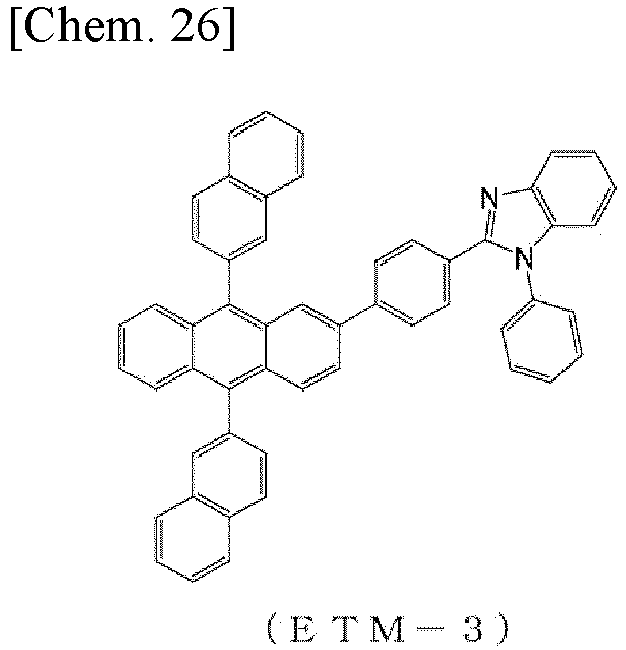
- The element lifespan of each of the organic EL elements prepared in Examples 9 to 14 and Comparative Examples 1 and 2 was measured. Table 3 collectively shows the results. The element lifespan was determined as follows: the organic EL element was driven by constant current to emit light at an initial luminance (luminance when light emission started) of 2,000 cd/m2, and the time taken for the luminance to decay to 1,900 cd/m2 (corresponding to 95% based on the initial luminance (100%): 95% decay) was determined and defined as the element lifespan.
Table 3 Layer serving as both hole locking layer and electron - transporting layer Voltage [V] (@10mA/ cm2) Luminance [cd/m2] (@10mA/ cm2) Luminous efficacy [cd/A] (@10mA/ cm2) Power efficiency [lm/W] (@10mA/ cm2) Element lifespan (95% decay) Ex. 9 Compound (5)/ ETM-1 3.53 861 8.62 7.69 257 hrs. Ex. 10 Compound (15)/ ETM-1 3.54 876 8.76 7.79 267 hrs. Ex. 11 Compound (17)/ ETM-1 3.44 874 8.75 8.00 266 hrs. Ex. 12 Compound (22)/ ETM-1 3.48 871 8.72 7.87 252 hrs. Ex. 13 Compound (26)/ ETM-1 3.50 866 8.68 7.81 293 hrs. Ex. 14 Compound (30)/ ETM-1 3.52 880 8.81 7.87 285 hrs. Com. Ex. 1 ETM-2/ETM-1 3.82 805 8.05 6.62 165 hrs. Com. Ex. 2 ETM-3/ETM-1 4.01 659 6.59 5.16 203 hrs. - As shown in Table 3, a current of 10 mA/cm2 in terms of a current density was passed through the organic EL elements, and at that time, while the organic EL elements of Comparative Examples 1 and 2 including the compounds ETM-2 and 3 of the structural formulas shown above, respectively, had a driving voltage of 3.82 to 4.01 V, the organic EL elements of Examples 9 to 14 had a lower driving voltage of 3.44 to 3.54 V. While the organic EL elements of Comparative Examples 1 and 2 had a luminous efficacy of 6.59 to 8.05 cd/A, the organic EL elements of Examples 9 to 14 had an improved luminous efficacy of 8.62 to 8.81 cd/A. While the organic EL elements of Comparative Examples 1 and 2 had a power efficiency of 5.16 to 6.62 lm/W, the organic EL elements of Examples 9 to 14 had a significantly improved power efficiency of 7.69 to 8.00 lm/W. While the organic EL elements of Comparative Examples 1 and 2 had an element lifespan (95% decay) of 165 to 203 hours, the organic EL elements of Examples 9 to 14 had a significantly longer lifespan of 252 to 293 hours.
- As described above, it is seen that the organic EL elements of the present invention had excellent luminous efficacy and power efficiency as well as a long lifespan, compared with the elements including the compounds ETM-2 or 3 of the structural formula shown above.
- The compound having a specific azabenzoxazole ring structure of the present invention has good electron-injecting properties and excellent hole-blocking capability and is stable in the form of a thin film, and the compound of the present invention is therefore an excellent compound for an organic EL element. An organic EL element prepared by using this compound can achieve high efficiency and also achieve a reduced driving voltage and hence improved durability. Thus, the organic EL element can be applied to uses such as home electric appliances and lighting equipment.
Claims (13)
- A compound having an azabenzoxazole ring structure and being represented by the general formula (a-1):
 where R is the same or different, and each represents a group represented by the structural formula (b-1), a hydrogen atom, a deuterium atom, a fluorine atom, a chlorine atom, a cyano group, a nitro group, a trimethylsilyl group, a triphenylsilyl group, a substituted or unsubstituted aromatic hydrocarbon group, a substituted or unsubstituted aromatic heterocyclic group, a substituted or unsubstituted fused polycyclic aromatic group, a linear or branched alkyl group having 1 to 6 carbon atoms and optionally having a substituent, a cycloalkyl group having 5 to 10 carbon atoms and optionally having a substituent, a linear or branched alkenyl group having 2 to 6 carbon atoms and optionally having a substituent, a linear or branched alkyloxy group having 1 to 6 carbon atoms and optionally having a substituent, or a cycloalkyloxy group having 5 to 10 carbon atoms and optionally having a substituent; andY is the same or different, and each represents a carbon atom having R or a nitrogen atom;provided that at least one R is a group represented by the structural formula (b-1), and that at least one Y is a nitrogen atom,
[Chem. 2]
- - - -L-Het (b-1 )
where L represents a single bond, or a divalent group of a substituted or unsubstituted aromatic hydrocarbon group, a substituted or unsubstituted aromatic heterocyclic group, or a substituted or unsubstituted fused polycyclic aromatic group;Het represents a substituted or unsubstituted pyridyl group, a substituted or unsubstituted pyrimidyl group, a substituted or unsubstituted triazyl group, a substituted or unsubstituted quinolyl group, a substituted or unsubstituted isoquinolyl group, a substituted or unsubstituted phenanthrolinyl group, a substituted or unsubstituted indolyl group, a substituted or unsubstituted azafluorenyl group, a substituted or unsubstituted diazafluorenyl group, a substituted or unsubstituted azaspirobifluorenyl group, or a substituted or unsubstituted diazaspirobifluorenyl group; andthe dashed line represents a binding site. - The compound having an azabenzoxazole ring structure according to claim 1, wherein the compound is represented by the general formula (a-2):
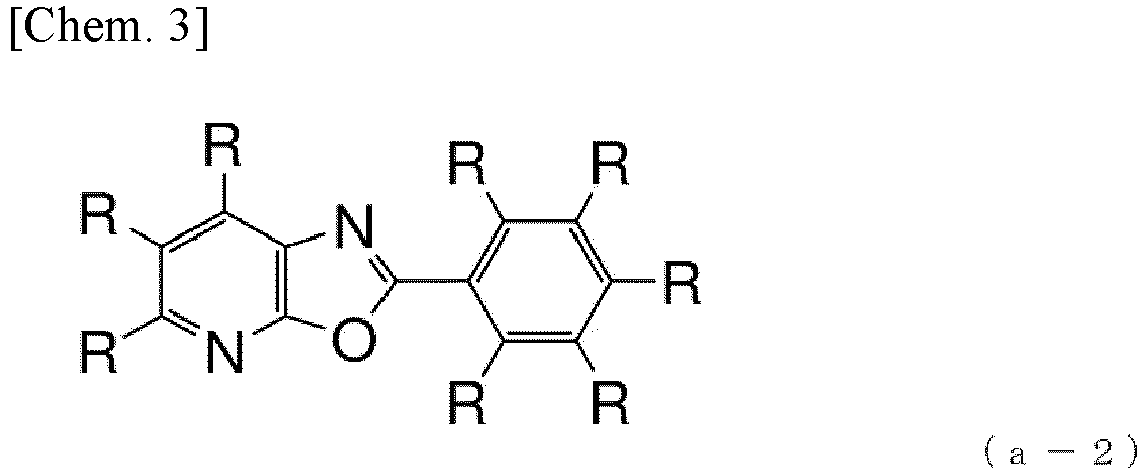
- The compound having an azabenzoxazole ring structure according to claim 1, wherein the compound is represented by the general formula (a-3):

- The compound having an azabenzoxazole ring structure according to claim 1, wherein the compound is represented by the general formula (a-4):

- The compound having an azabenzoxazole ring structure according to claim 1, wherein the compound is represented by the general formula (a-5):

- The compound having an azabenzoxazole ring structure according to claim 1, wherein the compound is represented by the general formula (a-6) or (a-7):


- The compound having an azabenzoxazole ring structure according to any one of claims 2 to 6,
wherein L in the structural formula (b-1) represents a single bond, a substituted or unsubstituted phenyl group, a substituted or unsubstituted biphenylyl group, or a substituted or unsubstituted naphthyl group. - The compound having an azabenzoxazole ring structure according to claim 7,
wherein Het in the structural formula (b-1) represents a substituted or unsubstituted pyridyl group, a substituted or unsubstituted pyrimidyl group, a substituted or unsubstituted quinolyl group, a substituted or unsubstituted isoquinolyl group, or a substituted or unsubstituted phenanthrolinyl group. - An organic electroluminescent element comprising a pair of electrodes and one or more organic layers sandwiched therebetween,
wherein the compound having an azabenzoxazole ring structure according to any one of claims 1 to 8 is included in at least one of the organic layers as a constituent material thereof. - The organic electroluminescent element according to claim 9,
wherein the organic layer including the compound having an azabenzoxazole ring structure is an electron-transporting layer. - The organic electroluminescent element according to claim 9,
wherein the organic layer including the compound having an azabenzoxazole ring structure is a hole-blocking layer. - The organic electroluminescent element according to claim 9,
wherein the organic layer including the compound having an azabenzoxazole ring structure is a light-emitting layer. - The organic electroluminescent element according to claim 9,
wherein the organic layer including the compound having an azabenzoxazole ring structure is an electron-injecting layer.
Applications Claiming Priority (2)
| Application Number | Priority Date | Filing Date | Title |
|---|---|---|---|
| JP2018223635 | 2018-11-29 | ||
| PCT/JP2019/046248 WO2020111081A1 (en) | 2018-11-29 | 2019-11-26 | Compound having azabenzoxazole ring structure and organic electroluminescent element |
Publications (2)
| Publication Number | Publication Date |
|---|---|
| EP3890043A1 true EP3890043A1 (en) | 2021-10-06 |
| EP3890043A4 EP3890043A4 (en) | 2022-08-24 |
Family
ID=70852318
Family Applications (1)
| Application Number | Title | Priority Date | Filing Date |
|---|---|---|---|
| EP19890353.6A Withdrawn EP3890043A4 (en) | 2018-11-29 | 2019-11-26 | COMPOUND WITH AZABENZOXAZOLE RING STRUCTURE AND ORGANIC ELECTROLUMINESCENT ELEMENT |
Country Status (7)
| Country | Link |
|---|---|
| US (1) | US12024527B2 (en) |
| EP (1) | EP3890043A4 (en) |
| JP (1) | JP7369714B2 (en) |
| KR (1) | KR102813014B1 (en) |
| CN (1) | CN112805845B (en) |
| TW (1) | TWI822914B (en) |
| WO (1) | WO2020111081A1 (en) |
Families Citing this family (3)
| Publication number | Priority date | Publication date | Assignee | Title |
|---|---|---|---|---|
| EP3605638B1 (en) * | 2017-03-28 | 2023-11-08 | Hodogaya Chemical Co., Ltd. | Organic electroluminescent device |
| CN113831356B (en) * | 2021-09-24 | 2022-12-27 | 长春海谱润斯科技股份有限公司 | Compound containing condensed ring and organic light-emitting device thereof |
| KR20240154363A (en) * | 2023-04-18 | 2024-10-25 | 호도가야 가가쿠 고교 가부시키가이샤 | Carbazole compound and organic electroluminescent element |
Family Cites Families (18)
| Publication number | Priority date | Publication date | Assignee | Title |
|---|---|---|---|---|
| WO1994022974A1 (en) | 1993-03-26 | 1994-10-13 | Sumitomo Electric Industries, Ltd. | Organic electroluminescent elements |
| DE69412567T2 (en) | 1993-11-01 | 1999-02-04 | Hodogaya Chemical Co., Ltd., Tokio/Tokyo | Amine compound and electroluminescent device containing it |
| EP0666298A3 (en) | 1994-02-08 | 1995-11-15 | Tdk Corp | Organic EL element and compound used therein. |
| AU2002365892A1 (en) * | 2001-11-30 | 2003-06-17 | Merck & Co., Inc. | Metabotropic glutamate receptor-5 modulators |
| KR100691543B1 (en) | 2002-01-18 | 2007-03-09 | 주식회사 엘지화학 | New material for electron transport and organic light emitting device using the same |
| JP5043404B2 (en) | 2006-11-20 | 2012-10-10 | キヤノン株式会社 | Heterocyclic compounds and organic light emitting devices |
| KR101288557B1 (en) | 2008-12-24 | 2013-07-22 | 제일모직주식회사 | Novel compound for organic photoelectric device and organic photoelectric device including the same |
| KR101297158B1 (en) | 2010-02-22 | 2013-08-21 | 제일모직주식회사 | Compound for organic photoelectric device and organic photoelectric device including the same |
| KR101376043B1 (en) * | 2011-06-21 | 2014-03-20 | 주식회사 알파켐 | New material for transporting electron and organic electroluminescent device using the same |
| KR102083691B1 (en) | 2011-10-14 | 2020-03-02 | 호도가야 가가쿠 고교 가부시키가이샤 | New benzotriazole derivative and organic electroluminescent element in which said derivative is used |
| EP2684932B8 (en) | 2012-07-09 | 2016-12-21 | Hodogaya Chemical Co., Ltd. | Diarylamino matrix material doped with a mesomeric radialene compound |
| WO2015022835A1 (en) * | 2013-08-14 | 2015-02-19 | コニカミノルタ株式会社 | Organic electroluminescent element, lighting device, display device and fluorescent compound |
| KR101548686B1 (en) * | 2013-09-11 | 2015-09-02 | 주식회사 알파켐 | New material for transporting electron and organic electroluminescent device using the same |
| KR101816233B1 (en) * | 2015-10-29 | 2018-01-08 | 삼성에스디아이 주식회사 | Organic compound for optoelectronic device and organic optoelectronic device and display device |
| KR102592185B1 (en) | 2016-04-06 | 2023-10-20 | 솔루스첨단소재 주식회사 | Organic compound and organic electroluminescent device comprising the same |
| KR102440762B1 (en) * | 2016-07-07 | 2022-09-05 | 호도가야 가가쿠 고교 가부시키가이샤 | A compound having a benzoazole ring structure and an organic electroluminescent device |
| EP3683852B1 (en) | 2017-09-13 | 2023-11-22 | Hodogaya Chemical Co., Ltd. | Organic electroluminescent element |
| JP7293343B2 (en) * | 2018-05-09 | 2023-06-19 | アプリノイア セラピューティクス リミテッド | Heteroaryl compound and use thereof |
-
2019
- 2019-11-26 JP JP2020557749A patent/JP7369714B2/en active Active
- 2019-11-26 US US17/285,405 patent/US12024527B2/en active Active
- 2019-11-26 CN CN201980065949.0A patent/CN112805845B/en active Active
- 2019-11-26 EP EP19890353.6A patent/EP3890043A4/en not_active Withdrawn
- 2019-11-26 KR KR1020217009157A patent/KR102813014B1/en active Active
- 2019-11-26 WO PCT/JP2019/046248 patent/WO2020111081A1/en not_active Ceased
- 2019-11-28 TW TW108143457A patent/TWI822914B/en active
Also Published As
| Publication number | Publication date |
|---|---|
| CN112805845B (en) | 2024-10-25 |
| JP7369714B2 (en) | 2023-10-26 |
| KR102813014B1 (en) | 2025-05-26 |
| US12024527B2 (en) | 2024-07-02 |
| JPWO2020111081A1 (en) | 2021-10-21 |
| EP3890043A4 (en) | 2022-08-24 |
| CN112805845A (en) | 2021-05-14 |
| KR20210097096A (en) | 2021-08-06 |
| TWI822914B (en) | 2023-11-21 |
| US20210395269A1 (en) | 2021-12-23 |
| TW202030193A (en) | 2020-08-16 |
| WO2020111081A1 (en) | 2020-06-04 |
Similar Documents
| Publication | Publication Date | Title |
|---|---|---|
| EP3156402B1 (en) | Pyrimidine derivative and organic electroluminescent element | |
| EP3812367B1 (en) | Compound having triarylamine structure and electroluminescence device | |
| US12102002B2 (en) | Compound having benzazole ring structure, and organic electroluminescent device | |
| KR102566080B1 (en) | Organic electroluminescent device containing a compound having a benzoazole ring structure | |
| US12024527B2 (en) | Compound having azabenzoxazole ring structure and organic electroluminescent element | |
| EP4112613A1 (en) | Arylamine compound and electronic apparatus using same | |
| EP3890042A1 (en) | Organic electroluminescence element | |
| KR102705588B1 (en) | Compounds having a benzimidazole ring structure and organic electroluminescent devices | |
| EP4230615A1 (en) | Arylamine compound, organic electroluminescent element, and electronic device | |
| KR102817272B1 (en) | Compounds having pyrimidine ring structures and organic electroluminescent devices | |
| JP7573524B2 (en) | Compound having a benzotriazole ring structure and organic electroluminescence device | |
| EP3683212B1 (en) | Compound having pyrimidine ring structure and organic electroluminescent element | |
| WO2019039402A1 (en) | Compound having indenobenzoazole-ring structure, and organic electroluminescence element |
Legal Events
| Date | Code | Title | Description |
|---|---|---|---|
| STAA | Information on the status of an ep patent application or granted ep patent |
Free format text: STATUS: THE INTERNATIONAL PUBLICATION HAS BEEN MADE |
|
| PUAI | Public reference made under article 153(3) epc to a published international application that has entered the european phase |
Free format text: ORIGINAL CODE: 0009012 |
|
| STAA | Information on the status of an ep patent application or granted ep patent |
Free format text: STATUS: REQUEST FOR EXAMINATION WAS MADE |
|
| 17P | Request for examination filed |
Effective date: 20210323 |
|
| AK | Designated contracting states |
Kind code of ref document: A1 Designated state(s): AL AT BE BG CH CY CZ DE DK EE ES FI FR GB GR HR HU IE IS IT LI LT LU LV MC MK MT NL NO PL PT RO RS SE SI SK SM TR |
|
| DAV | Request for validation of the european patent (deleted) | ||
| DAX | Request for extension of the european patent (deleted) | ||
| REG | Reference to a national code |
Ref country code: DE Ref legal event code: R079 Free format text: PREVIOUS MAIN CLASS: H01L0051500000 Ipc: H01L0051540000 |
|
| A4 | Supplementary search report drawn up and despatched |
Effective date: 20220725 |
|
| RIC1 | Information provided on ipc code assigned before grant |
Ipc: C07D 498/04 20060101ALI20220719BHEP Ipc: H01L 51/54 20060101AFI20220719BHEP |
|
| STAA | Information on the status of an ep patent application or granted ep patent |
Free format text: STATUS: THE APPLICATION HAS BEEN WITHDRAWN |
|
| 18W | Application withdrawn |
Effective date: 20230601 |