EP3889535B1 - Duct mounted heat exchanger - Google Patents
Duct mounted heat exchanger Download PDFInfo
- Publication number
- EP3889535B1 EP3889535B1 EP21154252.7A EP21154252A EP3889535B1 EP 3889535 B1 EP3889535 B1 EP 3889535B1 EP 21154252 A EP21154252 A EP 21154252A EP 3889535 B1 EP3889535 B1 EP 3889535B1
- Authority
- EP
- European Patent Office
- Prior art keywords
- heat exchanger
- manifold
- elements
- duct
- recited
- Prior art date
- Legal status (The legal status is an assumption and is not a legal conclusion. Google has not performed a legal analysis and makes no representation as to the accuracy of the status listed.)
- Active
Links
Images




Classifications
-
- F—MECHANICAL ENGINEERING; LIGHTING; HEATING; WEAPONS; BLASTING
- F28—HEAT EXCHANGE IN GENERAL
- F28D—HEAT-EXCHANGE APPARATUS, NOT PROVIDED FOR IN ANOTHER SUBCLASS, IN WHICH THE HEAT-EXCHANGE MEDIA DO NOT COME INTO DIRECT CONTACT
- F28D7/00—Heat-exchange apparatus having stationary tubular conduit assemblies for both heat-exchange media, the media being in contact with different sides of a conduit wall
- F28D7/08—Heat-exchange apparatus having stationary tubular conduit assemblies for both heat-exchange media, the media being in contact with different sides of a conduit wall the conduits being otherwise bent, e.g. in a serpentine or zig-zag
-
- F—MECHANICAL ENGINEERING; LIGHTING; HEATING; WEAPONS; BLASTING
- F28—HEAT EXCHANGE IN GENERAL
- F28F—DETAILS OF HEAT-EXCHANGE AND HEAT-TRANSFER APPARATUS, OF GENERAL APPLICATION
- F28F9/00—Casings; Header boxes; Auxiliary supports for elements; Auxiliary members within casings
- F28F9/02—Header boxes; End plates
- F28F9/026—Header boxes; End plates with static flow control means, e.g. with means for uniformly distributing heat exchange media into conduits
- F28F9/027—Header boxes; End plates with static flow control means, e.g. with means for uniformly distributing heat exchange media into conduits in the form of distribution pipes
-
- F—MECHANICAL ENGINEERING; LIGHTING; HEATING; WEAPONS; BLASTING
- F02—COMBUSTION ENGINES; HOT-GAS OR COMBUSTION-PRODUCT ENGINE PLANTS
- F02C—GAS-TURBINE PLANTS; AIR INTAKES FOR JET-PROPULSION PLANTS; CONTROLLING FUEL SUPPLY IN AIR-BREATHING JET-PROPULSION PLANTS
- F02C7/00—Features, components parts, details or accessories, not provided for in, or of interest apart form groups F02C1/00 - F02C6/00; Air intakes for jet-propulsion plants
- F02C7/12—Cooling of plants
- F02C7/16—Cooling of plants characterised by cooling medium
- F02C7/18—Cooling of plants characterised by cooling medium the medium being gaseous, e.g. air
-
- F—MECHANICAL ENGINEERING; LIGHTING; HEATING; WEAPONS; BLASTING
- F28—HEAT EXCHANGE IN GENERAL
- F28D—HEAT-EXCHANGE APPARATUS, NOT PROVIDED FOR IN ANOTHER SUBCLASS, IN WHICH THE HEAT-EXCHANGE MEDIA DO NOT COME INTO DIRECT CONTACT
- F28D7/00—Heat-exchange apparatus having stationary tubular conduit assemblies for both heat-exchange media, the media being in contact with different sides of a conduit wall
- F28D7/0058—Heat-exchange apparatus having stationary tubular conduit assemblies for both heat-exchange media, the media being in contact with different sides of a conduit wall the conduits for only one medium being tubes having different orientations to each other or crossing the conduit for the other heat exchange medium
-
- F—MECHANICAL ENGINEERING; LIGHTING; HEATING; WEAPONS; BLASTING
- F28—HEAT EXCHANGE IN GENERAL
- F28D—HEAT-EXCHANGE APPARATUS, NOT PROVIDED FOR IN ANOTHER SUBCLASS, IN WHICH THE HEAT-EXCHANGE MEDIA DO NOT COME INTO DIRECT CONTACT
- F28D7/00—Heat-exchange apparatus having stationary tubular conduit assemblies for both heat-exchange media, the media being in contact with different sides of a conduit wall
- F28D7/16—Heat-exchange apparatus having stationary tubular conduit assemblies for both heat-exchange media, the media being in contact with different sides of a conduit wall the conduits being arranged in parallel spaced relation
- F28D7/1615—Heat-exchange apparatus having stationary tubular conduit assemblies for both heat-exchange media, the media being in contact with different sides of a conduit wall the conduits being arranged in parallel spaced relation the conduits being inside a casing and extending at an angle to the longitudinal axis of the casing; the conduits crossing the conduit for the other heat exchange medium
- F28D7/1623—Heat-exchange apparatus having stationary tubular conduit assemblies for both heat-exchange media, the media being in contact with different sides of a conduit wall the conduits being arranged in parallel spaced relation the conduits being inside a casing and extending at an angle to the longitudinal axis of the casing; the conduits crossing the conduit for the other heat exchange medium with particular pattern of flow of the heat exchange media, e.g. change of flow direction
-
- F—MECHANICAL ENGINEERING; LIGHTING; HEATING; WEAPONS; BLASTING
- F28—HEAT EXCHANGE IN GENERAL
- F28D—HEAT-EXCHANGE APPARATUS, NOT PROVIDED FOR IN ANOTHER SUBCLASS, IN WHICH THE HEAT-EXCHANGE MEDIA DO NOT COME INTO DIRECT CONTACT
- F28D7/00—Heat-exchange apparatus having stationary tubular conduit assemblies for both heat-exchange media, the media being in contact with different sides of a conduit wall
- F28D7/16—Heat-exchange apparatus having stationary tubular conduit assemblies for both heat-exchange media, the media being in contact with different sides of a conduit wall the conduits being arranged in parallel spaced relation
- F28D7/163—Heat-exchange apparatus having stationary tubular conduit assemblies for both heat-exchange media, the media being in contact with different sides of a conduit wall the conduits being arranged in parallel spaced relation with conduit assemblies having a particular shape, e.g. square or annular; with assemblies of conduits having different geometrical features; with multiple groups of conduits connected in series or parallel and arranged inside common casing
- F28D7/1638—Heat-exchange apparatus having stationary tubular conduit assemblies for both heat-exchange media, the media being in contact with different sides of a conduit wall the conduits being arranged in parallel spaced relation with conduit assemblies having a particular shape, e.g. square or annular; with assemblies of conduits having different geometrical features; with multiple groups of conduits connected in series or parallel and arranged inside common casing with particular pattern of flow or the heat exchange medium flowing inside the conduits assemblies, e.g. change of flow direction from one conduit assembly to another one
-
- F—MECHANICAL ENGINEERING; LIGHTING; HEATING; WEAPONS; BLASTING
- F28—HEAT EXCHANGE IN GENERAL
- F28D—HEAT-EXCHANGE APPARATUS, NOT PROVIDED FOR IN ANOTHER SUBCLASS, IN WHICH THE HEAT-EXCHANGE MEDIA DO NOT COME INTO DIRECT CONTACT
- F28D7/00—Heat-exchange apparatus having stationary tubular conduit assemblies for both heat-exchange media, the media being in contact with different sides of a conduit wall
- F28D7/16—Heat-exchange apparatus having stationary tubular conduit assemblies for both heat-exchange media, the media being in contact with different sides of a conduit wall the conduits being arranged in parallel spaced relation
- F28D7/163—Heat-exchange apparatus having stationary tubular conduit assemblies for both heat-exchange media, the media being in contact with different sides of a conduit wall the conduits being arranged in parallel spaced relation with conduit assemblies having a particular shape, e.g. square or annular; with assemblies of conduits having different geometrical features; with multiple groups of conduits connected in series or parallel and arranged inside common casing
- F28D7/1669—Heat-exchange apparatus having stationary tubular conduit assemblies for both heat-exchange media, the media being in contact with different sides of a conduit wall the conduits being arranged in parallel spaced relation with conduit assemblies having a particular shape, e.g. square or annular; with assemblies of conduits having different geometrical features; with multiple groups of conduits connected in series or parallel and arranged inside common casing the conduit assemblies having an annular shape; the conduits being assembled around a central distribution tube
- F28D7/1676—Heat-exchange apparatus having stationary tubular conduit assemblies for both heat-exchange media, the media being in contact with different sides of a conduit wall the conduits being arranged in parallel spaced relation with conduit assemblies having a particular shape, e.g. square or annular; with assemblies of conduits having different geometrical features; with multiple groups of conduits connected in series or parallel and arranged inside common casing the conduit assemblies having an annular shape; the conduits being assembled around a central distribution tube with particular pattern of flow of the heat exchange media, e.g. change of flow direction
-
- F—MECHANICAL ENGINEERING; LIGHTING; HEATING; WEAPONS; BLASTING
- F28—HEAT EXCHANGE IN GENERAL
- F28F—DETAILS OF HEAT-EXCHANGE AND HEAT-TRANSFER APPARATUS, OF GENERAL APPLICATION
- F28F1/00—Tubular elements; Assemblies of tubular elements
- F28F1/02—Tubular elements of cross-section which is non-circular
- F28F1/022—Tubular elements of cross-section which is non-circular with multiple channels
-
- F—MECHANICAL ENGINEERING; LIGHTING; HEATING; WEAPONS; BLASTING
- F28—HEAT EXCHANGE IN GENERAL
- F28F—DETAILS OF HEAT-EXCHANGE AND HEAT-TRANSFER APPARATUS, OF GENERAL APPLICATION
- F28F1/00—Tubular elements; Assemblies of tubular elements
- F28F1/10—Tubular elements and assemblies thereof with means for increasing heat-transfer area, e.g. with fins, with projections, with recesses
-
- F—MECHANICAL ENGINEERING; LIGHTING; HEATING; WEAPONS; BLASTING
- F28—HEAT EXCHANGE IN GENERAL
- F28F—DETAILS OF HEAT-EXCHANGE AND HEAT-TRANSFER APPARATUS, OF GENERAL APPLICATION
- F28F27/00—Control arrangements or safety devices specially adapted for heat-exchange or heat-transfer apparatus
- F28F27/02—Control arrangements or safety devices specially adapted for heat-exchange or heat-transfer apparatus for controlling the distribution of heat-exchange media between different channels
-
- F—MECHANICAL ENGINEERING; LIGHTING; HEATING; WEAPONS; BLASTING
- F28—HEAT EXCHANGE IN GENERAL
- F28F—DETAILS OF HEAT-EXCHANGE AND HEAT-TRANSFER APPARATUS, OF GENERAL APPLICATION
- F28F9/00—Casings; Header boxes; Auxiliary supports for elements; Auxiliary members within casings
- F28F9/02—Header boxes; End plates
- F28F9/026—Header boxes; End plates with static flow control means, e.g. with means for uniformly distributing heat exchange media into conduits
- F28F9/0265—Header boxes; End plates with static flow control means, e.g. with means for uniformly distributing heat exchange media into conduits by using guiding means or impingement means inside the header box
- F28F9/0268—Header boxes; End plates with static flow control means, e.g. with means for uniformly distributing heat exchange media into conduits by using guiding means or impingement means inside the header box in the form of multiple deflectors for channeling the heat exchange medium
-
- F—MECHANICAL ENGINEERING; LIGHTING; HEATING; WEAPONS; BLASTING
- F28—HEAT EXCHANGE IN GENERAL
- F28F—DETAILS OF HEAT-EXCHANGE AND HEAT-TRANSFER APPARATUS, OF GENERAL APPLICATION
- F28F9/00—Casings; Header boxes; Auxiliary supports for elements; Auxiliary members within casings
- F28F9/22—Arrangements for directing heat-exchange media into successive compartments, e.g. arrangements of guide plates
-
- F—MECHANICAL ENGINEERING; LIGHTING; HEATING; WEAPONS; BLASTING
- F28—HEAT EXCHANGE IN GENERAL
- F28D—HEAT-EXCHANGE APPARATUS, NOT PROVIDED FOR IN ANOTHER SUBCLASS, IN WHICH THE HEAT-EXCHANGE MEDIA DO NOT COME INTO DIRECT CONTACT
- F28D1/00—Heat-exchange apparatus having stationary conduit assemblies for one heat-exchange medium only, the media being in contact with different sides of the conduit wall, in which the other heat-exchange medium is a large body of fluid, e.g. domestic or motor car radiators
- F28D1/02—Heat-exchange apparatus having stationary conduit assemblies for one heat-exchange medium only, the media being in contact with different sides of the conduit wall, in which the other heat-exchange medium is a large body of fluid, e.g. domestic or motor car radiators with heat-exchange conduits immersed in the body of fluid
- F28D1/04—Heat-exchange apparatus having stationary conduit assemblies for one heat-exchange medium only, the media being in contact with different sides of the conduit wall, in which the other heat-exchange medium is a large body of fluid, e.g. domestic or motor car radiators with heat-exchange conduits immersed in the body of fluid with tubular conduits
- F28D1/047—Heat-exchange apparatus having stationary conduit assemblies for one heat-exchange medium only, the media being in contact with different sides of the conduit wall, in which the other heat-exchange medium is a large body of fluid, e.g. domestic or motor car radiators with heat-exchange conduits immersed in the body of fluid with tubular conduits the conduits being bent, e.g. in a serpentine or zig-zag
- F28D1/0471—Heat-exchange apparatus having stationary conduit assemblies for one heat-exchange medium only, the media being in contact with different sides of the conduit wall, in which the other heat-exchange medium is a large body of fluid, e.g. domestic or motor car radiators with heat-exchange conduits immersed in the body of fluid with tubular conduits the conduits being bent, e.g. in a serpentine or zig-zag the conduits having a non-circular cross-section
-
- F—MECHANICAL ENGINEERING; LIGHTING; HEATING; WEAPONS; BLASTING
- F28—HEAT EXCHANGE IN GENERAL
- F28D—HEAT-EXCHANGE APPARATUS, NOT PROVIDED FOR IN ANOTHER SUBCLASS, IN WHICH THE HEAT-EXCHANGE MEDIA DO NOT COME INTO DIRECT CONTACT
- F28D21/00—Heat-exchange apparatus not covered by any of the groups F28D1/00 - F28D20/00
- F28D2021/0019—Other heat exchangers for particular applications; Heat exchange systems not otherwise provided for
- F28D2021/0026—Other heat exchangers for particular applications; Heat exchange systems not otherwise provided for for combustion engines, e.g. for gas turbines or for Stirling engines
-
- F—MECHANICAL ENGINEERING; LIGHTING; HEATING; WEAPONS; BLASTING
- F28—HEAT EXCHANGE IN GENERAL
- F28F—DETAILS OF HEAT-EXCHANGE AND HEAT-TRANSFER APPARATUS, OF GENERAL APPLICATION
- F28F2265/00—Safety or protection arrangements; Arrangements for preventing malfunction
- F28F2265/26—Safety or protection arrangements; Arrangements for preventing malfunction for allowing differential expansion between elements
-
- Y—GENERAL TAGGING OF NEW TECHNOLOGICAL DEVELOPMENTS; GENERAL TAGGING OF CROSS-SECTIONAL TECHNOLOGIES SPANNING OVER SEVERAL SECTIONS OF THE IPC; TECHNICAL SUBJECTS COVERED BY FORMER USPC CROSS-REFERENCE ART COLLECTIONS [XRACs] AND DIGESTS
- Y02—TECHNOLOGIES OR APPLICATIONS FOR MITIGATION OR ADAPTATION AGAINST CLIMATE CHANGE
- Y02T—CLIMATE CHANGE MITIGATION TECHNOLOGIES RELATED TO TRANSPORTATION
- Y02T50/00—Aeronautics or air transport
- Y02T50/60—Efficient propulsion technologies, e.g. for aircraft
Definitions
- a gas turbine engine typically includes a fan section, a compressor section, a combustor section, and a turbine section. Air entering the compressor section is compressed and delivered into the combustion section where it is mixed with fuel and ignited to generate a high-speed exhaust gas flow. The high-speed exhaust gas flow expands through the turbine section to drive the compressor and the fan section.
- Heat exchangers are useful for any number of fluid cooling and heating applications in a gas turbine engine.
- EP 3546873A1 describes a heat exchanger suitable for the high-temperature range according to the preamble of claim 1.
- a heat exchanger is provided as recited in claim 1.
- the central manifold includes a plurality of individual passages.
- the heat exchanger entrance elements and the heat exchanger exit elements are axially aligned relative to the other of the heat exchanger entrance elements and the heat exchanger exit elements.
- one of the heat exchanger entrance elements and the heat exchanger exit elements is offset relative to the other of the heat exchanger entrance elements and the heat exchanger exit elements.
- the heat exchanger entrance and exit elements are angled with respect to the central axis of the duct.
- the heat exchanger entrance and exit elements are angled with respect to the central axis of the duct, and one the heat exchanger entrance elements and the heat exchanger exit elements is offset relative to the other of the heat exchanger entrance elements and the heat exchanger exit elements.
- the plurality of heat exchanger elements include heat exchanger enhancement elements.
- a first transition manifold is positioned intermediate the inlet and outlet manifolds, and a second transition manifold is positioned upstream in the duct of the first transition manifold, and downstream in the duct of the outlet manifold.
- a first flow divider is positioned between the inlet manifold and the first transition manifold, and a second flow divider is positioned between the outlet manifold and the second transition manifold.
- At least one of the first and second transition manifolds extend at least 10 degrees around the circumference of the duct.
- the duct is circular in cross-section.
- the inlet and outlet manifolds extend about 360 degrees of the circumference of the duct.
- the second fluid source is air from the compressor.
- the outlet manifold is connected to an air cycle machine.
- FIG. 1 schematically illustrates a gas turbine engine 20.
- the gas turbine engine 20 is disclosed herein as a two-spool turbofan that generally incorporates a fan section 22, a compressor section 24, a combustor section 26 and a turbine section 28.
- the fan section 22 drives air along a bypass flow path B in a bypass duct defined within a housing 15, such as a fan case or nacelle, and also drives air along a core flow path C for compression and communication into the combustor section 26 then expansion through the turbine section 28.
- the exemplary engine 20 generally includes a low speed spool 30 and a high speed spool 32 mounted for rotation about an engine central longitudinal axis A relative to an engine static structure 36 via several bearing systems 38. It should be understood that various bearing systems 38 at various locations may alternatively or additionally be provided, and the location of bearing systems 38 may be varied as appropriate to the application.
- the low speed spool 30 generally includes an inner shaft 40 that interconnects, a first (or low) pressure compressor 44 and a first (or low) pressure turbine 46.
- the inner shaft 40 is connected to the fan 42 through a speed change mechanism, which in exemplary gas turbine engine 20 is illustrated as a geared architecture 48 to drive a fan 42 at a lower speed than the low speed spool 30.
- the high speed spool 32 includes an outer shaft 50 that interconnects a second (or high) pressure compressor 52 and a second (or high) pressure turbine 54.
- a combustor 56 is arranged in exemplary gas turbine 20 between the high pressure compressor 52 and the high pressure turbine 54.
- a mid-turbine frame 57 of the engine static structure 36 may be arranged generally between the high pressure turbine 54 and the low pressure turbine 46.
- the mid-turbine frame 57 further supports bearing systems 38 in the turbine section 28.
- the inner shaft 40 and the outer shaft 50 are concentric and rotate via bearing systems 38 about the engine central longitudinal axis A which is colline
- the core airflow is compressed by the low pressure compressor 44 then the high pressure compressor 52, mixed and burned with fuel in the combustor 56, then expanded through the high pressure turbine 54 and low pressure turbine 46.
- the mid-turbine frame 57 includes airfoils 59 which are in the core airflow path C.
- the turbines 46, 54 rotationally drive the respective low speed spool 30 and high speed spool 32 in response to the expansion.
- gear system 48 may be located aft of the low pressure compressor, or aft of the combustor section 26 or even aft of turbine section 28, and fan 42 may be positioned forward or aft of the location of gear system 48.
- the engine 20 in one example is a high-bypass geared aircraft engine.
- the engine 20 bypass ratio is greater than about six (6), with an example embodiment being greater than about ten (10)
- the geared architecture 48 is an epicyclic gear train, such as a planetary gear system or other gear system, with a gear reduction ratio of greater than about 2.3
- the low pressure turbine 46 has a pressure ratio that is greater than about five.
- the engine 20 bypass ratio is greater than about ten (10:1)
- the fan diameter is significantly larger than that of the low pressure compressor 44
- the low pressure turbine 46 has a pressure ratio that is greater than about five 5:1.
- Low pressure turbine 46 pressure ratio is pressure measured prior to inlet of low pressure turbine 46 as related to the pressure at the outlet of the low pressure turbine 46 prior to an exhaust nozzle.
- the geared architecture 48 may be an epicycle gear train, such as a planetary gear system or other gear system, with a gear reduction ratio of greater than about 2.3:1 and less than about 5:1. It should be understood, however, that the above parameters are only exemplary of one embodiment of a geared architecture engine and that the present invention is applicable to other gas turbine engines including direct drive turbofans.
- the fan section 22 of the engine 20 is designed for a particular flight condition -- typically cruise at about 0.8 Mach and about 35,000 feet (10,668 meters).
- the flight condition of 0.8 Mach and 35,000 ft (10,668 meters), with the engine at its best fuel consumption - also known as "bucket cruise Thrust Specific Fuel Consumption ('TSFC')" - is the industry standard parameter of lbm of fuel being burned divided by lbf of thrust the engine produces at that minimum point.
- "Low fan pressure ratio” is the pressure ratio across the fan blade alone, without a Fan Exit Guide Vane (“FEGV”) system.
- the low fan pressure ratio as disclosed herein according to one non-limiting embodiment is less than about 1.45.
- Low corrected fan tip speed is the actual fan tip speed in ft/sec divided by an industry standard temperature correction of [(Tram °R) / (518.7 °R)] 0.5 .
- the "Low corrected fan tip speed” as disclosed herein according to one non-limiting embodiment is less than about 1150 ft / second (350.5 meters/second).
- Figure 2 schematically illustrates a duct 60 having a full-flow heat exchanger 62.
- An inlet shows duct flow 110 passes over the heat exchanger 62 and flows out at 111.
- the duct 60 can be circular in cross-section.
- the flows 110, 111 can be bypass air such as shown in Figure 1 .
- the flows 110, 111 can be bleeds consisting of flow extracted from the low pressure compressor 44 or the high pressure compressor 52.
- the heat exchanger 62 may cool any number of fluids.
- the heat exchanger can cool compressed air for use on an air cycle machine to provide air for use on the aircraft.
- the heat exchanger 62 can cool engine oil or engine fuel.
- Heat exchanger alloys can include nickel alloys (IN625, IN718, Waspaloy, Haynes 282, etc.) cobalt alloys (Haynes 188, etc.) titanium alloys (Ti-6Al-4V, Ti-6Al-2Sn-4Zr-2Mo-Si, etc.), aluminum alloys and combinations thereof.
- the heat exchanger can be manufactured using additive manufacturing by direct metal laser sintering (DMLS), for example, and/or other processes known in the art. Heat exchanger elements typically utilize curvature to reduce steady state and transient thermally induced stress/strain so additive manufacturing can enable integral features and variation with minimal cost. Curvature can also increase the surface area for available cooling as the flow 110 interacts with the fluid being heated or cooled.
- FIG. 3 A more detailed view of the full-flow heat exchanger 62 and the duct 60 is shown in Figure 3 .
- An inlet manifold 74 is positioned within a downstream portion of the duct 60 at a radially outward location.
- an outlet manifold 76 is positioned within an upstream portion of the duct 60 at a radially outward location.
- the full-flow heat exchanger 62 uses inlet and outlet manifolds configured to capture fluid before and after passing through the full-flow heat exchanger 62.
- the fluid can be air, oil or other fluids.
- At least one of the inlet and outlet manifolds 74, 76 extend at least 10 degrees about the circumference of the duct 60. In one embodiment they each extend at least 180 degrees about the circumference of the duct 60, and in another embodiment they surround the entire circumference of the duct 60.
- each of the manifolds extend around the entire circumference of the duct.
- Fairings 66 are attached to each of the inlet and outlet manifolds 74, 76 such that an additional connection to the duct 60 is provided.
- the fairings 66 can be placed in such a way that helps to minimize airflow and/or fluid pressure loss at all airflow conditions. Other devices known in the art can also be added to further guide airflow.
- Heat exchange entrance elements 85 extend radially inward from the inlet manifold 74.
- heat exchange exit elements 87 extend radially outward to the outlet manifold 76.
- the heat exchanger elements 85, 87 can readily transport fluid to and from a central manifold 80.
- an engine component 100 passes fluid flow 120 radially to the inlet manifold 74.
- the flow passes through the heat exchanger entrance elements 85 and enters the central manifold 80.
- Fluid flows in an upstream direction 130.
- the duct flow 110 flows over the central manifold 80 and the heat exchanger elements 85, 87 to externally cool the fluid.
- the fluid flow is then passed radially outward to outlet manifold 76 through the heat exchanger exit elements 87.
- Fluid flow 121 passes to an intended engine component 101 through one or more connections to the outlet manifold 76.
- the arrows should be understood as fluid conduits.
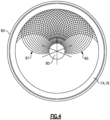
- the heat exchanger entrance elements 85 extend from the central manifold 80 to the inlet manifold 74 such that a directionally clockwise arc-shape is defined.
- the heat exchanger exit elements 87 extend from the central manifold 80 to the outlet manifold 76 such that a directionally counterclockwise arc-shape is defined.
- the arc-shape geometries allow for differential steady-state, transient thermal, and pressure induced radial growth to be accommodated via change in radius of curvature within the heat exchanger elements 85, 87.
- the arc-shaped geometries can also generate a considerable increase in surface area for heat transfer between fluids as the length of the arc-shapes can be longer than the radial distance between the central manifold 80, and the inlet manifold 74 or the outlet manifold 76.
- the heat exchanger elements 85, 87 will be formed about the entire circumference of the duct 60. They are illustrated only over a limited portion to better illustrate the shape.
- the duct 60 may be circular in cross-section, although other enclosed shapes may be utilized.
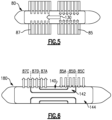
- Figure 5 further details the transition of flow from within the central manifold 80.
- the central manifold 80 can be positioned offset from a central axis of the duct 60. That is, the term "central” does not require exact centering.
- the central manifold 80 is open (passive, unforced or undirected flow interaction), thus, allowing fluid through the heat exchange entrance elements 85 to combine prior to discharging through the heat exchanger exit elements 87.
- Figure 6 illustrates a central manifold 180 having individual passages 140, 142, 144 allowing for a mixed two-pass heat transfer.
- Heat exchanger entrance elements 85A-85C and heat exchanger exit elements 87A-87C are similar to the heat exchanger entrance and exit elements described above unless stated otherwise.
- fluid flows radially inward into the passage 140 through the heat exchanger entrance elements 85A, flows in an upstream direction, and is passed radially outward through the heat exchanger exit elements 87A.
- the passage 142 passes fluid in an upstream direction from the heat exchanger entrance elements 85B to the heat exchanger exit elements 87B
- the passage 144 passes fluid in an upstream direction from the plurality of heat exchanger entrance elements 85C to the plurality of heat exchanger exit elements 87C.
- Figure 7 illustrates another example of a full-flow heat exchanger.
- the full-flow heat exchanger shown in Figure 7 is similar to the full-flow heat exchanger 62 except where described or shown differently.
- Like reference numerals designate like elements where appropriate with a leading "8.”
- An inlet shows duct flow 810 passes over the heat exchanger and flows out at 811.
- Duct 860 can be circular in cross-section, although other enclosed shaped may be used.
- An inlet manifold 874 is positioned within a downstream portion of the duct 860 at a radially outward location.
- an outlet manifold 876 is positioned within an upstream portion of the duct 860 at a radially outward location.
- At least one of the inlet and outlet manifolds 874, 876 extend at least 10 degrees about the circumference of the duct 860. In one embodiment they each extend at least 180 degrees about the circumference of the duct 860, and in another embodiment across the entire circumference of the duct 60.
- Fairings 866 are attached to each of the inlet and outlet manifolds 874, 876 such that an additional connection to the duct 860 is provided.
- Heat exchange entrance elements 885 extend radially inward from the inlet manifold 874 to a central manifold 880.
- heat exchange exit elements 887 extend radially outward from the central manifold to the outlet manifold 876.
- flow dividers 871 define a point of separation between the inlet and outlet manifolds 874, 876 and transition manifolds 870, 872, respectively.
- the transition manifold 870 is positioned intermediate to the inlet and outlet manifolds 874, 876.
- the transition manifold 872 is positioned upstream in the duct 860 of the transition manifold 870, and downstream in the duct 860 of the outlet manifold 876.
- heat exchanger entrance elements 885' extend radially inward from the transition manifold 870 to the central manifold 880
- heat exchanger exit elements 887" extend radially outward from the central manifold 880 to the transition manifold 870
- heat exchanger entrance elements 885" extend radially inward from the transition manifold 872 to the central manifold 880
- heat exchanger exit elements 887' extend radially outward from the central manifold 880 to the transition manifold 872.
- the central manifold 880 has internal flow dividers 873 configured to define different flow passages.
- an engine component 800 passes fluid flow 820 radially to the inlet manifold 874.
- the flow passes through the heat exchanger entrance elements 885 and enters a passage 840 of the central manifold 880.
- Fluid flows in an upstream direction and then radially outward through the heat exchanger exit elements 887" to the transition manifold 870 wherein the fluid is subsequently passed radially inward through the heat exchanger entrance elements 885' to a passage 842 of the central manifold 880.
- the fluid flows in an upstream direction 830.
- the duct flow 810 flows over the central manifold and the heat exchanger elements to externally cool the fluid.
- the fluid is then passed radially outward through the heat exchanger exit elements 887' to the transition manifold 872 wherein the fluid is subsequently passed radially inward through the heat exchanger entrance elements 885" to a passage 844 of the central manifold 880.
- Fluid flows in an upstream direction and then radially outward through the heat exchanger exit elements 887 to the outlet manifold 876.
- Fluid flow 821 passes to an intended engine component 801 through one or more connections to the outlet manifold 876.
- This embodiment utilizes a multi-pass heat exchanger useful for additional heat transfer via increased fluid interaction.
- transitional passageways can be added.
- the transitional manifolds extend across at least 10 degrees, in one embodiment at least 180 degrees, and in another embodiment, across at least 360 degrees.
- the transitional entrance and exit elements are spread across the circumference of the duct.
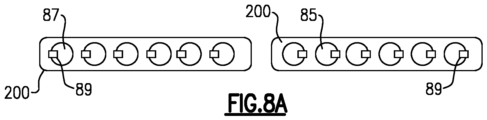
- the heat exchanger entrance and exit elements 85, 87 are channeled passages formed into a solid element 200. Passages 85, 87 may receive internal heat exchanger enhancement elements 89 such as pins, ribs, trip-strips, etc. The outer surface of the solid element 200 may also receive like external heat exchanger enhancement elements.
- heat exchange entrance and exit elements 485, 487 can be axially aligned to the other with respect to the duct central line E.
- heat exchanger entrance and exit elements 585, 587 can be offset to the other such that a radial offset D is defined.
- the offset orientation is configured such that as flow 510 passes through the duct, the heat exchanger entrance elements 585 are not directly in wake of the heat exchanger exit elements 587. "Wake” referring to disrupted flow downstream the duct.
- heat exchanger entrance and exit elements 685, 687 can be angled with respect to the duct central line E.
- heat exchanger entrance and exit elements 785, 787 can be angled and offset such that an offset R is defined. Similar to Figure 9B , offsetting the elements 785,787 helps eliminate waking as flow 710 passes through the duct.
- Angled should be understood as an angle that is non-parallel and/or non-perpendicular to the duct center line E.
- the above described examples provide a full-flow heat exchanger design compatible with integrated duct placement.
- the design of the heat exchanger allows for efficient heat transfer and system performance by enabling improved architecture for weight, and lowered costs due to the elimination of other flow guiding systems. Maintainability is enhanced due to external (to engine) ducts with an integrated heat exchanger that is more accessible for inspection and replacement. External ducts also allow prompt modifications for the increase or reduction in heat transfer. Contrarily, other heat exchangers known in the art are typically buried within engine cases or fan ducts.
Landscapes
- Engineering & Computer Science (AREA)
- Physics & Mathematics (AREA)
- Mechanical Engineering (AREA)
- General Engineering & Computer Science (AREA)
- Thermal Sciences (AREA)
- Geometry (AREA)
- Chemical & Material Sciences (AREA)
- Combustion & Propulsion (AREA)
- Heat-Exchange Devices With Radiators And Conduit Assemblies (AREA)
Description
- A gas turbine engine typically includes a fan section, a compressor section, a combustor section, and a turbine section. Air entering the compressor section is compressed and delivered into the combustion section where it is mixed with fuel and ignited to generate a high-speed exhaust gas flow. The high-speed exhaust gas flow expands through the turbine section to drive the compressor and the fan section.
- Heat exchangers are useful for any number of fluid cooling and heating applications in a gas turbine engine.
-
EP 3546873A1 describes a heat exchanger suitable for the high-temperature range according to the preamble of claim 1. - According to an aspect of the invention, a heat exchanger is provided as recited in claim 1.
- In another embodiment according to any of the previous embodiment, the central manifold includes a plurality of individual passages.
- In another embodiment according to any of the previous embodiments, the heat exchanger entrance elements and the heat exchanger exit elements are axially aligned relative to the other of the heat exchanger entrance elements and the heat exchanger exit elements.
- In another embodiment according to any of the previous embodiments, one of the heat exchanger entrance elements and the heat exchanger exit elements is offset relative to the other of the heat exchanger entrance elements and the heat exchanger exit elements.
- In another embodiment according to any of the previous embodiments, the heat exchanger entrance and exit elements are angled with respect to the central axis of the duct.
- In another embodiment according to any of the previous embodiments, the heat exchanger entrance and exit elements are angled with respect to the central axis of the duct, and one the heat exchanger entrance elements and the heat exchanger exit elements is offset relative to the other of the heat exchanger entrance elements and the heat exchanger exit elements.
- In another embodiment according to any of the previous embodiments, the plurality of heat exchanger elements include heat exchanger enhancement elements.
- In another embodiment according to any of the previous embodiments, a first transition manifold is positioned intermediate the inlet and outlet manifolds, and a second transition manifold is positioned upstream in the duct of the first transition manifold, and downstream in the duct of the outlet manifold.
- In another embodiment according to any of the previous embodiments, a first flow divider is positioned between the inlet manifold and the first transition manifold, and a second flow divider is positioned between the outlet manifold and the second transition manifold.
- In another embodiment according to any of the previous embodiments, at least one of the first and second transition manifolds extend at least 10 degrees around the circumference of the duct.
- In another embodiment according to any of the previous embodiments, the duct is circular in cross-section.
- In another embodiment according to any of the previous embodiments, the inlet and outlet manifolds extend about 360 degrees of the circumference of the duct.
- According to a further aspect of the invention, there is provided a gas turbine engine as recited in claim 12.
- In another embodiment according to the previous embodiment, the second fluid source is air from the compressor.
- In another embodiment according to any of the previous embodiments, the outlet manifold is connected to an air cycle machine.
- These and other features will be best understood from the following specification and drawings.
-
-
Figure 1 is a schematic view of an example gas turbine engine. -
Figure 2 is a schematic view of an example duct according to a first non-limiting example. -
Figure 3 illustrates a cross-sectional view taken along line A-A ofFigure 2 . -
Figure 4 illustrates a cross-sectional view taken along line B-B ofFigure 3 . -
Figure 5 illustrates a view of section C ofFigure 3 . -
Figure 6 illustrates an alternative embodiment of section C ofFigure 3 . -
Figure 7 is a schematic view of another example duct. -
Figure 8A illustrates an example embodiment of heat exchanger elements taken along line D-D ofFigure 3 . -
Figure 9A illustrates another example embodiment of heat exchanger elements taken along line D-D ofFigure 3 . -
Figure 9B illustrates another example embodiment of heat exchanger elements taken along line D-D ofFigure 3 . -
Figure 9C illustrates another example embodiment of heat exchanger elements taken along line D-D ofFigure 3 . -
Figures 9D illustrates another example embodiment of heat exchanger elements taken along line D-D ofFigure 3 . -
Figure 1 schematically illustrates agas turbine engine 20. Thegas turbine engine 20 is disclosed herein as a two-spool turbofan that generally incorporates afan section 22, a compressor section 24, acombustor section 26 and aturbine section 28. Thefan section 22 drives air along a bypass flow path B in a bypass duct defined within ahousing 15, such as a fan case or nacelle, and also drives air along a core flow path C for compression and communication into thecombustor section 26 then expansion through theturbine section 28. Although depicted as a two-spool turbofan gas turbine engine in the disclosed non-limiting embodiment, it should be understood that the concepts described herein are not limited to use with two-spool turbofans as the teachings may be applied to other types of turbine engines including three-spool architectures. - The
exemplary engine 20 generally includes alow speed spool 30 and ahigh speed spool 32 mounted for rotation about an engine central longitudinal axis A relative to an enginestatic structure 36 viaseveral bearing systems 38. It should be understood thatvarious bearing systems 38 at various locations may alternatively or additionally be provided, and the location ofbearing systems 38 may be varied as appropriate to the application. - The
low speed spool 30 generally includes aninner shaft 40 that interconnects, a first (or low)pressure compressor 44 and a first (or low)pressure turbine 46. Theinner shaft 40 is connected to thefan 42 through a speed change mechanism, which in exemplarygas turbine engine 20 is illustrated as a gearedarchitecture 48 to drive afan 42 at a lower speed than thelow speed spool 30. Thehigh speed spool 32 includes anouter shaft 50 that interconnects a second (or high)pressure compressor 52 and a second (or high)pressure turbine 54. Acombustor 56 is arranged inexemplary gas turbine 20 between thehigh pressure compressor 52 and thehigh pressure turbine 54. Amid-turbine frame 57 of the enginestatic structure 36 may be arranged generally between thehigh pressure turbine 54 and thelow pressure turbine 46. Themid-turbine frame 57 further supports bearingsystems 38 in theturbine section 28. Theinner shaft 40 and theouter shaft 50 are concentric and rotate viabearing systems 38 about the engine central longitudinal axis A which is collinear with their longitudinal axes. - The core airflow is compressed by the
low pressure compressor 44 then thehigh pressure compressor 52, mixed and burned with fuel in thecombustor 56, then expanded through thehigh pressure turbine 54 andlow pressure turbine 46. Themid-turbine frame 57 includesairfoils 59 which are in the core airflow path C. Theturbines low speed spool 30 andhigh speed spool 32 in response to the expansion. It will be appreciated that each of the positions of thefan section 22, compressor section 24,combustor section 26,turbine section 28, and fandrive gear system 48 may be varied. For example,gear system 48 may be located aft of the low pressure compressor, or aft of thecombustor section 26 or even aft ofturbine section 28, andfan 42 may be positioned forward or aft of the location ofgear system 48. - The
engine 20 in one example is a high-bypass geared aircraft engine. In a further example, theengine 20 bypass ratio is greater than about six (6), with an example embodiment being greater than about ten (10), the gearedarchitecture 48 is an epicyclic gear train, such as a planetary gear system or other gear system, with a gear reduction ratio of greater than about 2.3, and thelow pressure turbine 46 has a pressure ratio that is greater than about five. In one disclosed embodiment, theengine 20 bypass ratio is greater than about ten (10:1), the fan diameter is significantly larger than that of thelow pressure compressor 44, and thelow pressure turbine 46 has a pressure ratio that is greater than about five 5:1.Low pressure turbine 46 pressure ratio is pressure measured prior to inlet oflow pressure turbine 46 as related to the pressure at the outlet of thelow pressure turbine 46 prior to an exhaust nozzle. The gearedarchitecture 48 may be an epicycle gear train, such as a planetary gear system or other gear system, with a gear reduction ratio of greater than about 2.3:1 and less than about 5:1. It should be understood, however, that the above parameters are only exemplary of one embodiment of a geared architecture engine and that the present invention is applicable to other gas turbine engines including direct drive turbofans. - A significant amount of thrust is provided by the bypass flow B due to the high bypass ratio. The
fan section 22 of theengine 20 is designed for a particular flight condition -- typically cruise at about 0.8 Mach and about 35,000 feet (10,668 meters). The flight condition of 0.8 Mach and 35,000 ft (10,668 meters), with the engine at its best fuel consumption - also known as "bucket cruise Thrust Specific Fuel Consumption ('TSFC')" - is the industry standard parameter of lbm of fuel being burned divided by lbf of thrust the engine produces at that minimum point. "Low fan pressure ratio" is the pressure ratio across the fan blade alone, without a Fan Exit Guide Vane ("FEGV") system. The low fan pressure ratio as disclosed herein according to one non-limiting embodiment is less than about 1.45. "Low corrected fan tip speed" is the actual fan tip speed in ft/sec divided by an industry standard temperature correction of [(Tram °R) / (518.7 °R)]0.5. The "Low corrected fan tip speed" as disclosed herein according to one non-limiting embodiment is less than about 1150 ft / second (350.5 meters/second). -
Figure 2 schematically illustrates aduct 60 having a full-flow heat exchanger 62. An inlet showsduct flow 110 passes over theheat exchanger 62 and flows out at 111. Theduct 60 can be circular in cross-section. - The
flows Figure 1 . In other examples, theflows low pressure compressor 44 or thehigh pressure compressor 52. Theheat exchanger 62 may cool any number of fluids. In one example, the heat exchanger can cool compressed air for use on an air cycle machine to provide air for use on the aircraft. In other embodiments theheat exchanger 62 can cool engine oil or engine fuel. - A metal heat exchanger is preferred. Heat exchanger alloys can include nickel alloys (IN625, IN718, Waspaloy, Haynes 282, etc.) cobalt alloys (Haynes 188, etc.) titanium alloys (Ti-6Al-4V, Ti-6Al-2Sn-4Zr-2Mo-Si, etc.), aluminum alloys and combinations thereof. The heat exchanger can be manufactured using additive manufacturing by direct metal laser sintering (DMLS), for example, and/or other processes known in the art. Heat exchanger elements typically utilize curvature to reduce steady state and transient thermally induced stress/strain so additive manufacturing can enable integral features and variation with minimal cost. Curvature can also increase the surface area for available cooling as the
flow 110 interacts with the fluid being heated or cooled. - A more detailed view of the full-
flow heat exchanger 62 and theduct 60 is shown inFigure 3 . Aninlet manifold 74 is positioned within a downstream portion of theduct 60 at a radially outward location. Similarly, anoutlet manifold 76 is positioned within an upstream portion of theduct 60 at a radially outward location. The full-flow heat exchanger 62 uses inlet and outlet manifolds configured to capture fluid before and after passing through the full-flow heat exchanger 62. The fluid can be air, oil or other fluids. At least one of the inlet and outlet manifolds 74, 76 extend at least 10 degrees about the circumference of theduct 60. In one embodiment they each extend at least 180 degrees about the circumference of theduct 60, and in another embodiment they surround the entire circumference of theduct 60. - In some embodiments, there are multiple manifolds where each of the manifolds extend around the entire circumference of the duct.
-
Fairings 66 are attached to each of the inlet and outlet manifolds 74, 76 such that an additional connection to theduct 60 is provided. Thefairings 66 can be placed in such a way that helps to minimize airflow and/or fluid pressure loss at all airflow conditions. Other devices known in the art can also be added to further guide airflow. - Heat
exchange entrance elements 85 extend radially inward from theinlet manifold 74. Similarly, heatexchange exit elements 87 extend radially outward to theoutlet manifold 76. As illustrated inFigure 3 , theheat exchanger elements central manifold 80. - In this example, an
engine component 100 passesfluid flow 120 radially to theinlet manifold 74. The flow passes through the heatexchanger entrance elements 85 and enters thecentral manifold 80. Fluid flows in anupstream direction 130. During operation, theduct flow 110 flows over thecentral manifold 80 and theheat exchanger elements outlet manifold 76 through the heatexchanger exit elements 87.Fluid flow 121 passes to an intendedengine component 101 through one or more connections to theoutlet manifold 76. The arrows should be understood as fluid conduits. - In
Figure 4 , the heatexchanger entrance elements 85 extend from thecentral manifold 80 to theinlet manifold 74 such that a directionally clockwise arc-shape is defined. Conversely, the heatexchanger exit elements 87 extend from thecentral manifold 80 to theoutlet manifold 76 such that a directionally counterclockwise arc-shape is defined. The arc-shape geometries allow for differential steady-state, transient thermal, and pressure induced radial growth to be accommodated via change in radius of curvature within theheat exchanger elements central manifold 80, and theinlet manifold 74 or theoutlet manifold 76. Note, theheat exchanger elements duct 60. They are illustrated only over a limited portion to better illustrate the shape. - As shown, the
duct 60 may be circular in cross-section, although other enclosed shapes may be utilized. -
Figure 5 further details the transition of flow from within thecentral manifold 80. Thecentral manifold 80 can be positioned offset from a central axis of theduct 60. That is, the term "central" does not require exact centering. InFigure 5 , as one example of a mixed two-pass heat transfer system, thecentral manifold 80 is open (passive, unforced or undirected flow interaction), thus, allowing fluid through the heatexchange entrance elements 85 to combine prior to discharging through the heatexchanger exit elements 87. - Alternatively,
Figure 6 illustrates acentral manifold 180 havingindividual passages exchanger entrance elements 85A-85C and heatexchanger exit elements 87A-87C are similar to the heat exchanger entrance and exit elements described above unless stated otherwise. - In this example, fluid flows radially inward into the
passage 140 through the heatexchanger entrance elements 85A, flows in an upstream direction, and is passed radially outward through the heatexchanger exit elements 87A. Similarly, thepassage 142 passes fluid in an upstream direction from the heatexchanger entrance elements 85B to the heatexchanger exit elements 87B, and thepassage 144 passes fluid in an upstream direction from the plurality of heatexchanger entrance elements 85C to the plurality of heatexchanger exit elements 87C. -
Figure 7 illustrates another example of a full-flow heat exchanger. The full-flow heat exchanger shown inFigure 7 is similar to the full-flow heat exchanger 62 except where described or shown differently. Like reference numerals designate like elements where appropriate with a leading "8." - An inlet shows
duct flow 810 passes over the heat exchanger and flows out at 811.Duct 860 can be circular in cross-section, although other enclosed shaped may be used. Aninlet manifold 874 is positioned within a downstream portion of theduct 860 at a radially outward location. Similarly, anoutlet manifold 876 is positioned within an upstream portion of theduct 860 at a radially outward location. At least one of the inlet and outlet manifolds 874, 876 extend at least 10 degrees about the circumference of theduct 860. In one embodiment they each extend at least 180 degrees about the circumference of theduct 860, and in another embodiment across the entire circumference of theduct 60. -
Fairings 866 are attached to each of the inlet and outlet manifolds 874, 876 such that an additional connection to theduct 860 is provided. - Heat
exchange entrance elements 885 extend radially inward from theinlet manifold 874 to a central manifold 880. Similarly, heatexchange exit elements 887 extend radially outward from the central manifold to theoutlet manifold 876. - Notably, unlike
Figure 3 , inFigure 7 , flowdividers 871 define a point of separation between the inlet and outlet manifolds 874, 876 andtransition manifolds transition manifold 870 is positioned intermediate to the inlet and outlet manifolds 874, 876. Similarly, thetransition manifold 872 is positioned upstream in theduct 860 of thetransition manifold 870, and downstream in theduct 860 of theoutlet manifold 876. - As shown in
Figure 7 , heat exchanger entrance elements 885' extend radially inward from thetransition manifold 870 to the central manifold 880, and heatexchanger exit elements 887" extend radially outward from the central manifold 880 to thetransition manifold 870. Equally, heatexchanger entrance elements 885" extend radially inward from thetransition manifold 872 to the central manifold 880, and heatexchanger exit elements 887' extend radially outward from the central manifold 880 to thetransition manifold 872. - The central manifold 880 has
internal flow dividers 873 configured to define different flow passages. - In this example, an
engine component 800 passesfluid flow 820 radially to theinlet manifold 874. The flow passes through the heatexchanger entrance elements 885 and enters apassage 840 of the central manifold 880. Fluid flows in an upstream direction and then radially outward through the heatexchanger exit elements 887" to thetransition manifold 870 wherein the fluid is subsequently passed radially inward through the heat exchanger entrance elements 885' to apassage 842 of the central manifold 880. The fluid flows in anupstream direction 830. During operation, theduct flow 810 flows over the central manifold and the heat exchanger elements to externally cool the fluid. The fluid is then passed radially outward through the heatexchanger exit elements 887' to thetransition manifold 872 wherein the fluid is subsequently passed radially inward through the heatexchanger entrance elements 885" to apassage 844 of the central manifold 880. Fluid flows in an upstream direction and then radially outward through the heatexchanger exit elements 887 to theoutlet manifold 876.Fluid flow 821 passes to an intendedengine component 801 through one or more connections to theoutlet manifold 876. This embodiment utilizes a multi-pass heat exchanger useful for additional heat transfer via increased fluid interaction. - It should be understood that additional transitional passageways can be added. Also, like the inlet and outlet manifolds, the transitional manifolds extend across at least 10 degrees, in one embodiment at least 180 degrees, and in another embodiment, across at least 360 degrees. The transitional entrance and exit elements are spread across the circumference of the duct.
- In
Figure 8A , the heat exchanger entrance and exitelements solid element 200.Passages exchanger enhancement elements 89 such as pins, ribs, trip-strips, etc. The outer surface of thesolid element 200 may also receive like external heat exchanger enhancement elements. - In
Figure 9A , heat exchange entrance and exitelements - Alternatively, as shown in
Figure 9B , heat exchanger entrance and exitelements flow 510 passes through the duct, the heatexchanger entrance elements 585 are not directly in wake of the heatexchanger exit elements 587. "Wake" referring to disrupted flow downstream the duct. - As shown in
Figure 9C heat exchanger entrance and exitelements - Alternatively, as shown in
Figure 9D , heat exchanger entrance and exitelements Figure 9B , offsetting the elements 785,787 helps eliminate waking asflow 710 passes through the duct. - Angled, as described above, should be understood as an angle that is non-parallel and/or non-perpendicular to the duct center line E.
- It should also be understood that the geometries, orientations, and features described in
Figures 8A-9D can be applied, respectively, to the heat exchanger elements ofFigure 7 . - The above described examples provide a full-flow heat exchanger design compatible with integrated duct placement. The design of the heat exchanger allows for efficient heat transfer and system performance by enabling improved architecture for weight, and lowered costs due to the elimination of other flow guiding systems. Maintainability is enhanced due to external (to engine) ducts with an integrated heat exchanger that is more accessible for inspection and replacement. External ducts also allow prompt modifications for the increase or reduction in heat transfer. Contrarily, other heat exchangers known in the art are typically buried within engine cases or fan ducts.
- The foregoing description shall be interpreted as illustrative and not in any limiting sense. A worker of ordinary skill in the art would understand that certain modifications could come within the scope of this disclosure. For these reasons, the following claim should be studied to determine the true scope of the present invention.
Claims (14)
- A heat exchanger (62) comprising:
a duct comprising:a wall having a first and a second end spaced along a central axis, the first end to be in fluid communication with an upstream first fluid source, and the second end being connected with a downstream destination for the first fluid source;an inlet manifold (74) positioned within a downstream portion of the duct at a radially outward location, the inlet manifold (74) to be connected to a second fluid source;an outlet manifold (76) positioned within an upstream portion of the duct at a radially outward location;the duct being enclosed, and having a circumference, wherein at least one of the inlet and outlet manifolds (74, 76) extend at least 10 degrees around the circumference of the duct;a central manifold (80) disposed between the inlet and outlet manifolds (74, 76), and radially inwardly of the inlet and outlet manifolds (74, 76); andwherein heat exchanger entrance elements (85) extend radially inward from the inlet manifold (74) to the central manifold (80), and heat exchanger exit elements (87) extend radially outward from the central manifold (80) to the outlet manifold (76), the heat exchanger entrance and exit elements (87) extending over the circumference of the duct,wherein the heat exchanger entrance elements (85) and the heat exchanger exit elements (87) extend on an arc from the central manifold (80) to the inlet and outlet manifolds (74, 76), respectively,wherein one of the heat exchanger entrance and exit elements (85, 87) extend to form a clockwise arc-shape and the other of the heat exchanger entrance and exit elements (85, 87) extend to form a counterclockwise arc-shape,characterised in that the heat exchanger entrance and exit elements (85, 87) are each passages formed into a solid element (200). - The heat exchanger (62) as recited in claim 1, wherein the central manifold (80) includes a plurality of individual passages.
- The heat exchanger (62) as recited in claim 1 or 2, wherein the heat exchanger entrance elements (85) and the heat exchanger exit elements (87) are axially aligned relative to the other of the heat exchanger entrance elements (85) and the heat exchanger exit elements (87).
- The heat exchanger (62) as recited in claim 1 or 2, wherein one of the heat exchanger entrance elements (85) and the heat exchanger exit elements (87) is offset relative to the other of the heat exchanger entrance elements (85) and the heat exchanger exit elements (87).
- The heat exchanger (62) as recited in any preceding claim, wherein the heat exchanger entrance and exit elements (85, 87) are angled with respect to the central axis of the duct.
- The heat exchanger (62) as recited in any preceding claim, wherein the plurality of heat exchanger elements include heat exchanger enhancement elements (89).
- The heat exchanger (62) as recited in any preceding claim, wherein a first transition manifold (870) is positioned intermediate the inlet and outlet manifolds (74, 76), and a second transition manifold (872) is positioned upstream in the duct of the first transition manifold (870), and downstream in the duct of the outlet manifold (76).
- The heat exchanger (62) as recited in claim 7, wherein a first flow divider (873) is positioned between the inlet manifold (74) and the first transition manifold (870), and a second flow divider (873) is positioned between the outlet manifold (76) and the second transition manifold (872).
- The heat exchanger (62) as recited in claim 7 or 8, wherein at least one of the first and second transition manifolds (870, 872) extend at least 10 degrees around the circumference of the duct.
- The heat exchanger (62) as recited in any preceding claim, wherein the duct is circular in cross-section.
- The heat exchanger (62) as recited in claim 10, wherein the inlet and outlet manifolds (74, 76) extend about 360 degrees of the circumference of the duct.
- A gas turbine engine (20) comprising:a fan (42);a bypass duct;a compressor (44); anda heat exchanger (62) as recited in any preceding claim.
- The gas turbine as recited in claim 12, wherein the second fluid source is air from the compressor (44).
- The gas turbine as recited in claim 13, wherein the outlet manifold (76) is connected to an air cycle machine.
Applications Claiming Priority (1)
| Application Number | Priority Date | Filing Date | Title |
|---|---|---|---|
| US16/784,630 US11650018B2 (en) | 2020-02-07 | 2020-02-07 | Duct mounted heat exchanger |
Publications (2)
| Publication Number | Publication Date |
|---|---|
| EP3889535A1 EP3889535A1 (en) | 2021-10-06 |
| EP3889535B1 true EP3889535B1 (en) | 2023-07-26 |
Family
ID=74418240
Family Applications (1)
| Application Number | Title | Priority Date | Filing Date |
|---|---|---|---|
| EP21154252.7A Active EP3889535B1 (en) | 2020-02-07 | 2021-01-29 | Duct mounted heat exchanger |
Country Status (2)
| Country | Link |
|---|---|
| US (1) | US11650018B2 (en) |
| EP (1) | EP3889535B1 (en) |
Families Citing this family (8)
| Publication number | Priority date | Publication date | Assignee | Title |
|---|---|---|---|---|
| US11650018B2 (en) * | 2020-02-07 | 2023-05-16 | Raytheon Technologies Corporation | Duct mounted heat exchanger |
| GB2599686A (en) * | 2020-10-09 | 2022-04-13 | Rolls Royce Plc | An improved turbofan gas turbine engine |
| US11965697B2 (en) * | 2021-03-02 | 2024-04-23 | General Electric Company | Multi-fluid heat exchanger |
| US20230280110A1 (en) * | 2022-03-02 | 2023-09-07 | Transportation Ip Holdings, Llc | Thermal management system and method |
| US12228342B2 (en) | 2022-09-19 | 2025-02-18 | Hamilton Sundstrand Corporation | Annular arrangement of heat exchangers |
| US12044171B1 (en) * | 2023-02-10 | 2024-07-23 | Rtx Corporation | Engine with intercooler |
| US20250020080A1 (en) * | 2023-07-14 | 2025-01-16 | Raytheon Technologies Corporation | Bead protrusions heat transfer surface structure of fluid conduits and manifolds |
| US12331684B2 (en) * | 2023-11-07 | 2025-06-17 | Rtx Corporation | Strut microtube counterflow evaporator |
Family Cites Families (25)
| Publication number | Priority date | Publication date | Assignee | Title |
|---|---|---|---|---|
| GB581742A (en) * | 1943-04-27 | 1946-10-23 | Bristol Aeroplane Co Ltd | Improvements in or relating to heat-exchangers |
| US3033534A (en) * | 1959-01-29 | 1962-05-08 | Gen Motors Corp | Toroidal heat exchangers |
| US3064947A (en) * | 1959-02-20 | 1962-11-20 | United Aircraft Corp | Involute flat tube and plate fin radiator |
| GB1000017A (en) | 1962-02-13 | 1965-08-04 | Modine Mfg Co | Heat exchanger core |
| US3638719A (en) | 1964-02-20 | 1972-02-01 | Texaco Inc | Heat exchanger |
| US3735588A (en) * | 1971-07-21 | 1973-05-29 | Curtiss Wright Corp | Heat exchanger leakage baffle and positioning means |
| BE794623A (en) * | 1972-02-04 | 1973-05-16 | Ctc Gmbh | RETURN TRUNCON FOR PREFABRICATED PIPING CIRCUIT |
| US5117904A (en) * | 1991-07-15 | 1992-06-02 | Bond William H | Heat exchanger |
| US7128136B2 (en) * | 1998-08-10 | 2006-10-31 | Gregory Christian T | Radial flow heat exchanger |
| US7416137B2 (en) | 2003-01-22 | 2008-08-26 | Vast Power Systems, Inc. | Thermodynamic cycles using thermal diluent |
| US7546867B2 (en) | 2004-11-19 | 2009-06-16 | Luvata Grenada Llc | Spirally wound, layered tube heat exchanger |
| WO2006059978A1 (en) * | 2004-12-01 | 2006-06-08 | United Technologies Corporation | Cantilevered tip turbine engine |
| EP1825116A2 (en) * | 2004-12-01 | 2007-08-29 | United Technologies Corporation | Ejector cooling of outer case for tip turbine engine |
| WO2007106059A2 (en) * | 2006-02-15 | 2007-09-20 | United Technologies Corporation | Tip turbine engine with aspirated compressor |
| US20100116481A1 (en) | 2008-11-12 | 2010-05-13 | Evans Timothy V | Heat Exchanger |
| DE102013100887A1 (en) | 2013-01-29 | 2014-07-31 | Benteler Automobiltechnik Gmbh | Guide plate in the heat exchanger |
| EP3080424B1 (en) * | 2013-12-13 | 2022-05-04 | Raytheon Technologies Corporation | Architecture for an axially compact, high performance propulsion system |
| US10006369B2 (en) | 2014-06-30 | 2018-06-26 | General Electric Company | Method and system for radial tubular duct heat exchangers |
| US10126062B2 (en) * | 2016-01-08 | 2018-11-13 | General Electric Company | Heat exchanger for embedded engine applications |
| US10612414B2 (en) * | 2016-08-22 | 2020-04-07 | United Technologies Corporation | Panel based heat exchanger |
| US10684080B2 (en) | 2017-07-19 | 2020-06-16 | General Electric Company | Additively manufactured heat exchanger |
| EP3546873A1 (en) | 2018-03-29 | 2019-10-02 | Technische Hochshule Mittelhessen | Radial cross-current heat transformer |
| US11441850B2 (en) * | 2020-01-24 | 2022-09-13 | Hamilton Sundstrand Corporation | Integral mounting arm for heat exchanger |
| US11650018B2 (en) * | 2020-02-07 | 2023-05-16 | Raytheon Technologies Corporation | Duct mounted heat exchanger |
| US11530645B2 (en) * | 2021-02-17 | 2022-12-20 | Pratt & Whitney Canada Corp. | Fluid cooler for a gas turbine engine |
-
2020
- 2020-02-07 US US16/784,630 patent/US11650018B2/en active Active
-
2021
- 2021-01-29 EP EP21154252.7A patent/EP3889535B1/en active Active
Also Published As
| Publication number | Publication date |
|---|---|
| US11650018B2 (en) | 2023-05-16 |
| EP3889535A1 (en) | 2021-10-06 |
| US20210247152A1 (en) | 2021-08-12 |
Similar Documents
| Publication | Publication Date | Title |
|---|---|---|
| EP3889535B1 (en) | Duct mounted heat exchanger | |
| EP2951419B1 (en) | Gas turbine engine with lower bifurcation heat exchanger | |
| EP2907978B1 (en) | Engine mid-turbine frame having distributive coolant flow | |
| EP2900968B1 (en) | Split-zone flow metering t-tube | |
| EP3239512B1 (en) | Heat exchanger with heat resistant center body | |
| EP2935833B1 (en) | Gas turbine engine including a pre-diffuser heat exchanger | |
| EP3330524B1 (en) | Heat exchanger mounted at rear of gas turbine engine for challenging temperature applications | |
| EP3252420B1 (en) | Heat exchanger with precision manufactured flow passages | |
| US10465542B2 (en) | Gas turbine engine turbine vane baffle and serpentine cooling passage | |
| EP3734043B1 (en) | Heat transfer augmentation feature | |
| US10815794B2 (en) | Baffle for components of gas turbine engines | |
| US12215601B2 (en) | Air foil with staggered cooling hole configuration | |
| EP3919721B1 (en) | Cooling system for a gas turbine engine | |
| EP3569819B1 (en) | Multiple source impingement baffles for gas turbine engine components | |
| EP3502417B1 (en) | Platform flow turning elements for gas turbine engine components |
Legal Events
| Date | Code | Title | Description |
|---|---|---|---|
| PUAI | Public reference made under article 153(3) epc to a published international application that has entered the european phase |
Free format text: ORIGINAL CODE: 0009012 |
|
| STAA | Information on the status of an ep patent application or granted ep patent |
Free format text: STATUS: THE APPLICATION HAS BEEN PUBLISHED |
|
| AK | Designated contracting states |
Kind code of ref document: A1 Designated state(s): AL AT BE BG CH CY CZ DE DK EE ES FI FR GB GR HR HU IE IS IT LI LT LU LV MC MK MT NL NO PL PT RO RS SE SI SK SM TR |
|
| STAA | Information on the status of an ep patent application or granted ep patent |
Free format text: STATUS: REQUEST FOR EXAMINATION WAS MADE |
|
| 17P | Request for examination filed |
Effective date: 20220324 |
|
| RBV | Designated contracting states (corrected) |
Designated state(s): AL AT BE BG CH CY CZ DE DK EE ES FI FR GB GR HR HU IE IS IT LI LT LU LV MC MK MT NL NO PL PT RO RS SE SI SK SM TR |
|
| GRAP | Despatch of communication of intention to grant a patent |
Free format text: ORIGINAL CODE: EPIDOSNIGR1 |
|
| STAA | Information on the status of an ep patent application or granted ep patent |
Free format text: STATUS: GRANT OF PATENT IS INTENDED |
|
| RIC1 | Information provided on ipc code assigned before grant |
Ipc: F28F 1/02 20060101ALN20230202BHEP Ipc: F28D 1/047 20060101ALN20230202BHEP Ipc: F28F 9/02 20060101ALI20230202BHEP Ipc: F28D 7/16 20060101ALI20230202BHEP Ipc: F28D 7/08 20060101ALI20230202BHEP Ipc: F02C 7/18 20060101ALI20230202BHEP Ipc: F28D 7/00 20060101AFI20230202BHEP |
|
| INTG | Intention to grant announced |
Effective date: 20230301 |
|
| GRAS | Grant fee paid |
Free format text: ORIGINAL CODE: EPIDOSNIGR3 |
|
| GRAA | (expected) grant |
Free format text: ORIGINAL CODE: 0009210 |
|
| STAA | Information on the status of an ep patent application or granted ep patent |
Free format text: STATUS: THE PATENT HAS BEEN GRANTED |
|
| AK | Designated contracting states |
Kind code of ref document: B1 Designated state(s): AL AT BE BG CH CY CZ DE DK EE ES FI FR GB GR HR HU IE IS IT LI LT LU LV MC MK MT NL NO PL PT RO RS SE SI SK SM TR |
|
| REG | Reference to a national code |
Ref country code: CH Ref legal event code: EP |
|
| REG | Reference to a national code |
Ref country code: DE Ref legal event code: R096 Ref document number: 602021003663 Country of ref document: DE |
|
| REG | Reference to a national code |
Ref country code: IE Ref legal event code: FG4D |
|
| RAP4 | Party data changed (patent owner data changed or rights of a patent transferred) |
Owner name: RTX CORPORATION |
|
| REG | Reference to a national code |
Ref country code: LT Ref legal event code: MG9D |
|
| REG | Reference to a national code |
Ref country code: NL Ref legal event code: MP Effective date: 20230726 |
|
| REG | Reference to a national code |
Ref country code: AT Ref legal event code: MK05 Ref document number: 1592358 Country of ref document: AT Kind code of ref document: T Effective date: 20230726 |
|
| PG25 | Lapsed in a contracting state [announced via postgrant information from national office to epo] |
Ref country code: NL Free format text: LAPSE BECAUSE OF FAILURE TO SUBMIT A TRANSLATION OF THE DESCRIPTION OR TO PAY THE FEE WITHIN THE PRESCRIBED TIME-LIMIT Effective date: 20230726 |
|
| PG25 | Lapsed in a contracting state [announced via postgrant information from national office to epo] |
Ref country code: GR Free format text: LAPSE BECAUSE OF FAILURE TO SUBMIT A TRANSLATION OF THE DESCRIPTION OR TO PAY THE FEE WITHIN THE PRESCRIBED TIME-LIMIT Effective date: 20231027 |
|
| PG25 | Lapsed in a contracting state [announced via postgrant information from national office to epo] |
Ref country code: IS Free format text: LAPSE BECAUSE OF FAILURE TO SUBMIT A TRANSLATION OF THE DESCRIPTION OR TO PAY THE FEE WITHIN THE PRESCRIBED TIME-LIMIT Effective date: 20231126 |
|
| PG25 | Lapsed in a contracting state [announced via postgrant information from national office to epo] |
Ref country code: SE Free format text: LAPSE BECAUSE OF FAILURE TO SUBMIT A TRANSLATION OF THE DESCRIPTION OR TO PAY THE FEE WITHIN THE PRESCRIBED TIME-LIMIT Effective date: 20230726 Ref country code: RS Free format text: LAPSE BECAUSE OF FAILURE TO SUBMIT A TRANSLATION OF THE DESCRIPTION OR TO PAY THE FEE WITHIN THE PRESCRIBED TIME-LIMIT Effective date: 20230726 Ref country code: PT Free format text: LAPSE BECAUSE OF FAILURE TO SUBMIT A TRANSLATION OF THE DESCRIPTION OR TO PAY THE FEE WITHIN THE PRESCRIBED TIME-LIMIT Effective date: 20231127 Ref country code: NO Free format text: LAPSE BECAUSE OF FAILURE TO SUBMIT A TRANSLATION OF THE DESCRIPTION OR TO PAY THE FEE WITHIN THE PRESCRIBED TIME-LIMIT Effective date: 20231026 Ref country code: LV Free format text: LAPSE BECAUSE OF FAILURE TO SUBMIT A TRANSLATION OF THE DESCRIPTION OR TO PAY THE FEE WITHIN THE PRESCRIBED TIME-LIMIT Effective date: 20230726 Ref country code: LT Free format text: LAPSE BECAUSE OF FAILURE TO SUBMIT A TRANSLATION OF THE DESCRIPTION OR TO PAY THE FEE WITHIN THE PRESCRIBED TIME-LIMIT Effective date: 20230726 Ref country code: IS Free format text: LAPSE BECAUSE OF FAILURE TO SUBMIT A TRANSLATION OF THE DESCRIPTION OR TO PAY THE FEE WITHIN THE PRESCRIBED TIME-LIMIT Effective date: 20231126 Ref country code: HR Free format text: LAPSE BECAUSE OF FAILURE TO SUBMIT A TRANSLATION OF THE DESCRIPTION OR TO PAY THE FEE WITHIN THE PRESCRIBED TIME-LIMIT Effective date: 20230726 Ref country code: GR Free format text: LAPSE BECAUSE OF FAILURE TO SUBMIT A TRANSLATION OF THE DESCRIPTION OR TO PAY THE FEE WITHIN THE PRESCRIBED TIME-LIMIT Effective date: 20231027 Ref country code: FI Free format text: LAPSE BECAUSE OF FAILURE TO SUBMIT A TRANSLATION OF THE DESCRIPTION OR TO PAY THE FEE WITHIN THE PRESCRIBED TIME-LIMIT Effective date: 20230726 Ref country code: AT Free format text: LAPSE BECAUSE OF FAILURE TO SUBMIT A TRANSLATION OF THE DESCRIPTION OR TO PAY THE FEE WITHIN THE PRESCRIBED TIME-LIMIT Effective date: 20230726 |
|
| PG25 | Lapsed in a contracting state [announced via postgrant information from national office to epo] |
Ref country code: PL Free format text: LAPSE BECAUSE OF FAILURE TO SUBMIT A TRANSLATION OF THE DESCRIPTION OR TO PAY THE FEE WITHIN THE PRESCRIBED TIME-LIMIT Effective date: 20230726 |
|
| PG25 | Lapsed in a contracting state [announced via postgrant information from national office to epo] |
Ref country code: ES Free format text: LAPSE BECAUSE OF FAILURE TO SUBMIT A TRANSLATION OF THE DESCRIPTION OR TO PAY THE FEE WITHIN THE PRESCRIBED TIME-LIMIT Effective date: 20230726 |
|
| REG | Reference to a national code |
Ref country code: DE Ref legal event code: R097 Ref document number: 602021003663 Country of ref document: DE |
|
| PG25 | Lapsed in a contracting state [announced via postgrant information from national office to epo] |
Ref country code: SM Free format text: LAPSE BECAUSE OF FAILURE TO SUBMIT A TRANSLATION OF THE DESCRIPTION OR TO PAY THE FEE WITHIN THE PRESCRIBED TIME-LIMIT Effective date: 20230726 Ref country code: RO Free format text: LAPSE BECAUSE OF FAILURE TO SUBMIT A TRANSLATION OF THE DESCRIPTION OR TO PAY THE FEE WITHIN THE PRESCRIBED TIME-LIMIT Effective date: 20230726 Ref country code: ES Free format text: LAPSE BECAUSE OF FAILURE TO SUBMIT A TRANSLATION OF THE DESCRIPTION OR TO PAY THE FEE WITHIN THE PRESCRIBED TIME-LIMIT Effective date: 20230726 Ref country code: EE Free format text: LAPSE BECAUSE OF FAILURE TO SUBMIT A TRANSLATION OF THE DESCRIPTION OR TO PAY THE FEE WITHIN THE PRESCRIBED TIME-LIMIT Effective date: 20230726 Ref country code: DK Free format text: LAPSE BECAUSE OF FAILURE TO SUBMIT A TRANSLATION OF THE DESCRIPTION OR TO PAY THE FEE WITHIN THE PRESCRIBED TIME-LIMIT Effective date: 20230726 Ref country code: CZ Free format text: LAPSE BECAUSE OF FAILURE TO SUBMIT A TRANSLATION OF THE DESCRIPTION OR TO PAY THE FEE WITHIN THE PRESCRIBED TIME-LIMIT Effective date: 20230726 Ref country code: SK Free format text: LAPSE BECAUSE OF FAILURE TO SUBMIT A TRANSLATION OF THE DESCRIPTION OR TO PAY THE FEE WITHIN THE PRESCRIBED TIME-LIMIT Effective date: 20230726 |
|
| PG25 | Lapsed in a contracting state [announced via postgrant information from national office to epo] |
Ref country code: IT Free format text: LAPSE BECAUSE OF FAILURE TO SUBMIT A TRANSLATION OF THE DESCRIPTION OR TO PAY THE FEE WITHIN THE PRESCRIBED TIME-LIMIT Effective date: 20230726 |
|
| PLBE | No opposition filed within time limit |
Free format text: ORIGINAL CODE: 0009261 |
|
| STAA | Information on the status of an ep patent application or granted ep patent |
Free format text: STATUS: NO OPPOSITION FILED WITHIN TIME LIMIT |
|
| 26N | No opposition filed |
Effective date: 20240429 |
|
| PG25 | Lapsed in a contracting state [announced via postgrant information from national office to epo] |
Ref country code: SI Free format text: LAPSE BECAUSE OF FAILURE TO SUBMIT A TRANSLATION OF THE DESCRIPTION OR TO PAY THE FEE WITHIN THE PRESCRIBED TIME-LIMIT Effective date: 20230726 |
|
| PG25 | Lapsed in a contracting state [announced via postgrant information from national office to epo] |
Ref country code: MC Free format text: LAPSE BECAUSE OF FAILURE TO SUBMIT A TRANSLATION OF THE DESCRIPTION OR TO PAY THE FEE WITHIN THE PRESCRIBED TIME-LIMIT Effective date: 20230726 |
|
| PG25 | Lapsed in a contracting state [announced via postgrant information from national office to epo] |
Ref country code: MC Free format text: LAPSE BECAUSE OF FAILURE TO SUBMIT A TRANSLATION OF THE DESCRIPTION OR TO PAY THE FEE WITHIN THE PRESCRIBED TIME-LIMIT Effective date: 20230726 |
|
| REG | Reference to a national code |
Ref country code: CH Ref legal event code: PL |
|
| PG25 | Lapsed in a contracting state [announced via postgrant information from national office to epo] |
Ref country code: LU Free format text: LAPSE BECAUSE OF NON-PAYMENT OF DUE FEES Effective date: 20240129 |
|
| PG25 | Lapsed in a contracting state [announced via postgrant information from national office to epo] |
Ref country code: LU Free format text: LAPSE BECAUSE OF NON-PAYMENT OF DUE FEES Effective date: 20240129 |
|
| PG25 | Lapsed in a contracting state [announced via postgrant information from national office to epo] |
Ref country code: BE Free format text: LAPSE BECAUSE OF NON-PAYMENT OF DUE FEES Effective date: 20240131 |
|
| PG25 | Lapsed in a contracting state [announced via postgrant information from national office to epo] |
Ref country code: CH Free format text: LAPSE BECAUSE OF NON-PAYMENT OF DUE FEES Effective date: 20240131 |
|
| PG25 | Lapsed in a contracting state [announced via postgrant information from national office to epo] |
Ref country code: CH Free format text: LAPSE BECAUSE OF NON-PAYMENT OF DUE FEES Effective date: 20240131 Ref country code: BE Free format text: LAPSE BECAUSE OF NON-PAYMENT OF DUE FEES Effective date: 20240131 |
|
| REG | Reference to a national code |
Ref country code: BE Ref legal event code: MM Effective date: 20240131 |
|
| PG25 | Lapsed in a contracting state [announced via postgrant information from national office to epo] |
Ref country code: BG Free format text: LAPSE BECAUSE OF FAILURE TO SUBMIT A TRANSLATION OF THE DESCRIPTION OR TO PAY THE FEE WITHIN THE PRESCRIBED TIME-LIMIT Effective date: 20230726 |
|
| PG25 | Lapsed in a contracting state [announced via postgrant information from national office to epo] |
Ref country code: BG Free format text: LAPSE BECAUSE OF FAILURE TO SUBMIT A TRANSLATION OF THE DESCRIPTION OR TO PAY THE FEE WITHIN THE PRESCRIBED TIME-LIMIT Effective date: 20230726 |
|
| PG25 | Lapsed in a contracting state [announced via postgrant information from national office to epo] |
Ref country code: IE Free format text: LAPSE BECAUSE OF NON-PAYMENT OF DUE FEES Effective date: 20240129 |
|
| PG25 | Lapsed in a contracting state [announced via postgrant information from national office to epo] |
Ref country code: IE Free format text: LAPSE BECAUSE OF NON-PAYMENT OF DUE FEES Effective date: 20240129 |
|
| PG25 | Lapsed in a contracting state [announced via postgrant information from national office to epo] |
Ref country code: CY Free format text: LAPSE BECAUSE OF FAILURE TO SUBMIT A TRANSLATION OF THE DESCRIPTION OR TO PAY THE FEE WITHIN THE PRESCRIBED TIME-LIMIT; INVALID AB INITIO Effective date: 20210129 |
|
| PG25 | Lapsed in a contracting state [announced via postgrant information from national office to epo] |
Ref country code: HU Free format text: LAPSE BECAUSE OF FAILURE TO SUBMIT A TRANSLATION OF THE DESCRIPTION OR TO PAY THE FEE WITHIN THE PRESCRIBED TIME-LIMIT; INVALID AB INITIO Effective date: 20210129 |
|
| REG | Reference to a national code |
Ref country code: DE Ref legal event code: R081 Ref document number: 602021003663 Country of ref document: DE Owner name: RTX CORPORATION (N.D.GES.D. STAATES DELAWARE),, US Free format text: FORMER OWNER: RAYTHEON TECHNOLOGIES CORPORATION, FARMINGTON, CT, US |
|
| PG25 | Lapsed in a contracting state [announced via postgrant information from national office to epo] |
Ref country code: TR Free format text: LAPSE BECAUSE OF FAILURE TO SUBMIT A TRANSLATION OF THE DESCRIPTION OR TO PAY THE FEE WITHIN THE PRESCRIBED TIME-LIMIT Effective date: 20230726 |
|
| PGFP | Annual fee paid to national office [announced via postgrant information from national office to epo] |
Ref country code: GB Payment date: 20251220 Year of fee payment: 6 |
|
| PGFP | Annual fee paid to national office [announced via postgrant information from national office to epo] |
Ref country code: FR Payment date: 20251217 Year of fee payment: 6 |
|
| P01 | Opt-out of the competence of the unified patent court (upc) registered |
Free format text: CASE NUMBER: UPC_APP_0019416_3889535/2025 Effective date: 20251223 |
|
| PGFP | Annual fee paid to national office [announced via postgrant information from national office to epo] |
Ref country code: DE Payment date: 20251217 Year of fee payment: 6 |