EP3889155A1 - Biomimetic g-quartet compounds - Google Patents
Biomimetic g-quartet compounds Download PDFInfo
- Publication number
- EP3889155A1 EP3889155A1 EP20315084.2A EP20315084A EP3889155A1 EP 3889155 A1 EP3889155 A1 EP 3889155A1 EP 20315084 A EP20315084 A EP 20315084A EP 3889155 A1 EP3889155 A1 EP 3889155A1
- Authority
- EP
- European Patent Office
- Prior art keywords
- compound
- group
- formula
- compound according
- varies
- Prior art date
- Legal status (The legal status is an assumption and is not a legal conclusion. Google has not performed a legal analysis and makes no representation as to the accuracy of the status listed.)
- Withdrawn
Links
- 150000001875 compounds Chemical class 0.000 title claims abstract description 80
- 230000003592 biomimetic effect Effects 0.000 title description 2
- 238000006243 chemical reaction Methods 0.000 claims abstract description 14
- 125000000217 alkyl group Chemical group 0.000 claims abstract description 11
- 125000000008 (C1-C10) alkyl group Chemical group 0.000 claims abstract description 4
- 238000000034 method Methods 0.000 claims description 16
- 108091081406 G-quadruplex Proteins 0.000 claims description 13
- -1 Carboxybenzyl Chemical group 0.000 claims description 9
- 229910052799 carbon Inorganic materials 0.000 claims description 9
- 150000003839 salts Chemical class 0.000 claims description 8
- 150000001345 alkine derivatives Chemical class 0.000 claims description 7
- 238000000338 in vitro Methods 0.000 claims description 7
- 238000003384 imaging method Methods 0.000 claims description 6
- 239000007787 solid Substances 0.000 claims description 6
- 150000001540 azides Chemical group 0.000 claims description 5
- 229910052747 lanthanoid Inorganic materials 0.000 claims description 5
- 229920006395 saturated elastomer Polymers 0.000 claims description 5
- OKTJSMMVPCPJKN-UHFFFAOYSA-N Carbon Chemical compound [C] OKTJSMMVPCPJKN-UHFFFAOYSA-N 0.000 claims description 4
- 125000003118 aryl group Chemical group 0.000 claims description 4
- 150000002602 lanthanoids Chemical class 0.000 claims description 4
- 150000001457 metallic cations Chemical group 0.000 claims description 4
- 239000000523 sample Substances 0.000 claims description 4
- 239000012453 solvate Substances 0.000 claims description 4
- 238000006467 substitution reaction Methods 0.000 claims description 4
- 125000004400 (C1-C12) alkyl group Chemical group 0.000 claims description 3
- ZUHQCDZJPTXVCU-UHFFFAOYSA-N C1#CCCC2=CC=CC=C2C2=CC=CC=C21 Chemical compound C1#CCCC2=CC=CC=C2C2=CC=CC=C21 ZUHQCDZJPTXVCU-UHFFFAOYSA-N 0.000 claims description 3
- 108091034117 Oligonucleotide Proteins 0.000 claims description 3
- ABLZXFCXXLZCGV-UHFFFAOYSA-N Phosphorous acid Chemical group OP(O)=O ABLZXFCXXLZCGV-UHFFFAOYSA-N 0.000 claims description 3
- 239000002253 acid Substances 0.000 claims description 3
- 150000001721 carbon Chemical group 0.000 claims description 3
- 238000012632 fluorescent imaging Methods 0.000 claims description 3
- 125000001997 phenyl group Chemical group [H]C1=C([H])C([H])=C(*)C([H])=C1[H] 0.000 claims description 3
- 125000006239 protecting group Chemical group 0.000 claims description 3
- 125000003088 (fluoren-9-ylmethoxy)carbonyl group Chemical group 0.000 claims description 2
- IHXWECHPYNPJRR-UHFFFAOYSA-N 3-hydroxycyclobut-2-en-1-one Chemical compound OC1=CC(=O)C1 IHXWECHPYNPJRR-UHFFFAOYSA-N 0.000 claims description 2
- 238000000018 DNA microarray Methods 0.000 claims description 2
- ZRALSGWEFCBTJO-UHFFFAOYSA-N Guanidine Chemical group NC(N)=N ZRALSGWEFCBTJO-UHFFFAOYSA-N 0.000 claims description 2
- DPOPAJRDYZGTIR-UHFFFAOYSA-N Tetrazine Chemical group C1=CN=NN=N1 DPOPAJRDYZGTIR-UHFFFAOYSA-N 0.000 claims description 2
- 229910002091 carbon monoxide Inorganic materials 0.000 claims description 2
- 230000008878 coupling Effects 0.000 claims description 2
- 238000010168 coupling process Methods 0.000 claims description 2
- 238000005859 coupling reaction Methods 0.000 claims description 2
- 150000001925 cycloalkenes Chemical class 0.000 claims description 2
- WXUICIMSUQBFMI-UHFFFAOYSA-N cyclononyne Chemical compound C1CCCC#CCCC1 WXUICIMSUQBFMI-UHFFFAOYSA-N 0.000 claims description 2
- ZPWOOKQUDFIEIX-UHFFFAOYSA-N cyclooctyne Chemical compound C1CCCC#CCC1 ZPWOOKQUDFIEIX-UHFFFAOYSA-N 0.000 claims description 2
- GNBHRKFJIUUOQI-UHFFFAOYSA-N fluorescein Chemical compound O1C(=O)C2=CC=CC=C2C21C1=CC=C(O)C=C1OC1=CC(O)=CC=C21 GNBHRKFJIUUOQI-UHFFFAOYSA-N 0.000 claims description 2
- 239000012634 fragment Substances 0.000 claims description 2
- 229910021389 graphene Inorganic materials 0.000 claims description 2
- 125000005842 heteroatom Chemical group 0.000 claims description 2
- JFNLZVQOOSMTJK-KNVOCYPGSA-N norbornene Chemical compound C1[C@@H]2CC[C@H]1C=C2 JFNLZVQOOSMTJK-KNVOCYPGSA-N 0.000 claims description 2
- 238000012634 optical imaging Methods 0.000 claims description 2
- 102000004196 processed proteins & peptides Human genes 0.000 claims description 2
- 108090000765 processed proteins & peptides Proteins 0.000 claims description 2
- PYWVYCXTNDRMGF-UHFFFAOYSA-N rhodamine B Chemical compound [Cl-].C=12C=CC(=[N+](CC)CC)C=C2OC2=CC(N(CC)CC)=CC=C2C=1C1=CC=CC=C1C(O)=O PYWVYCXTNDRMGF-UHFFFAOYSA-N 0.000 claims description 2
- ANRHNWWPFJCPAZ-UHFFFAOYSA-M thionine Chemical compound [Cl-].C1=CC(N)=CC2=[S+]C3=CC(N)=CC=C3N=C21 ANRHNWWPFJCPAZ-UHFFFAOYSA-M 0.000 claims description 2
- URYYVOIYTNXXBN-OWOJBTEDSA-N trans-cyclooctene Chemical compound C1CCC\C=C\CC1 URYYVOIYTNXXBN-OWOJBTEDSA-N 0.000 claims description 2
- 125000004057 biotinyl group Chemical class [H]N1C(=O)N([H])[C@]2([H])[C@@]([H])(SC([H])([H])[C@]12[H])C([H])([H])C([H])([H])C([H])([H])C([H])([H])C(*)=O 0.000 claims 2
- 125000001425 triazolyl group Chemical group 0.000 claims 2
- 210000004027 cell Anatomy 0.000 description 22
- 239000000243 solution Substances 0.000 description 20
- 0 COC1NC(N)NC2N(*)CNC12 Chemical compound COC1NC(N)NC2N(*)CNC12 0.000 description 15
- 108091032973 (ribonucleotides)n+m Proteins 0.000 description 14
- 108020004414 DNA Proteins 0.000 description 14
- 239000000203 mixture Substances 0.000 description 14
- OKKJLVBELUTLKV-UHFFFAOYSA-N Methanol Chemical compound OC OKKJLVBELUTLKV-UHFFFAOYSA-N 0.000 description 12
- YBJHBAHKTGYVGT-ZKWXMUAHSA-N (+)-Biotin Chemical compound N1C(=O)N[C@@H]2[C@H](CCCCC(=O)O)SC[C@@H]21 YBJHBAHKTGYVGT-ZKWXMUAHSA-N 0.000 description 10
- XLYOFNOQVPJJNP-UHFFFAOYSA-N water Chemical compound O XLYOFNOQVPJJNP-UHFFFAOYSA-N 0.000 description 10
- 230000015572 biosynthetic process Effects 0.000 description 9
- 238000011065 in-situ storage Methods 0.000 description 8
- ONDYALNGTUAJDX-UHFFFAOYSA-N tasquinimod Chemical compound OC=1C=2C(OC)=CC=CC=2N(C)C(=O)C=1C(=O)N(C)C1=CC=C(C(F)(F)F)C=C1 ONDYALNGTUAJDX-UHFFFAOYSA-N 0.000 description 8
- 108090000623 proteins and genes Proteins 0.000 description 7
- 229910001868 water Inorganic materials 0.000 description 7
- YMWUJEATGCHHMB-UHFFFAOYSA-N Dichloromethane Chemical compound ClCCl YMWUJEATGCHHMB-UHFFFAOYSA-N 0.000 description 6
- XEKOWRVHYACXOJ-UHFFFAOYSA-N Ethyl acetate Chemical compound CCOC(C)=O XEKOWRVHYACXOJ-UHFFFAOYSA-N 0.000 description 6
- JGFZNNIVVJXRND-UHFFFAOYSA-N N,N-Diisopropylethylamine (DIPEA) Chemical compound CCN(C(C)C)C(C)C JGFZNNIVVJXRND-UHFFFAOYSA-N 0.000 description 6
- 238000001727 in vivo Methods 0.000 description 6
- 102000004169 proteins and genes Human genes 0.000 description 6
- 238000000746 purification Methods 0.000 description 6
- 239000002904 solvent Substances 0.000 description 6
- 239000011324 bead Substances 0.000 description 5
- 229960002685 biotin Drugs 0.000 description 5
- 235000020958 biotin Nutrition 0.000 description 5
- 239000011616 biotin Substances 0.000 description 5
- 239000000872 buffer Substances 0.000 description 5
- 238000001704 evaporation Methods 0.000 description 5
- 230000008020 evaporation Effects 0.000 description 5
- 238000002474 experimental method Methods 0.000 description 5
- UYTPUPDQBNUYGX-UHFFFAOYSA-N guanine Chemical class O=C1NC(N)=NC2=C1N=CN2 UYTPUPDQBNUYGX-UHFFFAOYSA-N 0.000 description 5
- 239000003446 ligand Substances 0.000 description 5
- IWZSHWBGHQBIML-ZGGLMWTQSA-N (3S,8S,10R,13S,14S,17S)-17-isoquinolin-7-yl-N,N,10,13-tetramethyl-2,3,4,7,8,9,11,12,14,15,16,17-dodecahydro-1H-cyclopenta[a]phenanthren-3-amine Chemical compound CN(C)[C@H]1CC[C@]2(C)C3CC[C@@]4(C)[C@@H](CC[C@@H]4c4ccc5ccncc5c4)[C@@H]3CC=C2C1 IWZSHWBGHQBIML-ZGGLMWTQSA-N 0.000 description 4
- 238000005160 1H NMR spectroscopy Methods 0.000 description 4
- WEVYAHXRMPXWCK-UHFFFAOYSA-N Acetonitrile Chemical compound CC#N WEVYAHXRMPXWCK-UHFFFAOYSA-N 0.000 description 4
- 125000001495 ethyl group Chemical group [H]C([H])([H])C([H])([H])* 0.000 description 4
- 238000002844 melting Methods 0.000 description 4
- 125000002496 methyl group Chemical group [H]C([H])([H])* 0.000 description 4
- 238000004007 reversed phase HPLC Methods 0.000 description 4
- 238000003756 stirring Methods 0.000 description 4
- 239000000758 substrate Substances 0.000 description 4
- 238000003786 synthesis reaction Methods 0.000 description 4
- 150000003852 triazoles Chemical group 0.000 description 4
- BMDRTAQNZSCQKT-UHFFFAOYSA-N 5-[(2-methylpropan-2-yl)oxycarbonylamino]pentyl methanesulfonate Chemical compound CC(C)(C)OC(=O)NCCCCCOS(C)(=O)=O BMDRTAQNZSCQKT-UHFFFAOYSA-N 0.000 description 3
- RYGMFSIKBFXOCR-UHFFFAOYSA-N Copper Chemical compound [Cu] RYGMFSIKBFXOCR-UHFFFAOYSA-N 0.000 description 3
- RTZKZFJDLAIYFH-UHFFFAOYSA-N Diethyl ether Chemical compound CCOCC RTZKZFJDLAIYFH-UHFFFAOYSA-N 0.000 description 3
- WSFSSNUMVMOOMR-UHFFFAOYSA-N Formaldehyde Chemical compound O=C WSFSSNUMVMOOMR-UHFFFAOYSA-N 0.000 description 3
- VYPSYNLAJGMNEJ-UHFFFAOYSA-N Silicium dioxide Chemical compound O=[Si]=O VYPSYNLAJGMNEJ-UHFFFAOYSA-N 0.000 description 3
- ZMANZCXQSJIPKH-UHFFFAOYSA-N Triethylamine Chemical compound CCN(CC)CC ZMANZCXQSJIPKH-UHFFFAOYSA-N 0.000 description 3
- 229910052802 copper Inorganic materials 0.000 description 3
- 239000010949 copper Substances 0.000 description 3
- ARUVKPQLZAKDPS-UHFFFAOYSA-L copper(II) sulfate Chemical compound [Cu+2].[O-][S+2]([O-])([O-])[O-] ARUVKPQLZAKDPS-UHFFFAOYSA-L 0.000 description 3
- 229910000366 copper(II) sulfate Inorganic materials 0.000 description 3
- 238000002866 fluorescence resonance energy transfer Methods 0.000 description 3
- 238000002955 isolation Methods 0.000 description 3
- 150000007524 organic acids Chemical class 0.000 description 3
- 229920001223 polyethylene glycol Polymers 0.000 description 3
- 125000001436 propyl group Chemical group [H]C([*])([H])C([H])([H])C([H])([H])[H] 0.000 description 3
- 102000040650 (ribonucleotides)n+m Human genes 0.000 description 2
- FWBHETKCLVMNFS-UHFFFAOYSA-N 4',6-Diamino-2-phenylindol Chemical compound C1=CC(C(=N)N)=CC=C1C1=CC2=CC=C(C(N)=N)C=C2N1 FWBHETKCLVMNFS-UHFFFAOYSA-N 0.000 description 2
- HBAQYPYDRFILMT-UHFFFAOYSA-N 8-[3-(1-cyclopropylpyrazol-4-yl)-1H-pyrazolo[4,3-d]pyrimidin-5-yl]-3-methyl-3,8-diazabicyclo[3.2.1]octan-2-one Chemical class C1(CC1)N1N=CC(=C1)C1=NNC2=C1N=C(N=C2)N1C2C(N(CC1CC2)C)=O HBAQYPYDRFILMT-UHFFFAOYSA-N 0.000 description 2
- CURLTUGMZLYLDI-UHFFFAOYSA-N Carbon dioxide Chemical compound O=C=O CURLTUGMZLYLDI-UHFFFAOYSA-N 0.000 description 2
- 102000005720 Glutathione transferase Human genes 0.000 description 2
- 108010070675 Glutathione transferase Proteins 0.000 description 2
- DHMQDGOQFOQNFH-UHFFFAOYSA-N Glycine Chemical compound NCC(O)=O DHMQDGOQFOQNFH-UHFFFAOYSA-N 0.000 description 2
- VEXZGXHMUGYJMC-UHFFFAOYSA-N Hydrochloric acid Chemical compound Cl VEXZGXHMUGYJMC-UHFFFAOYSA-N 0.000 description 2
- CSNNHWWHGAXBCP-UHFFFAOYSA-L Magnesium sulfate Chemical compound [Mg+2].[O-][S+2]([O-])([O-])[O-] CSNNHWWHGAXBCP-UHFFFAOYSA-L 0.000 description 2
- KDLHZDBZIXYQEI-UHFFFAOYSA-N Palladium Chemical compound [Pd] KDLHZDBZIXYQEI-UHFFFAOYSA-N 0.000 description 2
- NBIIXXVUZAFLBC-UHFFFAOYSA-N Phosphoric acid Chemical compound OP(O)(O)=O NBIIXXVUZAFLBC-UHFFFAOYSA-N 0.000 description 2
- OFOBLEOULBTSOW-UHFFFAOYSA-N Propanedioic acid Natural products OC(=O)CC(O)=O OFOBLEOULBTSOW-UHFFFAOYSA-N 0.000 description 2
- JUJWROOIHBZHMG-UHFFFAOYSA-N Pyridine Chemical compound C1=CC=NC=C1 JUJWROOIHBZHMG-UHFFFAOYSA-N 0.000 description 2
- WHBMMWSBFZVSSR-UHFFFAOYSA-N R3HBA Natural products CC(O)CC(O)=O WHBMMWSBFZVSSR-UHFFFAOYSA-N 0.000 description 2
- QAOWNCQODCNURD-UHFFFAOYSA-N Sulfuric acid Chemical compound OS(O)(=O)=O QAOWNCQODCNURD-UHFFFAOYSA-N 0.000 description 2
- 238000009825 accumulation Methods 0.000 description 2
- 125000001931 aliphatic group Chemical group 0.000 description 2
- 150000001408 amides Chemical group 0.000 description 2
- 238000010461 azide-alkyne cycloaddition reaction Methods 0.000 description 2
- 150000001615 biotins Chemical class 0.000 description 2
- 239000012267 brine Substances 0.000 description 2
- 125000000484 butyl group Chemical group [H]C([*])([H])C([H])([H])C([H])([H])C([H])([H])[H] 0.000 description 2
- 239000007978 cacodylate buffer Substances 0.000 description 2
- 150000001768 cations Chemical class 0.000 description 2
- 230000001086 cytosolic effect Effects 0.000 description 2
- 125000002704 decyl group Chemical group [H]C([H])([H])C([H])([H])C([H])([H])C([H])([H])C([H])([H])C([H])([H])C([H])([H])C([H])([H])C([H])([H])C([H])([H])* 0.000 description 2
- 230000001419 dependent effect Effects 0.000 description 2
- 238000001514 detection method Methods 0.000 description 2
- 238000011161 development Methods 0.000 description 2
- OGGXGZAMXPVRFZ-UHFFFAOYSA-N dimethylarsinic acid Chemical compound C[As](C)(O)=O OGGXGZAMXPVRFZ-UHFFFAOYSA-N 0.000 description 2
- 125000000524 functional group Chemical group 0.000 description 2
- 238000011534 incubation Methods 0.000 description 2
- 230000004807 localization Effects 0.000 description 2
- 239000000463 material Substances 0.000 description 2
- 108020004999 messenger RNA Proteins 0.000 description 2
- 150000007522 mineralic acids Chemical class 0.000 description 2
- 235000005985 organic acids Nutrition 0.000 description 2
- 125000001147 pentyl group Chemical group C(CCCC)* 0.000 description 2
- BWHMMNNQKKPAPP-UHFFFAOYSA-L potassium carbonate Chemical compound [K+].[K+].[O-]C([O-])=O BWHMMNNQKKPAPP-UHFFFAOYSA-L 0.000 description 2
- 238000012545 processing Methods 0.000 description 2
- 230000010076 replication Effects 0.000 description 2
- 238000000926 separation method Methods 0.000 description 2
- 238000010898 silica gel chromatography Methods 0.000 description 2
- 235000010378 sodium ascorbate Nutrition 0.000 description 2
- PPASLZSBLFJQEF-RKJRWTFHSA-M sodium ascorbate Substances [Na+].OC[C@@H](O)[C@H]1OC(=O)C(O)=C1[O-] PPASLZSBLFJQEF-RKJRWTFHSA-M 0.000 description 2
- HPALAKNZSZLMCH-UHFFFAOYSA-M sodium;chloride;hydrate Chemical compound O.[Na+].[Cl-] HPALAKNZSZLMCH-UHFFFAOYSA-M 0.000 description 2
- 239000007858 starting material Substances 0.000 description 2
- 239000000126 substance Substances 0.000 description 2
- DYHSDKLCOJIUFX-UHFFFAOYSA-N tert-butoxycarbonyl anhydride Chemical compound CC(C)(C)OC(=O)OC(=O)OC(C)(C)C DYHSDKLCOJIUFX-UHFFFAOYSA-N 0.000 description 2
- DDGNGFVNTZJMMZ-UHFFFAOYSA-N tert-butyl n-(5-hydroxypentyl)carbamate Chemical compound CC(C)(C)OC(=O)NCCCCCO DDGNGFVNTZJMMZ-UHFFFAOYSA-N 0.000 description 2
- 238000013518 transcription Methods 0.000 description 2
- 230000035897 transcription Effects 0.000 description 2
- 238000013519 translation Methods 0.000 description 2
- 238000001644 13C nuclear magnetic resonance spectroscopy Methods 0.000 description 1
- QRZUPJILJVGUFF-UHFFFAOYSA-N 2,8-dibenzylcyclooctan-1-one Chemical compound C1CCCCC(CC=2C=CC=CC=2)C(=O)C1CC1=CC=CC=C1 QRZUPJILJVGUFF-UHFFFAOYSA-N 0.000 description 1
- BMYNFMYTOJXKLE-UHFFFAOYSA-N 3-azaniumyl-2-hydroxypropanoate Chemical compound NCC(O)C(O)=O BMYNFMYTOJXKLE-UHFFFAOYSA-N 0.000 description 1
- ASNHGEVAWNWCRQ-UHFFFAOYSA-N 4-(hydroxymethyl)oxolane-2,3,4-triol Chemical compound OCC1(O)COC(O)C1O ASNHGEVAWNWCRQ-UHFFFAOYSA-N 0.000 description 1
- ZWFOOMQCYIGZBE-ZOBUZTSGSA-N 5-[(3as,4s,6ar)-2-oxo-1,3,3a,4,6,6a-hexahydrothieno[3,4-d]imidazol-4-yl]-n-[2-[2-[2-(2-azidoethoxy)ethoxy]ethoxy]ethyl]pentanamide Chemical compound N1C(=O)N[C@@H]2[C@H](CCCCC(=O)NCCOCCOCCOCCN=[N+]=[N-])SC[C@@H]21 ZWFOOMQCYIGZBE-ZOBUZTSGSA-N 0.000 description 1
- BUVSBIKCBLHNCG-UFLZEWODSA-N 5-[(3as,4s,6ar)-2-oxo-1,3,3a,4,6,6a-hexahydrothieno[3,4-d]imidazol-4-yl]pentanoic acid;azide Chemical compound [N-]=[N+]=[N-].N1C(=O)N[C@@H]2[C@H](CCCCC(=O)O)SC[C@@H]21 BUVSBIKCBLHNCG-UFLZEWODSA-N 0.000 description 1
- LQGKDMHENBFVRC-UHFFFAOYSA-N 5-aminopentan-1-ol Chemical compound NCCCCCO LQGKDMHENBFVRC-UHFFFAOYSA-N 0.000 description 1
- COVZYZSDYWQREU-UHFFFAOYSA-N Busulfan Chemical compound CS(=O)(=O)OCCCCOS(C)(=O)=O COVZYZSDYWQREU-UHFFFAOYSA-N 0.000 description 1
- 125000006539 C12 alkyl group Chemical group [H]C([H])([H])C([H])([H])C([H])([H])C([H])([H])C([H])([H])C([H])([H])C([H])([H])C([H])([H])C([H])([H])C([H])([H])C([H])([H])C([H])([H])* 0.000 description 1
- BOLNRXHZBLPTIT-FKGPFUHSSA-N CCNC1(CN(CCN)C2O[C@H]2CN2C3NC(N)NC4OC4C3NC2)OC1 Chemical compound CCNC1(CN(CCN)C2O[C@H]2CN2C3NC(N)NC4OC4C3NC2)OC1 BOLNRXHZBLPTIT-FKGPFUHSSA-N 0.000 description 1
- 238000001353 Chip-sequencing Methods 0.000 description 1
- 102000053602 DNA Human genes 0.000 description 1
- IAZDPXIOMUYVGZ-WFGJKAKNSA-N Dimethyl sulfoxide Chemical compound [2H]C([2H])([2H])S(=O)C([2H])([2H])[2H] IAZDPXIOMUYVGZ-WFGJKAKNSA-N 0.000 description 1
- 239000006144 Dulbecco’s modified Eagle's medium Substances 0.000 description 1
- KCXVZYZYPLLWCC-UHFFFAOYSA-N EDTA Chemical compound OC(=O)CN(CC(O)=O)CCN(CC(O)=O)CC(O)=O KCXVZYZYPLLWCC-UHFFFAOYSA-N 0.000 description 1
- DSLZVSRJTYRBFB-UHFFFAOYSA-N Galactaric acid Natural products OC(=O)C(O)C(O)C(O)C(O)C(O)=O DSLZVSRJTYRBFB-UHFFFAOYSA-N 0.000 description 1
- IAJILQKETJEXLJ-UHFFFAOYSA-N Galacturonsaeure Natural products O=CC(O)C(O)C(O)C(O)C(O)=O IAJILQKETJEXLJ-UHFFFAOYSA-N 0.000 description 1
- 239000004471 Glycine Substances 0.000 description 1
- KKNPLRYMKGLLGA-UHFFFAOYSA-N NC1NC2NCNC2CN1 Chemical compound NC1NC2NCNC2CN1 KKNPLRYMKGLLGA-UHFFFAOYSA-N 0.000 description 1
- GRYLNZFGIOXLOG-UHFFFAOYSA-N Nitric acid Chemical compound O[N+]([O-])=O GRYLNZFGIOXLOG-UHFFFAOYSA-N 0.000 description 1
- 229930040373 Paraformaldehyde Natural products 0.000 description 1
- 229940124158 Protease/peptidase inhibitor Drugs 0.000 description 1
- 238000011529 RT qPCR Methods 0.000 description 1
- 108020004682 Single-Stranded DNA Proteins 0.000 description 1
- HEDRZPFGACZZDS-MICDWDOJSA-N Trichloro(2H)methane Chemical compound [2H]C(Cl)(Cl)Cl HEDRZPFGACZZDS-MICDWDOJSA-N 0.000 description 1
- 239000007983 Tris buffer Substances 0.000 description 1
- 229920004890 Triton X-100 Polymers 0.000 description 1
- 239000013504 Triton X-100 Substances 0.000 description 1
- 230000009471 action Effects 0.000 description 1
- IAJILQKETJEXLJ-RSJOWCBRSA-N aldehydo-D-galacturonic acid Chemical compound O=C[C@H](O)[C@@H](O)[C@@H](O)[C@H](O)C(O)=O IAJILQKETJEXLJ-RSJOWCBRSA-N 0.000 description 1
- 229910000147 aluminium phosphate Inorganic materials 0.000 description 1
- 238000013459 approach Methods 0.000 description 1
- 239000008346 aqueous phase Substances 0.000 description 1
- 238000003556 assay Methods 0.000 description 1
- WPYMKLBDIGXBTP-UHFFFAOYSA-N benzoic acid group Chemical group C(C1=CC=CC=C1)(=O)O WPYMKLBDIGXBTP-UHFFFAOYSA-N 0.000 description 1
- 230000003851 biochemical process Effects 0.000 description 1
- 230000004071 biological effect Effects 0.000 description 1
- 230000008033 biological extinction Effects 0.000 description 1
- 230000008827 biological function Effects 0.000 description 1
- 230000033228 biological regulation Effects 0.000 description 1
- 239000012472 biological sample Substances 0.000 description 1
- 239000012888 bovine serum Substances 0.000 description 1
- 238000006555 catalytic reaction Methods 0.000 description 1
- 238000004113 cell culture Methods 0.000 description 1
- 230000009134 cell regulation Effects 0.000 description 1
- 230000001413 cellular effect Effects 0.000 description 1
- 241000902900 cellular organisms Species 0.000 description 1
- 230000033077 cellular process Effects 0.000 description 1
- 238000003776 cleavage reaction Methods 0.000 description 1
- 238000012650 click reaction Methods 0.000 description 1
- 230000000295 complement effect Effects 0.000 description 1
- 238000004624 confocal microscopy Methods 0.000 description 1
- 238000007796 conventional method Methods 0.000 description 1
- 239000006059 cover glass Substances 0.000 description 1
- 238000004132 cross linking Methods 0.000 description 1
- WZHCOOQXZCIUNC-UHFFFAOYSA-N cyclandelate Chemical compound C1C(C)(C)CC(C)CC1OC(=O)C(O)C1=CC=CC=C1 WZHCOOQXZCIUNC-UHFFFAOYSA-N 0.000 description 1
- 238000006352 cycloaddition reaction Methods 0.000 description 1
- 210000004395 cytoplasmic granule Anatomy 0.000 description 1
- LNHSQAOQVNHUGL-QRBHCBQLSA-N dbco-peg4-biotin Chemical compound C1C2=CC=CC=C2C#CC2=CC=CC=C2N1C(=O)CCNC(=O)CCOCCOCCOCCOCCNC(=O)CCCC[C@H]1[C@H]2NC(=O)N[C@H]2CS1 LNHSQAOQVNHUGL-QRBHCBQLSA-N 0.000 description 1
- 230000003247 decreasing effect Effects 0.000 description 1
- 239000008367 deionised water Substances 0.000 description 1
- 229910021641 deionized water Inorganic materials 0.000 description 1
- 238000001212 derivatisation Methods 0.000 description 1
- 150000004683 dihydrates Chemical class 0.000 description 1
- 238000010790 dilution Methods 0.000 description 1
- 239000012895 dilution Substances 0.000 description 1
- 201000010099 disease Diseases 0.000 description 1
- 208000037265 diseases, disorders, signs and symptoms Diseases 0.000 description 1
- 231100000673 dose–response relationship Toxicity 0.000 description 1
- 239000003814 drug Substances 0.000 description 1
- 238000007876 drug discovery Methods 0.000 description 1
- 238000001035 drying Methods 0.000 description 1
- 230000009977 dual effect Effects 0.000 description 1
- 230000000694 effects Effects 0.000 description 1
- 238000003821 enantio-separation Methods 0.000 description 1
- 238000005516 engineering process Methods 0.000 description 1
- 239000002532 enzyme inhibitor Substances 0.000 description 1
- 238000006345 epimerization reaction Methods 0.000 description 1
- 238000011067 equilibration Methods 0.000 description 1
- 230000005284 excitation Effects 0.000 description 1
- 238000000799 fluorescence microscopy Methods 0.000 description 1
- 230000006870 function Effects 0.000 description 1
- DSLZVSRJTYRBFB-DUHBMQHGSA-N galactaric acid Chemical compound OC(=O)[C@H](O)[C@@H](O)[C@@H](O)[C@H](O)C(O)=O DSLZVSRJTYRBFB-DUHBMQHGSA-N 0.000 description 1
- 230000002068 genetic effect Effects 0.000 description 1
- 125000003187 heptyl group Chemical group [H]C([*])([H])C([H])([H])C([H])([H])C([H])([H])C([H])([H])C([H])([H])C([H])([H])[H] 0.000 description 1
- 125000000623 heterocyclic group Chemical group 0.000 description 1
- AKYAUBWOTZJUBI-UHFFFAOYSA-N hex-2-ynoic acid Chemical compound CCCC#CC(O)=O AKYAUBWOTZJUBI-UHFFFAOYSA-N 0.000 description 1
- 125000004051 hexyl group Chemical group [H]C([H])([H])C([H])([H])C([H])([H])C([H])([H])C([H])([H])C([H])([H])* 0.000 description 1
- 238000000589 high-performance liquid chromatography-mass spectrometry Methods 0.000 description 1
- XMBWDFGMSWQBCA-UHFFFAOYSA-N hydrogen iodide Chemical compound I XMBWDFGMSWQBCA-UHFFFAOYSA-N 0.000 description 1
- 230000002452 interceptive effect Effects 0.000 description 1
- 230000008863 intramolecular interaction Effects 0.000 description 1
- 238000002372 labelling Methods 0.000 description 1
- 229910052943 magnesium sulfate Inorganic materials 0.000 description 1
- 238000005259 measurement Methods 0.000 description 1
- 230000007246 mechanism Effects 0.000 description 1
- 239000002609 medium Substances 0.000 description 1
- 230000008018 melting Effects 0.000 description 1
- 230000004060 metabolic process Effects 0.000 description 1
- 239000002207 metabolite Substances 0.000 description 1
- 229910052751 metal Inorganic materials 0.000 description 1
- 239000002184 metal Substances 0.000 description 1
- MYWUZJCMWCOHBA-VIFPVBQESA-N methamphetamine Chemical compound CN[C@@H](C)CC1=CC=CC=C1 MYWUZJCMWCOHBA-VIFPVBQESA-N 0.000 description 1
- 238000002156 mixing Methods 0.000 description 1
- 150000004682 monohydrates Chemical class 0.000 description 1
- 239000013642 negative control Substances 0.000 description 1
- 108091027963 non-coding RNA Proteins 0.000 description 1
- 102000042567 non-coding RNA Human genes 0.000 description 1
- 125000001400 nonyl group Chemical group [H]C([*])([H])C([H])([H])C([H])([H])C([H])([H])C([H])([H])C([H])([H])C([H])([H])C([H])([H])C([H])([H])[H] 0.000 description 1
- 125000002347 octyl group Chemical group [H]C([*])([H])C([H])([H])C([H])([H])C([H])([H])C([H])([H])C([H])([H])C([H])([H])C([H])([H])[H] 0.000 description 1
- 230000003287 optical effect Effects 0.000 description 1
- 239000012074 organic phase Substances 0.000 description 1
- 229920002866 paraformaldehyde Polymers 0.000 description 1
- 239000000137 peptide hydrolase inhibitor Substances 0.000 description 1
- WLJVXDMOQOGPHL-UHFFFAOYSA-N phenylacetic acid Chemical compound OC(=O)CC1=CC=CC=C1 WLJVXDMOQOGPHL-UHFFFAOYSA-N 0.000 description 1
- 230000004962 physiological condition Effects 0.000 description 1
- 229910000027 potassium carbonate Inorganic materials 0.000 description 1
- 238000001556 precipitation Methods 0.000 description 1
- 239000002243 precursor Substances 0.000 description 1
- 238000002360 preparation method Methods 0.000 description 1
- UMJSCPRVCHMLSP-UHFFFAOYSA-N pyridine Natural products COC1=CC=CN=C1 UMJSCPRVCHMLSP-UHFFFAOYSA-N 0.000 description 1
- 238000011002 quantification Methods 0.000 description 1
- 239000011541 reaction mixture Substances 0.000 description 1
- 238000001953 recrystallisation Methods 0.000 description 1
- 230000009711 regulatory function Effects 0.000 description 1
- 238000011160 research Methods 0.000 description 1
- 230000002441 reversible effect Effects 0.000 description 1
- 239000003161 ribonuclease inhibitor Substances 0.000 description 1
- 230000007017 scission Effects 0.000 description 1
- 238000012163 sequencing technique Methods 0.000 description 1
- 239000000377 silicon dioxide Substances 0.000 description 1
- 150000003384 small molecules Chemical class 0.000 description 1
- 229960005055 sodium ascorbate Drugs 0.000 description 1
- PPASLZSBLFJQEF-RXSVEWSESA-M sodium-L-ascorbate Chemical compound [Na+].OC[C@H](O)[C@H]1OC(=O)C(O)=C1[O-] PPASLZSBLFJQEF-RXSVEWSESA-M 0.000 description 1
- 238000010183 spectrum analysis Methods 0.000 description 1
- 230000002269 spontaneous effect Effects 0.000 description 1
- 230000006641 stabilisation Effects 0.000 description 1
- 238000011105 stabilization Methods 0.000 description 1
- 229960005322 streptomycin Drugs 0.000 description 1
- 239000000725 suspension Substances 0.000 description 1
- 150000004685 tetrahydrates Chemical class 0.000 description 1
- 230000001052 transient effect Effects 0.000 description 1
- 150000004684 trihydrates Chemical class 0.000 description 1
- LENZDBCJOHFCAS-UHFFFAOYSA-N tris Chemical compound OCC(N)(CO)CO LENZDBCJOHFCAS-UHFFFAOYSA-N 0.000 description 1
Images

Classifications
-
- C—CHEMISTRY; METALLURGY
- C07—ORGANIC CHEMISTRY
- C07D—HETEROCYCLIC COMPOUNDS
- C07D519/00—Heterocyclic compounds containing more than one system of two or more relevant hetero rings condensed among themselves or condensed with a common carbocyclic ring system not provided for in groups C07D453/00 or C07D455/00
-
- C—CHEMISTRY; METALLURGY
- C07—ORGANIC CHEMISTRY
- C07D—HETEROCYCLIC COMPOUNDS
- C07D473/00—Heterocyclic compounds containing purine ring systems
- C07D473/02—Heterocyclic compounds containing purine ring systems with oxygen, sulphur, or nitrogen atoms directly attached in positions 2 and 6
- C07D473/18—Heterocyclic compounds containing purine ring systems with oxygen, sulphur, or nitrogen atoms directly attached in positions 2 and 6 one oxygen and one nitrogen atom, e.g. guanine
-
- G—PHYSICS
- G01—MEASURING; TESTING
- G01N—INVESTIGATING OR ANALYSING MATERIALS BY DETERMINING THEIR CHEMICAL OR PHYSICAL PROPERTIES
- G01N33/00—Investigating or analysing materials by specific methods not covered by groups G01N1/00 - G01N31/00
- G01N33/48—Biological material, e.g. blood, urine; Haemocytometers
- G01N33/50—Chemical analysis of biological material, e.g. blood, urine; Testing involving biospecific ligand binding methods; Immunological testing
- G01N33/58—Chemical analysis of biological material, e.g. blood, urine; Testing involving biospecific ligand binding methods; Immunological testing involving labelled substances
- G01N33/582—Chemical analysis of biological material, e.g. blood, urine; Testing involving biospecific ligand binding methods; Immunological testing involving labelled substances with fluorescent label
-
- G—PHYSICS
- G01—MEASURING; TESTING
- G01N—INVESTIGATING OR ANALYSING MATERIALS BY DETERMINING THEIR CHEMICAL OR PHYSICAL PROPERTIES
- G01N2500/00—Screening for compounds of potential therapeutic value
- G01N2500/10—Screening for compounds of potential therapeutic value involving cells
Definitions
- the invention relates to biomimetic G-quartet compounds.
- RNA molecules are more than simple messengers between DNA and proteins and exhibit rich regulatory functions in development and disease.
- RNA transcripts Aside from the classical coding RNA mRNA, noncoding RNA such as tRNA and rRNA act between DNA and proteins as central components for translation for instance. Globally, 74% of the human genome is thought to give rise to RNA transcripts, with less than 2% of this corresponding to protein-coding mRNAs numerous ( Curr. Gene Ther. 16, 220 (2016 )).
- RNAs can adopt intricate bulged, stem-loop structures involving duplex-, triplex-, and quadruplex-RNA motifs.
- G-quadruplexes are structures formed by Hoogsteen bonding of four guanines to form planar guanine quartet (G-quartet) units, which ⁇ -stack on each other, to assemble into columnar four-stranded structures with the central cavity stabilized by monovalent cations (i.e., K + , Na + ). G4 folding is spontaneous in vitro and results in a highly stable structure.
- G4 formation in DNA molecules is thought to be transient and dependent on DNA transactions (replication, transcription) as a result of the local separation of the two strands of the genomic DNA; G4 formation in RNA molecules is more likely due to their predominant single-stranded nature in vivo.
- G4-DNA is associated with key cellular processes including transcription and replication ( Nat. Rev. Mol. Cell Biol. 18, 279 (2017 )). To better understand their roles in cell biology, two methods are available G4-seq ( Nat. Biotechnol. 33, 877 (2015 )) and G4 ChIP-seq ( Nat. Genet. 48, 1267 (2016 )).
- G4-RNA Formation of G4-RNA is implicated in key RNA metabolism events, including the regulation of RNA processing and translation. To better understand their roles in cell biology, two methods are available, rG4-seq ( Nat. Meth. 13; 841 (2016 )) and G4RP-seq ( Nat. Commun. 9, 4730 (2018 )).
- the method developed by Yang et al. ( Yang et al. Nat Commun 9, 4730 (2018 )) uniquely allows for studying the mammalian G4-RNA landscape in in vivo-like conditions via a method referred to as G4RP-seq (G4-RNA precipitation and sequencing) that relies on a molecular tool called BioTASQ (for biotinylated TASQ).
- G4RP-seq was also useful for evaluating the mechanisms underlying the biological activity of G4 ligands when used as therapeutics.
- BioTASQ ligand is the biotinylated version of a previously described compound PNA DOTASQ, a TASQ compound of formula
- One aim of the invention is to provide new and efficient compounds allowing to identify and to purify both G4-DNA and G4-RNA, with an increased affinity for their targets.
- Another aim of the invention is to provide more versatile compounds having enhanced bioavailability properties, which makes them readily usable in vivo, for both identification and purification purposes.
- the invention relates to a compound of formula I: wherein
- the inventors have unexpectedly identified new generations of TASQ compounds having high affinity for G-quadruplex structures, in vitro and in vivo, and which are very versatile and can be substituted easily by functional residues.
- the metallic action is advantageously a lanthanide cation chosen from: Sm 3+ , Eu 3+ , Tb 3+ , Dy 3+ , Lu 3+ , Yb 3+ and Nd 3+
- Lanthanide lumiphores have emission lifetimes in the millisecond range, whereas those of biological fluorophores are typically less than 10 nanoseconds. Consequently, lanthanide-emitted photons can be differentiated from biological autofluorescence using pulsed excitation and time-delayed signal acquisition. It is therefore advantageous to use a lanthanide metal cation in the compound according to the invention.
- X1, X2 and X4 independently from each other can be a C1, a C2 or a C3 linear alkyl, namely a methyl, an ethyl or a propyl group.
- X3 is a C2 or a C3 alkyl, i.e. a methyl or an ethyl group.
- Y1-Y4 can be independently from each other a C1-C10 alkyl, which means that Y can be a C1, a C2, a C3, a C4, a C5, a C6, a C7, a C8, a C9 or a C10 alkyl, namely a methyl, an ethyl, a propyl, a butyl, a pentyl, an hexyl, an heptyl, an octyl, a nonyl or a decyl group.
- Y1-Y4 can be one of the followings: wherein n varies from 0 to 5; wherein n varies from 0 to 5 and m varies from 1 to 3; wherein n and m vary from 1 to 5, and wherein p varies from 0 to 5; wherein n varies from 0 to 5 and m varies from 1 to 3; wherein n varies from 0 to 5 and m varies from 1 to 3; wherein n varies from 0 to 5 and m varies from 1 to 3; wherein n varies from 0 to 5 and m varies from 1 to 3; wherein n varies from 0 to 5; wherein n varies from 0 to 5; and wherein n varies from 0 to 5 and m varies from 1 to 3.
- Y1, Y2, Y3 and Y4 are the same.
- Z1, Z2, Z3 and Z4 are independently from each other a C1-C5 linear alkyl, i.e. Z1, Z2, Z3 and Z4 are independently from each other are a methyl group, an ethyl group, a propyl group, a butyl group or a pentyl group.
- Z1, Z2, Z3 and Z4 are the same.
- R1 is (CH 2 ) p -L-T, wherein p varies from 0 to 5, which means that R1 equals to -L-T, CH 2 -L-T, CH 2 -CH 2 -L-T, CH 2 -CH 2 -CH 2 -L-T, CH 2 -CH 2 -CH 2 -CH 2 -L-T and CH 2 -CH 2 -CH 2 -CH 2 -CH 2 -L-T.
- L is a linear or branched, saturated or not, C1-C12 alkyl, i.e. C1, C2, C3, C4, C5, C6, C7, C8, C9, C10, C11, C12 alkyl, aliphatic or aromatic, or PEG.
- T is a group allowing to carry out bioorthogonal reactions which refers to any chemical reaction that can occur inside of living systems without interfering with native biochemical processes.
- the bioorthogonal chemistry typically proceeds in two steps. First, a cellular substrate is modified with a bioorthogonal functional group (a chemical tag) and introduced to the cell; substrates include metabolites, enzyme inhibitors, small molecules, etc.
- a bioorthogonal functional group a chemical tag
- the chemical tag must not alter the structure of the substrate dramatically to avoid affecting its bioactivity.
- a probe containing the complementary functional group is introduced to react with the tag and label the substrate once in its binding site in cella.
- BCN CAS No 1263166-90-0 bicyclononyne
- DBCO CAS No 1255942-06-3 Dibenzocyclooctyne
- the compounds of Formula I are isomeric forms including isomers, diastereoisomers and salts thereof.
- salts embraces salts prepared from an inorganic acid or from an organic acid. Examples of such inorganic acids are hydrochloric, hydrobromic, hydroiodic, nitric, carbonic, sulfuric, and phosphoric acid.
- organic acids may be selected from aliphatic, cycloaliphatic, aromatic, araliphatic, heterocyclic, carboxylic and sulfonic classes of organic acids, example of which are formic, acetic, including trifluoraocetic, propionic, succinic, glycolic, gluconic, lactic, malic, tartaric, citric, ascorbic, glucuronic, maleic, fumaric, pyruvic, aspartic, glutamic, benzoic, anthranilic, p-hydroxybenzoic, salicyclic, phenylacetic, mandelic, embonic (pamoic), methanesulfonic, ethanesulfonic, 2-hydroxyethanesulfonic, pantothenic, benzenesulfonic, toluenesulfonic, sulfanilic, mesylic, cyclohexylaminosulfonic, stearic, algenic, ⁇ -hydroxy
- Certain compounds of the present invention including salts thereof can exist as solvated forms including hydrated forms such as monohydrate, dihydrate, hemihydrate, trihydrate, tetrahydrate and the like.
- the products may be true solvates, while in other cases, the products may merely retain adventitious solvent or be a mixture of solvate plus some adventitious solvent. It should be appreciated by those skilled in the art that solvated forms are equivalent to unsolvated forms and are intended to be encompassed within the scope of the present invention.
- the compounds according to the invention may be enantiomerically pure, such as a single enantiomer or a single diastereomer, or be stereoisomeric mixtures, such as a mixture of enantiomers, a racemic mixture, or a diastereomeric mixture.
- administration of a compound in its (R) form is equivalent, for compounds that undergo epimerization in vivo, to administration of the compound in its (S) form.
- the invention relates to the compound as defined above, said compound being of formula II: wherein B' is -(CO)-(CH2)m-T, m varying from 1 to 6, and Y1, Y2, Y3, Y4 , T and R2 are as defined above.
- Y1, Y2, Y3 and Y4 are the same are the following ones : wherein n varies from 0 to 5; wherein n varies from 0 to 5 and m varies from 1 to 3; wherein n and m vary from 1 to 5, and wherein p varies from 0 to 5; ; wherein n varies from 0 to 5 and m varies from 1 to 3; wherein n varies from 0 to 5 and m varies from 1 to 3; ; wherein n varies from 0 to 5 and m varies from 1 to 3; ; wherein n varies from 0 to 5 and m varies from 1 to 3; ; wherein n varies from 0 to 5; ; wherein n varies from 0 to 5; and ; wherein n varies from 0 to 5 and m varies from 1 to 3.
- the invention relates to the compound as defined above, said compound being of formula III:
- Y1, Y2, Y3 and Y4 are the same are the following ones : wherein n varies from 0 to 5; ; wherein n varies from 0 to 5 and m varies from 1 to 3; wherein n and m vary from 1 to 5, and wherein p varies from 0 to 5; wherein n varies from 0 to 5 and m varies from 1 to 3; wherein n varies from 0 to 5 and m varies from 1 to 3; wherein n varies from 0 to 5 and m varies from 1 to 3; ; wherein n varies from 0 to 5 and m varies from 1 to 3; ; wherein n varies from 0 to 5; wherein n varies from 0 to 5; and ; wherein n varies from 0 to 5 and m varies from 1 to 3.
- the invention relates to the compound as defined above, of formula IV: wherein B' is -(CO)-(CH 2 ) m -T, m varying from 1 to 6, and R2 is as defined above, preferably a compound of formula IVa in particular the compound of formula IVb:
- the invention relates to the compound as defined above, of formula V: wherein B' is -(CO)-(CH 2 ) m -T, m varying from 1 to 6, and R2 are as defined above, in particular the compound of formula Va:
- the invention relates advantageously to the compound as defined above, having one of the following formula :
- the invention relates to a compound as defined above coupled by click chemistry to
- the compounds defined above are link via the T moiety (or azide or alkyne moiety) to a other molecule, the linking being carried out via click chemistry.
- Click chemistry defines in the invention any chemospecific and quantitative reaction that can be carried out in a biological sample, on physiological conditions.
- Click chemistry involves the use of a modular approach and has important applications in the field of drug discovery, combinatorial chemistry, target-templated in situ chemistry, and DNA research.
- the pioneering example is the copper-catalyzed azide-alkyne cycloaddition to form 1,4-disubsituted-1,2,3-triazoles.
- the copper(I)-catalyzed reaction is mild and very efficient, requiring no protecting groups, and requiring no purification in many cases.
- the azide and alkyne functional groups are largely inert towards biological molecules and aqueous environments, which allows the use of the copper-catalyzed azide-alkyne cycloaddition in target-guided synthesis and activity-based protein profiling.
- the triazole has similarities to the ubiquitous amide moiety found in nature, but unlike amides, is not susceptible to cleavage. Additionally, they are nearly impossible to oxidize or reduce.
- Examples of compounds resulting from the click chemistry by using the compound according to the invention can be, without limitation: resulting from the addition of biotin to compound of formula XVI with a azide-PEG3-biotin conjugate of formula
- the invention relates to a method for detecting G-quadruplexes via the use of a suited kit combined with classical imaging techniques.
- the invention relates to a kit comprising, consisting essentially of, or consisting of a compound according to the above-mentioned definition in association with partners allowing for performing in situ click chemistry.
- the invention relates a kit comprising, consisting essentially of, or consisting of a compound according to the above-mentioned definition (MultiTASQ) in solution, in association with a compatible compound allowing click chemistry also in solution, which include (in a non-exhaustive manner) MultiTASQ plus Biotin-PEG(3)-N3, DBCO-PEG(4)-Biotin or Biotin-PEG(4)-alkyne for instance for purification purposes, and MultiTASQ plus Fluor 488-Alkyne, Cy3-alkyne or Dibenzocyclooctyne-PEG4-Fluor 545 for instance for detection purposes.
- MultiTASQ MultiTASQ
- MultiTASQ MultiTASQ plus Biotin-PEG(3)-N3, DBCO-PEG(4)-Biotin or Biotin-PEG(4)-alkyne for instance for purification purposes
- the components of the above-mentioned kit can be used simultaneously, separately or sequentially.
- the invention relates to a method for isolating and/or purifying G-quadruplexes, comprising a step of contacting a G-quadruplex structure with a compound as defined above.
- MultiTASQ the compounds according to the invention
- MultiTASQ are able to interact with G-quadruplex structures, forming a complex that could be isolated and/or purified.
- the compounds according to the invention contain a moiety allowing to carry out click chemistry
- a compound according to the invention that allows for isolation or purification including a biotin or a derivative, proteins such as Glutathione-S-transferase (GST), or protein tags such as Myc tag, VSVG-tag, His-tag, Ha-tag, Flag-tag...
- GST Glutathione-S-transferase
- protein tags such as Myc tag, VSVG-tag, His-tag, Ha-tag, Flag-tag
- the invention relates also to the use of a compound as defined above in order to purify, in particular in vitro, a G-quadruplex forming sequence.
- the invention also relates to a method for identifying molecules for in vitro, in vivo and/or ex vivo imaging, comprising a G quadruplex structure, said method comprising a first step of contacting a G-quadruplex to be identified/purified with a compound as defined above, and a step of coupling said compound with a fluorophore, a biotin derivative, a solid or biological support.
- In situ click-based detection method involving compounds according to the invention, allows for detecting G4 structures in cells.
- the method is based on live- or post-fixation incubation of cells with the compounds of invention, followed by a click chemistry step according to the invention.
- the invention relates also to the use of a compound as defined above for identifying molecules for in vitro, in vivo and/or ex vivo imaging, comprising a G quadruplex structure.
- Boc- PNA G(Z)-OH (1 g, 1.84 mmol) in methanol (50 mL) was added Pd/C (39.1 mg, 20 mol %). The suspension was stirred overnight at room temperature under H 2 . The solid was then filtered over dicalite and washed with methanol. The residue was concentrated under reduced pressure to afford Boc- PNA G-OH as a white solid (540 mg, 1.31 mmol, 72 %).
- the lyophilized DNA strands (purchased from Eurogentec, Seraing, Belgium) were firstly diluted at 500 ⁇ M in deionized water (18.2 M ⁇ .cm resistivity).
- the DNA batch was prepared in a Caco.K buffer, comprised of 10 mM lithium cacodylate buffer (pH 7.2) plus 10 mM KCI/90 mM LiCI.
- the quadruplex structure was prepared by mixing 40 ⁇ L of the constitutive strand (500 ⁇ M) with 8 ⁇ L of a lithium cacodylate buffer solution (100 mM, pH 7.2), plus 8 ⁇ L of a KCI/LiCI solution (100 mM/900 mM) and 24 ⁇ L of water.
- the final DNA concentration was theoretically 250 ⁇ M.
- the actual concentration of the DNA was determined through a dilution to 1 ⁇ M theoretical concentration through UV spectral analysis at 260 nm (after 5 min at 90°C) with the following molar extinction coefficient values: 268300 M -1 .cm -1 (F21T).
- the apparent affinity of each G4-ligands is quantified via fluorescence resonance energy transfer (FRET)-melting experiments.
- PNA DOTASQ, BioTASQ and MultiTASQ were thus assayed against the dual-labeled F-21-T FAM-d[seq]-TAMRA, wherein [seq] is 5' GGGTTAGGGTTAGGGTTAGGG 3' (SEQ ID NO: 1), in a dose-response manner (experiments were performed with 1 and 5 ⁇ M ligand versus 0.2 ⁇ M DNA, i.e. 5 and 25 mol. equiv. ligand).
- the inventors intended to detect, by fluorescent imaging, in situ localization of G-quadruplex containing molecules.
- MCF7 cell line were obtained from the American Type Culture Collection (ATCC). Cells were cultured in 75 cm 2 flasks (Corning) in DMEM (Life Technologies) supplemented with 5% synthetic feta bovine serum (FetalClone III, GE LifeSciences) and 100 U penicillin-streptomycin mixture (1.0 U.mL -1 Pen/1.0 mg.mL -1 Strep) at 37 °C in a humidified, 5% CO 2 atmosphere-controlled incubator (HERAcell). The standard protocols were used for subculturing the cells: aspiration of medium, PBS (Gibco) wash, trypsinization in Trypsin-EDTA (0.25%) and reseeding in appropriate density. All cell counting was performed using the Coulter Counter (Beckman Coulter).
- MCF-7 cells were seeded on chambered coverglass (24 well-plate) and allowed to recover for 24 h. Cells were incubated with 100 ⁇ M MultiTASQ at 37 °C. After 4 h, cells were fixed and permeabilized with paraformaldehyde (2%solubilized in 0.1% Triton X-100/PBS) for 5 min at room temperature. Treated cells were incubated during 30min at room temperature with 1 ⁇ M alexafluor488-azide® + Igepal® 0,05% in PBS + 4mM CuSO 4 + 10mM Sodium ascorbate and rinsed with PBS 1X (thrice 5 min). Nuclei are counterstained with DAPI (1 ⁇ g/mL, 5 min).
- MCF7 cells were seeded at 3.5x10 5 cells per 10-cm dish for 72h. Cells were then crosslinked using 1% formaldehyde/PBS for 5 min at 25 °C and the crosslinking was then quenched with 0.125 M glycine for 5 min. Cells were scraped and resuspended in G4RP buffer (150 mM KCI, 25 mM Tris pH7.4, 5 mM EDTA, 0.5 mM DTT, 0.5% NP40, RNase inhibitor (Roche), homebrew protease inhibitor cocktail). Cells were then sonicated using Covaris m220 Ultrasonicator using default settings at 10% duty for 2 min.
- biotin conjugated beads 150 ⁇ M Biotin azide (Sigma), 5mM E301 (Sigma), 4mM CuSO4, 25 ⁇ M MultiTASQ (or 25 ⁇ M biotin for negative control)
- 10 ⁇ g of streptavidin-magnetic beads was added and the extract was incubated for 2h at 4°C. Magnetic beads were then washed 4 times in G4RP buffer for 5 min. The beads were then incubated at 70 °C for 1 h to reverse crosslink. TRIZOL was then used to extract the RNA from the beads using manufacturer's instructions.
Landscapes
- Chemical & Material Sciences (AREA)
- Organic Chemistry (AREA)
- Health & Medical Sciences (AREA)
- Life Sciences & Earth Sciences (AREA)
- Engineering & Computer Science (AREA)
- Molecular Biology (AREA)
- Biomedical Technology (AREA)
- Urology & Nephrology (AREA)
- Hematology (AREA)
- Immunology (AREA)
- Biotechnology (AREA)
- Biochemistry (AREA)
- Cell Biology (AREA)
- Food Science & Technology (AREA)
- Medicinal Chemistry (AREA)
- Physics & Mathematics (AREA)
- Analytical Chemistry (AREA)
- Microbiology (AREA)
- General Health & Medical Sciences (AREA)
- General Physics & Mathematics (AREA)
- Pathology (AREA)
- Medicines Containing Antibodies Or Antigens For Use As Internal Diagnostic Agents (AREA)
- Saccharide Compounds (AREA)
- Measuring Or Testing Involving Enzymes Or Micro-Organisms (AREA)
- Organic Low-Molecular-Weight Compounds And Preparation Thereof (AREA)
Abstract
The invention relates to a compound of formula I:

wherein
- A is present or absent;
- X1, X2, X3 and X4 are, independently from each other, an alkyl;
- Y1, Y2, Y3 and Y4 are independently from each other a C1-C10 alkyl,
- Z1, Z2, Z3 and Z4 are independently from each other a C1-C5 linear alkyl;
- R1 is a group allowing to carry out bioorthogonal reactions; and
- R2 is group comprising a N.
- A is present or absent;
- X1, X2, X3 and X4 are, independently from each other, an alkyl;
- Y1, Y2, Y3 and Y4 are independently from each other a C1-C10 alkyl,
- Z1, Z2, Z3 and Z4 are independently from each other a C1-C5 linear alkyl;
- R1 is a group allowing to carry out bioorthogonal reactions; and
- R2 is group comprising a N.
Description
- The invention relates to biomimetic G-quartet compounds.
- Although DNA and proteins have evolved to carry out many functions in complex cellular organisms, it has been recently identified that RNA molecules are more than simple messengers between DNA and proteins and exhibit rich regulatory functions in development and disease.
- In 1986, Walter Gilbert promoted the idea of an 'RNA world' of early life forms that use only RNA molecules to carry genetic information and catalyze their own synthesis (Nature 319, 618 (1986)).
- Aside from the classical coding RNA mRNA, noncoding RNA such as tRNA and rRNA act between DNA and proteins as central components for translation for instance. Globally, 74% of the human genome is thought to give rise to RNA transcripts, with less than 2% of this corresponding to protein-coding mRNAs numerous (Curr. Gene Ther. 16, 220 (2016)).
- The biological functions and cellular regulations of RNAs are dependent on their secondary and tertiary structures. RNAs can adopt intricate bulged, stem-loop structures involving duplex-, triplex-, and quadruplex-RNA motifs.
- G-quadruplexes (G4s) are structures formed by Hoogsteen bonding of four guanines to form planar guanine quartet (G-quartet) units, which π-stack on each other, to assemble into columnar four-stranded structures with the central cavity stabilized by monovalent cations (i.e., K+, Na+). G4 folding is spontaneous in vitro and results in a highly stable structure. Both single-stranded DNA and RNA can fold into G4s: G4 formation in DNA molecules is thought to be transient and dependent on DNA transactions (replication, transcription) as a result of the local separation of the two strands of the genomic DNA; G4 formation in RNA molecules is more likely due to their predominant single-stranded nature in vivo.
- Formation of G4-DNA is associated with key cellular processes including transcription and replication (Nat. Rev. Mol. Cell Biol. 18, 279 (2017)). To better understand their roles in cell biology, two methods are available G4-seq (Nat. Biotechnol. 33, 877 (2015)) and G4 ChIP-seq (Nat. Genet. 48, 1267 (2016)).
- Formation of G4-RNA is implicated in key RNA metabolism events, including the regulation of RNA processing and translation. To better understand their roles in cell biology, two methods are available, rG4-seq (Nat. Meth. 13; 841 (2016)) and G4RP-seq (Nat. Commun. 9, 4730 (2018)).
- Of interest, the method developed by Yang et al. (Yang et al. Nat Commun 9, 4730 (2018)) uniquely allows for studying the mammalian G4-RNA landscape in in vivo-like conditions via a method referred to as G4RP-seq (G4-RNA precipitation and sequencing) that relies on a molecular tool called BioTASQ (for biotinylated TASQ). G4RP-seq was also useful for evaluating the mechanisms underlying the biological activity of G4 ligands when used as therapeutics.
- BioTASQ ligand is the biotinylated version of a previously described compound PNADOTASQ, a TASQ compound of formula

- While BioTASQ is efficient to purify the G4RNA, its quadruplex-affinity is decreased as compared to the parent compound PNADOTASQ, likely due to an intramolecular interaction between the biotin tag and a guanine. This pitfall is partly circumvented in vitro (target engagement).
- So to date, there is a need to obviate this drawback along with some pitfalls identified during the studies of this first generation of multivalent TASQ.
- One aim of the invention is to provide new and efficient compounds allowing to identify and to purify both G4-DNA and G4-RNA, with an increased affinity for their targets.
- Another aim of the invention is to provide more versatile compounds having enhanced bioavailability properties, which makes them readily usable in vivo, for both identification and purification purposes.
- To this end, the invention relates to a compound of formula I:

- A is absent or is a metallic cation, in particular a lanthanide used for optical imaging, in particular Eu3+, Tb3+, Dy3+, or Yb3+ ;
- X1, X2 and X4 are, independently from each other a C1-C3 linear alkyl;
- X3 is a C2-C3 alkyl, substituted by R1;
- Y1, Y2, Y3 and Y4 are independently from each other a C1-C10 alkyl, saturated or not, substituted or not by an acid group, possibly with a substitution of at least one carbon atom by N, P, a phenyl, a C=O group, phosphonate group, or a triazole group;
- Z1, Z2, Z3 and Z4 are independently from each other a C1-C5 linear alkyl;
- R1 is (CH2)p-L-T, wherein
- p varies from 0 to 5; and
- L is a linear or branched, saturated or not, C1-C12 alkyl, possibly with a substitution of at least one carbon by: a C=O group or an heteroatom, an aryl group possibly substituted, a triazole group, or a diazirin group;
- T is a group allowing to carry out bioorthogonal reactions, in particular the following groups: azide, tetrazine substituted or not, alkyne, constrained alkyne such as cyclooctyne or cyclononyne, and in particular dibenzocyclooctyne, bicyclononyne, constrained cycloalkenes, such as trans-cyclooctene, norbornene, cycloproprene,
- R2 is H, or (CH2)m-NHRx, wherein m varies from 1 to 4 and Rx is H or a protecting group such as Boc, Fmoc, Carboxybenzyl, or a guanidinium group,
- The inventors have unexpectedly identified new generations of TASQ compounds having high affinity for G-quadruplex structures, in vitro and in vivo, and which are very versatile and can be substituted easily by functional residues.
- In the above formula the central X1-N-X2-N-X3-N-X4-N ring can be complexed with a metallic cation or not. When the compound of formula I is not complexed with a metallic cation, its formula is the following formula la:

- The metallic action is advantageously a lanthanide cation chosen from: Sm3+, Eu3+, Tb3+, Dy3+, Lu3+, Yb3+ and Nd3+ Lanthanide lumiphores have emission lifetimes in the millisecond range, whereas those of biological fluorophores are typically less than 10 nanoseconds. Consequently, lanthanide-emitted photons can be differentiated from biological autofluorescence using pulsed excitation and time-delayed signal acquisition. It is therefore advantageous to use a lanthanide metal cation in the compound according to the invention.
- In the compound of formula I, or la, X1, X2 and X4, independently from each other can be a C1, a C2 or a C3 linear alkyl, namely a methyl, an ethyl or a propyl group. X3 is a C2 or a C3 alkyl, i.e. a methyl or an ethyl group.
- Y1-Y4 can be independently from each other a C1-C10 alkyl, which means that Y can be a C1, a C2, a C3, a C4, a C5, a C6, a C7, a C8, a C9 or a C10 alkyl, namely a methyl, an ethyl, a propyl, a butyl, a pentyl, an hexyl, an heptyl, an octyl, a nonyl or a decyl group. At least one carbon atom of Y can be substituted by at least a N, at least a P, a phenyl, a C=O group, phosphonate group, a triazole group
- For instance, Y1-Y4 can be one of the followings:


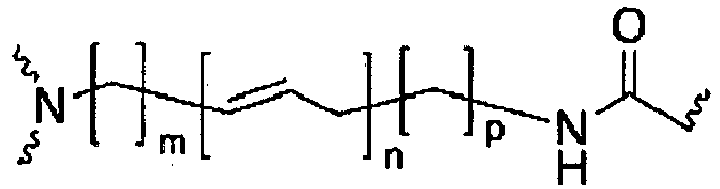


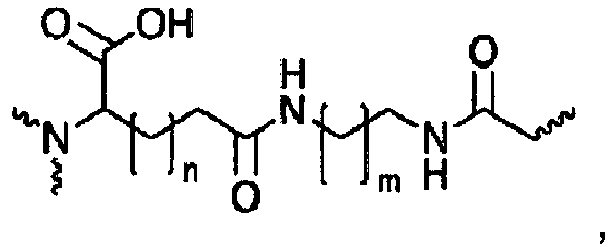


- Advantageously, Y1, Y2, Y3 and Y4 are the same.
- In the above-mentioned formula, Z1, Z2, Z3 and Z4 are independently from each other a C1-C5 linear alkyl, i.e. Z1, Z2, Z3 and Z4 are independently from each other are a methyl group, an ethyl group, a propyl group, a butyl group or a pentyl group.
- Advantageously, Z1, Z2, Z3 and Z4 are the same.
- The above mentioned formula differ from the compounds known in the art, in particular from BioTASQ and PNADOTASQ by R1.
- R1 is (CH2)p-L-T, wherein p varies from 0 to 5, which means that R1 equals to -L-T, CH2-L-T, CH2-CH2-L-T, CH2-CH2-CH2-L-T, CH2-CH2-CH2-CH2-L-T and CH2-CH2-CH2-CH2-CH2-L-T.
- L is a linear or branched, saturated or not, C1-C12 alkyl, i.e. C1, C2, C3, C4, C5, C6, C7, C8, C9, C10, C11, C12 alkyl, aliphatic or aromatic, or PEG.
- T is a group allowing to carry out bioorthogonal reactions which refers to any chemical reaction that can occur inside of living systems without interfering with native biochemical processes.
- The bioorthogonal chemistry typically proceeds in two steps. First, a cellular substrate is modified with a bioorthogonal functional group (a chemical tag) and introduced to the cell; substrates include metabolites, enzyme inhibitors, small molecules, etc. The chemical tag must not alter the structure of the substrate dramatically to avoid affecting its bioactivity. Secondly, a probe containing the complementary functional group is introduced to react with the tag and label the substrate once in its binding site in cella.
- Although effective bioorthogonal reactions such as copper-assisted and copper-free click chemistry have been developed, new reactions are still under development to allow multiple methods of labeling to be used in the same biosystems.
- According to the invention, T is preferably an alkyne -C=CH or an azide and possibly a bicyclononyne (BCN CAS No 1263166-90-0) or a Dibenzocyclooctyne (DBCO CAS No 1255942-06-3) or one of their derivatives.
- The compounds of Formula I are isomeric forms including isomers, diastereoisomers and salts thereof. The term "salts" embraces salts prepared from an inorganic acid or from an organic acid. Examples of such inorganic acids are hydrochloric, hydrobromic, hydroiodic, nitric, carbonic, sulfuric, and phosphoric acid.
- Appropriate organic acids may be selected from aliphatic, cycloaliphatic, aromatic, araliphatic, heterocyclic, carboxylic and sulfonic classes of organic acids, example of which are formic, acetic, including trifluoraocetic, propionic, succinic, glycolic, gluconic, lactic, malic, tartaric, citric, ascorbic, glucuronic, maleic, fumaric, pyruvic, aspartic, glutamic, benzoic, anthranilic, p-hydroxybenzoic, salicyclic, phenylacetic, mandelic, embonic (pamoic), methanesulfonic, ethanesulfonic, 2-hydroxyethanesulfonic, pantothenic, benzenesulfonic, toluenesulfonic, sulfanilic, mesylic, cyclohexylaminosulfonic, stearic, algenic, β-hydroxybutyric, malonic, galactaric and galacturonic acid. All of these salts may be prepared by conventional means from the corresponding compound of Formula I by reacting, for example, the appropriate acid with the compound of Formula I.
- Certain compounds of the present invention including salts thereof can exist as solvated forms including hydrated forms such as monohydrate, dihydrate, hemihydrate, trihydrate, tetrahydrate and the like. The products may be true solvates, while in other cases, the products may merely retain adventitious solvent or be a mixture of solvate plus some adventitious solvent. It should be appreciated by those skilled in the art that solvated forms are equivalent to unsolvated forms and are intended to be encompassed within the scope of the present invention.
- The compounds according to the invention may be enantiomerically pure, such as a single enantiomer or a single diastereomer, or be stereoisomeric mixtures, such as a mixture of enantiomers, a racemic mixture, or a diastereomeric mixture. As such, one of skill in the art will recognize that administration of a compound in its (R) form is equivalent, for compounds that undergo epimerization in vivo, to administration of the compound in its (S) form. Conventional techniques for the preparation/isolation of individual enantiomers include chiral synthesis from a suitable optically pure precursor or resolution of the racemate using, for example, chiral chromatography, recrystallization, resolution, diastereomeric salt formation, or derivatization into diastereomeric adducts followed by separation.
- Advantageously, the invention relates to the compound as defined above, said compound being of formula II:

- Advantageous compounds, wherein Y1, Y2, Y3 and Y4 are the same are the following ones :


- Advantageously, the invention relates to the compound as defined above, said compound being of formula III:

- wherein B' is -W-(CH2)m-T, m varying from 1 to 6,
- and, W= CO, C(=O)-NH, C(=S)-NH, or a squaraine group , i.e. B' is -CO-(CH2)m-T, CO-NH-(CH2)m-T, CS-NH-(CH2)m-T,
- preferably W is CO,
- more preferably a compound of formula IIIa

- and Y1, Y2, Y3, Y4, T and R2 are as defined above.
- Advantageous compounds, wherein Y1, Y2, Y3 and Y4 are the same are the following ones :


- More advantageously, the invention relates to the compound as defined above, of formula IV:


- More advantageously, the invention relates to the compound as defined above, of formula V:

in particular the compound of formula Va: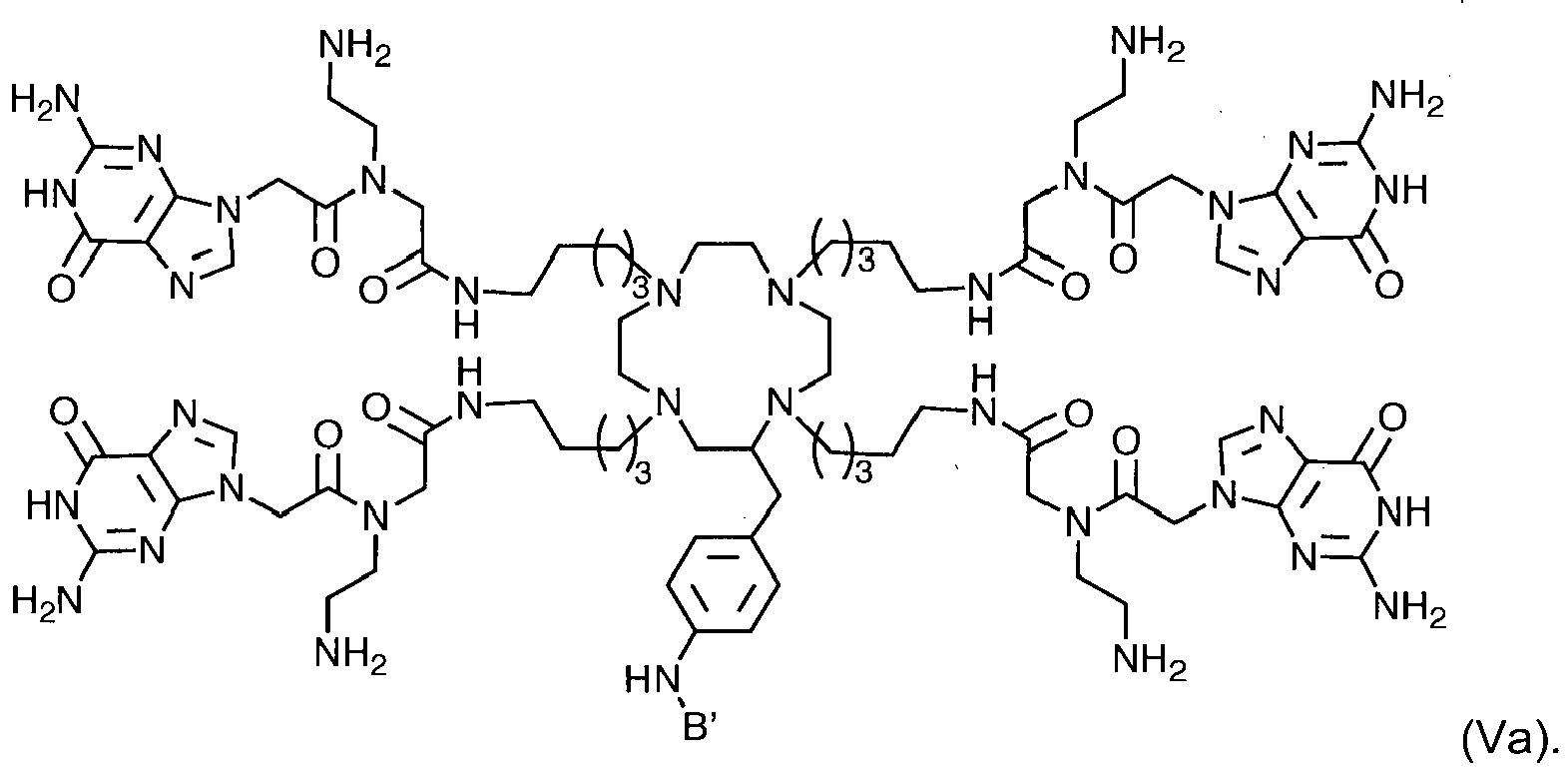
- The invention relates advantageously to the compound as defined above, having one of the following formula :


- All these compounds are novel, and does not belong to the prior art.
- Advantageously, the invention relates to a compound as defined above coupled by click chemistry to
- Fluorescent imaging probes, such as cyanine, fluorescein, rhodamine, bodipy derivatives,
- a biotin derivative, provided that said compound is not BioTASQ of formula XIX

- a biological support such as for example entire antibody type biological molecules, fragments of antibodies, peptides, oligonucleotide, sugar moieties, or
- a solid support such as graphene or biochips.
- The compounds defined above are link via the T moiety (or azide or alkyne moiety) to a other molecule, the linking being carried out via click chemistry.
- Click chemistry defines in the invention any chemospecific and quantitative reaction that can be carried out in a biological sample, on physiological conditions.
- Click chemistry involves the use of a modular approach and has important applications in the field of drug discovery, combinatorial chemistry, target-templated in situ chemistry, and DNA research. Of the reactions comprising the click chemistry scope, the pioneering example is the copper-catalyzed azide-alkyne cycloaddition to form 1,4-disubsituted-1,2,3-triazoles. The copper(I)-catalyzed reaction is mild and very efficient, requiring no protecting groups, and requiring no purification in many cases.
- The azide and alkyne functional groups are largely inert towards biological molecules and aqueous environments, which allows the use of the copper-catalyzed azide-alkyne cycloaddition in target-guided synthesis and activity-based protein profiling.
- The triazole has similarities to the ubiquitous amide moiety found in nature, but unlike amides, is not susceptible to cleavage. Additionally, they are nearly impossible to oxidize or reduce.
- Examples of compounds resulting from the click chemistry by using the compound according to the invention can be, without limitation:


- In one aspect, the invention relates to a method for detecting G-quadruplexes via the use of a suited kit combined with classical imaging techniques. In one advantageous embodiment, the invention relates to a kit comprising, consisting essentially of, or consisting of a compound according to the above-mentioned definition in association with partners allowing for performing in situ click chemistry.
- The invention relates a kit comprising, consisting essentially of, or consisting of a compound according to the above-mentioned definition (MultiTASQ) in solution, in association with a compatible compound allowing click chemistry also in solution, which include (in a non-exhaustive manner) MultiTASQ plus Biotin-PEG(3)-N3, DBCO-PEG(4)-Biotin or Biotin-PEG(4)-alkyne for instance for purification purposes, and MultiTASQ plus Fluor 488-Alkyne, Cy3-alkyne or Dibenzocyclooctyne-PEG4-Fluor 545 for instance for detection purposes.
- The components of the above-mentioned kit can be used simultaneously, separately or sequentially.
- In one other aspect, the invention relates to a method for isolating and/or purifying G-quadruplexes, comprising a step of contacting a G-quadruplex structure with a compound as defined above.
- As mentioned above, the compounds according to the invention (MultiTASQ) are able to interact with G-quadruplex structures, forming a complex that could be isolated and/or purified.
- As the compounds according to the invention contain a moiety allowing to carry out click chemistry, it is possible add a compound according to the invention that allows for isolation or purification, including a biotin or a derivative, proteins such as Glutathione-S-transferase (GST), or protein tags such as Myc tag, VSVG-tag, His-tag, Ha-tag, Flag-tag... this list is not limitative and the skilled person could easily determine which molecule would have to be "clicked" to the compound according to the invention in order to allow the purification of the said compound, and therefore the molecule that interact with.
- Depending on the mean attached to the compound according to the invention, the skilled person could carry out the steps allowing an isolation and/or a purification.
- The invention relates also to the use of a compound as defined above in order to purify, in particular in vitro, a G-quadruplex forming sequence.
- The invention also relates to a method for identifying molecules for in vitro, in vivo and/or ex vivo imaging, comprising a G quadruplex structure, said method comprising a first step of contacting a G-quadruplex to be identified/purified with a compound as defined above, and a step of coupling said compound with a fluorophore, a biotin derivative, a solid or biological support.
- In situ click-based detection method involving compounds according to the invention, allows for detecting G4 structures in cells. The method is based on live- or post-fixation incubation of cells with the compounds of invention, followed by a click chemistry step according to the invention.
- The invention relates also to the use of a compound as defined above for identifying molecules for in vitro, in vivo and/or ex vivo imaging, comprising a G quadruplex structure.
-
- [
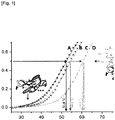
Fig. 1] Figure 1 represents FRET-melting curves of experiments performed with the doubly labelled quadruplex F21T (0.2 µM) in Caco.K buffer without (black curves - A) or with 5 molar equivalents of TASQ (gray curves: PNADOTASQ (D): R = -H, X = -CONH-; BioTASQ (C): R = -CH2-NHCO-(CH2)4-C5H7N2OS; X = -CONH; and MultiTASQ (B): R = -CH2-NHCO-(CH2)3-CC; X = -CH2-CH2-. Thermal stabilization, expressed as ΔT1/2 (in °C) are indicated for each TASQ (BioTASQ: 2.2 °C, MultiTASQ: 8.9 °C and PNADOTASQ: 9.1 °C). Y-axis : Normalized FAM expression; X-axis : Temperature in °C. *** : FRET. - [
Fig. 2] Figure 2 represents optical images of MCF-7 cells untreated (control: 1) or live-incubated with MultiTASQ (100 µM, 2-4:fields fields 1, 2 and 3) after fixation (PFA) and in situ click reactions performed with AlexaFluor488-azide® (1 µM) catalyzed by copper (CuSO4, 4 mM). Nuclei are counterstained with DAPI (light gray); accumulation of MultiTASQ highlighted by arrows in zooms a-d. -

- To a solution of Boc-PNAG(Z)-OH (1 g, 1.84 mmol) in methanol (50 mL) was added Pd/C (39.1 mg, 20 mol %). The suspension was stirred overnight at room temperature under H2. The solid was then filtered over dicalite and washed with methanol. The residue was concentrated under reduced pressure to afford Boc-PNAG-OH as a white solid (540 mg, 1.31 mmol, 72 %).
ESI-LRMS: [M+H]+ m/z = 410.82 (calcd. for C16H23N7O6 :410.40). 1H NMR (500 MHz, d6-DMSO): δ 1.37 (s, 9H), 3.20-3.80 (m, 4H), 3.99 (s, 2H), 4.85 (s, 2H), 6.46 (s, 2H), 6.95 (m,1H), 7.51 (s, 1H), 10.59 (s, 1H). -

- To a solution of 5-aminopentanol (1 g, 9.7 mmol) in CH2Cl2 (100 mL) was added triethylamine (1.5 mL, 10.7 mmol, 1.1 equiv.) and the solution was cooled down to 0°C with an ice bath. Di-tert-butyl dicarbonate (2.114 g, 9.7 mmol, 1 equiv.) was added portion-wise and the solution was allowed to warm to RT and stir overnight at RT. The reaction completion was monitored and the reaction was added silica and the solvent was evaporated. The residue was purified by silica gel chromatography (CH2Cl2/
MeOH 4% to 6%) to afford 5-((tert-butoxycarbonyl)amino)pentanol in 93% yield. 5-((tert-butoxycarbonyl)amino)pentanol (1 g, 4.5 mmol) was then dissolved in a mixture of THF (40 mL), pyridine was added (2mL, 45.2 mmol, 10 equiv.), and MsCI (2mL, 45.2 mmol, 10 equiv.) was added dropwise. The solution was allowed to stir over 48h at RT. - The THF was evaporated under vacuo, the mixture was then added 30 mL of ethyl acetate and 60 ml of acidified brine (30 mL of
aq solution HCl 1M and 30 mL of brine). The aqueous phase was extracted 3 times with ethyl acetate (30 mL each), the organic phases were pooled together, dried over MgSO4, filtered, and dried under vacuo. The residue was purified by silica gel chromatography (CH2Cl2/MeOH 4% to 6%) to afford 5-((tert-butoxycarbonyl)amino)pentyl methylsulfonate in 57% yield (non optimised).
1H NMR (500 MHz, Chloroform-d) δ 4.16 (t, J = 6.4 Hz, 2H), 3.06 (t, J = 6.4 Hz, 2H), 2.94 (s, 3H), 1.80 - 1.60 (m, 2H), 1.49 - 1.42 (m, 2H), 1.38 (s, 9H). -

- To a solution of hexynoic acid (136 mg, 134 µL, 1.2 mmol, 1 equiv.) and DIPEA (315 µL, 2.4 mmol, 2 equiv.) in DMF (4 mL) was added TSTU (404 mg, 1.3 mmol, 1.1 equiv.) and the solution was allowed to stir 1h until complete conversion of the starting material. To a solution of AMC (aminomethylcyclene) in DMF at 0°C was added dropwise the latter reaction mixture containing N-hydroxysuccinimide hex-5-ynoate (1 mL/3 hrs). The reaction was carefully monitored by RP-HPLC and quenched by addition of TFA (466 µL, 5 equiv.) as soon as disubstituted AMC appeared in the chromatogram. The solution was then concentrated under vacuum, added water and purified by RP-HPLC in a H2O/MeCN + 0.1% TFA mixture (gradient of 1 to 25 % over 20 minutes). After evaporation of the solvents, the AMC derivative was obtained (259 mg, 0.876 mmol, 72 % yield) (exact amount of TFA not quantified).
1H NMR (500 MHz, D2O): δ. 3.26 (d, J = 5.6 Hz, 1H), 3.14 - 2.61 (m, 15H), 2.26 (t, J = 7.4 Hz, 2H), 2.21 (t, J = 2.7 Hz, 1H), 2.09 (td, J = 7.0, 2.7 Hz, 2H), 1.65 (td, J = 7.4, 7.0 Hz, 2H). 13C NMR (151 MHz, D2O): δ. 177.04, 162.83, 162.60, 119.09, 117.16, 115.23, 84.58, 69.91, 52.26, 46.42, 44.34, 44.18, 43.89, 42.67, 42.08, 40.51, 39.01, 34.38, 23.75, 17.04. ESI-HRMS: [M+H]+ m/z = 296.2434 (calcd. for C15H30N5O: 296.2450). -

- To a solution of previously prepared AMC derivative (47.2 mg, 0.16 mmol, 1 equiv.) in MeCN (1.16 mL) was added 5-((tert-butoxycarbonyl)amino)pentyl methanesulfonate (360 mg, 1.28 mmol, 8 equiv.) and K2CO3 (176 mg, 1.28 mmol, 8 equiv.) and the solution was allowed to stir for 48 h until complete conversion of the starting material. The crude mixture was filtered, and concentrated under vacuum, added water, and purified by RP-HPLC in a H2O/MeCN + 0.1% TFA mixture (gradient of 1 to 100 % over 20 minutes). After evaporation of the solvents, the compound 19 was obtained (75.2 mg, 0.07 mmol, 45 % yield) (exact amount of TFA not quantified).
ESI-HRMS: [M+H]+ m/z = 1036.8098 (calc. for C55H105N9O9: 1035.8035). -

- A solution of compound 19 was stirred with 2 ml of TFA during 1 hour. After evaporation of the TFA, the unprotected compound 19 was obtained 78.5 mg, 0.072 mmol, 100 % yield) (exact amount of TFA not quantified). HPLC-MS profiles page 33). Boc-PNAG-OH (145.55 mg, 0.35 mmol, 4.5 equiv.) and TSTU (107.04 mg, 0.35 mmol, 4.5 equiv.) were dissolved in DMF (1 mL), DIPEA was added (61 µL, 4 equiv.). After 1 hour, a solution of the deprotected AMC derivative (70.2 mg, 0.09 mmol, 1 equiv.) and DIPEA (61 µL, 4 equiv.) in DMF (1 mL) was added to the mixture. The mixture was stirred at RT for 3 days. The solution was then concentrated under vacuum, added water (2mL), and purified by RP-HPLC in a H2O/MeCN + 0.1% TFA mixture (gradient of 1 to 50 % over 20 minutes). After evaporation of the solvents, the compound protected MultiTASQ was obtained (14.3 mg, 0.006 mmol, 8 % yield) (exact amount of TFA not quantified).
ESI-HRMS: [M+H]+ m/z = 2202.2475 (calc. for C99H157N37O21 : 2201.2427). 1H NMR (500 MHz, DMSO-d 6): δ 10.80 - 10.62 (m, 4H), 8.09 (s, 3H), 7.86 (d, J = 19.7 Hz, 2H), 7.59 (s, 3H), 6.48 (s, 8H), 4.95 (s, 3H), 4.79 (d, J = 10.1 Hz, 3H), 4.17 (s, 2H), 4.10 (s, 2H), 3.90 (s, 2H), 3.86 (s, 3H), 3.71 (s, 2H), 3.61 (m, 4H), 3.46 (s, 3H), 3.26 (d, J = 7.0 Hz, 2H), 3.21 (d, J = 7.0 Hz, 5H), 3.13 (m, 7H), 3.03 (d, J = 12.3 Hz, 8H), 2.97 (s, 4H), 2.88 (s, 3H), 2.79 - 2.70 (m, 5H), 2.68 (s, 2H), 2.60 - 2.51 (m, 9H), 2.17 (d, J = 17.0 Hz, 4H), 1.72 - 0.98 (m, 64H). -

- The protected MutiTASQ was stirred with 2mL of TFA during 1hour. After evaporation of the TFA, tituration in diethyl ether and drying under reduced pressure, the desired compound MultiTASQ was obtained 11 mg, 0.0064 mmol, 100 % yield (exact amount of TFA not quantified). ESI-HRMS: [M+2H]2+ m/z = 901.0192 (calc. for C79H125N37O13: [M+2H]2+=901.0128).
-> Of note, Freshly prepared MultiTASQ aliquots must be prepared just before used. Protected MultiTASQ is the privileged form for being stored. - The lyophilized DNA strands (purchased from Eurogentec, Seraing, Belgium) were firstly diluted at 500µM in deionized water (18.2 MΩ.cm resistivity). The DNA batch was prepared in a Caco.K buffer, comprised of 10 mM lithium cacodylate buffer (pH 7.2) plus 10 mM KCI/90 mM LiCI.
- The quadruplex structure was prepared by mixing 40 µL of the constitutive strand (500µM) with 8µL of a lithium cacodylate buffer solution (100 mM, pH 7.2), plus 8 µL of a KCI/LiCI solution (100 mM/900 mM) and 24 µL of water. The final DNA concentration was theoretically 250 µM. The actual concentration of the DNA was determined through a dilution to 1µM theoretical concentration through UV spectral analysis at 260 nm (after 5 min at 90°C) with the following molar extinction coefficient values: 268300 M-1.cm-1 (F21T). The higher-order DNA structure was folded as follows: solutions were heated (90°C, 5 min), cooled on ice (7 h) and then stored at least overnight (4°C). FRET-melting experiments were performed in a 96-well format using a Mx3005P qPCR machine (Agilent) equipped with FAM filters (λex = 492 nm;λem = 516 nm) in 100 µL (final volume) of Caco.K buffer with 0.2 µM of labeled oligonucleotide and 1 µM of TASQ (PNADOTASQ, BioTASQ and MultiTASQ). After a first equilibration step (25°C, 30 s), a stepwise increase of 1°C every 30s for 65 cycles to reach 90°C was performed, and measurements were made after each cycle. Final data were analyzed with Excel (Microsoft Corp.) and OriginPro®9.1 (OriginLab Corp.). The emission of FAM was normalized (0 to 1), and T1/2 was defined as the temperature for which the normalized emission is 0.5; ΔT1/2 values are means of 3 experiments (
Figure 1 ). - The apparent affinity of each G4-ligands is quantified via fluorescence resonance energy transfer (FRET)-melting experiments.
- PNADOTASQ, BioTASQ and MultiTASQ were thus assayed against the dual-labeled F-21-T FAM-d[seq]-TAMRA, wherein [seq] is 5'GGGTTAGGGTTAGGGTTAGGG3' (SEQ ID NO: 1), in a dose-response manner (experiments were performed with 1 and 5 µM ligand versus 0.2 µM DNA, i.e. 5 and 25 mol. equiv. ligand). Results seen in
Figure 1 show that the quadruplex-stabilizing capacity (or apparent G-quadruplex affinity) of MultiTASQ (compound according to the invention) is restored as compared to BioTASQ (ΔT1/2 = 8.9 versus 2.2 °C for MultiTASQ and BioTASQ, respectively), in a manner that is comparable to the results obtained with the parent compound PNADOTASQ. - By using the compounds according to the invention, the inventors intended to detect, by fluorescent imaging, in situ localization of G-quadruplex containing molecules.
- MCF7 cell line were obtained from the American Type Culture Collection (ATCC). Cells were cultured in 75 cm2 flasks (Corning) in DMEM (Life Technologies) supplemented with 5% synthetic feta bovine serum (FetalClone III, GE LifeSciences) and 100 U penicillin-streptomycin mixture (1.0 U.mL-1Pen/1.0 mg.mL-1 Strep) at 37 °C in a humidified, 5% CO2 atmosphere-controlled incubator (HERAcell). The standard protocols were used for subculturing the cells: aspiration of medium, PBS (Gibco) wash, trypsinization in Trypsin-EDTA (0.25%) and reseeding in appropriate density. All cell counting was performed using the Coulter Counter (Beckman Coulter).
- MCF-7 cells were seeded on chambered coverglass (24 well-plate) and allowed to recover for 24 h. Cells were incubated with 100µM MultiTASQ at 37 °C. After 4 h, cells were fixed and permeabilized with paraformaldehyde (2%solubilized in 0.1% Triton X-100/PBS) for 5 min at room temperature. Treated cells were incubated during 30min at room temperature with 1 µM alexafluor488-azide® + Igepal® 0,05% in PBS + 4mM CuSO4 + 10mM Sodium ascorbate and rinsed with PBS 1X (thrice 5 min). Nuclei are counterstained with DAPI (1µg/mL, 5 min). Cells were washed with PBS and mounted with Fluoromount-G (Southern Biotech). Confocal microscopy was performed either on a Zeiss LSM700 or on a Leica DMi8 microscope with the appropriate filters using the 63 x objective. Foci quantification is done using Leica software.
- MCF7 cells were seeded at 3.5x10⁵ cells per 10-cm dish for 72h. Cells were then crosslinked using 1% formaldehyde/PBS for 5 min at 25 °C and the crosslinking was then quenched with 0.125 M glycine for 5 min. Cells were scraped and resuspended in G4RP buffer (150 mM KCI, 25 mM Tris pH7.4, 5 mM EDTA, 0.5 mM DTT, 0.5% NP40, RNase inhibitor (Roche), homebrew protease inhibitor cocktail). Cells were then sonicated using Covaris m220 Ultrasonicator using default settings at 10% duty for 2 min. The sonicated fractions were then incubated with pre-clicked biotin conjugated beads (150µM Biotin azide (Sigma), 5mM E301 (Sigma), 4mM CuSO4, 25µM MultiTASQ (or 25 µM biotin for negative control)) overnight at 4°C. 10 µg of streptavidin-magnetic beads (Promega) was added and the extract was incubated for 2h at 4°C. Magnetic beads were then washed 4 times in G4RP buffer for 5 min. The beads were then incubated at 70 °C for 1 h to reverse crosslink. TRIZOL was then used to extract the RNA from the beads using manufacturer's instructions.
- The in situ click images seen in
Figure 2 shown that MultiTASQ enters cells (live incubation) and accumulates in perinuclear regions (arrows) in a manner that was already described with the intrinsically fluorescent N-TASQ probe. More precisely, MultiTASQ interacts with accessible RNA G-quadruplexes within the cytoplasmic compartment, thereby altering their functionalities. As a consequence, ineffective RNA bound to TASQ accumulates in cytoplasmic granules known as processing bodies (or P-bodies), in which they will be either processed or degraded. This events thus triggers the accumulation of RNA/TASQ in clearly defined cytoplasmic foci, making them readily detectable via in situ click imaging after copper-catalyzed cycloaddition of alexafluor488-azide.
Claims (11)
- Compound of formula I :
 - A is absent or is a metallic cation, in particular a lanthanide used for optical imaging, in particular Eu3+, Tb3+, Dy3+, or Yb3+ ;- X1, X2 and X4 are, independently from each other a C1-C3 linear alkyl;- X3 is a C2-C3 alkyl, substituted by R1;- Y1, Y2, Y3 and Y4 are independently from each other a C1-C10 alkyl, saturated or not, substituted or not by an acid group, possibly with a substitution of at least one carbon atom by N, P, a phenyl, a C=O group, phosphonate group, or a triazole group;- Z1, Z2, Z3 and Z4 are independently from each other a C1-C5 linear alkyl;- R1 is (CH2)p-L-T, whereinp varies from 0 to 5; andL is a linear or branched, saturated or not, C1-C12 alkyl, possibly with a substitution of at least one carbon by: a C=O group or an heteroatom, an aryl group possibly substituted, a triazole group, or a diazirin group;T is a group allowing to carry out bioorthogonal reactions, in particular the following groups: azide, tetrazine substituted or not, alkyne, constrained alkyne such as cyclooctyne or cyclononyne, and in particular dibenzocyclooctyne, bicyclononyne, constrained cycloalkenes, such as trans-cyclooctene, norbornene, cycloproprene,- R2 is H, or (CH2)m-NHRx, wherein m varies from 1 to 4 and Rx is H or a protecting group such as Boc, Fmoc, Carboxybenzyl, or a guanidinium group,or a salt or a solvate thereof.
 - Compound according to claim 2, said compound being of formula II:

- Compound according to claim 1, said compound being of formula III:
 wherein B' is -W-(CH2)m-T, m varying from 1 to 6,W= CO, C(=O)-NH, C(=S)-NH, or a group squaraine preferably CO, andY1, Y2, Y3, Y4, T and R2 are as defined in claim 1.
 - Compound according to claim 1 or 2, of formula IV:
 wherein B' is -(CO)-(CH2)m-T, m varying from 1 to 6, andR2 are as defined in claim 1,in particular the compound of formula IVa: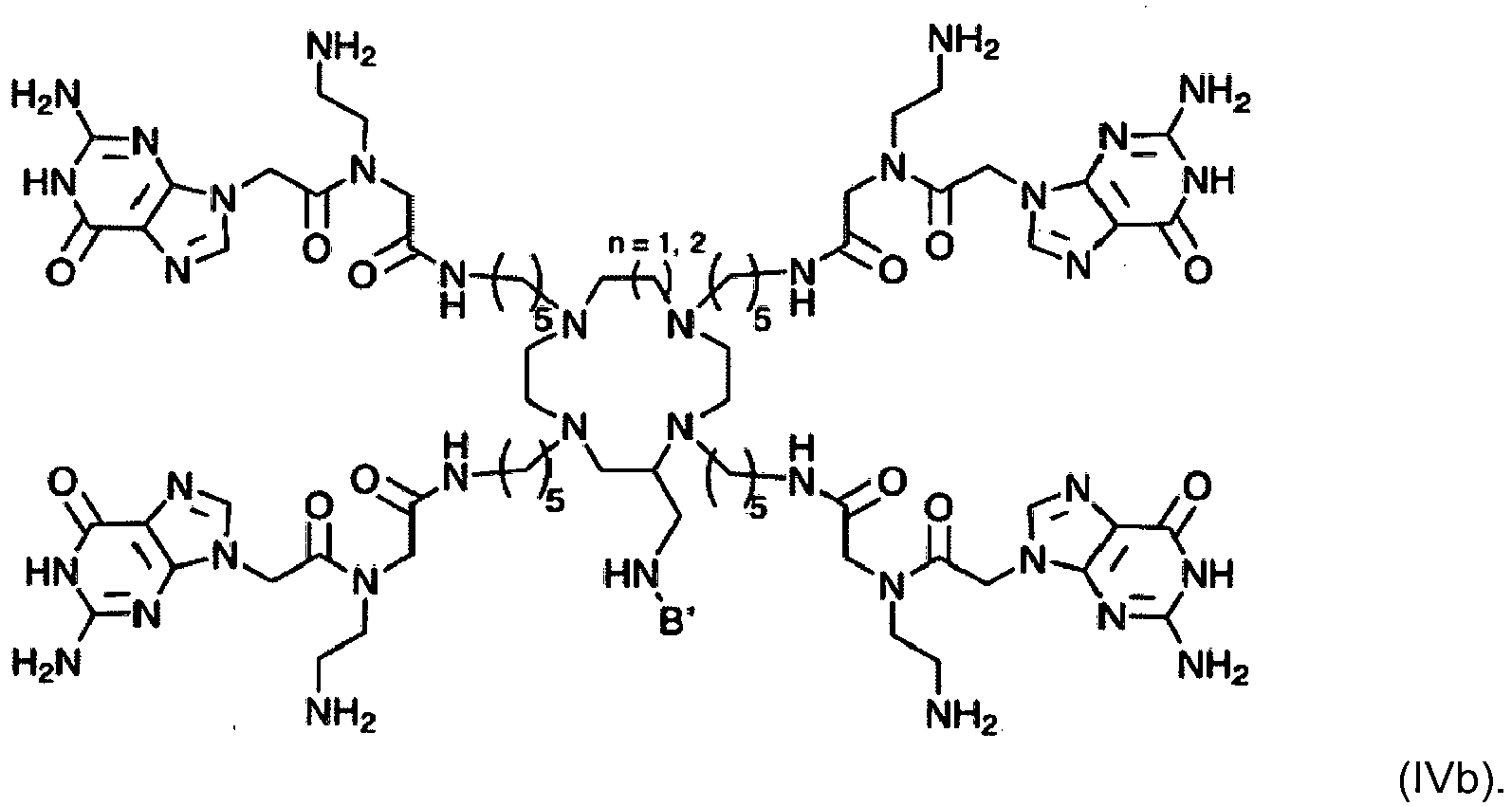
- Compound according to claim 1 or 3, of formula V:
 wherein B' is -(CO)-(CH2)m-T, m varying from 1 to 6, andR2 are as defined in claim 1,in particular the compound of formula Va:
- Compound according to anyone of claims 1 to 5, said compound having one of the following formula:


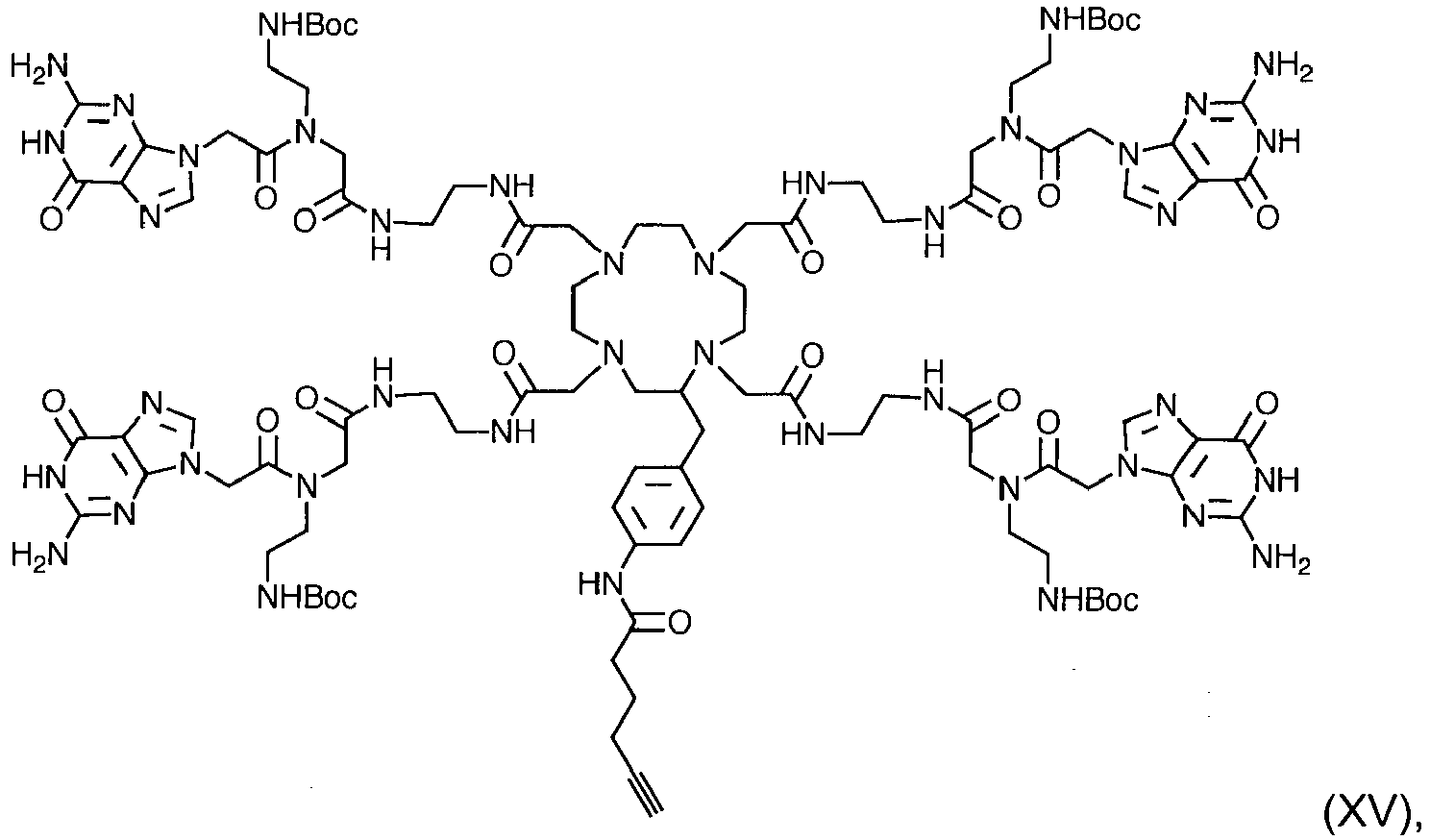


- Compound according to anyone of claims 1 to 6 coupled by click chemistry to- Fluorescent imaging probes, such as cyanine, fluorescein, rhodamine, bodipy derivatives,- a biotin derivative,- a biological support such as for example entire antibody type biological molecules, fragments of antibodies, peptides, oligonucleotide, sugar moieties, or- a solid support such as graphene or biochips.
- Compound according to claim 7 having one of the following formula:


- Kit comprising- a compound according to anyone claims 1 to 6, and- in association with a compatible compound allowing click chemistry.
- Method for identifying molecules for purifying molecules comprising a G quadruplex, said method comprising a step of contacting a molecule to be identified/purified with a compound according to anyone of claims 1 to 7.
- Method for identifying molecules for in vitro and/or ex vivo imaging molecules comprising a G quadruplex structure, said method comprising a first step of contacting a molecule comprising a G quadruplex structure to be identified with a compound according to anyone of claims 1 to 6,
and a step of coupling said compound with a fluorophore, a biotin derivative, solid or biological support.
Priority Applications (4)
| Application Number | Priority Date | Filing Date | Title |
|---|---|---|---|
| EP20315084.2A EP3889155A1 (en) | 2020-03-31 | 2020-03-31 | Biomimetic g-quartet compounds |
| EP21717770.8A EP4126865A1 (en) | 2020-03-31 | 2021-03-30 | Biomimetic g-quartet compounds |
| US17/915,713 US20230135545A1 (en) | 2020-03-31 | 2021-03-30 | Biomimetic g-quartet compounds |
| PCT/EP2021/058268 WO2021198239A1 (en) | 2020-03-31 | 2021-03-30 | Biomimetic g-quartet compounds |
Applications Claiming Priority (1)
| Application Number | Priority Date | Filing Date | Title |
|---|---|---|---|
| EP20315084.2A EP3889155A1 (en) | 2020-03-31 | 2020-03-31 | Biomimetic g-quartet compounds |
Publications (1)
| Publication Number | Publication Date |
|---|---|
| EP3889155A1 true EP3889155A1 (en) | 2021-10-06 |
Family
ID=70861371
Family Applications (2)
| Application Number | Title | Priority Date | Filing Date |
|---|---|---|---|
| EP20315084.2A Withdrawn EP3889155A1 (en) | 2020-03-31 | 2020-03-31 | Biomimetic g-quartet compounds |
| EP21717770.8A Pending EP4126865A1 (en) | 2020-03-31 | 2021-03-30 | Biomimetic g-quartet compounds |
Family Applications After (1)
| Application Number | Title | Priority Date | Filing Date |
|---|---|---|---|
| EP21717770.8A Pending EP4126865A1 (en) | 2020-03-31 | 2021-03-30 | Biomimetic g-quartet compounds |
Country Status (3)
| Country | Link |
|---|---|
| US (1) | US20230135545A1 (en) |
| EP (2) | EP3889155A1 (en) |
| WO (1) | WO2021198239A1 (en) |
-
2020
- 2020-03-31 EP EP20315084.2A patent/EP3889155A1/en not_active Withdrawn
-
2021
- 2021-03-30 US US17/915,713 patent/US20230135545A1/en active Pending
- 2021-03-30 WO PCT/EP2021/058268 patent/WO2021198239A1/en not_active Ceased
- 2021-03-30 EP EP21717770.8A patent/EP4126865A1/en active Pending
Non-Patent Citations (15)
| Title |
|---|
| AURELIEN LAGUERRE ET AL: "Synthetic G-Quartets as Versatile Nanotools for the Luminescent Detection of G-Quadruplexes", CHIMIA INTERNATIONAL JOURNAL FOR CHEMISTRY, vol. 69, no. 9, 30 September 2015 (2015-09-30), CH, pages 530 - 536, XP055716240, ISSN: 0009-4293, DOI: 10.2533/chimia.2015.530 * |
| CHEMICAL ABSTRACTS, Columbus, Ohio, US; abstract no. 1255942-06-3 |
| CHRISTIAN VANASSCHEN ET AL: "Gadolinium DOTA Chelates Featuring Alkyne Groups Directly Grafted on the Tetraaza Macrocyclic Ring: Synthesis, Relaxation Properties, "Click" Reaction, and High-Relaxivity Micelles", INORGANIC CHEMISTRY, vol. 50, no. 18, 19 September 2011 (2011-09-19), EASTON, US, pages 8946 - 8958, XP055716350, ISSN: 0020-1669, DOI: 10.1021/ic2010997 * |
| CURR. GENE THER., vol. 16, 2016, pages 220 |
| ISALINE RENARD ET AL: "Small-molecule affinity capture of DNA/RNA quadruplexes and their identification in vitro and in vivo through G4RP protocol: Supplementary data", 5 April 2019 (2019-04-05), XP055716248, Retrieved from the Internet <URL:https://oup.silverchair-cdn.com/oup/backfile/Content_public/Journal/nar/47/11/10.1093_nar_gkz215/1/gkz215_supplemental_file.pdf?Expires=1598258941&Signature=3xzMwyp5UtKrSjcNGBnmwBMglVAGX801kFT7bWwra-2qtvtNsSbaSJpaYqfddu-qZ~W22aXltXmB902qOGsMr72qpuoXvfxmO6wEGZdCwR5fjHqQaj62HKeWqq~FlmUyvGZ~SPTw9VVfKDi> [retrieved on 20200720] * |
| ISALINE RENARD ET AL: "Small-molecule affinity capture of DNA/RNA quadruplexes and their identification in vitro and in vivo through the G4RP protocol", NUCLEIC ACIDS RESEARCH, vol. 47, no. 11, 20 June 2019 (2019-06-20), pages 5502 - 5510, XP055716243, ISSN: 0305-1048, DOI: 10.1093/nar/gkz215 * |
| NAT. BIOTECHNOL., vol. 33, 2015, pages 877 |
| NAT. COMMUN., vol. 9, 2018, pages 4730 |
| NAT. GENET., vol. 48, 2016, pages 1267 |
| NAT. METH., vol. 13, 2016, pages 841 |
| NAT. REV. MOL. CELL BIOL., vol. 18, 2017, pages 279 |
| NATURE, vol. 319, 1986, pages 618 |
| SUNNY Y. YANG ET AL: "Supplementary section. Transcriptome-wide identification of transient RNA G-quadruplexes in human cells", NATURE COMMUNICATIONS, vol. 9, no. 1, 1 December 2018 (2018-12-01), XP055716251, DOI: 10.1038/s41467-018-07224-8 * |
| SUNNY Y. YANG ET AL: "Transcriptome-wide identification of transient RNA G-quadruplexes in human cells", NATURE COMMUNICATIONS, vol. 9, no. 1, 9 November 2018 (2018-11-09), pages 1 - 11, XP055716252, DOI: 10.1038/s41467-018-07224-8 * |
| YANG ET AL., NAT COMMUN, vol. 9, 2018, pages 4730 |
Also Published As
| Publication number | Publication date |
|---|---|
| EP4126865A1 (en) | 2023-02-08 |
| WO2021198239A1 (en) | 2021-10-07 |
| US20230135545A1 (en) | 2023-05-04 |
Similar Documents
| Publication | Publication Date | Title |
|---|---|---|
| USRE47539E1 (en) | Aza-dibenzocyclooctynes and methods of making and using same | |
| EP2782916B1 (en) | Carboxy x rhodamine analogs | |
| EP2748173B1 (en) | Cell permeable, fluorescent dye | |
| Song et al. | Development of an endoplasmic reticulum-targeting fluorescent probe for the imaging of polarity in living cells and tissues | |
| EP3000898B1 (en) | Drug target capturing method | |
| Pradère et al. | Chemical Synthesis of Mono‐and Bis‐Labeled Pre‐MicroRNAs | |
| US20150316557A1 (en) | Coumarin-based fluorogenic agents and uses thereof for specific protein labelling | |
| Means et al. | Structure–activity studies of oxazolidinone analogs as RNA-binding agents | |
| US8440835B2 (en) | Environmentally sensitive fluorophores | |
| WO2008106104A2 (en) | Environmentally sensitive fluorophores | |
| EP3889155A1 (en) | Biomimetic g-quartet compounds | |
| Baibek et al. | Wash‐free, peptide‐based fluorogenic probes for microbial imaging | |
| CA3232496A1 (en) | S- and se- adenosyl-l-methionine analogues with activated groups for transfer by methyltransferases on target biomolecules | |
| CN105295896B (en) | The capsaicine fluorescence probe and its synthetic method of a kind of specific marker and application | |
| Matuszewski et al. | Efficient conversion of N 6-threonylcarbamoyladenosine (t 6 A) into a tRNA native hydantoin cyclic form (ct 6 A) performed at nucleoside and oligoribonucleotide levels | |
| EP1991546B1 (en) | NOVEL DIBENZO[c,h][1,5]NAPHTHYRIDINES AND THEIR USE AS DNA PROBES | |
| WO2024010977A1 (en) | Bifacial peptide nucleic acid probes and methods of using thereof | |
| WO2009115288A1 (en) | Thiostrepton probe | |
| US8119364B2 (en) | Methods for generating analogs of coenzyme A | |
| Sawatani et al. | Sequence-specific DNA binding by long hairpin pyrrole–imidazole polyamides containing an 8-amino-3, 6-dioxaoctanoic acid unit | |
| US9958452B2 (en) | Highly fluorogenic protein labelling agents | |
| US20250230179A1 (en) | Phosphoramidite compounds and methods for preparing synthetic nucleic acids | |
| LU601545B1 (en) | A cysteine selective probe and its preparation method | |
| Musumeci et al. | New synthesis of PNA–3′ DNA linker monomers, useful building blocks to obtain PNA/DNA chimeras | |
| CN114349800B (en) | Ferrocene derivative and synthetic method and application thereof |
Legal Events
| Date | Code | Title | Description |
|---|---|---|---|
| PUAI | Public reference made under article 153(3) epc to a published international application that has entered the european phase |
Free format text: ORIGINAL CODE: 0009012 |
|
| STAA | Information on the status of an ep patent application or granted ep patent |
Free format text: STATUS: THE APPLICATION HAS BEEN PUBLISHED |
|
| AK | Designated contracting states |
Kind code of ref document: A1 Designated state(s): AL AT BE BG CH CY CZ DE DK EE ES FI FR GB GR HR HU IE IS IT LI LT LU LV MC MK MT NL NO PL PT RO RS SE SI SK SM TR |
|
| STAA | Information on the status of an ep patent application or granted ep patent |
Free format text: STATUS: THE APPLICATION IS DEEMED TO BE WITHDRAWN |
|
| 18D | Application deemed to be withdrawn |
Effective date: 20220407 |