EP3888967B1 - Power supply system and electric vehicle - Google Patents
Power supply system and electric vehicle Download PDFInfo
- Publication number
- EP3888967B1 EP3888967B1 EP21165499.1A EP21165499A EP3888967B1 EP 3888967 B1 EP3888967 B1 EP 3888967B1 EP 21165499 A EP21165499 A EP 21165499A EP 3888967 B1 EP3888967 B1 EP 3888967B1
- Authority
- EP
- European Patent Office
- Prior art keywords
- power
- output
- remaining
- battery
- threshold
- Prior art date
- Legal status (The legal status is an assumption and is not a legal conclusion. Google has not performed a legal analysis and makes no representation as to the accuracy of the status listed.)
- Active
Links
Images


Classifications
-
- B—PERFORMING OPERATIONS; TRANSPORTING
- B60—VEHICLES IN GENERAL
- B60L—PROPULSION OF ELECTRICALLY-PROPELLED VEHICLES; SUPPLYING ELECTRIC POWER FOR AUXILIARY EQUIPMENT OF ELECTRICALLY-PROPELLED VEHICLES; ELECTRODYNAMIC BRAKE SYSTEMS FOR VEHICLES IN GENERAL; MAGNETIC SUSPENSION OR LEVITATION FOR VEHICLES; MONITORING OPERATING VARIABLES OF ELECTRICALLY-PROPELLED VEHICLES; ELECTRIC SAFETY DEVICES FOR ELECTRICALLY-PROPELLED VEHICLES
- B60L1/00—Supplying electric power to auxiliary equipment of vehicles
-
- B—PERFORMING OPERATIONS; TRANSPORTING
- B60—VEHICLES IN GENERAL
- B60L—PROPULSION OF ELECTRICALLY-PROPELLED VEHICLES; SUPPLYING ELECTRIC POWER FOR AUXILIARY EQUIPMENT OF ELECTRICALLY-PROPELLED VEHICLES; ELECTRODYNAMIC BRAKE SYSTEMS FOR VEHICLES IN GENERAL; MAGNETIC SUSPENSION OR LEVITATION FOR VEHICLES; MONITORING OPERATING VARIABLES OF ELECTRICALLY-PROPELLED VEHICLES; ELECTRIC SAFETY DEVICES FOR ELECTRICALLY-PROPELLED VEHICLES
- B60L58/00—Methods or circuit arrangements for monitoring or controlling batteries or fuel cells, specially adapted for electric vehicles
- B60L58/10—Methods or circuit arrangements for monitoring or controlling batteries or fuel cells, specially adapted for electric vehicles for monitoring or controlling batteries
- B60L58/12—Methods or circuit arrangements for monitoring or controlling batteries or fuel cells, specially adapted for electric vehicles for monitoring or controlling batteries responding to state of charge [SoC]
-
- B—PERFORMING OPERATIONS; TRANSPORTING
- B60—VEHICLES IN GENERAL
- B60L—PROPULSION OF ELECTRICALLY-PROPELLED VEHICLES; SUPPLYING ELECTRIC POWER FOR AUXILIARY EQUIPMENT OF ELECTRICALLY-PROPELLED VEHICLES; ELECTRODYNAMIC BRAKE SYSTEMS FOR VEHICLES IN GENERAL; MAGNETIC SUSPENSION OR LEVITATION FOR VEHICLES; MONITORING OPERATING VARIABLES OF ELECTRICALLY-PROPELLED VEHICLES; ELECTRIC SAFETY DEVICES FOR ELECTRICALLY-PROPELLED VEHICLES
- B60L50/00—Electric propulsion with power supplied within the vehicle
- B60L50/50—Electric propulsion with power supplied within the vehicle using propulsion power supplied by batteries or fuel cells
- B60L50/60—Electric propulsion with power supplied within the vehicle using propulsion power supplied by batteries or fuel cells using power supplied by batteries
- B60L50/64—Constructional details of batteries specially adapted for electric vehicles
-
- B—PERFORMING OPERATIONS; TRANSPORTING
- B60—VEHICLES IN GENERAL
- B60K—ARRANGEMENT OR MOUNTING OF PROPULSION UNITS OR OF TRANSMISSIONS IN VEHICLES; ARRANGEMENT OR MOUNTING OF PLURAL DIVERSE PRIME-MOVERS IN VEHICLES; AUXILIARY DRIVES FOR VEHICLES; INSTRUMENTATION OR DASHBOARDS FOR VEHICLES; ARRANGEMENTS IN CONNECTION WITH COOLING, AIR INTAKE, GAS EXHAUST OR FUEL SUPPLY OF PROPULSION UNITS IN VEHICLES
- B60K35/00—Instruments specially adapted for vehicles; Arrangement of instruments in or on vehicles
- B60K35/20—Output arrangements, i.e. from vehicle to user, associated with vehicle functions or specially adapted therefor
- B60K35/21—Output arrangements, i.e. from vehicle to user, associated with vehicle functions or specially adapted therefor using visual output, e.g. blinking lights or matrix displays
- B60K35/22—Display screens
-
- B—PERFORMING OPERATIONS; TRANSPORTING
- B60—VEHICLES IN GENERAL
- B60K—ARRANGEMENT OR MOUNTING OF PROPULSION UNITS OR OF TRANSMISSIONS IN VEHICLES; ARRANGEMENT OR MOUNTING OF PLURAL DIVERSE PRIME-MOVERS IN VEHICLES; AUXILIARY DRIVES FOR VEHICLES; INSTRUMENTATION OR DASHBOARDS FOR VEHICLES; ARRANGEMENTS IN CONNECTION WITH COOLING, AIR INTAKE, GAS EXHAUST OR FUEL SUPPLY OF PROPULSION UNITS IN VEHICLES
- B60K35/00—Instruments specially adapted for vehicles; Arrangement of instruments in or on vehicles
- B60K35/20—Output arrangements, i.e. from vehicle to user, associated with vehicle functions or specially adapted therefor
- B60K35/28—Output arrangements, i.e. from vehicle to user, associated with vehicle functions or specially adapted therefor characterised by the type of the output information, e.g. video entertainment or vehicle dynamics information; characterised by the purpose of the output information, e.g. for attracting the attention of the driver
-
- B—PERFORMING OPERATIONS; TRANSPORTING
- B60—VEHICLES IN GENERAL
- B60K—ARRANGEMENT OR MOUNTING OF PROPULSION UNITS OR OF TRANSMISSIONS IN VEHICLES; ARRANGEMENT OR MOUNTING OF PLURAL DIVERSE PRIME-MOVERS IN VEHICLES; AUXILIARY DRIVES FOR VEHICLES; INSTRUMENTATION OR DASHBOARDS FOR VEHICLES; ARRANGEMENTS IN CONNECTION WITH COOLING, AIR INTAKE, GAS EXHAUST OR FUEL SUPPLY OF PROPULSION UNITS IN VEHICLES
- B60K35/00—Instruments specially adapted for vehicles; Arrangement of instruments in or on vehicles
- B60K35/80—Arrangements for controlling instruments
-
- B—PERFORMING OPERATIONS; TRANSPORTING
- B60—VEHICLES IN GENERAL
- B60L—PROPULSION OF ELECTRICALLY-PROPELLED VEHICLES; SUPPLYING ELECTRIC POWER FOR AUXILIARY EQUIPMENT OF ELECTRICALLY-PROPELLED VEHICLES; ELECTRODYNAMIC BRAKE SYSTEMS FOR VEHICLES IN GENERAL; MAGNETIC SUSPENSION OR LEVITATION FOR VEHICLES; MONITORING OPERATING VARIABLES OF ELECTRICALLY-PROPELLED VEHICLES; ELECTRIC SAFETY DEVICES FOR ELECTRICALLY-PROPELLED VEHICLES
- B60L50/00—Electric propulsion with power supplied within the vehicle
- B60L50/40—Electric propulsion with power supplied within the vehicle using propulsion power supplied by capacitors
-
- B—PERFORMING OPERATIONS; TRANSPORTING
- B60—VEHICLES IN GENERAL
- B60L—PROPULSION OF ELECTRICALLY-PROPELLED VEHICLES; SUPPLYING ELECTRIC POWER FOR AUXILIARY EQUIPMENT OF ELECTRICALLY-PROPELLED VEHICLES; ELECTRODYNAMIC BRAKE SYSTEMS FOR VEHICLES IN GENERAL; MAGNETIC SUSPENSION OR LEVITATION FOR VEHICLES; MONITORING OPERATING VARIABLES OF ELECTRICALLY-PROPELLED VEHICLES; ELECTRIC SAFETY DEVICES FOR ELECTRICALLY-PROPELLED VEHICLES
- B60L50/00—Electric propulsion with power supplied within the vehicle
- B60L50/50—Electric propulsion with power supplied within the vehicle using propulsion power supplied by batteries or fuel cells
- B60L50/60—Electric propulsion with power supplied within the vehicle using propulsion power supplied by batteries or fuel cells using power supplied by batteries
-
- B—PERFORMING OPERATIONS; TRANSPORTING
- B60—VEHICLES IN GENERAL
- B60L—PROPULSION OF ELECTRICALLY-PROPELLED VEHICLES; SUPPLYING ELECTRIC POWER FOR AUXILIARY EQUIPMENT OF ELECTRICALLY-PROPELLED VEHICLES; ELECTRODYNAMIC BRAKE SYSTEMS FOR VEHICLES IN GENERAL; MAGNETIC SUSPENSION OR LEVITATION FOR VEHICLES; MONITORING OPERATING VARIABLES OF ELECTRICALLY-PROPELLED VEHICLES; ELECTRIC SAFETY DEVICES FOR ELECTRICALLY-PROPELLED VEHICLES
- B60L58/00—Methods or circuit arrangements for monitoring or controlling batteries or fuel cells, specially adapted for electric vehicles
- B60L58/10—Methods or circuit arrangements for monitoring or controlling batteries or fuel cells, specially adapted for electric vehicles for monitoring or controlling batteries
- B60L58/12—Methods or circuit arrangements for monitoring or controlling batteries or fuel cells, specially adapted for electric vehicles for monitoring or controlling batteries responding to state of charge [SoC]
- B60L58/14—Preventing excessive discharging
-
- B—PERFORMING OPERATIONS; TRANSPORTING
- B60—VEHICLES IN GENERAL
- B60L—PROPULSION OF ELECTRICALLY-PROPELLED VEHICLES; SUPPLYING ELECTRIC POWER FOR AUXILIARY EQUIPMENT OF ELECTRICALLY-PROPELLED VEHICLES; ELECTRODYNAMIC BRAKE SYSTEMS FOR VEHICLES IN GENERAL; MAGNETIC SUSPENSION OR LEVITATION FOR VEHICLES; MONITORING OPERATING VARIABLES OF ELECTRICALLY-PROPELLED VEHICLES; ELECTRIC SAFETY DEVICES FOR ELECTRICALLY-PROPELLED VEHICLES
- B60L58/00—Methods or circuit arrangements for monitoring or controlling batteries or fuel cells, specially adapted for electric vehicles
- B60L58/10—Methods or circuit arrangements for monitoring or controlling batteries or fuel cells, specially adapted for electric vehicles for monitoring or controlling batteries
- B60L58/18—Methods or circuit arrangements for monitoring or controlling batteries or fuel cells, specially adapted for electric vehicles for monitoring or controlling batteries of two or more battery modules
-
- B—PERFORMING OPERATIONS; TRANSPORTING
- B60—VEHICLES IN GENERAL
- B60L—PROPULSION OF ELECTRICALLY-PROPELLED VEHICLES; SUPPLYING ELECTRIC POWER FOR AUXILIARY EQUIPMENT OF ELECTRICALLY-PROPELLED VEHICLES; ELECTRODYNAMIC BRAKE SYSTEMS FOR VEHICLES IN GENERAL; MAGNETIC SUSPENSION OR LEVITATION FOR VEHICLES; MONITORING OPERATING VARIABLES OF ELECTRICALLY-PROPELLED VEHICLES; ELECTRIC SAFETY DEVICES FOR ELECTRICALLY-PROPELLED VEHICLES
- B60L58/00—Methods or circuit arrangements for monitoring or controlling batteries or fuel cells, specially adapted for electric vehicles
- B60L58/10—Methods or circuit arrangements for monitoring or controlling batteries or fuel cells, specially adapted for electric vehicles for monitoring or controlling batteries
- B60L58/18—Methods or circuit arrangements for monitoring or controlling batteries or fuel cells, specially adapted for electric vehicles for monitoring or controlling batteries of two or more battery modules
- B60L58/22—Balancing the charge of battery modules
-
- H—ELECTRICITY
- H02—GENERATION; CONVERSION OR DISTRIBUTION OF ELECTRIC POWER
- H02J—ELECTRIC POWER NETWORKS; CIRCUIT ARRANGEMENTS OR SYSTEMS FOR SUPPLYING OR DISTRIBUTING ELECTRIC POWER; SYSTEMS FOR STORING ELECTRIC ENERGY
- H02J7/00—Circuit arrangements for charging or discharging batteries or for supplying loads from batteries
- H02J7/14—Circuit arrangements for charging or discharging batteries or for supplying loads from batteries for charging batteries from dynamo-electric generators driven at varying speed, e.g. on vehicle
- H02J7/1423—Circuit arrangements for charging or discharging batteries or for supplying loads from batteries for charging batteries from dynamo-electric generators driven at varying speed, e.g. on vehicle with multiple batteries
-
- H—ELECTRICITY
- H02—GENERATION; CONVERSION OR DISTRIBUTION OF ELECTRIC POWER
- H02J—ELECTRIC POWER NETWORKS; CIRCUIT ARRANGEMENTS OR SYSTEMS FOR SUPPLYING OR DISTRIBUTING ELECTRIC POWER; SYSTEMS FOR STORING ELECTRIC ENERGY
- H02J7/00—Circuit arrangements for charging or discharging batteries or for supplying loads from batteries
- H02J7/34—Parallel operation in networks using both storage and other DC sources, e.g. providing buffering
- H02J7/342—The other DC source being a battery actively interacting with the first one, i.e. battery to battery charging
-
- H—ELECTRICITY
- H02—GENERATION; CONVERSION OR DISTRIBUTION OF ELECTRIC POWER
- H02J—ELECTRIC POWER NETWORKS; CIRCUIT ARRANGEMENTS OR SYSTEMS FOR SUPPLYING OR DISTRIBUTING ELECTRIC POWER; SYSTEMS FOR STORING ELECTRIC ENERGY
- H02J7/00—Circuit arrangements for charging or discharging batteries or for supplying loads from batteries
- H02J7/50—Circuit arrangements for charging or discharging batteries or for supplying loads from batteries acting upon multiple batteries simultaneously or sequentially
- H02J7/52—Circuit arrangements for charging or discharging batteries or for supplying loads from batteries acting upon multiple batteries simultaneously or sequentially for charge balancing, e.g. equalisation of charge between batteries
- H02J7/54—Passive balancing, e.g. using resistors or parallel MOSFETs
-
- H—ELECTRICITY
- H02—GENERATION; CONVERSION OR DISTRIBUTION OF ELECTRIC POWER
- H02J—ELECTRIC POWER NETWORKS; CIRCUIT ARRANGEMENTS OR SYSTEMS FOR SUPPLYING OR DISTRIBUTING ELECTRIC POWER; SYSTEMS FOR STORING ELECTRIC ENERGY
- H02J7/00—Circuit arrangements for charging or discharging batteries or for supplying loads from batteries
- H02J7/80—Circuit arrangements for charging or discharging batteries or for supplying loads from batteries including monitoring or indicating arrangements
-
- H—ELECTRICITY
- H02—GENERATION; CONVERSION OR DISTRIBUTION OF ELECTRIC POWER
- H02M—APPARATUS FOR CONVERSION BETWEEN AC AND AC, BETWEEN AC AND DC, OR BETWEEN DC AND DC, AND FOR USE WITH MAINS OR SIMILAR POWER SUPPLY SYSTEMS; CONVERSION OF DC OR AC INPUT POWER INTO SURGE OUTPUT POWER; CONTROL OR REGULATION THEREOF
- H02M7/00—Conversion of AC power input into DC power output; Conversion of DC power input into AC power output
- H02M7/42—Conversion of DC power input into AC power output without possibility of reversal
- H02M7/44—Conversion of DC power input into AC power output without possibility of reversal by static converters
- H02M7/48—Conversion of DC power input into AC power output without possibility of reversal by static converters using discharge tubes with control electrode or semiconductor devices with control electrode
- H02M7/53—Conversion of DC power input into AC power output without possibility of reversal by static converters using discharge tubes with control electrode or semiconductor devices with control electrode using devices of a triode or transistor type requiring continuous application of a control signal
- H02M7/537—Conversion of DC power input into AC power output without possibility of reversal by static converters using discharge tubes with control electrode or semiconductor devices with control electrode using devices of a triode or transistor type requiring continuous application of a control signal using semiconductor devices only, e.g. single switched pulse inverters
- H02M7/5387—Conversion of DC power input into AC power output without possibility of reversal by static converters using discharge tubes with control electrode or semiconductor devices with control electrode using devices of a triode or transistor type requiring continuous application of a control signal using semiconductor devices only, e.g. single switched pulse inverters in a bridge configuration
- H02M7/53871—Conversion of DC power input into AC power output without possibility of reversal by static converters using discharge tubes with control electrode or semiconductor devices with control electrode using devices of a triode or transistor type requiring continuous application of a control signal using semiconductor devices only, e.g. single switched pulse inverters in a bridge configuration with automatic control of output voltage or current
-
- H—ELECTRICITY
- H02—GENERATION; CONVERSION OR DISTRIBUTION OF ELECTRIC POWER
- H02P—CONTROL OR REGULATION OF ELECTRIC MOTORS, ELECTRIC GENERATORS OR DYNAMO-ELECTRIC CONVERTERS; CONTROLLING TRANSFORMERS, REACTORS OR CHOKE COILS
- H02P27/00—Arrangements or methods for the control of AC motors characterised by the kind of supply voltage
- H02P27/04—Arrangements or methods for the control of AC motors characterised by the kind of supply voltage using variable-frequency supply voltage, e.g. inverter or converter supply voltage
- H02P27/06—Arrangements or methods for the control of AC motors characterised by the kind of supply voltage using variable-frequency supply voltage, e.g. inverter or converter supply voltage using DC to AC converters or inverters
- H02P27/08—Arrangements or methods for the control of AC motors characterised by the kind of supply voltage using variable-frequency supply voltage, e.g. inverter or converter supply voltage using DC to AC converters or inverters with pulse width modulation
-
- B—PERFORMING OPERATIONS; TRANSPORTING
- B60—VEHICLES IN GENERAL
- B60K—ARRANGEMENT OR MOUNTING OF PROPULSION UNITS OR OF TRANSMISSIONS IN VEHICLES; ARRANGEMENT OR MOUNTING OF PLURAL DIVERSE PRIME-MOVERS IN VEHICLES; AUXILIARY DRIVES FOR VEHICLES; INSTRUMENTATION OR DASHBOARDS FOR VEHICLES; ARRANGEMENTS IN CONNECTION WITH COOLING, AIR INTAKE, GAS EXHAUST OR FUEL SUPPLY OF PROPULSION UNITS IN VEHICLES
- B60K2360/00—Indexing scheme associated with groups B60K35/00 or B60K37/00 relating to details of instruments or dashboards
- B60K2360/16—Type of output information
- B60K2360/178—Warnings
-
- B—PERFORMING OPERATIONS; TRANSPORTING
- B60—VEHICLES IN GENERAL
- B60K—ARRANGEMENT OR MOUNTING OF PROPULSION UNITS OR OF TRANSMISSIONS IN VEHICLES; ARRANGEMENT OR MOUNTING OF PLURAL DIVERSE PRIME-MOVERS IN VEHICLES; AUXILIARY DRIVES FOR VEHICLES; INSTRUMENTATION OR DASHBOARDS FOR VEHICLES; ARRANGEMENTS IN CONNECTION WITH COOLING, AIR INTAKE, GAS EXHAUST OR FUEL SUPPLY OF PROPULSION UNITS IN VEHICLES
- B60K6/00—Arrangement or mounting of plural diverse prime-movers for mutual or common propulsion, e.g. hybrid propulsion systems comprising electric motors and internal combustion engines
- B60K6/20—Arrangement or mounting of plural diverse prime-movers for mutual or common propulsion, e.g. hybrid propulsion systems comprising electric motors and internal combustion engines the prime-movers consisting of electric motors and internal combustion engines, e.g. HEVs
- B60K6/22—Arrangement or mounting of plural diverse prime-movers for mutual or common propulsion, e.g. hybrid propulsion systems comprising electric motors and internal combustion engines the prime-movers consisting of electric motors and internal combustion engines, e.g. HEVs characterised by apparatus, components or means specially adapted for HEVs
- B60K6/28—Arrangement or mounting of plural diverse prime-movers for mutual or common propulsion, e.g. hybrid propulsion systems comprising electric motors and internal combustion engines the prime-movers consisting of electric motors and internal combustion engines, e.g. HEVs characterised by apparatus, components or means specially adapted for HEVs characterised by the electric energy storing means, e.g. batteries or capacitors
-
- B—PERFORMING OPERATIONS; TRANSPORTING
- B60—VEHICLES IN GENERAL
- B60L—PROPULSION OF ELECTRICALLY-PROPELLED VEHICLES; SUPPLYING ELECTRIC POWER FOR AUXILIARY EQUIPMENT OF ELECTRICALLY-PROPELLED VEHICLES; ELECTRODYNAMIC BRAKE SYSTEMS FOR VEHICLES IN GENERAL; MAGNETIC SUSPENSION OR LEVITATION FOR VEHICLES; MONITORING OPERATING VARIABLES OF ELECTRICALLY-PROPELLED VEHICLES; ELECTRIC SAFETY DEVICES FOR ELECTRICALLY-PROPELLED VEHICLES
- B60L2240/00—Control parameters of input or output; Target parameters
- B60L2240/40—Drive Train control parameters
- B60L2240/42—Drive Train control parameters related to electric machines
-
- B—PERFORMING OPERATIONS; TRANSPORTING
- B60—VEHICLES IN GENERAL
- B60L—PROPULSION OF ELECTRICALLY-PROPELLED VEHICLES; SUPPLYING ELECTRIC POWER FOR AUXILIARY EQUIPMENT OF ELECTRICALLY-PROPELLED VEHICLES; ELECTRODYNAMIC BRAKE SYSTEMS FOR VEHICLES IN GENERAL; MAGNETIC SUSPENSION OR LEVITATION FOR VEHICLES; MONITORING OPERATING VARIABLES OF ELECTRICALLY-PROPELLED VEHICLES; ELECTRIC SAFETY DEVICES FOR ELECTRICALLY-PROPELLED VEHICLES
- B60L2240/00—Control parameters of input or output; Target parameters
- B60L2240/40—Drive Train control parameters
- B60L2240/54—Drive Train control parameters related to batteries
-
- B—PERFORMING OPERATIONS; TRANSPORTING
- B60—VEHICLES IN GENERAL
- B60L—PROPULSION OF ELECTRICALLY-PROPELLED VEHICLES; SUPPLYING ELECTRIC POWER FOR AUXILIARY EQUIPMENT OF ELECTRICALLY-PROPELLED VEHICLES; ELECTRODYNAMIC BRAKE SYSTEMS FOR VEHICLES IN GENERAL; MAGNETIC SUSPENSION OR LEVITATION FOR VEHICLES; MONITORING OPERATING VARIABLES OF ELECTRICALLY-PROPELLED VEHICLES; ELECTRIC SAFETY DEVICES FOR ELECTRICALLY-PROPELLED VEHICLES
- B60L2250/00—Driver interactions
- B60L2250/10—Driver interactions by alarm
-
- B—PERFORMING OPERATIONS; TRANSPORTING
- B60—VEHICLES IN GENERAL
- B60L—PROPULSION OF ELECTRICALLY-PROPELLED VEHICLES; SUPPLYING ELECTRIC POWER FOR AUXILIARY EQUIPMENT OF ELECTRICALLY-PROPELLED VEHICLES; ELECTRODYNAMIC BRAKE SYSTEMS FOR VEHICLES IN GENERAL; MAGNETIC SUSPENSION OR LEVITATION FOR VEHICLES; MONITORING OPERATING VARIABLES OF ELECTRICALLY-PROPELLED VEHICLES; ELECTRIC SAFETY DEVICES FOR ELECTRICALLY-PROPELLED VEHICLES
- B60L2250/00—Driver interactions
- B60L2250/16—Driver interactions by display
-
- B—PERFORMING OPERATIONS; TRANSPORTING
- B60—VEHICLES IN GENERAL
- B60Y—INDEXING SCHEME RELATING TO ASPECTS CROSS-CUTTING VEHICLE TECHNOLOGY
- B60Y2200/00—Type of vehicle
- B60Y2200/90—Vehicles comprising electric prime movers
- B60Y2200/91—Electric vehicles
-
- B—PERFORMING OPERATIONS; TRANSPORTING
- B60—VEHICLES IN GENERAL
- B60Y—INDEXING SCHEME RELATING TO ASPECTS CROSS-CUTTING VEHICLE TECHNOLOGY
- B60Y2200/00—Type of vehicle
- B60Y2200/90—Vehicles comprising electric prime movers
- B60Y2200/92—Hybrid vehicles
-
- B—PERFORMING OPERATIONS; TRANSPORTING
- B60—VEHICLES IN GENERAL
- B60Y—INDEXING SCHEME RELATING TO ASPECTS CROSS-CUTTING VEHICLE TECHNOLOGY
- B60Y2400/00—Special features of vehicle units
- B60Y2400/11—Electric energy storages
- B60Y2400/112—Batteries
-
- G—PHYSICS
- G07—CHECKING-DEVICES
- G07C—TIME OR ATTENDANCE REGISTERS; REGISTERING OR INDICATING THE WORKING OF MACHINES; GENERATING RANDOM NUMBERS; VOTING OR LOTTERY APPARATUS; ARRANGEMENTS, SYSTEMS OR APPARATUS FOR CHECKING NOT PROVIDED FOR ELSEWHERE
- G07C5/00—Registering or indicating the working of vehicles
- G07C5/08—Registering or indicating performance data other than driving, working, idle, or waiting time, with or without registering driving, working, idle or waiting time
- G07C5/0816—Indicating performance data, e.g. occurrence of a malfunction
-
- Y—GENERAL TAGGING OF NEW TECHNOLOGICAL DEVELOPMENTS; GENERAL TAGGING OF CROSS-SECTIONAL TECHNOLOGIES SPANNING OVER SEVERAL SECTIONS OF THE IPC; TECHNICAL SUBJECTS COVERED BY FORMER USPC CROSS-REFERENCE ART COLLECTIONS [XRACs] AND DIGESTS
- Y02—TECHNOLOGIES OR APPLICATIONS FOR MITIGATION OR ADAPTATION AGAINST CLIMATE CHANGE
- Y02T—CLIMATE CHANGE MITIGATION TECHNOLOGIES RELATED TO TRANSPORTATION
- Y02T10/00—Road transport of goods or passengers
- Y02T10/60—Other road transportation technologies with climate change mitigation effect
- Y02T10/64—Electric machine technologies in electromobility
-
- Y—GENERAL TAGGING OF NEW TECHNOLOGICAL DEVELOPMENTS; GENERAL TAGGING OF CROSS-SECTIONAL TECHNOLOGIES SPANNING OVER SEVERAL SECTIONS OF THE IPC; TECHNICAL SUBJECTS COVERED BY FORMER USPC CROSS-REFERENCE ART COLLECTIONS [XRACs] AND DIGESTS
- Y02—TECHNOLOGIES OR APPLICATIONS FOR MITIGATION OR ADAPTATION AGAINST CLIMATE CHANGE
- Y02T—CLIMATE CHANGE MITIGATION TECHNOLOGIES RELATED TO TRANSPORTATION
- Y02T10/00—Road transport of goods or passengers
- Y02T10/60—Other road transportation technologies with climate change mitigation effect
- Y02T10/70—Energy storage systems for electromobility, e.g. batteries
-
- Y—GENERAL TAGGING OF NEW TECHNOLOGICAL DEVELOPMENTS; GENERAL TAGGING OF CROSS-SECTIONAL TECHNOLOGIES SPANNING OVER SEVERAL SECTIONS OF THE IPC; TECHNICAL SUBJECTS COVERED BY FORMER USPC CROSS-REFERENCE ART COLLECTIONS [XRACs] AND DIGESTS
- Y02—TECHNOLOGIES OR APPLICATIONS FOR MITIGATION OR ADAPTATION AGAINST CLIMATE CHANGE
- Y02T—CLIMATE CHANGE MITIGATION TECHNOLOGIES RELATED TO TRANSPORTATION
- Y02T10/00—Road transport of goods or passengers
- Y02T10/80—Technologies aiming to reduce greenhouse gasses emissions common to all road transportation technologies
- Y02T10/92—Energy efficient charging or discharging systems for batteries, ultracapacitors, supercapacitors or double-layer capacitors specially adapted for vehicles
Definitions
- the present invention relates to a power supply system and an electric vehicle. More specifically, the present invention relates to a power supply system including two electric storage devices, and relates to an electric vehicle mounted with the power supply system.
- the electric transportation apparatuses each include a drive motor serving as a driving force generation source.
- the electric vehicles each include a drive motor and an internal combustion engine serving as driving force generation sources.
- Such an electric vehicle is further mounted with an electric storage device (such as a battery and a capacitor) used to supply electrical energy to the drive motor.
- an electric storage device such as a battery and a capacitor
- Japanese Unexamined Patent Application, Publication No. JP 2017-99241 A illustrates a power supply system for an electric vehicle.
- the power supply system includes a capacity-type first electric storage device primarily aimed to have higher capacity and an output-type second electric storage device primarily aimed to have higher output.
- the power supply system illustrated in Japanese Unexamined Patent Application, Publication No. JP 2017-99241 A calculates, when a remaining amount of the capacity-type first electric storage device is less than a predetermined threshold, a maximum output of the first electric storage device to complement, when the maximum output of the first electric storage device drops below a requested output of a driver, insufficient power from the second electric storage device to achieve traveling according to the request of the driver.
- US 2017/232 851 A1 describes a power supply system for electric vehicle with a capacity-type first energy storage device and an output-type second energy storage device.
- the power supply system performs an extended-stop control process that controls the power transmission circuit to consume the remaining capacity of both the first and second storage devices as much as possible.
- the extended-stop control process if only the first storage device can output the required power, only the first storage device is used, and if there is a shortage with respect to the required power, the second storage device is used to make up the shortage.
- US 2014/368 041 A describes a technology for transferring power between two energy storages. There, power is supplied from the first energy storage to the second energy storage when the SOC of the second energy storage is below a predetermined threshold and the SOC of the first energy storage is above a predetermined threshold.
- the vehicle sets, when a maximum system output that is a sum of a maximum output of the first electric storage device and a maximum output of the second electric storage device is less than a predetermined output threshold, a remaining traveling possible distance to 0.
- An object of the present invention is to provide a power supply system that includes a capacity-type first electric storage device and an output-type second electric storage device, and to provide an electric vehicle mounted with the power supply system, making it possible to fully use power stored in the first electric storage device.
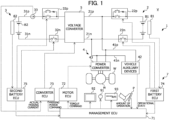
- FIG. 1 is a view illustrating a configuration of an electric vehicle V (hereinafter simply referred to as a "vehicle") mounted with a power supply system 1 according to the present embodiment.
- the vehicle V includes drive wheels W, a drive motor M coupled to the drive wheels W, and the power supply system 1 that allows power to be provided and received between the drive motor M and a first battery B1 and a second battery B2 described later.
- the vehicle V is described to mainly use a driving force generated in the drive motor M for acceleration and deceleration.
- the vehicle V may be a so-called hybrid electric vehicle mounted with the drive motor M and an engine serving as driving force generation sources.
- the drive motor M is coupled to the drive wheels W via a non-illustrated driving force transmission mechanism.
- the power supply system 1 supplies three phase, alternating current power to the drive motor M, the drive motor M generates torque.
- the torque is transmitted, via the non-illustrated driving force transmission mechanism, to the drive wheels W.
- the drive wheels W rotate.
- the vehicle V runs.
- the drive motor M exerts a function of a generator when the vehicle V decelerates to generate regenerative power, and to apply regenerative braking torque corresponding to a magnitude of the regenerative power to the drive wheels W.
- the regenerative power that the drive motor M has generated is appropriately used to charge the batteries B1 and B2 of the power supply system 1.
- the power supply system 1 includes a first power circuit 2 coupled to the first battery B1, a second power circuit 3 coupled to the second battery B2, a voltage converter 5 that couples to each other the first power circuit 2 and the second power circuit 3, a load circuit 4 having various electrical loads including the drive motor M, and an electronic control unit group 7 that controls the power circuits 2 and 3, the load circuit 4, and the voltage converter 5.
- the electronic control unit group 7 includes computers serving as a management ECU 71, a motor ECU 72, a converter ECU 73, a first battery ECU 74, and a second battery ECU 75.
- the first battery B1 is a secondary battery for which it is possible to perform both discharging where chemical energy is converted into electrical energy and charging where electrical energy is converted into chemical energy.
- a case will be described below, where a so-called lithium ion storage battery is used as the first battery B1, in which lithium ions move between electrodes to perform charging and discharging.
- the present invention is not limited to the case.
- the first battery B1 is provided with a first battery sensor unit 81 used to estimate an internal state of the first battery B1.
- the first battery sensor unit 81 includes a plurality of sensors that detect physical quantities necessary for acquiring, in the first battery ECU 74, a percentage of charge (an amount of stored power in a battery is represented by percentage) corresponding to a remaining amount and a temperature, for example, of the first battery B1, and transmit signals corresponding to the detected values to the first battery ECU 74. More specifically, the first battery sensor unit 81 includes a voltage sensor that detects a terminal voltage of the first battery B1, a current sensor that detects a current flowing in the first battery B1, and a temperature sensor that detects a temperature in the first battery B1, for example.
- the second battery B2 is a secondary battery for which it is possible to perform both discharging where chemical energy is converted into electrical energy and charging where electrical energy is converted into chemical energy.
- a so-called lithium ion storage battery is used as the second battery B2, in which lithium ions move between electrodes to perform charging and discharging.
- the present invention is not limited to the case.
- a capacitor may be used as the second battery B2.
- the second battery B2 is provided with a second battery sensor unit 82 used to estimate an internal state of the second battery B2.
- the second battery sensor unit 82 includes a plurality of sensors that detect physical quantities necessary for acquiring, in the second battery ECU 75, a percentage of charge and a temperature, for example, of the second battery B2, and transmit signals corresponding to the detected values to the second battery ECU 75. More specifically, the second battery sensor unit 82 includes a voltage sensor that detects a terminal voltage of the second battery B2, a current sensor that detects a current flowing in the second battery B2, and a temperature sensor that detects a temperature in the second battery B2, for example.
- the first battery B1 has lower output weight density and higher energy weight density than output weight density and energy weight density of the second battery B2. Furthermore, the first battery B1 has a greater capacity than a capacity of the second battery B2. That is, the first battery B1 is advantageous than the second battery B2 in terms of energy weight density.
- energy weight density refers to an amount of power per unit weight [Wh/kg].
- output weight density refers to power per unit weight [W/kg]. Therefore, the first battery B1 that is advantageous in energy weight density is a capacity type storage battery primarily aimed to have higher capacity.
- the second battery B2 that is advantageous in output weight density is an output type storage battery primarily aimed to have higher output. Therefore, in the power supply system 1, the first battery B1 is used as a main power supply. The second battery B2 is used as a sub power supply that complements the first battery B1.
- the first power circuit 2 includes the first battery B1, first power lines 21p and 21n respectively coupling to each other both positive and negative electrodes of the first battery B1 and a positive electrode terminal and a negative electrode terminal on a high voltage side of the voltage converter 5, and a positive electrode contactor 22p and a negative electrode contactor 22n respectively provided to the first power lines 21p and 21n.
- the contactors 22p and 22n are a normally open type, i.e., which are each opened when no external command signals are inputted to disconnect from each other both the electrodes of the first battery B1 and the first power lines 21p and 21n.
- the contactors 22p and 22n are each closed when command signals are inputted to couple to each other the first battery B1 and the first power lines 21p and 21n.
- the contactors 22p and 22n open or close in response to command signals transmitted from the first battery ECU 74.
- the positive electrode contactor 22p is a pre-charge contactor including a pre-charge resistor used to mitigate a rush current flowing into a plurality of smoothing capacitors provided in the first power circuit 2 and the load circuit 4, for example.
- the second power circuit 3 includes the second battery B2, second power lines 31p and 31n respectively coupling to each other both positive and negative electrodes of the second battery B2 and a positive electrode terminal and a negative electrode terminal on a low voltage side of the voltage converter 5, a positive electrode contactor 32p and a negative electrode contactor 32n respectively provided to the second power lines 31p and 31n, and a current sensor 33 provided to the second power line 31p.
- the contactors 32p and 32n are a normally open type, i.e., which are each opened when no external command signals are inputted to disconnect from each other both the electrodes of the second battery B2 and the second power lines 31p and 31n.
- the contactors 32p and 32n are each closed when command signals are inputted to couple to each other the second battery B2 and the second power lines 31p and 31n.
- the contactors 32p and 32n open or close in response to command signals transmitted from the second battery ECU 75.
- the positive electrode contactor 32p is a pre-charge contactor including a pre-charge resistor used to mitigate a rush current flowing into a plurality of smoothing capacitors provided in the first power circuit 2 and the load circuit 4, for example.
- the current sensor 33 transmits to the converter ECU 73 a detection signal corresponding to a passing current that is a current flowing in the second power line 31p, i.e., a current flowing in the voltage converter 5.
- a passing current that is a current flowing in the second power line 31p, i.e., a current flowing in the voltage converter 5.
- directions of a passing current one direction is regarded as positive when the passing current flows from the second power circuit 3 to the first power circuit 2.
- Another direction is regarded as negative when the passing current flows from the first power circuit 2 to the second power circuit 3.
- the load circuit 4 includes vehicle auxiliary devices 42, a power converter 43 coupled to the drive motor M, and load power lines 41p and 41n respectively coupling to each other the vehicle auxiliary devices 42, the power converter 43, and the first power circuit 2.
- the vehicle auxiliary devices 42 include a plurality of electrical loads such as a battery heater, an air compressor, a direct current-direct current (DC-DC) converter, and an in-vehicle charger.
- the vehicle auxiliary devices 42 are coupled, via the load power lines 41p and 41n, to the first power lines 21p and 21n of the first power circuit 2 to consume power supplied through the first power lines 21p and 21n for operation.
- Information regarding operational states of the various electrical loads constituting the vehicle auxiliary devices 42 is transmitted to the management ECU 71, for example.
- the power converter 43 is coupled, via the load power lines 41p and 41n, to the first power lines 21p and 21n, and is thus parallel to the vehicle auxiliary devices 42.
- the power converter 43 converts power between the first power lines 21p and 21n and the drive motor M.
- the power converter 43 is, for example, a pulse width modulation (PWM) inverter that operates based on pulse width modulation.
- the PWM inverter includes a bridge circuit where a plurality of switching devices (for example, insulated gate bipolar transistors (IGBTs)) are coupled to each other through bridge connections.
- the power converter 43 has a function of performing conversion between direct current power and alternating current power.
- the power converter 43 is coupled to the first power lines 21p and 21n on its direct current, input-and-output side.
- the power converter 43 On its alternating current, input-and-output side, the power converter 43 is further coupled to coils of a U phase, a V phase, and a W phase of the drive motor M.
- the power converter 43 follows gate drive signals generated at predetermined timings from a non-illustrated gate drive circuit of the motor ECU 72, on-and-off-drives the switching devices for the phases, converts direct current power in the first power lines 21p and 21n into three phase, alternating current power, and supplies the power to the drive motor M, and converts three phase, alternating current power supplied from the drive motor M into direct current power, and supplies the power to the first power lines 21p and 21n.
- the voltage converter 5 couples to each other the first power circuit 2 and the second power circuit 3 and converts a voltage between both the circuits 2 and 3.
- a known voltage-booster circuit is used to serve as the voltage converter 5.
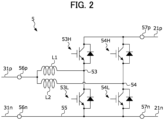
- FIG. 2 is a view illustrating an example of a circuit configuration of the voltage converter 5.
- the voltage converter 5 couples to each other the first power lines 21p and 21n coupled to the first battery B1 and the second power lines 31p and 31n coupled to the second battery B2 and converts a voltage between the first power lines 21p and 21n and the second power lines 31p and 31n.
- the voltage converter 5 is a full bridge type DC-DC converter configured to combine with each other a first reactor L1, a second reactor L2, a first high arm element 53H, a first low arm element 53L, a second high arm element 54H, a second low arm element 54L, a negative bus line 55, low voltage side terminals 56p and 56n, high voltage side terminals 57p and 57n, and a non-illustrated smoothing capacitor.
- the low voltage side terminals 56p and 56n are respectively coupled to the second power lines 31p and 31n.
- the high voltage side terminals 57p and 57n are respectively coupled to the first power lines 21p and 21n.
- the negative bus line 55 is a wire coupling to each other the low voltage side terminal 56n and the high voltage side terminal 57n.
- the first reactor L1 has an end side coupled to the low voltage side terminal 56p and another end side coupled to a coupling node 53 between the first high arm element 53H and the first low arm element 53L.
- the first high arm element 53H and the first low arm element 53L each include a known power switching device such as an IGBT or a metal-oxide semiconductor field-effect transistor (MOSFET) and a freewheeling diode coupled to the power switching device.
- the high arm element 53H and the low arm element 53L are coupled in series and in this order between the high voltage side terminal 57p and the negative bus line 55.
- the power switching device of the first high arm element 53H has a collector coupled to the high voltage side terminal 57p and an emitter coupled to a collector of the first low arm element 53L.
- An emitter of the power switching device of the first low arm element 53L is coupled to the negative bus line 55.
- a forward direction in the freewheeling diode provided to the first high arm element 53H is a direction from the first reactor L1 to the high voltage side terminal 57p.
- a forward direction in the freewheeling diode provided to the first low arm element 53L is a direction from the negative bus line 55 to the first reactor L1.
- the second reactor L2 has an end side coupled to the low voltage side terminal 56p and another end side coupled to a coupling node 54 between the second high arm element 54H and the second low arm element 54L.
- the second high arm element 54H and the second low arm element 54L each include a known power switching device such as an IGBT or a MOSFET and a freewheeling diode coupled to the power switching device.
- the high arm element 54H and the low arm element 54L are coupled in series and in this order between the high voltage side terminal 57p and the negative bus line 55.
- the power switching device of the second high arm element 54H has a collector coupled to the high voltage side terminal 57p and an emitter coupled to a collector of the second low arm element 54L.
- An emitter of the power switching device of the second low arm element 54L is coupled to the negative bus line 55.
- a forward direction in the freewheeling diode provided to the second high arm element 54H is a direction from the second reactor L2 to the high voltage side terminal 57p.
- a forward direction in the freewheeling diode provided to the second low arm element 54L is a direction from the negative bus line 55 to the second reactor L2.
- the voltage converter 5 follows gate drive signals generated at predetermined timings from a non-illustrated gate drive circuit of the converter ECU 73, alternately turns on/off and drives the first high arm element 53H and the second low arm element 54L and the first low arm element 53L and the second high arm element 54H, and converts a voltage between the first power lines 21p and 21n and the second power lines 31p and 31n.
- a static voltage of the second battery B2 is basically maintained lower than a static voltage of the first battery B1. Therefore, a voltage in the first power lines 21p and 21n is basically higher than a voltage in the second power lines 31p and 31n. Therefore, the converter ECU 73 operates, when power outputted from the first battery B1 and power outputted from the second battery B2 are both used to drive the drive motor M, the voltage converter 5 to allow the voltage converter 5 to exert a voltage-boosting function.
- the voltage-boosting function refers to a function of voltage-boosting power in the second power lines 31p and 31n respectively coupled to the low voltage side terminals 56p and 56n to output the voltage-boosted power to the first power lines 21p and 21n respectively coupled to the high voltage side terminals 57p and 57n.
- the converter ECU 73 turns off the voltage converter 5 to prevent a current from flowing from the first power lines 21p and 21n to the second power lines 31p and 31n.
- the converter ECU 73 When regenerative power outputted from the drive motor M to the first power lines 21p and 21n during deceleration is used to charge the first battery B1 and the second battery B2, the converter ECU 73 operates the voltage converter 5 to allow the voltage converter 5 to exert a voltage-lowering function.
- the voltage-lowering function refers to a function of voltage-lowering power in the first power lines 21p and 21n respectively coupled to the high voltage side terminals 57p and 57n to output the voltage-lowered power to the second power lines 31p and 31n respectively coupled to the low voltage side terminals 56p and 56n. Therefore, a negative passing current flows from the first power lines 21p and 21n to the second power lines 31p and 31n.
- the first battery ECU 74 is one of the computers, which mainly performs state monitoring of the first battery B1 and open-and-close operations for the contactors 22p and 22n of the first power circuit 2.
- the first battery ECU 74 uses a known algorithm and detected values transmitted from the first battery sensor unit 81 to calculate various parameters representing an internal state of the first battery B1, more specifically, a temperature of the first battery B1, internal resistance of the first battery B1, a static voltage of the first battery B1, a short-circuit voltage of the first battery B1, a first maximum output corresponding to power that the first battery B1 is able to output, and a first SOC corresponding to a percentage of charge in the first battery B1, for example.
- the first battery sensor unit 81 and the first battery ECU 74 therefore achieve a first remaining-amount parameter acquisition device and a first maximum output acquisition device.
- Information regarding the parameters that the first battery ECU 74 has acquired to represent the internal state of the first battery B1 is transmitted to the management ECU 71, for example.
- the second battery ECU 75 is one of the computers, which mainly performs state monitoring of the second battery B2 and open-and-close operations for the contactors 32p and 32n of the second power circuit 3.
- the second battery ECU 75 uses a known algorithm and detected values transmitted from the second battery sensor unit 82 to calculate various parameters representing an internal state of the second battery B2, more specifically, a temperature of the second battery B2, internal resistance of the second battery B2, a static voltage of the second battery B2, a short-circuit voltage of the second battery B2, a second maximum output corresponding to power that the second battery B2 is able to output, and a second SOC corresponding to a percentage of charge in the second battery B2, for example.
- the second battery sensor unit 82 and the second battery ECU 75 therefore achieve a second remaining-amount parameter acquisition device and a second maximum output acquisition device.
- Information regarding the parameters that the second battery ECU 75 has acquired to represent the internal state of the second battery B2 is transmitted to the management ECU 71, for example.
- the management ECU 71 is one of the computers, which mainly manages a flow of power in the whole power supply system 1.
- the management ECU 71 executes power management processing, described later with reference to FIG. 4 , to generate a torque command signal corresponding to a command regarding torque that the drive motor M generates and a converter passing power command signal corresponding to a command regarding converter passing power that is power passing through the voltage converter 5.
- the management ECU 71 is coupled to a charging request lamp 91, a monitor 92, and a remaining travel distance meter 93.
- the charging request lamp 91, the monitor 92, and the remaining travel distance meter 93 are respectively provided at positions at which the driver is able to see.
- the charging request lamp 91 is a notification device prompting the driver to charge the first battery B1.
- the management ECU 71 causes, when the first SOC is more than a predetermined lamp-on threshold (for example, see FIG. 6 , described later), the charging request lamp 91 to go off.
- the management ECU 71 causes, when the first SOC is equal to or less than the lamp-on threshold, the charging request lamp 91 to come on.
- the illumination prompts the driver to charge the first battery B1. Note that, since the first SOC and the first maximum output have an approximately proportional relationship, the management ECU 71 may compare with each other the first maximum output and a predetermined threshold to cause the charging request lamp 91 to go off or come on.
- the remaining travel distance meter 93 is a notification device that notifies, to the driver, a remaining traveling possible distance that is a distance with which the vehicle is able to travel.
- the management ECU 71 uses a known algorithm and the first SOC, the second SOC, the first maximum output, and the second maximum output to calculate the remaining traveling possible distance.
- the management ECU 71 then causes the remaining travel distance meter 93 to display a numerical value of the calculated remaining traveling possible distance.
- the management ECU 71 sets, when a maximum system output that is a sum of the first maximum output and the second maximum output is less than a predetermined output threshold (for example, see FIG. 6 , described later), the remaining traveling possible distance to 0.
- a predetermined output threshold for example, see FIG. 6 , described later
- the monitor 92 is an information display device that displays, in the form of text or a pictorial figure, for example, warning information regarding a state of the power supply system 1 to notify, to the driver, the state of the power supply system 1. Note that the content of the warning information and a timing of displaying the warning information on the monitor 92 will be described later with reference to FIG. 4 .
- the motor ECU 72 is one of the computers, which mainly operates the power converter 43 to control a flow of power between the first power circuit 2 and the drive motor M, i.e., a flow of inverter passing power that is power passing through the power converter 43.
- the inverter passing power that will be described below is regarded as positive when the power flows from the first power circuit 2 to the drive motor M, i.e., when the drive motor M is in power-driving.
- the inverter passing power is regarded as negative when power flows from the drive motor M to the first power circuit 2, i.e., when the drive motor M is in regenerative-driving.
- the motor ECU 72 follows a torque command signal calculated based on a command regarding the inverter passing power in the management ECU 71, operates the power converter 43, and causes the drive motor M to generate torque according to the command.
- the converter ECU 73 is one of the computers, which mainly operates the voltage converter 5 to control a flow of power between the first power circuit 2 and the second power circuit 3, i.e., a flow of converter passing power that is power passing through the voltage converter 5.
- the converter passing power that will be described below is regarded as positive when the power flows from the second power circuit 3 to the first power circuit 2, i.e., when the second battery B2 discharges and supplies power to the first power circuit 2.
- the converter passing power is regarded as negative when the power flows from the first power circuit 2 to the second power circuit 3, i.e., when the second battery B2 is charged with power in the first power circuit 2.
- the converter ECU 73 follows a converter passing power command signal transmitted from the management ECU 71, operates the voltage converter 5, and allows converter passing power according to the command to pass through the voltage converter 5. More specifically, the converter ECU 73 uses the converter passing power command signal, calculates a target current that is a target to a passing current in the voltage converter 5, follows a known feedback control algorithm, operates the voltage converter 5, and allows a passing current (hereinafter also referred to as an "actual passing current") that the current sensor 33 detects to reach the target current.
- FIG. 3 is a flowchart illustrating a specific procedure of the power management processing.
- the power management processing is repeatedly executed at predetermined cycles in the management ECU 71 until the remaining traveling possible distance reaches 0, i.e., the maximum system output is equal to or less than the output threshold.
- the management ECU 71 first calculates requested auxiliary device power Paux that is power requested from the vehicle auxiliary devices 42. The management ECU 71 then proceeds to S2. The management ECU 71 calculates the requested auxiliary device power Paux based on information regarding operational states of the various electrical loads, which is transmitted from the vehicle auxiliary devices 42.
- the management ECU 71 calculates requested inverter passing power Pmot_d according to a request for inverter passing power in the power converter 43.
- the management ECU 71 then proceeds to S3.
- the management ECU 71 calculates requested drive torque of the driver based on amounts of operations, by the driver, of pedals P (see FIG. 1 ) such as an accelerator pedal and a brake pedal, converts the requested drive torque into power, and calculates the requested inverter passing power Pmot_d.
- the management ECU 71 calculates maximum converter passing power Pcnv_max corresponding to maximum power with respect to the converter passing power in the voltage converter 5. The management ECU 71 then proceeds to S4. Note that a specific procedure of calculating the maximum converter passing power Pcnv_max will be described later in detail with reference to FIG. 4 .
- the management ECU 71 calculates maximum inverter passing power Pmot_max corresponding to maximum power with respect to inverter passing power in the power converter 43. The management ECU 71 then proceeds to S5. Note that a specific procedure of calculating the maximum inverter passing power Pmot_max will be described later in detail with reference to FIG. 5 .
- the management ECU 71 determines whether the requested inverter passing power Pmot_d is equal to or less than the maximum inverter passing power Pmot_max.
- the management ECU 71 sets the requested inverter passing power Pmot_d calculated at S2 as target inverter passing power Pmot_cmd corresponding to a target to the inverter passing power in the power converter 43 (see S6). The management ECU 71 then proceeds to S8.
- the management ECU 71 sets the maximum inverter passing power Pmot_max calculated through the process of S4 as the target inverter passing power Pmot_cmd (see S7). The management ECU 71 then proceeds to S8.
- the management ECU 71 calculates target converter passing power Pcnv_cmd corresponding to a target for the converter passing power in the voltage converter 5. The management ECU 71 then proceeds to S9. More specifically, the management ECU 71 calculates the target converter passing power Pcnv_cmd to perform charging and discharging of the first battery B1 and the second battery B2 at a predetermined rate within a range at and less than the maximum converter passing power Pcnv_max.
- the management ECU 71 preferably and proactively sets the target converter passing power Pcnv_cmd to a value smaller than 0, and preferably and proactively charges the second battery B2 with power in the first power circuit 2.
- the management ECU 71 At S9, the management ECU 71 generates a converter passing power command signal corresponding to the target converter passing power Pcnv_cmd calculated at S8, and transmits the signal to the converter ECU 73. The management ECU 71 then proceeds to S10. Therefore, the second battery B2 undergoes charging and discharging with power corresponding to the target converter passing power Pcnv_cmd.
- the management ECU 71 generates a torque command signal based on the target inverter passing power Pmot_cmd calculated at S6 or S7, and transmits the signal to the motor ECU 72.
- the management ECU 71 then ends the power management processing. More specifically, the management ECU 71 converts the target inverter passing power Pmot_cmd into torque to calculate target drive torque, and generates a torque command signal corresponding to the target drive torque.
- the motor ECU 72 operates the power converter 43 based on the torque command signal. Therefore, power corresponding to the target inverter passing power Pmot_cmd flows between the first power circuit 2 and the drive motor M.
- FIG. 4 is a flowchart illustrating a procedure of calculating the maximum converter passing power Pcnv_max.
- the management ECU 71 acquires a second maximum output P2_lim. The management ECU 71 then proceeds to S22. At S22, the management ECU 71 determines whether the charging request lamp 91 is turned on, i.e., whether the first SOC is equal to or less than the lamp-on threshold.
- the management ECU 71 proceeds to S23 and sets the second maximum output P2_lim as the maximum converter passing power Pcnv_max. The management ECU 71 then moves to the process of S4 in FIG. 3 .
- the management ECU 71 When a result of determination at S22 is YES, i.e., when the first SOC is equal to or less than the lamp-on threshold, the management ECU 71 then proceeds to S24.
- the management ECU 71 causes the monitor 92 to display predetermined warning information.
- the management ECU 71 then proceeds to S25.
- the management ECU 71 causes the monitor 92 to display a message regarding a state where output power to the drive motor M is presently restricted and a message prompting prompt charging of the first battery B1.
- the management ECU 71 acquires a first maximum output P1_lim. The management ECU 71 then proceeds to S26. At S26, the management ECU 71 determines whether the first maximum output P1_lim is equal to or less than an output threshold Pe0.
- the management ECU 71 When a result of determination at S26 is NO, i.e., when the first SOC is equal to or less than the lamp-on threshold and the first maximum output P1_lim is more than the output threshold Pe0, the management ECU 71 then proceeds to S27. At 527, the management ECU 71 sets the maximum converter passing power Pcnv_max to 0, i.e., prohibits discharging of the second battery B2. The management ECU 71 then moves to the process of S4 in FIG. 3 .
- the management ECU 71 sets the boost permission output P2bst as the maximum converter passing power Pcnv_max.
- the management ECU 71 then moves to the process of S4 in FIG. 3 . That is, when the first SOC is equal to or less than the lamp-on threshold and the first maximum output P1_lim is equal to or less than the output threshold Pe0, the management ECU 71 sets the maximum converter passing power Pcnv_max to a value greater than 0 and permits discharging of the second battery B2.
- the management ECU 71 sets the maximum converter passing power Pcnv_max to a larger value and permits discharging of the second battery B2, compared with a case where the first SOC is equal to or less than the lamp-on threshold and the first maximum output P1_lim is more than the output threshold Pe0.
- FIG. 5 is a flowchart illustrating a procedure of calculating the maximum inverter passing power Pmot_max.
- the management ECU 71 first acquires the first maximum output P1_lim. The management ECU 71 then proceeds to S32. At S32, the management ECU 71 determines whether the first maximum output P1_lim is equal to or less than the output threshold Pe0.
- the management ECU 71 When a result of determination at S32 is NO, i.e., when the first maximum output P1_lim is more than the output threshold Pe0, the management ECU 71 then proceeds to S33.
- the management ECU 71 then moves to the process of S5 in FIG. 3 .
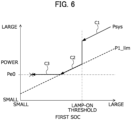
- FIG. 6 is a view illustrating changes in the first maximum output P1_lim (dotted line) and a system output Psys (solid line) when the first SOC drops to a value around the lamp-on threshold.
- the system output Psys is a sum of power outputted from the first battery B1 and power outputted from the second battery B2. Note that the example in FIG. 6 illustrates, for ease of understanding, a case where the requested auxiliary device power Paux is set to 0 and the requested inverter passing power Pmot_d is always regarded as a maximum value.
- the management ECU 71 sets the maximum converter passing power Pcnv_max to 0 to prohibit discharging of the second battery B2 (see S22, S24, S5, S26, and S27 in FIG. 4 ). Therefore, the system output Psys follows a route C2 to drop to the first maximum output P1_lim. Note that, at this time, while discharging of the second battery B2 is prohibited and the second SOC is less than the target second SOC, the second battery B2 is proactively charged with power in the first power circuit 2 (see S8 in FIG. 3 ).
- the management ECU 71 sets the first maximum output P1_lim as the maximum inverter passing power Pmot_max to restrict power supplied from the first power circuit 2 to the drive motor M to a value equal to or smaller than the first maximum output P1_lim (see S32 and S34 in FIG. 5 ).
- the management ECU 71 permits discharging of the second battery B2 to complement a shortage of power supplied from the first battery B1 (see S26, S28, and S29 in FIG. 4 ). Therefore, the system output Psys follows a route C3 on the output threshold Pe0.
- the power supply system 1 and the vehicle V according to the present embodiment lead to the following effects.
- the embodiment has been described above with reference to the case where, when the first SOC is equal to or less than the lamp-on threshold and the first maximum output P1_lim is more than the output threshold Pe0, the maximum converter passing power Pcnv_max is set to 0 to prohibit discharging of the second battery B2 (see S27 in FIG. 4 ).
- the present invention is not limited to the case.
- the maximum converter passing power Pcnv_max may be set to a value smaller than the second maximum output P2_lim to restrict discharging of the second battery B2 to a value smaller than the second maximum output P2_lim.
- a power supply system includes a first power circuit coupled to a capacity-type first battery and a drive motor, a second power circuit coupled to an output-type second battery, a voltage converter that converts a voltage between the first power circuit and the second power circuit, and a converter ECU and a management ECU that operate the voltage converter to control converter passing power in the voltage converter.
- the management ECU sets, when a first SOC that is a percentage of charge in the first battery is less than a predetermined lamp-on threshold and a first maximum output P1_lim that is a maximum output of the first battery is more than a predetermined output threshold Pe0, maximum converter passing power Pcnv_max corresponding to maximum power with respect to the converter passing power to 0 to prohibit discharging of the second battery.
Landscapes
- Engineering & Computer Science (AREA)
- Transportation (AREA)
- Mechanical Engineering (AREA)
- Power Engineering (AREA)
- Life Sciences & Earth Sciences (AREA)
- Sustainable Development (AREA)
- Sustainable Energy (AREA)
- Chemical & Material Sciences (AREA)
- Combustion & Propulsion (AREA)
- Electric Propulsion And Braking For Vehicles (AREA)
- Charge And Discharge Circuits For Batteries Or The Like (AREA)
- Secondary Cells (AREA)
Description
- This application is based on and claims the benefit of priority from
Japanese Patent Application No. 2020-061200, filed on 30 March 2020 - The present invention relates to a power supply system and an electric vehicle. More specifically, the present invention relates to a power supply system including two electric storage devices, and relates to an electric vehicle mounted with the power supply system.
- Development of electric transportation apparatuses and electric vehicles such as hybrid electric vehicles is growing in recent years. The electric transportation apparatuses each include a drive motor serving as a driving force generation source. The electric vehicles each include a drive motor and an internal combustion engine serving as driving force generation sources. Such an electric vehicle is further mounted with an electric storage device (such as a battery and a capacitor) used to supply electrical energy to the drive motor. Furthermore, development of electric vehicles that are each mounted with a plurality of electric storage devices that differ from each other in characteristic is also growing in recent years.
- For example, Japanese Unexamined Patent Application, Publication No.
JP 2017-99241 A JP 2017-99241 A
US 2017/232 851 A1 describes a power supply system for electric vehicle with a capacity-type first energy storage device and an output-type second energy storage device. The power supply system performs an extended-stop control process that controls the power transmission circuit to consume the remaining capacity of both the first and second storage devices as much as possible. In the extended-stop control process, if only the first storage device can output the required power, only the first storage device is used, and if there is a shortage with respect to the required power, the second storage device is used to make up the shortage.
US 2014/368 041 A describes a technology for transferring power between two energy storages. There, power is supplied from the first energy storage to the second energy storage when the SOC of the second energy storage is below a predetermined threshold and the SOC of the first energy storage is above a predetermined threshold. - By the way, there is an electric vehicle that uses power of two electric storage devices as described above for traveling. The vehicle sets, when a maximum system output that is a sum of a maximum output of the first electric storage device and a maximum output of the second electric storage device is less than a predetermined output threshold, a remaining traveling possible distance to 0.
- In here, a case is studied, where, when a remaining amount of the first electric storage device is less than the threshold, i.e., a maximum output of the first electric storage device is around the output threshold described above, insufficient power with respect to a driver's requested output is complemented from the second electric storage device, as illustrated in Japanese Unexamined Patent Application, Publication No.
JP 2017-99241 A JP 2017-99241 A - An object of the present invention is to provide a power supply system that includes a capacity-type first electric storage device and an output-type second electric storage device, and to provide an electric vehicle mounted with the power supply system, making it possible to fully use power stored in the first electric storage device.
- The invention solving the problems mentioned above is defined by the appended claims.
- (1) In the present invention, the first power circuit coupled to the capacity-type first electric storage device and the electrical load and the second power circuit coupled to the output-type second electric storage device are coupled to each other via the voltage converter. The control device operates the voltage converter to control a flow of power between the first power circuit and the second power circuit, i.e., charging and discharging of the second electric storage device. In here, a second maximum output of the output type second electric storage device drops faster than the first maximum output of the capacity type first electric storage device. Therefore, when, for example, the first remaining-amount parameter that has dropped gradually is less than the remaining amount threshold, the first maximum output is more than the output threshold, and discharging of the second electric storage device is not restricted, but is continuously permitted, a maximum system output that is a sum of the first maximum output and the second maximum output may drop below the output threshold before power stored in the first electric storage device is fully used. In the present invention, the control device then restricts, when the first remaining-amount parameter of the first electric storage device is less than the remaining amount threshold and the first maximum output is more than the output threshold, discharging of the second electric storage device, compared with a case where the first remaining-amount parameter is more than the remaining amount threshold. Therefore, it is possible to secure auxiliary power in the second electric storage device until the first maximum output of the first electric storage device drops below the output threshold. Therefore, according to the present invention, it is possible to use power from the second electric storage device to supply necessary power to the electrical load after the first maximum output has dropped below the output threshold, making it possible to fully use power stored in the first electric storage device.
- (2) In the present invention, the control device permits, when the first remaining-amount parameter is less than the remaining amount threshold and the first maximum output is less than the output threshold, discharging of the second electric storage device, compared with a case where the first remaining-amount parameter is less than the remaining amount threshold and the first maximum output is more than the output threshold. Therefore, when the first maximum output is less than the output threshold, it is possible to complement insufficient power (the output threshold - the first maximum output) with power secured from the second electric storage device while the first maximum output is more than the output threshold, as described above, making it possible to prevent a whole system output of the system including the first electric storage device and the second electric storage device from dropping below the output threshold, and to fully use power stored in the first electric storage device.
- (3) In the present invention, the control device sets, when the first remaining-amount parameter is less than the remaining amount threshold and the first maximum output is less than the output threshold, a difference between the output threshold and the first maximum output as maximum power flowing from the side adjacent to the second power circuit to the side adjacent to the first power circuit in the voltage converter. Therefore, it is possible to suppress a remaining amount of the second electric storage device from dropping quickly, making it possible to fully use power stored in the first electric storage device.
- (4) In the present invention, the control device uses, when the first remaining-amount parameter is less than the remaining amount threshold, the first maximum output is more than the output threshold, and the second remaining-amount parameter is less than a target remaining amount, power in the first power circuit to charge the second electric storage device. Therefore, it is possible to increase the remaining amount of the second electric storage device for preparing a case where the first maximum output of the first electric storage device drops below the output threshold. Therefore, according to the present invention, it is possible to secure a longer period during which it is possible to complement power from the second electric storage device after the first maximum output has dropped below the output threshold, making it possible to fully use power stored in the first electric storage device.
- (5) With the electric vehicle according to the present invention, it is possible to keep traveling with the drive motor until the power stored in the first electric storage device is fully used.
- (6) In the present invention, when the first remaining-amount parameter is less than the remaining amount threshold and the first maximum output is more than the output threshold, discharging of the second electric storage device is restricted, compared with a case where the first remaining-amount parameter is more than the remaining amount threshold. Therefore, in the electric vehicle, it is impossible to supply power according to a request of the driver to the drive motor, resulting in the driver possibly feeling uncomfortable. The control device then causes, when the first remaining-amount parameter is less than the remaining amount threshold, the information display device to display warning information regarding a state of the power supply system. Therefore, it is possible to suppress uncomfortable feelings in the driver.
- (7) In the present invention, the control device causes the information display device to display, as the warning information, information of a state where output power to the drive motor is restricted and information regarding a charging request to the first electric storage device. According to the present invention, it is possible to suppress uncomfortable feelings in the driver when outputting of power to the drive motor is restricted, while prompting charging of the first electric storage device.
-
-
FIG. 1 is a view illustrating a configuration of a vehicle mounted with a power supply system according to an embodiment of the present invention; -
FIG. 2 is a view illustrating an example of a circuit configuration of a voltage converter; -
FIG. 3 is a flowchart illustrating a specific procedure of power management processing; -
FIG. 4 is a flowchart illustrating a procedure of calculating maximum converter passing power; -
FIG. 5 is a flowchart illustrating a procedure of calculating maximum inverter passing power; and -
FIG. 6 is a view illustrating changes in a first maximum output and a system output when a first SOC drops to a value around a lamp-on threshold. - An embodiment of the present invention will now be described herein with reference to the accompanying drawings.
FIG. 1 is a view illustrating a configuration of an electric vehicle V (hereinafter simply referred to as a "vehicle") mounted with a power supply system 1 according to the present embodiment. - The vehicle V includes drive wheels W, a drive motor M coupled to the drive wheels W, and the power supply system 1 that allows power to be provided and received between the drive motor M and a first battery B1 and a second battery B2 described later. Note that, in the present embodiment, the vehicle V is described to mainly use a driving force generated in the drive motor M for acceleration and deceleration. However, the present invention is not limited to the present embodiment. The vehicle V may be a so-called hybrid electric vehicle mounted with the drive motor M and an engine serving as driving force generation sources.
- The drive motor M is coupled to the drive wheels W via a non-illustrated driving force transmission mechanism. As the power supply system 1 supplies three phase, alternating current power to the drive motor M, the drive motor M generates torque. The torque is transmitted, via the non-illustrated driving force transmission mechanism, to the drive wheels W. The drive wheels W rotate. The vehicle V runs. The drive motor M exerts a function of a generator when the vehicle V decelerates to generate regenerative power, and to apply regenerative braking torque corresponding to a magnitude of the regenerative power to the drive wheels W. The regenerative power that the drive motor M has generated is appropriately used to charge the batteries B1 and B2 of the power supply system 1.
- The power supply system 1 includes a
first power circuit 2 coupled to the first battery B1, a second power circuit 3 coupled to the second battery B2, avoltage converter 5 that couples to each other thefirst power circuit 2 and the second power circuit 3, a load circuit 4 having various electrical loads including the drive motor M, and an electroniccontrol unit group 7 that controls thepower circuits 2 and 3, the load circuit 4, and thevoltage converter 5. The electroniccontrol unit group 7 includes computers serving as amanagement ECU 71, amotor ECU 72, aconverter ECU 73, afirst battery ECU 74, and asecond battery ECU 75. - The first battery B1 is a secondary battery for which it is possible to perform both discharging where chemical energy is converted into electrical energy and charging where electrical energy is converted into chemical energy. A case will be described below, where a so-called lithium ion storage battery is used as the first battery B1, in which lithium ions move between electrodes to perform charging and discharging. However, the present invention is not limited to the case.
- The first battery B1 is provided with a first
battery sensor unit 81 used to estimate an internal state of the first battery B1. The firstbattery sensor unit 81 includes a plurality of sensors that detect physical quantities necessary for acquiring, in thefirst battery ECU 74, a percentage of charge (an amount of stored power in a battery is represented by percentage) corresponding to a remaining amount and a temperature, for example, of the first battery B1, and transmit signals corresponding to the detected values to thefirst battery ECU 74. More specifically, the firstbattery sensor unit 81 includes a voltage sensor that detects a terminal voltage of the first battery B1, a current sensor that detects a current flowing in the first battery B1, and a temperature sensor that detects a temperature in the first battery B1, for example. - The second battery B2 is a secondary battery for which it is possible to perform both discharging where chemical energy is converted into electrical energy and charging where electrical energy is converted into chemical energy. A case will be described below, where a so-called lithium ion storage battery is used as the second battery B2, in which lithium ions move between electrodes to perform charging and discharging. However, the present invention is not limited to the case. For example, a capacitor may be used as the second battery B2.
- The second battery B2 is provided with a second
battery sensor unit 82 used to estimate an internal state of the second battery B2. The secondbattery sensor unit 82 includes a plurality of sensors that detect physical quantities necessary for acquiring, in thesecond battery ECU 75, a percentage of charge and a temperature, for example, of the second battery B2, and transmit signals corresponding to the detected values to thesecond battery ECU 75. More specifically, the secondbattery sensor unit 82 includes a voltage sensor that detects a terminal voltage of the second battery B2, a current sensor that detects a current flowing in the second battery B2, and a temperature sensor that detects a temperature in the second battery B2, for example. - Here, characteristics of the first battery B1 and characteristics of the second battery B2 will be compared with each other. The first battery B1 has lower output weight density and higher energy weight density than output weight density and energy weight density of the second battery B2. Furthermore, the first battery B1 has a greater capacity than a capacity of the second battery B2. That is, the first battery B1 is advantageous than the second battery B2 in terms of energy weight density. Note that the term energy weight density refers to an amount of power per unit weight [Wh/kg]. The term output weight density refers to power per unit weight [W/kg]. Therefore, the first battery B1 that is advantageous in energy weight density is a capacity type storage battery primarily aimed to have higher capacity. The second battery B2 that is advantageous in output weight density is an output type storage battery primarily aimed to have higher output. Therefore, in the power supply system 1, the first battery B1 is used as a main power supply. The second battery B2 is used as a sub power supply that complements the first battery B1.
- The
first power circuit 2 includes the first battery B1,first power lines voltage converter 5, and apositive electrode contactor 22p and anegative electrode contactor 22n respectively provided to thefirst power lines - The
contactors first power lines contactors first power lines contactors first battery ECU 74. Note that thepositive electrode contactor 22p is a pre-charge contactor including a pre-charge resistor used to mitigate a rush current flowing into a plurality of smoothing capacitors provided in thefirst power circuit 2 and the load circuit 4, for example. - The second power circuit 3 includes the second battery B2,
second power lines voltage converter 5, apositive electrode contactor 32p and anegative electrode contactor 32n respectively provided to thesecond power lines current sensor 33 provided to thesecond power line 31p. - The
contactors second power lines contactors second power lines contactors second battery ECU 75. Note that thepositive electrode contactor 32p is a pre-charge contactor including a pre-charge resistor used to mitigate a rush current flowing into a plurality of smoothing capacitors provided in thefirst power circuit 2 and the load circuit 4, for example. - The
current sensor 33 transmits to the converter ECU 73 a detection signal corresponding to a passing current that is a current flowing in thesecond power line 31p, i.e., a current flowing in thevoltage converter 5. Note that, in the present embodiment, as for directions of a passing current, one direction is regarded as positive when the passing current flows from the second power circuit 3 to thefirst power circuit 2. Another direction is regarded as negative when the passing current flows from thefirst power circuit 2 to the second power circuit 3. - The load circuit 4 includes vehicle
auxiliary devices 42, apower converter 43 coupled to the drive motor M, and loadpower lines auxiliary devices 42, thepower converter 43, and thefirst power circuit 2. - The vehicle
auxiliary devices 42 include a plurality of electrical loads such as a battery heater, an air compressor, a direct current-direct current (DC-DC) converter, and an in-vehicle charger. The vehicleauxiliary devices 42 are coupled, via theload power lines first power lines first power circuit 2 to consume power supplied through thefirst power lines auxiliary devices 42 is transmitted to themanagement ECU 71, for example. - The
power converter 43 is coupled, via theload power lines first power lines auxiliary devices 42. Thepower converter 43 converts power between thefirst power lines power converter 43 is, for example, a pulse width modulation (PWM) inverter that operates based on pulse width modulation. The PWM inverter includes a bridge circuit where a plurality of switching devices (for example, insulated gate bipolar transistors (IGBTs)) are coupled to each other through bridge connections. Thepower converter 43 has a function of performing conversion between direct current power and alternating current power. Thepower converter 43 is coupled to thefirst power lines power converter 43 is further coupled to coils of a U phase, a V phase, and a W phase of the drive motor M. Thepower converter 43 follows gate drive signals generated at predetermined timings from a non-illustrated gate drive circuit of themotor ECU 72, on-and-off-drives the switching devices for the phases, converts direct current power in thefirst power lines first power lines - The
voltage converter 5 couples to each other thefirst power circuit 2 and the second power circuit 3 and converts a voltage between both thecircuits 2 and 3. A known voltage-booster circuit is used to serve as thevoltage converter 5. -
FIG. 2 is a view illustrating an example of a circuit configuration of thevoltage converter 5. Thevoltage converter 5 couples to each other thefirst power lines second power lines first power lines second power lines voltage converter 5 is a full bridge type DC-DC converter configured to combine with each other a first reactor L1, a second reactor L2, a firsthigh arm element 53H, a firstlow arm element 53L, a secondhigh arm element 54H, a secondlow arm element 54L, anegative bus line 55, lowvoltage side terminals 56p and 56n, highvoltage side terminals - The low
voltage side terminals 56p and 56n are respectively coupled to thesecond power lines voltage side terminals first power lines negative bus line 55 is a wire coupling to each other the lowvoltage side terminal 56n and the highvoltage side terminal 57n. - The first reactor L1 has an end side coupled to the low voltage side terminal 56p and another end side coupled to a
coupling node 53 between the firsthigh arm element 53H and the firstlow arm element 53L. The firsthigh arm element 53H and the firstlow arm element 53L each include a known power switching device such as an IGBT or a metal-oxide semiconductor field-effect transistor (MOSFET) and a freewheeling diode coupled to the power switching device. Thehigh arm element 53H and thelow arm element 53L are coupled in series and in this order between the highvoltage side terminal 57p and thenegative bus line 55. - The power switching device of the first
high arm element 53H has a collector coupled to the highvoltage side terminal 57p and an emitter coupled to a collector of the firstlow arm element 53L. An emitter of the power switching device of the firstlow arm element 53L is coupled to thenegative bus line 55. A forward direction in the freewheeling diode provided to the firsthigh arm element 53H is a direction from the first reactor L1 to the highvoltage side terminal 57p. A forward direction in the freewheeling diode provided to the firstlow arm element 53L is a direction from thenegative bus line 55 to the first reactor L1. - The second reactor L2 has an end side coupled to the low voltage side terminal 56p and another end side coupled to a
coupling node 54 between the secondhigh arm element 54H and the secondlow arm element 54L. The secondhigh arm element 54H and the secondlow arm element 54L each include a known power switching device such as an IGBT or a MOSFET and a freewheeling diode coupled to the power switching device. Thehigh arm element 54H and thelow arm element 54L are coupled in series and in this order between the highvoltage side terminal 57p and thenegative bus line 55. - The power switching device of the second
high arm element 54H has a collector coupled to the highvoltage side terminal 57p and an emitter coupled to a collector of the secondlow arm element 54L. An emitter of the power switching device of the secondlow arm element 54L is coupled to thenegative bus line 55. A forward direction in the freewheeling diode provided to the secondhigh arm element 54H is a direction from the second reactor L2 to the highvoltage side terminal 57p. A forward direction in the freewheeling diode provided to the secondlow arm element 54L is a direction from thenegative bus line 55 to the second reactor L2. - The
voltage converter 5 follows gate drive signals generated at predetermined timings from a non-illustrated gate drive circuit of theconverter ECU 73, alternately turns on/off and drives the firsthigh arm element 53H and the secondlow arm element 54L and the firstlow arm element 53L and the secondhigh arm element 54H, and converts a voltage between thefirst power lines second power lines - A static voltage of the second battery B2 is basically maintained lower than a static voltage of the first battery B1. Therefore, a voltage in the
first power lines second power lines converter ECU 73 operates, when power outputted from the first battery B1 and power outputted from the second battery B2 are both used to drive the drive motor M, thevoltage converter 5 to allow thevoltage converter 5 to exert a voltage-boosting function. The voltage-boosting function refers to a function of voltage-boosting power in thesecond power lines voltage side terminals 56p and 56n to output the voltage-boosted power to thefirst power lines voltage side terminals second power lines first power lines converter ECU 73 turns off thevoltage converter 5 to prevent a current from flowing from thefirst power lines second power lines - When regenerative power outputted from the drive motor M to the
first power lines converter ECU 73 operates thevoltage converter 5 to allow thevoltage converter 5 to exert a voltage-lowering function. The voltage-lowering function refers to a function of voltage-lowering power in thefirst power lines voltage side terminals second power lines voltage side terminals 56p and 56n. Therefore, a negative passing current flows from thefirst power lines second power lines - Now back to
FIG. 1 . Thefirst battery ECU 74 is one of the computers, which mainly performs state monitoring of the first battery B1 and open-and-close operations for thecontactors first power circuit 2. Thefirst battery ECU 74 uses a known algorithm and detected values transmitted from the firstbattery sensor unit 81 to calculate various parameters representing an internal state of the first battery B1, more specifically, a temperature of the first battery B1, internal resistance of the first battery B1, a static voltage of the first battery B1, a short-circuit voltage of the first battery B1, a first maximum output corresponding to power that the first battery B1 is able to output, and a first SOC corresponding to a percentage of charge in the first battery B1, for example. As described above, in the present embodiment, the firstbattery sensor unit 81 and thefirst battery ECU 74 therefore achieve a first remaining-amount parameter acquisition device and a first maximum output acquisition device. Information regarding the parameters that thefirst battery ECU 74 has acquired to represent the internal state of the first battery B1 is transmitted to themanagement ECU 71, for example. - The
second battery ECU 75 is one of the computers, which mainly performs state monitoring of the second battery B2 and open-and-close operations for thecontactors second battery ECU 75 uses a known algorithm and detected values transmitted from the secondbattery sensor unit 82 to calculate various parameters representing an internal state of the second battery B2, more specifically, a temperature of the second battery B2, internal resistance of the second battery B2, a static voltage of the second battery B2, a short-circuit voltage of the second battery B2, a second maximum output corresponding to power that the second battery B2 is able to output, and a second SOC corresponding to a percentage of charge in the second battery B2, for example. As described above, in the present embodiment, the secondbattery sensor unit 82 and thesecond battery ECU 75 therefore achieve a second remaining-amount parameter acquisition device and a second maximum output acquisition device. Information regarding the parameters that thesecond battery ECU 75 has acquired to represent the internal state of the second battery B2 is transmitted to themanagement ECU 71, for example. - The
management ECU 71 is one of the computers, which mainly manages a flow of power in the whole power supply system 1. Themanagement ECU 71 executes power management processing, described later with reference toFIG. 4 , to generate a torque command signal corresponding to a command regarding torque that the drive motor M generates and a converter passing power command signal corresponding to a command regarding converter passing power that is power passing through thevoltage converter 5. - The
management ECU 71 is coupled to a chargingrequest lamp 91, amonitor 92, and a remainingtravel distance meter 93. The chargingrequest lamp 91, themonitor 92, and the remainingtravel distance meter 93 are respectively provided at positions at which the driver is able to see. - The charging
request lamp 91 is a notification device prompting the driver to charge the first battery B1. Themanagement ECU 71 causes, when the first SOC is more than a predetermined lamp-on threshold (for example, seeFIG. 6 , described later), the chargingrequest lamp 91 to go off. Themanagement ECU 71 causes, when the first SOC is equal to or less than the lamp-on threshold, the chargingrequest lamp 91 to come on. The illumination prompts the driver to charge the first battery B1. Note that, since the first SOC and the first maximum output have an approximately proportional relationship, themanagement ECU 71 may compare with each other the first maximum output and a predetermined threshold to cause the chargingrequest lamp 91 to go off or come on. - The remaining
travel distance meter 93 is a notification device that notifies, to the driver, a remaining traveling possible distance that is a distance with which the vehicle is able to travel. Themanagement ECU 71 uses a known algorithm and the first SOC, the second SOC, the first maximum output, and the second maximum output to calculate the remaining traveling possible distance. Themanagement ECU 71 then causes the remainingtravel distance meter 93 to display a numerical value of the calculated remaining traveling possible distance. Here, themanagement ECU 71 sets, when a maximum system output that is a sum of the first maximum output and the second maximum output is less than a predetermined output threshold (for example, seeFIG. 6 , described later), the remaining traveling possible distance to 0. - The
monitor 92 is an information display device that displays, in the form of text or a pictorial figure, for example, warning information regarding a state of the power supply system 1 to notify, to the driver, the state of the power supply system 1. Note that the content of the warning information and a timing of displaying the warning information on themonitor 92 will be described later with reference toFIG. 4 . - The
motor ECU 72 is one of the computers, which mainly operates thepower converter 43 to control a flow of power between thefirst power circuit 2 and the drive motor M, i.e., a flow of inverter passing power that is power passing through thepower converter 43. Note that the inverter passing power that will be described below is regarded as positive when the power flows from thefirst power circuit 2 to the drive motor M, i.e., when the drive motor M is in power-driving. The inverter passing power is regarded as negative when power flows from the drive motor M to thefirst power circuit 2, i.e., when the drive motor M is in regenerative-driving. Themotor ECU 72 follows a torque command signal calculated based on a command regarding the inverter passing power in themanagement ECU 71, operates thepower converter 43, and causes the drive motor M to generate torque according to the command. - The
converter ECU 73 is one of the computers, which mainly operates thevoltage converter 5 to control a flow of power between thefirst power circuit 2 and the second power circuit 3, i.e., a flow of converter passing power that is power passing through thevoltage converter 5. Note that the converter passing power that will be described below is regarded as positive when the power flows from the second power circuit 3 to thefirst power circuit 2, i.e., when the second battery B2 discharges and supplies power to thefirst power circuit 2. The converter passing power is regarded as negative when the power flows from thefirst power circuit 2 to the second power circuit 3, i.e., when the second battery B2 is charged with power in thefirst power circuit 2. Theconverter ECU 73 follows a converter passing power command signal transmitted from themanagement ECU 71, operates thevoltage converter 5, and allows converter passing power according to the command to pass through thevoltage converter 5. More specifically, theconverter ECU 73 uses the converter passing power command signal, calculates a target current that is a target to a passing current in thevoltage converter 5, follows a known feedback control algorithm, operates thevoltage converter 5, and allows a passing current (hereinafter also referred to as an "actual passing current") that thecurrent sensor 33 detects to reach the target current. -
FIG. 3 is a flowchart illustrating a specific procedure of the power management processing. The power management processing is repeatedly executed at predetermined cycles in themanagement ECU 71 until the remaining traveling possible distance reaches 0, i.e., the maximum system output is equal to or less than the output threshold. - At S1, the
management ECU 71 first calculates requested auxiliary device power Paux that is power requested from the vehicleauxiliary devices 42. Themanagement ECU 71 then proceeds to S2. Themanagement ECU 71 calculates the requested auxiliary device power Paux based on information regarding operational states of the various electrical loads, which is transmitted from the vehicleauxiliary devices 42. - At S2, the
management ECU 71 calculates requested inverter passing power Pmot_d according to a request for inverter passing power in thepower converter 43. Themanagement ECU 71 then proceeds to S3. Themanagement ECU 71 calculates requested drive torque of the driver based on amounts of operations, by the driver, of pedals P (seeFIG. 1 ) such as an accelerator pedal and a brake pedal, converts the requested drive torque into power, and calculates the requested inverter passing power Pmot_d. - At S3, the
management ECU 71 calculates maximum converter passing power Pcnv_max corresponding to maximum power with respect to the converter passing power in thevoltage converter 5. Themanagement ECU 71 then proceeds to S4. Note that a specific procedure of calculating the maximum converter passing power Pcnv_max will be described later in detail with reference toFIG. 4 . - At S4, the
management ECU 71 calculates maximum inverter passing power Pmot_max corresponding to maximum power with respect to inverter passing power in thepower converter 43. Themanagement ECU 71 then proceeds to S5. Note that a specific procedure of calculating the maximum inverter passing power Pmot_max will be described later in detail with reference toFIG. 5 . - At S5, the
management ECU 71 determines whether the requested inverter passing power Pmot_d is equal to or less than the maximum inverter passing power Pmot_max. - When a result of determination at S5 is YES (when Pmot_d ≤ Pmot_max), the
management ECU 71 sets the requested inverter passing power Pmot_d calculated at S2 as target inverter passing power Pmot_cmd corresponding to a target to the inverter passing power in the power converter 43 (see S6). Themanagement ECU 71 then proceeds to S8. - When a result of determination at S5 is NO (when Pmot_d > Pmot_max), the
management ECU 71 sets the maximum inverter passing power Pmot_max calculated through the process of S4 as the target inverter passing power Pmot_cmd (see S7). Themanagement ECU 71 then proceeds to S8. - At S8, the
management ECU 71 calculates target converter passing power Pcnv_cmd corresponding to a target for the converter passing power in thevoltage converter 5. Themanagement ECU 71 then proceeds to S9. More specifically, themanagement ECU 71 calculates the target converter passing power Pcnv_cmd to perform charging and discharging of the first battery B1 and the second battery B2 at a predetermined rate within a range at and less than the maximum converter passing power Pcnv_max. - Note that, when the maximum converter passing power Pcnv_max is made smaller than the second maximum output of the second battery B2 to restrict discharging of the second battery B2 at a value smaller than the second maximum output (see S27 in
FIG. 4 , described later), and the second SOC is less than a predetermined target second SOC, themanagement ECU 71 preferably and proactively sets the target converter passing power Pcnv_cmd to a value smaller than 0, and preferably and proactively charges the second battery B2 with power in thefirst power circuit 2. - At S9, the
management ECU 71 generates a converter passing power command signal corresponding to the target converter passing power Pcnv_cmd calculated at S8, and transmits the signal to theconverter ECU 73. Themanagement ECU 71 then proceeds to S10. Therefore, the second battery B2 undergoes charging and discharging with power corresponding to the target converter passing power Pcnv_cmd. - At S10, the
management ECU 71 generates a torque command signal based on the target inverter passing power Pmot_cmd calculated at S6 or S7, and transmits the signal to themotor ECU 72. Themanagement ECU 71 then ends the power management processing. More specifically, themanagement ECU 71 converts the target inverter passing power Pmot_cmd into torque to calculate target drive torque, and generates a torque command signal corresponding to the target drive torque. Themotor ECU 72 operates thepower converter 43 based on the torque command signal. Therefore, power corresponding to the target inverter passing power Pmot_cmd flows between thefirst power circuit 2 and the drive motor M. -
FIG. 4 is a flowchart illustrating a procedure of calculating the maximum converter passing power Pcnv_max. - At S21, the
management ECU 71 acquires a second maximum output P2_lim. Themanagement ECU 71 then proceeds to S22. At S22, themanagement ECU 71 determines whether the chargingrequest lamp 91 is turned on, i.e., whether the first SOC is equal to or less than the lamp-on threshold. - When a result of determination at S22 is NO, i.e., when the first SOC is more than the lamp-on threshold, the
management ECU 71 proceeds to S23 and sets the second maximum output P2_lim as the maximum converter passing power Pcnv_max. Themanagement ECU 71 then moves to the process of S4 inFIG. 3 . - When a result of determination at S22 is YES, i.e., when the first SOC is equal to or less than the lamp-on threshold, the
management ECU 71 then proceeds to S24. - At S24, the
management ECU 71 causes themonitor 92 to display predetermined warning information. Themanagement ECU 71 then proceeds to S25. As will be described below, when the first SOC is equal to or less than the lamp-on threshold, an output of the second battery B2 is restricted. In this case, it is impossible to fulfill a request of the driver, resulting in the driver possibly feeling uncomfortable. At S24, themanagement ECU 71 then causes themonitor 92 to display a message regarding a state where output power to the drive motor M is presently restricted and a message prompting prompt charging of the first battery B1. - At S25, the
management ECU 71 acquires a first maximum output P1_lim. Themanagement ECU 71 then proceeds to S26. At S26, themanagement ECU 71 determines whether the first maximum output P1_lim is equal to or less than an output threshold Pe0. - When a result of determination at S26 is NO, i.e., when the first SOC is equal to or less than the lamp-on threshold and the first maximum output P1_lim is more than the output threshold Pe0, the
management ECU 71 then proceeds to S27. At 527, themanagement ECU 71 sets the maximum converter passing power Pcnv_max to 0, i.e., prohibits discharging of the second battery B2. Themanagement ECU 71 then moves to the process of S4 inFIG. 3 . - When a result of determination at S26 is YES, i.e., when the first SOC is equal to or less than the lamp-on threshold and the first maximum output P1_lim is equal to or less than the output threshold Pe0, the
management ECU 71 then proceeds to S28. At S28, themanagement ECU 71 calculates a boost permission output P2bst of the second battery B2. Themanagement ECU 71 then proceeds to S29. More specifically, themanagement ECU 71 subtracts the first maximum output P1_lim from the output threshold Pe0 to calculate the boost permission output P2bst (P2bst = Pe0 - P1_lim). That is, a difference between the output threshold Pe0 and the first maximum output P1_lim is regarded as the boost permission output P2bst. - At S29, the
management ECU 71 sets the boost permission output P2bst as the maximum converter passing power Pcnv_max. Themanagement ECU 71 then moves to the process of S4 inFIG. 3 . That is, when the first SOC is equal to or less than the lamp-on threshold and the first maximum output P1_lim is equal to or less than the output threshold Pe0, themanagement ECU 71 sets the maximum converter passing power Pcnv_max to a value greater than 0 and permits discharging of the second battery B2. That is, when the first SOC is equal to or less than the lamp-on threshold and the first maximum output P1_lim is equal to or less than the output threshold Pe0, themanagement ECU 71 sets the maximum converter passing power Pcnv_max to a larger value and permits discharging of the second battery B2, compared with a case where the first SOC is equal to or less than the lamp-on threshold and the first maximum output P1_lim is more than the output threshold Pe0. -
FIG. 5 is a flowchart illustrating a procedure of calculating the maximum inverter passing power Pmot_max. - At S31, the
management ECU 71 first acquires the first maximum output P1_lim. Themanagement ECU 71 then proceeds to S32. At S32, themanagement ECU 71 determines whether the first maximum output P1_lim is equal to or less than the output threshold Pe0. - When a result of determination at S32 is NO, i.e., when the first maximum output P1_lim is more than the output threshold Pe0, the
management ECU 71 then proceeds to S33. Themanagement ECU 71 subtracts the requested auxiliary device power Paux acquired at S1 inFIG. 3 from a sum of the first maximum output P1_lim acquired at S31 and the maximum converter passing power Pcnv_max calculated through the processing inFIG. 4 to calculate the maximum inverter passing power Pmot_max (Pmot_max = P1_lim + Pcnv_max - Paux). Themanagement ECU 71 then moves to the process of S5 inFIG. 3 . - When a result of determination at S32 is YES, i.e., when the first maximum output P1_lim is equal to or less than the output threshold Pe0, the
management ECU 71 then proceeds to S34 to set the first maximum output P1_lim acquired at S31 as the maximum inverter passing power Pmot_max (Pmot_max = P1_lim). Themanagement ECU 71 then moves to the process of S5 inFIG. 3 . -
FIG. 6 is a view illustrating changes in the first maximum output P1_lim (dotted line) and a system output Psys (solid line) when the first SOC drops to a value around the lamp-on threshold. In here, the system output Psys is a sum of power outputted from the first battery B1 and power outputted from the second battery B2. Note that the example inFIG. 6 illustrates, for ease of understanding, a case where the requested auxiliary device power Paux is set to 0 and the requested inverter passing power Pmot_d is always regarded as a maximum value. - When the first SOC is more than the lamp-on threshold, power is brought from the first battery B1 and the second battery B2, causing both the first SOC and the first maximum output P1_lim to drop. Therefore, the system output Psys gradually drops along a route C1, as the first maximum output P1_lim drops.
- In here, when the first SOC is equal to or less than the lamp-on threshold and the first maximum output P1_lim of the first battery B1 is more than the output threshold Pe0, the
management ECU 71 sets the maximum converter passing power Pcnv_max to 0 to prohibit discharging of the second battery B2 (see S22, S24, S5, S26, and S27 inFIG. 4 ). Therefore, the system output Psys follows a route C2 to drop to the first maximum output P1_lim. Note that, at this time, while discharging of the second battery B2 is prohibited and the second SOC is less than the target second SOC, the second battery B2 is proactively charged with power in the first power circuit 2 (see S8 inFIG. 3 ). - After that, when the first maximum output P1_lim of the first battery B1 drops to the output threshold Pe0, the
management ECU 71 sets the first maximum output P1_lim as the maximum inverter passing power Pmot_max to restrict power supplied from thefirst power circuit 2 to the drive motor M to a value equal to or smaller than the first maximum output P1_lim (see S32 and S34 inFIG. 5 ). When the first maximum output P1_lim drops to the output threshold Pe0, themanagement ECU 71 permits discharging of the second battery B2 to complement a shortage of power supplied from the first battery B1 (see S26, S28, and S29 inFIG. 4 ). Therefore, the system output Psys follows a route C3 on the output threshold Pe0. After that, when the first maximum output P1_lim drops and the maximum system output that is a sum of the first maximum output P1_lim and the second maximum output P2_lim drops to a value smaller than the output threshold Pe0, the remaining traveling possible distance reaches 0. Therefore, until the remaining traveling possible distance reaches 0, it is possible to fully use power stored in the first battery B1. - The power supply system 1 and the vehicle V according to the present embodiment lead to the following effects.
- (1) In the power supply system 1, the
first power circuit 2 coupled to the capacity-type first battery B1 and the load circuit 4 and the second power circuit 3 coupled to the output-type second battery B2 are coupled to each other via thevoltage converter 5. Theconverter ECU 73 operates thevoltage converter 5 to control the converter passing power, i.e., to control charging and discharging of the second battery B2. In here, the second maximum output P2_lim of the output-type second battery B2 drops faster than the first maximum output P1_lim of the capacity-type first battery B1. Therefore, when, for example, the first SOC is less than the lamp-on threshold, the first maximum output P1_lim is more than the output threshold Pe0, and discharging of the second battery B2 is permitted, the maximum system output that is a sum of the first maximum output P1_lim and the second maximum output P2_lim may drop below the output threshold Pe0 before power stored in the first battery B1 is fully used. In the power supply system 1, themanagement ECU 71 then prohibits, when the first SOC of the first battery B1 is less than the lamp-on threshold and the first maximum output P1_lim is more than the output threshold Pe0, discharging of the second battery B2. Therefore, until the first maximum output P1_lim of the first battery B1 drops below the output threshold Pe0, it is possible to secure auxiliary power in the second battery B2. Therefore, with the power supply system 1, it is possible to use power from the second battery B2 to supply necessary power to the load circuit 4 after the first maximum output P1_lim has dropped below the output threshold Pe0, making it possible to fully use power stored in the first battery B1. - (2) In the power supply system 1, the
management ECU 71 permits, when the first SOC is less than the lamp-on threshold and the first maximum output P1_lim is less than the output threshold Pe0, discharging of the second battery B2. Therefore, when the first maximum output P1_lim is less than the output threshold Pe0, it is possible to complement insufficient power (the output threshold Pe0 - the first maximum output P1_lim) with power secured from the second battery B2 while the first maximum output P1_lim is more than the output threshold Pe0, as described above, making it possible to prevent a whole system output of the system including the first battery B1 and the second battery B2 from dropping below the output threshold Pe0, and to fully use power stored in the first battery B1. - (3) In the power supply system 1, the
management ECU 71 restricts, when the first SOC is less than the lamp-on threshold and the first maximum output P1_lim is less than the output threshold Pe0, power supplied from thefirst power circuit 2 to the load circuit 4 to a value equal to or smaller than the output threshold Pe0. Therefore, it is possible to restrict an output from the second battery B2, making it possible to fully use power stored in the first battery B1. - (4) In the power supply system 1, the
management ECU 71 prohibits discharging of the second battery B2 and, when the second SOC is less than the target second SOC, uses power in thefirst power circuit 2 to charge the second battery B2. Therefore, it is possible to increase a remaining amount of the second battery B2 for preparing a case where the first maximum output P1_lim of the first battery B1 drops below the output threshold Pe0. Therefore, with the power supply system 1, it is possible to secure a longer period during which it is possible to complement power from the second battery B2 after the first maximum output P1_lim has dropped below the output threshold Pe0, making it possible to fully use power stored in the first battery B1. - (5) With the vehicle V mounted with the power supply system 1, it is possible to keep traveling with the drive motor M until power stored in the first battery B1 is fully used.
- (6) In the vehicle V, when the first SOC is less than the lamp-on threshold and the first maximum output P1_lim is more than the output threshold Pe0, discharging of the second battery B2 is prohibited. Therefore, in the vehicle V, it is impossible to supply power according to a request of the driver to the drive motor M, resulting in the driver possibly feeling uncomfortable. The
management ECU 71 then causes, when the first SOC is less than the lamp-on threshold, themonitor 92 to display warning information regarding a state of the power supply system 1. Therefore, it is possible to suppress uncomfortable feelings in the driver. - (7) In the vehicle V, the
management ECU 71 causes themonitor 92 to display a message regarding a state where output power to the drive motor M is presently restricted and a message prompting prompt charging of the first battery B1. With the vehicle V, it is possible to suppress uncomfortable feelings in the driver when outputting of power to the drive motor M is restricted, but to prompt charging of the first battery B1. - Although the embodiment of the present invention has been described, the present invention is not limited to the embodiment. The present invention may be appropriately altered in detailed configuration within the scope of the present invention.
- For example, the embodiment has been described above with reference to the case where, when the first SOC is equal to or less than the lamp-on threshold and the first maximum output P1_lim is more than the output threshold Pe0, the maximum converter passing power Pcnv_max is set to 0 to prohibit discharging of the second battery B2 (see S27 in
FIG. 4 ). However, the present invention is not limited to the case. When the first SOC is equal to or less than the lamp-on threshold and the first maximum output P1_lim is more than the output threshold Pe0, the maximum converter passing power Pcnv_max may be set to a value smaller than the second maximum output P2_lim to restrict discharging of the second battery B2 to a value smaller than the second maximum output P2_lim. - A power supply system includes a first power circuit coupled to a capacity-type first battery and a drive motor, a second power circuit coupled to an output-type second battery, a voltage converter that converts a voltage between the first power circuit and the second power circuit, and a converter ECU and a management ECU that operate the voltage converter to control converter passing power in the voltage converter. The management ECU sets, when a first SOC that is a percentage of charge in the first battery is less than a predetermined lamp-on threshold and a first maximum output P1_lim that is a maximum output of the first battery is more than a predetermined output threshold Pe0, maximum converter passing power Pcnv_max corresponding to maximum power with respect to the converter passing power to 0 to prohibit discharging of the second battery.
Claims (6)
- A power supply system (1) for an electric vehicle (V) comprising:a first power circuit (2) coupled to a first electric storage device (B1) and an electrical load (4);a second power circuit (3) coupled to a second electric storage device (B2) having higher output density and lower energy density than output density and energy density of the first electric storage device (B1);a first remaining-amount parameter acquisition device (81, 74) that is configured to acquire a first remaining-amount parameter that increases or decreases in accordance with a remaining amount of the first electric storage device (B1);a second remaining-amount parameter (82, 75) acquisition device that is configured to acquire a second remaining-amount parameter that increases or decreases in accordance with a remaining amount of the second electric storage device (B2);a first maximum output acquisition device (81, 74) that is configured to acquire a first maximum output (P1_lim) corresponding to power that is able to be output from the first electric storage device (B1);a second maximum output acquisition device (82, 75) that is configured to acquire a second maximum output (P2_lim) corresponding to power that is able to be output from the second electric storage device (B2);a notification device (93, 71) that is configured to notify a remaining traveling possible distance;a voltage converter (5) that is configured to convert a voltage between the first power circuit (2) and the second power circuit (3); anda control device (7) that is configured to operate the voltage converter (5) to control a flow of power between the first power circuit (2) and the second power circuit (3),the control device (7) is configured to prohibit, when the first remaining-amount parameter is less than a remaining amount threshold and the first maximum output (P1_lim) is more than the output threshold (Pe0), discharging of the second electric storage device (B2),the control device (7) is configured to permit, when the first remaining-amount parameter is more than the remaining amount threshold, discharging of the second electric storage device (B2), andthe control device (7) is configured to use, when the first remaining-amount parameter is less than the remaining amount threshold, the first maximum output (P1_lim) is more than the output threshold (Pe0), and the second remaining-amount parameter is less than a target remaining amount, power in the first power circuit (2) to charge the second electric storage device (B2). (B2),characterized in that:
the notification device (93, 71) is configured to set the remaining traveling possible distance to 0 when a sum of the first maximum output (P1_lim) and the second maximum output (P2_lim) is less than an output threshold (Pe0). - The power supply system (1) according to claim 1, wherein the control device (7) is configured to permit, when the first remaining-amount parameter is less than the remaining amount threshold and the first maximum output (P1_lim) is less than the output threshold (Pe0), discharging of the second electric storage device (B2), compared with a case where the first remaining-amount parameter is less than the remaining amount threshold and the first maximum output (P1_lim) is more than the output threshold (Pe0).
- The power supply system (1) according to claim 2, wherein the control device (7) is configured to set, when the first remaining-amount parameter is less than the remaining amount threshold and the first maximum output (P1_lim) is less than the output threshold (Pe0), a difference between the output threshold and the first maximum output (P1_lim) as maximum power passing from a side adjacent to the second power circuit (3) to a side adjacent to the first power circuit (2) in the voltage converter (5).
- An electric vehicle (V) comprising the power supply system (1) according to any one of claims 1 to 3 mounted thereon,
the electrical load (4) including a drive motor (M) mechanically coupled to drive wheels (W) and a power converter (43) that converts power between the first power circuit (2) and the drive motor (M). - The electric vehicle (V) according to claim 4, further comprising an information display device (92) that a driver is able to see,
wherein the control device (7) is configured to cause, when the first remaining-amount parameter is less than the remaining amount threshold, the information display device (92) to display warning information regarding a state of the power supply system (1). - The electric vehicle (V) according to claim 5, wherein the warning information includes information of a state where output power to the drive motor (M) is restricted and information regarding a charging request to the first electric storage device (B1).
Applications Claiming Priority (1)
| Application Number | Priority Date | Filing Date | Title |
|---|---|---|---|
| JP2020061200A JP7449750B2 (en) | 2020-03-30 | 2020-03-30 | Power systems and electric vehicles |
Publications (2)
| Publication Number | Publication Date |
|---|---|
| EP3888967A1 EP3888967A1 (en) | 2021-10-06 |
| EP3888967B1 true EP3888967B1 (en) | 2024-04-24 |
Family
ID=75277813
Family Applications (1)
| Application Number | Title | Priority Date | Filing Date |
|---|---|---|---|
| EP21165499.1A Active EP3888967B1 (en) | 2020-03-30 | 2021-03-29 | Power supply system and electric vehicle |
Country Status (4)
| Country | Link |
|---|---|
| US (1) | US11524589B2 (en) |
| EP (1) | EP3888967B1 (en) |
| JP (1) | JP7449750B2 (en) |
| CN (1) | CN113459893B (en) |
Families Citing this family (4)
| Publication number | Priority date | Publication date | Assignee | Title |
|---|---|---|---|---|
| JP7597416B2 (en) * | 2020-09-14 | 2024-12-10 | ビーアイエー パワー エルエルシー | Electrochemical Energy Storage Systems for High Energy and Power Requirements |
| JP7469219B2 (en) * | 2020-12-14 | 2024-04-16 | 本田技研工業株式会社 | Power System |
| JP7433204B2 (en) * | 2020-12-16 | 2024-02-19 | 本田技研工業株式会社 | power system |
| EP4502412B1 (en) | 2023-08-03 | 2026-03-18 | Warner Electric Technology LLC | Brake with integrated motor position sensor |
Family Cites Families (11)
| Publication number | Priority date | Publication date | Assignee | Title |
|---|---|---|---|---|
| JPH09298806A (en) * | 1996-05-01 | 1997-11-18 | Yamaha Motor Co Ltd | Electric power supply method and device for electric vehicle |
| JP5189607B2 (en) | 2010-02-04 | 2013-04-24 | トヨタ自動車株式会社 | Vehicle power supply |
| JP2011172318A (en) * | 2010-02-16 | 2011-09-01 | Omron Automotive Electronics Co Ltd | Power supply system, and power supply control method |
| CN103222148B (en) * | 2011-09-13 | 2014-06-18 | 丰田自动车株式会社 | Vehicle battery system and method for controlling same |
| JP2013119349A (en) * | 2011-12-08 | 2013-06-17 | Toyota Motor Corp | Vehicle display device |
| CA2818450C (en) * | 2013-06-17 | 2020-04-07 | Enedym Inc. | Reconfigurable hybrid energy storage system for electrified vehicles |
| CN107000739B (en) * | 2015-01-21 | 2019-06-14 | 三菱电机株式会社 | power conversion device |
| JP6254139B2 (en) | 2015-11-28 | 2017-12-27 | 本田技研工業株式会社 | Power supply system, transport equipment, and power transmission method |
| JP6266670B2 (en) * | 2016-02-12 | 2018-01-24 | 本田技研工業株式会社 | Power supply system, transport equipment, and power transmission method |
| JP2019193444A (en) * | 2018-04-25 | 2019-10-31 | 三菱電機株式会社 | Power conversion system |
| JP7178011B2 (en) | 2018-10-10 | 2022-11-25 | 東芝インフラシステムズ株式会社 | Recording medium and recording device |
-
2020
- 2020-03-30 JP JP2020061200A patent/JP7449750B2/en active Active
-
2021
- 2021-03-28 US US17/214,911 patent/US11524589B2/en active Active
- 2021-03-29 EP EP21165499.1A patent/EP3888967B1/en active Active
- 2021-03-30 CN CN202110342008.6A patent/CN113459893B/en active Active
Also Published As
| Publication number | Publication date |
|---|---|
| JP7449750B2 (en) | 2024-03-14 |
| US20210300188A1 (en) | 2021-09-30 |
| US11524589B2 (en) | 2022-12-13 |
| CN113459893A (en) | 2021-10-01 |
| JP2021164188A (en) | 2021-10-11 |
| EP3888967A1 (en) | 2021-10-06 |
| CN113459893B (en) | 2024-08-27 |
Similar Documents
| Publication | Publication Date | Title |
|---|---|---|
| EP3888967B1 (en) | Power supply system and electric vehicle | |
| CN103269898B (en) | Elec. vehicle and control method thereof | |
| US11203274B2 (en) | Electrically driven vehicle | |
| US11070156B2 (en) | Power system | |
| US12083899B2 (en) | Power supply system | |
| US9895980B2 (en) | Power supply system | |
| US11427179B2 (en) | Power supply system | |
| US11489329B2 (en) | Power supply system | |
| JP7594473B2 (en) | Power System | |
| CN114633641B (en) | Power Systems | |
| US11658502B2 (en) | Power supply system | |
| US12337719B2 (en) | Power supply system | |
| JP7469219B2 (en) | Power System |
Legal Events
| Date | Code | Title | Description |
|---|---|---|---|
| PUAI | Public reference made under article 153(3) epc to a published international application that has entered the european phase |
Free format text: ORIGINAL CODE: 0009012 |
|
| STAA | Information on the status of an ep patent application or granted ep patent |
Free format text: STATUS: REQUEST FOR EXAMINATION WAS MADE |
|
| 17P | Request for examination filed |
Effective date: 20210329 |
|
| AK | Designated contracting states |
Kind code of ref document: A1 Designated state(s): AL AT BE BG CH CY CZ DE DK EE ES FI FR GB GR HR HU IE IS IT LI LT LU LV MC MK MT NL NO PL PT RO RS SE SI SK SM TR |
|
| STAA | Information on the status of an ep patent application or granted ep patent |
Free format text: STATUS: EXAMINATION IS IN PROGRESS |
|
| 17Q | First examination report despatched |
Effective date: 20220610 |
|
| GRAP | Despatch of communication of intention to grant a patent |
Free format text: ORIGINAL CODE: EPIDOSNIGR1 |
|
| STAA | Information on the status of an ep patent application or granted ep patent |
Free format text: STATUS: GRANT OF PATENT IS INTENDED |
|
| INTG | Intention to grant announced |
Effective date: 20231116 |
|
| GRAS | Grant fee paid |
Free format text: ORIGINAL CODE: EPIDOSNIGR3 |
|
| GRAA | (expected) grant |
Free format text: ORIGINAL CODE: 0009210 |
|
| STAA | Information on the status of an ep patent application or granted ep patent |
Free format text: STATUS: THE PATENT HAS BEEN GRANTED |
|
| AK | Designated contracting states |
Kind code of ref document: B1 Designated state(s): AL AT BE BG CH CY CZ DE DK EE ES FI FR GB GR HR HU IE IS IT LI LT LU LV MC MK MT NL NO PL PT RO RS SE SI SK SM TR |
|
| REG | Reference to a national code |
Ref country code: GB Ref legal event code: FG4D |
|
| REG | Reference to a national code |
Ref country code: CH Ref legal event code: EP |
|
| REG | Reference to a national code |
Ref country code: DE Ref legal event code: R096 Ref document number: 602021012120 Country of ref document: DE |
|
| REG | Reference to a national code |
Ref country code: IE Ref legal event code: FG4D |
|
| REG | Reference to a national code |
Ref country code: LT Ref legal event code: MG9D |
|
| REG | Reference to a national code |
Ref country code: NL Ref legal event code: MP Effective date: 20240424 |
|
| REG | Reference to a national code |
Ref country code: AT Ref legal event code: MK05 Ref document number: 1679237 Country of ref document: AT Kind code of ref document: T Effective date: 20240424 |
|
| PG25 | Lapsed in a contracting state [announced via postgrant information from national office to epo] |
Ref country code: NL Free format text: LAPSE BECAUSE OF FAILURE TO SUBMIT A TRANSLATION OF THE DESCRIPTION OR TO PAY THE FEE WITHIN THE PRESCRIBED TIME-LIMIT Effective date: 20240424 |
|
| PG25 | Lapsed in a contracting state [announced via postgrant information from national office to epo] |
Ref country code: NL Free format text: LAPSE BECAUSE OF FAILURE TO SUBMIT A TRANSLATION OF THE DESCRIPTION OR TO PAY THE FEE WITHIN THE PRESCRIBED TIME-LIMIT Effective date: 20240424 |
|
| PG25 | Lapsed in a contracting state [announced via postgrant information from national office to epo] |
Ref country code: IS Free format text: LAPSE BECAUSE OF FAILURE TO SUBMIT A TRANSLATION OF THE DESCRIPTION OR TO PAY THE FEE WITHIN THE PRESCRIBED TIME-LIMIT Effective date: 20240824 |
|
| PG25 | Lapsed in a contracting state [announced via postgrant information from national office to epo] |
Ref country code: BG Free format text: LAPSE BECAUSE OF FAILURE TO SUBMIT A TRANSLATION OF THE DESCRIPTION OR TO PAY THE FEE WITHIN THE PRESCRIBED TIME-LIMIT Effective date: 20240424 |
|
| PG25 | Lapsed in a contracting state [announced via postgrant information from national office to epo] |
Ref country code: HR Free format text: LAPSE BECAUSE OF FAILURE TO SUBMIT A TRANSLATION OF THE DESCRIPTION OR TO PAY THE FEE WITHIN THE PRESCRIBED TIME-LIMIT Effective date: 20240424 Ref country code: FI Free format text: LAPSE BECAUSE OF FAILURE TO SUBMIT A TRANSLATION OF THE DESCRIPTION OR TO PAY THE FEE WITHIN THE PRESCRIBED TIME-LIMIT Effective date: 20240424 |
|
| PG25 | Lapsed in a contracting state [announced via postgrant information from national office to epo] |
Ref country code: GR Free format text: LAPSE BECAUSE OF FAILURE TO SUBMIT A TRANSLATION OF THE DESCRIPTION OR TO PAY THE FEE WITHIN THE PRESCRIBED TIME-LIMIT Effective date: 20240725 |
|
| PG25 | Lapsed in a contracting state [announced via postgrant information from national office to epo] |
Ref country code: PT Free format text: LAPSE BECAUSE OF FAILURE TO SUBMIT A TRANSLATION OF THE DESCRIPTION OR TO PAY THE FEE WITHIN THE PRESCRIBED TIME-LIMIT Effective date: 20240826 |
|
| PG25 | Lapsed in a contracting state [announced via postgrant information from national office to epo] |
Ref country code: ES Free format text: LAPSE BECAUSE OF FAILURE TO SUBMIT A TRANSLATION OF THE DESCRIPTION OR TO PAY THE FEE WITHIN THE PRESCRIBED TIME-LIMIT Effective date: 20240424 |
|
| PG25 | Lapsed in a contracting state [announced via postgrant information from national office to epo] |
Ref country code: AT Free format text: LAPSE BECAUSE OF FAILURE TO SUBMIT A TRANSLATION OF THE DESCRIPTION OR TO PAY THE FEE WITHIN THE PRESCRIBED TIME-LIMIT Effective date: 20240424 |
|
| PG25 | Lapsed in a contracting state [announced via postgrant information from national office to epo] |
Ref country code: PL Free format text: LAPSE BECAUSE OF FAILURE TO SUBMIT A TRANSLATION OF THE DESCRIPTION OR TO PAY THE FEE WITHIN THE PRESCRIBED TIME-LIMIT Effective date: 20240424 |
|
| PG25 | Lapsed in a contracting state [announced via postgrant information from national office to epo] |
Ref country code: LV Free format text: LAPSE BECAUSE OF FAILURE TO SUBMIT A TRANSLATION OF THE DESCRIPTION OR TO PAY THE FEE WITHIN THE PRESCRIBED TIME-LIMIT Effective date: 20240424 |
|
| PG25 | Lapsed in a contracting state [announced via postgrant information from national office to epo] |
Ref country code: PT Free format text: LAPSE BECAUSE OF FAILURE TO SUBMIT A TRANSLATION OF THE DESCRIPTION OR TO PAY THE FEE WITHIN THE PRESCRIBED TIME-LIMIT Effective date: 20240826 Ref country code: PL Free format text: LAPSE BECAUSE OF FAILURE TO SUBMIT A TRANSLATION OF THE DESCRIPTION OR TO PAY THE FEE WITHIN THE PRESCRIBED TIME-LIMIT Effective date: 20240424 Ref country code: NO Free format text: LAPSE BECAUSE OF FAILURE TO SUBMIT A TRANSLATION OF THE DESCRIPTION OR TO PAY THE FEE WITHIN THE PRESCRIBED TIME-LIMIT Effective date: 20240724 Ref country code: LV Free format text: LAPSE BECAUSE OF FAILURE TO SUBMIT A TRANSLATION OF THE DESCRIPTION OR TO PAY THE FEE WITHIN THE PRESCRIBED TIME-LIMIT Effective date: 20240424 Ref country code: IS Free format text: LAPSE BECAUSE OF FAILURE TO SUBMIT A TRANSLATION OF THE DESCRIPTION OR TO PAY THE FEE WITHIN THE PRESCRIBED TIME-LIMIT Effective date: 20240824 Ref country code: HR Free format text: LAPSE BECAUSE OF FAILURE TO SUBMIT A TRANSLATION OF THE DESCRIPTION OR TO PAY THE FEE WITHIN THE PRESCRIBED TIME-LIMIT Effective date: 20240424 Ref country code: GR Free format text: LAPSE BECAUSE OF FAILURE TO SUBMIT A TRANSLATION OF THE DESCRIPTION OR TO PAY THE FEE WITHIN THE PRESCRIBED TIME-LIMIT Effective date: 20240725 Ref country code: FI Free format text: LAPSE BECAUSE OF FAILURE TO SUBMIT A TRANSLATION OF THE DESCRIPTION OR TO PAY THE FEE WITHIN THE PRESCRIBED TIME-LIMIT Effective date: 20240424 Ref country code: ES Free format text: LAPSE BECAUSE OF FAILURE TO SUBMIT A TRANSLATION OF THE DESCRIPTION OR TO PAY THE FEE WITHIN THE PRESCRIBED TIME-LIMIT Effective date: 20240424 Ref country code: BG Free format text: LAPSE BECAUSE OF FAILURE TO SUBMIT A TRANSLATION OF THE DESCRIPTION OR TO PAY THE FEE WITHIN THE PRESCRIBED TIME-LIMIT Effective date: 20240424 Ref country code: AT Free format text: LAPSE BECAUSE OF FAILURE TO SUBMIT A TRANSLATION OF THE DESCRIPTION OR TO PAY THE FEE WITHIN THE PRESCRIBED TIME-LIMIT Effective date: 20240424 Ref country code: RS Free format text: LAPSE BECAUSE OF FAILURE TO SUBMIT A TRANSLATION OF THE DESCRIPTION OR TO PAY THE FEE WITHIN THE PRESCRIBED TIME-LIMIT Effective date: 20240724 |
|
| PG25 | Lapsed in a contracting state [announced via postgrant information from national office to epo] |
Ref country code: DK Free format text: LAPSE BECAUSE OF FAILURE TO SUBMIT A TRANSLATION OF THE DESCRIPTION OR TO PAY THE FEE WITHIN THE PRESCRIBED TIME-LIMIT Effective date: 20240424 |
|
| PG25 | Lapsed in a contracting state [announced via postgrant information from national office to epo] |
Ref country code: EE Free format text: LAPSE BECAUSE OF FAILURE TO SUBMIT A TRANSLATION OF THE DESCRIPTION OR TO PAY THE FEE WITHIN THE PRESCRIBED TIME-LIMIT Effective date: 20240424 |
|
| PG25 | Lapsed in a contracting state [announced via postgrant information from national office to epo] |
Ref country code: CZ Free format text: LAPSE BECAUSE OF FAILURE TO SUBMIT A TRANSLATION OF THE DESCRIPTION OR TO PAY THE FEE WITHIN THE PRESCRIBED TIME-LIMIT Effective date: 20240424 |
|
| PG25 | Lapsed in a contracting state [announced via postgrant information from national office to epo] |
Ref country code: RO Free format text: LAPSE BECAUSE OF FAILURE TO SUBMIT A TRANSLATION OF THE DESCRIPTION OR TO PAY THE FEE WITHIN THE PRESCRIBED TIME-LIMIT Effective date: 20240424 Ref country code: SK Free format text: LAPSE BECAUSE OF FAILURE TO SUBMIT A TRANSLATION OF THE DESCRIPTION OR TO PAY THE FEE WITHIN THE PRESCRIBED TIME-LIMIT Effective date: 20240424 |
|
| REG | Reference to a national code |
Ref country code: DE Ref legal event code: R097 Ref document number: 602021012120 Country of ref document: DE |
|
| PG25 | Lapsed in a contracting state [announced via postgrant information from national office to epo] |
Ref country code: SM Free format text: LAPSE BECAUSE OF FAILURE TO SUBMIT A TRANSLATION OF THE DESCRIPTION OR TO PAY THE FEE WITHIN THE PRESCRIBED TIME-LIMIT Effective date: 20240424 |
|
| PG25 | Lapsed in a contracting state [announced via postgrant information from national office to epo] |
Ref country code: SM Free format text: LAPSE BECAUSE OF FAILURE TO SUBMIT A TRANSLATION OF THE DESCRIPTION OR TO PAY THE FEE WITHIN THE PRESCRIBED TIME-LIMIT Effective date: 20240424 Ref country code: SK Free format text: LAPSE BECAUSE OF FAILURE TO SUBMIT A TRANSLATION OF THE DESCRIPTION OR TO PAY THE FEE WITHIN THE PRESCRIBED TIME-LIMIT Effective date: 20240424 Ref country code: RO Free format text: LAPSE BECAUSE OF FAILURE TO SUBMIT A TRANSLATION OF THE DESCRIPTION OR TO PAY THE FEE WITHIN THE PRESCRIBED TIME-LIMIT Effective date: 20240424 Ref country code: EE Free format text: LAPSE BECAUSE OF FAILURE TO SUBMIT A TRANSLATION OF THE DESCRIPTION OR TO PAY THE FEE WITHIN THE PRESCRIBED TIME-LIMIT Effective date: 20240424 Ref country code: DK Free format text: LAPSE BECAUSE OF FAILURE TO SUBMIT A TRANSLATION OF THE DESCRIPTION OR TO PAY THE FEE WITHIN THE PRESCRIBED TIME-LIMIT Effective date: 20240424 Ref country code: CZ Free format text: LAPSE BECAUSE OF FAILURE TO SUBMIT A TRANSLATION OF THE DESCRIPTION OR TO PAY THE FEE WITHIN THE PRESCRIBED TIME-LIMIT Effective date: 20240424 |
|
| PLBE | No opposition filed within time limit |
Free format text: ORIGINAL CODE: 0009261 |
|
| STAA | Information on the status of an ep patent application or granted ep patent |
Free format text: STATUS: NO OPPOSITION FILED WITHIN TIME LIMIT |
|
| 26N | No opposition filed |
Effective date: 20250127 |
|
| PG25 | Lapsed in a contracting state [announced via postgrant information from national office to epo] |
Ref country code: SI Free format text: LAPSE BECAUSE OF FAILURE TO SUBMIT A TRANSLATION OF THE DESCRIPTION OR TO PAY THE FEE WITHIN THE PRESCRIBED TIME-LIMIT Effective date: 20240424 |
|
| PG25 | Lapsed in a contracting state [announced via postgrant information from national office to epo] |
Ref country code: SE Free format text: LAPSE BECAUSE OF FAILURE TO SUBMIT A TRANSLATION OF THE DESCRIPTION OR TO PAY THE FEE WITHIN THE PRESCRIBED TIME-LIMIT Effective date: 20240424 |
|
| PG25 | Lapsed in a contracting state [announced via postgrant information from national office to epo] |
Ref country code: MC Free format text: LAPSE BECAUSE OF FAILURE TO SUBMIT A TRANSLATION OF THE DESCRIPTION OR TO PAY THE FEE WITHIN THE PRESCRIBED TIME-LIMIT Effective date: 20240424 |
|
| REG | Reference to a national code |
Ref country code: CH Ref legal event code: H13 Free format text: ST27 STATUS EVENT CODE: U-0-0-H10-H13 (AS PROVIDED BY THE NATIONAL OFFICE) Effective date: 20251024 |
|
| PG25 | Lapsed in a contracting state [announced via postgrant information from national office to epo] |
Ref country code: LU Free format text: LAPSE BECAUSE OF NON-PAYMENT OF DUE FEES Effective date: 20250329 |
|
| GBPC | Gb: european patent ceased through non-payment of renewal fee |
Effective date: 20250329 |
|
| REG | Reference to a national code |
Ref country code: DE Ref legal event code: R084 Ref document number: 602021012120 Country of ref document: DE |
|
| REG | Reference to a national code |
Ref country code: BE Ref legal event code: MM Effective date: 20250331 |
|
| PG25 | Lapsed in a contracting state [announced via postgrant information from national office to epo] |
Ref country code: GB Free format text: LAPSE BECAUSE OF NON-PAYMENT OF DUE FEES Effective date: 20250329 |
|
| PG25 | Lapsed in a contracting state [announced via postgrant information from national office to epo] |
Ref country code: FR Free format text: LAPSE BECAUSE OF NON-PAYMENT OF DUE FEES Effective date: 20250331 |
|
| PG25 | Lapsed in a contracting state [announced via postgrant information from national office to epo] |
Ref country code: BE Free format text: LAPSE BECAUSE OF NON-PAYMENT OF DUE FEES Effective date: 20250331 |
|
| PG25 | Lapsed in a contracting state [announced via postgrant information from national office to epo] |
Ref country code: CH Free format text: LAPSE BECAUSE OF NON-PAYMENT OF DUE FEES Effective date: 20250331 |
|
| PG25 | Lapsed in a contracting state [announced via postgrant information from national office to epo] |
Ref country code: IE Free format text: LAPSE BECAUSE OF NON-PAYMENT OF DUE FEES Effective date: 20250329 |
|
| PG25 | Lapsed in a contracting state [announced via postgrant information from national office to epo] |
Ref country code: IT Free format text: LAPSE BECAUSE OF FAILURE TO SUBMIT A TRANSLATION OF THE DESCRIPTION OR TO PAY THE FEE WITHIN THE PRESCRIBED TIME-LIMIT Effective date: 20240424 |
|
| PGFP | Annual fee paid to national office [announced via postgrant information from national office to epo] |
Ref country code: DE Payment date: 20260219 Year of fee payment: 6 |