EP3888465A1 - Antibacterial composition - Google Patents
Antibacterial composition Download PDFInfo
- Publication number
- EP3888465A1 EP3888465A1 EP20741815.3A EP20741815A EP3888465A1 EP 3888465 A1 EP3888465 A1 EP 3888465A1 EP 20741815 A EP20741815 A EP 20741815A EP 3888465 A1 EP3888465 A1 EP 3888465A1
- Authority
- EP
- European Patent Office
- Prior art keywords
- group
- antibacterial
- organic
- less
- mol
- Prior art date
- Legal status (The legal status is an assumption and is not a legal conclusion. Google has not performed a legal analysis and makes no representation as to the accuracy of the status listed.)
- Pending
Links
- 230000000844 anti-bacterial effect Effects 0.000 title claims abstract description 125
- 239000000203 mixture Substances 0.000 title claims abstract description 65
- 241000894006 Bacteria Species 0.000 claims abstract description 42
- 229910052751 metal Inorganic materials 0.000 claims description 130
- 239000002184 metal Substances 0.000 claims description 130
- 229910003471 inorganic composite material Inorganic materials 0.000 claims description 106
- 239000013110 organic ligand Substances 0.000 claims description 77
- 125000000524 functional group Chemical group 0.000 claims description 45
- 238000012360 testing method Methods 0.000 claims description 40
- 239000000463 material Substances 0.000 claims description 34
- 125000004432 carbon atom Chemical group C* 0.000 claims description 28
- 125000000217 alkyl group Chemical group 0.000 claims description 18
- 239000003446 ligand Substances 0.000 claims description 18
- 150000001875 compounds Chemical class 0.000 claims description 17
- 239000000126 substance Substances 0.000 claims description 17
- 231100000111 LD50 Toxicity 0.000 claims description 15
- 125000003545 alkoxy group Chemical group 0.000 claims description 11
- 125000003277 amino group Chemical group 0.000 claims description 11
- 229910052739 hydrogen Inorganic materials 0.000 claims description 9
- 239000001257 hydrogen Substances 0.000 claims description 9
- 125000004435 hydrogen atom Chemical group [H]* 0.000 claims description 9
- 125000002887 hydroxy group Chemical group [H]O* 0.000 claims description 9
- 229910052757 nitrogen Inorganic materials 0.000 claims description 9
- 125000004433 nitrogen atom Chemical group N* 0.000 claims description 9
- 238000012377 drug delivery Methods 0.000 claims description 8
- 239000003205 fragrance Substances 0.000 claims description 8
- 125000000449 nitro group Chemical group [O-][N+](*)=O 0.000 claims description 8
- 239000002781 deodorant agent Substances 0.000 claims description 7
- 125000003178 carboxy group Chemical group [H]OC(*)=O 0.000 claims description 6
- 238000003860 storage Methods 0.000 claims description 6
- 229910052799 carbon Inorganic materials 0.000 claims description 5
- 150000001923 cyclic compounds Chemical class 0.000 claims description 5
- 238000001802 infusion Methods 0.000 claims description 5
- 229910052742 iron Inorganic materials 0.000 claims description 5
- 230000000737 periodic effect Effects 0.000 claims description 5
- 229920003023 plastic Polymers 0.000 claims description 5
- 239000004033 plastic Substances 0.000 claims description 5
- 229910052726 zirconium Inorganic materials 0.000 claims description 5
- 241000192125 Firmicutes Species 0.000 claims description 4
- 229910006069 SO3H Inorganic materials 0.000 claims description 4
- 231100000921 acute inhalation toxicity Toxicity 0.000 claims description 4
- 229910052782 aluminium Inorganic materials 0.000 claims description 4
- 229910052802 copper Inorganic materials 0.000 claims description 4
- 229910052759 nickel Inorganic materials 0.000 claims description 4
- 239000003973 paint Substances 0.000 claims description 4
- 229910052804 chromium Inorganic materials 0.000 claims description 3
- 230000003511 endothelial effect Effects 0.000 claims description 3
- 239000007924 injection Substances 0.000 claims description 3
- 238000002347 injection Methods 0.000 claims description 3
- 229910052749 magnesium Inorganic materials 0.000 claims description 3
- 231100000252 nontoxic Toxicity 0.000 claims description 3
- 230000003000 nontoxic effect Effects 0.000 claims description 3
- 229910052725 zinc Inorganic materials 0.000 claims description 3
- 239000000835 fiber Substances 0.000 claims description 2
- 235000013305 food Nutrition 0.000 claims description 2
- 125000000542 sulfonic acid group Chemical group 0.000 claims description 2
- 239000012611 container material Substances 0.000 claims 1
- 125000005843 halogen group Chemical group 0.000 claims 1
- 244000005700 microbiome Species 0.000 abstract description 5
- ZMXDDKWLCZADIW-UHFFFAOYSA-N N,N-Dimethylformamide Chemical compound CN(C)C=O ZMXDDKWLCZADIW-UHFFFAOYSA-N 0.000 description 47
- 238000002360 preparation method Methods 0.000 description 23
- 239000011148 porous material Substances 0.000 description 21
- 150000002739 metals Chemical class 0.000 description 17
- 241000191967 Staphylococcus aureus Species 0.000 description 15
- QMKYBPDZANOJGF-UHFFFAOYSA-N benzene-1,3,5-tricarboxylic acid Chemical compound OC(=O)C1=CC(C(O)=O)=CC(C(O)=O)=C1 QMKYBPDZANOJGF-UHFFFAOYSA-N 0.000 description 12
- 239000003242 anti bacterial agent Substances 0.000 description 11
- 238000011156 evaluation Methods 0.000 description 11
- 239000012621 metal-organic framework Substances 0.000 description 11
- 239000010408 film Substances 0.000 description 10
- 241000588724 Escherichia coli Species 0.000 description 9
- 238000000034 method Methods 0.000 description 9
- 229920000642 polymer Polymers 0.000 description 9
- 239000000243 solution Substances 0.000 description 9
- 239000004809 Teflon Substances 0.000 description 8
- 229920006362 Teflon® Polymers 0.000 description 8
- 238000004458 analytical method Methods 0.000 description 8
- 230000003385 bacteriostatic effect Effects 0.000 description 8
- 238000004467 single crystal X-ray diffraction Methods 0.000 description 8
- 239000004215 Carbon black (E152) Substances 0.000 description 7
- 229930195733 hydrocarbon Natural products 0.000 description 7
- 150000002430 hydrocarbons Chemical class 0.000 description 7
- 150000002500 ions Chemical class 0.000 description 7
- 239000011259 mixed solution Substances 0.000 description 7
- XLYOFNOQVPJJNP-UHFFFAOYSA-N water Substances O XLYOFNOQVPJJNP-UHFFFAOYSA-N 0.000 description 7
- OYFRNYNHAZOYNF-UHFFFAOYSA-N 2,5-dihydroxyterephthalic acid Chemical compound OC(=O)C1=CC(O)=C(C(O)=O)C=C1O OYFRNYNHAZOYNF-UHFFFAOYSA-N 0.000 description 6
- LFQSCWFLJHTTHZ-UHFFFAOYSA-N Ethanol Chemical compound CCO LFQSCWFLJHTTHZ-UHFFFAOYSA-N 0.000 description 6
- -1 Formula 2 is formed Chemical class 0.000 description 6
- VZCYOOQTPOCHFL-OWOJBTEDSA-N Fumaric acid Chemical compound OC(=O)\C=C\C(O)=O VZCYOOQTPOCHFL-OWOJBTEDSA-N 0.000 description 6
- OKKJLVBELUTLKV-UHFFFAOYSA-N Methanol Chemical compound OC OKKJLVBELUTLKV-UHFFFAOYSA-N 0.000 description 6
- 125000003118 aryl group Chemical group 0.000 description 6
- 230000001580 bacterial effect Effects 0.000 description 6
- 238000006243 chemical reaction Methods 0.000 description 6
- RAXXELZNTBOGNW-UHFFFAOYSA-N imidazole Natural products C1=CNC=N1 RAXXELZNTBOGNW-UHFFFAOYSA-N 0.000 description 6
- 239000007788 liquid Substances 0.000 description 6
- RJQXTJLFIWVMTO-TYNCELHUSA-N Methicillin Chemical compound COC1=CC=CC(OC)=C1C(=O)N[C@@H]1C(=O)N2[C@@H](C(O)=O)C(C)(C)S[C@@H]21 RJQXTJLFIWVMTO-TYNCELHUSA-N 0.000 description 5
- PTFCDOFLOPIGGS-UHFFFAOYSA-N Zinc dication Chemical compound [Zn+2] PTFCDOFLOPIGGS-UHFFFAOYSA-N 0.000 description 5
- 229960003085 meticillin Drugs 0.000 description 5
- 239000004745 nonwoven fabric Substances 0.000 description 5
- 229920002239 polyacrylonitrile Polymers 0.000 description 5
- IJGRMHOSHXDMSA-UHFFFAOYSA-N Atomic nitrogen Chemical compound N#N IJGRMHOSHXDMSA-UHFFFAOYSA-N 0.000 description 4
- 230000000694 effects Effects 0.000 description 4
- XEEYBQQBJWHFJM-UHFFFAOYSA-N iron Substances [Fe] XEEYBQQBJWHFJM-UHFFFAOYSA-N 0.000 description 4
- 229910021645 metal ion Inorganic materials 0.000 description 4
- LXBGSDVWAMZHDD-UHFFFAOYSA-N 2-methyl-1h-imidazole Chemical compound CC1=NC=CN1 LXBGSDVWAMZHDD-UHFFFAOYSA-N 0.000 description 3
- JPVYNHNXODAKFH-UHFFFAOYSA-N Cu2+ Chemical compound [Cu+2] JPVYNHNXODAKFH-UHFFFAOYSA-N 0.000 description 3
- JLVVSXFLKOJNIY-UHFFFAOYSA-N Magnesium ion Chemical compound [Mg+2] JLVVSXFLKOJNIY-UHFFFAOYSA-N 0.000 description 3
- AFCARXCZXQIEQB-UHFFFAOYSA-N N-[3-oxo-3-(2,4,6,7-tetrahydrotriazolo[4,5-c]pyridin-5-yl)propyl]-2-[[3-(trifluoromethoxy)phenyl]methylamino]pyrimidine-5-carboxamide Chemical compound O=C(CCNC(=O)C=1C=NC(=NC=1)NCC1=CC(=CC=C1)OC(F)(F)F)N1CC2=C(CC1)NN=N2 AFCARXCZXQIEQB-UHFFFAOYSA-N 0.000 description 3
- HEMHJVSKTPXQMS-UHFFFAOYSA-M Sodium hydroxide Chemical compound [OH-].[Na+] HEMHJVSKTPXQMS-UHFFFAOYSA-M 0.000 description 3
- 239000012298 atmosphere Substances 0.000 description 3
- QVGXLLKOCUKJST-UHFFFAOYSA-N atomic oxygen Chemical compound [O] QVGXLLKOCUKJST-UHFFFAOYSA-N 0.000 description 3
- 239000010949 copper Substances 0.000 description 3
- 125000004122 cyclic group Chemical group 0.000 description 3
- 229940124447 delivery agent Drugs 0.000 description 3
- 238000001035 drying Methods 0.000 description 3
- 239000000428 dust Substances 0.000 description 3
- 239000001530 fumaric acid Substances 0.000 description 3
- 229910052736 halogen Inorganic materials 0.000 description 3
- 150000002367 halogens Chemical class 0.000 description 3
- 239000010410 layer Substances 0.000 description 3
- 229910001425 magnesium ion Inorganic materials 0.000 description 3
- 239000012046 mixed solvent Substances 0.000 description 3
- 230000003647 oxidation Effects 0.000 description 3
- 238000007254 oxidation reaction Methods 0.000 description 3
- 229910052760 oxygen Inorganic materials 0.000 description 3
- 239000001301 oxygen Substances 0.000 description 3
- BASFCYQUMIYNBI-UHFFFAOYSA-N platinum Substances [Pt] BASFCYQUMIYNBI-UHFFFAOYSA-N 0.000 description 3
- 229920000036 polyvinylpyrrolidone Polymers 0.000 description 3
- 239000001267 polyvinylpyrrolidone Substances 0.000 description 3
- 235000013855 polyvinylpyrrolidone Nutrition 0.000 description 3
- 239000000376 reactant Substances 0.000 description 3
- 239000002356 single layer Substances 0.000 description 3
- 231100000419 toxicity Toxicity 0.000 description 3
- 230000001988 toxicity Effects 0.000 description 3
- VZCYOOQTPOCHFL-UHFFFAOYSA-N trans-butenedioic acid Natural products OC(=O)C=CC(O)=O VZCYOOQTPOCHFL-UHFFFAOYSA-N 0.000 description 3
- 239000011701 zinc Substances 0.000 description 3
- GPNNOCMCNFXRAO-UHFFFAOYSA-N 2-aminoterephthalic acid Chemical compound NC1=CC(C(O)=O)=CC=C1C(O)=O GPNNOCMCNFXRAO-UHFFFAOYSA-N 0.000 description 2
- HEDRZPFGACZZDS-UHFFFAOYSA-N Chloroform Chemical compound ClC(Cl)Cl HEDRZPFGACZZDS-UHFFFAOYSA-N 0.000 description 2
- LYCAIKOWRPUZTN-UHFFFAOYSA-N Ethylene glycol Chemical compound OCCO LYCAIKOWRPUZTN-UHFFFAOYSA-N 0.000 description 2
- 229910018830 PO3H Inorganic materials 0.000 description 2
- OAICVXFJPJFONN-UHFFFAOYSA-N Phosphorus Chemical compound [P] OAICVXFJPJFONN-UHFFFAOYSA-N 0.000 description 2
- 239000004372 Polyvinyl alcohol Substances 0.000 description 2
- JUJWROOIHBZHMG-UHFFFAOYSA-N Pyridine Chemical compound C1=CC=NC=C1 JUJWROOIHBZHMG-UHFFFAOYSA-N 0.000 description 2
- 229910007157 Si(OH)3 Inorganic materials 0.000 description 2
- NINIDFKCEFEMDL-UHFFFAOYSA-N Sulfur Chemical compound [S] NINIDFKCEFEMDL-UHFFFAOYSA-N 0.000 description 2
- KKEYFWRCBNTPAC-UHFFFAOYSA-N Terephthalic acid Chemical compound OC(=O)C1=CC=C(C(O)=O)C=C1 KKEYFWRCBNTPAC-UHFFFAOYSA-N 0.000 description 2
- 229910007932 ZrCl4 Inorganic materials 0.000 description 2
- 239000002253 acid Substances 0.000 description 2
- 125000003342 alkenyl group Chemical group 0.000 description 2
- 125000000304 alkynyl group Chemical group 0.000 description 2
- 230000000845 anti-microbial effect Effects 0.000 description 2
- UJMDYLWCYJJYMO-UHFFFAOYSA-N benzene-1,2,3-tricarboxylic acid Chemical compound OC(=O)C1=CC=CC(C(O)=O)=C1C(O)=O UJMDYLWCYJJYMO-UHFFFAOYSA-N 0.000 description 2
- 230000015572 biosynthetic process Effects 0.000 description 2
- 150000001721 carbon Chemical group 0.000 description 2
- 239000000460 chlorine Substances 0.000 description 2
- 239000013078 crystal Substances 0.000 description 2
- 125000006165 cyclic alkyl group Chemical group 0.000 description 2
- 125000000753 cycloalkyl group Chemical group 0.000 description 2
- 238000001914 filtration Methods 0.000 description 2
- 239000007789 gas Substances 0.000 description 2
- 230000009036 growth inhibition Effects 0.000 description 2
- 238000001027 hydrothermal synthesis Methods 0.000 description 2
- 238000002372 labelling Methods 0.000 description 2
- 239000011777 magnesium Substances 0.000 description 2
- HQKMJHAJHXVSDF-UHFFFAOYSA-L magnesium stearate Chemical compound [Mg+2].CCCCCCCCCCCCCCCCCC([O-])=O.CCCCCCCCCCCCCCCCCC([O-])=O HQKMJHAJHXVSDF-UHFFFAOYSA-L 0.000 description 2
- 229910052748 manganese Inorganic materials 0.000 description 2
- 238000004519 manufacturing process Methods 0.000 description 2
- 235000015097 nutrients Nutrition 0.000 description 2
- 229910052763 palladium Inorganic materials 0.000 description 2
- 229910052698 phosphorus Inorganic materials 0.000 description 2
- 239000011574 phosphorus Substances 0.000 description 2
- 229910052697 platinum Inorganic materials 0.000 description 2
- 229920000098 polyolefin Polymers 0.000 description 2
- 229920002689 polyvinyl acetate Polymers 0.000 description 2
- 239000011118 polyvinyl acetate Substances 0.000 description 2
- 229920002451 polyvinyl alcohol Polymers 0.000 description 2
- 239000000843 powder Substances 0.000 description 2
- 239000002994 raw material Substances 0.000 description 2
- 150000003839 salts Chemical class 0.000 description 2
- 229910052709 silver Inorganic materials 0.000 description 2
- 239000007787 solid Substances 0.000 description 2
- 239000002904 solvent Substances 0.000 description 2
- 229910052717 sulfur Inorganic materials 0.000 description 2
- 239000011593 sulfur Substances 0.000 description 2
- 238000010189 synthetic method Methods 0.000 description 2
- 238000005406 washing Methods 0.000 description 2
- DUNKXUFBGCUVQW-UHFFFAOYSA-J zirconium tetrachloride Chemical compound Cl[Zr](Cl)(Cl)Cl DUNKXUFBGCUVQW-UHFFFAOYSA-J 0.000 description 2
- GRWFGVWFFZKLTI-UHFFFAOYSA-N α-pinene Chemical compound CC1=CCC2C(C)(C)C1C2 GRWFGVWFFZKLTI-UHFFFAOYSA-N 0.000 description 2
- VCRZAKVGPJFABU-UHFFFAOYSA-N 10-phenoxarsinin-10-yloxyphenoxarsinine Chemical compound C12=CC=CC=C2OC2=CC=CC=C2[As]1O[As]1C2=CC=CC=C2OC2=CC=CC=C21 VCRZAKVGPJFABU-UHFFFAOYSA-N 0.000 description 1
- GRWFGVWFFZKLTI-IUCAKERBSA-N 1S,5S-(-)-alpha-Pinene Natural products CC1=CC[C@@H]2C(C)(C)[C@H]1C2 GRWFGVWFFZKLTI-IUCAKERBSA-N 0.000 description 1
- PQAMFDRRWURCFQ-UHFFFAOYSA-N 2-ethyl-1h-imidazole Chemical compound CCC1=NC=CN1 PQAMFDRRWURCFQ-UHFFFAOYSA-N 0.000 description 1
- 229920001817 Agar Polymers 0.000 description 1
- 101100188540 Candida albicans (strain SC5314 / ATCC MYA-2876) OBPA gene Proteins 0.000 description 1
- OKTJSMMVPCPJKN-UHFFFAOYSA-N Carbon Chemical compound [C] OKTJSMMVPCPJKN-UHFFFAOYSA-N 0.000 description 1
- ZAMOUSCENKQFHK-UHFFFAOYSA-N Chlorine atom Chemical compound [Cl] ZAMOUSCENKQFHK-UHFFFAOYSA-N 0.000 description 1
- 235000008733 Citrus aurantifolia Nutrition 0.000 description 1
- 241000196324 Embryophyta Species 0.000 description 1
- WQZGKKKJIJFFOK-GASJEMHNSA-N Glucose Natural products OC[C@H]1OC(O)[C@H](O)[C@@H](O)[C@@H]1O WQZGKKKJIJFFOK-GASJEMHNSA-N 0.000 description 1
- WHUUTDBJXJRKMK-UHFFFAOYSA-N Glutamic acid Natural products OC(=O)C(N)CCC(O)=O WHUUTDBJXJRKMK-UHFFFAOYSA-N 0.000 description 1
- 241000282412 Homo Species 0.000 description 1
- 229910021578 Iron(III) chloride Inorganic materials 0.000 description 1
- GUBGYTABKSRVRQ-QKKXKWKRSA-N Lactose Natural products OC[C@H]1O[C@@H](O[C@H]2[C@H](O)[C@@H](O)C(O)O[C@@H]2CO)[C@H](O)[C@@H](O)[C@H]1O GUBGYTABKSRVRQ-QKKXKWKRSA-N 0.000 description 1
- 244000178870 Lavandula angustifolia Species 0.000 description 1
- 235000010663 Lavandula angustifolia Nutrition 0.000 description 1
- 244000024873 Mentha crispa Species 0.000 description 1
- 235000014749 Mentha crispa Nutrition 0.000 description 1
- 235000010672 Monarda didyma Nutrition 0.000 description 1
- 244000179970 Monarda didyma Species 0.000 description 1
- 239000004793 Polystyrene Substances 0.000 description 1
- 241000241413 Propolis Species 0.000 description 1
- 241000283984 Rodentia Species 0.000 description 1
- FAPWRFPIFSIZLT-UHFFFAOYSA-M Sodium chloride Chemical compound [Na+].[Cl-] FAPWRFPIFSIZLT-UHFFFAOYSA-M 0.000 description 1
- 241000201788 Staphylococcus aureus subsp. aureus Species 0.000 description 1
- 229920002472 Starch Polymers 0.000 description 1
- 235000021355 Stearic acid Nutrition 0.000 description 1
- 235000011941 Tilia x europaea Nutrition 0.000 description 1
- 240000006909 Tilia x europaea Species 0.000 description 1
- XEFQLINVKFYRCS-UHFFFAOYSA-N Triclosan Chemical compound OC1=CC(Cl)=CC=C1OC1=CC=C(Cl)C=C1Cl XEFQLINVKFYRCS-UHFFFAOYSA-N 0.000 description 1
- 108010059993 Vancomycin Proteins 0.000 description 1
- TVXBFESIOXBWNM-UHFFFAOYSA-N Xylitol Natural products OCCC(O)C(O)C(O)CCO TVXBFESIOXBWNM-UHFFFAOYSA-N 0.000 description 1
- 244000273928 Zingiber officinale Species 0.000 description 1
- 235000006886 Zingiber officinale Nutrition 0.000 description 1
- 159000000021 acetate salts Chemical class 0.000 description 1
- 239000004676 acrylonitrile butadiene styrene Substances 0.000 description 1
- 239000008272 agar Substances 0.000 description 1
- 125000002947 alkylene group Chemical group 0.000 description 1
- MVNCAPSFBDBCGF-UHFFFAOYSA-N alpha-pinene Natural products CC1=CCC23C1CC2C3(C)C MVNCAPSFBDBCGF-UHFFFAOYSA-N 0.000 description 1
- 229910000329 aluminium sulfate Inorganic materials 0.000 description 1
- DIZPMCHEQGEION-UHFFFAOYSA-H aluminium sulfate (anhydrous) Chemical compound [Al+3].[Al+3].[O-]S([O-])(=O)=O.[O-]S([O-])(=O)=O.[O-]S([O-])(=O)=O DIZPMCHEQGEION-UHFFFAOYSA-H 0.000 description 1
- 150000001450 anions Chemical class 0.000 description 1
- 150000001491 aromatic compounds Chemical class 0.000 description 1
- RBFQJDQYXXHULB-UHFFFAOYSA-N arsane Chemical compound [AsH3] RBFQJDQYXXHULB-UHFFFAOYSA-N 0.000 description 1
- RQNWIZPPADIBDY-UHFFFAOYSA-N arsenic atom Chemical class [As] RQNWIZPPADIBDY-UHFFFAOYSA-N 0.000 description 1
- 125000004429 atom Chemical group 0.000 description 1
- 125000001797 benzyl group Chemical group [H]C1=C([H])C([H])=C(C([H])=C1[H])C([H])([H])* 0.000 description 1
- WQZGKKKJIJFFOK-VFUOTHLCSA-N beta-D-glucose Chemical compound OC[C@H]1O[C@@H](O)[C@H](O)[C@@H](O)[C@@H]1O WQZGKKKJIJFFOK-VFUOTHLCSA-N 0.000 description 1
- 125000006267 biphenyl group Chemical group 0.000 description 1
- 229910052793 cadmium Inorganic materials 0.000 description 1
- 229910052791 calcium Inorganic materials 0.000 description 1
- 239000000969 carrier Substances 0.000 description 1
- 125000002091 cationic group Chemical group 0.000 description 1
- 239000001913 cellulose Substances 0.000 description 1
- 229920002678 cellulose Polymers 0.000 description 1
- 239000013626 chemical specie Substances 0.000 description 1
- 229910052801 chlorine Inorganic materials 0.000 description 1
- 239000002131 composite material Substances 0.000 description 1
- 229910001431 copper ion Inorganic materials 0.000 description 1
- SXTLQDJHRPXDSB-UHFFFAOYSA-N copper;dinitrate;trihydrate Chemical compound O.O.O.[Cu+2].[O-][N+]([O-])=O.[O-][N+]([O-])=O SXTLQDJHRPXDSB-UHFFFAOYSA-N 0.000 description 1
- 238000012136 culture method Methods 0.000 description 1
- 230000007423 decrease Effects 0.000 description 1
- 238000010586 diagram Methods 0.000 description 1
- 239000003989 dielectric material Substances 0.000 description 1
- 238000001523 electrospinning Methods 0.000 description 1
- 125000001495 ethyl group Chemical group [H]C([H])([H])C([H])([H])* 0.000 description 1
- 238000012854 evaluation process Methods 0.000 description 1
- 230000001747 exhibiting effect Effects 0.000 description 1
- 238000002474 experimental method Methods 0.000 description 1
- 229930003935 flavonoid Natural products 0.000 description 1
- 150000002215 flavonoids Chemical class 0.000 description 1
- 235000017173 flavonoids Nutrition 0.000 description 1
- 239000000796 flavoring agent Substances 0.000 description 1
- 235000019634 flavors Nutrition 0.000 description 1
- 235000008397 ginger Nutrition 0.000 description 1
- 239000008103 glucose Substances 0.000 description 1
- 235000013922 glutamic acid Nutrition 0.000 description 1
- 239000004220 glutamic acid Substances 0.000 description 1
- 229910052737 gold Inorganic materials 0.000 description 1
- 238000010438 heat treatment Methods 0.000 description 1
- WGCNASOHLSPBMP-UHFFFAOYSA-N hydroxyacetaldehyde Natural products OCC=O WGCNASOHLSPBMP-UHFFFAOYSA-N 0.000 description 1
- 229910052738 indium Inorganic materials 0.000 description 1
- 230000005764 inhibitory process Effects 0.000 description 1
- 229910052500 inorganic mineral Inorganic materials 0.000 description 1
- 239000002917 insecticide Substances 0.000 description 1
- RBTARNINKXHZNM-UHFFFAOYSA-K iron trichloride Chemical compound Cl[Fe](Cl)Cl RBTARNINKXHZNM-UHFFFAOYSA-K 0.000 description 1
- DCYOBGZUOMKFPA-UHFFFAOYSA-N iron(2+);iron(3+);octadecacyanide Chemical compound [Fe+2].[Fe+2].[Fe+2].[Fe+3].[Fe+3].[Fe+3].[Fe+3].N#[C-].N#[C-].N#[C-].N#[C-].N#[C-].N#[C-].N#[C-].N#[C-].N#[C-].N#[C-].N#[C-].N#[C-].N#[C-].N#[C-].N#[C-].N#[C-].N#[C-].N#[C-] DCYOBGZUOMKFPA-UHFFFAOYSA-N 0.000 description 1
- MGIYRDNGCNKGJU-UHFFFAOYSA-N isothiazolinone Chemical compound O=C1C=CSN1 MGIYRDNGCNKGJU-UHFFFAOYSA-N 0.000 description 1
- 239000008101 lactose Substances 0.000 description 1
- 239000001102 lavandula vera Substances 0.000 description 1
- 235000018219 lavender Nutrition 0.000 description 1
- 239000004571 lime Substances 0.000 description 1
- 125000005647 linker group Chemical group 0.000 description 1
- 231100000053 low toxicity Toxicity 0.000 description 1
- YIXJRHPUWRPCBB-UHFFFAOYSA-N magnesium nitrate Inorganic materials [Mg+2].[O-][N+]([O-])=O.[O-][N+]([O-])=O YIXJRHPUWRPCBB-UHFFFAOYSA-N 0.000 description 1
- 235000019359 magnesium stearate Nutrition 0.000 description 1
- 239000013521 mastic Substances 0.000 description 1
- HEBKCHPVOIAQTA-UHFFFAOYSA-N meso ribitol Natural products OCC(O)C(O)C(O)CO HEBKCHPVOIAQTA-UHFFFAOYSA-N 0.000 description 1
- 239000002082 metal nanoparticle Substances 0.000 description 1
- 125000002496 methyl group Chemical group [H]C([H])([H])* 0.000 description 1
- 239000011707 mineral Substances 0.000 description 1
- 238000002156 mixing Methods 0.000 description 1
- 229910052750 molybdenum Inorganic materials 0.000 description 1
- 239000002105 nanoparticle Substances 0.000 description 1
- 125000001624 naphthyl group Chemical group 0.000 description 1
- PXHVJJICTQNCMI-UHFFFAOYSA-N nickel Substances [Ni] PXHVJJICTQNCMI-UHFFFAOYSA-N 0.000 description 1
- 229910052758 niobium Inorganic materials 0.000 description 1
- 125000006574 non-aromatic ring group Chemical group 0.000 description 1
- 229910052755 nonmetal Inorganic materials 0.000 description 1
- 231100000956 nontoxicity Toxicity 0.000 description 1
- QIQXTHQIDYTFRH-UHFFFAOYSA-N octadecanoic acid Chemical compound CCCCCCCCCCCCCCCCCC(O)=O QIQXTHQIDYTFRH-UHFFFAOYSA-N 0.000 description 1
- OQCDKBAXFALNLD-UHFFFAOYSA-N octadecanoic acid Natural products CCCCCCCC(C)CCCCCCCCC(O)=O OQCDKBAXFALNLD-UHFFFAOYSA-N 0.000 description 1
- 238000007911 parenteral administration Methods 0.000 description 1
- 239000002245 particle Substances 0.000 description 1
- 239000008188 pellet Substances 0.000 description 1
- 125000001997 phenyl group Chemical group [H]C1=C([H])C([H])=C(*)C([H])=C1[H] 0.000 description 1
- 229920000747 poly(lactic acid) Polymers 0.000 description 1
- 239000004626 polylactic acid Substances 0.000 description 1
- 229910052700 potassium Inorganic materials 0.000 description 1
- 229940069949 propolis Drugs 0.000 description 1
- 229960003351 prussian blue Drugs 0.000 description 1
- 239000013225 prussian blue Substances 0.000 description 1
- UMJSCPRVCHMLSP-UHFFFAOYSA-N pyridine Natural products COC1=CC=CN=C1 UMJSCPRVCHMLSP-UHFFFAOYSA-N 0.000 description 1
- 238000011160 research Methods 0.000 description 1
- 229910052703 rhodium Inorganic materials 0.000 description 1
- 229910052707 ruthenium Inorganic materials 0.000 description 1
- 229910052706 scandium Inorganic materials 0.000 description 1
- 229910052708 sodium Inorganic materials 0.000 description 1
- 239000011780 sodium chloride Substances 0.000 description 1
- 241000894007 species Species 0.000 description 1
- 239000008107 starch Substances 0.000 description 1
- 235000019698 starch Nutrition 0.000 description 1
- 239000008117 stearic acid Substances 0.000 description 1
- 239000008223 sterile water Substances 0.000 description 1
- 230000001954 sterilising effect Effects 0.000 description 1
- 238000004659 sterilization and disinfection Methods 0.000 description 1
- 229910052712 strontium Inorganic materials 0.000 description 1
- 125000001424 substituent group Chemical group 0.000 description 1
- 230000004083 survival effect Effects 0.000 description 1
- 238000001308 synthesis method Methods 0.000 description 1
- 229910052713 technetium Inorganic materials 0.000 description 1
- 229910052718 tin Inorganic materials 0.000 description 1
- 229910052719 titanium Inorganic materials 0.000 description 1
- 231100000331 toxic Toxicity 0.000 description 1
- 230000002588 toxic effect Effects 0.000 description 1
- 229960003500 triclosan Drugs 0.000 description 1
- 229910052720 vanadium Inorganic materials 0.000 description 1
- 229960003165 vancomycin Drugs 0.000 description 1
- MYPYJXKWCTUITO-UHFFFAOYSA-N vancomycin Natural products O1C(C(=C2)Cl)=CC=C2C(O)C(C(NC(C2=CC(O)=CC(O)=C2C=2C(O)=CC=C3C=2)C(O)=O)=O)NC(=O)C3NC(=O)C2NC(=O)C(CC(N)=O)NC(=O)C(NC(=O)C(CC(C)C)NC)C(O)C(C=C3Cl)=CC=C3OC3=CC2=CC1=C3OC1OC(CO)C(O)C(O)C1OC1CC(C)(N)C(O)C(C)O1 MYPYJXKWCTUITO-UHFFFAOYSA-N 0.000 description 1
- MYPYJXKWCTUITO-LYRMYLQWSA-O vancomycin(1+) Chemical compound O([C@@H]1[C@@H](O)[C@H](O)[C@@H](CO)O[C@H]1OC1=C2C=C3C=C1OC1=CC=C(C=C1Cl)[C@@H](O)[C@H](C(N[C@@H](CC(N)=O)C(=O)N[C@H]3C(=O)N[C@H]1C(=O)N[C@H](C(N[C@@H](C3=CC(O)=CC(O)=C3C=3C(O)=CC=C1C=3)C([O-])=O)=O)[C@H](O)C1=CC=C(C(=C1)Cl)O2)=O)NC(=O)[C@@H](CC(C)C)[NH2+]C)[C@H]1C[C@](C)([NH3+])[C@H](O)[C@H](C)O1 MYPYJXKWCTUITO-LYRMYLQWSA-O 0.000 description 1
- 239000000811 xylitol Substances 0.000 description 1
- HEBKCHPVOIAQTA-SCDXWVJYSA-N xylitol Chemical compound OC[C@H](O)[C@@H](O)[C@H](O)CO HEBKCHPVOIAQTA-SCDXWVJYSA-N 0.000 description 1
- 229960002675 xylitol Drugs 0.000 description 1
- 235000010447 xylitol Nutrition 0.000 description 1
- 229910052727 yttrium Inorganic materials 0.000 description 1
- ONDPHDOFVYQSGI-UHFFFAOYSA-N zinc nitrate Inorganic materials [Zn+2].[O-][N+]([O-])=O.[O-][N+]([O-])=O ONDPHDOFVYQSGI-UHFFFAOYSA-N 0.000 description 1
Images

Classifications
-
- A—HUMAN NECESSITIES
- A01—AGRICULTURE; FORESTRY; ANIMAL HUSBANDRY; HUNTING; TRAPPING; FISHING
- A01N—PRESERVATION OF BODIES OF HUMANS OR ANIMALS OR PLANTS OR PARTS THEREOF; BIOCIDES, e.g. AS DISINFECTANTS, AS PESTICIDES OR AS HERBICIDES; PEST REPELLANTS OR ATTRACTANTS; PLANT GROWTH REGULATORS
- A01N55/00—Biocides, pest repellants or attractants, or plant growth regulators, containing organic compounds containing elements other than carbon, hydrogen, halogen, oxygen, nitrogen and sulfur
- A01N55/02—Biocides, pest repellants or attractants, or plant growth regulators, containing organic compounds containing elements other than carbon, hydrogen, halogen, oxygen, nitrogen and sulfur containing metal atoms
-
- A—HUMAN NECESSITIES
- A01—AGRICULTURE; FORESTRY; ANIMAL HUSBANDRY; HUNTING; TRAPPING; FISHING
- A01P—BIOCIDAL, PEST REPELLANT, PEST ATTRACTANT OR PLANT GROWTH REGULATORY ACTIVITY OF CHEMICAL COMPOUNDS OR PREPARATIONS
- A01P1/00—Disinfectants; Antimicrobial compounds or mixtures thereof
-
- A—HUMAN NECESSITIES
- A01—AGRICULTURE; FORESTRY; ANIMAL HUSBANDRY; HUNTING; TRAPPING; FISHING
- A01N—PRESERVATION OF BODIES OF HUMANS OR ANIMALS OR PLANTS OR PARTS THEREOF; BIOCIDES, e.g. AS DISINFECTANTS, AS PESTICIDES OR AS HERBICIDES; PEST REPELLANTS OR ATTRACTANTS; PLANT GROWTH REGULATORS
- A01N59/00—Biocides, pest repellants or attractants, or plant growth regulators containing elements or inorganic compounds
- A01N59/16—Heavy metals; Compounds thereof
- A01N59/20—Copper
-
- A—HUMAN NECESSITIES
- A01—AGRICULTURE; FORESTRY; ANIMAL HUSBANDRY; HUNTING; TRAPPING; FISHING
- A01N—PRESERVATION OF BODIES OF HUMANS OR ANIMALS OR PLANTS OR PARTS THEREOF; BIOCIDES, e.g. AS DISINFECTANTS, AS PESTICIDES OR AS HERBICIDES; PEST REPELLANTS OR ATTRACTANTS; PLANT GROWTH REGULATORS
- A01N25/00—Biocides, pest repellants or attractants, or plant growth regulators, characterised by their forms, or by their non-active ingredients or by their methods of application, e.g. seed treatment or sequential application; Substances for reducing the noxious effect of the active ingredients to organisms other than pests
- A01N25/08—Biocides, pest repellants or attractants, or plant growth regulators, characterised by their forms, or by their non-active ingredients or by their methods of application, e.g. seed treatment or sequential application; Substances for reducing the noxious effect of the active ingredients to organisms other than pests containing solids as carriers or diluents
-
- A—HUMAN NECESSITIES
- A01—AGRICULTURE; FORESTRY; ANIMAL HUSBANDRY; HUNTING; TRAPPING; FISHING
- A01N—PRESERVATION OF BODIES OF HUMANS OR ANIMALS OR PLANTS OR PARTS THEREOF; BIOCIDES, e.g. AS DISINFECTANTS, AS PESTICIDES OR AS HERBICIDES; PEST REPELLANTS OR ATTRACTANTS; PLANT GROWTH REGULATORS
- A01N25/00—Biocides, pest repellants or attractants, or plant growth regulators, characterised by their forms, or by their non-active ingredients or by their methods of application, e.g. seed treatment or sequential application; Substances for reducing the noxious effect of the active ingredients to organisms other than pests
- A01N25/08—Biocides, pest repellants or attractants, or plant growth regulators, characterised by their forms, or by their non-active ingredients or by their methods of application, e.g. seed treatment or sequential application; Substances for reducing the noxious effect of the active ingredients to organisms other than pests containing solids as carriers or diluents
- A01N25/10—Macromolecular compounds
-
- A—HUMAN NECESSITIES
- A01—AGRICULTURE; FORESTRY; ANIMAL HUSBANDRY; HUNTING; TRAPPING; FISHING
- A01N—PRESERVATION OF BODIES OF HUMANS OR ANIMALS OR PLANTS OR PARTS THEREOF; BIOCIDES, e.g. AS DISINFECTANTS, AS PESTICIDES OR AS HERBICIDES; PEST REPELLANTS OR ATTRACTANTS; PLANT GROWTH REGULATORS
- A01N25/00—Biocides, pest repellants or attractants, or plant growth regulators, characterised by their forms, or by their non-active ingredients or by their methods of application, e.g. seed treatment or sequential application; Substances for reducing the noxious effect of the active ingredients to organisms other than pests
- A01N25/34—Shaped forms, e.g. sheets, not provided for in any other sub-group of this main group
-
- A—HUMAN NECESSITIES
- A01—AGRICULTURE; FORESTRY; ANIMAL HUSBANDRY; HUNTING; TRAPPING; FISHING
- A01N—PRESERVATION OF BODIES OF HUMANS OR ANIMALS OR PLANTS OR PARTS THEREOF; BIOCIDES, e.g. AS DISINFECTANTS, AS PESTICIDES OR AS HERBICIDES; PEST REPELLANTS OR ATTRACTANTS; PLANT GROWTH REGULATORS
- A01N37/00—Biocides, pest repellants or attractants, or plant growth regulators containing organic compounds containing a carbon atom having three bonds to hetero atoms with at the most two bonds to halogen, e.g. carboxylic acids
- A01N37/34—Nitriles
-
- A—HUMAN NECESSITIES
- A01—AGRICULTURE; FORESTRY; ANIMAL HUSBANDRY; HUNTING; TRAPPING; FISHING
- A01N—PRESERVATION OF BODIES OF HUMANS OR ANIMALS OR PLANTS OR PARTS THEREOF; BIOCIDES, e.g. AS DISINFECTANTS, AS PESTICIDES OR AS HERBICIDES; PEST REPELLANTS OR ATTRACTANTS; PLANT GROWTH REGULATORS
- A01N43/00—Biocides, pest repellants or attractants, or plant growth regulators containing heterocyclic compounds
- A01N43/34—Biocides, pest repellants or attractants, or plant growth regulators containing heterocyclic compounds having rings with one nitrogen atom as the only ring hetero atom
- A01N43/36—Biocides, pest repellants or attractants, or plant growth regulators containing heterocyclic compounds having rings with one nitrogen atom as the only ring hetero atom five-membered rings
-
- A—HUMAN NECESSITIES
- A01—AGRICULTURE; FORESTRY; ANIMAL HUSBANDRY; HUNTING; TRAPPING; FISHING
- A01N—PRESERVATION OF BODIES OF HUMANS OR ANIMALS OR PLANTS OR PARTS THEREOF; BIOCIDES, e.g. AS DISINFECTANTS, AS PESTICIDES OR AS HERBICIDES; PEST REPELLANTS OR ATTRACTANTS; PLANT GROWTH REGULATORS
- A01N43/00—Biocides, pest repellants or attractants, or plant growth regulators containing heterocyclic compounds
- A01N43/48—Biocides, pest repellants or attractants, or plant growth regulators containing heterocyclic compounds having rings with two nitrogen atoms as the only ring hetero atoms
- A01N43/50—1,3-Diazoles; Hydrogenated 1,3-diazoles
-
- A—HUMAN NECESSITIES
- A01—AGRICULTURE; FORESTRY; ANIMAL HUSBANDRY; HUNTING; TRAPPING; FISHING
- A01N—PRESERVATION OF BODIES OF HUMANS OR ANIMALS OR PLANTS OR PARTS THEREOF; BIOCIDES, e.g. AS DISINFECTANTS, AS PESTICIDES OR AS HERBICIDES; PEST REPELLANTS OR ATTRACTANTS; PLANT GROWTH REGULATORS
- A01N59/00—Biocides, pest repellants or attractants, or plant growth regulators containing elements or inorganic compounds
- A01N59/06—Aluminium; Calcium; Magnesium; Compounds thereof
-
- A—HUMAN NECESSITIES
- A01—AGRICULTURE; FORESTRY; ANIMAL HUSBANDRY; HUNTING; TRAPPING; FISHING
- A01N—PRESERVATION OF BODIES OF HUMANS OR ANIMALS OR PLANTS OR PARTS THEREOF; BIOCIDES, e.g. AS DISINFECTANTS, AS PESTICIDES OR AS HERBICIDES; PEST REPELLANTS OR ATTRACTANTS; PLANT GROWTH REGULATORS
- A01N59/00—Biocides, pest repellants or attractants, or plant growth regulators containing elements or inorganic compounds
- A01N59/16—Heavy metals; Compounds thereof
Definitions
- the present application relates to an antibacterial composition, specifically, an antibacterial composition comprising an organic-inorganic composite material.
- Antibacterial agents are natural or synthetic compounds that can inhibit or eliminate growth or survival of microorganisms or bacteria.
- the antibacterial agent has enabled a wide range of surgical operations and greatly extended the human life-span.
- the antibacterial agent is required to have hazardousness to the human body as well as an antibacterial effect.
- OBPA oxybisphenox arsine
- triclosan or isothiazolinone as chlorine (Cl) series, and the like are typical organic antibacterial agents or insecticides, but their uses are limited because they are harmful to humans and the environment.
- antibacterial agents using nanoparticles of metals such as Ag are known as inorganic antibacterial agents, which show the antibacterial effect, but there is also a research finding that metal nanoparticles can cause damage to DNAs.
- the super bacteria are bacteria that are resistant to antibacterial agents, which are known to be caused by frequent use of antibacterial agents, and representative species include MRSA (methicillin-resistant Staphylococcus aureus) or VRSA (vancomycin-resistant Staphylococcus aureus), and the like.
- the present application is to provide an antibacterial composition. It is one object of the present application to provide an antibacterial composition having low or no toxicity, thereby being harmless to the human body, exhibiting an antibacterial effect against various microorganisms or bacteria, and particularly having an antibacterial effect against super bacteria.
- the present application relates to an antibacterial composition.
- the antibacterial composition comprises an organic-inorganic composite material.
- the present application also relates to a use of the organic-inorganic composite material as an antibacterial agent.
- the organic-inorganic composite material may be formed of building blocks, and may be a material having a porous three-dimensional structure.
- the building block is a unit for forming the organic-inorganic composite material, which may mean, for example, a unit that forms a skeleton structure (topology), which is described below, alone.
- the building block may comprise a metal component including a metal, and an organic ligand.
- the metal component may be, for example, a metal alone or a metal cluster, and such a metal or metal cluster may be included in the metal component in an ionic form (for example, a cationic form).
- the free ligand is bonded (for example, coordinately bonded) to the metal component, and a porous one-dimensional, two-dimensional or three-dimensional structure may be formed by such a bond.
- a material hereinafter, MOF or the like
- MOF metal organic framework
- MOP metal organic polyhedron
- the organic-inorganic composite material may be the MOF or the like.
- the metal component may be a so-called SBU (secondary building unit).
- the size of pores may be controlled through the type and binding form of the metal component and/or the organic ligand.
- a porous structure formed by linking a pore characteristic formed by a metal component and a free ligand, which satisfy conditions to be described below, and a skeleton structure (topology) associated with the arrangement of pores having such a pore characteristic shows antibacterial properties against various microorganisms and bacteria without hazardousness to the human body.
- such a porous structure may also surprisingly exhibit antibacterial properties against super bacteria such as MRSA.
- the antibacterial properties are expressed even when materials known to have no antibacterial property are applied as the metal component and the organic ligand, whereby the specific pore characteristic and the arrangement of pores, which are formed in the present application, can be expected to highly contribute to antibacterial properties.
- the metal in the metal component may be a metal belonging to the third to fifth periods of the periodic table.
- Properties, such as coordination numbers, of the metals belonging to the periods can be combined with the organic ligand, which is described below, to contribute to the formation of a suitable porous structure in the present application.
- the building block formed by the metal component and the organic ligand may have a skeletal structure (topology) of fcu, sod, sra, mtn, bnn, tbo, csq, pcu, qom, nbo, cag, gar, crb, gls, mer, rho, fau, lta, poz, moz, zni, dia, lcs, dft, ana, frl or gme in the RCSR (reticular chemistry structure resource) database.
- the specific characteristic pores of the present application are included in the porous structure having the skeletal structure as above, whereby the desired antibacterial property can be secured.
- the metal component and the organic ligand may have an L value of the following equation 1 in a range of 2 to 45.
- L C ⁇ M m / M L ⁇ 10
- Equation 1 M m is the molar mass of the metal contained in the metal component, M L is the molar mass of the component (for example, the organic ligand) excluding the metal component in the building block, and C is the number of coordinating functional groups in the organic ligand.
- the molar mass (M m , M L ) of Equation 1 above may be a mean molar mass.
- the molar mass of the metal when one kind of metal is applied as the metal of the metal component, the molar mass of the metal may become M m of Equation 1 above, and when two or more kinds of metals are applied, the mean (arithmetic mean) of the molar masses of the metals may become M m of Equation 1 above.
- the molar mass of the organic ligand may become M L of Equation 1 above, and when two or more kinds of organic ligands are applied, the mean (arithmetic mean) of the molar masses of the organic ligands may become M L of Equation 1 above.
- the number of coordinating functional groups may also be a mean number, and for example, when one kind of organic ligand is applied as the organic ligand, the number of coordinating functional groups in the organic ligand may become C of Equation 1 above, and when two or more kinds of organic ligands are applied, the mean (arithmetic mean) of the respective numbers of coordinating functional groups of the organic ligands may become C of Equation 1 above.
- the metal component may be the metal alone, or may be a metal cluster including the metals, or may be an ion of the metal or the metal cluster, and the metal component may be combined with the organic ligand to provide a building block or an organic-inorganic composite material having one of the skeleton structures (topologies) listed below.
- a metal component comprising a metal belonging to the third to fifth periods of the periodic table may be used.
- a metal ion having coordination sites in a range of 2 to 5 may be applied.
- the metal cluster may be one comprising a metal belonging to the third to fifth cycles of the periodic table or another component in addition to the ion of the relevant metal and having coordination sites in a range of 2 to 5.
- another component may be a nonmetal component.
- the metal cluster may further comprise an anion providing element such as oxygen (O), nitrogen (N), sulfur (S), and/or phosphorus (P) so that the metal cluster may have a predetermined charge.
- the metal cluster may comprise oxygen (O) atoms, such as Zn 4 O(CH 3 COO) 6 clusters, which can be obtained by reacting zinc ions (Zn 2+ ) with an acetate salt.
- the organic-inorganic composite material may comprise one or more kinds of metals or metal ions.
- the metal cluster forming the organic-inorganic composite material may comprise one or more kinds of metals or metal ions.
- metal types that can be used as the metal component are described in detail below.
- the organic ligand is a generic term for compounds (chemical species) such as ions or molecules coordinated with the metal component, which may be combined with the metal component to provide an organic-inorganic composite material having one of the skeleton structures listed below. That is, the organic ligand means a compound having at least one functional group (hereinafter, coordinating functional group) capable of coordinating to a metal component.
- the ligand may be used as a meaning including a monodentate ligand and a multidentate ligand.
- the organic ligand may include a linking ligand or bridging organic linker that links two or more adjacent metal components (metals, or metal clusters, and/or ions thereof), whereby the organic-inorganic composite material may have empty spaces (voids) or pores in its two-dimensional or three-dimensional solid structure.
- the organic ligand may also include a non-linking ligand that coordinates to any one metal, but does not link adjacent metal components (metals, metal clusters, and/or ions thereof).
- the organic-inorganic composite material may comprise one or more kinds of monodentate ligands and/or one or more kinds of multidentate ligands.
- the organic-inorganic composite material comprises one or more kinds of metal components, and one or more kinds of organic ligands. Adjacent metal components may be linked by multidentate ligands.
- the organic-inorganic composite material may have a building block which is a unit that predetermined metal components are linked by predetermined organic ligands. As these building blocks are repeated, a skeletal structure can be implemented by a linked network.
- the organic-inorganic composite material formed by repeated networks of building blocks has a porosity according to the crystal structure.
- antibacterial characteristics can be imparted to the organic-inorganic composite material and the composition comprising the same.
- the organic-inorganic composite material having excellent antibacterial characteristics and hazardousness to the human body provided by the present application may satisfy Equation 1 above. Surprisingly, the antibacterial characteristics of the organic-inorganic composite material of the present application can be expressed even when the organic-inorganic composite material is formed from a non-antibacterial metal and a non-antibacterial ligand.
- the building block or the organic-inorganic composite material may be formed by a metal and an organic ligand such that the L value in Equation 1 below is in the range of 2 to 45.
- the building block is a compound unit that is repeated to form the skeleton structure of the organic-inorganic composite material.
- L C ⁇ M m / M L ⁇ 10
- M m is the molar mass of the metal in the metal component of the building block
- M L is the molar mass of the component (for example, the organic ligand) excluding the metal component in the building block
- C is the number of the coordinating functional groups in the organic ligand.
- L in Equation 1 may be a dimensionless value.
- M m in Equation 1 may be a mean molar mass, as described above, and for example, when two or more metals are present in one building block, it may be the arithmetic mean with respect to the molar masses (g/mol) of the respective metals.
- the building block comprises only one metal, the M m is the molar mass of the relevant metal.
- M L in Equation 1 may be a mean molar mass, as described above, and for example, when two or more organic ligands are included in one building block, the arithmetic mean of the molar masses (g/mol) of the organic ligands may be the M L .
- the building block comprises only one organic ligand, the M L may be the molar mass of the relevant organic ligand.
- C in Equation 1 may also be the mean number of coordinating functional groups, as described above. Therefore, when one building block includes two or more organic ligands, the arithmetic mean with respect to the numbers of coordinating functional groups in the respective organic ligands may be the C. When the building block comprises only one organic ligand, C may be the number of coordinating functional groups in the relevant ligand.
- the L value may be 2.1 or more, 2.2 or more, 2.3 or more, 2.4 or more, 2.5 or more, 3.0 or more, 3.5 or more, 4.0 or more, 4.5 or more, 5.0 or more, 5.5 or more, 6.0 or more, 6.5 or more, 7.0 or more, 7.5 or more, 8.0 or more, 8.5 or more, 9.0 or more, 10 or more, 10.5 or more, 11.0 or more, 11.5 or more, 12.0 or more, 12.5 or more, 13.0 or more, 13.5 or more, 14.0 or more, 14.5 or more, or 15.0 or more.
- the L value may be 44.0 or less, 43 or less, 42 or less, 41 or less, or 40 or less, 35 or less, 30 or less, 25 or less, 20 or less, 19 or less, 18 or less, 17 or less, 16 or less, 15 or less, 14 or less, 13 or less, 12 or less, 11 or less, 10 or less, 9 or less, 8 or less, 7 or less, 6 or less, 5 or less, 4 or less, or 3 or less.
- the L value may be in a range of 2.0 to 20.
- the L value may be 2.1 or more, 2.2 or more, 2.3 or more, 2.4 or more, or 2.5 or more.
- the L value may be, for example, 3.0 or more, 3.5 or more, 4.0 or more, 4.5 or more, 5.0 or more, 5.5 or more, 6.0 or more, 6.5 or more, 7.0 or more, 7.5 or more, 8.0 or more, 8.5 or more, 9.0 or more, 10.0 or more, 10.5 or more, 11.0 or more, 11.5 or more, 12.0 or more, 12.5 or more, 13.0 or more, 13.5 or more, 14.0 or more, 14.5 or more, or 15.0 or more.
- the L value may be, for example, 19.0 or less, 18.5 or less, 18.0 or less, 17.5 or less, 17.0 or less, 16.5 or less, 16.0 or less, 15.5 or less, 15.0 or less, 14.5 or less, 14.0 or less, 13.5 or less, 13.0 or less, 12.5 or less, 12.0 or less, 11.5 or less, 11.0 or less, 10.5 or less, or 10.0 or less.
- the L value may be in the range of about 4 to 8, or may also be in the range of 10 to 13.
- M m , M L , and C values are not particularly limited.
- the ratio (M m /M L ) of M m to M L in Equation 1 above may satisfy a range of 0.1 to 2.5.
- the equation is satisfied, it is advantageous to satisfy the L value, and as a result, excellent antibacterial properties and harmlessness to the human body can be secured.
- the ratio (M m /M L ) may be 0.2 or more, 0.3 or more, 0.4 or more, 0.5 or more, 0.6 or more, 0.7 or more or 0.75 or more, or may also be 2.4 or less, 2.3 or less, 2.2 or less, 2.1 or less, 2.0 or less, 1.9 or less, 1.8 or less, 1.7 or less, 1.6 or less, 1.5 or less, 1.4 or less, 1.3 or less, 1.2 or less, 1.1 or less, 1.0 or less, 0.9 or less, or 0.85 or less or so.
- the M m may be in a range of 15 to 130 g/mol. Specifically, the M m may also be, for example, 20 g/mol or more, 25 g/mol or more, 30 g/mol or more, 35 g/mol or more, 40 g/mol or more, 45 g/mol or more, 50 g/mol or more, 55 g/mol or more, 60 g/mol or more, 65 g/mol or more, 70 g/mol or more, 75 g/mol or more, 80 g/mol or more, 85 g/mol or more, 90 g/mol or more, or 95 g/mol or more.
- the M m may also be 125 g/mol or less, 120 g/mol or less, 115 g/mol or less, 110 g/mol or less, 105 g/mol or less, 100 g/mol or less, or 95 g/mol or less.
- the M L may be in a range of 15 to 650 g/mol.
- the M L may also be 20 g/mol or more, 25 g/mol or more, 30 g/mol or more, 35 g/mol or more, 40 g/mol or more, 45 g/mol or more, 50 g/mol or more, 55 g/mol or more, 60 g/mol or more, 65 g/mol or more, 70 g/mol or more, 75 g/mol or more, 80 g/mol or more, 85 g/mol or more, 90 g/mol or more, 95 g/mol or more, 100 g/mol or more, 105 g/mol or more, 110 g/mol or more, 115 g/mol or more, 120 g/mol or more, 125 g/mol or more, 130 g/mol or more, 135 g/mol or more, 140 g/mol or more, 145 g/mol or more, 150 g/mol or more, 165 g/mol
- the M L may also be 600 g/mol or less, 550 g/mol or less, 500 g/mol or less, 450 g/mol or less, 400 g/mol or less, 350 g/mol or less, 300 g/mol or less, 250 g/mol or less, 245 g/mol or less, 240 g/mol or less, 235 g/mol or less, 230 g/mol or less, 225 g/mol or less, 220 g/mol or less, 215 g/mol or less, or 210 g/mol or less.
- the C may be 1 or more.
- it may be a number in a range 2 to 6, 2 to 5, or 2 to 4.
- the organic-inorganic composite material and/or the composition comprising the same can exhibit antibacterial properties against super bacteria such as MRSA (methicillin-resistant Staphylococcus aureus), as well as Escherichia coli and Staphylococcus aureus.
- MRSA methicillin-resistant Staphylococcus aureus
- Escherichia coli and Staphylococcus aureus can exhibit antibacterial properties.
- the building block comprising the metal component and the organic ligand or the organic-inorganic composite material formed therefrom may have a specific skeleton structure (topology).
- the organic-inorganic composite material may have a structure (topology) of fcu, sod, sra, mtn, bnn, tbo, csq, pcu, qom, nbo, cag, gar, crb, gls, mer, rho, fau, lta, poz, moz, zni, dia, lcs, dft, ana, frl or gme in the RCSR (reticular chemistry structure resource) database.
- RCSR reticular chemistry structure resource
- the method of confirming the structure of the organic-inorganic composite material for example, the MOF or the like, is known, which can be identified through, for example, a single-crystal X-ray diffraction analysis. Identification criteria follow the provisions of the RCSR (reticular chemistry structure resource) database. Even when the MOF or the like is composed by the same metal component (SBL) and organic ligand, it is known that the skeleton structure (topology) varies depending on the ratio therebetween or the synthetic method.
- SBL metal component
- topology varies depending on the ratio therebetween or the synthetic method.
- the building block comprising the metal component and the organic ligand and/or the organic-inorganic composite material formed therefrom may have one skeleton structure (topology) of sod, fcu, tbo, mtn, bnn, or sra.
- the metal included in the organic-inorganic composite material may be a metal belonging to periods 3 to 5 of the periodic table.
- the organic-inorganic composite material may comprise one or more metals selected from Na, Mg, Al, K, Ca, Sc, Ti, Vm Cr, Mn, Fe, Co, Ni, Cu, Zn, Ga, Rb, Sr, Y, Zr, Nb, Mo, Tc, Ru, Rh, Pd, Ag, Cd, In and Sn, or ions thereof.
- the organic-inorganic composite material may comprise a non-antibacterial metal of the metals belonging to periods 3 to 5.
- non-antibacterial metal may mean, for example, a metal known to have no growth inhibition activity against bacteria such as Escherichia coli , Staphylococcus aureus or MRS (methicillin-resistant Staphylococcus aureus ).
- non-antibacterial metal may be used as a meaning excluding metals known to have an action of reducing bacteria in a culture experiment for certain bacteria alone, such as Ag, that is, an antibacterial metal known to have a high bacteriostatic rate.
- the organic-inorganic composite material may not comprise Ag in the metal component.
- the non-antibacterial property of the metal component or metal may mean a case of forming a surface having an antibacterial activity value of less than 2.0 when performing an antibacterial test according to JISZ2801 or equivalents using certain bacteria.
- the antibacterial activity value of 2.0 or more can be seen as having antibacterial properties, and thus it can be interpreted that in the present application, the metal component used upon forming the organic-inorganic composite material or building block has non-antibacterial properties.
- the metal component or metal except for the organic ligand in the constitution forming the organic-inorganic composite material or building block) may be used to form the surface for the antibacterial test.
- the test may be performed on a single layer composed of only a metal component, or may also be performed in a state where a metal component forms a layer or a film with other polymer components or film components.
- the predetermined bacteria used upon performing the test may be gram-negative bacteria, gram-positive bacteria or super bacteria.
- the bacterium used upon performing the antibacterial test according to JISZ2801 may include Escherichia coli, Staphylococcus aureus or MRSA (methicillin-resistant Staphylococcus aureus ). However, it is not limited thereto.
- the composition may comprise one or more metals selected from Zr, Zn, Fe, Cu, Al, Mg, Ni and Cr, or ions thereof as the non-antibacterial metal.
- these metals are non-antibacterial by themselves, they can be combined with organic ligands to form antibacterial organic-inorganic composite materials satisfying Equation 1.
- the metal may have various oxidation numbers in the process of forming the organic-inorganic composite material.
- the metals may have oxidation numbers in a range of +1 to +5 or in a range of +2 to +5.
- the same metal may also have different oxidation numbers depending on the components participating in the formation of the metal clusters or depending on the three-dimensional shape of the organic-inorganic composite material formed in combination with the organic ligand.
- the organic-inorganic composite material may comprise one or more selected from Zr 4+ , Zn 2+ , Fe 3+ , Fe 2+ , Cu 2+ , Cu + , Al 3+ , Mg 2+ , Ni 2+ , Ni + and Cr 3+ .
- the skeletal structure (topology) of the building block or the organic-inorganic composite material may vary according to the length or form of the organic ligand, the satisfaction of Equation 1 and/or the synthesis method thereof, and the like, whereby the antibacterial properties and toxicity to the human body, and the like may vary.
- the organic ligand may have non-antibacterial properties.
- a compound known to have no growth inhibition activity against bacteria such as Escherichia coli, Staphylococcus aureus or MRSA (methicillin-resistant Staphylococcus aureus ), or a compound (salt) derived therefrom may be used as the organic ligand.
- the non-antibacterial property of the organic ligand may mean a case of forming a surface having an antibacterial activity value of less than 2.0 when performing an antibacterial test according to JISZ2801 or equivalents using certain bacteria.
- the antibacterial activity value of 2.0 or more can be seen as having antibacterial properties, and thus it can be interpreted that in the present application, the organic ligand used upon forming the organic-inorganic composite material or building block has non-antibacterial properties.
- the organic ligand (except for the metal component in the constitution forming the organic-inorganic composite material or building block) may be used to form the surface for the antibacterial test.
- the test may be performed on a single layer composed of only an organic ligand, or may also be performed in a state where an organic ligand forms a layer or a film with other polymer components or film components.
- the type of bacteria used in the relevant test is applied in the same manner as mentioned above.
- the organic ligand may have a hydrocarbon substructure, and may comprise, for example, one or more of oxygen (O), nitrogen (N), sulfur (S) and phosphorus (P) so that coordination bonds to metal components may be formed.
- the organic ligand may comprise a coordinating functional group such as -CO 2 H, -SO 3 H, -Si(OH) 3 , -PO 3 H, -CN, - NH 2 , -NHR, -NR (wherein, R may be any hydrocarbon), -NO 2 , halogen (-X), CO 2 -, CS 2 -, NO 2- , and/or SO 3- .
- the organic ligand may comprise, as a hydrocarbon substructure in which such a functional group is bonded, an alkyl group or a cycloalkyl group having carbon atoms in a range of 1 to 40, an alkylene group having carbon atoms in a range of 1 to 40, or an aromatic compound such as a condensed or uncondensed aryl group.
- the hydrocarbon of R may be exemplified by a linear, branched or cyclic alkyl group or alkoxy group having 1 to 20 carbon atoms, 1 to 16 carbon atoms, 1 to 12 carbon atoms, 1 to 8 carbon atoms or 1 to 4 carbon atoms, or a linear, branched or cyclic alkenyl group or alkynyl group having 2 to 20 carbon atoms, 2 to 16 carbon atoms, 2 to 12 carbon atoms, 2 to 8 carbon atoms or 2 to 4 carbon atoms, and the like, but is not limited thereto.
- the organic-inorganic composite material may comprise one or more of compounds represented by Formulas 1a and 1b below or compounds derived therefrom as the organic ligand.
- R 1 , R 2 , R 3 and R 4 may be each independently hydrogen, an alkyl group, an alkoxy group, a hydroxy group, an amino group or a coordinating functional group.
- the alkyl group may be a substituted or unsubstituted alkyl group.
- the carbon number of the alkyl group is not particularly limited.
- the alkyl group may be an alkyl group having carbon atoms in a range of 1 to 40, a range of 1 to 36, a range of 1 to 32, a range of 1 to 28, a range of 1 to 24, a range of 1 to 20, a range of 1 to 16, a range of 1 to 12, a range of 1 to 8, or a range of 1 to 4.
- the alkyl group may be linear, branched or cyclic.
- the alkyl group may be substituted with N, O and/or S.
- the ring also includes an aromatic ring or a non-aromatic ring.
- the coordinating functional group which may be included in Formula 1a above may be one or more selected from -CO 2 H, -SO 3 H, -Si(OH) 3 , -PO 3 H, -NH 2 , -NHR, -NR (wherein, R may be any hydrocarbon)), -NO 2 , halogen (-X), CO 2 -, CS 2 -, NO 2 -, and SO 3 -.
- the hydrocarbon of R may be exemplified by a linear, branched or cyclic alkyl group or alkoxy group having 1 to 20 carbon atoms, 1 to 16 carbon atoms, 1 to 12 carbon atoms, 1 to 8 carbon atoms or 1 to 4 carbon atoms, or a linear, branched or cyclic alkenyl group or alkynyl group having 2 to 20 carbon atoms, 2 to 16 carbon atoms, 2 to 12 carbon atoms, 2 to 8 carbon atoms or 2 to 4 carbon atoms, and the like, but is not limited thereto.
- the coordinating functional group that may be included in Formula 1a above may be one or more selected from a carboxyl group (-COOH), a carboxylic acid anion group (-COO-), an amine group (-NH 2 ), a nitro group (-NO 2 ), halogen (-X) and a sulfonic acid group (-SO 3 H).
- At least one of R 1 to R 4 in Formula 1a above may be a coordinating functional group.
- R 1 to R 4 in Formula 1a above may be coordinating functional groups.
- R 1 and R 2 may both be coordinating functional groups.
- R 1 and R 3 may be the same or different coordinating functional groups, and R 2 and R 4 may be independently hydrogen, an alkyl group, a hydroxy group or an amino group.
- the kind of the specific compound is not particularly limited, but a compound capable of providing an organic ligand such as Formula 1a may be, for example, fumaric acid.
- the kind of organic-inorganic porous composite material including the ligand of Formula 1b is not particularly limited, but may be, for example, Prussian blue.
- R 3 and R 4 may be connected to each other to form a cyclic compound, or may not be so.
- R 3 and R 4 of Formula 1a above may be connected to each other to form a cyclic compound such as Formula 2 below.
- R 1 and R 2 may or may not be coordinating functional groups.
- R 1 and R 2 may or may not be coordinating functional groups.
- R 1 and R 2 are both coordinating functional groups, one or more of R 5 , R 6 , R 7 , and R 8 may be coordinating functional groups.
- R 5 , R 6 , R 7 , and R 8 may not be coordinating functional groups or one or more of them may be coordinating functional groups.
- L is a nitrogen atom or a divalent residue of Formula 3 below
- L 1 is a nitrogen atom or a carbon atom
- R 1 , R 2 , R 5 , R 7 and R 8 are each independently hydrogen, an alkyl group, an alkoxy group, a hydroxy group, an amino group or a coordinating functional group, where R 8 may not be present when L 1 is a nitrogen atom.
- R 8 and R 5 may be each independently hydrogen, an alkyl group, a hydroxy group, an amino group or a coordinating functional group.
- the compound of Formula 1 when both L and L 1 are nitrogen atoms, the compound of Formula 1 may be an imidazole-based ligand.
- an imidazole-based compound 2-methyl imidazole or 2-ethyl imidazole may be used, without being limited thereto.
- the compound of Formula 1 when L is a divalent residue of Formula 3 above and L 1 is a nitrogen atom, the compound of Formula 1 may be a pyridine-based ligand.
- the compound of Formula 1 when L is a divalent residue of Formula 3 above and L 1 is a carbon atom, the compound of Formula 1 may be an aromatic ligand.
- terephthalic acid, 2,5-dihydroxyterephthalic acid, 1,2,3-benzenetricarboxylic acid, or 1,3,5-benzenetricarboxylic acid may be used.
- the alkoxy group is a functional group represented by -OR, wherein R may be a linear, branched or cyclic hydrocarbon having carbon atoms of 1 to 40 or less, specifically 1 to 20, 1 to 16, 1 to 12 carbon atoms, 1 to 8 or 1 to 4 carbon atoms.
- R may be a hydrocarbon including an alkyl group such as methyl or ethyl, or an aromatic ring such as an aryl group.
- the alkoxy group may be optionally substituted by one or more substituents.
- the aryl group that the alkoxy group contains a phenyl group, a benzyl group, a biphenyl group or a naphthalene group, and the like may be included.
- organic ligands are non-antibacterial, but when it is combined with the above-explained non-antibacterial metal to form an organic-inorganic composite material that satisfies Equation 1, it is possible to impart antibacterial properties to the organic-inorganic composite material and the composition comprising the same.
- the organic ligand may be included in a ratio in a range of about 0.00001 mol to 5 mol per mole of the metal or metal component.
- the ratio may be 0.0001 mol or more, 0.001 mol or more, 0.01 mol or more, 0.1 mol or more, 0.2 mol or more, 0.3 mol or more, 0.4 mol or more, or 0.5 mol or more, or may also be 4.9 mol or less, 4.8 mol or less, 4.7 mol or less, 4.6 mol or less, 4.5 mol or less, 4.4 mol or less, 4.3 mol or less, 4.2 mol or less, 4.1 mol or less, 4.0 mol or less, 3.9 mol or less, 3.8 mol or less, 3.7 mol or less, 3.6 mol or less, or 3.5 mol or less or so.
- the method for preparing the organic-inorganic composite material including the metal component and the organic ligand is not particularly limited, which may follow, for example, a manner known to prepare the MOF or the like.
- a manner may comprise, for example, processes of mixing a metal salt and a compound capable of providing an organic ligand in an appropriate solvent according to the purpose, and rubbing or heating the mixture, followed by filtration and drying.
- various methods capable of obtaining the desired organic-inorganic composite materials depending on the desired structures, the metal components (SBU) and the organic ligands are known.
- the organic-inorganic composite material is formed from a building block comprising a non-antibacterial metal and a non-antibacterial organic ligand, which may be a material having antibacterial properties against all of gram-negative bacteria, gram-positive bacteria and super bacteria.
- the antibacterial property is measured according to the method described in the following experimental examples, which may mean a case where the bacteriostatic rate for each of the gram-negative bacteria, gram-positive bacteria and super bacteria is 95% or more, preferably, 96% or more, 97% or more, 98% or more, 99% or more, and more preferably, about 100%.
- the antibacterial property of the organic-inorganic composite material may mean a case of forming a surface having an antibacterial activity value of 2.0 or more when performing an antibacterial test according to JISZ2801 or equivalents using predetermined bacteria.
- the activity value corresponds to the reduction of the viable bacteria count to 1/100 or less when using the organic-inorganic composite material.
- the organic-inorganic composite material formed from the building block satisfying Equation 1 may have antibacterial properties.
- the test may be performed on a single layer composed of only an organic-inorganic composite material, or may also be performed in a state where a layer or film composed by including other components and the like is formed.
- the type of bacteria used in the test is applied in the same manner as mentioned above.
- the composition may be non-toxic to the human body, as confirmed by the following experimental examples.
- the composition may have a characteristic that the lethal concentration 50 (LC50) measured according to an acute inhalation toxicity test (Test No. 436, dust atmosphere) exceeds 1.0 mg/L.
- the composition may have a characteristic that the lethal concentration 50 (LC50) according to the acute inhalation toxicity test (Test No. 436, dust atmosphere) is 5.0 mg/L or more.
- the nontoxic to the human body means a case belonging to category 4 or 5 in the toxicity classification criteria according to the GHS (globally harmonized system of classification & labeling chemicals) criteria.
- the organic-inorganic composite material may be in the form of particles or powder.
- the antibacterial composition may comprise a polymer component and the organic-inorganic composite material.
- the polymer component it may be advantageous to prepare the composition in the form of pellets, nonwovens or films.
- the type of polymer that can be included in the antibacterial composition is not particularly limited.
- polyolefin (PO) polystyrene (PS), polyacrylonitrile (PAN), acrylonitrile butadiene styrene (ABS), polylactic acid (PAL), polyvinyl acetate (PVAc), polyvinyl pyrrolidone (PVP) or polyvinyl alcohol (PVA), and the like can be used.
- PO polyolefin
- PS polystyrene
- PAN polyacrylonitrile
- ABS acrylonitrile butadiene styrene
- PAL polylactic acid
- PVAc polyvinyl acetate
- PVP polyvinyl pyrrolidone
- PVA polyvinyl alcohol
- the antibacterial composition may comprise the organic-inorganic composite material, for example, in an amount of 0.001 parts by weight or more relative to 100 parts by weight of the total composition.
- the composition may comprise the organic-inorganic composite material in a content of 0.1 parts by weight or more, 1 part by weight or more, 5 parts by weight or more, 10 parts by weight or more, 15 parts by weight or more, 20 parts by weight or more, 25 parts by weight or more, 30 parts by weight or more, 35 parts by weight or more, 40 parts by weight or more, 45 parts by weight or more, or 50 parts by weight or more.
- the content upper limit of the organic-inorganic composite material is not particularly limited, but for example, the organic-inorganic composite material may be used in a content of about 100 parts by weight or less in the composition.
- the composition may comprise the organic-inorganic composite material in a content of 99 parts by weight or less, 98 parts by weight or less, 97 parts by weight or less, 96 parts by weight or less, or 95 parts by weight or less, and more specifically, in a content of 90 parts by weight or less, 85 parts by weight or less, 80 parts by weight or less, 75 parts by weight or less, 70 parts by weight or less, 65 parts by weight or less, 60 parts by weight or less, 55 parts by weight or less, 50 parts by weight or less, 45 parts by weight or less, 40 parts by weight or less, 35 parts by weight or less, 30 parts by weight or less, 25 parts by weight or less, or 20 parts by weight or less.
- the composition may further comprise a functional material.
- the functional material may be, for example, a drug delivery agent, a fragrance, a deodorant, or an antibacterial substance. That is, the composition may further comprise one or more of a drug delivery agent, a fragrance, a deodorant and an antibacterial substance.
- the form in which the composition comprises the drug delivery substance, the fragrance, the deodorant, and/or the antibacterial substance is not particularly limited.
- the drug delivery agent, fragrance, deodorant or antibacterial substance in the composition may be present in admixture with the organic-inorganic composite material.
- it may be in the form that the material is supported in the organic-inorganic composite material, and the composition may be configured in the form that the organic-inorganic composite material is included in a functional preparation.
- the kind of drug delivery substances that may be included in the composition is not particularly limited.
- the drug delivery substance including a carrier for oral administration such as lactose, starch, a cellulose derivative, magnesium stearate and stearic acid; or a carrier for parenteral administration such as water, a suitable oil, saline, aqueous glucose and glycol may be used.
- the kind of fragrances that may be included in the composition is not particularly limited.
- the fragrance includes both natural and synthetic fragrances, where a substance capable of providing, for example, flavors such as lavender, ginger, bergamot, spearmint or lime may be used.
- the kind of deodorants that may be included in the composition is not particularly limited.
- glutamic acid which is a chemical refresher, or a flavonoid-based deodorant extracted from a plant, and the like may be used.
- the kind of antibacterial substances that may be included in the composition is not particularly limited.
- the antibacterial substance propolis, xylitol, mastic, alpha pinene or a natural mineral component (ESN substance), and the like may be used.
- the antibacterial composition may comprise the organic-inorganic composite material, for example, in an amount of 0.001 parts by weight or more, relative to 100 parts by weight of the total composition, and may comprise, as other components, the functional material and/or the polymer component.
- the content of the functional material and the organic-inorganic composite material according to one embodiment of the present application is based on the content ratio in the composition at the time of including the polymer as described above.
- the composition may be used as a paint.
- it may be used as a material having a use as described below or a material coated on an article surface.
- the use of the composition is not particularly limited.
- the composition may be used for syringe materials, injection storage container or tube materials, infusion pack materials, infusion storage container or tube materials, gauze, bandages, sterile gloves, antibacterial fibers, endothelial materials for clothes or shoes, automobile interior plastic materials, indoor/outdoor paints, kitchen container or kitchen utensil materials, home appliance materials, plastic materials for toilets or bathrooms, food packages or medical devices, and the like.
- the material and the composition comprising the same may be used as carriers for gas transport, drug delivery receptors, harmful gas collectors, or dielectric materials.
- the present application can provide an antibacterial composition that has no hazardousness to the human body and exhibits antibacterial characteristics against various microorganisms or bacteria.
- the antibacterial composition can exhibit excellent antibacterial properties against so-called super bacteria.
- organic-inorganic composite material (A) was a porous material having a structure that a metal component having zinc ions (Zn 2+ ) was linked by 2-methylimidazole (H-MeIM, organic ligand, number of coordinating functional groups: 2), and it was identified that it had sod topology of the RCSR (reticular chemistry structure resource) database through a single-crystal X-ray diffraction analysis.
- H-MeIM 2-methylimidazole
- the organic-inorganic composite material (B) was a porous material having a structure that a metal component having zirconium ions (Zr 4+ ) was linked by 1,4-benzenenedicarboxylic acid (H 2 BDC, organic ligand, number of coordinating functional groups: 2), and it was identified that it had fcu topology of the RCSR (reticular chemistry structure resource) database through a single-crystal X-ray diffraction analysis.
- RCSR reticular chemistry structure resource
- the organic-inorganic composite material (C) was a porous material having a structure that a metal component having zirconium ions (Zr 4+ ) was linked by 2-aminoterephthalic acid (organic ligand, number of coordinating functional groups: 2), and it was identified that it had fcu topology of the RCSR (reticular chemistry structure resource) database through a single-crystal X-ray diffraction analysis.
- Zr 4+ a metal component having zirconium ions
- 2-aminoterephthalic acid organic ligand, number of coordinating functional groups: 2
- the organic-inorganic composite material (D) was a porous material having a structure that a metal component having copper ions (Cu 2+ ) was linked by benzene-1,3,5-tricarboxylic acid (TMA-H3, organic ligand, number of coordinating functional groups: 3), and it was identified that it had tbo topology of the RCSR (reticular chemistry structure resource) database through a single-crystal X-ray diffraction analysis.
- TMA-H3 benzene-1,3,5-tricarboxylic acid
- the organic-inorganic composite material (E) was a porous material having a structure that a metal component having iron ions (Fe 3+ ) was linked by trimesic acid (H3BTC, organic ligand, number of coordinating functional groups: 3), and it was identified that it had mtn topology of the RCSR (reticular chemistry structure resource) database through a single-crystal X-ray diffraction analysis.
- H3BTC trimesic acid
- H4dhtp (2,5-dihydroxyterephthalic acid), 0.2 mmol of Mg(NO 3 ) 2 ⁇ 6H 2 O and 10 mg of polyvinyl pyrrolidone were mixed in a mixed solvent (mixed solvent of 6 mL of DMF (N,N-dimethylformamide) and 0.5 mL of H 2 O).
- the mixed solution was transferred to a Teflon vessel, the Teflon vessel was placed in a pressure vessel, and the mixed solution was subjected to hydrothermal reaction at about 120°C for about 8 hours.
- the reaction solution was filtered, washed with DMF (N,N-dimethylformamide) and ethanol, and then dried to obtain a target product (organic-inorganic composite material (F)).
- the organic-inorganic composite material (F) was a porous material having a structure that a metal component having magnesium ions (Mg 2+ ) was linked by H4dhtp (2,5-dihydroxyterephthalic acid, organic ligand, number of coordinating functional groups: 2), and it was identified that it had bnn topology of the RCSR (reticular chemistry structure resource) database through a single-crystal X-ray diffraction analysis.
- Mg 2+ metal component having magnesium ions
- the organic-inorganic composite material (G) was a porous material having a structure that a metal component having aluminum ions (Al 3+ ) was linked by fumaric acid (organic ligand, number of coordinating functional groups: 2), and it was identified that it had sra topology of the RCSR (reticular chemistry structure resource) database through a single-crystal X-ray diffraction analysis.
- a metal component having aluminum ions Al 3+
- fumaric acid organic ligand, number of coordinating functional groups: 2
- M m is the molar mass (g/mol) of the metal ions included in the metal component of each organic-inorganic composite material in Preparation Examples 1 to 7
- M L is the molar mass (g/mol) of each organic ligand
- C is the number of coordinating functional groups possessed by 1 mole of the organic ligand.
- the organic-inorganic composite material (A) of Preparation Example 1 and polyacrylonitrile (PAN) were mixed to prepare an antibacterial composition.
- the content of the organic-inorganic composite material was 25 weight% or so relative to the weight of the polymer (PAN).
- the antibacterial composition was spun by an electrospinning method to manufacture a test specimen in the form of a nonwoven fabric having a weight of about 10 to 12 gsm or so and a thickness of about 30 to 40 ⁇ m or so.
- the antibacterial evaluation of Test Example 2 was performed using the nonwoven fabric.
- Test specimens were manufactured in the same manner as in Example 1, except that the organic-inorganic composite materials of Preparation Examples 2 to 7 were used instead of the organic-inorganic composite material of Preparation Example 1, and the antibacterial evaluation of Test Example 2 was performed using them.
- the human hazardousness of organic-inorganic composite materials was evaluated by measuring acute inhalation toxicity (Test No. 436, dust atmosphere). Specifically, while changing the concentrations of the organic-inorganic composite material powders of Preparation Examples 1 to 7, the lethal concentration 50 (LC50) of 6 rodents was evaluated. Toxicity classification criteria were referred to the following GHS (globally harmonized system of classification & labeling chemicals) criteria. In the case of category 4 or 5, it can be determined that it is harmless to the human body. The results are as shown in Table 2 below. In Table 2 below, the unit of LC50 is mg/L.
- the antimicrobial activity was evaluated according to KCL-FIR 1003 (film adhesion method) as an official antimicrobial evaluation method of Korea Conformity Laboratories.
- the nonwoven fabric test specimen prepared in each example was cut to a size of 5 cm x 5 cm, and a stomacher film of the same size was prepared as a control specimen.
- the test bacterial liquids were prepared from 1 platinum loop of bacterial bodies of cultured test bacteria ( Escherichia coli (ATCC 8739), Staphylococcus aureus (ATCC 6538P) and super bacteria (MRSA; Staphylococcus aureus subsp.
- test bacterial liquid medium nutrient broth
- test bacterial liquid medium nutrient broth
- 0.2 mL of each test bacterial liquid was collected and inoculated on the test specimen (nonwoven fabrics of Examples 1 to 9) in a petri dish, and the top of the dropped test bacterial liquid was covered with a stomacher film having a size of 4 cm ⁇ 4 cm, whereby the test bacterial liquid was allowed to spread throughout the film.
- the same process was performed for the control specimen. Petri dishes containing the test specimen and the control specimen were incubated at 37°C for 24 hours.
- Fig. 1 schematically shows such an evaluation process
- Figs. 2 to 4 are antibacterial evaluation results of Escherichia coli, antibacterial evaluation results of Staphylococcus aureus and antibacterial evaluation results of super bacteria in Example 1, respectively.
- the antibacterial compositions of the present application exhibited a bacteriostatic rate of 99% or more for MRSA, which are super bacteria, as well as Escherichia coli and Staphylococcus aureus.
- the bacteriostatic rate of 99% or more means that the viable bacteria count is 1/100 or less.
Landscapes
- Life Sciences & Earth Sciences (AREA)
- General Health & Medical Sciences (AREA)
- Health & Medical Sciences (AREA)
- Environmental Sciences (AREA)
- Engineering & Computer Science (AREA)
- Pest Control & Pesticides (AREA)
- Plant Pathology (AREA)
- Wood Science & Technology (AREA)
- Zoology (AREA)
- Agronomy & Crop Science (AREA)
- Dentistry (AREA)
- Chemical & Material Sciences (AREA)
- Inorganic Chemistry (AREA)
- Toxicology (AREA)
- General Chemical & Material Sciences (AREA)
- Chemical Kinetics & Catalysis (AREA)
- Agricultural Chemicals And Associated Chemicals (AREA)
- Pharmaceuticals Containing Other Organic And Inorganic Compounds (AREA)
- Acyclic And Carbocyclic Compounds In Medicinal Compositions (AREA)
- Detergent Compositions (AREA)
Abstract
Description
- This application claims priority based on
Korean Patent Application No. 10-2019-0005276 filed on January 15, 2019 - The present application relates to an antibacterial composition, specifically, an antibacterial composition comprising an organic-inorganic composite material.
- Antibacterial agents are natural or synthetic compounds that can inhibit or eliminate growth or survival of microorganisms or bacteria. The antibacterial agent has enabled a wide range of surgical operations and greatly extended the human life-span.
- The antibacterial agent is required to have hazardousness to the human body as well as an antibacterial effect. For example, OBPA (oxybisphenox arsine) as arsenic series, or triclosan or isothiazolinone as chlorine (Cl) series, and the like are typical organic antibacterial agents or insecticides, but their uses are limited because they are harmful to humans and the environment.
- In addition, antibacterial agents using nanoparticles of metals such as Ag are known as inorganic antibacterial agents, which show the antibacterial effect, but there is also a research finding that metal nanoparticles can cause damage to DNAs.
- Another issue related to antibacterial agents is super bacteria that have arisen from frequent use of antibacterial agents. The super bacteria are bacteria that are resistant to antibacterial agents, which are known to be caused by frequent use of antibacterial agents, and representative species include MRSA (methicillin-resistant Staphylococcus aureus) or VRSA (vancomycin-resistant Staphylococcus aureus), and the like.
- The present application is to provide an antibacterial composition. It is one object of the present application to provide an antibacterial composition having low or no toxicity, thereby being harmless to the human body, exhibiting an antibacterial effect against various microorganisms or bacteria, and particularly having an antibacterial effect against super bacteria.
- The present application relates to an antibacterial composition. The antibacterial composition comprises an organic-inorganic composite material. The present application also relates to a use of the organic-inorganic composite material as an antibacterial agent.
- The organic-inorganic composite material may be formed of building blocks, and may be a material having a porous three-dimensional structure. Here, the building block is a unit for forming the organic-inorganic composite material, which may mean, for example, a unit that forms a skeleton structure (topology), which is described below, alone.
- The building block may comprise a metal component including a metal, and an organic ligand. Here, the metal component may be, for example, a metal alone or a metal cluster, and such a metal or metal cluster may be included in the metal component in an ionic form (for example, a cationic form).
- In the organic-inorganic composite material or building block, the free ligand is bonded (for example, coordinately bonded) to the metal component, and a porous one-dimensional, two-dimensional or three-dimensional structure may be formed by such a bond. As an example of such an organic-inorganic composite material, a material (hereinafter, MOF or the like) referred to as a so-called MOF (metal organic framework) or MOP (metal organic polyhedron), and the like is known.
- The organic-inorganic composite material may be the MOF or the like. When the organic-inorganic composite material is the MOF or the like, the metal component may be a so-called SBU (secondary building unit).
- In the organic-inorganic composite material, or the MOF or the like, the size of pores may be controlled through the type and binding form of the metal component and/or the organic ligand. In the present application, it has been confirmed that a porous structure formed by linking a pore characteristic formed by a metal component and a free ligand, which satisfy conditions to be described below, and a skeleton structure (topology) associated with the arrangement of pores having such a pore characteristic, shows antibacterial properties against various microorganisms and bacteria without hazardousness to the human body. In particular, such a porous structure may also surprisingly exhibit antibacterial properties against super bacteria such as MRSA. In addition, the antibacterial properties are expressed even when materials known to have no antibacterial property are applied as the metal component and the organic ligand, whereby the specific pore characteristic and the arrangement of pores, which are formed in the present application, can be expected to highly contribute to antibacterial properties.
- For example, the metal in the metal component may be a metal belonging to the third to fifth periods of the periodic table. Properties, such as coordination numbers, of the metals belonging to the periods can be combined with the organic ligand, which is described below, to contribute to the formation of a suitable porous structure in the present application.
- The building block formed by the metal component and the organic ligand may have a skeletal structure (topology) of fcu, sod, sra, mtn, bnn, tbo, csq, pcu, qom, nbo, cag, gar, crb, gls, mer, rho, fau, lta, poz, moz, zni, dia, lcs, dft, ana, frl or gme in the RCSR (reticular chemistry structure resource) database. The specific characteristic pores of the present application are included in the porous structure having the skeletal structure as above, whereby the desired antibacterial property can be secured.
- In one example, the metal component and the organic ligand may have an L value of the following
equation 1 in a range of 2 to 45.
- In
Equation 1, Mm is the molar mass of the metal contained in the metal component, ML is the molar mass of the component (for example, the organic ligand) excluding the metal component in the building block, and C is the number of coordinating functional groups in the organic ligand. - The molar mass (Mm, ML) of
Equation 1 above may be a mean molar mass. Thus, for example, when one kind of metal is applied as the metal of the metal component, the molar mass of the metal may become Mm ofEquation 1 above, and when two or more kinds of metals are applied, the mean (arithmetic mean) of the molar masses of the metals may become Mm ofEquation 1 above. Even in the case of the organic ligand, when one kind of organic ligand is applied as the organic ligand, the molar mass of the organic ligand may become ML ofEquation 1 above, and when two or more kinds of organic ligands are applied, the mean (arithmetic mean) of the molar masses of the organic ligands may become ML ofEquation 1 above. - In addition, the number of coordinating functional groups may also be a mean number, and for example, when one kind of organic ligand is applied as the organic ligand, the number of coordinating functional groups in the organic ligand may become C of
Equation 1 above, and when two or more kinds of organic ligands are applied, the mean (arithmetic mean) of the respective numbers of coordinating functional groups of the organic ligands may become C ofEquation 1 above. - In the present application, the metal component may be the metal alone, or may be a metal cluster including the metals, or may be an ion of the metal or the metal cluster, and the metal component may be combined with the organic ligand to provide a building block or an organic-inorganic composite material having one of the skeleton structures (topologies) listed below.
- For example, as the metal component, a metal component comprising a metal belonging to the third to fifth periods of the periodic table may be used. As the metal, for example, a metal ion having coordination sites in a range of 2 to 5 may be applied. For example, the metal cluster may be one comprising a metal belonging to the third to fifth cycles of the periodic table or another component in addition to the ion of the relevant metal and having coordination sites in a range of 2 to 5. At this time, another component may be a nonmetal component. Specifically, in forming the structure of the organic-inorganic composite material to be described below, the metal cluster may further comprise an anion providing element such as oxygen (O), nitrogen (N), sulfur (S), and/or phosphorus (P) so that the metal cluster may have a predetermined charge. For example, the metal cluster may comprise oxygen (O) atoms, such as Zn4O(CH3COO)6 clusters, which can be obtained by reacting zinc ions (Zn2+) with an acetate salt.
- In one example, the organic-inorganic composite material may comprise one or more kinds of metals or metal ions.
- In one example, the metal cluster forming the organic-inorganic composite material may comprise one or more kinds of metals or metal ions.
- Exemplary metal types that can be used as the metal component are described in detail below.
- The organic ligand is a generic term for compounds (chemical species) such as ions or molecules coordinated with the metal component, which may be combined with the metal component to provide an organic-inorganic composite material having one of the skeleton structures listed below. That is, the organic ligand means a compound having at least one functional group (hereinafter, coordinating functional group) capable of coordinating to a metal component.
- The ligand may be used as a meaning including a monodentate ligand and a multidentate ligand. For example, the organic ligand may include a linking ligand or bridging organic linker that links two or more adjacent metal components (metals, or metal clusters, and/or ions thereof), whereby the organic-inorganic composite material may have empty spaces (voids) or pores in its two-dimensional or three-dimensional solid structure. In addition, the organic ligand may also include a non-linking ligand that coordinates to any one metal, but does not link adjacent metal components (metals, metal clusters, and/or ions thereof).
- The organic-inorganic composite material may comprise one or more kinds of monodentate ligands and/or one or more kinds of multidentate ligands.
- Exemplary compound types that can be used as the organic ligand are described in detail below.
- The organic-inorganic composite material comprises one or more kinds of metal components, and one or more kinds of organic ligands. Adjacent metal components may be linked by multidentate ligands. The organic-inorganic composite material may have a building block which is a unit that predetermined metal components are linked by predetermined organic ligands. As these building blocks are repeated, a skeletal structure can be implemented by a linked network. The organic-inorganic composite material formed by repeated networks of building blocks has a porosity according to the crystal structure.
- Through control of pore sizes, forms and/or structures according to the type of metal, the type of organic ligand, their structure and/or their physicochemical property adjustment, and control of topology of a building block or an organic-inorganic composite material itself, antibacterial characteristics can be imparted to the organic-inorganic composite material and the composition comprising the same.
- The organic-inorganic composite material having excellent antibacterial characteristics and hazardousness to the human body provided by the present application may satisfy
Equation 1 above. Surprisingly, the antibacterial characteristics of the organic-inorganic composite material of the present application can be expressed even when the organic-inorganic composite material is formed from a non-antibacterial metal and a non-antibacterial ligand. - In one example, the building block or the organic-inorganic composite material may be formed by a metal and an organic ligand such that the L value in
Equation 1 below is in the range of 2 to 45. The building block is a compound unit that is repeated to form the skeleton structure of the organic-inorganic composite material.
- In
Equation 1 above, Mm is the molar mass of the metal in the metal component of the building block, ML is the molar mass of the component (for example, the organic ligand) excluding the metal component in the building block, C is the number of the coordinating functional groups in the organic ligand. L inEquation 1 may be a dimensionless value. - Mm in
Equation 1 may be a mean molar mass, as described above, and for example, when two or more metals are present in one building block, it may be the arithmetic mean with respect to the molar masses (g/mol) of the respective metals. When the building block comprises only one metal, the Mm is the molar mass of the relevant metal. - ML in
Equation 1 may be a mean molar mass, as described above, and for example, when two or more organic ligands are included in one building block, the arithmetic mean of the molar masses (g/mol) of the organic ligands may be the ML. When the building block comprises only one organic ligand, the ML may be the molar mass of the relevant organic ligand. - C in
Equation 1 may also be the mean number of coordinating functional groups, as described above. Therefore, when one building block includes two or more organic ligands, the arithmetic mean with respect to the numbers of coordinating functional groups in the respective organic ligands may be the C. When the building block comprises only one organic ligand, C may be the number of coordinating functional groups in the relevant ligand. - In another example, the L value may be 2.1 or more, 2.2 or more, 2.3 or more, 2.4 or more, 2.5 or more, 3.0 or more, 3.5 or more, 4.0 or more, 4.5 or more, 5.0 or more, 5.5 or more, 6.0 or more, 6.5 or more, 7.0 or more, 7.5 or more, 8.0 or more, 8.5 or more, 9.0 or more, 10 or more, 10.5 or more, 11.0 or more, 11.5 or more, 12.0 or more, 12.5 or more, 13.0 or more, 13.5 or more, 14.0 or more, 14.5 or more, or 15.0 or more. For example, the L value may be 44.0 or less, 43 or less, 42 or less, 41 or less, or 40 or less, 35 or less, 30 or less, 25 or less, 20 or less, 19 or less, 18 or less, 17 or less, 16 or less, 15 or less, 14 or less, 13 or less, 12 or less, 11 or less, 10 or less, 9 or less, 8 or less, 7 or less, 6 or less, 5 or less, 4 or less, or 3 or less.
- In one example, the L value may be in a range of 2.0 to 20. For example, the L value may be 2.1 or more, 2.2 or more, 2.3 or more, 2.4 or more, or 2.5 or more. Specifically, the L value may be, for example, 3.0 or more, 3.5 or more, 4.0 or more, 4.5 or more, 5.0 or more, 5.5 or more, 6.0 or more, 6.5 or more, 7.0 or more, 7.5 or more, 8.0 or more, 8.5 or more, 9.0 or more, 10.0 or more, 10.5 or more, 11.0 or more, 11.5 or more, 12.0 or more, 12.5 or more, 13.0 or more, 13.5 or more, 14.0 or more, 14.5 or more, or 15.0 or more. Also, the L value may be, for example, 19.0 or less, 18.5 or less, 18.0 or less, 17.5 or less, 17.0 or less, 16.5 or less, 16.0 or less, 15.5 or less, 15.0 or less, 14.5 or less, 14.0 or less, 13.5 or less, 13.0 or less, 12.5 or less, 12.0 or less, 11.5 or less, 11.0 or less, 10.5 or less, or 10.0 or less.
- In another example, the L value may be in the range of about 4 to 8, or may also be in the range of 10 to 13.
- When the L value calculated according to
Equation 1 satisfies the above range, it is advantageous to implement a pore characteristic capable of securing antibacterial properties. As a result of being experimentally confirmed, when the L value exceeds the above range, the antibacterial properties of the organic-inorganic porous material may deteriorate. It is assumed that this is because the surface area of the organic-inorganic composite material decreases as L is too large. When the L value is less than the above range, there may be a problem that the structural stability of the organic-inorganic composite material is lowered. - As long as the L value is satisfied, Mm, ML, and C values are not particularly limited.
- In one example, the ratio (Mm/ML) of Mm to ML in
Equation 1 above may satisfy a range of 0.1 to 2.5. As a result of being experimentally confirmed, when the equation is satisfied, it is advantageous to satisfy the L value, and as a result, excellent antibacterial properties and harmlessness to the human body can be secured. In another example, the ratio (Mm/ML) may be 0.2 or more, 0.3 or more, 0.4 or more, 0.5 or more, 0.6 or more, 0.7 or more or 0.75 or more, or may also be 2.4 or less, 2.3 or less, 2.2 or less, 2.1 or less, 2.0 or less, 1.9 or less, 1.8 or less, 1.7 or less, 1.6 or less, 1.5 or less, 1.4 or less, 1.3 or less, 1.2 or less, 1.1 or less, 1.0 or less, 0.9 or less, or 0.85 or less or so. - The Mm may be in a range of 15 to 130 g/mol. Specifically, the Mm may also be, for example, 20 g/mol or more, 25 g/mol or more, 30 g/mol or more, 35 g/mol or more, 40 g/mol or more, 45 g/mol or more, 50 g/mol or more, 55 g/mol or more, 60 g/mol or more, 65 g/mol or more, 70 g/mol or more, 75 g/mol or more, 80 g/mol or more, 85 g/mol or more, 90 g/mol or more, or 95 g/mol or more. For example, the Mm may also be 125 g/mol or less, 120 g/mol or less, 115 g/mol or less, 110 g/mol or less, 105 g/mol or less, 100 g/mol or less, or 95 g/mol or less.
- The ML may be in a range of 15 to 650 g/mol. For example, the ML may also be 20 g/mol or more, 25 g/mol or more, 30 g/mol or more, 35 g/mol or more, 40 g/mol or more, 45 g/mol or more, 50 g/mol or more, 55 g/mol or more, 60 g/mol or more, 65 g/mol or more, 70 g/mol or more, 75 g/mol or more, 80 g/mol or more, 85 g/mol or more, 90 g/mol or more, 95 g/mol or more, 100 g/mol or more, 105 g/mol or more, 110 g/mol or more, 115 g/mol or more, 120 g/mol or more, 125 g/mol or more, 130 g/mol or more, 135 g/mol or more, 140 g/mol or more, 145 g/mol or more, 150 g/mol or more, 165 g/mol or more, 170 g/mol or more, 175 g/mol or more, 185 g/mol or more, 190 g/mol or more, 195 g/mol or more, 200 g/mol or more, 205 g/mol or more, 210 g/mol or more, or 215 g/mol or more. For example, the ML may also be 600 g/mol or less, 550 g/mol or less, 500 g/mol or less, 450 g/mol or less, 400 g/mol or less, 350 g/mol or less, 300 g/mol or less, 250 g/mol or less, 245 g/mol or less, 240 g/mol or less, 235 g/mol or less, 230 g/mol or less, 225 g/mol or less, 220 g/mol or less, 215 g/mol or less, or 210 g/mol or less.
- In one example, the C may be 1 or more. For example, it may be a number in a range 2 to 6, 2 to 5, or 2 to 4.
- When the characteristics (size, form and/or structure) of pores included in the building block that the organic-inorganic composite material satisfies
Equation 1 above are associated with the skeleton structure (topology) to be described below, it is believed that the porous structure suitable for antibacterial properties is formed. As shown in the following experimental examples, in the case ofsatisfying Equation 1 above and having the skeletal structure mentioned in the present application, the organic-inorganic composite material and/or the composition comprising the same can exhibit antibacterial properties against super bacteria such as MRSA (methicillin-resistant Staphylococcus aureus), as well as Escherichia coli and Staphylococcus aureus. In addition, even when the organic-inorganic composite material is formed from a non-antibacterial metal and a non-antibacterial organic ligand, the overall porous structure can exhibit antibacterial properties. - The building block comprising the metal component and the organic ligand or the organic-inorganic composite material formed therefrom may have a specific skeleton structure (topology). For example, the organic-inorganic composite material may have a structure (topology) of fcu, sod, sra, mtn, bnn, tbo, csq, pcu, qom, nbo, cag, gar, crb, gls, mer, rho, fau, lta, poz, moz, zni, dia, lcs, dft, ana, frl or gme in the RCSR (reticular chemistry structure resource) database. The method of confirming the structure of the organic-inorganic composite material, for example, the MOF or the like, is known, which can be identified through, for example, a single-crystal X-ray diffraction analysis. Identification criteria follow the provisions of the RCSR (reticular chemistry structure resource) database. Even when the MOF or the like is composed by the same metal component (SBL) and organic ligand, it is known that the skeleton structure (topology) varies depending on the ratio therebetween or the synthetic method. In the manufacturing field of the MOF or the like, synthetic methods or raw material ratios for forming a desired skeleton structure (topology) are known depending on the raw material used, but it is not known that antibacterial properties are expressed by the combination of the skeleton structure and pore characteristics as described above. That is, when the organic-inorganic composite material or building
block satisfying Equation 1 has the above-listed skeletal structure, it may be advantageous to secure antibacterial properties. - Although not particularly limited, in one example, the building block comprising the metal component and the organic ligand and/or the organic-inorganic composite material formed therefrom may have one skeleton structure (topology) of sod, fcu, tbo, mtn, bnn, or sra.
- The metal included in the organic-inorganic composite material may be a metal belonging to periods 3 to 5 of the periodic table. For example, the organic-inorganic composite material may comprise one or more metals selected from Na, Mg, Al, K, Ca, Sc, Ti, Vm Cr, Mn, Fe, Co, Ni, Cu, Zn, Ga, Rb, Sr, Y, Zr, Nb, Mo, Tc, Ru, Rh, Pd, Ag, Cd, In and Sn, or ions thereof. In one example, the organic-inorganic composite material may comprise a non-antibacterial metal of the metals belonging to periods 3 to 5. In the present application, the term "non-antibacterial metal" may mean, for example, a metal known to have no growth inhibition activity against bacteria such as Escherichia coli, Staphylococcus aureus or MRS (methicillin-resistant Staphylococcus aureus). In other words, the term non-antibacterial metal may be used as a meaning excluding metals known to have an action of reducing bacteria in a culture experiment for certain bacteria alone, such as Ag, that is, an antibacterial metal known to have a high bacteriostatic rate. In one example, the organic-inorganic composite material may not comprise Ag in the metal component.
- In one example, the non-antibacterial property of the metal component or metal may mean a case of forming a surface having an antibacterial activity value of less than 2.0 when performing an antibacterial test according to JISZ2801 or equivalents using certain bacteria. According to JISZ2801, the antibacterial activity value of 2.0 or more can be seen as having antibacterial properties, and thus it can be interpreted that in the present application, the metal component used upon forming the organic-inorganic composite material or building block has non-antibacterial properties. Upon performing the test, the metal component or metal (except for the organic ligand in the constitution forming the organic-inorganic composite material or building block) may be used to form the surface for the antibacterial test. The test may be performed on a single layer composed of only a metal component, or may also be performed in a state where a metal component forms a layer or a film with other polymer components or film components. Then, the predetermined bacteria used upon performing the test may be gram-negative bacteria, gram-positive bacteria or super bacteria. Specifically, the bacterium used upon performing the antibacterial test according to JISZ2801 may include Escherichia coli, Staphylococcus aureus or MRSA (methicillin-resistant Staphylococcus aureus). However, it is not limited thereto.
- In one example, the composition may comprise one or more metals selected from Zr, Zn, Fe, Cu, Al, Mg, Ni and Cr, or ions thereof as the non-antibacterial metal. Although these metals are non-antibacterial by themselves, they can be combined with organic ligands to form antibacterial organic-inorganic composite
materials satisfying Equation 1. - The metal may have various oxidation numbers in the process of forming the organic-inorganic composite material. For example, the metals may have oxidation numbers in a range of +1 to +5 or in a range of +2 to +5. The same metal may also have different oxidation numbers depending on the components participating in the formation of the metal clusters or depending on the three-dimensional shape of the organic-inorganic composite material formed in combination with the organic ligand. For example, the organic-inorganic composite material may comprise one or more selected from Zr4+, Zn2+, Fe3+, Fe2+, Cu2+, Cu+, Al3+, Mg2+, Ni2+, Ni+ and Cr3+.
- Even when the same metal is used to form the organic-inorganic composite material, the skeletal structure (topology) of the building block or the organic-inorganic composite material may vary according to the length or form of the organic ligand, the satisfaction of
Equation 1 and/or the synthesis method thereof, and the like, whereby the antibacterial properties and toxicity to the human body, and the like may vary. - In one example, the organic ligand may have non-antibacterial properties. For example, a compound known to have no growth inhibition activity against bacteria such as Escherichia coli, Staphylococcus aureus or MRSA (methicillin-resistant Staphylococcus aureus), or a compound (salt) derived therefrom may be used as the organic ligand.
- In one example, the non-antibacterial property of the organic ligand may mean a case of forming a surface having an antibacterial activity value of less than 2.0 when performing an antibacterial test according to JISZ2801 or equivalents using certain bacteria. According to JISZ2801, the antibacterial activity value of 2.0 or more can be seen as having antibacterial properties, and thus it can be interpreted that in the present application, the organic ligand used upon forming the organic-inorganic composite material or building block has non-antibacterial properties. Upon performing the test, the organic ligand (except for the metal component in the constitution forming the organic-inorganic composite material or building block) may be used to form the surface for the antibacterial test. The test may be performed on a single layer composed of only an organic ligand, or may also be performed in a state where an organic ligand forms a layer or a film with other polymer components or film components. The type of bacteria used in the relevant test is applied in the same manner as mentioned above.
- The organic ligand may have a hydrocarbon substructure, and may comprise, for example, one or more of oxygen (O), nitrogen (N), sulfur (S) and phosphorus (P) so that coordination bonds to metal components may be formed. Specifically, the organic ligand may comprise a coordinating functional group such as -CO2H, -SO3H, -Si(OH)3, -PO3H, -CN, - NH2, -NHR, -NR (wherein, R may be any hydrocarbon), -NO2, halogen (-X), CO2-, CS2-, NO2-, and/or SO3-. Then, the organic ligand may comprise, as a hydrocarbon substructure in which such a functional group is bonded, an alkyl group or a cycloalkyl group having carbon atoms in a range of 1 to 40, an alkylene group having carbon atoms in a range of 1 to 40, or an aromatic compound such as a condensed or uncondensed aryl group. Here, the hydrocarbon of R may be exemplified by a linear, branched or cyclic alkyl group or alkoxy group having 1 to 20 carbon atoms, 1 to 16 carbon atoms, 1 to 12 carbon atoms, 1 to 8 carbon atoms or 1 to 4 carbon atoms, or a linear, branched or cyclic alkenyl group or alkynyl group having 2 to 20 carbon atoms, 2 to 16 carbon atoms, 2 to 12 carbon atoms, 2 to 8 carbon atoms or 2 to 4 carbon atoms, and the like, but is not limited thereto.
- In one example, the organic-inorganic composite material may comprise one or more of compounds represented by Formulas 1a and 1b below or compounds derived therefrom as the organic ligand.


- In Formula 1a above, R1, R2, R3 and R4 may be each independently hydrogen, an alkyl group, an alkoxy group, a hydroxy group, an amino group or a coordinating functional group.
- Regarding Formula 1a, the alkyl group may be a substituted or unsubstituted alkyl group. The carbon number of the alkyl group is not particularly limited. For example, the alkyl group may be an alkyl group having carbon atoms in a range of 1 to 40, a range of 1 to 36, a range of 1 to 32, a range of 1 to 28, a range of 1 to 24, a range of 1 to 20, a range of 1 to 16, a range of 1 to 12, a range of 1 to 8, or a range of 1 to 4. In addition, the alkyl group may be linear, branched or cyclic. The alkyl group may be substituted with N, O and/or S. The ring also includes an aromatic ring or a non-aromatic ring.
- In one example, the coordinating functional group which may be included in Formula 1a above may be one or more selected from -CO2H, -SO3H, -Si(OH)3, -PO3H, -NH2, -NHR, -NR (wherein, R may be any hydrocarbon)), -NO2, halogen (-X), CO2-, CS2-, NO2-, and SO3-. Here, the hydrocarbon of R may be exemplified by a linear, branched or cyclic alkyl group or alkoxy group having 1 to 20 carbon atoms, 1 to 16 carbon atoms, 1 to 12 carbon atoms, 1 to 8 carbon atoms or 1 to 4 carbon atoms, or a linear, branched or cyclic alkenyl group or alkynyl group having 2 to 20 carbon atoms, 2 to 16 carbon atoms, 2 to 12 carbon atoms, 2 to 8 carbon atoms or 2 to 4 carbon atoms, and the like, but is not limited thereto.
- Although not particularly limited, in another example, the coordinating functional group that may be included in Formula 1a above may be one or more selected from a carboxyl group (-COOH), a carboxylic acid anion group (-COO-), an amine group (-NH2), a nitro group (-NO2), halogen (-X) and a sulfonic acid group (-SO3H).
- In one example, at least one of R1 to R4 in Formula 1a above may be a coordinating functional group.
- In one example, at least two of R1 to R4 in Formula 1a above may be coordinating functional groups. For example, R1 and R2 may both be coordinating functional groups. In another example, R1 and R3 may be the same or different coordinating functional groups, and R2 and R4 may be independently hydrogen, an alkyl group, a hydroxy group or an amino group. The kind of the specific compound is not particularly limited, but a compound capable of providing an organic ligand such as Formula 1a may be, for example, fumaric acid.

- In one example, the ligand of Formula 1b above may be coordinated with a metal (M = Ti, V, Cr, Mn, Fe, Co, Ni, Pd, Pt, Cu, Ag, Au, etc.) to have a form such as [M(CN)6]3-, [M(CN)4]2-, or [M(CN)2]-. The kind of organic-inorganic porous composite material including the ligand of Formula 1b is not particularly limited, but may be, for example, Prussian blue.
- In Formula 1a, R3 and R4 may be connected to each other to form a cyclic compound, or may not be so.
- In one example, R3 and R4 of Formula 1a above may be connected to each other to form a cyclic compound such as Formula 2 below.
- In this case, R1 and R2 may or may not be coordinating functional groups. Specifically, when a cyclic compound such as Formula 2 is formed, unless R1 and R2 are both coordinating functional groups, one or more of R5, R6, R7, and R8 may be coordinating functional groups. Alternatively, when a cyclic compound such as Formula 2 is formed, if one or more of R1 and R2 are coordinating functional groups, R5, R6, R7, and R8 may not be coordinating functional groups or one or more of them may be coordinating functional groups.


- In Formula 2 above, L is a nitrogen atom or a divalent residue of Formula 3 below, L1 is a nitrogen atom or a carbon atom, and R1, R2, R5, R7 and R8 are each independently hydrogen, an alkyl group, an alkoxy group, a hydroxy group, an amino group or a coordinating functional group, where R8 may not be present when L1 is a nitrogen atom.

- In Formula 3, R8 and R5 may be each independently hydrogen, an alkyl group, a hydroxy group, an amino group or a coordinating functional group.
- In one example, regarding Formula 2 above, when both L and L1 are nitrogen atoms, the compound of
Formula 1 may be an imidazole-based ligand. As one example of such an imidazole-based compound, 2-methyl imidazole or 2-ethyl imidazole may be used, without being limited thereto. - In one example, regarding Formula 2 above, when L is a divalent residue of Formula 3 above and L1 is a nitrogen atom, the compound of
Formula 1 may be a pyridine-based ligand. - In one example, regarding Formula 2 above, when L is a divalent residue of Formula 3 above and L1 is a carbon atom, the compound of
Formula 1 may be an aromatic ligand. Although not particularly limited, for example, terephthalic acid, 2,5-dihydroxyterephthalic acid, 1,2,3-benzenetricarboxylic acid, or 1,3,5-benzenetricarboxylic acid may be used. - In one example, regarding
Formulas 1 to 3 above, the alkoxy group is a functional group represented by -OR, wherein R may be a linear, branched or cyclic hydrocarbon having carbon atoms of 1 to 40 or less, specifically 1 to 20, 1 to 16, 1 to 12 carbon atoms, 1 to 8 or 1 to 4 carbon atoms. For example, R may be a hydrocarbon including an alkyl group such as methyl or ethyl, or an aromatic ring such as an aryl group. Then, the alkoxy group may be optionally substituted by one or more substituents. As an example of the aryl group that the alkoxy group contains, a phenyl group, a benzyl group, a biphenyl group or a naphthalene group, and the like may be included. - Although the organic ligands are non-antibacterial, but when it is combined with the above-explained non-antibacterial metal to form an organic-inorganic composite material that satisfies
Equation 1, it is possible to impart antibacterial properties to the organic-inorganic composite material and the composition comprising the same. - In the organic-inorganic composite material or building block, the organic ligand may be included in a ratio in a range of about 0.00001 mol to 5 mol per mole of the metal or metal component. In another example, the ratio may be 0.0001 mol or more, 0.001 mol or more, 0.01 mol or more, 0.1 mol or more, 0.2 mol or more, 0.3 mol or more, 0.4 mol or more, or 0.5 mol or more, or may also be 4.9 mol or less, 4.8 mol or less, 4.7 mol or less, 4.6 mol or less, 4.5 mol or less, 4.4 mol or less, 4.3 mol or less, 4.2 mol or less, 4.1 mol or less, 4.0 mol or less, 3.9 mol or less, 3.8 mol or less, 3.7 mol or less, 3.6 mol or less, or 3.5 mol or less or so.
- The method for preparing the organic-inorganic composite material including the metal component and the organic ligand is not particularly limited, which may follow, for example, a manner known to prepare the MOF or the like. Such a manner may comprise, for example, processes of mixing a metal salt and a compound capable of providing an organic ligand in an appropriate solvent according to the purpose, and rubbing or heating the mixture, followed by filtration and drying. In the field of the MOF or the like, various methods capable of obtaining the desired organic-inorganic composite materials depending on the desired structures, the metal components (SBU) and the organic ligands are known.
- In one example, the organic-inorganic composite material is formed from a building block comprising a non-antibacterial metal and a non-antibacterial organic ligand, which may be a material having antibacterial properties against all of gram-negative bacteria, gram-positive bacteria and super bacteria. The antibacterial property is measured according to the method described in the following experimental examples, which may mean a case where the bacteriostatic rate for each of the gram-negative bacteria, gram-positive bacteria and super bacteria is 95% or more, preferably, 96% or more, 97% or more, 98% or more, 99% or more, and more preferably, about 100%.
- In one example, the antibacterial property of the organic-inorganic composite material may mean a case of forming a surface having an antibacterial activity value of 2.0 or more when performing an antibacterial test according to JISZ2801 or equivalents using predetermined bacteria. According to JISZ2801, the activity value corresponds to the reduction of the viable bacteria count to 1/100 or less when using the organic-inorganic composite material. Even when the non-antibacterial metal component and the non-antibacterial organic ligand are included, the organic-inorganic composite material formed from the building
block satisfying Equation 1 may have antibacterial properties. The test may be performed on a single layer composed of only an organic-inorganic composite material, or may also be performed in a state where a layer or film composed by including other components and the like is formed. The type of bacteria used in the test is applied in the same manner as mentioned above. - The composition may be non-toxic to the human body, as confirmed by the following experimental examples. For example, the composition may have a characteristic that the lethal concentration 50 (LC50) measured according to an acute inhalation toxicity test (Test No. 436, dust atmosphere) exceeds 1.0 mg/L. In another example, the composition may have a characteristic that the lethal concentration 50 (LC50) according to the acute inhalation toxicity test (Test No. 436, dust atmosphere) is 5.0 mg/L or more. In this specification, the nontoxic to the human body means a case belonging to category 4 or 5 in the toxicity classification criteria according to the GHS (globally harmonized system of classification & labeling chemicals) criteria.
- In one example, the organic-inorganic composite material may be in the form of particles or powder.
- In one example, the antibacterial composition may comprise a polymer component and the organic-inorganic composite material. When the polymer component is included, it may be advantageous to prepare the composition in the form of pellets, nonwovens or films.
- The type of polymer that can be included in the antibacterial composition is not particularly limited. For example, polyolefin (PO), polystyrene (PS), polyacrylonitrile (PAN), acrylonitrile butadiene styrene (ABS), polylactic acid (PAL), polyvinyl acetate (PVAc), polyvinyl pyrrolidone (PVP) or polyvinyl alcohol (PVA), and the like can be used.
- When the polymer is included, the antibacterial composition may comprise the organic-inorganic composite material, for example, in an amount of 0.001 parts by weight or more relative to 100 parts by weight of the total composition. Specifically, the composition may comprise the organic-inorganic composite material in a content of 0.1 parts by weight or more, 1 part by weight or more, 5 parts by weight or more, 10 parts by weight or more, 15 parts by weight or more, 20 parts by weight or more, 25 parts by weight or more, 30 parts by weight or more, 35 parts by weight or more, 40 parts by weight or more, 45 parts by weight or more, or 50 parts by weight or more. The content upper limit of the organic-inorganic composite material is not particularly limited, but for example, the organic-inorganic composite material may be used in a content of about 100 parts by weight or less in the composition. Specifically, the composition may comprise the organic-inorganic composite material in a content of 99 parts by weight or less, 98 parts by weight or less, 97 parts by weight or less, 96 parts by weight or less, or 95 parts by weight or less, and more specifically, in a content of 90 parts by weight or less, 85 parts by weight or less, 80 parts by weight or less, 75 parts by weight or less, 70 parts by weight or less, 65 parts by weight or less, 60 parts by weight or less, 55 parts by weight or less, 50 parts by weight or less, 45 parts by weight or less, 40 parts by weight or less, 35 parts by weight or less, 30 parts by weight or less, 25 parts by weight or less, or 20 parts by weight or less.
- In one example, the composition may further comprise a functional material. The functional material may be, for example, a drug delivery agent, a fragrance, a deodorant, or an antibacterial substance. That is, the composition may further comprise one or more of a drug delivery agent, a fragrance, a deodorant and an antibacterial substance.
- The form in which the composition comprises the drug delivery substance, the fragrance, the deodorant, and/or the antibacterial substance is not particularly limited. For example, the drug delivery agent, fragrance, deodorant or antibacterial substance in the composition may be present in admixture with the organic-inorganic composite material. In some cases, it may be in the form that the material is supported in the organic-inorganic composite material, and the composition may be configured in the form that the organic-inorganic composite material is included in a functional preparation.
- The kind of drug delivery substances that may be included in the composition is not particularly limited. For example, the drug delivery substance including a carrier for oral administration such as lactose, starch, a cellulose derivative, magnesium stearate and stearic acid; or a carrier for parenteral administration such as water, a suitable oil, saline, aqueous glucose and glycol may be used.
- The kind of fragrances that may be included in the composition is not particularly limited. For example, the fragrance includes both natural and synthetic fragrances, where a substance capable of providing, for example, flavors such as lavender, ginger, bergamot, spearmint or lime may be used.
- The kind of deodorants that may be included in the composition is not particularly limited. For example, glutamic acid, which is a chemical refresher, or a flavonoid-based deodorant extracted from a plant, and the like may be used.
- The kind of antibacterial substances that may be included in the composition is not particularly limited. For example, as the antibacterial substance, propolis, xylitol, mastic, alpha pinene or a natural mineral component (ESN substance), and the like may be used.
- When the composition comprises a functional material, the antibacterial composition may comprise the organic-inorganic composite material, for example, in an amount of 0.001 parts by weight or more, relative to 100 parts by weight of the total composition, and may comprise, as other components, the functional material and/or the polymer component. The content of the functional material and the organic-inorganic composite material according to one embodiment of the present application is based on the content ratio in the composition at the time of including the polymer as described above.
- In one example, the composition may be used as a paint. For example, it may be used as a material having a use as described below or a material coated on an article surface.
- As long as antibacterial properties, like inhibition of bacterial growth, are required, the use of the composition is not particularly limited. For example, the composition may be used for syringe materials, injection storage container or tube materials, infusion pack materials, infusion storage container or tube materials, gauze, bandages, sterile gloves, antibacterial fibers, endothelial materials for clothes or shoes, automobile interior plastic materials, indoor/outdoor paints, kitchen container or kitchen utensil materials, home appliance materials, plastic materials for toilets or bathrooms, food packages or medical devices, and the like.
- In addition, considering that other materials may be included in the pores of the organic-inorganic composite material, the material and the composition comprising the same may be used as carriers for gas transport, drug delivery receptors, harmful gas collectors, or dielectric materials.
- The present application can provide an antibacterial composition that has no hazardousness to the human body and exhibits antibacterial characteristics against various microorganisms or bacteria. The antibacterial composition can exhibit excellent antibacterial properties against so-called super bacteria.
-
-
Fig. 1 is a schematic diagram for explaining the antibacterial evaluation method (KCL-FIR 1003) of Test Example 2. -
Fig. 2 is antibacterial evaluation results of Escherichia coli concerning Example 1. -
Fig. 3 is antibacterial evaluation results of Staphylococcus aureus concerning Example 1. -
Fig. 4 is antibacterial evaluation results of super bacteria concerning Example 1. - Hereinafter, the present application will be described in detail through examples. However, the scope of the present application is not limited by the following examples.
- In a 20 mL vial, 18 mL of DMF (N,N-dimethylformamide) was placed, and 0.210 g of Zn(NO3)2·4H2O (8.03 × 10⁻⁴ mol) and 0.060 g of 2-methylimidazole (H-MeIM) (7.31 × 10⁻⁴ mol) were dissolved. The vial cap was closed and the mixture was heated at a temperature of about 140°C for about 24 hours. The mother liquid was removed from the reaction solution and 20 mL of chloroform was added thereto. Colorless polygonal crystals formed on the top of the vial were collected, washed with DMF (10 mL × 3), and then dried in air for about 10 minutes to obtain an organic-inorganic composite material (A). The organic-inorganic composite material (A) was a porous material having a structure that a metal component having zinc ions (Zn2+) was linked by 2-methylimidazole (H-MeIM, organic ligand, number of coordinating functional groups: 2), and it was identified that it had sod topology of the RCSR (reticular chemistry structure resource) database through a single-crystal X-ray diffraction analysis.
- 0.053 g of ZrCl4 (0.227 mmol) and 0.034 g of 1,4-benzenenedicarboxylic acid (H2BDC) (0.227 mmol) were dissolved in 24.9 g of DMF (N,N-dimethylformamide) (340 mmol) at room temperature. The mixed solution was sealed and reacted in an oven preheated to about 120°C for about 24 hours. After completion of the reaction, the reaction solution was naturally cooled, filtered and then washed with DMF (N,N-dimethylformamide), followed by natural drying at room temperature to obtain an organic-inorganic composite material (B). The organic-inorganic composite material (B) was a porous material having a structure that a metal component having zirconium ions (Zr4+) was linked by 1,4-benzenenedicarboxylic acid (H2BDC, organic ligand, number of coordinating functional groups: 2), and it was identified that it had fcu topology of the RCSR (reticular chemistry structure resource) database through a single-crystal X-ray diffraction analysis.
- 2.17 g of 2-aminoterephthalic acid and 3.8 g of ZrCl4 were dissolved in 36 mL of DMF (N,N-dimethylformamide). The mixed solution was stirred for about 30 minutes and then placed in a Teflon vessel, and reacted in a pressure vessel at a temperature of about 120°C for about 24 hours after the Teflon vessel was covered with a Teflon cap. After the reaction, the solid reactant was washed using DMF (N,N-dimethylformamide) and methanol in this order, and dried in an oven at about 150°C for about 4 hours after first drying at room temperature to obtain an organic-inorganic composite material (C). The organic-inorganic composite material (C) was a porous material having a structure that a metal component having zirconium ions (Zr4+) was linked by 2-aminoterephthalic acid (organic ligand, number of coordinating functional groups: 2), and it was identified that it had fcu topology of the RCSR (reticular chemistry structure resource) database through a single-crystal X-ray diffraction analysis.
- 1.8 mmol of cupric nitrate trihydrate and 1.0 mmol of benzene-1,3,5-tricarboxylic acid (TMA-H3) in a Teflon vessel containing 12 mL of a mixed solvent (50:50) of water and ethanol and the cover was closed. The Teflon vessel is placed in a pressure vessel and heated at a temperature of about 180°C for about 12 hours. After the hydrothermal synthesis reaction, the target was filtered, and then washed and dried to obtain a target product (organic-inorganic composite material (D)). The organic-inorganic composite material (D) was a porous material having a structure that a metal component having copper ions (Cu2+) was linked by benzene-1,3,5-tricarboxylic acid (TMA-H3, organic ligand, number of coordinating functional groups: 3), and it was identified that it had tbo topology of the RCSR (reticular chemistry structure resource) database through a single-crystal X-ray diffraction analysis.
- 0.015 g of FeCl3 (3 mmol) and 0.019 g of trimesic acid (H3BTC) were added to 30 mL of DMF (N,N-dimethylformamide) and mixed. The mixed solution is transferred to a Teflon vessel, and placed in an autoclave and reacted at about 110°C for about 23 hours. The solvent was removed from the reactant using a centrifuge, and the reactant was washed several times using DMF (N,N-dimethylformamide) and methanol, and dried at 60°C overnight to obtain a target product (organic-inorganic composite material (E)). The organic-inorganic composite material (E) was a porous material having a structure that a metal component having iron ions (Fe3+) was linked by trimesic acid (H3BTC, organic ligand, number of coordinating functional groups: 3), and it was identified that it had mtn topology of the RCSR (reticular chemistry structure resource) database through a single-crystal X-ray diffraction analysis.
- 0,1 mmol of H4dhtp (2,5-dihydroxyterephthalic acid), 0.2 mmol of Mg(NO3)2·6H2O and 10 mg of polyvinyl pyrrolidone were mixed in a mixed solvent (mixed solvent of 6 mL of DMF (N,N-dimethylformamide) and 0.5 mL of H2O). The mixed solution was transferred to a Teflon vessel, the Teflon vessel was placed in a pressure vessel, and the mixed solution was subjected to hydrothermal reaction at about 120°C for about 8 hours. The reaction solution was filtered, washed with DMF (N,N-dimethylformamide) and ethanol, and then dried to obtain a target product (organic-inorganic composite material (F)). The organic-inorganic composite material (F) was a porous material having a structure that a metal component having magnesium ions (Mg2+) was linked by H4dhtp (2,5-dihydroxyterephthalic acid, organic ligand, number of coordinating functional groups: 2), and it was identified that it had bnn topology of the RCSR (reticular chemistry structure resource) database through a single-crystal X-ray diffraction analysis.
- 15.06 g of Al2(SO4)3·18H2O was added to 70 mL of H2O to prepare Solution A. 5.2 g of fumaric acid and 5.3 g of NaOH were added to 70 mL of H2O to prepare Solution B. Subsequently, Solution B was slowly added to Solution A to prepare a mixed solution and the mixed solution was stirred for about 30 minutes while maintaining it at about 60°C. Filtration and washing processes were repeated using H2O and ethanol, and then the resultant was dried at about 100°C for about 12 hours to obtain a target product (organic-inorganic composite material (G)). The organic-inorganic composite material (G) was a porous material having a structure that a metal component having aluminum ions (Al3+) was linked by fumaric acid (organic ligand, number of coordinating functional groups: 2), and it was identified that it had sra topology of the RCSR (reticular chemistry structure resource) database through a single-crystal X-ray diffraction analysis.
- The topology of the organic-inorganic composite materials in Preparation Examples 1 to 7 and C, Mm, ML and L of
Equation 1 were summarized and described in Table 1 below. In Table 1 below, Mm is the molar mass (g/mol) of the metal ions included in the metal component of each organic-inorganic composite material in Preparation Examples 1 to 7, ML is the molar mass (g/mol) of each organic ligand, and C is the number of coordinating functional groups possessed by 1 mole of the organic ligand.[Table 1] Preparation Example 1 2 3 4 5 6 7 Type A B C D E F G Topology sod fcu fcu tbo mtn bnn sra Equation 1 C 2 2 2 3 3 2 2 Mm 65.38 91.22 91.22 63.546 55.845 24.305 26.98 ML 82.1 166.13 181.15 210.14 210.14 198.13 116.07 L 15.93 10.98 10.07 9.07 7.97 2.45 4.65 [Equation 1] L = C×(Mm/ML)×10 - The organic-inorganic composite material (A) of Preparation Example 1 and polyacrylonitrile (PAN) were mixed to prepare an antibacterial composition. The content of the organic-inorganic composite material was 25 weight% or so relative to the weight of the polymer (PAN). The antibacterial composition was spun by an electrospinning method to manufacture a test specimen in the form of a nonwoven fabric having a weight of about 10 to 12 gsm or so and a thickness of about 30 to 40 µm or so. The antibacterial evaluation of Test Example 2 was performed using the nonwoven fabric.
- Test specimens were manufactured in the same manner as in Example 1, except that the organic-inorganic composite materials of Preparation Examples 2 to 7 were used instead of the organic-inorganic composite material of Preparation Example 1, and the antibacterial evaluation of Test Example 2 was performed using them.
- Referring to the OECD guidelines for hazardousness evaluation of chemicals, the human hazardousness of organic-inorganic composite materials was evaluated by measuring acute inhalation toxicity (Test No. 436, dust atmosphere). Specifically, while changing the concentrations of the organic-inorganic composite material powders of Preparation Examples 1 to 7, the lethal concentration 50 (LC50) of 6 rodents was evaluated. Toxicity classification criteria were referred to the following GHS (globally harmonized system of classification & labeling chemicals) criteria. In the case of category 4 or 5, it can be determined that it is harmless to the human body. The results are as shown in Table 2 below. In Table 2 below, the unit of LC50 is mg/L.
- Category 1 (LC50 ≤ 0.05 mg/L): DANGER, fatal if inhaled
- Category 2 (0.05 mg / L < LC50 ≤ 0.5 mg / L): DANGER, fatal if inhaled
- Category 3 (0.5 mg/L < LC50 ≤ 1.0 mg/L): DANGER, toxic if inhaled
- Category 4 (1.0 mg/L < LC50 ≤ 5.0 mg/L): WARNING, harmful if inhaled.
- Category 5 (LC50 ≥ 5.0 mg/L): WARNING, may harmful if inhaled.
- The antimicrobial activity was evaluated according to KCL-FIR 1003 (film adhesion method) as an official antimicrobial evaluation method of Korea Conformity Laboratories. The nonwoven fabric test specimen prepared in each example was cut to a size of 5 cm x 5 cm, and a stomacher film of the same size was prepared as a control specimen. The test bacterial liquids were prepared from 1 platinum loop of bacterial bodies of cultured test bacteria (Escherichia coli (ATCC 8739), Staphylococcus aureus (ATCC 6538P) and super bacteria (MRSA; Staphylococcus aureus subsp. aureus (ATCC 33591)) using sterile water containing a 1/500 nutrient liquid medium (nutrient broth) so that the number of bacteria was about 2.5 to 10 × 105 CFU/mL or so. Thereafter, 0.2 mL of each test bacterial liquid was collected and inoculated on the test specimen (nonwoven fabrics of Examples 1 to 9) in a petri dish, and the top of the dropped test bacterial liquid was covered with a stomacher film having a size of 4 cm × 4 cm, whereby the test bacterial liquid was allowed to spread throughout the film. The same process was performed for the control specimen. Petri dishes containing the test specimen and the control specimen were incubated at 37°C for 24 hours. The viable bacteria count was measured from the washing solution of the inoculated test bacteria by an agar plate culture method.
Fig. 1 schematically shows such an evaluation process, andFigs. 2 to 4 are antibacterial evaluation results of Escherichia coli, antibacterial evaluation results of Staphylococcus aureus and antibacterial evaluation results of super bacteria in Example 1, respectively. - Experimental results for each example are as shown in Table 3, and the degree of antibacterial property was expressed as a bacteriostatic rate (sterilization rate) (%).
[Table 3] Example 1 2 3 4 5 6 7 Escherichia coli bacteriostatic rate (%) ≥99 ≥99 ≥99 ≥99 ≥99 ≥99 ≥99 Staphylococcus aureus bacteriostatic rate (%) ≥99 ≥99 ≥99 ≥99 ≥99 ≥99 ≥99 MRSA bacteriostatic rate (%) ≥99 ≥99 ≥99 ≥99 ≥99 ≥99 ≥99 - As confirmed in Table 3, the antibacterial compositions of the present application exhibited a bacteriostatic rate of 99% or more for MRSA, which are super bacteria, as well as Escherichia coli and Staphylococcus aureus. The bacteriostatic rate of 99% or more means that the viable bacteria count is 1/100 or less.
| Preparation Example | |||||||
| 1 | 2 | 3 | 4 | 5 | 6 | 7 | |
| Type | A | B | C | D | E | F | G |
| LC50 | 4.98 | 5.20 | 5.14 | ≥5.0 | ≥5.0 | ≥5.0 | ≥5.0 |
| GH5 Category | 4 | 5 | 5 | 5 | 5 | 5 | 5 |
Claims (14)
- An antibacterial composition, comprising:
an organic-inorganic composite material formed of building blocks,wherein the building block comprises a metal component comprising a metal belonging to the third to fifth periods of the periodic table; and an organic ligand,wherein the organic-inorganic composite material has a skeleton structure of fcu, sod, sra, mtn, bnn, tbo, csq, pcu, qom, nbo, cag, gar, crb, gls, mer, rho, fau, lta, poz, moz, zni, dia, lcs, dft, ana, frl or gme in the RCSR database, andwherein an L value of Equation 1 below is in a range from 2 to 45:
- The antibacterial composition according to claim 1, wherein the L value in Equation 1 is in a range of 2 to 20.
- The antibacterial composition according to claim 1, wherein the ratio (Mm/ML) of Mm to ML in Equation 1 is in a range of 0.1 to 2.5.
- The antibacterial composition according to claim 1, wherein the metal component forms a surface having an antibacterial activity value of less than 2.0 in an antibacterial property test according to JISZ2801.
- The antibacterial composition according to claim 1, comprising any one metal selected from the group consisting of Zr, Zn, Fe, Cu, Al, Mg, Ni and Cr.
- The antibacterial composition according to claim 1, wherein the free ligand forms a surface having an antibacterial activity value of less than 2.0 in an antibacterial property test according to JISZ2801.
- The antibacterial composition according to claim 1, wherein the organic ligand is one or more of compounds represented by Formulas 1a and 1b below:
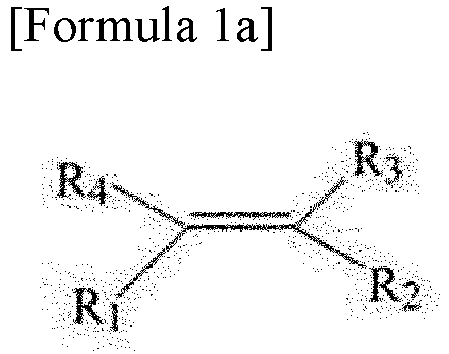

- The antibacterial composition according to claim 7, wherein R3 and R4 are linked to each other to form a cyclic compound represented by Formula 2 below:


- The antibacterial composition according to claim 8, wherein L and L1 in Formula 2 are nitrogen atoms, and R1, R2, R8 and R7 are each independently hydrogen, an alkyl group, an alkoxy group, a hydroxy group, an amino group or a coordinating functional group.
- The antibacterial composition according to claim 8, wherein L in Formula 2 is a divalent residue of Formula 3, L1 is a carbon atom, R1 and R5 or R1, R8 and R7 are coordinating functional groups, and the rest of R1, R2 and R8 to R8 are each independently hydrogen, an alkyl group, a hydroxy group, an amino group or a coordinating functional group.
- The antibacterial composition according to claim 1, having antibacterial properties against gram-negative bacteria, gram-positive bacteria and super bacteria.
- The antibacterial composition according to claim 1, wherein the lethal concentration 50 (LC50) of the acute inhalation toxicity test exceeds 1.0 mg/L and the composition is non-toxic to the human body.
- The antibacterial composition according to claim 1, further comprising one or more selected from the group consisting of drug delivery substances, fragrances, deodorants and antibacterial substances.
- The antibacterial composition according to claim 1, wherein the composition is used for syringe materials, injection storage containers, injection storage tube materials, infusion pack materials, infusion storage containers, infusion storage tube materials, gauze, bandages, sterile gloves, antibacterial fibers, endothelial materials for clothes, endothelial materials for shoes, automobile interior plastic materials, indoor paints, outdoor paints, kitchen container materials, kitchen utensil materials, home appliance materials, plastic materials for toilets, plastic materials for bathrooms, food packages or medical devices.
Applications Claiming Priority (2)
| Application Number | Priority Date | Filing Date | Title |
|---|---|---|---|
| KR20190005276 | 2019-01-15 | ||
| PCT/KR2020/000719 WO2020149633A1 (en) | 2019-01-15 | 2020-01-15 | Antibacterial composition |
Publications (2)
| Publication Number | Publication Date |
|---|---|
| EP3888465A1 true EP3888465A1 (en) | 2021-10-06 |
| EP3888465A4 EP3888465A4 (en) | 2022-04-13 |
Family
ID=71613925
Family Applications (1)
| Application Number | Title | Priority Date | Filing Date |
|---|---|---|---|
| EP20741815.3A Pending EP3888465A4 (en) | 2019-01-15 | 2020-01-15 | Antibacterial composition |
Country Status (6)
| Country | Link |
|---|---|
| US (1) | US20220095627A1 (en) |
| EP (1) | EP3888465A4 (en) |
| JP (1) | JP7679584B2 (en) |
| KR (1) | KR102568722B1 (en) |
| CN (1) | CN113226038B (en) |
| WO (1) | WO2020149633A1 (en) |
Families Citing this family (6)
| Publication number | Priority date | Publication date | Assignee | Title |
|---|---|---|---|---|
| KR102402524B1 (en) * | 2020-09-22 | 2022-05-27 | 엘지전자 주식회사 | Refrigerator |
| CN114181401B (en) * | 2021-12-13 | 2023-01-31 | 嘉兴南湖学院 | Antibacterial composite material with slow release performance and preparation method of antibacterial medical dressing |
| CN115252874B (en) * | 2022-08-18 | 2023-10-20 | 常州美杰医疗用品有限公司 | Biodegradable medical bandage and preparation method thereof |
| KR102540169B1 (en) * | 2022-09-20 | 2023-06-05 | 주식회사 고차원 | Toothbrush cap having MOF antibacterial ball receiving structure and manufacturing method thereof |
| CN115737839B (en) * | 2022-11-25 | 2023-12-12 | 深圳先进技术研究院 | Composite material and preparation method and application thereof |
| CN120192549B (en) * | 2025-05-23 | 2025-08-12 | 北京大学第三医院(北京大学第三临床医学院) | A fumarate metal-organic framework for treating eye bacterial infections |
Family Cites Families (18)
| Publication number | Priority date | Publication date | Assignee | Title |
|---|---|---|---|---|
| JP2007510712A (en) * | 2003-11-11 | 2007-04-26 | ベッキス インダストリーズ リミテッド | Bactericidal composition and methods for making and using the same |
| PL1988996T3 (en) * | 2006-02-28 | 2018-01-31 | Univ Michigan Regents | Preparation of functionalized zeolitic frameworks |
| DE102008005218A1 (en) * | 2007-11-04 | 2009-05-07 | BLüCHER GMBH | Sorption filter material and its use |
| CN101938900A (en) * | 2008-02-08 | 2011-01-05 | 日本曹达株式会社 | Liquid composition containing histidine silver complex, bactericide composition and stabilization method of histidine silver complex |
| GB201013307D0 (en) * | 2010-08-09 | 2010-09-22 | Univ St Andrews | Anti-microbial metal organic framework |
| CN103570752B (en) * | 2012-07-24 | 2016-09-28 | 中国科学院大连化学物理研究所 | A kind of method of ion full-boiled process synthetic microporous SOD type zeolite imidazole skeleton species |
| GB201309458D0 (en) * | 2013-05-27 | 2013-07-10 | Queens University Of The Belfast | Process for the Preparation of a Metal-Organic Compound |
| JP2017522239A (en) * | 2014-06-19 | 2017-08-10 | アグロフレッシュ インコーポレイテッド | Composition and method for packaging fruits and vegetables |
| US9394216B2 (en) * | 2014-11-10 | 2016-07-19 | Mirtech, Inc. | Complexes of 1-methylcyclopropene with metal coordination polymer networks |
| WO2017069702A1 (en) * | 2015-10-19 | 2017-04-27 | Agency For Science, Technology And Research | Antimicrobial coatings |
| US11478774B2 (en) * | 2016-08-29 | 2022-10-25 | Cornell University | Metal organic frameworks and methods of making and using same |
| KR102354462B1 (en) * | 2016-09-09 | 2022-01-21 | 한국화학연구원 | Bifunctional silver ion-containing metal-organic framework composites with functions of antibiosis and dehumidification, a preparation method thereof, and a biodegradable polymer film comprising the same |
| CN107022899A (en) * | 2017-04-28 | 2017-08-08 | 东华大学 | Metal organic frame/polymer nanofiber composite film material and preparation method thereof |
| DE102017209840A1 (en) * | 2017-06-12 | 2018-12-13 | Henkel Ag & Co. Kgaa | Trigger spray for removing bad smell and deodorising |
| KR101944255B1 (en) | 2017-07-05 | 2019-02-01 | 김윤기 | Bone plate for clavicle part osteosynthesis and bone plate system included the same |
| KR20190013629A (en) * | 2017-07-28 | 2019-02-11 | 주식회사 엘지화학 | Antimicrobial agent coomprising MOF and antimicrobial filter coomprising the same |
| JP2019088499A (en) * | 2017-11-15 | 2019-06-13 | 大原パラヂウム化学株式会社 | Deodorant for life smell |
| WO2019235742A1 (en) * | 2018-06-04 | 2019-12-12 | 광운대학교 산학협력단 | Antibacterial agent comprising metal-organic framework compound, and antibacterial silicone and antibacterial hydrogel comprising same |
-
2020
- 2020-01-15 US US17/422,859 patent/US20220095627A1/en active Pending
- 2020-01-15 KR KR1020200005075A patent/KR102568722B1/en active Active
- 2020-01-15 WO PCT/KR2020/000719 patent/WO2020149633A1/en not_active Ceased
- 2020-01-15 CN CN202080007142.4A patent/CN113226038B/en active Active
- 2020-01-15 JP JP2021532864A patent/JP7679584B2/en active Active
- 2020-01-15 EP EP20741815.3A patent/EP3888465A4/en active Pending
Also Published As
| Publication number | Publication date |
|---|---|
| US20220095627A1 (en) | 2022-03-31 |
| KR102568722B1 (en) | 2023-08-22 |
| CN113226038A (en) | 2021-08-06 |
| CN113226038B (en) | 2023-08-29 |
| JP7679584B2 (en) | 2025-05-20 |
| EP3888465A4 (en) | 2022-04-13 |
| WO2020149633A1 (en) | 2020-07-23 |
| JP2022513190A (en) | 2022-02-07 |
| KR20200088781A (en) | 2020-07-23 |
Similar Documents
| Publication | Publication Date | Title |
|---|---|---|
| EP3888465A1 (en) | Antibacterial composition | |
| Nakhaei et al. | Antibacterial activity of three zinc-terephthalate MOFs and its relation to their structural features | |
| Nabipour et al. | Synthesis and characterization of nanoscale zeolitic imidazolate frameworks with ciprofloxacin and their applications as antimicrobial agents | |
| EP3364759B1 (en) | Antimicrobial coatings | |
| Tăbăcaru et al. | Antibacterial action of 4, 4′-bipyrazolyl-based silver (I) coordination polymers embedded in PE disks | |
| KR102354462B1 (en) | Bifunctional silver ion-containing metal-organic framework composites with functions of antibiosis and dehumidification, a preparation method thereof, and a biodegradable polymer film comprising the same | |
| US20150173368A1 (en) | Synthesis of MOFs | |
| US20110086078A1 (en) | Fibrous antimicrobial materials, structures, and barrier applications | |
| JP2019088499A (en) | Deodorant for life smell | |
| Subhadarshini et al. | Zeolitic imidazolium framework (ZIF-8) and their derivative-based material for antibacterial study: a comprehensive review | |
| JP2012502730A (en) | Novel iodinated resin production method and product | |
| WO2011057611A1 (en) | Polymeric or oligomeric active ingredients having a biocidal effect, method for the production thereof, and composition comprising a polymeric or oligomeric active ingredient | |
| JP7392217B2 (en) | Molded sheet containing porous metal complex | |
| CN112056313B (en) | A kind of method for synthesizing nano Cu-MOF bacteriostatic agent in water phase | |
| Chinthamreddy et al. | ‘Biopolymer-PAA and surfactant-CTAB assistant solvothermal synthesis of Zn-based MOFs: Design, characterization for removal of toxic dyes, copper and their biological activities | |
| JP7066750B2 (en) | L-calcium lactate structure as a naturally degradable carrier | |
| JP3704543B2 (en) | AIT controlled release preparation, its production method and its use | |
| JP2022009369A (en) | Deodorant for daily life odor | |
| CN113663417A (en) | Gauze material, device containing gauze material, preparation method and application of gauze material | |
| KR101581136B1 (en) | An active-powder biocidal composition comprising at least one copper salt and at least one zinc salt, a biocidal compostion using tehreof and a method for preparing the same | |
| CN103435801A (en) | Silver chloride/porous aromatic frame composite material and preparation method thereof | |
| KR102045398B1 (en) | Antimicrobial agents with metal organic frameworks | |
| Premet et al. | Fabrication of ZIF-loaded polymer composites with antimicrobial properties towards food packaging solutions | |
| CN101731218A (en) | Antimicrobial composition, process for preparing the same, and utilization thereof | |
| JP2023130988A (en) | Functional liquid carrier, functional sustained release composition, and molded body |
Legal Events
| Date | Code | Title | Description |
|---|---|---|---|
| STAA | Information on the status of an ep patent application or granted ep patent |
Free format text: STATUS: THE INTERNATIONAL PUBLICATION HAS BEEN MADE |
|
| PUAI | Public reference made under article 153(3) epc to a published international application that has entered the european phase |
Free format text: ORIGINAL CODE: 0009012 |
|
| STAA | Information on the status of an ep patent application or granted ep patent |
Free format text: STATUS: REQUEST FOR EXAMINATION WAS MADE |
|
| 17P | Request for examination filed |
Effective date: 20210630 |
|
| AK | Designated contracting states |
Kind code of ref document: A1 Designated state(s): AL AT BE BG CH CY CZ DE DK EE ES FI FR GB GR HR HU IE IS IT LI LT LU LV MC MK MT NL NO PL PT RO RS SE SI SK SM TR |
|
| A4 | Supplementary search report drawn up and despatched |
Effective date: 20220314 |
|
| RIC1 | Information provided on ipc code assigned before grant |
Ipc: A01N 37/34 20060101ALI20220308BHEP Ipc: A01N 43/36 20060101ALI20220308BHEP Ipc: A01N 43/50 20060101ALI20220308BHEP Ipc: A01N 55/02 20060101AFI20220308BHEP |
|
| DAV | Request for validation of the european patent (deleted) | ||
| DAX | Request for extension of the european patent (deleted) | ||
| STAA | Information on the status of an ep patent application or granted ep patent |
Free format text: STATUS: EXAMINATION IS IN PROGRESS |
|
| 17Q | First examination report despatched |
Effective date: 20250305 |