EP3888085B1 - Vorhersage der glottalen insuffizienz mittels frequenzanalyse - Google Patents
Vorhersage der glottalen insuffizienz mittels frequenzanalyse Download PDFInfo
- Publication number
- EP3888085B1 EP3888085B1 EP19889852.0A EP19889852A EP3888085B1 EP 3888085 B1 EP3888085 B1 EP 3888085B1 EP 19889852 A EP19889852 A EP 19889852A EP 3888085 B1 EP3888085 B1 EP 3888085B1
- Authority
- EP
- European Patent Office
- Prior art keywords
- phonation
- voice recording
- contour curve
- fundamental frequency
- voice
- Prior art date
- Legal status (The legal status is an assumption and is not a legal conclusion. Google has not performed a legal analysis and makes no representation as to the accuracy of the status listed.)
- Active
Links
Images



Classifications
-
- G—PHYSICS
- G10—MUSICAL INSTRUMENTS; ACOUSTICS
- G10L—SPEECH ANALYSIS TECHNIQUES OR SPEECH SYNTHESIS; SPEECH RECOGNITION; SPEECH OR VOICE PROCESSING TECHNIQUES; SPEECH OR AUDIO CODING OR DECODING
- G10L25/00—Speech or voice analysis techniques not restricted to a single one of groups G10L15/00 - G10L21/00
- G10L25/48—Speech or voice analysis techniques not restricted to a single one of groups G10L15/00 - G10L21/00 specially adapted for particular use
- G10L25/51—Speech or voice analysis techniques not restricted to a single one of groups G10L15/00 - G10L21/00 specially adapted for particular use for comparison or discrimination
- G10L25/66—Speech or voice analysis techniques not restricted to a single one of groups G10L15/00 - G10L21/00 specially adapted for particular use for comparison or discrimination for extracting parameters related to health condition
-
- A—HUMAN NECESSITIES
- A61—MEDICAL OR VETERINARY SCIENCE; HYGIENE
- A61B—DIAGNOSIS; SURGERY; IDENTIFICATION
- A61B5/00—Measuring for diagnostic purposes; Identification of persons
- A61B5/0002—Remote monitoring of patients using telemetry, e.g. transmission of vital signals via a communication network
- A61B5/0015—Remote monitoring of patients using telemetry, e.g. transmission of vital signals via a communication network characterised by features of the telemetry system
- A61B5/0022—Monitoring a patient using a global network, e.g. telephone networks, internet
-
- A—HUMAN NECESSITIES
- A61—MEDICAL OR VETERINARY SCIENCE; HYGIENE
- A61B—DIAGNOSIS; SURGERY; IDENTIFICATION
- A61B5/00—Measuring for diagnostic purposes; Identification of persons
- A61B5/48—Other medical applications
- A61B5/4803—Speech analysis specially adapted for diagnostic purposes
-
- G—PHYSICS
- G10—MUSICAL INSTRUMENTS; ACOUSTICS
- G10L—SPEECH ANALYSIS TECHNIQUES OR SPEECH SYNTHESIS; SPEECH RECOGNITION; SPEECH OR VOICE PROCESSING TECHNIQUES; SPEECH OR AUDIO CODING OR DECODING
- G10L13/00—Speech synthesis; Text to speech systems
- G10L13/02—Methods for producing synthetic speech; Speech synthesisers
- G10L13/04—Details of speech synthesis systems, e.g. synthesiser structure or memory management
-
- G—PHYSICS
- G10—MUSICAL INSTRUMENTS; ACOUSTICS
- G10L—SPEECH ANALYSIS TECHNIQUES OR SPEECH SYNTHESIS; SPEECH RECOGNITION; SPEECH OR VOICE PROCESSING TECHNIQUES; SPEECH OR AUDIO CODING OR DECODING
- G10L25/00—Speech or voice analysis techniques not restricted to a single one of groups G10L15/00 - G10L21/00
- G10L25/48—Speech or voice analysis techniques not restricted to a single one of groups G10L15/00 - G10L21/00 specially adapted for particular use
-
- G—PHYSICS
- G10—MUSICAL INSTRUMENTS; ACOUSTICS
- G10L—SPEECH ANALYSIS TECHNIQUES OR SPEECH SYNTHESIS; SPEECH RECOGNITION; SPEECH OR VOICE PROCESSING TECHNIQUES; SPEECH OR AUDIO CODING OR DECODING
- G10L25/00—Speech or voice analysis techniques not restricted to a single one of groups G10L15/00 - G10L21/00
- G10L25/78—Detection of presence or absence of voice signals
-
- G—PHYSICS
- G10—MUSICAL INSTRUMENTS; ACOUSTICS
- G10L—SPEECH ANALYSIS TECHNIQUES OR SPEECH SYNTHESIS; SPEECH RECOGNITION; SPEECH OR VOICE PROCESSING TECHNIQUES; SPEECH OR AUDIO CODING OR DECODING
- G10L25/00—Speech or voice analysis techniques not restricted to a single one of groups G10L15/00 - G10L21/00
- G10L25/90—Pitch determination of speech signals
-
- A—HUMAN NECESSITIES
- A61—MEDICAL OR VETERINARY SCIENCE; HYGIENE
- A61B—DIAGNOSIS; SURGERY; IDENTIFICATION
- A61B2562/00—Details of sensors; Constructional details of sensor housings or probes; Accessories for sensors
- A61B2562/02—Details of sensors specially adapted for in-vivo measurements
- A61B2562/0204—Acoustic sensors
-
- G—PHYSICS
- G10—MUSICAL INSTRUMENTS; ACOUSTICS
- G10L—SPEECH ANALYSIS TECHNIQUES OR SPEECH SYNTHESIS; SPEECH RECOGNITION; SPEECH OR VOICE PROCESSING TECHNIQUES; SPEECH OR AUDIO CODING OR DECODING
- G10L25/00—Speech or voice analysis techniques not restricted to a single one of groups G10L15/00 - G10L21/00
- G10L25/90—Pitch determination of speech signals
- G10L2025/906—Pitch tracking
Definitions
- the invention relates to the field of computerized voice analysis.
- GCI Glottal closure insufficiency
- GCI glottal closure insufficiency
- the present invention provides for a computerized acoustic analysis of a fundamental frequency curve acquired during phonation, e.g., of a sustained vowel.
- the fundamental frequency may be defined as the lowest frequency of a periodic waveform.
- the fundamental frequency is the musical pitch of a note that is perceived as the lowest partial present.
- the present invention is based, at least in part, on the empirical finding that the fundamental frequency curve of a phonation of human subjects has several typical contours which correspond to different glottal closure conditions in the subjects. These typical contours may be explained qualitatively based on a set of parameters that capture the contour type, which may then be used to quantitively assess CGI in individuals.
- the computerized acoustic analysis may comprise measuring at least some of the following parameters: phonation settling time, phonation slope, and/or an area under curve for the phonation during the period from onset to settling.
- Voice disorders due to GCI which is the gap between vocal folds during phonation, may be caused by various conditions. The most common are vocal fold paresis and paralysis. When one of the vocal folds is paralyzed, the folds are not able to meet in the midline to start the glottic attack, thus preventing the development of the subglottic pressure needed to initiate normal speech. See, e.g., Orlikoff RF, Deliyski DD, Baken RJ, Watson BC; "Validation of a glottographic measure of vocal attack"; J Voice; 2009 Mar; 23(2): 164-8 .
- the mucosal wave cannot be adequately maintained due to the lack of negative glottal pressure caused by the Bernoulli Effect.
- Symptoms include effortful phonation, vocal fatigue, breathiness, and odynophonia.
- a multidimensional patient assessment for voice disorders protocol usually includes video-endoscopy; acoustic analysis, which includes maximum phonation time (MPT), S/Z ratio, jitter and shimmer; and voice quality assessment using, e.g., the GRBAS scale; and the voice handicap index (VHI).
- MPT maximum phonation time
- S/Z ratio maximum phonation time
- jitter and shimmer e.g., the GRBAS scale
- VHI voice handicap index
- the present invention provides for an objective assessment of the condition of an individual with voice disorders, based, at least in part, on voice analysis which measures voice initiation-parameters, including phonation settling time, the slope from the phonation onset to the settling time, and/or the area under the fundamental frequency curve from phonation onset to the settling time.
- voice initiation-parameters including phonation settling time, the slope from the phonation onset to the settling time, and/or the area under the fundamental frequency curve from phonation onset to the settling time.
- a potential advantage of the present invention is, therefore, in that it provides for an efficient, noninvasive, and inexpensive way to determine and measure CGI in an individual, based solely on acoustic analysis of one or more specified phonations by the individual.
- the present method does not require sophisticated equipment, such as high-speed cameras or digital kymography, and may be extracted from any common voice analysis system.
- Fig. 1 is a block diagram of an exemplary system 100 for determining glottal closure insufficiency (GCI) in subjects, according to an embodiment.
- System 100 may comprise one or more hardware processors 102, and a non-transitory computer-readable storage medium 104.
- Storage medium 104 may have encoded thereon software instructions or components configured to operate a processing unit (also "hardware processor,” “CPU,” or simply “processor”), such as hardware processor(s) 102.
- the software components may include an operating system, including various software components and/or drivers for controlling and managing general system tasks (e.g., memory management, storage device control, power management, etc.), and facilitating communication between various hardware and software components.
- the program instructions are segmented into one or more software modules, which may comprise, e.g., a voice analysis module 106.
- voice analysis module 106 may be configured for analyzing at least some of intensity, fundamental frequency, jitter, shimmer, and harmonic to noise ratio (HNR) of voice samples.
- a recording module 108 of system 100 may be configured for digitally recording voice samples of subjects at, e.g., a range of specified sampling rates and bit depths.
- microphone module 110 may comprise one or more microphones, such as a stroboscopic microphone, an omni-directional microphone, and/or additional or other types of microphones.
- System 100 as described herein is only an exemplary embodiment of the present invention, and in practice may be implemented in hardware, software only, or a combination of both hardware and software.
- System 100 may have more or fewer components and modules than shown, may combine two or more of the components, or may have a different configuration or arrangement of the components.
- system 100 may comprise one or more dedicated hardware devices, one or more software modules, and/or may form an addition to or extension to an existing device.
- a voice sample of a subject may be recorded using microphone module 110 and/or recording module 108.
- the voice sample may comprise the subject, e.g., pronouncing a specified sustained vowel (in a non-limiting example, the vowel /iy/).
- the present invention may be applied to a wide range of vowel pronunciations.
- a plurality of voice samples e.g., 3 or more, may be recorded, and the sample with the best contour may be selected for analysis.
- the voice sample may be analyzed using, e.g., voice analysis module 106.
- one or more fundamental frequency parameters may be derived, including, but not limited to, time-to-stabilization, slope-at-stabilization, and area-of-stability.
- the fundamental frequency parameters may be derived using methods that are based, at least in part, on the myoelastic-aerodynamic theory of vocal folds vibrations, modern control theory, and/or additional and/or other similar paradigms.
- the myoelastic-aerodynamic theory states that the voice is produced by a coupling between the aerodynamic forces and the vocal folds tissue parameters, which produce a range of acoustical sound. See, e.g., Van Den Berg, "Myoelastic-aerodynamic theory of voice production", J Speech Hear Res. 1958 Sep;1(3):227-44 .
- the most common modeling framework in voice investigations is the lumped-element approach, where the VF structure is modeled as a collection of discrete coupled mass-spring-damper systems subjected to some external aerodynamic and/or acoustical loading function. Lumped-element models have proven capable of emulating the physiological VF kinematics and acoustic output.
- Modern control theory is a field of science and engineering that is used in analyzing the behavior over time and frequency of different types of dynamic systems, such as mechanical systems, electric systems, liquid-level systems, pneumatic systems, hydraulic systems, and thermal systems. See, e.g., Burns, Roland (2001), “Advanced Control Engineering”, 1st Ed, Butterworth-Heinemann ; Ogata, Katsuhiko, (2010), “Modern Control Engineering”, 5th ed, Prentice-Hall ; Nise, Norman K., (2011), “Control System Engineering” 6th ed., John Wiley & Sons . Modern control theory provides a mathematic modeling framework of such systems using differential equations.
- the response (or the output) of a system to a given input is composed of a transient response and a steady-state response.
- Transient response represents the temporal behavior of the system from the initial state to the final stable state, while steady-state response represents what happens with the system after stabilization, usually after some period of time.
- the present invention provides for modeling the oscillations of the vocal folds based, at least in part, on a transient solution of a set of differential equations of the mass-spring-damper model.
- the present invention provides for an analysis of the fundamental frequency contour at the area of the phonation onset. The short duration between vocal folds vibration initiation until a stable vibration is achieved depends on the distance between them during adduction. Based on experimental measurements conducted by the present inventors, further discussed below under “Empirical Testing and Validation," the fundamental frequency contour of healthy subjects shows that the fundamental frequency can reach its final steady-state value almost instantly, creating a flat curve, or it may exceed the final fundamental frequency, a phenomenon known as overshoot.
- the transient values of the fundamental frequency were below the stable value, and this phenomenon is known as undershoot.
- the distance between the two vocal folds was too wide with no pitch production at all.
- the time-to-stabilization of healthy subjects is much shorter than of subjects with vocal insufficiency.
- the slope-at-stabilization of healthy subjects shows a negative slope, as it describes a decrease from the overshoot to the steady-state value, whereas in the subjects suffering from vocal fold paralysis, the slope-at-stabilization was positive as the fundamental frequency contour was rising from a low value to a steady state.
- the vocal fold system can be approximated as a double mass-spring-damper model, which is mathematically expressed as a second-order differential equation
- the transient response stage can be assessed from the very beginning of phonation until the oscillation stabilization.
- Lucero et al (2015) extended the standard lumped-mass model to capture the case when the left and right VF oscillate asynchronously as in the case of VF paralysis and paresis. This model is expressed as a double second-order system.
- the input to the system has to be a unit step function.
- This function is formally defined as being 0 until some point in time where it changes to the value 1. It may be assumed that a production of sustained vowels immediately after complete silence can be considered a unit step function.
- such a second-order system has two types of possible solutions: underdamped and overdamped. These solutions depend on the values of the system parameters: the masses of the VF tissues, the constant of the springs (i.e., the muscle elasticity of the VF), and the viscosity of the damper (i.e., the elasticity of the VF tissue).
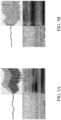
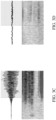
- Figs. 3A-3D illustrate examples of measurements of healthy and pathological subjects, wherein each panel consists of an upper graph showing the time signal and the lower graph showing the spectrum.
- Fig. 3A shows a rapid pitch rise with a flat curve, consistent with a flat transient stage response.
- Fig. 3B shows a positive notch immediately before pitch stabilization, consistent with overshoot.
- Figs. 3C 3D show an uprising curve until pitch stabilization takes place, consistent with undershoot (3C) and a scattered pattern (3D).
- voice analysis module 106 may be configured for extracting the fundamental frequency within time frames of 5 milliseconds (ms) of the voice sample.
- f ( t ) denote the fundamental frequency estimation at time frame t .
- Figs. 4A-4B show diagrams of slope-at-stability ( Fig. 4A ) and area-of-stability ( Fig. 4B ) in a subject.
- the arrow below each diagram indicates the settling time, i.e., time-to-stabilization.
- step 206 assessing CGI in the subject based on at least one of the derived parameters.
- the present inventors have conducted a test study to determine the validity of the fundamental frequency analysis in determining GCI in participants.
- the study comprised three groups of participants:
- Participants were asked to pronounce the sustained vowel (in a non-limiting example, the vowel / iy /) from complete silence, and their voices were recorded. Participants' voices were then analyzed to extract intensity, fundamental frequency, jitter, shimmer, and harmonic to noise ratio (HNR).
- HNR harmonic to noise ratio
- GFI Groningen Frailty Indicator
- VHI Voice Handicap Index
- VAS Visual Analog Scale
- GRABS GRABS voice scale
- Descriptive statistics for all participants were generated for all measures, including means and standard deviations for continuous measures using Stata 14 for Windows 10. Next, two sample t -tests were performed to compare different groups, and the Pearson correlation coefficient was used to establish if there is a relationship between variables.
- the average age was 50.56 (SD 17.49) years, the age range was 29-85, and 8 were men.
- Subjective voice analysis using VAS was 1.1 ⁇ 0.2 and GRABS was 0.6 ⁇ 1.0.
- Objective voice analyses measured by jitter, shimmer and HNR were 0.8 ⁇ 0.4, 7.1 ⁇ 3.0 and 14.3 ⁇ 3.9, respectively.
- MPT and the S/Z ratio were 17.9 ⁇ 1.0 and 0.9 ⁇ 0.2, respectively.
- the age range was 28-81 with an average of 57.4 (S.D. 16.74) years, and 12 were men.
- the mean GFI score was 16.9 ⁇ 4.2 and the VHI score was 89.0 ⁇ 23.8.
- Subjective voice analysis using VAS was 4.1 ⁇ 0.7 and GRABS was 12.3 ⁇ 2.9.
- Objective voice analyses measured by jitter, shimmer and HNR were 3.8 ⁇ 2.7, 14.0 ⁇ 6.3 and 10.2 ⁇ 6.4, respectively.
- MPT and the S/Z ratio were 5.6 ⁇ 2.1 and 0.9 ⁇ 0.2, respectively.
- Table 1 demonstrates the symptom and voice analysis differences between the groups. All voice measurements were found to be statistically significant. Table 1 : Objective and Subjective voice measurements of the control and patients before treatment.
- Table 3 compares the control subject to the participant receiving injection medialization laryngoplasty to close the gap between the vocal folds. Although there is an improvement and similarity between the control group and the participant group, the control group is still superior for all voice and symptom parameters.
- Table 3 Objective and Subjective voice measurements of the control and patients after treatment.
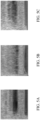
- Figs. 5A-5C illustrate pitch contour on the background of the spectrogram of control group participants ( Fig. 5A ), study group before treatment ( Fig. 5B ), and study group after treatment ( Fig. 5C ).
- Table 4 presents the pairwise correlation with the appropriate p -value between the traditional acoustic analysis paradigm and the new proposed measurements. As can be seen, all the traditional measurements are found to be overall highly correlated with the new proposed measurements (expect for S/Z ratio). Table 4 : New voice measurements of the control and the patients before and after treatment.
- the present invention may be a system, a method, and/or a computer program product.
- the computer program product may include a computer readable storage medium (or media) having computer readable program instructions thereon for causing a processor to carry out aspects of the present invention.
- the computer readable storage medium can be a tangible device that can retain and store instructions for use by an instruction execution device.
- the computer readable storage medium may be, for example, but is not limited to, an electronic storage device, a magnetic storage device, an optical storage device, an electromagnetic storage device, a semiconductor storage device, or any suitable combination of the foregoing.
- a non-exhaustive list of more specific examples of the computer readable storage medium includes the following: a portable computer diskette, a hard disk, a random access memory (RAM), a read-only memory (ROM), an erasable programmable read-only memory (EPROM or Flash memory), a static random access memory (SRAM), a portable compact disc read-only memory (CD-ROM), a digital versatile disk (DVD), a memory stick, a floppy disk, a mechanically encoded device having instructions recorded thereon, and any suitable combination of the foregoing.
- a computer readable storage medium is not to be construed as being transitory signals per se, such as radio waves or other freely propagating electromagnetic waves, electromagnetic waves propagating through a waveguide or other transmission media (e.g., light pulses passing through a fiber-optic cable), or electrical signals transmitted through a wire. Rather, the computer readable storage medium is a non-transient (i.e., not-volatile) medium.
- Computer readable program instructions described herein can be downloaded to respective computing/processing devices from a computer readable storage medium or to an external computer or external storage device via a network, for example, the Internet, a local area network, a wide area network and/or a wireless network.
- the network may comprise copper transmission cables, optical transmission fibers, wireless transmission, routers, firewalls, switches, gateway computers and/or edge servers.
- a network adapter card or network interface in each computing/processing device receives computer readable program instructions from the network and forwards the computer readable program instructions for storage in a computer readable storage medium within the respective computing/processing device.
- Computer readable program instructions for carrying out operations of the present invention may be assembler instructions, instruction-set-architecture (ISA) instructions, machine instructions, machine dependent instructions, microcode, firmware instructions, state-setting data, or either source code or object code written in any combination of one or more programming languages, including an object oriented programming language such as Java, Smalltalk, C++ or the like, and conventional procedural programming languages, such as the "C" programming language or similar programming languages.
- the computer readable program instructions may execute entirely on the user's computer, partly on the user's computer, as a stand-alone software package, partly on the user's computer and partly on a remote computer or entirely on the remote computer or server.
- the remote computer may be connected to the user's computer through any type of network, including a local area network (LAN) or a wide area network (WAN), or the connection may be made to an external computer (for example, through the Internet using an Internet Service Provider).
- electronic circuitry including, for example, programmable logic circuitry, field-programmable gate arrays (FPGA), or programmable logic arrays (PLA) may execute the computer readable program instructions by utilizing state information of the computer readable program instructions to personalize the electronic circuitry, in order to perform aspects of the present invention.
- These computer readable program instructions may be provided to a processor of a general-purpose computer, special purpose computer, or other programmable data processing apparatus to produce a machine, such that the instructions, which execute via the processor of the computer or other programmable data processing apparatus, create means for implementing the functions/acts specified in the flowchart and/or block diagram block or blocks.
- These computer readable program instructions may also be stored in a computer readable storage medium that can direct a computer, a programmable data processing apparatus, and/or other devices to function in a particular manner, such that the computer readable storage medium having instructions stored therein comprises an article of manufacture including instructions which implement aspects of the function/act specified in the flowchart and/or block diagram block or blocks.
- the computer readable program instructions may also be loaded onto a computer, other programmable data processing apparatus, or other device to cause a series of operational steps to be performed on the computer, other programmable apparatus or other device to produce a computer implemented process, such that the instructions which execute on the computer, other programmable apparatus, or other device implement the functions/acts specified in the flowchart and/or block diagram block or blocks.
- each block in the flowchart or block diagrams may represent a module, segment, or portion of instructions, which comprises one or more executable instructions for implementing the specified logical function(s).
- the functions noted in the block may occur out of the order noted in the figures.
- two blocks shown in succession may, in fact, be executed substantially concurrently, or the blocks may sometimes be executed in the reverse order, depending upon the functionality involved.
Landscapes
- Engineering & Computer Science (AREA)
- Health & Medical Sciences (AREA)
- Life Sciences & Earth Sciences (AREA)
- Physics & Mathematics (AREA)
- Audiology, Speech & Language Pathology (AREA)
- General Health & Medical Sciences (AREA)
- Human Computer Interaction (AREA)
- Acoustics & Sound (AREA)
- Multimedia (AREA)
- Public Health (AREA)
- Computational Linguistics (AREA)
- Signal Processing (AREA)
- Surgery (AREA)
- Biophysics (AREA)
- Medical Informatics (AREA)
- Molecular Biology (AREA)
- Biomedical Technology (AREA)
- Animal Behavior & Ethology (AREA)
- Pathology (AREA)
- Heart & Thoracic Surgery (AREA)
- Veterinary Medicine (AREA)
- Computer Networks & Wireless Communication (AREA)
- Epidemiology (AREA)
- Measurement Of The Respiration, Hearing Ability, Form, And Blood Characteristics Of Living Organisms (AREA)
- Investigating Or Analysing Biological Materials (AREA)
- Prostheses (AREA)
- Measurement And Recording Of Electrical Phenomena And Electrical Characteristics Of The Living Body (AREA)
Claims (15)
- System, umfassend:wenigstens einen Hardware-Prozessor; undein nicht transitorisches computerlesbares Speichermedium, welches darauf gespeicherte Programmanweisungen aufweist, wobei die Programmanweisungen durch den wenigstens einen Hardware-Prozessor ausführbar sind, zum:Empfangen einer Sprachaufnahme, welche eine Phonation durch ein Subjekt umfasst,Analysieren der Sprachaufnahme, um eine Grundfrequenz-Konturkurve der Phonation zu berechnen,Messen eines Zeitraums von einem Start der Phonation bis die Konturkurve ein festgelegtes Niveau erreicht,Messen wenigstens eines aus einer Steigung der Konturkurve während des Zeitraums und einer Fläche unter der Konturkurve während des Zeitraums, undBestimmen einer Glottiverschluss-Insuffizienz in dem Subjekt auf Grundlage wenigstens teilweise der Messung.
- System nach Anspruch 1, wobei die Phonation eine anhaltende Aussprache eines bestimmten Vokabulars durch das Subjekt beginnend von völliger Stille umfasst.
- System nach einem der Ansprüche 1-2, wobei das festgelegte Niveau auf Grundlage wenigstens teilweise von Messabweichungen in der Grundfrequenz während eines bestimmten Zeitraums bestimmt wird.
- System nach einem der Ansprüche 1-3, ferner umfassend ein Mikrofon, welches durch den wenigstens einen Hardware-Prozessor betreibbar ist, um die Sprachaufnahme zu erfassen.
- System nach einem der Ansprüche 1-4, wobei die Sprachaufnahme eine digitale Sprachaufnahme ist.
- Verfahren, umfassend:Empfangen einer Sprachaufnahme, welche eine Phonation durch ein Subjekt umfasst;Analysieren der Sprachaufnahme, um eine Grundfrequenz-Konturkurve der Phonation zu berechnen;Messen eines Zeitraums von einem Start der Phonation bis die Konturkurve ein festgelegtes Niveau erreicht,Messen wenigstens eines aus einer Steigung der Konturkurve während des Zeitraums und einer Fläche unter der Konturkurve während des Zeitraums; undBestimmen einer Glottiverschluss-Insuffizienz in dem Subjekt auf Grundlage wenigstens teilweise der Messung.
- Verfahren nach Anspruch 6, wobei die Phonation eine anhaltende Aussprache eines bestimmten Vokabulars durch das Subjekt beginnend von völliger Stille umfasst.
- Verfahren nach einem der Ansprüche 6-7, wobei das festgelegte Niveau auf Grundlage wenigstens teilweise von Messabweichungen in der Grundfrequenz während eines bestimmten Zeitraums bestimmt wird.
- Verfahren nach einem der Ansprüche 6-8, wobei die Sprachaufnahme unter Verwendung eines Mikrofons erfasst wird, welches durch den wenigstens einen Hardware-Prozessor betreibbar ist.
- Verfahren nach einem der Ansprüche 6-9, wobei die Sprachaufnahme eine digitale Sprachaufnahme ist.
- Computerprogrammprodukt, umfassend ein nicht transitorisches computerlesbares Speichermedium, welches damit verkörperte Programmanweisungen aufweist, wobei die Programmanweisungen durch wenigstens einen Hardware-Prozessor ausführbar sind, zum:Empfangen einer Sprachaufnahme, welche eine Phonation durch ein Subjekt umfasst;Analysieren der Sprachaufnahme, um eine Grundfrequenz-Konturkurve der Phonation zu berechnen;Messen eines Zeitraums von einem Start der Phonation bis die Konturkurve ein festgelegtes Niveau erreicht,Messen wenigstens eines aus: einer Steigung der Konturkurve während des Zeitraums und einer Fläche unter der Konturkurve während des Zeitraums; undBestimmen einer Glottiverschluss-Insuffizienz in dem Subjekt auf Grundlage wenigstens teilweise der Messung.
- Computerprogrammprodukt nach Anspruch 11, wobei die Phonation eine anhaltende Aussprache eines bestimmten Vokabulars durch das Subjekt beginnend von völliger Stille umfasst.
- Computerprogrammprodukt nach einem der Ansprüche 11-12, wobei das festgelegte Niveau auf Grundlage wenigstens teilweise von Messabweichungen in der Grundfrequenz während eines bestimmten Zeitraums bestimmt wird.
- Computerprogrammprodukt nach einem der Ansprüche 11-13, wobei die Sprachaufnahme unter Verwendung eines Mikrofons erfasst wird, welches durch den wenigstens einen Hardware-Prozessor betreibbar ist.
- Computerprogrammprodukt nach einem der Ansprüche 11-14 wobei die Sprachaufnahme eine digitale Sprachaufnahme ist.
Applications Claiming Priority (2)
| Application Number | Priority Date | Filing Date | Title |
|---|---|---|---|
| US201862772214P | 2018-11-28 | 2018-11-28 | |
| PCT/IL2019/051308 WO2020110123A1 (en) | 2018-11-28 | 2019-11-28 | Predicting glottal insufficiency using frequency analysis |
Publications (4)
| Publication Number | Publication Date |
|---|---|
| EP3888085A1 EP3888085A1 (de) | 2021-10-06 |
| EP3888085A4 EP3888085A4 (de) | 2022-08-24 |
| EP3888085C0 EP3888085C0 (de) | 2024-07-17 |
| EP3888085B1 true EP3888085B1 (de) | 2024-07-17 |
Family
ID=70852354
Family Applications (1)
| Application Number | Title | Priority Date | Filing Date |
|---|---|---|---|
| EP19889852.0A Active EP3888085B1 (de) | 2018-11-28 | 2019-11-28 | Vorhersage der glottalen insuffizienz mittels frequenzanalyse |
Country Status (5)
| Country | Link |
|---|---|
| US (1) | US11875818B2 (de) |
| EP (1) | EP3888085B1 (de) |
| ES (1) | ES2988817T3 (de) |
| IL (1) | IL283521B2 (de) |
| WO (1) | WO2020110123A1 (de) |
Families Citing this family (1)
| Publication number | Priority date | Publication date | Assignee | Title |
|---|---|---|---|---|
| WO2023074119A1 (ja) * | 2021-10-27 | 2023-05-04 | パナソニックIpマネジメント株式会社 | 推定装置、推定方法およびプログラム |
Family Cites Families (2)
| Publication number | Priority date | Publication date | Assignee | Title |
|---|---|---|---|---|
| US7251314B2 (en) * | 1994-10-18 | 2007-07-31 | Lucent Technologies | Voice message transfer between a sender and a receiver |
| US20100280829A1 (en) * | 2009-04-29 | 2010-11-04 | Paramesh Gopi | Photo Management Using Expression-Based Voice Commands |
-
2019
- 2019-11-28 IL IL283521A patent/IL283521B2/en unknown
- 2019-11-28 EP EP19889852.0A patent/EP3888085B1/de active Active
- 2019-11-28 WO PCT/IL2019/051308 patent/WO2020110123A1/en not_active Ceased
- 2019-11-28 US US17/297,695 patent/US11875818B2/en active Active
- 2019-11-28 ES ES19889852T patent/ES2988817T3/es active Active
Also Published As
| Publication number | Publication date |
|---|---|
| WO2020110123A1 (en) | 2020-06-04 |
| EP3888085C0 (de) | 2024-07-17 |
| IL283521A (en) | 2021-07-29 |
| EP3888085A4 (de) | 2022-08-24 |
| US11875818B2 (en) | 2024-01-16 |
| IL283521B2 (en) | 2025-05-01 |
| EP3888085A1 (de) | 2021-10-06 |
| US20220028416A1 (en) | 2022-01-27 |
| IL283521B1 (en) | 2025-01-01 |
| ES2988817T3 (es) | 2024-11-21 |
Similar Documents
| Publication | Publication Date | Title |
|---|---|---|
| US20220375491A1 (en) | Verbal periodic screening for heart disease | |
| Benba et al. | Voice analysis for detecting persons with Parkinson’s disease using MFCC and VQ | |
| Schultz et al. | A tutorial review on clinical acoustic markers in speech science | |
| EP3888085B1 (de) | Vorhersage der glottalen insuffizienz mittels frequenzanalyse | |
| Yan et al. | Nonlinear dynamical analysis of laryngeal, esophageal, and tracheoesophageal speech of Cantonese | |
| Appakaya et al. | Classification of Parkinson’s disease using pitch synchronous speech analysis | |
| Nieto et al. | Pattern recognition of hypernasality in voice of patients with Cleft and Lip Palate | |
| Villa-Canas et al. | Automatic assessment of voice signals according to the grbas scale using modulation spectra, mel frequency cepstral coefficients and noise parameters | |
| Sloboda et al. | Vocal biomarkers for cognitive performance estimation in a working memory task | |
| Sudro et al. | Modification of misarticulated fricative/s/in cleft lip and palate speech | |
| Dubey et al. | Hypernasality detection using zero time windowing | |
| Vats et al. | Exploring high spectro-temporal resolution for Alzheimer’s dementia detection | |
| Le et al. | The use of spectral information in the development of novel techniques for speech-based cognitive load classification | |
| Shadle et al. | Acoustic characterization of/s/spectra of adolescents: Moving beyond moments | |
| Sarika et al. | Acoustic Analysis of Malayalam Digits: Comparing Healthy and Dysarthric Speech | |
| Yan et al. | Nonlinear dynamics of voices in esophageal phonation | |
| Gayathri et al. | Automated Voice Pathology Diagnosis Through Feature Extraction | |
| Mertens et al. | Acoustical analysis of vocal tremor in Parkinson speakers | |
| Schraut | Machine Learning for Multimodal Assessment of Hoarseness Severity | |
| Ringeval et al. | Hilbert-Huang transform for nonlinear characterization of speech rhythm | |
| Jalalinajafabadi et al. | Computerised objective measurement of strain in voiced speech | |
| Bolt | Exploring cognitive decline through the aging ear with natural speech-based computational neurophysiology | |
| Rueda | Non-Linear and Non-Stationary Speech Analysis of Parkinson’s Disease Using Empirical Mode Decomposition | |
| Vicsi et al. | Improving the classification of healthy and pathological continuous speech | |
| Huckvale | 12 Data Processing: Digital Analysis of Speech Audio Signals |
Legal Events
| Date | Code | Title | Description |
|---|---|---|---|
| STAA | Information on the status of an ep patent application or granted ep patent |
Free format text: STATUS: THE INTERNATIONAL PUBLICATION HAS BEEN MADE |
|
| PUAI | Public reference made under article 153(3) epc to a published international application that has entered the european phase |
Free format text: ORIGINAL CODE: 0009012 |
|
| STAA | Information on the status of an ep patent application or granted ep patent |
Free format text: STATUS: REQUEST FOR EXAMINATION WAS MADE |
|
| 17P | Request for examination filed |
Effective date: 20210601 |
|
| AK | Designated contracting states |
Kind code of ref document: A1 Designated state(s): AL AT BE BG CH CY CZ DE DK EE ES FI FR GB GR HR HU IE IS IT LI LT LU LV MC MK MT NL NO PL PT RO RS SE SI SK SM TR |
|
| DAV | Request for validation of the european patent (deleted) | ||
| DAX | Request for extension of the european patent (deleted) | ||
| A4 | Supplementary search report drawn up and despatched |
Effective date: 20220727 |
|
| RIC1 | Information provided on ipc code assigned before grant |
Ipc: G10L 25/90 20130101ALN20220722BHEP Ipc: A61B 5/00 20060101ALI20220722BHEP Ipc: G10L 25/66 20130101AFI20220722BHEP |
|
| REG | Reference to a national code |
Ref country code: DE Ipc: G10L0025660000 Ref legal event code: R079 Ref document number: 602019055523 Country of ref document: DE Free format text: PREVIOUS MAIN CLASS: G10L0025480000 |
|
| GRAP | Despatch of communication of intention to grant a patent |
Free format text: ORIGINAL CODE: EPIDOSNIGR1 |
|
| STAA | Information on the status of an ep patent application or granted ep patent |
Free format text: STATUS: GRANT OF PATENT IS INTENDED |
|
| RIC1 | Information provided on ipc code assigned before grant |
Ipc: G10L 25/90 20130101ALN20240207BHEP Ipc: A61B 5/00 20060101ALI20240207BHEP Ipc: G10L 25/66 20130101AFI20240207BHEP |
|
| INTG | Intention to grant announced |
Effective date: 20240220 |
|
| GRAS | Grant fee paid |
Free format text: ORIGINAL CODE: EPIDOSNIGR3 |
|
| GRAA | (expected) grant |
Free format text: ORIGINAL CODE: 0009210 |
|
| STAA | Information on the status of an ep patent application or granted ep patent |
Free format text: STATUS: THE PATENT HAS BEEN GRANTED |
|
| AK | Designated contracting states |
Kind code of ref document: B1 Designated state(s): AL AT BE BG CH CY CZ DE DK EE ES FI FR GB GR HR HU IE IS IT LI LT LU LV MC MK MT NL NO PL PT RO RS SE SI SK SM TR |
|
| REG | Reference to a national code |
Ref country code: CH Ref legal event code: EP |
|
| REG | Reference to a national code |
Ref country code: DE Ref legal event code: R096 Ref document number: 602019055523 Country of ref document: DE |
|
| REG | Reference to a national code |
Ref country code: IE Ref legal event code: FG4D |
|
| U01 | Request for unitary effect filed |
Effective date: 20240724 |
|
| U07 | Unitary effect registered |
Designated state(s): AT BE BG DE DK EE FI FR IT LT LU LV MT NL PT SE SI Effective date: 20240807 |
|
| REG | Reference to a national code |
Ref country code: ES Ref legal event code: FG2A Ref document number: 2988817 Country of ref document: ES Kind code of ref document: T3 Effective date: 20241121 |
|
| U20 | Renewal fee for the european patent with unitary effect paid |
Year of fee payment: 6 Effective date: 20241128 |
|
| PG25 | Lapsed in a contracting state [announced via postgrant information from national office to epo] |
Ref country code: NO Free format text: LAPSE BECAUSE OF FAILURE TO SUBMIT A TRANSLATION OF THE DESCRIPTION OR TO PAY THE FEE WITHIN THE PRESCRIBED TIME-LIMIT Effective date: 20241017 |
|
| PG25 | Lapsed in a contracting state [announced via postgrant information from national office to epo] |
Ref country code: GR Free format text: LAPSE BECAUSE OF FAILURE TO SUBMIT A TRANSLATION OF THE DESCRIPTION OR TO PAY THE FEE WITHIN THE PRESCRIBED TIME-LIMIT Effective date: 20241018 Ref country code: PL Free format text: LAPSE BECAUSE OF FAILURE TO SUBMIT A TRANSLATION OF THE DESCRIPTION OR TO PAY THE FEE WITHIN THE PRESCRIBED TIME-LIMIT Effective date: 20240717 |
|
| PGFP | Annual fee paid to national office [announced via postgrant information from national office to epo] |
Ref country code: GB Payment date: 20241128 Year of fee payment: 6 |
|
| PG25 | Lapsed in a contracting state [announced via postgrant information from national office to epo] |
Ref country code: IS Free format text: LAPSE BECAUSE OF FAILURE TO SUBMIT A TRANSLATION OF THE DESCRIPTION OR TO PAY THE FEE WITHIN THE PRESCRIBED TIME-LIMIT Effective date: 20241117 |
|
| PG25 | Lapsed in a contracting state [announced via postgrant information from national office to epo] |
Ref country code: HR Free format text: LAPSE BECAUSE OF FAILURE TO SUBMIT A TRANSLATION OF THE DESCRIPTION OR TO PAY THE FEE WITHIN THE PRESCRIBED TIME-LIMIT Effective date: 20240717 |
|
| PG25 | Lapsed in a contracting state [announced via postgrant information from national office to epo] |
Ref country code: RS Free format text: LAPSE BECAUSE OF FAILURE TO SUBMIT A TRANSLATION OF THE DESCRIPTION OR TO PAY THE FEE WITHIN THE PRESCRIBED TIME-LIMIT Effective date: 20241017 |
|
| PGFP | Annual fee paid to national office [announced via postgrant information from national office to epo] |
Ref country code: ES Payment date: 20241213 Year of fee payment: 6 |
|
| PG25 | Lapsed in a contracting state [announced via postgrant information from national office to epo] |
Ref country code: RS Free format text: LAPSE BECAUSE OF FAILURE TO SUBMIT A TRANSLATION OF THE DESCRIPTION OR TO PAY THE FEE WITHIN THE PRESCRIBED TIME-LIMIT Effective date: 20241017 Ref country code: PL Free format text: LAPSE BECAUSE OF FAILURE TO SUBMIT A TRANSLATION OF THE DESCRIPTION OR TO PAY THE FEE WITHIN THE PRESCRIBED TIME-LIMIT Effective date: 20240717 Ref country code: NO Free format text: LAPSE BECAUSE OF FAILURE TO SUBMIT A TRANSLATION OF THE DESCRIPTION OR TO PAY THE FEE WITHIN THE PRESCRIBED TIME-LIMIT Effective date: 20241017 Ref country code: IS Free format text: LAPSE BECAUSE OF FAILURE TO SUBMIT A TRANSLATION OF THE DESCRIPTION OR TO PAY THE FEE WITHIN THE PRESCRIBED TIME-LIMIT Effective date: 20241117 Ref country code: HR Free format text: LAPSE BECAUSE OF FAILURE TO SUBMIT A TRANSLATION OF THE DESCRIPTION OR TO PAY THE FEE WITHIN THE PRESCRIBED TIME-LIMIT Effective date: 20240717 Ref country code: GR Free format text: LAPSE BECAUSE OF FAILURE TO SUBMIT A TRANSLATION OF THE DESCRIPTION OR TO PAY THE FEE WITHIN THE PRESCRIBED TIME-LIMIT Effective date: 20241018 |
|
| PGFP | Annual fee paid to national office [announced via postgrant information from national office to epo] |
Ref country code: CH Payment date: 20241201 Year of fee payment: 6 |
|
| PG25 | Lapsed in a contracting state [announced via postgrant information from national office to epo] |
Ref country code: SM Free format text: LAPSE BECAUSE OF FAILURE TO SUBMIT A TRANSLATION OF THE DESCRIPTION OR TO PAY THE FEE WITHIN THE PRESCRIBED TIME-LIMIT Effective date: 20240717 |
|
| PG25 | Lapsed in a contracting state [announced via postgrant information from national office to epo] |
Ref country code: CZ Free format text: LAPSE BECAUSE OF FAILURE TO SUBMIT A TRANSLATION OF THE DESCRIPTION OR TO PAY THE FEE WITHIN THE PRESCRIBED TIME-LIMIT Effective date: 20240717 |
|
| PG25 | Lapsed in a contracting state [announced via postgrant information from national office to epo] |
Ref country code: SK Free format text: LAPSE BECAUSE OF FAILURE TO SUBMIT A TRANSLATION OF THE DESCRIPTION OR TO PAY THE FEE WITHIN THE PRESCRIBED TIME-LIMIT Effective date: 20240717 |
|
| PLBE | No opposition filed within time limit |
Free format text: ORIGINAL CODE: 0009261 |
|
| STAA | Information on the status of an ep patent application or granted ep patent |
Free format text: STATUS: NO OPPOSITION FILED WITHIN TIME LIMIT |
|
| 26N | No opposition filed |
Effective date: 20250422 |
|
| PG25 | Lapsed in a contracting state [announced via postgrant information from national office to epo] |
Ref country code: MC Free format text: LAPSE BECAUSE OF FAILURE TO SUBMIT A TRANSLATION OF THE DESCRIPTION OR TO PAY THE FEE WITHIN THE PRESCRIBED TIME-LIMIT Effective date: 20240717 |
|
| PG25 | Lapsed in a contracting state [announced via postgrant information from national office to epo] |
Ref country code: IE Free format text: LAPSE BECAUSE OF NON-PAYMENT OF DUE FEES Effective date: 20241128 |
|
| PG25 | Lapsed in a contracting state [announced via postgrant information from national office to epo] |
Ref country code: RO Free format text: LAPSE BECAUSE OF FAILURE TO SUBMIT A TRANSLATION OF THE DESCRIPTION OR TO PAY THE FEE WITHIN THE PRESCRIBED TIME-LIMIT Effective date: 20240717 |
|
| U20 | Renewal fee for the european patent with unitary effect paid |
Year of fee payment: 7 Effective date: 20251127 |
|
| PG25 | Lapsed in a contracting state [announced via postgrant information from national office to epo] |
Ref country code: HU Free format text: LAPSE BECAUSE OF FAILURE TO SUBMIT A TRANSLATION OF THE DESCRIPTION OR TO PAY THE FEE WITHIN THE PRESCRIBED TIME-LIMIT; INVALID AB INITIO Effective date: 20191128 |
|
| PG25 | Lapsed in a contracting state [announced via postgrant information from national office to epo] |
Ref country code: CY Free format text: LAPSE BECAUSE OF FAILURE TO SUBMIT A TRANSLATION OF THE DESCRIPTION OR TO PAY THE FEE WITHIN THE PRESCRIBED TIME-LIMIT; INVALID AB INITIO Effective date: 20191128 |