EP3887196B1 - Electric multi-mode drive system and method for operating the same, a track and a vehicle for use in such a drive system - Google Patents
Electric multi-mode drive system and method for operating the same, a track and a vehicle for use in such a drive system Download PDFInfo
- Publication number
- EP3887196B1 EP3887196B1 EP19806302.6A EP19806302A EP3887196B1 EP 3887196 B1 EP3887196 B1 EP 3887196B1 EP 19806302 A EP19806302 A EP 19806302A EP 3887196 B1 EP3887196 B1 EP 3887196B1
- Authority
- EP
- European Patent Office
- Prior art keywords
- vehicle
- track
- board
- station
- drive system
- Prior art date
- Legal status (The legal status is an assumption and is not a legal conclusion. Google has not performed a legal analysis and makes no representation as to the accuracy of the status listed.)
- Active
Links
Images





Classifications
-
- B—PERFORMING OPERATIONS; TRANSPORTING
- B60—VEHICLES IN GENERAL
- B60L—PROPULSION OF ELECTRICALLY-PROPELLED VEHICLES; SUPPLYING ELECTRIC POWER FOR AUXILIARY EQUIPMENT OF ELECTRICALLY-PROPELLED VEHICLES; ELECTRODYNAMIC BRAKE SYSTEMS FOR VEHICLES IN GENERAL; MAGNETIC SUSPENSION OR LEVITATION FOR VEHICLES; MONITORING OPERATING VARIABLES OF ELECTRICALLY-PROPELLED VEHICLES; ELECTRIC SAFETY DEVICES FOR ELECTRICALLY-PROPELLED VEHICLES
- B60L13/00—Electric propulsion for monorail vehicles, suspension vehicles or rack railways; Magnetic suspension or levitation for vehicles
- B60L13/03—Electric propulsion by linear motors
-
- B—PERFORMING OPERATIONS; TRANSPORTING
- B60—VEHICLES IN GENERAL
- B60L—PROPULSION OF ELECTRICALLY-PROPELLED VEHICLES; SUPPLYING ELECTRIC POWER FOR AUXILIARY EQUIPMENT OF ELECTRICALLY-PROPELLED VEHICLES; ELECTRODYNAMIC BRAKE SYSTEMS FOR VEHICLES IN GENERAL; MAGNETIC SUSPENSION OR LEVITATION FOR VEHICLES; MONITORING OPERATING VARIABLES OF ELECTRICALLY-PROPELLED VEHICLES; ELECTRIC SAFETY DEVICES FOR ELECTRICALLY-PROPELLED VEHICLES
- B60L13/00—Electric propulsion for monorail vehicles, suspension vehicles or rack railways; Magnetic suspension or levitation for vehicles
- B60L13/04—Magnetic suspension or levitation for vehicles
-
- B—PERFORMING OPERATIONS; TRANSPORTING
- B60—VEHICLES IN GENERAL
- B60L—PROPULSION OF ELECTRICALLY-PROPELLED VEHICLES; SUPPLYING ELECTRIC POWER FOR AUXILIARY EQUIPMENT OF ELECTRICALLY-PROPELLED VEHICLES; ELECTRODYNAMIC BRAKE SYSTEMS FOR VEHICLES IN GENERAL; MAGNETIC SUSPENSION OR LEVITATION FOR VEHICLES; MONITORING OPERATING VARIABLES OF ELECTRICALLY-PROPELLED VEHICLES; ELECTRIC SAFETY DEVICES FOR ELECTRICALLY-PROPELLED VEHICLES
- B60L15/00—Methods, circuits, or devices for controlling the traction-motor speed of electrically-propelled vehicles
- B60L15/20—Methods, circuits, or devices for controlling the traction-motor speed of electrically-propelled vehicles for control of the vehicle or its driving motor to achieve a desired performance, e.g. speed, torque, programmed variation of speed
- B60L15/2009—Methods, circuits, or devices for controlling the traction-motor speed of electrically-propelled vehicles for control of the vehicle or its driving motor to achieve a desired performance, e.g. speed, torque, programmed variation of speed for braking
-
- B—PERFORMING OPERATIONS; TRANSPORTING
- B60—VEHICLES IN GENERAL
- B60L—PROPULSION OF ELECTRICALLY-PROPELLED VEHICLES; SUPPLYING ELECTRIC POWER FOR AUXILIARY EQUIPMENT OF ELECTRICALLY-PROPELLED VEHICLES; ELECTRODYNAMIC BRAKE SYSTEMS FOR VEHICLES IN GENERAL; MAGNETIC SUSPENSION OR LEVITATION FOR VEHICLES; MONITORING OPERATING VARIABLES OF ELECTRICALLY-PROPELLED VEHICLES; ELECTRIC SAFETY DEVICES FOR ELECTRICALLY-PROPELLED VEHICLES
- B60L15/00—Methods, circuits, or devices for controlling the traction-motor speed of electrically-propelled vehicles
- B60L15/20—Methods, circuits, or devices for controlling the traction-motor speed of electrically-propelled vehicles for control of the vehicle or its driving motor to achieve a desired performance, e.g. speed, torque, programmed variation of speed
- B60L15/2045—Methods, circuits, or devices for controlling the traction-motor speed of electrically-propelled vehicles for control of the vehicle or its driving motor to achieve a desired performance, e.g. speed, torque, programmed variation of speed for optimising the use of energy
-
- B—PERFORMING OPERATIONS; TRANSPORTING
- B60—VEHICLES IN GENERAL
- B60L—PROPULSION OF ELECTRICALLY-PROPELLED VEHICLES; SUPPLYING ELECTRIC POWER FOR AUXILIARY EQUIPMENT OF ELECTRICALLY-PROPELLED VEHICLES; ELECTRODYNAMIC BRAKE SYSTEMS FOR VEHICLES IN GENERAL; MAGNETIC SUSPENSION OR LEVITATION FOR VEHICLES; MONITORING OPERATING VARIABLES OF ELECTRICALLY-PROPELLED VEHICLES; ELECTRIC SAFETY DEVICES FOR ELECTRICALLY-PROPELLED VEHICLES
- B60L50/00—Electric propulsion with power supplied within the vehicle
- B60L50/50—Electric propulsion with power supplied within the vehicle using propulsion power supplied by batteries or fuel cells
- B60L50/60—Electric propulsion with power supplied within the vehicle using propulsion power supplied by batteries or fuel cells using power supplied by batteries
-
- B—PERFORMING OPERATIONS; TRANSPORTING
- B60—VEHICLES IN GENERAL
- B60L—PROPULSION OF ELECTRICALLY-PROPELLED VEHICLES; SUPPLYING ELECTRIC POWER FOR AUXILIARY EQUIPMENT OF ELECTRICALLY-PROPELLED VEHICLES; ELECTRODYNAMIC BRAKE SYSTEMS FOR VEHICLES IN GENERAL; MAGNETIC SUSPENSION OR LEVITATION FOR VEHICLES; MONITORING OPERATING VARIABLES OF ELECTRICALLY-PROPELLED VEHICLES; ELECTRIC SAFETY DEVICES FOR ELECTRICALLY-PROPELLED VEHICLES
- B60L9/00—Electric propulsion with power supply external to the vehicle
- B60L9/16—Electric propulsion with power supply external to the vehicle using AC induction motors
-
- B—PERFORMING OPERATIONS; TRANSPORTING
- B60—VEHICLES IN GENERAL
- B60L—PROPULSION OF ELECTRICALLY-PROPELLED VEHICLES; SUPPLYING ELECTRIC POWER FOR AUXILIARY EQUIPMENT OF ELECTRICALLY-PROPELLED VEHICLES; ELECTRODYNAMIC BRAKE SYSTEMS FOR VEHICLES IN GENERAL; MAGNETIC SUSPENSION OR LEVITATION FOR VEHICLES; MONITORING OPERATING VARIABLES OF ELECTRICALLY-PROPELLED VEHICLES; ELECTRIC SAFETY DEVICES FOR ELECTRICALLY-PROPELLED VEHICLES
- B60L15/00—Methods, circuits, or devices for controlling the traction-motor speed of electrically-propelled vehicles
- B60L15/20—Methods, circuits, or devices for controlling the traction-motor speed of electrically-propelled vehicles for control of the vehicle or its driving motor to achieve a desired performance, e.g. speed, torque, programmed variation of speed
-
- B—PERFORMING OPERATIONS; TRANSPORTING
- B60—VEHICLES IN GENERAL
- B60L—PROPULSION OF ELECTRICALLY-PROPELLED VEHICLES; SUPPLYING ELECTRIC POWER FOR AUXILIARY EQUIPMENT OF ELECTRICALLY-PROPELLED VEHICLES; ELECTRODYNAMIC BRAKE SYSTEMS FOR VEHICLES IN GENERAL; MAGNETIC SUSPENSION OR LEVITATION FOR VEHICLES; MONITORING OPERATING VARIABLES OF ELECTRICALLY-PROPELLED VEHICLES; ELECTRIC SAFETY DEVICES FOR ELECTRICALLY-PROPELLED VEHICLES
- B60L50/00—Electric propulsion with power supplied within the vehicle
- B60L50/40—Electric propulsion with power supplied within the vehicle using propulsion power supplied by capacitors
-
- B—PERFORMING OPERATIONS; TRANSPORTING
- B61—RAILWAYS
- B61B—RAILWAY SYSTEMS; EQUIPMENT THEREFOR NOT OTHERWISE PROVIDED FOR
- B61B13/00—Other railway systems
- B61B13/10—Tunnel systems
-
- H—ELECTRICITY
- H02—GENERATION; CONVERSION OR DISTRIBUTION OF ELECTRIC POWER
- H02J—ELECTRIC POWER NETWORKS; CIRCUIT ARRANGEMENTS OR SYSTEMS FOR SUPPLYING OR DISTRIBUTING ELECTRIC POWER; SYSTEMS FOR STORING ELECTRIC ENERGY
- H02J50/00—Circuit arrangements or systems for wireless supply or distribution of electric power
- H02J50/10—Circuit arrangements or systems for wireless supply or distribution of electric power using inductive coupling
- H02J50/12—Circuit arrangements or systems for wireless supply or distribution of electric power using inductive coupling of the resonant type
-
- H—ELECTRICITY
- H02—GENERATION; CONVERSION OR DISTRIBUTION OF ELECTRIC POWER
- H02J—ELECTRIC POWER NETWORKS; CIRCUIT ARRANGEMENTS OR SYSTEMS FOR SUPPLYING OR DISTRIBUTING ELECTRIC POWER; SYSTEMS FOR STORING ELECTRIC ENERGY
- H02J50/00—Circuit arrangements or systems for wireless supply or distribution of electric power
- H02J50/40—Circuit arrangements or systems for wireless supply or distribution of electric power using two or more transmitting or receiving devices
- H02J50/402—Circuit arrangements or systems for wireless supply or distribution of electric power using two or more transmitting or receiving devices the two or more transmitting or the two or more receiving devices being integrated in the same unit, e.g. power mats with several coils or antennas with several sub-antennas
-
- Y—GENERAL TAGGING OF NEW TECHNOLOGICAL DEVELOPMENTS; GENERAL TAGGING OF CROSS-SECTIONAL TECHNOLOGIES SPANNING OVER SEVERAL SECTIONS OF THE IPC; TECHNICAL SUBJECTS COVERED BY FORMER USPC CROSS-REFERENCE ART COLLECTIONS [XRACs] AND DIGESTS
- Y02—TECHNOLOGIES OR APPLICATIONS FOR MITIGATION OR ADAPTATION AGAINST CLIMATE CHANGE
- Y02T—CLIMATE CHANGE MITIGATION TECHNOLOGIES RELATED TO TRANSPORTATION
- Y02T10/00—Road transport of goods or passengers
- Y02T10/60—Other road transportation technologies with climate change mitigation effect
- Y02T10/64—Electric machine technologies in electromobility
-
- Y—GENERAL TAGGING OF NEW TECHNOLOGICAL DEVELOPMENTS; GENERAL TAGGING OF CROSS-SECTIONAL TECHNOLOGIES SPANNING OVER SEVERAL SECTIONS OF THE IPC; TECHNICAL SUBJECTS COVERED BY FORMER USPC CROSS-REFERENCE ART COLLECTIONS [XRACs] AND DIGESTS
- Y02—TECHNOLOGIES OR APPLICATIONS FOR MITIGATION OR ADAPTATION AGAINST CLIMATE CHANGE
- Y02T—CLIMATE CHANGE MITIGATION TECHNOLOGIES RELATED TO TRANSPORTATION
- Y02T10/00—Road transport of goods or passengers
- Y02T10/60—Other road transportation technologies with climate change mitigation effect
- Y02T10/70—Energy storage systems for electromobility, e.g. batteries
-
- Y—GENERAL TAGGING OF NEW TECHNOLOGICAL DEVELOPMENTS; GENERAL TAGGING OF CROSS-SECTIONAL TECHNOLOGIES SPANNING OVER SEVERAL SECTIONS OF THE IPC; TECHNICAL SUBJECTS COVERED BY FORMER USPC CROSS-REFERENCE ART COLLECTIONS [XRACs] AND DIGESTS
- Y02—TECHNOLOGIES OR APPLICATIONS FOR MITIGATION OR ADAPTATION AGAINST CLIMATE CHANGE
- Y02T—CLIMATE CHANGE MITIGATION TECHNOLOGIES RELATED TO TRANSPORTATION
- Y02T10/00—Road transport of goods or passengers
- Y02T10/60—Other road transportation technologies with climate change mitigation effect
- Y02T10/72—Electric energy management in electromobility
Definitions
- the present disclosure generally relates to an electric transport system and, in particular, to an electric multi-mode drive system for electrically driving a vehicle along a track, a method of operating such an electric multi-mode drive system for driving a vehicle, as well as a vehicle and a track for operating the electric multi-mode drive system.
- An electric transport system for moving a vehicle along a track from one station to another for boarding and de-boarding of the vehicle, requires electric driving equipment for propulsion, coasting and braking of the vehicle, and in case of a magnetic suspension transport system, also for levitation and guidance of the vehicle.
- the propulsion or launching equipment should be arranged for accelerating the vehicle in a reasonable short time to reach an envisaged coasting speed.
- the coasting equipment is required for moving the vehicle over a distance while travelling at the coasting speed.
- a braking system is arranged for decelerating the vehicle in an energy efficient manner.
- Various types of electric motors may be used for driving vehicles in such an electric transport system, among which linear electric motors, including Linear Synchronous Motors, LSMs, Linear Synchronous Reluctance Motors, LSRelMs, Linear Induction Motors, LIMs, and Linear Doubly Fed Motors, LDFMs.
- linear electric motors including Linear Synchronous Motors, LSMs, Linear Synchronous Reluctance Motors, LSRelMs, Linear Induction Motors, LIMs, and Linear Doubly Fed Motors, LDFMs.
- electric linear motors vehicles transported on wheels may be driven by electric rotary motors, such as Rotary Induction Motors, RIMs, Rotary Synchronous Motors, RSMs, and the like.
- Levitation trains further face problems in accelerating the vehicle(s) from standstill to a coasting speed within a short time, in supplying power to the vehicle or track to maintain the speed during coasting, and in bringing the vehicle to a stop at a predefined position.
- United States patent application US 2011/0184601 discloses a system and method for operating a vehicle in multiple transportation networks.
- European patent application EP2535219 discloses a power recaring device for a vehicle.
- an electric drive system for propelling or launching a vehicle or a train of vehicles in a relatively short period of time from standstill at a first station to a required driving speed along a track, to maintain the driving speed, and to bring the vehicle to a complete stop at a predefined position at a second station remote from the first station along the track, and this all in a cost and energy effective way, preferably with minimum losses and against minimum costs.
- an electric multi-mode drive system comprising a vehicle and a track, the track running from a first station to a second station remote from the first station, the first and second station arranged for at least one of boarding and de-boarding of the vehicle, the vehicle comprising an on-board rechargeable electrical energy storage device, wherein the vehicle and a first part of the track at the first and second station are arranged operating an electric Linear Doubly Fed Motor, LDFM, for launching the vehicle for moving along the track and charging the on-board energy storage device of the vehicle, and wherein the vehicle and a second part of the track between the first and second station are arranged operating a further electric motor different from an LDFM for at least one of accelerating, coasting and restarting movement of the vehicle for moving along the track after launching.
- LDFM electric Linear Doubly Fed Motor
- the present disclosure is based on the insight that the electric power for coasting a vehicle can be efficiently provided by an on-board electrical energy storage device of the vehicle, operating the further electric motor for driving the vehicle, while this further electric motor is designed for restarting movement of the vehicle in case of an unplanned standstill along the track between stations, for example in case of an emergency.
- This further electric motor may be advantageously designed for additionally accelerating the vehicle after launching and also after restarting thereof.
- the required launching power for starting and accelerating the vehicle at the start of a journey, or after a standstill at an intermediate stop at a station for loading and unloading passengers and goods is provided by an LDFM.
- the operation of the LDFM can be controlled for contactless recharging of the on-board electrical energy storage device of the vehicle during standstill, braking and/or launching thereof at a station.
- the electric multi-mode drive system is arranged for operating in a first mode of operation at a first part of the track at a station comprising an LDFM, and is arranged for operating in a second mode of operation at a second part of the track between stations comprising a further motor, not being an LDFM.
- the first or active track part of the LDFM arranged extending over a distance at stations where passengers board and de-board the vehicle, or loading and de-loading of goods takes place.
- the cost of the active track part of the disclosed multi-mode drive system can be kept much lower compared to a prior art levitation transport system, for example, requiring an active track along the entire length thereof.
- the combination of the two types of motors makes it possible to operate the vehicle at both a cost and energy effective way.
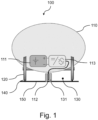
- the on-board rechargeable electrical energy storage device 111 may be a battery, a super capacitor, a super conducting coil, a flywheel or the like, as well as combinations thereof.
- the on-board energy storage device 111 is arranged for powering the on-board electric coil 112 and converter 113 assembly and, in accordance with an embodiment of the present disclosure, arranged for being charged and for supplying stored energy for driving the vehicle 110 during operation, in particular at coasting speed after launch of the vehicle 110.
- the on-board coil 112 is arranged over a length of the vehicle 110 and operates with at least a two-phase Alternating Current, AC, powering, or with a standard three-phase AC power supply.
- the power converter 113 may be arranged as a bi-directional Direct Current, DC to AC converter (four quadrants) connected to the on-board energy storage device 111 and arranged for generating alternating currents in the on-board electric coil 112.
- the long stator 131 of track 130 may be of an active or passive type.
- the vehicle 110 and the long stator 131 of track 130 interact with each other to form the drive system for driving the vehicle 110 along the track 130, which will be described in more detail in the following.
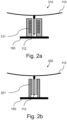
- Figures 2a, 2b illustrate, in cross-sectional views, examples of different track types in accordance with the present disclosure.
- the different track types interact in different ways with the moveable on-board coil 112 of the vehicle 110 (only part of which is shown in the figures) to form different types of linear motors, thereby realising control of mechanical thrust of the drive system by adjusting output from the power converter 113 on-board of the vehicle 110 in a field-oriented fashion.
- the different track-types can be used at specific parts of a track 130. Structural configurations and field distributions along length directions of different linear motor types formed by the vehicle-track combination are illustrated in Figure 4 .
- this first track type 310 is located at a first part of a track in and around stations for boarding and de-boarding a vehicle and the LDFM formed by the vehicle and this first part of the track, i.e. forming a vehicle-track combination, is arranged for launching the vehicle 110 and for fast contactless charging of the on-board energy storage device 111 of the vehicle 110. It is possible to combine the charging of the on-board energy storage device 111 with acceleration/deceleration of the vehicle 110, which will be detailed in the following.
- Charging the on-board energy storage device comprising batteries, for example, can be done in about 5 minutes of time, which is long enough to store sufficient energy on board of the vehicle 110 to perform the acceleration and the coasting of the vehicle over a long distance.
- the active doubly fed track section is the most expensive part of the drive system per unit length, but basically only needs to have a length extending along a train station, such that only sub-synchronous operation may be used in practice.
- the minimal length of the active part of the track may be that of the longest expected train, i.e. one or a number of concatenated , mechanically coupled, vehicles.
- a second track type 320 comprises a passive track or long stator 321, for example composed of a structure of alternating segments, such as metal segments and/or segments of ferrite or iron-compound materials having different magnetic properties extending along a length of the track (this can be seen more clearly from Figure 4 ).
- the on-board coil 112 sees position dependent inductance values from the track 321 while moving.
- the track 321 and the on-board coil 112 together operate as a Linear Synchronous Reluctance Motor, LSReIM.
- the LSRelM may be used to generate considerable thrust in case the vehicle 110 needs to restart from a position somewhere along the track where an LSRelM is present.
- this LSRelM track type 320 may be arranged following the first LDFM track type 310 in transport direction, i.e. downstream, at a second part of the track between a first and second station along the track, and may be used for further accelerating the vehicle 110. It may also be used for coasting when the rated speed is reached. Restarting the vehicle 110 at a place where no LDFM is provided, is also made possible by the second LSRelM track type 320. In this sense, the track type 320 may be used for driving the vehicle along the remaining part of the trip.
- the on-board coil 112 will be loss-free when switched off.
- wheels 120 are present, and as drag per lift on wheels is very low (0.001 to 0.004), less force is needed to keep the vehicle 110 rolling on the track once a rated speed is built up.
- regular train or tram rails may be used for guiding and supporting the wheels along the track.
- a further motor 330 such as a rotary electric motor, may be arranged on the vehicle 110, electrically connected to the on-board energy storage device 111 (not shown), providing the further motor.
- the rotary electric motor may be a rotary electric motor 331 mounted on an axle 332 of the vehicle 110 and arranged for operating as a speed-keeper, such as a commercially available high speed 20kW induction motor that weighs less about 60kg, which will not add much weight to the vehicle 110.
- the further motor 330 may also comprise an electric rotary motor driving the axle 332 using an intermediate drive-line or transmission gearing.
- the advantage of using an induction motor as speed-keeper is that losses are close to zero when the stator of the induction motor is switched off during the operation of the high thrust linear drive system, i.e. the LDFM. Means for braking safely may need to be added, either to the wheels 120 or use of a conducting fin as an eddy-current brake to dissipate the heat in the track and not in the vehicle 110.
- An LSRelM drive and/or rotary induction motor driving wheels on regular rails may be used for the whole track, except for the stations where the vehicle 110 is to be charged, accelerated and decelerated, using an LDFM.
- Figure 3b illustrates, in a cross-sectional view, a third track type 340, which is a passive track composed of a long stator 341 comprising permanent magnets of opposite magnetic polarity (342, 343), alternately spaced in longitudinal direction of the track with a proper pole-pitch to make the combination of track and vehicle drive components work as a 'short-stator' type Linear Synchronous Motor, LSM. (This can be seen more clearly from Figure 4 ).
- the on-board electric coil 112 on the vehicle 110 forms an active short stator. LSMs can operate at a high energy-efficiency.
- the energy for further acceleration of the vehicle 110 needs to be provided by the on-board energy storage device 111 as the wave velocity of the long stator is now zero.
- the achievable propulsion power in the vehicle 110 will be in the order of 50 to 500W/kg.
- a drag/lift ratio of a levitation system will determine the necessary power to maintain this speed over the remaining distance of the track.
- the necessary length of the passive magnet, PM, track depends on the available specific power in W/kg. For example at 500 W/kg a length of about 16 km will be needed to achieve the coasting speed of 1000 km/h, for 200 W/kg a distance of 36 km is needed.
- This LSM track type 340 may be arranged following the first LDFM track type 310 in transport direction, i.e. downstream, at a second part of the track between a first and second station along the track.
- a layout of the permanent magnets of the long stator 341 may be such that a smaller percentage of the available poles on the track are equipped with magnets at larger distance from the station.
- an LSM track section can be operated under constant power which implies the lowest required battery-and converter-weight, and the track may be designed to have a fixed speed-position profile, i.e. the induced voltage in the on-board or moving electric coil 112 can be kept reasonably constant. Lower speeds are always possible, while higher ones can be and should be avoided when approaching a station.
- the vehicle 110 After leaving the LSM section, the vehicle 110 only needs to maintain its speed for the largest part of the journey.
- the coasting power should be around an order of magnitude smaller than the acceleration power, enabling a simpler and less expensive passive track type to be suitable for coasting.
- Figure 3c illustrates, in a cross-sectional view, a fourth track type 350 comprising an inexpensive long stator 351 made of aluminium on solid back iron, for example.
- the long stator 351 together with the on-board electric coil 112 of the vehicle 110 forms a Linear Induction Motor, LIM.
- LIMs are of relatively low efficiency (high slip) and suffer from entry- and exit-effects at high speeds, a LIM may be used for constant-speed-coasting of the vehicle at a second part or third part of the track between a first and second station along the track, which may be the longest section of a track.
- An advantage of the LIM operation is that adjusting of the speed remains possible, even energy regeneration during braking, although with a much lower efficiency than in an LSM, LSReIM, and LDFM mode of operation.
- a sensorless control method in the vehicle 110 will be able to select the stator currents such that thrust is continuously controllable; both acceleration and deceleration are possible in LDFM, LSReIM, LSM and LIM drive operation.
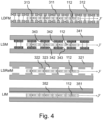
- Figure 4 illustrates, schematically, examples of structural configurations and field distributions of tracks along length directions of linear motor types LDFM, LSM, LSReIM, and LIM, in accordance with the present disclosure.
- current flow directions in the coils when in operation are depicted by the usual cross (leaving the viewer, i.e. going into the paper) and dot (approaching the viewer, i.e. coming out of the paper).
- Direction arrows in the figure indicate the direction of magnetic flux lines.
- the LDFM may comprise an active long stator 312 with a back iron made of laminated steel and electric coils 311 arranged on stator teeth 313 protruding from the back iron stator 312.
- the LSM may comprise a long stator 341 with a back iron made of solid steel and permanent magnets 342 and 343.
- the permanent magnets 342, 343 are of opposite magnetic polarity, indicated by hatchings in different directions, respectively. Such as north poles 342 and south poles 341, for example.
- the LSRelM may comprise a long stator 321 with a back iron made of solid steel, which is configured as having thick segments 322 and thin segments 323.
- the LIM may be built from a solid aluminium plate 352 on a long stator 351 having a solid back iron , for example.
- a multi-mode driving system formed by the vehicle 110 with the on-board (re)chargeable energy storage device 111 and the on-board electric coil 112 capable of operating with different types of tracks 310, and one or more of tracks 320, 340 and 350, in accordance with the present disclosure.
- the present multi-mode drive system provides the possibility to combine advantages of the mentioned track-types using the same vehicle.
- the operation of the vehicle when traveling over the track including launching, further acceleration, coasting, braking and charging of the on-board energy storage device, can be realised in a cost and energy effective fashion.
- Figure 5 illustrates, schematically, an example of a layout 400 of different track types along a track or railroad 401, in accordance with the present disclosure, in which long stators forming different types of linear motors are schematically shown, and an arrow 405 is used to indicate a travel direction of a vehicle 110 along the track 401 between a first station 410 and a second station 411, remote from the first station 410.
- the first and second stations 410, 411 arranged for boarding and de-boarding of the vehicle 110 are indicated by curly brackets.
- an active LDFM track 310 is provided and installed at a first part 402 of the track 401 at the first station 410, and at the second station 411.
- the LDFM 310 is followed by an LSRelM track 320, indicated by a dashed line, operating as a further electric motor at a second part 403 of the track 401, between the first 410 and second station 411, which may be used for further accelerating and/or coasting of the vehicle 110, after being set into motion by an LDFM 310.
- an LSM track 340 and an LIM track 350 may be used, indicated by a dash-dot line, at the second part 403 and/or a third part 404 of the track 401 between the first and second stations 410, 411, instead of and/or in addition to the LSRelM 320 for coasting purposes, for example.
- Separations 420, 421, shown for illustrative purposes, may be arranged between transition points between different track types, i.e. motor types. It is noted that the second part 403 of the track 401 may extend over the whole distance from the first station 410 to the second station 411.
- the LSRelM track 320 only needs to overcome a small drag and may be designed such that it could provide a reasonable amount of the peak thrust, allowing this type of inexpensive track to be used for the majority of the track-length.
- the further electric motor as an on-board rotary electric motor 330, indicated by dotted lines, in the vehicle 110, for example in a direct-drive fashion to drive an axle 332 of a wheel pair 120.
- This allows the use of rails 140, such as regular train rails, along the entire track 401 or part of the track 400 extending between the stations 410, 411 without a long stator track supporting a linear motor drive system to be used at a majority of the track-length.
- the track type 340 forming the high efficiency LSM may be used for further accelerating of the vehicle. Therefore, this track type may also be located outside the stations 410, 411 in moving direction 405, even just after the LDFM track part 310.
- the LSM track 340 may be used for coasting as well.
- the relatively low efficiency LIM track 350 suffices for constant-speed coasting as well, and may also be used for a large part of the track-length between the stations 410, 411.
- the stationary coils 311 forming the LDFM stators may be excited in different ways: a single frequency, a variable frequency and/or variable voltage, a zero frequency (LSM-like) or a short circuit (LIM-like).
- the feeding frequency of the LDFM stators may be chosen based on lamination quality and favourable airgap flux of the long stator.
- the stator sections are preferably connected or powered to get the best magnetic coupling with a parked and/or moving vehicle.
- the stator coils may be controlled such that a fixed AC flux level is provided to the on-board coil 112 of the vehicle.
- the stationary electric coils 311 are fed in parallel with a source of voltage, either by actually connecting them in parallel, or by feeding each coil-set by a separate converter.
- the magnetic coupling is maximized, i.e. leakage inductance is minimized, in this way, thereby maximizing the available system's peak power.
- FIGS 6a, 6b, 6c illustrate, schematically, examples of stationary electric coils and excitation thereof, in accordance with the present disclosure.
- Figure 6b shows a circuit diagram of three-phase stationary electric coils 311, each phase R, S, T comprises two parallel connected branches a, b, c, each comprising two series connected coil parts, for example a1, a2 and a3, a4, as illustrated in Figure 6a .
- Figure 6a shows part of stationary electric coils 311 arranged at the stator teeth 313, in particular for the coil parts a1 to a4, forming one pole pair a1, a2 and a3, a4 respectively.
- the coils are powered to provide a mutually alternating magnetic flux between opposite teeth 313.
- Arrows shown at the windings parts indicate the positive direction of current flow.
- Figure 6c illustrates, schematically, stationary electric coils 311 connected to a six-pulse constant frequency square-wave switching converter 600, comprising semiconductor operated switches 611 to 616, yielding soft-switching with minimal losses.
- FIG. 7 illustrates, schematically, further examples of exciting stationary electric coils 311 in accordance with the present disclosure.
- a one pole-pair stator 710 is shown. Only phase R is drawn for simplicity's sake.
- Option A shows series connecting the coils 311.
- Option B shows parallel connection of sets of two coils 311.
- Option C shows parallel connection of all coils 311.
- Option C provides for minimizing leakage inductance to the vehicle's electric coil 112.
- each tooth 313 acts as a source of flux, independent of neighbouring pole-pairs.
- Figures 8a, 8b, 8c show embodiments of stator arrangements in accordance with the present disclosure.
- Figure 8a shows a stator arrangement wherein all pole-pairs are provided with an individual converter 600, commonly powered by a single power supply 610.
- Figure 8b shows a stator arrangement comprising two pole-pairs per converter 600.
- Figure 8c shows a stator arrangement having three pole-pairs per converter 600. In a similar way any number of pole-pairs can be connected to a single converter.
- Per pole-pair (around 0.2m length) the rating is around 5 - 20 kVA.
- the moving part has an on-board energy buffer and a power-electronic converter that supplies AC currents to the on-board coils which are magnetically coupled to on-shore coils (stators) that are fed by on-shore AC power converters or directly connected to a 3-phase grid
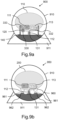
- Figures 9a and 9b illustrate, in schematic views, operation of the multi-mode drive system in accordance with the present disclosure, arranged as high speed tube transport systems.
- FIG. 9a shows a multi-mode drive system 900 arranged for vehicle transport on wheels 120 along rails 140 in a tube or tunnel 910 supported by a pedestal construction 911.
- the vehicle 110 comprises an on-board (re)chargeable electrical energy storage device 111, an electric coil 112 electrically connected to a controllable DC/AC power converter 113, and a rotary electric motor 330, such as an induction motor M, electrically connected to a controllable DC/AC power converter 333.
- the power converters 113 and 333 electrically connect to the on-board electrical energy storage device 111.
- the on-board electric motor 330 in use, drives an axle 332 of the vehicle 110 and hence rotate the wheels 120 that are mechanically connected to this axle 332.
- the on-board electric coil 112 is moveably arranged and magnetically coupled with respect to a long stator of a track arranged, among others, to operate an LDFM.
- Figure 9b illustrates a multi-mode drive system 950 using so-called electrodynamic suspension, EDS, levitation, for which the vehicle 200 comprises a support structure 960 bearing permanent magnets 961 opposite an aluminium plate part 962, for example, mounted at the tube-floor, for transport of the vehicle 200 by levitation.
- the on-board energy storage device 111, the power converter 113, and the on-board electric coil 112 of the vehicles 110 and 200 are identical for both systems 900, 950.
- the electric coil and converter assembly of the vehicle 200 is arranged for operating different linear motor types along the track, as described above, including an LDFM.
- Figure 9c illustrates a multi-mode drive system 970 using so-called electromagnetic suspension, EMS, levitation, for which the vehicle 990 comprises a support structure 980 bearing permanent magnets 981 opposite an aluminium plate part 982, for example, mounted at a support structure 971 arranged at the tube-ceiling.
- the on-board energy storage device 111, the power converter 113, and the on-board electric coil 112 of the vehicles 110 and 990 are identical for both systems 900, 970.
- the electric coil and converter assembly of the vehicle 990 is arranged for operating different linear motor types along the track, as described above, including an LDFM.
- safety means (not shown) are provided for avoiding sideways movement of the vehicle 990 to engage the tube wall and to drop from the support structure 971.
- a velocity of the vehicle is equal to a difference between wave velocities of the on-board coil and the stationary coils.
- the wave velocity of the on-board vehicle is negative, allowing charging of the on-board energy storage while accelerating the vehicle.
- the wave velocity of the on-board coil of the vehicle becomes zero, synchronous operation is realised.
- an LSM section with decreasing number of magnets at a part of the track 400 at a greater distance from the station may be economical.
- both the LSRelM formed by the on-board coil 112 and the track part with the track part of alternating segments having different magnetic properties, such as metal segments and/or segments of ferrite or iron-compound materials, and a further on-board rotary electric motor 330 may be used for acceleration. Restarting from standstill outside a station is also made possible with either the LSRelM and/or the on-board electric rotary motor.
- step 64 the drive system is operated to bring the vehicle to a stop while breaking energy can be regenerated for charging the on-board energy storage device 111 of the vehicle 110, 200.
- constant acceleration may be considered.
- coupled flux from permanent magnets may be diluted along the track to achieve progressive field-weakening and hence constant voltage and constant current operation throughout most of the acceleration stretch.
- Calculation shows that the total amount of flux (number of magnets along the track) is proportional to a square of a final speed. Although a lower specific power causes a longer time and distance before the target speed is reached, the total amount of necessary magnet material however is comparable; it means thinner magnets over a longer stretch, assuming the same current-density in the vehicle coils.
- the track section around stations is of type LDFM and contains an active track composed of stationary coils (stators) which are designed to magnetically couple with the on-board vehicle-coils.
- the active stators act as the primary of a transformer with the secondary being the pod's coil.
- the combination works as a doubly fed machine or a transformer with movable secondary winding.
- the electric frequency on the track-coils (for example 400Hz) represents a certain wave-velocity v shorecoil , for example 80 m/s in launch direction when a realistic pole-pitch of 0.1m is assumed.
- a fixed frequency allows six-step modulation with soft-switching which is cost-effective and has low losses.
- Power electronics of the station hardware is in this case less expensive and controls are hardly needed.
- the stator sections are connected or fed in parallel, to get the best magnetic coupling with the parked or moving pod or pods.
- Equation (1) shows that both wave-speeds have equal magnitude and sign at standstill and that v podcoil > 0 while going forward on passive tracks where v shorecoil ⁇ 0, and v podcoil ⁇ 0 is advantageous while accelerating in the doubly fed section.
- N mechanical thrust
- thrust and power are related, hence when standing still, exerting a force by a mechanically brake to the rail, maximum power can be harvested to charge the on-board battery.
- the developed thrust is proportional to the charging power.
- the charging power is proportional to pod-stator-wave-velocity v podcoil and thrust, so charging may continue up to the synchronous speed of for example 80m/s. This speed depends on the pole-pitch and the electric frequency on the track-coils.
- the active doubly fed section is the most expensive part of the track, but basically only needs to be the length of the station, so only sub-synchronous operation will be used in practice.
- P pod P track ⁇ m ⁇ ⁇ shorecoil ⁇ shorecoil
- the charging power fraction can be kept high during acceleration when v shorecoil is kept sufficiently higher than v m , the exit-speed from the active section.
- the exit speed of the doubly fed section will only be limited to a few tenths of m/s.
- the LDFM is able to charge the on-board battery during standstill and during acceleration as long as sub-synchronous operation is valid. During deceleration charging is possible during over-synchronous operation.
- the active stator of the LDFM could be operated at one frequency only. Fundamental soft-switching square wave operation would be an option.
- the track sections covered by the pod-mover need to be energized. Energizing more sections is allowed but not necessary. Selecting larger sections at the same time would be very well possible by connecting them in parallel, for example.
- the Linear Synchronous Reluctance Machine, LSReIM gets its thrust from the difference between L d , the direct inductance, and L q , the quadrature inductance, thrust is proportional to the square of the coil current, so a 0.5% thrust-level, needed to overcome the rolling drag and losses, would still require a less than 15% current level, for example.
- the power-efficiency of the LSRelM stator will be higher than a LIM stator, for example.
- the LSRELM track only needs to overcome the small drag and may be designed such that it provides a reasonable amount of the peak thrust, allowing this type of inexpensive track to be used for the majority of the track-length.
- LSRELM's efficiency is higher than LIM, for example, hence more suited for coasting and even breaking and acceleration. Entry and exit effects at an LSRelM are reduced in case solid iron is used. Laminations over the whole track are possible. The required flux level is low when a vehicle on wheels is used.
- the achievable propulsion power in the capsule will be in the order of 50 - 500W/kg. Once the required cruise speed (for example 1000km/h, potentially much higher) has been build up, the drag/lift ratio of the levitation system will determine the necessary power to maintain this speed over the remaining distance.
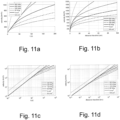
- FIGS 11a-d are graphs illustrating launch length required for constant power launching for various specific powers in W/kg, as captioned in the graphs.
- the starting acceleration is limited to 3.0 m/s 2 .
- Figures 11a and 11c show, for the same data, the vehicle velocity v (km/h) versus launching time t (s) depicted on a linear scale in Figure 11a and on a double-logarithmic scale in Figure 11c.
- Figures 11b and 11d show, for the same data, the vehicle velocity v (km/h) versus launching length or distance travelled x (km), depicted on a linear scale in Figure 11b and on a double-logarithmic scale in Figure 11d .
- the PM layout can be such that a smaller percentage of the available poles on the track are equipped with magnets at larger distance from the station.
- the LSM section can be operated under constant power which implies the lowest required battery and converter-weight and the Electro-Motive Force, EMF, can be kept reasonably constant at all speeds since the track can be designed to have a fixed speed-position profile.
- the pod After leaving the LSM section, the pod only needs to maintain its speed for the largest part of the journey.
- the coasting power should be around an order of magnitude smaller than the acceleration power or less, enabling a simpler and less expensive passive track type to be suitable for coasting.
- Table 3 shows details of a worked-out example.
- LIM Linear Induction Motor
- a Linear Induction Motor, LIM emerges when an inexpensive conducting rail made of, for example, aluminium surrounds the pod-coil (see Figure 3 ).
- LIMs are known for their poor efficiency (high slip) and their entry- and exit-effects at high speeds. Since only constant-speed-coasting is required in the longest section of the track, a lower efficiency should not be too troublesome.
- Advantages of the LIM operation are that speed adjusting remains possible, even energy regeneration during braking, although with a much lower efficiency than in an LSM and LDFM type liner motor mode of operation.
- a sensorless control method in the pod will be able to select the stator currents, such that thrust is continuously controllable; both acceleration and deceleration are possible in doubly-fed, LSM and LIM operation.
- the effective magnetizing time constant needs to be (much) less than the passing time of the vehicle.
- the width of the aluminium strips of the track may be varied depending on speed, to manage the entry effects at the high speed track sections. At low speeds a thicker aluminium reaction strip is beneficial.
- Sensorless field oriented control for example, as disclosed in European Patent 1 162 106 , the content of which is incorporated herein by reference, is able to estimate speed and torque or thrust in all machine types.
- Speed estimation in the LIM is not exact due to the uncertainty in the actual slip (effective rotor resistance is not known exact).
- the LSRelM has precise sensorless speed estimation. It would also be easier to generate considerable thrust in case the pod would need to restart from a position somewhere along the track where only LSRelM stator would be present.
- the LSRelM has, just like the LIM, the ability to control the linked flux over a wide range, which is perfect for constant power acceleration: the voltage is kept constant while the frequency increases, hence reducing the flux and therefore reducing thrust , keeping the product of speed and thrust constant.
- the pod-coil In the case of tube transport, the pod-coil is able to travel in vacuum and will be loss-free when switched off. Since drag on wheels is very low (0.001 to 0.004), not much force is needed to keep rolling, providing the possibility of leave out the track for coasting all together. Thus, replacing a linear induction motor for a rotating shaft spinning and driving wheels of the vehicle at an agreeable speed of 5000 - 6000 rpm, for example, present in the vehicle itself.
- the pod has wheels, such as wheels having a diameter in the range of 1 m
- Advantages of the proposed multi-mode machine type are the possibility to combine the advantages of the mentioned track-types using the same pod with just different controls for each track-type.
- a condition of constant power implies energy or work W (Joule) to be proportional with time.
- Equations (26) and (27) describe the speed and acceleration as a function of position during constant power operation.
- Figures 12a-d illustrate specific curves of the speed and acceleration as a function of position during constant power operation, for a short trip of 100km and various power values (W/kg), as captioned in the figures.
- Figure 12a shows, at a linear scale, the speed or velocity v (km/h) reached by the vehicle as function of time t (s).
- Figure 12b shows, at a linear scale, the distance x (km) travelled by the vehicle as function of time t (s).
- Figure 12c shows, at a linear scale, the speed or velocity v (km/h) reached by the vehicle as function of the distance x (km) travelled.
- Figure 12d shows the acceleration a (m/s 2 ) of the vehicle as a function of time t (s).
- Figures 13a, 13b, 13c and 13d illustrate, graphically, similar curves as described above for Figures 12a, 12b, 12c and 12d , respectively, during constant power operation, for a trip of 1000km.
- the coupled flux from permanent magnets may be diluted along the track to achieve progressive field-weakening and hence constant voltage and constant current operation throughout most of the acceleration stretch.
- ni being the ampere-turns of the pod's-short-stator winding:
- Equation (30) shows that the total amount of magnets is proportional to the square of the final speed v ref , but not a function of the total mass m c of the pod, as long as each pod with mass m c has its own active primary with ni current. Note that equation (30) is applicable in general, even for non-constant power launches.
- the total coupled flux ⁇ total along the track is only determined by the kinetic energy, i.e. m c v 2 ref , ni and the stator length l .
- the optimal frequency for the fixed stator coils would be preferably close to the cross-over point from constant acceleration to constant power, which is equal to: ⁇ shorecoil ⁇ p spec a max m / s ⁇ shorecoil ⁇ p spec 2 ⁇ a max Hz
- the frequency f shorecoil would be 334Hz (being the lowest frequency with maximum power). At this frequency in a station at standstill the pod receives the rated power for charging at rated current. At 400Hz in the example, available charging power will be higher at rated current.
- a lower specific power causes a longer time and distance before the target speed is reached.
- the total amount of necessary magnet material however is comparable, it means thinner magnets over a longer stretch.
- Using a pod-coil with equal length as the vehicle will minimize the number of necessary magnets while allowing trains of pods to be configured to reach the necessary travel capacity.
- Equation (30) show that the volume of required magnets depends on final speed ( v ref ) 2 and ni. Hence a lower power rating seems to lower the cost, but increase the travel time only by a little, see Figures 12 and 13 .
- Table 1 shows some common modes of transport and their specific power values.
- the Tesla Roadster TM achieves 174 W/kg (215kW and 1235kg)
- the Toyota Prius TM achieves 72 W/kg and only in a small range of speeds.
- a reasonable battery-weight percentage and battery quality will make specific power values between 100 - 500W/kg for the pod possible, but battery efficiency strongly deteriorates at shorter discharge times.
- Table 1 Comparison of specific power (W/kg) for different means of transport. item p spec (W/kg) duration horse 1...2 hours human body 1...20 hours...seconds TGV train 16...25 Toyota Prius 72 Tesla Roadster 174 Boeing 747 ⁇ 250 spaceX rocket ⁇ 10 ⁇ 10 3 minutes
- ⁇ rolling resistance' Two major sources of drag-force exist in ordinary traffic: ⁇ rolling resistance' and air-resistance. The latter is supposed to be negligible in an evacuated tube which leaves the ⁇ rolling resistance', 'flying resistance' or ⁇ levitation resistance' all called drag to dominate in the tube transport case. As shown in Table 2, different wheel plus track combinations result in different C rr (rolling resistance constant) values.
- the maximum energy density of a LiPo battery is about 0.72 MJ/kg, equal to 200 Wh/kg.
- Passenger rail car about 0.0020 [19] 0.001 to 0.0015 [20] 0.1 mm [2] Hardened steel ball bearings on steel 0.0019 to 0.0065 [21] Mine car cast iron wheels on steel rail 0.0022 to 0.005 [22] Production bicycle tires at 120 psi (8.3 bar) and 50 km/h (31 mph), measured on rollers 0.0025 [23] Special Michelin solar car/eco-marathon tires 0.005 Dirty tram rails (standard) with straights and curves 0.0045 to 0.008 [24] Large truck (Semi) tires 0.0055 [23] Typical BMX bicycle tires used for solar cars 0.0062 to 0.015 [25] Car tire measurements 0.010 to 0.015 [26] Ordinary car tires on concrete 0.0385 to 0.073 [27] Stage coach (19th century) on dirt road.
- Electro Dynamic Suspension is a passive magnetic levitation system based on repulsing forces.
- EDS consists of vehicle-connected Hallbach arrays of magnets, and a conducting plate or short-circuited coils in the track start to repel at a low lift-off speed. From a physical point of view it works like this:
- the magnet can be considered as a superconducting winding with high a built-in current. Above levitation speed, this built-in current i is mirrored into the reaction plate, the losses in the plate are i 2 R and are basically independent of speed.
- Using a solid aluminium plate instead of Litz-wire coils increases the levitation losses to over 40W/kg even with optimized Hallbach-array magnets. The repelling character of this passive levitation requires that all magnetic steel needs to be sufficiently distanced from the Hallbach arrays, which may impose tube-construction challenges.
- Electro Magnetic Suspension is an active configuration that is based on (unstable-) attractive forces due to a magnetic core, attached to the vehicle and excited by a winding with controllable DC current. By also including a bias-magnet, the necessary current can be reduced. By tuning the magnet size and separation, the excited coil's power lost can be kept manageable, however the construct can carry no more than about 30 times its own weight. Another issue is the necessity of a reaction rail in the track. In order to keep eddy-current losses and lifting force manageable, the reaction rail needs to be made from laminated iron and will be more expensive per meter than a solid aluminium plate.
- the Maglev in Japan operates with Super-Conducting Magnetic Suspension, SCMS, at costs of about 100 G$ per 500km: 200 M$/km, 200k$/m.
- SCMS Super-Conducting Magnetic Suspension
- the Japanese Maglev train starts to levitate above 140km/h, indicating a high percentage of drag at the intentional 500km/h.
- the need for Maglev suspension seems to have no physical advantage. Steel wheels on steel tracks can do the same much more efficient and have record speeds over 500km/h as well.
- W k 1 2 m c ⁇ m 2
- W d m c g C rr ⁇ x W d
- W k 2 g C rr ⁇ x ⁇ m 2
- Equation (38) implies that at 1000 km/h the air-pressure in the tube should not be much higher than about 0.1 % of the normal atmospheric pressure. Absolute pressure being approximately 100 Pa, named a medium vacuum.
- a specific energy of a good battery as on-board energy storage such as a lithium-ion-polymer or lithium-polymer, LiPo, battery: W Sbat ⁇ 0.72 MJ/kg (200 Wh/kg)
- k bat 12.5%
- Equations (42) and (36) result in an expression for range:
- W bat m bat
- W Sbat k bat m bat m c
- W k 1 2 m c ⁇ m 2
- W d m c g C rr ⁇ x k bat
- the capacity of a channel is measured by the number of vehicles that passes at one particular spot along the road, track, canal or tube: ⁇ tube (vehicles/s).
- ⁇ tube vehicle/s
- the maximum traffic flow-rate in a single tube with multiple capsules is calculated. In particular when constant-power-operation is incorporated.
- the smallest no-collision separation distance can be calculated using equation (17), assuming the head pod to coast and the tail pod to brake with specific power p spec , it takes T break seconds to reach equal speeds.
- Index 0 is used for the initial value and index 1 is used for the situation where the speed of the tail pod equals the speed of the head pod:
- Equation (49) shows the distance required given two speeds, when assuming a continuous specific braking power p spec at the tail pod only, assuming that the head pod is coasting at a constant speed v head .
- the safe distance becomes equal to x cp1 in (22).
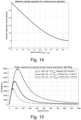
- Figure 14 illustrates minimum separation distance relative to required launch length as a function of initial speed difference between two capsules according equation (49).
- the tube traffic capacity can be described by the ratio of speed (m/s) divided by separation distance (m) yielding traffic flow rate ⁇ tube in (vehicles/s).
- ⁇ tube ⁇ tail0 x head0 ⁇ x tail0
- Figure 15 shows the effect of assuming the speed of the preceding vehicle to be a certain fraction of the approaching vehicle.
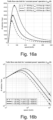
- Figure 16a shows the number of vehicles per hour versus the speed (km/h) depicted on a linear scale while Figure 16b shows same on a double-logarithmic scale. No additional reaction time is taken into account, this is the absolute limit without emergency brakes.
- Equation (50) shows the flow to be inversely proportional to the speed squared, which results in a mere 14 vehicles per hour in one tube when operating at a 1000 km/h top speed for the low specific-(breaking)-power.
- Figure 16 shows disappointing numbers at the higher speeds.
- the tube needs to compete with the TGV TM train from Rotterdam to Paris, i.e. 377 passengers, every 30 minutes, thus say 800 passengers/hour.
- the tollway to Paris has mainly 3 lanes which should be able to carry around 6000 vehicles per hour.
- the tollway's capacity in theory would be around 7200 passengers per hour this is about 9 times the number by high speed rail.
- Figure 16 implies that this capacity can only be reached safely at speeds between 10 - 101 km/h, no competitive speed for the tollway.
- figures 16a-b yield a maximum number of vehicles, safely launchable in the tube, of 14 vehicles per hour. This simply implies that one vehicle should transport at least 72 passengers. In other words one vehicle should have at least 72 seats, small pods are not an option, however one may construct a train of coupled pods.
- a great advantage of the on-board inverter and on-board field oriented controller is the fact that the (control of the) active track does not need to be changed depending on the length of the train: each pod in the train takes care of its own part of the power and follows, like all other pods in the same train, a mutual command from traffic control.
- the total power supplied by the station to the train will just be proportional to the length of the train, keeping the power per unit length the same.
- the guidance system has limited transverse force capability and passengers don't like high sideways acceleration. If a transverse acceleration needs to be limited to for example at ⁇ 2m/s 2 , then a speed of 1000 km/h would result in a minimum curve radius of 39 km. Keeping speed predictable at each track location, matched banking of the track could result into more practical (smaller radius) and comfortable curves.
- LDFM and LSM only need i q
- LSRelM also needs i d to build up flux in the airgap.
- the fixed stator can be regarded as a source of flux with constant frequency, for the pod equivalent to a 'conveyor belt' of moving magnets.
- the active stator in the doubly-fed topology can be realized in many ways. It is best to control the stator such that it provides a fixed AC flux level to the pod's coils. Best is to feed all LDFM stator-coils in parallel with a source of voltage, either by actually connecting them in parallel, or by feeding each coil-set by a separate converter. Inductance is minimized this way, thereby maximizing the available system's peak power.
- Figure 6 shows the way the coils could be configured and connected to a six-pulse converter with symbolically indicated switches 611-616.
- each set of three coils is star-connected to a standard 6-pack IGBT module fed by 1000 V DC that can handle say 50 A per phase, then one 6-pack can feed around 1 m of track, assuming the total power supplied by the track to a pod being in the order of 50 kW/m.
- Any group of coils could be combined to make a favourable load of the chosen power converter(s).
- the advantage of the disclosure is that all power converters in the station and the first part of the launch can all operate at one fixed frequency and one fixed but not stabilized voltage level. This makes these converters extremely simple and inexpensive, they can even run in 6-step fashion (3 square waves phase shifted by 120°).
- the resulting flux and no-load currents become 6-step sine-like, yielding a switching frequency equal to the fundamental frequency, therefore minimizing switching losses and Electromagnetic Interference, EMI, frequencies between 100 Hz and about 2 kHz are feasible at this point, even direct connection to a 50 or 60 Hz 3-phase AC grid would be an option to regard.
- EMI Electromagnetic Interference
- the converters along the active track could preferably only be activated when a pod is covering this particular converter-fed stator part.
- the active part of the track may be limited to just the standstill or stop part of the track: in the stations. Its minimal length would be that of the longest expected train. Charging on-board batteries can be done in around 5 minutes, which would store sufficient energy on board to do the acceleration and the coasting over a long distance. Placing expensive active track for recharging somewhere halfway the track will be very uneconomic since the time presence is too small to convey sufficient energy to the fast moving pod. One would need an intermediate active track with a length of 16.7 km to obtain just one minute of charging capability. In each station, just a (few) hundred meters of active stator will do. Hence recharging while coasting is not recommended. Adding a few batteries to each pod will be much more practical and orders of magnitude less expensive, achieving the same goal: reach the destination safely and on time.
- the LDFM stator can be excited in different ways: a single frequency, a variable frequency (DFM with adjustable flux), a zero frequency (LSM-like) or a short circuit (LIM-like). It is beneficial to use short sections of stator, driven by the same voltage and frequency to minimize unwanted series inductance. By means of a 'pod-present' signal, different sections of the stator could be switched on or off to minimize losses without a pod present.
- DFM with adjustable flux variable frequency
- LSM-like zero frequency
- LIM-like short circuit
- the fixed stator can preferably be fed by six-pulse modulation: just switching twice per electrical period.
- six-pulse modulation just switching twice per electrical period.
- the frequency can be chosen to match the lamination quality and required flux-level in the airgap.
- the stators could even be fed by 50 Hz, 60 Hz or 400Hz 3-phase utility grid without the use of converters.
- all pods By exciting all coils that are covered by one or more pods, all pods will have full capability, also in a train-configuration.
- Electric frequencies in the mover need to be able to vary over a wide range: plus and minus several hundred Hz to a few kHz depending on speed, pole-pitch and machine configuration.
- the feeding frequency of the LDFM stator can be chosen based on lamination quality and required airgap flux.
- N/m 2 Specific thrust per motor-type determines the minimum size of the active air-gap.
- Power converter modules that can directly connect to a high voltage battery (600 - 1000 V DC) and deliver the required power level of a few 100 kVA are commercially available components. Low cost existing hardware can be used, in combination with existing field-oriented control software for all stator types.
- LiPo Lithium-lon-Polymer battery
Landscapes
- Engineering & Computer Science (AREA)
- Power Engineering (AREA)
- Transportation (AREA)
- Mechanical Engineering (AREA)
- Physics & Mathematics (AREA)
- Electromagnetism (AREA)
- Life Sciences & Earth Sciences (AREA)
- Sustainable Development (AREA)
- Sustainable Energy (AREA)
- Electric Propulsion And Braking For Vehicles (AREA)
- Current-Collector Devices For Electrically Propelled Vehicles (AREA)
Description
- The present disclosure generally relates to an electric transport system and, in particular, to an electric multi-mode drive system for electrically driving a vehicle along a track, a method of operating such an electric multi-mode drive system for driving a vehicle, as well as a vehicle and a track for operating the electric multi-mode drive system.
- An electric transport system, for moving a vehicle along a track from one station to another for boarding and de-boarding of the vehicle, requires electric driving equipment for propulsion, coasting and braking of the vehicle, and in case of a magnetic suspension transport system, also for levitation and guidance of the vehicle. The propulsion or launching equipment should be arranged for accelerating the vehicle in a reasonable short time to reach an envisaged coasting speed. The coasting equipment is required for moving the vehicle over a distance while travelling at the coasting speed. In practice, a braking system is arranged for decelerating the vehicle in an energy efficient manner.
- Various types of electric motors may be used for driving vehicles in such an electric transport system, among which linear electric motors, including Linear Synchronous Motors, LSMs, Linear Synchronous Reluctance Motors, LSRelMs, Linear Induction Motors, LIMs, and Linear Doubly Fed Motors, LDFMs. Instead of electric linear motors, vehicles transported on wheels may be driven by electric rotary motors, such as Rotary Induction Motors, RIMs, Rotary Synchronous Motors, RSMs, and the like.
- In recent years, levitation transport systems have been developed, involving electric linear motors of long-stator design with passive vehicles and active tracks. In the publication "Advanced Convoy Control Strategy for Autonomously Driven Railway Vehicles", by C. HENKE, et al., 2006 IEEE Intelligent Transportation Systems Conference: Toronto, Ontario, Canada, 17 September 2006, pages 1388-1393, an electric railway transport system is disclosed, wherein the vehicle comprises an on-board electric power source for operating an LDFM.
- These systems require over the entire travelling distance powered tracks, which is much more expensive than a pair of steel rails, for example. Levitation trains further face problems in accelerating the vehicle(s) from standstill to a coasting speed within a short time, in supplying power to the vehicle or track to maintain the speed during coasting, and in bringing the vehicle to a stop at a predefined position.
- United States patent application
US 2011/0184601 discloses a system and method for operating a vehicle in multiple transportation networks. - European patent application
EP2535219 discloses a power recaring device for a vehicle. - Reference is also made to a document entitled "Constant Power Acceleration Profiles for Electric Vehicles", IEEE Transactions on industrial electronics, vol. IE-34, no. 2, 1 May 1987, pages 188-191 [XP055591487].
- Accordingly, there is a need for an electric drive system and a method of operating such an electric drive system, for propelling or launching a vehicle or a train of vehicles in a relatively short period of time from standstill at a first station to a required driving speed along a track, to maintain the driving speed, and to bring the vehicle to a complete stop at a predefined position at a second station remote from the first station along the track, and this all in a cost and energy effective way, preferably with minimum losses and against minimum costs.
- The above mentioned and other objects are achieved, in a first aspect of the present disclosure, by an electric multi-mode drive system comprising a vehicle and a track, the track running from a first station to a second station remote from the first station, the first and second station arranged for at least one of boarding and de-boarding of the vehicle, the vehicle comprising an on-board rechargeable electrical energy storage device, wherein the vehicle and a first part of the track at the first and second station are arranged operating an electric Linear Doubly Fed Motor, LDFM, for launching the vehicle for moving along the track and charging the on-board energy storage device of the vehicle, and wherein the vehicle and a second part of the track between the first and second station are arranged operating a further electric motor different from an LDFM for at least one of accelerating, coasting and restarting movement of the vehicle for moving along the track after launching.
- The present disclosure is based on the insight that the electric power for coasting a vehicle can be efficiently provided by an on-board electrical energy storage device of the vehicle, operating the further electric motor for driving the vehicle, while this further electric motor is designed for restarting movement of the vehicle in case of an unplanned standstill along the track between stations, for example in case of an emergency. This further electric motor may be advantageously designed for additionally accelerating the vehicle after launching and also after restarting thereof.
- The required launching power for starting and accelerating the vehicle at the start of a journey, or after a standstill at an intermediate stop at a station for loading and unloading passengers and goods, is provided by an LDFM. Advantageously, the operation of the LDFM can be controlled for contactless recharging of the on-board electrical energy storage device of the vehicle during standstill, braking and/or launching thereof at a station.
- Hence, the electric multi-mode drive system according to the present disclosure is arranged for operating in a first mode of operation at a first part of the track at a station comprising an LDFM, and is arranged for operating in a second mode of operation at a second part of the track between stations comprising a further motor, not being an LDFM.
- For the purpose of launching and braking of the vehicle, it is sufficient to have the first or active track part of the LDFM arranged extending over a distance at stations where passengers board and de-board the vehicle, or loading and de-loading of goods takes place. As the further electric motor provides the driving power for coasting, the cost of the active track part of the disclosed multi-mode drive system can be kept much lower compared to a prior art levitation transport system, for example, requiring an active track along the entire length thereof. Hence, the combination of the two types of motors makes it possible to operate the vehicle at both a cost and energy effective way.
- In accordance with an embodiment of the present disclosure, the vehicle comprises an on-board electric coil and converter assembly electrically connected to the electrical energy storage device, and the first part of track comprises a stationary electric coil and converter assembly extending along a length of the first part of the track, the two assemblies together arranged for operating and comprising the LDFM.
- The vehicle is a so-called active vehicle, with the on-board electric coil operating as a moving stator or short stator, arranged for magnetically interacting with the stationary electric coil extending along a so-called active part of the track, that is the first part of the track, operating as a long stator. The coiled short and long stators operate in combination as a transformer having a movable secondary winding, which makes the contactless charging of the on-board electrical energy storage device possible. An LDFM enables fast-charging of the on-board electrical energy storage device of the vehicle, thereby stacking sufficient electrical energy for powering the further electric motor during a certain travelling distance along the second part of the track.
- In accordance with an embodiment of the present disclosure, the vehicle and the second part of the track are arranged operating the further electric motor comprising an electric Linear Synchronous Reluctance Motor, LSReIM.
- In this embodiment, the LSRelM may be used to generate considerable thrust in case the vehicle needs to restart from a position somewhere along the track where only an LSRelM drive is present. Moreover, the LSRelM is able to control the magnetic flux over a wide range, thereby beneficially enabling operation with a constant power consumption or power generation in the vehicle, which provides for lowest required power storage and converter weight.
- In accordance with an embodiment of the present disclosure, wherein the vehicle comprises an on-board electric coil and converter assembly, the second part of the track comprises a structure of alternating segments having different magnetic properties extending along a length of the second part of the track, the on-board electric coil and converter assembly and the segments arranged comprising the LSReIM.
- It will be appreciated that the on-board electric coil and converter assembly of the vehicle may be the same for both LDFM and LSRelM operation. The on-board coil interacts with different track parts to form different types of linear motors. In the LSReIM, the second part of the track is of a passive solid structure, i.e. without an electrically powered coil, having a varying thickness along the length of the track, which allows the on-board coil of the vehicle to experience position dependent inductance values, for generating thrust. This second part of the vehicle-track combination is used for coasting, accelerating and restarting of the vehicle. As the long stator is of the passive type, not requiring electric power, LSRelM operation can be cost effectively provided for coasting over relative long track parts, between adjacent stations. The long stator track may be arranged for supporting a vehicle comprising wheels, such as wheels running along train rails.
- In accordance with another embodiment of the present disclosure, the track comprises rails and the vehicle comprises wheels for moving along the rails, such as regular or ordinary steel rails, for example, the further electric motor comprises a rotary electric motor on-board of the vehicle and electrically connected to the on-board electrical energy storage device, for rotating the wheels for moving the vehicle along the rails.
- For coasting at high speed, i.e. merely operating as a speed-keeper, the rotary motor may be of a relative low power type, while the track and the wheels should be suitable for travelling of the vehicle at high speed. This contributes to reduce the costs of the drive system compared to an all active or powered track, for example, because regular rails will do as track instead of special tracks for interaction with the active part of the vehicle.
- It will be appreciated that for a vehicle moving on wheels, both types of further electric motors, i.e. LSRelM and rotary motor may be provided, and designed such that a further motor alone or both motors in common, are operative for further accelerating the vehicle after launching by the LDFM, but also for bringing a vehicle to movement after standstill at part of the track not covered by LDFM operation. In such a case it will be appreciated that the vehicle needs not to be brought at a high or operating coasting speed, but that the drive power of the further motor needs to be sufficient just to move the vehicle to a next station or LDFM track part, for example.
- In accordance with an embodiment of the present disclosure, for further improvement of the energy efficiency, in case of a rotary electric motor, the motor is arranged for being switched off during operation of the LDFM.
- While the LDFM is operating, the vehicle is accelerated by the LDFM, such that the rotary electric motor may be switched off, hence not providing an electric load to the LDFM. The operation of the rotary electric motor may only start when the vehicle has reached or is near full coasting speed, which helps to further improve the drive system energy efficiency.
- As an example, the rotary electric motor may be an induction motor. The advantage of using an induction motor as a speed-keeper is that electric losses are close to zero when the stator of the induction motor is switched off during the operation of the LDFM.
- Alternatively, while the LDFM is operative, the rotary motor may be switched into operation supplementing the operation of the LDFM.
- In accordance with another embodiment of the present disclosure, the vehicle and a third part of the track between the first and second station are arranged operating at least one of a Linear Synchronous Motor, LSM, and a Linear Induction Motor, LlM, the LSM arranged for further acceleration of the vehicle, wherein different type track parts comprising the third part of the track are separated over a distance.
- When using different track part types, the separation between such different track type parts preferably has a length of at least one driven part of the vehicle, which helps to avoid unwanted transients in the produced thrust. Those skilled in the art will appreciate that the third and second part of the track may coincide when operating a rotary electric motor and an LSM and/or LIM.
- It will be appreciated that an on-board coil of the vehicle may be arranged for interacting with other type of tracks, to form other linear motors suitable for driving the vehicle. For example, LSM operation allows thrust to speed-up and slow down. The LSM may be operated under constant power, which makes the lowest required battery- and converter-weight possible. The speed induced voltage may also be kept reasonably constant, as the track may be designed to have a fixed speed-position profile. LIM operation is advantageous when running along a simple track design is required, i.e. a simple long stator.
- Following the present disclosure, the on-board electrical energy storage device may be arranged for being charged by at least one of an electric charging device at the first and second station, during launching of the vehicle operating the LDFM, and by regenerative power generated on-board of the vehicle operating the LDFM for braking movement of said vehicle.
- In general, contactless charging of the on-board electrical energy storage device is possible when the product of thrust and relative speed of the vehicle is negative, which may occur with any of the above-mentioned linear motor types, also during deceleration of the vehicle during LSM and LIM operation, for example.ln accordance with an embodiment of the present disclosure, the system is arranged for moving the vehicle along the track in a tube or tunnel with reduced air-pressure.
- High velocity is made possible in a tube or tunnel where air resistance is reduced or eliminated (near vacuum). With the air friction nearly vanished, the drive system has only to overcome the remaining rolling or hovering resistance, which allows for optimized energy efficiency at high travelling speed, such as up to 1000 km/h or even faster. It will be appreciated that at a station measures are taken for boarding an de-boarding passengers and/or goods with minimal air-leakage to the tube.
- A second aspect of the present disclosure provides a method of operating a multi-mode drive system comprising a vehicle and a track, the track running from a first station to a second station remote from the first station, the first and second station arranged for at least one of boarding and de-boarding of the vehicle, the vehicle comprising an on-board rechargeable electrical energy storage device, wherein the vehicle and a first part of the track at the first and second station are arranged operating an electric Linear Doubly Fed Motor, LDFM, and wherein the vehicle and a second part of the track between the first and second station are arranged operating a further electric motor different from an LDFM, the method comprising:
- operating the LDFM for launching the vehicle for moving along the track and charging the on-board energy storage device of the vehicle, and
- operating the further electric motor for at least one of accelerating, coasting and for restarting movement of the vehicle for moving along the track after launching.
- The above disclosed method of operating the multi-mode drive system enables exchange of electrical power between a stator on the track, a stator or mover on the vehicle, and the on-board electrical energy storage device of the vehicle. It allows the energy-storage of the vehicle to be charged during being parked in a station, launching and before synchronous operation during acceleration. The on-board (re)chargeable electrical energy storage device is effectively used to provide the energy needed for the further electric motor for coasting or other driving operations of the vehicle, such as further acceleration after launching and restart of the vehicle. The two operation steps, i.e. a first and second mode of operation, allow the vehicle to be driven in a cost and energy efficient manner.
- In accordance with an embodiment of the present disclosure, wherein for operating the LDFM, the vehicle comprises an on-board electric coil and converter assembly, and the first part of the track comprises a stationary electric coil and converter assembly extending along a length of the first part of the track, the assemblies arranged comprising the LDFM, the method further comprises operating the stationary electric coil and converter assembly at a constant frequency and operating the on-board electric coil and converter assembly for generating coil currents in a field oriented fashion.
- Field-oriented control, realised by adjusting output currents from the on-board vehicle converter, allows thrust control or speed control on different kinds of track types. Operating the stationary coils at a constant frequency is very advantageous in terms of reduced electrical an operational requirements to be set at the converter assemblies controlling the long stator of the LDFM, i.e. there is no requirement for overdimensioning, for example. Further, the operating frequency may be selected at a level not requiring very fast switches, i.e. switching semiconductor devices in the converter assemblies.
- In accordance with an embodiment of the present disclosure, during at least one of accelerating and decelerating of the movement of the vehicle, the on-board rechargeable electrical energy storage is predominantly operated at constant electrical power.
- A third aspect of the present disclosure provides a vehicle arranged for operating in the above disclosed multi-mode drive system.
- In accordance with an embodiment of the present disclosure, the vehicle comprises an on-board coil and converter assembly arranged for operating at least one LDFM, and at least one of an electrical Linear Synchronous Reluctance Motor, LSReIM, a Linear Synchronous Motor, LSM, and a Linear Induction Motor, LIM.
- A fourth aspect of the present disclosure provides a track arranged for operating in the above disclosed multi-mode drive system.
- In accordance with the present disclosure, the track may comprise a plurality of track type parts arranged for operating at least one LDFM, and at least one of an LSReIM, an LSM, and a LIM, wherein different track type parts are separated over a distance.
- The multi-mode drive system according to the present disclosure may comprise a plurality of tracks, a plurality of first and second stations, and a plurality of vehicles, arranged for simultaneously driving a plurality of vehicles along a track.
- These and other aspects of the disclosure will be apparent from and elucidated with reference to the embodiment(s) described hereinafter and elucidated with the attached drawings.
-
-
Fig. 1 illustrates, schematically, in cross-sectional view, a generalized example of an electric transport system comprising a drive system for driving a vehicle. -
Figs. 2a, 2b illustrate, in cross-sectional views, examples of different vehicle-track types in accordance with the present disclosure. -
Figs. 3a, 3b, 3c illustrate, in cross-sectional views, examples of further vehicle-track types in accordance with the present disclosure. -
Fig. 4 illustrates, schematically, examples of structural configuration and field distributions along length directions of different linear motor types, in accordance with the present disclosure. -
Fig. 5 illustrates, schematically, an example of a layout of track types in accordance with the present disclosure. -
Fig. 6a, 6b, 6c illustrate, schematically, examples of stationary coils and excitation thereof in accordance with the present disclosure. -
Fig. 7 illustrates, schematically, further examples of exciting stationary coils in accordance with the present disclosure. -
Figs. 8a, 8b, 8c show embodiments of stator arrangements in accordance with the present disclosure. -
Figs. 9a, 9b and9c illustrate, in schematic views, operation of the drive system in accordance with the present disclosure, arranged as high speed tube transport systems. -
Fig. 10 illustrates, in a flow chart-type diagram, an example of a method of operating the multi-mode drive system in accordance with the present disclosure. -
Figs. 11a, 11b, 11c and 11d show curves of speed and launch length required for constant power launching, for various specific powers in accordance with the present disclosure. -
Figs. 12a, 12b, 12c and 12d show curves of speed and acceleration as a function of position during constant power operation, for a short trip of 100km. -
Figs. 13a, 13b, 13c and 13d show curves of speed and acceleration as a function of position during constant power operation, for a trip of 1000km. -
Fig. 14 illustrates minimum separation distance relative to required launch length as a function of initial speed difference between two capsules. -
Fig. 15 illustrates an effect of assuming a speed of a preceding vehicle to be a certain fraction of an approaching vehicle. -
Figs. 16a and 16b illustrates traffic flow-rate limits calculated for constant power approach and initial speed difference to predecessor. - The present disclosure is described in more detail below with reference to exemplary drive systems.
-
Figure 1 illustrates, schematically, in a cross-sectional view, a generalized example of atransport system 100 comprising a drive system for driving avehicle 110. In this example, thevehicle 110 is supported bywheels 120 running on and guided by a pair ofrails 140 arranged on theground 150. It is noted that the wheels are not required and that the vehicle may be moved in a levitated position only along the track. - The
vehicle 110, also called a pod, a shuttle or a capsule, comprises an on-board (re)chargeable electricalenergy storage device 111, an on-board electric coil 112 and apower converter 113. The on-board coil 112 and thepower converter 113 are coupled with each other to form an on-board electric coil and converter assembly. In practice, the on-board electric coil 112 is moveably arranged and magnetically coupled with respect to along stator 131 oftrack 130 and arranged and operative as a short stator to induce a magnetic flux therein. Thetrack 130 is assumed to extend transverse to the plane of the drawing sheet. - The terms 'short stator' and 'long stator' are well known to the persons skilled in the art, and used as such. The term 'short' refers to the fact that the length of the
vehicle 110 carrying the short stator (i.e. the on-board coil 112) is relatively short with respect to thelong stator 131 of thetrack 130 that may extend over a distance along the length of therails 140, considerably longer than the length of thevehicle 110. As the on-board coil 112 of thevehicle 110 is able to move relative to therails 140, it is also indicated as 'a moving coil' or a mover. - The on-board rechargeable electrical
energy storage device 111 may be a battery, a super capacitor, a super conducting coil, a flywheel or the like, as well as combinations thereof. The on-boardenergy storage device 111 is arranged for powering the on-board electric coil 112 andconverter 113 assembly and, in accordance with an embodiment of the present disclosure, arranged for being charged and for supplying stored energy for driving thevehicle 110 during operation, in particular at coasting speed after launch of thevehicle 110. - In an embodiment, the on-
board coil 112 is arranged over a length of thevehicle 110 and operates with at least a two-phase Alternating Current, AC, powering, or with a standard three-phase AC power supply. Thepower converter 113, for example, may be arranged as a bi-directional Direct Current, DC to AC converter (four quadrants) connected to the on-boardenergy storage device 111 and arranged for generating alternating currents in the on-board electric coil 112. - The
long stator 131 oftrack 130 may be of an active or passive type. Thevehicle 110 and thelong stator 131 oftrack 130 interact with each other to form the drive system for driving thevehicle 110 along thetrack 130, which will be described in more detail in the following. - The drive system is a crucial part for the operation of the
transport system 100, in particular for operation at high speed or very high speed above the speed of classic prior art electric trains powered from overhead lines, for example. In accordance with an embodiment of the present disclosure, the drive system for moving thevehicle 110 along therails 140 is realised by driving thevehicle 110 operating different motor types. That is, the multi-mode drive system is arranged to operate under different driving or operational modes, at a track between a first station and a second station, remote from the first station along the track for boarding and de-boarding the vehicle, comprising launching, i.e. bringing the vehicle into motion from standstill, accelerating, coasting, regenerative braking of the vehicle as well as power exchange with an active part of the track. -
Figures 2a, 2b , illustrate, in cross-sectional views, examples of different track types in accordance with the present disclosure. The different track types interact in different ways with the moveable on-board coil 112 of the vehicle 110 (only part of which is shown in the figures) to form different types of linear motors, thereby realising control of mechanical thrust of the drive system by adjusting output from thepower converter 113 on-board of thevehicle 110 in a field-oriented fashion. The different track-types can be used at specific parts of atrack 130. Structural configurations and field distributions along length directions of different linear motor types formed by the vehicle-track combination are illustrated inFigure 4 . - A
first track type 310 illustrated inFigure 2a is an active track composed of stationaryelectric coils 311 extending over a distance along the track and may be energized at a fixed or variable electrical frequency power. The stationaryelectric coils 311 together with a converter for powering the same (not shown) form a stationary coil and converter assembly. The stationary coils (active long stators) 311 are designed to magnetically couple with the on-board electric coil 112 of thevehicle 110. The stationaryelectric coils 311 act, in fact, as a primary winding of a transformer with a secondary winding being the on-board coil 112. The vehicle-track combination operates as a Linear Doubly Fed Motor, LDFM, or in fact as a transformer with a movable secondary winding. - In accordance with the present disclosure, this
first track type 310 is located at a first part of a track in and around stations for boarding and de-boarding a vehicle and the LDFM formed by the vehicle and this first part of the track, i.e. forming a vehicle-track combination, is arranged for launching thevehicle 110 and for fast contactless charging of the on-boardenergy storage device 111 of thevehicle 110. It is possible to combine the charging of the on-boardenergy storage device 111 with acceleration/deceleration of thevehicle 110, which will be detailed in the following. - Mechanical power delivered to the
vehicle 110 equals powers from both the on-board coil 112 and thestationary coils 311. According to an analysis, at standstill of thevehicle 110, a force is exerted by a mechanical brake to thetrack 130, and maximum power may be harvested to charge the on-boardenergy storage device 111. Before synchronous operation, i.e. when a velocity or speed of thevehicle 110 equals a wave velocity generated in thestationary coils 311, the electric power delivered by the on-board coil 112 to the vehicle is negative, which means that it is possible to charge the on-boardenergy storage device 111. Charging may continue up to a speed of thevehicle 110 at which synchronous operation occurs, i.e. when the electrical frequency at the moving coil becomes zero. This speed depends on pole-pitch and the electric frequency of the powering of thestationary coils 311. Charging the on-board energy storage device comprising batteries, for example, can be done in about 5 minutes of time, which is long enough to store sufficient energy on board of thevehicle 110 to perform the acceleration and the coasting of the vehicle over a long distance. - The active doubly fed track section is the most expensive part of the drive system per unit length, but basically only needs to have a length extending along a train station, such that only sub-synchronous operation may be used in practice. The minimal length of the active part of the track may be that of the longest expected train, i.e. one or a number of concatenated , mechanically coupled, vehicles.
- A
second track type 320, as illustrated inFigure 2b , comprises a passive track orlong stator 321, for example composed of a structure of alternating segments, such as metal segments and/or segments of ferrite or iron-compound materials having different magnetic properties extending along a length of the track (this can be seen more clearly fromFigure 4 ). With this structure of thetrack 321, the on-board coil 112 sees position dependent inductance values from thetrack 321 while moving. Thetrack 321 and the on-board coil 112 together operate as a Linear Synchronous Reluctance Motor, LSReIM. The LSRelM may be used to generate considerable thrust in case thevehicle 110 needs to restart from a position somewhere along the track where an LSRelM is present. - Further, this
LSRelM track type 320 may be arranged following the firstLDFM track type 310 in transport direction, i.e. downstream, at a second part of the track between a first and second station along the track, and may be used for further accelerating thevehicle 110. It may also be used for coasting when the rated speed is reached. Restarting thevehicle 110 at a place where no LDFM is provided, is also made possible by the secondLSRelM track type 320. In this sense, thetrack type 320 may be used for driving the vehicle along the remaining part of the trip. - It will be appreciated that the on-
board coil 112 will be loss-free when switched off. Whenwheels 120 are present, and as drag per lift on wheels is very low (0.001 to 0.004), less force is needed to keep thevehicle 110 rolling on the track once a rated speed is built up. In consideration of the above, regular train or tram rails may be used for guiding and supporting the wheels along the track. - As illustrated in
Figure 3a , afurther motor 330, such as a rotary electric motor, may be arranged on thevehicle 110, electrically connected to the on-board energy storage device 111 (not shown), providing the further motor. In an embodiment, the rotary electric motor may be a rotaryelectric motor 331 mounted on anaxle 332 of thevehicle 110 and arranged for operating as a speed-keeper, such as a commercially available high speed 20kW induction motor that weighs less about 60kg, which will not add much weight to thevehicle 110. Thefurther motor 330 may also comprise an electric rotary motor driving theaxle 332 using an intermediate drive-line or transmission gearing. - The advantage of using an induction motor as speed-keeper is that losses are close to zero when the stator of the induction motor is switched off during the operation of the high thrust linear drive system, i.e. the LDFM. Means for braking safely may need to be added, either to the
wheels 120 or use of a conducting fin as an eddy-current brake to dissipate the heat in the track and not in thevehicle 110. - An LSRelM drive and/or rotary induction motor driving wheels on regular rails may be used for the whole track, except for the stations where the
vehicle 110 is to be charged, accelerated and decelerated, using an LDFM. -
Figure 3b illustrates, in a cross-sectional view, athird track type 340, which is a passive track composed of along stator 341 comprising permanent magnets of opposite magnetic polarity (342, 343), alternately spaced in longitudinal direction of the track with a proper pole-pitch to make the combination of track and vehicle drive components work as a 'short-stator' type Linear Synchronous Motor, LSM. (This can be seen more clearly fromFigure 4 ). The on-board electric coil 112 on thevehicle 110 forms an active short stator. LSMs can operate at a high energy-efficiency. - The energy for further acceleration of the
vehicle 110 needs to be provided by the on-boardenergy storage device 111 as the wave velocity of the long stator is now zero. - The achievable propulsion power in the
vehicle 110 will be in the order of 50 to 500W/kg. Once the required cruise speed (for example 1000 km/h, potentially much higher) has been build up, a drag/lift ratio of a levitation system will determine the necessary power to maintain this speed over the remaining distance of the track. The necessary length of the passive magnet, PM, track depends on the available specific power in W/kg. For example at 500 W/kg a length of about 16 km will be needed to achieve the coasting speed of 1000 km/h, for 200 W/kg a distance of 36 km is needed. - This
LSM track type 340 may be arranged following the firstLDFM track type 310 in transport direction, i.e. downstream, at a second part of the track between a first and second station along the track. - In an embodiment, a layout of the permanent magnets of the
long stator 341 may be such that a smaller percentage of the available poles on the track are equipped with magnets at larger distance from the station. In this way, an LSM track section can be operated under constant power which implies the lowest required battery-and converter-weight, and the track may be designed to have a fixed speed-position profile, i.e. the induced voltage in the on-board or movingelectric coil 112 can be kept reasonably constant. Lower speeds are always possible, while higher ones can be and should be avoided when approaching a station. - After leaving the LSM section, the
vehicle 110 only needs to maintain its speed for the largest part of the journey. For an economic drive system, the coasting power should be around an order of magnitude smaller than the acceleration power, enabling a simpler and less expensive passive track type to be suitable for coasting. -
Figure 3c illustrates, in a cross-sectional view, afourth track type 350 comprising an inexpensivelong stator 351 made of aluminium on solid back iron, for example. Thelong stator 351 together with the on-board electric coil 112 of thevehicle 110 forms a Linear Induction Motor, LIM. Although LIMs are of relatively low efficiency (high slip) and suffer from entry- and exit-effects at high speeds, a LIM may be used for constant-speed-coasting of the vehicle at a second part or third part of the track between a first and second station along the track, which may be the longest section of a track. - An advantage of the LIM operation is that adjusting of the speed remains possible, even energy regeneration during braking, although with a much lower efficiency than in an LSM, LSReIM, and LDFM mode of operation. A sensorless control method in the
vehicle 110 will be able to select the stator currents such that thrust is continuously controllable; both acceleration and deceleration are possible in LDFM, LSReIM, LSM and LIM drive operation. -
Figure 4 illustrates, schematically, examples of structural configurations and field distributions of tracks along length directions of linear motor types LDFM, LSM, LSReIM, and LIM, in accordance with the present disclosure. In the figure, current flow directions in the coils when in operation, are depicted by the usual cross (leaving the viewer, i.e. going into the paper) and dot (approaching the viewer, i.e. coming out of the paper). Direction arrows in the figure indicate the direction of magnetic flux lines. - In an embodiment according to
Figure 4 , the LDFM may comprise an activelong stator 312 with a back iron made of laminated steel andelectric coils 311 arranged onstator teeth 313 protruding from theback iron stator 312. The LSM may comprise along stator 341 with a back iron made of solid steel andpermanent magnets permanent magnets north poles 342 andsouth poles 341, for example. The LSRelM may comprise along stator 321 with a back iron made of solid steel, which is configured as havingthick segments 322 andthin segments 323. The LIM may be built from asolid aluminium plate 352 on along stator 351 having a solid back iron , for example. - Described above is a multi-mode driving system formed by the
vehicle 110 with the on-board (re)chargeableenergy storage device 111 and the on-board electric coil 112 capable of operating with different types oftracks 310, and one or more oftracks -
Figure 5 illustrates, schematically, an example of alayout 400 of different track types along a track orrailroad 401, in accordance with the present disclosure, in which long stators forming different types of linear motors are schematically shown, and anarrow 405 is used to indicate a travel direction of avehicle 110 along thetrack 401 between afirst station 410 and asecond station 411, remote from thefirst station 410. For convenience sake, the first andsecond stations vehicle 110 are indicated by curly brackets. - In an embodiment, an
active LDFM track 310 is provided and installed at afirst part 402 of thetrack 401 at thefirst station 410, and at thesecond station 411. In this example, theLDFM 310 is followed by anLSRelM track 320, indicated by a dashed line, operating as a further electric motor at asecond part 403 of thetrack 401, between the first 410 andsecond station 411, which may be used for further accelerating and/or coasting of thevehicle 110, after being set into motion by anLDFM 310. Alternatively, anLSM track 340 and anLIM track 350 may be used, indicated by a dash-dot line, at thesecond part 403 and/or athird part 404 of thetrack 401 between the first andsecond stations LSRelM 320 for coasting purposes, for example.Separations second part 403 of thetrack 401 may extend over the whole distance from thefirst station 410 to thesecond station 411. - As energy needed to overcome the drag along an ordinary trip exceeds the kinetic energy at top speed, it is economic to only use the
track type 310 forming the LDFM around thestations electric energy storage 111 of thevehicle 110 and move same out of a station. - Cost per unit length for an active track is much higher than a passive track, hence the present disclosure suggests a passive track for the largest part of a track. The
LSRelM track 320 only needs to overcome a small drag and may be designed such that it could provide a reasonable amount of the peak thrust, allowing this type of inexpensive track to be used for the majority of the track-length. - In case the vehicle has
wheels 120, it would be very beneficial to install the further electric motor as an on-board rotaryelectric motor 330, indicated by dotted lines, in thevehicle 110, for example in a direct-drive fashion to drive anaxle 332 of awheel pair 120. This allows the use ofrails 140, such as regular train rails, along theentire track 401 or part of thetrack 400 extending between thestations - The
track type 340 forming the high efficiency LSM may be used for further accelerating of the vehicle. Therefore, this track type may also be located outside thestations direction 405, even just after theLDFM track part 310. TheLSM track 340 may be used for coasting as well. - The relatively low
efficiency LIM track 350 suffices for constant-speed coasting as well, and may also be used for a large part of the track-length between thestations - With regard to the excitation of the stationary coils, it will be appreciated that the
stationary coils 311 forming the LDFM stators may be excited in different ways: a single frequency, a variable frequency and/or variable voltage, a zero frequency (LSM-like) or a short circuit (LIM-like). The feeding frequency of the LDFM stators may be chosen based on lamination quality and favourable airgap flux of the long stator. - Those skilled in the art will appreciate that different types of further electric motors, not operating an LDFM, may be used together at the second and third part of the track. In case contactless charging of the on-board electric storage device of the vehicle along the
track 401 betweenstations third part 404 of thetrack 401 may be arranged for operating an LDFM. The length of these sections depends on the amount of charging required. - It is beneficial to use short sections of stators, driven by the same voltage and frequency to minimize unwanted series inductance between adjacent sections of stators. By generating a 'vehicle-present' signal, different sections of the stators may be switched on or off to minimize losses without a vehicle present.
- The stator sections are preferably connected or powered to get the best magnetic coupling with a parked and/or moving vehicle.
- The stator coils may be controlled such that a fixed AC flux level is provided to the on-
board coil 112 of the vehicle. In an embodiment, the stationaryelectric coils 311 are fed in parallel with a source of voltage, either by actually connecting them in parallel, or by feeding each coil-set by a separate converter. The magnetic coupling is maximized, i.e. leakage inductance is minimized, in this way, thereby maximizing the available system's peak power. -
Figures 6a, 6b, 6c illustrate, schematically, examples of stationary electric coils and excitation thereof, in accordance with the present disclosure. -
Figure 6b shows a circuit diagram of three-phase stationaryelectric coils 311, each phase R, S, T comprises two parallel connected branches a, b, c, each comprising two series connected coil parts, for example a1, a2 and a3, a4, as illustrated inFigure 6a . -
Figure 6a shows part of stationaryelectric coils 311 arranged at thestator teeth 313, in particular for the coil parts a1 to a4, forming one pole pair a1, a2 and a3, a4 respectively. In operation, the coils are powered to provide a mutually alternating magnetic flux betweenopposite teeth 313. Arrows shown at the windings parts indicate the positive direction of current flow. -
Figure 6c illustrates, schematically, stationaryelectric coils 311 connected to a six-pulse constant frequency square-wave switching converter 600, comprising semiconductor operatedswitches 611 to 616, yielding soft-switching with minimal losses. -
Figure 7 illustrates, schematically, further examples of exciting stationaryelectric coils 311 in accordance with the present disclosure. InFigure 7 , a one pole-pair stator 710 is shown. Only phase R is drawn for simplicity's sake. Option A shows series connecting thecoils 311. Option B shows parallel connection of sets of twocoils 311. Option C shows parallel connection of all coils 311. Option C provides for minimizing leakage inductance to the vehicle'selectric coil 112. In option C, eachtooth 313 acts as a source of flux, independent of neighbouring pole-pairs. -
Figures 8a, 8b, 8c show embodiments of stator arrangements in accordance with the present disclosure.Figure 8a shows a stator arrangement wherein all pole-pairs are provided with anindividual converter 600, commonly powered by asingle power supply 610.Figure 8b shows a stator arrangement comprising two pole-pairs perconverter 600.Figure 8c shows a stator arrangement having three pole-pairs perconverter 600. In a similar way any number of pole-pairs can be connected to a single converter. Per pole-pair (around 0.2m length) the rating is around 5 - 20 kVA. - For powering the LDFM, where the moving part has an on-board energy buffer and a power-electronic converter that supplies AC currents to the on-board coils which are magnetically coupled to on-shore coils (stators) that are fed by on-shore AC power converters or directly connected to a 3-phase grid, it is proposed to feed the long stators in small sections, parallel with a constant frequency and controlling mechanical thrust (motoring or regenerating) by adjusting the on-board converter's output currents in a field-oriented fashion. This control enables power-exchange between the stator, the mover and the on-board energy storage device.
-
Figures 9a and 9b illustrate, in schematic views, operation of the multi-mode drive system in accordance with the present disclosure, arranged as high speed tube transport systems. -
Figure 9a shows amulti-mode drive system 900 arranged for vehicle transport onwheels 120 alongrails 140 in a tube ortunnel 910 supported by apedestal construction 911. Thevehicle 110 comprises an on-board (re)chargeable electricalenergy storage device 111, anelectric coil 112 electrically connected to a controllable DC/AC power converter 113, and a rotaryelectric motor 330, such as an induction motor M, electrically connected to a controllable DC/AC power converter 333. Thepower converters energy storage device 111. The on-boardelectric motor 330, in use, drives anaxle 332 of thevehicle 110 and hence rotate thewheels 120 that are mechanically connected to thisaxle 332. The on-board electric coil 112 is moveably arranged and magnetically coupled with respect to a long stator of a track arranged, among others, to operate an LDFM. -
Figure 9b illustrates amulti-mode drive system 950 using so-called electrodynamic suspension, EDS, levitation, for which thevehicle 200 comprises asupport structure 960 bearingpermanent magnets 961 opposite analuminium plate part 962, for example, mounted at the tube-floor, for transport of thevehicle 200 by levitation. The on-boardenergy storage device 111, thepower converter 113, and the on-board electric coil 112 of thevehicles systems vehicle 200 is arranged for operating different linear motor types along the track, as described above, including an LDFM. -
Figure 9c illustrates amulti-mode drive system 970 using so-called electromagnetic suspension, EMS, levitation, for which thevehicle 990 comprises asupport structure 980 bearingpermanent magnets 981 opposite analuminium plate part 982, for example, mounted at asupport structure 971 arranged at the tube-ceiling. The on-boardenergy storage device 111, thepower converter 113, and the on-board electric coil 112 of thevehicles systems vehicle 990 is arranged for operating different linear motor types along the track, as described above, including an LDFM. Although not shown, those skilled in the art will appreciate that in a practical EMS system, safety means (not shown) are provided for avoiding sideways movement of thevehicle 990 to engage the tube wall and to drop from thesupport structure 971. - The
multi-mode drive systems tunnel 910. - High velocities in a tube can only be realized economically when the air resistance is reduced or eliminated (i.e. the tube is near vacuum). Once the air friction is nearly gone, the rolling or hovering resistance becomes the second point to optimize.
Wheels 120 running onrails 140 are possible, but need be large in diameter at excessive speeds of many hundreds of meters per second. Train record speeds of about 575 km/h were reached on wheels and a jet-propelled car has travelled at 1227km/h, so wheels can do the job in practise. Obtaining an acceptable drag/lift ratio with EDS, however, remains challenging. -
Figure 10 illustrates, in a flow chart-type diagram, an example of amethod 60 of operating the present multi-mode drive system for driving at least one vehicle along a track. In accordance with the present disclosure, and referring toFigures 1 to 4 , at astation vehicle 110 is to be launched, theLDFM 310 formed by the vehicle-track combination is, atstep 61, operated for charging the on-boardenergy storage device 111 of thevehicle 110, if required, and for launching thevehicle 110. - With the LDFM, a velocity of the vehicle is equal to a difference between wave velocities of the on-board coil and the stationary coils. The wave velocity of the on-board vehicle is negative, allowing charging of the on-board energy storage while accelerating the vehicle. When the wave velocity of the on-board coil of the vehicle becomes zero, synchronous operation is realised.
- Before synchronous operation, i.e. at sub-synchronous operation, a power delivered by the on-
board coil 112 to the electricalenergy storage device 111 of the vehicle is negative, therefore the LDFM is able to charge the on-boardenergy storage device 111 during standstill and during acceleration as long as sub-synchronous operation is maintained. During deceleration of the vehicle contactless charging of the on-boardenergy storage device 111 is possible during so-called over-synchronous operation. - Optionally, when the
vehicle 110 leaves thefirst track part 402 at astation board coil 112 as the LDFM, atstep 62, an LSM may be operated at part of thetrack 400 directly following thefirst track part 402, and prior thesecond part 403 seen in movingdirection 405 of thevehicle 110, to further accelerate thevehicle 110. The LSM configuration is able to accelerate and decelerate with almost same efficiency to the on-board power (when neglecting mechanical losses). Hence, operation of the vehicle using an LSM or LSRelM replacing the LDFM at one ormore stations track 400 at a greater distance from the station may be economical. - Next, at
step 63, a further electric motor is operated at thesecond part 403 of the track between thestations - The further electric motor may be an LSRelM or a rotary electric motor, for example. Acceleration from one or both of the
previous steps vehicle 110 to a high speed. Therefore, operation at thisstep 63 is essentially coasting of thevehicle 110 along the track, requiring energy mainly for overcoming the drag. - In case further acceleration is required, both the LSRelM formed by the on-
board coil 112 and the track part with the track part of alternating segments having different magnetic properties, such as metal segments and/or segments of ferrite or iron-compound materials, and a further on-board rotaryelectric motor 330 may be used for acceleration. Restarting from standstill outside a station is also made possible with either the LSRelM and/or the on-board electric rotary motor. - Optionally, at
step 64 the drive system is operated to bring the vehicle to a stop while breaking energy can be regenerated for charging the on-boardenergy storage device 111 of thevehicle - In launching a vehicle using the multi-mode drive system in accordance with the present disclosure, constant acceleration may be considered.
- As the on-board
energy storage device 111 may be limited in its output power, according to an embodiment of the present disclosure, it is advantageous to design a predominantly constant-power launch' as this utilizes the system components more efficiently. Specific power levels of only 100 W/kg, which is a regular value used in present electric vehicles for road transport, are sufficient for fast and efficient long distance tube-transport, for example. - When assuming a constant-power launch, coupled flux from permanent magnets may be diluted along the track to achieve progressive field-weakening and hence constant voltage and constant current operation throughout most of the acceleration stretch. Calculation shows that the total amount of flux (number of magnets along the track) is proportional to a square of a final speed. Although a lower specific power causes a longer time and distance before the target speed is reached, the total amount of necessary magnet material however is comparable; it means thinner magnets over a longer stretch, assuming the same current-density in the vehicle coils.
- In the following, various aspects of system design of the above drive system will be discussed. It is noted that the terms "pod', 'capsule' and 'vehicle', as well as 'shore' and 'track' are used interchangeably.
- The track section around stations is of type LDFM and contains an active track composed of stationary coils (stators) which are designed to magnetically couple with the on-board vehicle-coils. The active stators act as the primary of a transformer with the secondary being the pod's coil. The combination works as a doubly fed machine or a transformer with movable secondary winding. The electric frequency on the track-coils (for example 400Hz) represents a certain wave-velocity v shorecoil, for example 80 m/s in launch direction when a realistic pole-pitch of 0.1m is assumed.
- A major advantage, both for complexity and cost, is that the track-frequency does not need to be variable. A fixed frequency allows six-step modulation with soft-switching which is cost-effective and has low losses. Power electronics of the station hardware is in this case less expensive and controls are hardly needed. The stator sections are connected or fed in parallel, to get the best magnetic coupling with the parked or moving pod or pods.
- In a doubly fed machine, the pod's velocity equals the difference between wave velocities in the two coils. Assume the pod's speed v m positive when going forward and the wave speed of the pod-coil v podcoil positive when traveling in a passive track section. Also the wave speed in the active stator v shorecoil is considered positive and equal to v m when the pod-coil would be shorted or fed by DC current.
- The vehicle will be controlled such that during acceleration a from standstill, the vehicle's stator frequency represents a wave-speed from back to front, defined as v shorecoil = 80m/s. Resulting in zero mechanical velocity v m when the on-board converter provides a frequency of -400Hz to the pod-coil.


- Equation (1) shows that both wave-speeds have equal magnitude and sign at standstill and that v podcoil > 0 while going forward on passive tracks where v shorecoil ≈ 0, and v podcoil < 0 is advantageous while accelerating in the doubly fed section. Important to realize is the mechanical thrust(N) of the machine being equal to:


- The mechanical power delivered to the pod equals the power from both active coils:

- Ignoring friction, the power P track delivered by the track stators and the power P pod delivered by the pod result into:


- In forward direction (v shorecoil >0 and v m > 0), two speed ranges can be defined: sub-synchronous when v m < v shorecoil while v podcoil < 0, synchronous when v m = v shorecoil (while v podcoil = 0) and super-synchronous when v m > v shorecoil implying that v podcoil > 0. According to equation (6), the power delivered by the moving coil P pod to the pod is negative while sub-synchronous and can hence be used for charging the on-board battery. During standstill v podcoil =-v shorecoil and the charging power is proportional to the mechanical trust.
- According to equations (5) and (6), thrust and power are related, hence when standing still, exerting a forceby a mechanically brake to the rail, maximum power can be harvested to charge the on-board battery. The developed thrust is proportional to the charging power. When the capsule is moving, the charging power is proportional to pod-stator-wave-velocity v podcoil and thrust, so charging may continue up to the synchronous speed of for example 80m/s. This speed depends on the pole-pitch and the electric frequency on the track-coils. The active doubly fed section is the most expensive part of the track, but basically only needs to be the length of the station, so only sub-synchronous operation will be used in practice.
- When P pod < 0, the battery is being charged, when P pod > 0 the battery delivers power to the on-board stator and is producing mechanical power. The fraction of charging power over input power equals:

- As equation (7) shows, the charging power fraction can be kept high during acceleration when v shorecoil is kept sufficiently higher than vm, the exit-speed from the active section. In the example setting with a station length of say 200 m, the exit speed of the doubly fed section will only be limited to a few tenths of m/s.
- The LDFM is able to charge the on-board battery during standstill and during acceleration as long as sub-synchronous operation is valid. During deceleration charging is possible during over-synchronous operation.
- Charging a coasting pod is theoretically possible but very ineffective since one minute of charging would require 16.7km worth of active track (at 1000 km/h)! Having all energy for launch and drag on board before launch is most efficient, and allows the active part of the stator to be limited to just the length of the station-platform.
- The active stator of the LDFM could be operated at one frequency only. Fundamental soft-switching square wave operation would be an option.
- When carrying out LDFM operation, the track sections covered by the pod-mover need to be energized. Energizing more sections is allowed but not necessary. Selecting larger sections at the same time would be very well possible by connecting them in parallel, for example.
- A linear solid steel structure with thick and thin segments distributed on one-pole-pitch intervals extending in longitudinal direction, results in a position dependent inductance value when seen from the moving coil of the vehicle. The Linear Synchronous Reluctance Machine, LSReIM, gets its thrust from the difference between L d, the direct inductance, and L q, the quadrature inductance, thrust is proportional to the square of the coil current, so a 0.5% thrust-level, needed to overcome the rolling drag and losses, would still require a less than 15% current level, for example. The power-efficiency of the LSRelM stator will be higher than a LIM stator, for example.
- The LSRELM track only needs to overcome the small drag and may be designed such that it provides a reasonable amount of the peak thrust, allowing this type of inexpensive track to be used for the majority of the track-length.
- LSRELM's efficiency is higher than LIM, for example, hence more suited for coasting and even breaking and acceleration. Entry and exit effects at an LSRelM are reduced in case solid iron is used. Laminations over the whole track are possible. The required flux level is low when a vehicle on wheels is used.
- A track-section composed of permanent magnets, PMs, with the proper pole-pitch to make the vehicle-track combination work as a 'short-stator' (here the coil on the pod is the stator) operates as a linear synchronous machine, LSM. LSMs can reach high energy-efficiency. The energy for further acceleration needs to be provided by the on-board battery as results from equations (1) - (6) and using v shorecoil = 0. The achievable propulsion power in the capsule will be in the order of 50 - 500W/kg. Once the required cruise speed (for example 1000km/h, potentially much higher) has been build up, the drag/lift ratio of the levitation system will determine the necessary power to maintain this speed over the remaining distance.
- The necessary length of the PM track depends on the available specific power in W/kg.
Figures 11a-d are graphs illustrating launch length required for constant power launching for various specific powers in W/kg, as captioned in the graphs. InFigures 11a-d , the starting acceleration is limited to 3.0 m/s2.Figures 11a and 11c show, for the same data, the vehicle velocity v (km/h) versus launching time t (s) depicted on a linear scale inFigure 11a and on a double-logarithmic scale inFigure 11c. Figures 11b and 11d show, for the same data, the vehicle velocity v (km/h) versus launching length or distance travelled x (km), depicted on a linear scale inFigure 11b and on a double-logarithmic scale inFigure 11d . - For example at 500 W/kg a length of about 16km will be needed to achieve the coasting speed of 1000 km/h, for 500 W/kg a distance of 36km is needed. The PM layout can be such that a smaller percentage of the available poles on the track are equipped with magnets at larger distance from the station. In this way the LSM section can be operated under constant power which implies the lowest required battery and converter-weight and the Electro-Motive Force, EMF, can be kept reasonably constant at all speeds since the track can be designed to have a fixed speed-position profile.
- After leaving the LSM section, the pod only needs to maintain its speed for the largest part of the journey. For an economic tube system, for example, the coasting power should be around an order of magnitude smaller than the acceleration power or less, enabling a simpler and less expensive passive track type to be suitable for coasting. Table 3 shows details of a worked-out example.
- Analysis shows that the energy needed to overcome the drag along an ordinary trip exceeds the kinetic energy at top speed, hence it could be economic to only use the LDFM in the station, for charging the on-board electrical energy storage of the vehicle and gently move out of the station. An LSM section with decreasing number of magnets at greater distance from the station would be economic.
- A Linear Induction Motor, LIM, emerges when an inexpensive conducting rail made of, for example, aluminium surrounds the pod-coil (see
Figure 3 ). LIMs are known for their poor efficiency (high slip) and their entry- and exit-effects at high speeds. Since only constant-speed-coasting is required in the longest section of the track, a lower efficiency should not be too troublesome. Advantages of the LIM operation are that speed adjusting remains possible, even energy regeneration during braking, although with a much lower efficiency than in an LSM and LDFM type liner motor mode of operation. A sensorless control method in the pod will be able to select the stator currents, such that thrust is continuously controllable; both acceleration and deceleration are possible in doubly-fed, LSM and LIM operation. - Entry and exit effects by the vehicle when moving in a LIM are limiting operation of LIMs at very high speeds. To lower the field-build up time, the effective magnetizing time constant needs to be (much) less than the passing time of the vehicle. The width of the aluminium strips of the track may be varied depending on speed, to manage the entry effects at the high speed track sections. At low speeds a thicker aluminium reaction strip is beneficial.
- Sensorless field oriented control, for example, as disclosed in
European Patent 1 162 106, keeping the product of speed and thrust constant. - In the case of tube transport, the pod-coil is able to travel in vacuum and will be loss-free when switched off. Since drag on wheels is very low (0.001 to 0.004), not much force is needed to keep rolling, providing the possibility of leave out the track for coasting all together. Thus, replacing a linear induction motor for a rotating shaft spinning and driving wheels of the vehicle at an agreeable speed of 5000 - 6000 rpm, for example, present in the vehicle itself.
- 'Winding up' a LIM track of hundreds of km length into a round commercially available induction motor is advantageous in terms of saving cost and complexity. An additional inverter would provide redundancy and a way to stay moving to a safe position in case of trouble with the linear propulsion system or a station during black-out, for example. The advantage of using an induction motor as a speed-keeper is that losses are close to zero when its stator is switched off during the operation of the high thrust linear propulsion system. By leaving away the track and just keeping the rails to ride on, the means for creating high force are gone. Hence additional means for braking safely will need to be added, either to the wheels or use a conducting fin as an eddy-current brake to dissipate the heat in the track and not in the pod.
- Thus, in case the pod has wheels, such as wheels having a diameter in the range of 1 m, it is very beneficial to install a small induction motor in a direct-drive fashion to the axle of a wheel pair. It can be shown that less than 40 Nm/1000 kg weight of the pod is required to have the pod to keep its speed. A small motor is sufficient for this purpose. Powering such a motor with a separate converter is advisable. In this way, there will be a redundant drive system available to move the pod also in case of issues with or defects of the linear drive system or a station in black-out condition.
- Advantages of the proposed multi-mode machine type are the possibility to combine the advantages of the mentioned track-types using the same pod with just different controls for each track-type.
- When launching a capsule from v 0 to v ref, the general equations according Newton's laws with acceleration a (m/s2), velocity v (m/s) and position x (m) with time t (s) are:


- Related variables are capsule mass m c (kg), thrust f(N) and power p (W).


- In case of constant acceleration equations (8) to (11) boil down to:

- Now insert the goal that v ref is the final speed, then the general requirements can be formulated:


- In case a = g = 9.81m/s2 and final speed equals 1000km/h = 278 m/s, the duration of the launch according to equation (13) would be t 1 =28.3 s and the required distance according to equation (14) equals x 1 =3.933 km, the maximum specific mechanical power required is 2.725 kW/kg. In an example of a pod with m c = 2000 kg, this would be 5.45 MW delivered to approximately 6 m of active track during a stator-cover-time of about 22 ms. This power needs to be supplied by each of the sections in the high-speed part of the launch. Launching with constant acceleration poses an enormous power requirement at the end of the launch track. Since peak-power and cost go hand in hand, this way of control will be very expensive, regardless of the motor-design.
- Instead of constant acceleration, an option of constant power is also possible. Starting with equation (16), a condition of constant power implies energy or work W (Joule) to be proportional with time. The variables are: work (W), power during constant power (p cp) and the corresponding velocity v cp as a function of time t, (t 0 is the moment of start), v 0 the velocity at t = t 0:


- Equation (17) can be rewritten into an expression for the velocity that results from constant power p cp operation:


- Assuming v 0 = 0, the resulting acceleration is the time-derivative of equation (19):

- From equation (20) it can be seen that the acceleration is unlimited for very small values of t, hence the actual a cp needs to be limited to the highest acceleration allowable or possible, i.e. a max. When limiting the acceleration to a max, the first part of the launch will be constant acceleration mode until the transition moment t T at which the intended constant power operation starts:

- For all tube transport type applications t T will be a fraction of a second to one minute at the most, since high final speeds are intended, the limitation of acceleration is ignored to simplify the following analysis. Now all expressions are ready to compare the constant power mode with the constant acceleration mode. Using (19), the time to reach v ref equals: and

- For constant power launch (ignoring the very first part of the launch), the time functions for a(f) and its time integral v(t) and time integral again into x(t) can be summarized according:


- Equations (26) and (27) describe the speed and acceleration as a function of position during constant power operation.
- To check the effect of specific power (W/kg) on total travel time, the following simulations have been carried out. All launches start with maximum acceleration of 3 m/s2 and continue with constant power till the goal speed is reached. At the half-way point the sequence is reversed. Once the goal-speed of 1000km/h is reached, coasting starts. Slowing down goes in the opposite order.
-
Figures 12a-d illustrate specific curves of the speed and acceleration as a function of position during constant power operation, for a short trip of 100km and various power values (W/kg), as captioned in the figures. -
Figure 12a shows, at a linear scale, the speed or velocity v (km/h) reached by the vehicle as function of time t (s).Figure 12b shows, at a linear scale, the distance x (km) travelled by the vehicle as function of time t (s).Figure 12c shows, at a linear scale, the speed or velocity v (km/h) reached by the vehicle as function of the distance x (km) travelled.Figure 12d shows the acceleration a (m/s2) of the vehicle as a function of time t (s). -
Figures 13a, 13b, 13c and 13d illustrate, graphically, similar curves as described above forFigures 12a, 12b, 12c and 12d , respectively, during constant power operation, for a trip of 1000km. - The results from
Figures 12a-d and13a-d show travel times between 7:35 and 12:51 minutes over 100km, and for a trip of 1000km the travel times range between 1:01 and 1:08 hours, which is pretty fast. An order of magnitude increase of specific power from 50W/kg to 500W/kg only results in a mere 7 minutes and 3 seconds shorter trip-time on the total of about one hour. The difference in travel time Tdiff (shown numerically inFigures 12b and 12d andFigures 13b and 13d , originates in the acceleration and deceleration sections of the trip and therefore hardly depends on the total distance travelled. - High specific power has small benefits on travel-time. Only 53 seconds gain is found on a 1000km trip when going from 200 W/kg to 500 W/kg. Even when going down to 50 W/kg (twice the value of a TGV train), the travel time is only 7 minutes more than with 10 times the power on board. Hence specific power comparable to that of a regular e-car is sufficient for fast and competitive tube-transport.
- Since total power usually is proportional to cost, by limiting the specific power to a practical and economic number, with sufficiently low drag, one will get at its destination with minimal energy use only a fraction later than in a high-cost high power system.
- In case an on-board energy storage or buffer and on-board power electronics are chosen, and since the on-board energy storage is limited in its output power, designing for a predominantly 'constant-power launch' utilizes the system components more efficient. Specific power levels of only 100 W/kg, regular values of present electric vehicles for road or street use, are sufficient for fast and efficient long distance tube-transport.
- Assuming a constant-power launch, the coupled flux from permanent magnets may be diluted along the track to achieve progressive field-weakening and hence constant voltage and constant current operation throughout most of the acceleration stretch. If we assume the coupled magnetic flux Ψ(x) to be a function of the position x, then keeping the power constant would imply, using ni being the ampere-turns of the pod's-short-stator winding:


- The total amount of flux (number of magnets along the track) Ψ total is proportional to the total kinetic energy to be delivered, independent of specific power p spec. Lower power implies a longer track with thinner magnets, keeping the total magnet volume and possibly cost equal;


- Now combining the last two equations (28) and (29) yields:

- Equation (30) shows that the total amount of magnets is proportional to the square of the final speed v ref, but not a function of the total mass m c of the pod, as long as each pod with mass m c has its own active primary with ni current. Note that equation (30) is applicable in general, even for non-constant power launches.
- It can be shown that for constant ni, the total coupled flux Ψ total along the track is only determined by the kinetic energy, i.e. m c v 2 ref, ni and the stator length l.
- The optimal frequency for the fixed stator coils would be preferably close to the cross-over point from constant acceleration to constant power, which is equal to:

- With the example values in Table 3, the frequency f shorecoil would be 334Hz (being the lowest frequency with maximum power). At this frequency in a station at standstill the pod receives the rated power for charging at rated current. At 400Hz in the example, available charging power will be higher at rated current.
- A lower specific power causes a longer time and distance before the target speed is reached. The total amount of necessary magnet material however is comparable, it means thinner magnets over a longer stretch.
- Using a pod-coil with equal length as the vehicle will minimize the number of necessary magnets while allowing trains of pods to be configured to reach the necessary travel capacity.
- An important conclusion from equation (22) is that required launch-distance is inversely proportional to the used specific power p spec = p cp/mc (W/kg) and proportional to the final speed cubed. In case a long-stator topology is used, the power times distance product is constant for a given launch speed and mass for all powers. This implies that a shorter launch track with higher power per section will have comparable cost as far as power electronics is concerned. For safety reasons, the whole track will need to have some means of propulsion. How that is envisioned, is an important question for a challenging design based on passive pods.
- For the active pod alternative, the cost and weight of the pod is reduced when lower power is chosen. A lower acceleration power of the pod will lower the required weight of the copper coils, and reduce the cooling needs for the coils in vacuum. Equation (30) show that the volume of required magnets depends on final speed (v ref)2 and ni. Hence a lower power rating seems to lower the cost, but increase the travel time only by a little, see
Figures 12 and13 . - Table 1 shows some common modes of transport and their specific power values. As an example the Tesla Roadster™ achieves 174 W/kg (215kW and 1235kg), the Toyota Prius™ achieves 72 W/kg and only in a small range of speeds. A reasonable battery-weight percentage and battery quality will make specific power values between 100 - 500W/kg for the pod possible, but battery efficiency strongly deteriorates at shorter discharge times.
Table 1: Comparison of specific power (W/kg) for different means of transport. item p spec(W/kg) duration horse 1...2 hours human body 1...20 hours...seconds TGV train 16...25 Toyota Prius 72 Tesla Roadster 174 Boeing 747 ≈ 250 spaceX rocket ≈ 10 × 103 minutes - First assume a vehicle having a perfect battery as on-board electric energy storage, a perfect motor and a perfect power converter yielding 100% efficiency from battery to mechanical propulsion and vice versa. In that case, the energy during acceleration will be fully recovered during deceleration back to the initial speed (standstill). Based on this assumption, the only energy lost is the drag-force (N) integrated over the distance (m) gives (Nm) also known as Joule.
- Two major sources of drag-force exist in ordinary traffic: `rolling resistance' and air-resistance. The latter is supposed to be negligible in an evacuated tube which leaves the `rolling resistance', 'flying resistance' or `levitation resistance' all called drag to dominate in the tube transport case. As shown in Table 2, different wheel plus track combinations result in different C rr (rolling resistance constant) values.
- The total energy (work) W d lost to drag during the trip with length Δx can be calculated, using g = 9.81 N/kg, lift L in (N) and drag D in (N) according:

- The maximum energy density of a LiPo battery is about 0.72 MJ/kg, equal to 200 Wh/kg. When a maximum battery weight fraction of 12.5% is assumed, the maximum range on just the battery, starting at cruse-speed would result into:

- This implies about 9km range when C rr=1, which means going straight up. To reach a destination at say 1000km distance on a full battery, equation (34) shows that the effective rolling resistance (still some air-friction will remain at very low pressure level) should be less than one percent, a value achievable with wheels. For a feasible long distance tube transport system, low friction is of paramount importance!
- Table of rolling resistance coefficient examples. [4] (h(tp://auto.howstuffworks.com/tire4htm)
Table 2: Drag per lift C rr = D/L for wheels. Magnetic levitation (EDS) yields about C rr = 0.2 (slow) down to C rr = 0.005 at 500 km/h (inductrac specifications from Richard F. Post, Maglev: A New Approach, Scientific American, January 2000). Crr b Description 0.0003 to 0.0004[16] "Pure rolling resistance" Railroad steel wheel on steel rail 0.0010 to 0.0024[17][18] 0.5 mm[2] Railroad steel wheel on steel rail. Passenger rail car about 0.0020[19] 0.001 to 0.0015[20] 0.1 mm[2] Hardened steel ball bearings on steel 0.0019 to 0.0065[21] Mine car cast iron wheels on steel rail 0.0022 to 0.005[22] Production bicycle tires at 120 psi (8.3 bar) and 50 km/h (31 mph), measured on rollers 0.0025[23] Special Michelin solar car/eco-marathon tires 0.005 Dirty tram rails (standard) with straights and curves 0.0045 to 0.008[24] Large truck (Semi) tires 0.0055[23] Typical BMX bicycle tires used for solar cars 0.0062 to 0.015[25] Car tire measurements 0.010 to 0.015[26] Ordinary car tires on concrete 0.0385 to 0.073[27] Stage coach (19th century) on dirt road. Soft snow on road for worst case. 0.3[26] Ordinary car tires on sand For example, in earth gravity, a car of 1000 kg on asphalt will need a force of around 100 newtons for rolling (1000 kg × 9.81 m/s2 × 0.01 = 98.1 N). - Electro Dynamic Suspension, EDS, is a passive magnetic levitation system based on repulsing forces. EDS consists of vehicle-connected Hallbach arrays of magnets, and a conducting plate or short-circuited coils in the track start to repel at a low lift-off speed. From a physical point of view it works like this: The magnet can be considered as a superconducting winding with high a built-in current. Above levitation speed, this built-in current i is mirrored into the reaction plate, the losses in the plate are i2R and are basically independent of speed. Levitation loss can therefore be regarded as a loss with constant power (p = v×), which implies that the braking force (drag) reduces proportional with speed. It also implies that total lost energy is proportional to flying time which implies that the highest speed is most efficient. Skin-effect in the reaction plate makes things worse at higher frequencies, causing the drag force to increase proportional to one over square-root (v).
- Coulomb friction behaves like a constant force, lost energy is proportional to travelled distance, not a function of speed. The speed where levitation losses equal rolling-losses can now easily be calculated, based on the optimistic numbers given in Richard F. Post, Maglev: A New Approach, Scientific American, January 2000 (using expensive Litz-wire coils in the track):

- The speed for wheels where the rolling losses become equal to 7 W/kg equals

- Equation (35) shows that a good wheel with C rr = 0.002 has equal drag loss as magnetic levitation at a speed of ≈ 360m/s equal to ≈ 1300km/h. For all lower speeds proper wheels on a smooth track will be more energy-efficient than magnetic levitation. And most likely also a lot less expensive. Using a solid aluminium plate instead of Litz-wire coils increases the levitation losses to over 40W/kg even with optimized Hallbach-array magnets. The repelling character of this passive levitation requires that all magnetic steel needs to be sufficiently distanced from the Hallbach arrays, which may impose tube-construction challenges.
- Electro Magnetic Suspension, EMS, is an active configuration that is based on (unstable-) attractive forces due to a magnetic core, attached to the vehicle and excited by a winding with controllable DC current. By also including a bias-magnet, the necessary current can be reduced. By tuning the magnet size and separation, the excited coil's power lost can be kept manageable, however the construct can carry no more than about 30 times its own weight. Another issue is the necessity of a reaction rail in the track. In order to keep eddy-current losses and lifting force manageable, the reaction rail needs to be made from laminated iron and will be more expensive per meter than a solid aluminium plate.
- The Maglev in Japan operates with Super-Conducting Magnetic Suspension, SCMS, at costs of about 100 G$ per 500km: 200 M$/km, 200k$/m. The Japanese Maglev train starts to levitate above 140km/h, indicating a high percentage of drag at the intentional 500km/h. The need for Maglev suspension seems to have no physical advantage. Steel wheels on steel tracks can do the same much more efficient and have record speeds over 500km/h as well.
- Wheels on a smooth track can run very efficiently, with C rr = 0.0003 - 0.002 (see Table 2). None of the magnetic suspension solutions even come close. A 'green' solution therefore needs to regard wheels before the magnetic options. Since the contact point of a wheel is standing still, the top of the wheel travels with the double vehicle velocity relative to the surrounding air. In a perfectly evacuated tube, a wheeled vehicle can travel above half the speed of sound without causing shock-waves. Even in air, wheel based vehicles have proven to be able to exceed the speed of sound in a jet-engine propelled car, hence it is mechanically feasible to design suitable wheels for speeds around 1000km/h and even higher. Taper on threads and avoiding hunting phenomena on wheels is proven technology. Since this solution does not need much traction, all efforts can be put to reducing drag and optimize damping during tracking the mechanical 'noise' in the rails.
- Comparing the kinetic energy W k and the drag-energy W d:

- For an example speed of 1000km/h (278m/s), the kinetic energy W k = 38.6 kJ/kg is equivalent to lifting the vehicle by a good portion of Mont Blanc: 3864 m. This implies that with a C rr = 0.01 being L/D = 100, a distance of 100×3.864km = 386.4 km would correspond to the kinetic energy of the example speed, being equal to the distance travelled before the pod would stop without any further propulsion. In principle, tube transport is designed for much larger distances. Required battery weight (energy) in this example is dominated by the friction coefficient C rr for all usable distances (>400km), which implies that for energy efficient travel C rr should be much smaller than 1%.
Figure 2 shows that such values are achievable by using wheels and rails instead of magnetic levitation. Another interpretation of equation (36) implies that you need to drop in free-space by 3.8 km to reach a velocity of 278 m/s. - Although the tube is supposed to be evacuated, some air will still remain. The general drag equation for compressible glass equals:

- Check at which density point ρ the air-friction equals the rolling resistance, assuming m c = 2000 (kg), CDA ≈ 1 (m2):

- Equation (38) implies that at 1000 km/h the air-pressure in the tube should not be much higher than about 0.1 % of the normal atmospheric pressure. Absolute pressure being approximately 100 Pa, named a medium vacuum.
- Energy lost to leaking air into the evacuated tube is described by

- For 1000km travel, one person would waste about 2.5 kWh=9 MJ of drag-energy. The hydraulic energy would be equal to the energy of the trip when 90 m3 of air would be leaked per person per 1000 km. Dependent on a vacuum pump efficiency, the requirement for making and keeping the vacuum may significantly add to the overall energy costs.
- The specific energy required for a launch is given in equation (16). This equation can be inverted when we assume W Sbat to represent the specific energy of the battery and m bat the total battery weight inside the pod:

- Equation (40) reveals that with a specific energy of a good battery as on-board energy storage (such as a lithium-ion-polymer or lithium-polymer, LiPo, battery: W Sbat ≈ 0.72 MJ/kg (200 Wh/kg)) and a battery-weight fraction of k bat =12.5%, a maximum speed of 424m/s (1527km/h) can be reached, assuming no friction and perfect system components.
- Beside specific energy W Sbat, specific power P Sbat = p peak/m bat of batteries is an important characteristic. The best performing type is LiPo, commonly used in model aircraft and many electric vehicles. LiPo has a very high specific power.
- Discharge rates of 20 C (3 minutes) are achievable. This amounts to P Sbat = 20 W Sbat / 3600 s ≈ 4 kW/kg. The specific power of the battery can be expressed into a specific power of the whole capsule by:

- With a modest battery weight fraction of k bat =12.5%, a specific power for the total capsule of p spec =0.5 kW/kg could be reached, this would imply 1000 kW for a 2000 kg capsule that carries 250 kg of LiPo batteries. This number would give impressive performance and reasonable launch length and track cost (see
Figures 11a-d ). - During deceleration most of the mechanical energy will be converted and pumped back into the on-board LiPo batteries, hence a reasonable amount of energy will not need to be charged at the station. Only the cycle loss needs to be replenished. No need for feeding while launching or breaking since the battery is capable to do the work on its own. As discussed, the effective drag coefficient C rr will dominate the total energy use on most journeys.
- As shown in Table 1, general passenger trains have specific powers in the order of 10 W/kg, high speed trains (TGV) 16 - 25 W/kg, commercial aircraft like a Boeing 747 (about 80 MW (4×200kN ×100m/s) per 320·103 kg) are in the order of 250 W/kg. A large size rocket like the spaceX accelerating with about 20 m/s2 at a speed of 5000 m/s shows a specific power in the order of 10000 W/kg. In the next section will be shown that little gain in total travel time is found by increasing the specific power when the top speed is limited to 1000 km/h.
- Roughly speaking, when only considering a rolling resistance C rr = 0.002, the lowest energy lost equals:

- For a pod with m c = 2000kg, this amounts to 40 kJ/km which is equal to a mere 11.2 Wh/km. In terms of fuel-efficiency this is roughly 340 km/litre or 0.3 litre/100km if a 30% fuel to electricity efficiency is assumed. These are fantastic numbers. Although overhead is left out of the equation, the transport losses seem potentially very low.
- In the ideal case of no friction or drag, specific energy and specific power of present LiPo batteries is sufficient to launch a capsule up to very high speeds depending on the battery weight fraction of the capsule. If 50% is assumed the maximum, 2800 km/h would be the theoretical limit. Using the disclosure, the starting speed of full battery operation can be designed to be quite high (when using a long LDFM part), hereby further increasing the maximum speed. In practice the drag from levitation or wheels will limit the range.
- Equations (42) and (36) result in an expression for range:

- The range in equation (43) results, using 12.5% battery fraction and W Sbat ≈ 0.72 MJ/kg in a range of 2.600 km.
- From general traffic considerations, the capacity of a channel is measured by the number of vehicles that passes at one particular spot along the road, track, canal or tube: Φtube (vehicles/s). In the next part the maximum traffic flow-rate in a single tube with multiple capsules is calculated. In particular when constant-power-operation is incorporated.
- Suppose at t ≈ t 0 two capsules in the tube, one at x tail0 with speed v tail0, the other at x head0 > x tail0 with steady speed v tail0 > v head0. Based on the general equation for constant power mode, the smallest no-collision separation distance can be calculated using equation (17), assuming the head pod to coast and the tail pod to brake with specific power p spec, it takes T break seconds to reach equal speeds.
Index 0 is used for the initial value andindex 1 is used for the situation where the speed of the tail pod equals the speed of the head pod:


- The primitive function of equation (47) is the following:

- Simplifying yields:

- Correcting for the value for t = 0, C can be found:

- The position travelled to reach v tail = v head can be calculated by substituting (44) into (49) with t = T break:


- To avoid a collision, the following needs to be true: x tail1 = (x head1-L pod) assuming the pod's length is L pod (m). Equation (45) is valid, yielding:

- Equation (49) shows the distance required given two speeds, when assuming a continuous specific braking power p spec at the tail pod only, assuming that the head pod is coasting at a constant speed v head. In case one needs to anticipate for a stopped pod, the safe distance becomes equal to x cp1 in (22).
Figure 14 illustrates minimum separation distance relative to required launch length as a function of initial speed difference between two capsules according equation (49). - An example case: suppose v head =100 m/s and v tail0 =200 m/s, while p =400kW and m c =2000 kg, the required minimum separation distance according (49) becomes 4177 m, breaking time equals T break = 75s, and distance travelled during braking: (x tail1 -x tail0) = 11.7 km.
- From equation (49) also results that in case the braking power is limited, the safe distance is inversely proportional to the available specific brake-power p spec.
- The tube traffic capacity can be described by the ratio of speed (m/s) divided by separation distance (m) yielding traffic flow rate Φtube in (vehicles/s). Using equation (49) an expression for the minimum flow-rate is found in (50):

-
Figure 15 shows the effect of assuming the speed of the preceding vehicle to be a certain fraction of the approaching vehicle. The different traces depict the cases of standstill (v head = 0), case v head = 0.5v tail and case v head = 0.75 v tail. - Equation (50) is calculated for L pod =10m, assuming the worst case that the first vehicle is standing still, resulting in
Figures 16a-b , which illustrate traffic flow-rate limits calculated for constant power approach and initial speed difference topredecessor 100%.Figure 16a shows the number of vehicles per hour versus the speed (km/h) depicted on a linear scale whileFigure 16b shows same on a double-logarithmic scale. No additional reaction time is taken into account, this is the absolute limit without emergency brakes. - These figures describe a curve that looks familiar from literature, where maximum flow-rates of about 2000 vehicles/h/lane around 80 km/h are mentioned for a typical freeway. Equation (50) shows the flow to be inversely proportional to the speed squared, which results in a mere 14 vehicles per hour in one tube when operating at a 1000 km/h top speed for the low specific-(breaking)-power.
-
Figure 16 shows disappointing numbers at the higher speeds. Of course, nobody would want to reduce the speed of the pods too much to reach sufficient flow. Suppose the tube needs to compete with the TGV™ train from Rotterdam to Paris, i.e. 377 passengers, every 30 minutes, thus say 800 passengers/hour. The tollway to Paris has mainly 3 lanes which should be able to carry around 6000 vehicles per hour. When assuming 1.2 passengers per vehicle, the tollway's capacity in theory would be around 7200 passengers per hour this is about 9 times the number by high speed rail. - The 800 train-passengers per hour travel on a single track. Suppose we like to move 1000 passengers per hour and we assume a pod to carry 8 passengers, this would require 125 pods per hour to be launched. When supposing p spec = 100W/kg, this flow-rate implies an absolute maximum pod-speed of 330 km/h which is comparable to the TGV.
- However if one would want to match the tollway with just one tube in each direction, at least 1200 pods per hour would need to be launched.
Figure 16 implies that this capacity can only be reached safely at speeds between 10 - 101 km/h, no competitive speed for the tollway. - At an intended speed of one thousand kilometres per hour,
figures 16a-b yield a maximum number of vehicles, safely launchable in the tube, of 14 vehicles per hour. This simply implies that one vehicle should transport at least 72 passengers. In other words one vehicle should have at least 72 seats, small pods are not an option, however one may construct a train of coupled pods. - Having a large number of independent pods in one tube appears not safe and does not compete with only one high-speed prior art train track. Suppose we have pods with 8 passenger seats, then launching ten of these coupled as one 'pods-train' has many advantages: more time in the station to charge the battery and disembark and board passengers, less moving objects to track, smoother transitions from one track-type to the next (each pod control's its own coils and shares it's part of the total thrust or braking force).
- A great advantage of the on-board inverter and on-board field oriented controller is the fact that the (control of the) active track does not need to be changed depending on the length of the train: each pod in the train takes care of its own part of the power and follows, like all other pods in the same train, a mutual command from traffic control. Using an automatic stator activation system, the total power supplied by the station to the train will just be proportional to the length of the train, keeping the power per unit length the same.
- The flow capacity of an evacuated tube is often grossly overestimated. The flow of pods per hour is inversely proportional to the square of the travel-speed.
Figures 16a-b show the impact of speed on safe-ow capacity. A way to achieve acceptable flow of one tube requires a significant amount of passengers, from dozens per launch, up to several hundred per launch. This implies using trains-of-pods or larger pods. - Using small pods, as generally advertised, will lead to impractically low traffic flow rate. Using much larger pods or launching the pods connected as proposed here is necessary to be able to match the passenger-flow of an existing high-speed rail.
- The centripetal acceleration in a curve is described by:

- The guidance system has limited transverse force capability and passengers don't like high sideways acceleration. If a transverse acceleration needs to be limited to for example at < 2m/s2, then a speed of 1000 km/h would result in a minimum curve radius of 39 km. Keeping speed predictable at each track location, matched banking of the track could result into more practical (smaller radius) and comfortable curves.
- To keep the controls simple, voltage-source feeding of the fixed stator of the LDFM is suggested, while the pod-coil is current-controlled in a field-oriented fashion. In this way both magnetizing current id and thrust producing current iq can be controlled independently. LDFM and LSM only need iq , LSRelM also needs id to build up flux in the airgap. The fixed stator can be regarded as a source of flux with constant frequency, for the pod equivalent to a 'conveyor belt' of moving magnets.
- The active stator in the doubly-fed topology can be realized in many ways. It is best to control the stator such that it provides a fixed AC flux level to the pod's coils. Best is to feed all LDFM stator-coils in parallel with a source of voltage, either by actually connecting them in parallel, or by feeding each coil-set by a separate converter. Inductance is minimized this way, thereby maximizing the available system's peak power.
Figure 6 shows the way the coils could be configured and connected to a six-pulse converter with symbolically indicated switches 611-616. - Suppose each set of three coils is star-connected to a standard 6-pack IGBT module fed by 1000 V DC that can handle say 50 A per phase, then one 6-pack can feed around 1 m of track, assuming the total power supplied by the track to a pod being in the order of 50 kW/m. Any group of coils could be combined to make a favourable load of the chosen power converter(s). The advantage of the disclosure is that all power converters in the station and the first part of the launch can all operate at one fixed frequency and one fixed but not stabilized voltage level. This makes these converters extremely simple and inexpensive, they can even run in 6-step fashion (3 square waves phase shifted by 120°).
- The resulting flux and no-load currents become 6-step sine-like, yielding a switching frequency equal to the fundamental frequency, therefore minimizing switching losses and Electromagnetic Interference, EMI, frequencies between 100 Hz and about 2 kHz are feasible at this point, even direct connection to a 50 or 60 Hz 3-phase AC grid would be an option to regard. The converters along the active track could preferably only be activated when a pod is covering this particular converter-fed stator part.
- The active part of the track may be limited to just the standstill or stop part of the track: in the stations. Its minimal length would be that of the longest expected train. Charging on-board batteries can be done in around 5 minutes, which would store sufficient energy on board to do the acceleration and the coasting over a long distance. Placing expensive active track for recharging somewhere halfway the track will be very uneconomic since the time presence is too small to convey sufficient energy to the fast moving pod. One would need an intermediate active track with a length of 16.7 km to obtain just one minute of charging capability. In each station, just a (few) hundred meters of active stator will do. Hence recharging while coasting is not recommended. Adding a few batteries to each pod will be much more practical and orders of magnitude less expensive, achieving the same goal: reach the destination safely and on time.
- The LDFM stator can be excited in different ways: a single frequency, a variable frequency (DFM with adjustable flux), a zero frequency (LSM-like) or a short circuit (LIM-like). It is beneficial to use short sections of stator, driven by the same voltage and frequency to minimize unwanted series inductance. By means of a 'pod-present' signal, different sections of the stator could be switched on or off to minimize losses without a pod present.
- The fixed stator can preferably be fed by six-pulse modulation: just switching twice per electrical period. By connecting the three phases in star (see
Figure 6 ), a segmented six-step sine-wave current results, sufficient for effective transfer of power to the pod. In this way all 'switchings' on the stationary converter will be 'soft' and its power-switches will have minimal losses. The frequency can be chosen to match the lamination quality and required flux-level in the airgap. In theory the stators could even be fed by 50 Hz, 60 Hz or 400Hz 3-phase utility grid without the use of converters. - By exciting all coils that are covered by one or more pods, all pods will have full capability, also in a train-configuration.
- Electric frequencies in the mover need to be able to vary over a wide range: plus and minus several hundred Hz to a few kHz depending on speed, pole-pitch and machine configuration. The feeding frequency of the LDFM stator can be chosen based on lamination quality and required airgap flux.
- Specific thrust (N/m2) per motor-type determines the minimum size of the active air-gap.
- A specific vehicle power around 100 - 200W/kg is equivalent to present high performance full electric cars. The pole-pitch λ (separation distance between two magnetic poles) has great influence on the electric frequency fe , see equation (52):

- As an example using λ =10cm and υm =278m/s, υ shorecoil = 0 yields fe =1.39kHz which is a very workable frequency which can even be reached with a 10 kHz switching frequency of the on-board power converter(s). Power converter modules that can directly connect to a high voltage battery (600 - 1000 V DC) and deliver the required power level of a few 100 kVA are commercially available components. Low cost existing hardware can be used, in combination with existing field-oriented control software for all stator types.
- A Lithium-lon-Polymer battery (LiPo) type is used as an example. Table 3 shows that the full launch under almost constant power takes about 3 minutes and uses about half the energy required for a 1000 km trip. This means that a battery with minimal storage capacity will be discharged at a current rate of around 0.5×60/3 = 10 C.
- A LiPo battery being fully discharged in one hour (definition for 1C) delivers 200 W/kg. From first principles follows that battery-weight fraction and specific power of the pod determine the discharge current according:

- The example in Table 3 yields an 8C discharge current (7.5 minute discharge time) which is well within the limits of LiPo cells.
- The disclosure of the parallel fed fixed-frequency stator coils and LDFM, LSM and LSRelM tracks for charging, acceleration under constant power and coasting, using an on-board battery and a full-power on-board power converter is calculated for one special case that is close to a large automobile for convenience. Table 3 shows realizable figures with very low shear stress (in existing LSM rollercoasters > 4N/cm2 is common). This will keep the design energy-efficient, more linear from a magnetic perspective and easier to keep cool.
Table 3 Example performance of active vehicle on wheels Item value unit Trip distance 1000 km Cruise speed 1000 km/h (278m/s) Pod-mass (incl. 8 pass.) 2000 kg Kinetic energy 21.5 kWh (77.2MJ) Travel time 1:02 hour (time while moving) Battery-mass (LiPo) 250 kg (12.5%) Pod-power 400 kW (200W/kg) Air pressure in tube < 100 Pa Coasting-power 10 to 20 kW (5...10W/kg) Accel distance 36 km Accel time 3:24 min Charging time Nx 2:24 min (25 + N trains, 25 launches / hour) Energy consumed 10...20 kWh (vacuum assumed) Station power 500 kW × pods per train Electric Frequency pod -400...1390 Hz (pole-pitch 0.1m) Electric Frequency stator 400 Hz or other constant value LDFM length 2 x 100 m (> 2x train-length) LSM length < 2 × 36 km (part LSRELM is an option) LSRELM or IM length 927.8 km wheel diameter 1 m (rough estimate) wheel and IM speed 5305 rpm ⊚ 1000km/h IM torque 18...36 Nm pod length 6 m coil height 0.1 m thrust 6 kN (⊚ 3m/s2) shear stress 1 N/cm2 train length 5 pods (total 40 passengers/train) Launches/hour 25 Safe distance (36km): ≤ 28 flow 1000 passengers / hour e-milage ≈ 2.5 Wh/km per passenger - The invention has been described herein with reference to several detailed examples. Those skilled in the art will appreciated that the invention is not limited to the disclosed embodiment. It shall also be understood that a preferred embodiment of the present disclosure can also be any combination of the dependent claims or above embodiments with the respective independent claim.
Claims (15)
- A multi-mode drive system comprising a vehicle (110) and a track (130), said track running from a first station (410) to a second station (411) remote from said first station, said first and second station arranged for at least one of boarding and de-boarding of said vehicle, said vehicle comprising an on-board rechargeable electrical energy storage device (111), wherein said vehicle and a first part of said track at said first and second station are arranged operating an electric Linear Doubly Fed Motor, LDFM, for launching said vehicle for moving along said track and charging said on-board energy storage device of said vehicle during standstill of said vehicle, and wherein said vehicle and a second part (403) of said track between said first and second station are arranged operating a further electric motor different from an LDFM for at least one of accelerating, coasting and restarting movement of said vehicle for moving along said track after launching.
- The multi-mode drive system according to claim 1, wherein said vehicle comprises an on-board electric coil (112) and converter assembly (113) electrically connected to said electrical energy storage device, and said first part of said track comprises a stationary electric coil and converter assembly extending along a length of said first part of said track, said assemblies arranged comprising said LDFM.
- The multi-mode drive system according to claim 1 or 2, wherein said vehicle and said second part (403) of said track are arranged operating said further electric motor comprising an electric Linear Synchronous Reluctance Motor, LSReIM.
- The multi-mode drive system according claim 3, wherein said vehicle comprises an on-board electric coil and converter assembly, said second part (403) of said track comprises a structure of alternating segments having different magnetic properties extending along a length of said second part of said track, said on-board electric coil and converter assembly and said segments arranged comprising said LSReIM.
- The multi-mode drive system according any of the previous claims, wherein said track comprises rails and said vehicle comprises wheels for moving along said rails, and said further electric motor comprises a rotary electric motor on-board of said vehicle and electrically connected to said electrical energy storage device, for rotating said wheels for moving said vehicle along said rails.
- The multi-mode drive system according to claim 5, wherein said rotary electric motor is arranged for being switched off during operation of said LDFM.
- The multi-mode drive system according to any the previous claims, wherein said vehicle and a third part (404) of said track between said first and second station are arranged operating at least one of a Linear Synchronous Motor, LSM, and a Linear Induction Motor, LIM, said LSM arranged for further acceleration of said vehicle, wherein different type track parts comprising said third part of said track are separated over a distance.
- The multi-mode drive system according to any of the previous claims, wherein said on-board electrical energy storage device is arranged for being charged by at least one of an electric charging device at said first and second station (410, 411), during launching of said vehicle operating said LDFM, and by regenerative power generated on-board of said vehicle operating said LDFM for braking movement of said vehicle.
- The multi-mode drive system according to any the previous claims, wherein said system is arranged for moving said vehicle along said track between said first and second station (410, 411) in a tube with reduced air-pressure.
- The multi-mode drive system according to any of the previous claims, comprising a plurality of tracks, a plurality of first and second stations, and a plurality of vehicles, arranged for simultaneously driving a plurality of vehicles along a track.
- A method of operating a multi-mode drive system comprising a vehicle and a track, said track running from a first station (410) to a second station (411) remote from said first station, said first and second station arranged for at least one of boarding and de-boarding of said vehicle, said vehicle comprising an on-board rechargeable electrical energy storage device (111), wherein said vehicle and a first part of said track at said first and second station are arranged operating an electric Linear Doubly Fed Motor, LDFM, and wherein said vehicle and a second part of said track between said first and second station are arranged operating a further electric motor different from an LDFM, said method comprising:operating said LDFM for launching said vehicle for moving along said track and for charging said on-board energy storage device of said vehicle during standstill of said vehicle, andoperating said further electric motor for at least one of accelerating, coasting and for restarting movement of said vehicle for moving along said track after launching.
- The method according to claim 11 wherein said vehicle comprises an on-board electric coil (112) and converter assembly (113) electrically connected to said electrical energy storage device, and said first part of said track comprises a stationary electric coil and converter assembly extending along a length of said first part of said track, said assemblies arranged comprising said LDFM, said method further comprising operating said stationary electric coil and converter assembly at a constant frequency and operating said on-board electric coil and converter assembly for generating coil currents in a field-oriented fashion.
- The method according to claim 11 or 12, wherein during at least one of accelerating and decelerating of said vehicle said on-board electrical energy storage device is predominantly operated at constant electrical power.
- A vehicle arranged for operating in a multi-mode drive system according to any of claims 1 to 10.
- A track arranged for operating in a multi-mode drive system according to any of the claims 1 - 10.
Applications Claiming Priority (2)
| Application Number | Priority Date | Filing Date | Title |
|---|---|---|---|
| EP18208550.6A EP3659852A1 (en) | 2018-11-27 | 2018-11-27 | Electric multi-mode drive system and method for operating the same, a track and a vehicle for use in such a drive system |
| PCT/EP2019/082795 WO2020109416A1 (en) | 2018-11-27 | 2019-11-27 | Electric multi-mode drive system and method for operating the same, a track and a vehicle for use in such a drive system |
Publications (2)
| Publication Number | Publication Date |
|---|---|
| EP3887196A1 EP3887196A1 (en) | 2021-10-06 |
| EP3887196B1 true EP3887196B1 (en) | 2025-01-01 |
Family
ID=64500239
Family Applications (2)
| Application Number | Title | Priority Date | Filing Date |
|---|---|---|---|
| EP18208550.6A Withdrawn EP3659852A1 (en) | 2018-11-27 | 2018-11-27 | Electric multi-mode drive system and method for operating the same, a track and a vehicle for use in such a drive system |
| EP19806302.6A Active EP3887196B1 (en) | 2018-11-27 | 2019-11-27 | Electric multi-mode drive system and method for operating the same, a track and a vehicle for use in such a drive system |
Family Applications Before (1)
| Application Number | Title | Priority Date | Filing Date |
|---|---|---|---|
| EP18208550.6A Withdrawn EP3659852A1 (en) | 2018-11-27 | 2018-11-27 | Electric multi-mode drive system and method for operating the same, a track and a vehicle for use in such a drive system |
Country Status (4)
| Country | Link |
|---|---|
| US (1) | US11890945B2 (en) |
| EP (2) | EP3659852A1 (en) |
| CN (1) | CN113302079B (en) |
| WO (1) | WO2020109416A1 (en) |
Families Citing this family (14)
| Publication number | Priority date | Publication date | Assignee | Title |
|---|---|---|---|---|
| US11760208B2 (en) * | 2020-08-26 | 2023-09-19 | Hyundai Motor Company | Method and system for controlling high voltage power of electric vehicle |
| US20220140695A1 (en) * | 2020-11-02 | 2022-05-05 | Stephen Zarlenga | Electro Magnetic Boost (EMB) |
| IT202000027146A1 (en) * | 2020-11-12 | 2022-05-12 | Altra S P A | METHOD AND ASSISTANT SYSTEM FOR THE MANAGEMENT OF ELECTRIC ENERGY OF AN ELECTRIC OR HYBRID TYPE VEHICLE, VEHICLE, AND SOFTWARE PROGRAM |
| CN112600383B (en) * | 2021-03-03 | 2021-06-08 | 西南交通大学 | Double-fed linear motor structure with long stator hollow winding and double sides |
| CN117461239A (en) * | 2021-06-08 | 2024-01-26 | B和R工业自动化有限公司 | Methods for inductive energy transfer |
| CN113415171B (en) * | 2021-07-07 | 2022-10-21 | 西南交通大学 | A suspension-drive-integrated magnetic suspension system and suspension-drive method |
| CN114633632B (en) * | 2022-04-07 | 2023-09-15 | 余洪东 | High-speed variable frequency train |
| CN114435139B (en) * | 2022-04-08 | 2022-06-17 | 西南交通大学 | Magnetic repulsion type suspension pantograph |
| CN115935510A (en) * | 2022-12-02 | 2023-04-07 | 中铁第四勘察设计院集团有限公司 | A Modeling Method and Application of Magnetic Levitation Motor Considering Air Gap Unevenness Error |
| CN116278787B (en) * | 2022-12-06 | 2025-09-09 | 河南科技大学 | Underslung type induction plate connecting device |
| AR128134A1 (en) * | 2022-12-27 | 2024-03-27 | Lopez Stanizzi Fernando Javier | ENERGY GENERATION AND RECOVERY SYSTEM THROUGH THE PASSAGE OF AN UNDERGROUND TRAIN |
| US20240286506A1 (en) * | 2023-02-28 | 2024-08-29 | Delphi Technologies Ip Limited | On-board charger with simultaneous charge and discharge capability |
| US11850948B1 (en) * | 2023-06-28 | 2023-12-26 | Rivian Ip Holdings, Llc | Drag detection by electrical parameters |
| CN117709636B (en) * | 2023-12-11 | 2024-06-25 | 通号(长沙)轨道交通控制技术有限公司 | Ground energy storage system capacity configuration method, terminal equipment and storage medium |
Family Cites Families (8)
| Publication number | Priority date | Publication date | Assignee | Title |
|---|---|---|---|---|
| FR2572700B1 (en) * | 1984-11-05 | 1992-01-03 | Geais Robert | RAIL SYSTEMS USING A LINEAR TRAIN PROPULSION MOTOR |
| DE19922441A1 (en) * | 1999-05-07 | 2000-11-09 | Transrapid International Gmbh | Method and device for operating a magnetic vehicle |
| NL1015153C2 (en) | 2000-05-10 | 2001-11-22 | Gti Electroproject B V | Method and device for sensorless estimation of the relative angular position between the stator and rotor of a synchronous three-phase motor. |
| NL1017462C2 (en) * | 2001-02-28 | 2002-08-29 | Arcadis Bouw Infra B V | Track system. |
| US8074578B2 (en) * | 2006-07-05 | 2011-12-13 | Magnemotion, Inc. | Linear synchronous motor power control system and methods |
| US8528487B2 (en) * | 2007-08-01 | 2013-09-10 | Sandor Wayne Shapery Wayne Shapery | System and method for operating a vehicle in multiple transportation networks |
| DE102007059504A1 (en) * | 2007-12-10 | 2009-06-18 | Thyssenkrupp Transrapid Gmbh | maglev |
| FR2976529B1 (en) * | 2011-06-14 | 2013-07-12 | Alstom Transport Sa | ENERGY RECHARGING DEVICE FOR A VEHICLE |
-
2018
- 2018-11-27 EP EP18208550.6A patent/EP3659852A1/en not_active Withdrawn
-
2019
- 2019-11-27 US US17/297,068 patent/US11890945B2/en active Active
- 2019-11-27 CN CN201980089058.9A patent/CN113302079B/en active Active
- 2019-11-27 WO PCT/EP2019/082795 patent/WO2020109416A1/en not_active Ceased
- 2019-11-27 EP EP19806302.6A patent/EP3887196B1/en active Active
Also Published As
| Publication number | Publication date |
|---|---|
| WO2020109416A1 (en) | 2020-06-04 |
| EP3887196A1 (en) | 2021-10-06 |
| CN113302079B (en) | 2024-06-04 |
| CN113302079A (en) | 2021-08-24 |
| US11890945B2 (en) | 2024-02-06 |
| US20220032781A1 (en) | 2022-02-03 |
| EP3659852A1 (en) | 2020-06-03 |
Similar Documents
| Publication | Publication Date | Title |
|---|---|---|
| EP3887196B1 (en) | Electric multi-mode drive system and method for operating the same, a track and a vehicle for use in such a drive system | |
| Thornton | Efficient and affordable maglev opportunities in the United States | |
| US8069792B2 (en) | System and method for capturing energy from a railcar | |
| HK1050166A1 (en) | Power supply system for an electric driven vehicle | |
| CN114734827B (en) | A magnetic wheel drive device and drive method | |
| JPH09505786A (en) | Rail type power unit | |
| CN110422051B (en) | A permanent magnet magnetic levitation pipe-rail transportation system | |
| WO2015045489A1 (en) | Electric vehicle drive apparatus, electric vehicle drive method, and program | |
| CN217074053U (en) | Permanent magnet electric suspension type driving device | |
| CN201824897U (en) | Novel magnetic suspension train | |
| JP4865443B2 (en) | Railway vehicle system | |
| JP7416806B2 (en) | Four-rail power supply control system for short stator type magnetic levitation railway | |
| Zhang et al. | Calculation and simulation of propulsion power supply system for high-speed maglev train | |
| Cassat et al. | Maglev–worldwide status and technical review | |
| KR101403697B1 (en) | Wheel-on-rail system equipped with a rotary and linear motor propulsion | |
| Wang et al. | Traction control of multi-section long primary ironless linear synchronous motor for maglev vehicle | |
| Veltman et al. | Tunnel-vision on economic linear propulsion? | |
| Ellison et al. | Surface-guided transport systems of the future | |
| WO2014199392A1 (en) | "safe and eco friendly train traction system with air cushion for lift and with horizontally mounted all wheel driven traction for mobility with no rails" | |
| KR101313624B1 (en) | DC linear propulsion system for a railway | |
| JP3178536U (en) | Electric vehicle power control device | |
| Boldea et al. | MAGLEVs–an Overview in 2023 | |
| Tozoni | Amlev-a self-regulating version of Maglev | |
| Johnson et al. | Using a superconducting magnetic energy storage coil to improve efficiency of a gas turbine powered high speed rail locomotive | |
| KR101723441B1 (en) | A train bogie with power collecting wire apparatus for the LPM |
Legal Events
| Date | Code | Title | Description |
|---|---|---|---|
| STAA | Information on the status of an ep patent application or granted ep patent |
Free format text: STATUS: UNKNOWN |
|
| STAA | Information on the status of an ep patent application or granted ep patent |
Free format text: STATUS: THE INTERNATIONAL PUBLICATION HAS BEEN MADE |
|
| PUAI | Public reference made under article 153(3) epc to a published international application that has entered the european phase |
Free format text: ORIGINAL CODE: 0009012 |
|
| STAA | Information on the status of an ep patent application or granted ep patent |
Free format text: STATUS: REQUEST FOR EXAMINATION WAS MADE |
|
| 17P | Request for examination filed |
Effective date: 20210622 |
|
| AK | Designated contracting states |
Kind code of ref document: A1 Designated state(s): AL AT BE BG CH CY CZ DE DK EE ES FI FR GB GR HR HU IE IS IT LI LT LU LV MC MK MT NL NO PL PT RO RS SE SI SK SM TR |
|
| DAV | Request for validation of the european patent (deleted) | ||
| DAX | Request for extension of the european patent (deleted) | ||
| GRAP | Despatch of communication of intention to grant a patent |
Free format text: ORIGINAL CODE: EPIDOSNIGR1 |
|
| STAA | Information on the status of an ep patent application or granted ep patent |
Free format text: STATUS: GRANT OF PATENT IS INTENDED |
|
| INTG | Intention to grant announced |
Effective date: 20240716 |
|
| GRAS | Grant fee paid |
Free format text: ORIGINAL CODE: EPIDOSNIGR3 |
|
| GRAA | (expected) grant |
Free format text: ORIGINAL CODE: 0009210 |
|
| STAA | Information on the status of an ep patent application or granted ep patent |
Free format text: STATUS: THE PATENT HAS BEEN GRANTED |
|
| AK | Designated contracting states |
Kind code of ref document: B1 Designated state(s): AL AT BE BG CH CY CZ DE DK EE ES FI FR GB GR HR HU IE IS IT LI LT LU LV MC MK MT NL NO PL PT RO RS SE SI SK SM TR |
|
| REG | Reference to a national code |
Ref country code: GB Ref legal event code: FG4D |
|
| REG | Reference to a national code |
Ref country code: CH Ref legal event code: EP |
|
| REG | Reference to a national code |
Ref country code: DE Ref legal event code: R096 Ref document number: 602019064326 Country of ref document: DE |
|
| REG | Reference to a national code |
Ref country code: IE Ref legal event code: FG4D |
|
| REG | Reference to a national code |
Ref country code: LT Ref legal event code: MG9D |
|
| REG | Reference to a national code |
Ref country code: NL Ref legal event code: MP Effective date: 20250101 |
|
| REG | Reference to a national code |
Ref country code: AT Ref legal event code: MK05 Ref document number: 1755920 Country of ref document: AT Kind code of ref document: T Effective date: 20250101 |
|
| PG25 | Lapsed in a contracting state [announced via postgrant information from national office to epo] |
Ref country code: NL Free format text: LAPSE BECAUSE OF FAILURE TO SUBMIT A TRANSLATION OF THE DESCRIPTION OR TO PAY THE FEE WITHIN THE PRESCRIBED TIME-LIMIT Effective date: 20250101 |
|
| PG25 | Lapsed in a contracting state [announced via postgrant information from national office to epo] |
Ref country code: FI Free format text: LAPSE BECAUSE OF FAILURE TO SUBMIT A TRANSLATION OF THE DESCRIPTION OR TO PAY THE FEE WITHIN THE PRESCRIBED TIME-LIMIT Effective date: 20250101 |
|
| PG25 | Lapsed in a contracting state [announced via postgrant information from national office to epo] |
Ref country code: PL Free format text: LAPSE BECAUSE OF FAILURE TO SUBMIT A TRANSLATION OF THE DESCRIPTION OR TO PAY THE FEE WITHIN THE PRESCRIBED TIME-LIMIT Effective date: 20250101 |
|
| PG25 | Lapsed in a contracting state [announced via postgrant information from national office to epo] |
Ref country code: ES Free format text: LAPSE BECAUSE OF FAILURE TO SUBMIT A TRANSLATION OF THE DESCRIPTION OR TO PAY THE FEE WITHIN THE PRESCRIBED TIME-LIMIT Effective date: 20250101 |
|
| PG25 | Lapsed in a contracting state [announced via postgrant information from national office to epo] |
Ref country code: IS Free format text: LAPSE BECAUSE OF FAILURE TO SUBMIT A TRANSLATION OF THE DESCRIPTION OR TO PAY THE FEE WITHIN THE PRESCRIBED TIME-LIMIT Effective date: 20250501 Ref country code: NO Free format text: LAPSE BECAUSE OF FAILURE TO SUBMIT A TRANSLATION OF THE DESCRIPTION OR TO PAY THE FEE WITHIN THE PRESCRIBED TIME-LIMIT Effective date: 20250401 |
|
| PG25 | Lapsed in a contracting state [announced via postgrant information from national office to epo] |
Ref country code: HR Free format text: LAPSE BECAUSE OF FAILURE TO SUBMIT A TRANSLATION OF THE DESCRIPTION OR TO PAY THE FEE WITHIN THE PRESCRIBED TIME-LIMIT Effective date: 20250101 |
|
| PG25 | Lapsed in a contracting state [announced via postgrant information from national office to epo] |
Ref country code: PT Free format text: LAPSE BECAUSE OF FAILURE TO SUBMIT A TRANSLATION OF THE DESCRIPTION OR TO PAY THE FEE WITHIN THE PRESCRIBED TIME-LIMIT Effective date: 20250502 Ref country code: LV Free format text: LAPSE BECAUSE OF FAILURE TO SUBMIT A TRANSLATION OF THE DESCRIPTION OR TO PAY THE FEE WITHIN THE PRESCRIBED TIME-LIMIT Effective date: 20250101 |
|
| PG25 | Lapsed in a contracting state [announced via postgrant information from national office to epo] |
Ref country code: GR Free format text: LAPSE BECAUSE OF FAILURE TO SUBMIT A TRANSLATION OF THE DESCRIPTION OR TO PAY THE FEE WITHIN THE PRESCRIBED TIME-LIMIT Effective date: 20250402 Ref country code: BG Free format text: LAPSE BECAUSE OF FAILURE TO SUBMIT A TRANSLATION OF THE DESCRIPTION OR TO PAY THE FEE WITHIN THE PRESCRIBED TIME-LIMIT Effective date: 20250101 |
|
| PG25 | Lapsed in a contracting state [announced via postgrant information from national office to epo] |
Ref country code: AT Free format text: LAPSE BECAUSE OF FAILURE TO SUBMIT A TRANSLATION OF THE DESCRIPTION OR TO PAY THE FEE WITHIN THE PRESCRIBED TIME-LIMIT Effective date: 20250101 |
|
| PG25 | Lapsed in a contracting state [announced via postgrant information from national office to epo] |
Ref country code: CZ Free format text: LAPSE BECAUSE OF FAILURE TO SUBMIT A TRANSLATION OF THE DESCRIPTION OR TO PAY THE FEE WITHIN THE PRESCRIBED TIME-LIMIT Effective date: 20250101 |
|
| PG25 | Lapsed in a contracting state [announced via postgrant information from national office to epo] |
Ref country code: SE Free format text: LAPSE BECAUSE OF FAILURE TO SUBMIT A TRANSLATION OF THE DESCRIPTION OR TO PAY THE FEE WITHIN THE PRESCRIBED TIME-LIMIT Effective date: 20250101 |
|
| REG | Reference to a national code |
Ref country code: DE Ref legal event code: R097 Ref document number: 602019064326 Country of ref document: DE |
|
| PG25 | Lapsed in a contracting state [announced via postgrant information from national office to epo] |
Ref country code: SM Free format text: LAPSE BECAUSE OF FAILURE TO SUBMIT A TRANSLATION OF THE DESCRIPTION OR TO PAY THE FEE WITHIN THE PRESCRIBED TIME-LIMIT Effective date: 20250101 |
|
| PG25 | Lapsed in a contracting state [announced via postgrant information from national office to epo] |
Ref country code: DK Free format text: LAPSE BECAUSE OF FAILURE TO SUBMIT A TRANSLATION OF THE DESCRIPTION OR TO PAY THE FEE WITHIN THE PRESCRIBED TIME-LIMIT Effective date: 20250101 |
|
| PG25 | Lapsed in a contracting state [announced via postgrant information from national office to epo] |
Ref country code: EE Free format text: LAPSE BECAUSE OF FAILURE TO SUBMIT A TRANSLATION OF THE DESCRIPTION OR TO PAY THE FEE WITHIN THE PRESCRIBED TIME-LIMIT Effective date: 20250101 |
|
| PG25 | Lapsed in a contracting state [announced via postgrant information from national office to epo] |
Ref country code: RO Free format text: LAPSE BECAUSE OF FAILURE TO SUBMIT A TRANSLATION OF THE DESCRIPTION OR TO PAY THE FEE WITHIN THE PRESCRIBED TIME-LIMIT Effective date: 20250101 |
|
| PG25 | Lapsed in a contracting state [announced via postgrant information from national office to epo] |
Ref country code: SK Free format text: LAPSE BECAUSE OF FAILURE TO SUBMIT A TRANSLATION OF THE DESCRIPTION OR TO PAY THE FEE WITHIN THE PRESCRIBED TIME-LIMIT Effective date: 20250101 |
|
| PLBE | No opposition filed within time limit |
Free format text: ORIGINAL CODE: 0009261 |
|
| STAA | Information on the status of an ep patent application or granted ep patent |
Free format text: STATUS: NO OPPOSITION FILED WITHIN TIME LIMIT |
|
| 26N | No opposition filed |
Effective date: 20251002 |
|
| PGFP | Annual fee paid to national office [announced via postgrant information from national office to epo] |
Ref country code: DE Payment date: 20251119 Year of fee payment: 7 |
|
| PGFP | Annual fee paid to national office [announced via postgrant information from national office to epo] |
Ref country code: GB Payment date: 20251121 Year of fee payment: 7 |
|
| PGFP | Annual fee paid to national office [announced via postgrant information from national office to epo] |
Ref country code: IT Payment date: 20251125 Year of fee payment: 7 |
|
| PGFP | Annual fee paid to national office [announced via postgrant information from national office to epo] |
Ref country code: FR Payment date: 20251126 Year of fee payment: 7 |