EP3885559B1 - Exhaust baffle component for an air turbine starter assembly - Google Patents
Exhaust baffle component for an air turbine starter assembly Download PDFInfo
- Publication number
- EP3885559B1 EP3885559B1 EP21164706.0A EP21164706A EP3885559B1 EP 3885559 B1 EP3885559 B1 EP 3885559B1 EP 21164706 A EP21164706 A EP 21164706A EP 3885559 B1 EP3885559 B1 EP 3885559B1
- Authority
- EP
- European Patent Office
- Prior art keywords
- louvers
- starter
- component
- assembly
- frames
- Prior art date
- Legal status (The legal status is an assumption and is not a legal conclusion. Google has not performed a legal analysis and makes no representation as to the accuracy of the status listed.)
- Active
Links
Images




Classifications
-
- F—MECHANICAL ENGINEERING; LIGHTING; HEATING; WEAPONS; BLASTING
- F02—COMBUSTION ENGINES; HOT-GAS OR COMBUSTION-PRODUCT ENGINE PLANTS
- F02C—GAS-TURBINE PLANTS; AIR INTAKES FOR JET-PROPULSION PLANTS; CONTROLLING FUEL SUPPLY IN AIR-BREATHING JET-PROPULSION PLANTS
- F02C7/00—Features, components parts, details or accessories, not provided for in, or of interest apart form groups F02C1/00 - F02C6/00; Air intakes for jet-propulsion plants
- F02C7/26—Starting; Ignition
- F02C7/268—Starting drives for the rotor, acting directly on the rotor of the gas turbine to be started
- F02C7/275—Mechanical drives
- F02C7/277—Mechanical drives the starter being a separate turbine
-
- F—MECHANICAL ENGINEERING; LIGHTING; HEATING; WEAPONS; BLASTING
- F01—MACHINES OR ENGINES IN GENERAL; ENGINE PLANTS IN GENERAL; STEAM ENGINES
- F01D—NON-POSITIVE DISPLACEMENT MACHINES OR ENGINES, e.g. STEAM TURBINES
- F01D19/00—Starting of machines or engines; Regulating, controlling, or safety means in connection therewith
-
- F—MECHANICAL ENGINEERING; LIGHTING; HEATING; WEAPONS; BLASTING
- F01—MACHINES OR ENGINES IN GENERAL; ENGINE PLANTS IN GENERAL; STEAM ENGINES
- F01D—NON-POSITIVE DISPLACEMENT MACHINES OR ENGINES, e.g. STEAM TURBINES
- F01D25/00—Component parts, details, or accessories, not provided for in, or of interest apart from, other groups
- F01D25/24—Casings; Casing parts, e.g. diaphragms, casing fastenings
-
- F—MECHANICAL ENGINEERING; LIGHTING; HEATING; WEAPONS; BLASTING
- F01—MACHINES OR ENGINES IN GENERAL; ENGINE PLANTS IN GENERAL; STEAM ENGINES
- F01D—NON-POSITIVE DISPLACEMENT MACHINES OR ENGINES, e.g. STEAM TURBINES
- F01D25/00—Component parts, details, or accessories, not provided for in, or of interest apart from, other groups
- F01D25/24—Casings; Casing parts, e.g. diaphragms, casing fastenings
- F01D25/243—Flange connections; Bolting arrangements
-
- F—MECHANICAL ENGINEERING; LIGHTING; HEATING; WEAPONS; BLASTING
- F01—MACHINES OR ENGINES IN GENERAL; ENGINE PLANTS IN GENERAL; STEAM ENGINES
- F01D—NON-POSITIVE DISPLACEMENT MACHINES OR ENGINES, e.g. STEAM TURBINES
- F01D9/00—Stators
- F01D9/02—Nozzles; Nozzle boxes; Stator blades; Guide conduits, e.g. individual nozzles
- F01D9/04—Nozzles; Nozzle boxes; Stator blades; Guide conduits, e.g. individual nozzles forming ring or sector
- F01D9/045—Nozzles; Nozzle boxes; Stator blades; Guide conduits, e.g. individual nozzles forming ring or sector for radial flow machines or engines
-
- F—MECHANICAL ENGINEERING; LIGHTING; HEATING; WEAPONS; BLASTING
- F02—COMBUSTION ENGINES; HOT-GAS OR COMBUSTION-PRODUCT ENGINE PLANTS
- F02C—GAS-TURBINE PLANTS; AIR INTAKES FOR JET-PROPULSION PLANTS; CONTROLLING FUEL SUPPLY IN AIR-BREATHING JET-PROPULSION PLANTS
- F02C7/00—Features, components parts, details or accessories, not provided for in, or of interest apart form groups F02C1/00 - F02C6/00; Air intakes for jet-propulsion plants
- F02C7/26—Starting; Ignition
- F02C7/268—Starting drives for the rotor, acting directly on the rotor of the gas turbine to be started
- F02C7/27—Fluid drives
-
- F—MECHANICAL ENGINEERING; LIGHTING; HEATING; WEAPONS; BLASTING
- F05—INDEXING SCHEMES RELATING TO ENGINES OR PUMPS IN VARIOUS SUBCLASSES OF CLASSES F01-F04
- F05D—INDEXING SCHEME FOR ASPECTS RELATING TO NON-POSITIVE-DISPLACEMENT MACHINES OR ENGINES, GAS-TURBINES OR JET-PROPULSION PLANTS
- F05D2220/00—Application
- F05D2220/30—Application in turbines
- F05D2220/32—Application in turbines in gas turbines
- F05D2220/323—Application in turbines in gas turbines for aircraft propulsion, e.g. jet engines
-
- F—MECHANICAL ENGINEERING; LIGHTING; HEATING; WEAPONS; BLASTING
- F05—INDEXING SCHEMES RELATING TO ENGINES OR PUMPS IN VARIOUS SUBCLASSES OF CLASSES F01-F04
- F05D—INDEXING SCHEME FOR ASPECTS RELATING TO NON-POSITIVE-DISPLACEMENT MACHINES OR ENGINES, GAS-TURBINES OR JET-PROPULSION PLANTS
- F05D2230/00—Manufacture
- F05D2230/60—Assembly methods
-
- F—MECHANICAL ENGINEERING; LIGHTING; HEATING; WEAPONS; BLASTING
- F05—INDEXING SCHEMES RELATING TO ENGINES OR PUMPS IN VARIOUS SUBCLASSES OF CLASSES F01-F04
- F05D—INDEXING SCHEME FOR ASPECTS RELATING TO NON-POSITIVE-DISPLACEMENT MACHINES OR ENGINES, GAS-TURBINES OR JET-PROPULSION PLANTS
- F05D2240/00—Components
- F05D2240/10—Stators
- F05D2240/12—Fluid guiding means, e.g. vanes
- F05D2240/126—Baffles or ribs
-
- F—MECHANICAL ENGINEERING; LIGHTING; HEATING; WEAPONS; BLASTING
- F05—INDEXING SCHEMES RELATING TO ENGINES OR PUMPS IN VARIOUS SUBCLASSES OF CLASSES F01-F04
- F05D—INDEXING SCHEME FOR ASPECTS RELATING TO NON-POSITIVE-DISPLACEMENT MACHINES OR ENGINES, GAS-TURBINES OR JET-PROPULSION PLANTS
- F05D2260/00—Function
- F05D2260/30—Retaining components in desired mutual position
- F05D2260/38—Retaining components in desired mutual position by a spring, i.e. spring loaded or biased towards a certain position
-
- F—MECHANICAL ENGINEERING; LIGHTING; HEATING; WEAPONS; BLASTING
- F05—INDEXING SCHEMES RELATING TO ENGINES OR PUMPS IN VARIOUS SUBCLASSES OF CLASSES F01-F04
- F05D—INDEXING SCHEME FOR ASPECTS RELATING TO NON-POSITIVE-DISPLACEMENT MACHINES OR ENGINES, GAS-TURBINES OR JET-PROPULSION PLANTS
- F05D2260/00—Function
- F05D2260/85—Starting
Definitions
- Exemplary embodiments pertain to the art of starter assemblies for engines, such as gas turbine engines and, more particularly, to exhaust baffle components to assist in directing airflow within a starter assembly of the engine.
- ATS air turbine starter
- the ATS is typically mounted on an accessory gearbox which, in turn, is mounted on the engine or airframe. Consequently, the ATS is installed in the aircraft at all times even though active operation may occur only for a minute or so at the beginning of each flight cycle, along with occasional operation during engine maintenance activities.
- the ATS generally includes a turbine section coupled to an output section within a housing.
- the turbine section is coupled to a high pressure fluid source, such as compressed air, to drive the output section through a gear system.
- a high pressure fluid source such as compressed air
- the ATS generally includes an exhaust baffle downstream of the turbine section.
- exhaust baffle assemblies for a turbine starter are provided.
- the baffles are configured to assist in directing airflow within a started assembly of an engine.
- the baffle includes a plurality of frames arranged with one another as a single component. At least one of the plurality of frames includes an attachment flange extending therefrom and defining a receiving aperture.
- each frame of the plurality of frames includes one or more louvers stacked relative to one another and spaced from one another to define an air opening therebetween.
- the attachment flange may extend from the frame to substantially align the receiving aperture with a starter aperture of a starter component to facilitate securement of the attachment flange to the starter component whereby the component also includes an extension of a flexible material extending from a lower portion of each frame of the plurality of frames, wherein the extension defines one or more openings sized to facilitate a snap fit to a feature of a housing of the starter component.
- At least one of the plurality of frames, the attachment flange, and a fastener may be inserted within the receiving aperture to secure the attachment flange to the starter component.
- each frame of the plurality of frames may define an opening and each of the one or more louvers may be mounted to one frame of the plurality of frames and extend across a respective opening.
- each frame of the plurality of frames may be connected to at least two adjacent frames to define a substantially circular shape about a central axis defined by the starter component.
- Each louver of the one or more louvers may be arranged with one another in a stack such that each louver of the one or more louvers does not overlap another louver relative to an airflow path extending through the exhaust baffle component.
- further embodiments of the baffle may include an air channel extending from a first location proximate the central axis to a second location proximate to at least one of the plurality of frames.
- each of the one or more louvers may be stacked vertically relative to an upper axis defined by the upper portion of the frame.
- each louver of the one or more louvers may be spaced from an adjacent one of the one or more louvers such that air may flow therebetween.
- further embodiments of the baffle may include an extension extending from a lower portion of each of the plurality of frames in a direction substantially perpendicular to a central axis defined by the starter component.
- each frame of the plurality of frames may be arranged with respective louvers of the one or more louvers such that a continuous airflow path is defined from an interior of the starter component to an exterior of the starter component without contacting one of the one or more louvers.
- an engine starter assembly includes a gear box and a starter assembly coupled to the gearbox.
- the starter assembly includes a baffle component formed as a single component and an attachment flange with a receiving aperture sized to receive a fastener to secure the attachment flange to the starter assembly.
- the attachment flange may extend from a substantially central region of an upper portion of a frame of the baffle component such that a force from a fastener inserted in the receiving aperture is oriented substantially perpendicular to a direction of airflow entering the baffle component.
- the baffle component may include a plurality of the attachment flanges arranged with one another about a first center axis and each attachment flange of the plurality of attachment flanges is sized such that each of the receiving apertures is spaced substantially at the same distance from the first center axis.
- the baffle component may include one or more louvers and each louver may define a corner.
- an exhaust axis may be defined extending perpendicularly from a central axis defined by the starter assembly to the corner.
- a length may be defined between the exhaust axis and an upper edge of an exhaust opening defined by the baffle component.
- the baffle component may include a plurality of frames arranged with one another to define a substantially circular shape.
- the baffle component may include an extension extending from a lower portion of the frame.
- the extension and the attachment flange may extend along separate axes oriented substantially parallel to one another.
- the assembly may further include a housing and the extension may define one or more grip openings each sized to engage with a feature of the housing.
- the assembly may further include a plurality of louvers each extending across an exhaust opening defined by the frame.
- each louver of the plurality of louvers may be oriented at an angle substantially between zero and ninety degrees.
- each louver of the plurality of louvers may be stacked relative to one another without a spacer between adjacent louvers.
- each louver of the plurality of louvers may be stacked relative to one another in a non-overlap relationship.
- the assembly may define a central axis.
- the starter assembly may define an air channel extending from a first location proximate the central axis to a second location proximate to the baffle component.
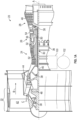
- FIG. 1A schematically illustrates an example of a gas turbine engine 20.
- the gas turbine engine 20 includes a fan section 22, a compressor section 24, a combustor section 26, and a turbine section 28.
- Each of the fan section 22, the compressor section 24, the combustor section 26, and the turbine section 28 is arranged with one another to define an engine central longitudinal axis A
- a gear box 100 may be mounted to a housing of the gas turbine engine 20 at a location adjacent one of the compressor section 24, the combustor section 26, or the turbine section 28 to facilitate mechanical communication between the engine and the gearbox.
- FIG. 1B is a perspective view showing the gear box 100 connected to a starter assembly 102 of FIG. 1A .
- the starter assembly 102 may be an air turbine starter.
- Components of the gear box 100 may be arranged with components of the gas turbine engine 20 to transfer mechanical energy between the gas turbine engine 20 and the starter assembly 102 in either direction. While the starter assembly 102 is shown in communication with the gas turbine engine 20 in FIG. 1A , those in the art will appreciate that the starter assembly 102 may operate with other types of engines without departing from a scope of the present disclosure.
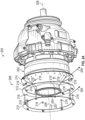
- FIGS. 2A and 2B show an example of a starter assembly of a gas turbine engine, referred to generally as a starter assembly 200 herein.
- the starter assembly 200 may be an air turbine starter.
- a housing 202 defines an opening 204.
- the opening 204 defines a central axis 206. Air enters the housing 202 via the opening 204 in a direction substantially parallel to the central axis 206 as represented by arrow 207 in FIG. 2A .
- Air exiting the housing 202 is represented by arrows 209 in 2B and exits through spacing between baffle louvers described below. Arrows 209 are also generally shown in FIG. 2A for context.
- the starter assembly 200 includes multiple additional components.
- the starter assembly can include an exhaust baffle assembly 208.
- the exhaust baffle assembly 208 includes separately formed components such as a first baffle louver 210, a second baffle louver 212, a third baffle louver 214, and a plurality of spacers 218. Each of these separately formed components must then be assembled with one another, a burdensome task. While the exhaust baffle assembly 208 is shown with three baffle louvers in FIGS. 2A and 2B , those skilled in the art will appreciate that the exhaust baffle assembly 208 may include more than three baffle louvers.
- FIG. 2B shows further detail related to an assembled version of the separately formed components discussed above.
- the assembly process alternately stacks the baffle louvers and the spacers 218.
- the baffle louvers When assembled, the baffle louvers are oriented with one another in an overlap-fashion relative to airflow originating near the central axis 206 and traveling toward the baffle assembly 208 as represented by arrows 222 in FIG. 2B .
- air may travel from the opening 204 to the baffle assembly 208 via a channel 223.
- the overlap-fashion of the baffle louvers interferes with continuous exhaust airflow through the baffle assembly 208 as all or most of the exhaust airflow contacts one of the first baffle louver 210, the second baffle louver 212, or the third baffle louver 214.
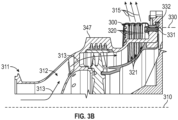
- FIGS. 3A and 3B illustrate an example of an engine starter assembly according to the present disclosure, referred to generally as an engine starter assembly 301 herein, and a portion of a baffle component for the engine starter assembly 301, referred to generally as a baffle component 300 herein.
- the engine starter assembly 301 may be an air turbine starter assembly.
- the engine starter assembly 301 and the baffle component 300 may be utilized in aircraft starters or other similar starters.
- the starter assembly 301 may be coupled to a gear box in mechanical communication with an engine.
- the engine starter assembly 301 may be mounted adjacent to a portion of the engine, such as the gear box 100 described above in relation to the gas turbine engine 20.
- the baffle component 300 may include a plurality of frames 306 connected to one another or formed as a single component. Each frame 306 of the plurality of frames 306 may be concentric and generally spaced at equal distances from a starter assembly central axis 310. In one example, each frame 306 of the plurality of frames 306 may be arranged with one another to define a substantially circular shape about the starter assembly central axis 310. In another example, the starter assembly central axis 310 may be defined by an opening 311.
- the baffle component 300 may be arranged with components of the engine starter assembly 301 to assist in managing airflow direction therein. Air may travel from the opening 311 to the baffle component 300 via an air channel 312 as represented with arrows 313 in FIG. 3B . Air may enter the starter assembly 301 at a location adjacent the starter assembly central axis 310 and travel in a direction parallel therewith as represented by arrow 313. Air may exit the starter assembly 301 via the baffle component 300 as represented by arrows 315 of FIG. 3B .
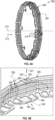
- each frame 306 of the plurality of frames 306 may be formed to define at least one opening and include one or more louvers 320 extending across the opening to assist in directing airflow.
- Each louver 320 of the one or more louvers 320 may be spaced from one another and stacked to assist in facilitating airflow between the one or more louvers 320 as further described below in relation to FIG. 4C .
- Each louver 320 of the one or more louvers 320 may be stacked vertically relative to an upper axis defined by an upper portion of a respective frame 306 and arranged with one another to define openings 321 between each louver 320 for air to pass therethrough.
- the louvers 320 of the one or more louvers 320 are not arranged in an overlap-fashion.
- FIG. 4A While only one set of arrows 315 is shown in FIG. 4A representing airflow in relationship to one frame 306 of the plurality of frames 306, those skilled in the art will appreciate that the airflow in relationship to the other frames 306 of the plurality of frames 306 is similar.
- Each frame 306 of the plurality of frames 306 may include features to assist in securing the baffle component 300 to a portion of a starter assembly for an engine.
- at least one frame 306 of the plurality of frames 306 may include an attachment flange 324 extending from a central region of an upper portion of a respective frame 306.
- a second force may be created by the extension 344 (discussed below) acting on the starter housing 347.
- Each attachment flange 324 may extend along a flange axis 329.
- Each attachment flange 324 may define an aperture 326 sized to receive a fastener, such as a fastener 331 shown in FIG. 3B .
- Each of the apertures 326 may be spaced at equal distances from the starter assembly central axis.
- Each frame 306 of the plurality of frames 306 may be arranged with a respective attachment flange 324 such that a first force 327 is created by a fastener inserted within a respective aperture 326.
- the first force 327 may be directed in a direction substantially perpendicular to a respective axis defined by an upper portion of the respective frame 306.
- Each attachment flange 324 may extend from a respective frame 306 such that each aperture 326 defines a centerline 330 oriented substantially parallel to the starter assembly central axis 310. Further, each attachment flange 324 may extend such that each centerline 330 is substantially aligned with a centerline of a starter component receiving aperture 332 as shown in FIG. 3B .
- Each frame 306 of the plurality of frames 306 may include an extension 344 extending from a lower portion of a respective frame 306 along an extension axis 345.
- Each extension axis 345 may be oriented substantially parallel to a respective flange axis 329.
- Each extension 344 may define one or more openings 346.
- Each of the one or more openings 346 may be sized to receive a portion of a starter assembly, such as a feature 349 of a starter housing 347 shown in FIG. 3A .
- each extension may be oriented to operate as a screen for airflow exiting the engine starter assembly 301.
- Each extension 344 may extend in a direction substantially perpendicular to a respective centerline 330 to align each of the one or more openings 346 with desired features 349 of the starter housing 347.
- Each extension may extend in a direction substantially perpendicular to the starter assembly central axis 310.
- Each extension 344 is of a flexible material to assist in facilitating a snap fit to the desired feature 349 of the starter housing 347.
- each attachment flange 324 may be arranged with a respective extension 344 such that a second force is created by the extension 344 acting on the starter housing 347. The second force may oppose the first force to assist in securing the baffle component 300 to the starter housing 347.
- Each attachment flange 324 may be arranged with a respective extension 344 such that each flange axis 329 is oriented in parallel with a respective extension axis 345.
- the baffle component 300 may be formed as only one component (thus eliminating burdensome assembly processes), is structured to provide a more secure attachment to the starter housing 347 (due to a structure of respective attachment flanges 324 and respective extensions 344), and is structured to more efficiently assist in managing exhaust airflow as now described in relation to FIG. 4C .
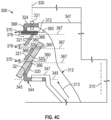
- FIGs. 4C and 4D illustrate an example of fluid flow within a portion of the starter assembly 301 as influenced by the baffle component 300. These two FIGs. include the same view but reference numerals are split between them for clarity.
- air originating at or adjacent the starter assembly central axis 310 may travel to the baffle component 300 via the air channel 312 as represented by arrows 313 in FIG. 3B and FIG. 4C .
- the air may then be exhausted from the starter assembly 301 as influenced by the baffle component 300 and as represented by arrows 360.
- Each of the one or more louvers 320 may include a corner 366.
- Each axis of a plurality of exhaust axes 367 may extend perpendicularly from the starter assembly central axis 310 and intersect one of the corners 366.
- a spacing between an upper edge 368 of one of the openings 321 and a respective exhaust axis 367 defines a length 370.
- Each of the exhaust axes 367 and respective upper edges 368 may form upper and lower boundaries of a first continuous airflow region 372.
- the first continuous airflow region 372 may be defined as a region or airflow path in which air has a direct path from a location inside the starter assembly 301 to a location outside the starter assembly 301 with minimal or no contact with one of the louvers 320.
- Each louver 320 of the one or more louvers 320 may be oriented at an angle to influence airflow.
- an outer edge 376 of the baffle component 300 may define an edge axis 378.
- Each louver 320 of the one or more louvers 320 may be oriented at an angle 380 substantially between zero and ninety degrees relative to the edge axis 378.
- Each louver 320 of the one of more louvers 320 may be closed to block exhaust airflow directed towards certain adjacent engine components if desired.
- each louver 320 may be connected so that it can rotate about as axis and orientated at an angle of from zero to 90 degrees relative to the edge axis 378 if desired. Of course, such rotation is optional, and the louvers could be fixed.
- each louver 320 of the one or more louvers 320 may define a first louver axis 381 and a second louver axis 383. Adjacent louvers 320 of the one or more louvers 320 may be spaced from one another a distance 385.
- the louvers 320 of the one or more louvers 320 may be arranged with one another such that the louver axes and/or the distance 385 define a second continuous airflow region 387.
- the second continuous airflow region 387 may be defined as a region or airflow path in which air has a direct path from a location inside the starter assembly 301 to a location outside the starter assembly 301 with minimal or no contact with one of the louvers 320.
Landscapes
- Engineering & Computer Science (AREA)
- Mechanical Engineering (AREA)
- General Engineering & Computer Science (AREA)
- Chemical & Material Sciences (AREA)
- Combustion & Propulsion (AREA)
- Exhaust Silencers (AREA)
- Retarders (AREA)
Description
- Exemplary embodiments pertain to the art of starter assemblies for engines, such as gas turbine engines and, more particularly, to exhaust baffle components to assist in directing airflow within a starter assembly of the engine.
- Many relatively large gas turbine engines, including turbofan engines, may use an air turbine starter (ATS) to initiate gas turbine engine rotation. The ATS is typically mounted on an accessory gearbox which, in turn, is mounted on the engine or airframe. Consequently, the ATS is installed in the aircraft at all times even though active operation may occur only for a minute or so at the beginning of each flight cycle, along with occasional operation during engine maintenance activities.
- The ATS generally includes a turbine section coupled to an output section within a housing. The turbine section is coupled to a high pressure fluid source, such as compressed air, to drive the output section through a gear system. Thus, when the high pressure fluid source impinges upon the turbine section, the output section powers the gas turbine engine. The ATS generally includes an exhaust baffle downstream of the turbine section.
- Current exhaust baffle assemblies for engine starters mount each of several individual baffles in parallel with a mounting face of an engine. Such assemblies include many components such as spacers between the individual baffles and are labor intensive to assemble. Further, due to the many components and assembly challenges, the baffle component of the starter assembly may experience cracking during use. Document
US2012/114475 discloses an exhaust baffle component for a turbine starter according to the prior art. - According to some embodiments, exhaust baffle assemblies for a turbine starter are provided. The baffles are configured to assist in directing airflow within a started assembly of an engine. The baffle includes a plurality of frames arranged with one another as a single component. At least one of the plurality of frames includes an attachment flange extending therefrom and defining a receiving aperture. In addition, each frame of the plurality of frames includes one or more louvers stacked relative to one another and spaced from one another to define an air opening therebetween. The attachment flange may extend from the frame to substantially align the receiving aperture with a starter aperture of a starter component to facilitate securement of the attachment flange to the starter component whereby the component also includes an extension of a flexible material extending from a lower portion of each frame of the plurality of frames, wherein the extension defines one or more openings sized to facilitate a snap fit to a feature of a housing of the starter component.
- In addition to one or more of the features described above, or as an alternative, in further embodiments of the baffle, at least one of the plurality of frames, the attachment flange, and a fastener may be inserted within the receiving aperture to secure the attachment flange to the starter component.
- In addition to one or more of the features described above, or as an alternative, in further embodiments of the baffle, each frame of the plurality of frames may define an opening and each of the one or more louvers may be mounted to one frame of the plurality of frames and extend across a respective opening.
- In addition to one or more of the features described above, or as an alternative, in further embodiments of the baffle, each frame of the plurality of frames may be connected to at least two adjacent frames to define a substantially circular shape about a central axis defined by the starter component. Each louver of the one or more louvers may be arranged with one another in a stack such that each louver of the one or more louvers does not overlap another louver relative to an airflow path extending through the exhaust baffle component.
- In addition to one or more of the features described above, or as an alternative, further embodiments of the baffle, may include an air channel extending from a first location proximate the central axis to a second location proximate to at least one of the plurality of frames.
- In addition to one or more of the features described above, or as an alternative, in further embodiments of the baffle, each of the one or more louvers may be stacked vertically relative to an upper axis defined by the upper portion of the frame.
- In addition to one or more of the features described above, or as an alternative, in further embodiments of the baffle, each louver of the one or more louvers may be spaced from an adjacent one of the one or more louvers such that air may flow therebetween.
- In addition to one or more of the features described above, or as an alternative, further embodiments of the baffle, may include an extension extending from a lower portion of each of the plurality of frames in a direction substantially perpendicular to a central axis defined by the starter component.
- In addition to one or more of the features described above, or as an alternative, in further embodiments of the baffle, each frame of the plurality of frames may be arranged with respective louvers of the one or more louvers such that a continuous airflow path is defined from an interior of the starter component to an exterior of the starter component without contacting one of the one or more louvers.
- According to some embodiments, an engine starter assembly is provided. The engine starter assembly includes a gear box and a starter assembly coupled to the gearbox. The starter assembly includes a baffle component formed as a single component and an attachment flange with a receiving aperture sized to receive a fastener to secure the attachment flange to the starter assembly. The attachment flange may extend from a substantially central region of an upper portion of a frame of the baffle component such that a force from a fastener inserted in the receiving aperture is oriented substantially perpendicular to a direction of airflow entering the baffle component.
- In addition to one or more of the features described above, or as an alternative, in further embodiments of the starter assembly, the baffle component may include a plurality of the attachment flanges arranged with one another about a first center axis and each attachment flange of the plurality of attachment flanges is sized such that each of the receiving apertures is spaced substantially at the same distance from the first center axis.
- In addition to one or more of the features described above, or as an alternative, in further embodiments of the starter assembly, the baffle component may include one or more louvers and each louver may define a corner. In addition, an exhaust axis may be defined extending perpendicularly from a central axis defined by the starter assembly to the corner. A length may be defined between the exhaust axis and an upper edge of an exhaust opening defined by the baffle component.
- In addition to one or more of the features described above, or as an alternative, in further embodiments of the starter assembly, the baffle component may include a plurality of frames arranged with one another to define a substantially circular shape.
- In addition to one or more of the features described above, or as an alternative, in further embodiments of the starter assembly, the baffle component may include an extension extending from a lower portion of the frame. In addition, the extension and the attachment flange may extend along separate axes oriented substantially parallel to one another.
- In addition to one or more of the features described above, or as an alternative, in further embodiments of the starter assembly, the assembly may further include a housing and the extension may define one or more grip openings each sized to engage with a feature of the housing.
- In addition to one or more of the features described above, or as an alternative, further embodiments of the starter assembly, the assembly may further include a plurality of louvers each extending across an exhaust opening defined by the frame. In addition, each louver of the plurality of louvers may be oriented at an angle substantially between zero and ninety degrees.
- In addition to one or more of the features described above, or as an alternative, in further embodiments of the starter assembly, each louver of the plurality of louvers may be stacked relative to one another without a spacer between adjacent louvers.
- In addition to one or more of the features described above, or as an alternative, in further embodiments of the starter assembly, each louver of the plurality of louvers may be stacked relative to one another in a non-overlap relationship.
- In addition to one or more of the features described above, or as an alternative, in further embodiments of the starter assembly, the assembly may define a central axis. In addition, the starter assembly may define an air channel extending from a first location proximate the central axis to a second location proximate to the baffle component.
- The following descriptions should not be considered limiting in any way. With reference to the accompanying drawings, like elements are numbered alike:
-
FIG. 1A is a side view, in partial cross-section, of an example of a gas turbine engine including a gear box and a starter assembly; -
FIG. 1B is a perspective view of a starter assembly connected to a gear box; -
FIG. 2A is a perspective, partially exploded view of an example of a portion of a starter assembly of an engine; -
FIG 2B is a side view, in cross-section, of a portion of the starter assembly ofFIG. 2A ; -
FIG. 3A is a perspective view of an example of a portion of a starter assembly of an engine; -
FIG. 3B is a side view, in cross-section, of a portion of the starter assembly ofFIG. 3A ; -
FIG. 4A is a perspective view of an exhaust baffle component of the starter assembly ofFIG. 3A ; -
FIG. 4B is a perspective view of a portion of the exhaust baffle component ofFIG. 4A ; and -
FIGs. 4C and4D are side views, in cross-section, of a portion of the starter assembly ofFIG. 3A illustrating an example of airflow influenced by the exhaust baffle component ofFIG. 4A . - A detailed description of one or more embodiments of the disclosed apparatus and method are presented herein by way of exemplification and not limitation with reference to the Figures.
-
FIG. 1A schematically illustrates an example of agas turbine engine 20. Thegas turbine engine 20 includes a fan section 22, acompressor section 24, acombustor section 26, and aturbine section 28. Each of the fan section 22, thecompressor section 24, thecombustor section 26, and theturbine section 28 is arranged with one another to define an engine central longitudinal axis A - In some cases, a
gear box 100 may be mounted to a housing of thegas turbine engine 20 at a location adjacent one of thecompressor section 24, thecombustor section 26, or theturbine section 28 to facilitate mechanical communication between the engine and the gearbox. -
FIG. 1B is a perspective view showing thegear box 100 connected to astarter assembly 102 ofFIG. 1A . In one example, thestarter assembly 102 may be an air turbine starter. Components of thegear box 100 may be arranged with components of thegas turbine engine 20 to transfer mechanical energy between thegas turbine engine 20 and thestarter assembly 102 in either direction. While thestarter assembly 102 is shown in communication with thegas turbine engine 20 inFIG. 1A , those in the art will appreciate that thestarter assembly 102 may operate with other types of engines without departing from a scope of the present disclosure. -
FIGS. 2A and2B show an example of a starter assembly of a gas turbine engine, referred to generally as astarter assembly 200 herein. In one example, thestarter assembly 200 may be an air turbine starter. Ahousing 202 defines anopening 204. Theopening 204 defines acentral axis 206. Air enters thehousing 202 via theopening 204 in a direction substantially parallel to thecentral axis 206 as represented byarrow 207 inFIG. 2A . Air exiting thehousing 202 is represented byarrows 209 in 2B and exits through spacing between baffle louvers described below.Arrows 209 are also generally shown inFIG. 2A for context. Thestarter assembly 200 includes multiple additional components. For example, the starter assembly can include anexhaust baffle assembly 208. Theexhaust baffle assembly 208 includes separately formed components such as afirst baffle louver 210, asecond baffle louver 212, athird baffle louver 214, and a plurality ofspacers 218. Each of these separately formed components must then be assembled with one another, a burdensome task. While theexhaust baffle assembly 208 is shown with three baffle louvers inFIGS. 2A and2B , those skilled in the art will appreciate that theexhaust baffle assembly 208 may include more than three baffle louvers. -
FIG. 2B shows further detail related to an assembled version of the separately formed components discussed above. The assembly process alternately stacks the baffle louvers and thespacers 218. When assembled, the baffle louvers are oriented with one another in an overlap-fashion relative to airflow originating near thecentral axis 206 and traveling toward thebaffle assembly 208 as represented byarrows 222 inFIG. 2B . For example, air may travel from theopening 204 to thebaffle assembly 208 via achannel 223. When the air reaches thebaffle assembly 208, the overlap-fashion of the baffle louvers interferes with continuous exhaust airflow through thebaffle assembly 208 as all or most of the exhaust airflow contacts one of thefirst baffle louver 210, thesecond baffle louver 212, or thethird baffle louver 214. -
FIGS. 3A and3B illustrate an example of an engine starter assembly according to the present disclosure, referred to generally as anengine starter assembly 301 herein, and a portion of a baffle component for theengine starter assembly 301, referred to generally as abaffle component 300 herein. In one example, theengine starter assembly 301 may be an air turbine starter assembly. Theengine starter assembly 301 and thebaffle component 300 may be utilized in aircraft starters or other similar starters. For example, thestarter assembly 301 may be coupled to a gear box in mechanical communication with an engine. Theengine starter assembly 301 may be mounted adjacent to a portion of the engine, such as thegear box 100 described above in relation to thegas turbine engine 20. Thebaffle component 300 may include a plurality offrames 306 connected to one another or formed as a single component. Eachframe 306 of the plurality offrames 306 may be concentric and generally spaced at equal distances from a starter assemblycentral axis 310. In one example, eachframe 306 of the plurality offrames 306 may be arranged with one another to define a substantially circular shape about the starter assemblycentral axis 310. In another example, the starter assemblycentral axis 310 may be defined by anopening 311. - The
baffle component 300 may be arranged with components of theengine starter assembly 301 to assist in managing airflow direction therein. Air may travel from theopening 311 to thebaffle component 300 via anair channel 312 as represented witharrows 313 inFIG. 3B . Air may enter thestarter assembly 301 at a location adjacent the starter assemblycentral axis 310 and travel in a direction parallel therewith as represented byarrow 313. Air may exit thestarter assembly 301 via thebaffle component 300 as represented byarrows 315 ofFIG. 3B . - Now additionally referring to
FIGS. 4A and 4B , eachframe 306 of the plurality offrames 306 may be formed to define at least one opening and include one ormore louvers 320 extending across the opening to assist in directing airflow. Eachlouver 320 of the one ormore louvers 320 may be spaced from one another and stacked to assist in facilitating airflow between the one ormore louvers 320 as further described below in relation toFIG. 4C . Eachlouver 320 of the one ormore louvers 320 may be stacked vertically relative to an upper axis defined by an upper portion of arespective frame 306 and arranged with one another to defineopenings 321 between eachlouver 320 for air to pass therethrough. In this example, thelouvers 320 of the one ormore louvers 320 are not arranged in an overlap-fashion. - While only one set of
arrows 315 is shown inFIG. 4A representing airflow in relationship to oneframe 306 of the plurality offrames 306, those skilled in the art will appreciate that the airflow in relationship to theother frames 306 of the plurality offrames 306 is similar. - Each
frame 306 of the plurality offrames 306 may include features to assist in securing thebaffle component 300 to a portion of a starter assembly for an engine. For example, at least oneframe 306 of the plurality offrames 306 may include anattachment flange 324 extending from a central region of an upper portion of arespective frame 306. A second force may be created by the extension 344 (discussed below) acting on thestarter housing 347. Eachattachment flange 324 may extend along aflange axis 329. - Each
attachment flange 324 may define anaperture 326 sized to receive a fastener, such as afastener 331 shown inFIG. 3B . Each of theapertures 326 may be spaced at equal distances from the starter assembly central axis. Eachframe 306 of the plurality offrames 306 may be arranged with arespective attachment flange 324 such that afirst force 327 is created by a fastener inserted within arespective aperture 326. Thefirst force 327 may be directed in a direction substantially perpendicular to a respective axis defined by an upper portion of therespective frame 306. Eachattachment flange 324 may extend from arespective frame 306 such that eachaperture 326 defines acenterline 330 oriented substantially parallel to the starter assemblycentral axis 310. Further, eachattachment flange 324 may extend such that eachcenterline 330 is substantially aligned with a centerline of a startercomponent receiving aperture 332 as shown inFIG. 3B . - Each
frame 306 of the plurality offrames 306 may include anextension 344 extending from a lower portion of arespective frame 306 along anextension axis 345. Eachextension axis 345 may be oriented substantially parallel to arespective flange axis 329. Eachextension 344 may define one ormore openings 346. Each of the one ormore openings 346 may be sized to receive a portion of a starter assembly, such as afeature 349 of astarter housing 347 shown inFIG. 3A . - Now with further reference to
FIGs. 3A /3B and4A/4B , in another example, each extension may be oriented to operate as a screen for airflow exiting theengine starter assembly 301. - Each
extension 344 may extend in a direction substantially perpendicular to arespective centerline 330 to align each of the one ormore openings 346 with desiredfeatures 349 of thestarter housing 347. Each extension may extend in a direction substantially perpendicular to the starter assemblycentral axis 310. Eachextension 344 is of a flexible material to assist in facilitating a snap fit to the desiredfeature 349 of thestarter housing 347. - Further, each
attachment flange 324 may be arranged with arespective extension 344 such that a second force is created by theextension 344 acting on thestarter housing 347. The second force may oppose the first force to assist in securing thebaffle component 300 to thestarter housing 347. Eachattachment flange 324 may be arranged with arespective extension 344 such that eachflange axis 329 is oriented in parallel with arespective extension axis 345. - In comparison to the
baffle assembly 208 shown inFIGS. 2A and2B , thebaffle component 300 may be formed as only one component (thus eliminating burdensome assembly processes), is structured to provide a more secure attachment to the starter housing 347 (due to a structure ofrespective attachment flanges 324 and respective extensions 344), and is structured to more efficiently assist in managing exhaust airflow as now described in relation toFIG. 4C . -
FIGs. 4C and4D illustrate an example of fluid flow within a portion of thestarter assembly 301 as influenced by thebaffle component 300. These two FIGs. include the same view but reference numerals are split between them for clarity. As mentioned above, air originating at or adjacent the starter assemblycentral axis 310 may travel to thebaffle component 300 via theair channel 312 as represented byarrows 313 inFIG. 3B andFIG. 4C . The air may then be exhausted from thestarter assembly 301 as influenced by thebaffle component 300 and as represented byarrows 360. - Each of the one or
more louvers 320 may include acorner 366. Each axis of a plurality ofexhaust axes 367 may extend perpendicularly from the starter assemblycentral axis 310 and intersect one of thecorners 366. A spacing between anupper edge 368 of one of theopenings 321 and arespective exhaust axis 367 defines alength 370. Each of the exhaust axes 367 and respectiveupper edges 368 may form upper and lower boundaries of a firstcontinuous airflow region 372. The firstcontinuous airflow region 372 may be defined as a region or airflow path in which air has a direct path from a location inside thestarter assembly 301 to a location outside thestarter assembly 301 with minimal or no contact with one of thelouvers 320. - Each
louver 320 of the one ormore louvers 320 may be oriented at an angle to influence airflow. For example, an outer edge 376 of thebaffle component 300 may define anedge axis 378. Eachlouver 320 of the one ormore louvers 320 may be oriented at anangle 380 substantially between zero and ninety degrees relative to theedge axis 378. Eachlouver 320 of the one ofmore louvers 320 may be closed to block exhaust airflow directed towards certain adjacent engine components if desired. For example, when eachlouver 320 may be connected so that it can rotate about as axis and orientated at an angle of from zero to 90 degrees relative to theedge axis 378 if desired. Of course, such rotation is optional, and the louvers could be fixed. In another example and best shown inFIG. 4D , eachlouver 320 of the one ormore louvers 320 may define afirst louver axis 381 and asecond louver axis 383.Adjacent louvers 320 of the one ormore louvers 320 may be spaced from one another adistance 385. Thelouvers 320 of the one ormore louvers 320 may be arranged with one another such that the louver axes and/or thedistance 385 define a secondcontinuous airflow region 387. The secondcontinuous airflow region 387 may be defined as a region or airflow path in which air has a direct path from a location inside thestarter assembly 301 to a location outside thestarter assembly 301 with minimal or no contact with one of thelouvers 320. - The term "about" is intended to include the degree of error associated with measurement of the particular quantity based upon the equipment available at the time of filing the application.
- The terminology used herein is for the purpose of describing particular embodiments only and is not intended to be limiting of the present disclosure. As used herein, the singular forms "a", "an" and "the" are intended to include the plural forms as well, unless the context clearly indicates otherwise. It will be further understood that the terms "comprises" and/or "comprising," when used in this specification, specify the presence of stated features, integers, steps, operations, elements, and/or components, but do not preclude the presence or addition of one or more other features, integers, steps, operations, element components, and/or groups thereof.
Claims (15)
- An exhaust baffle component (300) for a turbine starter comprising:a plurality of frames arranged with one another as a single component, at least one of the plurality of frames including an attachment flange (324) extending therefrom and defining a receiving aperture (326), each frame of the plurality of frames including one or more louvers stacked relative to one another and spaced from one another to define an air opening therebetween,wherein the attachment flange (324) extends from the frame to substantially align the receiving aperture with a starter aperture of a starter component to facilitate securement of the attachment flange to the starter component when in use;characterized in that the exhaust baffle component also includes an extension (344) of a flexible
material extending from a lower portion of each frame of the plurality of frames, wherein the extension defines one or more openings sized to facilitate a snap fit to a feature of a housing of the starter component. - The exhaust baffle component of claim 1, wherein the at least one of the plurality of frames and the attachment flange and a fastener inserted within the receiving aperture to secure the attachment flange to the starter component.
- The exhaust baffle component of claim 1 or 2, wherein each frame of the plurality of frames defines an opening, and wherein each of the one or more louvers is mounted to one frame of the plurality of frames and extends across a respective opening.
- The exhaust baffle component of claim 3, wherein each frame of the plurality of frames is connected to at least two adjacent frames to define a substantially circular shape about a central axis defined by the starter component, and wherein each louver of the one or more louvers is arranged with one another in a stack such that each louver of the one or more louvers does not overlap another louver relative to an airflow path extending through the exhaust baffle component.
- The exhaust baffle component of claim 4, further comprising an air channel extending from a first location proximate the central axis to a second location proximate to at least one of the plurality of frames.
- The exhaust baffle component of claim 3, wherein each of the one or more louvers is stacked vertically relative to an upper axis defined by the upper portion of the frame, and optionally wherein each louver of the one or more louvers is spaced from an adjacent one of the one or more louvers such that air may flow therebetween.
- The exhaust baffle component of any preceding claim, further comprising an extension extending from a lower portion of each of the plurality of frames in a direction substantially perpendicular to a central axis defined by the starter component.
- The exhaust baffle component of any preceding claim, wherein each frame of the plurality of frames is arranged with respective louvers of the one or more louvers such that a continuous airflow path is defined from an interior of the starter component to an exterior of the starter component without contacting one of the one or more louvers.
- An engine starter assembly (301) comprising:a gear box (100); anda starter component (301) coupled to the gearbox (100) and including an exhaust baffle component (300) as recited in any prior claim,wherein the attachment flange extends from a substantially central region of an upper portion of a frame of the baffle component such that a force from a fastener inserted in the receiving aperture is oriented substantially perpendicular to a direction of airflow entering the baffle component.
- The assembly of claim 9, wherein the baffle component further has a plurality of the attachment flanges arranged with one another about a first center axis, and wherein each attachment flange of the plurality of attachment flanges is sized such that each of the receiving apertures is spaced substantially at the same distance from the first center axis.
- The assembly of claim 9 or 10, wherein the baffle component further has one or more louvers, each louver defining a corner, wherein an exhaust axis is defined extending perpendicularly from a central axis defined by the starter assembly to the corner, wherein a length is defined between the exhaust axis and an upper edge of an exhaust opening defined by the baffle component.
- The assembly of any of claims 9 to 11, and wherein the extension and the attachment flange extend along separate axes oriented substantially parallel to one another, and optionally wherein the starter assembly further includes a housing, and wherein the extension defines one or more grip openings each sized to engage with a feature of the housing.
- The assembly of any of claims 9 to 12 wherein the louvers each extend across an exhaust opening defined by the frame, and wherein each louver of the plurality of louvers is oriented at an angle substantially between zero and ninety degrees.
- The assembly of claim 13, wherein each louver of the plurality of louvers is stacked relative to one another without a spacer between adjacent louvers, or wherein each louver of the plurality of louvers is stacked relative to one another in a non-overlap relationship.
- The assembly of any of claims 9 to 14, wherein the starter assembly defines a central axis, and wherein the starter assembly defines an air channel extending from a first location proximate the central axis to a second location proximate to the baffle component.
Applications Claiming Priority (1)
| Application Number | Priority Date | Filing Date | Title |
|---|---|---|---|
| US202063000063P | 2020-03-26 | 2020-03-26 |
Publications (2)
| Publication Number | Publication Date |
|---|---|
| EP3885559A1 EP3885559A1 (en) | 2021-09-29 |
| EP3885559B1 true EP3885559B1 (en) | 2024-01-17 |
Family
ID=75223070
Family Applications (1)
| Application Number | Title | Priority Date | Filing Date |
|---|---|---|---|
| EP21164706.0A Active EP3885559B1 (en) | 2020-03-26 | 2021-03-24 | Exhaust baffle component for an air turbine starter assembly |
Country Status (2)
| Country | Link |
|---|---|
| US (1) | US12134987B2 (en) |
| EP (1) | EP3885559B1 (en) |
Families Citing this family (1)
| Publication number | Priority date | Publication date | Assignee | Title |
|---|---|---|---|---|
| US11753997B2 (en) | 2020-03-26 | 2023-09-12 | Hamilton Sundstrand Corporation | Exhaust baffle component for an air turbine assembly |
Family Cites Families (25)
| Publication number | Priority date | Publication date | Assignee | Title |
|---|---|---|---|---|
| US1802329A (en) | 1930-01-24 | 1931-04-28 | Laval Steam Turbine Co | Turbine construction |
| US4074914A (en) * | 1975-07-28 | 1978-02-21 | United Technologies Corporation | High pressure lightweight flanges |
| SU857516A1 (en) | 1978-11-27 | 1981-08-23 | Харьковский Ордена Ленина Политехнический Институт Им. В.И.Ленина | Axial turbine outlet pipe |
| US5203674A (en) | 1982-11-23 | 1993-04-20 | Nuovo Pignone S.P.A. | Compact diffuser, particularly suitable for high-power gas turbines |
| IT1176439B (en) * | 1983-07-25 | 1987-08-18 | Gen Electric | SYSTEM TO LUBRICATE THE STARTER OF A TURBOMACHINE |
| US5813828A (en) | 1997-03-18 | 1998-09-29 | Norris; Thomas R. | Method and apparatus for enhancing gas turbo machinery flow |
| SE509521C2 (en) | 1997-06-05 | 1999-02-08 | Abb Stal Ab | Outlet device for a flow machine |
| DE10037684A1 (en) | 2000-07-31 | 2002-02-14 | Alstom Power Nv | Low pressure steam turbine with multi-channel diffuser |
| US6537027B2 (en) | 2001-07-17 | 2003-03-25 | Hamilton Sundstrand Corporation | Turbine no-load speed limiter |
| US6533541B1 (en) | 2001-12-04 | 2003-03-18 | Honeywell International, Inc. | High energy particle arrestor for air turbine starters |
| US6896475B2 (en) | 2002-11-13 | 2005-05-24 | General Electric Company | Fluidic actuation for improved diffuser performance |
| GB2475448B8 (en) | 2005-08-04 | 2015-12-16 | Rolls Royce Power Eng | Gas turbine exhaust diffuser |
| FR2941743B1 (en) | 2009-02-05 | 2011-03-04 | Microturbo | AIR STARTER FOR TURBOMACHINE. |
| US8133017B2 (en) | 2009-03-19 | 2012-03-13 | General Electric Company | Compressor diffuser |
| JP5331715B2 (en) | 2010-01-07 | 2013-10-30 | 株式会社日立製作所 | Gas turbine, exhaust diffuser, and gas turbine plant modification method |
| US8651806B2 (en) | 2010-08-17 | 2014-02-18 | Hamilton Sundstrand Corporation | Air turbine starter inlet housing assembly airflow path |
| US8757969B2 (en) | 2010-09-15 | 2014-06-24 | General Electric Company | Turbine exhaust plenum |
| US8522521B2 (en) * | 2010-11-09 | 2013-09-03 | Hamilton Sundstrand Corporation | Combined air turbine starter, air-oil cooler, and fan |
| US8506235B2 (en) * | 2010-11-10 | 2013-08-13 | Hamilton Sundstrand Corporation | Air turbine starter one-piece air exit port baffle |
| US9989030B2 (en) * | 2015-03-24 | 2018-06-05 | Ingersoll-Rand Company | Fluid powered starter with a variable turbine stator |
| KR101902240B1 (en) | 2017-04-18 | 2018-09-28 | 두산중공업 주식회사 | Exhaust Diffuser Having Variable Guide Vane, And Gas Turbine Having The Same |
| US20190032562A1 (en) | 2017-07-26 | 2019-01-31 | Unison Industries, Llc | Air turbine starter |
| US10844740B2 (en) | 2018-06-28 | 2020-11-24 | Hamilton Sunstrand Corporation | Air turbine starter with turbine air exhaust outlet valve |
| JP7254472B2 (en) | 2018-09-28 | 2023-04-10 | 三菱重工業株式会社 | Steam turbine exhaust chamber, steam turbine, and method for replacing steam turbine |
| US11753997B2 (en) | 2020-03-26 | 2023-09-12 | Hamilton Sundstrand Corporation | Exhaust baffle component for an air turbine assembly |
-
2021
- 2021-03-18 US US17/205,242 patent/US12134987B2/en active Active
- 2021-03-24 EP EP21164706.0A patent/EP3885559B1/en active Active
Also Published As
| Publication number | Publication date |
|---|---|
| US20210301726A1 (en) | 2021-09-30 |
| EP3885559A1 (en) | 2021-09-29 |
| US12134987B2 (en) | 2024-11-05 |
Similar Documents
| Publication | Publication Date | Title |
|---|---|---|
| JP5264184B2 (en) | Bleed structure for a bleed passage in a gas turbine engine | |
| US20030136102A1 (en) | Diffuser for terrestrial or aviation gas turbine | |
| US9097124B2 (en) | Gas turbine engine stator vane assembly with inner shroud | |
| EP3885559B1 (en) | Exhaust baffle component for an air turbine starter assembly | |
| EP3574197B1 (en) | Asymmetric inlet particle separator system | |
| WO2008059620A1 (en) | Film cooling structure | |
| US10184372B2 (en) | Exhaust systems and methods for gas turbine engine | |
| US20160258358A1 (en) | High turning angle ejector cooled turbine engine exhaust duct | |
| EP3241999A1 (en) | Ventilation system for turbomachine using bladeless airflow amplifier | |
| US20170306846A1 (en) | Ventilation system for turbomachine using bladeless airflow amplifier | |
| RU2737061C2 (en) | Exhaust pipe (versions), stiffness mechanism for an exhaust pipe and a method for increasing the resonance frequency of an exhaust system comprising an exhaust pipe | |
| US11753997B2 (en) | Exhaust baffle component for an air turbine assembly | |
| EP1071609B1 (en) | Jet engine exhaust nozzle | |
| EP1780124B1 (en) | Eductor swirl buster | |
| US10288082B2 (en) | Centrifugal fan assembly including cooling vanes and a cooling plate | |
| EP3550149B1 (en) | Structurally improved ram fan inlet shroud | |
| US20140099198A1 (en) | Duct assembly | |
| CN103518037B (en) | A fan nozzle for a turbine engine turbine and a turbine engine | |
| EP4428478B1 (en) | Heat exchanger with crossing heat exchange tubes | |
| EP2508716A2 (en) | Improvements in or relating to gas turbine engine transition ducts | |
| US20150308408A1 (en) | Apparatus for dampening of acoustic noise generated by air-cooling of at least one wind turbine component provided with the nacelle of a wind turbine | |
| EP4189215B1 (en) | Guide vane for a gas turbine engine | |
| EP1200713B1 (en) | Turbine guide vane for exhaust gas turbocharger | |
| EP3875743B1 (en) | Integrated exhaust baffle and split line retaining plate | |
| US20240410284A1 (en) | Turbine vane baffle chimney |
Legal Events
| Date | Code | Title | Description |
|---|---|---|---|
| PUAI | Public reference made under article 153(3) epc to a published international application that has entered the european phase |
Free format text: ORIGINAL CODE: 0009012 |
|
| STAA | Information on the status of an ep patent application or granted ep patent |
Free format text: STATUS: THE APPLICATION HAS BEEN PUBLISHED |
|
| AK | Designated contracting states |
Kind code of ref document: A1 Designated state(s): AL AT BE BG CH CY CZ DE DK EE ES FI FR GB GR HR HU IE IS IT LI LT LU LV MC MK MT NL NO PL PT RO RS SE SI SK SM TR |
|
| STAA | Information on the status of an ep patent application or granted ep patent |
Free format text: STATUS: REQUEST FOR EXAMINATION WAS MADE |
|
| 17P | Request for examination filed |
Effective date: 20220329 |
|
| RBV | Designated contracting states (corrected) |
Designated state(s): AL AT BE BG CH CY CZ DE DK EE ES FI FR GB GR HR HU IE IS IT LI LT LU LV MC MK MT NL NO PL PT RO RS SE SI SK SM TR |
|
| GRAP | Despatch of communication of intention to grant a patent |
Free format text: ORIGINAL CODE: EPIDOSNIGR1 |
|
| STAA | Information on the status of an ep patent application or granted ep patent |
Free format text: STATUS: GRANT OF PATENT IS INTENDED |
|
| INTG | Intention to grant announced |
Effective date: 20230901 |
|
| GRAS | Grant fee paid |
Free format text: ORIGINAL CODE: EPIDOSNIGR3 |
|
| GRAA | (expected) grant |
Free format text: ORIGINAL CODE: 0009210 |
|
| STAA | Information on the status of an ep patent application or granted ep patent |
Free format text: STATUS: THE PATENT HAS BEEN GRANTED |
|
| AK | Designated contracting states |
Kind code of ref document: B1 Designated state(s): AL AT BE BG CH CY CZ DE DK EE ES FI FR GB GR HR HU IE IS IT LI LT LU LV MC MK MT NL NO PL PT RO RS SE SI SK SM TR |
|
| REG | Reference to a national code |
Ref country code: GB Ref legal event code: FG4D |
|
| REG | Reference to a national code |
Ref country code: CH Ref legal event code: EP |
|
| REG | Reference to a national code |
Ref country code: DE Ref legal event code: R096 Ref document number: 602021008633 Country of ref document: DE |
|
| REG | Reference to a national code |
Ref country code: IE Ref legal event code: FG4D |
|
| PGFP | Annual fee paid to national office [announced via postgrant information from national office to epo] |
Ref country code: DE Payment date: 20240220 Year of fee payment: 4 |
|
| REG | Reference to a national code |
Ref country code: LT Ref legal event code: MG9D |
|
| REG | Reference to a national code |
Ref country code: NL Ref legal event code: MP Effective date: 20240117 |
|
| PGFP | Annual fee paid to national office [announced via postgrant information from national office to epo] |
Ref country code: FR Payment date: 20240220 Year of fee payment: 4 |
|
| REG | Reference to a national code |
Ref country code: AT Ref legal event code: MK05 Ref document number: 1650672 Country of ref document: AT Kind code of ref document: T Effective date: 20240117 |
|
| PG25 | Lapsed in a contracting state [announced via postgrant information from national office to epo] |
Ref country code: NL Free format text: LAPSE BECAUSE OF FAILURE TO SUBMIT A TRANSLATION OF THE DESCRIPTION OR TO PAY THE FEE WITHIN THE PRESCRIBED TIME-LIMIT Effective date: 20240117 |
|
| PG25 | Lapsed in a contracting state [announced via postgrant information from national office to epo] |
Ref country code: NL Free format text: LAPSE BECAUSE OF FAILURE TO SUBMIT A TRANSLATION OF THE DESCRIPTION OR TO PAY THE FEE WITHIN THE PRESCRIBED TIME-LIMIT Effective date: 20240117 |
|
| PG25 | Lapsed in a contracting state [announced via postgrant information from national office to epo] |
Ref country code: IS Free format text: LAPSE BECAUSE OF FAILURE TO SUBMIT A TRANSLATION OF THE DESCRIPTION OR TO PAY THE FEE WITHIN THE PRESCRIBED TIME-LIMIT Effective date: 20240517 |
|
| PG25 | Lapsed in a contracting state [announced via postgrant information from national office to epo] |
Ref country code: LT Free format text: LAPSE BECAUSE OF FAILURE TO SUBMIT A TRANSLATION OF THE DESCRIPTION OR TO PAY THE FEE WITHIN THE PRESCRIBED TIME-LIMIT Effective date: 20240117 |
|
| PG25 | Lapsed in a contracting state [announced via postgrant information from national office to epo] |
Ref country code: GR Free format text: LAPSE BECAUSE OF FAILURE TO SUBMIT A TRANSLATION OF THE DESCRIPTION OR TO PAY THE FEE WITHIN THE PRESCRIBED TIME-LIMIT Effective date: 20240418 |
|
| PG25 | Lapsed in a contracting state [announced via postgrant information from national office to epo] |
Ref country code: HR Free format text: LAPSE BECAUSE OF FAILURE TO SUBMIT A TRANSLATION OF THE DESCRIPTION OR TO PAY THE FEE WITHIN THE PRESCRIBED TIME-LIMIT Effective date: 20240117 Ref country code: RS Free format text: LAPSE BECAUSE OF FAILURE TO SUBMIT A TRANSLATION OF THE DESCRIPTION OR TO PAY THE FEE WITHIN THE PRESCRIBED TIME-LIMIT Effective date: 20240417 |
|
| PG25 | Lapsed in a contracting state [announced via postgrant information from national office to epo] |
Ref country code: ES Free format text: LAPSE BECAUSE OF FAILURE TO SUBMIT A TRANSLATION OF THE DESCRIPTION OR TO PAY THE FEE WITHIN THE PRESCRIBED TIME-LIMIT Effective date: 20240117 |
|
| PG25 | Lapsed in a contracting state [announced via postgrant information from national office to epo] |
Ref country code: AT Free format text: LAPSE BECAUSE OF FAILURE TO SUBMIT A TRANSLATION OF THE DESCRIPTION OR TO PAY THE FEE WITHIN THE PRESCRIBED TIME-LIMIT Effective date: 20240117 |
|
| PG25 | Lapsed in a contracting state [announced via postgrant information from national office to epo] |
Ref country code: RS Free format text: LAPSE BECAUSE OF FAILURE TO SUBMIT A TRANSLATION OF THE DESCRIPTION OR TO PAY THE FEE WITHIN THE PRESCRIBED TIME-LIMIT Effective date: 20240417 Ref country code: NO Free format text: LAPSE BECAUSE OF FAILURE TO SUBMIT A TRANSLATION OF THE DESCRIPTION OR TO PAY THE FEE WITHIN THE PRESCRIBED TIME-LIMIT Effective date: 20240417 Ref country code: LT Free format text: LAPSE BECAUSE OF FAILURE TO SUBMIT A TRANSLATION OF THE DESCRIPTION OR TO PAY THE FEE WITHIN THE PRESCRIBED TIME-LIMIT Effective date: 20240117 Ref country code: IS Free format text: LAPSE BECAUSE OF FAILURE TO SUBMIT A TRANSLATION OF THE DESCRIPTION OR TO PAY THE FEE WITHIN THE PRESCRIBED TIME-LIMIT Effective date: 20240517 Ref country code: HR Free format text: LAPSE BECAUSE OF FAILURE TO SUBMIT A TRANSLATION OF THE DESCRIPTION OR TO PAY THE FEE WITHIN THE PRESCRIBED TIME-LIMIT Effective date: 20240117 Ref country code: GR Free format text: LAPSE BECAUSE OF FAILURE TO SUBMIT A TRANSLATION OF THE DESCRIPTION OR TO PAY THE FEE WITHIN THE PRESCRIBED TIME-LIMIT Effective date: 20240418 Ref country code: FI Free format text: LAPSE BECAUSE OF FAILURE TO SUBMIT A TRANSLATION OF THE DESCRIPTION OR TO PAY THE FEE WITHIN THE PRESCRIBED TIME-LIMIT Effective date: 20240117 Ref country code: ES Free format text: LAPSE BECAUSE OF FAILURE TO SUBMIT A TRANSLATION OF THE DESCRIPTION OR TO PAY THE FEE WITHIN THE PRESCRIBED TIME-LIMIT Effective date: 20240117 Ref country code: BG Free format text: LAPSE BECAUSE OF FAILURE TO SUBMIT A TRANSLATION OF THE DESCRIPTION OR TO PAY THE FEE WITHIN THE PRESCRIBED TIME-LIMIT Effective date: 20240117 Ref country code: AT Free format text: LAPSE BECAUSE OF FAILURE TO SUBMIT A TRANSLATION OF THE DESCRIPTION OR TO PAY THE FEE WITHIN THE PRESCRIBED TIME-LIMIT Effective date: 20240117 |
|
| PG25 | Lapsed in a contracting state [announced via postgrant information from national office to epo] |
Ref country code: PT Free format text: LAPSE BECAUSE OF FAILURE TO SUBMIT A TRANSLATION OF THE DESCRIPTION OR TO PAY THE FEE WITHIN THE PRESCRIBED TIME-LIMIT Effective date: 20240517 Ref country code: PL Free format text: LAPSE BECAUSE OF FAILURE TO SUBMIT A TRANSLATION OF THE DESCRIPTION OR TO PAY THE FEE WITHIN THE PRESCRIBED TIME-LIMIT Effective date: 20240117 |
|
| PG25 | Lapsed in a contracting state [announced via postgrant information from national office to epo] |
Ref country code: SE Free format text: LAPSE BECAUSE OF FAILURE TO SUBMIT A TRANSLATION OF THE DESCRIPTION OR TO PAY THE FEE WITHIN THE PRESCRIBED TIME-LIMIT Effective date: 20240117 Ref country code: PT Free format text: LAPSE BECAUSE OF FAILURE TO SUBMIT A TRANSLATION OF THE DESCRIPTION OR TO PAY THE FEE WITHIN THE PRESCRIBED TIME-LIMIT Effective date: 20240517 Ref country code: PL Free format text: LAPSE BECAUSE OF FAILURE TO SUBMIT A TRANSLATION OF THE DESCRIPTION OR TO PAY THE FEE WITHIN THE PRESCRIBED TIME-LIMIT Effective date: 20240117 Ref country code: LV Free format text: LAPSE BECAUSE OF FAILURE TO SUBMIT A TRANSLATION OF THE DESCRIPTION OR TO PAY THE FEE WITHIN THE PRESCRIBED TIME-LIMIT Effective date: 20240117 |
|
| PG25 | Lapsed in a contracting state [announced via postgrant information from national office to epo] |
Ref country code: DK Free format text: LAPSE BECAUSE OF FAILURE TO SUBMIT A TRANSLATION OF THE DESCRIPTION OR TO PAY THE FEE WITHIN THE PRESCRIBED TIME-LIMIT Effective date: 20240117 |
|
| PG25 | Lapsed in a contracting state [announced via postgrant information from national office to epo] |
Ref country code: SM Free format text: LAPSE BECAUSE OF FAILURE TO SUBMIT A TRANSLATION OF THE DESCRIPTION OR TO PAY THE FEE WITHIN THE PRESCRIBED TIME-LIMIT Effective date: 20240117 |
|
| REG | Reference to a national code |
Ref country code: DE Ref legal event code: R097 Ref document number: 602021008633 Country of ref document: DE |
|
| PG25 | Lapsed in a contracting state [announced via postgrant information from national office to epo] |
Ref country code: EE Free format text: LAPSE BECAUSE OF FAILURE TO SUBMIT A TRANSLATION OF THE DESCRIPTION OR TO PAY THE FEE WITHIN THE PRESCRIBED TIME-LIMIT Effective date: 20240117 Ref country code: CZ Free format text: LAPSE BECAUSE OF FAILURE TO SUBMIT A TRANSLATION OF THE DESCRIPTION OR TO PAY THE FEE WITHIN THE PRESCRIBED TIME-LIMIT Effective date: 20240117 |
|
| PG25 | Lapsed in a contracting state [announced via postgrant information from national office to epo] |
Ref country code: SK Free format text: LAPSE BECAUSE OF FAILURE TO SUBMIT A TRANSLATION OF THE DESCRIPTION OR TO PAY THE FEE WITHIN THE PRESCRIBED TIME-LIMIT Effective date: 20240117 |
|
| PG25 | Lapsed in a contracting state [announced via postgrant information from national office to epo] |
Ref country code: SM Free format text: LAPSE BECAUSE OF FAILURE TO SUBMIT A TRANSLATION OF THE DESCRIPTION OR TO PAY THE FEE WITHIN THE PRESCRIBED TIME-LIMIT Effective date: 20240117 Ref country code: SK Free format text: LAPSE BECAUSE OF FAILURE TO SUBMIT A TRANSLATION OF THE DESCRIPTION OR TO PAY THE FEE WITHIN THE PRESCRIBED TIME-LIMIT Effective date: 20240117 Ref country code: RO Free format text: LAPSE BECAUSE OF FAILURE TO SUBMIT A TRANSLATION OF THE DESCRIPTION OR TO PAY THE FEE WITHIN THE PRESCRIBED TIME-LIMIT Effective date: 20240117 Ref country code: EE Free format text: LAPSE BECAUSE OF FAILURE TO SUBMIT A TRANSLATION OF THE DESCRIPTION OR TO PAY THE FEE WITHIN THE PRESCRIBED TIME-LIMIT Effective date: 20240117 Ref country code: DK Free format text: LAPSE BECAUSE OF FAILURE TO SUBMIT A TRANSLATION OF THE DESCRIPTION OR TO PAY THE FEE WITHIN THE PRESCRIBED TIME-LIMIT Effective date: 20240117 Ref country code: CZ Free format text: LAPSE BECAUSE OF FAILURE TO SUBMIT A TRANSLATION OF THE DESCRIPTION OR TO PAY THE FEE WITHIN THE PRESCRIBED TIME-LIMIT Effective date: 20240117 |
|
| REG | Reference to a national code |
Ref country code: CH Ref legal event code: PL |
|
| PG25 | Lapsed in a contracting state [announced via postgrant information from national office to epo] |
Ref country code: LU Free format text: LAPSE BECAUSE OF NON-PAYMENT OF DUE FEES Effective date: 20240324 |
|
| PG25 | Lapsed in a contracting state [announced via postgrant information from national office to epo] |
Ref country code: MC Free format text: LAPSE BECAUSE OF FAILURE TO SUBMIT A TRANSLATION OF THE DESCRIPTION OR TO PAY THE FEE WITHIN THE PRESCRIBED TIME-LIMIT Effective date: 20240117 |
|
| PLBE | No opposition filed within time limit |
Free format text: ORIGINAL CODE: 0009261 |
|
| STAA | Information on the status of an ep patent application or granted ep patent |
Free format text: STATUS: NO OPPOSITION FILED WITHIN TIME LIMIT |
|
| PG25 | Lapsed in a contracting state [announced via postgrant information from national office to epo] |
Ref country code: MC Free format text: LAPSE BECAUSE OF FAILURE TO SUBMIT A TRANSLATION OF THE DESCRIPTION OR TO PAY THE FEE WITHIN THE PRESCRIBED TIME-LIMIT Effective date: 20240117 Ref country code: LU Free format text: LAPSE BECAUSE OF NON-PAYMENT OF DUE FEES Effective date: 20240324 |
|
| PG25 | Lapsed in a contracting state [announced via postgrant information from national office to epo] |
Ref country code: IT Free format text: LAPSE BECAUSE OF FAILURE TO SUBMIT A TRANSLATION OF THE DESCRIPTION OR TO PAY THE FEE WITHIN THE PRESCRIBED TIME-LIMIT Effective date: 20240117 |
|
| REG | Reference to a national code |
Ref country code: BE Ref legal event code: MM Effective date: 20240331 |
|
| 26N | No opposition filed |
Effective date: 20241018 |
|
| PG25 | Lapsed in a contracting state [announced via postgrant information from national office to epo] |
Ref country code: IT Free format text: LAPSE BECAUSE OF FAILURE TO SUBMIT A TRANSLATION OF THE DESCRIPTION OR TO PAY THE FEE WITHIN THE PRESCRIBED TIME-LIMIT Effective date: 20240117 |
|
| PG25 | Lapsed in a contracting state [announced via postgrant information from national office to epo] |
Ref country code: BE Free format text: LAPSE BECAUSE OF NON-PAYMENT OF DUE FEES Effective date: 20240331 |
|
| PG25 | Lapsed in a contracting state [announced via postgrant information from national office to epo] |
Ref country code: IE Free format text: LAPSE BECAUSE OF NON-PAYMENT OF DUE FEES Effective date: 20240324 |
|
| PG25 | Lapsed in a contracting state [announced via postgrant information from national office to epo] |
Ref country code: IE Free format text: LAPSE BECAUSE OF NON-PAYMENT OF DUE FEES Effective date: 20240324 Ref country code: BE Free format text: LAPSE BECAUSE OF NON-PAYMENT OF DUE FEES Effective date: 20240331 Ref country code: CH Free format text: LAPSE BECAUSE OF NON-PAYMENT OF DUE FEES Effective date: 20240331 |
|
| PG25 | Lapsed in a contracting state [announced via postgrant information from national office to epo] |
Ref country code: SI Free format text: LAPSE BECAUSE OF FAILURE TO SUBMIT A TRANSLATION OF THE DESCRIPTION OR TO PAY THE FEE WITHIN THE PRESCRIBED TIME-LIMIT Effective date: 20240117 |
|
| PG25 | Lapsed in a contracting state [announced via postgrant information from national office to epo] |
Ref country code: CY Free format text: LAPSE BECAUSE OF FAILURE TO SUBMIT A TRANSLATION OF THE DESCRIPTION OR TO PAY THE FEE WITHIN THE PRESCRIBED TIME-LIMIT; INVALID AB INITIO Effective date: 20210324 |
|
| PG25 | Lapsed in a contracting state [announced via postgrant information from national office to epo] |
Ref country code: HU Free format text: LAPSE BECAUSE OF FAILURE TO SUBMIT A TRANSLATION OF THE DESCRIPTION OR TO PAY THE FEE WITHIN THE PRESCRIBED TIME-LIMIT; INVALID AB INITIO Effective date: 20210324 |
|
| REG | Reference to a national code |
Ref country code: DE Ref legal event code: R119 Ref document number: 602021008633 Country of ref document: DE |
|
| GBPC | Gb: european patent ceased through non-payment of renewal fee |
Effective date: 20250324 |
|
| PG25 | Lapsed in a contracting state [announced via postgrant information from national office to epo] |
Ref country code: TR Free format text: LAPSE BECAUSE OF FAILURE TO SUBMIT A TRANSLATION OF THE DESCRIPTION OR TO PAY THE FEE WITHIN THE PRESCRIBED TIME-LIMIT Effective date: 20240117 |
|
| PG25 | Lapsed in a contracting state [announced via postgrant information from national office to epo] |
Ref country code: DE Free format text: LAPSE BECAUSE OF NON-PAYMENT OF DUE FEES Effective date: 20251001 |
|
| PG25 | Lapsed in a contracting state [announced via postgrant information from national office to epo] |
Ref country code: GB Free format text: LAPSE BECAUSE OF NON-PAYMENT OF DUE FEES Effective date: 20250324 |
|
| PG25 | Lapsed in a contracting state [announced via postgrant information from national office to epo] |
Ref country code: FR Free format text: LAPSE BECAUSE OF NON-PAYMENT OF DUE FEES Effective date: 20250331 |