EP3884697B1 - Erleichterung der verbesserung von selbstorganisierenden netzwerken (son) - Google Patents
Erleichterung der verbesserung von selbstorganisierenden netzwerken (son) Download PDFInfo
- Publication number
- EP3884697B1 EP3884697B1 EP19832798.3A EP19832798A EP3884697B1 EP 3884697 B1 EP3884697 B1 EP 3884697B1 EP 19832798 A EP19832798 A EP 19832798A EP 3884697 B1 EP3884697 B1 EP 3884697B1
- Authority
- EP
- European Patent Office
- Prior art keywords
- son
- network
- test scenario
- wireless
- wireless connection
- Prior art date
- Legal status (The legal status is an assumption and is not a legal conclusion. Google has not performed a legal analysis and makes no representation as to the accuracy of the status listed.)
- Active
Links
Images







Classifications
-
- H—ELECTRICITY
- H04—ELECTRIC COMMUNICATION TECHNIQUE
- H04W—WIRELESS COMMUNICATION NETWORKS
- H04W24/00—Supervisory, monitoring or testing arrangements
- H04W24/02—Arrangements for optimising operational condition
-
- H—ELECTRICITY
- H04—ELECTRIC COMMUNICATION TECHNIQUE
- H04W—WIRELESS COMMUNICATION NETWORKS
- H04W76/00—Connection management
- H04W76/20—Manipulation of established connections
- H04W76/25—Maintenance of established connections
-
- H—ELECTRICITY
- H04—ELECTRIC COMMUNICATION TECHNIQUE
- H04L—TRANSMISSION OF DIGITAL INFORMATION, e.g. TELEGRAPHIC COMMUNICATION
- H04L5/00—Arrangements affording multiple use of the transmission path
- H04L5/003—Arrangements for allocating sub-channels of the transmission path
- H04L5/0053—Allocation of signalling, i.e. of overhead other than pilot signals
- H04L5/0055—Physical resource allocation for ACK/NACK
-
- H—ELECTRICITY
- H04—ELECTRIC COMMUNICATION TECHNIQUE
- H04W—WIRELESS COMMUNICATION NETWORKS
- H04W24/00—Supervisory, monitoring or testing arrangements
- H04W24/04—Arrangements for maintaining operational condition
-
- H—ELECTRICITY
- H04—ELECTRIC COMMUNICATION TECHNIQUE
- H04W—WIRELESS COMMUNICATION NETWORKS
- H04W76/00—Connection management
- H04W76/10—Connection setup
- H04W76/15—Setup of multiple wireless link connections
-
- H—ELECTRICITY
- H04—ELECTRIC COMMUNICATION TECHNIQUE
- H04W—WIRELESS COMMUNICATION NETWORKS
- H04W24/00—Supervisory, monitoring or testing arrangements
- H04W24/10—Scheduling measurement reports ; Arrangements for measurement reports
-
- H—ELECTRICITY
- H04—ELECTRIC COMMUNICATION TECHNIQUE
- H04W—WIRELESS COMMUNICATION NETWORKS
- H04W84/00—Network topologies
- H04W84/18—Self-organising networks, e.g. ad-hoc networks or sensor networks
Definitions
- IoT Internet of Things
- a wireless network node enables a network enhancement mechanism to increase network performance in an automated manner.
- UE user equipment
- the corresponding cellular network becomes more complex.
- Newer UEs may be capable of maintaining two or more wireless connections simultaneously with a wireless network.
- new cellular networks are expected to service an ever-increasing number of wireless device endpoints while juggling a myriad of different network settings, such as carrier frequencies, timer lengths, power levels, antenna directions, and so forth. Consequently, a wireless network may have thousands of configurable parameters, such as radio access or radio network parameters, which may be affected by hundreds of changing usage and environmental factors. As a result, manual adjustment of these parameters to improve network performance and accommodate the changing factors is infeasible.
- a wireless network liaison interacts with a network enhancement mechanism. Additionally or alternatively, a UE's ability to maintain multiple wireless connections is leveraged to safely test alternative network configurations in pursuit of network enhancement.
- a SON enhancement mechanism such as a server having an artificial intelligence (AI) functionality, can process a current network configuration and generate an alternative network configuration to be used in a test scenario. The AI functionality can, for instance, implement an iterative refinement technique such as A/B testing over time.
- a wireless network SON liaison such as a wireless network management node having SON network functionality, realizes an application programming interface (API) to interact with the SON enhancement mechanism. The SON liaison transforms the alternative network configuration into a transformed network configuration based on wireless network constraints that are unknown to the SON enhancement mechanism or to accommodate wireless network signaling protocols.
- API application programming interface
- the test scenario description can include, for instance, an assigned timeframe for executing the test and a termination configuration, which includes radio access or radio network configuration settings, that the UE is to adopt at a conclusion of the timeframe.
- a termination configuration which includes radio access or radio network configuration settings, that the UE is to adopt at a conclusion of the timeframe.
- an automated enhancement mechanism can be applied to facilitate SON operations while certain network expectations, such as a contracted-for QoS, are achieved using multiple wireless connections with a UE.
- the UE includes at least one antenna, at least one wireless transceiver coupled to the at least one antenna, and a processor and memory system.
- the processor and memory system are coupled to the at least one wireless transceiver and implement a SON facilitator.
- the SON facilitator is configured to receive, from a wireless network, a downlink (DL) SON message, with the DL SON message indicative of a test scenario and specifying at least one radio access network parameter configured in accordance with the test scenario.
- the SON facilitator is also configured to instruct the at least one wireless transceiver to communicate with at least one base station using at least a first wireless connection and a second wireless connection. The first wireless connection is to be unchanged by the test scenario, and the second wireless connection is to use the at least one radio access network parameter.
- the base station includes multiple antennas, multiple wireless transceivers coupled to the multiple antennas, and a processor and memory system.
- the processor and memory system is coupled to the multiple wireless transceivers and implements a SON facilitator.
- the SON facilitator is configured to transmit, to at least one user equipment (UE), a downlink (DL) SON message, with the DL SON message indicative of a test scenario and specifying at least one radio access network parameter configured in accordance with the test scenario.
- the SON facilitator is also configured to instruct at least one wireless transceiver of the multiple wireless transceivers to communicate with the at least one UE using at least a first wireless connection and a second wireless connection.
- the first wireless connection is to be unchanged by the test scenario, and the second wireless connection is to use the at least one radio access network parameter.
- the method includes receiving, from a wireless network, a downlink (DL) SON message, with the DL SON message indicative of a test scenario and specifying at least one radio access network parameter configured in accordance with the test scenario.
- the method also includes communicating, using at least one wireless transceiver, with at least one base station using a first wireless connection, with the first wireless connection to be unchanged by the test scenario.
- the method further includes communicating with the at least one base station using a second wireless connection using the at least one radio access network parameter.
- the method includes transmitting, to at least one user equipment (UE), a downlink (DL) SON message, with the DL SON message indicative of a test scenario and specifying at least one radio access network parameter configured in accordance with the test scenario.
- the method also includes communicating, using one or more wireless transceivers, with the at least one UE using a first wireless connection, with the first wireless connection to be unchanged by the test scenario.
- the method further includes communicating with the at least one UE using a second wireless connection using the at least one radio access network parameter.
- the system includes at least one core network interface coupled to a core network of a wireless network.
- the system also includes a processor and memory system coupled to the at least one core network interface to communicate with the wireless network and implement a SON facilitator.
- the SON facilitator is configured to collect configuration information for at least a portion of the wireless network.
- the SON facilitator is also configured to obtain, for a test scenario, alternative configuration information that is based on the configuration information.
- the SON facilitator is further configured to process the alternative configuration information using at least one current network condition for a user equipment (UE) to produce transformed alternative configuration information, with the transformed alternative configuration information comprising a provision for the UE including at least a first wireless connection and a second wireless connection.
- the first wireless connection is to be unchanged by the test scenario, and the second wireless connection is to be configured in accordance with the alternative configuration information for the test scenario.
- the system includes means for facilitating self-organizing network (SON) enhancement at the UE.
- the means for facilitating SON enhancement is configured to receive, from a wireless network, a downlink (DL) SON message, with the DL SON message indicative of a test scenario and specifying at least one radio access network parameter configured in accordance with the test scenario.
- the means for facilitating SON enhancement is also configured to instruct the at least one wireless transceiver to communicate with at least one base station using at least a first wireless connection and a second wireless connection.
- the first wireless connection is to be unchanged by the test scenario
- the second wireless connection is to use the at least one radio access network parameter.
- cellular wireless networks that operate in accordance with a 4G standard, such as LTE or LTE-Advanced.
- cellular wireless networks will be asked to handle newer applications that are technologically more difficult to provide to end users.
- Such applications may include watching ultra-HD (UHD) video or wirelessly coupling hundreds of billions more communication endpoints to the internet to support Internet-of-Things (IoT) devices.
- UHD ultra-HD
- IoT Internet-of-Things
- Such applications may also entail providing a safer sharing of the roadways by empowering self-driving vehicles or exchanging three-dimensional (3D) virtual reality (VR) data for games, professional training, and educational activities.
- 3D three-dimensional
- VR virtual reality
- next-generation 5G networks To upgrade from current 4G wireless networks, various goals have been established for next-generation 5G networks. These goals involve adopting higher electromagnetic (EM) frequencies for wireless signaling in 5G networks than are used in 4G networks. For example, instead of only operating in the 100s of MHz to a few GHz like in 4G networks, 5G networks are expected to also operate in the 10s of GHz (e.g., from 6 GHz to 300 GHz for mmW signaling). These higher frequencies offer some advantages, such as the potential for greater communication bandwidth in conjunction with lower latency. However, there are many challenges to working with these higher frequencies, and the increase in numbers of wireless devices will further tax wireless network resources.
- EM electromagnetic
- next-generation networks may employ beamforming in which antennas "aim" signal beams, carrier aggregation, micro-cells such that more base stations are obligated to interoperate in proximity with one another, diverse coding schemes, transmit power changes, different orthogonal frequency-division multiplexing (OFDM) numerologies, and so forth.
- OFDM orthogonal frequency-division multiplexing
- wireless cellular networks are specified by tens of thousands of pages of specifications, with thousands of configurable parameters.
- an automated approach may involve utilizing self-organizing networks (SON) or minimization of drive tests (MDT).
- SON self-organizing networks
- MDT minimization of drive tests
- AI machine learning and artificial intelligence
- a liaison to an automated enhancement mechanism is provided by a wireless network, and/or multiple wireless connections can be established between a given UE and the wireless network for experimental testing, which are termed test scenarios herein.
- the automated enhancement mechanism can create a test scenario with an alternative network configuration that is implemented by the wireless network using the liaison.
- the liaison maintains at least one wireless connection to a given UE that is not changed by the test scenario even while another wireless connection may be changed as a result of the test scenario.
- the liaison can be implemented by a wireless network management node (WNMN) that realizes an application programming interface (API).
- the API provides an interface between the automated enhancement mechanism and functionality of the wireless network core.
- a self-organizing network (SON) facilitator at the wireless network management node (WNMN) processes current configuration information for the wireless network to produce translated configuration information.
- the translated configuration information is adapted for input to and processing by a SON enhancer at a network enhancement server.
- the SON enhancer can implement, for example, an iterative refinement technique that utilizes a guided trial and error scheme to gradually enhance performance of the wireless network.
- the SON enhancer can produce a test scenario that is specified by alternative configuration information.
- the test scenario can change, for instance, network load or scheduling information, antenna direction, UL/DL configuration, and so forth.
- the UE also includes a SON facilitator.
- the UE receives the DL SON message, and the SON facilitator thereof processes the DL SON message.
- the DL SON message describes the test scenario. This description can include, for example, a timeframe ( e.g ., a start time or an end time) over which the test scenario is to occur.
- the description can also indicate a termination configuration, which includes radio access or ratio network configuration settings, to be enacted at the conclusion of the timeframe. This termination configuration for the UE can correspond to a reversion to the previous configuration or another different configuration.
- an automated enhancement mechanism can interface with a wireless network to enable the network to be self-organized and enhanced over time. Further, a wireless network can meet QoS obligations using multiple wireless connections with a given UE, with the wireless connections being established such that a test scenario created by the automated enhancement mechanism can be safely executed by the wireless network and the given UE.
- FIG. 1 illustrates an example environment 100, which includes at least one user equipment 102 (UE 102) that communicates with a base station 104 that acts as a serving cell (serving base station 104) through a wireless communication link 106 (wireless link 106).
- UE 102 user equipment 102
- base station 104 that acts as a serving cell
- wireless link 106 wireless link 106
- the user equipment 102 and other user equipments 103 are depicted as respective smartphones.
- any of the user equipments 102 and 103 may be implemented as any suitable computing or electronic device, such as a mobile communication device, modem, cellular or mobile phone, mobile station, gaming device, navigation device, media or entertainment device, laptop computer, desktop computer, tablet computer, smart appliance, vehicle-based communication system, wearable computer, Internet of Things (IoTs) device, wireless interface for a machine, and the like.
- IoTs Internet of Things
- the base station 104 may be implemented in a macrocell, microcell, small cell, picocell, and the like, or any combination thereof.
- the base station 104 communicates with the user equipment 102 using the wireless link 106, which may be implemented as any suitable type of wireless link.
- the wireless link 106 can include a downlink (DL) of data and control information communicated from the base station 104 to the user equipment 102, an uplink (UL) of other data and control information communicated from the user equipment 102 to the base station 104, or both.
- the wireless link 106 may include one or more wireless links or bearers implemented using any suitable communication protocol or standard, or combination of communication protocols or standards, such as 3rd Generation Partnership Project Long-Term Evolution (3GPP LTE), Fifth Generation New Radio (5G NR), and so forth.
- 3GPP LTE 3rd Generation Partnership Project Long-Term Evolution
- 5G NR Fifth Generation New Radio
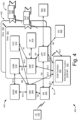
- QoS levels for network slices may number at least two, such as a first QoS 351 and a second QoS 352.
- first slice 451 corresponds to the first QoS 351
- second slice 452 corresponds to the second QoS 352.
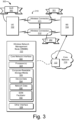
- the SON facilitator 332 has access to a slice or slices 450 that can guarantee a given QoS 350 to enable the SON facilitator 332 to adapt a potential network configuration for a test scenario to ensure that a stipulated QoS for a UE is provided during and after execution of a test scenario, even if operation of one slice is degraded ( e.g ., slowed or becomes prone to packet loss) responsive to the execution of the test scenario.
- Example network configuration information and actions by the SON facilitator 332 to provide an API for SON enhancement are described below with reference to Fig. 5 .
- Fig. 5 illustrates an example scheme 500 for facilitating SON enhancement with a UE 102 or a wireless network management node 122 (WNMN 122), which interfaces with a network enhancement server 124.
- the network enhancement server 124 includes a SON enhancer 504.
- the network enhancement server 124 can include one or more processors or CRM and at least one network interface (not shown in Fig. 5 ), similar to those that are described above for the wireless network management node 122 with reference to Fig. 3 .
- the wireless network management node 122 and the SON facilitator 332 can be merged with the network enhancement server 124 and the SON enhancer 504 ( e.g., into a single node or a combined functional entity).
- the SON enhancer 504 can be realized using, for instance, an artificial intelligence (AI) mechanism that employs an AI algorithm.
- AI mechanisms include, but are not limited to, machine learning, neural networks, reinforcement learning, iterative refinement (e.g ., guided trial and error or A/B testing), combinations thereof, and so forth.
- the SON enhancer 504 creates a test scenario as described below.
- the SON facilitator 332 obtains configuration information 512.
- the SON facilitator 332 can obtain the configuration information 512 from, for instance, the wireless network 402 of Fig. 4 , including from at least one base station 104 or one or more user equipments (UEs) that are wirelessly coupled thereto.
- the configuration information 512 can include network-wide configuration information, cell-level configuration information, UE configuration information, and so forth, depending on how much or what portions of a wireless network is or are being enhanced using a given test scenario 502.
- the SON facilitator 332 instantiates an API 506 for interfacing the SON enhancer 504 with the wireless network.
- the SON facilitator 332 translates the configuration information 512 to produce translated configuration information 514.
- This translation can include, for example, filtering of irrelevant data, conversion of data types, reformatting of the data to accommodate inputs of the SON enhancer 504, disassociation of account information from configuration information, amalgamation of individual measurement and performance data into batches, and so forth.
- the SON facilitator 332 can also collect measurement information from the wireless network about a previous test scenario to feed back into the AI mechanism. To feed this information back, the SON facilitator 332 can add the collected measurement information into the translated configuration information 514.
- the SON facilitator 332 provides the translated configuration information 514 to the SON enhancer 504.
- the SON enhancer 504 processes the translated configuration information 514 to produce alternative configuration information 516 that represents a test scenario 502.
- the SON enhancer 504 can change any of a multitude of network parameters, such as radio access or radio network parameters, to adapt performance in accordance with the SON principles implemented by a given SON enhancement system.
- Example configurable parameters that can be adjusted as part of a test scenario 502 include the following: carrier frequency (channel), physical cell identifier (PCI), OFDM numerology, transmit power, handoff/cell-selection thresholds, physical random-access channel (PRACH) resource configurations, timer values, network load/scheduling information, antenna configuration, antenna downtilt, antenna boresight direction, UL/DL configuration, another L1/L2/L3 radio resource control (RRC) configuration parameter, combinations thereof, and so forth.
- RRC radio resource control
- any parameter specified in a wireless open standard or proprietary standard can be adjusted to enhance network performance.
- the SON enhancer 504 can change any one or more of these parameters to produce alternative configuration information 516.
- a scope or a scale of the test scenario 502 is selectively adjustable.
- the SON enhancer 504 can perform an enhancement procedure on, for example, a single user equipment, multiple user equipments, a single base station or cell, multiple base stations or cells, at least one network slice or portion thereof, a geographically-defined portion of a wireless network, a whole wireless network, and so forth. Further, the SON enhancer 504 can perform an enhancement procedure for a metro area at different times of day, as user equipment moves around, as the wireless network load fluctuates over time or varies geographically, and so forth. The SON enhancer 504 provides the alternative configuration information 516 to the SON facilitator 332 using the API 506.
- the SON facilitator 332 accepts the alternative configuration information 516 that represents the test scenario 502.
- the alternative configuration information 516 includes at least the configuration information that is being changed as per the SON enhancer 504.
- the SON facilitator 332 has access to some current network conditions (e.g., a QoS 350 that is in effect for a given UE 102) that the SON enhancer 504 may not have access to.
- the SON facilitator 332 has knowledge of the protocols to communicate with other network functionality, such as that involved with using the network links N of Fig. 4 or messaging formats.
- the SON facilitator 332 is therefore configured to convert the alternative configuration information 516 into instructions and messages interpretable by the other network functions.
- the SON facilitator 332 uses these capabilities to process the alternative configuration information 516 and generates transformed alternative configuration information 518 based on the wireless network communication protocols and responsive to current network conditions.
- a SON message 520 can be realized using, for instance, a network announcement message, such as network change announcement message.
- SON messages 520 include, for example, a SON network announcement message 522, a downlink SON message 524 (DL SON Msg 524), and an uplink (UL) SON message 526 (UL SON Msg 526).
- network elements can communicate configuration information 512 or transformed alternative configuration information 518 to other network elements.
- the transformed alternative configuration information 518 is disseminated around the wireless network to different network functions and devices that are to participate in the test scenario 502.
- the SON facilitator 332 can generate a DL SON message 524 and populate the message with one or more indications descriptive of the test scenario 502 and at least those associated configuration changes that affect the UE 102.
- the base station 104 then transmits the DL SON message 524 to the UE 102.
- the SON facilitator 332 can send a SON network announcement message 522 to a network element, such as the base station 104, describing aspects of the test scenario 502, such as the first wireless connection 311 and the second wireless connection 312.
- the base station 104 in turn generates the DL SON message 524 based on the SON network announcement message 522 and transmits the DL SON message 524 to the UE 102 to inform the UE 102 of the back-up connection and the test connection.
- network elements may also generate network change messages.
- the UE 102 transmits an UL SON message 526 to the base station 104 acknowledging the test scenario 502 and indicating participation in the test scenario 502 (e.g ., indicating a plan to execute a portion of the test scenario 502 that corresponds to the UE 102).
- Example formats for the UL SON message 526 and the DL SON message 524, as well as factors considered by the SON facilitator 332 for formulating the latter message, are described below with reference to Fig. 6 .
- Fig. 6 illustrates example SON messages 520, including an example UL SON message 526 and an example DL SON message 524, which is for transmission to a UE to indicate the test scenario 502 and characteristics thereof.
- one SON message is shown for each of the UL and DL, multiple SON messages may be communicated for the UL or the DL as part of facilitating SON enhancement.
- At least one UL SON message 526 is transmitted by the UE 102 to a serving base station 104 to acknowledge receipt of a DL SON message and indicate that the UE 102 will participate in the test scenario 502.
- At least one UL SON message 526 can include, for example, an acknowledgement 652, measurement data 654, and so forth.
- the base station 104 receives the measurement data 654 and forwards the measurement data 654 in another SON message 520 (not explicitly shown) across a core network ( e.g ., of Figs. 4 and 5 ) to the SON facilitator 332 for processing.
- a core network e.g ., of Figs. 4 and 5
- a SON facilitator 216 of a UE 102 may populate an UL SON message 526 with other information, including as part of an acknowledgment 652 or measurement data 654 or as part of another field or portion of the message.
- the UL SON message 526 may be populated with UE configuration or status information for before, during, or after an execution of the test scenario 502.
- the UL SON message 526 may include a request to decline participation in the test scenario 502, including a request that the test scenario not be implemented generally or that the UE receive special treatment, such as changing the UE configuration before the test.
- the SON facilitator 216 may also include in the UL SON message 526 a reason for declining participation in the test scenario 502.
- An UL SON message 526 can alternatively include a request to change configuration (e.g ., a request to move to another frequency) before the test scenario 502 is implemented.
- Other information that a SON facilitator 216 can incorporate as part of an UL SON message 526 includes one or more measurements related to at least one nearby base station, which measurements can help the network move the UE to a different base station if requested or if otherwise appropriate (e.g ., to provide a given QoS).
- An UL SON message 526 can also include other information or combinations of information.
- At least one DL SON message 524 announces which parameter (e.g ., an RF carrier, one or more RAN nodes/sectors, a core network server, or a network slice) is going to be tuned for network enhancement.
- the DL SON message 524 can announce which carriers or other components are not involved in the test scenario 502.
- the DL SON message 524 also indicates when the network change will take place and at what time it will conclude.
- the DL SON message 524 also indicates if the network will, upon conclusion of the test, return to the previous configuration or will change to a new different configuration. If a different configuration, the DL SON message 524 can include parameters specifying this future configuration, too.
- the wireless network can communicate the DL SON message 524 to the UE 102 using a broadcast mechanism (e.g ., a broadcast message), a media access control (MAC) control element (CE) (e.g., an L2 MAC CE), an over-the-top message, and so forth.
- a broadcast mechanism e.g ., a broadcast message
- MAC media access control
- CE control element
- over-the-top message e.g., an L2 MAC CE
- information can be provided in at least one DL SON message 524 to prepare user equipments for execution of a test scenario.
- the information can include, for example, moving a primary component carrier (PCC) of a user equipment, adding a new secondary component carrier (SCC) to a user equipment, indicating measurements to be taken, identifying one or more Physical Random Access Channel (PRACH) parameters for backup network-attachment opportunities, and so forth.
- PCC primary component carrier
- SCC secondary component carrier
- PRACH Physical Random Access Channel
- at least one DL SON message 524 can include at least one parameter 602 that is being changed directly or that may otherwise be impacted by execution of the test scenario 502.
- the parameter 602 can comprise a parameter that is being configured in accordance with the alternative configuration information 516 of Fig. 5 .
- the parameter 602 can relate, for example, to a carrier 612 (e.g., one or more characteristics of a wireless signal assigned to a UE 102) or a network element 622 (e.g., a base station, a mobile management entity, a serving gateway, etc.).
- the parameter 602 comprises a radio access parameter or a radio network parameter.
- the parameter 602 can include a PRACH resource on another carrier and/or cell to which a UE can move if the UE is declining to participate in the test scenario 502.
- a parameter 602 that is being changed by a test scenario 502 is not directly utilized by the UE 102 (e.g., a parameter that configures a network slice 450 that is opaque to a wireless connection 310 but can nevertheless impact performance of the wireless connection 310), the parameter 602 can be omitted from the DL SON message 524.
- a DL SON message 524 can include a secondary component carrier (SCC) activation message that directs the UE 102 to establish a new wireless connection as the second wireless connection 312 having at least one radio access network parameter 602 configured in accordance with the test scenario 502.
- SCC secondary component carrier
- PCC primary component connection
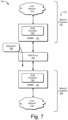
- Fig. 7 is a schematic diagram 700 of two example wireless networks, which respectively correspond to two different network operators 740, which can facilitate SON enhancement using a SON proxy 704.
- the network operators 740 include a first network operator 741 and a second network operator 742.
- additional network operators can be coupled to the SON proxy 704.
- the first network operator 741 operates a first network that includes a first core network 114 and a first wireless network management node 122 having a first SON facilitator 332.
- the first SON facilitator 332 is coupled to the SON proxy 704.
- the second network operator 742 operates a second network that includes a second core network 714 and a second wireless network management node 722 having a second SON facilitator 732.
- the second SON facilitator 732 is also coupled to the SON proxy 704.
- the SON proxy 704 allows different network operators 740 to communicate with each other to enable coordination on SON efforts using an inter-operator SON message.
- the first SON facilitator 332 can generate a notification 708 and transmit the notification 708 to the second SON facilitator 732 using the SON proxy 704.
- the notification 708 can provide information in advance of an upcoming test scenario 502 that is to be conducted by the first SON facilitator 332.
- a SON proxy 704 can facilitate an exchange of courtesy messages, such as when a carrier plans to change a network configuration in an unlicensed band.
- the SON proxy 704 is realized as a network server that exists between the core networks of two cellular carrier networks and is operationally disposed between their respective SON NFs 432 (of Fig. 4 ).
- the SON proxy 704 can be operated by either network operator 740, by a partnership including both the first and second network operators 741 and 742, by a third party, and so forth. Exchanging inter-operator SON messages can facilitate announcement of network changes across different carriers, such as if two carriers have proximate spectrum allocations or for unlicensed bands (e.g., 5G or citizens Broadband Radio Service (CBRS)) with carrier that are geographically close.
- An example of an unlicensed, or shared, band is CBRS.
- a network change notification 708 can alternatively be routed through a CBRS spectrum access system (SAS) server.
- SAS CBRS spectrum access system
- Fig. 8 is a sequence diagram 800 illustrating examples of operations performed by, and communications exchanged between, a UE 102 and a base station 104 to facilitate SON enhancement in accordance with a wireless signaling protocol.
- the operations or communications can be performed at least partially by a SON facilitator 216 (as shown in Fig. 2 ) of the UE 102 or by a SON facilitator 266 (also of Fig. 2 ) of the base station 104.
- time 834 increases in a downward direction.
- a begin time 614 and an end time 624 are indicated for a test scenario 502 that is to be executed.
- the arrow for time 834 is not necessarily depicted to scale relative to the occurrences of the operations and communications.
- Two example types of SON message communications are shown: a DL SON message 524 and an UL SON message 526.
- the base station 104 obtains a DL SON message at 842.
- the base station 104 can receive a prepared DL SON message from a SON facilitator 332 ( e.g., of Figs. 3 and 5 ).
- the base station 104 can receive from the SON facilitator 332 information regarding a test scenario 502 that is usable to populate a DL SON message, and the base station 104 can then generate the DL SON message using the received information.
- the base station 104 wirelessly transmits the DL SON message 524 (DL SON Msg) to the UE 102 with the DL SON message 524 including a description of at least one aspect of the test scenario 502 as described above with reference to Fig. 6 .
- the DL SON message 524 can be indicative of the test scenario 502 and specify at least one radio access network parameter that is configured in accordance with the test scenario 502.
- the UE 102 receives the DL SON message 524 from the base station 104.
- the UE 102 formulates a first UL SON message 526 (UL SON Msg #1) that acknowledges receipt (e.g., as represented by the acknowledgement 652) of the DL SON message 524 and indicates that the UE 102 will participate in the test scenario 502.
- the UE 102 transmits the first UL SON message 526 (#1) to the base station 104.
- the base station 104 therefore receives the first UL SON message 526 (#1).
- the UE 102 participates in the test scenario 502 at 822, and the base station 104 participates in the test scenario 502 at 844.
- the base station 104 and the UE 102 can communicate using multiple wireless connections 310, such as a first wireless connection 311 and a second wireless connection 312.
- the first and second wireless connections 311 and 312 are depicted "sequentially" relative to the arrow of time 834, the existence or usage of the wireless connections may overlap and/or be extant during substantially all of the test scenario 502.
- the UE 102 switches to the termination configuration 606 (of Fig.
- both the UE 102 and the base station 104 can start to communicate using a same set of the corresponding radio access or ratio network configuration settings at the end time 624.
- the UE 102 uses a configuration of the termination configuration 606 to transmit a second UL SON message 526 (UL SON Msg #2) to the base station 104.
- the second UL SON message 526 (#2) includes measurement data 654 taken by the UE 102 during the test scenario 502.
- the UE 102 can upload the measurement data 654 to the wireless network using the base station 104 at the end of, or otherwise during, the test scenario 502 (e.g., before switching to the termination configuration 606).
- the base station 104 receives the measurement data 654 from the UE 102 using the second UL SON message 526 (#2).
- the base station 104 forwards the measurement data 654 to the core network 114 (e.g., to a SON facilitator 332) using another SON message 848 (e.g., a SON message 520 of Fig. 5 ).
- This measurement data 654 can form a part of configuration information 512 (e.g., of Figs. 5 and 9 ) that is provided to and collected by the SON facilitator 332 of the wireless network management node 122 (e.g., of Fig. 5 ).
- the base station 104 can perform measurements, including with respect to the second wireless connection 312, and transmit the resulting measurement data to the SON facilitator 332 using another SON message 848.
- Fig. 9 is a sequence diagram 900 illustrating examples of operations performed by, and communications exchanged between, a SON facilitator 332 of a wireless network management node 122 ( e.g., of Figs. 1 , 3 , and 5 ) and a SON enhancer 504 of a network enhancement server 124 ( e.g., of Figs. 1 and 5 ) in accordance with an application programming interface 506 (API 506) to facilitate SON enhancement in accordance with a wireless signaling protocol. Additional example communications are shown that also include the core network 114. Each of the communications depicted in Fig. 9 may be implemented as a SON message 520 (of Fig.
- time 834 increases in the downward direction; the arrow for time 834 is not necessarily depicted to scale relative to the occurrences of the operations and communications.
- the SON facilitator 332 translates the configuration information 512, which is formatted for consumption, transmission, or usage by a wireless network, into a format that is appropriate for input to an enhancement mechanism, which formatted information is called translated configuration information 514 herein.
- the SON facilitator 332 can convert configuration information received using one or more wireless network protocols into data that can be applied to an input layer of an AI-based enhancement mechanism, such as a neural network.
- the SON facilitator 332 provides the translated configuration information 514 to the SON enhancer 504 using at least one message 904 in accordance with the API 506.
- the SON enhancer 504 processes the translated configuration information 514 to produce alternative configuration information 516 as part of an enhancement procedure at 942.
- the enhancement procedure uses guided learning to incrementally improve performance of the wireless network based on feedback from an earlier experimental configuration that is included as part of the configuration information 512.
- a different enhancement procedure at 942 that utilizes a different, e.g., AI-based analysis mechanism can alternatively be performed.
- the SON enhancer 504 provides the alternative configuration information 516 to the SON facilitator 332 using at least one message 906 in accordance with the API 506.
- the alternative configuration information 516 includes different network parameters that are expected to improve network performance over the previous ones as represented by the configuration information 512 and the translated configuration information 514. These different network parameters can include different radio access or radio network parameters.
- the alternative configuration information 516 comprises at least a portion of an output layer of a deep learning algorithm.
- the alternative configuration information 516 may be organized or formatted differently.
- the SON facilitator 332 performs a transformation procedure at 934 on the alternative configuration information 516 to produce transformed alternative configuration information 518.
- This transformed alternative configuration information 518 is organized or formatted for usage by, and communication among, various aspects of the wireless network.
- the SON facilitator 332 packages at least the parameter changes of the transformed alternative configuration information 518 into messages that can be transmitted over and interpreted by different network components.
- the SON facilitator 332 disseminates the parameter changes of the transformed alternative configuration information 518 using one or more SON network announcement messages 522 (of Fig. 5 ).
- a base station can generate a DL SON message 524 for transmission to an affected UE.
- the SON facilitator 332 can generate a DL SON message 524 for routing and transmission to the affected UE prior to the begin time 614 as shown in Fig. 9 .
- Example methods are described below with reference to various flow diagrams of Figs. 10 , 11 , and 12 . These methods relate to facilitating SON enhancement for a UE, a base station, and a network management node, respectively. Aspects of these methods may be implemented in, for example, hardware (e.g ., fixed logic circuitry, a communication-oriented processor such as a modem, or a general-purpose processor in conjunction with a memory system), firmware, or some combination thereof. These techniques may be realized using one or more of the wireless devices or components shown in Figs. 1-9 , which devices or components may be further divided, combined, and so on.
- the electronic devices and components of these figures generally represent firmware, hardware-such as user or server devices, IC chips, circuits, or a combination thereof. Thus, these figures illustrate some of the many possible systems or apparatuses capable of implementing the described techniques.
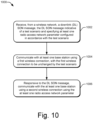
- Fig. 10 illustrates, with a flow diagram 1000, example methods for facilitating SON enhancement with a UE 102.
- the UE 102 is informed of an upcoming test scenario so that the UE 102 can safely participate in the test scenario and successfully maintain data throughput during execution of the test scenario.
- a downlink (DL) SON message is received from a wireless network, with the DL SON message indicative of a test scenario and specifying at least one radio access network parameter configured in accordance with the test scenario.
- DL downlink
- the UE 102 can receive, from a wireless network 402, a DL SON message 524, with the DL SON message 524 indicative of a test scenario 502 and specifying at least one radio access network parameter 602 configured in accordance with the test scenario 502.
- the radio access network parameter 602 can be one for which the UE 102 affirmatively makes a change ( e.g., to transceiver settings) to implement, one that the UE 102 can directly detect a change of but is realized at a serving base station, one that the UE 102 is or may be indirectly affected by, and so forth.
- a parameter 602 may generally comprise, for instance, a maximum transmit power level permitted by the UE 102 on a given carrier, a base station handover threshold, a network function or location thereof that is to be different, and so forth.
- At 1004 at least one base station is communicated with using a first wireless connection, with the first wireless connection to be unchanged by the test scenario.
- the UE 102 can communicate with a base station 104 using at least a first wireless connection 311, with the first wireless connection 311 to be unchanged by the test scenario 502.
- the first wireless connection 311 can be unchanged by the test scenario 502 based on the first wireless connection 311 being established with one or more resources that are separate from those resources configured in accordance with the test scenario.
- the UE 102 may transmit or receive a signal to or from the base station 104 using both the first wireless connection 311 and a second wireless connection 312, which is described below, at least once during a timeframe 604 of a test scenario 502.
- the first wireless connection 311 may be allocated to radio access or core network resources (e.g ., hardware, network functions, a network slice, air interface resources, some combination thereof) that are to be unaffected by the planned network configuration changes or differences implemented in accordance with the test scenario 502.
- the DL SON message 524 may indicate the extant connections 608 and identify which wireless connection is to be unchanged by the test scenario 502 and thus separate from ( e.g., not subject to) the alternative configurations to be implemented in accordance with the test scenario 502.
- the UE 102 can therefore maintain at least one reliable (e.g ., previously used successfully) wireless connection, the first wireless connection 311.
- At 1006 at least one base station is communicated with using a second wireless connection using the at least one radio access network parameter.
- the UE 102 can participate in the test scenario 502 by communicating with the base station 104 using the second wireless connection 312 using the at least one radio access network parameter 602.
- the UE 102 may experience different network performance characteristics, while using the second wireless connection 312 during the test scenario 502 due to the one or more alternative radio access network parameters 602.
- These different network performance characteristics may be different as compared to those experienced with the first wireless connection 311, with a previous version of the second wireless connection 312, or another earlier wireless connection.
- Fig. 11 illustrates, with a flow diagram 1100, example methods for facilitating SON enhancement with a base station 104.
- the base station 104 informs a UE of an upcoming test scenario so that the UE can safely participate in the test scenario using multiple wireless connections, at least one of which has been used successfully before (e.g ., successfully provided a given QoS or did not otherwise fail).
- a downlink (DL) SON message is transmitted to at least one UE, with the DL SON message indicative of a test scenario and specifying at least one radio access network parameter configured in accordance with the test scenario.
- DL downlink
- the base station 104 can transmit to at least one UE 102 a DL SON message 524, with the DL SON message 524 indicative of a test scenario 502 and specifying at least one radio access network parameter 602 configured in accordance with the test scenario 502.
- the DL SON message 524 may also specify how the radio access network parameter 602 is to be configured for the test scenario 502 for a particular wireless connection or include other attributes of the test scenario 502 as described above with reference to Fig. 6 .
- the at least one UE is communicated with using a first wireless connection, with the first wireless connection to be unchanged by the test scenario.
- the base station 104 can communicate with the at least one UE 102 using at least a first wireless connection 311, with the first wireless connection 311 to be unchanged by the test scenario 502.
- the first wireless connection 311 may be able to provide a corresponding QoS 350 that is associated with the at least one UE 102 by separating the first wireless connection 311 from changes scheduled for implementation during the test scenario 502 ( e.g., by allocating the first wireless connection 311 to resources of an unaffected slice 450 of a radio access or core network).
- the first wireless connection 311 is independent of the second wireless connection 312 such that the first wireless connection 311 can continue to provide connectivity to the at least one UE 102 even if the second wireless connection 312 fails as a result of the specified radio access network parameter 602 or another aspect of the test scenario 502 being executed.
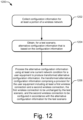
- Fig. 12 illustrates, with a flow diagram 1200, example methods for facilitating SON enhancement with a SON facilitator 332 of a wireless network management node 122.
- the SON facilitator 332 directs a wireless network to undergo a testing scenario as an experimental round intended to gradually discover iterative network performance improvements using a guided scheme.
- configuration information is collected for at least a portion of a wireless network.
- a SON facilitator 332 can collect configuration information 512 for at least a portion of a wireless network 402.
- the SON facilitator 332 may collect current network configuration information, such as current parameter settings, from other control or management nodes, from nodes or functions of the core network 114, from base stations 104, from UEs 102, and so forth using SON messages 520. As part of the configuration information 512, the SON facilitator 332 may also collect data measured by network entities as the data existed in a previous test scenario 502.
Landscapes
- Engineering & Computer Science (AREA)
- Signal Processing (AREA)
- Computer Networks & Wireless Communication (AREA)
- Mobile Radio Communication Systems (AREA)
Claims (15)
- Verfahren, das durch ein Benutzergerät (102) durchgeführt wird, um die Verbesserung von selbstorganisierenden Netzwerken (self-organizing network - SON) in einem drahtlosen Netzwerk zu erleichtern, wobei das Verfahren Folgendes umfasst:Empfangen (1002) einer Downlink-SON-Nachricht (524) von dem drahtlosen Netzwerk, wobei die Downlink-SON-Nachricht (524) ein Testszenario (502) angibt und mindestens einen Funkzugang-Netzwerkparameter (602) für eine alternative Netzwerkkonfiguration definiert, die in dem Testszenario (502) zu verwenden ist; undKommunizieren (1004, 1006) von Benutzerdaten mit mindestens einer Basisstation (104) unter Verwendung mindestens einer ersten drahtlosen Verbindung (311) und einer zweiten drahtlosen Verbindung (312), die gleichzeitig während mindestens eines Teils einer Ausführung des Testszenarios (502) vorhanden sind, wobei die erste drahtlose Verbindung (311) durch das Testszenario (502) nicht verändert werden soll und die zweite drahtlose Verbindung (312) den mindestens einen Funkzugang-Netzwerkparameter (602) verwenden soll.
- Verfahren nach Anspruch 1, ferner umfassend:
Aufrechterhalten der ersten drahtlosen Verbindung (311) während der Ausführung des Testszenarios (502), um eine Dienstgüte (quality-of-service - QoS) (351) bereitzustellen, die dem Benutzergerät (102) zugeordnet ist. - Verfahren nach Anspruch 1 oder Anspruch 2, wobei die erste drahtlose Verbindung (311) als Ausweichlösung für die Kommunikation durch das Benutzergerät (102) fungiert, wenn die zweite drahtlose Verbindung (312) als Reaktion auf die Ausführung des Testszenarios (502) beeinträchtigt ist.
- Verfahren nach einem der vorhergehenden Ansprüche, wobei:die Downlink-SON-Nachricht (524) einen Zeitrahmen (604) für die Ausführung des Testszenarios (502) angibt, wobei der Zeitrahmen (604) mindestens eine Endzeit (624) beinhaltet; unddas Verfahren ferner Beenden der Teilnahme an der Ausführung des Testszenarios (502) als Reaktion auf die Endzeit (624) umfasst.
- Verfahren nach einem der vorhergehenden Ansprüche, ferner umfassend:Generieren einer Uplink-SON-Nachricht (526) als Reaktion auf die Teilnahme an dem Testszenario (502), wobei die Uplink-SON-Nachricht (526) Messdaten (654) beinhaltet, die das Testszenario (502) betreffen; undÜbertragen der Uplink-SON-Nachricht (526) an die mindestens eine Basisstation (104) oder eine zweite Basisstation (108) des drahtlosen Netzwerks.
- Verfahren nach einem der vorhergehenden Ansprüche, wobei:die Downlink-SON-Nachricht (524) eine Beendigungskonfiguration (606) für die Beendigung der Ausführung des Testszenarios (502) angibt; unddas Verfahren ferner Kommunizieren mit dem drahtlosen Netzwerk unter Verwendung der Beendigungskonfiguration (606) als Reaktion auf die Beendigung der Ausführung des Testszenarios (502) umfasst.
- Verfahren nach Anspruch 6, wobei:die Beendigungskonfiguration (606) eine andere Konfiguration (626) umfasst, die mindestens teilweise durch die Downlink-SON-Nachricht (524) definiert ist; unddas Verfahren ferner Umschalten (824) auf die andere Konfiguration (626) als Reaktion auf die Beendigung der Ausführung des Testszenarios (502) umfasst.
- Verfahren nach einem der vorhergehenden Ansprüche, wobei die erste drahtlose Verbindung (311) durch das Testszenario (502) nicht verändert werden soll, indem ihr eine Dienstgüte (351), QoS, unter Verwendung mindestens einer Slice (451) des drahtlosen Netzwerks bereitgestellt wird, die dazu konfiguriert ist, die QoS (351) auch dann aufrechtzuerhalten, wenn eine andere Slice (452) des drahtlosen Netzwerks, die gemäß dem Testszenario (502) konfiguriert ist, als Reaktion auf die Ausführung des Testszenarios (502) beeinträchtigt ist.
- Verfahren nach einem der vorhergehenden Ansprüche, wobei die erste drahtlose Verbindung (311) basierend darauf, dass die erste drahtlose Verbindung (311) mit einer oder mehreren Luftschnittstellenressourcen aufgebaut wird, die von den Luftschnittstellenressourcen getrennt sind, die gemäß dem Testszenario (502) konfiguriert sind, durch das Testszenario (502) nicht verändert werden soll.
- Benutzergerät (102), umfassend:mindestens einen drahtlosen Transceiver (206, 208); undeinen Prozessor (210) und ein Speichersystem (212), die an den mindestens einen drahtlosen Transceiver (206, 208) gekoppelt und dazu konfiguriert sind, das Benutzergerät (102) zu veranlassen, das Verfahren nach einem der Ansprüche 1 bis 9 durchzuführen.
- Verfahren, das durch eine Basisstation (104) durchgeführt wird, um die Verbesserung von selbstorganisierenden Netzwerken (SON) in einem drahtlosen Netzwerk zu erleichtern, wobei das Verfahren Folgendes umfasst:Übertragen (1102) einer Downlink-SON-Nachricht (524) an mindestens ein Benutzergerät (102, 103), wobei die Downlink-SON-Nachricht (524) ein Testszenario (502) angibt und mindestens einen Funkzugang-Netzwerkparameter (602) für eine alternative Netzwerkkonfiguration definiert, die in dem Testszenario (502) zu verwenden ist; undKommunizieren (1104, 1106) von Benutzerdaten mit dem mindestens einen Benutzergerät (102, 103) unter Verwendung mindestens einer ersten drahtlosen Verbindung (311) und einer zweiten drahtlosen Verbindung (312), die gleichzeitig während mindestens eines Teils einer Ausführung des Testszenarios (502) vorhanden sind, wobei die erste drahtlose Verbindung (311) durch das Testszenario (502) nicht verändert werden soll und die zweite drahtlose Verbindung (312) den mindestens einen Funkzugang-Netzwerkparameter (602) verwenden soll.
- Verfahren nach Anspruch 11, wobei:die Downlink-SON-Nachricht (524) einen Zeitrahmen (604) für das Testszenario (502) angibt, wobei der Zeitrahmen eine Anfangszeit (614) und eine Endzeit (624) beinhaltet; unddas Kommunizieren mit dem mindestens einen Benutzergerät (102, 103) Folgendes umfasst:Starten der Verwendung der zweiten drahtlosen Verbindung (312) als Reaktion auf die Anfangszeit (614); undBeenden der Verwendung der zweiten drahtlosen Verbindung (312) als Reaktion auf die Endzeit (624).
- Verfahren nach Anspruch 11 oder 12, ferner umfassend:Empfangen einer Uplink-SON-Nachricht (526) von dem mindestens einen Benutzergerät (102, 103), wobei die Uplink-SON-Nachricht (526) Messdaten (654) beinhaltet, die die zweite drahtlose Verbindung (312) während mindestens des Teils der Ausführung des Testszenarios (502) betreffen; undÜbertragen der Messdaten (654) an eine SON-Netzwerkfunktion (432).
- Verfahren nach einem der Ansprüche 11 bis 13, wobei das Kommunizieren Folgendes umfasst:
Aufrechterhalten der ersten drahtlosen Verbindung (311) mit einer gegebenen Dienstgüte (351), QoS, während der Ausführung des Testszenarios (502), während der mindestens eine Funkzugang-Netzwerkparameter (602) der zweiten drahtlosen Verbindung (312) gemäß dem Testszenario (502) konfiguriert ist. - Basisstation (104), umfassend:mindestens einen drahtlosen Transceiver (256, 258); undeinen Prozessor (260) und ein Speichersystem (262), die an den mindestens einen drahtlosen Transceiver (256, 258) gekoppelt und dazu konfiguriert sind, die Basisstation (104) zu veranlassen, das Verfahren nach einem der Ansprüche 11 bis 14 durchzuführen.
Applications Claiming Priority (3)
| Application Number | Priority Date | Filing Date | Title |
|---|---|---|---|
| US201862778889P | 2018-12-12 | 2018-12-12 | |
| US201962850269P | 2019-05-20 | 2019-05-20 | |
| PCT/US2019/065703 WO2020123633A1 (en) | 2018-12-12 | 2019-12-11 | Facilitating self-organizing network (son) enhancement |
Publications (3)
| Publication Number | Publication Date |
|---|---|
| EP3884697A1 EP3884697A1 (de) | 2021-09-29 |
| EP3884697C0 EP3884697C0 (de) | 2025-07-02 |
| EP3884697B1 true EP3884697B1 (de) | 2025-07-02 |
Family
ID=71076739
Family Applications (1)
| Application Number | Title | Priority Date | Filing Date |
|---|---|---|---|
| EP19832798.3A Active EP3884697B1 (de) | 2018-12-12 | 2019-12-11 | Erleichterung der verbesserung von selbstorganisierenden netzwerken (son) |
Country Status (4)
| Country | Link |
|---|---|
| US (2) | US11937323B2 (de) |
| EP (1) | EP3884697B1 (de) |
| AU (1) | AU2019396444B2 (de) |
| WO (1) | WO2020123633A1 (de) |
Families Citing this family (10)
| Publication number | Priority date | Publication date | Assignee | Title |
|---|---|---|---|---|
| AU2019396444B2 (en) | 2018-12-12 | 2023-02-23 | Google Llc | Facilitating self-organizing network (SON) enhancement |
| US11096034B1 (en) * | 2020-08-17 | 2021-08-17 | Verizon Patent And Licensing Inc. | Systems and methods for emphasizing and deemphasizing radio beams from base stations |
| US11627472B2 (en) * | 2020-12-10 | 2023-04-11 | Amazon Technologies, Inc. | Automated deployment of radio-based networks |
| US11310733B1 (en) | 2020-12-10 | 2022-04-19 | Amazon Technologies, Inc. | On-demand application-driven network slicing |
| US11711727B1 (en) * | 2021-03-16 | 2023-07-25 | Amazon Technologies, Inc. | Provisioning radio-based networks on demand |
| US11871240B2 (en) | 2021-06-28 | 2024-01-09 | Amazon Technologies, Inc. | Interfaces for creating radio-based private networks |
| US12225385B2 (en) * | 2021-12-16 | 2025-02-11 | Dell Products, L.P. | Low-latency network edge spectrum-as-a-service controller |
| US12250655B2 (en) | 2022-01-03 | 2025-03-11 | Dell Products, L.P. | Client initiated low-latency network edge spectrum-as-a-service controller |
| US20230284053A1 (en) * | 2022-03-02 | 2023-09-07 | Dish Wireless L.L.C. | Integration of physical test environments with a cloud-native cellular core |
| US20250023773A1 (en) * | 2022-07-22 | 2025-01-16 | New H3C Technologies Co., Ltd. | Device management method and network device |
Family Cites Families (27)
| Publication number | Priority date | Publication date | Assignee | Title |
|---|---|---|---|---|
| JPS5628933U (de) | 1979-08-13 | 1981-03-18 | ||
| KR100979646B1 (ko) | 2006-01-11 | 2010-09-02 | 퀄컴 인코포레이티드 | 비콘 신호들을 통해 우선순위 정보를 송신하는 통신 방법 및 장치 |
| US8780732B2 (en) * | 2008-03-18 | 2014-07-15 | Qualcomm Incorporated | Method of network management by assistance from terminal using control-plane signaling between terminal and network |
| US20110158117A1 (en) | 2009-06-29 | 2011-06-30 | Qualcomm Incorporated | Power headroom report for simultaneous transmissions on disparate radio access technologies |
| US20120014308A1 (en) | 2009-11-11 | 2012-01-19 | Samsung Electronics Co., Ltd. | Methods and apparatus to support reconfiguration in self organized wireless communications and networks |
| US9451492B2 (en) * | 2010-03-31 | 2016-09-20 | Htc Corporation | Apparatuses and methods for reporting availability of measurement log |
| US9413395B2 (en) | 2011-01-13 | 2016-08-09 | Google Technology Holdings LLC | Inter-modulation distortion reduction in multi-mode wireless communication terminal |
| WO2012154106A1 (en) * | 2011-05-11 | 2012-11-15 | Telefonaktiebolaget L M Ericsson (Publ) | A radio network node, a node and methods therein for enabling enhanced cell id timing measurement for positioning of a user equipment |
| US9462529B2 (en) * | 2011-06-21 | 2016-10-04 | Telefonaktiebolaget Lm Ericsson (Publ) | Method and apparatus for accounting of cell related data |
| US20150208264A1 (en) * | 2012-07-03 | 2015-07-23 | Nokia Corporation | Method and apparatus for adapting minimisation of drive testing reports to operational mode of user equipment using assistance information |
| EP2693815A1 (de) | 2012-08-03 | 2014-02-05 | Panasonic Corporation | Energiereserven-Berichterstattung zur Vermeidung von Interferenzen bei einer In-Gerätekoexistenz |
| US9497644B2 (en) | 2012-10-01 | 2016-11-15 | Telefonaktiebolaget Lm Ericsson (Publ) | User equipment, network node and methods therein |
| US11356216B2 (en) | 2013-01-10 | 2022-06-07 | Texas Instruments Incorporated | Methods and apparatus for dual connectivity operation in a wireless communication network |
| US9414248B2 (en) * | 2013-03-15 | 2016-08-09 | Movik Networks, Inc. | System and methods for estimation and improvement of user, service and network QOE metrics |
| US9730143B2 (en) | 2013-04-02 | 2017-08-08 | Nokia Solutions And Networks Oy | Method and apparatus for self organizing networks |
| US9107187B2 (en) * | 2013-09-30 | 2015-08-11 | At&T Mobility Ii Llc | Enhanced self-organizing network switching matrix |
| EP3110220A4 (de) * | 2014-02-21 | 2017-10-25 | Kyocera Corporation | Bewegtkörperkommunikationssystem, basisstation und benutzerendgerät |
| US10630410B2 (en) | 2016-05-13 | 2020-04-21 | Telefonaktiebolaget Lm Ericsson (Publ) | Network architecture, methods, and devices for a wireless communications network |
| US9867112B1 (en) | 2016-11-23 | 2018-01-09 | Centurylink Intellectual Property Llc | System and method for implementing combined broadband and wireless self-organizing network (SON) |
| AU2018208142C1 (en) | 2017-01-13 | 2021-09-02 | Huawei Technologies Co., Ltd. | Radio resource configuration adjustment method, apparatus, and system |
| US10218422B2 (en) | 2017-03-24 | 2019-02-26 | Qualcomm Incorporated | Methods for beam switching in millimeter wave systems to manage thermal constraints |
| WO2018203306A1 (en) | 2017-05-04 | 2018-11-08 | Nokia Technologies Oy | User equipment measurements upon secondary radio link failure for long term evolution – new radio tight interworking |
| CN107466486B (zh) | 2017-07-07 | 2021-10-01 | 北京小米移动软件有限公司 | 干扰协调方法及装置、基站和用户设备 |
| EP3462622B1 (de) | 2017-09-11 | 2021-11-24 | Apple Inc. | Erkennung von intermodulationsproblemen und konfiguration des übertragungssystems zur behebung von intermodulationsproblemen |
| US10588032B2 (en) | 2017-11-14 | 2020-03-10 | Google Llc | Power adjustments for self-organizing networks |
| US10432375B1 (en) * | 2018-06-12 | 2019-10-01 | Wistron Neweb Corporation | Wireless communication system and method having automatic self-configuration mechanism |
| AU2019396444B2 (en) * | 2018-12-12 | 2023-02-23 | Google Llc | Facilitating self-organizing network (SON) enhancement |
-
2019
- 2019-12-11 AU AU2019396444A patent/AU2019396444B2/en active Active
- 2019-12-11 US US17/311,986 patent/US11937323B2/en active Active
- 2019-12-11 WO PCT/US2019/065703 patent/WO2020123633A1/en not_active Ceased
- 2019-12-11 EP EP19832798.3A patent/EP3884697B1/de active Active
-
2024
- 2024-03-18 US US18/608,618 patent/US12328788B2/en active Active
Also Published As
| Publication number | Publication date |
|---|---|
| EP3884697C0 (de) | 2025-07-02 |
| EP3884697A1 (de) | 2021-09-29 |
| US12328788B2 (en) | 2025-06-10 |
| US11937323B2 (en) | 2024-03-19 |
| US20240373495A1 (en) | 2024-11-07 |
| AU2019396444A1 (en) | 2021-06-10 |
| US20220007451A1 (en) | 2022-01-06 |
| WO2020123633A1 (en) | 2020-06-18 |
| AU2019396444B2 (en) | 2023-02-23 |
Similar Documents
| Publication | Publication Date | Title |
|---|---|---|
| US12328788B2 (en) | Facilitating self-organizing network (SON) enhancement | |
| EP3827619B1 (de) | Übertragung von netzwerk-slicing-beschränkungen in drahtlosen netzwerken | |
| US11350325B2 (en) | Signaling of delta configuration for handover | |
| EP3620025B1 (de) | Schnelle benutzerausrüstungskonfigurationssignalisierung in drahtloser kommunikation | |
| US20230209370A1 (en) | Model based predictive interference management | |
| US11711718B2 (en) | Communication efficiency | |
| WO2021249638A1 (en) | Model based predictive interference management | |
| CN115462045A (zh) | 用于非实时ran智能控制器的功能架构和接口 | |
| US20240334269A1 (en) | Configuration enhancements for an intra-gnb-du intra-frequency l1/l2 inter cell change | |
| US20240137783A1 (en) | Signalling support for split ml-assistance between next generation random access networks and user equipment | |
| EP3897035A1 (de) | Ermöglichung von new-radio-mobilfunk-dienstqualität für nichtinternetprotokoll-datensitzungen | |
| WO2022015626A1 (en) | Inter-system and event-triggered mobility load balancing | |
| CN114930909A (zh) | 针对l1/l2中心式蜂窝小区间移动性的带宽部分/频率位置限制 | |
| WO2023206476A1 (en) | User equipment adaptively determined l1-reference signal received power quantization | |
| CN110933722A (zh) | 切换时的上行链路承载绑定 | |
| CN118077248A (zh) | 用于无线网络的pscell的有条件重新配置期间的测量配置更新 | |
| US20240040455A1 (en) | Method and apparatus for confirming f1 termination donor node | |
| WO2025043633A1 (en) | Techniques to support dynamic grant-less transmissions | |
| CN121219999A (zh) | Tci状态的激活 | |
| CN118541930A (zh) | 协调无人机载具以调整无线覆盖区域的通信 |
Legal Events
| Date | Code | Title | Description |
|---|---|---|---|
| STAA | Information on the status of an ep patent application or granted ep patent |
Free format text: STATUS: UNKNOWN |
|
| STAA | Information on the status of an ep patent application or granted ep patent |
Free format text: STATUS: THE INTERNATIONAL PUBLICATION HAS BEEN MADE |
|
| PUAI | Public reference made under article 153(3) epc to a published international application that has entered the european phase |
Free format text: ORIGINAL CODE: 0009012 |
|
| STAA | Information on the status of an ep patent application or granted ep patent |
Free format text: STATUS: REQUEST FOR EXAMINATION WAS MADE |
|
| 17P | Request for examination filed |
Effective date: 20210621 |
|
| AK | Designated contracting states |
Kind code of ref document: A1 Designated state(s): AL AT BE BG CH CY CZ DE DK EE ES FI FR GB GR HR HU IE IS IT LI LT LU LV MC MK MT NL NO PL PT RO RS SE SI SK SM TR |
|
| DAV | Request for validation of the european patent (deleted) | ||
| DAX | Request for extension of the european patent (deleted) | ||
| STAA | Information on the status of an ep patent application or granted ep patent |
Free format text: STATUS: EXAMINATION IS IN PROGRESS |
|
| 17Q | First examination report despatched |
Effective date: 20230403 |
|
| GRAP | Despatch of communication of intention to grant a patent |
Free format text: ORIGINAL CODE: EPIDOSNIGR1 |
|
| STAA | Information on the status of an ep patent application or granted ep patent |
Free format text: STATUS: GRANT OF PATENT IS INTENDED |
|
| INTG | Intention to grant announced |
Effective date: 20250314 |
|
| GRAS | Grant fee paid |
Free format text: ORIGINAL CODE: EPIDOSNIGR3 |
|
| GRAA | (expected) grant |
Free format text: ORIGINAL CODE: 0009210 |
|
| STAA | Information on the status of an ep patent application or granted ep patent |
Free format text: STATUS: THE PATENT HAS BEEN GRANTED |
|
| AK | Designated contracting states |
Kind code of ref document: B1 Designated state(s): AL AT BE BG CH CY CZ DE DK EE ES FI FR GB GR HR HU IE IS IT LI LT LU LV MC MK MT NL NO PL PT RO RS SE SI SK SM TR |
|
| REG | Reference to a national code |
Ref country code: GB Ref legal event code: FG4D |
|
| REG | Reference to a national code |
Ref country code: CH Ref legal event code: EP |
|
| REG | Reference to a national code |
Ref country code: DE Ref legal event code: R096 Ref document number: 602019072045 Country of ref document: DE |
|
| REG | Reference to a national code |
Ref country code: IE Ref legal event code: FG4D |
|
| U01 | Request for unitary effect filed |
Effective date: 20250730 |
|
| U07 | Unitary effect registered |
Designated state(s): AT BE BG DE DK EE FI FR IT LT LU LV MT NL PT RO SE SI Effective date: 20250805 |