EP3883243B1 - Intra-frame chromaticity prediction method and decoder - Google Patents
Intra-frame chromaticity prediction method and decoder Download PDFInfo
- Publication number
- EP3883243B1 EP3883243B1 EP19907559.9A EP19907559A EP3883243B1 EP 3883243 B1 EP3883243 B1 EP 3883243B1 EP 19907559 A EP19907559 A EP 19907559A EP 3883243 B1 EP3883243 B1 EP 3883243B1
- Authority
- EP
- European Patent Office
- Prior art keywords
- mode
- prediction
- chroma
- modes
- block
- Prior art date
- Legal status (The legal status is an assumption and is not a legal conclusion. Google has not performed a legal analysis and makes no representation as to the accuracy of the status listed.)
- Active
Links
Images



Classifications
-
- H—ELECTRICITY
- H04—ELECTRIC COMMUNICATION TECHNIQUE
- H04N—PICTORIAL COMMUNICATION, e.g. TELEVISION
- H04N19/00—Methods or arrangements for coding, decoding, compressing or decompressing digital video signals
- H04N19/10—Methods or arrangements for coding, decoding, compressing or decompressing digital video signals using adaptive coding
- H04N19/102—Methods or arrangements for coding, decoding, compressing or decompressing digital video signals using adaptive coding characterised by the element, parameter or selection affected or controlled by the adaptive coding
- H04N19/103—Selection of coding mode or of prediction mode
- H04N19/107—Selection of coding mode or of prediction mode between spatial and temporal predictive coding, e.g. picture refresh
-
- H—ELECTRICITY
- H04—ELECTRIC COMMUNICATION TECHNIQUE
- H04N—PICTORIAL COMMUNICATION, e.g. TELEVISION
- H04N19/00—Methods or arrangements for coding, decoding, compressing or decompressing digital video signals
- H04N19/10—Methods or arrangements for coding, decoding, compressing or decompressing digital video signals using adaptive coding
- H04N19/134—Methods or arrangements for coding, decoding, compressing or decompressing digital video signals using adaptive coding characterised by the element, parameter or criterion affecting or controlling the adaptive coding
- H04N19/157—Assigned coding mode, i.e. the coding mode being predefined or preselected to be further used for selection of another element or parameter
- H04N19/159—Prediction type, e.g. intra-frame, inter-frame or bidirectional frame prediction
-
- H—ELECTRICITY
- H04—ELECTRIC COMMUNICATION TECHNIQUE
- H04N—PICTORIAL COMMUNICATION, e.g. TELEVISION
- H04N19/00—Methods or arrangements for coding, decoding, compressing or decompressing digital video signals
- H04N19/50—Methods or arrangements for coding, decoding, compressing or decompressing digital video signals using predictive coding
- H04N19/593—Methods or arrangements for coding, decoding, compressing or decompressing digital video signals using predictive coding involving spatial prediction techniques
-
- H—ELECTRICITY
- H04—ELECTRIC COMMUNICATION TECHNIQUE
- H04N—PICTORIAL COMMUNICATION, e.g. TELEVISION
- H04N19/00—Methods or arrangements for coding, decoding, compressing or decompressing digital video signals
- H04N19/10—Methods or arrangements for coding, decoding, compressing or decompressing digital video signals using adaptive coding
- H04N19/102—Methods or arrangements for coding, decoding, compressing or decompressing digital video signals using adaptive coding characterised by the element, parameter or selection affected or controlled by the adaptive coding
- H04N19/103—Selection of coding mode or of prediction mode
- H04N19/105—Selection of the reference unit for prediction within a chosen coding or prediction mode, e.g. adaptive choice of position and number of pixels used for prediction
-
- H—ELECTRICITY
- H04—ELECTRIC COMMUNICATION TECHNIQUE
- H04N—PICTORIAL COMMUNICATION, e.g. TELEVISION
- H04N19/00—Methods or arrangements for coding, decoding, compressing or decompressing digital video signals
- H04N19/10—Methods or arrangements for coding, decoding, compressing or decompressing digital video signals using adaptive coding
- H04N19/102—Methods or arrangements for coding, decoding, compressing or decompressing digital video signals using adaptive coding characterised by the element, parameter or selection affected or controlled by the adaptive coding
- H04N19/103—Selection of coding mode or of prediction mode
- H04N19/11—Selection of coding mode or of prediction mode among a plurality of spatial predictive coding modes
-
- H—ELECTRICITY
- H04—ELECTRIC COMMUNICATION TECHNIQUE
- H04N—PICTORIAL COMMUNICATION, e.g. TELEVISION
- H04N19/00—Methods or arrangements for coding, decoding, compressing or decompressing digital video signals
- H04N19/10—Methods or arrangements for coding, decoding, compressing or decompressing digital video signals using adaptive coding
- H04N19/169—Methods or arrangements for coding, decoding, compressing or decompressing digital video signals using adaptive coding characterised by the coding unit, i.e. the structural portion or semantic portion of the video signal being the object or the subject of the adaptive coding
- H04N19/17—Methods or arrangements for coding, decoding, compressing or decompressing digital video signals using adaptive coding characterised by the coding unit, i.e. the structural portion or semantic portion of the video signal being the object or the subject of the adaptive coding the unit being an image region, e.g. an object
- H04N19/172—Methods or arrangements for coding, decoding, compressing or decompressing digital video signals using adaptive coding characterised by the coding unit, i.e. the structural portion or semantic portion of the video signal being the object or the subject of the adaptive coding the unit being an image region, e.g. an object the region being a picture, frame or field
-
- H—ELECTRICITY
- H04—ELECTRIC COMMUNICATION TECHNIQUE
- H04N—PICTORIAL COMMUNICATION, e.g. TELEVISION
- H04N19/00—Methods or arrangements for coding, decoding, compressing or decompressing digital video signals
- H04N19/10—Methods or arrangements for coding, decoding, compressing or decompressing digital video signals using adaptive coding
- H04N19/169—Methods or arrangements for coding, decoding, compressing or decompressing digital video signals using adaptive coding characterised by the coding unit, i.e. the structural portion or semantic portion of the video signal being the object or the subject of the adaptive coding
- H04N19/17—Methods or arrangements for coding, decoding, compressing or decompressing digital video signals using adaptive coding characterised by the coding unit, i.e. the structural portion or semantic portion of the video signal being the object or the subject of the adaptive coding the unit being an image region, e.g. an object
- H04N19/176—Methods or arrangements for coding, decoding, compressing or decompressing digital video signals using adaptive coding characterised by the coding unit, i.e. the structural portion or semantic portion of the video signal being the object or the subject of the adaptive coding the unit being an image region, e.g. an object the region being a block, e.g. a macroblock
-
- H—ELECTRICITY
- H04—ELECTRIC COMMUNICATION TECHNIQUE
- H04N—PICTORIAL COMMUNICATION, e.g. TELEVISION
- H04N19/00—Methods or arrangements for coding, decoding, compressing or decompressing digital video signals
- H04N19/10—Methods or arrangements for coding, decoding, compressing or decompressing digital video signals using adaptive coding
- H04N19/169—Methods or arrangements for coding, decoding, compressing or decompressing digital video signals using adaptive coding characterised by the coding unit, i.e. the structural portion or semantic portion of the video signal being the object or the subject of the adaptive coding
- H04N19/186—Methods or arrangements for coding, decoding, compressing or decompressing digital video signals using adaptive coding characterised by the coding unit, i.e. the structural portion or semantic portion of the video signal being the object or the subject of the adaptive coding the unit being a colour or a chrominance component
-
- H—ELECTRICITY
- H04—ELECTRIC COMMUNICATION TECHNIQUE
- H04N—PICTORIAL COMMUNICATION, e.g. TELEVISION
- H04N19/00—Methods or arrangements for coding, decoding, compressing or decompressing digital video signals
- H04N19/46—Embedding additional information in the video signal during the compression process
- H04N19/463—Embedding additional information in the video signal during the compression process by compressing encoding parameters before transmission
-
- H—ELECTRICITY
- H04—ELECTRIC COMMUNICATION TECHNIQUE
- H04N—PICTORIAL COMMUNICATION, e.g. TELEVISION
- H04N19/00—Methods or arrangements for coding, decoding, compressing or decompressing digital video signals
- H04N19/70—Methods or arrangements for coding, decoding, compressing or decompressing digital video signals characterised by syntax aspects related to video coding, e.g. related to compression standards
-
- H—ELECTRICITY
- H04—ELECTRIC COMMUNICATION TECHNIQUE
- H04N—PICTORIAL COMMUNICATION, e.g. TELEVISION
- H04N9/00—Details of colour television systems
- H04N9/64—Circuits for processing colour signals
- H04N9/643—Hue control means, e.g. flesh tone control
Definitions
- Embodiments of the present disclosure relate to intra prediction in the field of video coding, and in particular, to chroma intra prediction.
- the luma and chroma are coded in separate partitioned blocks, and one chroma block may correspond to multiple luma blocks.
- the existing Direct Mode (DM) can only reflect the local texture features in the central region of the current chroma block. It is unreasonable to use a single DM for chroma prediction when one chroma block corresponds to multiple luma blocks at the same location. For example, when the DM is the Direct Current (DC) mode or Planar mode, the current chroma block may be considered flat and smooth.
- DC Direct Current
- Planar mode the current chroma block may be considered flat and smooth.
- the embodiments of the present disclosure provide a chroma intra prediction method and a decoder, which can effectively improve the accuracy of intra prediction while increasing the efficiency for encoding and decoding.
- An embodiment of the present disclosure provides a chroma intra prediction method as claimed in claim 1.
- An embodiment of the present disclosure provides a decoder as claimed in claim 2.
- the spatially or temporally available reconstructed picture is used in video coding to construct the prediction value of the block currently being processed, and only the difference value between the actual value and the prediction value is transmitted in order to reduce the amount of transmitted data.
- the intra prediction exploits the spatial correlation within the picture or within the picture region.
- the intra prediction of the block currently being processed may be performed through samples in adjacent blocks that have already been processed, e.g., using the upper row and left column of the block currently being processed to construct the prediction value of the block currently being processed.
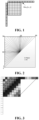
- FIG. 1 shows a schematic diagram of intra prediction, and as illustrated in FIG. 1 , samples from adjacent blocks are used to predict each sample of the block currently being processed.
- FIG. 2 shows a schematic diagram of 67 intra prediction modes, and as illustrated in FIG. 2 , the 67 intra prediction modes specifically include 65 prediction directions with prediction direction index numbers 2-66, a Planar mode with index number 0 and a DC mode with index number 1.
- FIG. 3 is a schematic diagram of an intra prediction method based on the above-mentioned FIG. 2 .
- the samples with numbers 0-16 are the upper row of the block currently being processed.
- Each sample of the block currently being processed is filled according to samples of the upper right diagonal line.
- the Planar mode is mainly used for regions where the picture texture is relatively smooth and has a relatively gradual process, and in the prediction method for the Planar mode, the sample values of the reconstructed neighbouring block corresponding to the block currently being processed are used as the reference sample values, and the linear interpolation and averaging calculations are further performed.
- the DC mode is mainly used for regions with flat pictures, smooth textures, and not much gradient.
- the prediction is performed based on the last row of decoded reference samples above the block currently being processed and the rightmost column of decoded reference samples to the left of the block currently being processed.
- both the Planar mode and DC mode are modes that construct the prediction block plainly, where the DC mode is to fill the whole chroma block with the average of the reference samples in the upper row and in the left column, and the Planar mode is to fill the chroma block in a gradient way.
- FIG. 2 there are two special direction modes, namely, the VER mode (i.e., the vertical prediction) with prediction direction index number 50 and the HOR mode (i.e., the horizontal prediction) with prediction direction index number 18.
- the VER mode i.e., the vertical prediction
- the HOR mode i.e., the horizontal prediction
- FIG. 4 is a schematic diagram of vertical prediction
- FIG. 5 is a schematic diagram of horizontal prediction.
- the prediction direction is the vertical prediction
- the vertical prediction can be performed based on the sample values of the vertically corresponding samples in the upper row
- horizontal prediction can be performed based on the sample values of the horizontally corresponding samples in the left column.
- the prediction can be performed according to modes 0-66 in FIG. 2 , and then the prediction value is constructed b selecting the prediction direction with the smallest difference value from the block currently being processed, i.e., through selecting the best matched direction.
- the difference value and the prediction direction are signalled into the bitstream at the encoding end.
- the decoding end obtains and parses the bitstream, calculate the prediction value of luma after obtaining the prediction direction index number, and adds the prediction value of luma to the difference value signal parsed from the bitstream, to obtain the reconstructed value of luma.
- the set of chroma intra candidate modes may include one or more chroma intra prediction modes, such as the linear model (LM) prediction, the Left Linear Model Prediction LM_T mode, the Right Linear Model Prediction LM_L mode, the DC mode, the Planar mode, the vertical VER mode, and the horizontal HOR mode.
- LM linear model
- LM_T mode Left Linear Model Prediction
- LM_L mode Right Linear Model Prediction
- DC mode the Planar mode
- Planar mode Planar mode
- the vertical VER mode the horizontal HOR mode
- FIG. 6 is a schematic diagram of a set of chroma intra candidate modes.
- different modes may be included in the set of chroma intra candidate modes, and the chroma intra prediction can be performed through selecting one among the different modes in the prior art.
- DM may represent the prediction mode corresponding to the central luma block
- the Cross-component Linear Model Prediction CCLM represents constructing the prediction signal with the scheme (a*luminance value + b), where both a and b are natural numbers, and when the DM is any one of the DC mode, Planar mode, VER mode, or HOR mode, the mode may be replaced with an angular mode with prediction direction index number 66.
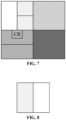
- FIG. 7 is a first schematic diagram of chroma blocks and luma blocks
- FIG. 8 is the second schematic diagram of chroma blocks and luminance blocks.
- the chroma blocks in FIG. 7 which correspond to the luma blocks in FIG. 8 , include 5 parts separately encoded (illustrated with different gray levels).
- the CR under DM can only reflect the local texture features of the chroma block, it is unreasonable to directly use a single DM prediction when the chroma block corresponds to multiple collocated luma blocks.
- the current block needs to be flat.
- the current luma block in FIG. 7 may not be flat.
- the chroma blocks entirely conforming to the horizontal and vertical prediction directions in this case are very few, thereby wasting the candidate positions, which is disadvantageous to the improvement of efficiency for encoding and decoding.
- the above chroma intra prediction method may be applied to the intra prediction part of the video coding hybrid framework, and in addition to VVC, it may be also applied to any other video coding hybrid framework.
- the VVC is used as an example for illustration, and should not be considered as a limitation.
- the above-mentioned chroma intra prediction method may work for both the encoding end and the decoding end.
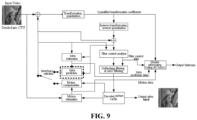
- FIG. 9 is a flowchart of a video encoding process. As illustrated in FIG. 9 , the video encoding may include multiple specific steps such as intra estimation, intra prediction, and motion compensation. Among them, the chroma intra prediction method provided in the present disclosure may be applied to the intra prediction.
- FIG. 9 is a flowchart of a video encoding process. As illustrated in FIG. 9 , the video encoding may include multiple specific steps such as intra estimation, intra prediction, and motion compensation. Among them, the chroma intra prediction method provided in the present disclosure may be applied to the intra prediction.
- the video decoding may include multiple specific steps such as filtration, intra prediction, and motion compensation.
- the chroma intra prediction method provided in the present disclosure may be applied to the intra prediction.
- FIG. 11 is a flowchart of a chroma intra prediction method according to an embodiment of the present disclosure. As illustrated in FIG. 11 , in the embodiment of the present disclosure, the above-mentioned method for the decoder to perform chroma intra prediction may include Steps 101 and 102.
- step 101 DM corresponding to the current chroma block is acquired from bitstream data corresponding to a current chroma block.
- the decoder may acquire, from bitstream data corresponding to a current chroma block, a DM corresponding to the current chroma block.
- the decoder may first receive the video bitstream and then obtain, from the received video bitstream, the bitstream data corresponding to the current coding block.
- the decoder may further obtain, from the above-mentioned bitstream data, the residual data corresponding to the current chroma block.
- the prediction when the encoder selects the luma intra prediction mode, the prediction may be performed according to multiple modes. For example, the prediction may be performed according to modes 0-66 in FIG. 2 , and then the best matched prediction direction is selected to construct the prediction value.
- the encoder when performing chroma intra prediction mode selection, the encoder does not predict all of the above-mentioned modes 0-66, but only extracts some of the prediction directions for prediction and selection.
- the decoder may further construct, from the bitstream data, a set of chroma intra candidates corresponding to the current chroma block, i.e., a set of chroma prediction modes corresponding to the current chroma block.
- the set of chroma prediction modes may include at least one chroma intra prediction mode.
- the set of chroma prediction modes may include DM, LM, LM_T, LM_L, DC, Planar, and other directional prediction modes.
- the current chroma block may be a square chroma block or a rectangular chroma block, which is not specifically limited in the embodiment of the present disclosure.
- a set of chroma prediction modes is acquired according to a modified candidate mode, when the DM is a DC mode or a Planar mode; wherein the set of chroma prediction modes is for performing chroma reconstruction on the current chroma block.
- the decoder after acquiring, from the bitstream data corresponding to the current chroma block, a DM corresponding to the current chroma block, acquires a set of chroma prediction modes according to a modified candidate mode when the DM is a DC mode or a Planar mode.
- the aforementioned set of chroma prediction modes may be used to perform chroma intra prediction on the aforementioned current chroma block.
- the set of chroma prediction modes is used to predict chroma.
- the decoder may perform chroma prediction on the current chroma block through the set of chroma prediction modes, so that reconstruct the chroma corresponding to the above-mentioned current chroma block.
- the decoder may determine whether the DM is the DC mode or the Planar mode.
- the encoder may add the modes according to the modified candidate mode, thereby obtaining the set of chroma prediction modes.
- the decoder may first read and analyze the DM, and then determine whether the DM is the DC mode or the Planar mode.
- both the Planar mode and the DC mode are methods for constructing the prediction blocks plainly, and therefore, in the DM, when the DC mode or the Planar mode is selected for the central luma block, the luma block may be considered flat.
- the luma and chroma are seperately partitioned into blocks for encoding.
- One chroma block may correspond to multiple luma blocks. Therefore, the DM may only reflect the local texture features of the central region, that is, there is a possibility that the luma block is not flat.
- Table 1 is the initial state of the design table for the intra prediction direction.
- the initial state of the prediction direction is the DC mode or the Planar mode
- Table 2 is the subsequent state of the design table for the intra prediction direction.
- the DM and CCLM need to be prioritized because they are important coding tools.
- the corresponding chroma block may cover multiple luma block regions, which may contain texture information with directions having different probability distributions.
- the mode can be replaced with the angular mode with prediction direction index number 66.
- the VER mode and HOR mode with prediction direction index numbers 18 and 50 have a high percentage, but the probability of texture across the entire chroma block is very small.
- the diagonal mode with prediction direction index numbers 34, 66 and 2 and the nearby direction modes may accurately predict the chroma block with a higher probability.
- the decoder needs to optimize the set of chroma prediction modes according to the modified candidate mode.
- the diagonal angular modes with prediction direction index numbers 34, 66, and 2 and the nearby direction modes may accurately predict the chroma block with a higher probability, these prediction direction modes may be used to replace the original horizontal and vertical prediction direction modes, etc., so as to further supplement the DM.
- the decoder may further obtain a set of chroma prediction modes for chroma prediction according to the modified candidate mode.
- the decoder may preset at least one mode as the candidate mode, that is, the decoder presets a modified candidate mode.
- the diagonal angular modes with prediction direction index numbers 34, 66, and 2 are often used for prediction in the small blocks of the luma region corresponding to the current chroma. Therefore, the above-mentioned modified candidate mode may contain the modes with prediction direction index numbers 34, 66 and 2.
- the mode with the prediction direction index number 34 may be first added to the set of chroma prediction modes, and then one of the modes with the prediction direction index numbers 66 and 2 which is of another diagonal direction is added to the set of chroma prediction modes, when the decoder is acquiring the set of chroma prediction modes according to the modified candidate mode.
- the decoder may adjust the mode with prediction direction index number 2 clockwise by certain angle, for example, adjust to the mode with prediction direction index number 6, and then use it as a modified candidate mode.
- the decoder may also adjust the mode with prediction direction index number 66 anti-clockwise by one angle, for example, adjust to the mode with prediction direction index number 61, and then use it as a modified candidate mode.
- the decoder can also adjust the mode with prediction direction index number 66 and the mode with prediction direction index number 2 by one angle at the same time as the modified candidate modes.
- the above-mentioned modified candidate modes may contain the modes with prediction direction index numbers 32, 64 and 4.
- the mode with the prediction direction index number 32 may be first added to the set of chroma prediction modes, and then one of the modes with the prediction direction index numbers 64 and 4 is added into the set of chroma prediction modes.
- the decoder when establishing the modified candidate mode, may determine at least one diagonal angular mode as the modified candidate mode; or determine the derived angular mode of at least one diagonal angular mode as the modified candidate mode; or determine at least one diagonal angular mode together with the derived angular mode of at least one diagonal angular mode as the modified candidate modes.
- the decoder may first determine the derived angle.
- the decoder may first determine an index number M corresponding to the DM, where M is an integer greater than 0; then the decoder may acquire a transformation parameter N, and determine an index number corresponding to the derived angular mode in accordance with M and N, so as to obtain the derived angular mode; where N is an integer greater than 0.
- the decoder when determining the index number corresponding to the derived angular mode in accordance with M and N, the decoder may either perform an addition operation on M and N, or perform an subtraction operation on M and N to obtain the index number corresponding to the derived angular mode.
- N may be equal to but not limited to 3, 5 or 7.
- the index number M corresponding to the DM is 1 (i.e. the DM is a DC mode), and then the decoder may take the angle direction obtained through 1+5 or 1-5 as the index number corresponding to the derived angular mode.
- a specific mapping method may be used to map the calculated value to the effective representation range.
- the specific calculation formula may be (M+62-N) %64+2, which yields 60.
- one of the modes with prediction direction index numbers 66 and 2 may be selected as a candidate mode according to the effective prediction direction range thereof, and the angel corresponding to the other prediction direction index number is adjusted as an candidate.
- the method for the decoder to perform chroma intra prediction may further include Step 103.
- a decoding process is performed according to the set of chroma prediction modes, to perform a chroma reconstruction on the current chroma block.
- the decoder after acquiring the set of chroma prediction modes according to the modified candidate mode, performs the decoding process according to the set of chroma prediction modes, to perform the chroma reconstruction on the current chroma block.
- the decoder may further perform the decoding process on the current chroma block through the set of chroma prediction modes, so that the current chroma block may be obtained through reconstruction.
- the decoder acquires, from the received video bitstream, the bitstream data corresponding to the current coding block, acquires the DM from the above-mentioned bitstream data, and may further acquire, from the above-mentioned bitstream data, the residual data corresponding to the current chroma block.
- the decoder may perform, based on the set of chroma prediction modes, the chroma intra prediction and decoding on the residual data, so as to reconstruct the current chroma block.
- the embodiments of the present disclosure provide the chroma intra prediction method, wherein the decoder acquires, from bitstream data corresponding to a current chroma block, a DM corresponding to the current chroma block; and acquires a set of chroma prediction modes according to a modified candidate mode in a case that the DM is a DC mode or a Planar mode; wherein the set of chroma prediction modes is for performing the chroma reconstruction on the current chroma block.
- the set of chroma prediction modes may be constructed through the modified candidate mode, and then the current chroma block is reconstructed according to the set of chroma prediction modes, thereby solving the problem of low accuracy of chroma intra prediction when the DM is the DC mode or the Planar mode, and further improving the efficiency for encoding and decoding.
- the decoder after acquiring, from bitstream data corresponding to a current chroma block, a DM corresponding to the current chroma block, when the DM is a DC mode or a Planar mode, acquires a set of chroma prediction modes according to a modified candidate mode, so as to improve the accuracy of decoding.
- both the Planar mode and the DC mode are methods for constructing the prediction blocks plainly, therefore, in the DM, when the DC mode or the Planar mode is selected for the central luma block, the luma block may be considered flat. However, this is not the actual situation.
- the luma and chroma are seperately partitioned into blocks for encoding.
- One chroma block may correspond to multiple luma blocks. Therefore, the DM may only reflect the local texture features of the central region, that is, there is a possibility that the luma block is not flat.
- the DM is the Planar mode or the DC mode
- the chroma blocks entirely conforming to the horizontal and vertical prediction directions in this case are very few, thereby wasting the candidate positions, which is disadvantageous to the improvement of efficiency for encoding and decoding. Therefore, it requires to obtain the set of chroma prediction modes according to the modified candidate mode. Specifically, before acquiring the set of chroma prediction modes according to the modified candidate mode, the decoder needs to obtain, from the bitstream data, the linear mode (LM) corresponding to the current chroma block.
- LM linear mode
- the method for the decoder to acquire the set of chroma prediction modes according to the modified candidate mode may specifically include steps 201 and 202.
- the set of chroma prediction modes is filled with the DM and the LM.
- the set of chroma prediction modes is filled according to the modified candidate mode.
- the decoder may first fill the set of chroma prediction modes with the DM and LM respectively, so that two modes in the set of chroma prediction modes may be determined first. Then, the decoder may continue to fill the set of chroma prediction modes according to the modified candidate mode, and ultimately obtain the set of chroma prediction modes.
- the decoder when the decoder adds the DM and LM to the set of chroma prediction modes, the decoder specifically adds the prediction direction index number of the mode corresponding to DM and the prediction direction index number of the mode corresponding to LM to the set of prediction modes. For example, if the DM is the DC mode and the prediction direction index number of the mode corresponding to the LM is 15, then the decoder can first add the prediction direction index numbers 1 and 15 to the set of chroma prediction modes, and then fill the set of chroma prediction modes according to the modified candidate modes. Specifically, since the DM is the DC mode, the decoder adds the prediction direction index number 0 of the Planar mode to the set of chroma prediction modes when filling the set of chroma prediction modes according to the modified candidate mode.
- the decoder fills the set of chroma prediction modes according to the modified candidate mode may specifically include Steps 202a and 202b.
- the decoder fills the set of chroma prediction modes with the Planar mode and the modified candidate mode.
- the decoder needs not to modify and replace the Planar mode, and thus the set of chroma prediction modes may be filled with the Planar mode and the modified candidate mode.
- the filling may be in no particular order.
- the decoder when the decoder adds the Planar mode and the modified candidate mode to the set of chroma prediction modes, the decoder specifically adds the prediction direction index numbers corresponding to the Planar mode and other modified candidate modes to the set of prediction modes. For example, if the prediction direction index numbers corresponding to other optimization candidate modes are 32 and 61, then the decoder may add prediction direction index numbers 0, 132, and 61 to the set of chroma prediction modes.
- the set of chroma prediction modes is filled with the DC mode and the modified candidate mode.
- the decoder need not to modify and replace the DC mode, and thus the set of chroma prediction modes may be filled with the DC mode and the modified candidate mode.
- the filling may be in no particular order.
- the decoder when the decoder adds the DC mode and the modified candidate mode to the set of chroma prediction modes, the decoder specifically adds the prediction direction index numbers corresponding to the DC mode and other modified candidate modes to the set of prediction modes. For example, if the prediction direction index numbers corresponding to other optimization candidate modes are 2 and 60, then the decoder may add prediction direction index numbers 1, 2, and 60 to the set of chroma prediction modes.
- the method for the decoder to add the modified candidate mode to the set of chroma prediction modes may further include Steps 301 and 302.
- a priority of at least one of the modified candidate modes is determined.
- the decoder may first determine the priority of at least one of the modified candidate modes.
- the modified candidate modes may include at least one mode; specially, the at least one mode have different prediction direction index numbers.
- the decoder may determine the priority in accordance with the probability of actual use of the at least one mode.
- the modified candidate modes are added to the set of chroma prediction modes respectively in order of priority from highest to lowest.
- the decoder after determining the priority of at least one of the modified candidate modes, the decoder further adds the modified candidate modes to the set of chroma prediction modes in order of priority from highest to lowest.
- the decoder may first add the modified candidate mode with the highest priority, and then select, in order of priority from highest to lowest, the next modified candidate mode to construct the set of chroma prediction modes.
- the decoder when the decoder adds the modified candidate mode to the set of chroma prediction modes, the decoder specifically adds the prediction direction index numbers corresponding to the modified candidate modes to the set of prediction modes.
- the decoder may construct the set of chroma prediction modes according to the preset modified candidate mode, the accuracy of the prediction may be improved.
- the embodiments of the present disclosure provide the chroma intra prediction method, where the decoder acquires, from bitstream data corresponding to a current chroma block, a DM corresponding to the current chroma block; and the decoder acquires a set of chroma prediction modes according to a modified candidate mode when the DM is a DC mode or a Planar mode; wherein the set of chroma prediction modes is for performing a chroma reconstruction on the current chroma block.
- the set of chroma prediction modes may be constructed through the modified candidate mode, and then the current chroma block is reconstructed according to the set of chroma prediction modes, thereby solving the problem of low accuracy of chroma intra prediction when the DM is the DC mode or the Planar mode, and further improving the efficiency for encoding and decoding.
- the current chroma block includes a square chroma block and a non-square chroma block.
- the decoder may determine at least one diagonal angular mode as the modified candidate mode, or determine the derived angular mode of at least one diagonal angular mode as the modified candidate mode, or determine at least one diagonal angular mode together with the derived angular mode of at least one diagonal angular mode as the modified candidate modes.
- the decoder may determine at least one diagonal angular mode as the modified candidate mode. Specifically, if the current chroma block is a square chroma block, that is, the diagonal angular modes of the current chroma block are the modes with prediction direction index numbers 34, 66, and 2, the diagonal angular modes with prediction direction index numbers 34, 66 and 2 are more often used for predictions.
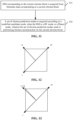
- FIG. 12 is a first schematic diagram of establishing the modified candidate mode. As illustrated in FIG.
- the decoder may first determine one diagonal prediction mode, i.e., the mode with the prediction direction index number 34, as the above-mentioned modified candidate mode, and then may determine another diagonal angle direction, i.e., any one of the modes with the prediction direction index numbers 66 and 2, as the above-mentioned modified candidate mode.
- one diagonal prediction mode i.e., the mode with the prediction direction index number 34
- another diagonal angle direction i.e., any one of the modes with the prediction direction index numbers 66 and 2
- the decoder may alternatively determine the derived angular mode of the at least one diagonal angular mode as the modified candidate mode.
- the current chroma block is a square chroma block, that is, the diagonal angular modes of the current chroma block are the modes with the prediction direction index numbers 34, 66, and 2, in addition to the diagonal angular modes often used to make predictions, other derived angles near the diagonal angular modes are also often used for making predictions.
- FIG. 13 is a second schematic diagram of establishing the modified candidate mode. As illustrated in FIG.
- the decoder may first determine one derived angle prediction mode, i.e., the mode with the prediction direction index number 32, as the above-mentioned modified candidate mode, and then may determine any one of the modes with the prediction direction index numbers 66 and 2 as the above-mentioned modified candidate mode.
- the decoder may first determine at least one derived angular modes. Specifically, the decoder may first determine an index number M corresponding to the DM; where M is an integer greater than 0; then the decoder may acquire a transformation parameter N, and determine an index number corresponding to the derived angular mode in accordance with M and N, so as to obtain the derived angular mode; where N is an integer greater than 0.
- the decoder when determining the index number corresponding to the derived angular mode in accordance with M and N, the decoder may either perform an addition operation on M and N, or perform a subtraction operation on M and N, and ultimately obtains the index number corresponding to the derived angular mode.
- N may be equal to 3, 5 or 7.
- the decoder may take the angle direction obtained through 0+5 or 0-5 as the index number corresponding to the derived angular mode.
- the prediction mode is generally not represented by a negative number
- a specific mapping method may be used to map the calculated value to the effective representation range.
- the specific calculation formula may be (M+62-N)%64+2, which yields 60. That is, the derived angular modes with the prediction direction angle 5 and with the prediction direction angle 60 may be obtained in this case.
- FIG. 14 is a third schematic diagram of establishing a modified candidate mode. As illustrated in FIG. 14 , the decoder adjusts the mode with prediction direction index number 2 to the mode with prediction direction index number 6. At the same time, the decoder may also adjust the mode with prediction direction index number 66 anti-clockwise by one angle and then use it as a modified candidate mode.
- FIG. 15 is a fourth schematic diagram of establishing a modified candidate mode. As illustrated in FIG.
- the decoder adjusts the mode with prediction direction index number 66 to the mode with prediction direction index number 61. Further, the decoder may also adjust the mode with prediction direction index number 66 and the mode with prediction direction index number 2 by one angle respectively at the same time as the modified candidate modes.
- FIG. 16 is a fifth schematic diagram of establishing a modified candidate mode. As illustrated in FIG. 16 , the decoder adjusts the mode with prediction direction index number 66 to the mode with prediction direction index number B, and adjusts the mode with prediction direction index number 2 to the mode with prediction direction index number A.
- the diagonal angular mode and the derived angular mode may be freely combined. For example, if three modified candidate modes are required to construct the set of chroma prediction modes, then one diagonal angular mode and two derived angular modes may be added to the set of chroma prediction modes, or two diagonal angular modes and one derived angular mode may be added to the set of chroma prediction modes, or three derived angular modes may be added to the set of chroma prediction modes, or three diagonal angular modes may be added to set of chroma prediction modes.
- angular modes 6, 61 and 66 may be added to the set of chroma prediction modes, or angular modes 6, 61 and 34 may be added to the set of chroma prediction modes, or angular modes 6, 61, 40 may be added to the set of chroma prediction modes, which are not specifically limited in the embodiment of the present disclosure.
- one of the modes with prediction direction index numbers 66 and 2 may be selected as an candidate mode according to its effective prediction direction range, and the angel corresponding to the other prediction direction index number may be adjusted as an candidate mode.
- the present disclosure provides the chroma intra prediction method, where the decoder acquires, from bitstream data corresponding to a current chroma block, a DM corresponding to the current chroma block; and acquires a set of chroma prediction modes according to a modified candidate mode when the DM is a DC mode or a Planar mode; wherein the set of chroma prediction modes is for performing chroma reconstruction on the current chroma block.
- the set of chroma prediction modes may be constructed through the modified candidate mode, and then the current chroma block is reconstructed according to the set of chroma prediction modes, thereby solving the problem of low accuracy of chroma intra prediction when the DM is the DC mode or the Planar mode, and further improving the efficiency for encoding and decoding.
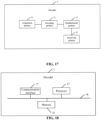
- FIG. 17 is a first schematic structure diagram of a decoder according to an embodiment of the present disclosure.
- the decoder 1 provided in the embodiment of the present disclosure may include an acquisition portion 11, a decoding portion 12, an establishment portion 13, and a receiving portion 14.
- the acquisition portion 11 is configured to acquire, from bitstream data corresponding to a current chroma block, a DM corresponding to the current chroma block; and acquire a set of chroma prediction modes according to a modified candidate mode, in case where the DM is a DC mode or a Planar mode; wherein the set of chroma prediction modes is for performing chroma reconstruction on the current chroma block.
- the acquisition portion 11 is further configured to acquire, from the bitstream data, a LM corresponding to the current chroma block, before acquiring the set of chroma prediction modes according to the modified candidate mode.
- the acquisition portion 11 is specifically configured to fill the set of chroma prediction modes with the DM and the LM; and fill the set of chroma prediction modes in accordance with modified candidate mode.
- the acquisition portion 11 is further specifically configured to: when the DM is the DC mode, fill the set of chroma prediction modes with the Planar mode and the modified candidate mode; and when the DM is the Planar mode, fill the set of chroma prediction modes with the DC mode and the modified candidate mode.
- the modified candidate mode comprises at least one mode; wherein the at least one mode have different prediction direction index numbers.
- the establishment portion 13 is configured to establish the modified candidate mode, before acquiring the set of chroma prediction modes according to the modified candidate mode.
- the establishment portion 13 is specifically configured to determine at least one diagonal angular mode as the modified candidate mode; or, determine a derived angular mode of the at least one diagonal angular mode as the modified candidate mode; or, determine the derived angular mode of the at least one diagonal angular mode and the at least one diagonal angular mode as the modified candidate modes.
- the acquisition portion 11 is further configured to determine an index number M corresponding to the DM before establishing the modified candidate mode; wherein M is an integer greater than 0; acquire a transformation parameter N, and determine, in accordance with M and N, an index number corresponding to the derived angular mode, so as to obtain the derived angular mode; wherein the N is an integer greater than 0.
- the acquisition portion 11 is specifically configured to perform an addition operation on M and N to obtain the index number corresponding to the derived angular mode; or, perform an subtraction operation on M and N to obtain the index number corresponding to the derived angular mode.
- N includes 3, 5, or 7.
- the current chroma block includes a square chroma block and a non-square chroma block.
- the receiving portion 14 is configured to receive a video bitstream to acquire the bitstream data, before acquiring, from the bitstream data corresponding to the current chroma block, the DM corresponding to the current chroma block.
- the decoding portion12 is configured to: after acquiring the set of chroma prediction modes according to the modified candidate mode, perform a decoding process according to the set of chroma prediction modes, to perform a chroma block reconstruction on the current chroma block.
- the acquisition portion 11 is further configured to acquire, from the bitstream data, residual data corresponding to the current chroma block, before performing the decoding process according to the set of chroma prediction modes to perform the chroma block reconstruction on the current chroma block.
- the decoding portion 12 is specifically configured to perform chroma intra prediction decoding on the residual data based on the set of chroma prediction modes, to perform a chroma reconstruction on the current chroma block.
- the acquisition portion 11 is further configured to: when there are identical prediction modes among the prediction modes corresponding to the current chroma block obtained from the bitstream data, acquire the set of chroma prediction modes according to the modified candidate mode, to perform chroma reconstruction on the current chroma block, after receiving the video bitstream to acquire the bitstream data.
- FIG. 18 is a second schematic structure diagram of the decoder provided in the embodiment of the present disclosure.
- the decoder 1 provided in the embodiment of the present disclosure may further include a processor 15 and a memory 16 storing instructions executable by the processor 15, a communication interface 17, and a bus 18 for connecting the processor 15, the memory 16, and the communication interface 17.
- the above-mentioned processor 15 may be at least one of an Application Specific Integrated Circuit (ASIC), a Digital Signal Processor (DSP), a Digital Signal Processing Device (DSPD), a ProgRAMmable Logic Device (PLD), a Field ProgRAMmable Gate Array (FPGA), a Central Processing Unit (CPU), a controller, a microcontroller, and a microprocessor.
- ASIC Application Specific Integrated Circuit
- DSP Digital Signal Processor
- DSPD Digital Signal Processing Device
- PLD ProgRAMmable Logic Device
- FPGA Field ProgRAMmable Gate Array
- CPU Central Processing Unit
- the electronic elements for implementing the above-mentioned processor functions may be alternatively in another type, which is not specifically limited in the embodiment of the present disclosure.
- the device 1 may further include a memory 16, which may be connected to the processor 15, wherein the memory 16 is for storing an executable program code including computer operation instructions, and the memory 16 may include a high-speed RAM memory, or may further include a Non-volatile memory, such as at least two disk memories.
- the bus 18 is for connecting the communication interface 17, the processor 15, the memory 16, and the mutual communications among these devices.
- the memory 16 is for storing the instructions and data.
- the aforementioned processor 15 is configured to acquire, from bitstream data corresponding to a current chroma block, a DM corresponding to the current chroma block; and acquire a set of chroma prediction modes according to a modified candidate mode when the DM is a DC mode or a Planar mode; wherein the set of chroma prediction modes is for performing a chroma reconstruction on the current chroma block.
- the above-mentioned memory 16 may be a first volatile memory (volatile memory), such as a Random-Access Memory (RAM); or a first non-volatile memory (non-volatile memory), such as a first Read-Only Memory (ROM), a first flash memory, a Hard Disk Drive (HDD), or a Solid-State Drive (SSD); or a combination of the above-mentioned types of first memory, and provides instructions and data to the processor 15.
- volatile memory such as a Random-Access Memory (RAM)
- a first non-volatile memory such as a first Read-Only Memory (ROM), a first flash memory, a Hard Disk Drive (HDD), or a Solid-State Drive (SSD); or a combination of the above-mentioned types of first memory, and provides instructions and data to the processor 15.
- the functional modules in this embodiment may be integrated into one processing unit, or the respective modules may physically exist seperately, or two or more modules may be integrated into one unit.
- the above-mentioned integrated unit may be realized in the form of hardware or in the form of a software function module.
- the integrated unit when implemented as a software function module and not sold or used as a stand-alone product, may be stored in a computer-readable storage medium.
- the essential technical solution of the embodiments, or the part that contributes to the prior art, or all or part of the technical solution may be embodied in the form of a software product stored in a storage medium including a number of instructions to enable a computer device (which may be a personal computer, a server, or a network device, etc.) or a processor to perform all or some of the steps of the method in the embodiments.
- the aforementioned storage medium includes various mediums that can store a program code, such as a USB flash drive, a removable hard disk, a Read Only Memory (ROM), a Random Access Memory (RAM), a disk or a compact disc.
- the embodiments of the present disclosure provide a device, wherein the decoder acquires, from bitstream data corresponding to a current chroma block, a DM corresponding to the current chroma block; and acquires a set of chroma prediction modes according to a modified candidate mode, when the DM is a DC mode or a Planar mode; wherein the set of chroma prediction modes is for performing a chroma reconstruction on the current chroma block.
- the modified candidate mode may be used to construct the set of chroma prediction modes, and then the current chroma block is reconstructed according to the set of chroma prediction modes, thereby solving the problem of low accuracy of chroma intra prediction when the DM is the DC mode or the Planar mode, and further improving the efficiency for encoding and decoding.
- An embodiment of the present disclosure provides a computer readable storage medium storing a program thereon, wherein the program implements, when executed by a processor, the chroma intra prediction methods as described above.
- the program instructions corresponding to a chroma intra prediction method in this embodiment may be stored on a storage medium such as optical disks, hard disks, and USB flash drives.
- a storage medium such as optical disks, hard disks, and USB flash drives.
- the embodiments of the present disclosure may be provided as methods, systems, or computer program products. Therefore, the present disclosure may adopt the form of hardware embodiments, software embodiments, or embodiments combining software and hardware. Moreover, the present disclosure may adopt the form of a computer program product implemented on one or more computer-usable storage medium (including but not limited to a disk storage, an optical storage, etc.) containing computer-usable program codes therein.
- a computer-usable storage medium including but not limited to a disk storage, an optical storage, etc.
- These computer program instructions may be provided to the processor of a general-purpose computer, a special-purpose computer, an embedded processor, or another programmable data processing equipment to generate a machine, so that the instructions executed by the processor of the computer or another programmable data processing equipment may generate a device for implementing the functions specified in one or more process in the flowchart and/or in one or more block in the block diagram.
- These computer program instructions may be alternatively stored in a computer-readable memory that can guide a computer or another programmable data processing equipment to work in a specific manner, so that the instructions stored in the computer-readable memory produce a manufacture including the instruction device.
- the instruction device realizes the functions specified in one or more processes in the flowchart and/or one or more blocks in the block diagram.
- These computer program instructions may be alternatively loaded on a computer or another programmable data processing equipment, so that a series of operation steps are performed on the computer or another programmable equipment to produce the computer-implemented processing, and the instructions executed on the computer or another programmable equipment provide steps for implementing the functions specified in one or more processes in the flowchart and/or one or more block in the block diagram.
- the embodiments of the present disclosure provide the chroma intra prediction method, the decoder and the computer storage medium, wherein the decoder acquires, from bitstream data corresponding to a current chroma block, a DM corresponding to the current chroma block; and acquires a set of chroma prediction modes according to a modified candidate mode, when the DM is a DC mode or a Planar mode; wherein the set of chroma prediction modes is for performing a chroma reconstruction on the current chroma block.
- the set of chroma prediction modes may be constructed through the modified candidate mode, and then the current chroma block is reconstructed according to the set of chroma prediction modes, thereby solving the problem of low accuracy of chroma intra prediction when the DM is the DC mode or the Planar mode, and further improving the efficiency for encoding and decoding.
Landscapes
- Engineering & Computer Science (AREA)
- Multimedia (AREA)
- Signal Processing (AREA)
- Compression Or Coding Systems Of Tv Signals (AREA)
- Compression, Expansion, Code Conversion, And Decoders (AREA)
Priority Applications (1)
| Application Number | Priority Date | Filing Date | Title |
|---|---|---|---|
| EP24178914.8A EP4398572A3 (en) | 2019-01-02 | 2019-01-02 | Intra-frame chromaticity prediction method and decoder |
Applications Claiming Priority (1)
| Application Number | Priority Date | Filing Date | Title |
|---|---|---|---|
| PCT/CN2019/070148 WO2020140215A1 (zh) | 2019-01-02 | 2019-01-02 | 色度帧内预测方法和装置、及计算机存储介质 |
Related Child Applications (2)
| Application Number | Title | Priority Date | Filing Date |
|---|---|---|---|
| EP24178914.8A Division-Into EP4398572A3 (en) | 2019-01-02 | 2019-01-02 | Intra-frame chromaticity prediction method and decoder |
| EP24178914.8A Division EP4398572A3 (en) | 2019-01-02 | 2019-01-02 | Intra-frame chromaticity prediction method and decoder |
Publications (3)
| Publication Number | Publication Date |
|---|---|
| EP3883243A1 EP3883243A1 (en) | 2021-09-22 |
| EP3883243A4 EP3883243A4 (en) | 2021-12-01 |
| EP3883243B1 true EP3883243B1 (en) | 2024-07-24 |
Family
ID=71406528
Family Applications (2)
| Application Number | Title | Priority Date | Filing Date |
|---|---|---|---|
| EP24178914.8A Pending EP4398572A3 (en) | 2019-01-02 | 2019-01-02 | Intra-frame chromaticity prediction method and decoder |
| EP19907559.9A Active EP3883243B1 (en) | 2019-01-02 | 2019-01-02 | Intra-frame chromaticity prediction method and decoder |
Family Applications Before (1)
| Application Number | Title | Priority Date | Filing Date |
|---|---|---|---|
| EP24178914.8A Pending EP4398572A3 (en) | 2019-01-02 | 2019-01-02 | Intra-frame chromaticity prediction method and decoder |
Country Status (11)
| Country | Link |
|---|---|
| US (5) | US11451792B2 (pl) |
| EP (2) | EP4398572A3 (pl) |
| JP (1) | JP7309884B2 (pl) |
| KR (2) | KR20250095748A (pl) |
| CN (3) | CN113347416B (pl) |
| AU (5) | AU2019419036B2 (pl) |
| ES (1) | ES2987142T3 (pl) |
| MX (5) | MX2021008090A (pl) |
| MY (1) | MY210271A (pl) |
| PL (1) | PL3883243T3 (pl) |
| WO (1) | WO2020140215A1 (pl) |
Families Citing this family (5)
| Publication number | Priority date | Publication date | Assignee | Title |
|---|---|---|---|---|
| CN115695786B (zh) * | 2019-01-02 | 2025-12-12 | Oppo广东移动通信有限公司 | 预测方向的确定方法、解码器以及计算机存储介质 |
| CN120639984A (zh) * | 2019-03-25 | 2025-09-12 | Oppo广东移动通信有限公司 | 图像分量的预测方法、编码器、解码器及计算机存储介质 |
| US12355982B2 (en) * | 2022-01-04 | 2025-07-08 | Alibaba (China) Co., Ltd | Decoder-side chroma intra prediction mode gradient-based derivation |
| EP4462775A4 (en) * | 2022-01-04 | 2025-12-17 | Lg Electronics Inc | Image encoding/decoding method, method for transmitting a bit stream and recording medium with bit stream stored thereon |
| WO2025071203A1 (ko) * | 2023-09-27 | 2025-04-03 | 주식회사 아틴스 | 인트라 예측 방법, 이를 수행하는 영상 부호화 및 복호화 장치 |
Family Cites Families (45)
| Publication number | Priority date | Publication date | Assignee | Title |
|---|---|---|---|---|
| CN101820546A (zh) * | 2009-02-27 | 2010-09-01 | 源见科技(苏州)有限公司 | 帧内预测方法 |
| KR101503269B1 (ko) | 2010-04-05 | 2015-03-17 | 삼성전자주식회사 | 영상 부호화 단위에 대한 인트라 예측 모드 결정 방법 및 장치, 및 영상 복호화 단위에 대한 인트라 예측 모드 결정 방법 및 장치 |
| MY180607A (en) | 2010-12-23 | 2020-12-03 | Samsung Electronics Co Ltd | Method and device for encoding intra prediction mode for image prediction unit, and method and device for decoding intra prediction mode for image prediction unit |
| ES2933424T3 (es) | 2011-03-06 | 2023-02-08 | Lg Electronics Inc | Método de predicción intra para bloques de crominancia |
| KR101585565B1 (ko) * | 2011-06-17 | 2016-01-14 | 미디어텍 인크. | 인트라 예측 모드의 코딩을 위한 방법 및 장치 |
| CN103096051B (zh) * | 2011-11-04 | 2017-04-12 | 华为技术有限公司 | 一种图像块信号分量采样点的帧内解码方法和装置 |
| CN103096055B (zh) * | 2011-11-04 | 2016-03-30 | 华为技术有限公司 | 一种图像信号帧内预测及解码的方法和装置 |
| CN109218730B (zh) * | 2012-01-19 | 2023-07-28 | 华为技术有限公司 | 用于lm帧内预测的参考像素缩减 |
| KR20130085603A (ko) * | 2012-01-20 | 2013-07-30 | 주식회사 팬택 | 색차 블록의 화면 내 예측 모드 방법 및 이러한 방법을 사용하는 장치 |
| CN104093025B (zh) * | 2012-01-20 | 2017-09-19 | 华为技术有限公司 | 编解码方法和装置 |
| WO2014146079A1 (en) * | 2013-03-15 | 2014-09-18 | Zenkich Raymond | System and method for non-uniform video coding |
| CN104683805B (zh) | 2013-11-30 | 2019-09-17 | 同济大学 | 图像编码、解码方法及装置 |
| US10321140B2 (en) * | 2015-01-22 | 2019-06-11 | Mediatek Singapore Pte. Ltd. | Method of video coding for chroma components |
| WO2017034331A1 (ko) * | 2015-08-27 | 2017-03-02 | 엘지전자 주식회사 | 영상 코딩 시스템에서 크로마 샘플 인트라 예측 방법 및 장치 |
| US11233990B2 (en) * | 2016-02-08 | 2022-01-25 | Sharp Kabushiki Kaisha | Systems and methods for intra prediction coding |
| WO2017143467A1 (en) * | 2016-02-22 | 2017-08-31 | Mediatek Singapore Pte. Ltd. | Localized luma mode prediction inheritance for chroma coding |
| US11032550B2 (en) * | 2016-02-25 | 2021-06-08 | Mediatek Inc. | Method and apparatus of video coding |
| CN109076243B (zh) * | 2016-05-04 | 2022-01-25 | 夏普株式会社 | 用于对变换数据进行编码的系统和方法 |
| US11039147B2 (en) * | 2016-05-28 | 2021-06-15 | Mediatek Inc. | Method and apparatus of palette mode coding for colour video data |
| US10326986B2 (en) | 2016-08-15 | 2019-06-18 | Qualcomm Incorporated | Intra video coding using a decoupled tree structure |
| US10368107B2 (en) | 2016-08-15 | 2019-07-30 | Qualcomm Incorporated | Intra video coding using a decoupled tree structure |
| WO2018062699A1 (ko) * | 2016-09-30 | 2018-04-05 | 엘지전자 주식회사 | 영상 코딩 시스템에서 영상 디코딩 방법 및 장치 |
| WO2018064956A1 (en) * | 2016-10-07 | 2018-04-12 | Mediatek Inc. | Method and apparatus for intra chroma coding in image and video coding |
| KR20180043149A (ko) * | 2016-10-19 | 2018-04-27 | 에스케이텔레콤 주식회사 | 영상 부호화 또는 복호화하기 위한 장치 및 방법 |
| US11025903B2 (en) * | 2017-01-13 | 2021-06-01 | Qualcomm Incorporated | Coding video data using derived chroma mode |
| WO2018142823A1 (en) | 2017-01-31 | 2018-08-09 | Sharp Kabushiki Kaisha | Systems and methods for scaling transform coefficient level values |
| EP3410708A1 (en) * | 2017-05-31 | 2018-12-05 | Thomson Licensing | Method and apparatus for intra prediction with interpolation |
| EP3410722A1 (en) * | 2017-05-31 | 2018-12-05 | Thomson Licensing | Method and apparatus for low-complexity bi-directional intra prediction in video encoding and decoding |
| WO2018236031A1 (ko) * | 2017-06-21 | 2018-12-27 | 엘지전자(주) | 인트라 예측 모드 기반 영상 처리 방법 및 이를 위한 장치 |
| MX2020001290A (es) | 2017-08-03 | 2020-03-12 | Sharp Kk | Sistemas y metodos para particionar bloques de video en un corte de interprediccion de datos de video. |
| JP2021005741A (ja) * | 2017-09-14 | 2021-01-14 | シャープ株式会社 | 画像符号化装置及び画像復号装置 |
| US20210067802A1 (en) * | 2017-09-26 | 2021-03-04 | Samsung Electronics Co., Ltd. | Video decoding method and device using cross-component prediction, and video encoding method and device using cross-component prediction |
| US11166045B2 (en) * | 2017-10-11 | 2021-11-02 | Lg Electronics Inc. | Method for image coding on basis of separable transform and apparatus therefor |
| CN111373750B (zh) * | 2017-10-24 | 2025-01-14 | 三星电子株式会社 | 视频信号处理方法和装置 |
| WO2019082770A1 (en) | 2017-10-24 | 2019-05-02 | Sharp Kabushiki Kaisha | SYSTEMS AND METHODS FOR DETERMINING PREDICTIVE QUANTIFICATION PARAMETER VALUES |
| CN111316640B (zh) * | 2017-11-17 | 2023-09-26 | 鸿颖创新有限公司 | 基于调整的帧内模式列表以编码视频数据的设备及方法 |
| US11310517B2 (en) * | 2017-12-07 | 2022-04-19 | Electronics And Telecommunications Research Institute | Method and apparatus for encoding and decoding using selective information sharing between channels |
| WO2019131807A1 (en) | 2017-12-29 | 2019-07-04 | Sharp Kabushiki Kaisha | Systems and methods for partitioning video blocks for video coding |
| EP3732883B1 (en) * | 2017-12-29 | 2025-04-02 | Sharp Kabushiki Kaisha | Device and method for coding video data based on mode list including different mode groups |
| CN119967171A (zh) | 2017-12-29 | 2025-05-09 | 夏普株式会社 | 确定视频数据的划分的方法、设备、视频解码装置与视频编码装置 |
| US10567801B2 (en) * | 2018-03-07 | 2020-02-18 | Tencent America LLC | Method and apparatus for video coding with primary and secondary transforms |
| US10609402B2 (en) * | 2018-05-02 | 2020-03-31 | Tencent America LLC | Method and apparatus for prediction and transform for small blocks |
| US10701358B2 (en) * | 2018-07-09 | 2020-06-30 | Tencent America LLC | Mode dependent primary and secondary transforms |
| CN119363976A (zh) * | 2018-08-24 | 2025-01-24 | 三星电子株式会社 | 视频解码方法和设备、以及视频编码方法和设备 |
| US11284093B2 (en) * | 2019-05-09 | 2022-03-22 | Qualcomm Incorporated | Affine linear weighted intra prediction in video coding |
-
2019
- 2019-01-02 CN CN202110646355.8A patent/CN113347416B/zh active Active
- 2019-01-02 EP EP24178914.8A patent/EP4398572A3/en active Pending
- 2019-01-02 KR KR1020257019757A patent/KR20250095748A/ko active Pending
- 2019-01-02 EP EP19907559.9A patent/EP3883243B1/en active Active
- 2019-01-02 JP JP2021537035A patent/JP7309884B2/ja active Active
- 2019-01-02 WO PCT/CN2019/070148 patent/WO2020140215A1/zh not_active Ceased
- 2019-01-02 KR KR1020217020179A patent/KR102822345B1/ko active Active
- 2019-01-02 ES ES19907559T patent/ES2987142T3/es active Active
- 2019-01-02 CN CN201980062647.8A patent/CN112771861A/zh active Pending
- 2019-01-02 MY MYPI2021003545A patent/MY210271A/en unknown
- 2019-01-02 AU AU2019419036A patent/AU2019419036B2/en active Active
- 2019-01-02 CN CN202310393421.4A patent/CN116506608B/zh active Active
- 2019-01-02 PL PL19907559.9T patent/PL3883243T3/pl unknown
- 2019-01-02 MX MX2021008090A patent/MX2021008090A/es unknown
-
2021
- 2021-06-29 US US17/361,625 patent/US11451792B2/en active Active
- 2021-07-01 MX MX2024014525A patent/MX2024014525A/es unknown
- 2021-07-01 MX MX2024014529A patent/MX2024014529A/es unknown
- 2021-07-01 MX MX2024014526A patent/MX2024014526A/es unknown
- 2021-07-01 MX MX2024014527A patent/MX2024014527A/es unknown
-
2022
- 2022-08-11 US US17/819,175 patent/US11924439B2/en active Active
-
2023
- 2023-10-24 US US18/493,496 patent/US12231655B2/en active Active
- 2023-10-24 US US18/493,217 patent/US12238301B2/en active Active
-
2024
- 2024-12-16 AU AU2024278459A patent/AU2024278459A1/en active Pending
- 2024-12-16 AU AU2024278460A patent/AU2024278460A1/en active Pending
- 2024-12-16 AU AU2024278456A patent/AU2024278456A1/en active Pending
- 2024-12-16 AU AU2024278461A patent/AU2024278461A1/en active Pending
-
2025
- 2025-01-16 US US19/025,004 patent/US20250159200A1/en active Pending
Also Published As
Similar Documents
| Publication | Publication Date | Title |
|---|---|---|
| EP3883243B1 (en) | Intra-frame chromaticity prediction method and decoder | |
| KR102171788B1 (ko) | 적응적 분할 코딩 | |
| CA2908115C (en) | Method of simplified cabac coding in 3d video coding | |
| EP3094091B1 (en) | Coding and decoding method and device | |
| US11973936B2 (en) | Image component prediction method and device, and computer storage medium | |
| JP7437404B2 (ja) | イントラ予測方法、装置およびコンピュータ記憶媒体 | |
| JP7791141B2 (ja) | クロマイントラ予測方法および装置、並びにコンピュータ記憶媒体 | |
| RU2776160C1 (ru) | Способ и устройство внутреннего предсказания цветности и компьютерный носитель данных | |
| US20250330593A1 (en) | Video decoding method, video encoding method, decoder, encoder and computer-readable storage medium | |
| CN105594214B (zh) | 在三维编码系统中深度区块的帧内编码方法及装置 | |
| HK1219596B (en) | Wedgelet pattern extension for depth intra coding |
Legal Events
| Date | Code | Title | Description |
|---|---|---|---|
| STAA | Information on the status of an ep patent application or granted ep patent |
Free format text: STATUS: THE INTERNATIONAL PUBLICATION HAS BEEN MADE |
|
| PUAI | Public reference made under article 153(3) epc to a published international application that has entered the european phase |
Free format text: ORIGINAL CODE: 0009012 |
|
| STAA | Information on the status of an ep patent application or granted ep patent |
Free format text: STATUS: REQUEST FOR EXAMINATION WAS MADE |
|
| 17P | Request for examination filed |
Effective date: 20210615 |
|
| AK | Designated contracting states |
Kind code of ref document: A1 Designated state(s): AL AT BE BG CH CY CZ DE DK EE ES FI FR GB GR HR HU IE IS IT LI LT LU LV MC MK MT NL NO PL PT RO RS SE SI SK SM TR |
|
| A4 | Supplementary search report drawn up and despatched |
Effective date: 20211103 |
|
| RIC1 | Information provided on ipc code assigned before grant |
Ipc: H04N 19/463 20140101ALI20211027BHEP Ipc: H04N 19/186 20140101ALI20211027BHEP Ipc: H04N 19/159 20140101ALI20211027BHEP Ipc: H04N 19/11 20140101AFI20211027BHEP |
|
| STAA | Information on the status of an ep patent application or granted ep patent |
Free format text: STATUS: EXAMINATION IS IN PROGRESS |
|
| DAV | Request for validation of the european patent (deleted) | ||
| DAX | Request for extension of the european patent (deleted) | ||
| 17Q | First examination report despatched |
Effective date: 20220318 |
|
| GRAP | Despatch of communication of intention to grant a patent |
Free format text: ORIGINAL CODE: EPIDOSNIGR1 |
|
| STAA | Information on the status of an ep patent application or granted ep patent |
Free format text: STATUS: GRANT OF PATENT IS INTENDED |
|
| INTG | Intention to grant announced |
Effective date: 20240416 |
|
| GRAS | Grant fee paid |
Free format text: ORIGINAL CODE: EPIDOSNIGR3 |
|
| GRAA | (expected) grant |
Free format text: ORIGINAL CODE: 0009210 |
|
| STAA | Information on the status of an ep patent application or granted ep patent |
Free format text: STATUS: THE PATENT HAS BEEN GRANTED |
|
| AK | Designated contracting states |
Kind code of ref document: B1 Designated state(s): AL AT BE BG CH CY CZ DE DK EE ES FI FR GB GR HR HU IE IS IT LI LT LU LV MC MK MT NL NO PL PT RO RS SE SI SK SM TR |
|
| REG | Reference to a national code |
Ref country code: GB Ref legal event code: FG4D |
|
| REG | Reference to a national code |
Ref country code: CH Ref legal event code: EP |
|
| REG | Reference to a national code |
Ref country code: IE Ref legal event code: FG4D Ref country code: DE Ref legal event code: R096 Ref document number: 602019055928 Country of ref document: DE |
|
| REG | Reference to a national code |
Ref country code: NL Ref legal event code: FP |
|
| P01 | Opt-out of the competence of the unified patent court (upc) registered |
Free format text: CASE NUMBER: APP_49551/2024 Effective date: 20240902 |
|
| REG | Reference to a national code |
Ref country code: LT Ref legal event code: MG9D |
|
| REG | Reference to a national code |
Ref country code: ES Ref legal event code: FG2A Ref document number: 2987142 Country of ref document: ES Kind code of ref document: T3 Effective date: 20241113 |
|
| PG25 | Lapsed in a contracting state [announced via postgrant information from national office to epo] |
Ref country code: PT Free format text: LAPSE BECAUSE OF FAILURE TO SUBMIT A TRANSLATION OF THE DESCRIPTION OR TO PAY THE FEE WITHIN THE PRESCRIBED TIME-LIMIT Effective date: 20241125 |
|
| REG | Reference to a national code |
Ref country code: AT Ref legal event code: MK05 Ref document number: 1707377 Country of ref document: AT Kind code of ref document: T Effective date: 20240724 |
|
| PG25 | Lapsed in a contracting state [announced via postgrant information from national office to epo] |
Ref country code: PT Free format text: LAPSE BECAUSE OF FAILURE TO SUBMIT A TRANSLATION OF THE DESCRIPTION OR TO PAY THE FEE WITHIN THE PRESCRIBED TIME-LIMIT Effective date: 20241125 |
|
| PG25 | Lapsed in a contracting state [announced via postgrant information from national office to epo] |
Ref country code: NO Free format text: LAPSE BECAUSE OF FAILURE TO SUBMIT A TRANSLATION OF THE DESCRIPTION OR TO PAY THE FEE WITHIN THE PRESCRIBED TIME-LIMIT Effective date: 20241024 |
|
| PG25 | Lapsed in a contracting state [announced via postgrant information from national office to epo] |
Ref country code: FI Free format text: LAPSE BECAUSE OF FAILURE TO SUBMIT A TRANSLATION OF THE DESCRIPTION OR TO PAY THE FEE WITHIN THE PRESCRIBED TIME-LIMIT Effective date: 20240724 Ref country code: GR Free format text: LAPSE BECAUSE OF FAILURE TO SUBMIT A TRANSLATION OF THE DESCRIPTION OR TO PAY THE FEE WITHIN THE PRESCRIBED TIME-LIMIT Effective date: 20241025 |
|
| PGFP | Annual fee paid to national office [announced via postgrant information from national office to epo] |
Ref country code: PL Payment date: 20241223 Year of fee payment: 7 |
|
| PG25 | Lapsed in a contracting state [announced via postgrant information from national office to epo] |
Ref country code: BG Free format text: LAPSE BECAUSE OF FAILURE TO SUBMIT A TRANSLATION OF THE DESCRIPTION OR TO PAY THE FEE WITHIN THE PRESCRIBED TIME-LIMIT Effective date: 20240724 |
|
| PG25 | Lapsed in a contracting state [announced via postgrant information from national office to epo] |
Ref country code: LV Free format text: LAPSE BECAUSE OF FAILURE TO SUBMIT A TRANSLATION OF THE DESCRIPTION OR TO PAY THE FEE WITHIN THE PRESCRIBED TIME-LIMIT Effective date: 20240724 |
|
| PG25 | Lapsed in a contracting state [announced via postgrant information from national office to epo] |
Ref country code: IS Free format text: LAPSE BECAUSE OF FAILURE TO SUBMIT A TRANSLATION OF THE DESCRIPTION OR TO PAY THE FEE WITHIN THE PRESCRIBED TIME-LIMIT Effective date: 20241124 Ref country code: AT Free format text: LAPSE BECAUSE OF FAILURE TO SUBMIT A TRANSLATION OF THE DESCRIPTION OR TO PAY THE FEE WITHIN THE PRESCRIBED TIME-LIMIT Effective date: 20240724 |
|
| PG25 | Lapsed in a contracting state [announced via postgrant information from national office to epo] |
Ref country code: HR Free format text: LAPSE BECAUSE OF FAILURE TO SUBMIT A TRANSLATION OF THE DESCRIPTION OR TO PAY THE FEE WITHIN THE PRESCRIBED TIME-LIMIT Effective date: 20240724 |
|
| PG25 | Lapsed in a contracting state [announced via postgrant information from national office to epo] |
Ref country code: RS Free format text: LAPSE BECAUSE OF FAILURE TO SUBMIT A TRANSLATION OF THE DESCRIPTION OR TO PAY THE FEE WITHIN THE PRESCRIBED TIME-LIMIT Effective date: 20241024 |
|
| PG25 | Lapsed in a contracting state [announced via postgrant information from national office to epo] |
Ref country code: RS Free format text: LAPSE BECAUSE OF FAILURE TO SUBMIT A TRANSLATION OF THE DESCRIPTION OR TO PAY THE FEE WITHIN THE PRESCRIBED TIME-LIMIT Effective date: 20241024 Ref country code: NO Free format text: LAPSE BECAUSE OF FAILURE TO SUBMIT A TRANSLATION OF THE DESCRIPTION OR TO PAY THE FEE WITHIN THE PRESCRIBED TIME-LIMIT Effective date: 20241024 Ref country code: LV Free format text: LAPSE BECAUSE OF FAILURE TO SUBMIT A TRANSLATION OF THE DESCRIPTION OR TO PAY THE FEE WITHIN THE PRESCRIBED TIME-LIMIT Effective date: 20240724 Ref country code: IS Free format text: LAPSE BECAUSE OF FAILURE TO SUBMIT A TRANSLATION OF THE DESCRIPTION OR TO PAY THE FEE WITHIN THE PRESCRIBED TIME-LIMIT Effective date: 20241124 Ref country code: HR Free format text: LAPSE BECAUSE OF FAILURE TO SUBMIT A TRANSLATION OF THE DESCRIPTION OR TO PAY THE FEE WITHIN THE PRESCRIBED TIME-LIMIT Effective date: 20240724 Ref country code: GR Free format text: LAPSE BECAUSE OF FAILURE TO SUBMIT A TRANSLATION OF THE DESCRIPTION OR TO PAY THE FEE WITHIN THE PRESCRIBED TIME-LIMIT Effective date: 20241025 Ref country code: FI Free format text: LAPSE BECAUSE OF FAILURE TO SUBMIT A TRANSLATION OF THE DESCRIPTION OR TO PAY THE FEE WITHIN THE PRESCRIBED TIME-LIMIT Effective date: 20240724 Ref country code: BG Free format text: LAPSE BECAUSE OF FAILURE TO SUBMIT A TRANSLATION OF THE DESCRIPTION OR TO PAY THE FEE WITHIN THE PRESCRIBED TIME-LIMIT Effective date: 20240724 Ref country code: AT Free format text: LAPSE BECAUSE OF FAILURE TO SUBMIT A TRANSLATION OF THE DESCRIPTION OR TO PAY THE FEE WITHIN THE PRESCRIBED TIME-LIMIT Effective date: 20240724 |
|
| PGFP | Annual fee paid to national office [announced via postgrant information from national office to epo] |
Ref country code: NL Payment date: 20250120 Year of fee payment: 7 |
|
| PGFP | Annual fee paid to national office [announced via postgrant information from national office to epo] |
Ref country code: DE Payment date: 20250121 Year of fee payment: 7 |
|
| PG25 | Lapsed in a contracting state [announced via postgrant information from national office to epo] |
Ref country code: SM Free format text: LAPSE BECAUSE OF FAILURE TO SUBMIT A TRANSLATION OF THE DESCRIPTION OR TO PAY THE FEE WITHIN THE PRESCRIBED TIME-LIMIT Effective date: 20240724 Ref country code: RO Free format text: LAPSE BECAUSE OF FAILURE TO SUBMIT A TRANSLATION OF THE DESCRIPTION OR TO PAY THE FEE WITHIN THE PRESCRIBED TIME-LIMIT Effective date: 20240724 Ref country code: DK Free format text: LAPSE BECAUSE OF FAILURE TO SUBMIT A TRANSLATION OF THE DESCRIPTION OR TO PAY THE FEE WITHIN THE PRESCRIBED TIME-LIMIT Effective date: 20240724 |
|
| PGFP | Annual fee paid to national office [announced via postgrant information from national office to epo] |
Ref country code: ES Payment date: 20250203 Year of fee payment: 7 |
|
| PG25 | Lapsed in a contracting state [announced via postgrant information from national office to epo] |
Ref country code: EE Free format text: LAPSE BECAUSE OF FAILURE TO SUBMIT A TRANSLATION OF THE DESCRIPTION OR TO PAY THE FEE WITHIN THE PRESCRIBED TIME-LIMIT Effective date: 20240724 |
|
| PG25 | Lapsed in a contracting state [announced via postgrant information from national office to epo] |
Ref country code: CZ Free format text: LAPSE BECAUSE OF FAILURE TO SUBMIT A TRANSLATION OF THE DESCRIPTION OR TO PAY THE FEE WITHIN THE PRESCRIBED TIME-LIMIT Effective date: 20240724 |
|
| PGFP | Annual fee paid to national office [announced via postgrant information from national office to epo] |
Ref country code: FR Payment date: 20250122 Year of fee payment: 7 |
|
| REG | Reference to a national code |
Ref country code: DE Ref legal event code: R097 Ref document number: 602019055928 Country of ref document: DE |
|
| PG25 | Lapsed in a contracting state [announced via postgrant information from national office to epo] |
Ref country code: SK Free format text: LAPSE BECAUSE OF FAILURE TO SUBMIT A TRANSLATION OF THE DESCRIPTION OR TO PAY THE FEE WITHIN THE PRESCRIBED TIME-LIMIT Effective date: 20240724 |
|
| PGFP | Annual fee paid to national office [announced via postgrant information from national office to epo] |
Ref country code: IT Payment date: 20250122 Year of fee payment: 7 Ref country code: GB Payment date: 20250122 Year of fee payment: 7 |
|
| PLBE | No opposition filed within time limit |
Free format text: ORIGINAL CODE: 0009261 |
|
| STAA | Information on the status of an ep patent application or granted ep patent |
Free format text: STATUS: NO OPPOSITION FILED WITHIN TIME LIMIT |
|
| 26N | No opposition filed |
Effective date: 20250425 |
|
| REG | Reference to a national code |
Ref country code: CH Ref legal event code: PL |
|
| PG25 | Lapsed in a contracting state [announced via postgrant information from national office to epo] |
Ref country code: SE Free format text: LAPSE BECAUSE OF FAILURE TO SUBMIT A TRANSLATION OF THE DESCRIPTION OR TO PAY THE FEE WITHIN THE PRESCRIBED TIME-LIMIT Effective date: 20240724 |
|
| PG25 | Lapsed in a contracting state [announced via postgrant information from national office to epo] |
Ref country code: LU Free format text: LAPSE BECAUSE OF NON-PAYMENT OF DUE FEES Effective date: 20250102 Ref country code: MC Free format text: LAPSE BECAUSE OF FAILURE TO SUBMIT A TRANSLATION OF THE DESCRIPTION OR TO PAY THE FEE WITHIN THE PRESCRIBED TIME-LIMIT Effective date: 20240724 |
|
| PG25 | Lapsed in a contracting state [announced via postgrant information from national office to epo] |
Ref country code: BE Free format text: LAPSE BECAUSE OF NON-PAYMENT OF DUE FEES Effective date: 20250131 |
|
| PG25 | Lapsed in a contracting state [announced via postgrant information from national office to epo] |
Ref country code: CH Free format text: LAPSE BECAUSE OF NON-PAYMENT OF DUE FEES Effective date: 20250131 |
|
| REG | Reference to a national code |
Ref country code: BE Ref legal event code: MM Effective date: 20250131 |