EP3882220A1 - Oily sewage pretreatment method and device without air flotation - Google Patents
Oily sewage pretreatment method and device without air flotation Download PDFInfo
- Publication number
- EP3882220A1 EP3882220A1 EP19884607.3A EP19884607A EP3882220A1 EP 3882220 A1 EP3882220 A1 EP 3882220A1 EP 19884607 A EP19884607 A EP 19884607A EP 3882220 A1 EP3882220 A1 EP 3882220A1
- Authority
- EP
- European Patent Office
- Prior art keywords
- oil
- oily sewage
- separation
- hydrocyclone
- intensified
- Prior art date
- Legal status (The legal status is an assumption and is not a legal conclusion. Google has not performed a legal analysis and makes no representation as to the accuracy of the status listed.)
- Granted
Links
Images
Classifications
-
- C—CHEMISTRY; METALLURGY
- C02—TREATMENT OF WATER, WASTE WATER, SEWAGE, OR SLUDGE
- C02F—TREATMENT OF WATER, WASTE WATER, SEWAGE, OR SLUDGE
- C02F9/00—Multistage treatment of water, waste water or sewage
-
- B—PERFORMING OPERATIONS; TRANSPORTING
- B01—PHYSICAL OR CHEMICAL PROCESSES OR APPARATUS IN GENERAL
- B01D—SEPARATION
- B01D17/00—Separation of liquids, not provided for elsewhere, e.g. by thermal diffusion
- B01D17/02—Separation of non-miscible liquids
- B01D17/04—Breaking emulsions
- B01D17/045—Breaking emulsions with coalescers
-
- B—PERFORMING OPERATIONS; TRANSPORTING
- B04—CENTRIFUGAL APPARATUS OR MACHINES FOR CARRYING-OUT PHYSICAL OR CHEMICAL PROCESSES
- B04C—APPARATUS USING FREE VORTEX FLOW, e.g. CYCLONES
- B04C9/00—Combinations with other devices, e.g. fans, expansion chambers, diffusors, water locks
-
- C—CHEMISTRY; METALLURGY
- C02—TREATMENT OF WATER, WASTE WATER, SEWAGE, OR SLUDGE
- C02F—TREATMENT OF WATER, WASTE WATER, SEWAGE, OR SLUDGE
- C02F1/00—Treatment of water, waste water, or sewage
- C02F1/38—Treatment of water, waste water, or sewage by centrifugal separation
-
- C—CHEMISTRY; METALLURGY
- C02—TREATMENT OF WATER, WASTE WATER, SEWAGE, OR SLUDGE
- C02F—TREATMENT OF WATER, WASTE WATER, SEWAGE, OR SLUDGE
- C02F1/00—Treatment of water, waste water, or sewage
- C02F1/40—Devices for separating or removing fatty or oily substances or similar floating material
-
- C—CHEMISTRY; METALLURGY
- C02—TREATMENT OF WATER, WASTE WATER, SEWAGE, OR SLUDGE
- C02F—TREATMENT OF WATER, WASTE WATER, SEWAGE, OR SLUDGE
- C02F3/00—Biological treatment of water, waste water, or sewage
- C02F3/30—Aerobic and anaerobic processes
-
- B—PERFORMING OPERATIONS; TRANSPORTING
- B04—CENTRIFUGAL APPARATUS OR MACHINES FOR CARRYING-OUT PHYSICAL OR CHEMICAL PROCESSES
- B04C—APPARATUS USING FREE VORTEX FLOW, e.g. CYCLONES
- B04C9/00—Combinations with other devices, e.g. fans, expansion chambers, diffusors, water locks
- B04C2009/004—Combinations with other devices, e.g. fans, expansion chambers, diffusors, water locks with internal filters, in the cyclone chamber or in the vortex finder
-
- C—CHEMISTRY; METALLURGY
- C02—TREATMENT OF WATER, WASTE WATER, SEWAGE, OR SLUDGE
- C02F—TREATMENT OF WATER, WASTE WATER, SEWAGE, OR SLUDGE
- C02F1/00—Treatment of water, waste water, or sewage
- C02F2001/007—Processes including a sedimentation step
-
- C—CHEMISTRY; METALLURGY
- C02—TREATMENT OF WATER, WASTE WATER, SEWAGE, OR SLUDGE
- C02F—TREATMENT OF WATER, WASTE WATER, SEWAGE, OR SLUDGE
- C02F2101/00—Nature of the contaminant
- C02F2101/30—Organic compounds
-
- C—CHEMISTRY; METALLURGY
- C02—TREATMENT OF WATER, WASTE WATER, SEWAGE, OR SLUDGE
- C02F—TREATMENT OF WATER, WASTE WATER, SEWAGE, OR SLUDGE
- C02F2101/00—Nature of the contaminant
- C02F2101/30—Organic compounds
- C02F2101/32—Hydrocarbons, e.g. oil
-
- C—CHEMISTRY; METALLURGY
- C02—TREATMENT OF WATER, WASTE WATER, SEWAGE, OR SLUDGE
- C02F—TREATMENT OF WATER, WASTE WATER, SEWAGE, OR SLUDGE
- C02F2101/00—Nature of the contaminant
- C02F2101/30—Organic compounds
- C02F2101/32—Hydrocarbons, e.g. oil
- C02F2101/322—Volatile compounds, e.g. benzene
-
- C—CHEMISTRY; METALLURGY
- C02—TREATMENT OF WATER, WASTE WATER, SEWAGE, OR SLUDGE
- C02F—TREATMENT OF WATER, WASTE WATER, SEWAGE, OR SLUDGE
- C02F2101/00—Nature of the contaminant
- C02F2101/30—Organic compounds
- C02F2101/32—Hydrocarbons, e.g. oil
- C02F2101/325—Emulsions
-
- C—CHEMISTRY; METALLURGY
- C02—TREATMENT OF WATER, WASTE WATER, SEWAGE, OR SLUDGE
- C02F—TREATMENT OF WATER, WASTE WATER, SEWAGE, OR SLUDGE
- C02F2103/00—Nature of the water, waste water, sewage or sludge to be treated
- C02F2103/34—Nature of the water, waste water, sewage or sludge to be treated from industrial activities not provided for in groups C02F2103/12 - C02F2103/32
- C02F2103/36—Nature of the water, waste water, sewage or sludge to be treated from industrial activities not provided for in groups C02F2103/12 - C02F2103/32 from the manufacture of organic compounds
- C02F2103/365—Nature of the water, waste water, sewage or sludge to be treated from industrial activities not provided for in groups C02F2103/12 - C02F2103/32 from the manufacture of organic compounds from petrochemical industry (e.g. refineries)
-
- C—CHEMISTRY; METALLURGY
- C02—TREATMENT OF WATER, WASTE WATER, SEWAGE, OR SLUDGE
- C02F—TREATMENT OF WATER, WASTE WATER, SEWAGE, OR SLUDGE
- C02F2303/00—Specific treatment goals
- C02F2303/14—Maintenance of water treatment installations
-
- C—CHEMISTRY; METALLURGY
- C02—TREATMENT OF WATER, WASTE WATER, SEWAGE, OR SLUDGE
- C02F—TREATMENT OF WATER, WASTE WATER, SEWAGE, OR SLUDGE
- C02F2303/00—Specific treatment goals
- C02F2303/16—Regeneration of sorbents, filters
Definitions
- the present disclosure pertains to the field of petrochemical industry and environmental protection, and relates to an oily sewage treatment technology. Particularly, the present disclosure relates to an oily sewage treatment method that combines sedimentation separation, hydrocyclone-intensified filtration, and shape coalescence separation. The present disclosure also relates to an oily sewage treatment apparatus.
- Processes for treatment of a large quantity of oily sewage can be found in the petrochemical, environmental protection, and coal chemical industries.
- pollutants in wastewater including oil, suspended solids, bacteria, dissolved organics, and trace heavy metal elements.
- API American Petroleum Institute
- a pretreatment process is used mainly for removing oil and suspended solids from the oily sewage, and it's a keypoint in the whole sewage treatment process.
- the quality of the pretreatment process has a direct influence on the treatment effect of the subsequent biochemical unit.
- the existing oily sewage pretreatment devices have a number of problems in common. Taking an oily sewage treatment scale of 1000m 3 /h for an example, the API oil separation + flotation process consumes the following chemicals: 6080t PAC (polyaluminum chloride) per year, 2800t FeCl 3 per year, and 115t PAM (polyacrylamide) per year. So, the chemical consumption is huge, the cost is high, and it is easy to cause secondary pollution.
- a flotation pool needs to be aerated, and its VOCs (volatile organic compounds) emission may reach 8100Nm 3 /h. As the structure of the building is large, VOCs are prone to leakage during the operation. In addition, the flotation scum output from the flotation pool is about 500t per month. As such, a large amount of oily hazardous waste is produced.
- US patent application US20120132588A1 discloses a method for treating oily wastewater, wherein electrochemical flocculation and flotation are used for pretreatment, and membrane distillation is used to treat the pretreated effluent which may be used as raw water to generate steam.
- this method has the problem of large energy consumption.
- Chinese patent CN104843817B discloses a method for removing oil by horizontal air flotation with the use of a corrugated plate in combination and an apparatus for the same, wherein an optimized combination of a multi-layer inclined plate unit and a horizontal air flotation process is used to realize three phase separation with high efficiency, rapidity and low energy consumption, suitable for sewage treatment, crude oil exploitation and other oily wastewater treatment processes.
- Chinese patent application CN106007209 discloses a pretreatment process for removing oil from oil refining wastewater, wherein a combination of mechanical separation, coarsening treatment and air flotation technology is used for pretreatment to achieve oil-water separation.
- the invention makes use of physical and chemical co-actions.
- the oil content in the pretreated oily wastewater is ⁇ 20mg/L, which meets the national standard.
- VOCs produced by air flotation there is still the problem of VOCs produced by air flotation.
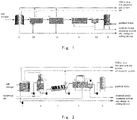
- Fig. 1 shows a flow chart of a traditional treatment process for oily sewage.
- the oily sewage first enters a conditioning tank 1 where primary separation of oil, sludge, and water is achieved.
- the effluent from the conditioning tank enters an oil separating pool 10 for further separating oil, sludge, and water.
- the effluent from the oil separating pool enters a flotation pool 11 for removing dispersed oil and suspended particles.
- the effluent from the flotation pool enters an A/O (anoxic/aerobic) biochemical pool 4 where microorganisms are used to remove organic matter in the sewage.
- the effluent from the biochemical pool enters a secondary sedimentation pool 12 for further sedimentation.
- the effluent from the secondary sedimentation pool enters a deep treatment device 5 for further treatment to obtain purified water, wherein the sludge obtained from the treatments in the conditioning tank, the oil separating pool and the flotation pool is delivered to coking device; the VOCs are delivered to a low-pressure gas system; the oil obtained from the treatments in the conditioning tank and the oil separating pool is delivered to an oil recovery system; part of the active sludge settled in the secondary sedimentation pool is returned to the biochemical pool for further treatment, and part of it is delivered to a residual sludge treatment system.
- the present disclosure provides a novel method and a novel apparatus for pretreatment of oily sewage without air flotation, thereby solving the problems existing in the prior art.
- the present disclosure provides a method for pretreatment of oily sewage without air flotation, comprising the following steps:
- the method further comprises: (e) deep treatment: further treating the effluent obtained by the biochemical treatment in Step (d); and (f) hydrocyclone-intensified filter backwash: backwashing the hydrocyclone-intensified filter at a frequency of not more than one time per week.
- the suspended matter in the oily sewage when suspended matter in the oily sewage has a concentration of 5000 mg/L or less, the suspended matter in the oily sewage is removed in Steps (a) and (b), so that the concentration of the suspended matter in the effluent is reduced to 50mg/L or less.
- Steps (b) and (c) when petroleum matter in the oily sewage has a concentration of 20000 mg/L or less, deoiling is effected in Steps (b) and (c), so that the concentration of the petroleum matter is reduced to 20 mg/L or less; wherein a retention time of the oily sewage in Steps (b) and (c) does not exceed 30 minutes in total.
- the present disclosure provides an oily sewage pretreatment apparatus that exempts air flotation, wherein the apparatus comprises:
- the apparatus further comprises a deep treatment device connected to the AOH biochemical pool for further deep treatment of the effluent obtained by the biochemical treatment.
- a filter material having a particle size of 0.5-2mm is used for a bed packing of the hydrocyclone-intensified filter; one or more hydrocyclone separators are provided on top of the hydrocyclone-intensified filter; and, in the backwash process of the hydrocyclone-intensified filter, the rotation of the particles in the hydrocyclone separators is utilized to intensified the filter material regeneration.
- the shape coalescer comprises a modular internal part comprising hydrophilic-oleophobic fibers and oleophilic-hydrophobic fibers weaved in an X and/or ⁇ pattern.
- the shape coalescer comprises an oil pocket for oil collection, wherein the oil pocket is controlled automatically to discharge oil at intervals.
- the integrated unit of the hydrocyclone-intensified filter and the shape coalescer connected in series has a pressure drop of 0.12 MPa or less, and a footprint that is reduced by about 70% as compared with a traditional API oil separation + flotation process.
- the main advantages of the method and apparatus of the invention include:
- the invention adopts a process combining sedimentation separation, hydrocyclone-intensified filter and shape coalescence separation to realize removal of oil and suspended solids from oily sewage, and an air flotation unit is exempted.
- This process effects no addition of chemicals, no air blowing, and no generation of flotation scum, and has the advantages of low cost, simple process, high separation efficiency, etc.
- a pretreatment process combining sedimentation separation, hydrocyclone-intensified filter and shape coalescence separation has been invented to remove oil and suspended solids from oily sewage, wherein the sedimentation separation can achieve primary separation of oil, sludge, and water; the hydrocyclone-intensified filter can achieve deep filtration and intensified regeneration of the filter material; the shape coalescer can achieve demulsification, coalescence and separation of emulsified oil; and the effluent from the coalescer enters a biochemical pool directly, wherein an air flotation unit is exempted.
- the present invention has been completed.
- a method for pretreatment of oily sewage without air flotation comprising the following steps:
- the method further comprises: (e) deep treatment: further treating the effluent obtained by the biochemical treatment in Step (d) using an AOH biochemical pool.
- the method further comprises: (f) backwash: backwashing the hydrocyclone-intensified filter at a frequency of not more than one time per week.
- the suspended matter in the oily sewage when suspended matter in the oily sewage has a concentration of 5000 mg/L or less, the suspended matter in the oily sewage can be removed effectively in Steps (a) and (b), so that the concentration of the suspended matter in the effluent is reduced to 50mg/L or less.
- a retention time of the oily sewage in Steps (b) and (c) does not exceed 30 minutes in total.
- an oily sewage pretreatment apparatus that exempts air flotation, wherein the apparatus comprises:
- the apparatus further comprises a deep treatment device connected to the AOH biochemical pool for further treatment of the effluent obtained by the biochemical treatment.
- a filter material having a particle size of 0.5-2mm is used for a bed packing of the hydrocyclone-intensified filter.
- one or more hydrocyclone separators are provided on top of the hydrocyclone-intensified filter, and in the backwash process of the hydrocyclone-intensified filter, the rotation and revolution of the particles in the hydrocyclone separators are utilized to intensified the filter material regeneration.
- the shape coalescer comprises a modular internal part comprising hydrophilic-oleophobic fibers and oleophilic-hydrophobic fibers weaved in an X and/or ⁇ pattern.
- the shape coalescer comprises an oil pocket for oil collection, wherein the oil pocket is controlled automatically to discharge oil at intervals.
- the integrated unit of the hydrocyclone-intensified filtration separator and the shape coalescer connected in series has a pressure drop of 0.12 MPa or less, and a footprint that is reduced by about 70% as compared with a traditional API oil separation + flotation process.
- Fig. 2 is a schematic diagram of an oily sewage treatment process according to an embodiment of the present invention.
- oily sewage first enters a conditioning tank 1 in which primary separation of oil, sludge and water is achieved.
- the effluent from the conditioning tank enters a hydrocyclone-intensified filter 2 for removing dispersed oil, sludge, sand and the like in the oily sewage.
- the resulting oily sewage enters a shape coalescer 3 for further treatment to achieve the demulsification, coalescence and separation of emulsified oil (water-in-oil and oil-in-water).
- the treated wastewater enters the AOH biochemical pool 4 together with air for removing organic matter in the wastewater.
- the effluent from the AOH biochemical pool enters a deep treatment device 5 for further treatment to obtain purified water.
- the backwash of hydrocyclone-intensified filter is necessary.
- the oily sludge obtained by the treatment in the conditioning tank is delivered to coking device; the VOCs are delivered to a low-pressure gas system; and the oil is delivered to an oil recovery system.
- One or more hydrocyclone separators 6 are installed on the top of the hydrocyclone-intensified filter, wherein the rotation and revolution of the particles in the hydrocyclone are utilized to achieve intensified regeneration of the filter material during the backwash process of the hydrocyclone-intensified filter.
- the overflow of the hydrocyclone separators is returned to the conditioning tank for further treatment.
- the shape coalescer achieves oil-water separation with the use of an oil removal module.
- the oil is collected in an oil bag 7, and the separated oil is delivered to the oil recovery system.
- the effluent from the coalescer is further treated in the AOH biochemical pool with the use of activated sludge. Part of the activated sludge settled in the secondary sedimentation pool is returned to the biochemical pool for recycling, and part of it is delivered to a residual sludge treatment system.
- This Example was applied to an oily sewage pretreatment system in the oil refining area of a petrochemical refinery.
- the previous pretreatment process used by the sewage treatment plant in this base was a combination of homogenization + API oil separation + flotation.
- the process flow was relatively long, and the arrangement of the corresponding covered buildings had a risk of untight sealing.
- the water quality conditions of the oily sewage used in this Example are shown in Table 1, and the treatment process flow is shown in Fig. 2 .
- the key devices in this process flow were a hydrocyclone-intensified filter and a shape coalescer. In practical applications, different numbers of devices can be connected in parallel according to different processing capacities.
- the key process devices are shell-type devices which are convenient for transportation and installation.
- a hydrocyclone-intensified filterr was coupled with a shape coalescer to treat petrochemical oily sewage.
- Table 1 The water quality conditions of the oily sewage are shown in Table 1 below: Table 1: Incoming water quality conditions COD (chemical oxygen demand) (mg/L) NH 4 -N (mg/L) Suspending matter (mg/L) Petroleum matter (mg/L) 800 40 50-10000 20-20000
- COD chemical oxygen demand
- NH 4 -N mg/L
- Suspending matter mg/L
- Petroleum matter mg/L
- the pretreatment system was used to conduct continuous experiments on the incoming water.
- the experimental working conditions included conventional working conditions (oil content being less than 200mg/L) and shock working conditions (oil content being greater than 1000mg/L), and the oil contents in the influent and the effluent were measured.
- the measurement results are shown in Table 2 and Table 3 below.
- Table 2 Oil contents in influent and effluent under conventional working conditions Time Oil content in influent (mg/L) Oil content in effluent (mg/L) Day 1 98.2 33.8 Day 2 125 28.5 Day 3 76.9 29.4 Day 4 47.2 21.3 Day 5 44.9 25.3
- Table 3 Oil contents in influent and effluent under shock working conditions Time Oil content in influent (mg/L) Oil content in effluent (mg/L) Day 1 15000 41.1 Day 2 10000 42.2 Day 3 5000 59.1 Day 5 10000 55.3 Day 6 20000 65.2
- the pretreatment system can effectively cope with the shock working conditions of oily sewage. Under the shock working conditions, more than 99% of the oil in the sewage can be recovered, while the volatilization of VOCs is effectively controlled, so that the volatilization of VOCs is reduced from the source.
- the leakage and diffusion of at least 60% of the hydrocarbons in the oily sewage in a traditional pretreatment unit are avoided; instead, the hydrocarbons are classified and collected concentratedly.
- the hydrocyclone-intensified filter can effectively intercept suspended matter which is enriched and recovered by a regeneration process. It's expected that the total amount of sediment can be reduced by 30%, and the process for enrichment and recovery of the sediment also realizes cyclic closed treatment.
- the novel pretreatment method of the present invention has a steady effect in removing oil and suspended solids.
- the concentration of the oil can be substantially controlled at 30mg/L or less under conventional working conditions, which means that most of the suspended oil and emulsified oil are removed.
- the recovery efficiency of the petroleum matter reaches 99% or higher under the shock working conditions, which means that great economic benefits can be achieved.
- this pretreatment method can substantially control the concentration of the suspended matter at 50mg/L or less.
Landscapes
- Chemical & Material Sciences (AREA)
- Engineering & Computer Science (AREA)
- Life Sciences & Earth Sciences (AREA)
- Water Supply & Treatment (AREA)
- Hydrology & Water Resources (AREA)
- Environmental & Geological Engineering (AREA)
- Organic Chemistry (AREA)
- Analytical Chemistry (AREA)
- Microbiology (AREA)
- Biodiversity & Conservation Biology (AREA)
- Mechanical Engineering (AREA)
- Physics & Mathematics (AREA)
- Thermal Sciences (AREA)
- Chemical Kinetics & Catalysis (AREA)
- Physical Water Treatments (AREA)
Abstract
Description
- The present disclosure pertains to the field of petrochemical industry and environmental protection, and relates to an oily sewage treatment technology. Particularly, the present disclosure relates to an oily sewage treatment method that combines sedimentation separation, hydrocyclone-intensified filtration, and shape coalescence separation. The present disclosure also relates to an oily sewage treatment apparatus.
- Processes for treatment of a large quantity of oily sewage can be found in the petrochemical, environmental protection, and coal chemical industries. There are many types of pollutants in wastewater, including oil, suspended solids, bacteria, dissolved organics, and trace heavy metal elements. At present, a combination of API (American Petroleum Institute) oil separation, flotation and biochemical processes is commonly applied for oily sewage treatment. A pretreatment process is used mainly for removing oil and suspended solids from the oily sewage, and it's a keypoint in the whole sewage treatment process. The quality of the pretreatment process has a direct influence on the treatment effect of the subsequent biochemical unit.
- The existing oily sewage pretreatment devices have a number of problems in common. Taking an oily sewage treatment scale of 1000m3/h for an example, the API oil separation + flotation process consumes the following chemicals: 6080t PAC (polyaluminum chloride) per year, 2800t FeCl3 per year, and 115t PAM (polyacrylamide) per year. So, the chemical consumption is huge, the cost is high, and it is easy to cause secondary pollution. A flotation pool needs to be aerated, and its VOCs (volatile organic compounds) emission may reach 8100Nm3/h. As the structure of the building is large, VOCs are prone to leakage during the operation. In addition, the flotation scum output from the flotation pool is about 500t per month. As such, a large amount of oily hazardous waste is produced.
- With respect to oil and suspended solids, the main pollutants in oily sewage, the treatment methods commonly used currently include, inter alia, gravity sedimentation, centrifugal separation, adsorption, and air flotation. These treatment methods all have their own limitations and are often difficult to achieve the emission requirements when used alone. In response to the gradual upgrade of environmental protection requirements, some processes which couple various methods have been developed, and domestic and foreign researchers have done work in various aspects.
- For example, US patent application
US20120132588A1 discloses a method for treating oily wastewater, wherein electrochemical flocculation and flotation are used for pretreatment, and membrane distillation is used to treat the pretreated effluent which may be used as raw water to generate steam. However, this method has the problem of large energy consumption. -
Chinese patent CN104843817B discloses a method for removing oil by horizontal air flotation with the use of a corrugated plate in combination and an apparatus for the same, wherein an optimized combination of a multi-layer inclined plate unit and a horizontal air flotation process is used to realize three phase separation with high efficiency, rapidity and low energy consumption, suitable for sewage treatment, crude oil exploitation and other oily wastewater treatment processes. -
Chinese patent application CN106007209 discloses a pretreatment process for removing oil from oil refining wastewater, wherein a combination of mechanical separation, coarsening treatment and air flotation technology is used for pretreatment to achieve oil-water separation. The invention makes use of physical and chemical co-actions. The oil content in the pretreated oily wastewater is ≤20mg/L, which meets the national standard. However, there is still the problem of VOCs produced by air flotation. -
Fig. 1 shows a flow chart of a traditional treatment process for oily sewage. As shown inFig. 1 , the oily sewage first enters a conditioning tank 1 where primary separation of oil, sludge, and water is achieved. The effluent from the conditioning tank enters anoil separating pool 10 for further separating oil, sludge, and water. The effluent from the oil separating pool enters aflotation pool 11 for removing dispersed oil and suspended particles. The effluent from the flotation pool enters an A/O (anoxic/aerobic) biochemical pool 4 where microorganisms are used to remove organic matter in the sewage. The effluent from the biochemical pool enters asecondary sedimentation pool 12 for further sedimentation. The effluent from the secondary sedimentation pool enters adeep treatment device 5 for further treatment to obtain purified water, wherein the sludge obtained from the treatments in the conditioning tank, the oil separating pool and the flotation pool is delivered to coking device; the VOCs are delivered to a low-pressure gas system; the oil obtained from the treatments in the conditioning tank and the oil separating pool is delivered to an oil recovery system; part of the active sludge settled in the secondary sedimentation pool is returned to the biochemical pool for further treatment, and part of it is delivered to a residual sludge treatment system. - As the existing oily sewage treatment processes are concerned, research on methods for reducing oil content is being deepened uninterruptedly. However, an air flotation process is inevitably used in the treatment. The air flotation process can effectively remove dispersed oil and suspended particles, but addition of chemicals is necessary for removing emulsified oil. In addition, the air flotation process often has such problems as a large amount of floatation scum, and volatilization and leakage of VOCs.
- Therefore, there is an urgent need in the art to develop a method and an apparatus that can reduce the emission of VOCs and the quantity of oily sludge in a short process, and overcome the above-mentioned defects of the air flotation process in the prior art.
- The present disclosure provides a novel method and a novel apparatus for pretreatment of oily sewage without air flotation, thereby solving the problems existing in the prior art.
- In one aspect, the present disclosure provides a method for pretreatment of oily sewage without air flotation, comprising the following steps:
- (a) Sedimentation separation: subjecting oily sewage to sedimentation separation to achieve primary separation of oil, sludge, and water;
- (b)Hydrocyclone-intensified filtration: subjecting the oily sewage obtained by the primary separation in Step (a) to hydrocyclone-intensified filtration for the further remove of dispersed oil, sludge and sand from the oily sewage;
- (c) Shape coalescence separation: subjecting the oily sewage obtained by Hydrocyclone-intensified filtration in Step (b) to shape coalescence separation to achieve the demulsification, coalescence and separation of emulsified oil; and
- (d) Biochemical treatment: delivering the effluent obtained in Step (c) directly to a biochemical system, wherein an air flotation unit is exempted.
- In a preferred embodiment, the method further comprises: (e) deep treatment: further treating the effluent obtained by the biochemical treatment in Step (d); and (f) hydrocyclone-intensified filter backwash: backwashing the hydrocyclone-intensified filter at a frequency of not more than one time per week.
- In another preferred embodiment, when suspended matter in the oily sewage has a concentration of 5000 mg/L or less, the suspended matter in the oily sewage is removed in Steps (a) and (b), so that the concentration of the suspended matter in the effluent is reduced to 50mg/L or less.
- In another preferred embodiment, when petroleum matter in the oily sewage has a concentration of 20000 mg/L or less, deoiling is effected in Steps (b) and (c), so that the concentration of the petroleum matter is reduced to 20 mg/L or less; wherein a retention time of the oily sewage in Steps (b) and (c) does not exceed 30 minutes in total.
- On the other hand, the present disclosure provides an oily sewage pretreatment apparatus that exempts air flotation, wherein the apparatus comprises:
- A conditioning tank for sedimentation separation of oily sewage to achieve primary separation of oil, sludge, and water;
- A hydrocyclone-intensified filter connected to the conditioning tank for the further remove of dispersed oil, sludge and sand from the oily sewage;
- A shape coalescer connected to the hydrocyclone-intensified filter to achieve the demulsification, coalescence and separation of emulsified oil; and
- An AOH (anoxic/aerobic/hydrocyclone) biochemical pool connected to the shape coalescer for removing organic matter in the effluent from the shape coalescer, wherein an air flotation unit is exempted.
- In a preferred embodiment, the apparatus further comprises a deep treatment device connected to the AOH biochemical pool for further deep treatment of the effluent obtained by the biochemical treatment.
- In another preferred embodiment, a filter material having a particle size of 0.5-2mm is used for a bed packing of the hydrocyclone-intensified filter; one or more hydrocyclone separators are provided on top of the hydrocyclone-intensified filter; and, in the backwash process of the hydrocyclone-intensified filter, the rotation of the particles in the hydrocyclone separators is utilized to intensified the filter material regeneration.
- In another preferred embodiment, the shape coalescer comprises a modular internal part comprising hydrophilic-oleophobic fibers and oleophilic-hydrophobic fibers weaved in an X and/or Ω pattern. In another preferred embodiment, the shape coalescer comprises an oil pocket for oil collection, wherein the oil pocket is controlled automatically to discharge oil at intervals.
- In another preferred embodiment, the integrated unit of the hydrocyclone-intensified filter and the shape coalescer connected in series has a pressure drop of 0.12 MPa or less, and a footprint that is reduced by about 70% as compared with a traditional API oil separation + flotation process.
- The main advantages of the method and apparatus of the invention include:
The invention adopts a process combining sedimentation separation, hydrocyclone-intensified filter and shape coalescence separation to realize removal of oil and suspended solids from oily sewage, and an air flotation unit is exempted. This process effects no addition of chemicals, no air blowing, and no generation of flotation scum, and has the advantages of low cost, simple process, high separation efficiency, etc. - The accompanying drawings are provided for further understanding of the disclosure. They constitute a part of the specification only for further explanation of the disclosure without limiting the disclosure.
-
Fig. 1 shows a flow chart of a traditional treatment process for oily sewage. -
Fig. 2 is a schematic diagram of an oily sewage treatment process according to an embodiment of the present invention. - After extensive and intensive research, the inventors of the present application have discovered that for a mixed system comprising solid phase, water phase, and oil phase, such as oily sewage which entails a large operating flux, the pretreatment methods that are commonly used are processes combining homogenization, API oil separation, and flotation, but these conventional processes have such problems as high complexity in process flow and low flexibility in operation. Therefore, a pretreatment process combining sedimentation separation, hydrocyclone-intensified filter and shape coalescence separation has been invented to remove oil and suspended solids from oily sewage, wherein the sedimentation separation can achieve primary separation of oil, sludge, and water; the hydrocyclone-intensified filter can achieve deep filtration and intensified regeneration of the filter material; the shape coalescer can achieve demulsification, coalescence and separation of emulsified oil; and the effluent from the coalescer enters a biochemical pool directly, wherein an air flotation unit is exempted. Based on the above findings, the present invention has been completed.
- In one aspect of the present disclosure, there is provided a method for pretreatment of oily sewage without air flotation, comprising the following steps:
- (a) Sedimentation separation: subjecting oily sewage to sedimentation separation in a conditioning tank to achieve primary separation of oil, sludge, and water;
- (b) Hydrocyclone-intensified filter: subjecting the oily sewage obtained by the primary separation in Step (a) to hydrocyclone-intensified filtration using a hydrocyclone-intensified filter to further remove dispersed oil, sludge, sand and the like from the oily sewage;
- (c) Shape coalescence separation: subjecting the oily sewage obtained by hydrocyclone-intensified filtration in Step (b) to shape coalescence separation using a shape coalescer to achieve demulsification, coalescence and separation of emulsified oil; and
- (d) Biochemical treatment: delivering the effluent obtained in Step (c) directly to a biochemical system, wherein an air flotation unit is exempted.
- In the present disclosure, the method further comprises: (e) deep treatment: further treating the effluent obtained by the biochemical treatment in Step (d) using an AOH biochemical pool.
- In the present disclosure, the method further comprises: (f) backwash: backwashing the hydrocyclone-intensified filter at a frequency of not more than one time per week.
- In the present disclosure, when suspended matter in the oily sewage has a concentration of 5000 mg/L or less, the suspended matter in the oily sewage can be removed effectively in Steps (a) and (b), so that the concentration of the suspended matter in the effluent is reduced to 50mg/L or less.
- In the present disclosure, when petroleum matter in the oily sewage has a concentration of 20000 mg/L or less, deoiling is effected in Steps (b) and (c), so that the concentration of the petroleum matter is reduced to 20 mg/L or less.
- In the present disclosure, a retention time of the oily sewage in Steps (b) and (c) does not exceed 30 minutes in total.
- In a second aspect of the present disclosure, there is provided an oily sewage pretreatment apparatus that exempts air flotation, wherein the apparatus comprises:
- A conditioning tank for sedimentation separation of oily sewage to achieve primary separation of oil, sludge, and water;
- A hydrocyclone-intensified filter connected to the conditioning tank for the further remove of dispersed oil, sludge and sand from the oily sewage;
- A shape coalescer connected to the hydrocyclone-intensified filter to achieve the demulsification, coalescence and separation of emulsified oil; and
- An AOH biochemical pool connected to the shape coalescer for removing organic matter in the effluent from the shape coalescer, wherein an air flotation unit is exempted.
- In the present disclosure, the apparatus further comprises a deep treatment device connected to the AOH biochemical pool for further treatment of the effluent obtained by the biochemical treatment.
- In the present disclosure, a filter material having a particle size of 0.5-2mm is used for a bed packing of the hydrocyclone-intensified filter.
- In the present disclosure, one or more hydrocyclone separators are provided on top of the hydrocyclone-intensified filter, and in the backwash process of the hydrocyclone-intensified filter, the rotation and revolution of the particles in the hydrocyclone separators are utilized to intensified the filter material regeneration.
- In the present disclosure, the shape coalescer comprises a modular internal part comprising hydrophilic-oleophobic fibers and oleophilic-hydrophobic fibers weaved in an X and/or Ω pattern.
- In the present disclosure, the shape coalescer comprises an oil pocket for oil collection, wherein the oil pocket is controlled automatically to discharge oil at intervals.
- In the present disclosure, the integrated unit of the hydrocyclone-intensified filtration separator and the shape coalescer connected in series has a pressure drop of 0.12 MPa or less, and a footprint that is reduced by about 70% as compared with a traditional API oil separation + flotation process.
- Reference will be now made to the accompanying drawings.
-
Fig. 2 is a schematic diagram of an oily sewage treatment process according to an embodiment of the present invention. As shown inFig. 2 , oily sewage first enters a conditioning tank 1 in which primary separation of oil, sludge and water is achieved. The effluent from the conditioning tank enters a hydrocyclone-intensifiedfilter 2 for removing dispersed oil, sludge, sand and the like in the oily sewage. The resulting oily sewage enters a shape coalescer 3 for further treatment to achieve the demulsification, coalescence and separation of emulsified oil (water-in-oil and oil-in-water). The treated wastewater enters the AOH biochemical pool 4 together with air for removing organic matter in the wastewater. The effluent from the AOH biochemical pool enters adeep treatment device 5 for further treatment to obtain purified water. After a period of operation, the backwash of hydrocyclone-intensified filter is necessary. The oily sludge obtained by the treatment in the conditioning tank is delivered to coking device; the VOCs are delivered to a low-pressure gas system; and the oil is delivered to an oil recovery system. One or more hydrocyclone separators 6 are installed on the top of the hydrocyclone-intensified filter, wherein the rotation and revolution of the particles in the hydrocyclone are utilized to achieve intensified regeneration of the filter material during the backwash process of the hydrocyclone-intensified filter. The overflow of the hydrocyclone separators is returned to the conditioning tank for further treatment. The shape coalescer achieves oil-water separation with the use of an oil removal module. The oil is collected in an oil bag 7, and the separated oil is delivered to the oil recovery system. The effluent from the coalescer is further treated in the AOH biochemical pool with the use of activated sludge. Part of the activated sludge settled in the secondary sedimentation pool is returned to the biochemical pool for recycling, and part of it is delivered to a residual sludge treatment system. - The invention will be further illustrated with reference to the following specific Examples. It is nevertheless to be appreciated that these Examples are only intended to exemplify the invention without limiting the scope of the invention. The test methods in the following examples for which no specific conditions are indicated will be carried out generally under conventional conditions or under those conditions suggested by the manufacturers. Unless otherwise specified, all parts are parts by weight, and all percentages are percentages by weight.
- This Example was applied to an oily sewage pretreatment system in the oil refining area of a petrochemical refinery. The previous pretreatment process used by the sewage treatment plant in this base was a combination of homogenization + API oil separation + flotation. The process flow was relatively long, and the arrangement of the corresponding covered buildings had a risk of untight sealing. The water quality conditions of the oily sewage used in this Example are shown in Table 1, and the treatment process flow is shown in
Fig. 2 . - The key devices in this process flow were a hydrocyclone-intensified filter and a shape coalescer. In practical applications, different numbers of devices can be connected in parallel according to different processing capacities. The key process devices are shell-type devices which are convenient for transportation and installation. In this Example, a hydrocyclone-intensified filterr was coupled with a shape coalescer to treat petrochemical oily sewage.
- The water quality conditions of the oily sewage are shown in Table 1 below:
Table 1: Incoming water quality conditions COD (chemical oxygen demand) (mg/L) NH4-N (mg/L) Suspending matter (mg/L) Petroleum matter (mg/L) 800 40 50-10000 20-20000 - The pretreatment system was used to conduct continuous experiments on the incoming water. The experimental working conditions included conventional working conditions (oil content being less than 200mg/L) and shock working conditions (oil content being greater than 1000mg/L), and the oil contents in the influent and the effluent were measured. The measurement results are shown in Table 2 and Table 3 below.
Table 2: Oil contents in influent and effluent under conventional working conditions Time Oil content in influent (mg/L) Oil content in effluent (mg/L) Day 1 98.2 33.8 Day 2125 28.5 Day 3 76.9 29.4 Day 4 47.2 21.3 Day 544.9 25.3 Table 3: Oil contents in influent and effluent under shock working conditions Time Oil content in influent (mg/L) Oil content in effluent (mg/L) Day 1 15000 41.1 Day 210000 42.2 Day 3 5000 59.1 Day 510000 55.3 Day 6 20000 65.2 - As can be seen from the analysis of the water quality of the influent and effluent, the pretreatment system can effectively cope with the shock working conditions of oily sewage. Under the shock working conditions, more than 99% of the oil in the sewage can be recovered, while the volatilization of VOCs is effectively controlled, so that the volatilization of VOCs is reduced from the source. As shown by the experimental results, by sealing the pretreatment process, the leakage and diffusion of at least 60% of the hydrocarbons in the oily sewage in a traditional pretreatment unit are avoided; instead, the hydrocarbons are classified and collected concentratedly. In addition, in this Example, the hydrocyclone-intensified filter can effectively intercept suspended matter which is enriched and recovered by a regeneration process. It's expected that the total amount of sediment can be reduced by 30%, and the process for enrichment and recovery of the sediment also realizes cyclic closed treatment.
- The novel pretreatment method of the present invention has a steady effect in removing oil and suspended solids. As can be seen from the measurement results of the concentrations of the petroleum matter in the influent and effluent, the concentration of the oil can be substantially controlled at 30mg/L or less under conventional working conditions, which means that most of the suspended oil and emulsified oil are removed. The recovery efficiency of the petroleum matter reaches 99% or higher under the shock working conditions, which means that great economic benefits can be achieved. In addition, this pretreatment method can substantially control the concentration of the suspended matter at 50mg/L or less.
- The Examples listed above are only preferred examples in the disclosure, and they are not intended to limit the scope of the disclosure. Equivalent variations and modifications according to the disclosure in the scope of the present application for invention all fall in the technical scope of the disclosure.
- All of the documents mentioned in the disclosure are incorporated herein by reference, as if each of them were incorporated herein individually by reference. It is to be further understood that various changes or modifications to the disclosure can be made by those skilled in the art after reading the above teachings of the disclosure, and these equivalent variations fall in the scope defined by the accompanying claims of the application as well.
Claims (10)
- A method for pretreatment of oily sewage without air flotation, comprising the following steps:(a) Sedimentation separation: subjecting oily sewage to sedimentation separation to achieve primary separation of oil, sludge, and water;(b) Hydrocyclone-intensified filtration: subjecting the oily sewage obtained by the primary separation in Step (a) to hydrocyclone-intensified filtration to further remove dispersed oil, sludge and sand from the oily sewage;(c) Shape coalescence separation: subjecting the oily sewage obtained by hydrocyclone-intensified filtration in Step (b) to shape coalescence separation to achieve the demulsification, coalescence and separation of emulsified oil; and(d) Biochemical treatment: delivering the effluent obtained in Step (c) directly to a biochemical system, wherein an air flotation unit is exempted.
- The method of claim 1, wherein the method further comprises: (e) deep treatment: further treating the effluent obtained by the biochemical treatment in Step (d); and (f) backwash: backwashing the hydrocyclone-intensified filter at a frequency of not more than one time per week.
- The method of claim 1 or 2, wherein when suspended matter in the oily sewage has a concentration of 5000 mg/L or less, the suspended matter in the oily sewage is removed in Steps (a) and (b), so that the concentration of the suspended matter in the effluent is reduced to 50mg/L or less.
- The method of claim 1 or 2, wherein when petroleum matter in the oily sewage has a concentration of 20000 mg/L or less, deoiling is effected in Steps (b) and (c), so that the concentration of the petroleum matter is reduced to 20 mg/L or less; wherein a retention time of the oily sewage in Steps (b) and (c) does not exceed 30 minutes in total.
- An oily sewage pretreatment apparatus that exempts air flotation, wherein the apparatus comprises:A conditioning tank (1) for sedimentation separation of oily sewage to achieve primary separation of oil, sludge, and water;A hydrocyclone-intensified filter (2) connected to the conditioning tank (1) for the further remove of dispersed oil, sludge and sand from the oily sewage;A shape coalescer (3) connected to the hydrocyclone-intensified filter (2) to achieve demulsification, coalescence and separation of emulsified oil; andAn AOH biochemical pool (4) connected to the shape coalescer (3) for removing organic matter in the effluent from the shape coalescer, wherein an air flotation unit is exempted.
- The apparatus of claim 5, wherein the apparatus further comprises a deep treatment device (5) connected to the AOH biochemical pool (4) for further treatment of the effluent obtained by the biochemical treatment.
- The apparatus of claim 5 or 6, wherein a filter material having a particle size of 0.5-2mm is used for a bed packing of the hydrocyclone-intensified filter (2); and one or more hydrocyclone separators (6) are provided on top of the hydrocyclone-intensified filter (2); wherein in the backwash process of the hydrocyclone-intensified filter (2), the rotation of particles in the hydrocyclone separators (6) is utilized to intensified the filter material regeneration.
- The apparatus of claim 5 or 6, wherein the shape coalescer (3) comprises a modular internal part comprising hydrophilic-oleophobic fibers and oleophilic-hydrophobic fibers weaved in an X and/or Ω pattern.
- The apparatus of claim 5 or 6, wherein the shape coalescer (3) comprises an oil pocket (7) for oil collection, wherein the oil pocket is controlled automatically to discharge oil at intervals.
- The apparatus of claim 5 or 6, wherein an integrated unit of the hydrocyclone-intensified filtration separator (2) and the shape coalescer (3) connected in series has a pressure drop of 0.12 MPa or less, and a footprint that is reduced by 70% as compared with a traditional API oil separation + flotation process.
Applications Claiming Priority (2)
| Application Number | Priority Date | Filing Date | Title |
|---|---|---|---|
| CN201811347039.5A CN111170552B (en) | 2018-11-13 | 2018-11-13 | Oily sewage pretreatment method and device without air floatation |
| PCT/CN2019/078618 WO2020098193A1 (en) | 2018-11-13 | 2019-03-19 | Oily sewage pretreatment method and device without air flotation |
Publications (4)
| Publication Number | Publication Date |
|---|---|
| EP3882220A1 true EP3882220A1 (en) | 2021-09-22 |
| EP3882220A4 EP3882220A4 (en) | 2022-04-27 |
| EP3882220B1 EP3882220B1 (en) | 2025-04-30 |
| EP3882220C0 EP3882220C0 (en) | 2025-04-30 |
Family
ID=70651791
Family Applications (1)
| Application Number | Title | Priority Date | Filing Date |
|---|---|---|---|
| EP19884607.3A Active EP3882220B1 (en) | 2018-11-13 | 2019-03-19 | Oily sewage pretreatment method and device without air flotation |
Country Status (4)
| Country | Link |
|---|---|
| US (1) | US12017939B2 (en) |
| EP (1) | EP3882220B1 (en) |
| CN (1) | CN111170552B (en) |
| WO (1) | WO2020098193A1 (en) |
Families Citing this family (14)
| Publication number | Priority date | Publication date | Assignee | Title |
|---|---|---|---|---|
| CN112028271A (en) * | 2020-06-06 | 2020-12-04 | 兰州资源环境职业技术学院 | Kitchen waste oil-water separation and kitchen wastewater treatment method |
| US12540084B2 (en) | 2020-09-17 | 2026-02-03 | East China University of Science and Technology q | Deep purification device and method for Methanol-to-Olefin washing water |
| CN112624411A (en) * | 2020-12-17 | 2021-04-09 | 华东理工大学 | Deep purification method and device for fracturing flowback fluid |
| CN112624406A (en) * | 2020-12-17 | 2021-04-09 | 华东理工大学 | Deep purification method and device for drilling sewage |
| CN113307405B (en) * | 2021-06-03 | 2022-12-13 | 招商局重工(江苏)有限公司 | Modular drilling platform dangerous area water falling treatment process and device |
| CN113714260A (en) * | 2021-09-06 | 2021-11-30 | 华东理工大学 | Kitchen waste sand and oil removing pretreatment method and device |
| CN114105421A (en) * | 2022-01-27 | 2022-03-01 | 新疆科力新技术发展股份有限公司 | Efficient purification reinjection treatment system and treatment method for complex wastewater in oil field |
| CN116696262A (en) * | 2022-02-28 | 2023-09-05 | 中国石油天然气股份有限公司 | Oil field water injection well flushing device |
| CN114702095B (en) * | 2022-03-10 | 2023-07-25 | 华东理工大学 | Circulating oil-water separation system and method for coupling segmented fiber particles with microbubbles |
| CN117682683A (en) * | 2022-08-23 | 2024-03-12 | 辽河石油勘探局有限公司 | An oil and gas associated trona ore brine pretreatment system and method |
| CN117142714B (en) * | 2023-09-28 | 2024-12-31 | 中国神华煤制油化工有限公司 | Treatment system for oily wastewater in methanol-to-olefin product |
| CN117401846A (en) * | 2023-10-24 | 2024-01-16 | 华东理工大学 | A process and device for near-zero discharge of oily and high-salt wastewater from refining |
| CN119191396A (en) * | 2024-07-17 | 2024-12-27 | 石化盈科信息技术有限责任公司 | A method and device for pretreatment of industrial wastewater samples |
| CN118993442A (en) * | 2024-09-27 | 2024-11-22 | 广西中伟新能源科技有限公司 | Treatment system and method for oily chemical wastewater |
Family Cites Families (18)
| Publication number | Priority date | Publication date | Assignee | Title |
|---|---|---|---|---|
| JP2826495B2 (en) * | 1995-12-26 | 1998-11-18 | 東北日本電気株式会社 | Oily wastewater filter |
| US5762810A (en) | 1996-11-22 | 1998-06-09 | Pelton; Paul | Coalescing oil/water separator |
| CN2609631Y (en) * | 2003-03-28 | 2004-04-07 | 北京华油惠博普科技有限公司 | Fluid whirlwind back-flash filter device |
| CN101337755B (en) * | 2008-08-29 | 2010-06-02 | 哈尔滨工业大学 | Biodegradation method of oil field super heavy oil wastewater |
| US20100193442A1 (en) * | 2009-02-05 | 2010-08-05 | Ian Tyler Bell | Fluidized Bed Method and Apparatus |
| CN101638274A (en) * | 2009-09-03 | 2010-02-03 | 江苏新龙鼎环保成套工程有限公司 | Portable complete device for treating oily wastewater from washing oil production well |
| CN101786776B (en) * | 2010-02-23 | 2011-10-19 | 北京欧泰克石油工程技术有限责任公司 | Advanced treatment process of sludge containing oil |
| CN102476881A (en) | 2010-11-30 | 2012-05-30 | 通用电气公司 | Treatment method and device of oil-containing wastewater |
| CN203545843U (en) * | 2013-10-30 | 2014-04-16 | 陈妍 | Composite type oil removing equipment |
| CN103964545B (en) * | 2014-05-19 | 2015-05-06 | 华东理工大学 | Method and device for deep oil removal of wastewater containing low-concentration sump oil |
| CN104843817B (en) | 2015-05-14 | 2017-11-07 | 华东理工大学 | A kind of horizontal air supporting coupled wave card deoiling method and its device |
| CN106007209B (en) | 2016-07-08 | 2018-12-25 | 南京日嘉新环保科技有限公司 | A kind of oil refinery's sewage oil removing pretreating process |
| CN108408894A (en) * | 2017-02-09 | 2018-08-17 | 中国石油化工股份有限公司 | A kind of method and device of eddy flow enhanced biodegradation treated sewage |
| CN106630502B (en) * | 2017-03-21 | 2020-03-17 | 乌海市中科院生态环境中心工业废水处理技术研究所 | Chemical sewage treatment device based on membrane bioreactor |
| CN206886920U (en) * | 2017-06-29 | 2018-01-16 | 天津博凯特科技有限公司 | A kind of multi-functional recycling petrochemical wastewater processing equipment |
| CN108328761B (en) * | 2017-08-29 | 2023-08-29 | 华东理工大学 | Method and device for prolonging continuous operation period of MTO water washing process |
| CN107433055B (en) * | 2017-08-30 | 2019-10-08 | 上海华畅环保设备发展有限公司 | Boiling granules regeneration method and device in ebullated bed separator |
| CN107512787B (en) | 2017-09-01 | 2021-06-18 | 上海华畅环保设备发展有限公司 | Method for sorting separation media in fluidized bed separator |
-
2018
- 2018-11-13 CN CN201811347039.5A patent/CN111170552B/en active Active
-
2019
- 2019-03-19 WO PCT/CN2019/078618 patent/WO2020098193A1/en not_active Ceased
- 2019-03-19 US US17/293,730 patent/US12017939B2/en active Active
- 2019-03-19 EP EP19884607.3A patent/EP3882220B1/en active Active
Also Published As
| Publication number | Publication date |
|---|---|
| CN111170552A (en) | 2020-05-19 |
| EP3882220B1 (en) | 2025-04-30 |
| EP3882220C0 (en) | 2025-04-30 |
| EP3882220A4 (en) | 2022-04-27 |
| WO2020098193A1 (en) | 2020-05-22 |
| US20220009811A1 (en) | 2022-01-13 |
| CN111170552B (en) | 2022-04-05 |
| US12017939B2 (en) | 2024-06-25 |
Similar Documents
| Publication | Publication Date | Title |
|---|---|---|
| US12017939B2 (en) | Oily sewage pretreatment method and device without air floatation | |
| CN1141263C (en) | Method for controlling oil-bearing waste water | |
| CN102531291A (en) | Standard discharge treatment system for rock debris wastewater | |
| US20210070642A1 (en) | Ballasted Activated Sludge Treatment Combined with High-Rate Liquids/Solids Separation Systems | |
| CN113277597A (en) | Method and device for separating oil-containing wastewater heterojunction microchannel | |
| CN112979015B (en) | Quality-divided treatment system and treatment method for port oily water | |
| CN111943461A (en) | An electrolytic capacitor and electrode foil wastewater treatment method and treatment system | |
| CN111170394B (en) | Emission reduction method and device for volatile organic compounds in oily sewage cleaning treatment | |
| CN111170551B (en) | Method and device for oil recovery in oily sewage cleaning treatment | |
| CN109437454A (en) | The reinforcing materialization treating method and apparatus of refinery high ammonia special type oily wastewater with high salt | |
| Al-Ani | Treatment of oily wastewater produced from old processing plant of north oil company | |
| CN111186936A (en) | Oily water treatment method and oily water treatment system | |
| CN101302063B (en) | Industrial sewage processing unit and industrial sewage process method | |
| CN105884148A (en) | Automobile coating sewage treatment process | |
| CN111170550B (en) | Method and device for reducing oil sludge and scum in oily sewage cleaning treatment | |
| WO2018153932A1 (en) | Wastewater treatment lines for improved carbon uptake through cake filtration of wastewater | |
| RU141342U1 (en) | COMPLEX FOR WASTE WATER TREATMENT FROM OIL PRODUCTS | |
| CN110590008A (en) | Waste cutting fluid treatment process | |
| dos Santos et al. | Treatment of secondary effluent using dissolved air flotation on a pilot-scale: Assessing operating conditions | |
| CN223659954U (en) | Gas field produced water treatment device for oil content in range of 500mgL-30000mgL | |
| CN112759199A (en) | Treatment process of waste cutting fluid | |
| CN112158914A (en) | Oily sewage treatment system | |
| CN221500830U (en) | Water washing phosphogypsum wastewater purification treatment system | |
| CN219929875U (en) | Fluorescent wastewater zero-emission recycling treatment system based on low-temperature evaporation desalination | |
| CN111908710A (en) | Phenol-containing wastewater treatment system |
Legal Events
| Date | Code | Title | Description |
|---|---|---|---|
| STAA | Information on the status of an ep patent application or granted ep patent |
Free format text: STATUS: THE INTERNATIONAL PUBLICATION HAS BEEN MADE |
|
| PUAI | Public reference made under article 153(3) epc to a published international application that has entered the european phase |
Free format text: ORIGINAL CODE: 0009012 |
|
| STAA | Information on the status of an ep patent application or granted ep patent |
Free format text: STATUS: REQUEST FOR EXAMINATION WAS MADE |
|
| 17P | Request for examination filed |
Effective date: 20210610 |
|
| AK | Designated contracting states |
Kind code of ref document: A1 Designated state(s): AL AT BE BG CH CY CZ DE DK EE ES FI FR GB GR HR HU IE IS IT LI LT LU LV MC MK MT NL NO PL PT RO RS SE SI SK SM TR |
|
| DAV | Request for validation of the european patent (deleted) | ||
| DAX | Request for extension of the european patent (deleted) | ||
| A4 | Supplementary search report drawn up and despatched |
Effective date: 20220329 |
|
| RIC1 | Information provided on ipc code assigned before grant |
Ipc: B01D 36/04 20060101ALI20220323BHEP Ipc: B01D 24/36 20060101ALI20220323BHEP Ipc: C02F 9/14 20060101ALI20220323BHEP Ipc: C02F 3/30 20060101ALI20220323BHEP Ipc: C02F 1/40 20060101ALI20220323BHEP Ipc: C02F 9/02 20060101AFI20220323BHEP |
|
| STAA | Information on the status of an ep patent application or granted ep patent |
Free format text: STATUS: EXAMINATION IS IN PROGRESS |
|
| 17Q | First examination report despatched |
Effective date: 20230324 |
|
| REG | Reference to a national code |
Ref country code: DE Ref legal event code: R079 Free format text: PREVIOUS MAIN CLASS: C02F0009020000 Ipc: C02F0009000000 Ref country code: DE Ref legal event code: R079 Ref document number: 602019069466 Country of ref document: DE Free format text: PREVIOUS MAIN CLASS: C02F0009020000 Ipc: C02F0009000000 |
|
| GRAP | Despatch of communication of intention to grant a patent |
Free format text: ORIGINAL CODE: EPIDOSNIGR1 |
|
| STAA | Information on the status of an ep patent application or granted ep patent |
Free format text: STATUS: GRANT OF PATENT IS INTENDED |
|
| RIC1 | Information provided on ipc code assigned before grant |
Ipc: C02F 3/30 20060101ALN20241203BHEP Ipc: C02F 1/40 20060101ALN20241203BHEP Ipc: C02F 1/38 20060101ALN20241203BHEP Ipc: C02F 103/36 20060101ALN20241203BHEP Ipc: C02F 101/32 20060101ALN20241203BHEP Ipc: B01D 36/04 20060101ALI20241203BHEP Ipc: B01D 24/36 20060101ALI20241203BHEP Ipc: C02F 9/00 20060101AFI20241203BHEP |
|
| INTG | Intention to grant announced |
Effective date: 20241212 |
|
| GRAS | Grant fee paid |
Free format text: ORIGINAL CODE: EPIDOSNIGR3 |
|
| GRAA | (expected) grant |
Free format text: ORIGINAL CODE: 0009210 |
|
| STAA | Information on the status of an ep patent application or granted ep patent |
Free format text: STATUS: THE PATENT HAS BEEN GRANTED |
|
| AK | Designated contracting states |
Kind code of ref document: B1 Designated state(s): AL AT BE BG CH CY CZ DE DK EE ES FI FR GB GR HR HU IE IS IT LI LT LU LV MC MK MT NL NO PL PT RO RS SE SI SK SM TR |
|
| REG | Reference to a national code |
Ref country code: CH Ref legal event code: EP Ref country code: GB Ref legal event code: FG4D |
|
| REG | Reference to a national code |
Ref country code: IE Ref legal event code: FG4D |
|
| REG | Reference to a national code |
Ref country code: DE Ref legal event code: R096 Ref document number: 602019069466 Country of ref document: DE |
|
| U01 | Request for unitary effect filed |
Effective date: 20250528 |
|
| U07 | Unitary effect registered |
Designated state(s): AT BE BG DE DK EE FI FR IT LT LU LV MT NL PT RO SE SI Effective date: 20250604 |
|
| PG25 | Lapsed in a contracting state [announced via postgrant information from national office to epo] |
Ref country code: ES Free format text: LAPSE BECAUSE OF FAILURE TO SUBMIT A TRANSLATION OF THE DESCRIPTION OR TO PAY THE FEE WITHIN THE PRESCRIBED TIME-LIMIT Effective date: 20250430 |
|
| PG25 | Lapsed in a contracting state [announced via postgrant information from national office to epo] |
Ref country code: NO Free format text: LAPSE BECAUSE OF FAILURE TO SUBMIT A TRANSLATION OF THE DESCRIPTION OR TO PAY THE FEE WITHIN THE PRESCRIBED TIME-LIMIT Effective date: 20250730 Ref country code: GR Free format text: LAPSE BECAUSE OF FAILURE TO SUBMIT A TRANSLATION OF THE DESCRIPTION OR TO PAY THE FEE WITHIN THE PRESCRIBED TIME-LIMIT Effective date: 20250731 |
|
| PG25 | Lapsed in a contracting state [announced via postgrant information from national office to epo] |
Ref country code: PL Free format text: LAPSE BECAUSE OF FAILURE TO SUBMIT A TRANSLATION OF THE DESCRIPTION OR TO PAY THE FEE WITHIN THE PRESCRIBED TIME-LIMIT Effective date: 20250430 |
|
| PG25 | Lapsed in a contracting state [announced via postgrant information from national office to epo] |
Ref country code: HR Free format text: LAPSE BECAUSE OF FAILURE TO SUBMIT A TRANSLATION OF THE DESCRIPTION OR TO PAY THE FEE WITHIN THE PRESCRIBED TIME-LIMIT Effective date: 20250430 |
|
| PG25 | Lapsed in a contracting state [announced via postgrant information from national office to epo] |
Ref country code: RS Free format text: LAPSE BECAUSE OF FAILURE TO SUBMIT A TRANSLATION OF THE DESCRIPTION OR TO PAY THE FEE WITHIN THE PRESCRIBED TIME-LIMIT Effective date: 20250731 |
|
| PG25 | Lapsed in a contracting state [announced via postgrant information from national office to epo] |
Ref country code: IS Free format text: LAPSE BECAUSE OF FAILURE TO SUBMIT A TRANSLATION OF THE DESCRIPTION OR TO PAY THE FEE WITHIN THE PRESCRIBED TIME-LIMIT Effective date: 20250830 |
|
| PG25 | Lapsed in a contracting state [announced via postgrant information from national office to epo] |
Ref country code: SM Free format text: LAPSE BECAUSE OF FAILURE TO SUBMIT A TRANSLATION OF THE DESCRIPTION OR TO PAY THE FEE WITHIN THE PRESCRIBED TIME-LIMIT Effective date: 20250430 |
|
| PG25 | Lapsed in a contracting state [announced via postgrant information from national office to epo] |
Ref country code: CZ Free format text: LAPSE BECAUSE OF FAILURE TO SUBMIT A TRANSLATION OF THE DESCRIPTION OR TO PAY THE FEE WITHIN THE PRESCRIBED TIME-LIMIT Effective date: 20250430 |
|
| PG25 | Lapsed in a contracting state [announced via postgrant information from national office to epo] |
Ref country code: SK Free format text: LAPSE BECAUSE OF FAILURE TO SUBMIT A TRANSLATION OF THE DESCRIPTION OR TO PAY THE FEE WITHIN THE PRESCRIBED TIME-LIMIT Effective date: 20250430 |
|
| PLBE | No opposition filed within time limit |
Free format text: ORIGINAL CODE: 0009261 |
|
| STAA | Information on the status of an ep patent application or granted ep patent |
Free format text: STATUS: NO OPPOSITION FILED WITHIN TIME LIMIT |
|
| REG | Reference to a national code |
Ref country code: CH Ref legal event code: L10 Free format text: ST27 STATUS EVENT CODE: U-0-0-L10-L00 (AS PROVIDED BY THE NATIONAL OFFICE) Effective date: 20260311 |
|
| U20 | Renewal fee for the european patent with unitary effect paid |
Year of fee payment: 8 Effective date: 20260209 |
|
| 26N | No opposition filed |
Effective date: 20260202 |
|
| PGFP | Annual fee paid to national office [announced via postgrant information from national office to epo] |
Ref country code: GB Payment date: 20260202 Year of fee payment: 8 |