EP3881686A1 - Tobacco-containing segment and method for producing same, noncombustible heating-smoking article and noncombustible heating-smoking system - Google Patents
Tobacco-containing segment and method for producing same, noncombustible heating-smoking article and noncombustible heating-smoking system Download PDFInfo
- Publication number
- EP3881686A1 EP3881686A1 EP19885004.2A EP19885004A EP3881686A1 EP 3881686 A1 EP3881686 A1 EP 3881686A1 EP 19885004 A EP19885004 A EP 19885004A EP 3881686 A1 EP3881686 A1 EP 3881686A1
- Authority
- EP
- European Patent Office
- Prior art keywords
- tobacco
- heat
- containing segment
- wrapper
- smoking article
- Prior art date
- Legal status (The legal status is an assumption and is not a legal conclusion. Google has not performed a legal analysis and makes no representation as to the accuracy of the status listed.)
- Pending
Links
Images


Classifications
-
- A—HUMAN NECESSITIES
- A24—TOBACCO; CIGARS; CIGARETTES; SIMULATED SMOKING DEVICES; SMOKERS' REQUISITES
- A24B—MANUFACTURE OR PREPARATION OF TOBACCO FOR SMOKING OR CHEWING; TOBACCO; SNUFF
- A24B15/00—Chemical features or treatment of tobacco; Tobacco substitutes, e.g. in liquid form
- A24B15/10—Chemical features of tobacco products or tobacco substitutes
- A24B15/12—Chemical features of tobacco products or tobacco substitutes of reconstituted tobacco
- A24B15/14—Chemical features of tobacco products or tobacco substitutes of reconstituted tobacco made of tobacco and a binding agent not derived from tobacco
-
- A—HUMAN NECESSITIES
- A24—TOBACCO; CIGARS; CIGARETTES; SIMULATED SMOKING DEVICES; SMOKERS' REQUISITES
- A24D—CIGARS; CIGARETTES; TOBACCO SMOKE FILTERS; MOUTHPIECES OF CIGARS OR CIGARETTES; MANUFACTURE OF TOBACCO SMOKE FILTERS OR MOUTHPIECES
- A24D1/00—Cigars; Cigarettes
- A24D1/002—Cigars; Cigarettes with additives, e.g. for flavouring
-
- A—HUMAN NECESSITIES
- A24—TOBACCO; CIGARS; CIGARETTES; SIMULATED SMOKING DEVICES; SMOKERS' REQUISITES
- A24D—CIGARS; CIGARETTES; TOBACCO SMOKE FILTERS; MOUTHPIECES OF CIGARS OR CIGARETTES; MANUFACTURE OF TOBACCO SMOKE FILTERS OR MOUTHPIECES
- A24D1/00—Cigars; Cigarettes
- A24D1/02—Cigars; Cigarettes with special covers
-
- A—HUMAN NECESSITIES
- A24—TOBACCO; CIGARS; CIGARETTES; SIMULATED SMOKING DEVICES; SMOKERS' REQUISITES
- A24D—CIGARS; CIGARETTES; TOBACCO SMOKE FILTERS; MOUTHPIECES OF CIGARS OR CIGARETTES; MANUFACTURE OF TOBACCO SMOKE FILTERS OR MOUTHPIECES
- A24D1/00—Cigars; Cigarettes
- A24D1/02—Cigars; Cigarettes with special covers
- A24D1/025—Cigars; Cigarettes with special covers the covers having material applied to defined areas, e.g. bands for reducing the ignition propensity
-
- A—HUMAN NECESSITIES
- A24—TOBACCO; CIGARS; CIGARETTES; SIMULATED SMOKING DEVICES; SMOKERS' REQUISITES
- A24D—CIGARS; CIGARETTES; TOBACCO SMOKE FILTERS; MOUTHPIECES OF CIGARS OR CIGARETTES; MANUFACTURE OF TOBACCO SMOKE FILTERS OR MOUTHPIECES
- A24D1/00—Cigars; Cigarettes
- A24D1/04—Cigars; Cigarettes with mouthpieces or filter-tips
- A24D1/042—Cigars; Cigarettes with mouthpieces or filter-tips with mouthpieces
-
- A—HUMAN NECESSITIES
- A24—TOBACCO; CIGARS; CIGARETTES; SIMULATED SMOKING DEVICES; SMOKERS' REQUISITES
- A24D—CIGARS; CIGARETTES; TOBACCO SMOKE FILTERS; MOUTHPIECES OF CIGARS OR CIGARETTES; MANUFACTURE OF TOBACCO SMOKE FILTERS OR MOUTHPIECES
- A24D1/00—Cigars; Cigarettes
- A24D1/20—Cigarettes specially adapted for simulated smoking devices
-
- A—HUMAN NECESSITIES
- A24—TOBACCO; CIGARS; CIGARETTES; SIMULATED SMOKING DEVICES; SMOKERS' REQUISITES
- A24F—SMOKERS' REQUISITES; MATCH BOXES; SIMULATED SMOKING DEVICES
- A24F40/00—Electrically operated smoking devices; Component parts thereof; Manufacture thereof; Maintenance or testing thereof; Charging means specially adapted therefor
- A24F40/40—Constructional details, e.g. connection of cartridges and battery parts
- A24F40/46—Shape or structure of electric heating means
-
- D—TEXTILES; PAPER
- D21—PAPER-MAKING; PRODUCTION OF CELLULOSE
- D21H—PULP COMPOSITIONS; PREPARATION THEREOF NOT COVERED BY SUBCLASSES D21C OR D21D; IMPREGNATING OR COATING OF PAPER; TREATMENT OF FINISHED PAPER NOT COVERED BY CLASS B31 OR SUBCLASS D21G; PAPER NOT OTHERWISE PROVIDED FOR
- D21H19/00—Coated paper; Coating material
- D21H19/10—Coatings without pigments
- D21H19/14—Coatings without pigments applied in a form other than the aqueous solution defined in group D21H19/12
- D21H19/20—Coatings without pigments applied in a form other than the aqueous solution defined in group D21H19/12 comprising macromolecular compounds obtained by reactions only involving carbon-to-carbon unsaturated bonds
-
- D—TEXTILES; PAPER
- D21—PAPER-MAKING; PRODUCTION OF CELLULOSE
- D21H—PULP COMPOSITIONS; PREPARATION THEREOF NOT COVERED BY SUBCLASSES D21C OR D21D; IMPREGNATING OR COATING OF PAPER; TREATMENT OF FINISHED PAPER NOT COVERED BY CLASS B31 OR SUBCLASS D21G; PAPER NOT OTHERWISE PROVIDED FOR
- D21H27/00—Special paper not otherwise provided for, e.g. made by multi-step processes
-
- D—TEXTILES; PAPER
- D21—PAPER-MAKING; PRODUCTION OF CELLULOSE
- D21H—PULP COMPOSITIONS; PREPARATION THEREOF NOT COVERED BY SUBCLASSES D21C OR D21D; IMPREGNATING OR COATING OF PAPER; TREATMENT OF FINISHED PAPER NOT COVERED BY CLASS B31 OR SUBCLASS D21G; PAPER NOT OTHERWISE PROVIDED FOR
- D21H5/00—Special paper or cardboard not otherwise provided for
- D21H5/12—Special paper or cardboard not otherwise provided for characterised by the use of special fibrous materials
- D21H5/14—Special paper or cardboard not otherwise provided for characterised by the use of special fibrous materials of cellulose fibres only
- D21H5/16—Tobacco or cigarette paper
Definitions
- the present invention relates to a tobacco-containing segment, a manufacturing method therefor, a heat-not-burn smoking article, and a heat-not-burn smoking system.
- a common combustion smoking article (cigarette) for smoking through combustion includes a tobacco-containing segment, in which a tobacco filler of dry tobacco leaves shredded into a width of about 1 mm and added with a flavor, a humectant, an appropriate amount of moisture, and so forth is wrapped cylindrically in a paper wrapper; and a mouthpiece segment, in which a corrugated paper or fibers of cellulose acetate or the like are wrapped cylindrically in a paper wrapper.
- the tobacco-containing segment and the mouthpiece segment are joined with a lining paper.
- a user smokes by igniting the end of the tobacco-containing segment with a lighter or the like and inhaling from the end of the mouthpiece segment.
- the leading end of the tobacco-containing segment burns at a temperature exceeding 800°C.
- a heat-not-burn smoking article and a heat-not-burn smoking system which utilize heating in place of combustion
- the heating temperature is lower than the burning temperature in a combustion smoking article and is 400°C or lower, for example.
- a tobacco filler of a tobacco-containing segment contains an aerosol former, such as glycerol, propylene glycol (PG), triethyl citrate (TEC), or triacetin.
- an aerosol former is vaporized upon heating, moved to a cooling segment within a mouthpiece segment through inhalation, and cooled to generate an aerosol further reliably. Since the aerosol is inhaled together during inhalation, it is possible to ensure the satisfactory sensation of a user.
- a heat-not-burn smoking system typically includes a cylindrical heat-not-burn smoking article having a shape similar to a common combustion smoking article; and a heating device equipped with a battery, a controller, a heater, and so forth.
- Exemplary heaters include an electric resistance heater and an induction heater.
- Exemplary heating methods by an electric resistance heater include a method of heating a heat-not-burn smoking article with a heater from the outside and a method of heating by inserting a needle-like or blade-like heater from the leading end of a heat-not-burn smoking article into a tobacco-containing segment that includes a tobacco filler.
- a tobacco-containing segment of a heat-not-burn smoking article contains an aerosol former, there is a case in which a tobacco component, a flavor component, or the like (aerosol component per se as well) bleeds into a paper wrapper that wraps a tobacco filler, thereby staining the outer surface of the wrapper.
- a high-temperature burning portion moves as burning progresses. Consequently, only a tobacco-containing segment near the burning portion is heated and a volatile component present in such a portion is volatilized and inhaled by a user.
- a volatile component present in the longitudinal direction of the tobacco-containing segment of a combustion smoking article is almost uniformly volatilized and delivered throughout inhalation.
- the entire longitudinal direction of its tobacco-containing segment is heated by a heater. Consequently, much of a volatile component, such as a volatile flavor component or an aerosol former, contained in the tobacco-containing segment is volatilized in the former half of inhalation in some cases.
- An object of the present invention is to provide a tobacco-containing segment that can suppress staining on a wrapper thereof and uniformly deliver a volatile component contained therein throughout inhalation as well as to provide a heat-not-burn smoking article and a heat-not-burn smoking system.
- a tobacco-containing segment according to the present invention is a tobacco-containing segment for a heat-not-burn smoking article, including a tobacco filler containing tobacco and an aerosol former; and a wrapper that covers the tobacco filler, where the wrapper includes a paper and a polymer layer provided on an inner surface of the paper; and the polymer layer contains a polymer as well as a volatile flavor component or an aerosol former.
- a heat-not-burn smoking article according to the present invention includes the above-described tobacco-containing segment and a mouthpiece segment.
- a heat-not-burn smoking system includes the above-mentioned heat-not-burn smoking article and a heating device for heating the tobacco-containing segment.
- a method of manufacturing the tobacco-containing segment according to the present invention includes producing the wrapper through a step of applying to the paper a dispersion in which the polymer as well as the volatile flavor component or the aerosol former are dispersed in an aqueous dispersion medium, followed by drying.
- a tobacco-containing segment that can suppress staining on a wrapper thereof and uniformly deliver a volatile component contained therein throughout inhalation as well as to provide a heat-not-burn smoking article and a heat-not-burn smoking system.
- a tobacco-containing segment according to the present invention is a tobacco-containing segment for a heat-not-burn smoking article, including a tobacco filler containing tobacco and an aerosol former; and a wrapper that covers the tobacco filler.
- the wrapper includes a paper and a polymer layer provided on an inner surface of the paper.
- the polymer layer contains a polymer as well as a volatile flavor component or an aerosol former (hereinafter, also referred to as "volatile component").
- the wrapper includes a polymer layer on an inner surface of a paper. Due to the presence of the polymer layer, it is possible to suppress bleeding of a volatile flavor component, a tobacco component, and/or an aerosol former contained in a large amount in a tobacco filler and thus to suppress staining on the wrapper.
- the polymer layer contains a polymer as well as a volatile flavor component or an aerosol former, which is a volatile component.
- the configuration of the tobacco-containing segment according to the present invention is not particularly limited provided that the tobacco-containing segment is a tobacco-containing segment for a heat-not-burn smoking article, including a tobacco filler containing tobacco and an aerosol former; and a wrapper that covers the tobacco filler, where the wrapper includes a paper and a polymer layer provided on an inner surface of the paper; and the polymer layer contains a polymer as well as a volatile flavor component or an aerosol former.
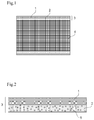
- Fig. 1 illustrates an exemplary tobacco-containing segment according to the present invention.
- the tobacco-containing segment illustrated in Fig. 1 includes a tobacco filler 4 containing tobacco and an aerosol former; and a tubular wrapper 3 that covers the tobacco filler 4.
- the wrapper 3 includes a paper 1 on the outer surface side and a polymer layer 2 on the inner surface side.
- the polymer layer 2 contains a polymer as well as a volatile flavor component or an aerosol former.
- the shape of the tobacco-containing segment is not particularly limited and may be columnar, for example.
- the perimeter length of the tobacco-containing segment is preferably 16 to 25 mm, more preferably 20 to 24 mm, and further preferably 21 to 23 mm
- the length of the tobacco-containing segment in the axial direction, in other words, the horizontal direction in Fig. 1 is preferably 20 to 70 mm, more preferably 20 to 50 mm, and further preferably 20 to 30 mm
- the cross-sectional shape of the tobacco-containing segment is not particularly limited and may be circular, elliptic, or polygonal, for example.
- a tobacco filler according to the present invention contains tobacco and an aerosol former.
- the tobacco filler may further contain a volatile flavor component, water, and so forth.
- the size of tobacco used as a filler or a preparation method therefor is not particularly limited.
- dry tobacco leaves shredded into a width of 0.8 to 1.2 mm may be used.
- the shreds have a length of about 5 to 20 mm
- those prepared by uniformly pulverizing dry tobacco leaves into an average particle size of about 20 to 200 ⁇ m, forming into sheets, and shredding the sheets into a width of 0.8 to 1.2 mm may also be used.
- the shreds have a length of about 5 to 20 mm.
- the above-mentioned formed sheets may be gathered without shredding and used as a filler.
- various types of tobacco may be employed for a tobacco filler. Flue-cured, burley, oriental, and domestic, regardless of Nicotiana tabacum varieties or Nicotiana rustica varieties, may be blended as appropriate for an intended taste and used. The details of the varieties of tobacco are disclosed in " Tobacco no Jiten (Dictionary of Tobacco), Tobacco Academic Studies Center, March 31, 2009 .” There are a plurality of conventional methods for pulverizing tobacco and forming into uniform sheets.
- Such sheets include a sheet made by a paper making process; a cast sheet made by uniformly mixing with a suitable solvent, such as water, thinly casting the resulting uniform mixture on a metal sheet or a metal sheet belt, and drying; and a rolled sheet formed by extruding a uniform mixture with a suitable solvent, such as water, into a sheet shape.
- a suitable solvent such as water
- the details of the types of uniform sheets are disclosed in " Tobacco no Jiten (Dictionary of Tobacco), Tobacco Academic Studies Center, March 31, 2009 .”
- the aerosol former is a material that can generate an aerosol upon heating, and examples include glycerol, propylene glycol (PG), triethyl citrate (TEC), triacetin, and 1,3-butanediol.
- the filling density of a tobacco filler is not particularly limited but is typically 250 mg/cm 3 or more, preferably 320 mg/cm 3 or more and typically 520 mg/cm 3 or less, preferably 420 mg/cm 3 or less from a viewpoint of ensuring the performance of a heat-not-burn smoking article and imparting a satisfactory smoking flavor.
- the content range of a tobacco filler in the tobacco-containing segment is 200 to 400 mg and preferably from 250 to 320 mg per tobacco-containing segment.
- the content of an aerosol former in a tobacco filler is not particularly limited but is typically 5 to 50 mass% and preferably 10 to 20 mass% from a viewpoint of sufficiently generating an aerosol and imparting a satisfactory smoking flavor.
- a tobacco filler contains a volatile flavor component
- the content of the volatile flavor component in the tobacco filler is not particularly limited but is typically 10,000 ppm or more, preferably 20,000 ppm or more, more preferably 25,000 ppm or more and typically 50,000 ppm or less, preferably 40,000 ppm or less, further preferably 33,000 ppm or less from a viewpoint of imparting a satisfactory smoking flavor.
- a method of packing a tobacco filler within a wrapper is not particularly limited.
- a tobacco filler may be wrapped in a wrapper or a tubular wrapper may be filled with a tobacco filler.
- tobacco may be packed with the longitudinal direction randomly aligned within a wrapper or may be packed with the longitudinal direction aligned with the axial direction or the direction perpendicular to the axial direction of the tobacco-containing segment.
- a tobacco component and an aerosol former contained in a tobacco filler are vaporized by heating the tobacco-containing segment and moved to a mouthpiece segment through inhalation.
- a wrapper according to the present invention includes a paper and a polymer layer provided on an inner surface of the paper.
- Fig. 2 illustrates an exemplary wrapper according to the present invention.
- a polymer layer 2 is provided on a paper 1.
- the polymer layer 2 contains a volatile flavor component or an aerosol former as a volatile component 5.
- the paper is not particularly limited provided that the paper functions as a support.
- the basis weight of the paper is preferably 25 g/m 2 or more and more preferably 35 to 50 g/m 2 .
- the paper preferably has a low air permeability and more preferably has an air permeability of zero.
- the thickness of the paper is not particularly limited and may be 30 to 60 ⁇ m, for example.
- the polymer layer contains a polymer and either of a volatile flavor component or an aerosol former or may contain a polymer and both a volatile flavor component and an aerosol former. It is presumed that a volatile component contained in the polymer layer is gradually released from the polymer layer since a polymer becomes rubbery or dissolved upon heating or an aerosol vaporized from a tobacco filler comes into contact with the polymer layer.
- the types of the polymer are not particularly limited but are preferably biodegradable polymers or edible polymers.
- the polymer has a glass transition temperature (Tg) of preferably 400°C or lower, more preferably 300°C or lower, and further preferably 200°C or lower.
- Tg glass transition temperature
- the lower limit of Tg of the polymer is not particularly limited and may be 40°C or higher, for example.
- the Tg of a polymer is specifically a value measured with a differential scanning calorimeter (trade name: "DSC7000" from Hitachi High-Tech Science Corporation).
- polymer examples include polyvinyl alcohol (PVA), polyvinyl alcohol-acrylic acid-methyl methacrylate copolymer (POVACOAT), cellulose acetate, trehalose, maltose, sucrose, maltitol, glucose, waxes, and hardened oils. These may be used alone or in combination. Among these, PVA or polyvinyl alcohol-acrylic acid-methyl methacrylate copolymer (POVACOAT) is preferable as a polymer in view of satisfactory coating properties of paper.
- PVA polyvinyl alcohol
- POVACOAT polyvinyl alcohol-acrylic acid-methyl methacrylate copolymer
- POVACOAT polyvinyl alcohol-acrylic acid-methyl methacrylate copolymer
- the PVA preferably has an average degree of polymerization of 1,500 or less.
- PVA has an average degree of polymerization of 1,500 or less, it is possible to improve coating properties of paper and uniformly form a polymer layer on paper.
- the average degree of polymerization of PVA is more preferably 100 or more and 1,300 or less, further preferably 300 or more and 1,200 or less, and particularly preferably 500 or more and 1,000 or less.
- the average degree of polymerization of PVA is a value measured in accordance with the testing methods for polyvinyl alcohol in JIS K 6726-1994.
- the PVA when the polymer is PVA, the PVA preferably has a degree of saponification of 90 mol% or more.
- the degree of saponification of PVA is more preferably 90 mol% or more and 99 mol% or less and further preferably 93 mol% or more and 98 mol% or less.
- the degree of saponification of PVA is a value measured in accordance with the testing methods for polyvinyl alcohol in JIS K 6726-1994.
- the volatile flavor component is not particularly limited and examples include, from a viewpoint of imparting a satisfactory smoking flavor, acetanisole, acetophenone, acetylpyrazine, 2-acetylthiazole, alfalfa extract, amyl alcohol, amyl butyrate, trans-anethole, star anise oil, apple juice, Peru balsam oil, beeswax absolute, benzaldehyde, benzoin resinoid, benzyl alcohol, benzyl benzoate, benzyl phenylacetate, benzyl propionate, 2,3-butanedione, 2-butanol, butyl butyrate, butyric acid, caramel, cardamom oil, carob absolute, ⁇ -carotene, carrot juice, L-carvone, ⁇ -caryophyllene, cassia bark oil, cedarwood oil, celery seed oil, chamomile oil, cinnamaldehyde, c
- menthol is particularly preferable.
- These volatile flavor components may be used alone or in combination.
- An aerosol former the same as that contained in a tobacco filler may be used as an aerosol former to be contained in the polymer layer.
- An aerosol former contained in the polymer layer may be the same as or different from an aerosol former contained in a tobacco filler.
- the polymer layer preferably has a porous structure.
- a volatile component existing inside pores of the porous structure is gradually released as the porous structure is partially broken by heating.
- Fig. 3 is an SEM image at 1,500 ⁇ for the cross-section of an exemplary polymer layer having a porous structure according to the present invention.
- the polymer layer 2 formed on the paper 1 has a plurality of fine pores, inside which a volatile component exists.
- the average pore size is preferably 0.5 ⁇ m or more and 20 ⁇ m or less and more preferably 1 ⁇ m or more and 10 ⁇ m or less.
- the average pore size of a porous structure is a value measured by a CD-SEM.
- a method of forming a porous structure is not particularly limited.
- the average pore size and porosity of a porous structure can be adjusted by the amount of the emulsifier to be used.
- the content of a volatile component in the polymer layer is preferably 10 mass% or more and 60 mass% or less based on 100 mass% of the polymer layer. When the content is 10 mass% or more, it is possible to deliver the volatile component further uniformly throughout inhalation.
- the content is more preferably 20 mass% or more and 60 mass% or less.
- the polymer layer preferably has a thickness of 10 ⁇ m or more and 60 ⁇ m or less.
- the thickness of the polymer layer is 10 ⁇ m or more, it is possible to retain a sufficient amount of a volatile component on the paper and thus deliver the volatile component further uniformly throughout inhalation.
- the thickness of the polymer layer is 60 ⁇ m or less, it is possible to enhance heat transfer from a heater in the case of heating the tobacco-containing segment from the outside using the heater.
- the thickness of the polymer layer is more preferably 15 ⁇ m or more and 50 ⁇ m or less and further preferably 20 ⁇ m or more and 40 ⁇ m or less.
- a method of manufacturing the tobacco-containing segment according to the present invention includes producing the wrapper through a step of applying to the paper a dispersion in which the polymer as well as the volatile flavor component or the aerosol former are dispersed in an aqueous dispersion medium, followed by drying. According to the method, the tobacco-containing segment according to the present invention can be manufactured suitably.
- a dispersion in which a polymer as well as a volatile flavor component or an aerosol former are dispersed in an aqueous dispersion medium is prepared.
- a dispersion in which a polymer, a volatile flavor component, and an aerosol former are dispersed in an aqueous dispersion medium may be prepared.
- a component that is solid at room temperature such as menthol
- a dispersion can be prepared, for example, by dissolving the solid component in ethanol and adding a polymer and an emulsifier as necessary to the resulting solution.
- Exemplary emulsifiers include glycerol fatty acid esters, sucrose fatty acid esters, and lecithins. These emulsifiers may be used alone or in combination.
- the solid component is dissolved in ethanol and the dissolution product and the polymer are dispersed in the dispersion (ethanol aqueous solution).
- ethanol aqueous solution ethanol aqueous solution
- the dispersion is applied and dried, ethanol and water are removed through volatilization while leaving, as pores, the portions where ethanol and water have existed.
- the formed polymer layer presumably has a porous structure in which the solid component exists inside pores.
- an emulsifier is used, micelles containing ethanol, the emulsifier, and the solid component are formed.
- pores are formed in micelle portions while leaving the solid component inside the pores.
- the formed polymer layer presumably has a porous structure in which the solid component exists inside the pores.
- the pore size of the porous structure can be adjusted, for example, by the amount of an emulsifier to be used. For example, as the amount of an emulsifier to be used decreases, the pore size increases. From a viewpoint of sufficiently holding a volatile component within pores and gradually releasing the volatile component upon heating, the pore size is preferably larger. In other words, the amount of an emulsifier to be used is preferably less.
- the concentration of an emulsifier in the dispersion is preferably 0 mass% or more and 10 mass% or less. Moreover, the concentration of a polymer in the dispersion is preferably 10 mass% or more and 30 mass% or less.
- the concentration of ethanol in the dispersion is preferably 5 mass% or more and 15 mass% or less.
- the concentration of a volatile flavor component or an aerosol former in the dispersion is preferably 5 mass% or more and 20 mass% or less.
- the dispersion is applied to a paper and dried.
- the amount of the dispersion applied to a paper may be appropriately selected according to the thickness of a polymer layer to be formed.
- the temperature during drying may be 60°C or higher and 200°C or lower, for example.
- a method of packing a tobacco filler within the obtained wrapper is not particularly limited.
- a tobacco filler which is tobacco containing an aerosol former or the like, may be wrapped in a wrapper or a tubular wrapper may be filled with the tobacco filler.
- tobacco may be packed with the longitudinal direction randomly aligned within a wrapper or may be packed with the longitudinal direction aligned with the axial direction or the direction perpendicular to the axial direction of the tobacco-containing segment.
- a heat-not-burn smoking article according to the present invention includes the tobacco-containing segment according to the present invention and a mouthpiece segment. Since the heat-not-burn smoking article includes the tobacco-containing segment according to the present invention, it is possible to suppress staining on a wrapper and uniformly deliver a volatile component throughout inhalation.
- the heat-not-burn smoking article according to the present invention may include other segments in addition to the tobacco-containing segment and the mouthpiece segment.
- Fig. 4 illustrates an exemplary heat-not-burn smoking article according to the present invention.
- the heat-not-burn smoking article 30 illustrated in Fig. 4 includes a tobacco-containing segment 10 according to the present invention and a mouthpiece segment 11.
- the mouthpiece segment 11 includes a cooling segment 12, a center hole segment 13, and a filter segment 14. During smoking, the tobacco-containing segment 10 is heated and inhalation takes place at the end of the filter segment 14.
- the cooling segment 12 comprises a tubular member 15.
- the tubular member 15 may be a paper tube of cylindrically processed cardboard, for example.
- the tubular member 15 and a mouthpiece lining paper 22 described hereinafter are provided with a perforation 16 passing therethrough. Due to the presence of the perforation 16, external air is introduced inside the cooling segment 12 during inhalation. Consequently, a volatile component vaporized through heating of the tobacco-containing segment 10 comes into contact with external air to be liquefied due to lowering temperature, thereby forming an aerosol.
- the size (diameter) of the perforation 16 is not particularly limited and may be 0.5 to 1.5 mm, for example.
- the number of the perforation 16 is also not particularly limited and may be one or two or more. For example, a plurality of perforations 16 may be provided on the perimeter of the cooling segment 12.
- the center hole segment comprises a filling layer having one or a plurality of hollow portions and an inner plug wrapper that covers the filling layer.
- the center hole segment 13 comprises a first filling layer 17 having a hollow portion and a first inner plug wrapper 18 that covers the first filling layer 17.
- the center hole segment 13 acts to increase the strength of the mouthpiece segment 11.
- the first filling layer 17 may be, for example, a rod of ⁇ 5.0 to ⁇ 1.0 mm in inner diameter formed by hardening highly densely packed cellulose acetate fibers added with 6 to 20 mass%, based on the mass of cellulose acetate, of a plasticizer including triacetin.
- the first filling layer 17 has a high filling density of fibers, air and an aerosol flow only through the hollow portion and hardly flow within the first filling layer 17 during inhalation.
- an aerosol component reduction through filtration in the filter segment 14 is desirably suppressed in the heat-not-burn smoking article 30, it is effective to reduce the length of the filter segment 14 and replace it with the center hole segment 13 for the purpose of increasing the amount of the aerosol component to be delivered.
- the first filling layer 17 inside the center hole segment 13 is a fiber-filled layer, a user rarely feels odd by touch from the outside during use.
- the filter segment 14 comprises a second filling layer 19 and a second inner plug wrapper 20 that covers the second filling layer 19. Since the second filling layer 19 is present all the way up to the mouth end in the filter segment 14, the mouth end exhibits an appearance similar to a common combustion smoking article. During inhalation, air and an aerosol pass through the second filling layer 19 and part of the aerosol is filtered.
- the second filling layer 19 may be a filling layer of cellulose acetate fibers, for example.
- the center hole segment 13 and the filter segment 14 are joined with an outer plug wrapper 21.
- the outer plug wrapper 21 may be a cylindrical paper, for example.
- the tobacco-containing segment 10, the cooling segment 12, and the connected center hole segment 13 and filter segment 14 are joined with the mouthpiece lining paper 22.
- These three segments may be joined, for example, by applying a glue, such as a vinyl acetate-based glue, to the inner surface of the mouthpiece lining paper 22 and wrapping the lining paper around these segments.
- a perforation 16 may be provided on the cooling segment 12.
- the length of the heat-not-burn smoking article according to the present invention in the axial direction is not particularly limited but is preferably 40 mm to 90 mm, more preferably 50 mm to 75 mm, and further preferably 50 mm to 60 mm
- the perimeter length of the heat-not-burn smoking article is preferably 16 mm to 25 mm, more preferably 20 mm to 24 mm, and further preferably 21 mm to 23 mm
- the length of the tobacco-containing segment 10 is 20 mm
- the length of the cooling segment 12 is 20 mm
- the length of the center hole segment 13 is 8 mm
- the length of the filter segment 14 is 7 mm
- the length of these individual segments may be changed appropriately depending on manufacturing feasibility, required quality, and so forth. Further, even an article in which only a filter segment is disposed on the downstream side of a cooling segment without using a center hole segment can also act as a heat-not-burn smoking article.
- a heat-not-burn smoking system includes the heat-not-burn smoking article according to the present invention and a heating device for heating the tobacco-containing segment. Since the heat-not-burn smoking system includes the heat-not-burn smoking article according to the present invention, it is possible to suppress staining on a wrapper and uniformly deliver a volatile component throughout inhalation.
- the heat-not-burn smoking system according to the present invention is not particularly limited provided that the heat-not-bum smoking article according to the present invention and the heating device are included and may have other configurations.
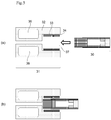
- Fig. 5 illustrates an exemplary heat-not-burn smoking system according to the present invention.
- the heat-not-burn smoking system illustrated in Fig. 5 includes a heat-not-burn smoking article 30 according to the present invention and a heating device 31 for heating a tobacco-containing segment of the heat-not-burn smoking article 30 from the outside.
- Fig. 5 (a) illustrates the state before inserting the heat-not-burn smoking article 30 into the heating device 31, and
- Fig. 5 (b) illustrates the state of heating the heat-not-burn smoking article 30 inserted into the heating device 31.
- the heating device 31 illustrated in Fig. 5 includes a body 32, a heater 33, a metal tube 34, a battery unit 35, and a control unit 36.
- the body 32 has a tubular recess 37, and the heater 33 and the metal tube 34 are arranged on the inner side surface of the recess 37 at a position corresponding to the tobacco-containing segment of the heat-not-burn smoking article 30 inserted into the recess 37.
- the heater 33 may be an electric resistance heater, and heating by the heater 33 is performed by supplying power from the battery unit 35 in accordance with instructions from the control unit 36, which controls temperature. Heat generated by the heater 33 is transferred to the tobacco-containing segment of the heat-not-burn smoking article 30 through the metal tube 34 having a high thermal conductivity.
- a gap exists between the outer perimeter of the heat-not-burn smoking article 30 and the inner perimeter of the metal tube 34.
- the heating device 31 heats the tobacco-containing segment of the heat-not-burn smoking article 30 from the outside, the heating device may be a heating device for heating from the inside.
- the heating temperature by the heating device is not particularly limited but is preferably 400°C or lower, more preferably 150°C or higher and 400°C or lower, and further preferably 200°C or higher and 350°C or lower.
- the heating temperature means the temperature of the heater in the heating device.
- a polymer layer containing a volatile component is provided on the inner surface of a wrapper of the tobacco-containing segment. Since the polymer layer is located near the heater of the heating device during heating, the volatile component contained in the polymer layer is released gradually but in a sufficient amount over a long period of time.
- solution A A solution (hereinafter, referred to as solution A) was prepared by dissolving 21 g of menthol in 9 g of ethanol.
- PVA Tg: 58°C, average degree of polymerization: 500, degree of saponification: 85 to 89 mol%) of 45 g was dispersed through mixing in 116 g of water heated to 80°C. Into the resulting mixture, solution A was added while stirring thoroughly with a stirrer to prepare a dispersion.
- the dispersion was applied to either surface (shred side) of a paper (trade name: 50NFB from Nippon Paper Papylia Co., Ltd., basis weight: 50 g/m 2 ) and dried at 60°C to 90°C to yield a wrapper in which a 20 to 30 ⁇ m-thick polymer layer is formed on the paper. Through the SEM observation of its cross-section, the polymer layer was confirmed to have a porous structure.
- a paper trade name: 50NFB from Nippon Paper Papylia Co., Ltd., basis weight: 50 g/m 2
- a commercial heat-not-burn smoking article (trade name: glo regular from British American Tobacco plc) was prepared.
- the heat-not-burn smoking article does not contain a volatile flavor component, and its portion corresponding to a tobacco-containing segment contains tobacco and glycerol as an aerosol former.
- a wrapper of the portion corresponding to a tobacco-containing segment is solely made of paper.
- a heat-not-burn smoking article for evaluation was obtained by removing the wrapper of the portion corresponding to a tobacco-containing segment of the heat-not-burn smoking article and by wrapping the prepared wrapper therearound.
- a heating device (trade name: glo from British American Tobacco plc) designed for the commercial heat-not-burn smoking article, the portion corresponding to a tobacco-containing segment of the heat-not-burn smoking article for evaluation was heated at 220°C.
- Smoking was performed in accordance with the Canadian intense smoking regimen. Components in an inhaled aerosol were trapped and subjected to shaking extraction with isopropanol (IPA), and the obtained sample was analyzed by GC. Specifically, smoking was performed as 4 puffs in total by inhaling 55 mL per puff (30 second interval for each puff, i.e. 2 seconds for inhaling and 28 seconds for waiting) in accordance with the CIR (Canadian intense regimen).
- IPA isopropanol
- Fig. 6 shows the menthol delivery efficiency, which represents a ratio of the amount of menthol in an inhaled aerosol per puff to the amount of menthol contained in each heat-not-burn smoking article. Moreover, Table 1 shows the total amount of menthol in inhaled aerosols during 4 puffs and the menthol delivery efficiency for 4 puffs in total.
- the heat-not-burn smoking articles for evaluation was put inside an airtight container and stored in an environment of a temperature of 22°C and a relative humidity of 60% for 4 weeks. Subsequently, the number of stains formed on the wrapper surfaces was visually observed for the heat-not-burn smoking article taken from the container.
- stains were measured by classifying into those satisfying 0.9 mm ⁇ L ⁇ 2.7 mm (small stain) and those satisfying 2.7 mm ⁇ L (large stain) where L is the maximum size of stains.
- the evaluation results are shown in Table 2.
- a unit of stains is each stain that can be approximated by an ellipse (including a circle) regardless of its isolation from other stains.
- the extent of staining is presented by the number of stained articles and the occurrence (%) of each level with a large or small stain or without stain for 200 heat-not-burn smoking articles.
- a commercial heat-not-burn smoking article (trade name: glo menthol from British American Tobacco plc) was prepared.
- a portion corresponding to a tobacco-containing segment of the heat-not-burn smoking article contains menthol as a volatile flavor component and glycerol as an aerosol former.
- a wrapper of the portion corresponding to a tobacco-containing segment is solely made of paper. It is noted that the amount of menthol contained in this heat-not-burn smoking article is larger than the amount of menthol contained in the heat-not-burn smoking article for evaluation prepared in Example 1.
- Example 1 The evaluation was performed in the same manner as Example 1 except for using the prepared heat-not-burn smoking article. The results are shown in Fig. 6 and Tables 1 and 2.
- Table 1 Total amount of menthol [mg/Cig] Menthol delivery efficiency (%) Ex. 1 5.0 51 Comp. Ex. 1 9.4 34
- Table 2 Small stain (number of articles) Large stain (number of articles) Small stain (%) Large stain (%) No stain (%) Ex. 1 0 0 0 0 100 Comp. Ex. 1 140 60 70 30 0
- Example 1 the menthol delivery efficiency from the first to the fourth puff was almost uniform in Example 1, in which a wrapper is provided with a polymer layer containing menthol. This is presumably because menthol was gradually released from the polymer layer. Meanwhile, the menthol delivery efficiency linearly decreased from the first to the fourth puff in Comparative Example 1, in which a tobacco filler contains menthol and a wrapper is not provided with a polymer layer containing menthol. This is presumably because much of menthol contained in the tobacco filler was vaporized in the former half of inhalation.
- Example 1 the menthol delivery efficiency for 4 puffs in total was higher in Example 1 than in Comparative Example 1. This is presumably because menthol is contained within the polymer layer of the wrapper and the polymer layer of the wrapper is located near a heater of the heating device during heating in Example 1. Since the initial amounts of menthol contained in the respective heat-not-burn smoking articles are different, Example 1 and Comparative Example 1 were compared on the basis of the menthol delivery efficiency in Fig. 6 and Table 1.
- Example 2 As shown in Table 2, no stain was observed on wrapper surfaces in Example 1 whereas stains were observed in Comparative Example 1. This is presumably because bleeding of an aerosol former, a tobacco component, and/or a volatile flavor component contained in a tobacco filler was successfully suppressed in Example 1 due to the presence of the polymer layer.
Landscapes
- Chemical & Material Sciences (AREA)
- Chemical Kinetics & Catalysis (AREA)
- General Chemical & Material Sciences (AREA)
- Cigarettes, Filters, And Manufacturing Of Filters (AREA)
- Paper (AREA)
- Manufacture Of Tobacco Products (AREA)
Abstract
Description
- The present invention relates to a tobacco-containing segment, a manufacturing method therefor, a heat-not-burn smoking article, and a heat-not-burn smoking system.
- A common combustion smoking article (cigarette) for smoking through combustion includes a tobacco-containing segment, in which a tobacco filler of dry tobacco leaves shredded into a width of about 1 mm and added with a flavor, a humectant, an appropriate amount of moisture, and so forth is wrapped cylindrically in a paper wrapper; and a mouthpiece segment, in which a corrugated paper or fibers of cellulose acetate or the like are wrapped cylindrically in a paper wrapper. The tobacco-containing segment and the mouthpiece segment are joined with a lining paper. A user smokes by igniting the end of the tobacco-containing segment with a lighter or the like and inhaling from the end of the mouthpiece segment. The leading end of the tobacco-containing segment burns at a temperature exceeding 800°C.
- As a substitute for such a common combustion smoking article, a heat-not-burn smoking article and a heat-not-burn smoking system, which utilize heating in place of combustion, have been developed (Patent Literature (PTL) 1 to 3, for example). The heating temperature is lower than the burning temperature in a combustion smoking article and is 400°C or lower, for example. In a heat-not-burn smoking article, a tobacco filler of a tobacco-containing segment contains an aerosol former, such as glycerol, propylene glycol (PG), triethyl citrate (TEC), or triacetin. Such an aerosol former is vaporized upon heating, moved to a cooling segment within a mouthpiece segment through inhalation, and cooled to generate an aerosol further reliably. Since the aerosol is inhaled together during inhalation, it is possible to ensure the satisfactory sensation of a user.
- A heat-not-burn smoking system typically includes a cylindrical heat-not-burn smoking article having a shape similar to a common combustion smoking article; and a heating device equipped with a battery, a controller, a heater, and so forth. Exemplary heaters include an electric resistance heater and an induction heater. Exemplary heating methods by an electric resistance heater include a method of heating a heat-not-burn smoking article with a heater from the outside and a method of heating by inserting a needle-like or blade-like heater from the leading end of a heat-not-burn smoking article into a tobacco-containing segment that includes a tobacco filler.
-
- PTL 1:
Japanese Patent No. 5292410 - PTL 2:
Japanese Patent No. 5771338 - PTL 3:
Japanese Unexamined Patent Application Publication (Translation of PCT Application) No. 2013-507906 - Since a tobacco-containing segment of a heat-not-burn smoking article contains an aerosol former, there is a case in which a tobacco component, a flavor component, or the like (aerosol component per se as well) bleeds into a paper wrapper that wraps a tobacco filler, thereby staining the outer surface of the wrapper.
- In a common combustion smoking article, a high-temperature burning portion moves as burning progresses. Consequently, only a tobacco-containing segment near the burning portion is heated and a volatile component present in such a portion is volatilized and inhaled by a user. In other words, a volatile component present in the longitudinal direction of the tobacco-containing segment of a combustion smoking article is almost uniformly volatilized and delivered throughout inhalation. Meanwhile, in a heat-not-burn smoking article, the entire longitudinal direction of its tobacco-containing segment is heated by a heater. Consequently, much of a volatile component, such as a volatile flavor component or an aerosol former, contained in the tobacco-containing segment is volatilized in the former half of inhalation in some cases.
- An object of the present invention is to provide a tobacco-containing segment that can suppress staining on a wrapper thereof and uniformly deliver a volatile component contained therein throughout inhalation as well as to provide a heat-not-burn smoking article and a heat-not-burn smoking system.
- A tobacco-containing segment according to the present invention is a tobacco-containing segment for a heat-not-burn smoking article, including a tobacco filler containing tobacco and an aerosol former; and a wrapper that covers the tobacco filler, where the wrapper includes a paper and a polymer layer provided on an inner surface of the paper; and the polymer layer contains a polymer as well as a volatile flavor component or an aerosol former.
- A heat-not-burn smoking article according to the present invention includes the above-described tobacco-containing segment and a mouthpiece segment.
- A heat-not-burn smoking system according to the present invention includes the above-mentioned heat-not-burn smoking article and a heating device for heating the tobacco-containing segment.
- A method of manufacturing the tobacco-containing segment according to the present invention includes producing the wrapper through a step of applying to the paper a dispersion in which the polymer as well as the volatile flavor component or the aerosol former are dispersed in an aqueous dispersion medium, followed by drying.
- According to the present invention, it is possible to provide a tobacco-containing segment that can suppress staining on a wrapper thereof and uniformly deliver a volatile component contained therein throughout inhalation as well as to provide a heat-not-burn smoking article and a heat-not-burn smoking system.
-
-
Fig. 1 is a cross-sectional view of an exemplary tobacco-containing segment according to the present invention. -
Fig. 2 is a cross-sectional view of an exemplary wrapper according to the present invention. -
Fig. 3 is an SEM image for the cross-section of an exemplary polymer layer having a porous structure according to the present invention. -
Fig. 4 is a cross-sectional view of an exemplary heat-not-burn smoking article according to the present invention. -
Fig. 5 is a schematic view of an exemplary heat-not-burn smoking system according to the present invention in (a) the state before inserting a heat-not-burn smoking article into a heating device and in (b) the state of heating the heat-not-burn smoking article inserted into the heating device. -
Fig. 6 is a graph showing the menthol delivery efficiency per puff in Example 1 and in Comparative Example 1. - A tobacco-containing segment according to the present invention is a tobacco-containing segment for a heat-not-burn smoking article, including a tobacco filler containing tobacco and an aerosol former; and a wrapper that covers the tobacco filler. Here, the wrapper includes a paper and a polymer layer provided on an inner surface of the paper. Moreover, the polymer layer contains a polymer as well as a volatile flavor component or an aerosol former (hereinafter, also referred to as "volatile component").
- In the present invention, the wrapper includes a polymer layer on an inner surface of a paper. Due to the presence of the polymer layer, it is possible to suppress bleeding of a volatile flavor component, a tobacco component, and/or an aerosol former contained in a large amount in a tobacco filler and thus to suppress staining on the wrapper. Moreover, in the present invention, the polymer layer contains a polymer as well as a volatile flavor component or an aerosol former, which is a volatile component. By incorporating a volatile flavor component or an aerosol former into the polymer layer, the volatile flavor component or the aerosol former is gradually volatilized and released from the polymer layer upon heating. Consequently, the volatile flavor component or the aerosol former is uniformly volatilized and delivered to a user throughout inhalation. Hereinafter, the details of the present invention will be described.
- The configuration of the tobacco-containing segment according to the present invention is not particularly limited provided that the tobacco-containing segment is a tobacco-containing segment for a heat-not-burn smoking article, including a tobacco filler containing tobacco and an aerosol former; and a wrapper that covers the tobacco filler, where the wrapper includes a paper and a polymer layer provided on an inner surface of the paper; and the polymer layer contains a polymer as well as a volatile flavor component or an aerosol former.
Fig. 1 illustrates an exemplary tobacco-containing segment according to the present invention. The tobacco-containing segment illustrated inFig. 1 includes atobacco filler 4 containing tobacco and an aerosol former; and atubular wrapper 3 that covers thetobacco filler 4. Thewrapper 3 includes apaper 1 on the outer surface side and apolymer layer 2 on the inner surface side. Thepolymer layer 2 contains a polymer as well as a volatile flavor component or an aerosol former. - The shape of the tobacco-containing segment is not particularly limited and may be columnar, for example. When the tobacco-containing segment is columnar, the perimeter length of the tobacco-containing segment is preferably 16 to 25 mm, more preferably 20 to 24 mm, and further preferably 21 to 23 mm Further, the length of the tobacco-containing segment in the axial direction, in other words, the horizontal direction in
Fig. 1 is preferably 20 to 70 mm, more preferably 20 to 50 mm, and further preferably 20 to 30 mm The cross-sectional shape of the tobacco-containing segment is not particularly limited and may be circular, elliptic, or polygonal, for example. - A tobacco filler according to the present invention contains tobacco and an aerosol former. The tobacco filler may further contain a volatile flavor component, water, and so forth. The size of tobacco used as a filler or a preparation method therefor is not particularly limited. For example, dry tobacco leaves shredded into a width of 0.8 to 1.2 mm may be used. In this case, the shreds have a length of about 5 to 20 mm Moreover, those prepared by uniformly pulverizing dry tobacco leaves into an average particle size of about 20 to 200 µm, forming into sheets, and shredding the sheets into a width of 0.8 to 1.2 mm may also be used. In this case, the shreds have a length of about 5 to 20 mm. Further, the above-mentioned formed sheets may be gathered without shredding and used as a filler. In either case of using dry tobacco leaves as shreds or as sheets formed after uniform pulverization, various types of tobacco may be employed for a tobacco filler. Flue-cured, burley, oriental, and domestic, regardless of Nicotiana tabacum varieties or Nicotiana rustica varieties, may be blended as appropriate for an intended taste and used. The details of the varieties of tobacco are disclosed in "Tobacco no Jiten (Dictionary of Tobacco), Tobacco Academic Studies Center, March 31, 2009." There are a plurality of conventional methods for pulverizing tobacco and forming into uniform sheets. Such sheets include a sheet made by a paper making process; a cast sheet made by uniformly mixing with a suitable solvent, such as water, thinly casting the resulting uniform mixture on a metal sheet or a metal sheet belt, and drying; and a rolled sheet formed by extruding a uniform mixture with a suitable solvent, such as water, into a sheet shape. The details of the types of uniform sheets are disclosed in "Tobacco no Jiten (Dictionary of Tobacco), Tobacco Academic Studies Center, March 31, 2009." The aerosol former is a material that can generate an aerosol upon heating, and examples include glycerol, propylene glycol (PG), triethyl citrate (TEC), triacetin, and 1,3-butanediol. These aerosol formers may be used alone or in combination. The filling density of a tobacco filler is not particularly limited but is typically 250 mg/cm3 or more, preferably 320 mg/cm3 or more and typically 520 mg/cm3 or less, preferably 420 mg/cm3 or less from a viewpoint of ensuring the performance of a heat-not-burn smoking article and imparting a satisfactory smoking flavor. Specifically, in the case of a tobacco-containing segment of 22 mm in circumference and 20 mm in length, the content range of a tobacco filler in the tobacco-containing segment is 200 to 400 mg and preferably from 250 to 320 mg per tobacco-containing segment.
- The content of an aerosol former in a tobacco filler is not particularly limited but is typically 5 to 50 mass% and preferably 10 to 20 mass% from a viewpoint of sufficiently generating an aerosol and imparting a satisfactory smoking flavor. When a tobacco filler contains a volatile flavor component, the content of the volatile flavor component in the tobacco filler is not particularly limited but is typically 10,000 ppm or more, preferably 20,000 ppm or more, more preferably 25,000 ppm or more and typically 50,000 ppm or less, preferably 40,000 ppm or less, further preferably 33,000 ppm or less from a viewpoint of imparting a satisfactory smoking flavor.
- A method of packing a tobacco filler within a wrapper is not particularly limited. For example, a tobacco filler may be wrapped in a wrapper or a tubular wrapper may be filled with a tobacco filler. When the shape of tobacco has a longitudinal direction as in a rectangle, tobacco may be packed with the longitudinal direction randomly aligned within a wrapper or may be packed with the longitudinal direction aligned with the axial direction or the direction perpendicular to the axial direction of the tobacco-containing segment. A tobacco component and an aerosol former contained in a tobacco filler are vaporized by heating the tobacco-containing segment and moved to a mouthpiece segment through inhalation.
- A wrapper according to the present invention includes a paper and a polymer layer provided on an inner surface of the paper.
Fig. 2 illustrates an exemplary wrapper according to the present invention. In thewrapper 3 illustrated inFig. 2 , apolymer layer 2 is provided on apaper 1. Thepolymer layer 2 contains a volatile flavor component or an aerosol former as avolatile component 5. - The paper is not particularly limited provided that the paper functions as a support. However, from a viewpoint of allowing formation of a thick polymer layer, the basis weight of the paper is preferably 25 g/m2 or more and more preferably 35 to 50 g/m2. Moreover, the paper preferably has a low air permeability and more preferably has an air permeability of zero. The thickness of the paper is not particularly limited and may be 30 to 60 µm, for example.
- The polymer layer contains a polymer and either of a volatile flavor component or an aerosol former or may contain a polymer and both a volatile flavor component and an aerosol former. It is presumed that a volatile component contained in the polymer layer is gradually released from the polymer layer since a polymer becomes rubbery or dissolved upon heating or an aerosol vaporized from a tobacco filler comes into contact with the polymer layer.
- The types of the polymer are not particularly limited but are preferably biodegradable polymers or edible polymers. From a viewpoint of allowing the release of a volatile component from the polymer layer at a heating temperature of a tobacco-containing segment, the polymer has a glass transition temperature (Tg) of preferably 400°C or lower, more preferably 300°C or lower, and further preferably 200°C or lower. The lower limit of Tg of the polymer is not particularly limited and may be 40°C or higher, for example. Herein, the Tg of a polymer is specifically a value measured with a differential scanning calorimeter (trade name: "DSC7000" from Hitachi High-Tech Science Corporation). Specific examples of the polymer include polyvinyl alcohol (PVA), polyvinyl alcohol-acrylic acid-methyl methacrylate copolymer (POVACOAT), cellulose acetate, trehalose, maltose, sucrose, maltitol, glucose, waxes, and hardened oils. These may be used alone or in combination. Among these, PVA or polyvinyl alcohol-acrylic acid-methyl methacrylate copolymer (POVACOAT) is preferable as a polymer in view of satisfactory coating properties of paper.
- When the polymer is PVA, the PVA preferably has an average degree of polymerization of 1,500 or less. When PVA has an average degree of polymerization of 1,500 or less, it is possible to improve coating properties of paper and uniformly form a polymer layer on paper. The average degree of polymerization of PVA is more preferably 100 or more and 1,300 or less, further preferably 300 or more and 1,200 or less, and particularly preferably 500 or more and 1,000 or less. Herein, the average degree of polymerization of PVA is a value measured in accordance with the testing methods for polyvinyl alcohol in JIS K 6726-1994.
- Moreover, when the polymer is PVA, the PVA preferably has a degree of saponification of 90 mol% or more. When PVA has a degree of saponification of 90 mol% or more, the solubility of PVA in water is lowered, thereby suppressing the release of a volatile component due to dissolution of PVA in water. Consequently, it is possible to retain a volatile component within a polymer layer in a stable manner. The degree of saponification of PVA is more preferably 90 mol% or more and 99 mol% or less and further preferably 93 mol% or more and 98 mol% or less. Herein, the degree of saponification of PVA is a value measured in accordance with the testing methods for polyvinyl alcohol in JIS K 6726-1994.
- The volatile flavor component is not particularly limited and examples include, from a viewpoint of imparting a satisfactory smoking flavor, acetanisole, acetophenone, acetylpyrazine, 2-acetylthiazole, alfalfa extract, amyl alcohol, amyl butyrate, trans-anethole, star anise oil, apple juice, Peru balsam oil, beeswax absolute, benzaldehyde, benzoin resinoid, benzyl alcohol, benzyl benzoate, benzyl phenylacetate, benzyl propionate, 2,3-butanedione, 2-butanol, butyl butyrate, butyric acid, caramel, cardamom oil, carob absolute, β-carotene, carrot juice, L-carvone, β-caryophyllene, cassia bark oil, cedarwood oil, celery seed oil, chamomile oil, cinnamaldehyde, cinnamic acid, cinnamyl alcohol, cinnamyl cinnamate, citronella oil, DL-citronellol, clary sage extract, cocoa, coffee, cognac oil, coriander oil, cuminaldehyde, davana oil, δ-decalactone, γ-decalactone, decanoic acid, dill oil, 3,4-dimethyl-1,2-cyclopentanedione, 4,5-dimethyl-3-hydroxy-2,5-dihydrofuran-2-one, 3,7-dimethyl-6-octenoic acid, 2,3-dimethylpyrazine, 2,5-dimethylpyrazine, 2,6-dimethylpyrazine, ethyl 2-methylbutyrate, ethyl acetate, ethyl butyrate, ethyl hexanoate, ethyl isovalerate, ethyl lactate, ethyl laurate, ethyl levulinate, ethyl maltol, ethyl octanoate, ethyl oleate, ethyl palmitate, ethyl phenylacetate, ethyl propionate, ethyl stearate, ethyl valerate, ethyl vanillin, ethyl vanillin glucoside, 2-ethyl-3,(5 or 6)-dimethylpyrazine, 5-ethyl-3-hydroxy-4-methyl-2(5H)-furanone, 2-ethyl-3-methylpyrazine, eucalyptol, fenugreek absolute, genet absolute, gentian root infusion, geraniol, geranyl acetate, grape juice, guaiacol, guava extract, γ-heptalactone, γ-hexalactone, hexanoic acid, cis-3-hexen-1-ol, hexyl acetate, hexyl alcohol, hexyl phenylacetate, honey, 4-hydroxy-3-pentenoic acid γ-lactone, 4-hydroxy-4-(3-hydroxy-1-butenyl)-3,5,5-trimethyl-2-cyclohexen-1-one, 4-(p-hydroxyphenyl)-2-butanone, 4-hydroxyundecanoic acid sodium salt, immortelle absolute, β-ionone, isoamyl acetate, isoamyl butyrate, isoamyl phenylacetate, isobutyl acetate, isobutyl phenylacetate, jasmine absolute, kola nut tincture, labdanum oil, terpeneless lemon oil, licorice extract, linalool, linalyl acetate, lovage root oil, maltol, maple syrup, menthol, menthone, L-menthyl acetate, p-methoxybenzaldehyde, methyl 2-pyrrolyl ketone, methyl anthranilate, methyl phenylacetate, methyl salicylate, 4'-methylacetophenone, methyl cyclopentenolone, 3-methylvaleric acid, mimosa absolute, molasses, myristic acid, nerol, nerolidol, γ-nonalactone, nutmeg oil, δ-octalactone, octanal, octanoic acid, orange flower oil, orange oil, oris root oil, palmitic acid, ω-pentadecalactone, peppermint oil, petitgrain Paraguay oil, phenethyl alcohol, phenethyl phenylacetate, phenylacetic acid, piperonal, plum extract, propenylguaethol, propyl acetate, 3-propylidenephthalide, prune juice, pyruvic acid, raisin extract, rose oil, rum, sage oil, sandalwood oil, spearmint oil, styrax absolute, marigold oil, tea distillate, α-terpineol, terpinyl acetate, 5,6,7,8-tetrahydroquinoxaline, 1,5,5,9-tetramethyl-13-oxatricyclo[8.3.0.0.(4.9)]tridecane, 2,3,5,6-tetramethylpyrazine, thyme oil, tomato extract, 2-tridecanone, triethyl citrate, 4-(2,6,6-trimethylcyclohex-1-enyl)but-2-en-4-one, 2,6,6-trimethylcyclohex-2-ene-1,4-dione, 4-(2,6,6-trimethylcyclohexa-1,3-dienyl)but-2-en-4-one, 2,3,5-trimethylpyrazine, γ-undecalactone, γ-valerolactone, vanilla extract, vanillin, veratraldehyde, violet leaf absolute, and extracts of tobacco plants (tobacco leaf, tobacco stem, tobacco flower, tobacco root, and tobacco seed). Among these, menthol is particularly preferable. These volatile flavor components may be used alone or in combination. An aerosol former the same as that contained in a tobacco filler may be used as an aerosol former to be contained in the polymer layer. An aerosol former contained in the polymer layer may be the same as or different from an aerosol former contained in a tobacco filler.
- The polymer layer preferably has a porous structure. For example, a volatile component existing inside pores of the porous structure is gradually released as the porous structure is partially broken by heating. As a result, it is possible to uniformly deliver the volatile component throughout inhalation.
Fig. 3 is an SEM image at 1,500× for the cross-section of an exemplary polymer layer having a porous structure according to the present invention. InFig. 3 , thepolymer layer 2 formed on thepaper 1 has a plurality of fine pores, inside which a volatile component exists. - When the polymer layer has a porous structure, the average pore size is preferably 0.5 µm or more and 20 µm or less and more preferably 1 µm or more and 10 µm or less. Herein, the average pore size of a porous structure is a value measured by a CD-SEM.
- A method of forming a porous structure is not particularly limited. For example, as described hereinafter, it is possible to form a micelle-derived porous structure by emulsifying a polymer and a volatile component using an emulsifier to form micelles during preparation of a coating liquid for a polymer layer. In this case, the average pore size and porosity of a porous structure can be adjusted by the amount of the emulsifier to be used.
- The content of a volatile component in the polymer layer is preferably 10 mass% or more and 60 mass% or less based on 100 mass% of the polymer layer. When the content is 10 mass% or more, it is possible to deliver the volatile component further uniformly throughout inhalation. The content is more preferably 20 mass% or more and 60 mass% or less.
- The polymer layer preferably has a thickness of 10 µm or more and 60 µm or less. When the thickness of the polymer layer is 10 µm or more, it is possible to retain a sufficient amount of a volatile component on the paper and thus deliver the volatile component further uniformly throughout inhalation. Meanwhile, when the thickness of the polymer layer is 60 µm or less, it is possible to enhance heat transfer from a heater in the case of heating the tobacco-containing segment from the outside using the heater. The thickness of the polymer layer is more preferably 15 µm or more and 50 µm or less and further preferably 20 µm or more and 40 µm or less.
- A method of manufacturing the tobacco-containing segment according to the present invention includes producing the wrapper through a step of applying to the paper a dispersion in which the polymer as well as the volatile flavor component or the aerosol former are dispersed in an aqueous dispersion medium, followed by drying. According to the method, the tobacco-containing segment according to the present invention can be manufactured suitably.
- First, a dispersion in which a polymer as well as a volatile flavor component or an aerosol former are dispersed in an aqueous dispersion medium is prepared. Alternatively, a dispersion in which a polymer, a volatile flavor component, and an aerosol former are dispersed in an aqueous dispersion medium may be prepared. For example, when a component that is solid at room temperature, such as menthol, is used as a volatile flavor component, it is preferable to dissolve the solid component in ethanol or the like in advance. Specifically, a dispersion can be prepared, for example, by dissolving the solid component in ethanol and adding a polymer and an emulsifier as necessary to the resulting solution. Exemplary emulsifiers include glycerol fatty acid esters, sucrose fatty acid esters, and lecithins. These emulsifiers may be used alone or in combination.
- In the dispersion, the solid component is dissolved in ethanol and the dissolution product and the polymer are dispersed in the dispersion (ethanol aqueous solution). When the dispersion is applied and dried, ethanol and water are removed through volatilization while leaving, as pores, the portions where ethanol and water have existed. As a result, the formed polymer layer presumably has a porous structure in which the solid component exists inside pores. Moreover, when an emulsifier is used, micelles containing ethanol, the emulsifier, and the solid component are formed. When ethanol and water are removed, pores are formed in micelle portions while leaving the solid component inside the pores. As a result, the formed polymer layer presumably has a porous structure in which the solid component exists inside the pores. The pore size of the porous structure can be adjusted, for example, by the amount of an emulsifier to be used. For example, as the amount of an emulsifier to be used decreases, the pore size increases. From a viewpoint of sufficiently holding a volatile component within pores and gradually releasing the volatile component upon heating, the pore size is preferably larger. In other words, the amount of an emulsifier to be used is preferably less. The concentration of an emulsifier in the dispersion is preferably 0 mass% or more and 10 mass% or less. Moreover, the concentration of a polymer in the dispersion is preferably 10 mass% or more and 30 mass% or less. When ethanol is used, the concentration of ethanol in the dispersion is preferably 5 mass% or more and 15 mass% or less. The concentration of a volatile flavor component or an aerosol former in the dispersion is preferably 5 mass% or more and 20 mass% or less.
- Next, the dispersion is applied to a paper and dried. The amount of the dispersion applied to a paper may be appropriately selected according to the thickness of a polymer layer to be formed. The temperature during drying may be 60°C or higher and 200°C or lower, for example. Through this step, a wrapper in which a polymer layer is formed on a paper is obtained.
- A method of packing a tobacco filler within the obtained wrapper is not particularly limited. For example, a tobacco filler, which is tobacco containing an aerosol former or the like, may be wrapped in a wrapper or a tubular wrapper may be filled with the tobacco filler. When the shape of tobacco has a longitudinal direction as in a rectangle, tobacco may be packed with the longitudinal direction randomly aligned within a wrapper or may be packed with the longitudinal direction aligned with the axial direction or the direction perpendicular to the axial direction of the tobacco-containing segment.
- A heat-not-burn smoking article according to the present invention includes the tobacco-containing segment according to the present invention and a mouthpiece segment. Since the heat-not-burn smoking article includes the tobacco-containing segment according to the present invention, it is possible to suppress staining on a wrapper and uniformly deliver a volatile component throughout inhalation. The heat-not-burn smoking article according to the present invention may include other segments in addition to the tobacco-containing segment and the mouthpiece segment.
-
Fig. 4 illustrates an exemplary heat-not-burn smoking article according to the present invention. The heat-not-burn smoking article 30 illustrated inFig. 4 includes a tobacco-containingsegment 10 according to the present invention and amouthpiece segment 11. Themouthpiece segment 11 includes acooling segment 12, acenter hole segment 13, and afilter segment 14. During smoking, the tobacco-containingsegment 10 is heated and inhalation takes place at the end of thefilter segment 14. - The cooling
segment 12 comprises atubular member 15. Thetubular member 15 may be a paper tube of cylindrically processed cardboard, for example. Thetubular member 15 and amouthpiece lining paper 22 described hereinafter are provided with aperforation 16 passing therethrough. Due to the presence of theperforation 16, external air is introduced inside the coolingsegment 12 during inhalation. Consequently, a volatile component vaporized through heating of the tobacco-containingsegment 10 comes into contact with external air to be liquefied due to lowering temperature, thereby forming an aerosol. The size (diameter) of theperforation 16 is not particularly limited and may be 0.5 to 1.5 mm, for example. The number of theperforation 16 is also not particularly limited and may be one or two or more. For example, a plurality ofperforations 16 may be provided on the perimeter of the coolingsegment 12. - The center hole segment comprises a filling layer having one or a plurality of hollow portions and an inner plug wrapper that covers the filling layer. For example, the
center hole segment 13 comprises afirst filling layer 17 having a hollow portion and a firstinner plug wrapper 18 that covers thefirst filling layer 17. Thecenter hole segment 13 acts to increase the strength of themouthpiece segment 11. Thefirst filling layer 17 may be, for example, a rod of ø5.0 to ø1.0 mm in inner diameter formed by hardening highly densely packed cellulose acetate fibers added with 6 to 20 mass%, based on the mass of cellulose acetate, of a plasticizer including triacetin. Since thefirst filling layer 17 has a high filling density of fibers, air and an aerosol flow only through the hollow portion and hardly flow within thefirst filling layer 17 during inhalation. When an aerosol component reduction through filtration in thefilter segment 14 is desirably suppressed in the heat-not-burn smoking article 30, it is effective to reduce the length of thefilter segment 14 and replace it with thecenter hole segment 13 for the purpose of increasing the amount of the aerosol component to be delivered. Since thefirst filling layer 17 inside thecenter hole segment 13 is a fiber-filled layer, a user rarely feels odd by touch from the outside during use. - The
filter segment 14 comprises asecond filling layer 19 and a secondinner plug wrapper 20 that covers thesecond filling layer 19. Since thesecond filling layer 19 is present all the way up to the mouth end in thefilter segment 14, the mouth end exhibits an appearance similar to a common combustion smoking article. During inhalation, air and an aerosol pass through thesecond filling layer 19 and part of the aerosol is filtered. Thesecond filling layer 19 may be a filling layer of cellulose acetate fibers, for example. - The
center hole segment 13 and thefilter segment 14 are joined with anouter plug wrapper 21. Theouter plug wrapper 21 may be a cylindrical paper, for example. Moreover, the tobacco-containingsegment 10, the coolingsegment 12, and the connectedcenter hole segment 13 andfilter segment 14 are joined with themouthpiece lining paper 22. These three segments may be joined, for example, by applying a glue, such as a vinyl acetate-based glue, to the inner surface of themouthpiece lining paper 22 and wrapping the lining paper around these segments. After joining, aperforation 16 may be provided on thecooling segment 12. - The length of the heat-not-burn smoking article according to the present invention in the axial direction, in other words, the horizontal direction in
Fig. 4 is not particularly limited but is preferably 40 mm to 90 mm, more preferably 50 mm to 75 mm, and further preferably 50 mm to 60 mm The perimeter length of the heat-not-burn smoking article is preferably 16 mm to 25 mm, more preferably 20 mm to 24 mm, and further preferably 21 mm to 23 mm In an exemplary embodiment, the length of the tobacco-containingsegment 10 is 20 mm, the length of the coolingsegment 12 is 20 mm, the length of thecenter hole segment 13 is 8 mm, and the length of thefilter segment 14 is 7 mm The length of these individual segments may be changed appropriately depending on manufacturing feasibility, required quality, and so forth. Further, even an article in which only a filter segment is disposed on the downstream side of a cooling segment without using a center hole segment can also act as a heat-not-burn smoking article. - A heat-not-burn smoking system according to the present invention includes the heat-not-burn smoking article according to the present invention and a heating device for heating the tobacco-containing segment. Since the heat-not-burn smoking system includes the heat-not-burn smoking article according to the present invention, it is possible to suppress staining on a wrapper and uniformly deliver a volatile component throughout inhalation. The heat-not-burn smoking system according to the present invention is not particularly limited provided that the heat-not-bum smoking article according to the present invention and the heating device are included and may have other configurations.
-
Fig. 5 illustrates an exemplary heat-not-burn smoking system according to the present invention. The heat-not-burn smoking system illustrated inFig. 5 includes a heat-not-burn smoking article 30 according to the present invention and aheating device 31 for heating a tobacco-containing segment of the heat-not-burn smoking article 30 from the outside.Fig. 5 (a) illustrates the state before inserting the heat-not-burn smoking article 30 into theheating device 31, andFig. 5 (b) illustrates the state of heating the heat-not-burn smoking article 30 inserted into theheating device 31. Theheating device 31 illustrated inFig. 5 includes abody 32, a heater 33, ametal tube 34, abattery unit 35, and acontrol unit 36. Thebody 32 has atubular recess 37, and the heater 33 and themetal tube 34 are arranged on the inner side surface of therecess 37 at a position corresponding to the tobacco-containing segment of the heat-not-burn smoking article 30 inserted into therecess 37. The heater 33 may be an electric resistance heater, and heating by the heater 33 is performed by supplying power from thebattery unit 35 in accordance with instructions from thecontrol unit 36, which controls temperature. Heat generated by the heater 33 is transferred to the tobacco-containing segment of the heat-not-burn smoking article 30 through themetal tube 34 having a high thermal conductivity. In the schematic view ofFig. 5 (b) , a gap exists between the outer perimeter of the heat-not-burn smoking article 30 and the inner perimeter of themetal tube 34. However, such a gap between the outer perimeter of the heat-not-burn smoking article 30 and the inner perimeter of themetal tube 34 is actually and desirably absent for the purpose of efficient heat transfer. Although theheating device 31 heats the tobacco-containing segment of the heat-not-burn smoking article 30 from the outside, the heating device may be a heating device for heating from the inside. - The heating temperature by the heating device is not particularly limited but is preferably 400°C or lower, more preferably 150°C or higher and 400°C or lower, and further preferably 200°C or higher and 350°C or lower. Herein, the heating temperature means the temperature of the heater in the heating device.
- In the heat-not-burn smoking system according to the present invention, a polymer layer containing a volatile component is provided on the inner surface of a wrapper of the tobacco-containing segment. Since the polymer layer is located near the heater of the heating device during heating, the volatile component contained in the polymer layer is released gradually but in a sufficient amount over a long period of time.
- Hereinafter, the present invention will be described further specifically by means of working examples. However, the present invention is by no means limited by these working examples.
- A solution (hereinafter, referred to as solution A) was prepared by dissolving 21 g of menthol in 9 g of ethanol. PVA (Tg: 58°C, average degree of polymerization: 500, degree of saponification: 85 to 89 mol%) of 45 g was dispersed through mixing in 116 g of water heated to 80°C. Into the resulting mixture, solution A was added while stirring thoroughly with a stirrer to prepare a dispersion. The dispersion was applied to either surface (shred side) of a paper (trade name: 50NFB from Nippon Paper Papylia Co., Ltd., basis weight: 50 g/m2) and dried at 60°C to 90°C to yield a wrapper in which a 20 to 30 µm-thick polymer layer is formed on the paper. Through the SEM observation of its cross-section, the polymer layer was confirmed to have a porous structure.
- A commercial heat-not-burn smoking article (trade name: glo regular from British American Tobacco plc) was prepared. The heat-not-burn smoking article does not contain a volatile flavor component, and its portion corresponding to a tobacco-containing segment contains tobacco and glycerol as an aerosol former. Moreover, a wrapper of the portion corresponding to a tobacco-containing segment is solely made of paper. A heat-not-burn smoking article for evaluation was obtained by removing the wrapper of the portion corresponding to a tobacco-containing segment of the heat-not-burn smoking article and by wrapping the prepared wrapper therearound.
- By using a heating device (trade name: glo from British American Tobacco plc) designed for the commercial heat-not-burn smoking article, the portion corresponding to a tobacco-containing segment of the heat-not-burn smoking article for evaluation was heated at 220°C. Smoking was performed in accordance with the Canadian intense smoking regimen. Components in an inhaled aerosol were trapped and subjected to shaking extraction with isopropanol (IPA), and the obtained sample was analyzed by GC. Specifically, smoking was performed as 4 puffs in total by inhaling 55 mL per puff (30 second interval for each puff, i.e. 2 seconds for inhaling and 28 seconds for waiting) in accordance with the CIR (Canadian intense regimen). Components in an inhaled aerosol were trapped by a Cambridge filter. The components trapped by the Cambridge filter were subjected to shaking extraction using 10 mL of isopropanol (IPA) as an extraction solvent under conditions of 200 rmp for 20 minutes. The obtained extract was analyzed by GC under the following conditions to quantify the amount of menthol per puff.
- Inlet temperature: 240°C
- Oven temperature: retention at 150°C for 1.3 min, subsequent temperature rising at 70°C/min to 240°C, retention for 5 min
- Column: (trade name) DB-WAX 10 m × 0.18 mm × 0.18 µm from Agilent Technologies, Inc.
- Detector: FID
-
Fig. 6 shows the menthol delivery efficiency, which represents a ratio of the amount of menthol in an inhaled aerosol per puff to the amount of menthol contained in each heat-not-burn smoking article. Moreover, Table 1 shows the total amount of menthol in inhaled aerosols during 4 puffs and the menthol delivery efficiency for 4 puffs in total. - The heat-not-burn smoking articles for evaluation was put inside an airtight container and stored in an environment of a temperature of 22°C and a relative humidity of 60% for 4 weeks. Subsequently, the number of stains formed on the wrapper surfaces was visually observed for the heat-not-burn smoking article taken from the container. In the evaluation, stains were measured by classifying into those satisfying 0.9 mm ≤ L < 2.7 mm (small stain) and those satisfying 2.7 mm ≤ L (large stain) where L is the maximum size of stains. The evaluation results are shown in Table 2. In this evaluation, a unit of stains is each stain that can be approximated by an ellipse (including a circle) regardless of its isolation from other stains. Further, the extent of staining is presented by the number of stained articles and the occurrence (%) of each level with a large or small stain or without stain for 200 heat-not-burn smoking articles.
- A commercial heat-not-burn smoking article (trade name: glo menthol from British American Tobacco plc) was prepared. A portion corresponding to a tobacco-containing segment of the heat-not-burn smoking article contains menthol as a volatile flavor component and glycerol as an aerosol former. Moreover, a wrapper of the portion corresponding to a tobacco-containing segment is solely made of paper. It is noted that the amount of menthol contained in this heat-not-burn smoking article is larger than the amount of menthol contained in the heat-not-burn smoking article for evaluation prepared in Example 1.
- The evaluation was performed in the same manner as Example 1 except for using the prepared heat-not-burn smoking article. The results are shown in
Fig. 6 and Tables 1 and 2.[Table 1] Total amount of menthol [mg/Cig] Menthol delivery efficiency (%) Ex. 1 5.0 51 Comp. Ex. 1 9.4 34 [Table 2] Small stain (number of articles) Large stain (number of articles) Small stain (%) Large stain (%) No stain (%) Ex. 1 0 0 0 0 100 Comp. Ex. 1 140 60 70 30 0 - As shown in
Fig. 6 , the menthol delivery efficiency from the first to the fourth puff was almost uniform in Example 1, in which a wrapper is provided with a polymer layer containing menthol. This is presumably because menthol was gradually released from the polymer layer. Meanwhile, the menthol delivery efficiency linearly decreased from the first to the fourth puff in Comparative Example 1, in which a tobacco filler contains menthol and a wrapper is not provided with a polymer layer containing menthol. This is presumably because much of menthol contained in the tobacco filler was vaporized in the former half of inhalation. - Moreover, as shown in Table 1, the menthol delivery efficiency for 4 puffs in total was higher in Example 1 than in Comparative Example 1. This is presumably because menthol is contained within the polymer layer of the wrapper and the polymer layer of the wrapper is located near a heater of the heating device during heating in Example 1. Since the initial amounts of menthol contained in the respective heat-not-burn smoking articles are different, Example 1 and Comparative Example 1 were compared on the basis of the menthol delivery efficiency in
Fig. 6 and Table 1. - Further, as shown in Table 2, no stain was observed on wrapper surfaces in Example 1 whereas stains were observed in Comparative Example 1. This is presumably because bleeding of an aerosol former, a tobacco component, and/or a volatile flavor component contained in a tobacco filler was successfully suppressed in Example 1 due to the presence of the polymer layer.
-
- 1
- Paper
- 2
- Polymer layer
- 3
- Wrapper
- 4
- Tobacco filler
- 5
- Volatile component
- 10
- Tobacco-containing segment
- 11
- Mouthpiece segment
- 12
- Cooling segment
- 13
- Center hole segment
- 14
- Filter segment
- 15
- Tubular member
- 16
- Perforation
- 17
- First filling layer
- 18
- First inner plug wrapper
- 19
- Second filling layer
- 20
- Second inner plug wrapper
- 21
- Outer plug wrapper
- 22
- Mouthpiece lining paper
- 30
- Heat-not-burn smoking article
- 31
- Heating device
- 32
- Body
- 33
- Heater
- 34
- Metal tube
- 35
- Battery unit
- 36
- Control unit
- 37
- Recess
Claims (12)
- A tobacco-containing segment for a heat-not-burn smoking article, comprising a tobacco filler containing tobacco and an aerosol former; and a wrapper that covers the tobacco filler, whereinthe wrapper includes a paper and a polymer layer provided on an inner surface of the paper; andthe polymer layer contains a polymer as well as a volatile flavor component or an aerosol former.
- The tobacco-containing segment according to Claim 1, wherein the polymer has a glass transition temperature of 400°C or lower.
- The tobacco-containing segment according to Claim 1 or 2, wherein the polymer is polyvinyl alcohol.
- The tobacco-containing segment according to Claim 3, wherein the polyvinyl alcohol has an average degree of polymerization of 1,500 or less.
- The tobacco-containing segment according to Claim 3 or 4, wherein the polyvinyl alcohol has a degree of saponification of 90 mol% or more.
- The tobacco-containing segment according to any one of Claims 1 to 5, wherein the polymer layer has a porous structure.
- The tobacco-containing segment according to Claim 6, wherein the volatile flavor component or the aerosol former exists inside pores of the porous structure.
- The tobacco-containing segment according to any one of Claims 1 to 7, wherein the polymer layer contains the volatile flavor component and the aerosol former.
- A heat-not-burn smoking article comprising the tobacco-containing segment according to any one of Claims 1 to 8 and a mouthpiece segment.
- A heat-not-burn smoking system comprisingthe heat-not-burn smoking article according to Claim 9 anda heating device for heating the tobacco-containing segment.
- The heat-not-burn smoking system according to Claim 10, wherein a heating temperature by the heating device is 400°C or lower.
- A method of manufacturing the tobacco-containing segment according to any one of Claims 1 to 8, comprising
producing the wrapper through a step of applying to the paper a dispersion in which the polymer as well as the volatile flavor component or the aerosol former are dispersed in an aqueous dispersion medium, followed by drying.
Applications Claiming Priority (2)
| Application Number | Priority Date | Filing Date | Title |
|---|---|---|---|
| JP2018213388 | 2018-11-14 | ||
| PCT/JP2019/044296 WO2020100879A1 (en) | 2018-11-14 | 2019-11-12 | Tobacco-containing segment and method for producing same, noncombustible heating-smoking article and noncombustible heating-smoking system |
Publications (2)
| Publication Number | Publication Date |
|---|---|
| EP3881686A1 true EP3881686A1 (en) | 2021-09-22 |
| EP3881686A4 EP3881686A4 (en) | 2022-08-10 |
Family
ID=70731235
Family Applications (1)
| Application Number | Title | Priority Date | Filing Date |
|---|---|---|---|
| EP19885004.2A Pending EP3881686A4 (en) | 2018-11-14 | 2019-11-12 | Tobacco-containing segment and method for producing same, noncombustible heating-smoking article and noncombustible heating-smoking system |
Country Status (6)
| Country | Link |
|---|---|
| EP (1) | EP3881686A4 (en) |
| JP (1) | JP7034329B2 (en) |
| KR (1) | KR102660689B1 (en) |
| CN (1) | CN113015446B (en) |
| TW (1) | TW202037282A (en) |
| WO (1) | WO2020100879A1 (en) |
Cited By (2)
| Publication number | Priority date | Publication date | Assignee | Title |
|---|---|---|---|---|
| WO2022123262A1 (en) * | 2020-12-11 | 2022-06-16 | Nicoventures Trading Limited | Article for use in an aerosol provision system |
| EP4475693B1 (en) | 2022-04-12 | 2025-07-02 | Philip Morris Products S.A. | Aerosol-generating article with low density substrate and relatively long downstream section |
Families Citing this family (15)
| Publication number | Priority date | Publication date | Assignee | Title |
|---|---|---|---|---|
| EP3979847B1 (en) | 2019-06-10 | 2024-02-28 | Philip Morris Products S.A. | Stable wrapper for aerosol generating article |
| MX2021015098A (en) * | 2019-06-10 | 2022-01-18 | Philip Morris Products Sa | Stable wrapper for aerosol generating article. |
| JP2021108575A (en) * | 2020-01-09 | 2021-08-02 | 株式会社東亜産業 | Heated aroma generating base material, heated aroma generating source including the same, heated aroma cartridge including the same and method for manufacturing heated aroma generating base material |
| JP7659571B2 (en) * | 2020-10-02 | 2025-04-09 | 日本たばこ産業株式会社 | Tobacco Sheet |
| KR20230087491A (en) * | 2020-10-15 | 2023-06-16 | 제이티 인터내셔널 소시에떼 아노님 | Smoking articles and methods for manufacturing smoking articles |
| EP3984383B1 (en) * | 2020-10-15 | 2023-08-23 | JT International SA | A smoking article with a heated segment comprising a tobacco product |
| TW202241292A (en) * | 2021-04-20 | 2022-11-01 | 瑞士商傑太日煙國際股份有限公司 | Aerosol-generating article and method for producing an aerosol-generating article |
| WO2022230885A1 (en) * | 2021-04-26 | 2022-11-03 | 日本たばこ産業株式会社 | Tobacco sheet for non-combustion heating-type flavor inhaler, non-combustion heating-type flavor inhaler, and non-combustion heating-type flavor inhalation system |
| WO2022230500A1 (en) * | 2021-04-26 | 2022-11-03 | 日本たばこ産業株式会社 | Tobacco composition containing saturated fatty acid additive |
| JP7618025B2 (en) * | 2021-04-27 | 2025-01-20 | 日本たばこ産業株式会社 | Tobacco sheet for non-combustion heating type flavor inhaler, non-combustion heating type flavor inhaler, and non-combustion heating type flavor inhaler system |
| CN117597034A (en) * | 2021-04-27 | 2024-02-23 | 日本烟草产业株式会社 | Tobacco sheets for non-combustion heated flavor smokers, non-combustion heated flavor smokers, and non-combustion heated flavor smokers |
| WO2023282171A1 (en) * | 2021-07-07 | 2023-01-12 | 日本たばこ産業株式会社 | Tobacco sheet for non-combustion heating-type flavor inhaler and manufacturing method therefor, non-combustion heating-type flavor inhaler, and non-combustion heating-type flavor inhaler system |
| WO2023033054A1 (en) * | 2021-09-01 | 2023-03-09 | 日本たばこ産業株式会社 | Tobacco sheet for non-combustion heating-type flavor inhaler, non-combustion heating-type flavor inhaler, and non-combustion heating-type flavor inhalation system |
| JP7756722B2 (en) * | 2021-11-15 | 2025-10-20 | 日本たばこ産業株式会社 | Non-combustion heating stick |
| EP4577068B1 (en) * | 2022-10-27 | 2026-02-04 | Philip Morris Products S.A. | Aerosol-generating article having a plurality of strands of aerosol-generating material |
Family Cites Families (16)
| Publication number | Priority date | Publication date | Assignee | Title |
|---|---|---|---|---|
| JPS5815670Y2 (en) | 1976-11-30 | 1983-03-30 | 川崎重工業株式会社 | Pump shaft sealing device |
| JPS5771338U (en) | 1980-10-20 | 1982-04-30 | ||
| US5692525A (en) * | 1992-09-11 | 1997-12-02 | Philip Morris Incorporated | Cigarette for electrical smoking system |
| GB0228819D0 (en) * | 2002-12-11 | 2003-01-15 | British American Tobacco Co | Improvements relating to smoking articles |
| US8157918B2 (en) * | 2005-09-30 | 2012-04-17 | Philip Morris Usa Inc. | Menthol cigarette |
| TW201023769A (en) | 2008-10-23 | 2010-07-01 | Japan Tobacco Inc | Non-burning type flavor inhalation article |
| US9089162B2 (en) * | 2010-03-26 | 2015-07-28 | Philip Morris Usa Inc. | Smoking articles containing polymers of polycarboxylic acid esters |
| JP2012065633A (en) * | 2010-09-27 | 2012-04-05 | Satoshi Igarashi | Smokeless tobacco |
| EP2625974A1 (en) | 2012-02-13 | 2013-08-14 | Philip Morris Products S.A. | Aerosol-generating article having a flavour-generating component |
| CN104411190B (en) | 2012-10-31 | 2016-10-12 | 日本烟草产业株式会社 | Paper tube manufacturing machine, its manufacturing method and paper tube manufactured by the manufacturing method |
| GB2546934B (en) | 2014-11-11 | 2018-04-11 | Jt Int Sa | Electronic vapour inhalers |
| KR102554553B1 (en) | 2015-02-06 | 2023-07-13 | 필립모리스 프로덕츠 에스.에이. | Containers for aerosol-generating devices |
| CN105018004A (en) * | 2015-06-25 | 2015-11-04 | 云南中烟工业有限责任公司 | Holder adhesive for cellulose acetate cigarette tipping paper |
| EP3462935B1 (en) | 2016-05-31 | 2020-08-26 | Philip Morris Products S.a.s. | Aerosol-generating system comprising a heated aerosol-generating article |
| JP2019126290A (en) * | 2018-01-24 | 2019-08-01 | 日本製紙パピリア株式会社 | Cartridge molding sheet of non-burning flavor suction tool |
| CN108433197A (en) * | 2018-06-12 | 2018-08-24 | 普维思信(北京)科技有限公司 | It is a kind of to heat not burning cigarette and its component |
-
2019
- 2019-11-12 KR KR1020217012460A patent/KR102660689B1/en active Active
- 2019-11-12 WO PCT/JP2019/044296 patent/WO2020100879A1/en not_active Ceased
- 2019-11-12 CN CN201980075450.8A patent/CN113015446B/en active Active
- 2019-11-12 EP EP19885004.2A patent/EP3881686A4/en active Pending
- 2019-11-12 JP JP2020555712A patent/JP7034329B2/en active Active
- 2019-11-14 TW TW108141384A patent/TW202037282A/en unknown
Cited By (2)
| Publication number | Priority date | Publication date | Assignee | Title |
|---|---|---|---|---|
| WO2022123262A1 (en) * | 2020-12-11 | 2022-06-16 | Nicoventures Trading Limited | Article for use in an aerosol provision system |
| EP4475693B1 (en) | 2022-04-12 | 2025-07-02 | Philip Morris Products S.A. | Aerosol-generating article with low density substrate and relatively long downstream section |
Also Published As
| Publication number | Publication date |
|---|---|
| WO2020100879A1 (en) | 2020-05-22 |
| KR20210063415A (en) | 2021-06-01 |
| KR102660689B1 (en) | 2024-04-26 |
| CN113015446B (en) | 2023-07-14 |
| TW202037282A (en) | 2020-10-16 |
| JP7034329B2 (en) | 2022-03-11 |
| CN113015446A (en) | 2021-06-22 |
| EP3881686A4 (en) | 2022-08-10 |
| JPWO2020100879A1 (en) | 2021-09-02 |
Similar Documents
| Publication | Publication Date | Title |
|---|---|---|
| KR102660689B1 (en) | Tobacco-containing segments and methods of manufacturing same, non-combustible heated smoking articles, and non-combustible heated smoking systems | |
| EP3881699B1 (en) | Non-combustion heated smoking article and non-combustion heated smoking system | |
| EP3881688B1 (en) | Cooling segment and method for producing same, noncombustible heating-smoking article and noncombustible heating-smoking system | |
| JP7259146B2 (en) | Filter segments, non-combustion heating smoking articles and non-combustion heating smoking systems | |
| EP3881698B1 (en) | Non-combustion-heated smoking product and non-combustion-heated smoking system | |
| EP3949772A1 (en) | Cooling segment, non-combustion heating type flavor inhalation article, method for using non-combustion heating type flavor inhalation article, and non-combustion heating type flavor inhalation system | |
| JP7667202B2 (en) | FILTER SEGMENT FOR NON-COMBUSTION HEATING TYPE FLAVOR INHALANTION INSTRUMENT, ... AND NON-COMBUSTION HEATING TYPE FLAVOR INHALANTION SYSTEM | |
| WO2020100876A1 (en) | Non-combustion-heated smoking product and non-combustion-heated smoking system | |
| WO2020100877A1 (en) | Non-combustion heated smoking article and non-combustion heated smoking system | |
| US20240156152A1 (en) | Aerosol-Generating Article and Method for Producing an Aerosol-Generating Article | |
| RU2772648C1 (en) | Tobacco-containing segment and method for its manufacture, smoking product with heating and no burning and smoking system with heating without burning | |
| RU2782008C1 (en) | Cooling segment and method for manufacture thereof, smoking article with no-burning heating, and smoking system with no-burning heating | |
| RU2779519C1 (en) | Smoking article with no-burning heating and smoking system with no-burning heating | |
| KR20250172949A (en) | Aerosol generating sheets, flavor generating compositions and non-combustion heated smoking articles | |
| HK40055631A (en) | Filter segment, non-combustion heating type smoking article and non-combustion heating type smoking system |
Legal Events
| Date | Code | Title | Description |
|---|---|---|---|
| STAA | Information on the status of an ep patent application or granted ep patent |
Free format text: STATUS: THE INTERNATIONAL PUBLICATION HAS BEEN MADE |
|
| PUAI | Public reference made under article 153(3) epc to a published international application that has entered the european phase |
Free format text: ORIGINAL CODE: 0009012 |
|
| STAA | Information on the status of an ep patent application or granted ep patent |
Free format text: STATUS: REQUEST FOR EXAMINATION WAS MADE |
|
| 17P | Request for examination filed |
Effective date: 20210506 |
|
| AK | Designated contracting states |
Kind code of ref document: A1 Designated state(s): AL AT BE BG CH CY CZ DE DK EE ES FI FR GB GR HR HU IE IS IT LI LT LU LV MC MK MT NL NO PL PT RO RS SE SI SK SM TR |
|
| DAV | Request for validation of the european patent (deleted) | ||
| DAX | Request for extension of the european patent (deleted) | ||
| A4 | Supplementary search report drawn up and despatched |
Effective date: 20220707 |
|
| RIC1 | Information provided on ipc code assigned before grant |
Ipc: A24B 15/14 20060101ALI20220701BHEP Ipc: A24D 1/20 20200101ALI20220701BHEP Ipc: D21H 27/00 20060101ALI20220701BHEP Ipc: D21H 19/20 20060101ALI20220701BHEP Ipc: A24F 40/20 20200101ALI20220701BHEP Ipc: A24D 1/02 20060101AFI20220701BHEP |