EP3880500B1 - Electric powered rear-mounted transportation refrigeration unit - Google Patents
Electric powered rear-mounted transportation refrigeration unit Download PDFInfo
- Publication number
- EP3880500B1 EP3880500B1 EP19836142.0A EP19836142A EP3880500B1 EP 3880500 B1 EP3880500 B1 EP 3880500B1 EP 19836142 A EP19836142 A EP 19836142A EP 3880500 B1 EP3880500 B1 EP 3880500B1
- Authority
- EP
- European Patent Office
- Prior art keywords
- trailer
- refrigeration unit
- split
- tractor
- mode
- Prior art date
- Legal status (The legal status is an assumption and is not a legal conclusion. Google has not performed a legal analysis and makes no representation as to the accuracy of the status listed.)
- Active
Links
Images
Classifications
-
- B—PERFORMING OPERATIONS; TRANSPORTING
- B60—VEHICLES IN GENERAL
- B60H—ARRANGEMENTS OF HEATING, COOLING, VENTILATING OR OTHER AIR-TREATING DEVICES SPECIALLY ADAPTED FOR PASSENGER OR GOODS SPACES OF VEHICLES
- B60H1/00—Heating, cooling or ventilating devices
- B60H1/32—Cooling devices
- B60H1/3204—Cooling devices using compression
- B60H1/3232—Cooling devices using compression particularly adapted for load transporting vehicles
-
- B—PERFORMING OPERATIONS; TRANSPORTING
- B60—VEHICLES IN GENERAL
- B60H—ARRANGEMENTS OF HEATING, COOLING, VENTILATING OR OTHER AIR-TREATING DEVICES SPECIALLY ADAPTED FOR PASSENGER OR GOODS SPACES OF VEHICLES
- B60H1/00—Heating, cooling or ventilating devices
- B60H1/32—Cooling devices
- B60H1/3204—Cooling devices using compression
- B60H1/3226—Self-contained devices, i.e. including own drive motor
-
- B—PERFORMING OPERATIONS; TRANSPORTING
- B60—VEHICLES IN GENERAL
- B60P—VEHICLES ADAPTED FOR LOAD TRANSPORTATION OR TO TRANSPORT, TO CARRY, OR TO COMPRISE SPECIAL LOADS OR OBJECTS
- B60P3/00—Vehicles adapted to transport, to carry or to comprise special loads or objects
- B60P3/20—Refrigerated goods vehicles
-
- B—PERFORMING OPERATIONS; TRANSPORTING
- B60—VEHICLES IN GENERAL
- B60H—ARRANGEMENTS OF HEATING, COOLING, VENTILATING OR OTHER AIR-TREATING DEVICES SPECIALLY ADAPTED FOR PASSENGER OR GOODS SPACES OF VEHICLES
- B60H1/00—Heating, cooling or ventilating devices
- B60H1/00007—Combined heating, ventilating, or cooling devices
- B60H1/00014—Combined heating, ventilating, or cooling devices for load cargos on load transporting vehicles
-
- B—PERFORMING OPERATIONS; TRANSPORTING
- B60—VEHICLES IN GENERAL
- B60H—ARRANGEMENTS OF HEATING, COOLING, VENTILATING OR OTHER AIR-TREATING DEVICES SPECIALLY ADAPTED FOR PASSENGER OR GOODS SPACES OF VEHICLES
- B60H1/00—Heating, cooling or ventilating devices
- B60H1/00007—Combined heating, ventilating, or cooling devices
- B60H1/00207—Combined heating, ventilating, or cooling devices characterised by the position of the HVAC devices with respect to the passenger compartment
- B60H2001/00242—Devices in the rear area of the passenger compartment
-
- B—PERFORMING OPERATIONS; TRANSPORTING
- B60—VEHICLES IN GENERAL
- B60H—ARRANGEMENTS OF HEATING, COOLING, VENTILATING OR OTHER AIR-TREATING DEVICES SPECIALLY ADAPTED FOR PASSENGER OR GOODS SPACES OF VEHICLES
- B60H1/00—Heating, cooling or ventilating devices
- B60H1/32—Cooling devices
- B60H2001/3286—Constructional features
- B60H2001/3292—Compressor drive is electric only
-
- B—PERFORMING OPERATIONS; TRANSPORTING
- B62—LAND VEHICLES FOR TRAVELLING OTHERWISE THAN ON RAILS
- B62D—MOTOR VEHICLES; TRAILERS
- B62D53/00—Tractor-trailer combinations; Road trains
-
- B—PERFORMING OPERATIONS; TRANSPORTING
- B62—LAND VEHICLES FOR TRAVELLING OTHERWISE THAN ON RAILS
- B62D—MOTOR VEHICLES; TRAILERS
- B62D63/00—Motor vehicles or trailers not otherwise provided for
- B62D63/06—Trailers
- B62D63/08—Component parts or accessories
-
- Y—GENERAL TAGGING OF NEW TECHNOLOGICAL DEVELOPMENTS; GENERAL TAGGING OF CROSS-SECTIONAL TECHNOLOGIES SPANNING OVER SEVERAL SECTIONS OF THE IPC; TECHNICAL SUBJECTS COVERED BY FORMER USPC CROSS-REFERENCE ART COLLECTIONS [XRACs] AND DIGESTS
- Y02—TECHNOLOGIES OR APPLICATIONS FOR MITIGATION OR ADAPTATION AGAINST CLIMATE CHANGE
- Y02T—CLIMATE CHANGE MITIGATION TECHNOLOGIES RELATED TO TRANSPORTATION
- Y02T10/00—Road transport of goods or passengers
- Y02T10/80—Technologies aiming to reduce greenhouse gasses emissions common to all road transportation technologies
- Y02T10/88—Optimized components or subsystems, e.g. lighting, actively controlled glasses
Definitions
- the present invention relates to a split trailer refrigeration unit for a tractor trailer, as well as to a method for refrigerating a tractor trailer.
- the invention herein relates more specifically to a rear mounted electric powered transportation refrigeration unit for tractor trailers.
- Tractor trailers for carrying refrigerated goods typically include a refrigeration unit mounted to the front of the trailer and positioned between the tractor and the trailer.
- the refrigeration units typically include a diesel, or other fossil fuel, powered generator that provides operational power to the refrigeration unit, allowing the trailer to be maintained at a cool or cold temperature.
- Recent tractor trailer constructions have redesigned the tractors and/or the trailers in order to reduce drag on the vehicle and increase the efficiency of the vehicle.
- the redesigns include features such as fairings extending from the rear sides, top, or both of the tractor toward the front of the trailer, and a reduction in the length of the gap between the tractor and the trailer and the use of boat tail extensions from the rear of the trailer.
- DE 10 2014 016939 discloses a cooling system for a transport unit such as a trailer or transport container, wherein the cooling system has at least two identically constructed cooling circuit modules that can be connected and disconnected to adapt the refrigeration capacity to the load requirements of the transport unit.
- the invention provides a split trailer refrigeration unit for a tractor trailer according to claim 1, wherein the split refrigeration unit includes: a first portion including an electrically driven compressor, a condenser and an evaporator, the first portion being sized to independently refrigerate the trailer; a second portion, the second portion including an electrically driven compressor, a condenser and an evaporator, the second portion being sized to independently refrigerate the trailer; both of the first portion and the second portion including a respective set of power electronics connecting a respective electricity source to the corresponding electric compressor, each set of power electronics being configured to control power characteristics of power provided from the electricity source to the electric compressor; a frame configured to structurally mount each of the first portion and the second portion to a rear trailer door; and a controller configured to operate the first portion in an electrical storage unit charging operation and the second portion in a refrigeration operation during a first mode, and configured to operate the second portion in the electrical storage unit charging operation and the first portion in the refrigeration operation during a second mode.
- the electricity source(s) is at least one of an electrical storage unit and a power interface connected to an external power source.
- the electricity source(s) includes both the electrical storage unit and the power interface connected to the external power source.
- the frame is integral to a trailer door and wherein a trailer door latch is a component of the frame.
- the frame is mountable to a trailer door and distinct from the trailer door.
- the controller is configured to transition from the first mode to the second mode in response to the electrical storage unit in the second portion falling below a charge threshold.
- an external skin covers at least one of the first portion and the second portion.
- the external skin comprises a first aerodynamic component covering the first portion and a second aerodynamic component covering the second portion.
- the external skin has an aerodynamic profile including one of an angular planar configuration, hemispherical curved configuration and a teardrop configuration.
- the invention provides an exemplary method for refrigerating a tractor according to claim 12, that includes powering at least one portion of a rear mounted refrigeration unit via an electrical power source and operating the at least one portion of a rear mounted refrigeration unit in a refrigeration mode, wherein powering the at least one portion of the rear mounted refrigeration unit comprises providing power to a first portion of the at least one portion during a first mode of operations and charging an electrical storage unit of a second portion of the at least one portion during the first mode of operations; providing power to the second portion of the at least one portion during a second mode of operations and charging an electrical storage unit of the first portion of the at least one portion during the second mode of operations; and transitioning from the first mode of operations to the second mode of operations, in response to an electrical storage unit in the first portion falling below a threshold charge level.
- the above described exemplary method for refrigerating a tractor trailer powering the at least one portion of the rear mounted refrigeration unit via the electrical power source comprises simultaneously powering a first portion and a second portion of the rear mounted refrigeration unit via the electrical power source, wherein each of the first portion and the second portion are substantially identical.
- a tractor trailer vehicle includes a tractor including a plurality of fairings extending rearward from a rear end of the tractor, a trailer connected to the tractor, wherein a gap between the rear end of the tractor and a forward end of the trailer is less than 43 inches, and a rear mounted refrigeration unit as described above connected to a rear end of the trailer via the frame, wherein the rear mounted refrigeration unit including a first portion including an electrically driven compressor, a condenser and an evaporator, a second portion, the second portion including an electrically driven compressor, a condenser and an evaporator, and at least one of the first portion and the second portion including a set of power electronics connecting an electricity source to the corresponding electric compressor, the set of power electronics being configured to control power characteristics of power provided from the electricity source to the electric compressor.
- tractor trailer vehicle further includes an aerodynamic external skin covering at least one of the first portion and the second portion.
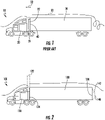
- FIG 1 schematically illustrates an exemplary vehicle 10 including a tractor 20 configured to pull a trailer 30.
- the trailer 30 is a refrigerated trailer, and includes a refrigeration unit 40 mounted to a front end 32 of the trailer 30.
- the refrigeration unit 40 includes a diesel, or other fossil fuel, based power generation unit configured to provide operational power to the refrigeration unit 40.
- the refrigeration unit 40 refrigerates the trailer 30 during transportation of temperature sensitive goods.
- Driving the vehicle 10 induces an airstream 50 that passes over the tractor 20 and the trailer 30 and causes drag on the vehicle 10.
- the drag decreases the efficiency of the tractor 20 and increases fuel consumption during transportation.
- a gap 22 between the tractor 20 and the trailer 30 is reduced in length, and aerodynamic flaps 24, referred to as fairings, are added extending from the tractor 20 toward the front of the trailer 30.
- the reduction of the gap 22 and the addition of the aerodynamic flaps 24 reduces the available space for the refrigeration unit 40 and can, in some examples, eliminate the feasibility of placing a conventional trailer refrigeration unit in the gap 22.
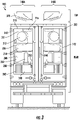
- FIG. 2 schematically illustrates an embodiment of a trailer 130 including a rear mounted refrigeration unit 140.
- the rear mounted refrigeration unit 140 is an electric refrigeration unit 140, and includes a battery configured to power the refrigeration systems.
- the rear mounted refrigeration unit 140 can include an electrical connection allowing the refrigeration unit 140 to connect to, and draw power from, an electric engine within the tractor 120 or any other source of electrical power on the vehicle 100.
- the rear mounted refrigeration unit 140 can include both a battery and an electrical connection to the tractor 120, with either the battery or the electrical connection operating as a backup configuration in case the primary configuration is damaged or otherwise unusable.
- a frame 142 connects the refrigeration unit 140 to the rear end 134 of the trailer 130.
- a gap 122 between the trailer and the tractor 120 is substantially reduced relative to prior art systems, and aerodynamic flaps 124 can extend almost the entirety of the gap 122.
- the gap 122 can be less than 109 cm (43 inches) in some configurations.
- the frame 142 can be integrated with the rear doors of the trailer 130 such that a door latch is incorporated into the frame 142.
- the frame 142 can be mounted to an existing door structure, and is configured such that the frame 142 does not interfere with the door latch system.
- Figure 3 schematically illustrates a top and rear view of the vehicle 100 of Figure 2 .
- a split refrigeration unit 140A, 140B Mounted to the rear of the vehicle 100 on doors 202 are two portions of a split refrigeration unit 140A, 140B.
- the portions of the split refrigeration unit 140A, 140B are mounted to the doors via the frame 142.
- a latch 144 for the doors is independent of the frame 142 and the frame 142 is configured not to interfere with the door latch 144 and the opening of the door.
- the frame 142 and the latch 144 are integrated, and the frame is built into the door structure.
- each portion of the split refrigeration unit 140A, 140B is substantial identical to the other portion.
- substantial identical refrigeration unit portions are portions that include the same general components in the same general layout, while allowing for minor constructional variations to accommodate a split rear door 202 structure.
- the variations can include mirrored configurations, minor size differences, and the like.
- Each of the rear mounted refrigeration portions in the split refrigeration unit 140A, 140B includes a condenser 210 with a condenser coil 211 and electric condenser fan 212 used to draw outside air through the condenser coil 211.
- the condenser coil 211 is a refrigerant heat rejection heat exchanger and is connected in refrigerant flow communication via a closed-loop circuit with the evaporator 220 (acting as a refrigerant heat absorption heat exchanger), electric compressor 230 and other components such as an expansion device, filter drier, receiver, liquid-suction heat exchanger and/or accumulator required as necessary to meeting operational needs.
- the evaporator 220 uses electric fan(s) to pass air drawn from the trailer cargo space via the return air input 214 which heats and evaporates the refrigerant thus cooling the air. The cooled air is then delivered to the trailer cargo space via the supply air output 216.
- An electric compressor 230 provides compression to the condenser 210 and evaporator 220 systems, and allows the split refrigeration unit 140A, 140B to function.
- Each of the electric compressors 230, the electric condenser and the evaporator fans are electrically connected to an electrical energy storage unit 240, such as a battery, a super capacitor, or any other rechargeable electrical storage unit.
- an electrical energy storage unit 240 such as a battery, a super capacitor, or any other rechargeable electrical storage unit.
- the electric compressor 230, the electric condenser and the evaporator fans can be connected to an interface 250, or incorporate the interface 250 within the electric compressor 230.
- the interface 250 allows a connection to the electrical systems of the tractor portion of the vehicle 100, and is configured to provide operational power to the split refrigeration unit 140A, 140B.
- the interface 250 and the electrical storage unit 240 can both be included, and power from the tractor can be used to both power the portions of the split refrigeration unit 140A, 140B, and to charge the electrical storage unit 240.
- Connected to the electrical storage unit 240 in the illustrated example is a set of power electronics 242.
- the power electronics 242 regulate the voltage and current provided from the electrical storage unit 240 or the interface 250 to the electric compressor 230, the electric condenser and the evaporator fans using any conventional power electronics configuration.
- a control box 260 which includes a controller 261, contactors, relays, fuses, and the like.
- the controller 261 is controllably coupled to each of the controlled elements of the refrigeration unit 140A, 140B, and provides the operational parameters and controls to the corresponding split refrigeration unit 140A, 140B.
- a single controller 261 can be included in one of the portions of the split refrigeration unit 140A, 140B and provide controls to the components of both portions of the split refrigeration unit 140A, 140B.
- the controller 261 would include a connection configured to be easily coupled and decoupled such that a driver, or other vehicle operator, could decouple the controller connection prior to opening the doors, and recouple the controller 261 upon closing the doors.
- each portion of the split refrigeration unit 140A, 140B can include a corresponding controller 261, with the controllers 261 being interfaced together such that one of the controllers 261 can take control of the other portions of the split refrigeration unit 140A, 140B in the event that the other controller 261 fails.
- this alternative would include a communication cable connecting the controllers 261 and being configured to easily disconnect and reconnect when the driver or operator of the vehciloe opens and closes the doors.
- each of the split refrigeration unit 140A, 140B is covered via a skin 270.
- the skin 270 encloses the components of the split refrigeration unit 140A, 140B and protects the split refrigeration unit 140A, 140B from environmental hazards such as road salt, mud, debris, as well as from environmental conditions like rain or snow.
- the skin 270 includes an aerodynamic profile that assists in reducing drag on the vehicle 100 during transportation.
- the aerodynamic profile can be an angled planar shape.
- the aerodynamic profile can include a hemispherical curved or teardrop shape encompassing the corresponding split refrigeration unit 140A, 140B components.
- a hybrid of the angled planar shape and the teardrop shape can be utilized.
- each of the portions of the split refrigeration unit 140A, 140B includes its own dedicated skin 270.
- a single skin 270 can cover both portions.
- the skin 270 is removably mounted to the frame 142, and is removed before the doors are opened.
- each portion of the split refrigeration unit 140A, 140B provides cooling to the trailer 130.
- the portions of the split refrigeration unit 140A, 140B are sized such that each unit 140A, 140B provides approximately half of the necessary cooling, and each portion of the split refrigeration unit 140A, 140B operates in conjunction with the other portion to provide full cooling.
- each portion of the split refrigeration unit 140A, 140B is sized to provide sufficient refrigeration to refrigerate the trailer 130 without the assistance of the other portion of the split refrigeration unit 140A, 140B.
- a first split refrigeration unit 140A operates in a refrigerating cycle discharging power from the corresponding electrical storage unit 240.
- the second portion of the split refrigeration unit 140B operates in a charging cycle, utilizing electrical power from the tractor 120 to charge the electrical storage unit 240.
- the electrical storage unit 240 of the first split refrigeration unit 140A falls below a threshold charge level, the first refrigeration transitions to a charging function, and signals the second refrigeration unit 140B to begin a refrigeration cycle.
- each unit 140A, 140B is in direct electrical communication with the tractor's power system (i.e. tractor battery or tractor energy storage) and the electrical storage unit 240 is omitted.
Landscapes
- Engineering & Computer Science (AREA)
- Physics & Mathematics (AREA)
- Thermal Sciences (AREA)
- Mechanical Engineering (AREA)
- Health & Medical Sciences (AREA)
- Public Health (AREA)
- Transportation (AREA)
- Devices That Are Associated With Refrigeration Equipment (AREA)
Description
- The present invention relates to a split trailer refrigeration unit for a tractor trailer, as well as to a method for refrigerating a tractor trailer. The invention herein relates more specifically to a rear mounted electric powered transportation refrigeration unit for tractor trailers.
- Tractor trailers for carrying refrigerated goods typically include a refrigeration unit mounted to the front of the trailer and positioned between the tractor and the trailer. The refrigeration units typically include a diesel, or other fossil fuel, powered generator that provides operational power to the refrigeration unit, allowing the trailer to be maintained at a cool or cold temperature.
- Recent tractor trailer constructions have redesigned the tractors and/or the trailers in order to reduce drag on the vehicle and increase the efficiency of the vehicle. The redesigns include features such as fairings extending from the rear sides, top, or both of the tractor toward the front of the trailer, and a reduction in the length of the gap between the tractor and the trailer and the use of boat tail extensions from the rear of the trailer.
-
DE 10 2014 016939 discloses a cooling system for a transport unit such as a trailer or transport container, wherein the cooling system has at least two identically constructed cooling circuit modules that can be connected and disconnected to adapt the refrigeration capacity to the load requirements of the transport unit. - Viewed from a first aspect, the invention provides a split trailer refrigeration unit for a tractor trailer according to claim 1, wherein the split refrigeration unit includes: a first portion including an electrically driven compressor, a condenser and an evaporator, the first portion being sized to independently refrigerate the trailer; a second portion, the second portion including an electrically driven compressor, a condenser and an evaporator, the second portion being sized to independently refrigerate the trailer; both of the first portion and the second portion including a respective set of power electronics connecting a respective electricity source to the corresponding electric compressor, each set of power electronics being configured to control power characteristics of power provided from the electricity source to the electric compressor; a frame configured to structurally mount each of the first portion and the second portion to a rear trailer door; and a controller configured to operate the first portion in an electrical storage unit charging operation and the second portion in a refrigeration operation during a first mode, and configured to operate the second portion in the electrical storage unit charging operation and the first portion in the refrigeration operation during a second mode.
- Optionally, the electricity source(s) is at least one of an electrical storage unit and a power interface connected to an external power source.
- Optionally, the electricity source(s) includes both the electrical storage unit and the power interface connected to the external power source.
- Optionally, the frame is integral to a trailer door and wherein a trailer door latch is a component of the frame.
- Optionally, the frame is mountable to a trailer door and distinct from the trailer door.
- Optionally, the controller is configured to transition from the first mode to the second mode in response to the electrical storage unit in the second portion falling below a charge threshold.
- Optionally, an external skin covers at least one of the first portion and the second portion.
- Optionally, the external skin comprises a first aerodynamic component covering the first portion and a second aerodynamic component covering the second portion.
- Optionally, the external skin has an aerodynamic profile including one of an angular planar configuration, hemispherical curved configuration and a teardrop configuration.
- Viewed from a second aspect, the invention provides an exemplary method for refrigerating a tractor according to claim 12, that includes powering at least one portion of a rear mounted refrigeration unit via an electrical power source and operating the at least one portion of a rear mounted refrigeration unit in a refrigeration mode, wherein powering the at least one portion of the rear mounted refrigeration unit comprises providing power to a first portion of the at least one portion during a first mode of operations and charging an electrical storage unit of a second portion of the at least one portion during the first mode of operations; providing power to the second portion of the at least one portion during a second mode of operations and charging an electrical storage unit of the first portion of the at least one portion during the second mode of operations; and transitioning from the first mode of operations to the second mode of operations, in response to an electrical storage unit in the first portion falling below a threshold charge level.
- In another example the above described exemplary method for refrigerating a tractor trailer powering the at least one portion of the rear mounted refrigeration unit via the electrical power source comprises simultaneously powering a first portion and a second portion of the rear mounted refrigeration unit via the electrical power source, wherein each of the first portion and the second portion are substantially identical.
- In one exemplary embodiment a tractor trailer vehicle includes a tractor including a plurality of fairings extending rearward from a rear end of the tractor, a trailer connected to the tractor, wherein a gap between the rear end of the tractor and a forward end of the trailer is less than 43 inches, and a rear mounted refrigeration unit as described above connected to a rear end of the trailer via the frame, wherein the rear mounted refrigeration unit including a first portion including an electrically driven compressor, a condenser and an evaporator, a second portion, the second portion including an electrically driven compressor, a condenser and an evaporator, and at least one of the first portion and the second portion including a set of power electronics connecting an electricity source to the corresponding electric compressor, the set of power electronics being configured to control power characteristics of power provided from the electricity source to the electric compressor.
- Another example of the above described tractor trailer vehicle further includes an aerodynamic external skin covering at least one of the first portion and the second portion.
- These and other features of the present invention can be best understood from the following specification and drawings, the following of which is a brief description.
-
Figure 1 illustrates an exemplary prior art tractor trailer configuration. -
Figure 2 schematically illustrates an exemplary embodiment of a trailer including a rear mounted electric refrigeration unit. -
Figure 3 schematically illustrates a top and rear view of theexemplary vehicle 100 ofFigure 2 . -
Figure 1 schematically illustrates anexemplary vehicle 10 including atractor 20 configured to pull atrailer 30. Thetrailer 30 is a refrigerated trailer, and includes arefrigeration unit 40 mounted to afront end 32 of thetrailer 30. Therefrigeration unit 40 includes a diesel, or other fossil fuel, based power generation unit configured to provide operational power to therefrigeration unit 40. Therefrigeration unit 40 refrigerates thetrailer 30 during transportation of temperature sensitive goods. - Driving the
vehicle 10 induces anairstream 50 that passes over thetractor 20 and thetrailer 30 and causes drag on thevehicle 10. The drag, in turn, decreases the efficiency of thetractor 20 and increases fuel consumption during transportation. In order to reduce the inefficiencies associated with drag, agap 22 between thetractor 20 and thetrailer 30 is reduced in length, andaerodynamic flaps 24, referred to as fairings, are added extending from thetractor 20 toward the front of thetrailer 30. However, the reduction of thegap 22 and the addition of theaerodynamic flaps 24 reduces the available space for therefrigeration unit 40 and can, in some examples, eliminate the feasibility of placing a conventional trailer refrigeration unit in thegap 22. - With continued reference to
Figure 1, Figure 2 schematically illustrates an embodiment of atrailer 130 including a rear mountedrefrigeration unit 140. The rear mountedrefrigeration unit 140 is anelectric refrigeration unit 140, and includes a battery configured to power the refrigeration systems. In alternative examples the rear mountedrefrigeration unit 140 can include an electrical connection allowing therefrigeration unit 140 to connect to, and draw power from, an electric engine within thetractor 120 or any other source of electrical power on thevehicle 100. In yet further alternative examples, the rear mountedrefrigeration unit 140 can include both a battery and an electrical connection to thetractor 120, with either the battery or the electrical connection operating as a backup configuration in case the primary configuration is damaged or otherwise unusable. - A
frame 142 connects therefrigeration unit 140 to therear end 134 of thetrailer 130. As therefrigeration unit 140 is mounted to therear end 134, agap 122 between the trailer and thetractor 120 is substantially reduced relative to prior art systems, andaerodynamic flaps 124 can extend almost the entirety of thegap 122. By way of example, thegap 122 can be less than 109 cm (43 inches) in some configurations. In some examples, theframe 142 can be integrated with the rear doors of thetrailer 130 such that a door latch is incorporated into theframe 142. In alternative examples, theframe 142 can be mounted to an existing door structure, and is configured such that theframe 142 does not interfere with the door latch system. - With continued reference to
Figures 1 and 2 ,Figure 3 schematically illustrates a top and rear view of thevehicle 100 ofFigure 2 . Mounted to the rear of thevehicle 100 ondoors 202 are two portions of asplit refrigeration unit split refrigeration unit frame 142. In some examples, alatch 144 for the doors is independent of theframe 142 and theframe 142 is configured not to interfere with thedoor latch 144 and the opening of the door. In alternative examples, theframe 142 and thelatch 144 are integrated, and the frame is built into the door structure. - Each portion of the
split refrigeration unit rear door 202 structure. By way of example, the variations can include mirrored configurations, minor size differences, and the like. - Each of the rear mounted refrigeration portions in the
split refrigeration unit condenser 210 with acondenser coil 211 andelectric condenser fan 212 used to draw outside air through thecondenser coil 211. Thecondenser coil 211 is a refrigerant heat rejection heat exchanger and is connected in refrigerant flow communication via a closed-loop circuit with the evaporator 220 (acting as a refrigerant heat absorption heat exchanger),electric compressor 230 and other components such as an expansion device, filter drier, receiver, liquid-suction heat exchanger and/or accumulator required as necessary to meeting operational needs. Theevaporator 220 uses electric fan(s) to pass air drawn from the trailer cargo space via thereturn air input 214 which heats and evaporates the refrigerant thus cooling the air. The cooled air is then delivered to the trailer cargo space via thesupply air output 216. Anelectric compressor 230 provides compression to thecondenser 210 andevaporator 220 systems, and allows thesplit refrigeration unit - Each of the
electric compressors 230, the electric condenser and the evaporator fans are electrically connected to an electricalenergy storage unit 240, such as a battery, a super capacitor, or any other rechargeable electrical storage unit. In alternative examples, theelectric compressor 230, the electric condenser and the evaporator fans can be connected to aninterface 250, or incorporate theinterface 250 within theelectric compressor 230. Theinterface 250 allows a connection to the electrical systems of the tractor portion of thevehicle 100, and is configured to provide operational power to thesplit refrigeration unit - In yet further examples, the
interface 250 and theelectrical storage unit 240 can both be included, and power from the tractor can be used to both power the portions of thesplit refrigeration unit electrical storage unit 240. Connected to theelectrical storage unit 240 in the illustrated example is a set ofpower electronics 242. Thepower electronics 242 regulate the voltage and current provided from theelectrical storage unit 240 or theinterface 250 to theelectric compressor 230, the electric condenser and the evaporator fans using any conventional power electronics configuration. - Also included in each portion of the
split refrigeration unit control box 260 which includes acontroller 261, contactors, relays, fuses, and the like. Thecontroller 261 is controllably coupled to each of the controlled elements of therefrigeration unit split refrigeration unit single controller 261 can be included in one of the portions of thesplit refrigeration unit split refrigeration unit controller 261 would include a connection configured to be easily coupled and decoupled such that a driver, or other vehicle operator, could decouple the controller connection prior to opening the doors, and recouple thecontroller 261 upon closing the doors. - In yet further alternative examples, each portion of the
split refrigeration unit corresponding controller 261, with thecontrollers 261 being interfaced together such that one of thecontrollers 261 can take control of the other portions of thesplit refrigeration unit other controller 261 fails. As with thesingle controller 261 example described above, this alternative would include a communication cable connecting thecontrollers 261 and being configured to easily disconnect and reconnect when the driver or operator of the vehciloe opens and closes the doors. - Referring now to the top view portion of
Figure 3 , each of thesplit refrigeration unit skin 270. Theskin 270 encloses the components of thesplit refrigeration unit split refrigeration unit skin 270 includes an aerodynamic profile that assists in reducing drag on thevehicle 100 during transportation. In some examples, the aerodynamic profile can be an angled planar shape. In other examples, the aerodynamic profile can include a hemispherical curved or teardrop shape encompassing the correspondingsplit refrigeration unit - In the illustrated example, each of the portions of the
split refrigeration unit dedicated skin 270. In alternative examples, asingle skin 270 can cover both portions. In such an example, theskin 270 is removably mounted to theframe 142, and is removed before the doors are opened. - During operation of the
vehicle 100, each portion of thesplit refrigeration unit trailer 130. In some examples, the portions of thesplit refrigeration unit unit split refrigeration unit split refrigeration unit trailer 130 without the assistance of the other portion of thesplit refrigeration unit split refrigeration unit 140A operates in a refrigerating cycle discharging power from the correspondingelectrical storage unit 240. Simultaneously, the second portion of thesplit refrigeration unit 140B operates in a charging cycle, utilizing electrical power from thetractor 120 to charge theelectrical storage unit 240. When theelectrical storage unit 240 of the firstsplit refrigeration unit 140A falls below a threshold charge level, the first refrigeration transitions to a charging function, and signals thesecond refrigeration unit 140B to begin a refrigeration cycle. In another example, eachunit electrical storage unit 240 is omitted. - Although an embodiment of this invention has been disclosed, a worker of ordinary skill in this art would recognize that certain modifications would come within the scope of this invention, which is defined by the claims. For that reason, the following claims should be studied to determine the true scope and content of this invention.
Claims (13)
- A split trailer refrigeration unit for a tractor trailer, the split refrigeration unit comprising:a first portion (140A) including an electrically driven compressor (230), a condenser (210) and an evaporator (220), the first portion being sized to independently refrigerate the trailer (30);a second portion (140B), the second portion including an electrically driven compressor (230), a condenser (210) and an evaporator (220), the second portion being sized to independently refrigerate the trailer;both of the first portion and the second portion including a respective set of power electronics (242) connecting a respective electricity source (240) to the corresponding electric compressor, each set of power electronics being configured to control power characteristics of power provided from the electricity source to the electric compressor;a frame (142) configured to structurally mount each of the first portion and the second portion to a rear trailer door (134); anda controller (261) configured to operate the first portion in an electrical storage unit charging operation and the second portion in a refrigeration operation during a first mode, and configured to operate the second portion in the electrical storage unit charging operation and the first portion in the refrigeration operation during a second mode.
- The split trailer refrigeration unit of claim 1, wherein each electricity source (240) is at least one of an electrical storage unit (240) and a power interface (250) connected to an external power source.
- The split trailer refrigeration unit of claim 2, wherein each electricity source (240) includes both the electrical storage unit (240) and the power interface (250) connected to the external power source.
- The split refrigeration unit of claim 1, comprising a trailer door (134) integral with the frame (142) and wherein a trailer door latch is a component of the frame.
- The split refrigeration unit of claim 1, wherein the frame (142) is mountable to a trailer door (134) and distinct from the trailer door.
- The split refrigeration unit of any preceding claim, wherein the controller (261) is configured to transition from the first mode to the second mode in response to the electrical storage unit (240) in the second portion (140B) falling below a charge threshold.
- The split refrigeration unit of claim 1, further comprising an external skin (270) covering at least one of the first portion (140A) and the second portion (140B).
- The split refrigeration unit of claim 7, wherein the external skin (270) comprises a first aerodynamic component covering the first portion (140A) and a second aerodynamic component covering the second portion (140B).
- The split refrigeration unit of claim 7, wherein the external skin (270) has an aerodynamic profile including one of an angular planar configuration, hemispherical curved configuration and a teardrop configuration.
- A tractor trailer vehicle comprising:a tractor (20) including a plurality of fairings extending rearward from a rear end of the tractor;a trailer (30) connected to the tractor, wherein a gap between the rear end of the tractor and a forward end of the trailer is less than 43 inches; anda rear mounted refrigeration unit comprising a split refrigeration unit as defined in any preceding claim, being connected to a rear end (134) of the trailer via the frame (142).
- The tractor trailer vehicle of claim 10, further comprising an aerodynamic external skin (270) covering at least one of the first portion (140A) and the second portion (140B).
- A method for refrigerating a tractor trailer according to claim 10 comprising:powering at least one portion of a rear mounted refrigeration unit (140) via an electrical power source and operating the at least one portion of a rear mounted refrigeration unit in a refrigeration mode, wherein powering the at least one portion of the rear mounted refrigeration unit comprises providing power to a first portion (140A) of the at least one portion during a first mode of operations and charging an electrical storage unit (240) of a second portion (140B) of the at least one portion during the first mode of operations;providing power to the second portion (140B) of the at least one portion during a second mode of operations and charging an electrical storage unit (240) of the first portion (140A) of the at least one portion during the second mode of operations; andtransitioning from the first mode of operations to the second mode of operations, in response to an electrical storage unit (240) in the first portion falling below a threshold charge level.
- The method of claim 12, wherein powering the at least one portion (140A, 140B) of the rear mounted refrigeration unit (140) via the electrical power source comprises simultaneously powering a first portion and a second portion of the rear mounted refrigeration unit via the electrical power source, wherein each of the first portion and the second portion are substantially identical.
Applications Claiming Priority (2)
| Application Number | Priority Date | Filing Date | Title |
|---|---|---|---|
| US201862768288P | 2018-11-16 | 2018-11-16 | |
| PCT/US2019/060693 WO2020102061A1 (en) | 2018-11-16 | 2019-11-11 | Electric powered rear-mounted transportation refrigeration unit |
Publications (2)
| Publication Number | Publication Date |
|---|---|
| EP3880500A1 EP3880500A1 (en) | 2021-09-22 |
| EP3880500B1 true EP3880500B1 (en) | 2023-01-25 |
Family
ID=69160177
Family Applications (1)
| Application Number | Title | Priority Date | Filing Date |
|---|---|---|---|
| EP19836142.0A Active EP3880500B1 (en) | 2018-11-16 | 2019-11-11 | Electric powered rear-mounted transportation refrigeration unit |
Country Status (3)
| Country | Link |
|---|---|
| US (1) | US20210252946A1 (en) |
| EP (1) | EP3880500B1 (en) |
| WO (1) | WO2020102061A1 (en) |
Families Citing this family (1)
| Publication number | Priority date | Publication date | Assignee | Title |
|---|---|---|---|---|
| US12263718B2 (en) | 2022-03-10 | 2025-04-01 | Carrier Corporation | Transport refrigeration system with battery temperature control |
Family Cites Families (8)
| Publication number | Priority date | Publication date | Assignee | Title |
|---|---|---|---|---|
| US4468060A (en) * | 1982-09-29 | 1984-08-28 | Fitzgerald Joseph M | Aerodynamic enclosure with a condenser inlet cover |
| US5123258A (en) * | 1991-07-23 | 1992-06-23 | Brown George S | Air conditioning system |
| US20010025466A1 (en) * | 2000-03-28 | 2001-10-04 | Brown Noel S. | Insulated closure structure and method |
| US8807628B1 (en) * | 2013-09-03 | 2014-08-19 | Raimund Pfaff | Air deflector for a refrigerated trailer |
| DE102014016939A1 (en) * | 2014-11-14 | 2016-05-19 | Liebherr-Transportation Systems Gmbh & Co. Kg | cooling system |
| EP3072740A1 (en) * | 2015-03-25 | 2016-09-28 | Thermo King Corporation | Low profile refrigerated transport unit |
| US9819063B2 (en) * | 2015-08-18 | 2017-11-14 | Ford Global Technologies, Llc | Climate control system for a vehicle |
| US10137945B2 (en) * | 2016-11-30 | 2018-11-27 | Xstream Trucking Inc. | Deployable fairing for use with vehicles |
-
2019
- 2019-11-11 EP EP19836142.0A patent/EP3880500B1/en active Active
- 2019-11-11 WO PCT/US2019/060693 patent/WO2020102061A1/en not_active Ceased
- 2019-11-11 US US17/251,257 patent/US20210252946A1/en not_active Abandoned
Also Published As
| Publication number | Publication date |
|---|---|
| EP3880500A1 (en) | 2021-09-22 |
| US20210252946A1 (en) | 2021-08-19 |
| WO2020102061A1 (en) | 2020-05-22 |
Similar Documents
| Publication | Publication Date | Title |
|---|---|---|
| US11192451B2 (en) | Methods and systems for energy management of a transport climate control system | |
| US11260723B2 (en) | Methods and systems for power and load management of a transport climate control system | |
| EP3674115B1 (en) | Method and system for preserving autonomous operation of a transport climate control system | |
| EP3647088B1 (en) | Methods and systems for augmenting a vehicle powered transport climate control system | |
| EP3634792B1 (en) | Hybrid power conversion system for a refrigerated transport vehicle and method | |
| US10240847B1 (en) | Efficient electric trailer refrigeration system | |
| EP2903860B1 (en) | Systems and methods for powering a transport refrigeration system | |
| EP2844506B1 (en) | Transport refrigeration system having electric fans | |
| US9321352B2 (en) | Solar auxiliary power systems for vehicles | |
| US9211881B2 (en) | Control system for auxiliary power unit of a vehicle | |
| US20100031682A1 (en) | Solar air conditioner for vehicle | |
| EP3819145B1 (en) | Methods of minimizing c-rate fluctuation by adjusting operation of a transport climate control system | |
| KR20200069964A (en) | Cooling system for refrigerated vehicle | |
| EP4219199B1 (en) | A power system for a transport refrigeration unit | |
| EP2237984A2 (en) | Hybrid vehicle for transportation of a refrigerated commercial load | |
| EP3880500B1 (en) | Electric powered rear-mounted transportation refrigeration unit | |
| CN113581103B (en) | Power protection system for power modules of a transport climate control system | |
| KR102533081B1 (en) | Transport refrigrator unit | |
| JP3703984B2 (en) | Vehicle refrigeration system | |
| US20260001472A1 (en) | Refrigerated cargo vehicle with improved refrigeration power system | |
| KR102555950B1 (en) | Cooling system for large truck | |
| US20240286460A1 (en) | Refrigerated cargo vehicle with alternator driven refrigeration system |
Legal Events
| Date | Code | Title | Description |
|---|---|---|---|
| STAA | Information on the status of an ep patent application or granted ep patent |
Free format text: STATUS: UNKNOWN |
|
| STAA | Information on the status of an ep patent application or granted ep patent |
Free format text: STATUS: THE INTERNATIONAL PUBLICATION HAS BEEN MADE |
|
| PUAI | Public reference made under article 153(3) epc to a published international application that has entered the european phase |
Free format text: ORIGINAL CODE: 0009012 |
|
| STAA | Information on the status of an ep patent application or granted ep patent |
Free format text: STATUS: REQUEST FOR EXAMINATION WAS MADE |
|
| 17P | Request for examination filed |
Effective date: 20210110 |
|
| AK | Designated contracting states |
Kind code of ref document: A1 Designated state(s): AL AT BE BG CH CY CZ DE DK EE ES FI FR GB GR HR HU IE IS IT LI LT LU LV MC MK MT NL NO PL PT RO RS SE SI SK SM TR |
|
| DAV | Request for validation of the european patent (deleted) | ||
| DAX | Request for extension of the european patent (deleted) | ||
| GRAP | Despatch of communication of intention to grant a patent |
Free format text: ORIGINAL CODE: EPIDOSNIGR1 |
|
| STAA | Information on the status of an ep patent application or granted ep patent |
Free format text: STATUS: GRANT OF PATENT IS INTENDED |
|
| INTG | Intention to grant announced |
Effective date: 20221107 |
|
| GRAS | Grant fee paid |
Free format text: ORIGINAL CODE: EPIDOSNIGR3 |
|
| GRAA | (expected) grant |
Free format text: ORIGINAL CODE: 0009210 |
|
| STAA | Information on the status of an ep patent application or granted ep patent |
Free format text: STATUS: THE PATENT HAS BEEN GRANTED |
|
| AK | Designated contracting states |
Kind code of ref document: B1 Designated state(s): AL AT BE BG CH CY CZ DE DK EE ES FI FR GB GR HR HU IE IS IT LI LT LU LV MC MK MT NL NO PL PT RO RS SE SI SK SM TR |
|
| REG | Reference to a national code |
Ref country code: GB Ref legal event code: FG4D |
|
| REG | Reference to a national code |
Ref country code: CH Ref legal event code: EP |
|
| REG | Reference to a national code |
Ref country code: DE Ref legal event code: R096 Ref document number: 602019024916 Country of ref document: DE |
|
| REG | Reference to a national code |
Ref country code: AT Ref legal event code: REF Ref document number: 1545682 Country of ref document: AT Kind code of ref document: T Effective date: 20230215 Ref country code: IE Ref legal event code: FG4D |
|
| REG | Reference to a national code |
Ref country code: NL Ref legal event code: FP |
|
| REG | Reference to a national code |
Ref country code: LT Ref legal event code: MG9D |
|
| REG | Reference to a national code |
Ref country code: AT Ref legal event code: MK05 Ref document number: 1545682 Country of ref document: AT Kind code of ref document: T Effective date: 20230125 |
|
| PG25 | Lapsed in a contracting state [announced via postgrant information from national office to epo] |
Ref country code: RS Free format text: LAPSE BECAUSE OF FAILURE TO SUBMIT A TRANSLATION OF THE DESCRIPTION OR TO PAY THE FEE WITHIN THE PRESCRIBED TIME-LIMIT Effective date: 20230125 Ref country code: PT Free format text: LAPSE BECAUSE OF FAILURE TO SUBMIT A TRANSLATION OF THE DESCRIPTION OR TO PAY THE FEE WITHIN THE PRESCRIBED TIME-LIMIT Effective date: 20230525 Ref country code: NO Free format text: LAPSE BECAUSE OF FAILURE TO SUBMIT A TRANSLATION OF THE DESCRIPTION OR TO PAY THE FEE WITHIN THE PRESCRIBED TIME-LIMIT Effective date: 20230425 Ref country code: LV Free format text: LAPSE BECAUSE OF FAILURE TO SUBMIT A TRANSLATION OF THE DESCRIPTION OR TO PAY THE FEE WITHIN THE PRESCRIBED TIME-LIMIT Effective date: 20230125 Ref country code: LT Free format text: LAPSE BECAUSE OF FAILURE TO SUBMIT A TRANSLATION OF THE DESCRIPTION OR TO PAY THE FEE WITHIN THE PRESCRIBED TIME-LIMIT Effective date: 20230125 Ref country code: HR Free format text: LAPSE BECAUSE OF FAILURE TO SUBMIT A TRANSLATION OF THE DESCRIPTION OR TO PAY THE FEE WITHIN THE PRESCRIBED TIME-LIMIT Effective date: 20230125 Ref country code: ES Free format text: LAPSE BECAUSE OF FAILURE TO SUBMIT A TRANSLATION OF THE DESCRIPTION OR TO PAY THE FEE WITHIN THE PRESCRIBED TIME-LIMIT Effective date: 20230125 Ref country code: AT Free format text: LAPSE BECAUSE OF FAILURE TO SUBMIT A TRANSLATION OF THE DESCRIPTION OR TO PAY THE FEE WITHIN THE PRESCRIBED TIME-LIMIT Effective date: 20230125 |
|
| PG25 | Lapsed in a contracting state [announced via postgrant information from national office to epo] |
Ref country code: SE Free format text: LAPSE BECAUSE OF FAILURE TO SUBMIT A TRANSLATION OF THE DESCRIPTION OR TO PAY THE FEE WITHIN THE PRESCRIBED TIME-LIMIT Effective date: 20230125 Ref country code: PL Free format text: LAPSE BECAUSE OF FAILURE TO SUBMIT A TRANSLATION OF THE DESCRIPTION OR TO PAY THE FEE WITHIN THE PRESCRIBED TIME-LIMIT Effective date: 20230125 Ref country code: IS Free format text: LAPSE BECAUSE OF FAILURE TO SUBMIT A TRANSLATION OF THE DESCRIPTION OR TO PAY THE FEE WITHIN THE PRESCRIBED TIME-LIMIT Effective date: 20230525 Ref country code: GR Free format text: LAPSE BECAUSE OF FAILURE TO SUBMIT A TRANSLATION OF THE DESCRIPTION OR TO PAY THE FEE WITHIN THE PRESCRIBED TIME-LIMIT Effective date: 20230426 Ref country code: FI Free format text: LAPSE BECAUSE OF FAILURE TO SUBMIT A TRANSLATION OF THE DESCRIPTION OR TO PAY THE FEE WITHIN THE PRESCRIBED TIME-LIMIT Effective date: 20230125 |
|
| REG | Reference to a national code |
Ref country code: DE Ref legal event code: R097 Ref document number: 602019024916 Country of ref document: DE |
|
| PG25 | Lapsed in a contracting state [announced via postgrant information from national office to epo] |
Ref country code: SM Free format text: LAPSE BECAUSE OF FAILURE TO SUBMIT A TRANSLATION OF THE DESCRIPTION OR TO PAY THE FEE WITHIN THE PRESCRIBED TIME-LIMIT Effective date: 20230125 Ref country code: RO Free format text: LAPSE BECAUSE OF FAILURE TO SUBMIT A TRANSLATION OF THE DESCRIPTION OR TO PAY THE FEE WITHIN THE PRESCRIBED TIME-LIMIT Effective date: 20230125 Ref country code: EE Free format text: LAPSE BECAUSE OF FAILURE TO SUBMIT A TRANSLATION OF THE DESCRIPTION OR TO PAY THE FEE WITHIN THE PRESCRIBED TIME-LIMIT Effective date: 20230125 Ref country code: DK Free format text: LAPSE BECAUSE OF FAILURE TO SUBMIT A TRANSLATION OF THE DESCRIPTION OR TO PAY THE FEE WITHIN THE PRESCRIBED TIME-LIMIT Effective date: 20230125 Ref country code: CZ Free format text: LAPSE BECAUSE OF FAILURE TO SUBMIT A TRANSLATION OF THE DESCRIPTION OR TO PAY THE FEE WITHIN THE PRESCRIBED TIME-LIMIT Effective date: 20230125 |
|
| PG25 | Lapsed in a contracting state [announced via postgrant information from national office to epo] |
Ref country code: SK Free format text: LAPSE BECAUSE OF FAILURE TO SUBMIT A TRANSLATION OF THE DESCRIPTION OR TO PAY THE FEE WITHIN THE PRESCRIBED TIME-LIMIT Effective date: 20230125 |
|
| PLBE | No opposition filed within time limit |
Free format text: ORIGINAL CODE: 0009261 |
|
| STAA | Information on the status of an ep patent application or granted ep patent |
Free format text: STATUS: NO OPPOSITION FILED WITHIN TIME LIMIT |
|
| 26N | No opposition filed |
Effective date: 20231026 |
|
| PG25 | Lapsed in a contracting state [announced via postgrant information from national office to epo] |
Ref country code: SI Free format text: LAPSE BECAUSE OF FAILURE TO SUBMIT A TRANSLATION OF THE DESCRIPTION OR TO PAY THE FEE WITHIN THE PRESCRIBED TIME-LIMIT Effective date: 20230125 |
|
| PG25 | Lapsed in a contracting state [announced via postgrant information from national office to epo] |
Ref country code: IT Free format text: LAPSE BECAUSE OF FAILURE TO SUBMIT A TRANSLATION OF THE DESCRIPTION OR TO PAY THE FEE WITHIN THE PRESCRIBED TIME-LIMIT Effective date: 20230125 |
|
| REG | Reference to a national code |
Ref country code: CH Ref legal event code: PL |
|
| PG25 | Lapsed in a contracting state [announced via postgrant information from national office to epo] |
Ref country code: MC Free format text: LAPSE BECAUSE OF FAILURE TO SUBMIT A TRANSLATION OF THE DESCRIPTION OR TO PAY THE FEE WITHIN THE PRESCRIBED TIME-LIMIT Effective date: 20230125 |
|
| PG25 | Lapsed in a contracting state [announced via postgrant information from national office to epo] |
Ref country code: LU Free format text: LAPSE BECAUSE OF NON-PAYMENT OF DUE FEES Effective date: 20231111 |
|
| PG25 | Lapsed in a contracting state [announced via postgrant information from national office to epo] |
Ref country code: CH Free format text: LAPSE BECAUSE OF NON-PAYMENT OF DUE FEES Effective date: 20231130 |
|
| PG25 | Lapsed in a contracting state [announced via postgrant information from national office to epo] |
Ref country code: MC Free format text: LAPSE BECAUSE OF FAILURE TO SUBMIT A TRANSLATION OF THE DESCRIPTION OR TO PAY THE FEE WITHIN THE PRESCRIBED TIME-LIMIT Effective date: 20230125 Ref country code: LU Free format text: LAPSE BECAUSE OF NON-PAYMENT OF DUE FEES Effective date: 20231111 Ref country code: CH Free format text: LAPSE BECAUSE OF NON-PAYMENT OF DUE FEES Effective date: 20231130 |
|
| REG | Reference to a national code |
Ref country code: BE Ref legal event code: MM Effective date: 20231130 |
|
| REG | Reference to a national code |
Ref country code: IE Ref legal event code: MM4A |
|
| PG25 | Lapsed in a contracting state [announced via postgrant information from national office to epo] |
Ref country code: IE Free format text: LAPSE BECAUSE OF NON-PAYMENT OF DUE FEES Effective date: 20231111 |
|
| PG25 | Lapsed in a contracting state [announced via postgrant information from national office to epo] |
Ref country code: BE Free format text: LAPSE BECAUSE OF NON-PAYMENT OF DUE FEES Effective date: 20231130 |
|
| PG25 | Lapsed in a contracting state [announced via postgrant information from national office to epo] |
Ref country code: IE Free format text: LAPSE BECAUSE OF NON-PAYMENT OF DUE FEES Effective date: 20231111 Ref country code: BE Free format text: LAPSE BECAUSE OF NON-PAYMENT OF DUE FEES Effective date: 20231130 |
|
| PG25 | Lapsed in a contracting state [announced via postgrant information from national office to epo] |
Ref country code: BG Free format text: LAPSE BECAUSE OF FAILURE TO SUBMIT A TRANSLATION OF THE DESCRIPTION OR TO PAY THE FEE WITHIN THE PRESCRIBED TIME-LIMIT Effective date: 20230125 |
|
| PGFP | Annual fee paid to national office [announced via postgrant information from national office to epo] |
Ref country code: NL Payment date: 20241022 Year of fee payment: 6 |
|
| PG25 | Lapsed in a contracting state [announced via postgrant information from national office to epo] |
Ref country code: BG Free format text: LAPSE BECAUSE OF FAILURE TO SUBMIT A TRANSLATION OF THE DESCRIPTION OR TO PAY THE FEE WITHIN THE PRESCRIBED TIME-LIMIT Effective date: 20230125 |
|
| PG25 | Lapsed in a contracting state [announced via postgrant information from national office to epo] |
Ref country code: CY Free format text: LAPSE BECAUSE OF FAILURE TO SUBMIT A TRANSLATION OF THE DESCRIPTION OR TO PAY THE FEE WITHIN THE PRESCRIBED TIME-LIMIT; INVALID AB INITIO Effective date: 20191111 |
|
| PG25 | Lapsed in a contracting state [announced via postgrant information from national office to epo] |
Ref country code: HU Free format text: LAPSE BECAUSE OF FAILURE TO SUBMIT A TRANSLATION OF THE DESCRIPTION OR TO PAY THE FEE WITHIN THE PRESCRIBED TIME-LIMIT; INVALID AB INITIO Effective date: 20191111 |
|
| PG25 | Lapsed in a contracting state [announced via postgrant information from national office to epo] |
Ref country code: TR Free format text: LAPSE BECAUSE OF FAILURE TO SUBMIT A TRANSLATION OF THE DESCRIPTION OR TO PAY THE FEE WITHIN THE PRESCRIBED TIME-LIMIT Effective date: 20230125 |
|
| PGFP | Annual fee paid to national office [announced via postgrant information from national office to epo] |
Ref country code: DE Payment date: 20251022 Year of fee payment: 7 |
|
| PGFP | Annual fee paid to national office [announced via postgrant information from national office to epo] |
Ref country code: GB Payment date: 20251023 Year of fee payment: 7 |
|
| PGFP | Annual fee paid to national office [announced via postgrant information from national office to epo] |
Ref country code: FR Payment date: 20251022 Year of fee payment: 7 |