EP3879740B1 - Verfahren zur verarbeitung von restbits für das proportionale rundlauf-verfahrens-parsing von ressourceneinheiten in systemen mit extrem hohem durchsatz - Google Patents
Verfahren zur verarbeitung von restbits für das proportionale rundlauf-verfahrens-parsing von ressourceneinheiten in systemen mit extrem hohem durchsatz Download PDFInfo
- Publication number
- EP3879740B1 EP3879740B1 EP21160692.6A EP21160692A EP3879740B1 EP 3879740 B1 EP3879740 B1 EP 3879740B1 EP 21160692 A EP21160692 A EP 21160692A EP 3879740 B1 EP3879740 B1 EP 3879740B1
- Authority
- EP
- European Patent Office
- Prior art keywords
- rus
- bits
- tones
- larger
- combination
- Prior art date
- Legal status (The legal status is an assumption and is not a legal conclusion. Google has not performed a legal analysis and makes no representation as to the accuracy of the status listed.)
- Active
Links
Images


Classifications
-
- H—ELECTRICITY
- H04—ELECTRIC COMMUNICATION TECHNIQUE
- H04W—WIRELESS COMMUNICATION NETWORKS
- H04W28/00—Network traffic management; Network resource management
- H04W28/02—Traffic management, e.g. flow control or congestion control
- H04W28/06—Optimizing the usage of the radio link, e.g. header compression, information sizing, discarding information
-
- H—ELECTRICITY
- H04—ELECTRIC COMMUNICATION TECHNIQUE
- H04L—TRANSMISSION OF DIGITAL INFORMATION, e.g. TELEGRAPHIC COMMUNICATION
- H04L5/00—Arrangements affording multiple use of the transmission path
- H04L5/003—Arrangements for allocating sub-channels of the transmission path
- H04L5/0044—Allocation of payload; Allocation of data channels, e.g. PDSCH or PUSCH
-
- H—ELECTRICITY
- H04—ELECTRIC COMMUNICATION TECHNIQUE
- H04L—TRANSMISSION OF DIGITAL INFORMATION, e.g. TELEGRAPHIC COMMUNICATION
- H04L5/00—Arrangements affording multiple use of the transmission path
- H04L5/003—Arrangements for allocating sub-channels of the transmission path
- H04L5/0058—Allocation criteria
- H04L5/0075—Allocation using proportional fairness
-
- H—ELECTRICITY
- H04—ELECTRIC COMMUNICATION TECHNIQUE
- H04L—TRANSMISSION OF DIGITAL INFORMATION, e.g. TELEGRAPHIC COMMUNICATION
- H04L5/00—Arrangements affording multiple use of the transmission path
- H04L5/0001—Arrangements for dividing the transmission path
- H04L5/0003—Two-dimensional division
- H04L5/0005—Time-frequency
-
- H—ELECTRICITY
- H04—ELECTRIC COMMUNICATION TECHNIQUE
- H04L—TRANSMISSION OF DIGITAL INFORMATION, e.g. TELEGRAPHIC COMMUNICATION
- H04L5/00—Arrangements affording multiple use of the transmission path
- H04L5/003—Arrangements for allocating sub-channels of the transmission path
- H04L5/0042—Intra-user or intra-terminal allocation
-
- H—ELECTRICITY
- H04—ELECTRIC COMMUNICATION TECHNIQUE
- H04L—TRANSMISSION OF DIGITAL INFORMATION, e.g. TELEGRAPHIC COMMUNICATION
- H04L5/00—Arrangements affording multiple use of the transmission path
- H04L5/003—Arrangements for allocating sub-channels of the transmission path
- H04L5/0058—Allocation criteria
-
- H—ELECTRICITY
- H04—ELECTRIC COMMUNICATION TECHNIQUE
- H04W—WIRELESS COMMUNICATION NETWORKS
- H04W84/00—Network topologies
- H04W84/02—Hierarchically pre-organised networks, e.g. paging networks, cellular networks, WLAN [Wireless Local Area Network] or WLL [Wireless Local Loop]
- H04W84/10—Small scale networks; Flat hierarchical networks
- H04W84/12—WLAN [Wireless Local Area Networks]
Definitions
- the present disclosure is generally related to wireless communications and, more particularly, to leftover bits processing for proportional round-robin resource unit (RU) parsing in extreme high-throughput (EHT) systems.
- RU proportional round-robin resource unit
- EHT extreme high-throughput
- next-generation EHT systems such as wireless local area network (WLAN) systems in accordance with the upcoming Institute of Electrical and Electronics Engineers (IEEE) 802.11be standard
- WLAN wireless local area network
- IEEE Institute of Electrical and Electronics Engineers 802.11be standard
- multi-RU aggregated RU
- STA single station
- bits for RU(s) of smaller size(s) e.g., RU484, which denotes a RU of 484 tones
- there may be some leftover bits for larger RU(s) e.g., RU996, which denotes of a RU of 996 tones.
- RU996 which denotes of a RU of 996 tones
- US2019/281614A1 discloses a method of parsing of bits to multiple RUs and parsing of remaining bits in case of unequal segment sizes.
- the IEEE draft "Multiple RU Aggregation", XP068165425 discloses various combinations of multiple RU aggregation for a PPDU transmission in all of the bandwidths.
- An objective of the present disclosure is to provide schemes, concepts, designs, techniques, methods and apparatuses pertaining to leftover bits processing for proportional round-robin RU parsing in EHT systems.
- Methods according to the invention are defined in the independent claims.
- the dependent claims define preferred embodiments thereof.
- a method may involve processing a stream of bits to provide processed bits. The method may also involve transmitting the processed bits to a STA over a combination of multiple RUs assigned to the STA. In processing the stream of bits, the method may involve parsing the stream of bits to the combination of multiple RUs. Moreover, in an event of leftover bits remaining from the parsing, the method may further involve distributing the leftover bits to one or more RUs but not all RUs of the combination of multiple RUs.
- the combination of multiple RUs comprises at least one smaller RU and at least two larger RUs with each of the at least two larger RUs having more tones than the at least one smaller RU.
- the distributing of the leftover bits to one or more RUs but not all RUs of the combination of multiple RUs comprises distributing the leftover bits to the at least two larger RUs.
- the distributing of the leftover bits to the at least two larger RUs comprises proportionally distributing the leftover bits over last predefined number of tones on each of the at least two larger RUs.
- the proportionally distributing of the leftover bits over last predefined number of tones on each of the at least two larger RUs comprises proportionally distributing the leftover bits over last 44 tones on each of the at least two larger RUs.
- a method may involve processing a stream of bits to provide processed bits.
- the method may also involve transmitting the processed bits to a STA over a combination of multiple RUs assigned to the STA.
- the combination of multiple RUs may include at least one smaller RU and at least two larger RUs with each of the at least two larger RUs having more tones than the at least one smaller RU.
- the method in processing the stream of bits, the method may involve parsing the stream of bits to the combination of multiple RUs in a proportional round-robin fashion.
- the method may further involve distributing the leftover bits to the at least two larger RUs.
- the distributing of the leftover bits to the at least two larger RUs comprises evenly distributing the leftover bits over each of the larger RUs.
- the evenly distributing of the leftover bits over each of the at least two larger RUs comprises, for every N iterations of parsing the stream of bits to the combination of multiple RUs in the proportional round-robin fashion, distributing the leftover bits over each of the at least two larger RUs, and wherein N is an integer equal to or greater than 1.
- radio access technologies such as, Wi-Fi
- the proposed concepts, schemes and any variation(s)/derivative(s) thereof may be implemented in, for and by other types of radio access technologies, networks and network topologies such as, for example and without limitation, Bluetooth, ZigBee, 5 th Generation (5G)/New Radio (NR), Long-Term Evolution (LTE), LTE-Advanced, LTE-Advanced Pro, Internet-of-Things (IoT), Industrial loT (lloT) and narrowband loT (NB-loT).
- 5G 5 th Generation
- NR 5 th Generation
- LTE Long-Term Evolution
- LTE-Advanced LTE-Advanced
- LTE-Advanced Pro Internet-of-Things
- IoT Internet-of-Things
- IoT Industrial loT
- NB-loT narrowband loT
- Implementations in accordance with the present disclosure relate to various techniques, methods, schemes and/or solutions pertaining to leftover bits processing for proportional round-robin RU parsing in EHT systems.
- a number of possible solutions may be implemented separately or jointly. That is, although these possible solutions may be described below separately, two or more of these possible solutions may be implemented in one combination or another.
- FIG. 1 illustrates an example network environment 100 in which various solutions and schemes in accordance with the present disclosure may be implemented.
- FIG. 2 ⁇ FIG. 6 illustrate examples of implementation of various proposed schemes in network environment 100 in accordance with the present disclosure. The following description of various proposed schemes is provided with reference to FIG. 1 ⁇ FIG.6 .
- network environment 100 may involve at least a STA 110 communicating wirelessly with a STA 120.
- STA 110 and STA 120 may be a non-access point (non-AP) STA or, alternatively, either of STA 110 and STA 120 may function as an AP.
- STA 110 and STA 120 may be associated with a basic service set (BSS) in accordance with one or more IEEE 802.11 standards (e.g., IEEE 802.11be and future-developed standards).
- BSS basic service set
- IEEE 802.11 e.g., IEEE 802.11be and future-developed standards.
- Each of STA 110 and STA 120 may be configured to communicate with each other with leftover bits processing for proportional round-robin RU parsing in EHT systems in accordance with various proposed schemes described below.
- FIG. 2 illustrates an example design 200 in accordance with the present disclosure.
- a fundamental operation of multi-RU transmission may involve a number of operations described below with reference to FIG. 2 .
- data for one STA e.g., STA 110 or STA 120
- PHY physical layer
- PSDU service data unit
- MAC medium access control layer
- Information bits for the multiple RUs may be jointly encoded by a joint encoder 220 to provide an encoded bit sequence to a stream parser 230 which may perform stream parsing to split or otherwise parse an input stream of encoded bits into different spatial streams.
- bit-level RU and segment (RU/segment) parser 240 may be operated per stream at bit level to allocate, distribute or otherwise parse the encoded bits onto each RU of the multiple RUs to be modulated and tone-mapped/interleaved for transmission on the assigned RUs.
- N bpscs denotes the number of coded bits per subcarrier per spatial stream.
- parsing of coded bits to multiple RUs may be performed in a proportional round-robin fashion, with the parser ratio depending on the size (or number of tones) of each RU in the RU aggregation.
- the parser ratio may be defined in the format of m 0 : m 1 : m 2 ... (or 1 s :2 s :3 s ...), and each of m 0 , m 1 and m 2 may be in units of s-bits.
- the proportional round-robin parser may operate as follows: first the parser may parse m 0 s-bits to a first RU (RU1), then parse m1 s-bits to a second RU (RU2), ... and so on by alternatively distributing coded bits to each RU of multiple RUs. For some multi-RU combinations, in case there are remaining bits after alternatively allocating coded bits to each RU in the ratio of m 0 : m 1 : ... (or 1s : 2s : Among, the remaining (leftover) bits may be assigned to each RU of relatively larger size(s).
- the remaining/leftover bits may be further alternatively distributed to larger RU(s) (in case a number of larger RU(s) is equal to or greater than 2) with m 1 : m 2 : m 3 (or 2:2:2) ratio (in unit of s-bits, in case the larger RUs have equal size) to further improve system performance. Otherwise, the remaining/leftover bits may be sequentially or evenly distributed to each of the larger RU(s), as described below.
- FIG. 3 illustrates an example scenario 300 in accordance with the present disclosure.
- a set of example combinations of RUs and corresponding parameters are shown in a table.
- one corresponding parameter may be a total number of tones or data subcarriers ( N sd ).
- Another corresponding parameter may be a proportional ratio between the RUs in the combination expressed as N sd,0 : N sd,1 :N sd,2 : ...which is approximated to be m0:m1:m2: ...with m i being an integer in units of s-bits, 0 ⁇ i ⁇ number of RUs combined - 1.
- each expression of ratio such as m 0 : ... : m n may be interchangeably replaced with an alternative expression of 1s: ... : ns , with n > 1.
- a further corresponding parameter may be a number of leftover (or remaining) bits (per symbol), if any, after a stream of coded bits have been parsed to the combination of multiple RUs in a round-robin fashion.
- each of those combinations of multiple RUs having leftover bits there may be at least one smaller RU and at least one larger RU in terms of number of tones.
- the following combinations may have leftover bits after parsing in a round-robin fashion: a combination of a smaller RU of 484 tones (RU484) plus a larger RU of 996 tones (RU996), a combination of an aggregate RU (having one RU of 242 tones (RU242) and one RU of 484 tones (RU484)), as a smaller RU, and a larger RU of 996 tones (RU996), a combination of one smaller RU of 484 tones (RU484) plus two larger RUs of 996 tones (RU996), a combination of one smaller RU of 484 tones (RU484) plus three larger RUs of 996 tones (RU996), and a combination of one smaller RU of 242 tones (RU242) plus one larger RU of 996 tones (RU996).
- the leftover bits may be distributed to the at least one larger RU of the combination of multiple RUs.
- the leftover bits may be proportionally distributed over last predefined number of tones (e.g., 44 tones) with the proportional ratio of m 1 : m 2 : ... between the larger RUs (e.g., RU996's) of the combination of multiple RUs, as shown in FIG. 4 .
- the leftover bits may be sequentially distributed over last predefined number of tones (e.g., 44 tones) on each of the larger RUs (e.g., RU996's) of the combination of multiple RUs, as shown in FIG. 5 .
- the leftover bits may be evenly distributed over each of the larger RUs (e.g., RU996's) of the combination of multiple RUs, as shown in FIG. 6 .
- FIG. 4 illustrates an example scenario 400 in accordance with the present invent i on .
- a stream of bits e.g., coded bits of input data
- the leftover bits may be distributed to the at least one larger RU of the combination of multiple RUs. For instance, in the example shown in FIG.
- the combination of multiple RUs may include one smaller RU (e.g., RU484) and two larger RUs (e.g., a first RU996 and a second RU996), with a proportional ratio of m 0 : m 1 : m 2 being 448:996:996 or 1:2:2.
- the stream of bits may be parsed to the RU484, the first RU996 and the second RU996 of the combination of multiple RUs in a proportional round-robin fashion according to the proportional ratio of 1:2:2.
- the remaining leftover bits may be distributed over the last 44 tones between the first RU996 and the second RU996.
- FIG. 5 illustrates an example scenario 500 in accordance with the present disclosure.
- a stream of bits e.g., coded bits of input data
- the leftover bits may be distributed to the at least one larger RU of the combination of multiple RUs. For instance, in the example shown in FIG.
- the combination of multiple RUs may include one smaller RU (e.g., RU484) and two larger RUs (e.g., a first RU996 and a second RU996), with a proportional ratio of m 0 : m 1 : m 2 being 448:996:996 or 1:2:2.
- the stream of bits may be parsed to the RU484, the first RU996 and the second RU996 of the combination of multiple RUs in a proportional round-robin fashion according to the proportional ratio of 1:2:2.
- the remaining leftover bits may be distributed over the last 44 tones on each of the first RU996 and the second RU996.
- FIG. 6 illustrates an example scenario 600 in accordance with the present invention.
- a stream of bits e.g., coded bits of input data
- the leftover bits may be distributed to the at least one larger RU of the combination of multiple RUs. For instance, in the example shown in FIG.
- the combination of multiple RUs may include one smaller RU (e.g., RU484) and two larger RUs (e.g., a first RU996 and a second RU996), with a proportional ratio of m 0 : m 1 : m 2 being 448:996:996 or 1:2:2.
- FIG. 7 illustrates an example system 700 having at least an example apparatus 710 and an example apparatus 720 in accordance with an implementation of the present disclosure.
- apparatus 710 and apparatus 720 may perform various functions to implement schemes, techniques, processes and methods described herein pertaining to leftover bits processing for proportional round-robin RU parsing in EHT systems, including the various schemes described above with respect to various proposed designs, concepts, schemes, systems and methods described above as well as processes described below.
- apparatus 710 may be implemented in STA 110 and apparatus 720 may be implemented in STA 120, or vice versa.
- Each of apparatus 710 and apparatus 720 may be a part of an electronic apparatus, which may be a STA or an AP, such as a portable or mobile apparatus, a wearable apparatus, a wireless communication apparatus or a computing apparatus.
- an electronic apparatus which may be a STA or an AP, such as a portable or mobile apparatus, a wearable apparatus, a wireless communication apparatus or a computing apparatus.
- each of apparatus 710 and apparatus 720 may be implemented in a smartphone, a smart watch, a personal digital assistant, a digital camera, or a computing equipment such as a tablet computer, a laptop computer or a notebook computer.
- Each of apparatus 710 and apparatus 720 may also be a part of a machine type apparatus, which may be an IoT apparatus such as an immobile or a stationary apparatus, a home apparatus, a wire communication apparatus or a computing apparatus.
- each of apparatus 710 and apparatus 720 may be implemented in a smart thermostat, a smart fridge, a smart door lock, a wireless speaker or a home control center.
- apparatus 710 and/or apparatus 720 may be implemented in a network node, such as an AP in a WLAN.
- each of apparatus 710 and apparatus 720 may be implemented in the form of one or more integrated-circuit (IC) chips such as, for example and without limitation, one or more single-core processors, one or more multi-core processors, one or more reduced-instruction set computing (RISC) processors, or one or more complex-instruction-set-computing (CISC) processors.
- IC integrated-circuit
- RISC reduced-instruction set computing
- CISC complex-instruction-set-computing
- each of apparatus 710 and apparatus 720 may be implemented in or as a STA or an AP.
- Each of apparatus 710 and apparatus 720 may include at least some of those components shown in FIG. 7 such as a processor 712 and a processor 722, respectively, for example.
- Each of apparatus 710 and apparatus 720 may further include one or more other components not pertinent to the proposed scheme of the present disclosure (e.g., internal power supply, display device and/or user interface device), and, thus, such component(s) of apparatus 710 and apparatus 720 are neither shown in FIG. 7 nor described below in the interest of simplicity and brevity.
- other components e.g., internal power supply, display device and/or user interface device
- each of processor 712 and processor 722 may be implemented in the form of one or more single-core processors, one or more multi-core processors, one or more RISC processors or one or more CISC processors. That is, even though a singular term "a processor" is used herein to refer to processor 712 and processor 722, each of processor 712 and processor 722 may include multiple processors in some implementations and a single processor in other implementations in accordance with the present disclosure.
- each of processor 712 and processor 722 may be implemented in the form of hardware (and, optionally, firmware) with electronic components including, for example and without limitation, one or more transistors, one or more diodes, one or more capacitors, one or more resistors, one or more inductors, one or more memristors and/or one or more varactors that are configured and arranged to achieve specific purposes in accordance with the present disclosure.
- each of processor 712 and processor 722 is a special-purpose machine specifically designed, arranged and configured to perform specific tasks including those pertaining to leftover bits processing for proportional round-robin RU parsing in EHT systems in accordance with various implementations of the present disclosure.
- apparatus 710 may also include a transceiver 716 coupled to processor 712.
- Transceiver 716 may include a transmitter capable of wirelessly transmitting and a receiver capable of wirelessly receiving data.
- apparatus 720 may also include a transceiver 726 coupled to processor 722.
- Transceiver 726 may include a transmitter capable of wirelessly transmitting and a receiver capable of wirelessly receiving data.
- transceiver 716 and transceiver 726 are illustrated as being external to and separate from processor 712 and processor 722, respectively, in some implementations, transceiver 716 may be an integral part of processor 712 as a system on chip (SoC) and/or transceiver 726 may be an integral part of processor 722 as a SoC.
- SoC system on chip
- apparatus 710 may further include a memory 714 coupled to processor 712 and capable of being accessed by processor 712 and storing data therein.
- apparatus 720 may further include a memory 724 coupled to processor 722 and capable of being accessed by processor 722 and storing data therein.
- RAM random-access memory
- DRAM dynamic RAM
- SRAM static RAM
- T-RAM thyristor RAM
- Z-RAM zero-capacitor RAM
- each of memory 714 and memory 724 may include a type of read-only memory (ROM) such as mask ROM, programmable ROM (PROM), erasable programmable ROM (EPROM) and/or electrically erasable programmable ROM (EEPROM).
- ROM read-only memory
- PROM programmable ROM
- EPROM erasable programmable ROM
- EEPROM electrically erasable programmable ROM
- each of memory 714 and memory 724 may include a type of non-volatile random-access memory (NVRAM) such as flash memory, solid-state memory, ferroelectric RAM (FeRAM), magnetoresistive RAM (MRAM) and/or phase-change memory.
- NVRAM non-volatile random-access memory
- Each of apparatus 710 and apparatus 720 may be a communication entity capable of communicating with each other using various proposed schemes in accordance with the present disclosure.
- a description of capabilities of apparatus 710, as STA 110, and apparatus 720, as STA 120, is provided below. It is noteworthy that, although a detailed description of capabilities, functionalities and/or technical features of apparatus 710 is provided below, the same may be applied to apparatus 720 although a detailed description thereof is not provided solely in the interest of brevity. It is also noteworthy that, although the example implementations described below are provided in the context of WLAN, the same may be implemented in other types of networks.
- processor 712 of apparatus 710 may code data for a STA (e.g., STA 120) to provide a stream of bits. Additionally, processor 712 may process the stream of bits to provide processed bits. For instance, processor 712 may parse the stream of bits to a combination of multiple RUs which are assigned to the STA and, in an event of leftover bits remaining from the parsing, processor 712 may distribute the leftover bits to one or more RUs but not all RUs of the combination of multiple RUs. Moreover, processor 712 may wirelessly transmit, via transceiver 716, the processed bits to the STA over the combination of multiple RUs.
- processor 712 may parse the stream of bits to the combination of multiple RUs in a proportional round-robin fashion.
- the combination of multiple RUs may include at least one smaller RU and at least one larger RU with each of the at least one larger RU having more tones than the at least one smaller RU.
- processor 712 may distribute the leftover bits to the at least one larger RU.
- processor 712 may proportionally distribute the leftover bits over last predefined number of tones on each of the at least one larger RU. For instance, processor 712 may proportionally distribute the leftover bits over last 44 tones on each of the at least one larger RU.
- the combination of multiple RUs may include one smaller RU of 484 tones and one larger RU of 996 tones.
- a proportional ratio of the multiple RUs may be 1:2 in units of s-bits and alternatively expressed as 1s:2s, with the remaining leftover bits distributed to the large RU of 996 tones.
- the combination of multiple RUs may include one smaller RU of 484 tones and two larger RUs of 996 tones.
- a proportional ratio of the multiple RUs may be 1:2:2 in units of s-bits or alternatively expressed as 1s:2s:2s, with the remaining leftover bits distributed to the two large RUs of 996 tones with a proportional ratio of 2:2 in units of s-bits or alternatively expressed as 2s:2s.
- the combination of multiple RUs may include one smaller RU of 484 tones and three larger RUs of 996 tones.
- a proportional ratio of the multiple RUs may be 1:2:2:2 in units of s-bits or alternatively expressed as 1s:2s:2s:2s, with the remaining leftover bits distributed to the three large RUs of 996 tones with a proportional ratio of 2:2:2 in units of s-bits or alternatively expressed as 2s:2s:2s.
- the combination of multiple RUs may include one aggregated RU and one larger RU of 996 tones with the aggregated RU comprising one smaller RU of 242 tones and one smaller RU of 484 tones.
- a proportional ratio of the multiple RUs may be 3:4 in units of s-bits or alternatively expressed as 3s:4s, with the remaining leftover bits distributed to the large RU of 996 tones.
- the combination of multiple RUs may include one smaller RU of 242 tones and one larger RU of 996 tones.
- a proportional ratio of the multiple RUs may be 1:4 in units of s-bits and alternatively expressed as 1s:4s.
- processor 712 of apparatus 710 may code data for a STA (e.g., STA 120) to provide a stream of bits. Additionally, processor 712 may process the stream of bits to provide processed bits. For instance, processor 712 may parse, in a proportional round-robin fashion, the stream of bits to a combination of multiple RUs which are assigned to the STA and may include at least one smaller RU and at least one larger RU with each of the at least one larger RU having more tones than the at least one smaller RU.
- processor 712 may distribute the leftover bits to one or more RUs but not all RUs of the combination of multiple RUs. Furthermore, processor 712 may wirelessly transmit, via transceiver 716, the processed bits to the STA over the combination of multiple RUs.
- processor 712 may proportionally distribute the leftover bits over last 44 tones on each of the at least one larger RU.
- processor 712 may sequentially distribute the leftover bits over last 44 tones on each of the at least one larger RU.
- processor 712 may evenly distribute the leftover bits over each of the at least one larger RU. For instance, in evenly distributing the leftover bits over each of the at least one larger RU, processor 712 may, for every N iterations of parsing the stream of bits to the combination of multiple RUs in the proportional round-robin fashion, distribute the leftover bits over each of the at least one larger RU, with N being an integer equal to or greater than 1.
- the combination of multiple RUs may include one smaller RU of 484 tones and one larger RU of 996 tones.
- a proportional ratio of the multiple RUs may be 1:2 in units of s-bits and alternatively expressed as 1s:2s, with the remaining leftover bits distributed to the large RU of 996 tones.
- the combination of multiple RUs may include one smaller RU of 484 tones and two larger RUs of 996 tones.
- a proportional ratio of the multiple RUs may be 1:2:2 in units of s-bits or alternatively expressed as 1s:2s:2s, with the remaining leftover bits distributed to the two large RUs of 996 tones with a proportional ratio of 2:2 in units of s-bits or alternatively expressed as 2s:2s.
- the combination of multiple RUs may include one smaller RU of 484 tones and three larger RUs of 996 tones.
- a proportional ratio of the multiple RUs may be 1:2:2:2 in units of s-bits or alternatively expressed as 1s:2s:2s:2s, with the remaining leftover bits distributed to the three large RUs of 996 tones with a proportional ratio of 2:2:2 in units of s-bits or alternatively expressed as 2s:2s:2s.
- the combination of multiple RUs may include one aggregated RU and one larger RU of 996 tones with the aggregated RU comprising one smaller RU of 242 tones and one smaller RU of 484 tones.
- a proportional ratio of the multiple RUs may be 3:4 in units of s-bits or alternatively expressed as 3s:4s, with the remaining leftover bits distributed to the large RU of 996 tones.
- the combination of multiple RUs may include one smaller RU of 242 tones and one larger RU of 996 tones.
- a proportional ratio of the multiple RUs may be 1:4 in units of s-bits and alternatively expressed as 1s:4s.
- FIG. 8 illustrates an example process 800 in accordance with an implementation of the present disclosure.
- Process 800 may represent an aspect of implementing various proposed designs, concepts, schemes, systems and methods described above. More specifically, process 800 may represent an aspect of the proposed concepts and schemes pertaining to leftover bits processing for proportional round-robin RU parsing in EHT systems in accordance with the present disclosure.
- Process 800 may include one or more operations, actions, or functions as illustrated by one or more of blocks 810, 820 and 830 as well as sub-blocks 822 and 824. Although illustrated as discrete blocks, various blocks of process 800 may be divided into additional blocks, combined into fewer blocks, or eliminated, depending on the desired implementation. Moreover, the blocks/sub-blocks of process 800 may be executed in the order shown in FIG.
- Process 800 may be implemented by or in apparatus 710 and apparatus 720 as well as any variations thereof. Solely for illustrative purposes and without limiting the scope, process 800 is described below in the context of apparatus 710 implemented in or as STA 110 and apparatus 720 implemented in or as STA 120 of a wireless network such as a WLAN in network environment 100 in accordance with one or more of IEEE 802.11 standards. Process 800 may begin at block 810.
- process 800 may involve processor 712 of apparatus 710 (e.g., STA 110) coding data for a STA (e.g., STA 120) to provide a stream of bits.
- Process 800 may proceed from 810 to 820.
- process 800 may involve processor 712 processing the stream of bits to provide processed bits by performing operations represented by 822 and 824.
- Process 800 may proceed from 820 to 830.
- process 800 may involve processor 712 transmitting, via transceiver 716, the processed bits to the STA over a combination of multiple RUs which are assigned to the STA.
- process 800 may involve processor 712 parsing the stream of bits to the combination of multiple RUs. Process 800 may proceed from 822 to 824.
- process 800 may involve processor 712 distributing the leftover bits to one or more RUs but not all RUs of the combination of multiple RUs.
- process 800 may involve processor 712 parsing the stream of bits to the combination of multiple RUs in a proportional round-robin fashion.
- the combination of multiple RUs may include at least one smaller RU and at least one larger RU with each of the at least one larger RU having more tones than the at least one smaller RU.
- process 800 may involve processor 712 distributing the leftover bits to the at least one larger RU.
- process 800 may involve processor 712 proportionally distributing the leftover bits over last predefined number of tones on each of the at least one larger RU. For instance, process 800 may involve processor 712 proportionally distributing the leftover bits over last 44 tones on each of the at least one larger RU.
- the combination of multiple RUs may include one smaller RU of 484 tones and one larger RU of 996 tones.
- a proportional ratio of the multiple RUs may be 1:2 in units of s-bits and alternatively expressed as 1s:2s, with the remaining leftover bits distributed to the large RU of 996 tones.
- the combination of multiple RUs may include one smaller RU of 484 tones and two larger RUs of 996 tones.
- a proportional ratio of the multiple RUs may be 1:2:2 in units of s-bits or alternatively expressed as 1s:2s:2s, with the remaining leftover bits distributed to the two large RUs of 996 tones with a proportional ratio of 2:2 in units of s-bits or alternatively expressed as 2s:2s.
- the combination of multiple RUs may include one smaller RU of 484 tones and three larger RUs of 996 tones.
- a proportional ratio of the multiple RUs may be 1:2:2:2 in units of s-bits or alternatively expressed as 1s:2s:2s:2s, with the remaining leftover bits distributed to the three large RUs of 996 tones with a proportional ratio of 2:2:2 in units of s-bits or alternatively expressed as 2s:2s:2s.
- the combination of multiple RUs may include one aggregated RU and one larger RU of 996 tones with the aggregated RU comprising one smaller RU of 242 tones and one smaller RU of 484 tones.
- a proportional ratio of the multiple RUs may be 3:4 in units of s-bits or alternatively expressed as 3s:4s, with the remaining leftover bits distributed to the large RU of 996 tones.
- the combination of multiple RUs may include one smaller RU of 242 tones and one larger RU of 996 tones.
- a proportional ratio of the multiple RUs may be 1:4 in units of s-bits and alternatively expressed as 1s:4s.
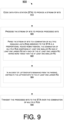
- FIG. 9 illustrates an example process 900 in accordance with an implementation of the present disclosure.
- Process 900 may represent an aspect of implementing various proposed designs, concepts, schemes, systems and methods described above. More specifically, process 900 may represent an aspect of the proposed concepts and schemes pertaining to leftover bits processing for proportional round-robin RU parsing in EHT systems in accordance with the present disclosure.
- Process 900 may include one or more operations, actions, or functions as illustrated by one or more of blocks 910, 920 and 930 as well as sub-blocks 922 and 924. Although illustrated as discrete blocks, various blocks of process 900 may be divided into additional blocks, combined into fewer blocks, or eliminated, depending on the desired implementation.
- Process 900 may be implemented by or in apparatus 710 and apparatus 720 as well as any variations thereof. Solely for illustrative purposes and without limiting the scope, process 900 is described below in the context of apparatus 710 implemented in or as STA 110 and apparatus 720 implemented in or as STA 120 of a wireless network such as a WLAN in network environment 100 in accordance with one or more of IEEE 802.11 standards. Process 900 may begin at block 910.
- process 900 may involve processor 712 of apparatus 710 (e.g., STA 110) coding data for a STA (e.g., STA 120) to provide a stream of bits.
- Process 900 may proceed from 910 to 920.
- process 900 may involve processor 712 processing the stream of bits to provide processed bits by performing operations represented by 922 and 924. Process 900 may proceed from 920 to 930.
- process 900 may involve processor 712 transmitting, via transceiver 716, the processed bits to the STA over a combination of multiple RUs which are assigned to the STA and may include at least one smaller RU and at least one larger RU with each of the at least one larger RU having more tones than the at least one smaller RU.
- process 900 may involve processor 712 parsing the stream of bits to the combination of multiple RUs in a proportional round-robin fashion. Process 900 may proceed from 922 to 924.
- process 900 may involve processor 712 distributing the leftover bits to one or more RUs but not all RUs of the combination of multiple RUs (e.g., to the at least one larger RU).
- process 900 may involve processor 712 proportionally distributing the leftover bits over last 44 tones on each of the at least one larger RU.
- process 900 may involve processor 712 sequentially distributing the leftover bits over last 44 tones on each of the at least one larger RU.
- process 900 may involve processor 712 evenly distributing the leftover bits over each of the at least one larger RU. For instance, in evenly distributing the leftover bits over each of the at least one larger RU, process 900 may involve processor 712, for every N iterations of parsing the stream of bits to the combination of multiple RUs in the proportional round-robin fashion, distributing the leftover bits over each of the at least one larger RU, with N being an integer equal to or greater than 1.
- the combination of multiple RUs may include one smaller RU of 484 tones and one larger RU of 996 tones.
- a proportional ratio of the multiple RUs may be 1:2 in units of s-bits and alternatively expressed as 1s:2s, with the remaining leftover bits distributed to the large RU of 996 tones.
- the combination of multiple RUs may include one smaller RU of 484 tones and two larger RUs of 996 tones.
- a proportional ratio of the multiple RUs may be 1:2:2 in units of s-bits or alternatively expressed as 1s:2s:2s, with the remaining leftover bits distributed to the two large RUs of 996 tones with a proportional ratio of 2:2 in units of s-bits or alternatively expressed as 2s:2s.
- the combination of multiple RUs may include one smaller RU of 484 tones and three larger RUs of 996 tones.
- a proportional ratio of the multiple RUs may be 1:2:2:2 in units of s-bits or alternatively expressed as 1s:2s:2s:2s, with the remaining leftover bits distributed to the three large RUs of 996 tones with a proportional ratio of 2:2:2 in units of s-bits or alternatively expressed as 2s:2s:2s.
- the combination of multiple RUs may include one aggregated RU and one larger RU of 996 tones with the aggregated RU comprising one smaller RU of 242 tones and one smaller RU of 484 tones.
- a proportional ratio of the multiple RUs may be 3:4 in units of s-bits or alternatively expressed as 3s:4s, with the remaining leftover bits distributed to the large RU of 996 tones.
- the combination of multiple RUs may include one smaller RU of 242 tones and one larger RU of 996 tones.
- a proportional ratio of the multiple RUs may be 1:4 in units of s-bits and alternatively expressed as 1s:4s.
- any two components so associated can also be viewed as being “operably connected”, or “operably coupled”, to each other to achieve the desired functionality, and any two components capable of being so associated can also be viewed as being “operably couplable”, to each other to achieve the desired functionality.
- operably couplable include but are not limited to physically mateable and/or physically interacting components and/or wirelessly interactable and/or wirelessly interacting components and/or logically interacting and/or logically interactable components.
Landscapes
- Engineering & Computer Science (AREA)
- Signal Processing (AREA)
- Computer Networks & Wireless Communication (AREA)
- Mobile Radio Communication Systems (AREA)
- Hardware Redundancy (AREA)
- Circuit For Audible Band Transducer (AREA)
- Two-Way Televisions, Distribution Of Moving Picture Or The Like (AREA)
Claims (4)
- Verfahren, das von einer Vorrichtung durchgeführt wird, umfassend:Verarbeiten eines Bitstroms, um verarbeitete Bits bereitzustellen (820); undÜbertragen der verarbeiteten Bits an eine Station, im Folgenden auch als STA bezeichnet, über eine Kombination von mehreren Ressourceneinheiten, im Folgenden auch als RUs bezeichnet, die der STA zugewiesen sind (830),wobei das Verarbeiten des Bitstroms (820) umfasst:wobei
Parsen des Bitstroms auf die Kombination von mehreren RUs in einer proportionales-Round-Robin Weise (822);die Kombination von mehreren RUs mindestens eine kleinere RU und mindestens zwei größere RUs umfasst, wobei jede der mindestens zwei größeren RUs mehr Töne als die mindestens eine kleinere RU aufweist; unddas Verarbeiten des Bitstroms (820) ferner umfasst:
in einem Fall von verbleibenden Bits, die aus dem Parsen in der proportionales-Round-Robin Weise verbleiben, Verteilen der verbleibenden Bits auf eine oder mehrere RUs, aber nicht alle RUs, der Kombination von mehreren RUs (824);wobei das Verteilen der verbleibenden Bits auf eine oder mehrere RUs, aber nicht alle RUs, der Kombination von mehreren RUs ein Verteilen der verbleibenden Bits auf die mindestens zwei größeren RUs umfasst;wobei das Verteilen der verbleibenden Bits auf die mindestens zwei größeren RUs ein proportionales Verteilen der verbleibenden Bits über eine letzte vordefinierte Anzahl von Tönen auf jeder der mindestens zwei größeren RUs umfasst; undwobei das proportionale Verteilen der verbleibenden Bits über eine letzte vordefinierte Anzahl von Tönen auf jeder der mindestens zwei größeren RUs ein proportionales Verteilen der verbleibenden Bits über letzte 44 Töne auf jeder der mindestens zwei größeren RUs umfasst. - Verfahren, das von einer Vorrichtung durchgeführt wird, umfassend:Verarbeiten eines Bitstroms, um verarbeitete Bits bereitzustellen (920); undÜbertragen der verarbeiteten Bits an eine Station, im Folgenden auch als STA bezeichnet, über eine Kombination von mehreren Ressourceneinheiten, im Folgenden auch als RUs bezeichnet, die der STA zugewiesen sind (930), undwobei das Verarbeiten des Bitstroms (920) umfasst:
Parsen des Bitstroms auf die Kombination von mehreren RUs in einer proportionales-Round-Robin Weise (922);wobei die Kombination von mehreren RUs mindestens eine kleinere RU und mindestens zwei größere RUs umfasst, wobei jede der mindestens zwei größeren RUs mehr Töne als die mindestens eine kleinere RU aufweist; unddas Verarbeiten des Bitstroms (820) ferner umfasst:
in einem Fall von verbleibenden Bits, die aus dem Parsen in der proportionales-Round-Robin Weise verbleiben, Verteilen der verbleibenden Bits auf die mindestens zwei größeren RUs (924);wobei das Verteilen der verbleibenden Bits auf die mindestens zwei größeren RUs ein gleichmäßiges Verteilen der verbleibenden Bits über jede der mindestens zwei größeren RUs umfasst;wobei das gleichmäßige Verteilen der verbleibenden Bits über jede der mindestens zwei größeren RUs für jede N Iterationen des Parsens des Bitstroms auf die Kombination von mehreren RUs in der proportionales-Round-Robin Weise ein Verteilen der verbleibenden Bits über jede der mindestens zwei größeren RUs umfasst, und wobei N eine ganze Zahl gleich oder größer als 1 ist. - Verfahren nach einem der Ansprüche 1 bis 2, wobei die Kombination von mehreren RUs eine kleinere RU von 484 Tönen und zwei größere RUs von 996 Tönen umfasst, und wobei ein proportionales Verhältnis der mehreren RUs 1:2:2 in Einheiten von s-Bits oder alternativ ausgedrückt als 1s:2s:2s ist, wobei die verbleibenden verbleibenden Bits auf die zwei großen RUs von 996 Tönen mit einem proportionalen Verhältnis von 2:2 in Einheiten von s-Bits oder alternativ ausgedrückt als 2s:2s verteilt werden.
- Verfahren nach einem der Ansprüche 1 bis 2, wobei die Kombination von mehreren RUs eine kleinere RU von 484 Tönen und drei größere RUs von 996 Tönen umfasst, und wobei ein proportionales Verhältnis der mehreren RUs 1:2:2:2 in Einheiten von s-Bits oder alternativ ausgedrückt als 1s:2s:2s:2s ist, wobei die verbleibenden verbleibenden Bits auf die drei großen RUs von 996 Tönen mit einem proportionalen Verhältnis von 2:2:2 in Einheiten von s-Bits oder alternativ ausgedrückt als 2s:2s:2s verteilt werden.
Applications Claiming Priority (2)
| Application Number | Priority Date | Filing Date | Title |
|---|---|---|---|
| US202062986867P | 2020-03-09 | 2020-03-09 | |
| US17/189,227 US11515987B2 (en) | 2020-03-09 | 2021-03-01 | Leftover bits processing for proportional round-robin resource unit parsing in extreme high-throughput systems |
Publications (2)
| Publication Number | Publication Date |
|---|---|
| EP3879740A1 EP3879740A1 (de) | 2021-09-15 |
| EP3879740B1 true EP3879740B1 (de) | 2025-06-04 |
Family
ID=74858312
Family Applications (1)
| Application Number | Title | Priority Date | Filing Date |
|---|---|---|---|
| EP21160692.6A Active EP3879740B1 (de) | 2020-03-09 | 2021-03-04 | Verfahren zur verarbeitung von restbits für das proportionale rundlauf-verfahrens-parsing von ressourceneinheiten in systemen mit extrem hohem durchsatz |
Country Status (4)
| Country | Link |
|---|---|
| US (2) | US11515987B2 (de) |
| EP (1) | EP3879740B1 (de) |
| CN (2) | CN120676409A (de) |
| TW (1) | TWI771937B (de) |
Families Citing this family (5)
| Publication number | Priority date | Publication date | Assignee | Title |
|---|---|---|---|---|
| US11728942B2 (en) * | 2019-03-22 | 2023-08-15 | Qualcomm Incorporated | Data parsing to support resource unit aggregation |
| US11515987B2 (en) * | 2020-03-09 | 2022-11-29 | Mediatek Singapore Pte. Ltd. | Leftover bits processing for proportional round-robin resource unit parsing in extreme high-throughput systems |
| CN115280711A (zh) * | 2020-03-16 | 2022-11-01 | 索尼集团公司 | 通信设备和方法 |
| US12471143B2 (en) * | 2020-05-21 | 2025-11-11 | Lg Electronics Inc. | CTS transmission method |
| US12562839B2 (en) * | 2021-12-06 | 2026-02-24 | Mediatek Singapore Pte. Ltd. | Detailed signaling designs for distributed-tone resource unit transmission |
Family Cites Families (16)
| Publication number | Priority date | Publication date | Assignee | Title |
|---|---|---|---|---|
| CN106664187A (zh) * | 2014-06-02 | 2017-05-10 | 马维尔国际贸易有限公司 | 高效正交频分复用(ofdm)物理层(phy) |
| US9854580B2 (en) * | 2014-09-04 | 2017-12-26 | Qualcomm, Incorporated | Efficient resource allocation |
| US10098110B2 (en) * | 2014-10-05 | 2018-10-09 | Lg Electronics Inc. | Method and apparatus for allocating wireless resources based on single resource unit in WLAN |
| CN107113830B (zh) * | 2014-11-01 | 2020-11-20 | Lg电子株式会社 | 用于在无线lan中分配资源单元的方法和装置 |
| US10958391B2 (en) | 2014-11-18 | 2021-03-23 | Qualcomm Incorporated | Tone plans for wireless communication networks |
| WO2016201739A1 (zh) * | 2015-06-16 | 2016-12-22 | 华为技术有限公司 | 资源调度的方法、装置和设备 |
| US10536196B2 (en) * | 2015-09-11 | 2020-01-14 | Interdigital Patent Holdings, Inc. | Multiple resource unit allocation for OFDMA WLAN |
| US9867189B2 (en) * | 2015-09-29 | 2018-01-09 | Newracom, Inc. | Resource allocation indication for multi-user multiple-input-multiple-output (MU-MIMO) orthogonal frequency division multiple access (OFDMA) communication |
| RU2720950C1 (ru) * | 2017-02-03 | 2020-05-15 | Идак Холдингз, Инк. | Сегментация блока кода в зависимости от выбора базовой матрицы ldpc |
| US10856311B2 (en) | 2018-03-06 | 2020-12-01 | Qualcomm Incorporated | Systems and methods of communicating via sub-bands in wireless communication networks |
| US11509413B2 (en) * | 2018-06-28 | 2022-11-22 | Intel Corporation | Apparatus, system and method of an orthogonal frequency-division multiplexing (OFDM) transmission over a wide bandwidth |
| CN116996162A (zh) | 2018-07-06 | 2023-11-03 | 华为技术有限公司 | 编码比特的传输方法及装置 |
| US11728942B2 (en) * | 2019-03-22 | 2023-08-15 | Qualcomm Incorporated | Data parsing to support resource unit aggregation |
| US11239940B2 (en) * | 2019-10-01 | 2022-02-01 | Mediatek Singapore Pte. Ltd. | Joint encoding schemes with interleaver and tone mapper for multi-RU operation |
| US11711786B2 (en) * | 2020-01-21 | 2023-07-25 | Mediatek Singapore Pte. Ltd. | Optimization of resource unit and segment parser design for aggregated and multi-resource unit operations in extreme high-throughput systems |
| US11515987B2 (en) * | 2020-03-09 | 2022-11-29 | Mediatek Singapore Pte. Ltd. | Leftover bits processing for proportional round-robin resource unit parsing in extreme high-throughput systems |
-
2021
- 2021-03-01 US US17/189,227 patent/US11515987B2/en active Active
- 2021-03-03 CN CN202510682865.9A patent/CN120676409A/zh active Pending
- 2021-03-03 TW TW110107491A patent/TWI771937B/zh active
- 2021-03-03 CN CN202110236708.7A patent/CN113382443B/zh active Active
- 2021-03-04 EP EP21160692.6A patent/EP3879740B1/de active Active
-
2022
- 2022-10-28 US US17/975,875 patent/US11916846B2/en active Active
Also Published As
| Publication number | Publication date |
|---|---|
| CN113382443B (zh) | 2025-06-13 |
| TW202135583A (zh) | 2021-09-16 |
| US11916846B2 (en) | 2024-02-27 |
| US20210281382A1 (en) | 2021-09-09 |
| CN120676409A (zh) | 2025-09-19 |
| TWI771937B (zh) | 2022-07-21 |
| CN113382443A (zh) | 2021-09-10 |
| US20230051851A1 (en) | 2023-02-16 |
| EP3879740A1 (de) | 2021-09-15 |
| US11515987B2 (en) | 2022-11-29 |
Similar Documents
| Publication | Publication Date | Title |
|---|---|---|
| US11949609B2 (en) | EHT preamble designs for transmissions to mixed clients in wireless communications | |
| US11916846B2 (en) | Leftover bits processing for proportional round-robin resource unit parsing in extreme high-throughput systems | |
| US11711786B2 (en) | Optimization of resource unit and segment parser design for aggregated and multi-resource unit operations in extreme high-throughput systems | |
| EP3849128B1 (de) | Verschachtelung von kombinationen mehrerer ressourceneinheiten in einem wlan | |
| US11825493B2 (en) | Resource unit allocation subfield designs for trigger-based and self-contained signaling in extreme high-throughput systems | |
| US20220045788A1 (en) | Signaling Of Punctured Sub-Channels In Wireless Communications | |
| WO2024055989A1 (en) | 4x ltf sequence design for wide bandwidths in wireless communications | |
| US11805510B2 (en) | Enhanced PUCCH format 0 and format 1 design for new radio unlicensed spectrum operation | |
| US12549320B2 (en) | Channelization of 60GHz band for next-generation WLAN | |
| WO2026046200A1 (en) | Coding and rate matching designs for uhr enhanced long range wi-fi | |
| US20260012292A1 (en) | Stream Parser And Segment Parser Designs For Unequal Modulation Of Spatial Streams In Wireless Communications | |
| WO2024160248A1 (en) | Sub-resource unit based adaptive modulation schemes in wireless communications | |
| US20240364445A1 (en) | Proportional Round Robin Segment Parser Designs For Wider Bandwidths In Wireless Communications | |
| WO2024251277A1 (en) | Multiple mru transmission methods for next-generation wlan systems | |
| WO2024217483A1 (en) | Stream parser designs for unequal modulation transmissions with multiple spatial streams | |
| WO2026057036A1 (en) | Signaling designs for uhr trigger frame in wireless communications | |
| WO2024199494A1 (en) | Segment parser designs for unequal modulation and unequal mcs transmission | |
| WO2026077438A1 (en) | Signaling designs for new modulation and coding schemes in next-generation wireless communications | |
| WO2026098539A1 (en) | Enabling mu-mimo with unequal modulation in wireless communications | |
| WO2025061074A1 (en) | Link adaptation enhancement with more combinations of modulation and coding schemes for next-generation wlan systems | |
| WO2023237109A1 (en) | Designs of data and pilot subcarrier indices of wide bandwidth resource unit for next-generation wlan | |
| WO2025247376A1 (en) | Papr reduction for elr ppdu transmission with ru duplication in wireless communications |
Legal Events
| Date | Code | Title | Description |
|---|---|---|---|
| PUAI | Public reference made under article 153(3) epc to a published international application that has entered the european phase |
Free format text: ORIGINAL CODE: 0009012 |
|
| STAA | Information on the status of an ep patent application or granted ep patent |
Free format text: STATUS: THE APPLICATION HAS BEEN PUBLISHED |
|
| AK | Designated contracting states |
Kind code of ref document: A1 Designated state(s): AL AT BE BG CH CY CZ DE DK EE ES FI FR GB GR HR HU IE IS IT LI LT LU LV MC MK MT NL NO PL PT RO RS SE SI SK SM TR |
|
| STAA | Information on the status of an ep patent application or granted ep patent |
Free format text: STATUS: REQUEST FOR EXAMINATION WAS MADE |
|
| 17P | Request for examination filed |
Effective date: 20220314 |
|
| RBV | Designated contracting states (corrected) |
Designated state(s): AL AT BE BG CH CY CZ DE DK EE ES FI FR GB GR HR HU IE IS IT LI LT LU LV MC MK MT NL NO PL PT RO RS SE SI SK SM TR |
|
| STAA | Information on the status of an ep patent application or granted ep patent |
Free format text: STATUS: EXAMINATION IS IN PROGRESS |
|
| 17Q | First examination report despatched |
Effective date: 20230227 |
|
| P01 | Opt-out of the competence of the unified patent court (upc) registered |
Effective date: 20230627 |
|
| GRAP | Despatch of communication of intention to grant a patent |
Free format text: ORIGINAL CODE: EPIDOSNIGR1 |
|
| STAA | Information on the status of an ep patent application or granted ep patent |
Free format text: STATUS: GRANT OF PATENT IS INTENDED |
|
| RIN1 | Information on inventor provided before grant (corrected) |
Inventor name: PARE, JR. THOMAS EDWARD Inventor name: LIU, JIANHAN Inventor name: HU, SHENGQUAN |
|
| INTG | Intention to grant announced |
Effective date: 20250108 |
|
| GRAS | Grant fee paid |
Free format text: ORIGINAL CODE: EPIDOSNIGR3 |
|
| GRAA | (expected) grant |
Free format text: ORIGINAL CODE: 0009210 |
|
| STAA | Information on the status of an ep patent application or granted ep patent |
Free format text: STATUS: THE PATENT HAS BEEN GRANTED |
|
| AK | Designated contracting states |
Kind code of ref document: B1 Designated state(s): AL AT BE BG CH CY CZ DE DK EE ES FI FR GB GR HR HU IE IS IT LI LT LU LV MC MK MT NL NO PL PT RO RS SE SI SK SM TR |
|
| REG | Reference to a national code |
Ref country code: GB Ref legal event code: FG4D |
|
| REG | Reference to a national code |
Ref country code: CH Ref legal event code: EP |
|
| REG | Reference to a national code |
Ref country code: DE Ref legal event code: R096 Ref document number: 602021031584 Country of ref document: DE |
|
| REG | Reference to a national code |
Ref country code: IE Ref legal event code: FG4D |
|
| REG | Reference to a national code |
Ref country code: NL Ref legal event code: MP Effective date: 20250604 |
|
| PG25 | Lapsed in a contracting state [announced via postgrant information from national office to epo] |
Ref country code: ES Free format text: LAPSE BECAUSE OF FAILURE TO SUBMIT A TRANSLATION OF THE DESCRIPTION OR TO PAY THE FEE WITHIN THE PRESCRIBED TIME-LIMIT Effective date: 20250604 Ref country code: FI Free format text: LAPSE BECAUSE OF FAILURE TO SUBMIT A TRANSLATION OF THE DESCRIPTION OR TO PAY THE FEE WITHIN THE PRESCRIBED TIME-LIMIT Effective date: 20250604 |
|
| REG | Reference to a national code |
Ref country code: LT Ref legal event code: MG9D |
|
| PG25 | Lapsed in a contracting state [announced via postgrant information from national office to epo] |
Ref country code: GR Free format text: LAPSE BECAUSE OF FAILURE TO SUBMIT A TRANSLATION OF THE DESCRIPTION OR TO PAY THE FEE WITHIN THE PRESCRIBED TIME-LIMIT Effective date: 20250905 Ref country code: NO Free format text: LAPSE BECAUSE OF FAILURE TO SUBMIT A TRANSLATION OF THE DESCRIPTION OR TO PAY THE FEE WITHIN THE PRESCRIBED TIME-LIMIT Effective date: 20250904 |
|
| PG25 | Lapsed in a contracting state [announced via postgrant information from national office to epo] |
Ref country code: PL Free format text: LAPSE BECAUSE OF FAILURE TO SUBMIT A TRANSLATION OF THE DESCRIPTION OR TO PAY THE FEE WITHIN THE PRESCRIBED TIME-LIMIT Effective date: 20250604 |
|
| PG25 | Lapsed in a contracting state [announced via postgrant information from national office to epo] |
Ref country code: BG Free format text: LAPSE BECAUSE OF FAILURE TO SUBMIT A TRANSLATION OF THE DESCRIPTION OR TO PAY THE FEE WITHIN THE PRESCRIBED TIME-LIMIT Effective date: 20250604 |
|
| PG25 | Lapsed in a contracting state [announced via postgrant information from national office to epo] |
Ref country code: HR Free format text: LAPSE BECAUSE OF FAILURE TO SUBMIT A TRANSLATION OF THE DESCRIPTION OR TO PAY THE FEE WITHIN THE PRESCRIBED TIME-LIMIT Effective date: 20250604 |
|
| PG25 | Lapsed in a contracting state [announced via postgrant information from national office to epo] |
Ref country code: RS Free format text: LAPSE BECAUSE OF FAILURE TO SUBMIT A TRANSLATION OF THE DESCRIPTION OR TO PAY THE FEE WITHIN THE PRESCRIBED TIME-LIMIT Effective date: 20250904 |
|
| PG25 | Lapsed in a contracting state [announced via postgrant information from national office to epo] |
Ref country code: LV Free format text: LAPSE BECAUSE OF FAILURE TO SUBMIT A TRANSLATION OF THE DESCRIPTION OR TO PAY THE FEE WITHIN THE PRESCRIBED TIME-LIMIT Effective date: 20250604 |
|
| PG25 | Lapsed in a contracting state [announced via postgrant information from national office to epo] |
Ref country code: NL Free format text: LAPSE BECAUSE OF FAILURE TO SUBMIT A TRANSLATION OF THE DESCRIPTION OR TO PAY THE FEE WITHIN THE PRESCRIBED TIME-LIMIT Effective date: 20250604 |
|
| PG25 | Lapsed in a contracting state [announced via postgrant information from national office to epo] |
Ref country code: PT Free format text: LAPSE BECAUSE OF FAILURE TO SUBMIT A TRANSLATION OF THE DESCRIPTION OR TO PAY THE FEE WITHIN THE PRESCRIBED TIME-LIMIT Effective date: 20251006 |
|
| REG | Reference to a national code |
Ref country code: AT Ref legal event code: MK05 Ref document number: 1801410 Country of ref document: AT Kind code of ref document: T Effective date: 20250604 |
|
| PG25 | Lapsed in a contracting state [announced via postgrant information from national office to epo] |
Ref country code: IS Free format text: LAPSE BECAUSE OF FAILURE TO SUBMIT A TRANSLATION OF THE DESCRIPTION OR TO PAY THE FEE WITHIN THE PRESCRIBED TIME-LIMIT Effective date: 20251004 |
|
| PG25 | Lapsed in a contracting state [announced via postgrant information from national office to epo] |
Ref country code: AT Free format text: LAPSE BECAUSE OF FAILURE TO SUBMIT A TRANSLATION OF THE DESCRIPTION OR TO PAY THE FEE WITHIN THE PRESCRIBED TIME-LIMIT Effective date: 20250604 Ref country code: SM Free format text: LAPSE BECAUSE OF FAILURE TO SUBMIT A TRANSLATION OF THE DESCRIPTION OR TO PAY THE FEE WITHIN THE PRESCRIBED TIME-LIMIT Effective date: 20250604 |
|
| PGFP | Annual fee paid to national office [announced via postgrant information from national office to epo] |
Ref country code: FR Payment date: 20251231 Year of fee payment: 6 |
|
| PG25 | Lapsed in a contracting state [announced via postgrant information from national office to epo] |
Ref country code: CZ Free format text: LAPSE BECAUSE OF FAILURE TO SUBMIT A TRANSLATION OF THE DESCRIPTION OR TO PAY THE FEE WITHIN THE PRESCRIBED TIME-LIMIT Effective date: 20250604 |
|
| PG25 | Lapsed in a contracting state [announced via postgrant information from national office to epo] |
Ref country code: EE Free format text: LAPSE BECAUSE OF FAILURE TO SUBMIT A TRANSLATION OF THE DESCRIPTION OR TO PAY THE FEE WITHIN THE PRESCRIBED TIME-LIMIT Effective date: 20250604 |
|
| PG25 | Lapsed in a contracting state [announced via postgrant information from national office to epo] |
Ref country code: SK Free format text: LAPSE BECAUSE OF FAILURE TO SUBMIT A TRANSLATION OF THE DESCRIPTION OR TO PAY THE FEE WITHIN THE PRESCRIBED TIME-LIMIT Effective date: 20250604 Ref country code: RO Free format text: LAPSE BECAUSE OF FAILURE TO SUBMIT A TRANSLATION OF THE DESCRIPTION OR TO PAY THE FEE WITHIN THE PRESCRIBED TIME-LIMIT Effective date: 20250604 |
|
| PG25 | Lapsed in a contracting state [announced via postgrant information from national office to epo] |
Ref country code: IT Free format text: LAPSE BECAUSE OF FAILURE TO SUBMIT A TRANSLATION OF THE DESCRIPTION OR TO PAY THE FEE WITHIN THE PRESCRIBED TIME-LIMIT Effective date: 20250604 |
|
| REG | Reference to a national code |
Ref country code: DE Ref legal event code: R097 Ref document number: 602021031584 Country of ref document: DE |
|
| PGFP | Annual fee paid to national office [announced via postgrant information from national office to epo] |
Ref country code: GB Payment date: 20260106 Year of fee payment: 6 |
|
| PLBE | No opposition filed within time limit |
Free format text: ORIGINAL CODE: 0009261 |
|
| STAA | Information on the status of an ep patent application or granted ep patent |
Free format text: STATUS: NO OPPOSITION FILED WITHIN TIME LIMIT |
|
| PG25 | Lapsed in a contracting state [announced via postgrant information from national office to epo] |
Ref country code: DK Free format text: LAPSE BECAUSE OF FAILURE TO SUBMIT A TRANSLATION OF THE DESCRIPTION OR TO PAY THE FEE WITHIN THE PRESCRIBED TIME-LIMIT Effective date: 20250604 |
|
| PGFP | Annual fee paid to national office [announced via postgrant information from national office to epo] |
Ref country code: DE Payment date: 20260102 Year of fee payment: 6 |
|
| REG | Reference to a national code |
Ref country code: CH Ref legal event code: L10 Free format text: ST27 STATUS EVENT CODE: U-0-0-L10-L00 (AS PROVIDED BY THE NATIONAL OFFICE) Effective date: 20260416 |
|
| 26N | No opposition filed |
Effective date: 20260305 |