EP3879250B1 - Flush-mount combined static pressure and temperature probe with flow enhancement feature - Google Patents
Flush-mount combined static pressure and temperature probe with flow enhancement feature Download PDFInfo
- Publication number
- EP3879250B1 EP3879250B1 EP21151166.2A EP21151166A EP3879250B1 EP 3879250 B1 EP3879250 B1 EP 3879250B1 EP 21151166 A EP21151166 A EP 21151166A EP 3879250 B1 EP3879250 B1 EP 3879250B1
- Authority
- EP
- European Patent Office
- Prior art keywords
- probe
- temperature
- channel
- pressure
- sensor
- Prior art date
- Legal status (The legal status is an assumption and is not a legal conclusion. Google has not performed a legal analysis and makes no representation as to the accuracy of the status listed.)
- Active
Links
Images


Classifications
-
- G—PHYSICS
- G01—MEASURING; TESTING
- G01K—MEASURING TEMPERATURE; MEASURING QUANTITY OF HEAT; THERMALLY-SENSITIVE ELEMENTS NOT OTHERWISE PROVIDED FOR
- G01K13/00—Thermometers specially adapted for specific purposes
- G01K13/02—Thermometers specially adapted for specific purposes for measuring temperature of moving fluids or granular materials capable of flow
-
- F—MECHANICAL ENGINEERING; LIGHTING; HEATING; WEAPONS; BLASTING
- F02—COMBUSTION ENGINES; HOT-GAS OR COMBUSTION-PRODUCT ENGINE PLANTS
- F02C—GAS-TURBINE PLANTS; AIR INTAKES FOR JET-PROPULSION PLANTS; CONTROLLING FUEL SUPPLY IN AIR-BREATHING JET-PROPULSION PLANTS
- F02C9/00—Controlling gas-turbine plants; Controlling fuel supply in air- breathing jet-propulsion plants
- F02C9/26—Control of fuel supply
- F02C9/28—Regulating systems responsive to plant or ambient parameters, e.g. temperature, pressure, rotor speed
-
- F—MECHANICAL ENGINEERING; LIGHTING; HEATING; WEAPONS; BLASTING
- F01—MACHINES OR ENGINES IN GENERAL; ENGINE PLANTS IN GENERAL; STEAM ENGINES
- F01D—NON-POSITIVE DISPLACEMENT MACHINES OR ENGINES, e.g. STEAM TURBINES
- F01D17/00—Regulating or controlling by varying flow
- F01D17/02—Arrangement of sensing elements
- F01D17/08—Arrangement of sensing elements responsive to condition of working-fluid, e.g. pressure
-
- F—MECHANICAL ENGINEERING; LIGHTING; HEATING; WEAPONS; BLASTING
- F01—MACHINES OR ENGINES IN GENERAL; ENGINE PLANTS IN GENERAL; STEAM ENGINES
- F01D—NON-POSITIVE DISPLACEMENT MACHINES OR ENGINES, e.g. STEAM TURBINES
- F01D17/00—Regulating or controlling by varying flow
- F01D17/02—Arrangement of sensing elements
- F01D17/08—Arrangement of sensing elements responsive to condition of working-fluid, e.g. pressure
- F01D17/085—Arrangement of sensing elements responsive to condition of working-fluid, e.g. pressure to temperature
-
- F—MECHANICAL ENGINEERING; LIGHTING; HEATING; WEAPONS; BLASTING
- F01—MACHINES OR ENGINES IN GENERAL; ENGINE PLANTS IN GENERAL; STEAM ENGINES
- F01D—NON-POSITIVE DISPLACEMENT MACHINES OR ENGINES, e.g. STEAM TURBINES
- F01D21/00—Shutting-down of machines or engines, e.g. in emergency; Regulating, controlling, or safety means not otherwise provided for
- F01D21/003—Arrangements for testing or measuring
-
- G—PHYSICS
- G01—MEASURING; TESTING
- G01K—MEASURING TEMPERATURE; MEASURING QUANTITY OF HEAT; THERMALLY-SENSITIVE ELEMENTS NOT OTHERWISE PROVIDED FOR
- G01K13/00—Thermometers specially adapted for specific purposes
- G01K13/02—Thermometers specially adapted for specific purposes for measuring temperature of moving fluids or granular materials capable of flow
- G01K13/024—Thermometers specially adapted for specific purposes for measuring temperature of moving fluids or granular materials capable of flow of moving gases
-
- G—PHYSICS
- G01—MEASURING; TESTING
- G01L—MEASURING FORCE, STRESS, TORQUE, WORK, MECHANICAL POWER, MECHANICAL EFFICIENCY, OR FLUID PRESSURE
- G01L19/00—Details of, or accessories for, apparatus for measuring steady or quasi-steady pressure of a fluent medium insofar as such details or accessories are not special to particular types of pressure gauges
- G01L19/0092—Pressure sensor associated with other sensors, e.g. for measuring acceleration or temperature
-
- G—PHYSICS
- G01—MEASURING; TESTING
- G01M—TESTING STATIC OR DYNAMIC BALANCE OF MACHINES OR STRUCTURES; TESTING OF STRUCTURES OR APPARATUS, NOT OTHERWISE PROVIDED FOR
- G01M15/00—Testing of engines
- G01M15/14—Testing gas-turbine engines or jet-propulsion engines
Definitions
- the present disclosure relates generally to gas turbine engines, and more particularly to a sensor system of a gas turbine engine.
- a gas turbine engine typically includes a high pressure spool, a combustion system, and a low pressure spool disposed within an engine case to form a generally axial, serial flow path about the engine centerline.
- the high pressure spool includes a high pressure turbine, a high pressure shaft extending axially forward from the high pressure turbine, and a high pressure compressor connected to a forward end of the high pressure shaft.
- the low pressure spool includes a low pressure turbine, which is disposed downstream of the high pressure turbine, a low pressure shaft, which typically extends coaxially through the high pressure shaft, and a fan connected to a forward end of the low pressure shaft, forward of the high pressure compressor.
- the combustion system is disposed between the high pressure compressor and the high pressure turbine and receives compressed air from the compressors and fuel provided by a fuel injection system.
- a combustion process is carried out within the combustion system to produce high energy gases to produce thrust and turn the high and low pressure turbines, which drive the compressor and the fan to sustain the combustion process.
- An engine control system for the gas turbine engine can employ sensors that relay data relating to various properties of the engine and its operation.
- the engine control system may want to know the working fluid temperature and pressure at particular points in the engine. These properties are measured by probes that are communicatively connected to the engine control system.
- the probes have a particular size, though, which occupies space and adds weight to the engine.
- the positioning of the probes can affect the flow of the working fluid, which can affect the measurements of other probes.
- US 10 371 000 relates to a pressure and temperature probe.
- a probe is provided in claim 1 and includes a probe head, a probe tip extending from the probe head and ending with a sensor face in fluidic communication with a first fluid stream, a pressure channel extending into the probe tip through the sensor face, a pressure sensor configured to sense a pressure in the pressure channel, a temperature channel extending into the probe tip through the sensor face with a temperature orifice located on the sensor face and at least one exit port distal from the sensor face, and a temperature sensor configured to sense a temperature in the temperature channel.
- the temperature channel extends parallel to the pressure channel and is fluidly separate from the pressure channel.
- the temperature channel is configured to channel a fluid flow from the temperature orifice to the at least one exit port, which is configured to discharge the fluid flow into a second fluid stream.
- a gas turbine engine extending along an axis includes a fan section having a number of rotor cascades and a number of stator cascades, a splitter downstream of the fan section and having an inner side, an outer side, and an inside surface, a compressor section downstream of the fan section, a combustor section downstream of the compressor section, a turbine section downstream of the combustor section and connected to the compressor and/or fan sections, and a probe assembly located on the compressor and/or fan section and configured to sense a pressure and a total temperature of a first airflow stream.
- the probe includes a probe head, a probe tip extending from the probe head and ending with a sensor face in fluidic communication with a first fluid stream, a pressure channel extending into the probe tip through the sensor face, a pressure sensor configured to sense a pressure in the pressure channel, a temperature channel extending into the probe tip through the sensor face with a temperature orifice located on the sensor face and at least one exit port distal from the sensor face, and a temperature sensor configured to sense a temperature in the temperature channel.
- the temperature channel extends parallel to the pressure channel and is fluidly separate from the pressure channel.
- the temperature channel is configured to channel a fluid flow from the temperature orifice to the at least one exit port, which is configured to discharge the fluid flow into a second fluid stream.
- FIG. 1 is a schematic side cross-section view of gas turbine engine 10. Although FIG. 1 depicts a gas turbine engine typically used for aircraft propulsion, the present disclosure is readily applicable to gas turbine generators and other similar systems incorporating rotor-supported, shaft-driven turbines. Shown in FIG.
- gas turbine engine 10 gas turbine engine 10, fan 12, fan rotor cascades 13A - 13C, fan stator cascades 14A - 14D, high pressure compressor (HPC) 16, combustor section 18, high pressure turbine (HPT) 20, low pressure turbine (LPT) 22, struts 24, fan case 26, HPC case 28, HPT case 30, LPT case 32, low pressure shaft 34, high pressure shaft 36, splitter 38, inside surface 39, injectors 40, HPT blades 41, LPT blades 42, support rotor 44, vane airfoil sections 46, probe assembly 48, engine control unit 50, inlet air A, fan air A F , primary air A P , secondary air A S , and longitudinal engine centerline axis C L .
- Gas turbine engine 10 can be described as having cold section 11 and hot section 17, as annotated in FIG. 1 .
- gas turbine engine 10 comprises a dual-spool turbofan engine in which the advantages of the present disclosure are particularly well illustrated.
- Gas turbine engine 10 of which the operational principles are well known in the art, comprises cold section 11, including fan 12 and HPC 16, and hot section 17, including combustor section 18, HPT 20, and LPT 22. These components are each concentrically disposed around longitudinal engine centerline axis C L .
- Fan 12 is separated from HPC 16 by a plurality of struts 24, and fan 12 is enclosed at its outer diameter within fan case 26.
- the other engine components are correspondingly enclosed at their outer diameters within various engine casings, including HPC case 28, HPT case 30, and LPT case 32.
- Fan 12 is connected to LPT 22 through low pressure shaft 34, and together with fan 12, LPT 22, and low pressure shaft 34, comprise the low pressure spool.
- HPC 16 is connected to HPT 20 through high pressure shaft 36, and together HPC 16, HPT 20, and high pressure shaft 36 comprise the high pressure spool.
- inlet air A enters engine 10 at fan 12.
- Fan 12 comprises fan rotor cascades 13A-13C which are rotated by LPT 22 through low pressure shaft 34 (either directly as shown or through a gearbox, not shown).
- fan stator cascades 14A-14D between which fan rotor cascades 13A-13C are positioned, respectively
- fan air A F is accelerated and compressed.
- splitter 38 fan air A F is divided into streams of primary air A P (also known as gas path air) and secondary air A S (also known as bypass air). Secondary air A S produces a major portion of the thrust output of engine 10 while primary air A P is directed into HPC 16.
- HPC 16 includes pluralities of rotors and stators, alternately positioned, that incrementally step up the pressure of primary air A P .
- HPC 16 is rotated by HPT 20 through high pressure shaft 36 to provide compressed air to combustor section 18.
- the compressed air is delivered to combustor section 18, along with fuel through injectors 40, such that a combustion process can be carried out to produce the high energy gases necessary to turn HPT 20 and LPT 22.
- Primary air A P continues through gas turbine engine 10 whereby it is typically passed through an exhaust nozzle to further produce thrust.
- primary air A P flows through HPT 20 and LPT 22 such that HPT blades 41 and LPT blades 42 extract energy from the flow of primary air A P .
- Primary air A P impinges on HPT blades 41 to cause rotation of high pressure shaft 36, which turns HPC 16.
- Primary air A P also impinges on LPT blades 42 to cause rotation of support rotor 44 and low pressure shaft 34, which turns the rotating components of fan 12.
- gas turbine engine 10 includes probe assembly 48.
- Probe assembly 48 begins exterior to fan case 26 and HPC case 28, extends through one of struts 24 and splitter 38, terminating flush with inside surface 39 of splitter 38 in fluid contact with primary air A P adjacent to the wall at the probe face. Thereby, probe assembly 48 can measure the static pressure and total temperature of primary air A P (i.e., the static primary air A P temperature plus the kinetic energy of primary air A P ).
- Probe assembly 48 is communicatively connected to engine control unit (ECU) 50 such that ECU 50 receives measurements from probe assembly 48.
- ECU engine control unit
- probe assembly 48 is positioned downstream of fan rotor cascades 13A-13C and fan stator cascades 14A-14D and upstream of HPC 16, although in alternate embodiments, probe assembly 48 can be positioned in other locations, such as within HPC 16 or amongst fan rotor cascades 13 and fan stator cascades 14. Probe assembly 48 can also be referred to as a probe.
- gas turbine engine 10 as shown in FIG. 1 allow for ECU 50 to know the total temperature and static pressure of primary air A P as reported by probe assembly 48. ECU 50 can then use this information to control gas turbine engine 10 appropriately.
- FIG. 1 Depicted in FIG. 1 is one embodiment of the present disclosure, to which there are alternative embodiments.
- engine 10 can be a three spool engine.
- engine 10 has an intermediate compressor between fan 12 and HPC 16 and an intermediate turbine between HPT 20 and LPT 22, wherein the intermediate compressor is connected to the intermediate turbine with an additional shaft.
- FIG. 2 is a schematic side cross-sectional view of gas turbine engine 10 proximate a probe assembly 48. Also shown in FIG. 2 are inner side 35 and outer side 37. At splitter 38, fan air A F is divided into streams of primary air A P , flowing on inner side 35, and secondary air A S , flowing on outer side 37.
- Probe assembly 48 comprises probe head 52 with probe tip 54 extending therefrom. At the innermost end of probe tip 54 is sensor face 56 which is tangent to inside surface 39 of splitter 38. Thereby, probe tip 54 extends at an acute, upstream angle from the flow of primary air A P .
- sensor face 56 is flat, although in alternate embodiments sensor face 56 can be curved to closer match the contour of splitter 38.
- sensor face 56 is substantially flush with inside surface 39 of splitter 38 in that no part of sensor face 56 is more than 0.76 mm (0.030 inch) from being even with inside surface 39.
- Probe assembly 48 also includes pressure sensor 58, located in probe head 52, and temperature sensor 60, located in probe tip 54. Pressure sensor 58 and temperature sensor 60 are each located within a respective channel (not shown in FIG. 2 ) and will be described in more detail later in FIGS. 3 - 4 .
- probe assembly 48 is positioned on fan case 26 and configured to sense a pressure and a total temperature of primary air A P (i.e., the primary airflow stream).
- temperature sensor 60 can be located near (i.e., proximate) sensor face 56, while in other embodiments, temperature sensor 60 can be located some distance away from sensor face 56 within a temperature channel. As will be shown and described later in FIGS.
- a flow of fluid past temperature sensor 60 can result in a more accurate indication of total temperature of primary air A P .
- Pressure sensor 58 can be a pressure transducer that measures the static pressure of primary air A P
- temperature sensor 60 can be a resistive temperature detector, such as a contact thermometer, that measures the total temperature of primary air A P .
- the data from pressure sensor 58 and temperature sensor 60 is fed to ECU 50. Because the properties are measured at the boundary of the flow of primary air A P , ECU 50 can do calculations to estimate the average properties of primary air A P across the primary air flowpath.
- pressure sensor 58 can be routed elsewhere in or near ECU 50 by using a pneumatic line (not shown) leading from probe assembly 48 to a remote pressure transducer, thereby providing fluid communication between probe assembly 48 and a remote pressure transducer. This embodiment could be advantageous for harsh environments.
- gas turbine engine 10 allow for the static pressure and total temperature of primary air A P to be measured without the measurement devices protruding into the flowpath which prevents major flow disturbances due to probe assembly 48.
- the static pressure and total temperature data can be transmitted to ECU 50 for further processing and can be used to control gas turbine engine 10.
- the sensed temperature differs from the center flow Ap total temperature. This is due to the incomplete A p flow recovery as the flow comes to theoretical rest at the wall, and also due to wall heat conduction. A correction can be applied to account for this difference using empirical data or approximations based on flow velocity at the probe interface.
- FIG. 3 is a cross-sectional front view of probe tip 54 along line 3-3 in FIG. 2 .
- HPC case void 33 inner side 35, outer side 37, inside surfaces 39A, 39B, probe assembly 48, probe tip 54, probe shaft 55, sensor face 56, pressure sensor 58, temperature sensor 60, pressure channel 62, pressure orifice 63, temperature channel 64, temperature orifice 65, wires 66, shaft 68, and exit port 70.
- primary air A P also labeled in FIG. 3 are also labeled in FIG. 3 , secondary air A S , temperature channel flow F, probe tip diameter D 1 , pressure orifice diameter D 2 , temperature orifice diameter D 3 , exit port diameter D 4 , probe shaft diameter D 5 , and spacing S.
- HPC case void 33 is a region between primary air A P and secondary air A S , being defined by respective inside surfaces 39A and 39B, as shown in FIGS. 1 - 2 .
- Probe assembly 48 shown in the illustrated embodiment is not drawn to scale, in order to provide a sufficient level of detail. In a practical embodiment, the length of probe shaft 55 (i.e., in a direction of pressure channel 62 and temperature channel 64) will be much greater than depicted.
- Pressure orifice 63 and temperature orifice 65 are each located on sensor face 56 in fluidic communication with primary air A P .
- Pressure channel 62 and temperature channel 64 are beside each other, extending through probe tip 54 along substantially parallel axes (not labeled), with the center of pressure channel 62 being approximately aligned with the center of temperature channel 64 relative to the C L axis of engine 10, and with pressure channel 62 and temperature channel 64 being approximately perpendicular to Ap flow.
- Pressure channel 62 begins at pressure orifice 63 in sensor face 56 and extends all of the way to probe head 52 (shown in FIG. 2 ).
- Pressure channel 62 is in fluidic communication with pressure sensor 58. Thereby, primary air A P enters and can exert a static pressure on pressure channel 62, the static pressure being measured by pressure sensor 58.
- Temperature channel 64 begins at temperature orifice 65 in sensor face 56 and also extends toward probe head 52. Primary air A P entering temperature orifice 65 becomes temperature channel flow F, flowing through temperature channel 64 from temperature orifice 65, past temperature sensor 60, and out exit port 70 into secondary air A S .
- exit port 70 is located in secondary air A S on outer side 37, shown in FIG. 2 , and is oriented laterally (i.e., perpendicular to centerline axis C L , shown in FIG. 1 ). In some embodiments, more than one exit port 70 can be used. The location of one or more exit ports will be shown and described in more detail later, in FIGS. 4A - 4B, 5A - 5B , and 6A - 6B .
- Temperature sensor 60 electronically communicates with probe head 52 via wires 66. Temperature sensor 60 further includes shaft 68 which extends into temperature channel 64 minimally contacting probe tip 54, which thermally isolates shaft 68 from probe tip 54.
- the flow of primary air A P can be affected by pressure orifice 63 and/or temperature orifice 65. In order to prevent interference of the flow into one orifice by the other orifice, the center of pressure orifice 63 is at the same axial location as the center of temperature orifice 65.
- probe tip diameter D 1 is about 25 mm (1.0 inch)
- pressure orifice diameter D 2 is about 2.5 mm (0.10 inch)
- temperature orifice diameter D 3 is about 6.4 mm (0.25 inch)
- exit port diameter D 4 is about 2.5 mm (0.10 inch).
- probe tip 54 and probe shaft 55 are both circular in cross-sectional shape, with probe shaft diameter D 5 being slightly less than probe tip diameter D 1 .
- probe tip 54 and/or probe shaft 55 can have cross-sectional shapes that are non-round. Different configurations for probe shaft 55, including exemplary cross-sectional shapes, will be shown and described in more detail later, in FIGS. 4A - 4B, 5A - 5B , and 6A - 6B .
- pressure orifice 63 is spaced laterally apart from temperature orifice 65, because temperature channel flow F through temperature channel 64 can be significant, thereby potentially disrupting the static pressure at pressure orifice 63.
- Spacing S between the proximate sides of pressure orifice 63 and temperature orifice 65 is between about 0.5 - 2 times temperature orifice diameter D 3 . In the illustrated embodiment, spacing S is about 4.98 mm (0.196 inch).
- the components and configuration of probe assembly 48 allow for the static pressure and total temperature of primary air A P to be measured by a single, compact device. In addition, the measurements can be taken accurately without the flow at pressure channel 62 being disturbed by the flow of primary air A P into temperature channel 64.
- FIG. 4A is a cross-sectional top view of probe shaft 55 shown in FIG. 3 along line 4A - 4A.
- Temperature channel flow F exits temperature channel 64 through exit port 70.
- Secondary air A S flowing past probe shaft 55 having probe shaft diameter D 5 can be modeled as airflow over a cylinder, whereby surface pressure (i.e., pressure at a surface of probe shaft 55) is lowest at points perpendicular to the direction of secondary air A S . Bernoulli's principle is known in the fluid arts as explaining this phenomenon. Accordingly, exit port 70 is located at a point on past probe shaft 55 that discharges temperature channel flow F in a direction that is about perpendicular to secondary air A S . Therefore, temperature sensor 60 of probe assembly 48 can be used to measure temperature of primary air A P even in an embodiment where the static pressures of primary air A P and secondary air A S are about the same because of the aforementioned effect.
- FIG. 4B is a cross-sectional top view of a second embodiment of probe shaft 55 shown in FIG. 3 along line 4A - 4A. Temperature channel flow F through temperature channel 164 through exit ports 170 and 170A, each located opposite the other and configured to discharge exit port flow F', each being about half the flow of temperature channel flow F.
- FIG. 4B depicts an exemplary embodiment of probe assembly 48 having two exit ports 170, 170A from temperature channel 164. In some embodiments, three or more exit ports can be used on temperature channel 164.
- exit ports can be located at various radial positions around probe shaft 155, with the positions being selected to achieve a desired temperature channel flow F for a design operating condition of gas turbine engine 10. Additionally, exit port diameter D 4 and/or the radial locations of exit ports can also be changed in different embodiments to achieve a desired temperature channel flow F.
- Several factors can be considered in determining an optimum temperature channel flow F for a particular embodiment, in order to optimize the performance of temperature probe 48 (i.e., the performance of temperature sensor 60). For example, a small value of temperature channel flow F can result in a slow response time, whereas a large value of temperature channel flow F can increase recovery error, which is the difference between the probe's measured air temperature and total air temperature.
- FIG. 5A is a cross-sectional top view of a third embodiment of probe shaft 55 shown in FIG. 3 along line 4A - 4A.
- Temperature channel flow F exits temperature channel 264 through exit port 270 in a direction that is perpendicular to that of secondary air A S flowing past probe shaft 255.
- probe shaft 255 has a cross-sectional shape that is elliptical, and can be characterized by major dimension M and minor dimension L, as labeled.
- a ratio of major dimension M to minor dimension L is about 2.2.
- the ratio of major dimension M to minor dimension L can range from about 1 - 3. In other embodiments, the ratio of major dimension M to minor dimension L can be greater than 3.
- the cross-sectional shape of probe shaft 255 can be oval, oblong, egg-shaped, or any other non-circular geometric shape.
- Probe shaft 255 having a non-round cross-sectional shape can be particularly beneficial in some embodiments in defining a flow and/or pressure profile of secondary air A S (i.e., secondary airflow) over probe shaft 255.
- the flow and/or pressure profile of secondary air A S in the vicinity of exit port 270 can be particularly beneficial in some embodiments.
- Other exemplary cross-sectional shapes of probe shaft 255 will be shown and described later, in FIGS. 6A - 6B .
- FIG. 5B is a cross-sectional top view of a fourth embodiment of probe shaft 55 shown in FIG. 3 along line 4A - 4A.
- the description of the cross-sectional shape of probe shaft 355 is substantially similar to that provided above in regard to FIG. 5A .
- the descriptions of exit ports 370 and 370A, including various embodiments thereof, are substantially similar to those provided above in regard to FIGS. 4B .
- FIG. 6A is a cross-sectional top view of a fifth embodiment of probe shaft 55 shown in FIG. 3 along line 4A - 4A.
- Temperature channel flow F exits temperature channel 464 through exit port 470 in a direction that is perpendicular to that of secondary air A S flowing past probe shaft 455.
- probe shaft 455 has an asymmetrical airfoil cross-sectional shape, with exit port 470 being located on the "lift" side (i.e., high speed, reduced pressure side) of probe shaft 455.
- temperature channel flow F exits temperature channel 464 through exit port 470 in a direction that is perpendicular to that of secondary air A S flowing past probe shaft 455 on the "lift" side of the airfoil shape (i.e., near the side of lower relative pressure).
- one or more exit ports can be located at other positions around the perimeter of probe shaft 455.
- the cross-sectional shape of probe shaft 455 and/or the location of one or more exit ports 470 can be selected to provide a desired temperature channel flow F based on a particular operating condition of gas turbine engine 10.
- the cross-sectional shape of probe shaft 455 can causes an appreciable "lift” force that can result in a lateral force on probe shaft 455 during the operation of gas turbine engine 10. Accordingly, the materials and structural design of probe shaft 455 must be able to accommodate the "lift” force that results from an asymmetrical cross-sectional shape.
- FIG. 6B is a cross-sectional top view of a sixth embodiment of probe shaft 55 shown in FIG. 3 along line 4A - 4A.
- Temperature channel flow F exits temperature channel 564 through exit port 570 in a direction that is perpendicular to that of secondary air A S flowing past probe shaft 555.
- probe shaft 555 has a symmetrical airfoil cross-sectional shape (i.e., symmetrical about axis 575 that is perpendicular to the flow direction of secondary air A S ). This can also be referred to as a symmetrical airfoil, or as having a teardrop cross-sectional shape.
- a benefit of a symmetrical airfoil shape is that a high velocity of secondary air A S can be developed at the vicinity of exit port 570, while not developing a "lift" force that can cause a lateral force on probe shaft 555 (as described in regard to probe shaft 455 shown in FIG. 6A ).
- one or more exit ports can be located at other positions around the perimeter of probe shaft 555.
- the cross-sectional shape of probe shaft 555 and/or the location of one or more exit ports 570 can be selected to provide a desired temperature channel flow F based on a particular operating condition of gas turbine engine 10. As described above in regard to FIG.
- various non-round cross-sectional shapes can be particularly beneficial in some embodiments in defining the flow and/or pressure profiles of secondary air A S (i.e., secondary airflow) over probe shaft 255, etc. and/or in the vicinity of exit ports 270, etc. All non-round cross-sectional shapes of probe shaft 255 are within the scope of the present disclosure. Moreover, all configurations of exit ports 70 with regard to number, size, and/or placement on probe shaft 255 are within the scope of the present disclosure.
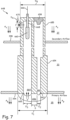
- FIG. 7 is a cross-sectional front view of a second embodiment of probe assembly 48 shown in FIG. 2 along line 3 - 3. Shown in FIG. 7 are HPC case void 33, inner side 35, outer side 37, inside surfaces 39A, 39B, probe assembly 648, probe shaft 655, sensor face 656, pressure sensor 658, temperature sensor 660, pressure channel 662, pressure orifice 663, temperature channel 664, temperature orifice 665, wires 666, shaft 668, and exit port 670, all having a description substantially similar to that provided above in regard to FIG. 3 .
- temperature sensor 660 is located higher in temperature channel 664 (i.e., further away from sensor face 656), nearer exit port 670 than temperature sensor shown in FIG. 3 .
- temperature sensor 660 measures the temperature of temperature channel flow F at a point much nearer exit port 670 than in the embodiment shown in FIG. 3 .
- An advantage of probe assembly 648 is that a much shorter shaft 668 is required to support temperature sensor 660, which can provide greater structural stability of temperature sensor 660. This can be beneficial in an embodiment where temperature probe 660 is susceptible to vibration, flow turbulence, and the like.
- temperature sensor 660 can experience a time lag, particularly when the temperature of primary air A P is changing rapidly, as a result of the transport time of temperature channel flow F through temperature channel 664 from temperature orifice 665 to temperature sensor 660.
- Temperature probe 48, 648 of the present disclosure measures temperature of a primary air A P using temperature sensor 60, 660 that is recessed in temperature channel 64, etc. (i.e., recessed from the primary air A P stream) because of channel flow F through temperature channel 64, etc.
- Channel flow F is induced by a pressure differential between temperature orifice 65, 665 in primary air A P and exit port 70, 670 in secondary air A S .
- Primary air A P can be referred to as a first stream
- secondary air A S can be referred to as a second stream. Accordingly, a pressure differential between the first stream and the second stream induces channel flow F through temperature channel 64, etc.
- the first stream can be at a higher pressure than the second stream.
- the first stream can be at a significantly higher pressure than the second stream.
- the configuration of exit ports 70, etc. can be to minimize flow turbulence, vortex shedding, and so forth (i.e., flow disturbances).
- the cross-sectional shape (i.e., profile) of probe shaft 255, etc. can be configured to control and/or minimize flow disturbances.
- a minimal pressure differential can exist between the first stream and the second stream.
- the first stream and the second stream can have the same static pressure.
- the first stream and the second stream can be driven by the same prime mover. Therefore, in some embodiments, channel flow F through temperature channel 64, etc., is induced by the orientation of temperature orifice 65, 665 and the orientation of exit port/ports 70, etc. Accordingly, in these other embodiments, the configuration of exit ports 70, etc., can be to promote the induction of channel flow F through temperature channel 64, etc. For these reasons, the configuration of exit ports 70, etc. with regard to size, placement, and/or number, can be to enhance channel flow F, and the exit ports can also be referred to as one or more flow enhancement features.
- a flush-mount combined static pressure and temperature probe is used to measure a temperature or a total temperature of a first stream by inducing a flow of fluid from a first stream to a second stream.
- Each of the first and/or second streams can be gaseous or liquid.
- Air and exhaust gas are non-limiting examples of a gas; and fuel, oil, water, and aqueous solutions are non-limiting examples of a liquid.
- a probe comprising a probe head; a probe tip extending from the probe head and ending with a sensor face configured for fluidic communication with a first fluid stream; a pressure channel extending into the probe tip through the sensor face; a pressure sensor in configured to sense a pressure in the pressure channel; a temperature channel extending into the probe tip through the sensor face, the temperature channel including a temperature orifice disposed on the sensor face and at least one exit port distal from the sensor face; and a temperature sensor configured to sense a temperature in the temperature channel; wherein: the temperature channel extends parallel to the pressure channel; the temperature channel is fluidly separate from the pressure channel; the temperature channel is configured to channel a fluid flow from the temperature orifice to the at least one exit port; and the at least one exit port is configured to discharge the fluid flow into a second fluid stream.
- the probe of the preceding paragraph can optionally include, additionally and/or alternatively, any one or more of the following features, configurations and/or additional components:
- a further embodiment of the foregoing probe wherein: the second fluid stream defines a second fluid stream direction; and at least one exit port establishes an exit flow direction that is perpendicular to the second fluid stream direction.
- a further embodiment of the foregoing probe comprising two exit ports, one on an opposite side of the temperature channel from the other.
- thermosensor is a total temperature sensor.
- a further embodiment of the foregoing probe further comprising a probe shaft, the probe shaft disposed between the sensor face and the probe head, wherein the at least one exit ports are disposed on the probe shaft.
- the probe shaft defines a probe shaft cross-sectional shape; and the probe shaft cross-sectional shape is circular.
- the probe shaft defines a probe shaft cross-sectional shape
- the probe shaft cross-sectional shape is non-circular, defining a major width and a minor width
- the major width defines a major axis that is parallel to the second fluid stream direction.
- probe shaft cross-sectional shape is an ellipse, oval, airfoil, or teardrop shape.
- the at least one exit port is configured to create a negative pressure on the temperature channel with respect to the temperature orifice, thereby inducing the fluid flow from the temperature orifice to the at least one exit port.
- a further embodiment of the foregoing probe wherein the first fluid stream is at a pressure greater than the second airflow stream.
- a further embodiment of the foregoing probe wherein: the first fluid stream is air; the second fluid stream is air; and the probe is configured to measure a static pressure and a total temperature in a primary airstream in a gas turbine engine.
- a further embodiment of the foregoing probe further comprising a gas turbine engine extending along an axis comprising: a fan section comprising a plurality of rotor cascades and a plurality of stator cascades; a compressor section downstream of the fan section; a combustor section downstream of the compressor section; and a turbine section downstream of the combustor section, the turbine section being connected to the compressor and/or fan section; wherein the probe is disposed on the compressor and/or fan section and is configured to sense a pressure and a total temperature of a first airflow stream.
- a gas turbine engine extending along an axis comprising: a fan section comprising a plurality of rotor cascades and a plurality of stator cascades; a splitter downstream of the fan section, the splitter including inner side, an outer side, and an inside surface; a compressor section downstream of the fan section; a combustor section downstream of the compressor section; a turbine section downstream of the combustor section, the turbine section being connected to the compressor and/or fan sections; and a probe assembly, disposed on the compressor and/or fan section and configured to sense a pressure and a total temperature of a first airflow stream, the probe assembly comprising: a probe head; a probe tip extending from the probe head and ending with a sensor face configured for fluidic communication with a first fluid stream; a pressure channel extending into the probe tip through the sensor face; a pressure sensor configured to sense the pressure in the pressure channel; a temperature channel extending into the probe tip through the sensor face, the temperature channel including a temperature orifice disposed on the sensor
- gas turbine engine of the preceding paragraph can optionally include, additionally and/or alternatively, any one or more of the following features, configurations and/or additional components:
- the pressure sensor is a static pressure sensor.
- thermo channel includes an outlet positioned inside of the splitter.
- thermo channel includes an outlet positioned outside of the splitter.
- a further embodiment of the foregoing gas turbine engine wherein a center of the temperature channel at the sensor face is in substantially the same axial position as a center of the pressure channel at the sensor face.
- the at least one exit port is configured to discharge the fluid flow into a second airflow stream; the second airflow stream defines a second airflow stream direction; and at least one exit port establishes an exit flow direction that is perpendicular to the second airflow stream direction.
Landscapes
- Engineering & Computer Science (AREA)
- Chemical & Material Sciences (AREA)
- Mechanical Engineering (AREA)
- General Engineering & Computer Science (AREA)
- Physics & Mathematics (AREA)
- General Physics & Mathematics (AREA)
- Combustion & Propulsion (AREA)
- Analytical Chemistry (AREA)
- Measuring Temperature Or Quantity Of Heat (AREA)
Description
- This application is related to
U.S. Patent Application No. 15/934615, entitled "FLUSH-MOUNT COMBINED STATIC PRESSURE AND TEMPERATURE PROBE", filed March 23, 2018 U.S. Pat. No. 10, 371,000 - The present disclosure relates generally to gas turbine engines, and more particularly to a sensor system of a gas turbine engine.
- A gas turbine engine typically includes a high pressure spool, a combustion system, and a low pressure spool disposed within an engine case to form a generally axial, serial flow path about the engine centerline. The high pressure spool includes a high pressure turbine, a high pressure shaft extending axially forward from the high pressure turbine, and a high pressure compressor connected to a forward end of the high pressure shaft. The low pressure spool includes a low pressure turbine, which is disposed downstream of the high pressure turbine, a low pressure shaft, which typically extends coaxially through the high pressure shaft, and a fan connected to a forward end of the low pressure shaft, forward of the high pressure compressor. The combustion system is disposed between the high pressure compressor and the high pressure turbine and receives compressed air from the compressors and fuel provided by a fuel injection system. A combustion process is carried out within the combustion system to produce high energy gases to produce thrust and turn the high and low pressure turbines, which drive the compressor and the fan to sustain the combustion process.
- An engine control system for the gas turbine engine can employ sensors that relay data relating to various properties of the engine and its operation. For example, the engine control system may want to know the working fluid temperature and pressure at particular points in the engine. These properties are measured by probes that are communicatively connected to the engine control system. The probes have a particular size, though, which occupies space and adds weight to the engine. In addition, the positioning of the probes can affect the flow of the working fluid, which can affect the measurements of other probes.
US 10 371 000 - A probe is provided in claim 1 and includes a probe head, a probe tip extending from the probe head and ending with a sensor face in fluidic communication with a first fluid stream, a pressure channel extending into the probe tip through the sensor face, a pressure sensor configured to sense a pressure in the pressure channel, a temperature channel extending into the probe tip through the sensor face with a temperature orifice located on the sensor face and at least one exit port distal from the sensor face, and a temperature sensor configured to sense a temperature in the temperature channel. The temperature channel extends parallel to the pressure channel and is fluidly separate from the pressure channel. The temperature channel is configured to channel a fluid flow from the temperature orifice to the at least one exit port, which is configured to discharge the fluid flow into a second fluid stream.
- A gas turbine engine extending along an axis is provided in claims 6 and 7, and includes a fan section having a number of rotor cascades and a number of stator cascades, a splitter downstream of the fan section and having an inner side, an outer side, and an inside surface, a compressor section downstream of the fan section, a combustor section downstream of the compressor section, a turbine section downstream of the combustor section and connected to the compressor and/or fan sections, and a probe assembly located on the compressor and/or fan section and configured to sense a pressure and a total temperature of a first airflow stream. The probe includes a probe head, a probe tip extending from the probe head and ending with a sensor face in fluidic communication with a first fluid stream, a pressure channel extending into the probe tip through the sensor face, a pressure sensor configured to sense a pressure in the pressure channel, a temperature channel extending into the probe tip through the sensor face with a temperature orifice located on the sensor face and at least one exit port distal from the sensor face, and a temperature sensor configured to sense a temperature in the temperature channel. The temperature channel extends parallel to the pressure channel and is fluidly separate from the pressure channel. The temperature channel is configured to channel a fluid flow from the temperature orifice to the at least one exit port, which is configured to discharge the fluid flow into a second fluid stream.
-
-
FIG. 1 is a schematic side cross-sectional view of an embodiment of a gas turbine engine. -
FIG. 2 is a schematic side cross-sectional view of the gas turbine engine proximate a probe assembly. -
FIG. 3 is a cross-sectional front view of the probe assembly shown inFIG. 2 along line 3 - 3. -
FIG. 4A is a cross-sectional top view of the probe shaft shown inFIG. 3 alongline 4A - 4A. -
FIG. 4B is a cross-sectional top view of a second embodiment of the probe shaft shown inFIG. 3 alongline 4A - 4A. -
FIG. 5A is a cross-sectional top view of a third embodiment of the probe shaft shown inFIG. 3 alongline 4A - 4A. -
FIG. 5B is a cross-sectional top view of a fourth embodiment of the probe shaft shown inFIG. 3 alongline 4A - 4A. -
FIG. 6A is a cross-sectional top view of a fifth embodiment of the probe shaft shown inFIG. 3 alongline 4A - 4A. -
FIG. 6B is a cross-sectional top view of a sixth embodiment of the probe shaft shown inFIG. 3 alongline 4A - 4A. -
FIG. 7 is a cross-sectional front view of a second embodiment of the probe assembly shown inFIG. 2 along line 3 - 3. -
FIG. 1 is a schematic side cross-section view ofgas turbine engine 10. AlthoughFIG. 1 depicts a gas turbine engine typically used for aircraft propulsion, the present disclosure is readily applicable to gas turbine generators and other similar systems incorporating rotor-supported, shaft-driven turbines. Shown inFIG. 1 aregas turbine engine 10,fan 12,fan rotor cascades 13A - 13C,fan stator cascades 14A - 14D, high pressure compressor (HPC) 16,combustor section 18, high pressure turbine (HPT) 20, low pressure turbine (LPT) 22,struts 24,fan case 26, HPCcase 28, HPTcase 30,LPT case 32,low pressure shaft 34,high pressure shaft 36,splitter 38,inside surface 39,injectors 40,HPT blades 41,LPT blades 42, support rotor 44,vane airfoil sections 46,probe assembly 48,engine control unit 50, inlet air A, fan air AF, primary air AP, secondary air AS, and longitudinal engine centerline axis CL.Gas turbine engine 10 can be described as havingcold section 11 andhot section 17, as annotated inFIG. 1 . - In the illustrated embodiment,
gas turbine engine 10 comprises a dual-spool turbofan engine in which the advantages of the present disclosure are particularly well illustrated.Gas turbine engine 10, of which the operational principles are well known in the art, comprisescold section 11, includingfan 12 and HPC 16, andhot section 17, includingcombustor section 18, HPT 20, andLPT 22. These components are each concentrically disposed around longitudinal engine centerline axis CL. Fan 12 is separated from HPC 16 by a plurality ofstruts 24, andfan 12 is enclosed at its outer diameter withinfan case 26. Likewise, the other engine components are correspondingly enclosed at their outer diameters within various engine casings, includingHPC case 28,HPT case 30, andLPT case 32.Fan 12 is connected toLPT 22 throughlow pressure shaft 34, and together withfan 12,LPT 22, andlow pressure shaft 34, comprise the low pressure spool. HPC 16 is connected to HPT 20 throughhigh pressure shaft 36, and together HPC 16, HPT 20, andhigh pressure shaft 36 comprise the high pressure spool. - During normal operation, inlet air A enters
engine 10 atfan 12.Fan 12 comprisesfan rotor cascades 13A-13C which are rotated byLPT 22 through low pressure shaft 34 (either directly as shown or through a gearbox, not shown). In conjunction withfan stator cascades 14A-14D (between whichfan rotor cascades 13A-13C are positioned, respectively), fan air AF is accelerated and compressed. Atsplitter 38, fan air AF is divided into streams of primary air AP (also known as gas path air) and secondary air AS (also known as bypass air). Secondary air AS produces a major portion of the thrust output ofengine 10 while primary air AP is directed intoHPC 16. HPC 16 includes pluralities of rotors and stators, alternately positioned, that incrementally step up the pressure of primary air AP. HPC 16 is rotated by HPT 20 throughhigh pressure shaft 36 to provide compressed air tocombustor section 18. The compressed air is delivered tocombustor section 18, along with fuel throughinjectors 40, such that a combustion process can be carried out to produce the high energy gases necessary to turnHPT 20 andLPT 22. Primary air AP continues throughgas turbine engine 10 whereby it is typically passed through an exhaust nozzle to further produce thrust. - After being compressed in
HPC 16 and participating in a combustion process incombustor section 18 to increase pressure and energy, primary air AP flows throughHPT 20 andLPT 22 such thatHPT blades 41 andLPT blades 42 extract energy from the flow of primary air AP. Primary air AP impinges onHPT blades 41 to cause rotation ofhigh pressure shaft 36, which turnsHPC 16. Primary air AP also impinges onLPT blades 42 to cause rotation of support rotor 44 andlow pressure shaft 34, which turns the rotating components offan 12. - In addition,
gas turbine engine 10 includesprobe assembly 48.Probe assembly 48 begins exterior tofan case 26 andHPC case 28, extends through one ofstruts 24 andsplitter 38, terminating flush withinside surface 39 ofsplitter 38 in fluid contact with primary air AP adjacent to the wall at the probe face. Thereby,probe assembly 48 can measure the static pressure and total temperature of primary air AP (i.e., the static primary air AP temperature plus the kinetic energy of primary air AP).Probe assembly 48 is communicatively connected to engine control unit (ECU) 50 such thatECU 50 receives measurements fromprobe assembly 48. In the illustrated embodiment,probe assembly 48 is positioned downstream of fan rotor cascades 13A-13C and fan stator cascades 14A-14D and upstream ofHPC 16, although in alternate embodiments,probe assembly 48 can be positioned in other locations, such as withinHPC 16 or amongst fan rotor cascades 13 and fan stator cascades 14. Probeassembly 48 can also be referred to as a probe. - The components and configuration of
gas turbine engine 10 as shown inFIG. 1 allow forECU 50 to know the total temperature and static pressure of primary air AP as reported byprobe assembly 48.ECU 50 can then use this information to controlgas turbine engine 10 appropriately. Depicted inFIG. 1 is one embodiment of the present disclosure, to which there are alternative embodiments. For example,engine 10 can be a three spool engine. In such an embodiment,engine 10 has an intermediate compressor betweenfan 12 andHPC 16 and an intermediate turbine betweenHPT 20 andLPT 22, wherein the intermediate compressor is connected to the intermediate turbine with an additional shaft. -
FIG. 2 is a schematic side cross-sectional view ofgas turbine engine 10 proximate aprobe assembly 48. Also shown inFIG. 2 areinner side 35 andouter side 37. Atsplitter 38, fan air AF is divided into streams of primary air AP, flowing oninner side 35, and secondary air AS, flowing onouter side 37. Probeassembly 48 comprisesprobe head 52 withprobe tip 54 extending therefrom. At the innermost end ofprobe tip 54 issensor face 56 which is tangent toinside surface 39 ofsplitter 38. Thereby,probe tip 54 extends at an acute, upstream angle from the flow of primary air AP. In the illustratedembodiment sensor face 56 is flat, although in alternateembodiments sensor face 56 can be curved to closer match the contour ofsplitter 38. In addition,sensor face 56 is substantially flush withinside surface 39 ofsplitter 38 in that no part ofsensor face 56 is more than 0.76 mm (0.030 inch) from being even withinside surface 39. - Probe
assembly 48 also includespressure sensor 58, located inprobe head 52, andtemperature sensor 60, located inprobe tip 54.Pressure sensor 58 andtemperature sensor 60 are each located within a respective channel (not shown inFIG. 2 ) and will be described in more detail later inFIGS. 3 - 4 . In the illustrated embodiment,probe assembly 48 is positioned onfan case 26 and configured to sense a pressure and a total temperature of primary air AP (i.e., the primary airflow stream). In someembodiments temperature sensor 60 can be located near (i.e., proximate)sensor face 56, while in other embodiments,temperature sensor 60 can be located some distance away fromsensor face 56 within a temperature channel. As will be shown and described later inFIGS. 3 - 4 , a flow of fluidpast temperature sensor 60 can result in a more accurate indication of total temperature of primary air AP. Pressure sensor 58 can be a pressure transducer that measures the static pressure of primary air AP, andtemperature sensor 60 can be a resistive temperature detector, such as a contact thermometer, that measures the total temperature of primary air AP. The data frompressure sensor 58 andtemperature sensor 60 is fed toECU 50. Because the properties are measured at the boundary of the flow of primary air AP,ECU 50 can do calculations to estimate the average properties of primary air AP across the primary air flowpath. In other embodiments,pressure sensor 58 can be routed elsewhere in or nearECU 50 by using a pneumatic line (not shown) leading fromprobe assembly 48 to a remote pressure transducer, thereby providing fluid communication betweenprobe assembly 48 and a remote pressure transducer. This embodiment could be advantageous for harsh environments. - The components and configuration of
gas turbine engine 10 allow for the static pressure and total temperature of primary air AP to be measured without the measurement devices protruding into the flowpath which prevents major flow disturbances due to probeassembly 48. In addition, the static pressure and total temperature data can be transmitted toECU 50 for further processing and can be used to controlgas turbine engine 10. In some embodiments, because of the flush mounted configuration, the sensed temperature differs from the center flow Ap total temperature. This is due to the incomplete Ap flow recovery as the flow comes to theoretical rest at the wall, and also due to wall heat conduction. A correction can be applied to account for this difference using empirical data or approximations based on flow velocity at the probe interface. -
FIG. 3 is a cross-sectional front view ofprobe tip 54 along line 3-3 inFIG. 2 . Shown inFIG. 3 areHPC case void 33,inner side 35,outer side 37, inside surfaces 39A, 39B,probe assembly 48,probe tip 54,probe shaft 55,sensor face 56,pressure sensor 58,temperature sensor 60,pressure channel 62,pressure orifice 63,temperature channel 64,temperature orifice 65, wires 66,shaft 68, and exitport 70. Also labeled inFIG. 3 are primary air AP, secondary air AS, temperature channel flow F, probe tip diameter D1, pressure orifice diameter D2, temperature orifice diameter D3, exit port diameter D4, probe shaft diameter D5, and spacing S. In the illustrated embodiment,HPC case void 33 is a region between primary air AP and secondary air AS, being defined by respective insidesurfaces FIGS. 1 - 2 . Probeassembly 48 shown in the illustrated embodiment is not drawn to scale, in order to provide a sufficient level of detail. In a practical embodiment, the length of probe shaft 55 (i.e., in a direction ofpressure channel 62 and temperature channel 64) will be much greater than depicted.Pressure orifice 63 andtemperature orifice 65 are each located onsensor face 56 in fluidic communication with primary air AP. Pressure channel 62 andtemperature channel 64 are beside each other, extending throughprobe tip 54 along substantially parallel axes (not labeled), with the center ofpressure channel 62 being approximately aligned with the center oftemperature channel 64 relative to the CL axis ofengine 10, and withpressure channel 62 andtemperature channel 64 being approximately perpendicular to Ap flow.Pressure channel 62 begins atpressure orifice 63 insensor face 56 and extends all of the way to probe head 52 (shown inFIG. 2 ).Pressure channel 62 is in fluidic communication withpressure sensor 58. Thereby, primary air AP enters and can exert a static pressure onpressure channel 62, the static pressure being measured bypressure sensor 58. -
Temperature channel 64 begins attemperature orifice 65 insensor face 56 and also extends towardprobe head 52. Primary air AP enteringtemperature orifice 65 becomes temperature channel flow F, flowing throughtemperature channel 64 fromtemperature orifice 65,past temperature sensor 60, and outexit port 70 into secondary air AS. In the illustrated embodiment,exit port 70 is located in secondary air AS onouter side 37, shown inFIG. 2 , and is oriented laterally (i.e., perpendicular to centerline axis CL, shown inFIG. 1 ). In some embodiments, more than oneexit port 70 can be used. The location of one or more exit ports will be shown and described in more detail later, inFIGS. 4A - 4B, 5A - 5B , and6A - 6B . During operation ofgas turbine engine 10, temperature channel flow F is driven by a pressure differential fromtemperature orifice 65 in primary air AP andexit port 70 in secondary air AS. Temperature sensor 60 electronically communicates withprobe head 52 via wires 66.Temperature sensor 60 further includesshaft 68 which extends intotemperature channel 64 minimally contactingprobe tip 54, which thermally isolatesshaft 68 fromprobe tip 54. The flow of primary air AP can be affected bypressure orifice 63 and/ortemperature orifice 65. In order to prevent interference of the flow into one orifice by the other orifice, the center ofpressure orifice 63 is at the same axial location as the center oftemperature orifice 65. In the illustrated embodiment, probe tip diameter D1 is about 25 mm (1.0 inch), pressure orifice diameter D2 is about 2.5 mm (0.10 inch), temperature orifice diameter D3 is about 6.4 mm (0.25 inch), and exit port diameter D4 is about 2.5 mm (0.10 inch). In the illustrated embodiment,probe tip 54 andprobe shaft 55 are both circular in cross-sectional shape, with probe shaft diameter D5 being slightly less than probe tip diameter D1. In some embodiments,probe tip 54 and/or probeshaft 55 can have cross-sectional shapes that are non-round. Different configurations forprobe shaft 55, including exemplary cross-sectional shapes, will be shown and described in more detail later, inFIGS. 4A - 4B, 5A - 5B , and6A - 6B . In a typical embodiment,pressure orifice 63 is spaced laterally apart fromtemperature orifice 65, because temperature channel flow F throughtemperature channel 64 can be significant, thereby potentially disrupting the static pressure atpressure orifice 63. Spacing S between the proximate sides ofpressure orifice 63 andtemperature orifice 65 is between about 0.5 - 2 times temperature orifice diameter D3. In the illustrated embodiment, spacing S is about 4.98 mm (0.196 inch). The components and configuration ofprobe assembly 48 allow for the static pressure and total temperature of primary air AP to be measured by a single, compact device. In addition, the measurements can be taken accurately without the flow atpressure channel 62 being disturbed by the flow of primary air AP intotemperature channel 64. -
FIG. 4A is a cross-sectional top view ofprobe shaft 55 shown inFIG. 3 alongline 4A - 4A. Temperature channel flow F exitstemperature channel 64 throughexit port 70. Secondary air AS flowingpast probe shaft 55 having probe shaft diameter D5 can be modeled as airflow over a cylinder, whereby surface pressure (i.e., pressure at a surface of probe shaft 55) is lowest at points perpendicular to the direction of secondary air AS. Bernoulli's principle is known in the fluid arts as explaining this phenomenon. Accordingly,exit port 70 is located at a point onpast probe shaft 55 that discharges temperature channel flow F in a direction that is about perpendicular to secondary air AS. Therefore,temperature sensor 60 ofprobe assembly 48 can be used to measure temperature of primary air AP even in an embodiment where the static pressures of primary air AP and secondary air AS are about the same because of the aforementioned effect. - As noted above in the description of
FIG. 3 , other configurations ofprobe shaft 55 and/orexit port 70 are possible.FIG. 4B is a cross-sectional top view of a second embodiment ofprobe shaft 55 shown inFIG. 3 alongline 4A - 4A. Temperature channel flow F throughtemperature channel 164 throughexit ports FIG. 4B depicts an exemplary embodiment ofprobe assembly 48 having twoexit ports temperature channel 164. In some embodiments, three or more exit ports can be used ontemperature channel 164. In various embodiments, exit ports can be located at various radial positions aroundprobe shaft 155, with the positions being selected to achieve a desired temperature channel flow F for a design operating condition ofgas turbine engine 10. Additionally, exit port diameter D4 and/or the radial locations of exit ports can also be changed in different embodiments to achieve a desired temperature channel flow F. Several factors can be considered in determining an optimum temperature channel flow F for a particular embodiment, in order to optimize the performance of temperature probe 48 (i.e., the performance of temperature sensor 60). For example, a small value of temperature channel flow F can result in a slow response time, whereas a large value of temperature channel flow F can increase recovery error, which is the difference between the probe's measured air temperature and total air temperature. -
FIG. 5A is a cross-sectional top view of a third embodiment ofprobe shaft 55 shown inFIG. 3 alongline 4A - 4A. Temperature channel flow F exitstemperature channel 264 through exit port 270 in a direction that is perpendicular to that of secondary air AS flowingpast probe shaft 255. In the illustrated embodiment,probe shaft 255 has a cross-sectional shape that is elliptical, and can be characterized by major dimension M and minor dimension L, as labeled. In the illustrated embodiment, a ratio of major dimension M to minor dimension L is about 2.2. In some embodiments, the ratio of major dimension M to minor dimension L can range from about 1 - 3. In other embodiments, the ratio of major dimension M to minor dimension L can be greater than 3. In yet other embodiments, the cross-sectional shape ofprobe shaft 255 can be oval, oblong, egg-shaped, or any other non-circular geometric shape. Probeshaft 255 having a non-round cross-sectional shape can be particularly beneficial in some embodiments in defining a flow and/or pressure profile of secondary air AS (i.e., secondary airflow) overprobe shaft 255. Moreover, the flow and/or pressure profile of secondary air AS in the vicinity of exit port 270 can be particularly beneficial in some embodiments. Other exemplary cross-sectional shapes ofprobe shaft 255 will be shown and described later, inFIGS. 6A - 6B . -
FIG. 5B is a cross-sectional top view of a fourth embodiment ofprobe shaft 55 shown inFIG. 3 alongline 4A - 4A. Temperature channel flow F throughtemperature channel 364 throughexit ports probe shaft 355, each located opposite the other and configured to discharge exit port flow F', each being about half the flow of temperature channel flow F. The description of the cross-sectional shape ofprobe shaft 355 is substantially similar to that provided above in regard toFIG. 5A . The descriptions ofexit ports FIGS. 4B . -
FIG. 6A is a cross-sectional top view of a fifth embodiment ofprobe shaft 55 shown inFIG. 3 alongline 4A - 4A. Temperature channel flow F exitstemperature channel 464 throughexit port 470 in a direction that is perpendicular to that of secondary air AS flowingpast probe shaft 455. In the illustrated embodiment,probe shaft 455 has an asymmetrical airfoil cross-sectional shape, withexit port 470 being located on the "lift" side (i.e., high speed, reduced pressure side) ofprobe shaft 455. In the illustrated embodiment, temperature channel flow F exitstemperature channel 464 throughexit port 470 in a direction that is perpendicular to that of secondary air AS flowingpast probe shaft 455 on the "lift" side of the airfoil shape (i.e., near the side of lower relative pressure). In other embodiments, one or more exit ports can be located at other positions around the perimeter ofprobe shaft 455. In various embodiments, the cross-sectional shape ofprobe shaft 455 and/or the location of one ormore exit ports 470 can be selected to provide a desired temperature channel flow F based on a particular operating condition ofgas turbine engine 10. In some embodiments, the cross-sectional shape ofprobe shaft 455 can causes an appreciable "lift" force that can result in a lateral force onprobe shaft 455 during the operation ofgas turbine engine 10. Accordingly, the materials and structural design ofprobe shaft 455 must be able to accommodate the "lift" force that results from an asymmetrical cross-sectional shape. -
FIG. 6B is a cross-sectional top view of a sixth embodiment ofprobe shaft 55 shown inFIG. 3 alongline 4A - 4A. Temperature channel flow F exitstemperature channel 564 throughexit port 570 in a direction that is perpendicular to that of secondary air AS flowingpast probe shaft 555. In the illustrated embodiment,probe shaft 555 has a symmetrical airfoil cross-sectional shape (i.e., symmetrical aboutaxis 575 that is perpendicular to the flow direction of secondary air AS). This can also be referred to as a symmetrical airfoil, or as having a teardrop cross-sectional shape. A benefit of a symmetrical airfoil shape is that a high velocity of secondary air AS can be developed at the vicinity ofexit port 570, while not developing a "lift" force that can cause a lateral force on probe shaft 555 (as described in regard to probeshaft 455 shown inFIG. 6A ). In other embodiments, one or more exit ports can be located at other positions around the perimeter ofprobe shaft 555. In various embodiments, the cross-sectional shape ofprobe shaft 555 and/or the location of one ormore exit ports 570 can be selected to provide a desired temperature channel flow F based on a particular operating condition ofgas turbine engine 10. As described above in regard toFIG. 5A , various non-round cross-sectional shapes can be particularly beneficial in some embodiments in defining the flow and/or pressure profiles of secondary air AS (i.e., secondary airflow) overprobe shaft 255, etc. and/or in the vicinity of exit ports 270, etc. All non-round cross-sectional shapes ofprobe shaft 255 are within the scope of the present disclosure. Moreover, all configurations ofexit ports 70 with regard to number, size, and/or placement onprobe shaft 255 are within the scope of the present disclosure. -
FIG. 7 is a cross-sectional front view of a second embodiment ofprobe assembly 48 shown inFIG. 2 along line 3 - 3. Shown inFIG. 7 areHPC case void 33,inner side 35,outer side 37, inside surfaces 39A, 39B,probe assembly 648,probe shaft 655,sensor face 656,pressure sensor 658,temperature sensor 660,pressure channel 662, pressure orifice 663,temperature channel 664,temperature orifice 665,wires 666, shaft 668, and exit port 670, all having a description substantially similar to that provided above in regard toFIG. 3 . In the illustrated embodiment,temperature sensor 660 is located higher in temperature channel 664 (i.e., further away from sensor face 656), nearer exit port 670 than temperature sensor shown inFIG. 3 . Accordingly,temperature sensor 660 measures the temperature of temperature channel flow F at a point much nearer exit port 670 than in the embodiment shown inFIG. 3 . An advantage ofprobe assembly 648 is that a much shorter shaft 668 is required to supporttemperature sensor 660, which can provide greater structural stability oftemperature sensor 660. This can be beneficial in an embodiment wheretemperature probe 660 is susceptible to vibration, flow turbulence, and the like. However,temperature sensor 660 can experience a time lag, particularly when the temperature of primary air AP is changing rapidly, as a result of the transport time of temperature channel flow F throughtemperature channel 664 fromtemperature orifice 665 totemperature sensor 660. -
Temperature probe temperature sensor temperature channel 64, etc. (i.e., recessed from the primary air AP stream) because of channel flow F throughtemperature channel 64, etc. Channel flow F is induced by a pressure differential betweentemperature orifice exit port 70, 670 in secondary air AS. Primary air AP can be referred to as a first stream, and secondary air AS can be referred to as a second stream. Accordingly, a pressure differential between the first stream and the second stream induces channel flow F throughtemperature channel 64, etc. In some embodiments, the first stream can be at a higher pressure than the second stream. In some of these embodiments, the first stream can be at a significantly higher pressure than the second stream. Accordingly, in these embodiments, the configuration ofexit ports 70, etc., can be to minimize flow turbulence, vortex shedding, and so forth (i.e., flow disturbances). Moreover, in various embodiments, the cross-sectional shape (i.e., profile) ofprobe shaft 255, etc., can be configured to control and/or minimize flow disturbances. These various embodiments can be referred to as one or more flow enhancement features. In other embodiments, and/or during some operating conditions, a minimal pressure differential can exist between the first stream and the second stream. In some of these embodiments, the first stream and the second stream can have the same static pressure. In an exemplary embodiment, the first stream and the second stream can be driven by the same prime mover. Therefore, in some embodiments, channel flow F throughtemperature channel 64, etc., is induced by the orientation oftemperature orifice ports 70, etc. Accordingly, in these other embodiments, the configuration ofexit ports 70, etc., can be to promote the induction of channel flow F throughtemperature channel 64, etc. For these reasons, the configuration ofexit ports 70, etc. with regard to size, placement, and/or number, can be to enhance channel flow F, and the exit ports can also be referred to as one or more flow enhancement features. While a gas turbine engine was depicted as an exemplary embodiment oftemperature probe 48, the scope of the present disclosure includes all embodiments where a flush-mount combined static pressure and temperature probe is used to measure a temperature or a total temperature of a first stream by inducing a flow of fluid from a first stream to a second stream. Each of the first and/or second streams can be gaseous or liquid. Air and exhaust gas are non-limiting examples of a gas; and fuel, oil, water, and aqueous solutions are non-limiting examples of a liquid. - The following are non-exclusive descriptions of possible embodiments of the present invention.
- A probe, comprising a probe head; a probe tip extending from the probe head and ending with a sensor face configured for fluidic communication with a first fluid stream; a pressure channel extending into the probe tip through the sensor face; a pressure sensor in configured to sense a pressure in the pressure channel; a temperature channel extending into the probe tip through the sensor face, the temperature channel including a temperature orifice disposed on the sensor face and at least one exit port distal from the sensor face; and a temperature sensor configured to sense a temperature in the temperature channel; wherein: the temperature channel extends parallel to the pressure channel; the temperature channel is fluidly separate from the pressure channel; the temperature channel is configured to channel a fluid flow from the temperature orifice to the at least one exit port; and the at least one exit port is configured to discharge the fluid flow into a second fluid stream.
- The probe of the preceding paragraph can optionally include, additionally and/or alternatively, any one or more of the following features, configurations and/or additional components:
A further embodiment of the foregoing probe, wherein: the second fluid stream defines a second fluid stream direction; and at least one exit port establishes an exit flow direction that is perpendicular to the second fluid stream direction. - A further embodiment of the foregoing probe, comprising two exit ports, one on an opposite side of the temperature channel from the other.
- A further embodiment of the foregoing probe, wherein the pressure sensor is a static pressure sensor.
- A further embodiment of the foregoing probe, wherein the temperature sensor is a total temperature sensor.
- A further embodiment of the foregoing probe, further comprising a probe shaft, the probe shaft disposed between the sensor face and the probe head, wherein the at least one exit ports are disposed on the probe shaft.
- A further embodiment of the foregoing probe, wherein: the probe shaft defines a probe shaft cross-sectional shape; and the probe shaft cross-sectional shape is circular.
- A further embodiment of the foregoing probe, wherein: the probe shaft defines a probe shaft cross-sectional shape; the probe shaft cross-sectional shape is non-circular, defining a major width and a minor width; and the major width defines a major axis that is parallel to the second fluid stream direction.
- A further embodiment of the foregoing probe, wherein the probe shaft cross-sectional shape is an ellipse, oval, airfoil, or teardrop shape.
- A further embodiment of the foregoing probe, wherein the at least one exit port is configured to create a negative pressure on the temperature channel with respect to the temperature orifice, thereby inducing the fluid flow from the temperature orifice to the at least one exit port.
- A further embodiment of the foregoing probe, wherein the first fluid stream is at a pressure greater than the second airflow stream.
- A further embodiment of the foregoing probe, wherein: the first fluid stream is air; the second fluid stream is air; and the probe is configured to measure a static pressure and a total temperature in a primary airstream in a gas turbine engine.
- A further embodiment of the foregoing probe, further comprising a gas turbine engine extending along an axis comprising: a fan section comprising a plurality of rotor cascades and a plurality of stator cascades; a compressor section downstream of the fan section; a combustor section downstream of the compressor section; and a turbine section downstream of the combustor section, the turbine section being connected to the compressor and/or fan section; wherein the probe is disposed on the compressor and/or fan section and is configured to sense a pressure and a total temperature of a first airflow stream.
- A gas turbine engine extending along an axis comprising: a fan section comprising a plurality of rotor cascades and a plurality of stator cascades; a splitter downstream of the fan section, the splitter including inner side, an outer side, and an inside surface; a compressor section downstream of the fan section; a combustor section downstream of the compressor section; a turbine section downstream of the combustor section, the turbine section being connected to the compressor and/or fan sections; and a probe assembly, disposed on the compressor and/or fan section and configured to sense a pressure and a total temperature of a first airflow stream, the probe assembly comprising: a probe head; a probe tip extending from the probe head and ending with a sensor face configured for fluidic communication with a first fluid stream; a pressure channel extending into the probe tip through the sensor face; a pressure sensor configured to sense the pressure in the pressure channel; a temperature channel extending into the probe tip through the sensor face, the temperature channel including a temperature orifice disposed on the sensor face and at least one exit port distal from the sensor face; and a temperature sensor configured to sense the temperature in the temperature channel; wherein: the temperature channel extends parallel to the pressure channel; the temperature channel is fluidly separate from the pressure channel; the temperature channel is configured to channel air from the temperature orifice to the at least one exit port; and the at least one exit port is configured to discharge the airflow into a second airstream.
- The gas turbine engine of the preceding paragraph can optionally include, additionally and/or alternatively, any one or more of the following features, configurations and/or additional components:
A further embodiment of the foregoing gas turbine engine, wherein the pressure sensor is a static pressure sensor. - A further embodiment of the foregoing gas turbine engine, wherein the sensor face offset no more than 0.76 mm (0.030 inch) from the inside surface of the splitter.
- A further embodiment of the foregoing gas turbine engine, wherein the temperature channel includes an outlet positioned inside of the splitter.
- A further embodiment of the foregoing gas turbine engine, wherein the temperature channel includes an outlet positioned outside of the splitter.
- A further embodiment of the foregoing gas turbine engine, wherein a center of the temperature channel at the sensor face is in substantially the same axial position as a center of the pressure channel at the sensor face.
- A further embodiment of the foregoing gas turbine engine, wherein: the at least one exit port is configured to discharge the fluid flow into a second airflow stream; the second airflow stream defines a second airflow stream direction; and at least one exit port establishes an exit flow direction that is perpendicular to the second airflow stream direction.
Claims (11)
- A probe comprising:a probe head (52);a probe tip (54) extending from the probe head and ending with a sensor face (56) configured for fluidic communication with a first fluid stream;a pressure channel (62) extending into the probe tip through the sensor face;a pressure sensor (58) configured to sense a pressure in the pressure channel;a temperature channel (64) extending into the probe tip through the sensor face, the temperature channel including a temperature orifice (65) disposed on the sensor face and at least one exit port (70) distal from the sensor face configured to discharge the fluid flow into a second fluid stream;a temperature sensor (60) configured to sense a temperature in the temperature channel;a probe shaft (55) disposed between the sensor face and the probe head;the probe shaft (55) defines a probe shaft cross-sectional shape; characterized in that:the probe shaft cross-sectional shape is non-circular, defining a major width and a minor width; andthe major width defines a major axis that is parallel to the second fluid stream direction;wherein:the temperature channel extends parallel to the pressure channel;the temperature channel is fluidly separate from the pressure channel;the temperature channel is configured to channel a fluid flow from the temperature orifice to the at least one exit port; andthe at least one exit ports are disposed on the probe shaft (55);the probe shaft cross-sectional shape is an ellipse, oval, airfoil, or teardrop shape; andwherein:the second fluid stream defines a second fluid stream direction; andthe at least one exit port (70) establishes an exit flow direction that is perpendicular to the second fluid stream direction.
- The probe of claim 1, wherein the probe comprises two exit ports, one on an opposite side of the temperature channel from the other.
- The probe of claim 1 or 2, wherein the pressure sensor (58) is a static pressure sensor, and the temperature sensor (60) is a total temperature sensor.
- The probe of any preceding claim, wherein the at least one exit port (70) is configured to create a negative pressure on the temperature channel with respect to the temperature orifice, thereby inducing the fluid flow from the temperature orifice to the at least one exit port.
- The probe of any preceding claim, wherein:the first fluid stream is air;the second fluid stream is air; andthe probe is configured to measure a static pressure and a total temperature in a primary airstream in a gas turbine engine.
- A gas turbine engine extending along an axis comprising:a fan section comprising a plurality of rotor cascades (13A-13C) and a plurality of stator cascades (14A-14D);a compressor section downstream of the fan section;a combustor section downstream of the compressor section;a turbine section downstream of the combustor section, the turbine section being connected to the compressor and/or fan section; andthe probe of claim 1;wherein the probe is disposed on the compressor and/or fan section and is configured to sense a pressure and a total temperature of a first airflow stream.
- A gas turbine engine extending along an axis comprising:a fan section comprising a plurality of rotor cascades (13A-13C) and a plurality of stator cascades (14A-14D);a splitter (38) downstream of the fan section, the splitter including inner side, an outer side, and an inside surface;a compressor section downstream of the fan section;a combustor section downstream of the compressor section;a turbine section downstream of the combustor section, the turbine section being connected to the compressor and/or fan sections; andthe probe of claim 1, disposed on the compressor and/or fan section and configured to sense a pressure and a total temperature of a first airflow stream.
- The gas turbine engine of claim 7, wherein the pressure sensor (58) is a static pressure sensor.
- The gas turbine engine of claims 7 or 8, wherein the sensor face (56) is offset no more than 0.76 mm (0.030 inch) from the inside surface of the splitter.
- The gas turbine engine of any of claims 7-9, wherein the temperature channel (64) includes an outlet positioned inside of the splitter (38) or positioned outside of the splitter (38); and/or
wherein a center of the temperature channel (64) at the sensor face (56) is in substantially the same axial position as a center of the pressure channel at the sensor face. - The gas turbine engine of any of claims 7-10, wherein:the at least one exit port (70) is configured to discharge the fluid flow into a second airflow stream;the second airflow stream defines a second airflow stream direction; andat least one exit port establishes an exit flow direction that is perpendicular to the second airflow stream direction.
Applications Claiming Priority (1)
| Application Number | Priority Date | Filing Date | Title |
|---|---|---|---|
| US16/818,355 US11473508B2 (en) | 2020-03-13 | 2020-03-13 | Flush-mount combined static pressure and temperature probe with flow enhancement feature |
Publications (2)
| Publication Number | Publication Date |
|---|---|
| EP3879250A1 EP3879250A1 (en) | 2021-09-15 |
| EP3879250B1 true EP3879250B1 (en) | 2025-05-07 |
Family
ID=74175668
Family Applications (1)
| Application Number | Title | Priority Date | Filing Date |
|---|---|---|---|
| EP21151166.2A Active EP3879250B1 (en) | 2020-03-13 | 2021-01-12 | Flush-mount combined static pressure and temperature probe with flow enhancement feature |
Country Status (3)
| Country | Link |
|---|---|
| US (1) | US11473508B2 (en) |
| EP (1) | EP3879250B1 (en) |
| CA (1) | CA3105226A1 (en) |
Families Citing this family (2)
| Publication number | Priority date | Publication date | Assignee | Title |
|---|---|---|---|---|
| CN114427974B (en) * | 2022-01-27 | 2023-11-28 | 中国航发沈阳发动机研究所 | Integrated probe |
| CN116399606B (en) * | 2023-05-12 | 2026-03-24 | 中国航发沈阳发动机研究所 | Methods for measuring the compressor outlet flow field under the conditions of the entire aero-engine and its core engine |
Family Cites Families (7)
| Publication number | Priority date | Publication date | Assignee | Title |
|---|---|---|---|---|
| JP3870918B2 (en) * | 2002-10-23 | 2007-01-24 | 株式会社デンソー | Temperature sensor integrated pressure sensor device |
| US8074521B2 (en) | 2009-11-09 | 2011-12-13 | Kulite Semiconductor Products, Inc. | Enhanced static-dynamic pressure transducer suitable for use in gas turbines and other compressor applications |
| CN104034532B (en) | 2014-06-09 | 2016-06-08 | 中国航空工业集团公司沈阳发动机设计研究所 | Total temperature wing detector probe of total pressure |
| CN204241219U (en) | 2014-06-09 | 2015-04-01 | 中国航空工业集团公司沈阳发动机设计研究所 | The wing detector probe of stagnation temperature stagnation pressure |
| GB201504103D0 (en) | 2015-03-11 | 2015-04-22 | Rolls Royce Plc | A probe |
| US10670473B2 (en) | 2017-07-25 | 2020-06-02 | Rolls-Royce North American Technologies, Inc. | Sensor with integral vortex tube for warming |
| US10371000B1 (en) * | 2018-03-23 | 2019-08-06 | Rosemount Aerospace Inc. | Flush-mount combined static pressure and temperature probe |
-
2020
- 2020-03-13 US US16/818,355 patent/US11473508B2/en active Active
-
2021
- 2021-01-06 CA CA3105226A patent/CA3105226A1/en active Pending
- 2021-01-12 EP EP21151166.2A patent/EP3879250B1/en active Active
Also Published As
| Publication number | Publication date |
|---|---|
| US20210285385A1 (en) | 2021-09-16 |
| EP3879250A1 (en) | 2021-09-15 |
| CA3105226A1 (en) | 2021-09-13 |
| US11473508B2 (en) | 2022-10-18 |
Similar Documents
| Publication | Publication Date | Title |
|---|---|---|
| EP3543473B1 (en) | Gas turbine engine having a splitter with a flush-mounted combined static pressure and temperature probe | |
| US4244222A (en) | Instrumentation probe | |
| US11175187B2 (en) | Air temperature sensor having a bushing | |
| EP3879250B1 (en) | Flush-mount combined static pressure and temperature probe with flow enhancement feature | |
| JP6371039B2 (en) | Process sensor with convection increaser | |
| EP3418703B1 (en) | Air temperature sensor | |
| EP4177442B1 (en) | Air inlet strut for aircraft engine | |
| EP3301417B1 (en) | Exhaust gas temperature sensing probe assembly | |
| US4050306A (en) | Method and apparatus for measuring pressures | |
| US9116051B2 (en) | Actively cooled gas turbine sensor probe housing | |
| EP3438412A1 (en) | Engine component with non-uniform chevron pins | |
| EP3301418B1 (en) | Exhaust gas temperature sensing probe assembly | |
| EP4253727B1 (en) | Aircraft engine with strut | |
| CN109115370B (en) | Air temperature sensor and method for reducing error | |
| EP3301419B1 (en) | Exhaust gas temperature sensing probe assembly | |
| Hathaway et al. | NASA low-speed centrifugal compressor for three-dimensional viscous code assessment and fundamental flow physics research | |
| EP3754315B1 (en) | ENGINE INTAKE PRESSURE AND TEMPERATURE SENSOR PERFORMANCE IMPROVEMENT | |
| EP0907004B1 (en) | Arrangement of a gas temperature sensing device in a gas turbine vane | |
| Hathaway et al. | NASA low-speed centrifugal compressor for 3-D viscous code assessment and fundamental flow physics research | |
| CN116201605A (en) | Airfoil profile for a blade in a turbine engine | |
| US10801724B2 (en) | Method and apparatus for minimizing cross-flow across an engine cooling hole |
Legal Events
| Date | Code | Title | Description |
|---|---|---|---|
| PUAI | Public reference made under article 153(3) epc to a published international application that has entered the european phase |
Free format text: ORIGINAL CODE: 0009012 |
|
| STAA | Information on the status of an ep patent application or granted ep patent |
Free format text: STATUS: THE APPLICATION HAS BEEN PUBLISHED |
|
| AK | Designated contracting states |
Kind code of ref document: A1 Designated state(s): AL AT BE BG CH CY CZ DE DK EE ES FI FR GB GR HR HU IE IS IT LI LT LU LV MC MK MT NL NO PL PT RO RS SE SI SK SM TR |
|
| STAA | Information on the status of an ep patent application or granted ep patent |
Free format text: STATUS: REQUEST FOR EXAMINATION WAS MADE |
|
| 17P | Request for examination filed |
Effective date: 20220314 |
|
| RBV | Designated contracting states (corrected) |
Designated state(s): AL AT BE BG CH CY CZ DE DK EE ES FI FR GB GR HR HU IE IS IT LI LT LU LV MC MK MT NL NO PL PT RO RS SE SI SK SM TR |
|
| STAA | Information on the status of an ep patent application or granted ep patent |
Free format text: STATUS: EXAMINATION IS IN PROGRESS |
|
| 17Q | First examination report despatched |
Effective date: 20230712 |
|
| GRAP | Despatch of communication of intention to grant a patent |
Free format text: ORIGINAL CODE: EPIDOSNIGR1 |
|
| STAA | Information on the status of an ep patent application or granted ep patent |
Free format text: STATUS: GRANT OF PATENT IS INTENDED |
|
| INTG | Intention to grant announced |
Effective date: 20241212 |
|
| GRAS | Grant fee paid |
Free format text: ORIGINAL CODE: EPIDOSNIGR3 |
|
| GRAA | (expected) grant |
Free format text: ORIGINAL CODE: 0009210 |
|
| STAA | Information on the status of an ep patent application or granted ep patent |
Free format text: STATUS: THE PATENT HAS BEEN GRANTED |
|
| AK | Designated contracting states |
Kind code of ref document: B1 Designated state(s): AL AT BE BG CH CY CZ DE DK EE ES FI FR GB GR HR HU IE IS IT LI LT LU LV MC MK MT NL NO PL PT RO RS SE SI SK SM TR |
|
| REG | Reference to a national code |
Ref country code: GB Ref legal event code: FG4D |
|
| REG | Reference to a national code |
Ref country code: CH Ref legal event code: EP |
|
| REG | Reference to a national code |
Ref country code: DE Ref legal event code: R096 Ref document number: 602021030212 Country of ref document: DE |
|
| REG | Reference to a national code |
Ref country code: IE Ref legal event code: FG4D |
|
| PG25 | Lapsed in a contracting state [announced via postgrant information from national office to epo] |
Ref country code: PT Free format text: LAPSE BECAUSE OF FAILURE TO SUBMIT A TRANSLATION OF THE DESCRIPTION OR TO PAY THE FEE WITHIN THE PRESCRIBED TIME-LIMIT Effective date: 20250908 Ref country code: FI Free format text: LAPSE BECAUSE OF FAILURE TO SUBMIT A TRANSLATION OF THE DESCRIPTION OR TO PAY THE FEE WITHIN THE PRESCRIBED TIME-LIMIT Effective date: 20250507 Ref country code: ES Free format text: LAPSE BECAUSE OF FAILURE TO SUBMIT A TRANSLATION OF THE DESCRIPTION OR TO PAY THE FEE WITHIN THE PRESCRIBED TIME-LIMIT Effective date: 20250507 |
|
| REG | Reference to a national code |
Ref country code: LT Ref legal event code: MG9D |
|
| PG25 | Lapsed in a contracting state [announced via postgrant information from national office to epo] |
Ref country code: GR Free format text: LAPSE BECAUSE OF FAILURE TO SUBMIT A TRANSLATION OF THE DESCRIPTION OR TO PAY THE FEE WITHIN THE PRESCRIBED TIME-LIMIT Effective date: 20250808 Ref country code: NO Free format text: LAPSE BECAUSE OF FAILURE TO SUBMIT A TRANSLATION OF THE DESCRIPTION OR TO PAY THE FEE WITHIN THE PRESCRIBED TIME-LIMIT Effective date: 20250807 |
|
| PG25 | Lapsed in a contracting state [announced via postgrant information from national office to epo] |
Ref country code: NL Free format text: LAPSE BECAUSE OF FAILURE TO SUBMIT A TRANSLATION OF THE DESCRIPTION OR TO PAY THE FEE WITHIN THE PRESCRIBED TIME-LIMIT Effective date: 20250507 Ref country code: PL Free format text: LAPSE BECAUSE OF FAILURE TO SUBMIT A TRANSLATION OF THE DESCRIPTION OR TO PAY THE FEE WITHIN THE PRESCRIBED TIME-LIMIT Effective date: 20250507 |
|
| REG | Reference to a national code |
Ref country code: AT Ref legal event code: MK05 Ref document number: 1792926 Country of ref document: AT Kind code of ref document: T Effective date: 20250507 |
|
| PG25 | Lapsed in a contracting state [announced via postgrant information from national office to epo] |
Ref country code: BG Free format text: LAPSE BECAUSE OF FAILURE TO SUBMIT A TRANSLATION OF THE DESCRIPTION OR TO PAY THE FEE WITHIN THE PRESCRIBED TIME-LIMIT Effective date: 20250507 |
|
| PG25 | Lapsed in a contracting state [announced via postgrant information from national office to epo] |
Ref country code: HR Free format text: LAPSE BECAUSE OF FAILURE TO SUBMIT A TRANSLATION OF THE DESCRIPTION OR TO PAY THE FEE WITHIN THE PRESCRIBED TIME-LIMIT Effective date: 20250507 |
|
| PG25 | Lapsed in a contracting state [announced via postgrant information from national office to epo] |
Ref country code: AT Free format text: LAPSE BECAUSE OF FAILURE TO SUBMIT A TRANSLATION OF THE DESCRIPTION OR TO PAY THE FEE WITHIN THE PRESCRIBED TIME-LIMIT Effective date: 20250507 |
|
| PG25 | Lapsed in a contracting state [announced via postgrant information from national office to epo] |
Ref country code: RS Free format text: LAPSE BECAUSE OF FAILURE TO SUBMIT A TRANSLATION OF THE DESCRIPTION OR TO PAY THE FEE WITHIN THE PRESCRIBED TIME-LIMIT Effective date: 20250807 |
|
| PG25 | Lapsed in a contracting state [announced via postgrant information from national office to epo] |
Ref country code: IS Free format text: LAPSE BECAUSE OF FAILURE TO SUBMIT A TRANSLATION OF THE DESCRIPTION OR TO PAY THE FEE WITHIN THE PRESCRIBED TIME-LIMIT Effective date: 20250907 |
|
| PG25 | Lapsed in a contracting state [announced via postgrant information from national office to epo] |
Ref country code: LV Free format text: LAPSE BECAUSE OF FAILURE TO SUBMIT A TRANSLATION OF THE DESCRIPTION OR TO PAY THE FEE WITHIN THE PRESCRIBED TIME-LIMIT Effective date: 20250507 |
|
| PGFP | Annual fee paid to national office [announced via postgrant information from national office to epo] |
Ref country code: GB Payment date: 20251220 Year of fee payment: 6 |
|
| PG25 | Lapsed in a contracting state [announced via postgrant information from national office to epo] |
Ref country code: DK Free format text: LAPSE BECAUSE OF FAILURE TO SUBMIT A TRANSLATION OF THE DESCRIPTION OR TO PAY THE FEE WITHIN THE PRESCRIBED TIME-LIMIT Effective date: 20250507 Ref country code: SM Free format text: LAPSE BECAUSE OF FAILURE TO SUBMIT A TRANSLATION OF THE DESCRIPTION OR TO PAY THE FEE WITHIN THE PRESCRIBED TIME-LIMIT Effective date: 20250507 |
|
| PGFP | Annual fee paid to national office [announced via postgrant information from national office to epo] |
Ref country code: FR Payment date: 20251217 Year of fee payment: 6 |
|
| PG25 | Lapsed in a contracting state [announced via postgrant information from national office to epo] |
Ref country code: CZ Free format text: LAPSE BECAUSE OF FAILURE TO SUBMIT A TRANSLATION OF THE DESCRIPTION OR TO PAY THE FEE WITHIN THE PRESCRIBED TIME-LIMIT Effective date: 20250507 |
|
| PG25 | Lapsed in a contracting state [announced via postgrant information from national office to epo] |
Ref country code: EE Free format text: LAPSE BECAUSE OF FAILURE TO SUBMIT A TRANSLATION OF THE DESCRIPTION OR TO PAY THE FEE WITHIN THE PRESCRIBED TIME-LIMIT Effective date: 20250507 |
|
| PG25 | Lapsed in a contracting state [announced via postgrant information from national office to epo] |
Ref country code: SK Free format text: LAPSE BECAUSE OF FAILURE TO SUBMIT A TRANSLATION OF THE DESCRIPTION OR TO PAY THE FEE WITHIN THE PRESCRIBED TIME-LIMIT Effective date: 20250507 Ref country code: RO Free format text: LAPSE BECAUSE OF FAILURE TO SUBMIT A TRANSLATION OF THE DESCRIPTION OR TO PAY THE FEE WITHIN THE PRESCRIBED TIME-LIMIT Effective date: 20250507 |
|
| PG25 | Lapsed in a contracting state [announced via postgrant information from national office to epo] |
Ref country code: IT Free format text: LAPSE BECAUSE OF FAILURE TO SUBMIT A TRANSLATION OF THE DESCRIPTION OR TO PAY THE FEE WITHIN THE PRESCRIBED TIME-LIMIT Effective date: 20250507 |
|
| REG | Reference to a national code |
Ref country code: DE Ref legal event code: R097 Ref document number: 602021030212 Country of ref document: DE |
|
| PLBE | No opposition filed within time limit |
Free format text: ORIGINAL CODE: 0009261 |
|
| STAA | Information on the status of an ep patent application or granted ep patent |
Free format text: STATUS: NO OPPOSITION FILED WITHIN TIME LIMIT |
|
| REG | Reference to a national code |
Ref country code: CH Ref legal event code: L10 Free format text: ST27 STATUS EVENT CODE: U-0-0-L10-L00 (AS PROVIDED BY THE NATIONAL OFFICE) Effective date: 20260318 |
|
| PGFP | Annual fee paid to national office [announced via postgrant information from national office to epo] |
Ref country code: DE Payment date: 20251217 Year of fee payment: 6 |
|
| 26N | No opposition filed |
Effective date: 20260210 |